WO2020158910A1 - 5'位修飾ヌクレオシドおよびそれを用いたヌクレオチド - Google Patents
5'位修飾ヌクレオシドおよびそれを用いたヌクレオチド Download PDFInfo
- Publication number
- WO2020158910A1 WO2020158910A1 PCT/JP2020/003597 JP2020003597W WO2020158910A1 WO 2020158910 A1 WO2020158910 A1 WO 2020158910A1 JP 2020003597 W JP2020003597 W JP 2020003597W WO 2020158910 A1 WO2020158910 A1 WO 2020158910A1
- Authority
- WO
- WIPO (PCT)
- Prior art keywords
- group
- carbon atoms
- branch
- ring
- nucleic acid
- Prior art date
- Legal status (The legal status is an assumption and is not a legal conclusion. Google has not performed a legal analysis and makes no representation as to the accuracy of the status listed.)
- Ceased
Links
- 0 CC(*)(C1)C1(*)[C@@]1(*)O[C@](*)C(*)C1N=O Chemical compound CC(*)(C1)C1(*)[C@@]1(*)O[C@](*)C(*)C1N=O 0.000 description 11
- GKMIDMKPBOUSBQ-UHFFFAOYSA-N CC(C(N1)=O)=CN(C)C1=O Chemical compound CC(C(N1)=O)=CN(C)C1=O GKMIDMKPBOUSBQ-UHFFFAOYSA-N 0.000 description 1
- AMGPKEPWTNMCBJ-UHFFFAOYSA-N CC(C(NC(c1ccccc1)=O)=N1)=CN(C)C1=O Chemical compound CC(C(NC(c1ccccc1)=O)=N1)=CN(C)C1=O AMGPKEPWTNMCBJ-UHFFFAOYSA-N 0.000 description 1
- WRYQIXXPVQSMHS-UHFFFAOYSA-N CC(C)C(NC(NC1=O)=Nc2c1nc[n]2C)=O Chemical compound CC(C)C(NC(NC1=O)=Nc2c1nc[n]2C)=O WRYQIXXPVQSMHS-UHFFFAOYSA-N 0.000 description 1
- GVTHENACTRRRBM-SECBINFHSA-N CC(C)C(NC(NC1=O)=Nc2c1nc[n]2[C@@H](C1)OC(C2(CC2)O)=C1O)=O Chemical compound CC(C)C(NC(NC1=O)=Nc2c1nc[n]2[C@@H](C1)OC(C2(CC2)O)=C1O)=O GVTHENACTRRRBM-SECBINFHSA-N 0.000 description 1
Images


Classifications
-
- C—CHEMISTRY; METALLURGY
- C07—ORGANIC CHEMISTRY
- C07H—SUGARS; DERIVATIVES THEREOF; NUCLEOSIDES; NUCLEOTIDES; NUCLEIC ACIDS
- C07H19/00—Compounds containing a hetero ring sharing one ring hetero atom with a saccharide radical; Nucleosides; Mononucleotides; Anhydro-derivatives thereof
- C07H19/02—Compounds containing a hetero ring sharing one ring hetero atom with a saccharide radical; Nucleosides; Mononucleotides; Anhydro-derivatives thereof sharing nitrogen
- C07H19/04—Heterocyclic radicals containing only nitrogen atoms as ring hetero atom
- C07H19/06—Pyrimidine radicals
- C07H19/10—Pyrimidine radicals with the saccharide radical esterified by phosphoric or polyphosphoric acids
-
- C—CHEMISTRY; METALLURGY
- C07—ORGANIC CHEMISTRY
- C07H—SUGARS; DERIVATIVES THEREOF; NUCLEOSIDES; NUCLEOTIDES; NUCLEIC ACIDS
- C07H19/00—Compounds containing a hetero ring sharing one ring hetero atom with a saccharide radical; Nucleosides; Mononucleotides; Anhydro-derivatives thereof
- C07H19/02—Compounds containing a hetero ring sharing one ring hetero atom with a saccharide radical; Nucleosides; Mononucleotides; Anhydro-derivatives thereof sharing nitrogen
- C07H19/04—Heterocyclic radicals containing only nitrogen atoms as ring hetero atom
- C07H19/06—Pyrimidine radicals
-
- C—CHEMISTRY; METALLURGY
- C07—ORGANIC CHEMISTRY
- C07H—SUGARS; DERIVATIVES THEREOF; NUCLEOSIDES; NUCLEOTIDES; NUCLEIC ACIDS
- C07H19/00—Compounds containing a hetero ring sharing one ring hetero atom with a saccharide radical; Nucleosides; Mononucleotides; Anhydro-derivatives thereof
- C07H19/02—Compounds containing a hetero ring sharing one ring hetero atom with a saccharide radical; Nucleosides; Mononucleotides; Anhydro-derivatives thereof sharing nitrogen
- C07H19/04—Heterocyclic radicals containing only nitrogen atoms as ring hetero atom
- C07H19/16—Purine radicals
-
- C—CHEMISTRY; METALLURGY
- C07—ORGANIC CHEMISTRY
- C07H—SUGARS; DERIVATIVES THEREOF; NUCLEOSIDES; NUCLEOTIDES; NUCLEIC ACIDS
- C07H19/00—Compounds containing a hetero ring sharing one ring hetero atom with a saccharide radical; Nucleosides; Mononucleotides; Anhydro-derivatives thereof
- C07H19/02—Compounds containing a hetero ring sharing one ring hetero atom with a saccharide radical; Nucleosides; Mononucleotides; Anhydro-derivatives thereof sharing nitrogen
- C07H19/04—Heterocyclic radicals containing only nitrogen atoms as ring hetero atom
- C07H19/16—Purine radicals
- C07H19/20—Purine radicals with the saccharide radical esterified by phosphoric or polyphosphoric acids
-
- C—CHEMISTRY; METALLURGY
- C07—ORGANIC CHEMISTRY
- C07H—SUGARS; DERIVATIVES THEREOF; NUCLEOSIDES; NUCLEOTIDES; NUCLEIC ACIDS
- C07H21/00—Compounds containing two or more mononucleotide units having separate phosphate or polyphosphate groups linked by saccharide radicals of nucleoside groups, e.g. nucleic acids
-
- C—CHEMISTRY; METALLURGY
- C07—ORGANIC CHEMISTRY
- C07H—SUGARS; DERIVATIVES THEREOF; NUCLEOSIDES; NUCLEOTIDES; NUCLEIC ACIDS
- C07H23/00—Compounds containing boron, silicon or a metal, e.g. chelates or vitamin B12
-
- C—CHEMISTRY; METALLURGY
- C12—BIOCHEMISTRY; BEER; SPIRITS; WINE; VINEGAR; MICROBIOLOGY; ENZYMOLOGY; MUTATION OR GENETIC ENGINEERING
- C12N—MICROORGANISMS OR ENZYMES; COMPOSITIONS THEREOF; PROPAGATING, PRESERVING, OR MAINTAINING MICROORGANISMS; MUTATION OR GENETIC ENGINEERING; CULTURE MEDIA
- C12N15/00—Mutation or genetic engineering; DNA or RNA concerning genetic engineering, vectors, e.g. plasmids, or their isolation, preparation or purification; Use of hosts therefor
- C12N15/09—Recombinant DNA-technology
- C12N15/11—DNA or RNA fragments; Modified forms thereof; Non-coding nucleic acids having a biological activity
- C12N15/113—Non-coding nucleic acids modulating the expression of genes, e.g. antisense oligonucleotides; Antisense DNA or RNA; Triplex- forming oligonucleotides; Catalytic nucleic acids, e.g. ribozymes; Nucleic acids used in co-suppression or gene silencing
-
- C—CHEMISTRY; METALLURGY
- C12—BIOCHEMISTRY; BEER; SPIRITS; WINE; VINEGAR; MICROBIOLOGY; ENZYMOLOGY; MUTATION OR GENETIC ENGINEERING
- C12N—MICROORGANISMS OR ENZYMES; COMPOSITIONS THEREOF; PROPAGATING, PRESERVING, OR MAINTAINING MICROORGANISMS; MUTATION OR GENETIC ENGINEERING; CULTURE MEDIA
- C12N2310/00—Structure or type of the nucleic acid
- C12N2310/10—Type of nucleic acid
- C12N2310/11—Antisense
-
- C—CHEMISTRY; METALLURGY
- C12—BIOCHEMISTRY; BEER; SPIRITS; WINE; VINEGAR; MICROBIOLOGY; ENZYMOLOGY; MUTATION OR GENETIC ENGINEERING
- C12N—MICROORGANISMS OR ENZYMES; COMPOSITIONS THEREOF; PROPAGATING, PRESERVING, OR MAINTAINING MICROORGANISMS; MUTATION OR GENETIC ENGINEERING; CULTURE MEDIA
- C12N2310/00—Structure or type of the nucleic acid
- C12N2310/30—Chemical structure
- C12N2310/31—Chemical structure of the backbone
- C12N2310/315—Phosphorothioates
-
- C—CHEMISTRY; METALLURGY
- C12—BIOCHEMISTRY; BEER; SPIRITS; WINE; VINEGAR; MICROBIOLOGY; ENZYMOLOGY; MUTATION OR GENETIC ENGINEERING
- C12N—MICROORGANISMS OR ENZYMES; COMPOSITIONS THEREOF; PROPAGATING, PRESERVING, OR MAINTAINING MICROORGANISMS; MUTATION OR GENETIC ENGINEERING; CULTURE MEDIA
- C12N2310/00—Structure or type of the nucleic acid
- C12N2310/30—Chemical structure
- C12N2310/32—Chemical structure of the sugar
- C12N2310/323—Chemical structure of the sugar modified ring structure
- C12N2310/3231—Chemical structure of the sugar modified ring structure having an additional ring, e.g. LNA, ENA
-
- C—CHEMISTRY; METALLURGY
- C12—BIOCHEMISTRY; BEER; SPIRITS; WINE; VINEGAR; MICROBIOLOGY; ENZYMOLOGY; MUTATION OR GENETIC ENGINEERING
- C12N—MICROORGANISMS OR ENZYMES; COMPOSITIONS THEREOF; PROPAGATING, PRESERVING, OR MAINTAINING MICROORGANISMS; MUTATION OR GENETIC ENGINEERING; CULTURE MEDIA
- C12N2310/00—Structure or type of the nucleic acid
- C12N2310/30—Chemical structure
- C12N2310/33—Chemical structure of the base
- C12N2310/334—Modified C
- C12N2310/3341—5-Methylcytosine
-
- C—CHEMISTRY; METALLURGY
- C12—BIOCHEMISTRY; BEER; SPIRITS; WINE; VINEGAR; MICROBIOLOGY; ENZYMOLOGY; MUTATION OR GENETIC ENGINEERING
- C12N—MICROORGANISMS OR ENZYMES; COMPOSITIONS THEREOF; PROPAGATING, PRESERVING, OR MAINTAINING MICROORGANISMS; MUTATION OR GENETIC ENGINEERING; CULTURE MEDIA
- C12N2320/00—Applications; Uses
- C12N2320/30—Special therapeutic applications
- C12N2320/33—Alteration of splicing
-
- Y—GENERAL TAGGING OF NEW TECHNOLOGICAL DEVELOPMENTS; GENERAL TAGGING OF CROSS-SECTIONAL TECHNOLOGIES SPANNING OVER SEVERAL SECTIONS OF THE IPC; TECHNICAL SUBJECTS COVERED BY FORMER USPC CROSS-REFERENCE ART COLLECTIONS [XRACs] AND DIGESTS
- Y02—TECHNOLOGIES OR APPLICATIONS FOR MITIGATION OR ADAPTATION AGAINST CLIMATE CHANGE
- Y02P—CLIMATE CHANGE MITIGATION TECHNOLOGIES IN THE PRODUCTION OR PROCESSING OF GOODS
- Y02P20/00—Technologies relating to chemical industry
- Y02P20/50—Improvements relating to the production of bulk chemicals
- Y02P20/55—Design of synthesis routes, e.g. reducing the use of auxiliary or protecting groups
Definitions
- the present invention relates to a 5'-modified nucleoside and a nucleotide using the same. More specifically, it relates to a 5'-modified nucleoside that has good nuclease resistance and can be efficiently produced, and a nucleotide using the same.
- antisense method inhibits the translation process of pathogenic RNA by introducing an oligonucleotide (antisense strand) complementary to mRNA involved in disease from the outside to form a double strand, thereby treating disease. It is a method to prevent and prevent. Similar to this, siRNA inhibits translation of mRNA into protein by double-stranded RNA administered to the living body.
- the antigene method suppresses transcription from DNA to RNA by externally introducing a triplex-forming oligonucleotide corresponding to a DNA site that transcribes pathogenic RNA. Since an aptamer is a short nucleic acid molecule (oligonucleotide), it exhibits a function by binding to a biological component such as a protein that causes a disease.
- Non-Patent Documents 1 and 2 and application to various nucleic acid drugs such as antisense method is expected.
- Non-patent Documents 3 and 4 such an artificial nucleic acid having a substituent introduced at the 5′-position requires separation of diastereomers in its synthesis (Non-patent Documents 3 and 4), which complicates the manufacturing process as a whole and industrially. Further development towards production is desired.
- the present invention is intended to solve the above problems, and an object of the present invention is to have good nuclease resistance and to efficiently produce a diastereomer separation operation in the synthetic route thereof. It is to provide a nucleoside having a modified 5′ position and a nucleotide using the nucleoside.
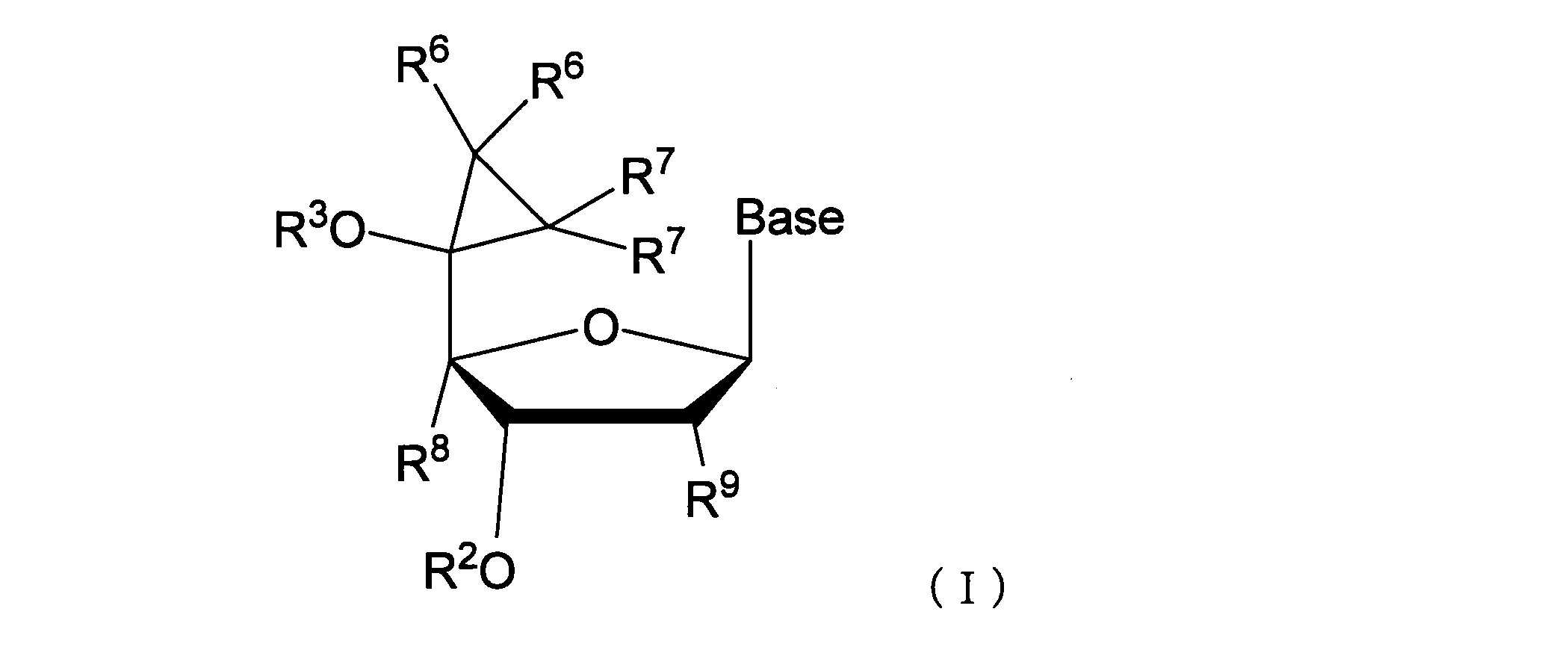
- the present invention includes a compound represented by the following formula (I) or a salt thereof:
- Base represents a purin-9-yl group or a 2-oxo-1,2-dihydropyrimidin-1-yl group which may have one or more optional substituents selected from the ⁇ group, wherein:
- the ⁇ group is protected by a hydroxyl group, a hydroxyl group protected by a protective group for nucleic acid synthesis, a linear alkyl group having 1 to 6 carbon atoms, a linear alkoxy group having 1 to 6 carbon atoms, a mercapto group, a protective group for nucleic acid synthesis.
- An acyl group optionally having one or more substituents, a silyl group optionally having one or more substituents selected from the ⁇ group, and an optional substituent selected from the ⁇ group The above-mentioned phosphate group, a phosphate group protected by a protective group for nucleic acid synthesis, -P(R 4 )R 5 [wherein R 4 and R 5 are each independently a hydroxyl group, Hydroxyl group protected by a protective group for nucleic acid synthesis, mercapto group, mercapto group protected by
- a straight-chain alkoxy group having 1 to 6 carbon atoms which may be substituted with an alkoxy group; or -OR 10 [wherein R 10 is a hydrogen atom or a hydroxyl-protecting group for nucleic acid synthesis], or R 8 and R 9 taken together are of the formula:
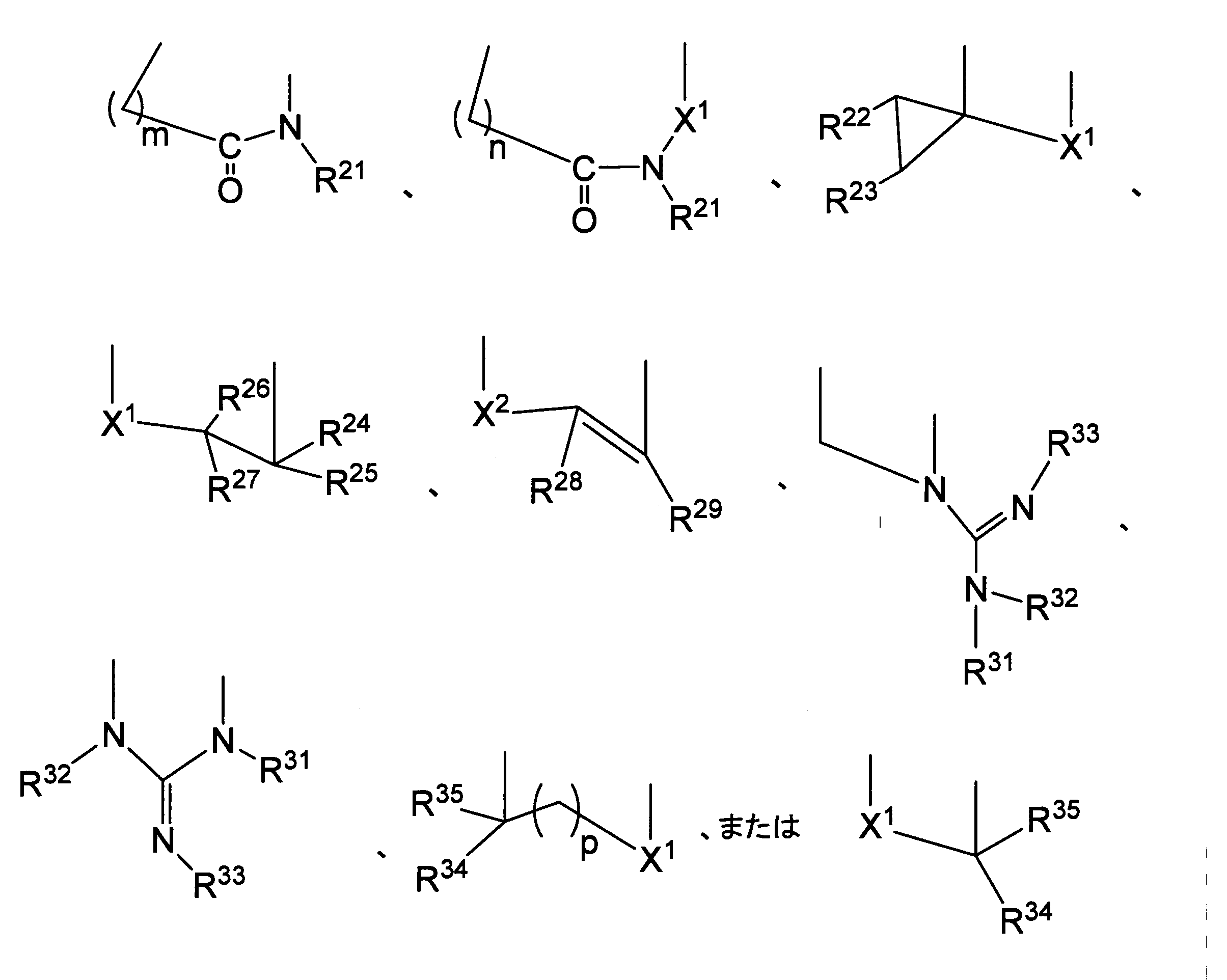
- R 21 is a hydrogen atom, an alkyl group having 1 to 6 carbon atoms which may form a branch or ring, an alkenyl group having 2 to 6 carbon atoms which may form a branch or ring, and is selected from the ⁇ group. Which may have one or more optional substituents and which may contain a hetero atom, have an aryl group having 3 to 10 carbon atoms, and have one or more optional substituents selected from the ⁇ group.
- R 22 and R 23 may each independently be a hydrogen atom; may be substituted with an aryl group having 3 to 12 carbon atoms which may contain a hetero atom, and may form a branch or a ring.
- R 24 and R 25 are taken together to form ⁇ C(R 36 )R 37 [wherein R 36 and R 37 are each independently a hydrogen atom, a hydroxyl group, or a hydroxyl group protected by a protective group for nucleic acid synthesis].
- a mercapto group, a mercapto group protected by a protective group for nucleic acid synthesis, an amino group, a linear or branched alkoxy group having 1 to 6 carbon atoms, a linear or branched alkylthio group having 1 to 6 carbon atoms, and 1 carbon atom Represents a cyanoalkoxy group having 1 to 6 or a linear or branched alkylamino group having 1 to 6 carbon atoms].
- R 26 and R 27 are each independently a hydrogen atom, an alkyl group having 1 to 6 carbon atoms which may form a branch or a ring, and an alkyl group which has 1 to 6 carbon atoms which may form a branch or a ring.
- R 28 is a hydrogen atom, an alkyl group having 1 to 6 carbon atoms which may form a branch or a ring, an alkoxy group having 1 to 6 carbon atoms which may form a branch or a ring, or from 1 carbon atoms.
- R 29 represents a hydrogen atom, a hydroxyl group, an alkyl group having 1 to 6 carbon atoms which may form a branch or a ring, an alkoxy group having 1 to 6 carbon atoms which may form a branch or a ring, an amino group, Or an amino group protected by a protecting group for nucleic acid synthesis
- R 31 , R 32 , and R 33 are each independently a hydrogen atom, an alkyl group having 1 to 6 carbon atoms which may form a branch or a ring, or a protecting group for an amino group in nucleic acid synthesis
- R 34 and R 35 each independently represent a hydrogen atom, a hydroxyl group, an alkyl group having 1 to 6 carbon atoms which may form a branch or ring, or an alkyl group which may form a branch or ring, and having 1 carbon atom.
- the Base is a 6-aminopurin-9-yl group, a 2,6-diaminopurin-9-yl group, a 2-amino-6-chloropurine-9- Group, 2-amino-6-fluoropurin-9-yl group, 2-amino-6-bromopurin-9-yl group, 2-amino-6-hydroxypurin-9-yl group, 6-amino-2 -Methoxypurin-9-yl group, 6-amino-2-chloropurin-9-yl group, 6-amino-2-fluoropurin-9-yl group, 2,6-dimethoxypurin-9-yl group, 2 ,6-dichloropurin-9-yl group, 6-mercaptopurin-9-yl group, 2-oxo-4-amino-1,2-dihydropyrimidin-1-yl group, 4-amino-2-oxo-5 -Fluoro-1,2-di
- the above Base is the following formula:
- R 6 and R 7 are both hydrogen atoms.
- R 8 and R 9 are both hydrogen atoms.
- the present invention also provides an oligonucleotide containing at least one nucleoside structure represented by the following formula (II) or a pharmacologically acceptable salt thereof:
- Base represents a purin-9-yl group or a 2-oxo-1,2-dihydropyrimidin-1-yl group which may have one or more optional substituents selected from the ⁇ group, wherein:
- the ⁇ group is protected by a hydroxyl group, a hydroxyl group protected by a protective group for nucleic acid synthesis, a linear alkyl group having 1 to 6 carbon atoms, a linear alkoxy group having 1 to 6 carbon atoms, a mercapto group, a protective group for nucleic acid synthesis.
- R 6 and R 7 are each independently a hydrogen atom, a halogen atom, or a methyl group
- R 8 is a hydrogen atom
- R 9 is a hydrogen atom, a halogen atom, or a straight chain having 1 to 6 carbon atoms. It is a linear alkoxy group having 1 to 6 carbon atoms which may be substituted with a chain alkoxy group, or R 8 and R 9 are taken together and have the following formula:
- R 21 is a hydrogen atom, an alkyl group having 1 to 6 carbon atoms which may form a branch or ring, an alkenyl group having 2 to 6 carbon atoms which may form a branch or ring, and is selected from the ⁇ group. Which may have one or more optional substituents and which may contain a hetero atom, have an aryl group having 3 to 10 carbon atoms, and have one or more optional substituents selected from the ⁇ group.
- R 22 and R 23 may each independently be a hydrogen atom; may be substituted with an aryl group having 3 to 12 carbon atoms which may contain a hetero atom, and may form a branch or a ring.
- R 24 and R 25 are taken together to form ⁇ C(R 36 )R 37 [wherein R 36 and R 37 are each independently a hydrogen atom, a hydroxyl group, or a hydroxyl group protected by a protective group for nucleic acid synthesis].
- R 26 and R 27 are each independently a hydrogen atom, an alkyl group having 1 to 6 carbon atoms which may form a branch or a ring, and an alkyl group which has 1 to 6 carbon atoms which may form a branch or a ring.
- R 28 represents a hydrogen atom, an alkyl group having 1 to 6 carbon atoms which may form a branch or a ring, an alkoxy group having 1 to 6 carbon atoms which may form a branch or a ring, or from 1 carbon atoms.
- R 29 represents a hydrogen atom, a hydroxyl group, an alkyl group having 1 to 6 carbon atoms which may form a branch or a ring, an alkoxy group having 1 to 6 carbon atoms which may form a branch or a ring, an amino group, Or an amino group protected by a protecting group for nucleic acid synthesis
- R 31 , R 32 , and R 33 are each independently a hydrogen atom, an alkyl group having 1 to 6 carbon atoms which may form a branch or a ring, or a protecting group for an amino group in nucleic acid synthesis
- R 34 and R 35 are each independently a hydrogen atom, a hydroxyl group, an alkyl group having 1 to 6 carbon atoms which may form a branch or ring, or an alkyl group which may form a branch or ring, and having 1 carbon atom.
- R 6 and R 7 are both hydrogen atoms.
- R 8 and R 9 are both hydrogen atoms.
- the present invention also provides a method for producing the above oligonucleotide or a pharmacologically acceptable salt thereof, comprising: A compound represented by the following formula (I) or a pharmacologically acceptable salt thereof:
- Base represents a purin-9-yl group or a 2-oxo-1,2-dihydropyrimidin-1-yl group which may have one or more optional substituents selected from the ⁇ group, wherein:
- the ⁇ group is protected by a hydroxyl group, a hydroxyl group protected by a protective group for nucleic acid synthesis, a linear alkyl group having 1 to 6 carbon atoms, a linear alkoxy group having 1 to 6 carbon atoms, a mercapto group, a protective group for nucleic acid synthesis.
- the phosphate group which may be possessed above, a phosphate group protected by a protecting group for nucleic acid synthesis, -P(R 4 )R 5 [wherein R 4 and R 5 are each independently a hydroxyl group, Hydroxyl group protected by a protective group for nucleic acid synthesis, mercapto group, mercapto group
- a straight-chain alkoxy group having 1 to 6 carbon atoms which may be substituted with an alkoxy group; or -OR 10 [wherein R 10 is a hydrogen atom or a hydroxyl-protecting group for nucleic acid synthesis], or R 8 and R 9 taken together are of the formula:
- R 21 is a hydrogen atom, an alkyl group having 1 to 6 carbon atoms which may form a branch or ring, an alkenyl group having 2 to 6 carbon atoms which may form a branch or ring, and is selected from the ⁇ group. Which may have one or more optional substituents and which may contain a hetero atom, have an aryl group having 3 to 10 carbon atoms, and have one or more optional substituents selected from the ⁇ group.
- R 22 and R 23 may each independently be a hydrogen atom; may be substituted with an aryl group having 3 to 12 carbon atoms which may contain a hetero atom, and may form a branch or a ring.
- R 24 and R 25 are taken together to form ⁇ C(R 36 )R 37 [wherein R 36 and R 37 are each independently a hydrogen atom, a hydroxyl group, or a hydroxyl group protected by a protective group for nucleic acid synthesis].
- R 26 and R 27 are each independently a hydrogen atom, an alkyl group having 1 to 6 carbon atoms which may form a branch or a ring, and an alkyl group which has 1 to 6 carbon atoms which may form a branch or a ring.
- R 28 represents a hydrogen atom, an alkyl group having 1 to 6 carbon atoms which may form a branch or a ring, an alkoxy group having 1 to 6 carbon atoms which may form a branch or a ring, or from 1 carbon atoms.
- R 29 represents a hydrogen atom, a hydroxyl group, an alkyl group having 1 to 6 carbon atoms which may form a branch or a ring, an alkoxy group having 1 to 6 carbon atoms which may form a branch or a ring, an amino group, Or an amino group protected by a protecting group for nucleic acid synthesis
- R 31 , R 32 , and R 33 are each independently a hydrogen atom, an alkyl group having 1 to 6 carbon atoms which may form a branch or a ring, or a protecting group for an amino group in nucleic acid synthesis
- R 34 and R 35 are each independently a hydrogen atom, a hydroxyl group, an alkyl group having 1 to 6 carbon atoms which may form a branch or ring, or an alkyl group which may form a branch or ring, and having 1 carbon atom.
- a novel 5'-modified nucleoside and a nucleotide using the same are provided.
- the 5'-modified nucleoside of the present invention can be used as a substitute for a phosphorothioate-modified nucleic acid, which may be accumulated in a specific organ.
- the 5'-modified nucleoside of the present invention is also excellent in industrial productivity because it does not require a diastereomeric separation step in its production.
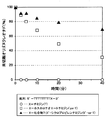
- FIG. 6 is a graph showing the time-dependent change in the ratio of uncleaved oligonucleotide when various oligonucleotides having a sequence of 5′-TTTTTTTTTX-3′ were treated with 3′-exonuclease. It is a graph which shows the mRNA relative expression level which skipped the exon 58 of the dystrophin gene by various oligonucleotides.
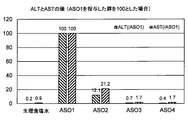
- 3 is a graph showing the antisense effect of various oligonucleotides expressed as a relative value when the value is 100.
- ALT aspartate transaminase
- ALT alanine transaminase
- straight chain alkyl group having 1 to 6 carbon atoms refers to any straight chain alkyl group having 1 to 6 carbon atoms, specifically, methyl group, ethyl group, n-propyl group, An n-butyl group, an n-pentyl group, or an n-hexyl group.
- alkyl group having 1 to 6 carbon atoms refers to any linear, branched or cyclic alkyl group having 1 to 6 carbon atoms.
- linear alkoxy group having 1 to 6 carbon atoms includes an alkoxy group having any linear alkyl group having 1 to 6 carbon atoms.
- methoxy group, ethoxy group, n-propoxy group and the like can be mentioned.
- alkoxy group having 1 to 6 carbon atoms refers to any linear, branched or cyclic alkoxy group having 1 to 6 carbon atoms.
- a straight-chain alkoxy group having 1 to 6 carbon atoms which may be substituted with a straight-chain alkoxy group having 1 to 6 carbon atoms is mentioned above, And one or more hydrogen atoms constituting the "linear alkoxy group having 1 to 6 carbon atoms" are substituted with another "linear alkoxy group having 1 to 6 carbon atoms” which may be the same or different. And an alkoxy group.
- Examples of the "linear alkoxy group having 1 to 6 carbon atoms which may be substituted with a linear alkoxy group having 1 to 6 carbon atoms” include, for example, methoxy group, ethoxy group, n-propoxy group, methoxymethoxy group.
- Ethoxymethoxy group n-propoxymethoxy group, methoxyethoxy group (eg 2-methoxyethoxy group), ethoxyethoxy group (eg 2-ethoxyethoxy group), and n-propoxyethoxy group.
- cyanoalkoxy group having 1 to 6 carbon atoms means that at least one hydrogen atom in any linear, branched or cyclic alkoxy group having 1 to 6 carbon atoms is substituted with a cyano group. Refers to the group.
- linear alkylthio group having 1 to 6 carbon atoms includes an alkylthio group having any linear alkyl group having 1 to 6 carbon atoms. Examples thereof include a methylthio group, an ethylthio group and an n-propylthio group.
- alkylthio group having 1 to 6 carbon atoms refers to any linear, branched or cyclic alkylthio group having 1 to 6 carbon atoms.
- linear alkylamino group having 1 to 6 carbon atoms includes an alkylamino group having one or two alkylamino groups having any linear alkyl group having 1 to 6 carbon atoms. To do. Examples thereof include a methylamino group, a dimethylamino group, an ethylamino group, a methylethylamino group and a diethylamino group.
- an alkyl group having 1 to 7 carbon atoms which may be branched or form a ring means any linear alkyl group having 1 to 7 carbon atoms, or any branched alkyl group having 3 to 7 carbon atoms.
- a chain alkyl group and an arbitrary cyclic alkyl group having 3 to 7 carbon atoms are included. It may be simply referred to as a "lower alkyl group”.
- examples of the linear alkyl group having 1 to 7 carbon atoms include a methyl group, an ethyl group, an n-propyl group, an n-butyl group, an n-pentyl group, an n-hexyl group, and an n-heptyl group.
- examples of the branched chain alkyl group having 3 to 7 carbon atoms include isopropyl group, isobutyl group, tert-butyl group, isopentyl group, and the optional cyclic alkyl group having 3 to 7 carbon atoms includes Examples thereof include a cyclobutyl group, a cyclopentyl group and a cyclohexyl group.
- alkenyl group having 2 to 7 carbon atoms which may be branched or form a ring means any linear alkenyl group having 2 to 7 carbon atoms, or any branched chain having 3 to 7 carbon atoms. It includes a chain alkenyl group and any cyclic alkenyl group having 3 to 7 carbon atoms. It may be simply referred to as a "lower alkenyl group”.
- arbitrary linear alkenyl group having 2 to 7 carbon atoms ethenyl group, 1-propenyl group, 2-propenyl group, 1-butenyl group, 2-butenyl group, 1-pentenyl group, 2-pentenyl group, 3-pentenyl group, 4-pentenyl group, 1-hexenyl group and the like can be mentioned.
- Examples of the branched chain alkenyl group having 3 to 7 carbon atoms include isopropenyl group, 1-methyl-1-propenyl group and 1-methyl group.
- -2-propenyl group 2-methyl-1-propenyl group, 2-methyl-2-propenyl group, 1-methyl-2-butenyl group and the like
- an optional cyclic alkenyl group having 3 to 7 carbon atoms Include a cyclobutenyl group, a cyclopentenyl group, a cyclohexenyl group and the like.
- aryl group having 3 to 10 carbon atoms which may contain a hetero atom refers to any aryl group having 6 to 10 carbon atoms, which is composed of only a hydrocarbon, and the aryl group.
- any heteroaryl group having 3 to 12 carbon atoms in which at least one carbon atom constituting the ring structure is substituted with a hetero atom eg, a nitrogen atom, an oxygen atom, and a sulfur atom, and a combination thereof.
- Examples of the aryl group having 6 to 10 carbon atoms include phenyl group, naphthyl group, indenyl group, and azulenyl group, and examples of the heteroaryl group having 3 to 12 carbon atoms include pyridyl group, pyrrolyl group, Examples thereof include quinolyl group, indolyl group, imidazolyl group, furyl group and thienyl group.
- examples of the term “aralkyl group having an aryl moiety having 3 to 12 carbon atoms which may contain a hetero atom” include benzyl group, phenethyl group, naphthylmethyl group, 3-phenylpropyl group, 2 -Phenylpropyl group, 4-phenylbutyl group, 2-phenylbutyl group, pyridylmethyl group, indolylmethyl group, furylmethyl group, thienylmethyl group, pyrrolylmethyl group, 2-pyridylethyl group, 1-pyridylethyl group, 3 -Thienylpropyl group and the like.
- examples of the term “acyl group” include aliphatic acyl group and aromatic acyl group.
- examples of the aliphatic acyl group include formyl group, acetyl group, propionyl group, butyryl group, isobutyryl group, pentanoyl group, pivaloyl group, valeryl group, isovaleryl group, octanoyl group, nonanoyl group, decanoyl group, 3-methylnonanoyl group, 8-methylnonanoyl group, 3-ethyloctanoyl group, 3,7-dimethyloctanoyl group, undecanoyl group, dodecanoyl group, tridecanoyl group, tetradecanoyl group, pentadecanoyl group, hexadecanoyl group, 1-methylpentadecanoyl group, 14-methylpentadecanoyl group, 13,13-
- halogeno lower alkylcarbonyl groups lower alkoxy lower alkylcarbonyl groups such as methoxyacetyl group; and unsaturated alkylcarbonyl groups such as (E)-2-methyl-2-butenoyl group.
- aromatic acyl groups include arylcarbonyl groups such as benzoyl group, ⁇ -naphthoyl group and ⁇ -naphthoyl group; halogenoarylcarbonyl groups such as 2-bromobenzoyl group and 4-chlorobenzoyl group; 2 , Lower alkylated arylcarbonyl groups such as 4,6-trimethylbenzoyl group and 4-toluoyl group; lower alkoxylated arylcarbonyl groups such as 4-anisoyl group; 2-carboxybenzoyl group, 3-carboxybenzoyl group, 4 -Carboxylated arylcarbonyl groups such as carboxybenzoyl groups; 4-nitrobenzoyl groups, nitrated arylcarbonyl groups such as 2-nitrobenzoyl groups; lower alkoxycarbonylated arylcarbonyl groups such as 2-(methoxycarbonyl)benzoyl groups Group; arylated aryl
- sil group examples include trimethylsilyl group, triethylsilyl group, isopropyldimethylsilyl group, t-butyldimethylsilyl group, methyldiisopropylsilyl group, methyldi-t-butylsilyl group, triisopropylsilyl group.
- a tri-lower alkylsilyl group such as a diphenylmethylsilyl group, a butyldiphenylbutylsilyl group, a diphenylisopropylsilyl group or a tri-loweralkylsilyl group substituted with 1 to 2 aryl groups such as a phenyldiisopropylsilyl group.
- a trimethylsilyl group, a triethylsilyl group, a triisopropylsilyl group, a t-butyldimethylsilyl group and a t-butyldiphenylsilyl group are preferred, and a trimethylsilyl group is more preferred.
- halogen atom includes, for example, fluorine atom, chlorine atom, bromine atom or iodine atom. It is preferably a fluorine atom or a chlorine atom.
- protecting group for amino group in nucleic acid synthesis means those capable of stably protecting an amino group, a hydroxyl group, a phosphate group or a mercapto group during nucleic acid synthesis. If so, there is no particular limitation.
- a protective group that is stable under acidic or neutral conditions and can be cleaved by a chemical method such as hydrogenolysis, hydrolysis, electrolysis, and photolysis.
- protecting groups include, for example, lower alkyl group, lower alkenyl group, acyl group, tetrahydropyranyl or tetrahydrothiopyranyl group, tetrahydrofuranyl or tetrahydrothiofuranyl group, silyl group, lower alkoxymethyl group, lower alkoxy group.
- the tetrahydropyranyl group or the tetrahydrothiopyranyl group includes a tetrahydropyran-2-yl group, a 3-bromotetrahydropyran-2-yl group, a 4-methoxytetrahydropyran-4-yl group and a tetrahydro Examples thereof include a thiopyran-4-yl group and a 4-methoxytetrahydrothiopyran-4-yl group.
- Examples of the tetrahydrofuranyl group or the tetrahydrothiofuranyl group include a tetrahydrofuran-2-yl group and a tetrahydrothiofuran-2-yl group.
- Examples of the lower alkoxymethyl group include a methoxymethyl group, a 1,1-dimethyl-1-methoxymethyl group, an ethoxymethyl group, a propoxymethyl group, an isopropoxymethyl group, a butoxymethyl group and a t-butoxymethyl group.
- Examples of the lower alkoxylated lower alkoxymethyl group include a 2-methoxyethoxymethyl group.
- Examples of the halogeno lower alkoxymethyl group include 2,2,2-trichloroethoxymethyl group and bis(2-chloroethoxy)methyl group.
- Examples of the lower alkoxylated ethyl group include 1-ethoxyethyl group and 1-(isopropoxy)ethyl group.
- halogenated ethyl group examples include a 2,2,2-trichloroethyl group.
- methyl group substituted with 1 to 3 aryl groups examples include benzyl group, ⁇ -naphthylmethyl group, ⁇ -naphthylmethyl group, diphenylmethyl group, triphenylmethyl group, ⁇ -naphthyldiphenylmethyl group, 9-ane Examples thereof include a thrylmethyl group.
- the “methyl group substituted with 1 to 3 aryl groups in which the aryl ring is substituted with a lower alkyl group, a lower alkoxy group, a halogen atom or a cyano group” is 4-methylbenzyl group, 2,4,6- Trimethylbenzyl group, 3,4,5-trimethylbenzyl group, 4-methoxybenzyl group, 4-methoxyphenyldiphenylmethyl group, 4,4'-dimethoxytriphenylmethyl group, 2-nitrobenzyl group, 4-nitrobenzyl group , 4-chlorobenzyl group, 4-bromobenzyl group, 4-cyanobenzyl group and the like.
- lower alkoxycarbonyl group examples include a methoxycarbonyl group, an ethoxycarbonyl group, a t-butoxycarbonyl group and an isobutoxycarbonyl group.
- Aryl group substituted with a halogen atom, a lower alkoxy group or a nitro group means 4-chlorophenyl group, 2-fluorophenyl group, 4-methoxyphenyl group, 4-nitrophenyl group, 2,4-dinitrophenyl group. And so on.
- Examples of the "lower alkoxycarbonyl group substituted with a halogen atom or a tri-lower alkylsilyl group” include a 2,2,2-trichloroethoxycarbonyl group and a 2-trimethylsilylethoxycarbonyl group.
- Examples of the alkenyloxycarbonyl group include a vinyloxycarbonyl group and an aryloxycarbonyl group.
- aralkyloxycarbonyl group in which the aryl ring may be substituted with a lower alkoxy or nitro group is "benzyloxycarbonyl group, 4-methoxybenzyloxycarbonyl group, 3,4-dimethoxybenzyloxycarbonyl group, 2-nitro” Examples thereof include a benzyloxycarbonyl group and a 4-nitrobenzyloxycarbonyl group.
- the “protecting group for hydroxyl group in nucleic acid synthesis” includes, for example, an aliphatic acyl group, an aromatic acyl group, a methyl group substituted with 1 to 3 aryl groups, “lower alkyl, lower alkoxy, Halogen, a methyl group substituted with 1 to 3 aryl groups in which the aryl ring is substituted with a cyano group, and a silyl group.
- the “protecting group for hydroxyl group in nucleic acid synthesis” is, for example, acetyl group, benzoyl group, benzyl group, p-methoxybenzoyl group, dimethoxytrityl group, monomethoxytrityl group, tert-butyldiphenylsilyl.
- tert-butyldimethylsilyl TDMS
- TDMS tert-butyldimethylsilyl
- TOM triisopropylsilyl
- NOM bis(acetoxyethoxy)methyl ether
- Mthp tetrahydro-4-methoxy-2H-pyran-2-yl
- CEE 1-(2-cyanoethoxy)ethyl
- CEM 2-cyanoethoxymethyl
- tert-butyldithiomethyl examples include a (DTM) group, a 2-(4-tolylsulfonyl)ethoxymethyl (TEM) group, and a 4-(N-dichloroacetyl-N-methylamino)benzyloxymethyl (4-MABOM) group.
- examples of the protecting group of the “hydroxyl group protected by a protecting group for nucleic acid synthesis” include an aliphatic acyl group, an aromatic acyl group, and a “methyl group substituted with 1 to 3 aryl groups”. , "Aryl group substituted with halogen atom, lower alkoxy group or nitro group", lower alkyl group, and lower alkenyl group.
- the protecting group of “hydroxyl group protected by a protecting group for nucleic acid synthesis” includes, for example, benzoyl group, benzyl group, 2-chlorophenyl group, 4-chlorophenyl group, and 2-propenyl group.
- examples of the “protecting group for amino group in nucleic acid synthesis” include an acyl group, and preferably a benzoyl group.
- the “protecting group” of the “phosphate group protected by a protecting group for nucleic acid synthesis” is, for example, a lower alkyl group, a lower alkyl group substituted with a cyano group, an aralkyl group, a “nitro group or And an "aralkyl group in which the aryl ring is substituted with a halogen atom", and "an aryl group substituted with a lower alkyl group, a halogen atom, or a nitro group”.
- the "protecting group" of the "phosphate group protected by a protecting group for nucleic acid synthesis” is, for example, 2-cyanoethyl group, 2,2,2-trichloroethyl group, benzyl group, 2 Examples thereof include a -chlorophenyl group and a 4-chlorophenyl group.
- examples of the "protecting group” of the “mercapto group protected by a protecting group for nucleic acid synthesis” include an aliphatic acyl group and an aromatic acyl group, and preferably a benzoyl group.
- R 4 and R 5 are each independently a hydroxyl group, a hydroxyl group protected by a nucleic acid synthesis protecting group, a mercapto group, or a nucleic acid synthesis protecting group.
- the phosphoramidite group is preferably a group represented by the formula —P(OC 2 H 4 CN)(N(iPr) 2 ), or a group represented by the formula —P(OCH 3 )(N(iPr) 2 ).
- the groups represented may be mentioned.
- iPr represents an isopropyl group.
- nucleoside and nucleoside analogue mean a non-natural type of “nucleoside” in which a purine or pyrimidine base and a sugar are bound, and an aromatic heterocycle other than purine and pyrimidine. And an aromatic hydrocarbon ring capable of substituting a purine or pyrimidine base and a sugar bound thereto.
- the terms “artificial oligonucleotide” and “oligonucleotide analog” mean the same or different “nucleoside” or “nucleoside analog”, for example, an “oligonucleotide” in which 2 to 50 phosphoside ester bonds are linked by a phosphodiester bond.
- Preferable examples of such analogs include sugar derivatives modified in sugar moieties; thioate derivatives in which phosphodiester moieties are thioated; ester derivatives in which terminal phosphate moieties are esterified; Examples thereof include amides in which the amino group is amidated, and more preferable examples include sugar derivatives with modified sugar moieties.
- salt thereof refers to a salt of the compound represented by the formula (I) or (II) of the present invention.
- examples of such salts include sodium salts, potassium salts, alkali metal salts such as lithium salts, calcium salts, alkaline earth metal salts such as magnesium salts, aluminum salts, iron salts, zinc salts, copper salts, Metal salts such as nickel salts and cobalt salts; inorganic salts such as ammonium salts, t-octylamine salts, dibenzylamine salts, morpholine salts, glucosamine salts, phenylglycine alkyl ester salts, ethylenediamine salts, N-methylglucamine salts , Guanidine salt, diethylamine salt, triethylamine salt, dicyclohexylamine salt, N,N'-dibenzylethylenediamine salt, chloroprocaine salt, procaine salt, diethanolamine salt
- the term “pharmacologically acceptable salt thereof” refers to a salt of an oligonucleotide analogue containing at least one nucleoside structure represented by the formula (II) of the present invention.
- such salts include sodium salts, potassium salts, alkali metal salts such as lithium salts, calcium salts, alkaline earth metal salts such as magnesium salts, aluminum salts, iron salts, zinc salts, copper salts, Metal salts such as nickel salts and cobalt salts; inorganic salts such as ammonium salts, t-octylamine salts, dibenzylamine salts, morpholine salts, glucosamine salts, phenylglycine alkyl ester salts, ethylenediamine salts, N-methylglucamine salts , Guanidine salt, diethylamine salt, triethylamine salt, dicyclohexylamine salt, N,N'-dibenzylethylened
- Inorganic acid salts such as chlorates, sulfates and phosphates; lower alkane sulfonates such as methane sulfonate, trifluoromethane sulfonate and ethane sulfonate, benzene sulfonate, p-toluene sulfonate
- Aryl sulfonates such as salts, acetates, malates, fumarates, succinates, citrates, tartrates, oxalates, maleates, and other organic acid salts; and glycine salts, lysine Amino acid salts such as salts, arginine salts, ornithine salts, glutamate and aspartate are mentioned.
- the 5'-modified nucleoside of the present invention has the following formula (I):
- Base represents a purin-9-yl group or a 2-oxo-1,2-dihydropyrimidin-1-yl group which may have one or more optional substituents selected from the ⁇ group, wherein:
- the ⁇ group is protected by a hydroxyl group, a hydroxyl group protected by a protective group for nucleic acid synthesis, a linear alkyl group having 1 to 6 carbon atoms, a linear alkoxy group having 1 to 6 carbon atoms, a mercapto group, a protective group for nucleic acid synthesis.
- An acyl group optionally having one or more substituents, a silyl group optionally having one or more substituents selected from the ⁇ group, and an optional substituent selected from the ⁇ group The above-mentioned phosphate group, a phosphate group protected by a protective group for nucleic acid synthesis, -P(R 4 )R 5 [wherein R 4 and R 5 are each independently a hydroxyl group, Hydroxyl group protected by a protective group for nucleic acid synthesis, mercapto group, mercapto group protected by
- a straight-chain alkoxy group having 1 to 6 carbon atoms which may be substituted with an alkoxy group; or -OR 10 [wherein R 10 is a hydrogen atom or a hydroxyl-protecting group for nucleic acid synthesis], or R 8 and R 9 taken together are of the formula:
- R 21 is a hydrogen atom, an alkyl group having 1 to 6 carbon atoms which may form a branch or ring, an alkenyl group having 2 to 6 carbon atoms which may form a branch or ring, and is selected from the ⁇ group. Which may have one or more optional substituents and which may contain a hetero atom, have an aryl group having 3 to 10 carbon atoms, and have one or more optional substituents selected from the ⁇ group.
- R 22 and R 23 may each independently be a hydrogen atom; may be substituted with an aryl group having 3 to 12 carbon atoms which may contain a hetero atom, and may form a branch or a ring.
- R 24 and R 25 are taken together to form ⁇ C(R 36 )R 37 [wherein R 36 and R 37 are each independently a hydrogen atom, a hydroxyl group, or a hydroxyl group protected by a protective group for nucleic acid synthesis].
- R 26 and R 27 are each independently a hydrogen atom, an alkyl group having 1 to 6 carbon atoms which may form a branch or a ring, and an alkyl group which has 1 to 6 carbon atoms which may form a branch or a ring.
- R 28 represents a hydrogen atom, an alkyl group having 1 to 6 carbon atoms which may form a branch or a ring, an alkoxy group having 1 to 6 carbon atoms which may form a branch or a ring, or from 1 carbon atoms.
- R 29 represents a hydrogen atom, a hydroxyl group, an alkyl group having 1 to 6 carbon atoms which may form a branch or a ring, an alkoxy group having 1 to 6 carbon atoms which may form a branch or a ring, an amino group, Or an amino group protected by a protecting group for nucleic acid synthesis
- R 31 , R 32 , and R 33 are each independently a hydrogen atom, an alkyl group having 1 to 6 carbon atoms which may form a branch or a ring, or a protecting group for an amino group in nucleic acid synthesis
- R 34 and R 35 are each independently a hydrogen atom, a hydroxyl group, an alkyl group having 1 to 6 carbon atoms which may form a branch or ring, or an alkyl group which may form a branch or ring, and having 1 carbon atom.
- Base is, for example, a purine base (ie, purine-9-yl group) or a pyrimidine base (ie, 2-oxo-1,2-dihydropyrimidin-1-yl group).
- bases include a hydroxyl group, a linear alkyl group having 1 to 6 carbon atoms, a linear alkoxy group having 1 to 6 carbon atoms, a mercapto group, a linear alkylthio group having 1 to 6 carbon atoms, an amino group, and 1 to 6 carbon atoms. It may have one or more optional substituents selected from the ⁇ group consisting of the linear alkylamino group of 6 and a halogen atom.
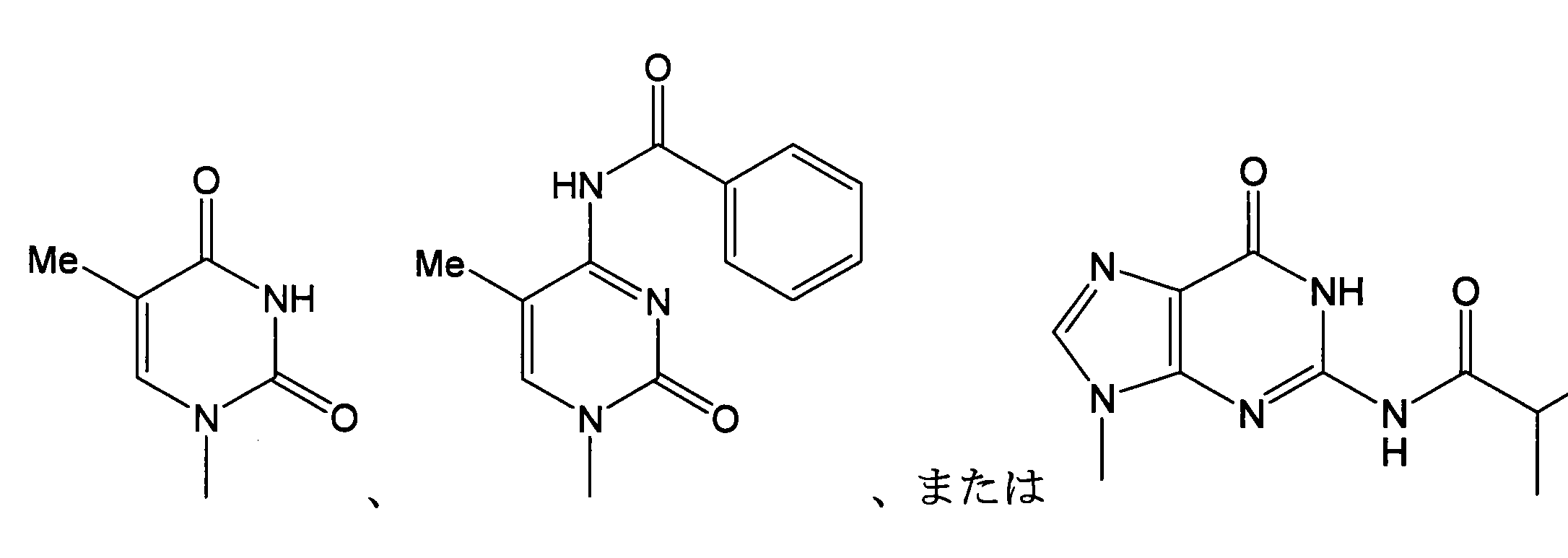
- Base examples include an adenylyl group, a guanynyl group, a cytosinyl group, a uracinyl group, and a thyminyl group, and a 6-aminopurin-9-yl group, a 2,6-diaminopurin-9-yl group, 2 -Amino-6-chloropurin-9-yl group, 2-amino-6-fluoropurin-9-yl group, 2-amino-6-bromopurin-9-yl group, 2-amino-6-hydroxypurine- 9-yl group, 6-amino-2-methoxypurine-9-yl group, 6-amino-2-chloropurin-9-yl group, 6-amino-2-fluoropurin-9-yl group, 2,6 -Dimethoxypurin-9-yl group, 2,6-dichloropurin-9-yl group, 6-mercaptopurin
- Base is the following structural formula from the viewpoint of introduction into a nucleic acid drug:
- “Base” is preferably one in which the hydroxyl group and amino group constituting the above group are protected by a protecting group during the synthesis of the oligonucleotide.
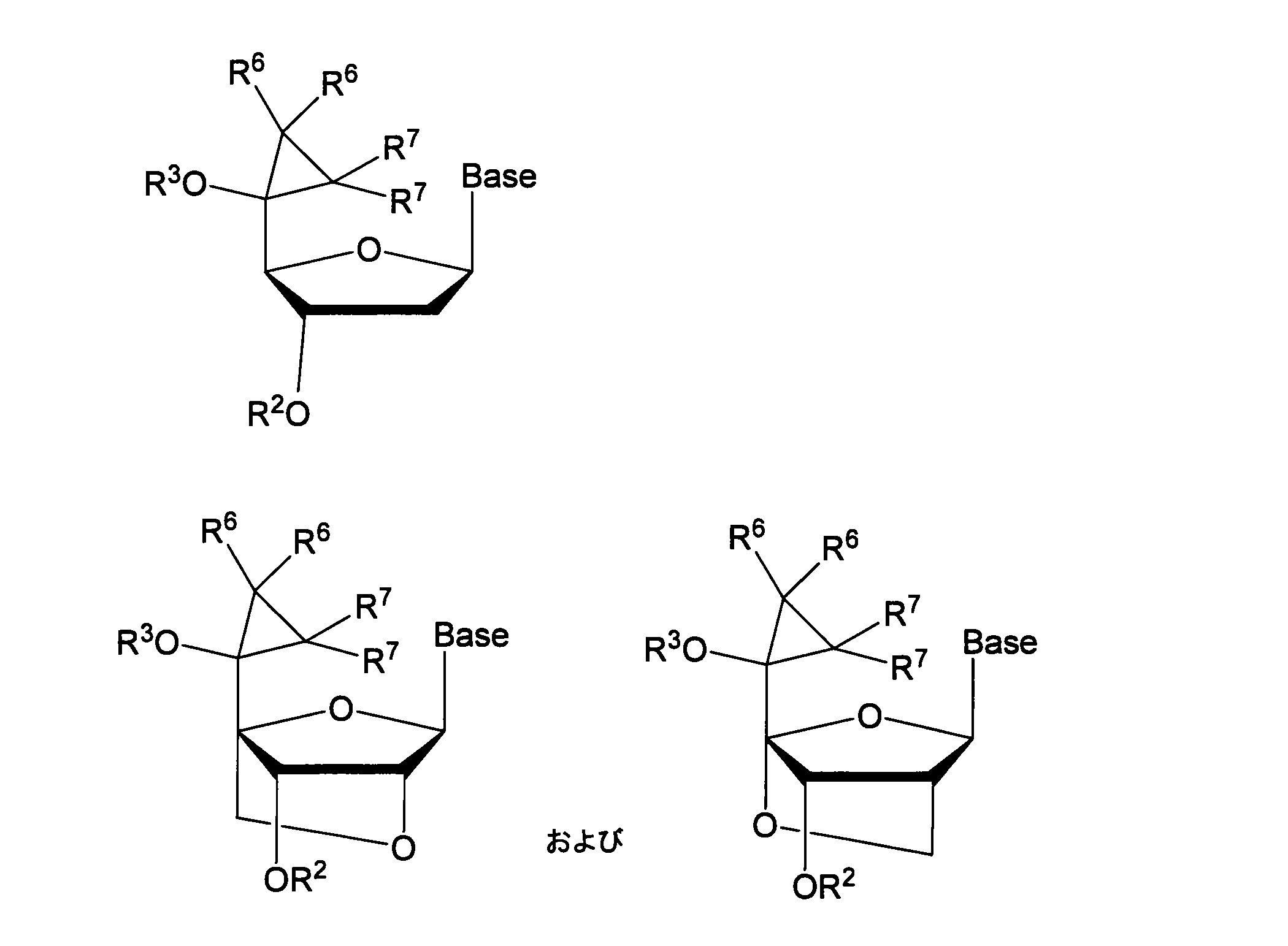
- the nucleoside of the present invention In the 5′-position modified nucleoside of the present invention, two identical R 6 are bonded to one carbon atom constituting the 5′-position cyclopropane moiety of the formula (I), and two carbon atoms are bonded to another carbon atom. The same R 7 is attached. Due to having such a structure, the nucleoside of the present invention cannot have a diastereomeric structure at the 5'position, and is compared with a conventional artificial nucleic acid having a substituent introduced at the 5'position. , Freeing the need to separate diastereomers during their synthesis.
- the 2′-position and the 4′-position of the formula (I) are as follows:
- R 8 and R 9 are crosslinked together. It may have a structure, or each of R 8 and R 9 may be a hydrogen atom. In one embodiment of the present invention, R 8 and R 9 in the above formula (I) are both hydrogen atoms.
- the nuclease resistance of the oligonucleotide described below is improved by introducing a cyclopropane moiety at the 5'position of formula (I). Further, such ring strain in the cyclopropane group directly affects the conformation of the sugar moiety. Therefore, the 5'-modified nucleoside of the present invention can further improve the binding affinity of the obtained oligonucleotide with ssRNA due to the influence.
- the oligonucleotide uses such a 5′-modified nucleoside of the formula (I), for example, the amidite method well known in the art, or M. Kuwahara et al., Nucleic Acids Res., 2008, 36 volumes. , No. 13, pages 4257-4265, and can be easily produced via triphosphorylation.
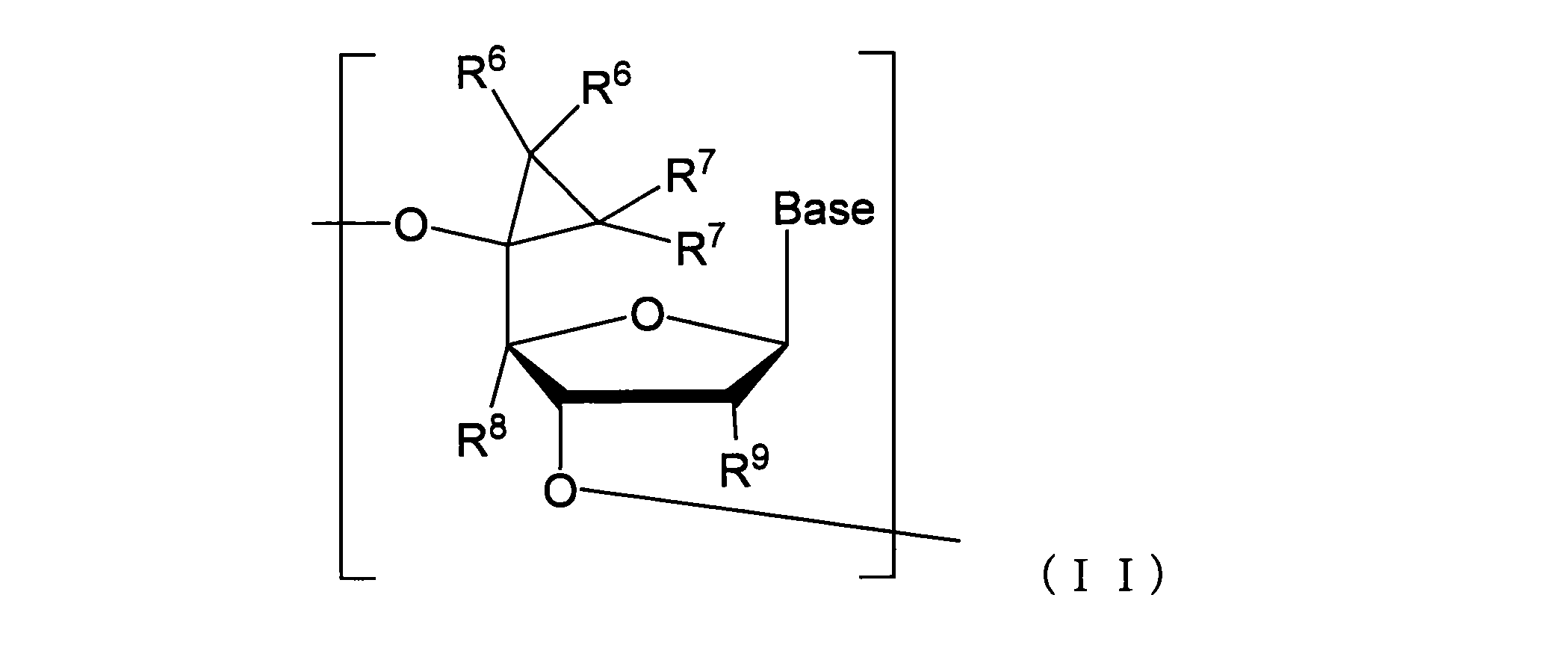
- oligonucleotide of the present invention or a pharmacologically acceptable salt thereof (hereinafter, these may be collectively referred to as “oligonucleotide of the present invention”) has the following formula (II):
- Base represents a purin-9-yl group or a 2-oxo-1,2-dihydropyrimidin-1-yl group which may have one or more optional substituents selected from the ⁇ group, wherein:
- the ⁇ group is protected by a hydroxyl group, a hydroxyl group protected by a protective group for nucleic acid synthesis, a linear alkyl group having 1 to 6 carbon atoms, a linear alkoxy group having 1 to 6 carbon atoms, a mercapto group, a protective group for nucleic acid synthesis.
- R 6 and R 7 are each independently a hydrogen atom, a halogen atom, or a methyl group
- R 8 is a hydrogen atom
- R 9 is a hydrogen atom, a halogen atom, or a straight chain having 1 to 6 carbon atoms. It is a linear alkoxy group having 1 to 6 carbon atoms which may be substituted with a chain alkoxy group, or R 8 and R 9 are taken together and are represented by the following formulas (CR01) to (CR11):
- R 21 is a hydrogen atom, an alkyl group having 1 to 6 carbon atoms which may form a branch or ring, an alkenyl group having 2 to 6 carbon atoms which may form a branch or ring, and is selected from the ⁇ group. Which may have one or more optional substituents and which may contain a hetero atom, have an aryl group having 3 to 10 carbon atoms, and have one or more optional substituents selected from the ⁇ group.
- R 22 and R 23 may each independently be a hydrogen atom; may be substituted with an aryl group having 3 to 12 carbon atoms which may contain a hetero atom, and may form a branch or a ring.
- R 24 and R 25 are taken together to form ⁇ C(R 36 )R 37 [wherein R 36 and R 37 are each independently a hydrogen atom, a hydroxyl group, or a hydroxyl group protected by a protective group for nucleic acid synthesis].
- R 26 and R 27 are each independently a hydrogen atom, an alkyl group having 1 to 6 carbon atoms which may form a branch or a ring, and an alkyl group which has 1 to 6 carbon atoms which may form a branch or a ring.
- R 28 represents a hydrogen atom, an alkyl group having 1 to 6 carbon atoms which may form a branch or a ring, an alkoxy group having 1 to 6 carbon atoms which may form a branch or a ring, or from 1 carbon atoms.
- R 29 represents a hydrogen atom, a hydroxyl group, an alkyl group having 1 to 6 carbon atoms which may form a branch or a ring, an alkoxy group having 1 to 6 carbon atoms which may form a branch or a ring, an amino group, Or an amino group protected by a protecting group for nucleic acid synthesis
- R 31 , R 32 , and R 33 are each independently a hydrogen atom, an alkyl group having 1 to 6 carbon atoms which may form a branch or a ring, or a protecting group for an amino group in nucleic acid synthesis
- R 34 and R 35 are each independently a hydrogen atom, a hydroxyl group, an alkyl group having 1 to 6 carbon atoms which may form a branch or ring, or an alkyl group which may form a branch or ring, and having 1 carbon atom.
- the structures represented by the formulas (CR07) and (CR09) are any anions existing around the crosslinked structure.
- hydroxide ion, phosphate ion, chloride ion it is held electrically neutral.
- examples of the nucleoside structure of the formula (II) contained in the oligonucleotide of the present invention are:
- R 6 and R 7 in the above formula (II) are hydrogen atoms.
- examples of the nucleoside structure of formula (II) included in the oligonucleotide of the present invention are:
- R 6 and R 7 are the same as those defined in the above formula (II)). In one embodiment of the present invention, both R 6 and R 7 in formula (II) above are hydrogen atoms.
- the oligonucleotide of the present invention has at least one nucleoside structure described above at an arbitrary position.
- the position and the number are not particularly limited and may be appropriately designed according to the purpose.
- the oligonucleotide (antisense molecule) containing such a nucleoside structure has dramatically improved nuclease resistance as compared to the case of using the conventional 2',4'-BNA/LNA. It also has an ssRNA binding affinity comparable to the known 2',4'-BNA/LNA. Further, the oligonucleotide can reduce hepatotoxicity without impairing antisense activity.
- the oligonucleotide of the present invention synthesized by using the 5'-modified nucleoside of the present invention inhibits or restores the action of specific genes such as antitumor agents and antiviral agents to cause diseases. It is expected to be useful as a drug (antisense molecule) for treating An example of a drug expected to have such usefulness is a muscular dystrophy therapeutic drug.
- the antisense method requires both binding affinity for complementary sense strand RNA and resistance to in vivo DNA degrading enzyme.
- the structure of the sugar moiety of a nucleic acid constantly fluctuates between a shape close to a DNA duplex and a shape close to a DNA-RNA duplex or an RNA duplex. It has been known.
- a single-stranded nucleic acid forms a double strand with a complementary RNA strand, its sugar moiety structure is fixed.
- the sugar part is fixed in a state where a double chain is formed in advance, it is easy to form a double chain with the RNA strand of interest, and it should be stably present.
- the oligonucleotide of the present invention contains, for example, an auxiliary agent usually used in the technical field of pharmaceutical formulation such as an excipient, a binder, a preservative, an oxidative stabilizer, a disintegrating agent, a lubricant, a corrigent, and the like, It can be a parenteral preparation or a liposome preparation. Further, for example, a pharmaceutical preparation commonly used in this technical field can be blended to prepare a topical preparation such as a solution, a cream or an ointment.
- an auxiliary agent usually used in the technical field of pharmaceutical formulation such as an excipient, a binder, a preservative, an oxidative stabilizer, a disintegrating agent, a lubricant, a corrigent, and the like
- a parenteral preparation or a liposome preparation can be blended to prepare a topical preparation such as a solution, a cream or an ointment.
- Table 1 shows the physical property data of the obtained compound 3.
- Table 2 shows the physical property data of the obtained compound 4.
- Table 3 shows the physical data of the obtained compound 5.
- Table 4 shows the physical property data of the obtained compound 6.
- N,N-diisopropylethylamine DIPEA; 1.85 mL, 10.8 mmol
- 2-cyanoethyl 2-cyanoethyl
- Table 5 shows the physical property data of the obtained compound 7.
- Table 6 shows the physical property data of the obtained compound 8.
- Benzoyl chloride (BzCl; 850 ⁇ L, 7.34 mmol) was added to an anhydrous pyridine solution (50 mL) of Compound 8 (3.20 g, 4.89 mmol) obtained above, and the mixture was stirred at 0° C. for 1.5 hours. After the reaction was completed, water was added and the mixture was extracted with ethyl acetate. After washing the organic layer with water, the solvent was distilled off under reduced pressure and azeotropic distillation with toluene was performed.
- Table 7 shows the physical data of the obtained compound 9.
- Table 8 shows the physical property data of the obtained compound 10.
- N,N-diisopropylethylamine DIEPA; 1.85 mL, 10.8 mmol
- 2-cyanoethyl 2-cyanoethyl
- an anhydrous acetonitrile solution 36 mL
- —N,N-Diisopropylphosphorochloridate iPr 2 NP(Cl)OCH 2 CH 2 CN; 1.20 mL, 5.34 mmol
- Table 9 shows the physical data of the obtained compound 11.
- Table 10 shows the physical property data of the obtained compound 13.
- Table 11 shows the physical property data of the obtained compound 14.
- Table 12 shows the physical property data of Compound 15 obtained.
- Table 13 shows the physical property data of Compound 16 thus obtained.
- Table 14 shows the physical property data of Compound 17 obtained.
- Table 15 shows the physical property data of Compound 18 obtained.
- Table 16 shows the physical property data of Compound 19 thus obtained.
- N,N-diisopropylethylamine DIPEA; 1.5 mL, 8.77 mmol
- 2-cyanoethyl- 2-cyanoethyl- were added to a deoxygenated dichloromethane solution (11 mL) of the compound 19 (733 mg, 1.11 mmol) obtained above.
- N,N-Diisopropylphosphorochloridate iPr 2 NP(Cl)OCH 2 CH 2 CN; 1.0 mL, 4.48 mmol
- Table 17 shows the physical property data of the obtained compound 20.
- TEMPO 2,2,6,6-tetramethylpiperidine 1-oxyl Free radicals
- Table 18 shows the physical data of the obtained compound 22.
- Table 19 shows the physical property data of the obtained compound 23.
- Table 20 shows the physical property data of the obtained compound 24.
- Table 21 shows the physical property data of the obtained compound 25.
- Table 22 shows the physical property data of the obtained compound 26.
- N,N-diisopropylethylamine DIPEA; 490 ⁇ L, 2.87 mmol
- 2-cyanoethyl-N 2-cyanoethyl-N
- anhydrous acetonitrile solution 9 mL
- N-diisopropyl phosphorochloridate iPr 2 NP(Cl)OCH 2 CH 2 CN; 320 ⁇ L, 1.43 mmol
- Table 23 shows the physical data of the obtained compound 27.
- Table 24 shows the physical property data of the obtained compound 25a.
- Table 25 shows the physical property data of the obtained compound 26a.
- Table 26 shows the physical property data of the obtained compound 27a.
- N,N-diisopropylethylamine (420 ⁇ L, 2.46 mmol) and 2-cyanoethyl-N,N- were added to an anhydrous acetonitrile solution (6.1 mL) of compound 27a (410 mg, 0.61 mmol) obtained above.
- Table 27 shows the physical data of the obtained compound 28.
- Table 28 shows the physical property data of Compound 31 thus obtained.
- Table 29 shows the physical data of the obtained compound 32.
- Table 30 shows the physical property data of the obtained compound 33.
- Table 31 shows the physical property data of the obtained compound 34.
- Table 32 shows the physical property data of the obtained compound 35.
- Table 33 shows the physical data of the obtained compound 38.
- Table 34 shows the physical data of the obtained compound 39.
- Table 35 shows the physical data of the obtained compound 40.
- Table 36 shows the physical data of the obtained compound 41.
- the compound 41 (67 mg, 0.15 mmol) obtained above was dissolved in anhydrous acetonitrile solvent (440 ⁇ L) with N,N-diisopropylethylamine (DIPEA; 75 ⁇ L) and 2-cyanoethyl N,N-diisopropylphosphochloridate ( iPr 2 NP(Cl)OCH 2 CH 2 CN; 65 ⁇ L) was sequentially added, and the mixture was stirred at room temperature for 3 hours.
- DIPEA N,N-diisopropylethylamine
- 2-cyanoethyl N,N-diisopropylphosphochloridate iPr 2 NP(Cl)OCH 2 CH 2 CN; 65 ⁇ L
- Table 37 shows the physical data of the obtained compound 42.
- Table 38 shows the physical property data of the obtained compound 44.
- Benzoyl chloride (390 ⁇ l, 3.4 mmol) was added at 0° C. to the pyridine solution of compound 44 (8.5 ml) obtained above, and the mixture was stirred at 70° C. for 12.5 hours. After completion of the reaction, saturated aqueous sodium hydrogen carbonate solution was added at 0°C, and the mixture was extracted with ethyl acetate. The organic layer was washed with water and saturated brine, dried over anhydrous sodium sulfate, and the solvent was evaporated under reduced pressure.
- Table 39 shows the physical data of the obtained compound 45.
- Table 40 shows the physical property data of the obtained compound 46.
- Table 41 shows the physical data of the obtained compound 47.
- Table 42 shows the physical property data of the obtained compound 48.
- Table 43 shows the physical data of the obtained compound 49.
- the compound 50 can be obtained according to the following synthetic scheme, for example, by the reagents and reaction conditions described in (6-3) to (6-6) of Example 6 above.
- Example 9 Synthesis and purification of oligonucleotides
- Compounds 7, 11, 20, 35 and 42 prepared in Examples 1 to 3, 6, and 7 were used as amidite blocks to synthesize oligonucleotides as follows. ..
- Compounds other than the compounds 7, 11, 20, 35 and 42 constituting the oligonucleotide were purchased from Proligo, unless otherwise specified.
- the product is treated with a 28% aqueous ammonia solution at room temperature for 1.5 hours to be excised from the column carrier, and then left standing at 55° C. for 5 hours or more to deprotect the base portion. I went. Then, it was purified by a simple reverse-phase column (Sep-Pak (registered trademark) Plus C18 Environmental Cartridges manufactured by Waters), and further purified by reverse-phase HPLC.
- a simple reverse-phase column Sep-Pak (registered trademark) Plus C18 Environmental Cartridges manufactured by Waters
- the composition of the purified oligonucleotide was determined by MALDI-TOF-MS measurement.
- a matrix (1 ⁇ L) in which a 3-hydroxypicolinic acid aqueous solution (10 mg/mL) and a diammonium citrate aqueous solution (1 mg/mL) were mixed at a volume ratio of 1:1 was used.
- An oligonucleotide aqueous solution (50 ⁇ M, 1 ⁇ L) was placed on and dried again, and then MALDI-TOF-MS measurement was performed.
- the molecular weight was measured in negative mode and oligothymidylic acid (7mer, 15mer and 23mer) was used as an external standard.
- the amount of the synthesized oligonucleotide was quantified by measuring the ultraviolet absorption at 260 nm using an absorbance measuring device (SHIMADZU UV-1800 manufactured by Shimadzu Corporation).
- the ability of the oligonucleotide to form a double strand was examined by measuring the T m value after annealing each oligonucleotide and the target strand to form a double strand. More specifically, a mixture of each oligonucleotide (final concentration 4 ⁇ M) and sodium chloride (final concentration 100 mM) in phosphate buffer (10 mM, pH 7.2, 130 ⁇ L) was bathed in boiling water and slowly cooled to room temperature. .. Then, it cooled to 5 degreeC under nitrogen stream, and started the measurement. The temperature was raised to 90° C. at 0.5° C./minute, and the absorbance at 260 nm was plotted at 0.5° C. intervals. The Tm value was calculated by the median line method and used as the average value of three independent measurements.
- Table 44 shows the results of duplex forming ability: (A): Sequences (1) and (2); (B): Sequences (3) and (4); (C): Sequences (5) and (6); (D): Sequences (7) and (8); (E): Sequences (7), (9) and (10).
- “ssRNA” The results for the single-stranded oligo RNA, single-stranded results for oligo NA are shown in "ssDNA”, and a T m of a respective oligonucleotide, Tm temperature variation per artificially modified nucleic 1 base ( “ ⁇ T m /mod.”).
- both single-stranded oligo DNA and single-stranded oligo RNA are natural oligonucleotides.
- the T m value was only slightly reduced compared to (sequences (1), (3), (5) or (7)) and did not impair the binding affinity.
- sequence (10) especially for single-stranded oligo RNA
- the T m value is increased as compared with the natural oligonucleotide (sequence (7)), and therefore single-stranded oligo RNA It showed a high binding affinity for ⁇ , which was comparable to the 2′,4′-BNA/LNA containing oligonucleotide (sequence (9)).
- Example 11 Evaluation of Nuclease Tolerance
- 3'-exonuclease (Crotalus adamanteus venom phosphodiesterase, CAVP) was added to 50 mM Tris-HCl buffer (pH 8.0) containing 7.5 ⁇ M test oligonucleotide and 10 mM magnesium chloride, and incubated at 37°C. did. At the start of incubation (0 minutes), after 2.5 minutes, after 5 minutes, after 10 minutes, after 20 minutes and after 40 minutes, 10 ⁇ L of each sample was taken out and analyzed by reverse phase HPLC to analyze the uncut oligonucleotide. The ratio was calculated. The evaluation was derived from three independent measurements.
- a mixed solution containing 50 mM Tris-HCl buffer (pH 8.0) and 3 mM magnesium chloride, 75 mM potassium chloride, 10 mM dithiothreitol was added to a test oligonucleotide (60 pmol) and a complementary strand RNA (5′-FAM-) labeled with fluorescein. r(AGCAAAAAAAACGC)-3′) (SEQ ID NO:22) (300 pmol) was dissolved. Each sample was heated to 70° C. and then slowly cooled to room temperature. 2.0 units of E. coli-derived RNase H was added to each sample and incubated at 30°C.
- Oligonucleotides introduced with every third compound are comparable to oligonucleotides without compound 7 (sequence (11)).
- the cutting rate was shown. From this, it was confirmed that the 5'-cyclopropylene modification can also be used for an RNase H-derived antisense oligonucleotide.
- L-lysine (PLL) coated 24-well plates were seeded at 2.0 ⁇ 10 5 cells/well. Twenty-four hours later, cells at about 50% confluence were transfected with a mixture of 30 nM SSO and 2.0 ⁇ L of Lipofectamine 2000 (Invitrogen) according to the package insert of Lipofectamine 2000. 24 hours later, total RNA was collected. For extraction of total RNA, QuickGene 800 and QuickGene RNA Cultured Cell Kit S (Kurabo) were used.
- RNA Plus mode Extraction was performed in RNA Plus mode, and 2 ⁇ RQ1 RNase-Free DNase (Promega) was added during the extraction.
- cDNA conversion was performed using Rever-Tra Ace qPCR RT Master Mix (manufactured by Toyobo Co., Ltd.) according to the package insert.
- SYBRGreen Real-time PCR Master Mix As a PCR reaction reagent, PCR reaction was performed by StepOnePlus (Applied Biosystems).
- the PCR reaction conditions were the protocol of the package insert of SYBR Green Real-time PCR Master Mix (Toyobo) with the annealing temperature of 65° C. and the time of 15 seconds.
- RPLP2 Using RPLP2 as a housekeeping gene, the expression level of the dystrophin minigene was corrected.
- the primer information used for PCR is shown in Table 46 below.
- the skipping activity of exon 58 was calculated by performing the analysis by the calibration curve method. As a control group, those to which nothing was added at the time of transfection and those to which DEPC water (diethylpyrocarbonate-treated water) was added instead of cDNA at the time of quantitative PCR were used.
- results are as shown in Figure 2.
- the results were expressed as the relative expression level of mRNA in which exon 58 of the dystrophin gene was skipped by each of SSO1 to SSO3 oligonucleotides.
- “no treatment” means that nothing was added at the time of transfection
- “water” means that DEPC water was added instead of cDNA during quantitative PCR.
- 5'-cyclopropylene-modified SSO3 significantly improved the exon skipping activity, as compared to LSO-only SSO1. Moreover, since the activity of SSO3 is similar to that of SSO2 modified with phosphorothioate, it was revealed that 5'-cyclopropylene modification has the same ability to improve exon skipping activity as phosphorothioate modification.
- test oligonucleotide (20 mg/kg) was administered to the tail vein of a 6-week-old mouse (C57BL/6NCrl, male). Saline was administered as a control. 96 hours later, blood was collected under inhalation anesthesia (isoflurane) and euthanized by exsanguination. Then, the liver was collected, and the liver weight was measured and RNA was extracted (after homogenization with TRIzol, extraction with phenol/chloroform). The activity of aspartate transaminase (AST) and alanine transaminase (ALT) in blood was measured by an automatic analyzer (JCA-BM6070 manufactured by JEOL Ltd.).
- the mRNA expression levels of the target gene NR3C1 and the housekeeping gene GAPDH are determined by real-time PCR (use kit: One Step SYBR PrimeScript RT-PCR Kit (manufactured by Takara Bio Inc.), primer sequence: NR3C1 forward(actgtcccagcatgccgct) (sequence number).
- NR3C1 reverse (gcagtggctttgctgaatttcc) (SEQ ID NO: 35), GAPDH forward (gtgtgaacggattttggcccgt) (SEQ ID NO: 36), GAPDH reverse (gacaagctttccgtcctctctctctctctctctctctctctctctctctctctctctctctctctctctctctctctctctctctctctctctct
- FIG. 3 is a graph showing the amount of mRNA of the target gene NR3C1 in the mouse liver when each of the test oligonucleotides ASO1, ASO2, ASO3 and ASO4 was administered and when the saline was administered. In this case, it is shown as a relative value when the mRNA amount is 100.
- FIG. 4 is a graph showing the activity of aspartate transaminase (AST) and alanine transaminase (ALT) in blood when the test oligonucleotides ASO1, ASO2, ASO3, and ASO4 were administered and when saline was administered. , And the relative values when the ALT value and the AST value in the case of ASO1 administration are 100 respectively.
- a novel 5'-modified nucleoside that can be used as a substitute for a phosphorothioate-modified nucleic acid and a nucleotide using the same are provided.
- the 5'-modified nucleoside of the present invention is also excellent in industrial productivity because it does not require a diastereomeric separation step in its production.
- the oligonucleotide obtained by using the 5'-modified nucleoside of the present invention is useful, for example, as a material for a nucleic acid drug.
Landscapes
- Chemical & Material Sciences (AREA)
- Organic Chemistry (AREA)
- Health & Medical Sciences (AREA)
- Life Sciences & Earth Sciences (AREA)
- Molecular Biology (AREA)
- Engineering & Computer Science (AREA)
- Genetics & Genomics (AREA)
- Biochemistry (AREA)
- Biotechnology (AREA)
- General Health & Medical Sciences (AREA)
- Biomedical Technology (AREA)
- General Engineering & Computer Science (AREA)
- Bioinformatics & Cheminformatics (AREA)
- Wood Science & Technology (AREA)
- Zoology (AREA)
- Physics & Mathematics (AREA)
- Biophysics (AREA)
- Plant Pathology (AREA)
- Microbiology (AREA)
- Saccharide Compounds (AREA)
- Pharmaceuticals Containing Other Organic And Inorganic Compounds (AREA)
- Medicines That Contain Protein Lipid Enzymes And Other Medicines (AREA)
Abstract
Description
Baseは、α群から選択される任意の置換基を1以上有していてもよいプリン-9-イル基または2-オキソ-1,2-ジヒドロピリミジン-1-イル基を表し、ここで、該α群は、水酸基、核酸合成の保護基で保護された水酸基、炭素数1から6の直鎖アルキル基、炭素数1から6の直鎖アルコキシ基、メルカプト基、核酸合成の保護基で保護されたメルカプト基、炭素数1から6の直鎖アルキルチオ基、アミノ基、炭素数1から6の直鎖アルキルアミノ基、核酸合成の保護基で保護されたアミノ基、およびハロゲン原子からなり、
R2およびR3は、それぞれ独立して、水素原子、核酸合成の水酸基の保護基、分岐または環を形成していてもよい炭素数1から7のアルキル基、分岐または環を形成していてもよい炭素数2から7のアルケニル基、該α群から選択される任意の置換基を1以上有していてもよくそしてヘテロ原子を含んでいてもよい炭素数3から10のアリール基、該α群から選択される任意の置換基を1以上有していてもよくそしてヘテロ原子を含んでいてもよい炭素数3から12のアリール部分を有するアラルキル基、該α群から選択される任意の置換基を1以上有していてもよいアシル基、該α群から選択される任意の置換基を1以上有していてもよいシリル基、該α群から選択される任意の置換基を1以上有していてもよいリン酸基、核酸合成の保護基で保護されたリン酸基、-P(R4)R5[式中、R4およびR5は、それぞれ独立して、水酸基、核酸合成の保護基で保護された水酸基、メルカプト基、核酸合成の保護基で保護されたメルカプト基、アミノ基、炭素数1から6のアルコキシ基、炭素数1から6のアルキルチオ基、炭素数1から6のシアノアルコキシ基、または炭素数1から6のアルキル基を有するジアルキルアミノ基を表す]を表し、
R6およびR7は、それぞれ独立して、水素原子、ハロゲン原子、またはメチル基であり、そして
R8は水素原子でありかつR9は水素原子、ハロゲン原子;炭素数1から6の直鎖アルコキシ基で置換されていてもよい炭素数1から6の直鎖アルコキシ基;または-OR10[式中、R10は水素原子、または核酸合成の水酸基の保護基である]であるか、あるいは
R8およびR9は一緒になって以下の式:
R21は、水素原子、分岐または環を形成していてもよい炭素数1から6のアルキル基、分岐または環を形成していてもよい炭素数2から6のアルケニル基、該α群から選択される任意の置換基を1以上有していてもよくそしてヘテロ原子を含んでいてもよい炭素数3から10のアリール基、該α群から選択される任意の置換基を1以上有していてもよくそしてヘテロ原子を含んでいてもよい炭素数3から12のアリール部分を有するアラルキル基、または核酸合成のアミノ基の保護基であり;
R22およびR23は、それぞれ独立して、水素原子;ヘテロ原子を含んでいてもよい炭素数3から12のアリール基で置換されていてもよく、かつ分岐または環を形成していてもよい炭素数1から6のアルキル基;またはヘテロ原子を含んでいてもよい炭素数3から12のアリール部分を有するアラルキル基;であるか、あるいは
R22およびR23は一緒になって、-(CH2)q-[式中、qは2から5の整数である]を表し;
R24およびR25は、それぞれ独立して、水素原子;水酸基;分岐または環を形成していてもよい炭素数1から6のアルキル基;分岐または環を形成していてもよい炭素数1から6のアルコキシ基;アミノ基;および核酸合成の保護基で保護されたアミノ基;からなる群から選択される基であるか、あるいは、
R24およびR25は一緒になって、=C(R36)R37[式中、R36およびR37は、それぞれ独立して、水素原子、水酸基、核酸合成の保護基で保護された水酸基、メルカプト基、核酸合成の保護基で保護されたメルカプト基、アミノ基、炭素数1から6の直鎖または分岐鎖アルコキシ基、炭素数1から6の直鎖または分岐鎖アルキルチオ基、炭素数1から6のシアノアルコキシ基、または炭素数1から6の直鎖または分岐鎖アルキルアミノ基を表す]を表し;
R26およびR27は、それぞれ独立して、水素原子、分岐または環を形成していてもよい炭素数1から6のアルキル基、分岐または環を形成していてもよい炭素数1から6のアルコキシ基、または炭素数1から6の直鎖または分岐鎖アルキルチオ基であり;
R28は、水素原子、分岐または環を形成していてもよい炭素数1から6のアルキル基、分岐または環を形成していてもよい炭素数1から6のアルコキシ基、または炭素数1から6の直鎖または分岐鎖アルキルチオ基であり;
R29は、水素原子、水酸基、分岐または環を形成していてもよい炭素数1から6のアルキル基、分岐または環を形成していてもよい炭素数1から6のアルコキシ基、アミノ基、あるいは核酸合成の保護基で保護されたアミノ基であり;
R31、R32、およびR33は、それぞれ独立して、水素原子、分岐または環を形成していてもよい炭素数1から6のアルキル基、あるいは核酸合成のアミノ基の保護基であり;
R34およびR35は、それぞれ独立して、水素原子、水酸基、分岐または環を形成していてもよい炭素数1から6のアルキル基、分岐または環を形成していてもよい炭素数1から6のアルコキシ基、アミノ基、または核酸合成の保護基で保護されたアミノ基であり;
mは0から2の整数であり;
nは0から1の整数であり;
pは0から1の整数であり;
X1は、酸素原子、硫黄原子、またはアミノ基であり;そして
X2は酸素原子または硫黄原子である]
で表される二価の基を表す)である。

Baseは、α群から選択される任意の置換基を1以上有していてもよいプリン-9-イル基または2-オキソ-1,2-ジヒドロピリミジン-1-イル基を表し、ここで、該α群は、水酸基、核酸合成の保護基で保護された水酸基、炭素数1から6の直鎖アルキル基、炭素数1から6の直鎖アルコキシ基、メルカプト基、核酸合成の保護基で保護されたメルカプト基、炭素数1から6の直鎖アルキルチオ基、アミノ基、炭素数1から6の直鎖アルキルアミノ基、核酸合成の保護基で保護されたアミノ基、およびハロゲン原子からなり、
R6およびR7は、それぞれ独立して、水素原子、ハロゲン原子、またはメチル基であり、そして
R8は水素原子でありかつR9は水素原子、ハロゲン原子、または炭素数1から6の直鎖アルコキシ基で置換されていてもよい炭素数1から6の直鎖アルコキシ基であるか、あるいはR8およびR9は一緒になって以下の式:

R21は、水素原子、分岐または環を形成していてもよい炭素数1から6のアルキル基、分岐または環を形成していてもよい炭素数2から6のアルケニル基、該α群から選択される任意の置換基を1以上有していてもよくそしてヘテロ原子を含んでいてもよい炭素数3から10のアリール基、該α群から選択される任意の置換基を1以上有していてもよくそしてヘテロ原子を含んでいてもよい炭素数3から12のアリール部分を有するアラルキル基、または核酸合成のアミノ基の保護基であり;
R22およびR23は、それぞれ独立して、水素原子;ヘテロ原子を含んでいてもよい炭素数3から12のアリール基で置換されていてもよく、かつ分岐または環を形成していてもよい炭素数1から6のアルキル基;またはヘテロ原子を含んでいてもよい炭素数3から12のアリール部分を有するアラルキル基;であるか、あるいは
R22およびR23は一緒になって、-(CH2)q-[式中、qは2から5の整数である]を表し;
R24およびR25は、それぞれ独立して、水素原子;水酸基;分岐または環を形成していてもよい炭素数1から6のアルキル基;分岐または環を形成していてもよい炭素数1から6のアルコキシ基;アミノ基;および核酸合成の保護基で保護されたアミノ基;からなる群から選択される基であるか、あるいは、
R24およびR25は一緒になって、=C(R36)R37[式中、R36およびR37は、それぞれ独立して、水素原子、水酸基、核酸合成の保護基で保護された水酸基、メルカプト基、核酸合成の保護基で保護されたメルカプト基、アミノ基、炭素数1から6の直鎖または分岐鎖アルコキシ基、炭素数1から6の直鎖または分岐鎖アルキルチオ基、炭素数1から6のシアノアルコキシ基、または炭素数1から6の直鎖または分岐鎖アルキルアミノ基を表す]を表し;
R26およびR27は、それぞれ独立して、水素原子、分岐または環を形成していてもよい炭素数1から6のアルキル基、分岐または環を形成していてもよい炭素数1から6のアルコキシ基、または炭素数1から6の直鎖または分岐鎖アルキルチオ基であり;
R28は、水素原子、分岐または環を形成していてもよい炭素数1から6のアルキル基、分岐または環を形成していてもよい炭素数1から6のアルコキシ基、または炭素数1から6の直鎖または分岐鎖アルキルチオ基であり;
R29は、水素原子、水酸基、分岐または環を形成していてもよい炭素数1から6のアルキル基、分岐または環を形成していてもよい炭素数1から6のアルコキシ基、アミノ基、あるいは核酸合成の保護基で保護されたアミノ基であり;
R31、R32、およびR33は、それぞれ独立して、水素原子、分岐または環を形成していてもよい炭素数1から6のアルキル基、あるいは核酸合成のアミノ基の保護基であり;
R34およびR35は、それぞれ独立して、水素原子、水酸基、分岐または環を形成していてもよい炭素数1から6のアルキル基、分岐または環を形成していてもよい炭素数1から6のアルコキシ基、アミノ基、または核酸合成の保護基で保護されたアミノ基であり;
mは0から2の整数であり;
nは0から1の整数であり;
pは0から1の整数であり;
X1は、酸素原子、硫黄原子、またはアミノ基であり;そして
X2は酸素原子または硫黄原子である]
で表される二価の基を表す)である。
以下の式(I)で表される化合物またはその薬理学上許容される塩:

Baseは、α群から選択される任意の置換基を1以上有していてもよいプリン-9-イル基または2-オキソ-1,2-ジヒドロピリミジン-1-イル基を表し、ここで、該α群は、水酸基、核酸合成の保護基で保護された水酸基、炭素数1から6の直鎖アルキル基、炭素数1から6の直鎖アルコキシ基、メルカプト基、核酸合成の保護基で保護されたメルカプト基、炭素数1から6の直鎖アルキルチオ基、アミノ基、炭素数1から6の直鎖アルキルアミノ基、核酸合成の保護基で保護されたアミノ基、およびハロゲン原子からなり、
R2およびR3は、それぞれ独立して、水素原子、核酸合成の水酸基の保護基、分岐または環を形成していてもよい炭素数1から7のアルキル基、分岐または環を形成していてもよい炭素数2から7のアルケニル基、該α群から選択される任意の置換基を1以上有していてもよくそしてヘテロ原子を含んでいてもよい炭素数3から10のアリール基、該α群から選択される任意の置換基を1以上有していてもよくそしてヘテロ原子を含んでいてもよい炭素数3から12のアリール部分を有するアラルキル基、該α群から選択される任意の置換基を1以上有していてもよいアシル基、該α群から選択される任意の置換基を1以上有していてもよいシリル基、該α群から選択される任意の置換基を1以上有していてもよいリン酸基、核酸合成の保護基で保護されたリン酸基、-P(R4)R5[式中、R4およびR5は、それぞれ独立して、水酸基、核酸合成の保護基で保護された水酸基、メルカプト基、核酸合成の保護基で保護されたメルカプト基、アミノ基、炭素数1から6のアルコキシ基、炭素数1から6のアルキルチオ基、炭素数1から6のシアノアルコキシ基、または炭素数1から6のアルキル基を有するジアルキルアミノ基を表す]を表し、
R6およびR7は、それぞれ独立して、水素原子、ハロゲン原子、またはメチル基であり、そして
R8は水素原子でありかつR9は水素原子、ハロゲン原子;炭素数1から6の直鎖アルコキシ基で置換されていてもよい炭素数1から6の直鎖アルコキシ基;または-OR10[式中、R10は水素原子、または核酸合成の水酸基の保護基である]であるか、あるいは
R8およびR9は一緒になって以下の式:

R21は、水素原子、分岐または環を形成していてもよい炭素数1から6のアルキル基、分岐または環を形成していてもよい炭素数2から6のアルケニル基、該α群から選択される任意の置換基を1以上有していてもよくそしてヘテロ原子を含んでいてもよい炭素数3から10のアリール基、該α群から選択される任意の置換基を1以上有していてもよくそしてヘテロ原子を含んでいてもよい炭素数3から12のアリール部分を有するアラルキル基、または核酸合成のアミノ基の保護基であり;
R22およびR23は、それぞれ独立して、水素原子;ヘテロ原子を含んでいてもよい炭素数3から12のアリール基で置換されていてもよく、かつ分岐または環を形成していてもよい炭素数1から6のアルキル基;またはヘテロ原子を含んでいてもよい炭素数3から12のアリール部分を有するアラルキル基;であるか、あるいは
R22およびR23は一緒になって、-(CH2)q-[式中、qは2から5の整数である]を表し;
R24およびR25は、それぞれ独立して、水素原子;水酸基;分岐または環を形成していてもよい炭素数1から6のアルキル基;分岐または環を形成していてもよい炭素数1から6のアルコキシ基;アミノ基;および核酸合成の保護基で保護されたアミノ基;からなる群から選択される基であるか、あるいは、
R24およびR25は一緒になって、=C(R36)R37[式中、R36およびR37は、それぞれ独立して、水素原子、水酸基、核酸合成の保護基で保護された水酸基、メルカプト基、核酸合成の保護基で保護されたメルカプト基、アミノ基、炭素数1から6の直鎖または分岐鎖アルコキシ基、炭素数1から6の直鎖または分岐鎖アルキルチオ基、炭素数1から6のシアノアルコキシ基、または炭素数1から6の直鎖または分岐鎖アルキルアミノ基を表す]を表し;
R26およびR27は、それぞれ独立して、水素原子、分岐または環を形成していてもよい炭素数1から6のアルキル基、分岐または環を形成していてもよい炭素数1から6のアルコキシ基、または炭素数1から6の直鎖または分岐鎖アルキルチオ基であり;
R28は、水素原子、分岐または環を形成していてもよい炭素数1から6のアルキル基、分岐または環を形成していてもよい炭素数1から6のアルコキシ基、または炭素数1から6の直鎖または分岐鎖アルキルチオ基であり;
R29は、水素原子、水酸基、分岐または環を形成していてもよい炭素数1から6のアルキル基、分岐または環を形成していてもよい炭素数1から6のアルコキシ基、アミノ基、あるいは核酸合成の保護基で保護されたアミノ基であり;
R31、R32、およびR33は、それぞれ独立して、水素原子、分岐または環を形成していてもよい炭素数1から6のアルキル基、あるいは核酸合成のアミノ基の保護基であり;
R34およびR35は、それぞれ独立して、水素原子、水酸基、分岐または環を形成していてもよい炭素数1から6のアルキル基、分岐または環を形成していてもよい炭素数1から6のアルコキシ基、アミノ基、または核酸合成の保護基で保護されたアミノ基であり;
mは0から2の整数であり;
nは0から1の整数であり;
pは0から1の整数であり;
X1は、酸素原子、硫黄原子、またはアミノ基であり;そして
X2は酸素原子または硫黄原子である]
で表される二価の基を表す)
を用いてオリゴヌクレオチドを合成する工程を包含する、方法である。

Baseは、α群から選択される任意の置換基を1以上有していてもよいプリン-9-イル基または2-オキソ-1,2-ジヒドロピリミジン-1-イル基を表し、ここで、該α群は、水酸基、核酸合成の保護基で保護された水酸基、炭素数1から6の直鎖アルキル基、炭素数1から6の直鎖アルコキシ基、メルカプト基、核酸合成の保護基で保護されたメルカプト基、炭素数1から6の直鎖アルキルチオ基、アミノ基、炭素数1から6の直鎖アルキルアミノ基、核酸合成の保護基で保護されたアミノ基、およびハロゲン原子からなり、
R2およびR3は、それぞれ独立して、水素原子、核酸合成の水酸基の保護基、分岐または環を形成していてもよい炭素数1から7のアルキル基、分岐または環を形成していてもよい炭素数2から7のアルケニル基、該α群から選択される任意の置換基を1以上有していてもよくそしてヘテロ原子を含んでいてもよい炭素数3から10のアリール基、該α群から選択される任意の置換基を1以上有していてもよくそしてヘテロ原子を含んでいてもよい炭素数3から12のアリール部分を有するアラルキル基、該α群から選択される任意の置換基を1以上有していてもよいアシル基、該α群から選択される任意の置換基を1以上有していてもよいシリル基、該α群から選択される任意の置換基を1以上有していてもよいリン酸基、核酸合成の保護基で保護されたリン酸基、-P(R4)R5[式中、R4およびR5は、それぞれ独立して、水酸基、核酸合成の保護基で保護された水酸基、メルカプト基、核酸合成の保護基で保護されたメルカプト基、アミノ基、炭素数1から6のアルコキシ基、炭素数1から6のアルキルチオ基、炭素数1から6のシアノアルコキシ基、または炭素数1から6のアルキル基を有するジアルキルアミノ基を表す]を表し、
R6およびR7は、それぞれ独立して、水素原子、ハロゲン原子、またはメチル基であり、そして
R8は水素原子でありかつR9は水素原子、ハロゲン原子;炭素数1から6の直鎖アルコキシ基で置換されていてもよい炭素数1から6の直鎖アルコキシ基;または-OR10[式中、R10は水素原子、または核酸合成の水酸基の保護基である]であるか、あるいは
R8およびR9は一緒になって以下の式:

R21は、水素原子、分岐または環を形成していてもよい炭素数1から6のアルキル基、分岐または環を形成していてもよい炭素数2から6のアルケニル基、該α群から選択される任意の置換基を1以上有していてもよくそしてヘテロ原子を含んでいてもよい炭素数3から10のアリール基、該α群から選択される任意の置換基を1以上有していてもよくそしてヘテロ原子を含んでいてもよい炭素数3から12のアリール部分を有するアラルキル基、または核酸合成のアミノ基の保護基であり;
R22およびR23は、それぞれ独立して、水素原子;ヘテロ原子を含んでいてもよい炭素数3から12のアリール基で置換されていてもよく、かつ分岐または環を形成していてもよい炭素数1から6のアルキル基;またはヘテロ原子を含んでいてもよい炭素数3から12のアリール部分を有するアラルキル基;であるか、あるいは
R22およびR23は一緒になって、-(CH2)q-[式中、qは2から5の整数である]を表し;
R24およびR25は、それぞれ独立して、水素原子;水酸基;分岐または環を形成していてもよい炭素数1から6のアルキル基;分岐または環を形成していてもよい炭素数1から6のアルコキシ基;アミノ基;および核酸合成の保護基で保護されたアミノ基;からなる群から選択される基であるか、あるいは、
R24およびR25は一緒になって、=C(R36)R37[式中、R36およびR37は、それぞれ独立して、水素原子、水酸基、核酸合成の保護基で保護された水酸基、メルカプト基、核酸合成の保護基で保護されたメルカプト基、アミノ基、炭素数1から6の直鎖または分岐鎖アルコキシ基、炭素数1から6の直鎖または分岐鎖アルキルチオ基、炭素数1から6のシアノアルコキシ基、または炭素数1から6の直鎖または分岐鎖アルキルアミノ基を表す]を表し;
R26およびR27は、それぞれ独立して、水素原子、分岐または環を形成していてもよい炭素数1から6のアルキル基、分岐または環を形成していてもよい炭素数1から6のアルコキシ基、または炭素数1から6の直鎖または分岐鎖アルキルチオ基であり;
R28は、水素原子、分岐または環を形成していてもよい炭素数1から6のアルキル基、分岐または環を形成していてもよい炭素数1から6のアルコキシ基、または炭素数1から6の直鎖または分岐鎖アルキルチオ基であり;
R29は、水素原子、水酸基、分岐または環を形成していてもよい炭素数1から6のアルキル基、分岐または環を形成していてもよい炭素数1から6のアルコキシ基、アミノ基、あるいは核酸合成の保護基で保護されたアミノ基であり;
R31、R32、およびR33は、それぞれ独立して、水素原子、分岐または環を形成していてもよい炭素数1から6のアルキル基、あるいは核酸合成のアミノ基の保護基であり;
R34およびR35は、それぞれ独立して、水素原子、水酸基、分岐または環を形成していてもよい炭素数1から6のアルキル基、分岐または環を形成していてもよい炭素数1から6のアルコキシ基、アミノ基、または核酸合成の保護基で保護されたアミノ基であり;
mは0から2の整数であり;
nは0から1の整数であり;
pは0から1の整数であり;
X1は、酸素原子、硫黄原子、またはアミノ基であり;そして
X2は酸素原子または硫黄原子である]
で表される二価の基を表す)で表される化合物またはその塩である。


Baseは、α群から選択される任意の置換基を1以上有していてもよいプリン-9-イル基または2-オキソ-1,2-ジヒドロピリミジン-1-イル基を表し、ここで、該α群は、水酸基、核酸合成の保護基で保護された水酸基、炭素数1から6の直鎖アルキル基、炭素数1から6の直鎖アルコキシ基、メルカプト基、核酸合成の保護基で保護されたメルカプト基、炭素数1から6の直鎖アルキルチオ基、アミノ基、炭素数1から6の直鎖アルキルアミノ基、核酸合成の保護基で保護されたアミノ基、およびハロゲン原子からなり、
R6およびR7は、それぞれ独立して、水素原子、ハロゲン原子、またはメチル基であり、そして
R8は水素原子でありかつR9は水素原子、ハロゲン原子、または炭素数1から6の直鎖アルコキシ基で置換されていてもよい炭素数1から6の直鎖アルコキシ基であるか、あるいはR8およびR9は一緒になって以下の式(CR01)~(CR11):

R21は、水素原子、分岐または環を形成していてもよい炭素数1から6のアルキル基、分岐または環を形成していてもよい炭素数2から6のアルケニル基、該α群から選択される任意の置換基を1以上有していてもよくそしてヘテロ原子を含んでいてもよい炭素数3から10のアリール基、該α群から選択される任意の置換基を1以上有していてもよくそしてヘテロ原子を含んでいてもよい炭素数3から12のアリール部分を有するアラルキル基、または核酸合成のアミノ基の保護基であり;
R22およびR23は、それぞれ独立して、水素原子;ヘテロ原子を含んでいてもよい炭素数3から12のアリール基で置換されていてもよく、かつ分岐または環を形成していてもよい炭素数1から6のアルキル基;またはヘテロ原子を含んでいてもよい炭素数3から12のアリール部分を有するアラルキル基;であるか、あるいは
R22およびR23は一緒になって、-(CH2)q-[式中、qは2から5の整数である]を表し;
R24およびR25は、それぞれ独立して、水素原子;水酸基;分岐または環を形成していてもよい炭素数1から6のアルキル基;分岐または環を形成していてもよい炭素数1から6のアルコキシ基;アミノ基;および核酸合成の保護基で保護されたアミノ基;からなる群から選択される基であるか、あるいは、
R24およびR25は一緒になって、=C(R36)R37[式中、R36およびR37は、それぞれ独立して、水素原子、水酸基、核酸合成の保護基で保護された水酸基、メルカプト基、核酸合成の保護基で保護されたメルカプト基、アミノ基、炭素数1から6の直鎖または分岐鎖アルコキシ基、炭素数1から6の直鎖または分岐鎖アルキルチオ基、炭素数1から6のシアノアルコキシ基、または炭素数1から6の直鎖または分岐鎖アルキルアミノ基を表す]を表し;
R26およびR27は、それぞれ独立して、水素原子、分岐または環を形成していてもよい炭素数1から6のアルキル基、分岐または環を形成していてもよい炭素数1から6のアルコキシ基、または炭素数1から6の直鎖または分岐鎖アルキルチオ基であり;
R28は、水素原子、分岐または環を形成していてもよい炭素数1から6のアルキル基、分岐または環を形成していてもよい炭素数1から6のアルコキシ基、または炭素数1から6の直鎖または分岐鎖アルキルチオ基であり;
R29は、水素原子、水酸基、分岐または環を形成していてもよい炭素数1から6のアルキル基、分岐または環を形成していてもよい炭素数1から6のアルコキシ基、アミノ基、あるいは核酸合成の保護基で保護されたアミノ基であり;
R31、R32、およびR33は、それぞれ独立して、水素原子、分岐または環を形成していてもよい炭素数1から6のアルキル基、あるいは核酸合成のアミノ基の保護基であり;
R34およびR35は、それぞれ独立して、水素原子、水酸基、分岐または環を形成していてもよい炭素数1から6のアルキル基、分岐または環を形成していてもよい炭素数1から6のアルコキシ基、アミノ基、または核酸合成の保護基で保護されたアミノ基であり;
mは0から2の整数であり;
nは0から1の整数であり;
pは0から1の整数であり;
X1は、酸素原子、硫黄原子、またはアミノ基であり;そして
X2は酸素原子または硫黄原子である]
で表される二価の基を表す)で表されるヌクレオシド構造を少なくとも1つ含む。

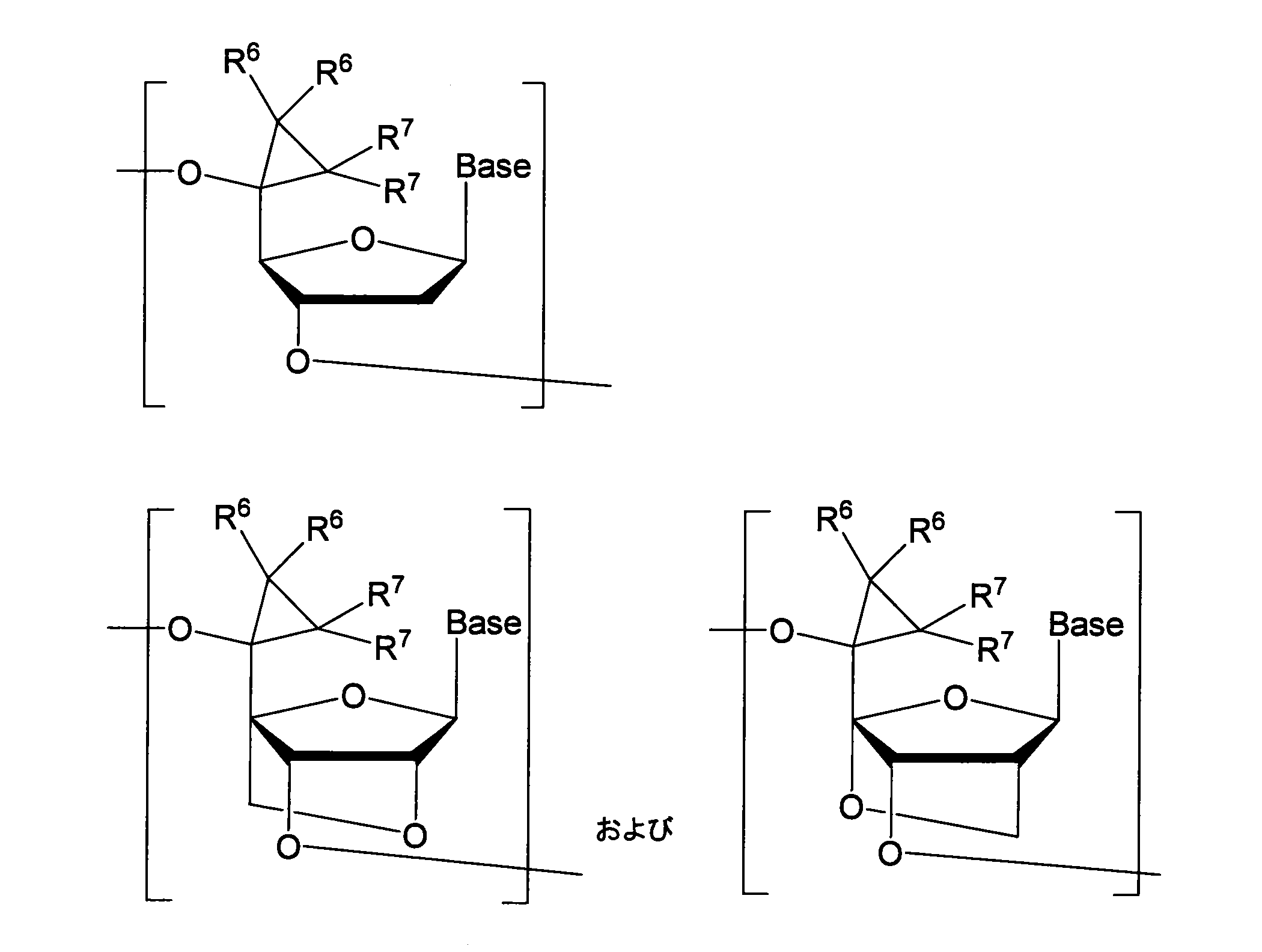
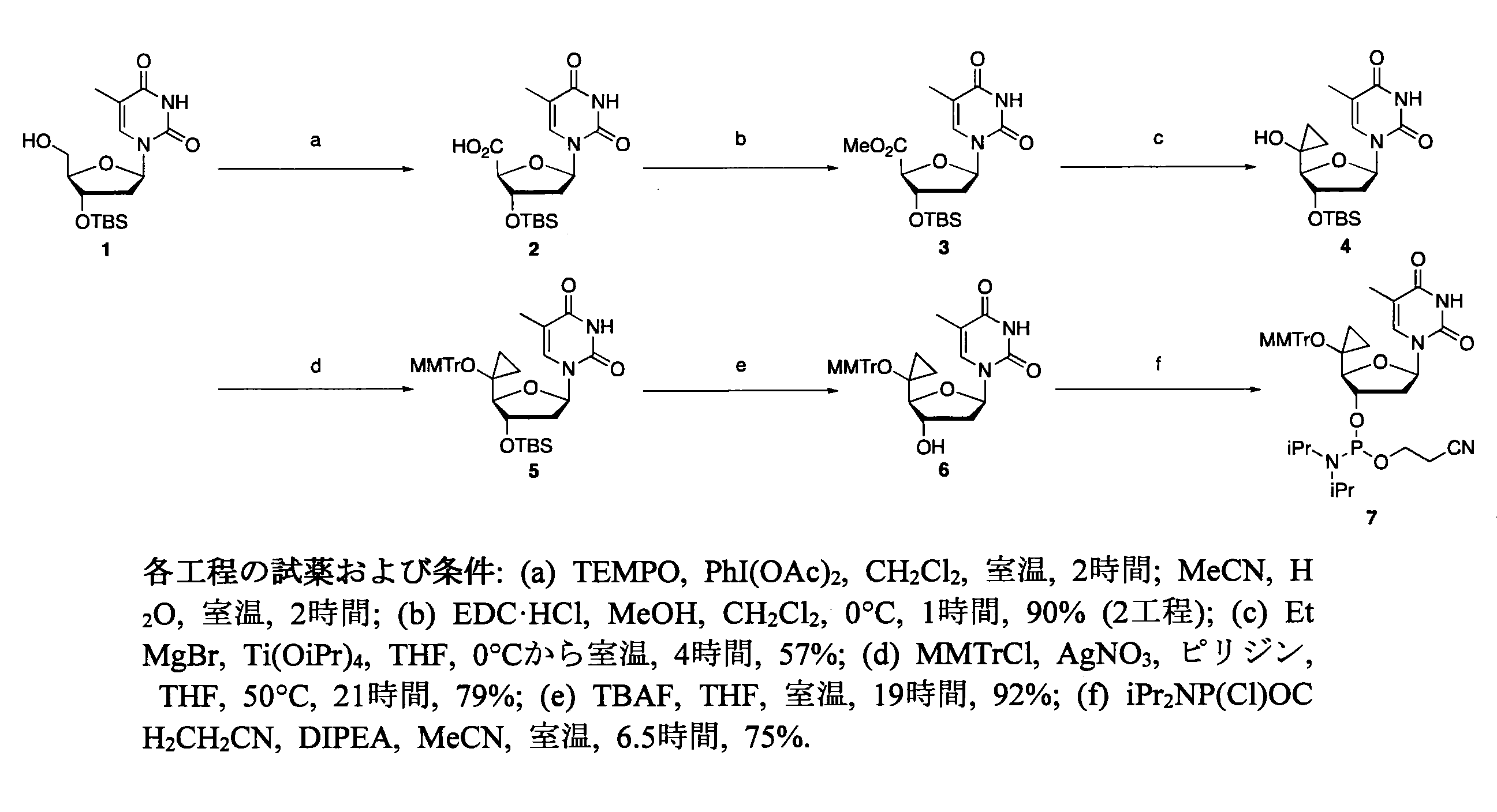
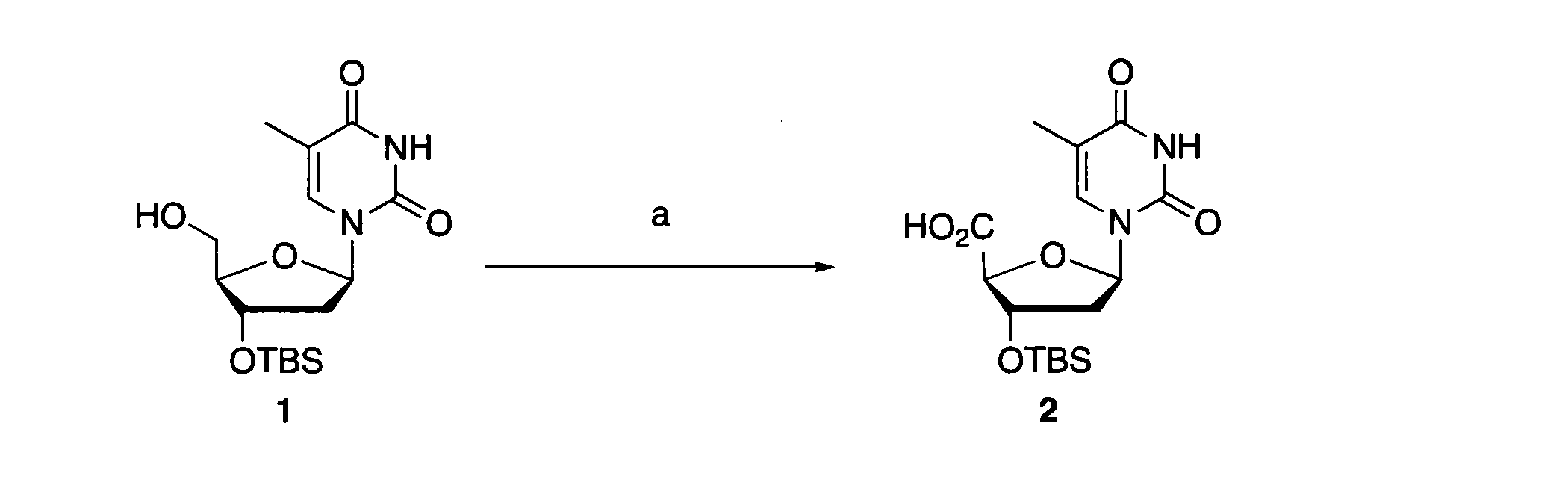


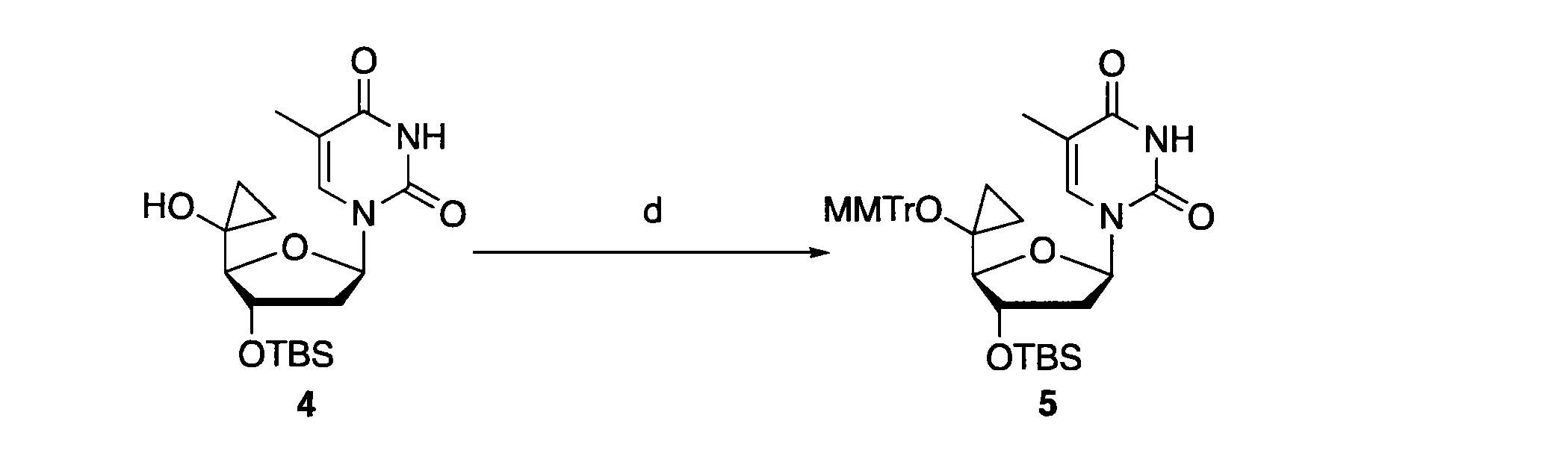
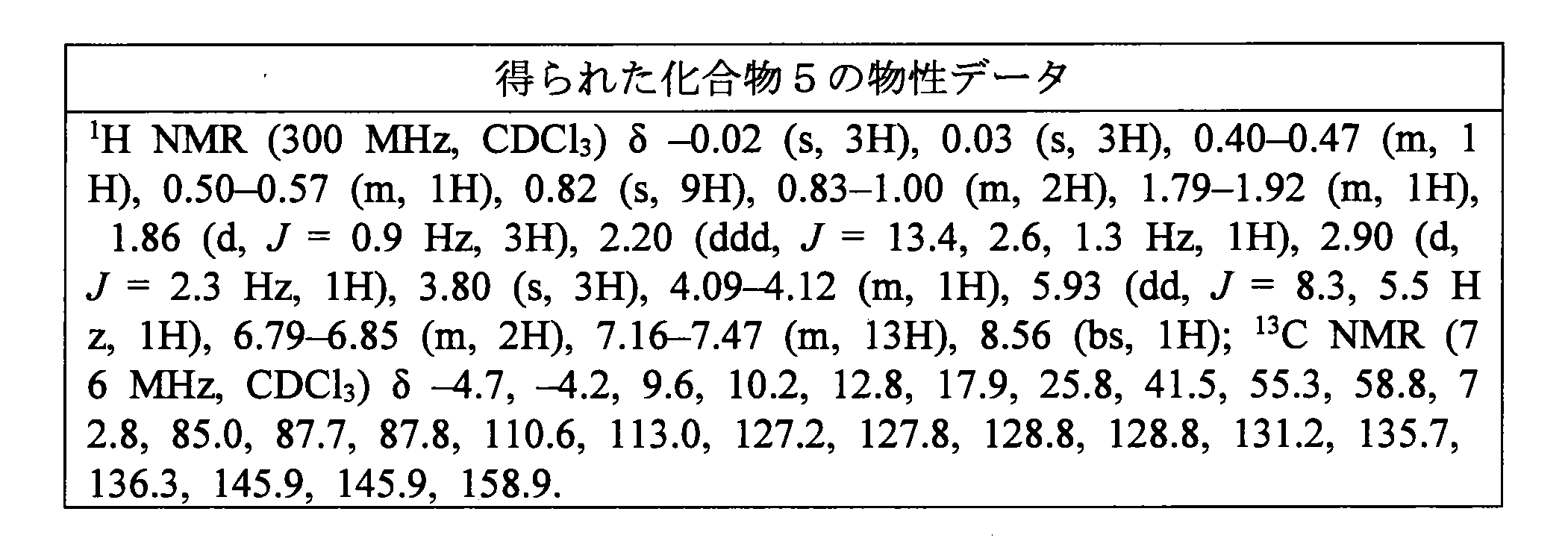
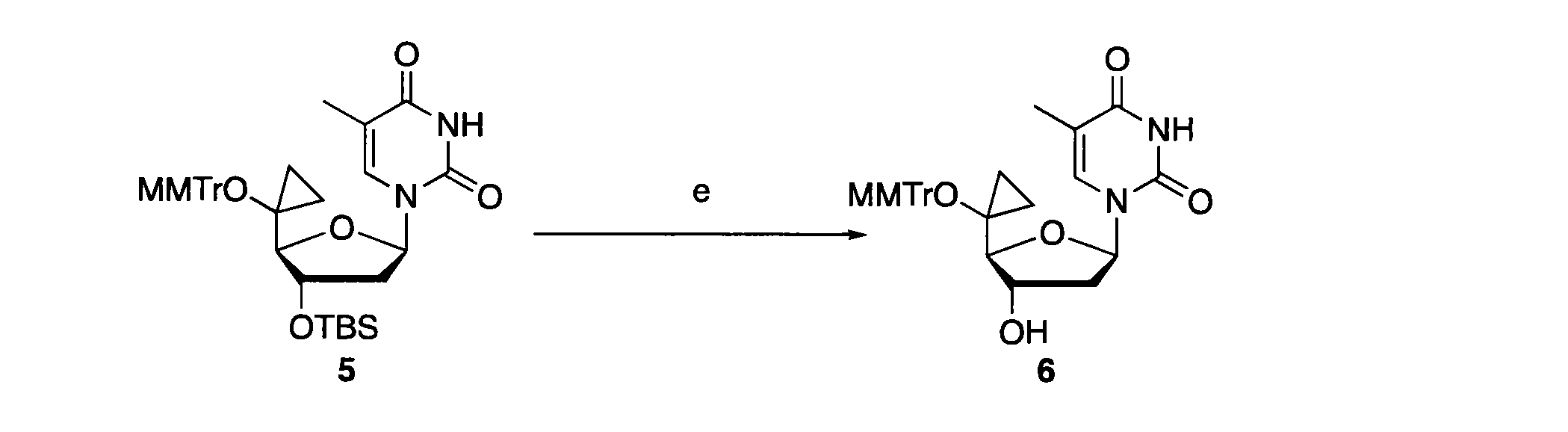
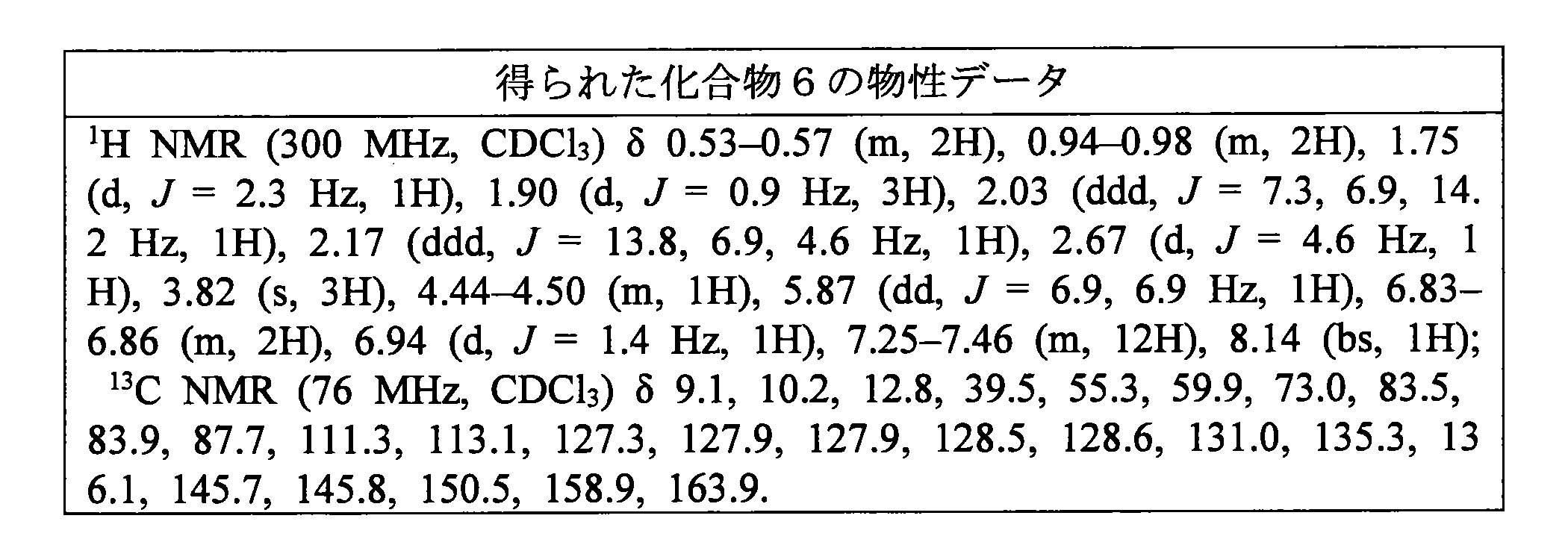
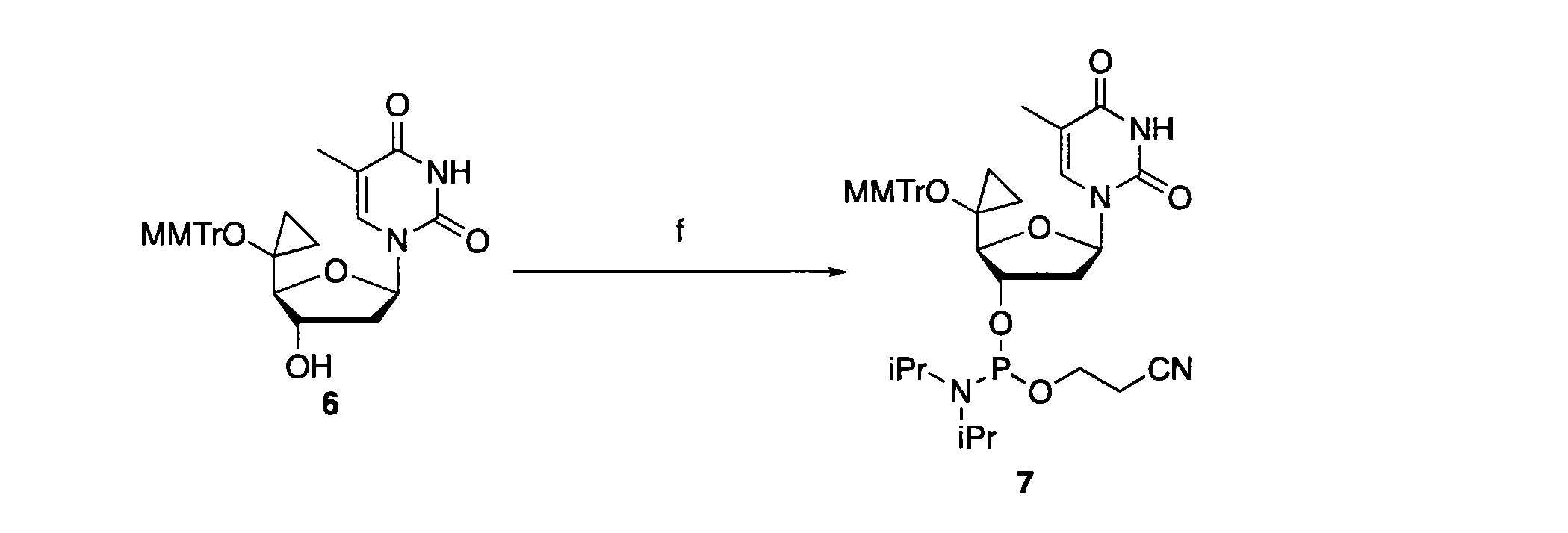


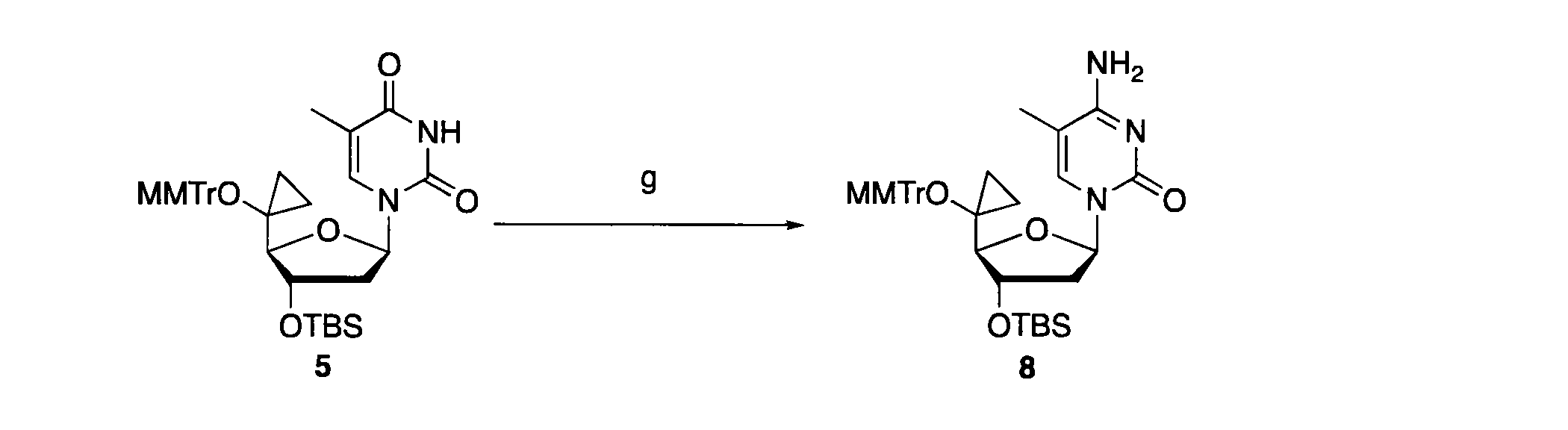


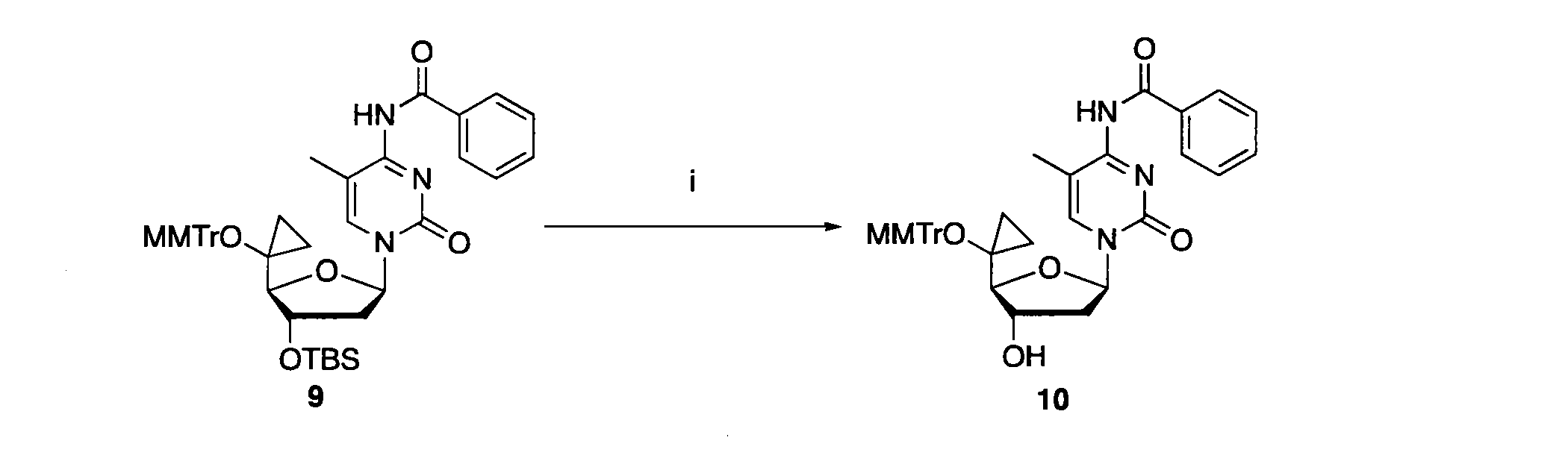
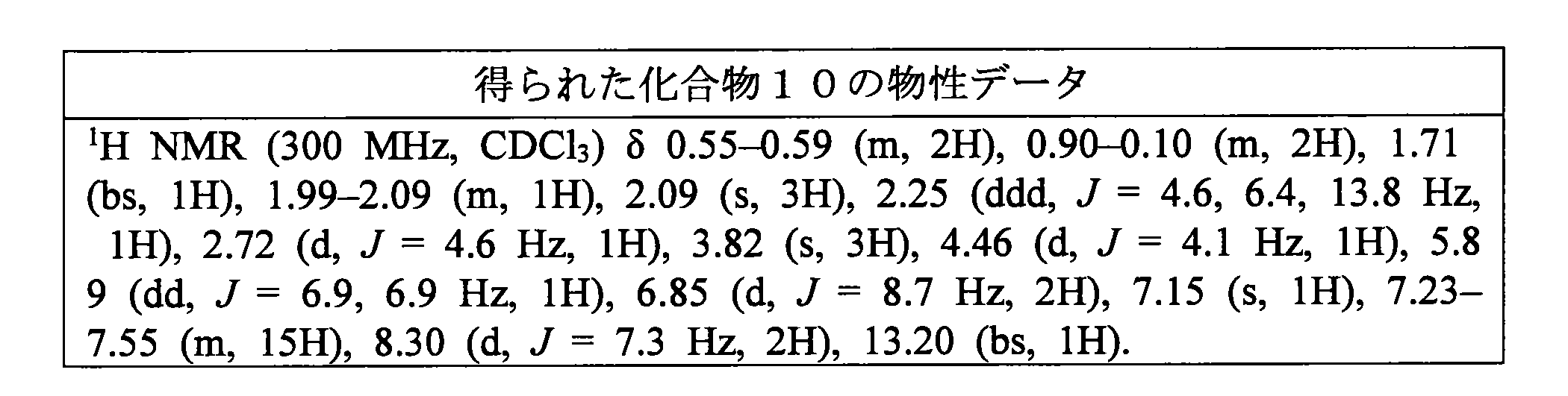
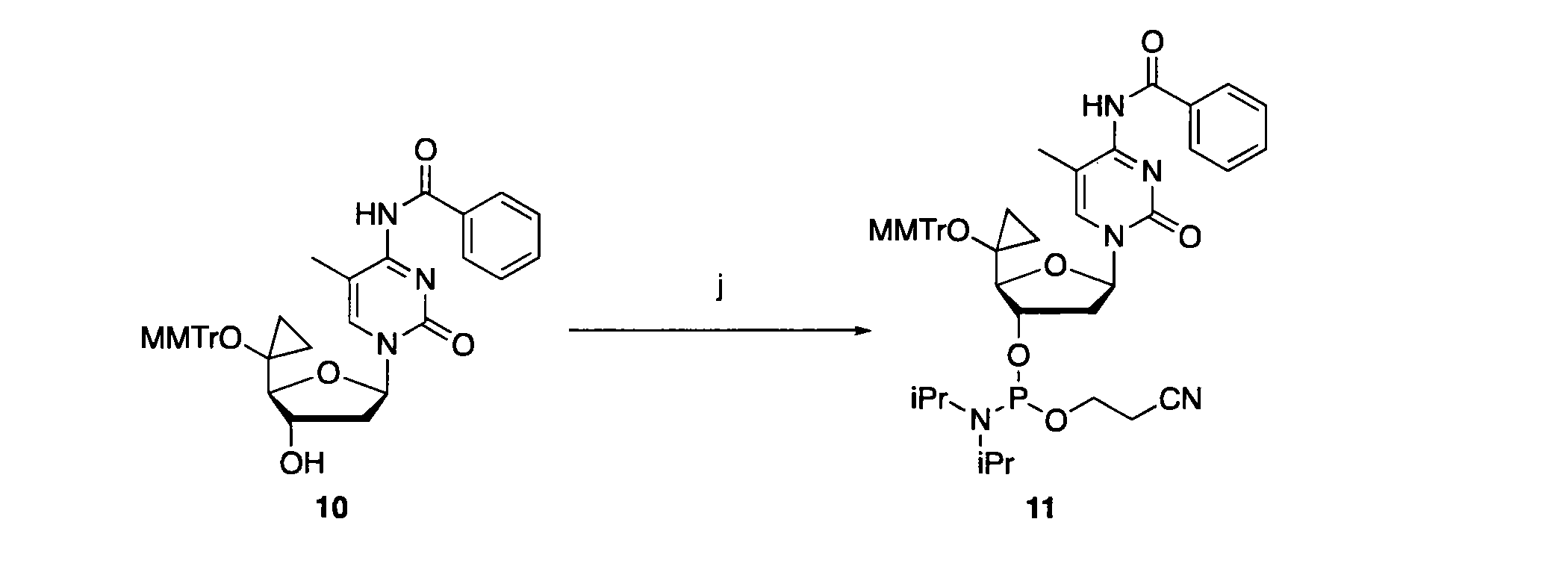


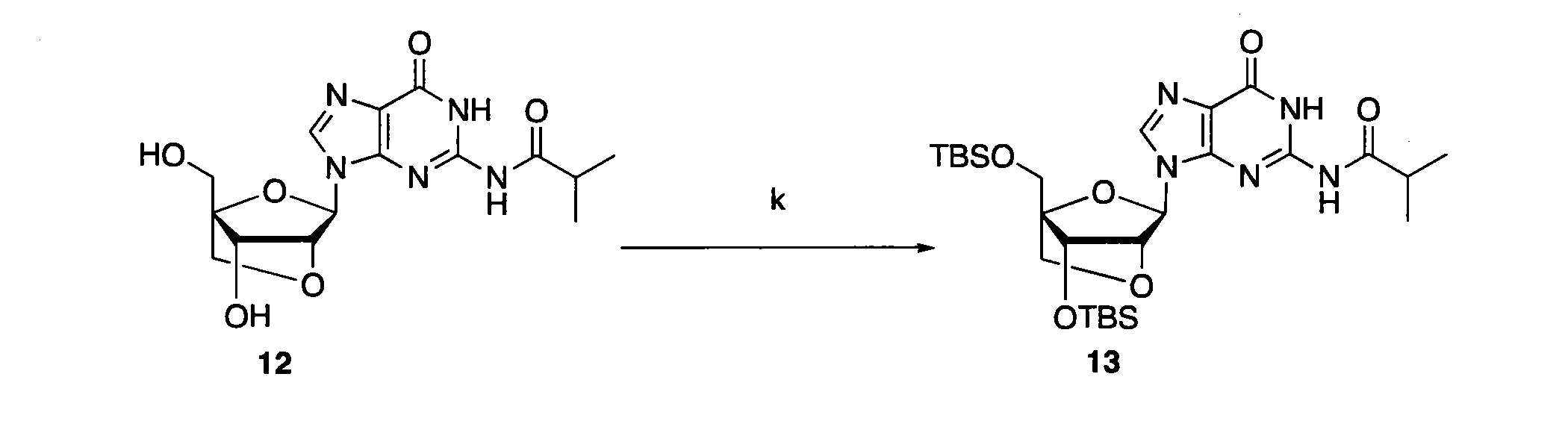

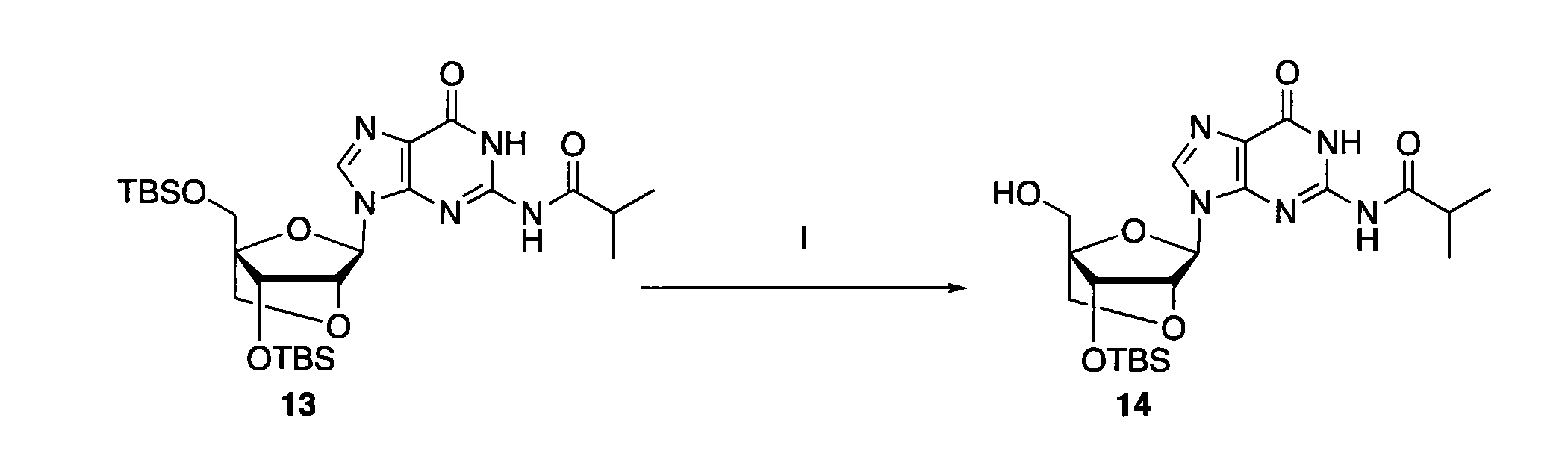


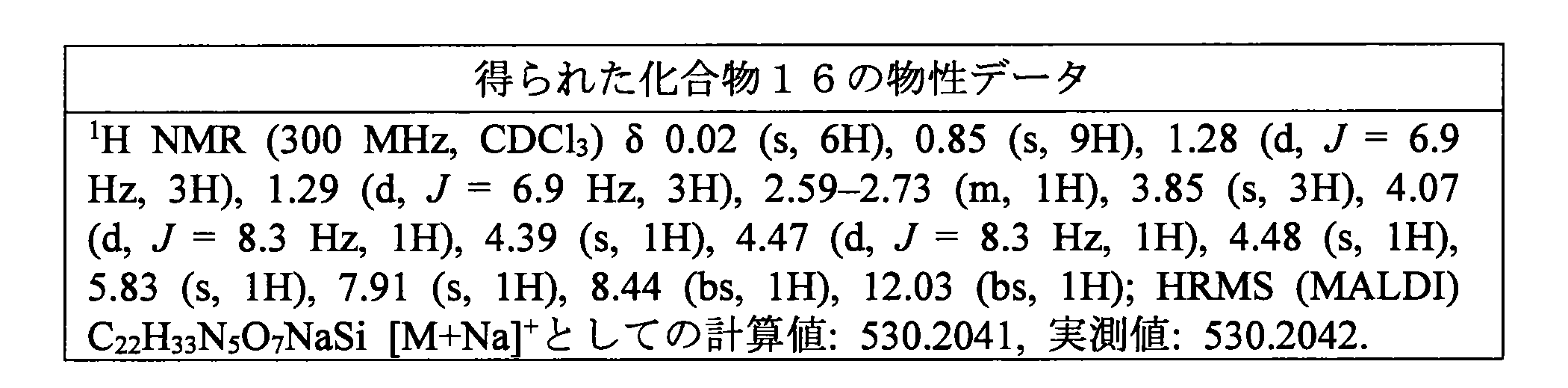
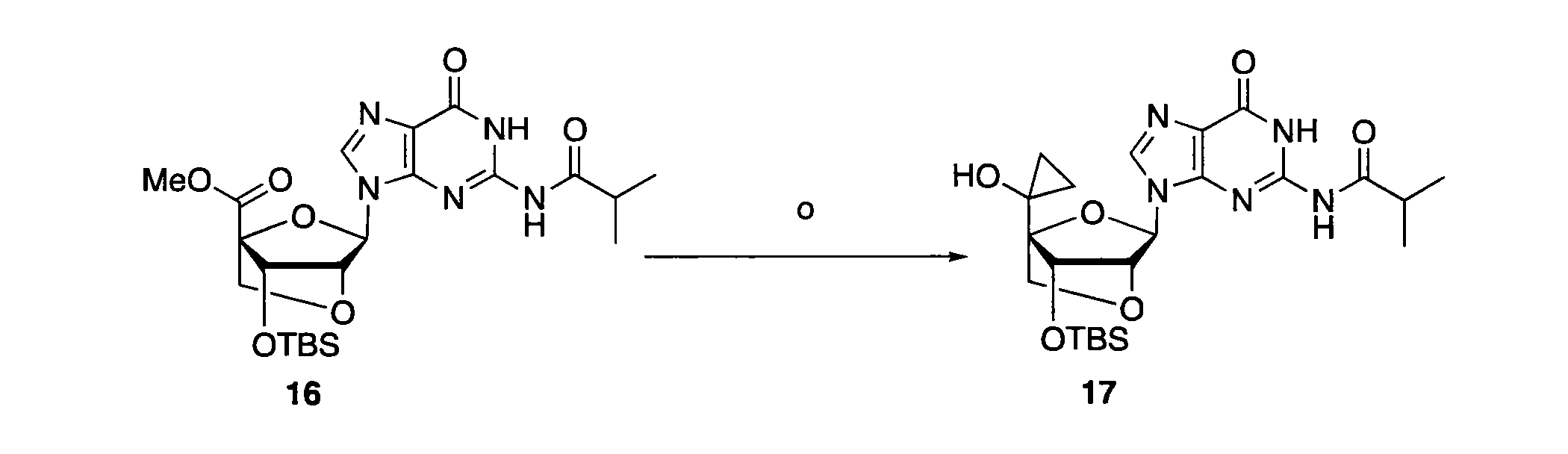

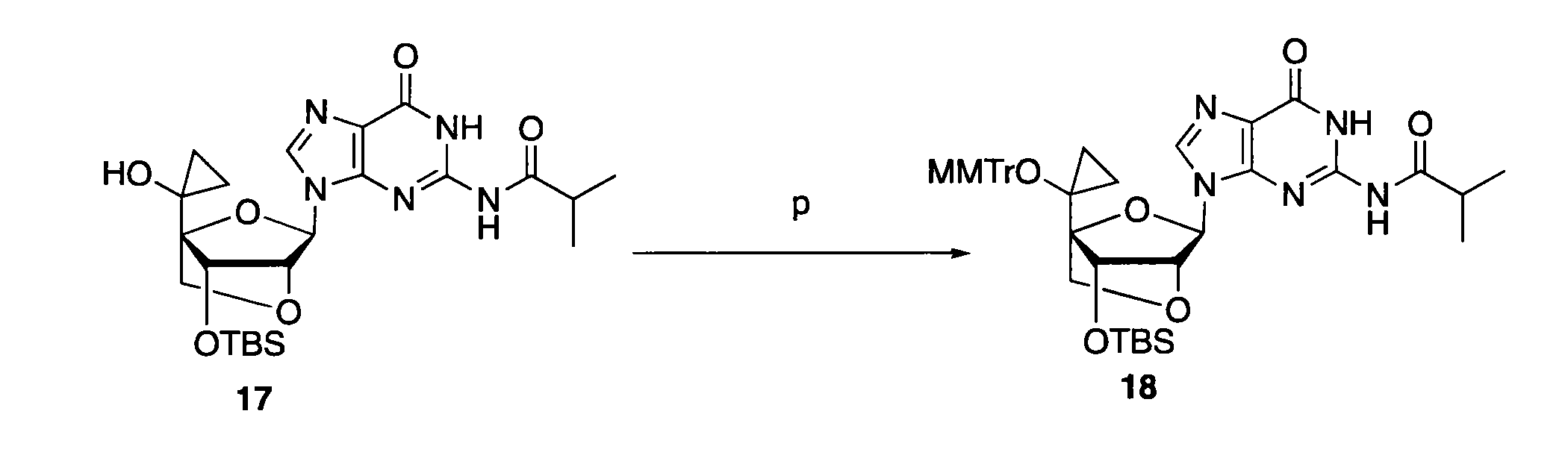


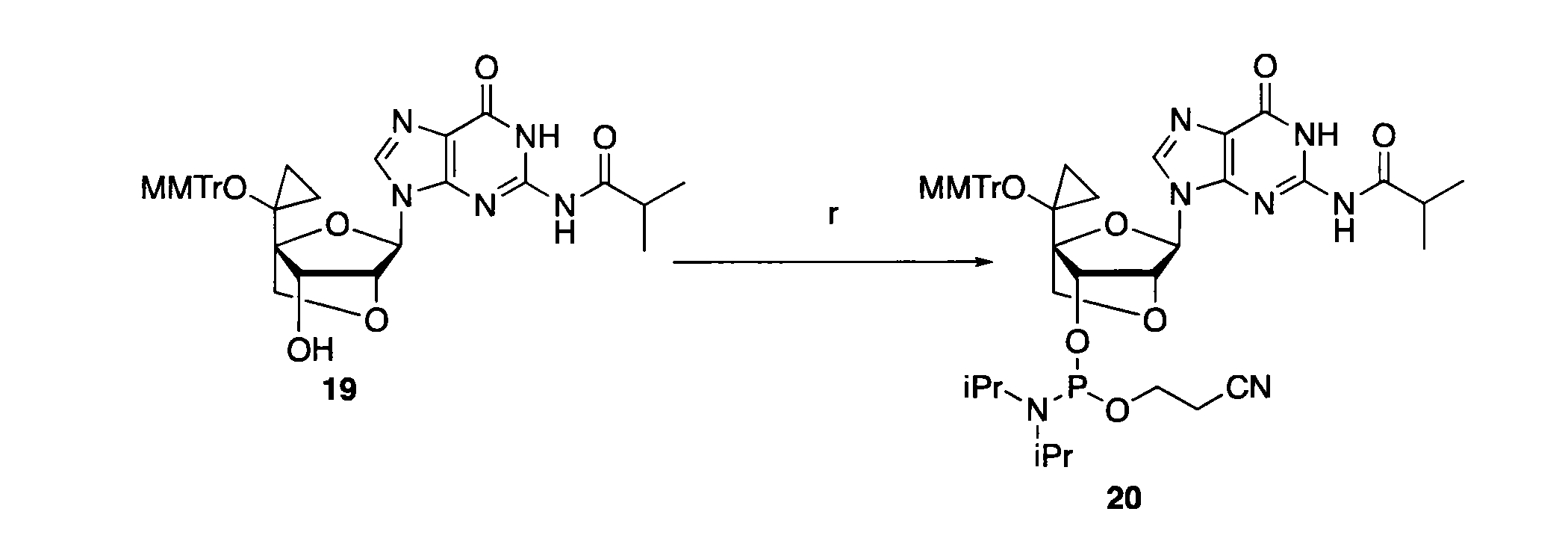

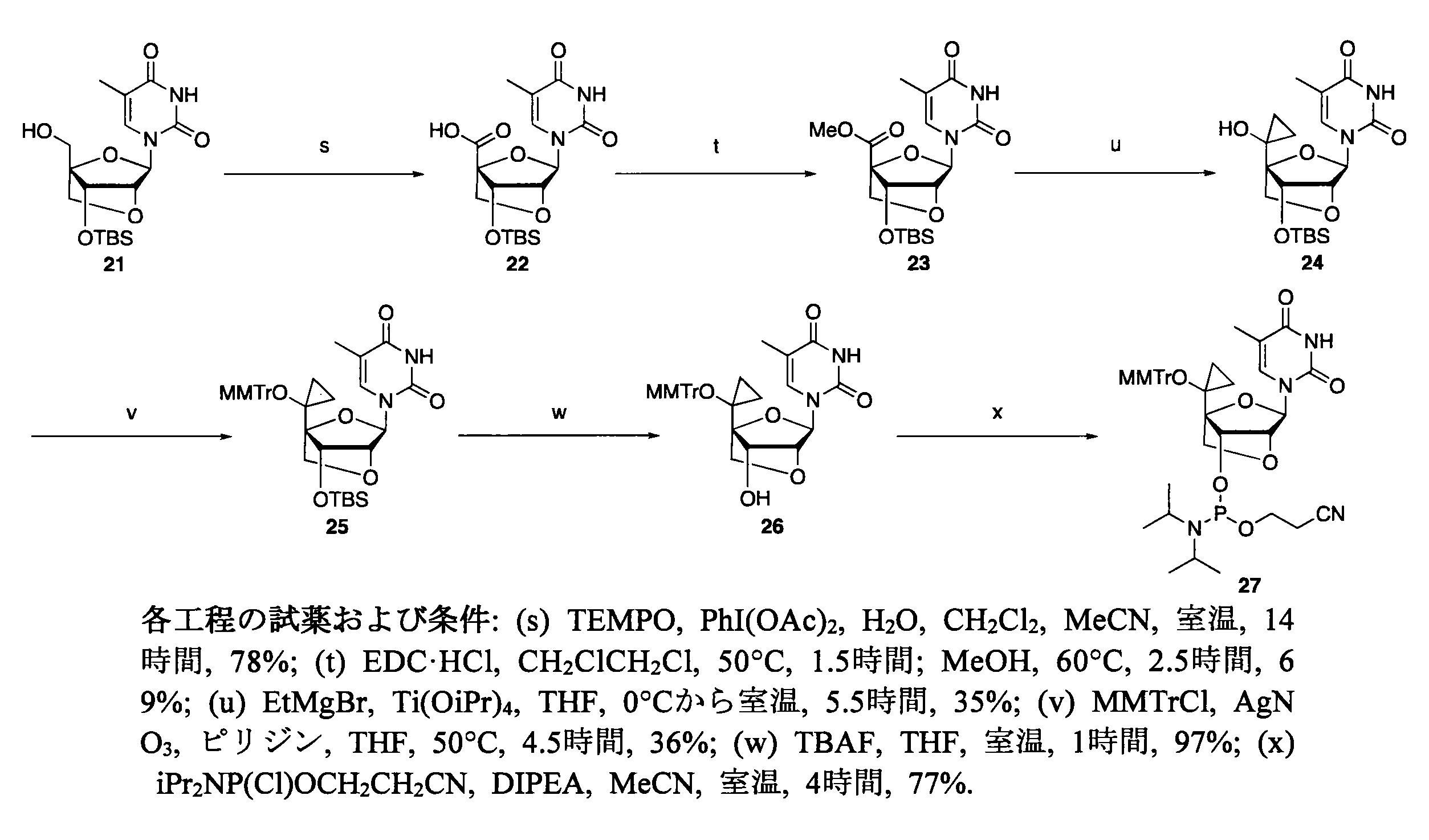
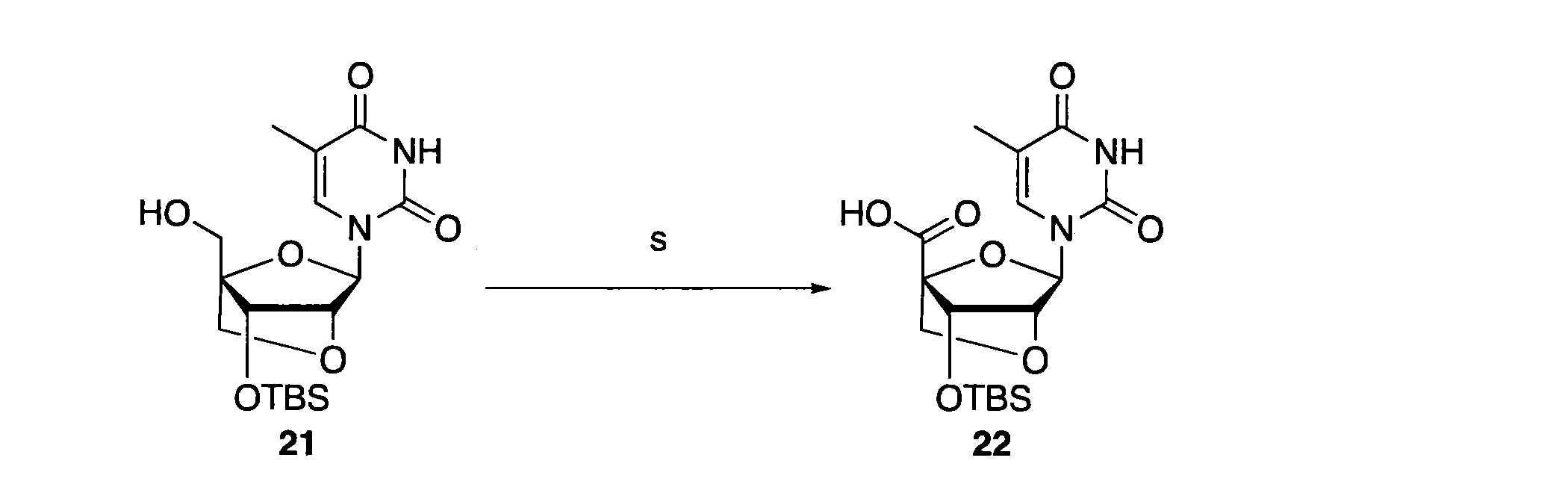


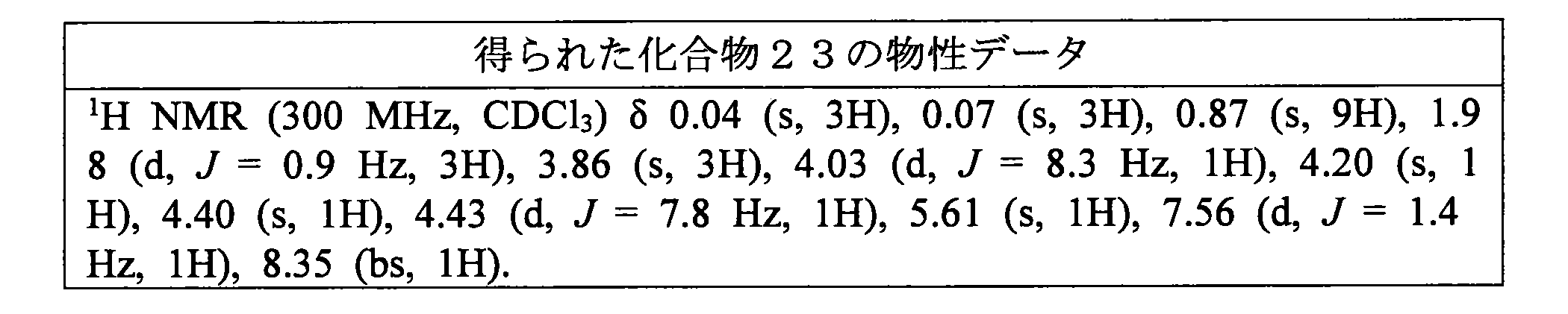

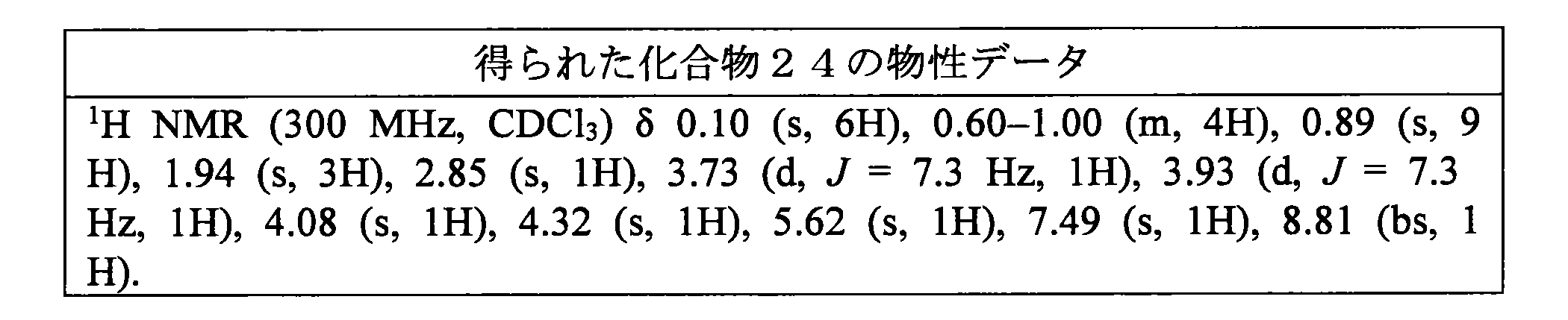


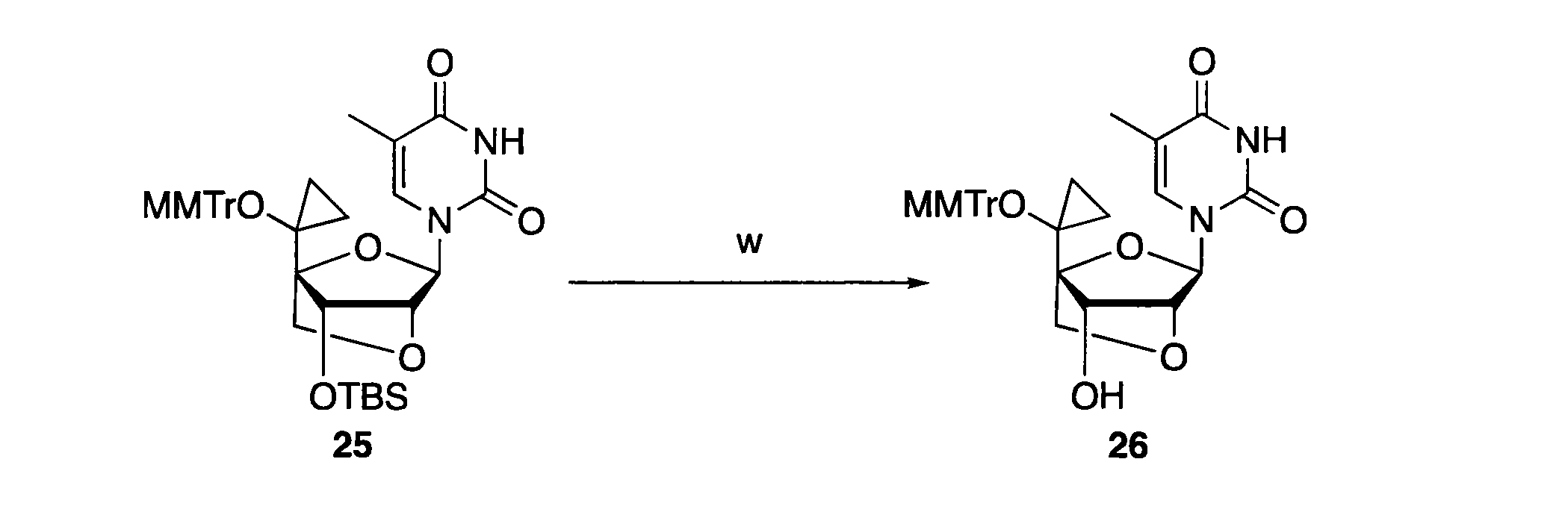
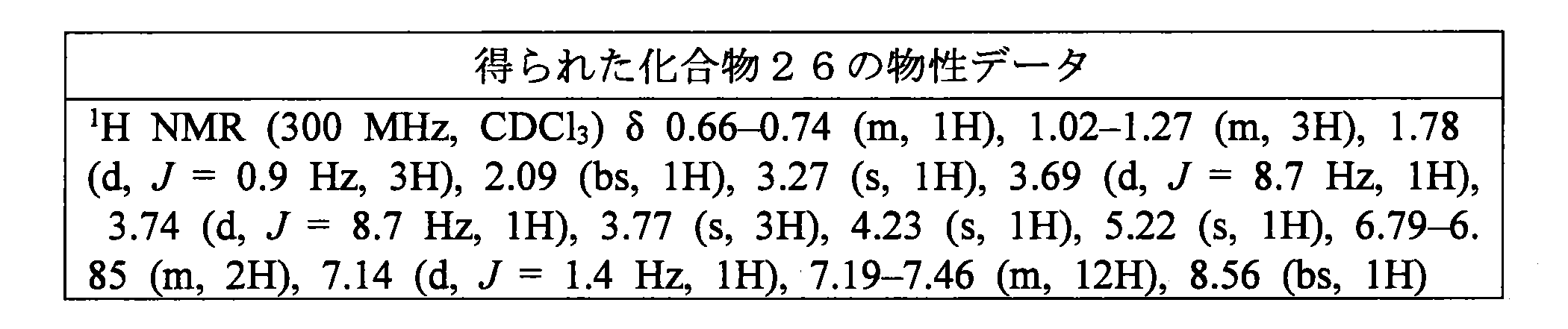
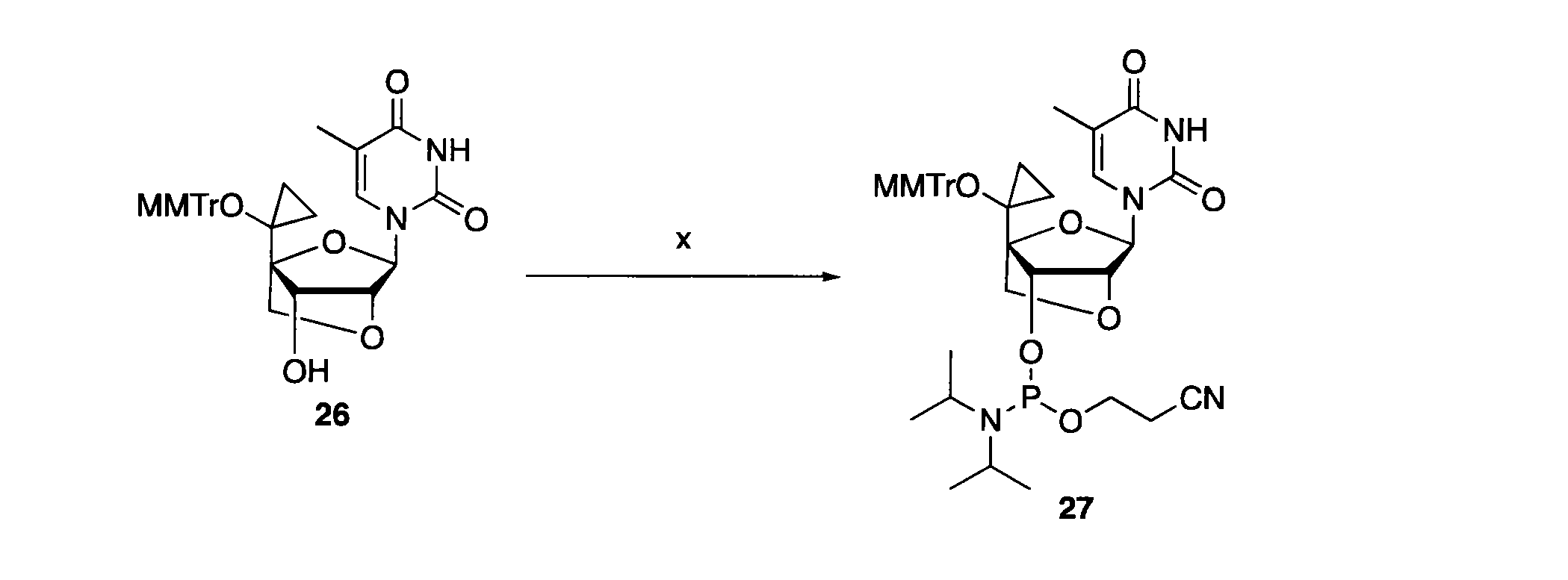
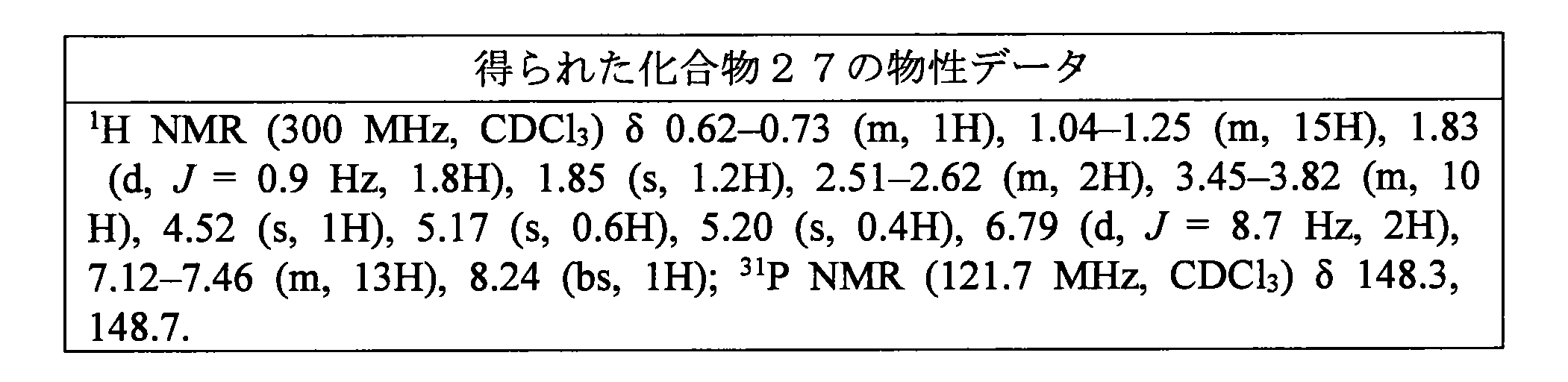

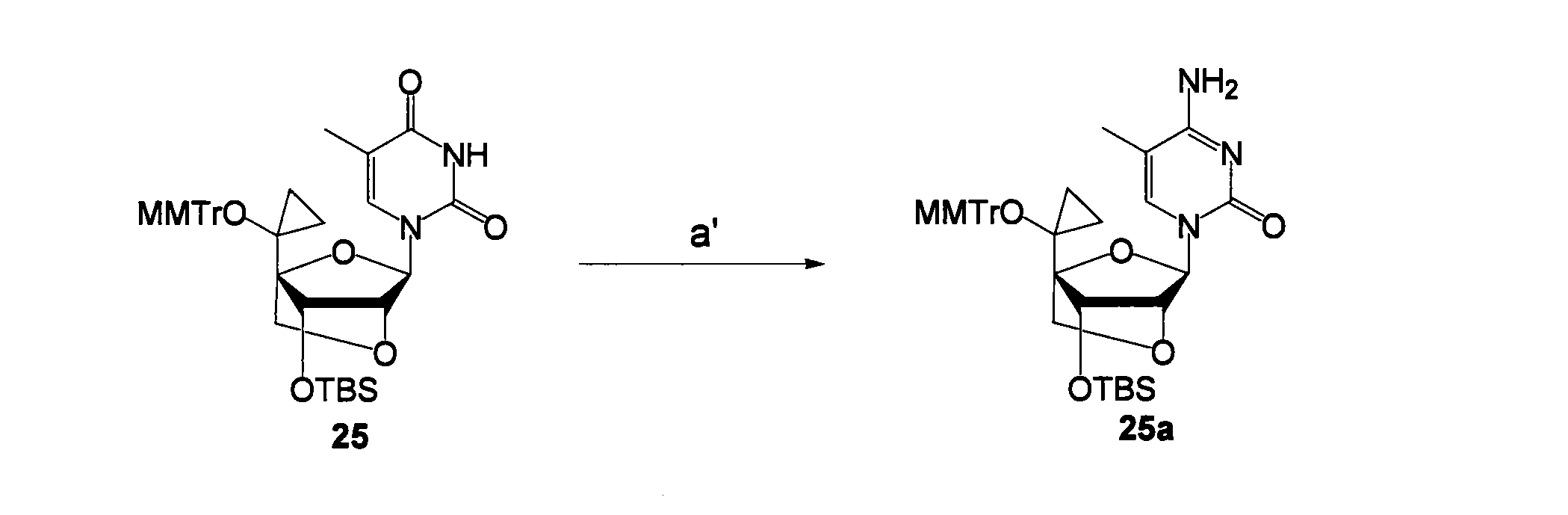
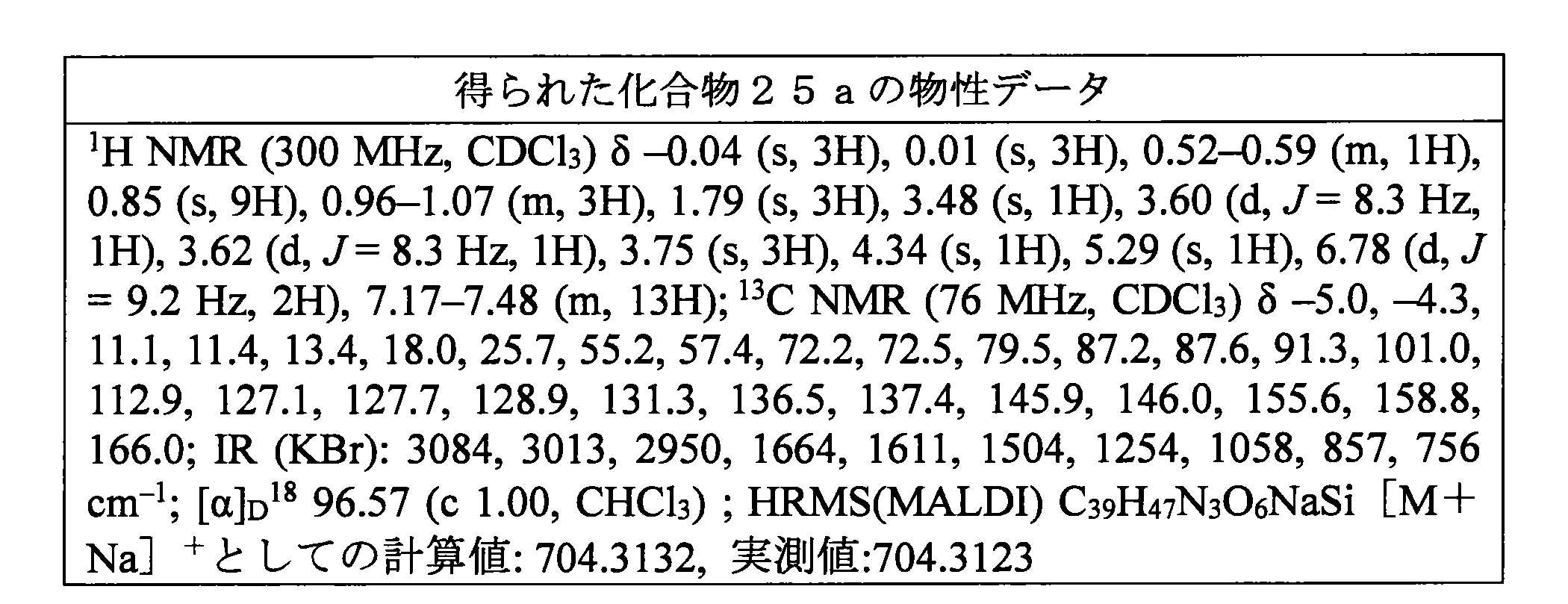
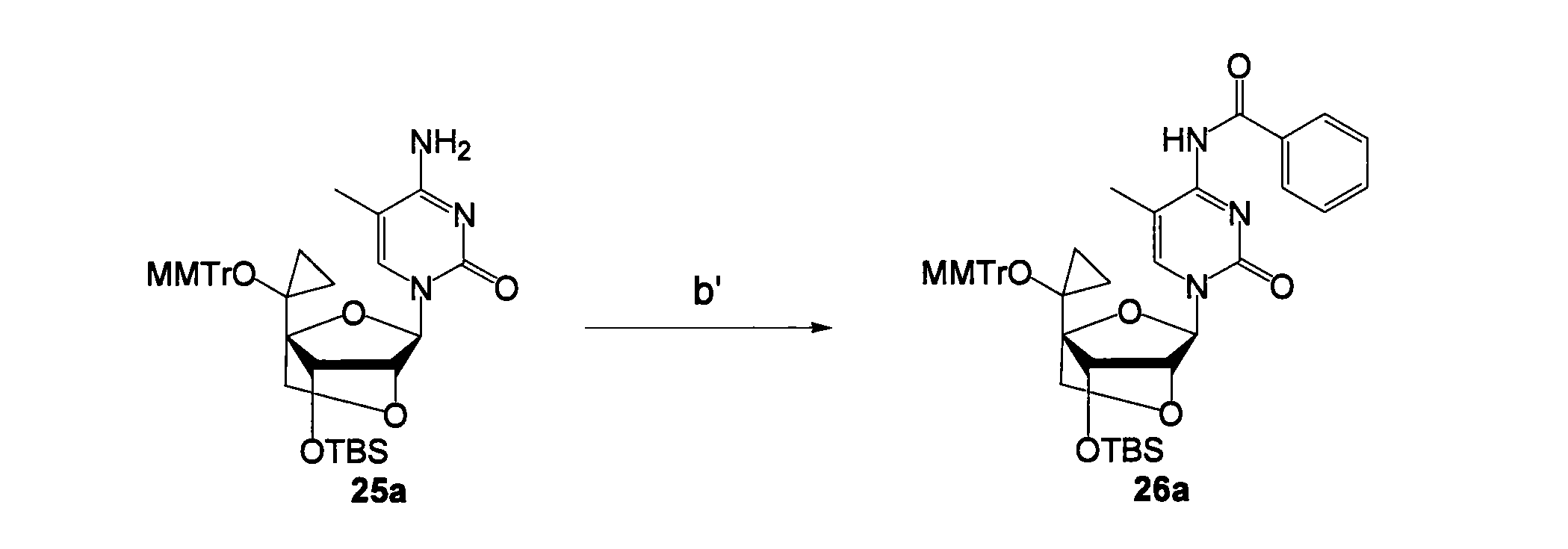


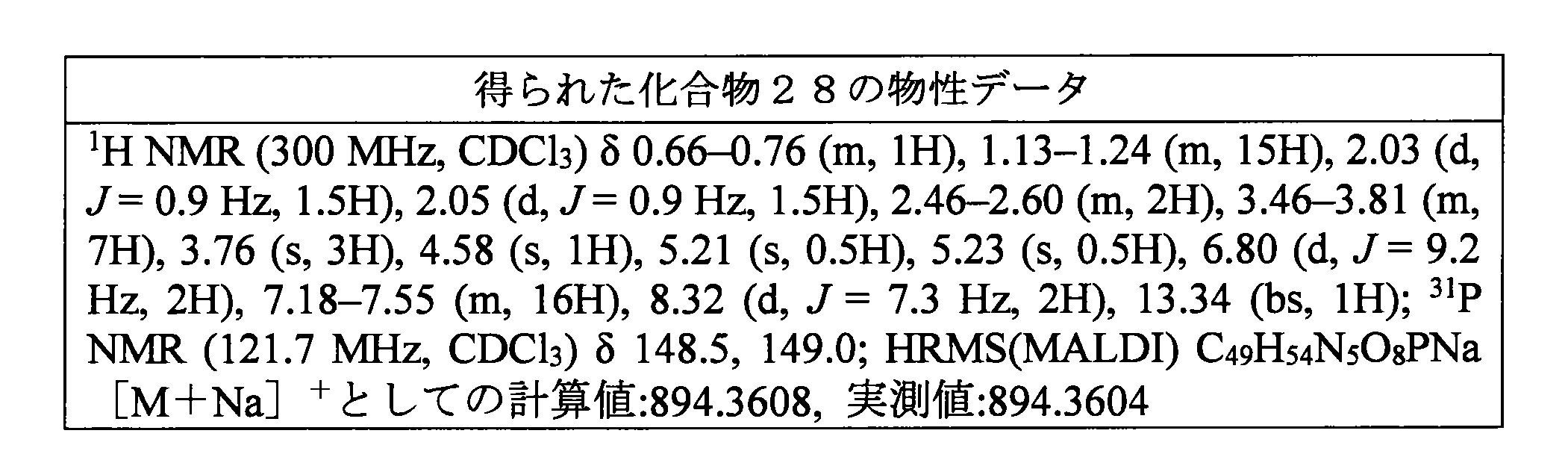

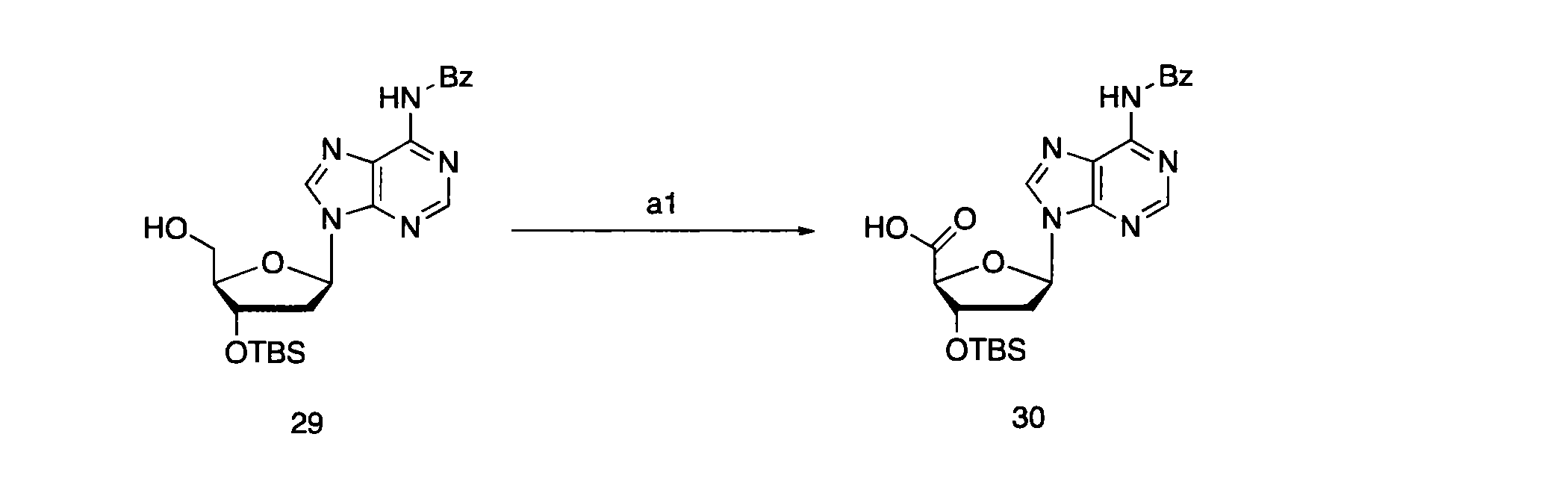
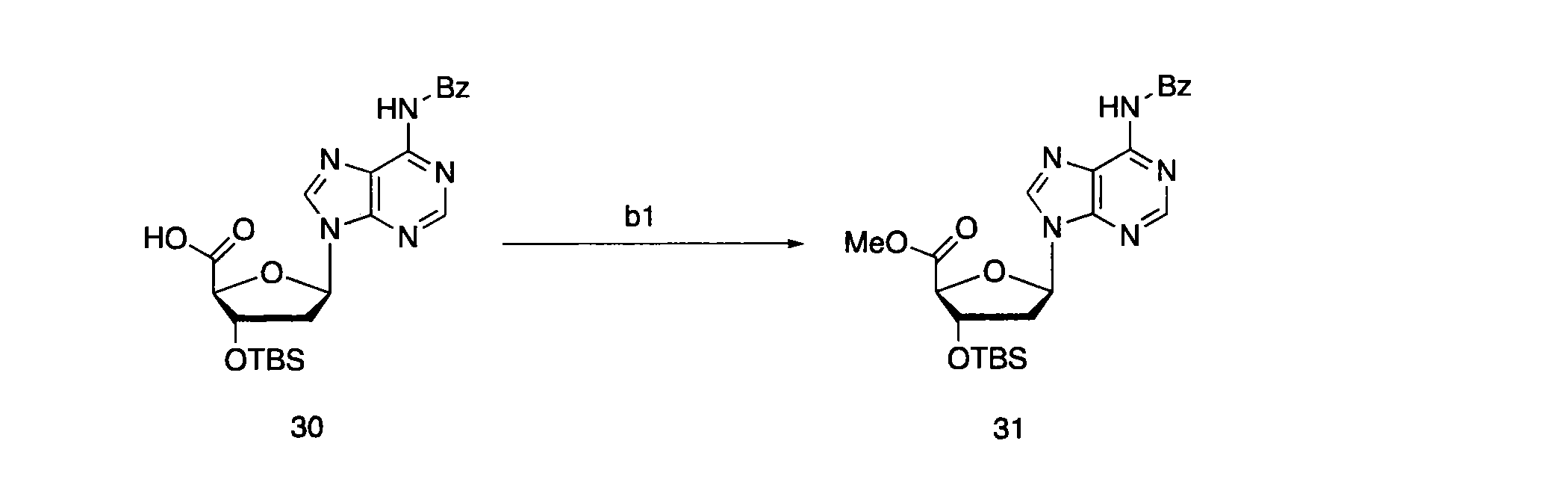
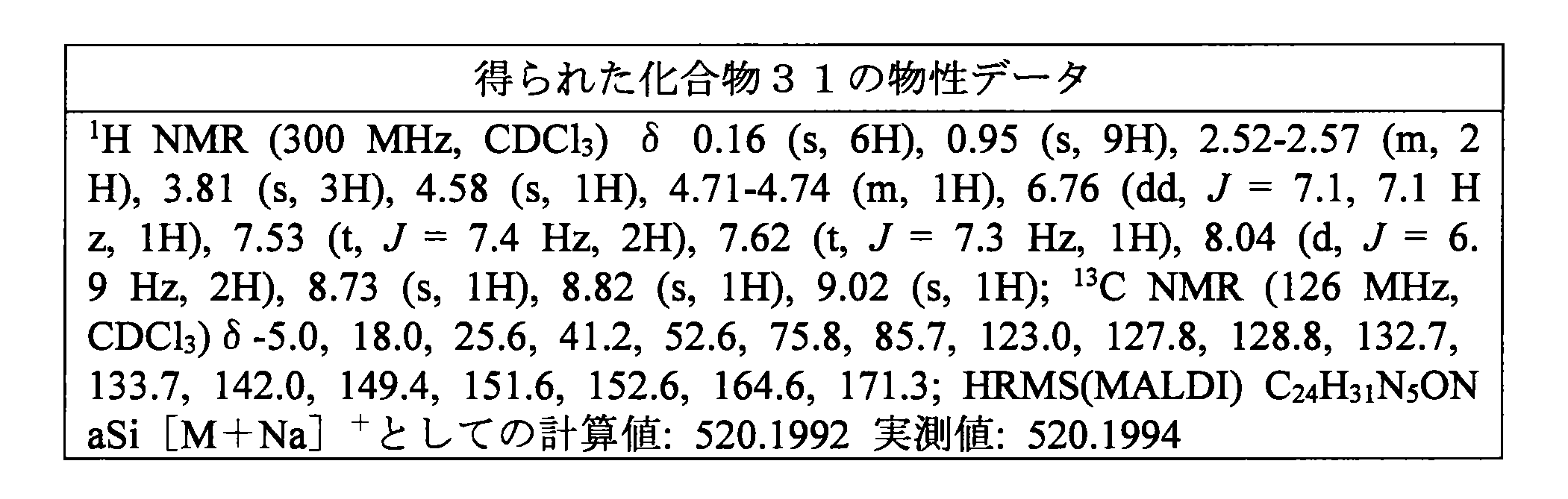

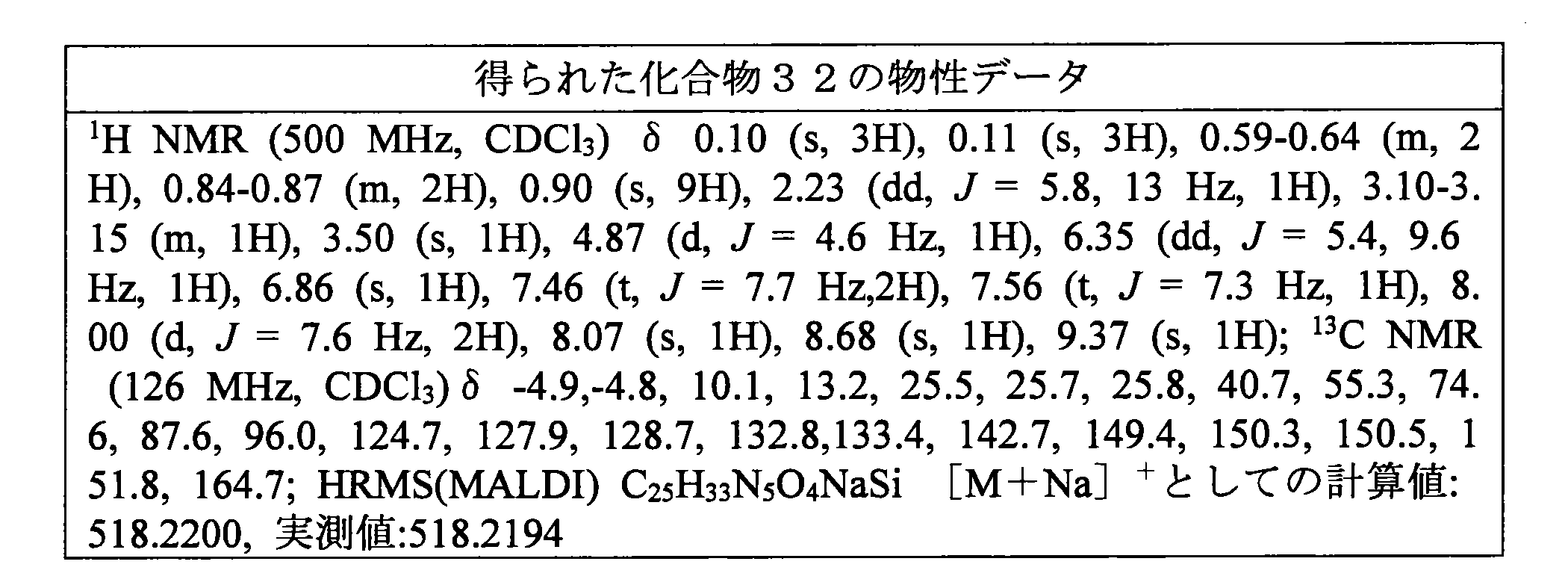
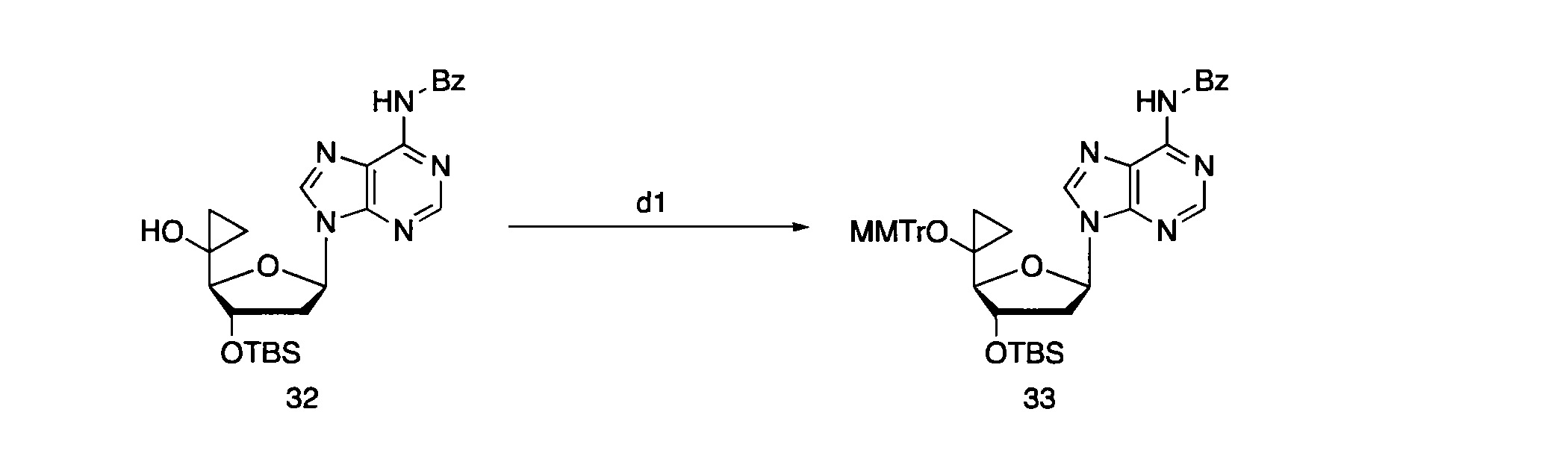
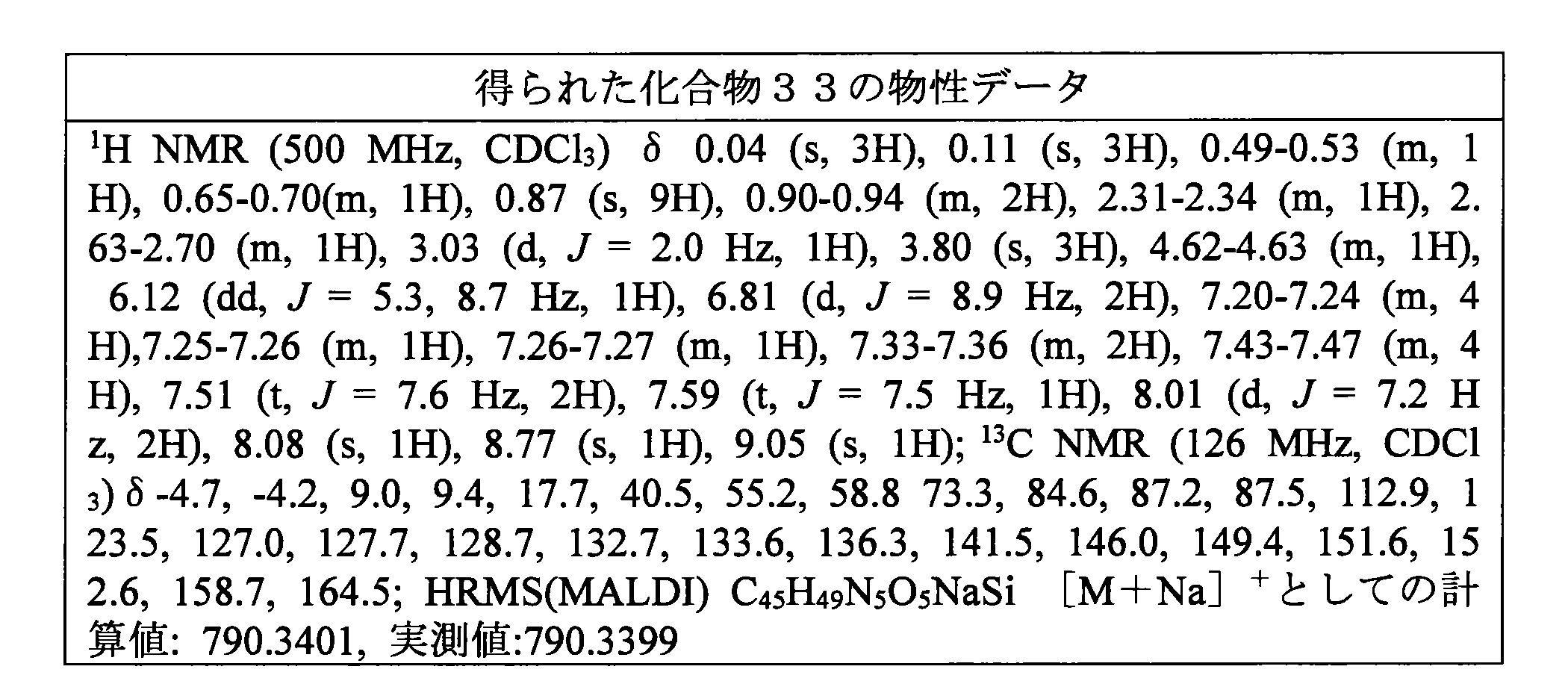
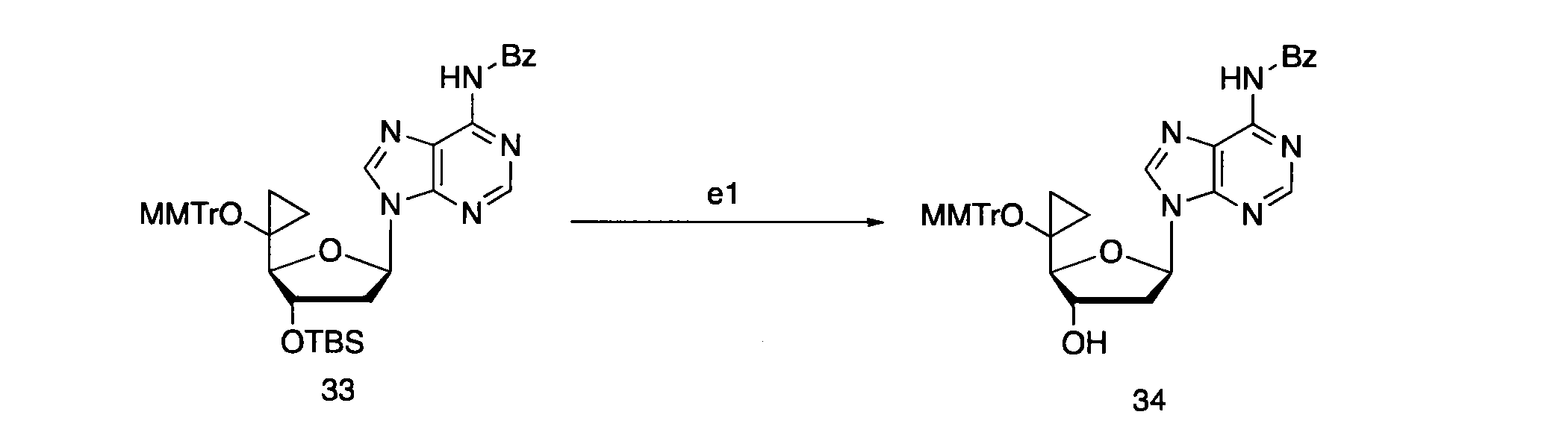
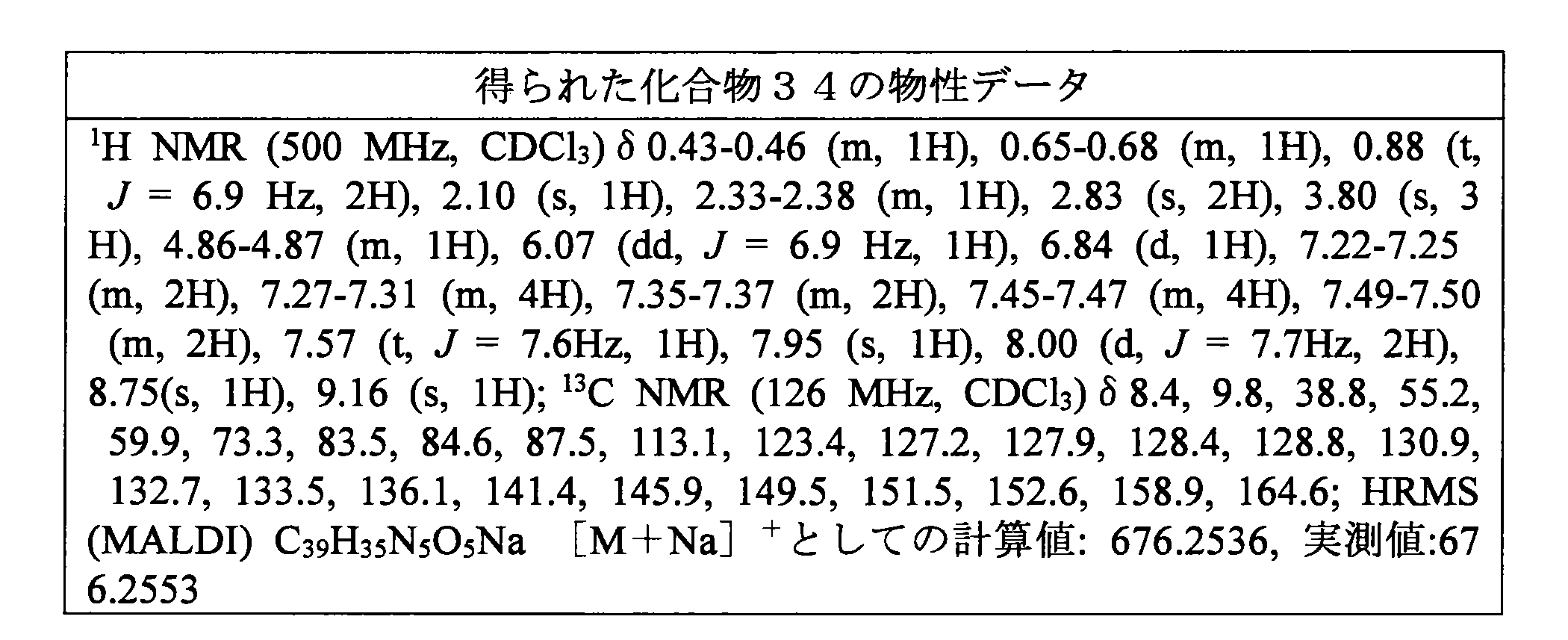

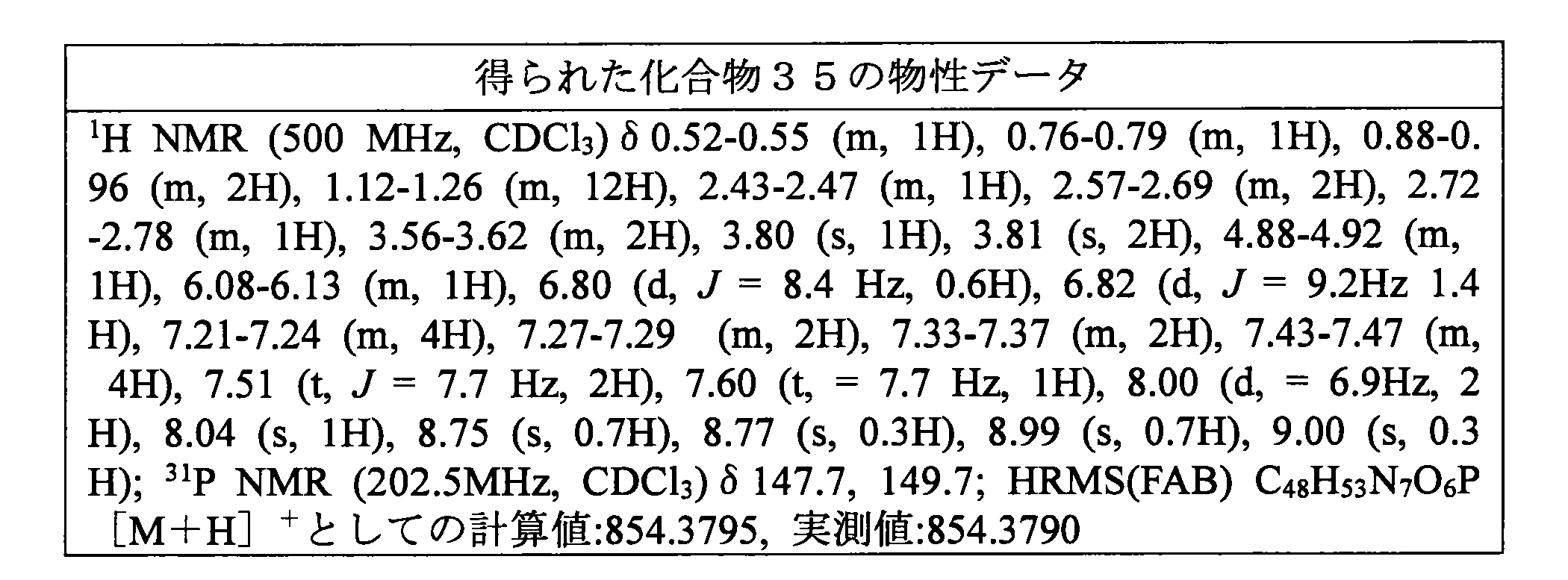
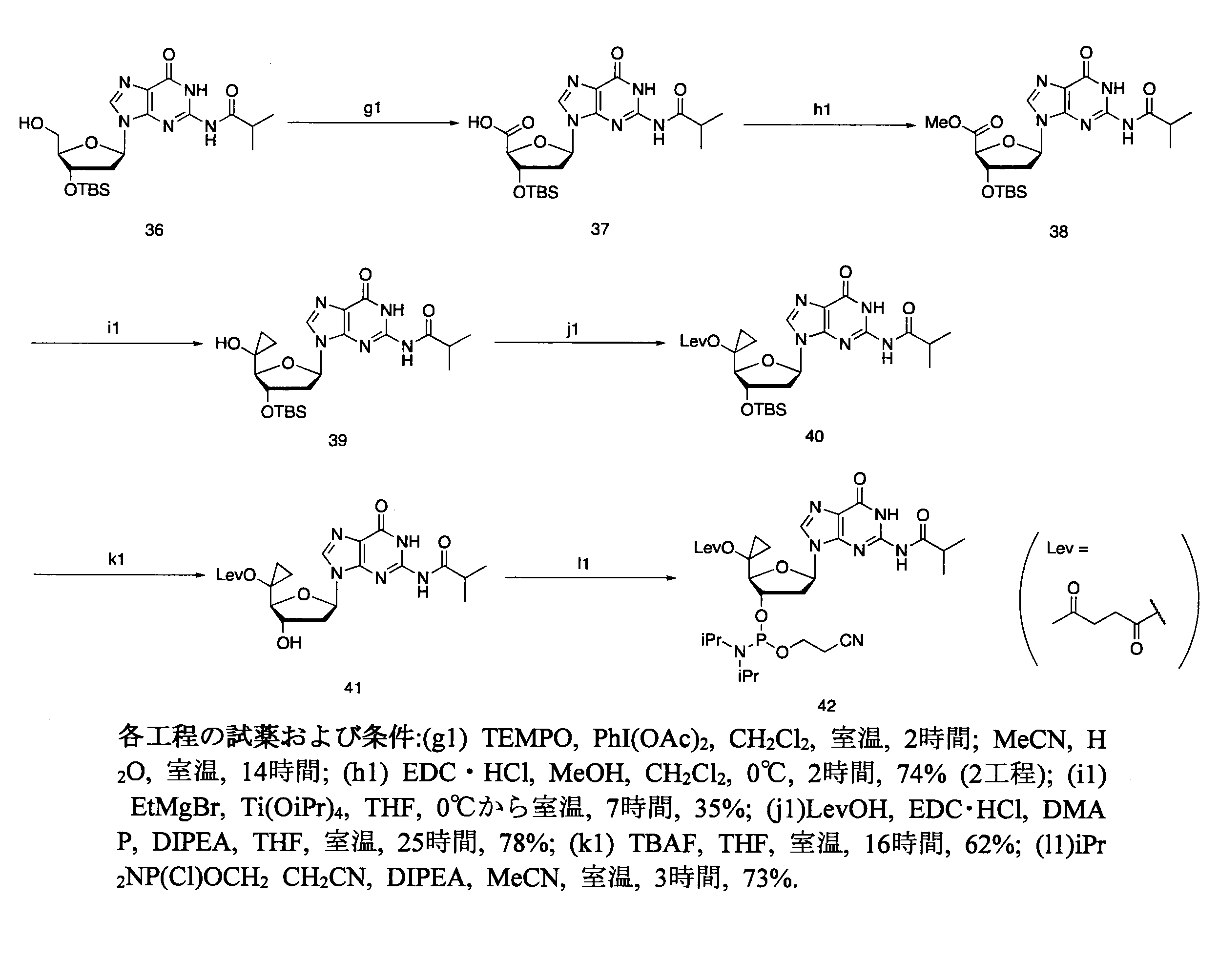
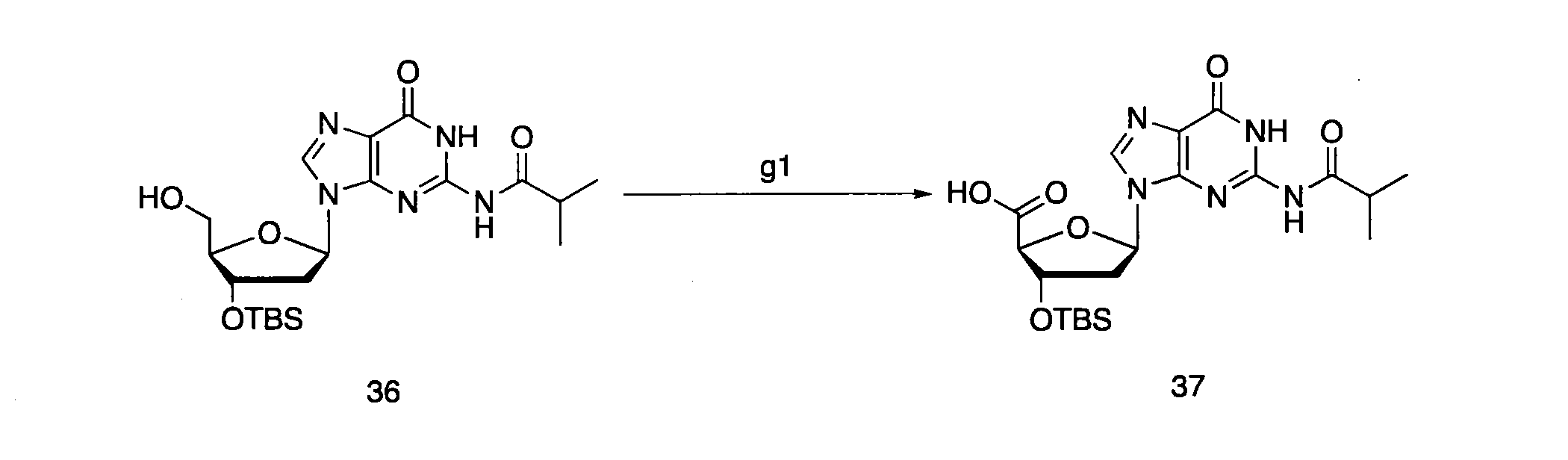

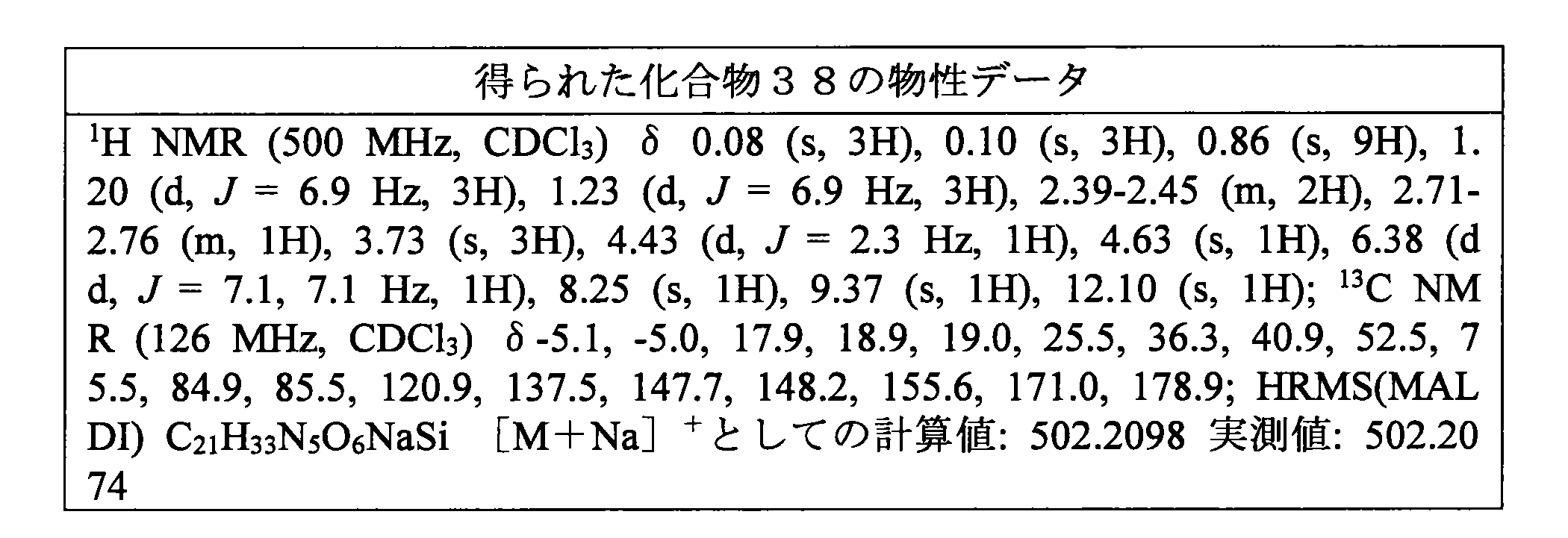

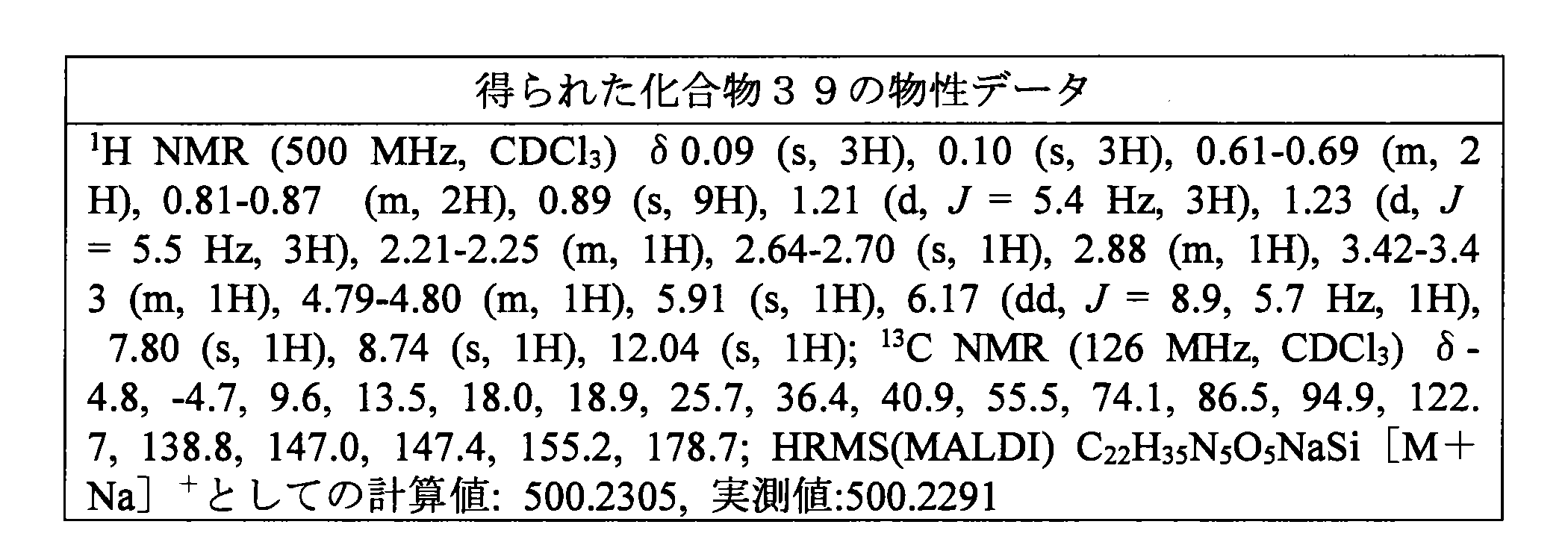


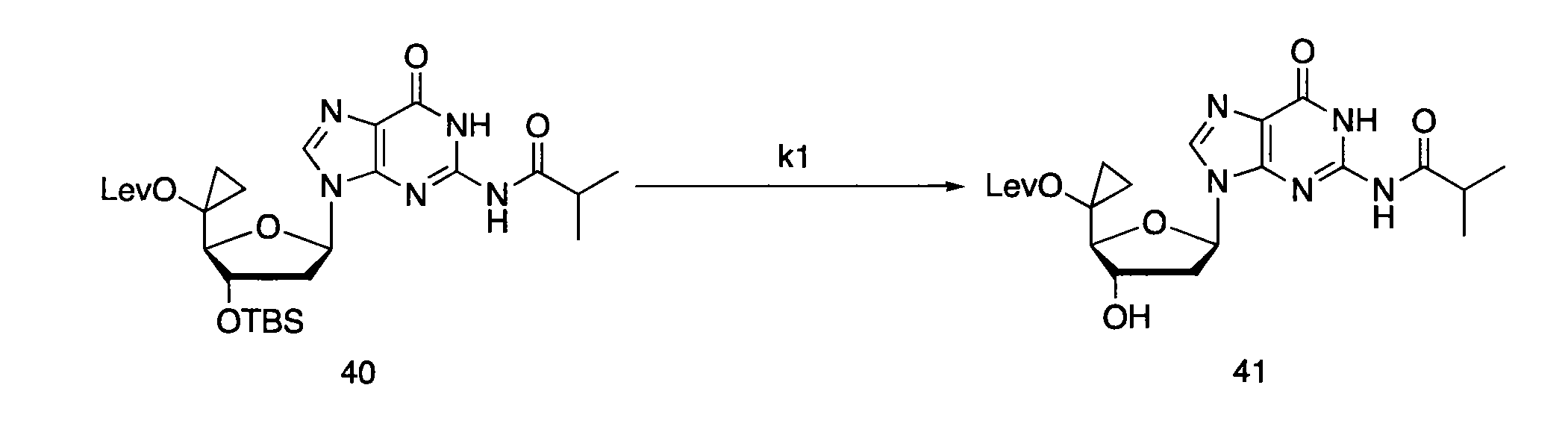
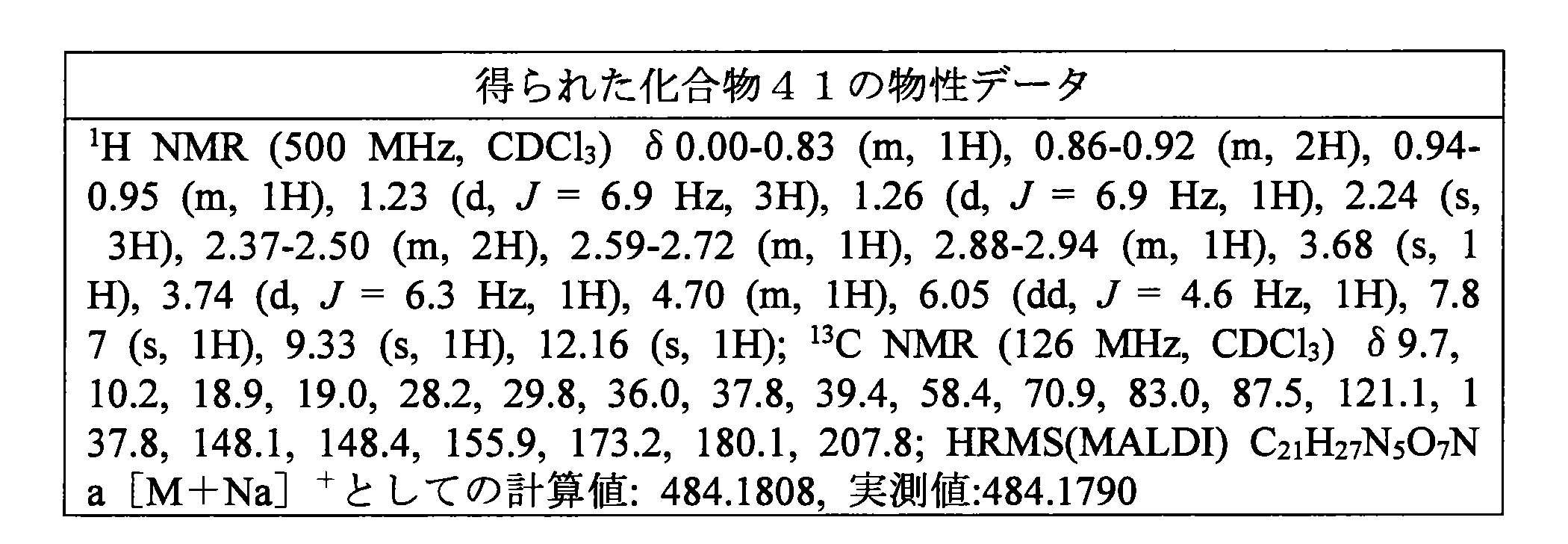
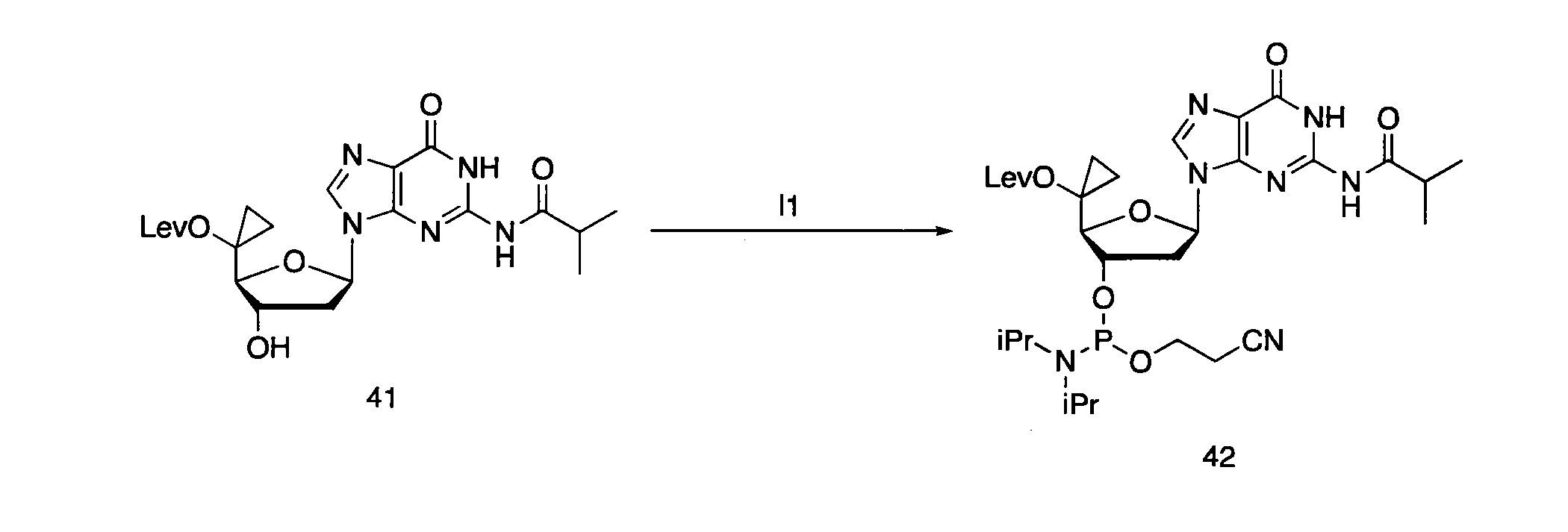
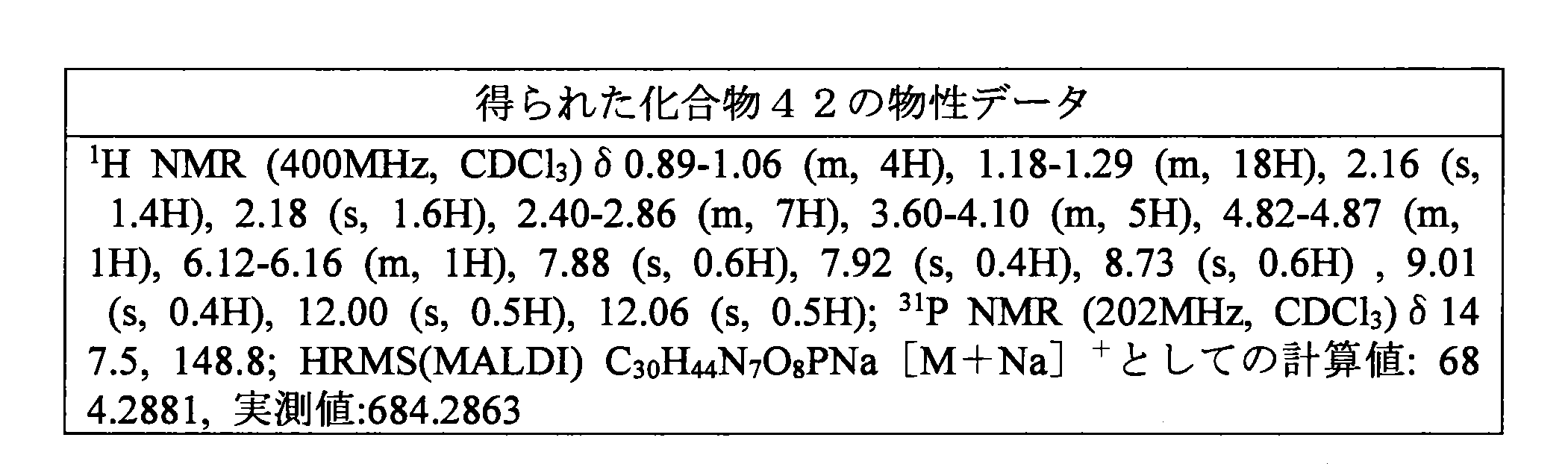
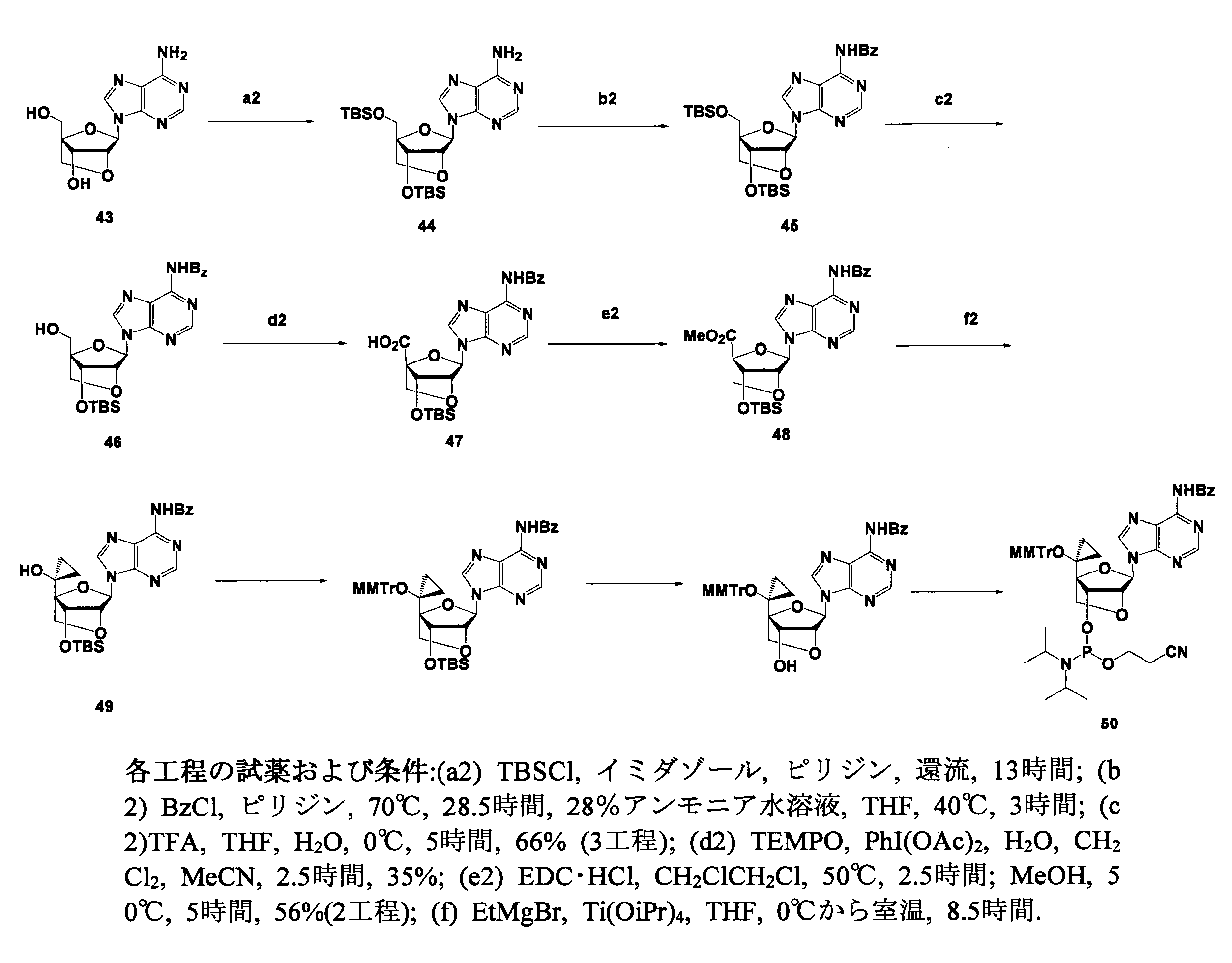
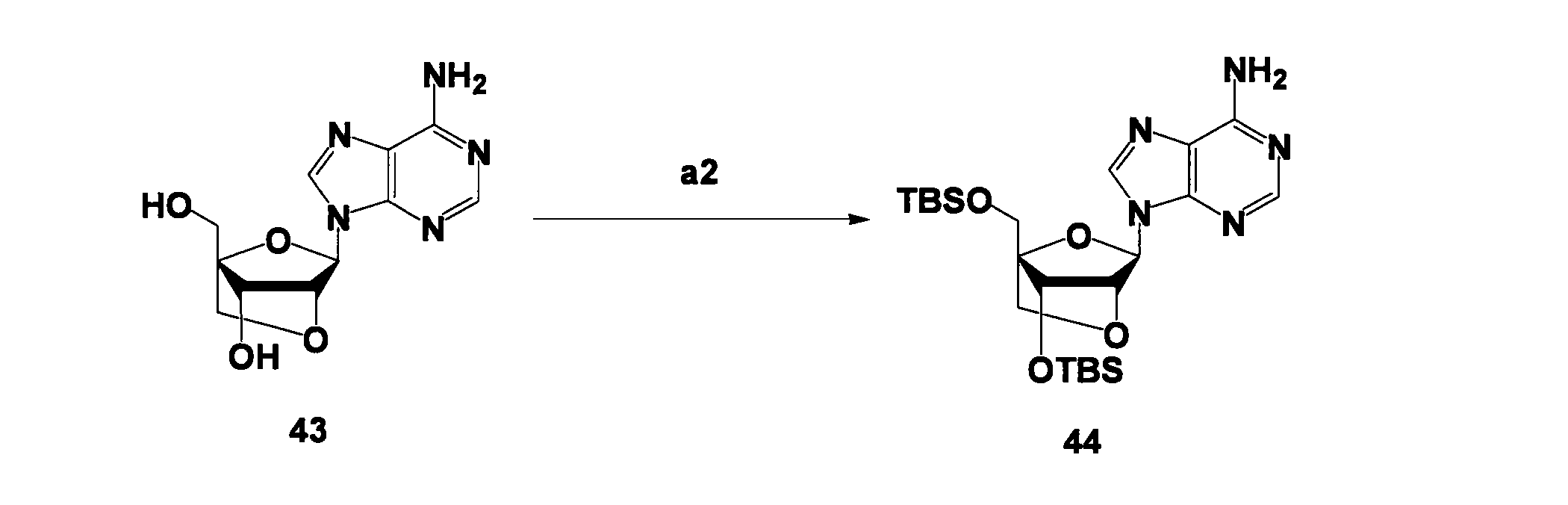
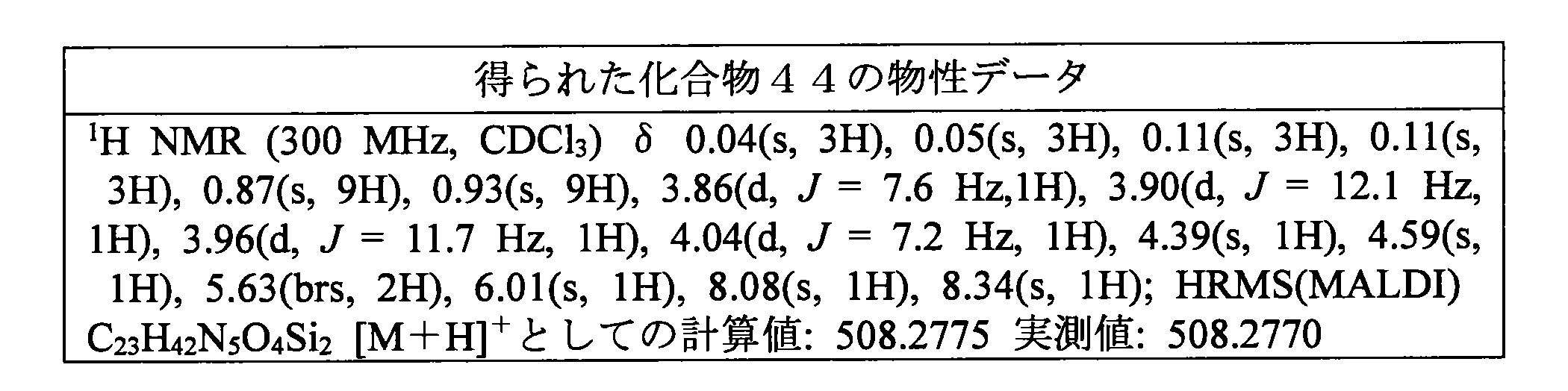


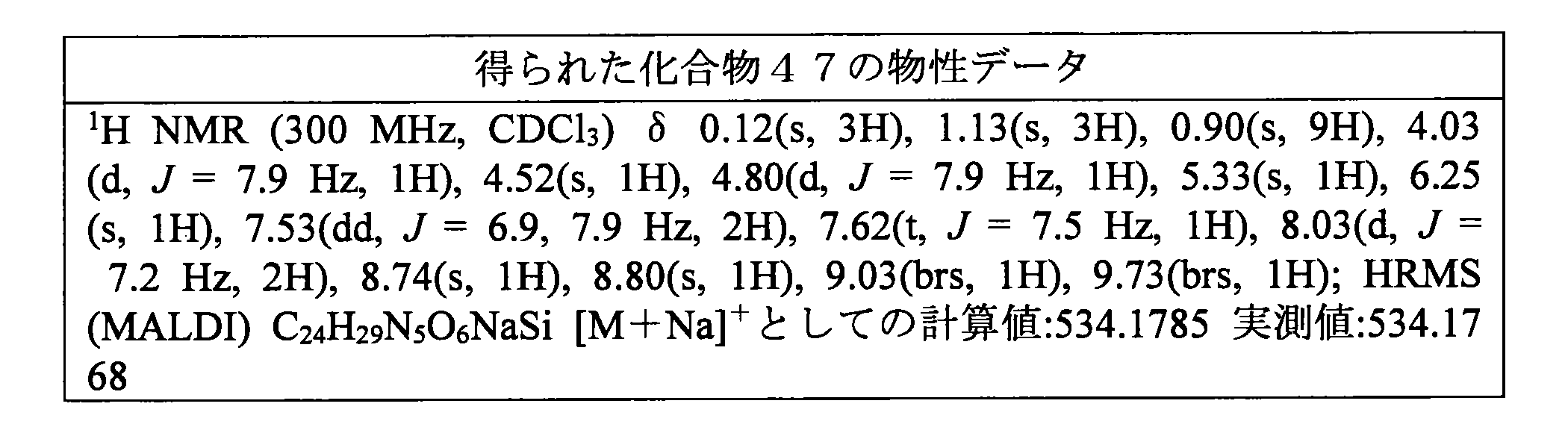

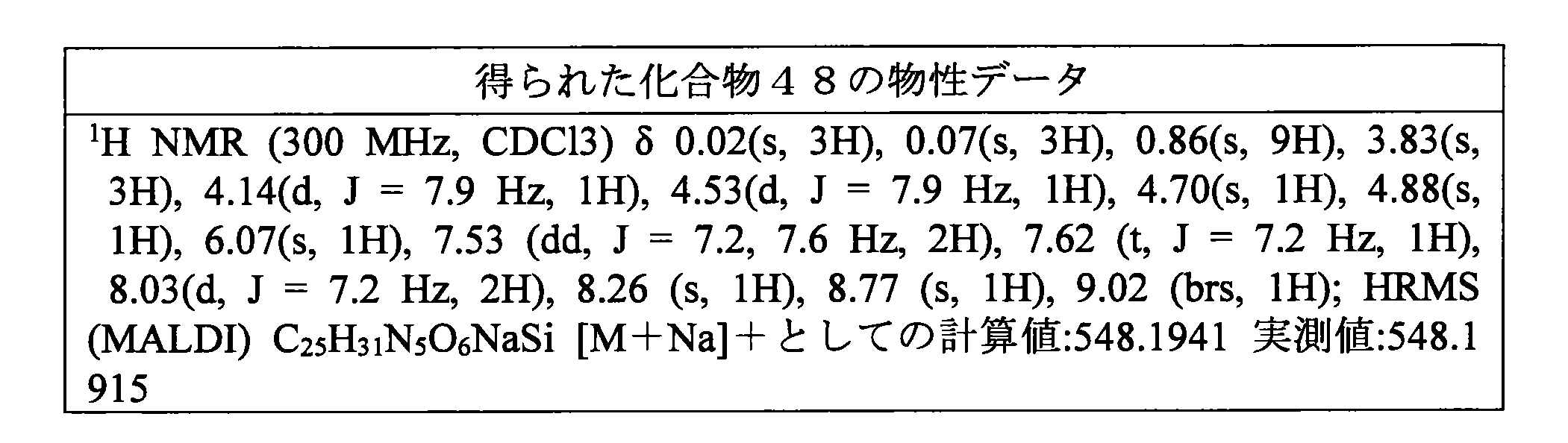
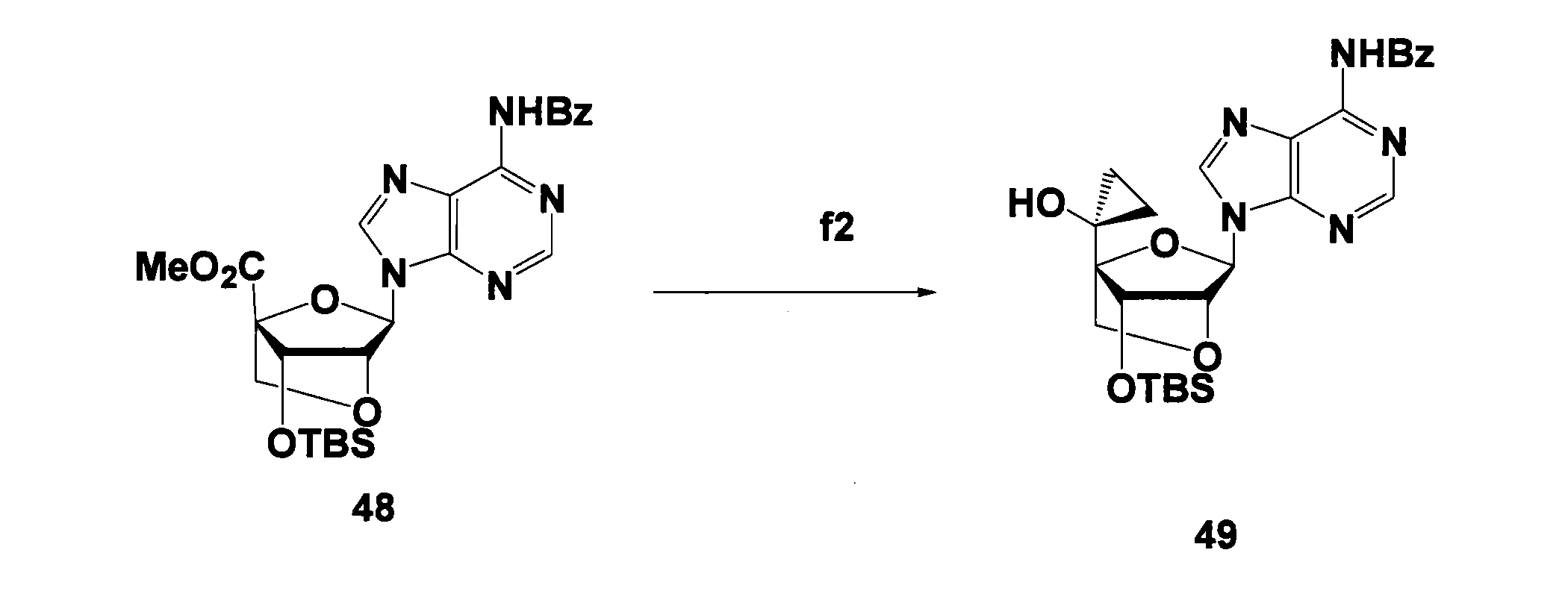
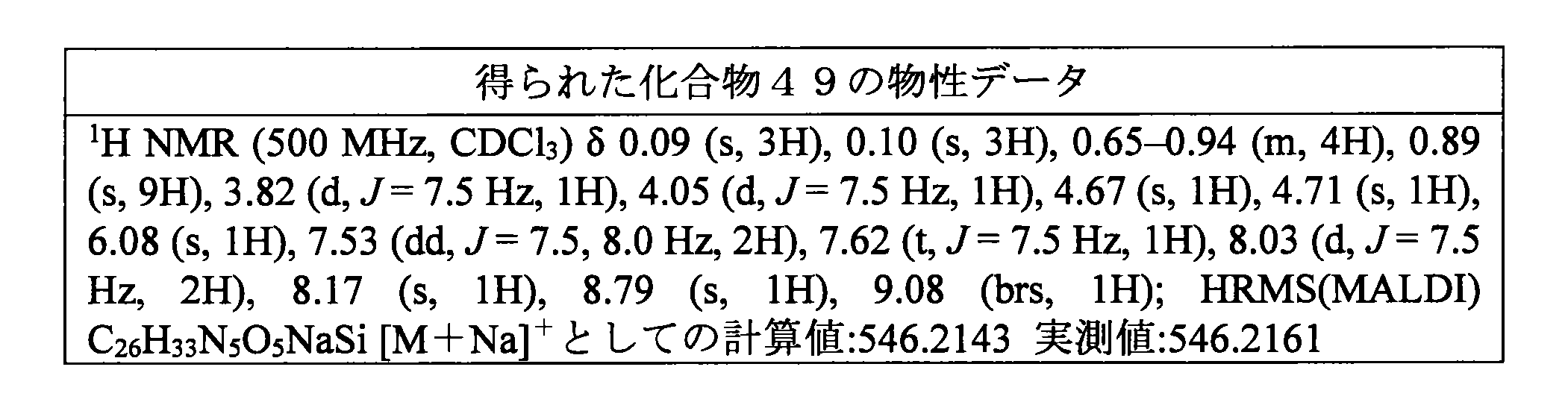

実施例1~3、6、7で作製された化合物7、11、20、35および42をアミダイトブロックとして用い、以下のようにしてオリゴヌクレオチドを合成した。オリゴヌクレオチドを構成する化合物7、11、20、35および42以外の化合物は、特に表記がない限り、Proligo社から購入した。
実施例9に記載のようにして、以下の配列のオリゴヌクレオチドを合成および精製した:
5’-d(GCGTTXTTTGCT)-3’(配列番号1~10)
(1)X=チミジン(T)(配列番号1)
(2)X=化合物7(5’-シクロプロピレンチミジン(5’-cp-T))(配列番号2)
(3)X=シチジン(C)(配列番号3)
(4)X=化合物11(5’-シクロプロピレン-5-メチル-2’-デオキシシチジン(5’-cp-MeC))(配列番号4)
(5)X=アデノシン(A)(配列番号5)
(6)X=化合物35(5’-シクロプロピレン-2’-デオキシアデノシン(5’-cp-A))(配列番号6)
(7)X=グアノシン(G)(配列番号7)
(8)X=化合物42(5’-シクロプロピレン-2’-デオキシグアノシン(5’-cp-G)))(配列番号8)
(9)X=LNA-グアニン(下記表43中「GL」)(配列番号9)
(10)X=化合物20(5’-シクロプロピレン-LNA-グアニン(5’-cp-LNA-G):下記表43中「GcpL」)(配列番号10)
配列(1)および(2)の標的鎖:一本鎖オリゴRNA5’-r(AGCAAAAAACGC)-3’(配列番号11)および一本鎖オリゴDNA5’-d(AGCAAAAAACGC)-3’(配列番号12);
配列(3)および(4)の標的鎖:一本鎖オリゴRNA5’-r(AGCAAAGAACGC)-3’(配列番号13)および一本鎖オリゴDNA5’-d(AGCAAAGAACGC)-3’(配列番号14);
配列(5)および(6)の標的鎖:一本鎖オリゴRNA5’-r(AGCAAAUAACGC)-3’(配列番号15)および一本鎖オリゴDNA5’-d(AGCAAATAACGC)-3’(配列番号16);ならびに
配列(7)~(10)の標的鎖:一本鎖オリゴRNA5’-r(AGCAAACAACGC)-3’(配列番号17)および一本鎖オリゴDNA5’-d(AGCAAACAACGC)-3’(配列番号18)。
(A):配列(1)および(2);
(B):配列(3)および(4);
(C):配列(5)および(6);
(D):配列(7)および(8);
(E):配列(7)、(9)および(10)。
表44中、一本鎖オリゴRNAに対する結果を「ssRNA」、一本鎖オリゴNAに対する結果を「ssDNA」に示し、そして各オリゴヌクレオチドのTmと、人工修飾核酸1塩基当たりのTm変動温度(「ΔTm/mod.」)とを示す。
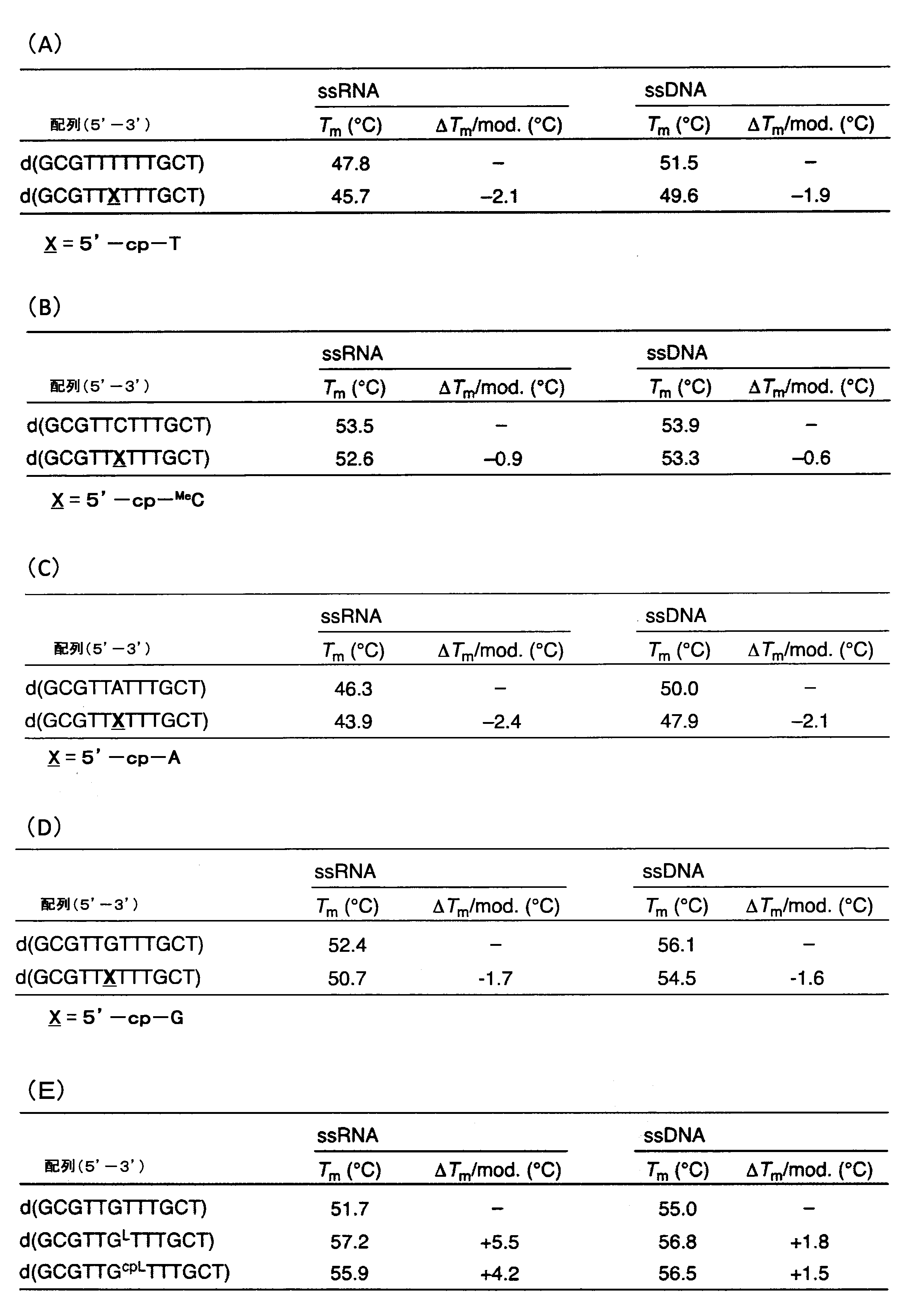
実施例9に記載のようにして、以下の10merの配列のオリゴヌクレオチドを合成および精製し、被験オリゴヌクレオチドとして用いた:
5’-TTTTTTTTTX-3’
X=チミジン(T)
X=ホスホロチオエートチミジン(ps-T)
X=化合物7(5’-シクロプロピレンチミジン(5’-cp-T))
実施例9に記載のようにして、以下の配列(11)~(12)のオリゴヌクレオチドを合成および精製し、被験オリゴヌクレオチドとして用いた:
(11)5’-GmCmGmttttttttGmCmUm-3’(配列番号19)
(12)5’-GmCmGmtttXtttXGmCmUm-3’(配列番号20)
(13)5’-GmCmGmtXttXttXGmCmUm-3’(配列番号21)
Gm、Cm、Um:2’-O-メチル修飾
t=チミジン
X=化合物7(5’-シクロプロピレンチミジン(5’-cp-T))

実施例9に記載のようにして、以下の配列のオリゴヌクレオチドを合成および精製し、被験オリゴヌクレオチドとして用いた:
SSO1:5’-tCcCtCtTgAaGgCc-3’(配列番号23)
SSO2:5’-t^CcCtCtTgAa^GgC^c-3’(配列番号24)
SSO3:5’-<t>CcCtCtTgAa<G>gC<c>-3’(配列番号25)
a、g、cおよびt=DNA
A=LNA-A、G=LNA-G、C=LNA-5-メチルシトシン、T=LNA-T、
<t>=化合物7(5’-シクロプロピレンチミジン)
<c>=化合物11(5’-シクロプロピレン-5-メチル-2’-デオキシシチジン))
<G>=化合物20(5’-シクロプロピレン-LNA-グアニン)
^=ホスホロチオエート結合(ヌクレオチド間の結合部位のリン酸基を硫黄化(S化)した)。
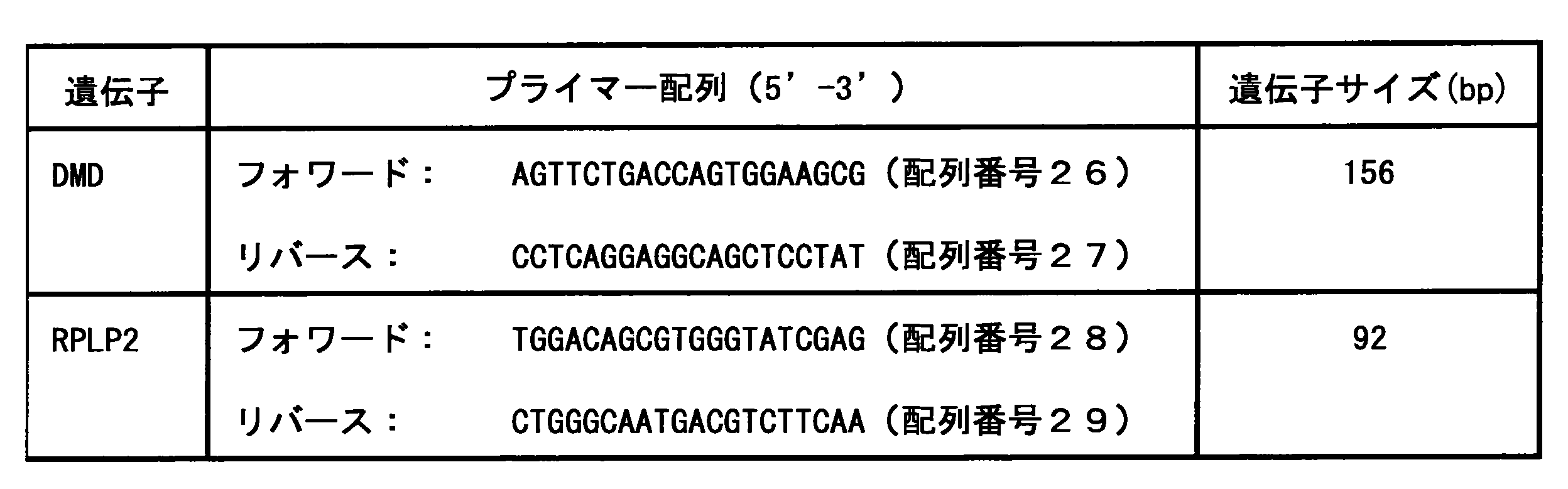
実施例9に記載のようにして、以下の配列のオリゴヌクレオチドを合成および精製し、被験オリゴヌクレオチドとして用いた:
ASO1:5’-G^T^mC^t^c^t^t^t^a^c^c^T^G^G-3’(配列番号30)
ASO2:5’-G^T^mCX^c^t^t^t^a^c^c^T^G^G-3’(配列番号31)
ASO3:5’-G^T^mC^t^c^tX^t^a^c^c^T^G^G-3’(配列番号32)
ASO4:5’-G^T^mCX^c^t^tX^a^c^c^T^G^G-3’(配列番号33)
a、g、cおよびt=DNA
A=LNA-A、G=LNA-G、mC=LNA-5-メチルシトシン、T=LNA-T、
大文字(A、G、mC、T)はLNAであり、そして小文字(a、g、c、t)はDNAである。
X=化合物7(5’-シクロプロピレンチミジン(5’-cp-T))。
^=ホスホロチオエート結合(ヌクレオチド間の結合部位のリン酸基を硫黄化(S化)した)。
Claims (9)
- 以下の式(I)で表される化合物またはその塩:

Baseは、α群から選択される任意の置換基を1以上有していてもよいプリン-9-イル基または2-オキソ-1,2-ジヒドロピリミジン-1-イル基を表し、ここで、該α群は、水酸基、核酸合成の保護基で保護された水酸基、炭素数1から6の直鎖アルキル基、炭素数1から6の直鎖アルコキシ基、メルカプト基、核酸合成の保護基で保護されたメルカプト基、炭素数1から6の直鎖アルキルチオ基、アミノ基、炭素数1から6の直鎖アルキルアミノ基、核酸合成の保護基で保護されたアミノ基、およびハロゲン原子からなり、
R2およびR3は、それぞれ独立して、水素原子、核酸合成の水酸基の保護基、分岐または環を形成していてもよい炭素数1から7のアルキル基、分岐または環を形成していてもよい炭素数2から7のアルケニル基、該α群から選択される任意の置換基を1以上有していてもよくそしてヘテロ原子を含んでいてもよい炭素数3から10のアリール基、該α群から選択される任意の置換基を1以上有していてもよくそしてヘテロ原子を含んでいてもよい炭素数3から12のアリール部分を有するアラルキル基、該α群から選択される任意の置換基を1以上有していてもよいアシル基、該α群から選択される任意の置換基を1以上有していてもよいシリル基、該α群から選択される任意の置換基を1以上有していてもよいリン酸基、核酸合成の保護基で保護されたリン酸基、-P(R4)R5[式中、R4およびR5は、それぞれ独立して、水酸基、核酸合成の保護基で保護された水酸基、メルカプト基、核酸合成の保護基で保護されたメルカプト基、アミノ基、炭素数1から6のアルコキシ基、炭素数1から6のアルキルチオ基、炭素数1から6のシアノアルコキシ基、または炭素数1から6のアルキル基を有するジアルキルアミノ基を表す]を表し、
R6およびR7は、それぞれ独立して、水素原子、ハロゲン原子、またはメチル基であり、そして
R8は水素原子でありかつR9は水素原子、ハロゲン原子;炭素数1から6の直鎖アルコキシ基で置換されていてもよい炭素数1から6の直鎖アルコキシ基;または-OR10[式中、R10は水素原子、または核酸合成の水酸基の保護基である]であるか、あるいは
R8およびR9は一緒になって以下の式:
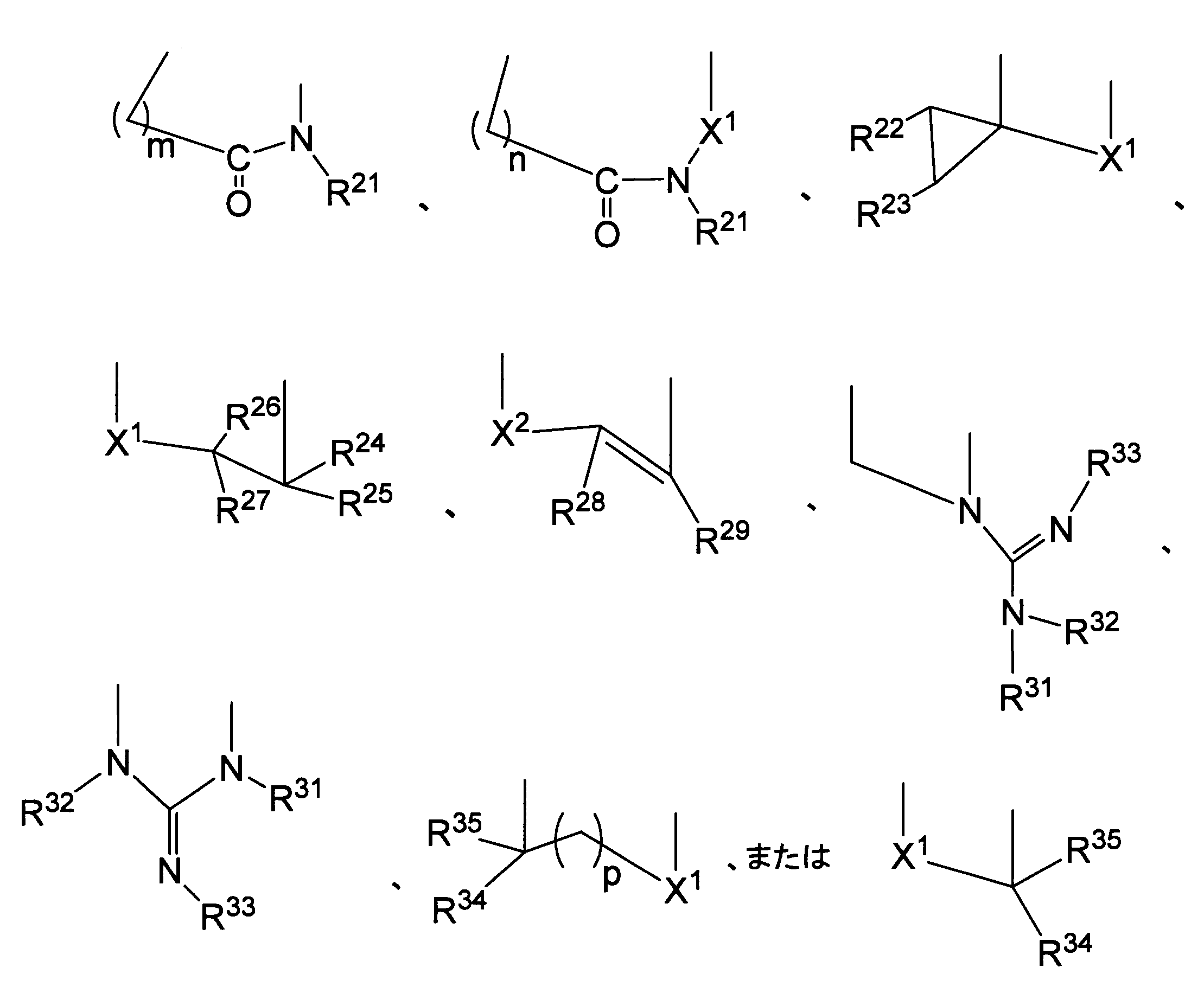
R21は、水素原子、分岐または環を形成していてもよい炭素数1から6のアルキル基、分岐または環を形成していてもよい炭素数2から6のアルケニル基、該α群から選択される任意の置換基を1以上有していてもよくそしてヘテロ原子を含んでいてもよい炭素数3から10のアリール基、該α群から選択される任意の置換基を1以上有していてもよくそしてヘテロ原子を含んでいてもよい炭素数3から12のアリール部分を有するアラルキル基、または核酸合成のアミノ基の保護基であり;
R22およびR23は、それぞれ独立して、水素原子;ヘテロ原子を含んでいてもよい炭素数3から12のアリール基で置換されていてもよく、かつ分岐または環を形成していてもよい炭素数1から6のアルキル基;またはヘテロ原子を含んでいてもよい炭素数3から12のアリール部分を有するアラルキル基;であるか、あるいは
R22およびR23は一緒になって、-(CH2)q-[式中、qは2から5の整数である]を表し;
R24およびR25は、それぞれ独立して、水素原子;水酸基;分岐または環を形成していてもよい炭素数1から6のアルキル基;分岐または環を形成していてもよい炭素数1から6のアルコキシ基;アミノ基;および核酸合成の保護基で保護されたアミノ基;からなる群から選択される基であるか、あるいは、
R24およびR25は一緒になって、=C(R36)R37[式中、R36およびR37は、それぞれ独立して、水素原子、水酸基、核酸合成の保護基で保護された水酸基、メルカプト基、核酸合成の保護基で保護されたメルカプト基、アミノ基、炭素数1から6の直鎖または分岐鎖アルコキシ基、炭素数1から6の直鎖または分岐鎖アルキルチオ基、炭素数1から6のシアノアルコキシ基、または炭素数1から6の直鎖または分岐鎖アルキルアミノ基を表す]を表し;
R26およびR27は、それぞれ独立して、水素原子、分岐または環を形成していてもよい炭素数1から6のアルキル基、分岐または環を形成していてもよい炭素数1から6のアルコキシ基、または炭素数1から6の直鎖または分岐鎖アルキルチオ基であり;
R28は、水素原子、分岐または環を形成していてもよい炭素数1から6のアルキル基、分岐または環を形成していてもよい炭素数1から6のアルコキシ基、または炭素数1から6の直鎖または分岐鎖アルキルチオ基であり;
R29は、水素原子、水酸基、分岐または環を形成していてもよい炭素数1から6のアルキル基、分岐または環を形成していてもよい炭素数1から6のアルコキシ基、アミノ基、あるいは核酸合成の保護基で保護されたアミノ基であり;
R31、R32、およびR33は、それぞれ独立して、水素原子、分岐または環を形成していてもよい炭素数1から6のアルキル基、あるいは核酸合成のアミノ基の保護基であり;
R34およびR35は、それぞれ独立して、水素原子、水酸基、分岐または環を形成していてもよい炭素数1から6のアルキル基、分岐または環を形成していてもよい炭素数1から6のアルコキシ基、アミノ基、または核酸合成の保護基で保護されたアミノ基であり;
mは0から2の整数であり;
nは0から1の整数であり;
pは0から1の整数であり;
X1は、酸素原子、硫黄原子、またはアミノ基であり;そして
X2は酸素原子または硫黄原子である]
で表される二価の基を表す)。 - 前記式(I)において、前記Baseが、6-アミノプリン-9-イル基、2,6-ジアミノプリン-9-イル基、2-アミノ-6-クロロプリン-9-イル基、2-アミノ-6-フルオロプリン-9-イル基、2-アミノ-6-ブロモプリン-9-イル基、2-アミノ-6-ヒドロキシプリン-9-イル基、6-アミノ-2-メトキシプリン-9-イル基、6-アミノ-2-クロロプリン-9-イル基、6-アミノ-2-フルオロプリン-9-イル基、2,6-ジメトキシプリン-9-イル基、2,6-ジクロロプリン-9-イル基、6-メルカプトプリン-9-イル基、2-オキソ-4-アミノ-1,2-ジヒドロピリミジン-1-イル基、4-アミノ-2-オキソ-5-フルオロ-1,2-ジヒドロピリミジン-1-イル基、4-アミノ-2-オキソ-5-クロロ-1,2-ジヒドロピリミジン-1-イル基、2-オキソ-4-メトキシ-1,2-ジヒドロピリミジン-1-イル基、2-オキソ-4-メルカプト-1,2-ジヒドロピリミジン-1-イル基、2-オキソ-4-ヒドロキシ-1,2-ジヒドロピリミジン-1-イル基、2-オキソ-4-ヒドロキシ-5-メチル-1,2-ジヒドロピリミジン-1-イル基、または4-アミノ-5-メチル-2-オキソ-1,2-ジヒドロピリミジン-1-イル基である、請求項1に記載の化合物またはその塩。
- 前記式(I)において、前記Baseが、以下の式:
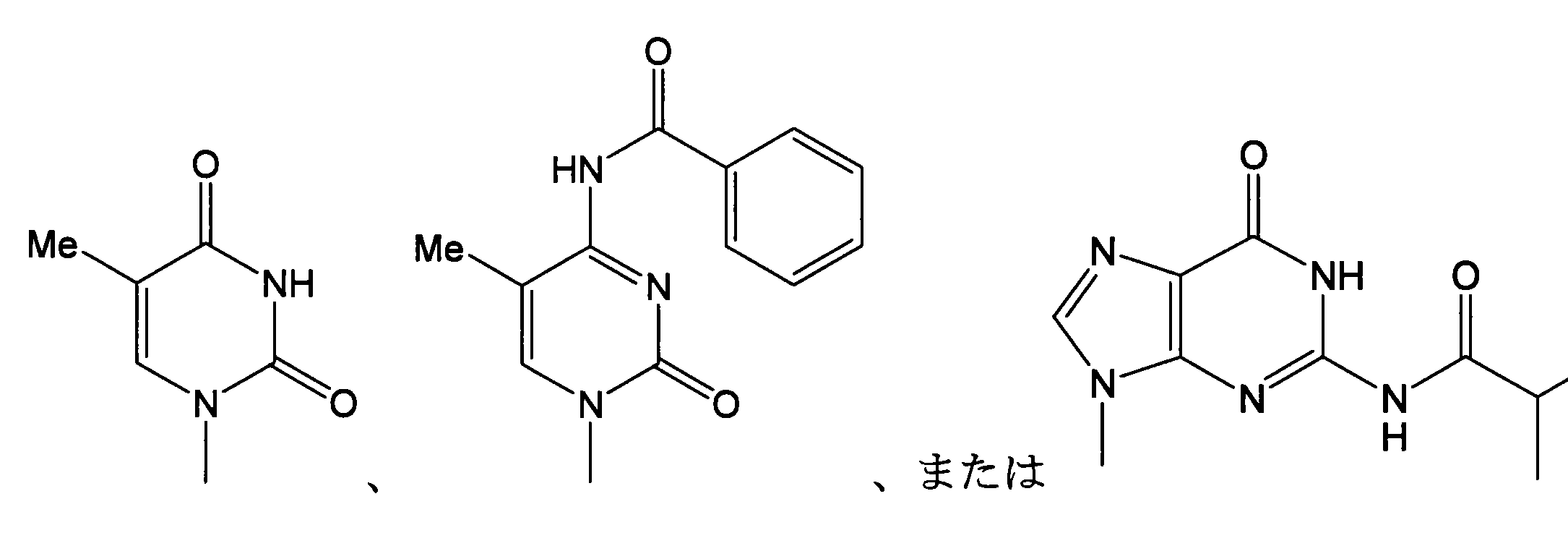
- 前記式(I)において、R6およびR7がともに水素原子である、請求項1から3のいずれかに記載の化合物またはその塩。
- 前記式(I)において、R8およびR9がともに水素原子である、請求項1から4のいずれかに記載の化合物またはその塩。
- 以下の式(II)で表されるヌクレオシド構造を少なくとも1つ含有するオリゴヌクレオチドまたはその薬理学上許容される塩:

Baseは、α群から選択される任意の置換基を1以上有していてもよいプリン-9-イル基または2-オキソ-1,2-ジヒドロピリミジン-1-イル基を表し、ここで、該α群は、水酸基、核酸合成の保護基で保護された水酸基、炭素数1から6の直鎖アルキル基、炭素数1から6の直鎖アルコキシ基、メルカプト基、核酸合成の保護基で保護されたメルカプト基、炭素数1から6の直鎖アルキルチオ基、アミノ基、炭素数1から6の直鎖アルキルアミノ基、核酸合成の保護基で保護されたアミノ基、およびハロゲン原子からなり、
R6およびR7は、それぞれ独立して、水素原子、ハロゲン原子、またはメチル基であり、そして
R8は水素原子でありかつR9は水素原子、ハロゲン原子、または炭素数1から6の直鎖アルコキシ基で置換されていてもよい炭素数1から6の直鎖アルコキシ基であるか、あるいはR8およびR9は一緒になって以下の式:

R21は、水素原子、分岐または環を形成していてもよい炭素数1から6のアルキル基、分岐または環を形成していてもよい炭素数2から6のアルケニル基、該α群から選択される任意の置換基を1以上有していてもよくそしてヘテロ原子を含んでいてもよい炭素数3から10のアリール基、該α群から選択される任意の置換基を1以上有していてもよくそしてヘテロ原子を含んでいてもよい炭素数3から12のアリール部分を有するアラルキル基、または核酸合成のアミノ基の保護基であり;
R22およびR23は、それぞれ独立して、水素原子;ヘテロ原子を含んでいてもよい炭素数3から12のアリール基で置換されていてもよく、かつ分岐または環を形成していてもよい炭素数1から6のアルキル基;またはヘテロ原子を含んでいてもよい炭素数3から12のアリール部分を有するアラルキル基;であるか、あるいは
R22およびR23は一緒になって、-(CH2)q-[式中、qは2から5の整数である]を表し;
R24およびR25は、それぞれ独立して、水素原子;水酸基;分岐または環を形成していてもよい炭素数1から6のアルキル基;分岐または環を形成していてもよい炭素数1から6のアルコキシ基;アミノ基;および核酸合成の保護基で保護されたアミノ基;からなる群から選択される基であるか、あるいは、
R24およびR25は一緒になって、=C(R36)R37[式中、R36およびR37は、それぞれ独立して、水素原子、水酸基、核酸合成の保護基で保護された水酸基、メルカプト基、核酸合成の保護基で保護されたメルカプト基、アミノ基、炭素数1から6の直鎖または分岐鎖アルコキシ基、炭素数1から6の直鎖または分岐鎖アルキルチオ基、炭素数1から6のシアノアルコキシ基、または炭素数1から6の直鎖または分岐鎖アルキルアミノ基を表す]を表し;
R26およびR27は、それぞれ独立して、水素原子、分岐または環を形成していてもよい炭素数1から6のアルキル基、分岐または環を形成していてもよい炭素数1から6のアルコキシ基、または炭素数1から6の直鎖または分岐鎖アルキルチオ基であり;
R28は、水素原子、分岐または環を形成していてもよい炭素数1から6のアルキル基、分岐または環を形成していてもよい炭素数1から6のアルコキシ基、または炭素数1から6の直鎖または分岐鎖アルキルチオ基であり;
R29は、水素原子、水酸基、分岐または環を形成していてもよい炭素数1から6のアルキル基、分岐または環を形成していてもよい炭素数1から6のアルコキシ基、アミノ基、あるいは核酸合成の保護基で保護されたアミノ基であり;
R31、R32、およびR33は、それぞれ独立して、水素原子、分岐または環を形成していてもよい炭素数1から6のアルキル基、あるいは核酸合成のアミノ基の保護基であり;
R34およびR35は、それぞれ独立して、水素原子、水酸基、分岐または環を形成していてもよい炭素数1から6のアルキル基、分岐または環を形成していてもよい炭素数1から6のアルコキシ基、アミノ基、または核酸合成の保護基で保護されたアミノ基であり;
mは0から2の整数であり;
nは0から1の整数であり;
pは0から1の整数であり;
X1は、酸素原子、硫黄原子、またはアミノ基であり;そして
X2は酸素原子または硫黄原子である]
で表される二価の基を表す)。 - 前記式(II)において、R6およびR7がともに水素原子である、請求項6に記載のオリゴヌクレオチドまたはその薬理学上許容される塩。
- 前記式(II)において、R8およびR9がともに水素原子である、請求項6または7に記載のオリゴヌクレオチドまたはその薬理学上許容される塩。
- 請求項6に記載のオリゴヌクレオチドまたはその薬理学上許容される塩の製造方法であって、
以下の式(I)で表される化合物またはその薬理学上許容される塩:
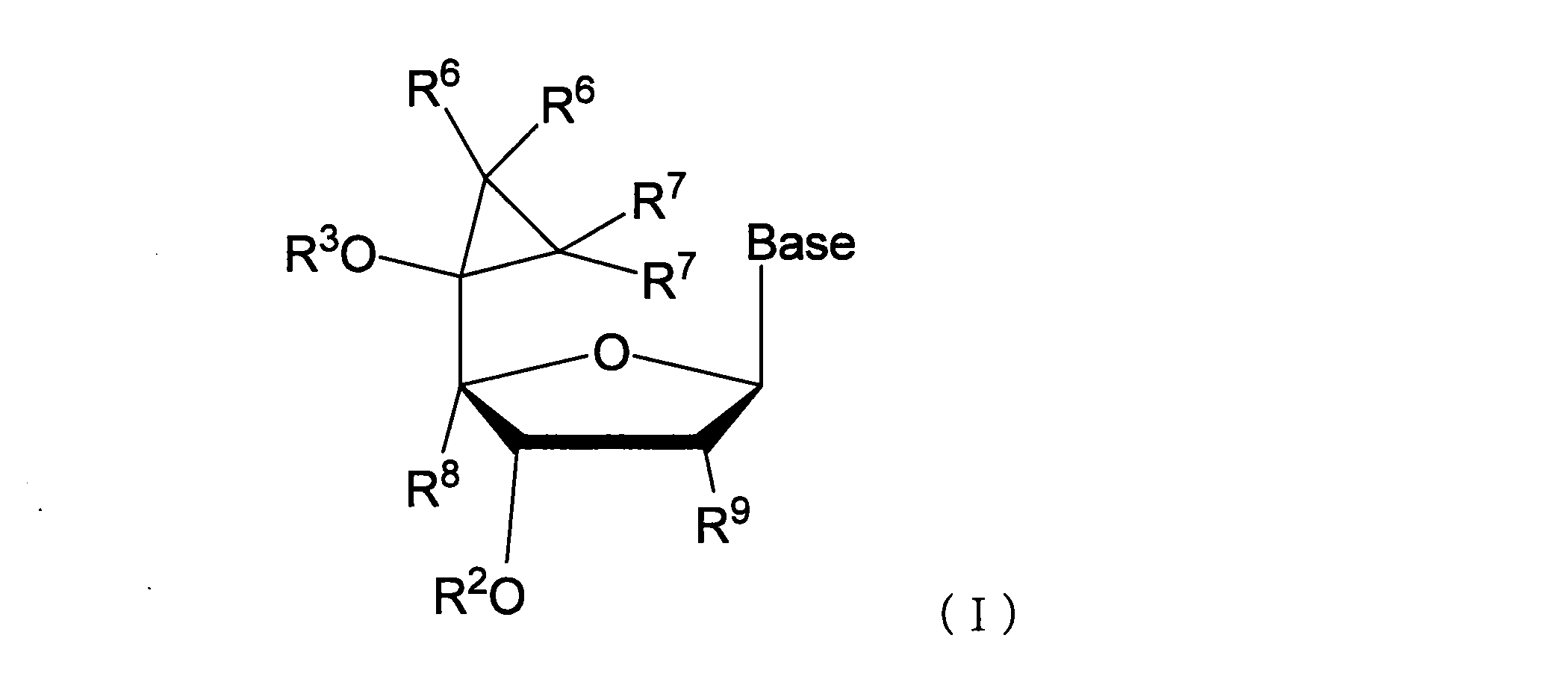
Baseは、α群から選択される任意の置換基を1以上有していてもよいプリン-9-イル基または2-オキソ-1,2-ジヒドロピリミジン-1-イル基を表し、ここで、該α群は、水酸基、核酸合成の保護基で保護された水酸基、炭素数1から6の直鎖アルキル基、炭素数1から6の直鎖アルコキシ基、メルカプト基、核酸合成の保護基で保護されたメルカプト基、炭素数1から6の直鎖アルキルチオ基、アミノ基、炭素数1から6の直鎖アルキルアミノ基、核酸合成の保護基で保護されたアミノ基、およびハロゲン原子からなり、
R2およびR3は、それぞれ独立して、水素原子、核酸合成の水酸基の保護基、分岐または環を形成していてもよい炭素数1から7のアルキル基、分岐または環を形成していてもよい炭素数2から7のアルケニル基、該α群から選択される任意の置換基を1以上有していてもよくそしてヘテロ原子を含んでいてもよい炭素数3から10のアリール基、該α群から選択される任意の置換基を1以上有していてもよくそしてヘテロ原子を含んでいてもよい炭素数3から12のアリール部分を有するアラルキル基、該α群から選択される任意の置換基を1以上有していてもよいアシル基、該α群から選択される任意の置換基を1以上有していてもよいシリル基、該α群から選択される任意の置換基を1以上有していてもよいリン酸基、核酸合成の保護基で保護されたリン酸基、-P(R4)R5[式中、R4およびR5は、それぞれ独立して、水酸基、核酸合成の保護基で保護された水酸基、メルカプト基、核酸合成の保護基で保護されたメルカプト基、アミノ基、炭素数1から6のアルコキシ基、炭素数1から6のアルキルチオ基、炭素数1から6のシアノアルコキシ基、または炭素数1から6のアルキル基を有するジアルキルアミノ基を表す]を表し、
R6およびR7は、それぞれ独立して、水素原子、ハロゲン原子、またはメチル基であり、そして
R8は水素原子でありかつR9は水素原子、ハロゲン原子;炭素数1から6の直鎖アルコキシ基で置換されていてもよい炭素数1から6の直鎖アルコキシ基;または-OR10[式中、R10は水素原子、または核酸合成の水酸基の保護基である]であるか、あるいは
R8およびR9は一緒になって以下の式:
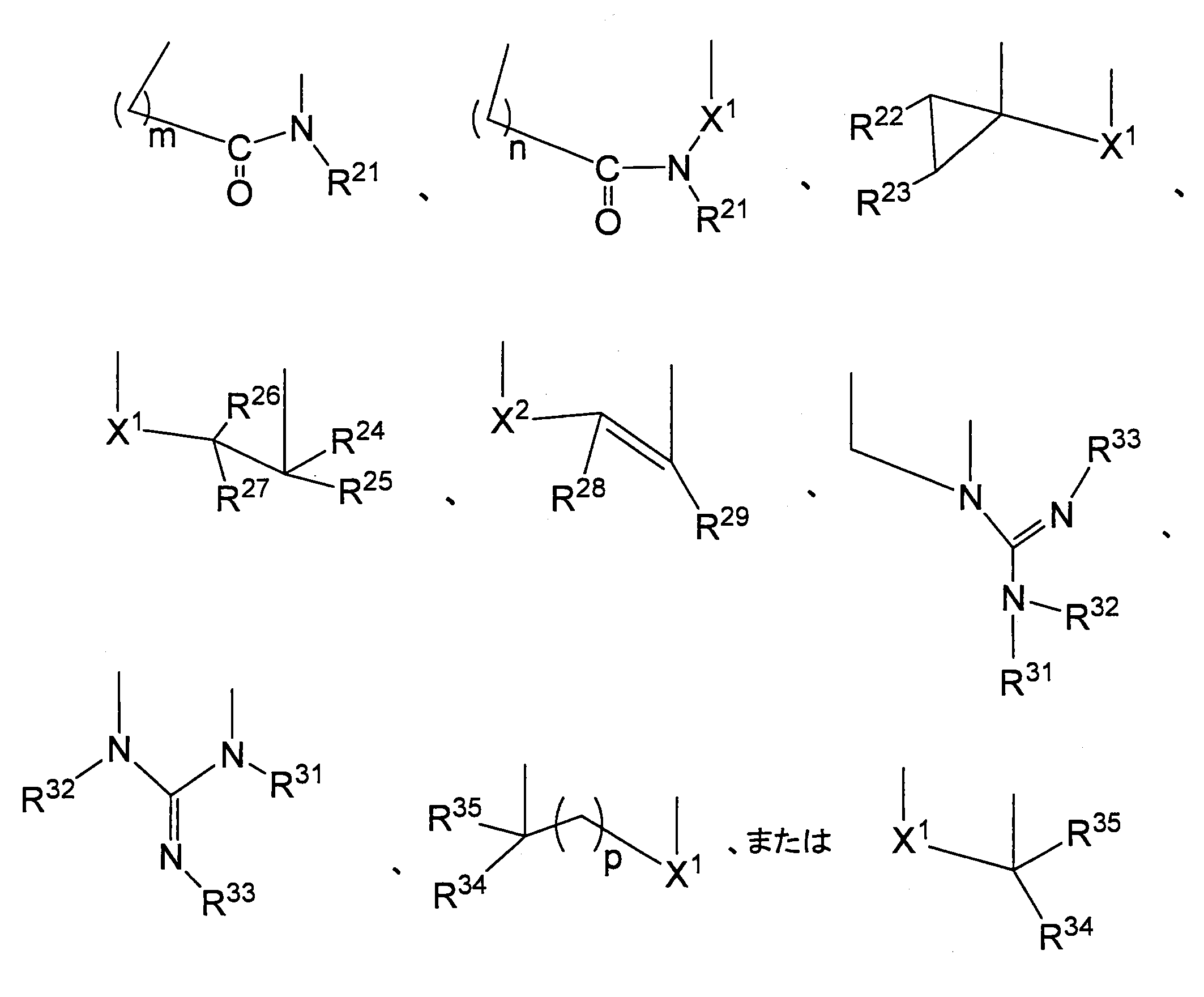
R21は、水素原子、分岐または環を形成していてもよい炭素数1から6のアルキル基、分岐または環を形成していてもよい炭素数2から6のアルケニル基、該α群から選択される任意の置換基を1以上有していてもよくそしてヘテロ原子を含んでいてもよい炭素数3から10のアリール基、該α群から選択される任意の置換基を1以上有していてもよくそしてヘテロ原子を含んでいてもよい炭素数3から12のアリール部分を有するアラルキル基、または核酸合成のアミノ基の保護基であり;
R22およびR23は、それぞれ独立して、水素原子;ヘテロ原子を含んでいてもよい炭素数3から12のアリール基で置換されていてもよく、かつ分岐または環を形成していてもよい炭素数1から6のアルキル基;またはヘテロ原子を含んでいてもよい炭素数3から12のアリール部分を有するアラルキル基;であるか、あるいは
R22およびR23は一緒になって、-(CH2)q-[式中、qは2から5の整数である]を表し;
R24およびR25は、それぞれ独立して、水素原子;水酸基;分岐または環を形成していてもよい炭素数1から6のアルキル基;分岐または環を形成していてもよい炭素数1から6のアルコキシ基;アミノ基;および核酸合成の保護基で保護されたアミノ基;からなる群から選択される基であるか、あるいは、
R24およびR25は一緒になって、=C(R36)R37[式中、R36およびR37は、それぞれ独立して、水素原子、水酸基、核酸合成の保護基で保護された水酸基、メルカプト基、核酸合成の保護基で保護されたメルカプト基、アミノ基、炭素数1から6の直鎖または分岐鎖アルコキシ基、炭素数1から6の直鎖または分岐鎖アルキルチオ基、炭素数1から6のシアノアルコキシ基、または炭素数1から6の直鎖または分岐鎖アルキルアミノ基を表す]を表し;
R26およびR27は、それぞれ独立して、水素原子、分岐または環を形成していてもよい炭素数1から6のアルキル基、分岐または環を形成していてもよい炭素数1から6のアルコキシ基、または炭素数1から6の直鎖または分岐鎖アルキルチオ基であり;
R28は、水素原子、分岐または環を形成していてもよい炭素数1から6のアルキル基、分岐または環を形成していてもよい炭素数1から6のアルコキシ基、または炭素数1から6の直鎖または分岐鎖アルキルチオ基であり;
R29は、水素原子、水酸基、分岐または環を形成していてもよい炭素数1から6のアルキル基、分岐または環を形成していてもよい炭素数1から6のアルコキシ基、アミノ基、あるいは核酸合成の保護基で保護されたアミノ基であり;
R31、R32、およびR33は、それぞれ独立して、水素原子、分岐または環を形成していてもよい炭素数1から6のアルキル基、あるいは核酸合成のアミノ基の保護基であり;
R34およびR35は、それぞれ独立して、水素原子、水酸基、分岐または環を形成していてもよい炭素数1から6のアルキル基、分岐または環を形成していてもよい炭素数1から6のアルコキシ基、アミノ基、または核酸合成の保護基で保護されたアミノ基であり;
mは0から2の整数であり;
nは0から1の整数であり;
pは0から1の整数であり;
X1は、酸素原子、硫黄原子、またはアミノ基であり;そして
X2は酸素原子または硫黄原子である]
で表される二価の基を表す)
を用いてオリゴヌクレオチドを合成する工程を包含する、方法。
Priority Applications (4)
| Application Number | Priority Date | Filing Date | Title |
|---|---|---|---|
| EP20748721.6A EP3919501A4 (en) | 2019-02-01 | 2020-01-31 | 5'-MODIFIED NUCLEOSIDE AND NUCLEOTIDE THEREOF |
| US17/427,134 US12398171B2 (en) | 2019-02-01 | 2020-01-31 | 5′-modified nucleoside and nucleotide using same |
| JP2020568623A JP7441523B2 (ja) | 2019-02-01 | 2020-01-31 | 5’位修飾ヌクレオシドおよびそれを用いたヌクレオチド |
| CN202080011853.9A CN113412268B (zh) | 2019-02-01 | 2020-01-31 | 5’位修饰核苷和使用其的核苷酸 |
Applications Claiming Priority (2)
| Application Number | Priority Date | Filing Date | Title |
|---|---|---|---|
| JP2019-016756 | 2019-02-01 | ||
| JP2019016756 | 2019-02-01 |
Publications (1)
| Publication Number | Publication Date |
|---|---|
| WO2020158910A1 true WO2020158910A1 (ja) | 2020-08-06 |
Family
ID=71840179
Family Applications (1)
| Application Number | Title | Priority Date | Filing Date |
|---|---|---|---|
| PCT/JP2020/003597 Ceased WO2020158910A1 (ja) | 2019-02-01 | 2020-01-31 | 5'位修飾ヌクレオシドおよびそれを用いたヌクレオチド |
Country Status (5)
| Country | Link |
|---|---|
| US (1) | US12398171B2 (ja) |
| EP (1) | EP3919501A4 (ja) |
| JP (1) | JP7441523B2 (ja) |
| CN (1) | CN113412268B (ja) |
| WO (1) | WO2020158910A1 (ja) |
Cited By (7)
| Publication number | Priority date | Publication date | Assignee | Title |
|---|---|---|---|---|
| WO2022097727A1 (ja) | 2020-11-06 | 2022-05-12 | 住友ファーマ株式会社 | Rps25遺伝子の発現及び/又は機能調節剤 |
| WO2022211095A1 (ja) * | 2021-03-31 | 2022-10-06 | ルクサナバイオテク株式会社 | Fgfr3のアンチセンスオリゴヌクレオチド |
| WO2022234855A1 (ja) | 2021-05-06 | 2022-11-10 | ルクサナバイオテク株式会社 | 中枢毒性が低減したオリゴヌクレオチドの設計方法 |
| JPWO2023167094A1 (ja) * | 2022-03-01 | 2023-09-07 | ||
| WO2024071099A1 (ja) | 2022-09-29 | 2024-04-04 | 国立大学法人東京医科歯科大学 | 5'-シクロプロピレン修飾を含む核酸分子 |
| WO2024257847A1 (ja) | 2023-06-16 | 2024-12-19 | 住友ファーマ株式会社 | Rps25遺伝子の発現及び/又はその機能を調節するアンチセンスオリゴヌクレオチド |
| WO2025005151A1 (ja) | 2023-06-26 | 2025-01-02 | 学校法人昭和大学 | Hic-5を標的とするアンチセンスオリゴヌクレオチド |
Citations (8)
| Publication number | Priority date | Publication date | Assignee | Title |
|---|---|---|---|---|
| WO1994022890A1 (en) * | 1993-03-31 | 1994-10-13 | Sterling Winthop Inc. | Novel 5'-substituted nucleosides and oligomers produced therefrom |
| WO2007134181A2 (en) * | 2006-05-11 | 2007-11-22 | Isis Pharmaceuticals, Inc. | 5'-modified bicyclic nucleic acid analogs |
| WO2010048585A2 (en) | 2008-10-24 | 2010-04-29 | Isis Pharmaceuticals, Inc. | Oligomeric compounds and methods |
| WO2010048549A2 (en) | 2008-10-24 | 2010-04-29 | Isis Pharmaceuticals, Inc. | 5' and 2' bis-substituted nucleosides and oligomeric compounds prepared therefrom |
| WO2010077578A1 (en) | 2008-12-09 | 2010-07-08 | Isis Pharmaceuticals, Inc. | Bis-modified bicyclic nucleic acid analogs |
| WO2015116248A1 (en) * | 2013-02-01 | 2015-08-06 | Enanta Pharmaceuticals, Inc. | 5, 6-d2 uridine nucleoside/tide derivatives |
| WO2015125783A1 (ja) * | 2014-02-18 | 2015-08-27 | 国立大学法人大阪大学 | 架橋型ヌクレオシドおよびヌクレオチド |
| CN108276463A (zh) * | 2017-01-06 | 2018-07-13 | 米文君 | 一类新的化合物及其用途 |
Family Cites Families (3)
| Publication number | Priority date | Publication date | Assignee | Title |
|---|---|---|---|---|
| US7306662B2 (en) * | 2006-05-11 | 2007-12-11 | Lam Research Corporation | Plating solution for electroless deposition of copper |
| WO2011139699A2 (en) | 2010-04-28 | 2011-11-10 | Isis Pharmaceuticals, Inc. | 5' modified nucleosides and oligomeric compounds prepared therefrom |
| US20220127300A1 (en) | 2019-02-13 | 2022-04-28 | Osaka University | 5'-modified nucleoside and nucleotide using same |
-
2020
- 2020-01-31 EP EP20748721.6A patent/EP3919501A4/en active Pending
- 2020-01-31 CN CN202080011853.9A patent/CN113412268B/zh active Active
- 2020-01-31 US US17/427,134 patent/US12398171B2/en active Active
- 2020-01-31 JP JP2020568623A patent/JP7441523B2/ja active Active
- 2020-01-31 WO PCT/JP2020/003597 patent/WO2020158910A1/ja not_active Ceased
Patent Citations (8)
| Publication number | Priority date | Publication date | Assignee | Title |
|---|---|---|---|---|
| WO1994022890A1 (en) * | 1993-03-31 | 1994-10-13 | Sterling Winthop Inc. | Novel 5'-substituted nucleosides and oligomers produced therefrom |
| WO2007134181A2 (en) * | 2006-05-11 | 2007-11-22 | Isis Pharmaceuticals, Inc. | 5'-modified bicyclic nucleic acid analogs |
| WO2010048585A2 (en) | 2008-10-24 | 2010-04-29 | Isis Pharmaceuticals, Inc. | Oligomeric compounds and methods |
| WO2010048549A2 (en) | 2008-10-24 | 2010-04-29 | Isis Pharmaceuticals, Inc. | 5' and 2' bis-substituted nucleosides and oligomeric compounds prepared therefrom |
| WO2010077578A1 (en) | 2008-12-09 | 2010-07-08 | Isis Pharmaceuticals, Inc. | Bis-modified bicyclic nucleic acid analogs |
| WO2015116248A1 (en) * | 2013-02-01 | 2015-08-06 | Enanta Pharmaceuticals, Inc. | 5, 6-d2 uridine nucleoside/tide derivatives |
| WO2015125783A1 (ja) * | 2014-02-18 | 2015-08-27 | 国立大学法人大阪大学 | 架橋型ヌクレオシドおよびヌクレオチド |
| CN108276463A (zh) * | 2017-01-06 | 2018-07-13 | 米文君 | 一类新的化合物及其用途 |
Non-Patent Citations (12)
| Title |
|---|
| CARUTHERS ET AL., TETRAHEDRON LETT., vol. 37, no. 35, 1996, pages 6239 - 6242 |
| HORIBA, M. ET AL.: "Synthesis of scpBNA-mC, -A, and -G Monomers and Evaluation of the Binding Affinities of scpBNA-Modified Oligonucleotides toward Complementary ssRNA and ssDNA", THE JOURNAL OF ORGANIC CHEMISTRY, vol. 81, no. 22, 2016, pages 11000 - 11008, XP055376695, DOI: 10.1021/acs.joc.6b02036 * |
| LOMHOLT ET AL., J. ORG. CHEM., vol. 66, no. 25, 2001, pages 8504 - 8512 |
| M. KUWAHARA ET AL., NUCLEIC ACIDS RES., vol. 36, no. 13, 2008, pages 4257 - 4265 |
| MANOHARANET, J. ORG. CHEM., vol. 81, 2016, pages 2261 - 2279 |
| OBIKA ET AL., NUCLEIC ACIDS RES., vol. 42, no. 12, 2014, pages 8174 - 8187 |
| S. SINGH ET AL., J. CHEM. COMMUN., 1998, pages 455 - 456 |
| S.OBIKA ET AL., TETRAHEDRON LETT., vol. 38, 1997, pages 8735 - 8738 |
| See also references of EP3919501A4 |
| SUZUKI ET AL., BIOMACROMOLECULES, vol. 12, no. 5, 2011, pages 1449 - 1459 |
| WEXSELLBLATT ET AL., BIOORG. MED. CHEM., vol. 18, no. 12, 2010, pages 4485 - 4497 |
| YAWMAN ET AL., J. ORG. CHEM., vol. 60, 1995, pages 788 - 789 |
Cited By (12)
| Publication number | Priority date | Publication date | Assignee | Title |
|---|---|---|---|---|
| WO2022097727A1 (ja) | 2020-11-06 | 2022-05-12 | 住友ファーマ株式会社 | Rps25遺伝子の発現及び/又は機能調節剤 |
| WO2022211095A1 (ja) * | 2021-03-31 | 2022-10-06 | ルクサナバイオテク株式会社 | Fgfr3のアンチセンスオリゴヌクレオチド |
| WO2022234855A1 (ja) | 2021-05-06 | 2022-11-10 | ルクサナバイオテク株式会社 | 中枢毒性が低減したオリゴヌクレオチドの設計方法 |
| JPWO2022234855A1 (ja) * | 2021-05-06 | 2022-11-10 | ||
| EP4335859A4 (en) * | 2021-05-06 | 2025-07-30 | Luxna Biotech Co Ltd | METHOD FOR DESIGNING AN OLIGONUCLEOTIDE HAVING REDUCED CENTRAL TOXICITY |
| JPWO2023167094A1 (ja) * | 2022-03-01 | 2023-09-07 | ||
| WO2023167094A1 (ja) | 2022-03-01 | 2023-09-07 | 国立大学法人大阪大学 | 5'位修飾ヌクレオシドおよびそれを用いたヌクレオチド |
| JP7650412B2 (ja) | 2022-03-01 | 2025-03-25 | 国立大学法人大阪大学 | 5′位修飾ヌクレオシドおよびそれを用いたヌクレオチド |
| EP4488281A4 (en) * | 2022-03-01 | 2026-04-22 | Univ Osaka | 5' MODIFIED NUCLEOSIDE AND NUCLEOTIDE USING IT |
| WO2024071099A1 (ja) | 2022-09-29 | 2024-04-04 | 国立大学法人東京医科歯科大学 | 5'-シクロプロピレン修飾を含む核酸分子 |
| WO2024257847A1 (ja) | 2023-06-16 | 2024-12-19 | 住友ファーマ株式会社 | Rps25遺伝子の発現及び/又はその機能を調節するアンチセンスオリゴヌクレオチド |
| WO2025005151A1 (ja) | 2023-06-26 | 2025-01-02 | 学校法人昭和大学 | Hic-5を標的とするアンチセンスオリゴヌクレオチド |
Also Published As
| Publication number | Publication date |
|---|---|
| US20220372060A1 (en) | 2022-11-24 |
| CN113412268B (zh) | 2025-06-17 |
| US12398171B2 (en) | 2025-08-26 |
| JP7441523B2 (ja) | 2024-03-01 |
| CN113412268A (zh) | 2021-09-17 |
| EP3919501A4 (en) | 2022-11-23 |
| EP3919501A1 (en) | 2021-12-08 |
| JPWO2020158910A1 (ja) | 2021-12-02 |
Similar Documents
| Publication | Publication Date | Title |
|---|---|---|
| JP7441523B2 (ja) | 5’位修飾ヌクレオシドおよびそれを用いたヌクレオチド | |
| JP6233903B2 (ja) | 架橋型ヌクレオシドおよびヌクレオチド | |
| JP6562517B2 (ja) | 架橋型ヌクレオシドおよびヌクレオチド | |
| JP5669073B2 (ja) | 架橋型人工ヌクレオシドおよびヌクレオチド | |
| JPWO2005021570A1 (ja) | N−o結合性架橋構造型新規人工核酸 | |
| JP7438546B2 (ja) | 5’位修飾ヌクレオシドおよびそれを用いたヌクレオチド | |
| US12606589B2 (en) | Bridged nucleoside and nucleotide using same | |
| JP7650412B2 (ja) | 5′位修飾ヌクレオシドおよびそれを用いたヌクレオチド | |
| JP2023110119A (ja) | 5’位修飾ヌクレオシドおよびそれを用いたヌクレオチド | |
| JP7709690B2 (ja) | 架橋型ヌクレオシドおよびそれを用いたヌクレオチド | |
| CN118946575A (zh) | 5'位修饰核苷和使用其的核苷酸 | |
| WO2023149038A1 (ja) | フェノキサジン誘導体およびそれを用いたドラッグデリバリーシステム製剤 | |
| WO2021256297A1 (ja) | 架橋型ヌクレオシドおよびヌクレオチド |
Legal Events
| Date | Code | Title | Description |
|---|---|---|---|
| 121 | Ep: the epo has been informed by wipo that ep was designated in this application |
Ref document number: 20748721 Country of ref document: EP Kind code of ref document: A1 |
|
| ENP | Entry into the national phase |
Ref document number: 2020568623 Country of ref document: JP Kind code of ref document: A |
|
| NENP | Non-entry into the national phase |
Ref country code: DE |
|
| ENP | Entry into the national phase |
Ref document number: 2020748721 Country of ref document: EP Effective date: 20210901 |
|
| WWG | Wipo information: grant in national office |
Ref document number: 202080011853.9 Country of ref document: CN |
|
| WWG | Wipo information: grant in national office |
Ref document number: 17427134 Country of ref document: US |