WO2020138063A1 - 医薬品容器用ガラス、これを用いた医薬品容器用ガラス管及び医薬品容器 - Google Patents
医薬品容器用ガラス、これを用いた医薬品容器用ガラス管及び医薬品容器 Download PDFInfo
- Publication number
- WO2020138063A1 WO2020138063A1 PCT/JP2019/050572 JP2019050572W WO2020138063A1 WO 2020138063 A1 WO2020138063 A1 WO 2020138063A1 JP 2019050572 W JP2019050572 W JP 2019050572W WO 2020138063 A1 WO2020138063 A1 WO 2020138063A1
- Authority
- WO
- WIPO (PCT)
- Prior art keywords
- glass
- cao
- mgo
- less
- content
- Prior art date
- Legal status (The legal status is an assumption and is not a legal conclusion. Google has not performed a legal analysis and makes no representation as to the accuracy of the status listed.)
- Ceased
Links
Classifications
-
- C—CHEMISTRY; METALLURGY
- C03—GLASS; MINERAL OR SLAG WOOL
- C03C—CHEMICAL COMPOSITION OF GLASSES, GLAZES OR VITREOUS ENAMELS; SURFACE TREATMENT OF GLASS; SURFACE TREATMENT OF FIBRES OR FILAMENTS MADE FROM GLASS, MINERALS OR SLAGS; JOINING GLASS TO GLASS OR OTHER MATERIALS
- C03C3/00—Glass compositions
- C03C3/04—Glass compositions containing silica
- C03C3/076—Glass compositions containing silica with 40% to 90% silica, by weight
- C03C3/083—Glass compositions containing silica with 40% to 90% silica, by weight containing aluminium oxide or an iron compound
- C03C3/085—Glass compositions containing silica with 40% to 90% silica, by weight containing aluminium oxide or an iron compound containing an oxide of a divalent metal
-
- C—CHEMISTRY; METALLURGY
- C03—GLASS; MINERAL OR SLAG WOOL
- C03C—CHEMICAL COMPOSITION OF GLASSES, GLAZES OR VITREOUS ENAMELS; SURFACE TREATMENT OF GLASS; SURFACE TREATMENT OF FIBRES OR FILAMENTS MADE FROM GLASS, MINERALS OR SLAGS; JOINING GLASS TO GLASS OR OTHER MATERIALS
- C03C3/00—Glass compositions
- C03C3/04—Glass compositions containing silica
- C03C3/076—Glass compositions containing silica with 40% to 90% silica, by weight
- C03C3/089—Glass compositions containing silica with 40% to 90% silica, by weight containing boron
- C03C3/091—Glass compositions containing silica with 40% to 90% silica, by weight containing boron containing aluminium
- C03C3/093—Glass compositions containing silica with 40% to 90% silica, by weight containing boron containing aluminium containing zinc or zirconium
-
- A—HUMAN NECESSITIES
- A61—MEDICAL OR VETERINARY SCIENCE; HYGIENE
- A61J—CONTAINERS SPECIALLY ADAPTED FOR MEDICAL OR PHARMACEUTICAL PURPOSES; DEVICES OR METHODS SPECIALLY ADAPTED FOR BRINGING PHARMACEUTICAL PRODUCTS INTO PARTICULAR PHYSICAL OR ADMINISTERING FORMS; DEVICES FOR ADMINISTERING FOOD OR MEDICINES ORALLY; BABY COMFORTERS; DEVICES FOR RECEIVING SPITTLE
- A61J1/00—Containers specially adapted for medical or pharmaceutical purposes
- A61J1/05—Containers specially adapted for medical or pharmaceutical purposes for collecting, storing or administering blood, plasma or medical fluids ; Infusion or perfusion containers
- A61J1/06—Ampoules or carpules
- A61J1/065—Rigid ampoules, e.g. glass ampoules
-
- A—HUMAN NECESSITIES
- A61—MEDICAL OR VETERINARY SCIENCE; HYGIENE
- A61J—CONTAINERS SPECIALLY ADAPTED FOR MEDICAL OR PHARMACEUTICAL PURPOSES; DEVICES OR METHODS SPECIALLY ADAPTED FOR BRINGING PHARMACEUTICAL PRODUCTS INTO PARTICULAR PHYSICAL OR ADMINISTERING FORMS; DEVICES FOR ADMINISTERING FOOD OR MEDICINES ORALLY; BABY COMFORTERS; DEVICES FOR RECEIVING SPITTLE
- A61J1/00—Containers specially adapted for medical or pharmaceutical purposes
- A61J1/14—Details; Accessories therefor
- A61J1/1468—Containers characterised by specific material properties
-
- B—PERFORMING OPERATIONS; TRANSPORTING
- B65—CONVEYING; PACKING; STORING; HANDLING THIN OR FILAMENTARY MATERIAL
- B65D—CONTAINERS FOR STORAGE OR TRANSPORT OF ARTICLES OR MATERIALS, e.g. BAGS, BARRELS, BOTTLES, BOXES, CANS, CARTONS, CRATES, DRUMS, JARS, TANKS, HOPPERS, FORWARDING CONTAINERS; ACCESSORIES, CLOSURES, OR FITTINGS THEREFOR; PACKAGING ELEMENTS; PACKAGES
- B65D1/00—Rigid or semi-rigid containers having bodies formed in one piece, e.g. by casting metallic material, by moulding plastics, by blowing vitreous material, by throwing ceramic material, by moulding pulped fibrous material or by deep-drawing operations performed on sheet material
- B65D1/02—Bottles or similar containers with necks or like restricted apertures, designed for pouring contents
- B65D1/0207—Bottles or similar containers with necks or like restricted apertures, designed for pouring contents characterised by material, e.g. composition, physical features
-
- C—CHEMISTRY; METALLURGY
- C03—GLASS; MINERAL OR SLAG WOOL
- C03C—CHEMICAL COMPOSITION OF GLASSES, GLAZES OR VITREOUS ENAMELS; SURFACE TREATMENT OF GLASS; SURFACE TREATMENT OF FIBRES OR FILAMENTS MADE FROM GLASS, MINERALS OR SLAGS; JOINING GLASS TO GLASS OR OTHER MATERIALS
- C03C3/00—Glass compositions
- C03C3/04—Glass compositions containing silica
- C03C3/076—Glass compositions containing silica with 40% to 90% silica, by weight
- C03C3/083—Glass compositions containing silica with 40% to 90% silica, by weight containing aluminium oxide or an iron compound
- C03C3/085—Glass compositions containing silica with 40% to 90% silica, by weight containing aluminium oxide or an iron compound containing an oxide of a divalent metal
- C03C3/087—Glass compositions containing silica with 40% to 90% silica, by weight containing aluminium oxide or an iron compound containing an oxide of a divalent metal containing calcium oxide, e.g. common sheet or container glass
-
- C—CHEMISTRY; METALLURGY
- C03—GLASS; MINERAL OR SLAG WOOL
- C03C—CHEMICAL COMPOSITION OF GLASSES, GLAZES OR VITREOUS ENAMELS; SURFACE TREATMENT OF GLASS; SURFACE TREATMENT OF FIBRES OR FILAMENTS MADE FROM GLASS, MINERALS OR SLAGS; JOINING GLASS TO GLASS OR OTHER MATERIALS
- C03C4/00—Compositions for glass with special properties
- C03C4/20—Compositions for glass with special properties for chemical resistant glass
-
- A—HUMAN NECESSITIES
- A61—MEDICAL OR VETERINARY SCIENCE; HYGIENE
- A61J—CONTAINERS SPECIALLY ADAPTED FOR MEDICAL OR PHARMACEUTICAL PURPOSES; DEVICES OR METHODS SPECIALLY ADAPTED FOR BRINGING PHARMACEUTICAL PRODUCTS INTO PARTICULAR PHYSICAL OR ADMINISTERING FORMS; DEVICES FOR ADMINISTERING FOOD OR MEDICINES ORALLY; BABY COMFORTERS; DEVICES FOR RECEIVING SPITTLE
- A61J1/00—Containers specially adapted for medical or pharmaceutical purposes
-
- C—CHEMISTRY; METALLURGY
- C03—GLASS; MINERAL OR SLAG WOOL
- C03C—CHEMICAL COMPOSITION OF GLASSES, GLAZES OR VITREOUS ENAMELS; SURFACE TREATMENT OF GLASS; SURFACE TREATMENT OF FIBRES OR FILAMENTS MADE FROM GLASS, MINERALS OR SLAGS; JOINING GLASS TO GLASS OR OTHER MATERIALS
- C03C2204/00—Glasses, glazes or enamels with special properties
Definitions
- the present invention relates to a glass for a drug container having excellent processability and hydrolysis resistance, a glass tube for a drug container using the glass, and a drug container.
- the components of the filled drug do not deteriorate in the drug container.
- the glass component elutes in the drug, it may change the properties of the drug and may affect the health of the patient and eventually life. Therefore, the elution amount of the glass component from the glass for pharmaceutical containers is limited by the pharmacopoeia of each country.
- borosilicate glass containing a large amount of B 2 O 3 is used as a glass material that satisfies the criteria of elution components from glass.
- Pharmaceutical container borosilicate glass in current use generally contain SiO 2, Al 2 O 3, B 2 O 3, Na 2 O, K 2 O, CaO, BaO and a small amount of fining agents.
- Patent Document 1 As a measure against delamination, glass as disclosed in Patent Document 1 has been developed.
- the glass described in Patent Document 1 is called aluminosilicate glass, and it is difficult to cause delamination by reducing the content of B 2 O 3 .
- the viscosity of glass is high, and it is inferior in processability to drug containers such as ampoules, vials, prefilled syringes, and cartridges.
- the components contained in the glass are likely to evaporate during processing, which may contaminate the inner surface of the container. Also, it cannot be said that the hydrolysis resistance is sufficient.
- the present inventor has found that the above problems can be solved by controlling the content of each component constituting the glass and setting the working point of the glass at 1270° C. or lower, and proposed as the present invention. To do.
- the glass for a pharmaceutical container of the present invention has, as a glass composition, mol% of SiO 2 69 to 81%, Al 2 O 3 4 to 12%, B 2 O 3 0 to 5%, Li 2 O+Na 2 O+K 2. O 5 to 20%, Li 2 O 0 to 12%, Na 2 O 0 to 11%, MgO+CaO+SrO+BaO 0.01 to 11%, CaO 0.01 to 11%, and molar ratio MgO/CaO ⁇ 9.0. In addition to satisfying the above conditions, the working point is 1270° C. or lower.
- Li 2 O + Na 2 O + K 2 O Li 2 O, refers to the total content of Na 2 O and K 2 O.
- MgO+CaO+SrO+BaO means the total content of MgO, CaO, SrO and BaO. Further, “MgO/CaO” is a value obtained by dividing the content of MgO by the content of CaO. Furthermore, the "working point” means the temperature at which the viscosity of glass becomes 10 4.0 dPa ⁇ s.
- the present inventor has found that Mg ions eluted from the glass react with the hydrated silicic acid formed on the glass surface to form an insoluble magnesium silicate hydrate film while the medicine is filled and stored in the glass container. I found out that there is a possibility that This insoluble foreign substance is formed on the inner wall of the container and is peeled off by vibration or the like to become a flaky insoluble foreign substance which can be mixed in the drug. Then, the insoluble foreign matter thus mixed in the drug may form a thrombus in the patient's body, as in the case of the delamination.
- the glass for a pharmaceutical container of the present invention regulates the content of B 2 O 3 and the molar ratio MgO/CaO, delamination and insoluble foreign matter are unlikely to occur. Further, by regulating the glass composition and the working point of the glass as described above, good processability and excellent hydrolysis resistance can both be achieved. Therefore, delamination and insoluble foreign matter are unlikely to occur, and it becomes possible to easily produce a pharmaceutical container having excellent hydrolysis resistance.
- the glass for pharmaceutical containers of the present invention preferably satisfies the molar ratio MgO/CaO ⁇ 1.0. By doing so, the risk of forming insoluble foreign matter can be further reduced. In addition, excellent processability and hydrolysis resistance can be further improved. As a result, it becomes easier to obtain a drug container having higher safety and hydrolysis resistance.
- the glass for pharmaceutical containers of the present invention preferably has a Li 2 O content of 0.1 to 12 mol %.
- the glass for pharmaceutical containers of the present invention preferably has a molar ratio of CaO/Li 2 O of more than 0 to 10,000.
- CaO/Li 2 O is a value obtained by dividing the content of CaO by the content of Li 2 O.
- the glass for pharmaceutical containers of the present invention preferably has a molar ratio of Li 2 O/(Na 2 O+K 2 O) of 0 to 4.0.
- Li 2 O/(Na 2 O+K 2 O) is a value obtained by dividing the content of Li 2 O by the total content of Na 2 O and K 2 O.
- the glass for a pharmaceutical container of the present invention preferably contains MgO 0 to 5%, CaO 1 to 4%, SrO 0 to 4%, and BaO 0 to 4% in mol% as a glass composition.
- the glass for pharmaceutical containers of the present invention preferably has a B 2 O 3 content of 0.01 to 4 mol %.
- the content of Al 2 O 3 is preferably more than 8 to 12 mol %.
- the glass for pharmaceutical containers of the present invention preferably satisfies the molar ratio Al 2 O 3 /(Li 2 O+Na 2 O+K 2 O) ⁇ 0.52.
- Al 2 O 3 / (Li 2 O + Na 2 O + K 2 O) the content of Al 2 O 3 obtained by dividing the total content of Li 2 O, Na 2 O and K 2 O It is a value.
- hydrolysis resistance can be further improved while maintaining processability.
- the glass for pharmaceutical containers of the present invention preferably has a MgO+CaO+SrO+BaO content of 1 to 5 mol %.
- MgO+CaO+SrO+BaO is the total content of MgO, CaO, SrO, and BaO.
- the glass for a pharmaceutical container of the present invention has a glass composition in mol% of SiO 2 69 to 81%, Al 2 O 3 4 to 8%, B 2 O 3 0 to 5%, Li 2 O+Na 2 O+K 2 O 5 to 16.4%, Na 2 O 0.1 to 11%, MgO+CaO+SrO+BaO 0.01 to 11%, CaO 0.01 to 4%, and further satisfy the molar ratio MgO/CaO ⁇ 1.0.
- the molar ratio CaO/Li 2 O is more than 0 to 10,000, and the working point is 1270° C. or less.
- the glass for pharmaceutical containers of the present invention has a glass composition of, in mol %, SiO 2 69 to 81%, Al 2 O 3 more than 8 to 12%, B 2 O 3 0 to 5%, and Li 2 O 3. 2 to 12%, Na 2 O 0.1 to 11%, CaO 0.01 to 11%, and a molar ratio MgO/CaO ⁇ 1.0 is satisfied, and Al 2 O 3 /(Li 2 O+Na 2 The value of (O+K 2 O) is 0.52 to 1.10.
- the glass for a pharmaceutical container of the present invention has a glass composition in mol% of SiO 2 69 to 81%, Al 2 O 3 4 to 8%, B 2 O 3 0 to 5%, Li 2 O+Na 2 O+K 2 O 5 to 14%, Na 2 O 0.1 to 11%, MgO+CaO+SrO+BaO 0.1 to 11%, CaO 0.1 to 4%, and a molar ratio MgO/CaO ⁇ 1.0 is satisfied.
- the value of the ratio CaO/Li 2 O is more than 0 to 10,000 and the value of the molar ratio Al 2 O 3 /(Li 2 O+Na 2 O+K 2 O) is 0.3 to 0.5. ..
- the working point of the glass for pharmaceutical containers of the present invention is preferably 1260° C. or lower.
- the glass for pharmaceutical containers of the present invention preferably has a class of at least HGA1 in a hydrolysis resistance test (acetone cleaning) according to ISO720.
- the “hydrolysis resistance test (acetone cleaning) according to ISO720” refers to the following test. (1) A glass sample is crushed in an alumina mortar and classified to 300 to 425 ⁇ m with a sieve. (2) The obtained powder sample is washed with acetone and dried in an oven at 140°C. (3) 10 g of the dried powder sample is placed in a quartz flask, 50 mL of purified water is further added, the lid is closed, and the mixture is treated in an autoclave. The treatment is performed under the treatment conditions that the temperature is raised from 100° C. to 121° C. at a rate of 1° C./min, the temperature is maintained at 121° C. for 30 minutes, and the temperature is lowered to 100° C.
- ISO720 classes in hydrolysis resistance test conforming to is at least HGA1
- the alkaline elution amount per glass 1g were terms of Na 2 O as determined by the above test is 62 ⁇ g / g or less Means that.
- the glass for pharmaceutical containers of the present invention preferably has an alkali elution amount of 60 ⁇ g/g or less in a hydrolysis resistance test (acetone cleaning) according to ISO720.
- the glass tube for pharmaceutical containers of the present invention is preferably made of the above-mentioned glass for pharmaceutical containers.
- the drug container of the present invention is preferably made of the above glass for drug containers.
- the glass for pharmaceutical containers of the present invention has high hydrolysis resistance. Further, since the processing temperature can be lowered, the evaporation of the glass component during processing can be reduced, and the contamination of the inner surface of the container can be easily suppressed. As a result, it becomes easy to obtain a pharmaceutical container having excellent hydrolysis resistance and eventually chemical durability.
- SiO 2 is one of the components constituting the glass network structure. If the content of SiO 2 is too small, it becomes difficult to vitrify, and the thermal expansion coefficient increases, so that the thermal shock resistance tends to decrease. On the other hand, if the content of SiO 2 is too large, the liquidus temperature rises and devitrification is likely to occur. Therefore, the content of SiO 2 is 69 to 81%, preferably 70 to 80%, 71 to 79%, 71 to 78%, 72 to 78%, 72 to 77%, particularly preferably 73 to 76%. is there.
- Al 2 O 3 is one of the components that constitutes the network structure of glass, and has the effect of improving the hydrolysis resistance of glass. If the content of Al 2 O 3 is too small, the hydrolysis resistance tends to deteriorate. On the other hand, if the content of Al 2 O 3 is too large, the viscosity becomes high. Therefore, the content of Al 2 O 3 is 4 to 12%, preferably more than 4 to 11%, 4.5 to 10%, more preferably 5 to 9%, still more preferably 5.5 to 8%. Most preferably, it is 6 to 8%.
- the content of Al 2 O 3 is preferably 6 to 12%, 6.5 to 12%, 7 to 12%, 7.5 to 11.5%, 8 -11%, 8-10.5%, 8-10%, particularly preferably more than 8-10%.
- B 2 O 3 has the effect of lowering the viscosity of glass and improving the meltability and workability.
- B 2 O 3 is considered to be one of the factors that cause delamination, and if the content thereof is too large, the delamination resistance deteriorates and flakes easily occur. Therefore, the content of B 2 O 3 is 0 to 5%, preferably 0.01 to 4%, 0.02 to 3%, 0.03 to 2%, 0.04 to 1%, and particularly preferably It is 0.05 to 0.5%.
- Li 2 O, Na 2 O, and K 2 O which are alkali metal oxides (R 2 O) have the effects of lowering the viscosity of glass and enhancing workability and meltability.
- R 2 O alkali metal oxides
- the total content of R 2 O is 5 to 20%, preferably 5 to 17%, 6 to 16.4%, 6.5 to 16%, 7 to 15.5%, 7.5. -15%, more preferably 8-14.5%, most preferably 9-14%.
- the total content of R 2 O is 5 to 16.4%, 5.5 to 16%, 6 ⁇ 15.5%, 6.5 ⁇ 15%, particularly 7-14.5%, 7.5 ⁇ 14% are preferred. This makes it possible to further improve processability and meltability while maintaining preferable hydrolysis resistance.
- Li 2 O has the effect of lowering the viscosity of glass and enhancing workability and meltability.
- the content of Li 2 O is 0 to 12%, preferably more than 0 to 11%, 0.1 to 10%, 0.5 to 9%, 1 to 8.8%, 1.5 to 8 0.5%, 2 to 8.3%, 2.5 to 8%, 3 to less than 8%, 3.1 to 7.5%, 3.2 to 7%, 4 to 7%, especially more than 4 to 7 It is less than %.
- Na 2 O has the effect of lowering the viscosity of the glass and enhancing the workability and meltability.
- the content of Na 2 O is 0 to 15%, preferably more than 0 to 13%, 0.1 to 11%, 0.5 to 10%, 0.8 to 9.5%, 1 to 9 %, 1.5 to 8.5%, 2 to 8.3%, 2.5 to 8%, 3 to 7.9%, 3.2 to 7.5%, 3.5 to 7%, especially 4 ⁇ 7%.
- K 2 O like Li 2 O and Na 2 O, has the effect of lowering the viscosity of glass and improving the workability and meltability.
- the upper limit of the content of K 2 O is preferably 11% or less, 10.5% or less, 10% or less, 8% or less, 6% or less, 5.5% or less, 5% or less, 4. 5% or less, 4.3% or less, 4% or less, 3.5% or less, 3.3% or less, 3.2% or less, 3.1% or less, particularly 3% or less.
- the content is too small, the devitrification resistance may decrease.
- the lower limit of the content of K 2 O is preferably 0% or more, more than 0%, 0.1% or more, 0.5% or more, 0.6% or more, 0.8% or more, 0. 9% or more, 1% or more, 1.1% or more, 1.2% or more, 1.3% or more, 1.4% or more, 1.5% or more, 1.6% or more, 1.7% or more, 1.8% or more, 1.9% or more, 2% or more, 2.1% or more, 2.2% or more, 2.3% or more, 2.4% or more, 2.5% or more, 2.6% Above, especially 2.7% or more.
- Li 2 O has the highest effect of lowering the viscosity of glass, followed by Na 2 O and K 2 O in that order. Therefore, from the viewpoint of placing importance on workability and reducing the viscosity of glass, the relation of the respective contents is Li 2 O ⁇ Na 2 O (particularly Li 2 O>Na 2 O), Li 2 O ⁇ K 2 O. (In particular, Li 2 O>K 2 O) and Na 2 O ⁇ K 2 O are preferable. More preferably, Li 2 O ⁇ Na 2 O ⁇ K 2 O, Li 2 O ⁇ Na 2 O>K 2 O or Li 2 O>Na 2 O ⁇ K 2 O, and particularly Li 2 O>Na 2 O. >K 2 O is preferred.
- Na 2 O>K 2 O is preferable from the viewpoint of achieving both viscosity and hydrolysis resistance.
- the content of the alkali metal oxide (R 2 O) may satisfy the relationship of Na 2 O>Li 2 O from the viewpoint of devitrification resistance.
- the effect of improving the devitrification resistance of glass is highest in K 2 O, and then becomes higher in the order of Na 2 O and Li 2 O.
- the content relationship between the alkali metal oxides (R 2 O) is preferably Li 2 O ⁇ Na 2 O ⁇ K 2 O, Li. 2 O ⁇ K 2 O>Na 2 O or Li 2 O>Na 2 O ⁇ K 2 O, particularly preferably Li 2 O>K 2 O>Na 2 O.
- the glass for a pharmaceutical container of the present invention is a Li 2 O with respect to Na 2 O and K 2 O expressed by a molar ratio of Li 2 O/(Na 2 O+K 2 O) with respect to an alkali metal oxide (R 2 O). It is preferable to regulate the ratio of the contents of the above in an appropriate range. By doing so, it becomes possible to reduce the viscosity of the glass without lowering the hydrolysis resistance and the devitrification resistance. Therefore, the value is preferably 0 to 4.0, more than 0 to 3.0, 0.1 to 2.0, 0.2 to 1.5, and most preferably 0.3 to 1.0. In this case, Na 2 O+K 2 O is preferably 0.1% or more.
- MgO, CaO, SrO, and BaO which are alkaline earth metal oxides (R'O)
- R'O alkaline earth metal oxides
- the likelihood of precipitation of R'O carbonate or sulfate depends on the solubility of each salt. Specifically, MgO has the highest solubility, followed by CaO, SrO, and BaO in this order. Therefore, MgO is most unlikely to cause salt precipitation, and BaO is most likely to cause salt precipitation.
- the relation of the content between R′O is MgO ⁇ CaO (especially MgO>CaO), MgO ⁇ SrO (especially MgO>SrO), MgO ⁇ BaO (especially MgO>BaO), CaO ⁇ SrO (particularly CaO>SrO), CaO ⁇ BaO (particularly CaO>BaO), SrO ⁇ BaO (particularly SrO>BaO) are preferable, MgO ⁇ CaO ⁇ SrO ⁇ BaO are more preferable, and MgO>CaO>SrO>BaO are preferable. More preferable.
- R′O MgO ⁇ CaO (especially MgO ⁇ CaO), MgO ⁇ SrO (especially MgO ⁇ SrO), MgO ⁇ BaO (especially MgO ⁇ BaO), CaO ⁇ SrO.
- CaO ⁇ SrO CaO ⁇ BaO (especially CaO ⁇ BaO), SrO ⁇ BaO (especially SrO ⁇ BaO) are preferable, MgO ⁇ CaO ⁇ SrO ⁇ BaO are more preferable, and MgO ⁇ CaO ⁇ SrO ⁇ BaO are further preferable. ..
- the glass for pharmaceutical containers of the present invention regulates MgO.
- MgO is a component that has a high solubility of carbonate or sulfate and is unlikely to cause salt precipitation.
- Mg ions easily react with hydrated silicic acid, when Mg ions in the glass are eluted, the hydrated silicic acid formed on the glass surface reacts with Mg ions to form an insoluble magnesium silicate hydrate film. It is also a component that may be generated. This film may be peeled off by vibration or the like to become flaky insoluble foreign matter.
- the content of MgO is preferably 0 to 9%, 0 to 8.5%, 0 to 5%, 0 to 4%, 0 to 3%, 0 to 2%, 0 to 1%, 0. To 0.01%, particularly preferably not contained.
- "not containing" means not positively adding and does not exclude inevitable impurities.
- CaO is a component that is compatible with both salt and insoluble foreign matter precipitation resistance, even among alkaline earth metal oxides. Therefore, in the present invention, it is preferable to contain CaO as an essential component. On the other hand, if too much CaO is contained, the hydrolysis resistance may deteriorate. Therefore, the content of CaO is 0.01 to 11%, preferably 0.01 to 10%, 0.05 to 10%, 0.1 to 8%, 0.5 to 6%, 0.8 to It is 5.5%, 0.9 to 5%, 1 to 4.5%, more than 1 to 4%, 1.1 to 3.5%, and particularly 1.5 to 3%.
- CaO is preferably contained, and the lower limit of the content of CaO is preferably 1% or more, 1.2% or more, 1.4% or more, 1 2.6% or more, 1.8% or more, 2% or more, 2.2% or more, 2.4% or more, 2.6% or more, 2.8% or more, 3% or more, 3.2% or more, 3 It is at least 4%, especially at least 3.5%.
- MgO+CaO is preferably 0.01 to 8%, 0.1 to 7%, 0.3 to 6%, 0.5 to 5%, 0.8 to 4.6%, It is 0.9 to 4.3%, 1 to 4%, more than 1 to 3.8%, 1.1 to 3.5%, and particularly 1.5 to 3%. In this way, precipitation of carbonate or sulfate is less likely to occur.
- MgO+CaO is the total content of MgO and CaO.
- the lower limit of MgO+CaO is preferably 1% or more, 1.2% or more, 1.4% or more, 1.6% or more, 1.8% or more, 2 % Or more, 2.2% or more, 2.4% or more, 2.6% or more, 2.8% or more, 3% or more, 3.2% or more, 3.4% or more, particularly 3.5% or more is there.
- the molar ratio MgO/CaO of the content of MgO and CaO is less than 9.0, preferably 8.0 or less, 7.5 or less, 7.0 or less, 6.0 or less, 5.0 or less, Less than 3.0, less than 1.0, less than 1.0, less than 0.9, less than 0.7, less than 0.5, less than 0.5, less than 0.4, less than 0.3, less than 0.2, It is less than 0.1, less than 0.01, and particularly preferably 0. By doing so, hydrolysis resistance can be improved.
- MgO may form an insoluble foreign matter, but CaO is a component that is less likely to react with SiO 2 than MgO, and is less likely to form an insoluble foreign matter. Therefore, by controlling the molar ratio MgO/CaO, the risk of forming insoluble foreign matter can be reduced. Moreover, since the viscosity of the glass can be lowered, excellent processability can be obtained.
- the SrO content is preferably 0 to 4% and 0 to 2%, preferably 0 to 1%, particularly preferably 0 to 0.01%, and more preferably not included.
- the content of BaO is preferably 0 to 4% and 0 to 2%, preferably 0 to 1%, particularly preferably 0 to 0.01%, and more preferably not contained.
- the glass containing a certain amount of the alkali metal oxide (R 2 O) it is excellent by appropriately controlling the content ratio of each component of the alkaline earth metal oxide (R′O). It becomes easier to achieve both good processability and hydrolysis resistance.
- the alkaline earth metal oxide it is preferable to preferentially select MgO and CaO in which precipitation of carbonate or sulfate is less likely to occur.
- the glass for pharmaceutical containers of the present invention it is preferable to regulate the value of the molar ratio CaO/Li 2 O.
- the lower limit of the molar ratio CaO/Li 2 O is preferably more than 0, 0.01 or more, 0.05 or more, 0.1 or more, 0.15 or more, 0.2 or more, 0.25 or more, 0. It is 3 or more, 0.35 or more, 0.4 or more, 0.5 or more, 0.6 or more.
- the upper limit of the molar ratio CaO/Li 2 O is preferably 10000 or less, 1000 or less, 100 or less, 10 or less, 9 or less, 4 or less, 2 or less, 1.9 or less, 1.8 or less, 1. 7 or less, 1.6 or less, 1.5 or less, 1.4 or less, 1.3 or less, 1.2 or less, 1.1 or less, 1 or less, 0.95 or less, 0.9 or less, 0.85 or less , 0.8 or less.
- Li 2 O of the alkali metal oxide (R 2 O) essential and to regulate the value of MgO/CaO.
- Li 2 O has a particularly high effect of lowering the viscosity of glass among alkali metal oxides, but on the other hand, it may deteriorate the hydrolysis resistance. Therefore, in order to improve the workability while maintaining the hydrolysis resistance, both the content of Li 2 O and the value of MgO/CaO are regulated within an appropriate range, so that the workability and hydrolysis resistance of the glass can be improved. Both sex can be increased.
- the processing temperature is low, it is easy to suppress contamination of the inner surface of the container during processing. As a result, it becomes easy to obtain a pharmaceutical container having excellent hydrolysis resistance and eventually chemical durability.
- the present invention it is preferable to appropriately regulate both the value of Li 2 O/(Na 2 O+K 2 O) of the alkali metal oxide (R 2 O) and the value of MgO/CaO. That is, by appropriately controlling Li 2 O/(Na 2 O+K 2 O), while enjoying the effect of Li 2 O having a high effect of lowering the viscosity among alkali metal oxides, hydrolysis resistance is particularly high. It is possible to suppress the adverse effect of Na 2 O.
- MgO/CaO within an appropriate range, both processability and hydrolysis resistance can be enhanced. Furthermore, since the processing temperature is low, it is easy to suppress the contamination on the inner surface of the container. As a result, it becomes easy to obtain a pharmaceutical container having excellent hydrolysis resistance and eventually chemical durability.
- the glass for pharmaceutical containers of the present invention it is preferable to regulate the value of the molar ratio Al 2 O 3 /(Li 2 O+Na 2 O+K 2 O).
- the glass for pharmaceutical containers of the present invention has hydrolysis resistance and processing by controlling the molar ratio of the Al 2 O 3 content and the total content of alkali metal oxides (R 2 O). It is easy to achieve both sex.
- the value of the molar ratio Al 2 O 3 /(Li 2 O+Na 2 O+K 2 O) is preferably 0 to 1.2, more than 0 to 1.2, 0.1 to 0.1.
- the value of the molar ratio Al 2 O 3 /(Li 2 O+Na 2 O+K 2 O) is preferably 0.52 to 3.0 or more than 0.52. ⁇ 2.5, 0.53 to 2.0, 0.55 to 1.8, 0.58 to 1.5, 0.59 to 1.3, 0.60 to 1.2, 0.61 to 1 .1, particularly 0.62-1.
- the lower limit of Al 2 O 3 —Li 2 O is preferably ⁇ 3 or more, ⁇ 2 or more, ⁇ 1 or more, ⁇ 0.5 or more, 0 or more, 0. 1 or more, 0.5 or more, 0.8 or more, 0.9 or more, 1 or more, 1.1 or more, 1.2 or more, 1.3 or more, 1.4 or more, 1.5 or more, 1.6 or more It is 1.7 or more, 1.8 or more, and particularly 1.9 or more.
- a certain amount of Li 2 O which has the effect of lowering the viscosity of glass and enhancing the workability and meltability, is contained with respect to Al 2 O 3 to improve hydrolysis resistance and workability.
- the upper limit of Al 2 O 3 —Li 2 O is 9 or less, 8 or less, 5.9 or less, 5 or less, 4 or less, 3 or less, and particularly 2 or less.
- the “Al 2 O 3 —Li 2 O” is a value obtained by subtracting the content of Li 2 O from the content of Al 2 O 3 .
- the lower limit of Al 2 O 3 /Li 2 O is preferably 0.9 or more, 1.0 or more, 1.2 or more, 1.3 or more, and particularly 1.4 or more.
- the upper limit of Al 2 O 3 /Li 2 O is preferably 3.0 or less, 2.8 or less, 2.6 or less, 2.5 or less, 2.4 or less, 2.2 or less, 2.0 or less. , Especially 1.8 or less.
- Al 2 O 3 /Li 2 O is a value obtained by dividing the content of Al 2 O 3 by the content of Li 2 O.
- the value of (B 2 O 3 +Li 2 O+Na 2 O+K 2 O+MgO+CaO+SrO+BaO)-Al 2 O 3 is preferably 5 to 15, 5 to 14, 5.5 to 13,6. -12, 6.5-11, especially 7-10.
- (B 2 O 3 +Li 2 O+Na 2 O+K 2 O+MgO+CaO+SrO+BaO)-Al 2 O 3 means B 2 O 3 , Li 2 O, Na 2 O, K 2 O, MgO, CaO, SrO, and BaO. It is a value obtained by subtracting the content of Al 2 O 3 from the total content.
- the molar ratio Al 2 O 3 /(B 2 O 3 +Li 2 O+Na 2 O+K 2 O+MgO+CaO+SrO+BaO) value is preferably 0.35 to. It is 1.0, 0.36 to 0.80, 0.40 to 0.70, and particularly 0.45 to 0.60. By doing so, hydrolysis resistance can be improved. On the other hand, if this value is too large, the viscosity of the glass becomes too high, which may deteriorate the workability.
- the values of the molar ratio Al 2 O 3 /(B 2 O 3 +Li 2 O+Na 2 O+K 2 O+MgO+CaO+SrO+BaO) are 0.25 to 0.70, 0.30 to 0.60, especially It is preferably 0.32 to 0.50.
- Al 2 O 3 / (B 2 O 3 + Li 2 O + Na 2 O + K 2 O + MgO + CaO + SrO + BaO) B content of Al 2 O 3 2 O 3, Li 2 O, Na 2 O, K 2 O, It is a value divided by the total content of MgO, CaO, SrO, and BaO.
- the value of SiO 2 +Al 2 O 3 +B 2 O 3 +Li 2 O+Na 2 O+K 2 O+MgO+CaO is preferably 90% or more, 93% or more, 95% or more, more preferably 96. % Or more, 97% or more, 98% or more, and particularly 99% or more.
- SiO 2 + Al 2 O 3 + B 2 O 3 + Li 2 O + Na 2 O + K 2 O + MgO + CaO SiO 2, Al 2 O 3 , B 2 O 3, Li 2 O, Na 2 O, K 2 O, MgO , The total content of CaO.
- the glass for a pharmaceutical container of the present invention has a value of SiO 2 +Al 2 O 3 +B 2 O 3 +Li 2 O+Na 2 O+K 2 O+MgO+CaO+SrO+BaO, preferably 90% or more, 93% or more, 95% or more, 96% or more, It is 97% or more, 98% or more, and particularly 99% or more. By doing so, the effects of the above-mentioned respective components can be obtained more efficiently.
- the glass for a pharmaceutical container of the present invention may contain components other than the above as a glass composition.
- ZrO 2 may be contained in order to improve the alkali resistance of the glass, or 0.01% or more may be contained when importance is attached to the alkali resistance.
- the content of ZrO 2 is too large, the viscosity of the glass increases and the devitrification resistance also decreases.
- its content is preferably 0 to 2%, particularly preferably 0 to 1.5%.
- TiO 2 and Fe 2 O 3 may be added to the batch raw material.
- the total content of standard TiO 2 and Fe 2 O 3 should be 7% or less, 6% or less, 5% or less, 3% or less, 1% or less, and further 0.5% or less. Is preferred.
- the fining agent one or more kinds of F, Cl, Sb 2 O 3 , SnO 2 , SO 3 and the like may be contained.
- the total content of the standard fining agent is preferably 5% or less, particularly 1% or less, and further preferably 0.5% or less in total.
- ZnO, P 2 O 5 , Cr 2 O 3 , PbO, La 2 O 3 , WO 3 , Nb 2 O 3 , Y 2 O 3 and the like are each added to improve chemical durability, high temperature viscosity and the like. You may add 3% or less, 2% or less, 1% or less, 1% or less, 0.5% or less.
- components such as H 2 , CO 2 , CO, H 2 O, He, Ne, Ar, and N 2 may be included up to 0.1%.
- the amount of the noble metal element such as Pt, Rh, Au, etc. mixed in is preferably 500 ppm or less, more preferably 300 ppm or less.
- a glass composition in mol %, SiO 2 69 to 81%, Al 2 O 3 4 to 8%, B 2 O 3 0 to 5%, Li 2 O+Na 2 O+K. 2 O 5 to 16.4%, Na 2 O 0.1 to 11%, MgO+CaO+SrO+BaO 0.01 to 11%, CaO 0.01 to 4%, and a molar ratio MgO/CaO ⁇ 1.0.
- a glass that satisfies the above conditions and has a molar ratio CaO/Li 2 O of more than 0 to 10,000 and a working point of 1260° C. or less can be exemplified. The reason for limiting each component and the preferable range thereof are the same as those described above, and thus the description thereof is omitted here.
- composition range for example, as a glass composition, in mol%, SiO 2 69 to 81%, Al 2 O 3 more than 8 to 12%, B 2 O 3 0 to 5%, Li 2 O 3 2 to 12%, Na 2 O 0.1 to 11%, CaO 0.01 to 11%, and a molar ratio MgO/CaO ⁇ 1.0 is satisfied, and Al 2 O 3 /(Li 2 O+Na A glass having a value of ( 2 O+K 2 O) of 0.52 to 1.10 can be exemplified.
- the reason for limiting each component and the preferable range thereof are the same as those described above, and thus the description thereof is omitted here.
- the glass for pharmaceutical containers of the present invention preferably has a class of at least HGA1 in a hydrolysis resistance test (acetone cleaning) according to ISO720.
- ISO720 classes in hydrolysis resistance test conforming to is at least HGA1
- the alkaline elution amount per glass 1g were terms of Na 2 O as determined by the above test is 62 ⁇ g / g or less Means that.
- the glass for pharmaceutical containers of the present invention has an alkali elution amount in terms of Na 2 O calculated by a hydrolysis resistance test (acetone cleaning) according to ISO720 of preferably less than 527 ⁇ g/g, 400 ⁇ g/g or less, 200 ⁇ g or less. /G or less, 100 ⁇ g/g or less, 80 ⁇ g/g or less, 62 ⁇ g/g or less, 60 ⁇ g/g or less, 57 ⁇ g/g or less, 55 ⁇ g/g or less, 53 ⁇ g/g or less, particularly 50 ⁇ g/g or less.
- the amount of alkali elution is too large, when the glass is processed into an ampoule or a vial and the drug is filled and stored, the drug component may be deteriorated by the alkaline component eluted from the glass.
- the alkali resistance of glass is one index for judging the resistance to delamination.
- the glass for pharmaceutical containers of the present invention preferably has an alkali resistance of at least class 2 as determined by a test according to ISO695.
- the "alkali resistance test according to ISO695" refers to the following test. (1) All the surface area was mirror-finished Acm 2 (where, A is a 10 ⁇ 15cm 2) preparing a glass sample piece. First, as a pretreatment, a solution is prepared by mixing a sample with hydrofluoric acid (40 wt %) and hydrochloric acid (2 mol/L) in a volume ratio of 1:9. The sample is immersed in this and stirred for 10 minutes with a magnetic stirrer.
- a sample is taken out, ultrasonic cleaning with purified water for 2 minutes is performed 3 times, and ultrasonic cleaning with ethanol for 1 minute is performed twice.
- the sample is dried in an oven at 110° C. for 1 hour and allowed to cool in a desiccator for 30 minutes.
- the mass m1 of the sample is measured to an accuracy of ⁇ 0.1 mg and recorded.
- Sodium hydroxide aqueous solution (1 mol/L) and sodium carbonate aqueous solution (0.5 mol /L) is mixed at a volume ratio of 1:1 to prepare 800 mL of a solution.
- the solution is placed in a stainless steel container and boiled with a mantle heater.
- a sample hung with a platinum wire is charged and kept for 3 hours.
- a sample is taken out, ultrasonic cleaning with purified water for 2 minutes is performed 3 times, and ultrasonic cleaning with ethanol for 1 minute is performed twice. Then, the sample is dried in an oven at 110° C. for 1 hour and left to cool in a desiccator for 30 minutes.
- Measure the mass m2 of the sample to an accuracy of ⁇ 0.1 mg and record it.
- (6) From the masses m1 and m2 (mg) before and after being added to the boiling alkali solution and the surface area A (cm 2 ) of the sample, the mass reduction amount per unit area is calculated by the following calculation formula, and the alkali resistance test is measured. The value. (Amount of mass reduction per unit area) 100 ⁇ (m1-m2)/A
- the alkali resistance by the test according to ISO695 is class 2
- the amount of mass reduction per unit area obtained above is 175 mg/dm 2 or less. If the amount of decrease in mass per unit area obtained above is 75 mg/dm 2 or less, “alkali resistance in a test according to ISO 695 is class 1”.
- the amount of mass reduction per unit area is preferably 130 mg/dm 2 or less, 75 mg/dm 2 or less, 70 mg/dm 2 or less, 65 mg/dm 2 or less, particularly preferably It is 60 mg/dm 2 or less.
- the amount of mass reduction per unit area is preferably 1.5 mg/dm 2 or less, and particularly 0.7 mg/dm 2 or less.
- the mass reduction amount is large, when a bottle container such as an ampoule or a vial is manufactured, and a chemical solution is filled and stored, the elution amount of the glass component is significantly increased, which may cause deterioration of the chemical solution component.
- the “acid resistance test according to YBB00342004” refers to the following test. (1) All the surface area was mirror-finished Acm 2 (where, A is a 100 ⁇ 5 cm 2) to prepare a glass sample piece.
- a solution is prepared by mixing a sample with hydrofluoric acid (40 wt %) and hydrochloric acid (2 mol/L) in a volume ratio of 1:9.
- the sample is immersed in this and stirred for 10 minutes with a magnetic stirrer.
- a sample is taken out, ultrasonic cleaning with purified water for 2 minutes is performed 3 times, and ultrasonic cleaning with ethanol for 1 minute is performed twice.
- the sample is dried in an oven at 110° C. for 1 hour and allowed to cool in a desiccator for 30 minutes.
- the mass m1 of the sample is measured to an accuracy of ⁇ 0.1 mg and recorded.
- the solution is placed in a silica glass container and boiled with an electric heater.
- a sample hung with a platinum wire is charged and held for 6 hours.
- a sample is taken out, ultrasonic cleaning with purified water for 2 minutes is performed 3 times, and ultrasonic cleaning with ethanol for 1 minute is performed twice.
- the sample is dried in an oven at 110° C. for 1 hour and left to cool in a desiccator for 30 minutes.
- Measure the mass m2 of the sample to an accuracy of ⁇ 0.1 mg and record it.
- the working point is preferably 1270°C or lower, 1265°C or lower, 1260°C or lower, 1230°C or lower, 1200°C or lower, and particularly 1180°C or lower.
- the working temperature when working the glass tube into an ampoule or a vial becomes higher, and the evaporation of the alkaline component contained in the glass significantly increases.
- the evaporated alkali component adheres to the inner wall of the glass tube, and the glass tube is processed into a glass container.
- Such a glass container causes deterioration of the drug when the drug is filled and stored.
- a glass containing a large amount of boron when the working point becomes hot, the evaporation of boron also increases, which may cause delamination.
- the glass for pharmaceutical containers of the present invention can be subjected to a chemical strengthening treatment to form a compressive stress layer on the surface thereof.
- the glass for pharmaceutical containers of the present invention has a compressive stress value of a compressive stress layer formed when it is immersed in a KNO 3 molten salt at 475° C. for 7 hours for chemical strengthening (ion exchange) treatment.
- Is preferably 100 MPa or more, more preferably 200 MPa or more, and particularly preferably 300 MPa or more.
- the depth of the compressive stress layer is preferably 10 ⁇ m or more, more preferably 20 ⁇ m or more, and particularly preferably 30 ⁇ m or more.
- the compressive stress value (CS) after chemical strengthening (ion exchange) and the depth (DOL) from the sample surface can be measured as follows. First, both surfaces of the sample are mirror-polished, and then immersed in KNO 3 molten salt at 475° C. for 7 hours for chemical strengthening (ion exchange) treatment. Subsequently, the surface of the sample was washed, and the compressive stress value (CS) of the compressive stress layer on the surface and the sample were obtained from the number of interference fringes and the intervals observed using a surface stress meter (FSM-6000 manufactured by Orihara Manufacturing Co., Ltd.) Calculate the depth from the surface (DOL).
- FSM-6000 surface stress meter
- the refractive index of the sample is 1.50 and the photoelastic constant is 29.5 [(nm/cm)/MPa].
- the glass composition in the surface layer of the glass is microscopically different before and after the chemical strengthening treatment, when viewed as the whole glass, the glass composition is not substantially different.
- a glass tube is obtained by cutting the drawn out tubular glass into a predetermined length.
- the glass tube thus obtained is used for manufacturing vials and ampoules.
- the glass tube for a pharmaceutical container of the present invention is not limited to the Dunner method, and may be manufactured by any conventionally known method.
- the bellows method or the downdraw method is effective as a method for producing the glass tube for a pharmaceutical container of the present invention.
- the following is an example of manufacturing a pharmaceutical container by processing a glass tube by a vertical processing method.
- the melted portion is heat-molded with a burner to form the bottom, and a drug container is obtained.
- the blown part on the glass tube side will be opened by heating with a burner and will be used for the next container production. In this way, a plurality of drug containers can be obtained from the glass tube by repeating the molding process described above.
- a drug container such as an ampoule or a vial obtained by using the glass tube for a drug container of the present invention is immersed in KNO 3 molten salt for ion exchange to obtain a chemically strengthened drug container. it can.
- the outer surface of the glass tube for a pharmaceutical container of the present invention can be coated.
- any material selected from inorganic coatings and organic coatings such as fluorine, silicon, and a surfactant can be selected.
- a drug container such as an ampoule and a vial obtained by using the glass tube for a drug container of the present invention.
- a drug container such as an ampoule and a vial obtained by using the glass tube for a drug container of the present invention.
- any material selected from inorganic coatings and organic coatings such as fluorine, silicon, and a surfactant can be selected.
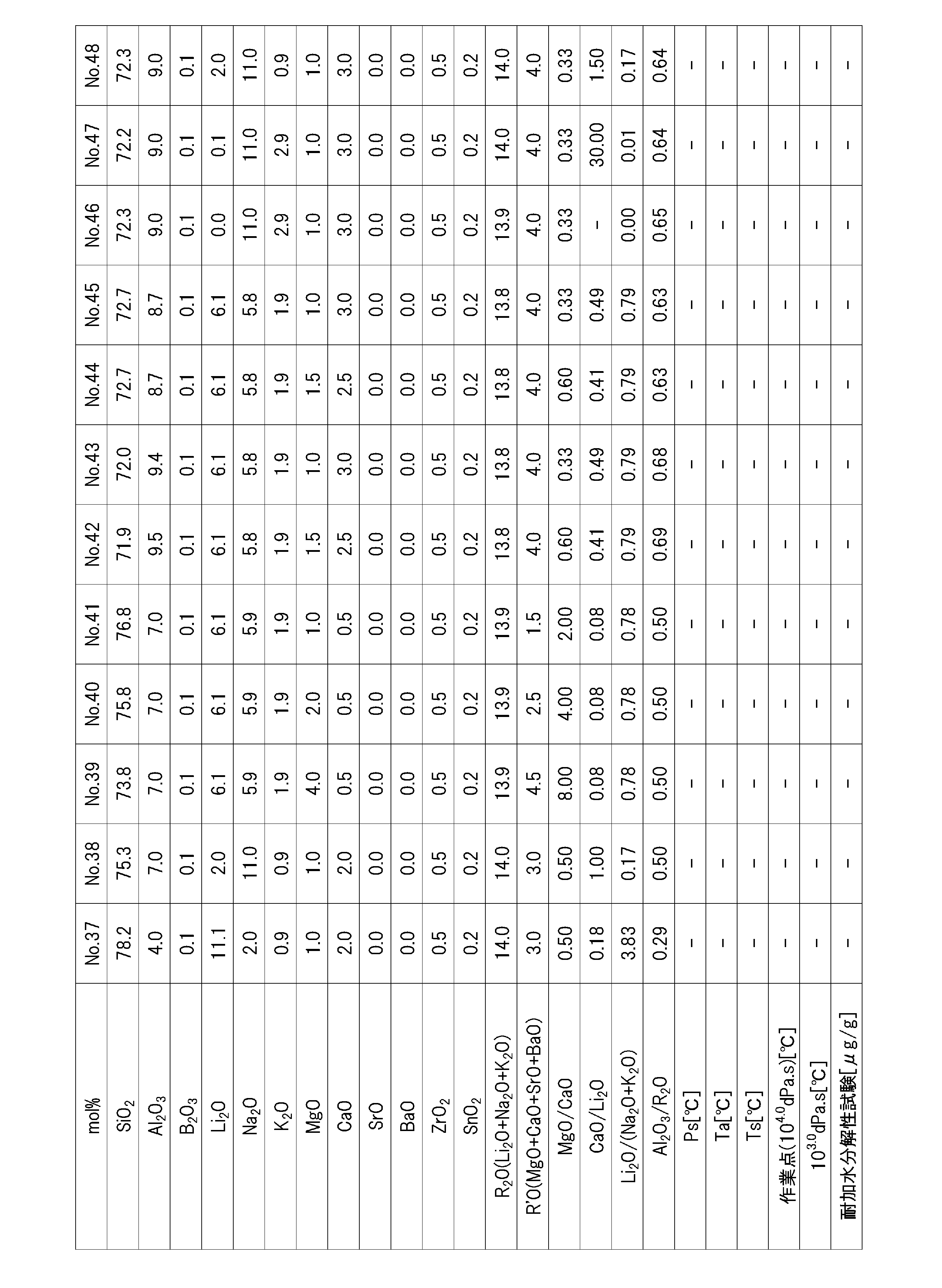
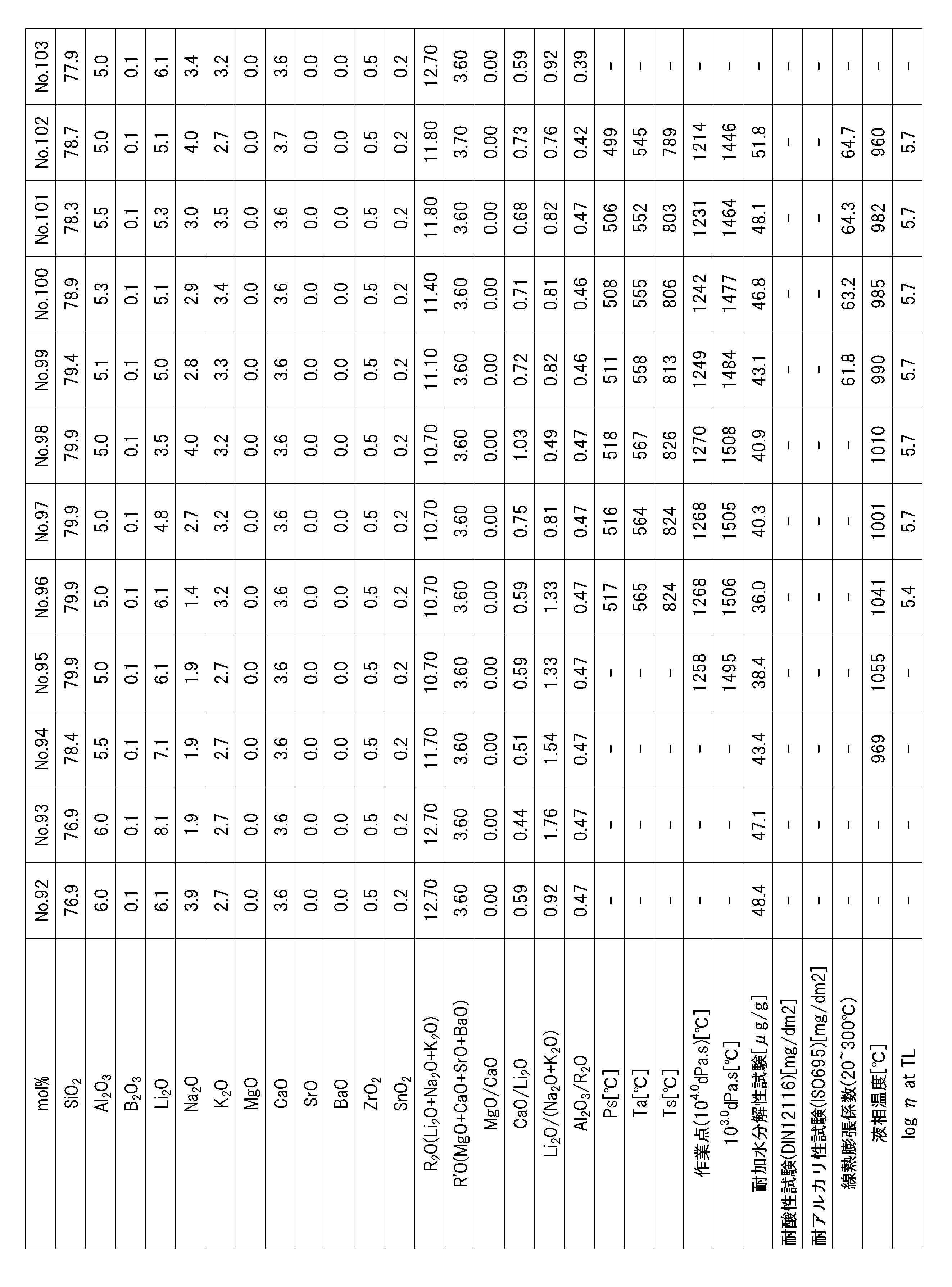
- Table 1 (10) shows examples (Sample Nos. 1 to 51, 56 to 108) and comparative examples (Sample Nos. 52 to 55) of the present invention.
- a batch of 550 g was prepared so as to have the composition shown in the table and melted at 1550° C. for 2.5 hours using a platinum crucible.
- stirring was performed twice in the melting process.
- the glass was once water-granulated and dried, and again melted at 1550° C. for 1 hour using a platinum crucible and stirred once. Melted at 1600° C. for 2 hours to reduce bubbles in the sample. After melting, an ingot was produced, processed into a shape required for measurement, and provided for various evaluations. The results are shown in Tables 1-7.
- the temperature at which the viscosity of the glass reaches 10 14.5 Pa ⁇ s was obtained by using the fiber drawing method based on ASTM C336.
- the temperature at which the viscosity of the glass becomes 10 7.6 dPa ⁇ s was obtained by using the fiber drawing method based on ASTM C388.
- the working point (the temperature at which the viscosity of the glass reaches 10 4.0 dPa ⁇ s) and the temperature at which the viscosity of the glass reaches 10 3.0 dPa ⁇ s were measured using a platinum ball pulling method.
- the linear thermal expansion coefficient was measured in a temperature range of 20 to 300° C. with a dilatometer using a glass sample molded into a rod shape of about 5 mm ⁇ 20 mm.
- the liquidus temperature was measured by charging a crushed glass sample in a platinum boat of about 120 ⁇ 20 ⁇ 10 mm and placing it in an electric furnace having a linear temperature gradient for 24 hours. After that, the crystal precipitation portion was specified by microscopic observation, the temperature corresponding to the crystal precipitation portion was calculated from the temperature gradient graph of the electric furnace, and this temperature was taken as the liquidus temperature.
- the liquidus viscosity is calculated by obtaining the viscosity curve of the glass from the strain point, the slow cooling point, the softening point, the working temperature and the Fulcher's viscosity calculation formula, and calculating the viscosity of the glass at the liquidus temperature from this viscosity curve.
- the liquidus viscosity was defined as the liquidus viscosity.
- the hydrolysis resistance test was performed by a hydrolysis resistance test (acetone cleaning) according to ISO720.
- the detailed test procedure is as follows.
- the glass sample was crushed using an alumina mortar and an alumina pestle, and classified with a sieve to a particle size of 300 to 425 ⁇ m.
- the obtained powder was washed with acetone and dried in an oven at 140°C.
- 10 g of the dried powder sample was placed in a quartz flask, and 50 mL of purified water was further added to cover the lid.
- a quartz flask containing the sample was placed in an autoclave for treatment.
- the treatment conditions were such that the temperature was raised from 100° C. to 121° C. at 1° C./min, held at 121° C.
- the alkali resistance of glass was evaluated by a test according to ISO695.
- the acid resistance of the glass was evaluated by an acid resistance test according to YBB00342004.
- the working glass of the example glass of the present invention was 1270° C. or lower, and the alkali elution amount by the hydrolysis resistance test was 80.0 ⁇ g/g or lower.
- the glass for pharmaceutical containers of the present invention regulates the content of B 2 O 3 , it is considered that delamination does not easily occur.
- the molar ratio MgO/CaO is regulated, it is considered that insoluble foreign matter due to Mg ions eluted from the glass is unlikely to occur.
- the glass for drug containers of the present invention is suitable as a glass for manufacturing drug containers such as ampoules, vials, prefilled syringes, and cartridges. Further, it can be applied to a drug container for an oral drug and a bottle for beverages.
Landscapes
- Chemical & Material Sciences (AREA)
- Engineering & Computer Science (AREA)
- Life Sciences & Earth Sciences (AREA)
- General Chemical & Material Sciences (AREA)
- Organic Chemistry (AREA)
- Materials Engineering (AREA)
- Geochemistry & Mineralogy (AREA)
- Chemical Kinetics & Catalysis (AREA)
- Health & Medical Sciences (AREA)
- Pharmacology & Pharmacy (AREA)
- Veterinary Medicine (AREA)
- Public Health (AREA)
- General Health & Medical Sciences (AREA)
- Animal Behavior & Ethology (AREA)
- Hematology (AREA)
- Mechanical Engineering (AREA)
- Ceramic Engineering (AREA)
- Glass Compositions (AREA)
- Wrappers (AREA)
- Medical Preparation Storing Or Oral Administration Devices (AREA)
Abstract
本発明の医薬品容器用ガラスは、ガラス組成として、モル%で、SiO2 69~81%、Al2O3 4~12%、B2O3 0~5%、Li2O+Na2O+K2O 5~20%、Li2O 0~12%、Na2O 0~11%、MgO+CaO+SrO+BaO 0.01~11%、CaO 0.01~11%を含有し、モル比MgO/CaO<9.0を満たすとともに、作業点が1270℃以下であることを特徴とする。
Description
本発明は加工性及び耐加水分解性に優れた医薬品容器用ガラス、これを用いた医薬品容器用ガラス管及び医薬品容器に関する。
従来、医薬品を保管する充填容器として種々のガラス容器が用いられている。医薬品は経口剤と非経口剤の2種類に大別されるが、特に非経口剤については、ガラス容器に充填・保管された薬剤を直接患者の血液中へ投与するため、ガラス容器には非常に高い品質が要求される。
また、医薬品容器には、充填された薬剤の成分が変質しないことが求められる。ガラス成分が薬剤中に溶出すると、薬剤の性質を変化させ、患者の健康、ひいては生命にまで影響を及ぼす虞がある。そのため、各国薬局方によって医薬品容器用ガラスからのガラス成分の溶出量が制限されている。
そこで、ガラスからの溶出成分の基準を満たすガラス材質としてB2O3を多く含むホウケイ酸ガラスが用いられている。現在使用されている医薬品容器用ホウケイ酸ガラスは、一般的に、SiO2、Al2O3、B2O3、Na2O、K2O、CaO、BaOと少量の清澄剤を含有する。
近年、医学・薬学の発展によって、薬効が高い薬剤が開発されつつあるが、そのような薬剤を従来のホウケイ酸ガラスからなるガラス容器に充填・保管すると、ガラス容器内面が浸食され、容器内表面が剥離しフレークスとして薬剤中を浮遊する、デラミネーションと呼ばれる現象が大きな問題となっている。デラミネーション等により発生した不溶性異物は、薬剤とともに患者の体内に注射された場合、血管の中で血栓を形成する等、人体に有害となる虞があるからである。
そこで、デラミネーションの対策として、特許文献1のようなガラスが開発されている。特許文献1に記載のガラスは、アルミノシリケートガラスと呼ばれており、B2O3の含有量を低減することでデラミネーションを生じにくくしている。その一方で、ガラスの粘度が高く、アンプル、バイアル、プレフィルドシリンジ、カートリッジ等の医薬品容器への加工性に劣る。更に、加工時に加工温度を高温にする必要があるため、加工中にガラスに含まれる成分が蒸発しやすくなり、これが容器内面を汚染してしまう虞がある。また、耐加水分解性の面でも十分とはいえない。
本発明の技術的課題は、アンプル、バイアル、プレフィルドシリンジ、カートリッジ等の医薬品容器への加工性に優れ、更に、デラミネーションや不溶性異物を生じにくく、耐加水分解性に優れた医薬品容器用ガラス、これを用いたガラス管及び医薬品容器を提案することである。
本発明者は種々の検討を行った結果、ガラスを構成する各々の成分の含有量を規制し、ガラスの作業点を1270℃以下にすることにより上記課題が解決できることを見出し、本発明として提案するものである。
すなわち、本発明の医薬品容器用ガラスは、ガラス組成として、モル%で、SiO2 69~81%、Al2O3 4~12%、B2O3 0~5%、Li2O+Na2O+K2O 5~20%、Li2O 0~12%、Na2O 0~11%、MgO+CaO+SrO+BaO 0.01~11%、CaO 0.01~11%を含有し、モル比MgO/CaO<9.0を満たすとともに、作業点が1270℃以下であることを特徴とする。ここで、「Li2O+Na2O+K2O」とは、Li2O、Na2O及びK2Oの含有量の合量を意味する。「MgO+CaO+SrO+BaO」とは、MgO、CaO、SrO及びBaOの含有量の合量を意味する。また、「MgO/CaO」とは、MgOの含有量をCaOの含有量で除した値である。更に、「作業点」とは、ガラスの粘度が104.0dPa・sになる温度を意味する。
本発明者は、薬剤をガラス容器に充填・保管する間に、ガラス中から溶出したMgイオンが、ガラス表面に生成する水和ケイ酸と反応して不溶性のケイ酸マグネシウム水和物皮膜を生成する虞があることを突き止めた。この不溶性異物は、容器の内壁に形成され、振動等によって剥離して薄片状の不溶性異物となり薬剤に混入し得る。そして、このようにして薬剤中に混入した不溶性異物は、上記のデラミネーションと同様に、患者の体内で血栓を形成する虞がある。本発明の医薬品容器用ガラスは、B2O3の含有量及びモル比MgO/CaOを規制しているため、デラミネーション及び不溶性異物が生じにくい。また、ガラス組成とガラスの作業点を上記の通り規制することにより、良好な加工性と優れた耐加水分解性を両立することができる。このため、デラミネーションや不溶性異物が生じにくく、耐加水分解性に優れた医薬品容器を容易に生産することが可能となる。
また、本発明の医薬品容器用ガラスは、モル比MgO/CaO≦1.0を満たすことが好ましい。このようにすれば、不溶性異物が形成されるリスクを更に低減することができる。また、優れた加工性及び耐加水分解性を更に向上させることができる。その結果、より安全性に優れ、耐加水分解性に優れた医薬品容器を得ることが容易になる。
また、本発明の医薬品容器用ガラスは、Li2Oの含有量が、0.1~12モル%であることが好ましい。
このようにすると、優れた加工性を付与することが可能になり、複雑な形状に加工することが容易になる。
本発明の医薬品容器用ガラスは、モル比CaO/Li2Oの値が、0超~10000であることが好ましい。ここで、「CaO/Li2O」とは、CaOの含有量をLi2Oの含有量で除した値である。
このようにすると、優れた加工性に加えて、医薬品容器に求められる耐加水分解性を有するガラスを容易に得ることができる。
本発明の医薬品容器用ガラスは、モル比Li2O/(Na2O+K2O)の値が、0~4.0であることが好ましい。ここで、「Li2O/(Na2O+K2O)」とは、Li2Oの含有量を、Na2OとK2Oの含有量の合量で除した値である。
このようにすると、耐加水分解性と耐失透性を維持しつつ、ガラスの粘度を低下させ、加工性を向上させることが可能になる。
本発明の医薬品容器用ガラスは、ガラス組成として、モル%で、MgO 0~5%、CaO 1~4%、SrO 0~4%、BaO 0~4%を含有することが好ましい。
本発明の医薬品容器用ガラスは、B2O3の含有量が、0.01~4モル%であることが好ましい。
このようにすれば、デラミネーションの発生を抑制しつつ、良好な加工性を得ることができる。
また、本発明の医薬品容器用ガラスは、Al2O3の含有量が、8超~12モル%であることが好ましい。
このようにすると、耐加水分解性を更に向上させることができる。
また、本発明の医薬品容器用ガラスは、モル比Al2O3/(Li2O+Na2O+K2O)≧0.52を満たすことが好ましい。ここで、「Al2O3/(Li2O+Na2O+K2O)」とは、Al2O3の含有量をLi2O、Na2O及びK2Oの含有量の合量で除した値である。
このようにすると、加工性を維持しつつ、耐加水分解性を更に向上させることができる。
また、本発明の医薬品容器用ガラスは、MgO+CaO+SrO+BaOの含有量が、1~5モル%であることが好ましい。ここで、「MgO+CaO+SrO+BaO」とは、MgO、CaO、SrO及びBaOの含有量の合量である。
このようにすると、良好な加工性と優れた耐加水分解性を両立しやすくでき、更に、耐失透性を維持することが容易になる。
また、本発明の医薬品容器用ガラスは、ガラス組成として、モル%で、SiO2 69~81%、Al2O3 4~8%、B2O3 0~5%、Li2O+Na2O+K2O 5~16.4%、Na2O 0.1~11%、MgO+CaO+SrO+BaO 0.01~11%、CaO 0.01~4%を含有し、更に、モル比MgO/CaO<1.0を満たし、モル比CaO/Li2Oの値が0超~10000であるともに、作業点が1270℃以下であることを特徴とする。
また、本発明の医薬品容器用ガラスは、ガラス組成として、モル%で、SiO2 69~81%、Al2O3 8超~12%、B2O3 0~5%、Li2O 3.2~12%、Na2O 0.1~11%、CaO 0.01~11%を含有し、更に、モル比MgO/CaO<1.0を満たし、Al2O3/(Li2O+Na2O+K2O)の値が0.52~1.10であることを特徴とする。
また、本発明の医薬品容器用ガラスは、ガラス組成として、モル%で、SiO2 69~81%、Al2O3 4~8%、B2O3 0~5%、Li2O+Na2O+K2O 5~14%、Na2O 0.1~11%、MgO+CaO+SrO+BaO 0.1~11%、CaO 0.1~4%を含有し、更に、モル比MgO/CaO<1.0を満たし、モル比CaO/Li2Oの値が0超~10000であるとともに、モル比Al2O3/(Li2O+Na2O+K2O)の値が0.3~0.5であることを特徴とする。
本発明の医薬品容器用ガラスは、作業点が1260℃以下であることが好ましい。
また、本発明の医薬品容器用ガラスは、ISO720に準じた耐加水分解性試験(アセトン洗浄)におけるクラスが、少なくともHGA1であることが好ましい。
なお、本発明において、「ISO720に準じた耐加水分解性試験(アセトン洗浄)」とは以下の試験を指す。
(1)ガラス試料をアルミナ乳鉢で粉砕し、篩で300~425μmに分級する。
(2)得られた粉末試料をアセトンで洗浄し、140℃のオーブンで乾燥する。
(3)乾燥後の粉末試料10gを石英フラスコに入れ、さらに50mLの精製水を加えて蓋をし、オートクレーブ内で処理する。処理は、100℃から121℃まで1℃/分で昇温した後、121℃で30分間保持し、100℃まで0.5℃/分で降温する、という処理条件によって行う。
(4)オートクレーブ処理後、石英フラスコ内の溶液を別のビーカーに移し、さらに石英フラスコ内を15mLの精製水で3回洗浄し、その洗浄液もビーカーに加える。
(5)ビーカーにメチルレッド指示薬を加え、0.02mol/L塩酸水溶液で滴定する。
(6)0.02mol/L塩酸水溶液1mLをNa2O 620μgに相当するとしてガラス1gあたりのアルカリ溶出量に換算する。
(1)ガラス試料をアルミナ乳鉢で粉砕し、篩で300~425μmに分級する。
(2)得られた粉末試料をアセトンで洗浄し、140℃のオーブンで乾燥する。
(3)乾燥後の粉末試料10gを石英フラスコに入れ、さらに50mLの精製水を加えて蓋をし、オートクレーブ内で処理する。処理は、100℃から121℃まで1℃/分で昇温した後、121℃で30分間保持し、100℃まで0.5℃/分で降温する、という処理条件によって行う。
(4)オートクレーブ処理後、石英フラスコ内の溶液を別のビーカーに移し、さらに石英フラスコ内を15mLの精製水で3回洗浄し、その洗浄液もビーカーに加える。
(5)ビーカーにメチルレッド指示薬を加え、0.02mol/L塩酸水溶液で滴定する。
(6)0.02mol/L塩酸水溶液1mLをNa2O 620μgに相当するとしてガラス1gあたりのアルカリ溶出量に換算する。
なお、「ISO720に準じた耐加水分解性試験(アセトン洗浄)におけるクラスが、少なくともHGA1である」とは、上記試験により求めたNa2O換算したガラス1gあたりのアルカリ溶出量が62μg/g以下であることを意味する。
また、本発明の医薬品容器用ガラスは、ISO720に準じた耐加水分解性試験(アセトン洗浄)におけるアルカリ溶出量が、60μg/g以下であることが好ましい。
本発明の医薬品容器用ガラス管は、上記した医薬品容器用ガラスからなることが好ましい。
本発明の医薬品容器は、上記した医薬品容器用ガラスからなることが好ましい。本発明の医薬品容器用ガラスは、耐加水分解性が高い。更に加工温度を低くできるため、加工中におけるガラス成分の蒸発を少なくでき、容器内面の汚染を抑制しやすい。その結果、耐加水分解性、ひいては化学耐久性に優れた医薬品容器が得やすくなる。
各成分の組成範囲を限定した理由を述べる。なお、以下の説明では、特に断りのない限り、「%」は「モル%」を意味する。
SiO2はガラスのネットワーク構造を構成する成分の一つである。SiO2の含有量が少なすぎるとガラス化しにくくなり、また熱膨張係数が増大して、耐熱衝撃性が低下しやすくなる。一方、SiO2の含有量が多すぎると液相温度が上昇し、失透しやすくなる。よって、SiO2の含有量は69~81%であり、好ましくは70~80%、71~79%、71~78%、72~78%、72~77%、特に好ましくは73~76%である。
Al2O3はガラスのネットワーク構造を構成する成分の一つであり、ガラスの耐加水分解性を向上させる効果がある。Al2O3の含有量が少なすぎると、耐加水分解性が悪化しやすくなる。一方、Al2O3の含有量が多くなりすぎると、粘度が高くなる。よって、Al2O3の含有量は4~12%であり、好ましくは4超~11%、4.5~10%、より好ましくは5~9%、さらに好ましくは5.5~8%、最も好ましくは6~8%である。また、耐加水分解性の向上を重視する場合、Al2O3の含有量は好ましくは6~12%、6.5~12%、7~12%、7.5~11.5%、8~11%、8~10.5%、8~10%、特に好ましくは8超~10%である。
B2O3はガラスの粘度を下げ、溶融性や加工性を向上させる効果がある。しかしB2O3はデラミネーションを引き起こす要因の一つと考えられており、その含有量が多くなりすぎると耐デラミネーション性が悪化し、フレークスが発生しやすくなる。よって、B2O3の含有量は0~5%であり、好ましくは0.01~4%、0.02~3%、0.03~2%、0.04~1%、特に好ましくは0.05~0.5%である。
アルカリ金属酸化物(R2O)であるLi2O、Na2O及びK2Oは、ガラスの粘度を低下させ、加工性や溶融性を高める効果がある。ただし、これらの成分の含有量の合量が多すぎると、ガラスの耐加水分解性が悪化したり、熱膨張係数が増大して耐熱衝撃性が低下したりする。よって、R2Oの含有量の合量は5~20%であり、好ましくは5~17%、6~16.4%、6.5~16%、7~15.5%、7.5~15%、さらに好ましくは8~14.5%、最も好ましくは9~14%である。また、耐加水分解性をより重視し、Al2O3の含有量を増加させた場合、R2Oの含有量の合量は、5~16.4%、5.5~16%、6~15.5%、6.5~15%、特に7~14.5%、7.5~14%とすることが好ましい。このようにすると好ましい耐加水分解性を維持しつつ、加工性や溶融性をより高めることができる。
Li2Oは既述の通り、ガラスの粘度を低下させ、加工性や溶融性を高める効果がある。しかし、Li2Oの含有量が多すぎると、耐失透性や耐加水分解性が悪化する虞がある。よって、Li2Oの含有量は0~12%であり、好ましくは0超~11%、0.1~10%、0.5~9%、1~8.8%、1.5~8.5%、2~8.3%、2.5~8%、3~8%未満、3.1~7.5%、3.2~7%、4~7%、特に4超~7%未満である。
Na2OはLi2Oと同様にガラスの粘度を低下させ、加工性や溶融性を高める効果がある。しかし、Na2Oの含有量が多すぎると、耐失透性や耐加水分解性が悪化する虞がある。また、含有量が少なすぎる場合は、耐失透性が低下することがある。よって、Na2Oの含有量は0~15%であり、好ましくは0超~13%、0.1~11%、0.5~10%、0.8~9.5%、1~9%、1.5~8.5%、2~8.3%、2.5~8%、3~7.9%、3.2~7.5%、3.5~7%、特に4~7%である。
K2Oは、Li2O、Na2Oと同様にガラスの粘度を低下させ、加工性や溶融性を高める効果がある。しかし、K2Oの含有量が多すぎると耐加水分解性が悪化する。よって、K2Oの含有量の上限は、好ましくは11%以下であり、10.5%以下、10%以下、8%以下、6%以下、5.5%以下、5%以下、4.5%以下、4.3%以下、4%以下、3.5%以下、3.3%以下、3.2%以下、3.1%以下、特に3%以下である。一方、含有量が少なすぎる場合は、耐失透性が低下することがある。よって、K2Oの含有量の下限は、好ましくは0%以上であり、0%超、0.1%以上、0.5%以上、0.6%以上、0.8%以上、0.9%以上、1%以上、1.1%以上、1.2%以上、1.3%以上、1.4%以上、1.5%以上、1.6%以上、1.7%以上、1.8%以上、1.9%以上、2%以上、2.1%以上、2.2%以上、2.3%以上、2.4%以上、2.5%以上、2.6%以上、特に2.7%以上である。
上記したアルカリ金属酸化物(R2O)の中でも、ガラスの粘度を低下させる効果はLi2Oが最も高く、次いでNa2O、K2Oの順に効果が高い。よって、加工性を重視し、ガラスの粘度を下げる観点からは、それぞれの含有量の関係は、Li2O≧Na2O(特にLi2O>Na2O)、Li2O≧K2O(特にLi2O>K2O)、Na2O≧K2Oが好ましい。更に好ましくはLi2O≧Na2O≧K2O、Li2O≧Na2O>K2O又はLi2O>Na2O≧K2Oであり、特に、Li2O>Na2O>K2Oであることが好ましい。また、K2Oが占める割合が多すぎると、ガラスの粘度と耐加水分解性の両方を良好に保つことが困難になる。そのため、粘度と耐加水分解性を両立させる観点から、Na2O>K2Oであることが好ましい。
更に、ガラスに含まれるアルカリ金属酸化物(R2O)のうち、Li2Oが占める割合が多すぎると、ガラスの耐失透性が低下する。そのため、ある実施形態においては、耐失透性の観点から、アルカリ金属酸化物(R2O)の含有量はNa2O>Li2Oの関係を満たすようにしてもよい。また、ガラスの耐失透性を改善する効果は、K2Oが最も高く、次いでNa2O、Li2Oの順に高くなる。ガラスの耐加水分解性と耐失透性を両立させる観点からは、アルカリ金属酸化物(R2O)間の含有量の関係は、好ましくはLi2O≧Na2O≧K2O、Li2O≧K2O>Na2O又はLi2O>Na2O≧K2Oであり、特に好ましくはLi2O>K2O>Na2Oである。
また、本発明の医薬品容器用ガラスは、アルカリ金属酸化物(R2O)について、モル比Li2O/(Na2O+K2O)で表されるNa2O及びK2Oに対するLi2Oの含有量の比を適切な範囲に規制することが好ましい。このようにすることで、耐加水分解性や耐失透性を低下させることなく、ガラスの粘度を低下させることが可能となる。よって、その値は、好ましくは0~4.0、0超~3.0、0.1~2.0、0.2~1.5、最も好ましくは0.3~1.0である。なお、この場合、Na2O+K2Oは0.1%以上であることが好ましい。
アルカリ土類金属酸化物(R’O)であるMgO、CaO、SrO、BaOは、ガラスの粘度を低下させる効果がある。また、耐加水分解性にも影響を与える。これらの成分の含有量が多すぎると、ガラスの耐失透性が低下する上、ガラス中から薬剤中に溶出したR’Oが炭酸塩あるいは硫酸塩として析出する虞がある。また、耐加水分解性が悪化す虞
がある。したがって、R’Oの含有量の合量は0.01~11%であり、好ましくは0.05~10%、0.1~9%、0.5~8%、0.7~7%、0.9~6%、1.0~5%、1超~4.9%、1.1~4.8%、1.2~4.7%、1.3~4.6%、1.4~4.3%、特に1.5~4%、1.8~4%未満、最も好ましくは、1.9~3.8%である。
がある。したがって、R’Oの含有量の合量は0.01~11%であり、好ましくは0.05~10%、0.1~9%、0.5~8%、0.7~7%、0.9~6%、1.0~5%、1超~4.9%、1.1~4.8%、1.2~4.7%、1.3~4.6%、1.4~4.3%、特に1.5~4%、1.8~4%未満、最も好ましくは、1.9~3.8%である。
ここで、R’Oの炭酸塩あるいは硫酸塩の析出の起こりやすさは、それぞれの塩の溶解度に依存する。具体的には、MgOの溶解度が最も高く、次いでCaO、SrO、BaOの順に溶解度は低くなる。したがって、MgOが最も塩の析出を生じにくく、BaOが最も塩の析出を生じやすい。そのため、溶解度に着目する場合、R’O間の含有量の関係は、MgO≧CaO(特にMgO>CaO)、MgO≧SrO(特にMgO>SrO)、MgO≧BaO(特にMgO>BaO)、CaO≧SrO(特にCaO>SrO)、CaO≧BaO(特にCaO>BaO)、SrO≧BaO(特にSrO>BaO)が好ましく、MgO≧CaO≧SrO≧BaOがより好ましく、MgO>CaO>SrO>BaOが更に好ましい。
一方で、ガラスの粘度を低下させる効果はBaOが最も高く、次いでSrO、CaO、MgOの順に効果は低くなる。そのため、加工性を重視する場合、R’Oの含有量は、MgO≦CaO(特にMgO<CaO)、MgO≦SrO(特にMgO<SrO)、MgO≦BaO(特にMgO<BaO)、CaO≦SrO(特にCaO<SrO)、CaO≦BaO(特にCaO<BaO)、SrO≦BaO(特にSrO<BaO)が好ましく、MgO≦CaO≦SrO≦BaOがより好ましく、MgO<CaO<SrO<BaOが更に好ましい。
また、本発明の医薬品容器用ガラスは、MgOを規制することが好ましい。上記したように、MgOは炭酸塩あるいは硫酸塩の溶解度が高く、塩の析出が起こりにくい成分である。しかし、Mgイオンは水和ケイ酸と反応しやすいため、ガラス中のMgイオンが溶出すると、ガラス表面に生成する水和ケイ酸とMgイオンが反応して不溶性のケイ酸マグネシウム水和物皮膜を生成する虞がある成分でもある。この皮膜は振動等によって剥離して薄片状の不溶性異物となる可能性がある。この不溶性異物も、デラミネーションと同様に、薬剤とともに患者の体内に注射された場合、血管の中で血栓を形成する等、人体に有害となる虞がある。また、MgOの含有量が多すぎると、耐加水分解性が悪化する。よって、MgOの含有量は、好ましくは0~9%であり、0~8.5%、0~5%、0~4%、0~3%、0~2%、0~1%、0~0.01%、特に好ましくは含有させない。なお本発明において「含有させない」とは、積極的に添加しない、という意味であり、不可避的不純物まで排除するものではない。
CaOは、アルカリ土類金属酸化物の中でも、塩及び不溶性異物析出しにくさを両立できる成分である。そのため、本発明においては、CaOを必須成分として含有することが好ましい。一方、CaOを多く含有させすぎると、耐加水分解性が悪化する虞がある。よって、CaOの含有量は0.01~11%であり、好ましくは0.01~10%、0.05~10%、0.1~8%、0.5~6%、0.8~5.5%、0.9~5%、1~4.5%、1超~4%、1.1~3.5%、特に1.5~3%である。また、ガラスの加工性を重視する観点からは、CaOを含有させることが好ましく、CaOの含有量の下限は、好ましくは1%以上であり、1.2%以上、1.4%以上、1.6%以上、1.8%以上、2%以上、2.2%以上、2.4%以上、2.6%以上、2.8%以上、3%以上、3.2%以上、3.4%以上、特に3.5%以上である。
また、MgO+CaOの値は、好ましくは0.01~8%であり、0.1~7%であり、0.3~6%、0.5~5%、0.8~4.6%、0.9~4.3%、1~4%、1超~3.8%、1.1~3.5%、特に1.5~3%である。このようにすると、炭酸塩あるいは硫酸塩の析出が起こりにくくなる。なお、「MgO+CaO」とは、MgO、CaOの含有量の合量である。また、ガラスの加工性を重視する観点から、MgO+CaOの下限は、好ましくは1%以上であり、1.2%以上、1.4%以上、1.6%以上、1.8%以上、2%以上、2.2%以上、2.4%以上、2.6%以上、2.8%以上、3%以上、3.2%以上、3.4%以上、特に3.5%以上である。
また、MgOとCaOの含有量のモル比MgO/CaOは、9.0未満であり、好ましくは8.0以下、7.5以下、7.0以下、6.0以下、5.0未満、3.0未満、1.0以下、1.0未満、0.9以下、0.7未満、0.5以下、0.5未満、0.4未満、0.3未満、0.2未満、0.1未満、0.01未満、特に好ましくは0である。このようにすることで、耐加水分解性を向上させることができる。また、前述したとおり、本発明において、MgOは不溶性異物を形成する虞があるが、CaOはMgOと比べてSiO2と反応しにくい成分であり、不溶性異物を形成する虞が少ない。そのため、モル比MgO/CaOを規制することで、不溶性異物が形成されるリスクを低減させることができる。また、ガラスの粘度も低くできるため、優れた加工性を得ることができる。
SrOの含有量は好ましくは0~4%、0~2%であり、0~1%、特に0~0.01%であることが好ましく、含有させないことがより好ましい。
BaOの含有量は好ましくは0~4%、0~2%であり、0~1%、特に0~0.01%であることが好ましく、含有させないことがより好ましい。
また、本発明においては、アルカリ金属酸化物(R2O)を一定量含有するガラスにおいて、アルカリ土類金属酸化物(R’O)の各成分の含有比を適切に規制することで、優れた加工性と耐加水分解性を両立させることがより容易になる。具体的には、アルカリ土類金属酸化物に関し、炭酸塩あるいは硫酸塩の析出が起こりにくいMgOおよびCaOを優先的に選択することが好ましい。更には、よりガラスの粘度を低下させる効果が高いCaOを多く含む様に調整することがより好ましい。
また、本発明の医薬品容器用ガラスは、モル比CaO/Li2Oの値を規制することが好ましい。本発明の医薬品容器用ガラスは、CaOの含有量とLi2Oの含有量のモル比の値を規制することで、耐加水分解性と加工性を両立しやすくなる。モル比CaO/Li2Oの下限は、好ましくは0超であり、0.01以上、0.05以上、0.1以上、0.15以上、0.2以上、0.25以上、0.3以上、0.35以上、0.4以上、0.5以上、0.6以上である。一方、モル比CaO/Li2Oの値が大きすぎると、加工性が悪化する虞がある。そのため、モル比CaO/Li2Oの上限は、好ましくは10000以下であり、1000以下、100以下、10以下、9以下、4以下、2以下、1.9以下、1.8以下、1.7以下、1.6以下、1.5以下、1.4以下、1.3以下、1.2以下、1.1以下、1以下、0.95以下、0.9以下、0.85以下、0.8以下である。
また、加工性と耐加水分解性の両方を向上させるためには、アルカリ金属酸化物(R2O)のうちLi2Oを必須とした上、MgO/CaOの値を規制することが効果的である。Li2Oは、アルカリ金属酸化物の中でもガラスの粘度を下げる効果が特に高いが、その一方で耐加水分解性を悪化させる虞がある。そのため、耐加水分解性を維持しつつ加工性を向上させるために、Li2Oの含有量及びMgO/CaOの値の両方を適切な範囲に規制することで、ガラスの加工性と耐加水分解性の両方を高めることができる。更に、加工温度が低いため、加工時の容器内面の汚染を抑制しやすい。その結果、耐加水分解性、ひいては化学耐久性に優れた医薬品容器が得やすくなる。
更に、本発明においては、アルカリ金属酸化物(R2O)のLi2O/(Na2O+K2O)の値と、MgO/CaOの値の両方を適切に規制することが好ましい。すなわち、Li2O/(Na2O+K2O)を適切に規制することにより、アルカリ金属酸化物の中で粘度を下げる効果が高いLi2Oの効果を享受しつつ、耐加水分解性を特に悪化させるNa2Oの影響を抑制できる。加えて、MgO/CaOを適切な範囲に規制することで、加工性と耐加水分解性の両方を高めることができる。更に、加工温度が低いため、容器内面の汚染を抑制しやすい。その結果、耐加水分解性、ひいては化学耐久性に優れた医薬品容器が得やすくなる。
また、本発明の医薬品容器用ガラスは、モル比Al2O3/(Li2O+Na2O+K2O)の値を規制することが好ましい。本発明の医薬品容器用ガラスは、Al2O3の含有量とアルカリ金属酸化物(R2O)の含有量の合量とのモル比の値を規制することで、耐加水分解性と加工性を両立しやすくなる。特にガラスの加工性を重視する場合、モル比Al2O3/(Li2O+Na2O+K2O)の値は、好ましくは、0~1.2、0超~1.2、0.1~0.8、更に好ましくは0.15~0.61、0.2~0.6、0.25~0.59、特に好ましくは0.3~0.52、0.3超~0.5、最も好ましくは0.35~0.45である。また、特にガラスの耐加水分解性の向上を重視する場合、モル比Al2O3/(Li2O+Na2O+K2O)の値は、好ましくは0.52~3.0、0.52超~2.5、0.53~2.0、0.55~1.8、0.58~1.5、0.59~1.3、0.60~1.2、0.61~1.1、特に0.62~1である。
また、本発明の医薬品容器用ガラスは、Al2O3-Li2Oの下限が、好ましくは―3以上であり、-2以上、-1以上、-0.5以上、0以上、0.1以上、0.5以上、0.8以上、0.9以上、1以上、1.1以上、1.2以上、1.3以上、1.4以上、1.5以上、1.6以上、1.7以上、1.8以上、特に1.9以上である。アルカリ金属酸化物の中でも特にガラスの粘度を低下させ、加工性や溶融性を高める効果があるLi2OをAl2O3に対して一定量含有させることで、耐加水分解性と加工性を両立しやすくなる。一方、Al2O3-Li2Oの上限が大きすぎると、耐加水分解性が悪化する虞がある。そのため、Al2O3-Li2Oの上限は、9以下、8以下、5.9以下、5以下、4以下、3以下、特に2以下である。なお、「Al2O3-Li2O」とは、Al2O3の含有量からLi2Oの含有量を引いた値である。
また、本発明の医薬品容器用ガラスは、モル比Al2O3/Li2Oの値を規制することが好ましい。このようにすることで、耐加水分解性を向上させることが可能となる。よって、Al2O3/Li2Oの下限は、好ましくは0.9以上、1.0以上、1.2以上、1.3以上、特に1.4以上である。一方、この値が大きすぎると、ガラスの粘度が高くなりすぎ、加工性が悪化する虞がある。よって、Al2O3/Li2Oの上限は、好ましくは3.0以下、2.8以下、2.6以下、2.5以下、2.4以下、2.2以下、2.0以下、特に1.8以下である。なお、「Al2O3/Li2O」とは、Al2O3の含有量をLi2Oの含有量で除した値である。
また、本発明の医薬品容器用ガラスは、(B2O3+Li2O+Na2O+K2O+MgO+CaO+SrO+BaO)-Al2O3の値が、好ましくは5~15、5~14、5.5~13、6~12、6.5~11、特に7~10である。ガラスの粘度を低下させ、加工性や溶融性を高める効果があるアルカリ金属酸化物(R2O)、B2O3及びアルカリ土類金属酸化物(R’O)をAl2O3に対して一定量含有させることで、耐加水分解性と加工性を両立しやすくなる。なお、「(B2O3+Li2O+Na2O+K2O+MgO+CaO+SrO+BaO)-Al2O3」とは、B2O3、Li2O、Na2O、K2O、MgO、CaO、SrO、BaOの含有量の合量から、Al2O3の含有量を引いた値である。
また、本発明の医薬品容器用ガラスは、耐加水分解性を重視する場合、モル比Al2O3/(B2O3+Li2O+Na2O+K2O+MgO+CaO+SrO+BaO)の値が、好ましくは0.35~1.0、 0.36~0.80、0.40~0.70、特に0.45~0.60である。このようにすることで、耐加水分解性を向上させることが可能となる。一方、この値が大きすぎると、ガラスの粘度が高くなりすぎ、加工性が悪化する虞がある。加工性を重視する場合には、モル比Al2O3/(B2O3+Li2O+Na2O+K2O+MgO+CaO+SrO+BaO)の値は、0.25~0.70、0.30~0.60、特に0.32~0.50であることが好ましい。なお、「Al2O3/(B2O3+Li2O+Na2O+K2O+MgO+CaO+SrO+BaO)」とは、Al2O3の含有量をB2O3、Li2O、Na2O、K2O、MgO、CaO、SrO、BaOの含有量の合量で除した値である。
本発明の医薬品容器用ガラスは、SiO2+Al2O3+B2O3+Li2O+Na2O+K2O+MgO+CaOの値が、好ましくは90%以上であり、93%以上、95%以上、より好ましくは96%以上、97%以上、98%以上、特に99%以上である。このようにすれば、前記した各成分の効果がより効率的に得られる。なお、「SiO2+Al2O3+B2O3+Li2O+Na2O+K2O+MgO+CaO」とは、SiO2、Al2O3、B2O3、Li2O、Na2O、K2O、MgO、CaOの含有量の合量である。
また、本発明の医薬品容器用ガラスは、SiO2+Al2O3+B2O3+Li2O+Na2O+K2O+MgO+CaO+SrO+BaOの値が、好ましくは90%以上、93%以上、95%以上、96%以上、97%以上、98%以上、特に99%以上である。このようにすれば、前記した各成分の効果がより効率的に得られる。なお、「SiO2+Al2O3+B2O3+Li2O+Na2O+K2O+MgO+CaO+SrO+BaO」とは、SiO2、Al2O3、B2O3、Li2O、Na2O、K2O、MgO、CaO、SrO、BaOの含有量の合量である。
また、本発明の医薬品容器用ガラスは、ガラス組成として、上記以外の他の成分を含んでもよい。例えば、ガラスの耐アルカリ性を向上させるためにZrO2を含有してもよく、耐アルカリ性を重視する場合は0.01%以上含有してもよい。しかし、ZrO2の含有量が多すぎるとガラスの粘度が上昇し、また耐失透性も低下する。ZrO2を含有する場合、その含有量は0~2%、特に0~1.5%であることが好ましい。
また、ガラスを着色したい場合には、TiO2とFe2O3をバッチ原料に添加すればよい。この場合、標準的なTiO2とFe2O3の含有量の合計量は7%以下、6%以下、5%以下、3%以下、1%以下、さらには0.5%以下であることが好ましい。
また、清澄剤として、F、Cl、Sb2O3、SnO2、SO3等を1種類以上含有しても良い。この場合、標準的な清澄剤の含有量は合計量で5%以下、特に1%以下、さらには0.5%以下であることが好ましい。
また、化学的耐久性、高温粘度等の改良のためにZnO、P2O5、Cr2O3、PbO、La2O3、WO3、Nb2O3、Y2O3等をそれぞれ、3%以下、2%以下、1%以下、1%未満、0.5%以下で添加してもよい。
また、不純物として、H2、CO2、CO、H2O、He、Ne、Ar、N2等の成分をそれぞれ0.1%まで含んでもよい。またPt、Rh、Au等の貴金属元素の混入量はそれぞれ500ppm以下、さらには300ppm以下であることが好ましい。
また、上記した組成範囲の他に、例えば、ガラス組成として、モル%で、SiO2 69~81%、Al2O3 4~8%、B2O3 0~5%、Li2O+Na2O+K2O 5~16.4%、Na2O 0.1~11%、MgO+CaO+SrO+BaO 0.01~11%、CaO 0.01~4%を含有し、更に、モル比MgO/CaO<1.0を満たし、モル比CaO/Li2Oの値が0超~10000であるともに、作業点が1260℃以下であるガラスを例示することができる。各成分の限定理由及び好ましい範囲は既述の内容と重複するため、ここでは説明を割愛する。
また、上記した組成範囲の他に、例えば、ガラス組成として、モル%で、SiO2 69~81%、Al2O3 8超~12%、B2O3 0~5%、Li2O 3.2~12%、Na2O 0.1~11%、CaO 0.01~11%を含有し、更に、モル比MgO/CaO<1.0を満たし、Al2O3/(Li2O+Na2O+K2O)の値が0.52~1.10であるガラスを例示することができる。各成分の限定理由及び好ましい範囲は既述の内容と重複するため、ここでは説明を割愛する。
本発明の医薬品容器用ガラスは、ISO720に準じた耐加水分解性試験(アセトン洗浄)におけるクラスが、少なくともHGA1であることが好ましい。
なお、「ISO720に準じた耐加水分解性試験(アセトン洗浄)におけるクラスが、少なくともHGA1である」とは、上記試験により求めたNa2O換算したガラス1gあたりのアルカリ溶出量が62μg/g以下であることを意味する。
また、本発明の医薬品容器用ガラスは、ISO720に準じた耐加水分解性試験(アセトン洗浄)によるNa2O換算のアルカリ溶出量が、好ましくは527μg/g未満であり、400μg/g以下、200μg/g以下、100μg/g以下、80μg/g以下、62μg/g未満、60μg/g以下、57μg/g以下、55μg/g以下、53μg/g以下、特に50μg/g以下である。アルカリ溶出量が多すぎると、ガラスをアンプルやバイアルに加工し、薬剤を充填して保存した際に、ガラスから溶出したアルカリ成分によって薬剤成分が変質する虞がある。
また、ガラスの耐アルカリ性はデラミネーションに対する耐性を判断する一つの指標となる。本発明の医薬品容器用ガラスは、ISO695に準じた試験による耐アルカリ性が少なくともクラス2であることが好ましい。ここで、「ISO695に準じた耐アルカリ性試験」とは、以下の試験を指す。
(1)表面を全て鏡面仕上げとした表面積Acm2(但し、Aは10~15cm2とする)のガラス試料片を準備する。始めに前処理として、試料をフッ酸(40wt%)と塩酸(2mol/L)を体積比で1:9となるように混合した溶液を調製する。これに試料を浸し、10分間マグネチックスターラーで攪拌する。試料を取り出し、精製水による2分間の超音波洗浄を3回行い、エタノールによる1分間の超音波洗浄を2回行う。
(2)その後、試料を110℃のオーブン中で1時間乾燥させ、デシケータ内で30分間放冷する。
(3)試料の質量m1を精度±0.1mgまで測定し、記録する。
(4)水酸化ナトリウム水溶液(1mol/L)と炭酸ナトリウム水溶液(0.5mol
/L)を体積比で1:1になるように混合した溶液800mLを調製する。溶液をステンレス製の容器に入れてマントルヒーターにて沸騰させる。白金線で吊るした試料を投入して3時間保持する。試料を取り出し、精製水による2分間の超音波洗浄を3回行い、エタノールによる1分間の超音波洗浄を2回行う。その後、試料を110℃のオーブン中で1時間乾燥させ、デシケータ内で30分間放冷する。
(5)試料の質量m2を精度±0.1mgまで測定し、記録する。
(6)沸騰アルカリ溶液に投入する前後の質量m1、m2(mg)と試料の表面積A(cm2)から、以下の算出式によって単位面積あたりの質量減少量を算出し、耐アルカリ性試験の測定値とする。
(単位面積あたりの質量減少量)=100×(m1-m2)/A
(1)表面を全て鏡面仕上げとした表面積Acm2(但し、Aは10~15cm2とする)のガラス試料片を準備する。始めに前処理として、試料をフッ酸(40wt%)と塩酸(2mol/L)を体積比で1:9となるように混合した溶液を調製する。これに試料を浸し、10分間マグネチックスターラーで攪拌する。試料を取り出し、精製水による2分間の超音波洗浄を3回行い、エタノールによる1分間の超音波洗浄を2回行う。
(2)その後、試料を110℃のオーブン中で1時間乾燥させ、デシケータ内で30分間放冷する。
(3)試料の質量m1を精度±0.1mgまで測定し、記録する。
(4)水酸化ナトリウム水溶液(1mol/L)と炭酸ナトリウム水溶液(0.5mol
/L)を体積比で1:1になるように混合した溶液800mLを調製する。溶液をステンレス製の容器に入れてマントルヒーターにて沸騰させる。白金線で吊るした試料を投入して3時間保持する。試料を取り出し、精製水による2分間の超音波洗浄を3回行い、エタノールによる1分間の超音波洗浄を2回行う。その後、試料を110℃のオーブン中で1時間乾燥させ、デシケータ内で30分間放冷する。
(5)試料の質量m2を精度±0.1mgまで測定し、記録する。
(6)沸騰アルカリ溶液に投入する前後の質量m1、m2(mg)と試料の表面積A(cm2)から、以下の算出式によって単位面積あたりの質量減少量を算出し、耐アルカリ性試験の測定値とする。
(単位面積あたりの質量減少量)=100×(m1-m2)/A
なお、「ISO695に準じた試験による耐アルカリ性がクラス2」とは、上記により求めた単位面積あたりの質量減少量が175mg/dm2以下であることを意味する。なお、上記により求めた単位面積あたりの質量減少量が75mg/dm2以下であれば、「ISO695に準じた試験による耐アルカリ性がクラス1」となる。
デラミネーションは、クエン酸やリン酸緩衝液等、pHが中性付近であっても強いアルカリ性のような挙動を示す溶液を共に用いた薬剤をガラス容器に充填、保存した際に起こることが多い。ISO695に準じた試験により求めた単位面積あたりの質量減少量が175mg/dm2より大きくなると、デラミネーションを引き起こす可能性が高くなる。そのため、本発明の医薬品容器用ガラスは、上記単位面積あたりの質量減少量が、好ましくは130mg/dm2以下、75mg/dm2以下、70mg/dm2以下、65mg/dm2以下、特に好ましくは60mg/dm2以下である。
また、本発明の医薬品容器用ガラスは、YBB00342004に準じた耐酸性試験において、単位面積あたりの質量減少量が、好ましくは1.5mg/dm2以下、特に0.7mg/dm2以下である。質量減少量が多くなると、アンプルやバイアルなどの瓶容器を作製し、薬液を充填、保存した際、ガラス成分の溶出量が大幅に増加して薬液成分の変質を引き起こす虞がある。なお、「YBB00342004に準じた耐酸性試験」とは、以下の試験を指す。
(1)表面を全て鏡面仕上げとした表面積Acm2(但し、Aは100±5cm2とする)のガラス試料片を準備する。始めに前処理として、試料をフッ酸(40wt%)と塩酸(2mol/L)を体積比で1:9となるように混合した溶液を調製する。これに試料を浸し、10分間マグネチックスターラーで攪拌する。試料を取り出し、精製水による2分間の超音波洗浄を3回行い、エタノールによる1分間の超音波洗浄を2回行う。
(2)その後、試料を110℃のオーブン中で1時間乾燥させ、デシケータ内で30分間放冷する。
(3)試料の質量m1を精度±0.1mgまで測定し、記録する。
(4)塩酸溶液(6mol/L)を800mL用意する。溶液をシリカガラス製の容器に入れて、電熱器にて沸騰させる。白金線で吊るした試料を投入して6時間保持する。試料を取り出し、精製水による2分間の超音波洗浄を3回行い、エタノールによる1分間の超音波洗浄を2回行う。その後、試料を110℃のオーブン中で1時間乾燥させ、デシケータ内で30分間放冷する。
(5)試料の質量m2を精度±0.1mgまで測定し、記録する。
(6)沸騰酸溶液に投入する前後の質量m1、m2(mg)と試料の表面積A(cm2)から、以下の算出式によって単位面積あたりの質量減少量の半分を算出し、耐酸性試験の測定値とする。
(単位面積あたりの質量減少量)=1/2×100×(m1-m2)/A
(1)表面を全て鏡面仕上げとした表面積Acm2(但し、Aは100±5cm2とする)のガラス試料片を準備する。始めに前処理として、試料をフッ酸(40wt%)と塩酸(2mol/L)を体積比で1:9となるように混合した溶液を調製する。これに試料を浸し、10分間マグネチックスターラーで攪拌する。試料を取り出し、精製水による2分間の超音波洗浄を3回行い、エタノールによる1分間の超音波洗浄を2回行う。
(2)その後、試料を110℃のオーブン中で1時間乾燥させ、デシケータ内で30分間放冷する。
(3)試料の質量m1を精度±0.1mgまで測定し、記録する。
(4)塩酸溶液(6mol/L)を800mL用意する。溶液をシリカガラス製の容器に入れて、電熱器にて沸騰させる。白金線で吊るした試料を投入して6時間保持する。試料を取り出し、精製水による2分間の超音波洗浄を3回行い、エタノールによる1分間の超音波洗浄を2回行う。その後、試料を110℃のオーブン中で1時間乾燥させ、デシケータ内で30分間放冷する。
(5)試料の質量m2を精度±0.1mgまで測定し、記録する。
(6)沸騰酸溶液に投入する前後の質量m1、m2(mg)と試料の表面積A(cm2)から、以下の算出式によって単位面積あたりの質量減少量の半分を算出し、耐酸性試験の測定値とする。
(単位面積あたりの質量減少量)=1/2×100×(m1-m2)/A
また、本発明の医薬品容器用ガラスでは、作業点は、好ましくは1270℃以下、1265℃以下、1260℃以下、1230℃以下、1200℃以下、特に1180℃以下である。作業点が高温になると、ガラス管をアンプルあるいはバイアルに加工する際の加工温度もより高温になり、ガラスに含まれるアルカリ成分の蒸発が著しく増加する。蒸発したアルカリ成分はガラス管内壁に付着し、そのガラス管がガラス容器へと加工される。そのようなガラス容器は薬剤を充填、保存した際に薬剤を変質させる原因となる。また、ホウ素を多く含むガラスでは、作業点が高温になるとホウ素の蒸発も増加し、デラミネーションの原因となりうる。
本発明の医薬品容器用ガラスは、化学強化処理に供することにより、その表面に圧縮応力層を形成することが可能である。具体的には、本発明の医薬品容器用ガラスは、475℃のKNO3溶融塩中に7時間浸漬して化学強化(イオン交換)処理を行った際に形成される圧縮応力層の圧縮応力値が、100MPa以上であることが好ましく、200MPa以上、特に300MPa以上となることが好ましい。また、圧縮応力層の深さは、10μm以上であることが好ましく、20μm以上、特に30μm以上が好ましい。
なお、化学強化(イオン交換)後の圧縮応力値(CS)と試料表面からの深さ(DOL)は次のようにして測定できる。まず試料の両表面に鏡面研磨を施した後、475℃のKNO3溶融塩中に7時間浸漬して化学強化(イオン交換)処理を行う。続いて試料の表面を洗浄し、表面応力計(株式会社折原製作所製FSM-6000)を用いて観察される干渉縞の本数とその間隔から表面の圧縮応力層の圧縮応力値(CS)と試料表面からの深さ(DOL)を算出する。算出にあたり、試料の屈折率を1.50、光弾性定数を29.5[(nm/cm)/MPa]とする。なお、化学強化処理前後でガラスの表層におけるガラス組成が微視的に異なるものの、ガラス全体として見た場合は、ガラス組成は実質的に相違しない。
次に、本発明の医薬品容器用ガラス管を製造する方法を説明する。以下の説明はダンナ-法を用いた例である。
まず、ガラス原料を所定のガラス組成になるように調合してガラスバッチを作製する。次に、このガラスバッチを1550~1700℃の溶融窯に連続投入して溶融、清澄を行った後、得られた溶融ガラスを回転する耐火物に巻きつけながら、耐火物先端部から空気を吹き出しつつ当該先端部からガラスを管状に引出す。
続いて、引き出した管状ガラスを所定の長さに切断することでガラス管を得る。このようにして得られたガラス管はバイアルやアンプルの製造に供される。
なお、本発明の医薬品容器用ガラス管は、ダンナ-法に限らず、従来周知の任意の手法を用いて製造してもよい。例えば、ベロー法あるいはダウンドロー法は本発明の医薬品容器用ガラス管の製造方法として有効である。
次に、本発明の医薬品容器を製造する方法を説明する。以下は、一例として、ガラス管を縦式加工方法で加工し、医薬品容器を製造する例である。
まず、ガラス管を用意する。次に、ガラス管を垂直に立てた状態で、バーナーによりガラス管の一方側の端部を加熱し、成形具を用いて肩部及び口部を形成する。次に、バーナーでガラス管の肩部より上方の部分を加熱して溶断する。
続いて、溶断した部分をバーナーで加熱成形して底部を形成し、医薬品容器を得る。
なお、ガラス管側の溶断した部分は、バーナーで加熱することにより開口させ、次の容器製造に供される。このようにして、上述した成形加工を繰り返すことにより、ガラス管から複数の医薬品容器を得ることができる。
更に、本発明の医薬品容器用ガラス管を用いて得られたアンプル、バイアル等の医薬品容器を、KNO3溶融塩中に浸漬してイオン交換することにより、化学強化された医薬品容器を得ることができる。
また、本発明の医薬品容器用ガラス管は、その外面に、コーティングすることが可能である。コーティングは、フッ素、シリコン、界面活性剤等の、無機コーティング及び有機コーティングのうち任意の材料を選択することができる。
さらに本発明の医薬品容器用ガラス管を用いて得られたアンプル、バイアル等の医薬品容器も、その内面及び/又は外面に、コーティングすることが可能である。コーティングは、フッ素、シリコン、界面活性剤等の、無機コーティング及び有機コーティングのうち任意の材料を選択することができる。
以下、実施例に基づいて本発明を説明する。
表1■10は本発明の実施例(試料No.1~51、56~108)及び比較例(試料No.52~55)を示している。





各試料は以下のようにして調製した。
まず表に示す組成となるように550gのバッチを調合し、白金坩堝を用いて1550℃で2.5時間溶融した。なお、試料の均質性を高めるため、溶融過程で2回の攪拌を行った。更に試料の均質性を高めるため、一旦ガラスを水砕・乾燥し、再度白金坩堝を用いて1550℃で1時間溶融し、1回の攪拌を行った。試料中の泡を減らすため、1600℃で2時間溶融した。溶融後、インゴットを作製し、測定に必要な形状に加工して各種評価に供した。結果を表1~7に示す。
なお、歪点Psは、ASTM C336に準拠したファイバー延伸法を用い、ガラスの粘度が1014.5Pa・sになる温度を求めた。
徐冷点Ta及び軟化点Tsは、ASTM C388に準拠したファイバー延伸法を用い、ガラスの粘度が107.6dPa・sになる温度を求めた。
作業点(ガラスの粘度が104.0dPa・sになる温度)及びガラスの粘度が103.0dPa・sになる温度の測定は、白金球引き上げ法を用いて求めた。
線熱膨張係数の測定は、約5mmφ×20mmのロッド状に成形したガラス試料を用い、ディラートメーターにより、20~300℃の温度範囲において行った。
液相温度の測定は、約120×20×10mmの白金ボートに粉砕したガラス試料を充填し、線形の温度勾配を有する電気炉に24時間投入した。その後、顕微鏡観察にて結晶析出箇所を特定し、結晶析出箇所に対応する温度を電気炉の温度勾配グラフから算出し、この温度を液相温度とした。
液相粘度の算出は、歪点、徐冷点、軟化点、作業温度とFulcherの粘度計算式からガラスの粘度曲線を求め、この粘度曲線から液相温度におけるガラスの粘度を算出し、この粘度を液相粘度とした。
耐加水分解性試験は、ISO720に準じた耐加水分解性試験(アセトン洗浄)で行った。詳細な試験手順は以下の通りである。ガラス試料をアルミナ乳鉢とアルミナ乳棒を用いて粉砕し、篩で粒径300~425μmに分級した。得られた粉末をアセトンで洗浄し、140℃のオーブンで乾燥させた。乾燥後の粉末試料10gを石英フラスコに入れ、さらに50mLの精製水を加えて蓋をした。試料の入った石英フラスコをオートクレーブ内に設置し処理を行った。処理条件は100℃から121℃まで1℃/分で昇温した後、121℃で30分間保持し、100℃まで0.5℃/分で降温した。石英フラスコ内の溶液を別のビーカーに移し、さらに石英フラスコ内を15mLの精製水で3回洗浄し、その洗浄水もビーカーに加えた。ビーカーにメチルレッド指示薬を加え、0.02mol/L塩酸溶液で滴定した。0.02mol/L塩酸溶液1mLをNa2O 620μgに相当すると換算してアルカリ溶出量を求め、耐加水分解性の測定値とした。
ガラスの耐アルカリ性はISO695に準じた試験により評価した。
ガラスの耐酸性は、YBB00342004に準じた耐酸性試験により評価した。
表1~10から明らかなように、本発明の実施例ガラスは、作業点が1270℃以下、耐加水分解性試験によるアルカリ溶出量が80.0μg/g以下であった。このように、本発明では、優れた加工性を有しつつ、耐加水分解性に優れたガラスを得ることが可能である。また、本発明の医薬品容器用ガラスは、B2O3の含有量を規制しているため、デラミネーションが生じにくいと考えられる。また、モル比MgO/CaOを規制しているため、ガラス中から溶出するMgイオンによる不溶性異物が生じにくいと考えられる。
本発明の医薬品容器用ガラスは、アンプル、バイアル、プレフィルドシリンジ、カートリッジなどの医薬品容器を製造するためのガラスとして好適である。また、経口剤用医薬品の医薬品容器や飲料用びんにも応用可能である。
Claims (18)
- ガラス組成として、モル%で、SiO2 69~81%、Al2O3 4~12%、B2O3 0~5%、Li2O+Na2O+K2O 5~20%、Li2O 0~12%、Na2O 0~11%、MgO+CaO+SrO+BaO 0.01~11%、CaO 0.01~11%を含有し、モル比MgO/CaO<9.0を満たすとともに、作業点が1270℃以下であることを特徴とする医薬品容器用ガラス。
- モル比MgO/CaO≦1.0を満たすことを特徴とする請求項1に記載の医薬品容器用ガラス。
- Li2Oの含有量が、0.1~12モル%であることを特徴とする請求項1又は2に記載の医薬品容器用ガラス。
- モル比CaO/Li2Oの値が、0超~10000であることを特徴とする請求項1~3の何れかに記載の医薬品容器用ガラス。
- モル比Li2O/(Na2O+K2O)の値が、0~4.0であることを特徴とする請求項1~4の何れかに記載の医薬品容器用ガラス。
- ガラス組成として、モル%で、MgO 0~5%、CaO 1~4%、SrO 0~4%、BaO 0~4%を含有することを特徴とする請求項1~5の何れかに記載の医薬品容器用ガラス。
- B2O3の含有量が、0.01~4モル%であることを特徴とする請求項1~6の何れかに記載の医薬品容器用ガラス。
- Al2O3の含有量が、8超~12モル%であることを特徴とする請求項1~7の何れかに記載の医薬品容器用ガラス。
- モル比Al2O3/(Li2O+Na2O+K2O)≧0.52を満たすことを特徴とする請求項1~8の何れかに記載の医薬品容器用ガラス。
- MgO+CaO+SrO+BaOの含有量が、1~5モル%であることを特徴とする請求項1~9の何れかに記載の医薬容器用ガラス。
- ガラス組成として、モル%で、SiO2 69~81%、Al2O3 4~8%、B2O3 0~5%、Li2O+Na2O+K2O 5~16.4%、Na2O 0.1~11%、MgO+CaO+SrO+BaO 0.01~11%、CaO 0.01~4%を含有し、モル比MgO/CaO<1.0を満たし、モル比CaO/Li2Oの値が0超~10000であるともに、作業点が1270℃以下であることを特徴とする医薬品容器用ガラス。
- ガラス組成として、モル%で、SiO2 69~81%、Al2O3 8超~12%、B2O3 0~5%、Li2O 3.2~12%、Na2O 0.1~11%、CaO 0.01~11%を含有し、モル比MgO/CaO<1.0を満たし、Al2O3/(Li2O+Na2O+K2O)の値が0.52~1.10であることを特徴とする医薬品容器用ガラス。
- ガラス組成として、モル%で、SiO2 69~81%、Al2O3 4~8%、B2O3 0~5%、Li2O+Na2O+K2O 5~14%、Na2O 0.1~11%、MgO+CaO+SrO+BaO 0.1~11%、CaO 0.1~4%を含有し、更に、モル比MgO/CaO<1.0を満たし、モル比CaO/Li2Oの値が0超~10000であるとともに、モル比Al2O3/(Li2O+Na2O+K2O)の値が0.3~0.5であることを特徴とする医薬品容器用ガラス。
- 作業点が1260℃以下であることを特徴とする請求項1~13の何れかに記載の医薬品容器用ガラス。
- ISO720に準じた耐加水分解性試験(アセトン洗浄)におけるクラスが、少なくともHGA1であることを特徴とする請求項1~14の何れかに記載の医薬品容器用ガラス。
- ISO720に準じた耐加水分解性試験(アセトン洗浄)におけるアルカリ溶出量が、60μg/g以下であることを特徴とする請求項1~15の何れかに記載の医薬品容器用ガラス。
- 請求項1~16の何れかに記載の医薬品容器用ガラスからなることを特徴とする医薬品容器用ガラス管。
- 請求項1~16の何れかに記載の医薬品容器用ガラスからなることを特徴とする医薬品容器。
Priority Applications (4)
| Application Number | Priority Date | Filing Date | Title |
|---|---|---|---|
| CN201980085769.9A CN113227008B (zh) | 2018-12-27 | 2019-12-24 | 医药品容器用玻璃、使用其的医药品容器用玻璃管及医药品容器 |
| JP2020563299A JP7495668B2 (ja) | 2018-12-27 | 2019-12-24 | 医薬品容器用ガラス、これを用いた医薬品容器用ガラス管及び医薬品容器 |
| DE112019006477.0T DE112019006477T5 (de) | 2018-12-27 | 2019-12-24 | Glas für Arzneimittelbehälter und Arzneimittelbehälter-Glasrohr und Arzneimittelbehälter, die selbiges verwenden |
| US17/294,140 US12264099B2 (en) | 2018-12-27 | 2019-12-24 | Glass for medicine container, and medicine container glass tube and medicine container using same |
Applications Claiming Priority (4)
| Application Number | Priority Date | Filing Date | Title |
|---|---|---|---|
| JP2018-244220 | 2018-12-27 | ||
| JP2018244220 | 2018-12-27 | ||
| JP2019142104 | 2019-08-01 | ||
| JP2019-142104 | 2019-08-01 |
Publications (1)
| Publication Number | Publication Date |
|---|---|
| WO2020138063A1 true WO2020138063A1 (ja) | 2020-07-02 |
Family
ID=71127118
Family Applications (1)
| Application Number | Title | Priority Date | Filing Date |
|---|---|---|---|
| PCT/JP2019/050572 Ceased WO2020138063A1 (ja) | 2018-12-27 | 2019-12-24 | 医薬品容器用ガラス、これを用いた医薬品容器用ガラス管及び医薬品容器 |
Country Status (5)
| Country | Link |
|---|---|
| US (1) | US12264099B2 (ja) |
| JP (1) | JP7495668B2 (ja) |
| CN (1) | CN113227008B (ja) |
| DE (1) | DE112019006477T5 (ja) |
| WO (1) | WO2020138063A1 (ja) |
Cited By (2)
| Publication number | Priority date | Publication date | Assignee | Title |
|---|---|---|---|---|
| WO2024143156A1 (ja) * | 2022-12-27 | 2024-07-04 | 日本電気硝子株式会社 | ガラス、強化用ガラス板及び強化ガラス板 |
| WO2026049939A1 (en) * | 2024-08-30 | 2026-03-05 | Corning Incorporated | Chemically durable aluminosilicate glass compositions and glass articles formed therefrom |
Families Citing this family (1)
| Publication number | Priority date | Publication date | Assignee | Title |
|---|---|---|---|---|
| CN116119924A (zh) * | 2022-11-21 | 2023-05-16 | 河北光兴半导体技术有限公司 | 玻璃组合物、玻璃及其制备方法和应用 |
Citations (5)
| Publication number | Priority date | Publication date | Assignee | Title |
|---|---|---|---|---|
| JP2011093792A (ja) * | 2009-10-28 | 2011-05-12 | Schott Ag | ホウ素フリーガラス |
| US20130101853A1 (en) * | 2011-10-25 | 2013-04-25 | Melinda Ann Drake | Alkaline earth alumino-silicate glass compositions with improved chemical and mechanical durability |
| JP2015013793A (ja) * | 2013-06-06 | 2015-01-22 | 日本電気硝子株式会社 | 医薬品容器用ガラス |
| WO2017110927A1 (ja) * | 2015-12-25 | 2017-06-29 | 日本電気硝子株式会社 | 珪酸塩ガラス用混合原料及びこれを用いた管ガラスの製造方法 |
| JP2017218353A (ja) * | 2016-06-09 | 2017-12-14 | 日本電気硝子株式会社 | 医薬品容器用ガラス及び医薬品容器用ガラス管 |
Family Cites Families (4)
| Publication number | Priority date | Publication date | Assignee | Title |
|---|---|---|---|---|
| JP5613164B2 (ja) * | 2009-09-28 | 2014-10-22 | Hoya株式会社 | 情報記録媒体用ガラス基板及び情報記録媒体 |
| US11707408B2 (en) | 2011-10-25 | 2023-07-25 | Corning Incorporated | Delamination resistant pharmaceutical glass containers containing active pharmaceutical ingredients |
| WO2014025009A1 (ja) * | 2012-08-09 | 2014-02-13 | 日本電気硝子株式会社 | ガラス管及び強化ガラス管 |
| EP3345876A4 (en) * | 2015-09-03 | 2019-06-19 | Nippon Electric Glass Co., Ltd. | BOROSILICATE GLASS FOR MEDICAL TANKS, GLASS TUBE FOR MEDICAL TANKS AND METHOD FOR PRODUCING MEDICAL TANKS |
-
2019
- 2019-12-24 JP JP2020563299A patent/JP7495668B2/ja active Active
- 2019-12-24 WO PCT/JP2019/050572 patent/WO2020138063A1/ja not_active Ceased
- 2019-12-24 US US17/294,140 patent/US12264099B2/en active Active
- 2019-12-24 CN CN201980085769.9A patent/CN113227008B/zh active Active
- 2019-12-24 DE DE112019006477.0T patent/DE112019006477T5/de active Pending
Patent Citations (5)
| Publication number | Priority date | Publication date | Assignee | Title |
|---|---|---|---|---|
| JP2011093792A (ja) * | 2009-10-28 | 2011-05-12 | Schott Ag | ホウ素フリーガラス |
| US20130101853A1 (en) * | 2011-10-25 | 2013-04-25 | Melinda Ann Drake | Alkaline earth alumino-silicate glass compositions with improved chemical and mechanical durability |
| JP2015013793A (ja) * | 2013-06-06 | 2015-01-22 | 日本電気硝子株式会社 | 医薬品容器用ガラス |
| WO2017110927A1 (ja) * | 2015-12-25 | 2017-06-29 | 日本電気硝子株式会社 | 珪酸塩ガラス用混合原料及びこれを用いた管ガラスの製造方法 |
| JP2017218353A (ja) * | 2016-06-09 | 2017-12-14 | 日本電気硝子株式会社 | 医薬品容器用ガラス及び医薬品容器用ガラス管 |
Cited By (2)
| Publication number | Priority date | Publication date | Assignee | Title |
|---|---|---|---|---|
| WO2024143156A1 (ja) * | 2022-12-27 | 2024-07-04 | 日本電気硝子株式会社 | ガラス、強化用ガラス板及び強化ガラス板 |
| WO2026049939A1 (en) * | 2024-08-30 | 2026-03-05 | Corning Incorporated | Chemically durable aluminosilicate glass compositions and glass articles formed therefrom |
Also Published As
| Publication number | Publication date |
|---|---|
| US20210371324A1 (en) | 2021-12-02 |
| JPWO2020138063A1 (ja) | 2021-11-25 |
| CN113227008A (zh) | 2021-08-06 |
| DE112019006477T5 (de) | 2021-09-09 |
| US12264099B2 (en) | 2025-04-01 |
| CN113227008B (zh) | 2023-08-15 |
| JP7495668B2 (ja) | 2024-06-05 |
Similar Documents
| Publication | Publication Date | Title |
|---|---|---|
| JP6455799B2 (ja) | 医薬品容器用ガラス管及び医薬品容器 | |
| JP6694167B2 (ja) | 医薬容器用ホウケイ酸ガラス | |
| JP7832600B2 (ja) | 医薬品容器用ガラス、これを用いた医薬品容器用ガラス管及び医薬品容器 | |
| JP6709501B2 (ja) | 医薬品容器用ガラス及び医薬品容器用ガラス管 | |
| JP6627779B2 (ja) | 医薬品容器用ガラス及び医薬容器用ガラス管 | |
| JP7495668B2 (ja) | 医薬品容器用ガラス、これを用いた医薬品容器用ガラス管及び医薬品容器 | |
| JP6811941B2 (ja) | 医薬容器用ホウケイ酸ガラス | |
| WO2014069177A1 (ja) | 医薬用ガラス及び医薬用ガラス管 | |
| JP2017078003A (ja) | 医薬容器用ガラス管及びその製造方法 | |
| JP2014237562A (ja) | 医薬容器用ホウケイ酸ガラス | |
| JP7118587B2 (ja) | 医薬容器用ホウケイ酸ガラス | |
| JP2017048091A (ja) | 医薬容器用ホウケイ酸ガラス | |
| JP7810948B2 (ja) | 医薬品容器用ガラス、医薬品容器用ガラス管及び医薬品容器 | |
| JP2017057096A (ja) | 医薬容器用ガラス管 | |
| JP6653073B2 (ja) | 医薬容器用ホウケイ酸ガラス | |
| CN120641365A (zh) | 医药品容器用玻璃及医药品容器用玻璃管 |
Legal Events
| Date | Code | Title | Description |
|---|---|---|---|
| 121 | Ep: the epo has been informed by wipo that ep was designated in this application |
Ref document number: 19903761 Country of ref document: EP Kind code of ref document: A1 |
|
| WWE | Wipo information: entry into national phase |
Ref document number: 2020563299 Country of ref document: JP |
|
| 122 | Ep: pct application non-entry in european phase |
Ref document number: 19903761 Country of ref document: EP Kind code of ref document: A1 |
|
| WWG | Wipo information: grant in national office |
Ref document number: 17294140 Country of ref document: US |