WO2020137623A1 - 酸無水物含有量測定方法 - Google Patents
酸無水物含有量測定方法 Download PDFInfo
- Publication number
- WO2020137623A1 WO2020137623A1 PCT/JP2019/048939 JP2019048939W WO2020137623A1 WO 2020137623 A1 WO2020137623 A1 WO 2020137623A1 JP 2019048939 W JP2019048939 W JP 2019048939W WO 2020137623 A1 WO2020137623 A1 WO 2020137623A1
- Authority
- WO
- WIPO (PCT)
- Prior art keywords
- acid anhydride
- measuring
- sample
- anhydride content
- pretreatment liquid
- Prior art date
- Legal status (The legal status is an assumption and is not a legal conclusion. Google has not performed a legal analysis and makes no representation as to the accuracy of the status listed.)
- Ceased
Links
Images

Classifications
-
- G—PHYSICS
- G01—MEASURING; TESTING
- G01N—INVESTIGATING OR ANALYSING MATERIALS BY DETERMINING THEIR CHEMICAL OR PHYSICAL PROPERTIES
- G01N24/00—Investigating or analyzing materials by the use of nuclear magnetic resonance, electron paramagnetic resonance or other spin effects
- G01N24/08—Investigating or analyzing materials by the use of nuclear magnetic resonance, electron paramagnetic resonance or other spin effects by using nuclear magnetic resonance
- G01N24/088—Assessment or manipulation of a chemical or biochemical reaction, e.g. verification whether a chemical reaction occurred or whether a ligand binds to a receptor in drug screening or assessing reaction kinetics
-
- G—PHYSICS
- G01—MEASURING; TESTING
- G01N—INVESTIGATING OR ANALYSING MATERIALS BY DETERMINING THEIR CHEMICAL OR PHYSICAL PROPERTIES
- G01N24/00—Investigating or analyzing materials by the use of nuclear magnetic resonance, electron paramagnetic resonance or other spin effects
- G01N24/08—Investigating or analyzing materials by the use of nuclear magnetic resonance, electron paramagnetic resonance or other spin effects by using nuclear magnetic resonance
-
- G—PHYSICS
- G01—MEASURING; TESTING
- G01R—MEASURING ELECTRIC VARIABLES; MEASURING MAGNETIC VARIABLES
- G01R33/00—Arrangements or instruments for measuring magnetic variables
- G01R33/20—Arrangements or instruments for measuring magnetic variables involving magnetic resonance
- G01R33/44—Arrangements or instruments for measuring magnetic variables involving magnetic resonance using nuclear magnetic resonance [NMR]
- G01R33/46—NMR spectroscopy
Definitions
- the present invention relates to a method for measuring an acid anhydride content, and more particularly to a method for measuring an acid anhydride content in a deteriorated polyester.
- thermoplastic polyester has both strength and flexibility, and is used as various engineering plastics.
- PET polyethylene terephthalate
- PET which is a thermoplastic polyester, is used in films, fibers, beverage bottles, and the like, and some of them are also recycled.
- thermoplastic polyester deteriorates due to heat and light, but it is industrially important to understand the state of this deterioration.
- the thermoplastic polyester deteriorated by light or heat is in a state of containing an acid anhydride structure (Non-Patent Document 1).
- the acid anhydride structure is hydrolyzed, the strength of the material is reduced due to molecular chain scission, so the content of the acid anhydride structure can be said to be an important index for evaluating the deterioration of the thermoplastic polyester.
- IR measurement can detect the acid anhydride structure contained in the deteriorated thermoplastic polyester (Non-Patent Document 1).
- Non-Patent Document 1 In order to convert the peak intensity of the infrared absorption spectrum obtained by IR measurement into a concentration, it is necessary to obtain a calibration curve by measuring a standard sample whose concentration of the molecular structure to be measured is known. 2, 68, 69). Since it is difficult to obtain a standard sample of a thermoplastic polyester containing an acid anhydride structure, which is a product of deterioration of the thermoplastic polyester, at an arbitrary concentration, it is difficult to obtain a standard sample of the acid anhydride structure by IR measurement. It is difficult to quantify.
- thermoplastic polyester As a general measurement condition of the thermoplastic polyester, deuterated chloroform (CDCl 3 ) and 1,1,1,3,3,3-hexafluoro-2- are used as a solvent for dissolving the thermoplastic polyester as a sample.
- a mixed solvent of propanol-2d (HFIP-2d) or a mixed solvent of deuterated chloroform (CDCl 3 ) and trifluoroacetic acid-d (TFA-d) is used (Non-patent Documents 2, 86, 87). page).
- 1,1,1,3,3,3-hexafluoro-2-propanol-2d (HFIP-2d) is a deuterated 1,1,1,3,3,3-hexafluoro-2-propanol is there.
- the peak derived from the acid anhydride structure overlaps with other peaks derived from the components of the solvent, and the peak derived from the acid anhydride structure cannot be detected.
- thermoplastic polyester as a sample is dissolved in a mixed solvent with 2d), an amine is added to the mixed solution, and the mixed solution containing the amine is heated to quantitatively measure the aromatic carboxylic acid terminal of the thermoplastic polyester. It is also known how to use it. In this measurement, the acid anhydride structure is decomposed, and it is difficult to detect and quantify the peak derived from this decomposition product separately from the peaks of other components.
- the conventional measurement method has a problem that the acid anhydride content in the deteriorated polyester cannot be measured.
- the present invention has been made to solve the above problems, and an object thereof is to enable the content of acid anhydride in a deteriorated polyester to be measured.
- the acid anhydride content measuring method comprises a first step of dissolving a sample made of polyester or a polyester decomposition product in a pretreatment liquid containing a secondary amine to obtain a reaction product of the sample, and the reaction product.
- the two substituents of the secondary amine are composed of an aliphatic hydrocarbon.
- the two substituents of the secondary amine are composed of the same aliphatic hydrocarbon.
- the pretreatment liquid contains chloroform in addition to the secondary amine.
- the mixing ratio of chloroform to secondary amine in the pretreatment liquid is set to 3 or less by volume.
- the temperature of the pretreatment liquid is 30° C. or higher and is equal to or lower than the boiling point of the component having the lowest boiling point contained in the pretreatment, and the sample is pretreated liquid. To obtain the reaction product of the sample.
- a sample composed of polyester or a polyester decomposition product is dissolved in a pretreatment liquid containing a secondary amine to obtain a reaction product of the sample.
- the acid anhydride content can be measured.
- FIG. 1 is a flowchart for explaining an acid anhydride content measuring method according to an embodiment of the present invention.
- a sample made of polyester or a polyester decomposition product is dissolved in a pretreatment liquid containing a secondary amine to obtain a reaction product (amide) of the sample.
- a secondary amine an amine in which two substituents are composed of an aliphatic hydrocarbon (aliphatic substituent) such as diethylamine can be used. Diethylamine has two substituents composed of the same aliphatic hydrocarbon [(CH 2 CH 3 )].
- the pretreatment liquid may be configured to include chloroform in addition to the secondary amine. Note that in the following, the process of the first step will be referred to as "pretreatment".
- the acid anhydride structure (1) is selectively selected by the following reaction (A) or reaction (B).
- the amides (2), (3), (4) and (5), which are reaction products having an acid anhydride structure, can be obtained by chemical conversion into
- R1 is an aromatic ring and R2 is an aliphatic hydrocarbon.
- R3 and R4 are aliphatic substituents on the secondary amine.
- the obtained reaction product amide is converted into a solvent containing deuterated chloroform and deuterated 1,1,1,3,3,3-hexafluoro-2-propanol.
- a sample solution mixed with is prepared.
- the pretreatment solution in which the generated reaction product is dissolved is removed by volatilization, and the obtained solid is dissolved in a deuterated solvent.
- the amount of amide (reaction product) in the sample solution is measured by nuclear magnetic resonance spectroscopy for hydrogen atoms to determine the amount of acid anhydride in the sample.
- the amount of the acid anhydride structure in the sample solution is measured by measuring the amount of the amide, which is a reaction product of the acid anhydride structure described above, by nuclear magnetic resonance spectroscopy targeting hydrogen atoms. Ask for. Deterioration of the sample (polyester) to be measured is judged based on the obtained amount (total amount) of the acid anhydride structure. For example, if the measurement result of the acid anhydride structure of the sample to be deteriorated is increased to a reference value or more, it can be determined that the sample to be deteriorated.
- sample 1 Polyethylene terephthalate, about 3 mg.
- -Sample 2 A low molecular compound having an acid anhydride structure represented by the following chemical formula (6), about 3 mg.
- -Sample 3 Polyethylene terephthalate (polyester decomposition product) containing an acid anhydride structure, about 3 mg.
- the pretreatment liquid was composed of chloroform mixed with diethylamine (secondary amine).
- a pretreatment liquid using n-butylamine (primary amine) and isopropylamine (primary amine) instead of diethylamine was also prepared.
- Measurement solvent 1 deuterated chloroform (CDCl 3 ) containing 0.03% (v/v) of Me 4 Si and deuterated 1,1,1,3,3,3-hexafluoro A solution in which 2-propanol-2d (HFIP-2d) is mixed at a volume ratio of 1:1.
- Measurement solvent 2 CDCl 3 containing 0.03% (v/v) of Me 4 Si and deuterated trifluoroacetic acid-d (TFA-d) were mixed at a volume ratio of 10:1. Solution.
- Measurement solvent 3 CDCl 3 containing 0.03% (v/v) of Me 4 Si and HFIP-2d were mixed at a volume ratio of 1:1 to 1.0 mL of a solution, and about 3 mg of isopropylamine was added.
- Measurement solvent 4 CDCl 3 containing 0.03% (v/v) of Me 4 Si and HFIP-2d were mixed at a volume ratio of 1:1 to 1.0 mL of a solution, and about 3 mg of n-butylamine was added. The added solution.
- Measurement solvent 5 About 3 mg of diethylamine was added to 1.0 mL of a solution in which CDCl 3 containing 0.03% (v/v) of Me 4 Si and HFIP-2d were mixed at a volume ratio of 1:1. solution.
- the compound represented by the chemical formula (6) is a low molecular weight compound of Sample 2 having an acid anhydride structure.
- the amide bond represented by the chemical formula (8) is an amide conversion product of the compound represented by the chemical formula (6).
- the aromatic ring represented by the chemical formula (9) is an amide conversion product of the compound represented by the chemical formula (6).
- each compound represented by the chemical formula (6), the chemical formula (7), the chemical formula (8), the chemical formula (9), the chemical formula (10), the chemical formula (11), and the chemical formula (12) will be referred to as a compound (6 ), compound (7), compound (8), compound (9), compound (10), compound (11), compound (12).
- Sample 1 and sample 2 are dissolved in measurement solvent 1, measurement solvent 2, and measurement solvent 3, respectively.
- Table 1 shows the results of comparison between the peak detection positions of the proton derived from the acid anhydride structure obtained by this measurement and the peak detection positions of the proton derived from the thermoplastic polyester.
- the proton peak of the acid anhydride structure was detected at the same position as the proton peak of the thermoplastic polyester. Further, when the sample 2 was measured using the measurement solvent 3, a plurality of aromatic ring proton peaks were confirmed, the acid anhydride structure was decomposed, and most of the decomposed product peaks were those of the thermoplastic polyester. was detected at the same position as. From this, it was found that it is difficult to detect the acid anhydride structure contained in the thermoplastic polyester under the existing NMR measurement conditions.
- the mol concentration C [mol%] of the acid anhydride structure with respect to the total terephthalic acid structure in each sample is any of the above-mentioned values obtained by NMR measurement of decomposition products.
- C ⁇ (h) ⁇ 2+((j)+(j′)) ⁇ k ⁇ / ⁇ (a)+(c)+(c′)+(h )+(h′) ⁇ 100... (concentration calculation formula)”.
- k is a value obtained by dividing 2 by the number of protons in the peak of (j).
- the inventors have conducted extensive studies on chemical conversion satisfying the above-mentioned requirements, and converted the acid anhydride structure into the compound (3) and the compound (4) by the reaction (A) and the reaction (B) to obtain the compound (3). , We decided to examine the method of detecting the proton of the compound (4) and to verify it by experiments.
- the compound (7) has the same molecular structure as the carboxylic acid terminal amine salt of the thermoplastic polyester, and the compound (7) cannot be quantified by distinguishing it from the carboxylic acid terminal amine salt of the thermoplastic polyester.
- the compound (9) was quantified by detecting the proton (g) peak of the aromatic ring at a position not overlapping with the peak of the thermoplastic polyester under any measurement conditions.
- the secondary amides produced when diethylamine is used are thought to be due to the peak splitting due to the rotation barrier of the amide bond.
- the peak of the amine salt there is no report on the method of utilizing the peak splitting due to the rotation of the amide, and it is not an easily conceivable method.
- polyethylene terephthalate was used as the sample as the thermoplastic polyester. It can be easily inferred that the method is applicable to polymers as well.
- diethylamine was used as the secondary amine, but it can be easily inferred that dimethylamine, dipropylamine, diisopropylamine, dibutylamine, diisobutylamine, etc. can also be used. It is desirable that the type of the secondary amine used in the pretreatment and the type of amine added to the measurement solvent are the same.
- an aliphatic group is preferably used as the substituent R 3 and the substituent R 4 of N of the secondary amine for easy distinction from the aromatic ring peak of the thermoplastic polyester. Further, in order to reduce the number of peaks to be quantified, the substituents R 3 and R 4 preferably have the same molecular structure.
- reaction temperature The temperature (reaction temperature) and time in the pretreatment are set appropriately so that the chemical conversion of the acid anhydride structure is completed. Since the thermoplastic polyester has low solubility in amine and chloroform, it is desirable to dissolve it by stirring for several hours while heating.
- the temperature of the pretreatment liquid (reaction temperature) is set to 30° C. or higher and lower than or equal to the boiling point of the component having the lowest boiling point contained in the pretreatment, and the sample is dissolved in the pretreatment liquid. Specifically, the sample is dissolved in the pretreatment liquid by setting the temperature of the pretreatment liquid to 30° C. or higher and the lower boiling point of the boiling point of the secondary amine or the boiling point of chloroform.
- the reaction temperature in the pretreatment step is 20° C., even if the reaction time was extended, the peak intensities of (h), (j), and (j′) were smaller than in the experiment, and the amidation reaction did not proceed sufficiently, It was found that the pretreatment temperature was too low. Further, when the reaction temperature was 50° C., the peak intensities of (h), (j), and (j′) were almost constant as in the experiment. Even if the temperature is raised to 55° C., which is the boiling point of diethylamine, it is considered that the intended pretreatment can be carried out without any problem if care is taken not to evaporate the amine completely. Therefore, it can be said that the reaction temperature in the pretreatment step is preferably 30 or higher and lower than or equal to the boiling point of the component having the lowest boiling point contained in the pretreatment.
- the mixing ratio of diethylamine and chloroform in the pretreatment liquid will be explained.
- the mixing ratio was 1:4, the peak intensities of (h), (j), and (j') were smaller than in the experiment even if the reaction time was extended, the amidation reaction did not proceed sufficiently, and the amine concentration was Turned out to be too low.
- the amine concentration in the pretreatment liquid is low, the reaction takes a long time. Therefore, when chloroform is also used in the pretreatment liquid, the mixing ratio of chloroform to secondary amine is 3 or less in volume ratio. ..
- the sample composed of the polyester or the polyester decomposition product is dissolved in the pretreatment liquid containing the secondary amine to obtain the reaction product of the sample.
- the content of anhydride can be measured.
- thermoplastic polyester contains a carboxylic acid and a hydroxyl group as a functional group that can be chemically converted in addition to the acid anhydride structure.
Landscapes
- Physics & Mathematics (AREA)
- High Energy & Nuclear Physics (AREA)
- Chemical & Material Sciences (AREA)
- Health & Medical Sciences (AREA)
- General Physics & Mathematics (AREA)
- Analytical Chemistry (AREA)
- Biochemistry (AREA)
- General Health & Medical Sciences (AREA)
- Life Sciences & Earth Sciences (AREA)
- Immunology (AREA)
- Pathology (AREA)
- Engineering & Computer Science (AREA)
- Bioinformatics & Cheminformatics (AREA)
- Chemical Kinetics & Catalysis (AREA)
- Medicinal Chemistry (AREA)
- Investigating Or Analyzing Non-Biological Materials By The Use Of Chemical Means (AREA)
Abstract
第1工程S101で、ポリエステルまたはポリエステル分解物からなる試料を、2級アミンを含む前処理液に溶解し、試料の反応生成物(アミド)を得る。第2工程S102で、得られた反応生成物であるアミドを、重水素化クロロホルムおよび重水素化した1,1,1,3,3,3-ヘキサフルオロ-2-プロパノールを含む溶媒に混合した試料液を作製する。第3工程S103で、水素原子を対象とした核磁気共鳴分光法により試料液の中のアミドの量を測定することで試料中の酸無水物の量を求める。
Description
本発明は、酸無水物含有量測定方法に関し、より詳しくは、劣化したポリエステルにおける酸無水物の含有量を測定する方法に関する。
熱可塑性を有するポリエステル(熱可塑性ポリエステル)は、強度と柔軟性の両方を有し、エンジニアリングプラスチックとして様々な用途に利用されている。例えば、熱可塑性ポリエステルであるポリエチレンテレフタレート(polyethylene terephthalate:PET)は、フィルム、繊維、飲料用ボトル等で利用されており、その一部はリサイクルも実施されている。
熱可塑性ポリエステルは、熱や光により劣化が進行するが、この劣化の状態を把握することは、工業上重要となる。光や熱により劣化した熱可塑性ポリエステルには、酸無水物構造が含まれる状態となる(非特許文献1)。この酸無水物構造が加水分解されると、分子鎖切断によって材料の強度低下を招くことから、酸無水物構造の含有量は、熱可塑性ポリエステルの劣化を評価する上で重要な指標といえる。
しかしながら、高分子の分子構造の定量測定に有効な赤外分光測定(IR測定)、水素原子を対象とした核磁気共鳴分光法(1H NMR測定)のいずれを用いても、既存の方法では、熱可塑性ポリエステルにおける酸無水物構造の含有量を測定するのは困難である。
IR測定は、劣化した熱可塑性ポリエステルに含まれる酸無水物構造を検出可能である(非特許文献1)。ただし、IR測定で得られる赤外吸収スペクトルのピーク強度を濃度に換算するには、測定対象の分子構造の濃度が既知である標準試料を測定して検量線を得る必要がある(非特許文献2、68,69頁)。熱可塑性ポリエステルの劣化による生成物である酸無水物構造を、任意の濃度で含む熱可塑性ポリエステルの標準試料は、入手することが困難であることから、IR測定による酸無水物構造の含有量の定量は難しい。
一方、1H NMR測定は、プロトンスペクトルの積分値の比から濃度の算出が可能であり、定量測定のための標準試料を必要としない。しかしながら、劣化した熱可塑性ポリエステル中に含まれる酸無水物構造を、1H NMRで測定した報告例がない。熱可塑性ポリエステルの一般的な測定条件として、試料となる熱可塑性ポリエステルを溶解させる溶媒に、重水素化クロロホルム(CDCl3)と、1,1,1,3,3,3-ヘキサフルオロ-2-プロパノール-2d(HFIP-2d)の混合溶媒、あるいは、重水素化クロロホルム(CDCl3)とトリフルオロ酢酸-d(TFA-d)の混合溶媒が用いられている(非特許文献2,86,87頁)。1,1,1,3,3,3-ヘキサフルオロ-2-プロパノール-2d(HFIP-2d)は、重水素化した1,1,1,3,3,3-ヘキサフルオロ-2-プロパノールである。
しかしながら、これらの溶媒を用いた測定では、酸無水物構造に由来するピークが、溶媒の成分に由来する他のピークと重なってしまい、酸無水物構造に由来するピークが検出できない。
また、熱可塑性ポリエステルの芳香族カルボン酸末端を定量測定する方法として、重水素化クロロホルム(CDCl3)と1,1,1,3,3,3-ヘキサフルオロ-2-プロパノール-2d(HFIP-2d)との混合溶媒に試料となる熱可塑性ポリエステルを溶解させ、この混合溶液にアミンを添加し、アミンを添加した混合溶液を加温して、熱可塑性ポリエステルの芳香族カルボン酸末端を定量測定に供する方法も知られている。この測定では、酸無水物構造は分解してしまい、この分解生成物に由来するピークを他の成分のピークと区別して検出して定量することは困難である。
T. Grossetete et al., "Photochemical degradation of poly(ethylene terephthalate)-modified copolymer", Polymer, vol. 41, pp. 3541-3554, 2000.
日本分析化学会 編、原口 紘、石田 英之、大谷 肇、鈴木 孝治、関 宏子、渡會 仁編集委員、大谷 肇、佐藤 信之、高山 森、松田 裕生、後藤 幸孝 著、「日本分析化学会 応用分析4」、2013年発行。
以上に説明したように、従来の測定方法では、劣化したポリエステルにおける酸無水物の含有量が測定できないという問題があった。
本発明は、以上のような問題点を解消するためになされたものであり、劣化したポリエステルにおける酸無水物の含有量が測定できるようにすることを目的とする。
本発明に係る酸無水物含有量測定方法は、ポリエステルまたはポリエステル分解物からなる試料を、2級アミンを含む前処理液に溶解し、試料の反応生成物を得る第1工程と、反応生成物を、重水素化クロロホルムおよび重水素化した1,1,1,3,3,3-ヘキサフルオロ-2-プロパノールを含む溶媒に混合した試料液を作製する第2工程と、水素原子を対象とした核磁気共鳴分光法により試料液の中のアミドの量を測定することで試料中の酸無水物の量を求める第3工程とを備える。
上記酸無水物含有量測定方法の一構成例において、2級アミンの2つの置換基は、脂肪族炭化水素から構成されている。
上記酸無水物含有量測定方法の一構成例において、2級アミンの2つの置換基は、同一の脂肪族炭化水素から構成されている。
上記酸無水物含有量測定方法の一構成例において、前処理液は、2級アミンに加えてクロロホルムを含む。
上記酸無水物含有量測定方法の一構成例において、前処理液における2級アミンに対するクロロホルムの混合比は、体積比で3以下とされている。
上記酸無水物含有量測定方法の一構成例において、第1工程は、前処理液の温度を30℃以上、前処理に含まれる最も低い沸点を有する成分の沸点以下として、試料を前処理液に溶解して試料の反応生成物を得る。
以上説明したように、本発明によれば、ポリエステルまたはポリエステル分解物からなる試料を、2級アミンを含む前処理液に溶解し、試料の反応生成物を得るようにしたので、劣化したポリエステルにおける酸無水物の含有量が測定できるようになる。
以下、本発明の実施の形態に係る酸無水物含有量測定方法について図1を参照して説明する。
まず、第1工程S101で、ポリエステルまたはポリエステル分解物からなる試料を、2級アミンを含む前処理液に溶解し、試料の反応生成物(アミド)を得る。2級アミンは、ジエチルアミンなどの、2つの置換基が脂肪族炭化水素(脂肪族系置換基)から構成されているアミンを用いることができる。ジエチルアミンは、2つの置換基が、同一の脂肪族炭化水素[(CH2CH3)]から構成されている。また、前処理液は、2級アミンに加えてクロロホルムを含む構成とすることもできる。なお、後述では、第1工程の処理を「前処理」と称する。
ジエチルアミンを含む前処理液に、酸無水物構造を含有する熱可塑性ポリエステルの試料を溶解させることにより、以下に示す反応(A)あるいは反応(B)によって、酸無水物構造(1)を選択的に化学変換させ、酸無水物構造の反応生成物であるアミド(2),(3),(4),(5)を得ることができる。なお、R1は、芳香環,R2は、脂肪族系炭化水素である。また、R3、R4は、2級アミンにおける脂肪族系置換基である。

次に、第2工程S102で、得られた反応生成物であるアミドを、重水素化クロロホルムおよび重水素化した1,1,1,3,3,3-ヘキサフルオロ-2-プロパノールを含む溶媒に混合した試料液を作製する。例えば、生成した反応生成物が溶解している前処理溶液を揮発させて除き,得られる固体を重水素化溶媒に溶解させる。
次に、第3工程S103で、水素原子を対象とした核磁気共鳴分光法により試料液の中のアミド(反応生成物)の量を測定することで試料中の酸無水物の量を求める。第3工程S103では、前述した酸無水物構造の反応生成物であるアミドの量を、水素原子を対象とした核磁気共鳴分光法で計測することで、試料液中の酸無水物構造の量を求める。求めた酸無水物構造の量(総量)を元に、測定対象の試料(ポリエステル)の劣化を判断する。例えば、劣化判断の対象とする試料の酸無水物構造の測定結果が基準値以上に増加していれば、対象となる試料は劣化しているものと判断できる。
[実施例]
以下、実施例を用いてより詳細に説明する。
以下、実施例を用いてより詳細に説明する。
[試料]
・試料1:ポリエチレンテレフタレート、約3mg。
・試料2:以下の化学式(6)で示される酸無水物構造の低分子化合物、約3mg。
・試料3:酸無水物構造を含むポリエチレンテレフタレート(ポリエステル分解物)、約3mg。
・試料1:ポリエチレンテレフタレート、約3mg。
・試料2:以下の化学式(6)で示される酸無水物構造の低分子化合物、約3mg。
・試料3:酸無水物構造を含むポリエチレンテレフタレート(ポリエステル分解物)、約3mg。

[前処理液]
前処理液は、クロロホルムにジエチルアミン(2級アミン)を混合させた構成とした。なお、比較のために、ジエチルアミンに変えて、n-ブチルアミン(1級アミン)、イソプロピルアミン(1級アミン)を用いた前処理液も用意した。
前処理液は、クロロホルムにジエチルアミン(2級アミン)を混合させた構成とした。なお、比較のために、ジエチルアミンに変えて、n-ブチルアミン(1級アミン)、イソプロピルアミン(1級アミン)を用いた前処理液も用意した。
[試料液を作製するための測定溶媒]
・測定溶媒1:Me4Siを0.03%(v/v)含有した重水素化クロロホルム(CDCl3)と、重水素化されている1,1,1,3,3,3-ヘキサフルオロ-2-プロパノール-2d(HFIP-2d)とを、体積比1:1で混合した溶液。
・測定溶媒2:Me4Siを0.03%(v/v)含有したCDCl3と、重水素化されているトリフルオロ酢酸-d(TFA-d)とを、体積比10:1で混合した溶液。
・測定溶媒3:Me4Siを0.03%(v/v)含有したCDCl3とHFIP-2dとを、体積比1:1で混合した溶液1.0mLに、約3mgのイソプロピルアミンを添加した溶液。
・測定溶媒4:Me4Siを0.03%(v/v)含有したCDCl3とHFIP-2dとを、体積比1:1で混合した溶液1.0mLに、約3mgのn-ブチルアミンを添加した溶液。
・測定溶媒5:Me4Siを0.03%(v/v)含有したCDCl3とHFIP-2dとを、体積比1:1で混合した溶液1.0mLに、約3mgのジエチルアミンを添加した溶液。
・測定溶媒1:Me4Siを0.03%(v/v)含有した重水素化クロロホルム(CDCl3)と、重水素化されている1,1,1,3,3,3-ヘキサフルオロ-2-プロパノール-2d(HFIP-2d)とを、体積比1:1で混合した溶液。
・測定溶媒2:Me4Siを0.03%(v/v)含有したCDCl3と、重水素化されているトリフルオロ酢酸-d(TFA-d)とを、体積比10:1で混合した溶液。
・測定溶媒3:Me4Siを0.03%(v/v)含有したCDCl3とHFIP-2dとを、体積比1:1で混合した溶液1.0mLに、約3mgのイソプロピルアミンを添加した溶液。
・測定溶媒4:Me4Siを0.03%(v/v)含有したCDCl3とHFIP-2dとを、体積比1:1で混合した溶液1.0mLに、約3mgのn-ブチルアミンを添加した溶液。
・測定溶媒5:Me4Siを0.03%(v/v)含有したCDCl3とHFIP-2dとを、体積比1:1で混合した溶液1.0mLに、約3mgのジエチルアミンを添加した溶液。
[NMR測定]
Varian社の核磁気共鳴装置Oxfordにより、作製した各試料の1H NMR(300MHz)を測定した。各試料は、各測定溶媒(約0.9mL)に溶解させ、T℃で測定した。ケミカルシフトδはppm単位で表し、Me4Siのピークを0ppmとした。
Varian社の核磁気共鳴装置Oxfordにより、作製した各試料の1H NMR(300MHz)を測定した。各試料は、各測定溶媒(約0.9mL)に溶解させ、T℃で測定した。ケミカルシフトδはppm単位で表し、Me4Siのピークを0ppmとした。
[測定するピーク]
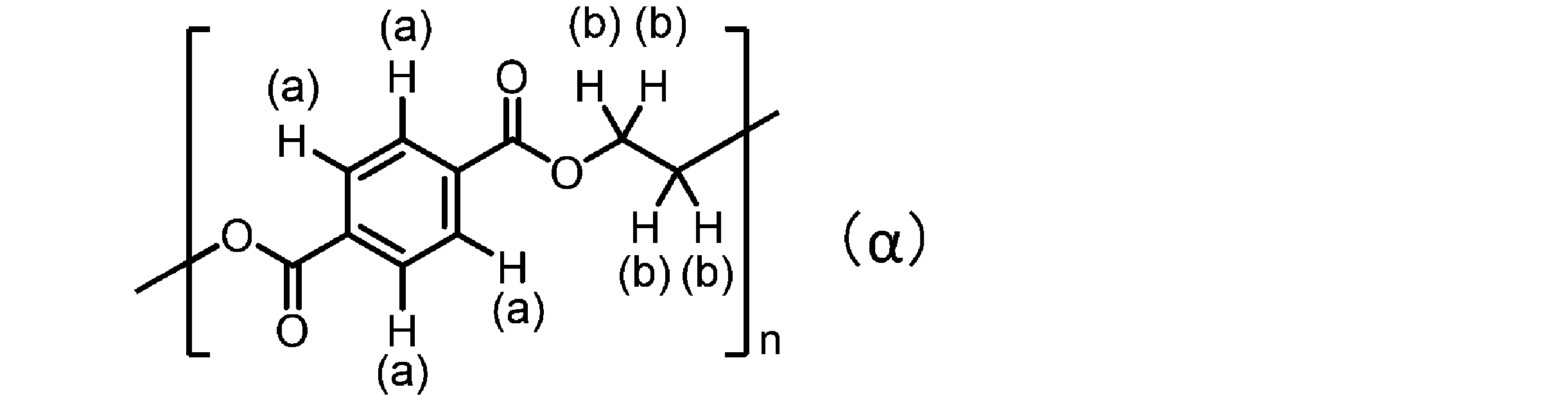
・以下の化学式(α)で示されるポリエステルの繰り返し構造における芳香環のプロトン(a)。
・化学式(α)で示されるポリエステルの繰り返し構造におけるエステル結合α位のメチレン基のプロトン(b)。
・以下の化学式(7)で示されるポリエステルのカルボン酸末端のアミン誘導体のプロトン(c),(c’)。
・以下の化学式(6)で示される化合物の芳香環のプロトン(d),(d’)。なお、前述したように、化学式(6)で示される化合物は、試料2の酸無水物構造の低分子化合物である。
・以下の化学式(6)で示される酸無水物構造のα位のプロトン(e)。
・以下の化学式(8)で示されるアミド結合のカルボニル炭素のα位のプロトン(f)。なお、化学式(8)で示されるアミド結合は、化学式(6)で示される化合物のアミド変換生成物である。
・以下の化学式(9)で示される芳香環のプロトン(g)。なお、化学式(9)で示される芳香環は、化学式(6)で示される化合物のアミド変換生成物である。
・化学式(10)で示されるポリエステル中の酸無水物構造の分解生成物における芳香環のプロトン(h),(h’)。
・以下の化学式(11)で示されるポリエステル中の酸無水物構造の分解生成物における置換基R3のプロトン(i)。
・以下の化学式(12)で示されるポリエステル中の酸無水物構造のジエチルアミンによる分解生成物におけるNのβ位のプロトン(j),(j’)。
・以下の化学式(α)で示されるポリエステルの繰り返し構造における芳香環のプロトン(a)。
・化学式(α)で示されるポリエステルの繰り返し構造におけるエステル結合α位のメチレン基のプロトン(b)。
・以下の化学式(7)で示されるポリエステルのカルボン酸末端のアミン誘導体のプロトン(c),(c’)。
・以下の化学式(6)で示される化合物の芳香環のプロトン(d),(d’)。なお、前述したように、化学式(6)で示される化合物は、試料2の酸無水物構造の低分子化合物である。
・以下の化学式(6)で示される酸無水物構造のα位のプロトン(e)。
・以下の化学式(8)で示されるアミド結合のカルボニル炭素のα位のプロトン(f)。なお、化学式(8)で示されるアミド結合は、化学式(6)で示される化合物のアミド変換生成物である。
・以下の化学式(9)で示される芳香環のプロトン(g)。なお、化学式(9)で示される芳香環は、化学式(6)で示される化合物のアミド変換生成物である。
・化学式(10)で示されるポリエステル中の酸無水物構造の分解生成物における芳香環のプロトン(h),(h’)。
・以下の化学式(11)で示されるポリエステル中の酸無水物構造の分解生成物における置換基R3のプロトン(i)。
・以下の化学式(12)で示されるポリエステル中の酸無水物構造のジエチルアミンによる分解生成物におけるNのβ位のプロトン(j),(j’)。
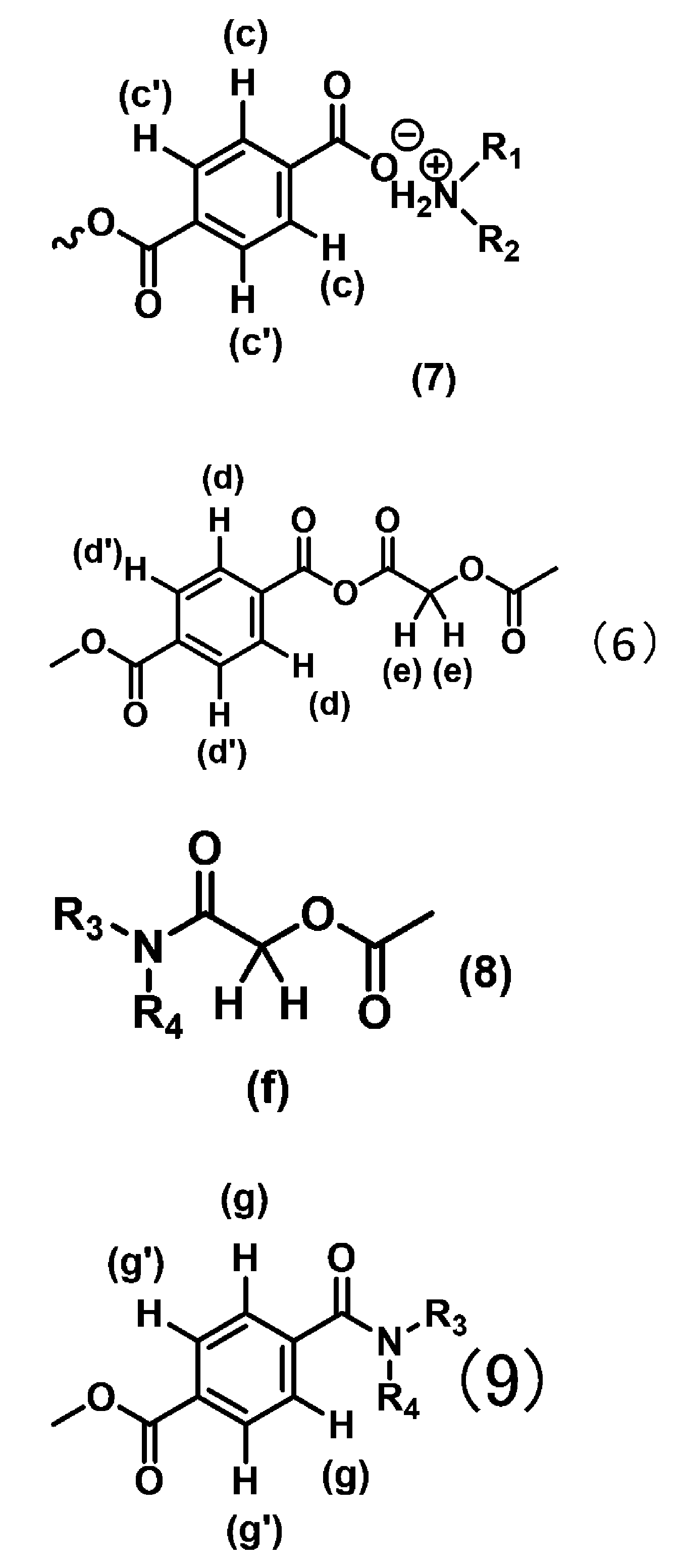
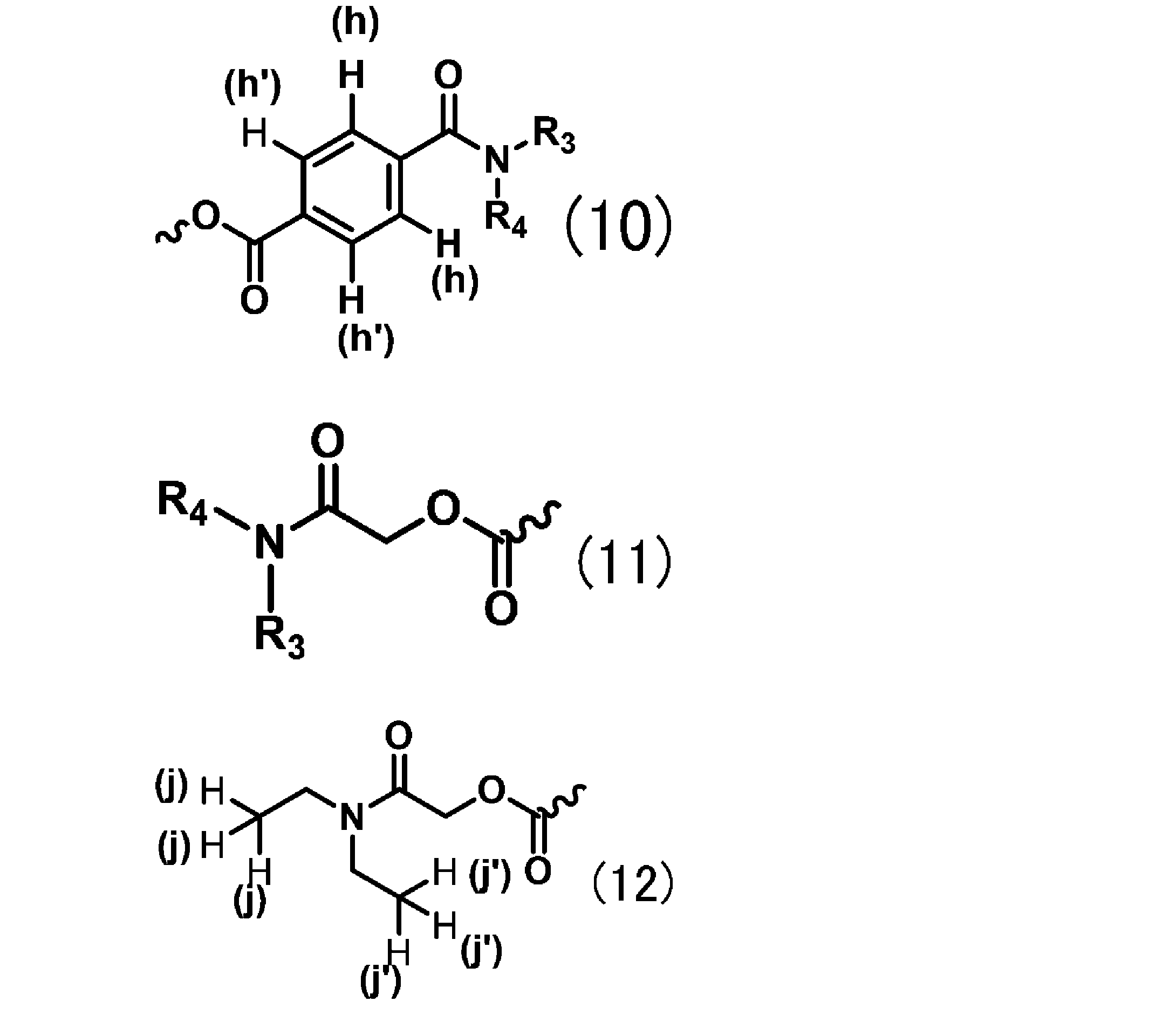
なお、以下では、化学式(6),化学式(7),化学式(8),化学式(9),化学式(10),化学式(11),化学式(12)で示される各々の化合物を、化合物(6),化合物(7),化合物(8),化合物(9),化合物(10),化合物(11),化合物(12)と称する。
[検討1]
次に、酸無水物構造のジエチルアミンによる分解生成物を測定するためのピーク検出位置について検討する。この検討では、既存のNMR測定方法における酸無水物構造由来のプロトンのピーク検出位置と、熱可塑性ポリエステル由来のプロトンのピーク検出位置とを比較する。
次に、酸無水物構造のジエチルアミンによる分解生成物を測定するためのピーク検出位置について検討する。この検討では、既存のNMR測定方法における酸無水物構造由来のプロトンのピーク検出位置と、熱可塑性ポリエステル由来のプロトンのピーク検出位置とを比較する。
試料1および試料2を、それぞれ測定溶媒1,測定溶媒2,測定溶媒3に溶解させる。測定溶媒1および測定溶媒3に溶解させた試料は、T=50℃で,測定溶媒2に溶解させた試料は、T=25℃で,1H NMRの測定を行った。この測定により得られた酸無水物構造由来のプロトンのピーク検出位置と,熱可塑性ポリエステル由来のプロトンのピーク検出位置を比較した結果を表1に示す。
測定溶媒1,測定溶媒2を用いた場合は,酸無水物構造のプロトンのピークは,いずれも熱可塑性ポリエステルのプロトンのピークと同位置に検出された。また,測定溶媒3を用いて試料2を測定した場合は,芳香環のプロトンのピークが複数確認され,酸無水物構造が分解しており,その分解物のピークの多くは熱可塑性ポリエステルのピークと同位置に検出された。これにより,既存のNMR測定条件では,熱可塑性ポリエステル中に含まれる酸無水物構造を検出することは困難であることが分かった。

[酸無水物構造の定量法]
上述した検討1による検討および考察の結果、各試料中の全テレフタル酸構造に対する酸無水物構造のmol濃度C[mol%]は、分解生成物を対象としたNMR測定で得られた上述のいずれかのプロトンのピークの積分値を用い、「C={(h)×2+((j)+(j’))×k}/{(a)+(c)+(c’)+(h)+(h’)}×100・・・(濃度算出式)」で算出した。なお、kは、2を(j)のピークのプロトン数で除した値である。
上述した検討1による検討および考察の結果、各試料中の全テレフタル酸構造に対する酸無水物構造のmol濃度C[mol%]は、分解生成物を対象としたNMR測定で得られた上述のいずれかのプロトンのピークの積分値を用い、「C={(h)×2+((j)+(j’))×k}/{(a)+(c)+(c’)+(h)+(h’)}×100・・・(濃度算出式)」で算出した。なお、kは、2を(j)のピークのプロトン数で除した値である。
[検討2](酸無水物構造の低分子モデル化合物の前処理方法の検討)
次に、第2工程で作製する試料液の検討結果について説明する。発明者らは、前処理によって酸無水物構造を1H NMRの測定で検出可能な化合物へ変換することを検討した。1H NMRの測定で検出可能とするには、熱可塑性ポリエステルおよび測定溶媒のピークとは明瞭に区別できるピークを有する化合物に変換する必要がある。また、上述した変換の過程で,熱可塑性ポリエステルの繰り返し単位に含まれるエステル基、および熱可塑性ポリエステルの末端官能基であるカルボキシル基,水酸基が、酸無水物構造を変換した後の化合物と同じ化合物に変換されてはならない。
次に、第2工程で作製する試料液の検討結果について説明する。発明者らは、前処理によって酸無水物構造を1H NMRの測定で検出可能な化合物へ変換することを検討した。1H NMRの測定で検出可能とするには、熱可塑性ポリエステルおよび測定溶媒のピークとは明瞭に区別できるピークを有する化合物に変換する必要がある。また、上述した変換の過程で,熱可塑性ポリエステルの繰り返し単位に含まれるエステル基、および熱可塑性ポリエステルの末端官能基であるカルボキシル基,水酸基が、酸無水物構造を変換した後の化合物と同じ化合物に変換されてはならない。
発明者らは、上述した要件を満たす化学変換について鋭意検討を重ね,酸無水物構造を反応(A),反応(B)によって化合物(3),化合物(4)に変換し、化合物(3),化合物(4)のプロトンを検出する方法を検討するに至り、実験で検証することとした。
まず,代表的なアミン(ブチルアミン,イソプロピルアミン,ジエチルアミン)を用いて、以下に示す反応(A’)および(B’)が定量的に進行するか否かを確認した。クロロホルムにアミン(ブチルアミン,イソプロピルアミン,ジエチルアミンについてそれぞれ実施)を添加した溶液に、3mgの試料2を加えて5分間撹拌して溶解させ、溶液(溶媒)を揮発させて除き、約3mgの固体を得た。得られた固体を重水素化クロロホルムに溶解させ,T=25℃で,1H NMR測定を行ったところ、いずれのアミンを用いた場合についても、反応(A’)および反応(B’)が定量的に進行したことが確認された。

次に、上記測定実施後の試料液の溶媒を揮発させ、試料を回収し、化合物(6)の酸無水物構造の分解に用いたアミンと同一のアミンを添加したHFIPとクロロホルムの混合溶媒を用いてNMR測定を実施した。この測定により、化合物(7),化合物(8),化合物(9)および、反応(B’)による化合物(13)のピーク検出位置と、熱可塑性ポリエステル(試料1)のピーク検出位置を比較し、化合物(7)~(9)、化合物(13)と熱可塑性ポリエステルが混在した場合の化合物(7)~(9)、化合物(13)の定量可否を調べた。
化合物(7)は、熱可塑性ポリエステルのカルボン酸末端のアミン塩と同一の分子構造であり、熱可塑性ポリエステルのカルボン酸末端のアミン塩と区別して化合物(7)を定量することはできない。
化合物(8)については後述する。
化合物(9)は、いずれの測定条件においても、芳香環のプロトン(g)のピークが、熱可塑性ポリエステルのピークとは重ならない位置に検出され、定量できることが分かった。
化合物(13)のピークは、いずれも熱可塑性ポリエステルの他のピークと重なり、化合物(13)は定量できないことが分かった。
以上の検討結果より、化合物(8)が定量できる条件であれば、化合物(9)の定量結果と合わせて、酸無水物構造の定量が可能といえる。
化合物(8)のアミド結合のカルボニル炭素のα位の炭素上のプロトン(f)のピークは、いずれの測定条件でも熱可塑性ポリエステルの(b)のピークとピーク位置が一致し、プロトン(f)のピークを用いた定量はできないことが分かった。
化合物(8)の置換基R3のプロトンのピーク、および置換基R4のプロトンのピークについて、用いたアミン毎の検出可否を表2に示す。ブチルアミン、イソプロピルアミンでは測定系中のアミン塩のプロトンピークと重なり検出不可であったが、ジエチルアミンを用いた場合は、測定系中のアミン塩と区別して検出可能であることが分かった。

1級アミンであるブチルアミン、イソプロピルアミンを用いた場合に生成する1級アミドとは異なり、ジエチルアミンを用いた場合に生成する2級アミドは、アミド結合の回転障壁によりピークが分裂することによると考えられる。アミン塩のピークとアミドのピークを区別するために、アミドの回転によるピーク分裂を利用する手法は報告例がなく、容易に発想できる方法ではない。
[実験]
次に、実験の結果を用いて説明する。
次に、実験の結果を用いて説明する。
ジエチルアミンとクロロホルムの体積混合比が1:1である溶液に,試料5酸無水物構造を含む、3mgのPETを投入し、40℃で4時間撹拌して溶解させる。この後、溶液中の溶媒を揮発させて除いた。これを測定溶媒1に溶解させ,50℃で1H NMR測定を行ったところ、(h)および(j),(j’)のピークが検出された。
(h):δ7.72
(j),(j’):δ1.13,1.22
(j),(j’):δ1.13,1.22
検出されたピークの積分値を、濃度算出式に代入すると、「C={(h)×2+((j)+(j’))×2÷3}/{(a)+(c)+(c’)+(h)+(h’)}×100={0.15×2+(1.56+1.50)×2÷3}+ /(42.73)×100=5.47」となり、 全芳香環に対する酸無水物構造のmol濃度は,約5.5mol%であると算出された。
なお、この実験では、熱可塑性ポリエステルとして、ポリエチレンテレフタレートを試料としたが,上述した測定方法は、ポリブチレンテレフタレート(PBT),ポリネオペンチルテレフタレート(PNT),ポリネオペンチルイソフタレートや、これらの共重合体においても適用可能な方法であることは容易に類推できる。
上述では、2級アミンとしてジエチルアミンを用いたが、ジメチルアミン、ジプロピルアミン、ジイソプロピルアミン、ジブチルアミン、ジイソブチルアミンなども使用可能であることは容易に類推できる。前処理で用いる2級アミンと,測定溶媒に添加するアミンの種類は同一であることが望ましい。
なお、熱可塑性ポリエステルの芳香環ピークと区別しやすくするため,2級アミンのNの置換基R3,置換基R4は、脂肪族基が好適に用いられる。また,定量対象のピーク数を減らすため,置換基R3,置換基R4は同一の分子構造が望ましい。
前処理における温度(反応温度)および時間は、酸無水物構造の化学変換が完了するよう適宜設定する。熱可塑性ポリエステルのアミンおよびクロロホルムへの溶解性は低いことから,加温しながら,数時間撹拌することで溶解させることが望ましい。前処理工程(第1工程)では、前処理液の温度(反応温度)を30℃以上、前処理に含まれる最も低い沸点を有する成分の沸点以下として、試料を前処理液に溶解する。具体的には、前処理液の温度を30℃以上、2級アミンの沸点またはクロロホルムの沸点のうちより低い方の沸点以下として、試料を前処理液に溶解する。
次に、反応温度による1H NMR測定結果への影響について説明する。前述した実験と同じ条件で、前処理液および前処理工程における反応温度を変更し前処理を実施し、NMR測定を行った。測定の結果として得られた(h)および(j),(j’)のピークを、実験の結果と比較した。比較した結果を表3に示す。なお、この比較では、表3中に示すように、前処理液における2級アミンとクロロホルムとの混合比(体積比)も変化させている。
実験と同等に(h)および(j),(j’)のピークが検出されたものは〇,実施例よりも(h)および(j),(j’)のピーク強度が小さかったものは×を記した。なお,ジエチルアミンの沸点は55℃であることから,反応温度を、20,30,40,50℃とした場合について検討した。また、前処理液における2級アミンとクロロホルムとの混合比は、1:0.2,1:1,1:2,1:3,1:4とした場合について検討した。

前処理工程における反応温度を20℃とすると反応時間を延長しても,実験よりも(h)および(j),(j’)のピーク強度が小さく,アミド化反応が十分に進行せず,前処理温度として低すぎることが分かった。また,反応温度を50℃とすると、(h)および(j),(j’)のピーク強度は実験と同程度定度であった。ジエチルアミンの沸点である55℃に上げても、アミンが蒸発しきらないよう留意すれば,問題なく目的の前処理が実施できると考えられる。よって,前処理工程における反応温度は、30以上、前処理に含まれる最も低い沸点を有する成分の沸点以下が、好適に用いられるといえる。
次に,前処理液におけるジエチルアミンとクロロホルムとの混合比について説明する。混合比が1:4となると,反応時間を延ばしても実験よりも(h)および(j),(j’)のピーク強度が小さく,アミド化反応が十分に進行せず、アミンの濃度が低すぎることが分かった。このように、前処理液におけるアミン濃度が低いと反応に長時間要することから、前処理液は、クロロホルムも加えて用いる場合、2級アミンに対するクロロホルムの混合比は、体積比で3以下とする。
以上に説明したように、本発明では、ポリエステルまたはポリエステル分解物からなる試料を、2級アミンを含む前処理液に溶解し、試料の反応生成物を得るようにしたので、劣化したポリエステルにおける酸無水物の含有量が測定できるようになる。
既存の測定方法では、熱可塑性ポリエステルに含まれる酸無水物構造の含有量を測定することは困難であった。直接測定が困難な分子構造を検出するには、検出対象としていた子構造を、検出可能な分子構造に変換することが考えられるが、この変換反応の選択は重要である。これは、熱可塑性ポリエステルは、酸無水物構造以外にも化学変換されうる官能基として、カルボン酸、水酸基を含んでいるためである。
発明者らは、代表的なアミンを用いて酸無水物構造のアミドへの変換を行ったところ、生成物である脂肪族アミドのピークは、系中のアミン塩のピークと重なりやすく、検出が容易でないことを明らかにした。この結果より、発明者らは鋭意検討を重ねた結果、2級アミンを利用することで、脂肪族アミドが検出可能となることを見出した。これは、2級アミドのN上置換基のプロトンピークが、アミド結合の回転障壁によって分離して検出されることを利用したものと考えることができる。化学変換を用いた酸無水物構造の検出で、2級アミドのN上置換基のプロトンピークの分裂を利用する例はこれまでになく、本発明は、容易に類推できるものではない。
なお、本発明は以上に説明した実施の形態に限定されるものではなく、本発明の技術的思想内で、当分野において通常の知識を有する者により、多くの変形および組み合わせが実施可能であることは明白である。
Claims (6)
- ポリエステルまたはポリエステル分解物からなる試料を、2級アミンを含む前処理液に溶解し、前記試料の反応生成物を得る第1工程と、
前記反応生成物を、重水素化クロロホルムおよび重水素化した1,1,1,3,3,3-ヘキサフルオロ-2-プロパノールを含む溶媒に混合した試料液を作製する第2工程と、
水素原子を対象とした核磁気共鳴分光法により前記試料液の中のアミドの量を測定することで前記試料の中の酸無水物の量を求める第3工程と
を備える酸無水物含有量測定方法。 - 請求項1記載の酸無水物含有量測定方法において、
前記2級アミンの2つの置換基は、脂肪族炭化水素から構成されていることを特徴とする酸無水物含有量測定方法。 - 請求項2記載の酸無水物含有量測定方法において、
前記2級アミンの2つの置換基は、同一の脂肪族炭化水素から構成されていることを特徴とする酸無水物含有量測定方法。 - 請求項1~3のいずれか1項に記載の酸無水物含有量測定方法において、
前記前処理液は、前記2級アミンに加えてクロロホルムを含むことを特徴とする酸無水物含有量測定方法。 - 請求項4記載の酸無水物含有量測定方法において、
前記前処理液における前記2級アミンに対するクロロホルムの混合比は、体積比で3以下とされている
ことを特徴とする酸無水物含有量測定方法。 - 請求項1~5のいずれか1項に記載の酸無水物含有量測定方法において、
前記第1工程は、前記前処理液の温度を30℃以上、前記前処理液に含まれる最も低い沸点を有する成分の沸点以下として、前記試料を前記前処理液に溶解して前記反応生成物を得ることを特徴とする酸無水物含有量測定方法。
Priority Applications (1)
| Application Number | Priority Date | Filing Date | Title |
|---|---|---|---|
| US17/417,672 US20220034828A1 (en) | 2018-12-28 | 2019-12-13 | Method for Measuring Acid Anhydride Content |
Applications Claiming Priority (2)
| Application Number | Priority Date | Filing Date | Title |
|---|---|---|---|
| JP2018246654A JP7092025B2 (ja) | 2018-12-28 | 2018-12-28 | 酸無水物含有量測定方法 |
| JP2018-246654 | 2018-12-28 |
Publications (1)
| Publication Number | Publication Date |
|---|---|
| WO2020137623A1 true WO2020137623A1 (ja) | 2020-07-02 |
Family
ID=71127647
Family Applications (1)
| Application Number | Title | Priority Date | Filing Date |
|---|---|---|---|
| PCT/JP2019/048939 Ceased WO2020137623A1 (ja) | 2018-12-28 | 2019-12-13 | 酸無水物含有量測定方法 |
Country Status (3)
| Country | Link |
|---|---|
| US (1) | US20220034828A1 (ja) |
| JP (1) | JP7092025B2 (ja) |
| WO (1) | WO2020137623A1 (ja) |
Citations (5)
| Publication number | Priority date | Publication date | Assignee | Title |
|---|---|---|---|---|
| JP2001201471A (ja) * | 2000-01-18 | 2001-07-27 | Polyplastics Co | ポリエステル樹脂の末端基の定量方法及びそれを使用したポリエステル樹脂の製造方法 |
| US20030157722A1 (en) * | 1999-10-06 | 2003-08-21 | Gardella Joseph A. | Method for testing the degradation of polymeric materials |
| JP2011163797A (ja) * | 2010-02-05 | 2011-08-25 | Sumitomo Chemical Co Ltd | 分析方法 |
| JP2017219519A (ja) * | 2016-06-10 | 2017-12-14 | 日本電信電話株式会社 | 熱可塑性ポリエステルの延性低下による寿命の推定方法 |
| JP2017219517A (ja) * | 2016-06-10 | 2017-12-14 | 日本電信電話株式会社 | 熱可塑性ポリエステルの数平均分子量及び最大応力の推定方法 |
Family Cites Families (9)
| Publication number | Priority date | Publication date | Assignee | Title |
|---|---|---|---|---|
| US3701741A (en) * | 1971-02-01 | 1972-10-31 | Eastman Kodak Co | Purification of impure scrap poly(ethylene terephthalate) |
| US5342854A (en) * | 1993-07-28 | 1994-08-30 | Hoechst Celanese Corporation | Polyester dissolution for polyester/cotton blend recycle |
| US6306507B1 (en) * | 1999-05-18 | 2001-10-23 | General Electric Company | Thermally stable polymers, method of preparation, and articles made therefrom |
| DE10297453B4 (de) * | 2001-11-16 | 2008-11-27 | Hitachi Chemical Co., Ltd. | Abbauverfahren für gesättigte Polyester unter Verwendung einer Lösung |
| US20050159542A1 (en) * | 2004-01-17 | 2005-07-21 | General Electric Company | Compositions useful as coatings, their preparation, and articles made therefrom |
| US20050159543A1 (en) * | 2004-01-17 | 2005-07-21 | General Electric Company | Coating compositions, their preparation, and coated articles made therefrom |
| US8974815B2 (en) * | 2005-12-16 | 2015-03-10 | Cornell University | Fibrous membrane for biomedical application based on poly(ester-amide)s |
| US8822605B2 (en) * | 2009-03-09 | 2014-09-02 | Council Of Scientific & Industrial Research | PH sensitive graft copolymer |
| WO2011111071A1 (en) * | 2010-03-09 | 2011-09-15 | Council Of Scientific & Industrial Research | Graft copolymer with ph dependent behaviour |
-
2018
- 2018-12-28 JP JP2018246654A patent/JP7092025B2/ja active Active
-
2019
- 2019-12-13 US US17/417,672 patent/US20220034828A1/en not_active Abandoned
- 2019-12-13 WO PCT/JP2019/048939 patent/WO2020137623A1/ja not_active Ceased
Patent Citations (5)
| Publication number | Priority date | Publication date | Assignee | Title |
|---|---|---|---|---|
| US20030157722A1 (en) * | 1999-10-06 | 2003-08-21 | Gardella Joseph A. | Method for testing the degradation of polymeric materials |
| JP2001201471A (ja) * | 2000-01-18 | 2001-07-27 | Polyplastics Co | ポリエステル樹脂の末端基の定量方法及びそれを使用したポリエステル樹脂の製造方法 |
| JP2011163797A (ja) * | 2010-02-05 | 2011-08-25 | Sumitomo Chemical Co Ltd | 分析方法 |
| JP2017219519A (ja) * | 2016-06-10 | 2017-12-14 | 日本電信電話株式会社 | 熱可塑性ポリエステルの延性低下による寿命の推定方法 |
| JP2017219517A (ja) * | 2016-06-10 | 2017-12-14 | 日本電信電話株式会社 | 熱可塑性ポリエステルの数平均分子量及び最大応力の推定方法 |
Non-Patent Citations (1)
| Title |
|---|
| STAMATAKIS, GEORGIOS: "Analysis and aging of unsaturated polyester resins in contemporary a installations by NMR spectroscopy", ANAL BIOAN CHEM, vol. 398, 2010, pages 3203 - 3214, XP019863984, DOI: 10.1007/s00216-010-4233-3 * |
Also Published As
| Publication number | Publication date |
|---|---|
| JP7092025B2 (ja) | 2022-06-28 |
| US20220034828A1 (en) | 2022-02-03 |
| JP2020106447A (ja) | 2020-07-09 |
Similar Documents
| Publication | Publication Date | Title |
|---|---|---|
| Peng et al. | Acetolysis of waste polyethylene terephthalate for upcycling and life-cycle assessment study | |
| Chrissafis et al. | Effect of molecular weight on thermal degradation mechanism of the biodegradable polyester poly (ethylene succinate) | |
| Ali et al. | Syntheses of high-performance biopolyamides derived from itaconic acid and their environmental corrosion | |
| Akbari et al. | Novel bio-based branched unsaturated polyester resins for high-temperature applications | |
| Geyer et al. | Designing oligomeric ethylene terephtalate building blocks by chemical recycling of polyethylene terephtalate | |
| JP2521297B2 (ja) | ポリアリレ−トの製造法 | |
| Berti et al. | Transamidations in melt-mixed MXD6 and PA6I-6T polyamides: 1. Determination of the degree of randomness and block length by 1H-NMR analysis | |
| WO2020137623A1 (ja) | 酸無水物含有量測定方法 | |
| JP2010518377A (ja) | ビニル末端の測定方法 | |
| JP7092024B2 (ja) | 酸無水物含有量測定方法 | |
| Rusu et al. | Structural investigations of amines treated polyester thin films by FTIR-ATR spectroscopy | |
| Salem et al. | Chemical recycling of poly (ethylene terephthalate) waste using a new co-catalytic system | |
| WO2019225357A1 (ja) | 分子量測定方法および測定用溶媒 | |
| JP3836284B2 (ja) | ポリエステル樹脂の末端基の定量方法及びそれを使用したポリエステル樹脂の製造方法 | |
| JP6969495B2 (ja) | テレフタル酸含有量測定方法および測定用溶媒 | |
| Fenouillot et al. | Reaction and miscibility of two diepoxides with poly (ethylene terephthalate) | |
| JP6849580B2 (ja) | 高分子材料の寿命推定方法 | |
| Sun et al. | Study on yellowing mechanism and inhibiting technology based on amide salts modified polyester | |
| Suganuma et al. | Stereoregularity of poly (lactic acid) and their model compounds as studied by NMR and quantum chemical calculations | |
| Samperi et al. | Reactive melt mixing of PC/PEN blend. Structural characterization of reaction products | |
| Zheng et al. | Hyperbranched unsaturated polyester amide synthesized by two-step method | |
| JPS638133B2 (ja) | ||
| EP4660230A1 (en) | Method for chemically recycling polyamide polymers using aliphatic dicarboxylic acids and related methods | |
| Baccarin et al. | Circularity in Polyamide Textiles: Enhancing Recycled Polymer Molar Mass with Carbodiimide Linear Coupling | |
| Djamila et al. | Piperazine polymerization catalyzed by Maghnite-H+ |
Legal Events
| Date | Code | Title | Description |
|---|---|---|---|
| 121 | Ep: the epo has been informed by wipo that ep was designated in this application |
Ref document number: 19902464 Country of ref document: EP Kind code of ref document: A1 |
|
| NENP | Non-entry into the national phase |
Ref country code: DE |
|
| 122 | Ep: pct application non-entry in european phase |
Ref document number: 19902464 Country of ref document: EP Kind code of ref document: A1 |