WO2020129901A1 - ケトン化合物の製造方法 - Google Patents
ケトン化合物の製造方法 Download PDFInfo
- Publication number
- WO2020129901A1 WO2020129901A1 PCT/JP2019/049177 JP2019049177W WO2020129901A1 WO 2020129901 A1 WO2020129901 A1 WO 2020129901A1 JP 2019049177 W JP2019049177 W JP 2019049177W WO 2020129901 A1 WO2020129901 A1 WO 2020129901A1
- Authority
- WO
- WIPO (PCT)
- Prior art keywords
- group
- heterocyclic
- substituents
- aliphatic
- represented
- Prior art date
- Legal status (The legal status is an assumption and is not a legal conclusion. Google has not performed a legal analysis and makes no representation as to the accuracy of the status listed.)
- Ceased
Links
- 0 Cc1ccc(*)c(C*)c1 Chemical compound Cc1ccc(*)c(C*)c1 0.000 description 3
Classifications
-
- C—CHEMISTRY; METALLURGY
- C07—ORGANIC CHEMISTRY
- C07B—GENERAL METHODS OF ORGANIC CHEMISTRY; APPARATUS THEREFOR
- C07B41/00—Formation or introduction of functional groups containing oxygen
- C07B41/06—Formation or introduction of functional groups containing oxygen of carbonyl groups
-
- C—CHEMISTRY; METALLURGY
- C07—ORGANIC CHEMISTRY
- C07C—ACYCLIC OR CARBOCYCLIC COMPOUNDS
- C07C45/00—Preparation of compounds having >C = O groups bound only to carbon or hydrogen atoms; Preparation of chelates of such compounds
- C07C45/45—Preparation of compounds having >C = O groups bound only to carbon or hydrogen atoms; Preparation of chelates of such compounds by condensation
-
- C—CHEMISTRY; METALLURGY
- C07—ORGANIC CHEMISTRY
- C07C—ACYCLIC OR CARBOCYCLIC COMPOUNDS
- C07C67/00—Preparation of carboxylic acid esters
- C07C67/28—Preparation of carboxylic acid esters by modifying the hydroxylic moiety of the ester, such modification not being an introduction of an ester group
- C07C67/293—Preparation of carboxylic acid esters by modifying the hydroxylic moiety of the ester, such modification not being an introduction of an ester group by isomerisation; by change of size of the carbon skeleton
-
- C—CHEMISTRY; METALLURGY
- C07—ORGANIC CHEMISTRY
- C07B—GENERAL METHODS OF ORGANIC CHEMISTRY; APPARATUS THEREFOR
- C07B61/00—Other general methods
-
- C—CHEMISTRY; METALLURGY
- C07—ORGANIC CHEMISTRY
- C07H—SUGARS; DERIVATIVES THEREOF; NUCLEOSIDES; NUCLEOTIDES; NUCLEIC ACIDS
- C07H1/00—Processes for the preparation of sugar derivatives
-
- C—CHEMISTRY; METALLURGY
- C07—ORGANIC CHEMISTRY
- C07H—SUGARS; DERIVATIVES THEREOF; NUCLEOSIDES; NUCLEOTIDES; NUCLEIC ACIDS
- C07H7/00—Compounds containing non-saccharide radicals linked to saccharide radicals by a carbon-to-carbon bond
- C07H7/04—Carbocyclic radicals
Definitions
- the present invention relates to a method for producing a ketone compound.
- antidiabetic agents including sulfonylurea drugs, glinide drugs, biguanide drugs, thiazolidine drugs, ⁇ -glucosidase inhibitors, dipeptidyl peptidase 4 (DPP-4) inhibitors, glucose-like peptides. 1 (GLP-1) passive agonist and the like are known.
- DPP-4 dipeptidyl peptidase 4
- GLP-1 glucose-like peptides. 1
- GLP-1 glucose-like peptides. 1
- SGLT-2 sodium-glucose cotransporter-2
- Examples of SGLT-2 inhibitors include canagliflozin (1-( ⁇ -D-glycopyranosyl)-4-methyl-3-[5-(4-fluorophenyl)-2-thienylmethyl]benzene) and the like.
- canagliflozin (1-( ⁇ -D-glycopyranosyl)-4-methyl-3-[5-(4-fluorophenyl)-2-thienylmethyl]benzene) and the like.
- Non-Patent Document 2 And an addition reaction of the aryl group (see Non-Patent Document 2), and further, using a magnesium ate complex obtained from lithium tri-n-butyl magnesate (nBu 3 MgLi), a temperature environment of about ⁇ 15° C.
- a method of adding an aryl group to a D-gluconolactone derivative is known below.
- a thioester derivative is reacted with an organozinc reagent in the presence of a nickel catalyst to cause coupling to obtain a ketone derivative (see Non-Patent Documents 4 and 5).
- One object of the present invention is to provide a new method for producing a ketone compound.
- the present invention includes the following inventions.
- W 1 and W 2 are each independently a function of bonding an aliphatic hydrocarbon group, an aromatic hydrocarbon ring group, an aliphatic heterocyclic group or an aromatic heterocyclic group to the carbon atom of the carbonyl group in the formula.
- the at least one organozinc compound contains the compound (III-I),
- the compound (III-I) has the following formula: [In the formula, W 2 and X are as defined above. ]
- the aliphatic hydrocarbon group is an aliphatic hydrocarbon group having 1 to 6 carbon atoms
- the aromatic hydrocarbon ring group is an aromatic hydrocarbon ring group having 6 to 18 carbon atoms
- the aliphatic heterocyclic group is a 3- to 8-membered aliphatic heterocyclic group, The method according to any one of [1] to [6], wherein the aromatic heterocyclic group is a 6 to 14-membered aromatic heterocyclic group.
- the one or more substituents that the aliphatic hydrocarbon group may have are each independently a halogen atom, a nitro group, a cyano group, an oxo group, an optionally protected hydroxyl group, Optionally protected thiol group, optionally protected amino group, optionally protected formyl group, optionally protected carboxyl group, optionally protected carbamoyl group, optionally protected Good sulfonyl group, aryl group, aliphatic heterocyclic group, heteroaryl group, alkylaryl group, alkylaliphatic heterocyclic group, alkylheteroaryl group, arylalkyl group, aliphatic heterocyclic alkyl group, heteroarylalkyl group, alkyl Oxy group, aryloxy group, aliphatic heterocyclic oxy group, heteroaryloxy group, alkylaryloxy group, alkylaliphatic heterocyclic oxy group, alkylheteroaryloxy group, arylalkyl group
- the one or more substituents that the aromatic hydrocarbon ring group, the aliphatic heterocyclic group, and the aromatic heterocyclic group may have, are each independently a halogen atom or a nitro group.
- At least one of the organic group represented by W 1 and the organic group represented by W 2 is an aromatic hydrocarbon ring group or an aromatic heterocyclic group, which is a carbon atom of the carbonyl group in the formula (I). Any of [1] to [9], which is included as a functional group bonded to an atom, and the aromatic hydrocarbon ring group and the aromatic heterocyclic group each may have one or more substituents. The method described in.
- At least one of the organic group represented by W 1 and the organic group represented by W 2 has the following formula (V):
- R a is each independently a halogen atom, an alkyl group, an alkenyl group, an alkynyl group, an aryl group, an arylalkyl group, an arylalkenyl group, an arylalkynyl group, an alkyloxy group, an alkenyloxy group, an alkynyloxy group, or aryloxy.
- At least one of the organic group represented by W 1 and the organic group represented by W 2 has the following formula (Va): [In the formula, Ra is as defined above, Ar' is represented by the following formulas (Va-I), (Va-II) and (Va-III): [Wherein each R b independently represents a functional group selected from the group consisting of an aliphatic hydrocarbon group, an aromatic hydrocarbon ring group, an aliphatic heterocyclic group and an aromatic heterocyclic group, The aliphatic hydrocarbon group, the aromatic hydrocarbon ring group, the aliphatic heterocyclic group and the aromatic heterocycle each may have one or more substituents, and p is an integer of 0 to 5 Represents.
- R b Represents a functional group selected from the group consisting of: ]
- the functional groups represented by R b are each independently an alkyl group having 1 to 20 carbon atoms, an alkenyl group having 2 to 20 carbon atoms, an alkynyl group having 2 to 20 carbon atoms, and a carbon number of 6 to 14
- the organic group represented by Q contains an alkyl group, an alkenyl group, an alkynyl group or an aryl group as a functional group that bonds to a sulfur atom in the formula, and the alkyl group, the alkenyl group, the alkynyl group and The method according to any one of [1] to [14], wherein each of the aryl groups may have one or more substituents.
- At least one of the organic group represented by W 1 and the organic group represented by W 2 is an aliphatic hydrocarbon group which may have one or more substituents, [1] to The method according to any one of [15].
- a novel method for producing a ketone compound is provided.
- INDUSTRIAL APPLICABILITY The production method of the present invention makes it possible to produce a ketone compound industrially inexpensively and efficiently, and can significantly reduce equipment costs, running costs, etc., and is therefore advantageous in industrial production.
- alkyl group also applies to functional groups containing “alkyl” or “alkyl groups” (eg, alkylaryl groups, arylalkyl groups, etc.).
- alkylaryl groups e.g., alkylaryl groups, arylalkyl groups, etc.
- alkylaryl groups e.g., alkylaryl groups, arylalkyl groups, etc.
- alkylaryl groups e.g, alkylaryl groups, arylalkyl groups, etc.
- Organic group means a functional group containing one or more carbon atoms.
- the organic group can contain one or more heteroatoms.
- Heteroatom means atoms other than hydrogen and carbon atoms. Examples of the hetero atom include a nitrogen atom, an oxygen atom, a sulfur atom, a halogen atom, a silicon atom and the like.
- Healogen atom means a fluorine atom, a chlorine atom, a bromine atom or an iodine atom.
- the bond of the organic group is preferably formed of a bond of a carbon atom contained in the organic group.
- the organic group is an aliphatic hydrocarbon group which may have one or more substituents, or an aliphatic hydrocarbon group which may have one or more substituents. Including a group.
- the bond of the organic group is preferably formed of the bond of an aliphatic hydrocarbon group.
- the organic group is an aromatic hydrocarbon ring group which may have one or more substituents, or an aromatic hydrocarbon ring which may have one or more substituents.
- the bond of the organic group is preferably formed of the bond of the aromatic hydrocarbon ring group.
- the organic group is an aliphatic heterocyclic group which may have one or more substituents, or an aliphatic heterocyclic group which may have one or more substituents. Including a ring group.
- the bond of the organic group is preferably formed of the bond of the aliphatic heterocyclic group.
- the organic group is an aromatic heterocyclic group optionally having one or more substituents, or an aromatic heterocyclic group optionally having one or more substituents. Including a ring group.
- the bond of the organic group is preferably formed of the bond of the aromatic heterocyclic group.
- the organic group is an aliphatic hydrocarbon group which may have one or more substituents, an aromatic hydrocarbon ring group which may have one or more substituents, Which is formed by combining two or more kinds selected from an aliphatic heterocyclic group which may have one or more substituents and an aromatic heterocyclic group which may have one or more substituents Including a group.
- the bond of the organic group is preferably formed of a bond of an aliphatic hydrocarbon group, an aromatic hydrocarbon ring group, an aliphatic heterocyclic group or an aromatic heterocyclic group.
- “Aliphatic hydrocarbon group” means a functional group (hydrocarbon group having no aromaticity) produced by removing a hydrogen atom from an aliphatic hydrocarbon.
- “Aliphatic hydrocarbon group” may mean a monovalent or divalent functional group depending on the context.
- the monovalent aliphatic hydrocarbon group may be referred to as "-aliphatic hydrocarbon group” and the divalent aliphatic hydrocarbon group may be referred to as "-aliphatic hydrocarbon group-”.
- the aliphatic hydrocarbon group may be linear, cyclic or a combination thereof.
- the chain may be a straight chain or a branched chain.
- the aliphatic hydrocarbon group is preferably linear or branched.
- the aliphatic hydrocarbon group may be saturated or unsaturated.
- the unsaturated bond may be a carbon-carbon double bond or a carbon-carbon triple bond.
- Examples of the monovalent aliphatic hydrocarbon group include an alkyl group, an alkenyl group and an alkynyl group.
- the monovalent aliphatic hydrocarbon group is preferably an alkyl group or an alkenyl group, and more preferably an alkyl group.
- Examples of the divalent aliphatic hydrocarbon group include an alkylene group, an alkenylene group, an alkynylene group and the like.
- the divalent aliphatic hydrocarbon group is preferably an alkylene group or an alkenylene group, more preferably an alkylene group.
- Alkyl group means a monovalent functional group generated by removing one hydrogen atom from an alkane.
- the alkyl group may be linear, cyclic or a combination thereof.
- the cyclic alkyl group has the same meaning as the "cycloalkyl group”.
- the chain may be a straight chain or a branched chain.
- the alkyl group is preferably linear or branched.
- the carbon number of the linear alkyl group is usually 1 to 20, preferably 1 to 10, more preferably 1 to 8, even more preferably 1 to 6, and even more preferably 1 to 4, More preferably, it is 1 to 3.
- the number of carbon atoms of the branched alkyl group is usually 3 to 20, preferably 3 to 10, more preferably 3 to 8, even more preferably 3 to 6, and even more preferably 3 to 4. is there.
- the carbon number of the cyclic alkyl group is usually 3 to 20, preferably 3 to 10, more preferably 3 to 8, and even more preferably 3 to 6.
- the number of carbon atoms of the alkyl group having a linear or branched portion and a cyclic portion is usually 4 to 20, preferably 4 to 10, more preferably 4 to 8, and even more preferably 4 to 6. Is.
- alkyl group examples include methyl group, ethyl group, propyl group, isopropyl group, n-butyl group, isobutyl group, sec-butyl group, tert-butyl group, pentyl group, hexyl group, isohexyl group, heptyl group, 4 , 4-Dimethylpentyl group, octyl group, 2,2,4-trimethylpentyl group, nonyl group, decyl group and other linear or branched alkyl groups; cyclopropyl group, cyclobutyl group, cyclopentyl group, cyclohexyl group , A cycloalkyl group such as a cycloheptyl group and a cyclooctyl group; having a linear or branched chain portion such as a cyclopentylmethyl group, a cyclopentylethyl group, a cyclopentyl
- Alkenyl group means a monovalent functional group formed by removing one hydrogen atom from an alkene.
- An alkenyl group has at least one carbon-carbon double bond.
- the alkenyl group may be linear, cyclic or a combination thereof.
- the cyclic alkenyl group has the same meaning as "cycloalkenyl group”.
- the chain may be a straight chain or a branched chain.
- the alkenyl group is preferably linear or branched.
- the number of carbon atoms of the linear alkenyl group is usually 2 to 20, preferably 2 to 10, more preferably 2 to 8, even more preferably 2 to 6, and even more preferably 2 to 4. is there.
- the number of carbon atoms of the branched alkenyl group is usually 3 to 20, preferably 3 to 10, more preferably 3 to 8, even more preferably 3 to 6, and even more preferably 3 to 4. is there.
- the carbon number of the cyclic alkenyl group is usually 3 to 20, preferably 3 to 10, more preferably 3 to 8, and even more preferably 3 to 6.
- the number of carbon atoms of the alkenyl group having a linear or branched portion and a cyclic portion is usually 4 to 20, preferably 4 to 10, more preferably 4 to 8, and even more preferably 4 to 6. Is.
- the number of double bonds in the alkenyl group is usually 1 to 9, preferably 1 to 7, more preferably 1 to 4, and even more preferably 1 to 3.
- alkenyl group examples include a vinyl group, 2-propenyl group, 3-butenyl group, 2-butenyl group, 4-pentenyl group, 3-pentenyl group, 2-hexenyl group, 3-hexenyl group, 2-heptenyl group, Linear or branched alkenyl groups such as 3-heptenyl group, 4-heptenyl group, 3-octenyl group, 3-nonenyl group, 4-decenyl group; cyclopropenyl group, cyclobutenyl group, cyclopentenyl group, cyclohexenyl group Cyclic alkenyl groups such as groups, cycloheptenyl groups, cyclooctenyl groups; linear or branched moieties such as cyclopentenylmethyl groups, cyclopentenylethyl groups, cyclopentenylpropyl groups, cyclohexenylmethyl groups, cyclohexenylethy
- Alkynyl group means a monovalent functional group generated by removing one hydrogen atom from an alkyne.
- An alkynyl group has at least one carbon-carbon triple bond.
- the alkynyl group may be linear, cyclic or a combination thereof.
- the cyclic alkynyl group has the same meaning as the "cycloalkynyl group”.
- the chain may be a straight chain or a branched chain.
- the alkynyl group is preferably linear or branched.
- the number of carbon atoms of the linear alkynyl group is usually 2 to 20, preferably 2 to 10, more preferably 2 to 8, even more preferably 2 to 6, and even more preferably 2 to 4. is there.
- the branched alkynyl group has usually 4 to 20 carbon atoms, preferably 4 to 10 carbon atoms, more preferably 4 to 8 carbon atoms, and still more preferably 4 to 6 carbon atoms.
- the carbon number of the cyclic alkynyl group is usually 4 to 20, preferably 4 to 10, more preferably 4 to 8, and even more preferably 4 to 6.
- the number of carbon atoms of the alkynyl group having a linear or branched portion and a cyclic portion is usually 5 to 20, preferably 5 to 10, more preferably 5 to 8, and even more preferably 5 to 6. Is.
- the number of triple bonds in the alkynyl group is usually 1 to 9, preferably 1 to 7, more preferably 1 to 4, and even more preferably 1 to 3.
- alkynyl group examples include 2-propynyl group, 3-butynyl group, 2-butynyl group, 4-pentynyl group, 3-pentynyl group, 2-hexynyl group, 3-hexynyl group, 2-heptynyl group, 3-heptynyl group.
- alkynyl group such as 4-heptynyl group, 3-octynyl group, 3-nonynyl group and 4-decynyl group; cyclic such as cyclobutynyl group, cyclopentynyl group, cycloheptynyl group and cyclooctynyl group
- alkynyl group having a linear or branched portion such as a cyclopentynylmethyl group, a cyclopentenylethyl group, a cyclopentynylpropyl group, a cyclopentynylmethyl group, a cyclopentynylethyl group and a cyclic portion.
- Alkylene group means a divalent functional group formed by removing one hydrogen atom from an alkyl group. The description on the alkyl group is the same as above.
- Alkenylene group means a divalent functional group formed by removing one hydrogen atom from an alkenyl group. The description on the alkenyl group is the same as above.
- Alkynylene group means a divalent functional group formed by removing one hydrogen atom from an alkynyl group. The description on the alkynyl group is the same as above.
- “Aromatic hydrocarbon ring group” means a functional group formed by removing a hydrogen atom from an aromatic hydrocarbon ring. “Aromatic hydrocarbon ring group” may mean a monovalent or divalent functional group, depending on the context. Hereinafter, the monovalent aromatic hydrocarbon ring group may be referred to as "-aromatic hydrocarbon ring group” and the divalent aromatic hydrocarbon ring group may be referred to as "-aromatic hydrocarbon ring group-”. The monovalent aromatic hydrocarbon ring group has the same meaning as the "aryl group”, and the divalent aromatic hydrocarbon ring group has the same meaning as the "arylene group”.
- the aromatic hydrocarbon ring group includes, for example, a monocyclic or polycyclic (eg, bicyclic or tricyclic) aromatic carbohydrogen ring group.
- the aromatic hydrocarbon ring group is usually 1 to 4 ring type, preferably 1 to 3 ring type, and more preferably 1 or 2 ring type.
- the number of ring-constituting carbon atoms in the aromatic hydrocarbon ring group is usually 6 to 18, preferably 6 to 14, and more preferably 6 to 10.
- Examples of the monocyclic aromatic carbon-hydrogen ring group include a phenyl group.
- the aromatic carbohydrogen ring group also includes a condensed polycyclic aromatic hydrocarbon ring group and a partially saturated condensed polycyclic aromatic hydrocarbon ring group.
- the partially saturated fused polycyclic aromatic hydrocarbon ring group is a fused polycyclic aromatic hydrocarbon ring group in which some of the bonds constituting the ring are hydrogenated.
- Examples of the condensed polycyclic aromatic hydrocarbon ring group include, for example, naphthenyl group, anthryl group, phenanthrenyl group, tetracenyl group, pyrenyl group, and other 2- to 4-cyclic aromatic carbon-hydrogen ring groups, and fluorenyl group. , Indenyl group, acenaphthylenyl and the like.
- Examples of the partially saturated fused polycyclic aromatic hydrocarbon ring group include a dihydronaphthyl group, an indanyl group, an acenaphthenyl group and the like.
- the divalent aromatic hydrocarbon ring group is a divalent functional group produced by removing one hydrogen atom from the monovalent aromatic hydrocarbon ring group.
- the description on the monovalent aromatic hydrocarbon ring group is the same as above.
- Examples of the divalent aromatic hydrocarbon ring group include a 1,3-phenylene group and a 1,4-phenylene group.
- “Aliphatic heterocyclic group” means, as a ring-constituting atom, a monocyclic group containing, in addition to a carbon atom, one or more heteroatoms independently selected from the group consisting of an oxygen atom, a sulfur atom and a nitrogen atom, or It means a functional group formed by removing a hydrogen atom from a polycyclic (eg, bicyclic or tricyclic) aliphatic heterocycle (non-aromatic heterocycle).
- the “aliphatic heterocyclic group” may mean a monovalent or divalent functional group depending on the context.
- the monovalent aliphatic heterocyclic group may be referred to as "-aliphatic heterocyclic group”
- the divalent aliphatic heterocyclic group may be referred to as "-aliphatic heterocycle-”.
- the “aliphatic heterocycle” in the functional group containing “aliphatic heterocycle” eg, aliphatic heterocyclic thio group, aliphatic heterocyclic oxy group, etc.
- aliphatic heterocycle in the functional group containing “aliphatic heterocycle” (eg, aliphatic heterocyclic thio group, aliphatic heterocyclic oxy group, etc.) means an aliphatic heterocyclic group.
- the number of heteroatoms contained in the aliphatic heterocyclic group is usually 1 to 4, preferably 1 to 3, and more preferably 1 or 2.
- the number of members of the aliphatic heterocyclic group is usually 3 to 16 members, preferably 4 to 10 members, more preferably 5 to 8 members, still more preferably 5 to 7 members, still more preferably 5 or 6 members.
- the aliphatic heterocyclic group is, for example, monocyclic, bicyclic or tricyclic, preferably monocyclic or bicyclic.
- the number of ring-constituting carbon atoms in the aliphatic heterocyclic group is appropriately selected according to the number of heteroatoms and the number of members of the aliphatic heterocyclic group.
- the number of ring-constituting carbon atoms in the aliphatic heterocyclic group is usually 2 to 12, preferably 2 to 8, and more preferably 2 to 5.
- the monocyclic aliphatic heterocyclic group is, for example, a monocyclic saturated aliphatic heterocyclic group.
- the monocyclic saturated aliphatic heterocyclic group is a monocyclic aliphatic heterocyclic group in which the ring is composed of only saturated bonds.
- the monocyclic saturated aliphatic heterocyclic group contains 1-2 oxygen atoms.
- the monocyclic saturated aliphatic heterocyclic group contains 1-2 sulfur atoms.
- the monocyclic saturated aliphatic heterocyclic group contains 1-2 oxygen atoms and 1-2 sulfur atoms.
- the monocyclic saturated aliphatic heterocyclic group contains 1-4 nitrogen atoms.
- the monocyclic saturated aliphatic heterocyclic group contains 1-3 nitrogen atoms, 1-2 sulfur atoms and/or 1-2 oxygen atoms.
- two carbon atoms constituting the ring may be bridged with an alkylene group.
- two adjacent carbon atoms among the carbon atoms constituting the ring may form a double bond.
- two hydrogen atoms bonded to the same carbon atom may be substituted with an oxo group.
- the number of oxo groups that the monocyclic saturated aliphatic heterocyclic group can have is preferably 1 or 2.
- the monocyclic saturated aliphatic heterocyclic group may be a dioxide.
- Examples of the monocyclic aliphatic heterocyclic group include an aziridinyl group, an oxiranyl group, a thiylanyl group, an azetidinyl group, an oxetanyl group, a thietanyl group, a tetrahydrothienyl group, a tetrahydrofuranyl group, a pyrrolinyl group, a pyrrolidinyl group, an imidazolinyl group, and an imidazolidinyl group.
- the monocyclic aliphatic heterocyclic group also includes a partially saturated monocyclic aromatic heterocyclic group.
- the partially saturated monocyclic aromatic heterocyclic group is a monocyclic aromatic heterocyclic group in which some of the bonds constituting the ring are hydrogenated.
- Examples of the partially saturated monocyclic aromatic heterocyclic group include, for example, 4,5-dihydro-1H-imidazolyl group, 1,2,3,6-tetrahydropyridyl group, 4H-1,3-oxazinyl group. Group, 5,6-dihydro-4H-1,3-oxazinyl group and the like.
- a partially saturated monocyclic aromatic heterocyclic group two hydrogen atoms bonded to the same carbon atom may be substituted with an oxo group.
- the number of oxo groups which the partially saturated monocyclic aromatic heterocyclic group may have is preferably 1 or 2.
- the polycyclic aliphatic heterocyclic group is, for example, a condensed polycyclic aliphatic heterocyclic group.
- the condensed polycyclic aliphatic heterocyclic group is, for example, a condensed polycyclic saturated aliphatic heterocyclic ring.
- the condensed polycyclic saturated aliphatic heterocyclic ring is a condensed polycyclic aliphatic heterocyclic group in which the ring is composed of only saturated bonds.
- the fused polycyclic saturated aliphatic heterocyclic group contains 1-3 oxygen atoms.
- the fused polycyclic saturated aliphatic heterocyclic group contains 1-3 sulfur atoms.
- the fused polycyclic saturated aliphatic heterocyclic group contains 1-3 oxygen atoms and 1-3 sulfur atoms. In another embodiment, the fused polycyclic saturated aliphatic heterocyclic group contains 1-5 nitrogen atoms. In another embodiment, the fused polycyclic saturated aliphatic heterocyclic group contains 1 to 4 nitrogen atoms and 1 to 3 sulfur atoms and/or 1 to 3 oxygen atoms. In the fused polycyclic saturated aliphatic heterocyclic group, two carbon atoms constituting the ring may be bridged with an alkylene group. In the fused polycyclic saturated aliphatic heterocyclic group, two adjacent carbon atoms among the carbon atoms constituting the ring may form a double bond.
- the fused polycyclic saturated aliphatic heterocyclic group two hydrogen atoms bonded to the same carbon atom may be substituted with an oxo group.
- the number of oxo groups which the condensed polycyclic saturated aliphatic heterocyclic group may have is preferably 1, 2 or 3.
- the condensed polycyclic saturated aliphatic heterocyclic group may be a dioxide.
- condensed polycyclic aliphatic heterocyclic group examples include octahydro-1H-isoindolyl group, decahydroquinolyl group, decahydroisoquinolyl group, hexahydro-2H-[1,4]dioxino[2,3-c ] Pyrrolyl group, 3-azabicyclo[3.1.0]hex-3-yl group and the like.
- the aliphatic heterocyclic group also includes a spiro cyclic heterocyclic group.
- a spirocyclic heterocyclic group is a heterocyclic group formed by two rings sharing one spiro carbon atom. Examples of the combination of two rings include a combination of a monocyclic aliphatic heterocyclic group and a monocyclic aliphatic hydrocarbon ring group (eg, cycloalkyl group, cycloalkenyl group, etc.), monocyclic And the like, and a combination of the aliphatic heterocyclic group and the monocyclic aliphatic heterocyclic group.
- the spiro cyclic heterocyclic group In the spiro cyclic heterocyclic group, two adjacent carbon atoms of the ring-constituting carbon atoms may form a double bond. In the spiro cyclic heterocyclic group, two hydrogen atoms bonded to the same carbon atom may be substituted with an oxo group.
- the number of oxo groups that the spirocyclic heterocyclic group may have is preferably 1, 2 or 3.
- the heteroatom contained in the spiro cyclic heterocyclic group is a sulfur atom
- the spiro cyclic heterocyclic group may be in a dioxide form.
- spiro cyclic heterocyclic group examples include, for example, 2-oxa-6-azaspiro[3.3]heptanyl group, 1-oxa-6-azaspiro[3.3]heptanyl group, 6-oxa-1-azaspiro[3 .3]heptanyl group, 1-oxo-2,8-diazaspiro[4.5]decanyl group, 1,4-dioxa-8-azaspiro[4.5]decanyl group, 2-azaspiro[3.3]heptyl group , 7-oxa-2-azaspiro[3.5]nonyl group, 5,8-oxa-2-azaspiro[3.4]octyl group, 1,4-dioxa-8-azaspiro[4.5]decanyl group, Examples thereof include a 1-oxaspiro[4.5]decanyl group.
- the "aromatic heterocyclic group” is, as a ring-constituting atom, a monocyclic group containing, in addition to a carbon atom, one or more heteroatoms independently selected from the group consisting of an oxygen atom, a sulfur atom and a nitrogen atom, or It means a functional group formed by removing a hydrogen atom from a polycyclic aromatic heterocycle.
- the "aromatic heterocyclic group” may mean a monovalent or divalent functional group depending on the context.
- the monovalent aromatic heterocyclic group may be referred to as "-aromatic heterocyclic group” and the divalent aromatic heterocyclic group may be referred to as "-aromatic heterocyclic group-”.
- the monovalent aromatic heterocyclic group has the same meaning as the “heteroaryl group”, and the divalent aromatic heterocyclic group has the same meaning as the “heteroarylene group”.
- Examples of the aromatic heterocyclic group include a monocyclic or polycyclic aromatic heterocyclic group.
- the aromatic heterocyclic group is usually 1 to 4 ring type, preferably 1 to 3 ring type, and more preferably 1 or 2 ring type.
- the number of heteroatoms contained in the aromatic heterocyclic group is usually 1 to 4, preferably 1 to 3, and more preferably 1 or 2.
- the number of members of the aromatic heterocyclic group is preferably 5 to 14 members, more preferably 5 to 10 members.
- the number of ring-constituting carbon atoms in the aromatic heterocyclic group is appropriately determined according to the number of heteroatoms and the number of members.
- the number of ring-constituting carbon atoms in the aromatic heterocyclic group is usually 3 to 12, preferably 3 to 8, and even more preferably 3 to 5.
- two hydrogen atoms bonded to the same carbon atom may be substituted with an oxo group.
- the aromatic heterocyclic group is a 5-7 membered monocyclic aromatic heterocyclic group.
- the aromatic heterocyclic group is an 8-14 membered bicyclic or tricyclic aromatic heterocyclic group.
- the aromatic heterocyclic group is, for example, a monocyclic aromatic heterocyclic group.
- the monocyclic aromatic heterocyclic group contains 1-2 oxygen atoms.
- the monocyclic aromatic heterocyclic group contains 1-2 sulfur atoms.
- the monocyclic aromatic heterocyclic group contains 1-2 oxygen atoms and 1-2 sulfur atoms.
- a monocyclic aromatic heterocyclic group contains 1 to 4 nitrogen atoms.
- the monocyclic aromatic heterocyclic group contains 1-3 nitrogen atoms, 1-2 sulfur atoms and/or 1-2 oxygen atoms.
- Examples of the monocyclic aromatic heterocyclic group include a pyridyl group, a pyridazinyl group, a pyrimidinyl group, a pyrazinyl group, a thienyl group, a pyrrolyl group, a thiazolyl group, an isothiazolyl group, a pyrazolyl group, an imidazolyl group, a furyl group, an oxazolyl group, Isoxazolyl group, oxadiazolyl group (eg, 1,2,4-oxadiazolyl group, 1,3,4-oxadiazolyl group, etc.), thiadiazolyl group (eg, 1,2,4-thiadiazolyl group, 1,3,4-thiadiazolyl group) Etc.), a triazolyl group (eg, 1,2,3-triazolyl group, 1,2,4-triazolyl group, etc.), a tetrazolyl group, a
- the aromatic heterocyclic group is, for example, a polycyclic aromatic heterocyclic group.
- the polycyclic aromatic heterocyclic group is, for example, a condensed polycyclic aromatic heterocyclic group.
- the fused polycyclic aromatic heterocyclic group contains 1-3 oxygen atoms.
- the fused polycyclic aromatic heterocyclic group contains 1-3 sulfur atoms.
- the fused polycyclic aromatic heterocyclic group contains 1-3 oxygen atoms and 1-3 sulfur atoms.
- the fused polycyclic aromatic heterocyclic group contains 1-5 nitrogen atoms.
- the fused polycyclic aromatic heterocyclic group contains 1 to 4 nitrogen atoms and 1 to 3 sulfur atoms and/or 1 to 3 oxygen atoms.
- Examples of the condensed polycyclic aromatic heterocyclic group include a benzothiophenyl group, a benzofuranyl group, a benzimidazolyl group, a benzoxazolyl group, a benzisoxazolyl group, a benzothiazolyl group, a benzoisothiazolyl group, and benzotria.
- the aromatic heterocyclic group is a fused polycyclic aromatic group having a partially saturated monocycle (eg, a monocyclic aromatic hydrocarbon ring group, a monocyclic aromatic heterocyclic group, etc.)
- a heterocyclic group (for example, a cyclic group in which an aliphatic heterocycle is condensed with an aromatic ring) is also included.
- a fused polycyclic aromatic heterocyclic group having a partially saturated monocycle is a fused polycyclic aromatic heterocyclic group having a monocycle in which some of the bonds constituting the ring are hydrogenated. is there.
- fused polycyclic aromatic heterocyclic group having a partially saturated monocycle examples include dihydrobenzofuranyl group, dihydrobenzimidazolyl group, dihydrobenzoxazolyl group, dihydrobenzothiazolyl group, dihydro Benzisothiazolyl group, dihydronaphtho[2,3-b]thienyl group, tetrahydroisoquinolyl group, tetrahydroquinolyl group, 4H-quinolizinyl group, indolinyl group, isoindolinyl group, tetrahydrothieno[2,3-c]pyridinyl group Group, tetrahydrobenzazepinyl group, tetrahydroquinoxalinyl group, tetrahydrophenanthridinyl group, hexahydrophenothiazinyl group, hexahydrophenoxazinyl group, tetrahydrophthalazinyl group,
- fused polycyclic aromatic heterocyclic group having a partially saturated monocycle two hydrogen atoms bonded to the same carbon atom may be substituted with an oxo group.
- the number of oxo groups that the fused polycyclic aromatic heterocyclic group having a partially saturated monocycle may have is 1, 2 or 3.
- the aromatic heterocyclic group also includes a partially saturated fused polycyclic aromatic heterocyclic group.
- the partially saturated fused polycyclic aromatic heterocyclic group is a fused polycyclic aromatic heterocyclic group having a monocycle in which some of the bonds constituting the ring are hydrogenated.
- Examples of the partially saturated fused polycyclic aromatic heterocyclic group include, for example, 1,3-dihydrobenzimidazole-2-onyl group, 2-benzoxazolinonyl group, octahydroisoindolyl group, 2H -Pyrido[3,2-b]-1,4-oxazin-3(4H)-on-yl group, 3-oxo-3,4-dihydro-2H-pyrido[3,2-b][1,4 ] Oxazin-6-yl group, [1,3]dioxolo[4,5-b]pyridyl group, 2,3-dihydrobenzo[b]thienyl group, 2,3-dihydro-1-benzofuran-5-yl group 2,3-dihydro-1-benzofuran-6-yl group, 1,3-dihydro-2-benzofuran-5-yl group, 2,3-dihydro-1H-indol-5-yl group
- the divalent aromatic heterocyclic group means a divalent functional group produced by removing one hydrogen atom from the monovalent aromatic heterocyclic group.
- the description regarding the monovalent aromatic heterocyclic group is the same as above.
- Examples of the functional group formed by combining two or more kinds selected from an aliphatic hydrocarbon group, an aromatic hydrocarbon ring group, an aliphatic heterocyclic group and an aromatic heterocyclic group include, for example, an aliphatic hydrocarbon group and Functional group formed by combining an aromatic hydrocarbon ring group, functional group formed by combining an aliphatic hydrocarbon group and an aliphatic heterocyclic group, formed by combining an aliphatic hydrocarbon group and an aromatic heterocyclic group And functional groups to be mentioned.
- the functional group formed by combining the aliphatic hydrocarbon group and the aromatic hydrocarbon ring group is represented by the formula: (*)-aliphatic hydrocarbon group-aromatic hydrocarbon ring group, or the formula: (*)-aromatic It is represented by an aromatic hydrocarbon ring group-aliphatic hydrocarbon group.
- (*) represents a bond of an organic group containing a functional group formed by combining an aliphatic hydrocarbon group and an aromatic hydrocarbon ring group.
- Each of the aliphatic hydrocarbon group and the aromatic hydrocarbon ring group in the formula may have one or more substituents.
- the aliphatic hydrocarbon group in the formula may have, for example, one or more substituents selected from an aromatic hydrocarbon ring group, an aliphatic heterocyclic group and an aromatic heterocyclic group.
- the aromatic hydrocarbon ring group in the formula has, for example, one or more substituents selected from an aliphatic hydrocarbon group, an aromatic hydrocarbon ring group, an aliphatic heterocyclic group and an aromatic heterocyclic group. May be
- the aliphatic hydrocarbon group selected as a substituent may have, for example, one or more substituents selected from an aromatic hydrocarbon ring group, an aliphatic heterocyclic group and an aromatic heterocyclic group. ..
- the aromatic hydrocarbon ring group, the aliphatic heterocyclic group and the aromatic heterocyclic group selected as the substituent are, for example, an aliphatic hydrocarbon group, an aromatic hydrocarbon ring group, an aliphatic heterocyclic group and an aromatic group, respectively. It may have one or more substituents selected from a heterocyclic group.
- Examples of the functional group represented by the formula: (*)-aromatic hydrocarbon ring group-aliphatic hydrocarbon group include an alkylaryl group, an alkenylaryl group, an alkynylaryl group, and the like.
- the description of the alkyl group, alkenyl group, alkynyl group and aryl group in the “alkylaryl group”, “alkenylaryl group” and “alkynylaryl group” is the same as above.
- the number of alkyl groups in the alkylaryl group, the number of alkenyl groups in the alkenylaryl group, and the number of alkynyl groups in the alkynylaryl group are usually 1 to 4, preferably 1 to 3, and more preferably 1 to 2. ..
- the number of carbon atoms of the alkylaryl group is usually 7 to 30, preferably 7 to 20, more preferably 7 to 18, even more preferably 7 to 15, and even more preferably 7 to 11.
- the number of carbon atoms of the alkenylaryl group and the number of carbon atoms of the alkynylaryl group are generally 8 to 30, preferably 8 to 20, more preferably 8 to 18, even more preferably 8 to 16, and even more preferably 8. It is up to 12.
- alkylaryl group examples include o-toluyl, m-toluyl, p-toluyl, 2,3-dimethylphenyl, 2,4-dimethylphenyl, 2,5-dimethylphenyl, 2,6-dimethylphenyl, 3, 4-dimethylphenyl, 3,5-dimethylphenyl, 2,4,6-trimethylphenyl, o-ethylphenyl, m-ethylphenyl, p-ethylphenyl and the like can be mentioned.
- alkenylaryl group examples include alkenylaryl groups such as o-styryl, m-styryl, p-styryl and the like.
- alkynylaryl group examples include alkynylaryl groups such as 2-ethynyl-2-phenyl.
- Examples of the functional group represented by the formula: (*)-aliphatic hydrocarbon group-aromatic hydrocarbon ring group include arylalkyl groups, arylalkenyl groups, arylalkynyl groups, and the like.
- the description of the alkyl group, alkenyl group, alkynyl group and aryl group in the “arylalkyl group”, “arylalkenyl group” and “arylalkynyl group” is the same as above.
- the carbon number of the arylalkyl group is usually 7 to 30, preferably 7 to 20, more preferably 7 to 18, even more preferably 7 to 15, and even more preferably 7 to 11.
- Examples of the arylalkyl group include a benzyl group and a 2-phenethyl group.
- the carbon number of the arylalkenyl group is usually 8 to 30, preferably 8 to 20, more preferably 8 to 18, even more preferably 8 to 16, and even more preferably 8 to 12.
- Examples of the arylalkenyl group include a 2-phenethenyl group and a 2-nephtylethenyl group.
- the carbon number of the arylalkynyl group is usually 8 to 30, preferably 8 to 20, more preferably 8 to 18, even more preferably 8 to 16, and even more preferably 8 to 12.
- Examples of the arylalkynyl group include a phenylethynyl group and the like.
- the functional group formed by combining the aliphatic hydrocarbon group and the aliphatic heterocyclic group is represented by the formula: (*)-aliphatic hydrocarbon group-aliphatic heterocyclic group, or the formula: (*)-aliphatic heterocyclic group. It is represented by a ring group-aliphatic hydrocarbon group. (*) represents a bond of an organic group containing a functional group formed by combining an aliphatic hydrocarbon group and an aliphatic heterocyclic group. Each of the aliphatic hydrocarbon group and the aliphatic heterocyclic group in the formula may have one or more substituents.
- the aliphatic hydrocarbon group in the formula may have, for example, one or more substituents selected from an aromatic hydrocarbon ring group, an aliphatic heterocyclic group and an aromatic heterocyclic group.
- the aliphatic heterocyclic group in the formula has, for example, one or more substituents selected from an aliphatic hydrocarbon group, an aromatic hydrocarbon ring group, an aliphatic heterocyclic group and an aromatic heterocyclic group. May be.
- the aliphatic hydrocarbon group selected as a substituent may have, for example, one or more substituents selected from an aromatic hydrocarbon ring group, an aliphatic heterocyclic group and an aromatic heterocyclic group. ..
- the aromatic hydrocarbon ring group, the aliphatic heterocyclic group and the aromatic heterocyclic group selected as the substituent are, for example, an aliphatic hydrocarbon group, an aromatic hydrocarbon ring group, an aliphatic heterocyclic group and an aromatic group, respectively. It may have one or more substituents selected from a heterocyclic group.
- Examples of the functional group represented by the formula: (*)-aliphatic heterocyclic group-aliphatic hydrocarbon group include alkylaliphatic heterocyclic groups, alkenylaliphatic heterocyclic groups, alkynylaliphatic heterocyclic groups and the like. Can be mentioned. The description of the alkyl group, alkenyl group, alkynyl group and aliphatic heterocyclic group in the “alkyl aliphatic heterocyclic group”, “alkenyl aliphatic heterocyclic group” and “alkynyl aliphatic heterocyclic group” is the same as above. ..
- Examples of the functional group represented by the formula: (*)-aliphatic hydrocarbon group-aliphatic heterocyclic group include an aliphatic heterocyclic alkyl group, an aliphatic heterocyclic alkenyl group, an aliphatic heterocyclic alkynyl group and the like. Can be mentioned. The description of the alkyl group, alkenyl group, alkynyl group and aliphatic heterocyclic group in the "aliphatic heterocyclic alkyl group", "aliphatic heterocyclic alkenyl group” and “aliphatic heterocyclic alkynyl group” is the same as above. ..
- the functional group formed by combining the aliphatic hydrocarbon group and the aromatic heterocyclic group is represented by the formula: (*)-aliphatic hydrocarbon group-aromatic heterocyclic group, or the formula: (*)-aromatic heterocyclic group. It is represented by a ring group-aliphatic hydrocarbon group. (*) represents a bond of an organic group containing a functional group formed by combining an aliphatic hydrocarbon group and an aromatic heterocyclic group. Each of the aliphatic hydrocarbon group and the aromatic heterocyclic group in the formula may have one or more substituents.
- the aliphatic hydrocarbon group in the formula may have, for example, one or more substituents selected from an aromatic hydrocarbon ring group, an aliphatic heterocyclic group and an aromatic heterocyclic group.
- the aromatic heterocyclic group in the formula has, for example, one or more substituents selected from an aliphatic hydrocarbon group, an aromatic hydrocarbon ring group, an aliphatic heterocyclic group and an aromatic heterocyclic group. May be.
- the aliphatic hydrocarbon group selected as a substituent may have, for example, one or more substituents selected from an aromatic hydrocarbon ring group, an aliphatic heterocyclic group and an aromatic heterocyclic group. ..
- the aromatic hydrocarbon ring group, the aliphatic heterocyclic group and the aromatic heterocyclic group selected as the substituent are, for example, an aliphatic hydrocarbon group, an aromatic hydrocarbon ring group, an aliphatic heterocyclic group and an aromatic group, respectively. It may have one or more substituents selected from a heterocyclic group.
- Examples of the functional group represented by the formula: (*)-aromatic heterocyclic group-aliphatic hydrocarbon group include an alkylheteroaryl group, an alkenylheteroaryl group, an alkynylheteroaryl group, and the like.
- the description of the alkyl group, alkenyl group, alkynyl group and heteroaryl group in the “alkylheteroaryl group”, “alkenylheteroaryl group” and “alkynylheteroaryl group” is the same as above.
- the number of alkyl groups in the alkylheteroaryl group, the number of alkenyl groups in the alkenylheteroaryl group, and the number of alkynyl groups in the alkynylheteroaryl group are usually 1 to 4, preferably 1 to 3, and more preferably 1 to 2. It is an individual.
- the number of carbon atoms of the alkylheteroaryl group is usually 3 to 30, preferably 3 to 20, more preferably 3 to 18, even more preferably 3 to 15, and even more preferably 3 to 11.
- the number of carbon atoms of the alkenylheteroaryl group and the number of carbon atoms of the alkynylheteroaryl group are usually 4 to 30, preferably 4 to 20, more preferably 4 to 18, even more preferably 4 to 15, and even more preferably Is 4 to 11.
- Examples of the functional group represented by the formula: (*)-aliphatic hydrocarbon group-aromatic heterocyclic group include a heteroarylalkyl group, a heteroarylalkenyl group, a heteroarylalkynyl group and the like.
- the description of the alkyl group, alkenyl group, alkynyl group and heteroaryl group in the “heteroarylalkyl group”, “heteroarylalkenyl group” and “heteroarylalkynyl group” is the same as above.
- the carbon number of the heteroarylalkyl group is usually 3 to 30, preferably 3 to 20, more preferably 3 to 18, even more preferably 3 to 15, and even more preferably 3 to 11.
- Examples of the heteroarylalkyl group include a furylethyl group, a thienylmethyl group, a benzothiophenylmethyl group and the like.
- the carbon number of the heteroarylalkenyl group is usually 4 to 30, preferably 4 to 20, more preferably 4 to 18, even more preferably 4 to 15, and even more preferably 4 to 11.
- Examples of the heteroarylalkenyl group include a pyridylethenyl group, a thienylethenyl group, a benzothiophenylethenyl group and the like.
- the carbon number of the heteroarylalkynyl group is usually 4 to 30, preferably 4 to 20, more preferably 4 to 18, even more preferably 4 to 15, and even more preferably 4 to 11.
- Examples of the heteroarylalkynyl group include an imidazoylethynyl group, a thienylethynyl group, a benzothiophenylethynyl group and the like.
- the number of substituents that the aliphatic hydrocarbon group can have can be appropriately determined according to the number of carbon atoms in the aliphatic hydrocarbon group.
- the aliphatic hydrocarbon group can have, for example, 1 to 6, preferably 1 to 3, more preferably 1 or 2 substituents at substitutable positions.
- the hydrocarbon group has two or more substituents, the two or more substituents may be the same or different.
- the number of substituents that the alkyl group may have is usually 1 to 3, preferably 1 or 2, and more preferably 1.
- the number of substituents that the alkyl group may have is usually 1 to 6, preferably 1 to 5, more preferably 1 to 4, and even more preferably Is 1 or 2.
- the number of substituents that the alkyl group may have is usually 1 to 9, preferably 1 to 5, more preferably 1 to 4, and even more preferably Is 1 or 2.
- the number of substituents that the alkenyl group may have is usually 1 to 3, preferably 1 or 2, and more preferably 1.
- the number of substituents that the alkenyl group can have is usually 1 to 5, preferably 1 to 4, more preferably 1 to 3, It is more preferably 1 or 2.
- the number of substituents that the alkenyl group can have is usually 1 to 8, preferably 1 to 4, and more preferably 1 to 3 It is more preferably 1 or 2.
- the number of substituents that the alkynyl group can have is usually 1 to 3, preferably 1 or 2, and more preferably 1.
- the number of substituents that the alkynyl group may have is usually 1 to 5, preferably 1 to 4, more preferably 1 to 3, and even more. It is preferably 1 or 2.
- the number of substituents that the alkynyl group may have is usually 1 to 8, preferably 1 to 4, more preferably 1 to 3, and even more preferably Is 1 or 2.
- the number of substituents that the aromatic hydrocarbon ring group can have can be appropriately determined according to the number of carbon atoms and the number of members of the aromatic hydrocarbon ring group.
- the aromatic hydrocarbon ring group can have, for example, 1 to 5, preferably 1 to 4, more preferably 1 to 3 and even more preferably 1 or 2 substituents at substitutable positions. ..
- the aromatic hydrocarbon ring group has two or more substituents, the two or more substituents may be the same or different.
- the number of substituents that the aliphatic heterocyclic group can have can be appropriately determined according to the number of carbon atoms and the number of members of the aliphatic heterocyclic group.
- the aliphatic heterocyclic group can have, for example, 1 to 4, preferably 1 to 3, and more preferably 1 or 2 substituents at substitutable positions. When the aliphatic heterocyclic group has two or more substituents, the two or more substituents may be the same or different.
- the number of substituents that the aromatic heterocyclic group can have can be appropriately determined according to the number of carbon atoms and the number of members of the aromatic heterocyclic group.
- the aromatic heterocyclic group can have, for example, 1 to 4, preferably 1 to 3, and more preferably 1 or 2 substituents at substitutable positions. When the aromatic heterocyclic group has two or more substituents, the two or more substituents may be the same or different.
- the number of substituents that the arylalkyl group or the alkylaryl group can have is usually 1 to 5, preferably 1 to 4 It is preferably 1 to 2.
- the number of substituents that the arylalkyl group or the alkylaryl group can have is usually 1 to 6, preferably 1 to 4 It is preferably 1 to 2.
- the number of substituents that the arylalkyl group or the alkylaryl group can have is usually 1 to 8, preferably 1 to 6 and more preferably Is 1 to 4, and more preferably 1 to 2.
- the number of substituents that the arylalkenyl group or the alkenylaryl group can have is usually 1 to 5, preferably 1 to 4 It is preferably 1 to 2.
- the number of substituents that the arylalkenyl group or alkenylaryl group may have is usually 1 to 6, preferably 1 to 4 It is preferably 1 to 2.
- the number of substituents that the arylalkenyl group or alkenylaryl group can have is usually 1 to 8, preferably 1 to 6 and more preferably Is 1 to 4, and more preferably 1 to 2.
- the number of substituents that the arylalkynyl group or alkynylaryl group may have is usually 1 to 5, preferably 1 to 4 It is preferably 1 to 2.
- the number of substituents that the arylalkynyl group or alkynylaryl group may have is usually 1 to 6, preferably 1 to 4 It is preferably 1 to 2.
- the number of substituents that the arylalkynyl group or alkynylaryl group can have is usually 1 to 8, preferably 1 to 6 and more preferably Is 1 to 4, and more preferably 1 to 2.
- One or more substituents that the aliphatic hydrocarbon group (including monovalent and divalent) contained in the organic group may have, and the aromatic hydrocarbon ring group (including monovalent and divalent) contained in the organic group
- the one or more substituents that the heterocyclic group (including monovalent and divalent) may have can be independently selected from the following substituent groups A to M.
- the one or more substituents which the aliphatic hydrocarbon group (including monovalent and divalent) contained in the organic group may have, are each independently, for example, a halogen atom, a nitro group, a cyano group, an oxo group, Optionally protected hydroxyl group, optionally protected thiol group, optionally protected amino group, optionally protected formyl group, optionally protected carboxyl group, optionally protected Carbamoyl group, optionally protected sulfonyl group, aryl group, aliphatic heterocyclic group, heteroaryl group, alkylaryl group, alkylaliphatic heterocyclic group, alkylheteroaryl group, arylalkyl group, aliphatic heterocyclic alkyl Group, heteroarylalkyl group, alkyloxy group, aryloxy group, aliphatic heterocyclic oxy group, heteroaryloxy group, alkylaryloxy group, alkylaliphatic heterocyclic oxy group, alky
- the linear or branched aliphatic hydrocarbon group is cyclic. May have an aliphatic hydrocarbon group (for example, a cycloalkyl group, a cycloalkenyl group, a cycloalkynyl group, etc.)
- an aromatic hydrocarbon ring group (including monovalent and divalent) contained in the organic group may have, and an aliphatic heterocyclic group (including monovalent and divalent) contained in the organic group
- substituents that the aromatic heterocyclic group (including monovalent and divalent) contained in the organic group can have, each independently, for example, , Halogen atom, nitro group, cyano group, oxo group, optionally protected hydroxyl group, optionally protected thiol group, optionally protected amino group, optionally protected formyl group, protected Optionally protected carboxyl group, optionally protected carbamoyl group, optionally protected sulfonyl group, alkyl group, aryl group, aliphatic heterocyclic group, heteroaryl group, alkylaryl group, alkylaliphatic heterocycle Group, alkylheteroaryl group, arylalkyl group, aliphatic heterocyclic alkyl group, heteroarylalkyl group, alkyloxy
- the term “may be protected” with respect to a certain functional group means that the functional group is unsubstituted or the functional group is protected by a commonly used protecting group.
- the “protecting group” means that a target functional group can be converted into a functional group that is inactive in a target reaction, and as long as it can be removed from the target functional group after completion of the target reaction. It is not particularly limited and can be appropriately selected depending on the intended functional group, the intended reaction and the like.
- the “optionally protected hydroxyl group” is a hydroxyl group or a hydroxyl group protected by a hydroxyl protecting group, for example, formula: —OP 1 (wherein, P 1 represents a hydrogen atom or a hydroxyl protecting group).
- P 1 represents a hydrogen atom or a hydroxyl protecting group
- Examples of the hydroxyl group protecting group include ester type protecting group, arylalkyl type protecting group, alkyl type protecting group, arylalkyloxyalkyl type protecting group, alkyloxyalkyl type protecting group, silyl type protecting group, oxycarbonyl type protecting group, etc. Are listed.
- ester type protecting group examples include an alkylcarbonyl group having 2 to 10 carbon atoms which may have one or more substituents, and 7 to carbon atoms which may have one or more substituents.
- Examples include 10 arylcarbonyl groups.
- the one or more substituents can be selected, for example, from the substituent groups AM.
- the substituent that the alkylcarbonyl group may have is the same as the substituent for the aliphatic hydrocarbon group.
- the substituent that the arylcarbonyl group may have is the same as the substituent for the aromatic hydrocarbon ring group.
- alkylcarbonyl group which may have one or more substituents include, for example, an acetyl group, a propanoyl group, a butanoyl group, an isopropanoyl group and a pivaloyl group.
- arylcarbonyl group which may have one or more substituents include, for example, benzoyl group, 4-nitrobenzoyl group, 4-methyloxybenzoyl group, 4-methylbenzoyl group, 4-tert-butylbenzoyl group.
- the ester type protecting group is preferably an alkylcarbonyl group having 2 to 10 carbon atoms, more preferably an alkylcarbonyl group having 2 to 5 carbon atoms, still more preferably an acetyl group or a pivaloyl group.
- Examples of the arylalkyl type protecting group include an arylalkyl group having 7 to 11 carbon atoms which may have one or more substituents.
- the one or more substituents can be selected, for example, from the substituent groups AM.
- the substituent that “alkyl” in the arylalkyl group may have is the same as the substituent for the aliphatic hydrocarbon group.
- the substituent which "aryl" in the arylalkyl group may have is the same as the substituent for the aromatic hydrocarbon ring group.
- the one or more substituents are preferably selected from halogen atoms, nitro groups, cyano groups, methyl groups, methyloxy groups, phenyl groups and naphthyl groups.
- arylalkyl group having 7 to 11 carbon atoms which may have one or more substituents include, for example, benzyl group, 1-phenylethyl group, diphenylmethyl group, 1,1-diphenylethyl group and naphthyl. Examples thereof include a methyl group.
- alkyl type protecting group examples include an alkyl group having 1 to 10 carbon atoms which may have one or more substituents.
- the one or more substituents can be selected, for example, from the substituent groups AM.
- the substituent that the alkyl group may have is the same as the substituent for the aliphatic hydrocarbon group.
- the one or more substituents are preferably selected from halogen atoms, nitro groups and cyano groups.
- the alkyl type protecting group is preferably an alkyl group having 1 to 5 carbon atoms which may be substituted with one or more substituents, more preferably a methyl group, an ethyl group, a tert-butyl group or the like. ..
- Examples of the arylalkyloxyalkyl type protecting group include an arylalkyloxymethyl group having 8 to 11 carbon atoms which may have one or more substituents, and one or more substituents. Examples thereof include arylalkyloxyethyl groups having 9 to 11 carbon atoms and arylalkyloxyalkyl groups having 10 to 11 carbon atoms which may have one or more substituents.
- the one or more substituents can be selected, for example, from the substituent groups AM.
- the substituent which "alkyl" in the arylalkyloxyalkyl group may have is the same as the substituent for the aliphatic hydrocarbon group.
- the substituent that “aryl” in the arylalkyloxyalkyl group may have is the same as the substituent for the aromatic hydrocarbon ring group.
- the one or more substituents are preferably selected from halogen atoms, nitro groups, cyano groups, methyl groups and methyloxy groups.
- the arylalkyloxyalkyl-type protecting group is, for example, substituted with a benzyloxymethyl group which may have one or more substituents, preferably a halogen atom, a nitro group, a cyano group, a methyl group or a methyloxy group.
- a benzyloxymethyl group more preferably a benzyloxymethyl group.
- alkyloxyalkyl-type protecting group examples include an alkyloxymethyl group having 2 to 10 carbon atoms which may have one or more substituents, and a carbon which may have one or more substituents.
- examples thereof include an alkyloxyethyl group having a number of 3 to 10 and an alkyloxyalkyl group such as an alkyloxypropyl group having a carbon number of 4 to 10 which may have one or more substituents.
- the one or more substituents can be selected, for example, from the substituent groups AM.
- the substituent that “alkyl” in the alkyloxyalkyl group may have is the same as the substituent for the aliphatic hydrocarbon group.
- the one or more substituents are preferably selected from halogen atoms, nitro groups, cyano groups, methyl groups and methyloxy groups.
- the alkyloxyalkyl type protecting group is preferably an alkyloxymethyl group having 2 to 10 carbon atoms which may have one or more substituents, more preferably a halogen atom, a nitro group, a cyano group or methyl.
- An alkyloxymethyl group having 2 to 5 carbon atoms which may have an oxy group or an ethyloxy group, and more preferably a methyloxymethyl group.
- Examples of the silyl-type protecting group include an alkyl group having 1 to 10 carbon atoms which may have one or more substituents, and 7 to 10 carbon atoms which may have one or more substituents.
- the one or more substituents can be selected, for example, from the substituent groups AM.
- the substituent that “alkyl” in the alkyl group and arylalkyl group may have is the same as the substituent for the aliphatic hydrocarbon group.
- the substituent that “aryl” in the aryl group and arylalkyl group may have is the same as the substituent for the aromatic hydrocarbon ring group.
- the silyl type protecting group is preferably a silyl group having a functional group selected from an alkyl group having 1 to 10 carbon atoms and an aryl group having 6 to 10 carbon atoms, and more preferably 1 to 5 carbon atoms.
- Examples of the oxycarbonyl-type protecting group include an alkyloxycarbonyl group having 2 to 10 carbon atoms which may have one or more substituents, and a carbon number which may have one or more substituents. Examples thereof include an alkenyloxycarbonyl group having 3 to 10 carbon atoms and an arylalkyloxycarbonyl group having 8 to 11 carbon atoms which may have one or more substituents.
- the one or more substituents can be selected, for example, from the substituent groups AM.
- the substituent which "alkyl” in the alkyloxycarbonyl group, “alkenyl” in the alkenyloxycarbonyl group and “alkyl” in the arylalkyloxycarbonyl group may have is the same as the substituent for the aliphatic hydrocarbon group.
- the substituent that “aryl” in the arylalkyloxycarbonyl group may have is the same as the substituent for the aromatic hydrocarbon ring group.
- the oxycarbonyl-type protecting group is preferably an alkyloxycarbonyl group having 2 to 5 carbon atoms, an alkenyloxycarbonyl group having 3 to 5 carbon atoms or a benzyloxycarbonyl group, more preferably a methyloxymethyl group, allyloxy.
- the “optionally protected thiol group” is a thiol group or a thiol group protected with a thiol group-protecting group, and has, for example, the formula: —SP 2 (wherein P 2 is a hydrogen atom or a thiol group-protecting group). Can be represented by.).
- Examples of the thiol group-protecting group include ester-type protecting groups, arylalkyl-type protecting groups, alkyl-type protecting groups, arylalkyloxyalkyl-type protecting groups, alkyloxyalkyl-type protecting groups, silyl-type protecting groups, oxycarbonyl-type protecting groups. Etc. The description regarding these protecting groups is the same as above.
- amino group-protecting group examples include an alkyloxycarbonyl group having 2 to 10 carbon atoms (eg, methyloxycarbonyl group, tert-butyloxycarbonyl group, etc.), an arylalkyloxycarbonyl group having 8 to 11 carbon atoms (eg, Benzyloxycarbonyl group), 9-fluorenylmethyloxycarbonyl group, benzhydryl group, trityl group, 2,2,2-trichloroethyloxycarbonyl group, allyloxycarbonyl group and the like.
- the amino group also includes an alicyclic amino group and a heterocyclic amino group.
- the “optionally protected carboxyl group” is a carboxyl group or a carboxyl group protected with a carboxyl group-protecting group, and is represented by, for example, the formula —C( ⁇ O)(—OP 5 ), where P 5 is A hydrogen atom or a carboxyl group-protecting group).
- the carboxyl-protecting group include an alkyl group having 1 to 10 carbon atoms (eg, methyl group, ethyl group, propyl group, etc.), an arylalkyl group having 7 to 11 carbon atoms (eg, benzyl group), etc.
- the “optionally protected formyl group” is a formyl group or a formyl group protected with a formyl group-protecting group, and is represented by, for example, the formula —C(Y a P 6 )(Y a P 7 ), where Y a represents a hetero atom, P 6 and P 7 each independently represent a hydroxyl-protecting group, or P 6 and P 7 may together form an alkylene). It can.
- the heteroatoms are preferably oxygen or sulfur atoms.
- the hydroxyl-protecting group include an alkyl group having 1 to 5 carbon atoms, preferably a methyl group, an ethyl group, a propyl group, a butyl group and the like.
- P 6 and P 7 together form an alkylene having preferably 2 to 10 carbon atoms, preferably 2 to 5 carbon atoms, and more preferably 2 or 3 carbon atoms.
- the “optionally protected carbamoyl group” is preferably represented by the formula —O—C( ⁇ O)—NH(—P 8 ), where P 8 represents an amino group-protecting group. ..
- the amino group-protecting group include an alkyloxycarbonyl group having 2 to 10 carbon atoms (eg, methyloxycarbonyl group, tert-butyloxycarbonyl group, etc.), an arylalkyloxycarbonyl group having 8 to 11 carbon atoms (eg, Benzyloxycarbonyl group), 9-fluorenylmethyloxycarbonyl group, benzhydryl group, trityl group, 2,2,2-trichloroethyloxycarbonyl group, allyloxycarbonyl group and the like.
- the “sulfonyl group which may be protected” is a sulfonyl group or a sulfonyl group which is protected by a sulfonyl group protecting group, for example, an alkylsulfonyl group which may be substituted with one or more substituents, one or more. And an arylsulfonyl group which may be substituted with the substituent.
- the one or more substituents can be selected, for example, from the substituent groups AM.
- the substituent which "alkyl" in the alkylsulfonyl group may have is the same as the substituent for the aliphatic hydrocarbon group.
- the substituent that “aryl” in the arylsulfonyl group may have is the same as the substituent related to the aromatic hydrocarbon ring group.
- the number of carbon atoms of the alkyl group in the alkylsulfonyl group is usually 1 to 10, preferably 1 to 5, and more preferably 1 to 3.
- the alkylsulfonyl group which may be substituted with one or more substituents is, for example, an alkylsulfonyl group which may be substituted with a halogen atom (eg, methylsulfonyl group, trifluoromethylsulfonyl group, etc.).
- the aryl group in the arylsulfonyl group has usually 6 to 14, preferably 6 to 10 carbon atoms.
- the arylsulfonyl group which may be substituted with one or more substituents is, for example, an alkylsulfonyl group which may be substituted with a halogen atom (eg, phenylsulfonyl group, p-toluenesulfonyl group, etc.).
- alkyl “alkenyl”, “alkynyl”, “aryl”, “heteroaryl” and “aliphatic heterocycle” contained in the substituents in the substituent groups A to M are each selected from the substituent group A. It may be substituted with one or more substituents.
- substituents selected from Substituent group A for further substituting "alkyl”, “alkenyl”, “alkynyl”, “aryl”, “heteroaryl” or “aliphatic heterocycle” included in the substituent Substituents are each independently preferably a halogen atom, a hydroxyl group which may be protected, a thiol group which may be protected, an amino group which may be protected, a formyl group which may be protected, It is more preferably selected from an optionally protected carboxyl group, an optionally protected carbamoyl group and an optionally substituted sulfonyl group, and is more preferably a halogen atom, an optionally protected hydroxyl group, or an optionally protected group. It is selected from an amino group, an optionally protected formyl group and an optionally protected carboxyl group, and even more preferably a halogen atom.
- W 1 and W 2 each independently have an aliphatic hydrocarbon group which may have one or more substituents, and one or more substituents.
- An aromatic hydrocarbon ring group, an aliphatic heterocyclic group which may have one or more substituents, or an aromatic heterocyclic group which may have one or more substituents are represented by the formula (I) Represents an organic group contained as a functional group bonded to a carbon atom of a carbonyl group therein.
- the organic group represented by W 1 and the organic group represented by W 2 may be the same or different.
- At least one of the organic group represented by W 1 and the organic group represented by W 2 is an aliphatic hydrocarbon group which may have one or more substituents, or It contains an aliphatic hydrocarbon group which may have one or more substituents as a functional group bonded to the carbon atom of the carbonyl group in the formula (I).
- At least one of the organic group represented by W 1 and the organic group represented by W 2 is an aromatic hydrocarbon ring group which may have one or more substituents.
- an aromatic hydrocarbon ring group which may have one or more substituents as a functional group bonded to the carbon atom of the carbonyl group in the formula (I).
- one of the organic group represented by W 1 and the organic group represented by W 2 is an aliphatic hydrocarbon group which may have one or more substituents, or An aliphatic hydrocarbon group which may have one or more substituents is contained as a functional group which bonds to a carbon atom of the carbonyl group in the formula (I), and an organic group represented by W 1 and W 2
- the other of the represented organic groups is an aromatic hydrocarbon ring group which may have one or more substituents, or an aromatic hydrocarbon ring group which may have one or more substituents.
- a hydrogen ring group is included as a functional group bonded to the carbon atom of the carbonyl group in formula (I).
- At least one of the organic group represented by W 1 and the organic group represented by W 2 is an aliphatic heterocyclic group which may have one or more substituents, Alternatively, it contains an aliphatic heterocyclic group which may have one or more substituents as a functional group bonded to the carbon atom of the carbonyl group in the formula (I).
- one of the organic group represented by W 1 and the organic group represented by W 2 is an aliphatic hydrocarbon group which may have one or more substituents, or An aliphatic hydrocarbon group which may have one or more substituents is contained as a functional group which bonds to a carbon atom of the carbonyl group in the formula (I), and an organic group represented by W 1 and W 2
- the other of the organic groups represented is an aliphatic heterocyclic group which may have one or more substituents, or an aliphatic heterocyclic group which may have one or more substituents.
- a group is included as a functional group bonded to the carbon atom of the carbonyl group in formula (I).
- At least one of the organic group represented by W 1 and the organic group represented by W 2 is an aromatic heterocyclic group which may have one or more substituents
- An aromatic heterocyclic group which may have one or more substituents is contained as a functional group bonded to the carbon atom of the carbonyl group in the formula (I).
- one of the organic group represented by W 1 and the organic group represented by W 2 is an aliphatic hydrocarbon group which may have one or more substituents, or An aliphatic hydrocarbon group which may have one or more substituents is contained as a functional group which bonds to a carbon atom of the carbonyl group in the formula (I), and an organic group represented by W 1 and W 2
- the other of the organic groups represented is an aromatic heterocyclic group which may have one or more substituents, or an aromatic heterocyclic group which may have one or more substituents.
- a group is included as a functional group bonded to the carbon atom of the carbonyl group in formula (I).
- At least one of the organic group represented by W 1 and the organic group represented by W 2 is an aliphatic hydrocarbon group which may have one or more substituents, and one or more.
- An aromatic hydrocarbon ring group which may have a substituent, an aliphatic heterocyclic group which may have one or more substituents, and an aromatic which may have one or more substituents A functional group formed by combining two or more selected from the group heterocyclic groups is included as a functional group bonded to the carbon atom of the carbonyl group in formula (I).
- one of the organic group represented by W 1 and the organic group represented by W 2 is an aliphatic hydrocarbon group which may have one or more substituents, or An aliphatic hydrocarbon group which may have one or more substituents is contained as a functional group which bonds to a carbon atom of the carbonyl group in the formula (I), and an organic group represented by W 1 and W 2
- the other of the organic groups represented is an aliphatic hydrocarbon group which may have one or more substituents, an aromatic hydrocarbon ring group which may have one or more substituents, one A functional group formed by combining two or more kinds selected from the above aliphatic heterocyclic groups optionally having substituents and aromatic heterocyclic groups optionally having one or more substituents.
- the bond of the organic group is formed by a bond of an aliphatic hydrocarbon group, an aromatic hydrocarbon ring group, an aliphatic heterocyclic group or an aromatic heterocyclic group.
- the organic group containing an aliphatic hydrocarbon group which may have one or more substituents as a functional group bonding to the carbon atom of the carbonyl group in the formula (I) can be represented by, for example, the following formula. ..
- L 1 represents an aliphatic hydrocarbon group which may have one or more substituents
- L 2 represents an aromatic hydrocarbon group which may have one or more substituents
- (*) represents the formula (I Represents a bond to be bonded to the carbon atom of the carbonyl group in ).
- L 1 is an unsubstituted aliphatic hydrocarbon group and L 2 is an unsubstituted aromatic hydrocarbon ring group.
- L 1 is an unsubstituted aliphatic hydrocarbon group and L 2 is an unsubstituted aliphatic heterocyclic group.
- L 1 is an unsubstituted aliphatic hydrocarbon group and L 2 is an unsubstituted aromatic heterocyclic group.
- L 1 is an unsubstituted aliphatic hydrocarbon group and L 2 is an aromatic hydrocarbon ring group having one or more substituents.
- L 1 is an unsubstituted aliphatic hydrocarbon group and L 2 is an aliphatic heterocyclic group having one or more substituents.
- L 1 is an unsubstituted aliphatic hydrocarbon group and L 2 is an aromatic heterocyclic group having one or more substituents.
- L 1 is an aliphatic hydrocarbon group having one or more substituents and L 2 is an unsubstituted aromatic hydrocarbon ring group.
- L 1 is an aliphatic hydrocarbon group having one or more substituents and L 2 is an unsubstituted aliphatic heterocyclic group.
- L 1 is an aliphatic hydrocarbon group having one or more substituents and L 2 is an unsubstituted aromatic heterocyclic group.
- L 1 is an aliphatic hydrocarbon group having one or more substituents and L 2 is an aromatic hydrocarbon ring group having one or more substituents.
- L 1 is an aliphatic hydrocarbon group having one or more substituents and L 2 is an aliphatic heterocyclic group having one or more substituents.
- L 1 is an aliphatic hydrocarbon group having one or more substituents and L 2 is an aromatic heterocyclic group having one or more substituents.
- organic group containing an aliphatic hydrocarbon group which may have one or more substituents as a functional group bonding to the carbon atom of the carbonyl group in the formula (I) is represented by the following formula, for example. You can
- L 1 and L 2 have the same meanings as described above, L 3 represents an aliphatic hydrocarbon group which may have one or more substituents, and (*) represents formula (I). It represents a bond that bonds to the carbon atom of the carbonyl group in.
- L 3 is an unsubstituted aliphatic hydrocarbon group. This embodiment can be combined with the above embodiments for L 1 and L 2 .
- L 3 is an aliphatic hydrocarbon group having one or more substituents. This embodiment can be combined with the above embodiments for L 1 and L 2 .
- organic group containing an aliphatic hydrocarbon group which may have one or more substituents as a functional group bonding to the carbon atom of the carbonyl group in the formula (I) is represented by the following formula, for example. You can
- L 1 , L 2 and L 3 are as defined above, and L 4 is an aromatic hydrocarbon ring group which may have one or more substituents, and one or more substituents.
- L 4 is an unsubstituted aromatic hydrocarbon ring group. This embodiment can be combined with the above embodiments for L 1 , L 2 and L 3 .
- L 4 is an unsubstituted aliphatic heterocyclic group. This embodiment can be combined with the above embodiments for L 1 , L 2 and L 3 .
- L 4 is an unsubstituted aromatic heterocyclic group. This embodiment can be combined with the above embodiments for L 1 , L 2 and L 3 .
- L 4 is an aromatic hydrocarbon ring group having one or more substituents. This embodiment can be combined with the above embodiments for L 1 , L 2 and L 3 .
- L 4 is an aliphatic heterocyclic group having one or more substituents. This embodiment can be combined with the above embodiments for L 1 , L 2 and L 3 .
- L 4 is an aromatic heterocyclic group having one or more substituents. This embodiment can be combined with the above embodiments for L 1 , L 2 and L 3 .
- each of the one or more substituents is independently, for example, the substituent group A to M. You can choose from.
- the one or more substituents contained in the aliphatic hydrocarbon group represented by L 1 and/or L 3 are independently, for example, a halogen atom, a nitro group, a cyano group, an oxo group, or even if they are protected.
- the one or more substituents are each independently a halogen atom, a nitro group, a cyano group, an oxo group, an optionally protected hydroxyl group, an optionally protected thiol group, or an optionally protected amino group.
- a linear or branched aliphatic hydrocarbon group is It may have a cyclic aliphatic hydrocarbon group (for example, a cycloalkyl group, a cycloalkenyl group, a cycloalkynyl group, etc.) as a substituent.
- a cyclic aliphatic hydrocarbon group for example, a cycloalkyl group, a cycloalkenyl group, a cycloalkynyl group, etc.
- one or more substituents are: Each can be independently selected from the substituent groups A to M, for example.
- the one or more substituents contained in the aromatic hydrocarbon ring group, aliphatic heterocyclic group or aromatic heterocyclic group represented by L 2 and/or L 4 are independently, for example, a halogen atom, a nitro group, or a nitro group.
- the one or more substituents are each independently a halogen atom, a nitro group, a cyano group, an oxo group, an optionally protected hydroxyl group, an optionally protected thiol group, or an optionally protected amino group.
- Optionally protected formyl group, optionally protected carboxyl group, optionally protected carbamoyl group, optionally protected sulfonyl group, alkyloxy group, alkyl group, alkylthio group, alkylcarbonyl group And alkyloxycarbonyl groups are preferred.
- An aromatic hydrocarbon ring group which may have one or more substituents, an aliphatic heterocyclic group which may have one or more substituents, or one or more substituents,
- the organic group containing an aromatic heterocyclic group as a functional group which bonds to the carbon atom of the carbonyl group in formula (I) can be represented by the following formula, for example.
- M 1 is an aromatic hydrocarbon ring group which may have one or more substituents, an aliphatic heterocyclic group which may have one or more substituents, or one or more.
- M 2 represents an aliphatic hydrocarbon group which may have one or more substituents
- (*) represents formula (I Represents a bond to be bonded to the carbon atom of the carbonyl group in ).
- M 1 is an unsubstituted aromatic hydrocarbon ring group and M 2 is an unsubstituted aliphatic hydrocarbon group.
- M 1 is an unsubstituted aromatic hydrocarbon ring group and M 2 is an aliphatic hydrocarbon group having one or more substituents.
- M 1 is an aromatic hydrocarbon ring group having one or more substituents and M 2 is an unsubstituted aliphatic hydrocarbon group.
- M 1 is an aromatic hydrocarbon ring group having one or more substituents and M 2 is an aliphatic hydrocarbon group having one or more substituents.
- M 1 is an unsubstituted aliphatic heterocyclic group and M 2 is an unsubstituted aliphatic hydrocarbon group.
- M 1 is an unsubstituted aliphatic heterocyclic group and M 2 is an aliphatic hydrocarbon group having one or more substituents.
- M 1 is an aliphatic heterocyclic group having one or more substituents and M 2 is an unsubstituted aliphatic hydrocarbon group.
- M 1 is an aliphatic heterocyclic group having one or more substituents and M 2 is an aliphatic hydrocarbon group having one or more substituents.
- M 1 is an unsubstituted aromatic heterocyclic group and M 2 is an unsubstituted aliphatic hydrocarbon group.
- M 1 is an unsubstituted aromatic heterocyclic group and M 2 is an aliphatic hydrocarbon group having one or more substituents.
- M 1 is an aromatic heterocyclic group having one or more substituents and M 2 is an unsubstituted aliphatic hydrocarbon group.
- M 1 is an aromatic heterocyclic group having one or more substituents and M 2 is an aliphatic hydrocarbon group having one or more substituents.
- aromatic hydrocarbon ring group which may have one or more substituents
- an aliphatic heterocyclic group which may have one or more substituents
- substituents or one or more substituents.
- the organic group containing the optionally substituted aromatic heterocyclic group as a functional group bonded to the carbon atom of the carbonyl group in the formula (I) can be represented by, for example, the following formula.
- M 1 and M 2 have the same meanings as above, and M 3 has an aromatic hydrocarbon ring group which may have one or more substituents, and one or more substituents.
- M 3 has an aromatic hydrocarbon ring group which may have one or more substituents, and one or more substituents.
- M 3 is an unsubstituted aromatic hydrocarbon ring group. This embodiment can be combined with the above embodiments for M 1 and M 2 .
- M 3 is an aromatic hydrocarbon ring group having one or more substituents. This embodiment can be combined with the above embodiments for M 1 and M 2 .
- M 3 is an unsubstituted aliphatic heterocyclic group. This embodiment can be combined with the above embodiments for M 1 and M 2 .
- M 3 is an aliphatic heterocyclic group having one or more substituents. This embodiment can be combined with the above embodiments for M 1 and M 2 .
- M 3 is an unsubstituted aromatic heterocyclic group. This embodiment can be combined with the above embodiments for M 1 and M 2 .
- M 3 is an aromatic heterocyclic group having one or more substituents. This embodiment can be combined with the above embodiments for M 1 and M 2 .
- aromatic hydrocarbon ring group which may have one or more substituents
- an aliphatic heterocyclic group which may have one or more substituents
- substituents or one or more substituents.
- the organic group containing the optionally substituted aromatic heterocyclic group as a functional group bonded to the carbon atom of the carbonyl group in the formula (I) can be represented by, for example, the following formula.
- M 1 , M 2 and M 3 have the same meanings as described above, M 4 represents an aliphatic hydrocarbon group which may have one or more substituents, and (*) represents the formula. It represents a bond that bonds to the carbon atom of the carbonyl group in (I).
- M 4 is an unsubstituted aliphatic hydrocarbon group. This embodiment can be combined with the above embodiments for M 1 , M 2 and M 3 .
- M 4 is an aliphatic hydrocarbon group having one or more substituents. This embodiment can be combined with the above embodiments for M 1 , M 2 and M 3 .
- each of the one or more substituents independently represents, for example, the substituent group A to M. You can choose from.
- the one or more substituents contained in the aliphatic hydrocarbon group represented by M 2 and/or M 4 are independently, for example, a halogen atom, a nitro group, a cyano group, an oxo group, or even if they are protected.
- the one or more substituents are each independently a halogen atom, a nitro group, a cyano group, an oxo group, an optionally protected hydroxyl group, an optionally protected thiol group, or an optionally protected amino group.
- the linear or branched aliphatic hydrocarbon group is It may have a cyclic aliphatic hydrocarbon group (for example, a cycloalkyl group, a cycloalkenyl group, a cycloalkynyl group, etc.) as a substituent.
- a cyclic aliphatic hydrocarbon group for example, a cycloalkyl group, a cycloalkenyl group, a cycloalkynyl group, etc.
- one or more substituents are Each can be independently selected from the substituent groups A to M, for example.
- the one or more substituents contained in the aromatic hydrocarbon ring group, the aliphatic heterocyclic group or the aromatic heterocyclic group represented by M 1 and/or M 3 are independently, for example, a halogen atom or a nitro group.
- the one or more substituents are each independently a halogen atom, a nitro group, a cyano group, an oxo group, an optionally protected hydroxyl group, an optionally protected thiol group, or an optionally protected amino group.
- At least one of the organic group represented by W 1 and the organic group represented by W 2 is preferably an alkyl group, an alkenyl group, an alkynyl group, an aryl group, an arylalkyl group, an arylalkenyl group, an arylalkynyl group, or a heteroaryl.
- Group, a heteroarylalkyl group, a heteroarylalkenyl group or a heteroarylalkynyl group as a functional group that bonds to the carbon atom of the carbonyl group in the formula (I), and more preferably an alkyl group, an alkenyl group, an alkynyl group or an aryl group.
- the carbon number of the alkyl group is, for example, 1 to 20, preferably 1 to 10
- the carbon number of the arylalkyl group is, for example, 7 to 20, preferably 7 to 15, and the carbon number of the aryl group is, for example, 6
- the number of carbon atoms of the heteroaryl group is, for example, 5 to 20, preferably 5 to 9.
- the compound (I) is, for example, a compound (Ia) represented by the following formula (Ia).
- the compound (Ia) is an aromatic compound in which one of the organic group represented by W 1 and the organic group represented by W 2 in the formula (I) may have one or more substituents.
- R 1 to R 5 each independently represent a hydroxyl group-protecting group or a hydrogen atom
- Ar is an aromatic hydrocarbon ring group which may have one or more substituents, or It represents an organic group containing an aromatic heterocyclic group which may have one or more substituents as a functional group bonded to the carbon atom of the carbonyl group in the formula (Ia).
- R 1 and R 2 each independently represent a hydroxyl protecting group
- R 3 and R 4 each independently represent a hydroxyl protecting group or a hydrogen atom
- R 5 represents a hydroxyl protecting group.
- a group (however, the same hydroxyl group protecting group as the hydroxyl group protecting group represented by R 1 and the same hydroxyl group protecting group as the hydroxyl group protecting group represented by R 2 are excluded).
- the hydroxyl-protecting groups represented by R 1 to R 5 may be the same or different, but are preferably the same in consideration of efficient introduction and removal of the hydroxyl-protecting group.
- the hydroxyl protecting group represented by R 5 is preferably a hydroxyl protecting group different from the hydroxyl protecting group represented by R 1 and the hydroxyl protecting group represented by R 2 .
- the hydroxyl protecting group represented by R 1 to R 5 is not particularly limited.
- the hydroxyl group-protecting groups represented by R 1 to R 5 are each independently, for example, an ester-type protecting group, an arylalkyl-type protecting group, an alkyl-type protecting group, an arylalkyloxyalkyl-type protecting group, an alkyloxyalkyl-type protecting group. It can be selected from a group, a silyl type protecting group and an oxycarbonyl type protecting group.
- ester type protecting group the arylalkyl type protecting group, the alkyl type protecting group, the arylalkyloxyalkyl type protecting group, the alkyloxyalkyl type protecting group, the silyl type protecting group and the oxycarbonyl type protecting group is the same as above. ..
- the hydroxyl protecting groups represented by R 1 to R 5 are each independently a methyloxymethyl group, a benzyloxymethyl group, an acetyl group, a propanoyl group, a butanoyl group, an isopropanoyl group, a pivaloyl group, a benzoyl group, -Nitrobenzoyl group, 4-methyloxybenzoyl group, 4-methylbenzoyl group, 4-tert-butylbenzoyl group, 4-fluorobenzoyl group, 4-chlorobenzoyl group, 4-bromobenzoyl group, 4-phenylbenzoyl group, 4-methyloxycarbonylbenzoyl group, benzyl group, 1-phenylethyl group, diphenylmethyl group, 1,1-diphenylethyl group, naphthylmethyl group, methyl group, tert-butyl group, trimethylsilyl group, triethylsilyl group, tert-
- the functional groups represented by R 1 and R 2 may be hydrogen atoms, but from the viewpoint of efficiently forming a 6-membered ring compound of formula (IVa) described later, it is preferably a hydroxyl group-protecting group. ..
- the functional groups represented by R 3 and R 4 may be hydrogen atoms, but from the viewpoint of efficiently forming a 6-membered ring compound of the formula (IVa) described later, it is preferably a hydroxyl group-protecting group. ..
- the hydroxyl protecting group represented by R 3 and R 4 may be the same as or different from the hydroxyl protecting group represented by R 1 and R 2 , but from the viewpoint of efficient introduction and removal of the protecting group. Therefore, it is preferably the same as the hydroxyl protecting group represented by R 1 and R 2 .
- the organic group represented by Ar is an aromatic hydrocarbon ring group which may have one or more substituents or an aromatic heterocyclic group which may have one or more substituents. It is not particularly limited as long as it is contained as a functional group bonded to the carbon atom of the carbonyl group in (Ia).
- the organic group represented by Ar is an aromatic hydrocarbon ring group which may have one or more substituents, or has one or more substituents.
- the aromatic hydrocarbon ring group may be included as a functional group bonded to the carbon atom of the carbonyl group in the formula (Ia).
- the organic group represented by Ar is an aromatic heterocyclic group which may have one or more substituents, or has one or more substituents.
- the aromatic hydrocarbon ring group may be included as a functional group bonded to the carbon atom of the carbonyl group in the formula (Ia).
- the organic group containing an aromatic hydrocarbon ring group which may have one or more substituents as a functional group bonded to the carbon atom of the carbonyl group in the formula (Ia) may be represented by the following formula, for example. it can.
- J 1 represents an aromatic hydrocarbon ring group which may have one or more substituents
- J 2 represents an aliphatic hydrocarbon group which may have one or more substituents
- J 3 is an aromatic hydrocarbon ring group which may have one or more substituents
- an aliphatic heterocyclic group which may have one or more substituents or one The aromatic heterocyclic group which may have the above substituents is represented
- (*) represents a bond to be bonded to the carbon atom of the carbonyl group in the formula (I).
- J 1 is an unsubstituted aromatic hydrocarbon ring group and J 2 is an unsubstituted aliphatic hydrocarbon group.
- J 1 is an unsubstituted aromatic hydrocarbon ring group and J 2 is an aliphatic hydrocarbon group having one or more substituents.
- J 1 is an aromatic hydrocarbon ring group having one or more substituents and J 2 is an unsubstituted aliphatic hydrocarbon group.
- J 1 is an aromatic hydrocarbon ring group having one or more substituents and J 2 is an aliphatic hydrocarbon group having one or more substituents.
- J 3 is an unsubstituted aromatic hydrocarbon ring group. This embodiment can be combined with the above embodiments for J 1 and J 2 .
- J 3 is an aromatic hydrocarbon ring group having one or more substituents. This embodiment can be combined with the above embodiments for J 1 and J 2 .
- J 3 is an unsubstituted aliphatic heterocyclic group. This embodiment can be combined with the above embodiments for J 1 and J 2 .
- J 3 is an aliphatic heterocyclic group having one or more substituents. This embodiment can be combined with the above embodiments for J 1 and J 2 .
- J 3 is an unsubstituted aromatic heterocyclic group. This embodiment can be combined with the above embodiments for J 1 and J 2 .
- J 3 is an aromatic heterocyclic group having one or more substituents. This embodiment can be combined with the above embodiments for J 1 and J 2 .
- the one or more substituents may be independently selected from, for example, the substituent groups A to M. it can.
- the one or more substituents contained in the aliphatic hydrocarbon group represented by J 2 are each independently, for example, a halogen atom, a nitro group, a cyano group, an oxo group, an optionally protected hydroxyl group, or a protected group.
- Optionally protected thiol group optionally protected amino group, optionally protected formyl group, optionally protected carboxyl group, optionally protected carbamoyl group, optionally protected sulfonyl Group, aryl group, aliphatic heterocyclic group, heteroaryl group, alkylaryl group, alkylaliphatic heterocyclic group, alkylheteroaryl group, arylalkyl group, aliphatic heterocyclic alkyl group, heteroarylalkyl group, alkyloxy group , Aryloxy group, aliphatic heterocyclic oxy group, heteroaryloxy group, alkylaryloxy group, alkylaliphatic heterocyclic oxy group, alkylheteroaryloxy group, arylalkyloxy group, aliphatic heterocyclic alkyloxy group, hetero Arylalkyloxy group, alkylthio group, arylthio group, aliphatic heterocyclic thio group, heteroarylthio group, alkylaryl
- the one or more substituents are each independently a halogen atom, a nitro group, a cyano group, an oxo group, an optionally protected hydroxyl group, an optionally protected thiol group, or an optionally protected amino group.
- the linear or branched aliphatic hydrocarbon group represented by J 2 is a linear or branched aliphatic hydrocarbon group
- the linear or branched aliphatic hydrocarbon group is a cyclic aliphatic group. It may have a hydrocarbon group (for example, a cycloalkyl group, a cycloalkenyl group, a cycloalkynyl group, etc.) as a substituent.
- the aromatic hydrocarbon ring group represented by J 1 and/or the aromatic hydrocarbon ring group represented by J 3 has one or more substituents.
- the one or more substituents can be independently selected, for example, from the substituent groups A to M.
- the aromatic hydrocarbon ring group represented by J 1 and/or the aromatic hydrocarbon ring group represented by J 3 has one or more substituents, respectively, Independently, for example, a halogen atom, a nitro group, a cyano group, an oxo group, an optionally protected hydroxyl group, an optionally protected thiol group, an optionally protected amino group, or an optionally protected Formyl group, optionally protected carboxyl group, optionally protected carbamoyl group, optionally protected sulfonyl group, alkyl group, aryl group, aliphatic heterocyclic group, heteroaryl group, alkylaryl group, Alkyl aliphatic heterocyclic group, alkylheteroaryl group, arylalkyl group, aliphatic heterocyclic alkyl group, heteroarylalkyl group, alkyloxy group, aryloxy group, aliphatic heterocyclic oxy group
- the one or more substituents are each independently a halogen atom, a nitro group, a cyano group, an oxo group, an optionally protected hydroxyl group, an optionally protected thiol group, or an optionally protected amino group.
- the organic group containing an aromatic heterocyclic group which may have one or more substituents as a functional group bonded to the carbon atom of the carbonyl group in the formula (Ia) can be represented by, for example, the following formula. ..
- K 1 represents an aromatic heterocyclic group which may have one or more substituents
- K 2 represents an aliphatic hydrocarbon which may have one or more substituents.
- K 3 is an aromatic hydrocarbon ring group optionally having one or more substituents
- an aliphatic heterocyclic group optionally having one or more substituents or one or more Represents an optionally substituted aromatic heterocyclic group
- (*) represents a bond that bonds to the carbon atom of the carbonyl group in formula (I).
- K 1 is an unsubstituted aromatic heterocyclic group and K 2 is an unsubstituted aliphatic hydrocarbon group.
- K 1 is an unsubstituted aromatic heterocyclic group and K 2 is an aliphatic hydrocarbon group having one or more substituents.
- K 1 is an aromatic heterocyclic group having one or more substituents and K 2 is an unsubstituted aliphatic hydrocarbon group.
- K 1 is an aromatic heterocyclic group having one or more substituents and K 2 is an aliphatic hydrocarbon group having one or more substituents.
- K 3 is an unsubstituted aromatic hydrocarbon ring group. This embodiment can be combined with the above embodiments for K 1 and K 2 .
- K 3 is an aromatic hydrocarbon ring group having one or more substituents. This embodiment can be combined with the above embodiments for K 1 and K 2 .
- K 3 is an unsubstituted aliphatic heterocyclic group. This embodiment can be combined with the above embodiments for K 1 and K 2 .
- K 3 is an aliphatic heterocyclic group having one or more substituents. This embodiment can be combined with the above embodiments for K 1 and K 2 .
- K 3 is an unsubstituted aromatic heterocyclic group. This embodiment can be combined with the above embodiments for K 1 and K 2 .
- K 3 is an aromatic heterocyclic group having one or more substituents. This embodiment can be combined with the above embodiments for K 1 and K 2 .
- the one or more substituents may be independently selected from, for example, the substituent groups A to M. it can.
- the one or more substituents contained in the aliphatic hydrocarbon group represented by K 2 are each independently, for example, a halogen atom, a nitro group, a cyano group, an oxo group, an optionally protected hydroxyl group, or a protected group.
- Optionally protected thiol group optionally protected amino group, optionally protected formyl group, optionally protected carboxyl group, optionally protected carbamoyl group, optionally protected sulfonyl Group, aryl group, aliphatic heterocyclic group, heteroaryl group, alkylaryl group, alkylaliphatic heterocyclic group, alkylheteroaryl group, arylalkyl group, aliphatic heterocyclic alkyl group, heteroarylalkyl group, alkyloxy group , Aryloxy group, aliphatic heterocyclic oxy group, heteroaryloxy group, alkylaryloxy group, alkylaliphatic heterocyclic oxy group, alkylheteroaryloxy group, arylalkyloxy group, aliphatic heterocyclic alkyloxy group, hetero Arylalkyloxy group, alkylthio group, arylthio group, aliphatic heterocyclic thio group, heteroarylthio group, alkylaryl
- the one or more substituents are each independently a halogen atom, a nitro group, a cyano group, an oxo group, an optionally protected hydroxyl group, an optionally protected thiol group, or an optionally protected amino group.
- the linear or branched aliphatic hydrocarbon group represented by K 2 is a linear or branched aliphatic hydrocarbon group
- the linear or branched aliphatic hydrocarbon group is a cyclic aliphatic hydrocarbon group. It may have a hydrocarbon group (for example, a cycloalkyl group, a cycloalkenyl group, a cycloalkynyl group, etc.) as a substituent.
- the aliphatic heterocyclic group or the aromatic heterocyclic group has one or more substituents.
- the one or more substituents can each be independently selected, for example, from the substituent groups A to M.
- the aromatic heterocyclic group represented by K 1 and/or the aromatic hydrocarbon ring group represented by K 3 , the aliphatic heterocyclic group, or the one or more substituents possessed by the aromatic heterocyclic group are each independently Then, for example, a halogen atom, a nitro group, a cyano group, an oxo group, an optionally protected hydroxyl group, an optionally protected thiol group, an optionally protected amino group, an optionally protected formyl Group, optionally protected carboxyl group, optionally protected carbamoyl group, optionally protected sulfonyl group, alkyl group, aryl group, aliphatic heterocyclic group, heteroaryl group, alkylaryl group, alkyl Aliphatic heterocyclic group, alkylheteroaryl group, arylalkyl group, aliphatic heterocyclic alkyl group, heteroarylalkyl group, alkyloxy group, aryloxy group, aliphatic heterocyclic
- the one or more substituents are each independently a halogen atom, a nitro group, a cyano group, an oxo group, an optionally protected hydroxyl group, an optionally protected thiol group, an optionally protected amino group.
- Optionally protected formyl group, optionally protected carboxyl group, optionally protected carbamoyl group, optionally protected sulfonyl group, alkyl group, alkyloxy group, alkylthio group, alkylcarbonyl group And alkyloxycarbonyl groups are preferred.
- the aromatic hydrocarbon ring group or aromatic heterocyclic group bonded to the carbon atom of the carbonyl group in the formula (Ia) contained in the organic group represented by Ar is preferably an aromatic group having 6 to 14 carbon atoms.
- the organic group represented by Ar is an aromatic hydrocarbon ring group or an aromatic heterocycle contained in the SGLT-2 inhibitor from the viewpoint of using the compound (Ia) as a raw material for producing the SGLT-2 inhibitor or its derivative. It is preferably the same as the group or a group derived from the aromatic hydrocarbon ring group or aromatic heterocyclic group.
- canagliflozin (1-( ⁇ -D-glycopyranosyl)-4-methyl-3-[5-(4-fluorophenyl)-2-thienylmethyl]benzene
- empagliflozin ((1S)-1 ,5-anhydro-1-C- ⁇ 4-chloro-3-[(4- ⁇ [(3S)-oxolan-3-yl]oxy ⁇ phenyl)methyl]phenyl ⁇ -D-glucitol)
- ipragliflozin (1S)-1,5-Anhydro-1-C- ⁇ 3-[(1-benzothiophen-2-yl)methyl]-4-fluorophenyl ⁇ -D-glucitol-(2S)-pyrrolidine-2-carvone Acid
- dapagliflozin ((2S,3R,4R,5S,6R)-2-[4-chloro-3-(4-ethyloxybenzyl)phenyl]-6
- the organic group represented by Ar is represented by the following formula (V).
- R a is each independently a halogen atom, an alkyl group, an alkenyl group, an alkynyl group, an aryl group, an arylalkyl group, an arylalkenyl group, an arylalkynyl group, an alkyloxy group, an alkenyloxy group, It represents a functional group selected from the group consisting of an alkynyloxy group, an aryloxy group, an arylalkyloxy group, an arylalkenyloxy group and an arylalkynyloxy group, and is an alkyl group, an alkenyl group, an alkynyl group or an aryl group included in the group.
- the functional groups represented by R a are preferably each independently a halogen atom, an alkyl group having 1 to 20 carbon atoms, an aryl group having 6 to 14 carbon atoms, or 7 to 15 carbon atoms. Is selected from the group consisting of an arylalkyl group having 1 to 20 carbon atoms, an alkyloxy group having 1 to 20 carbon atoms and an arylalkyloxy group having 7 to 15 carbon atoms, and more preferably a halogen atom and an alkyl group having 1 to 10 carbon atoms.
- n represents an integer of 0-4.
- the integer represented by n is preferably 1 to 3, and more preferably 1 or 2.
- n R a s may be the same or different.
- Ar′ represents an aromatic hydrocarbon ring group which may have one or more substituents, an aliphatic heterocyclic group which may have one or more substituents, or 1 Represents an aromatic heterocyclic group which may have one or more substituents.
- Ar' preferably represents an aromatic hydrocarbon ring group which may have one or more substituents or an aromatic heterocyclic group which may have one or more substituents.
- the functional group represented by Ar′ preferably has an aromatic hydrocarbon ring group having 6 to 14 carbon atoms which may have one or more substituents, or one or more substituents.
- an aromatic heterocycle having 3 to 12 carbon atoms more preferably an aromatic hydrocarbon ring group having 6 to 14 carbon atoms which may have one or more substituents, or one or more substituents.
- a thienyl group, an optionally substituted benzothiophenyl group, an optionally substituted furyl group, an optionally substituted one or more substituents An optionally substituted pyrrolyl group, an imidazolyl group which may have one or more substituents, or a pyridyl group which may have one or more substituents, and more preferably one or more Is a phenyl group which may have a substituent, a thienyl group which may have one or more substituents, or a benzothiophenyl group which may have one or more substituents.
- the one or more substituents contained in the functional group represented by Ar′ are preferably a phenyl group which may be substituted with a halogen atom, an alkyloxy group having 1 to 5 carbon atoms, an aliphatic heterocyclic oxy group ( For example, a tetrahydrofuranyloxy group etc.) and the like.
- the organic group represented by Ar is represented by the following formula (Va).
- Ar' is preferably a functional group represented by the following formulas (Va-I), (Va-II) and (Va-III).
- R b is each independently an aliphatic hydrocarbon group, an aromatic hydrocarbon ring group, an aliphatic heterocyclic group or an aromatic group.
- the functional groups represented by R b are each independently an alkyl group having 1 to 20 carbon atoms, which may have one or more substituents, and one or more substituents.
- An alkenyl group having 2 to 20 carbon atoms, an alkynyl group having 2 to 20 carbon atoms which may have one or more substituents, and an alkynyl group having 6 to 14 carbon atoms which may have one or more substituents Aromatic hydrocarbon ring group, aliphatic heterocyclic group having 2 to 12 carbon atoms which may have one or more substituents, and 3 to 12 carbon atoms which may have one or more substituents
- it is selected from the aromatic heterocyclic groups of, and an alkyl group having 1 to 10 carbon atoms that may have one or more substituents, and a carbon that may have one or more substituents.
- An alkenyl group having 2 to 10 carbon atoms, an alkynyl group having 2 to 10 carbon atoms that may have one or more substituents, and an fragrance having 6 to 10 carbon atoms that may have one or more substituents More preferably selected from an aromatic hydrocarbon ring group and an aliphatic heterocyclic group having 2 to 5 carbon atoms, which may have one or more substituents, and has one or more substituents. It is even more preferred to be selected from a phenyl group which may be substituted and a tetrahydrofuranyl group which may have one or more substituents.
- the one or more substituents contained in the functional group represented by R b can be independently selected from, for example, the substituent groups A to M.
- the one or more substituents contained in the functional group represented by R b are each independently, for example, a halogen atom, a nitro group, a cyano group, an oxo group, an optionally protected hydroxyl group, or an optionally protected group.
- Good thiol group optionally protected amino group, optionally protected formyl group, optionally protected carboxyl group, optionally protected carbamoyl group, optionally protected sulfonyl group, alkyl Group, aryl group, aliphatic heterocyclic group, heteroaryl group, alkylaryl group, alkylaliphatic heterocyclic group, alkylheteroaryl group, arylalkyl group, aliphatic heterocyclic alkyl group, heteroarylalkyl group, alkyloxy group , Aryloxy group, aliphatic heterocyclic oxy group, heteroaryloxy group, alkylaryloxy group, alkylaliphatic heterocyclic oxy group, alkylheteroaryloxy group, arylalkyloxy group, aliphatic heterocyclic alkyloxy group, hetero Arylalkyloxy group, alkylthio group, arylthio group, aliphatic heterocyclic thio group, heteroarylthio group, al
- the one or more substituents are each independently a halogen atom, a nitro group, a cyano group, an oxo group, an optionally protected hydroxyl group, an optionally protected thiol group, an optionally protected amino group.
- Optionally protected formyl group, optionally protected carboxyl group, optionally protected carbamoyl group, optionally protected sulfonyl group, alkyl group, alkyloxy group, alkylthio group, alkylcarbonyl group And alkyloxycarbonyl groups are preferred.
- the one or more substituents are each independently a halogen atom, a nitro group, an optionally protected hydroxyl group, an optionally protected thiol group, an optionally protected formyl group, or an optionally protected formyl group. More preferably selected from a good amino group, an optionally protected carboxyl group, an optionally protected sulfonyl group and an alkyloxycarbonyl group having 1 to 10 carbon atoms, a halogen atom, an amino group, a nitro group, Even more preferably, it is selected from an alkyloxy group having 1 to 10 carbon atoms and an alkyloxycarbonyl group having 1 to 10 carbon atoms.
- p represents an integer of 0-5.
- the integer represented by p is preferably 0 to 3, more preferably 0 to 2, and even more preferably 0 or 1.
- the integer represented by p is preferably 0 to 5, more preferably 0 to 3, and even more preferably 0 to 2.
- p R b s may be the same or different.
- R b is preferably a phenyl group optionally having one or more substituents, and more preferably has a halogen atom. It is a phenyl group, and more preferably a phenyl group having a fluorine atom.
- the position to which the phenyl group, which may have one or more substituents, is bonded is preferably the 2-position of the thiophene ring.
- the position to which the halogen atom is bonded is preferably the 4-position of the benzene ring.
- p is preferably 0.
- R b is preferably an alkyl group optionally having one or more substituents or one or more substituents. It may be an aliphatic heterocyclic group.
- the alkyl group which may have one or more substituents is preferably an alkyl group having 1 to 3 carbon atoms, and more preferably a methyl group or an ethyl group.
- the aliphatic heterocyclic group which may have one or more substituents is preferably a tetrahydrofuranyl group.
- the position at which the alkyl group which may have one or more substituents or the aliphatic heterocyclic group which may have one or more substituents is bonded is preferably the 4-position of the benzene ring. Is.
- the organic group represented by Ar is represented by the following (VI-I), (V-II-I), (V-III-I) or (V-III-II). It
- W 1 has the same meaning as described above, and Q has an aliphatic hydrocarbon group which may have one or more substituents, and may have one or more substituents.
- a good aromatic hydrocarbon ring group, an aliphatic heterocyclic group which may have one or more substituents, or an aromatic heterocyclic group which may have one or more substituents are represented by the formula (II Represents an organic group contained as a functional group bonded to the sulfur atom in the).
- the organic group represented by Q is an aliphatic hydrocarbon group which may have one or more substituents, or has one or more substituents. It contains a good aliphatic hydrocarbon group as a functional group bonded to the sulfur atom in the formula (II).
- the organic group represented by Q is an aromatic hydrocarbon ring group which may have one or more substituents, or has one or more substituents. And optionally contains an aromatic hydrocarbon ring group as a functional group bonded to the sulfur atom in the formula (II).
- the organic group represented by Q is an aliphatic heterocyclic group which may have one or more substituents, or has one or more substituents. And an aliphatic heterocyclic group as a functional group bonded to the sulfur atom in the formula (II).
- the organic group represented by Q is an aromatic heterocyclic group which may have one or more substituents, or may have one or more substituents.
- An aromatic heterocyclic group is included as a functional group bonded to the sulfur atom in the formula (II).
- An organic group containing an aliphatic hydrocarbon group which may have one or more substituents as a functional group bonding to the sulfur atom in the formula (II) can be represented by, for example, the following formula.
- L 1 represents an aliphatic hydrocarbon group which may have one or more substituents
- L 2 represents an aromatic hydrocarbon group which may have one or more substituents
- the description of the organic group represented by the above formula is the same as the above, except that (*) represents a bond to the sulfur atom in the formula (II).
- organic group containing an aliphatic hydrocarbon group which may have one or more substituents as a functional group bonding to the sulfur atom in the formula (II) can be represented by, for example, the following formula.
- L 1 and L 2 have the same meanings as described above
- L 3 represents an aliphatic hydrocarbon group which may have one or more substituents
- (*) represents formula (II). Represents a bond that bonds to the sulfur atom in.
- the description of the organic group represented by the above formula is the same as the above, except that (*) represents a bond to the sulfur atom in the formula (II).
- organic group containing an aliphatic hydrocarbon group which may have one or more substituents as a functional group bonding to the sulfur atom in the formula (II) can be represented by, for example, the following formula.
- L 1 , L 2 and L 3 are as defined above, and L 4 is an aromatic hydrocarbon ring group which may have one or more substituents, and one or more substituents.
- L 4 is an aromatic hydrocarbon ring group which may have one or more substituents, and one or more substituents.
- (*) is a bond which bonds to the sulfur atom in the formula (II). Representing a hand.
- the description of the organic group represented by the above formula is the same as the above, except that (*) represents a bond to the sulfur atom in the formula (II).
- An aromatic hydrocarbon ring group which may have one or more substituents, an aliphatic heterocyclic group which may have one or more substituents, or one or more substituents,
- the organic group containing the aromatic heterocyclic group as a functional group bonding to the sulfur atom in the formula (II) can be represented by the following formula, for example.
- M 1 is an aromatic hydrocarbon ring group which may have one or more substituents, an aliphatic heterocyclic group which may have one or more substituents, or one or more.
- M 2 represents an aliphatic hydrocarbon group which may have one or more substituents
- (*) represents a group represented by the formula (II ) Represents a bond to be bonded to the sulfur atom.
- the description of the organic group represented by the above formula is the same as the above, except that (*) represents a bond to the sulfur atom in the formula (II).
- an aromatic hydrocarbon ring group which may have one or more substituents
- an aliphatic heterocyclic group which may have one or more substituents
- the organic group containing an optionally substituted aromatic heterocyclic group as a functional group bonding to the sulfur atom in the formula (II) can be represented by the following formula.
- M 1 and M 2 have the same meanings as above, and M 3 has an aromatic hydrocarbon ring group which may have one or more substituents, and one or more substituents.
- the description of the organic group represented by the above formula is the same as the above, except that (*) represents a bond to the sulfur atom in the formula (II).
- an aromatic hydrocarbon ring group which may have one or more substituents
- an aliphatic heterocyclic group which may have one or more substituents
- the organic group containing an optionally substituted aromatic heterocyclic group as a functional group bonding to the sulfur atom in the formula (II) can be represented by the following formula.
- M 1 , M 2 and M 3 have the same meanings as described above
- M 4 represents an aliphatic hydrocarbon group which may have one or more substituents
- (*) represents the formula. It represents a bond that bonds to the sulfur atom in (II).
- the description of the organic group represented by the above formula is the same as the above, except that (*) represents a bond to the sulfur atom in the formula (II).
- the organic group represented by Q is preferably an alkyl group, an alkenyl group, an alkynyl group, an aryl group, an arylalkyl group, an arylalkenyl group, an arylalkynyl group, a heteroaryl group, a heteroarylalkyl group, a heteroarylalkenyl group or a heteroaryl group.
- An arylalkynyl group is contained as a functional group that bonds to the sulfur atom in the formula (II), and more preferably an alkyl group, an alkenyl group, an alkynyl group, an aryl group, an arylalkyl group, an arylalkenyl group or an arylalkynyl group. ) As a functional group which is bonded to the sulfur atom.
- the carbon number of the alkyl group is, for example, 1 to 20, preferably 1 to 10
- the carbon number of the arylalkyl group is, for example, 7 to 20, preferably 7 to 15, and the carbon number of the aryl group is, for example, 6
- the number of carbon atoms in the heteroaryl group is, for example, 5 to 20, preferably 5 to 9.
- the compound (II) is, for example, a compound (IIa) represented by the following formula (IIa).
- the compound (IIa) corresponds to the compound in which the organic group represented by W 1 in the formula (II) is an aliphatic hydrocarbon group which may have one or more substituents.
- R 1 to R 5 and Q are as defined above.
- the method for producing the compound (I) of the present invention includes the following step (a).
- the step (a) includes the compound (II) represented by the above formula (II), The following formula (III-I): [In the formula, W 2 has the same meaning as described above, and X represents a halogen atom. ] And a compound (III-I) represented by the following formula (III-II): [In formula, W ⁇ 2 > is synonymous with the above. ]
- step (a) at least one organozinc compound selected from the group consisting of compound (III-I) compound (III-II) is used as a reagent for introducing group W 2 into compound (II).
- organozinc compound one of compound (III-I) and compound (III-II) may be used alone, or both may be used in combination.
- the at least one organozinc compound comprises compound (III-I).
- the compound (III-I) is preferably in an equilibrium state represented by the following formula in the reaction system. From the viewpoint of realizing the Schlenk equilibrium state represented by the following formula, it is preferable to use both the compound (III-I) and the compound (III-II) as the organozinc compound.
- the halogen atom represented by X is selected from a fluorine atom, a chlorine atom, a bromine atom and an iodine atom.
- the halogen atom represented by X is preferably a chlorine atom, a bromine atom or an iodine atom.
- Examples of the compound (III-I) include arylzinc halide (a compound of the formula (III-I) in which W 2 is an aryl group and X is a halogen atom, preferably a chlorine atom, a bromine atom or an iodine atom). And an alkylzinc halide (a compound of the formula (II-I) in which W 2 is an alkyl group and X is a halogen atom, preferably a chlorine atom, a bromine atom or an iodine atom) and the like.
- Examples of the compound (III-II) include diarylzinc (a compound in which W 2 is an aryl group in the formula (III-II)), dialkylzinc (in the formula (III-II), W 2 is an alkyl group). Compounds) and the like.
- the compound (III-I) and the compound (III-II) may be commercially available products, or may be produced according to a known method described in Non-Patent Document 5 and the like.
- compound (III-I) is prepared by reacting a Grignard reagent ArMgX with zinc halide ZnX 2 in an organic solvent.
- the amount of zinc halide used is usually about 0.9 to 1.5 equivalents, preferably about 1 to 1.2 equivalents, more preferably 1 to 1 equivalent of the Grignard reagent. It is about 1.1 equivalents.
- the organic solvent used in the production of the compound (III-I) is preferably an ether solvent, more preferably 2-methyltetrahydrofuran, tetrahydrofuran, etc., and even more preferably Tetrahydrofuran.
- reaction temperature in the production of compound (III-I) is usually -50 to 50°C, preferably 0 to 30°C.
- the compound (III-I) and/or compound (III-II) can be used, for example, together with a lithium salt such as lithium chloride or a zinc salt such as zinc chloride. From the viewpoint of realizing the equilibrium state represented by the above formula, it is preferable to use the compound (III-I) and/or the compound (III-II) together with a zinc salt such as zinc chloride. It is preferable to use the compound (III-I) and/or the compound (III-II) together with a lithium salt such as lithium chloride, from the viewpoint of forming a complex of the compound (III-I) and the lithium salt described later. ..
- the compound (III-I) may form a complex with a lithium salt.
- the complex of the compound (III-I) and the lithium salt can be represented by, for example, the following formula (III-Ia).
- X and Y each independently represent a halogen atom.
- the complex (III-Ia) of the compound (III-I) and the lithium salt can be suitably obtained by carrying out the production of the compound (III-I) in the presence of the lithium salt.
- the complex (III-Ia) may be a lithium salt complex of the compound (III-I).
- step (a) it is preferable to use the complex (III-Ia) in order to improve the reaction rate of the organozinc compound.
- lithium salt examples include lithium chloride, lithium bromide, lithium iodide, and the like, but lithium chloride is preferable. Therefore, in the complex (III-Ia), X and Y are preferably each independently selected from chlorine, bromine and iodine, more preferably chlorine and bromine.
- the complex (III-Ia) may be a commercially available product or may be produced according to a known method.
- the formula: W 2 MgX a ⁇ LiY [wherein, W 2 has the same meaning as above, and X a represents a halogen atom. ]
- the turbo Grignard reagent represented by these, and a formula: ZnX [In formula, X represents a halogen atom. ]
- the method of making it react with the zinc halide represented by this in an organic solvent is mentioned.
- the halogen atom represented by X may be the same as or different from the halogen atom represented by Y.
- the turbo-Grignard reagent was prepared by adding magnesium and the formula: W 2 X a [wherein W 2 and X a are in the presence of a lithium salt, in a reaction vessel substituted with an inert gas (for example, nitrogen, argon, etc.). It is synonymous with the above. ] It can be obtained by reacting with a halogen organic compound represented by the following in an organic solvent.
- Magnesium is preferably used as a crushed material, shavings, etc. from the viewpoint of improving reactivity.
- a catalytic amount of diisobutylaluminum hydride (DIBAL) of about 0.05 to 0.2 equivalents relative to 1 equivalent of magnesium is used.
- DIBAL diisobutylaluminum hydride
- a reducing agent such as —H may be added to the organic solvent.
- the amount of the lithium salt used is usually about 0.5 to 5.0 equivalents, preferably about 0.5 to 3.0 equivalents, and more preferably 0, relative to 1 equivalent of magnesium. It may be about 0.5 to 2.0 equivalents.
- the amount of the halogenated organic compound (W 2 X a ) used is usually about 0.5 to 3.0 equivalents, preferably about 0.5 to 2.0 equivalents, relative to 1 equivalent of magnesium. , And more preferably about 0.5 to 1.5 equivalents.
- the organic solvent used in the production of the turbo-Grignard reagent is preferably an ether solvent, more preferably diethyl ether, tetrahydrofuran, etc., and even more preferably tetrahydrofuran. ..
- the amount of the solvent used is usually 1 to 1000 times, preferably 1 to 100 times the volume of the halogen organic compound (W 2 X a ).
- the reaction temperature in the production of the Turbo Grignard reagent is usually -50 to 50°C, preferably -20 to 20°C.
- the reaction time is usually 0.5 to 5 hours, preferably 1 to 3 hours.
- the turbo-Grignard reagent (W 2 MgX a ⁇ LiY) was prepared according to Angew Chem. Int. According to a known method described in Ed 2006, 45, 2958 and the like, as shown in the following formula, TMPMgX a ⁇ LiY [In the formula, TMP represents 2,2,6,6-tetramethylpiperidine. ]
- the compound may be produced by reacting the Noschel-Hauser base represented by the above with the compound (W 2 —H). Such an aspect is also included in the present invention.
- the complex (III-Ia) can be produced by mixing the turbo-Grignard reagent and zinc halide in an organic solvent.
- the reaction between the turbo-Grignard reagent and the zinc halide is preferably carried out in an ether solvent (eg, tetrahydrofuran) as in the production of the turbo-Grignard reagent.
- the reaction between the turbo-Grignard reagent and zinc halide can usually be performed at a temperature of about -30 to 30°C.
- the reaction time is usually 0.1 to 1 hour.
- the amount of the organozinc compound or complex (III-Ia) used can be appropriately set according to the amount of the compound (II).
- the amount of the organic zinc compound used is usually 1 to 5 equivalents, preferably 1 to 3 equivalents, relative to 1 equivalent of the compound (II).
- the organozinc compound or complex (III-Ia) may be added to the reaction system after adding and mixing the copper catalyst and the compound (II) to the reaction system, or the compound (II) is added to the reaction system. After that, the copper catalyst and the compound (II) may be added to and mixed with the reaction system at the same time as the copper catalyst.
- step (a) zinc halide ZnX 2 is added to the reaction system of the step (a) together with the organozinc compound or its lithium salt complex from the viewpoint of activating the organozinc compound and improving the yield. May be.
- the amount of zinc halide added to the reaction system together with the organozinc compound or its lithium salt complex is usually about 0.05 to 1.0 equivalent with respect to 1 equivalent of the organozinc compound or its lithium salt complex. , Preferably about 0.05 to 0.3 equivalents, more preferably about 0.05 to 0.2 equivalents.
- the zinc halide may be added to the reaction system of step (a) separately from the organozinc compound or the lithium salt complex thereof, or may be added simultaneously with the organozinc compound or the lithium salt complex thereof. It is preferable to add zinc oxide and an organozinc compound or a lithium salt complex thereof in a state of being premixed to the reaction system of step (a).
- the reaction atmosphere is preferably an inert gas atmosphere such as argon or nitrogen in consideration of the activity of the copper catalyst.
- the reaction atmosphere may be pressurized, atmospheric pressure or reduced pressure.
- a copper catalyst is used in step (a).
- the amount of the copper catalyst used can be appropriately adjusted within the range where the desired reaction proceeds.
- the amount of the copper catalyst used is usually 0.0001 to 1 equivalent, preferably 0.01 to 0.1 equivalent, relative to 1 equivalent of compound (II).
- the copper catalyst is a copper salt or a hydrate or solvate thereof.
- the valence of the copper atom contained in the copper salt is usually monovalent or divalent.
- the copper salt include copper (I) chloride (CuCl), copper (II) chloride (CuCl 2 ), copper (I) bromide (CuBr), copper bromide (II) (CuBr 2 ), and copper iodide.
- copper(I) iodide, copper(II) acetate (Cu(OAc) 2 ) and copper(II) sulfate (CuSO 4 ) are preferable, and copper(I) iodide is more preferable.
- the copper catalyst is a copper complex catalyst.
- the copper complex catalyst comprises a copper atom and a ligand chelating to the copper atom.
- the valence of the copper atom in the copper complex catalyst is usually 0 to 3, and preferably 1 or 2.
- the monovalent or divalent copper atom (copper ion) to act as a catalyst, chelate formation with a ligand is necessary.
- the ratio of the ligand to the copper atom is not particularly limited, but it is preferable that one or more copper atom is coordinated per one ligand.
- the number of copper atoms per ligand is, for example, 1 to 3.
- the copper atom contained in the copper complex catalyst is derived from, for example, a copper salt added to the reaction system or a hydrate or solvate thereof. Specific examples of the copper salt or its hydrate or solvate are the same as above.
- a preformed copper complex catalyst may be added to the reaction system, or a copper salt or a hydrate or solvate thereof and a ligand are added to the reaction system. It may be added to form a copper complex catalyst in the reaction system.
- the ligand contained in the copper complex catalyst is a molecule or ion bonded to the copper atom by a coordinate bond.
- a preferred ligand is a nitrogen ligand.
- the nitrogen ligand is a ligand containing a nitrogen atom as a coordinating atom.
- a coordinating atom is an atom that is directly involved in the coordination bond.
- Nitrogen ligands are usually basic.
- the nitrogen ligand is, for example, an amine-based or imine-based polydentate ligand.
- the polydentate ligand is a bidentate or higher-dentate ligand.
- the bidentate ligand is a ligand having two coordination atoms
- the tridentate ligand is a ligand having three coordination atoms
- the tetradentate ligand is a coordination ligand. It is a ligand having four atoms.
- nitrogen ligand examples include N,N′,N′-tetramethylethylenediamine (TMDTA), N,N,N′,N′′,N′′-pentamethyldiethylenetriamine (PMDTA), 1,10- Examples include phenanthroline and 3,3′-dipyridine.
- TMDTA N,N′,N′-tetramethylethylenediamine
- PMDTA N,N,N′,N′′,N′′-pentamethyldiethylenetriamine
- 1,10- Examples include phenanthroline and 3,3′-dipyridine.
- the preferred nitrogen ligand is PMDTA.
- nitrogen ligands include, for example, 2,2-bipyridine, 4,4′-dimethyl-2,2′-bipyridine, 4,4′-di-tert-butyl-2,2′-bipyridine, 4 , 4'-di-(5-nonyl)-2,2'-bipyridine, 1,10-phenanthroline, N-(n-propyl)pyridylmethanimine, N-(n-octyl)pyridylmethanimine, etc.
- Tridentate coordinating amine such as N-propyl-N,N-di(2-pyridylmethyl)amine; Hexamethyltris(2-aminoethyl)amine, N,N-bis (2-Dimethylaminoethyl)-N,N'-dimethylethylenediamine, 2,5,9,12-tetramethyl-2,5,9,12-tetraazatetradecane, 2,6,9,13-tetramethyl- 2,6,9,13-tetraazatetradecane, 4,11-dimethyl-1,4,8,11-tetraazabicyclohexadecane, N',N"-dimethyl-N',N"-bis(( Pyridin-2-yl)methyl)ethane-1,2-diamine, tris[(2-pyridyl)methyl]amine, 2,5,8,12-tetramethyl-2,5,8,12-tetraazatetradecane, etc.
- Tetradentate polydentate amine N,N,N′,N′′,N′′′,N′′′′,N′′′′-heptamethyltetraethylenetetramine and other pentadentate polydentate amines
- a bidentate amine a hexadentate polydentate amine such as N,N,N′,N′-tetrakis(2-pyridylmethyl)ethylenediamine; and other nitrogen ligands such as polyamine and polyethyleneimine.
- the nitrogen ligand also includes derivatives of the above nitrogen ligand.
- Examples of derivatization of the nitrogen ligand include introduction of one or more substituents.
- Examples of the one or more substituents introduced into the nitrogen ligand include, for example, an alkyl group, an aryl group, an arylalkyl group, an alkylaryl group, an alkyloxy group, an alkyloxyalkyl group, an aryloxy group, an aryloxyalkyl group. , Halogen atoms, dialkyl groups, diarylamino groups, nitro groups, oxycarbonyl groups, dialkylphosphine groups, diarylphosphine groups and the like.
- the copper catalyst is a supported catalyst having copper atoms and a carrier supporting the copper atoms.
- the valence of the copper atom in the supported catalyst is usually 0 to 3, and preferably 1 or 2.
- chelate formation with a ligand is necessary.
- the supported catalyst may be supported with a copper salt or a hydrate or solvate thereof, may be supported with a copper complex catalyst, and may be supported with a copper metal catalyst. It is preferable that a salt, a hydrate or solvate thereof, or a copper complex catalyst is supported.
- the carrier in the supported catalyst for example, activated carbon, alumina, barium sulfate, calcium carbonate, hydroxyapatite, hydrotalcite, aluminum oxide, titanium dioxide, zirconium dioxide, silicon dioxide, clay, silicate, zeolite, polymer matrix and the like.
- the polymer matrix include styrene-divinylbenzene resin, phenol-formaldehyde resin and the like.
- the carrier may carry a ligand that chelates a copper atom.
- the copper catalyst can be formed as a heterogeneous catalyst by the ligand supported on the carrier forming a complex with a copper atom. Use of the supported catalyst is advantageous in reducing the amount of by-products generated by the coupling reaction between the groups W 2 .
- the copper catalyst may be a homogeneous catalyst or a heterogeneous catalyst.
- the copper catalyst is preferably a copper salt or copper complex catalyst.
- Homogeneous catalysts are advantageous in that they allow the reaction to proceed rapidly.
- the copper catalyst is a heterogeneous catalyst, it is preferably a supported catalyst. Supported catalysts are advantageous in that the transition metal catalyst can be easily separated from the reaction mixture.
- the solvent used in step (a) is preferably an organic solvent such as N,N-dimethylformamide (DMF), dimethylsulfoxide (DMSO), 1,2-dimethoxyethane, tetrahydrofuran (THF), 2- Aprotic polar solvents such as methyl-tetrahydrofuran, cyclopentyl methyl ether (CPME), tert-butyl methyl ether, diisopropyl ether, N,N-dimethylacetamide (DMA), diglyme, methyl-tetrahydrofuran, 1,4-dioxane, toluene , Non-polar solvents such as methylene chloride, hexane, heptane, xylene, 1,4-dioxane, dibutyl ether, mesitylene and p-cymene.
- organic solvent such as N,N-dimethylformamide (DMF), dimethylsulfoxide (DMSO), 1,2-d
- the solvent one type may be used alone, or two or more types may be used in combination as a mixed solvent.
- the solvent is preferably THF, 2-methyl-THF, dibutyl ether, toluene, DMF or a mixed solvent thereof, and more preferably THF.
- the amount of the solvent used in the step (a) is not particularly limited, but can be, for example, 1 to 100 times the volume of the compound (II).
- the reaction temperature is usually -30 to 120°C, preferably -10 to 100°C, more preferably 10 to 80°C, even more preferably 10 to 60°C, even more preferably 10 to 50°C. Is.
- the fact that compound (I) can be produced by employing such mild temperature conditions is preferable in terms of suppressing the facility cost related to temperature control and carrying out industrial production.
- the reaction time may be appropriately determined according to the amount of the substrate used, the amount of the catalyst, the reaction temperature, etc., and is usually 0.5 to 48 hours, preferably 1 to 24 hours.
- the step (a) includes at least one compound selected from the group consisting of the compound (IIa), the compound (III-I) and the compound (III-II).
- the compound (Ia) is obtained by reacting with an organozinc compound in the presence of a copper catalyst.
- the reaction scheme is as shown below.
- the hydroxyl protecting group represented by R 5 is a hydroxyl protecting group represented by R 1 and a hydroxyl protecting group represented by R 2 from the viewpoint of efficiently forming a 6-membered ring compound of the formula (IVa) described later. It is preferably a hydroxyl-protecting group different from That is, the hydroxyl protecting group represented by R 5 is selected from the range excluding the same hydroxyl protecting group as the hydroxyl protecting group represented by R 1 and the same hydroxyl protecting group represented by R 2. Preferably.
- the hydroxyl-protecting group represented by R 5 is removed, a hydroxyl group is generated and can react with a carbonyl group in the same molecule to form a ring of formula (IVa). Accordingly, while retaining the hydroxyl protecting group represented by R 1 and R 2, so that it can selectively remove the hydroxyl-protecting group represented by R 5, select the type of hydroxyl-protecting group represented by R 5 Preferably.
- the hydroxyl protecting group represented by R 5 is an ester protecting group, an arylalkyl protecting group, an alkyl protecting group, an arylalkyloxyalkyl protecting group, an arylalkylalkyloxyalkyl protecting group, a silyl protecting group and oxycarbonyl. It is preferably selected from the group consisting of ester-type protecting groups, more preferably the group consisting of ester-type protecting groups, arylalkyloxyalkyl-type protecting groups alkyloxyalkyl-type protecting groups, silyl-type protecting groups and oxycarbonyl-type protecting groups.
- the hydroxyl protecting group represented by R 5 is preferably a methyloxymethyl group, a benzyloxymethyl group, an acetyl group, a propanoyl group, a butanoyl group, an isopropanoyl group, a pivaloyl group, a benzoyl group, a 4-nitrobenzoyl group, 4-methyloxybenzoyl group, 4-methylbenzoyl group, 4-tert-butylbenzoyl group, 4-fluorobenzoyl group, 4-chlorobenzoyl group, 4-bromobenzoyl group, 4-phenylbenzoyl group, 4-methyloxycarbonyl group Benzoyl group, benzyl group, 1-phenylethyl group, diphenylmethyl group, 1,1-diphenylethyl group, naphthylmethyl group, methyl group, tert-butyl group, trimethylsilyl group, triethylsilyl group, tert-but
- the hydroxyl protecting group represented by R 5 is an ester protecting group
- the hydroxyl protecting group represented by R 1 and the hydroxyl protecting group represented by R 2 are each independently aryl. It is selected from an alkyl-type protecting group, an alkyl-type protecting group, an arylalkyloxyalkyl-type protecting group, an alkyloxyalkyl-type protecting group, a silyl-type protecting group and an oxycarbonyl-type protecting group.
- the hydroxyl protecting group represented by R 5 is an acetyl group or a pivaloyl group
- the hydroxyl protecting group represented by R 1 and the hydroxyl protecting group represented by R 2 are each independently , Methyl group, benzyl group, trimethylsilyl group, tert-butyldimethylsilyl group and tert-butyldiphenylsilyl group.
- the hydroxyl protecting group represented by R 5 is a silyl type protecting group
- the hydroxyl protecting group represented by R 1 and the hydroxyl protecting group represented by R 2 are each independently.
- the hydroxyl protecting group represented by R 5 is selected from trimethylsilyl group, tert-butyldimethylsilyl group and tert-butyldiphenylsilyl group, and the hydroxyl protecting group represented by R 1 and R
- the hydroxyl protecting group represented by 2 is independently selected from a methyl group, a benzyl group, an acetyl group and a pivaloyl group.
- the hydroxyl protecting group represented by R 5 is different from the hydroxyl protecting groups represented by R 1 , R 2 , R 3 and R 4. Is preferred.
- the hydroxyl-protecting group represented by R 5 is an ester-type protecting group, and the hydroxyl-protecting groups represented by R 1 , R 2 , R 3 and R 4 are each independently arylalkyl.
- the hydroxyl-protecting group represented by R 5 is an acetyl group or a pivaloyl group, and the hydroxyl-protecting groups represented by R 1 , R 2 , R 3 and R 4 are each independently methyl.
- the hydroxyl-protecting group represented by R 5 is a silyl-type protecting group, and the hydroxyl-protecting groups represented by R 1 , R 2 , R 3 and R 4 are each independently, It is selected from an arylalkyloxyalkyl type protecting group, an alkyloxyalkyl type protecting group and an oxycarbonyl type protecting group arylalkyl.
- the hydroxyl-protecting group represented by R 5 is a trimethylsilyl group, a tert-butyldimethylsilyl group or a tert-butyldiphenylsilyl group, represented by R 1 , R 2 , R 3 and R 4 .
- the hydroxyl protecting groups are independently selected from a methyl group, a benzyl group, an acetyl group and a pivaloyl group.
- the step (b) is carried out to obtain the compound (IVa) represented by the following formula (IVa). It is preferable to manufacture.
- Step (b) is a step of removing the hydroxyl-protecting group represented by R 5 from compound (Ia) to obtain compound (IVa).
- the reaction scheme is as shown below.
- the hydroxyl group-protecting group represented by R 5 may be the same as described in Peter G. M. It can be removed by a known method described in Wuts, "Protective Group in Organic Synthesis, 5th Edition” (published by JOHN WILEY & SONS) and the like.
- a typical method is a method of reacting compound (Ia) with an acidic reagent or a basic reagent in an inert solvent to remove the hydroxyl-protecting group represented by R 5 .
- Examples of the acidic reagent include inorganic acids such as hydrochloric acid, sulfuric acid, nitric acid, acetic acid and hydrogen bromide, and organic acids such as trifluoroacetic acid, trichloroacetic acid, p-toluenesulfonic acid, formic acid and phthalic acid.
- Examples of the basic reagent include tetra-n-butylammonium fluoride, ammonium fluoride, ammonium bifluoride, fluorides such as hydrofluoric acid, potassium carbonate, lithium hydroxide, sodium hydroxide, potassium hydroxide, Examples thereof include sodium methyl oxide, sodium ethyl oxide and aqueous ammonia.
- the amount of the acidic reagent used is usually 0.1 to 1000 equivalents, preferably 1 to 5 equivalents, relative to 1 equivalent of the compound (Ia).
- the amount of the basic reagent used is usually 0.001 to 10 equivalents, preferably 0.01 to 2 equivalents, relative to 1 equivalent of the compound (Ia).
- the solvent used in step (b) is preferably an organic solvent, and examples thereof include polar protic solvents such as methanol, ethanol, isopropanol, butanol; acetonitrile, propionitrile, THF, 2-methyl-tetrahydrofuran, 1 , 4-dioxane, tert-butyl methyl ether, diisopropyl ether, dimethyloxyethane, diglyme, acetone, methyl ethyl ketone, diethyl ketone, methyl acetate, ethyl acetate, butyl acetate and other polar aprotic solvents: methylene chloride, chloroform, tetrachloride Examples include nonpolar solvents such as carbon, 1,2-dichloroethane, chlorobenzene, toluene, xylene, hexane and heptane. As the solvent, one type may be used alone, or two or more types may be
- the amount of the solvent used in the step (b) is usually 1 to 1000 times, preferably 1 to 100 times the volume of the compound (Ia).
- the reaction temperature is usually ⁇ 30 to 100° C., preferably 0 to 100° C., more preferably 0 to 40° C., and even more preferably 0 to 50° C. It is preferable to employ such mild temperature conditions to obtain compound (IVa) in order to suppress the facility cost related to temperature control and to carry out industrial production.
- step (a-1) which is a step of preparing compound (IIa) will be described.
- the reaction scheme of step (a-1) is as shown in the following formula.
- compound (IIa) used as a starting material may be a commercially available product or may be produced according to step (a-1).
- Step (a-1) includes the following step (a-1-1) and step (a-1-2).
- the step (a-1-1) comprises the following formula (VI): A compound (VI) represented by The following formula (VII): By reacting with a compound (VII) represented by the following formula (VIII): Is a step of obtaining a compound (VIII) represented by
- step (a-1-1) is as shown below.
- step (a-1-1) compound (VI) is reacted with compound (VII) to obtain compound (VIII).
- Compound (VI) used as a starting material in step (a-1-1) is produced, for example, according to a known method described in Non-Patent Document 1, Non-Patent Document 2 or the like or a method described in Example 1 described later. can do.
- Compound (VI) may be a commercially available product.
- Compound (VII) can be produced according to a known method.
- As the compound (VII) a commercially available organic thiol compound may be used.
- the amount of compound (VII) used is, for example, usually 1 to 10 equivalents, preferably 1 to 5 equivalents, relative to 1 equivalent of compound (VI).
- reaction conditions of the compound (VI) and the compound (VII) are not particularly limited as long as the compound (VIII) can be obtained, but the reaction may be performed in the presence of the compound (IX) represented by the following formula (IX). preferable.
- Compound (IX) can be produced according to a known method. As the compound (IX), a commercially available aluminum catalyst may be used.
- R c and R d are each independently selected from the group consisting of a halogen atom, an aliphatic hydrocarbon group, an aromatic hydrocarbon ring group, an aliphatic heterocyclic group and an aromatic heterocyclic group. And an aliphatic hydrocarbon group, an aromatic hydrocarbon ring group, an aliphatic heterocyclic group and an aromatic heterocyclic group included in the above group each have one or more substituents. Good.
- R c and R d each independently represent a functional group selected from the group consisting of an alkyl group, an aryl group and an arylalkyl group, and the alkyl group, the aryl group and the aryl group included in the group.
- Each alkyl group may have one or more substituents.
- R c and R d are preferably each independently selected from the group consisting of an alkyl group having 1 to 20 carbon atoms, an aryl group having 6 to 20 carbon atoms and an arylalkyl group having 7 to 20 carbon atoms, It is more preferably selected from an alkyl group having 1 to 10 carbon atoms, and even more preferably selected from a methyl group, an ethyl group and a propyl group.
- the functional group represented by R c and the functional group represented by R d may be the same or different, but are preferably the same.
- the amount of the compound (IX) used is usually 1 to 5 equivalents, preferably 3 to 5 equivalents, relative to 1 equivalent of the compound (VI).
- the solvent used in step (a-1-1) is preferably an organic solvent, for example, acetonitrile, propionitrile, THF, 2-methyl-tetrahydrofuran, 1,4-dioxane, tert-butyl methyl ether.
- the solvent one type may be used alone, or two or more types may be used in combination as a mixed solvent.
- the solvent is preferably methylene chloride, toluene, hexane or a mixed solvent thereof, and more preferably methylene chloride.
- the amount of the solvent used in the step (a-1-1) is usually 1 to 1000 times the volume of the compound (VI), preferably 1 to 100 times the volume.
- the reaction temperature is generally -30 to 80°C, preferably -10 to 40°C, more preferably 0 to 40°C.
- relatively mild temperature conditions can be adopted in this step is preferable from the viewpoint of suppressing the facility cost related to temperature management.
- the aluminum catalyst reaction can be terminated by using water, an aqueous solution of HCl, an aqueous solution of ammonium chloride, etc., and the catalyst can be easily removed.
- step (a-1-1) After the compound (VIII) is obtained in the step (a-1-1), the next step (a-1-2) is preferably carried out as quickly as possible. For this reason, the step (a-1-1) ) And step (a-1-2) are preferably carried out in the same reaction system. Promptly shifting from step (a-1-1) to step (a-1-2) is advantageous in preventing compound (VI) from being regenerated due to the ring closure reaction of compound (VIII). ..
- Step (a-1-2) is a step of protecting the hydroxyl group in compound (VIII) with a hydroxyl group-protecting group represented by R 5 to obtain compound (IIa).
- the reaction scheme of step (a-1-2) is as shown in the following formula.
- step (a-1-2) the hydroxyl group in the compound (VIII) represented by the following formula (VIII) is protected by the hydroxyl group-protecting group represented by R 5 to obtain the compound (II).
- R 5 group to the hydroxyl group in the compound (VIII) is not particularly limited, and depending on the kind of the hydroxyl group-protecting group represented by R 5 , Peter G. M. It can be carried out by a known method described in Wuts, "Protective Group in Organic Synthesis, 5th Edition" (published by JOHN WILEY & SONS) and the like. As a typical method, a method of introducing R 5 by reacting compound (VIII) with a protecting group introducing reagent in the presence of an acid or a basic reagent in an inert solvent can be mentioned.
- the protective group-introducing reagent can be appropriately determined according to the type of R 5 , and examples thereof include ester-type protective group-introducing agents such as acetic anhydride, pivalic anhydride, acetyl chloride, pivaloyl chloride; benzyl bromide and the like.
- Arylalkyl ether type protecting group introducing agent alkyl ether type protecting group introducing agent such as iodomethane; silyl type protecting group introducing agent such as trimethylsilyl chloride, triisopropylsilyl chloride, tert-butyldimethylsilyl chloride, tert-butyldiphenylsilyl chloride
- Examples thereof include oxycarbonyl-type protecting groups such as bis(tert-butyloxycarbonyloxy)oxide, etc., preferably acetic anhydride, pivalic anhydride, acetyl chloride, pivaloyl chloride and other ester-type protecting group introducing agents, More preferably, it is acetic anhydride.
- acidic reagents include inorganic acids such as acetic acid and hydrogen bromide, and organic acids such as p-toluenesulfonic acid and phthalic acid.
- the basic reagent include, but are not limited to, triethylamine, 4-dimethylaminopyridine (DMAP), diazabicycloundecene (DBU), organic amines such as diethylaniline, and the like, with preference given to triethylamine and 4-dimethyl.
- DMAP 4-dimethylaminopyridine
- DBU diazabicycloundecene
- organic amines such as diethylaniline, and the like, with preference given to triethylamine and 4-dimethyl.
- the amount of the acidic reagent used is not particularly limited, but is usually 0.1 to 1000 equivalents, preferably 1 to 5 equivalents, relative to 1 equivalent of the compound (VIII).
- the amount of the basic reagent used is not particularly limited, but is usually 0.001 to 10 equivalents, preferably 0.01 to 2 equivalents, relative to 1 equivalent of the compound (VIII).
- the solvent used in step (a-1-2) is preferably an organic solvent, for example, acetonitrile, propionitrile, THF, 2-methyl-tetrahydrofuran, 1,4-dioxane, tert-butyl methyl ether.
- the solvent one type may be used alone, or two or more types may be used in combination as a mixed solvent.
- the solvent is preferably methylene chloride, toluene or a mixed solvent thereof.
- the amount of the solvent used in the step (a-1-2) is not particularly limited, but is usually 1 to 1000 times the volume of the compound (VIII), preferably 1 to 100 times the volume.
- the reaction temperature is not particularly limited, but is usually ⁇ 30 to 100° C., preferably ⁇ 30 to 40° C., more preferably ⁇ 10 to 40° C., further preferably 0 to 30. °C. It is advantageous to employ a relatively mild temperature condition also in this step, in order to suppress the reaction of the return of the compound (VIII) to the compound (VI). Further, it is preferable that relatively mild temperature conditions can be adopted also in this step in order to suppress the facility cost related to temperature management and to carry out industrial production.
- the compound (IVa) can be advantageously used as a raw material for producing a compound (XI) represented by the following formula (XI), that is, a ⁇ -C-arylglycoside derivative.
- a known reduction reaction can be used for the reaction from compound (IVa) to compound (XI).
- the reduction method a method of reducing the compound (I) using triethylsilane in the presence of a boron trifluoride diethyl ether complex (BF 3 ⁇ OEt 2 ), triethylsilane, triisopropylsilane, Examples include a method of reacting a compound (I) with a Lewis acid such as BF 3 ⁇ OEt 2 , boron trifluoride tetrahydrofuran (BF 3 ⁇ THF), and aluminum chloride in the presence of a silane compound such as tetramethyldisiloxane. ..
- the obtained compound (XI) was used as it is, or when R 1 ′, R 2 ′, R 3 ′ or R 4 ′ was a hydroxyl-protecting group, if desired, Peter G. M. Deprotection by a known method described in Wuts, "Protective Group in Organic Synthesis, 5th Edition” (published by JOHN WILEY & SONS) and the like, and ⁇ -C-arylglycoside. It can be used as a derivative.
- Compound (IVa) can be produced using compound (IIa) as a production intermediate, and can be further converted to compound (XI) which is the SGLT2 inhibitor itself or a synthetic intermediate thereof. Therefore, compound (IIa) can be suitably applied as a reagent or an intermediate for the production of compound (XI).
- Ar in formula (XI) is represented by formula (V) or (Va).
- reaction mixture was diluted with toluene (100 mL), and 1N HCl aqueous solution (120 mL) was added to the obtained diluted solution to quench excess acetic anhydride.
- the resulting reaction mixture was stirred at 20-25°C for 20 minutes and then phase separated.
- the resulting organic phase was washed with 1M aqueous NaHCO 3 solution (3 x 50 mL).
- the organic phase was further washed with water (15 mL) and brine (15 mL), then dried over anhydrous Na 2 SO 4 , filtered and concentrated under reduced pressure.
- reaction mixture was diluted with CH 2 Cl 2 (20 mL) and added to a 250 mL beaker containing ice-cold water (20 mL), and 1N HCl aqueous solution (10 mL) was slowly poured into the beaker while stirring to perform phase separation. It was The resulting aqueous phase was extracted with cold CH 2 Cl 2 (3 ⁇ 30mL ).
- Triethylsilane (76 mg, 0.65 mmol) was added to an acetonitrile solution (3 mL) of the compound (6) (200 mg, 0.32 mmol) obtained in Example 1.
- the obtained solution was cooled to ⁇ 40° C. with a dry ice/acetone bath, and a solution of boron trifluoride/ether complex (70 mg, 0.49 mmol) in methylene chloride (1 mL) was added to the solution at ⁇ 40 to ⁇ 30° C. Stir for hours.
- Scrap metal Mg (372 mg, 15.3 mmol, 1.5 eq) and lithium chloride (LiCl; 540 mg, 12.75 mmol, 1.25 eq) are put into a 50 mL dry Schlenk tube containing a magnetic stir bar and gloved. It was placed in a box and dried with a hot gun. Next, after injecting argon 3 times into a warm flask, dry THF (8 mL) and diisobutylaluminum hydride (DIBAL-H; 0.1 M THF solution 0.1 mL, 1 mol%) were added at room temperature, and the mixture was heated at 5-10%. Stir for minutes. The Schlenk tube was then cooled to 0° C.
- DIBAL-H diisobutylaluminum hydride
Landscapes
- Chemical & Material Sciences (AREA)
- Organic Chemistry (AREA)
- Organic Low-Molecular-Weight Compounds And Preparation Thereof (AREA)
- Low-Molecular Organic Synthesis Reactions Using Catalysts (AREA)
Abstract
[課題]本発明は、ケトン化合物の新規製造方法を提供することを目的とする。 [解決手段]本発明は、下記式(I): で表される化合物(I)を製造する方法であって、 下記式(II): で表される化合物(II)と、 下記式(III-I): で表される化合物(III-I)、及び、下記式(III-II): で表される化合物(III-II) からなる群から選択される少なくとも1種の有機亜鉛化合物とを、 銅触媒の存在下で反応させて、前記化合物(I)を得る工程 を含んでなる、方法を提供する。
Description
本特許出願は、2018年12月17日に出願された日本国特許出願2018-235913号に基づく優先権の主張を伴うものであり、当該先の特許出願における全開示内容は、引用により本明細書の一部とされる。
本発明は、ケトン化合物の製造方法に関する。
現在、糖尿病治療薬として様々な治療薬が市販されており、スルホニル尿素薬、グリニド薬、ビグアナイド薬、チアゾリジン薬、α-グルコシダーゼ阻害剤、ジペプチジルペプチダーゼ4(DPP-4)阻害剤、グルコース様ペプチド1(GLP-1)受動態作動薬等が知られている。また、近年では、新たな機序の糖尿病治療薬として、ナトリウム-グルコース共輸送担体-2(以下「SGLT-2」ともいう。)阻害薬も開発され、注目されている。
SGLT-2阻害薬の例として、カナグリフロジン(1-(β-D-グリコピラノシル)-4-メチル-3-[5-(4-フルオロフェニル)-2-チエニルメチル]ベンゼン)等が挙げられ、これらの化合物の製造方法として、1-(β-D-グリコピラノシル)-4-メチル-3-[5-(4-フルオロフェニル)-2-チエニルメチル]ベンゼン前駆体の酸素保護基を脱保護してカナグリフロジンを合成することが提案されている(特許文献1参照)。1-(β-D-グリコピラノシル)-4-メチル-3-[5-(4-フルオロフェニル)-2-チエニルメチル]ベンゼン前駆体は、C-アリールヒドロキシグリコキシド誘導体とも称され、SGLT-2阻害薬を製造するための中間体として注目されている(非特許文献1、非特許文献2、非特許文献3、特許文献1及び特許文献2参照)。
上述したC-アリールヒドロキシグリコキシド誘導体の製造方法として種々の提案がなされており、例えば、-78℃の超低温下において、D-グルコノラクトン誘導体にアリールリチウムを作用させてアリール基を付加反応させる方法(非特許文献1及び非特許文献3参照)、-20~-10℃の低温下において、D-グルコノラクトン誘導体にArMgBr・LiCl(Arはアリール基を表す)等のターボグリニャール試薬を作用させてアリール基を付加反応させる方法(非特許文献2参照)、更には、リチウムトリn-ブチルマグネサート(nBu3MgLi)から得られたマグネシウムアート錯体を用いて、-15℃程度の温度環境下、D-グルコノラクトン誘導体にアリール基を付加反応させる方法(特許文献2参照)等が知られている。また、ニッケル触媒存在下でチオエステル誘導体に有機亜鉛試薬を反応させることによりカップリングが起こり、ケトン誘導体が得られることが報告されている(非特許文献4及び非特許文献5参照)。
J.Med.Chem.2008,51,1145-1149
Org.Lett.2014,16,4090-4093
J.Org.Chem.1989,54, 610-612
Tetrahedron Letters 2002,43, 1039-1042
Chem.Eur.J.2018,24,8774-8778
C-アリールヒドロキシグリコキシド誘導体の製造に従前使用されていた手法はいずれも、厳しい低温条件下で高価な試薬を用いて実施する必要があり、設備コスト又はランニングコストが極めて高価となり、最終原薬を安価に量産することが困難となっていた。このため、C-アリールヒドロキシグリコキシド誘導体を工業的に安価で効率的に製造することを可能とするケトン化合物の製造方法が求められている。
本発明は、ケトン化合物の新規製造方法を提供することを一つの目的としている。
本発明は、以下の発明を包含する。
[1]下記式(I):

[式中、
W1及びW2は、それぞれ独立して、脂肪族炭化水素基、芳香族炭化水素環基、脂肪族複素環基又は芳香族複素環基を、式中のカルボニル基の炭素原子と結合する官能基として含む有機基を表し、前記脂肪族炭化水素基、前記芳香族炭化水素環基、前記脂肪族複素環基及び前記芳香族複素環基は各々、1個以上の置換基を有していてもよい。]
で表される化合物(I)を製造する方法であって、
下記式(II):

[式中、
W1は、前記と同義であり、
Qは、脂肪族炭化水素基、芳香族炭化水素環基、脂肪族複素環基又は芳香族複素環基を、式中の硫黄原子と結合する官能基として含む有機基を表し、前記脂肪族炭化水素基、前記芳香族炭化水素環基、前記脂肪族複素環基及び前記芳香族複素環基は各々、1個以上の置換基を有していてもよい。]
で表される化合物(II)と、
下記式(III-I):

[式中、W2は、前記と同義であり、Xは、ハロゲン原子を表す。]
で表される化合物(III-I)、及び、下記式(III-II):

[式中、W2は、前記と同義である。]
で表される化合物(III-II)
からなる群から選択される少なくとも1種の有機亜鉛化合物とを、
銅触媒の存在下で反応させて、前記化合物(I)を得る工程
を含んでなる、方法。
[2]前記化合物(II)と前記少なくとも1種の有機亜鉛化合物との反応が、-10~80℃で行われる、[1]に記載の方法。
[3]前記銅触媒が、銅塩又はその水和物もしくは溶媒和物である、[1]又は[2]に記載の方法。
[4]前記銅触媒が、銅錯体触媒である、[1]又は[2]に記載の方法。
[5]前記銅錯体触媒が、1価又は2価の銅原子及び窒素配位子を含んでなる、[4]に記載の方法。
[6]前記少なくとも1種の有機亜鉛化合物が、前記化合物(III-I)を含み、
前記化合物(III-I)が、下記式:

[式中、W2及びXは、前記と同義である。]
で表されるシュレンク平衡状態にある、[1]~[5]のいずれかに記載の方法。
[7]前記脂肪族炭化水素基が、炭素数1~6の脂肪族炭化水素基であり、
前記芳香族炭化水素環基が、炭素数6~18の芳香族炭化水素環基であり、
前記脂肪族複素環基が、3~8員の脂肪族複素環基であり、
前記芳香族複素環基が、6~14員の芳香族複素環基である、[1]~[6]のいずれかに記載の方法。
[8]前記脂肪族炭化水素基が有していてもよい前記1個以上の置換基が、それぞれ独立して、ハロゲン原子、ニトロ基、シアノ基、オキソ基、保護されていてもよい水酸基、保護されていてもよいチオール基、保護されていてもよいアミノ基、保護されていてもよいホルミル基、保護されていてもよいカルボキシル基、保護されていてもよいカルバモイル基、保護されていてもよいスルホニル基、アリール基、脂肪族複素環基、ヘテロアリール基、アルキルアリール基、アルキル脂肪族複素環基、アルキルヘテロアリール基、アリールアルキル基、脂肪族複素環アルキル基、ヘテロアリールアルキル基、アルキルオキシ基、アリールオキシ基、脂肪族複素環オキシ基、ヘテロアリールオキシ基、アルキルアリールオキシ基、アルキル脂肪族複素環オキシ基、アルキルヘテロアリールオキシ基、アリールアルキルオキシ基、脂肪族複素環アルキルオキシ基、ヘテロアリールアルキルオキシ基、アルキルチオ基、アリールチオ基、脂肪族複素環チオ基、ヘテロアリールチオ基、アルキルアリールチオ基、アルキル脂肪族複素環チオ基、アルキルヘテロアリールチオ基、アリールアルキルチオ基、脂肪族複素環アルキルチオ基、ヘテロアリールアルキルチオ基、アルキルカルボニル基、アリールカルボニル基、脂肪族複素環カルボニル基、ヘテロアリールカルボニル基、アルキルアリールカルボニル基、アルキル脂肪族複素環カルボニル基、アルキルヘテロアリールカルボニル基、アリールアルキルカルボニル基、脂肪族複素環アルキルカルボニル基、ヘテロアリールアルキルカルボニル基、アルキルオキシカルボニル基、アリールオキシカルボニル基、脂肪族複素環オキシカルボニル基、ヘテロアリールオキシカルボニル基、アルキルアリールオキシカルボニル基、アルキル脂肪族複素環オキシカルボニル基、アルキルヘテロアリールオキシカルボニル基、アリールアルキルオキシカルボニル基、脂肪族複素環アルキルオキシカルボニル基及びヘテロアリールアルキルオキシカルボニル基から選択される、[1]~[7]のいずれかに記載の方法。
[9]前記芳香族炭化水素環基、前記脂肪族複素環基及び前記芳香族複素環基が有していてもよい前記1個以上の置換基が、それぞれ独立して、ハロゲン原子、ニトロ基、シアノ基、オキソ基、保護されていてもよい水酸基、保護されていてもよいチオール基、保護されていてもよいアミノ基、保護されていてもよいホルミル基、保護されていてもよいカルボキシル基、保護されていてもよいカルバモイル基、保護されていてもよいスルホニル基、アルキル基、アリール基、脂肪族複素環基、ヘテロアリール基、アルキルアリール基、アルキル脂肪族複素環基、アルキルヘテロアリール基、アリールアルキル基、脂肪族複素環アルキル基、ヘテロアリールアルキル基、アルキルオキシ基、アリールオキシ基、脂肪族複素環オキシ基、ヘテロアリールオキシ基、アルキルアリールオキシ基、アルキル脂肪族複素環オキシ基、アルキルヘテロアリールオキシ基、アリールアルキルオキシ基、脂肪族複素環アルキルオキシ基、ヘテロアリールアルキルオキシ基、アルキルチオ基、アリールチオ基、脂肪族複素環チオ基、ヘテロアリールチオ基、アルキルアリールチオ基、アルキル脂肪族複素環チオ基、アルキルヘテロアリールチオ基、アリールアルキルチオ基、脂肪族複素環アルキルチオ基、ヘテロアリールアルキルチオ基、アルキルカルボニル基、アリールカルボニル基、脂肪族複素環カルボニル基、ヘテロアリールカルボニル基、アルキルアリールカルボニル基、アルキル脂肪族複素環カルボニル基、アルキルヘテロアリールカルボニル基、アリールアルキルカルボニル基、脂肪族複素環アルキルカルボニル基、ヘテロアリールアルキルカルボニル基、アルキルオキシカルボニル基、アリールオキシカルボニル基、脂肪族複素環オキシカルボニル基、ヘテロアリールオキシカルボニル基、アルキルアリールオキシカルボニル基、アルキル脂肪族複素環オキシカルボニル基、アルキルヘテロアリールオキシカルボニル基、アリールアルキルオキシカルボニル基、脂肪族複素環アルキルオキシカルボニル基及びヘテロアリールアルキルオキシカルボニル基から選択される、[1]~[8]のいずれかに記載の方法。
[10]W1で表される有機基及びW2で表される有機基の少なくとも一方が、芳香族炭化水素環基又は芳香族複素環基を、前記式(I)中のカルボニル基の炭素原子と結合する官能基として含み、前記芳香族炭化水素環基及び前記芳香族複素環基が各々、1個以上の置換基を有していてもよい、[1]~[9]のいずれかに記載の方法。
[11]W1で表される有機基及びW2で表される有機基の少なくとも一方が、下記式(V):

[式中、
Raは、それぞれ独立して、ハロゲン原子、アルキル基、アルケニル基、アルキニル基、アリール基、アリールアルキル基、アリールアルケニル基、アリールアルキニル基、アルキルオキシ基、アルケニルオキシ基、アルキニルオキシ基、アリールオキシ基、アリールアルキルオキシ基、アリールアルケニルオキシ基及びアリールアルキニルオキシ基からなる群から選択される官能基を表し、前記アルキル基、前記アルケニル基、前記アルキニル基、前記アリール基、前記アリールアルキル基、前記アリールアルケニル基、前記アリールアルキニル基、前記アルキルオキシ基、前記アルケニルオキシ基、前記アルキニルオキシ基、前記アリールオキシ基、前記アリールアルキルオキシ基、前記アリールアルケニルオキシ基及び前記アリールアルキニルオキシ基は各々、1個以上の置換基を有していてもよく、
nは、0~4の整数であり、
Ar’は、芳香族炭化水素環基、脂肪族複素環基又は芳香族複素環基を表し、前記芳香族炭化水素環基、前記脂肪族複素環基及び前記芳香族複素環基は各々、1個以上の置換基を有していてもよい。]
で表される、[1]~[10]のいずれかに記載の方法。
[12]Raで表される官能基が、それぞれ独立して、アルキル基及びハロゲン原子から選択され、前記アルキル基が、1個以上の置換基を有していてもよい、[11]に記載の方法。
[13]W1で表される有機基及びW2で表される有機基の少なくとも一方が、下記式(Va):
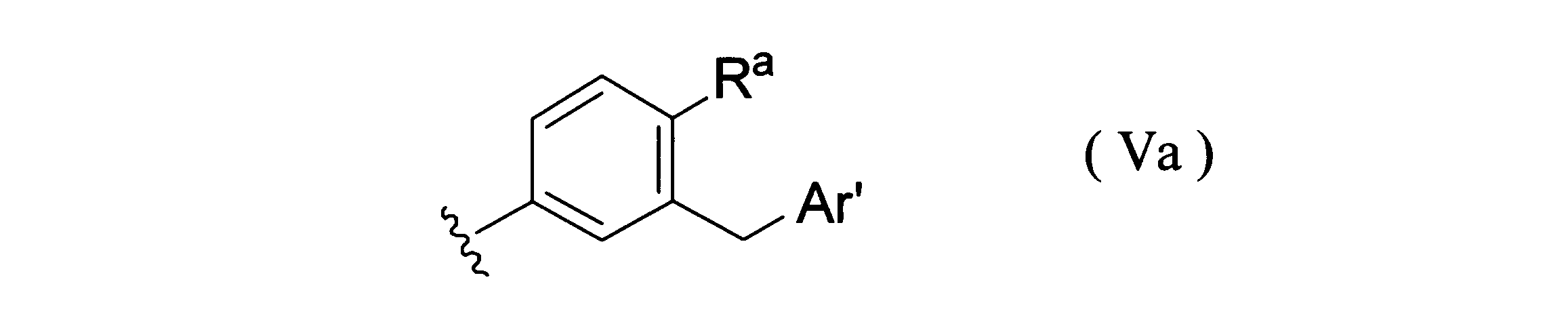
[式中、
Raは、前記と同義であり、
Ar’は、下記式(Va-I)、(Va-II)及び(Va-III):
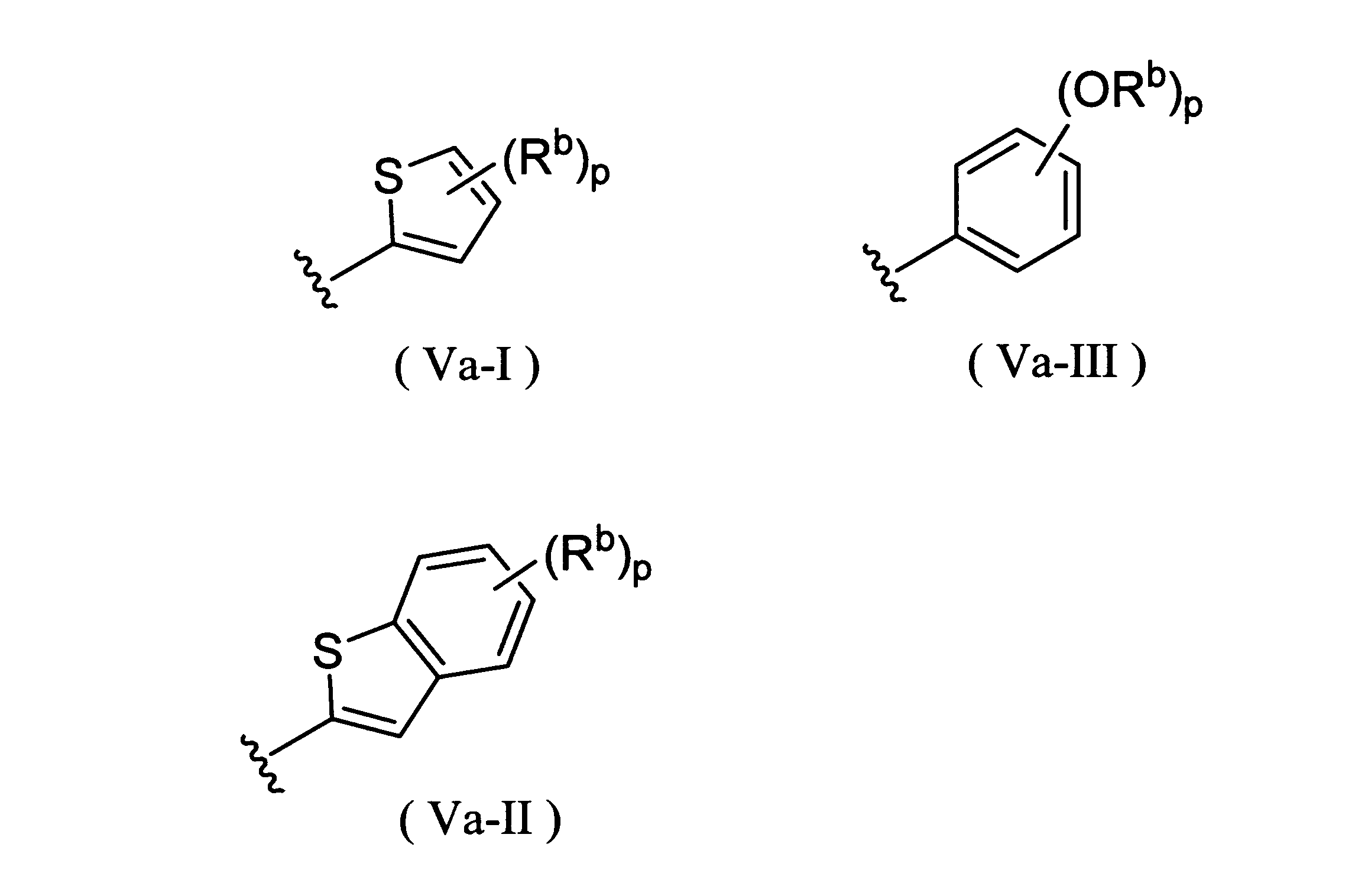
[式中、Rbは、それぞれ独立して、脂肪族炭化水素基、芳香族炭化水素環基、脂肪族複素環基及び芳香族複素環基からなる群から選択される官能基を表し、前記脂肪族炭化水素基、前記芳香族炭化水素環基、前記脂肪族複素環基及び前記芳香族複素環は各々、1個以上の置換基を有していてもよく、pは0~5の整数を表す。]
からなる群から選択される官能基を表す。]
で表される、[11]又は[12]に記載の方法。
[14]Rbで表される官能基が、それぞれ独立して、炭素数1~20のアルキル基、炭素数2~20のアルケニル基、炭素数2~20のアルキニル基、炭素数6~14の芳香族炭化水素環基、炭素数2~12の脂肪族複素環基及び炭素数3~12の芳香族複素環基からなる群から選択され、前記アルキル基、前記アルケニル基、前記アルキニル基、前記芳香族炭化水素環基、前記脂肪族複素環基及び前記芳香族複素環基が各々、1個以上の置換基を有していてもよい、[13]に記載の方法。
[15]Qで表される有機基が、アルキル基、アルケニル基、アルキニル基又はアリール基を、式中の硫黄原子と結合する官能基として含み、前記アルキル基、前記アルケニル基、前記アルキニル基及び前記アリール基が各々、1個以上の置換基を有していてもよい、[1]~[14]のいずれかに記載の方法。
[16]W1で表される有機基及びW2で表される有機基の少なくとも一方が、1個以上の置換基を有していてもよい脂肪族炭化水素基である、[1]~[15]のいずれかに記載の方法。
W1及びW2は、それぞれ独立して、脂肪族炭化水素基、芳香族炭化水素環基、脂肪族複素環基又は芳香族複素環基を、式中のカルボニル基の炭素原子と結合する官能基として含む有機基を表し、前記脂肪族炭化水素基、前記芳香族炭化水素環基、前記脂肪族複素環基及び前記芳香族複素環基は各々、1個以上の置換基を有していてもよい。]
で表される化合物(I)を製造する方法であって、
下記式(II):
W1は、前記と同義であり、
Qは、脂肪族炭化水素基、芳香族炭化水素環基、脂肪族複素環基又は芳香族複素環基を、式中の硫黄原子と結合する官能基として含む有機基を表し、前記脂肪族炭化水素基、前記芳香族炭化水素環基、前記脂肪族複素環基及び前記芳香族複素環基は各々、1個以上の置換基を有していてもよい。]
で表される化合物(II)と、
下記式(III-I):
で表される化合物(III-I)、及び、下記式(III-II):
で表される化合物(III-II)
からなる群から選択される少なくとも1種の有機亜鉛化合物とを、
銅触媒の存在下で反応させて、前記化合物(I)を得る工程
を含んでなる、方法。
[2]前記化合物(II)と前記少なくとも1種の有機亜鉛化合物との反応が、-10~80℃で行われる、[1]に記載の方法。
[3]前記銅触媒が、銅塩又はその水和物もしくは溶媒和物である、[1]又は[2]に記載の方法。
[4]前記銅触媒が、銅錯体触媒である、[1]又は[2]に記載の方法。
[5]前記銅錯体触媒が、1価又は2価の銅原子及び窒素配位子を含んでなる、[4]に記載の方法。
[6]前記少なくとも1種の有機亜鉛化合物が、前記化合物(III-I)を含み、
前記化合物(III-I)が、下記式:
で表されるシュレンク平衡状態にある、[1]~[5]のいずれかに記載の方法。
[7]前記脂肪族炭化水素基が、炭素数1~6の脂肪族炭化水素基であり、
前記芳香族炭化水素環基が、炭素数6~18の芳香族炭化水素環基であり、
前記脂肪族複素環基が、3~8員の脂肪族複素環基であり、
前記芳香族複素環基が、6~14員の芳香族複素環基である、[1]~[6]のいずれかに記載の方法。
[8]前記脂肪族炭化水素基が有していてもよい前記1個以上の置換基が、それぞれ独立して、ハロゲン原子、ニトロ基、シアノ基、オキソ基、保護されていてもよい水酸基、保護されていてもよいチオール基、保護されていてもよいアミノ基、保護されていてもよいホルミル基、保護されていてもよいカルボキシル基、保護されていてもよいカルバモイル基、保護されていてもよいスルホニル基、アリール基、脂肪族複素環基、ヘテロアリール基、アルキルアリール基、アルキル脂肪族複素環基、アルキルヘテロアリール基、アリールアルキル基、脂肪族複素環アルキル基、ヘテロアリールアルキル基、アルキルオキシ基、アリールオキシ基、脂肪族複素環オキシ基、ヘテロアリールオキシ基、アルキルアリールオキシ基、アルキル脂肪族複素環オキシ基、アルキルヘテロアリールオキシ基、アリールアルキルオキシ基、脂肪族複素環アルキルオキシ基、ヘテロアリールアルキルオキシ基、アルキルチオ基、アリールチオ基、脂肪族複素環チオ基、ヘテロアリールチオ基、アルキルアリールチオ基、アルキル脂肪族複素環チオ基、アルキルヘテロアリールチオ基、アリールアルキルチオ基、脂肪族複素環アルキルチオ基、ヘテロアリールアルキルチオ基、アルキルカルボニル基、アリールカルボニル基、脂肪族複素環カルボニル基、ヘテロアリールカルボニル基、アルキルアリールカルボニル基、アルキル脂肪族複素環カルボニル基、アルキルヘテロアリールカルボニル基、アリールアルキルカルボニル基、脂肪族複素環アルキルカルボニル基、ヘテロアリールアルキルカルボニル基、アルキルオキシカルボニル基、アリールオキシカルボニル基、脂肪族複素環オキシカルボニル基、ヘテロアリールオキシカルボニル基、アルキルアリールオキシカルボニル基、アルキル脂肪族複素環オキシカルボニル基、アルキルヘテロアリールオキシカルボニル基、アリールアルキルオキシカルボニル基、脂肪族複素環アルキルオキシカルボニル基及びヘテロアリールアルキルオキシカルボニル基から選択される、[1]~[7]のいずれかに記載の方法。
[9]前記芳香族炭化水素環基、前記脂肪族複素環基及び前記芳香族複素環基が有していてもよい前記1個以上の置換基が、それぞれ独立して、ハロゲン原子、ニトロ基、シアノ基、オキソ基、保護されていてもよい水酸基、保護されていてもよいチオール基、保護されていてもよいアミノ基、保護されていてもよいホルミル基、保護されていてもよいカルボキシル基、保護されていてもよいカルバモイル基、保護されていてもよいスルホニル基、アルキル基、アリール基、脂肪族複素環基、ヘテロアリール基、アルキルアリール基、アルキル脂肪族複素環基、アルキルヘテロアリール基、アリールアルキル基、脂肪族複素環アルキル基、ヘテロアリールアルキル基、アルキルオキシ基、アリールオキシ基、脂肪族複素環オキシ基、ヘテロアリールオキシ基、アルキルアリールオキシ基、アルキル脂肪族複素環オキシ基、アルキルヘテロアリールオキシ基、アリールアルキルオキシ基、脂肪族複素環アルキルオキシ基、ヘテロアリールアルキルオキシ基、アルキルチオ基、アリールチオ基、脂肪族複素環チオ基、ヘテロアリールチオ基、アルキルアリールチオ基、アルキル脂肪族複素環チオ基、アルキルヘテロアリールチオ基、アリールアルキルチオ基、脂肪族複素環アルキルチオ基、ヘテロアリールアルキルチオ基、アルキルカルボニル基、アリールカルボニル基、脂肪族複素環カルボニル基、ヘテロアリールカルボニル基、アルキルアリールカルボニル基、アルキル脂肪族複素環カルボニル基、アルキルヘテロアリールカルボニル基、アリールアルキルカルボニル基、脂肪族複素環アルキルカルボニル基、ヘテロアリールアルキルカルボニル基、アルキルオキシカルボニル基、アリールオキシカルボニル基、脂肪族複素環オキシカルボニル基、ヘテロアリールオキシカルボニル基、アルキルアリールオキシカルボニル基、アルキル脂肪族複素環オキシカルボニル基、アルキルヘテロアリールオキシカルボニル基、アリールアルキルオキシカルボニル基、脂肪族複素環アルキルオキシカルボニル基及びヘテロアリールアルキルオキシカルボニル基から選択される、[1]~[8]のいずれかに記載の方法。
[10]W1で表される有機基及びW2で表される有機基の少なくとも一方が、芳香族炭化水素環基又は芳香族複素環基を、前記式(I)中のカルボニル基の炭素原子と結合する官能基として含み、前記芳香族炭化水素環基及び前記芳香族複素環基が各々、1個以上の置換基を有していてもよい、[1]~[9]のいずれかに記載の方法。
[11]W1で表される有機基及びW2で表される有機基の少なくとも一方が、下記式(V):
Raは、それぞれ独立して、ハロゲン原子、アルキル基、アルケニル基、アルキニル基、アリール基、アリールアルキル基、アリールアルケニル基、アリールアルキニル基、アルキルオキシ基、アルケニルオキシ基、アルキニルオキシ基、アリールオキシ基、アリールアルキルオキシ基、アリールアルケニルオキシ基及びアリールアルキニルオキシ基からなる群から選択される官能基を表し、前記アルキル基、前記アルケニル基、前記アルキニル基、前記アリール基、前記アリールアルキル基、前記アリールアルケニル基、前記アリールアルキニル基、前記アルキルオキシ基、前記アルケニルオキシ基、前記アルキニルオキシ基、前記アリールオキシ基、前記アリールアルキルオキシ基、前記アリールアルケニルオキシ基及び前記アリールアルキニルオキシ基は各々、1個以上の置換基を有していてもよく、
nは、0~4の整数であり、
Ar’は、芳香族炭化水素環基、脂肪族複素環基又は芳香族複素環基を表し、前記芳香族炭化水素環基、前記脂肪族複素環基及び前記芳香族複素環基は各々、1個以上の置換基を有していてもよい。]
で表される、[1]~[10]のいずれかに記載の方法。
[12]Raで表される官能基が、それぞれ独立して、アルキル基及びハロゲン原子から選択され、前記アルキル基が、1個以上の置換基を有していてもよい、[11]に記載の方法。
[13]W1で表される有機基及びW2で表される有機基の少なくとも一方が、下記式(Va):
Raは、前記と同義であり、
Ar’は、下記式(Va-I)、(Va-II)及び(Va-III):
からなる群から選択される官能基を表す。]
で表される、[11]又は[12]に記載の方法。
[14]Rbで表される官能基が、それぞれ独立して、炭素数1~20のアルキル基、炭素数2~20のアルケニル基、炭素数2~20のアルキニル基、炭素数6~14の芳香族炭化水素環基、炭素数2~12の脂肪族複素環基及び炭素数3~12の芳香族複素環基からなる群から選択され、前記アルキル基、前記アルケニル基、前記アルキニル基、前記芳香族炭化水素環基、前記脂肪族複素環基及び前記芳香族複素環基が各々、1個以上の置換基を有していてもよい、[13]に記載の方法。
[15]Qで表される有機基が、アルキル基、アルケニル基、アルキニル基又はアリール基を、式中の硫黄原子と結合する官能基として含み、前記アルキル基、前記アルケニル基、前記アルキニル基及び前記アリール基が各々、1個以上の置換基を有していてもよい、[1]~[14]のいずれかに記載の方法。
[16]W1で表される有機基及びW2で表される有機基の少なくとも一方が、1個以上の置換基を有していてもよい脂肪族炭化水素基である、[1]~[15]のいずれかに記載の方法。
本発明によれば、ケトン化合物の新規製造方法が提供される。本発明の製造方法は、工業的に安価で効率的にケトン化合物を製造することを可能とし、設備コスト、ランニングコスト等を大幅に抑制し得ることから、工業生産上有利である。
以下、本発明について説明する。なお、本明細書に記載される実施形態のうち、2以上の実施形態を組み合わせることができる場合、本発明には、当該組み合わせも包含される。
<定義>
以下、本明細書で用いられる用語及び表現について説明する。以下の定義は、別段規定される場合を除き、本明細書を通じて適用される。例えば、「アルキル基」の定義は、「アルキル」又は「アルキル基」を含む官能基(例えば、アルキルアリール基、アリールアルキル基等)に関しても適用される。その他の官能基の定義も同様である。
以下、本明細書で用いられる用語及び表現について説明する。以下の定義は、別段規定される場合を除き、本明細書を通じて適用される。例えば、「アルキル基」の定義は、「アルキル」又は「アルキル基」を含む官能基(例えば、アルキルアリール基、アリールアルキル基等)に関しても適用される。その他の官能基の定義も同様である。
「有機基」は、1個以上の炭素原子を含む官能基を意味する。有機基は、1種又は2種以上のヘテロ原子を含むことができる。「ヘテロ原子」は、水素原子及び炭素原子以外の原子を意味する。ヘテロ原子としては、例えば、窒素原子、酸素原子、硫黄原子、ハロゲン原子、珪素原子等が挙げられる。「ハロゲン原子」は、フッ素原子、塩素原子、臭素原子又はヨウ素原子を意味する。有機基の結合手は、有機基に含まれる炭素原子の結合手で形成されていることが好ましい。
一実施形態において、有機基は、1個以上の置換基を有していてもよい脂肪族炭化水素基であるか、又は、1個以上の置換基を有していてもよい脂肪族炭化水素基を含む。この実施形態において、有機基の結合手は、脂肪族炭化水素基の結合手で形成されていることが好ましい。
別の実施形態において、有機基は、1個以上の置換基を有していてもよい芳香族炭化水素環基であるか、又は、1個以上の置換基を有していてもよい芳香族炭化水素環基を含む。この実施形態において、有機基の結合手は、芳香族炭化水素環基の結合手で形成されていることが好ましい。
別の実施形態において、有機基は、1個以上の置換基を有していてもよい脂肪族複素環基であるか、又は、1個以上の置換基を有していてもよい脂肪族複素環基を含む。この実施形態において、有機基の結合手は、脂肪族複素環基の結合手で形成されていることが好ましい。
別の実施形態において、有機基は、1個以上の置換基を有していてもよい芳香族複素環基であるか、又は、1個以上の置換基を有していてもよい芳香族複素環基を含む。この実施形態において、有機基の結合手は、芳香族複素環基の結合手で形成されていることが好ましい。
別の実施形態において、有機基は、1個以上の置換基を有していてもよい脂肪族炭化水素基、1個以上の置換基を有していてもよい芳香族炭化水素環基、1個以上の置換基を有していてもよい脂肪族複素環基及び1個以上の置換基を有していてもよい芳香族複素環基から選択される2種以上を組み合わせて形成される官能基を含む。この実施形態において、有機基の結合手は、脂肪族炭化水素基、芳香族炭化水素環基、脂肪族複素環基又は芳香族複素環基の結合手で形成されていることが好ましい。
「脂肪族炭化水素基」は、脂肪族炭化水素から水素原子を除去することにより生成される官能基(芳香族性を有しない炭化水素基)を意味する。「脂肪族炭化水素基」は、文脈に応じて、1価又は2価の官能基を意味し得る。以下、1価の脂肪族炭化水素基を「-脂肪族炭化水素基」、2価の脂肪族炭化水素基を「-脂肪族炭化水素基-」と表す場合がある。脂肪族炭化水素基は、鎖状、環状及びこれらの組み合わせのいずれであってもよい。鎖状は、直鎖状であってもよいし、分岐鎖状であってもよい。脂肪族炭化水素基は、好ましくは、直鎖状又は分岐鎖状である。脂肪族炭化水素基は、飽和であってもよいし、不飽和であってもよい。不飽和結合は、炭素-炭素二重結合であってもよいし、炭素-炭素三重結合であってもよい。
1価の脂肪族炭化水素基としては、例えば、アルキル基、アルケニル基、アルキニル基等が挙げられる。1価の脂肪族炭化水素基は、好ましくは、アルキル基又はアルケニル基であり、さらに好ましくは、アルキル基である。2価の脂肪族炭化水素基としては、例えば、アルキレン基、アルケニレン基、アルキニレン基等が挙げられる。2価の脂肪族炭化水素基は、好ましくは、アルキレン基又はアルケニレン基であり、さらに好ましくはアルキレン基である。
「アルキル基」は、アルカンから1個の水素原子を除去することにより生成される1価の官能基を意味する。アルキル基は、鎖状、環状及びこれらの組み合わせのいずれであってもよい。なお、環状のアルキル基は「シクロアルキル基」と同義である。鎖状は、直鎖状であってもよいし、分岐鎖状であってもよい。アルキル基は、好ましくは、直鎖状又は分岐鎖状である。直鎖状のアルキル基の炭素数は、通常1~20個、好ましくは1~10個、より好ましくは1~8個、より一層好ましくは1~6個、より一層好ましくは1~4個、より一層好ましくは1~3個である。分岐鎖状のアルキル基の炭素数は、通常3~20個、好ましくは3~10個、より好ましくは3~8個、より一層好ましくは3~6個、より一層好ましくは3~4個である。環状のアルキル基の炭素数は、通常3~20個、好ましくは3~10個、より好ましくは3~8個、より一層好ましくは3~6個である。直鎖状又は分岐鎖状部分と環状部分とを有するアルキル基の炭素数は、通常4~20個、好ましくは4~10個、より好ましくは4~8個、より一層好ましくは4~6個である。
アルキル基としては、例えば、メチル基、エチル基、プロピル基、イソプロピル基、n-ブチル基、イソブチル基、sec-ブチル基、tert-ブチル基、ペンチル基、ヘキシル基、イソヘキシル基、ヘプチル基、4,4-ジメチルペンチル基、オクチル基、2,2,4-トリメチルペンチル基、ノニル基、デシル基等の直鎖状又は分岐鎖状のアルキル基;シクロプロピル基、シクロブチル基、シクロペンチル基、シクロヘキシル基、シクロヘプチル基、シクロオクチル基等の環状のアルキル基;シクロペンチルメチル基、シクロペンチルエチル基、シクロペンチルプロピル基、シクロヘキシルメチル基、シクロヘキシルエチル基等の直鎖状又は分岐鎖状部分と環状部分とを有するアルキル基等が挙げられる。
「アルケニル基」は、アルケンから1個の水素原子を除去することにより生成される1価の官能基を意味する。アルケニル基は、少なくとも1個の炭素-炭素二重結合を有する。アルケニル基は、鎖状、環状及びこれらの組み合わせのいずれであってもよい。なお、環状のアルケニル基は「シクロアルケニル基」と同義である。鎖状は、直鎖状であってもよいし、分岐鎖状であってもよい。アルケニル基は、好ましくは、直鎖状又は分岐鎖状である。直鎖状のアルケニル基の炭素数は、通常2~20個、好ましくは2~10個、より好ましくは2~8個、より一層好ましくは2~6個、より一層好ましくは2~4個である。分岐鎖状のアルケニル基の炭素数は、通常3~20個、好ましくは3~10個、より好ましくは3~8個、より一層好ましくは3~6個、より一層好ましくは3~4個である。環状のアルケニル基の炭素数は、通常3~20個、好ましくは3~10個、より好ましくは3~8個、より一層好ましくは3~6個である。直鎖状又は分岐鎖状部分と環状部分とを有するアルケニル基の炭素数は、通常4~20個、好ましくは4~10個、より好ましくは4~8個、より一層好ましくは4~6個である。アルケニル基における二重結合の数は、通常1~9個、好ましくは1~7個、より好ましくは1~4個、より一層好ましくは1~3個である。
アルケニル基としては、例えば、ビニル基、2-プロペニル基、3-ブテニル基、2-ブテニル基、4-ペンテニル基、3-ペンテニル基、2-ヘキセニル基、3-ヘキセニル基、2-ヘプテニル基、3-ヘプテニル基、4-ヘプテニル基、3-オクテニル基、3-ノネニル基、4-デセニル基等の直鎖状又は分岐鎖状のアルケニル基;シクロプロペニル基、シクロブテニル基、シクロペンテニル基、シクロヘキセニル基、シクロヘプテニル基、シクロオクテニル基等の環状のアルケニル基;シクロペンテニルメチル基、シクロペンテニルエチル基、シクロペンテニルプロピル基、シクロヘキセニルメチル基、シクロヘキセニルエチル基等の直鎖状又は分岐鎖状部分と環状部分とを有するアルケニル基等が挙げられる。
「アルキニル基」は、アルキンから1個の水素原子を除去することにより生成される1価の官能基を意味する。アルキニル基は、少なくとも1個の炭素-炭素三重結合を有する。アルキニル基は、鎖状、環状及びこれらの組み合わせのいずれであってもよい。なお、環状のアルキニル基は「シクロアルキニル基」と同義である。鎖状は、直鎖状であってもよいし、分岐鎖状であってもよい。アルキニル基は、好ましくは、直鎖状又は分岐鎖状である。直鎖状のアルキニル基の炭素数は、通常2~20個、好ましくは2~10個、より好ましくは2~8個、より一層好ましくは2~6個、より一層好ましくは2~4個である。分岐鎖状のアルキニル基の炭素数は、通常4~20個、好ましくは4~10個、より好ましくは4~8個、より一層好ましくは4~6個である。環状のアルキニル基の炭素数は、通常4~20個、好ましくは4~10個、より好ましくは4~8個、より一層好ましくは4~6個である。直鎖状又は分岐鎖状部分と環状部分とを有するアルキニル基の炭素数は、通常5~20個、好ましくは5~10個、より好ましくは5~8個、より一層好ましくは5~6個である。アルキニル基における三重結合の数は、通常1~9個、好ましくは1~7個、より好ましくは1~4個、より一層好ましくは1~3個である。
アルキニル基としては、例えば、2-プロピニル基、3-ブチニル基、2-ブチニル基、4-ペンチニル基、3-ペンチニル基、2-ヘキシニル基、3-ヘキシニル基、2-ヘプチニル基、3-ヘプチニル基、4-ヘプチニル基、3-オクチニル基、3-ノニニル基、4-デシニル基等の直鎖状又は分岐鎖状のアルキニル基;シクロブチニル基、シクロペンチニル基、シクロヘプチニル基、シクロオクチニル基等の環状のアルキニル基;シクロペンチニルメチル基、シクロペンテニルエチル基、シクロペンチニルプロピル基、シクロペンチニルメチル基、シクロペンチニルエチル基等の直鎖状又は分岐鎖状部分と環状部分とを有するアルキニル基等が挙げられる。
「アルキレン基」は、アルキル基から1個の水素原子を除去することにより生成される2価の官能基を意味する。アルキル基に関する説明は、上記と同様である。
「アルケニレン基」は、アルケニル基から1個の水素原子を除去することにより生成される2価の官能基を意味する。アルケニル基に関する説明は、上記と同様である。
「アルキニレン基」は、アルキニル基から1個の水素原子を除去することにより生成される2価の官能基を意味する。アルキニル基に関する説明は、上記と同様である。
「芳香族炭化水素環基」は、芳香族炭化水素環から水素原子を除去することにより生成される官能基を意味する。「芳香族炭化水素環基」は、文脈に応じて、1価又は2価の官能基を意味し得る。以下、1価の芳香族炭化水素環基を「-芳香族炭化水素環基」、2価の芳香族炭化水素環基を「-芳香族炭化水素環基-」と表す場合がある。1価の芳香族炭化水素環基は「アリール基」と同義であり、2価の芳香族炭化水素環基は「アリーレン基」と同義である。
芳香族炭化水素環基としては、例えば、単環式又は多環式(例えば、2環式又は3環式)の芳香族炭素水素環基が挙げられる。芳香族炭化水素環基は、通常1~4環式、好ましくは1~3環式、より好ましくは1又は2環式である。芳香族炭化水素環基における環構成炭素原子の数は、通常6~18個、好ましくは6~14個、より好ましくは6~10個である。
単環式の芳香族炭素水素環基としては、例えば、フェニル基が挙げられる。
芳香族炭素水素環基には、縮合多環式の芳香族炭化水素環基及び部分的に飽和された縮合多環式の芳香族炭化水素環基も包含される。部分的に飽和された縮合多環式の芳香族炭化水素環基は、環を構成する結合の一部が水素化された縮合多環式の芳香族炭化水素環基である。縮合多環式の芳香族炭化水素環基としては、例えば、ナフチル基、アントリル基、フェナントレニル基、テトラセニル基、ピレニル基等の2~4環式の芳香族炭素水素環基に加えて、フルオレニル基、インデニル基、アセナフチレニル等が挙げられる。部分的に飽和された縮合多環式の芳香族炭化水素環基としては、例えば、ジヒドロナフチル基、インダニル基、アセナフテニル基等が挙げられる。
2価の芳香族炭化水素環基は、1価の芳香族炭化水素環基から1個の水素原子を除去することにより生成される2価の官能基である。1価の芳香族炭化水素環基に関する説明は、上記と同様である。2価の芳香族炭化水素環基としては、例えば、1,3-フェニレン基、1,4-フェニレン基等が挙げられる。
「脂肪族複素環基」は、環構成原子として、炭素原子に加えて、酸素原子、硫黄原子及び窒素原子からなる群から独立して選択される1個以上のヘテロ原子を含む単環式又は多環式(例えば、2環式又は3環式)の脂肪族複素環(非芳香族複素環)から水素原子を除去することにより生成される官能基を意味する。「脂肪族複素環基」は、文脈に応じて、1価又は2価の官能基を意味し得る。以下、1価の脂肪族複素環基を「-脂肪族複素環基」、2価の脂肪族複素環基を「-脂肪族複素環-」と表す場合がある。なお、「脂肪族複素環」を含む官能基(例えば、脂肪族複素環チオ基、脂肪族複素環オキシ基等)における「脂肪族複素環」は、脂肪族複素環基を意味する。
脂肪族複素環基に含まれるヘテロ原子の数は、通常1~4個、好ましくは1~3個、より好ましくは1又は2個である。脂肪族複素環基の員数は、通常3~16員、好ましくは4~10員、より好ましくは5~8員、より一層好ましくは5~7員、より一層好ましくは5又は6員である。脂肪族複素環基は、例えば、単環式、2環式又は3環式であり、好ましくは単環式又は2環式である。脂肪族複素環基における環構成炭素原子の数は、脂肪族複素環基のヘテロ原子数及び員数に応じて適宜選択される。脂肪族複素環基における環構成炭素原子の数は、通常2~12個、好ましくは2~8個、より好ましくは2~5個である。
単環式の脂肪族複素環基は、例えば、単環式の飽和脂肪族複素環基である。単環式の飽和脂肪族複素環基は、飽和結合のみによって環が構成された単環式の脂肪族複素環基である。一実施形態において、単環式の飽和脂肪族複素環基は、1~2個の酸素原子を含む。別の実施形態において、単環式の飽和脂肪族複素環基は、1~2個の硫黄原子を含む。別の実施形態において、単環式の飽和脂肪族複素環基は、1~2個の酸素原子及び1~2個の硫黄原子を含む。別の実施形態において、単環式の飽和脂肪族複素環基は、1~4個の窒素原子を含む。別の実施形態において、単環式の飽和脂肪族複素環基は、1~3個の窒素原子と、1~2個の硫黄原子及び/又は1~2個の酸素原子とを含む。単環式の飽和脂肪族複素環基において、環を構成する2個の炭素原子がアルキレン基で架橋されていてもよい。単環式の飽和脂肪族複素環基において、環を構成する炭素原子のうち隣接する2個の炭素原子が二重結合を形成していてもよい。単環式の飽和脂肪族複素環基において、同一炭素原子に結合する2個の水素原子が、オキソ基で置換されていてもよい。単環式の飽和脂肪族複素環基が有し得るオキソ基の数は、好ましくは1又は2個である。単環式の飽和脂肪族複素環基に含まれるヘテロ原子が硫黄原子である場合、単環式の飽和脂肪族複素環基は、ジオキシド体であってもよい。
単環式の脂肪族複素環基としては、例えば、アジリジニル基、オキシラニル基、チイラニル基、アゼチジニル基、オキセタニル基、チエタニル基、テトラヒドロチエニル基、テトラヒドロフラニル基、ピロリニル基、ピロリジニル基、イミダゾリニル基、イミダゾリジニル基、オキサゾリニル基、オキサゾリジニル基、ピラゾリニル基、ピラゾリジニル基、チアゾリニル基、チアゾリジニル基、テトラヒドロイソチアゾリル基、テトラヒドロオキサゾリル基、テトラヒドロイソオキサゾリル基、ピペリジニル基、ピペラジニル基、テトラヒドロピリジニル基、ジヒドロピリジニル基、ジヒドロチオピラニル基、テトラヒドロピリミジニル基、テトラヒドロピリダジニル基、ジヒドロピラニル基、テトラヒドロピラニル基、テトラヒドロチオピラニル基、モルホリニル基、チオモルホリニル基(環上の硫黄原子は酸化されてもよい)、アゼパニル基、ジアゼパニル基、アゼピニル基、オキセパニル基、アゾカニル基、ジアゾカニル基等の3~8員の単環式の脂肪族複素環基が挙げられる。
単環式の脂肪族複素環基には、部分的に飽和された単環式の芳香族複素環基も包含される。部分的に飽和された単環式の芳香族複素環基は、環を構成する結合の一部が水素化された単環式の芳香族複素環基である。部分的に飽和された単環式の芳香族複素環基としては、例えば、4,5-ジヒドロ-1H-イミダゾリル基、1,2,3,6-テトラヒドロピリジル基、4H-1,3-オキサジニル基、5,6-ジヒドロ-4H-1,3-オキサジニル基等が挙げられる。部分的に飽和された単環式の芳香族複素環基において、同一炭素原子に結合する2個の水素原子が、オキソ基で置換されていてもよい。部分的に飽和された単環式の芳香族複素環基が有し得るオキソ基の数は、好ましくは1又は2個である。
多環式の脂肪族複素環基は、例えば、縮合多環式の脂肪族複素環基である。縮合多環式の脂肪族複素環基は、例えば、縮合多環式の飽和脂肪族複素環である。縮合多環式の飽和脂肪族複素環は、飽和結合のみによって環が構成された縮合多環式の脂肪族複素環基である。一実施形態において、縮合多環式の飽和脂肪族複素環基は、1~3個の酸素原子を含む。別の実施形態において、縮合多環式の飽和脂肪族複素環基は、1~3個の硫黄原子を含む。別の実施形態において、縮合多環式の飽和脂肪族複素環基は、1~3個の酸素原子及び1~3個の硫黄原子を含む。別の実施形態において、縮合多環式の飽和脂肪族複素環基は、1~5個の窒素原子を含む。別の実施形態において、縮合多環式の飽和脂肪族複素環基は、1~4個の窒素原子と、1~3個の硫黄原子及び/又は1~3個の酸素原子とを含む。縮合多環式の飽和脂肪族複素環基において、環を構成する2個の炭素原子がアルキレン基で架橋されていてもよい。縮合多環式の飽和脂肪族複素環基において、環を構成する炭素原子のうち隣接する2個の炭素原子が二重結合を形成していてもよい。縮合多環式の飽和脂肪族複素環基において、同一炭素原子に結合する2個の水素原子が、オキソ基で置換されていてもよい。縮合多環式の飽和脂肪族複素環基が有し得るオキソ基の数は、好ましくは1、2又は3個である。縮合多環式の飽和脂肪族複素環基に含まれるヘテロ原子が硫黄原子である場合、縮合多環式の飽和脂肪族複素環基は、ジオキシド体であってもよい。
縮合多環式の脂肪族複素環基としては、例えば、オクタヒドロ-1H-イソインドリル基、デカヒドロキノリル基、デカヒドロイソキノリル基、ヘキサヒドロ-2H-[1,4]ジオキシノ[2,3-c]ピロリル基、3-アザビシクロ[3.1.0]ヘキサ-3-イル基等が挙げられる。
脂肪族複素環基には、スピロ環式複素環基も包含される。スピロ環式複素環基は、2個の環が1個のスピロ炭素原子を共有して形成された複素環基である。2個の環の組み合わせとしては、例えば、単環式の脂肪族複素環基と単環式の脂肪族炭化水素環基(例えば、シクロアルキル基、シクロアルケニル基等)との組み合わせ、単環式の脂肪族複素環基と単環式の脂肪族複素環基との組み合わせ等が挙げられる。スピロ環式複素環基において、環を構成する炭素原子のうち隣接する2個の炭素原子が二重結合を形成していてもよい。スピロ環式複素環基において、同一炭素原子に結合する2個の水素原子が、オキソ基で置換されていてもよい。スピロ環式複素環基が有し得るオキソ基の数は、好ましくは1、2又は3個である。スピロ環式複素環基に含まれるヘテロ原子が硫黄原子である場合、スピロ環式複素環基は、ジオキシド体であってもよい。
スピロ環式複素環基としては、例えば、2-オキサ-6-アザスピロ[3.3]ヘプタニル基、1-オキサ-6-アザスピロ[3.3]ヘプタニル基、6-オキサ-1-アザスピロ[3.3]ヘプタニル基、1-オキソ-2,8-ジアザスピロ[4.5]デカニル基、1,4-ジオキサ-8-アザスピロ[4.5]デカニル基、2-アザスピロ[3.3]ヘプチル基、7-オキサ-2-アザスピロ[3.5]ノニル基、5,8-オキサ-2-アザスピロ[3.4]オクチル基、1,4-ジオキサ-8-アザスピロ[4.5]デカニル基、1-オキサスピロ[4.5]デカニル基等が挙げられる。
「芳香族複素環基」は、環構成原子として、炭素原子に加えて、酸素原子、硫黄原子及び窒素原子からなる群から独立して選択される1個以上のヘテロ原子を含む単環式又は多環式の芳香族複素環から水素原子を除去することにより生成される官能基を意味する。「芳香族複素環基」は、文脈に応じて、1価又は2価の官能基を意味し得る。以下、1価の芳香族複素環基を「-芳香族複素環基」、2価の芳香族複素環基を「-芳香族複素環基-」と表す場合がある。1価の芳香族複素環基は「ヘテロアリール基」と同義であり、2価の芳香族複素環基は「ヘテロアリーレン基」と同義である。
芳香族複素環基としては、例えば、単環式又は多環式の芳香族複素環基が挙げられる。芳香族複素環基は、通常1~4環式、好ましくは1~3環式、より好ましくは1又は2環式である。芳香族複素環基に含まれるヘテロ原子の数は、通常1~4個、好ましくは1~3個、より一層好ましくは1又は2個である。芳香族複素環基の員数は、好ましくは5~14員、より好ましくは5~10員である。芳香族複素環基における環構成炭素原子の数は、ヘテロ原子数及び員数に応じて適宜決定される。芳香族複素環基における環構成炭素原子の数は、通常3~12個、好ましくは3~8個、より一層好ましくは3~5個である。芳香族複素環基において、同一炭素原子に結合する2個の水素原子が、オキソ基で置換されていてもよい。一実施形態において、芳香族複素環基は、5~7員の単環式の芳香族複素環基である。別の実施形態において、芳香族複素環基は、8~14員の2環式又は3環式の芳香族複素環基である。
芳香族複素環基は、例えば、単環式の芳香族複素環基である。一実施形態において、単環式の芳香族複素環基は、1~2個の酸素原子を含む。別の実施形態において、単環式の芳香族複素環基は、1~2個の硫黄原子を含む。別の実施形態において、単環式の芳香族複素環基は、1~2個の酸素原子及び1~2個の硫黄原子を含む。別の実施形態において、単環式の芳香族複素環基は、1~4個の窒素原子を含む。別の実施形態において、単環式の芳香族複素環基は、1~3個の窒素原子と、1~2個の硫黄原子及び/又は1~2個の酸素原子とを含む。
単環式の芳香族複素環基としては、例えば、ピリジル基、ピリダジニル基、ピリミジニル基、ピラジニル基、チエニル基、ピロリル基、チアゾリル基、イソチアゾリル基、ピラゾリル基、イミダゾリル基、フリル基、オキサゾリル基、イソオキサゾリル基、オキサジアゾリル基(例えば、1,2,4-オキサジアゾリル基、1,3,4-オキサジアゾリル基等)、チアジアゾリル基(例えば、1,2,4-チアジアゾリル基、1,3,4-チアジアゾリル基等)、トリアゾリル基(例えば、1,2,3-トリアゾリル基、1,2,4-トリアゾリル基等)、テトラゾリル基、トリアジニル基等の5~7員の単環式の芳香族複素環基が挙げられる。単環式の芳香族複素環基において、同一炭素原子に結合する2個の水素原子が、オキソ基で置換されていてもよい。単環式の芳香族複素環基が有し得るオキソ基の数は、好ましくは1又は2個である。
芳香族複素環基は、例えば、多環式の芳香族複素環基である。多環式の芳香族複素環基は、例えば、縮合多環式の芳香族複素環基である。一実施形態において、縮合多環式の芳香族複素環基は、1~3個の酸素原子を含む。別の実施形態において、縮合多環式の芳香族複素環基は、1~3個の硫黄原子を含む。別の実施形態において、縮合多環式の芳香族複素環基は、1~3個の酸素原子及び1~3個の硫黄原子を含む。別の実施形態において、縮合多環式の芳香族複素環基は、1~5個の窒素原子を含む。別の実施形態において、縮合多環式の芳香族複素環基は、1~4個の窒素原子と、1~3個の硫黄原子及び/又は1~3個の酸素原子とを含む。
縮合多環式の芳香族複素環基としては、例えば、ベンゾチオフェニル基、ベンゾフラニル基、ベンゾイミダゾリル基、ベンゾオキサゾリル基、ベンゾイソオキサゾリル基、ベンゾチアゾリル基、ベンゾイソチアゾリル基、ベンゾトリアゾリル基、イミダゾピリジニル基、チエノピリジニル基、フロピリジニル基、ピロロピリジニル基、ピラゾロピリジニル基、オキサゾロピリジニル基、チアゾロピリジニル基、イミダゾピラジニル基、イミダゾピリミジニル基、チエノピリミジニル基、フロピリミジニル基、ピロロピリミジニル基、ピラゾロピリミジニル基、オキサゾロピリミジニル基、チアゾロピリミジニル基、ピラゾロトリアジニル基、ナフト[2,3-b]チエニル基、フェノキサチイニル基、インドリル基、イソインドリル基、1H-インダゾリル基、プリニル基、イソキノリル基、キノリル基、フタラジニル基、ナフチリジニル基、キノキサリニル基、キナゾリニル基、シンノリニル基、カルバゾリル基、β-カルボリニル基、フェナントリジニル基、アクリジニル基、フェナジニル基、フェノチアジニル基、フェノキサジニル基等の8~14員の縮合多環式(好ましくは2環式又は3環式)の芳香族複素環基等が挙げられる。多環式の芳香族複素環基において、同一炭素原子に結合する2個の水素原子が、オキソ基で置換されていてもよい。多環式の芳香族複素環基が有し得るオキソ基の数は、好ましくは1、2又は3個である。
芳香族複素環基には、部分的に飽和された単環(例えば、単環式の芳香族炭化水素環基、単環式の芳香族複素環基等)を有する縮合多環式の芳香族複素環基(例えば、芳香族環に脂肪族複素環が縮合した環式基等)も包含される。部分的に飽和された単環を有する縮合多環式の芳香族複素環基は、環を構成する結合の一部が水素化された単環を有する縮合多環式の芳香族複素環基である。部分的に飽和された単環を有する縮合多環式の芳香族複素環基としては、例えば、ジヒドロベンゾフラニル基、ジヒドロベンゾイミダゾリル基、ジヒドロベンゾオキサゾリル基、ジヒドロベンゾチアゾリル基、ジヒドロベンゾイソチアゾリル基、ジヒドロナフト[2,3-b]チエニル基、テトラヒドロイソキノリル基、テトラヒドロキノリル基、4H-キノリジニル基、インドリニル基、イソインドリニル基、テトラヒドロチエノ[2,3-c]ピリジニル基、テトラヒドロベンゾアゼピニル基、テトラヒドロキノキサリニル基、テトラヒドロフェナントリジニル基、ヘキサヒドロフェノチアジニル基、ヘキサヒドロフェノキサジニル基、テトラヒドロフタラジニル基、テトラヒドロナフチリジニル基、テトラヒドロキナゾリニル基、テトラヒドロシンノリニル基、テトラヒドロカルバゾリル基、テトラヒドロ-β-カルボリニル基、テトラヒドロアクリジニル基、テトラヒドロフェナジニル基、テトラヒドロチオキサンテニル基、オクタヒドロイソキノリル基等の9~14員の縮合多環式(好ましくは2環式又は3環式)の芳香族複素環基等が挙げられる。部分的に飽和された単環を有する縮合多環式の芳香族複素環基において、同一炭素原子に結合する2個の水素原子が、オキソ基で置換されていてもよい。部分的に飽和された単環を有する縮合多環式の芳香族複素環基が有し得るオキソ基の数は、好ましくは1、2又は3個である。
芳香族複素環基には、部分的に飽和された縮合多環式の芳香族複素環基も包含される。部分的に飽和された縮合多環式の芳香族複素環基は、環を構成する結合の一部が水素化された単環を有する縮合多環式の芳香族複素環基である。部分的に飽和された縮合多環式の芳香族複素環基としては、例えば、1,3-ジヒドロベンゾイミダゾール-2-オニル基、2-ベンゾオキサゾリノニル基、オクタヒドロイソインドリル基、2H-ピリド[3,2-b]-1,4-オキサジン-3(4H)-オン-イル基、3-オキソ-3,4-ジヒドロ-2H-ピリド[3,2-b][1,4]オキサジン-6-イル基、[1,3]ジオキソロ[4,5-b]ピリジル基、2,3-ジヒドロベンゾ[b]チエニル基、2,3-ジヒドロ-1-ベンゾフラン-5-イル基、2,3-ジヒドロ-1-ベンゾフラン-6-イル基、1,3-ジヒドロ-2-ベンゾフラン-5-イル基、2,3-ジヒドロ-1H-インドール-5-イル基、1,3-ベンゾジオキソール-5-イル基、2,3-ジヒドロ-1,4-ベンゾジオキシン-2-イル基、2,3-ジヒドロ-1,4-ベンゾジオキシン-6-イル基、3-オキソ-3,4-ジヒドロ-2H-1,4-ベンゾオキサジン-6-イル基、1,4-ベンゾジオキサニル基、2H-ベンゾ[b][1,4]オキサジン-3(4H)-オン-イル基、3,4-ジヒドロ-2H-ベンゾ[b][1,4]ジオキセピニル基、インドリニル基、2H-イソインドリニル基、クロマニル基、クロモニル基、イソクロマニル基、1,2,3,4-テトラヒドロイソキノリル基等が挙げられる。
2価の芳香族複素環基は、1価の芳香族複素環基から1個の水素原子を除去することにより生成される2価の官能基を意味する。1価の芳香族複素環基に関する説明は、上記と同様である。
脂肪族炭化水素基、芳香族炭化水素環基、脂肪族複素環基及び芳香族複素環基から選択される2種以上を組み合わせて形成される官能基としては、例えば、脂肪族炭化水素基及び芳香族炭化水素環基を組み合わせて形成される官能基、脂肪族炭化水素基及び脂肪族複素環基を組み合わせて形成される官能基、脂肪族炭化水素基及び芳香族複素環基を組み合わせて形成される官能基等が挙げられる。
脂肪族炭化水素基及び芳香族炭化水素環基を組み合わせて形成される官能基は、式:(*)-脂肪族炭化水素基-芳香族炭化水素環基、又は、式:(*)-芳香族炭化水素環基-脂肪族炭化水素基で表される。(*)は、脂肪族炭化水素基及び芳香族炭化水素環基を組み合わせて形成される官能基を含む有機基の結合手を表す。式中の脂肪族炭化水素基及び芳香族炭化水素環基は各々、1個以上の置換基を有していてもよい。式中の脂肪族炭化水素基は、例えば、芳香族炭化水素環基、脂肪族複素環基及び芳香族複素環基から選択される1個以上の置換基を有していてもよい。式中の芳香族炭化水素環基は、例えば、脂肪族炭化水素基、芳香族炭化水素環基、脂肪族複素環基及び芳香族複素環基から選択される1個以上の置換基を有していてもよい。置換基として選択される脂肪族炭化水素基は、例えば、芳香族炭化水素環基、脂肪族複素環基及び芳香族複素環基から選択される1個以上の置換基を有していてもよい。置換基として選択される芳香族炭化水素環基、脂肪族複素環基及び芳香族複素環基は各々、例えば、脂肪族炭化水素基、芳香族炭化水素環基、脂肪族複素環基及び芳香族複素環基から選択される1個以上の置換基を有していてもよい。
式:(*)-芳香族炭化水素環基-脂肪族炭化水素基で表される官能基としては、例えば、アルキルアリール基、アルケニルアリール基、アルキニルアリール基等が挙げられる。「アルキルアリール基」、「アルケニルアリール基」及び「アルキニルアリール基」におけるアルキル基、アルケニル基、アルキニル基及びアリール基に関する説明は、上記と同様である。
アルキルアリール基におけるアルキル基の数、アルケニルアリール基におけるアルケニル基の数及びアルキニルアリール基におけるアルキニル基の数は、通常1~4個、好ましくは1~3個、より好ましくは1~2個である。アルキルアリール基の炭素数は、通常7~30個、好ましくは7~20個、より好ましくは7~18個、より一層好ましくは7~15個、より一層好ましくは7~11個である。アルケニルアリール基の炭素数及びアルキニルアリール基の炭素数は、通常8~30個、好ましくは8~20個、より好ましくは8~18個、より一層好ましくは8~16個、より一層好ましくは8~12個である。アルキルアリール基としては、例えば、o-トルイル、m-トルイル、p-トルイル、2,3-ジメチルフェニル、2,4-ジメチルフェニル、2,5-ジメチルフェニル、2,6-ジメチルフェニル、3,4-ジメチルフェニル、3,5-ジメチルフェニル、2,4,6-トリメチルフェニル、o-エチルフェニル、m-エチルフェニル、p-エチルフェニル等が挙げられる。アルケニルアリール基としては、例えば、o-スチリル,m-スチリル,p-スチリル等のアルケニルアリール基が挙げられる。アルキニルアリール基としては、例えば、2-エチニル-2-フェニル等のアルキニルアリール基等が挙げられる。
式:(*)-脂肪族炭化水素基-芳香族炭化水素環基で表される官能基としては、例えば、アリールアルキル基、アリールアルケニル基、アリールアルキニル基等が挙げられる。「アリールアルキル基」、「アリールアルケニル基」及び「アリールアルキニル基」におけるアルキル基、アルケニル基、アルキニル基及びアリール基に関する説明は、上記と同様である。
アリールアルキル基の炭素数は、通常7~30個、好ましくは7~20個、より好ましくは7~18個、より一層好ましくは7~15個、より一層好ましくは7~11個である。アリールアルキル基としては、例えば、ベンジル基、2-フェネチル基等が挙げられる。アリールアルケニル基の炭素数は、通常8~30個、好ましくは8~20個、より好ましくは8~18個、より一層好ましくは8~16個、より一層好ましくは8~12個である。アリールアルケニル基としては、例えば、2-フェネテニル基、2-ネフチルエテニル基等が挙げられる。アリールアルキニル基の炭素数は、通常8~30個、好ましくは8~20個、より好ましくは8~18個、より一層好ましくは8~16個、より一層好ましくは8~12個である。アリールアルキニル基としては、例えば、フェニルエチニル基等が挙げられる。
脂肪族炭化水素基及び脂肪族複素環基を組み合わせて形成される官能基は、式:(*)-脂肪族炭化水素基-脂肪族複素環基、又は、式:(*)-脂肪族複素環基-脂肪族炭化水素基で表される。(*)は、脂肪族炭化水素基及び脂肪族複素環基を組み合わせて形成される官能基を含む有機基の結合手を表す。式中の脂肪族炭化水素基及び脂肪族複素環基は各々、1個以上の置換基を有していてもよい。式中の脂肪族炭化水素基は、例えば、芳香族炭化水素環基、脂肪族複素環基及び芳香族複素環基から選択される1個以上の置換基を有していてもよい。式中の脂肪族複素環基は、例えば、脂肪族炭化水素基、芳香族炭化水素環基、脂肪族複素環基及び芳香族複素環基から選択される1個以上の置換基を有していてもよい。置換基として選択される脂肪族炭化水素基は、例えば、芳香族炭化水素環基、脂肪族複素環基及び芳香族複素環基から選択される1個以上の置換基を有していてもよい。置換基として選択される芳香族炭化水素環基、脂肪族複素環基及び芳香族複素環基は各々、例えば、脂肪族炭化水素基、芳香族炭化水素環基、脂肪族複素環基及び芳香族複素環基から選択される1個以上の置換基を有していてもよい。
式:(*)-脂肪族複素環基-脂肪族炭化水素基で表される官能基としては、例えば、アルキル脂肪族複素環基、アルケニル脂肪族複素環基、アルキニル脂肪族複素環基等が挙げられる。「アルキル脂肪族複素環基」、「アルケニル脂肪族複素環基」及び「アルキニル脂肪族複素環基」におけるアルキル基、アルケニル基、アルキニル基及び脂肪族複素環基に関する説明は、上記と同様である。
式:(*)-脂肪族炭化水素基-脂肪族複素環基で表される官能基としては、例えば、脂肪族複素環アルキル基、脂肪族複素環アルケニル基、脂肪族複素環アルキニル基等が挙げられる。「脂肪族複素環アルキル基」、「脂肪族複素環アルケニル基」及び「脂肪族複素環アルキニル基」におけるアルキル基、アルケニル基、アルキニル基及び脂肪族複素環基に関する説明は、上記と同様である。
脂肪族炭化水素基及び芳香族複素環基を組み合わせて形成される官能基は、式:(*)-脂肪族炭化水素基-芳香族複素環基、又は、式:(*)-芳香族複素環基-脂肪族炭化水素基で表される。(*)は、脂肪族炭化水素基及び芳香族複素環基を組み合わせて形成される官能基を含む有機基の結合手を表す。式中の脂肪族炭化水素基及び芳香族複素環基は各々、1個以上の置換基を有していてもよい。式中の脂肪族炭化水素基は、例えば、芳香族炭化水素環基、脂肪族複素環基及び芳香族複素環基から選択される1個以上の置換基を有していてもよい。式中の芳香族複素環基は、例えば、脂肪族炭化水素基、芳香族炭化水素環基、脂肪族複素環基及び芳香族複素環基から選択される1個以上の置換基を有していてもよい。置換基として選択される脂肪族炭化水素基は、例えば、芳香族炭化水素環基、脂肪族複素環基及び芳香族複素環基から選択される1個以上の置換基を有していてもよい。置換基として選択される芳香族炭化水素環基、脂肪族複素環基及び芳香族複素環基は各々、例えば、脂肪族炭化水素基、芳香族炭化水素環基、脂肪族複素環基及び芳香族複素環基から選択される1個以上の置換基を有していてもよい。
式:(*)-芳香族複素環基-脂肪族炭化水素基で表される官能基としては、例えば、アルキルヘテロアリール基、アルケニルヘテロアリール基、アルキニルヘテロアリール基等が挙げられる。「アルキルヘテロアリール基」、「アルケニルヘテロアリール基」及び「アルキニルヘテロアリール基」におけるアルキル基、アルケニル基、アルキニル基及びヘテロアリール基に関する説明は、上記と同様である。
アルキルヘテロアリール基におけるアルキル基の数、アルケニルヘテロアリール基におけるアルケニル基の数及びアルキニルヘテロアリール基におけるアルキニル基の数は、通常1~4個、好ましくは1~3個、より好ましくは1~2個である。アルキルヘテロアリール基の炭素数は、通常3~30個、好ましくは3~20個、より好ましくは3~18個、より一層好ましくは3~15個、より一層好ましくは3~11個である。アルケニルヘテロアリール基の炭素数及びアルキニルヘテロアリール基の炭素数は、通常4~30個、好ましくは4~20個、より好ましくは4~18個、より一層好ましくは4~15個、より一層好ましくは4~11個である。
式:(*)-脂肪族炭化水素基-芳香族複素環基で表される官能基としては、例えば、ヘテロアリールアルキル基、ヘテロアリールアルケニル基、ヘテロアリールアルキニル基等が挙げられる。「ヘテロアリールアルキル基」、「ヘテロアリールアルケニル基」及び「ヘテロアリールアルキニル基」におけるアルキル基、アルケニル基、アルキニル基及びヘテロアリール基に関する説明は、上記と同様である。
ヘテロアリールアルキル基の炭素数は、通常3~30個、好ましくは3~20個、より好ましくは3~18個、より一層好ましくは3~15個、より一層好ましくは3~11個である。ヘテロアリールアルキル基としては、例えば、フリルエチル基、チエニルメチル基、ベンソチオフェニルメチル基等が挙げられる。ヘテロアリールアルケニル基の炭素数は、通常4~30個、好ましくは4~20個、より好ましくは4~18個、より一層好ましくは4~15個、より一層好ましくは4~11個である。ヘテロアリールアルケニル基としては、例えば、ピリジルエテニル基、チエニルエテニル基、ベンソチオフェニルエテニル基等が挙げられる。ヘテロアリールアルキニル基の炭素数は、通常4~30個、好ましくは4~20個、より好ましくは4~18個、より一層好ましくは4~15個、より一層好ましくは4~11個である。ヘテロアリールアルキニル基としては、例えば、イミダゾイルエチニル基、チエニルエチニル基、ベンソチオフェニルエチニル基等が挙げられる。
ある官能基に関して「1個以上の置換基を有していてもよい」という表現は、当該官能基の1個以上の水素原子が、それぞれ独立して、他の原子又は原子団で置き換えられていてもよいことを意味する。「置換されていてもよい」という表現は、「1個以上の置換基を有していてもよい」という表現と同義である。
脂肪族炭化水素基が有し得る置換基の数は、脂肪族炭化水素基の炭素数等に応じて適宜決定することができる。脂肪族炭化水素基は、置換可能位置に、例えば1~6個、好ましくは1~3個、より好ましくは1又は2個の置換基を有することができる。炭化水素基が2個以上の置換基を有する場合、2個以上の置換基は同一であってもよいし、異なっていてもよい。
アルキル基の炭素数が1~4個である場合、アルキル基が有し得る置換基の数は、通常1~3個、好ましくは1又は2個、より好ましくは1個である。アルキル基の炭素数が5~9個である場合、アルキル基が有し得る置換基の数は、通常1~6個、好ましくは1~5個、より好ましくは1~4個、より一層好ましくは1又は2個である。アルキル基の炭素数が10個以上である場合、アルキル基が有し得る置換基の数は、通常1~9個、好ましくは1~5個、より一層好ましくは1~4個、より一層好ましくは1又は2個である。
アルケニル基の炭素数が2~4個である場合、アルケニル基が有し得る置換基の数は、通常1~3個、好ましくは1又は2個、より好ましくは1個である。また、アルケニル基の炭素数が5~9個である場合、アルケニル基が有し得る置換基の数は、通常1~5個、好ましくは1~4個、より好ましくは1~3個、より一層好ましくは1又は2個である。また、アルケニル基の炭素数が10個以上である場合、アルケニル基が有し得る置換基の数は、通常1~8個、好ましくは1~4個、より一層好ましくは1~3個、より一層好ましくは1又は2個である。
アルキニル基の炭素数が2~4個である場合、アルキニル基が有し得る置換基の数は、通常1~3個、好ましくは1又は2個、より好ましくは1個である。アルキニル基の炭素数が5~9個である場合は、アルキニル基が有し得る置換基の数は、通常1~5個、好ましくは1~4個、より好ましくは1~3個、より一層好ましくは1又は2個である。アルキニル基の炭素数が10個以上である場合、アルキニル基が有し得る置換基の数は、通常1~8個、好ましくは1~4個、より一層好ましくは1~3個、より一層好ましくは1又は2個である。
芳香族炭化水素環基が有し得る置換基の数は、芳香族炭化水素環基の炭素数、員数等に応じて適宜決定することができる。芳香族炭化水素環基は、置換可能位置に、例えば1~5個、好ましくは1~4個、より好ましくは1~3個、より一層好ましくは1又は2個の置換基を有することができる。芳香族炭化水素環基が2個以上の置換基を有する場合、2個以上の置換基は同一であってもよいし、異なっていてもよい。
脂肪族複素環基が有し得る置換基の数は、脂肪族複素環基の炭素数、員数等に応じて適宜決定することができる。脂肪族複素環基は、置換可能位置に、例えば1~4個、好ましくは1~3個、より好ましくは1又は2個の置換基を有することができる。脂肪族複素環基が2個以上の置換基を有する場合、2個以上の置換基は同一であってもよいし、異なっていてもよい。
芳香族複素環基が有し得る置換基の数は、芳香族複素環基の炭素数、員数等に応じて適宜決定することができる。芳香族複素環基は、置換可能位置に、例えば1~4個、好ましくは1~3個、より好ましくは1又は2個の置換基を有することができる。芳香族複素環基が2個以上の置換基を有する場合、2個以上の置換基は同一であってもよいし、異なっていてもよい。
アリールアルキル基又はアルキルアリール基の炭素数が7~11個である場合、アリールアルキル基又はアルキルアリール基が有し得る置換基の数は、通常1~5個、好ましくは1~4個、より好ましくは1~2個である。アリールアルキル基又はアルキルアリール基の炭素数が12~15個である場合、アリールアルキル基又はアルキルアリール基が有し得る置換基の数は、通常1~6個、好ましくは1~4個、より好ましくは1~2個である。アリールアルキル基又はアルキルアリール基の炭素数が16個以上である場合、アリールアルキル基又はアルキルアリール基が有し得る置換基の数は、通常1~8個、好ましくは1~6個、より好ましくは1~4個であり、より一層好ましくは1~2個である。
アリールアルケニル基又はアルケニルアリール基の炭素数が8~11個である場合、アリールアルケニル基又はアルケニルアリール基が有し得る置換基の数は、通常1~5個、好ましくは1~4個、より好ましくは1~2個である。アリールアルケニル基又はアルケニルアリール基の炭素数が12~15個である場合、アリールアルケニル基又はアルケニルアリール基が有し得る置換基の数は、通常1~6個、好ましくは1~4個、より好ましくは1~2個である。アリールアルケニル基又はアルケニルアリール基の炭素数が16個以上である場合、アリールアルケニル基又はアルケニルアリール基が有し得る置換基の数は、通常1~8個、好ましくは1~6個、より好ましくは1~4個であり、より一層好ましくは1~2個である。
アリールアルキニル基又はアルキニルアリール基の炭素数が8~11個である場合、アリールアルキニル基又はアルキニルアリール基が有し得る置換基の数は、通常1~5個、好ましくは1~4個、より好ましくは1~2個である。アリールアルキニル基又はアルキニルアリール基の炭素数が12~15個である場合、アリールアルキニル基又はアルキニルアリール基が有し得る置換基の数は、通常1~6個、好ましくは1~4個、より好ましくは1~2個である。アリールアルキニル基又はアルキニルアリール基の炭素数が16個以上である場合、アリールアルキニル基又はアルキニルアリール基が有し得る置換基の数は、通常1~8個、好ましくは1~6個、より好ましくは1~4個であり、より一層好ましくは1~2個である。
有機基に含まれる脂肪族炭化水素基(1価及び2価を含む)が有し得る1個以上の置換基、有機基に含まれる芳香族炭化水素環基(1価及び2価を含む)が有し得る1個以上の置換基、有機基に含まれる脂肪族複素環基(1価及び2価を含む)が有し得る1個以上の置換基、及び、有機基に含まれる芳香族複素環基(1価及び2価を含む)が有し得る1個以上の置換基は、それぞれ独立して、以下の置換基群A~Mから選択することができる。
[置換基群A]
(A-1)ハロゲン原子
(A-2)ニトロ基
(A-3)シアノ基
(A-4)オキソ基
(A-5)保護されていてもよい水酸基
(A-6)保護されていてもよいチオール基
(A-7)保護されていてもよいアミノ基
(A-8)保護されていてもよいホルミル基
(A-9)保護されていてもよいカルボキシル基
(A-10)保護されていてもよいカルバモイル基
(A-11)保護されていてもよいスルホニル基
(A-1)ハロゲン原子
(A-2)ニトロ基
(A-3)シアノ基
(A-4)オキソ基
(A-5)保護されていてもよい水酸基
(A-6)保護されていてもよいチオール基
(A-7)保護されていてもよいアミノ基
(A-8)保護されていてもよいホルミル基
(A-9)保護されていてもよいカルボキシル基
(A-10)保護されていてもよいカルバモイル基
(A-11)保護されていてもよいスルホニル基
[置換基群B]
(B-1)アルキル基
(B-2)アルキルチオ基
(B-3)アルキルオキシ基
(B-4)アルキルカルボニルオキシ基
(B-5)アルキルカルバモイルオキシ基
(B-6)アルキルスルホニルオキシ基
(B-7)アルキルオキシカルボニルオキシ基
(B-8)アルキルカルボニル基
(B-9)アルキルオキシカルボニル基
(B-10)アルキルアミノカルボニル基
(B-11)アルキルカルバモイル基
(B-12)アルキルスルホニル基
(B-13)アルキルスルフィニル基
(B-14)モノ-又はジ-アルキルアミノ基
(B-15)アルキルカルボニルアミノ基
(B-16)アルキルスルホニルアミノ基
(B-17)アルキルオキシカルボニルアミノ基
(B-18)アルキルオキシアルキルオキシ基
[置換基群C]
(C-1)アルケニル基
(C-2)アルケニルチオ基
(C-3)アルケニルオキシ基
(C-4)アルケニルカルボニルオキシ基
(C-5)アルケニルカルバモイルオキシ基
(C-6)アルケニルスルホニルオキシ基
(C-7)アルケニルオキシカルボニルオキシ基
(C-8)アルケニルカルボニル基
(C-9)アルケニルオキシカルボニル基
(C-10)アルケニルアミノカルボニル基
(C-11)アルケニルカルバモイル基
(C-12)アルケニルスルホニル基
(C-13)アルケニルスルフィニル基
(C-14)モノ-又はジ-アルケニルアミノ基
(C-15)アルケニルカルボニルアミノ基
(C-16)アルケニルスルホニルアミノ基
(C-17)アルケニルオキシカルボニルアミノ基
(C-18)アルケニルオキシアルキルオキシ基
[置換基群D]
(D-1)アルキニル基
(D-2)アルキニルチオ基
(D-3)アルキニルオキシ基
(D-4)アルキニルカルボニルオキシ基
(D-5)アルキニルカルバモイルオキシ基
(D-6)アルキニルスルホニルオキシ基
(D-7)アルキニルオキシカルボニルオキシ基
(D-8)アルキニルカルボニル基
(D-9)アルキニルオキシカルボニル基
(D-10)アルキニルアミノカルボニル基
(D-11)アルキニルカルバモイル基
(D-12)アルキニルスルホニル基
(D-13)アルキニルスルフィニル基
(D-14)モノ-又はジ-アルキニルアミノ基
(D-15)アルキニルカルボニルアミノ基
(D-16)アルキニルスルホニルアミノ基
(D-17)アルキニルオキシカルボニルアミノ基
(D-18)アルキニルオキシアルキルオキシ基
[置換基群E]
(E-1)アリール基
(E-2)アリールチオ基
(E-3)アリールオキシ基
(E-4)アリールカルボニルオキシ基
(E-5)アリールカルバモイルオキシ基
(E-6)アリールスルホニルオキシ基
(E-7)アリールオキシカルボニルオキシ基
(E-8)アリールカルボニル基
(E-9)アリールオキシカルボニル基
(E-10)アリールアミノカルボニル基
(E-11)アリールカルバモイル基
(E-12)アリールスルホニル基
(E-13)アリールスルフィニル基
(E-14)モノ-又はジ-アリールアミノ基
(E-15)アリールカルボニルアミノ基
(E-16)アリールスルホニルアミノ基
(E-17)アリールオキシカルボニルアミノ基
(E-18)アリールオキシアルキルオキシ基
[置換基群F]
(F-1)ヘテロアリール基
(F-2)ヘテロアリールチオ基
(F-3)ヘテロアリールオキシ基
(F-4)ヘテロアリールカルボニルオキシ基
(F-5)ヘテロアリールカルバモイルオキシ基
(F-6)ヘテロアリールスルホニルオキシ基
(F-7)ヘテロアリールオキシカルボニルオキシ基
(F-8)ヘテロアリールカルボニル基
(F-9)ヘテロアリールオキシカルボニル基
(F-10)ヘテロアリールアミノカルボニル基
(F-11)ヘテロアリールカルバモイル基
(F-12)ヘテロアリールスルホニル基
(F-13)ヘテロアリールスルフィニル基
(F-14)モノ-又はジ-ヘテロアリールアミノ基
(F-15)ヘテロアリールカルボニルアミノ基
(F-16)ヘテロアリールスルホニルアミノ基
(F-17)ヘテロアリールオキシカルボニルアミノ基
(F-18)ヘテロアリールオキシアルキルオキシ基
[置換基群G]
(G-1)脂肪族複素環基
(G-2)脂肪族複素環チオ基
(G-3)脂肪族複素環オキシ基
(G-4)脂肪族複素環カルボニルオキシ基
(G-5)脂肪族複素環カルバモイルオキシ基
(G-6)脂肪族複素環スルホニルオキシ基
(G-7)脂肪族複素環オキシカルボニルオキシ基
(G-8)脂肪族複素環カルボニル基
(G-9)脂肪族複素環オキシカルボニル基
(G-10)脂肪族複素環アミノカルボニル基
(G-11)脂肪族複素環カルバモイル基
(G-12)脂肪族複素環スルホニル基
(G-13)脂肪族複素環スルフィニル基
(G-14)モノ-又はジ-脂肪族複素環アミノ基
(G-15)脂肪族複素環カルボニルアミノ基
(G-16)脂肪族複素環スルホニルアミノ基
(G-17)脂肪族複素環オキシカルボニルアミノ基
(G-18)脂肪族複素環アルキルオキシアルキルオキシ基
[置換基群H]
(H-1)アリールアルキル基
(H-2)アリールアルキルチオ基
(H-3)アリールアルキルオキシ基
(H-4)アリールアルキルカルボニルオキシ基
(H-5)アリールアルキルカルバモイルオキシ基
(H-6)アリールアルキルスルホニルオキシ基
(H-7)アリールアルキルオキシカルボニルオキシ基
(H-8)アリールアルキルカルボニル基
(H-9)アリールアルキルオキシカルボニル基
(H-10)アリールアルキルアミノカルボニル基
(H-11)アリールアルキルカルバモイル基
(H-12)アリールアルキルスルホニル基
(H-13)アリールアルキルスルフィニル基
(H-14)モノ-又はジ-アリールアルキルアミノ基
(H-15)アリールアルキルカルボニルアミノ基
(H-16)アリールアルキルスルホニルアミノ基
(H-17)アリールアルキルオキシカルボニルアミノ基
(H-18)アリールアルキルオキシアルキルオキシ基
[置換基群I]
(I-1)アリールアルケニル基
(I-2)アリールアルケニルチオ基
(I-3)アリールアルケニルオキシ基
(I-4)アリールアルケニルカルボニルオキシ基
(I-5)アリールアルケニルカルバモイルオキシ基
(I-6)アリールアルケニルスルホニルオキシ基
(I-7)アリールアルケニルオキシカルボニルオキシ基
(I-8)アリールアルケニルカルボニル基
(I-9)アリールアルケニルオキシカルボニル基
(I-10)アリールアルケニルアミノカルボニル基
(I-11)アリールアルケニルカルバモイル基
(I-12)アリールアルケニルスルホニル基
(I-13)アリールアルケニルスルフィニル基
(I-14)モノ-又はジ-アリールアルケニルアミノ基
(I-15)アリールアルケニルカルボニルアミノ基
(I-16)アリールアルケニルスルホニルアミノ基
(I-17)アリールアルケニルオキシカルボニルアミノ基
(I-18)アリールアルケニルオキシアルキルオキシ基
[置換基群J]
(J-1)アリールアルキニル基
(J-2)アリールアルキニルチオ基
(J-3)アリールアルキニルオキシ基
(J-4)アリールアルキニルカルボニルオキシ基
(J-5)アリールアルキニルカルバモイルオキシ基
(J-6)アリールアルキニルスルホニルオキシ基
(J-7)アリールアルキニルオキシカルボニルオキシ基
(J-8)アリールアルキニルカルボニル基
(J-9)アリールアルキニルオキシカルボニル基
(J-10)アリールアルキニルアミノカルボニル基
(J-11)アリールアルキニルカルバモイル基
(J-12)アリールアルキニルスルホニル基
(J-13)アリールアルキニルスルフィニル基
(J-14)モノ-又はジ-アリールアルキニルアミノ基
(J-15)アリールアルキニルカルボニルアミノ基
(J-16)アリールアルキニルスルホニルアミノ基
(J-17)アリールアルキニルオキシカルボニルアミノ基
(J-18)アリールアルキニルオキシアルキルオキシ基
[置換基群K]
(K-1)ヘテロアリールアルキル基
(K-2)ヘテロアリールアルキルチオ基
(K-3)ヘテロアリールアルキルオキシ基
(K-4)ヘテロアリールアルキルカルボニルオキシ基
(K-5)ヘテロアリールアルキルカルバモイルオキシ基
(K-6)ヘテロアリールアルキルスルホニルオキシ基
(K-7)ヘテロアリールアルキルオキシカルボニルオキシ基
(K-8)ヘテロアリールアルキルカルボニル基
(K-9)ヘテロアリールアルキルオキシカルボニル基
(K-10)ヘテロアリールアルキルアミノカルボニル基
(K-11)ヘテロアリールアルキルカルバモイル基
(K-12)ヘテロアリールアルキルスルホニル基
(K-13)ヘテロアリールアルキルスルフィニル基
(K-14)モノ-又はジ-ヘテロアリールアルキルアミノ基
(K-15)ヘテロアリールアルキルカルボニルアミノ基
(K-16)ヘテロアリールアルキルスルホニルアミノ基
(K-17)ヘテロアリールアルキルオキシカルボニルアミノ基
(K-18)ヘテロアリールアルキニルオキシアルキルオキシ基
[置換基群L]
(L-1)ヘテロアリールアルケニル基
(L-2)ヘテロアリールアルケニルチオ基
(L-3)ヘテロアリールアルケニルオキシ基
(L-4)ヘテロアリールアルケニルカルボニルオキシ基
(L-5)ヘテロアリールアルケニルカルバモイルオキシ基
(L-6)ヘテロアリールアルケニルスルホニルオキシ基
(L-7)ヘテロアリールアルケニルオキシカルボニルオキシ基
(L-8)ヘテロアリールアルケニルカルボニル基
(L-9)ヘテロアリールアルケニルオキシカルボニル基
(L-10)ヘテロアリールアルケニルアミノカルボニル基
(L-11)ヘテロアリールアルケニルカルバモイル基
(L-12)ヘテロアリールアルケニルスルホニル基
(L-13)ヘテロアリールアルケニルスルフィニル基
(L-14)モノ-又はジ-ヘテロアリールアルケニルアミノ基
(L-15)ヘテロアリールアルケニルカルボニルアミノ基
(L-16)ヘテロアリールアルケニルスルホニルアミノ基
(L-17)ヘテロアリールアルケニルオキシカルボニルアミノ基
(L-18)ヘテロアリールアルケニルオキシアルキルオキシ基
[置換基群M]
(M-1)ヘテロアリールアルキニル基
(M-2)ヘテロアリールアルキニルチオ基
(M-3)ヘテロアリールアルキニルオキシ基
(M-4)ヘテロアリールアルキニルカルボニルオキシ基
(M-5)ヘテロアリールアルキニルカルバモイルオキシ基
(M-6)ヘテロアリールアルキニルスルホニルオキシ基
(M-7)ヘテロアリールアルキニルオキシカルボニルオキシ基
(M-8)ヘテロアリールアルキニルカルボニル基
(M-9)ヘテロアリールアルキニルオキシカルボニル基
(M-10)ヘテロアリールアルキニルアミノカルボニル基
(M-11)ヘテロアリールアルキニルカルバモイル基
(M-12)ヘテロアリールアルキニルスルホニル基
(M-13)ヘテロアリールアルキニルスルフィニル基
(M-14)モノ-又はジ-ヘテロアリールアルキニルアミノ基
(M-15)ヘテロアリールアルキニルカルボニルアミノ基
(M-16)ヘテロアリールアルキニルスルホニルアミノ基
(M-17)ヘテロアリールアルキニルオキシカルボニルアミノ基
(M-18)ヘテロアリールアルキニルオキシアルキルオキシ基
有機基に含まれる脂肪族炭化水素基(1価及び2価を含む)が有し得る1個以上の置換基は、それぞれ独立して、例えば、ハロゲン原子、ニトロ基、シアノ基、オキソ基、保護されていてもよい水酸基、保護されていてもよいチオール基、保護されていてもよいアミノ基、保護されていてもよいホルミル基、保護されていてもよいカルボキシル基、保護されていてもよいカルバモイル基、保護されていてもよいスルホニル基、アリール基、脂肪族複素環基、ヘテロアリール基、アルキルアリール基、アルキル脂肪族複素環基、アルキルヘテロアリール基、アリールアルキル基、脂肪族複素環アルキル基、ヘテロアリールアルキル基、アルキルオキシ基、アリールオキシ基、脂肪族複素環オキシ基、ヘテロアリールオキシ基、アルキルアリールオキシ基、アルキル脂肪族複素環オキシ基、アルキルヘテロアリールオキシ基、アリールアルキルオキシ基、脂肪族複素環アルキルオキシ基、ヘテロアリールアルキルオキシ基、アルキルチオ基、アリールチオ基、脂肪族複素環チオ基、ヘテロアリールチオ基、アルキルアリールチオ基、アルキル脂肪族複素環チオ基、アルキルヘテロアリールチオ基、アリールアルキルチオ基、脂肪族複素環アルキルチオ基、ヘテロアリールアルキルチオ基、アルキルカルボニル基、アリールカルボニル基、脂肪族複素環カルボニル基、ヘテロアリールカルボニル基、アルキルアリールカルボニル基、アルキル脂肪族複素環カルボニル基、アルキルヘテロアリールカルボニル基、アリールアルキルカルボニル基、脂肪族複素環アルキルカルボニル基、ヘテロアリールアルキルカルボニル基、アルキルオキシカルボニル基、アリールオキシカルボニル基、脂肪族複素環オキシカルボニル基、ヘテロアリールオキシカルボニル基、アルキルアリールオキシカルボニル基、アルキル脂肪族複素環オキシカルボニル基、アルキルヘテロアリールオキシカルボニル基、アリールアルキルオキシカルボニル基、脂肪族複素環アルキルオキシカルボニル基及びヘテロアリールアルキルオキシカルボニル基から選択することができる。なお、脂肪族炭化水素基(1価及び2価を含む)が直鎖状又は分岐鎖状の脂肪族炭化水素基である場合、直鎖状又は分岐鎖状の脂肪族炭化水素基は、環状の脂肪族炭化水素基(例えば、シクロアルキル基、シクロアルケニル基、シクロアルキニル基等)を置換基として有し得る。
有機基に含まれる芳香族炭化水素環基(1価及び2価を含む)が有し得る1個以上の置換基、有機基に含まれる脂肪族複素環基(1価及び2価を含む)が有し得る1個以上の置換基、及び、有機基に含まれる芳香族複素環基(1価及び2価を含む)が有し得る1個以上の置換基は、それぞれ独立して、例えば、ハロゲン原子、ニトロ基、シアノ基、オキソ基、保護されていてもよい水酸基、保護されていてもよいチオール基、保護されていてもよいアミノ基、保護されていてもよいホルミル基、保護されていてもよいカルボキシル基、保護されていてもよいカルバモイル基、保護されていてもよいスルホニル基、アルキル基、アリール基、脂肪族複素環基、ヘテロアリール基、アルキルアリール基、アルキル脂肪族複素環基、アルキルヘテロアリール基、アリールアルキル基、脂肪族複素環アルキル基、ヘテロアリールアルキル基、アルキルオキシ基、アリールオキシ基、脂肪族複素環オキシ基、ヘテロアリールオキシ基、アルキルアリールオキシ基、アルキル脂肪族複素環オキシ基、アルキルヘテロアリールオキシ基、アリールアルキルオキシ基、脂肪族複素環アルキルオキシ基、ヘテロアリールアルキルオキシ基、アルキルチオ基、アリールチオ基、脂肪族複素環チオ基、ヘテロアリールチオ基、アルキルアリールチオ基、アルキル脂肪族複素環チオ基、アルキルヘテロアリールチオ基、アリールアルキルチオ基、脂肪族複素環アルキルチオ基、ヘテロアリールアルキルチオ基、アルキルカルボニル基、アリールカルボニル基、脂肪族複素環カルボニル基、ヘテロアリールカルボニル基、アルキルアリールカルボニル基、アルキル脂肪族複素環カルボニル基、アルキルヘテロアリールカルボニル基、アリールアルキルカルボニル基、脂肪族複素環アルキルカルボニル基、ヘテロアリールアルキルカルボニル基、アルキルオキシカルボニル基、アリールオキシカルボニル基、脂肪族複素環オキシカルボニル基、ヘテロアリールオキシカルボニル基、アルキルアリールオキシカルボニル基、アルキル脂肪族複素環オキシカルボニル基、アルキルヘテロアリールオキシカルボニル基、アリールアルキルオキシカルボニル基、脂肪族複素環アルキルオキシカルボニル基及びヘテロアリールアルキルオキシカルボニル基から選択することができる。
ある官能基に関して「保護されていてもよい」とは、当該官能基が無置換であること、又は、当該官能基が、一般的に用いられる保護基で保護されていることを意味する。
「保護基」とは、目的の官能基を目的の反応において不活性である官能基に変換することができ、目的の反応後が終了した後、目的の官能基から脱離することができる限り特に限定されず、目的の官能基、目的の反応等に応じて適宜選択することができる。
「保護されていてもよい水酸基」は、水酸基又は水酸基保護基で保護された水酸基であり、例えば、式:-OP1(式中、P1は、水素原子又は水酸基保護基を表す。)で表すことができる。水酸基保護基としては、例えば、エステル型保護基、アリールアルキル型保護基、アルキル型保護基、アリールアルキルオキシアルキル型保護基、アルキルオキシアルキル型保護基、シリル型保護基、オキシカルボニル型保護基等が挙げられる。
エステル型保護基としては、例えば、1個以上の置換基を有していてもよい炭素数2~10個のアルキルカルボニル基、1個以上の置換基を有していてもよい炭素数7~10個のアリールカルボニル基等が挙げられる。1個以上の置換基は、例えば、置換基群A~Mから選択することができる。アルキルカルボニル基が有し得る置換基は、脂肪族炭化水素基に関する置換基と同様である。アリールカルボニル基が有し得る置換基は、芳香族炭化水素環基に関する置換基と同様である。1個以上の置換基を有していてもよいアルキルカルボニル基としては、例えば、例えば、アセチル基、プロパノイル基、ブタノイル基、イソプロパノイル基、ピバロイル基等が挙げられる。1個以上の置換基を有していてもよいアリールカルボニル基としては、例えば、ベンゾイル基、4-ニトロベンゾイル基、4-メチルオキシベンゾイル基、4-メチルベンゾイル基、4-tert-ブチルベンゾイル基、4-フルオロベンゾイル基、4-クロロベンゾイル基、4-ブロモベンゾイル基、4-フェニルベンゾイル基、4-メチルオキシカルボニルベンゾイル基等が挙げられる。エステル型保護基は、好ましくは、炭素数2~10個のアルキルカルボニル基、より好ましくは、炭素数2~5個のアルキルカルボニル基、より一層好ましくは、アセチル基又はピバロイル基である。
アリールアルキル型保護基としては、例えば、1個以上の置換基を有していてもよい炭素数7~11個のアリールアルキル基等が挙げられる。1個以上の置換基は、例えば、置換基群A~Mから選択することができる。アリールアルキル基における「アルキル」が有し得る置換基は、脂肪族炭化水素基に関する置換基と同様である。アリールアルキル基における「アリール」が有し得る置換基は、芳香族炭化水素環基に関する置換基と同様である。1個以上の置換基は、好ましくは、ハロゲン原子、ニトロ基、シアノ基、メチル基、メチルオキシ基、フェニル基及びナフチル基から選択される。1個以上の置換基を有していてもよい炭素数7~11個のアリールアルキル基としては、例えば、ベンジル基、1-フェニルエチル基、ジフェニルメチル基、1,1-ジフェニルエチル基、ナフチルメチル基等が挙げられる。
アルキル型保護基としては、例えば、1個以上の置換基を有していてもよい炭素数1~10個のアルキル基等が挙げられる。1個以上の置換基は、例えば、置換基群A~Mから選択することができる。アルキル基が有し得る置換基は、脂肪族炭化水素基に関する置換基と同様である。1個以上の置換基は、好ましくは、ハロゲン原子、ニトロ基及びシアノ基から選択される。アルキル型保護基は、好ましくは、1個以上の置換基で置換されていてもよい炭素数1~5個のアルキル基であり、より好ましくはメチル基、エチル基、tert-ブチル基等である。
アリールアルキルオキシアルキル型保護基としては、例えば、1個以上の置換基を有していてもよい炭素数8~11個のアリールアルキルオキシメチル基、1個以上の置換基を有していてもよい炭素数9~11個のアリールアルキルオキシエチル基、1個以上の置換基を有していてもよい炭素数10~11個のアリールアルキルオキシプロピル基等のアリールアルキルオキシアルキル基が挙げられる。1個以上の置換基は、例えば、置換基群A~Mから選択することができる。アリールアルキルオキシアルキル基における「アルキル」が有し得る置換基は、脂肪族炭化水素基に関する置換基と同様である。アリールアルキルオキシアルキル基における「アリール」が有し得る置換基は、芳香族炭化水素環基に関する置換基と同様である。1個以上の置換基は、好ましくは、ハロゲン原子、ニトロ基、シアノ基、メチル基及びメチルオキシ基から選択される。アリールアルキルオキシアルキル型保護基は、例えば、1個以上の置換基を有していてもよいベンジルオキシメチル基、好ましくは、ハロゲン原子、ニトロ基、シアノ基、メチル基又はメチルオキシ基で置換されていてもよいベンジルオキシメチル基、より好ましくはベンジルオキシメチル基である。
アルキルオキシアルキル型保護基としては、例えば、1個以上の置換基を有していてもよい炭素数2~10個のアルキルオキシメチル基、1個以上の置換基を有していてもよい炭素数3~10個のアルキルオキシエチル基、1個以上の置換基を有していてもよい炭素数4~10個のアルキルオキシプロピル基等のアルキルオキシアルキル基が挙げられる。1個以上の置換基は、例えば、置換基群A~Mから選択することができる。アルキルオキシアルキル基における「アルキル」が有し得る置換基は、脂肪族炭化水素基に関する置換基と同様である。1個以上の置換基は、好ましくは、ハロゲン原子、ニトロ基、シアノ基、メチル基及びメチルオキシ基から選択される。アルキルオキシアルキル型保護基は、好ましくは、1個以上の置換基を有していてもよい炭素数2~10個のアルキルオキシメチル基、より好ましくは、ハロゲン原子、ニトロ基、シアノ基、メチルオキシ基又はエチルオキシ基を有していてもよい炭素数2~5個のアルキルオキシメチル基、より一層好ましくは、メチルオキシメチル基である。
シリル型保護基としては、例えば、1個以上の置換基を有していてもよい炭素数1~10個のアルキル基、1個以上の置換基を有していてもよい炭素数7~10個のアリールアルキル基及び1個以上の置換基を有していてもよい炭素数6~10個のアリール基から選択される官能基を有するシリル基が挙げられる。1個以上の置換基は、例えば、置換基群A~Mから選択することができる。アルキル基及びアリールアルキル基における「アルキル」が有し得る置換基は、脂肪族炭化水素基に関する置換基と同様である。アリール基及びアリールアルキル基における「アリール」が有し得る置換基は、芳香族炭化水素環基に関する置換基と同様である。シリル型保護基は、好ましくは、炭素数1~10個のアルキル基及び炭素数6~10個のアリール基から選択される官能基を有するシリル基、より好ましくは、炭素数1~5個のアルキル基及びフェニル基から選択される官能基を有するシリル基、より一層好ましくは、トリメチルシリル基、トリエチルシリル基、tert-ブチルジメチルシリル基又はtert-ブチルジフェニルシリル基である。
オキシカルボニル型保護基としては、例えば、1個以上の置換基を有していてもよい炭素数2~10個のアルキルオキシカルボニル基、1個以上の置換基を有していてもよい炭素数3~10個のアルケニルオキシカルボニル基、1個以上の置換基を有していてもよい炭素数8~11個アリールアルキルオキシカルボニル基等が挙げられる。1個以上の置換基は、例えば、置換基群A~Mから選択することができる。アルキルオキシカルボニル基における「アルキル」、アルケニルオキシカルボニル基における「アルケニル」及びアリールアルキルオキシカルボニル基における「アルキル」が有し得る置換基は、脂肪族炭化水素基に関する置換基と同様である。アリールアルキルオキシカルボニル基における「アリール」が有し得る置換基は、芳香族炭化水素環基に関する置換基と同様である。オキシカルボニル型保護基は、好ましくは、炭素数2~5個のアルキルオキシカルボニル基、炭素数3~5個のアルケニルオキシカルボニル基又はベンジルオキシカルボニル基、より好ましくは、メチルオキシメチル基、アリルオキシカルボニル基又はベンジルオキシカルボニル基である。
「保護されていてもよいチオール基」は、チオール基又はチオール基保護基で保護されたチオール基であり、例えば、式:-SP2(式中、P2は、水素原子又はチオール基保護基を表す。)で表すことができる。チオール基保護基としては、例えば、エステル型保護基、アリールアルキル型保護基、アルキル型保護基、アリールアルキルオキシアルキル型保護基、アルキルオキシアルキル型保護基、シリル型保護基、オキシカルボニル型保護基等が挙げられる。これらの保護基に関する説明は、上記と同様である。
「保護されていてもよいアミノ基」は、アミノ基又はアミノ基保護基で保護されたアミノ基であり、例えば、式-NH-P3、式-N(-P3)(-P4)、又は式=N(-P3)(式中、P3及びP4は、それぞれ独立して、アミノ基保護基を表す。)で表すことができる。アミノ基保護基としては、例えば、炭素数2~10のアルキルオキシカルボニル基(例えば、メチルオキシカルボニル基、tert-ブチルオキシカルボニル基等)、炭素数8~11のアリールアルキルオキシカルボニル基(例えば、ベンジルオキシカルボニル基等)、9-フルオレニルメチルオキシカルボニル基、ベンズヒドリル基、トリチル基、2,2,2-トリクロロエチルオキシカルボニル基、アリルオキシカルボニル基等が挙げられる。なお、アミノ基には、脂環式アミノ基及び複素環式アミノ基も包含される。
「保護されていてもよいカルボキシル基」は、カルボキシル基又はカルボキシル基保護基で保護されたカルボキシル基であり、例えば、式-C(=O)(-OP5)(式中、P5は、水素原子又はカルボキシル基保護基を表す。)で表すことができる。カルボキシル基保護基としては、例えば、炭素数1~10のアルキル基(例えば、メチル基、エチル基、プロピル基等)、炭素数7~11のアリールアルキル基(例えば、ベンジル基等)等が挙げられる。
「保護されていてもよいホルミル基」は、ホルミル基又はホルミル基保護基で保護されたホルミル基であり、例えば、式-C(YaP6)(YaP7)(式中、Yaはヘテロ原子を表し、P6及びP7は、それぞれ独立して水酸基保護基を表すか、又は、P6及びP7は一緒になってアルキレンを形成してもよい。)で表すことができる。ヘテロ原子は、好ましくは酸素原子又は硫黄原子である。水酸基保護基は、例えば、炭素数1~5のアルキル基、好ましくはメチル基、エチル基、プロピル基、ブチル基等が挙げられる。また、P6及びP7は一緒になって形成するアルキレンの炭素数は、好ましくは2~10個であり、好ましくは2~5個であり、より好ましくは2又は3個である。
「保護されていてもよいカルバモイル基」は、好ましくは式-O-C(=O)-NH(-P8)(式中、P8は、アミノ基保護基を表す。)で表される。アミノ基保護基としては、例えば、炭素数2~10のアルキルオキシカルボニル基(例えば、メチルオキシカルボニル基、tert-ブチルオキシカルボニル基等)、炭素数8~11のアリールアルキルオキシカルボニル基(例えば、ベンジルオキシカルボニル基等)、9-フルオレニルメチルオキシカルボニル基、ベンズヒドリル基、トリチル基、2,2,2-トリクロロエチルオキシカルボニル基、アリルオキシカルボニル基等が挙げられる。
「保護されていてもよいスルホニル基」は、スルホニル基又はスルホニル基保護基で保護されたスルホニル基であり、例えば、1個以上の置換基で置換されていてもよいアルキルスルホニル基、1個以上の置換基で置換されていてもよいアリールスルホニル基等である。1個以上の置換基は、例えば、置換基群A~Mから選択することができる。アルキルスルホニル基における「アルキル」が有し得る置換基は、脂肪族炭化水素基に関する置換基と同様である。アリールスルホニル基における「アリール」が有し得る置換基は、芳香族炭化水素環基に関する置換基と同様である。アルキルスルホニル基におけるアルキル基の炭素数は、通常1~10、好ましくは1~5、より好ましくは1~3である。1個以上の置換基で置換されていてもよいアルキルスルホニル基は、例えば、ハロゲン原子で置換されていてもよいアルキルスルホニル基(例えば、メチルスルホニル基、トリフルオロメチルスルホニル基等)である。アリールスルホニル基におけるアリ-ル基の炭素数は、通常6~14、好ましくは6~10である。1個以上の置換基で置換されていてもよいアリールスルホニル基は、例えば、ハロゲン原子で置換されていてもよいアルキルスルホニル基(例えば、フェニルスルホニル基、p-トルエンスルホニル基等)である。
置換基群A~Mにおける置換基に含まれる「アルキル」、「アルケニル」、「アルキニル」、「アリール」、「ヘテロアリール」及び「脂肪族複素環」は、それぞれ、置換基群Aから選択される1個以上の置換基で置換されていてもよい。置換基に含まれる「アルキル」、「アルケニル」、「アルキニル」、「アリール」、「ヘテロアリール」又は「脂肪族複素環」をさらに置換するために置換基群Aから選択される1個以上の置換基は、それぞれ独立して、好ましくは、ハロゲン原子、保護されていてもよい水酸基、保護されていてもよいチオール基、保護されていてもよいアミノ基、保護されていてもよいホルミル基、保護されていてもよいカルボキシル基、保護されていてもよいカルバモイル基及び置換されていてもよいスルホニル基から選択され、より好ましく、ハロゲン原子、保護されていてもよい水酸基、保護されていてもよいアミノ基、保護されていてもよいホルミル基及び保護されていてもよいカルボキシル基から選択され、より一層好ましくは、ハロゲン原子である。
<化合物(I)>
化合物(I)は、下記式(I)で表される。
化合物(I)は、下記式(I)で表される。

式(I)において、W1及びW2は、それぞれ独立して、1個以上の置換基を有していてもよい脂肪族炭化水素基、1個以上の置換基を有していてもよい芳香族炭化水素環基、1個以上の置換基を有していてもよい脂肪族複素環基又は1個以上の置換基を有していてもよい芳香族複素環基を、式(I)中のカルボニル基の炭素原子と結合する官能基として含む有機基を表す。
W1で表される有機基及びW2で表される有機基は、同一であってもよいし、異なっていてもよい。
一実施形態において、W1で表される有機基及びW2で表される有機基の少なくとも一方は、1個以上の置換基を有していてもよい脂肪族炭化水素基であるか、又は、1個以上の置換基を有していてもよい脂肪族炭化水素基を式(I)中のカルボニル基の炭素原子と結合する官能基として含む。
別の実施形態において、W1で表される有機基及びW2で表される有機基の少なくとも一方は、1個以上の置換基を有していてもよい芳香族炭化水素環基であるか、又は、1個以上の置換基を有していてもよい芳香族炭化水素環基を式(I)中のカルボニル基の炭素原子と結合する官能基として含む。
好ましい実施形態において、W1で表される有機基及びW2で表される有機基の一方は、1個以上の置換基を有していてもよい脂肪族炭化水素基であるか、又は、1個以上の置換基を有していてもよい脂肪族炭化水素基を式(I)中のカルボニル基の炭素原子と結合する官能基として含み、W1で表される有機基及びW2で表される有機基の他方は、1個以上の置換基を有していてもよい芳香族炭化水素環基であるか、又は、1個以上の置換基を有していてもよい芳香族炭化水素環基を式(I)中のカルボニル基の炭素原子と結合する官能基として含む。
別の実施形態において、W1で表される有機基及びW2で表される有機基の少なくとも一方は、1個以上の置換基を有していてもよい脂肪族複素環基であるか、又は、1個以上の置換基を有していてもよい脂肪族複素環基を式(I)中のカルボニル基の炭素原子と結合する官能基として含む。
好ましい実施形態において、W1で表される有機基及びW2で表される有機基の一方は、1個以上の置換基を有していてもよい脂肪族炭化水素基であるか、又は、1個以上の置換基を有していてもよい脂肪族炭化水素基を式(I)中のカルボニル基の炭素原子と結合する官能基として含み、W1で表される有機基及びW2で表される有機基の他方は、1個以上の置換基を有していてもよい脂肪族複素環基であるか、又は、1個以上の置換基を有していてもよい脂肪族複素環基を式(I)中のカルボニル基の炭素原子と結合する官能基として含む。
別の実施形態において、W1で表される有機基及びW2で表される有機基の少なくとも一方は、1個以上の置換基を有していてもよい芳香族複素環基であるか、1個以上の置換基を有していてもよい芳香族複素環基を式(I)中のカルボニル基の炭素原子と結合する官能基として含む。
好ましい実施形態において、W1で表される有機基及びW2で表される有機基の一方は、1個以上の置換基を有していてもよい脂肪族炭化水素基であるか、又は、1個以上の置換基を有していてもよい脂肪族炭化水素基を式(I)中のカルボニル基の炭素原子と結合する官能基として含み、W1で表される有機基及びW2で表される有機基の他方は、1個以上の置換基を有していてもよい芳香族複素環基であるか、又は、1個以上の置換基を有していてもよい芳香族複素環基を式(I)中のカルボニル基の炭素原子と結合する官能基として含む。
別の実施形態において、W1で表される有機基及びW2で表される有機基の少なくとも一方は、1個以上の置換基を有していてもよい脂肪族炭化水素基、1個以上の置換基を有していてもよい芳香族炭化水素環基、1個以上の置換基を有していてもよい脂肪族複素環基及び1個以上の置換基を有していてもよい芳香族複素環基から選択される2種以上を組み合わせて形成される官能基を式(I)中のカルボニル基の炭素原子と結合する官能基として含む。
好ましい実施形態において、W1で表される有機基及びW2で表される有機基の一方は、1個以上の置換基を有していてもよい脂肪族炭化水素基であるか、又は、1個以上の置換基を有していてもよい脂肪族炭化水素基を式(I)中のカルボニル基の炭素原子と結合する官能基として含み、W1で表される有機基及びW2で表される有機基の他方は、1個以上の置換基を有していてもよい脂肪族炭化水素基、1個以上の置換基を有していてもよい芳香族炭化水素環基、1個以上の置換基を有していてもよい脂肪族複素環基及び1個以上の置換基を有していてもよい芳香族複素環基から選択される2種以上を組み合わせて形成される官能基を式(I)中のカルボニル基の炭素原子と結合する官能基として含む。この実施形態において、有機基の結合手は、脂肪族炭化水素基、芳香族炭化水素環基、脂肪族複素環基又は芳香族複素環基の結合手で形成されている。
1個以上の置換基を有していてもよい脂肪族炭化水素基を式(I)中のカルボニル基の炭素原子と結合する官能基として含む有機基は、例えば、下記式で表すことができる。

上記式において、L1は、1個以上の置換基を有していてもよい脂肪族炭化水素基を表し、L2は、1個以上の置換基を有していてもよい芳香族炭化水素環基、1個以上の置換基を有していてもよい脂肪族複素環基又は1個以上の置換基を有していてもよい芳香族複素環基を表し、(*)は式(I)中のカルボニル基の炭素原子と結合する結合手を表す。
一実施形態において、L1は、無置換の脂肪族炭化水素基であり、L2は、無置換の芳香族炭化水素環基である。
別の実施形態において、L1は、無置換の脂肪族炭化水素基であり、L2は、無置換の脂肪族複素環基である。
別の実施形態において、L1は、無置換の脂肪族炭化水素基であり、L2は、無置換の芳香族複素環基である。
別の実施形態において、L1は、無置換の脂肪族炭化水素基であり、L2は、1個以上の置換基を有する芳香族炭化水素環基である。
別の実施形態において、L1は、無置換の脂肪族炭化水素基であり、L2は、1個以上の置換基を有する脂肪族複素環基である。
別の実施形態において、L1は、無置換の脂肪族炭化水素基であり、L2は、1個以上の置換基を有する芳香族複素環基である。
別の実施形態において、L1は、1個以上の置換基を有する脂肪族炭化水素基であり、L2は、無置換の芳香族炭化水素環基である。
別の実施形態において、L1は、1個以上の置換基を有する脂肪族炭化水素基であり、L2は、無置換の脂肪族複素環基である。
別の実施形態において、L1は、1個以上の置換基を有する脂肪族炭化水素基であり、L2は、無置換の芳香族複素環基である。
別の実施形態において、L1は、1個以上の置換基を有する脂肪族炭化水素基であり、L2は、1個以上の置換基を有する芳香族炭化水素環基である。
別の実施形態において、L1は、1個以上の置換基を有する脂肪族炭化水素基であり、L2は、1個以上の置換基を有する脂肪族複素環基である。
別の実施形態において、L1は、1個以上の置換基を有する脂肪族炭化水素基であり、L2は、1個以上の置換基を有する芳香族複素環基である。
また、1個以上の置換基を有していてもよい脂肪族炭化水素基を式(I)中のカルボニル基の炭素原子と結合する官能基として含む有機基は、例えば、下記式で表すことができる。

上記式において、L1及びL2は、上記と同義であり、L3は、1個以上の置換基を有していてもよい脂肪族炭化水素基を表し、(*)は式(I)中のカルボニル基の炭素原子と結合する結合手を表す。
一実施形態において、L3は、無置換の脂肪族炭化水素基である。この実施形態は、L1及びL2に関する上記実施形態と組み合わせることができる。
別の実施形態において、L3は、1個以上の置換基を有する脂肪族炭化水素基である。この実施形態は、L1及びL2に関する上記実施形態と組み合わせることができる。
また、1個以上の置換基を有していてもよい脂肪族炭化水素基を式(I)中のカルボニル基の炭素原子と結合する官能基として含む有機基は、例えば、下記式で表すことができる。

上記式において、L1、L2及びL3は、上記と同義であり、L4は、1個以上の置換基を有していてもよい芳香族炭化水素環基、1個以上の置換基を有していてもよい脂肪族複素環基又は1個以上の置換基を有していてもよい芳香族複素環基を表し、(*)は式(I)中のカルボニル基の炭素原子と結合する結合手を表す。
一実施形態において、L4は、無置換の芳香族炭化水素環基である。この実施形態は、L1、L2及びL3に関する上記実施形態と組み合わせることができる。
別の実施形態において、L4は、無置換の脂肪族複素環基である。この実施形態は、L1、L2及びL3に関する上記実施形態と組み合わせることができる。
別の実施形態において、L4は、無置換の芳香族複素環基である。この実施形態は、L1、L2及びL3に関する上記実施形態と組み合わせることができる。
別の実施形態において、L4は、1個以上の置換基を有する芳香族炭化水素環基である。この実施形態は、L1、L2及びL3に関する上記実施形態と組み合わせることができる。
別の実施形態において、L4は、1個以上の置換基を有する脂肪族複素環基である。この実施形態は、L1、L2及びL3に関する上記実施形態と組み合わせることができる。
別の実施形態において、L4は、1個以上の置換基を有する芳香族複素環基である。この実施形態は、L1、L2及びL3に関する上記実施形態と組み合わせることができる。
L1及び/又はL3で表される脂肪族炭化水素基が1個以上の置換基を有する実施形態において、1個以上の置換基は、それぞれ独立して、例えば、置換基群A~Mから選択することができる。L1及び/又はL3で表される脂肪族炭化水素基が有する1個以上の置換基は、それぞれ独立して、例えば、ハロゲン原子、ニトロ基、シアノ基、オキソ基、保護されていてもよい水酸基、保護されていてもよいチオール基、保護されていてもよいアミノ基、保護されていてもよいホルミル基、保護されていてもよいカルボキシル基、保護されていてもよいカルバモイル基、保護されていてもよいスルホニル基、アリール基、脂肪族複素環基、ヘテロアリール基、アルキルアリール基、アルキル脂肪族複素環基、アルキルヘテロアリール基、アリールアルキル基、脂肪族複素環アルキル基、ヘテロアリールアルキル基、アルキルオキシ基、アリールオキシ基、脂肪族複素環オキシ基、ヘテロアリールオキシ基、アルキルアリールオキシ基、アルキル脂肪族複素環オキシ基、アルキルヘテロアリールオキシ基、アリールアルキルオキシ基、脂肪族複素環アルキルオキシ基、ヘテロアリールアルキルオキシ基、アルキルチオ基、アリールチオ基、脂肪族複素環チオ基、ヘテロアリールチオ基、アルキルアリールチオ基、アルキル脂肪族複素環チオ基、アルキルヘテロアリールチオ基、アリールアルキルチオ基、脂肪族複素環アルキルチオ基、ヘテロアリールアルキルチオ基、アルキルカルボニル基、アリールカルボニル基、脂肪族複素環カルボニル基、ヘテロアリールカルボニル基、アルキルアリールカルボニル基、アルキル脂肪族複素環カルボニル基、アルキルヘテロアリールカルボニル基、アリールアルキルカルボニル基、脂肪族複素環アルキルカルボニル基、ヘテロアリールアルキルカルボニル基、アルキルオキシカルボニル基、アリールオキシカルボニル基、脂肪族複素環オキシカルボニル基、ヘテロアリールオキシカルボニル基、アルキルアリールオキシカルボニル基、アルキル脂肪族複素環オキシカルボニル基、アルキルヘテロアリールオキシカルボニル基、アリールアルキルオキシカルボニル基、脂肪族複素環アルキルオキシカルボニル基及びヘテロアリールアルキルオキシカルボニル基から選択することができる。1個以上の置換基は、それぞれ独立して、ハロゲン原子、ニトロ基、シアノ基、オキソ基、保護されていてもよい水酸基、保護されていてもよいチオール基、保護されていてもよいアミノ基、保護されていてもよいホルミル基、保護されていてもよいカルボキシル基、保護されていてもよいカルバモイル基、保護されていてもよいスルホニル基、アルキルオキシ基、アルキルチオ基、アルキルカルボニル基及びアルキルオキシカルボニル基から選択されることが好ましい。なお、L1及び/又はL3で表される脂肪族炭化水素基が直鎖状又は分岐鎖状の脂肪族炭化水素基である場合、直鎖状又は分岐鎖状の脂肪族炭化水素基は、環状の脂肪族炭化水素基(例えば、シクロアルキル基、シクロアルケニル基、シクロアルキニル基等)を置換基として有し得る。
L2及び/又はL4で表される芳香族炭化水素環基、脂肪族複素環基又は芳香族複素環基が1個以上の置換基を有する実施形態において、1個以上の置換基は、それぞれ独立して、例えば、置換基群A~Mから選択することができる。L2及び/又はL4で表される芳香族炭化水素環基、脂肪族複素環基又は芳香族複素環基が有する1個以上の置換基は、それぞれ独立して、例えば、ハロゲン原子、ニトロ基、シアノ基、オキソ基、保護されていてもよい水酸基、保護されていてもよいチオール基、保護されていてもよいアミノ基、保護されていてもよいホルミル基、保護されていてもよいカルボキシル基、保護されていてもよいカルバモイル基、保護されていてもよいスルホニル基、アルキル基、アリール基、脂肪族複素環基、ヘテロアリール基、アルキルアリール基、アルキル脂肪族複素環基、アルキルヘテロアリール基、アリールアルキル基、脂肪族複素環アルキル基、ヘテロアリールアルキル基、アルキルオキシ基、アリールオキシ基、脂肪族複素環オキシ基、ヘテロアリールオキシ基、アルキルアリールオキシ基、アルキル脂肪族複素環オキシ基、アルキルヘテロアリールオキシ基、アリールアルキルオキシ基、脂肪族複素環アルキルオキシ基、ヘテロアリールアルキルオキシ基、アルキルチオ基、アリールチオ基、脂肪族複素環チオ基、ヘテロアリールチオ基、アルキルアリールチオ基、アルキル脂肪族複素環チオ基、アルキルヘテロアリールチオ基、アリールアルキルチオ基、脂肪族複素環アルキルチオ基、ヘテロアリールアルキルチオ基、アルキルカルボニル基、アリールカルボニル基、脂肪族複素環カルボニル基、ヘテロアリールカルボニル基、アルキルアリールカルボニル基、アルキル脂肪族複素環カルボニル基、アルキルヘテロアリールカルボニル基、アリールアルキルカルボニル基、脂肪族複素環アルキルカルボニル基、ヘテロアリールアルキルカルボニル基、アルキルオキシカルボニル基、アリールオキシカルボニル基、脂肪族複素環オキシカルボニル基、ヘテロアリールオキシカルボニル基、アルキルアリールオキシカルボニル基、アルキル脂肪族複素環オキシカルボニル基、アルキルヘテロアリールオキシカルボニル基、アリールアルキルオキシカルボニル基、脂肪族複素環アルキルオキシカルボニル基及びヘテロアリールアルキルオキシカルボニル基から選択することができる。1個以上の置換基は、それぞれ独立して、ハロゲン原子、ニトロ基、シアノ基、オキソ基、保護されていてもよい水酸基、保護されていてもよいチオール基、保護されていてもよいアミノ基、保護されていてもよいホルミル基、保護されていてもよいカルボキシル基、保護されていてもよいカルバモイル基、保護されていてもよいスルホニル基、アルキルオキシ基、アルキル基、アルキルチオ基、アルキルカルボニル基及びアルキルオキシカルボニル基から選択されることが好ましい。
1個以上の置換基を有していてもよい芳香族炭化水素環基、1個以上の置換基を有していてもよい脂肪族複素環基又は1個以上の置換基を有していてもよい芳香族複素環基を式(I)中のカルボニル基の炭素原子と結合する官能基として含む有機基は、例えば、下記式で表すことができる。

上記式において、M1は、1個以上の置換基を有していてもよい芳香族炭化水素環基、1個以上の置換基を有していてもよい脂肪族複素環基又は1個以上の置換基を有していてもよい芳香族複素環基を表し、M2は、1個以上の置換基を有していてもよい脂肪族炭化水素基を表し、(*)は式(I)中のカルボニル基の炭素原子と結合する結合手を表す。
一実施形態において、M1は、無置換の芳香族炭化水素環基であり、M2は、無置換の脂肪族炭化水素基である。
別の実施形態において、M1は、無置換の芳香族炭化水素環基であり、M2は、1個以上の置換基を有する脂肪族炭化水素基である。
別の実施形態において、M1は、1個以上の置換基を有する芳香族炭化水素環基であり、M2は、無置換の脂肪族炭化水素基である。
別の実施形態において、M1は、1個以上の置換基を有する芳香族炭化水素環基であり、M2は、1個以上の置換基を有する脂肪族炭化水素基である。
一実施形態において、M1は、無置換の脂肪族複素環基であり、M2は、無置換の脂肪族炭化水素基である。
別の実施形態において、M1は、無置換の脂肪族複素環基であり、M2は、1個以上の置換基を有する脂肪族炭化水素基である。
別の実施形態において、M1は、1個以上の置換基を有する脂肪族複素環基であり、M2は、無置換の脂肪族炭化水素基である。
別の実施形態において、M1は、1個以上の置換基を有する脂肪族複素環基であり、M2は、1個以上の置換基を有する脂肪族炭化水素基である。
一実施形態において、M1は、無置換の芳香族複素環基であり、M2は、無置換の脂肪族炭化水素基である。
別の実施形態において、M1は、無置換の芳香族複素環基であり、M2は、1個以上の置換基を有する脂肪族炭化水素基である。
別の実施形態において、M1は、1個以上の置換基を有する芳香族複素環基であり、M2は、無置換の脂肪族炭化水素基である。
別の実施形態において、M1は、1個以上の置換基を有する芳香族複素環基であり、M2は、1個以上の置換基を有する脂肪族炭化水素基である。
また、1個以上の置換基を有していてもよい芳香族炭化水素環基、1個以上の置換基を有していてもよい脂肪族複素環基又は1個以上の置換基を有していてもよい芳香族複素環基を式(I)中のカルボニル基の炭素原子と結合する官能基として含む有機基は、例えば、下記式で表すことができる。

上記式において、M1及びM2は、上記と同義であり、M3は、1個以上の置換基を有していてもよい芳香族炭化水素環基、1個以上の置換基を有していてもよい脂肪族複素環基又は1個以上の置換基を有していてもよい芳香族複素環基を表し、(*)は式(I)中のカルボニル基の炭素原子と結合する結合手を表す。
一実施形態において、M3は、無置換の芳香族炭化水素環基である。この実施形態は、M1及びM2に関する上記実施形態と組み合わせることができる。
別の実施形態において、M3は、1個以上の置換基を有する芳香族炭化水素環基である。この実施形態は、M1及びM2に関する上記実施形態と組み合わせることができる。
別の実施形態において、M3は、無置換の脂肪族複素環基である。この実施形態は、M1及びM2に関する上記実施形態と組み合わせることができる。
別の実施形態において、M3は、1個以上の置換基を有する脂肪族複素環基である。この実施形態は、M1及びM2に関する上記実施形態と組み合わせることができる。
別の実施形態において、M3は、無置換の芳香族複素環基である。この実施形態は、M1及びM2に関する上記実施形態と組み合わせることができる。
別の実施形態において、M3は、1個以上の置換基を有する芳香族複素環基である。この実施形態は、M1及びM2に関する上記実施形態と組み合わせることができる。
また、1個以上の置換基を有していてもよい芳香族炭化水素環基、1個以上の置換基を有していてもよい脂肪族複素環基又は1個以上の置換基を有していてもよい芳香族複素環基を式(I)中のカルボニル基の炭素原子と結合する官能基として含む有機基は、例えば、下記式で表すことができる。

上記式において、M1、M2及びM3は、上記と同義であり、M4は、1個以上の置換基を有していてもよい脂肪族炭化水素基を表し、(*)は式(I)中のカルボニル基の炭素原子と結合する結合手を表す。
一実施形態において、M4は、無置換の脂肪族炭化水素基である。この実施形態は、M1、M2及びM3に関する上記実施形態と組み合わせることができる。
別の実施形態において、M4は、1個以上の置換基を有する脂肪族炭化水素基である。この実施形態は、M1、M2及びM3に関する上記実施形態と組み合わせることができる。
M2及び/又はM4で表される脂肪族炭化水素基が1個以上の置換基を有する実施形態において、1個以上の置換基は、それぞれ独立して、例えば、置換基群A~Mから選択することができる。M2及び/又はM4で表される脂肪族炭化水素基が有する1個以上の置換基は、それぞれ独立して、例えば、ハロゲン原子、ニトロ基、シアノ基、オキソ基、保護されていてもよい水酸基、保護されていてもよいチオール基、保護されていてもよいアミノ基、保護されていてもよいホルミル基、保護されていてもよいカルボキシル基、保護されていてもよいカルバモイル基、保護されていてもよいスルホニル基、アリール基、脂肪族複素環基、ヘテロアリール基、アルキルアリール基、アルキル脂肪族複素環基、アルキルヘテロアリール基、アリールアルキル基、脂肪族複素環アルキル基、ヘテロアリールアルキル基、アルキルオキシ基、アリールオキシ基、脂肪族複素環オキシ基、ヘテロアリールオキシ基、アルキルアリールオキシ基、アルキル脂肪族複素環オキシ基、アルキルヘテロアリールオキシ基、アリールアルキルオキシ基、脂肪族複素環アルキルオキシ基、ヘテロアリールアルキルオキシ基、アルキルチオ基、アリールチオ基、脂肪族複素環チオ基、ヘテロアリールチオ基、アルキルアリールチオ基、アルキル脂肪族複素環チオ基、アルキルヘテロアリールチオ基、アリールアルキルチオ基、脂肪族複素環アルキルチオ基、ヘテロアリールアルキルチオ基、アルキルカルボニル基、アリールカルボニル基、脂肪族複素環カルボニル基、ヘテロアリールカルボニル基、アルキルアリールカルボニル基、アルキル脂肪族複素環カルボニル基、アルキルヘテロアリールカルボニル基、アリールアルキルカルボニル基、脂肪族複素環アルキルカルボニル基、ヘテロアリールアルキルカルボニル基、アルキルオキシカルボニル基、アリールオキシカルボニル基、脂肪族複素環オキシカルボニル基、ヘテロアリールオキシカルボニル基、アルキルアリールオキシカルボニル基、アルキル脂肪族複素環オキシカルボニル基、アルキルヘテロアリールオキシカルボニル基、アリールアルキルオキシカルボニル基、脂肪族複素環アルキルオキシカルボニル基及びヘテロアリールアルキルオキシカルボニル基から選択することができる。1個以上の置換基は、それぞれ独立して、ハロゲン原子、ニトロ基、シアノ基、オキソ基、保護されていてもよい水酸基、保護されていてもよいチオール基、保護されていてもよいアミノ基、保護されていてもよいホルミル基、保護されていてもよいカルボキシル基、保護されていてもよいカルバモイル基、保護されていてもよいスルホニル基、アルキルオキシ基、アルキルチオ基、アルキルカルボニル基及びアルキルオキシカルボニル基から選択されることが好ましい。なお、M2及び/又はM4で表される脂肪族炭化水素基が直鎖状又は分岐鎖状の脂肪族炭化水素基である場合、直鎖状又は分岐鎖状の脂肪族炭化水素基は、環状の脂肪族炭化水素基(例えば、シクロアルキル基、シクロアルケニル基、シクロアルキニル基等)を置換基として有し得る。
M1及び/又はM3で表される芳香族炭化水素環基、脂肪族複素環基又は芳香族複素環基が1個以上の置換基を有する実施形態において、1個以上の置換基は、それぞれ独立して、例えば、置換基群A~Mから選択することができる。M1及び/又はM3で表される芳香族炭化水素環基、脂肪族複素環基又は芳香族複素環基が有する1個以上の置換基は、それぞれ独立して、例えば、ハロゲン原子、ニトロ基、シアノ基、オキソ基、保護されていてもよい水酸基、保護されていてもよいチオール基、保護されていてもよいアミノ基、保護されていてもよいホルミル基、保護されていてもよいカルボキシル基、保護されていてもよいカルバモイル基、保護されていてもよいスルホニル基、アルキル基、アリール基、脂肪族複素環基、ヘテロアリール基、アルキルアリール基、アルキル脂肪族複素環基、アルキルヘテロアリール基、アリールアルキル基、脂肪族複素環アルキル基、ヘテロアリールアルキル基、アルキルオキシ基、アリールオキシ基、脂肪族複素環オキシ基、ヘテロアリールオキシ基、アルキルアリールオキシ基、アルキル脂肪族複素環オキシ基、アルキルヘテロアリールオキシ基、アリールアルキルオキシ基、脂肪族複素環アルキルオキシ基、ヘテロアリールアルキルオキシ基、アルキルチオ基、アリールチオ基、脂肪族複素環チオ基、ヘテロアリールチオ基、アルキルアリールチオ基、アルキル脂肪族複素環チオ基、アルキルヘテロアリールチオ基、アリールアルキルチオ基、脂肪族複素環アルキルチオ基、ヘテロアリールアルキルチオ基、アルキルカルボニル基、アリールカルボニル基、脂肪族複素環カルボニル基、ヘテロアリールカルボニル基、アルキルアリールカルボニル基、アルキル脂肪族複素環カルボニル基、アルキルヘテロアリールカルボニル基、アリールアルキルカルボニル基、脂肪族複素環アルキルカルボニル基、ヘテロアリールアルキルカルボニル基、アルキルオキシカルボニル基、アリールオキシカルボニル基、脂肪族複素環オキシカルボニル基、ヘテロアリールオキシカルボニル基、アルキルアリールオキシカルボニル基、アルキル脂肪族複素環オキシカルボニル基、アルキルヘテロアリールオキシカルボニル基、アリールアルキルオキシカルボニル基、脂肪族複素環アルキルオキシカルボニル基及びヘテロアリールアルキルオキシカルボニル基から選択することができる。1個以上の置換基は、それぞれ独立して、ハロゲン原子、ニトロ基、シアノ基、オキソ基、保護されていてもよい水酸基、保護されていてもよいチオール基、保護されていてもよいアミノ基、保護されていてもよいホルミル基、保護されていてもよいカルボキシル基、保護されていてもよいカルバモイル基、保護されていてもよいスルホニル基、アルキルオキシ基、アルキルチオ基、アルキルカルボニル基及びアルキルオキシカルボニル基から選択されることが好ましい。
W1で表される有機基及びW2で表される有機基の少なくとも一方は、好ましくはアルキル基、アルケニル基、アルキニル基、アリール基、アリールアルキル基、アリールアルケニル基、アリールアルキニル基、ヘテロアリール基、ヘテロアリールアルキル基、ヘテロアリールアルケニル基又はヘテロアリールアルキニル基を式(I)中のカルボニル基の炭素原子と結合する官能基として含み、より好ましくはアルキル基、アルケニル基、アルキニル基、アリール基、アリールアルキル基、アリールアルケニル基又はアリールアルキニル基を式(I)中のカルボニル基の炭素原子と結合する官能基として含む。アルキル基の炭素数は、例えば1~20、好ましくは1~10であり、アリールアルキル基の炭素数は、例えば7~20、好ましくは7~15であり、アリール基の炭素数は、例えば6~20、好ましくは6~10であり、ヘテロアリール基の炭素数は、例えば5~20、好ましくは5~9である。
化合物(I)は、例えば、下記式(Ia)で表される化合物(Ia)である。なお、化合物(Ia)は、式(I)において、W1で表される有機基及びW2で表される有機基の一方が、1個以上の置換基を有していてもよい芳香族炭化水素環基又は1個以上の置換基を有していてもよい芳香族複素環基を式(I)中のカルボニル基の炭素原子と結合する官能基として含む有機基であり、W1で表される有機基及びW2で表される有機基の一方が、1個以上の置換基を有していてもよい脂肪族炭化水素基である化合物に相当する。
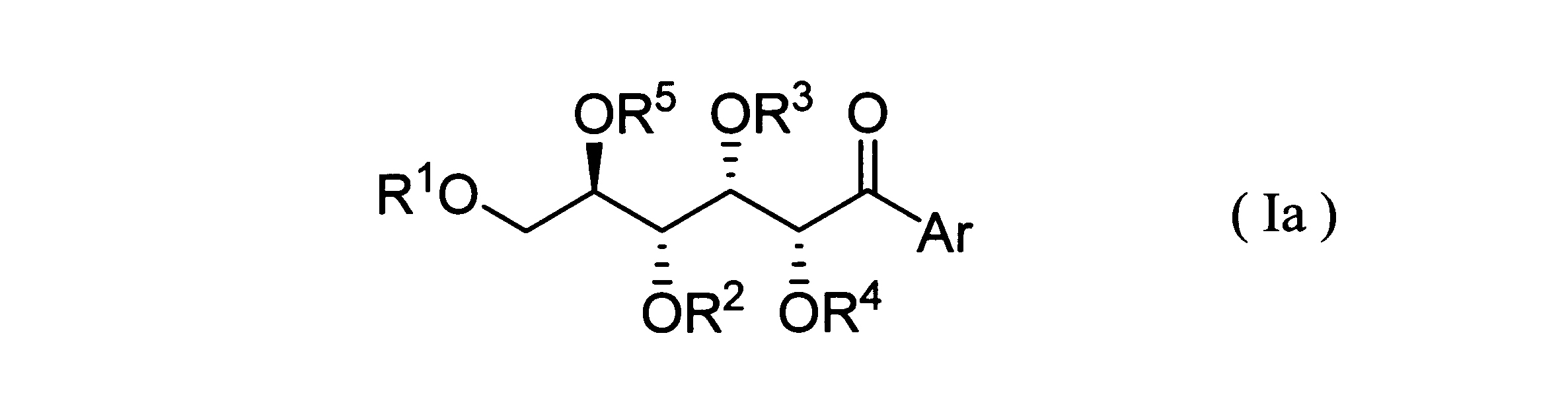
式(Ia)において、R1~R5は、それぞれ独立して、水酸基保護基又は水素原子を表し、Arは、1個以上の置換基を有していてもよい芳香族炭化水素環基又は1個以上の置換基を有していてもよい芳香族複素環基を、式(Ia)中のカルボニル基の炭素原子と結合する官能基として含む有機基を表す。
好ましい実施形態において、R1及びR2は、それぞれ独立して、水酸基保護基を表し、R3及びR4は、それぞれ独立して、水酸基保護基又は水素原子を表し、R5は、水酸基保護基(ただし、R1で表される水酸基保護基と同一の水酸基保護基及びR2で表される水酸基保護基と同一の水酸基保護基を除く。)を表す。
R1~R5で表される水酸基保護基は、同一であっても異なってもよいが、水酸基保護基の効率的な導入及び除去を勘案すれば、同一であることが好ましい。但し、R5で表される水酸基保護基は、R1で表される水酸基保護基及びR2で表される水酸基保護基とは異なる水酸基保護基であることが好ましい。
R1~R5で表される水酸基保護基は、特に限定されない。R1~R5で表される水酸基保護基は、それぞれ独立して、例えば、エステル型保護基、アリールアルキル型保護基、アルキル型保護基、アリールアルキルオキシアルキル型保護基、アルキルオキシアルキル型保護基、シリル型保護基及びオキシカルボニル型保護基から選択することができる。エステル型保護基、アリールアルキル型保護基、アルキル型保護基、アリールアルキルオキシアルキル型保護基、アルキルオキシアルキル型保護基、シリル型保護基及びオキシカルボニル型保護基に関する説明は、上記と同様である。
R1~R5で表される水酸基保護基は、それぞれ独立して、メチルオキシメチル基、ベンジルオキシメチル基、アセチル基、プロパノイル基、ブタノイル基、イソプロパノイル基、ピバロイル基、ベンゾイル基、4-ニトロベンゾイル基、4-メチルオキシベンゾイル基、4-メチルベンゾイル基、4-tert-ブチルベンゾイル基、4-フルオロベンゾイル基、4-クロロベンゾイル基、4-ブロモベンゾイル基、4-フェニルベンゾイル基、4-メチルオキシカルボニルベンゾイル基、ベンジル基、1-フェニルエチル基、ジフェニルメチル基、1,1-ジフェニルエチル基、ナフチルメチル基、メチル基、tert-ブチル基、トリメチルシリル基、トリエチルシリル基、tert-ブチルジメチルシリル基、tert-ブチルジフェニルシリル基、tert-ブチルオキシカルボニルオキシ基及びベンジルオキシカルボニル基から選択されることが好ましく、ベンジル基、アセチル基、ピバロイル基、トリメチルシリル基、tert-ブチルジメチルシリル基及びtert-ブチルジフェニルシリル基から選択されることがより好ましい。
R1及びR2で表される官能基は、水素原子であってもよいが、後述する式(IVa)の6員環化合物を効率的に形成する観点から、水酸基保護基であることが好ましい。
R3及びR4で表される官能基は、水素原子であってもよいが、後述する式(IVa)の6員環化合物を効率的に形成する観点から、水酸基保護基であることが好ましい。
R3及びR4で表される水酸基保護基は、R1及びR2で表される水酸基保護基と同一であっても異なっていてもよいが、効率的な保護基の導入及び除去の観点から、R1及びR2で表される水酸基保護基と同一であることが好ましい。
Arで表される有機基は、1個以上の置換基を有していてもよい芳香族炭化水素環基又は1個以上の置換基を有していてもよい芳香族複素環基を、式(Ia)中のカルボニル基の炭素原子と結合する官能基として含む限り特に限定されない。
一実施形態において、Arで表される有機基は、1個以上の置換基を有していてもよい芳香族炭化水素環基であるか、又は、1個以上の置換基を有していてもよい芳香族炭化水素環基を式(Ia)中のカルボニル基の炭素原子と結合する官能基として含む。
別の実施形態において、Arで表される有機基は、1個以上の置換基を有していてもよい芳香族複素環基であるか、又は、1個以上の置換基を有していてもよい芳香族炭化水素環基を式(Ia)中のカルボニル基の炭素原子と結合する官能基として含む。
1個以上の置換基を有していてもよい芳香族炭化水素環基を式(Ia)中のカルボニル基の炭素原子と結合する官能基として含む有機基は、例えば、下記式で表すことができる。

上記式において、J1は、1個以上の置換基を有していてもよい芳香族炭化水素環基を表し、J2は、1個以上の置換基を有していてもよい脂肪族炭化水素基を表し、J3は、1個以上の置換基を有していてもよい芳香族炭化水素環基、1個以上の置換基を有していてもよい脂肪族複素環基又は1個以上の置換基を有していてもよい芳香族複素環基を表し、(*)は式(I)中のカルボニル基の炭素原子と結合する結合手を表す。
一実施形態において、J1は、無置換の芳香族炭化水素環基であり、J2は、無置換の脂肪族炭化水素基である。
別の実施形態において、J1は、無置換の芳香族炭化水素環基であり、J2は、1個以上の置換基を有する脂肪族炭化水素基である。
別の実施形態において、J1は、1個以上の置換基を有する芳香族炭化水素環基であり、J2は、無置換の脂肪族炭化水素基である。
別の実施形態において、J1は、1個以上の置換基を有する芳香族炭化水素環基であり、J2は、1個以上の置換基を有する脂肪族炭化水素基である。
一実施形態において、J3は、無置換の芳香族炭化水素環基である。この実施形態は、J1及びJ2に関する上記実施形態と組み合わせることができる。
別の実施形態において、J3は、1個以上の置換基を有する芳香族炭化水素環基である。この実施形態は、J1及びJ2に関する上記実施形態と組み合わせることができる。
別の実施形態において、J3は、無置換の脂肪族複素環基である。この実施形態は、J1及びJ2に関する上記実施形態と組み合わせることができる。
別の実施形態において、J3は、1個以上の置換基を有する脂肪族複素環基である。この実施形態は、J1及びJ2に関する上記実施形態と組み合わせることができる。
別の実施形態において、J3は、無置換の芳香族複素環基である。この実施形態は、J1及びJ2に関する上記実施形態と組み合わせることができる。
別の実施形態において、J3は、1個以上の置換基を有する芳香族複素環基である。この実施形態は、J1及びJ2に関する上記実施形態と組み合わせることができる。
J2で表される脂肪族炭化水素基が1個以上の置換基を有する実施形態において、1個以上の置換基は、それぞれ独立して、例えば、置換基群A~Mから選択することができる。J2で表される脂肪族炭化水素基が有する1個以上の置換基は、それぞれ独立して、例えば、ハロゲン原子、ニトロ基、シアノ基、オキソ基、保護されていてもよい水酸基、保護されていてもよいチオール基、保護されていてもよいアミノ基、保護されていてもよいホルミル基、保護されていてもよいカルボキシル基、保護されていてもよいカルバモイル基、保護されていてもよいスルホニル基、アリール基、脂肪族複素環基、ヘテロアリール基、アルキルアリール基、アルキル脂肪族複素環基、アルキルヘテロアリール基、アリールアルキル基、脂肪族複素環アルキル基、ヘテロアリールアルキル基、アルキルオキシ基、アリールオキシ基、脂肪族複素環オキシ基、ヘテロアリールオキシ基、アルキルアリールオキシ基、アルキル脂肪族複素環オキシ基、アルキルヘテロアリールオキシ基、アリールアルキルオキシ基、脂肪族複素環アルキルオキシ基、ヘテロアリールアルキルオキシ基、アルキルチオ基、アリールチオ基、脂肪族複素環チオ基、ヘテロアリールチオ基、アルキルアリールチオ基、アルキル脂肪族複素環チオ基、アルキルヘテロアリールチオ基、アリールアルキルチオ基、脂肪族複素環アルキルチオ基、ヘテロアリールアルキルチオ基、アルキルカルボニル基、アリールカルボニル基、脂肪族複素環カルボニル基、ヘテロアリールカルボニル基、アルキルアリールカルボニル基、アルキル脂肪族複素環カルボニル基、アルキルヘテロアリールカルボニル基、アリールアルキルカルボニル基、脂肪族複素環アルキルカルボニル基、ヘテロアリールアルキルカルボニル基、アルキルオキシカルボニル基、アリールオキシカルボニル基、脂肪族複素環オキシカルボニル基、ヘテロアリールオキシカルボニル基、アルキルアリールオキシカルボニル基、アルキル脂肪族複素環オキシカルボニル基、アルキルヘテロアリールオキシカルボニル基、アリールアルキルオキシカルボニル基、脂肪族複素環アルキルオキシカルボニル基及びヘテロアリールアルキルオキシカルボニル基から選択することができる。1個以上の置換基は、それぞれ独立して、ハロゲン原子、ニトロ基、シアノ基、オキソ基、保護されていてもよい水酸基、保護されていてもよいチオール基、保護されていてもよいアミノ基、保護されていてもよいホルミル基、保護されていてもよいカルボキシル基、保護されていてもよいカルバモイル基、保護されていてもよいスルホニル基、アルキルオキシ基、アルキルチオ基、アルキルカルボニル基及びアルキルオキシカルボニル基から選択されることが好ましい。なお、J2で表される脂肪族炭化水素基が直鎖状又は分岐鎖状の脂肪族炭化水素基である場合、直鎖状又は分岐鎖状の脂肪族炭化水素基は、環状の脂肪族炭化水素基(例えば、シクロアルキル基、シクロアルケニル基、シクロアルキニル基等)を置換基として有し得る。
J1で表される芳香族炭化水素環基及び/又はJ3で表される芳香族炭化水素環基、脂肪族複素環基もしくは芳香族複素環基が1個以上の置換基を有する実施形態において、1個以上の置換基は、それぞれ独立して、例えば、置換基群A~Mから選択することができる。J1で表される芳香族炭化水素環基及び/又はJ3で表される芳香族炭化水素環基、脂肪族複素環基もしくは芳香族複素環基が有する1個以上の置換基は、それぞれ独立して、例えば、ハロゲン原子、ニトロ基、シアノ基、オキソ基、保護されていてもよい水酸基、保護されていてもよいチオール基、保護されていてもよいアミノ基、保護されていてもよいホルミル基、保護されていてもよいカルボキシル基、保護されていてもよいカルバモイル基、保護されていてもよいスルホニル基、アルキル基、アリール基、脂肪族複素環基、ヘテロアリール基、アルキルアリール基、アルキル脂肪族複素環基、アルキルヘテロアリール基、アリールアルキル基、脂肪族複素環アルキル基、ヘテロアリールアルキル基、アルキルオキシ基、アリールオキシ基、脂肪族複素環オキシ基、ヘテロアリールオキシ基、アルキルアリールオキシ基、アルキル脂肪族複素環オキシ基、アルキルヘテロアリールオキシ基、アリールアルキルオキシ基、脂肪族複素環アルキルオキシ基、ヘテロアリールアルキルオキシ基、アルキルチオ基、アリールチオ基、脂肪族複素環チオ基、ヘテロアリールチオ基、アルキルアリールチオ基、アルキル脂肪族複素環チオ基、アルキルヘテロアリールチオ基、アリールアルキルチオ基、脂肪族複素環アルキルチオ基、ヘテロアリールアルキルチオ基、アルキルカルボニル基、アリールカルボニル基、脂肪族複素環カルボニル基、ヘテロアリールカルボニル基、アルキルアリールカルボニル基、アルキル脂肪族複素環カルボニル基、アルキルヘテロアリールカルボニル基、アリールアルキルカルボニル基、脂肪族複素環アルキルカルボニル基、ヘテロアリールアルキルカルボニル基、アルキルオキシカルボニル基、アリールオキシカルボニル基、脂肪族複素環オキシカルボニル基、ヘテロアリールオキシカルボニル基、アルキルアリールオキシカルボニル基、アルキル脂肪族複素環オキシカルボニル基、アルキルヘテロアリールオキシカルボニル基、アリールアルキルオキシカルボニル基、脂肪族複素環アルキルオキシカルボニル基及びヘテロアリールアルキルオキシカルボニル基から選択することができる。1個以上の置換基は、それぞれ独立して、ハロゲン原子、ニトロ基、シアノ基、オキソ基、保護されていてもよい水酸基、保護されていてもよいチオール基、保護されていてもよいアミノ基、保護されていてもよいホルミル基、保護されていてもよいカルボキシル基、保護されていてもよいカルバモイル基、保護されていてもよいスルホニル基、アルキルオキシ基、アルキルチオ基、アルキルカルボニル基及びアルキルオキシカルボニル基から選択されることが好ましい。
1個以上の置換基を有していてもよい芳香族複素環基を式(Ia)中のカルボニル基の炭素原子と結合する官能基として含む有機基は、例えば、下記式で表すことができる。

上記式において、K1は、1個以上の置換基を有していてもよい芳香族複素環基を表し、K2は、1個以上の置換基を有していてもよい脂肪族炭化水素基を表し、K3は、1個以上の置換基を有していてもよい芳香族炭化水素環基、1個以上の置換基を有していてもよい脂肪族複素環基又は1個以上の置換基を有していてもよい芳香族複素環基を表し、(*)は式(I)中のカルボニル基の炭素原子と結合する結合手を表す。
一実施形態において、K1は、無置換の芳香族複素環基であり、K2は、無置換の脂肪族炭化水素基である。
別の実施形態において、K1は、無置換の芳香族複素環基であり、K2は、1個以上の置換基を有する脂肪族炭化水素基である。
別の実施形態において、K1は、1個以上の置換基を有する芳香族複素環基であり、K2は、無置換の脂肪族炭化水素基である。
別の実施形態において、K1は、1個以上の置換基を有する芳香族複素環基であり、K2は、1個以上の置換基を有する脂肪族炭化水素基である。
一実施形態において、K3は、無置換の芳香族炭化水素環基である。この実施形態は、K1及びK2に関する上記実施形態と組み合わせることができる。
別の実施形態において、K3は、1個以上の置換基を有する芳香族炭化水素環基である。この実施形態は、K1及びK2に関する上記実施形態と組み合わせることができる。
別の実施形態において、K3は、無置換の脂肪族複素環基である。この実施形態は、K1及びK2に関する上記実施形態と組み合わせることができる。
別の実施形態において、K3は、1個以上の置換基を有する脂肪族複素環基である。この実施形態は、K1及びK2に関する上記実施形態と組み合わせることができる。
別の実施形態において、K3は、無置換の芳香族複素環基である。この実施形態は、K1及びK2に関する上記実施形態と組み合わせることができる。
別の実施形態において、K3は、1個以上の置換基を有する芳香族複素環基である。この実施形態は、K1及びK2に関する上記実施形態と組み合わせることができる。
K2で表される脂肪族炭化水素基が1個以上の置換基を有する実施形態において、1個以上の置換基は、それぞれ独立して、例えば、置換基群A~Mから選択することができる。K2で表される脂肪族炭化水素基が有する1個以上の置換基は、それぞれ独立して、例えば、ハロゲン原子、ニトロ基、シアノ基、オキソ基、保護されていてもよい水酸基、保護されていてもよいチオール基、保護されていてもよいアミノ基、保護されていてもよいホルミル基、保護されていてもよいカルボキシル基、保護されていてもよいカルバモイル基、保護されていてもよいスルホニル基、アリール基、脂肪族複素環基、ヘテロアリール基、アルキルアリール基、アルキル脂肪族複素環基、アルキルヘテロアリール基、アリールアルキル基、脂肪族複素環アルキル基、ヘテロアリールアルキル基、アルキルオキシ基、アリールオキシ基、脂肪族複素環オキシ基、ヘテロアリールオキシ基、アルキルアリールオキシ基、アルキル脂肪族複素環オキシ基、アルキルヘテロアリールオキシ基、アリールアルキルオキシ基、脂肪族複素環アルキルオキシ基、ヘテロアリールアルキルオキシ基、アルキルチオ基、アリールチオ基、脂肪族複素環チオ基、ヘテロアリールチオ基、アルキルアリールチオ基、アルキル脂肪族複素環チオ基、アルキルヘテロアリールチオ基、アリールアルキルチオ基、脂肪族複素環アルキルチオ基、ヘテロアリールアルキルチオ基、アルキルカルボニル基、アリールカルボニル基、脂肪族複素環カルボニル基、ヘテロアリールカルボニル基、アルキルアリールカルボニル基、アルキル脂肪族複素環カルボニル基、アルキルヘテロアリールカルボニル基、アリールアルキルカルボニル基、脂肪族複素環アルキルカルボニル基、ヘテロアリールアルキルカルボニル基、アルキルオキシカルボニル基、アリールオキシカルボニル基、脂肪族複素環オキシカルボニル基、ヘテロアリールオキシカルボニル基、アルキルアリールオキシカルボニル基、アルキル脂肪族複素環オキシカルボニル基、アルキルヘテロアリールオキシカルボニル基、アリールアルキルオキシカルボニル基、脂肪族複素環アルキルオキシカルボニル基及びヘテロアリールアルキルオキシカルボニル基から選択することができる。1個以上の置換基は、それぞれ独立して、ハロゲン原子、ニトロ基、シアノ基、オキソ基、保護されていてもよい水酸基、保護されていてもよいチオール基、保護されていてもよいアミノ基、保護されていてもよいホルミル基、保護されていてもよいカルボキシル基、保護されていてもよいカルバモイル基、保護されていてもよいスルホニル基、アルキルオキシ基、アルキルチオ基、アルキルカルボニル基及びアルキルオキシカルボニル基から選択されることが好ましい。なお、K2で表される脂肪族炭化水素基が直鎖状又は分岐鎖状の脂肪族炭化水素基である場合、直鎖状又は分岐鎖状の脂肪族炭化水素基は、環状の脂肪族炭化水素基(例えば、シクロアルキル基、シクロアルケニル基、シクロアルキニル基等)を置換基として有し得る。
K1で表される芳香族複素環基及び/又はK3で表される芳香族炭化水素環基、脂肪族複素環基もしくは芳香族複素環基が1個以上の置換基を有する実施形態において、1個以上の置換基は、それぞれ独立して、例えば、置換基群A~Mから選択することができる。K1で表される芳香族複素環基及び/又はK3で表される芳香族炭化水素環基、脂肪族複素環基もしくは芳香族複素環基が有する1個以上の置換基は、それぞれ独立して、例えば、ハロゲン原子、ニトロ基、シアノ基、オキソ基、保護されていてもよい水酸基、保護されていてもよいチオール基、保護されていてもよいアミノ基、保護されていてもよいホルミル基、保護されていてもよいカルボキシル基、保護されていてもよいカルバモイル基、保護されていてもよいスルホニル基、アルキル基、アリール基、脂肪族複素環基、ヘテロアリール基、アルキルアリール基、アルキル脂肪族複素環基、アルキルヘテロアリール基、アリールアルキル基、脂肪族複素環アルキル基、ヘテロアリールアルキル基、アルキルオキシ基、アリールオキシ基、脂肪族複素環オキシ基、ヘテロアリールオキシ基、アルキルアリールオキシ基、アルキル脂肪族複素環オキシ基、アルキルヘテロアリールオキシ基、アリールアルキルオキシ基、脂肪族複素環アルキルオキシ基、ヘテロアリールアルキルオキシ基、アルキルチオ基、アリールチオ基、脂肪族複素環チオ基、ヘテロアリールチオ基、アルキルアリールチオ基、アルキル脂肪族複素環チオ基、アルキルヘテロアリールチオ基、アリールアルキルチオ基、脂肪族複素環アルキルチオ基、ヘテロアリールアルキルチオ基、アルキルカルボニル基、アリールカルボニル基、脂肪族複素環カルボニル基、ヘテロアリールカルボニル基、アルキルアリールカルボニル基、アルキル脂肪族複素環カルボニル基、アルキルヘテロアリールカルボニル基、アリールアルキルカルボニル基、脂肪族複素環アルキルカルボニル基、ヘテロアリールアルキルカルボニル基、アルキルオキシカルボニル基、アリールオキシカルボニル基、脂肪族複素環オキシカルボニル基、ヘテロアリールオキシカルボニル基、アルキルアリールオキシカルボニル基、アルキル脂肪族複素環オキシカルボニル基、アルキルヘテロアリールオキシカルボニル基、アリールアルキルオキシカルボニル基、脂肪族複素環アルキルオキシカルボニル基及びヘテロアリールアルキルオキシカルボニル基から選択することができる。1個以上の置換基は、それぞれ独立して、ハロゲン原子、ニトロ基、シアノ基、オキソ基、保護されていてもよい水酸基、保護されていてもよいチオール基、保護されていてもよいアミノ基、保護されていてもよいホルミル基、保護されていてもよいカルボキシル基、保護されていてもよいカルバモイル基、保護されていてもよいスルホニル基、アルキル基、アルキルオキシ基、アルキルチオ基、アルキルカルボニル基及びアルキルオキシカルボニル基から選択されることが好ましい。
Arで表される有機基に含まれる、式(Ia)中のカルボニル基の炭素原子と結合する芳香族炭化水素環基又は芳香族複素環基は、好ましくは、炭素数6~14の芳香族炭化水素環基又は炭素数3~12の芳香族複素環基であり、より好ましくは、炭素数6~10の芳香族炭化水素環基又は炭素数3~8の芳香族複素環基であり、より一層好ましくは、フェニル基、チエニル基、ベンゾチオフェニル基、フリル基、ピロリル基、イミダゾリル基又はピリジル基であり、より一層好ましくはフェニル基、チエニル基又はベンゾチオフェニル基であり、より一層好ましくは、フェニル基である。
Arで表される有機基は、化合物(Ia)をSGLT-2阻害薬又はその誘導体の製造原料として使用する観点からは、SGLT-2阻害薬が有する芳香族炭化水素環基又は芳香族複素環基と同一であるか、当該芳香族炭化水素環基又は芳香族複素環基を誘導化した基であることが好ましい。
ここで、カナグリフロジン(1-(β-D-グリコピラノシル)-4-メチル-3-[5-(4-フルオロフェニル)-2-チエニルメチル]ベンゼン)、エンパグリフロジン((1S)-1,5-アンヒドロ-1-C-{4-クロロ-3-[(4-{[(3S)-オキソラン-3-イル]オキシ}フェニル)メチル]フェニル}-D-グルシトール)、イプラグリフロジン((1S)-1,5-アンヒドロ-1-C-{3-[(1-ベンゾチオフェン-2-イル)メチル]-4-フルオロフェニル}-D-グルシトール―(2S)-ピロリジン-2-カルボン酸)及びダパグリフロジン((2S,3R,4R,5S,6R)-2-[4-クロロ-3-(4-エチルオキシベンジル)フェニル]-6-(ヒドロキシメチル)テトラヒドロ-2H-ピラン-3,4,5-チオール)をはじめとするSGLT-2阻害薬は、下記式(V)又は式(Va)で表される芳香族炭化水素環基又は芳香族複素環基を有している。
したがって、好ましい実施形態において、Arで表される有機基は、下記式(V)で表される。
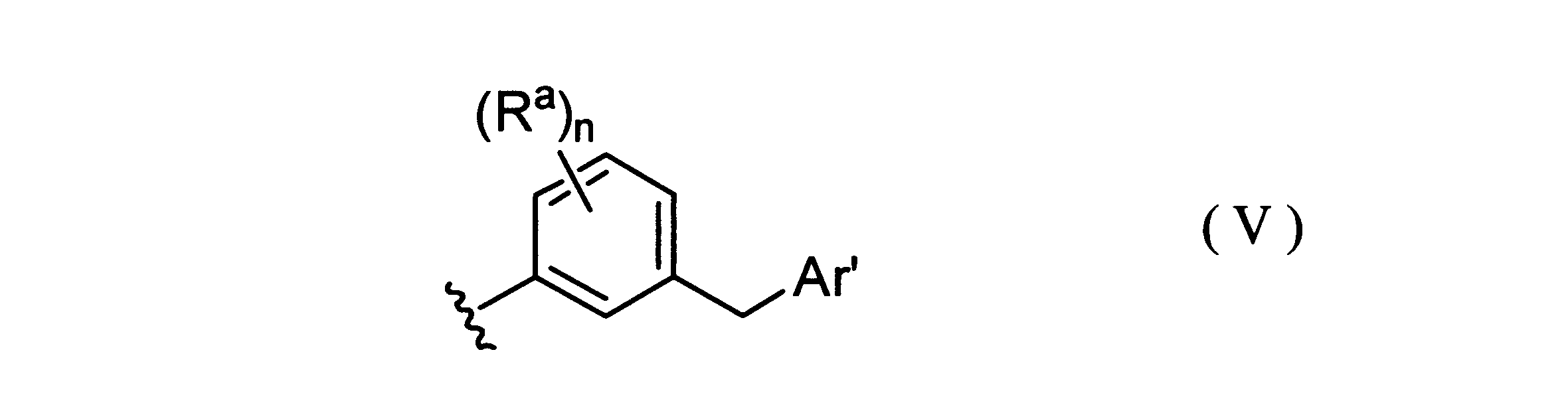
式(V)において、Raは、それぞれ独立して、ハロゲン原子、アルキル基、アルケニル基、アルキニル基、アリール基、アリールアルキル基、アリールアルケニル基、アリールアルキニル基、アルキルオキシ基、アルケニルオキシ基、アルキニルオキシ基、アリールオキシ基、アリールアルキルオキシ基、アリールアルケニルオキシ基及びアリールアルキニルオキシ基からなる群から選択される官能基を表し、前記群に含まれるアルキル基、アルケニル基、アルキニル基、アリール基、アリールアルキル基、アリールアルケニル基、アリールアルキニル基、アルキルオキシ基、アルケニルオキシ基、アルキニルオキシ基、アリールオキシ基、アリールアルキルオキシ基、アリールアルケニルオキシ基及びアリールアルキニルオキシ基は各々、1個以上の置換基を有していてもよい。
式(V)において、Raで表される官能基は、それぞれ独立して、好ましくは、ハロゲン原子、炭素数1~20のアルキル基、炭素数6~14のアリール基、炭素数7~15のアリールアルキル基、炭素数1~20のアルキルオキシ基及び炭素数7~15のアリールアルキルオキシ基から選択され、より好ましくは、ハロゲン原子及び炭素数1~10のアルキル基から選択される。
式(V)において、nは、0~4の整数を表す。nで表される整数は、好ましくは1~3であり、より好ましくは1又は2である。nが2以上である場合、n個のRaは、同一であってもよいし、異なっていてもよい。
式(V)において、Ar’は、1個以上の置換基を有していてもよい芳香族炭化水素環基、1個以上の置換基を有していてもよい脂肪族複素環基又は1個以上の置換基を有していてもよい芳香族複素環基を表す。Ar’は、好ましくは、1個以上の置換基を有していてもよい芳香族炭化水素環基又は1個以上の置換基を有していてもよい芳香族複素環基を表す。
Ar’で表される官能基は、好ましくは、1個以上の置換基を有していてもよい炭素数6~14の芳香族炭化水素環基又は1個以上の置換基を有していてもよい炭素数3~12の芳香族複素環であり、より好ましくは、1個以上の置換基を有していてもよい炭素数6~14の芳香族炭化水素環基又は1個以上の置換基を有していてもよい炭素数3~12の芳香族複素環であり、より一層好ましくは、1個以上の置換基を有していてもよいフェニル基、1個以上の置換基を有していてもよいチエニル基、1個以上の置換基を有していてもよいベンゾチオフェニル基、1個以上の置換基を有していてもよいフリル基、1個以上の置換基を有していてもよいピロリル基、1個以上の置換基を有していてもよいイミダゾリル基又は1個以上の置換基を有していてもよいピリジル基であり、より一層好ましくは、1個以上の置換基を有していてもよいフェニル基、1個以上の置換基を有していてもよいチエニル基又は1個以上の置換基を有していてもよいベンゾチオフェニル基である。
Ar’で表される官能基が有する1個以上の置換基は、好ましくは、ハロゲン原子で置換されていてもよいフェニル基、炭素数1~5のアルキルオキシ基、脂肪族複素環オキシ基(例えば、テトラヒドロフラニルオキシ基等)等である。
より好ましい実施形態において、Arで表される有機基は、下記式(Va)で表される。

式(Va)において、Raで表される官能基は、上記と同義である。
式(V)及び式(Va)において、Ar’は、好ましくは、下記式(Va-I)、(Va-II)及び(Va-III)で表される官能基である。

式(Va-I)、(Va-II)及び(Va-III)において、Rbは、それぞれ独立して、脂肪族炭化水素基、芳香族炭化水素環基、脂肪族複素環基及び芳香族複素環基からなる群から選択される官能基を表し、前記群に含まれる脂肪族炭化水素基、芳香族炭化水素環基、脂肪族複素環基及び芳香族複素環は各々、1個以上の置換基を有していてもよい。
Rbで表される官能基は、それぞれ独立して、1個以上の置換基を有していてもよい炭素数1~20のアルキル基、1個以上の置換基を有していてもよい炭素数2~20のアルケニル基、1個以上の置換基を有していてもよい炭素数2~20のアルキニル基、1個以上の置換基を有していてもよい炭素数6~14の芳香族炭化水素環基、1個以上の置換基を有していてもよい炭素数2~12の脂肪族複素環基及び1個以上の置換基を有していてもよい炭素数3~12の芳香族複素環基から選択されることが好ましく、1個以上の置換基を有していてもよい炭素数1~10のアルキル基、1個以上の置換基を有していてもよい炭素数2~10のアルケニル基、1個以上の置換基を有していてもよい炭素数2~10のアルキニル基、1個以上の置換基を有していてもよい炭素数6~10の芳香族炭化水素環基及び1個以上の置換基を有していてもよい炭素数2~5の脂肪族複素環基から選択されることがより好ましく、1個以上の置換基を有していてもよいフェニル基及び1個以上の置換基を有していてもよいテトラヒドロフラニル基から選択されることがより一層好ましい。
Rbで表される官能基が有する1個以上の置換基は、それぞれ独立して、例えば、置換基群A~Mから選択することができる。Rbで表される官能基が有する1個以上の置換基は、それぞれ独立して、例えば、ハロゲン原子、ニトロ基、シアノ基、オキソ基、保護されていてもよい水酸基、保護されていてもよいチオール基、保護されていてもよいアミノ基、保護されていてもよいホルミル基、保護されていてもよいカルボキシル基、保護されていてもよいカルバモイル基、保護されていてもよいスルホニル基、アルキル基、アリール基、脂肪族複素環基、ヘテロアリール基、アルキルアリール基、アルキル脂肪族複素環基、アルキルヘテロアリール基、アリールアルキル基、脂肪族複素環アルキル基、ヘテロアリールアルキル基、アルキルオキシ基、アリールオキシ基、脂肪族複素環オキシ基、ヘテロアリールオキシ基、アルキルアリールオキシ基、アルキル脂肪族複素環オキシ基、アルキルヘテロアリールオキシ基、アリールアルキルオキシ基、脂肪族複素環アルキルオキシ基、ヘテロアリールアルキルオキシ基、アルキルチオ基、アリールチオ基、脂肪族複素環チオ基、ヘテロアリールチオ基、アルキルアリールチオ基、アルキル脂肪族複素環チオ基、アルキルヘテロアリールチオ基、アリールアルキルチオ基、脂肪族複素環アルキルチオ基、ヘテロアリールアルキルチオ基、アルキルカルボニル基、アリールカルボニル基、脂肪族複素環カルボニル基、ヘテロアリールカルボニル基、アルキルアリールカルボニル基、アルキル脂肪族複素環カルボニル基、アルキルヘテロアリールカルボニル基、アリールアルキルカルボニル基、脂肪族複素環アルキルカルボニル基、ヘテロアリールアルキルカルボニル基、アルキルオキシカルボニル基、アリールオキシカルボニル基、脂肪族複素環オキシカルボニル基、ヘテロアリールオキシカルボニル基、アルキルアリールオキシカルボニル基、アルキル脂肪族複素環オキシカルボニル基、アルキルヘテロアリールオキシカルボニル基、アリールアルキルオキシカルボニル基、脂肪族複素環アルキルオキシカルボニル基及びヘテロアリールアルキルオキシカルボニル基から選択することができる。1個以上の置換基は、それぞれ独立して、ハロゲン原子、ニトロ基、シアノ基、オキソ基、保護されていてもよい水酸基、保護されていてもよいチオール基、保護されていてもよいアミノ基、保護されていてもよいホルミル基、保護されていてもよいカルボキシル基、保護されていてもよいカルバモイル基、保護されていてもよいスルホニル基、アルキル基、アルキルオキシ基、アルキルチオ基、アルキルカルボニル基及びアルキルオキシカルボニル基から選択されることが好ましい。1個以上の置換基は、それぞれ独立して、ハロゲン原子、ニトロ基、保護されていてもよい水酸基、保護されていてもよいチオール基、保護されていてもよいホルミル基、保護されていてもよいアミノ基、保護されていてもよいカルボキシル基、保護されていてもよいスルホニル基及び炭素数1~10のアルキルオキシカルボニル基から選択されることがより好ましく、ハロゲン原子、アミノ基、ニトロ基、炭素数1~10のアルキルオキシ基及び炭素数1~10のアルキルオキシカルボニル基から選択されることがより一層好ましい。
式(Va-I)において、pは0~5の整数を表す。pで表される整数は、好ましくは0~3、より好ましくは0~2、より一層好ましくは0又は1である。式(Va-II)及び(Va-III)において、pで表される整数は、好ましくは0~5、より好ましくは0~3、より一層好ましくは0~2である。pが2以上である場合、p個のRbは、同一であってもよいし、異なっていてもよい。
式(Va-I)において、pは、好ましくは1であり、Rbは、好ましくは、1個以上の置換基を有していてもよいフェニル基であり、より好ましくは、ハロゲン原子を有するフェニル基であり、より一層好ましくは、フッ素原子を有するフェニル基である。1個以上の置換基を有していてもよいフェニル基が結合している位置は、好ましくは、チオフェン環の2位である。ハロゲン原子を有するフェニル基において、ハロゲン原子が結合している位置は、好ましくは、ベンゼン環の4位である。
式(Va-II)において、pは、好ましくは0である。
式(Va-III)において、pは、好ましくは1であり、Rbは、好ましくは、1個以上の置換基を有していてもよいアルキル基又は1個以上の置換基を有していてもよい脂肪族複素環基である。1個以上の置換基を有していてもよいアルキル基は、好ましくは、炭素数1~3のアルキル基であり、より好ましくは、メチル基又はエチル基である。1個以上の置換基を有していてもよい脂肪族複素環基は、好ましくは、テトラヒドロフラニル基である。1個以上の置換基を有していてもよいアルキル基又は1個以上の置換基を有していてもよい脂肪族複素環基が結合している位置は、好ましくは、ベンゼン環の4位である。
より好ましい実施形態において、Arで表される有機基は、下記(V-I-I)、(V-II-I)、(V-III-I)又は(V-III-II)で表される。
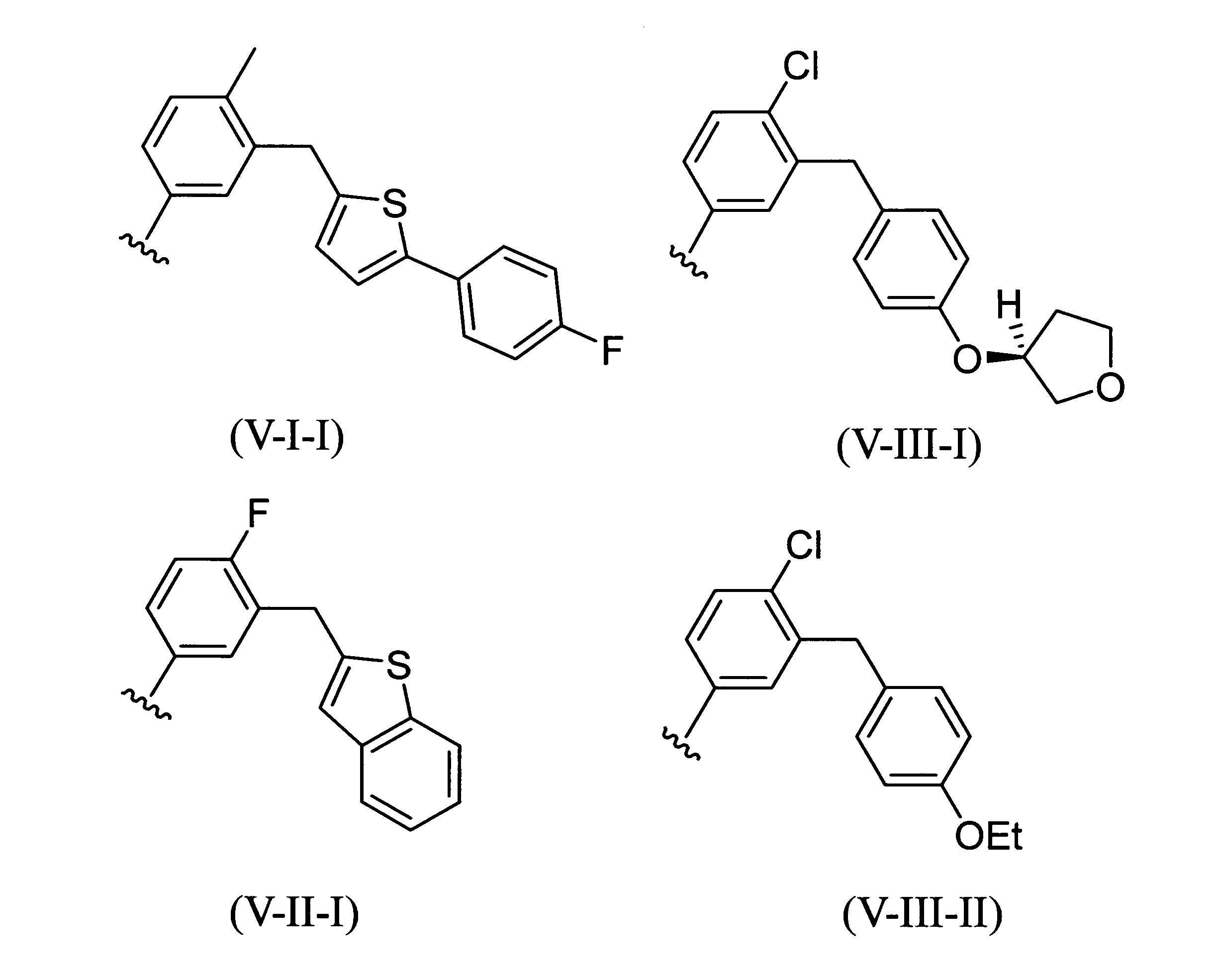
<化合物(II)>
化合物(II)は、下記式(II)で表される。
化合物(II)は、下記式(II)で表される。

式(II)において、W1は、上記と同義であり、Qは、1個以上の置換基を有していてもよい脂肪族炭化水素基、1個以上の置換基を有していてもよい芳香族炭化水素環基、1個以上の置換基を有していてもよい脂肪族複素環基又は1個以上の置換基を有していてもよい芳香族複素環基を、式(II)中の硫黄原子と結合する官能基として含む有機基を表す。
一実施形態において、Qで表される有機基は、1個以上の置換基を有していてもよい脂肪族炭化水素基であるか、又は、1個以上の置換基を有していてもよい脂肪族炭化水素基を式(II)中の硫黄原子と結合する官能基として含む。
別の実施形態において、Qで表される有機基は、1個以上の置換基を有していてもよい芳香族炭化水素環基であるか、又は、1個以上の置換基を有していてもよい芳香族炭化水素環基を式(II)中の硫黄原子と結合する官能基として含む。
別の実施形態において、Qで表される有機基は、1個以上の置換基を有していてもよい脂肪族複素環基であるか、又は、1個以上の置換基を有していてもよい脂肪族複素環基を式(II)中の硫黄原子と結合する官能基として含む。
別の実施形態において、Qで表される有機基は、1個以上の置換基を有していてもよい芳香族複素環基であるか、1個以上の置換基を有していてもよい芳香族複素環基を式(II)中の硫黄原子と結合する官能基として含む。
1個以上の置換基を有していてもよい脂肪族炭化水素基を式(II)中の硫黄原子と結合する官能基として含む有機基は、例えば、下記式で表すことができる。

上記式において、L1は、1個以上の置換基を有していてもよい脂肪族炭化水素基を表し、L2は、1個以上の置換基を有していてもよい芳香族炭化水素環基、1個以上の置換基を有していてもよい脂肪族複素環基又は1個以上の置換基を有していてもよい芳香族複素環基を表し、(*)は式(II)中の硫黄原子と結合する結合手を表す。上記式で表される有機基に関する説明は、(*)が式(II)中の硫黄原子と結合する結合手を表す点を除き、上記と同様である。
また、1個以上の置換基を有していてもよい脂肪族炭化水素基を式(II)中の硫黄原子と結合する官能基として含む有機基は、例えば、下記式で表すことができる。

上記式において、L1及びL2は、上記と同義であり、L3は、1個以上の置換基を有していてもよい脂肪族炭化水素基を表し、(*)は式(II)中の硫黄原子と結合する結合手を表す。上記式で表される有機基に関する説明は、(*)が式(II)中の硫黄原子と結合する結合手を表す点を除き、上記と同様である。
また、1個以上の置換基を有していてもよい脂肪族炭化水素基を式(II)中の硫黄原子と結合する官能基として含む有機基は、例えば、下記式で表すことができる。

上記式において、L1、L2及びL3は、上記と同義であり、L4は、1個以上の置換基を有していてもよい芳香族炭化水素環基、1個以上の置換基を有していてもよい脂肪族複素環基又は1個以上の置換基を有していてもよい芳香族複素環基を表し、(*)は式(II)中の硫黄原子と結合する結合手を表す。上記式で表される有機基に関する説明は、(*)が式(II)中の硫黄原子と結合する結合手を表す点を除き、上記と同様である。
1個以上の置換基を有していてもよい芳香族炭化水素環基、1個以上の置換基を有していてもよい脂肪族複素環基又は1個以上の置換基を有していてもよい芳香族複素環基を式(II)中の硫黄原子と結合する官能基として含む有機基は、例えば、下記式で表すことができる。

上記式において、M1は、1個以上の置換基を有していてもよい芳香族炭化水素環基、1個以上の置換基を有していてもよい脂肪族複素環基又は1個以上の置換基を有していてもよい芳香族複素環基を表し、M2は、1個以上の置換基を有していてもよい脂肪族炭化水素基を表し、(*)は式(II)中の硫黄原子と結合する結合手を表す。上記式で表される有機基に関する説明は、(*)が式(II)中の硫黄原子と結合する結合手を表す点を除き、上記と同様である。
また、1個以上の置換基を有していてもよい芳香族炭化水素環基、1個以上の置換基を有していてもよい脂肪族複素環基又は1個以上の置換基を有していてもよい芳香族複素環基を式(II)中の硫黄原子と結合する官能基として含む有機基は、例えば、下記式で表すことができる。

上記式において、M1及びM2は、上記と同義であり、M3は、1個以上の置換基を有していてもよい芳香族炭化水素環基、1個以上の置換基を有していてもよい脂肪族複素環基又は1個以上の置換基を有していてもよい芳香族複素環基を表し、(*)は式(II)中の硫黄原子と結合する結合手を表す。上記式で表される有機基に関する説明は、(*)が式(II)中の硫黄原子と結合する結合手を表す点を除き、上記と同様である。
また、1個以上の置換基を有していてもよい芳香族炭化水素環基、1個以上の置換基を有していてもよい脂肪族複素環基又は1個以上の置換基を有していてもよい芳香族複素環基を式(II)中の硫黄原子と結合する官能基として含む有機基は、例えば、下記式で表すことができる。

上記式において、M1、M2及びM3は、上記と同義であり、M4は、1個以上の置換基を有していてもよい脂肪族炭化水素基を表し、(*)は式(II)中の硫黄原子と結合する結合手を表す。上記式で表される有機基に関する説明は、(*)が式(II)中の硫黄原子と結合する結合手を表す点を除き、上記と同様である。
Qで表される有機基は、好ましくはアルキル基、アルケニル基、アルキニル基、アリール基、アリールアルキル基、アリールアルケニル基、アリールアルキニル基、ヘテロアリール基、ヘテロアリールアルキル基、ヘテロアリールアルケニル基又はヘテロアリールアルキニル基を式(II)中の硫黄原子と結合する官能基として含み、より好ましくはアルキル基、アルケニル基、アルキニル基、アリール基、アリールアルキル基、アリールアルケニル基又はアリールアルキニル基を式(II)中の硫黄原子と結合する官能基として含む。アルキル基の炭素数は、例えば1~20、好ましくは1~10であり、アリールアルキル基の炭素数は、例えば7~20、好ましくは7~15であり、アリール基の炭素数は、例えば6~20、好ましくは6~10であり、ヘテロアリール基の炭素数は、例えば5~20、好ましくは5~9である。
化合物(II)は、例えば、下記式(IIa)で表される化合物(IIa)である。なお、化合物(IIa)は、式(II)において、W1で表される有機基が、1個以上の置換基を有していてもよい脂肪族炭化水素基である化合物に相当する。
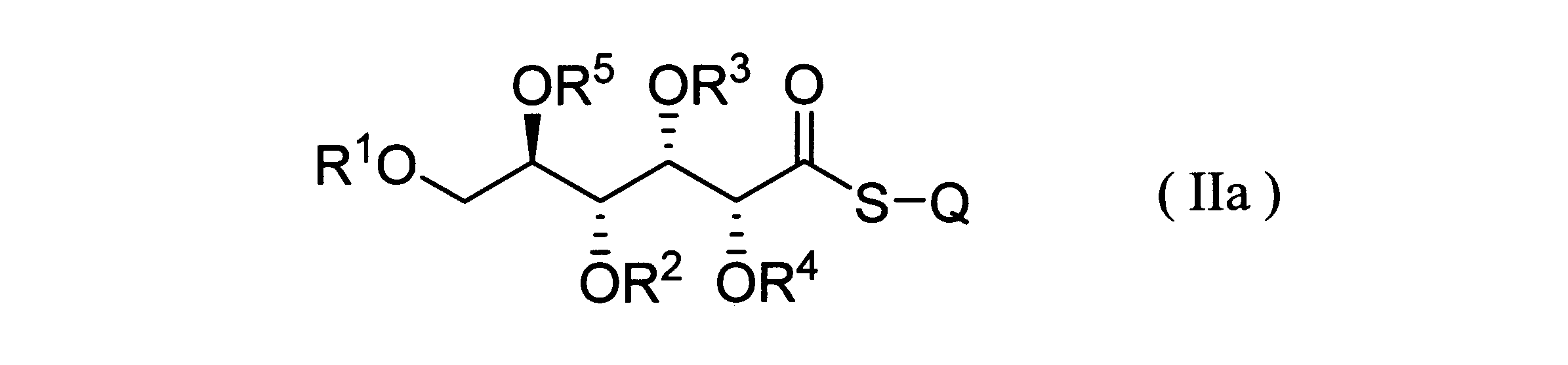
式(IIa)において、R1~R5及びQは、上記と同義である。
<化合物(I)を製造する方法>
本発明の化合物(I)を製造する方法は、以下の工程(a)を含む。
本発明の化合物(I)を製造する方法は、以下の工程(a)を含む。
工程(a)は、上記式(II)で表される化合物(II)と、
下記式(III-I):

[式中、W2は、上記と同義であり、Xは、ハロゲン原子を表す。]
で表される化合物(III-I)、及び、下記式(III-II):

[式中、W2は、上記と同義である。]
で表される化合物(III-II)
からなる群から選択される少なくとも1種の有機亜鉛化合物とを、
銅触媒の存在下で反応させて、化合物(I)を得る工程である。
下記式(III-I):
で表される化合物(III-I)、及び、下記式(III-II):
で表される化合物(III-II)
からなる群から選択される少なくとも1種の有機亜鉛化合物とを、
銅触媒の存在下で反応させて、化合物(I)を得る工程である。
工程(a)においては、化合物(III-I)化合物(III-II)からなる群から選択される少なくとも1種の有機亜鉛化合物は、化合物(II)に基W2を導入する試薬として使用される。有機亜鉛化合物として、化合物(III-I)及び化合物(III-II)の一方を単独で使用してもよいし、両方を組み合わせて使用してもよい。
好ましい実施形態において、少なくとも1種の有機亜鉛化合物は、化合物(III-I)を含む。化合物(III-I)は、反応系内において、下記式で表される平衡状態にあることが好ましい。下記式で表されるシュレンク平衡状態を実現する観点から、有機亜鉛化合物として、化合物(III-I)及び化合物(III-II)の両方を使用することが好ましい。

Xで表されるハロゲン原子は、フッ素原子、塩素原子、臭素原子及びヨウ素原子から選択される。Xで表されるハロゲン原子は、好ましくは、塩素原子、臭素原子又はヨウ素原子である。
化合物(III-I)としては、例えば、アリール亜鉛ハライド(式(III-I)において、W2がアリール基であり、Xがハロゲン原子、好ましくは塩素原子、臭素原子又はヨウ素原子である化合物)、アルキル亜鉛ハライド(式(II-I)において、W2がアルキル基であり、Xがハロゲン原子、好ましくは塩素原子、臭素原子又はヨウ素原子である化合物)等が挙げられる。
化合物(III-II)としては、例えば、ジアリール亜鉛(式(III-II)において、W2がアリール基である化合物)、ジアルキル亜鉛(式(III-II)において、W2がアルキル基である化合物)等が挙げられる。
化合物(III-I)及び化合物(III-II)は、市販品であってもよいし、非特許文献5等に記載の公知の手法に従って製造してもよい。
一実施態様によれば、化合物(III-I)は、グリニャール試薬ArMgXと、ハロゲン化亜鉛ZnX2とを有機溶媒中で反応させることにより製造される。
化合物(III-I)の製造において、ハロゲン化亜鉛の使用量はグリニャール試薬1当量に対して、通常0.9~1.5当量程度、好ましくは1~1.2当量程度、より好ましくは1~1.1当量程度である。
化合物(III-I)の製造に使用される有機溶媒としては、安定的な製造の観点から、好ましくはエーテル系溶媒であり、より好ましくは2-メチルテトラヒドロフラン、テトラヒドロフラン等であり、より一層好ましくはテトラヒドロフランである。
化合物(III-I)の製造における反応温度は、通常-50~50℃であり、好ましくは0~30℃である。
化合物(III-I)及び/又は化合物(III-II)は、例えば、塩化リチウム等のリチウム塩、塩化亜鉛等の亜鉛塩とともに使用することができる。上記式で表される平衡状態を実現する点からは、化合物(III-I)及び/又は化合物(III-II)を塩化亜鉛等の亜鉛塩とともに使用することが好ましい。後述する化合物(III-I)とリチウム塩との複合体を形成する点からは、化合物(III-I)及び/又は化合物(III-II)を塩化リチウム等のリチウム塩とともに使用することが好ましい。
化合物(III-I)は、リチウム塩との複合体を形成していてもよい。化合物(III-I)とリチウム塩との複合体は、例えば、下記式(III-Ia)で表すことができる。

式(III-Ia)において、X及びYは、それぞれ独立して、ハロゲン原子を表す。
化合物(III-I)とリチウム塩との複合体(III-Ia)は、化合物(III-I)の製造を、リチウム塩の存在下で実施することにより好適に得ることができる。複合体(III-Ia)は、化合物(III-I)のリチウム塩錯体であってもよい。
工程(a)において、複合体(III-Ia)を使用することは、有機亜鉛化合物の反応速度を向上させる上で好ましい。
リチウム塩としては、例えば、塩化リチウム、臭化リチウム、ヨウ化リチウム等が挙げられるが、好ましくは、塩化リチウムである。したがって、複合体(III-Ia)において、X及びYは、それぞれ独立して、塩素、臭素及びヨウ素から選択されることが好ましく、塩素および臭素から選択されることがより好ましい。
複合体(III-Ia)は、市販品であってもよいし、公知の手法に従って製造してもよい。好ましい製造方法としては、式:W2MgXa・LiY[式中、W2は上記と同義であり、Xaは、ハロゲン原子を表す。]で表されるターボグリニャール試薬と、式:ZnX[式中、Xは、ハロゲン原子を表す。]で表されるハロゲン化亜鉛とを有機溶媒中で反応させる方法が挙げられる。Xで表されるハロゲン原子は、Yで表されるハロゲン原子と同一であってもよいし、異なっていてもよい。
ターボグリニャール試薬は、不活性化ガス(例えば、窒素、アルゴン等)に置換した反応容器において、リチウム塩の存在下、マグネシウムと、式:W2Xa[式中、W2及びXaは、上記と同義である。]で表されるハロゲン有機化合物とを有機溶媒中で反応させることにより得ることができる。
マグネシウムは、反応性向上の観点から、粉砕物、削り屑状物等として使用することが好ましい。また、マグネシウムとハロゲン有機化合物とを有機溶媒中で反応させる際、反応性を向上する観点から、マグネシウム1当量に対して0.05~0.2当量程度の触媒量の水素化ジイソブチルアルミニウム(DIBAL-H)等の還元剤を有機溶媒中に添加していてもよい。
ターボグリニャール試薬の製造において、リチウム塩の使用量は、通常、マグネシウム1当量に対して、通常0.5~5.0当量程度、好ましくは0.5~3.0当量程度、より好ましくは0.5~2.0当量程度とすればよい。
ターボグリニャール試薬の製造において、ハロゲン有機化合物(W2Xa)の使用量は、マグネシウム1当量に対して、通常0.5~3.0当量程度、好ましくは0.5~2.0当量程度、より好ましくは0.5~1.5当量程度とすればよい。
ターボグリニャール試薬の製造に使用される有機溶媒は、安定的な製造の観点から、好ましくは、エーテル系溶媒であり、より好ましくは、ジエチルエーテル、テトラヒドロフラン等であり、より一層好ましくは、テトラヒドロフランである。使用される溶媒の量は、ハロゲン有機化合物(W2Xa)に対して通常1~1000倍の容量、好ましくは1~100倍の容量である。
ターボグリニャール試薬の製造における反応温度は、通常-50~50℃であり、好ましくは-20~20℃である。反応時間は、通常0.5~5時間、好ましくは1~3時間である。
なお、ターボグリニャール試薬(W2MgXa・LiY)は、Angew Chem.Int.Ed2006,45,2958等に記載の公知方法に従い、下記式に示される通り、TMPMgXa・LiY[式中、TMPは、2,2,6,6-テトラメチルピペリジンを表す。]で表されるノッシェル・ハウザー塩基と、化合物(W2-H)とを反応させることにより製造してもよい。このような態様も、本発明に包含される。
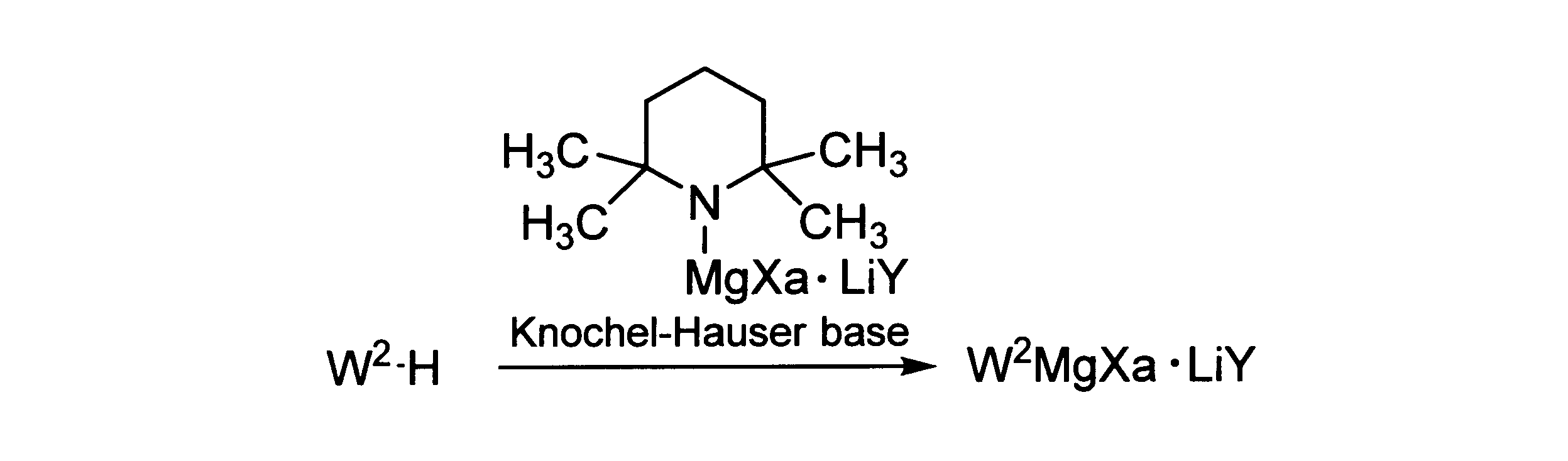
複合体(III-Ia)は、ターボグリニャール試薬とハロゲン化亜鉛とを有機溶媒中で混合して製造することができる。ターボグリニャール試薬とハロゲン化亜鉛との反応は、ターボグリニャール試薬の製造と同様、エーテル系溶媒(例えば、テトラヒドロフラン等)中で実施することが好ましい。
ターボグリニャール試薬とハロゲン化亜鉛との反応は、通常-30~30℃程度の温度で行うことができる。また、反応時間は、通常0.1~1時間である。
工程(a)において、有機亜鉛化合物又は複合体(III-Ia)の使用量は、化合物(II)の量に応じ適宜設定することができる。有機亜鉛化合物の使用量は、化合物(II)1当量に対して、通常1~5当量、好ましくは1~3当量である。
有機亜鉛化合物又は複合体(III-Ia)は、反応系に銅触媒及び化合物(II)を添加して混合した後、反応系に添加してもよいし、反応系に化合物(II)を添加した後、銅触媒と同時に反応系に添加して混合してもよいが、反応系に銅触媒及び化合物(II)を添加して混合した後、反応系に添加することが好ましい。
なお、工程(a)において、ハロゲン化亜鉛ZnX2は、有機亜鉛化合物を活性化して収率を向上する観点から、有機亜鉛化合物又はそのリチウム塩複合体と共に工程(a)の反応系に添加してもよい。有機亜鉛化合物又はそのリチウム塩複合体と共に反応系に添加されるハロゲン化亜鉛の量は、通常、有機亜鉛化合物又はそのリチウム塩複合体1当量に対して、通常0.05~1.0当量程度、好ましくは0.05~0.3当量程度、より好ましくは0.05~0.2当量程度である。ハロゲン化亜鉛は、有機亜鉛化合物又はそのリチウム塩複合体と別々に工程(a)の反応系に添加してもよく、有機亜鉛化合物又はそのリチウム塩複合体と同時に添加してもよいが、ハロゲン化亜鉛と有機亜鉛化合物又はそのリチウム塩複合体とを予め混合した状態で工程(a)の反応系に添加することが好ましい。
反応雰囲気は、銅触媒の活性を考慮して、アルゴン、窒素等の不活性ガス雰囲気であることが好ましい。反応雰囲気は、加圧、常圧及び減圧のいずれであってもよい。
工程(a)において、銅触媒が使用される。銅触媒の使用量は、所望の反応が進行する範囲で適宜調整することができる。銅触媒の使用量は、化合物(II)1当量に対して、通常0.0001~1当量、好ましくは、0.01~0.1当量である。
一実施形態において、銅触媒は、銅塩又はその水和物若しくは溶媒和物である。銅塩に含まれる銅原子の価数は、通常、1価又は2価である。銅塩としては、例えば、塩化銅(I)(CuCl)、塩化銅(II)(CuCl2)、臭化銅(I)(CuBr)、臭化銅(II)(CuBr2)、ヨウ化銅(I)(CuI)、ヨウ化銅(II)(CuI2)、酢酸銅(I)(CuOAc)、酢酸銅(II)(Cu(OAc)2)、硫酸銅(II)(CuSO4)、酸化銅(I)(Cu2O)、酸化銅(II)(CuO)、トリフルオロメタンスルホン酸銅(I)(CuOTf)、トリフルオロメタンスルホン酸銅(II)(Cu(OTf)2)、安息香酸銅(I)(CuOBz)、安息香酸銅(II)(Cu(OBz)2)等が挙げられる。これらのうち、ヨウ化銅(I)、酢酸銅(II)(Cu(OAc)2)及び硫酸銅(II)(CuSO4)が好ましく、ヨウ化銅(I)がより好ましい。
別の実施形態において、銅触媒は、銅錯体触媒である。銅錯体触媒は、銅原子及び該銅原子にキレートする配位子を含んでなる。銅錯体触媒における銅原子の価数は、通常0~3価、好ましくは1又は2価である。なお、1又は2価の銅原子(銅イオン)が触媒として作用するためには、配位子とのキレート形成が必要である。銅錯体触媒において、配位子と銅原子との比に特に限定されないが、配位子1個あたり1個以上の銅原子が配位することが好ましい。配位子1個あたりの銅原子の数は、例えば、1~3個である。銅錯体触媒に含まれる銅原子は、例えば、反応系に添加された銅塩又はその水和物若しくは溶媒和物に由来する。銅塩又はその水和物若しくは溶媒和物の具体例は、上記と同様である。銅触媒が銅錯体触媒である実施形態において、予め形成された銅錯体触媒を反応系に添加してもよいし、反応系に銅塩又はその水和物若しくは溶媒和物と配位子とを添加し、反応系中で銅錯体触媒を形成してもよい。
銅錯体触媒に含まれる配位子は、銅原子に配位結合で結合している分子又はイオンである。好ましい配位子は、窒素配位子である。窒素配位子は、配位原子として窒素原子を含有する配位子である。配位原子は、配位結合に直接かかわっている原子である。窒素配位子は、通常、塩基性である。窒素配位子は、例えば、アミン系又はイミン系の多座配位子である。多座配位子は、二座以上の配位子である。二座配位子は、配位原子数が2個の配位子であり、三座配位子は、配位原子数が3個の配位子であり、四座配位子は、配位原子数が4個の配位子である。
窒素配位子としては、例えば、N、N’、N’-テトラメチルエチレンジアミン(TMDTA)、N、N、N’、N’’、N’’-ペンタメチルジエチレントリアミン(PMDTA)、1,10-フェナントロリン、3,3’-ジピリジン等が挙げられる。好ましい窒素配位子は、PMDTAである。
その他の窒素配位子としては、例えば、2,2-ビピリジン、4,4’-ジメチル-2,2’-ビピリジン、4,4’-ジ-tert-ブチル-2,2’-ビピリジン、4,4’-ジ-(5-ノニル)-2,2’-ビピリジン、1,10-フェナントロリン、N-(n-プロピル)ピリジルメタンイミン、N-(n-オクチル)ピリジルメタンイミン等の二座配位の多座アミン;N-プロピル-N,N-ジ(2-ピリジルメチル)アミン等の三座配位の多座アミン;ヘキサメチルトリス(2-アミノエチル)アミン、N,N-ビス(2-ジメチルアミノエチル)-N,N’-ジメチルエチレンジアミン、2,5,9,12-テトラメチル-2,5,9,12-テトラアザテトラデカン、2,6,9,13-テトラメチル-2,6,9,13-テトラアザテトラデカン、4,11-ジメチル-1,4,8,11-テトラアザビシクロヘキサデカン、N’,N’’-ジメチル-N’,N’’-ビス((ピリジン-2-イル)メチル)エタン-1,2-ジアミン、トリス[(2-ピリジル)メチル]アミン、2,5,8,12-テトラメチル-2,5,8,12-テトラアザテトラデカン等の四座配位の多座アミン;N,N,N’,N’’,N’’’,N’’’’,N’’’’-ヘプタメチルテトラエチレンテトラミン等の五座配位の多座アミン;N,N,N’,N’-テトラキス(2-ピリジルメチル)エチレンジアミン等の六座配位の多座アミン;ポリアミン、ポリエチレンイミン等のその他の窒素配位子等が挙げられる。
窒素配位子には、上記窒素配位子の誘導体も包含される。窒素配位子の誘導体化としては、例えば、1個以上の置換基の導入等が挙げられる。窒素配位子に導入される1個以上の置換基としては、例えば、アルキル基、アリール基、アリールアルキル基、アルキルアリール基、アルキルオキシ基、アルキルオキシアルキル基、アリールオキシ基、アリールオキシアルキル基、ハロゲン原子、ジアルキル基、ジアリールアミノ基、ニトロ基、オキシカルボニル基、ジアルキルホスフィン基、ジアリールホスフィン基等が挙げられる。
別の実施形態において、銅触媒は、銅原子と該銅原子を担持する担体とを有する担持触媒である。担持触媒における銅原子の価数は、通常0~3価、好ましくは1又は2価である。なお、1又は2価の銅原子(銅イオン)が触媒として作用するためには、配位子とのキレート形成が必要である。担持触媒には、銅塩又はその水和物若しくは溶媒和物が担持されていてもよいし、銅錯体触媒が担持されていてもよいし、銅金属触媒が担持されていてもよいが、銅塩又はその水和物若しくは溶媒和物、あるいは、銅錯体触媒が担持されていることが好ましい。担持触媒における担体としては、例えば、活性炭、アルミナ、硫酸バリウム、炭酸カルシウム、ヒドロキシアパタイト、ハイドロタルサイト、酸化アルミニウム、二酸化チタン、二酸化ジルコニウム、二酸化珪素、粘土、珪酸塩、ゼオライト、高分子マトリックス等が挙げられる。高分子マトリックスとしては、例えば、スチレン-ジビニルベンゼン樹脂、フェノール-ホルムアルデヒド樹脂等が挙げられる。担体には、銅原子にキレートする配位子が担持されていてもよい。担体に担持された配位子が、銅原子との錯体を形成することにより、銅触媒を、不均一触媒として形成することができる。担持触媒を使用することにより、基W2間のカップリング反応等により生じる副生成物の量を低減する上で有利である。
銅触媒は、均一触媒であってもよいし、不均一触媒であってもよい。銅触媒が均一触媒である場合、銅触媒は、銅塩又は銅錯体触媒であることが好ましい。均一触媒は、反応を迅速に進行させることができる点で有利である。銅触媒が不均一触媒である場合、銅触媒は、担持触媒であることが好ましい。担持触媒は、反応混合物から遷移金属触媒を容易に分離できる点で有利である。
工程(a)において使用される溶媒は、好ましくは有機溶媒であり、例えば、N,N-ジメチルホルムアミド(DMF)、ジメチルスルホキシド(DMSO)、1,2-ジメトキシエタン、テトラヒドロフラン(THF)、2-メチル-テトラヒドロフラン、シクロペンチルメチルエーテル(CPME)、tert-ブチルメチルエーテル、ジイソプロピルエーテル、N,N-ジメチルアセトアミド(DMA)、ジグライム、メチル-テトラヒドロフラン、1,4-ジオキサン等の非プロトン性極性溶媒、トルエン、塩化メチレン、ヘキサン、ヘプタン、キシレン、1,4-ジオキサン、ジブチルエーテル、メシチレン、p-シメン等の非極性溶媒等が挙げられる。溶媒は、1種を単独で使用してもよいし、2種以上を組み合わせて混合溶媒として使用してもよい。溶媒は、好ましくは、THF、2-メチル-THF、ジブチルエーテル、トルエン、DMF又はそれらの混合溶媒であり、より好ましくはTHFである。
工程(a)において使用される溶媒の量は、特に限定されないが、例えば、化合物(II)に対して1~100倍の容量とすることができる。
工程(a)において、反応温度は、通常-30~120℃、好ましくは-10~100℃、より好ましくは10~80℃、より一層好ましくは10~60℃、より一層好ましくは10~50℃である。このようなマイルドな温度条件を採用して化合物(I)を製造できることは、温度管理に関連した設備コストを抑制して工業生産を実施する上で好ましい。
工程(a)において、反応時間は、用いる基質の量、触媒の量、反応温度等に応じて適宜決定してよく、通常0.5~48時間、好ましくは1~24時間である。
以下、化合物(II)として化合物(IIa)を使用する場合について説明する。
化合物(II)として化合物(IIa)を使用する場合、工程(a)は、化合物(IIa)と、化合物(III-I)及び化合物(III-II)からなる群から選択される少なくとも1種の有機亜鉛化合物とを、銅触媒の存在下で反応させて、化合物(Ia)を得る工程である。反応スキームは、下記式の通りである。
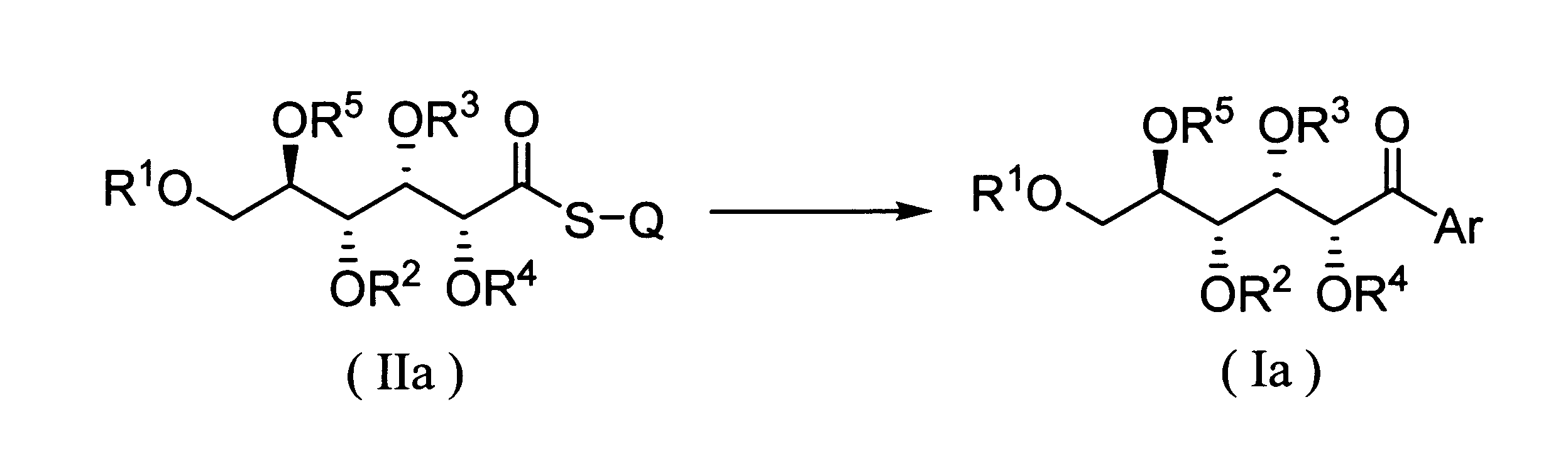
まず、化合物(IIa)を準備する。化合物(IIa)の準備工程の詳細は、工程(a-1)として後述する。
R5で表される水酸基保護基は、後述する式(IVa)の6員環化合物を効率的に形成する観点から、R1で表される水酸基保護基及びR2で表される水酸基保護基と異なる水酸基保護基であることが好ましい。すなわち、R5で表される水酸基保護基は、R1で表される水酸基保護基と同一の水酸基保護基及びR2で表される水酸基保護基と同一の水酸基保護基を除く範囲から選択されることが好ましい。R5で表される水酸基保護基が除去されると、水酸基が生じ、同一分子内のカルボニル基と反応して、式(IVa)の環が形成され得る。したがって、R1及びR2で表される水酸基保護基を保持しつつ、R5で表される水酸基保護基を選択的に除去できるように、R5で表される水酸基保護基の種類を選択することが好ましい。
R5で表される水酸基保護基は、エステル型保護基、アリールアルキル型保護基、アルキル型保護基、アリールアルキルオキシアルキル型保護基アリールアルキルアルキルオキシアルキル型保護基、シリル型保護基及びオキシカルボニル型保護基から選択されることが好ましく、エステル型保護基、アリールアルキルオキシアルキル型保護基アルキルオキシアルキル型保護基、シリル型保護基及びオキシカルボニル型保護基から選択されることがより好ましい。R5で表される水酸基保護基は、好ましくは、メチルオキシメチル基、ベンジルオキシメチル基、アセチル基、プロパノイル基、ブタノイル基、イソプロパノイル基、ピバロイル基、ベンゾイル基、4-ニトロベンゾイル基、4-メチルオキシベンゾイル基、4-メチルベンゾイル基、4-tert-ブチルベンゾイル基、4-フルオロベンゾイル基、4-クロロベンゾイル基、4-ブロモベンゾイル基、4-フェニルベンゾイル基、4-メチルオキシカルボニルベンゾイル基、ベンジル基、1-フェニルエチル基、ジフェニルメチル基、1,1-ジフェニルエチル基、ナフチルメチル基、メチル基、tert-ブチル基、トリメチルシリル基、トリエチルシリル基、tert-ブチルジメチルシリル基、tert-ブチルジフェニルシリル基、tert-ブチルオキシカルボニルオキシ基、ベンジルオキシカルボニル基であり、より好ましくはメチル基、ベンジル基、アセチル基、ピバロイル基、トリメチルシリル基、tert-ブチルジメチルシリル基又はtert-ブチルジフェニルシリル基である。
好ましい実施形態において、R5で表される水酸基保護基は、エステル型保護基であり、R1で表される水酸基保護基及びR2で表される水酸基保護基は、それぞれ独立して、アリールアルキル型保護基、アルキル型保護基、アリールアルキルオキシアルキル型保護基、アルキルオキシアルキル型保護基、シリル型保護基及びオキシカルボニル型保護基から選択される。より好ましい実施形態において、R5で表される水酸基保護基は、アセチル基又はピバロイル基であり、R1で表される水酸基保護基及びR2で表される水酸基保護基は、それぞれ独立して、メチル基、ベンジル基、トリメチルシリル基、tert-ブチルジメチルシリル基及びtert-ブチルジフェニルシリル基から選択される。
好ましい別の実施形態において、R5で表される水酸基保護基は、シリル型保護基であり、R1で表される水酸基保護基及びR2で表される水酸基保護基は、それぞれ独立して、エステル型保護基、アリールアルキル型保護基、アルキル型保護基、アリールアルキルオキシアルキル型保護基アルキルオキシアルキル型保護基、シリル型保護基及びオキシカルボニル型保護基アリールアルキルから選択される。より好ましい別の実施形態において、R5で表される水酸基保護基は、トリメチルシリル基、tert-ブチルジメチルシリル基及びtert-ブチルジフェニルシリル基から選択され、R1で表される水酸基保護基及びR2で表される水酸基保護基は、それぞれ独立して、メチル基、ベンジル基、アセチル基及びピバロイル基から選択される。
式(IVa)の6員環を効率的に形成する観点からは、R5で表される水酸基保護基は、R1、R2、R3及びR4で表される水酸基保護基と異なることが好ましい。
一実施形態において、R5で表される水酸基保護基は、エステル型保護基であり、R1、R2、R3及びR4で表される水酸基保護基は、それぞれ独立して、アリールアルキル型保護基、アルキル型保護基、アリールアルキルオキシアルキル型保護基、アルキルオキシアルキル型保護基、シリル型保護基及びオキシカルボニル型保護基から選択される。好ましい実施形態において、R5で表される水酸基保護基は、アセチル基又はピバロイル基であり、R1、R2、R3及びR4で表される水酸基保護基は、それぞれ独立して、メチル基、ベンジル基、トリメチルシリル基、tert-ブチルジメチルシリル基及びtert-ブチルジフェニルシリル基から選択される。
好ましい別の実施形態において、R5で表される水酸基保護基は、シリル型保護基であり、R1、R2、R3及びR4で表される水酸基保護基は、それぞれ独立して、アリールアルキルオキシアルキル型保護基、アルキルオキシアルキル型保護基及びオキシカルボニル型保護基アリールアルキルから選択される。好ましい別の実施形態において、R5で表される水酸基保護基は、トリメチルシリル基、tert-ブチルジメチルシリル基又はtert-ブチルジフェニルシリル基であり、R1、R2、R3及びR4で表される水酸基保護基は、それぞれ独立して、メチル基、ベンジル基、アセチル基及びピバロイル基から選択される。
化合物(II)として化合物(IIa)を使用する場合、工程(a)において化合物(Ia)を得た後、工程(b)を実施し、下記式(IVa)で表される化合物(IVa)を製造することが好ましい。
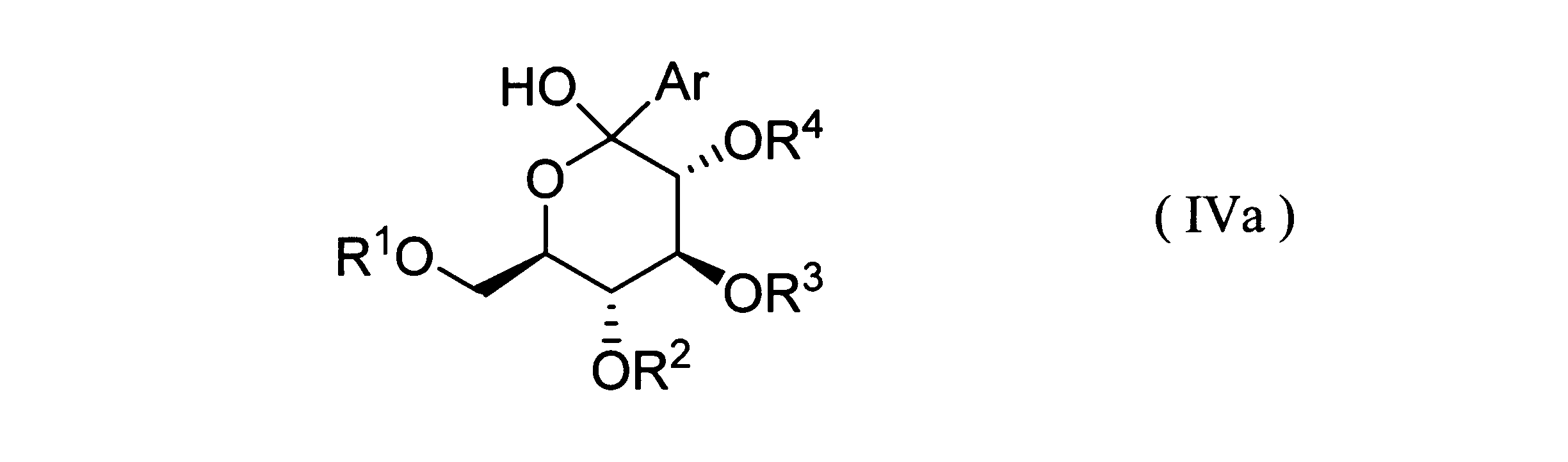
工程(b)は、化合物(Ia)からR5で表される水酸基保護基を除去して、化合物(IVa)を得る工程である。反応スキームは、下記式の通りである。
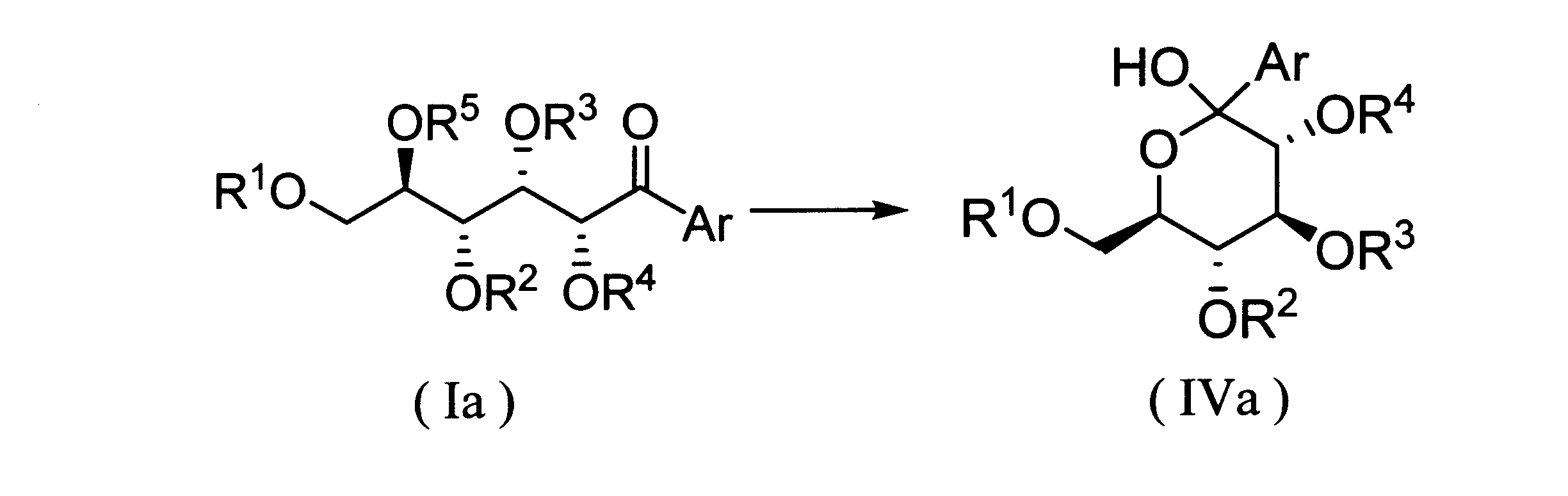
R5で表される水酸基保護基は、水酸基保護基の種類に応じて、Peter G.M. Wuts著、「プロテクティブ・グループ・イン・オーガニック・シンセシス(“Protective Group in Organic Synthesis”)第5版」(JOHN WILEY&SONS出版)等に記載の公知の手法によって除去することができる。典型的な手法としては、化合物(Ia)と酸性試薬又は塩基性試薬とを不活性溶媒中で反応させてR5で表される水酸基保護基を除去する方法が挙げられる。
酸性試薬としては、例えば、塩酸、硫酸、硝酸、酢酸、臭化水素等の無機酸、トリフルオロ酢酸、トリクロロ酢酸、p-トルエンスルホン酸、ギ酸、フタル酸等の有機酸が挙げられる。塩基性試薬としては、例えば、テトラ-n-ブチルアンモニウムフルオリド、アンモニウムフルオリド、アンモニウムバイフルオリド、フッ化水素酸等のフッ化物、炭酸カリウム、水酸化リチウム、水酸化ナトリウム、水酸化カリウム、ナトリウムメチルオキシド、ナトリウムエチルオキシド、アンモニア水等が挙げられる。
酸性試薬の使用量は、化合物(Ia)1当量に対して通常0.1~1000当量、好ましくは1~5当量である。塩基性試薬の使用量は、化合物(Ia)1当量に対して通常0.001~10当量、好ましくは0.01~2当量である。
工程(b)において使用される溶媒としては、好ましくは有機溶媒であり、例えば、メタノール、エタノール、イソプロパノール、ブタノール等の極性プロトン性溶媒;アセトニトリル、プロピオニトリル、THF、2-メチル-テトラヒドロフラン、1,4-ジオキサン、tert-ブチルメチルエーテル、ジイソプロピルエーテル、ジメチルオキシエタン、ジグライム、アセトン、メチルエチルケトン、ジエチルケトン、酢酸メチル、酢酸エチル、酢酸ブチル等の極性非プロトン性溶媒:塩化メチレン、クロロホルム、四塩化炭素、1,2-ジクロロエタン、クロロベンゼン、トルエン、キシレン、ヘキサン、ヘプタン等の無極性溶媒等が挙げられる。溶媒は、1種を単独で使用してもよいし、2種以上を組み合わせて混合溶媒として使用してもよい。溶媒は、好ましくは、メタノール、エタノール、イソプロパノール又はそれらの混合溶媒である。
工程(b)において使用される溶媒の量は、化合物(Ia)に対して通常1~1000倍の容量、好ましくは1~100倍の容量である。
工程(b)において、反応温度は、通常-30~100℃、好ましくは0~100℃、より好ましくは0~40℃、より一層好ましくは0~50℃である。このようなマイルドな温度条件を採用して化合物(IVa)を取得できることは、温度管理に関連した設備コストを抑制して工業生産を実施する上で好ましい。
以下、化合物(IIa)の準備工程である工程(a-1)について説明する。
工程(a-1)の反応スキームは、下記式の通りである。
工程(a-1)の反応スキームは、下記式の通りである。
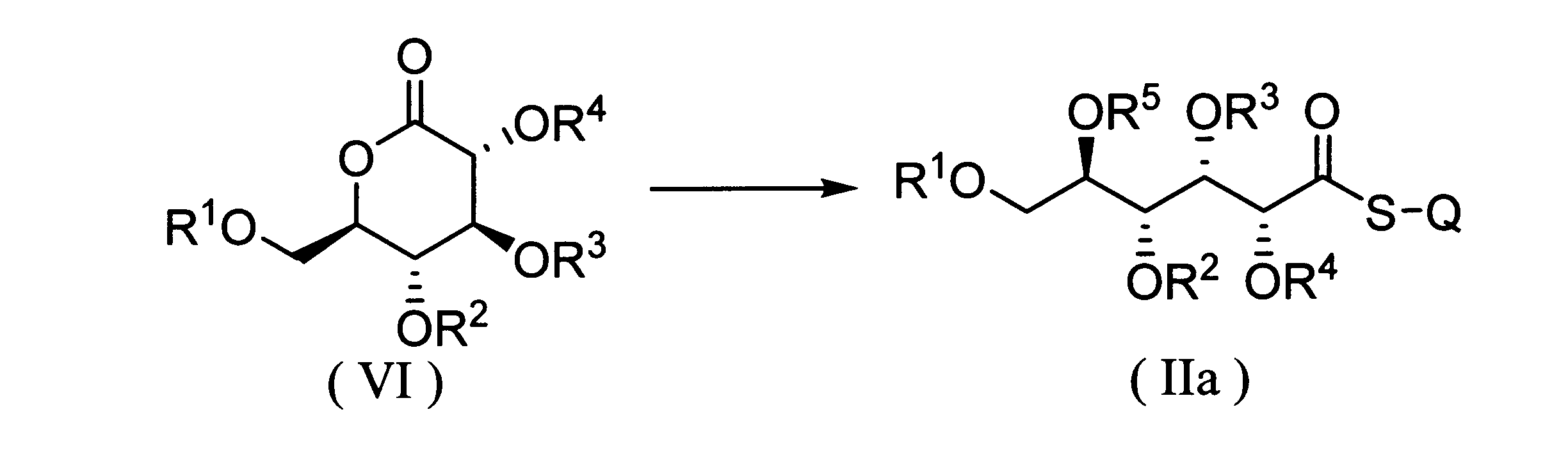
化合物(IVa)の製造方法において、出発原料として使用される化合物(IIa)は、市販品であってもよいし、工程(a-1)に従って製造してもよい。
工程(a-1)は、以下の工程(a-1-1)及び工程(a-1-2)を含む。
工程(a-1-1)は、下記式(VI):
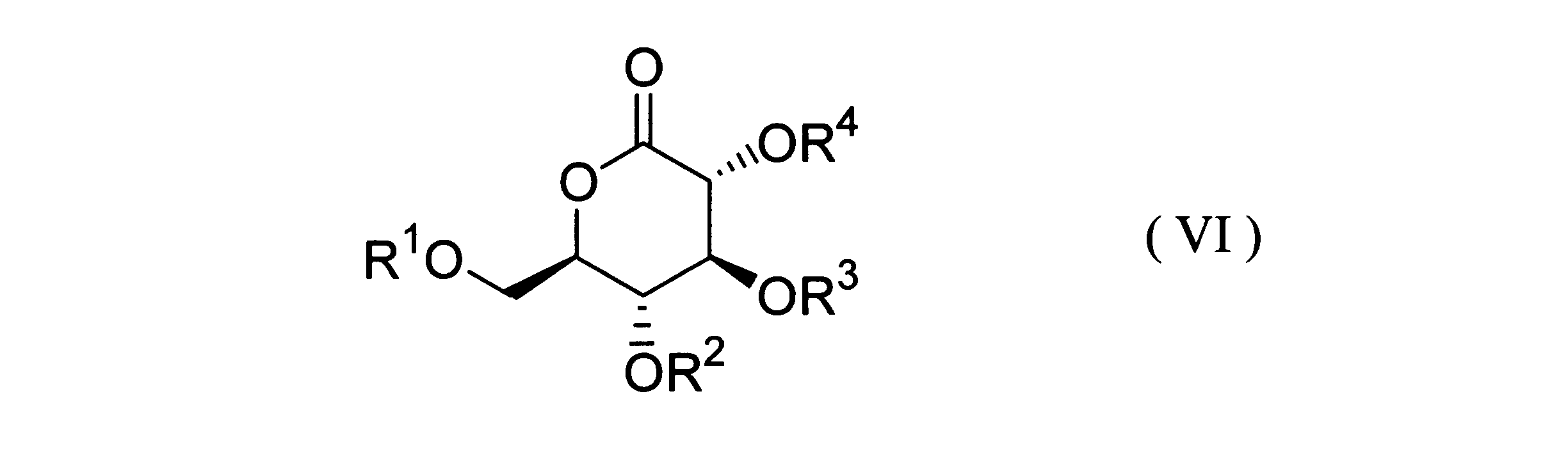
で表される化合物(VI)と、
下記式(VII):

で表される化合物(VII)とを反応させて、下記式(VIII):
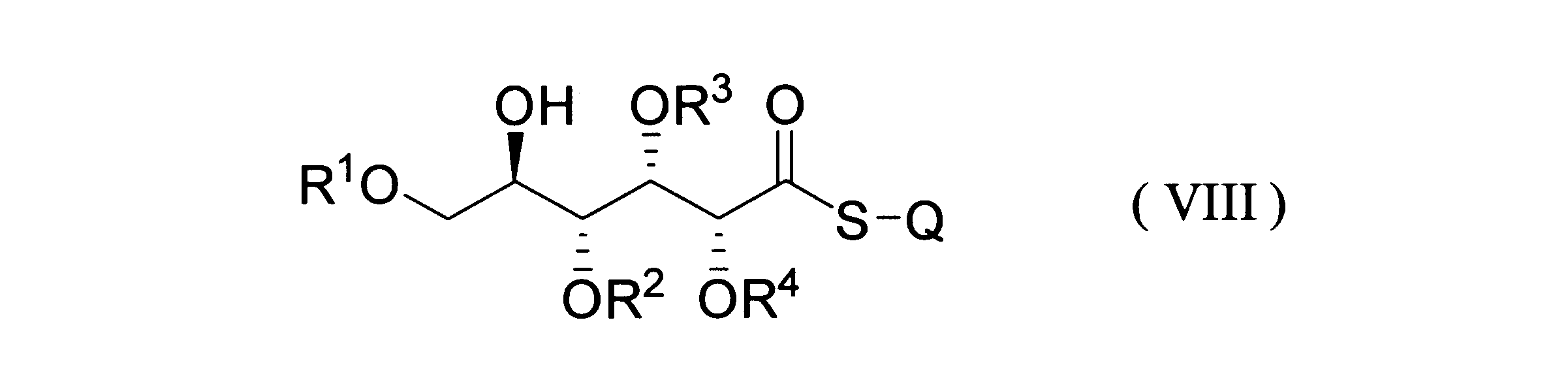
で表される化合物(VIII)を得る工程である。
下記式(VII):
工程(a-1-1)の反応スキームは、下記式の通りである。
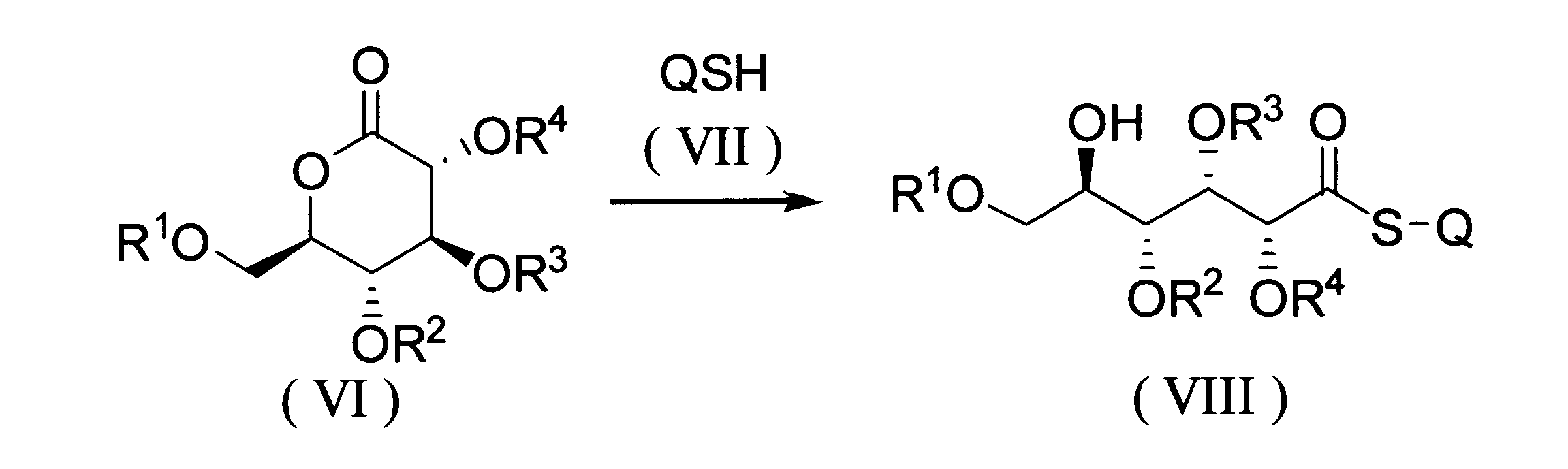
工程(a-1-1)では、化合物(VI)と、化合物(VII)とを反応させて化合物(VIII)を得る。工程(a-1-1)において出発物質として使用される化合物(VI)は、例えば、非特許文献1、非特許文献2等に記載の公知の方法又は後述する例1に記載の方法に従って製造することができる。化合物(VI)は、市販品であってもよい。化合物(VII)は、公知の手法に従って製造することができる。化合物(VII)として、市販の有機チオール化合物を使用してもよい。
化合物(VII)の使用量は、例えば、化合物(VI)1当量に対して通常1~10当量、好ましくは1~5当量である。
化合物(VI)と化合物(VII)との反応条件は、化合物(VIII)を取得しうる限り特に限定されないが、下記式(IX)で表される化合物(IX)の存在下で実施することが好ましい。化合物(IX)は、公知の手法に従って製造することができる。化合物(IX)として、市販のアルミニウム触媒を使用してもよい。

式(IX)において、Rc及びRdは、それぞれ独立して、ハロゲン原子、脂肪族炭化水素基、芳香族炭化水素環基、脂肪族複素環基及び芳香族複素環基からなる群から選択される官能基を表し、前記群に含まれる脂肪族炭化水素基、芳香族炭化水素環基、脂肪族複素環基及び芳香族複素環基は各々、1個以上の置換基を有していてもよい。
好ましい実施形態において、Rc及びRdは、それぞれ独立して、アルキル基、アリール基及びアリールアルキル基からなる群から選択される官能基を表し、前記群に含まれるアルキル基、アリール基及びアリールアルキル基は各々、1個以上の置換基を有していてもよい。Rc及びRdは、それぞれ独立して、炭素数1~20のアルキル基、炭素数6~20のアリール基及び炭素数7~20のアリールアルキル基からなる群から選択されることが好ましく、炭素数1~10のアルキル基から選択されることがより好ましく、メチル基、エチル基及びプロピル基から選択されることがより一層好ましい。Rcで表される官能基及びRdで表される官能基は、同一であってもよいし、異なっていてもよいが、同一であることが好ましい。
式(IX)において、qは0~3の整数を表し、rは0~3の整数を表す。ただし、q+r=3である。好ましい実施形態において、q又はrの一方は0を表し、他方は3を表す。
工程(a-1-1)において、化合物(IX)の使用量は、化合物(VI)1当量に対して通常1~5当量、好ましくは3~5当量である。
工程(a-1-1)において使用される溶媒としては、好ましくは有機溶媒であり、例えば、アセトニトリル、プロピオニトリル、THF、2-メチル-テトラヒドロフラン、1,4-ジオキサン、tert-ブチルメチルエーテル、ジイソプロピルエーテル、ジメチルオキシエタン、ジグライム、アセトン、メチルエチルケトン、ジエチルケトン、酢酸メチル、酢酸エチル、酢酸ブチル等の極性非プロトン性溶媒;塩化メチレン、クロロホルム、四塩化炭素、1,2-ジクロロエタン、クロロベンゼン、トルエン、キシレン、ヘキサン、ヘプタン等の無極性溶媒等が挙げられる。溶媒は、1種を単独で使用してもよいし、2種以上を組み合わせて混合溶媒として使用してもよい。溶媒は、好ましくは、塩化メチレン、トルエン、ヘキサン又はそれらの混合溶媒であり、より好ましくは、塩化メチレンである。
工程(a-1-1)において使用される溶媒の量は、化合物(VI)に対して通常1~1000倍の容量、好ましくは1~100倍の容量である。
工程(a-1-1)において、反応温度は、通常-30~80℃、好ましくは-10~40℃、より好ましくは0~40℃である。本工程において比較的マイルドな温度条件を採用できることは、温度管理に関連した設備コストを抑制する観点から好ましい。
工程(a-1-1)においては、水、HCl水溶液、塩化アンモニウム水溶液等を使用してアルミニウム触媒反応を終了させ、触媒の除去を簡便に実施することができる。
工程(a-1-1)において化合物(VIII)を得た後、次の工程(a-1-2)は、出来る限り速やかに行うことが好ましく、このために、工程(a-1-1)及び工程(a-1-2)を同じ反応系で実施することが好ましい。工程(a-1-1)から速やかに工程(a-1-2)に移行することは、化合物(VIII)の閉環反応により化合物(VI)が再度生成することを防止する上で有利である。
工程(a-1-2)は、化合物(VIII)における水酸基を、R5で表される水酸基保護基で保護し、化合物(IIa)を得る工程である。工程(a-1-2)の反応スキームは、下記式の通りである。
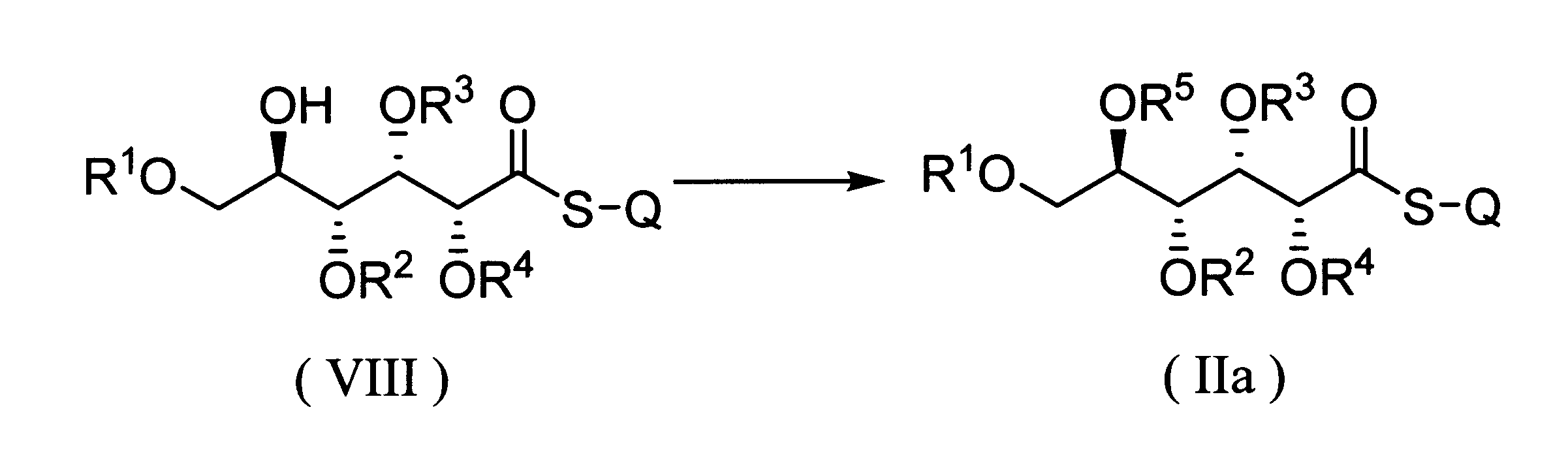
工程(a-1-2)では、下記式(VIII)で表される化合物(VIII)における水酸基を、R5で表される水酸基保護基で保護して、化合物(II)を得る。

化合物(VIII)における水酸基に対するR5基の導入は、特に限定されず、R5で表される水酸基保護基の種類に応じて、Peter G.M. Wuts著、「プロテクティブ・グループ・イン・オーガニック・シンセシス(“Protective Group in Organic Synthesis”)第5版」(JOHN WILEY&SONS出版)等に記載の公知の手法によって実施することができる。典型的な手法としては、化合物(VIII)と保護基導入試薬とを酸又は塩基性試薬の存在下、不活性溶媒中で反応させてR5を導入する方法が挙げられる。
保護基導入試薬は、R5の種類に応じて適宜決定することができるが、例えば、無水酢酸、無水ピバリン酸、アセチルクロリド、ピバロイルクロリド等のエステル型保護基導入剤;臭化ベンジル等のアリールアルキルエーテル型保護基導入剤;ヨードメタン等のアルキルエーテル型保護基導入剤;トリメチルシリルクロリド、トリイソプロピルシリルクロリド、tert-ブチルジメチルシリルクロリド、tert-ブチルジフェニルシリルクロリド等のシリル型保護基導入剤ビス(tert-ブチルオキシカルボニルオキシ)オキシド等のオキシカルボニル型保護基等が挙げられるが、好ましくは無水酢酸、無水ピバリン酸、アセチルクロリド、ピバロイルクロリド等のエステル型保護基導入剤であり、より好ましくは無水酢酸である。
酸性試薬としては、例えば、酢酸、臭化水素等の無機酸、p-トルエンスルホン酸、フタル酸等の有機酸等が挙げられる。塩基性試薬としては、特に限定されないが、トリエチルアミン、4-ジメチルアミノピリジン(DMAP)、ジアザビシクロウンデセン(DBU)及びジエチルアニリン等の有機アミン等が挙げられるが、好ましくはトリエチルアミン、4-ジメチルアミノピリジン(DMAP)又はそれらの混合物である。
酸性試薬の使用量は、特に限定されないが、化合物(VIII)1当量に対して通常0.1~1000当量、好ましくは1~5当量である。また、塩基性試薬の使用量は、特に限定されないが、化合物(VIII)1当量に対して通常0.001~10当量、好ましくは0.01~2当量である。
工程(a-1-2)において使用される溶媒としては、好ましくは有機溶媒であり、例えば、アセトニトリル、プロピオニトリル、THF、2-メチル-テトラヒドロフラン、1,4-ジオキサン、tert-ブチルメチルエーテル、ジイソプロピルエーテル、ジメチルオキシエタン、ジグライム、アセトン、メチルエチルケトン、ジエチルケトン、酢酸メチル、酢酸エチル、酢酸ブチル等の極性非プロトン性溶媒;塩化メチレン、クロロホルム、四塩化炭素、1,2-ジクロロエタン、クロロベンゼン、トルエン、キシレン、ヘキサン、ヘプタン等の無極性溶媒等が挙げられる。溶媒は、1種を単独で使用してもよいし、2種以上を組み合わせて混合溶媒として使用してもよい。溶媒は、好ましくは塩化メチレン、トルエン又はそれらの混合溶媒である。
工程(a-1-2)において使用される溶媒の量は、特に限定されないが、化合物(VIII)に対して通常1~1000倍の容量、好ましくは1~100倍の容量である。
工程(a-1-2)において、反応温度は、特に限定されないが、通常-30~100℃、好ましくは-30~40℃、より好ましくは-10~40℃、より一層好ましくは0~30℃である。本工程においても比較的マイルドな温度条件を採用することは、化合物(VIII)から化合物(VI)への戻りの反応を抑制する上で有利である。また、本工程においても比較的マイルドな温度条件を採用できることは、温度管理に関連した設備コストを抑制して工業生産を実施する上で好ましい。
<β-C-アリールグリコシド誘導体(化合物(XI))の製造工程>
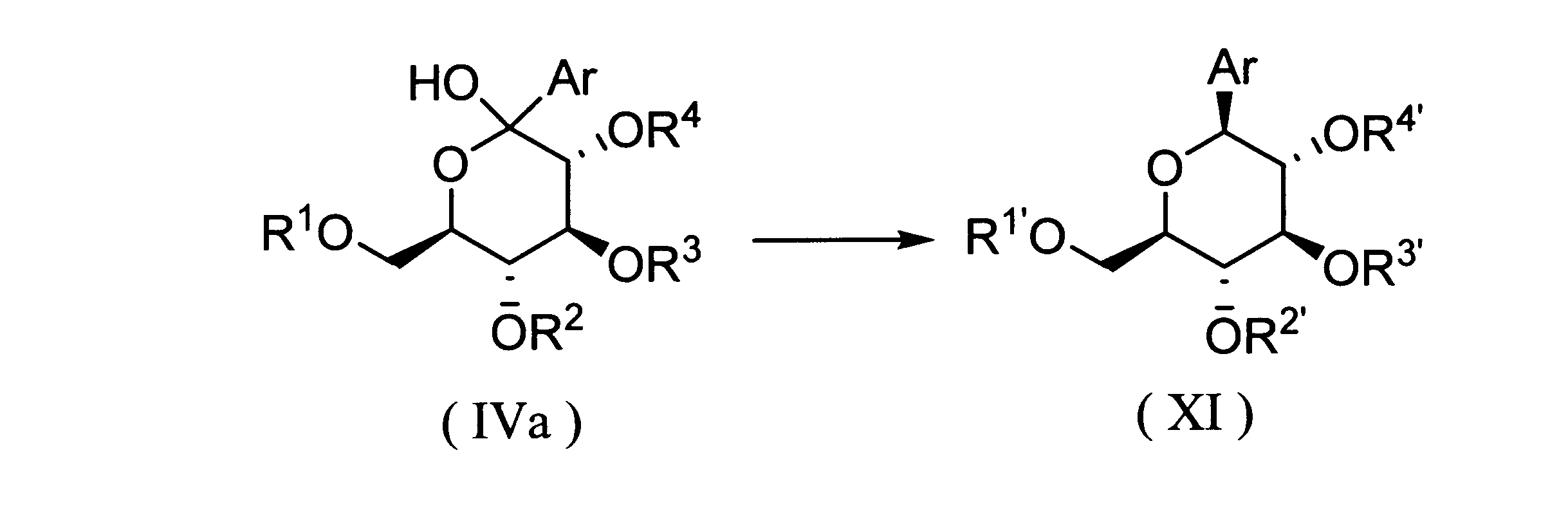
化合物(IVa)は、下記式(XI)で表わされる化合物(XI)、すなわちβ-C-アリールグリコシド誘導体の製造原料として有利に使用することができる。
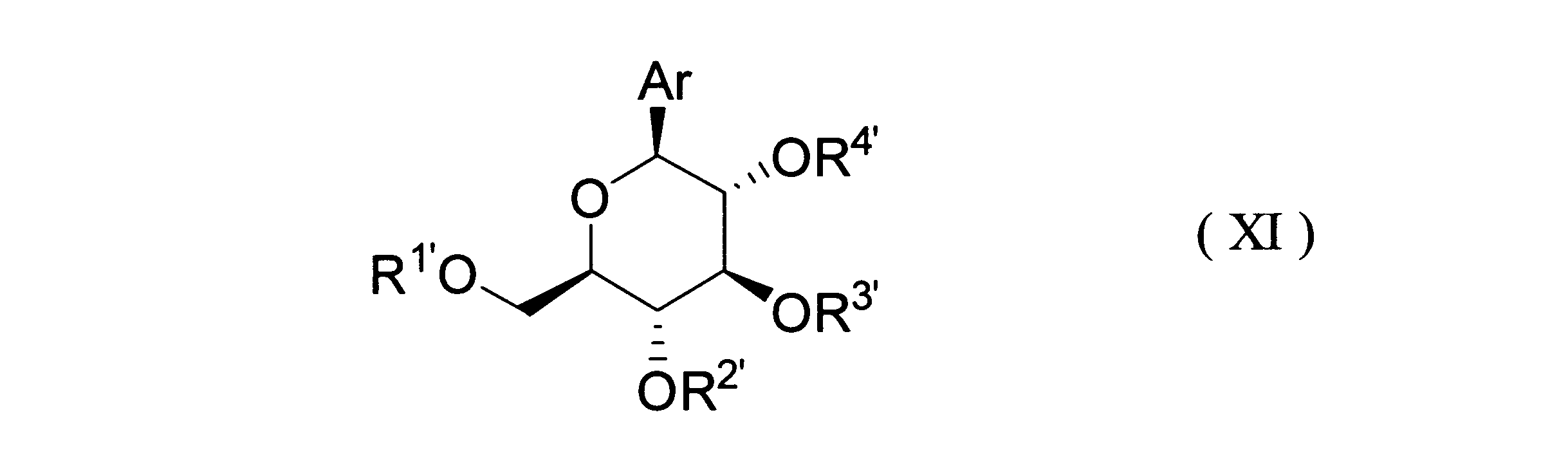
化合物(IVa)から化合物(XI)への反応は、公知の還元反応を用いることが可能である。具体的には、還元方法としては、三フッ化ホウ素ジエチルエーテル錯体(BF3・OEt2)の存在下でトリエチルシランを用いて化合物(I)を還元する方法や、トリエチルシラン、トリイソプロピルシラン、テトラメチルジシロキサン等のシラン化合物の存在下、BF3・OEt2、三フッ化ホウ素テトラヒドロフラン(BF3・THF)、塩化アルミニウム等のルイス酸と化合物(I)とを反応させる方法等が挙げられる。
得られた化合物(XI)は、そのまま、あるいはR1’、R2’、R3’又はR4’が水酸基保護基の場合、所望によりPeter G.M. Wuts著、「プロテクティブ・グループ・イン・オーガニック・シンセシス(“Protective Group in Organic Synthesis”)第5版」(JOHN WILEY&SONS出版)等に記載の公知の方法で脱保護して、β-C-アリールグリコシド誘導体として使用することができる。
<化合物(IIa)の用途/製造中間体>
化合物(IIa)を製造中間体として使用して化合物(IVa)を製造し、さらにSGLT2阻害剤自体又はその合成中間体に当たる化合物(XI)に変換することができる。したがって、化合物(IIa)は、化合物(XI)の製造のための試薬又は中間体として好適に適用することができる。
化合物(IIa)を製造中間体として使用して化合物(IVa)を製造し、さらにSGLT2阻害剤自体又はその合成中間体に当たる化合物(XI)に変換することができる。したがって、化合物(IIa)は、化合物(XI)の製造のための試薬又は中間体として好適に適用することができる。
したがって、本発明の好ましい態様によれば、化合物(IIa)を含んでなる、化合物(XI)を製造するための試薬が提供される。また、本発明の好ましい態様によれば、前記試薬において、式(XI)におけるArは式(V)又は(Va)で表されるものである。
また、本発明の別の態様によれば、化合物(XI)の製造中間体としての、化合物(IIa)の使用が提供される。また、本発明の好ましい態様によれば、前記使用において、式(XI)におけるArは式(V)又は(Va)で表されるものである。
以下、本発明の実施例を説明するが、本発明はこれら実施例に限定されるものではない。
例1:化合物(2)((3R,4S,5R,6R)-3,4,5-トリス(ベンジルオキシ)-6-(ベンジルオキシメチル)テトラヒドロ-2H-ピラン-2-オン)の製造

ジメチルスルホキシド(25mL)中に化合物(1)(2,3,4,6-テトラ-O-ベンジル-D-グルコピラノース;5.0g、9.24mmol)を含有する溶液をアルゴン雰囲気下、20~25℃で30分間撹拌した。この反応混合液に対して25℃にて無水酢酸(15mL)を5分かけて添加した。添加が完了した後、得られた反応混合液を薄層クロマトグラフィー(TLC)分析によってモニターしながら、20~25℃で20時間撹拌した。次に、反応混合液をトルエン(100mL)で希釈し、得られた希釈液に1N HCl水溶液(120mL)を加えて過剰の無水酢酸をクエンチした。得られた反応混合液を20~25℃で20分間撹拌した後、相分離した。得られた有機相を1M NaHCO3水溶液(3×50mL)で洗浄した。さらに有機相を水(15mL)及び食塩水(15mL)で洗浄し、次いで無水Na2SO4で乾燥させ、濾過し、減圧濃縮した。得られた粗生成物をシリカゲルカラムクロマトグラフィー(酢酸エチル/ヘキサン=2/20~3/20)により精製し、無色油状物として化合物(2)(3R,4S,5R,6R)-3,4,5-トリス(ベンジルオキシ)-6-(ベンジルオキシメチル)テトラヒドロ-2H-ピラン-2-オン;4.8g、収率96%)を得た。
化合物(2)
IR(KBr):νmax=3030,2868,1754,1496,1363,1164,1097,737,698cm-1
1H NMR(400MHz,CDCl3)δ:7.39-7.16(m,20H),4.97(d,J=11.4Hz,1H),4.73-4.44(m,8H),4.12(d,J=6.3Hz,1H),3.96-3.89(m,2H),3.73-3.64(m,2H)
13C NMR(101MHz,CDCl3)δ:169.38,137.71,137.64,137.63,137.06,128.57,128.53,128.48,128.19,128.09,128.07,128.02,127.91,81.06,78.26,77.51,76.20,73.98,73.80,73.78,73.66,68.40
HRMS[M+H]+ C34H35O6 計算値539.2428;実測値:539.2420
質量分析[M+H]+:539
例2:化合物(3)((2R,3S,4R,5R)-S-デシル2,3,4,6-テトラキス(ベンゾイルオキシ)-5-ヒドロキシヘキサンチオエート)の製造
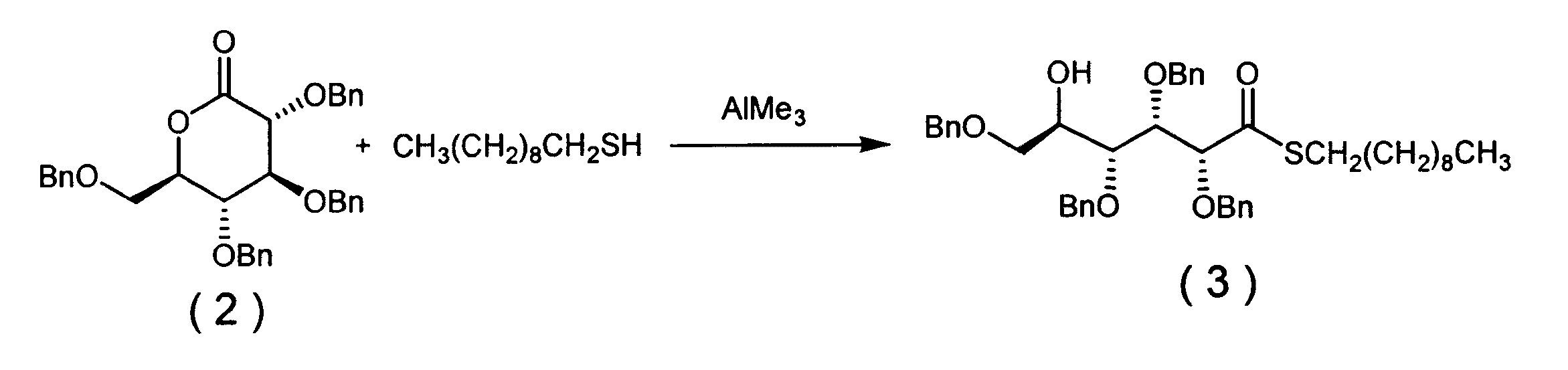
0℃に冷却した無水CH2Cl2(10mL)中にデカンチオール(0.72g、4.1mmol)を含有する溶液に、トリメチルアルミニウム(1Mトルエン溶液;4.1mL、4.1mmol)を10分間かけて滴下し、20分間撹拌した。次に、得られた反応混合液に対して、無水CH2Cl2(12mL)中に化合物(2)(2g、3.71mmol)を含有する溶液を10分間かけてゆっくりと加え、1時間撹拌した。得られた反応混合液をCH2Cl2(20mL)で希釈して氷冷水(20mL)を含む250mLビーカーに加え、さらに1N HCl水溶液(10mL)を撹拌しながらゆっくりビーカーに注ぎ、相分離を行った。得られた水相は冷CH2Cl2(3×30mL)で抽出した。有機抽出物を合わせた有機相は、水及び食塩水で洗浄し、Na2SO4で乾燥させ、溶離液としてCH2Cl2を使用したフラッシュシリカカラムにより濾過し、化合物(3)((2R,3S,4R,5R)-S-デシル2,3,4,6-テトラキス(ベンゾイルオキシ)-5-ヒドロキシヘキサンチオエート)の粗生成物を得た。その後、得られた化合物(3)の粗生成物は精製せずに、次の工程に用いた。
例3:化合物(4)((2R,3R,4S,5R)-1,3,4,5-テトラキス(ベンゾイルオキシ)-6-(デシルチオ)-6-オキソヘキサン-2-イルアセテート)の製造
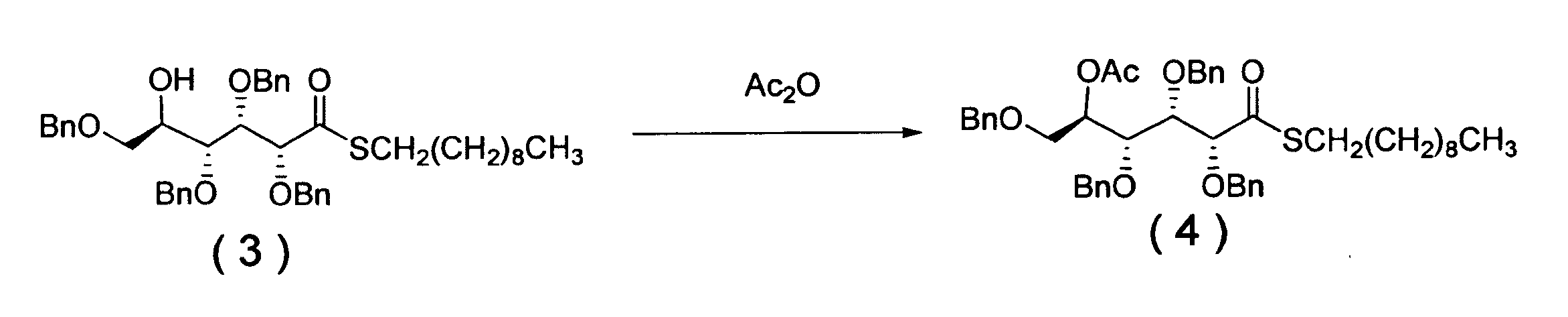
アルゴン雰囲気下、0℃に冷却した無水CH2Cl2中に化合物(3)の粗生成物(2.8g、3.71mmol)を含有する溶液に対して、無水酢酸(Ac2O;0.88mL、9.5mmol)を添加し、さらにDMAP(9mg、2mol%)を添加した。5分後、得られた混合液にトリエチルアミン(1.32mL、9.5mmol)を添加し、アルゴン雰囲気下で4時間撹拌した。得られた反応混合液を水(30mL)でクエンチし、有機相をCH2Cl2(3×30mL)で抽出した。有機抽出物を合わせた有機相は、水(30mL)及び食塩水(30mL)で洗浄し、無水Na2SO4で乾燥し、濃縮した。得られた粗生成物をシリカクロマトグラフィー(酢酸エチル/ヘキサン=1/20~2/20)で精製し、無色液体として化合物(4)((2R,3R,4S,5R)-1,3,4,5-テトラキス(ベンゾイルオキシ)-6-(デシルチオ)-6-オキソヘキサン-2-イルアセテート;2.6g、化合物(2)を基準として収率92%)を得た。
化合物(4)
IR (KBr):νmax=3063,3031,2926,2860,1745,1676,1452,1375,1244,1093,1069,745,696cm-1
1H-NMR(400MHz,CDCl3)δ:7.40(d,J=6.5Hz,2H),7.36-7.15(m,18H),5.15(q,J=4.3Hz,1H),4.79(d,J=10.8Hz,1H),4.71(d,J=11.4Hz,1H),4.65-4.39(m,6H),4.25(d,J=4.3Hz,1H),4.01-3.95(m,2H),3.82(dd,J=10.6,4.1Hz,1H),3.65(dd,J=10.6,5.7Hz,1H),2.84(t,J=7.4Hz,2H),1.96(s,3H),1.55(p,J=7.3Hz,2H),1.41-1.18(m,15H),0.88(t,J=6.7Hz,3H)
13C-NMR(101MHz,CDCl3)δ:201.90,170.02,138.51,138.08,137.98,137.08,128.65,128.43,128.39,128.36,128.25,128.17,128.04,127.97,127.80,127.71,127.59,127.53,85.28,80.31,78.45,75.71,74.67,74.53,73.23,72.91,68.06,31.95,29.61,29.55,29.36,29.20,29.05,28.39,22.74,21.11,14.18
HRMS [M+H]+ C46H59O7S 計算値755.3981;実測値:755.3976
質量分析[M+H]+:755
例4:CuI及びPMDEA存在下のカップリング反応
化合物(5)((2R,3R,4S,5R)-1,3,4,5-テトラキス(ベンゾイルオキシ)-6-オキソ-6-フェニルヘキサン-2-イルアセテート)の製造
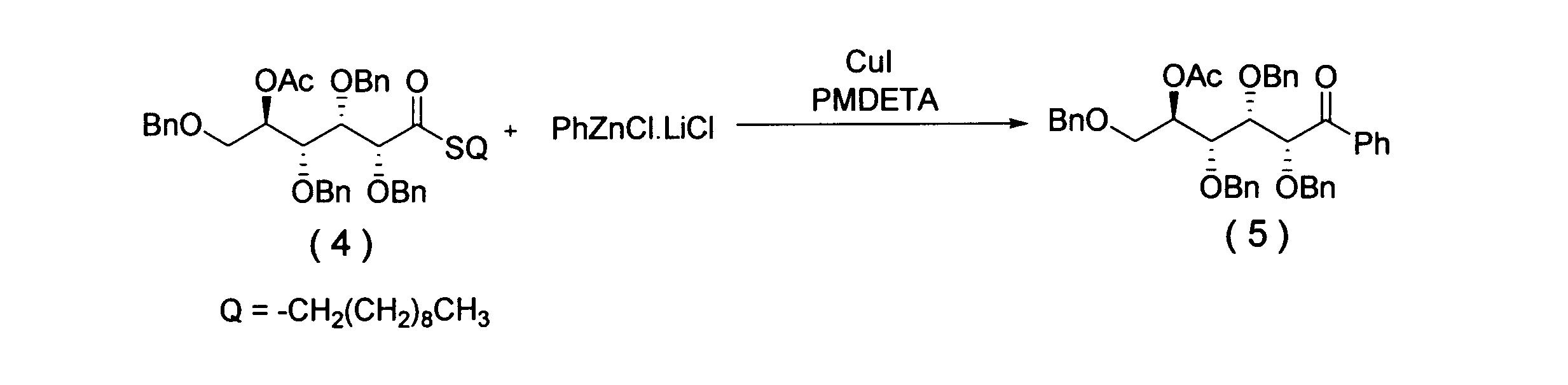
化合物(5)((2R,3R,4S,5R)-1,3,4,5-テトラキス(ベンゾイルオキシ)-6-オキソ-6-フェニルヘキサン-2-イルアセテート)の製造
ホットオーブンで乾燥したSchlenk管に、アルゴン雰囲気下、化合物(4)(0.25mmol、190mg)を入れ、続いてCuI(0.0125mmol、3mg)、PMDETA(0.0125mmol、3mg)およびTHF(2mL)を入れた。得られた反応混合液を5分間撹拌し、続いて有機亜鉛化合物と塩化リチウムとの複合体PhZnCl・LiCl(0.375mmol、3mL)のTHF溶液(0.125M)を注射器で添加した。得られた反応混合液を40℃で12時間撹拌した。その後、反応混合液を水(1mL)でクエンチし、セライトパッドにより濾過し、酢酸エチル(3×30mL)で抽出した。得られた有機抽出物を水および食塩水で洗浄し、無水Na2SO4で乾燥させ、濃縮した。得られた粗生成物をシリカゲルカラムクロマトグラフィー(酢酸エチル/ヘキサン=1/20~2/20)で精製し、化合物(5)((2R,3R,4S,5R)-1,3,4,5-テトラキス(ベンゾイルオキシ)-6-オキソ-6-フェニルヘキサン-2-イルアセテート;121mg、0.182mmol、73%)を得た。また、化合物(5)の他、未反応の化合物(4)(46mg、0.06mmol、24%)及び副生成物ビフェニルPh-Ph(7mg、0.045mmol、24%)を得た。
例5:化合物(6)(2,3,4,6-テトラ-O-ベンジル-1C-フェニルグルコース)の製造
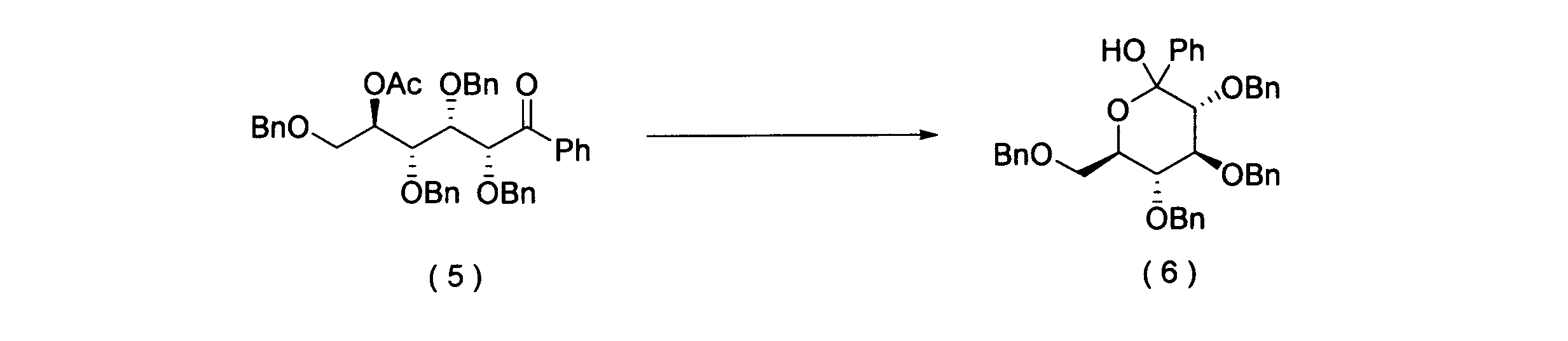
ホットオーブンで乾燥したSchlenk管に、アルゴン雰囲気下、化合物(5)(0.2mmol、132mg)を入れ、続いてナトリウムメトキシド(0.02mmol、1mg)及びメタノール(2mL)を入れた。得られた反応混合液を25℃で6時間撹拌した。その後、反応混合液をシリカ層で濾過し、メタノール(3×20mL)で洗浄した。次に、得られた溶液を減圧濃縮して粗生成物を得た。粗生成物はシリカゲルカラムクロマトグラフィー(酢酸エチル/ヘキサン=4/20~8/20)で精製し、無色液体として化合物(6)(2,3,4,6-テトラ-O-ベンジル-1C-フェニルグルコース;112mg、0.182mmol、収率91%)を得た。
化合物(6)
IR(KBr):νmax=3411,3027,2923,1590,1494,1452,1361,1212,1093,734,696cm-1
1H-NMR(400MHz,CDCl3)δ:7.64(d,J=7.0Hz,2H),7.38-7.13(m,21H),6.97(d,J=6.1Hz,2H),4.95-4.81(m,3H),4.69-4.56(m,2H),4.51(d,J=12.3Hz,1H),4.38(d,J=10.4Hz,1H),4.17(d,J=8.2Hz,1H),4.07(t,J=9.2Hz,1H),3.84-3.79(m,3H),3.70(d,J=10.9Hz,1H),3.53(d,J=9.4Hz,1H),3.34(s,1H)
13C-NMR(101MHz,CDCl3)δ:142.47,138.85,138.58,138.45,137.59,128.61,128.47,128.42,128.26,128.23,128.03,127.79,127.75,127.69,127.62,127.58,126.36,98.00,85.28,83.59,78.53,75.75,75.53,75.08,73.38,72.15,69.12
HRMS [M-H]-:C40H39O6 計算値615.2747;実測値:615.2743
質量分析[M-H]-:615
例6:化合物(7)(3R,4S、5R-トリベンジルオキシ-6R-ベンジルオキシメチル-6S-フェニルテトラヒドロピラン)の製造
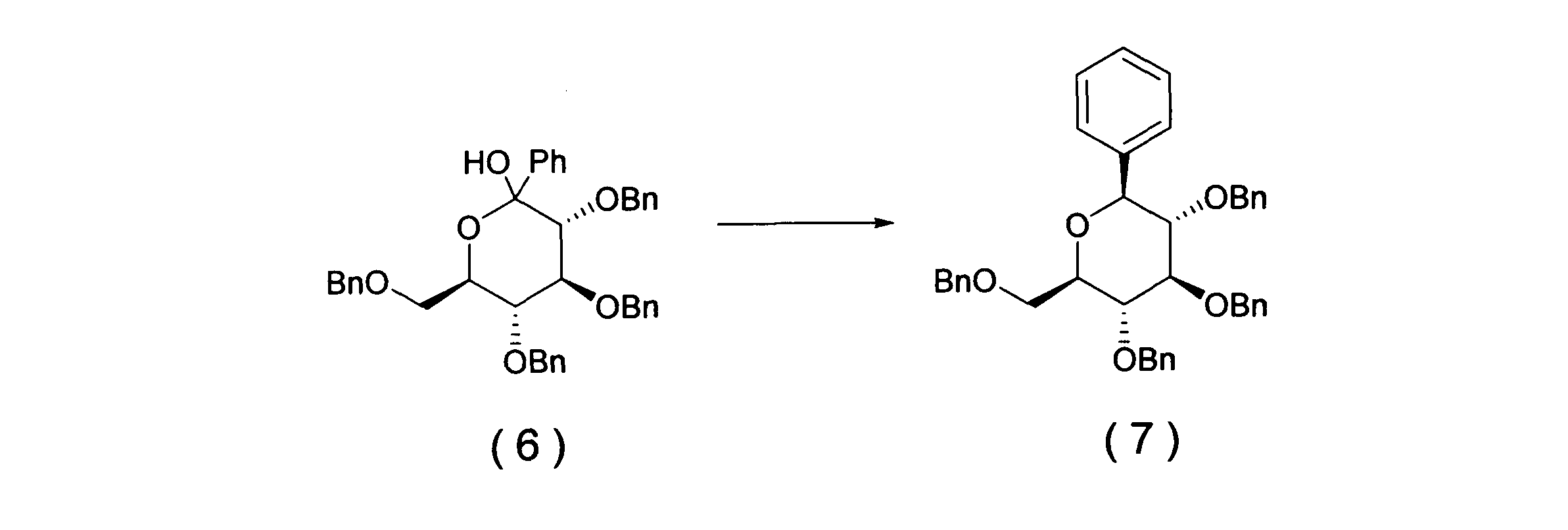
例1で得られた化合物(6)(200mg、0.32mmol)のアセトニトリル溶液(3mL)にトリエチルシラン(76mg、0.65mmol)を加えた。得られた溶液をドライアイス/アセトンバスで-40℃まで冷却後、三フッ化ホウ素・エーテル錯体(70mg、0.49mmol)の塩化メチレン(1mL)溶液を加えて-40~-30℃で3時間撹拌した。
反応液をHPLC分析したところ、化合物(6)は完全に消費され、化合物(7)のピークが確認された。
反応液に水(20mL)を加え、生成物を酢酸エチル(5mL×4)で抽出した。有機抽出物を合わせて減圧濃縮した。濃縮液をシリカゲルカラム(展開溶媒:ヘキサン/酢酸エチル=10/1)で精製して化合物(7)(3R,4S、5R-トリベンジルオキシ-6R-ベンジルオキシメチル-6S-フェニルテトラヒドロピラン;110mg、収率56%)を得た。化合物(7)の異性体比は、β:α=82/18であった。
HPLC条件:
測定波長:210nm
流速:1.0mL/min
移動相:アセトニトリル:水=90/10→100/0(0→10、20min)
カラム温度:20℃
充填剤:X Bridge、C18、5mm、4.8mmx150mm)
保持時間:β体 5.64min; α体 5.31min
測定波長:210nm
流速:1.0mL/min
移動相:アセトニトリル:水=90/10→100/0(0→10、20min)
カラム温度:20℃
充填剤:X Bridge、C18、5mm、4.8mmx150mm)
保持時間:β体 5.64min; α体 5.31min
化合物(7)
1H-NMR(CDCl3)δ:3.50-3.55(m,1H),3.60-3.61(m,1H),3.73-3.82(m,5H),4.25(d,J=9.3Hz,1H),4.36(d,J=10.3Hz,1H),4.55-4.68(m,3H),4.86-4.98(m,3H),6.91-6.93(m,2H),7.14-7.53(m,23H)
1H-NMR(CDCl3)δ:3.50-3.55(m,1H),3.60-3.61(m,1H),3.73-3.82(m,5H),4.25(d,J=9.3Hz,1H),4.36(d,J=10.3Hz,1H),4.55-4.68(m,3H),4.86-4.98(m,3H),6.91-6.93(m,2H),7.14-7.53(m,23H)
例7:有機亜鉛化合物と塩化リチウムとの複合体PhZnCl・LiClの製造
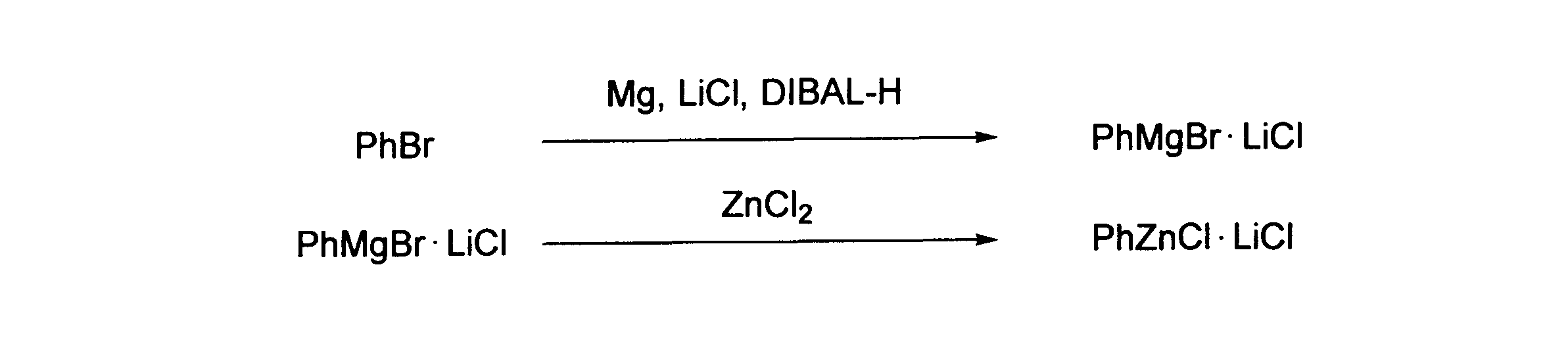
マグネチック撹拌子の入った50mLの乾燥したシュレンク管に削り屑状Mg(372mg、15.3mmol、1.5当量)及び塩化リチウム(LiCl;540mg、12.75mmol、1.25当量)入れてグローブボックスに入れ、ホットガンで乾燥させた。次に、温かいフラスコにアルゴンを3回注入した後、乾燥したTHF(8mL)及び水素化ジイソブチルアルミニウム(DIBAL-H;1.0M THF溶液0.1mL、1mol%)を室温で加え、5~10分撹拌した。次に、シュレンク管を0℃に冷却し、ブロモベンゼン(1.1mL、10.2mmol、1.0当量)を加えた。得られた反応混合液を0℃で10分間、次いで室温で2時間撹拌してグリニャール試薬と塩化リチウムとの複合体(PhMgBr.LiCl)を得た。グリニャール試薬と塩化リチウムとの複合体を適当な量の乾燥THFで希釈して、LiCl及びヨウ素を用いて滴定し、約1M濃度に調整した。得られたグリニャール試薬と塩化リチウムとの複合体を含有する溶液を、ZnCl2(グリニャール試薬に対して1当量)を含有する乾燥THF溶液に室温で添加し、15分間撹拌して、0.125MのPhZnCl・LiClを含有する溶液を取得した。なお、溶液濃度は、対応するグリニャール試薬の滴定濃度とトランスメタレーション後の希釈率に基づき調整した。
Claims (16)
- 下記式(I):

W1及びW2は、それぞれ独立して、脂肪族炭化水素基、芳香族炭化水素環基、脂肪族複素環基又は芳香族複素環基を、式中のカルボニル基の炭素原子と結合する官能基として含む有機基を表し、前記脂肪族炭化水素基、前記芳香族炭化水素環基、前記脂肪族複素環基及び前記芳香族複素環基は各々、1個以上の置換基を有していてもよい。]
で表される化合物(I)を製造する方法であって、
下記式(II):

W1は、前記と同義であり、
Qは、脂肪族炭化水素基、芳香族炭化水素環基、脂肪族複素環基又は芳香族複素環基を、式中の硫黄原子と結合する官能基として含む有機基を表し、前記脂肪族炭化水素基、前記芳香族炭化水素環基、前記脂肪族複素環基及び前記芳香族複素環基は各々、1個以上の置換基を有していてもよい。]
で表される化合物(II)と、
下記式(III-I):

で表される化合物(III-I)、及び、下記式(III-II):

で表される化合物(III-II)
からなる群から選択される少なくとも1種の有機亜鉛化合物とを、
銅触媒の存在下で反応させて、前記化合物(I)を得る工程
を含んでなる、方法。 - 前記化合物(II)と前記少なくとも1種の有機亜鉛化合物との反応が、-10~80℃で行われる、請求項1に記載の方法。
- 前記銅触媒が、銅塩又はその水和物もしくは溶媒和物である、請求項1又は2に記載の方法。
- 前記銅触媒が、銅錯体触媒である、請求項1又は2に記載の方法。
- 前記銅錯体触媒が、1価又は2価の銅原子及び窒素配位子を含んでなる、請求項4に記載の方法。
- 前記少なくとも1種の有機亜鉛化合物が、前記化合物(III-I)を含み、
前記化合物(III-I)が、下記式:

で表されるシュレンク平衡状態にある、請求項1~5のいずれか一項に記載の方法。 - 前記脂肪族炭化水素基が、炭素数1~6の脂肪族炭化水素基であり、
前記芳香族炭化水素環基が、炭素数6~18の芳香族炭化水素環基であり、
前記脂肪族複素環基が、3~8員の脂肪族複素環基であり、
前記芳香族複素環基が、6~14員の芳香族複素環基である、請求項1~6のいずれか一項に記載の方法。 - 前記脂肪族炭化水素基が有していてもよい前記1個以上の置換基が、それぞれ独立して、ハロゲン原子、ニトロ基、シアノ基、オキソ基、保護されていてもよい水酸基、保護されていてもよいチオール基、保護されていてもよいアミノ基、保護されていてもよいホルミル基、保護されていてもよいカルボキシル基、保護されていてもよいカルバモイル基、保護されていてもよいスルホニル基、アリール基、脂肪族複素環基、ヘテロアリール基、アルキルアリール基、アルキル脂肪族複素環基、アルキルヘテロアリール基、アリールアルキル基、脂肪族複素環アルキル基、ヘテロアリールアルキル基、アルキルオキシ基、アリールオキシ基、脂肪族複素環オキシ基、ヘテロアリールオキシ基、アルキルアリールオキシ基、アルキル脂肪族複素環オキシ基、アルキルヘテロアリールオキシ基、アリールアルキルオキシ基、脂肪族複素環アルキルオキシ基、ヘテロアリールアルキルオキシ基、アルキルチオ基、アリールチオ基、脂肪族複素環チオ基、ヘテロアリールチオ基、アルキルアリールチオ基、アルキル脂肪族複素環チオ基、アルキルヘテロアリールチオ基、アリールアルキルチオ基、脂肪族複素環アルキルチオ基、ヘテロアリールアルキルチオ基、アルキルカルボニル基、アリールカルボニル基、脂肪族複素環カルボニル基、ヘテロアリールカルボニル基、アルキルアリールカルボニル基、アルキル脂肪族複素環カルボニル基、アルキルヘテロアリールカルボニル基、アリールアルキルカルボニル基、脂肪族複素環アルキルカルボニル基、ヘテロアリールアルキルカルボニル基、アルキルオキシカルボニル基、アリールオキシカルボニル基、脂肪族複素環オキシカルボニル基、ヘテロアリールオキシカルボニル基、アルキルアリールオキシカルボニル基、アルキル脂肪族複素環オキシカルボニル基、アルキルヘテロアリールオキシカルボニル基、アリールアルキルオキシカルボニル基、脂肪族複素環アルキルオキシカルボニル基及びヘテロアリールアルキルオキシカルボニル基から選択される、請求項1~7のいずれか一項に記載の方法。
- 前記芳香族炭化水素環基、前記脂肪族複素環基及び前記芳香族複素環基が有していてもよい前記1個以上の置換基が、それぞれ独立して、ハロゲン原子、ニトロ基、シアノ基、オキソ基、保護されていてもよい水酸基、保護されていてもよいチオール基、保護されていてもよいアミノ基、保護されていてもよいホルミル基、保護されていてもよいカルボキシル基、保護されていてもよいカルバモイル基、保護されていてもよいスルホニル基、アルキル基、アリール基、脂肪族複素環基、ヘテロアリール基、アルキルアリール基、アルキル脂肪族複素環基、アルキルヘテロアリール基、アリールアルキル基、脂肪族複素環アルキル基、ヘテロアリールアルキル基、アルキルオキシ基、アリールオキシ基、脂肪族複素環オキシ基、ヘテロアリールオキシ基、アルキルアリールオキシ基、アルキル脂肪族複素環オキシ基、アルキルヘテロアリールオキシ基、アリールアルキルオキシ基、脂肪族複素環アルキルオキシ基、ヘテロアリールアルキルオキシ基、アルキルチオ基、アリールチオ基、脂肪族複素環チオ基、ヘテロアリールチオ基、アルキルアリールチオ基、アルキル脂肪族複素環チオ基、アルキルヘテロアリールチオ基、アリールアルキルチオ基、脂肪族複素環アルキルチオ基、ヘテロアリールアルキルチオ基、アルキルカルボニル基、アリールカルボニル基、脂肪族複素環カルボニル基、ヘテロアリールカルボニル基、アルキルアリールカルボニル基、アルキル脂肪族複素環カルボニル基、アルキルヘテロアリールカルボニル基、アリールアルキルカルボニル基、脂肪族複素環アルキルカルボニル基、ヘテロアリールアルキルカルボニル基、アルキルオキシカルボニル基、アリールオキシカルボニル基、脂肪族複素環オキシカルボニル基、ヘテロアリールオキシカルボニル基、アルキルアリールオキシカルボニル基、アルキル脂肪族複素環オキシカルボニル基、アルキルヘテロアリールオキシカルボニル基、アリールアルキルオキシカルボニル基、脂肪族複素環アルキルオキシカルボニル基及びヘテロアリールアルキルオキシカルボニル基から選択される、請求項1~8のいずれか一項に記載の方法。
- W1で表される有機基及びW2で表される有機基の少なくとも一方が、芳香族炭化水素環基又は芳香族複素環基を、前記式(I)中のカルボニル基の炭素原子と結合する官能基として含み、前記芳香族炭化水素環基及び前記芳香族複素環基が各々、1個以上の置換基を有していてもよい、請求項1~9のいずれか一項に記載の方法。
- W1で表される有機基及びW2で表される有機基の少なくとも一方が、下記式(V):
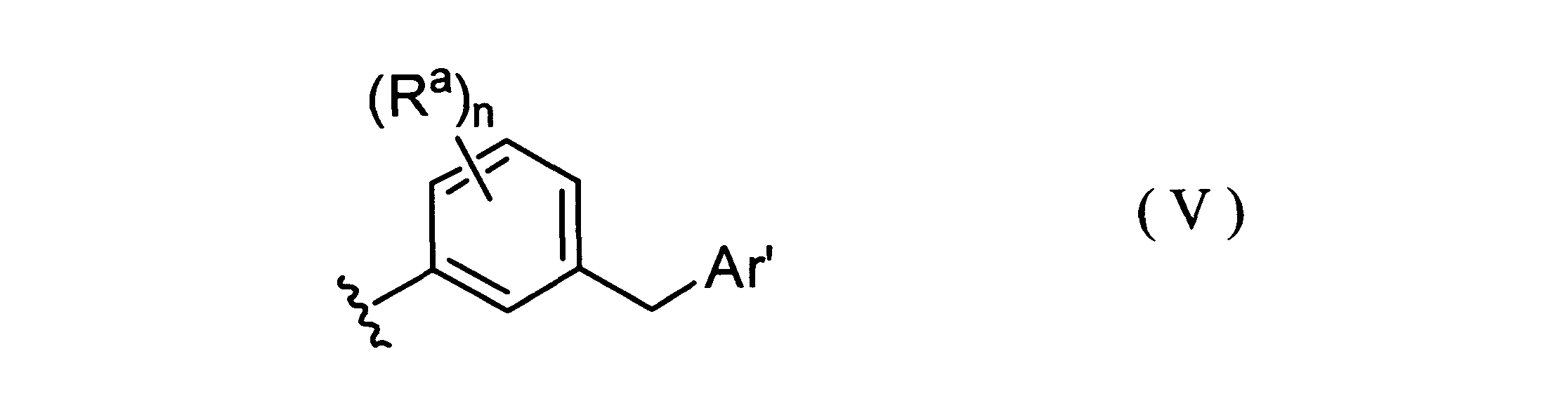
Raは、それぞれ独立して、ハロゲン原子、アルキル基、アルケニル基、アルキニル基、アリール基、アリールアルキル基、アリールアルケニル基、アリールアルキニル基、アルキルオキシ基、アルケニルオキシ基、アルキニルオキシ基、アリールオキシ基、アリールアルキルオキシ基、アリールアルケニルオキシ基及びアリールアルキニルオキシ基からなる群から選択される官能基を表し、前記アルキル基、前記アルケニル基、前記アルキニル基、前記アリール基、前記アリールアルキル基、前記アリールアルケニル基、前記アリールアルキニル基、前記アルキルオキシ基、前記アルケニルオキシ基、前記アルキニルオキシ基、前記アリールオキシ基、前記アリールアルキルオキシ基、前記アリールアルケニルオキシ基及び前記アリールアルキニルオキシ基は各々、1個以上の置換基を有していてもよく、
nは、0~4の整数であり、
Ar’は、芳香族炭化水素環基、脂肪族複素環基又は芳香族複素環基を表し、前記芳香族炭化水素環基、前記脂肪族複素環基及び前記芳香族複素環基は各々、1個以上の置換基を有していてもよい。]
で表される、請求項1~10のいずれか一項に記載の方法。 - Raで表される官能基が、それぞれ独立して、アルキル基及びハロゲン原子から選択され、前記アルキル基が、1個以上の置換基を有していてもよい、請求項11に記載の方法。
- W1で表される有機基及びW2で表される有機基の少なくとも一方が、下記式(Va):

Raは、前記と同義であり、
Ar’は、下記式(Va-I)、(Va-II)及び(Va-III):

からなる群から選択される官能基を表す。]
で表される、請求項11又は12に記載の方法。 - Rbで表される官能基が、それぞれ独立して、炭素数1~20のアルキル基、炭素数2~20のアルケニル基、炭素数2~20のアルキニル基、炭素数6~14の芳香族炭化水素環基、炭素数2~12の脂肪族複素環基及び炭素数3~12の芳香族複素環基からなる群から選択され、前記アルキル基、前記アルケニル基、前記アルキニル基、前記芳香族炭化水素環基、前記脂肪族複素環基及び前記芳香族複素環基が各々、1個以上の置換基を有していてもよい、請求項13に記載の方法。
- Qで表される有機基が、アルキル基、アルケニル基、アルキニル基又はアリール基を、式中の硫黄原子と結合する官能基として含み、前記アルキル基、前記アルケニル基、前記アルキニル基及び前記アリール基が各々、1個以上の置換基を有していてもよい、請求項1~14のいずれか一項に記載の方法。
- W1で表される有機基及びW2で表される有機基の少なくとも一方が、1個以上の置換基を有していてもよい脂肪族炭化水素基である、請求項1~15のいずれか一項に記載の方法。
Applications Claiming Priority (2)
| Application Number | Priority Date | Filing Date | Title |
|---|---|---|---|
| JP2018-235913 | 2018-12-17 | ||
| JP2018235913A JP2022028987A (ja) | 2018-12-17 | 2018-12-17 | ケトン化合物の製造方法 |
Publications (1)
| Publication Number | Publication Date |
|---|---|
| WO2020129901A1 true WO2020129901A1 (ja) | 2020-06-25 |
Family
ID=71101361
Family Applications (1)
| Application Number | Title | Priority Date | Filing Date |
|---|---|---|---|
| PCT/JP2019/049177 Ceased WO2020129901A1 (ja) | 2018-12-17 | 2019-12-16 | ケトン化合物の製造方法 |
Country Status (3)
| Country | Link |
|---|---|
| JP (1) | JP2022028987A (ja) |
| TW (1) | TW202039412A (ja) |
| WO (1) | WO2020129901A1 (ja) |
Cited By (3)
| Publication number | Priority date | Publication date | Assignee | Title |
|---|---|---|---|---|
| JP2022029068A (ja) * | 2020-08-04 | 2022-02-17 | 株式会社トクヤマ | チオエステル誘導体の製造方法 |
| JP2022029075A (ja) * | 2020-08-04 | 2022-02-17 | 株式会社トクヤマ | チオエステル誘導体の製造方法 |
| WO2023080243A1 (ja) * | 2021-11-08 | 2023-05-11 | 株式会社トクヤマ | C-アリールグリコサイド誘導体の製造方法 |
Families Citing this family (2)
| Publication number | Priority date | Publication date | Assignee | Title |
|---|---|---|---|---|
| CN116547272A (zh) * | 2020-11-18 | 2023-08-04 | 株式会社德山 | 酮衍生物的制造方法 |
| JP2024046451A (ja) * | 2022-09-22 | 2024-04-03 | 株式会社トクヤマ | ケトン誘導体の製造方法 |
-
2018
- 2018-12-17 JP JP2018235913A patent/JP2022028987A/ja active Pending
-
2019
- 2019-12-16 TW TW108145930A patent/TW202039412A/zh unknown
- 2019-12-16 WO PCT/JP2019/049177 patent/WO2020129901A1/ja not_active Ceased
Non-Patent Citations (6)
| Title |
|---|
| ASHIRBAEV, SALAVAT S. ET AL.: "Copper-Catalyzed Coupling of Acyl Chlorides with gem-Difluorinated Organozinc Reagents via Acyl Dithiocarbamate", JOURNAL OF ORGANIC CHEMISTRY, vol. 83, no. 1, 2018, pages 478 - 483, XP055698573, DOI: 10.1021/acs.joc.7b02598 * |
| HARAGUCHI, RYOSUKE ET AL.: "Chemo- and regioselective preparation of zinc enolate from thiol esters by palladium catalyzed cross-coupling reaction", TETRAHEDRON, vol. 71, no. 46, 2015, pages 8830 - 8837, XP055721864 * |
| MORI, YOSHIKAZU ET AL.: "A novel procedure for the synthesis of multifunctional ketones through the Fukuyama coupling reaction employing dialkylzincs", TETRAHEDRON LETTERS, vol. 45, no. 39, 2004, pages 7343 - 7345, XP004558998, DOI: 10.1016/j.tetlet.2004.07.148 * |
| MORI, YOSHIKAZU ET AL.: "A practical synthesis of multifunctional ketones through the Fukuyama coupling reaction", ADVANCED SYNTHESIS & CATALYSIS, vol. 349, no. 11+12, 2007, pages 2027 - 2038, XP055721862 * |
| MORI, YOSHIKAZU ET AL.: "Pd(OH)2/C (Pearlman's Catalyst): A Highly Active Catalyst for Fukuyama, Sonogashira, and Suzuki Coupling Reactions", JOURNAL OF ORGANIC CHEMISTRY, vol. 68, no. 4, 2003, pages 1571 - 1574, XP055721861 * |
| OOST, RIK ET AL.: "Enantioconvergent Fukuyama Cross-Coupling of Racemic Benzylic Organozinc Reagents", ANGEWANDTE CHEMIE , INTERNATIONAL EDITION, vol. 55, no. 14, 2016, pages 4587 - 4590, XP055721865 * |
Cited By (4)
| Publication number | Priority date | Publication date | Assignee | Title |
|---|---|---|---|---|
| JP2022029068A (ja) * | 2020-08-04 | 2022-02-17 | 株式会社トクヤマ | チオエステル誘導体の製造方法 |
| JP2022029075A (ja) * | 2020-08-04 | 2022-02-17 | 株式会社トクヤマ | チオエステル誘導体の製造方法 |
| JP7546405B2 (ja) | 2020-08-04 | 2024-09-06 | 株式会社トクヤマ | チオエステル誘導体の製造方法 |
| WO2023080243A1 (ja) * | 2021-11-08 | 2023-05-11 | 株式会社トクヤマ | C-アリールグリコサイド誘導体の製造方法 |
Also Published As
| Publication number | Publication date |
|---|---|
| TW202039412A (zh) | 2020-11-01 |
| JP2022028987A (ja) | 2022-02-17 |
Similar Documents
| Publication | Publication Date | Title |
|---|---|---|
| WO2020129899A1 (ja) | C-アリールヒドロキシグリコキシド誘導体の製造方法 | |
| CN101899026B (zh) | 用于制备软海绵素b的类似物的中间体 | |
| CA2702898C (en) | Inhibitors of c-fms kinase | |
| TW202144339A (zh) | 稠環化合物、其製備方法、藥物組合物及其應用 | |
| JP2022028987A (ja) | ケトン化合物の製造方法 | |
| CA3097949C (en) | Hpk1 inhibitors, preparation method and application thereof | |
| CA3172478A1 (en) | Bcl-2 inhibitor | |
| KR20190026827A (ko) | 방향족 아세틸렌 또는 방향족 에틸렌계 화합물, 그의 중간체, 제조 방법, 약물 조성물 및 용도 | |
| KR20210061400A (ko) | 유비퀴틴 특이적 펩티다아제 9x의 억제 | |
| JP7524899B2 (ja) | ベンゾトリアゾール誘導体 | |
| JP2026515254A (ja) | 窒素含有複素環化合物、その薬学的に許容される塩及びその調製方法と使用 | |
| KR101871133B1 (ko) | 벤즈옥사제핀 화합물의 제조 방법 | |
| WO2009125809A1 (ja) | ピペリジン誘導体 | |
| JP2012509351A (ja) | 有機化合物のフッ素化 | |
| CA2894536A1 (en) | Mannose derivatives for treating bacterial infections | |
| JP6955485B2 (ja) | 抗がん剤としての複素環式の限定された三環系スルホンアミド | |
| WO2009125808A1 (ja) | アミノシクロヘキシル誘導体 | |
| JP2023513373A (ja) | P2x3修飾薬 | |
| TW202214609A (zh) | 抗血小板藥物及其用途 | |
| KR102797099B1 (ko) | 2-[(3r)-3-메틸모르폴린-4-일]-4-(1-메틸-1h-피라졸-5-일)-8-(1h-피라졸-5-일)-1,7-나프티리딘의 제조 방법 | |
| CN108997267A (zh) | 用于制备软海绵素b的类似物的中间体 | |
| JP2020534275A (ja) | 代謝関連の突然変異誘発性及び線維性の症状及び障害を治療するためのホルモン受容体調節薬 | |
| WO2024259241A1 (en) | 5-ht2a receptor modulators and methods of use thereof | |
| WO2020129900A1 (ja) | C-アリールヒドロキシグリコキシド誘導体の製造方法 | |
| JP6533794B2 (ja) | タキサン化合物、その調製方法およびその使用 |
Legal Events
| Date | Code | Title | Description |
|---|---|---|---|
| 121 | Ep: the epo has been informed by wipo that ep was designated in this application |
Ref document number: 19899292 Country of ref document: EP Kind code of ref document: A1 |
|
| NENP | Non-entry into the national phase |
Ref country code: DE |
|
| 122 | Ep: pct application non-entry in european phase |
Ref document number: 19899292 Country of ref document: EP Kind code of ref document: A1 |
|
| NENP | Non-entry into the national phase |
Ref country code: JP |