WO2020110752A1 - ポリマー担持不斉触媒 - Google Patents
ポリマー担持不斉触媒 Download PDFInfo
- Publication number
- WO2020110752A1 WO2020110752A1 PCT/JP2019/044710 JP2019044710W WO2020110752A1 WO 2020110752 A1 WO2020110752 A1 WO 2020110752A1 JP 2019044710 W JP2019044710 W JP 2019044710W WO 2020110752 A1 WO2020110752 A1 WO 2020110752A1
- Authority
- WO
- WIPO (PCT)
- Prior art keywords
- group
- carbon atoms
- asymmetric
- mmol
- substituent
- Prior art date
- Legal status (The legal status is an assumption and is not a legal conclusion. Google has not performed a legal analysis and makes no representation as to the accuracy of the status listed.)
- Ceased
Links
- 0 ***C(C1)CN(*)C1C(*)(*)[Al+] Chemical compound ***C(C1)CN(*)C1C(*)(*)[Al+] 0.000 description 1
Classifications
-
- B—PERFORMING OPERATIONS; TRANSPORTING
- B01—PHYSICAL OR CHEMICAL PROCESSES OR APPARATUS IN GENERAL
- B01J—CHEMICAL OR PHYSICAL PROCESSES, e.g. CATALYSIS OR COLLOID CHEMISTRY; THEIR RELEVANT APPARATUS
- B01J31/00—Catalysts comprising hydrides, coordination complexes or organic compounds
- B01J31/02—Catalysts comprising hydrides, coordination complexes or organic compounds containing organic compounds or metal hydrides
- B01J31/12—Catalysts comprising hydrides, coordination complexes or organic compounds containing organic compounds or metal hydrides containing organo-metallic compounds or metal hydrides
-
- C—CHEMISTRY; METALLURGY
- C07—ORGANIC CHEMISTRY
- C07D—HETEROCYCLIC COMPOUNDS
- C07D207/00—Heterocyclic compounds containing five-membered rings not condensed with other rings, with one nitrogen atom as the only ring hetero atom
- C07D207/02—Heterocyclic compounds containing five-membered rings not condensed with other rings, with one nitrogen atom as the only ring hetero atom with only hydrogen or carbon atoms directly attached to the ring nitrogen atom
- C07D207/04—Heterocyclic compounds containing five-membered rings not condensed with other rings, with one nitrogen atom as the only ring hetero atom with only hydrogen or carbon atoms directly attached to the ring nitrogen atom having no double bonds between ring members or between ring members and non-ring members
- C07D207/10—Heterocyclic compounds containing five-membered rings not condensed with other rings, with one nitrogen atom as the only ring hetero atom with only hydrogen or carbon atoms directly attached to the ring nitrogen atom having no double bonds between ring members or between ring members and non-ring members with hetero atoms or with carbon atoms having three bonds to hetero atoms with at the most one bond to halogen, e.g. ester or nitrile radicals, directly attached to ring carbon atoms
- C07D207/12—Oxygen or sulfur atoms
-
- C—CHEMISTRY; METALLURGY
- C08—ORGANIC MACROMOLECULAR COMPOUNDS; THEIR PREPARATION OR CHEMICAL WORKING-UP; COMPOSITIONS BASED THEREON
- C08F—MACROMOLECULAR COMPOUNDS OBTAINED BY REACTIONS ONLY INVOLVING CARBON-TO-CARBON UNSATURATED BONDS
- C08F12/00—Homopolymers and copolymers of compounds having one or more unsaturated aliphatic radicals, each having only one carbon-to-carbon double bond, and at least one being terminated by an aromatic carbocyclic ring
- C08F12/02—Monomers containing only one unsaturated aliphatic radical
- C08F12/04—Monomers containing only one unsaturated aliphatic radical containing one ring
- C08F12/14—Monomers containing only one unsaturated aliphatic radical containing one ring substituted by hetero atoms or groups containing heteroatoms
- C08F12/26—Nitrogen
- C08F12/28—Amines
Definitions
- the present invention relates to a polymer-supported asymmetric catalyst that can be used in an asymmetric reaction, and a method for producing a chiral compound using the polymer-supported asymmetric catalyst.
- Solid asymmetric catalysts have attracted attention because they are easily recovered and can be recycled.
- catalysts in which a site having an asymmetric catalytic function is covalently supported on a polymer are known.
- the site having the asymmetric catalytic function is a proline derivative
- a catalyst in which proline is bound to polysiloxane (Patent Document 1 or the like) or a proline methyl ester is bound to a copolymer of polyethylene glycol and polylysine is used.
- Non-Patent Document 1 1-pivaloyl-2-(diphenylmethyl)pyrrolidine bonded to Merrifield resin
- Patent Document 2 2-diphenyl(trimethylsilyloxy)methylpyrrolidine bonded to polyethylene glycol
- Patent Document 3 catalysts in which 2-diphenyl(tert-butyldimethylsilyloxy)methylpyrrolidine is bound to polystyrene
- Patent Document 2 catalysts in which 2-diphenyl(tert-butyldimethylsilyloxy)methylpyrrolidine is bound to polystyrene
- the stereoselectivity of the asymmetric reaction is inferior in the examples using proline as the asymmetric induction site in Patent Document 1 and Non-Patent Document 1.
- the stereoselectivity of the asymmetric reaction was not sufficiently satisfactory.
- the present invention has been made in view of the above circumstances, and its purpose is to further enhance the stereoselectivity of asymmetric reaction.
- a preferred object of the present invention is to provide an asymmetry-inducing site capable of increasing stereoselectivity as compared with that before binding by binding to a polymer.
- (hetero)aryl is a general term for a combination of aryl and heteroaryl. That is, the present invention is as follows.
- Ar 1 and Ar 2 are each independently an aryl group having 6 to 20 carbon atoms which may have a substituent, or an aryl group having 3 to 20 carbon atoms which may have a substituent.
- X represents an oxygen atom or a sulfur atom
- Y represents a single bond or a linking group
- Z represents a polymer chain
- R 1 has a hydrogen atom, a hydroxyl group or a substituent.
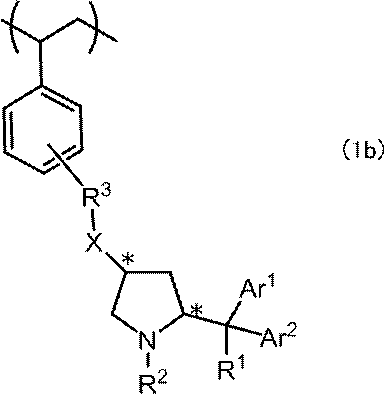
- a polymer-supported asymmetric catalyst having: [2] The following formula (1b); (In the formula, Ar 1 , Ar 2 , X, R 1 , R 2 and * are the same as the above.
- R 3 is a single bond or an alkylene group having 1 to 5 carbon atoms which may have a substituent.
- a polymer-supported asymmetric catalyst having a repeating unit derived from a styrene-based monomer.
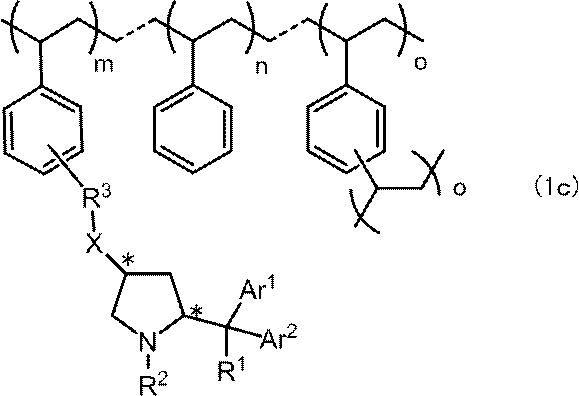
- m, n and o represent the molar ratio of the molecules, and the sum of m, n and o is A polymer-supported asymmetric catalyst having a portion represented by 100%).
- Both Ar 1 and Ar 2 are phenyl groups or 3,5-dimethylphenyl groups, R 1 is a hydrogen atom, a hydroxyl group, a methoxy group, or a trimethylsiloxy group, and R 2 is a hydrogen atom.
- the polymer-supported asymmetric catalyst according to any one of [1] to [3].
- a method for producing a chiral compound which comprises Alder reaction, asymmetric Mannich reaction, or asymmetric Michael addition reaction.
- the polymer-supported asymmetric catalyst is packed in a column, a liquid containing reaction raw materials is continuously supplied from a column inlet, and a reaction liquid containing the chiral compound is continuously discharged from a column outlet [6].
- a method for producing the described chiral compound is produced.
- the polymer-supported asymmetric catalyst of the present invention since cis-di(hetero)arylmethylpyrrolidine is used as the asymmetric induction site, trans-di(hetero)arylmethylpyrrolidine is used as the asymmetric induction site.
- the stereoselectivity of the asymmetric reaction can be enhanced, and when the asymmetric induction site is bonded to the polymer, the stereoselectivity can be further enhanced as compared with before the bonding to the polymer.
- This polymer-supported asymmetric catalyst can be used as a solid asymmetric catalyst in various asymmetric reactions, the catalyst can be easily recovered and reused, and it can be packed in a column and used as a flow reactor.
- polymer-Supported Asymmetric Catalyst The polymer-supported asymmetric catalyst of the present invention is represented by the following formula (1a).
- Ar 1 and Ar 2 are each independently an aryl group having 6 to 20 carbon atoms which may have a substituent, or an aryl group having 3 to 20 carbon atoms which may have a substituent.
- X represents an oxygen atom or a sulfur atom
- Y represents a single bond or a linking group
- Z represents a polymer chain
- R 1 has a hydrogen atom, a hydroxyl group or a substituent.
- An aryl group having 6 to 20 carbon atoms which may have a substituent, a formyl group, an acyl group having 2 to 20 carbon atoms which may have a substituent, a carbon which may have a substituent Represents an alkoxycarbonyl group or a carbamoyl group of the formula 2 to 20. * represents an asymmetric carbon atom, and the exocyclic substituents of the two asymmetric carbon atoms represent cis relative configurations.
- the pyrrolidine ring has a di(hetero)arylmethyl group (—C(Ar 1 )(Ar 2 )) and an X group in a cis relative configuration.
- the stereoselectivity of asymmetric reaction can be enhanced more than the relative configuration of trans.
- the aryl group or the heteroaryl group (Ar 1 , Ar 2 ) constituting the di(hetero)arylmethyl group is a phenyl group, a 1-naphthyl group, a 2-naphthyl group, a 2-furanyl group or a thiophen-2- Examples thereof include an yl group and a 2-pyridyl group, and it is preferable that both Ar 1 and Ar 2 are phenyl groups.
- Examples of the substituent that the aryl group or the heteroaryl group may have include an alkyl group having 1 to 6 carbon atoms such as a methyl group, an ethyl group, and a propyl group; and a carbon number of 1 to 6 such as a trifluoromethyl group.
- a phenyl group or a 3,5-dimethylphenyl group is particularly preferable as Ar 1 and Ar 2 .
- an oxygen atom and a sulfur atom are preferable, and an oxygen atom is more preferable.
- linking group representing Y examples include a divalent hydrocarbon group having about 1 to 40 carbon atoms such as an alkylene group, a phenylene group, and a group in which an alkylene group and a phenylene group are bonded, and an ester group, an ether group, a carbonyl group.
- a divalent functional group such as a group may be appropriately contained.
- the polymer chain representing Z preferably has a structure corresponding to a so-called polymer main chain, and is a homo- or copolymer main chain of a vinyl group-containing monomer, a polyester main chain, a polyamide main chain, a polyurethane main chain, a polyether main chain.
- Examples thereof include a chain (polyalkylene glycol main chain etc.), and preferably a homopolymer or copolymer main chain of a vinyl group-containing monomer.
- vinyl group-containing monomer examples include olefinic monomers such as ethylene and propylene; styrene-based monomers such as styrene and ⁇ -methylstyrene; vinyl halides such as vinyl chloride; vinyl carboxylates such as vinyl acetate; Examples thereof include (meth)acrylic acid-based monomers such as (meth)acrylic acid and (meth)acrylic acid ester.
- the main chain has a continuous structure of methylene groups.
- the polymer chains may optionally be crosslinked.
- the alkyloxy group having 1 to 20 carbon atoms which represents R 1 is preferably an alkyloxy group having 1 to 10 carbon atoms such as methoxy group, ethoxy group and propoxy group, more preferably an alkyloxy group having 1 to 5 carbon atoms. ..
- the substituent which the alkyloxy group may have is an alkyloxy group having 1 to 6 carbon atoms such as a methoxy group, an ethoxy group and a propoxy group; a carbon number such as a methoxycarbonyl group and an ethoxycarbonyl group is 2
- the aralkyloxy group having 7 to 20 carbon atoms which represents R 1 is preferably an aralkyloxy group having 7 to 15 carbon atoms such as benzyloxy group, phenylethyloxy group and phenylpropyl group, and the aralkyloxy group having 7 to 10 carbon atoms. Groups are more preferred.
- Examples of the substituent that the aralkyloxy group may have include an alkyloxy group having 1 to 6 carbon atoms such as a methoxy group, an ethoxy group and a propoxy group; a carbon number such as a methoxycarbonyl group and an ethoxycarbonyl group having 2 carbon atoms.
- alkoxycarbonyl group acetyl group, propionyl group and other acyl groups having 2 to 10 carbon atoms; halogen such as fluorine, chlorine, bromine, iodine; nitro group; cyano group; trimethylsilyl group, triethylsilyl group, triisopropyl Examples thereof include trialkylsilyl groups having 3 to 20 carbon atoms such as silyl groups.
- the acyloxy group having 2 to 20 carbon atoms which represents R 1 is preferably an acyloxy group having 2 to 15 carbon atoms such as acetoxy group, pivaloyloxy group and benzoyloxy group, and more preferably an acyloxy group having 2 to 10 carbon atoms.
- Examples of the substituent that the acyloxy group may have include an alkyloxy group having a carbon number of 1 to 6 such as a methoxy group, an ethoxy group and a propoxy group; a carbon number of 2 to 2 such as a methoxycarbonyl group and an ethoxycarbonyl group.
- Examples of the silyloxy group having a hydrocarbon group having 3 to 20 carbon atoms which represents R 1 include trialkylsilyloxy groups such as trimethylsilyloxy group, dimethylethylsilyloxy group, methyldiethylsilyloxy group and triethylsilyloxy group; dimethylphenyl Examples thereof include alkylarylsilyloxy groups such as silyloxy groups; triarylsilyloxy groups such as triphenylsilyloxy groups, and trialkylsilyloxy groups are preferred.
- Examples of the substituent that the silyloxy group having a hydrocarbon group having 3 to 20 carbon atoms may have include an alkyloxy group having 1 to 6 carbon atoms such as a methoxy group, an ethoxy group and a propoxy group; a methoxycarbonyl group, Alkoxycarbonyl group having 2 to 10 carbon atoms such as ethoxycarbonyl group; Acyl group having 2 to 10 carbon atoms such as acetyl group and propionyl group; Halogen such as fluorine, chlorine, bromine and iodine; Nitro group; Cyano group; Examples thereof include trialkylsilyl groups having 3 to 20 carbon atoms such as trimethylsilyl group, triethylsilyl group and triisopropylsilyl group.
- R 1 is preferably a hydrogen atom, a hydroxyl group, an alkyloxy group or a silyloxy group having a hydrocarbon group, more preferably a hydrogen atom, a hydroxyl group, an alkyloxy group or a trialkylsilyloxy group, and a hydrogen atom, a hydroxyl group or a methoxy group.
- Trimethylsilyloxy groups are more preferred, and hydrogen atoms are even more preferred.
- alkyl group having 1 to 20 carbon atoms which represents R 2
- an alkyl group having 1 to 10 carbon atoms such as a methyl group, an ethyl group, a propyl group and a butyl group
- an alkyl group having 1 to 6 carbon atoms is more preferable. ..
- an alkyloxy group having a carbon number of 1 to 6 such as a methoxy group, an ethoxy group and a propoxy group; a carbon number of 2 to such as a methoxycarbonyl group and an ethoxycarbonyl group 10 alkoxycarbonyl groups; acetyl groups, propionyl groups, and other acyl groups having 2 to 10 carbon atoms; halogens such as fluorine, chlorine, bromine, and iodine; nitro groups; cyano groups; trimethylsilyl groups, triethylsilyl groups, triisopropylsilyl Examples thereof include trialkylsilyl groups having 3 to 20 carbon atoms such as groups.
- Examples of the C 6-20 aryl group represented by R 2 include a phenyl group, a 1-naphthyl group, a 2-naphthyl group and the like.
- the substituent which the aryl group may have is an alkyl group having 1 to 6 carbon atoms such as a methyl group, an ethyl group and a propyl group; a carbon number of 1 to 6 such as a methoxy group, an ethoxy group and a propoxy group.
- Examples of the acyl group having 2 to 20 carbon atoms which represents R 2 include an alkylcarbonyl group such as an acetyl group and a propionyl group; an arylcarbonyl group such as a benzoyl group.
- Examples of the substituent that the acyl group may have include an alkyloxy group having 1 to 6 carbon atoms such as a methoxy group, an ethoxy group, and a propoxy group; 10 alkoxycarbonyl groups; acetyl groups, propionyl groups, and other acyl groups having 2 to 10 carbon atoms; halogens such as fluorine, chlorine, bromine, and iodine; nitro groups; cyano groups; trimethylsilyl groups, triethylsilyl groups, triisopropylsilyl Examples thereof include trialkylsilyl groups having 3 to 20 carbon atoms such as groups.
- Examples of the alkoxycarbonyl group having 2 to 20 carbon atoms which represents R 2 include an alkyloxycarbonyl group such as a methoxycarbonyl group and a tert-butoxycarbonyl group; an aralkyloxycarbonyl group such as a benzyloxycarbonyl group.
- alkoxycarbonyl group may have include an alkyloxy group having 1 to 6 carbon atoms such as a methoxy group, an ethoxy group, and a propoxy group; ⁇ 10 alkoxycarbonyl group; acetyl group, propionyl group and other acyl groups having 2 to 10 carbon atoms; halogen such as fluorine, chlorine, bromine, iodine; nitro group; cyano group; trimethylsilyl group, triethylsilyl group, triisopropyl Examples thereof include trialkylsilyl groups having 3 to 20 carbon atoms such as silyl groups.
- R 2 a hydrogen atom is preferable.
- the polymer-supported asymmetric catalyst represented by the formula (1a) is defined as containing a salt thereof with an acceptable acid.
- the acid include inorganic acids such as hydrogen chloride, hydrogen bromide, phosphoric acid, sulfuric acid, nitric acid, perchloric acid, formic acid, acetic acid, trifluoroacetic acid, trichloroacetic acid, benzoic acid, oxalic acid, citric acid, tartaric acid, and methane.
- organic acids such as sulfonic acid and p-toluenesulfonic acid.
- Hydrogen chloride, sulfuric acid, trifluoroacetic acid, trichloroacetic acid and methanesulfonic acid are preferable, and trifluoroacetic acid is more preferable.
- a polymer-supported asymmetric catalyst represented by the formula (1a) As the polymer-supported asymmetric catalyst represented by the formula (1a), a polymer-supported asymmetric catalyst having a repeating unit represented by the formula (1b) is preferable.
- R 3 may have a single bond or a substituent. Represents a good alkylene group having 1 to 5 carbon atoms.
- Examples of the alkylene group having 1 to 5 carbon atoms which represents R 3 include a methylene group, an ethylene group, a propylene group, a butylene group and a pentylene group, and a methylene group or a butylene group is preferable.
- alkylene group may have include an alkyloxy group having 1 to 6 carbon atoms such as a methoxy group, an ethoxy group and a propoxy group; 10 alkoxycarbonyl groups; acetyl groups, propionyl groups, and other acyl groups having 2 to 10 carbon atoms; halogens such as fluorine, chlorine, bromine, and iodine; nitro groups; cyano groups; trimethylsilyl groups, triethylsilyl groups, triisopropylsilyl Examples thereof include trialkylsilyl groups having 3 to 20 carbon atoms such as groups.
- R 3 is preferably an alkylene group having 1 to 5 carbon atoms, more preferably a methylene group or a butylene group, and particularly preferably a methylene group.
- the polymer-supported asymmetric catalyst having a repeating unit represented by the formula (1b) may be a homopolymer or a copolymer of a vinyl monomer corresponding to the formula (1b), It is preferably a copolymer.
- the asymmetric environmental field can be appropriately controlled.
- the molar ratio of the repeating units represented by the formula (1b) is, for example, 0.1% or more, preferably 1% or more, when the molar amount of all the repeating units is 100%. It is preferably 3% or more, for example, 50% or less, preferably 30% or less, and more preferably 20% or less.
- the repeating units derived from the copolymerization component include olefinic monomers such as ethylene and propylene; styrene-based monomers such as styrene and ⁇ -methylstyrene; vinyl halides such as vinyl chloride.
- a vinyl carboxylate such as vinyl acetate; a repeating unit derived from a vinyl group-containing monomer such as a (meth)acrylic acid-based monomer such as a (meth)acrylic acid or a (meth)acrylic acid ester; Repeating units derived from monomers are preferred.
- the repeating unit derived from the styrene-based monomer can make the asymmetric environmental field more appropriate, probably because the benzene ring of the repeating unit interacts with the benzene ring bound by R 3 of the formula (1b).
- the polymer-supported asymmetric catalyst may be crosslinked by copolymerizing a polyfunctional monomer. By crosslinking, the solubility of the polymer-supported asymmetric catalyst can be reduced and the strength can be increased.
- a polymer-supported asymmetric catalyst having reduced solubility and increased strength can maintain the voids between the polymer-supported asymmetric catalyst particles, for example, even when the polymer-supported asymmetric catalyst is used under pressure by packing it in a column. Can prevent clogging.
- a monomer having a ⁇ bond-containing ring such as triallyl cyanurate or divinylbenzene; allyl (meth)acrylate, diallyl phthalate, diallyl mer Rate, divinyl adipate, ethylene glycol di(meth)acrylate, propylene glycol di(meth)acrylate, diethylene glycol di(meth)acrylate, triethylene glycol di(meth)acrylate, trimethylolpropane tri(meth)acrylate, tetramethylolmethane tetra
- repeating units derived from (meth)acrylate, dipropylene glycol di(meth)acrylate, etc. repeating units derived from a monomer having a ⁇ bond-containing ring are preferable, and repeating units derived from divinylbenzene are more preferable.
- the repeating unit derived from the monomer having a ⁇ -bond-containing ring is more suitable for the asymmetric environmental field, probably because the ⁇ -bond-containing ring interacts with the benzene ring bonded by R 3 of the formula (1b). it can.
- the molar ratio of the repeating units derived from the polyfunctional monomer is, for example, 0.1% or more, preferably 0.5% or more, and more preferably 1. When the molar amount of all the repeating units is 100%. It is 0% or more, for example, 50% or less, preferably 40% or less, more preferably 30% or less.
- the polymer-supported asymmetric catalyst represented by the above formula (1b) is more preferably a polymer-supported asymmetric catalyst having a moiety represented by the following formula (1c).
- the broken line represents the bonding position of the monomer.
- the sequence of the monomers is not limited, and the formula (1c) is preferably a random copolymer.
- the ratio of m, n, and o is not particularly limited, but m is preferably 1 to 50%, more preferably 5 to 20%, and n is preferably 50 to 99%, more preferably 60 to 95%, o is preferably 0 to 50%, and more preferably 1 to 30%.
- the polymer-supported asymmetric catalyst is substantially insoluble in water and an organic solvent.
- the polymer-supported asymmetric catalyst can be used as a catalyst for various asymmetric reactions and can produce chiral compounds.
- a double bond-containing compound having an electron-withdrawing group (a carboxylic acid group, a carboxylic acid ester group, a formyl group, a nitrile group, a nitro group, a halogeno group, etc.) bonded thereto, and a Hantzsch ester hydrogenated. It can be used as a catalyst for asymmetric reduction reactions such as asymmetric reduction using a transfer source.
- Asymmetric aldol reaction, asymmetric epoxidation reaction, asymmetric oxidation reaction, asymmetric Diels-Alder reaction, asymmetric Mannich reaction The polymer-supported asymmetric catalyst can also be used as a catalyst in an asymmetric Michael addition reaction or the like.
- the asymmetric reaction using the polymer-supported asymmetric catalyst may be a batch reaction in which a liquid containing a reaction raw material and a polymer-supported asymmetric catalyst is stirred, and the polymer-supported asymmetric catalyst is packed in a column to contain the reaction raw material.
- a column-type reaction in which a liquid is continuously supplied from a column inlet and a reaction liquid containing a chiral compound as a reaction product is continuously discharged from a column outlet may be used.
- the polymer-supported asymmetric catalyst can be removed by filtering the liquid in which the reaction product is dissolved, and according to the column-type reaction, the reaction product separated from the polymer-supported asymmetric catalyst can be continuously removed.
- a preferred reaction system is a column system.
- a column type can be used for a flow reactor.
- a reactor for carrying out a raw material generation reaction of an asymmetric reaction may be connected to the upstream side of the column packed with the polymer-supported asymmetric catalyst, and the reactor downstream of the column packed with the polymer-supported asymmetric catalyst may be connected.
- a reactor for further reacting the simultaneous reaction product may be connected so that a series of reactions can be efficiently performed.
- Phenylmagnesium bromide (20 mL) in N-(tert-butoxycarbonyl)-cis-4-hydroxy-D-proline methyl ester (compound 1,500 mg, 2.04 mmol, 1 equivalent) in tetrahydrofuran (hereinafter, THF) (20 mL) was added to phenylmagnesium bromide (20 mL).
- THF tetrahydrofuran
- a THF solution of PhMgBr) (1M, 7.13 mL, 7.13 mmol, 3.5 equivalents
- the obtained crude product was filtered through a glass filter, washed with THF (about 10 mL ⁇ 3), dried at 40° C. for 24 hours, and then Boc-cat-A1 (pyrrolidine of compound cat-A1 was added to tert-butoxy). A compound having a carbonyl group bonded thereto) was obtained.
- Boc-cat-A1 (1.44 g, 1.00 mmol of N-Boc) and THF (2.5 mL) were weighed. After the reaction solution was cooled to 0°C, 4.0M HCl dioxane solution (2.50 mL, 10.0 mmol) was slowly added dropwise at 0°C. After the completion of dropping, the mixture was stirred at room temperature for 24 hours. After filtering with a glass filter, the insoluble matter was washed twice with THF (10 mL) to obtain a polymer-supported chiral pyrrolidine hydrochloride cat-A1 (referred to as the hydrochloride of the compound cat-A1).
- a polymer-supported chiral pyrrolidine hydrochloride cat-A1 (1.00 mmol of HCl salt) and THF (2.5 mL) were weighed into a 20 mL eggplant-shaped flask. Next, 3.73 mL (50.0 mmol) of 13.4 M ammonia water was slowly added dropwise at room temperature, and the mixture was stirred for 24 hours. After filtering with a glass filter, the insoluble matter was washed 5 times with 10 mL of a mixed solution of THF:H 2 O (2:1). When dried by a vacuum pump at 40° C. for 24 hours, compound cat-A1 (1.34 g, 1.00 mmol (based on amino group), yield 100 mol %) was obtained as a transparent solid.
- Boc-cat-A3 compound cat-A3 with pyrrolidine was tert- A compound having a butoxycarbonyl group bonded thereto was obtained).
- Boc-cat-A3 (1.48 g, 1.00 mmol of N-Boc) and THF (2.5 mL) were weighed into a 20 mL eggplant-shaped flask. After the reaction solution was cooled to 0°C, 4.0M HCl dioxane solution (2.50 mL, 10.0 mmol) was slowly added dropwise at 0°C. After the completion of dropping, the mixture was stirred at room temperature for 24 hours. After filtering with a glass filter, the insoluble matter was washed twice with THF (10 mL) to obtain polymer-supported chiral pyrrolidine hydrochloride cat-A3 (referred to as the hydrochloride of compound cat-A3).
- a polymer-supported chiral pyrrolidine hydrochloride cat-A3 (1.00 mmol of HCl salt) and THF (2.5 mL) were weighed into a 20 mL eggplant-shaped flask. Next, 3.73 mL (50.0 mmol) of 13.4 M ammonia water was slowly added dropwise at room temperature, and the mixture was stirred for 24 hours. After filtering with a glass filter, the insoluble matter was washed 5 times with 10 mL of a mixed solution of THF:H 2 O (2:1). When dried at 40° C. for 24 hours with a vacuum pump, compound cat-A3 (1.22 g, 0.90 mmol (amino group basis), yield 90 mol %) was obtained as a transparent solid.
- trans-diarylmethylpyrrolidine (comparative example) As trans-diarylmethylpyrrolidine, trans-H compound 26, trans-OTMS compound 16, and trans-OMe compound 18 represented by the following formula were synthesized according to the following Scheme 3 or Scheme 4.
- the reaction solution was extracted 3 times with 30 mL of ethyl acetate, and then the organic layer was washed once with H 2 O (20 mL). After drying the organic layer with anhydrous MgSO 4 , MgSO 4 was removed by filtration. After the solvent was distilled off under reduced pressure with an evaporator, the product was dried under reduced pressure at room temperature using a vacuum pump to obtain a crude product.
- the transparent solid Boc-cat-D1 (1.44 g, 1.00 mmol of N-Boc) and THF (2.5 mL) were weighed into a 20 mL eggplant-shaped flask. After the reaction solution was cooled to 0°C, 4.0M HCl dioxane solution (2.50 mL, 10.0 mmol) was slowly added dropwise at 0°C. After the completion of dropping, the mixture was stirred at room temperature for 24 hours. After filtering with a glass filter, the insoluble matter was washed twice with THF (10 mL) to obtain polymer-supported chiral pyrrolidine hydrochloride cat-D1 (referred to as the hydrochloride of compound cat-D1).
- a polymer-supported chiral pyrrolidine hydrochloride cat-D1 (1.00 mmol of HCl salt) and THF (2.5 mL) were weighed into a 20 mL eggplant-shaped flask. Next, 3.73 mL (50.0 mmol) of 13.4 M ammonia water was slowly added dropwise at room temperature, and the mixture was stirred for 24 hours. After filtering with a glass filter, the insoluble matter was washed 5 times with 10 mL of a mixed solution of THF:H 2 O (2:1). It was dried at 40° C. for 24 hours with a vacuum pump to obtain a compound cat-D1 (1.25 g, yield 93 mol %) as a transparent solid.
- Boc-cat-D3 (1.48 g, 1.00 mmol of N-Boc) and THF (2.5 mL) were weighed into a 20 mL eggplant-shaped flask. After the reaction solution was cooled to 0°C, 4.0M HCl dioxane solution (2.50 mL, 10.0 mmol) was slowly added dropwise at 0°C. After the completion of dropping, the mixture was stirred at room temperature for 24 hours. After filtering with a glass filter, the insoluble matter was washed twice with THF (10 mL) to obtain polymer-supported chiral pyrrolidine hydrochloride cat-D3 (referred to as the hydrochloride of compound cat-D3).
- a polymer-supported chiral pyrrolidine hydrochloride cat-D3 (1.00 mmol of HCl salt) and THF (2.5 mL) were weighed into a 20 mL eggplant-shaped flask. Next, 3.73 mL (50.0 mmol) of 13.4 M ammonia water was slowly added dropwise at room temperature, and the mixture was stirred for 24 hours. After filtering with a glass filter, the insoluble matter was washed 5 times with 10 mL of a mixed solution of THF:H 2 O (2:1). After drying at 40° C. for 24 hours with a vacuum pump, compound cat-D3 (1.16 g, 0.86 mmol (amino group basis), yield 86 mol %) was obtained as a transparent solid.
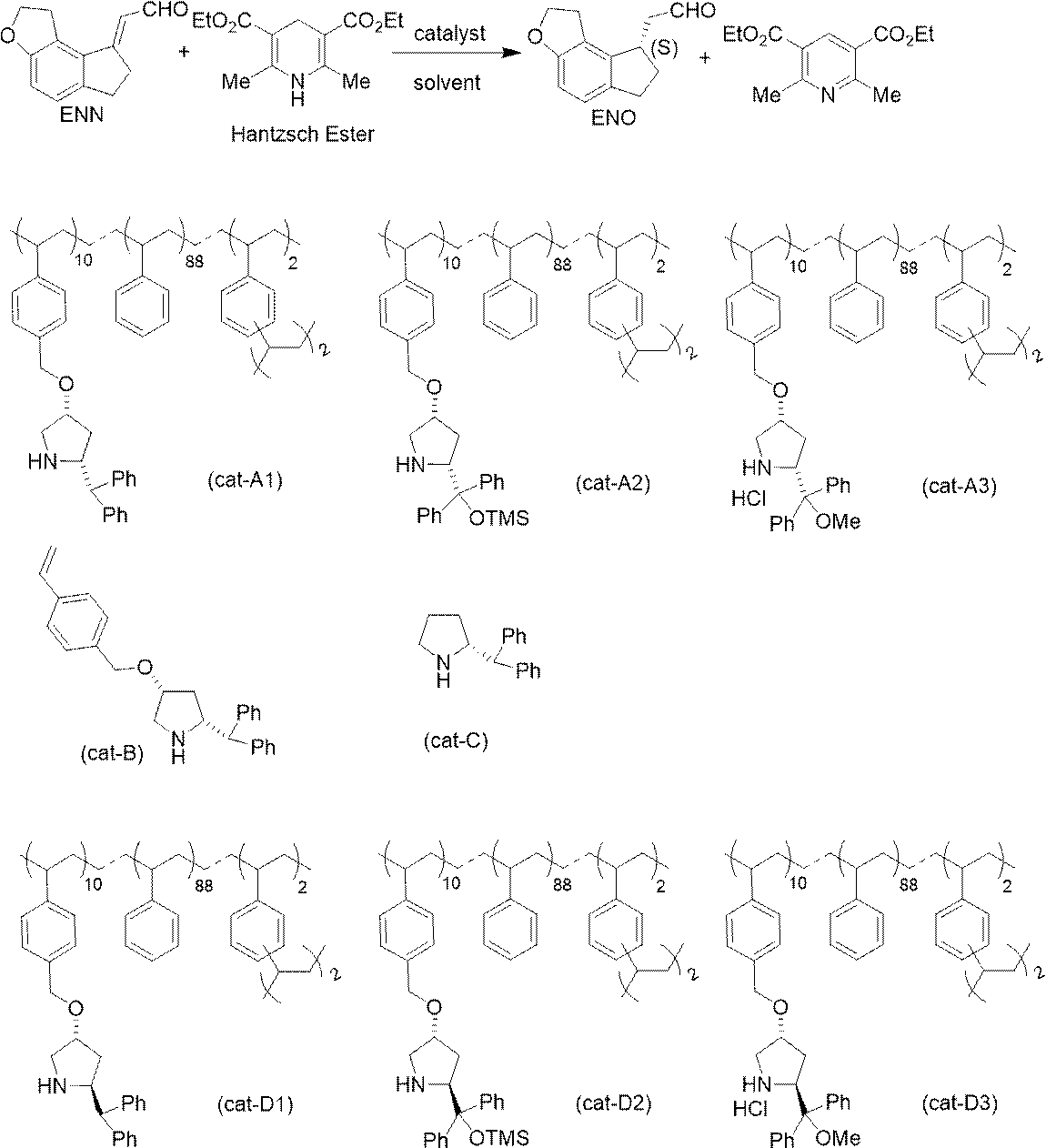
- Catalyst (cat-A1, cat-A2, cat-A3, cat-B, cat-C((R)-(+)-2-(Diphenylmethyl)pyrrolidine, AstaTech (Chengdu) Biopharmaceutical), cat-D1, Alternatively, cat-D3) is an amount (0.1 equivalent) in which the chiral pyrrolidine unit is 0.05 mmol, Hantzsch ester 152 mg (0.6 mmol), (E)-2-[1,2,6,7-tetrahydro-8H A predetermined solution containing -indeno[5,4-b]furan-8-ylidene]acetaldehyde (400 mg, 2 mmol) (hereinafter, ENN) 100 mg (0.5 mmol), solvent 3 mL, and trifluoroacetic acid 11 mg (0.1 mmol) was prepared.
- ENN -indeno[5,4-b]furan-8-ylidene]acetaldehyde
- the mixture was stirred at a temperature for a predetermined time, and when the catalyst was solid, the solid catalyst was filtered off and washed with 3 mL of THF.
- the obtained liquid was analyzed by high performance liquid chromatography (HPLC), and the conversion rate (conversion rate) of the raw material ENN, the target compound ((S)-(1,6,7,8-tetrahydro-2H-indeno[5,4 The molar yield of -b]furan-8-yl)acetaldehyde (hereinafter, ENO)), the optical purity of the target compound (ENO), and the absolute configuration of the target compound (ENO) were examined.
- the results are shown in Table 1.
Landscapes
- Chemical & Material Sciences (AREA)
- Organic Chemistry (AREA)
- Chemical Kinetics & Catalysis (AREA)
- Engineering & Computer Science (AREA)
- Materials Engineering (AREA)
- Health & Medical Sciences (AREA)
- Medicinal Chemistry (AREA)
- Polymers & Plastics (AREA)
- Catalysts (AREA)
- Organic Low-Molecular-Weight Compounds And Preparation Thereof (AREA)
Abstract
下記式(1a); で表される部分を有するポリマー担持不斉触媒。
Description
本発明は不斉反応に利用可能なポリマー担持不斉触媒と、該ポリマー担持不斉触媒を用いたキラル化合物の製造方法に関するものである。
固体不斉触媒は、回収が容易でリサイクルが可能なために注目されており、該固体不斉触媒としては、不斉触媒機能を有する部位を共有結合でポリマーに担持させた触媒が知られている。前記不斉触媒機能を有する部位がプロリン誘導体である例として、例えば、ポリシロキサンにプロリンを結合させた触媒(特許文献1など)、ポリエチレングリコールとポリリジンの共重合ポリマーにプロリンメチルエステルを結合させた触媒(非特許文献1など)、メリフィールド樹脂に1-ピバロイル-2-(ジフェニルメチル)ピロリジンを結合させた触媒(特許文献2)、ポリエチレングリコールに2-ジフェニル(トリメチルシリルオキシ)メチルピロリジンを結合させた触媒(特許文献3)、ポリスチレンに2-ジフェニル(tert-ブチルジメチルシリルオキシ)メチルピロリジンを結合させた触媒(非特許文献2)などが知られている。
Bioconjugate Chem,1994年,5巻,621-630頁
Organic Letters,2016年,18巻,6292-6295頁
しかし、特許文献1及び非特許文献1などの不斉誘起部位としてプロリンを用いた例では不斉反応の立体選択性が劣る。また特許文献2、特許文献3、非特許文献2などの不斉誘起部位としてtrans-ジフェニルメチルピロリジンを用いた例では、不斉反応の立体選択性が十分に満足いくものではなかった。
本発明は上記の様な事情に着目してなされたものであって、その目的は、不斉反応の立体選択性を更に高めることにある。また本発明の好ましい目的は、ポリマーに結合させることで、結合前よりも立体選択性を高めることが可能な不斉誘起部位を提供することにある。
本発明は上記の様な事情に着目してなされたものであって、その目的は、不斉反応の立体選択性を更に高めることにある。また本発明の好ましい目的は、ポリマーに結合させることで、結合前よりも立体選択性を高めることが可能な不斉誘起部位を提供することにある。
本発明者らは、前記課題を解決するために鋭意研究を重ねた結果、cis-ジ(ヘテロ)アリールメチルピロリジンを不斉誘起部位として用いると不斉反応の立体選択性を更に高めることができ、かつ該不斉誘起部位をポリマーに結合させると、ポリマーに結合する前よりも立体選択性を高めることができることを見出し、本発明を完成した。なお本明細書において、(ヘテロ)アリールとは、アリールとヘテロアリールを合わせての総称である。
すなわち、本発明は、以下の通りである。
[1] 下記式(1a);

(式中、Ar1、Ar2は、それぞれ独立して、置換基を有していてもよい炭素数6~20のアリール基、又は置換基を有していてもよい炭素数3~20のヘテロアリール基を表す。Xは酸素原子、又は硫黄原子を表し、Yは単結合、又は連結基を表し、Zはポリマー鎖を表す。R1は水素原子、水酸基、置換基を有していてもよい炭素数1~20のアルキルオキシ基、置換基を有していてもよい炭素数7~20のアラルキルオキシ基、置換基を有していてもよい炭素数2~20のアシルオキシ基、又は置換基を有していてもよい炭素数3~20の炭化水素基を有するシリルオキシ基を表す。R2は水素原子、水酸基、置換基を有していてもよい炭素数1~20のアルキル基、置換基を有していてもよい炭素数6~20のアリール基、ホルミル基、置換基を有していてもよい炭素数2~20のアシル基、置換基を有していてもよい炭素数2~20のアルコキシカルボニル基、又はカルバモイル基を表す。*は不斉炭素原子を表し、2つの不斉炭素原子の環外置換基はシスの相対立体配置を示す。)で表される部分を有するポリマー担持不斉触媒。
[2] 下記式(1b);

(式中、Ar1、Ar2、X、R1、R2、*は前記に同じである。R3は単結合、又は置換基を有してもよい炭素数1~5のアルキレン基である。)で表され、スチレン系単量体に由来する繰り返し単位を有するポリマー担持不斉触媒。
[3] 下記式(1c);

(式中、Ar1、Ar2、X、R1、R2、R3、*は前記に同じである。m、n、oは分子のモル比率を表し、m、n、oの合計が100%となる。)で表される部分を有するポリマー担持不斉触媒。
[4] 前記Ar1、Ar2がともにフェニル基、又は3,5-ジメチルフェニル基であり、前記R1が水素原子、水酸基、メトキシ基、又はトリメチルシロキシ基であり、前記R2が水素原子である、[1]~[3]のいずれかに記載のポリマー担持不斉触媒。
[5] 前記R3がメチレン基、又はブチレン基であり、前記Xが酸素原子である、[2]~[4]のいずれかに記載のポリマー担持不斉触媒。
[6] [1]~[5]のいずれかに記載のポリマー担持不斉触媒を触媒として、不斉還元反応、不斉アルドール反応、不斉エポキシ化反応、不斉酸化反応、不斉Diels-Alder反応、不斉Mannich反応、又は不斉マイケル付加反応を行うキラル化合物の製造方法。
[7] 前記ポリマー担持不斉触媒をカラムに充填し、反応原料を含む液をカラム入口から連続的に供給し、前記キラル化合物を含む反応液をカラム出口から連続的に排出する[6]に記載のキラル化合物の製造方法。
すなわち、本発明は、以下の通りである。
[1] 下記式(1a);
[2] 下記式(1b);
[3] 下記式(1c);
[4] 前記Ar1、Ar2がともにフェニル基、又は3,5-ジメチルフェニル基であり、前記R1が水素原子、水酸基、メトキシ基、又はトリメチルシロキシ基であり、前記R2が水素原子である、[1]~[3]のいずれかに記載のポリマー担持不斉触媒。
[5] 前記R3がメチレン基、又はブチレン基であり、前記Xが酸素原子である、[2]~[4]のいずれかに記載のポリマー担持不斉触媒。
[6] [1]~[5]のいずれかに記載のポリマー担持不斉触媒を触媒として、不斉還元反応、不斉アルドール反応、不斉エポキシ化反応、不斉酸化反応、不斉Diels-Alder反応、不斉Mannich反応、又は不斉マイケル付加反応を行うキラル化合物の製造方法。
[7] 前記ポリマー担持不斉触媒をカラムに充填し、反応原料を含む液をカラム入口から連続的に供給し、前記キラル化合物を含む反応液をカラム出口から連続的に排出する[6]に記載のキラル化合物の製造方法。
本発明のポリマー担持不斉触媒によれば、cis-ジ(ヘテロ)アリールメチルピロリジンを不斉誘起部位として用いているため、trans-ジ(ヘテロ)アリールメチルピロリジンを不斉誘起部位として用いるよりも不斉反応の立体選択性を高めることができ、かつ該不斉誘起部位をポリマーに結合させると、ポリマーに結合する前よりも更に立体選択性を高めることができる。このポリマー担持不斉触媒は、固体不斉触媒として種々の不斉反応に使用でき、触媒の回収及び再利用が容易であり、カラムに充填してフローリアクターとして使用できる。
1.ポリマー担持不斉触媒
本発明のポリマー担持不斉触媒は、下記式(1a)で表される。
本発明のポリマー担持不斉触媒は、下記式(1a)で表される。

式(1a)で表されるポリマー担持不斉触媒では、ピロリジン環がジ(ヘテロ)アリールメチル基(-C(Ar1)(Ar2))とX基をシスの相対立体配置にすることで、トランスに相対立体配置をするよりも不斉反応の立体選択性を高めることができる。ジ(ヘテロ)アリールメチル基を構成するアリール基、又はヘテロアリール基(Ar1、Ar2)としては、それぞれフェニル基、1-ナフチル基、2-ナフチル基、2-フラニル基、チオフェン-2-イル基、2-ピリジル基などが挙げられ、Ar1及びAr2の両方がフェニル基であることが好ましい。
前記アリール基、又はヘテロアリール基が有していてもよい置換基としては、メチル基、エチル基、プロピル基などの炭素数が1~6のアルキル基;トリフルオロメチル基などの炭素数1~6のパーフルオロアルキル基;メトキシ基、エトキシ基、プロポキシ基などの炭素数が1~6のアルキルオキシ基;メトキシカルボニル基、エトキシカルボニル基などの炭素数が2~10のアルコキシカルボニル基;アセチル基、プロピオニル基などの炭素数が2~10のアシル基;フッ素、塩素、臭素、ヨウ素などのハロゲン;ニトロ基;シアノ基;トリメチルシリル基、トリエチルシリル基、トリイソプロピルシリル基などの炭素数3~20のトリアルキルシリル基などが挙げられる。Ar1及びAr2として特に好ましくはフェニル基、又は3,5-ジメチルフェニル基である。
前記アリール基、又はヘテロアリール基が有していてもよい置換基としては、メチル基、エチル基、プロピル基などの炭素数が1~6のアルキル基;トリフルオロメチル基などの炭素数1~6のパーフルオロアルキル基;メトキシ基、エトキシ基、プロポキシ基などの炭素数が1~6のアルキルオキシ基;メトキシカルボニル基、エトキシカルボニル基などの炭素数が2~10のアルコキシカルボニル基;アセチル基、プロピオニル基などの炭素数が2~10のアシル基;フッ素、塩素、臭素、ヨウ素などのハロゲン;ニトロ基;シアノ基;トリメチルシリル基、トリエチルシリル基、トリイソプロピルシリル基などの炭素数3~20のトリアルキルシリル基などが挙げられる。Ar1及びAr2として特に好ましくはフェニル基、又は3,5-ジメチルフェニル基である。
Xとしては、酸素原子、硫黄原子が好ましく、酸素原子がより好ましい。
Yを表す連結基としては、アルキレン基、フェニレン基、アルキレン基とフェニレン基とが結合した基などの2価の炭素数1~40程度の炭化水素基が挙げられ、エステル基、エーテル基、カルボニル基などの2価の官能基を適宜含んでいてもよい。
Zを表すポリマー鎖は、いわゆるポリマーの主鎖に該当する構造であることが好ましく、ビニル基含有モノマーの単独又は共重合体主鎖、ポリエステル主鎖、ポリアミド主鎖、ポリウレタン主鎖、ポリエーテル主鎖(ポリアルキレングリコール主鎖など)などが挙げられ、好ましくはビニル基含有モノマーの単独又は共重合体主鎖が挙げられる。前記ビニル基含有モノマーとしては、エチレン、プロピレンなどのオレフィン系単量体;スチレン、α-メチルスチレンなどのスチレン系単量体;塩化ビニルなどのハロゲン化ビニル;酢酸ビニルなどのカルボン酸ビニル;(メタ)アクリル酸、(メタ)アクリル酸エステルなどの(メタ)アクリル酸系単量体が挙げられ、いずれの場合も、主鎖はメチレン基の連続構造を有している。前記ポリマー鎖は、適宜、架橋されていてもよい。
R1を表す炭素数1~20のアルキルオキシ基としては、メトキシ基、エトキシ基、プロポキシ基などの炭素数1~10のアルキルオキシ基が好ましく、炭素数1~5のアルキルオキシ基がより好ましい。該アルキルオキシ基が有していてもよい置換基としては、メトキシ基、エトキシ基、プロポキシ基などの炭素数が1~6のアルキルオキシ基;メトキシカルボニル基、エトキシカルボニル基などの炭素数が2~10のアルコキシカルボニル基;アセチル基、プロピオニル基などの炭素数が2~10のアシル基;フェニル基、ナフチル基等の炭素数が6~20のアリール基;ベンジル基等の炭素数が7~20のアラルキル基等;フッ素、塩素、臭素、ヨウ素などのハロゲン;ニトロ基;シアノ基;トリメチルシリル基、トリエチルシリル基、トリイソプロピルシリル基などの炭素数3~20のトリアルキルシリル基などが挙げられる。
R1を表す炭素数7~20のアラルキルオキシ基としては、ベンジルオキシ基、フェニルエチルオキシ基、フェニルプロピル基などの炭素数7~15のアラルキルオキシ基が好ましく、炭素数7~10のアラルキルオキシ基がより好ましい。該アラルキルオキシ基が有していてもよい置換基としては、メトキシ基、エトキシ基、プロポキシ基などの炭素数が1~6のアルキルオキシ基;メトキシカルボニル基、エトキシカルボニル基などの炭素数が2~10のアルコキシカルボニル基;アセチル基、プロピオニル基などの炭素数が2~10のアシル基;フッ素、塩素、臭素、ヨウ素などのハロゲン;ニトロ基;シアノ基;トリメチルシリル基、トリエチルシリル基、トリイソプロピルシリル基などの炭素数3~20のトリアルキルシリル基などが挙げられる。
R1を表す炭素数2~20のアシルオキシ基としては、アセトキシ基、ピバロイルオキシ基、ベンゾイルオキシ基などの炭素数2~15のアシルオキシ基が好ましく、炭素数2~10のアシルオキシ基がより好ましい。該アシルオキシ基が有していてもよい置換基としては、メトキシ基、エトキシ基、プロポキシ基などの炭素数が1~6のアルキルオキシ基;メトキシカルボニル基、エトキシカルボニル基などの炭素数が2~10のアルコキシカルボニル基;アセチル基、プロピオニル基などの炭素数が2~10のアシル基;フッ素、塩素、臭素、ヨウ素などのハロゲン;ニトロ基;シアノ基;トリメチルシリル基、トリエチルシリル基、トリイソプロピルシリル基などの炭素数3~20のトリアルキルシリル基などが挙げられる。
R1を表す炭素数3~20の炭化水素基を有するシリルオキシ基としては、トリメチルシリルオキシ基、ジメチルエチルシリルオキシ基、メチルジエチルシリルオキシ基、トリエチルシリルオキシ基などのトリアルキルシリルオキシ基;ジメチルフェニルシリルオキシ基などのアルキルアリールシリルオキシ基;トリフェニルシリルオキシ基などのトリアリールシリルオキシ基が挙げられ、好ましくはトリアルキルシリルオキシ基である。炭素数3~20の炭化水素基を有するシリルオキシ基が有していてもよい置換基としては、メトキシ基、エトキシ基、プロポキシ基などの炭素数が1~6のアルキルオキシ基;メトキシカルボニル基、エトキシカルボニル基などの炭素数が2~10のアルコキシカルボニル基;アセチル基、プロピオニル基などの炭素数が2~10のアシル基;フッ素、塩素、臭素、ヨウ素などのハロゲン;ニトロ基;シアノ基;トリメチルシリル基、トリエチルシリル基、トリイソプロピルシリル基などの炭素数3~20のトリアルキルシリル基などが挙げられる。
前記R1としては、水素原子、水酸基、アルキルオキシ基、炭化水素基を有するシリルオキシ基が好ましく、水素原子、水酸基、アルキルオキシ基、トリアルキルシリルオキシ基がより好ましく、水素原子、水酸基、メトキシ基、トリメチルシリルオキシ基が更に好ましく、水素原子がより更に好ましい。
R2を示す炭素数1~20のアルキル基としては、メチル基、エチル基、プロピル基、ブチル基などの炭素数1~10のアルキル基が好ましく、炭素数1~6のアルキル基がより好ましい。該アルキル基が有していてもよい置換基としては、メトキシ基、エトキシ基、プロポキシ基などの炭素数が1~6のアルキルオキシ基;メトキシカルボニル基、エトキシカルボニル基などの炭素数が2~10のアルコキシカルボニル基;アセチル基、プロピオニル基などの炭素数が2~10のアシル基;フッ素、塩素、臭素、ヨウ素などのハロゲン;ニトロ基;シアノ基;トリメチルシリル基、トリエチルシリル基、トリイソプロピルシリル基などの炭素数3~20のトリアルキルシリル基などが挙げられる。
R2を示す炭素数6~20のアリール基としては、フェニル基、1-ナフチル基、2-ナフチル基などが挙げられる。該アリール基が有していてもよい置換基としては、メチル基、エチル基、プロピル基などの炭素数が1~6のアルキル基;メトキシ基、エトキシ基、プロポキシ基などの炭素数が1~6のアルキルオキシ基;メトキシカルボニル基、エトキシカルボニル基などの炭素数が2~10のアルコキシカルボニル基;アセチル基、プロピオニル基などの炭素数が2~10のアシル基;フッ素、塩素、臭素、ヨウ素などのハロゲン;ニトロ基;シアノ基;トリメチルシリル基、トリエチルシリル基、トリイソプロピルシリル基などの炭素数3~20のトリアルキルシリル基などが挙げられる。
R2を示す炭素数2~20のアシル基としては、アセチル基、プロピオニル基などのアルキルカルボニル基;ベンゾイル基などのアリールカルボニル基などが挙げられる。該アシル基が有していてもよい置換基としては、メトキシ基、エトキシ基、プロポキシ基などの炭素数が1~6のアルキルオキシ基;メトキシカルボニル基、エトキシカルボニル基などの炭素数が2~10のアルコキシカルボニル基;アセチル基、プロピオニル基などの炭素数が2~10のアシル基;フッ素、塩素、臭素、ヨウ素などのハロゲン;ニトロ基;シアノ基;トリメチルシリル基、トリエチルシリル基、トリイソプロピルシリル基などの炭素数3~20のトリアルキルシリル基などが挙げられる。
R2を示す炭素数2~20のアルコキシカルボニル基としては、メトキシカルボニル基、tert-ブトキシカルボニル基などのアルキルオキシカルボニル基;ベンジルオキシカルボニル基などのアラルキルオキシカルボニル基などが挙げられる。該アルコキシカルボニル基が有していてもよい置換基としては、メトキシ基、エトキシ基、プロポキシ基などの炭素数が1~6のアルキルオキシ基;メトキシカルボニル基、エトキシカルボニル基などの炭素数が2~10のアルコキシカルボニル基;アセチル基、プロピオニル基などの炭素数が2~10のアシル基;フッ素、塩素、臭素、ヨウ素などのハロゲン;ニトロ基;シアノ基;トリメチルシリル基、トリエチルシリル基、トリイソプロピルシリル基などの炭素数3~20のトリアルキルシリル基などが挙げられる。
前記R2としては、水素原子が好ましい。
また、R2が水素原子の場合、式(1a)で表されるポリマー担持不斉触媒は、その許容される酸との塩を含むものとして定義される。前記酸としては、塩化水素、臭化水素、リン酸、硫酸、硝酸、過塩素酸などの無機酸、ギ酸、酢酸、トリフルオロ酢酸、トリクロロ酢酸、安息香酸、シュウ酸、クエン酸、酒石酸、メタンスルホン酸、p-トルエンスルホン酸などの有機酸が挙げられる。好ましくは塩化水素、硫酸、トリフルオロ酢酸、トリクロロ酢酸、メタンスルホン酸であり、更に好ましくはトリフルオロ酢酸である。
また、R2が水素原子の場合、式(1a)で表されるポリマー担持不斉触媒は、その許容される酸との塩を含むものとして定義される。前記酸としては、塩化水素、臭化水素、リン酸、硫酸、硝酸、過塩素酸などの無機酸、ギ酸、酢酸、トリフルオロ酢酸、トリクロロ酢酸、安息香酸、シュウ酸、クエン酸、酒石酸、メタンスルホン酸、p-トルエンスルホン酸などの有機酸が挙げられる。好ましくは塩化水素、硫酸、トリフルオロ酢酸、トリクロロ酢酸、メタンスルホン酸であり、更に好ましくはトリフルオロ酢酸である。
式(1a)で表されるポリマー担持不斉触媒としては、式(1b)で表される繰り返し単位を有するポリマー担持不斉触媒が好ましい。

R3を表す炭素数1~5のアルキレン基としては、メチレン基、エチレン基、プロピレン基、ブチレン基、ペンチレン基などが挙げられ、メチレン基、又はブチレン基が好ましい。該アルキレン基が有していてもよい置換基としては、メトキシ基、エトキシ基、プロポキシ基などの炭素数が1~6のアルキルオキシ基;メトキシカルボニル基、エトキシカルボニル基などの炭素数が2~10のアルコキシカルボニル基;アセチル基、プロピオニル基などの炭素数が2~10のアシル基;フッ素、塩素、臭素、ヨウ素などのハロゲン;ニトロ基;シアノ基;トリメチルシリル基、トリエチルシリル基、トリイソプロピルシリル基などの炭素数3~20のトリアルキルシリル基などが挙げられる。
R3としては炭素数1~5のアルキレン基が好ましく、メチレン基、又はブチレン基がより好ましく、特に好ましくはメチレン基である。
R3としては炭素数1~5のアルキレン基が好ましく、メチレン基、又はブチレン基がより好ましく、特に好ましくはメチレン基である。
式(1b)で表される繰り返し単位を有するポリマー担持不斉触媒は、式(1b)に対応するビニル系単量体の単独重合体であってもよく、共重合体であってもよく、共重合体であることが好ましい。共重合体とすることで、不斉環境場を適切に制御できる。共重合体とする場合、式(1b)で表される繰り返し単位のモル割合は、全繰り返し単位のモル量を100%としたとき、例えば、0.1%以上、好ましくは1%以上、より好ましくは3%以上であり、例えば、50%以下、好ましくは30%以下、より好ましくは20%以下である。
共重合体とする場合、共重合成分に由来する繰り返し単位としては、エチレン、プロピレンなどのオレフィン系単量体;スチレン、α-メチルスチレンなどのスチレン系単量体;塩化ビニルなどのハロゲン化ビニル;酢酸ビニルなどのカルボン酸ビニル;(メタ)アクリル酸、(メタ)アクリル酸エステルなどの(メタ)アクリル酸系単量体などのビニル基含有モノマーに由来する繰り返し単位が挙げられ、スチレン系単量体に由来する繰り返し単位が好ましい。スチレン系単量体に由来する繰り返し単位は、該単位が有するベンゼン環が、式(1b)のR3で結合するベンゼン環と相互作用するためか、不斉環境場を更に適切にできる。
前記ポリマー担持不斉触媒は、多官能性単量体を共重合させることで架橋されていてもよい。架橋することでポリマー担持不斉触媒の溶解性を下げることができ、また強度を高めることができる。溶解性を下げ、強度を高めたポリマー担持不斉触媒は、例えば、粒子にしてカラムに充填して加圧下で使用しても、ポリマー担持不斉触媒粒子間空隙を維持することができ、カラム詰まりを防止できる。多官能性単量体に由来する繰り返し単位としては、トリアリルシアヌレート、ジビニルベンゼンなどのπ結合含有環(好ましくは芳香環)を有する単量体;アリル(メタ)アクリレート、ジアリルフタレート、ジアリルマレート、ジビニルアジペート、エチレングリコールジ(メタ)アクリレート、プロピレングリコールジ(メタ)アクリレート、ジエチレングリコールジ(メタ)アクリレート、トリエチレングリコールジ(メタ)アクリレート、トリメチルロールプロパントリ(メタ)アクリレート、テトラメチロールメタンテトラ(メタ)アクリレート、ジプロピレングリコールジ(メタ)アクリレートなどに由来する繰り返し単位が挙げられ、π結合含有環を有する単量体に由来する繰り返し単位が好ましく、ジビニルベンゼンに由来する繰り返し単位がより好ましい。π結合含有環を有する単量体に由来する繰り返し単位は、該π結合含有環が、式(1b)のR3で結合するベンゼン環と相互作用するためか、不斉環境場を更に適切にできる。
多官能性単量体に由来する繰り返し単位のモル割合は、全繰り返し単位のモル量を100%としたとき、例えば、0.1%以上、好ましくは0.5%以上、より好ましくは1.0%以上であり、例えば、50%以下、好ましくは40%以下、より好ましくは30%以下である。
前記式(1b)で表されるポリマー担持不斉触媒として、より好ましくは下記式(1c)で表される部分を有するポリマー担持不斉触媒である。
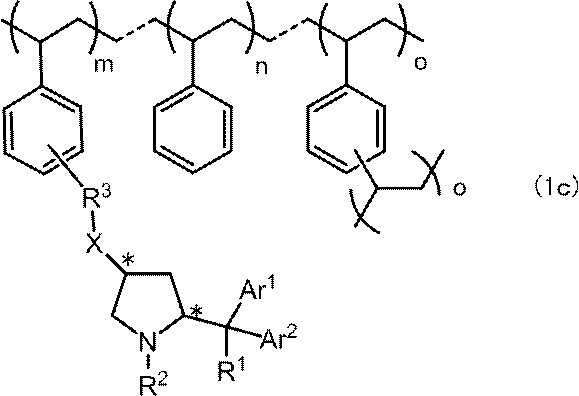
式(1c)中、破線は単量体の結合箇所を表す。なお、単量体の配列は限定されず、式(1c)は好ましくはランダム共重合体である。
前記m、n、oの比率としては特に制限されないが、mとして好ましくは1~50%、更に好ましくは5~20%であり、nとして好ましくは50~99%であり、更に好ましくは60~95%、oとして好ましくは0~50%であり、更に好ましくは1~30%である。
また前記ポリマー担持不斉触媒は、水及び有機溶媒に対して実質的に溶解しないことが好ましい。
前記ポリマー担持不斉触媒は、種々の不斉反応の触媒として使用でき、キラル化合物を製造できる。例えば前記ポリマー担持不斉触媒は、電子吸引性基(カルボン酸基、カルボン酸エステル基、ホルミル基、ニトリル基、ニトロ基、ハロゲノ基など)が結合した二重結合含有化合物を、Hantzschエステルを水素移動源として用いて不斉還元するなどの不斉還元反応の触媒として使用可能であり、不斉アルドール反応、不斉エポキシ化反応、不斉酸化反応、不斉Diels-Alder反応、不斉Mannich反応、不斉マイケル付加反応などでも前記ポリマー担持不斉触媒を触媒として使用可能である。
前記ポリマー担持不斉触媒を用いた不斉反応は、反応原料とポリマー担持不斉触媒とを含む液を攪拌するバッチ式反応でもよく、ポリマー担持不斉触媒をカラムに充填し、反応原料を含む液をカラム入口から連続的に供給し、反応生成物としてのキラル化合物を含む反応液をカラム出口から連続的に排出するカラム式反応でもよい。バッチ式反応によれば、反応生成物を溶解した液をろ過することでポリマー担持不斉触媒を除去でき、カラム式反応によればポリマー担持不斉触媒から分離された反応生成物を連続的に取り出すことができ、反応生成物の精製とポリマー担持不斉触媒の回収が容易である。好ましい反応方式は、カラム式である。カラム式にすると、フローリアクターに利用できる。フローリアクターでは、前記ポリマー担持不斉触媒を充填したカラムの上流側に、不斉反応の原料生成反応を行うリアクターを接続させてもよく、ポリマー担持不斉触媒を充填したカラムの下流側に不斉反応生成物をさらに反応させるリアクターを接続させてもよく、一連の反応を効率よく行うことができる。
本願は、2018年11月30日に出願された日本国特許出願第2018-225701号に基づく優先権の利益を主張するものである。2018年11月30日に出願された日本国特許出願第2018-225701号の明細書の全内容が、本願に参考のため援用される。
以下、実施例を挙げて本発明をより具体的に説明するが、本発明はもとより下記実施例によって制限を受けるものではなく、前及び/又は後記の趣旨に適合し得る範囲で適当に変更を加えて実施することも勿論可能であり、それらはいずれも本発明の技術的範囲に包含される。
1.cis-ジアリールメチルピロリジンの製造
cis-ジアリールメチルピロリジンとして、下記式で表されるcis-H化合物6、cis-トリメチルシロキシ(以下、OTMS)化合物9、cis-メトキシ(以下、OMe)化合物11を下記のScheme1又はScheme2に従って合成した。
cis-ジアリールメチルピロリジンとして、下記式で表されるcis-H化合物6、cis-トリメチルシロキシ(以下、OTMS)化合物9、cis-メトキシ(以下、OMe)化合物11を下記のScheme1又はScheme2に従って合成した。
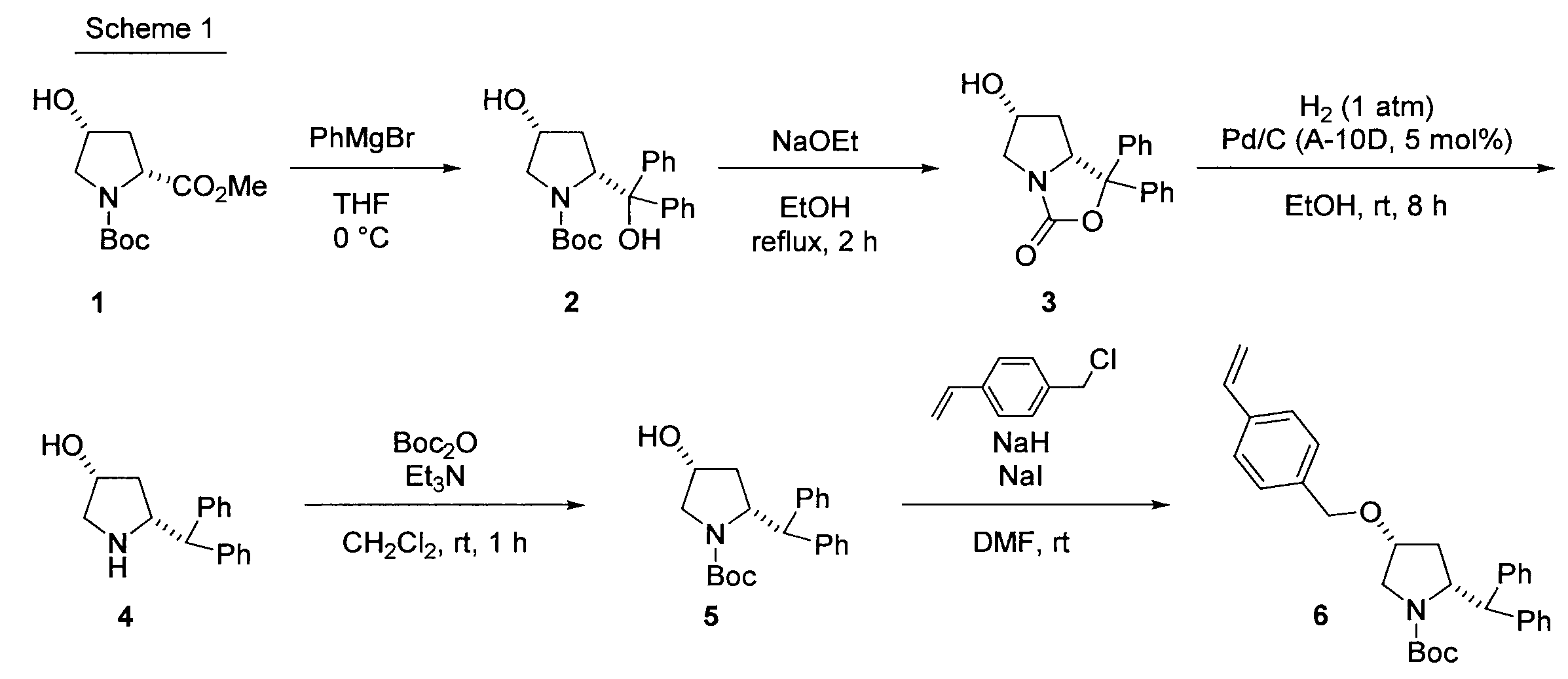

製造例1(Scheme1)
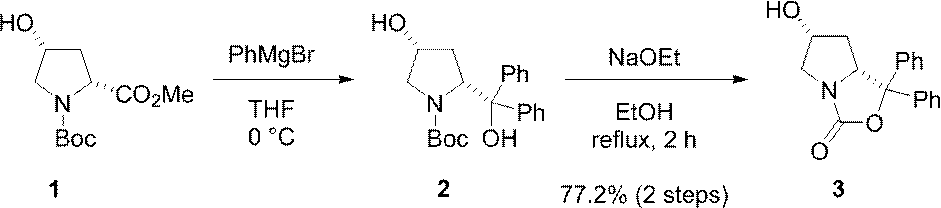
製造例2(Scheme1)

得られた粗生成物のCH2Cl2溶液(130mL)に対し、室温で二炭酸ジ-tert-ブチル(以下、Boc2O)(3.01g,13.8mmol,1.0当量)を加えた。室温で1時間攪拌後、水(約100mL)を加えた。CH2Cl2で抽出(約50mL×3)した。Na2SO4で乾燥、濾過後、減圧下濃縮して粗生成物を得た。得られた粗生成物はシリカゲルカラムクロマトグラフィー(n-Hex:EtOAc=2:1(体積比))により精製したところ、化合物5(4.11g,11.6mmol,化合物3からの収率84.4モル%)を無色の液体として得た。
製造例3(Scheme1)

製造例4(Scheme2)

化合物7(801mg,1.95mmol,1当量)をEtOH(20mL)-H2O(10mL)混合溶媒に懸濁させ、KOH(546mg,9.73mmol,5当量)を加えた。70°Cで15時間攪拌後、KOH(546mg,9.73mmol,5当量)を追加した。さらに70°Cで21時間攪拌した。室温に冷却後、飽和NH4Cl水溶液(約50mL)を加えた。EtOAcで抽出(約20mLx3)した。有機層を飽和食塩水(約30mL)で洗浄し、Na2SO4で乾燥、濾過後、減圧下濃縮を行ったところ、化合物8(618mg,1.60mmol,収率82.4モル%)を無色の液体として得た。
製造例5(Scheme2)

製造例6(Scheme2)

化合物10の粗生成物のDMF(7.8mL)溶液にMeI(58.3mL,0.943mmol,1.2当量)とNaH(55wt% dispersion,51.4mg,1.18mmol,1.5当量)を順次0°Cで加えた。室温で22時間攪拌後、飽和NH4Cl水溶液(約30mL)を加えた。EtOAcで抽出(約10mL×3)した。有機層を水(約20mL)、飽和食塩水(約20mL)で順次洗浄した。Na2SO4で乾燥、濾過後、減圧下濃縮を行い、粗生成物を得た。得られた粗生成物はシリカゲルカラムクロマトグラフィー(n-Hex:EtOAc=5:1(体積比))により精製したところ、化合物11(200mg,0.400mmol,収率50.9モル%)を無色の液体として得た。
2.cis-ジアリールメチルピロリジンを不斉誘起部位として有するポリマー担持不斉触媒の製造
実施例1
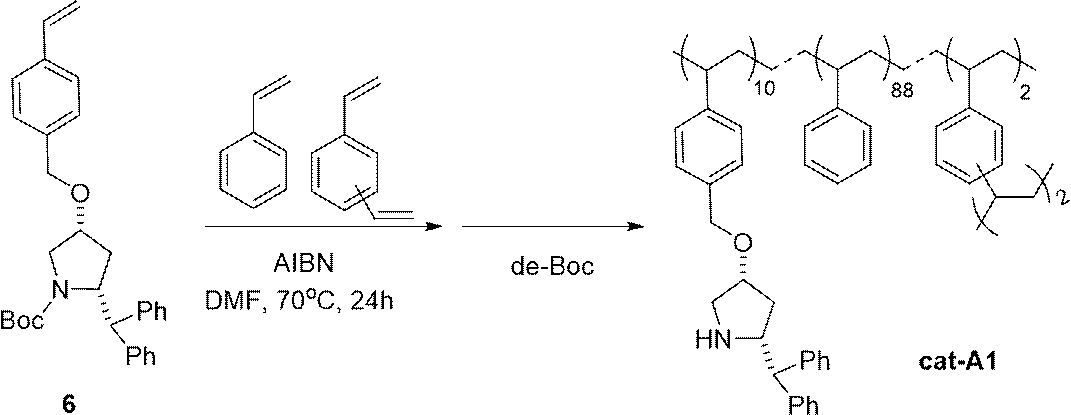
20mLナス形フラスコに、Boc-cat-A1(1.44g,1.00mmol of N-Boc)、THF(2.5mL)を量り取った。反応溶液を0°Cに冷却した後、4.0M HClジオキサン溶液(2.50mL,10.0mmol)を0°Cでゆっくり滴下した。滴下終了後、室温で24時間攪拌した。ガラスフィルターでろ過した後、不溶物をTHF(10mL)で2回洗浄し、ポリマー担持化キラルピロリジン塩酸塩cat-A1(化合物cat-A1の塩酸塩を称す)を得た。
20mLナス形フラスコに、ポリマー担持化キラルピロリジン塩酸塩cat-A1(1.00mmol of HCl salt),THF(2.5mL)を量り取った。次に、13.4Mアンモニア水3.73mL(50.0mmol)を室温でゆっくり滴下し、24時間攪拌した。ガラスフィルターでろ過した後、不溶物をTHF:H2O(2:1)混合溶液10mLで5回洗浄した。真空ポンプにより、40°Cで24時間乾燥したところ、化合物cat-A1(1.34g,1.00mmol(アミノ基基準),収率100モル%)を透明な固体として得た。
実施例2

実施例3

20mLナス形フラスコに、Boc-cat-A3(1.48g,1.00mmol of N-Boc)、THF(2.5mL)を量り取った。反応溶液を0°Cに冷却した後、4.0M HClジオキサン溶液(2.50mL,10.0mmol)を0°Cでゆっくり滴下した。滴下終了後、室温で24時間攪拌した。ガラスフィルターでろ過した後、不溶物をTHF(10mL)で2回洗浄し、ポリマー担持化キラルピロリジン塩酸塩cat-A3(化合物cat-A3の塩酸塩を称す)を得た。
20mLナス形フラスコに、ポリマー担持化キラルピロリジン塩酸塩cat-A3(1.00mmol of HCl salt),THF(2.5mL)を量り取った。次に、13.4Mアンモニア水3.73mL(50.0mmol)を室温でゆっくり滴下し、24時間攪拌した。ガラスフィルターでろ過した後、不溶物をTHF:H2O(2:1)混合溶液10mLで5回洗浄した。真空ポンプにより、40°Cで24時間乾燥したところ、化合物cat-A3(1.22g,0.90mmol(アミノ基基準),収率90モル%)を透明な固体として得た。
3.trans-ジアリールメチルピロリジンの製造(比較例)
trans-ジアリールメチルピロリジンとして、下記式で表されるtrans-H化合物26、trans-OTMS化合物16、trans-OMe化合物18を下記のScheme3又はScheme4に従って合成した。
trans-ジアリールメチルピロリジンとして、下記式で表されるtrans-H化合物26、trans-OTMS化合物16、trans-OMe化合物18を下記のScheme3又はScheme4に従って合成した。


比較製造例1(Scheme3)
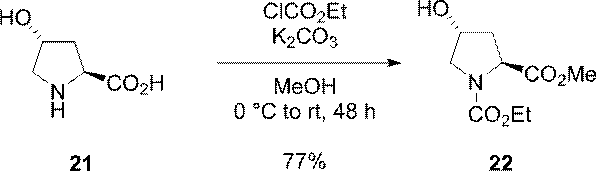
比較製造例2(Scheme3)

比較製造例3(Scheme3)
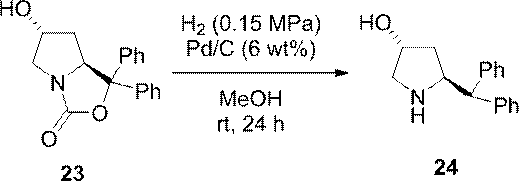
比較製造例4(Scheme3)

比較製造例5(Scheme3)
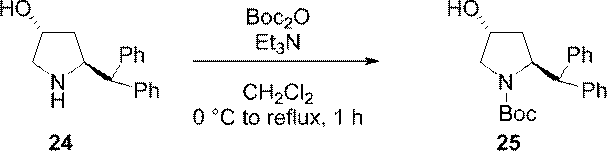
比較製造例6(Scheme3)
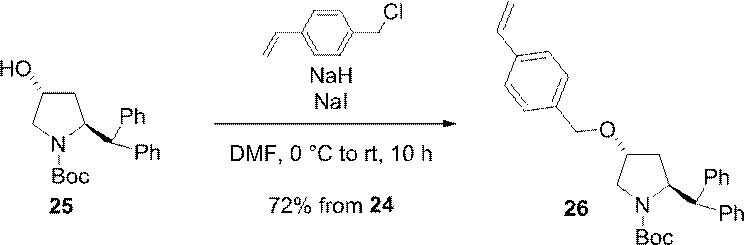
比較製造例7(Scheme4)
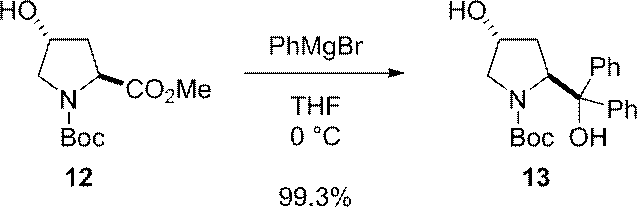
比較製造例8(Scheme4)
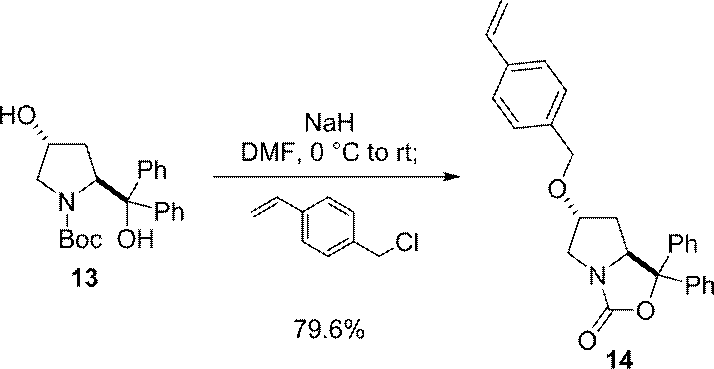
比較製造例9(Scheme4)
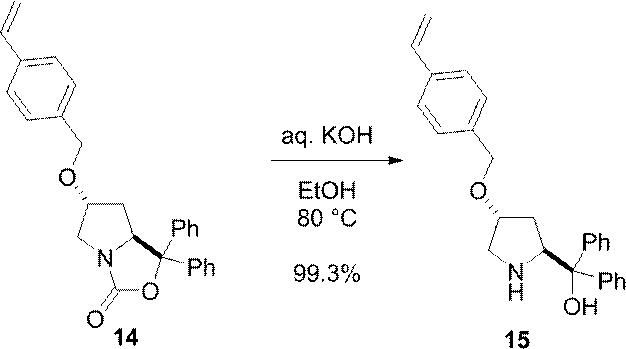
比較製造例10(Scheme4)

比較製造例11(Scheme4)
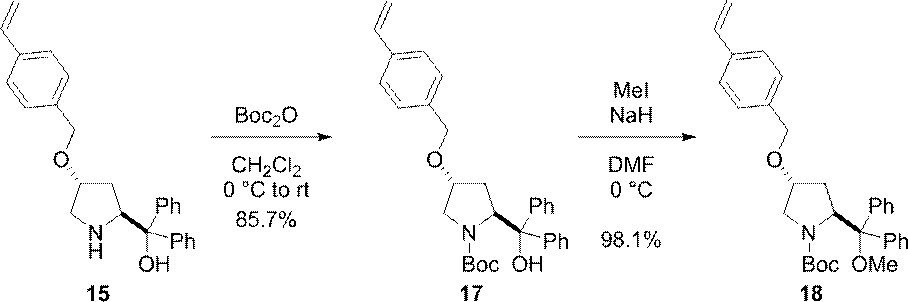
化合物17(1.78g,3.67mmol,1当量)のDMF(36mL)溶液にMeI(297mL,4.78mmol,1.3当量)とNaH(55%dispersion,240mg,5.51mmol,1.5当量)を順次0°Cで加えた。0°Cで3時間攪拌後、1M HCl水溶液(約30mL)を加えた。混合溶媒をEtOAc(約30mL×3)で抽出した。水(約30mL)、食塩水(約30mL)で順次洗浄した。Na2SO4で乾燥、濾過後、減圧下濃縮し、粗生成物を得た。得られた粗生成物はシリカゲルカラムクロマトグラフィーにより精製(n-Hex:EtOAc=10:1(体積比))したところ、化合物18(1.80g,3.60mmol,収率98.1モル%)を無色の液体として得た。
4.trans-ジアリールメチルピロリジンを不斉誘起部位として有するポリマー担持不斉触媒の製造(比較例)
比較例1

20mLナス形フラスコに、上記透明固体Boc-cat-D1(1.44g,1.00mmol of N-Boc)、THF(2.5mL)を量り取った。反応溶液を0°Cに冷却した後、4.0M HClジオキサン溶液(2.50mL,10.0mmol)を0°Cでゆっくり滴下した。滴下終了後、室温で24時間攪拌した。ガラスフィルターでろ過した後、不溶物をTHF(10mL)で2回洗浄し、ポリマー担持化キラルピロリジン塩酸塩cat-D1(化合物cat-D1の塩酸塩を称す)を得た。
20mLナス形フラスコに、ポリマー担持化キラルピロリジン塩酸塩cat-D1(1.00mmol of HCl salt),THF(2.5mL)を量り取った。次に、13.4Mアンモニア水3.73mL(50.0mmol)を室温でゆっくり滴下し、24時間攪拌した。ガラスフィルターでろ過した後、不溶物をTHF:H2O(2:1)混合溶液10mLで5回洗浄した。真空ポンプにより、40°Cで24時間乾燥し、化合物cat-D1(1.25g,収率93モル%)を透明固体として得た。
比較例2
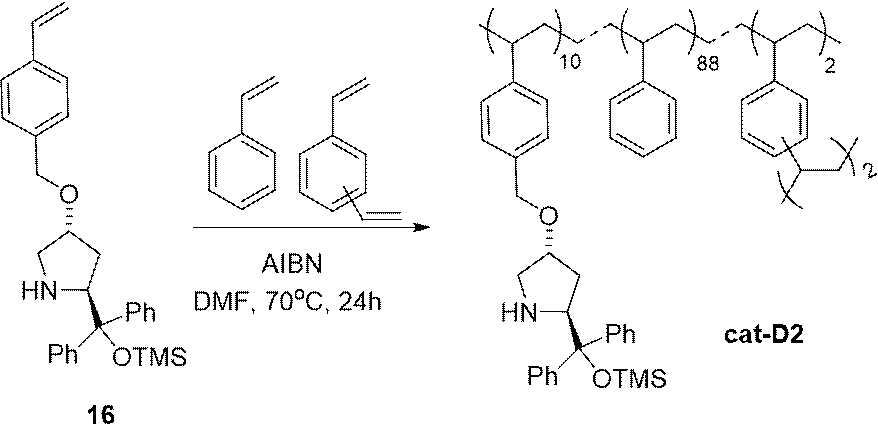
比較例3

20mLナス形フラスコに、Boc-cat-D3(1.48g,1.00mmol of N-Boc)、THF(2.5mL)を量り取った。反応溶液を0°Cに冷却した後、4.0M HClジオキサン溶液(2.50mL,10.0mmol)を0°Cでゆっくり滴下した。滴下終了後、室温で24時間攪拌した。ガラスフィルターでろ過した後、不溶物をTHF(10mL)で2回洗浄し、ポリマー担持化キラルピロリジン塩酸塩cat-D3(化合物cat-D3の塩酸塩を称す)を得た。
20mLナス形フラスコに、ポリマー担持化キラルピロリジン塩酸塩cat-D3(1.00mmol of HCl salt),THF(2.5mL)を量り取った。次に、13.4Mアンモニア水3.73mL(50.0mmol)を室温でゆっくり滴下し、24時間攪拌した。ガラスフィルターでろ過した後、不溶物をTHF:H2O(2:1)混合溶液10mLで5回洗浄した。真空ポンプにより、40°Cで24時間乾燥したところ、化合物cat-D3(1.16g,0.86mmol(アミノ基基準),収率86モル%)を透明な固体として得た。
比較例4

実施例4~7及び比較例5~8

実施例8~9及び比較例9~10


実施例10~11及び比較例11
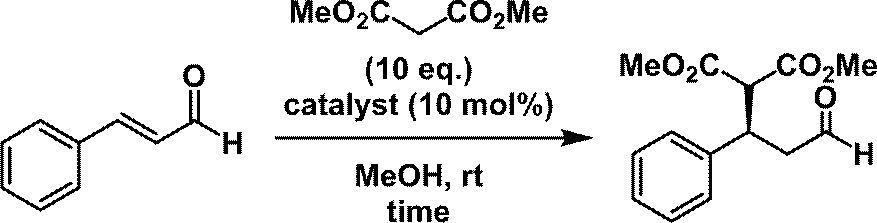

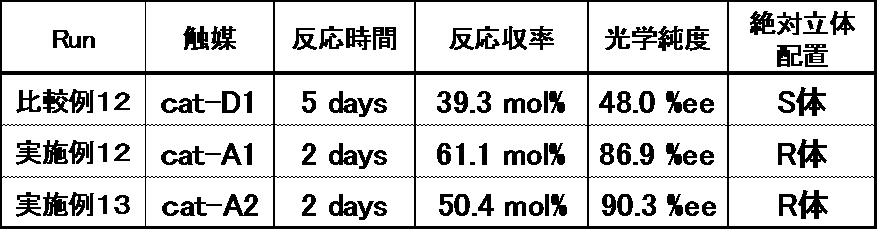
実施例12~13及び比較例12

実施例14及び比較例13

Claims (7)
- 下記式(1a);

- 下記式(1b);
- 下記式(1c);
- 前記Ar1、Ar2がともにフェニル基、又は3,5-ジメチルフェニル基であり、前記R1が水素原子、水酸基、メトキシ基、又はトリメチルシロキシ基であり、前記R2が水素原子である、請求項1~3のいずれかに記載のポリマー担持不斉触媒。
- 前記R3がメチレン基、又はブチレン基であり、前記Xが酸素原子である、請求項2~4のいずれかに記載のポリマー担持不斉触媒。
- 請求項1~5のいずれかに記載のポリマー担持不斉触媒を触媒として、不斉還元反応、不斉アルドール反応、不斉エポキシ化反応、不斉酸化反応、不斉Diels-Alder反応、不斉Mannich反応、又は不斉マイケル付加反応を行うキラル化合物の製造方法。
- 前記ポリマー担持不斉触媒をカラムに充填し、反応原料を含む液をカラム入口から連続的に供給し、前記キラル化合物を含む反応液をカラム出口から連続的に排出する請求項6に記載のキラル化合物の製造方法。
Applications Claiming Priority (2)
| Application Number | Priority Date | Filing Date | Title |
|---|---|---|---|
| JP2018-225701 | 2018-11-30 | ||
| JP2018225701 | 2018-11-30 |
Publications (1)
| Publication Number | Publication Date |
|---|---|
| WO2020110752A1 true WO2020110752A1 (ja) | 2020-06-04 |
Family
ID=70852110
Family Applications (1)
| Application Number | Title | Priority Date | Filing Date |
|---|---|---|---|
| PCT/JP2019/044710 Ceased WO2020110752A1 (ja) | 2018-11-30 | 2019-11-14 | ポリマー担持不斉触媒 |
Country Status (1)
| Country | Link |
|---|---|
| WO (1) | WO2020110752A1 (ja) |
Cited By (1)
| Publication number | Priority date | Publication date | Assignee | Title |
|---|---|---|---|---|
| CN118702926A (zh) * | 2024-06-14 | 2024-09-27 | 重庆邮电大学 | MOF@Pro HNs空心介孔网状纳米材料的制备方法及其产品和应用 |
Citations (4)
| Publication number | Priority date | Publication date | Assignee | Title |
|---|---|---|---|---|
| JPH02131493A (ja) * | 1988-11-11 | 1990-05-21 | Fuji Yakuhin Kogyo Kk | 新規なホスフィノピロリジン化合物およびそれを用いる不斉合成法 |
| JP2000237595A (ja) * | 1999-02-18 | 2000-09-05 | Nissan Chem Ind Ltd | 高分子担持不斉ジ−又はトリ−アミン触媒 |
| JP2004161861A (ja) * | 2002-11-12 | 2004-06-10 | Nippon Soda Co Ltd | 高分子固定化光学活性ジアミン化合物、高分子遷移金属錯体化合物及び光学活性アルコールの製造方法 |
| JP2013063942A (ja) * | 2011-08-29 | 2013-04-11 | Nippon Soda Co Ltd | 光学活性4級アンモニウム塩、および光学活性化合物の製造方法 |
-
2019
- 2019-11-14 WO PCT/JP2019/044710 patent/WO2020110752A1/ja not_active Ceased
Patent Citations (4)
| Publication number | Priority date | Publication date | Assignee | Title |
|---|---|---|---|---|
| JPH02131493A (ja) * | 1988-11-11 | 1990-05-21 | Fuji Yakuhin Kogyo Kk | 新規なホスフィノピロリジン化合物およびそれを用いる不斉合成法 |
| JP2000237595A (ja) * | 1999-02-18 | 2000-09-05 | Nissan Chem Ind Ltd | 高分子担持不斉ジ−又はトリ−アミン触媒 |
| JP2004161861A (ja) * | 2002-11-12 | 2004-06-10 | Nippon Soda Co Ltd | 高分子固定化光学活性ジアミン化合物、高分子遷移金属錯体化合物及び光学活性アルコールの製造方法 |
| JP2013063942A (ja) * | 2011-08-29 | 2013-04-11 | Nippon Soda Co Ltd | 光学活性4級アンモニウム塩、および光学活性化合物の製造方法 |
Cited By (2)
| Publication number | Priority date | Publication date | Assignee | Title |
|---|---|---|---|---|
| CN118702926A (zh) * | 2024-06-14 | 2024-09-27 | 重庆邮电大学 | MOF@Pro HNs空心介孔网状纳米材料的制备方法及其产品和应用 |
| CN118702926B (zh) * | 2024-06-14 | 2025-09-16 | 重庆邮电大学 | MOF@Pro HNs空心介孔网状纳米材料的制备方法及其产品和应用 |
Similar Documents
| Publication | Publication Date | Title |
|---|---|---|
| EP2534140B1 (en) | Efficient methods for z- or cis-selective cross-metathesis | |
| JP5830020B2 (ja) | カルボキシラート金属錯体及びオレフィン重合用触媒 | |
| WO2020110752A1 (ja) | ポリマー担持不斉触媒 | |
| Wang et al. | Synthesis and properties of novel helical 3-vinylpyridine polymers containing proline moieties for asymmetric aldol reaction | |
| US6777526B2 (en) | Optically active maleimide derivatives, optically active polymaleimide derivatives, production method thereof, separating agent using the same derivative, and method for separating optically active compounds using the same agent | |
| US7645889B2 (en) | Optically active polymaleimide derivatives and process for their production | |
| CN111302933A (zh) | 聚合性肉桂酸酯衍生物的制造方法 | |
| JP2006036757A (ja) | シリコーンモノマーの製造方法 | |
| WO2013168601A1 (ja) | 不斉選択性の切り替えが可能なクロマトグラフィー用充填剤 | |
| Komura et al. | A novel approach to the synthesis of optically active poly (β-hydroxy carbonyl) s by Aldol polymerization based on Mukaiyama Aldol reaction | |
| CN116375611A (zh) | 一种由脂肪胺合成二氟烷基类化合物的方法 | |
| CN116354995A (zh) | 一种含硼手性烯丙基酯类化合物及高立体选择性合成的方法 | |
| JPH07292037A (ja) | 新規な光学活性ポリアセチレン誘導体及びその製造方法 | |
| JP6086512B2 (ja) | 新規ポリ(ジフェニルアセチレン)化合物及びその製造方法、並びにその光学異性体分離剤としての用途 | |
| CN110684045B (zh) | 一种乙烯基三(2,2,2-三氟乙氧基)硅烷的制备方法 | |
| JP4696275B2 (ja) | インドール化合物の製法及び触媒 | |
| JP7709704B2 (ja) | 新規グラフェンナノリボン及びその製造方法 | |
| JP6460816B2 (ja) | 固体状態で不斉選択性の切り替えが可能な光学異性体分離剤 | |
| CN116209710B (zh) | 分离方法 | |
| EP1277771A2 (fr) | Procédé de fabrication d'un polymère séquencé à l'aide d'amorceurs radicalaires fonctionnels en polymérisation vivante | |
| JP4477206B2 (ja) | アリルオキシ基、または置換アリルオキシ基を有するポリアルキレンオキサイド系重合体の製造方法 | |
| JP2005344040A (ja) | 光学活性ポリマレイミド誘導体、並びにそれからなる光学異性体分離剤及び該分離剤を用いた光学活性化合物の分離方法 | |
| WO2005085204A1 (ja) | 含窒素5員環化合物の製造方法 | |
| JP2024081038A (ja) | スチルベン化合物の製造方法およびジアリール化合物の製造方法 | |
| Kumagai et al. | Asymmetric allylation polymerization of bis (allylsilane) and dialdehyde |
Legal Events
| Date | Code | Title | Description |
|---|---|---|---|
| 121 | Ep: the epo has been informed by wipo that ep was designated in this application |
Ref document number: 19891331 Country of ref document: EP Kind code of ref document: A1 |
|
| NENP | Non-entry into the national phase |
Ref country code: DE |
|
| 122 | Ep: pct application non-entry in european phase |
Ref document number: 19891331 Country of ref document: EP Kind code of ref document: A1 |
|
| NENP | Non-entry into the national phase |
Ref country code: JP |