WO2020105688A1 - 多成分系金属化合物 - Google Patents
多成分系金属化合物Info
- Publication number
- WO2020105688A1 WO2020105688A1 PCT/JP2019/045498 JP2019045498W WO2020105688A1 WO 2020105688 A1 WO2020105688 A1 WO 2020105688A1 JP 2019045498 W JP2019045498 W JP 2019045498W WO 2020105688 A1 WO2020105688 A1 WO 2020105688A1
- Authority
- WO
- WIPO (PCT)
- Prior art keywords
- metal compound
- silver
- elements
- conductivity
- component metal
- Prior art date
- Legal status (The legal status is an assumption and is not a legal conclusion. Google has not performed a legal analysis and makes no representation as to the accuracy of the status listed.)
- Ceased
Links
Classifications
-
- C—CHEMISTRY; METALLURGY
- C22—METALLURGY; FERROUS OR NON-FERROUS ALLOYS; TREATMENT OF ALLOYS OR NON-FERROUS METALS
- C22C—ALLOYS
- C22C30/00—Alloys containing less than 50% by weight of each constituent
Definitions
- the present invention provides a conductor that has at least one of light weight and excellent chemical stability when used in air (especially, a property that sulfide and oxidation do not easily occur) and that has a high conductivity. It relates to a multi-component metal compound suitable for making.
- conductors used for thin film materials such as power transmission and distribution lines and electrodes that form circuits of photoelectric conversion devices and electronic devices that perform amplification, oscillation and switching, reduction of power transmission loss and A material having high conductivity is used to achieve low resistance.
- silver As a material with high conductivity, silver has the highest conductivity, followed by copper, gold, and aluminum. However, since silver is expensive, copper or aluminum is generally used as a conductor used for electric wires.
- Silver has a high electrical conductivity in normal air that does not contain a sulfur compound gas such as sulfur dioxide or hydrogen sulfide, but it has a high sulfur content when left in the air containing a small amount of a sulfur compound gas.
- Sulfide corrosion
- the electrical resistance value increases and the aesthetic appearance of the surface is impaired. It was
- Patent Document 1 describes an alloy material having excellent conductivity by using a ternary alloy of 17 at% to 25 at% silver, 30 at% to 45 at% palladium, and 30 at% to 53 at% Cu as a basic composition.
- Patent Document 1 The alloy material described in Patent Document 1 does not pay attention to chemical stability when used in air, and since it is used for a contact probe, it has not only excellent conductivity but also high hardness. In addition, since it is necessary to satisfy excellent workability in a well-balanced manner, the electric resistivity is large in the range of 8.01 to 8.91 ( ⁇ ⁇ m). 0.016 ( ⁇ ⁇ m)), it is more than two orders of magnitude larger, and conductivity equal to or higher than that of silver alone is not obtained.
- An object of the present invention is to have at least one of light weight and excellent chemical stability when used in the air (especially the property that sulfide and oxidation are unlikely to occur), and have a high conductivity.
- a multi-component metal compound suitable for producing a conductor is provided.
- the gist of the present invention is as follows.
- a multi-component metal compound containing three or more elements which satisfies at least one of the following requirements (I) and (II).
- the multi-component metal compound according to (1) above which has a conductivity higher than that of Ag when measured.
- the multi-component metal compound according to (2) wherein the metal compound contains silver (Ag) and two or more kinds of elements.
- the contents (atomic%) of each of the three or more elements constituting the metal compound are substantially the same, or the difference from the remaining elements is 8 atomic% or less.
- the contents (atomic%) of each of the three or more elements constituting the metal compound are the same, or deviate from the average value of the content of the three or more elements.
- the two or more elements are copper (Cu), nickel (Ni), scandium (Sc), yttrium (Y), zirconium (Zr), tungsten (W), iridium (Ir), zinc (Zn). , Indium (In), Tin (Sn), Aluminum (Al), Strontium (Sr), Ba (Barium), Calcium (Ca), Oxygen (O) and Sulfur (S). ) Or the multi-component metal compound according to (6) to (8).
- a multi-component metal compound containing three or more elements the requirement (I), that is, the conductivity when measured at room temperature is equal to or higher than silver (Ag), The electrical conductivity when measured in a high frequency band of 4 MHz or higher at room temperature is higher than Ag, and the requirement (II), that is, the metal compound contains silver (Ag) and two or more kinds of elements.
- the requirement (I) that is, the conductivity when measured at room temperature is equal to or higher than silver (Ag)
- the requirement (II) that is, the metal compound contains silver (Ag) and two or more kinds of elements.
- the multi-component metal compound according to the present invention is a multi-component metal compound containing three or more elements and is characterized by satisfying at least one of the following requirements (I) and (II). It is a component type metal compound.
- Requirement (I) The electrical conductivity when measured at room temperature is equal to or higher than that of silver (Ag), and the electrical conductivity when measured at room temperature and in a high frequency band of 4 MHz or higher is higher than Ag.
- the multi-component metal compound according to the first embodiment is a multi-component metal compound containing three or more kinds of elements, and has a conductivity equal to or higher than that of silver (Ag) when measured at room temperature, The conductivity is higher than that of Ag when measured in a high frequency band of 4 MHz or higher at room temperature.
- the "normal temperature” here means a temperature within a range of 15 ° C or higher and 35 ° C or lower.
- conductivity when measured at room temperature is a measurement sample made into a sintered body having a diameter of 10 mm and a thickness of 5 mm, and four needle electrodes are placed on a straight line by the four-point probe method.
- the electrode is placed on a straight line, and an alternating current (DC) is applied between the two outer electrodes at room temperature by a DC bias power supply to sweep the frequency band from 0 Hz to 10 MHz ( Sweeping), measuring the potential difference between the two inner electrodes at a specific frequency (for example, 10 MHz) in the high frequency band of 4 MHz or more to calculate the resistivity ⁇ ( ⁇ ⁇ cm), and when it is determined from this resistivity ⁇ AC electrical conductivity ⁇ (reciprocal 1 / ⁇ of resistivity) of
- the present inventor measured the electric conductivity in various composition systems containing three or more elements, and conducted a diligent study as to whether or not there is a composition system having an electric conductivity equal to or higher than that of silver. It was found that there exists a composition system in which the conductivity when measured at room temperature is equal to or higher than that of silver (Ag), and the conductivity when measured at room temperature and in the high frequency band of 4 MHz or higher is higher than Ag. did.
- the multi-component metal compound of the present invention is a high-entropy alloy, or a compound containing a high-entropy alloy, in spite of being lighter than silver, a multi-component metal compound having a conductivity equal to or higher than that of silver. It was found that there are many compounds.
- high entropy alloy refers to a single-phase solid solution (which melts with each other to form a uniform solid phase) by increasing the entropy of mixing by mixing five or more constituent elements. Say that. It is known that the high entropy alloy has a low atomic diffusion rate and is excellent in high temperature strength, heat resistance and corrosion resistance.
- the multi-component metal compound of the present invention is not particularly limited as long as it is a composition system containing three or more kinds of elements, but it is preferable that the multi-component metal compound contains silver (Ag) and two or more kinds of elements. It is preferable in terms of achieving both high performance and environment resistance at a high level.
- two or more kinds of elements other than silver (Ag) are selected from the group of copper (Cu), nickel (Ni), alkaline earth metal and group 16 element.
- the element is preferably selected, and the Group 16 element is preferably at least one element of oxygen (O) and sulfur (S).
- the two or more elements are specifically copper (Cu), nickel (Ni), scandium (Sc), yttrium (Y), zirconium (Zr), tungsten (W), iridium (Ir), zinc (Zn). ), Indium (In), tin (Sn), aluminum (Al), strontium (Sr), Ba (barium) and calcium (Ca), oxygen (O) and sulfur (S). Is.
- the multi-component metal compound is a high entropy alloy in which five or more kinds of elements are composed in a composition having an equal atomic ratio.
- the multi-component metal compound of the present invention include AgAlCuIrNiSr and AgCuNiSrWZn, which are, for example, hexagonal metal compounds containing six elements including silver in equiatomic ratios (about 16.7 at%). , AgCaInZrYSc, AgAlCuIrNiBa, AgAlCuWNiCa, AgAlCuWNiBa, AgAlCuZnNiBa, AgCuNiInWS.
- the relative value of the multi-component metal compound with respect to the simple substance of silver is in the range of 0.50 to 0.92.
- Table 1 shows that 6 kinds of metal powders including silver powder are mixed at equal atomic ratios (16.7 at%) in a ball mill etc. to prepare a mixed powder, which is then compacted under a pressure of 50 MPa.
- a sintered body (metal compound) having a diameter of 10 mm and a height of 5.0 mm was produced by sintering at a temperature of 950 ° C., and a UPS spectrum measured by ultraviolet photoelectron spectroscopy using the produced sintered body.
- the work function (eV) is calculated from the above, and the density of the sintered body is measured.
- Example A shows the case where the sintered body is made of AgAlCuIrNiSr alloy
- Example B shows the case where the sintered body is made of AgCuNiSrWZn alloy.
- Table 1 also shows the work function and density of silver alone (comparative example).
- the six-component metal compounds of Examples A and B have a smaller density and can be made lighter in weight than the simple substance of the comparative example, and the work function values are almost the same as those of the simple substance of the comparative example. It can be seen that the stability (especially oxidation resistance) is excellent at the same level.
- Example 1-1 AgCuNiSrWZn (Example 1-2), AgCaInZrYSc (Example 1-3), AgAlCuIrNiBa (Example 1-4), AgAlCuWNiCa (Example 1-5), AgAlCuWNiBa (Example 1).
- Example 1-6 AgAlCuZnNiBa (Example 1-7) and AgCuNiInWS (Example 1-8) were prepared in the same manner as above, and the test materials (sintered bodies) were subjected to 0 V, 0 Hz, 20 Hz and 10 MHz. The resistivity ( ⁇ cm) at 25 ° C.
- the density (g / cm 3 ) of each test material was measured. Table 2 shows the measured density (measured density), the theoretical density, the resistivity ( ⁇ cm) when the resistivity measured by the measured density is converted into a relative density of 96%, and the material cost.
- the “actually measured density” here means the density when the volume and weight of the produced sintered body are actually measured and calculated from the measured volume and weight.
- the “theoretical density” means the density of the bulk body obtained by calculation.
- the "relative density” means the percentage of the measured density of the sintered body produced by using the powder having the same composition as the bulk body with respect to the theoretical density (100%).
- the density can be calculated by the following formula: actual density of aggregate] / [density of bulk body (theoretical density)] ⁇ 100 (%). Furthermore, the numerical values shown in parentheses in the theoretical density column of Tables 2 and 3 are the theoretical values of silver (the bulk body of silver) when the theoretical density of silver (sintered body) is 1.00. It means the relative value (ratio) of the theoretical density to the density, assuming that each test material (sintered body) has the same density as the bulk body.
- Example 1-3 (AgCaInZrYSc), although the material cost is higher than the Ag simple substance of the comparative example, the theoretical density is 5.6 g / cm 3 , and the theoretical density of the simple silver (1.00) The relative value of 0.53 is only about half, which means that the weight can be significantly reduced.
- the method of calculating the resistivity when converted to the relative density of 96% shown in Table 2 assumes that the actually measured density is determined by the balance between the compound that constitutes the sintered body and the voids. It is calculated from the correlation.
- the multi-component metal compound according to the second embodiment is a multi-component metal compound containing three or more elements, and the metal compound contains silver (Ag) and two or more elements, Both of the conductivity and the ionization potential measured at room temperature and atmospheric pressure are higher than those of silver (Ag) alone.
- the "normal temperature” referred to herein means a temperature within a range of 15 ° C or higher and 35 ° C or lower, and the "normal pressure” is a pressure when neither depressurization nor pressurization is performed, and is usually large. It means a pressure equal to atmospheric pressure (1 atm).
- conductivity when measured at room temperature and atmospheric pressure is a measurement sample made into a sintered body having a diameter of 10 mm and a thickness of 5 mm. It is placed on a table placed above, a constant direct current (DC) is applied between the two outer electrodes, and the electrical potential difference between the two inner electrodes is measured at room temperature and atmospheric pressure to obtain a resistivity ⁇ ( ⁇ ⁇ cm), and means the DC conductivity ⁇ (reciprocal 1 / ⁇ of resistivity) when calculated from this resistivity ⁇ .
- the "ionization potential when measured at room temperature and pressure” represents the ionization energy required to take out one electron from the surface of the manufactured measurement sample (sintered body) in the unit of electron volt (eV).
- the work function energy difference between Fermi level and vacuum level.
- the electrical conductivity of the produced test material is measured under the atmospheric pressure of 25 ° C. Can be obtained from the UPS spectrum measured by ultraviolet photoelectron spectroscopy.
- the present inventor produced metal compounds of various composition systems containing silver (Ag) and two or more kinds of elements and containing three or more kinds of elements, and measured the electric conductivity, and compared with silver alone.
- As a result of diligent examination as to whether or not there is a composition system having high conductivity it has been found that there is a composition system in which the conductivity when measured at room temperature and pressure is higher than that of silver (Ag) alone. did.
- UPS spectra were measured by ultraviolet photoelectron spectroscopy, and a work function (ionization potential) (eV) was calculated from the UPS spectra, and the results were measured at room temperature and atmospheric pressure.
- the multi-component metal compound of the present invention has a composition system containing silver (Ag) and two or more kinds of elements and containing three or more kinds of elements, so that The chemical stability (particularly the characteristic that sulfuration, oxidation, etc. are unlikely to occur) and conductivity can be compatible at a high level.
- the electrical conductivity is, specifically, a percentage of the electrical conductivity of silver is 101 to 500%, and the ionization potential (work function) is specifically, that of silver.
- the percentage with respect to the ionization potential (work function) is 101 to 200%.
- two or more kinds of elements other than silver (Ag) are copper (Cu), nickel (Ni), zinc (Zn), tungsten (W), aluminum. It is preferably selected from the group consisting of (Al), indium (In), scandium (Sc), yttrium (Y), barium (Ba) and group 16 elements.
- the group 16 element is preferably at least one element of oxygen (O) and sulfur (S).
- the content (atomic%) of each of the three or more elements constituting the metal compound is the same (equiatomic ratio), or the content of the three or more elements is the average value. It is preferable that all the deviation ratios are within 8%.
- the multi-component metal compound of the present invention include AgCuNi, AgCuS, AgZnS, and AgWS in the case of a ternary metal compound containing three types of elements including silver in equiatomic ratios (about 33.3 atom%). , AgAlS, etc., and the hexanary metal compound which is a high entropy alloy containing 6 kinds of elements including silver by equiatomic ratio (about 16.7 atomic%), AgAlBaCuNiW, AgCuInNiWS, AgCuInNiWY, AgCuNiScWZn. , AgCuInNiScW, AgCuInNiScZn, AgCuInNiWS and the like.
- Table 3 shows that two or more kinds of metal powders containing silver powder are mixed at a ratio of equiatomic% by a ball mill or the like to prepare a mixed powder, which is then pressed under a pressure of 50 MPa and then 950 ° C.
- a sintered body (metal compound) having a diameter of 10 mm and a height of 5.0 mm is produced by sintering at a temperature of, and the electrical conductivity is measured under the atmospheric pressure of 25 ° C. using the produced sintered body.
- the results of calculating the work function (eV) from the UPS spectrum measured by ultraviolet photoelectron spectroscopy under the atmospheric pressure of 25 ° C. are shown. The theoretical density was also calculated for each test material.
- Table 3 also shows the results of conductivity and work function obtained by the same method for silver alone (Comparative Example 1) and copper alone (Comparative Example 2).
- the conductivity the DC component and frequency dependence were measured using a digital multimeter (model number: 34460A manufactured by Keysight Technology LLC) and an impedance analyzer (model number: E4990A manufactured by Keysight Technology LLC). ..
- the conductivity and the work function in Table 3 are all shown as an index ratio (%) when the simple substance of Comparative Example 1 is 100%, and the conductivity is higher as the value of the index ratio is higher.
- the work function means that the larger the value of the exponential ratio is, the higher the work function is, and the better the chemical stability is.
- the metal compounds of Examples 2-1 to 2-12 have work functions different from those of the silver simple substance of Comparative Example 2-1 (both work function and conductivity are 100% (reference)). It is found that it is as high as 103 to 194%, has excellent chemical stability when used in air, and has an electric conductivity of 177 to 471%. In addition, all of the examples except Example 2-3 have excellent chemical stability and a much higher conductivity of 200% or more as compared with the simple substance of silver. Both -6 and 2-9 have a remarkably high conductivity of 300% or more as compared with silver alone. It is also understood that the theoretical density of each of Examples 2-1 to 2-12 (excluding Example 2-4) is smaller than the theoretical density of Ag alone in the comparative example, and the weight can be reduced.
- the copper simple substance of Comparative Example 2-2 is superior in chemical stability to the silver simple substance, but has a low electrical conductivity.
- the binary AgCu compound of Comparative Example 2-3 has a larger work function than silver alone and is excellent in chemical stability when used in air, but has poor conductivity.
- the six-component metal compound containing strontium (Sr) of Comparative Example 2-4 is inferior in chemical stability to the silver alone and has a low electric conductivity.
- the six-component metal compound containing iridium (Ir) of Comparative Example 2-5 has the same chemical stability as that of the simple substance of silver, but has a low electric conductivity.
Landscapes
- Chemical & Material Sciences (AREA)
- Engineering & Computer Science (AREA)
- Materials Engineering (AREA)
- Mechanical Engineering (AREA)
- Metallurgy (AREA)
- Organic Chemistry (AREA)
- Non-Insulated Conductors (AREA)
Abstract
本発明の多成分系金属化合物は、3種以上の元素を含有する多成分系金属化合物であって、要件(I)、すなわち常温で測定したときの導電率が、銀(Ag)と同等以上であり、常温でかつ4MHz以上の高周波数帯域で測定したときの導電率が、Agよりも高いこと、および要件(II)、すなわち前記金属化合物が、銀(Ag)と、2種以上の元素とを含有し、常温および常圧で測定したときの、導電率およびイオン化ポテンシャルのいずれもが、銀(Ag)よりも高いこと、の少なくとも一方を満足する。これによって、軽量、および空気中で使用した際における優れた化学的安定性(信頼性)のうちの少なくとも一方の特性を具備し、かつ高い導電率を有する導体を作製するのに好適な多成分系金属化合物を提供することが可能である。
Description
本発明は、軽量、および空気中で使用した際における優れた化学的安定性(特に硫化や酸化等が生じにくい特性)のうちの少なくとも一方の特性を具備し、かつ高い導電率を有する導体を作製するのに好適な多成分系金属化合物に関する。
例えば、電力用の送配電線や、光電変換デバイスや増幅・発振・スイッチングを行う電子デバイスの回路を形成する電極などの薄膜材料などに使用される導体には、送電ロスの低減や、薄膜での低抵抗化を図るため、高導電性を有する材料が使用される。
高導電性を有する材料としては、銀が最も導電率が高く、次いで、銅、金、アルミニウムが挙げられる。しかしながら、銀は高価であることから、電線に使用される導体としては、通常、銅またはアルミニウムを使用するのが一般的である。
電線の導体に、アルミニウムを使用した場合、銀や銅に比べて導電性が劣るため、銅と同等レベルの導電性を確保するには、銅を用いた導体に比べて線径を大きくする必要がある。しかしながら、電線に用いられる導体に対する近年の軽量化や小型化への要求は、年々高まる傾向があり、現状の銅やアルミニウムを導体に用いた電線では、導体の導電性を維持しながら軽量化や小型化を図るのは限界があった。また、銅やアルミニウムは、空気中で使用すると、表面が酸化されやすく、表面が酸化されると、電気抵抗値の増大を招くという問題があった。
銀は、例えば二酸化硫黄や硫化水素等の硫黄系化合物のガスを含まない通常の空気中では導電率が高いものの、硫黄系化合物のガスが微量に含まれる空気中に放置された状態では、硫黄系化合物と化学反応して硫化銀となる硫化(腐食)が生じて変色する傾向があり、表面が腐食されると、電気抵抗値の増大を招くとともに、表面の美観が損なわれるという問題があった。
電線等に使用する導体としては、銀と同等以上の導電率を有するとともに、銀単体に比較して軽量であり、さらに、硫化や酸化等が生じにくく、優れた化学的安定性を有するような組成系材料を開発したものを用いることができれば望ましい。例えば、特許文献1には、17at%~25at%銀、30at%~45at%パラジウム、30at%~53at%Cuの三元合金を基本組成とし、導電性に優れた合金材料が記載されている。
特許文献1に記載の合金材料は、空気中で使用した際の化学的安定性については着目しておらず、また、コンタクトプローブに用いるため、優れた導電性を有するだけではなく、高硬度でかつ優れた加工性もバランスよく満足させる必要があるため、電気抵抗率が、8.01~8.91(μΩ・m)の範囲と大きく、かかる数値範囲は、銀の電気抵抗率の数値(0.016(μΩ・m))に比べて2桁以上も大きく、銀単体と同等以上の導電性は得られていない。
本発明の目的は、軽量、および空気中で使用した際における優れた化学的安定性(特に硫化や酸化等が生じにくい特性)のうちの少なくとも一方の特性を具備し、かつ高い導電率を有する導体を作製するのに好適な多成分系金属化合物を提供する。
上記目的を達成するため、本発明の要旨構成は以下の通りである。
(1)3種以上の元素を含有する多成分系金属化合物であって、下記の要件(I)および要件(II)の少なくとも一方を満足することを特徴とする多成分系金属化合物。
要件(I):常温で測定したときの導電率が、銀(Ag)と同等以上であり、常温でかつ4MHz以上の高周波数帯域で測定したときの導電率が、Agよりも高いこと。
要件(II):前記金属化合物が、銀(Ag)と、2種以上の元素とを含有し、常温および常圧で測定したときの、導電率およびイオン化ポテンシャルのいずれもが、銀(Ag)よりも高いこと。
(2)3種以上の元素を含有する多成分系金属化合物であって、常温で測定したときの導電率が、銀(Ag)と同等以上であり、常温でかつ4MHz以上の高周波数帯域で測定したときの導電率が、Agよりも高いことを特徴とする上記(1)に記載の多成分系金属化合物。
(3)前記金属化合物が、銀(Ag)と、2種以上の元素とを含有する、上記(2)に記載の多成分系金属化合物。
(4)前記金属化合物を構成する前記3種以上の元素のそれぞれの含有量(原子%)は、いずれもほぼ同じであるか、あるいは、残りの元素との差がいずれも8原子%以内の範囲内である、上記(2)または(3)に記載の多成分系金属化合物。
(5)前記金属化合物は、銀の理論密度に対する相対値が0.50~0.92の範囲である、上記(2)、(3)または(4)に記載の多成分系金属化合物。
(6)3種以上の元素を含有する多成分系金属化合物であって、前記金属化合物が、銀(Ag)と、2種以上の元素とを含有し、常温および常圧で測定したときの、導電率およびイオン化ポテンシャルのいずれもが、銀(Ag)よりも高いことを特徴とする上記(1)に記載の多成分系金属化合物。
(7)前記導電率は、銀の導電率に対する百分率が101~500%であり、前記イオン化ポテンシャルは、銀のイオン化ポテンシャルに対する百分率が101~200%である、上記(6)に記載の多成分系金属化合物。
(8)前記金属化合物を構成する前記3種以上の元素のそれぞれの含有量(原子%)は、いずれも同じであるか、あるいは、前記3種以上の元素の含有量の平均値とのずれ割合がいずれも8%以内の範囲内である、上記(6)または(7)に記載の多成分系金属化合物。
(9)前記2種以上の元素が、銅(Cu)、ニッケル(Ni)、スカンジウム(Sc)、イットリウム(Y)、ジルコニウム(Zr)、タングステン(W)、イリジウム(Ir)、亜鉛(Zn)、インジウム(In)、錫(Sn)、アルミニウム(Al)、ストロンチウム(Sr)、Ba(バリウム)、カルシウム(Ca)、酸素(O)および硫黄(S)の群から選択される、上記(3)または(6)~(8)に記載の多成分系金属化合物。
(10)前記金属化合物が、高エントロピー合金、または高エントロピー合金を含む化合物である、上記(1)~(9)のいずれか1項に記載の多成分系金属化合物。
(11)前記多成分系金属化合物が、銀単体に比べて軽量である上記(1)~(10)のいずれか1項に記載の多成分系金属化合物。
要件(I):常温で測定したときの導電率が、銀(Ag)と同等以上であり、常温でかつ4MHz以上の高周波数帯域で測定したときの導電率が、Agよりも高いこと。
要件(II):前記金属化合物が、銀(Ag)と、2種以上の元素とを含有し、常温および常圧で測定したときの、導電率およびイオン化ポテンシャルのいずれもが、銀(Ag)よりも高いこと。
(2)3種以上の元素を含有する多成分系金属化合物であって、常温で測定したときの導電率が、銀(Ag)と同等以上であり、常温でかつ4MHz以上の高周波数帯域で測定したときの導電率が、Agよりも高いことを特徴とする上記(1)に記載の多成分系金属化合物。
(3)前記金属化合物が、銀(Ag)と、2種以上の元素とを含有する、上記(2)に記載の多成分系金属化合物。
(4)前記金属化合物を構成する前記3種以上の元素のそれぞれの含有量(原子%)は、いずれもほぼ同じであるか、あるいは、残りの元素との差がいずれも8原子%以内の範囲内である、上記(2)または(3)に記載の多成分系金属化合物。
(5)前記金属化合物は、銀の理論密度に対する相対値が0.50~0.92の範囲である、上記(2)、(3)または(4)に記載の多成分系金属化合物。
(6)3種以上の元素を含有する多成分系金属化合物であって、前記金属化合物が、銀(Ag)と、2種以上の元素とを含有し、常温および常圧で測定したときの、導電率およびイオン化ポテンシャルのいずれもが、銀(Ag)よりも高いことを特徴とする上記(1)に記載の多成分系金属化合物。
(7)前記導電率は、銀の導電率に対する百分率が101~500%であり、前記イオン化ポテンシャルは、銀のイオン化ポテンシャルに対する百分率が101~200%である、上記(6)に記載の多成分系金属化合物。
(8)前記金属化合物を構成する前記3種以上の元素のそれぞれの含有量(原子%)は、いずれも同じであるか、あるいは、前記3種以上の元素の含有量の平均値とのずれ割合がいずれも8%以内の範囲内である、上記(6)または(7)に記載の多成分系金属化合物。
(9)前記2種以上の元素が、銅(Cu)、ニッケル(Ni)、スカンジウム(Sc)、イットリウム(Y)、ジルコニウム(Zr)、タングステン(W)、イリジウム(Ir)、亜鉛(Zn)、インジウム(In)、錫(Sn)、アルミニウム(Al)、ストロンチウム(Sr)、Ba(バリウム)、カルシウム(Ca)、酸素(O)および硫黄(S)の群から選択される、上記(3)または(6)~(8)に記載の多成分系金属化合物。
(10)前記金属化合物が、高エントロピー合金、または高エントロピー合金を含む化合物である、上記(1)~(9)のいずれか1項に記載の多成分系金属化合物。
(11)前記多成分系金属化合物が、銀単体に比べて軽量である上記(1)~(10)のいずれか1項に記載の多成分系金属化合物。
本発明によれば、3種以上の元素を含有する多成分系金属化合物であって、要件(I)、すなわち、常温で測定したときの導電率が、銀(Ag)と同等以上であり、常温でかつ4MHz以上の高周波数帯域で測定したときの導電率が、Agよりも高いこと、および要件(II)、すなわち、前記金属化合物が、銀(Ag)と、2種以上の元素とを含有し、常温および常圧で測定したときの、導電率およびイオン化ポテンシャルのいずれもが、銀(Ag)よりも高いこと、の少なくとも一方を満足することによって、軽量、および空気中で使用した際における優れた化学的安定性(信頼性)のうちの少なくとも一方の特性を具備し、かつ高い導電率を有する導体を作製するのに好適な多成分系金属化合物を提供することが可能になった。
以下、本発明を実施の形態に基づき詳細に説明する。
本発明に従う多成分系金属化合物は、3種以上の元素を含有する多成分系金属化合物であって、下記の要件(I)および要件(II)の少なくとも一方を満足することを特徴とする多成分系金属化合物である。
要件(I):常温で測定したときの導電率が、銀(Ag)と同等以上であり、常温でかつ4MHz以上の高周波数帯域で測定したときの導電率が、Agよりも高いこと。
要件(II):前記金属化合物が、銀(Ag)と、2種以上の元素とを含有し、常温および常圧で測定したときの、導電率およびイオン化ポテンシャルのいずれもが、銀(Ag)よりも高いこと。
本発明に従う多成分系金属化合物は、3種以上の元素を含有する多成分系金属化合物であって、下記の要件(I)および要件(II)の少なくとも一方を満足することを特徴とする多成分系金属化合物である。
要件(I):常温で測定したときの導電率が、銀(Ag)と同等以上であり、常温でかつ4MHz以上の高周波数帯域で測定したときの導電率が、Agよりも高いこと。
要件(II):前記金属化合物が、銀(Ag)と、2種以上の元素とを含有し、常温および常圧で測定したときの、導電率およびイオン化ポテンシャルのいずれもが、銀(Ag)よりも高いこと。
(第1の実施形態)
第1の実施形態の多成分系金属化合物は、3種以上の元素を含有する多成分系金属化合物であって、常温で測定したときの導電率が、銀(Ag)と同等以上であり、常温でかつ4MHz以上の高周波数帯域で測定したときの導電率が、Agよりも高いことを特徴とする。
なお、ここでいう「常温」は、15℃以上35℃以下の範囲内の温度を意味する。
また、「常温で測定したときの導電率」は、直径10mm、厚さ5mmのサイズの焼結体にした測定試料を、4探針法により、4本の針状の電極が直線上に置かれた台の上に載置し、外側の二電極間に一定の直流電流(DC)を流し、内側の二電極間に生じる電位差を常温で測定して抵抗率ρ(Ω・cm)を算出し、この抵抗率ρから求めたときの直流導電率σ(抵抗率の逆数1/ρ)を意味する。
さらに、「常温でかつ4MHz以上の高周波数帯域で測定したときの導電率」は、直径10mm、厚さ5mmのサイズの焼結体にした測定試料を、交流インピーダンス測定法により、4本の針状の電極が直線上に置かれた台の上に載置し、外側の二電極間に、常温にてDCバイアス電源で交流電流(DC)を流し、0Hzから10MHzまでの周波数帯域を掃引(スイープ)し、4MHz以上の高周波数帯域の特定周波数(例えば10MHz)で内側の二電極間に生じる電位差を測定して抵抗率ρ(Ω・cm)を算出し、この抵抗率ρから求めたときの交流導電率σ(抵抗率の逆数1/ρ)を意味する。
第1の実施形態の多成分系金属化合物は、3種以上の元素を含有する多成分系金属化合物であって、常温で測定したときの導電率が、銀(Ag)と同等以上であり、常温でかつ4MHz以上の高周波数帯域で測定したときの導電率が、Agよりも高いことを特徴とする。
なお、ここでいう「常温」は、15℃以上35℃以下の範囲内の温度を意味する。
また、「常温で測定したときの導電率」は、直径10mm、厚さ5mmのサイズの焼結体にした測定試料を、4探針法により、4本の針状の電極が直線上に置かれた台の上に載置し、外側の二電極間に一定の直流電流(DC)を流し、内側の二電極間に生じる電位差を常温で測定して抵抗率ρ(Ω・cm)を算出し、この抵抗率ρから求めたときの直流導電率σ(抵抗率の逆数1/ρ)を意味する。
さらに、「常温でかつ4MHz以上の高周波数帯域で測定したときの導電率」は、直径10mm、厚さ5mmのサイズの焼結体にした測定試料を、交流インピーダンス測定法により、4本の針状の電極が直線上に置かれた台の上に載置し、外側の二電極間に、常温にてDCバイアス電源で交流電流(DC)を流し、0Hzから10MHzまでの周波数帯域を掃引(スイープ)し、4MHz以上の高周波数帯域の特定周波数(例えば10MHz)で内側の二電極間に生じる電位差を測定して抵抗率ρ(Ω・cm)を算出し、この抵抗率ρから求めたときの交流導電率σ(抵抗率の逆数1/ρ)を意味する。
本発明者は、3種以上の元素を含有する種々の組成系において、導電率を測定し、銀と同等以上の導電率を有する組成系が存在するか否かについて鋭意検討を行なった結果、常温で測定したときの導電率が銀(Ag)と同等以上であり、かつ常温でかつ4MHz以上の高周波数帯域で測定したときの導電率が、Agよりも高い組成系が存在することが判明した。
特に、本発明の多成分系金属化合物は、高エントロピー合金、または高エントロピー合金を含む化合物である場合に、銀よりも軽量にもかかわらず、銀と同等以上の導電率を有する多成分系金属化合物が多く存在することが判明した。
ここで、「高エントロピー合金」とは、5種以上の構成元素を混合することにより、混合のエントロピーを高めた単相の固溶体(互いに溶け合い、全体が均一の固相になっている)材料のことをいう。高エントロピー合金は、原子拡散速度が遅いことや、高温強度、耐熱性、耐腐食性に優れている特徴を有していることが知られている。
本発明の多成分系金属化合物は、3種以上の元素を含有する組成系であればよく、特に限定はされないが、銀(Ag)と、2種以上の元素とを含有することが、導電性と耐環境特性を高いレベルで両立させるという点で好ましい。
また、本発明の多成分系金属化合物を構成する元素は、銀(Ag)以外の2種以上の元素が、銅(Cu)、ニッケル(Ni)、アルカリ土類金属および16族元素の群から選択されることが好ましく、また、16族元素は、酸素(O)および硫黄(S)の少なくとも1種の元素であることが好ましい。
2種以上の元素は、具体的には、銅(Cu)、ニッケル(Ni)、スカンジウム(Sc)、イットリウム(Y)、ジルコニウム(Zr)、タングステン(W)、イリジウム(Ir)、亜鉛(Zn)、インジウム(In)、錫(Sn)、アルミニウム(Al)、ストロンチウム(Sr)、Ba(バリウム)およびカルシウム(Ca)、酸素(O)および硫黄(S)の群から選択されることが好適である。
金属化合物を構成する3種以上の元素のそれぞれの含有量(原子%)は、いずれもほぼ同じであるか、あるいは、残りの元素との差がいずれも8原子%以内の範囲内であることが好ましく、特に多成分系金属化合物が、5種類以上の元素が等原子比の組成で構成された高エントロピー合金であることがより好ましい。
本発明の多成分系金属化合物の具体例を、例えば、銀を含む6種の元素を等原子比(約16.7at%)ずつ含有する六元系金属化合物の中で挙げると、AgAlCuIrNiSr、AgCuNiSrWZn、AgCaInZrYSc、AgAlCuIrNiBa、AgAlCuWNiCa、AgAlCuWNiBa、AgAlCuZnNiBa、AgCuNiInWSである。
多成分系金属化合物は、軽量化の点で、銀単体に対する相対値が0.50~0.92の範囲であることが好ましい。
表1は、銀粉末を含む6種の金属粉末を、それぞれ等原子比(16.7at%)ずつ、ボールミル等で混合して混合粉末を作製した後、50MPaの圧力下で圧粉してから、950℃の温度で焼結することによって、直径10mm、高さ5.0mmの焼結体(金属化合物)を作製し、作製した焼結体を用いて、紫外光電子分光法によって測定したUPSスペクトルから仕事関数(eV)を算出するとともに、焼結体の密度を測定した結果を示したものである。実施例Aは、焼結体をAgAlCuIrNiSr合金で形成した場合、実施例Bは、焼結体をAgCuNiSrWZn合金で形成した場合を示す。また、参考のため、銀単体(比較例)についての仕事関数と密度についても表1に併記する。

表1に示す結果から、実施例AおよびBの六成分系金属化合物は、比較例の銀単体に比べて密度が小さく、軽量化が図れるとともに、仕事関数の数値も比較例の銀単体とほぼ同等レベルであり、安定性(特に耐酸化性)が優れていることが分かる。
次に、AgAlCuIrNiSr(実施例1-1)、AgCuNiSrWZn(実施例1-2)、AgCaInZrYSc(実施例1-3)、AgAlCuIrNiBa(実施例1-4)、AgAlCuWNiCa(実施例1-5)、AgAlCuWNiBa(実施例1-6)、AgAlCuZnNiBa(実施例1-7)およびAgCuNiInWS(実施例1-8)を上記と同様な方法で作製した供試材(焼結体)について、0Vで0Hz、20Hzおよび10MHzの3種類の周波数に変化させたときの無負荷条件下にて、25℃の抵抗率(Ωcm)を測定した。各供試材について、密度(g/cm3)を測定した。表2に、測定した密度(実測密度)、理論密度、実測密度で測定した抵抗率を相対密度96%で換算したときの抵抗率(Ωcm)、および材料コストを表2に示す。
なお、ここでいう「実測密度」とは、作製した焼結体の体積と重量を実際に測定し、測定した体積と重量から算出したときの密度を意味する。
また、「理論密度」とは、計算から求められるバルク体の密度を意味する。
さらに、「相対密度」は、理論密度(100%)に対する、このバルク体と同一組成の粉体を用いて作製した焼結体の実測密度の百分率を意味し、具体的には、([焼結体の実測密度]/[バルク体の密度(理論密度)])×100(%)によって算出することができる。
さらにまた、表2および表3の理論密度の欄に括弧書きで示す数値は、いずれも、銀(焼結体)単体の理論密度を1.00とするとき、銀(のバルク体)の理論密度に対する、各供試材(焼結体)がバルク体の密度と同じであると仮定したときの理論密度の相対値(割合)を意味する。
なお、ここでいう「実測密度」とは、作製した焼結体の体積と重量を実際に測定し、測定した体積と重量から算出したときの密度を意味する。
また、「理論密度」とは、計算から求められるバルク体の密度を意味する。
さらに、「相対密度」は、理論密度(100%)に対する、このバルク体と同一組成の粉体を用いて作製した焼結体の実測密度の百分率を意味し、具体的には、([焼結体の実測密度]/[バルク体の密度(理論密度)])×100(%)によって算出することができる。
さらにまた、表2および表3の理論密度の欄に括弧書きで示す数値は、いずれも、銀(焼結体)単体の理論密度を1.00とするとき、銀(のバルク体)の理論密度に対する、各供試材(焼結体)がバルク体の密度と同じであると仮定したときの理論密度の相対値(割合)を意味する。
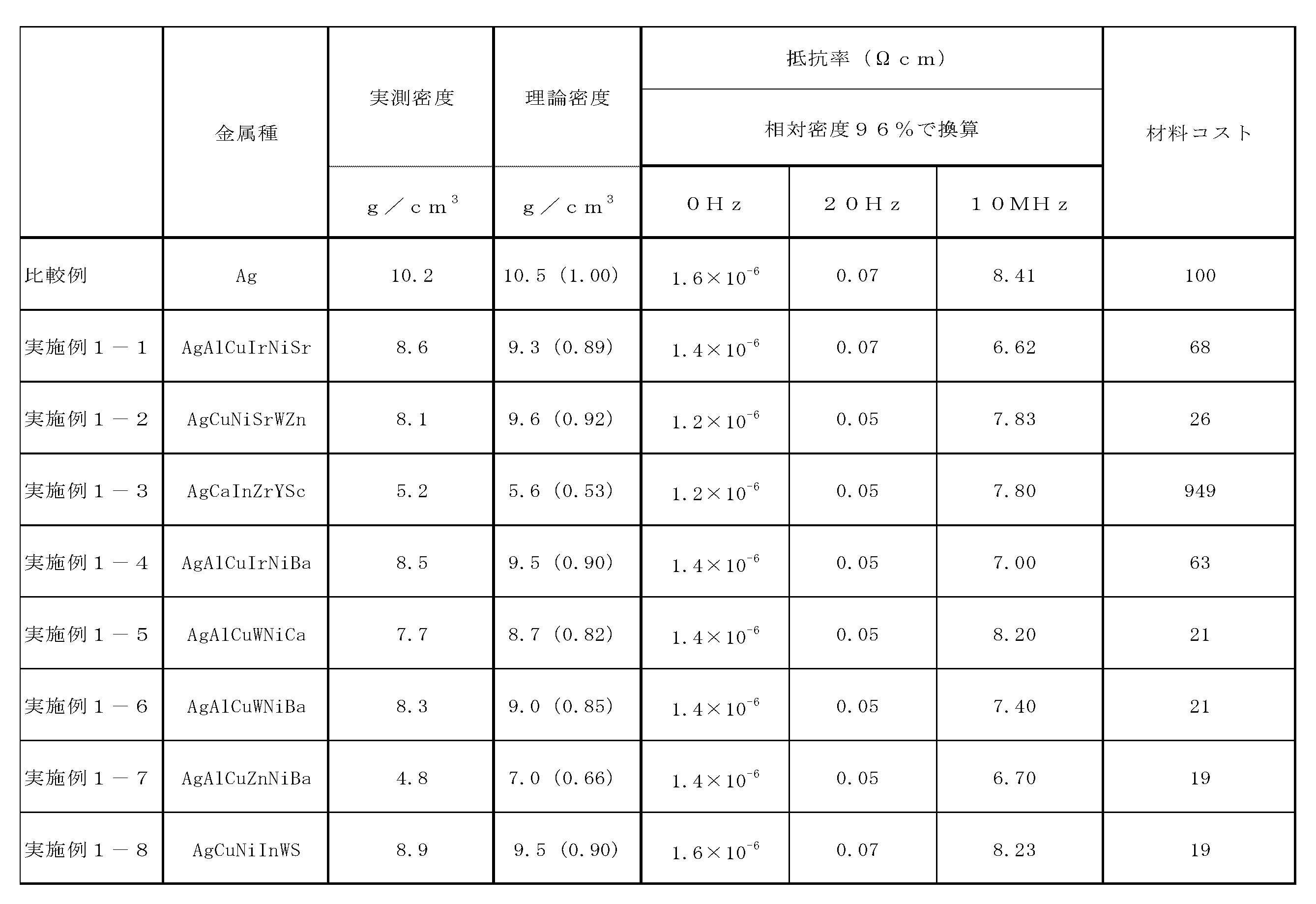
表2に示す結果から、実施例1-1~1-8の六元系金属化合物は、いずれも、0Hz(DC)や、20Hzの低周波数では、比較例の銀単体に比べて、軽量でありかつ導電率が同等以上(抵抗率が同等以下)であり、しかも、10MHzの高周波数では、比較例の銀単体に比べて、導電率が高い(抵抗率が小さい)ことがわかる。特に、実施例1-1(AgAlCuIrNiSr)は、10MHzの高周波数での抵抗率が、銀単体に比べて約21.3%も小さくなり、導電率が銀単体に比べて格段に高いことが分かる。また、実施例1-3(AgCaInZrYSc)は、比較例のAg単体に比べて、材料コストは高いものの、理論密度が5.6g/cm3であって、銀単体の理論密度(1.00)に対する相対値が0.53と半分程度しかなく、格段に軽量化が図れていることが分かる。
なお、表2に示す相対密度96%に換算したときの抵抗率の算出方法は、実測密度が焼結体を構成する化合物と空隙とのバランスによって決まっているとして、相対密度と抵抗率との相関から算出したものである。
なお、表2に示す相対密度96%に換算したときの抵抗率の算出方法は、実測密度が焼結体を構成する化合物と空隙とのバランスによって決まっているとして、相対密度と抵抗率との相関から算出したものである。
(第2の実施形態)
第2の実施形態の多成分系金属化合物は、3種以上の元素を含有する多成分系金属化合物であって、金属化合物が、銀(Ag)と、2種以上の元素とを含有し、常温および常圧で測定したときの、導電率およびイオン化ポテンシャルのいずれもが、銀(Ag)単体よりも高いことを特徴とする。
なお、ここでいう「常温」は、15℃以上35℃以下の範囲内の温度を意味し、「常圧」は、特に減圧も加圧も行なっていないときの圧力であって、通常は大気圧(1atm)に等しい圧力を意味する。
また、「常温および常圧で測定したときの導電率」は、直径10mm、厚さ5mmのサイズの焼結体にした測定試料を、4探針法により、4本の針状の電極が直線上に置かれた台の上に載置し、外側の二電極間に一定の直流電流(DC)を流し、内側の二電極間に生じる電位差を常温および常圧で測定して抵抗率ρ(Ω・cm)を算出し、この抵抗率ρから求めたときの直流導電率σ(抵抗率の逆数1/ρ)を意味する。
さらに、「常温および常圧で測定したときのイオン化ポテンシャル」は、作製した測定試料(焼結体)の表面から1個の電子を取り出すのに要するイオン化エネルギーを電子ボルト(eV)単位で表した値を意味し、金属材料の場合、仕事関数(フェルミ準位と真空準位とのエネルギー差)と一致する。金属材料の仕事関数(イオン化ポテンシャル)の具体的な測定方法としては、例えば作製した供試材(焼結体)において25℃の大気圧下で導電率を測定するとともに、25℃の大気圧下で紫外光電子分光法によって測定したUPSスペクトルから求めることができる。
第2の実施形態の多成分系金属化合物は、3種以上の元素を含有する多成分系金属化合物であって、金属化合物が、銀(Ag)と、2種以上の元素とを含有し、常温および常圧で測定したときの、導電率およびイオン化ポテンシャルのいずれもが、銀(Ag)単体よりも高いことを特徴とする。
なお、ここでいう「常温」は、15℃以上35℃以下の範囲内の温度を意味し、「常圧」は、特に減圧も加圧も行なっていないときの圧力であって、通常は大気圧(1atm)に等しい圧力を意味する。
また、「常温および常圧で測定したときの導電率」は、直径10mm、厚さ5mmのサイズの焼結体にした測定試料を、4探針法により、4本の針状の電極が直線上に置かれた台の上に載置し、外側の二電極間に一定の直流電流(DC)を流し、内側の二電極間に生じる電位差を常温および常圧で測定して抵抗率ρ(Ω・cm)を算出し、この抵抗率ρから求めたときの直流導電率σ(抵抗率の逆数1/ρ)を意味する。
さらに、「常温および常圧で測定したときのイオン化ポテンシャル」は、作製した測定試料(焼結体)の表面から1個の電子を取り出すのに要するイオン化エネルギーを電子ボルト(eV)単位で表した値を意味し、金属材料の場合、仕事関数(フェルミ準位と真空準位とのエネルギー差)と一致する。金属材料の仕事関数(イオン化ポテンシャル)の具体的な測定方法としては、例えば作製した供試材(焼結体)において25℃の大気圧下で導電率を測定するとともに、25℃の大気圧下で紫外光電子分光法によって測定したUPSスペクトルから求めることができる。
本発明者は、銀(Ag)と、2種以上の元素とを含有する、3種以上の元素を含有する種々の組成系の金属化合物を作製して導電率を測定し、銀単体よりも高い導電率を有する組成系が存在するか否かについて鋭意検討を行なった結果、常温および常圧で測定したときの導電率が、銀(Ag)単体よりも高い組成系が存在することが判明した。
また、上記作製した種々の組成系の金属化合物について、紫外光電子分光法によってUPSスペクトルを測定し、このUPSスペクトルから仕事関数(イオン化ポテンシャル)(eV)を算出した結果、常温および常圧で測定したときのイオン化ポテンシャルが、銀(Ag)よりも高い組成系が存在することも判明した。そして、本発明の多成分系金属化合物は、銀(Ag)と、2種以上の元素とを含有する、3種以上の元素を含有する組成系とすることによって、空気中で使用した際の化学的安定性(特に硫化や酸化等が生じにくい特性)と導電性とを高いレベルで両立させることができる。
また、上記作製した種々の組成系の金属化合物について、紫外光電子分光法によってUPSスペクトルを測定し、このUPSスペクトルから仕事関数(イオン化ポテンシャル)(eV)を算出した結果、常温および常圧で測定したときのイオン化ポテンシャルが、銀(Ag)よりも高い組成系が存在することも判明した。そして、本発明の多成分系金属化合物は、銀(Ag)と、2種以上の元素とを含有する、3種以上の元素を含有する組成系とすることによって、空気中で使用した際の化学的安定性(特に硫化や酸化等が生じにくい特性)と導電性とを高いレベルで両立させることができる。
本発明の多成分系金属化合物では、導電率は、具体的には、銀の導電率に対する百分率が101~500%であり、また、イオン化ポテンシャル(仕事関数)は、具体的には、銀のイオン化ポテンシャル(仕事関数)に対する百分率が101~200%である。
また、本発明の多成分系金属化合物を構成する元素は、銀(Ag)以外の2種以上の元素が、銅(Cu)、ニッケル(Ni)、亜鉛(Zn)、タングステン(W)、アルミニウム(Al)、インジウム(In)、スカンジウム(Sc)、イットリウム(Y)、バリウム(Ba)および16族元素の群から選択されることが好ましい。
16族元素は、酸素(O)および硫黄(S)の少なくとも1種の元素であることが好適である。
金属化合物を構成する前記3種以上の元素のそれぞれの含有量(原子%)は、いずれも同じ(等原子比)であるか、あるいは、前記3種以上の元素の含有量の平均値とのずれ割合がいずれも8%以内の範囲内であることが好ましい。ここで、「3種以上の元素の含有量の平均値とのずれ割合がいずれも8%以内の範囲内である」とは、具体的には、多成分系金属化合物が、6種類の元素が等原子比の組成で構成された高エントロピー合金である場合を考えると、これら6種類の元素の含有量の平均値は、約16.7原子%(=100原子%/6)であるため、6種類の元素のそれぞれの含有量は、いずれも、15.4原子%(=16.7×(1-0.08))~18.0原子%(=16.7×(1+0.08))の範囲であることを意味する。
本発明の多成分系金属化合物の具体例としては、銀を含む3種の元素を等原子比(約33.3原子%)ずつ含有する三元系金属化合物では、AgCuNi、AgCuS、AgZnS、AgWS、AgAlS等が挙げられ、また、銀を含む6種の元素を等原子比(約16.7原子%)ずつ含有する高エントロピー合金である六元系金属化合物では、AgAlBaCuNiW、AgCuInNiWS、AgCuInNiWY、AgCuNiScWZn、AgCuInNiScW、AgCuInNiScZn、AgCuInNiWS等が挙げられる。
表3は、銀粉末を含む2種以上の金属粉末を、それぞれ等原子%の割合で、ボールミル等で混合して混合粉末を作製した後、50MPaの圧力下で圧粉してから、950℃の温度で焼結することによって、直径10mm、高さ5.0mmの焼結体(金属化合物)を作製し、作製した焼結体を用いて、25℃の大気圧下で導電率を測定するとともに、25℃の大気圧下で紫外光電子分光法によって測定したUPSスペクトルから仕事関数(eV)を算出した結果を示したものである。また、各供試材について、理論密度も算出した。参考のため、銀単体(比較例1)および銅単体(比較例2)についても、同様な方法で求めた導電率と仕事関数の結果を表3に併記する。なお、導電率は、デジタルマルチメータ(型番:34460A キーサイト・テクノロジー合同会社製)およびインピーダンス・アナライザ(型番:E4990A キーサイト・テクノロジー合同会社製)を用いて、直流成分及び周波数依存性を測定した。表3中の導電率および仕事関数は、いずれも比較例1の銀単体を100%としたときの指数比(%)で示しており、導電率は、指数比の数値が大きいほど高いことを意味し、また、仕事関数は、指数比の数値が大きいほど高く、化学的安定性に優れていることを意味する。
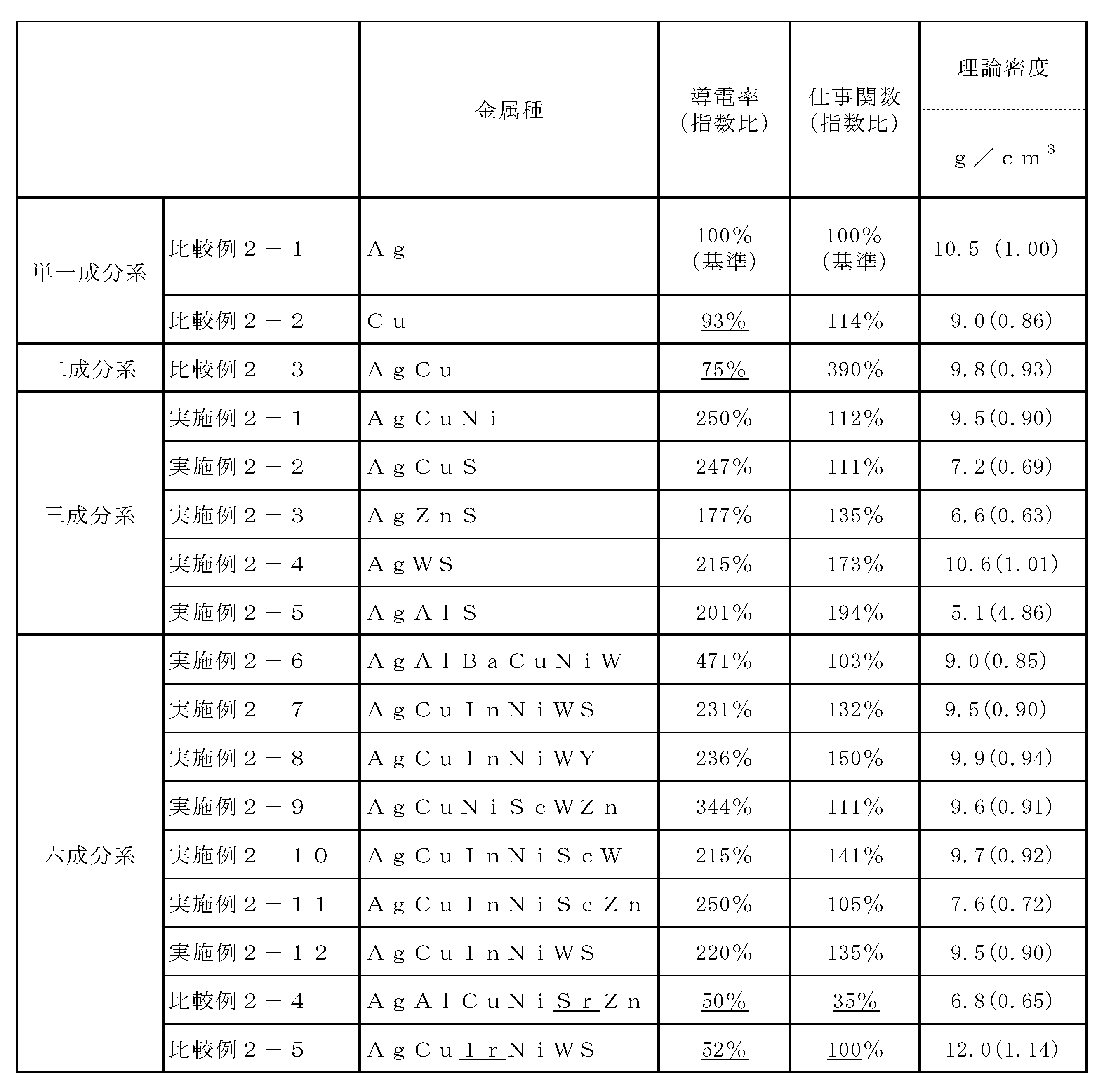
表3に示す結果から、実施例2-1~2-12の金属化合物は、比較例2-1の銀単体(仕事関数および導電率がともに100%(基準))に対して、仕事関数が103~194%と高く、空気中で使用した際の化学的安定性に優れ、かつ導電率が177~471%を有していることが分かる。また、実施例2-3を除く全ての実施例は、銀単体に比べて、優れた化学安定性を有しつつ、200%以上と一段と高い導電率を有しており、特に、実施例2-6および2-9はいずれも、銀単体に比べて、300%以上と顕著に高い導電率を有している。また、実施例2-1~2-12(実施例2-4を除く。)は、いずれも理論密度が、比較例のAg単体の理論密度よりも小さく、軽量化も図れていることが分かる。
これに対し、比較例2-2の銅単体は、銀単体に比べて、化学安定性は優れているものの、導電率が低い。
また、比較例2-3の二成分系のAgCu化合物は、銀単体に比べて、仕事関数が大きく、空気中で使用した際の化学的安定性には優れているものの、導電率が劣っている。
さらに、比較例2-4のストロンチウム(Sr)を含有する六成分系金属化合物は、銀単体に比べて、化学安定性が劣り、導電率も低い。加えて、比較例2-5のイリジウム(Ir)を含有する六成分系金属化合物は、銀単体に比べて、化学安定性は同等であるものの、導電率が低い。
これに対し、比較例2-2の銅単体は、銀単体に比べて、化学安定性は優れているものの、導電率が低い。
また、比較例2-3の二成分系のAgCu化合物は、銀単体に比べて、仕事関数が大きく、空気中で使用した際の化学的安定性には優れているものの、導電率が劣っている。
さらに、比較例2-4のストロンチウム(Sr)を含有する六成分系金属化合物は、銀単体に比べて、化学安定性が劣り、導電率も低い。加えて、比較例2-5のイリジウム(Ir)を含有する六成分系金属化合物は、銀単体に比べて、化学安定性は同等であるものの、導電率が低い。
Claims (11)
- 3種以上の元素を含有する多成分系金属化合物であって、
下記の要件(I)および要件(II)の少なくとも一方を満足することを特徴とする多成分系金属化合物。
要件(I):常温で測定したときの導電率が、銀(Ag)と同等以上であり、常温でかつ4MHz以上の高周波数帯域で測定したときの導電率が、Agよりも高いこと。
要件(II):前記金属化合物が、銀(Ag)と、2種以上の元素とを含有し、常温および常圧で測定したときの、導電率およびイオン化ポテンシャルのいずれもが、銀(Ag)よりも高いこと。 - 3種以上の元素を含有する多成分系金属化合物であって、
常温で測定したときの導電率が、銀(Ag)と同等以上であり、
常温でかつ4MHz以上の高周波数帯域で測定したときの導電率が、Agよりも高いことを特徴とする請求項1に記載の多成分系金属化合物。 - 前記金属化合物が、銀(Ag)と、2種以上の元素とを含有する、請求項2に記載の多成分系金属化合物。
- 前記金属化合物を構成する前記3種以上の元素のそれぞれの含有量(原子%)は、いずれもほぼ同じであるか、あるいは、残りの元素との差がいずれも8原子%以内の範囲内である、請求項2または3に記載の多成分系金属化合物。
- 前記金属化合物は、銀の理論密度に対する相対値が0.50~0.92の範囲である、請求項2、3または4に記載の多成分系金属化合物。
- 3種以上の元素を含有する多成分系金属化合物であって、
前記金属化合物が、銀(Ag)と、2種以上の元素とを含有し、
常温および常圧で測定したときの、導電率およびイオン化ポテンシャルのいずれもが、銀(Ag)よりも高いことを特徴とする請求項1に記載の多成分系金属化合物。 - 前記導電率は、銀の導電率に対する百分率が101~500%であり、
前記イオン化ポテンシャルは、銀のイオン化ポテンシャルに対する百分率が101~200%である、請求項6に記載の多成分系金属化合物。 - 前記金属化合物を構成する前記3種以上の元素のそれぞれの含有量(原子%)は、いずれも同じであるか、あるいは、前記3種以上の元素の含有量の平均値とのずれ割合がいずれも8%以内の範囲内である、請求項6または7に記載の多成分系金属化合物。
- 前記2種以上の元素が、銅(Cu)、ニッケル(Ni)、スカンジウム(Sc)、イットリウム(Y)、ジルコニウム(Zr)、タングステン(W)、イリジウム(Ir)、亜鉛(Zn)、インジウム(In)、錫(Sn)、アルミニウム(Al)、ストロンチウム(Sr)、Ba(バリウム)、カルシウム(Ca)、酸素(O)および硫黄(S)の群から選択される、請求項3または6~8に記載の多成分系金属化合物。
- 前記金属化合物が、高エントロピー合金、または高エントロピー合金を含む化合物である、請求項1~9のいずれか1項に記載の多成分系金属化合物。
- 前記多成分系金属化合物が、銀単体に比べて軽量である請求項1~10のいずれか1項に記載の多成分系金属化合物。
Applications Claiming Priority (4)
| Application Number | Priority Date | Filing Date | Title |
|---|---|---|---|
| JP2018-218967 | 2018-11-22 | ||
| JP2018218967 | 2018-11-22 | ||
| JP2019-061759 | 2019-03-27 | ||
| JP2019061759 | 2019-03-27 |
Publications (1)
| Publication Number | Publication Date |
|---|---|
| WO2020105688A1 true WO2020105688A1 (ja) | 2020-05-28 |
Family
ID=70773804
Family Applications (1)
| Application Number | Title | Priority Date | Filing Date |
|---|---|---|---|
| PCT/JP2019/045498 Ceased WO2020105688A1 (ja) | 2018-11-22 | 2019-11-20 | 多成分系金属化合物 |
Country Status (1)
| Country | Link |
|---|---|
| WO (1) | WO2020105688A1 (ja) |
Cited By (1)
| Publication number | Priority date | Publication date | Assignee | Title |
|---|---|---|---|---|
| CN110714156A (zh) * | 2019-11-27 | 2020-01-21 | 河海大学 | 一种轻质高强耐蚀高熵合金及其制备方法 |
Citations (3)
| Publication number | Priority date | Publication date | Assignee | Title |
|---|---|---|---|---|
| JP2002173732A (ja) * | 2000-11-29 | 2002-06-21 | Univ Qinghua | ハイエントロピー多元合金 |
| US20020159914A1 (en) * | 2000-11-07 | 2002-10-31 | Jien-Wei Yeh | High-entropy multielement alloys |
| JP2009068086A (ja) * | 2007-09-14 | 2009-04-02 | Tohoku Univ | 導電性複合粉末およびその製造方法 |
-
2019
- 2019-11-20 WO PCT/JP2019/045498 patent/WO2020105688A1/ja not_active Ceased
Patent Citations (3)
| Publication number | Priority date | Publication date | Assignee | Title |
|---|---|---|---|---|
| US20020159914A1 (en) * | 2000-11-07 | 2002-10-31 | Jien-Wei Yeh | High-entropy multielement alloys |
| JP2002173732A (ja) * | 2000-11-29 | 2002-06-21 | Univ Qinghua | ハイエントロピー多元合金 |
| JP2009068086A (ja) * | 2007-09-14 | 2009-04-02 | Tohoku Univ | 導電性複合粉末およびその製造方法 |
Non-Patent Citations (2)
| Title |
|---|
| MUNITZ, A. ET AL.: "Melt separation phenomena in CoNiCuAlCr high entropy alloy containing silver", MATERIALS SCIENCE & ENGINEERING, vol. 560, 10 January 2013 (2013-01-10), pages 633 - 642, XP055710017, ISSN: 0921-5093, DOI: 10.1016/j.msea.2012.10.007 * |
| TAKEUCHI , AKIRA ET AL.: "Validation of critical site percolation of all constituent elements by molecular dynamics simulations for quaternary and quinary perfect equiatomic high entropy alloys", LECTURE OUTLINE OF THE JAPAN INSTITUTE METALS AND MATERIALS, vol. 161, 23 August 2017 (2017-08-23), pages 418 * |
Cited By (2)
| Publication number | Priority date | Publication date | Assignee | Title |
|---|---|---|---|---|
| CN110714156A (zh) * | 2019-11-27 | 2020-01-21 | 河海大学 | 一种轻质高强耐蚀高熵合金及其制备方法 |
| CN110714156B (zh) * | 2019-11-27 | 2021-05-11 | 河海大学 | 一种轻质高强耐蚀高熵合金及其制备方法 |
Similar Documents
| Publication | Publication Date | Title |
|---|---|---|
| Li et al. | Controlling mixed conductivity in Na 1/2 Bi 1/2 TiO 3 using A-site non-stoichiometry and Nb-donor doping | |
| Jin et al. | Characterization and evaluation of double perovskites LnBaCoFeO5+ δ (Ln= Pr and Nd) as intermediate-temperature solid oxide fuel cell cathodes | |
| Li et al. | Electrode properties of CuBi2O4 spinel oxide as a new and potential cathode material for solid oxide fuel cells | |
| JP5808513B1 (ja) | スパッタリングターゲット材 | |
| RU2011101578A (ru) | Электродная проволока с перовскитным покрытием | |
| CN105405651A (zh) | 层叠陶瓷电容器 | |
| JPWO2008035727A1 (ja) | 積層セラミックコンデンサ | |
| Park et al. | Microstructure and electrical properties of YSZ–NiO composites | |
| Takahashi et al. | The electrical conductivity and the crystal structure of silver iodide | |
| US20170178876A1 (en) | Cu-Ga ALLOY SPUTTERING TARGET AND METHOD FOR MANUFACTURING SAME | |
| JP6876268B2 (ja) | スパッタリングターゲット | |
| JP7542206B2 (ja) | 固体電解質組成物、および、固体電解質粒子 | |
| Kolchina et al. | Evaluation of Ce-doped Pr 2 CuO 4 for potential application as a cathode material for solid oxide fuel cells | |
| Zhou et al. | A high-performance cobalt-free cathode for proton-conducting solid oxide fuel cells via multi-element doping in Sr2Fe2O6 | |
| Zhang et al. | Transitional metal-doped 8 mol% yttria-stabilized zirconia electrolytes | |
| Wang et al. | In-situ growth of Ru/RuO2 nanoparticles decorated (La0. 6Sr1. 4) 0.95 Mn0. 9Ru0. 1O4 as a potential electrode for symmetrical solid oxide fuel cells | |
| Wu et al. | Analysis of the microstructure and physical properties of La0. 85Sr0. 15Ga0. 8Mg0. 2O2. 825 and Ce0. 85Sm0. 15O1. 925 composite electrolytes used in solid oxide fuel cells | |
| CN107001145B (zh) | 导电性氧化物烧结体、导电用构件、气体传感器、压电元件以及压电元件的制造方法 | |
| Lee et al. | Electrical conductivity and oxygen permeation of Ag/BaBi8O13 composites | |
| Chiu et al. | Synthesis of Pr2CuO4 powders by using a glycine–nitrate combustion method for cathode application in intermediate-temperature solid oxide fuel cells | |
| EP3846596B1 (en) | Silicon nitride substrate and silicon nitride circuit board | |
| Pang et al. | Investigation of electrical conductivity and oxidation behavior of TiC and TiN based cermets for SOFC interconnect application | |
| CN102969082A (zh) | Ag包覆Ni复合纳米粉体导电浆料的制备方法 | |
| Perucchi et al. | Electrodynamic properties of an artificial heterostructured superconducting cuprate | |
| JP2002097021A (ja) | 高温導電性酸化物、燃料電池用電極及び該電極を用いた燃料電池 |
Legal Events
| Date | Code | Title | Description |
|---|---|---|---|
| 121 | Ep: the epo has been informed by wipo that ep was designated in this application |
Ref document number: 19888136 Country of ref document: EP Kind code of ref document: A1 |
|
| NENP | Non-entry into the national phase |
Ref country code: DE |
|
| 122 | Ep: pct application non-entry in european phase |
Ref document number: 19888136 Country of ref document: EP Kind code of ref document: A1 |
|
| NENP | Non-entry into the national phase |
Ref country code: JP |