WO2020105278A1 - 吸収性物品 - Google Patents
吸収性物品Info
- Publication number
- WO2020105278A1 WO2020105278A1 PCT/JP2019/038012 JP2019038012W WO2020105278A1 WO 2020105278 A1 WO2020105278 A1 WO 2020105278A1 JP 2019038012 W JP2019038012 W JP 2019038012W WO 2020105278 A1 WO2020105278 A1 WO 2020105278A1
- Authority
- WO
- WIPO (PCT)
- Prior art keywords
- absorbent article
- basis weight
- stool
- width direction
- low basis
- Prior art date
- Legal status (The legal status is an assumption and is not a legal conclusion. Google has not performed a legal analysis and makes no representation as to the accuracy of the status listed.)
- Ceased
Links
Images

Classifications
-
- A—HUMAN NECESSITIES
- A61—MEDICAL OR VETERINARY SCIENCE; HYGIENE
- A61F—FILTERS IMPLANTABLE INTO BLOOD VESSELS; PROSTHESES; DEVICES PROVIDING PATENCY TO, OR PREVENTING COLLAPSING OF, TUBULAR STRUCTURES OF THE BODY, e.g. STENTS; ORTHOPAEDIC, NURSING OR CONTRACEPTIVE DEVICES; FOMENTATION; TREATMENT OR PROTECTION OF EYES OR EARS; BANDAGES, DRESSINGS OR ABSORBENT PADS; FIRST-AID KITS
- A61F13/00—Bandages or dressings; Absorbent pads
- A61F13/15—Absorbent pads, e.g. sanitary towels, swabs or tampons for external or internal application to the body; Supporting or fastening means therefor; Tampon applicators
- A61F13/42—Absorbent pads, e.g. sanitary towels, swabs or tampons for external or internal application to the body; Supporting or fastening means therefor; Tampon applicators with wetness indicator or alarm
-
- A—HUMAN NECESSITIES
- A61—MEDICAL OR VETERINARY SCIENCE; HYGIENE
- A61F—FILTERS IMPLANTABLE INTO BLOOD VESSELS; PROSTHESES; DEVICES PROVIDING PATENCY TO, OR PREVENTING COLLAPSING OF, TUBULAR STRUCTURES OF THE BODY, e.g. STENTS; ORTHOPAEDIC, NURSING OR CONTRACEPTIVE DEVICES; FOMENTATION; TREATMENT OR PROTECTION OF EYES OR EARS; BANDAGES, DRESSINGS OR ABSORBENT PADS; FIRST-AID KITS
- A61F13/00—Bandages or dressings; Absorbent pads
- A61F13/15—Absorbent pads, e.g. sanitary towels, swabs or tampons for external or internal application to the body; Supporting or fastening means therefor; Tampon applicators
- A61F13/53—Absorbent pads, e.g. sanitary towels, swabs or tampons for external or internal application to the body; Supporting or fastening means therefor; Tampon applicators characterised by the absorbing medium
- A61F13/531—Absorbent pads, e.g. sanitary towels, swabs or tampons for external or internal application to the body; Supporting or fastening means therefor; Tampon applicators characterised by the absorbing medium having a homogeneous composition through the thickness of the pad
- A61F13/532—Absorbent pads, e.g. sanitary towels, swabs or tampons for external or internal application to the body; Supporting or fastening means therefor; Tampon applicators characterised by the absorbing medium having a homogeneous composition through the thickness of the pad inhomogeneous in the plane of the pad
-
- A—HUMAN NECESSITIES
- A61—MEDICAL OR VETERINARY SCIENCE; HYGIENE
- A61F—FILTERS IMPLANTABLE INTO BLOOD VESSELS; PROSTHESES; DEVICES PROVIDING PATENCY TO, OR PREVENTING COLLAPSING OF, TUBULAR STRUCTURES OF THE BODY, e.g. STENTS; ORTHOPAEDIC, NURSING OR CONTRACEPTIVE DEVICES; FOMENTATION; TREATMENT OR PROTECTION OF EYES OR EARS; BANDAGES, DRESSINGS OR ABSORBENT PADS; FIRST-AID KITS
- A61F13/00—Bandages or dressings; Absorbent pads
- A61F13/15—Absorbent pads, e.g. sanitary towels, swabs or tampons for external or internal application to the body; Supporting or fastening means therefor; Tampon applicators
- A61F13/53—Absorbent pads, e.g. sanitary towels, swabs or tampons for external or internal application to the body; Supporting or fastening means therefor; Tampon applicators characterised by the absorbing medium
- A61F13/534—Absorbent pads, e.g. sanitary towels, swabs or tampons for external or internal application to the body; Supporting or fastening means therefor; Tampon applicators characterised by the absorbing medium having an inhomogeneous composition through the thickness of the pad
- A61F13/537—Absorbent pads, e.g. sanitary towels, swabs or tampons for external or internal application to the body; Supporting or fastening means therefor; Tampon applicators characterised by the absorbing medium having an inhomogeneous composition through the thickness of the pad characterised by a layer facilitating or inhibiting flow in one direction or plane, e.g. a wicking layer
-
- A—HUMAN NECESSITIES
- A61—MEDICAL OR VETERINARY SCIENCE; HYGIENE
- A61F—FILTERS IMPLANTABLE INTO BLOOD VESSELS; PROSTHESES; DEVICES PROVIDING PATENCY TO, OR PREVENTING COLLAPSING OF, TUBULAR STRUCTURES OF THE BODY, e.g. STENTS; ORTHOPAEDIC, NURSING OR CONTRACEPTIVE DEVICES; FOMENTATION; TREATMENT OR PROTECTION OF EYES OR EARS; BANDAGES, DRESSINGS OR ABSORBENT PADS; FIRST-AID KITS
- A61F13/00—Bandages or dressings; Absorbent pads
- A61F13/15—Absorbent pads, e.g. sanitary towels, swabs or tampons for external or internal application to the body; Supporting or fastening means therefor; Tampon applicators
- A61F13/53—Absorbent pads, e.g. sanitary towels, swabs or tampons for external or internal application to the body; Supporting or fastening means therefor; Tampon applicators characterised by the absorbing medium
- A61F13/539—Absorbent pads, e.g. sanitary towels, swabs or tampons for external or internal application to the body; Supporting or fastening means therefor; Tampon applicators characterised by the absorbing medium characterised by the connection of the absorbent layers with each other or with the outer layers
-
- A—HUMAN NECESSITIES
- A61—MEDICAL OR VETERINARY SCIENCE; HYGIENE
- A61F—FILTERS IMPLANTABLE INTO BLOOD VESSELS; PROSTHESES; DEVICES PROVIDING PATENCY TO, OR PREVENTING COLLAPSING OF, TUBULAR STRUCTURES OF THE BODY, e.g. STENTS; ORTHOPAEDIC, NURSING OR CONTRACEPTIVE DEVICES; FOMENTATION; TREATMENT OR PROTECTION OF EYES OR EARS; BANDAGES, DRESSINGS OR ABSORBENT PADS; FIRST-AID KITS
- A61F5/00—Orthopaedic methods or devices for non-surgical treatment of bones or joints; Nursing devices ; Anti-rape devices
- A61F5/44—Devices worn by the patient for reception of urine, faeces, catamenial or other discharge; Colostomy devices
Definitions
- the present invention relates to absorbent articles.
- An example of an absorbent article is a disposable diaper.
- a pocket having at least one of a low basis weight portion having a lower basis weight of the absorbent material and a non-weightless portion having no absorbent material is provided in a central portion in the width direction of the absorbent body, and the absorbent body and the liquid
- a disposable diaper is disclosed in which an excretion display portion that changes color due to contact with the excreted liquid is provided between the permeable sheet and the non-pocket portion.
- a hydrophilic composition that visually changes when contacted with moisture is arranged at a predetermined portion between the absorbent core and the back sheet, and corresponds to the portion where the composition is arranged. Then, an absorbent article in which the absorbent core is provided with a portion having a smaller absorption capacity than other portions is disclosed.
- the excretion display portion is arranged in the non-pocket portion located beside the pocket portion of the absorbent body, which is composed of the low weighted portion or the non-weighted portion, the urine absorbs the absorbent body during urination. Although it can pass through and reach the excretion display part, at the time of defecation, it is difficult to pass through the high basis weight part of the absorber due to the high viscosity of feces, and there is a possibility that the excretion display part cannot be reached.
- the composition arranged corresponding to the low absorption part having a smaller absorption capacity than other parts is a hydrophilic composition, It also reacts with water in the stool, and it is impossible to distinguish whether urine or stool was excreted from the outer surface of the absorbent article. Further, when urination is performed first and the composition reacts, the reaction becomes difficult for subsequent defecation, and defecation may not be detected.
- the present invention has been made in view of the conventional problems as described above, and an object thereof is to allow stool moisture to smoothly pass through the absorber and to reach the stool indicator. To provide an absorbent article.
- the main invention for achieving the above-mentioned object is to have a predetermined reaction by contacting with a liquid-absorbent absorber and feces, which has a longitudinal direction, a width direction and a thickness direction in a plan view of a developed state.
- the absorbent article having a stool indicator that presents the absorbent body has a low basis weight portion in a central portion in the width direction, and a basis weight of the low basis weight portion is equal to the low basis weight portion.
- the stool indicator is provided on the non-skin side of the absorbent body in the thickness direction, and the stool indicator and the low basis weight portion.
- the absorbent article has an overlapping portion in the longitudinal direction and the width direction.
- an absorbent article capable of allowing stool moisture to smoothly permeate through the absorber and allow stool moisture to reach the stool indicator.
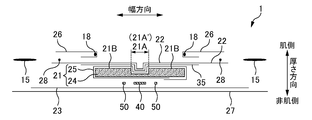
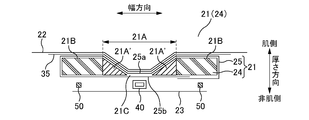
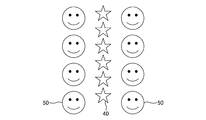
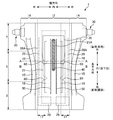
- FIG. 2 is a sectional view taken along line AA shown in FIG. 1. It is a partial expanded sectional view showing another composition of low basic weight part 21A. It is a figure which shows an example of the pattern of the urine indicator 40 and the stool indicator 50. It is a figure which shows the modification of the diaper 1.
- An absorbent article having a longitudinal direction, a width direction, and a thickness direction in a plan view in a developed state, and having a liquid-absorbent absorbent body and a stool indicator that exhibits a predetermined reaction by contacting with stool.
- the absorber has a low basis weight portion in the center portion in the width direction, and the basis weight of the low basis weight portion is a basis weight of an area adjacent to the low basis weight portion from the outside in the width direction.
- the stool indicator is provided on the non-skin side of the absorbent body in the thickness direction, and the stool indicator and the low basis weight portion overlap in the longitudinal direction and the width direction.
- the absorbent body by providing the absorbent body with a low basis weight portion having a low basis weight and disposing the fecal indicator on the non-skin side of the low basis weight portion in the thickness direction, the moisture content of feces is reduced.
- the absorbent body can be smoothly transmitted through the basis weight portion. As a result, it is possible to improve the amount of water in the stool reaching the stool indicator and effectively react the stool indicator.
- the low basis weight portion has a region where the basis weight is zero at least in the center portion in the width direction.
- the moisture of feces easily permeates the region where the basis weight is zero and is more easily drawn into the lower layer.
- the reaction of the stool indicator can be enhanced.
- the low basis weight portion has a high-density region having a higher density than a density of a region adjacent to the low basis weight portion from the outside in the width direction, at least in a part. Is desirable.
- the stool indicator is provided on the non-skin side of the high-density region in the thickness direction, and the stool indicator and the high-density region are in the longitudinal direction and the width. It is desirable to have portions that overlap in direction.
- stool is easily drawn into the high-density region due to the dense and dense structure of the high-density region of the low basis weight portion, and the stool indicator is arranged so as to correspond to the high-density region in the thickness direction.
- the stool retractability is improved, and the stool indicator can be reacted more effectively.
- the center of the low basis weight portion is located rearward of the center of the absorbent article in the longitudinal direction.
- the low basis weight portion is provided on the rear side of the longitudinal center of the absorbent article, which is a region where the wearer's anus faces, so that faeces can be efficiently pulled in.
- the front end of the low basis weight portion is located behind the center of the absorbent article in the longitudinal direction.
- the low grammage portion has an area arranged rearward of the center of the absorbent article in the longitudinal direction, the area being located in front of the center of the absorbent article in the longitudinal direction.
- the stool indicator is larger than the area arranged on the rear side of the longitudinal center of the absorbent article, and the stool indicator is on the front side of the longitudinal center of the absorbent article. It is desirable that the area is larger than the area arranged in.
- the area of the low grammage portion is larger on the rear side than the center in the longitudinal direction of the absorbent article, where the wearer's anus position is opposed, so that the stool can be pulled in more reliably.
- the stool indicator is arranged more in the longitudinal rear region of the absorbent article near the defecation position, the stool indicator can effectively react over a wide range.
- Such an absorbent article which has a back sheet provided on the non-skin side in the thickness direction with respect to the absorber, the stool indicator, in the thickness direction, the low basis weight portion and the back. It is desirable that it is located between the seats and changes visually when it comes into contact with stool.
- the presence or absence of defecation can be recognized quickly and easily from the outer surface of the absorbent article by visually changing the stool indicator in response to the wearer's stool.
- Such an absorbent article further comprising a second sheet arranged in contact with the absorbent body in the thickness direction, the second sheet and the low basis weight portion in the longitudinal direction and the width direction. It is desirable to have overlapping portions.
- the length of the stool indicator in the longitudinal direction is longer than the length of the low basis weight portion in the longitudinal direction.
- the stool indicator is located inside both ends of the low basis weight part in the longitudinal direction and the width direction.
- Such an absorbent article further comprising a top sheet provided on the skin side in the thickness direction with respect to the absorber, and a second sheet provided on the non-skin side in the thickness direction with respect to the top sheet.
- the stool indicator is arranged between the low basis weight portion of the absorber and the back sheet, and in the width direction, in a region corresponding to the low basis weight portion, It is desirable that the top sheet and the second sheet are joined in the thickness direction.
- the absorbent body has an absorbent core and a core wrap sheet that covers a skin side surface and a non-skin side surface of the absorbent core, and in the width direction, the low basis weight portion. It is desirable that the second sheet and the core wrap sheet are joined in the thickness direction in corresponding regions.
- a space is generated in the thickness direction between the second sheet and the core wrap sheet by joining the second sheet and the core wrap sheet in the region corresponding to the low basis weight portion.
- Such an absorbent article having a backsheet provided on the non-skin side in the thickness direction with respect to the absorber, in the width direction, in the region corresponding to the low basis weight portion, the core
- the wrap sheet and the back sheet are joined in the thickness direction.
- a space is generated in the thickness direction between the core wrap sheet and the back sheet by joining the core wrap sheet and the back sheet in the region corresponding to the low basis weight portion. Instead, the water in the stool that has permeated the absorber easily reaches the stool indicator.
- the low basis weight portion of the absorbent body has a region where the basis weight is zero in at least the central portion in the width direction, and the basis weight is zero in the width direction. It is preferable that the top sheet, the second sheet, the core wrap sheet, and the back sheet are joined in the thickness direction in a region corresponding to the region.
- a space is not formed between the sheets in the thickness direction, and it is possible to improve the ability of the feces to draw moisture to the non-skin side in the thickness direction.
- the core wrap sheet has a skin side portion covering a skin side surface of the absorbent core and a non-skin side portion covering a non-skin side surface, and in the width direction, the basis weight is It is desirable that the skin side portion and the non-skin side portion of the core wrap sheet are joined in the thickness direction in a region corresponding to a region of zero.
- a space is not formed in the thickness direction between the skin side portion and the non-skin side portion of the core wrap sheet, and the ability to draw the moisture of feces to the thickness direction non-skin side is reduced. Can be improved.
- the low basis weight portion of the absorbent body has a region where the basis weight is zero at least in the center portion in the width direction, and the feces indicator and the region where the basis weight is zero. And has a portion that overlaps in the longitudinal direction and the width direction, on the non-skin side of the thickness direction of the absorber, a pair of a reaction different from the predetermined reaction by contact with urine It is desirable that a urine indicator is provided, and the non-low basis weight portion that is a portion other than the low basis weight portion in the absorber and the pair of urine indicators have portions that overlap in the longitudinal direction and the width direction. ..
- the diaper 1 of the present embodiment is a so-called open type disposable diaper, and has a front part 3, a crotch part 5, and a rear part 7, as shown in FIG.
- the front part 3 is a part to be located on the front part (ventral side, front waistline) of the wearer.
- the rear part 7 is a part which will be located in a rear part (back side, a back waistline) of a wearer.
- the crotch portion 5 is a portion to be located between the front portion 3 and the rear portion 7.
- each direction is defined as shown in Fig. 1. That is, in a plan view in the unfolded state, the direction from the front part 3 to the rear part 7 is the “longitudinal direction”, and the direction orthogonal to the longitudinal direction is the “width direction”.
- the line BB shown in FIG. 1 is a line showing the center of the diaper 1 in the longitudinal direction.
- the direction orthogonal to the longitudinal direction and the width direction is the "thickness direction”
- the side of the wearer's skin is the "skin side”
- the opposite side is the "non-skin side”. ..
- the diaper 1 has a central band-shaped region 12, side flaps 14, leg gathers 16, and leg side gathers 17.
- a fastening tape 30 is attached to each of the pair of side flaps 14 at the rear portion 7.
- the central strip-shaped region 12 is a strip-shaped region formed by the front portion 3, the crotch portion 5, and the rear portion 7 and located at the center portion in the width direction (see FIG. 1).
- the central band-shaped region 12 is a part that absorbs and holds liquid such as urine excreted by the wearer.
- the central band-shaped region 12 has a vertically long shape (a shape along the longitudinal direction) that includes the liquid retaining absorbent body 21.
- the central band-shaped region 12 is mainly composed of an absorbent body 21, a liquid-permeable topsheet 22 that covers the absorbent body 21 from the skin side, and a liquid-impermeable backsheet 23 that covers the absorbent body 21 from the non-skin side. , And an exterior sheet 27 (for example, non-woven fabric) that forms the exterior of the diaper 1 (see FIG. 2).
- the central strip 12 is further provided with a liquid-permeable second sheet 35, but the second sheet 35 may not necessarily be provided.
- the absorbent body 21 of the present embodiment covers the absorbent core 24 that absorbs excrement such as urine, and the absorbent core 24 from both the skin side and the non-skin side in the thickness direction. It has a liquid-permeable core wrap sheet 25.
- suitable materials for the core wrap sheet 25 include tissue paper and non-woven fabric.
- the absorber 21 (absorbent core 24) is arranged over the front part 3, the crotch part 5, and the rear part 7.
- the absorbent core 24 of the present embodiment has a substantially hourglass shape in plan view as an example of the predetermined shape.
- the absorbent core 24 may be provided at least in the crotch portion 5.
- liquid absorbent material forming the absorbent core 24 for example, liquid absorbent fibers such as pulp fibers and liquid absorbent particles such as super absorbent polymer (so-called SAP) can be used. Further, it may contain a liquid absorbent material other than the liquid absorbent fiber and the liquid absorbent granular material.
- a pair of elastic members 28 around the leg that can expand and contract in the longitudinal direction.
- the leg elastic members 28 are members that impart elasticity to the central band-shaped region 12 of the crotch portion 5.
- the leg-surrounding elastic member 28 is attached in a state of being elongated in the longitudinal direction. As a result, the leg elastic members 28 exert a contracting force along the longitudinal direction on the crotch portion 5 of the central band-shaped region 12.
- the side flaps 14 are portions located on both sides in the width direction of the central belt-shaped region 12.
- the side flaps 14 are formed over the front portion 3, the crotch portion 5, and the rear portion 7 (see FIG. 1).
- the length (width) of the side flaps 14 in the crotch portion 5 in the width direction is smaller than the length (width) of the side flaps 14 in the front portion 3 and the rear portion 7 in the width direction.
- the side flap 14 is mainly composed of a skin side sheet 26 and a back sheet 23 (see FIG. 2).
- the skin-side sheet 26 is a member on the skin side formed over the front portion 3, the crotch portion 5, and the rear portion 7, and is made of, for example, a nonwoven fabric.
- the skin side sheet 26 is also a member that constitutes the leg side gathers 17 (three-dimensional gathers), and a portion outside the skin side sheet 26 (a portion outside the joint portion 26A shown by the broken line in FIG. 1) is the side flap 14. Make up.
- the pair of side flaps 14 are provided with leg gather elastic members 15 that expand and contract along the longitudinal direction.
- the leg gather elastic member 15 is an elastic member that expands and contracts along the longitudinal direction, and is a member that imparts elasticity to the leg openings when the diaper 1 is worn. That is, the leg gather elastic member 15 is a leg elastic member that fits the leg run portion of the diaper 1 to the wearer's leg. Further, the leg gathers 16 are configured by the leg gather elastic members 15 imparting elasticity to the skin side sheet 26 and the back sheet 23 of the crotch portion 5.
- the leg side gathers 17 are three-dimensional gathers that prevent liquid from leaking from the gap between the legs.
- the pair of leg side gathers 17 are formed along the longitudinal direction over the front portion 3, the crotch portion 5, and the rear portion 7 (see FIG. 1).
- the leg side gathers 17 are formed inside the side flaps 14 so as to cover both edges of the central band-shaped region 12.
- the leg side gathers 17 are mainly composed of the inner part in the width direction of the skin side sheet 26 (see FIG. 2).
- the inner edge of the skin-side sheet 26 of the crotch portion 5 has elasticity due to the leg side gather elastic member 18 such as thread rubber.
- the skin-side sheet 26 is joined along the longitudinal direction at a joining portion 26A between the central strip 12 and the side flap 14.
- the region inside the joint portion 26A of the skin-side sheet 26 rises to the wearer's skin side with the joint portion 26A as the base point, and the excrement or the like is discharged laterally. Control leakage.
- the fastening tapes 30 are arranged on both sides in the width direction of the side flaps 14 in the rear part 7 of the diaper 1 (see FIG. 1). Then, by locking each fastening tape 30 to a target tape 29 (FIG. 1) described later, a waist opening and leg openings of the diaper 1 are formed, and the position of the diaper 1 with respect to the wearer's body (body). Can be fixed.
- a target tape 29 is provided on the front part 3 of the central strip 12 (see FIG. 1).
- the target tape 29 is arranged on the non-skin side of the back sheet 23 of the front portion 3.
- the target tape 29 is a member that can be engaged with the fastening tape 30, and is made of, for example, non-woven fabric.
- the target tape 29 constitutes a target area for engaging the fastening tape 30.
- the target region may be directly formed on the outermost non-woven fabric forming the back sheet 23. Then, the diaper 1 is worn by engaging the fastening tape 30 with the target tape 29.
- the diaper 1 of the present embodiment has a stool indicator 40 at the center of the diaper 1 in the width direction, and further, is provided with a pair of urine indicators 50 spaced apart from the stool indicator 40 in the width direction outside. (See Figure 1).
- the stool indicator 40 and the urine indicator 50 are arranged on the non-skin side of the absorber 21 in the thickness direction.
- the urine indicator 50 is configured as an indicator including a pH indicator that is adopted in a conventional general diaper.
- the urine indicator 50 detects that urine is excreted by exhibiting a predetermined reaction (for example, a color reaction) by contacting urine with the pH of urine as a reaction factor (urine indicator reaction factor). .. Details of the flight indicator 40 will be described later.
- the stool indicator 40 is a stool indicator for absorbent articles such as the diaper 1, and causes a predetermined reaction (for example, color reaction) by contacting with a predetermined reaction factor (stool indicator reaction factor) contained in the stool. By presenting it, it is detected that the feces have been discharged.
- the stool indicator 40 includes a chemical component that detects a biological substance in stool, and the response of this chemical component to stool and the response to urine are different from each other, so that only stool discharge is detected. It is possible.
- the biological substance detected by the chemical component contained in the stool indicator 40 is a protein
- a pH indicator as the chemical component.
- a protein has a structure in which amino acids are polymerized, and since it has acidic and basic functional groups at both ends and side chains of the main chain of the protein, when a certain amount of protein or more is present,
- the pH indicator can be changed in color (protein error method).
- the pH indicator responds to stool by detecting undigested protein derived from food in stool, protein secreted from intestinal bacteria, and the like.
- specific pH indicators for example, tetraphenol blue, bromophenol blue, bromocresol green, thymolphthalein and the like can be used.
- the pH indicator is safe for the skin and has excellent storage stability in the presence of moisture and sunlight.
- the stool indicator 40 it is desirable that the chemical components contained in the stool indicator 40 respond to stool and not to urine so as to prevent false detection of whether the excrement is stool or urine. .. Therefore, the stool indicator 40 in the present embodiment shows a reaction such as a color reaction in response to a stool indicator reaction factor (protein or the like) having a predetermined concentration or more, and when the stool indicator reaction factor is smaller than the predetermined concentration, The reaction is difficult to occur.
- a stool indicator reaction factor protein or the like
- the stool indicator 50 responds to a protein of 150 mg / L or more, and more preferably a protein of 5,000 mg / L or more by the protein error method using a pH indicator. It is more preferable to respond to 10,000 mg / L or more of protein.
- the application amount of the pH indicator per 1 cm 2 in the stool indicator 50 may be 16.3 ⁇ g.
- the applied amount of the pH indicator per 1 cm 2 in the stool indicator 50 is preferably 0.5 ⁇ g, and the stool indicator 50 has 10,000 mg / L.
- the applied amount of the pH indicator per 1 cm 2 in the stool indicator 50 is 0.25 ⁇ g.
- the range in which the stool indicator 40 can react with stool is relatively smaller than the range in which the stool indicator 40 can react with stool. be able to.
- the reaction of the stool indicator 40 on stool and the reaction of the stool indicator 40 on urine can be made different. This makes it difficult for the stool indicator 40 to react with urine.
- the stool indicator 40 does not limit the above-mentioned protein as a reaction factor.
- it may be made to react with substances derived from feces such as intestinal bacteria contained in feces, ionic strength of feces correlated with specific gravity of feces, and bilirubin of bile pigment. These components are generally not contained in urine, or the amount and specific gravity contained in urine are very small as compared with stool. Therefore, as in the case where a protein is used as a reaction factor, the stool indicator 40 is less likely to react with urine and is more likely to react with stool. Therefore, feces excreted in the diaper 1 can be accurately detected.
- the stool indicator 40 is formed by applying an adhesive (for example, a hot melt adhesive HMA) containing the above-mentioned chemical component (for example, a pH indicator) to the skin side surface of the back sheet 23 of the diaper 1.
- a hot melt adhesive is applied to a strip-shaped (or linear) region along the longitudinal direction from the crotch portion 5 to the rear portion 7 at the center in the width direction by using a coater.
- the stool indicator 40 is formed by applying (HMA). According to such coater coating, it becomes possible to form the stool indicator 40 having a uniform film thickness and less unevenness, and the stool detection accuracy can be improved. Further, the manufacturing cost can be suppressed.
- the urine indicator 50 can be formed in the same manner.
- the stool indicator 40 may be formed by mixing a chemical component with ink and printing-coating the back sheet 23 or the core wrap sheet 12. Further, the stool indicator 40 is formed by joining and fixing a filter paper or a non-woven fabric impregnated with a chemical component to the back sheet 23 or the core wrap sheet 12 with a hot melt adhesive (HMA) or ultrasonic welding. Is also good.
- HMA hot melt adhesive
- the stool indicator 40 is arranged on the non-skin side of the absorbent body 21 to detect stool.
- stool usually has high viscosity and low fluidity, It is difficult to penetrate the body in the thickness direction. Therefore, when the stool indicator 40 is provided on the non-skin side of the absorbent body 21, it may be difficult for stool to reach the stool indicator 40.
- the absorber 21 has the low basis weight portion 21A in the center portion in the width direction (see FIG. 2).
- the grammage is lower than the grammage of the regions 21B and 21B adjacent to the low grammage portion 21A from the outer side in the width direction.
- the basis weight is a mass per unit area.
- the grammage of the low grammage portion 21A of the present embodiment is preferably about 0 to 200 g / m 2 , and more preferably about 100 g / m 2 .
- the grammage of each of the adjacent regions 21B is preferably about 370 g / m 2 . If the basic weight of the low basic weight portion 21A exceeds 200 g / m 2 , the basic weight is too high, and it becomes difficult for feces to pass through the low basic weight portion 21A.
- the above-mentioned stool indicator 40 is provided on the non-skin side in the thickness direction of the absorber 21, as shown in FIG. Further, the stool indicator 40 and the low basis weight portion 21A have a portion overlapping in the longitudinal direction and the width direction, as shown in FIG. As in the present embodiment, by placing the stool indicator 40 on the non-skin side of the low basis weight portion 21A in the thickness direction (see FIG. 2), the moisture of the stool passes through the low basis weight portion 21A and the absorber 21. Can be transmitted smoothly. Thereby, it is possible to improve the water content of the stool to reach the stool indicator 40 and effectively react the stool indicator 40.
- the low basis weight portion 21A may have, at least in part, a high density area 21A ′ having a higher density than the areas 21B and 21B adjacent to the low basis weight portion 21A from the outer side in the width direction. Preferred (see Figure 3).
- the density is measured by calculating a basis weight (g / m 2 ) obtained by adding pulp fibers and SAP contained in the absorbent body 21, and measuring the thickness (mm) of the absorbent body 21 in the relevant portion. Then, the density is calculated from the values of the basis weight and the thickness.
- the density of the low basis weight portion 21A 'of the present embodiment is preferably 200 ⁇ 900kg / m 3, more preferably 333kg / m 3 approximately.
- the density of the regions 21B and 21B is preferably about 185 kg / m 3 .
- the stool indicator 40 is arranged so as to have a portion on the non-skin side of the above-mentioned high-density region 21A ′ in the thickness direction and overlapping with the high-density region 21A ′ in the longitudinal direction and the width direction. ing.
- the stool indicator 40 is raised in the thickness direction.
- FIG. 3 is a partially enlarged cross-sectional view showing another configuration of the low basis weight portion 21A (absorbent core 24).
- the low basis weight portion 21A may have a region 21C (hereinafter, also referred to as “slit 21C”) in which the basis weight is zero, at least in the center portion in the width direction.
- slit 21C a region 21C in which the basis weight is zero, at least in the center portion in the width direction.
- a pair of high-density areas 21A ' are provided in the low basis weight portion 21A, outside the slit 21C in the width direction and along the longitudinal direction.
- the dense structure is formed by providing the high-density regions 21A ′ in the low-basis-weight part 21A, but also the high-density regions 21A ′ gradually reduce the basic weight toward the center in the width direction as shown in FIG. Since it has the inclined slope, it becomes easier to draw in the water from the stool toward the central portion in the width direction. Furthermore, by providing a region 21C (slit 21C) in which the basis weight is zero at the center portion in the width direction of the low basis weight portion 21A, the moisture of feces is drawn into the lower layer in the thickness direction by passing through the region 21C. Will be done. The improvement of the pulling property to the lower layer consequently improves the reaction of the stool indicator 40.
- the high-density region 21A 'in FIG. 3 has a gradient so that the basis weight becomes lower toward the center in the width direction, but the present invention is not limited to this.
- the present invention is not limited to this.
- the basis weight is lower than the basis weights of the areas 21B and 21B that are adjacent from the outer side in the width direction, even if it has a predetermined uniform basis weight, or partially in the basis weight. The amount may be changed.
- the slit 21C and the stool indicator 40 described above have a portion that overlaps in the longitudinal direction and the width direction.
- the water content of the feces can pass through the region (slit 21C) in which the basic weight is zero in the low basic weight portion 21A, and smoothly passes through the absorber 21.
- a pair of urine indicators 50 are provided apart from the feces indicator 40 in the width direction outer side. ing.
- the non-low basis weight portion (21B) that is a portion other than the low basis weight portion 21A of the absorbent body 21 and the pair of urine indicators 50 have a portion that overlaps in the longitudinal direction and the width direction.
- the center of the low basis weight portion 21A in the longitudinal direction is located behind the line BB in FIG. 1 showing the center in the longitudinal direction of the diaper 1. Is preferred.
- the rear region in the longitudinal direction of the diaper 1 is a region where the wearer's anus faces, and by providing the low basis weight portion 21A in the region, faeces can be efficiently pulled in.
- the front end of the low basis weight portion 21A in the longitudinal direction may be located rearward of the longitudinal center of the diaper 1 (line BB in FIG. 1).
- the low grammage portion 21A is arranged only on the rear side in the longitudinal direction of the diaper 1, and at the time of defecation and urination, high absorbability is maintained at the center in the longitudinal direction where both feces and urine easily flow. be able to.
- the low grammage portion 21A is arranged in the longitudinal direction in such a manner that the area arranged on the rear side of the line BB of FIG. 1 which is the center of the diaper 1 is arranged on the front side of the line BB. It is preferably larger than the area. That is, in the longitudinal direction of the diaper 1, it is preferable that a large amount of the low grammage portion 21A be present on the rear side. Thereby, in the rear region of the diaper 1 corresponding to the wearer's anus position, more feces and moisture of the feces can permeate the low basis weight portion 21A, and the feces withdrawal property is improved.
- the area arranged in the longitudinal direction behind the line BB in FIG. 1 which is the center of the diaper 1 is the area arranged in front of the line BB. Is preferably larger than. The more the stool indicator 40 is arranged in the rear region of the diaper 1 close to the defecation position, the stool indicator 40 can effectively react over a wide range.
- the second sheet 35 is arranged on the non-skin side of the top sheet 22 in the thickness direction and in contact with the core wrap sheet 25 of the absorbent body 21 (see FIG. 2). Further, the second sheet 35 and the low basis weight portion 21A have a portion overlapping in the longitudinal direction and the width direction (see FIG. 1).
- An example of the second sheet 35 is a mixed cotton fiber sheet of rayon and pulp.
- the basis weight (g / m2) of the sheet is preferably about 35 g / m2, and the first layer has a three-layer structure of 100% rayon, the second layer has 100% pulp fibers, and the third layer has 100% rayon. There is.
- the second sheet 35 is preferably made of a hydrophilic material, and due to the effect of the hydrophilic material, it has a high affinity with moisture in the stool, and it becomes easier to absorb the stool.
- the second sheet 35 of the present embodiment by arranging the pulp fibers, not rayon alone, between the rayons, the gap between the rayon fibers is filled with the pulp fibers so as to connect the fibers, thereby increasing the density. It makes it easier to draw in the water.
- the second sheet 35 has a high ability to pick up moisture in the stool, of the stool on the top sheet 22 in which particles and moisture are mixed, only moisture is allowed to permeate from the top sheet 22 to the second sheet 35. be able to. Particles are removed from the stool that has penetrated into the second sheet 35, and the stool has a high water content. It becomes easy to penetrate and permeate. As a result, the arrival of stools at the stool indicator 40 is improved.
- FIG. 4 is a diagram showing an example of a design of the urine indicator 40 and the stool indicator 50.
- the stool indicator 40 is located between the low basis weight portion 21A and the backsheet 23 provided on the non-skin side in the thickness direction of the absorbent body 21 in the thickness direction (see FIG. 2), and It changes visually when touched.
- the stool indicator 40 and the urine indicator 50 may be configured with a design as shown in FIG. In FIG. 4, the face mark is the urine indicator 50 and the star mark is the stool indicator 40.
- Each stool indicator 40 and urine indicator 50 have the same or different predetermined color, and are configured to exhibit a different color from the initially predetermined color after urination or after defecation.
- By visually changing the stool indicator 40 and the urine indicator 50 in response to the wearer's stool it is possible to quickly and easily recognize the presence or absence of defecation / urination from the outer surface of the diaper 1, thereby preventing the stool or urine from leaking. Can be reduced.
- With regard to stool it is possible to suppress skin troubles caused by stool sticking to the skin for a long time. Further, since it is possible to distinguish between defecation and urination from the outer surface of the diaper, it is possible for the diaper changer to prepare for the excretion and perform the exchanging work when defecation is performed.
- the length of the stool indicator 40 in the longitudinal direction is preferably longer than the length of the low basis weight portion 21A in the longitudinal direction.
- the length in the longitudinal direction of the stool indicator 40 does not necessarily have to be set longer than the length in the longitudinal direction of the low basis weight portion 21A, and is longer than both ends of the low basis weight portion 21A in the longitudinal direction and the width direction.
- the stool indicator 40 may be provided so as to be located inside. By arranging the stool indicator 40 so as to be included in the low basis weight portion 21A in both the longitudinal direction and the width direction, stool moisture easily reaches any part of the stool indicator.
- the stool indicator 40 is arranged between the low basis weight portion 21A of the absorbent body 21 and the backsheet 23 in the thickness direction. Then, in the area corresponding to the low basis weight portion 21A in the width direction, the top sheet 22 and the second sheet 35, the second sheet 35 and the core wrap sheet 25, and the core wrap sheet 25 and the back sheet 23 are joined in the thickness direction, respectively. Has been done.
- the top sheet 22, the second sheet 35, the core wrap sheet 25, and the back sheet 23. May be joined in the thickness direction.
- the skin side portion 25a that covers the skin side surface of the absorbent core 24 and the non-skin side portion 25b that covers the non-skin side surface are in a region corresponding to the slit 21C in the width direction, It is preferable that they are joined in the thickness direction.
- the joining method of each sheet is a method of applying a hot melt adhesive or the like by a known coating method such as a coater spray method, a spiral spray method, an omega spray method or a curtain spray method, and fixing it by ultrasonic welding (sonic seal). Law, etc.
- the bonding strength between the second sheet 35 and the core wrap sheet 25 is higher than the bonding strength between the top sheet 22 and the second sheet 35.
- the density of the adhesive such as hot-melt adhesive in the top sheet 22 in which the particles and water are mixed is the most impenetrable for stool penetration.
- the density of an adhesive such as a hot melt adhesive for joining the second sheet 35 and the core wrap sheet 25 is increased. However, it does not hinder the penetration.
- FIG. 5 is a diagram showing a modified example of the diaper 1.
- a pair of cutouts 60, 60 are formed near the rear portion 7 of both widthwise ends, and similarly, a pair of notch portions are formed near the front portion 3 of both widthwise ends.
- Notch portions 60, 60 are formed.
- the cutout portions 60 need not be two pairs, but may be one pair. Both ends of the pair of notches 60 in the width direction of the absorber 21 are formed in a mountain shape toward the inside in the width direction.
- the shape of the cutout portion 60 is not limited to the shape shown in FIG. Further, in this modification, the absorbent body 21 (absorbent core 24) is cut out at each cutout portion 60, but the basis weight of the liquid absorbent material should be smaller than the other portions of the absorbent body 21. May be formed by.
- interposed in the width direction by a pair of notch parts 60 and 60 near the rear part 7, and the feces indicator 40 are a longitudinal direction. It has an overlapping portion in the width direction.
- the pair of notches 60 can prevent the absorbent core 24 from twisting and a gap between the diaper 1 and the wearer, and can prevent excrement from leaking. Further, since the site of the absorbent core 24 sandwiched between the pair of cutouts 60 can securely secure the stool, by disposing the stool indicator 40 at a position corresponding to the sandwiched region, The arrival of flights is also improved.
- the second sheet 35 is arranged between the top sheet 22 and the core wrap sheet 25 in the thickness direction, but the diffusion sheet that diffuses the liquid between the absorber 21 and the stool indicator 40. You may arrange as. By doing so, the moisture of the stool that has passed through the low basis weight portion 21A can be diffused in the lower layer of the absorber 21, and the stool indicator 40 can react in a wider range. Thereby, the visibility from the outer surface of the diaper 1 can be improved.
- the top sheet 22 may have an opening. By having the opening, the ground contact area between the second seat 35 and the feces can be increased, and the permeability of the feces to the second seat 35 can be improved.
- the shape of the low basis weight portion 21A is a rectangular shape that is long in the longitudinal direction in the plan view shown in FIG. 1, but the shape is not limited to this.
- a square shape, a rectangular shape elongated in the width direction, a heart-shaped pattern shape, or the like may be used.
- the basis weight is not limited to be constant, and for example, in the width direction from both ends to the central portion. You may form so that a basis weight may be reduced in steps toward.
- the low basis weight portion 21A in the above-described embodiment has a lower basis weight than the areas 21B and 21B adjacent to the low basis weight portion 21A from the outer side in the width direction.
- the low basis weight portion 21A may have a lower basis weight than the basis weights at both ends in the width direction of the absorbent body.
- the number of the low basis weight portions 21A is one at the center portion in the width direction of the diaper 1, but a plurality of the low weighing portions 21A may be provided. In this case, it is possible to further improve the detection of defecation by arranging a plurality of stool indicators 40 so as to have an overlapping portion in each of the low basis weight portions 21A in the longitudinal direction and the width direction.
Landscapes
- Health & Medical Sciences (AREA)
- Epidemiology (AREA)
- Engineering & Computer Science (AREA)
- Biomedical Technology (AREA)
- Heart & Thoracic Surgery (AREA)
- Vascular Medicine (AREA)
- Life Sciences & Earth Sciences (AREA)
- Animal Behavior & Ethology (AREA)
- General Health & Medical Sciences (AREA)
- Public Health (AREA)
- Veterinary Medicine (AREA)
- Nursing (AREA)
- Orthopedic Medicine & Surgery (AREA)
- Absorbent Articles And Supports Therefor (AREA)
- Orthopedics, Nursing, And Contraception (AREA)
Abstract
展開状態の平面視にて、長手方向と幅方向と厚さ方向とを有し、液吸収性の吸収体(21)と、便と接触することにより所定の反応を呈する便インジケータ(40)とを有する吸収性物品(1)であって、前記吸収体(21)は、前記幅方向の中央部に低坪量部(21A)を有し、前記低坪量部(21A)の坪量は、前記低坪量部(21A)に前記幅方向の外側から隣接する領域(21B)の坪量よりも低く、前記便インジケータ(40)は、前記吸収体(21)の前記厚さ方向の非肌側に設けられており、前記便インジケータ(40)と前記低坪量部(21A)とは、前記長手方向及び前記幅方向において重複する部分を有する吸収性物品。
Description
本発明は、吸収性物品に関する。
吸収性物品の一例として、使い捨ておむつが挙げられる。特許文献1には、吸収体の幅方向中央部に、周囲より吸収素材目付けの低い低目付け部及び吸収素材を有さない無目付け部の少なくとも一方からなるポケットを有し、吸収体と液不透過性シートとの間に、排泄液分との接触により変色する排泄表示部を非ポケット部と重なるように設けた使い捨ておむつが開示されている。また、特許文献2には、吸収性コアと裏面シートとの間の所定部位に、水分と接触すると視覚的に変化する親水性の組成物を配し、組成物が配されている部位に対応して吸収性コアに他の部位よりも吸収容量の小さい部位を設けた吸収性物品が開示されている。
しかし、特許文献1の使い捨ておむつでは、排泄表示部が吸収体の低目付け部又は無目付け部からなるポケット部の脇に位置する非ポケット部に配置されているため、排尿時には尿が吸収体を透過して排泄表示部に到達できるが、排便時には、便の粘性が高いことから吸収体の高目付部を透過することが困難であり、排泄表示部に到達できない虞がある。
また、特許文献2の吸収性物品では、他の部位よりも吸収容量が小さい低吸収部に対応して配置された組成物は、親水性の組成物であるため、尿中の水分にも、便中の水分にも反応してしまい、吸収性物品の外面より尿又は便のどちらが排泄されたか区別ができない。また、先に排尿が行われて組成物が反応してしまった場合には、その後の排便に対して反応が困難になり、排便を検知できない可能性がある。
本発明は、上記のような従来の問題に鑑みてなされたものであって、その目的は、便の水分が吸収体をスムーズに透過し、便の水分を便インジケータまで到達させることが可能な吸収性物品を提供することにある。
上記目的を達成するための主たる発明は、展開状態の平面視にて、長手方向と幅方向と厚さ方向とを有し、液吸収性の吸収体と、便と接触することにより所定の反応を呈する便インジケータとを有する吸収性物品であって、前記吸収体は、前記幅方向の中央部に低坪量部を有し、前記低坪量部の坪量は、前記低坪量部に前記幅方向の外側から隣接する領域の坪量よりも低く、前記便インジケータは、前記吸収体の前記厚さ方向の非肌側に設けられており、前記便インジケータと前記低坪量部とは、前記長手方向及び前記幅方向において重複する部分を有する吸収性物品である。
本発明の他の特徴については、本明細書及び添付図面の記載により明らかにする。
本発明の他の特徴については、本明細書及び添付図面の記載により明らかにする。
本発明によれば、便の水分が吸収体をスムーズに透過し、便の水分を便インジケータまで到達させることが可能な吸収性物品を提供できる。
本明細書及び添付図面の記載により、少なくとも以下の事項が明らかとなる。
展開状態の平面視にて、長手方向と幅方向と厚さ方向とを有し、液吸収性の吸収体と、便と接触することにより所定の反応を呈する便インジケータとを有する吸収性物品であって、前記吸収体は、前記幅方向の中央部に低坪量部を有し、前記低坪量部の坪量は、前記低坪量部に前記幅方向の外側から隣接する領域の坪量よりも低く、前記便インジケータは、前記吸収体の前記厚さ方向の非肌側に設けられており、前記便インジケータと前記低坪量部とは、前記長手方向及び前記幅方向において重複する部分を有する、ことを特徴とする吸収性物品である。
展開状態の平面視にて、長手方向と幅方向と厚さ方向とを有し、液吸収性の吸収体と、便と接触することにより所定の反応を呈する便インジケータとを有する吸収性物品であって、前記吸収体は、前記幅方向の中央部に低坪量部を有し、前記低坪量部の坪量は、前記低坪量部に前記幅方向の外側から隣接する領域の坪量よりも低く、前記便インジケータは、前記吸収体の前記厚さ方向の非肌側に設けられており、前記便インジケータと前記低坪量部とは、前記長手方向及び前記幅方向において重複する部分を有する、ことを特徴とする吸収性物品である。
このような吸収性物品によれば、吸収体に坪量の低い低坪量部を設け、厚さ方向において低坪量部の非肌側に便インジケータを配置させることで、便の水分が低坪量部を通って吸収体をスムーズに透過できるようになる。それにより、便インジケータまでへの便の水分の到達を向上させ、便インジケータを有効に反応させることができる。
かかる吸収性物品であって、前記低坪量部は、少なくとも前記幅方向の中央部において坪量がゼロである領域を有することが望ましい。
このような吸収性物品によれば、低坪量部に坪量がゼロである領域を設けることで、便の水分は坪量がゼロの領域を透過してより下層に引き込まれ易くなる。下層への引き込み性が向上することによって、便インジケータの反応を高めることができる。
かかる吸収性物品であって、前記低坪量部は、少なくとも一部において、前記低坪量部に前記幅方向の外側から隣接する領域の密度よりも密度が高い高密度領域を有していることが望ましい。
このような吸収性物品によれば、低坪量部に高密度領域を設けることで、他の吸収体部分と低坪量部とによって粗密構造が形成され、密度の高い低坪量部に便の水分を引き込み易くなる。そのため、少量の便でも便インジケータを有効に反応させることができる。
かかる吸収性物品であって、前記便インジケータは、前記厚さ方向において、前記高密度領域の非肌側に設けられており、前記便インジケータと前記高密度領域とは、前記長手方向及び前記幅方向において重複する部分を有することが望ましい。
このような吸収性物品によれば、低坪量部の高密度領域による粗密構造から、高密度領域には便が引き込まれ易く、便インジケータを厚さ方向において高密度領域と対応するように配置させることで、便の引き込み性が向上し、便インジケータをより有効に反応させることができる。
かかる吸収性物品であって、前記長手方向において、前記低坪量部の中心は、前記吸収性物品の中心よりも後側に位置していることが望ましい。
このような吸収性物品によれば、着用者の肛門が対向する領域である、吸収性物品の長手方向の中心よりも後側に低坪量部を設けることで、効率的に便を引き込むことができる。
かかる吸収性物品であって、前記長手方向において、前記低坪量部の前側端は、前記吸収性物品の中心よりも後側に位置していることが望ましい。
このような吸収性物品によれば、低坪量部の配置を吸収性物品の後方領域のみにすることで、便及び尿共に流れ込みやすい長手方向の中心部において、高い吸収性を保つことができる。
かかる吸収性物品であって、前記低坪量部は、前記吸収性物品の前記長手方向の中心よりも後側に配置されている面積が、前記吸収性物品の前記長手方向の中心よりも前側に配置されている面積よりも大きく、前記便インジケータは、前記吸収性物品の前記長手方向の中心よりも後側に配置されている面積が、前記吸収性物品の前記長手方向の中心よりも前側に配置されている面積よりも大きいことが望ましい。
このような吸収性物品によれば、着用者の肛門位置が対向する、吸収性物品の長手方向の中心よりも後側において低坪量部の面積が大きいことで、より確実に便を引き込むことができる。同様に、便インジケータも排便位置に近い吸収性物品の長手方向の後方領域により多く配置されるため、便インジケータが広範囲に亘って有効に反応できる。
かかる吸収性物品であって、前記便インジケータの尿に対する反応は、前記便インジケータの便に対する反応と異なることが望ましい。
このような吸収性物品によれば、吸収性物品において排泄された便を精度よく検出することができる。
かかる吸収性物品であって、前記吸収体よりも前記厚さ方向の非肌側に設けられたバックシートを有し、前記便インジケータは、前記厚さ方向において、前記低坪量部と前記バックシートとの間に位置し、便と接触すると視覚的に変化することが望ましい。
このような吸収性物品によれば、着用者の便に反応して便インジケータが視覚的に変化することで、吸収性物品の外面から排便の有無を迅速且つ容易に認識できる。
かかる吸収性物品であって、前記厚さ方向において、前記吸収体と接するように配置されるセカンドシートをさらに備え、前記セカンドシートと前記低坪量部とは、前記長手方向及び前記幅方向において重複する部分を有することが望ましい。
このような吸収性物品によれば、便の水分の引き込み性を向上させるセカンドシートを低坪量部と重なるように設けることで、厚さ方向のより下層側に便を浸透・透過させ易くなり、便インジケータへの便の到達を向上させる。
かかる吸収性物品であって、前記便インジケータの前記長手方向の長さは、前記低坪量部の前記長手方向の長さよりも長いことが望ましい。
このような吸収性物品によれば、便インジケータの長さが長手方向に長いことで、排便後に視覚的に変化した便インジケータを様々な角度から確認し易くなり、早期に排便に気付くことができる。
かかる吸収性物品であって、前記便インジケータは、前記長手方向及び前記幅方向において、前記低坪量部の両端部よりも内側に位置することが望ましい。
このような吸収性物品によれば、長手方向及び幅方向においても低坪量部に包含されるように便インジケータを配置することで、便インジケータのいずれの部分にも便の水分が到達し易くなる。
かかる吸収性物品であって、前記吸収体よりも前記厚さ方向の肌側に設けられたトップシートと、前記トップシートよりも前記厚さ方向の非肌側に設けられたセカンドシートとをさらに備え、前記便インジケータは、前記厚さ方向において、前記吸収体の前記低坪量部と前記バックシートとの間に配置され、前記幅方向において、前記低坪量部と対応する領域にて、前記トップシートと前記セカンドシートとが前記厚さ方向に接合されていることが望ましい。
このような吸収性物品によれば、低坪量部と対応する領域において、トップシートとセカンドシートとを接合することで、トップシートとセカンドシート間において厚さ方向に空間が生じず、厚さ方向非肌側への便の水分の引き込み性を向上させることができる。
かかる吸収性物品であって、前記吸収体は、吸収性コアと、前記吸収性コアの肌側面及び非肌側面を覆うコアラップシートとを有し、前記幅方向において、前記低坪量部と対応する領域にて、前記セカンドシートと前記コアラップシートとが前記厚さ方向に接合されていることが望ましい。
このような吸収性物品によれば、低坪量部と対応する領域において、セカンドシートとコアラップシートとを接合することで、セカンドシートとコアラップシートとの間において厚さ方向に空間が生じず、厚さ方向非肌側への便の水分の引き込み性を向上させることができる。
かかる吸収性物品であって、前記吸収体よりも前記厚さ方向の非肌側に設けられたバックシートを有し、前記幅方向において、前記低坪量部と対応する領域にて、前記コアラップシートと前記バックシートとが前記厚さ方向に接合されている。
このような吸収性物品によれば、低坪量部と対応する領域において、コアラップシートとバックシートとを接合することで、コアラップシートとバックシートとの間において厚さ方向に空間が生じず、吸収体を透過した便の水分が便インジケータに到達し易くなる。
かかる吸収性物品であって、前記吸収体の前記低坪量部は、少なくとも前記幅方向の中央部において坪量がゼロである領域を有し、前記幅方向において、前記坪量がゼロである領域と対応する領域にて、前記トップシートと、前記セカンドシートと、前記コアラップシートと、前記バックシートとが前記厚さ方向に接合されていることが望ましい。
このような吸収性物品によれば、各シート間において厚さ方向に空間が生じず、厚さ方向非肌側への便の水分の引き込み性を向上させることができる。
かかる吸収性物品であって、前記コアラップシートは、前記吸収性コアの肌側面を覆う肌側部と、非肌側面を覆う非肌側部を有し、前記幅方向において、前記坪量がゼロである領域と対応する領域にて、前記コアラップシートの前記肌側部と前記非肌側部とが前記厚さ方向に接合されていることが望ましい。
このような吸収性物品によれば、コアラップシートの肌側部と非肌側部との間において厚さ方向に空間が生じず、厚さ方向非肌側への便の水分の引き込み性を向上させることができる。
かかる吸収性物品であって、前記吸収体の前記低坪量部は、少なくとも前記幅方向の中央部において坪量がゼロである領域を有し、前記便インジケータと前記坪量がゼロである領域とは、前記長手方向及び前記幅方向において重複する部分を有し、前記吸収体の前記厚さ方向の非肌側において、尿と接触することにより前記所定の反応とは異なる反応を呈する一対の尿インジケータを設け、前記吸収体において前記低坪量部以外の部分である非低坪量部と、前記一対の尿インジケータとは、前記長手方向及び前記幅方向において重複する部分を有することが望ましい。
このような吸収性物品によれば、便インジケータを低坪量部の坪量がゼロである領域に設けることで、便の水分が吸収体を透過し易くなり、尿インジケータを低坪量部とは異なる非低坪量部に対応させて配置することで、尿インジケータが便によって汚染されるのを防ぐ。また、便の油膜によって尿インジケータの反応が低下してしまうことも防ぐことができ、尿インジケータの尿への反応を阻害しない。
===実施形態===
本発明に係る吸収性物品として、乳幼児用のテープ型使い捨ておむつを例に挙げて実施形態を説明する。ただし、これに限らず、例えば、パンツ型やパッドタイプの使い捨ておむつ、大人用のテープ型使い捨ておむつ等にも本発明を適用できる。
本発明に係る吸収性物品として、乳幼児用のテープ型使い捨ておむつを例に挙げて実施形態を説明する。ただし、これに限らず、例えば、パンツ型やパッドタイプの使い捨ておむつ、大人用のテープ型使い捨ておむつ等にも本発明を適用できる。
<テープ型使い捨ておむつ1の基本構成>
図1は、テープ型使い捨ておむつ1(以下「おむつ」ともいう)が展開かつ伸長された状態における平面図である。図2は、図1に示す線A-Aでの断面図である。おむつ1を伸長させた状態とは、おむつ1の展開状態において、おむつ1に生じていた皺が実質的に視認されなくなる程に伸長させた状態であり、おむつ1を構成する各部材(例えば後述するトップシート22等)の寸法がその部材単体の寸法と一致又はそれに近い長さになるまでおむつ1が伸長した状態である。
図1は、テープ型使い捨ておむつ1(以下「おむつ」ともいう)が展開かつ伸長された状態における平面図である。図2は、図1に示す線A-Aでの断面図である。おむつ1を伸長させた状態とは、おむつ1の展開状態において、おむつ1に生じていた皺が実質的に視認されなくなる程に伸長させた状態であり、おむつ1を構成する各部材(例えば後述するトップシート22等)の寸法がその部材単体の寸法と一致又はそれに近い長さになるまでおむつ1が伸長した状態である。
本実施形態のおむつ1は、所謂オープンタイプの使い捨ておむつであり、図1に示すように、前部3と、股下部5と、後部7とを有する。前部3は、着用者の前部(腹側、前胴回り)に位置することになる部分である。また、後部7は、着用者の後部(背側、後胴回り)に位置することになる部分である。股下部5は、前部3と後部7との間に位置することになる部分である。
以下の説明では、図1に示すように、各方向を定義する。すなわち、展開状態の平面視にて、前部3から後部7に向かう方向を「長手方向」とし、長手方向と直交する方向を「幅方向」とする。図1に示されている線B-Bは、長手方向におけるおむつ1の中心を示す線である。また、図2に示すように、長手方向及び幅方向と直交する方向を「厚さ方向」とし、着用者の肌の側を「肌側」とし、その逆側を「非肌側」とする。
おむつ1は、中央帯状領域12と、サイドフラップ14と、レッグギャザー16と、レッグサイドギャザー17とを有する。一対のサイドフラップ14は、後部7において、ファスニングテープ30がそれぞれ取り付けられている。
中央帯状領域12は、前部3、股下部5及び後部7によって構成された幅方向の中央部に位置する帯状の領域である(図1参照)。中央帯状領域12は、着用者によって排泄された尿等の液体を吸収し保持する部位である。中央帯状領域12は、液保持性の吸収体21を含む縦長の形状(長手方向に沿った形状)を有する。中央帯状領域12は、主に、吸収体21と、同吸収体21を肌側から覆う液透過性のトップシート22と、同吸収体21を非肌側から覆う液不透過性のバックシート23、及び、おむつ1の外装をなす外装シート27(例えば不織布)とを有する(図2参照)。中央帯状領域12には、さらに、液透過性であるセカンドシート35が設けられているが、セカンドシート35を必ずしも設けなくても良い。
本実施形態の吸収体21は、図2に示すように、尿等の排泄物を吸収する吸収性コア24と、吸収性コア24を厚さ方向の肌側及び非肌側の両側からそれぞれ覆う液透過性のコアラップシート25とを有している。コアラップシート25に好適な材料としては、ティッシュペーパーや不織布等を例示できる。
吸収体21(吸収性コア24)は、前部3、股下部5及び後部7にわたって配置されている。本実施形態の吸収性コア24は、所定形状の一例としての平面視略砂時計形状を有する。また、吸収性コア24は、少なくとも股下部5に設けられていれば良い。吸収性コア24を構成する液体吸収性素材としては、例えばパルプ繊維等の液体吸収性繊維や、高吸収性ポリマー(所謂SAP)等の液体吸収性粒状物を使用することができる。また、液体吸収性繊維及び液体吸収性粒状物以外の液体吸収性素材を含んでいても良い。
中央帯状領域12のうち少なくとも股下部5には、吸収体21とバックシート23との間に、長手方向に伸縮可能な一対の脚周り弾性部材28(例えば糸ゴム)が設けられている。脚周り弾性部材28は、股下部5の中央帯状領域12に伸縮性を付与する部材である。本実施形態では、長手方向に伸長させた状態で脚周り弾性部材28が取り付けられる。これにより、脚周り弾性部材28は中央帯状領域12の股下部5に対して長手方向に沿った収縮力を発現する。
サイドフラップ14は、中央帯状領域12の幅方向の両側部に位置する部位である。サイドフラップ14は、前部3、股下部5及び後部7にわたって形成されている(図1参照)。股下部5におけるサイドフラップ14の幅方向の長さ(幅)は、前部3及び後部7におけるサイドフラップ14の幅方向の長さ(幅)よりも狭い。サイドフラップ14は、主に、肌側シート26とバックシート23から構成されている(図2参照)。肌側シート26は、前部3、股下部5及び後部7にわたって形成された肌側の部材であり、例えば不織布で構成されている。肌側シート26は、レッグサイドギャザー17(立体ギャザー)を構成する部材でもあり、肌側シート26の外側の部位(図1の破線で表示された接合部26Aより外側の部位)がサイドフラップ14を構成する。
一対のサイドフラップ14には、長手方向に沿って伸縮するレッグギャザー弾性部材15がそれぞれ設けられている。レッグギャザー弾性部材15は、長手方向に沿って伸縮する弾性部材であり、おむつ1の着用時において、脚回り開口部に伸縮性を付与する部材である。すなわち、レッグギャザー弾性部材15はおむつ1の脚繰り部を着用者の脚に合わせてフィットさせる脚回り弾性部材である。また、レッグギャザー弾性部材15が股下部5の肌側シート26及びバックシート23に伸縮性を付与することによって、レッグギャザー16が構成される。
レッグサイドギャザー17は、脚繰りの隙間からの液漏れを防ぐための立体ギャザーである。一対のレッグサイドギャザー17は、前部3、股下部5及び後部7にわたって長手方向に沿って形成されている(図1参照)。レッグサイドギャザー17は、サイドフラップ14の内側で中央帯状領域12の両縁を覆うように形成されている。
レッグサイドギャザー17(立体ギャザー)は、主に肌側シート26の幅方向内側の部位から構成されている(図2参照)。股下部5の肌側シート26の内縁は糸ゴム等のレッグサイドギャザー弾性部材18によって伸縮性を有している。肌側シート26は、中央帯状領域12とサイドフラップ14との間の接合部26Aで長手方向に沿って接合されている。おむつ1の着用時には、レッグサイドギャザー弾性部材18の伸縮性によって肌側シート26の接合部26Aよりも内側の領域が、接合部26Aを基点として着用者の肌側に立ち上がり、排泄物等の横漏れを抑制する。
ファスニングテープ30は、おむつ1の後部7においてサイドフラップ14の幅方向の両側部に配置されている(図1参照)。そして、後述するターゲットテープ29(図1)に各ファスニングテープ30を係止することにより、おむつ1の胴回り開口及び脚回り開口が形成され、着用者の身体(胴)に対しておむつ1の位置を固定することができる。
中央帯状領域12の前部3には、ターゲットテープ29が設けられている(図1参照)。ターゲットテープ29は、前部3のバックシート23の非肌側に配置されている。ターゲットテープ29は、ファスニングテープ30と係合可能な部材であり、例えば不織布によって形成されている。ターゲットテープ29は、ファスニングテープ30を係合させるターゲット領域を構成する。なお、バックシート23の非肌側にターゲットテープ29を配置する代わりに、バックシート23を構成している最外層の不織布にターゲット領域を直接形成しても良い。そして、ファスニングテープ30をターゲットテープ29に係合させることによって、おむつ1を着用させることになる。
本実施形態のおむつ1は、おむつ1の幅方向の中央部に便インジケータ40を有しており、さらに、便インジケータ40に対して幅方向外側に離間して、一対の尿インジケータ50を設けている(図1参照)。便インジケータ40及び尿インジケータ50は、厚さ方向において、それぞれ吸収体21の非肌側に配置される。尿インジケータ50は、従来の一般的なおむつに採用されているpH指示薬を含むインジケータとして構成されている。例えば、尿インジケータ50は、尿のpHを反応因子(尿インジケータ反応因子)として、尿と接触することによって所定の反応(例えば呈色反応)を呈することにより、尿が排出されたことを検知する。便インジケータ40の詳細については後述する。
<便インジケータ40の原理>
便インジケータ40は、おむつ1等の吸収性物品用の便インジケータであって、便中に含まれる所定の反応因子(便インジケータ反応因子)と接触することによって所定の反応(例えば呈色反応)を呈することにより、便が排出されたことを検知する。本実施形態では、便インジケータ40が便中の生体物質を検知する化学成分を含み、この化学成分の便への応答と、尿への応答が異なることにより、便の排出のみを検出することを可能としている。
便インジケータ40は、おむつ1等の吸収性物品用の便インジケータであって、便中に含まれる所定の反応因子(便インジケータ反応因子)と接触することによって所定の反応(例えば呈色反応)を呈することにより、便が排出されたことを検知する。本実施形態では、便インジケータ40が便中の生体物質を検知する化学成分を含み、この化学成分の便への応答と、尿への応答が異なることにより、便の排出のみを検出することを可能としている。
例えば、便インジケータ40に含まれる化学成分が検知する生体物質をたんぱく質とする場合、当該化学成分としては、pH指示薬を用いることが好ましい。一般に、たんぱく質は、アミノ酸が重合した構造を有しており、たんぱく質の主鎖の両末端や側鎖に酸性及び塩基性の官能基を有しているため、一定以上のたんぱく質が存在する場合、pH指示薬を変色させることができる(たんぱく誤差法)。本実施形態では、便中の食物由来の未消化のたんぱく質や、腸内細菌から分泌されるたんぱく質等を検知することで、pH指示薬が便に応答するようにしている。具体的なpH指示薬としては、例えば、テトラフェノールブルー、ブロモフェノールブルー、ブロモクレゾールグリーン、チモールフタレイン等を使用することができる。さらに、pH指示薬は、肌に対して安全であり、湿気や日光による保管性に優れたものであることが望ましい。
また、便インジケータ40では、排泄物が便であるか尿であるかを誤検出しないように、便インジケータ40に含まれる化学成分が便に応答し、尿には応答しないようにすることが望ましい。そこで、本実施形態における便インジケータ40は、所定濃度以上の便インジケータ反応因子(たんぱく質等)に応答して呈色反応等の反応を示し、便インジケータ反応因子が所定濃度よりも小さい場合には、反応を生じ難くしている。
一般に、健常者の尿中には、たんぱく質は含まれておらず、非健常者であっても、尿中のたんぱく質は、10,000mg/Lを下回る。よって、本実施形態においては、pH指示薬を使用したたんぱく質誤差法により、便インジケータ50が、150mg/L以上のたんぱく質に応答することが好ましく、5,000mg/L以上のたんぱく質に応答することがより好ましく、10,000mg/L以上のたんぱく質に応答することが更に好ましい。例えば、化学成分としてブロモフェノールブルーを使用する条件で、便インジケータ50が150mg/L以上のたんぱく質に応答する場合、便インジケータ50における1cm2あたりのpH指示薬の適用量を、16.3μgとすることが好ましく、便インジケータ50が5,000mg/L以上のたんぱく質に応答する場合、便インジケータ50における1cm2あたりのpH指示薬の適用量を、0.5μgとすることが好ましく、便インジケータ50が10,000mg/L以上のたんぱく質に応答する場合、便インジケータ50における1cm2あたりのpH指示薬の適用量を、0.25μgとすることが好ましい。なお、pH指示薬の適用量を17.0μg以下とすることにより、吸収性物品の着用者に対する便インジケータ40の安全性が高まる。
本実施形態では、このようにpH指示薬の塗布量を調整することによって、便インジケータ40が便に対して反応可能な範囲と比較して、尿に対して反応可能な範囲を相対的に小さくすることができる。言い換えると、便インジケータ40の便に対する反応と、便インジケータ40の尿に対する反応とを異ならせることができる。これにより、便インジケータ40を尿に対して反応し難くすることができる。
また、便インジケータ40は、上述したたんぱく質を反応因子として限定するものではない。例えば、便中に含まれる腸内細菌や、便の比重と相関関係がある便のイオン強度、胆汁色素のビリルビン等、便に由来する物質に反応するようにしても良い。これらの成分は、一般に、尿に含まれていない、若しくは便と比較して尿に含有される量や比重が非常に小さい。したがって、たんぱく質を反応因子とする場合と同様に、便インジケータ40が尿に対して反応し難く、便に対して反応しやすくなる。したがって、おむつ1において排泄された便を精度よく検出することができる。
<便インジケータ40の具体的構成>
便インジケータ40は、上述のような化学成分(例えばpH指示薬)を含んだ接着剤(例えばホットメルト接着剤HMA)をおむつ1のバックシート23の肌側面に塗工することによって形成されている。本実施形態では、図1に示されるように、幅方向の中央において、股下部5から後部7にわたって、長手方向に沿った帯状(若しくは線状)の領域に、コーターを用いてホットメルト接着剤(HMA)を塗工することによって便インジケータ40が形成されている。このようなコーター塗工によれば、均等な膜厚でムラの少ない便インジケータ40を形成することが可能となり、便の検出精度を高めることができる。また、製造コストを抑えることができる。なお、尿インジケータ50についても同様にして形成することができる。
便インジケータ40は、上述のような化学成分(例えばpH指示薬)を含んだ接着剤(例えばホットメルト接着剤HMA)をおむつ1のバックシート23の肌側面に塗工することによって形成されている。本実施形態では、図1に示されるように、幅方向の中央において、股下部5から後部7にわたって、長手方向に沿った帯状(若しくは線状)の領域に、コーターを用いてホットメルト接着剤(HMA)を塗工することによって便インジケータ40が形成されている。このようなコーター塗工によれば、均等な膜厚でムラの少ない便インジケータ40を形成することが可能となり、便の検出精度を高めることができる。また、製造コストを抑えることができる。なお、尿インジケータ50についても同様にして形成することができる。
また、化学成分をインクと混ぜて、バックシート23やコアラップシート12に印刷塗工することによって便インジケータ40が形成されるのであっても良い。また、化学成分を染みこませた濾紙や不織布を、ホットメルト接着剤(HMA)や超音波溶着でバックシート23やコアラップシート12に接合固定することによって便インジケータ40が形成されるのであっても良い。
<低坪量部21Aについて>
上述のように、本実施形態においては、吸収体21の非肌側に便インジケータ40を配置して便を検出するようにしているが、通常、便は粘性が高く流動性が低いため、吸収体を厚さ方向に透過し難い。そのため、便インジケータ40が吸収体21の非肌側に設けられている場合、当該便インジケータ40に便が到達しにくくなるおそれがある。
上述のように、本実施形態においては、吸収体21の非肌側に便インジケータ40を配置して便を検出するようにしているが、通常、便は粘性が高く流動性が低いため、吸収体を厚さ方向に透過し難い。そのため、便インジケータ40が吸収体21の非肌側に設けられている場合、当該便インジケータ40に便が到達しにくくなるおそれがある。
これに対し、本実施形態では、吸収体21が、幅方向の中央部に低坪量部21Aを有している(図2参照)。低坪量部21Aにおいては、坪量が、低坪量部21Aに幅方向の外側から隣接する領域21B、21Bの坪量よりも低くなっている。ここで、坪量とは、単位面積当たりの質量のことである。本実施形態の低坪量部21Aの坪量は、0~200g/m2程度であることが好ましく、100g/m2程度であることがより好ましい。隣接する領域21Bのそれぞれの坪量は、370g/m2程度が好ましい。尚、低坪量部21Aの坪量が200g/m2を超えてしまうと、坪量が高すぎて便が低坪量部21Aを透過することが困難になる。
ここで、前述の便インジケータ40は、図2に示すように、吸収体21の厚さ方向の非肌側に設けられている。また、便インジケータ40と低坪量部21Aとは、図1に示すように、長手方向及び幅方向において重複する部分を有する。本実施形態のように、厚さ方向において低坪量部21Aの非肌側に便インジケータ40を配置させることで(図2参照)、便の水分が低坪量部21Aを通って吸収体21をスムーズに透過できるようになる。それにより、便インジケータ40への便の水分の到達を向上させ、便インジケータ40を有効に反応させることができる。
また、低坪量部21Aは、少なくとも一部において、低坪量部21Aに幅方向の外側から隣接する領域21B、21Bの密度よりも密度が高い高密度領域21A’を有していることが好ましい(図3参照)。密度の測定方法は、吸収体21に含まれるパルプ繊維及びSAPなどを合算した坪量(g/m2)を算出し、当該部分の吸収体21の厚み(mm)を測定する。そして上記坪量と厚みの数値から密度を算出する。本実施形態の低坪量部21A’の密度は、好ましくは200~900kg/m3であり、より好ましくは333kg/m3程度である。領域21B、21Bの密度は、185kg/m3程度が好ましい。低坪量部21Aに高密度領域21A’を設けることで、他の吸収体21の部分(領域21B、21B)と低坪量部21Aとによって粗密構造が形成され、密度の高い低坪量部21A側に便の水分を引き込み易くなる。そのため、少量の便でも便インジケータ40を有効に反応させることができる。
さらに、便インジケータ40は、厚さ方向において、上述の高密度領域21A’の非肌側であって、かつ、長手方向及び幅方向において高密度領域21A’と重複する部分を有するように配置されている。上述のように、低坪量部21Aの高密度領域21A’と領域21B、21Bとによる粗密構造から、高密度領域21A’には便が引き込まれ易く、さらに便インジケータ40を厚さ方向において高密度領域21A’と対応するように配置させることで、便インジケータ40への便の引き込み性が向上し、便インジケータ40をより有効に反応させることができる。
次に、低坪量部21Aにおいて、坪量がゼロである部分を有する場合について説明する。図3は、低坪量部21A(吸収性コア24)の別の構成を示す部分拡大断面図である。図3に示すように、低坪量部21Aは、少なくとも幅方向の中央部において、坪量がゼロである領域21C(以下、「スリット21C」ともいう)を有していてもよい。この場合、高密度領域21A’は、低坪量部21Aにおいて、スリット21Cよりも幅方向の外側且つ長手方向に沿って一対設けられている。低坪量部21Aに高密度領域21A’を設けることで粗密構造を形成するだけでなく、図3のように、各高密度領域21A’は幅方向中央部に向かって坪量を徐々に低減させた勾配を有するため、より幅方向中央部に向かって便の水分を引き込み易くなっている。さらに、低坪量部21Aの幅方向中央部に坪量がゼロである領域21C(スリット21C)を設けることで、便の水分は領域21Cを透過することによって、より厚さ方向の下層に引き込まれることとなる。下層への引き込み性の向上により、結果として便インジケータ40の反応を向上させることとなる。尚、図3の高密度領域21A’は、幅方向中央に向けて坪量が低くなるように勾配を有していたが、これに限定されるものではない。各高密度領域21A’においては、幅方向の外側から隣接する領域21B、21Bの坪量よりも低い坪量であれば、所定の均一の坪量を有していても、或いは部分的に坪量を変化させてもよい。
また、本実施形態においては、上述のスリット21Cと便インジケータ40とは、長手方向及び幅方向において重複する部分を有している。これにより、便の水分は、低坪量部21Aのうち坪量がゼロである領域(スリット21C)を透過することができ、吸収体21をスムーズに透過する。また、図3に示すように、吸収体21(吸収性コア24)の厚さ方向の非肌側において、便インジケータ40に対して幅方向外側に離間して、一対の尿インジケータ50が設けられている。そして、吸収体21における低坪量部21A以外の部分である非低坪量部(21B)と、一対の尿インジケータ50とは、長手方向及び幅方向において重複する部分を有している。各尿インジケータ50を低坪量部21Aとは異なる非低坪量部に対応させて配置することで、各尿インジケータ50が便によって汚染されるのを防ぐことができる。また、便の油膜によって尿インジケータ50の反応が低下してしまうことも抑制でき、尿インジケータ50の尿への反応を阻害しない。
また、本実施形態において、低坪量部21Aは、長手方向における低坪量部21Aの中心が、おむつ1の長手方向の中心を示す図1の線B-Bよりも後側に位置していることが好ましい。おむつ1の長手方向の後方領域は、着用者の肛門が対向する領域であり、当該領域に低坪量部21Aを設けることで、便を効率的に引き込むことができる。
また、低坪量部21Aの長手方向における前側端は、おむつ1の長手方向の中心(図1の線B-B)よりも後側に位置していてもよい。それにより、低坪量部21Aは、おむつ1の長手方向の後側のみに配置されることになり、排便及び排尿時に、便及び尿共に流れ込みやすい長手方向の中心においては、高い吸収性を保つことができる。
さらに、低坪量部21Aは、長手方向において、おむつ1の中心である図1の線B-Bよりも後側に配置されている面積が、線B-Bよりも前側に配置されている面積よりも大きいことが好ましい。つまり、おむつ1の長手方向において、後側により多くの低坪量部21Aが存在していることが好ましい。これにより、着用者の肛門位置に対応するおむつ1の後側領域において、より多くの便及び便の水分が低坪量部21Aを透過でき、便の引き込み性が向上する。
同様に、便インジケータ40も、長手方向において、おむつ1の中心である図1の線B-Bよりも後側に配置されている面積が、線B-Bよりも前側に配置されている面積よりも大きいことが好ましい。便インジケータ40が排便位置に近いおむつ1の後側領域により多く配置されることで、便インジケータ40は、広範囲に亘って有効に反応できる。
<セカンドシート35について>
本実施形態において、セカンドシート35は、厚さ方向においてトップシート22よりも非肌側、且つ、吸収体21のコアラップシート25と接するように配置されている(図2参照)。さらに、セカンドシート35と低坪量部21Aとは、長手方向及び幅方向において重複する部分を有している(図1参照)。セカンドシート35の一例としては、レーヨンとパルプの混綿繊維シートが挙げられる。当該シートの坪量(g/m2)は、35g/m2程度が好ましく、1層目がレーヨン100%、2層目がパルプ繊維100%、3層目がレーヨン100%の3層構造になっている。セカンドシート35は、親水素材から構成されるのが好ましく、親水素材の効果により便中の水分との親和性が高く、より便を吸収しやすくなる。本実施形態のセカンドシート35では、レーヨン単体ではなくパルプ繊維をレーヨン間に配置することによって、レーヨン繊維同士の隙間をパルプ繊維が穴埋めして繊維同士を繋ぐ役割をし、密度を高めることで便中の水分をより一層引き込み易くしている。
本実施形態において、セカンドシート35は、厚さ方向においてトップシート22よりも非肌側、且つ、吸収体21のコアラップシート25と接するように配置されている(図2参照)。さらに、セカンドシート35と低坪量部21Aとは、長手方向及び幅方向において重複する部分を有している(図1参照)。セカンドシート35の一例としては、レーヨンとパルプの混綿繊維シートが挙げられる。当該シートの坪量(g/m2)は、35g/m2程度が好ましく、1層目がレーヨン100%、2層目がパルプ繊維100%、3層目がレーヨン100%の3層構造になっている。セカンドシート35は、親水素材から構成されるのが好ましく、親水素材の効果により便中の水分との親和性が高く、より便を吸収しやすくなる。本実施形態のセカンドシート35では、レーヨン単体ではなくパルプ繊維をレーヨン間に配置することによって、レーヨン繊維同士の隙間をパルプ繊維が穴埋めして繊維同士を繋ぐ役割をし、密度を高めることで便中の水分をより一層引き込み易くしている。
このように、セカンドシート35は便の水分の引き上げ性が高いため、粒子と水分が混ざり合った状態のトップシート22上の便のうち、水分だけをトップシート22からセカンドシート35へと浸透させることができる。セカンドシート35に浸透した便は、粒子が除かれて水分が多いため、低坪量部21Aの高密度領域21A’の粗密構造により、セカンドシート35から密度の高い低坪量部21Aに便を浸透・透過させ易くなる。結果として、便インジケータ40への便の到達を向上させる。
<便インジケータ40及び尿インジケータ50の一例について>
本実施形態の便インジケータ40及び尿インジケータ50は、図1に示されるような帯状のパターンではなく、それぞれ異なる図柄のパターンによって形成されても良い。図4は、尿インジケータ40及び便インジケータ50の図柄の一例を示す図である。便インジケータ40は、厚さ方向において、低坪量部21Aと、吸収体21よりも厚さ方向の非肌側に設けられたバックシート23との間に位置し(図2参照)、便と接触すると視覚的に変化する。例えば、便インジケータ40及び尿インジケータ50は、図4に示すような図柄で構成されていてもよい。図4では、顔のマークが尿インジケータ50であり、星型マークが便インジケータ40である。各便インジケータ40及び尿インジケータ50は、同一又は異なる所定の色を有しており、排尿後又は排便後に当初の所定の色とは異なる別の色を呈するように構成されている。着用者の便に反応して便インジケータ40及び尿インジケータ50が視覚的に変化することで、おむつ1の外面から排便・排尿の有無を迅速且つ容易に認識することができ、便又は尿の漏れを低減することができる。また、便に関しては、長時間便が肌に付着することによる肌トラブルを抑制できる。さらに、おむつ外面から排便或いは排尿の区別がつくため、排便時の際は、おむつ交換者が排便時の交換に伴った準備をして交換作業に臨むことが可能となる。
本実施形態の便インジケータ40及び尿インジケータ50は、図1に示されるような帯状のパターンではなく、それぞれ異なる図柄のパターンによって形成されても良い。図4は、尿インジケータ40及び便インジケータ50の図柄の一例を示す図である。便インジケータ40は、厚さ方向において、低坪量部21Aと、吸収体21よりも厚さ方向の非肌側に設けられたバックシート23との間に位置し(図2参照)、便と接触すると視覚的に変化する。例えば、便インジケータ40及び尿インジケータ50は、図4に示すような図柄で構成されていてもよい。図4では、顔のマークが尿インジケータ50であり、星型マークが便インジケータ40である。各便インジケータ40及び尿インジケータ50は、同一又は異なる所定の色を有しており、排尿後又は排便後に当初の所定の色とは異なる別の色を呈するように構成されている。着用者の便に反応して便インジケータ40及び尿インジケータ50が視覚的に変化することで、おむつ1の外面から排便・排尿の有無を迅速且つ容易に認識することができ、便又は尿の漏れを低減することができる。また、便に関しては、長時間便が肌に付着することによる肌トラブルを抑制できる。さらに、おむつ外面から排便或いは排尿の区別がつくため、排便時の際は、おむつ交換者が排便時の交換に伴った準備をして交換作業に臨むことが可能となる。
また、図1に示すように、便インジケータ40長手方向の長さは、低坪量部21Aの長手方向の長さよりも長いことが好ましい。便インジケータ40の長さを長く設けることで、排便後に視覚的に変化した便インジケータを様々な角度から確認し易くなり、早期に排便に気付くことができる。
しかしながら、便インジケータ40の長手方向の長さは、必ずしも低坪量部21Aの長手方向の長さよりも長く設定する必要はなく、長手方向及び幅方向において、低坪量部21Aの両端部よりも内側に位置するように便インジケータ40を設けてもよい。長手方向及び幅方向の両方向において低坪量部21Aに包含されるように便インジケータ40を配置することによって、便インジケータのいずれの部分にも便の水分が到達し易くなる。
本実施形態において、便インジケータ40は、厚さ方向において、吸収体21の低坪量部21Aとバックシート23との間に配置されている。そして、幅方向において低坪量部21Aと対応する領域では、トップシート22とセカンドシート35、セカンドシート35とコアラップシート25、及びコアラップシート25とバックシート23が、それぞれ厚さ方向に接合されている。
また、図3に示すように、低坪量部21Aが、少なくとも幅方向の中央部においてスリット21Cを有している場合に、トップシート22、セカンドシート35、コアラップシート25、及びバックシート23が厚さ方向に接合されていてもよい。その際、コアラップシート25においては、吸収性コア24の肌側面を覆う肌側部25aと、非肌側面を覆う非肌側部25bとが、幅方向においてスリット21Cと対応する領域にて、厚さ方向に接合されていることが好ましい。
各シートの接合方法は、ホットメルト接着剤等をコータースプレー法、スパイラルスプレー法、オメガスプレー法、カーテンスプレー法などの公知の塗布方法で塗布して固定する方法や、超音波溶着(ソニックシール)法などが挙げられる。
このように、低坪量部21A或いはスリットCと幅方向に対応する領域において、厚さ方向に隣接する上記各シートをそれぞれ接合させることで、各シート間において厚さ方向に空間が生じず、厚さ方向非肌側への便の水分の引き込み性を向上させることができる。
また、各上記シート間の低坪量部21における接合強度は、セカンドシート35とコアラップシート25との接合強度が、トップシート22とセカンドシート35との接合強度よりも高いことが好ましい。便の中には、通常、粒の大きな粒子と水分が混ざっているが、その粒子と水分が混ざった状態の最も便が透過しにくいトップシート22において、ホットメルト接着剤等の接着剤の密度を低くすることで、便がトップシート22を透過するのを妨げにくくする。一方で、セカンドシート35には、トップシート22から濾過された便の水分が浸透しているため、セカンドシート35とコアラップシート25とを接合するホットメルト接着剤等の接着剤の密度を高くしても、浸透を阻害しない。
図5は、おむつ1の変形例を示す図である。図5における吸収体21の股下部5には、幅方向の両端部の後部7寄りに一対の切欠き部60、60が形成され、同様に、幅方向の両端部の前部3寄りに一対の切欠き部60、60が形成されている。切欠き部60は、二対でなくてもよく、一対でもよい。一対の切欠き部60は、吸収体21の幅方向の両端部が幅方向内側に向かって山形形状に形成されている。尚、切欠き部60の形状は図5に示す形状に限らない。また、本変形例では、各切欠き部60において吸収体21(吸収性コア24)が切り欠かれているが、吸収体21の他の部分よりも液体吸収性素材の目付量を少なくすることによって形成されてもよい。
そして、図5に示すおむつ1では、後部7寄りの一対の切欠き部60、60に幅方向において挟まれる吸収体21(吸収性コア24)の部位と、便インジケータ40とは、長手方向及び幅方向において重複する部分を有している。一対の各切欠き部60によって吸収性コア24のよれや、おむつ1と着用者との間に隙間が生じるのを抑え、排泄物の漏れを抑制できる。さらに、一対の切欠き部60に挟まれる吸収性コア24の部位は便をしっかりと確保できるため、その挟まれた部位に対応した位置に便インジケータ40を配置することで、便インジケータ40への便の到達も向上する。
===その他の実施の形態===
以上、本発明の実施形態について説明したが、上記の実施形態は、本発明の理解を容易にするためのものであり、本発明を限定して解釈するためのものではない。また、本発明は、その趣旨を逸脱することなく、変更や改良され得るとともに、本発明にはその等価物が含まれるのはいうまでもない。
以上、本発明の実施形態について説明したが、上記の実施形態は、本発明の理解を容易にするためのものであり、本発明を限定して解釈するためのものではない。また、本発明は、その趣旨を逸脱することなく、変更や改良され得るとともに、本発明にはその等価物が含まれるのはいうまでもない。
上述の実施形態では、セカンドシート35を厚さ方向においてトップシート22とコアラップシート25との間に配置しているが、吸収体21と便インジケータ40との間に、液体を拡散させる拡散シートとして配置してもよい。そうすることで、低坪量部21Aを透過した便の水分を吸収体21の下層で拡散させ、便インジケータ40をより広い範囲で反応させることができる。それにより、おむつ1外面からの視認性を高めることができる。
また、トップシート22は、開口を有していてもよい。開口を有することによって、セカンドシート35と便との接地面積を増やし、セカンドシート35への便の透過性を向上させることができる。
また、上述の実施形態では、低坪量部21Aの形状は、図1に示す平面視において長手方向に長い長方形状であるが、形状はこの限りではない。例えば、正方形、幅方向に長い長方形状、ハート型等のパターン形状などでもよい。
また、図2及び図3に示す低坪量部21Aに幅方向の外側から隣接する領域21B、21Bにおいては、坪量が一定であることに限られず、例えば、幅方向において両端部から中央部に向かって坪量を段階的に低減させていくように形成してもよい。
また、上述の実施形態における低坪量部21Aは、その坪量が、低坪量部21Aに幅方向の外側から隣接する領域21B、21Bの坪量と比較して低くなっているが、これに限らず、例えば、吸収体の幅方向両端の坪量よりも低い坪量を有する低坪量部21Aであってもよい。
また、上述の実施形態では、低坪量部21Aの数は、おむつ1の幅方向の中央部に1つであったが、低秤量部21Aは複数設けられてもよい。この場合、各低坪量部21Aに対して長手方向及び幅方向において重複する部分を有するように便インジケータ40を複数配置することよって、排便の検知をより向上させることもできる。
1 テープ型使い捨ておむつ(吸収性物品)
3 前部
5 股下部
7 後部
12 中央帯状領域
14 サイドフラップ
15 レッグギャザー弾性部材
16 レッグギャザー
17 レッグサイドギャザー
18 レッグサイドギャザー弾性部材
21 吸収体
21A 低坪量部
21A’高密度領域
21B 領域(非低坪量部)
21C スリット(坪量がゼロである領域)
22 トップシート
23 バックシート
24 吸収性コア
25 コアラップシート
25a 肌側部
25b 非肌側部
26 肌側シート
26A 接合部
27 外装シート
28 脚周り弾性部材
29 ターゲットテープ
30 ファスニングテープ
35 セカンドシート
40 便インジケータ
50 尿インジケータ
60 切欠き部
Claims (18)
- 展開状態の平面視にて、長手方向と幅方向と厚さ方向とを有し、
液吸収性の吸収体と、
便と接触することにより所定の反応を呈する便インジケータと
を有する吸収性物品であって、
前記吸収体は、前記幅方向の中央部に低坪量部を有し、
前記低坪量部の坪量は、前記低坪量部に前記幅方向の外側から隣接する領域の坪量よりも低く、
前記便インジケータは、前記吸収体の前記厚さ方向の非肌側に設けられており、
前記便インジケータと前記低坪量部とは、前記長手方向及び前記幅方向において重複する部分を有する
ことを特徴とする吸収性物品。 - 請求項1に記載の吸収性物品であって、
前記低坪量部は、少なくとも前記幅方向の中央部において坪量がゼロである領域を有する
ことを特徴とする吸収性物品。 - 請求項1又は2に記載の吸収性物品であって、
前記低坪量部は、少なくとも一部において、前記低坪量部に前記幅方向の外側から隣接する領域の密度よりも密度が高い高密度領域を有している
ことを特徴とする吸収性物品。 - 請求項3に記載の吸収性物品であって、
前記便インジケータは、前記厚さ方向において、前記高密度領域の非肌側に設けられており、
前記便インジケータと前記高密度領域とは、前記長手方向及び前記幅方向において重複する部分を有する
ことを特徴とする吸収性物品。 - 請求項1から請求項4のいずれか1項に記載の吸収性物品であって、
前記長手方向において、前記低坪量部の中心は、前記吸収性物品の中心よりも後側に位置している
ことを特徴とする吸収性物品。 - 請求項5に記載の吸収性物品であって、
前記長手方向において、前記低坪量部の前側端は、前記吸収性物品の中心よりも後側に位置している
ことを特徴とする吸収性物品。 - 請求項1から請求項6のいずれか1項に記載の吸収性物品であって、
前記低坪量部は、前記吸収性物品の前記長手方向の中心よりも後側に配置されている面積が、前記吸収性物品の前記長手方向の中心よりも前側に配置されている面積よりも大きく、
前記便インジケータは、前記吸収性物品の前記長手方向の中心よりも後側に配置されている面積が、前記吸収性物品の前記長手方向の中心よりも前側に配置されている面積よりも大きい
ことを特徴とする吸収性物品。 - 請求項1から請求項7のいずれか1項に記載の吸収性物品であって、
前記便インジケータの尿に対する反応は、前記便インジケータの便に対する反応と異なる
ことを特徴とする吸収性物品。 - 請求項1から請求項8のいずれか1項に記載の吸収性物品であって、
前記吸収体よりも前記厚さ方向の非肌側に設けられたバックシートを有し、
前記便インジケータは、前記厚さ方向において、前記低坪量部と前記バックシートとの間に位置し、便と接触すると視覚的に変化する
ことを特徴とする吸収性物品。 - 請求項1から請求項9のいずれか1項に記載の吸収性物品であって、
前記厚さ方向において、前記吸収体と接するように配置されるセカンドシートをさらに備え、
前記セカンドシートと前記低坪量部とは、前記長手方向及び前記幅方向において重複する部分を有する
ことを特徴とする吸収性物品。 - 請求項1から請求項10のいずれか1項に記載の吸収性物品であって、
前記便インジケータの前記長手方向の長さは、前記低坪量部の前記長手方向の長さよりも長い
ことを特徴とする吸収性物品。 - 請求項1から請求項10のいずれか1項に記載の吸収性物品であって、
前記便インジケータは、前記長手方向及び前記幅方向において、前記低坪量部の両端部よりも内側に位置する
ことを特徴とする吸収性物品。 - 請求項1から請求項12のいずれか1項に記載の吸収性物品であって、
前記吸収体よりも前記厚さ方向の肌側に設けられたトップシートと、
前記トップシートよりも前記厚さ方向の非肌側に設けられたセカンドシートと
をさらに備え、
前記便インジケータは、前記厚さ方向において、前記吸収体の前記低坪量部と前記バックシートとの間に配置され、
前記幅方向において、前記低坪量部と対応する領域にて、前記トップシートと前記セカンドシートとが前記厚さ方向に接合されている
ことを特徴とする吸収性物品。 - 請求項13に記載の吸収性物品であって、
前記吸収体は、吸収性コアと、前記吸収性コアの肌側面及び非肌側面を覆うコアラップシートとを有し、
前記幅方向において、前記低坪量部と対応する領域にて、前記セカンドシートと前記コアラップシートとが前記厚さ方向に接合されている
ことを特徴とする吸収性物品。 - 請求項14に記載の吸収性物品であって、
前記吸収体よりも前記厚さ方向の非肌側に設けられたバックシートを有し、
前記幅方向において、前記低坪量部と対応する領域にて、前記コアラップシートと前記バックシートとが前記厚さ方向に接合されている
ことを特徴とする吸収性物品。 - 請求項14又は15に記載の吸収性物品であって、
前記吸収体の前記低坪量部は、少なくとも前記幅方向の中央部において坪量がゼロである領域を有し、
前記幅方向において、前記坪量がゼロである領域と対応する領域にて、前記トップシートと、前記セカンドシートと、前記コアラップシートと、前記バックシートとが前記厚さ方向に接合されている
ことを特徴とする吸収性物品。 - 請求項16に記載の吸収性物品であって、
前記コアラップシートは、前記吸収性コアの肌側面を覆う肌側部と、非肌側面を覆う非肌側部を有し、
前記幅方向において、前記坪量がゼロである領域と対応する領域にて、前記コアラップシートの前記肌側部と前記非肌側部とが前記厚さ方向に接合されている
ことを特徴とする吸収性物品。 - 請求項1から請求項17のいずれか1項に記載の吸収性物品であって、
前記吸収体の前記低坪量部は、少なくとも前記幅方向の中央部において坪量がゼロである領域を有し、
前記便インジケータと前記坪量がゼロである領域とは、前記長手方向及び前記幅方向において重複する部分を有し、
前記吸収体の前記厚さ方向の非肌側において、尿と接触することにより前記所定の反応とは異なる反応を呈する一対の尿インジケータを設け、
前記吸収体において前記低坪量部以外の部分である非低坪量部と、前記一対の尿インジケータとは、前記長手方向及び前記幅方向において重複する部分を有する
ことを特徴とする吸収性物品。
Applications Claiming Priority (2)
| Application Number | Priority Date | Filing Date | Title |
|---|---|---|---|
| JP2018-219701 | 2018-11-22 | ||
| JP2018219701A JP7209421B2 (ja) | 2018-11-22 | 2018-11-22 | 吸収性物品 |
Publications (1)
| Publication Number | Publication Date |
|---|---|
| WO2020105278A1 true WO2020105278A1 (ja) | 2020-05-28 |
Family
ID=70773966
Family Applications (1)
| Application Number | Title | Priority Date | Filing Date |
|---|---|---|---|
| PCT/JP2019/038012 Ceased WO2020105278A1 (ja) | 2018-11-22 | 2019-09-26 | 吸収性物品 |
Country Status (3)
| Country | Link |
|---|---|
| JP (1) | JP7209421B2 (ja) |
| TW (1) | TW202038877A (ja) |
| WO (1) | WO2020105278A1 (ja) |
Cited By (1)
| Publication number | Priority date | Publication date | Assignee | Title |
|---|---|---|---|---|
| CN116583249A (zh) * | 2020-12-16 | 2023-08-11 | 尤妮佳股份有限公司 | 吸收性物品 |
Citations (7)
| Publication number | Priority date | Publication date | Assignee | Title |
|---|---|---|---|---|
| JPH09140742A (ja) * | 1995-11-29 | 1997-06-03 | Uni Charm Corp | 使い捨ておむつ |
| JP2005021390A (ja) * | 2003-07-02 | 2005-01-27 | Kao Corp | 吸収性物品 |
| JP2010075464A (ja) * | 2008-09-26 | 2010-04-08 | Daio Paper Corp | 使い捨ておむつ |
| JP2012223230A (ja) * | 2011-04-15 | 2012-11-15 | Kao Corp | 使い捨ておむつ |
| WO2013187261A1 (ja) * | 2012-06-11 | 2013-12-19 | 花王株式会社 | 吸収性物品 |
| WO2015151552A1 (ja) * | 2014-03-31 | 2015-10-08 | ユニ・チャーム株式会社 | 吸収性物品 |
| US20170165123A1 (en) * | 2014-06-20 | 2017-06-15 | Roberto José GOGIN FENANDEZ | Absorbent item having indicators for the differential detection of urine and faeces |
-
2018
- 2018-11-22 JP JP2018219701A patent/JP7209421B2/ja active Active
-
2019
- 2019-09-26 WO PCT/JP2019/038012 patent/WO2020105278A1/ja not_active Ceased
- 2019-11-05 TW TW108140030A patent/TW202038877A/zh unknown
Patent Citations (7)
| Publication number | Priority date | Publication date | Assignee | Title |
|---|---|---|---|---|
| JPH09140742A (ja) * | 1995-11-29 | 1997-06-03 | Uni Charm Corp | 使い捨ておむつ |
| JP2005021390A (ja) * | 2003-07-02 | 2005-01-27 | Kao Corp | 吸収性物品 |
| JP2010075464A (ja) * | 2008-09-26 | 2010-04-08 | Daio Paper Corp | 使い捨ておむつ |
| JP2012223230A (ja) * | 2011-04-15 | 2012-11-15 | Kao Corp | 使い捨ておむつ |
| WO2013187261A1 (ja) * | 2012-06-11 | 2013-12-19 | 花王株式会社 | 吸収性物品 |
| WO2015151552A1 (ja) * | 2014-03-31 | 2015-10-08 | ユニ・チャーム株式会社 | 吸収性物品 |
| US20170165123A1 (en) * | 2014-06-20 | 2017-06-15 | Roberto José GOGIN FENANDEZ | Absorbent item having indicators for the differential detection of urine and faeces |
Cited By (1)
| Publication number | Priority date | Publication date | Assignee | Title |
|---|---|---|---|---|
| CN116583249A (zh) * | 2020-12-16 | 2023-08-11 | 尤妮佳股份有限公司 | 吸收性物品 |
Also Published As
| Publication number | Publication date |
|---|---|
| JP7209421B2 (ja) | 2023-01-20 |
| TW202038877A (zh) | 2020-11-01 |
| JP2020081342A (ja) | 2020-06-04 |
Similar Documents
| Publication | Publication Date | Title |
|---|---|---|
| US9180058B2 (en) | Disposable wearing article | |
| US20140171892A1 (en) | Disposable absorbent article | |
| TWI552734B (zh) | Absorbent items | |
| WO2007043027A2 (en) | Absorbent article including barrier leg cuff structure and absorbent core with superabsorbent material | |
| WO2015076136A1 (ja) | 使い捨ておむつ | |
| CN102046128B (zh) | 吸收性物品 | |
| EP2640329B1 (en) | Absorbent article | |
| JP7245624B2 (ja) | 吸収性物品 | |
| EA021988B1 (ru) | Предмет одежды одноразового использования | |
| US8684990B2 (en) | Simple disposable pant-like garment having breathable side barriers | |
| JP7209421B2 (ja) | 吸収性物品 | |
| CN113164294A (zh) | 吸收性物品 | |
| CN113164295B (zh) | 吸收性物品 | |
| JP5607417B2 (ja) | 吸収性物品 | |
| US12396899B2 (en) | Absorbent product provided with feces indicator and urine indicator | |
| JP4979255B2 (ja) | 使い捨ておむつ | |
| JP5099761B2 (ja) | 使い捨ておむつ | |
| JP2021069874A (ja) | 吸収性物品 | |
| WO2021085119A1 (ja) | 吸収性物品 | |
| WO2021085415A1 (ja) | 吸収性物品 | |
| JP2021069873A (ja) | 吸収性物品 | |
| JP2021069872A (ja) | 吸収性物品 | |
| KR20230017763A (ko) | 일회용 기저귀 및 그 제조 방법 | |
| JP2021069871A (ja) | 吸収性物品 |
Legal Events
| Date | Code | Title | Description |
|---|---|---|---|
| 121 | Ep: the epo has been informed by wipo that ep was designated in this application |
Ref document number: 19886215 Country of ref document: EP Kind code of ref document: A1 |
|
| NENP | Non-entry into the national phase |
Ref country code: DE |
|
| 122 | Ep: pct application non-entry in european phase |
Ref document number: 19886215 Country of ref document: EP Kind code of ref document: A1 |