WO2020105270A1 - 血液フィルター - Google Patents
血液フィルターInfo
- Publication number
- WO2020105270A1 WO2020105270A1 PCT/JP2019/037009 JP2019037009W WO2020105270A1 WO 2020105270 A1 WO2020105270 A1 WO 2020105270A1 JP 2019037009 W JP2019037009 W JP 2019037009W WO 2020105270 A1 WO2020105270 A1 WO 2020105270A1
- Authority
- WO
- WIPO (PCT)
- Prior art keywords
- glass
- mass
- nonwoven fabric
- blood
- parts
- Prior art date
- Legal status (The legal status is an assumption and is not a legal conclusion. Google has not performed a legal analysis and makes no representation as to the accuracy of the status listed.)
- Ceased
Links
Images
Classifications
-
- B—PERFORMING OPERATIONS; TRANSPORTING
- B01—PHYSICAL OR CHEMICAL PROCESSES OR APPARATUS IN GENERAL
- B01D—SEPARATION
- B01D39/00—Filtering material for liquid or gaseous fluids
- B01D39/14—Other self-supporting filtering material ; Other filtering material
- B01D39/20—Other self-supporting filtering material ; Other filtering material of inorganic material, e.g. asbestos paper, metallic filtering material of non-woven wires
-
- G—PHYSICS
- G01—MEASURING; TESTING
- G01N—INVESTIGATING OR ANALYSING MATERIALS BY DETERMINING THEIR CHEMICAL OR PHYSICAL PROPERTIES
- G01N33/00—Investigating or analysing materials by specific methods not covered by groups G01N1/00 - G01N31/00
- G01N33/48—Biological material, e.g. blood, urine; Haemocytometers
Definitions
- the present invention relates to a blood filter.
- a glass fiber layer composed of a glass fiber layer having an average diameter of 0.2 to 5 ⁇ and a density of 0.1 to 0.5 g / cm 3 has been proposed (for example, Patent Document 1). See 1.).
- the present invention provides a blood filter capable of reducing the filtration time of blood while sufficiently ensuring the required separation performance.
- the present invention [1] comprises a glass non-woven fabric and a hemagglutination agent adhered to the glass non-woven fabric, and the pressure loss value of the glass non-woven fabric with respect to the thickness of the glass non-woven fabric is 120 Pa / mm or more and 1500 Pa / mm or less.
- the adhered amount of the hemagglutination agent includes a blood filter that is 0.1 part by mass or more and 6.6 parts by mass or less with respect to 100 parts by mass of the glass fiber contained in the glass nonwoven fabric.
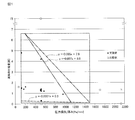
- the present invention [2] includes the blood filter according to the above [1], wherein the amount of the hemagglutination agent attached to the glass nonwoven fabric satisfies the following formulas (1) and (2).
- y represents the adhesion amount [parts by mass] of the hemagglutination agent to 100 parts by mass of the glass fibers contained in the glass nonwoven fabric.
- X represents the thickness of the glass nonwoven fabric. The pressure loss value [Pa / mm] of the glass nonwoven fabric is shown.
- the pressure loss value of the glass non-woven fabric with respect to the thickness of the glass non-woven fabric (hereinafter, referred to as pressure loss / thickness) is not less than the above lower limit, and the adhered amount of the blood cell aggregating agent to the glass fiber (hereinafter, aggregating agent).
- the amount of adhered is more than the above lower limit, so that the separation performance of the blood filter can be sufficiently ensured.
- the pressure loss / thickness of the glass nonwoven fabric is less than or equal to the above upper limit and the amount of the aggregating agent attached is less than or equal to the above upper limit, it is possible to improve the blood filtration rate in the blood filter.
- the pressure loss value (pressure loss / thickness) of the glass non-woven fabric with respect to the thickness of the glass non-woven fabric, and the adhesion amount of the hemagglutination agent (aggregation agent adhesion amount) to 100 parts by mass of the glass fiber The graph which shows the correlation of is shown.
- the blood filter is capable of removing blood cells from blood and separating plasma by filtering blood.
- the blood filter includes a glass non-woven fabric and a hemagglutination agent attached to the glass non-woven fabric.
- the glass non-woven fabric has a sheet shape (flat plate shape) formed by intertwining glass fibers, specifically, has a predetermined thickness and extends in a direction orthogonal to the thickness direction.
- the glass non-woven fabric includes glass fibers intertwined with each other and voids located between the glass fibers.
- the void is a space other than glass fiber in the glass non-woven fabric, and is opened on the front and back surfaces of the glass non-woven fabric so as to communicate with the external space of the glass non-woven fabric.
- the glass non-woven fabric may further contain a binder that bonds the glass fibers together.
- binder examples include synthetic resins excluding the below-mentioned cationic polymer, and specifically, thermosetting resins (for example, epoxy resin, urethane resin, melamine resin, phenol resin, etc.), thermoplastic resins (for example, Examples thereof include acrylic resin, vinyl acetate resin, ethylene-vinyl acetate copolymer (EVA), vinyl chloride resin, etc.).
- thermosetting resins for example, epoxy resin, urethane resin, melamine resin, phenol resin, etc.
- thermoplastic resins for example, Examples thereof include acrylic resin, vinyl acetate resin, ethylene-vinyl acetate copolymer (EVA), vinyl chloride resin, etc.
- -Binders can be used alone or in combination of two or more.
- binders acrylic resin is preferable.
- the content ratio of the binder is, for example, 1.0 part by mass or more, preferably 3.0 parts by mass or more, for example, 10.0 parts by mass or less, and preferably 8.0 parts by mass with respect to 100 parts by mass of the glass fiber. Below the section.
- the average diameter of the glass fibers in such a glass nonwoven fabric is, for example, 0.1 ⁇ m or more, preferably 0.2 ⁇ m or more, for example, 10 ⁇ m or less, preferably 5 ⁇ m or less.
- the basis weight of the glass nonwoven fabric is, for example, 10 g / m 2 or more, preferably 20 g / m 2 or more, for example, 300 g / m 2 or less, preferably 150 g / m 2 or less.
- the pressure loss value of the glass nonwoven fabric is, for example, 20 Pa or more, preferably 30 Pa or more, more preferably 50 Pa or more, for example 600 Pa or less, preferably 350 Pa or less.
- the pressure loss value can be measured according to the method described in Examples described later (the same applies hereinafter).
- the thickness of the nonwoven glass fabric is, for example, 0.05 mm or more, preferably 0.10 mm or more, for example 1.0 mm or less, preferably 0.70 mm or less.
- the thickness of the glass nonwoven fabric can be measured with a micrometer according to the method described in JIS P8118.
- the pressure loss / thickness in the glass nonwoven fabric is an index of the roughness of the glass nonwoven fabric, and is 120 Pa / mm or more, preferably 200 Pa / mm or more, more preferably 400 Pa / mm or more, and particularly preferably 500 Pa / mm. mm or more and 1500 Pa / mm or less, preferably 1150 Pa / mm or less, and more preferably 1000 Pa / mm or less.
- the pressure loss / thickness is above the above lower limit, it is possible to surely improve the separation performance of the blood filter, and if the pressure loss / thickness is below the above upper limit, surely reduce the blood filtration time by the blood filter. Can be achieved.
- a hemagglutination agent is capable of aggregating blood cells in blood, and separates blood cell aggregates and plasma.
- the hemagglutination agent may be impregnated in the binder of the glass non-woven fabric, or may be attached to the surface of the glass fiber.
- hemagglutination agents include cationic polymers.
- the cationic polymer is a polymer having a cationic group, and has, for example, an amino group and / or a quaternary ammonium salt group as the cationic group.
- cationic polymers examples include amino group-containing polymers, quaternary ammonium salt group-containing polymers, amino group / quaternary ammonium salt group-containing polymers, and the like.
- amino group-containing polymer examples include polylysine (eg, poly-L-lysine, poly-D-lysine, poly-D, L-lysine, etc.), polyallylamine, polyalanine, poly (N, N-dimethylaminoethyl ( (Meth) acrylate), a copolymer of N, N-dimethylaminoethyl (meth) acrylate and methyl (meth) acrylate, and polyethyleneimine.
- the (meth) acrylate contains methacrylate and / or acrylate.
- Examples of the quaternary ammonium salt group-containing polymer include poly (diallyldimethylammonium chloride) and poly (1,1-dimethyl-3,5-dimethylenepiperidinium chloride).
- polymers having both amino groups and quaternary ammonium bases include copolymers of poly (diallyldimethylammonium chloride) and acrylamide.
- cationic polymers preferably, a quaternary ammonium salt group-containing polymer is used, and more preferably, poly (diallyldimethylammonium chloride) is used.
- the weight average molecular weight (Mw) of the cationic polymer is, for example, 100,000 or more, preferably 400,000 or more, for example, 10 million or less, preferably 4 million or less, more preferably 1 million or less.
- the weight average molecular weight can be measured by GPC (gel permeation chromatograph) and calculated in terms of standard polyethylene glycol (the same applies hereinafter).
- cationic polymers examples include Unisense FPA-1001L (poly (diallyldimethylammonium chloride), Mw: 500,000 manufactured by Senka Co.), Unisense FPA-1002L (poly (diallyldimethylammonium chloride), Mw: 900,000). , Senka Co., Ltd., C508 (poly (diallyldimethylammonium chloride), Mw: 3.5 million, manufactured by MT Aqua Polymer Co., Ltd.) and the like.
- Such hemagglutination agents can be used alone or in combination of two or more kinds.
- the adhesion amount of the hemagglutination agent is 0.1 parts by mass or more, preferably 0.5 parts by mass or more, 6.6 parts by mass with respect to 100 parts by mass of the glass fiber contained in the glass nonwoven fabric.
- the amount is preferably 5.0 parts by mass or less, more preferably 4.5 parts by mass or less.
- the amount of the aggregating agent attached can be measured according to the method described in Examples below (the same applies hereinafter).
- the amount of adhered coagulant is above the above lower limit, it is possible to surely improve the separation performance of the blood filter, and if the amount of adhered coagulant is below the above upper limit, it is sure to reduce the filtration time of blood by the blood filter. Can be achieved.
- the coagulant adhesion amount if the pressure loss / thickness in the glass nonwoven fabric is increased, the coagulant adhesion amount is reduced, and if the pressure loss / thickness in the glass nonwoven fabric is decreased, the coagulant adhesion amount is increased. By adjusting so as to achieve excellent balance, excellent separation performance and reduction of filtration time can be secured.
- the amount of the aggregating agent attached is preferably 0.1 part by mass or more and 2 parts by mass or less.
- the amount of the aggregating agent attached is preferably 0.5 parts by mass or more and 4.5 parts by mass or less.
- the amount of the aggregating agent attached is preferably 1.0 part by mass or more and 6.6 parts by mass or less, more preferably 5.
- the amount of the aggregating agent attached is preferably 1.4 parts by mass or more and 6.6 parts by mass or less.
- the amount of the aggregating agent attached is set so as to satisfy the following formulas (1) and (2) in consideration of pressure loss / thickness.
- y represents the adhesion amount [parts by mass] of the hemagglutination agent with respect to 100 parts by mass of the glass fiber contained in the glass nonwoven fabric.
- X represents the thickness of the glass nonwoven fabric with respect to the thickness of the glass nonwoven fabric. Indicates the pressure loss value [Pa / mm].)
- the above formula (1) shows the lower limit of the coagulant adhesion amount
- the above formula (2) shows the upper limit of the coagulant adhesion amount. If the adhered amount of the coagulant satisfies the above formula (1) and the above formula (2), excellent separation performance and reduction in filtration time can be ensured in a more balanced manner.
- the coagulant adhesion amount satisfies the following formula (3).
- the glass nonwoven fabric may be impregnated with the above-mentioned binder so as to have the above-mentioned content ratio.
- the aggregating agent liquid contains the above-described hemagglutination agent and a solvent.
- the solvent examples include water and methanol, and preferably water.
- the solvent can be used alone or in combination of two or more kinds.
- the aggregating agent liquid is prepared as an aggregating agent aqueous solution in which the hemagglutination agent is dissolved in water.
- the immersion temperature of the glass nonwoven fabric in the flocculant liquid is, for example, 5 ° C. or higher, preferably 15 ° C. or higher, for example, 50 ° C. or lower, preferably 30 ° C. or lower.
- the immersion time of the glass nonwoven fabric in the flocculant liquid is, for example, 30 seconds or more, preferably 1 minute or more, for example, 10 minutes or less, preferably 5 minutes or less.
- the concentration of the hemagglutination agent in the aggregating agent solution is, for example, 0.001% by mass or more, preferably 0.005% by mass or more, for example, 2.0% by mass or less, and preferably 0.5% by mass or less. ..
- the amount of the flocculant adhered can be appropriately adjusted.
- the glass non-woven fabric can be directly immersed in the hemagglutination agent which is liquid at room temperature.
- the blood coagulant adheres to the glass non-woven fabric and the blood filter is manufactured.
- the pressure loss / thickness of the glass non-woven fabric is not less than the above lower limit, and the amount of adhered coagulant is not less than the above lower limit. Therefore, the separation performance of the blood filter can be sufficiently ensured.
- the pressure loss / thickness of the glass nonwoven fabric is less than or equal to the above upper limit, and the amount of the coagulant attached is less than or equal to the above upper limit. Therefore, the blood filtration rate in the blood filter can be improved.
- the blood filter can be used alone, or can be used by laminating another filter (for example, a porous membrane made of resin) on the blood filter.
- another filter for example, a porous membrane made of resin
- the blood filter can be suitably used for blood filtration for various purposes.
- blood filters include blood filters for genetic tests, blood filters for infectious disease tests, blood filters for biochemical tests, blood filters for microbiological tests, and the like.
- Glass fibers and an aqueous dispersion of an acrylic resin as a binder were prepared, and glass nonwoven fabrics A to J were prepared by a wet papermaking method.
- the average diameter of the glass fibers in the glass nonwoven fabric A was 2.7 ⁇ m, and the content ratio of the binder was 5.7 parts by mass with respect to 100 parts by mass of the glass fibers.
- the basis weight of the glass nonwoven fabric A was 52 g / m 2 .
- the average diameter of the glass fibers in the glass nonwoven fabric B was 3.4 ⁇ m, and the content ratio of the binder was 5.5 parts by mass with respect to 100 parts by mass of the glass fibers.
- the basis weight of the glass nonwoven fabric B was 55 g / m 2 .
- the average diameter of the glass fibers in the glass nonwoven fabric C was 1.9 ⁇ m, and the content ratio of the binder was 5.5 parts by mass with respect to 100 parts by mass of the glass fibers.
- the basis weight of the glass nonwoven fabric C was 52 g / m 2 .
- the average diameter of the glass fibers in the glass nonwoven fabric D was 2.7 ⁇ m, and the content ratio of the binder was 6.0 parts by mass with respect to 100 parts by mass of the glass fibers.
- the basis weight of the glass nonwoven fabric D was 31 g / m 2 .
- the average diameter of the glass fibers in the glass nonwoven fabric E was 2.7 ⁇ m, and the content ratio of the binder was 5.9 parts by mass with respect to 100 parts by mass of the glass fibers.
- the basis weight of the glass nonwoven fabric E was 101 g / m 2 .
- the average diameter of the glass fibers in the glass nonwoven fabric F was 1.5 ⁇ m, and the content ratio of the binder was 6.7 parts by mass with respect to 100 parts by mass of the glass fibers.
- the basis weight of the glass nonwoven fabric F was 58 g / m 2 .
- the average diameter of the glass fibers in the glass nonwoven fabric G was 1.7 ⁇ m, and the content ratio of the binder was 5.8 parts by mass with respect to 100 parts by mass of the glass fibers.
- the basis weight of the glass nonwoven fabric G was 51 g / m 2 .
- the average diameter of the glass fibers in the glass nonwoven fabric H was 4.0 ⁇ m, and the content ratio of the binder was 5.9 parts by mass with respect to 100 parts by mass of the glass fibers.
- the basis weight of the glass nonwoven fabric H was 54 g / m 2 .
- the average diameter of the glass fibers in the glass nonwoven fabric I was 3.5 ⁇ m, and the content ratio of the binder was 5.4 parts by mass with respect to 100 parts by mass of the glass fibers.
- the basis weight of the glass nonwoven fabric I was 55 g / m 2 .
- the average diameter of the glass fibers in the glass nonwoven fabric J was 3.7 ⁇ m, and the content ratio of the binder was 5.3 parts by mass with respect to 100 parts by mass of the glass fibers.
- the basis weight of the glass nonwoven fabric J was 56 g / m 2 .
- the respective thicknesses of the glass nonwoven fabrics A to J are shown in Tables 1 and 2.
- the concentration of the coagulant liquid A was 0.05% by mass
- the concentration of the coagulant liquid B was 0.005% by mass
- the concentration of the coagulant liquid C was 0.5% by mass.
- Unisense FPA-1002L poly (diallyldimethylammonium chloride), Mw: 500,000, manufactured by Senka Co., Ltd.
- concentration of the coagulant liquid D was 0.05% by mass.
- a coagulant solution F was prepared by dissolving Unisense FPA-1001L (poly (diallyldimethylammonium chloride), Mw: 500,000, manufactured by Senka Co., Ltd.) in water.
- the concentration of the flocculant liquid F was 2.0% by mass.
- Example 1 The glass nonwoven fabric A was immersed in the flocculant liquid A for 1 minute at room temperature (23 ° C.). Next, the glass non-woven fabric A was taken out from the flocculant liquid A and dried at 23 ° C. The blood filter was prepared as described above.
- Example 2 A blood filter was prepared in the same manner as in Example 1 except that the flocculant liquid A was changed to the flocculant liquid B.
- Example 3 A blood filter was prepared in the same manner as in Example 1 except that the coagulant liquid A was changed to the coagulant liquid C.
- Example 4 A blood filter was prepared in the same manner as in Example 1 except that the coagulant solution A was changed to the coagulant solution D.
- Example 5 A blood filter was prepared in the same manner as in Example 1 except that the flocculant liquid A was changed to the flocculant liquid E.
- Example 6 A blood filter was prepared in the same manner as in Example 1 except that the glass nonwoven fabric A was changed to each of the glass nonwoven fabrics B to E.
- Example 10 A blood filter was prepared in the same manner as in Example 1 except that the glass nonwoven fabric A was changed to the glass nonwoven fabric I.
- Example 11 A blood filter was prepared in the same manner as in Example 1 except that the glass nonwoven fabric A was changed to the glass nonwoven fabric J.
- Example 12 A blood filter was prepared in the same manner as in Example 11 except that the flocculant liquid A was changed to the flocculant liquid C.
- Example 3 A blood filter was prepared in the same manner as in Example 1 except that the coagulant liquid A was changed to the coagulant liquid F.
- Example 6 A blood filter was prepared in the same manner as in Example 1 except that the glass nonwoven fabric A was changed to each of the glass nonwoven fabrics F to H.
- Z Mass of each glass nonwoven fabric after heating at 500 ° C.
- the blood filter of the present invention is used, for example, as a blood filter for genetic testing, a blood filter for infectious disease testing, a blood filter for biochemical testing, a blood filter for microbiological testing, and the like.
Landscapes
- Life Sciences & Earth Sciences (AREA)
- Chemical & Material Sciences (AREA)
- Health & Medical Sciences (AREA)
- Engineering & Computer Science (AREA)
- Physics & Mathematics (AREA)
- Analytical Chemistry (AREA)
- Urology & Nephrology (AREA)
- Hematology (AREA)
- Food Science & Technology (AREA)
- Medicinal Chemistry (AREA)
- Biomedical Technology (AREA)
- Molecular Biology (AREA)
- Biochemistry (AREA)
- General Health & Medical Sciences (AREA)
- General Physics & Mathematics (AREA)
- Immunology (AREA)
- Pathology (AREA)
- Geology (AREA)
- Chemical Kinetics & Catalysis (AREA)
- Filtering Materials (AREA)
Abstract
血液フィルターに、ガラス不織布と、ガラス不織布に付着する血球凝集剤とを備える。そして、ガラス不織布の厚みに対するガラス不織布の圧力損失値を、120Pa/mm以上1500Pa/mm以下とし、ガラス不織布が含有するガラス繊維100質量部に対する血球凝集剤の付着量を、0.1質量部以上6.6質量部以下とする。
Description
本発明は、血液フィルターに関する。
従来、血液を遠心分離機により血球と血漿とに分離した後、血漿を種々の血液検査に用いることが知られている。しかし、血液を遠心分離機により分離することは煩雑であり、より簡易な方法により血液を血球と血漿とに分離することが望まれている。
そこで、血液フィルターにより、血液をろ過して、血球を除去するとともに血漿を分離することが検討されている。
そのような血液フィルターとして、例えば、平均直径0.2~5μを有するガラス繊維の、密度0.1~0.5g/cm3の層よりなるガラス繊維層が提案されている(例えば、特許文献1参照。)。
近年、血液検査に要する検査時間の短縮が望まれており、血液フィルターによる血液のろ過時間の低減が望まれている。しかし、特許文献1に記載のガラス繊維層では、血液のろ過速度の向上には限度があり、血液のろ過時間を低減することは困難である。
本発明は、要求される分離性能を十分に確保できながら、血液のろ過時間の低減を図ることができる血液フィルターを提供する。
本発明[1]は、ガラス不織布と、前記ガラス不織布に付着する血球凝集剤と、を備え、前記ガラス不織布の厚みに対する前記ガラス不織布の圧力損失値は、120Pa/mm以上1500Pa/mm以下であり、前記血球凝集剤の付着量は、前記ガラス不織布が含有するガラス繊維100質量部に対して、0.1質量部以上6.6質量部以下である、血液フィルターを含む。
本発明[2]は、前記ガラス不織布に対する前記血球凝集剤の付着量は、下記式(1)および下記式(2)を満たす、上記[1]に記載の血液フィルターを含む。
y≧-0.0001x+0.3 (1)
y≦-0.005x+7.6 (2)
(式(1)および(2)中、yは、前記ガラス不織布が含有するガラス繊維100質量部に対する前記血球凝集剤の付着量[質量部]を示す。xは、前記ガラス不織布の厚みに対する前記ガラス不織布の圧力損失値[Pa/mm]を示す。)
y≦-0.005x+7.6 (2)
(式(1)および(2)中、yは、前記ガラス不織布が含有するガラス繊維100質量部に対する前記血球凝集剤の付着量[質量部]を示す。xは、前記ガラス不織布の厚みに対する前記ガラス不織布の圧力損失値[Pa/mm]を示す。)
本発明の血液フィルターでは、ガラス不織布の厚みに対するガラス不織布の圧力損失値(以下、圧力損失/厚みとする。)が上記下限以上、かつ、ガラス繊維に対する血球凝集剤の付着量(以下、凝集剤付着量とする。)が上記下限以上であるので、血液フィルターの分離性能を十分に確保することができる。
また、ガラス不織布における圧力損失/厚みが上記上限以下、かつ、凝集剤付着量が上記上限以下であるので、血液フィルターにおける血液のろ過速度の向上を図ることができる。
その結果、優れた分離性能を確保できながら、血液のろ過時間の低減を図ることができる。
<血液フィルター>
血液フィルターは、血液をろ過することにより、血液から血球を除去して血漿を分離可能である。血液フィルターは、ガラス不織布と、ガラス不織布に付着する血球凝集剤とを備える。
血液フィルターは、血液をろ過することにより、血液から血球を除去して血漿を分離可能である。血液フィルターは、ガラス不織布と、ガラス不織布に付着する血球凝集剤とを備える。
ガラス不織布は、ガラス繊維が互いに絡み合って形成されるシート形状(平板形状)を有し、具体的には、所定の厚みを有し、前記厚み方向と直交する方向に延びる。ガラス不織布は、互いに絡み合うガラス繊維と、そのガラス繊維の間に位置する空隙とを備える。
空隙は、ガラス不織布におけるガラス繊維以外の空間部分であり、ガラス不織布の表面および裏面において、ガラス不織布の外部空間と連通するように開口している。
また、ガラス不織布は、ガラス繊維を互いに結合させるバインダをさらに含有することができる。
バインダとして、例えば、後述するカチオン性ポリマーを除く合成樹脂が挙げられ、具体的には、熱硬化性樹脂(例えば、エポキシ樹脂、ウレタン樹脂、メラミン樹脂、フェノール樹脂など)、熱可塑性樹脂(例えば、アクリル樹脂、酢酸ビニル樹脂、エチレン-酢酸ビニル共重合体(EVA)、塩化ビニル樹脂など)などが挙げられる。
バインダは、単独使用または2種以上併用することができる。バインダのなかでは、好ましくは、アクリル樹脂が挙げられる。
バインダの含有割合は、ガラス繊維100質量部に対して、例えば、1.0質量部以上、好ましくは、3.0質量部以上、例えば、10.0質量部以下、好ましくは、8.0質量部以下である。
このようなガラス不織布におけるガラス繊維の平均径は、例えば、0.1μm以上、好ましくは、0.2μm以上、例えば、10μm以下、好ましくは、5μm以下である。
ガラス不織布の目付量は、例えば、10g/m2以上、好ましくは、20g/m2以上、例えば、300g/m2以下、好ましくは、150g/m2以下である。
ガラス不織布の圧力損失値は、例えば、20Pa以上、好ましくは、30Pa以上、さらに好ましくは、50Pa以上、例えば、600Pa以下、好ましくは、350Pa以下である。なお、圧力損失値は、後述する実施例に記載の方法に準拠して測定できる(以下同様)。
ガラス不織布の厚みは、例えば、0.05mm以上、好ましくは、0.10mm以上、例えば、1.0mm以下、好ましくは、0.70mm以下である。なお、ガラス不織布の厚みは、JIS P8118に記載の方法に従い、マイクロメータにより測定できる。
また、ガラス不織布における圧力損失/厚みは、ガラス不織布の粗さの指標であって、120Pa/mm以上、好ましくは、200Pa/mm以上、さらに好ましくは、400Pa/mm以上、とりわけ好ましくは、500Pa/mm以上、1500Pa/mm以下、好ましくは、1150Pa/mm以下、さらに好ましくは、1000Pa/mm以下である。
圧力損失/厚みが上記下限以上であれば、血液フィルターの分離性能の向上を確実に図ることができ、圧力損失/厚みが上記上限以下であれば、血液フィルターによる血液のろ過時間の低減を確実に図ることができる。
血球凝集剤は、血液中の血球を凝集可能であり、血球の凝集体と血漿とを分離させる。血球凝集剤は、ガラス不織布のバインダ中に含浸されていてもよく、ガラス繊維の表面に付着していてもよい。
血球凝集剤として、例えば、カチオン性ポリマーなどが挙げられる。カチオン性ポリマーは、カチオン性基を有する重合体であって、カチオン性基として、例えば、アミノ基および/または第四級アンモニウム塩基を有する。
そのようなカチオン性ポリマーとして、例えば、アミノ基含有ポリマー、第四級アンモニウム塩基含有ポリマー、アミノ基・第四級アンモニウム塩基併有ポリマーなどが挙げられる。
アミノ基含有ポリマーとして、例えば、ポリリジン(例えば、ポリ-L-リジン、ポリ-D-リジン、ポリ-D,L-リジンなど)、ポリアリルアミン、ポリアラニン、ポリ(N,N-ジメチルアミノエチル(メタ)アクリレート)、N,N-ジメチルアミノエチル(メタ)アクリレートとメチル(メタ)アクリレートとの共重合体、ポリエチレンイミンなどが挙げられる。なお、(メタ)アクリレートは、メタクリレートおよび/またはアクリレートを含む。
第四級アンモニウム塩基含有ポリマーとして、例えば、ポリ(ジアリルジメチルアンモニウムクロライド)、ポリ(1,1-ジメチル-3,5-ジメチレンピペリジニウムクロライド)などが挙げられる。
アミノ基・第四級アンモニウム塩基併有ポリマーとして、例えば、ポリ(ジアリルジメチルアンモニウムクロライド)とアクリルアミドとの共重合体などが挙げられる。
カチオン性ポリマーのなかでは、好ましくは、第四級アンモニウム塩基含有ポリマーが挙げられ、さらに好ましくは、ポリ(ジアリルジメチルアンモニウムクロライド)が挙げられる。
カチオン性ポリマーの重量平均分子量(Mw)は、例えば、10万以上、好ましくは、40万以上、例えば、1000万以下、好ましくは、400万以下、さらに好ましくは、100万以下である。なお、重量平均分子量は、GPC(ゲル・パーミエーション・クロマトグラフ)により測定し、標準ポリエチレングリコール換算により算出できる(以下同様)。
このようなカチオン性ポリマーは、市販品を用いることができる。カチオン性ポリマーの市販品として、例えば、ユニセンスFPA-1001L(ポリ(ジアリルジメチルアンモニウムクロライド)、Mw:50万、センカ社製)、ユニセンスFPA-1002L(ポリ(ジアリルジメチルアンモニウムクロライド)、Mw:90万、センカ社製)、C508(ポリ(ジアリルジメチルアンモニウムクロライド)、Mw:350万、MTアクアポリマー社製)などが挙げられる。
このような血球凝集剤は、単独使用または2種以上併用することができる。
血球凝集剤の付着量(凝集剤付着量)は、ガラス不織布が含有するガラス繊維100質量部に対して、0.1質量部以上、好ましくは、0.5質量部以上、6.6質量部以下、好ましくは、5.0質量部以下、さらに好ましくは、4.5質量部以下である。なお、凝集剤付着量は、後述する実施例に記載の方法に準拠して測定できる(以下同様)。
凝集剤付着量が上記下限以上であれば、血液フィルターの分離性能の向上を確実に図ることができ、凝集剤付着量が上記上限以下であれば、血液フィルターによる血液のろ過時間の低減を確実に図ることができる。
つまり、ガラス不織布における圧力損失/厚みが上記の範囲であり、かつ、凝集剤付着量が上記の範囲であれば、血液フィルターの分離性能の向上を図ることができながら、血液フィルターによる血液のろ過時間の低減を図ることができる。
また、上記した凝集剤付着量の範囲において、ガラス不織布における圧力損失/厚みを高くすれば、凝集剤付着量を少なくし、ガラス不織布における圧力損失/厚みを低くすれば、凝集剤付着量を多くするように調整することにより、優れた分離性能およびろ過時間の低減をバランスよく確保することができる。
具体的には、ガラス不織布における圧力損失/厚みが1000Pa/mm以上1500Pa/mm以下であると、凝集剤付着量は、好ましくは、0.1質量部以上2質量部以下である。また、ガラス不織布における圧力損失/厚みが600Pa/mm以上1000Pa/mm未満であると、凝集剤付着量は、好ましくは、0.5質量部以上4.5質量部以下である。また、ガラス不織布における圧力損失/厚みが200Pa/mm以上600Pa/mm未満であると、凝集剤付着量は、好ましくは、1.0質量部以上6.6質量部以下、さらに好ましくは、5.5質量部以下である。また、ガラス不織布における圧力損失/厚みが120Pa/mm以上200Pa/mm未満であると、凝集剤付着量は、好ましくは、1.4質量部以上6.6質量部以下である。
また、凝集剤付着量が一定であり、かつ、ガラス不織布における圧力損失/厚みが高くなると、血液のろ過時間が増加(血液のろ過速度が低下)する傾向がある。そのため、凝集剤付着量は、さらに好ましくは、圧力損失/厚みを考慮して、下記式(1)および下記式(2)を満たすように設定される。
y≧-0.0001x+0.3 (1)
y≦-0.005x+7.6 (2)
(式(1)および式(2)中、yは、ガラス不織布が含有するガラス繊維100質量部に対する血球凝集剤の付着量[質量部]を示す。xは、ガラス不織布の厚みに対するガラス不織布の圧力損失値[Pa/mm]を示す。)
上記式(1)は、凝集剤付着量の下限を示し、上記式(2)は、凝集剤付着量の上限を示す。凝集剤付着量が上記式(1)および上記式(2)を満たせば、優れた分離性能およびろ過時間の低減をより一層バランスよく確保することができる。
y≦-0.005x+7.6 (2)
(式(1)および式(2)中、yは、ガラス不織布が含有するガラス繊維100質量部に対する血球凝集剤の付着量[質量部]を示す。xは、ガラス不織布の厚みに対するガラス不織布の圧力損失値[Pa/mm]を示す。)
上記式(1)は、凝集剤付着量の下限を示し、上記式(2)は、凝集剤付着量の上限を示す。凝集剤付着量が上記式(1)および上記式(2)を満たせば、優れた分離性能およびろ過時間の低減をより一層バランスよく確保することができる。
また、凝集剤付着量は、とりわけ好ましくは、下記式(3)を満たす。
y≦-0.007x+8.0 (3)
(式(3)中、xおよびyは、上記式(1)のxおよびyと同義である。)
上記式(3)は、凝集剤付着量の上限を示す。凝集剤付着量が上記式(3)を満たせば、ろ過時間の低減をより一層確実に図ることができる。
(式(3)中、xおよびyは、上記式(1)のxおよびyと同義である。)
上記式(3)は、凝集剤付着量の上限を示す。凝集剤付着量が上記式(3)を満たせば、ろ過時間の低減をより一層確実に図ることができる。
<血液フィルターの製造方法>
次に、血液フィルターの製造方法について説明する。
次に、血液フィルターの製造方法について説明する。
血液フィルターを製造するには、まず、上記したガラス不織布を準備する。なお、ガラス不織布には、必要に応じて、上記したバインダが、上記した含有割合となるように含浸されていてもよい。
次いで、上記した血球凝集剤が溶解および/または分散される凝集剤液を準備し、ガラス不織布を凝集剤液に浸漬する。
凝集剤液は、上記した血球凝集剤と、溶媒とを含有する。
溶媒として、例えば、水、メタノールなどが挙げられ、好ましくは、水が挙げられる。溶媒は、単独使用または2種以上併用することができる。溶媒が水である場合、凝集剤液は、血球凝集剤が水に溶解された凝集剤水溶液として準備される。
凝集剤液に対するガラス不織布の浸漬温度は、例えば、5℃以上、好ましくは、15℃以上、例えば、50℃以下、好ましくは、30℃以下である。
凝集剤液に対するガラス不織布の浸漬時間は、例えば、30秒以上、好ましくは、1分以上、例えば、10分以下、好ましくは、5分以下である。
凝集剤液における血球凝集剤の濃度は、例えば、0.001質量%以上、好ましくは、0.005質量%以上、例えば、2.0質量%以下、好ましくは、0.5質量%以下である。
凝集剤液の濃度および/または浸漬時間(とりわけ凝集剤液の濃度)を上記の範囲で調整することにより、凝集剤付着量を適宜調整することができる。
なお、血球凝集剤が常温(23℃)において液状である場合、ガラス不織布を常温液状の血球凝集剤に直接浸漬することもできる。
次いで、ガラス不織布を凝集剤液から取り出し、必要に応じて乾燥させる。
以上によって、血球凝集剤がガラス不織布に付着して、血液フィルターが製造される。
このような血液フィルターでは、ガラス不織布における圧力損失/厚みが上記下限以上、かつ、凝集剤付着量が上記下限以上である。そのため、血液フィルターの分離性能を十分に確保することができる。
また、ガラス不織布における圧力損失/厚みが上記上限以下、かつ、凝集剤付着量が上記上限以下である。そのため、血液フィルターにおける血液のろ過速度の向上を図ることができる。
つまり、上記した血液フィルターでは、要求される分離性能を十分に確保できながら、血液のろ過速度の向上を図ることができる。
また、血液フィルターは、単独で使用することもでき、血液フィルターに他のフィルター(例えば、樹脂からなる多孔質膜など)を積層して使用することもできる。
また、血液フィルターは、種々の目的のための血液ろ過に好適に利用することができる。血液フィルターの用途として、例えば、遺伝子検査用血液フィルター、感染病検査用血液フィルター、生化学検査用血液フィルター、微生物学検査用血液フィルターなどが挙げられる。
以下に、実施例および比較例を示し、本発明をさらに具体的に説明する。なお、本発明は、何ら実施例および比較例に限定されない。また、以下の記載において用いられる配合割合(含有割合)、物性値、パラメータなどの具体的数値は、上記の「発明を実施するための形態」において記載されている、それらに対応する配合割合(含有割合)、物性値、パラメータなど該当記載の上限(「以下」、「未満」として定義されている数値)または下限(「以上」、「超過」として定義されている数値)に代替することができる。
する。
する。
<ガラス不織布の準備>
ガラス繊維、および、バインダとしてのアクリル樹脂の水分散液を準備して、湿式抄紙法により、ガラス不織布A~Jを調製した。
ガラス繊維、および、バインダとしてのアクリル樹脂の水分散液を準備して、湿式抄紙法により、ガラス不織布A~Jを調製した。
ガラス不織布Aにおけるガラス繊維の平均径は、2.7μmであり、バインダの含有割合は、ガラス繊維100質量部に対して、5.7質量部であった。ガラス不織布Aの目付量は、52g/m2であった。
ガラス不織布Bにおけるガラス繊維の平均径は、3.4μmであり、バインダの含有割合は、ガラス繊維100質量部に対して、5.5質量部であった。ガラス不織布Bの目付量は、55g/m2であった。
ガラス不織布Cにおけるガラス繊維の平均径は、1.9μmであり、バインダの含有割合は、ガラス繊維100質量部に対して、5.5質量部であった。ガラス不織布Cの目付量は、52g/m2であった。
ガラス不織布Dにおけるガラス繊維の平均径は、2.7μmであり、バインダの含有割合は、ガラス繊維100質量部に対して、6.0質量部であった。ガラス不織布Dの目付量は、31g/m2であった。
ガラス不織布Eにおけるガラス繊維の平均径は、2.7μmであり、バインダの含有割合は、ガラス繊維100質量部に対して、5.9質量部であった。ガラス不織布Eの目付量は、101g/m2であった。
ガラス不織布Fにおけるガラス繊維の平均径は、1.5μmであり、バインダの含有割合は、ガラス繊維100質量部に対して、6.7質量部であった。ガラス不織布Fの目付量は、58g/m2であった。
ガラス不織布Gにおけるガラス繊維の平均径は、1.7μmであり、バインダの含有割合は、ガラス繊維100質量部に対して、5.8質量部であった。ガラス不織布Gの目付量は、51g/m2であった。
ガラス不織布Hにおけるガラス繊維の平均径は、4.0μmであり、バインダの含有割合は、ガラス繊維100質量部に対して、5.9質量部であった。ガラス不織布Hの目付量は、54g/m2であった。
ガラス不織布Iにおけるガラス繊維の平均径は、3.5μmであり、バインダの含有割合は、ガラス繊維100質量部に対して、5.4質量部であった。ガラス不織布Iの目付量は、55g/m2であった。
ガラス不織布Jにおけるガラス繊維の平均径は、3.7μmであり、バインダの含有割合は、ガラス繊維100質量部に対して、5.3質量部であった。ガラス不織布Jの目付量は、56g/m2であった。
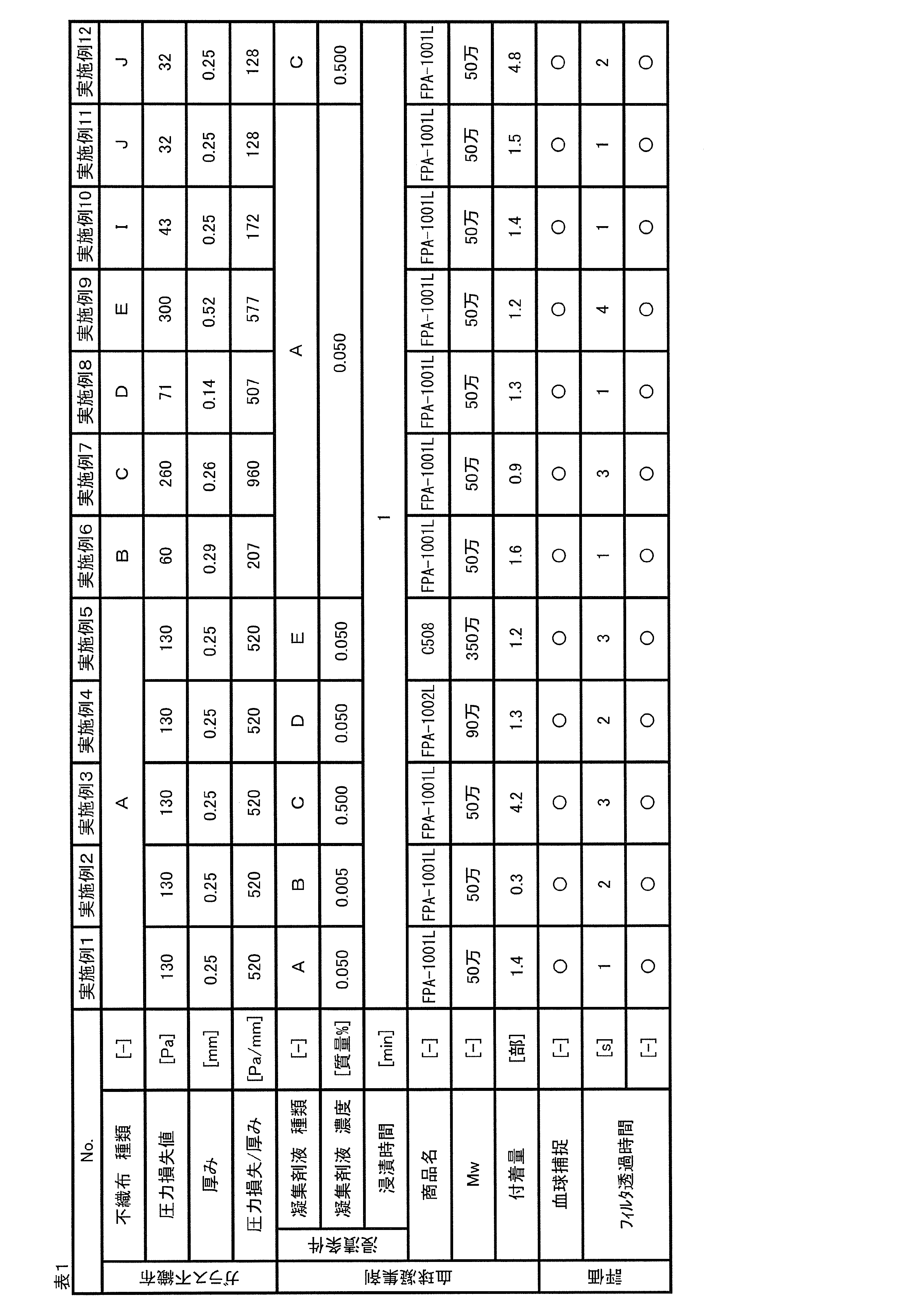
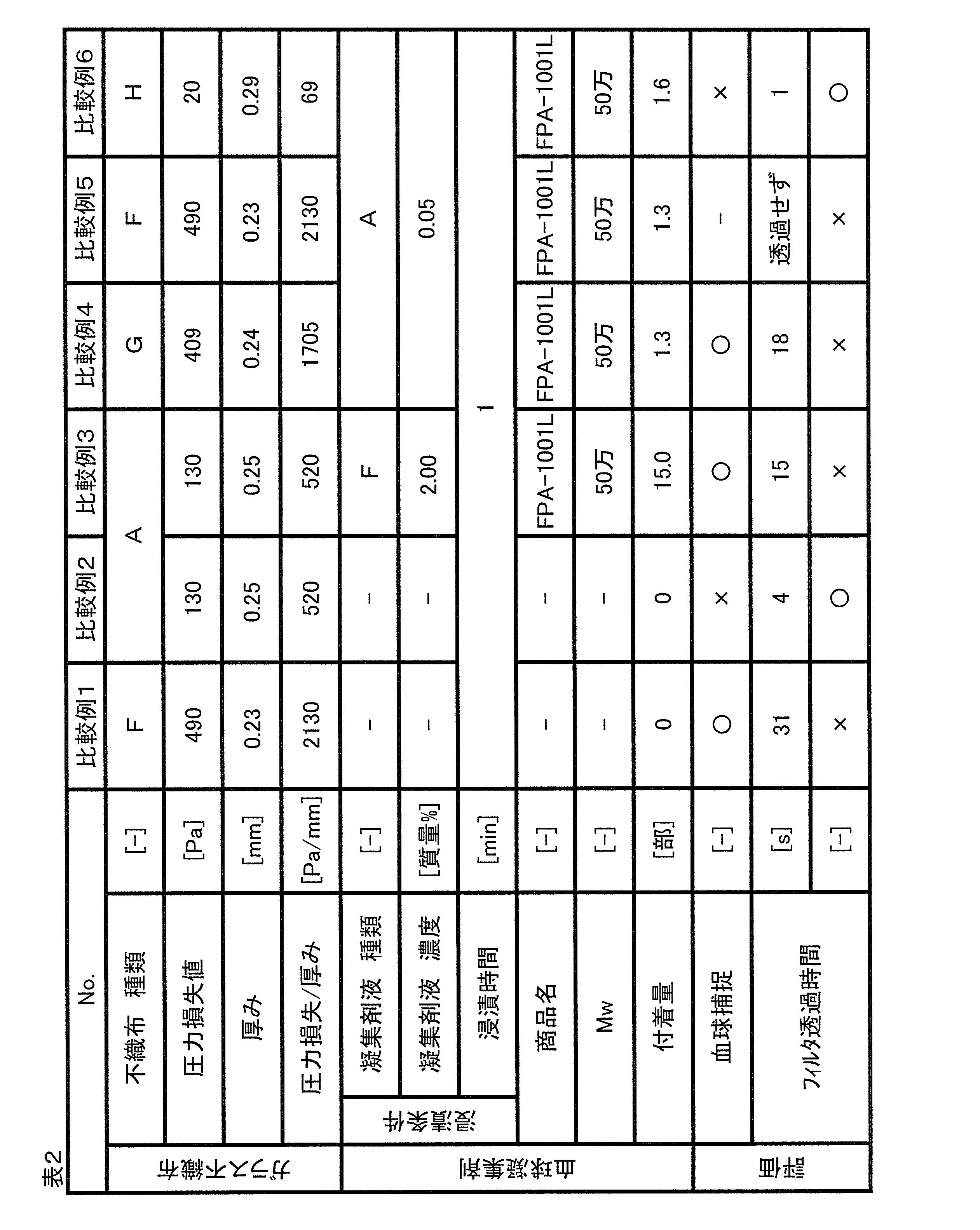
また、ガラス不織布A~Jのそれぞれの厚みを、表1および表2に示す。
<血球凝集剤水溶液(凝集剤液)の準備>
ユニセンスFPA-1001L(ポリ(ジアリルジメチルアンモニウムクロライド)、Mw:50万、センカ社製)を水に溶解して、凝集剤液A~Cを準備した。凝集剤液Aの濃度は、0.05質量%、凝集剤液Bの濃度は、0.005質量%、凝集剤液Cの濃度は、0.5質量%であった。
ユニセンスFPA-1001L(ポリ(ジアリルジメチルアンモニウムクロライド)、Mw:50万、センカ社製)を水に溶解して、凝集剤液A~Cを準備した。凝集剤液Aの濃度は、0.05質量%、凝集剤液Bの濃度は、0.005質量%、凝集剤液Cの濃度は、0.5質量%であった。
ユニセンスFPA-1002L(ポリ(ジアリルジメチルアンモニウムクロライド)、Mw:50万、センカ社製)を水に溶解して、凝集剤液Dを準備した。凝集剤液Dの濃度は、0.05質量%であった。
C508(ポリ(ジアリルジメチルアンモニウムクロライド)、Mw:350万、MTアクアポリマー社製)を水に溶解して、凝集剤液Eを準備した。凝集剤液Eの濃度は、0.05質量%であった。
ユニセンスFPA-1001L(ポリ(ジアリルジメチルアンモニウムクロライド)、Mw:50万、センカ社製)を水に溶解して、凝集剤液Fを準備した。凝集剤液Fの濃度は、2.0質量%であった。
(実施例1)
ガラス不織布Aを、常温(23℃)において、凝集剤液Aに1分間浸漬した。次いで、ガラス不織布Aを凝集剤液Aから取り出し、23℃において乾燥させた。以上によって、血液フィルターを準備した。
ガラス不織布Aを、常温(23℃)において、凝集剤液Aに1分間浸漬した。次いで、ガラス不織布Aを凝集剤液Aから取り出し、23℃において乾燥させた。以上によって、血液フィルターを準備した。
(実施例2)
凝集剤液Aを凝集剤液Bに変更したこと以外は、実施例1と同様にして、血液フィルターを準備した。
凝集剤液Aを凝集剤液Bに変更したこと以外は、実施例1と同様にして、血液フィルターを準備した。
(実施例3)
凝集剤液Aを凝集剤液Cに変更したこと以外は、実施例1と同様にして、血液フィルターを準備した。
凝集剤液Aを凝集剤液Cに変更したこと以外は、実施例1と同様にして、血液フィルターを準備した。
(実施例4)
凝集剤液Aを凝集剤液Dに変更したこと以外は、実施例1と同様にして、血液フィルターを準備した。
凝集剤液Aを凝集剤液Dに変更したこと以外は、実施例1と同様にして、血液フィルターを準備した。
(実施例5)
凝集剤液Aを凝集剤液Eに変更したこと以外は、実施例1と同様にして、血液フィルターを準備した。
凝集剤液Aを凝集剤液Eに変更したこと以外は、実施例1と同様にして、血液フィルターを準備した。
(実施例6~9)
ガラス不織布Aをガラス不織布B~Eのそれぞれに変更したこと以外は、実施例1と同様にして、血液フィルターを準備した。
ガラス不織布Aをガラス不織布B~Eのそれぞれに変更したこと以外は、実施例1と同様にして、血液フィルターを準備した。
(実施例10)
ガラス不織布Aをガラス不織布Iに変更したこと以外は、実施例1と同様にして、血液フィルターを準備した。
ガラス不織布Aをガラス不織布Iに変更したこと以外は、実施例1と同様にして、血液フィルターを準備した。
(実施例11)
ガラス不織布Aをガラス不織布Jに変更したこと以外は、実施例1と同様にして、血液フィルターを準備した。
ガラス不織布Aをガラス不織布Jに変更したこと以外は、実施例1と同様にして、血液フィルターを準備した。
(実施例12)
凝集剤液Aを凝集剤液Cに変更したこと以外は、実施例11と同様にして、血液フィルターを準備した。
凝集剤液Aを凝集剤液Cに変更したこと以外は、実施例11と同様にして、血液フィルターを準備した。
(比較例1)
ガラス不織布Fを凝集剤液に浸漬することなく、血液フィルターとした。
ガラス不織布Fを凝集剤液に浸漬することなく、血液フィルターとした。
(比較例2)
ガラス不織布Aを凝集剤液に浸漬することなく、血液フィルターとした。
ガラス不織布Aを凝集剤液に浸漬することなく、血液フィルターとした。
(比較例3)
凝集剤液Aを凝集剤液Fに変更したこと以外は、実施例1と同様にして、血液フィルターを準備した。
凝集剤液Aを凝集剤液Fに変更したこと以外は、実施例1と同様にして、血液フィルターを準備した。
(比較例4~6)
ガラス不織布Aをガラス不織布F~Hのそれぞれに変更したこと以外は、実施例1と同様にして、血液フィルターを準備した。
ガラス不織布Aをガラス不織布F~Hのそれぞれに変更したこと以外は、実施例1と同様にして、血液フィルターを準備した。
評価
(圧力損失値の測定および圧力損失/厚みの算出)
JIS B 9927に記載の「クリーンルーム用エアフィルター性能試験方法」に準拠して、断面積100cm2および面風速5.3cm/sにて、ガラス不織布A~Jのそれぞれに空気を送り込み、各ガラス不織布の上流側および下流側の圧力を測定し、それらの差を圧力損失値とした。その結果を表1および表2に示す。
(圧力損失値の測定および圧力損失/厚みの算出)
JIS B 9927に記載の「クリーンルーム用エアフィルター性能試験方法」に準拠して、断面積100cm2および面風速5.3cm/sにて、ガラス不織布A~Jのそれぞれに空気を送り込み、各ガラス不織布の上流側および下流側の圧力を測定し、それらの差を圧力損失値とした。その結果を表1および表2に示す。
そして、測定された各ガラス不織布の圧力損失値を各ガラス不織布の厚みで除して、ガラス不織布の厚みに対するガラス不織布の圧力損失値(圧力損失/厚み)を算出した。その結果を表1および表2に示す。
(血球凝集剤の付着量の測定)
加熱重量減少法(TGA)によって、各血液フィルターおよび各ガラス不織布におけるTGA測定による減少質量(TGA測定前とTGA測定後との質量差)を測定した。そして、それら減少質量に基づき、下記式(4)により、各血液フィルターにおける血球凝集剤の付着量(凝集剤付着量)を算出した。その結果を表1および表2に示す。
加熱重量減少法(TGA)によって、各血液フィルターおよび各ガラス不織布におけるTGA測定による減少質量(TGA測定前とTGA測定後との質量差)を測定した。そして、それら減少質量に基づき、下記式(4)により、各血液フィルターにおける血球凝集剤の付着量(凝集剤付着量)を算出した。その結果を表1および表2に示す。
測定条件:室温から500℃まで昇温速度10℃/min
凝集剤付着量(質量部)=(X-Y)/Z×100 (4)
X:TGA測定前の各血液フィルターの質量から、TGA測定後の各血液フィルターの質量を減じた減少質量(=血球凝集剤およびバインダなどの燃焼成分の合計質量)
Y:TGA測定前の各ガラス不織布の質量から、TGA測定後の各ガラス不織布の質量を減じた減少質量(=バインダなどの燃焼成分の質量)
Z:500℃加熱後(TGA測定後)の各ガラス不織布の質量(=ガラス不織布が含有するガラス繊維の質量)
(ろ過試験)
各実施例および各比較例の血液フィルターの表面に血液10μLを載せた後、各血液フィルターの裏面から透過液が染み出るまでの時間(透過時間)を測定した。なお、比較例5の血液フィルターでは、血液載置後300秒を経過しても透過液が透過しなかった。
凝集剤付着量(質量部)=(X-Y)/Z×100 (4)
X:TGA測定前の各血液フィルターの質量から、TGA測定後の各血液フィルターの質量を減じた減少質量(=血球凝集剤およびバインダなどの燃焼成分の合計質量)
Y:TGA測定前の各ガラス不織布の質量から、TGA測定後の各ガラス不織布の質量を減じた減少質量(=バインダなどの燃焼成分の質量)
Z:500℃加熱後(TGA測定後)の各ガラス不織布の質量(=ガラス不織布が含有するガラス繊維の質量)
(ろ過試験)
各実施例および各比較例の血液フィルターの表面に血液10μLを載せた後、各血液フィルターの裏面から透過液が染み出るまでの時間(透過時間)を測定した。なお、比較例5の血液フィルターでは、血液載置後300秒を経過しても透過液が透過しなかった。
そして、透過時間を下記の基準で評価した。その結果を表1および2に示す。
○:透過時間が1秒以上5秒以下。
×:透過時間が5秒を超過。
○:透過時間が1秒以上5秒以下。
×:透過時間が5秒を超過。
また、各血液フィルターを透過した透過液を目視により観察して、各血液フィルターの分離性能を下記の基準により評価した。その結果を表1および表2に示す。
○:透過液中に赤い血球がない。
×:透過液中に赤い血球がある。
○:透過液中に赤い血球がない。
×:透過液中に赤い血球がある。
なお、上記発明は、本発明の例示の実施形態として提供したが、これは単なる例示に過ぎず、限定的に解釈してはならない。当該技術分野の当業者によって明らかな本発明の変形例は、後記請求の範囲に含まれる。
本発明の血液フィルターは、例えば、遺伝子検査用血液フィルター、感染病検査用血液フィルター、生化学検査用血液フィルター、微生物学検査用血液フィルターなどに用いられる。
Claims (2)
- ガラス不織布と、
前記ガラス不織布に付着する血球凝集剤と、を備え、
前記ガラス不織布の厚みに対する前記ガラス不織布の圧力損失値は、120Pa/mm以上1500Pa/mm以下であり、
前記血球凝集剤の付着量は、前記ガラス不織布が含有するガラス繊維100質量部に対して、0.1質量部以上6.6質量部以下であることを特徴とする、血液フィルター。 - 前記ガラス不織布に対する前記血球凝集剤の付着量は、下記式(1)および下記式(2)を満たすことを特徴とする、請求項1に記載の血液フィルター
y≧-0.0001x+0.3 (1)
y≦-0.005x+7.6 (2)
(式(1)および(2)中、yは、前記ガラス不織布が含有するガラス繊維100質量部に対する前記血球凝集剤の付着量[質量部]を示す。xは、前記ガラス不織布の厚みに対する前記ガラス不織布の圧力損失値[Pa/mm]を示す。)。
Applications Claiming Priority (4)
| Application Number | Priority Date | Filing Date | Title |
|---|---|---|---|
| JP2018216341 | 2018-11-19 | ||
| JP2018-216341 | 2018-11-19 | ||
| JP2019160327A JP2020085887A (ja) | 2018-11-19 | 2019-09-03 | 血液フィルター |
| JP2019-160327 | 2019-09-03 |
Publications (1)
| Publication Number | Publication Date |
|---|---|
| WO2020105270A1 true WO2020105270A1 (ja) | 2020-05-28 |
Family
ID=70773224
Family Applications (1)
| Application Number | Title | Priority Date | Filing Date |
|---|---|---|---|
| PCT/JP2019/037009 Ceased WO2020105270A1 (ja) | 2018-11-19 | 2019-09-20 | 血液フィルター |
Country Status (1)
| Country | Link |
|---|---|
| WO (1) | WO2020105270A1 (ja) |
Cited By (1)
| Publication number | Priority date | Publication date | Assignee | Title |
|---|---|---|---|---|
| WO2023048115A1 (ja) * | 2021-09-21 | 2023-03-30 | 日東紡績株式会社 | 血球分離剤、およびそれを用いた血球分離方法 |
Citations (4)
| Publication number | Priority date | Publication date | Assignee | Title |
|---|---|---|---|---|
| JPS63177059A (ja) * | 1986-10-29 | 1988-07-21 | バイオトラック,インコーポレイティド | 血液分離装置及び方法 |
| US5423989A (en) * | 1988-05-19 | 1995-06-13 | Chemtrack, Inc. | Plasma forming device |
| JPH09143081A (ja) * | 1995-06-09 | 1997-06-03 | Toyobo Co Ltd | 血漿分離フィルター、それを用いる血漿分離方法および血漿分離装置 |
| JP2000338103A (ja) * | 1999-05-26 | 2000-12-08 | Fujirebio Inc | 分離装置 |
-
2019
- 2019-09-20 WO PCT/JP2019/037009 patent/WO2020105270A1/ja not_active Ceased
Patent Citations (4)
| Publication number | Priority date | Publication date | Assignee | Title |
|---|---|---|---|---|
| JPS63177059A (ja) * | 1986-10-29 | 1988-07-21 | バイオトラック,インコーポレイティド | 血液分離装置及び方法 |
| US5423989A (en) * | 1988-05-19 | 1995-06-13 | Chemtrack, Inc. | Plasma forming device |
| JPH09143081A (ja) * | 1995-06-09 | 1997-06-03 | Toyobo Co Ltd | 血漿分離フィルター、それを用いる血漿分離方法および血漿分離装置 |
| JP2000338103A (ja) * | 1999-05-26 | 2000-12-08 | Fujirebio Inc | 分離装置 |
Cited By (2)
| Publication number | Priority date | Publication date | Assignee | Title |
|---|---|---|---|---|
| WO2023048115A1 (ja) * | 2021-09-21 | 2023-03-30 | 日東紡績株式会社 | 血球分離剤、およびそれを用いた血球分離方法 |
| JPWO2023048115A1 (ja) * | 2021-09-21 | 2023-03-30 |
Similar Documents
| Publication | Publication Date | Title |
|---|---|---|
| Homaeigohar et al. | Polyethersulfone electrospun nanofibrous composite membrane for liquid filtration | |
| JP7676450B2 (ja) | 燃料流用の複合媒体 | |
| US10981096B2 (en) | Process for making high efficiency synthetic filter media | |
| TWI410269B (zh) | 白血球過濾材料及其過濾方法 | |
| JP6170493B2 (ja) | ポリマーブレンド物の膜 | |
| CN113856495A (zh) | 一种除病毒用不对称的聚醚砜滤膜及其制备方法 | |
| MX2011000218A (es) | Membranas de purificacion de agua con resistencia al ensuciamiento mejorada. | |
| TWI657858B (zh) | 複合微多孔質膜、其製造方法及使用其的過濾器 | |
| Shen et al. | Preliminary investigation on hemocompatibility of poly (vinylidene fluoride) membrane grafted with acryloylmorpholine via ATRP | |
| WO1997022405A1 (en) | Hollow fiber type filtration membrane | |
| KR20150064059A (ko) | 미다공막 및 그 제조 방법 | |
| KR20160136430A (ko) | 중공사막, 및 중공사막의 제조 방법 | |
| CN109126205B (zh) | 一种油水分离用ps/pmma仿生超疏水膜的制备方法 | |
| WO2020105270A1 (ja) | 血液フィルター | |
| JP2020085887A (ja) | 血液フィルター | |
| CN116234620A (zh) | 过滤介质 | |
| JP2015160185A (ja) | メンブレンバイオリアクター | |
| JP7255945B2 (ja) | 親水性複合多孔質膜 | |
| Xiang et al. | Improved antifouling properties and blood compatibility of 3-methacryloxypropyl trimethoxysilane–based zwitterionic copolymer modified composite membranes via in situ post-crosslinking copolymerization | |
| Wang et al. | One-pot synthesis of highly hemocompatible polyurethane/polyethersulfone composite membranes | |
| US9695084B2 (en) | Preparation for fiberglass air filtration media | |
| KR101391651B1 (ko) | 정삼투막 및 그 제조방법 | |
| TW202006033A (zh) | 親水性複合膜、親水性多孔膜及親水性樹脂組成物 | |
| JPH07185235A (ja) | ろ紙とその製造方法 | |
| JPWO2018030057A1 (ja) | 不織布およびその製造方法 |
Legal Events
| Date | Code | Title | Description |
|---|---|---|---|
| 121 | Ep: the epo has been informed by wipo that ep was designated in this application |
Ref document number: 19887967 Country of ref document: EP Kind code of ref document: A1 |
|
| NENP | Non-entry into the national phase |
Ref country code: DE |
|
| 122 | Ep: pct application non-entry in european phase |
Ref document number: 19887967 Country of ref document: EP Kind code of ref document: A1 |