WO2020100472A1 - パンツ型使い捨ておむつ - Google Patents
パンツ型使い捨ておむつ Download PDFInfo
- Publication number
- WO2020100472A1 WO2020100472A1 PCT/JP2019/039749 JP2019039749W WO2020100472A1 WO 2020100472 A1 WO2020100472 A1 WO 2020100472A1 JP 2019039749 W JP2019039749 W JP 2019039749W WO 2020100472 A1 WO2020100472 A1 WO 2020100472A1
- Authority
- WO
- WIPO (PCT)
- Prior art keywords
- skin
- pants
- disposable diaper
- type disposable
- skin side
- Prior art date
- Legal status (The legal status is an assumption and is not a legal conclusion. Google has not performed a legal analysis and makes no representation as to the accuracy of the status listed.)
- Ceased
Links
Images



Classifications
-
- A—HUMAN NECESSITIES
- A61—MEDICAL OR VETERINARY SCIENCE; HYGIENE
- A61F—FILTERS IMPLANTABLE INTO BLOOD VESSELS; PROSTHESES; DEVICES PROVIDING PATENCY TO, OR PREVENTING COLLAPSING OF, TUBULAR STRUCTURES OF THE BODY, e.g. STENTS; ORTHOPAEDIC, NURSING OR CONTRACEPTIVE DEVICES; FOMENTATION; TREATMENT OR PROTECTION OF EYES OR EARS; BANDAGES, DRESSINGS OR ABSORBENT PADS; FIRST-AID KITS
- A61F13/00—Bandages or dressings; Absorbent pads
- A61F13/15—Absorbent pads, e.g. sanitary towels, swabs or tampons for external or internal application to the body; Supporting or fastening means therefor; Tampon applicators
- A61F13/45—Absorbent pads, e.g. sanitary towels, swabs or tampons for external or internal application to the body; Supporting or fastening means therefor; Tampon applicators characterised by the shape
- A61F13/49—Absorbent pads, e.g. sanitary towels, swabs or tampons for external or internal application to the body; Supporting or fastening means therefor; Tampon applicators characterised by the shape specially adapted to be worn around the waist, e.g. diapers, nappies
-
- A—HUMAN NECESSITIES
- A61—MEDICAL OR VETERINARY SCIENCE; HYGIENE
- A61F—FILTERS IMPLANTABLE INTO BLOOD VESSELS; PROSTHESES; DEVICES PROVIDING PATENCY TO, OR PREVENTING COLLAPSING OF, TUBULAR STRUCTURES OF THE BODY, e.g. STENTS; ORTHOPAEDIC, NURSING OR CONTRACEPTIVE DEVICES; FOMENTATION; TREATMENT OR PROTECTION OF EYES OR EARS; BANDAGES, DRESSINGS OR ABSORBENT PADS; FIRST-AID KITS
- A61F13/00—Bandages or dressings; Absorbent pads
- A61F13/15—Absorbent pads, e.g. sanitary towels, swabs or tampons for external or internal application to the body; Supporting or fastening means therefor; Tampon applicators
- A61F13/45—Absorbent pads, e.g. sanitary towels, swabs or tampons for external or internal application to the body; Supporting or fastening means therefor; Tampon applicators characterised by the shape
- A61F13/49—Absorbent pads, e.g. sanitary towels, swabs or tampons for external or internal application to the body; Supporting or fastening means therefor; Tampon applicators characterised by the shape specially adapted to be worn around the waist, e.g. diapers, nappies
- A61F13/496—Absorbent pads, e.g. sanitary towels, swabs or tampons for external or internal application to the body; Supporting or fastening means therefor; Tampon applicators characterised by the shape specially adapted to be worn around the waist, e.g. diapers, nappies in the form of pants or briefs
-
- A—HUMAN NECESSITIES
- A61—MEDICAL OR VETERINARY SCIENCE; HYGIENE
- A61F—FILTERS IMPLANTABLE INTO BLOOD VESSELS; PROSTHESES; DEVICES PROVIDING PATENCY TO, OR PREVENTING COLLAPSING OF, TUBULAR STRUCTURES OF THE BODY, e.g. STENTS; ORTHOPAEDIC, NURSING OR CONTRACEPTIVE DEVICES; FOMENTATION; TREATMENT OR PROTECTION OF EYES OR EARS; BANDAGES, DRESSINGS OR ABSORBENT PADS; FIRST-AID KITS
- A61F13/00—Bandages or dressings; Absorbent pads
- A61F13/15—Absorbent pads, e.g. sanitary towels, swabs or tampons for external or internal application to the body; Supporting or fastening means therefor; Tampon applicators
- A61F13/51—Absorbent pads, e.g. sanitary towels, swabs or tampons for external or internal application to the body; Supporting or fastening means therefor; Tampon applicators characterised by the outer layers of the pads
-
- A—HUMAN NECESSITIES
- A61—MEDICAL OR VETERINARY SCIENCE; HYGIENE
- A61L—METHODS OR APPARATUS FOR STERILISING MATERIALS OR OBJECTS IN GENERAL; DISINFECTION, STERILISATION OR DEODORISATION OF AIR; CHEMICAL ASPECTS OF BANDAGES, DRESSINGS, ABSORBENT PADS OR SURGICAL ARTICLES; MATERIALS FOR BANDAGES, DRESSINGS, ABSORBENT PADS OR SURGICAL ARTICLES
- A61L15/00—Chemical aspects of, or use of materials for, bandages, dressings or absorbent pads
- A61L15/16—Bandages, dressings or absorbent pads for physiological fluids such as urine or blood, e.g. sanitary towels, tampons
- A61L15/22—Bandages, dressings or absorbent pads for physiological fluids such as urine or blood, e.g. sanitary towels, tampons containing macromolecular materials
- A61L15/28—Polysaccharides or their derivatives
Definitions
- the present invention relates to a pants-type disposable diaper.
- a pair of side seals, a waist opening and a pair of side seals are formed by joining both sides of an abdominal region disposed on the abdomen of a wearer when worn and both sides of a dorsal region disposed on the back side.
- a pants-type disposable diaper having a leg opening is known.
- a force in the width direction is applied to the side seal portion when the diaper of this kind is expanded or when the diaper is worn.
- a longitudinal force is applied to the side seal portion. Since various forces are applied to the side seal portion in this manner, it is necessary to set the seal strength high.
- the side seal part is torn and separated into the ventral side region and the back side region. From this viewpoint, it is not desirable that the side seal part has too high sealing strength.
- the side seal portion is required to have both tear resistance during wearing or during wearing and ease of tearing during undressing after use.
- Patent Document 1 discloses a pants-type disposable diaper in which the joint strength of a side seal portion formed by joining both sides of a front body and both sides of a back body is partially adjusted. ing.
- Patent Document 2 discloses that a papermaking sheet containing natural fibers such as pulp is used as a constituent member of disposable clothing.
- Patent Document 3 discloses a disposable diaper in which a sweat-absorbent sheet containing hydrophilic fibers is attached to the waistline region.
- the present invention provides a pants-type disposable diaper that includes an absorbent main body and an exterior body that is disposed on the non-skin facing surface side thereof and that has a longitudinal direction that corresponds to the front-back direction of the wearer.
- the skin-facing surfaces at both side edges of the ventral side region of the exterior body and the skin-facing surfaces at both side edges of the back side region of the exterior body are joined so as to abut each other in the longitudinal direction.
- a pair of extending side seal portions is formed.
- at least a region adjacent to the side seal portion in the ventral region and the dorsal region of the exterior body is stretchable in the lateral direction.
- the portion forming the side seal portion includes a cellulosic fiber and a thermoplastic fiber.
- the cellulosic fibers are oriented in a direction intersecting the longitudinal direction.
- FIG. 1 is a perspective view schematically showing an embodiment of a pants-type disposable diaper of the present invention.
- FIG. 2 is a sectional view taken along line II-II in FIG.
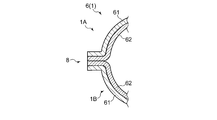
- FIG. 3 is a cross-sectional view of a side seal portion of a pants-type disposable diaper, which is another embodiment of the present invention, taken along the lateral direction.
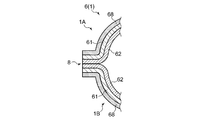
- FIG. 4 is a cross-sectional view of a side seal portion of a pants-type disposable diaper, which is another embodiment of the present invention, taken along the lateral direction.
- FIG. 5 is a cross-sectional view taken along the lateral direction of a side seal portion of a pants-type disposable diaper according to yet another embodiment of the present invention.
- the present invention relates to a pants-type disposable diaper having both tear resistance during or during wearing and easy tearing during undressing after use.
- the pants-type disposable diaper 1 of the embodiment shown in FIG. 1 includes an abdominal region 1A arranged on the abdominal side of the wearer when worn and a dorsal region 1B arranged on the back side.
- the diaper 1 has an absorbent main body 5 and an exterior body 6 disposed on the non-skin-facing surface side of the absorbent main body 5.
- the “skin-facing surface” is a surface of the disposable diaper or its constituent members (for example, an exterior body) that is directed toward the wearer's skin side when wearing the wearing article, that is, relatively close to the wearer's skin.
- the exterior body 6 has a ventral region 1A, a dorsal region 1B, and a crotch region 1C located between them.
- the crotch region 1C is a part that is arranged in the crotch part of the wearer when worn.
- the diaper 1 has a vertical direction X extending from the abdominal region 1A to the dorsal region 1B via the crotch region 1C and a lateral direction Y orthogonal to the vertical direction X.
- the exterior body 6 has a shape in which both side edges along the vertical direction X are constricted inward in the crotch region 1C.
- the exterior body 6 includes an inner layer sheet 62 which is a skin side layer closer to the wearer's skin side, and a non-skin side positioned farther from the wearer's skin than the inner layer sheet 62. It has the outer layer sheet 61 used as a layer.
- the inner layer sheet 62 and the outer layer sheet 61 are joined together to form an integral type composite sheet.
- the inner layer sheet 62 and the outer layer sheet 61 are each formed of a nonwoven fabric containing cellulosic fibers and thermoplastic fibers.
- the outer layer sheet 61 extends outward in the vertical direction X from the end of the inner layer sheet 62 in the longitudinal direction X, and the extended portion is folded back to the inner layer sheet 62 side. May be.
- a plurality of elastic members 63 are arranged and fixed between the outer layer sheet 61 and the inner layer sheet 62 in each of the abdominal region 1A and the back region 1B.
- the elastic member 63 is arranged along the lateral direction Y in the expanded state, and the elastic member 63 in the expanded state reaches the vicinity of the side seal portion 8 described later. Therefore, of the ventral side region 1A and the back side region 1B of the exterior body 6, at least the region adjacent to the side seal portion 8 has elasticity in the lateral direction Y.
- the diaper 1 is joined so that the skin-facing surfaces on both side edges of the ventral region 1A of the exterior body 6 and the skin-facing surfaces on both side edges of the back region 1B of the exterior body 6 are in contact with each other.
- the pair of side seal portions 8 and 8 the waist opening portion 1W and the pair of leg opening portions 1L and 1L are formed.
- a joining means for forming the side seal portion 8 a heating means and / or a pressing means can be used.
- the side seal portion 8 formed in this way has a so-called gassho structure.
- a part of the lateral edge of the abdominal region 1A in the lateral direction Y and the lateral edge of the dorsal region 1B in the lateral direction Y that forms the side seal portion 8 includes a cellulosic fiber and a thermoplastic fiber.
- the cellulosic fibers contained in the side seal portion 8 are preferably oriented in a direction intersecting the longitudinal direction X in which the side seal portion 8 extends, and are oriented in a lateral direction Y orthogonal to the longitudinal direction X. More preferable.
- a pants-type disposable diaper is manufactured by a so-called cross-flow manufacturing method.
- the fiber forming the side seal part is formed only of thermoplastic fibers, and the peel strength of the side seal part before absorbing body fluid and after absorbing body fluid. Since the peel strength of the side seal portion is the same, it is possible to achieve both tear resistance of the side seal portion during or during wearing and ease of tearing of the side seal portion during undressing after use. could not.
- the portion forming the side seal portion 8 contains the cellulosic fiber.
- the side seal portion 8 has a gas palm structure, it is possible to directly absorb, for example, body fluid, sweat while the diaper 1 is worn, by the side seal portion 8, and the side seal portion 8 is separated before absorbing the body fluid.
- the peel strength of the side seal portion 8 after absorbing body fluid is lower than the strength. Due to this, when the diaper is taken off after use, the side seal portion 8 is easily torn.
- the cellulosic fibers are oriented in a direction intersecting the longitudinal direction X in which the side seal portion 8 extends, when the diaper is expanded or when the abdominal circumference changes during wearing of the diaper, the side seal portion 8 is moved in the lateral direction Y. Even if the force is applied, the side seal portion 8 is unlikely to tear.
- the peel strength of the side seal portion 8 changes before and after absorbing body fluid, so that the side seal portion 8 can prevent tearing during or during wearing, and can be easily torn during undressing after use. It can be compatible with the sex.
- the above-mentioned "oriented in a direction intersecting the longitudinal direction X in which the side seal portion 8 extends” means that when an arbitrary portion of the side seal portion 8 in plan view is observed, the side seal portion 8 extends in the longitudinal direction.
- the angle formed by the imaginary straight line extending parallel to X and the orientation direction of the cellulosic fibers is preferably 45 ° or more and 135 ° or less, and more preferably 90 °.
- the orientation direction of the cellulosic fibers of the side seal portion 8 can be determined according to the following method.
- a red solution is prepared by dissolving 1 g of Red No. 1 in 200 g of pure water. After impregnating the entire diaper outer package with this red solution for 5 minutes, the diaper outer package is dried by electrodrying at 70 ° C. for 24 hours. As a result, a diaper exterior body in which only cellulosic fibers are dyed red is created. After maximally stretching the colored exterior body, a plane enlarged image of the side seal portion 8 is photographed with a microscope VHX1000 manufactured by KEYENCE at a magnification of 20 times. The photographed image is printed, and the image is binarized using the image processing software NewQube (trade name) of Nexus Co., Ltd.
- the orientation angle between the virtual straight line extending along the side seal portion and the cellulosic fiber is measured from the binarized image. . The measurement is performed at five points, and the average thereof is taken as the angle formed by the imaginary straight line extending in the longitudinal direction X along the side seal portion 8 of the diaper exterior body and the orientation direction of the cellulosic fibers.
- the inner layer sheet 62 is used as the skin side sheet closer to the wearer's skin side, and is located farther from the wearer's skin than the skin side sheet.
- the outer layer sheet 61 is used as the non-skin side sheet. Therefore, the side edge of the abdominal region 1A and the side edge of the dorsal region 1B are each formed by stacking two independent sheet structures. Regarding the content rate of the cellulosic fibers in this sheet structure, when the outer layer sheet 61 is higher than the inner layer sheet 62, the outer layer sheet 61 is the inner layer because the cellulosic fibers absorb body fluid during use of the diaper 1. It becomes easier to tear than the seat 62, and as a result, the side seal portion 8 becomes easier to tear.
- the side portion of the abdominal region 1A and the side portion of the back region 1B may be continuously joined along the vertical direction X of the side seal portion 8, and the vertical direction X thereof. It may be joined intermittently along. From the viewpoint of easiness of tearing of the side seal portion 8 at the time of undressing after use, it is preferable that the side seal portion 8 is intermittently joined and formed. From the viewpoint of making this effect more remarkable, the distance between the joint portions adjacent to each other in the vertical direction X in the side seal portion 8 is preferably 0.2 mm or more, more preferably 0.4 mm or more, and preferably It is 4 mm or less, more preferably 3 mm or less.
- the side edge of the abdominal region 1A and the side edge of the dorsal region 1B are respectively formed from two sheets, an inner layer sheet 62 closer to the skin side and an outer layer sheet 61 far from the skin. Become. It is preferable that the inner layer sheet 62 and the outer layer sheet 61 have different ratios of thermoplastic fibers contained therein. Specifically, the content of the thermoplastic fiber in the side seal portion 8 is preferably higher in the inner layer sheet 62 than in the outer layer sheet 61. By doing so, the side seal portion 8 is less likely to be torn during wearing or during wearing, and the side seal portion 8 is likely to be torn during undressing after use.
- the ratio ((T1 / T2) ⁇ 100) of the content T1 of the thermoplastic fibers of the outer layer sheet 61 to the content T2 of the thermoplastic fibers of the inner layer sheet 62 is 90%. It is particularly preferably 80% or less, and most preferably 0%.
- the preferable range of the content rates T1 and T2 itself is 60 mass% or less, more preferably 50 mass% or less, and most preferably 0 mass% for the content rate T1.
- the content T2 is 20% by mass or more, further 30% by mass or more, and most preferably 100% by mass.
- the content of the thermoplastic fiber in the side seal portion 8 can be measured according to the following method.
- the inner layer sheet 62 and the outer layer sheet 61 of the outer package are impregnated with a red solution prepared by dissolving 1 g of Red No. 1 in 200 g of pure water for 5 minutes. Then, the inner layer sheet 62 and the outer layer sheet 61 are dried by electrodrying at 70 ° C. for 24 hours. As a result, a sheet in which only the cellulosic fibers are dyed red is prepared. A plane enlarged image of this colored sheet is photographed with a microscope VHX1000 manufactured by KEYENCE at a magnification of 200 times.
- the inner layer sheet 62 and the outer layer sheet 61 have different proportions of cellulosic fibers contained therein.
- the content of the cellulosic fibers in the side seal portion 8 is preferably higher in the outer layer sheet 61 than in the inner layer sheet 62.
- the ratio ((S2 / S1) ⁇ 100) of the cellulosic fiber content S2 in the inner layer sheet 62 to the cellulosic fiber content S1 in the outer layer sheet 61 is preferably It is 90% or less, more preferably 80% or less, and most preferably 0%.
- the preferred range of the content rates S1 and S2 itself is 35 mass% or more, further 45 mass% or more, and 100 mass% is most preferred for the content rate S1.
- the content S2 is 60% by mass or less, further 50% by mass or less, and 0% by mass is most preferable.
- the content rate of the cellulosic fibers in the side seal portion 8 can be measured according to the following method.
- the inner layer sheet 62 and the outer layer sheet 61 of the outer package are impregnated with a red solution prepared by dissolving 1 g of Red No. 1 in 200 g of pure water for 5 minutes. Then, the inner layer sheet 62 and the outer layer sheet 61 are dried by electrodrying at 70 ° C. for 24 hours. As a result, a sheet in which only the cellulosic fibers are dyed red is prepared. A plane enlarged image of this colored sheet is photographed with a microscope VHX1000 manufactured by KEYENCE at a magnification of 200 times.
- the total content of red and white fibers is defined as the total content of red fiber areas, and the content of cellulose is determined for each of the inner layer sheet and the outer layer sheet. The measurement is performed at each of 5 points, and the average value is taken as the content rate.
- the central portion 8C in the vertical direction X of the side seal portion 8 the end portion 8W on the waist opening 1W side, and the end portion 8L on the leg opening 1L side contain the cellulose fiber. It is preferred that the proportions are different. In particular, the content rate of the cellulosic fibers may be lower in the end portion 8W on the waist opening 1W side and the end portion 8L on the leg opening 1L side than in the central portion 8C in the vertical direction X of the side seal portion 8. preferable. This effectively prevents the end portions 8W, 8L from unintentionally breaking at the end portions 8W, 8L serving as the starting points for tearing the side seal portion 8.
- the ratio ((S3 / S5) ⁇ 100) of the cellulosic fiber content S3 in the end portion 8W to the cellulosic fiber content rate S5 in the central portion 8C is set to 90%. It is particularly preferably 80% or less, and most preferably 0%. As described above, it is most preferable that the end portion 8W has no cellulosic fibers and only the thermoplastic fibers.
- the ratio of the cellulosic fibers in the end portion 8L may be the same as or different from the ratio ((S3 / S5) ⁇ 100) in the end portion 8W.
- the preferable range of the content rates S3 and S5 itself is 60 mass% or less, further 50 mass% or less, and most preferably 0 mass% for the content rate S3.
- the content S5 is 20% by mass or more, further 25% by mass or more, and 80% by mass or less, further 70% by mass or less.
- the content of the cellulosic fibers in each part of the side seal part 8 can be measured according to the following method.
- ⁇ Method of measuring content rate of cellulosic fiber at each site in side seal part The entire exterior body of the side seal part is impregnated with a red solution prepared by dissolving 1 g of Red No. 1 in 200 g of pure water for 5 minutes. After that, the inner layer sheet 62 and the outer layer sheet 61 are each cut by 10 mm ⁇ 10 mm at the waist opening end. Similarly, the inner layer sheet 62 and the outer layer sheet 61 are each cut by 10 mm ⁇ 10 mm at the leg opening end. Further, the inner layer sheet 62 and the outer layer sheet 61 are each cut by 10 mm ⁇ 10 mm at the central portion 8C in the longitudinal direction X in which the side seal portion 8 extends.
- the content of cellulose in each portion of the cut sample is calculated, and the difference in content is measured. Five points are measured for each sample, and the average value is used as the content rate.
- FIGS. 3 to 5 Another embodiment of the present invention will be described with reference to FIGS. 3 to 5.
- constituent parts different from the above-described embodiment will be mainly described, and similar constituent parts will be denoted by the same reference numerals and description thereof will be omitted.
- the description of the above-described embodiment is appropriately applied to components that are not particularly described.
- the exterior body 6 in the diaper 1 of the embodiment shown in FIG. 3 has an inner layer close to the wearer's skin side in the lateral edge of the abdominal region 1A in the lateral direction Y and the lateral edge of the dorsal region 1B in the lateral direction Y. It has a sheet 62 and an outer layer sheet 61 far from the skin, and in addition to them, it further has a cellulose-containing layer 70 containing a cellulosic fiber between the outer layer sheet 61 and the inner layer sheet 62. Examples of such a cellulose-containing layer include the sweat absorbing sheet described in JP 2010-119578 A.
- the cellulose-containing layer 70 is arranged so as to extend in the lateral direction Y between the pair of side seal portions 8 and 8 and extends to a position overlapping the side seal portions 8 and 8.
- the side edge of the abdominal region 1A and the side edge of the dorsal region 1B are a laminated body of the inner layer sheet 62, the cellulose-containing layer 70, and the outer layer sheet 61, respectively.
- the skin-facing surface of the inner layer sheet 62 at the side edge of the side area 1A and the skin-facing surface of the inner layer sheet 62 at the side edge of the back area 1B are joined so as to come into contact with each other, whereby the side seal portion 8 is formed. Has been formed.
- the inner layer sheet 62 and the outer layer sheet 61 are each made of a non-woven fabric that does not contain cellulosic fibers and is composed of only thermoplastic fibers. That is, the content T1 of the thermoplastic fibers of the outer layer sheet 61 and the content T2 of the thermoplastic fibers of the inner layer sheet 62 are each 100% by mass.
- the cellulose-containing layer 70 is made of a non-woven fabric composed of only cellulosic fibers without containing thermoplastic fibers. That is, the content rate of the cellulosic fibers in the cellulosic layer 70 is 100% by mass.
- the cellulosic fibers of the cellulose-containing layer 70 are oriented in a direction intersecting the longitudinal direction X.
- the diaper 1 shown in FIG. 3 also has both tear resistance during wearing or during wearing and ease of tearing during undressing after use.
- the outer body 6 in the diaper 1 of the embodiment shown in FIG. 4 has an inner layer close to the wearer's skin side in the lateral edge of the abdominal region 1A in the lateral direction Y and the lateral edge of the dorsal region 1B in the lateral direction Y. It has a sheet 62 and an outer layer sheet 61 farther from the skin, and in addition to them, further has an outermost layer sheet 68 farther from the wearer's skin than the outer layer sheet 61.
- the inner layer sheet 62, the outer layer sheet 61, and the outermost layer sheet 68 are joined together to form an integral type composite sheet.
- the inner layer sheet 62, the outer layer sheet 61, and the outermost layer sheet 68 are each formed of a nonwoven fabric containing cellulosic fibers and thermoplastic fibers.
- the elastic member 63 is disposed and fixed between the outer layer sheet 61 and the inner layer sheet 62, or between the outer layer sheet 61 and the outermost layer sheet 68.
- the skin facing surface of the inner layer sheet 62 at the side edge portion of the abdominal region 1A and the skin facing surface of the inner layer sheet 62 at the side edge portion of the back side region 1B are joined so as to abut.
- the side seal portion 8 is formed.
- the inner layer sheet 62, the outer layer sheet 61, and the outermost layer sheet 68 have different proportions of thermoplastic fibers or cellulosic fibers contained therein.
- the content of the cellulosic fibers is preferably higher in the outer layer sheet 61 than in the inner layer sheet 62
- the content of the thermoplastic fibers is preferably higher in the outermost layer sheet 68 than in the outer layer sheet 61.
- the ratio ((T1 / T3) ⁇ 100) of the content T1 of the thermoplastic fiber of the outer layer sheet 61 to the content T3 of the thermoplastic fiber of the outermost layer sheet 68 is set to 90. % Or less, more preferably 80% or less, and most preferably 0%. As described above, it is most preferable that the outermost layer sheet 68 does not contain cellulosic fibers and is composed of only thermoplastic fibers.
- the preferable ranges of the content rates T1 and T3 themselves are the same as the ranges described above with respect to the content rate T1.
- the content T3 is 30% by mass or more, further 40% by mass or more, and most preferably 100% by mass.
- the content of the thermoplastic fiber in the side seal portion 8 can be measured according to the method described above.
- the exterior body 6 in the diaper 1 of the embodiment shown in FIG. 5 has one sheet 69 at each of the lateral edge portion of the abdominal region 1A in the lateral direction Y and the lateral edge portion of the dorsal region 1B in the lateral direction Y. is doing.
- the sheet 69 is made of a non-woven fabric in which cellulosic fibers and thermoplastic fibers are mixed.
- the elastic member 63 is disposed and fixed on the non-skin-facing surface of the sheet 69.
- the diaper 1 shown in FIG. 5 can also achieve both tear resistance during or during wearing and ease of tearing during undressing after use.
- Examples of the cellulosic fibers constituting the side seal portion 8 used in each of the above-described embodiments include natural cellulosic fibers such as cotton and pulp; regenerated cellulosic fibers such as rayon and cupra. These can be used alone or in combination of two or more.
- the cellulosic fibers may be short fibers or long fibers. From the viewpoint of easiness of tearing of the side seal portion 8 during undressing after use, short fibers of natural cellulosic fibers are preferable.
- cotton is used as the cellulosic fiber, it is possible to prevent the side seal portion 8 from being easily torn in the lateral direction Y and to prevent unexpected tearing.
- pulp is used as the cellulosic fiber, the side seal portion 8 can be torn with a uniform force when undressing after use.
- thermoplastic fibers forming the side seal portion 8 fibers made of various thermoplastic resins can be used.
- the thermoplastic resin include polyolefin such as polyethylene and polypropylene; polyester such as polyethylene terephthalate; polyamide such as nylon 6 and nylon 66; polyacrylic acid, polymethacrylic acid alkyl ester, polyvinyl chloride, polyvinylidene chloride, and the like. These 1 type can be used individually or in combination of 2 or more types.
- the thermoplastic fibers may be short fibers or long fibers.
- core-sheath type or side-by-side type composite fiber, split fiber, modified cross-section fiber, heat-shrinkable fiber and the like can also be used.
- the pants-type disposable diaper of the present invention is not limited to the above-described embodiments, and can be changed as appropriate. Further, the respective constituents in the above-described respective embodiments can be appropriately combined and implemented within a range not impairing the gist of the present invention.
- the back side region 1B of the outer package 6 has a cellulose-containing layer containing a cellulosic fiber. May be.
- a cellulose-containing layer include the sweat absorbing sheet described in JP 2010-119578 A. It is preferable that such a cellulose-containing layer is arranged so as to extend in the lateral direction Y between the pair of side seal portions 8 and 8 and extends to a position overlapping the side seal portions 8 and 8.
- the cellulose-containing layer When the cellulose-containing layer is thus arranged, the sweat of the wearer who is wearing the sweat is absorbed, and the absorbed sweat reaches the side seal portion 8 along the cellulose-based fibers of the cellulose-containing layer, thereby enabling the use.
- the side seal part 8 is easily torn during subsequent undressing.
- a first portion containing cellulosic fibers and a second portion containing no cellulosic fibers may be formed in the longitudinal direction X in which the side seal portions 8 extend.
- the vertical length of the side seal portion 8 is increased.
- the first portion and the second portion can be formed.
- the seal joint area of the first portion of the side seal portion 8 be larger than the seal joint area of the second portion.
- the seal joint area means the area surrounded by the contour of the joint portion in which the side edge portion of the abdominal region 1A and the side edge portion of the back side region 1B are joined by the heating means and / or the pressurizing means. Means area.
- Sealing the junction area of the first portion of the side seal portion 8 A1 is preferably 0.3 mm 2/10 mm or more, more preferably 0.8 mm 2/10 mm or more, and preferably 120 mm 2/10 mm or less, more preferably is 100mm 2 / 10mm or less.
- Sealing the junction area of the second portion of the side seal portion 8 A2 is preferably 0.1 mm 2/10 mm or more, more preferably 0.5 mm 2/10 mm or more, and preferably 100 mm 2/10 mm or less, more preferably is 70mm 2 / 10mm or less.
- the ratio ((A1 / A2) ⁇ 100) of the seal joint area A1 to the seal joint area A2 is preferably 110% or more, and particularly preferably 130% or more.
- the seal joint area A1 of the first portion and the seal joint area A2 of the second portion of the side seal portion 8 can be measured according to the following method.
- ⁇ Measurement method of the seal joining areas A1 and A2 of the first portion and the second portion in the side seal portion> After maximally extending the exterior body, a plane enlarged image of the first portion of the side seal portion 8 is photographed with a microscope VHX1000 manufactured by KEYENCE at a magnification of 200 times. The seal portion of the photographed image is copied on an OHP film, and the area is measured by image analysis using Image-Pro plus 6.2 Installation manufactured by Roper Co., Ltd. Further, the area of the joint portion of the first portion per 10 mm in the longitudinal direction X of the side seal portion 8 is defined as the seal joint area A1.
- the seal joining area A1 does not mean the total area of the pair of side seal portions 8 and 8, but means the average value of the pair of side seal portions 8 and 8.
- the area of the joint portion of the second portion per length 10 mm in the vertical direction X of the side seal portion 8 is defined as the seal joint area A2.
- the seal joining area A2 means an average value of the pair of side seal portions 8 and 8.
- the inner layer sheet 62 is used as the skin side layer and the outer layer sheet 61 is used as the non-skin side layer.
- the outermost layer sheet 68 is used in the above, and the skin side layer, the non-skin side layer, and the second non-skin side layer are in the form of sheets such as non-woven fabric, woven fabric, and knitted fabric. It may be in the form of a constituent fibrous web layer.
- the diaper 1 having the exterior body 6 extending over the abdominal region 1A, the crotch region 1C, and the back region 1B has been described, but the present invention is not limited to the diaper.
- the absorbent main body may be a pants-type disposable diaper of an exterior body division type in which the absorbent main body is laid across and fixed between the back side sheet member and the abdominal side sheet member.
- An pants-type disposable diaper comprising an absorbent main body and an exterior body arranged on the non-skin facing surface side thereof, and having a longitudinal direction corresponding to the front-back direction of the wearer, A pair of side seals which are joined so that the skin facing surfaces at both side edges of the ventral side region of the exterior body and the skin facing surfaces at both side edges of the back side region of the exterior body are in contact with each other and extend in the longitudinal direction.
- Part is formed, Of the ventral region and the dorsal region of the exterior body, at least the region adjacent to the side seal portion has elasticity in the lateral direction, Of the side edges of each of the ventral region and the dorsal region, the portion forming the side seal portion contains a cellulosic fiber and a thermoplastic fiber, A pants-type disposable diaper in which the cellulosic fibers are oriented in a direction intersecting the longitudinal direction in the side seal portion.
- each of the ventral side region and the back side region are a skin side layer closer to the wearer's skin side, and a non-skin side positioned farther from the wearer's skin than the skin side layer.
- the pants-type disposable diaper according to ⁇ 1> wherein the content of the thermoplastic fiber is higher in the skin side layer than in the non-skin side layer.
- each of the ventral side region and the back side region are a skin side layer closer to the wearer's skin side, and a non-skin side positioned farther from the wearer's skin than the skin side layer.
- a layer and a second non-skin side layer located on the side farther from the wearer's skin than the non-skin side layer,
- the content of the cellulosic fibers is higher in the non-skin side layer than in the skin side layer.
- the pants-type disposable diaper according to any one of ⁇ 1> to ⁇ 4>, in which the content of the thermoplastic fiber in the second non-skin side layer is higher than that in the non-skin side layer.
- the content of the cellulosic fibers in the side seal portion is such that the waist opening side end of the pants-type disposable diaper and the leg opening of the pants-type disposable diaper than the central portion in the longitudinal direction of the side seal portion.
- the pants-type disposable diaper according to any one of the above items ⁇ 1> to ⁇ 5>, wherein the end on the side of the part is lower.
- the side edges of each of the ventral side region and the back side region are a skin side layer closer to the wearer's skin side, and a non-skin side positioned farther from the wearer's skin than the skin side layer.
- the pants-type disposable diaper according to any one of ⁇ 1> to ⁇ 6> wherein the content of the cellulosic fibers in the non-skin side layer is 35% by mass or more.
- ⁇ 8> In the side seal portion, a side edge portion of the ventral side region and a side edge portion of the back side region are intermittently joined along the longitudinal direction of the side seal portion, ⁇ 1> to The pants-type disposable diaper according to any one of ⁇ 7>.
- ⁇ 9> The pants-type disposable diaper according to any one of ⁇ 1> to ⁇ 8>, wherein the cellulosic fiber is a cotton fiber.
- ⁇ 11> In the longitudinal direction of the side seal portion, having a first portion containing the cellulosic fibers and a second portion not containing the cellulosic fibers, The pants type according to any one of ⁇ 1> to ⁇ 10>, wherein a seal joint area of the first portion of the side seal portion is larger than a seal joint area of the second portion of the side seal portion. Disposable diaper.
- the ratio ((A1 / A2) ⁇ 100) of the seal joint area A1 to the seal joint area A2 is preferably 110% or more, particularly preferably 130% or more, any one of the above items ⁇ 11> to ⁇ 13>
- the distance between the joint portions extending in the longitudinal direction and extending in the side seal portion is preferably 0.2 mm or more, more preferably 0.4 mm or more, and preferably 4 mm or less, more preferably 3 mm or less,
- the pants-type disposable diaper according to any one of ⁇ 1> to ⁇ 14>.
- ⁇ 16> A skin side layer closer to the wearer's skin side, and a non-skin side layer located on the side farther from the wearer's skin than the skin side layer, The ratio ((T1 / T2) ⁇ 100) of the content T1 of the thermoplastic fibers of the outer layer sheet which is the non-skin side layer to the content T2 of the thermoplastic fibers of the inner layer sheet which is the skin side layer is 90%.
- the pants-type disposable diaper described in any one of the above items ⁇ 1> to ⁇ 15> is preferably below, more preferably below 80%, most preferably below 0%.
- ⁇ 17> A skin side layer closer to the wearer's skin side, and a non-skin side layer located on the side farther from the wearer's skin than the skin side layer,
- the preferable range of the content T1 of the thermoplastic fiber of the outer layer sheet which is the non-skin side layer is 60% by mass or less, more preferably 50% by mass or less, and most preferably 0% by mass.
- ⁇ 18> A skin side layer closer to the wearer's skin side, and a non-skin side layer located on the side farther from the wearer's skin than the skin side layer,
- the preferable range of the content T2 of the thermoplastic fiber of the inner layer sheet to be the skin side layer is 20% by mass or more, further 30% by mass or more, and most preferably 100% by mass,
- ⁇ 1> A pants-type disposable diaper according to any one of to ⁇ 17>.
- the ratio ((S2 / S1) ⁇ 100) of the content S2 of the cellulosic fibers in the inner layer sheet serving as the skin side layer to the content S1 of the cellulosic fibers in the outer layer sheet serving as the non-skin side layer is preferably 90. % Or less, more preferably 80% or less, and most preferably 0%, the pants-type disposable diaper according to any one of ⁇ 1> to ⁇ 18>.
- the preferable range of the content S1 of the cellulosic fibers in the outer layer sheet which is the non-skin side layer is 35% by mass or more, further 45% by mass or more, and 100% by mass is most preferable.
- the pants-type disposable diaper according to any one of ⁇ 19>.
- the preferable range of the content S2 of the cellulosic fibers in the inner layer sheet to be the skin side layer is 60% by mass or less, further 50% by mass or less, and 0% by mass is most preferable.
- Ratio of cellulosic fiber content S3 at the longitudinal end of the side seal portion to cellulosic fiber content S5 at the longitudinal center of the side seal portion ((S3 / S5) ⁇ 100) Is preferably 90% or less, more preferably 80% or less, and most preferably 0%.
- the content S3 of the cellulosic fibers at the longitudinal end portion of the side seal portion is 60% by mass or less, more preferably 50% by mass or less, and most preferably 0% by mass. 22>
- the content S5 of the cellulosic fibers in the central portion in the longitudinal direction of the side seal portion is 20% by mass or more, further 25% by mass or more, and 80% by mass or less, further 70% by mass or less.
- the pants-type disposable diaper according to any one of ⁇ 1> to ⁇ 23>.
- ⁇ 25> A skin side layer closer to the wearer's skin side, a non-skin side layer positioned farther from the wearer's skin than the skin side layer, and a side farther from the wearer's skin than the non-skin side layer.
- a second non-skin side layer located, The ratio ((T1 / T3) ⁇ 100) of the content T1 of the thermoplastic fibers of the outer layer sheet which is the non-skin side layer to the content T3 of the thermoplastic fibers of the outermost layer sheet which is the second non-skin side layer is The pants-type disposable diaper according to any one of ⁇ 1> to ⁇ 24>, which is preferably 90% or less, particularly preferably 80% or less, and most preferably 0%.
- the preferred range of the content T3 is 30% by mass or more, more preferably 40% by mass or more, and most preferably 100% by mass.
- the present invention it is possible to provide a pants-type disposable diaper that has both tear resistance during wearing or during wearing and easy tearing during undressing after use.
Landscapes
- Health & Medical Sciences (AREA)
- Public Health (AREA)
- General Health & Medical Sciences (AREA)
- Veterinary Medicine (AREA)
- Epidemiology (AREA)
- Engineering & Computer Science (AREA)
- Life Sciences & Earth Sciences (AREA)
- Animal Behavior & Ethology (AREA)
- Vascular Medicine (AREA)
- Heart & Thoracic Surgery (AREA)
- Biomedical Technology (AREA)
- Hematology (AREA)
- Chemical & Material Sciences (AREA)
- Materials Engineering (AREA)
- Absorbent Articles And Supports Therefor (AREA)
Abstract
パンツ型使い捨ておむつ(1)は、外装体(6)の腹側領域(1A)の両側縁部と背側領域(1B)の両側縁部とが接合されて縦方向(X)に延びる一対のサイドシール部(8)が形成されている。腹側領域(1A)及び背側領域(1B)それぞれの側縁部のうち、サイドシール部(8)を形成する部位が、セルロース系繊維及び熱可塑性繊維を含んでいる。サイドシール部(8)において、セルロース系繊維が、該サイドシール部(8)が延びる縦方向(Xと)交差する方向に配向している。
Description
本発明は、パンツ型使い捨ておむつに関する。
従来、着用時に着用者の腹側に配される腹側領域の両側部と背側に配される背側領域の両側部とを接合することによって一対のサイドシール部、ウエスト開口部及び一対のレッグ開口部が形成されているパンツ型使い捨ておむつが知られている。この種のおむつを拡げるとき或いはおむつの着用中にはサイドシール部に幅方向への力が加わる。また、おむつの着用時におむつを引き揚げるときにはサイドシール部に長手方向への力が加わる。このようにサイドシール部には、様々な力が加わることから、そのシール強度を高く設定する必要がある。しかしその一方、おむつを脱ぐ場合には、サイドシール部を引き裂いて腹側領域と背側領域とに分離させるので、この観点からはサイドシール部のシール強度が高すぎるのは望ましくない。このように、サイドシール部には、着用時或いは着用中における破れ防止性と、使用後の脱衣時における引き裂き容易性との両立が求められている。
この目的のために、特許文献1には、前身頃の両側部と後身頃の両側部とを接合して形成されるサイドシール部の接合強度を部分的に調整したパンツ型使い捨ておむつが開示されている。
これとは別の技術として、特許文献2には、使い捨て衣類の構成部材として、パルプ等の天然繊維を含む抄造シートを用いることが開示されている。また、特許文献3には、親水性繊維を含む吸汗性シートが胴回り域に取り付けられた使い捨ておむつが開示されている。
本発明は、吸収性本体と、その非肌対向面側に配された外装体とを備え、着用者の前後方向に対応する縦方向を有するパンツ型使い捨ておむつを提供する。
一実施形態において、前記外装体の腹側領域の両側縁部における肌対向面と、該外装体の背側領域の両側縁部における肌対向面とが当接するように接合されて前記縦方向に延びる一対のサイドシール部が形成されている。
一実施形態において、前記外装体の腹側領域及び背側領域のうち、少なくとも前記サイドシール部に隣接する領域が横方向に伸縮性を有している。
一実施形態において、前記腹側領域及び前記背側領域それぞれの側縁部のうち、前記サイドシール部を形成する部位が、セルロース系繊維及び熱可塑性繊維を含んでいる。
一実施形態では、前記サイドシール部において、前記セルロース系繊維が、前記縦方向と交差する方向に配向している。
一実施形態において、前記外装体の腹側領域の両側縁部における肌対向面と、該外装体の背側領域の両側縁部における肌対向面とが当接するように接合されて前記縦方向に延びる一対のサイドシール部が形成されている。
一実施形態において、前記外装体の腹側領域及び背側領域のうち、少なくとも前記サイドシール部に隣接する領域が横方向に伸縮性を有している。
一実施形態において、前記腹側領域及び前記背側領域それぞれの側縁部のうち、前記サイドシール部を形成する部位が、セルロース系繊維及び熱可塑性繊維を含んでいる。
一実施形態では、前記サイドシール部において、前記セルロース系繊維が、前記縦方向と交差する方向に配向している。
特許文献1に記載の技術では、着用時或いは着用中における破れ防止性と、使用後の脱衣時における引き裂き容易性とを両立することができない。
また、特許文献2では、サイドシール部について何ら検討されていない。また特許文献3に記載の吸汗性シートは、外装体の両側部に亘って延在しておらず、サイドシール部について何ら検討されていない。
本発明は、上記事情に鑑み、着用時或いは着用中における破れ防止性と、使用後の脱衣時における引き裂き容易性とを両立するパンツ型使い捨ておむつに関する。
以下、本発明のパンツ型使い捨ておむつをその好ましい実施形態に基づいて説明する。図1に示す実施形態のパンツ型使い捨ておむつ1は、着用時に着用者の腹側に配される腹側領域1Aと背側に配される背側領域1Bとを備えている。おむつ1は、吸収性本体5と、吸収性本体5の非肌対向面側に配された外装体6とを有している。
本明細書において、「肌対向面」は、使い捨ておむつ又はその構成部材(例えば外装体)における、着用物品の着用時に着用者の肌側に向けられる面、即ち相対的に着用者の肌に近い側の面であり、「非肌対向面」は、使い捨ておむつ又はその構成部材における、着用物品の着用時に肌側とは反対側に向けられる面、即ち相対的に着用者の肌から遠い側の面である。
外装体6は、図1に示すように、腹側領域1Aと背側領域1Bと、これらの間に位置する股下領域1Cとを有している。股下領域1Cは、着用時には着用者の股間部に配される部位である。また、おむつ1は、腹側領域1Aから股下領域1Cを介して背側領域1Bに延びる縦方向Xとこれに直交する横方向Yとを有している。外装体6は、縦方向Xに沿う両側縁が、股下領域1Cにおいて内方に向かって括れた形状となっている。
外装体6は、図2に示すように、着用者の肌側に近い側の肌側層となる内層シート62と、該内層シート62よりも着用者の肌から遠い側に位置する非肌側層となる外層シート61とを有している。内層シート62と外層シート61とは接合されて一体型の複合シートとなっている。内層シート62及び外層シート61は、それぞれ、セルロース系繊維と熱可塑性繊維とを含んだ不織布で形成されている。外層シート61は、腹側領域1A及び背側領域1Bにおいて、内層シート62の縦方向Xの端部より縦方向X外方に延出し、該延出部分を内層シート62側に折り返す形態であってもよい。腹側領域1A及び背側領域1Bそれぞれにおける外層シート61と内層シート62との間には、複数本の弾性部材63が配設固定されている。弾性部材63は、伸長状態で、横方向Yに沿って配されており、伸長状態の該弾性部材63が、後述するサイドシール部8近傍にまで至っている。その為、外装体6の腹側領域1A及び背側領域1Bのうち、少なくとも該サイドシール部8に隣接する領域が、横方向Yに伸縮性を有する。
おむつ1には、外装体6の腹側領域1Aの両側縁部における肌対向面と、該外装体6の背側領域1Bの両側縁部における肌対向面とが当接するように接合されることによって、一対のサイドシール部8,8、ウエスト開口部1W及び一対のレッグ開口部1L,1Lが形成されている。サイドシール部8を形成する接合の手段としては、加熱手段及び/又は加圧手段を用いることができる。このように形成されたサイドシール部8は、いわゆる合掌構造となっている。
腹側領域1Aの横方向Yの側縁部及び背側領域1Bの横方向Yの側縁部のうち、サイドシール部8を形成する部位は、セルロース系繊維及び熱可塑性繊維を含んでいる。サイドシール部8に含まれるセルロース系繊維は、サイドシール部8の延びる縦方向Xと交差する方向に配向していることが好ましく、縦方向Xに直交する横方向Yに配向していることが更に好ましい。セルロース系繊維を該交差する方向に配向させるためには、パンツ型使い捨ておむつをいわゆる横流れの製造方法で製造する。
従来、パンツ型使い捨ておむつのサイドシール部においては、サイドシール部を形成する繊維が熱可塑性繊維のみで形成されており、体液を吸収する前のサイドシール部の剥離強度と、体液を吸収した後のサイドシール部の剥離強度とは、同じ強度であるため、着用時或いは着用中におけるサイドシール部の破れ防止性と、使用後の脱衣時におけるサイドシール部の引き裂き容易性とを両立することができなかった。これに対し、本実施形態のおむつ1によれば、サイドシール部8を形成する部位がセルロース系繊維を含んでいる。しかもサイドシール部8が合掌構造となっているので、おむつ1の着用中において例えば体液である汗を直接サイドシール部8で吸収することができ、体液を吸収する前のサイドシール部8の剥離強度に比べて、体液を吸収した後のサイドシール部8の剥離強度が低くなる。このことに起因して、使用後におむつを脱ぐ場合には、サイドシール部8を引き裂き易くなる。さらに、前記セルロース系繊維がサイドシール部8の延びる縦方向Xと交差する方向に配向しているので、おむつを拡げるとき、或いはおむつの着用中の腹囲変動時にはサイドシール部8に横方向Yへの力が加わったとしても、サイドシール部8が破れにくい。このように本実施形態のおむつ1によれば、体液を吸収する前後でサイドシール部8の剥離強度が変化するので、着用時或いは着用中における破れ防止性と、使用後の脱衣時における引き裂き容易性とを両立することができる。
前記の「サイドシール部8の延びる縦方向Xと交差する方向に配向している」とは、サイドシール部8の平面視における任意の部位を観察したとき、サイドシール部8に沿って縦方向Xに平行に延びる仮想直線とセルロース系繊維の配向方向とのなす角度が、45°以上135°以下となっていることが好ましく、90°となっていることが更に好ましい。サイドシール部8のセルロース系繊維の配向方向は、以下の方法に従って決定できる。
<サイドシール部8のセルロース系繊維の配向方向の測定>
純水200gに赤色1号を1g溶解させた赤色溶液を作成する。この赤色溶液におむつ外装体の全体を5分間含浸した後、70℃の電乾にて24時間おむつ外装体を乾燥させる。これにより、セルロース系繊維のみを赤色に染色したおむつ外装体を作成する。この着色した外装体を最大伸長させた後、サイドシール部8の平面拡大画像をKEYENCE社製のマイクロスコープVHX1000において倍率20倍にて撮影する。撮影画像を印刷し、株式会社nexusの画像処理ソフトウエア NewQube(商品名)を使用し、前記画像を二値化する。次いで、繊維配向解析プログラムであるFiber Orientation Analysis 8.13 Single(ソフト名)を用い、前記二値化した画像から、サイドシール部に沿って伸びる仮想直線とセルロース系繊維との配向角を測定する。測定は5点測定し、その平均を当該おむつ外装体のサイドシール部8に沿って縦方向Xに延びる仮想直線とセルロース系繊維の配向方向とのなす角度とする。
純水200gに赤色1号を1g溶解させた赤色溶液を作成する。この赤色溶液におむつ外装体の全体を5分間含浸した後、70℃の電乾にて24時間おむつ外装体を乾燥させる。これにより、セルロース系繊維のみを赤色に染色したおむつ外装体を作成する。この着色した外装体を最大伸長させた後、サイドシール部8の平面拡大画像をKEYENCE社製のマイクロスコープVHX1000において倍率20倍にて撮影する。撮影画像を印刷し、株式会社nexusの画像処理ソフトウエア NewQube(商品名)を使用し、前記画像を二値化する。次いで、繊維配向解析プログラムであるFiber Orientation Analysis 8.13 Single(ソフト名)を用い、前記二値化した画像から、サイドシール部に沿って伸びる仮想直線とセルロース系繊維との配向角を測定する。測定は5点測定し、その平均を当該おむつ外装体のサイドシール部8に沿って縦方向Xに延びる仮想直線とセルロース系繊維の配向方向とのなす角度とする。
上述したように、図2に示す本実施形態においては、着用者の肌側に近い側の肌側シートとして内層シート62を用い、該肌側シートよりも着用者の肌から遠い側に位置する非肌側シートとして外層シート61を用いている。その為、腹側領域1Aの側縁部及び背側領域1Bの側縁部は、それぞれ、独立した2枚のシート構造体どうしの重ね合わせからなっている。このシート構造体におけるセルロース系繊維の含有率に関し、内層シート62よりも外層シート61の方が高くなると、おむつ1の使用中にセルロース系繊維が体液を吸収することによって外層シート61の方が内層シート62よりも破れ易くなり、結果として、サイドシール部8を引き裂き易くなる。
サイドシール部8においては、腹側領域1Aの側部と背側領域1Bの側部とが、サイドシール部8における縦方向Xに沿って連続して接合されていてもよく、その縦方向Xに沿って間欠的に接合されていてもよい。使用後の脱衣時におけるサイドシール部8の引き裂き易さの観点からは、サイドシール部8は間欠的に接合されて形成されていることが好ましい。この効果を一層顕著なものとする観点から、サイドシール部8における縦方向Xに隣り合う接合部どうしの間隔は、好ましくは0.2mm以上、より好ましくは0.4mm以上であり、また好ましくは4mm以下、より好ましくは3mm以下である。
図2に示す実施形態では、腹側領域1Aの側縁部及び背側領域1Bの側縁部は、それぞれ、肌側に近い内層シート62と肌から遠い外層シート61との2枚のシートからなる。内層シート62と外層シート61とは、それらに含まれる熱可塑性繊維の割合が異なっていることが好ましい。詳細には、サイドシール部8における熱可塑性繊維の含有率は、外層シート61よりも内層シート62の方が高いことが好ましい。こうすることで、着用時或いは着用中においてサイドシール部8が破れにくく、使用後の脱衣時にサイドシール部8が引き裂かれ易くなる。この効果を一層顕著なものとする観点から、内層シート62の熱可塑性繊維の含有率T2に対する外層シート61の熱可塑性繊維の含有率T1の割合((T1/T2)×100)を、90%以下、特に80%以下とすることが好ましく、0%とすることが最も好ましい。
図2に示す実施形態では、含有率T1,T2それ自体の好ましい範囲は、含有率T1については、60質量%以下、更には50質量%以下が好ましく、最も好ましくは0質量%である。含有率T2については、20質量%以上、更には30質量%以上であり、そして、最も好ましくは100質量%である。サイドシール部8における熱可塑性繊維の含有率は、以下の方法に従って測定することができる。
<サイドシール部における熱可塑性繊維の含有率の測定方法>
外装体の内層シート62及び外層シート61をそれぞれ純水200gに赤色1号を1g溶解させた赤色溶液に5分間含浸させる。その後、70℃の電乾にて24時間内層シート62及び外層シート61を乾燥させる。これにより、セルロース系繊維のみを赤色に染色したシートを作成する。この着色したシートの平面拡大画像をKEYENCE社製のマイクロスコープVHX1000において倍率200倍にて撮影する。赤色に着色した繊維のOHPフィルムに写し取り、その面積を株式会社ローパー製のImage―Pro plus6.2 Installationを用いて画像解析を行い測定する。同様に、赤色でない繊維をOHPに写し取り同様に面積を測定した。全体の赤色と白いとの繊維の面積合計に対し、白色の繊維面積合計を熱可塑性繊維の含有率とし、内層シートと外層シートそれぞれにおいて、含有率を求める。測定はそれぞれ5点測定し、その平均の値を含有率とする。
外装体の内層シート62及び外層シート61をそれぞれ純水200gに赤色1号を1g溶解させた赤色溶液に5分間含浸させる。その後、70℃の電乾にて24時間内層シート62及び外層シート61を乾燥させる。これにより、セルロース系繊維のみを赤色に染色したシートを作成する。この着色したシートの平面拡大画像をKEYENCE社製のマイクロスコープVHX1000において倍率200倍にて撮影する。赤色に着色した繊維のOHPフィルムに写し取り、その面積を株式会社ローパー製のImage―Pro plus6.2 Installationを用いて画像解析を行い測定する。同様に、赤色でない繊維をOHPに写し取り同様に面積を測定した。全体の赤色と白いとの繊維の面積合計に対し、白色の繊維面積合計を熱可塑性繊維の含有率とし、内層シートと外層シートそれぞれにおいて、含有率を求める。測定はそれぞれ5点測定し、その平均の値を含有率とする。
上述した熱可塑性繊維と同様に、図2に示す実施形態では、内層シート62と外層シート61とは、それらに含まれるセルロース系繊維の割合が異なっていることも好ましい。詳細には、サイドシール部8におけるセルロース系繊維の含有率は、内層シート62よりも外層シート61の方が高いことが好ましい。こうすることで、着用時或いは着用中におけるサイドシール部8の破れ防止性と、使用後の脱衣時におけるサイドシール部8の引き裂き容易性とを両立させることが一層容易となる。この効果を一層顕著なものとする観点から、外層シート61におけるセルロース系繊維の含有率S1に対する内層シート62におけるセルロース系繊維の含有率S2の割合((S2/S1)×100)は、好ましくは90%以下、更に好ましくは80%以下であり、そして、最も好ましくは0%である。
図2に示す実施形態では、含有率S1,S2それ自体の好ましい範囲は、含有率S1については、35質量%以上、更には45質量%以上であり、そして、100質量%が最も好ましい。含有率S2については、60質量%以下、更には50質量%以下であり、0質量%が最も好ましい。サイドシール部8におけるセルロース系繊維の含有率は、以下の方法に従って測定することができる。
<サイドシール部におけるセルロース系繊維の含有率の測定方法>
外装体の内層シート62及び外層シート61をそれぞれ純水200gに赤色1号を1g溶解させた赤色溶液に5分間含浸させる。その後、70℃の電乾にて24時間内層シート62及び外層シート61を乾燥させる。これにより、セルロース系繊維のみを赤色に染色したシートを作成する。この着色したシートの平面拡大画像をKEYENCE社製のマイクロスコープVHX1000において倍率200倍にて撮影する。赤色に着色した繊維のOHPフィルムに写し取り、その面積を株式会社ローパー製のImage―Pro plus6.2 Installationを用いて画像解析を行い測定する。同様に、赤色でない繊維をOHPに写し取り同様に面積を測定する。全体の赤色と白いとの繊維の面積合計に対し、赤色の繊維面積合計をセルロースの含有率とし、内層シートと外層シートそれぞれにおいて、含有率を求める。測定はそれぞれ5点測定し、その平均の値を含有率とする。
外装体の内層シート62及び外層シート61をそれぞれ純水200gに赤色1号を1g溶解させた赤色溶液に5分間含浸させる。その後、70℃の電乾にて24時間内層シート62及び外層シート61を乾燥させる。これにより、セルロース系繊維のみを赤色に染色したシートを作成する。この着色したシートの平面拡大画像をKEYENCE社製のマイクロスコープVHX1000において倍率200倍にて撮影する。赤色に着色した繊維のOHPフィルムに写し取り、その面積を株式会社ローパー製のImage―Pro plus6.2 Installationを用いて画像解析を行い測定する。同様に、赤色でない繊維をOHPに写し取り同様に面積を測定する。全体の赤色と白いとの繊維の面積合計に対し、赤色の繊維面積合計をセルロースの含有率とし、内層シートと外層シートそれぞれにおいて、含有率を求める。測定はそれぞれ5点測定し、その平均の値を含有率とする。
サイドシール部8においては、サイドシール部8における縦方向Xの中央部8Cと、ウエスト開口部1W側の端部8Wと、及びレッグ開口部1L側の端部8Lとで、セルロース系繊維の含有割合が異なっていることが好ましい。特に、セルロース系繊維の含有率は、サイドシール部8における縦方向Xの中央部8Cよりも、ウエスト開口部1W側の端部8W及びレッグ開口部1L側の端部8Lの方が低いことが好ましい。こうすることで、サイドシール部8を引き裂く起点となる端部8W,8Lにおいて、該端部8W,8Lが意図せず破れることが効果的に防止される。これとともに、サイドシール部8を引き裂き始めたら、当該引き裂きをスムーズに行うことができる。この効果を一層顕著なものとする観点から、中央部8Cにおけるセルロース系繊維の含有率S5に対する端部8Wにおけるセルロース系繊維の含有率S3の割合((S3/S5)×100)を、90%以下、特に80%以下とすることが好ましく、そして、0%とすることが最も好ましい。このように、端部8Wにはセルロース系繊維が配されておらず、熱可塑性繊維のみ配されていることが最も好ましい。端部8Lにおけるセルロース系繊維の割合は、端部8Wにおける前記割合((S3/S5)×100)と同じでもよく、異なっていてもよい。
含有率S3,S5それ自体の好ましい範囲は、含有率S3については、60質量%以下であり、更には50質量%以下であり、最も好ましくは0質量%である。含有率S5については、20質量%以上、更には25質量%以上であり、そして、80質量%以下、更には70質量%以下である。サイドシール部8における各部位でのセルロース系繊維の含有率は、以下の方法に従って測定することができる。
<サイドシール部における各部位でのセルロース系繊維の含有率の測定方法>
サイドシール部の外装体全体を純水200gに赤色1号を1g溶解させた赤色溶液に5分間含浸させる。その後、ウエスト開口端部において内層シート62及び外層シート61をそれぞれ10mm×10mm切り取る。同様にレッグ開口端部において内層シート62及び外層シート61をそれぞれ10mm×10mm切り取る。また、サイドシール部8の延びる縦方向Xの中央部8Cにおいて内層シート62及び外層シート61をそれぞれ10mm×10mm切り取る。切り取ったサンプルを上述した<サイドシール部におけるセルロース系繊維の含有率の測定方法>と同様に各部位にてセルロース含有率を算出し、含有率の違いを測定する。測定は各サンプルについてそれぞれ5点測定し、その平均の値を含有率とする。
サイドシール部の外装体全体を純水200gに赤色1号を1g溶解させた赤色溶液に5分間含浸させる。その後、ウエスト開口端部において内層シート62及び外層シート61をそれぞれ10mm×10mm切り取る。同様にレッグ開口端部において内層シート62及び外層シート61をそれぞれ10mm×10mm切り取る。また、サイドシール部8の延びる縦方向Xの中央部8Cにおいて内層シート62及び外層シート61をそれぞれ10mm×10mm切り取る。切り取ったサンプルを上述した<サイドシール部におけるセルロース系繊維の含有率の測定方法>と同様に各部位にてセルロース含有率を算出し、含有率の違いを測定する。測定は各サンプルについてそれぞれ5点測定し、その平均の値を含有率とする。
次に、本発明の他の実施形態を、図3乃至図5を参照して説明する。図3乃至図5に示す実施形態については、上述した実施形態と異なる構成部分を主として説明し、同様の構成部分は同一の符号を付して説明を省略する。特に説明しない構成部分は、上述した実施形態についての説明が適宜適用される。
図3に示す実施形態のおむつ1における外装体6は、腹側領域1Aの横方向Yの側縁部及び背側領域1Bの横方向Yの側縁部は、着用者の肌側に近い内層シート62と、肌から遠い外層シート61とを有し、それらに加えて更に、外層シート61と内層シート62との間に、セルロース系繊維を含むセルロース含有層70を有している。このようなセルロース含有層としては、特開2010-119578号公報に記載の吸汗シートが挙げられる。セルロース含有層70は、一対のサイドシール部8,8の間に亘って横方向Yに延びるように配され、且つサイドシール部8,8と重なる位置まで延びている。図3に示す実施形態では、腹側領域1Aの側縁部及び背側領域1Bの側縁部が、それぞれ、内層シート62、セルロース含有層70及び外層シート61の積層体となっており、腹側領域1Aの側縁部における内層シート62の肌対向面と、背側領域1Bの側縁部における内層シート62の肌対向面とが当接するように接合されることによって、サイドシール部8が形成されている。
図3に示す実施形態では、内層シート62及び外層シート61は、それぞれ、セルロース系繊維を含まず、熱可塑性繊維のみで構成された不織布からなる。即ち、外層シート61の熱可塑性繊維の含有率T1及び内層シート62の熱可塑性繊維の含有率T2は、それぞれ、100質量%となっている。また、セルロース含有層70は、熱可塑性繊維を含まず、セルロース系繊維のみで構成された不織布からなる。即ち、セルロース含有層70のセルロース系繊維の含有率は、100質量%となっている。
図3に示す実施形態では、サイドシール部8において、セルロース含有層70のセルロース系繊維が縦方向Xと交差する方向に配向している。図3に示すおむつ1によっても、着用時或いは着用中における破れ防止性と、使用後の脱衣時における引き裂き容易性とを両立することができる。
図4に示す実施形態のおむつ1における外装体6は、腹側領域1Aの横方向Yの側縁部及び背側領域1Bの横方向Yの側縁部は、着用者の肌側に近い内層シート62と、肌から遠い外層シート61とを有し、それらに加えて更に、外層シート61よりも着用者の肌から遠い最外層シート68とを有している。内層シート62と外層シート61と、最外層シート68とは接合されて一体型の複合シートとなっている。内層シート62、外層シート61及び最外層シート68は、それぞれ、セルロース系繊維と熱可塑性繊維とを含んだ不織布で形成されている。弾性部材63は、外層シート61と内層シート62との間に、又は外層シート61と最外層シート68との間に、配設固定されている。図4に示す実施形態では、腹側領域1Aの側縁部における内層シート62の肌対向面と、背側領域1Bの側縁部における内層シート62の肌対向面とが当接するように接合されることによって、サイドシール部8が形成されている。
図4に示す実施形態では、内層シート62と、外層シート61と、最外層シート68とは、それらに含まれる熱可塑性繊維、又はセルロース系繊維の割合が異なっていることが好ましい。詳細には、セルロース系繊維の含有率は内層シート62よりも外層シート61の方が高いことが好ましく、熱可塑性繊維の含有率は外層シート61よりも最外層シート68の方が高いことが好ましい。こうすることで、サイドシール部8の剥離強度を向上させ、着用時或いは着用中におけるサイドシール部8の破れが防止できる。この効果を一層顕著なものとする観点から、最外層シート68の熱可塑性繊維の含有率T3に対する外層シート61の熱可塑性繊維の含有率T1の割合((T1/T3)×100)を、90%以下、更に80%以下とすることが好ましく、そして、0%とすることが最も好ましい。このように、最外層シート68はセルロース系繊維が含有されておらず、熱可塑性繊維のみで構成されていることが最も好ましい。
含有率T1,T3それ自体の好ましい範囲は、含有率T1に関しては、上述した範囲と同じである。含有率T3については、30質量%以上、更には40質量%以上であり、最も好ましくは100質量%である。サイドシール部8における熱可塑性繊維の含有率は、上述した方法に従って測定することができる。
図5に示す実施形態のおむつ1における外装体6は、腹側領域1Aの横方向Yの側縁部及び背側領域1Bの横方向Yの側縁部が、それぞれ一枚のシート69を有している。シート69は、セルロース系繊維と熱可塑性繊維とが混合された不織布からなる。弾性部材63は、シート69の非肌対向面上に配設固定されている。図5に示すおむつ1によっても、着用時或いは着用中における破れ防止性と、使用後の脱衣時における引き裂き容易性とを両立することができる。
上述した各実施形態に使用されているサイドシール部8を構成するセルロース系繊維としては、例えば、コットン、パルプ等の天然セルロース系繊維;レーヨン、キュプラ等の再生セルロース系繊維等が挙げられ、これらの1種を単独で又は2種以上を組み合わせて用いることができる。セルロース系繊維は、短繊維でも長繊維でも良い。使用後の脱衣時におけるサイドシール部8の引き裂き易さの観点からは、天然セルロース系繊維の短繊維であることが好ましい。特に、セルロース系繊維としてコットンを用いれば、サイドシール部8の横方向Yへの裂け易さを防止でき、不意な破れを防止することができる。また、セルロース系繊維としてパルプを用いれば、使用後の脱衣時におけるサイドシール部8を均一な力で引き裂くことができる。
サイドシール部8を構成する熱可塑性繊維としては、各種の熱可塑性樹脂からなる繊維を用いることができる。熱可塑性樹脂としては、ポリエチレン、ポリプロピレン等のポリオレフィン;ポリエチレンテレフタレート等のポリエステル;ナイロン6、ナイロン66等のポリアミド;ポリアクリル酸、ポリメタクリル酸アルキルエステル、ポリ塩化ビニル、ポリ塩化ビニリデン等が挙げられ、これらの1種を単独で又は2種以上を組み合わせて用いることができる。熱可塑性繊維は、短繊維でも長繊維でも良い。熱可塑性繊維としては、芯鞘型又はサイド・バイ・サイド型等の複合繊維、分割繊維、異形断面繊維、熱収縮繊維等を用いることもできる。
本発明のパンツ型使い捨ておむつは、上述の各実施形態に何ら制限されるものではなく、適宜変更可能である。また、上述の各実施形態における各構成要件は、本発明の趣旨を損なわない範囲で、適宜組み合わせて実施できる。
例えば、図1及び図2に示す実施形態、図4に示す実施形態、及び図5に示す実施形態においては、外装体6の背側領域1Bに、セルロース系繊維を含むセルロース含有層を有していてもよい。このようなセルロース含有層としては、特開2010-119578号公報に記載の吸汗シートが挙げられる。このようなセルロース含有層は、一対のサイドシール部8,8の間に亘って横方向Yに延びるように配され、且つサイドシール部8,8と重なる位置まで延びていることが好ましい。このようにセルロース含有層が配されていると、着用中の着用者の汗が吸収され、吸収された汗がセルロース含有層のセルロース系繊維を伝ってサイドシール部8まで到達することによって、使用後の脱衣時にサイドシール部8が引き裂き易くなる。
また、サイドシール部8において、サイドシール部8が延びる縦方向Xに、セルロース系繊維を含む第1部分と、該セルロース系繊維を含まない第2部分とを形成してもよい。例えば内層シート62及び外層シート61が互いに重なる領域において、内層シート62及び外層シート61に、セルロース系繊維を含む部分と、該セルロース系繊維を含まない部分を設けることによって、サイドシール部8における縦方向Xに、前記第1部分と前記第2部分とが形成できる。サイドシール部8の剥離強度を向上させる観点から、サイドシール部8における該第1部分のシール接合面積を、該第2部分のシール接合面積よりも大きくすることが好ましい。ここで、シール接合面積とは、腹側領域1Aの側縁部と背側領域1Bの側縁部とを、加熱手段及び/又は加圧手段によって接合した接合部の輪郭によって囲まれた領域の面積を意味する。
サイドシール部8における前記第1部分のシール接合面積A1は、好ましくは0.3mm2/10mm以上、より好ましくは0.8mm2/10mm以上であり、また好ましくは120mm2/10mm以下、より好ましくは100mm2/10mm以下である。サイドシール部8における前記第2部分のシール接合面積A2は、好ましくは0.1mm2/10mm以上、より好ましくは0.5mm2/10mm以上であり、また好ましくは100mm2/10mm以下、より好ましくは70mm2/10mm以下である。シール接合面積A2に対するシール接合面積A1の割合((A1/A2)×100)を、110%以上、特に130%以上とすることが好ましい。サイドシール部8における前記第1部分のシール接合面積A1及び前記第2部分のシール接合面積A2は、以下の方法に従って測定することができる。
<サイドシール部における第1部分及び第2部分のシール接合面積A1,A2の測定方法>
外装体を最大伸長させた後、サイドシール部8の第1部分の平面拡大画像をKEYENCE社製のマイクロスコープVHX1000において倍率200倍にて撮影する。撮影画像のシール部分をOHPフィルムに写し取り、その面積を株式会社ローパー製のImage―Pro plus6.2 Installationを用いて画像解析を行い、測定する。また、サイドシール部8の縦方向Xの長さ10mmあたりの第1部分の接合部の面積をシール接合面積A1とする。シール接合面積A1は、一対のサイドシール部8,8の総面積を意味せず、一対のサイドシール部8,8の平均値を意味する。同様にサイドシール部8の縦方向Xの長さ10mmあたりの第2部分の接合部の面積をシール接合面積A2とする。シール接合面積A2は、一対のサイドシール部8,8の平均値を意味する。
外装体を最大伸長させた後、サイドシール部8の第1部分の平面拡大画像をKEYENCE社製のマイクロスコープVHX1000において倍率200倍にて撮影する。撮影画像のシール部分をOHPフィルムに写し取り、その面積を株式会社ローパー製のImage―Pro plus6.2 Installationを用いて画像解析を行い、測定する。また、サイドシール部8の縦方向Xの長さ10mmあたりの第1部分の接合部の面積をシール接合面積A1とする。シール接合面積A1は、一対のサイドシール部8,8の総面積を意味せず、一対のサイドシール部8,8の平均値を意味する。同様にサイドシール部8の縦方向Xの長さ10mmあたりの第2部分の接合部の面積をシール接合面積A2とする。シール接合面積A2は、一対のサイドシール部8,8の平均値を意味する。
また図1及び図2に示す実施形態では、肌側層に内層シート62及び非肌側層に外層シート61を用い、図4に示す実施形態では、それらに加えて、第2非肌側層に最外層シート68を用いており、肌側層、非肌側層及び第2非肌側層の形態として、不織布、織布、編布などのシートの形態としているが、1枚の不織布を構成する繊維ウエブ層の形態であってもよい。
また図1に示す実施形態では、腹側領域1A、股下領域1C及び背側領域1Bに亘る外装体6を有するおむつ1を用いて説明したが、本発明は、外装体が着用者の背側に配される背側シート部材と腹側に配される腹側シート部材とに分割されており、背側シート部材と腹側シート部材とが一対のサイドシール部で接合されて筒状をなしているとともに、吸収性本体が、背側シート部材と腹側シート部材との間に架け渡して固定されている外装体分割タイプのパンツ型使い捨ておむつであっても良い。
前述した本発明の実施形態に関し、更に以下のパンツ型使い捨ておむつを開示する。
<1>
吸収性本体と、その非肌対向面側に配された外装体とを備え、着用者の前後方向に対応する縦方向を有するパンツ型使い捨ておむつであって、
前記外装体の腹側領域の両側縁部における肌対向面と、該外装体の背側領域の両側縁部における肌対向面とが当接するように接合されて前記縦方向に延びる一対のサイドシール部が形成されており、
前記外装体の腹側領域及び背側領域のうち、少なくとも前記サイドシール部に隣接する領域が横方向に伸縮性を有し、
前記腹側領域及び前記背側領域それぞれの側縁部のうち、前記サイドシール部を形成する部位が、セルロース系繊維及び熱可塑性繊維を含んでおり、
前記サイドシール部において、前記セルロース系繊維が、前記縦方向と交差する方向に配向している、パンツ型使い捨ておむつ。
<1>
吸収性本体と、その非肌対向面側に配された外装体とを備え、着用者の前後方向に対応する縦方向を有するパンツ型使い捨ておむつであって、
前記外装体の腹側領域の両側縁部における肌対向面と、該外装体の背側領域の両側縁部における肌対向面とが当接するように接合されて前記縦方向に延びる一対のサイドシール部が形成されており、
前記外装体の腹側領域及び背側領域のうち、少なくとも前記サイドシール部に隣接する領域が横方向に伸縮性を有し、
前記腹側領域及び前記背側領域それぞれの側縁部のうち、前記サイドシール部を形成する部位が、セルロース系繊維及び熱可塑性繊維を含んでおり、
前記サイドシール部において、前記セルロース系繊維が、前記縦方向と交差する方向に配向している、パンツ型使い捨ておむつ。
<2>
前記腹側領域及び前記背側領域それぞれの前記側縁部は、着用者の肌側に近い側の肌側層と、該肌側層よりも着用者の肌から遠い側に位置する非肌側層とを有し、
前記熱可塑性繊維の含有率が、前記非肌側層よりも前記肌側層の方が高い、前記<1>に記載のパンツ型使い捨ておむつ。
<3>
前記外装体の前記背側領域は、前記セルロース系繊維を含むセルロース含有層を有している、前記<1>又は<2>に記載のパンツ型使い捨ておむつ。
<4>
前記セルロース系繊維は短繊維である、前記<1>~<3>の何れか1つに記載のパンツ型使い捨ておむつ。
前記腹側領域及び前記背側領域それぞれの前記側縁部は、着用者の肌側に近い側の肌側層と、該肌側層よりも着用者の肌から遠い側に位置する非肌側層とを有し、
前記熱可塑性繊維の含有率が、前記非肌側層よりも前記肌側層の方が高い、前記<1>に記載のパンツ型使い捨ておむつ。
<3>
前記外装体の前記背側領域は、前記セルロース系繊維を含むセルロース含有層を有している、前記<1>又は<2>に記載のパンツ型使い捨ておむつ。
<4>
前記セルロース系繊維は短繊維である、前記<1>~<3>の何れか1つに記載のパンツ型使い捨ておむつ。
<5>
前記腹側領域及び前記背側領域それぞれの前記側縁部は、着用者の肌側に近い側の肌側層と、該肌側層よりも着用者の肌から遠い側に位置する非肌側層と、該非肌側層よりも着用者の肌から遠い側に位置する第2非肌側層とを有し、
前記セルロース系繊維の含有率が、前記肌側層よりも前記非肌側層の方が高く、
前記熱可塑性繊維の含有率が、前記非肌側層よりも前記第2非肌側層の方が高い、前記<1>~<4>の何れか1つに記載のパンツ型使い捨ておむつ。
<6>
前記サイドシール部における前記セルロース系繊維の含有率が、該サイドシール部における前記縦方向の中央部よりも、前記パンツ型使い捨ておむつのウエスト開口部側の端部及び該パンツ型使い捨ておむつのレッグ開口部側の端部の方が低い、前記<1>~<5>の何れか1つに記載のパンツ型使い捨ておむつ。
<7>
前記腹側領域及び前記背側領域それぞれの前記側縁部は、着用者の肌側に近い側の肌側層と、該肌側層よりも着用者の肌から遠い側に位置する非肌側層とを有し、
前記非肌側層における前記セルロース系繊維の含有率が35質量%以上である、前記<1>~<6>の何れか1つに記載のパンツ型使い捨ておむつ。
<8>
前記サイドシール部において、前記腹側領域の側縁部と前記背側領域の側縁部とが、該サイドシール部における前記縦方向に沿って間欠的に接合されている、前記<1>~<7>の何れか1つに記載のパンツ型使い捨ておむつ。
<9>
前記セルロース系繊維はコットン繊維である、前記<1>~<8>の何れか1つに記載のパンツ型使い捨ておむつ。
<10>
前記セルロース系繊維はパルプ繊維である、前記<1>~<8>の何れか1つに記載のパンツ型使い捨ておむつ。
前記腹側領域及び前記背側領域それぞれの前記側縁部は、着用者の肌側に近い側の肌側層と、該肌側層よりも着用者の肌から遠い側に位置する非肌側層と、該非肌側層よりも着用者の肌から遠い側に位置する第2非肌側層とを有し、
前記セルロース系繊維の含有率が、前記肌側層よりも前記非肌側層の方が高く、
前記熱可塑性繊維の含有率が、前記非肌側層よりも前記第2非肌側層の方が高い、前記<1>~<4>の何れか1つに記載のパンツ型使い捨ておむつ。
<6>
前記サイドシール部における前記セルロース系繊維の含有率が、該サイドシール部における前記縦方向の中央部よりも、前記パンツ型使い捨ておむつのウエスト開口部側の端部及び該パンツ型使い捨ておむつのレッグ開口部側の端部の方が低い、前記<1>~<5>の何れか1つに記載のパンツ型使い捨ておむつ。
<7>
前記腹側領域及び前記背側領域それぞれの前記側縁部は、着用者の肌側に近い側の肌側層と、該肌側層よりも着用者の肌から遠い側に位置する非肌側層とを有し、
前記非肌側層における前記セルロース系繊維の含有率が35質量%以上である、前記<1>~<6>の何れか1つに記載のパンツ型使い捨ておむつ。
<8>
前記サイドシール部において、前記腹側領域の側縁部と前記背側領域の側縁部とが、該サイドシール部における前記縦方向に沿って間欠的に接合されている、前記<1>~<7>の何れか1つに記載のパンツ型使い捨ておむつ。
<9>
前記セルロース系繊維はコットン繊維である、前記<1>~<8>の何れか1つに記載のパンツ型使い捨ておむつ。
<10>
前記セルロース系繊維はパルプ繊維である、前記<1>~<8>の何れか1つに記載のパンツ型使い捨ておむつ。
<11>
前記サイドシール部における前記縦方向に、前記セルロース系繊維を含む第1部分と、該セルロース系繊維を含まない第2部分とを有し、
前記サイドシール部における前記第1部分のシール接合面積が、該サイドシール部における前記第2部分のシール接合面積よりも大きい、前記<1>~<10>の何れか1つに記載のパンツ型使い捨ておむつ。
<12>
前記第1部分のシール接合面積A1は、サイドシール縦方向10mmあたり、好ましくは0.3mm2/10mm以上、より好ましくは0.8mm2/10mm以上であり、また好ましくは120mm2/10mm以下、より好ましくは100mm2/10mm以下である、前記<11>に記載のパンツ型使い捨ておむつ。
<13>
前記第2部分のシール接合面積A2は、サイドシール縦方向10mmあたり、好ましくは0.1mm2/10mm以上、より好ましくは0.5mm2/10mm以上であり、また好ましくは100mm2/10mm以下、より好ましくは70mm2/10mm以下である、前記<11>又は<12>に記載のパンツ型使い捨ておむつ。
<14>
前記シール接合面積A2に対する前記シール接合面積A1の割合((A1/A2)×100)は、好ましくは110%以上、特に好ましくは130%以上である、前記<11>~<13>の何れか1つに記載のパンツ型使い捨ておむつ。
前記サイドシール部における前記縦方向に、前記セルロース系繊維を含む第1部分と、該セルロース系繊維を含まない第2部分とを有し、
前記サイドシール部における前記第1部分のシール接合面積が、該サイドシール部における前記第2部分のシール接合面積よりも大きい、前記<1>~<10>の何れか1つに記載のパンツ型使い捨ておむつ。
<12>
前記第1部分のシール接合面積A1は、サイドシール縦方向10mmあたり、好ましくは0.3mm2/10mm以上、より好ましくは0.8mm2/10mm以上であり、また好ましくは120mm2/10mm以下、より好ましくは100mm2/10mm以下である、前記<11>に記載のパンツ型使い捨ておむつ。
<13>
前記第2部分のシール接合面積A2は、サイドシール縦方向10mmあたり、好ましくは0.1mm2/10mm以上、より好ましくは0.5mm2/10mm以上であり、また好ましくは100mm2/10mm以下、より好ましくは70mm2/10mm以下である、前記<11>又は<12>に記載のパンツ型使い捨ておむつ。
<14>
前記シール接合面積A2に対する前記シール接合面積A1の割合((A1/A2)×100)は、好ましくは110%以上、特に好ましくは130%以上である、前記<11>~<13>の何れか1つに記載のパンツ型使い捨ておむつ。
<15>
前記サイドシール部の延びる前記縦方向に隣り合う接合部どうしの間隔は、好ましくは0.2mm以上、より好ましくは0.4mm以上であり、また好ましくは4mm以下、より好ましくは3mm以下である、前記<1>~<14>の何れか1つに記載のパンツ型使い捨ておむつ。
<16>
着用者の肌側に近い側の肌側層と、該肌側層よりも着用者の肌から遠い側に位置する非肌側層とを有し、
前記肌側層となる内層シートの熱可塑性繊維の含有率T2に対する、前記非肌側層となる外層シートの熱可塑性繊維の含有率T1の割合((T1/T2)×100)を、90%以下とすることが好ましく、80%以下とすることがより好ましく、0%とすることが最も好ましい、前記<1>~<15>の何れか1つに記載のパンツ型使い捨ておむつ。
<17>
着用者の肌側に近い側の肌側層と、該肌側層よりも着用者の肌から遠い側に位置する非肌側層とを有し、
前記非肌側層となる外層シートの熱可塑性繊維の含有率T1の好ましい範囲は、60質量%以下、更には50質量%以下が好ましく、最も好ましくは0質量%である、前記<1>~<16>の何れか1つに記載のパンツ型使い捨ておむつ。
<18>
着用者の肌側に近い側の肌側層と、該肌側層よりも着用者の肌から遠い側に位置する非肌側層とを有し、
前記肌側層となる内層シートの熱可塑性繊維の含有率T2の好ましい範囲は、20質量%以上、更には30質量%以上であり、そして、最も好ましくは100質量%である、前記<1>~<17>の何れか1つに記載のパンツ型使い捨ておむつ。
<19>
着用者の肌側に近い側の肌側層と、該肌側層よりも着用者の肌から遠い側に位置する非肌側層とを有し、
前記非肌側層となる外層シートにおけるセルロース系繊維の含有率S1に対する前記肌側層となる内層シートにおけるセルロース系繊維の含有率S2の割合((S2/S1)×100)は、好ましくは90%以下、更に好ましくは80%以下であり、そして、最も好ましくは0%である、前記<1>~<18>の何れか1つに記載のパンツ型使い捨ておむつ。
<20>
着用者の肌側に近い側の肌側層と、該肌側層よりも着用者の肌から遠い側に位置する非肌側層とを有し、
前記非肌側層となる外層シートにおけるセルロース系繊維の含有率S1の好ましい範囲は、35質量%以上、更には45質量%以上であり、そして、100質量%が最も好ましい、前記<1>~<19>の何れか1つに記載のパンツ型使い捨ておむつ。
<21>
着用者の肌側に近い側の肌側層と、該肌側層よりも着用者の肌から遠い側に位置する非肌側層とを有し、
前記肌側層となる内層シートにおけるセルロース系繊維の含有率S2の好ましい範囲は60質量%以下、更には50質量%以下であり、0質量%が最も好ましい、前記<1>~<20>の何れか1つに記載のパンツ型使い捨ておむつ。
前記サイドシール部の延びる前記縦方向に隣り合う接合部どうしの間隔は、好ましくは0.2mm以上、より好ましくは0.4mm以上であり、また好ましくは4mm以下、より好ましくは3mm以下である、前記<1>~<14>の何れか1つに記載のパンツ型使い捨ておむつ。
<16>
着用者の肌側に近い側の肌側層と、該肌側層よりも着用者の肌から遠い側に位置する非肌側層とを有し、
前記肌側層となる内層シートの熱可塑性繊維の含有率T2に対する、前記非肌側層となる外層シートの熱可塑性繊維の含有率T1の割合((T1/T2)×100)を、90%以下とすることが好ましく、80%以下とすることがより好ましく、0%とすることが最も好ましい、前記<1>~<15>の何れか1つに記載のパンツ型使い捨ておむつ。
<17>
着用者の肌側に近い側の肌側層と、該肌側層よりも着用者の肌から遠い側に位置する非肌側層とを有し、
前記非肌側層となる外層シートの熱可塑性繊維の含有率T1の好ましい範囲は、60質量%以下、更には50質量%以下が好ましく、最も好ましくは0質量%である、前記<1>~<16>の何れか1つに記載のパンツ型使い捨ておむつ。
<18>
着用者の肌側に近い側の肌側層と、該肌側層よりも着用者の肌から遠い側に位置する非肌側層とを有し、
前記肌側層となる内層シートの熱可塑性繊維の含有率T2の好ましい範囲は、20質量%以上、更には30質量%以上であり、そして、最も好ましくは100質量%である、前記<1>~<17>の何れか1つに記載のパンツ型使い捨ておむつ。
<19>
着用者の肌側に近い側の肌側層と、該肌側層よりも着用者の肌から遠い側に位置する非肌側層とを有し、
前記非肌側層となる外層シートにおけるセルロース系繊維の含有率S1に対する前記肌側層となる内層シートにおけるセルロース系繊維の含有率S2の割合((S2/S1)×100)は、好ましくは90%以下、更に好ましくは80%以下であり、そして、最も好ましくは0%である、前記<1>~<18>の何れか1つに記載のパンツ型使い捨ておむつ。
<20>
着用者の肌側に近い側の肌側層と、該肌側層よりも着用者の肌から遠い側に位置する非肌側層とを有し、
前記非肌側層となる外層シートにおけるセルロース系繊維の含有率S1の好ましい範囲は、35質量%以上、更には45質量%以上であり、そして、100質量%が最も好ましい、前記<1>~<19>の何れか1つに記載のパンツ型使い捨ておむつ。
<21>
着用者の肌側に近い側の肌側層と、該肌側層よりも着用者の肌から遠い側に位置する非肌側層とを有し、
前記肌側層となる内層シートにおけるセルロース系繊維の含有率S2の好ましい範囲は60質量%以下、更には50質量%以下であり、0質量%が最も好ましい、前記<1>~<20>の何れか1つに記載のパンツ型使い捨ておむつ。
<22>
前記サイドシール部における前記縦方向の中央部におけるセルロース系繊維の含有率S5に対する前記サイドシール部における前記縦方向の端部におけるセルロース系繊維の含有率S3の割合((S3/S5)×100)は、好ましくは90%以下であり、より好ましくは80%以下であり、最も好ましくは0%である、前記<1>~<21>の何れか1つに記載のパンツ型使い捨ておむつ。
<23>
前記サイドシール部における前記縦方向の端部におけるセルロース系繊維の含有率S3は、60質量%以下、更には50質量%以下であり、最も好ましくは0質量%である、前記<1>~<22>の何れか1つに記載のパンツ型使い捨ておむつ。
<24>
前記サイドシール部における前記縦方向の中央部におけるセルロース系繊維の含有率S5は、20質量%以上、更には25質量%以上であり、そして、80質量%以下、更には70質量%以下である、前記<1>~<23>の何れか1つに記載のパンツ型使い捨ておむつ。
<25>
着用者の肌側に近い側の肌側層と、該肌側層よりも着用者の肌から遠い側に位置する非肌側層と、該非肌側層よりも着用者の肌から遠い側に位置する第2非肌側層とを有し、
前記第2非肌側層となる最外層シートの熱可塑性繊維の含有率T3に対する前記非肌側層となる外層シートの熱可塑性繊維の含有率T1の割合((T1/T3)×100)は、好ましくは90%以下、特に好ましくは80%以下であり、最も好ましくは0%である、前記<1>~<24>の何れか1つに記載のパンツ型使い捨ておむつ。
<26>
前記含有率T3の好ましい範囲は、30質量%以上、更には40質量%以上であり、最も好ましくは100質量%である、前記<25>に記載のパンツ型使い捨ておむつ。
前記サイドシール部における前記縦方向の中央部におけるセルロース系繊維の含有率S5に対する前記サイドシール部における前記縦方向の端部におけるセルロース系繊維の含有率S3の割合((S3/S5)×100)は、好ましくは90%以下であり、より好ましくは80%以下であり、最も好ましくは0%である、前記<1>~<21>の何れか1つに記載のパンツ型使い捨ておむつ。
<23>
前記サイドシール部における前記縦方向の端部におけるセルロース系繊維の含有率S3は、60質量%以下、更には50質量%以下であり、最も好ましくは0質量%である、前記<1>~<22>の何れか1つに記載のパンツ型使い捨ておむつ。
<24>
前記サイドシール部における前記縦方向の中央部におけるセルロース系繊維の含有率S5は、20質量%以上、更には25質量%以上であり、そして、80質量%以下、更には70質量%以下である、前記<1>~<23>の何れか1つに記載のパンツ型使い捨ておむつ。
<25>
着用者の肌側に近い側の肌側層と、該肌側層よりも着用者の肌から遠い側に位置する非肌側層と、該非肌側層よりも着用者の肌から遠い側に位置する第2非肌側層とを有し、
前記第2非肌側層となる最外層シートの熱可塑性繊維の含有率T3に対する前記非肌側層となる外層シートの熱可塑性繊維の含有率T1の割合((T1/T3)×100)は、好ましくは90%以下、特に好ましくは80%以下であり、最も好ましくは0%である、前記<1>~<24>の何れか1つに記載のパンツ型使い捨ておむつ。
<26>
前記含有率T3の好ましい範囲は、30質量%以上、更には40質量%以上であり、最も好ましくは100質量%である、前記<25>に記載のパンツ型使い捨ておむつ。
本発明によれば、着用時或いは着用中における破れ防止性と、使用後の脱衣時における引き裂き容易性とを両立したパンツ型使い捨ておむつが提供できる。
Claims (26)
- 吸収性本体と、その非肌対向面側に配された外装体とを備え、着用者の前後方向に対応する縦方向を有するパンツ型使い捨ておむつであって、
前記外装体の腹側領域の両側縁部における肌対向面と、該外装体の背側領域の両側縁部における肌対向面とが当接するように接合されて前記縦方向に延びる一対のサイドシール部が形成されており、
前記外装体の腹側領域及び背側領域のうち、少なくとも前記サイドシール部に隣接する領域が横方向に伸縮性を有し、
前記腹側領域及び前記背側領域それぞれの側縁部のうち、前記サイドシール部を形成する部位が、セルロース系繊維及び熱可塑性繊維を含んでおり、
前記サイドシール部において、前記セルロース系繊維が、前記縦方向と交差する方向に配向している、パンツ型使い捨ておむつ。 - 前記腹側領域及び前記背側領域それぞれの前記側縁部は、着用者の肌側に近い側の肌側層と、該肌側層よりも着用者の肌から遠い側に位置する非肌側層とを有し、
前記熱可塑性繊維の含有率が、前記非肌側層よりも前記肌側層の方が高い、請求項1に記載のパンツ型使い捨ておむつ。 - 前記外装体の前記背側領域は、前記セルロース系繊維を含むセルロース含有層を有している、請求項1又は2に記載のパンツ型使い捨ておむつ。
- 前記セルロース系繊維は短繊維である、請求項1~3の何れか1項に記載のパンツ型使い捨ておむつ。
- 前記腹側領域及び前記背側領域それぞれの前記側縁部は、着用者の肌側に近い側の肌側層と、該肌側層よりも着用者の肌から遠い側に位置する非肌側層と、該非肌側層よりも着用者の肌から遠い側に位置する第2非肌側層とを有し、
前記セルロース系繊維の含有率が、前記肌側層よりも前記非肌側層の方が高く、
前記熱可塑性繊維の含有率が、前記非肌側層よりも前記第2非肌側層の方が高い、請求項1~4の何れか1項に記載のパンツ型使い捨ておむつ。 - 前記サイドシール部における前記セルロース系繊維の含有率が、該サイドシール部における前記縦方向の中央部よりも、前記パンツ型使い捨ておむつのウエスト開口部側の端部及び該パンツ型使い捨ておむつのレッグ開口部側の端部の方が低い、請求項1~5の何れか1項に記載のパンツ型使い捨ておむつ。
- 前記腹側領域及び前記背側領域それぞれの前記側縁部は、着用者の肌側に近い側の肌側層と、該肌側層よりも着用者の肌から遠い側に位置する非肌側層とを有し、
前記非肌側層における前記セルロース系繊維の含有率が35質量%以上である、請求項1~6の何れか1項に記載のパンツ型使い捨ておむつ。 - 前記サイドシール部において、前記腹側領域の側縁部と前記背側領域の側縁部とが、該サイドシール部における前記縦方向に沿って間欠的に接合されている、請求項1~7の何れか1項に記載のパンツ型使い捨ておむつ。
- 前記セルロース系繊維はコットン繊維である、請求項1~8の何れか1項に記載のパンツ型使い捨ておむつ。
- 前記セルロース系繊維はパルプ繊維である、請求項1~8の何れか1項に記載のパンツ型使い捨ておむつ。
- 前記サイドシール部における前記縦方向に、前記セルロース系繊維を含む第1部分と、該セルロース系繊維を含まない第2部分とを有し、
前記サイドシール部における前記第1部分のシール接合面積が、該サイドシール部における前記第2部分のシール接合面積よりも大きい、請求項1~10の何れか1項に記載のパンツ型使い捨ておむつ。 - 前記第1部分のシール接合面積A1は、サイドシール縦方向10mmあたり、0.3mm2/10mm以上、120mm2/10mm以下である、請求項11に記載のパンツ型使い捨ておむつ。
- 前記第2部分のシール接合面積A2は、サイドシール縦方向10mmあたり、0.1mm2/10mm以上、100mm2/10mm以下である、請求項11又は12に記載のパンツ型使い捨ておむつ。
- 前記シール接合面積A2に対する前記シール接合面積A1の割合((A1/A2)×100)は、110%以上である、請求項11~13の何れか1項に記載のパンツ型使い捨ておむつ。
- 前記サイドシール部の延びる前記縦方向に隣り合う接合部どうしの間隔は、0.2mm以上、4mm以下である、請求項1~14の何れか1項に記載のパンツ型使い捨ておむつ。
- 着用者の肌側に近い側の肌側層と、該肌側層よりも着用者の肌から遠い側に位置する非肌側層とを有し、
前記肌側層となる内層シートの熱可塑性繊維の含有率T2に対する、前記非肌側層となる外層シートの熱可塑性繊維の含有率T1の割合((T1/T2)×100)を、90%以下とする、請求項1~15の何れか1項に記載のパンツ型使い捨ておむつ。 - 着用者の肌側に近い側の肌側層と、該肌側層よりも着用者の肌から遠い側に位置する非肌側層とを有し、
前記非肌側層となる外層シートの熱可塑性繊維の含有率T1は、60質量%以下である、請求項1~16の何れか1項に記載のパンツ型使い捨ておむつ。 - 着用者の肌側に近い側の肌側層と、該肌側層よりも着用者の肌から遠い側に位置する非肌側層とを有し、
前記肌側層となる内層シートの熱可塑性繊維の含有率T2は、20質量%以上である、請求項1~17の何れか1項に記載のパンツ型使い捨ておむつ。 - 着用者の肌側に近い側の肌側層と、該肌側層よりも着用者の肌から遠い側に位置する非肌側層とを有し、
前記非肌側層となる外層シートにおけるセルロース系繊維の含有率S1に対する前記肌側層となる内層シートにおけるセルロース系繊維の含有率S2の割合((S2/S1)×100)は、90%以下である、請求項1~18の何れか1項に記載のパンツ型使い捨ておむつ。 - 着用者の肌側に近い側の肌側層と、該肌側層よりも着用者の肌から遠い側に位置する非肌側層とを有し、
前記非肌側層となる外層シートにおけるセルロース系繊維の含有率S1は35質量%以上である、請求項1~19の何れか1項に記載のパンツ型使い捨ておむつ。 - 着用者の肌側に近い側の肌側層と、該肌側層よりも着用者の肌から遠い側に位置する非肌側層とを有し、
前記肌側層となる内層シートにおけるセルロース系繊維の含有率S2は60質量%以下である、請求項1~20の何れか1項に記載のパンツ型使い捨ておむつ。 - 前記サイドシール部における前記縦方向の中央部におけるセルロース系繊維の含有率S5に対する前記サイドシール部における前記縦方向の端部におけるセルロース系繊維の含有率S3の割合((S3/S5)×100)は、90%以下である、請求項1~21の何れか1項に記載のパンツ型使い捨ておむつ。
- 前記サイドシール部における前記縦方向の端部におけるセルロース系繊維の含有率S3は、60質量%以下である、請求項1~22の何れか1項に記載のパンツ型使い捨ておむつ。
- 前記サイドシール部における前記縦方向の中央部におけるセルロース系繊維の含有率S5は、20質量%以上、80質量%以下である、請求項1~23の何れか1項に記載のパンツ型使い捨ておむつ。
- 着用者の肌側に近い側の肌側層と、該肌側層よりも着用者の肌から遠い側に位置する非肌側層と、該非肌側層よりも着用者の肌から遠い側に位置する第2非肌側層とを有し、
前記第2非肌側層となる最外層シートの熱可塑性繊維の含有率T3に対する前記非肌側層となる外層シートの熱可塑性繊維の含有率T1の割合((T1/T3)×100)は、90%以下である、請求項1~24の何れか1項に記載のパンツ型使い捨ておむつ。 - 前記含有率T3は、30質量%以上である、請求項25に記載のパンツ型使い捨ておむつ。
Priority Applications (2)
| Application Number | Priority Date | Filing Date | Title |
|---|---|---|---|
| CN201980074772.0A CN113056248B (zh) | 2018-11-15 | 2019-10-09 | 短裤型一次性尿布 |
| RU2021115270A RU2767824C1 (ru) | 2018-11-15 | 2019-10-09 | Одноразовый подгузник типа трусов |
Applications Claiming Priority (2)
| Application Number | Priority Date | Filing Date | Title |
|---|---|---|---|
| JP2018-214975 | 2018-11-15 | ||
| JP2018214975A JP6708723B2 (ja) | 2018-11-15 | 2018-11-15 | パンツ型使い捨ておむつ |
Publications (1)
| Publication Number | Publication Date |
|---|---|
| WO2020100472A1 true WO2020100472A1 (ja) | 2020-05-22 |
Family
ID=70731825
Family Applications (1)
| Application Number | Title | Priority Date | Filing Date |
|---|---|---|---|
| PCT/JP2019/039749 Ceased WO2020100472A1 (ja) | 2018-11-15 | 2019-10-09 | パンツ型使い捨ておむつ |
Country Status (4)
| Country | Link |
|---|---|
| JP (1) | JP6708723B2 (ja) |
| CN (1) | CN113056248B (ja) |
| RU (1) | RU2767824C1 (ja) |
| WO (1) | WO2020100472A1 (ja) |
Citations (8)
| Publication number | Priority date | Publication date | Assignee | Title |
|---|---|---|---|---|
| US4610681A (en) * | 1985-05-31 | 1986-09-09 | Kimberly-Clark Corporation | Disposable underpants having discrete outer seals |
| JPH06500153A (ja) * | 1990-08-24 | 1994-01-06 | ザ、プロクター、エンド、ギャンブル、カンパニー | 取り外しパネルを備えた使い捨て下着 |
| JP2002272785A (ja) * | 2001-03-21 | 2002-09-24 | Uni Charm Corp | パンツ型の使い捨ておむつ |
| WO2008069281A1 (ja) * | 2006-12-08 | 2008-06-12 | Uni-Charm Corporation | 吸収性物品 |
| JP2009131539A (ja) * | 2007-11-30 | 2009-06-18 | Daio Paper Corp | パンツ型使い捨ておむつ |
| JP2013188434A (ja) * | 2012-03-15 | 2013-09-26 | Koyo:Kk | 使い捨て着用物品 |
| JP2017104197A (ja) * | 2015-12-08 | 2017-06-15 | 花王株式会社 | パンツ型吸収性物品 |
| JP2017113194A (ja) * | 2015-12-22 | 2017-06-29 | 花王株式会社 | パンツ型吸収性物品の製造方法 |
Family Cites Families (3)
| Publication number | Priority date | Publication date | Assignee | Title |
|---|---|---|---|---|
| US20050133180A1 (en) * | 2003-12-19 | 2005-06-23 | Hugh West | Densification agent and oil treated cellulose fibers |
| JP4986585B2 (ja) * | 2006-11-27 | 2012-07-25 | 花王株式会社 | 吸収性物品 |
| JP6029026B2 (ja) * | 2014-03-12 | 2016-11-24 | 大王製紙株式会社 | パンツタイプ使い捨ておむつ |
-
2018
- 2018-11-15 JP JP2018214975A patent/JP6708723B2/ja active Active
-
2019
- 2019-10-09 WO PCT/JP2019/039749 patent/WO2020100472A1/ja not_active Ceased
- 2019-10-09 RU RU2021115270A patent/RU2767824C1/ru active
- 2019-10-09 CN CN201980074772.0A patent/CN113056248B/zh active Active
Patent Citations (8)
| Publication number | Priority date | Publication date | Assignee | Title |
|---|---|---|---|---|
| US4610681A (en) * | 1985-05-31 | 1986-09-09 | Kimberly-Clark Corporation | Disposable underpants having discrete outer seals |
| JPH06500153A (ja) * | 1990-08-24 | 1994-01-06 | ザ、プロクター、エンド、ギャンブル、カンパニー | 取り外しパネルを備えた使い捨て下着 |
| JP2002272785A (ja) * | 2001-03-21 | 2002-09-24 | Uni Charm Corp | パンツ型の使い捨ておむつ |
| WO2008069281A1 (ja) * | 2006-12-08 | 2008-06-12 | Uni-Charm Corporation | 吸収性物品 |
| JP2009131539A (ja) * | 2007-11-30 | 2009-06-18 | Daio Paper Corp | パンツ型使い捨ておむつ |
| JP2013188434A (ja) * | 2012-03-15 | 2013-09-26 | Koyo:Kk | 使い捨て着用物品 |
| JP2017104197A (ja) * | 2015-12-08 | 2017-06-15 | 花王株式会社 | パンツ型吸収性物品 |
| JP2017113194A (ja) * | 2015-12-22 | 2017-06-29 | 花王株式会社 | パンツ型吸収性物品の製造方法 |
Also Published As
| Publication number | Publication date |
|---|---|
| CN113056248A (zh) | 2021-06-29 |
| CN113056248B (zh) | 2022-05-06 |
| RU2767824C1 (ru) | 2022-03-22 |
| JP2020080940A (ja) | 2020-06-04 |
| JP6708723B2 (ja) | 2020-06-10 |
Similar Documents
| Publication | Publication Date | Title |
|---|---|---|
| US8721609B2 (en) | Absorptive article | |
| CN106029027B (zh) | 短裤型一次性尿布 | |
| CN106029028B (zh) | 吸收性物品的伸缩结构的制造方法、短裤型一次性尿布的制造方法以及短裤型一次性尿布 | |
| KR102296407B1 (ko) | 팬티 타입 일회용 기저귀의 제조 방법 및 그 제조 방법에 의해 제조 가능한 팬티 타입 일회용 기저귀 | |
| CN206642003U (zh) | 短裤型吸收性物品 | |
| JP2019170731A (ja) | パンツタイプ使い捨て着用物品 | |
| JP2019205853A (ja) | 使い捨ておむつおよびその製造方法 | |
| JP2018139718A (ja) | パンツ型使い捨ておむつ | |
| JP5390325B2 (ja) | パンツタイプ使い捨ておむつ | |
| JP7763159B2 (ja) | 使い捨ておむつ | |
| JP2017086564A (ja) | 使い捨ておむつおよびその製造方法 | |
| JP2011072429A5 (ja) | ||
| JP6708723B2 (ja) | パンツ型使い捨ておむつ | |
| KR100595738B1 (ko) | 날개가 부착된 생리대 | |
| WO2021241553A1 (ja) | 吸収性物品 | |
| JP7741692B2 (ja) | パンツ型吸収性物品 | |
| TWI513456B (zh) | Disposable diaper and its manufacturing method | |
| JP5369311B2 (ja) | 止着テープ、止着テープの製造方法及びテープ型使い捨ておむつ | |
| JP2006230920A (ja) | トランクス型おむつ | |
| JP4163144B2 (ja) | 使い捨てパンツ及びその製造方法 | |
| JP4540215B2 (ja) | 使い捨てパンツおよびその製造方法 | |
| JP3868729B2 (ja) | 吸収性物品 | |
| JP2014028000A (ja) | 吸収性物品 | |
| JP5717682B2 (ja) | テープタイプ使い捨ておむつ | |
| JP5497375B2 (ja) | 使い捨ておむつ |
Legal Events
| Date | Code | Title | Description |
|---|---|---|---|
| 121 | Ep: the epo has been informed by wipo that ep was designated in this application |
Ref document number: 19885977 Country of ref document: EP Kind code of ref document: A1 |
|
| NENP | Non-entry into the national phase |
Ref country code: DE |
|
| 122 | Ep: pct application non-entry in european phase |
Ref document number: 19885977 Country of ref document: EP Kind code of ref document: A1 |