WO2020090992A1 - 粘着剤用添加剤および感温性粘着剤組成物 - Google Patents
粘着剤用添加剤および感温性粘着剤組成物 Download PDFInfo
- Publication number
- WO2020090992A1 WO2020090992A1 PCT/JP2019/042864 JP2019042864W WO2020090992A1 WO 2020090992 A1 WO2020090992 A1 WO 2020090992A1 JP 2019042864 W JP2019042864 W JP 2019042864W WO 2020090992 A1 WO2020090992 A1 WO 2020090992A1
- Authority
- WO
- WIPO (PCT)
- Prior art keywords
- sensitive adhesive
- temperature
- pressure
- group
- additive
- Prior art date
- Legal status (The legal status is an assumption and is not a legal conclusion. Google has not performed a legal analysis and makes no representation as to the accuracy of the status listed.)
- Ceased
Links
Classifications
-
- C—CHEMISTRY; METALLURGY
- C09—DYES; PAINTS; POLISHES; NATURAL RESINS; ADHESIVES; COMPOSITIONS NOT OTHERWISE PROVIDED FOR; APPLICATIONS OF MATERIALS NOT OTHERWISE PROVIDED FOR
- C09J—ADHESIVES; NON-MECHANICAL ASPECTS OF ADHESIVE PROCESSES IN GENERAL; ADHESIVE PROCESSES NOT PROVIDED FOR ELSEWHERE; USE OF MATERIALS AS ADHESIVES
- C09J4/00—Adhesives based on organic non-macromolecular compounds having at least one polymerisable carbon-to-carbon unsaturated bond ; adhesives, based on monomers of macromolecular compounds of groups C09J183/00 - C09J183/16
-
- C—CHEMISTRY; METALLURGY
- C08—ORGANIC MACROMOLECULAR COMPOUNDS; THEIR PREPARATION OR CHEMICAL WORKING-UP; COMPOSITIONS BASED THEREON
- C08F—MACROMOLECULAR COMPOUNDS OBTAINED BY REACTIONS ONLY INVOLVING CARBON-TO-CARBON UNSATURATED BONDS
- C08F222/00—Copolymers of compounds having one or more unsaturated aliphatic radicals, each having only one carbon-to-carbon double bond, and at least one being terminated by a carboxyl radical and containing at least one other carboxyl radical in the molecule; Salts, anhydrides, esters, amides, imides, or nitriles thereof
- C08F222/36—Amides or imides
- C08F222/40—Imides, e.g. cyclic imides
-
- C—CHEMISTRY; METALLURGY
- C08—ORGANIC MACROMOLECULAR COMPOUNDS; THEIR PREPARATION OR CHEMICAL WORKING-UP; COMPOSITIONS BASED THEREON
- C08L—COMPOSITIONS OF MACROMOLECULAR COMPOUNDS
- C08L101/00—Compositions of unspecified macromolecular compounds
- C08L101/12—Compositions of unspecified macromolecular compounds characterised by physical features, e.g. anisotropy, viscosity or electrical conductivity
-
- C—CHEMISTRY; METALLURGY
- C08—ORGANIC MACROMOLECULAR COMPOUNDS; THEIR PREPARATION OR CHEMICAL WORKING-UP; COMPOSITIONS BASED THEREON
- C08L—COMPOSITIONS OF MACROMOLECULAR COMPOUNDS
- C08L35/00—Compositions of homopolymers or copolymers of compounds having one or more unsaturated aliphatic radicals, each having only one carbon-to-carbon double bond, and at least one being terminated by a carboxyl radical, and containing at least one other carboxyl radical in the molecule, or of salts, anhydrides, esters, amides, imides or nitriles thereof; Compositions of derivatives of such polymers
-
- C—CHEMISTRY; METALLURGY
- C09—DYES; PAINTS; POLISHES; NATURAL RESINS; ADHESIVES; COMPOSITIONS NOT OTHERWISE PROVIDED FOR; APPLICATIONS OF MATERIALS NOT OTHERWISE PROVIDED FOR
- C09J—ADHESIVES; NON-MECHANICAL ASPECTS OF ADHESIVE PROCESSES IN GENERAL; ADHESIVE PROCESSES NOT PROVIDED FOR ELSEWHERE; USE OF MATERIALS AS ADHESIVES
- C09J11/00—Features of adhesives not provided for in group C09J9/00, e.g. additives
- C09J11/08—Macromolecular additives
-
- C—CHEMISTRY; METALLURGY
- C09—DYES; PAINTS; POLISHES; NATURAL RESINS; ADHESIVES; COMPOSITIONS NOT OTHERWISE PROVIDED FOR; APPLICATIONS OF MATERIALS NOT OTHERWISE PROVIDED FOR
- C09J—ADHESIVES; NON-MECHANICAL ASPECTS OF ADHESIVE PROCESSES IN GENERAL; ADHESIVE PROCESSES NOT PROVIDED FOR ELSEWHERE; USE OF MATERIALS AS ADHESIVES
- C09J133/00—Adhesives based on homopolymers or copolymers of compounds having one or more unsaturated aliphatic radicals, each having only one carbon-to-carbon double bond, and at least one being terminated by only one carboxyl radical, or of salts, anhydrides, esters, amides, imides, or nitriles thereof; Adhesives based on derivatives of such polymers
-
- C—CHEMISTRY; METALLURGY
- C09—DYES; PAINTS; POLISHES; NATURAL RESINS; ADHESIVES; COMPOSITIONS NOT OTHERWISE PROVIDED FOR; APPLICATIONS OF MATERIALS NOT OTHERWISE PROVIDED FOR
- C09J—ADHESIVES; NON-MECHANICAL ASPECTS OF ADHESIVE PROCESSES IN GENERAL; ADHESIVE PROCESSES NOT PROVIDED FOR ELSEWHERE; USE OF MATERIALS AS ADHESIVES
- C09J135/00—Adhesives based on homopolymers or copolymers of compounds having one or more unsaturated aliphatic radicals, each having only one carbon-to-carbon double bond, and at least one being terminated by a carboxyl radical, and containing at least another carboxyl radical in the molecule, or of salts, anhydrides, esters, amides, imides or nitriles thereof; Adhesives based on derivatives of such polymers
-
- C—CHEMISTRY; METALLURGY
- C09—DYES; PAINTS; POLISHES; NATURAL RESINS; ADHESIVES; COMPOSITIONS NOT OTHERWISE PROVIDED FOR; APPLICATIONS OF MATERIALS NOT OTHERWISE PROVIDED FOR
- C09J—ADHESIVES; NON-MECHANICAL ASPECTS OF ADHESIVE PROCESSES IN GENERAL; ADHESIVE PROCESSES NOT PROVIDED FOR ELSEWHERE; USE OF MATERIALS AS ADHESIVES
- C09J201/00—Adhesives based on unspecified macromolecular compounds
-
- C—CHEMISTRY; METALLURGY
- C09—DYES; PAINTS; POLISHES; NATURAL RESINS; ADHESIVES; COMPOSITIONS NOT OTHERWISE PROVIDED FOR; APPLICATIONS OF MATERIALS NOT OTHERWISE PROVIDED FOR
- C09J—ADHESIVES; NON-MECHANICAL ASPECTS OF ADHESIVE PROCESSES IN GENERAL; ADHESIVE PROCESSES NOT PROVIDED FOR ELSEWHERE; USE OF MATERIALS AS ADHESIVES
- C09J7/00—Adhesives in the form of films or foils
- C09J7/30—Adhesives in the form of films or foils characterised by the adhesive composition
- C09J7/38—Pressure-sensitive adhesives [PSA]
-
- C—CHEMISTRY; METALLURGY
- C09—DYES; PAINTS; POLISHES; NATURAL RESINS; ADHESIVES; COMPOSITIONS NOT OTHERWISE PROVIDED FOR; APPLICATIONS OF MATERIALS NOT OTHERWISE PROVIDED FOR
- C09J—ADHESIVES; NON-MECHANICAL ASPECTS OF ADHESIVE PROCESSES IN GENERAL; ADHESIVE PROCESSES NOT PROVIDED FOR ELSEWHERE; USE OF MATERIALS AS ADHESIVES
- C09J9/00—Adhesives characterised by their physical nature or the effects produced, e.g. glue sticks
Definitions
- the present invention relates to a pressure-sensitive adhesive additive and a temperature-sensitive pressure-sensitive adhesive composition.
- Temperature-sensitive adhesives are known as adhesives.
- the temperature-sensitive adhesive contains a side-chain crystalline polymer as a main component, and when cooled to a temperature lower than the melting point of the side-chain crystalline polymer, the side-chain crystalline polymer crystallizes to give an adhesive force.
- the temperature-sensitive adhesive is processed into a tape or the like and is used when temporarily fixing an object to be processed (see, for example, Patent Document 1).
- An object of the present invention is to provide an adhesive additive capable of enhancing the adhesive performance of the adhesive and a temperature-sensitive adhesive composition containing the additive.
- the adhesive additive of the present invention is a copolymer containing an N-substituted maleimide compound and a carboxy group-containing ethylenically unsaturated monomer as a monomer component.
- the temperature-sensitive adhesive composition of the present invention contains the above-mentioned additive for adhesive and a side chain crystalline polymer, and its adhesive strength decreases at a temperature lower than the melting point of the side chain crystalline polymer.
- additive for pressure-sensitive adhesives
- the additive of the present embodiment is a copolymer containing an N-substituted maleimide compound and a carboxy group-containing ethylenically unsaturated monomer as a monomer component, and is used by being added to an adhesive.
- the pressure-sensitive adhesive performance of the pressure-sensitive adhesive can be enhanced. This effect will be specifically described by taking a temperature-sensitive adhesive composition (hereinafter, also referred to as “temperature-sensitive adhesive”) as an example of the pressure-sensitive adhesive.
- the adhesive performance of the temperature-sensitive adhesive includes, for example, fixing force and peeling property.
- Elasticity is one of the physical properties that affect the fixing force and the peeling property.
- a highly elastic temperature-sensitive adhesive has a weak fixing force but tends to have a high peeling property.
- a low-elasticity temperature-sensitive adhesive has a high fixing force but a low peeling property. The tendency of low peelability is remarkable when exposed to high temperature. This is because the relatively low elasticity temperature-sensitive adhesive easily follows fine irregularities existing on the surface of the workpiece when exposed to high temperature, and when the side chain crystalline polymer is crystallized at low temperature. It is presumed that this is due to the fact that the anchor effect is easily expressed in.
- the additive of the present embodiment has a function of imparting adhesiveness to an adhesive while suppressing a decrease in elasticity. Therefore, when the additive of the present embodiment is added to the highly elastic temperature-sensitive adhesive, the adhesive force can be increased while maintaining the elasticity, and the high adhesive force and the high elasticity can be achieved at the same time. Therefore, the temperature-sensitive adhesive containing the additive of the present embodiment has excellent fixability at the time of processing the workpiece, but can be easily peeled off after the processing. Further, the peelability does not easily decrease even when exposed to a high temperature, and the easy peelability can be maintained.
- the N-substituted maleimide compound has, for example, the general formula (I): [In the formula, R represents a hydrogen atom, a methyl group, an ethyl group, a butyl group, a dodecyl group, a phenyl group, a chlorophenyl group, a hydroxyphenyl group, a carboxyphenyl group, a nitrophenyl group, a cyclohexyl group, a benzyl group, a tolyl group, and naphthyl. Group, hydroxyl group, hydroxyethyl group, methoxycarbonyl group, carboxy group, carboxyethyl group, carboxybutyl group or carboxyhexyl group. ]] Is represented.
- the N-substituted maleimide compound when R represents a hydrogen atom, the N-substituted maleimide compound becomes maleimide.
- the N-substituted maleimide compound may be maleimide.
- the carboxyethyl group represented by R is a group: —CH 2 CH 2 COOH.
- the N-substituted maleimide compounds exemplified above may be used alone or in combination of two or more.
- a commercially available product can be used as the N-substituted maleimide compound.
- the commercially available N-substituted maleimide compound include N-phenylmaleimide "Imilex P” manufactured by Nippon Shokubai Co., Ltd., which has a phenyl group as a substituent, and N-cyclohexylmaleimide "Imilex” manufactured by Nippon Shokubai, which has a cyclohexyl group as a substituent C ”and the like.
- carboxy group-containing ethylenically unsaturated monomer examples include acrylic acid, methacrylic acid, ⁇ -carboxyethyl acrylate, crotonic acid, itaconic acid, maleic acid, fumaric acid and the like.
- the exemplified carboxy group-containing ethylenically unsaturated monomers may be used alone or in combination of two or more.
- the N-substituted maleimide compound may be contained in a larger weight ratio than the carboxy group-containing ethylenically unsaturated monomer.
- the proportion of the N-substituted maleimide compound and the carboxy group-containing ethylenically unsaturated monomer in the copolymer is not limited to the above relationship.
- the carboxy group-containing ethylenically unsaturated monomer may be contained in a larger weight ratio than the N-substituted maleimide compound, or both may be contained in the same weight ratio. Good.
- the copolymer may further contain other monomer components in addition to the N-substituted maleimide compound and the carboxy group-containing ethylenically unsaturated monomer.
- the copolymer may further contain a reactive polysiloxane compound (silicone monomer) as a monomer component.
- a reactive polysiloxane compound is a polysiloxane compound having a reactive functional group and having a siloxane bond in the main chain.
- the reactive functional group include a group having an ethylenically unsaturated double bond such as a vinyl group, an allyl group, a (meth) acryl group, a (meth) acryloyl group, and a (meth) acryloxy group; an epoxy group ( (Including glycidyl group and epoxycycloalkyl group), mercapto group, carbinol group, carboxyl group, silanol group, phenol group, amino group, hydroxyl group and the like.
- the above-mentioned (meth) acrylic group is an acrylic group or a methacrylic group. The same applies to the (meth) acryloyl group and the (meth) acryloxy group.
- the functional group may be introduced into the side chain of the main chain, or may be introduced into both ends or one end of the main chain.
- the reactive polysiloxane compound can be classified into a side chain type, a both terminal type, a one terminal type and a side chain both terminal type depending on the position of the functional group to be introduced.
- R 1 represents an alkyl group.
- R 2 represents a group: CH 2 ⁇ CHCOOR 3 — or CH 2 ⁇ C (CH 3 ) COOR 3 — (in the formula, R 3 represents an alkylene group).
- n represents an integer of 5 to 200.
- Examples of the alkyl group represented by R 1 in the general formula (II) include a methyl group, an ethyl group, an n-propyl group, an isopropyl group, an n-butyl group, an isobutyl group, an s-butyl group, a t-butyl group, Examples thereof include linear or branched alkyl groups having 1 to 6 carbon atoms such as a pentyl group, an isopentyl group, a neopentyl group and a hexyl group.
- the alkylene group represented by R 3 is, for example, a straight or branched chain having 1 to 6 carbon atoms such as methylene group, ethylene group, trimethylene group, methylethylene group, propylene group, tetramethylene group, pentamethylene group, hexamethylene group. Examples thereof include branched alkylene groups.
- modified polydimethylsiloxane compound represented by the general formula (II) include compounds represented by the following general formula (IIa). [In the formula, R 1 and n are the same as defined above. ]
- a commercially available product can be used as the modified polydimethylsiloxane compound.
- the commercially available modified polydimethylsiloxane compound include, for example, Shin-Etsu Chemical Co., Ltd. single-end reactive silicone oils “KF-2012”, “X-22-2475”, “X-24-8201", and “X”. -22-2426 ", all one-end reactive silicone oils” FM-0711 “,” FM-0721 “manufactured by JNC, and polymeric azo initiator" VPS-1001 "manufactured by FUJIFILM Wako Pure Chemical Industries, Ltd. VPS-1001N ”and the like.
- the reactive polysiloxane compound may be contained in the least amount by weight.
- the weight ratio of the N-substituted maleimide compound, the carboxy group-containing ethylenically unsaturated monomer and the reactive polysiloxane compound is N-substituted maleimide compound: carboxy group-containing ethylenically unsaturated monomer.
- Reactive polysiloxane compound 50 to 94.9: 5 to 45: 0.1 to 5 may be used.
- N-substituted maleimide compound: carboxy group-containing ethylenically unsaturated monomer: reactive polysiloxane compound may be 94.9: 5: 0.1.
- the N-substituted maleimide compound may be contained most in the weight ratio.
- the polymerization method includes, for example, a solution polymerization method. More specifically, a monomer component and a solvent are mixed, a polymerization initiator, a chain transfer agent, etc. are added if necessary, and the reaction is carried out at 40 to 90 ° C. for about 2 to 10 hours while stirring. ..
- the solvent include methyl ethyl ketone and the like.
- the composition of the polymerization initiator is not particularly limited, and a commercially available product may be used.
- the addition amount of the polymerization initiator is preferably 0.1 to 5 parts by weight with respect to 100 parts by weight of the monomer component constituting the copolymer.
- the chain transfer agent include thiol chain transfer agents such as dodecanethiol.
- the addition amount of the chain transfer agent is preferably 1 to 30 parts by weight with respect to 100 parts by weight of the monomer component constituting the copolymer.
- the composition of the solvent, the proportion of the polymerization initiator, and the composition and the proportion of the chain transfer agent described above are not limited to the exemplified ones.
- the chain transfer agent may not be added.
- the weight average molecular weight of the copolymer is preferably 10,000 or less, more preferably 5,000 or less. With such a configuration, the dispersibility of the additive in the pressure-sensitive adhesive is enhanced.
- the lower limit of the weight average molecular weight of the copolymer is preferably 400 or more.
- the weight average molecular weight is a value measured by gel permeation chromatography (GPC), and the obtained measured value is converted into polystyrene.
- the temperature-sensitive adhesive of the present embodiment contains the above-mentioned additive and a side chain crystalline polymer, and the adhesive strength is reduced at a temperature lower than the melting point of the side chain crystalline polymer. Since the temperature-sensitive adhesive of the present embodiment contains the above-mentioned additive, it can achieve both high adhesive force and high elasticity, and has excellent fixability and easy peeling property. Further, the easy peeling property can be maintained even when exposed to a high temperature.
- a side chain crystalline polymer is a polymer that has a melting point.
- the melting point is the temperature at which a certain part of the polymer, which was initially aligned in an ordered arrangement by a certain equilibrium process, becomes disordered, using a differential scanning calorimeter (DSC) at 10 ° C./min. It is the value obtained by measurement under the measurement conditions of.
- the side-chain crystalline polymer is crystallized at a temperature lower than the above-mentioned melting point and exhibits a fluidity by undergoing a phase transition at a temperature above the melting point. That is, the side chain crystalline polymer has a temperature sensitivity that reversibly causes a crystalline state and a fluidized state in response to a temperature change.
- the temperature-sensitive adhesive of the present embodiment contains the side chain crystalline polymer in a ratio such that the adhesive force is reduced when the side chain crystalline polymer is crystallized at a temperature lower than the melting point.
- the temperature-sensitive adhesive of this embodiment contains a side chain crystalline polymer as a main component. Therefore, when peeling the temperature-sensitive adhesive from the workpiece, if the temperature-sensitive adhesive is cooled to a temperature lower than the melting point of the side-chain crystalline polymer, the side-chain crystalline polymer will be crystallized to cause the adhesion. The power decreases.
- the above-mentioned main component is a component contained in the temperature-sensitive adhesive most in a weight ratio.
- the melting point of the side chain crystalline polymer is preferably room temperature (23 ° C) or higher, more preferably 23 to 60 ° C.
- the melting point can be adjusted, for example, by changing the composition of the monomer components constituting the side chain crystalline polymer.
- the side-chain crystalline polymer contains (meth) acrylate having a linear alkyl group having 16 or more carbon atoms as a monomer component.
- the linear alkyl group having 16 or more carbon atoms functions as a side chain crystalline site in the side chain crystalline polymer. That is, the side-chain crystalline polymer is a comb-shaped polymer having a linear alkyl group having 16 or more carbon atoms in the side chain, and the side chain is crystallized by being aligned in an ordered array by intermolecular force or the like.
- the above-mentioned (meth) acrylate is an acrylate or a methacrylate.
- Examples of the (meth) acrylate having a linear alkyl group having 16 or more carbon atoms include, for example, cetyl (meth) acrylate, stearyl (meth) acrylate, eicosyl (meth) acrylate, behenyl (meth) acrylate and the like having 16 to 16 carbon atoms.
- (Meth) acrylates having 22 linear alkyl groups are mentioned. The exemplified (meth) acrylates may be used alone or in combination of two or more.
- the (meth) acrylate having a linear alkyl group having 16 or more carbon atoms is contained in the monomer component constituting the side chain crystalline polymer in an amount of preferably 10 to 99% by weight, more preferably 20 to 99% by weight. Be done.
- the monomer component that constitutes the side-chain crystalline polymer may include other monomers that can be copolymerized with the (meth) acrylate having a linear alkyl group having 16 or more carbon atoms.
- examples of other monomers include (meth) acrylates having an alkyl group having 1 to 6 carbon atoms, polar monomers, and the like.
- Examples of the (meth) acrylate having an alkyl group having 1 to 6 carbon atoms include methyl (meth) acrylate, ethyl (meth) acrylate, butyl (meth) acrylate, and hexyl (meth) acrylate.
- the exemplified (meth) acrylates may be used alone or in combination of two or more.
- the (meth) acrylate having an alkyl group having 1 to 6 carbon atoms is contained in the monomer component constituting the side chain crystalline polymer in an amount of preferably 85% by weight or less, more preferably 1 to 70% by weight.
- Examples of the polar monomer include, for example, the same carboxy group-containing ethylenically unsaturated monomers as exemplified for the additives; 2-hydroxyethyl (meth) acrylate, 2-hydroxypropyl (meth) acrylate, 2-hydroxyhexyl (meth ) Examples include hydroxyl group-containing ethylenically unsaturated monomers such as acrylates.
- the exemplified polar monomers may be used alone or in combination of two or more.
- the polar monomer is contained in the monomer component constituting the side chain crystalline polymer in an amount of preferably 20% by weight or less, more preferably 10 to 15% by weight.
- the preferred composition of the side chain crystalline polymer is 10 to 60% by weight of (meth) acrylate having a linear alkyl group having 16 or more carbon atoms, and 20 (meth) acrylate having an alkyl group of 1 to 6 carbon atoms. To 85% by weight, and the polar monomer is 5 to 20% by weight. More preferable composition is 20 to 60% by weight of (meth) acrylate having a linear alkyl group having 16 or more carbon atoms and 1 to The (meth) acrylate having 6 alkyl groups is 25 to 70% by weight and the polar monomer is 10 to 15% by weight.
- the side-chain crystalline polymer may contain the same carboxylic group-containing ethylenically unsaturated monomer as the above-mentioned additive as a monomer component.
- the mutual compatibility between the side chain crystalline polymer and the additive is enhanced.
- Examples of the method for polymerizing the monomer component include a solution polymerization method, a bulk polymerization method, a suspension polymerization method and an emulsion polymerization method.
- a solution polymerization method adopted, a monomer component and a solvent are mixed, a polymerization initiator, a chain transfer agent, etc. are added if necessary, and the reaction is carried out at 40 to 90 ° C. for about 2 to 10 hours while stirring. You can do it.
- the weight average molecular weight of the side chain crystalline polymer is preferably 100,000 or more, more preferably 300,000 to 900,000, and further preferably 300,000 to 700,000.
- the weight average molecular weight of the copolymer (additive) may be smaller than that of the side chain crystalline polymer. When such a constitution is satisfied, the dispersibility of the additive in the side chain crystalline polymer is enhanced.
- the content of the additive is preferably 5 to 50 parts by weight with respect to 100 parts by weight of the side chain crystalline polymer.
- the temperature-sensitive adhesive of this embodiment may further contain a crosslinking agent.
- a crosslinking agent include metal chelate compounds, aziridine compounds, isocyanate compounds, epoxy compounds and the like.
- Adopting a metal chelate compound as a cross-linking agent increases the heat resistance of the temperature-sensitive adhesive.
- the metal chelate compound include a polyvalent metal acetylacetone coordination compound and a polyvalent metal acetoacetic acid ester coordination compound.
- the polyvalent metal include aluminum, nickel, chromium, iron, titanium, zinc, cobalt, manganese, zirconium and the like.
- the metal chelate compounds may be used alone or in combination of two or more. Among these, aluminum acetylacetone coordination compounds or acetoacetic acid ester coordination compounds are preferable, and aluminum trisacetylacetonate is more preferable.
- the heating temperature is about 90 to 130 ° C. and the heating time is about 1 to 20 minutes.
- the content of the crosslinking agent is preferably 0.1 to 10 parts by weight with respect to 100 parts by weight of the side chain crystalline polymer.
- the temperature-sensitive adhesive has a storage elastic modulus G ′ at 80 ° C. of preferably 0.15 MPa or more, more preferably 0.15 to 5 MPa.
- the storage elastic modulus G ′ at 80 ° C. can be adjusted, for example, by changing the composition of the monomer components constituting the side chain crystalline polymer, the weight average molecular weight of the side chain crystalline polymer, the content of the crosslinking agent, and the like. ..
- the storage elastic modulus G ′ at 80 ° C. is a value obtained by measuring with a dynamic viscoelasticity measuring device.
- the temperature-sensitive adhesive has a 180 ° peel strength to stainless steel of 0.5 N / 25 mm or more at 80 ° C., preferably 1.0 to 20.0 N / 25 mm, and 0.1 N / 25 mm or less at 23 ° C. It may be. When such a constitution is satisfied, the sticking surface has excellent fixability and easy peeling property with respect to the work piece containing the inorganic material.
- the 180 ° peel strength is a value measured according to JIS Z0237.
- the temperature-sensitive adhesive may have a 180 ° peel strength with respect to stainless steel of 0.2 N / 25 mm or less at 23 ° C. after passing 150 ° C. When satisfying such a constitution, the temperature-sensitive adhesive has easy peeling property even when exposed to high temperature.
- the temperature-sensitive adhesive has a 180 ° peel strength to polyethylene terephthalate of 0.8 N / 25 mm or more at 80 ° C., preferably 1.0 to 20.0 N / 25 mm and 0.1 N / 25 mm or less at 23 ° C. It may be. When such a constitution is satisfied, the adhered surface has excellent fixability and easy peeling property with respect to the work piece containing the organic material.
- temperature-sensitive adhesive is not particularly limited, and for example, it may be used as it is, or may be used in the form of an adhesive sheet, an adhesive tape or the like, as described below.
- the temperature-sensitive adhesive sheet of the present embodiment contains the above-mentioned temperature-sensitive adhesive composition, and is in the form of a sheet without a base material.
- the thickness of the temperature-sensitive adhesive sheet is preferably 1 to 100 ⁇ m, more preferably 5 to 50 ⁇ m.
- a release film may be laminated on the surface of the temperature-sensitive adhesive sheet.
- the release film include those obtained by applying a release agent such as silicone to the surface of a film made of polyethylene terephthalate or the like.
- the thickness of the release film is preferably 5 to 500 ⁇ m, more preferably 25 to 250 ⁇ m. The release film is peeled off when the temperature-sensitive adhesive sheet is used.
- the temperature-sensitive adhesive tape of the present embodiment includes a film-shaped base material and a pressure-sensitive adhesive layer laminated on at least one surface of the base material.
- the film shape is not limited to a film shape, and is a concept including a film shape or a sheet shape as long as the effect of the present embodiment is not impaired.
- constituent material of the substrate for example, polyethylene, polyethylene terephthalate, polypropylene, polyester, polyamide, polyimide, polycarbonate, ethylene vinyl acetate copolymer, ethylene ethyl acrylate copolymer, ethylene polypropylene copolymer, polyvinyl chloride, etc. Synthetic resins may be mentioned.
- the structure of the base material may be either a single-layer structure or a multi-layer structure.
- the thickness of the substrate is preferably 5 to 500 ⁇ m, more preferably 25 to 250 ⁇ m.
- the base material may be surface-treated in order to improve the adhesion to the pressure-sensitive adhesive layer. Examples of the surface treatment include corona discharge treatment, plasma treatment, blast treatment, chemical etching treatment, and primer treatment.
- the pressure-sensitive adhesive layer laminated on at least one side of the base material contains the above-mentioned temperature-sensitive adhesive.
- a solvent is added to the temperature-sensitive adhesive to prepare a coating solution, and the obtained coating solution is applied to one side or both sides of the substrate with a coater or the like. It may be applied and dried.
- the coater include a knife coater, a roll coater, a calendar coater, a comma coater, a gravure coater and a rod coater.
- the thickness of the adhesive layer is preferably 1 to 100 ⁇ m, more preferably 5 to 50 ⁇ m.
- the pressure-sensitive adhesive layer on one surface and the pressure-sensitive adhesive layer on the other surface may have the same or different mutual thickness and composition. Good.
- the pressure-sensitive adhesive layer on one side is not particularly limited as long as the pressure-sensitive adhesive layer on one side contains the above-mentioned temperature-sensitive pressure-sensitive adhesive.
- the pressure-sensitive adhesive layer on the other surface can be made of, for example, a natural rubber-based pressure-sensitive adhesive, a synthetic rubber-based pressure-sensitive adhesive, an acrylic pressure-sensitive adhesive, a silicone-based pressure-sensitive adhesive, a urethane-based pressure-sensitive adhesive, or the like.
- a release film may be laminated on the surface of the temperature-sensitive adhesive tape.
- the release film the same ones as exemplified for the above-mentioned temperature-sensitive adhesive sheet can be mentioned.
- the release film is peeled off when the temperature-sensitive adhesive tape is used.
- the additive of the present embodiment may be added to an adhesive other than the temperature-sensitive adhesive. You can also
- N-substituted maleimide compounds N-Phenylmaleimide: “Imilex P” manufactured by Nippon Shokubai Co., Ltd.
- N-Benzylmaleimide "N-Benzylmaleimide” manufactured by Tokyo Chemical Industry Co., Ltd.
- N-Ethylmaleimide “N-Ethylmaleimide” manufactured by Tokyo Chemical Industry Co., Ltd.
- acrylic acid was prepared as a carboxy group-containing ethylenically unsaturated monomer.
- modified polydimethylsiloxane compound was prepared as a reactive polysiloxane compound.
- Modified polydimethylsiloxane compound One end reactive silicone oil "KF-2012" manufactured by Shin-Etsu Chemical Co., Ltd.
- each monomer was added to the reaction vessel in the combination and proportion shown in Table 1 to obtain a monomer mixture.
- Table 1 AA represents acrylic acid and KF-2012 represents a modified polydimethylsiloxane compound.
- perhexyl PV manufactured by NOF Corporation was added to the reaction container at a ratio of 1 part by weight to 100 parts by weight of the monomer mixture, and then methyl ethyl ketone was added to the reaction container so that the solid content concentration became 37% by weight.
- a mixed solution was obtained.
- the obtained mixed liquid was stirred at 80 ° C. for 3 hours to copolymerize each monomer to obtain a copolymer (additive).
- Table 1 shows the weight average molecular weight of the obtained copolymer.
- the weight average molecular weight is a polystyrene-converted value obtained by measuring with GPC.
- the resulting mixed liquid was stirred at 55 ° C. for 4 hours to copolymerize each monomer, and a side chain crystalline polymer was obtained.
- Table 2 shows the weight average molecular weight and melting point of the obtained side chain crystalline polymer.
- the weight average molecular weight is a polystyrene-converted value obtained by measuring with GPC.
- the melting point is a value measured using a DSC under measurement conditions of 10 ° C./min.
- Examples 1-1 to 5, 2 to 10 and Comparative Examples 1 to 4 ⁇ Preparation of temperature-sensitive adhesive tape> First, the side-chain crystalline polymers obtained in Synthesis Examples A to E were used in the combinations shown in Table 3, and a crosslinking agent was added in the ratio shown in Table 3 to prepare Synthesis Examples 1-1 to 5 and 2 to The additives obtained in Example 7 were added in the combinations and proportions shown in Table 3 to obtain a temperature-sensitive adhesive.
- the addition amounts of the cross-linking agent and the additives shown in Table 3 are values in terms of solid content based on 100 parts by weight of the side chain crystalline polymer.
- the added cross-linking agent is as follows. Examples 1-1 to 5 and 2 to 10: A metal chelate compound, aluminum trisacetylacetonate manufactured by Kawaken Fine Chemical Co., Ltd. Comparative Examples 1 to 4: Aziridine compound “chemitite PZ-33” manufactured by Nippon Shokubai Co., Ltd.
- the temperature-sensitive adhesive obtained was adjusted with ethyl acetate so that the solid content concentration was 30% by weight, to obtain a coating solution.
- the obtained coating liquid was applied to one side of a film-shaped substrate made of polyethylene terephthalate having a thickness of 100 ⁇ m.
- a crosslinking reaction was carried out under the condition of 100 ° C. ⁇ 10 minutes to obtain a temperature-sensitive adhesive tape having a 30 ⁇ m-thick adhesive layer laminated on one surface of the substrate.
- the temperature-sensitive adhesive tape was attached to SUS or PET at an ambient temperature of 80 ° C., left standing for 20 minutes, and then peeled off by 180 °.
- the SUS used was plate-shaped SUS304.
- the PET was a film having a thickness of 25 ⁇ m and was untreated.
- the sticking of the temperature-sensitive adhesive tape to SUS or PET was performed by reciprocating a 2 kg roller 5 times on the temperature-sensitive adhesive tape.
- the storage elastic modulus G ′ at 80 ° C. is 1 Hz, 5 ° C./min, and the temperature is increased from 0 to 200 ° C. by using a dynamic viscoelasticity measuring device “HAAKE MARS III” manufactured by Thermo Scientific (Thermo Scientific). Measured in the process.
- Examples 1-1 to 5 and 2 to 10 have a high 180 ° peel strength value (fixability) at 80 ° C and a high temperature at 23 ° C as compared with both SUS and PET.
- the 180 ° peel strength value (peelability) is low.
- the value of the storage elastic modulus G'at 80 ° C. is also high, and it can be seen that both high adhesive strength and high elasticity can be achieved.
- the 180 ° peel strength value at 23 ° C. after passing through 150 ° C. is also low, easy peelability can be maintained even when exposed to high temperature. I understand.
Landscapes
- Chemical & Material Sciences (AREA)
- Organic Chemistry (AREA)
- Health & Medical Sciences (AREA)
- Chemical Kinetics & Catalysis (AREA)
- Medicinal Chemistry (AREA)
- Polymers & Plastics (AREA)
- Adhesive Tapes (AREA)
- Adhesives Or Adhesive Processes (AREA)
Abstract
本発明の粘着剤用添加剤は、N置換マレイミド化合物およびカルボキシ基含有エチレン性不飽和単量体をモノマー成分として含む共重合体である。前記共重合体において、前記N置換マレイミド化合物が、前記カルボキシ基含有エチレン性不飽和単量体よりも重量比で多く含まれていてもよい。本発明の感温性粘着剤組成物は、前記粘着剤用添加剤と、側鎖結晶性ポリマーと、を含有し、前記側鎖結晶性ポリマーの融点未満の温度で粘着力が低下する。
Description
本発明は、粘着剤用添加剤および感温性粘着剤組成物に関する。
粘着剤として感温性粘着剤が知られている。感温性粘着剤は、側鎖結晶性ポリマーを主成分として含有しており、側鎖結晶性ポリマーの融点未満の温度に冷却されると、側鎖結晶性ポリマーが結晶化することによって粘着力が低下する粘着剤である。感温性粘着剤は、テープなどに加工されて、被加工物を仮固定するときに使用されている(例えば、特許文献1参照)。
本発明の課題は、粘着剤の粘着性能を高めることができる粘着剤用添加剤およびそれを含有する感温性粘着剤組成物を提供することである。
本発明の粘着剤用添加剤は、N置換マレイミド化合物およびカルボキシ基含有エチレン性不飽和単量体をモノマー成分として含む共重合体である。
本発明の感温性粘着剤組成物は、前記粘着剤用添加剤と、側鎖結晶性ポリマーと、を含有し、前記側鎖結晶性ポリマーの融点未満の温度で粘着力が低下する。
本発明によれば、粘着剤の粘着性能を高めることができるという効果がある。
<粘着剤用添加剤>
以下、本発明の一実施形態に係る粘着剤用添加剤(以下、「添加剤」と言うことがある。)について詳細に説明する。
以下、本発明の一実施形態に係る粘着剤用添加剤(以下、「添加剤」と言うことがある。)について詳細に説明する。
本実施形態の添加剤は、N置換マレイミド化合物およびカルボキシ基含有エチレン性不飽和単量体をモノマー成分として含む共重合体であり、粘着剤に添加して使用されるものである。本実施形態の添加剤を粘着剤に添加すると、粘着剤の粘着性能を高めることができる。この効果について、粘着剤として感温性粘着剤組成物(以下、「感温性粘着剤」と言うことがある。)を例に挙げて具体的に説明する。
感温性粘着剤の粘着性能としては、例えば、固定力、剥離性などが挙げられる。そして、固定力および剥離性に影響を与える物性の1つに、弾性が挙げられる。通常、高弾性の感温性粘着剤は、固定力は弱いものの剥離性は高い傾向にある。逆に、低弾性の感温性粘着剤は、固定力は高いものの剥離性は低い傾向にある。剥離性が低い傾向は、高温に曝されたときに顕著である。これは、比較的低弾性の感温性粘着剤は、高温に曝されると被加工物の表面に存在する微細な凹凸形状に追従し易く、低温で側鎖結晶性ポリマーが結晶化したときにアンカー効果が発現し易いことに起因すると推察される。
このように、一般的な感温性粘着剤では、高粘着力と高弾性とを両立し難く、固定性と剥離性のいずれかに劣るという問題があった。また、高温に曝されると剥離性が悪化することがあった。
本実施形態の添加剤は、粘着剤に対して弾性の低下を抑制しつつ粘着性を付与できる機能を有する。したがって、本実施形態の添加剤を高弾性の感温性粘着剤に添加すれば、弾性を維持しつつ粘着力を高めることができ、高粘着力と高弾性とを両立させることができる。それゆえ、本実施形態の添加剤を含有する感温性粘着剤は、被加工物の加工時には優れた固定性を有しつつ、加工後には簡単に剥離することが可能となる。また、高温に曝されても剥離性が低下し難く、易剥離性を維持することができる。
N置換マレイミド化合物は、例えば、一般式(I):

[式中、Rは、水素原子、メチル基、エチル基、ブチル基、ドデシル基、フェニル基、クロロフェニル基、ヒドロキシフェニル基、カルボキシフェニル基、ニトロフェニル基、シクロヘキシル基、ベンジル基、トリル基、ナフチル基、ヒドロキシル基、ヒドロキシエチル基、メトキシカルボニル基、カルボキシ基、カルボキシエチル基、カルボキシブチル基またはカルボキシヘキシル基を示す。]で表される。
一般式(I)中、Rが水素原子を示すとき、N置換マレイミド化合物は、マレイミドになる。言い換えれば、N置換マレイミド化合物は、マレイミドであってもよい。また、一般式(I)中、Rが示すカルボキシエチル基は、基:-CH2CH2COOHである。例示したN置換マレイミド化合物は、1種のみを使用してもよいし、2種以上を併用してもよい。
N置換マレイミド化合物は、市販品を使用することができる。市販のN置換マレイミド化合物としては、例えば、置換基がフェニル基である日本触媒社製のN-フェニルマレイミド「イミレックスP」、置換基がシクロヘキシル基である日本触媒社製のN-シクロヘキシルマレイミド「イミレックスC」などが挙げられる。
カルボキシ基含有エチレン性不飽和単量体としては、例えば、アクリル酸、メタクリル酸、β-カルボキシエチルアクリレート、クロトン酸、イタコン酸、マレイン酸、フマル酸などが挙げられる。例示したカルボキシ基含有エチレン性不飽和単量体は、1種のみを使用してもよいし、2種以上を併用してもよい。
共重合体において、N置換マレイミド化合物が、カルボキシ基含有エチレン性不飽和単量体よりも重量比で多く含まれていてもよい。具体的には、N置換マレイミド化合物とカルボキシ基含有エチレン性不飽和単量体との比率が、重量比で、N置換マレイミド化合物:カルボキシ基含有エチレン性不飽和単量体=95:5~55:45であってもよい。このような構成を満たすときは、上述した添加剤の機能が高まる傾向にある。
なお、共重合体におけるN置換マレイミド化合物とカルボキシ基含有エチレン性不飽和単量体との割合は、上述した関係に限定されない。例えば、共重合体において、カルボキシ基含有エチレン性不飽和単量体が、N置換マレイミド化合物よりも重量比で多く含まれていてもよいし、両者が重量比で同じ割合で含まれていてもよい。
共重合体は、N置換マレイミド化合物およびカルボキシ基含有エチレン性不飽和単量体に加えて、他のモノマー成分をさらに含んでいてもよい。例えば、共重合体は、反応性ポリシロキサン化合物(シリコーンモノマー)をモノマー成分としてさらに含んでいてもよい。
反応性ポリシロキサン化合物とは、反応性を示す官能基を有し、且つ、主鎖にシロキサン結合を有するポリシロキサン化合物のことである。反応性を示す官能基としては、例えば、ビニル基、アリル基、(メタ)アクリル基、(メタ)アクリロイル基、(メタ)アクリロキシ基などのエチレン性不飽和二重結合を有する基;エポキシ基(グリシジル基およびエポキシシクロアルキル基を含む)、メルカプト基、カルビノール基、カルボキシル基、シラノール基、フェノール基、アミノ基、ヒドロキシル基などが挙げられる。なお、上述した(メタ)アクリル基とは、アクリル基またはメタクリル基のことである。この点は、(メタ)アクリロイル基および(メタ)アクリロキシ基においても同様である。
官能基は、主鎖が有する側鎖に導入されていてもよいし、主鎖の両末端または片末端に導入されていてもよい。反応性ポリシロキサン化合物は、導入される官能基の位置によって、側鎖型、両末端型、片末端型および側鎖両末端型に分類することができる。
片末端型の具体例としては、下記一般式(II)で表される変性ポリジメチルシロキサン化合物などが挙げられる。

[式中、R1はアルキル基を示す。R2は基:CH2=CHCOOR3-またはCH2=C(CH3)COOR3-(式中、R3はアルキレン基を示す。)を示す。nは5~200の整数を示す。]
一般式(II)中、R1が示すアルキル基としては、例えば、メチル基、エチル基、n-プロピル基、イソプロピル基、n-ブチル基、イソブチル基、s-ブチル基、t-ブチル基、ペンチル基、イソペンチル基、ネオペンチル基、ヘキシル基などの炭素数1~6の直鎖または分岐したアルキル基が挙げられる。R3が示すアルキレン基としては、例えば、メチレン基、エチレン基、トリメチレン基、メチルエチレン基、プロピレン基、テトラメチレン基、ペンタメチレン基、ヘキサメチレン基などの炭素数1~6の直鎖または分枝したアルキレン基などが挙げられる。
一般式(II)で表される変性ポリジメチルシロキサン化合物の具体例としては、下記一般式(IIa)で表される化合物などが挙げられる。

[式中、R1、nは、前記と同じである。]
変性ポリジメチルシロキサン化合物は、市販品を使用することができる。市販の変性ポリジメチルシロキサン化合物としては、例えば、いずれも信越化学工業社製の片末端反応性シリコーンオイル「KF-2012」、「X-22-2475」、「X-24-8201」、「X-22-2426」、いずれもJNC社製の片末端反応性シリコーンオイル「FM-0711」、「FM-0721」、富士フイルム和光純薬社製の高分子アゾ開始剤「VPS-1001」、「VPS-1001N」などが挙げられる。
共重合体において、反応性ポリシロキサン化合物が重量比で最も少なく含まれていてもよい。具体的には、N置換マレイミド化合物とカルボキシ基含有エチレン性不飽和単量体と反応性ポリシロキサン化合物との比率が、重量比で、N置換マレイミド化合物:カルボキシ基含有エチレン性不飽和単量体:反応性ポリシロキサン化合物=50~94.9:5~45:0.1~5であってもよい。具体例を挙げると、N置換マレイミド化合物:カルボキシ基含有エチレン性不飽和単量体:反応性ポリシロキサン化合物=54.9:45:0.1であってもよい。また、N置換マレイミド化合物:カルボキシ基含有エチレン性不飽和単量体:反応性ポリシロキサン化合物=94.9:5:0.1であってもよい。
N置換マレイミド化合物およびカルボキシ基含有エチレン性不飽和単量体に加えて、他のモノマー成分を共重合体がさらに含むとき、N置換マレイミド化合物が重量比で最も多く含まれていてもよい。
重合方法としては、例えば、溶液重合法などが挙げられる。具体的に説明すると、モノマー成分と溶媒とを混合し、必要に応じて重合開始剤、連鎖移動剤などを添加し、撹拌しながら40~90℃程度で2~10時間程度反応させればよい。溶媒としては、例えば、メチルエチルケトンなどが挙げられる。重合開始剤の組成は、特に限定されず、市販品を使用することもできる。重合開始剤の添加量は、共重合体を構成するモノマー成分100重量部に対して、好ましくは0.1~5重量部である。連鎖移動剤としては、例えば、ドデカンチオールなどのチオール系連鎖移動剤などが挙げられる。連鎖移動剤の添加量は、共重合体を構成するモノマー成分100重量部に対して、好ましくは1~30重量部である。なお、上述した溶媒の組成、重合開始剤の割合、連鎖移動剤の組成および割合は、例示したものに限定されない。例えば、連鎖移動剤は添加しなくてもよい。
共重合体の重量平均分子量は、好ましくは10000以下、より好ましくは5000以下である。このような構成によれば、粘着剤に対する添加剤の分散性が高まる。なお、共重合体の重量平均分子量の下限値は、好ましくは400以上である。重量平均分子量は、ゲルパーミエーションクロマトグラフィー(GPC)で測定し、得られた測定値をポリスチレン換算した値である。
<感温性粘着剤組成物>
次に、本発明の一実施形態に係る感温性粘着剤組成物について詳細に説明する。
本実施形態の感温性粘着剤は、上述した添加剤と、側鎖結晶性ポリマーとを含有し、側鎖結晶性ポリマーの融点未満の温度で粘着力が低下する。本実施形態の感温性粘着剤は、上述した添加剤を含有することから、高粘着力と高弾性とを両立することができ、優れた固定性と易剥離性とを有する。また、高温に曝されても易剥離性を維持することができる。
次に、本発明の一実施形態に係る感温性粘着剤組成物について詳細に説明する。
本実施形態の感温性粘着剤は、上述した添加剤と、側鎖結晶性ポリマーとを含有し、側鎖結晶性ポリマーの融点未満の温度で粘着力が低下する。本実施形態の感温性粘着剤は、上述した添加剤を含有することから、高粘着力と高弾性とを両立することができ、優れた固定性と易剥離性とを有する。また、高温に曝されても易剥離性を維持することができる。
(側鎖結晶性ポリマー)
側鎖結晶性ポリマーは、融点を有するポリマーである。融点とは、ある平衡プロセスにより、最初は秩序ある配列に整合されていた重合体の特定部分が無秩序状態になる温度であり、示差熱走査熱量計(DSC)を使用して、10℃/分の測定条件で測定して得られる値のことである。
側鎖結晶性ポリマーは、融点を有するポリマーである。融点とは、ある平衡プロセスにより、最初は秩序ある配列に整合されていた重合体の特定部分が無秩序状態になる温度であり、示差熱走査熱量計(DSC)を使用して、10℃/分の測定条件で測定して得られる値のことである。
側鎖結晶性ポリマーは、上述した融点未満の温度で結晶化し、且つ、融点以上の温度で相転移して流動性を示す。すなわち、側鎖結晶性ポリマーは、温度変化に対応して結晶状態と流動状態とを可逆的に起こす感温性を有する。
本実施形態の感温性粘着剤は、融点未満の温度で側鎖結晶性ポリマーが結晶化したときに粘着力が低下する割合で、側鎖結晶性ポリマーを含有する。言い換えれば、本実施形態の感温性粘着剤は、側鎖結晶性ポリマーを主成分として含有する。それゆえ、感温性粘着剤を被加工物から剥離するときには、側鎖結晶性ポリマーの融点未満の温度に感温性粘着剤を冷却すれば、側鎖結晶性ポリマーが結晶化することによって粘着力が低下する。また、側鎖結晶性ポリマーの融点以上の温度に感温性粘着剤を加熱すれば、側鎖結晶性ポリマーが流動性を示すことによって粘着力が回復するので、繰り返し使用することができる。なお、上述した主成分とは、感温性粘着剤中に重量比で最も多く含まれる成分のことである。
側鎖結晶性ポリマーの融点は、好ましくは室温(23℃)以上、より好ましくは23~60℃である。融点は、例えば、側鎖結晶性ポリマーを構成するモノマー成分の組成などを変えることによって調整することができる。
側鎖結晶性ポリマーは、炭素数16以上の直鎖状アルキル基を有する(メタ)アクリレートをモノマー成分として含む。炭素数16以上の直鎖状アルキル基を有する(メタ)アクリレートは、その炭素数16以上の直鎖状アルキル基が側鎖結晶性ポリマーにおける側鎖結晶性部位として機能する。すなわち、側鎖結晶性ポリマーは、側鎖に炭素数16以上の直鎖状アルキル基を有する櫛形のポリマーであり、この側鎖が分子間力などによって秩序ある配列に整合されることにより結晶化する。なお、上述した(メタ)アクリレートとは、アクリレートまたはメタクリレートのことである。
炭素数16以上の直鎖状アルキル基を有する(メタ)アクリレートとしては、例えば、セチル(メタ)アクリレート、ステアリル(メタ)アクリレート、エイコシル(メタ)アクリレート、ベヘニル(メタ)アクリレートなどの炭素数16~22の線状アルキル基を有する(メタ)アクリレートが挙げられる。例示した(メタ)アクリレートは、1種のみを使用してもよいし、2種以上を併用してもよい。炭素数16以上の直鎖状アルキル基を有する(メタ)アクリレートは、側鎖結晶性ポリマーを構成するモノマー成分中に好ましくは10~99重量%、より好ましくは20~99重量%の割合で含まれる。
側鎖結晶性ポリマーを構成するモノマー成分には、炭素数16以上の直鎖状アルキル基を有する(メタ)アクリレートと共重合し得る他のモノマーが含まれていてもよい。他のモノマーとしては、例えば、炭素数1~6のアルキル基を有する(メタ)アクリレート、極性モノマーなどが挙げられる。
炭素数1~6のアルキル基を有する(メタ)アクリレートとしては、例えば、メチル(メタ)アクリレート、エチル(メタ)アクリレート、ブチル(メタ)アクリレート、ヘキシル(メタ)アクリレートなどが挙げられる。例示した(メタ)アクリレートは、1種のみを使用してもよいし、2種以上を併用してもよい。炭素数1~6のアルキル基を有する(メタ)アクリレートは、側鎖結晶性ポリマーを構成するモノマー成分中に好ましくは85重量%以下、より好ましくは1~70重量%の割合で含まれる。
極性モノマーとしては、例えば、添加剤で例示したのと同じカルボキシ基含有エチレン性不飽和単量体;2-ヒドロキシエチル(メタ)アクリレート、2-ヒドロキシプロピル(メタ)アクリレート、2-ヒドロキシヘキシル(メタ)アクリレートなどのヒドロキシル基含有エチレン性不飽和単量体などが挙げられる。例示した極性モノマーは、1種のみを使用してもよいし、2種以上を併用してもよい。極性モノマーは、側鎖結晶性ポリマーを構成するモノマー成分中に好ましくは20重量%以下、より好ましくは10~15重量%の割合で含まれる。
側鎖結晶性ポリマーの好ましい組成としては、炭素数16以上の直鎖状アルキル基を有する(メタ)アクリレートが10~60重量%、炭素数1~6のアルキル基を有する(メタ)アクリレートが20~85重量%、および極性モノマーが5~20重量%であり、より好ましい組成としては、炭素数16以上の直鎖状アルキル基を有する(メタ)アクリレートが20~60重量%、炭素数1~6のアルキル基を有する(メタ)アクリレートが25~70重量%、および極性モノマーが10~15重量%である。
側鎖結晶性ポリマーは、上述した添加剤におけるカルボキシ基含有エチレン性不飽和単量体と同じものをモノマー成分として含んでいてもよい。このような構成を満たすときは、側鎖結晶性ポリマーと添加剤との互いの相溶性が高まる。
モノマー成分の重合方法としては、例えば、溶液重合法、塊状重合法、懸濁重合法、乳化重合法などが挙げられる。溶液重合法を採用する場合には、モノマー成分と溶媒とを混合し、必要に応じて重合開始剤、連鎖移動剤などを添加し、撹拌しながら40~90℃程度で2~10時間程度反応させればよい。
側鎖結晶性ポリマーの重量平均分子量は、好ましくは100000以上、より好ましくは300000~900000、さらに好ましくは300000~700000である。
共重合体(添加剤)の重量平均分子量は、側鎖結晶性ポリマーの重量平均分子量よりも小さくてもよい。このような構成を満たすときは、側鎖結晶性ポリマーに対する添加剤の分散性が高まる。
添加剤の含有量は、側鎖結晶性ポリマー100重量部に対して、好ましくは5~50重量部である。
(架橋剤)
本実施形態の感温性粘着剤は、架橋剤をさらに含有していてもよい。架橋剤としては、例えば、金属キレート化合物、アジリジン化合物、イソシアネート化合物、エポキシ化合物などが挙げられる。
本実施形態の感温性粘着剤は、架橋剤をさらに含有していてもよい。架橋剤としては、例えば、金属キレート化合物、アジリジン化合物、イソシアネート化合物、エポキシ化合物などが挙げられる。
架橋剤として金属キレート化合物を採用すると、感温性粘着剤の耐熱性が高まる。金属キレート化合物としては、例えば、多価金属のアセチルアセトン配位化合物、多価金属のアセト酢酸エステル配位化合物などが挙げられる。多価金属としては、例えば、アルミニウム、ニッケル、クロム、鉄、チタン、亜鉛、コバルト、マンガン、ジルコニウムなどが挙げられる。金属キレート化合物は、1種のみを使用してもよいし、2種以上を併用してもよい。これらの中でも、アルミニウムのアセチルアセトン配位化合物またはアセト酢酸エステル配位化合物が好ましく、アルミニウムトリスアセチルアセトナートがより好ましい。
架橋条件としては、加熱温度が90~130℃程度であり、加熱時間が1分~20分程度である。
架橋剤の含有量は、側鎖結晶性ポリマー100重量部に対して、好ましくは0.1~10重量部である。
感温性粘着剤は、80℃における貯蔵弾性率G’が、好ましくは0.15MPa以上、より好ましくは0.15~5MPaである。このような構成を満たすときは、感温性粘着剤が高弾性になることから、剥離性が高まる。80℃における貯蔵弾性率G’は、例えば、側鎖結晶性ポリマーを構成するモノマー成分の組成、側鎖結晶性ポリマーの重量平均分子量、架橋剤の含有量などを変えることによって調整することができる。80℃における貯蔵弾性率G’は、動的粘弾性測定装置で測定して得られる値である。
感温性粘着剤は、ステンレス鋼に対する180°剥離強度が、80℃において0.5N/25mm以上、好ましくは1.0~20.0N/25mmであり、23℃において0.1N/25mm以下であってもよい。このような構成を満たすときは、被貼着面が無機材料を含む被加工物に対して、感温性粘着剤が優れた固定性と易剥離性とを有する。180°剥離強度は、JIS Z0237に準拠して測定される値である。
感温性粘着剤は、ステンレス鋼に対する180°剥離強度が、150℃を経た後の23℃において0.2N/25mm以下であってもよい。このような構成を満たすときは、感温性粘着剤が高温に曝されても易剥離性を有する。
感温性粘着剤は、ポリエチレンテレフタレートに対する180°剥離強度が、80℃において0.8N/25mm以上、好ましくは1.0~20.0N/25mmであり、23℃において0.1N/25mm以下であってもよい。このような構成を満たすときは、被貼着面が有機材料を含む被加工物に対して、感温性粘着剤が優れた固定性と易剥離性とを有する。
上述した感温性粘着剤の使用形態は、特に限定されず、例えば、そのまま使用してもよいし、下記で説明するように、粘着シート、粘着テープなどの形態で使用してもよい。
<感温性粘着シート>
本実施形態の感温性粘着シートは、上述した感温性粘着剤組成物を含むものであり、基材レスのシート状である。感温性粘着シートの厚さは、好ましくは1~100μm、より好ましくは5~50μmである。
本実施形態の感温性粘着シートは、上述した感温性粘着剤組成物を含むものであり、基材レスのシート状である。感温性粘着シートの厚さは、好ましくは1~100μm、より好ましくは5~50μmである。
感温性粘着シートの表面には、離型フィルムを積層してもよい。離型フィルムとしては、例えば、ポリエチレンテレフタレートなどからなるフィルムの表面に、シリコーンなどの離型剤を塗布したものが挙げられる。離型フィルムの厚さは、好ましくは5~500μm、より好ましくは25~250μmである。離型フィルムは、感温性粘着シートの使用時に剥離される。
<感温性粘着テープ>
本実施形態の感温性粘着テープは、フィルム状の基材と、基材の少なくとも片面に積層されている粘着剤層とを備えている。フィルム状とは、フィルム状のみに限定されるものではなく、本実施形態の効果を損なわない限りにおいて、フィルム状ないしシート状をも含む概念である。
本実施形態の感温性粘着テープは、フィルム状の基材と、基材の少なくとも片面に積層されている粘着剤層とを備えている。フィルム状とは、フィルム状のみに限定されるものではなく、本実施形態の効果を損なわない限りにおいて、フィルム状ないしシート状をも含む概念である。
基材の構成材料としては、例えば、ポリエチレン、ポリエチレンテレフタレート、ポリプロピレン、ポリエステル、ポリアミド、ポリイミド、ポリカーボネート、エチレン酢酸ビニル共重合体、エチレンエチルアクリレート共重合体、エチレンポリプロピレン共重合体、ポリ塩化ビニルなどの合成樹脂が挙げられる。
基材の構造は、単層構造または多層構造のいずれであってもよい。基材の厚さは、好ましくは5~500μm、より好ましくは25~250μmである。基材は、粘着剤層に対する密着性を高めるうえで、表面処理が施されていてもよい。表面処理としては、例えば、コロナ放電処理、プラズマ処理、ブラスト処理、ケミカルエッチング処理、プライマー処理などが挙げられる。
基材の少なくとも片面に積層されている粘着剤層は、上述した感温性粘着剤を含んでいる。粘着剤層を基材の片面または両面に積層するには、例えば、感温性粘着剤に溶剤を加えて塗布液を調製し、得られた塗布液をコーターなどで基材の片面または両面に塗布して乾燥させればよい。コーターとしては、例えば、ナイフコーター、ロールコーター、カレンダーコーター、コンマコーター、グラビアコーター、ロッドコーターなどが挙げられる。
粘着剤層の厚さは、好ましくは1~100μm、より好ましくは5~50μmである。
基材の両面に粘着剤層を積層する場合には、片面の粘着剤層と他面の粘着剤層は、互いの厚さ、組成などが、同じであってもよいし、異なっていてもよい。また、片面の粘着剤層が上述した感温性粘着剤を含む限り、他面の粘着剤層は特に限定されない。他面の粘着剤層は、例えば、天然ゴム系粘着剤、合成ゴム系粘着剤、アクリル系粘着剤、シリコーン系粘着剤、ウレタン系粘着剤などで構成することもできる。
感温性粘着テープの表面には、離型フィルムを積層してもよい。離型フィルムとしては、上述した感温性粘着シートで例示したのと同じものが挙げられる。離型フィルムは感温性粘着テープの使用時に剥離される。
以上、本発明に係る好ましい実施形態について例示したが、本発明は上述した実施形態に限定されるものではなく、本発明の要旨を逸脱しない限り任意のものとすることができることは言うまでもない。
例えば、上述した実施形態では、添加剤を感温性粘着剤に添加する場合を例にとって説明したが、本実施形態の添加剤は、感温性粘着剤以外の他の粘着剤に添加することもできる。
以下、合成例および実施例を挙げて本発明を詳細に説明するが、本発明は以下の合成例および実施例のみに限定されるものではない。
(合成例1-1~5、2~7:粘着剤用添加剤)
まず、N置換マレイミド化合物として、以下の化合物を準備した。
N-フェニルマレイミド:日本触媒社製の「イミレックスP」
N-シクロヘキシルマレイミド:日本触媒社製の「イミレックスC」
N-ベンジルマレイミド:東京化成工業社製の「N-Benzylmaleimide」
N-エチルマレイミド:東京化成工業社製の「N-Ethylmaleimide」
まず、N置換マレイミド化合物として、以下の化合物を準備した。
N-フェニルマレイミド:日本触媒社製の「イミレックスP」
N-シクロヘキシルマレイミド:日本触媒社製の「イミレックスC」
N-ベンジルマレイミド:東京化成工業社製の「N-Benzylmaleimide」
N-エチルマレイミド:東京化成工業社製の「N-Ethylmaleimide」
また、カルボキシ基含有エチレン性不飽和単量体として、アクリル酸を準備した。反応性ポリシロキサン化合物として、以下の変性ポリジメチルシロキサン化合物を準備した。
変性ポリジメチルシロキサン化合物:信越化学工業社製の片末端反応性シリコーンオイル「KF-2012」
変性ポリジメチルシロキサン化合物:信越化学工業社製の片末端反応性シリコーンオイル「KF-2012」
そして、各モノマーを表1に示す組み合わせおよび割合で反応容器に加え、モノマー混合物を得た。なお、表1において、AAはアクリル酸を示し、KF-2012は変性ポリジメチルシロキサン化合物を示す。
次に、連鎖移動剤としてドデカンチオールをモノマー混合物100重量部に対して以下の割合で反応容器に加えた。
合成例1-1~3、2~7:20重量部
合成例1-4:30重量部
合成例1-5:10重量部
合成例1-1~3、2~7:20重量部
合成例1-4:30重量部
合成例1-5:10重量部
さらに重合開始剤として日油製のパーヘキシルPVをモノマー混合物100重量部に対して1重量部の割合で反応容器に加えた後、固形分濃度が37重量%になるようにメチルエチルケトンを反応容器に加え、混合液を得た。得られた混合液を80℃で3時間撹拌することによって各モノマーを共重合させて共重合体(添加剤)を得た。得られた共重合体の重量平均分子量を表1に示す。なお、重量平均分子量は、GPCで測定して得られた測定値をポリスチレン換算した値である。

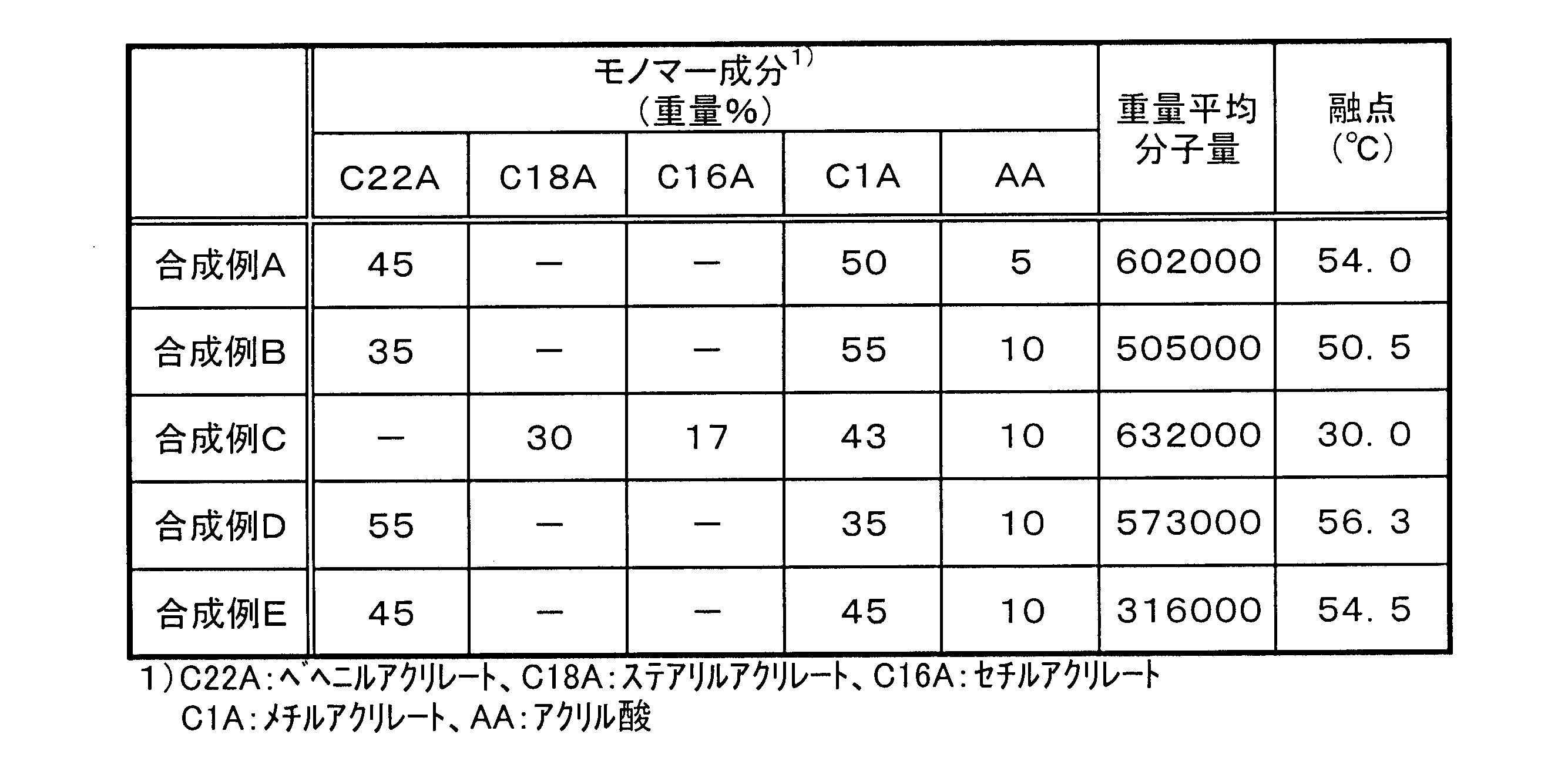
(合成例A~E:側鎖結晶性ポリマー)
まず、表2に示すモノマーを表2に示す割合で反応容器に加えた。表2に示すモノマーは、以下のとおりである。
C22A:ベヘニルアクリレート
C18A:ステアリルアクリレート
C16A:セチルアクリレート
C1A:メチルアクリレート
AA:アクリル酸
まず、表2に示すモノマーを表2に示す割合で反応容器に加えた。表2に示すモノマーは、以下のとおりである。
C22A:ベヘニルアクリレート
C18A:ステアリルアクリレート
C16A:セチルアクリレート
C1A:メチルアクリレート
AA:アクリル酸
次に、重合開始剤として日油製のパーブチルNDをモノマー混合物100重量部に対して1重量部の割合で反応容器に加えた後、固形分濃度が30重量%になるように酢酸エチル:トルエン=75:25(重量比)の混合溶媒を反応容器に加え、混合液を得た。得られた混合液を55℃で4時間撹拌することによって各モノマーを共重合させ、側鎖結晶性ポリマーを得た。得られた側鎖結晶性ポリマーの重量平均分子量および融点を表2に示す。なお、重量平均分子量は、GPCで測定して得られた測定値をポリスチレン換算した値である。融点は、DSCを用いて10℃/分の測定条件で測定した値である。
[実施例1-1~5、2~10および比較例1~4]
<感温性粘着テープの作製>
まず、合成例A~Eで得られた各側鎖結晶性ポリマーを表3に示す組み合わせで使用するとともに、架橋剤を表3に示す割合で添加し、合成例1-1~5、2~7で得られた各添加剤を表3に示す組み合わせおよび割合で添加し、感温性粘着剤を得た。なお、表3に示す架橋剤および添加剤の添加量は、固形分換算で側鎖結晶性ポリマー100重量部に対する値である。
<感温性粘着テープの作製>
まず、合成例A~Eで得られた各側鎖結晶性ポリマーを表3に示す組み合わせで使用するとともに、架橋剤を表3に示す割合で添加し、合成例1-1~5、2~7で得られた各添加剤を表3に示す組み合わせおよび割合で添加し、感温性粘着剤を得た。なお、表3に示す架橋剤および添加剤の添加量は、固形分換算で側鎖結晶性ポリマー100重量部に対する値である。
添加した架橋剤は、以下のとおりである。
実施例1-1~5、2~10:金属キレート化合物である川研ファインケミカル社製のアルミニウムトリスアセチルアセトナート
比較例1~4:日本触媒社製のアジリジン化合物「ケミタイトPZ-33」
実施例1-1~5、2~10:金属キレート化合物である川研ファインケミカル社製のアルミニウムトリスアセチルアセトナート
比較例1~4:日本触媒社製のアジリジン化合物「ケミタイトPZ-33」
次に、得られた感温性粘着剤を酢酸エチルによって固形分濃度が30重量%となるように調整し、塗布液を得た。得られた塗布液を厚さ100μmのポリエチレンテレフタレートからなるフィルム状の基材の片面に塗布した。そして、100℃×10分の条件で架橋反応を行い、基材の片面に厚さ30μmの粘着剤層が積層されている感温性粘着テープを得た。
<評価>
実施例1-1~5、2~10および比較例1~4で得られた各感温性粘着テープについて、180°剥離強度および80℃における貯蔵弾性率G’を評価した。各評価方法を以下に示すとともに、その結果を表3に示す。
実施例1-1~5、2~10および比較例1~4で得られた各感温性粘着テープについて、180°剥離強度および80℃における貯蔵弾性率G’を評価した。各評価方法を以下に示すとともに、その結果を表3に示す。
(180°剥離強度)
得られた感温性粘着テープについて、80℃および23℃の各雰囲気温度におけるステンレス鋼(SUS)またはポリエチレンテレフタレート(PET)に対する180°剥離強度を測定した。また、150℃を経た後の23℃の雰囲気温度におけるSUSに対する180°剥離強度を測定した。180°剥離強度は、JIS Z0237に準拠して測定した。具体的には、以下の条件で感温性粘着テープをSUSまたはPETに貼着した後、ロードセルを用いて300mm/分の速度で180°剥離した。
得られた感温性粘着テープについて、80℃および23℃の各雰囲気温度におけるステンレス鋼(SUS)またはポリエチレンテレフタレート(PET)に対する180°剥離強度を測定した。また、150℃を経た後の23℃の雰囲気温度におけるSUSに対する180°剥離強度を測定した。180°剥離強度は、JIS Z0237に準拠して測定した。具体的には、以下の条件で感温性粘着テープをSUSまたはPETに貼着した後、ロードセルを用いて300mm/分の速度で180°剥離した。
[80℃]
80℃の雰囲気温度で感温性粘着テープをSUSまたはPETに貼着して20分間静置した後、180°剥離した。
80℃の雰囲気温度で感温性粘着テープをSUSまたはPETに貼着して20分間静置した後、180°剥離した。
[23℃]
80℃の雰囲気温度で感温性粘着テープをSUSまたはPETに貼着し、この雰囲気温度で20分間静置した後、雰囲気温度を23℃に下げ、この雰囲気温度で20分間静置した後、180°剥離した。
80℃の雰囲気温度で感温性粘着テープをSUSまたはPETに貼着し、この雰囲気温度で20分間静置した後、雰囲気温度を23℃に下げ、この雰囲気温度で20分間静置した後、180°剥離した。
[150℃を経た後の23℃]
80℃の雰囲気温度で感温性粘着テープをSUSに貼着し、雰囲気温度を150℃に上げ、この雰囲気温度で60分間静置した後、雰囲気温度を23℃に下げ、この雰囲気温度で20分間静置した後、180°剥離した。結果は、表3中の「150℃→23℃」の欄に示した。
80℃の雰囲気温度で感温性粘着テープをSUSに貼着し、雰囲気温度を150℃に上げ、この雰囲気温度で60分間静置した後、雰囲気温度を23℃に下げ、この雰囲気温度で20分間静置した後、180°剥離した。結果は、表3中の「150℃→23℃」の欄に示した。
なお、SUSは、板状のSUS304を使用した。PETは、厚さ25μmのフィルム状であって、未処理のものを使用した。SUSまたはPETに対する感温性粘着テープの貼着は、感温性粘着テープの上で2kgのローラーを5往復させることによって行った。
(80℃における貯蔵弾性率G’)
80℃における貯蔵弾性率G’は、サーモサイエンティフィック(Thermo Scientific)社製の動的粘弾性測定装置「HAAKE MARSIII」を使用して、1Hz、5℃/分、0~200℃の昇温過程で測定した。
80℃における貯蔵弾性率G’は、サーモサイエンティフィック(Thermo Scientific)社製の動的粘弾性測定装置「HAAKE MARSIII」を使用して、1Hz、5℃/分、0~200℃の昇温過程で測定した。
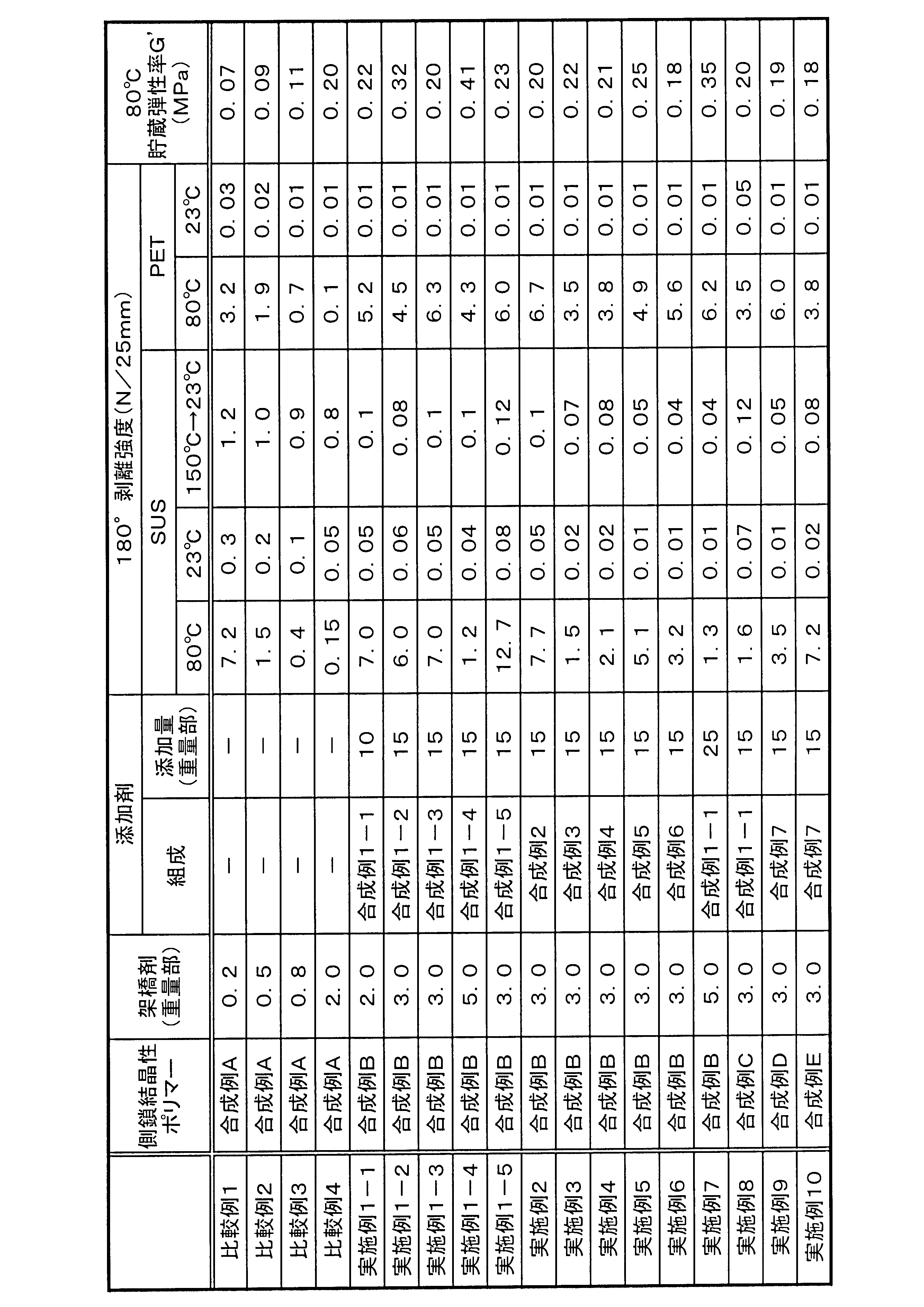
表3から明らかなように、実施例1-1~5、2~10は、SUSおよびPETのいずれに対しても、80℃における180°剥離強度の値(固定性)が高く、23℃における180°剥離強度の値(剥離性)が低い。また、実施例1-1~5、2~10は、80℃における貯蔵弾性率G’の値も高く、高粘着力と高弾性とを両立できていることがわかる。さらに、実施例1-1~5、2~10は、150℃を経た後の23℃における180°剥離強度の値も低いことから、高温に曝されても易剥離性を維持できていることがわかる。
Claims (13)
- N置換マレイミド化合物およびカルボキシ基含有エチレン性不飽和単量体をモノマー成分として含む共重合体である、粘着剤用添加剤。
- 前記共重合体において、前記N置換マレイミド化合物が、前記カルボキシ基含有エチレン性不飽和単量体よりも重量比で多く含まれている、請求項1に記載の粘着剤用添加剤。
- 前記共重合体が、反応性ポリシロキサン化合物をモノマー成分としてさらに含む、請求項1または2に記載の粘着剤用添加剤。
- 前記共重合体の重量平均分子量が、10000以下である、請求項1~3のいずれかに記載の粘着剤用添加剤。
- 請求項1~4のいずれかに記載の粘着剤用添加剤と、
側鎖結晶性ポリマーと、を含有し、
前記側鎖結晶性ポリマーの融点未満の温度で粘着力が低下する、感温性粘着剤組成物。 - 前記側鎖結晶性ポリマーが、前記カルボキシ基含有エチレン性不飽和単量体と同じものをモノマー成分として含む、請求項5に記載の感温性粘着剤組成物。
- 前記共重合体の重量平均分子量が、前記側鎖結晶性ポリマーの重量平均分子量よりも小さい、請求項5または6に記載の感温性粘着剤組成物。
- 80℃における貯蔵弾性率G’が、0.15MPa以上である、請求項5~7のいずれかに記載の感温性粘着剤組成物。
- ステンレス鋼に対する180°剥離強度が、
80℃において0.5N/25mm以上であり、
23℃において0.1N/25mm以下である、請求項5~8のいずれかに記載の感温性粘着剤組成物。 - ステンレス鋼に対する180°剥離強度が、
150℃を経た後の23℃において0.2N/25mm以下である、請求項5~9のいずれかに記載の感温性粘着剤組成物。 - ポリエチレンテレフタレートに対する180°剥離強度が、
80℃において0.8N/25mm以上であり、
23℃において0.1N/25mm以下である、請求項5~10のいずれかに記載の感温性粘着剤組成物。 - 請求項5~11のいずれかに記載の感温性粘着剤組成物を含む、感温性粘着シート。
- フィルム状の基材と、
前記基材の少なくとも片面に積層されており請求項5~11のいずれかに記載の感温性粘着剤組成物を含む粘着剤層と、を備える、感温性粘着テープ。
Priority Applications (1)
| Application Number | Priority Date | Filing Date | Title |
|---|---|---|---|
| KR1020217002725A KR102767754B1 (ko) | 2018-11-02 | 2019-10-31 | 점착제용 첨가제 및 감온성 점착제 조성물 |
Applications Claiming Priority (2)
| Application Number | Priority Date | Filing Date | Title |
|---|---|---|---|
| JP2018207661 | 2018-11-02 | ||
| JP2018-207661 | 2018-11-02 |
Publications (1)
| Publication Number | Publication Date |
|---|---|
| WO2020090992A1 true WO2020090992A1 (ja) | 2020-05-07 |
Family
ID=70463802
Family Applications (1)
| Application Number | Title | Priority Date | Filing Date |
|---|---|---|---|
| PCT/JP2019/042864 Ceased WO2020090992A1 (ja) | 2018-11-02 | 2019-10-31 | 粘着剤用添加剤および感温性粘着剤組成物 |
Country Status (4)
| Country | Link |
|---|---|
| JP (1) | JP7358200B2 (ja) |
| KR (1) | KR102767754B1 (ja) |
| TW (1) | TWI821445B (ja) |
| WO (1) | WO2020090992A1 (ja) |
Families Citing this family (1)
| Publication number | Priority date | Publication date | Assignee | Title |
|---|---|---|---|---|
| JP7558864B2 (ja) | 2021-03-24 | 2024-10-01 | 日本カーバイド工業株式会社 | 粘着剤組成物及び粘着シート |
Citations (3)
| Publication number | Priority date | Publication date | Assignee | Title |
|---|---|---|---|---|
| JP2012102212A (ja) * | 2010-11-09 | 2012-05-31 | Nitta Corp | 易剥離性粘着シートおよび易剥離性粘着テープ |
| JP2012158633A (ja) * | 2011-01-31 | 2012-08-23 | Nitta Corp | 易剥離性粘着シートおよび易剥離性粘着テープ |
| JP2013166910A (ja) * | 2011-06-13 | 2013-08-29 | Nitto Denko Corp | ポリマー組成物、粘着剤組成物、当該ポリマー組成物を用いて製造された温度応答性シート、及び、当該粘着剤組成物を用いて製造された冷却剥離粘着シート |
Family Cites Families (3)
| Publication number | Priority date | Publication date | Assignee | Title |
|---|---|---|---|---|
| JPH09249860A (ja) | 1996-03-14 | 1997-09-22 | Nitta Ind Corp | 半導体ウエハの表面保護材 |
| JP2008144124A (ja) * | 2006-11-14 | 2008-06-26 | Jsr Corp | 熱硬化性樹脂組成物、カラーフィルタの保護膜の形成方法およびカラーフィルタの保護膜 |
| JP6792509B2 (ja) * | 2017-04-21 | 2020-11-25 | ニッタ株式会社 | 感温性粘着剤 |
-
2019
- 2019-10-31 KR KR1020217002725A patent/KR102767754B1/ko active Active
- 2019-10-31 WO PCT/JP2019/042864 patent/WO2020090992A1/ja not_active Ceased
- 2019-10-31 JP JP2019198858A patent/JP7358200B2/ja active Active
- 2019-11-01 TW TW108139732A patent/TWI821445B/zh active
Patent Citations (3)
| Publication number | Priority date | Publication date | Assignee | Title |
|---|---|---|---|---|
| JP2012102212A (ja) * | 2010-11-09 | 2012-05-31 | Nitta Corp | 易剥離性粘着シートおよび易剥離性粘着テープ |
| JP2012158633A (ja) * | 2011-01-31 | 2012-08-23 | Nitta Corp | 易剥離性粘着シートおよび易剥離性粘着テープ |
| JP2013166910A (ja) * | 2011-06-13 | 2013-08-29 | Nitto Denko Corp | ポリマー組成物、粘着剤組成物、当該ポリマー組成物を用いて製造された温度応答性シート、及び、当該粘着剤組成物を用いて製造された冷却剥離粘着シート |
Also Published As
| Publication number | Publication date |
|---|---|
| KR102767754B1 (ko) | 2025-02-17 |
| KR20210087012A (ko) | 2021-07-09 |
| TW202028402A (zh) | 2020-08-01 |
| JP7358200B2 (ja) | 2023-10-10 |
| JP2020076091A (ja) | 2020-05-21 |
| TWI821445B (zh) | 2023-11-11 |
Similar Documents
| Publication | Publication Date | Title |
|---|---|---|
| JP5231775B2 (ja) | 感温性樹脂および感温性粘着剤、並びに感温性粘着テープ | |
| CN105264036B (zh) | 感温性粘合剂 | |
| CN106103627A (zh) | 热敏性粘合剂 | |
| JP7460451B2 (ja) | 感温性粘着剤 | |
| JP6546910B2 (ja) | 感温性粘着剤 | |
| JP2018178060A (ja) | 感温性粘着剤 | |
| TWI853792B (zh) | 感溫性黏著劑、感溫性黏著片及感溫性黏著帶 | |
| TWI740022B (zh) | 感溫性黏著劑 | |
| JP2011099042A (ja) | 感温性粘着剤 | |
| WO2020090992A1 (ja) | 粘着剤用添加剤および感温性粘着剤組成物 | |
| JPH03243679A (ja) | アクリル系粘着剤組成物及び粘着テープ、ラベル、シート | |
| TWI589658B (zh) | 感溫性黏著劑組成物 | |
| KR102652136B1 (ko) | 감온성 점착제, 감온성 점착 시트 및 감온성 점착 테이프 | |
| JP6813988B2 (ja) | 感温性粘着テープおよび感温性粘着シート | |
| WO2016158414A1 (ja) | 感温性粘着テープおよび感温性粘着シート | |
| JPH08302304A (ja) | 耐可塑剤用両面粘着テープ | |
| JP6393510B2 (ja) | 感温性粘着剤組成物 |
Legal Events
| Date | Code | Title | Description |
|---|---|---|---|
| 121 | Ep: the epo has been informed by wipo that ep was designated in this application |
Ref document number: 19878892 Country of ref document: EP Kind code of ref document: A1 |
|
| ENP | Entry into the national phase |
Ref document number: 20217002725 Country of ref document: KR Kind code of ref document: A |
|
| NENP | Non-entry into the national phase |
Ref country code: DE |
|
| 122 | Ep: pct application non-entry in european phase |
Ref document number: 19878892 Country of ref document: EP Kind code of ref document: A1 |