WO2020090793A1 - 毛髪変形処理用中間処理剤、毛髪変形処理方法及び毛髪変形剤 - Google Patents
毛髪変形処理用中間処理剤、毛髪変形処理方法及び毛髪変形剤 Download PDFInfo
- Publication number
- WO2020090793A1 WO2020090793A1 PCT/JP2019/042305 JP2019042305W WO2020090793A1 WO 2020090793 A1 WO2020090793 A1 WO 2020090793A1 JP 2019042305 W JP2019042305 W JP 2019042305W WO 2020090793 A1 WO2020090793 A1 WO 2020090793A1
- Authority
- WO
- WIPO (PCT)
- Prior art keywords
- agent
- hair
- treatment
- hair deformation
- disulfide
- Prior art date
- Legal status (The legal status is an assumption and is not a legal conclusion. Google has not performed a legal analysis and makes no representation as to the accuracy of the status listed.)
- Ceased
Links
Images


Classifications
-
- A—HUMAN NECESSITIES
- A61—MEDICAL OR VETERINARY SCIENCE; HYGIENE
- A61K—PREPARATIONS FOR MEDICAL, DENTAL OR TOILETRY PURPOSES
- A61K8/00—Cosmetics or similar toiletry preparations
- A61K8/18—Cosmetics or similar toiletry preparations characterised by the composition
- A61K8/30—Cosmetics or similar toiletry preparations characterised by the composition containing organic compounds
- A61K8/46—Cosmetics or similar toiletry preparations characterised by the composition containing organic compounds containing sulfur
-
- A—HUMAN NECESSITIES
- A61—MEDICAL OR VETERINARY SCIENCE; HYGIENE
- A61Q—SPECIFIC USE OF COSMETICS OR SIMILAR TOILETRY PREPARATIONS
- A61Q5/00—Preparations for care of the hair
- A61Q5/04—Preparations for permanent waving or straightening the hair
Definitions
- the present invention relates to an intermediate treatment agent for hair deformation treatment, a hair deformation treatment method, and a hair deformation agent.
- the hair deformation treatment such as permanent wave treatment is performed by treating the hair with a reducing agent to cleave the disulfide bond in the hair, applying a wave with a rod or the like, and re-bonding the disulfide bond with an oxidizing agent.
- Patent Document 1 In hair deformation treatment, attempts have been made to treat the hair with an intermediate treatment agent between the reduction treatment with the first agent and the oxidation treatment with the second agent.
- a carbonate or hydrogen carbonate and (B) a permanent wave intermediate treatment agent composition containing dithiodiglycolic acid or a salt thereof, and a permanent wave treatment method using the same composition.
- Example 1 the hair was treated with 1% by mass of disodium dithiodiglycolate as an intermediate treatment agent for 10 minutes.
- paragraph [0001] of Patent Document 1 describes that the ability to form permanent waves is improved and damage to hair is prevented.
- Patent Document 2 discloses an intermediate treatment agent for hair deformation treatment, which is used after treating hair with a first agent containing a reducing agent and before treating the hair with a second agent containing an oxidizing agent.
- An intermediate treatment agent for treating hair deformation which contains 0.1 to 3.5% by mass of the oxidizing agent and has a pH of 6.0 to 10.0. It is described that the oxidizing agent includes an oxidized dimer of a reducing agent such as bromate and diammonium dithiodiglycolate. In Examples 14 to 18, hair was treated with 0.1 to 3.5 mass% of diammonium dithiodiglycolate as an intermediate treatment agent for 3 minutes.
- Paragraph [0007] of Patent Document 2 describes that various problems occur in the conventional hair treatment agents.
- the invention of Patent Document 2 is made in view of the above problems, and in a short time, the effect of the hair deformation treatment is sufficiently obtained, and the residual odor is dramatically reduced, resulting in a better finished feeling. It can be obtained.
- the conventional method could not stably form a large, solid, three-dimensional wave. Therefore, there has been a demand for a hair deformation treatment capable of stably forming a firm, large and three-dimensional wave that is dull.
- the present invention has been made in view of the above circumstances, and the problem to be solved by the present invention is to provide a stable, firm and large three-dimensional wave, which is an intermediate for hair deformation treatment.
- a treatment agent a hair deformation treatment method, and a hair deformation agent.
- the present inventors have found that after treating hair with a first agent containing a reducing agent and before treating hair with a second agent containing an oxidizing agent, a high concentration of 5 to 15% by mass.
- a high concentration of 5 to 15% by mass Surprisingly, when hair was treated with an intermediate treatment agent for hair deformation treatment containing disulfide, it was possible to obtain a stable, firm and large three-dimensional wave that could not be obtained by the conventional method.
- the present invention has been completed by finding that they can be made.
- the present invention is based on such findings, and specifically, the present invention is as follows.
- An intermediate treatment agent for hair deformation treatment for use after treating hair with a first agent containing a reducing agent and before treating hair with a second agent containing an oxidizing agent, Intermediate treatment agent for hair deformation treatment containing 5 to 15% by mass of disulfide.
- Disulfides include dithiodiglycolic acid or a salt thereof, dithiodilactic acid or a salt thereof, cystamine or a salt thereof, cystine or a salt thereof, N, N′-diacetylcystine, di (2,3-dihydroxypropyl) disulfide and disulfide.
- a hair deformation treatment method including the following steps.
- Step 1) a step of treating hair with a first agent containing a reducing agent;
- Step 2) a step of treating the hair treated in the step 1 with an intermediate treatment agent for hair deformation treatment containing 5 to 15% by mass of disulfide; and
- step 3) a hair treated in the step 2.
- step 3) a hair treated in the step 2.
- step 3) a hair treated in the step 2.
- a hair deformation treatment method including the following steps.
- the disulfide is dithiodiglycolic acid or a salt thereof, dithiodilactic acid or a salt thereof, cystamine or a salt thereof, cystine or a salt thereof, N, N′-diacetylcystine, di (2,3-dihydroxypropyl) disulfide and disulfide.
- the hair deformation treatment method according to [5] which is one or more disulfides selected from (2-butyrolactyl) disulfide.
- the hair deformation treatment method according to any one of [5] to [7] in which a firm three-dimensional curl is applied to the hair.
- a hair deforming agent comprising a first agent containing a reducing agent, an intermediate treatment agent for hair deformation treatment containing 5 to 15% by mass of disulfide, and a second agent containing an oxidizing agent.
- the disulfide is dithiodiglycolic acid or a salt thereof, dithiodilactic acid or a salt thereof, cystamine or a salt thereof, cystine or a salt thereof, N, N′-diacetylcystine, di (2,3-dihydroxypropyl) disulfide and disulfide.
- the hair deforming agent according to [10] which is one or more reducing agents selected from (2-butyrolactyl) disulfide.
- the intermediate treatment agent for hair deformation treatment, the hair deformation treatment method, and the hair deformation agent of the present invention it is possible to form a dull, firm and large three-dimensional wave.
- the intermediate treatment agent for hair deformation treatment, the hair deformation treatment method and the wave formed by the hair deformation agent of the present invention are retained for a long period of time.
- FIG. 5 is a photograph showing the experimental results of the study on the concentration of diammonium dithiodiglycolate in Test Example 1.
- FIG. 3 is a schematic diagram showing lengths a1 to a3 used for measuring the minor axis of treated hair. It is a photograph which shows an experimental result of examination of shampoo of treatment example 4, and processing of treatment.
- the intermediate treatment agent for hair deformation treatment of the present invention is for hair deformation treatment for use after treating hair with a first agent containing a reducing agent and before treating hair with a second agent containing an oxidizing agent.
- An intermediate treatment agent for hair deformation treatment containing 5 to 15% by mass of disulfide.
- the hair to be treated is wrapped around a cylindrical rod or coil having a specific radius, then reduction treatment is performed with the first agent, treatment with an intermediate treatment agent for hair deformation treatment, and oxidation treatment with the second agent. Then, by removing the hair from the rod or the coil, the hair deformation process is performed.
- any of those usually used for the first agent for hair deformation treatment can be used.
- the reducing agent one or more selected from cysteamine or a salt thereof, thioglycolic acid or a salt thereof, thiolactic acid or a salt thereof, cysteine or a salt thereof, N-acetylcysteine, sulfite and 2-mercapto-4-butanolide.
- cysteine and N-acetyl cysteine include those having the structures of L-cysteine, D-cysteine and DL-cysteine.
- reducing agents selected from salts There may be mentioned one or more reducing agents selected from salts.
- One or more reducing agents selected from thioglycollate and thiolactate are preferred because they have little effect on the skin.
- a reducing agent having a basic group, an acidic group, or the like is preferable because it can form a dull, firm and large three-dimensional wave.
- Examples of the salt of the reducing agent include inorganic acid salts such as hydrochloride, sulfate and nitrate, organic acid salts such as methanesulfonate, benzenesulfonate and maleate, alkali salts such as sodium salt and potassium salt. Examples thereof include alkaline earth metal salts such as metal salts, magnesium salts and calcium salts, inorganic base salts such as ammonia salts, ethanolamine salts, isopropanolamine salts, triethylamine salts, arginine salts, lysine salts and the like.
- a dimer of the reducing agent such as dithiodiglycolic acid or dithiodilactic acid, may be added to the first agent in an amount equal to or less than the reducing agent.
- the content of the reducing agent in the first agent, the hair treatment method of the first agent, the pH, the treatment temperature, the treatment time, etc. can be carried out based on a usual method. That is, the content, the treatment method, the pH, the treatment temperature, and the treatment time can be arbitrarily selected according to the reducing agent to be used.
- the content of the reducing agent in the first agent is, for example, 1 to 15 mass% with respect to the first agent, preferably 2 to 10 mass%, more preferably 4 to 8 mass%.
- Examples of the pH of the first agent include pH 5 to 10, preferably pH 7 to 10, and more preferably pH 8 to 9.5.
- the reducing agent remaining on the hair will hinder the subsequent oxidation reaction by disulfide, so it is preferable to wash it off with water.
- Intermediate treatment agent for hair deformation treatment contains 5 to 15% by mass of disulfide.
- the intermediate treatment agent for hair deformation treatment By using the intermediate treatment agent for hair deformation treatment, a larger amount of mixed disulfide can be retained, and a dull, firm and large three-dimensional wave can be formed.
- the disulfide include dithiodiglycolic acid or a salt thereof, dithiodilactic acid or a salt thereof, cystamine or a salt thereof, cystine or a salt thereof, N, N′-diacetylcystine, di (2,3-dihydroxypropyl) disulfide and di ( And one or more disulfides selected from 2-butyrolactyl) disulfide.
- a disulfide having an acidic or basic group such as an amino group or a carboxyl group is preferred because it can form a firm and large three-dimensional wave that is dull and firm.
- Preferred disulfides include, for example, dithiodiglycolic acid or a salt thereof, dithiodilactic acid or a salt thereof, cystamine or a salt thereof, cystine or a salt thereof, N, N′-diacetylcystine, and the like, and more preferably dithiodiglycolic acid or a salt thereof. Examples thereof include salts thereof, dithiodilactic acid or salts thereof, cystamine or salts thereof, and the like.
- disulfide salt examples include inorganic acid salts such as hydrochlorides, sulfates and nitrates, organic acid salts such as methanesulfonate, benzenesulfonate and maleate, alkali metal salts such as sodium salt and potassium salt.
- examples thereof include alkaline earth metal salts such as salts, magnesium salts and calcium salts, inorganic base salts such as ammonia salts, organic base salts such as ethanolamine salts and triethylamine salts.
- the content of disulfide in the intermediate treatment agent for hair deformation treatment is 5 to 15% by mass, preferably 5 to 13% by mass, more preferably 6 to 11% by mass, and further preferably 7 to 10 mass% can be mentioned. By using this disulfide content, a firm, large and three-dimensional wave is formed.
- Comparative Example 6 1% by mass of diammonium dithiodiglycolate, 10 minutes
- Example 1 of Patent Document 1 and Example 18 of Patent Document 2 are described.
- Comparative Example 7 (3.5% by mass of diammonium dithiodiglycolate, 3 minutes
- Example 13 of the present invention 5% by mass of diammonium dithiodiglycolate, 2 minutes
- the pH of the intermediate treatment agent for hair deformation treatment is preferably, for example, pH 4 to 10, and more preferably pH 5.5 to 10. By adjusting the pH to 4 to 10, a firm, large and three-dimensional wave is formed.
- the treatment temperature of the intermediate treatment agent for hair deformation treatment is, for example, 10 to 40 ° C., preferably 15 to 30 ° C., and more preferably room temperature.
- the treatment time of the intermediate treatment agent for hair deformation treatment varies depending on the treatment temperature, but is, for example, 1 to 60 minutes, preferably 2 to 30 minutes, and more preferably 5 to 15 minutes.
- the treatment with the intermediate treatment agent for hair deformation treatment After the treatment with the intermediate treatment agent for hair deformation treatment is finished, usually it is treated with the second agent as it is without washing with water.
- the oxidizing agent contained in the second agent includes any oxidizing agent that can be used as the second agent for hair deformation treatment.
- Specific examples of the oxidizing agent include sodium bromate, bromates such as potassium bromate, sodium perborate, perborates such as potassium perborate, hydrogen peroxide solution, iodine, and oxygen.
- bromate and perborate are preferable, and bromate is more preferable.
- the content of the oxidizing agent in the second agent, the hair treatment method of the second agent, the pH, the treatment temperature, the treatment time and the like can be carried out based on a usual method. That is, the content, the treatment method, the pH, the treatment temperature, and the treatment time can be arbitrarily selected according to the oxidizing agent to be used.
- the pH of the second agent is 8 or more, more preferably 8 to 10.
- the pH is 8 or more, the rate of the oxidation reaction is slowed down, and more mixed disulfide can be left, whereby a dull, firm and large three-dimensional wave can be formed.
- a pH adjuster is used to adjust the pH of the first agent, the intermediate treatment agent for hair deformation treatment, and the second agent.
- the pH adjusting agent include those usually used for hair deformation treatment, and examples thereof include phosphoric acid, hydrochloric acid, sulfuric acid, methanesulfonic acid, citric acid, acetic acid, sodium dihydrogen phosphate, trisodium phosphate, sodium acetate, Sodium hydroxide, sodium carbonate, sodium hydrogen carbonate, potassium hydroxide, potassium carbonate, potassium hydrogen carbonate, monoethanolamine, ammonia, ammonium carbonate, 2-amino-2-methyl-1-propanol, tripotassium citrate, phosphoric acid Examples thereof include diammonium hydrogen.
- Other components can be added to the first agent, the intermediate treatment agent for hair deformation treatment, and the second agent as long as the effects of the present invention are not impaired.
- Other components include, for example, higher alcohols, solvents, oils, wetting agents, cationic, anionic and amphoteric surfactants, urea, guanidine, guanidine salts, silicones, aluminum stearate, alum and other aluminum compounds, and quenching agents.
- Acids succinic acid, acetic acid, lactic acid, tartaric acid, malic acid, glycine, aspartic acid and other organic acids, hydrochloric acid, phosphoric acid and other inorganic acids, ethylenediamine, mono-, di- or tri-ethanolamine, morpholine, basic amino acids Alkaline agents such as ammonia, sodium hydroxide, tetrasodium ethylenediaminetetraacetate, pentasodium diethylenetriaminepentaacetate, sodium polyphosphate, sequestering agents such as phytic acid, proteins, thickeners, emulsifiers, hair restorers, bactericides, colorants , And fragrances.
- Alkaline agents such as ammonia, sodium hydroxide, tetrasodium ethylenediaminetetraacetate, pentasodium diethylenetriaminepentaacetate, sodium polyphosphate
- sequestering agents such as phytic acid, proteins, thickeners,
- the first agent, the intermediate treatment agent for hair deformation treatment, and the second agent are prepared by dissolving them in water or an aqueous solvent to prepare a solution, emulsion, suspension, aerosol or the like.
- the aqueous solvent include water containing an organic solvent such as ethanol and isopropanol at a concentration that does not affect the human body.
- the first agent, the intermediate treatment agent for hair deformation treatment, and the second agent are used by applying or spraying on the hair.
- the intermediate treatment agent for hair deformation treatment of the present invention By performing the hair deformation treatment using the intermediate treatment agent for hair deformation treatment of the present invention, it is possible to apply a firm and large three-dimensional curl that does not drip on the hair. As described in the test example described below, by performing the hair deformation treatment, the minor diameter of curl of hair and the hair thickness are improved as compared with the conventional method which does not use the intermediate treatment agent for hair deformation treatment of the present invention. ..
- the hair deformation treatment method of the present invention includes the following steps.
- (Step 1) a step of treating hair with a first agent containing a reducing agent;
- (Step 2) a step of treating the hair treated in the step 1 with an intermediate treatment agent for hair deformation treatment containing 5 to 15% by mass of disulfide; and
- (step 3) a hair treated in the step 2.
- the first agent in step 1 the content of the reducing agent in the first agent, the hair treatment method for the first agent, the pH, the treatment temperature, the treatment time and the like can be the same as described above. Since the reducing agent remaining on the hair after the step 1 will inhibit the oxidation reaction by the disulfide in the subsequent step 2, it is preferably washed with water.
- the intermediate treatment agent for hair deformation treatment in step 2 the content of disulfide in the intermediate treatment agent for hair deformation treatment, the hair treatment method of the intermediate treatment agent for hair deformation treatment, pH, treatment temperature, treatment time, etc. are as described above. It can be carried out in the same manner.
- the second agent in step 3 the content of the oxidizing agent in the second agent, the hair treatment method of the second agent, the pH, the treatment temperature, the treatment time and the like can be the same as described above.
- the hair can be curled by winding the hair around a rod or coil before step 1 and removing the rod or coil after step 3.
- the hair deformation treatment method of the present invention it is possible to apply a firm and large three-dimensional curl that does not drip on the hair.
- the hair deformation treatment method of the present invention improves curl short diameter and hair thickness of the hair, as compared with the conventional method that does not use the intermediate treatment agent for hair deformation treatment of the present invention.
- the "dull, firm and large three-dimensional curl” refers to hair that has been combed twice with a comb after being subjected to a hair deformation treatment according to the method described in the test example below.
- the curl in which the minor axis of the curl is measured and compared with the radius of the rod used is a curl in which the minor axis of the curl is equal to or larger than the radius of the rod.
- the hair deforming agent of the present invention comprises a first agent containing a reducing agent, an intermediate treatment agent for hair deforming treatment containing 5 to 15% by mass of disulfide, and a second agent containing an oxidizing agent.
- the first agent, the intermediate treatment agent for hair deformation treatment, and the second agent are the same as those described above.
- the hair deforming agent of the present invention contains these three agents as a set and can be used in the hair deforming treatment method of the present invention.
- the reagents used in the following Examples and Comparative Examples were as follows. Ammonium thiolactate (Bruno Boc, 60%) Diammonium dithiodiglycolate (Sasaki Chemical Co., 40%) Sodium bromate (made by Sasaki Chemical Co., Ltd.) Sodium hydroxide (manufactured by Tokyo Ohka Kogyo Co., Ltd.) Ethanolamine (manufactured by BASF)
- Test Example 1 Examination on the concentration of diammonium dithiodiglycolate 8.0 parts by mass of ammonium thiolactate (60%) (4.8 parts by mass as ammonium thiolactate) and 3.0 parts by mass of monoethanolamine were purified water 89.
- the 1st agent was prepared by mixing with 0.0 mass part.
- the second agent was prepared by mixing 7.0 parts by mass of sodium bromate and 93.0 parts by mass of purified water.
- diammonium dithiodiglycolate (40%) with purified water so that the concentration of diammonium dithiodiglycolate is 1, 5, 10, 15 and 20% by mass, pH 5.5 or pH 5 is obtained.
- An intermediate treatment agent for hair deformation treatment having each concentration of 0.6 was prepared.
- the short diameter and thickness of the obtained hair were measured as follows. As shown in FIG. 1, two bundles of treated hairs were placed on their desks with their flat surfaces being superposed on each other. Regarding the thickness of the hair, the thickness (cm) of the hair was measured when viewed from the sideways direction of the superposed state, that is, the sideways direction of the photograph of FIG.
- the short diameter of the hair is selected as one hair bundle in which a plurality of hairs are gathered into one, and is in a state as shown in FIG. 2 when viewed from directly above the desk, that is, when viewed directly from the front of FIG.
- the lengths a1 to a3 of the three peaks from the end of were measured and the average value thereof was taken as the minor axis.
- draw a tangent line L1 that touches the hair at the contact points P1 and P2 draw a straight line that has the longest length from the tangent line L1 to the second mountain. It was pulled out and its length a1 (cm) was measured.
- the feel of the obtained hair was evaluated according to the following evaluation criteria.
- Comparative Example 3 in which the concentration of diammonium dithiodiglycolate is 20% by mass, the minor axis and the thickness are greatly improved as compared with Comparative Example 1 of the control, but the minor axis is 1.14 cm, The radius was lower than 1.15 cm.
- the concentration of diammonium dithiodiglycolate is preferably 5 to 15% by mass.
- Examples 1 and 2 were evaluated as A, which was excellent. Therefore, when the feel evaluation is included, the concentration of diammonium dithiodiglycolate is more preferably 5 to 10% by mass.
- Test Example 2 Examination on pH The first agent and the second agent prepared in Test Example 1 were used. In addition, by using the intermediate treatment agent for hair deformation treatment having a concentration of diammonium dithiodiglycolate of 10 mass% prepared in Test Example 1, the pH was adjusted to 5.5, 8 and 10 by adding sodium hydroxide. Was prepared.
- Hair deformation treatment was carried out in the same manner as in Test Example 1 using the above-mentioned intermediate treatment agents for hair deformation treatment having pH of 5.5, 8 and 10.
- the one not treated with the intermediate treatment agent for hair deformation treatment was used as a control (Comparative Example 1).
- the minor axis and the thickness of the obtained hair were measured. The results are shown in Table 2.
- the pH of the intermediate treatment agent for hair deformation treatment is in the range of 5.5 to 10
- the minor axis is 1.43 to 1.57 cm
- the radius of the rod is 1.15 cm or more.
- the thickness is 3.86 to 4.04 cm
- the minor axis and the thickness are greatly improved as compared with the control of Comparative Example 1.
- Test Example 3 Examination regarding combination of concentration and pH of diammonium dithiodiglycolate The first agent and the second agent prepared in Test Example 1 were used.
- the pH was adjusted to 5.5 and 8 in the same manner as in Test Example 4 to obtain 4
- Various types of intermediate treatment agents for hair deformation treatment were prepared. Hair deformation treatment was performed in the same manner as in Test Example 1. In addition, the one not treated with the intermediate treatment agent for hair deformation treatment was used as a control (Comparative Example 1). The minor axis and the thickness of the obtained hair were measured. The results are shown in Table 3.
- Test Example 4 Examination of treatment of shampoo and treatment Test using the first and second agents prepared in Test Example 1 and an intermediate treatment agent for hair deformation treatment having a concentration of diammonium dithiodiglycolate of 5% by mass. Hair deformation treatment was performed in the same manner as in Example 1 (Example 1). What was not treated with the intermediate treatment agent for hair deformation treatment was used as a control (Comparative Example 1). After that, the treatment of shampoo and treatment was performed once. Before the treatment of shampoo and treatment (0 times) and after the treatment of 1 time, the obtained hair was measured for minor axis and thickness. The results are shown in FIG. 3 and Table 4.
- Example 1 Even after the treatment of shampoo and treatment was performed once, the minor axis was the rod radius of 1.15 cm or more, and a dull, firm and large three-dimensional wave was generated. Retained
- Test Example 5 Examination of Treatment Time of Intermediate Treatment Agent for Hair Deformation Treatment
- First agent and second agent prepared in Test Example 1 and intermediate treatment agent for hair deformation treatment having a concentration of diammonium dithiodiglycolate of 5% by mass was used.
- the hair deformation treatment was performed in the same manner as in Test Example 1 with the treatment time of the intermediate treatment agent for hair deformation treatment set to 1, 2, 5 and 10 minutes.
- the minor axis and the thickness of the obtained hair were measured. The results are shown in Table 5.
- the treatment time is preferably 2 minutes or longer, more preferably 5 minutes or longer.
- Test Example 6 Examination of Concentration of Intermediate Treatment Agent for Hair Deformation Treatment and Treatment Time
- the first agent and the second agent prepared in Test Example 1 were used.
- an intermediate treatment agent for hair deformation treatment was prepared in which the concentration of diammonium dithiodiglycolate was 1, 3.5 and 5% by mass, and using them, the treatment time was 10, 3 respectively.
- the hair deformation treatment was performed. The minor axis and the thickness of the obtained hair were measured. The results are shown in Table 6.
- Comparative Example 6 treatment with 1% by mass of diammonium dithiodiglycolate for 10 minutes
- Comparative Example 7 treatment with 3.5% by mass of diammonium dithiodiglycolate for 3 minutes
- the diameters were 0.62 cm and 0.94 cm, far below the rod radius of 1.15 cm.
- Example 13 treated with 5% by mass of diammonium dithiodiglycolate for 2 minutes
- the minor axis was 1.40 cm
- the radius of the rod was 1.15 cm or more
- Comparative Examples 6 and 7 were used. In comparison with, it was very significantly higher, which resulted in the stable formation of a dull, firm and large three-dimensional wave.
- the reaction rate increases in proportion to the concentration of the reaction reagent, and if the concentration of the reaction reagent does not change significantly, the reaction proceeds with the reaction time. Therefore, in the above test, in Comparative Example 6, Comparative Example 7, and Example 13, the product of the concentration of the intermediate treatment agent for hair deformation treatment and the treatment time was approximately equal to about 10, and if similar reactions proceed, those skilled in the art will appreciate. Expects. However, according to the above-mentioned test results, it was obtained that the one having a high concentration of the intermediate treatment agent for hair deformation treatment had a remarkably high short diameter and thickness despite the short treatment time. ..
- the concentration of diammonium dithiodiglycolate is 5% by mass or more.
- the experimental conditions of Comparative Example 6 (1% by mass of diammonium dithiodiglycolate for 10 minutes) correspond to the conditions of Example 1 of Patent Document 1.
- the experimental conditions of Comparative Example 7 (3.5 mass% diammonium dithiodiglycolate, 3 minutes) correspond to the conditions of Example 18 of Patent Document 2.
- the concentration of diammonium dithiodiglycolate is 5% by mass or more, the minor axis and the thickness are remarkably increased even if the treatment time is shortened. This effect cannot be predicted by those skilled in the art from Patent Documents 1 and 2.
- Test Example 7 Examination of pH of Second Agent
- the first agent prepared in Test Example 1 was used. Further, by mixing 6.0 parts by mass of sodium bromate and 94.0 parts by mass of purified water and adding sodium hydroxide, a second agent having a pH of 6, 8, 8.5, 10, and 12 is prepared. did.
- a hair deformation treatment was carried out in the same manner as in Test Example 1 without treatment with the intermediate treatment agent for hair deformation treatment. The short diameter, thickness and feel of the obtained hair were measured. The results are shown in Table 7.
- the intermediate treatment agent for hair deformation treatment, a dull, firm and large three-dimensional wave is stably formed, but in addition to that, the oxidizing agent is bromate, and pH is By using the second agent having a ratio of 8 or more, a firm, large, and three-dimensional wave can be stably formed.
- the present invention provides an intermediate treatment agent for hair deformation treatment, a hair deformation treatment method, and a hair deformation agent, which are capable of stably forming a firm, large and three-dimensional wave that is dull.
Landscapes
- Life Sciences & Earth Sciences (AREA)
- Health & Medical Sciences (AREA)
- Animal Behavior & Ethology (AREA)
- General Health & Medical Sciences (AREA)
- Public Health (AREA)
- Veterinary Medicine (AREA)
- Birds (AREA)
- Epidemiology (AREA)
- Cosmetics (AREA)
Abstract
本発明は、還元剤を含有する第1剤で毛髪を処理した後、酸化剤を含有する第2剤で毛髪を処理する前に使用するための毛髪変形処理用中間処理剤であって、ジスルフィドを5~15質量%含有する毛髪変形処理用中間処理剤等に関する。本発明によって、だれない、しっかりとした大きく立体的なウェーブを安定して形成させることができる、毛髪変形処理用中間処理剤、毛髪変形処理方法及び毛髪変形剤を提供することができる。
Description
本発明は、毛髪変形処理用中間処理剤、毛髪変形処理方法及び毛髪変形剤に関する。
パーマネントウェーブ処理等の毛髪変形処理は、毛髪を還元剤で処理して毛髪内のジスルフィド結合を開裂させ、ロッド等でウェーブをつけて酸化剤でジスルフィド結合を再結合させることで行われる。
毛髪変形処理において、第1剤による還元処理と第2剤による酸化処理の間に中間処理剤で毛髪を処理する試みがなされている。例えば、特許文献1には、(A)炭酸塩又は炭酸水素塩、及び(B)ジチオジグリコール酸又はその塩を含有するパーマネントウェーブ中間処理剤組成物、並びに同組成物を用いるパーマネントウェーブ処理方法が開示されている。実施例1では、中間処理剤として1質量%のジチオジグリコール酸ジナトリウムを用いて10分間、毛髪を処理している。本方法の効果として、特許文献1の段落[0001]には、パーマネントウェーブ形成能を向上させ、毛髪の損傷を防ぐものであると記載されている。
特許文献2には、還元剤を含有する第1剤により毛髪を処理した後、酸化剤を含有する第2剤により前記毛髪を処理する前に使用される毛髪変形処理用中間処理剤であって、0.1~3.5質量%の前記酸化剤を含有し、かつpHが6.0~10.0である毛髪変形処理用中間処理剤が開示されている。その酸化剤には、臭素酸塩、ジチオジグリコール酸ジアンモニウム等の還元剤の酸化型二量体が含まれることが記載されている。実施例14~18では、中間処理剤として0.1~3.5質量%のジチオジグリコール酸ジアンモニウムを用いて3分間、毛髪を処理している。特許文献2の段落[0007]には、従来の毛髪処理剤では、種々問題が発生していたことが記載されている。特許文献2の発明は、上記の問題に鑑みてなされたものであり、短時間で、毛髪変形処理の効果が十分に得られるとともに、残臭が飛躍的に低減され、更に良好な仕上がり感を得ることができると記載されている。
しかし、特許文献1及び2の実施例等に記載の方法等の従来の方法では、だれない、しっかりとした大きく立体的なウェーブを安定して形成させることはできなかった。
上記のように、従来の方法では、だれない、しっかりとした大きく立体的なウェーブを安定して形成させることができなかった。そこで、だれない、しっかりとした大きく立体的なウェーブを安定して形成させることができる毛髪変形処理が求められていた。本発明は上記事情に鑑みてなされたものであり、本発明が解決しようとする課題は、だれない、しっかりとした大きく立体的なウェーブを安定して形成させることができる、毛髪変形処理用中間処理剤、毛髪変形処理方法及び毛髪変形剤を提供することにある。
本発明者らは、鋭意検討した結果、還元剤を含有する第1剤で毛髪を処理した後、酸化剤を含有する第2剤で毛髪を処理する前に、5~15質量%の高濃度のジスルフィドを含有する毛髪変形処理用中間処理剤で毛髪を処理したところ、意外にも、従来の方法では得ることができなかった、だれない、しっかりとした大きく立体的なウェーブを安定して形成させることができることを見出し、本発明を完成した。本発明は、かかる知見に基づくものであり、具体的には、本発明は以下の通りである。
[1] 還元剤を含有する第1剤で毛髪を処理した後、酸化剤を含有する第2剤で毛髪を処理する前に使用するための毛髪変形処理用中間処理剤であって、
ジスルフィドを5~15質量%含有する毛髪変形処理用中間処理剤。
[2] ジスルフィドが、還元剤の二量体である、[1]に記載の毛髪変形処理用中間処理剤。
[3] ジスルフィドが、ジチオジグリコール酸又はその塩、ジチオジ乳酸又はその塩、シスタミン又はその塩、シスチン又はその塩、N,N’-ジアセチルシスチン、ジ(2,3-ジヒドロキシプロピル)ジスルフィド及びジ(2-ブチロラクチル)ジスルフィドから選択される1又は複数のジスルフィドである、[1]に記載の毛髪変形処理用中間処理剤。
[4] 酸化剤が臭素酸塩又は過ホウ素酸塩であり、第2剤のpHが8以上である、[1]~[3]のいずれかに記載の毛髪変形処理用中間処理剤。
[5] 以下の工程を含む、毛髪変形処理方法。
(工程1)還元剤を含有する第1剤で毛髪を処理する工程;
(工程2)工程1で処理された毛髪に対して、ジスルフィドを5~15質量%含有する毛髪変形処理用中間処理剤で処理する工程;及び
(工程3)工程2で処理された毛髪に対して、酸化剤を含有する第2剤で毛髪を処理する工程。
[6] ジスルフィドが、還元剤の二量体である、[5]に記載の毛髪変形処理方法。
[7] ジスルフィドが、ジチオジグリコール酸又はその塩、ジチオジ乳酸又はその塩、シスタミン又はその塩、シスチン又はその塩、N,N’-ジアセチルシスチン、ジ(2,3-ジヒドロキシプロピル)ジスルフィド及びジ(2-ブチロラクチル)ジスルフィドから選択される1又は複数のジスルフィドである、[5]に記載の毛髪変形処理方法。
[8] 毛髪にだれないしっかりとした立体的なカールをかける、[5]~[7]のいずれかに記載の毛髪変形処理方法。
[9] 酸化剤が臭素酸塩又は過ホウ素酸塩であり、第2剤のpHが8以上である、[5]~[8]のいずれかに記載の毛髪変形処理方法。
[10] 還元剤を含有する第1剤と、ジスルフィドを5~15質量%含有する毛髪変形処理用中間処理剤と、酸化剤を含有する第2剤を含む、毛髪変形剤。
[11] ジスルフィドが、還元剤の二量体である、[10]に記載の毛髪変形剤。
[12] ジスルフィドが、ジチオジグリコール酸又はその塩、ジチオジ乳酸又はその塩、シスタミン又はその塩、シスチン又はその塩、N,N’-ジアセチルシスチン、ジ(2,3-ジヒドロキシプロピル)ジスルフィド及びジ(2-ブチロラクチル)ジスルフィドから選択される1又は複数の還元剤である、[10]に記載の毛髪変形剤。
[13] 酸化剤が臭素酸塩又は過ホウ素酸塩であり、第2剤のpHが8以上である、[10]~[12]のいずれかに記載の毛髪変形剤。
[11] ジスルフィドが、還元剤の二量体である、[10]に記載の毛髪変形剤。
[12] ジスルフィドが、ジチオジグリコール酸又はその塩、ジチオジ乳酸又はその塩、シスタミン又はその塩、シスチン又はその塩、N,N’-ジアセチルシスチン、ジ(2,3-ジヒドロキシプロピル)ジスルフィド及びジ(2-ブチロラクチル)ジスルフィドから選択される1又は複数の還元剤である、[10]に記載の毛髪変形剤。
[13] 酸化剤が臭素酸塩又は過ホウ素酸塩であり、第2剤のpHが8以上である、[10]~[12]のいずれかに記載の毛髪変形剤。
本発明の毛髪変形処理用中間処理剤、毛髪変形処理方法及び毛髪変形剤によれば、だれない、しっかりとした大きく立体的なウェーブを形成させることができる。本発明の毛髪変形処理用中間処理剤、毛髪変形処理方法及び毛髪変形剤で形成されたウェーブは長期間、保持される。
<毛髪変形処理用中間処理剤>
本発明の毛髪変形処理用中間処理剤は、還元剤を含有する第1剤で毛髪を処理した後、酸化剤を含有する第2剤で毛髪を処理する前に使用するための毛髪変形処理用中間処理剤であって、ジスルフィドを5~15質量%含有する毛髪変形処理用中間処理剤である。通常、特定の半径の円筒形のロッド又はコイルに、処理する毛髪を巻き付け、その後、第1剤で還元処理を行い、毛髪変形処理用中間処理剤で処理し、第2剤で酸化処理を行って、毛髪をロッド又はコイルから外すことで、毛髪変形処理がなされる。
本発明の毛髪変形処理用中間処理剤は、還元剤を含有する第1剤で毛髪を処理した後、酸化剤を含有する第2剤で毛髪を処理する前に使用するための毛髪変形処理用中間処理剤であって、ジスルフィドを5~15質量%含有する毛髪変形処理用中間処理剤である。通常、特定の半径の円筒形のロッド又はコイルに、処理する毛髪を巻き付け、その後、第1剤で還元処理を行い、毛髪変形処理用中間処理剤で処理し、第2剤で酸化処理を行って、毛髪をロッド又はコイルから外すことで、毛髪変形処理がなされる。
「還元剤」としては、毛髪変形処理用の第1剤に通常、用いられるものは如何なるものでも使用することができる。還元剤としては、システアミン又はその塩、チオグリコール酸又はその塩、チオ乳酸又はその塩、システイン又はその塩、N-アセチルシステイン、サルファイト及び2-メルカプト-4-ブタノリドから選択される1又は複数の還元剤が挙げられる。ここで、システイン及びN-アセチルシステインには、L-システイン、D-システイン、DL-システインの構造を有するものが含まれる。好ましくは、チオグリコール酸又はその塩、チオ乳酸又はその塩、システイン又はその塩及びN-アセチルシステインから選択される1又は複数の還元剤が挙げられ、より好ましくは、チオグリコール酸塩及びチオ乳酸塩から選択される1又は複数の還元剤が挙げられる。チオグリコール酸塩及びチオ乳酸塩から選択される1又は複数の還元剤は、皮膚への影響が少ないため好ましい。塩基性基又は酸性基等を有する還元剤は、よりだれない、しっかりとした大きく立体的なウェーブを形成させることができるため、好ましい。上記の還元剤の塩としては、例えば塩酸塩、硫酸塩、硝酸塩等の無機酸塩、メタンスルホン酸塩、ベンゼンスルホン酸塩、マレイン酸塩等の有機酸塩、ナトリウム塩、カリウム塩等のアルカリ金属塩、マグネシウム塩、カルシウム塩等のアルカリ土類金属塩、アンモニア塩等の無機塩基塩、エタノールアミン塩、イソプロパノールアミン塩、トリエチルアミン塩、アルギニン塩、リジン塩等の有機塩基塩等が挙げられる。また、第1剤には、上記の還元剤に加えて、その還元剤の2量体、例えばジチオジグリコール酸、ジチオジ乳酸等を還元剤の当量以下添加することもできる。
第1剤中の還元剤の含有量、第1剤の毛髪処理方法、pH、処理温度、処理時間等は、通常の方法に基づいて実施することができる。すなわち、用いる還元剤に合わせて、含有量、処理方法、pH、処理温度、処理時間を任意に選択して、実施することができる。第1剤中の還元剤の含有量としては、例えば、第1剤に対して1~15質量%が挙げられ、好ましくは2~10質量%、より好ましくは4~8質量%が挙げられる。第1剤のpHとしては、例えばpH5~10が挙げられ、好ましくはpH7~10が挙げられ、より好ましくはpH8~9.5が挙げられる。
第1剤による還元処理が終わった後、毛髪に残存した還元剤は、続くジスルフィドによる酸化反応を阻害することになるため、水で洗い流すことが好ましい。
毛髪変形処理用中間処理剤には、5~15質量%のジスルフィドが含まれる。毛髪変形処理用中間処理剤によって、より多くの混合ジスルフィドを残存させることができ、だれない、しっかりとした大きく立体的なウェーブを形成させることができる。ジスルフィドとしては、例えばジチオジグリコール酸又はその塩、ジチオジ乳酸又はその塩、シスタミン又はその塩、シスチン又はその塩、N,N’-ジアセチルシスチン、ジ(2,3-ジヒドロキシプロピル)ジスルフィド及びジ(2-ブチロラクチル)ジスルフィドから選択される1又は複数のジスルフィドが挙げられる。よりだれない、しっかりとした大きく立体的なウェーブを形成させることができるため、アミノ基、カルボキシル基等の酸性又は塩基性の基等を有するジスルフィドが好ましい。好ましいジスルフィドとして、例えば、ジチオジグリコール酸又はその塩、ジチオジ乳酸又はその塩、シスタミン又はその塩、シスチン又はその塩、N,N’-ジアセチルシスチン等が挙げられ、より好ましくはジチオジグリコール酸又はその塩、ジチオジ乳酸又はその塩、シスタミン又はその塩等が挙げられる。上記のジスルフィドの塩としては、例えば塩酸塩、硫酸塩、硝酸塩等の無機酸塩、メタンスルホン酸塩、ベンゼンスルホン酸塩、マレイン酸塩等の有機酸塩、ナトリウム塩、カリウム塩等のアルカリ金属塩、マグネシウム塩、カルシウム塩等のアルカリ土類金属塩、アンモニア塩等の無機塩基塩、エタノールアミン塩、トリエチルアミン塩等の有機塩基塩等が挙げられる。
毛髪変形処理用中間処理剤中のジスルフィドの含有量は5~15質量%であるが、好ましくは、5~13質量%が挙げられ、より好ましくは6~11質量%が挙げられ、さらに好ましくは7~10質量%が挙げられる。このジスルフィドの含有量を用いることで、だれない、しっかりとした大きく立体的なウェーブが形成される。後述の試験例6に記載のように、特許文献1の実施例1に対応する比較例6(1質量%のジチオジグリコール酸ジアンモニウム,10分間)、特許文献2の実施例18に対応する比較例7(3.5質量%のジチオジグリコール酸ジアンモニウム,3分間)、及び本発明の実施例13(5質量%のジチオジグリコール酸ジアンモニウム,2分間)では、毛髪変形処理用中間処理剤の濃度と処理時間の積が約10とほぼ等しく、同程度の反応が進行すると当業者は予想するが、意外にも、ジチオジグリコール酸ジアンモニウムの濃度が5質量%以上であれば、たとえ処理時間が短くなっても、極めて顕著に短径及び厚みが増加する。この効果は、特許文献1及び2からは当業者は到底予測できるものではない。
毛髪変形処理用中間処理剤のpHとしては、例えばpH4~10が好ましく、pH5.5~10がより好ましい。pHを4~10にすることで、だれない、しっかりとした大きく立体的なウェーブが形成される。
毛髪変形処理用中間処理剤の処理温度としては、例えば10~40℃が挙げられ、好ましくは15~30℃が挙げられ、より好ましくは室温が挙げられる。毛髪変形処理用中間処理剤の処理時間としては、処理温度によって変わるが、例えば1~60分間が挙げられ、好ましくは2~30分間が挙げられ、より好ましくは5~15分間が挙げられる。
毛髪変形処理用中間処理剤による処理が終わった後、通常は、水洗せずにそのまま第2剤で処理する。
第2剤に含まれる酸化剤には、毛髪変形処理用第2剤として使用しうる如何なる酸化剤も含まれる。酸化剤としては、具体的には、臭素酸ナトリウム、臭素酸カリウム等の臭素酸塩、過ホウ素酸ナトリウム、過ホウ素酸カリウム等の過ホウ素酸塩、過酸化水素水、ヨウ素、酸素等が挙げられ、好ましくは臭素酸塩及び過ホウ素酸塩が挙げられ、より好ましくは臭素酸塩が挙げられる。第2剤中の酸化剤の含有量、第2剤の毛髪処理方法、pH、処理温度、処理時間等は、通常の方法に基づいて実施することができる。すなわち、用いる酸化剤に合わせて、含有量、処理方法、pH、処理温度、処理時間を任意に選択して、実施することができる。
酸化剤として臭素酸塩又は過ホウ素酸を用いた場合、第2剤のpHを8以上とすることも好ましく、pHを8~10にすることがより好ましい。pH8以上とすることで酸化反応の速度が遅くなり、より多くの混合ジスルフィドを残存させることができ、それによって、だれない、しっかりとした大きく立体的なウェーブを形成させることができる。
第1剤、毛髪変形処理用中間処理剤、及び第2剤のpHを調整するために、pH調整剤が用いられる。pH調整剤としては、毛髪変形処理に通常用いられるものが挙げられ、例えば、リン酸、塩酸、硫酸、メタンスルホン酸、クエン酸、酢酸、リン酸二水素ナトリウム、リン酸三ナトリウム、酢酸ナトリウム、水酸化ナトリウム、炭酸ナトリウム、炭酸水素ナトリウム、水酸化カリウム、炭酸カリウム、炭酸水素カリウム、モノエタノールアミン、アンモニア、炭酸アンモニウム、2-アミノ-2-メチル-1-プロパノール、クエン酸三カリウム、リン酸水素二アンモニウム等が挙げられる。
第1剤、毛髪変形処理用中間処理剤、及び第2剤には、本願発明の効果を妨げない範囲において、他の成分を添加することができる。他の成分としては、例えば、高級アルコール、溶剤、油剤、湿潤剤、カチオン性、アニオン性、両性の界面活性剤、尿素、グアニジン、グアニジン塩、シリコーン、ステアリン酸アルミニウム、ミョウバン等のアルミニウム化合物、クエン酸、コハク酸、酢酸、乳酸、酒石酸、リンゴ酸、グリシン、アスパラギン酸等の有機酸、塩酸、リン酸等の無機酸、エチレンジアミン、モノ-、ジ-若しくはトリ-エタノールアミン、モルホリン、塩基性アミノ酸、アンモニア、水酸化ナトリウム等のアルカリ剤、エチレンジアミン四酢酸四ナトリウム、ジエチレントリアミン五酢酸五ナトリウム、ポリリン酸ナトリウム、フィチン酸等の金属封鎖剤、プロテイン、増粘剤、乳化剤、養毛剤、殺菌剤、着色剤、香料等が挙げられる。
第1剤、毛髪変形処理用中間処理剤、及び第2剤は、水又は水性溶媒に溶解し、溶液、乳液、懸濁液、エアゾール等にすることで調製される。水性溶媒としては、例えば、人体に影響の無い濃度のエタノール、イソプロパノール等の有機溶媒を含む水が挙げられる。第1剤、毛髪変形処理用中間処理剤、及び第2剤は、毛髪に塗布又は噴霧することによって使用される。
本発明の毛髪変形処理用中間処理剤を用いて毛髪変形処理を行うことで、毛髪にだれないしっかりとした大きく立体的なカールをかけることができる。後述の試験例に記載の通り、毛髪変形処理を行うことで、本発明の毛髪変形処理用中間処理剤を用いない従来の方法と比べて、毛髪のカールの短径及び毛髪の厚みが向上する。
<毛髪変形処理方法>
本発明の毛髪変形処理方法は、以下の工程を含む。
(工程1)還元剤を含有する第1剤で毛髪を処理する工程;
(工程2)工程1で処理された毛髪に対して、ジスルフィドを5~15質量%含有する毛髪変形処理用中間処理剤で処理する工程;及び
(工程3)工程2で処理された毛髪に対して、酸化剤を含有する第2剤で毛髪を処理する工程。
本発明の毛髪変形処理方法は、以下の工程を含む。
(工程1)還元剤を含有する第1剤で毛髪を処理する工程;
(工程2)工程1で処理された毛髪に対して、ジスルフィドを5~15質量%含有する毛髪変形処理用中間処理剤で処理する工程;及び
(工程3)工程2で処理された毛髪に対して、酸化剤を含有する第2剤で毛髪を処理する工程。
工程1における第1剤、及び第1剤中の還元剤の含有量、第1剤の毛髪処理方法、pH、処理温度、処理時間等は、前記と同様にして実施することができる。工程1の後、毛髪に残存した還元剤は、続く工程2のジスルフィドによる酸化反応を阻害することになるため、水で洗い流すことが好ましい。工程2における毛髪変形処理用中間処理剤、及び毛髪変形処理用中間処理剤中のジスルフィドの含有量、毛髪変形処理用中間処理剤の毛髪処理方法、pH、処理温度、処理時間等は、前記と同様にして実施することができる。工程3における第2剤、及び第2剤中の酸化剤の含有量、第2剤の毛髪処理方法、pH、処理温度、処理時間等は、前記と同様にして実施することができる。通常、工程1の前に、毛髪をロッド又はコイルに巻き付けて、工程3の後に、ロッド又はコイルを外すことで、毛髪にカールをかけることができる。
本発明の毛髪変形処理方法によって、毛髪にだれないしっかりとした大きく立体的なカールをかけることができる。後述の試験例に記載の通り、本発明の毛髪変形処理方法によって、本発明の毛髪変形処理用中間処理剤を用いない従来の方法と比べて、毛髪のカールの短径及び毛髪の厚みが向上する。ここで、「だれないしっかりとした大きく立体的なカール」とは、後述の試験例に記載の方法に従って、毛髪変形処理を行った後、乾燥して、櫛で2回梳いた毛髪について、形成されたカールの短径を測定し、用いたロッドの半径と比較して、カールの短径がロッドの半径以上であるカールを言う。
<毛髪変形剤>
本発明の毛髪変形剤は、還元剤を含有する第1剤と、ジスルフィドを5~15質量%含有する毛髪変形処理用中間処理剤と、酸化剤を含有する第2剤を含む。
第1剤、毛髪変形処理用中間処理剤及び第2剤は、前記のものと同じである。本発明の毛髪変形剤は、これらの3つの剤をセットとして含むものであり、本発明の毛髪変形処理方法に用いることができる。
本発明の毛髪変形剤は、還元剤を含有する第1剤と、ジスルフィドを5~15質量%含有する毛髪変形処理用中間処理剤と、酸化剤を含有する第2剤を含む。
第1剤、毛髪変形処理用中間処理剤及び第2剤は、前記のものと同じである。本発明の毛髪変形剤は、これらの3つの剤をセットとして含むものであり、本発明の毛髪変形処理方法に用いることができる。
以下、本発明を実施例、比較例及び参考例によりさらに詳細に説明するが、本発明はこれらに何ら限定されるものではない。
下記の実施例及び比較例で用いた試薬は、以下のものを用いた。
チオ乳酸アンモニウム(ブルーノボック社製,60%)
ジチオジグリコール酸ジアンモニウム(佐々木化学社製,40%)
臭素酸ナトリウム(佐々木化学社製)
水酸化ナトリウム(東京応化工業社製)
エタノールアミン(BASF社製)
チオ乳酸アンモニウム(ブルーノボック社製,60%)
ジチオジグリコール酸ジアンモニウム(佐々木化学社製,40%)
臭素酸ナトリウム(佐々木化学社製)
水酸化ナトリウム(東京応化工業社製)
エタノールアミン(BASF社製)
試験例1:ジチオジグリコール酸ジアンモニウムの濃度に関する検討
チオ乳酸アンモニウム(60%)8.0質量部(チオ乳酸アンモニウムとして4.8質量部)とモノエタノールアミン3.0質量部を精製水89.0質量部と混合することで、第1剤を調製した。また、臭素酸ナトリウム7.0質量部と精製水93.0質量部を混合することで、第2剤を調製した。ジチオジグリコール酸ジアンモニウム(40%)を、ジチオジグリコール酸ジアンモニウムの濃度が1、5、10、15及び20質量%となるように、精製水と混合することで、pH5.5又はpH5.6の各濃度の毛髪変形処理用中間処理剤を調製した。
チオ乳酸アンモニウム(60%)8.0質量部(チオ乳酸アンモニウムとして4.8質量部)とモノエタノールアミン3.0質量部を精製水89.0質量部と混合することで、第1剤を調製した。また、臭素酸ナトリウム7.0質量部と精製水93.0質量部を混合することで、第2剤を調製した。ジチオジグリコール酸ジアンモニウム(40%)を、ジチオジグリコール酸ジアンモニウムの濃度が1、5、10、15及び20質量%となるように、精製水と混合することで、pH5.5又はpH5.6の各濃度の毛髪変形処理用中間処理剤を調製した。
25cmの毛髪3gの毛束(製品名:毛束黒髪根元揃え(BS-B3AK),ビューラックス社製)を2束用いた。直径2.3cm(半径1.15cm)の円筒形のプラスチック製ロッドに、この毛髪の束をその平たい面で巻付くように巻き付けた。続いて、第1剤に浸漬して30℃で15分間放置し、1分間、水洗し、1、5、10、15及び20質量%の毛髪変形処理用中間処理剤に浸漬して室温で2分間放置し、第2剤に浸漬して室温で15分間放置し、水洗して、ロッドを外した。一晩風乾させ、櫛で2回梳いだ。また、毛髪変形処理用中間処理剤で処理しないものをコントロールとした(比較例1)。処理された毛束2束をその平たい面同士で重ね合わせて図1に示すように机の上に置いた。
得られた毛髪の短径と厚みの測定は以下のようにして行った。図1の通り、処理された毛束2束をその平たい面同士で重ね合わせて図1に示すように机の上に置いた。毛髪の厚みは、重ね合わせた状態の真横の方向、すなわち図1の写真の真横の方向から見て、その厚み(cm)を測定した。
毛髪の短径は、複数の毛髪が1つにまとまった毛束1つを選択して、机の真上から、すなわち図1の真正面から見て、図2に示すような状態とし、毛束の末端から3つの山の長さa1~a3を測定してそれらの平均値を短径とした。具体的には、毛束の末端から2つ目の山について、毛髪と接点P1とP2で接する接線L1を引き、接線L1から直角に2つ目の山までの長さが最長となる直線を引いて、その長さa1(cm)を測定した。3つ目の山について、毛髪と接点P3とP4で接する接線L2を引き、接線L2から直角に3つ目の山までの長さが最長となる直線を引いて、その長さa2(cm)を測定した。4つ目の山について、毛髪と接点P5とP6で接する接線L3を引き、接線L3から直角に4つ目の山までの長さが最長となる直線を引いて、その長さa3(cm)を測定した。得られたa1~a3の平均値を短径(cm)とした。短径と厚みの測定結果を、表1に示す。
得られた毛髪の感触を下記評価基準にしたがって評価した。
A:なめらか
B:普通
C:ごわつく
短径と厚みの測定結果及び感触を、表1に示す。
A:なめらか
B:普通
C:ごわつく
短径と厚みの測定結果及び感触を、表1に示す。

上記の結果から、毛髪変形処理用中間処理剤におけるジチオジグリコール酸ジアンモニウムの濃度が5~15質量%である実施例1~3では、短径が1.29~1.57cmであり、ロッドの半径1.15cm以上である。また、厚みが3.29~4.00cmであり、短径及び厚みがコントロールの比較例1より大きく向上している。このように、実施例1~3では、だれない、しっかりとした大きく立体的なウェーブが安定して形成された。それに対して、ジチオジグリコール酸ジアンモニウムの濃度が1質量%である比較例2では、短径及び厚みはコントロールの比較例1より若干向上したに過ぎなかった。また、ジチオジグリコール酸ジアンモニウムの濃度が20質量%である比較例3では、短径及び厚みはコントロールの比較例1より大きく向上しているものの、短径が1.14cmであり、ロッドの半径1.15cmより低かった。以上のように、ジチオジグリコール酸ジアンモニウムの濃度は、5~15質量%であることが好ましい。また、感触の評価結果に関しては、実施例1及び2がA評価であり、優れていた。従って、感触の評価を含めると、ジチオジグリコール酸ジアンモニウムの濃度は、5~10質量%であることがさらに好ましい。
試験例2:pHに関する検討
試験例1で調製した第1剤と第2剤を用いた。また、試験例1で調製したジチオジグリコール酸ジアンモニウムの濃度が10質量%である毛髪変形処理用中間処理剤を用い、水酸化ナトリウムを添加することで、pHが5.5、8及び10のものを調製した。
試験例1で調製した第1剤と第2剤を用いた。また、試験例1で調製したジチオジグリコール酸ジアンモニウムの濃度が10質量%である毛髪変形処理用中間処理剤を用い、水酸化ナトリウムを添加することで、pHが5.5、8及び10のものを調製した。
上記のpHが5.5、8及び10の毛髪変形処理用中間処理剤のものを用いて、試験例1と同様に毛髪変形処理を行った。また、毛髪変形処理用中間処理剤で処理しないものをコントロールとした(比較例1)。得られた毛髪について、短径及び厚みを測定した。その結果を表2に示す。

上記の結果から、毛髪変形処理用中間処理剤のpHは5.5~10の範囲で、短径が1.43~1.57cmであり、ロッドの半径1.15cm以上である。また、厚みが3.86~4.04cmであり、短径及び厚みがコントロールの比較例1より大きく向上している。このように、実施例4~6では、だれない、しっかりとした大きく立体的なウェーブが安定して形成された。
試験例3:ジチオジグリコール酸ジアンモニウムの濃度とpHの組み合わせに関する検討
試験例1で調製した第1剤と第2剤を用いた。試験例1で調製したジチオジグリコール酸ジアンモニウムの濃度が1及び5質量%の毛髪変形処理用中間処理剤について、試験例2と同様にしてpHを5.5及び8とすることで、4種類の毛髪変形処理用中間処理剤を調製した。試験例1と同様にして、毛髪変形処理を行った。また、毛髪変形処理用中間処理剤で処理しないものをコントロールとした(比較例1)。得られた毛髪について、短径及び厚みを測定した。その結果を表3に示す。
試験例1で調製した第1剤と第2剤を用いた。試験例1で調製したジチオジグリコール酸ジアンモニウムの濃度が1及び5質量%の毛髪変形処理用中間処理剤について、試験例2と同様にしてpHを5.5及び8とすることで、4種類の毛髪変形処理用中間処理剤を調製した。試験例1と同様にして、毛髪変形処理を行った。また、毛髪変形処理用中間処理剤で処理しないものをコントロールとした(比較例1)。得られた毛髪について、短径及び厚みを測定した。その結果を表3に示す。
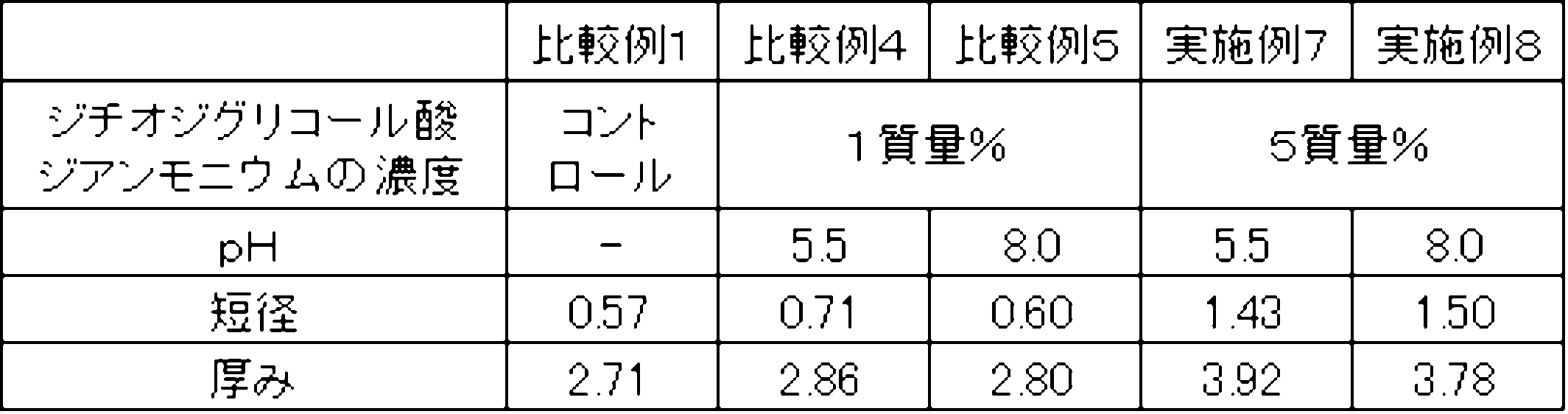
上記の結果から、pHが5.5及び8ともに、ジチオジグリコール酸ジアンモニウムの濃度が1質量%よりも5質量%のほうが、短径及び厚みが大きく、短径がロッドの半径1.15cm以上であり、だれない、しっかりとした大きく立体的なウェーブが安定して形成された。
試験例4:シャンプーとトリートメントの処理の検討
試験例1で調製した第1剤と第2剤とジチオジグリコール酸ジアンモニウムの濃度が5質量%の毛髪変形処理用中間処理剤を用いて、試験例1と同様にして、毛髪変形処理を行った(実施例1)。毛髪変形処理用中間処理剤で処理しないものをコントロールとした(比較例1)。その後、シャンプーとトリートメントの処理を1回行った。シャンプーとトリートメントの処理を行う前(0回)、及び1回の処理後、得られた毛髪について、短径及び厚みを測定した。その結果を図3及び表4に示す。
試験例1で調製した第1剤と第2剤とジチオジグリコール酸ジアンモニウムの濃度が5質量%の毛髪変形処理用中間処理剤を用いて、試験例1と同様にして、毛髪変形処理を行った(実施例1)。毛髪変形処理用中間処理剤で処理しないものをコントロールとした(比較例1)。その後、シャンプーとトリートメントの処理を1回行った。シャンプーとトリートメントの処理を行う前(0回)、及び1回の処理後、得られた毛髪について、短径及び厚みを測定した。その結果を図3及び表4に示す。
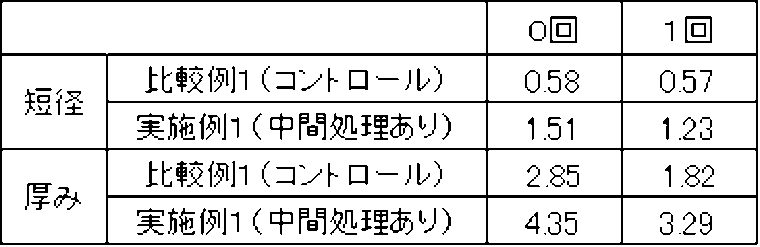
上記の結果から、実施例1ではシャンプーとトリートメントの処理を1回行った後であっても、短径がロッドの半径1.15cm以上であり、だれない、しっかりとした大きく立体的なウェーブが保持された。
試験例5:毛髪変形処理用中間処理剤の処理時間の検討
試験例1で調製した第1剤と第2剤とジチオジグリコール酸ジアンモニウムの濃度が5質量%の毛髪変形処理用中間処理剤を用いた。毛髪変形処理用中間処理剤の処理時間を、1、2、5及び10分間として、試験例1と同様にして、毛髪変形処理を行った。得られた毛髪について、短径及び厚みを測定した。その結果を表5に示す。
試験例1で調製した第1剤と第2剤とジチオジグリコール酸ジアンモニウムの濃度が5質量%の毛髪変形処理用中間処理剤を用いた。毛髪変形処理用中間処理剤の処理時間を、1、2、5及び10分間として、試験例1と同様にして、毛髪変形処理を行った。得られた毛髪について、短径及び厚みを測定した。その結果を表5に示す。
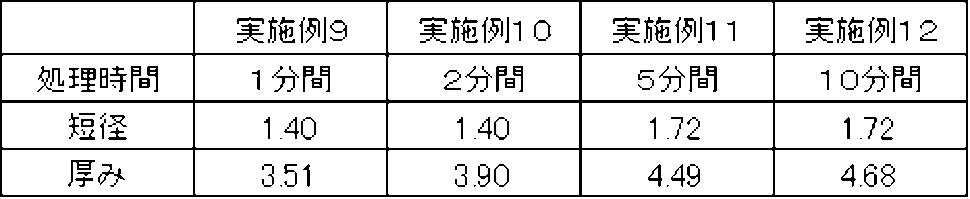
上記の結果から、処理時間が長いほど短径及び厚みがより高まり、よりだれない、よりしっかりとした大きく立体的なウェーブが得られた。このように、処理時間は2分間以上が好ましく、5分間以上がより好ましいことが分かった。
試験例6:毛髪変形処理用中間処理剤の濃度と処理時間の検討
試験例1で調製した第1剤と第2剤を用いた。試験例1と同様にしてジチオジグリコール酸ジアンモニウムの濃度を1、3.5及び5質量%とした毛髪変形処理用中間処理剤を調製し、それらを用いて、それぞれ処理時間を10、3及び2分間として、試験例1と同様にして、毛髪変形処理を行った。得られた毛髪について、短径及び厚みを測定した。その結果を表6に示す。
試験例1で調製した第1剤と第2剤を用いた。試験例1と同様にしてジチオジグリコール酸ジアンモニウムの濃度を1、3.5及び5質量%とした毛髪変形処理用中間処理剤を調製し、それらを用いて、それぞれ処理時間を10、3及び2分間として、試験例1と同様にして、毛髪変形処理を行った。得られた毛髪について、短径及び厚みを測定した。その結果を表6に示す。
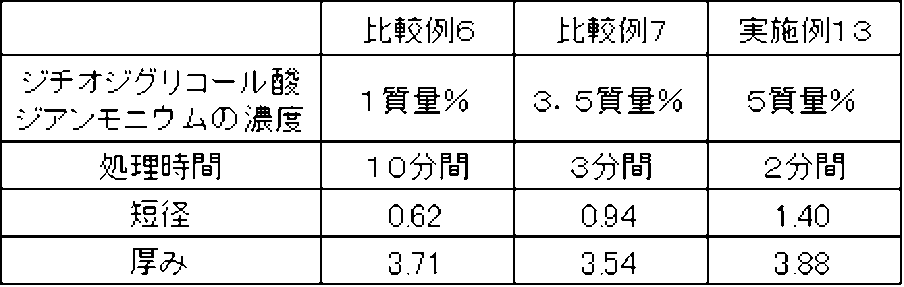
表6から分かる通り、比較例6(1質量%のジチオジグリコール酸ジアンモニウムで10分間処理)及び比較例7(3.5質量%のジチオジグリコール酸ジアンモニウムで3分間処理)では、短径が0.62cm及び0.94cmであり、ロッドの半径1.15cmには遥かに及ばないものであった。それに対して、実施例13(5質量%のジチオジグリコール酸ジアンモニウムで2分間処理)では、短径が1.40cmであり、ロッドの半径1.15cm以上であって、比較例6及び7と比較して、極めて顕著に高く、それによって、だれない、しっかりとした大きく立体的なウェーブが安定して形成された。
化学反応論的には、反応速度は反応試薬の濃度に比例して高くなり、また反応試薬の濃度が大きく変わらなければ反応時間と共に反応が進行する。従って、上記の試験では、比較例6と比較例7と実施例13では、毛髪変形処理用中間処理剤の濃度と処理時間の積が約10とほぼ等しく、同程度の反応が進行すると当業者は予想する。しかし、上記の試験結果によれば、毛髪変形処理用中間処理剤の濃度が高いものが、短い処理時間にも関わらず、意外にも短径及び厚みが顕著に高いとの結果が得られた。従って、ジチオジグリコール酸ジアンモニウムの濃度は5質量%以上であることが顕著に好ましいことが判明した。なお、比較例6(1質量%のジチオジグリコール酸ジアンモニウム,10分間)の実験条件は、特許文献1の実施例1の条件に対応する。比較例7(3.5質量%のジチオジグリコール酸ジアンモニウム,3分間)の実験条件は、特許文献2の実施例18の条件に対応する。ジチオジグリコール酸ジアンモニウムの濃度が5質量%以上であれば、たとえ処理時間が短くなっても、極めて顕著に短径及び厚みが増加する。この効果は、特許文献1及び2からは当業者は到底予測できるものではない。
試験例7:第2剤のpHの検討
試験例1で調製した第1剤を用いた。また、臭素酸ナトリウム6.0質量部と精製水94.0質量部を混合し、水酸化ナトリウムを添加することで、pHが6、8、8.5、10及び12の第2剤を調製した。毛髪変形処理用中間処理剤で処理せずに、試験例1と同様にして、毛髪変形処理を行った。得られた毛髪について、短径、厚み及び感触を測定した。その結果を表7に示す。
試験例1で調製した第1剤を用いた。また、臭素酸ナトリウム6.0質量部と精製水94.0質量部を混合し、水酸化ナトリウムを添加することで、pHが6、8、8.5、10及び12の第2剤を調製した。毛髪変形処理用中間処理剤で処理せずに、試験例1と同様にして、毛髪変形処理を行った。得られた毛髪について、短径、厚み及び感触を測定した。その結果を表7に示す。
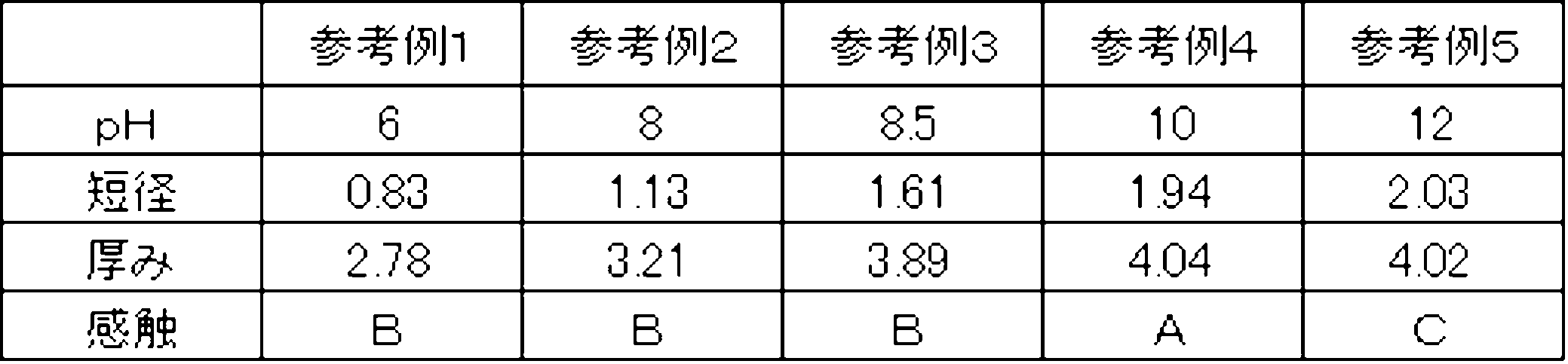
この結果から、第2剤のpHを8~12とした参考例2~5では、短径が1.13~2.03cmであり、ロッドの半径1.15cmとほぼ同等又はそれ以上であり、だれない、しっかりとした大きく立体的なウェーブが安定して形成された。しかし、pHが12の第2剤を用いた参考例5では感触が不良であったため、第2剤のpHは8~10が好ましいことが分かった。このように、第2剤のpHを8以上とすることで、第2剤による酸化処理の速度を遅くして、毛髪のカールの三次元構造を安定化することで、ほぼだれない、しっかりとした大きく立体的なウェーブを安定して形成させることができると推定している。本発明では、毛髪変形処理用中間処理剤を用いることで、だれない、しっかりとした大きく立体的なウェーブが安定して形成されるが、それに加えて、酸化剤が臭素酸塩であり、pHが8以上である第2剤を用いることで、さらにだれない、しっかりとした大きく立体的なウェーブが安定して形成される。
今回開示された実施の形態はすべての点で例示であって、制限的なものではないと考えられるべきである。本発明の範囲は上記した説明ではなく特許請求の範囲によって示され、特許請求の範囲と均等の意味、及び範囲内でのすべての変更が含まれることが意図される。
本発明によって、だれない、しっかりとした大きく立体的なウェーブを安定して形成させることができる、毛髪変形処理用中間処理剤、毛髪変形処理方法及び毛髪変形剤が提供された。
Claims (13)
- 還元剤を含有する第1剤で毛髪を処理した後、酸化剤を含有する第2剤で毛髪を処理する前に使用するための毛髪変形処理用中間処理剤であって、
ジスルフィドを5~15質量%含有する毛髪変形処理用中間処理剤。 - ジスルフィドが、還元剤の二量体である、請求項1に記載の毛髪変形処理用中間処理剤。
- ジスルフィドが、ジチオジグリコール酸又はその塩、ジチオジ乳酸又はその塩、シスタミン又はその塩、シスチン又はその塩、N,N’-ジアセチルシスチン、ジ(2,3-ジヒドロキシプロピル)ジスルフィド及びジ(2-ブチロラクチル)ジスルフィドから選択される1又は複数のジスルフィドである、請求項1に記載の毛髪変形処理用中間処理剤。
- 酸化剤が臭素酸塩又は過ホウ素酸であり、第2剤のpHが8以上である、請求項1~3のいずれかに記載の毛髪変形処理用中間処理剤。
- 以下の工程を含む、毛髪変形処理方法。
(工程1)還元剤を含有する第1剤で毛髪を処理する工程;
(工程2)工程1で処理された毛髪に対して、ジスルフィドを5~15質量%含有する毛髪変形処理用中間処理剤で処理する工程;及び
(工程3)工程2で処理された毛髪に対して、酸化剤を含有する第2剤で毛髪を処理する工程。 - ジスルフィドが、還元剤の二量体である、請求項5に記載の毛髪変形処理方法。
- ジスルフィドが、ジチオジグリコール酸又はその塩、ジチオジ乳酸又はその塩、シスタミン又はその塩、シスチン又はその塩、N,N’-ジアセチルシスチン、ジ(2,3-ジヒドロキシプロピル)ジスルフィド及びジ(2-ブチロラクチル)ジスルフィドから選択される1又は複数のジスルフィドである、請求項5に記載の毛髪変形処理方法。
- 毛髪にだれないしっかりとした立体的なカールをかける、請求項5~7のいずれかに記載の毛髪変形処理方法。
- 酸化剤が臭素酸塩又は過ホウ素酸であり、第2剤のpHが8以上である、請求項5~8のいずれかに記載の毛髪変形処理方法。
- 還元剤を含有する第1剤と、ジスルフィドを5~15質量%含有する毛髪変形処理用中間処理剤と、酸化剤を含有する第2剤を含む、毛髪変形剤。
- ジスルフィドが、還元剤の二量体である、請求項10に記載の毛髪変形剤。
- ジスルフィドが、ジチオジグリコール酸又はその塩、ジチオジ乳酸又はその塩、シスタミン又はその塩、シスチン又はその塩、N,N’-ジアセチルシスチン、ジ(2,3-ジヒドロキシプロピル)ジスルフィド及びジ(2-ブチロラクチル)ジスルフィドから選択される1又は複数の還元剤である、請求項10に記載の毛髪変形剤。
- 酸化剤が臭素酸塩又は過ホウ素酸であり、第2剤のpHが8以上である、請求項10~12のいずれかに記載の毛髪変形剤。
Priority Applications (1)
| Application Number | Priority Date | Filing Date | Title |
|---|---|---|---|
| CN201980070804.XA CN112912055A (zh) | 2018-10-30 | 2019-10-29 | 毛发变形处理用中间处理剂、毛发变形处理方法以及毛发变形剂 |
Applications Claiming Priority (2)
| Application Number | Priority Date | Filing Date | Title |
|---|---|---|---|
| JP2018203903A JP2020070249A (ja) | 2018-10-30 | 2018-10-30 | 毛髪変形処理用中間処理剤、毛髪変形処理方法及び毛髪変形剤 |
| JP2018-203903 | 2018-10-30 |
Publications (1)
| Publication Number | Publication Date |
|---|---|
| WO2020090793A1 true WO2020090793A1 (ja) | 2020-05-07 |
Family
ID=70463255
Family Applications (1)
| Application Number | Title | Priority Date | Filing Date |
|---|---|---|---|
| PCT/JP2019/042305 Ceased WO2020090793A1 (ja) | 2018-10-30 | 2019-10-29 | 毛髪変形処理用中間処理剤、毛髪変形処理方法及び毛髪変形剤 |
Country Status (3)
| Country | Link |
|---|---|
| JP (1) | JP2020070249A (ja) |
| CN (1) | CN112912055A (ja) |
| WO (1) | WO2020090793A1 (ja) |
Cited By (1)
| Publication number | Priority date | Publication date | Assignee | Title |
|---|---|---|---|---|
| JP2021109876A (ja) * | 2020-01-07 | 2021-08-02 | サムイン ケミカル カンパニー,リミテッド | 染色専用トリートメント組成物 |
Citations (3)
| Publication number | Priority date | Publication date | Assignee | Title |
|---|---|---|---|---|
| JPH07101840A (ja) * | 1993-10-06 | 1995-04-18 | Kao Corp | 縮毛矯正剤組成物及び該組成物を用いる縮毛矯正方法 |
| JP2000026251A (ja) * | 1998-07-14 | 2000-01-25 | Mirubon:Kk | パーマネントウエーブ用第2剤 |
| JP2008031052A (ja) * | 2006-07-26 | 2008-02-14 | Milbon Co Ltd | 毛髪処理用組成物 |
Family Cites Families (2)
| Publication number | Priority date | Publication date | Assignee | Title |
|---|---|---|---|---|
| JPH07538B2 (ja) * | 1992-04-16 | 1995-01-11 | 花王株式会社 | パーマネントウェーブ中間処理剤組成物 |
| JP6764648B2 (ja) * | 2015-12-25 | 2020-10-07 | タカラベルモント株式会社 | 毛髪変形処理用中間処理剤 |
-
2018
- 2018-10-30 JP JP2018203903A patent/JP2020070249A/ja active Pending
-
2019
- 2019-10-29 CN CN201980070804.XA patent/CN112912055A/zh active Pending
- 2019-10-29 WO PCT/JP2019/042305 patent/WO2020090793A1/ja not_active Ceased
Patent Citations (3)
| Publication number | Priority date | Publication date | Assignee | Title |
|---|---|---|---|---|
| JPH07101840A (ja) * | 1993-10-06 | 1995-04-18 | Kao Corp | 縮毛矯正剤組成物及び該組成物を用いる縮毛矯正方法 |
| JP2000026251A (ja) * | 1998-07-14 | 2000-01-25 | Mirubon:Kk | パーマネントウエーブ用第2剤 |
| JP2008031052A (ja) * | 2006-07-26 | 2008-02-14 | Milbon Co Ltd | 毛髪処理用組成物 |
Cited By (2)
| Publication number | Priority date | Publication date | Assignee | Title |
|---|---|---|---|---|
| JP2021109876A (ja) * | 2020-01-07 | 2021-08-02 | サムイン ケミカル カンパニー,リミテッド | 染色専用トリートメント組成物 |
| JP7185812B2 (ja) | 2020-01-07 | 2022-12-08 | サムイン ケミカル カンパニー,リミテッド | 染色専用トリートメント組成物 |
Also Published As
| Publication number | Publication date |
|---|---|
| CN112912055A (zh) | 2021-06-04 |
| JP2020070249A (ja) | 2020-05-07 |
Similar Documents
| Publication | Publication Date | Title |
|---|---|---|
| US4992267A (en) | Hair straightening composition and system | |
| US4898726A (en) | Initiated hair straightening composition and system | |
| WO2002098381A1 (en) | Method of treating hair | |
| WO2003015725A2 (en) | Compositions comprising at least one hydroxide compound and at least one reducing agent, and methods for relaxing hair | |
| EP0667141B1 (en) | Permanent wave composition and method | |
| JP6346399B2 (ja) | 毛髪変形用処理剤および毛髪変形処理方法 | |
| JP2010515764A (ja) | 縮毛矯正組成物 | |
| JP2020070249A (ja) | 毛髪変形処理用中間処理剤、毛髪変形処理方法及び毛髪変形剤 | |
| WO2020090604A1 (ja) | 毛髪変形処理用第2剤、毛髪変形処理方法及び毛髪変形剤 | |
| JP6929621B2 (ja) | 毛髪変形用第2剤、毛髪変形用剤及び毛髪変形方法 | |
| US7118736B2 (en) | Hair relaxer compositions comprising at least one hydroxide compound and at least one activating agent, and methods of using the same | |
| WO2022092125A1 (ja) | 頭髪化粧品およびその製造方法、ならびにそれを用いた髪質を改良するための方法および髪型を形成するための方法 | |
| US20120121526A1 (en) | Composition and method for long-lasting non-permanent straightening of human hair | |
| US5651961A (en) | Hair manageability and styling composition | |
| JP2009137886A (ja) | 毛髪形状制御剤第1剤 | |
| JP2023003921A (ja) | 毛髪変形用処理剤 | |
| JP6929620B2 (ja) | 毛髪変形用第2剤、毛髪変形用剤及び毛髪変形方法 | |
| JP4963554B2 (ja) | パーマ用第1剤組成物 | |
| WO2018079478A1 (ja) | 毛髪処理剤及び毛髪浸透促進剤 | |
| JP2002114651A (ja) | 有機吸収剤を使用するケラチン物質のパーマネント変形方法 | |
| JP6902829B2 (ja) | 毛髪変形用第1剤、毛髪変形用剤及び毛髪変形方法 | |
| JP2927526B2 (ja) | 毛髪セット加工用前処理剤 | |
| KR101573260B1 (ko) | 모발 변형 처리방법 | |
| JP5160188B2 (ja) | 縮毛矯正処理方法 | |
| JP2007314498A (ja) | 毛髪処理方法 |
Legal Events
| Date | Code | Title | Description |
|---|---|---|---|
| 121 | Ep: the epo has been informed by wipo that ep was designated in this application |
Ref document number: 19880086 Country of ref document: EP Kind code of ref document: A1 |
|
| NENP | Non-entry into the national phase |
Ref country code: DE |
|
| 122 | Ep: pct application non-entry in european phase |
Ref document number: 19880086 Country of ref document: EP Kind code of ref document: A1 |