WO2020079913A1 - ゴム部材及びゴム部材の被覆層組成物 - Google Patents
ゴム部材及びゴム部材の被覆層組成物 Download PDFInfo
- Publication number
- WO2020079913A1 WO2020079913A1 PCT/JP2019/029265 JP2019029265W WO2020079913A1 WO 2020079913 A1 WO2020079913 A1 WO 2020079913A1 JP 2019029265 W JP2019029265 W JP 2019029265W WO 2020079913 A1 WO2020079913 A1 WO 2020079913A1
- Authority
- WO
- WIPO (PCT)
- Prior art keywords
- rubber
- coating layer
- mass
- parts
- content
- Prior art date
- Legal status (The legal status is an assumption and is not a legal conclusion. Google has not performed a legal analysis and makes no representation as to the accuracy of the status listed.)
- Ceased
Links
Classifications
-
- B—PERFORMING OPERATIONS; TRANSPORTING
- B32—LAYERED PRODUCTS
- B32B—LAYERED PRODUCTS, i.e. PRODUCTS BUILT-UP OF STRATA OF FLAT OR NON-FLAT, e.g. CELLULAR OR HONEYCOMB, FORM
- B32B25/00—Layered products comprising a layer of natural or synthetic rubber
- B32B25/04—Layered products comprising a layer of natural or synthetic rubber comprising rubber as the main or only constituent of a layer, which is next to another layer of the same or of a different material
-
- B—PERFORMING OPERATIONS; TRANSPORTING
- B32—LAYERED PRODUCTS
- B32B—LAYERED PRODUCTS, i.e. PRODUCTS BUILT-UP OF STRATA OF FLAT OR NON-FLAT, e.g. CELLULAR OR HONEYCOMB, FORM
- B32B27/00—Layered products comprising a layer of synthetic resin
- B32B27/18—Layered products comprising a layer of synthetic resin characterised by the use of special additives
-
- B—PERFORMING OPERATIONS; TRANSPORTING
- B32—LAYERED PRODUCTS
- B32B—LAYERED PRODUCTS, i.e. PRODUCTS BUILT-UP OF STRATA OF FLAT OR NON-FLAT, e.g. CELLULAR OR HONEYCOMB, FORM
- B32B27/00—Layered products comprising a layer of synthetic resin
- B32B27/18—Layered products comprising a layer of synthetic resin characterised by the use of special additives
- B32B27/20—Layered products comprising a layer of synthetic resin characterised by the use of special additives using fillers, pigments, thixotroping agents
-
- B—PERFORMING OPERATIONS; TRANSPORTING
- B61—RAILWAYS
- B61F—RAIL VEHICLE SUSPENSIONS, e.g. UNDERFRAMES, BOGIES OR ARRANGEMENTS OF WHEEL AXLES; RAIL VEHICLES FOR USE ON TRACKS OF DIFFERENT WIDTH; PREVENTING DERAILING OF RAIL VEHICLES; WHEEL GUARDS, OBSTRUCTION REMOVERS OR THE LIKE FOR RAIL VEHICLES
- B61F5/00—Constructional details of bogies; Connections between bogies and vehicle underframes; Arrangements or devices for adjusting or allowing self-adjustment of wheel axles or bogies when rounding curves
- B61F5/02—Arrangements permitting limited transverse relative movements between vehicle underframe or bolster and bogie; Connections between underframes and bogies
- B61F5/04—Bolster supports or mountings
- B61F5/10—Bolster supports or mountings incorporating fluid springs
-
- C—CHEMISTRY; METALLURGY
- C08—ORGANIC MACROMOLECULAR COMPOUNDS; THEIR PREPARATION OR CHEMICAL WORKING-UP; COMPOSITIONS BASED THEREON
- C08K—Use of inorganic or non-macromolecular organic substances as compounding ingredients
- C08K3/00—Use of inorganic substances as compounding ingredients
- C08K3/02—Elements
- C08K3/04—Carbon
-
- C—CHEMISTRY; METALLURGY
- C08—ORGANIC MACROMOLECULAR COMPOUNDS; THEIR PREPARATION OR CHEMICAL WORKING-UP; COMPOSITIONS BASED THEREON
- C08K—Use of inorganic or non-macromolecular organic substances as compounding ingredients
- C08K3/00—Use of inorganic substances as compounding ingredients
- C08K3/18—Oxygen-containing compounds, e.g. metal carbonyls
- C08K3/20—Oxides; Hydroxides
- C08K3/22—Oxides; Hydroxides of metals
-
- C—CHEMISTRY; METALLURGY
- C08—ORGANIC MACROMOLECULAR COMPOUNDS; THEIR PREPARATION OR CHEMICAL WORKING-UP; COMPOSITIONS BASED THEREON
- C08K—Use of inorganic or non-macromolecular organic substances as compounding ingredients
- C08K5/00—Use of organic ingredients
- C08K5/02—Halogenated hydrocarbons
-
- C—CHEMISTRY; METALLURGY
- C08—ORGANIC MACROMOLECULAR COMPOUNDS; THEIR PREPARATION OR CHEMICAL WORKING-UP; COMPOSITIONS BASED THEREON
- C08L—COMPOSITIONS OF MACROMOLECULAR COMPOUNDS
- C08L11/00—Compositions of homopolymers or copolymers of chloroprene
-
- C—CHEMISTRY; METALLURGY
- C08—ORGANIC MACROMOLECULAR COMPOUNDS; THEIR PREPARATION OR CHEMICAL WORKING-UP; COMPOSITIONS BASED THEREON
- C08L—COMPOSITIONS OF MACROMOLECULAR COMPOUNDS
- C08L7/00—Compositions of natural rubber
-
- C—CHEMISTRY; METALLURGY
- C08—ORGANIC MACROMOLECULAR COMPOUNDS; THEIR PREPARATION OR CHEMICAL WORKING-UP; COMPOSITIONS BASED THEREON
- C08L—COMPOSITIONS OF MACROMOLECULAR COMPOUNDS
- C08L9/00—Compositions of homopolymers or copolymers of conjugated diene hydrocarbons
Definitions
- the present disclosure relates to a rubber member and a coating layer composition for the rubber member.
- This application claims priority based on Japanese Patent Application No. 2018-197000 filed on Oct. 18, 2018. All contents described in the Japanese patent application are incorporated herein by reference.
- railway vehicles are equipped with an air spring between the vehicle body side and the trolley side to absorb the vibration transmitted between the vehicle body side and the trolley side.
- the air spring has an upper plate attached to the vehicle body side, a lower member attached to the trolley side, and various elastic members formed of rubber material such as a diaphragm and a stopper provided between the upper plate and the lower member. It is provided (see Japanese Patent Laid-Open No. 2003-254378).
- a rubber member according to an aspect of the present disclosure is a rubber member used for an air spring for a railway vehicle, and includes a rubber main body containing rubber as a main component, and a flame-retardant coating layer that covers the surface of the rubber main body.
- the coating layer contains a rubber component containing chloroprene rubber, natural rubber, butadiene rubber or a combination thereof, antimony trioxide, expanded graphite, and a brominated flame retardant, and the rubber in the coating layer.
- the content of the expanded graphite with respect to 100 parts by mass of the component is 30 parts by mass or more, and the content ratio of the expanded graphite in the rubber body is 3% by mass or less.
- a coating layer composition for a rubber member according to another aspect of the present disclosure is a coating layer composition for a rubber member used in an air spring for a railroad vehicle, which is chloroprene rubber, natural rubber, butadiene rubber, or a combination thereof. Containing a rubber component containing, antimony trioxide, expanded graphite and a brominated flame retardant, and the content of the expanded graphite is 30 parts by mass or more based on 100 parts by mass of the rubber component.
- the “main component” is a component with the largest content, for example, a component with a content of 50 mass% or more.
- Such railway vehicles are required to have high safety, and the elastic member formed of the rubber material used under a severe environment where a load is applied is required to have further improved flame retardancy. Further, in recent years, in Europe, fire protection standards have become strict in various fields. As for products used for railway vehicles, EN 45545-2, which is a unified European standard, has been stipulated, and it is necessary to meet the above standards. Further, the elastic member is required to have wear resistance because it is accelerated in wear when used in a severe environment where a load is applied.
- a rubber member according to an aspect of the present disclosure is a rubber member used for an air spring for a railway vehicle, and includes a rubber main body containing rubber as a main component, and a flame-retardant coating layer that covers the surface of the rubber main body.
- the coating layer contains a rubber component containing chloroprene rubber, natural rubber, butadiene rubber or a combination thereof, antimony trioxide, expanded graphite, and a brominated flame retardant, and the rubber in the coating layer.
- the content of the expanded graphite with respect to 100 parts by mass of the component is 30 parts by mass or more, and the content ratio of the expanded graphite in the rubber body is 3% by mass or less.
- the rubber member has a coating layer for coating the surface of the rubber body, a rubber component containing chloroprene rubber, natural rubber, butadiene rubber or a combination thereof, antimony trioxide, expanded graphite, and a brominated flame retardant. Since the content of the expanded graphite is 30 parts by mass or more based on 100 parts by mass of the rubber component in the coating layer, the flame retardancy is excellent. Furthermore, since the content rate of the expanded graphite in the rubber body is not more than the specific content rate, the properties required for the rubber body such as high mechanical strength and toughness can be maintained.
- the coating layer further contains aluminum hypophosphite, zinc stannate, or a combination thereof.
- flame retardancy can be further improved.
- the coating layer further contains an inorganic filler
- the refractive index of the inorganic filler is 2.0 or more
- the average particle diameter of the inorganic filler is 0.5 ⁇ m or more and 10 ⁇ m or less.
- flame retardancy can be further improved.
- the refractive index and the average particle diameter of the inorganic filler is in the above range, the effect of reflecting the radiant heat from the heat source is improved, and the temperature rise of the rubber member is suppressed, thus suppressing the spread to the rubber body. The effect can be enhanced.
- the “average particle size of the inorganic filler” is the particle size (D50) corresponding to a cumulative mass percentage of 50% in the mass-based particle size distribution measured based on the laser diffraction scattering method.
- the coating layer further contains silicone.
- silicone means a polymer compound having a siloxane bond in which a silicon atom and an oxygen atom are bonded as a main skeleton and having an organic group in a side chain.
- the coating layer further contains resin particles.
- the wear resistance can be further improved.
- the coating layer does not contain aluminum hydroxide and magnesium hydroxide.
- the present inventors have found that when aluminum hydroxide or magnesium hydroxide is contained in the coating layer of the rubber member, the flame retardancy is increased but the wear resistance is reduced. Since the coating layer does not contain aluminum hydroxide and magnesium hydroxide as the flame retardant, it is possible to suppress deterioration of wear resistance of the rubber member.
- a coating layer composition for a rubber member according to another aspect of the present disclosure is a coating layer composition for a rubber member used for an air spring for a railway vehicle, and contains chloroprene rubber, natural rubber, butadiene rubber or a combination thereof. Rubber component, antimony trioxide, expanded graphite and a brominated flame retardant, and the content of the expanded graphite is 30 parts by mass or more based on 100 parts by mass of the rubber component.
- the coating layer composition of the rubber member contains a rubber component containing chloroprene rubber, natural rubber, butadiene rubber or a combination thereof, antimony trioxide, expanded graphite, and a brominated flame retardant. Since the content of the expanded graphite with respect to parts by mass is 30 parts by mass or more, it is possible to form a coating layer that can improve the flame retardancy and wear resistance of the rubber member used for the air spring for railway vehicles. [Details of the embodiment of the present disclosure] Hereinafter, the rubber member according to the embodiment of the present disclosure will be described in detail.
- the rubber member is used, for example, for an air spring that is interposed between a vehicle body side and a bogie side of a railway vehicle and absorbs vibration transmitted between the vehicle body side and the bogie side, and is used for railway vehicles such as diaphragms and stoppers. It can be applied to various rubber members used for air springs.
- the rubber member includes a rubber main body containing rubber as a main component, and a flame-retardant coating layer that covers the surface of the rubber main body. [Rubber body]
- the rubber body is mainly composed of rubber.
- the rubber is not particularly limited, but examples thereof include natural rubber (NR), isoprene rubber (IR), butadiene rubber (BR), styrene-butadiene copolymer rubber (SBR), acrylonitrile-butadiene copolymer rubber (NBR), chloroprene.
- Rubber (CR), butyl rubber (IIR), ethylene-propylene rubber (EPM) and ethylene-propylene-diene rubber (EPDM), chlorosulfonated polyethylene rubber (CSM), hydrogenated acrylonitrile-butadiene copolymer rubber (HNBR), etc. are used. be able to.
- chloroprene rubber, natural rubber and butadiene rubber are preferable as the rubber from the viewpoint of improving mechanical strength, weather resistance and heat resistance.
- the above rubbers can be used alone or in combination of two or more.
- the content of expanded graphite in the rubber body is 3 mass% or less, preferably 2 mass% or less, and more preferably 1 mass% or less. Most preferably, the rubber body does not contain expanded graphite. When the content of expanded graphite in the rubber body is 3% by mass or less, the properties required for the rubber body, such as high mechanical strength and toughness, can be maintained.
- the rubber body may contain additives as components other than rubber and expanded graphite.
- additives include vulcanizing agents, vulcanization accelerators, antioxidants, lubricants, antioxidants, ultraviolet absorbers, colorants, fillers, softeners, plasticizers, waxes, vulcanization accelerator aids, etc. Is mentioned.
- the lower limit of the rubber content in the rubber body is preferably 37% by mass, more preferably 40% by mass, and even more preferably 43% by mass.
- the content of rubber in the rubber body is smaller than the above lower limit, the elasticity of the rubber body may decrease, and the elasticity of the rubber member may be insufficient.
- the average thickness of the rubber body is not particularly limited and can be appropriately changed depending on the application, but can be, for example, 2 mm or more and 100 mm or less.
- the “average thickness” means the average value of the thicknesses measured at arbitrary ten points.
- the coating layer is flame-retardant and covers the surface of the rubber body. Further, the coating layer may cover not only the entire surface of the rubber body but also a part of the outer surface.
- the coating layer contains a rubber component, antimony trioxide, expanded graphite, and a brominated flame retardant. When the coating layer contains the components, the rubber member has excellent flame retardancy.
- the rubber component contains chloroprene rubber, natural rubber, butadiene rubber, or a combination thereof. Since the coating layer contains chloroprene rubber, natural rubber, butadiene rubber or a combination thereof as a rubber component, it has excellent mechanical strength, abrasion resistance, weather resistance, heat resistance and the like.
- the lower limit of the content of the rubber component in the coating layer is preferably 27% by mass, more preferably 30% by mass, and further preferably 33% by mass.
- the upper limit of the rubber content in the coating layer is more preferably 77% by mass, more preferably 74% by mass, and further preferably 71% by mass.
- the flame retardancy of the rubber member may be insufficient.
- the lower limit of the content of the antimony trioxide with respect to 100 parts by mass of the rubber component in the coating layer is preferably 3 parts by mass, and more preferably 5 parts by mass.
- the upper limit of the content of the antimony trioxide with respect to 100 parts by mass of the rubber component in the coating layer is preferably 25 parts by mass, and more preferably 20 parts by mass.
- the lower limit of the content of the expanded graphite with respect to 100 parts by mass of the rubber component in the coating layer is 30 parts by mass, preferably 40 parts by mass.
- the upper limit of the content of the expanded graphite with respect to 100 parts by mass of the rubber component in the coating layer is preferably 100 parts by mass, more preferably 90 parts by mass.
- a bromine-containing organic compound is preferable, and examples thereof include ethylenebis (pentabromobiphenyl), hexabromobenzene, tetrabromobisphenol S, hexabromocyclododecane (HBCD), tetrabromobisphenol A (TBBA), TBBA.
- the lower limit of the content of the brominated flame retardant with respect to 100 parts by mass of the rubber component in the coating layer is preferably 3 parts by mass, and more preferably 5 parts by mass.
- the upper limit of the content of the brominated flame retardant with respect to 100 parts by mass of the rubber component in the coating layer is preferably 45 parts by mass, and more preferably 40 parts by mass.
- the coating layer further contains aluminum hypophosphite, zinc stannate, or a combination thereof.
- flame retardancy can be further improved.
- the lower limit of the content of the aluminum hypophosphite with respect to 100 parts by mass of the rubber component in the coating layer is preferably 1 part by mass, more preferably 3 parts by mass.
- the upper limit of the content of the aluminum hypophosphite with respect to 100 parts by mass of the rubber component in the coating layer is preferably 15 parts by mass, and more preferably 12 parts by mass.
- the lower limit of the content of the zinc stannate with respect to 100 parts by mass of the rubber component in the coating layer is preferably 1 part by mass, more preferably 3 parts by mass.
- the upper limit of the content of the zinc stannate with respect to 100 parts by mass of the rubber component in the coating layer is preferably 15 parts by mass, and more preferably 12 parts by mass.
- the difference in refractive index between the inorganic filler and the rubber component is preferably large.
- a refractive index of the above-mentioned inorganic filler 2.0 is preferred and 2.3 is more preferred.
- the upper limit of the refractive index of the inorganic filler is not particularly limited, but can be 3.5, for example.
- the “refractive index of the inorganic filler” is the absolute refractive index that is the value obtained by dividing the speed of light in vacuum (phase velocity of light) by the speed of light in the inorganic filler. Please let us know if it is the relative refractive index which is the ratio of the absolute refractive indices of the two substances.
- the lower limit of the average particle size of the inorganic filler is preferably 0.5 ⁇ m, more preferably 0.7 ⁇ m.
- the upper limit of the average particle diameter of the inorganic filler is preferably 10 ⁇ m, more preferably 5 ⁇ m.
- the above-mentioned inorganic filler is preferably a metal oxide, and examples thereof include iron oxide, titanium oxide, iron-chromium composite oxide, and copper oxide.
- the lower limit of the content of the inorganic filler with respect to 100 parts by mass of the rubber component in the coating layer is preferably 3 parts by mass, and more preferably 5 parts by mass.
- the upper limit of the content of the inorganic filler with respect to 100 parts by mass of the rubber component in the coating layer is preferably 30 parts by mass, and more preferably 25 parts by mass.
- silicone examples include polysiloxane having a methyl group, a phenyl group, or the like in the side chain.
- the lower limit of the weight average molecular weight of the silicone is preferably 80,000, more preferably 90,000 and even more preferably 100,000.
- the upper limit of the weight average molecular weight of the silicone is preferably 2,000,000, more preferably 17,50,000, and even more preferably 1,500,000. If the content of silicone in the coating layer is smaller than the lower limit, the effect of improving the wear resistance of the rubber member may not be obtained. On the contrary, when the content of silicone in the coating layer exceeds the above upper limit, it may be difficult to uniformly disperse the coating layer.
- the coating layer preferably further contains resin particles. When the coating layer further contains resin particles, the wear resistance can be further improved.
- the resin particles include polyolefin particles, polyester particles, and polyamide particles.
- the polyolefin particles include homopolymer particles such as polyethylene particles, polypropylene particles, poly-1-butene particles and poly-4-methyl-1-pentene particles; ethylene and propylene, 1-butene, 1-hexene, 1-octene. And particles of a copolymer with ⁇ -olefin such as 4-methyl-1-pentene.
- polyester particles include polyethylene terephthalate particles, polytrimethylene terephthalate particles, polybutylene terephthalate particles, polyethylene naphthalate particles, and polybutylene naphthalate particles.
- polyamide particles examples include nylon 6 particles, nylon 12 particles, nylon 66 particles and the like.
- Others a group of resins called engineering plastics, specifically polyacetal particles, polycarbonate particles, modified polyphenylene ether particles, polyarylate particles, polysulfone particles, polyphenyl sulfone particles, polyether sulfone particles, polyphenylene sulfide particles, polyetherimide particles, Examples thereof include liquid crystal polymer particles, polyether ether ketone particles, polyamide imide particles, fluororesin particles, and polyimide particles.
- the resin particles may be used alone or in combination of two or more.
- the lower limit of the content of the resin particles in 100 parts by mass of the rubber component in the coating layer is preferably 3 parts by mass, and more preferably 5 parts by mass.
- the upper limit of the content of the resin particles with respect to 100 parts by mass of the rubber component in the coating layer is preferably 30 parts by mass, and more preferably 25 parts by mass. If the content of the resin particles in the coating layer is smaller than the lower limit, the effect of improving the wear resistance of the rubber member may not be obtained. On the contrary, when the content of the resin particles in the coating layer exceeds the above upper limit, physical properties such as mechanical strength may deteriorate. (Aluminum hydroxide and magnesium hydroxide)
- the coating layer preferably does not contain aluminum hydroxide or magnesium hydroxide.
- the coating layer does not contain aluminum hydroxide and magnesium hydroxide as the flame retardant, it is possible to suppress deterioration of wear resistance of the rubber member.
- the coating layer within a range that does not impair the effects of the present disclosure, the above rubber component, antimony trioxide, expanded graphite, brominated flame retardant, aluminum hypophosphite, zinc stannate, inorganic filler, silicone, resin particles, Other additives may be contained as a component other than aluminum hydroxide and magnesium hydroxide.
- the additives include vulcanizing agents, vulcanization accelerators, antioxidants, coloring agents such as carbon black, lubricants, antioxidants, ultraviolet absorbers, softening agents, plasticizers, waxes, vulcanization accelerating aids. Etc.
- the coating layer containing the above-mentioned other additives can impart desired characteristics to the coating layer.
- the upper limit of the content of the other additives with respect to 100 parts by mass of the rubber component in the coating layer is preferably 100 parts by mass, and more preferably 95 parts by mass.
- the lower limit of the average thickness of the coating layer is preferably 100 ⁇ m, more preferably 200 ⁇ m, and even more preferably 300 ⁇ m.
- the upper limit of the average thickness is preferably 3500 ⁇ m, preferably 3000 ⁇ m, and more preferably 2500 ⁇ m. If the average thickness is less than the lower limit, the flame retardancy and molding processability of the rubber member may decrease. On the contrary, when the average thickness exceeds the upper limit, the rubber member may be unnecessarily thick.
- the coating layer composition of the rubber member (hereinafter, also referred to as the coating layer composition) is a composition used for forming the coating layer of the rubber member.
- the coating layer composition for the rubber member includes a rubber component containing chloroprene rubber, natural rubber, butadiene rubber or a combination thereof, antimony trioxide, expanded graphite, and a brominated flame retardant. Further, the content of the expanded graphite is 30 parts by mass or more based on 100 parts by mass of the rubber component.
- a coating layer for a rubber member having excellent flame retardancy can be formed.
- the above-mentioned rubber component, antimony trioxide, expanded graphite and brominated flame retardant contained in the coating layer composition of the rubber member are as described above.
- the lower limit of the content of the rubber component in the coating layer composition is preferably 27% by mass, more preferably 30% by mass, and further preferably 33% by mass.
- the content of rubber in the coating layer composition is smaller than the lower limit, the elasticity of the coating layer of the rubber member may decrease.
- the lower limit of the content of the antimony trioxide based on 100 parts by mass of the rubber component in the coating layer composition is preferably 3 parts by mass, more preferably 5 parts by mass.
- the upper limit of the content of the antimony trioxide with respect to 100 parts by mass of the rubber component in the coating layer composition is preferably 25 parts by mass, and more preferably 20 parts by mass.
- the lower limit of the content of the expanded graphite with respect to 100 parts by mass of the rubber component in the coating layer composition is 30 parts by mass, preferably 40 parts by mass.
- the upper limit of the content of the expanded graphite with respect to 100 parts by mass of the rubber component in the coating layer composition is preferably 100 parts by mass, and more preferably 90 parts by mass.
- the lower limit of the content of the brominated flame retardant with respect to 100 parts by mass of the rubber component in the coating layer composition is preferably 3 parts by mass, and more preferably 5 parts by mass.
- the upper limit of the content of the brominated flame retardant with respect to 100 parts by mass of the rubber component in the coating layer composition is preferably 45 parts by mass, and more preferably 40 parts by mass.
- the coating layer composition for the rubber member preferably further contains aluminum hypophosphite, zinc stannate, an inorganic filler, silicone, resin particles or a combination thereof.
- the coating layer composition for a rubber member can further form a coating layer for a rubber member having better flame retardancy by further containing aluminum hypophosphite, zinc stannate, an inorganic filler, or a combination thereof.
- the coating layer composition of the rubber member can further form a coating layer of the rubber member having better wear resistance by further containing silicone, resin particles or a combination thereof.
- the lower limit of the content of the aluminum hypophosphite with respect to 100 parts by mass of the rubber component in the coating layer composition is preferably 1 part by mass, more preferably 3 parts by mass.
- the upper limit of the content of the aluminum hypophosphite with respect to 100 parts by mass of the rubber component in the coating layer composition is preferably 15 parts by mass, and more preferably 12 parts by mass.
- the lower limit of the content of zinc stannate with respect to 100 parts by mass of the rubber component in the coating layer composition is preferably 1 part by mass, more preferably 3 parts by mass.
- the upper limit of the content of zinc stannate with respect to 100 parts by mass of the rubber component in the coating layer composition is preferably 15 parts by mass, and more preferably 12 parts by mass.
- the lower limit of the content of the inorganic filler with respect to 100 parts by mass of the rubber component in the coating layer composition is preferably 3 parts by mass, more preferably 5 parts by mass.
- the upper limit of the content of the inorganic filler with respect to 100 parts by mass of the rubber component in the coating layer composition is preferably 30 parts by mass, more preferably 25 parts by mass.
- the lower limit of the content of the silicone with respect to 100 parts by mass of the rubber component in the coating layer composition is preferably 0.3 part by mass, more preferably 0.5 part by mass.
- an upper limit of the content of the silicone with respect to 100 parts by mass of the rubber component in the coating layer composition 15 parts by mass is preferable, and 12 parts by mass is more preferable.
- the content of silicone in the coating layer composition is smaller than the lower limit, the effect of improving the wear resistance of the rubber member may not be obtained.
- the content of silicone in the coating layer composition exceeds the above upper limit, physical properties such as mechanical strength may deteriorate.
- the lower limit of the content of the resin particles with respect to 100 parts by mass of the rubber component in the coating layer composition is preferably 3 parts by mass, more preferably 5 parts by mass.
- the upper limit of the content of the resin particles with respect to 100 parts by mass of the rubber component in the coating layer composition is preferably 30 parts by mass, and more preferably 25 parts by mass.
- the said coating layer composition does not contain aluminum hydroxide and magnesium hydroxide. Since the coating layer composition does not contain aluminum hydroxide and magnesium hydroxide as the flame retardant, it is possible to suppress deterioration of wear resistance of the rubber member. (Other additives)
- the coating layer composition as long as the effect of the present disclosure is not impaired, the above rubber component, antimony trioxide, expanded graphite, brominated flame retardant, aluminum hypophosphite, zinc stannate, inorganic filler, silicone, resin.
- Other additives may be contained as components other than the particles, aluminum hydroxide and magnesium hydroxide.
- the additives include vulcanizing agents, vulcanization accelerators, antioxidants, coloring agents such as carbon black, lubricants, antioxidants, ultraviolet absorbers, softening agents, plasticizers, waxes, vulcanization accelerating aids. Etc.
- the coating layer composition containing the above-mentioned additive can impart desired characteristics to the coating layer composition.
- the upper limit of the content of the other additives with respect to 100 parts by mass of the rubber component in the coating layer composition is preferably 100 parts by mass, and more preferably 95 parts by mass.
- the method for manufacturing the rubber member includes, for example, a step of preparing a coating layer composition and a step of laminating the coating layer on the surface of the rubber body.
- each component except a vulcanizing agent, a vulcanization accelerator, and the like is blended, and the coating layer is cooled by a pressure kneader so as to prevent crosslinking from progressing during mixing, and the coating layer.
- a pressure kneader so as to prevent crosslinking from progressing during mixing, and the coating layer.
- the coating layer composition is prepared by mixing the remaining components while keeping the composition at a temperature of 90 ° C. or lower while cooling with water by a roll so that crosslinking does not proceed during mixing.
- the coating layer composition prepared in the coating layer composition preparation step is superposed on the surface of the rubber body by press vulcanization, or after being set on the inner surface of the mold, the rubber body is injection-molded and vulcanized. Thus, the coating layer is laminated on the surface of the rubber body.
- the rubber member Since the rubber member is excellent in flame retardancy and can enhance the safety of the air spring for railway vehicles, it can be suitably used for the rubber member used for the air spring for railway vehicles. Further, according to the coating layer composition of the rubber member, it is possible to form a coating layer capable of improving the flame retardancy and wear resistance of the rubber member used in the air spring for railway vehicles. [Other Embodiments]
- the embodiments disclosed this time are to be considered as illustrative in all points and not restrictive. The scope of the present invention is not limited to the configurations of the above-described embodiments, but is shown by the claims, and is intended to include meanings equivalent to the claims and all modifications within the scope. .
- Rubber member No. 1 to No. 17 was manufactured by the following procedure, and the flame retardancy and abrasion resistance were evaluated. Rubber member No. 1 to No. The compositions of 17 are shown in Tables 1 to 4. In addition, "-" in Tables 1 to 4 indicates that the corresponding component was not used. (1) Material used (natural rubber) RSS (Ribbed Smoked Sheet) No.
- Vulcanizing agent Fine powder sulfur S 325 mesh (Hosoi Chemical Co., Ltd.) (2) Mixing of materials The above materials were mixed in the respective amounts (unit: parts by mass) shown in Tables 1 to 4 below, and the coating layer was prepared by a pressure kneader while cooling with water to prevent crosslinking during mixing. The composition was mixed at a temperature of 110 ° C. or lower. Next, a coating layer composition was prepared by mixing the remaining components while keeping the composition at a temperature of 90 ° C. or lower while cooling with water by a roll so that crosslinking did not proceed during mixing.
- MARHE An index called MARHE stipulated in EN 45545-2 was calculated from the above heat generation rate data, and if MARHE was 90 kW / m 2 or less, it was determined to be acceptable. Regarding the evaluation, the following four stages were evaluated.
- Dsmax The maximum smoke density
- a toxicity test (general product) based on EN 45545-2 Annex C was conducted. The conditions of the corn calorimeter were 25 kW / mm 2 , the test time was 4 minutes and 8 minutes, and the generated gas of the coating layer of each thickness at each time was analyzed, and the standard index of toxicity specified in EN 45545-2 ( CITG) was calculated. If the CITG after 4 minutes and after 8 minutes were both 1.8 or less, it was determined to be acceptable. Regarding the evaluation, the following four stages were evaluated.
- the coating layer has a thickness of 0.7 mm and passes B: The coating layer has a thickness of 1.4 mm and passes C: The coating layer has a thickness of 2.1 mm and passes D: The coating layer has a thickness of 2.1 mm and fails [ Flame retardant comprehensive evaluation]
- the flame-retardant comprehensive evaluation was evaluated in the following four stages based on the three evaluation results of (1) heat release rate, (2) smoke concentration and (3) toxicity test. When the flame retardant comprehensive evaluation is C or more, it can be applied as a rubber member.
- the abrasion resistance was evaluated based on the Taber abrasion test results in the following three stages.
- Tables 1 to 4 show the evaluation results.
- the coating layer contains a rubber component containing chloroprene rubber, natural rubber and butadiene rubber, antimony trioxide, expanded graphite and a brominated flame retardant, and the rubber component in the coating layer.
- the rubber member No. 3 and rubber member No. 9-No. When compared with No. 13, the rubber member No. which uses aluminum hypophosphite, zinc stannate, iron oxide, titanium oxide or iron-chromium composite oxide together as a flame retardant. 9-No. It can be seen that No. 13 has further improved flame retardancy.
- the rubber member has excellent flame retardancy and can improve wear resistance.
Landscapes
- Chemical & Material Sciences (AREA)
- Health & Medical Sciences (AREA)
- Chemical Kinetics & Catalysis (AREA)
- Medicinal Chemistry (AREA)
- Polymers & Plastics (AREA)
- Organic Chemistry (AREA)
- Engineering & Computer Science (AREA)
- Mechanical Engineering (AREA)
- Compositions Of Macromolecular Compounds (AREA)
- Laminated Bodies (AREA)
Abstract
本開示の一態様に係るゴム部材は、鉄道車両用空気ばねに用いるゴム部材であって、ゴムを主成分とするゴム本体と、上記ゴム本体の表面を被覆する難燃性の被覆層とを備え、上記被覆層が、クロロプレンゴム、天然ゴム、ブタジエンゴム又はこれらの組合せを含有するゴム成分と、三酸化アンチモンと、膨張黒鉛と、臭素系難燃剤とを含み、上記被覆層中の上記ゴム成分100質量部に対する上記膨張黒鉛の含有量が30質量部以上であり、上記ゴム本体中の膨張黒鉛の含有率が3質量%以下である。
Description
本開示は、ゴム部材及びゴム部材の被覆層組成物に関する。本出願は、2018年10月18日に出願した日本特許出願である特願2018-197000号に基づく優先権を主張する。当該日本特許出願に記載された全ての記載内容は、参照によって本明細書に援用される。
一般に、鉄道車両には、その車体側と台車側との間に空気ばねが装備され、車体側及び台車側間に伝わる振動を吸収するようになっている。
空気ばねは、車体側に取り付けられる上面板と、台車側に取り付けられる下側部材と、上面板及び下側部材間に設けられるダイヤフラム、ストッパー等、ゴム材で形成される種々の弾性部材とが備えられている(特開2003-254378号公報参照)。
本開示の一態様に係るゴム部材は、鉄道車両用空気ばねに用いるゴム部材であって、ゴムを主成分とするゴム本体と、上記ゴム本体の表面を被覆する難燃性の被覆層とを備え、上記被覆層が、クロロプレンゴム、天然ゴム、ブタジエンゴム又はこれらの組合せを含有するゴム成分と、三酸化アンチモンと、膨張黒鉛と、臭素系難燃剤とを含み、上記被覆層中の上記ゴム成分100質量部に対する上記膨張黒鉛の含有量が30質量部以上であり、上記ゴム本体中の膨張黒鉛の含有率が3質量%以下である。
また、本開示の別の一態様に係るゴム部材の被覆層組成物は、鉄道車両用空気ばねに用いるゴム部材の被覆層組成物であって、クロロプレンゴム、天然ゴム、ブタジエンゴム又はこれらの組合せを含有するゴム成分と、三酸化アンチモンと、膨張黒鉛と、臭素系難燃剤とを含み、上記ゴム成分100質量部に対する上記膨張黒鉛の含有量が30質量部以上である。
ここで、「主成分」とは、最も含有量の多い成分であり、例えば含有量が50質量%以上の成分をいう。
[本開示が解決しようとする課題]
このような鉄道車両は高い安全性が要求されており、荷重がかかる過酷な環境下で使用される上記ゴム材で形成される弾性部材は、さらなる難燃性の向上が求められる。また、近年、欧州においては、様々な分野において防火基準が厳しくなっている。鉄道車両に使用される製品についても欧州統一規格のEN 45545-2が規定されており、上記基準を満たす必要がある。さらに、上記弾性部材は、荷重がかかる過酷な環境下で使用された場合、摩耗が促進されることから、耐摩耗性も備える必要がある。
このような鉄道車両は高い安全性が要求されており、荷重がかかる過酷な環境下で使用される上記ゴム材で形成される弾性部材は、さらなる難燃性の向上が求められる。また、近年、欧州においては、様々な分野において防火基準が厳しくなっている。鉄道車両に使用される製品についても欧州統一規格のEN 45545-2が規定されており、上記基準を満たす必要がある。さらに、上記弾性部材は、荷重がかかる過酷な環境下で使用された場合、摩耗が促進されることから、耐摩耗性も備える必要がある。
本開示は上記事情に基づいてなされたものであり、難燃性に優れ、鉄道車両用空気ばねの安全性を高めることができるゴム部材を提供することを目的とする。
[本開示の効果]
本開示の一態様に係るゴム部材は、難燃性に優れ、鉄道車両用空気ばねの安全性を高めることができる。
[本開示の実施形態の説明]
本開示の一態様に係るゴム部材は、鉄道車両用空気ばねに用いるゴム部材であって、ゴムを主成分とするゴム本体と、上記ゴム本体の表面を被覆する難燃性の被覆層とを備え、上記被覆層が、クロロプレンゴム、天然ゴム、ブタジエンゴム又はこれらの組合せを含有するゴム成分と、三酸化アンチモンと、膨張黒鉛と、臭素系難燃剤とを含み、上記被覆層中の上記ゴム成分100質量部に対する上記膨張黒鉛の含有量が30質量部以上であり、上記ゴム本体中の膨張黒鉛の含有率が3質量%以下である。
[本開示の効果]
本開示の一態様に係るゴム部材は、難燃性に優れ、鉄道車両用空気ばねの安全性を高めることができる。
[本開示の実施形態の説明]
本開示の一態様に係るゴム部材は、鉄道車両用空気ばねに用いるゴム部材であって、ゴムを主成分とするゴム本体と、上記ゴム本体の表面を被覆する難燃性の被覆層とを備え、上記被覆層が、クロロプレンゴム、天然ゴム、ブタジエンゴム又はこれらの組合せを含有するゴム成分と、三酸化アンチモンと、膨張黒鉛と、臭素系難燃剤とを含み、上記被覆層中の上記ゴム成分100質量部に対する上記膨張黒鉛の含有量が30質量部以上であり、上記ゴム本体中の膨張黒鉛の含有率が3質量%以下である。
当該ゴム部材は、ゴム本体の表面を被覆する被覆層が、クロロプレンゴム、天然ゴム、ブタジエンゴム又はこれらの組合せを含有するゴム成分と、三酸化アンチモンと、膨張黒鉛と、臭素系難燃剤とを含み、上記被覆層中の上記ゴム成分100質量部に対する上記膨張黒鉛の含有量が30質量部以上であるので、難燃性に優れる。さらに、上記ゴム本体中の膨張黒鉛の含有率が特定の含有率以下であるため、例えば高い機械強度や靱性等、ゴム本体に求められる特性を維持することができる。
上記被覆層が次亜リン酸アルミニウム、スズ酸亜鉛又はこれらの組合せをさらに含有することが好ましい。上記被覆層が次亜リン酸アルミニウム、スズ酸亜鉛又はこれらの組合せをさらに含有することで、難燃性をより向上できる。
上記被覆層が、無機フィラーをさらに含有し、上記無機フィラーの屈折率が2.0以上であり、上記無機フィラーの平均粒径が0.5μm以上10μm以下であることが好ましい。上記被覆層が、無機フィラーをさらに含有し、上記無機フィラーの屈折率及び平均粒径が上記範囲であることで、難燃性をより向上できる。特に、上記無機フィラーの屈折率及び平均粒径が上記範囲であることで、熱源からの輻射熱を反射する効果が向上し、ゴム部材の温度上昇が抑制されるため、ゴム本体への延焼に対する抑制効果を高めることができる。
ここで、「無機フィラーの平均粒径」とは、レーザー回折散乱法に基づいて測定される質量基準の粒度分布において、累積質量百分率が50%に相当する粒径(D50)のことである。
上記被覆層がシリコーンをさらに含有することが好ましい。上記被覆層がシリコーンをさらに含有することで、耐摩耗性をより向上できる。ここで、「シリコーン」とは、ケイ素原子と酸素原子とが結合したシロキサン結合を主骨格とし、側鎖に有機基を有する高分子化合物を意味する。
上記被覆層が樹脂粒子をさらに含有することが好ましい。上記被覆層が樹脂粒子をさらに含有することで、耐摩耗性をより向上できる。
上記被覆層が水酸化アルミニウム及び水酸化マグネシウムを含有しないことが好ましい。本発明者らは、ゴム部材の被覆層に水酸化アルミニウム又は水酸化マグネシウムを含有すると、難燃性が高められるが、耐摩耗性が低下することを知見した。上記被覆層が難燃剤として水酸化アルミニウム及び水酸化マグネシウムを含有しないことで、当該ゴム部材の耐摩耗性が低下することを抑制できる。
本開示の他の一態様に係るゴム部材の被覆層組成物は、鉄道車両用空気ばねに用いるゴム部材の被覆層組成物であって、クロロプレンゴム、天然ゴム、ブタジエンゴム又はこれらの組合せを含有するゴム成分と、三酸化アンチモンと、膨張黒鉛と、臭素系難燃剤とを含み、上記ゴム成分100質量部に対する上記膨張黒鉛の含有量が30質量部以上である。
当該ゴム部材の被覆層組成物は、クロロプレンゴム、天然ゴム、ブタジエンゴム又はこれらの組合せを含有するゴム成分と、三酸化アンチモンと、膨張黒鉛と、臭素系難燃剤とを含み、上記ゴム成分100質量部に対する上記膨張黒鉛の含有量が30質量部以上であるので、鉄道車両用空気ばねに用いるゴム部材の難燃性及び耐摩耗性を向上できる被覆層を形成できる。
[本開示の実施形態の詳細]
以下、本開示の実施形態に係るゴム部材について詳説する。
<ゴム部材>
当該ゴム部材は、例えば、鉄道車両の車体側と台車側との間に介装されて、車体側及び台車側間に伝わる振動を吸収する空気ばねに用いられ、ダイヤフラム、ストッパー等、鉄道車両用空気ばねに用いる種々のゴム部材に適用できる。当該ゴム部材は、ゴムを主成分とするゴム本体と、上記ゴム本体の表面を被覆する難燃性の被覆層とを備える。
[ゴム本体]
ゴム本体は、ゴムを主成分とする。上記ゴムとしては、特に限定されないが、例えば天然ゴム(NR)、イソプレンゴム(IR)、ブタジエンゴム(BR)、スチレン-ブタジエン共重合ゴム(SBR)、アクリロニトリル-ブタジエン共重合ゴム(NBR)、クロロプレンゴム(CR)、ブチルゴム(IIR)、エチレン-プロピレンゴム(EPM)及びエチレン-プロピレン-ジエンゴム(EPDM)、クロロスルホン化ポリエチレンゴム(CSM)、水素化アクリロニトリル-ブタジエン共重合ゴム(HNBR)などを用いることができる。上記ゴムとしては、機械的強度、耐候性、耐熱性向上の観点から、これらの中でもクロロプレンゴム、天然ゴム、ブタジエンゴムが好ましい。上記ゴムは、1種単独で又は2種以上を組み合わせて用いることができる。
[本開示の実施形態の詳細]
以下、本開示の実施形態に係るゴム部材について詳説する。
<ゴム部材>
当該ゴム部材は、例えば、鉄道車両の車体側と台車側との間に介装されて、車体側及び台車側間に伝わる振動を吸収する空気ばねに用いられ、ダイヤフラム、ストッパー等、鉄道車両用空気ばねに用いる種々のゴム部材に適用できる。当該ゴム部材は、ゴムを主成分とするゴム本体と、上記ゴム本体の表面を被覆する難燃性の被覆層とを備える。
[ゴム本体]
ゴム本体は、ゴムを主成分とする。上記ゴムとしては、特に限定されないが、例えば天然ゴム(NR)、イソプレンゴム(IR)、ブタジエンゴム(BR)、スチレン-ブタジエン共重合ゴム(SBR)、アクリロニトリル-ブタジエン共重合ゴム(NBR)、クロロプレンゴム(CR)、ブチルゴム(IIR)、エチレン-プロピレンゴム(EPM)及びエチレン-プロピレン-ジエンゴム(EPDM)、クロロスルホン化ポリエチレンゴム(CSM)、水素化アクリロニトリル-ブタジエン共重合ゴム(HNBR)などを用いることができる。上記ゴムとしては、機械的強度、耐候性、耐熱性向上の観点から、これらの中でもクロロプレンゴム、天然ゴム、ブタジエンゴムが好ましい。上記ゴムは、1種単独で又は2種以上を組み合わせて用いることができる。
上記ゴム本体中の膨張黒鉛の含有率は3質量%以下であり、好ましくは2質量%以下であり、より好ましくは1質量%以下である。ゴム本体が膨張黒鉛を含有しないことが最も好ましい。上記ゴム本体中の膨張黒鉛の含有率が3質量%以下であることで、例えば高い機械強度や靱性等、ゴム本体に求められる特性を維持することができる。
上記ゴム本体は、ゴム、膨張黒鉛以外の成分として添加剤を含有してもよい。上記添加剤としては、例えば加硫剤、加硫促進剤、老化防止剤、滑剤、酸化防止剤、紫外線吸収剤、着色剤、充填材、軟化剤、可塑剤、ワックス、加硫促進助剤等が挙げられる。
ゴム本体におけるゴムの含有量の下限としては、37質量%が好ましく、40質量%がより好ましく、43質量%がさらに好ましい。ゴム本体におけるゴムの含有量が上記下限より小さい場合、ゴム本体の弾性が低下し、ゴム部材の弾性が不十分となるおそれがある。
ゴム本体の平均厚さとしては、特に限定されず用途に応じて適宜変更可能であるが、例えば2mm以上100mm以下とすることができる。ここで、「平均厚さ」とは、任意の十点において測定した厚さの平均値をいう。
[被覆層]
被覆層は難燃性であり、上記ゴム本体の表面を被覆する。また、被覆層は上記ゴム本体の全表面のみならず、一部の外表面のみを被覆していてもよい。上記被覆層は、ゴム成分と、三酸化アンチモンと、膨張黒鉛と、臭素系難燃剤とを含む。上記被覆層が上記成分を含有することで、当該ゴム部材は難燃性に優れる。
(ゴム成分)
上記ゴム成分としては、クロロプレンゴム、天然ゴム、ブタジエンゴム又はこれらの組合せを含有する。被覆層は、ゴム成分としてクロロプレンゴム、天然ゴム、ブタジエンゴム又はこれらの組合せを含有することで、機械的強度、耐摩耗性、耐候性、耐熱性等が優れる。
[被覆層]
被覆層は難燃性であり、上記ゴム本体の表面を被覆する。また、被覆層は上記ゴム本体の全表面のみならず、一部の外表面のみを被覆していてもよい。上記被覆層は、ゴム成分と、三酸化アンチモンと、膨張黒鉛と、臭素系難燃剤とを含む。上記被覆層が上記成分を含有することで、当該ゴム部材は難燃性に優れる。
(ゴム成分)
上記ゴム成分としては、クロロプレンゴム、天然ゴム、ブタジエンゴム又はこれらの組合せを含有する。被覆層は、ゴム成分としてクロロプレンゴム、天然ゴム、ブタジエンゴム又はこれらの組合せを含有することで、機械的強度、耐摩耗性、耐候性、耐熱性等が優れる。
被覆層におけるゴム成分の含有量の下限としては、27質量%が好ましく、30質量%がより好ましく、33質量%がさらに好ましい。被覆層におけるゴムの含有量が上記下限より小さい場合、被覆層の弾性が低下し、当該ゴム部材の弾性が不十分となるおそれがある。なお、被覆層におけるゴムの含有量の上限としては、77質量%がより好ましく、74質量%がより好ましく、71質量%がさらに好ましい。被覆層におけるゴムの含有量が上記上限より大きい場合、当該ゴム部材の難燃性が不十分となるおそれがある。
(三酸化アンチモン)
被覆層は、三酸化アンチモンを含有することで、難燃性を向上できる。
(三酸化アンチモン)
被覆層は、三酸化アンチモンを含有することで、難燃性を向上できる。
上記被覆層中の上記ゴム成分100質量部に対する上記三酸化アンチモンの含有量の下限としては、3質量部が好ましく、5質量部がより好ましい。一方、上記被覆層中の上記ゴム成分100質量部に対する上記三酸化アンチモンの含有量の上限としては、25質量部が好ましく、20質量部がより好ましい。被覆層における三酸化アンチモンの含有量が上記下限より小さい場合、当該ゴム部材の難燃性が低下するおそれがある。逆に、被覆層における三酸化アンチモンの含有量が上記上限を超える場合、機械強度等の物性が低下するおそれがある。
(膨張黒鉛)
被覆層は、膨張黒鉛を含有することで、難燃性を向上できる。
(膨張黒鉛)
被覆層は、膨張黒鉛を含有することで、難燃性を向上できる。
上記被覆層中の上記ゴム成分100質量部に対する上記膨張黒鉛の含有量の下限としては、30質量部であり、40質量部が好ましい。一方、上記被覆層中の上記ゴム成分100質量部に対する上記膨張黒鉛の含有量の上限としては、100質量部が好ましく、90質量部がより好ましい。被覆層における膨張黒鉛の含有量が上記下限より小さい場合、当該ゴム部材の難燃性が低下するおそれがある。逆に、被覆層における膨張黒鉛の含有量が上記上限を超える場合、被覆層における機械強度等の物性が低下するおそれがある。
(臭素系難燃剤)
被覆層は、臭素系難燃剤を含有することで、難燃性を向上できる。
(臭素系難燃剤)
被覆層は、臭素系難燃剤を含有することで、難燃性を向上できる。
臭素系難燃剤としては、臭素含有有機化合物が好ましく、例えば、エチレンビス(ペンタブロモビフェニル)、ヘキサブロモベンゼン、テトラブロモビスフェノールS、ヘキサブロモシクロドデカン(HBCD)、テトラブロモビスフェノールA(TBBA)、TBBAエポキシオリゴマー又はポリマー、TBBA-ビス(2,3-ジブロモプロピルエーテル)、ジブロモエチル-ジブロモシクロヘキサン、ジブロモネオペンチルグリコール、トリブロモフェノール、トリブロモフェノールアリルエーテル、ペンタブロモフェノール、ペンタブロモトルエン、ヘキサブロモジフェニルエーテル、ジブロモネオペンチルグリコールテトラカルボナート、N-メチルヘキサブロモフェニルアミン等を用いることができる。
上記被覆層中の上記ゴム成分100質量部に対する上記臭素系難燃剤の含有量の下限としては、3質量部が好ましく、5質量部がより好ましい。一方、上記被覆層中の上記ゴム成分100質量部に対する上記臭素系難燃剤の含有量の上限としては、45質量部が好ましく、40質量部がより好ましい。被覆層における臭素系難燃剤の含有量が上記下限より小さい場合、当該ゴム部材の難燃性が低下するおそれがある。逆に、被覆層における臭素系難燃剤の含有量が上記上限を超える場合、機械強度等の物性が低下するとともに、燃焼時の発煙が顕著になるおそれがある。
(次亜リン酸アルミニウム、スズ酸亜鉛)
上記被覆層が次亜リン酸アルミニウム、スズ酸亜鉛又はこれらの組合せをさらに含有することが好ましい。上記被覆層が次亜リン酸アルミニウム、スズ酸亜鉛又はこれらの組合せをさらに含有することで、難燃性をより向上できる。
(次亜リン酸アルミニウム、スズ酸亜鉛)
上記被覆層が次亜リン酸アルミニウム、スズ酸亜鉛又はこれらの組合せをさらに含有することが好ましい。上記被覆層が次亜リン酸アルミニウム、スズ酸亜鉛又はこれらの組合せをさらに含有することで、難燃性をより向上できる。
上記被覆層中の上記ゴム成分100質量部に対する上記次亜リン酸アルミニウムの含有量の下限としては、1質量部が好ましく、3質量部がより好ましい。一方、上記被覆層中の上記ゴム成分100質量部に対する上記次亜リン酸アルミニウムの含有量の上限としては、15質量部が好ましく、12質量部がより好ましい。被覆層における次亜リン酸アルミニウムの含有量が上記下限より小さい場合、当該ゴム部材の難燃性向上効果が得られないおそれがある。逆に、被覆層における次亜リン酸アルミニウムの含有量が上記上限を超える場合、機械強度等の物性が低下するおそれがある。
上記被覆層中の上記ゴム成分100質量部に対する上記スズ酸亜鉛の含有量の下限としては、1質量部が好ましく、3質量部がより好ましい。一方、上記被覆層中の上記ゴム成分100質量部に対する上記スズ酸亜鉛の含有量の上限としては、15質量部が好ましく、12質量部がより好ましい。被覆層におけるスズ酸亜鉛の含有量が上記下限より小さい場合、当該ゴム部材の難燃性が低下するおそれがある。逆に、被覆層におけるスズ酸亜鉛の含有量が上記上限を超える場合、機械強度等の物性が低下するおそれがある。
(無機フィラー)
上記被覆層が、無機フィラーをさらに含有することで、難燃性をより向上できる。
(無機フィラー)
上記被覆層が、無機フィラーをさらに含有することで、難燃性をより向上できる。
上記無機フィラーと上記ゴム成分との屈折率差は、大きいほうが好ましい。上記無機フィラーの屈折率の下限としては、2.0が好ましく、2.3がより好ましい。上記無機フィラーの屈折率が上記範囲であることで、熱源からの輻射熱を反射する効果が向上し、当該ゴム部材の温度上昇が抑制されるため、ゴム本体への延焼に対する抑制効果を高めることができる。また、上記無機フィラーの屈折率の上限は、特に限定されないが、例えば3.5とすることができる。
なお、「無機フィラーの屈折率」とは、真空中の光速(光の位相速度)を無機フィラー中の光速で割った値である絶対屈折率である。もし2つの物質の絶対屈折率の比である相対屈折率であればお知らせください。
上記無機フィラーの平均粒径の下限としては、0.5μmが好ましく、0.7μmがより好ましい。一方、上記無機フィラーの平均粒径の上限としては、10μmが好ましく、5μmがより好ましい。上記無機フィラーの平均粒径が上記範囲であることで、熱源からの輻射熱を反射する効果が向上し、当該ゴム部材の温度上昇が抑制されるため、ゴム本体への延焼に対する抑制効果を高めることができる。
上記無機フィラーとしては、金属酸化物が好ましく、例えば酸化鉄、酸化チタン、鉄クロム複合酸化物、酸化銅などを挙げることができる。
上記被覆層中の上記ゴム成分100質量部に対する無機フィラーの含有量の下限としては、3質量部が好ましく、5質量部がより好ましい。一方、上記被覆層中の上記ゴム成分100質量部に対する無機フィラーの含有量の上限としては、30質量部が好ましく、25質量部がより好ましい。被覆層における無機フィラーの含有量が上記下限より小さい場合、当該ゴム部材の難燃性向上効果が得られないおそれがある。逆に、被覆層における無機フィラーの含有量が上記上限を超える場合、機械強度等の物性が低下するおそれがある。
(シリコーン)
上記被覆層は、シリコーンをさらに含有することが好ましい。上記被覆層がシリコーンをさらに含有することで、耐摩耗性をより向上できる。
(シリコーン)
上記被覆層は、シリコーンをさらに含有することが好ましい。上記被覆層がシリコーンをさらに含有することで、耐摩耗性をより向上できる。
上記シリコーンとしては、例えば側鎖にメチル基、フェニル基等を有するポリシロキサンが挙げられる。
上記シリコーンとしては、耐摩耗性向上の観点から、高分子量のシリコーンが好ましい。上記シリコーンの重量平均分子量の下限としては、80,000が好ましく、90,000がより好ましく、100,000がさらに好ましい。一方、上記シリコーンの重量平均分子量の上限としては、2,000,000が好ましく、1,750,000がより好ましく、1,500,000がさらに好ましい。被覆層におけるシリコーンの含有量が上記下限より小さい場合、当該ゴム部材の耐摩耗性向上効果が得られないおそれがある。逆に、被覆層におけるシリコーンの含有量が上記上限を超える場合、均一に分散させることが困難となるおそれがある。
上記被覆層中の上記ゴム成分100質量部に対する上記シリコーンの含有量の下限としては、0.3質量部が好ましく、0.5質量部がより好ましい。一方、上記被覆層中の上記ゴム成分100質量部に対する上記シリコーンの含有量の上限としては、15質量部が好ましく、12質量部がより好ましい。被覆層におけるシリコーンの含有量が上記下限より小さい場合、当該ゴム部材の耐摩耗性向上効果が得られないおそれがある。逆に、被覆層におけるシリコーンの含有量が上記上限を超える場合、機械強度等の物性が低下するおそれがある。
(樹脂粒子)
上記被覆層は、樹脂粒子をさらに含有することが好ましい。上記被覆層が樹脂粒子をさらに含有することで、耐摩耗性をより向上できる。
(樹脂粒子)
上記被覆層は、樹脂粒子をさらに含有することが好ましい。上記被覆層が樹脂粒子をさらに含有することで、耐摩耗性をより向上できる。
上記樹脂粒子としては、例えばポリオレフィン粒子、ポリエステル粒子、ポリアミド粒子を挙げることができる。ポリオレフィン粒子としては、例えばポリエチレン粒子、ポリプロピレン粒子、ポリ-1-ブテン粒子、ポリ-4-メチル-1-ペンテン粒子などのホモポリマー粒子;エチレンとプロピレン、1-ブテン、1-ヘキセン、1-オクテン、4-メチル-1-ペンテンなどのα-オレフィンとの共重合体の粒子等が挙げられる。また、ポリエステル粒子としては、ポリエチレンテレフタレート粒子、ポリトリメチレンテレフタレート粒子、ポリブチレンテレフタレート粒子、ポリエチレンナフタレート粒子、ポリブチレンナフタレート粒子等が挙げられる。ポリアミド粒子としては、例えばナイロン6粒子、ナイロン12粒子、ナイロン66粒子等が挙げられる。その他、エンジニアリングプラスチックと呼ばれる樹脂群、具体的にはポリアセタール粒子、ポリカーボネート粒子、変性ポリフェニレンエーテル粒子、ポリアリレート粒子、ポリスルホン粒子、ポリフェニルスルホン粒子、ポリエーテルスルホン粒子、ポリフェニレンサルファイド粒子、ポリエーテルイミド粒子、液晶ポリマー粒子、ポリエーテルエーテルケトン粒子、ポリアミドイミド粒子、フッ素樹脂粒子、ポリイミド粒子等を挙げることができる。樹脂粒子は、1種単独で又は2種以上を組み合わせて用いることができる。
上記被覆層中の上記ゴム成分100質量部に対する上記樹脂粒子の含有量の下限としては、3質量部が好ましく、5質量部がより好ましい。一方、上記被覆層中の上記ゴム成分100質量部に対する上記樹脂粒子の含有量の上限としては、30質量部が好ましく、25質量部がより好ましい。被覆層における樹脂粒子の含有量が上記下限より小さい場合、当該ゴム部材の耐摩耗性向上効果が得られないおそれがある。逆に、被覆層における樹脂粒子の含有量が上記上限を超える場合、機械強度等の物性が低下するおそれがある。
(水酸化アルミニウム及び水酸化マグネシウム)
上記被覆層は、水酸化アルミニウム及び水酸化マグネシウムを含有しないことが好ましい。難燃剤として上記被覆層が水酸化アルミニウム及び水酸化マグネシウムを含有しないことで、当該ゴム部材の耐摩耗性が低下することを抑制できる。
(その他の添加剤)
上記被覆層は、本開示の効果を損なわない範囲において、上述のゴム成分、三酸化アンチモン、膨張黒鉛、臭素系難燃剤、次亜リン酸アルミ、スズ酸亜鉛、無機フィラー、シリコーン、樹脂粒子、水酸化アルミニウム及び水酸化マグネシウム以外の成分としてその他の添加剤を含有してもよい。上記添加剤としては、例えば加硫剤、加硫促進剤、老化防止剤、カーボンブラック等の着色剤、滑剤、酸化防止剤、紫外線吸収剤、軟化剤、可塑剤、ワックス、加硫促進助剤等が挙げられる。このように、被覆層が上記その他の添加剤を含有することで、被覆層に所望の特性を付与できる。上記被覆層中の上記ゴム成分100質量部に対する上記その他の添加剤の含有量の上限としては、100質量部が好ましく、95質量部がより好ましい。
(水酸化アルミニウム及び水酸化マグネシウム)
上記被覆層は、水酸化アルミニウム及び水酸化マグネシウムを含有しないことが好ましい。難燃剤として上記被覆層が水酸化アルミニウム及び水酸化マグネシウムを含有しないことで、当該ゴム部材の耐摩耗性が低下することを抑制できる。
(その他の添加剤)
上記被覆層は、本開示の効果を損なわない範囲において、上述のゴム成分、三酸化アンチモン、膨張黒鉛、臭素系難燃剤、次亜リン酸アルミ、スズ酸亜鉛、無機フィラー、シリコーン、樹脂粒子、水酸化アルミニウム及び水酸化マグネシウム以外の成分としてその他の添加剤を含有してもよい。上記添加剤としては、例えば加硫剤、加硫促進剤、老化防止剤、カーボンブラック等の着色剤、滑剤、酸化防止剤、紫外線吸収剤、軟化剤、可塑剤、ワックス、加硫促進助剤等が挙げられる。このように、被覆層が上記その他の添加剤を含有することで、被覆層に所望の特性を付与できる。上記被覆層中の上記ゴム成分100質量部に対する上記その他の添加剤の含有量の上限としては、100質量部が好ましく、95質量部がより好ましい。
被覆層の平均厚さの下限としては、100μmが好ましく、200μmがより好ましく、300μmがさらに好ましい。一方、上記平均厚さの上限としては、3500μmが好ましく、3000μmが好ましく、2500μmがさらに好ましい。上記平均厚さが上記下限より小さい場合、ゴム部材の難燃性及び成形加工性が低下するおそれがある。逆に、上記平均厚さが上記上限を超える場合、ゴム部材が不要に厚くなるおそれがある。
<ゴム部材の被覆層組成物>
当該ゴム部材の被覆層組成物(以下、当該被覆層組成物ともいう)は、当該ゴム部材の被覆層の形成に用いる組成物である。当該ゴム部材の被覆層組成物は、クロロプレンゴム、天然ゴム、ブタジエンゴム又はこれらの組合せを含有するゴム成分と、三酸化アンチモンと、膨張黒鉛と、臭素系難燃剤とを含む。また、上記ゴム成分100質量部に対する上記膨張黒鉛の含有量が30質量部以上である。上記ゴム部材の被覆層組成物が上記成分を含むことで、難燃性に優れるゴム部材の被覆層を形成できる。
<ゴム部材の被覆層組成物>
当該ゴム部材の被覆層組成物(以下、当該被覆層組成物ともいう)は、当該ゴム部材の被覆層の形成に用いる組成物である。当該ゴム部材の被覆層組成物は、クロロプレンゴム、天然ゴム、ブタジエンゴム又はこれらの組合せを含有するゴム成分と、三酸化アンチモンと、膨張黒鉛と、臭素系難燃剤とを含む。また、上記ゴム成分100質量部に対する上記膨張黒鉛の含有量が30質量部以上である。上記ゴム部材の被覆層組成物が上記成分を含むことで、難燃性に優れるゴム部材の被覆層を形成できる。
当該ゴム部材の被覆層組成物が含む上記ゴム成分、三酸化アンチモン、膨張黒鉛及び臭素系難燃剤については上述の通りである。
当該被覆層組成物におけるゴム成分の含有量の下限としては、27質量%が好ましく、30質量%がより好ましく、33質量%がさらに好ましい。当該被覆層組成物におけるゴムの含有量が上記下限より小さい場合、当該ゴム部材の被覆層の弾性が低下するおそれがある。
当該被覆層組成物中の上記ゴム成分100質量部に対する上記三酸化アンチモンの含有量の下限としては、3質量部が好ましく、5質量部がより好ましい。一方、当該被覆層組成物中の上記ゴム成分100質量部に対する上記三酸化アンチモンの含有量の上限としては、25質量部が好ましく、20質量部がより好ましい。当該被覆層組成物における三酸化アンチモンの含有量が上記下限より小さい場合、当該ゴム部材の難燃性が低下するおそれがある。逆に、当該被覆層組成物における三酸化アンチモンの含有量が上記上限を超える場合、機械強度等の物性が低下するおそれがある。
当該被覆層組成物中の上記ゴム成分100質量部に対する上記膨張黒鉛の含有量の下限としては、30質量部であり、40質量部が好ましい。一方、当該被覆層組成物中の上記ゴム成分100質量部に対する上記膨張黒鉛の含有量の上限としては、100質量部が好ましく、90質量部がより好ましい。当該被覆層組成物における膨張黒鉛の含有量が上記下限より小さい場合、当該ゴム部材の難燃性が低下するおそれがある。逆に、当該被覆層組成物における膨張黒鉛の含有量が上記上限を超える場合、当該被覆層組成物における機械強度等の物性が低下するおそれがある。
当該被覆層組成物中の上記ゴム成分100質量部に対する上記臭素系難燃剤の含有量の下限としては、3質量部が好ましく、5質量部がより好ましい。一方、当該被覆層組成物中の上記ゴム成分100質量部に対する上記臭素系難燃剤の含有量の上限としては、45質量部が好ましく、40質量部がより好ましい。当該被覆層組成物における臭素系難燃剤の含有量が上記下限より小さい場合、当該ゴム部材の難燃性が低下するおそれがある。逆に、当該被覆層組成物における臭素系難燃剤の含有量が上記上限を超える場合、機械強度等の物性が低下するとともに、燃焼時の発煙が顕著になるおそれがある。
また、当該ゴム部材の被覆層組成物は、次亜リン酸アルミニウム、スズ酸亜鉛、無機フィラー、シリコーン、樹脂粒子又はこれらの組合せをさらに含むことが好ましい。当該ゴム部材の被覆層組成物は、次亜リン酸アルミニウム、スズ酸亜鉛、無機フィラー又はこれらの組合せをさらに含むことで、難燃性がより良好なゴム部材の被覆層を形成できる。また、当該ゴム部材の被覆層組成物は、シリコーン、樹脂粒子又はこれらの組合せをさらに含むことで、耐摩耗性がより良好なゴム部材の被覆層を形成できる。
上記次亜リン酸アルミニウム、スズ酸亜鉛、無機フィラー、シリコーン及び樹脂粒子については上述の通りである。
当該被覆層組成物中の上記ゴム成分100質量部に対する上記次亜リン酸アルミニウムの含有量の下限としては、1質量部が好ましく、3質量部がより好ましい。一方、当該被覆層組成物中の上記ゴム成分100質量部に対する上記次亜リン酸アルミニウムの含有量の上限としては、15質量部が好ましく、12質量部がより好ましい。当該被覆層組成物における次亜リン酸アルミニウムの含有量が上記下限より小さい場合、当該ゴム部材の難燃性向上効果が得られないおそれがある。逆に、当該被覆層組成物における次亜リン酸アルミニウムの含有量が上記上限を超える場合、機械強度等の物性が低下するおそれがある。
当該被覆層組成物中の上記ゴム成分100質量部に対する上記スズ酸亜鉛の含有量の下限としては、1質量部が好ましく、3質量部がより好ましい。一方、当該被覆層組成物中の上記ゴム成分100質量部に対する上記スズ酸亜鉛の含有量の上限としては、15質量部が好ましく、12質量部がより好ましい。当該被覆層組成物におけるスズ酸亜鉛の含有量が上記下限より小さい場合、当該ゴム部材の難燃性が低下するおそれがある。逆に、当該被覆層組成物におけるスズ酸亜鉛の含有量が上記上限を超える場合、機械強度等の物性が低下するおそれがある。
当該被覆層組成物中の上記ゴム成分100質量部に対する無機フィラーの含有量の下限としては、3質量部が好ましく、5質量部がより好ましい。一方、当該被覆層組成物中の上記ゴム成分100質量部に対する無機フィラーの含有量の上限としては、30質量部が好ましく、25質量部がより好ましい。当該被覆層組成物における無機フィラーの含有量が上記下限より小さい場合、当該ゴム部材の難燃性向上効果が得られないおそれがある。逆に、当該被覆層組成物における無機フィラーの含有量が上記上限を超える場合、機械強度等の物性が低下するおそれがある。
当該被覆層組成物中の上記ゴム成分100質量部に対する上記シリコーンの含有量の下限としては、0.3質量部が好ましく、0.5質量部がより好ましい。一方、当該被覆層組成物中の上記ゴム成分100質量部に対する上記シリコーンの含有量の上限としては、15質量部が好ましく、12質量部がより好ましい。当該被覆層組成物におけるシリコーンの含有量が上記下限より小さい場合、当該ゴム部材の耐摩耗性向上効果が得られないおそれがある。逆に、当該被覆層組成物におけるシリコーンの含有量が上記上限を超える場合、機械強度等の物性が低下するおそれがある。
当該被覆層組成物中の上記ゴム成分100質量部に対する上記樹脂粒子の含有量の下限としては、3質量部が好ましく、5質量部がより好ましい。一方、当該被覆層組成物中の上記ゴム成分100質量部に対する上記樹脂粒子の含有量の上限としては、30質量部が好ましく、25質量部がより好ましい。当該被覆層組成物における樹脂粒子の含有量が上記下限より小さい場合、当該ゴム部材の耐摩耗性向上効果が得られないおそれがある。逆に、当該被覆層組成物における樹脂粒子の含有量が上記上限を超える場合、機械強度等の物性が低下するおそれがある。
また、当該被覆層組成物は、水酸化アルミニウム及び水酸化マグネシウムを含有しないことが好ましい。当該被覆層組成物が難燃剤として水酸化アルミニウム及び水酸化マグネシウムを含有しないことで、当該ゴム部材の耐摩耗性が低下することを抑制できる。
(その他の添加剤)
当該被覆層組成物は、本開示の効果を損なわない範囲において、上述のゴム成分、三酸化アンチモン、膨張黒鉛、臭素系難燃剤、次亜リン酸アルミニウム、スズ酸亜鉛、無機フィラー、シリコーン、樹脂粒子、水酸化アルミニウム及び水酸化マグネシウム以外の成分としてその他の添加剤を含有してもよい。上記添加剤としては、例えば加硫剤、加硫促進剤、老化防止剤、カーボンブラック等の着色剤、滑剤、酸化防止剤、紫外線吸収剤、軟化剤、可塑剤、ワックス、加硫促進助剤等が挙げられる。このように、当該被覆層組成物が上記添加剤を含有することで、当該被覆層組成物に所望の特性を付与できる。当該被覆層組成物中の上記ゴム成分100質量部に対する上記その他の添加剤の含有量の上限としては、100質量部が好ましく、95質量部がより好ましい。
[ゴム部材の製造方法]
当該ゴム部材の製造方法は、例えば被覆層組成物を調製する工程と、ゴム本体の表面に被覆層を積層する工程とを備える。
(被覆層組成物調製工程)
本工程では、当該被覆層組成物のうち、加硫剤、加硫促進剤等を除く各成分をそれぞれ配合し、加圧式ニーダーにより混合中に架橋が進行しないように水冷をしつつ、被覆層組成物の温度が110℃以下になるようにして混合する。その後、ロールにより、混合中に架橋が進行しないように水冷しつつ、組成物の温度が90℃以下になるようにして残りの成分を混合して被覆層組成物を調製する。
(被覆層積層工程)
本工程では、被覆層組成物調製工程で調製された被覆層組成物をゴム本体の表面に重ねてプレス加硫する、あるいは金型内面にセッティングした後にゴム本体を射出成形して加硫させることにより、ゴム本体の表面に被覆層を積層する。
(その他の添加剤)
当該被覆層組成物は、本開示の効果を損なわない範囲において、上述のゴム成分、三酸化アンチモン、膨張黒鉛、臭素系難燃剤、次亜リン酸アルミニウム、スズ酸亜鉛、無機フィラー、シリコーン、樹脂粒子、水酸化アルミニウム及び水酸化マグネシウム以外の成分としてその他の添加剤を含有してもよい。上記添加剤としては、例えば加硫剤、加硫促進剤、老化防止剤、カーボンブラック等の着色剤、滑剤、酸化防止剤、紫外線吸収剤、軟化剤、可塑剤、ワックス、加硫促進助剤等が挙げられる。このように、当該被覆層組成物が上記添加剤を含有することで、当該被覆層組成物に所望の特性を付与できる。当該被覆層組成物中の上記ゴム成分100質量部に対する上記その他の添加剤の含有量の上限としては、100質量部が好ましく、95質量部がより好ましい。
[ゴム部材の製造方法]
当該ゴム部材の製造方法は、例えば被覆層組成物を調製する工程と、ゴム本体の表面に被覆層を積層する工程とを備える。
(被覆層組成物調製工程)
本工程では、当該被覆層組成物のうち、加硫剤、加硫促進剤等を除く各成分をそれぞれ配合し、加圧式ニーダーにより混合中に架橋が進行しないように水冷をしつつ、被覆層組成物の温度が110℃以下になるようにして混合する。その後、ロールにより、混合中に架橋が進行しないように水冷しつつ、組成物の温度が90℃以下になるようにして残りの成分を混合して被覆層組成物を調製する。
(被覆層積層工程)
本工程では、被覆層組成物調製工程で調製された被覆層組成物をゴム本体の表面に重ねてプレス加硫する、あるいは金型内面にセッティングした後にゴム本体を射出成形して加硫させることにより、ゴム本体の表面に被覆層を積層する。
当該ゴム部材によれば、難燃性に優れ、鉄道車両用空気ばねの安全性を高めることができるので、鉄道車両用空気ばねに用いるゴム部材に好適に用いることができる。また、当該ゴム部材の被覆層組成物によれば、鉄道車両用空気ばねに用いるゴム部材の難燃性及び耐摩耗性を向上できる被覆層を形成できる。
[その他の実施形態]
今回開示された実施の形態はすべての点で例示であって制限的なものではないと考えられるべきである。本発明の範囲は、上記実施形態の構成に限定されるものではなく、特許請求の範囲によって示され、請求の範囲と均等の意味及び範囲内での全ての変更が含まれることが意図される。
[その他の実施形態]
今回開示された実施の形態はすべての点で例示であって制限的なものではないと考えられるべきである。本発明の範囲は、上記実施形態の構成に限定されるものではなく、特許請求の範囲によって示され、請求の範囲と均等の意味及び範囲内での全ての変更が含まれることが意図される。
以下、実施例によって本開示をさらに具体的に説明するが、本発明は以下の実施例に限定されるものではない。
<ゴム部材No.1~No.17>
ゴム部材No.1~No.17を以下の手順で作製し、難燃性及び耐摩耗性を評価した。ゴム部材No.1~No.17の組成を表1~表4に示す。なお、表1~表4中の「-」は、該当する成分を用いなかったことを示す。
(1)使用した材料
(天然ゴム)
RSS(Ribbed Smoked Sheet)3号(素練り品)
(クロロプレンゴム)
メルカプタン変性クロロプレンゴム:ショウプレンWRT(昭和電工社製)
(ブタジエンゴム)
高シスブタジエンゴム:ニポールBR1220(日本ゼオン社製)
(三酸化アンチモン)
「三酸化アンチモン(Sb2O3)」(三井金属鉱業社製)
(膨張黒鉛)
「加熱膨張性黒鉛GREP-EG」(鈴裕化学社製)
(スズ酸亜鉛)
「フラムタードH」(日本軽金属社製)
(臭素系難燃剤:エチレンビス(ペンタブロモビフェニル))
「SAYTEX8010」(アルベマール日本社製)
(次亜リン酸アルミニウム)
「Exolit OP1230」(クラリアントケミカルズ社製)
(シリコーン化合物)
「GENIOPLAST Pellet S」(旭化成ワッカーシリコーン社製)
(ポリエチレン粒子)
「ハイゼックスミリオン240S」(三井化学社製)
(酸化鉄(ベンガラ))
「モリシタカラー」(森下弁柄社製)
(酸化チタン)
「TITANIX JR-1000」(テイカ社製)
(鉄クロム複合酸化物)
「IRR Black 6340」(アサヒ化成工業社製)
(水酸化アルミニウム)
「微粒C-301N」(住友化学社製)
(水酸化マグネシウム)
「キスマ5B」(協和化学工業社製)
(その他の成分)
その他の成分としては、以下のものを用いた。
<ゴム部材No.1~No.17>
ゴム部材No.1~No.17を以下の手順で作製し、難燃性及び耐摩耗性を評価した。ゴム部材No.1~No.17の組成を表1~表4に示す。なお、表1~表4中の「-」は、該当する成分を用いなかったことを示す。
(1)使用した材料
(天然ゴム)
RSS(Ribbed Smoked Sheet)3号(素練り品)
(クロロプレンゴム)
メルカプタン変性クロロプレンゴム:ショウプレンWRT(昭和電工社製)
(ブタジエンゴム)
高シスブタジエンゴム:ニポールBR1220(日本ゼオン社製)
(三酸化アンチモン)
「三酸化アンチモン(Sb2O3)」(三井金属鉱業社製)
(膨張黒鉛)
「加熱膨張性黒鉛GREP-EG」(鈴裕化学社製)
(スズ酸亜鉛)
「フラムタードH」(日本軽金属社製)
(臭素系難燃剤:エチレンビス(ペンタブロモビフェニル))
「SAYTEX8010」(アルベマール日本社製)
(次亜リン酸アルミニウム)
「Exolit OP1230」(クラリアントケミカルズ社製)
(シリコーン化合物)
「GENIOPLAST Pellet S」(旭化成ワッカーシリコーン社製)
(ポリエチレン粒子)
「ハイゼックスミリオン240S」(三井化学社製)
(酸化鉄(ベンガラ))
「モリシタカラー」(森下弁柄社製)
(酸化チタン)
「TITANIX JR-1000」(テイカ社製)
(鉄クロム複合酸化物)
「IRR Black 6340」(アサヒ化成工業社製)
(水酸化アルミニウム)
「微粒C-301N」(住友化学社製)
(水酸化マグネシウム)
「キスマ5B」(協和化学工業社製)
(その他の成分)
その他の成分としては、以下のものを用いた。
加硫剤:微粉硫黄S 325メッシュ(細井化学工業社製)
(2)材料の混合
上記材料を下記表1~表4に示す配合量(単位:質量部)でそれぞれ配合し、加圧式ニーダーにより混合中に架橋が進行しないように水冷をしつつ、被覆層組成物の温度が110℃以下になるようにして混合した。次に、ロールにより、混合中に架橋が進行しないように水冷しつつ、組成物の温度が90℃以下になるようにして残りの成分を混合して被覆層組成物を調製した。
(3)ゴム部材の作製
ダイアフラムを模擬した厚み約6mmのゴム本体の上に、調製した被覆層組成物を用いて被覆層を積層した。被覆層の厚みとしては、0.7mm、1.4mm、2.1mmのサンプルを作製し、下記の評価を行った。
<評価>
[難燃性]
当該ゴム部材の評価については、鉄道車両に使用される製品を対象とする欧州統一規格のEN 45545-2(2013)+A1(2015)に基づいて評価した。空気ばねのうち、ダイアフラムは、EN 45545-2に定められる各種クライテリア(要求)のうちR9に該当する。R9では、以下の(1)~(3)の試験を実施し、全て合格することが要求されている。上記(1)~(3)の合格可否の基準は、鉄道車両の運用方法や設計により決まる「危険レベル」によって異なってくるが、危険レベルがHL2の場合を適用して評価した。
(1)発熱速度
ISO 5660-1(2015)に準拠したコーンカロリーメータ試験を実施した。コーンカロリーメータの条件は25kW/mm2、試験時間は20分間とし、各時間における各厚みの被覆層の発熱速度(kW/m2)を測定した。
(2)材料の混合
上記材料を下記表1~表4に示す配合量(単位:質量部)でそれぞれ配合し、加圧式ニーダーにより混合中に架橋が進行しないように水冷をしつつ、被覆層組成物の温度が110℃以下になるようにして混合した。次に、ロールにより、混合中に架橋が進行しないように水冷しつつ、組成物の温度が90℃以下になるようにして残りの成分を混合して被覆層組成物を調製した。
(3)ゴム部材の作製
ダイアフラムを模擬した厚み約6mmのゴム本体の上に、調製した被覆層組成物を用いて被覆層を積層した。被覆層の厚みとしては、0.7mm、1.4mm、2.1mmのサンプルを作製し、下記の評価を行った。
<評価>
[難燃性]
当該ゴム部材の評価については、鉄道車両に使用される製品を対象とする欧州統一規格のEN 45545-2(2013)+A1(2015)に基づいて評価した。空気ばねのうち、ダイアフラムは、EN 45545-2に定められる各種クライテリア(要求)のうちR9に該当する。R9では、以下の(1)~(3)の試験を実施し、全て合格することが要求されている。上記(1)~(3)の合格可否の基準は、鉄道車両の運用方法や設計により決まる「危険レベル」によって異なってくるが、危険レベルがHL2の場合を適用して評価した。
(1)発熱速度
ISO 5660-1(2015)に準拠したコーンカロリーメータ試験を実施した。コーンカロリーメータの条件は25kW/mm2、試験時間は20分間とし、各時間における各厚みの被覆層の発熱速度(kW/m2)を測定した。
上記発熱速度のデータからEN 45545-2に規定されるMARHEと呼ばれる指数を算出し、MARHEが90kW/m2以下であれば合格とした。評価については、下記の4段階で評価した。
A:被覆層の厚みが0.7mmで合格
B:被覆層の厚みが1.4mmで合格
C:被覆層の厚みが2.1mmで合格
D:被覆層の厚みが2.1mmでも不合格
(2)発煙濃度
EN ISO 5659-2に準拠した発煙濃度試験(シングルチャンバ試験)を実施する。コーンカロリーメータの条件は25kW/mm2、試験時間は10分間とし、各厚みの被覆層の発煙濃度Dsを測定した。
B:被覆層の厚みが1.4mmで合格
C:被覆層の厚みが2.1mmで合格
D:被覆層の厚みが2.1mmでも不合格
(2)発煙濃度
EN ISO 5659-2に準拠した発煙濃度試験(シングルチャンバ試験)を実施する。コーンカロリーメータの条件は25kW/mm2、試験時間は10分間とし、各厚みの被覆層の発煙濃度Dsを測定した。
発煙濃度の最大値(Ds max)を算出し、これが600以下であれば合格とした。評価については、下記の4段階で評価した。
A:被覆層の厚みが0.7mmで合格
B:被覆層の厚みが1.4mmで合格
C:被覆層の厚みが2.1mmで合格
D:被覆層の厚みが2.1mmでも不合格
(3)毒性試験
EN 45545-2 Annex Cに準拠した毒性試験(一般製品)を実施した。コーンカロリーメータの条件は25kW/mm2、試験時間は4分間及び8分間とし、それぞれの時間における各厚みの被覆層の発生ガスの分析を行い、EN 45545-2に規定の毒性の標準指数(CITG)を計算した。4分及び8分後のCITGが両方とも1.8以下であれば合格とした。評価については、下記の4段階で評価した。
B:被覆層の厚みが1.4mmで合格
C:被覆層の厚みが2.1mmで合格
D:被覆層の厚みが2.1mmでも不合格
(3)毒性試験
EN 45545-2 Annex Cに準拠した毒性試験(一般製品)を実施した。コーンカロリーメータの条件は25kW/mm2、試験時間は4分間及び8分間とし、それぞれの時間における各厚みの被覆層の発生ガスの分析を行い、EN 45545-2に規定の毒性の標準指数(CITG)を計算した。4分及び8分後のCITGが両方とも1.8以下であれば合格とした。評価については、下記の4段階で評価した。
A:被覆層の厚みが0.7mmで合格
B:被覆層の厚みが1.4mmで合格
C:被覆層の厚みが2.1mmで合格
D:被覆層の厚みが2.1mmでも不合格
[難燃性総合評価]
難燃性総合評価は、上記(1)発熱速度、(2)発煙濃度及び(3)毒性試験の3つの評価結果に基づいて、下記の4段階で評価した。難燃性総合評価がC以上の場合に、ゴム部材として適用可能である。
B:被覆層の厚みが1.4mmで合格
C:被覆層の厚みが2.1mmで合格
D:被覆層の厚みが2.1mmでも不合格
[難燃性総合評価]
難燃性総合評価は、上記(1)発熱速度、(2)発煙濃度及び(3)毒性試験の3つの評価結果に基づいて、下記の4段階で評価した。難燃性総合評価がC以上の場合に、ゴム部材として適用可能である。
A:1)発熱速度、(2)発煙濃度及び(3)毒性試験の3つの評価結果において、すべてAである
B:1)発熱速度、(2)発煙濃度及び(3)毒性試験の3つの評価結果において、最も悪いものがBである
C:1)発熱速度、(2)発煙濃度及び(3)毒性試験の3つの評価結果において、最も悪いものがCである
D:1)発熱速度、(2)発煙濃度及び(3)毒性試験の3つの評価結果において、Dを1つ以上含む
[耐摩耗性評価(テーバー摩耗試験)]
JIS-K6264-2(2005)の「テーバー摩耗試験」に準拠して測定した。研磨輪の材質はH18、回転数は1,000回転、荷重は1kgとした。耐摩耗性評価は、テーバー摩耗試験結果に基づき、下記の3段階で評価した。
A:摩耗量が400mg以下
B:摩耗量が400mg超700mg以下
C:摩耗量が700mg超
表1~表4に、評価結果を示す。
B:1)発熱速度、(2)発煙濃度及び(3)毒性試験の3つの評価結果において、最も悪いものがBである
C:1)発熱速度、(2)発煙濃度及び(3)毒性試験の3つの評価結果において、最も悪いものがCである
D:1)発熱速度、(2)発煙濃度及び(3)毒性試験の3つの評価結果において、Dを1つ以上含む
[耐摩耗性評価(テーバー摩耗試験)]
JIS-K6264-2(2005)の「テーバー摩耗試験」に準拠して測定した。研磨輪の材質はH18、回転数は1,000回転、荷重は1kgとした。耐摩耗性評価は、テーバー摩耗試験結果に基づき、下記の3段階で評価した。
A:摩耗量が400mg以下
B:摩耗量が400mg超700mg以下
C:摩耗量が700mg超
表1~表4に、評価結果を示す。
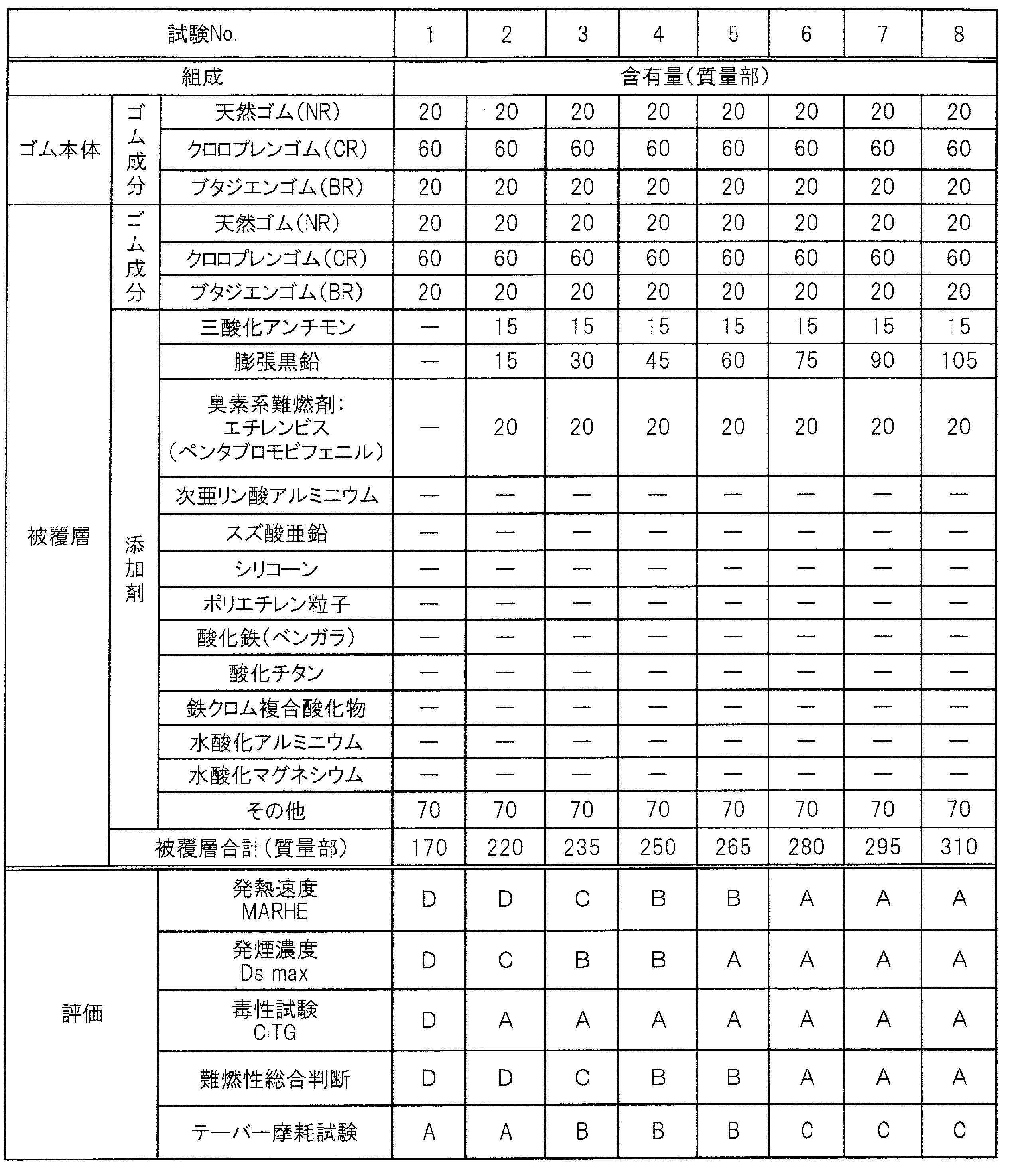
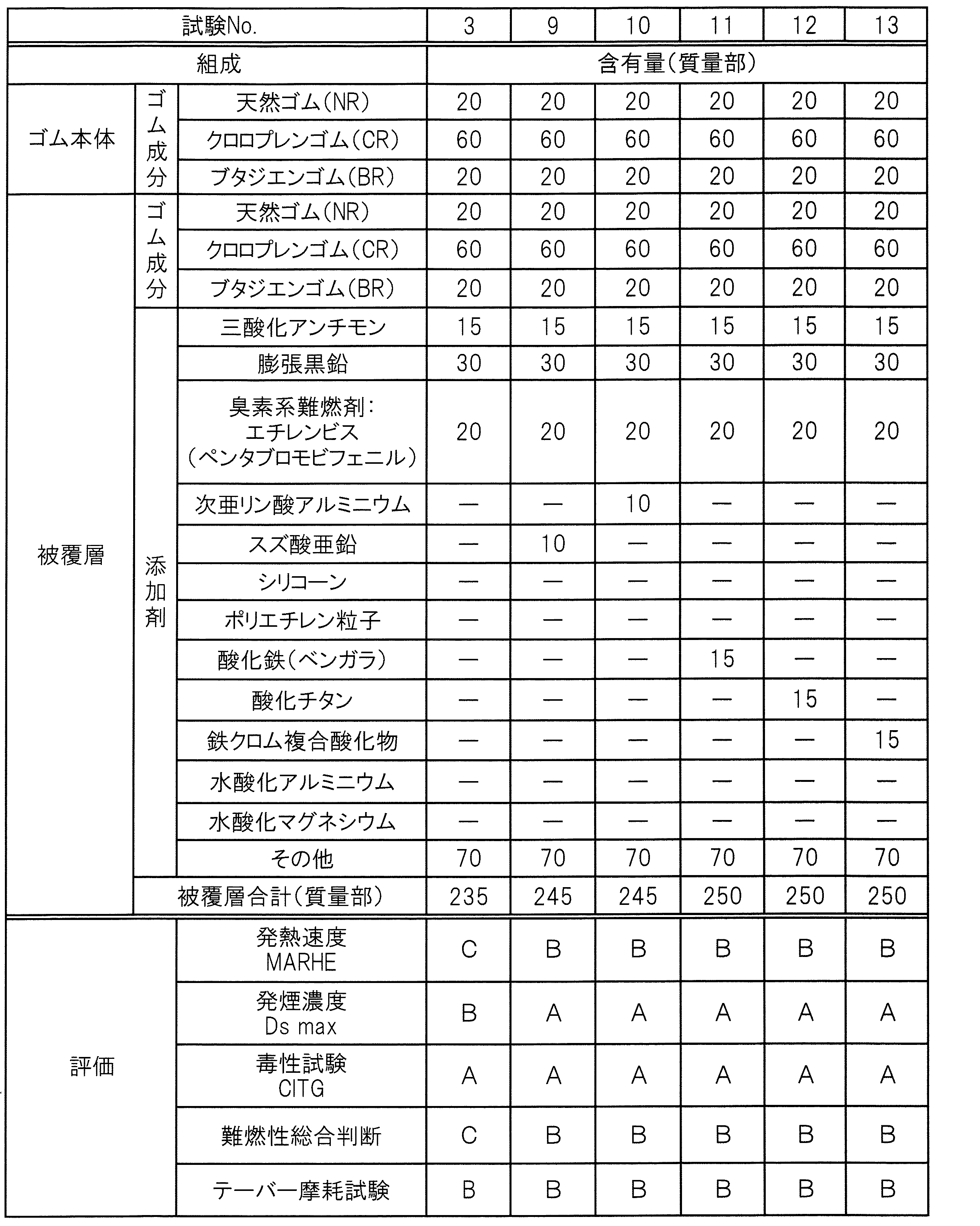
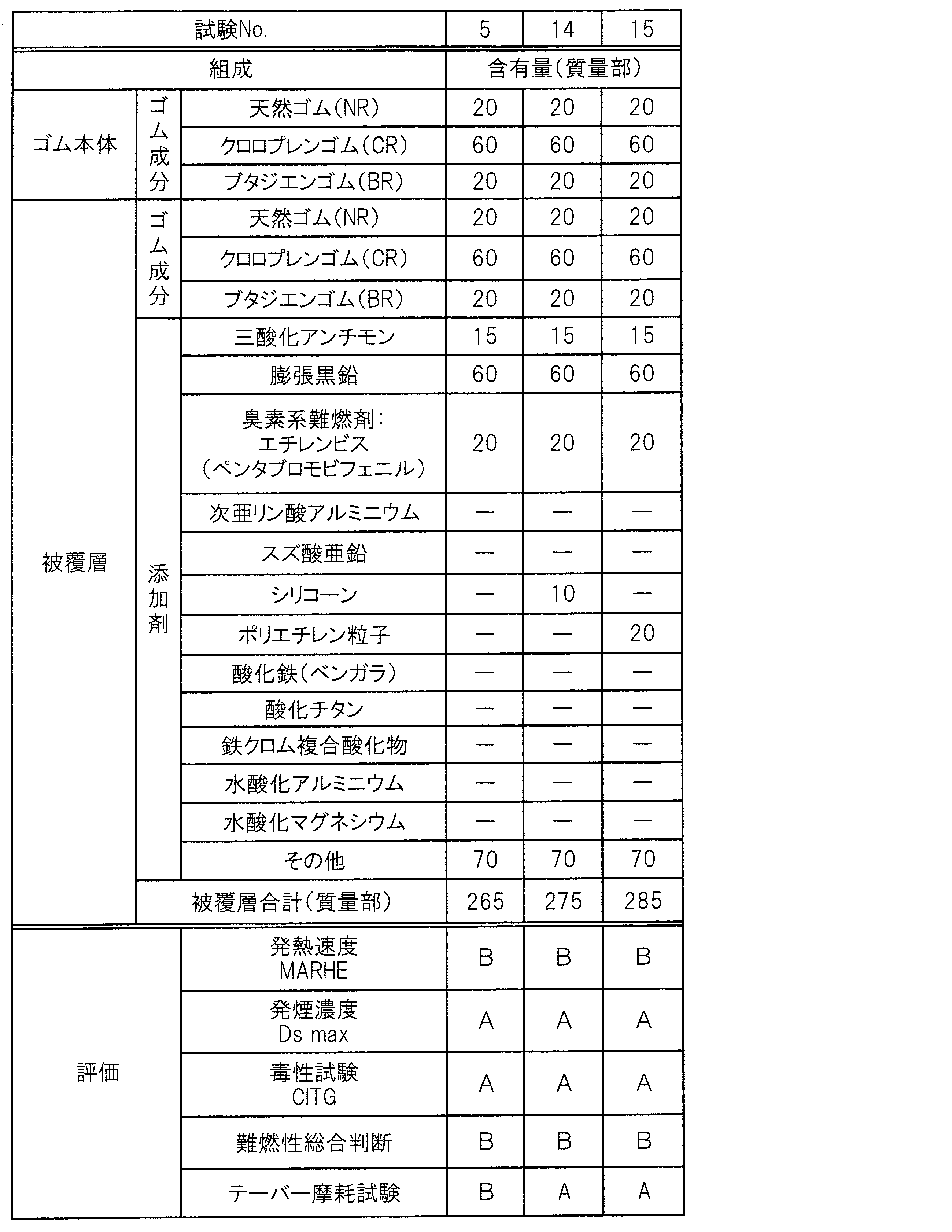
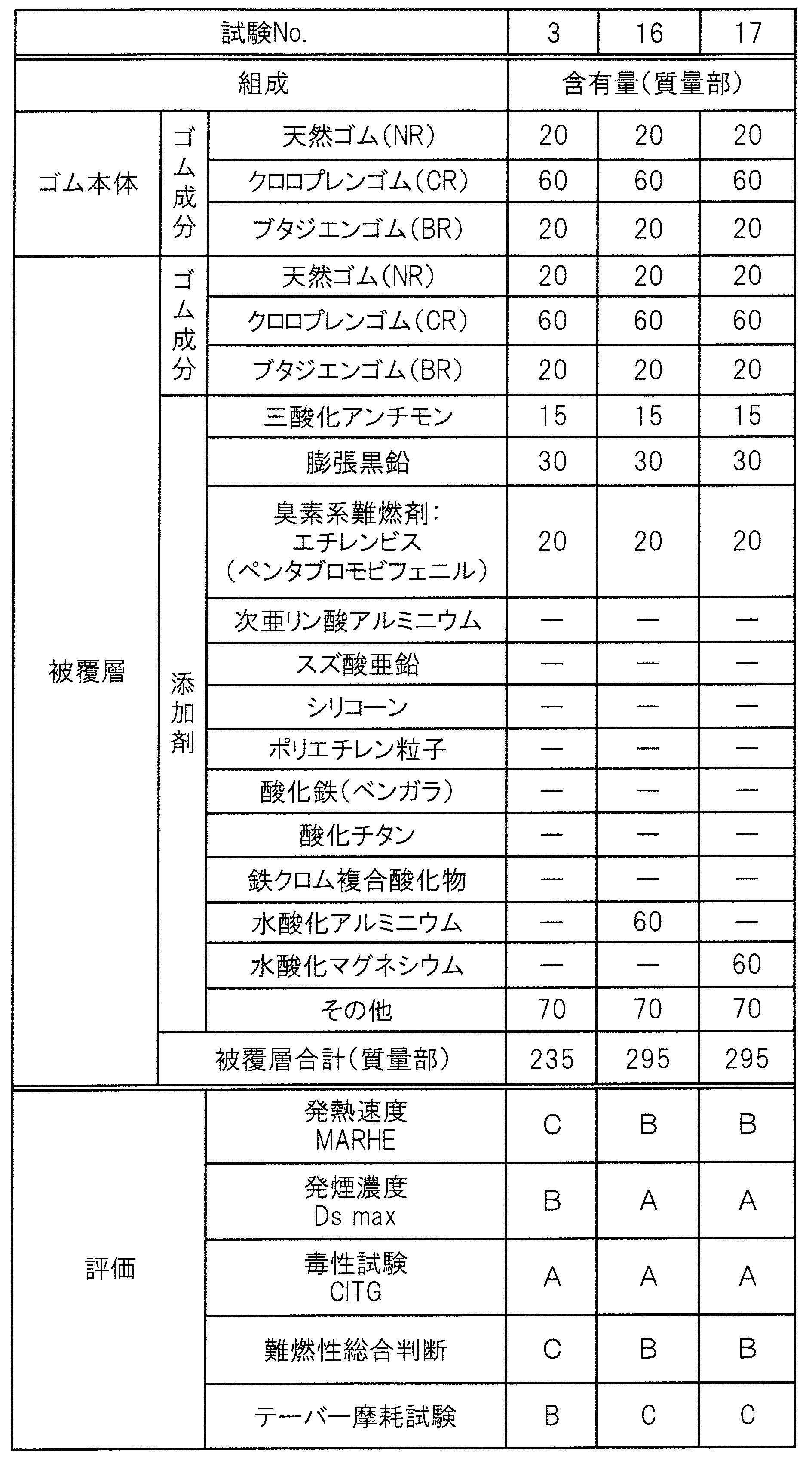
表1に示すように、被覆層がクロロプレンゴム、天然ゴム及びブタジエンゴムを含有するゴム成分と、三酸化アンチモンと、膨張黒鉛と、臭素系難燃剤とを含み、上記被覆層中の上記ゴム成分100質量部に対する上記膨張黒鉛の含有量が30質量部以上であるゴム部材No.3~No.8は、難燃性が良好であった。
一方、被覆層に膨張黒鉛を含有しないゴム部材No.1及び被覆層中の上記ゴム成分100質量部に対する上記膨張黒鉛の含有量が30質量部未満であるゴム部材No.2は、難燃性が劣っていた。
表2に示すように、ゴム部材No.3とゴム部材No.9~No.13とを比較すると、難燃剤として次亜リン酸アルミニウム、スズ酸亜鉛、酸化鉄、酸化チタン又は鉄クロム複合酸化物を併用しているゴム部材No.9~No.13は、さらに難燃性が向上していることがわかる。
表3に示すように、ゴム部材No.5とゴム部材No.14~No.15とを比較すると、高分子量のシリコーン又はポリエチレン粒子をさらに含有するゴム部材No.14~No.15は、耐摩耗性が向上することがわかる。
表4に示すように、ゴム部材No.3とゴム部材No.16~No.17とを比較すると、難燃剤として水酸化アルミニウム又は水酸化マグネシウムを併用しているゴム部材No.16~No.17は、難燃性はさらに向上するが、耐摩耗性が低下することがわかる。
以上の結果から、当該ゴム部材は、難燃性に優れ、耐摩耗性を向上できることが示された。
Claims (7)
- 鉄道車両用空気ばねに用いるゴム部材であって、
ゴムを主成分とするゴム本体と、
前記ゴム本体の表面を被覆する難燃性の被覆層と
を備え、
前記被覆層が、クロロプレンゴム、天然ゴム、ブタジエンゴム又はこれらの組合せを含有するゴム成分と、三酸化アンチモンと、膨張黒鉛と、臭素系難燃剤とを含み、
前記被覆層中の前記ゴム成分100質量部に対する前記膨張黒鉛の含有量が30質量部以上であり、
前記ゴム本体中の膨張黒鉛の含有率が3質量%以下であるゴム部材。 - 前記被覆層が次亜リン酸アルミニウム、スズ酸亜鉛又はこれらの組合せをさらに含有する請求項1に記載のゴム部材。
- 前記被覆層が、無機フィラーをさらに含有し、
前記無機フィラーの屈折率が2.0以上であり、
前記無機フィラーの平均粒径が0.5μm以上10μm以下である請求項1又は請求項2に記載のゴム部材。 - 前記被覆層がシリコーンをさらに含有する請求項1、請求項2又は請求項3に記載のゴム部材。
- 前記被覆層が樹脂粒子をさらに含有する請求項1から請求項4のいずれか1項に記載のゴム部材。
- 前記被覆層が水酸化アルミニウム及び水酸化マグネシウムを含有しない請求項1から請求項5のいずれか1項に記載のゴム部材。
- 鉄道車両用空気ばねに用いるゴム部材の被覆層組成物であって、
クロロプレンゴム、天然ゴム、ブタジエンゴム又はこれらの組合せを含有するゴム成分と、三酸化アンチモンと、膨張黒鉛と、臭素系難燃剤とを含み、
前記ゴム成分100質量部に対する前記膨張黒鉛の含有量が30質量部以上であるゴム部材の被覆層組成物。
Applications Claiming Priority (2)
| Application Number | Priority Date | Filing Date | Title |
|---|---|---|---|
| JP2018197000A JP2022031610A (ja) | 2018-10-18 | 2018-10-18 | ゴム部材及びゴム部材の被覆層組成物 |
| JP2018-197000 | 2018-10-18 |
Publications (1)
| Publication Number | Publication Date |
|---|---|
| WO2020079913A1 true WO2020079913A1 (ja) | 2020-04-23 |
Family
ID=70283873
Family Applications (1)
| Application Number | Title | Priority Date | Filing Date |
|---|---|---|---|
| PCT/JP2019/029265 Ceased WO2020079913A1 (ja) | 2018-10-18 | 2019-07-25 | ゴム部材及びゴム部材の被覆層組成物 |
Country Status (2)
| Country | Link |
|---|---|
| JP (1) | JP2022031610A (ja) |
| WO (1) | WO2020079913A1 (ja) |
Citations (4)
| Publication number | Priority date | Publication date | Assignee | Title |
|---|---|---|---|---|
| JPS5920059U (ja) * | 1982-07-27 | 1984-02-07 | トヨタ自動車株式会社 | シヨツクアブソ−バ用ロ−リングダイアフラム |
| JPH1160837A (ja) * | 1997-08-19 | 1999-03-05 | Kawasaki Steel Corp | 難燃化ポリプロピレンコンパウンドおよびその製造方法、ならびにスタンパブルシートおよびスタンパブルシート成形品 |
| JP2008132641A (ja) * | 2006-11-28 | 2008-06-12 | Bridgestone Corp | 筒状可撓膜体 |
| JP2008179741A (ja) * | 2007-01-26 | 2008-08-07 | Dai Ichi Kogyo Seiyaku Co Ltd | 難燃性オレフィン系樹脂組成物 |
-
2018
- 2018-10-18 JP JP2018197000A patent/JP2022031610A/ja active Pending
-
2019
- 2019-07-25 WO PCT/JP2019/029265 patent/WO2020079913A1/ja not_active Ceased
Patent Citations (4)
| Publication number | Priority date | Publication date | Assignee | Title |
|---|---|---|---|---|
| JPS5920059U (ja) * | 1982-07-27 | 1984-02-07 | トヨタ自動車株式会社 | シヨツクアブソ−バ用ロ−リングダイアフラム |
| JPH1160837A (ja) * | 1997-08-19 | 1999-03-05 | Kawasaki Steel Corp | 難燃化ポリプロピレンコンパウンドおよびその製造方法、ならびにスタンパブルシートおよびスタンパブルシート成形品 |
| JP2008132641A (ja) * | 2006-11-28 | 2008-06-12 | Bridgestone Corp | 筒状可撓膜体 |
| JP2008179741A (ja) * | 2007-01-26 | 2008-08-07 | Dai Ichi Kogyo Seiyaku Co Ltd | 難燃性オレフィン系樹脂組成物 |
Also Published As
| Publication number | Publication date |
|---|---|
| JP2022031610A (ja) | 2022-02-22 |
Similar Documents
| Publication | Publication Date | Title |
|---|---|---|
| ITMI20000701A1 (it) | Composizione di gomma procedimento per produrre la stessa e manicottoutilizzante la composizione di gomma | |
| CN109438794A (zh) | 一种空气弹簧用防火橡胶材料及其制备方法、空气弹簧及其制备方法 | |
| Beltrán-Ramírez et al. | Effect of nanometric metallic hydroxides on the flame retardant properties of HDPE composites | |
| CN107250270A (zh) | 具有提高的冲击性能的增强的聚碳酸酯组合物 | |
| CN110892017A (zh) | 氟橡胶组合物、其制造方法以及氟橡胶交联成型品 | |
| US7868089B2 (en) | Thermoplastic polymer composition | |
| CN103834089A (zh) | 过氧化物交联树脂组合物及使用其的电线、电缆 | |
| JP5372801B2 (ja) | タイヤインナーライナー用ゴム組成物及び空気入りタイヤ | |
| KR20210044982A (ko) | 우수한 난연성을 부여하는 복합난연제 및 이를 포함하는 난연 수지 조성물 | |
| CN111511827A (zh) | 制品,特别是空气弹簧波纹管、金属-橡胶元件或减振器 | |
| JP2008031358A (ja) | 放熱筐体 | |
| WO2020079913A1 (ja) | ゴム部材及びゴム部材の被覆層組成物 | |
| CN104177806A (zh) | 一种低成本阻燃电缆护套材料 | |
| US9346936B2 (en) | Fluororesin composition and its molded product | |
| JP5352947B2 (ja) | 放熱シャーシ | |
| JP2023098306A (ja) | 積層型防振ゴム及びゴム部材 | |
| JP6889042B2 (ja) | 鉄道車両用緩衝ゴム用ゴム組成物 | |
| EP3940026B1 (en) | FLAME-RETARDANT VIBRATION 
ISOLATION RUBBER COMPOSITION AND FLAME-RETARDANT VIBRATION ISOLATION RUBBER MEMBER | |
| JP2008033147A (ja) | トナーケース | |
| JP4984533B2 (ja) | フッ素ゴムコーティング剤 | |
| JP6993169B2 (ja) | 鉄道車両用緩衝ゴム用ゴム組成物 | |
| JP2025180747A (ja) | ゴム部材および鉄道車両用空気ばね | |
| JP7556494B2 (ja) | 樹脂シート及び成形体 | |
| JP5548600B2 (ja) | 塩素化ポリエチレン樹脂組成物 | |
| JP6920894B2 (ja) | ゴム部材 |
Legal Events
| Date | Code | Title | Description |
|---|---|---|---|
| 121 | Ep: the epo has been informed by wipo that ep was designated in this application |
Ref document number: 19872592 Country of ref document: EP Kind code of ref document: A1 |
|
| NENP | Non-entry into the national phase |
Ref country code: DE |
|
| 122 | Ep: pct application non-entry in european phase |
Ref document number: 19872592 Country of ref document: EP Kind code of ref document: A1 |
|
| NENP | Non-entry into the national phase |
Ref country code: JP |