WO2020071048A1 - 無方向性電磁鋼板及びその素材となるスラブ鋳片の製造方法 - Google Patents
無方向性電磁鋼板及びその素材となるスラブ鋳片の製造方法Info
- Publication number
- WO2020071048A1 WO2020071048A1 PCT/JP2019/034879 JP2019034879W WO2020071048A1 WO 2020071048 A1 WO2020071048 A1 WO 2020071048A1 JP 2019034879 W JP2019034879 W JP 2019034879W WO 2020071048 A1 WO2020071048 A1 WO 2020071048A1
- Authority
- WO
- WIPO (PCT)
- Prior art keywords
- mass
- rem
- steel sheet
- less
- oxide
- Prior art date
- Legal status (The legal status is an assumption and is not a legal conclusion. Google has not performed a legal analysis and makes no representation as to the accuracy of the status listed.)
- Ceased
Links
Classifications
-
- C—CHEMISTRY; METALLURGY
- C22—METALLURGY; FERROUS OR NON-FERROUS ALLOYS; TREATMENT OF ALLOYS OR NON-FERROUS METALS
- C22C—ALLOYS
- C22C38/00—Ferrous alloys, e.g. steel alloys
- C22C38/002—Ferrous alloys, e.g. steel alloys containing In, Mg, or other elements not provided for in one single group C22C38/001 - C22C38/60
-
- B—PERFORMING OPERATIONS; TRANSPORTING
- B22—CASTING; POWDER METALLURGY
- B22D—CASTING OF METALS; CASTING OF OTHER SUBSTANCES BY THE SAME PROCESSES OR DEVICES
- B22D11/00—Continuous casting of metals, i.e. casting in indefinite lengths
- B22D11/001—Continuous casting of metals, i.e. casting in indefinite lengths of specific alloys
-
- C—CHEMISTRY; METALLURGY
- C21—METALLURGY OF IRON
- C21C—PROCESSING OF PIG-IRON, e.g. REFINING, MANUFACTURE OF WROUGHT-IRON OR STEEL; TREATMENT IN MOLTEN STATE OF FERROUS ALLOYS
- C21C7/00—Treating molten ferrous alloys, e.g. steel, not covered by groups C21C1/00 - C21C5/00
- C21C7/04—Removing impurities by adding a treating agent
-
- C—CHEMISTRY; METALLURGY
- C21—METALLURGY OF IRON
- C21C—PROCESSING OF PIG-IRON, e.g. REFINING, MANUFACTURE OF WROUGHT-IRON OR STEEL; TREATMENT IN MOLTEN STATE OF FERROUS ALLOYS
- C21C7/00—Treating molten ferrous alloys, e.g. steel, not covered by groups C21C1/00 - C21C5/00
- C21C7/04—Removing impurities by adding a treating agent
- C21C7/06—Deoxidising, e.g. killing
-
- C—CHEMISTRY; METALLURGY
- C21—METALLURGY OF IRON
- C21C—PROCESSING OF PIG-IRON, e.g. REFINING, MANUFACTURE OF WROUGHT-IRON OR STEEL; TREATMENT IN MOLTEN STATE OF FERROUS ALLOYS
- C21C7/00—Treating molten ferrous alloys, e.g. steel, not covered by groups C21C1/00 - C21C5/00
- C21C7/10—Handling in a vacuum
-
- C—CHEMISTRY; METALLURGY
- C22—METALLURGY; FERROUS OR NON-FERROUS ALLOYS; TREATMENT OF ALLOYS OR NON-FERROUS METALS
- C22B—PRODUCTION AND REFINING OF METALS; PRETREATMENT OF RAW MATERIALS
- C22B9/00—General processes of refining or remelting of metals; Apparatus for electroslag or arc remelting of metals
- C22B9/04—Refining by applying a vacuum
-
- C—CHEMISTRY; METALLURGY
- C22—METALLURGY; FERROUS OR NON-FERROUS ALLOYS; TREATMENT OF ALLOYS OR NON-FERROUS METALS
- C22C—ALLOYS
- C22C38/00—Ferrous alloys, e.g. steel alloys
-
- C—CHEMISTRY; METALLURGY
- C22—METALLURGY; FERROUS OR NON-FERROUS ALLOYS; TREATMENT OF ALLOYS OR NON-FERROUS METALS
- C22C—ALLOYS
- C22C38/00—Ferrous alloys, e.g. steel alloys
- C22C38/001—Ferrous alloys, e.g. steel alloys containing N
-
- C—CHEMISTRY; METALLURGY
- C22—METALLURGY; FERROUS OR NON-FERROUS ALLOYS; TREATMENT OF ALLOYS OR NON-FERROUS METALS
- C22C—ALLOYS
- C22C38/00—Ferrous alloys, e.g. steel alloys
- C22C38/005—Ferrous alloys, e.g. steel alloys containing rare earths, i.e. Sc, Y, Lanthanides
-
- C—CHEMISTRY; METALLURGY
- C22—METALLURGY; FERROUS OR NON-FERROUS ALLOYS; TREATMENT OF ALLOYS OR NON-FERROUS METALS
- C22C—ALLOYS
- C22C38/00—Ferrous alloys, e.g. steel alloys
- C22C38/02—Ferrous alloys, e.g. steel alloys containing silicon
-
- C—CHEMISTRY; METALLURGY
- C22—METALLURGY; FERROUS OR NON-FERROUS ALLOYS; TREATMENT OF ALLOYS OR NON-FERROUS METALS
- C22C—ALLOYS
- C22C38/00—Ferrous alloys, e.g. steel alloys
- C22C38/04—Ferrous alloys, e.g. steel alloys containing manganese
-
- C—CHEMISTRY; METALLURGY
- C22—METALLURGY; FERROUS OR NON-FERROUS ALLOYS; TREATMENT OF ALLOYS OR NON-FERROUS METALS
- C22C—ALLOYS
- C22C38/00—Ferrous alloys, e.g. steel alloys
- C22C38/06—Ferrous alloys, e.g. steel alloys containing aluminium
-
- C—CHEMISTRY; METALLURGY
- C22—METALLURGY; FERROUS OR NON-FERROUS ALLOYS; TREATMENT OF ALLOYS OR NON-FERROUS METALS
- C22C—ALLOYS
- C22C38/00—Ferrous alloys, e.g. steel alloys
- C22C38/16—Ferrous alloys, e.g. steel alloys containing copper
-
- C—CHEMISTRY; METALLURGY
- C22—METALLURGY; FERROUS OR NON-FERROUS ALLOYS; TREATMENT OF ALLOYS OR NON-FERROUS METALS
- C22C—ALLOYS
- C22C38/00—Ferrous alloys, e.g. steel alloys
- C22C38/18—Ferrous alloys, e.g. steel alloys containing chromium
- C22C38/20—Ferrous alloys, e.g. steel alloys containing chromium with copper
-
- C—CHEMISTRY; METALLURGY
- C22—METALLURGY; FERROUS OR NON-FERROUS ALLOYS; TREATMENT OF ALLOYS OR NON-FERROUS METALS
- C22C—ALLOYS
- C22C38/00—Ferrous alloys, e.g. steel alloys
- C22C38/18—Ferrous alloys, e.g. steel alloys containing chromium
- C22C38/34—Ferrous alloys, e.g. steel alloys containing chromium with more than 1.5% by weight of silicon
-
- C—CHEMISTRY; METALLURGY
- C22—METALLURGY; FERROUS OR NON-FERROUS ALLOYS; TREATMENT OF ALLOYS OR NON-FERROUS METALS
- C22C—ALLOYS
- C22C38/00—Ferrous alloys, e.g. steel alloys
- C22C38/18—Ferrous alloys, e.g. steel alloys containing chromium
- C22C38/40—Ferrous alloys, e.g. steel alloys containing chromium with nickel
-
- C—CHEMISTRY; METALLURGY
- C22—METALLURGY; FERROUS OR NON-FERROUS ALLOYS; TREATMENT OF ALLOYS OR NON-FERROUS METALS
- C22C—ALLOYS
- C22C38/00—Ferrous alloys, e.g. steel alloys
- C22C38/60—Ferrous alloys, e.g. steel alloys containing lead, selenium, tellurium, or antimony, or more than 0.04% by weight of sulfur
-
- H—ELECTRICITY
- H01—ELECTRIC ELEMENTS
- H01F—MAGNETS; INDUCTANCES; TRANSFORMERS; SELECTION OF MATERIALS FOR THEIR MAGNETIC PROPERTIES
- H01F1/00—Magnets or magnetic bodies characterised by the magnetic materials therefor; Selection of materials for their magnetic properties
- H01F1/01—Magnets or magnetic bodies characterised by the magnetic materials therefor; Selection of materials for their magnetic properties of inorganic materials
- H01F1/03—Magnets or magnetic bodies characterised by the magnetic materials therefor; Selection of materials for their magnetic properties of inorganic materials characterised by their coercivity
- H01F1/12—Magnets or magnetic bodies characterised by the magnetic materials therefor; Selection of materials for their magnetic properties of inorganic materials characterised by their coercivity of soft-magnetic materials
- H01F1/14—Magnets or magnetic bodies characterised by the magnetic materials therefor; Selection of materials for their magnetic properties of inorganic materials characterised by their coercivity of soft-magnetic materials metals or alloys
- H01F1/147—Alloys characterised by their composition
-
- H—ELECTRICITY
- H01—ELECTRIC ELEMENTS
- H01F—MAGNETS; INDUCTANCES; TRANSFORMERS; SELECTION OF MATERIALS FOR THEIR MAGNETIC PROPERTIES
- H01F1/00—Magnets or magnetic bodies characterised by the magnetic materials therefor; Selection of materials for their magnetic properties
- H01F1/01—Magnets or magnetic bodies characterised by the magnetic materials therefor; Selection of materials for their magnetic properties of inorganic materials
- H01F1/03—Magnets or magnetic bodies characterised by the magnetic materials therefor; Selection of materials for their magnetic properties of inorganic materials characterised by their coercivity
- H01F1/12—Magnets or magnetic bodies characterised by the magnetic materials therefor; Selection of materials for their magnetic properties of inorganic materials characterised by their coercivity of soft-magnetic materials
- H01F1/14—Magnets or magnetic bodies characterised by the magnetic materials therefor; Selection of materials for their magnetic properties of inorganic materials characterised by their coercivity of soft-magnetic materials metals or alloys
- H01F1/147—Alloys characterised by their composition
- H01F1/14766—Fe-Si based alloys
-
- C—CHEMISTRY; METALLURGY
- C21—METALLURGY OF IRON
- C21D—MODIFYING THE PHYSICAL STRUCTURE OF FERROUS METALS; GENERAL DEVICES FOR HEAT TREATMENT OF FERROUS OR NON-FERROUS METALS OR ALLOYS; MAKING METAL MALLEABLE, e.g. BY DECARBURISATION OR TEMPERING
- C21D8/00—Modifying the physical properties of ferrous metals or ferrous alloys by deformation combined with, or followed by, heat treatment
- C21D8/12—Modifying the physical properties of ferrous metals or ferrous alloys by deformation combined with, or followed by, heat treatment during manufacturing of articles with special electromagnetic properties
-
- C—CHEMISTRY; METALLURGY
- C21—METALLURGY OF IRON
- C21D—MODIFYING THE PHYSICAL STRUCTURE OF FERROUS METALS; GENERAL DEVICES FOR HEAT TREATMENT OF FERROUS OR NON-FERROUS METALS OR ALLOYS; MAKING METAL MALLEABLE, e.g. BY DECARBURISATION OR TEMPERING
- C21D9/00—Heat treatment, e.g. annealing, hardening, quenching or tempering, adapted for particular articles; Furnaces therefor
- C21D9/46—Heat treatment, e.g. annealing, hardening, quenching or tempering, adapted for particular articles; Furnaces therefor for sheet metals
-
- Y—GENERAL TAGGING OF NEW TECHNOLOGICAL DEVELOPMENTS; GENERAL TAGGING OF CROSS-SECTIONAL TECHNOLOGIES SPANNING OVER SEVERAL SECTIONS OF THE IPC; TECHNICAL SUBJECTS COVERED BY FORMER USPC CROSS-REFERENCE ART COLLECTIONS [XRACs] AND DIGESTS
- Y02—TECHNOLOGIES OR APPLICATIONS FOR MITIGATION OR ADAPTATION AGAINST CLIMATE CHANGE
- Y02P—CLIMATE CHANGE MITIGATION TECHNOLOGIES IN THE PRODUCTION OR PROCESSING OF GOODS
- Y02P10/00—Technologies related to metal processing
- Y02P10/20—Recycling
Definitions
- the present invention relates to a non-oriented electrical steel sheet used as a core material of electrical equipment and the like, and to a method for producing a slab cast piece as the material.
- Patent Literature 1 discloses that the composition of oxide-based inclusions is controlled to a specific composition by adding Ca (calcium) after reducing the concentration of Al (aluminum) in steel, and reducing the content of S in steel.
- Ca calcium
- a high magnetic flux density non-oriented electrical steel sheet in which (sulfur) is fixed as CaS has been proposed.
- Patent Literature 2 discloses a low iron loss non-directional material in which 0.1 to 3% by mass of Al is contained and S in steel is fixed by adding a rare earth element (hereinafter, referred to as “REM”). Electrical steel sheets have been proposed.
- REM refers to 15 elements from La (lanthanum) having an atomic number of 57 to Lu (lutetium) having an atomic number of 57, Sc (scandium) having an atomic number of 21 and Y (yttrium) having an atomic number of 39. It is a general term for a total of 17 elements added.
- Patent Document 2 discloses that after deoxidizing molten steel with Al, CaO is added to reform oxide-based inclusions into CaO-Al 2 O 3 system, and then REM is added in a predetermined concentration range. This is a technique that achieves both control of the precipitation form of TiN by adding REM and prevention of clogging of the tundish nozzle by REM oxide and the like.
- Patent Document 3 contains 0.05 to 3.0% by mass of Al and 1.0 to 3.5% by mass of Cu (copper), and contains Ca, REM and Mg (magnesium) in steel.
- a high-strength non-oriented electrical steel sheet to which S is fixed has been proposed.
- Mg since Mg also forms sulfide preferentially at a high temperature, coarse sulfide is generated in molten steel, and the growth of crystal grains can be improved.
- Ca is an element having a low addition yield to molten steel, and when the Ca concentration in the molten steel is low due to variations in operation, or when T.C.
- O total oxygen
- the oxide inclusions are not sufficiently modified and have a low melting point composition.
- the oxide-based inclusions elongate in the rolling direction during hot rolling, suppress the growth of crystal grains during annealing, reduce the crystal grains, hinder domain wall movement, and deteriorate iron loss.
- the Al concentration in the steel is reduced, it tends to be difficult to sufficiently reduce the dissolved oxygen and S in the steel in the refining process of the molten steel.
- the form may not be sufficiently controlled.
- Patent Document 2 has a problem that the magnetic flux density is low because the Al concentration in steel is basically high.
- the morphological control of oxide-based inclusions by adding CaO is not effective, and the morphological control of oxide-based or sulfide-based inclusions in steel is effectively performed. You need the skills to do it.
- S in the steel is fixed by REM, precipitation of MnS can be suppressed, but morphological control of oxide-based inclusions is not controlled by using TiN as precipitation nuclei or suppressing nozzle clogging.
- the concentration of each component has been studied, and depending on conditions such as the REM concentration, O (oxygen) concentration, and S concentration in steel, there is a problem that the oxide-based inclusions have a low melting point and are elongated during rolling.
- Patent Document 3 examines the influence of the added elements of Ca, REM, and Mg by considering only the morphological control of sulfide-based inclusions, and discusses the conditions necessary for morphological control of oxide-based inclusions. Is not specified. Therefore, in Patent Literature 3, as in Patent Literature 2, the oxide-based inclusions have a low melting point composition depending on the amount of these additions and the conditions such as the O (oxygen) concentration and the S concentration in the steel. There is a possibility that.
- the present invention has been made in view of the above circumstances, and it is an object of the present invention to provide a non-oriented electrical steel sheet having a low Al content, excellent iron scrap recyclability, and a high magnetic flux density and a low iron loss. And to propose a method for producing a slab cast piece as a material of the non-oriented electrical steel sheet.
- the component composition and inclusion composition of the non-oriented electrical steel sheet and a method of manufacturing a slab cast piece that is a material of the non-oriented electrical steel sheet, and a non-oriented electrical steel sheet Focusing on the relationship with the magnetic properties of the product steel sheet, we conducted intensive studies.
- the present invention has been made based on the above findings, and the gist thereof is as follows.
- C 0.0050% by mass or less, Si: 1.5 to 5.0% by mass, Mn: 0.2 to 3.0% by mass, sol. Al: 0.0030% by mass or less, P: 0 0.2% by mass or less; S; 0.0050% by mass or less; N; 0.0040% by mass or less; Ca; 0.0010 to 0.0080% by mass; O: 0.0100% by mass or less, and REM; 0.0001 to 0.0050% by mass, the balance being a component composition comprising Fe and inevitable impurities, T. Ca, the REM, the T.C.
- a non-oriented electrical steel sheet wherein the mass ratio of the four components O and S ((T.Ca + REM) / (TO + S)) is 0.4 or more.
- O and S ((T.Ca + REM) / (TO + S)) is 0.4 or more.
- C 0.0050% by mass or less
- Si 1.5 to 5.0% by mass
- Mn 0.2 to 3.0% by mass
- Al 0.0030% by mass or less, P: 0 0.2% by mass or less; S; 0.0050% by mass or less; N; 0.0040% by mass or less; Ca; 0.0010 to 0.0080% by mass; O: 0.0100% by mass or less, and REM; 0.0001 to 0.0050% by mass, and further contains at least one of the following chemical components from Groups A to C, with the balance being Having a component composition of Fe and unavoidable impurities, T. Ca, the REM, the T.C.
- Group A Sn, Sb; one or two selected from 0.01 to 0.1% by mass each Group B: Mg; 0.0001 to 0.0050% by mass Group C: Cu, Ni, Cr; one or more selected from 0.01 to 0.5% by mass each [3].
- a method for producing a slab cast as a raw material of a non-oriented electrical steel sheet containing Si, REM, and Ca as a component composition Molten steel discharged from a converter or an electric furnace is refined in a vacuum degassing facility, and after refining in the vacuum degassing facility, a Ca-containing alloy is added to the molten steel.
- the metal steel or Si-containing alloy is added to the molten steel to deoxidize the molten steel.
- a REM-containing alloy is added during refining in the vacuum degassing facility, or a REM-containing alloy is added after refining in the vacuum degassing facility, Thereafter, a Ca-containing alloy is added to molten steel in a ladle, and a method for producing a slab cast piece as a material of a non-oriented electrical steel sheet.
- the T.P. Ca, REM, T.I. By controlling the mass ratio ((T.Ca + REM) / (TO + S)) of the four components of O and S to 0.4 or more, the generation of elongated sulfide-based inclusions in the steel is suppressed.
- the oxide-based inclusions in the steel can be in a granular non-stretched state. Thereby, it is a non-oriented electrical steel sheet having a high magnetic flux density and a low iron loss, and is excellent in recyclability as iron scrap since sol. Al has a low Al content of 0.0030% by mass or less. It is realized to provide a non-oriented electrical steel sheet.
- the REM-containing alloy is added to the molten steel with a high yield because the molten steel is deoxidized with Si and the REM-containing alloy is added. can do.
- the Ca-containing alloy is added after the REM-containing alloy is added, the fixation and removal of S (sulfur) by the REM addition is achieved, and the slab cast used as the material of the non-oriented electrical steel sheet is manufactured at low cost. Is realized.
- the present inventors have found that C: 0.0050% by mass or less, Si: 1.5 to 5.0% by mass, Mn: 0.2 to 3.0% by mass, sol. Al: 0.0030% by mass or less, P: 0.2% by mass or less, S: 0.0050% by mass or less, N: 0.0040% by mass or less, Ca (total calcium); 0.0010 to 0.0080% by mass; Slab casting containing O (total oxygen): 0.0100% by mass or less and REM: 0.0001 to 0.0050% by mass, with the balance being Fe and unavoidable impurities and serving as a material for non-oriented electrical steel sheets
- the steel pieces were refined in a vacuum degassing facility after the tapping of the converter, then manufactured by a continuous casting machine, and the steel composition in a product steel sheet (finished annealed steel sheet) manufactured using the obtained slab cast pieces as a raw material And the relationship between iron loss W 15/50 was evaluated.
- those having a good iron loss W 15/50 correspond to T.C.
- Ca concentration and REM concentration were It was higher than the O concentration and the S concentration, and many of the oxide-based inclusions were granular and non-stretched.
- the iron loss W 15/50 was inferior in T.
- Ca concentration and REM concentration are T. Oxide inclusions were low with respect to O concentration and S concentration, and many oxide inclusions were elongated in the rolling direction.
- the oxide-based inclusions in the steel are REM oxides. Is based on CaO-SiO 2 system. Further, since the Al 2 O 3 present in the ladle slag is reduced Si in the steel, the Ca and REM, from that capable of generating Al in the molten steel, in oxide inclusions Al 2 O 3 is also included.
- the elongated oxide-based inclusions have lower CaO and REM oxide concentrations and higher Al 2 O 3 concentrations in the inclusions than the non-extended granular oxide-based inclusions. .
- Such oxide-based inclusions are broken during cold rolling, the growth of crystal grains of the non-oriented electrical steel sheet is suppressed during annealing, the crystal grains become small, and the movement of the domain wall is hindered. 15/50 is considered to have deteriorated.
- the sulfide-based inclusions CaS, MnS and REM sulfide were observed.
- the stretched sulfide-based inclusions were observed to have a high MnS concentration in the inclusions and to be finely precipitated in the crystal grains. From these events, T.M. It has been found that when the Ca concentration or the REM concentration is insufficient, poor control of the form of the sulfide-based inclusions also occurs, which contributes to the deterioration of the iron loss W15 / 50 .
- Increasing the Ca concentration or the REM concentration is to increase the CaO concentration or the REM oxide concentration in the oxide-based inclusions, which contributes to the higher melting point of the oxide-based inclusions.
- S can be fixed as CaS or REM sulfide in molten steel by adding Ca or REM. Does not affect grain growth.
- the CaO—SiO 2 oxide inclusions contain REM oxide
- the sulfide capacity of the oxide inclusions increases, and the oxide inclusions are used as nuclei for sulfide precipitation. We can expect to do it. If sulfides can be precipitated on oxide-based inclusions, sulfide-based inclusions precipitated in crystal grains can be reduced, so that improvement in magnetic properties can be expected.
- the mass ratio of the components in the steel ((T.Ca + REM) / (TO + S)) to 0.4 or more, and the mass ratio is preferably Is controlled to 0.8 or more, more preferably 1.2 or more.
- T.C the mass ratio of the two components Ca and REM
- T. Ca / REM the mass ratio of the two components Ca and REM
- the REM oxide concentration in the oxide-based inclusions increases, and the melting point of the oxide-based inclusions decreases.
- the REM since excessive addition of the REM-containing alloy causes an increase in cost, it is preferable that the REM only plays an auxiliary role of Ca. Therefore, in the non-oriented electrical steel sheet according to the present invention, it is preferable to control the mass ratio (T. Ca / REM) of the components in the steel to 1.0 or more.
- the average grain size of the non-oriented electrical steel sheet is preferably 40 ⁇ m or more, and more preferably 70 ⁇ m.
- the average crystal grain size in the present specification is an average value of crystal grain sizes measured in a cross section of a non-oriented electrical steel sheet cut in a sheet thickness direction parallel to a rolling direction at a center position in a sheet width direction.
- the non-oriented electrical steel sheet having a high Si content which is a target of the present invention, is used for refining molten steel discharged from a converter or an electric furnace in a vacuum degassing facility such as an RH vacuum degassing apparatus (including Si addition). ) And manufactured.
- a vacuum degassing facility such as an RH vacuum degassing apparatus (including Si addition).
- Si addition including Si addition
- the REM-containing alloy is added before the molten steel is deoxidized with Si, a large amount of the REM-containing alloy is required, and there is a concern that the yield will decrease and the cost will increase. In order to prevent this, it is necessary to add a REM-containing alloy after adding a predetermined amount of Si to deoxidize molten steel.
- the REM-containing alloy before adding the Ca-containing alloy, it becomes possible to increase the effective working amount in controlling the form of Ca inclusions (oxide-based inclusions and sulfide-based inclusions). And good inclusions (oxide-based inclusions and sulfide-based inclusions) can be obtained. That is, in the present invention, when manufacturing a slab slab as a raw material of a non-oriented electrical steel sheet, Si deoxidation is performed during vacuum degassing, and REM is contained during vacuum degassing after Si deoxidation. The alloy is added, or the REM-containing alloy is added after the vacuum degassing process and before the Ca-containing alloy is added.
- the Ca-containing alloy is added to the molten steel after the REM-containing alloy is added, and the molten steel to which the Ca-containing alloy is added is continuously cast by a continuous casting machine to form a slab slab. To manufacture.
- C is an element that causes magnetic aging to increase iron loss. In particular, if it exceeds 0.0050% by mass, the increase in iron loss becomes remarkable. It is limited to 0.0050% by mass or less. Preferably it is 0.0030 mass% or less. It is to be noted that the lower limit is not particularly defined because the smaller the value, the better.
- Si silicon
- Si silicon
- Si is an element effective for increasing the electrical resistance of steel and reducing iron loss.
- Al having the same effect as Si is reduced, 1.5% by mass or more of Si is contained.
- the upper limit is set to 5.0% by mass. More preferably, it is 1.5 to 3.8% by mass.
- Mn manganese: 0.2 to 3.0% by mass
- Mn is an element effective for increasing the electrical resistance of steel and reducing iron loss. Therefore, in the present invention, Mn is contained in an amount of 0.2% by mass or more. On the other hand, if Mn exceeds 3.0% by mass, the magnetic flux density decreases, so the upper limit is set to 3.0% by mass.
- Al (acid-soluble aluminum); 0.0030% by mass or less Al (aluminum) is an element effective to increase the electric resistance of steel and reduce iron loss, like Si.
- Al is less than 0.05% by mass, and the lower the Al, the better.
- Al is further reduced and is limited to 0.0030% by mass or less in sol.
- it is 0.0020% by mass or less, more preferably 0.0010% by mass or less in sol.Al.
- the lower limit is not particularly defined because the lower the better, the better.
- P phosphorus: 0.2% by mass or less
- P is a useful element having a large effect of increasing the hardness of steel with a small content, and is appropriately contained according to the required hardness.
- an excessive P content causes a decrease in cold rollability, so the upper limit of P is set to 0.2% by mass.
- S sulfur: 0.0050% by mass or less
- S is a sulfide and forms inclusions, which lowers manufacturability (hot rolling property) and magnetic properties of a product steel sheet. Therefore, the upper limit in the present invention is allowed to be up to 0.0050% by mass, but when importance is placed on the magnetic characteristics, it is preferably set to 0.0025% by mass or less. Note that the lower the S, the better. Therefore, the lower limit is not particularly defined.
- N nitrogen
- nitrogen 0.0040% by mass or less
- N is an element that deteriorates magnetic properties as in the case of C described above. Restrict to the following. Preferably it is 0.0030 mass% or less. It is to be noted that the lower limit is not particularly defined because the smaller the value, the better.
- T. Ca total calcium
- Ca calcium
- Ca calcium
- the Ca concentration is the sum of the acid-soluble Ca concentration and the acid-insoluble Ca concentration in steel.
- T. O total oxygen
- O oxygen
- O oxygen
- T. O is the sum of O (oxygen) dissolved in the steel and O (oxygen) present in the steel as an oxide.
- REM 0.0001 to 0.0050% by mass REM has the effect of producing stable sulfide at high temperatures and improving magnetic properties, as described above. Further, an auxiliary effect of increasing the effective amount of Ca can also be expected. Therefore, it is necessary to contain at least 0.0001% by mass or more. On the other hand, the upper limit is set to 0.0050% by mass because, even if it is contained excessively, there is a concern that the effect may be saturated, the cost may be increased, and the melting point of the oxide inclusion may be lowered.
- the non-oriented electrical steel sheet according to the present invention may further contain at least one group of the following groups A to C in addition to the above chemical components.
- Group A Sn (tin), Sb (antimony); one or two selected from 0.01 to 0.1 mass% each Sn and Sb both improve texture and improve magnetic properties. It has the effect of improving.
- each of them is contained individually or in combination at 0.01% by mass or more. However, if contained excessively, the steel becomes brittle and causes surface defects such as plate breakage and scabs in the production process of the steel plate. Therefore, the upper limit is preferably set to 0.1% by mass.
- Mg manganesium
- 0.0001 to 0.0050% by mass Mg is an element that produces a sulfide that is more stable than MnS or Cu 2 S at a high temperature and has an effect of improving magnetic properties, and therefore can be contained.
- the content is preferably 0.0001% by mass or more.
- the upper limit is preferably set to 0.0050% by mass.
- Group C Cu (copper), Ni (nickel), Cr (chromium); one or two or more selected from 0.01 to 0.5 mass% each Cu, Ni, Cr is the specific resistance of the steel sheet Therefore, one or two or more of these elements can be contained.
- the content is preferably 0.01% by mass or more.
- the content of each is preferably 0.5% by mass or less.
- the balance other than the above components is Fe and inevitable impurities.
- the content of other elements is not refused as long as the effects of the present invention are not impaired.
- the content of V (vanadium) as an unavoidable impurity is 0.004% by mass or less.
- Nb (niobium) is 0.004% by mass or less
- B (boron) is 0.0005% by mass or less
- Ti is 0.002% by mass or less
- Cu is 0.01% by mass or less
- Ni is 0.01% by mass.
- Cr may be acceptable if it is 0.01% by mass or less.
- the oxide-based inclusions present in the product steel sheet (finish-annealed steel sheet), and eventually, the hot-rolled steel sheet or slab cast slab which is the material thereof Component composition ratio of CaO and REM oxide in existing oxide-based inclusions ((% by mass CaO +% by mass REM-oxide) / (% by mass CaO +% by mass REM-oxide +% by mass SiO 2 +% by mass Al 2 O 3) )) Is 0.50 or more, and the component composition ratio of Al 2 O 3 in the oxide-based inclusions (% by mass Al 2 O 3 / (% by mass CaO +% by mass REM-oxide +% by mass SiO 2 +% by mass Al) 2 O 3 )) is required to be 0.20 or less.
- the oxide-based inclusions are reduced in melting point and extended by hot rolling, and are subjected to self-annealing immediately after hot rolling and annealing or finish annealing of a hot-rolled steel sheet. It hinders crystal grain growth and degrades magnetic properties.
- the component composition ratio of CaO and REM oxide in the oxide-based inclusion ((% by mass CaO +% by mass REM-oxide) / (% by mass CaO +% by mass REM-oxide +% by mass SiO 2 +% by mass Al 2 O) 3 )) is 0.6 or more, and the composition ratio of Al 2 O 3 in the oxide-based inclusions (% by mass Al 2 O 3 / (% by mass CaO +% by mass REM-oxide +% by mass SiO 2 +% by mass Al) 2 O 3 )) is less than or equal to 0.1.
- the component composition ratio of the CaO and the REM oxide and the component composition ratio of the Al 2 O 3 are such that the oxide-based inclusions existing in the cross section (L cross section) parallel to the rolling direction of the steel sheet are SEM ( It is a value calculated from an average value when 100 or more components are observed with a scanning electron microscope (SEM) and their component compositions are analyzed by EDX (energy dispersive X-ray analysis) attached to the SEM.
- the beam diameter of the electron beam of the EDX is 1 ⁇ m.
- the method for producing a slab cast as a raw material of a non-oriented electrical steel sheet according to the present invention is a method for producing a slab cast as a raw material for a non-oriented electrical steel sheet having the above-described component composition, and includes the steps of:
- the molten steel that has been tapped is refined in a vacuum degassing facility.After refining in the vacuum degassing facility, the Ca-containing alloy is added to the molten steel, and the molten steel added with the Ca-containing alloy is continuously cast by a continuous casting machine. Slab slab.
- a Si-containing substance is added to the molten steel during the refining in the vacuum degassing equipment to adjust the Si concentration in the molten steel to a range of 1.5 to 5.0% by mass.
- the REM-containing alloy is added during the refining in the vacuum degassing facility, or the REM-containing alloy is added after the refining in the vacuum degassing facility to reduce the REM concentration in the molten steel. It is adjusted to the range of 0.0001 to 0.0050% by mass.
- the Ca-containing alloy is added to the molten steel in the ladle after the REM-containing alloy has been added, and the T.O.
- the Ca concentration is adjusted to the range of 0.0010 to 0.0080% by mass.
- the molten steel produced in the converter or the electric furnace is tapped into a ladle, and the tapped molten steel is refined under reduced pressure using a vacuum degassing facility having a vacuum refining function such as an RH vacuum degassing device ( "Vacuum degassing process").
- a vacuum degassing facility having a vacuum refining function such as an RH vacuum degassing device ( "Vacuum degassing process”).
- vacuum degassing C in the molten steel is decarburized to an extremely low concentration (0.0050 mass% or less) (referred to as “vacuum decarburization treatment”), and at the same time, N in the molten steel is removed (referred to as “denitrification”). ).
- Si deoxidation is performed by adding metallic Si or a Si-containing alloy (such as an Fe—Si alloy). After adjusting the Si concentration in the molten steel to a predetermined value within the range of 1.5 to 5.0% by mass, other alloy components such as metal Mn are added to adjust the components.
- the REM-containing alloy is added during the vacuum degassing process, the REM-containing alloy is added simultaneously with or after the addition of other alloy components such as metal Mn to adjust the REM content.
- the oxide inclusions and the oxysulfide inclusions are separated from the molten steel by levitation treatment for a predetermined time, and then the vacuum degassing treatment is terminated.
- some of the alloys other than the REM-containing alloy may be added when tapping from a converter or an electric furnace.
- adding the REM-containing alloy after the vacuum degassing process after the vacuum degassing process is completed, add the REM-containing alloy to the molten steel in the ladle under atmospheric pressure and adjust the REM content. I do.
- an injection method, an iron-coated wire feeder addition method, or the like can be used as a method for adding the REM-containing alloy under atmospheric pressure.
- the Ca-containing alloy (Ca-Si alloy, etc.) is added to the molten steel in the ladle after the REM-containing alloy has been added under atmospheric pressure conditions.
- the Ca concentration is adjusted to be in the range of 0.0010 to 0.0080% by mass and the mass ratio of the components in the steel ((T.Ca + REM) / (TO + S)) is 0.4 or more.
- an injection method, an iron-coated wire feeder adding method, or the like can be used as a method for adding the Ca-containing alloy.
- the T.D. Ca concentration, the mass ratio of the components in the steel ((T.Ca + REM) / (TO + S)) needs to be 0.4 or more, and the mass ratio of the components in the steel (T.Ca/REM) is It is preferably 1.0 or more.
- the amount of Ca-containing alloy added to the molten steel is increased, or the time after Si deoxidation is sufficiently ensured by vacuum degassing to ensure that the T.V. It is effective to reduce the O content and to reduce the S content in the molten steel to 0.0025% by mass or less by desulfurizing the hot metal or molten steel.
- a lid is attached to the ladle at the time of adding the Ca-containing alloy, and an inert gas such as argon gas is further blown to blow air. Blocking is also effective.
- the molten steel is continuously cast by a continuous casting machine to produce a slab cast piece having a predetermined thickness and length.
- a continuous casting machine to produce a slab cast piece having a predetermined thickness and length.
- the slab slab which is the material of the non-oriented electrical steel sheet, is hot-rolled into a hot-rolled steel sheet.
- the heating temperature (SRT) of the slab slab in the hot rolling is preferably set to 1000 to 1250 ° C. If the SRT exceeds 1250 ° C., not only is energy loss increased to be uneconomical, but also the high-temperature strength of the slab slab is reduced, and there is a possibility that manufacturing problems such as slab dripping may occur. On the other hand, when the SRT is lower than 1000 ° C., the hot deformation resistance increases, and it becomes difficult to perform hot rolling. The subsequent hot rolling conditions may be performed under normal conditions.
- the thickness of the hot-rolled steel sheet produced by hot rolling is preferably in the range of 1.5 to 2.8 mm from the viewpoint of securing productivity.
- the thickness of the steel sheet is less than 1.5 mm, rolling troubles in hot rolling increase.
- the thickness exceeds 2.8 mm, the cold rolling reduction becomes too high and the texture is deteriorated.
- a more preferred thickness of the hot-rolled steel sheet is in the range of 1.7 to 2.4 mm.
- Annealing of the hot-rolled steel sheet after hot rolling may be performed or omitted, but it is more advantageous to omit it from the viewpoint of reducing manufacturing costs.
- the coiling temperature of the coil after hot rolling is preferably set to 550 ° C. or higher. This is because if the coiling temperature is lower than 550 ° C., the self-annealing of the hot-rolled steel sheet coil is insufficient, and if the steel sheet before cold rolling is not sufficiently recrystallized, ridging or magnetic flux is generated. This is because the density decreases.
- the coiling temperature of the coil after hot rolling is set to 600 ° C. or higher.
- the soaking temperature of the hot-rolled steel sheet when annealing a hot-rolled steel sheet, it is preferable to set the soaking temperature of the hot-rolled steel sheet to be in a range of 900 to 1150 ° C. If the soaking temperature is less than 900 ° C., the rolled structure remains, and the effect of improving the magnetic properties cannot be sufficiently obtained. On the other hand, if the soaking temperature exceeds 1150 ° C., the crystal grains become coarse, This is because cracking is easily caused by rolling, and it is economically disadvantageous. It is needless to say that the coil winding temperature may be set to 550 ° C. or more even when annealing the hot-rolled steel sheet.
- the steel sheet after the hot rolling and the steel sheet after the hot-rolled steel sheet are cold-rolled to a final thickness by cold rolling once or twice or more with intermediate annealing.
- the thickness (final thickness) of the cold-rolled steel sheet is not particularly specified, but is preferably in the range of 0.10 to 0.60 mm. This is because productivity is reduced when the thickness is less than 0.10 mm, while the effect of reducing iron loss is small when the thickness exceeds 0.60 mm.
- the thickness (final thickness) of the cold rolled steel sheet is more preferably in the range of 0.10 to 0.35 mm.
- the cold-rolled cold-rolled steel sheet is then subjected to finish annealing by continuous annealing.
- the soaking temperature of the finish annealing is preferably in the range of 700 to 1150 ° C. If the soaking temperature is less than 700 ° C., recrystallization does not sufficiently proceed, and good magnetic properties cannot be obtained, and a shape correcting effect by continuous annealing cannot be obtained. On the other hand, if the soaking temperature exceeds 1150 ° C., energy loss increases, which is uneconomical.
- the insulating coating is preferably an organic coating containing a resin in order to ensure good punching properties, and a semi-organic coating or an inorganic coating when emphasizing weldability. Is preferred.
- T.P. Ca, REM, T.I. By controlling the mass ratio ((T.Ca + REM) / (TO + S)) of the four components of O and S to 0.4 or more, the generation of elongated sulfide-based inclusions in the steel is suppressed.
- the oxide-based inclusions in the steel can be in a granular non-stretched state. This makes it possible to provide a non-oriented electrical steel sheet having a high magnetic flux density and a low iron loss, and having a low Al content and having excellent recyclability as an iron scrap. Become.
- the slab cast obtained by continuous casting was heated to a temperature of 1050 to 1130 ° C., and then hot-rolled to obtain a hot-rolled steel sheet having a thickness of 2.3 mm. At that time, the coil winding temperature was all set to 680 ° C.
- the obtained hot-rolled steel sheet is pickled, pickled, and cold-rolled into a cold-rolled steel sheet having a final sheet thickness of 0.50 mm, finish annealing at a soaking temperature of 1000 ° C., and then applying and baking an insulating film. And a non-oriented electrical steel sheet (product steel sheet).
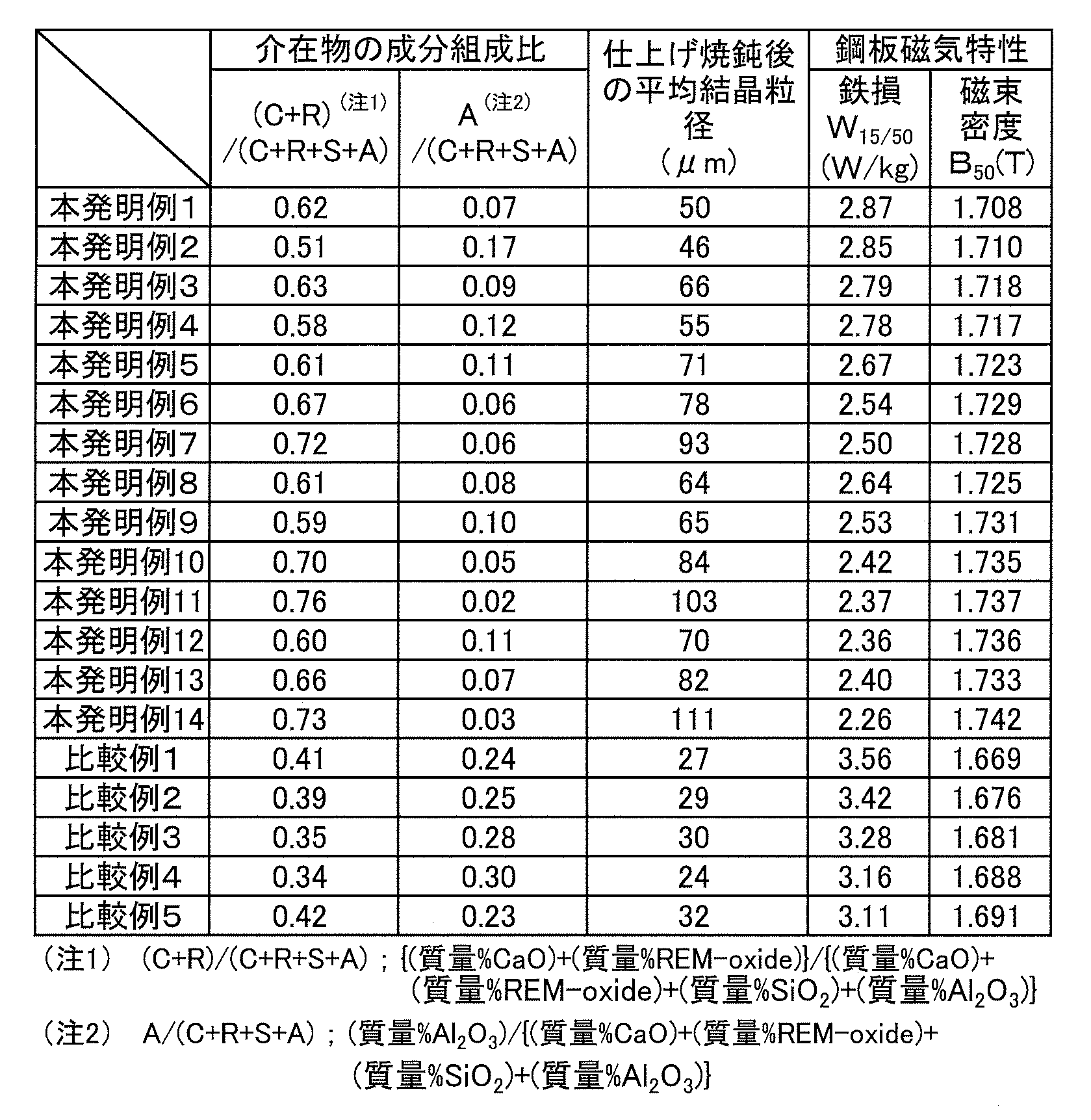
- a cross section (L cross section) parallel to the rolling direction of the product steel sheet obtained as described above was observed with a scanning electron microscope (SEM), and the component composition of 100 or more oxide-based inclusions was analyzed.
- the average value of the obtained analysis values was determined, and the component composition ratio of CaO and REM oxide in the oxide-based inclusion ((% by mass CaO +% by mass REM-oxide) / (% by mass CaO +% by mass REM-oxide +% by mass) % SiO 2 +% by mass Al 2 O 3 )) and the component composition ratio of Al 2 O 3 in the oxide-based inclusions (% by mass Al 2 O 3 / (% by mass CaO +% by mass REM-oxide +% by mass SiO 2) + wt% Al 2 O 3)) was calculated.
- the average crystal grain size of the product steel sheet was measured.
- the average grain size is determined by measuring the average cross-sectional area of the grains by the comparison method or cutting method described in the JIS G0552 steel ferrite grain size test method, and calculating the diameter of a circle equivalent to the obtained area by the average grain size. The diameter was determined as the diameter.
- an Epstein test piece was cut out from the rolling direction and the direction perpendicular to the rolling direction of the product steel sheet, and a magnetic flux density B 50 (magnetic flux density at a magnetization force of 5000 A / m) and an iron loss W 15/50 (magnetic flux density 1.5 T, frequency 50 Hz) was measured in accordance with JIS C2552.
- Table 2 shows the results of the investigation of the inclusions and the measurement results of the average crystal grain size, the magnetic flux density B 50 , and the iron loss W 15/50 .
- the steel sheets satisfying the conditions of the present invention have a low iron loss W 15/50 of 2.87 W / kg or less, and a magnetic flux density B 50 was 1.708 T or more, which was excellent, and it was found that it had excellent magnetic properties.
- the magnetic properties of the steel sheets of Comparative Examples 1 to 5, which are conditions not suitable for the present invention are inferior in iron loss W 15/50 and / or magnetic flux density B 50 .
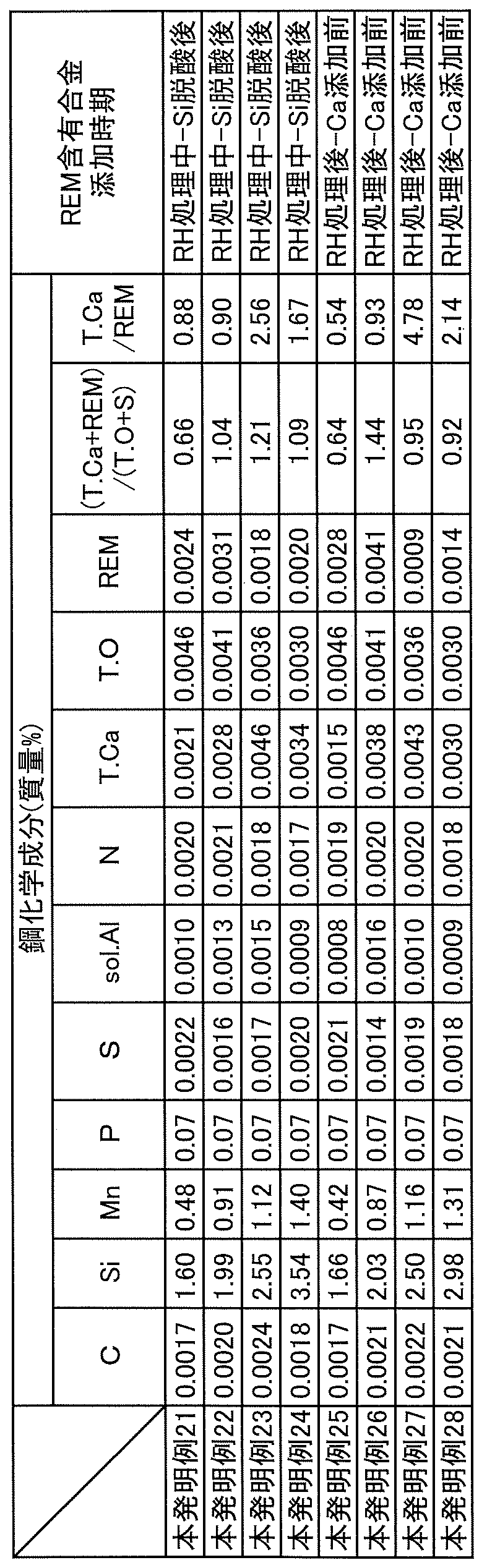
- the obtained slab slab was used as a non-oriented electrical steel sheet (product steel sheet) using the same method as in Example 1.
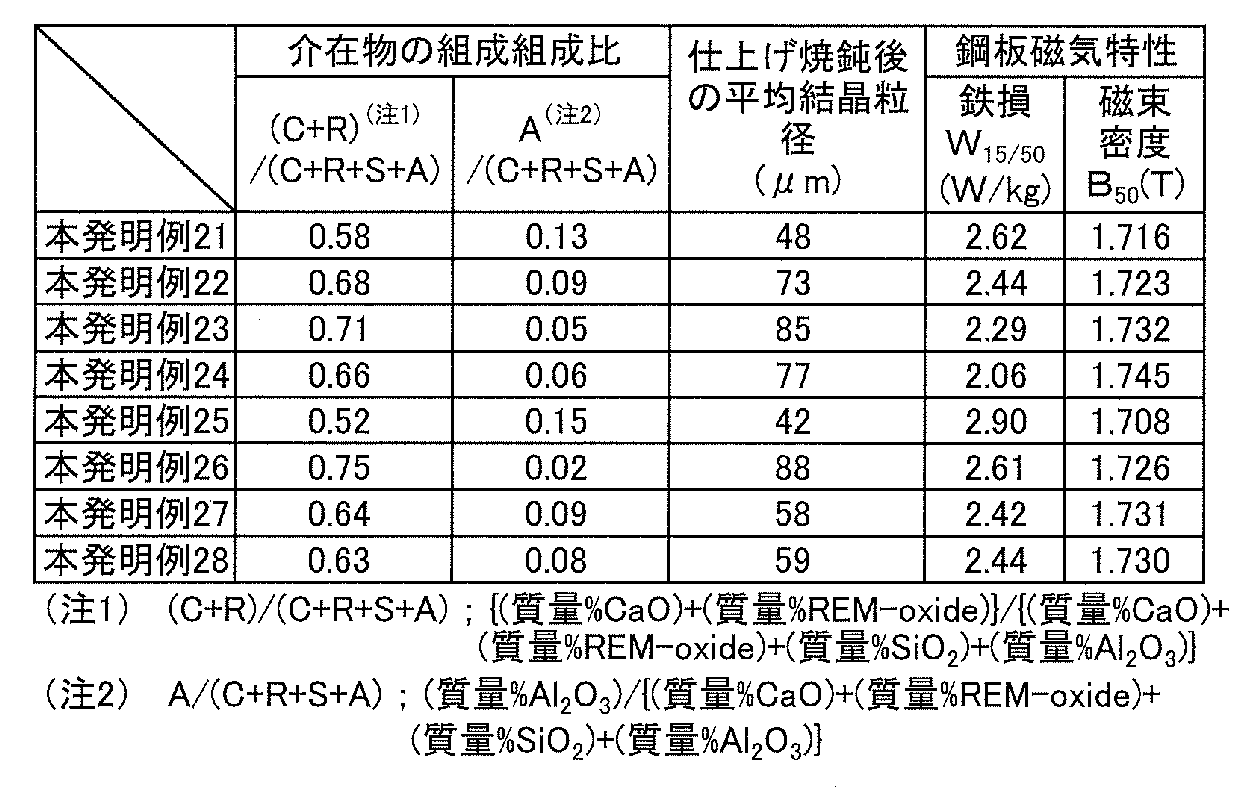
- the component composition ratio of CaO and REM oxide in the oxide-based inclusions ((% by mass CaO +% by mass REM-oxide) / (% by mass CaO +% by mass) REM-oxide +% by mass SiO 2 +% by mass Al 2 O 3 )) and the component composition ratio of Al 2 O 3 in the oxide-based inclusions (% by mass Al 2 O 3 / (% by mass CaO +% by mass REM-oxide + In addition to calculating the mass% SiO 2 + mass% Al 2 O 3 )), the average crystal grain size, the magnetic flux density B 50 and the iron loss W 15/50 were measured.
- Table 4 shows the results of the investigation of the inclusions and the measurement results of the average crystal grain size, the magnetic flux density B 50 , and the iron loss W 15/50 .
- the steel sheet (Examples 21 to 24) in which the REM-containing alloy was added after the Si deoxidation during the treatment in the RH vacuum degassing apparatus had an iron loss W 15/50 of 2.62 W. / kg is less and low iron loss, and magnetic flux density B 50 is at a high magnetic flux density and higher 1.716T, was added before Ca-containing alloys added after completion of processing by RH vacuum degassing apparatus REM-containing alloys It was found that the steel sheet had excellent magnetic properties as compared with the steel sheet under the conditions (Examples 25 to 28 of the present invention).
Landscapes
- Chemical & Material Sciences (AREA)
- Engineering & Computer Science (AREA)
- Materials Engineering (AREA)
- Metallurgy (AREA)
- Organic Chemistry (AREA)
- Mechanical Engineering (AREA)
- Physics & Mathematics (AREA)
- Electromagnetism (AREA)
- Power Engineering (AREA)
- Dispersion Chemistry (AREA)
- Manufacturing & Machinery (AREA)
- Thermal Sciences (AREA)
- Crystallography & Structural Chemistry (AREA)
- Treatment Of Steel In Its Molten State (AREA)
- Soft Magnetic Materials (AREA)
- Manufacturing Of Steel Electrode Plates (AREA)
Abstract
Description
[1]C;0.0050質量%以下、Si;1.5~5.0質量%、Mn;0.2~3.0質量%、sol.Al;0.0030質量%以下、P;0.2質量%以下、S;0.0050質量%以下、N;0.0040質量%以下、T.Ca;0.0010~0.0080質量%、T.O;0.0100質量%以下、及び、REM;0.0001~0.0050質量%を含有し、残部がFe及び不可避的不純物からなる成分組成を有し、
前記T.Ca、前記REM、前記T.O及び前記Sの4成分の質量比((T.Ca+REM)/(T.O+S))が、0.4以上である、無方向性電磁鋼板。
[2]C;0.0050質量%以下、Si;1.5~5.0質量%、Mn;0.2~3.0質量%、sol.Al;0.0030質量%以下、P;0.2質量%以下、S;0.0050質量%以下、N;0.0040質量%以下、T.Ca;0.0010~0.0080質量%、T.O;0.0100質量%以下、及び、REM;0.0001~0.0050質量%を含有し、更に、下記のA群~C群のうちの少なくとも1群の化学成分を含有し、残部がFe及び不可避的不純物からなる成分組成を有し、
前記T.Ca、前記REM、前記T.O及び前記Sの4成分の質量比((T.Ca+REM)/(T.O+S))が、0.4以上である、無方向性電磁鋼板。
A群:Sn、Sb;それぞれ0.01~0.1質量%のうちから選ばれる1種または2種
B群:Mg;0.0001~0.0050質量%
C群:Cu、Ni、Cr;それぞれ0.01~0.5質量%のうちから選ばれる1種または2種以上
[3]更に、前記T.Ca及び前記REMの2成分の質量比(T.Ca/REM)が、1.0以上である、上記[1]または上記[2]に記載の無方向性電磁鋼板。
[4]金属組織の平均結晶粒径が40μm以上である、上記[1]から上記[3]のいずれかに記載の無方向性電磁鋼板。
[5]成分組成としてSi、REM、及びCaを含有する無方向性電磁鋼板の素材となるスラブ鋳片の製造方法であって、
転炉または電気炉から出鋼された溶鋼を、真空脱ガス設備で精錬し、真空脱ガス設備での精錬終了後、溶鋼にCa含有合金を添加し、その後、Ca含有合金を添加した溶鋼を連続鋳造機で連続鋳造してスラブ鋳片を製造する過程において、
前記真空脱ガス設備での精錬中に溶鋼に金属SiまたはSi含有合金を添加して溶鋼をSi脱酸し、
溶鋼がSi脱酸された後、前記真空脱ガス設備での精錬中にREM含有合金を添加する、または、前記真空脱ガス設備での精錬終了後にREM含有合金を添加し、
その後、取鍋内の溶鋼にCa含有合金を添加する、無方向性電磁鋼板の素材となるスラブ鋳片の製造方法。
Cは、磁気時効を起こして鉄損を増加させる元素であり、特に、0.0050質量%を超えると、鉄損の増加が顕著となることから、0.0050質量%以下に制限する。好ましくは0.0030質量%以下である。尚、下限については、少ないほど好ましいので、特に規定しない。
Siは、鋼の電気抵抗を高めて鉄損を低減するのに有効な元素である。特に、本発明では、Siと同じ効果を有するAlを低減しているために、Siを1.5質量%以上含有させる。しかし、Siが5.0質量%を超えると、磁束密度が低下するだけでなく、鋼が脆化し、冷間圧延中に亀裂を生じるなど、製造性を大きく低下させる。よって、上限は5.0質量%とする。更に好ましくは、1.5~3.8質量%である。
Mnは、Siと同様、鋼の電気抵抗を高めて鉄損を低減するのに有効な元素である。そこで、本発明では、Mnを0.2質量%以上含有させる。一方、Mnが3.0質量%を超えると、磁束密度が低下するので、上限は3.0質量%とする。
Al(アルミニウム)は、Siと同様、鋼の電気抵抗を高めて鉄損を低減するのに有効な元素である。しかし、当該無方向性電磁鋼板の鉄スクラップを鋳物銑の原料としてリサイクルする観点から、Alは0.05質量%未満であることが望まれており、低いほど好ましい。また、集合組織を改善し、磁束密度を高める目的から、Alを更に低減し、sol.Alで0.0030質量%以下に制限する。好ましくは、sol.Alで0.0020質量%以下、更に好ましくは、0.0010質量%以下である。下限については、少ないほど好ましいので、特に規定しない。
Pは、微量の含有量で鋼の硬さを高める効果が大きい有用な元素であり、要求される硬さに応じて適宜含有させる。しかし、Pの過剰な含有は、冷間圧延性の低下をもたらすので、Pの上限は0.2質量%とする。
Sは、硫化物となって介在物を形成し、製造性(熱間圧延性)や製品鋼板の磁気特性を低下させるので、少ないほど好ましい。そこで、本発明での上限は0.0050質量%まで許容されるが、磁気特性を重視する場合には0.0025質量%以下とするのが好ましい。尚、Sは少ないほど好ましいので、下限は特に規定しない。
Nは、前述したCと同様、磁気特性を劣化させる元素であり、特に、低Al含有鋼では、上記悪影響は顕著となるので、0.0040質量%以下に制限する。好ましくは0.0030質量%以下である。尚、下限については、少ないほど好ましいので、特に規定しない。
Ca(カルシウム)は、CaSとなって粗大な硫化物を形成し、MnSなどの微細な硫化物の析出を抑制するので、結晶粒の成長を改善して鉄損を低減する効果がある。このため、T.Caは0.0010質量%以上とする。一方で、T.Caが0.0080質量%を超えると、Ca硫化物やCa酸化物の量が増加して結晶粒の成長を阻害し、却って鉄損特性が劣化する。したがって、上限を0.0080質量%とする。尚、T.Ca濃度(全カルシウム濃度)は、鋼中の酸可溶Ca濃度と酸不可溶Ca濃度との和である。
O(酸素)は、T.Oで0.0100質量%を超えると、鋼中の酸化物系介在物量が増加して結晶粒の成長を阻害し、鉄損特性を劣化させるので、T.Oを0.0100質量%以下とする。好ましくは、0.0060質量%以下である。ここでT.Oとは、鋼中に固溶しているO(酸素)と、酸化物として鋼中に存在するO(酸素)との合計である。
REMは、先に述べたように、高温で安定な硫化物を生成し、磁気特性を向上させる効果を有する。更には、Caの有効作用量を増加させる補助的な効果も期待できる。したがって、少なくとも0.0001質量%以上含有させる必要がある。一方で、過剰に含有させても、効果の飽和やコスト増加、酸化物系介在物の低融点化が懸念されることから、上限を0.0050質量%とする。
Sn及びSbは、いずれも、集合組織を改善し、磁気特性を向上する効果を有する。上記効果を得るには、単独または複合して、それぞれ0.01質量%以上含有するのが好ましい。しかし、過剰に含有すると、鋼が脆化し、鋼板の製造過程で板破断やヘゲなどの表面欠陥を引き起こすので、上限はそれぞれ0.1質量%とするのが好ましい。
Mgは、高温下で、MnSやCu2Sよりも安定な硫化物を生成し、磁気特性を向上させる効果を有する元素であるので、これを含有させることができる。上記効果を得るためには、0.0001質量%以上含有するのが好ましい。一方、過剰に含有させても、効果の飽和や、酸化物系介在物の低融点化が懸念されるので、上限は0.0050質量%とするのが好ましい。
Cu、Ni、Crは、鋼板の比抵抗を高めて鉄損を低減させるのに有効な元素であるので、これらの元素の1種または2種以上を含有させることができる。上記効果を得るためには、それぞれ0.01質量%以上含有するのが好ましい。一方、これらの元素は、SiやAlと比較して高価であるので、それぞれの含有量は0.5質量%以下とするのが好ましい。

Claims (5)
- C;0.0050質量%以下、Si;1.5~5.0質量%、Mn;0.2~3.0質量%、sol.Al;0.0030質量%以下、P;0.2質量%以下、S;0.0050質量%以下、N;0.0040質量%以下、T.Ca;0.0010~0.0080質量%、T.O;0.0100質量%以下、及び、REM;0.0001~0.0050質量%を含有し、残部がFe及び不可避的不純物からなる成分組成を有し、
前記T.Ca、前記REM、前記T.O及び前記Sの4成分の質量比((T.Ca+REM)/(T.O+S))が、0.4以上である、無方向性電磁鋼板。 - C;0.0050質量%以下、Si;1.5~5.0質量%、Mn;0.2~3.0質量%、sol.Al;0.0030質量%以下、P;0.2質量%以下、S;0.0050質量%以下、N;0.0040質量%以下、T.Ca;0.0010~0.0080質量%、T.O;0.0100質量%以下、及び、REM;0.0001~0.0050質量%を含有し、更に、下記のA群~C群のうちの少なくとも1群の化学成分を含有し、残部がFe及び不可避的不純物からなる成分組成を有し、
前記T.Ca、前記REM、前記T.O及び前記Sの4成分の質量比((T.Ca+REM)/(T.O+S))が、0.4以上である、無方向性電磁鋼板。
A群:Sn、Sb;それぞれ0.01~0.1質量%のうちから選ばれる1種または2種
B群:Mg;0.0001~0.0050質量%
C群:Cu、Ni、Cr;それぞれ0.01~0.5質量%のうちから選ばれる1種または2種以上 - 更に、前記T.Ca及び前記REMの2成分の質量比(T.Ca/REM)が、1.0以上である、請求項1または請求項2に記載の無方向性電磁鋼板。
- 金属組織の平均結晶粒径が40μm以上である、請求項1から請求項3のいずれか1項に記載の無方向性電磁鋼板。
- 成分組成としてSi、REM、及びCaを含有する無方向性電磁鋼板の素材となるスラブ鋳片の製造方法であって、
転炉または電気炉から出鋼された溶鋼を、真空脱ガス設備で精錬し、真空脱ガス設備での精錬終了後、溶鋼にCa含有合金を添加し、その後、Ca含有合金を添加した溶鋼を連続鋳造機で連続鋳造してスラブ鋳片を製造する過程において、
前記真空脱ガス設備での精錬中に溶鋼に金属SiまたはSi含有合金を添加して溶鋼をSi脱酸し、
溶鋼がSi脱酸された後、前記真空脱ガス設備での精錬中にREM含有合金を添加する、または、前記真空脱ガス設備での精錬終了後にREM含有合金を添加し、
その後、取鍋内の溶鋼にCa含有合金を添加する、無方向性電磁鋼板の素材となるスラブ鋳片の製造方法。
Priority Applications (8)
| Application Number | Priority Date | Filing Date | Title |
|---|---|---|---|
| CA3111121A CA3111121C (en) | 2018-10-02 | 2019-09-05 | Non-oriented electrical steel sheet and method for manufacturing slab used as material for the same |
| US17/281,075 US12146209B2 (en) | 2018-10-02 | 2019-09-05 | Non-oriented electrical steel sheet and method for manufacturing slab used as material for the same |
| KR1020217009549A KR102528345B1 (ko) | 2018-10-02 | 2019-09-05 | 무방향성 전자 강판 및 그의 소재가 되는 슬래브 주편의 제조 방법 |
| CN201980064888.6A CN112789363B (zh) | 2018-10-02 | 2019-09-05 | 无方向性电磁钢板和作为其材料的板坯铸片的制造方法 |
| MX2021003795A MX2021003795A (es) | 2018-10-02 | 2019-09-05 | Chapa de acero electrico no orientado y metodo para fabricar una plancha usada como material para la misma. |
| RU2021109002A RU2768098C1 (ru) | 2018-10-02 | 2019-09-05 | Лист из неструктурированной электротехнической стали и способ изготовления сляба, используемого в качестве материала для него |
| JP2020514767A JP6989000B2 (ja) | 2018-10-02 | 2019-09-05 | 無方向性電磁鋼板の素材となるスラブ鋳片の製造方法 |
| US18/913,120 US20250034685A1 (en) | 2018-10-02 | 2024-10-11 | Non-oriented electrical steel sheet and method for manufacturing slab used as material for the same |
Applications Claiming Priority (2)
| Application Number | Priority Date | Filing Date | Title |
|---|---|---|---|
| JP2018-187234 | 2018-10-02 | ||
| JP2018187234 | 2018-10-02 |
Related Child Applications (2)
| Application Number | Title | Priority Date | Filing Date |
|---|---|---|---|
| US17/281,075 A-371-Of-International US12146209B2 (en) | 2018-10-02 | 2019-09-05 | Non-oriented electrical steel sheet and method for manufacturing slab used as material for the same |
| US18/913,120 Division US20250034685A1 (en) | 2018-10-02 | 2024-10-11 | Non-oriented electrical steel sheet and method for manufacturing slab used as material for the same |
Publications (1)
| Publication Number | Publication Date |
|---|---|
| WO2020071048A1 true WO2020071048A1 (ja) | 2020-04-09 |
Family
ID=70054534
Family Applications (1)
| Application Number | Title | Priority Date | Filing Date |
|---|---|---|---|
| PCT/JP2019/034879 Ceased WO2020071048A1 (ja) | 2018-10-02 | 2019-09-05 | 無方向性電磁鋼板及びその素材となるスラブ鋳片の製造方法 |
Country Status (9)
| Country | Link |
|---|---|
| US (2) | US12146209B2 (ja) |
| JP (1) | JP6989000B2 (ja) |
| KR (1) | KR102528345B1 (ja) |
| CN (1) | CN112789363B (ja) |
| CA (1) | CA3111121C (ja) |
| MX (1) | MX2021003795A (ja) |
| RU (1) | RU2768098C1 (ja) |
| TW (1) | TWI718670B (ja) |
| WO (1) | WO2020071048A1 (ja) |
Cited By (1)
| Publication number | Priority date | Publication date | Assignee | Title |
|---|---|---|---|---|
| TWI900416B (zh) * | 2024-03-26 | 2025-10-01 | 日商杰富意鋼鐵股份有限公司 | 無方向性電磁鋼片用熱軋鋼片之製造方法及無方向性電磁鋼片之製造方法 |
Families Citing this family (1)
| Publication number | Priority date | Publication date | Assignee | Title |
|---|---|---|---|---|
| EP4663796A1 (en) * | 2023-02-09 | 2025-12-17 | Nippon Steel Corporation | Non-oriented electromagnetic steel sheet, method for producing same, and rotary electric machine containing same |
Citations (5)
| Publication number | Priority date | Publication date | Assignee | Title |
|---|---|---|---|---|
| JPS5943814A (ja) * | 1982-09-06 | 1984-03-12 | Kawasaki Steel Corp | 鉄損の低い無方向性電磁鋼板の製造に供する溶鋼の取鍋精錬方法 |
| JP2016047943A (ja) * | 2014-08-27 | 2016-04-07 | Jfeスチール株式会社 | 無方向性電磁鋼板およびその製造方法 |
| WO2017122761A1 (ja) * | 2016-01-15 | 2017-07-20 | Jfeスチール株式会社 | 無方向性電磁鋼板とその製造方法 |
| CN107794439A (zh) * | 2016-08-30 | 2018-03-13 | 宝山钢铁股份有限公司 | 极低铁损无取向电工钢板及其制造方法 |
| JP2018066033A (ja) * | 2016-10-18 | 2018-04-26 | 新日鐵住金株式会社 | 無方向性電磁鋼板 |
Family Cites Families (18)
| Publication number | Priority date | Publication date | Assignee | Title |
|---|---|---|---|---|
| TW498107B (en) * | 2000-04-07 | 2002-08-11 | Nippon Steel Corp | Low iron loss non-oriented electrical steel sheet excellent in workability and method for producing the same |
| JP4568999B2 (ja) | 2000-09-01 | 2010-10-27 | Jfeスチール株式会社 | 無方向性電磁鋼板およびその製造方法 |
| CN100476004C (zh) * | 2003-05-06 | 2009-04-08 | 新日本制铁株式会社 | 铁损优良的无方向性电磁钢板及其制造方法 |
| JP4276613B2 (ja) | 2004-11-11 | 2009-06-10 | 新日本製鐵株式会社 | 無方向性電磁鋼板ならびに無方向性電磁鋼板用溶鋼の取鍋精錬方法 |
| CN100447285C (zh) * | 2006-03-27 | 2008-12-31 | 宝山钢铁股份有限公司 | 焊接工艺性优良的软磁结构钢板及其制造方法 |
| JP4510911B2 (ja) * | 2008-07-24 | 2010-07-28 | 新日本製鐵株式会社 | 高周波用無方向性電磁鋼鋳片の製造方法 |
| KR101203791B1 (ko) | 2012-03-27 | 2012-11-21 | 허남회 | 자성특성이 우수한 (100)〔0vw〕 무방향성 전기강판의 제조방법 |
| JP5943814B2 (ja) | 2012-11-22 | 2016-07-05 | 株式会社ブリヂストン | 空気入りタイヤ |
| JP5825494B2 (ja) | 2013-03-06 | 2015-12-02 | Jfeスチール株式会社 | 無方向性電磁鋼板およびその製造方法 |
| JP5790953B2 (ja) | 2013-08-20 | 2015-10-07 | Jfeスチール株式会社 | 無方向性電磁鋼板とその熱延鋼板 |
| CN107075640A (zh) * | 2014-10-30 | 2017-08-18 | 杰富意钢铁株式会社 | 无取向性电磁钢板和无取向性电磁钢板的制造方法 |
| EP3214198B1 (en) | 2014-10-31 | 2022-06-01 | NIPPON STEEL Stainless Steel Corporation | Ferrite-based stainless steel with high resistance to corrosiveness caused by exhaust gas and condensation and high brazing properties and method for manufacturing same |
| CN107109563B (zh) * | 2014-12-24 | 2019-10-22 | 杰富意钢铁株式会社 | 取向性电磁钢板及其制造方法 |
| JP6020863B2 (ja) * | 2015-01-07 | 2016-11-02 | Jfeスチール株式会社 | 無方向性電磁鋼板およびその製造方法 |
| WO2016136095A1 (ja) | 2015-02-24 | 2016-09-01 | Jfeスチール株式会社 | 無方向性電磁鋼板の製造方法 |
| EP3290539B1 (en) | 2015-04-27 | 2021-06-02 | Nippon Steel Corporation | Non-oriented magnetic steel sheet |
| JP6406522B2 (ja) | 2015-12-09 | 2018-10-17 | Jfeスチール株式会社 | 無方向性電磁鋼板の製造方法 |
| JP6763148B2 (ja) | 2016-02-04 | 2020-09-30 | 日本製鉄株式会社 | 無方向性電磁鋼板 |
-
2019
- 2019-09-05 RU RU2021109002A patent/RU2768098C1/ru active
- 2019-09-05 WO PCT/JP2019/034879 patent/WO2020071048A1/ja not_active Ceased
- 2019-09-05 JP JP2020514767A patent/JP6989000B2/ja active Active
- 2019-09-05 CN CN201980064888.6A patent/CN112789363B/zh active Active
- 2019-09-05 MX MX2021003795A patent/MX2021003795A/es unknown
- 2019-09-05 KR KR1020217009549A patent/KR102528345B1/ko active Active
- 2019-09-05 US US17/281,075 patent/US12146209B2/en active Active
- 2019-09-05 CA CA3111121A patent/CA3111121C/en active Active
- 2019-09-17 TW TW108133311A patent/TWI718670B/zh active
-
2024
- 2024-10-11 US US18/913,120 patent/US20250034685A1/en active Pending
Patent Citations (5)
| Publication number | Priority date | Publication date | Assignee | Title |
|---|---|---|---|---|
| JPS5943814A (ja) * | 1982-09-06 | 1984-03-12 | Kawasaki Steel Corp | 鉄損の低い無方向性電磁鋼板の製造に供する溶鋼の取鍋精錬方法 |
| JP2016047943A (ja) * | 2014-08-27 | 2016-04-07 | Jfeスチール株式会社 | 無方向性電磁鋼板およびその製造方法 |
| WO2017122761A1 (ja) * | 2016-01-15 | 2017-07-20 | Jfeスチール株式会社 | 無方向性電磁鋼板とその製造方法 |
| CN107794439A (zh) * | 2016-08-30 | 2018-03-13 | 宝山钢铁股份有限公司 | 极低铁损无取向电工钢板及其制造方法 |
| JP2018066033A (ja) * | 2016-10-18 | 2018-04-26 | 新日鐵住金株式会社 | 無方向性電磁鋼板 |
Cited By (3)
| Publication number | Priority date | Publication date | Assignee | Title |
|---|---|---|---|---|
| TWI900416B (zh) * | 2024-03-26 | 2025-10-01 | 日商杰富意鋼鐵股份有限公司 | 無方向性電磁鋼片用熱軋鋼片之製造方法及無方向性電磁鋼片之製造方法 |
| WO2025204271A1 (ja) * | 2024-03-26 | 2025-10-02 | Jfeスチール株式会社 | 無方向性電磁鋼板用熱延鋼板の製造方法及び無方向性電磁鋼板の製造方法 |
| JPWO2025204271A1 (ja) * | 2024-03-26 | 2025-10-02 |
Also Published As
| Publication number | Publication date |
|---|---|
| JP6989000B2 (ja) | 2022-01-05 |
| CA3111121A1 (en) | 2020-04-09 |
| US12146209B2 (en) | 2024-11-19 |
| CN112789363B (zh) | 2022-06-07 |
| RU2768098C1 (ru) | 2022-03-23 |
| US20250034685A1 (en) | 2025-01-30 |
| KR20210052519A (ko) | 2021-05-10 |
| JPWO2020071048A1 (ja) | 2021-02-15 |
| CA3111121C (en) | 2023-02-21 |
| KR102528345B1 (ko) | 2023-05-02 |
| US20210332463A1 (en) | 2021-10-28 |
| MX2021003795A (es) | 2021-05-27 |
| TW202020184A (zh) | 2020-06-01 |
| CN112789363A (zh) | 2021-05-11 |
| TWI718670B (zh) | 2021-02-11 |
Similar Documents
| Publication | Publication Date | Title |
|---|---|---|
| TWI622655B (zh) | 無方向性電磁鋼板及其製造方法 | |
| KR101940084B1 (ko) | 무방향성 전자 강판 및 그의 제조 방법 | |
| JP7159311B2 (ja) | 磁気特性に優れる無方向性電磁鋼板およびその製造方法 | |
| CN112391512A (zh) | 一种高磁感取向硅钢及其制造方法 | |
| US20250034685A1 (en) | Non-oriented electrical steel sheet and method for manufacturing slab used as material for the same | |
| JPWO2005100627A1 (ja) | 打抜き加工性と歪取焼鈍後の磁気特性に優れた無方向性電磁銅板とその製造方法 | |
| JP4218136B2 (ja) | 高磁束密度低鉄損の無方向性電磁鋼板およびその製造方法 | |
| JP7047818B2 (ja) | 溶鋼の精錬方法 | |
| JP2004204252A (ja) | 耐リジング性に優れたTi含有高加工性フェライト系クロム鋼板およびその製造方法 | |
| JPH10212555A (ja) | 磁気特性に優れた無方向性電磁鋼板およびその製造方法 | |
| JPH1112699A (ja) | 磁気特性に優れた無方向性電磁鋼板およびその製造方法 | |
| WO2026104191A1 (en) | Method of manufacturing ngo electrical steel | |
| JPWO2021045212A1 (ja) | 方向性電磁鋼板およびその製造方法 | |
| JPH07305109A (ja) | 鉄損の低い無方向性電磁鋼板用溶鋼の溶製方法 | |
| JPH0673510A (ja) | 磁気特性に優れた無方向性電磁鋼板及びその溶製方法 | |
| JP2000017331A (ja) | 鉄損の低い無方向性電磁鋼板の製造方法 |
Legal Events
| Date | Code | Title | Description |
|---|---|---|---|
| ENP | Entry into the national phase |
Ref document number: 2020514767 Country of ref document: JP Kind code of ref document: A |
|
| 121 | Ep: the epo has been informed by wipo that ep was designated in this application |
Ref document number: 19869968 Country of ref document: EP Kind code of ref document: A1 |
|
| ENP | Entry into the national phase |
Ref document number: 3111121 Country of ref document: CA |
|
| WWE | Wipo information: entry into national phase |
Ref document number: MX/A/2021/003795 Country of ref document: MX |
|
| ENP | Entry into the national phase |
Ref document number: 20217009549 Country of ref document: KR Kind code of ref document: A |
|
| WWE | Wipo information: entry into national phase |
Ref document number: 2101001916 Country of ref document: TH |
|
| NENP | Non-entry into the national phase |
Ref country code: DE |
|
| 122 | Ep: pct application non-entry in european phase |
Ref document number: 19869968 Country of ref document: EP Kind code of ref document: A1 |
|
| WWG | Wipo information: grant in national office |
Ref document number: MX/A/2021/003795 Country of ref document: MX |