WO2020059675A1 - 改変チャネルロドプシン - Google Patents
改変チャネルロドプシン Download PDFInfo
- Publication number
- WO2020059675A1 WO2020059675A1 PCT/JP2019/036252 JP2019036252W WO2020059675A1 WO 2020059675 A1 WO2020059675 A1 WO 2020059675A1 JP 2019036252 W JP2019036252 W JP 2019036252W WO 2020059675 A1 WO2020059675 A1 WO 2020059675A1
- Authority
- WO
- WIPO (PCT)
- Prior art keywords
- amino acid
- acid sequence
- seq
- polypeptide
- sequence shown
- Prior art date
- Legal status (The legal status is an assumption and is not a legal conclusion. Google has not performed a legal analysis and makes no representation as to the accuracy of the status listed.)
- Ceased
Links
Images



Classifications
-
- C—CHEMISTRY; METALLURGY
- C07—ORGANIC CHEMISTRY
- C07K—PEPTIDES
- C07K14/00—Peptides having more than 20 amino acids; Gastrins; Somatostatins; Melanotropins; Derivatives thereof
- C07K14/405—Peptides having more than 20 amino acids; Gastrins; Somatostatins; Melanotropins; Derivatives thereof from algae
-
- A—HUMAN NECESSITIES
- A61—MEDICAL OR VETERINARY SCIENCE; HYGIENE
- A61K—PREPARATIONS FOR MEDICAL, DENTAL OR TOILETRY PURPOSES
- A61K38/00—Medicinal preparations containing peptides
- A61K38/16—Peptides having more than 20 amino acids; Gastrins; Somatostatins; Melanotropins; Derivatives thereof
- A61K38/17—Peptides having more than 20 amino acids; Gastrins; Somatostatins; Melanotropins; Derivatives thereof from animals; from humans
-
- A—HUMAN NECESSITIES
- A61—MEDICAL OR VETERINARY SCIENCE; HYGIENE
- A61K—PREPARATIONS FOR MEDICAL, DENTAL OR TOILETRY PURPOSES
- A61K38/00—Medicinal preparations containing peptides
- A61K38/16—Peptides having more than 20 amino acids; Gastrins; Somatostatins; Melanotropins; Derivatives thereof
- A61K38/17—Peptides having more than 20 amino acids; Gastrins; Somatostatins; Melanotropins; Derivatives thereof from animals; from humans
- A61K38/177—Receptors; Cell surface antigens; Cell surface determinants
- A61K38/1796—Receptors; Cell surface antigens; Cell surface determinants for hormones
-
- A—HUMAN NECESSITIES
- A61—MEDICAL OR VETERINARY SCIENCE; HYGIENE
- A61K—PREPARATIONS FOR MEDICAL, DENTAL OR TOILETRY PURPOSES
- A61K48/00—Medicinal preparations containing genetic material which is inserted into cells of the living body to treat genetic diseases; Gene therapy
- A61K48/005—Medicinal preparations containing genetic material which is inserted into cells of the living body to treat genetic diseases; Gene therapy characterised by an aspect of the 'active' part of the composition delivered, i.e. the nucleic acid delivered
-
- A—HUMAN NECESSITIES
- A61—MEDICAL OR VETERINARY SCIENCE; HYGIENE
- A61P—SPECIFIC THERAPEUTIC ACTIVITY OF CHEMICAL COMPOUNDS OR MEDICINAL PREPARATIONS
- A61P27/00—Drugs for disorders of the senses
- A61P27/02—Ophthalmic agents
-
- C—CHEMISTRY; METALLURGY
- C07—ORGANIC CHEMISTRY
- C07K—PEPTIDES
- C07K14/00—Peptides having more than 20 amino acids; Gastrins; Somatostatins; Melanotropins; Derivatives thereof
- C07K14/435—Peptides having more than 20 amino acids; Gastrins; Somatostatins; Melanotropins; Derivatives thereof from animals; from humans
- C07K14/705—Receptors; Cell surface antigens; Cell surface determinants
-
- C—CHEMISTRY; METALLURGY
- C07—ORGANIC CHEMISTRY
- C07K—PEPTIDES
- C07K14/00—Peptides having more than 20 amino acids; Gastrins; Somatostatins; Melanotropins; Derivatives thereof
- C07K14/435—Peptides having more than 20 amino acids; Gastrins; Somatostatins; Melanotropins; Derivatives thereof from animals; from humans
- C07K14/705—Receptors; Cell surface antigens; Cell surface determinants
- C07K14/72—Receptors; Cell surface antigens; Cell surface determinants for hormones
- C07K14/723—G protein coupled receptor, e.g. TSHR-thyrotropin-receptor, LH/hCG receptor, FSH receptor
-
- C—CHEMISTRY; METALLURGY
- C07—ORGANIC CHEMISTRY
- C07K—PEPTIDES
- C07K19/00—Hybrid peptides, i.e. peptides covalently bound to nucleic acids, or non-covalently bound protein-protein complexes
-
- C—CHEMISTRY; METALLURGY
- C12—BIOCHEMISTRY; BEER; SPIRITS; WINE; VINEGAR; MICROBIOLOGY; ENZYMOLOGY; MUTATION OR GENETIC ENGINEERING
- C12N—MICROORGANISMS OR ENZYMES; COMPOSITIONS THEREOF; PROPAGATING, PRESERVING, OR MAINTAINING MICROORGANISMS; MUTATION OR GENETIC ENGINEERING; CULTURE MEDIA
- C12N15/00—Mutation or genetic engineering; DNA or RNA concerning genetic engineering, vectors, e.g. plasmids, or their isolation, preparation or purification; Use of hosts therefor
- C12N15/09—Recombinant DNA-technology
- C12N15/63—Introduction of foreign genetic material using vectors; Vectors; Use of hosts therefor; Regulation of expression
- C12N15/79—Vectors or expression systems specially adapted for eukaryotic hosts
- C12N15/85—Vectors or expression systems specially adapted for eukaryotic hosts for animal cells
- C12N15/86—Viral vectors
-
- C—CHEMISTRY; METALLURGY
- C12—BIOCHEMISTRY; BEER; SPIRITS; WINE; VINEGAR; MICROBIOLOGY; ENZYMOLOGY; MUTATION OR GENETIC ENGINEERING
- C12N—MICROORGANISMS OR ENZYMES; COMPOSITIONS THEREOF; PROPAGATING, PRESERVING, OR MAINTAINING MICROORGANISMS; MUTATION OR GENETIC ENGINEERING; CULTURE MEDIA
- C12N5/00—Undifferentiated human, animal or plant cells, e.g. cell lines; Tissues; Cultivation or maintenance thereof; Culture media therefor
- C12N5/10—Cells modified by introduction of foreign genetic material
-
- A—HUMAN NECESSITIES
- A61—MEDICAL OR VETERINARY SCIENCE; HYGIENE
- A61K—PREPARATIONS FOR MEDICAL, DENTAL OR TOILETRY PURPOSES
- A61K38/00—Medicinal preparations containing peptides
-
- C—CHEMISTRY; METALLURGY
- C07—ORGANIC CHEMISTRY
- C07K—PEPTIDES
- C07K2319/00—Fusion polypeptide
-
- C—CHEMISTRY; METALLURGY
- C12—BIOCHEMISTRY; BEER; SPIRITS; WINE; VINEGAR; MICROBIOLOGY; ENZYMOLOGY; MUTATION OR GENETIC ENGINEERING
- C12N—MICROORGANISMS OR ENZYMES; COMPOSITIONS THEREOF; PROPAGATING, PRESERVING, OR MAINTAINING MICROORGANISMS; MUTATION OR GENETIC ENGINEERING; CULTURE MEDIA
- C12N2750/00—MICROORGANISMS OR ENZYMES; COMPOSITIONS THEREOF; PROPAGATING, PRESERVING, OR MAINTAINING MICROORGANISMS; MUTATION OR GENETIC ENGINEERING; CULTURE MEDIA ssDNA viruses
- C12N2750/00011—Details
- C12N2750/14011—Parvoviridae
- C12N2750/14111—Dependovirus, e.g. adenoassociated viruses
- C12N2750/14141—Use of virus, viral particle or viral elements as a vector
- C12N2750/14143—Use of virus, viral particle or viral elements as a vector viral genome or elements thereof as genetic vector
Definitions
- the present invention relates to a modified channel rhodopsin. More specifically, the present invention relates to a modified channel rhodopsin capable of opening and closing an ion channel by irradiation with light of different wavelengths and / or having high ion permeability (photoreactivity).
- Patent Document 1 discloses a modified channel rhodopsin in which the expression efficiency on the cell membrane is improved by substituting the N-terminal region of the modified channel rhodopsin. This modified channel rhodopsin is capable of opening an ion channel by illuminating light to induce excitement.
- the present invention is directed to restoring visual acuity by introducing the gene into the retina of a blinded rat. Are successful.
- an object of the present invention is to provide a modified channel rhodopsin capable of opening and closing an ion channel by irradiation with light of different wavelengths and / or having high ion permeability.
- the third transmembrane domain of the seven transmembrane domains possessed by the modified channelrhodopsin reported in Patent Document 1 by the present inventors was replaced by seven transmembrane domains possessed by Chlamydomonas reinhardtii-derived channelrhodopsin-1. It has been found that by substituting the third transmembrane domain, channelrhodopsin with high ion permeability can be obtained.
- the N-terminal region of volvobox-derived channelrhodopsin is replaced with the N-terminal region of Chlamydomonas reinhardtii-derived channelrhodopsin-1.
- a C-terminal region of Chlamydomonas reinhardtii-derived channelrhodopsin-2 containing at least the 270th to 315th amino acids of the amino acid sequence shown in SEQ ID NO: 2 is added to the C-terminal of the polypeptide.
- the modified channelrhodopsin according to the present invention is a C-terminal of channelrhodopsin in which the N-terminal region of volvobox-derived channelrhodopsin is replaced by the N-terminal region of Chlamydomonas reinhardtii-derived channelrhodopsin-1, as described in claim 2.
- the modified channel rhodopsin according to claim 3 is the modified channel rhodopsin according to claim 1 or 2, wherein the amino acid at position 166 (cysteine) of the amino acid sequence shown in SEQ ID NO: 1 is substituted with alanine.
- the modified channelrhodopsin according to claim 4 is any one of the following (a) to (c) in the modified channelrhodopsin according to claim 3.
- modified channel rhodopsin according to claim 5 is any one of the following (a) to (c) in the modified channel rhodopsin according to claim 3.
- modified channel rhodopsin according to claim 6 is the modified channel rhodopsin according to claim 1 or 2, wherein the amino acids 142 to 169 of the amino acid sequence shown in SEQ ID NO: 1 are 143 to 17 of the amino acid sequence of channelrhodopsin-1 derived from Chlamydomonas reinhardtii shown in SEQ ID NO: 6 It is replaced by the 0th amino acid.
- the modified channel rhodopsin according to claim 7 is obtained by replacing the amino acid at position 167 (cysteine) of the amino acid sequence shown in SEQ ID NO: 6 with alanine in the modified channel rhodopsin according to claim 6.
- the modified channel rhodopsin according to claim 8 is the modified channel rhodopsin according to claim 6 or 7, wherein the 162nd amino acid (glutamic acid) of the amino acid sequence shown in SEQ ID NO: 6 is substituted with threonine.
- the modified channelrhodopsin according to claim 9 is any one of the following (a) to (c) in the modified channelrhodopsin according to claim 7.
- modified channel rhodopsin according to claim 10 is any one of the following (a) to (c) in the modified channel rhodopsin according to claim 7.
- modified channel rhodopsin according to claim 11 is any one of the following (a) to (c) in the modified channel rhodopsin according to claim 8.
- modified channelrhodopsin of the present invention is characterized in that the N-terminal region of volvobox-derived channelrhodopsin has the N-terminal region of Chlamydomonas reinhardtii-derived channelrhodopsin-1 as described in claim 12.
- polypeptide comprising the amino acid sequence shown in SEQ ID NO: 10; (b) an amino acid sequence comprising deletion, substitution, addition or insertion of one or more amino acids in the amino acid sequence shown in SEQ ID NO: 10, and (C) a polypeptide having a biological activity equivalent to that of the polypeptide of (a); and (c) an amino acid sequence having at least 90% sequence identity with the amino acid sequence shown in SEQ ID NO: 10, and Polypeptide Having Equivalent Biological Activity
- the polynucleotide of the present invention encodes the polypeptide according to any one of claims 1 to 12.
- the expression vector of the present invention comprises the polynucleotide of claim 13 operatively linked to a promoter, as described in claim 14.
- the cell of the present invention expresses the polypeptide according to any one of claims 1 to 12.
- the cell according to claim 16 is the cell according to claim 15, wherein the cell is a photoreceptor cell.
- the present invention provides a polypeptide according to any one of claims 1 to 12, and a polypeptide according to any one of claims 1 to 12, in the manufacture of a medicament for treating a subject suffering from a disorder of the outer retinal layer, as described in claim 17. Use of a polynucleotide, any of the expression vectors of claim 14.
- the use according to claim 18 is the use according to claim 17, wherein the disorder of the outer retinal layer is any of retinitis pigmentosa, age-related macular degeneration, and retinal detachment.
- the pharmaceutical composition for treating a disorder of the outer retinal layer of the present invention as described in claim 19, comprises the polypeptide according to any one of claims 1 to 12 or the expression vector according to claim 14. As an active ingredient.
- a modified channel rhodopsin capable of opening and closing an ion channel by irradiation with light of different wavelengths and / or having high ion permeability.
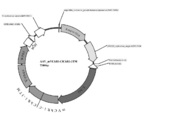
- FIG. 2 shows the construction of a plasmid for preparing a neomVChR1-expressing adeno-associated virus vector in Example 1.
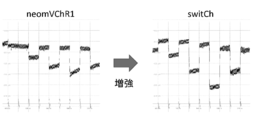
- FIG. The same shows the results of measuring the light-induced current of the cells expressing neomChR1 by the patch clamp method.
- 10 is a graph showing that switchCh has higher ion permeability than neomVChR1 in Example 2.
- FIG. 5 shows the construction of a plasmid for producing an adeno-associated virus vector expressing mVChR1-ClChR1-3TM in Example 3.
- FIG. FIG. 4 is a graph showing that mVChR1-ClChR1-3TM has higher ion permeability than mVChR1.
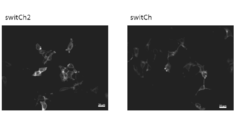
- FIG. 10 is a fluorescence micrograph showing that switchCh2 has higher localization in a cell membrane than switchCh in Example 4.
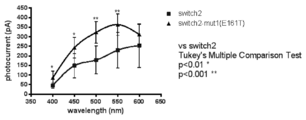
- FIG. 11 is a graph showing that switchCh2-mut1 obtained by substituting glutamic acid at position 161 of switchCh2 with threonine in Example 5 has higher ion permeability than switchCh2.
- the modified channel rhodopsin of the present invention is based on the modified channel rhodopsin reported by the present inventors in Patent Document 1.
- This modified channelrhodopsin is obtained by replacing the N-terminal region of Volvox-derived channelrhodopsin with the N-terminal region of Chlamydomonas reinhardtii-derived channelrhodopsin-1 (a region involved in the expression of a cell membrane and not containing a transmembrane domain). ), The expression efficiency of which on the cell membrane is improved.
- a polypeptide comprising the amino acid sequence shown in SEQ ID NO: 1 (the amino acid sequence shown in SEQ ID NO: 10 in Patent Document 1) Consisting of a polypeptide consisting of Matters described in Patent Document 1 are treated as the matters described in this specification.
- the modified channel rhodopsin of the present invention may be obtained by modifying the C-terminal region of the modified channel rhodopsin reported in Patent Document 1 by the C-terminal region of Chlamydomonas reinhardtii-derived channelrhodopsin-2 or a channel derived from tetracermis striata. It is a substitution of the C-terminal region of rhodopsin.
- the modified channelrhodopsin of the present invention in which the C-terminal region of the modified channelrhodopsin reported by the present inventors in Patent Document 1 is replaced with the C-terminal region of channelrhodopsin-2 derived from Chlamydomonas reinhardtii, specifically, A channel derived from Chlamydomonas reinhardtii comprising at least the 270th to 315th amino acids of the amino acid sequence of SEQ ID NO: 2 at the C-terminus of the polypeptide comprising at least the 1st to 307th amino acids of the amino acid sequence of SEQ ID NO: 1 It is obtained by adding the C-terminal region of rhodopsin-2.
- the modified channel rhodopsin of the present invention in which the C-terminal region of the modified channel rhodopsin reported by the present inventors in Patent Document 1 is substituted with the C-terminal region of the channel rhodopsin derived from tetracermis striata is specifically represented by SEQ ID NO: 1.
- the modified channel rhodopsin of the present invention opens the ion channel by light irradiation of a wide wavelength region of visible light, for example, 450 to 600 mm, and opens the ion channel by light irradiation of a wavelength shorter than 400 nm, which opens the ion channel.
- the amino acid at position 166 (cysteine) in the amino acid sequence shown in SEQ ID NO: 1 is substituted with alanine.
- the amino acid at position 194 (aspartic acid) in the amino acid sequence shown in SEQ ID NO: 1 may be substituted with cysteine, or the amino acid at position 229 (histidine) may be substituted with asparagine. Further, it may have another site-specific mutation.
- SEQ ID NO: 2 contains at least the amino acids 1 to 307 of the amino acid sequence shown in SEQ ID NO: 1, and 166 is substituted with alanine, 194 is substituted with cysteine, and 229 is substituted with asparagine at the C-terminal of the polypeptide.
- Specific examples of the modified channelrhodopsin of the present invention in which the C-terminal region of Chlamydomonas reinhardtii-derived channelrhodopsin-2 containing at least the 270th to 315th amino acids of the amino acid sequence of A polypeptide comprising the amino acid sequence shown.
- SEQ ID NO: 3 comprises at least the amino acids 1 to 307 of the amino acid sequence shown in SEQ ID NO: 1, and 166 is substituted with alanine, 194 is substituted with cysteine, and 229 is substituted with asparagine.
- Specific examples of the modified channelrhodopsin of the present invention in which the C-terminal region of the channelrhodopsin derived from tetracermis striater at least including the amino acids 252 to 292 of the amino acid sequence shown in SEQ ID NO: 5 are added. Polypeptides.
- amino acids 142 to 169 of the amino acid sequence shown in SEQ ID NO: 1 may be substituted with amino acids 143 to 170 in the amino acid sequence of channelrhodopsin-1 derived from Chlamydomonas reinhardtii shown in SEQ ID NO: 6. .
- This substitution replaces the third transmembrane domain of the seven transmembrane domains of the modified channelrhodopsin reported by the present inventors in Patent Document 1 (that is, the seven transmembrane domains of the channel rhodopsin from Volbox) with Chlamydomonas.
- -It means to replace the seven transmembrane domains of channel rhodopsin-1 derived from Reinhardtii with the third transmembrane domain, and this substitution can increase ion permeability.
- the ion channel is opened by light irradiation of a wide wavelength region of visible light such as 450 to 600 mm, and the ion channel is closed by light irradiation of a wavelength shorter than 400 nm to open the ion channel.
- the amino acid at position 167 (cysteine after substitution with amino acids 142 to 169 of the amino acid sequence shown in SEQ ID NO: 1) (cysteine) in the amino acid sequence shown in SEQ ID NO: 6 is substituted with alanine.
- amino acid at position 194 (aspartic acid) in the amino acid sequence shown in SEQ ID NO: 1 may be substituted with cysteine, or the amino acid at position 229 (histidine) may be substituted with asparagine. Further, it may have another site-specific mutation.
- the 162nd amino acid (glutamic acid) of the amino acid sequence shown in SEQ ID NO: 6 (the 161st amino acid after substitution with the 142nd to 169th amino acids in the amino acid sequence shown in SEQ ID NO: 1)
- the amino acid at position 170 (leucine) in the amino acid sequence shown in SEQ ID NO: 1 may be substituted with cysteine, or the amino acid at position 197 (cysteine) may be substituted with serine.
- SEQ ID NO: 1 contains at least amino acids 1 to 307 of the amino acid sequence, and amino acids 142 to 169 are amino acids 143 to 143 of the amino acid sequence of Chlamydomonas reinhardtii-derived channelrhodopsin-1 shown in SEQ ID NO: 6.
- the amino acid at position 170 is replaced with alanine
- the position 166 is replaced with alanine
- the position 194 is replaced with cysteine
- the position 229 is replaced with asparagine at the C-terminal of the polypeptide
- modified channelrhodopsin of the present invention to which the C-terminal region of Chlamydomonas reinhardtii-derived channelrhodopsin-2 containing at least an amino acid include a polypeptide having the amino acid sequence shown in SEQ ID NO: 7 .
- SEQ ID NO: 1 contains at least amino acids 1 to 307 of the amino acid sequence, and amino acids 142 to 169 are amino acids 143 to 143 of the amino acid sequence of Chlamydomonas reinhardtii-derived channelrhodopsin-1 shown in SEQ ID NO: 6.
- the amino acid at position 170 is substituted at the amino acid at position 170, the position at position 166 is replaced with alanine, the position at position 194 is replaced with cysteine, and the position at position 229 is replaced with asparagine at the C-terminus.
- a specific example of the modified channelrhodopsin of the present invention to which the C-terminal region of the channelrhodopsin derived from tetracermis striater containing at least an amino acid is added includes a polypeptide having the amino acid sequence shown in SEQ ID NO: 8.
- SEQ ID NO: 1 contains at least amino acids 1 to 307 of the amino acid sequence, and amino acids 142 to 169 are amino acids 143 to 143 of the amino acid sequence of Chlamydomonas reinhardtii-derived channelrhodopsin-1 shown in SEQ ID NO: 6.
- Specific examples of the modified channelrhodopsin of the present invention to which the C-terminal region of Chlamydomonas reinhardtii-derived channelrhodopsin-2 containing at least the 270th to 315th amino acids of the present invention include the amino acid sequence shown in SEQ ID NO: 9 Polypeptides.
- the third transmembrane domain of the seven transmembrane domains of the modified channel rhodopsin reported by the present inventors in Patent Document 1 is three of the seven transmembrane domains of the channel rhodopsin-1 derived from Chlamydomonas reinhardtii.
- a specific example of the modified channel rhodopsin of the present invention substituted by the second transmembrane domain includes a polypeptide having the amino acid sequence shown in SEQ ID NO: 10.
- the modified channel rhodopsin of the present invention has one or more amino acid deletions, substitutions, additions or insertions in the amino acid sequences shown in SEQ ID NOs: 4, 5, 7 to 10, respectively.
- it consists of an amino acid sequence having at least 90% sequence identity with the amino acid sequence shown in each of SEQ ID NOs: 4, 5, 7 to 10, and consists of the amino acid sequence shown in each of SEQ ID NOs: 4, 5, 7 to 10
- the “plurality” is an integer of 50 or less, preferably an integer of 30 or less, more preferably an integer of 10 or less, for example, 2 to 9, 2 to 7, 2 to 5 .
- the sequence identity with the amino acid sequence shown in each of SEQ ID NOs: 4, 5, 7 to 10 is preferably at least 95%, more preferably at least 96%, even more preferably at least 97%, and even more. Preferably it is at least 98%, most preferably at least 99%.
- the percentage of identity refers to a value calculated using software (for example, FASTA, DANASYS, BLAST, etc.) for calculating the identity between a plurality (two) of amino acid sequences with default settings.
- “Equivalent biological activity” means that the biological activities such as photosensitivity and channel function are substantially the same in intensity.
- the term may also include the case of having substantially the same biological activity, in which case the "homogeneous" biological activity is the same in properties such as light-receiving wavelength and ion permeability. It means something.
- the modified channel rhodopsin of the present invention can be produced by a genetic engineering technique. Specifically, first, a polynucleotide encoding the modified channel rhodopsin of the present invention (hereinafter, referred to as “modified channel rhodopsin gene of the present invention”) is prepared.
- modified channel rhodopsin gene of the present invention can be prepared by a method known to those skilled in the art.
- a polynucleotide encoding a modified channel rhodopsin reported by the present inventors in Patent Document 1 a polynucleotide encoding a channel rhodopsin-2 derived from Chlamydomonas reinhardtii, a channel derived from tetracermis striater It can be prepared by chemically synthesizing a polynucleotide encoding rhodopsin and a polynucleotide encoding channel rhodopsin-1 derived from Chlamydomonas reinhardtii based on the respective sequence information.
- the modified channel rhodopsin gene of the present invention operably linked to a promoter can maintain replication in the host cell, stably express the encoded polypeptide, and stabilize this gene.
- the modified channel rhodopsin of the present invention can be produced in a host by incorporating the gene into a sustainable expression vector and transforming a host with the obtained recombinant expression vector. For recombinant techniques, see Proc. Natl. Acad. Sci. USA.
- expression vectors include plasmids derived from Escherichia coli (Escherichia coli) (eg, pET28, pGEX4T, pUC118, pUC119, pUC18, pUC19, and other plasmid DNAs), and plasmids derived from Bacillus subtilis (eg, pUB110, pTP5, and Other plasmid DNAs), yeast-derived plasmids (eg, YEp13, YEp24, YCp50, and other plasmid DNAs), ⁇ phage ( ⁇ gt11 and ⁇ ZAP), mammalian plasmids (pCMV and pSV40), viral vectors (eg, adenovirus vectors) , Adeno-associated virus vector, retrovirus vector, lentivirus vector, vaccini
- a binary vector pBI-type such as cosmid vector
- cosmid vector can be used.
- “operably linked” refers to a functional bond between a promoter sequence and a polynucleotide sequence of interest such that the promoter sequence can initiate transcription of the polynucleotide sequence of interest.
- the promoter is not particularly limited, and a suitable promoter may be selected according to the host, and a known constitutive promoter or an inducible promoter can be used, but a constitutive promoter is preferably used.
- Insertion of the modified channel rhodopsin gene of the present invention into an expression vector can be performed, for example, by creating or ligating a restriction enzyme site flanking the modified channel rhodopsin gene of the present invention, and into an appropriate vector DNA restriction enzyme site or multicloning site. This is done by inserting.
- the expression vector includes a promoter and the modified channel rhodopsin gene of the present invention, as well as an enhancer and other cis elements, a splicing signal, a polyA addition signal, a selection marker (an ampicillin resistance marker, a tetracycline resistance marker and other drug resistance genes, if necessary). Markers, auxotrophic complementary gene markers such as LEU1, TRP1, and URA3; dominant selectable markers such as APH, DHFR, and TK; and a ribosome binding site (RBS).
- auxotrophic complementary gene markers such as LEU1, TRP1, and URA3
- dominant selectable markers such as APH, DHFR, and TK
- RBS ribosome binding site
- Transformation of the host is performed using the protoplast method, spheroplast method, competent cell method, virus method, calcium phosphate method, lipofection method, microinjection method, gene bombardment method, Agrobacterium method, electroporation, etc. be able to.
- the transformant thus obtained is cultured under appropriate conditions using a medium containing an assimilable carbon source, nitrogen source, metal salt, vitamin, and the like.
- Culture of the transformant is usually performed at 25 to 37 ° C. for 3 to 6 hours under aerobic conditions such as shaking culture or aeration and stirring culture.
- the pH is kept near neutral. Adjustment of pH is performed using an inorganic or organic acid, an alkaline solution, or the like.
- an antibiotic such as ampicillin or tetracycline may be added to the medium, if necessary, depending on the selection marker inserted into the recombinant expression vector.
- the host used for the transformation is not particularly limited as long as it can express the modified channelrhodopsin of the present invention.
- Bacteria such as Escherichia coli and Bacillus subtilis
- yeast such as Saccharomyces cerevisiae
- animal cells such as COS Cells, Chinese hamster ovary (CHO) cells, 3T3 cells, BHK cells, HEK293 cells, etc.
- the modified channel rhodopsin of the present invention can be fractionated and purified by a general method from a culture obtained by culturing a transformant (culture supernatant, cultured cells, cultured bacterial cells, homogenates of cells and bacterial cells, etc.). It can be obtained by ultrafiltration, freeze-drying, spray-drying, crystallization, etc., in a form that retains its activity.
- the modified channel rhodopsin of the present invention may be provided in the form of cells expressing the modified channel rhodopsin of the present invention without isolation or purification.
- the host cell used for transformation is a host cell suitable for the subsequent use, for example, a photoreceptor cell, preferably a human photoreceptor cell.
- the modified channel rhodopsin of the present invention may be provided in the form of an expression vector of the modified channel rhodopsin of the present invention.
- an expression vector having excellent transfection efficiency into cells, maintenance of replication in cells, stability, expression efficiency, and the like.
- examples of such vectors include adeno-associated virus vectors, retrovirus vectors, viral vectors such as lentivirus vectors, plasmids (which can replicate autonomously), transposons, and the like.
- the plasmid for producing the modified channel rhodopsin expression vector of the present invention is, for example, Tomita ⁇ H ⁇ et al. , Invest ⁇ Ophthalmol ⁇ Vis ⁇ Sci. 2007 @ Aug; 48 (8): 3821-6, and Sugano @ E @ et al. , Invest ⁇ Ophthalmol ⁇ Vis ⁇ Sci. 2005 @ Sep; 46 (9): 3341-8.
- the modified channel rhodopsin gene of the present invention for example, a polynucleotide consisting of the nucleotide sequence shown in SEQ ID NO: 11 (encoding a polypeptide consisting of the amino acid sequence shown in SEQ ID NO: 4) and the nucleotide sequence shown in SEQ ID NO: 12 A polynucleotide consisting of the amino acid sequence shown in SEQ ID NO: 5; a polynucleotide consisting of the nucleotide sequence shown in SEQ ID NO: 13 (coding a polypeptide consisting of the amino acid sequence shown in SEQ ID NO: 7); A polynucleotide consisting of the nucleotide sequence shown in SEQ ID NO: 8 (encoding a polypeptide consisting of the amino acid sequence shown in SEQ ID NO: 8), a polynucleotide consisting of the nucleotide sequence shown in SEQ ID NO: 15 (encoding a polypeptide consisting of the amino acid sequence
- the modified channel rhodopsin gene of the present invention is not limited to these polynucleotides, and is a polynucleotide that hybridizes to a complementary strand of these polynucleotides under stringent conditions, and includes SEQ ID NOS: 4, 5, Includes a polynucleotide encoding a polypeptide having a biological activity equivalent to the polypeptide consisting of the amino acid sequence shown in each of 7 to 10. Further, at least 90%, preferably at least 95%, more preferably at least 96%, further preferably at least 97%, still more preferably at least 98%, and most preferably at least 90% of the nucleotide sequence shown in each of SEQ ID NOS: 11 to 16.
- hybridization under stringent conditions refers to, for example, 30 to 50 ° C., 3 to 4 ⁇ SSC (150 mM sodium chloride, 15 mM sodium citrate, pH 7.2), 0.1 to 0.5 Including hybridization for 1-24 hours in% SDS, preferably for 1-24 hours in 40% to 45 ° C., 3.4 ⁇ SSC, 0.3% SDS, followed by washing.
- the washing conditions include, for example, a solution containing 2 ⁇ SSC and 0.1% SDS, a 1 ⁇ SSC solution, and a continuous washing at room temperature with a 0.2 ⁇ SSC solution.
- a solution containing 2 ⁇ SSC and 0.1% SDS a 1 ⁇ SSC solution
- a continuous washing at room temperature with a 0.2 ⁇ SSC solution a solution containing 2 ⁇ SSC and 0.1% SDS
- a 1 ⁇ SSC solution e.g., 0.1% SDS
- a continuous washing at room temperature with a 0.2 ⁇ SSC solution e.g, the concentration, length and GC content of the hybridization probe, By appropriately combining the reaction times, etc., the same stringency as described above can be realized.
- the modified channel rhodopsin of the present invention retains the property that the modified channel rhodopsin reported by the present inventors in Patent Document 1 has a high expression efficiency on cell membranes, and furthermore, by irradiation with light in a wide wavelength region of visible light. It has a characteristic that the ion channel is opened and the ion channel is closed by light irradiation with a wavelength shorter than the wavelength that opens the ion channel, and a characteristic that the ion permeability is high. Therefore, the modified channel rhodopsin of the present invention and the expression vector containing the polynucleotide encoding the same are useful for treating a subject suffering from a disorder of the outer retinal layer.
- the “disorder of the outer retinal layer” means that visual cells present in the outer retinal layer are degenerated or lost, resulting in visual dysfunction or visual dysfunction, but cells other than the visual cells remain normal. Or any disease in which part of the function is maintained. Such diseases include retinitis pigmentosa, age-related macular degeneration, retinal detachment, and the like.
- the “subject” refers to a subject who is blind or has a risk of blindness due to a failure of the outer retinal layer. The subject is not limited to a human, and may be another mammal. Other mammals include, for example, mice, rats, monkeys, rabbits, dogs, cats, cows, horses, and the like.
- Treatment of a subject suffering from a disorder of the outer retinal layer '' refers to a subject who is blinded or has a risk of blindness due to a disorder of the outer retinal layer, as compared to before administration of the medicament of the present invention. Means to restore visual function.
- the pharmaceutical composition of the present invention contains the modified channel rhodopsin of the present invention or an expression vector containing a polynucleotide encoding the same as an active ingredient, and is formulated as a medicament for treating a subject suffering from a disorder of the outer retinal layer.
- the effective amount is an amount that can provide a therapeutic effect for a given symptom or usage, and is appropriately determined by those skilled in the art by conducting tests using animals and clinical tests. The weight, sex, disease state and severity, administration method, etc. are taken into consideration.
- the amount of the virus is, for example, 10 12 to 10 13 capsids / ml (eg, about 10 13 capsids / ml).
- the active ingredient may be formulated with one or more pharmaceutically acceptable carriers.
- Pharmaceutically acceptable carriers include various buffers, for example, buffers such as saline, phosphate, acetate and the like.
- the medicament may include other therapeutic ingredients.
- Other therapeutic components include drugs known as therapeutic agents for retinitis pigmentosa, age-related macular degeneration, retinal detachment, and the like.
- the medicament can be formulated into, for example, injections for topical administration, eye drops, eyewashes and the like. Formulations for injection can be presented in unit dosage form, eg, in ampoules or in multi-dose containers, with an added preservative.
- the medicament may also be a lyophilized preparation for reconstitution before use with a suitable vehicle, such as sterile pyrogen-free water.
- a suitable vehicle such as sterile pyrogen-free water.
- the administration of the medicament is preferably performed by direct injection into the affected area of the subject, that is, the retina, or by direct contact with the vitreous body.
- Example 1 Modified channel rhodopsin of the present invention consisting of the amino acid sequence shown in SEQ ID NO: 4 (abbreviation: neomChR1) (Acquisition of cells expressing neomChR1) It was obtained as follows according to the method described in Patent Document 1.
- Polypeptide encoding amino acids 1 to 307 of modified channel rhodopsin consisting of the amino acid sequence of SEQ ID NO: 1 described in Patent Document 1 (substitute 166th with alanine, 194th with cysteine and 229th with asparagine)
- the nucleotide region is linked to the polynucleotide region encoding the 270th to 315th amino acids of the amino acid sequence shown in SEQ ID NO: 2 of channelrhodopsin-2 derived from Chlamydomonas reinhardtii, and the 5 'and 3' ends thereof are linked.
- SEQ ID NO: 2 of channelrhodopsin-2 derived from Chlamydomonas reinhardtii
- FIG. 1 shows the structure of the thus prepared plasmid for preparing the neomVChR1-expressing adeno-associated virus vector.
- a fluorescent protein gene (venus) is arranged in the 3 'region of the multi-cloning site, and the target gene is expressed as a fusion protein in which venus is added to the C-terminal region.
- SH-800, Sony was used to sort cells expressing neomVChR1.
- the cells were cultured using Human embryonic Kidney (HEK) 293 cells in a DMEM medium containing 10% FBS at 5% CO 2 at 37 ° C.
- HEK Human embryonic Kidney
- the plasmid for producing the neomVChR1-expressing adeno-associated virus vector is made linear with two types of plasmids (pAAV-RC, pHelper) by digestion with restriction enzymes, and then electroporation (CUY21 Pro-vitro system, Nepa Gene). Was introduced into cells.
- the solution in the electrode was composed of 130 mM CsCl, 1.1 mM EGTA, 2 mM MgCl 2 , 0.1 mM CaCl 2 , 10 mM NaCl, 10 mM HEPES, and 2 mM Na 2 ATP, and was adjusted to pH 7.2 with 1N CsOH.
- Light irradiation was performed for 1 second, and the intensity was set to 1 ⁇ W / mm 2 .
- the wavelengths were 400, 450, 500, 550, and 600 nm, respectively. The results are shown in FIG. As is clear from FIG.
- the neomVChR1 has a characteristic that an ion channel is opened by light irradiation of a wide wavelength region of visible light of 450 to 600 mm, and the ion channel is closed by light irradiation of 400 nm shorter than the wavelength for opening the ion channel. I understand.
- Example 2 Modified channel rhodopsin of the present invention consisting of the amino acid sequence shown in SEQ ID NO: 8 (abbreviation: switchCh) A region of a polynucleotide encoding amino acids 1 to 141 of modified channel rhodopsin consisting of the amino acid sequence shown in SEQ ID NO: 1 described in Patent Document 1 and SEQ ID NO: 6 of channel rhodopsin-1 derived from Chlamydomonas reinhardtii
- the region of the polynucleotide encoding 229) is linked to the region of the polynucleotide encoding the amino acids 252 to 292 of the amino acid sequence shown in SEQ ID NO: 3 of channel
- the photoinduced current was measured by the patch clamp method in the same manner as in Example 1. The results are shown in FIG. As is clear from FIG. 3, it was found that switchCh has higher ion permeability than neomVChR1.
- Example 3 Modified channel rhodopsin of the present invention consisting of the amino acid sequence shown in SEQ ID NO: 10 (abbreviation: mVChR1-ClChR1-3TM) (Acquisition of cells expressing mVChR1-ClChR1-3TM) A region of a polynucleotide encoding amino acids 1 to 141 of modified channel rhodopsin consisting of the amino acid sequence shown in SEQ ID NO: 1 described in Patent Document 1 and SEQ ID NO: 6 of channel rhodopsin-1 derived from Chlamydomonas reinhardtii The region of the polynucleotide encoding the amino acids 143 to 170 of the amino acid sequence shown is linked to the region of the polynucleotide encoding the amino acids 170 to 307 of the amino acid sequence shown in SEQ ID NO: 1.
- FIG. 4 shows the structure of a plasmid for producing an adeno-associated virus vector expressing mVChR1-ClChR1-3TM.
- FIG. 5 shows the results.
- FIG. 5 also shows the measurement results of the modified channel rhodopsin (abbreviation: mVChR1) consisting of the amino acid sequence shown in SEQ ID NO: 1 described in Patent Document 1 and obtained in the same manner as the cells expressing mVChR1-ClChR1-3TM. Show.
- mVChR1 modified channel rhodopsin
- Example 4 Modified channel rhodopsin of the present invention consisting of the amino acid sequence shown in SEQ ID NO: 7 (abbreviation: switchCh2) A region of a polynucleotide encoding amino acids 1 to 141 of modified channel rhodopsin consisting of the amino acid sequence shown in SEQ ID NO: 1 described in Patent Document 1 and SEQ ID NO: 6 of channel rhodopsin-1 derived from Chlamydomonas reinhardtii The region of the polynucleotide encoding the amino acids 143 to 170 of the amino acid sequence shown (where 167 is substituted with alanine) and the amino acids 170 to 307 of the amino acid sequence shown in SEQ ID NO: 1 (where 194 is cysteine, 229 is substituted with asparagine) and the polynucleotide region encoding amino acids 270 to 315 of the amino acid sequence shown in SEQ ID NO: 2 of channel rhodopsin-2 derived from Chla
- FIG. 6 shows a fluorescence micrograph of the cells expressing switchCh2 thus obtained.
- FIG. 6 also shows a fluorescence micrograph of the cells expressing switchCh obtained in Example 2.
- switchCh2 was found to be more highly localized in the cell membrane than switchCh.
- the C-terminal region of the modified Chanel rhodopsin of the present invention was the C-terminal region of Chlamydomonas reinhardtii-derived channelrhodopsin-2, whereas the C-terminal region of the channelrhodopsin derived from tetracermis striater was It was considered that this was more advantageous than the fact that the localization in the cell membrane was high.
- Example 5 Examination of ion permeability of a variant of the modified channelrhodopsin (abbreviation: switchCh2) of the present invention consisting of the amino acid sequence shown in SEQ ID NO: 7 (examination method) Cells expressing the following seven types of switchCh2 mutants were obtained in the same manner as the cells expressing the switchCh2 in Example 4, and the light-induced current by the patch clamp method was measured in the same manner as in Example 1.
- switchCh2 modified channelrhodopsin
- switchCh2-mut1 a mutant in which glutamic acid at position 161 of switchCh2 is substituted with threonine (E161T)
- switchCh2-mut2 a mutant in which leucine at position 170 of switchCh2 is substituted with cysteine (L170C)
- switchCh2-mut3 a mutant in which cysteine at position 197 of switchCh2 is substituted with serine (C197S)
- switchCh2-mut4 a mutant in which glutamic acid at position 161 of switchCh2 is replaced with threonine and leucine at position 170 is replaced with cysteine (E161T + L170C)
- switchCh2-mut5 a mutant in which glutamic acid at position 161 of switchCh2 is replaced with threonine and cysteine at position 197 is replaced with serine (E161T + C197S)
- switchCh2-mut6 a mutant in which leucine at position 170 of cytCh2 is replaced with cysteine and cyste
- FIG. 7 shows the measurement results of switchCh2 and switchCh2-mut1 (consisting of the amino acid sequence shown in SEQ ID NO: 9).
- the present invention has industrial applicability in that a modified channel rhodopsin capable of opening and closing an ion channel by irradiation with light of different wavelengths and / or having high ion permeability (photoreactivity) can be provided. Having.
Landscapes
- Health & Medical Sciences (AREA)
- Life Sciences & Earth Sciences (AREA)
- Chemical & Material Sciences (AREA)
- Organic Chemistry (AREA)
- Engineering & Computer Science (AREA)
- Genetics & Genomics (AREA)
- General Health & Medical Sciences (AREA)
- Medicinal Chemistry (AREA)
- Zoology (AREA)
- Biochemistry (AREA)
- Bioinformatics & Cheminformatics (AREA)
- Molecular Biology (AREA)
- Proteomics, Peptides & Aminoacids (AREA)
- Biotechnology (AREA)
- Biophysics (AREA)
- Gastroenterology & Hepatology (AREA)
- Biomedical Technology (AREA)
- Public Health (AREA)
- Veterinary Medicine (AREA)
- Pharmacology & Pharmacy (AREA)
- Animal Behavior & Ethology (AREA)
- Immunology (AREA)
- Cell Biology (AREA)
- Wood Science & Technology (AREA)
- General Engineering & Computer Science (AREA)
- Epidemiology (AREA)
- Toxicology (AREA)
- Microbiology (AREA)
- General Chemical & Material Sciences (AREA)
- Nuclear Medicine, Radiotherapy & Molecular Imaging (AREA)
- Chemical Kinetics & Catalysis (AREA)
- Ophthalmology & Optometry (AREA)
- Endocrinology (AREA)
- Physics & Mathematics (AREA)
- Plant Pathology (AREA)
- Virology (AREA)
- Neurology (AREA)
- Peptides Or Proteins (AREA)
- Micro-Organisms Or Cultivation Processes Thereof (AREA)
- Medicines That Contain Protein Lipid Enzymes And Other Medicines (AREA)
Priority Applications (3)
| Application Number | Priority Date | Filing Date | Title |
|---|---|---|---|
| US17/277,468 US12325729B2 (en) | 2018-09-20 | 2019-09-15 | Modified channel rhodopsin |
| JP2020548485A JP7487913B2 (ja) | 2018-09-20 | 2019-09-15 | 改変チャネルロドプシン |
| EP19861516.3A EP3854876A4 (en) | 2018-09-20 | 2019-09-15 | MODIFIED CHANNEL RRHODOPSIN |
Applications Claiming Priority (2)
| Application Number | Priority Date | Filing Date | Title |
|---|---|---|---|
| JP2018176671 | 2018-09-20 | ||
| JP2018-176671 | 2018-09-20 |
Publications (1)
| Publication Number | Publication Date |
|---|---|
| WO2020059675A1 true WO2020059675A1 (ja) | 2020-03-26 |
Family
ID=69887070
Family Applications (1)
| Application Number | Title | Priority Date | Filing Date |
|---|---|---|---|
| PCT/JP2019/036252 Ceased WO2020059675A1 (ja) | 2018-09-20 | 2019-09-15 | 改変チャネルロドプシン |
Country Status (4)
| Country | Link |
|---|---|
| US (1) | US12325729B2 (https=) |
| EP (1) | EP3854876A4 (https=) |
| JP (1) | JP7487913B2 (https=) |
| WO (1) | WO2020059675A1 (https=) |
Cited By (2)
| Publication number | Priority date | Publication date | Assignee | Title |
|---|---|---|---|---|
| JPWO2021193731A1 (https=) * | 2020-03-24 | 2021-09-30 | ||
| JP2023047858A (ja) * | 2021-09-27 | 2023-04-06 | 国立大学法人岩手大学 | 改変光受容クロライドチャネル |
Citations (2)
| Publication number | Priority date | Publication date | Assignee | Title |
|---|---|---|---|---|
| JPS5322067B1 (https=) | 1967-12-08 | 1978-07-06 | ||
| WO2011019081A1 (ja) * | 2009-08-10 | 2011-02-17 | 国立大学法人東北大学 | 発現効率が改善された光受容チャネルロドプシン |
Family Cites Families (2)
| Publication number | Priority date | Publication date | Assignee | Title |
|---|---|---|---|---|
| US20150232528A1 (en) | 2014-02-18 | 2015-08-20 | Board Of Regents Of The University Of Texas System | High-efficiency, sodium -specific, blue-shifted channelrhodopsins |
| CN106459138A (zh) | 2014-03-28 | 2017-02-22 | 斯坦福大学托管董事会 | 工程化的光激活阴离子通道蛋白及其使用方法 |
-
2019
- 2019-09-15 WO PCT/JP2019/036252 patent/WO2020059675A1/ja not_active Ceased
- 2019-09-15 EP EP19861516.3A patent/EP3854876A4/en active Pending
- 2019-09-15 US US17/277,468 patent/US12325729B2/en active Active
- 2019-09-15 JP JP2020548485A patent/JP7487913B2/ja active Active
Patent Citations (2)
| Publication number | Priority date | Publication date | Assignee | Title |
|---|---|---|---|---|
| JPS5322067B1 (https=) | 1967-12-08 | 1978-07-06 | ||
| WO2011019081A1 (ja) * | 2009-08-10 | 2011-02-17 | 国立大学法人東北大学 | 発現効率が改善された光受容チャネルロドプシン |
Non-Patent Citations (9)
| Title |
|---|
| "Molecular Cloning: A Laboratory Manual", 1989, COLD SPRING HARBOR LABORATORY PRESS |
| H OSOSHIMA, SHOKO ET AL.: "Kinetic evaluation of photosensitivity in bi-stable variants of chimeric channelrhodopsins", PLOS ONE, vol. 10, no. 3, 19 March 2015 (2015-03-19), pages e0119558, XP055693910 * |
| PRIGGE, MATTHIAS ET AL.: "Color-tuned channelrhodopsins for multiwavelength optogenetics", THE JOURNAL OF BIOLOGICAL CHEMISTRY, vol. 287, no. 38, 14 September 2012 (2012-09-14), pages 31804 - 31812, XP055075027, DOI: 10.1074/jbc.M112.391185 * |
| PROC. NATL. ACAD. SCI. USA., vol. 81, 1984, pages 5662 |
| See also references of EP3854876A4 |
| SINESHCHEKOV, OLEG A. ET AL.: "Intramolecular proton transfer in channelrhodopsins", BIOPHYSICAL JOURNAL, vol. 104, February 2013 (2013-02-01), pages 807 - 817, XP028993783, DOI: 10.1016/j.bpj.2013.01.002 * |
| SUGANO E ET AL., INVEST OPHTHALMOL VIS SCI., vol. 46, no. 9, September 2005 (2005-09-01), pages 3341 - 8 |
| TOMITA H ET AL., INVEST OPHTHALMOL VIS SCI, vol. 48, no. 8, August 2007 (2007-08-01), pages 3821 - 6 |
| WANG, HONGXIA ET AL.: "Molecular determinants differentiating photocurrent properties of two channelrhodopsins from Chlamydomonas", THE JOURNAL OF BIOLOGICAL CHEMISTRY, vol. 284, no. 9, 27 February 2009 (2009-02-27), pages 5685 - 5696, XP008151880, DOI: 10.1074/jbc.M807632200 * |
Cited By (8)
| Publication number | Priority date | Publication date | Assignee | Title |
|---|---|---|---|---|
| JPWO2021193731A1 (https=) * | 2020-03-24 | 2021-09-30 | ||
| EP4130271A4 (en) * | 2020-03-24 | 2024-03-06 | National University Corporation, Iwate University | MODIFIED RHODOPSIN CHANNEL |
| US12428453B2 (en) | 2020-03-24 | 2025-09-30 | National University Corporation, Iwate University | Modified channelrhodopsin |
| JP2025159109A (ja) * | 2020-03-24 | 2025-10-17 | 国立大学法人岩手大学 | 改変チャネルロドプシン |
| JP7792699B2 (ja) | 2020-03-24 | 2025-12-26 | 国立大学法人岩手大学 | 改変チャネルロドプシン |
| JP7846932B2 (ja) | 2020-03-24 | 2026-04-16 | 国立大学法人岩手大学 | 改変チャネルロドプシン |
| JP2023047858A (ja) * | 2021-09-27 | 2023-04-06 | 国立大学法人岩手大学 | 改変光受容クロライドチャネル |
| JP7756391B2 (ja) | 2021-09-27 | 2025-10-20 | 国立大学法人岩手大学 | 改変光受容クロライドチャネル |
Also Published As
| Publication number | Publication date |
|---|---|
| EP3854876A4 (en) | 2022-11-30 |
| US20210347831A1 (en) | 2021-11-11 |
| EP3854876A1 (en) | 2021-07-28 |
| JPWO2020059675A1 (ja) | 2021-09-16 |
| JP7487913B2 (ja) | 2024-05-21 |
| US12325729B2 (en) | 2025-06-10 |
Similar Documents
| Publication | Publication Date | Title |
|---|---|---|
| JP5322067B2 (ja) | 発現効率が改善された光受容チャネルロドプシン | |
| AU2016232819B2 (en) | Compositions and methods for use of anion channel rhodopsins | |
| US20240301011A1 (en) | Photoresponsive protein and utilization thereof | |
| WO2020059675A1 (ja) | 改変チャネルロドプシン | |
| JP7756391B2 (ja) | 改変光受容クロライドチャネル | |
| EP4582544A1 (en) | Light-responsive modified opsin | |
| US20190367564A1 (en) | Compositions and methods for use of anion channel rhodopsins | |
| JP7792699B2 (ja) | 改変チャネルロドプシン | |
| EP4119666A1 (en) | Light-responsive protein for color recognition and use thereof | |
| JP7745890B2 (ja) | 改変光受容クロライドチャネル | |
| HK40083633A (en) | Modified channelrhodopsin | |
| JP2009213430A (ja) | 網膜外層の障害を治療するための新規融合タンパク質 | |
| CN100443501C (zh) | 人骨髓基质细胞来源的线粒体转运蛋白分子及其编码序列和用途 | |
| EP2198027A1 (en) | Short polypeptide mediated conformational changes promoting enhancement of enzymatic activity |
Legal Events
| Date | Code | Title | Description |
|---|---|---|---|
| 121 | Ep: the epo has been informed by wipo that ep was designated in this application |
Ref document number: 19861516 Country of ref document: EP Kind code of ref document: A1 |
|
| DPE2 | Request for preliminary examination filed before expiration of 19th month from priority date (pct application filed from 20040101) | ||
| ENP | Entry into the national phase |
Ref document number: 2020548485 Country of ref document: JP Kind code of ref document: A |
|
| NENP | Non-entry into the national phase |
Ref country code: DE |
|
| ENP | Entry into the national phase |
Ref document number: 2019861516 Country of ref document: EP Effective date: 20210420 |
|
| WWG | Wipo information: grant in national office |
Ref document number: 17277468 Country of ref document: US |