WO2020058091A1 - Method of chemical monitoring the fat removal from surfaces - Google Patents
Method of chemical monitoring the fat removal from surfaces Download PDFInfo
- Publication number
- WO2020058091A1 WO2020058091A1 PCT/EP2019/074398 EP2019074398W WO2020058091A1 WO 2020058091 A1 WO2020058091 A1 WO 2020058091A1 EP 2019074398 W EP2019074398 W EP 2019074398W WO 2020058091 A1 WO2020058091 A1 WO 2020058091A1
- Authority
- WO
- WIPO (PCT)
- Prior art keywords
- fat
- oil
- stain
- laundry detergent
- tri
- Prior art date
- Legal status (The legal status is an assumption and is not a legal conclusion. Google has not performed a legal analysis and makes no representation as to the accuracy of the status listed.)
- Ceased
Links
Classifications
-
- C—CHEMISTRY; METALLURGY
- C11—ANIMAL OR VEGETABLE OILS, FATS, FATTY SUBSTANCES OR WAXES; FATTY ACIDS THEREFROM; DETERGENTS; CANDLES
- C11D—DETERGENT COMPOSITIONS; USE OF SINGLE SUBSTANCES AS DETERGENTS; SOAP OR SOAP-MAKING; RESIN SOAPS; RECOVERY OF GLYCEROL
- C11D3/00—Other compounding ingredients of detergent compositions covered in group C11D1/00
- C11D3/16—Organic compounds
- C11D3/20—Organic compounds containing oxygen
- C11D3/2093—Esters; Carbonates
-
- C—CHEMISTRY; METALLURGY
- C11—ANIMAL OR VEGETABLE OILS, FATS, FATTY SUBSTANCES OR WAXES; FATTY ACIDS THEREFROM; DETERGENTS; CANDLES
- C11D—DETERGENT COMPOSITIONS; USE OF SINGLE SUBSTANCES AS DETERGENTS; SOAP OR SOAP-MAKING; RESIN SOAPS; RECOVERY OF GLYCEROL
- C11D3/00—Other compounding ingredients of detergent compositions covered in group C11D1/00
- C11D3/43—Solvents
-
- C—CHEMISTRY; METALLURGY
- C11—ANIMAL OR VEGETABLE OILS, FATS, FATTY SUBSTANCES OR WAXES; FATTY ACIDS THEREFROM; DETERGENTS; CANDLES
- C11D—DETERGENT COMPOSITIONS; USE OF SINGLE SUBSTANCES AS DETERGENTS; SOAP OR SOAP-MAKING; RESIN SOAPS; RECOVERY OF GLYCEROL
- C11D7/00—Compositions of detergents based essentially on non-surface-active compounds
- C11D7/22—Organic compounds
- C11D7/26—Organic compounds containing oxygen
- C11D7/266—Esters or carbonates
-
- C—CHEMISTRY; METALLURGY
- C11—ANIMAL OR VEGETABLE OILS, FATS, FATTY SUBSTANCES OR WAXES; FATTY ACIDS THEREFROM; DETERGENTS; CANDLES
- C11D—DETERGENT COMPOSITIONS; USE OF SINGLE SUBSTANCES AS DETERGENTS; SOAP OR SOAP-MAKING; RESIN SOAPS; RECOVERY OF GLYCEROL
- C11D7/00—Compositions of detergents based essentially on non-surface-active compounds
- C11D7/50—Solvents
- C11D7/5004—Organic solvents
-
- C—CHEMISTRY; METALLURGY
- C11—ANIMAL OR VEGETABLE OILS, FATS, FATTY SUBSTANCES OR WAXES; FATTY ACIDS THEREFROM; DETERGENTS; CANDLES
- C11D—DETERGENT COMPOSITIONS; USE OF SINGLE SUBSTANCES AS DETERGENTS; SOAP OR SOAP-MAKING; RESIN SOAPS; RECOVERY OF GLYCEROL
- C11D2111/00—Cleaning compositions characterised by the objects to be cleaned; Cleaning compositions characterised by non-standard cleaning or washing processes
- C11D2111/10—Objects to be cleaned
- C11D2111/12—Soft surfaces, e.g. textile
-
- C—CHEMISTRY; METALLURGY
- C11—ANIMAL OR VEGETABLE OILS, FATS, FATTY SUBSTANCES OR WAXES; FATTY ACIDS THEREFROM; DETERGENTS; CANDLES
- C11D—DETERGENT COMPOSITIONS; USE OF SINGLE SUBSTANCES AS DETERGENTS; SOAP OR SOAP-MAKING; RESIN SOAPS; RECOVERY OF GLYCEROL
- C11D2111/00—Cleaning compositions characterised by the objects to be cleaned; Cleaning compositions characterised by non-standard cleaning or washing processes
- C11D2111/40—Specific cleaning or washing processes
- C11D2111/44—Multi-step processes
Definitions
- the present invention concerns a method for measuring the chemical changes in a fat stain due to washing with detergent ingredients.
- Household detergent products are designed for the removal of soils from surfaces, such as textiles, work tops, windows and toilet bowls. Typically, the performance is measured by changes in the colour intensity of the stain on the surface. This method does not give detailed information on the change in the chemical composition of the soil caused by the cleaning processes.
- Fats are ubiquitous in the home and are predominately composed of triglycerides which consist of a glycerol moiety bound via ester bonds to 3 fatty acids. Fats and oils are typically colourless. Removal of fats and oils from surfaces are a key function of household detergent products.
- the invention relates to a method of chemically identifying the di- and tri-glyceride composition of a fat stain on a surface, said method comprising:- a) stain surface with fat stain;
- laundry detergent composition dosed at a 1 to 20g/L, wherein the laundry detergent composition comprises surfactant, preferably at levels of from 1 to 50 wt.%; then remove aqueous solution and optionally rinse the surface;
- step e) measure the di- and tri-glyceride content of the residual fat using MALDI (matrix- assisted laser desorption ionization) mass spectrometry.
- MALDI matrix- assisted laser desorption ionization mass spectrometry.
- the surface in step a) is selected from textiles and clothing.
- the stained surface is preferably stored for from 0 to 400 hours, preferably at a temperature below 313K, more preferably 253 to 303K, most preferably 283 to 298K.
- the solubilisation step of method step d) has a solvent to fat weight ratio of 10:1 to 5000:1 , more preferably 20:1 to 100:1. Preferably all the fat is solubilised.
- the fat is selected from lard, butter, ghee, goose fat, duck fat, chicken fat, olive oil, suet, palm oil, sunflower oil, rapeseed oil, nut oils, soya oil, fish oil, cocoa butter, shea butter, sebum, borneo tallow, lllipe butter, sesame oil, safflower oil, linseed oil, poppy oil, pumpkin seed oil, wheat germ oil, corn germ oil.
- the fat is a solid at 30°C, most preferably at 37 °C.
- the fat is selected from lard.
- Palm kernels oils are preferably selected from: oil palm ( Elaeis guineensis), coconut palm (Cocos nucifera), and babassu palm ( Orbignya speciosa).
- the di- and tri-glycerides are preferably analysed in positive mode in the MALDI
- the fat stains may be washed with a saline (NaCI) solution to increase signal in the MALDI spectrometer.
- aCI saline
- the treatment method in (b) is washing in aqueous solution with a laundry detergent composition dosed at a 1 to 20g/L, wherein the laundry detergent composition comprises surfactant, preferably at levels of from 1 to 50 wt.%.
- the laundry detergent composition comprises an anionic surfactant.
- the surface in step a) is selected from textiles and clothing.
- the fats are preferably of animal or plant origin and contain greater than 5 wt.%, more preferably greater than 30 wt.%, most preferably greater than 80wt.% of di- and tri-glyceride.
- the solubilisation step of method step d) has a solvent to fat weight ratio of 10:1 to 5000:1 , more preferably 20:1 to 100:1. Preferably all the fat is solubilised.
- the fat is selected from lard, butter, ghee, goose fat, duck fat, chicken fat, olive oil, suet, palm oil, sunflower oil, rapeseed oil, nut oils, soya oil, fish oil, cocoa butter, shea butter, sebum, borneo tallow, lllipe butter, sesame oil, safflower oil, linseed oil, poppy oil, pumpkin seed oil, wheat germ oil, corn germ oil.
- the fat is a solid at 30°C, most preferably at 37 °C.
- the fat is selected from lard.
- Palm kernels oils are preferably selected from: oil palm ( Elaeis guineensis), coconut palm (Cocos nucifera), and babassu palm ( Orbignya speciosa).
- the di- and tri-glycerides are preferably analysed in positive mode in the MALDI
- the fat stains may be washed with a saline (NaCI) solution to increase signal in the MALDI spectrometer.
- aCI saline
- the fat may be in the form of a food product, for example a pesto, gravy, ice cream, salad dressing, sauce for example cheese sauce, cheese, cream chocolate and mayonnaise.
- a food product for example a pesto, gravy, ice cream, salad dressing, sauce for example cheese sauce, cheese, cream chocolate and mayonnaise.
- sauce for example cheese sauce, cheese, cream chocolate and mayonnaise.
- Triglycerides and fats are described in Food Chemistry, Belitz, H.-D., Grosch W., Schieberle P. (2009 Springer).
- a triglyceride is described by the acyl carbon number, ACN, and the number of double bonds, DB, in the form ACN:DB.
- the ACN is the total number of carbons in the three fatty acid chain and DB is the total number of double bonds in the fatty acid chains.
- triolein consisted of 3 oleic acid bound to glycerol and has an ACN:DB of 54:3; a triglyceride consisting of palmitic acid, lauric acid and myrisitic acid has an ACN:DB of 42:0; a triglyceride consisting of 3 linoleic acids has an ACN:DB of 54:6.
- the ACN:DB of a triglyceride is expressed as for example C54:6.
- a diglyceride may be described in a similar manner, and is expressed for example by DG34:0 to distinguish it from the triglyceride C34:0.
- fresh fat is used that is not rancid and has no rancid odour.
- Lard is pig fat and may be obtained from part of the pig where there is a high concentration of fatty tissue.
- the lard may be rendered or unrendered, preferably unrendered.
- Preferably the lard is obtained from leaf and backfat, most preferably leaf fat.
- Leaf fat is obtained from the "flare" visceral fat deposit surrounding the kidneys and inside the loin.
- Butter is preferably butter made from cows milk.
- the surface preferably a textile garment or clothing, may be washed by any domestic wash habit, preferably by hand washing, washing in a top loading automatic washing machine or washing in a front loading automatic washing machine.
- any domestic wash habit preferably by hand washing, washing in a top loading automatic washing machine or washing in a front loading automatic washing machine.
- Preferably water hardness of 6 to 48 degrees French hard are used for washes and rinses, with liquor to cloth ratios in the range of 2:1 to 40:1 , preferably 5:1 to 30:1.
- the wash water temperature is preferably 273 to 313K, more preferably 285 to 303K.
- Rinse water temperatures are preferably ambient.
- the laundry detergent composition used in the method may be in any suitable form such as liquids, powders, bars, unit dose powders, unit dose liquids.
- compositions may preferably contain surfactants such as linear alkyl benzene sulfonates, alkyl ether sulfates, fatty alcohol ethoxylates, alkyl sulfates, quaternary ammonium salts (rinse conditioner active).
- surfactants such as linear alkyl benzene sulfonates, alkyl ether sulfates, fatty alcohol ethoxylates, alkyl sulfates, quaternary ammonium salts (rinse conditioner active).
- the laundry detergent composition comprises anionic surfactant, preferably at a level of from 1 to 50 wt.%.
- the laundry detergent compositions for testing may preferably be a powder detergent or a liquid detergent.
- the detergent may be in the form of a unit dose, for example a liquid unit dose.
- the laundry detergent compositions are preferably diluted in water before use.
- protease and amylase enzymes Other common ingredient include: protease and amylase enzymes, sequesterants, builders, anti-reposition polymers.
- the household detergent product preferably when a laundry detergent product or machine dishwash product preferably comprises a lipid esterase (lipase).
- lipid esterase lipase
- Cleaning lipid esterases are preferable active at alkaline pH in the range 7 to 1 1 , most preferably they have maximum activity in the pH range 8 to 10.5.
- the lipid esterase may be selected from lipase enzymes in E.C. class 3.1 or 3.2 or a combination thereof.
- the cleaning lipid esterases is selected from:
- Wax-ester hydrolase (E.C. 3.1.1.50)
- Suitable triacylglycerol lipases can be selected from variants of the Humicola lanuginosa (Thermomyces lanuginosus) lipase.
- Other suitable triacylglycerol lipases can be selected from variants of Pseudomonas lipases, e.g., from P. alcaligenes or P. pseudoalcaligenes (EP 218 272), P. cepacia (EP 331 376), P. stutzeri (GB 1 ,372,034), P. fluorescens,
- Pseudomonas sp. strain SD 705 (WO 95/06720 and WO 96/27002), P. wisconsinensis (WO 96/12012), Bacillus lipases, e.g., from B. subtilis (Dartois et al. (1993), Biochemica et Biophysica Acta, 1131 , 253-360), B. stearothermophilus (JP 64/744992) or B. pumilus (WO 91/16422).
- Suitable carboxylic ester hydrolases can be selected from wild-types or variants of carboxylic ester hydrolases endogenous to B. gladioli, P. fluorescens, P. putida, B.
- Suitable cutinases can be selected from wild-types or variants of cutinases endogenous to strains of Aspergillus, in particular Aspergillus oryzae, a strain of Alternaria, in particular Alternaria brassiciola, a strain of Fusarium, in particular Fusarium solani, Fusarium solani pisi, Fusarium oxysporum, Fusarium oxysporum cepa, Fusarium roseum culmorum, or Fusarium roseum sambucium, a strain of Helminthosporum, in particular Helminthosporum sativum, a strain of Humicola, in particular Humicola insolens, a strain of Pseudomonas, in particular Pseudomonas mendocina, or Pseudomonas putida, a strain of Rhizoctonia, in particular Rhizoctonia solani, a strain of Streptomyces, in particular
- the cutinase is selected from variants of the Pseudomonas mendocina cutinase described in WO 2003/076580 (Genencor), such as the variant with three substitutions at I178M, F180V, and S205G.
- the cutinase is a wild-type or variant of the six cutinases endogenous to Coprinopsis cinerea described in H. Kontkanen et al, App. Environ.
- the cutinase is a wild-type or variant of the two cutinases endogenous to Trichoderma reesei described in W02009007510 (VTT).
- the cutinase is derived from a strain of Humicola insolens, in particular the strain Humicola insolens DSM 1800.
- Humicola insolens cutinase is described in WO 96/13580 which is hereby incorporated by reference.
- the cutinase may be a variant, such as one of the variants disclosed in WO 00/34450 and WO 01/92502.
- Preferred cutinase variants include variants listed in Example 2 of WO 01/92502.
- Preferred commercial cutinases include Novozym 51032 (available from Novozymes, Bagsvaerd, Denmark).
- Suitable sterol esterases may be derived from a strain of Ophiostoma, for example
- Ophiostoma piceae a strain of Pseudomonas, for example Pseudomonas aeruginosa, or a strain of Melanocarpus, for example Melanocarpus albomyces.
- the sterol esterase is the Melanocarpus albomyces sterol esterase described in H. Kontkanen et al, Enzyme Microb Technol., 39, (2006), 265-273.
- Suitable wax-ester hydrolases may be derived from Simmondsia chinensis.
- the lipid esterase is preferably selected from lipase enzyme in E.C. class 3.1.1.1 or 3.1.1.3 or a combination thereof, most preferably E.C.3.1.1.3.
- Examples of EC 3.1.1.3 lipases include those described in WIPO publications WO 00/60063, WO 99/42566, WO 02/062973, WO 97/04078, WO 97/04079 and US 5,869,438.
- Preferred lipases are produced by Absidia reflexa, Absidia corymbefera, Rhizmucor miehei, Rhizopus deleman Aspergillus niger, Aspergillus tubigensis, Fusarium oxysporum, Fusarium heterosporum, Aspergillus oryzea, Penicilium camembertii, Aspergillus foetidus, Aspergillus niger, Thermomyces lanoginosus (synonym: Humicola lanuginosa) and Landerina penisapora, particularly Thermomyces lanoginosus.
- Lipolase® Lipolase Ultra®, Lipoprime®, Lipoclean® and Lipex® (registered tradenames of Novozymes) and LIPASE P "AMANO®” available from Areario Pharmaceutical Co. Ltd., Nagoya, Japan, AMANO-CES®, commercially available from Toyo Jozo Co., Tagata, Japan; and further Chromobacter viscosum lipases from Amersham Pharmacia Biotech., Piscataway, New Jersey, U.S.A. and Diosynth Co., Netherlands, and other lipases such as Pseudomonas gladioli.
- suitable lipases include the "first cycle lipases" described in WO 00/60063 and U.S. Patent 6,939,702 Bl, preferably a variant of SEQ ID No. 2, more preferably a variant of SEQ ID No. 2 having at least 90% homology to SEQ ID No. 2 comprising a substitution of an electrically neutral or negatively charged amino acid with R or K at any of positions 3, 224, 229, 231 and 233, with a most preferred variant comprising T23 IR and N233R mutations, such most preferred variant being sold under the tradename Lipex® (Novozymes).
- lipases can be used in combination (any mixture of lipases can be used). Suitable lipases can be purchased from Novozymes, Bagsvaerd, Denmark; Areario Pharmaceutical Co. Ltd., Nagoya, Japan; Toyo Jozo Co., Tagata, Japan; Amersham
- Lipid esterase with reduced potential for odor generation and a good relative performance are particularly preferred, as described in WO 2007/087243. These include lipoclean ® (Novozyme).
- the solvents used in the fat solubilisation are preferably selected from aromatic, alcohols, alkanes, ethers, CO2, chlorinated organic solvent. In some case it may be necessary to gentle heat the solvent to 40°C to solubilise the fat.
- the solvent is toluene.
- the solvent does not dissolve the surface on which the fat is placed.
- the fat is separated from the bulk of any water present before solubilisation.
- MALDI matrix-assisted laser desorption ionization
- MALDI Mass Spectrometry involves placing a drop of the fat solution onto a metal sample plate, preferably stainless steel, and letting the solvent evaporate.
- a matrix chemical may be added to the solution before evaporation, separately deposited onto the sample, or no matrix chemical maybe added.
- the sample is placed into the spectrometer where it is irradiated wth a pulsed laser causing ablation and desorption of the sample and matrix material.
- the analyte molecules are ionized in the hot plume of ablated gases, and are then analysed by a mass spectrometer. Preferably no matrix material is used
- MALDI includes laser desorption ionization (LDI) and surface assisted laser desorption ionization (SALDI).
- the matrix materials include 2,5-dihydroxybenzoic acid.
- Dithranol, 5-ethyl-2- mercaptothiazole, and ocyano-4-hydroxycinnamic acid (CHCA) preferably with crystal sizes of 5 to 20 microns after spray deposition.
- Suitable detectors are preferably selected from Fourier Transform Ion Cyclotron Resonance Mass Analyzers, Triple quadruple (QqQ) mass analyzers and Quadrupole-Time of Flights analyzers (Q-Tof) and Time of flight analyzers (Tof).
- MALDI Mass Spectrometer may be purchased from providers such as: Bruker, Shimadzu, Waters
- Suitable spectrometers are:
- the mass spectra acquired should be analysed for, triglycerides and diglycerides. These are typically present as the Na salt observed in positive mode.
- the level of triglyceride can be measured relative to a known standard of different mass to the material under test.
- a known standard of different mass to the material under test Preferably an internal standard is used where a known concentration of a di or triglyceride is added to the solvent used to dissolve the fat.
- the added triglyceride standard should preferably have a mass which does not significantly overlap with triglycerides of the fat.
- ACN:DB of C42:0 is most preferred.
- ACN:DB of C60:0 is most preferred.
- LARD an internal standard triglyceride with ACN:DB of C42:0 is most preferred.
- the concentration of the fat under test is measured by comparison of the signal size to the signal size of the standard.
- the RA is the relative area of each glyceride peak which is calculated as:-
- RA area of glyceride/sum of area of triglyceride (C48:1 to C54:1 )
- triglyceride peaks used for the sum of area of triglycerides were c48:1 , c50:3, c50:2, c50:1 , c50:0, c51 :1 , c51 :0, c52:4, c52:3, c52:2, c52:1 , c52:0, c53:2, c53:1 , c53:0, c54:6, c54:4, c54:3, c54:2, and c54:1
- SLES is Lauryl ether sulfate with 2 moles of ethoxylation
Landscapes
- Chemical & Material Sciences (AREA)
- Life Sciences & Earth Sciences (AREA)
- Engineering & Computer Science (AREA)
- Chemical Kinetics & Catalysis (AREA)
- Oil, Petroleum & Natural Gas (AREA)
- Wood Science & Technology (AREA)
- Organic Chemistry (AREA)
- Health & Medical Sciences (AREA)
- Emergency Medicine (AREA)
- Detergent Compositions (AREA)
Abstract
The present invention concerns a method of chemically identifying the di- and tri-glyceride composition of a fat stain on a surface, said method comprising: a) stain surface with fat stain; b) treat fat stain by washing with an aqueous solution of a laundry detergent composition dosed at a 1 to 20g/L, wherein the laundry detergent composition comprises surfactant, preferably at levels of from 1 to 50 wt.%; then remove aqueous solution and optionally rinse the surface; c) optionally dry the residual stain in air; b) solubilise the residual fat from the surface using an organic solvent; e) measure the di- and tri-glyceride content of the residual fat using MALDI (matrix-assisted laser desorption ionization) mass spectrometry.
Description
METHOD OF CHEMICAL MONITORING THE FAT REMOVAL FROM SURFACES
Field of Invention
The present invention concerns a method for measuring the chemical changes in a fat stain due to washing with detergent ingredients.
Background of the Invention
Household detergent products are designed for the removal of soils from surfaces, such as textiles, work tops, windows and toilet bowls. Typically, the performance is measured by changes in the colour intensity of the stain on the surface. This method does not give detailed information on the change in the chemical composition of the soil caused by the cleaning processes.
Fats are ubiquitous in the home and are predominately composed of triglycerides which consist of a glycerol moiety bound via ester bonds to 3 fatty acids. Fats and oils are typically colourless. Removal of fats and oils from surfaces are a key function of household detergent products.
There is a desire to better identify the chemical composition of fat soil on treated and untreated surfaces so as to better design detergent products for household purposes.
Summary of the Invention
The invention relates to a method of chemically identifying the di- and tri-glyceride composition of a fat stain on a surface, said method comprising:- a) stain surface with fat stain;
b) treat fat stain by washing with an aqueous solution of a laundry detergent
composition dosed at a 1 to 20g/L, wherein the laundry detergent composition comprises surfactant, preferably at levels of from 1 to 50 wt.%; then remove aqueous solution and optionally rinse the surface;
c) optionally dry the residual stain in air;
d) solubilise the residual fat from the surface using an organic solvent;
e) measure the di- and tri-glyceride content of the residual fat using MALDI (matrix- assisted laser desorption ionization) mass spectrometry.
Preferably the surface in step a) is selected from textiles and clothing.
After method step c), the stained surface is preferably stored for from 0 to 400 hours, preferably at a temperature below 313K, more preferably 253 to 303K, most preferably 283 to 298K.
Preferably the solubilisation step of method step d) has a solvent to fat weight ratio of 10:1 to 5000:1 , more preferably 20:1 to 100:1. Preferably all the fat is solubilised.
Preferably the fat is selected from lard, butter, ghee, goose fat, duck fat, chicken fat, olive oil, suet, palm oil, sunflower oil, rapeseed oil, nut oils, soya oil, fish oil, cocoa butter, shea butter, sebum, borneo tallow, lllipe butter, sesame oil, safflower oil, linseed oil, poppy oil, pumpkin seed oil, wheat germ oil, corn germ oil.
Preferably the fat is a solid at 30°C, most preferably at 37 °C.
Most preferably the fat is selected from lard.
Palm kernels oils are preferably selected from: oil palm ( Elaeis guineensis), coconut palm (Cocos nucifera), and babassu palm ( Orbignya speciosa).
It is preferable to dilute extract by known amounts and remeasure to ensure spectrometer response is linear to the concentration of analyte. In MALDI the response often increases linearly as the concentration of dissolved fat decreases over a wide range.
The di- and tri-glycerides are preferably analysed in positive mode in the MALDI
spectrometer.
The fat stains may be washed with a saline (NaCI) solution to increase signal in the MALDI spectrometer.
Preferably the treatment method in (b) is washing in aqueous solution with a laundry detergent composition dosed at a 1 to 20g/L, wherein the laundry detergent composition comprises surfactant, preferably at levels of from 1 to 50 wt.%. Most preferably the laundry detergent composition comprises an anionic surfactant.
Detailed Description of the Invention
Surface
Most preferably the surface in step a) is selected from textiles and clothing.
Fats
The fats are preferably of animal or plant origin and contain greater than 5 wt.%, more preferably greater than 30 wt.%, most preferably greater than 80wt.% of di- and tri-glyceride.
Preferably the solubilisation step of method step d) has a solvent to fat weight ratio of 10:1 to 5000:1 , more preferably 20:1 to 100:1. Preferably all the fat is solubilised.
Preferably the fat is selected from lard, butter, ghee, goose fat, duck fat, chicken fat, olive oil, suet, palm oil, sunflower oil, rapeseed oil, nut oils, soya oil, fish oil, cocoa butter, shea butter, sebum, borneo tallow, lllipe butter, sesame oil, safflower oil, linseed oil, poppy oil, pumpkin seed oil, wheat germ oil, corn germ oil.
Preferably the fat is a solid at 30°C, most preferably at 37 °C.
Most preferably the fat is selected from lard.
Palm kernels oils are preferably selected from: oil palm ( Elaeis guineensis), coconut palm (Cocos nucifera), and babassu palm ( Orbignya speciosa).
It is preferable to dilute extract by known amounts and remeasure to ensure spectrometer response is linear to the concentration of analyte. In MALDI the response often increases linearly as the concentration of dissolved fat decreases over a wide range.
The di- and tri-glycerides are preferably analysed in positive mode in the MALDI
spectrometer.
The fat stains may be washed with a saline (NaCI) solution to increase signal in the MALDI spectrometer.
The fat may be in the form of a food product, for example a pesto, gravy, ice cream, salad dressing, sauce for example cheese sauce, cheese, cream chocolate and mayonnaise.
Triglycerides and fats are described in Food Chemistry, Belitz, H.-D., Grosch W., Schieberle P. (2009 Springer).
A triglyceride is described by the acyl carbon number, ACN, and the number of double bonds, DB, in the form ACN:DB. The ACN is the total number of carbons in the three fatty acid chain and DB is the total number of double bonds in the fatty acid chains. For example, triolein consisted of 3 oleic acid bound to glycerol and has an ACN:DB of 54:3; a triglyceride consisting of palmitic acid, lauric acid and myrisitic acid has an ACN:DB of 42:0; a triglyceride consisting of 3 linoleic acids has an ACN:DB of 54:6. The ACN:DB of a triglyceride is expressed as for example C54:6. A diglyceride may be described in a similar manner, and is expressed for example by DG34:0 to distinguish it from the triglyceride C34:0.
Preferably fresh fat is used that is not rancid and has no rancid odour.
Lard is pig fat and may be obtained from part of the pig where there is a high concentration of fatty tissue. The lard may be rendered or unrendered, preferably unrendered. Preferably the lard is obtained from leaf and backfat, most preferably leaf fat. Leaf fat is obtained from the "flare" visceral fat deposit surrounding the kidneys and inside the loin.
Butter is preferably butter made from cows milk.
Washing method
The surface, preferably a textile garment or clothing, may be washed by any domestic wash habit, preferably by hand washing, washing in a top loading automatic washing machine or washing in a front loading automatic washing machine. For rigid surfaces they are preferably attached to the side or window of a washing machine to prevent breakage.
Preferably water hardness of 6 to 48 degrees French hard are used for washes and rinses, with liquor to cloth ratios in the range of 2:1 to 40:1 , preferably 5:1 to 30:1.
The wash water temperature is preferably 273 to 313K, more preferably 285 to 303K.
Rinse water temperatures are preferably ambient.
The laundry detergent composition used in the method may be in any suitable form such as liquids, powders, bars, unit dose powders, unit dose liquids. Laundry detergent
compositions may preferably contain surfactants such as linear alkyl benzene sulfonates, alkyl ether sulfates, fatty alcohol ethoxylates, alkyl sulfates, quaternary ammonium salts (rinse conditioner active). Preferably the laundry detergent composition comprises anionic surfactant, preferably at a level of from 1 to 50 wt.%.
The laundry detergent compositions for testing may preferably be a powder detergent or a liquid detergent. The detergent may be in the form of a unit dose, for example a liquid unit dose. The laundry detergent compositions are preferably diluted in water before use.
Other common ingredient include: protease and amylase enzymes, sequesterants, builders, anti-reposition polymers.
The household detergent product, preferably when a laundry detergent product or machine dishwash product preferably comprises a lipid esterase (lipase).
Lipid Esterase
Cleaning lipid esterases are discussed in Enzymes in Detergency edited by Jan H. Van Ee„ Onno Misset and Erik J. Baas (1997 Marcel Dekker, New York).
Cleaning lipid esterases are preferable active at alkaline pH in the range 7 to 1 1 , most preferably they have maximum activity in the pH range 8 to 10.5.
The lipid esterase may be selected from lipase enzymes in E.C. class 3.1 or 3.2 or a combination thereof.
Preferably the cleaning lipid esterases is selected from:
(1 ) Triacylglycerol lipases (E.C. 3.1.1.3)
(2) Carboxylic ester hydrolase (E.C. 3.1.1.1 )
(3) Cutinase (E.C. 3.1.1.74)
(4) Sterol esterase (E.C. 3.1.1.13)
(5) Wax-ester hydrolase (E.C. 3.1.1.50)
Suitable triacylglycerol lipases can be selected from variants of the Humicola lanuginosa (Thermomyces lanuginosus) lipase. Other suitable triacylglycerol lipases can be selected
from variants of Pseudomonas lipases, e.g., from P. alcaligenes or P. pseudoalcaligenes (EP 218 272), P. cepacia (EP 331 376), P. stutzeri (GB 1 ,372,034), P. fluorescens,
Pseudomonas sp. strain SD 705 (WO 95/06720 and WO 96/27002), P. wisconsinensis (WO 96/12012), Bacillus lipases, e.g., from B. subtilis (Dartois et al. (1993), Biochemica et Biophysica Acta, 1131 , 253-360), B. stearothermophilus (JP 64/744992) or B. pumilus (WO 91/16422).
Suitable carboxylic ester hydrolases can be selected from wild-types or variants of carboxylic ester hydrolases endogenous to B. gladioli, P. fluorescens, P. putida, B.
acidocaldarius, B. subtilis, B. stearothermophilus, Streptomyces chrysomallus, S.
diastatochromogenes and Saccaromyces cerevisiae.
Suitable cutinases can be selected from wild-types or variants of cutinases endogenous to strains of Aspergillus, in particular Aspergillus oryzae, a strain of Alternaria, in particular Alternaria brassiciola, a strain of Fusarium, in particular Fusarium solani, Fusarium solani pisi, Fusarium oxysporum, Fusarium oxysporum cepa, Fusarium roseum culmorum, or Fusarium roseum sambucium, a strain of Helminthosporum, in particular Helminthosporum sativum, a strain of Humicola, in particular Humicola insolens, a strain of Pseudomonas, in particular Pseudomonas mendocina, or Pseudomonas putida, a strain of Rhizoctonia, in particular Rhizoctonia solani, a strain of Streptomyces, in particular Streptomyces scabies, a strain of Coprinopsis, in particular Coprinopsis cinerea, a strain of Thermobifida, in particular Thermobifida fusca, a strain of Magnaporthe, in particular Magnaporthe grisea, or a strain of Ulocladium, in particular Ulocladium consortiale.
In a preferred embodiment, the cutinase is selected from variants of the Pseudomonas mendocina cutinase described in WO 2003/076580 (Genencor), such as the variant with three substitutions at I178M, F180V, and S205G.
In another preferred embodiment, the cutinase is a wild-type or variant of the six cutinases endogenous to Coprinopsis cinerea described in H. Kontkanen et al, App. Environ.
Microbiology, 2009, p2148-2157
In another preferred embodiment, the cutinase is a wild-type or variant of the two cutinases endogenous to Trichoderma reesei described in W02009007510 (VTT).
In a most preferred embodiment the cutinase is derived from a strain of Humicola insolens, in particular the strain Humicola insolens DSM 1800. Humicola insolens cutinase is described in WO 96/13580 which is hereby incorporated by reference. The cutinase may be a variant, such as one of the variants disclosed in WO 00/34450 and WO 01/92502.
Preferred cutinase variants include variants listed in Example 2 of WO 01/92502. Preferred commercial cutinases include Novozym 51032 (available from Novozymes, Bagsvaerd, Denmark).
Suitable sterol esterases may be derived from a strain of Ophiostoma, for example
Ophiostoma piceae, a strain of Pseudomonas, for example Pseudomonas aeruginosa, or a strain of Melanocarpus, for example Melanocarpus albomyces.
In a most preferred embodiment the sterol esterase is the Melanocarpus albomyces sterol esterase described in H. Kontkanen et al, Enzyme Microb Technol., 39, (2006), 265-273.
Suitable wax-ester hydrolases may be derived from Simmondsia chinensis.
The lipid esterase is preferably selected from lipase enzyme in E.C. class 3.1.1.1 or 3.1.1.3 or a combination thereof, most preferably E.C.3.1.1.3.
Examples of EC 3.1.1.3 lipases include those described in WIPO publications WO 00/60063, WO 99/42566, WO 02/062973, WO 97/04078, WO 97/04079 and US 5,869,438. Preferred lipases are produced by Absidia reflexa, Absidia corymbefera, Rhizmucor miehei, Rhizopus deleman Aspergillus niger, Aspergillus tubigensis, Fusarium oxysporum, Fusarium heterosporum, Aspergillus oryzea, Penicilium camembertii, Aspergillus foetidus, Aspergillus niger, Thermomyces lanoginosus (synonym: Humicola lanuginosa) and Landerina penisapora, particularly Thermomyces lanoginosus. Certain preferred lipases are supplied by Novozymes under the tradenames. Lipolase®, Lipolase Ultra®, Lipoprime®, Lipoclean® and Lipex® (registered tradenames of Novozymes) and LIPASE P "AMANO®" available from Areario Pharmaceutical Co. Ltd., Nagoya, Japan, AMANO-CES®, commercially available from Toyo Jozo Co., Tagata, Japan; and further Chromobacter viscosum lipases from Amersham Pharmacia Biotech., Piscataway, New Jersey, U.S.A. and Diosynth Co., Netherlands, and other lipases such as Pseudomonas gladioli. Additional useful lipases are described in WIPO publications WO 02062973, WO 2004/101759, WO 2004/101760 and WO 2004/101763. In one embodiment, suitable lipases include the "first cycle lipases" described in WO 00/60063 and U.S. Patent 6,939,702 Bl, preferably a variant of SEQ ID No.
2, more preferably a variant of SEQ ID No. 2 having at least 90% homology to SEQ ID No. 2 comprising a substitution of an electrically neutral or negatively charged amino acid with R or K at any of positions 3, 224, 229, 231 and 233, with a most preferred variant comprising T23 IR and N233R mutations, such most preferred variant being sold under the tradename Lipex® (Novozymes).
The aforementioned lipases can be used in combination (any mixture of lipases can be used). Suitable lipases can be purchased from Novozymes, Bagsvaerd, Denmark; Areario Pharmaceutical Co. Ltd., Nagoya, Japan; Toyo Jozo Co., Tagata, Japan; Amersham
Pharmacia Biotech., Piscataway, New Jersey, U.S.A; Diosynth Co., Oss, Netherlands and/or made in accordance with the examples contained herein.
Lipid esterase with reduced potential for odor generation and a good relative performance, are particularly preferred, as described in WO 2007/087243. These include lipoclean ® (Novozyme).
Fat solubilisation
The solvents used in the fat solubilisation are preferably selected from aromatic, alcohols, alkanes, ethers, CO2, chlorinated organic solvent. In some case it may be necessary to gentle heat the solvent to 40°C to solubilise the fat. Preferably the solvent is toluene.
Preferably the solvent does not dissolve the surface on which the fat is placed.
Preferably the fat is separated from the bulk of any water present before solubilisation.
MALDI Mass Spectrometer
MALDI (matrix-assisted laser desorption ionization) Mass Spectrometry is discussed in Electrospray and MALDI Mass Spectrometry: Fundamentals, Instrumentation, Practicalities, and Biological Applications: Fundamentals, Instrumentation, and Applications (Cole, R.B. ed, Wiley Blackwell 2010).
MALDI Mass Spectrometry involves placing a drop of the fat solution onto a metal sample plate, preferably stainless steel, and letting the solvent evaporate. A matrix chemical may be added to the solution before evaporation, separately deposited onto the sample, or no matrix chemical maybe added. The sample is placed into the spectrometer where it is irradiated wth a pulsed laser causing ablation and desorption of the sample and matrix material. The
analyte molecules are ionized in the hot plume of ablated gases, and are then analysed by a mass spectrometer. Preferably no matrix material is used
In the current description MALDI includes laser desorption ionization (LDI) and surface assisted laser desorption ionization (SALDI).
For MALDI the matrix materials include 2,5-dihydroxybenzoic acid. Dithranol, 5-ethyl-2- mercaptothiazole, and ocyano-4-hydroxycinnamic acid (CHCA) preferably with crystal sizes of 5 to 20 microns after spray deposition.
Any mass spectrometer may be used. Suitable detectors are preferably selected from Fourier Transform Ion Cyclotron Resonance Mass Analyzers, Triple quadruple (QqQ) mass analyzers and Quadrupole-Time of Flights analyzers (Q-Tof) and Time of flight analyzers (Tof).
MALDI Mass Spectrometer may be purchased from providers such as: Bruker, Shimadzu, Waters
Examples of suitable spectrometers are:
Bruker autoflex maX; Shimadzu MALDI-8020; Waters MALDI SYNAPT G2-Si Mass
Spectrometer.
Mass Spectral Analysis
The mass spectra acquired should be analysed for, triglycerides and diglycerides. These are typically present as the Na salt observed in positive mode.
MALDI analysis of animal fats is described in G. Picariello, R Sacchi and F Addeo, Eur. J. Lipid Sci. Technol. 109 (2007) 511-524.
The level of triglyceride can be measured relative to a known standard of different mass to the material under test. Preferably an internal standard is used where a known concentration of a di or triglyceride is added to the solvent used to dissolve the fat. The added triglyceride standard should preferably have a mass which does not significantly overlap with triglycerides of the fat. For fats which are predominately based on C16 and C18 fatty acids an internal standard triglyceride with ACN:DB of C42:0 is most preferred. For other fats an internal standard triglyceride with ACN:DB of C60:0 is most preferred.
For LARD an internal standard triglyceride with ACN:DB of C42:0 is most preferred. The concentration of the fat under test is measured by comparison of the signal size to the signal size of the standard.
Detergent formulations
The invention will be further described with the following non-limiting examples.
Examples
COOP brand lard was purchased from the Coop (UK), stored in a domestic refrigerator and used as supplied. A small portion of lard was placed in a glass test tube and the lard melted by placing in a batch of hot water. 0.070g of the melted lard was placed in a small flat- bottomed glass tube and allowed to solidify in a film on the bottom. 10ml of a cold aqueous wash solution at pH=7, 24°FH with 0.5g/L sodium lauryl ether sulfate (2EO) was added, the tube sealed and placed in an incubator set to 40°C and a shaker speed of 150rpm for 1 hour. After wash the sample was place in ice for 30 minutes then the wash liquor removed and the tube rinsed twice with 50ml of cold 24 °FH water. The experiment was done in triplicate. The experiment was repeated with the addition of 1 ppm of a lipase (lipex evity ® ex Novozymes) to the wash liquor. The samples were left overnight (18hours) then the residual lard in each tube dissolved in 5ml of toluene and the solution used to spot onto a stainless steel MALDI plate. For each tube 6 MALDI deposition spots were made. When the toluene had evaporated the MALDI mass spectra were measured on a Bruker Autoflex using 100% laser power.
The mass spectra was analysed and the results shown in the table below.
The RA is the relative area of each glyceride peak which is calculated as:-
RA = area of glyceride/sum of area of triglyceride (C48:1 to C54:1 )
The triglyceride peaks used for the sum of area of triglycerides were c48:1 , c50:3, c50:2, c50:1 , c50:0, c51 :1 , c51 :0, c52:4, c52:3, c52:2, c52:1 , c52:0, c53:2, c53:1 , c53:0, c54:6, c54:4, c54:3, c54:2, and c54:1
95% confidence limits were calculated from the repeats.
The results are shown in the table below.
The SLES + lipase increases the concentration of DG34:1 but not DG35:0, indicating the lipase does not hydolyse all the triglycerides at equal rates. The distribution of the triglycerides changes slightly with a relative increase in the triglycerides with an even ACN compared to odd ACN.
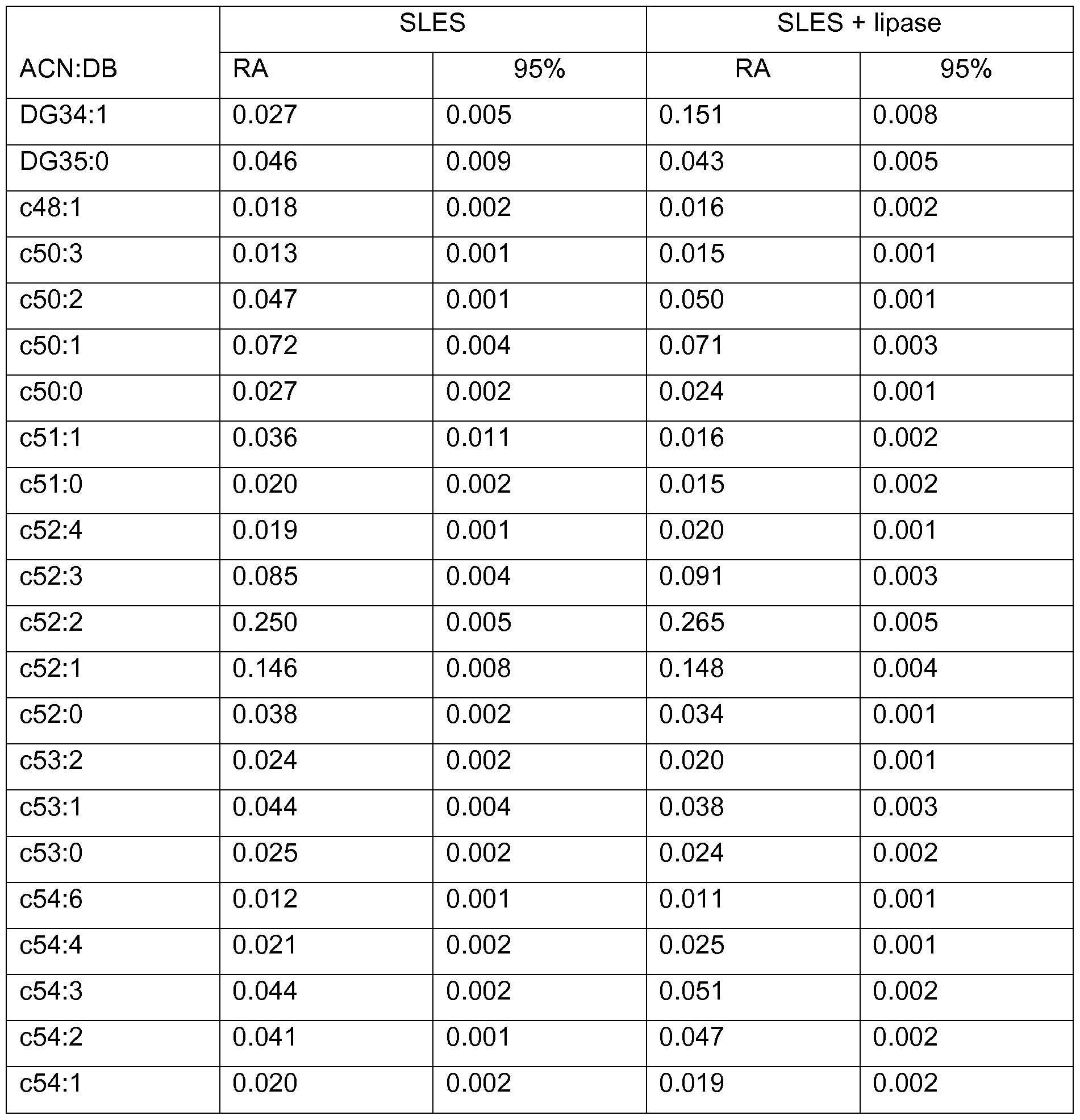
SLES is Lauryl ether sulfate with 2 moles of ethoxylation
Claims
1. A method of chemically identifying the di- and tri-glyceride composition of a fat stain on a surface, said method comprising:- a) stain surface with fat stain;
b) treat fat stain by washing with an aqueous solution of a laundry detergent composition dosed at a 1 to 20g/L, wherein the laundry detergent composition comprises surfactant, preferably at levels of from 1 to 50 wt.%; then remove aqueous solution and optionally rinse the surface;
c) optionally dry the residual stain in air;
d) solubilise the residual fat from the surface using an organic solvent; e) measure the di- and tri-glyceride content of the residual fat using MALDI (matrix-assisted laser desorption ionization) mass spectrometry.
2. A method according to claim 1 , wherein the surface in step a) is selected from
textiles and clothing.
3. A method according to claim 1 or claim 2, wherein the stained surface is stored for from 0 to 400 hours, preferably at a temperature below 313K, more preferably 253 to 303K, most preferably 283 to 298K.
4. A method according to any preceding claim, wherein the solubilisation step of
method step d) has a solvent to fat weight ratio of 10:1 to 5000:1 , more preferably 20:1 to 100:1.
5. A method according to any preceding claim, wherein the fat is selected from lard, butter, ghee, goose fat, duck fat, chicken fat, olive oil, suet, palm oil, sunflower oil, rapeseed oil, nut oils, soya oil, fish oil, cocoa butter, shea butter, sebum, borneo tallow, lllipe butter, sesame oil, safflower oil, linseed oil, poppy oil, pumpkin seed oil, wheat germ oil, corn germ oil.
6. A method according to any preceding claim, wherein the fat is a solid at 30°C, most preferably at 37 °C.
7. A method according to any preceding claim, wherein the di- and tri-glycerides are analysed in positive mode in the MALDI spectrometer.
8. A method according to any preceding claim, wherein the laundry detergent composition comprises an anionic surfactant.
9. A method according to any preceding claim wherein an internal standard is used where a known concentration of a di or triglyceride is added to the solvent used to dissolve the fat.
Applications Claiming Priority (2)
| Application Number | Priority Date | Filing Date | Title |
|---|---|---|---|
| EP18195199.7 | 2018-09-18 | ||
| EP18195199 | 2018-09-18 |
Publications (1)
| Publication Number | Publication Date |
|---|---|
| WO2020058091A1 true WO2020058091A1 (en) | 2020-03-26 |
Family
ID=63642729
Family Applications (1)
| Application Number | Title | Priority Date | Filing Date |
|---|---|---|---|
| PCT/EP2019/074398 Ceased WO2020058091A1 (en) | 2018-09-18 | 2019-09-12 | Method of chemical monitoring the fat removal from surfaces |
Country Status (2)
| Country | Link |
|---|---|
| AR (1) | AR116410A1 (en) |
| WO (1) | WO2020058091A1 (en) |
Cited By (1)
| Publication number | Priority date | Publication date | Assignee | Title |
|---|---|---|---|---|
| CN113025419A (en) * | 2021-03-12 | 2021-06-25 | 郑州轻工业大学 | Duck oil fractionation method |
Citations (25)
| Publication number | Priority date | Publication date | Assignee | Title |
|---|---|---|---|---|
| GB1372034A (en) | 1970-12-31 | 1974-10-30 | Unilever Ltd | Detergent compositions |
| EP0218272A1 (en) | 1985-08-09 | 1987-04-15 | Gist-Brocades N.V. | Novel lipolytic enzymes and their use in detergent compositions |
| EP0331376A2 (en) | 1988-02-28 | 1989-09-06 | Amano Pharmaceutical Co., Ltd. | Recombinant DNA, bacterium of the genus pseudomonas containing it, and process for preparing lipase by using it |
| WO1991016422A1 (en) | 1990-04-14 | 1991-10-31 | Kali-Chemie Aktiengesellschaft | Alkaline bacillus lipases, coding dna sequences therefor and bacilli which produce these lipases |
| WO1995006720A1 (en) | 1993-08-30 | 1995-03-09 | Showa Denko K.K. | Novel lipase, microorganism producing the lipase, process for producing the lipase, and use of the lipase |
| WO1996012012A1 (en) | 1994-10-14 | 1996-04-25 | Solvay S.A. | Lipase, microorganism producing same, method for preparing said lipase and uses thereof |
| WO1996013580A1 (en) | 1994-10-26 | 1996-05-09 | Novo Nordisk A/S | An enzyme with lipolytic activity |
| WO1996027002A1 (en) | 1995-02-27 | 1996-09-06 | Novo Nordisk A/S | Novel lipase gene and process for the production of lipase with the use of the same |
| WO1997004078A1 (en) | 1995-07-14 | 1997-02-06 | Novo Nordisk A/S | A modified enzyme with lipolytic activity |
| US5869438A (en) | 1990-09-13 | 1999-02-09 | Novo Nordisk A/S | Lipase variants |
| WO1999042566A1 (en) | 1998-02-17 | 1999-08-26 | Novo Nordisk A/S | Lipase variant |
| WO2000034450A1 (en) | 1998-12-04 | 2000-06-15 | Novozymes A/S | Cutinase variants |
| WO2000060063A1 (en) | 1999-03-31 | 2000-10-12 | Novozymes A/S | Lipase variant |
| WO2001092502A1 (en) | 2000-06-02 | 2001-12-06 | Novozymes A/S | Cutinase variants |
| WO2002062973A2 (en) | 2001-02-07 | 2002-08-15 | Novozymes A/S | Lipase variants |
| WO2003076580A2 (en) | 2002-03-05 | 2003-09-18 | Genencor International, Inc. | High throughput mutagenesis screening method |
| WO2004101760A2 (en) | 2003-05-12 | 2004-11-25 | Genencor International, Inc. | Novel lipolytic enzyme elip |
| WO2004101763A2 (en) | 2003-05-12 | 2004-11-25 | Genencor International, Inc. | Novel lipolytic enzyme lip1 |
| WO2004101759A2 (en) | 2003-05-12 | 2004-11-25 | Genencor International, Inc. | Novel lipolytic enzyme lip2 |
| WO2007087243A2 (en) | 2006-01-23 | 2007-08-02 | The Procter & Gamble Company | Detergent compositions |
| WO2009007510A1 (en) | 2007-07-10 | 2009-01-15 | Valtion Teknillinen Tutkimuskeskus | Novel esterases and their use |
| US20100311897A1 (en) * | 2007-12-19 | 2010-12-09 | Akzo Nobel Coatings Internationally B.V. | Method of Making Triglyceride Macromonomers |
| EP2325649A1 (en) * | 2009-11-20 | 2011-05-25 | Centre National de la Recherche Scientifique (CNRS) | Dye-assisted laser desorption ionization (DALDI) |
| US20180073046A1 (en) * | 2015-03-26 | 2018-03-15 | Stichting Wageningen Research | Production of fatty acid estolides |
| JP6474492B2 (en) | 2014-12-10 | 2019-02-27 | メレクシス・テクノロジーズ・ナムローゼフェンノートシャップ | Semiconductor pressure sensor |
-
2019
- 2019-09-12 WO PCT/EP2019/074398 patent/WO2020058091A1/en not_active Ceased
- 2019-09-16 AR ARP190102615A patent/AR116410A1/en unknown
Patent Citations (27)
| Publication number | Priority date | Publication date | Assignee | Title |
|---|---|---|---|---|
| GB1372034A (en) | 1970-12-31 | 1974-10-30 | Unilever Ltd | Detergent compositions |
| EP0218272A1 (en) | 1985-08-09 | 1987-04-15 | Gist-Brocades N.V. | Novel lipolytic enzymes and their use in detergent compositions |
| EP0331376A2 (en) | 1988-02-28 | 1989-09-06 | Amano Pharmaceutical Co., Ltd. | Recombinant DNA, bacterium of the genus pseudomonas containing it, and process for preparing lipase by using it |
| WO1991016422A1 (en) | 1990-04-14 | 1991-10-31 | Kali-Chemie Aktiengesellschaft | Alkaline bacillus lipases, coding dna sequences therefor and bacilli which produce these lipases |
| US5869438A (en) | 1990-09-13 | 1999-02-09 | Novo Nordisk A/S | Lipase variants |
| WO1995006720A1 (en) | 1993-08-30 | 1995-03-09 | Showa Denko K.K. | Novel lipase, microorganism producing the lipase, process for producing the lipase, and use of the lipase |
| WO1996012012A1 (en) | 1994-10-14 | 1996-04-25 | Solvay S.A. | Lipase, microorganism producing same, method for preparing said lipase and uses thereof |
| WO1996013580A1 (en) | 1994-10-26 | 1996-05-09 | Novo Nordisk A/S | An enzyme with lipolytic activity |
| WO1996027002A1 (en) | 1995-02-27 | 1996-09-06 | Novo Nordisk A/S | Novel lipase gene and process for the production of lipase with the use of the same |
| WO1997004078A1 (en) | 1995-07-14 | 1997-02-06 | Novo Nordisk A/S | A modified enzyme with lipolytic activity |
| WO1997004079A1 (en) | 1995-07-14 | 1997-02-06 | Novo Nordisk A/S | A modified enzyme with lipolytic activity |
| WO1999042566A1 (en) | 1998-02-17 | 1999-08-26 | Novo Nordisk A/S | Lipase variant |
| WO2000034450A1 (en) | 1998-12-04 | 2000-06-15 | Novozymes A/S | Cutinase variants |
| WO2000060063A1 (en) | 1999-03-31 | 2000-10-12 | Novozymes A/S | Lipase variant |
| US6939702B1 (en) | 1999-03-31 | 2005-09-06 | Novozymes A/S | Lipase variant |
| WO2001092502A1 (en) | 2000-06-02 | 2001-12-06 | Novozymes A/S | Cutinase variants |
| WO2002062973A2 (en) | 2001-02-07 | 2002-08-15 | Novozymes A/S | Lipase variants |
| WO2003076580A2 (en) | 2002-03-05 | 2003-09-18 | Genencor International, Inc. | High throughput mutagenesis screening method |
| WO2004101759A2 (en) | 2003-05-12 | 2004-11-25 | Genencor International, Inc. | Novel lipolytic enzyme lip2 |
| WO2004101763A2 (en) | 2003-05-12 | 2004-11-25 | Genencor International, Inc. | Novel lipolytic enzyme lip1 |
| WO2004101760A2 (en) | 2003-05-12 | 2004-11-25 | Genencor International, Inc. | Novel lipolytic enzyme elip |
| WO2007087243A2 (en) | 2006-01-23 | 2007-08-02 | The Procter & Gamble Company | Detergent compositions |
| WO2009007510A1 (en) | 2007-07-10 | 2009-01-15 | Valtion Teknillinen Tutkimuskeskus | Novel esterases and their use |
| US20100311897A1 (en) * | 2007-12-19 | 2010-12-09 | Akzo Nobel Coatings Internationally B.V. | Method of Making Triglyceride Macromonomers |
| EP2325649A1 (en) * | 2009-11-20 | 2011-05-25 | Centre National de la Recherche Scientifique (CNRS) | Dye-assisted laser desorption ionization (DALDI) |
| JP6474492B2 (en) | 2014-12-10 | 2019-02-27 | メレクシス・テクノロジーズ・ナムローゼフェンノートシャップ | Semiconductor pressure sensor |
| US20180073046A1 (en) * | 2015-03-26 | 2018-03-15 | Stichting Wageningen Research | Production of fatty acid estolides |
Non-Patent Citations (7)
| Title |
|---|
| "Electrospray and MALDI Mass Spectrometry: Fundamentals, Instrumentation, Practicalities, and Biological Applications: Fundamentals, Instrumentation, and Applications", 2010, WILEY BLACKWELL |
| "Enzymes in Detergency", 1997, MARCEL DEKKER |
| DARTOIS ET AL., BIOCHEMICA ET BIOPHYSICA ACTA, vol. 1131, 1993, pages 253 - 360 |
| G. PICARIELLOR SACCHIF ADDEO, EUR. J. LIPID SCI. TECHNOL., vol. 109, 2007, pages 511 - 524 |
| H. KONTKANEN ET AL., APP. ENVIRON. MICROBIOLOGY, 2009, pages 2148 - 2157 |
| H. KONTKANEN ET AL., ENZYME MICROB TECHNOL., vol. 39, 2006, pages 265 - 273 |
| JONATAN HALL-ANDERSEN ET AL: "MALDI imaging of enzymatic degradation of glycerides by lipase on textile surface", CHEMISTRY AND PHYSICS OF LIPIDS., vol. 211, 6 November 2017 (2017-11-06), IR, pages 100 - 106, XP055640124, ISSN: 0009-3084, DOI: 10.1016/j.chemphyslip.2017.11.004 * |
Cited By (1)
| Publication number | Priority date | Publication date | Assignee | Title |
|---|---|---|---|---|
| CN113025419A (en) * | 2021-03-12 | 2021-06-25 | 郑州轻工业大学 | Duck oil fractionation method |
Also Published As
| Publication number | Publication date |
|---|---|
| AR116410A1 (en) | 2021-05-05 |
Similar Documents
| Publication | Publication Date | Title |
|---|---|---|
| JP4851034B2 (en) | Chemically modified lipolytic enzyme | |
| EP3710828B1 (en) | Method of demonstrating sebum removal from laundered garments | |
| Aaslyng et al. | Mechanistic studies of proteases and lipases for the detergent industry | |
| US20100162491A1 (en) | Detergent compositions | |
| EP4065677B1 (en) | Improved alkylbenzenesulfonate surfactants | |
| BR112013000108B1 (en) | detergent composition, its uses, and process for cleaning a substrate | |
| JP2013541356A (en) | Concentrated immersion cleaning | |
| CN107735487B (en) | Laundry detergent compositions | |
| WO2020058091A1 (en) | Method of chemical monitoring the fat removal from surfaces | |
| WO2007087318A2 (en) | Detergent compositions | |
| EP4041856A1 (en) | Methods and compositions for reducing odor and biofilm | |
| CN106833945A (en) | Biological fruit and vegetable enzyme cleaning fluid and its preparation method and application | |
| JP2013536698A (en) | Two-time immersion cleaning | |
| CN107858210A (en) | A kind of novel environment friendly household cleaning degreaser and preparation method thereof | |
| EP3344765A1 (en) | Liquid detergency composition comprising lipase and protease | |
| EP3853338A1 (en) | Detergent composition | |
| WO2014095617A1 (en) | Stain removal compositions | |
| CN106414694B (en) | Enzyme treatment composition | |
| CN109234062A (en) | A kind of environmentally-friendly water-based hard surface antibacterial cleanser and its preparation method and application | |
| BR112020009317B1 (en) | METHOD FOR DEMONSTRATING SEBUM REMOVAL FROM FABRICS WASHED BY ONE OR MORE LAUNDRY DETERGENT COMPOSITIONS | |
| JP7062733B2 (en) | Detergent composition and its uses | |
| KR101983805B1 (en) | Natural Detergent Containing Ginger and Manufacturing Method Thereof | |
| JP2001348596A (en) | Detergent composition | |
| JP2001348595A (en) | Detergent composition | |
| JPWO2023210744A5 (en) |
Legal Events
| Date | Code | Title | Description |
|---|---|---|---|
| 121 | Ep: the epo has been informed by wipo that ep was designated in this application |
Ref document number: 19768809 Country of ref document: EP Kind code of ref document: A1 |
|
| NENP | Non-entry into the national phase |
Ref country code: DE |
|
| 122 | Ep: pct application non-entry in european phase |
Ref document number: 19768809 Country of ref document: EP Kind code of ref document: A1 |