WO2020045295A1 - 動物飼料用の植物性タンパク質及びその製造方法 - Google Patents
動物飼料用の植物性タンパク質及びその製造方法 Download PDFInfo
- Publication number
- WO2020045295A1 WO2020045295A1 PCT/JP2019/033099 JP2019033099W WO2020045295A1 WO 2020045295 A1 WO2020045295 A1 WO 2020045295A1 JP 2019033099 W JP2019033099 W JP 2019033099W WO 2020045295 A1 WO2020045295 A1 WO 2020045295A1
- Authority
- WO
- WIPO (PCT)
- Prior art keywords
- protein
- vegetable protein
- potato
- plant
- drying
- Prior art date
- Legal status (The legal status is an assumption and is not a legal conclusion. Google has not performed a legal analysis and makes no representation as to the accuracy of the status listed.)
- Ceased
Links
Images

Classifications
-
- A—HUMAN NECESSITIES
- A23—FOODS OR FOODSTUFFS; TREATMENT THEREOF, NOT COVERED BY OTHER CLASSES
- A23J—PROTEIN COMPOSITIONS FOR FOODSTUFFS; WORKING-UP PROTEINS FOR FOODSTUFFS; PHOSPHATIDE COMPOSITIONS FOR FOODSTUFFS
- A23J3/00—Working-up of proteins for foodstuffs
- A23J3/14—Vegetable proteins
-
- A—HUMAN NECESSITIES
- A23—FOODS OR FOODSTUFFS; TREATMENT THEREOF, NOT COVERED BY OTHER CLASSES
- A23K—FODDER
- A23K10/00—Animal feeding-stuffs
- A23K10/30—Animal feeding-stuffs from material of plant origin, e.g. roots, seeds or hay; from material of fungal origin, e.g. mushrooms
-
- A—HUMAN NECESSITIES
- A23—FOODS OR FOODSTUFFS; TREATMENT THEREOF, NOT COVERED BY OTHER CLASSES
- A23K—FODDER
- A23K10/00—Animal feeding-stuffs
- A23K10/30—Animal feeding-stuffs from material of plant origin, e.g. roots, seeds or hay; from material of fungal origin, e.g. mushrooms
- A23K10/35—Animal feeding-stuffs from material of plant origin, e.g. roots, seeds or hay; from material of fungal origin, e.g. mushrooms from potatoes
-
- A—HUMAN NECESSITIES
- A23—FOODS OR FOODSTUFFS; TREATMENT THEREOF, NOT COVERED BY OTHER CLASSES
- A23K—FODDER
- A23K20/00—Accessory food factors for animal feeding-stuffs
- A23K20/10—Organic substances
- A23K20/142—Amino acids; Derivatives thereof
- A23K20/147—Polymeric derivatives, e.g. peptides or proteins
-
- A—HUMAN NECESSITIES
- A23—FOODS OR FOODSTUFFS; TREATMENT THEREOF, NOT COVERED BY OTHER CLASSES
- A23K—FODDER
- A23K50/00—Feeding-stuffs specially adapted for particular animals
- A23K50/80—Feeding-stuffs specially adapted for particular animals for aquatic animals, e.g. fish, crustaceans or molluscs
-
- Y—GENERAL TAGGING OF NEW TECHNOLOGICAL DEVELOPMENTS; GENERAL TAGGING OF CROSS-SECTIONAL TECHNOLOGIES SPANNING OVER SEVERAL SECTIONS OF THE IPC; TECHNICAL SUBJECTS COVERED BY FORMER USPC CROSS-REFERENCE ART COLLECTIONS [XRACs] AND DIGESTS
- Y02—TECHNOLOGIES OR APPLICATIONS FOR MITIGATION OR ADAPTATION AGAINST CLIMATE CHANGE
- Y02A—TECHNOLOGIES FOR ADAPTATION TO CLIMATE CHANGE
- Y02A40/00—Adaptation technologies in agriculture, forestry, livestock or agroalimentary production
- Y02A40/80—Adaptation technologies in agriculture, forestry, livestock or agroalimentary production in fisheries management
- Y02A40/81—Aquaculture, e.g. of fish
- Y02A40/818—Alternative feeds for fish, e.g. in aquacultures
Definitions
- the present invention relates to a vegetable protein to be incorporated into animal feed.
- Patent Document 1 discloses a foaming composition containing particles of a protein such as soy protein, and a powder containing the protein used to trap a pressurized gas for producing the composition. It is disclosed that a material having a density and a glass transition temperature within a predetermined range is used. This foaming composition is used for food applications.
- Patent Document 2 describes a method for obtaining a coagulated plant protein fraction having a medium molecular weight, which comprises adjusting the pH from potato juice to precipitate the protein. Patent Document 2 describes that the obtained protein is dried after washing, but no specific drying conditions are described.
- Patent Document 3 as a method for obtaining a plant protein and / or a peptide, (a) a step of preparing a starting material containing a plant protein and / or a peptide in an aqueous matrix; (c) at least one method comprising a synthetic polymer A method is described which includes a step of isolating at least a part of the protein and / or peptide from the aqueous matrix by adsorption onto an ion exchange membrane.
- Patent Literature 3 describes drying a protein or peptide by spray drying or freeze drying.
- Patent Document 4 as a method for isolating a natural potato protein fraction from potato juice, adjusting the pH to a predetermined range or contacting the potato juice with a functionalized support carrier having pores. are described. Patent Document 4 describes drying an isolated natural potato protein fraction by spray drying, flash drying, or freeze drying.
- Patent Document 5 describes a method for producing a potato protein with improved taste and aroma, which includes steps such as acid treatment, heating, removal of low-molecular compounds, and drying.
- Patent Literature 5 describes a method for drying a potato protein by adding a shaping agent such as dextrin and drying by spray drying or the like.
- an object of the present invention is to provide a plant protein having high feed efficiency and / or easily digestible by animals.
- the present inventors have surprisingly found that a plant protein having an endothermic peak temperature in differential scanning calorimetry and / or an exothermic peak temperature within a predetermined range has particularly high feed efficiency and digestibility by animals,
- the present inventors have found that it is preferable as a protein source to be blended in animal feed, and have completed the present invention.
- a vegetable protein for animal feed having an endothermic peak temperature of 40 to 80 ° C. in differential scanning calorimetry.
- the vegetable protein according to any one of (1) to (3) which is derived from a protein dissolved in a plant juice.
- the plant protein according to (4) wherein the plant is a raw material plant for starch or sugar.
- the vegetable protein according to (5), wherein the starch or sugar raw material plant is potato, cassava, beet or sugarcane.
- a feed composition comprising the vegetable protein according to any one of (1) to (7).
- a method of breeding an animal comprising feeding the animal with the feed composition according to (8).
- (10) The method according to (9), wherein the animal is a marine animal.
- (11) The method according to (10), wherein the marine animal is yellowtail, thailand, salmon, or shrimp.
- (12) A method for producing a vegetable protein, Separating plant proteins from plant raw materials, Adjusting the water content of the separated vegetable protein to 55% by weight or more; and Drying the vegetable protein having a water content of 55% by weight or more until the water content becomes 15% by weight or less, In the drying, the method is characterized in that the temperature of the vegetable protein is 50 ° C. or less until the water content of the vegetable protein is reduced to 30% by weight.
- a vegetable protein for animal feed a feed composition containing the same, and a method for breeding animals using the feed composition, which are suitable as a protein source to be incorporated into animal feed.
- FIG. 1 shows the time-dependent changes in potato protein temperature and water content during drying in Experimental Section 2-1 in which the potato protein was dried by a vibrating fluidized bed drier to a water content of 5 to 10%.
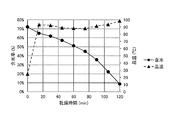
- FIG. 2 shows the temperature and water content of potato protein during drying in Experimental Section 2-2, in which potato protein was dried at 90 ° C. at a drying temperature of 5 to 10% using a disk dryer. The change with time is shown.
- a first aspect of the present invention relates to a vegetable protein for animal feed, having an endothermic peak temperature in differential scanning calorimetry of 40 to 80 ° C.
- a second aspect of the present invention relates to a vegetable protein for animal feed, having an exothermic peak temperature of 120 to 160 ° C. in differential scanning calorimetry.
- DSC Differential scanning calorimetry
- the present inventors have found that a plant protein having an endothermic peak temperature of DSC in the above range has a remarkable feed efficiency when given to an animal as compared to a vegetable protein having an endothermic peak temperature exceeding the upper limit of the above range. Was found to be high.
- the present inventors have further found that a plant protein having an endothermic peak temperature of DSC in the above range has particularly high digestibility by animal digestive enzymes.
- the DSC endothermic peak temperature is more preferably 45 to 75 ° C, still more preferably 50 to 70 ° C, and particularly preferably 57 to 69 ° C.
- the plant protein having an exothermic peak temperature of DSC in the above-mentioned range has a significantly higher feed efficiency when given to an animal as compared to the vegetable protein having an exothermic peak temperature outside the above-mentioned range. I found it expensive.
- the present inventors have further found that a plant protein having an exothermic peak temperature of DSC in the above range has a particularly high digestibility by animal digestive enzymes.
- the exothermic peak temperature of the DSC is more preferably from 125 to 160 ° C, still more preferably from 130 to 160 ° C, and particularly preferably from 130 to 157 ° C.
- Vegetable protein refers to a composition that may contain water and other impurities in addition to plant-derived protein components. Vegetable proteins are not limited to those in the natural state and may be denatured.
- the plant protein of the present invention has high feed efficiency and is particularly suitable as a protein source for feeding animals.
- the “animal” refers to a non-human animal, and is typically a marine animal or a livestock animal. Specific examples of marine animals are as described below.
- the plant protein is not particularly limited as long as it is a protein isolated from a plant, but is preferably a plant protein derived from a protein dissolved in plant juice (particularly preferably starch or sugar).
- Vegetable protein derived from protein dissolved in the juice of the raw material plant vegetable protein derived from soybean, rapeseed, palm, pea, peanut, palm, cotton, coconut, olive, sunflower or sesame, etc. can be exemplified.
- a vegetable protein derived from a protein dissolved in the juice of a plant such as a raw material plant of starch or sugar.
- starch-based plants include root crop plants and cereal plants, and root crop plants are particularly preferred.
- root vegetables include potato plants such as potatoes, cassava and sweet potato, and potatoes are particularly preferred.
- examples of the cereal plant include corn, wheat, oat, and rice, and corn and wheat are particularly preferred.
- As a raw material plant for sugar, beet or sugarcane is preferred.
- the vegetable protein of the present invention has a water content of preferably 15% by weight or less, more preferably 10% by weight or less, more preferably 9% by weight or less, more preferably 8% by weight or less.
- “Potato glycoalkaloids” are steroid alkaloids present in potatoes with neurotoxin, and are known to be solanine and chaconin. The high content of polyglycoalkaloids in feeds for animals, especially fish, reduces the palatability of feeds by animals.
- the plant protein of the present invention is a potato-derived plant protein
- the potato-derived plant protein is more preferably the total content of potato glycoalkaloids (chaconin and solanine) in dry matter. At most 300 ppm, more preferably at most 100 ppm, more preferably at most 50 ppm, more preferably at most 30 ppm, more preferably at most 20 ppm, particularly preferably at most 10 ppm.
- animals, especially fishes are particularly preferred to eat and are therefore suitable for use in animal feed.
- the vegetable protein of the present invention can be prepared by separating the protein from plant raw materials.
- Examples of a method for separating a vegetable protein from a plant material include the following methods.
- the heating temperature and the heating time are not particularly limited.
- the heating temperature may be 90 to 120 ° C.
- the heating time may be 1 to 60 minutes.
- Aggregation by heating can be performed using electricity, steam, or the like.
- coagulation by salting out for example, a lime solution is added, and then the protein can be adsorbed on calcium carbonate generated by blowing carbon dioxide gas.
- An antioxidant or the like may be added to the plant raw material before the preparation of the juice or the juice.
- the aggregate is dried with a dryer.
- the drying time is not particularly limited, and can be appropriately adjusted so as to obtain a desired water content.
- the aggregated vegetable protein can be dehydrated by a dehydrator. If necessary, the vegetable protein can be washed to remove impurities. When washing is performed after the drying step (2), drying is performed again by a dryer after the washing.
- the drying time is not particularly limited, and can be appropriately adjusted so as to obtain a desired water content.
- washing method a method including a washing step of washing a vegetable protein with at least one selected from an aqueous acid solution, an alcohol, and water can be mentioned.
- washing with water can be performed to reduce the amount of the residual acid aqueous solution and the residual alcohol in the protein. If necessary, the dried product can be appropriately pulverized.
- the endothermic peak temperature of DSC of the obtained vegetable protein and the exothermic peak temperature of DSC vary according to the heat history at the time of production of the vegetable protein, and the gentler the heat history, the more the endothermic peak temperature of DSC and The exothermic peak temperature tends to be lower.
- a more preferred embodiment of the method for producing a vegetable protein A more preferred embodiment of the method for producing a vegetable protein, Separating plant proteins from plant raw materials, Adjusting the water content of the separated vegetable protein to 55% by weight or more; and Drying the vegetable protein having a water content of 55% by weight or more until the water content becomes 15% by weight or less, In the drying, the temperature of the vegetable protein is 50 ° C. or less until the water content of the vegetable protein is reduced to 30% by weight.
- heat applied to the vegetable protein is small, and it is easy to produce a vegetable protein in which the DSC endothermic peak temperature and the DSC exothermic peak temperature are within the above-mentioned predetermined ranges.
- one or both of the separation step and the drying step of the vegetable protein are performed after the completion of the treatment in each step by the entire amount of the vegetable protein raw material to be treated as shown in the examples.
- the process may be performed in a batch system in which the components are exchanged, or may be performed in a continuous system in which each step is performed while supplying the plant protein raw material to be processed, and a portion in which the processing in each process is completed is sequentially taken out.
- the separation of the plant protein from the plant material can be performed by the above-mentioned means.
- the vegetable protein can be separated from the plant raw material by an aggregation step of aggregating the protein by heating or salting out the juice of the vegetable raw material.
- the step of adjusting the water content of the isolated vegetable protein to 55% by weight or more is not particularly limited.
- the separated plant protein is a suspension of the aggregated protein or a concentrated solution thereof
- the suspension or the concentrated solution is dehydrated by an appropriate means such as centrifugation to remove excess water.
- a vegetable protein having a water content of 55% by weight or more can be obtained.
- the water content of the vegetable protein after this step is more preferably 80% by weight or less, more preferably 70% by weight or less.
- the water content of a vegetable protein is the ratio of the weight of the contained water to the total wet weight of the vegetable protein.
- the water content of the vegetable protein is preferably 10% by weight or less, more preferably 1 to 5% by weight. It is dried so as to be 10% by weight, more preferably 5 to 10% by weight.
- the temperature of the vegetable protein is 50 ° C. or less until the water content of the vegetable protein is reduced to 30% by weight, so that the vegetable protein is heated to a mild temperature. Can be dried under the conditions. Therefore, a dried vegetable protein having high digestibility by digestive enzymes of animals and high feed efficiency can be obtained.
- drying is preferably performed using a vibrating fluidized bed dryer.
- the vibrating fluidized-bed dryer includes a drying oven and a mesh plate installed in the drying oven so as to be vertically movable.
- the drying furnace has an inlet and an outlet.
- the vegetable protein to be dried is placed on a mesh plate in a drying furnace of a vibrating fluidized bed dryer, and while moving the mesh plate up and down, the hot air supplied from the air inlet of the drying furnace is passed through the mesh plate.
- the hot air is exhausted from the exhaust port by allowing the air to pass upward from below.
- a drying method using a spray dryer or a flash dryer can be exemplified.
- the temperature of the vegetable protein is preferably 45 ° C. or less until the water content of the vegetable protein is reduced to 30% by weight. Furthermore, in the drying step, the temperature of the vegetable protein while the water content of the vegetable protein is reduced from 30% by weight to 20% by weight is preferably 70 ° C or lower, more preferably 60 ° C or lower, particularly preferably. 55 ° C. or less. Further, in the drying step, the temperature of the vegetable protein during the time when the water content of the vegetable protein is reduced from 20% by weight to 15% by weight is preferably 85 ° C or less, more preferably 80 ° C or less, and particularly preferably. 70 ° C. or less. Further, in the drying step, the temperature of the vegetable protein is preferably 85 ° C.
- the vegetable protein can be cooled immediately after the drying is completed, and overdrying can be suppressed, which is preferable.
- the drying step is carried out before the water content of the vegetable protein decreases to the target water content (for example, when the target water content (%) + the water content of 0.1 to 5% is reached). This may include stopping the temperature rise of the protein and further reducing the water content of the vegetable protein while cooling to reach the target water content.
- the present invention also relates to a feed composition comprising the plant protein for animal feed of the present invention.
- the feed composition of the present invention has the advantage that feed efficiency is particularly high.
- the feed composition of the present invention may contain the vegetable protein of the present invention as a protein source, and may contain other components as a protein source.
- Other protein sources include fish meal.
- the feed composition of the present invention may further include other ingredients acceptable as feed.
- the animal can be bred by giving the animal the feed composition of the present invention. Since the feed composition of the present invention has high feed efficiency, animals can be bred efficiently.
- the target animal includes a livestock animal or a marine animal, and a marine animal is particularly preferable.
- the marine animals are not particularly limited, and are mainly aquatic reptiles such as fish such as yellowtail, Thailand, salmon, flounder, tiger puffer, amberjack, striped horse mackerel, flyfish, eel, carp, crucian carp, crustaceans such as shrimp and crab, turtles, green turtles and the like. And the like, preferably fish or crustacean, and particularly preferably yellowtail, thailand, salmon or shrimp. Since the feed composition of the present invention has a particularly high feed efficiency for marine animals, it is possible to breed (cultivate) marine animals efficiently.
- Feet efficiency has been used to know how much an individual animal (fish, etc.) has increased in weight during a given amount of food given during a certain period.
- the total weight (g, wet weight) / total feed (g, dry weight) ⁇ 100 ”of the individual animal is calculated.
- feed efficiency varies depending on environmental factors (breeding water temperature, water quality, dissolved oxygen content, salt concentration, etc. in fish and other marine products), the size of animal individuals, and the composition of the feed even for the same feed. It also changes depending on the situation. Therefore, when evaluating the suitability of vegetable protein as a protein source for blending in animal feed, for example, a control group containing fish meal instead of the vegetable protein to be evaluated is provided, and the control efficiency and the feed efficiency of the control group are compared. The difference can be evaluated relatively.
- the potato protein used in the experiment was produced by the following procedure. Potato juice obtained from a starch factory was used. The potato juice was heated at 90 ° C. to aggregate the potato proteins in the juice. The potato protein was dehydrated with a dehydrator. It was dried by heating at 90 ° C. until the water content was 5-10%.
- the dried unwashed potato protein obtained in the above step was washed with an acid in a stirring tank according to the following procedure.
- Potato protein was ground before washing.
- the pulverization was performed with a tabletop pulverizer.
- Potato protein was placed in a container, and water was added to prepare a solution having a concentration of 10%.
- sulfuric acid was added to adjust the pH to 3-3.5.
- the temperature was room temperature (20-30 ° C.). Dilute sulfuric acid of 10 wt% or less was used as the sulfuric acid.
- the pH began to rise, so the acid was added as needed to maintain the pH at 3 to 3.5. After stirring for about 3 hours, it was confirmed that the pH behavior was in a steady state.
- the stirring was terminated, and vacuum dehydration was performed to obtain a wet protein.
- the washing operation from the step of preparing a solution having a potato protein concentration of 10% to the step of obtaining a wet protein was further repeated three times, for a total of four times.
- an appropriate amount of a 5% or less aqueous sodium hydroxide solution is added to a dispersion obtained by sufficiently dispersing the potato protein in water to neutralize the pH of the dispersion to 7.0 to 7.5. did. Since the pH fluctuated even during the neutralization, an alkali was appropriately supplied.
- the dried product was pulverized with a tabletop pulverizer (mill) to obtain a pulverized product.
- the grounds were used for feed testing.
- DSC ⁇ DSC measurement of sample>
- the measurement was performed under the following conditions using a simple sealed container for DSC.
- Apparatus Thermal analysis system TA7000 manufactured by Hitachi High-Tech Science Corporation Differential scanning calorimeter DSC7000X Measurement temperature: 0 ° C to 200 ° C (repeated measurement) Heating rate: 10 ° C / min Gas used: nitrogen gas, 30 mL / min Sample amount: about 3mg
- the samples in the control section and the test sections 1 to 4 were prepared according to the following procedure. First, the powdered raw materials were mixed well, and then fish oil and water were added and mixed. The uniformly mixed raw material was formed into a diameter of about 1 cm by a pasta machine. It was dried by heating at 90 ° C. until the water content was 5-10%.
- Red sea bream (approximately 600 g) was used as a test fish, and two 1000 L circular tanks containing 40 test fish were prepared in each test section.
- the breeding was carried out by running water that constantly supplies raw seawater (seawater without filtration) having a water temperature of about 23 ° C.
- fish were housed in aquariums, pre-fed for about 4 weeks using the mixed feed of each plot, and after confirming that there was no variation in the amount of food consumed between the aquariums, The test of feeding was started.
- the test feed was fed twice daily until satiety (until the fish stopped eating the food that had fallen to the bottom of the aquarium instantaneously), and the feed amount up to that point was defined as the one-day food intake by the fry.
- the feeding test was performed for 4 weeks. The amount of increase in the weight of the fish from the start to the end of this period was defined as the total weight gain.
- the results were expressed in terms of feed efficiency (%) calculated by the following formula.
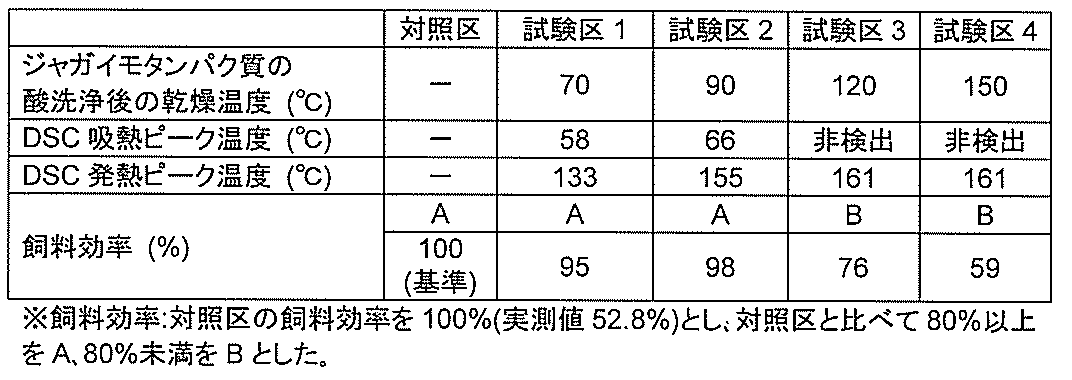
- the feed efficiency in the control group was taken as 100% (actual value 52.8%), and 80% or more compared with the control group was A (good), 80% Less than B (impossible).
- Feed efficiency (%) total weight gain of fish (g, wet weight) / total feed (g, dry weight) ⁇ 100
- ⁇ Preparation of sample> (1. Extraction of potato protein)
- the potato protein used in the experiment was produced by the following procedure. Potato juice obtained from a starch factory was used. The potato juice was heated at 90 ° C. to aggregate the potato proteins in the juice. The potato protein was dehydrated with a dehydrator.
- the dehydrated potato protein (water content 75%) was dried under the following conditions.
- the potato protein was dried by a vibrating fluidized bed dryer until the water content reached 5 to 10%.
- FIG. 1 shows the changes over time in the temperature and moisture content of the potato protein during drying.
- the temperature of the product to be dried is 45 ° C. or less until the water content reaches 30% or less.
- the object to be dried reached a water content of 5 to 10%. Thereafter, the product temperature of the object to be dried was cooled to 50 ° C.
- FIG. 2 shows the time-dependent changes in the product temperature and the water content of the potato protein during drying.
- the temperature of the product to be dried rose to about 90 ° C. immediately after the start, and the water content gradually decreased while maintaining this temperature. It took 120 minutes for the dried object to reach a water content of 5 to 10%.
- the potato protein was dried using a shelf dryer at a drying temperature of 120 ° C. until the water content reached 5 to 10%.
- Test Section 2-4 the potato protein was dried using a shelf dryer at a drying temperature of 150 ° C. until the water content reached 5 to 10%.
- the stirring was terminated, and vacuum dehydration was performed to obtain a wet protein.
- the washing operation from the step of preparing a solution having a potato protein concentration of 10% to the step of obtaining a wet protein was further repeated three times, for a total of four times.
- an appropriate amount of a 5% or less aqueous sodium hydroxide solution is added to a dispersion obtained by sufficiently dispersing the potato protein in water to neutralize the pH of the dispersion to 7.0 to 7.5. did. Since the pH fluctuated even during the neutralization, an alkali was appropriately supplied.
- the neutralized potato protein was dehydrated, and each test section was dried under the same conditions as those before the acid washing.
- the dried product was pulverized with a tabletop pulverizer (mill) to obtain a pulverized product.
- the pulverized material was used for the following digestibility measurement. At this time, in order to eliminate the influence of the particle diameter, the particles were classified by a sieve, and a sample having a 280 mesh pass was used.
- the time required for the free substance concentration of each potato protein and standard substance to reach 50% was calculated from an approximate expression obtained from the free substance concentrations at the lapse of 0, 3, 6, and 24 hours.
- the reciprocal of the time at which the free matter concentration of each potato protein reached 50% was converted to a relative value when the reciprocal of the time at which the free matter concentration of the standard substance reached 50% was defined as 100%, and these were converted to those of each potato protein.
- the digestibility (%) was used. ⁇ Result>
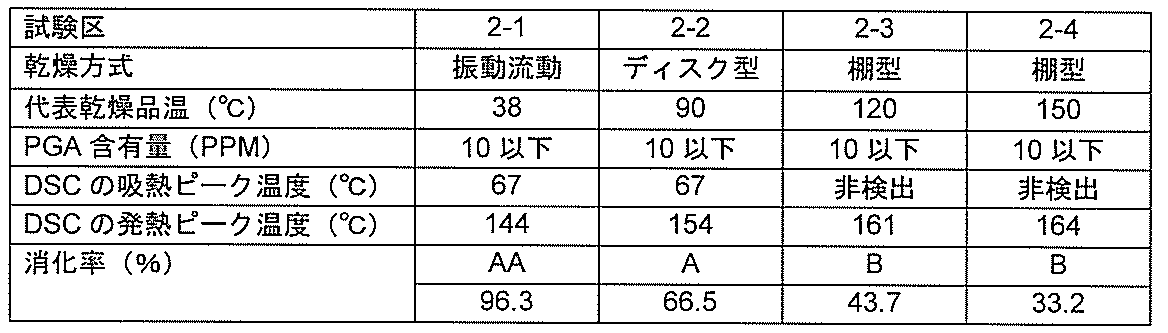
- the measurement results of the DSC endothermic peak temperature, DSC exothermic peak temperature, and digestibility of the potato protein samples in Test Section 2-1 to Test Section 2-4 are shown in the following table.
- Samples having a digestibility of 80% or more were designated AA (excellent), samples having a digestibility of 50% or more and less than 80% were designated A (good), and samples having a digestibility of less than 50% were designated B (impossible).
- the samples in Test Section 2-3 and Test Section 2-4 were significantly denatured, and the endothermic peak temperature of DSC could not be detected.
- Potato protein in each test section was finely pulverized with a pulverizer. The mixture was sieved with a mesh of 180 ⁇ m or less, and a sieved product was used.
- HPLC HPLC was performed under the following conditions.
- the total content of solanine and chaconin in the dry matter of the potato protein in each test group was 10 ppm or less.
- test plot 3-1 potato protein was dried under the same conditions as test plot 2-1 in experiment 2.
- test plot 3-2 potato protein was dried under the same conditions as test plot 2-2 in experiment 2.
- test plot 3-3 potato protein was dried under the same conditions as test plot 2-3 in experiment 2.
- test plot 3-4 potato protein was dried under the same conditions as in test plot 2-4 of experiment 2.
- the dried product was pulverized with a tabletop pulverizer (mill) to obtain a pulverized product.
- the pulverized material was used for the following digestibility measurement. At this time, in order to eliminate the influence of the particle diameter, the particles were classified by a sieve, and a sample having a 280 mesh pass was used.
Landscapes
- Life Sciences & Earth Sciences (AREA)
- Chemical & Material Sciences (AREA)
- Polymers & Plastics (AREA)
- Engineering & Computer Science (AREA)
- Food Science & Technology (AREA)
- Animal Husbandry (AREA)
- Zoology (AREA)
- Health & Medical Sciences (AREA)
- Proteomics, Peptides & Aminoacids (AREA)
- Biotechnology (AREA)
- Botany (AREA)
- Molecular Biology (AREA)
- Mycology (AREA)
- Physiology (AREA)
- Birds (AREA)
- Marine Sciences & Fisheries (AREA)
- Insects & Arthropods (AREA)
- Nutrition Science (AREA)
- Biochemistry (AREA)
- Fodder In General (AREA)
Abstract
本発明は、飼料効率の高い動物飼料用の植物性タンパク質を提供することを目的とする。 本発明は、示差走査熱量測定での吸熱ピーク温度が40~80℃であり、及び/又は、示差走査熱量測定での発熱ピーク温度が120~160℃である、動物飼料用の植物性タンパク質に関する。
Description
本発明は動物飼料に配合するための植物性タンパク質に関する。
従来、水産用飼料等の飼料のタンパク質源としては、タンパク質含量の高さ、アミノ酸バランス、良好な消化・吸収性で増体にも貢献し得ることから最優良なタンパク質源の1つとされている魚粉が用いられることが多い。
しかしながら、魚粉の生産量が世界的に年々減少し、飼料として、あるいは食品としての蛋白源枯渇が懸念されている。そうした中、人を含む動物が食べることができる高純度な植物性タンパク質が、持続可能な環境に優しいタンパク質源として期待されている。
一方、タンパク質の物理的特性として真密度、示差走査熱量測定での吸熱ピーク温度等の特性が知られている。
例えば特許文献1では、大豆タンパク質等のタンパク質の粒子を含む起泡組成物が開示されており、該組成物の製造のために加圧気体を閉じ込めるのに使用されるタンパク質を含む粉末として、真密度とガラス転移温度が所定の範囲であるものを用いることが開示されている。この起泡組成物は食品用途に用いられるものである。
一方、植物性タンパク質を植物原料から分離し取得する技術を開示する文献としては例えば以下の文献が挙げられる。
特許文献2では、ジャガイモ搾汁からpHを調節してタンパク質を沈殿させることを含む中分子量を有する凝固植物タンパク質画分を得る方法が記載されている。特許文献2では取得したタンパク質を洗浄後乾燥することが記載されているが、具体的な乾燥条件は記載されていない。
特許文献3では、植物タンパク質および/またはペプチドを得る方法として、(a)植物タンパク質および/またはペプチドを含む出発材料を水性マトリクス中に調製する工程;(c)合成ポリマーから構成される少なくとも1つのイオン交換膜上への吸着によって、該水性マトリクスから該タンパク質および/またはペプチドの少なくとも一部を単離する工程等を含む方法が記載されている。特許文献3では、タンパク質又はペプチドをスプレードライまたはフリーズドライによって乾燥させることが記載されている。
特許文献4では、ジャガイモジュースから天然ジャガイモタンパク質画分を単離するための方法として、pHを所定範囲に調整することや、ジャガイモジュースを、細孔を有する官能化された支持担体と接触させることを含む方法が記載されている。特許文献4では、単離した天然ジャガイモタンパク質画分を噴霧乾燥、気流乾燥、または凍結乾燥によって乾燥することが記載されている。
特許文献5では、呈味や香りが改善されたジャガイモタンパクの製造方法であって、酸処理、加熱、低分子化合物の除去、乾燥等の工程を含む方法が記載されている。特許文献5では、ジャガイモタンパクの乾燥方法として、デキストリンなどの賦型剤を添加しスプレードライなどにより乾燥する方法が記載されている。
タンパク質の物理的特性を評価する手法は知られている。しかし、植物性タンパク質の動物飼料に配合するためのタンパク質源としての適性と、その物理的特性との関係は従来検討されていない。
動物飼料としては、摂餌量あたりの体重増加量の割合、すなわち飼料効率、が高いものが求められている。
そこで本発明は、飼料効率の高い及び/又は動物により消化され易い植物性タンパク質を提供することを目的とする。
動物飼料としては、摂餌量あたりの体重増加量の割合、すなわち飼料効率、が高いものが求められている。
そこで本発明は、飼料効率の高い及び/又は動物により消化され易い植物性タンパク質を提供することを目的とする。
本発明者らは、驚くべきことに、示差走査熱量測定での吸熱ピーク温度、及び/又は、発熱ピーク温度が所定の範囲にある植物性タンパク質が、飼料効率及び動物による消化性が特に高く、動物飼料に配合するタンパク質源として好ましいことを見出し、本発明を完成するに至った。
(1)示差走査熱量測定での吸熱ピーク温度が40~80℃である、動物飼料用の植物性タンパク質。
(2)示差走査熱量測定での発熱ピーク温度が120~160℃である、(1)に記載の植物性タンパク質。
(3)示差走査熱量測定での発熱ピーク温度が120~160℃である、動物飼料用の植物性タンパク質。
(4)植物の搾汁に溶解したタンパク質に由来する、(1)~(3)のいずれかに記載の植物性タンパク質。
(5)前記植物が澱粉又は糖の原料植物である、(4)に記載の植物性タンパク質。
(6)前記澱粉又は糖の原料植物が、ジャガイモ、キャッサバ、ビート又はサトウキビである、(5)に記載の植物性タンパク質。
(7)ジャガイモに由来し、乾物中のポテトグリコアルカロイドの含有量が合計で100ppm以下である、請求項1~6のいずれか1項に記載の植物性タンパク質。
(8)(1)~(7)のいずれかに記載の植物性タンパク質を含む、飼料組成物。
(9)(8)に記載の飼料組成物を動物に与えることを含む、動物の飼育方法。
(10)前記動物が水産動物である、(9)に記載の方法。
(11)前記水産動物が、ブリ、タイ、サーモン又はエビである、(10)に記載の方法。
(12)植物性タンパク質の製造方法であって、
植物原料から植物性タンパク質を分離すること、
分離した前記植物性タンパク質の含水率を55重量%以上に調節すること、及び、
含水率55重量%以上の前記植物性タンパク質を、含水率が15重量%以下となるまで乾燥させること
を含み、
前記乾燥において、前記植物性タンパク質の含水率が30重量%に低減するまでの間の、前記植物性タンパク質の温度が50℃以下であることを特徴とする方法。
(1)示差走査熱量測定での吸熱ピーク温度が40~80℃である、動物飼料用の植物性タンパク質。
(2)示差走査熱量測定での発熱ピーク温度が120~160℃である、(1)に記載の植物性タンパク質。
(3)示差走査熱量測定での発熱ピーク温度が120~160℃である、動物飼料用の植物性タンパク質。
(4)植物の搾汁に溶解したタンパク質に由来する、(1)~(3)のいずれかに記載の植物性タンパク質。
(5)前記植物が澱粉又は糖の原料植物である、(4)に記載の植物性タンパク質。
(6)前記澱粉又は糖の原料植物が、ジャガイモ、キャッサバ、ビート又はサトウキビである、(5)に記載の植物性タンパク質。
(7)ジャガイモに由来し、乾物中のポテトグリコアルカロイドの含有量が合計で100ppm以下である、請求項1~6のいずれか1項に記載の植物性タンパク質。
(8)(1)~(7)のいずれかに記載の植物性タンパク質を含む、飼料組成物。
(9)(8)に記載の飼料組成物を動物に与えることを含む、動物の飼育方法。
(10)前記動物が水産動物である、(9)に記載の方法。
(11)前記水産動物が、ブリ、タイ、サーモン又はエビである、(10)に記載の方法。
(12)植物性タンパク質の製造方法であって、
植物原料から植物性タンパク質を分離すること、
分離した前記植物性タンパク質の含水率を55重量%以上に調節すること、及び、
含水率55重量%以上の前記植物性タンパク質を、含水率が15重量%以下となるまで乾燥させること
を含み、
前記乾燥において、前記植物性タンパク質の含水率が30重量%に低減するまでの間の、前記植物性タンパク質の温度が50℃以下であることを特徴とする方法。
本明細書は本願の優先権の基礎となる日本国特許出願番号2018-158199号の開示内容を包含する。
本発明によれば、動物飼料に配合するタンパク質源として適した、動物飼料用の植物性タンパク質及びそれを含む飼料組成物、並びに、該飼料組成物を用いた動物の飼育方法が提供される。
以下本発明の好ましい実施形態について説明する。
<植物性タンパク質>
本発明の第一の態様は、示差走査熱量測定での吸熱ピーク温度が40~80℃である、動物飼料用の植物性タンパク質に関する。
本発明の第二の態様は、示差走査熱量測定での発熱ピーク温度が120~160℃である、動物飼料用の植物性タンパク質に関する。
本発明の第一の態様は、示差走査熱量測定での吸熱ピーク温度が40~80℃である、動物飼料用の植物性タンパク質に関する。
本発明の第二の態様は、示差走査熱量測定での発熱ピーク温度が120~160℃である、動物飼料用の植物性タンパク質に関する。
「示差走査熱量測定」は一定の熱を与えながら、基準物質と試料の温度を測定して、試料の熱物性を温度差として捉え、試料の状態変化による吸熱反応や発熱反応を測定することを指す。以下の説明では「示差走査熱量測定」を「DSC」と略記する。植物性タンパク質のDSCの吸熱ピーク温度は、該タンパク質の変性温度を示す。
本発明者らは、DSCの吸熱ピーク温度が前記範囲にある植物性タンパク質は、前記範囲の上限を超える吸熱ピーク温度を有する植物性タンパク質と比較して、動物に与えたときの飼料効率が顕著に高いことを見出した。本発明者らは更に、DSCの吸熱ピーク温度が前記範囲にある植物性タンパク質は、動物の消化酵素による消化性が特に高いことを見出した。本発明の第一の態様においてDSCの吸熱ピーク温度はより好ましくは45~75℃であり、さらにより好ましくは50~70℃であり、特に好ましくは57~69℃である。
本発明者らは更に、DSCの発熱ピーク温度が前記範囲にある植物性タンパク質は、前記範囲外の発熱ピーク温度を有する植物性タンパク質と比較して、動物に与えたときの飼料効率が顕著に高いことを見出した。本発明者らは更にまた、DSCの発熱ピーク温度が前記範囲にある植物性タンパク質は、動物の消化酵素による消化性が特に高いことを見出した。本発明の第二の態様においてDSCの発熱ピーク温度はより好ましくは125~160℃であり、さらにより好ましくは130~160℃であり、特に好ましくは130℃~157℃である。
植物性タンパク質のDSCの発熱ピーク温度は、植物性タンパク質の加工時に受けた熱履歴に相関すると考えられる。これらの温度が前記範囲にある植物性タンパク質が、動物に与えたときの飼料効率及び消化酵素による消化性が特に高いタンパク質であることは、本発明者らが実験を通じて初めて見出した予想外の結果であり、その原因は明らかではない。
「植物性タンパク質」とは、植物に由来するタンパク質成分に加えて、水や他の不純物を含み得る組成物を指す。植物性タンパク質は天然状態のものに限らず変性したものであってもよい。
本発明の植物性タンパク質は、飼料効率が高く、動物に摂食させるためのタンパク質源として特に好適である。ここで「動物」とは非ヒト動物を指し、典型的には、水産動物、畜産動物である。水産動物の具体例は後述する通りである。
本明細書において植物性タンパク質とは、植物から分離されたタンパク質であれば特に限定されないが、好ましくは、植物の搾汁に溶解したタンパク質に由来する植物性タンパク質(特に好ましくは、澱粉又は糖の原料植物の搾汁に溶解したタンパク質に由来する植物性タンパク質)や、大豆、菜種、パーム、エンドウマメ、ピーナッツ、ヤシ、コットン、ココナッツ、オリーブ、ヒマワリ又はゴマに由来する植物性タンパク質等が例示でき、澱粉又は糖の原料植物等の植物の搾汁に溶解したタンパク質に由来する植物性タンパク質が特に好ましい。澱粉の原料植物としては、根菜類植物、穀類植物が例示でき、根菜類植物が特に好ましい。根菜類植物としては、ジャガイモ、キャッサバ、サツマイモ等のイモ類植物が例示でき、ジャガイモが特に好ましい。穀類植物としては、トウモロコシ、小麦、エンバク、米等が例示でき、トウモロコシ、小麦が特に好ましい。糖の原料植物としてはビート又はサトウキビが好ましい。
本発明の植物性タンパク質は、水分含量が、好ましくは15重量%以下、より好ましくは10重量%以下、より好ましくは9重量%以下、より好ましくは8重量%以下である。
「ポテトグリコアルカロイド」とは、ジャガイモ中に存在する、神経毒を持つステロイドアルカロイドであり、ソラニン及びチャコニンが知られている。動物、特に魚類、のための飼料中にポリグリコアルカロイドが多く含まれると、動物による飼料の嗜好性が低下する。本発明の植物性タンパク質が、ジャガイモに由来する植物性タンパク質である実施形態では、ジャガイモに由来する植物性タンパク質は、より好ましくは、乾物中のポテトグリコアルカロイド(チャコニン及びソラニン)の含有量が合計で300ppm以下であり、より好ましくは100ppm以下であり、より好ましくは50ppm以下であり、より好ましくは30ppm以下であり、より好ましくは20ppm以下であり、特に好ましくは10ppm以下である。この場合に、動物、特に魚類、が特に好んで食べるため、動物用の飼料での利用に適する。
本発明の植物性タンパク質は、植物原料からタンパク質を分離することにより調製することができる。
植物原料から植物性タンパク質を分離する方法としては例えば以下の方法が挙げられる。
(1)植物原料の搾汁を加熱や塩析、等電点沈殿等により、タンパク質を凝集させる凝集工程を行う。加熱による凝集の場合、加熱温度、加熱時間は特に限定されないが、例えば加熱温度として90~120℃が例示でき、加熱時間として1~60分間が例示できる。加熱による凝集は、電気、蒸気等を使用して行うことができる。塩析による凝集の場合、例えば石灰液を添加し、次いで炭酸ガスを吹き込み生じた炭酸カルシウムに、タンパク質を吸着させることができる。搾汁作製前の植物原料もしくは、その搾汁に酸化防止剤等を添加しても良い。
(2)凝集物を乾燥機にて乾燥する。乾燥の時間は特に限定されず、目的とする水分量となるように適宜調節することができる。
(1)植物原料の搾汁を加熱や塩析、等電点沈殿等により、タンパク質を凝集させる凝集工程を行う。加熱による凝集の場合、加熱温度、加熱時間は特に限定されないが、例えば加熱温度として90~120℃が例示でき、加熱時間として1~60分間が例示できる。加熱による凝集は、電気、蒸気等を使用して行うことができる。塩析による凝集の場合、例えば石灰液を添加し、次いで炭酸ガスを吹き込み生じた炭酸カルシウムに、タンパク質を吸着させることができる。搾汁作製前の植物原料もしくは、その搾汁に酸化防止剤等を添加しても良い。
(2)凝集物を乾燥機にて乾燥する。乾燥の時間は特に限定されず、目的とする水分量となるように適宜調節することができる。
必要に応じて、脱水機にて凝集した植物性タンパク質を脱水することができる。
必要に応じて、植物性タンパク質を洗浄して不純物を除去することができる。前記(2)の乾燥工程後に洗浄する場合は、洗浄後に再度乾燥機にて乾燥する。乾燥の時間は特に限定されず、目的とする水分量となるように適宜調節することができる。
必要に応じて、植物性タンパク質を洗浄して不純物を除去することができる。前記(2)の乾燥工程後に洗浄する場合は、洗浄後に再度乾燥機にて乾燥する。乾燥の時間は特に限定されず、目的とする水分量となるように適宜調節することができる。
洗浄方法としては、植物性タンパク質を酸水溶液及びアルコール、水から選択される1種以上で洗浄する洗浄工程を含む方法が挙げられる。
洗浄操作終了後、必要に応じて水で水洗し、タンパク質中の残酸水溶液量や残アルコール量を減らすことができる。
必要に応じて、乾燥物を適宜粉砕することができる。
必要に応じて、乾燥物を適宜粉砕することができる。
得られる植物性タンパク質のDSCの吸熱ピーク温度、及び、DSCの発熱ピーク温度は、植物性タンパク質の製造時の熱履歴に応じて変動し、熱履歴が穏やかであるほど、DSCの吸熱ピーク温度及び発熱ピーク温度は低くなる傾向がある。植物性タンパク質のDSCの吸熱ピーク温度、DSCの発熱ピーク温度を所定の範囲に調節するためには、タンパク質の乾燥又は加熱による凝集の際の温度及び時間を適当な範囲に調節することが好ましい。
<植物性タンパク質の製造方法のより好ましい実施形態>
植物性タンパク質の製造方法のより好ましい実施形態は、
植物原料から植物性タンパク質を分離すること、
分離した前記植物性タンパク質の含水率を55重量%以上に調節すること、及び、
含水率55重量%以上の前記植物性タンパク質を、含水率が15重量%以下となるまで乾燥させること
を含み、
前記乾燥において、前記植物性タンパク質の含水率が30重量%に低減するまでの間の、前記植物性タンパク質の温度が50℃以下であることを特徴とする。
植物性タンパク質の製造方法のより好ましい実施形態は、
植物原料から植物性タンパク質を分離すること、
分離した前記植物性タンパク質の含水率を55重量%以上に調節すること、及び、
含水率55重量%以上の前記植物性タンパク質を、含水率が15重量%以下となるまで乾燥させること
を含み、
前記乾燥において、前記植物性タンパク質の含水率が30重量%に低減するまでの間の、前記植物性タンパク質の温度が50℃以下であることを特徴とする。
この方法によれば、植物性タンパク質に加わる熱が少なく、DSCの吸熱ピーク温度、DSCの発熱ピーク温度が上記の所定の範囲である植物性タンパク質を生産することが容易である。
本実施形態に係る植物性タンパク質の製造方法において、植物性タンパク質の分離工程及び乾燥工程の一方又は両方は、実施例で示すように処理する植物性タンパク質原料の全量を各工程による処理が完了後に入れ替えるバッチ式で行っても良いし、処理する植物性タンパク質原料を供給しながら各工程を行い、各工程による処理が完了した部分を順に取り出す連続式で行ってもよい。
この実施形態において、植物原料から植物性タンパク質の分離は上記の手段により行うことができる。好ましくは、植物原料の搾汁を加熱や塩析等により、タンパク質を凝集させる凝集工程により、植物原料から植物性タンパク質を分離することができる。
分離した植物性タンパク質の含水率を55重量%以上に調節する工程は特に限定されない。例えば、分離した植物性タンパク質が凝集したタンパク質の懸濁液又はその濃縮液である場合には、この懸濁液又は濃縮液を遠心分離等の適当な手段で脱水して余剰の水を除去して含水率が55重量%以上の植物性タンパク質を得ることができる。この工程を経た植物性タンパク質の含水率はより好ましくは80重量%以下、より好ましくは70重量%以下である。なお本明細書において植物性タンパク質の含水率は、植物性タンパク質の湿重量の全重量に対する含有する水の重量の割合である。
上記の、含水率55重量%以上の前記植物性タンパク質を、含水率が15重量%以下となるまで乾燥させる工程では、植物性タンパク質の含水率が好ましくは10重量%以下、より好ましくは1~10重量%、より好ましくは5~10重量%となるように乾燥させる。
本実施形態では前記乾燥する工程において、植物性タンパク質の含水率が30重量%に低減するまでの間の、前記植物性タンパク質の温度が50℃以下であることにより、植物性タンパク質を穏やかな温度条件で乾燥することができる。このため動物の消化酵素による消化性が高く、飼料効率の高い、乾燥された植物性タンパク質を得ることができる。このような乾燥工程を実現するためには、振動流動層乾燥機を用いて乾燥を行うことが好ましい。振動流動層乾燥機は、乾燥炉と、乾燥炉内に上下動可能に設置された網板とを備える。前記乾燥炉は吸気口と排気口を備える。乾燥対象物である植物性タンパク質を振動流動層乾燥機の乾燥炉内の網板上に載せ、前記網板を上下動させながら、乾燥炉の前記吸気口から供給された熱風を、網板を下方から上方に通過させ、前記排気口から熱風を排気する。振動流動層乾燥機を用いた乾燥処理では、急速に気化する水により乾燥対象物の品温の上昇を抑制しつつ含水率を30重量%以下まで低減することが可能である。
本実施形態では前記乾燥する工程において、植物性タンパク質の含水率が30重量%に低減するまでの間の、前記植物性タンパク質の温度が50℃以下であることにより、植物性タンパク質を穏やかな温度条件で乾燥することができる。このため動物の消化酵素による消化性が高く、飼料効率の高い、乾燥された植物性タンパク質を得ることができる。このような乾燥工程を実現するためには、振動流動層乾燥機を用いて乾燥を行うことが好ましい。振動流動層乾燥機は、乾燥炉と、乾燥炉内に上下動可能に設置された網板とを備える。前記乾燥炉は吸気口と排気口を備える。乾燥対象物である植物性タンパク質を振動流動層乾燥機の乾燥炉内の網板上に載せ、前記網板を上下動させながら、乾燥炉の前記吸気口から供給された熱風を、網板を下方から上方に通過させ、前記排気口から熱風を排気する。振動流動層乾燥機を用いた乾燥処理では、急速に気化する水により乾燥対象物の品温の上昇を抑制しつつ含水率を30重量%以下まで低減することが可能である。
振動流動層乾燥機を用いる乾燥方法以外の、前記乾燥工程を実現する方法としては、スプレードライヤー又はフラッシュドライヤーを用いた乾燥方法が例示できる。
前記乾燥する工程では、植物性タンパク質の含水率が30重量%に低減するまでの間の前記植物性タンパク質の温度がより好ましくは45℃以下である。更に、前記乾燥する工程では、植物性タンパク質の含水率が30重量%から20重量%に低減する間の前記植物性タンパク質の温度が好ましくは70℃以下、より好ましくは60℃以下、特に好ましくは55℃以下である。更に、前記乾燥する工程では、植物性タンパク質の含水率が20重量%から15重量%に低減する間の前記植物性タンパク質の温度が好ましくは85℃以下、より好ましくは80℃以下、特に好ましくは70℃以下である。更に、前記乾燥する工程では、植物性タンパク質の含水率が15重量%以下に到達後にさらにそれ以下の含水率まで乾燥する段階での、前記植物性タンパク質の温度が好ましくは85℃以下、より好ましくは50℃以下、特に好ましくは30℃以下である。乾燥工程の最終段階の温度をこの範囲とすることにより植物性タンパク質を乾燥終了後に速やかに冷却することができ、過乾燥を抑制することができるため好ましい。乾燥工程は、植物性タンパク質の含水率が目標とする含水率にまで低下する前に(例えば目標とする含水率(%)+0.1~5%の含水率に達した時点で)、植物性タンパク質の温度上昇を停止し冷却しながら植物性タンパク質の含水率を更に低下させて目標とする含水率に到達させることを含んでも良い。
<飼料組成物>
本発明はまた、本発明の動物飼料用の植物性タンパク質を含む飼料組成物に関する。本発明の飼料組成物は、飼料効率が特に高いという利点を有する。
本発明はまた、本発明の動物飼料用の植物性タンパク質を含む飼料組成物に関する。本発明の飼料組成物は、飼料効率が特に高いという利点を有する。
本発明の飼料組成物は、タンパク質源として、本発明の植物性タンパク質を含んでいればよく、タンパク質源として他の成分を含んでいてもよい。他のタンパク質源としては魚粉が挙げられる。
本発明の飼料組成物は飼料として許容される他の成分を更に含んでもよい。
本発明の飼料組成物は飼料として許容される他の成分を更に含んでもよい。
本発明の飼料組成物を動物に与えることにより動物を飼育することができる。本発明の飼料組成物は飼料効率が高いため、動物を効率的に飼育することができる。対象となる動物としては畜産動物又は水産動物が挙げられ、特に水産動物が好ましい。水産動物としては特に限定されず、ブリ、タイ、サーモン、ヒラメ、トラフグ、カンパチ、シマアジ、ヒラマサ、ウナギ、コイ、フナ等の魚類、エビ、カニ等の甲殻類、スッポン、ミドリガメ等の主として水生爬虫類等が例示でき、好ましくは魚類又は甲殻類であり、特に好ましくはブリ、タイ、サーモン又はエビである。本発明の飼料組成物は水産動物に対する飼料効率が特に高いため、水産動物を効率的に飼育(養殖)することが可能である。
<飼料効率>
従来から、ある期間内に与えた餌料量に対して、その期間中に動物個体(魚等)がどれだけ増重したかを知るのに、「飼料効率」という値が用いられており、「動物個体の総増重量(g、湿重量)/総給餌量(g、乾重量)×100」で算出する。
従来から、ある期間内に与えた餌料量に対して、その期間中に動物個体(魚等)がどれだけ増重したかを知るのに、「飼料効率」という値が用いられており、「動物個体の総増重量(g、湿重量)/総給餌量(g、乾重量)×100」で算出する。
ただし、飼料効率の値は、同一飼料であっても環境要因(魚等の水産生物における飼育水温、水質、溶存酸素量、塩分濃度など)、動物個体の大小によって変化し、また飼料の配合組成等によっても変化する。従って、動物飼料に配合するためのタンパク質源としての植物性タンパク質の適性を評価する際は、例えば評価する植物性タンパク質の代わりに魚粉を配合した対照区を設け、その対照区の飼料効率との差異で相対的に評価することができる。
<実験1>
<サンプルの作製>
(ジャガイモタンパク質の抽出)
実験に用いたジャガイモタンパク質は、次の手順で製造した。
澱粉工場から得られた、ジャガイモの搾汁を使用した。
ジャガイモの搾汁を90℃で加熱して、搾汁中のジャガイモタンパク質を凝集させた。
脱水機にて、ジャガイモタンパク質を脱水した。
乾燥機にて90℃で水分量が5-10%になるまで加熱して乾燥した。
(ジャガイモタンパク質の抽出)
実験に用いたジャガイモタンパク質は、次の手順で製造した。
澱粉工場から得られた、ジャガイモの搾汁を使用した。
ジャガイモの搾汁を90℃で加熱して、搾汁中のジャガイモタンパク質を凝集させた。
脱水機にて、ジャガイモタンパク質を脱水した。
乾燥機にて90℃で水分量が5-10%になるまで加熱して乾燥した。
(ジャガイモタンパク質の酸洗浄)
前記工程で得た乾燥した未洗浄ジャガイモタンパク質を使用し、次の手順に従い、撹拌槽内で酸により洗浄した。
ジャガイモタンパク質は洗浄前に粉砕した。粉砕は、卓上粉砕機にて実施した。
容器にジャガイモタンパク質を入れ、水を添加し、濃度10%の液を調製した。
撹拌しながら、硫酸を添加してpH3~3.5とした。温度は室温(20~30℃)とした。前記硫酸として10wt%以下の希硫酸を用いた。
酸添加後からすぐに、pHが上がりはじめるため、随時酸を添加しpH3~3.5を維持するようにした。
約3時間撹拌し、pHの挙動が定常状態であることを確認した。
撹拌を終了し、真空脱水を実施し、湿タンパク質を得た。
洗浄度を高めるため、ジャガイモタンパク質の濃度10%の液を調製する工程から湿タンパク質を得る工程までの洗浄操作を更に3回繰り返し、合計4回行った。
洗浄操作が終了後、ジャガイモタンパク質を水中で十分に分散させて得た分散液に5%以下の水酸化ナトリウム水溶液を適量添加して前記分散液のpHを7.0~7.5に中和した。中和中にもpHが変動するため、適宜アルカリを供給した。
真空脱水し、乾燥機にて70-150℃の温度で水分量が5-10%になるまで加熱して乾燥した。
乾燥物を卓上の粉砕機(ミル)により粉砕して粉砕物を得た。粉砕物を飼料テストに用いた。
前記工程で得た乾燥した未洗浄ジャガイモタンパク質を使用し、次の手順に従い、撹拌槽内で酸により洗浄した。
ジャガイモタンパク質は洗浄前に粉砕した。粉砕は、卓上粉砕機にて実施した。
容器にジャガイモタンパク質を入れ、水を添加し、濃度10%の液を調製した。
撹拌しながら、硫酸を添加してpH3~3.5とした。温度は室温(20~30℃)とした。前記硫酸として10wt%以下の希硫酸を用いた。
酸添加後からすぐに、pHが上がりはじめるため、随時酸を添加しpH3~3.5を維持するようにした。
約3時間撹拌し、pHの挙動が定常状態であることを確認した。
撹拌を終了し、真空脱水を実施し、湿タンパク質を得た。
洗浄度を高めるため、ジャガイモタンパク質の濃度10%の液を調製する工程から湿タンパク質を得る工程までの洗浄操作を更に3回繰り返し、合計4回行った。
洗浄操作が終了後、ジャガイモタンパク質を水中で十分に分散させて得た分散液に5%以下の水酸化ナトリウム水溶液を適量添加して前記分散液のpHを7.0~7.5に中和した。中和中にもpHが変動するため、適宜アルカリを供給した。
真空脱水し、乾燥機にて70-150℃の温度で水分量が5-10%になるまで加熱して乾燥した。
乾燥物を卓上の粉砕機(ミル)により粉砕して粉砕物を得た。粉砕物を飼料テストに用いた。
<サンプルのDSC測定>
(DSC)
DSC用の簡易密封容器を用いて、以下の条件で測定した。
装置:株式会社日立ハイテクサイエンス製 熱分析システム TA7000
示差走査熱量計 DSC7000X
測定温度:0℃から200℃(繰り返し測定)
昇温速度:10℃/min
使用ガス:窒素ガス、30mL/min
試料量:約3mg
(DSC)
DSC用の簡易密封容器を用いて、以下の条件で測定した。
装置:株式会社日立ハイテクサイエンス製 熱分析システム TA7000
示差走査熱量計 DSC7000X
測定温度:0℃から200℃(繰り返し測定)
昇温速度:10℃/min
使用ガス:窒素ガス、30mL/min
試料量:約3mg
<サンプルの飼料効率評価>
(飼料組成)
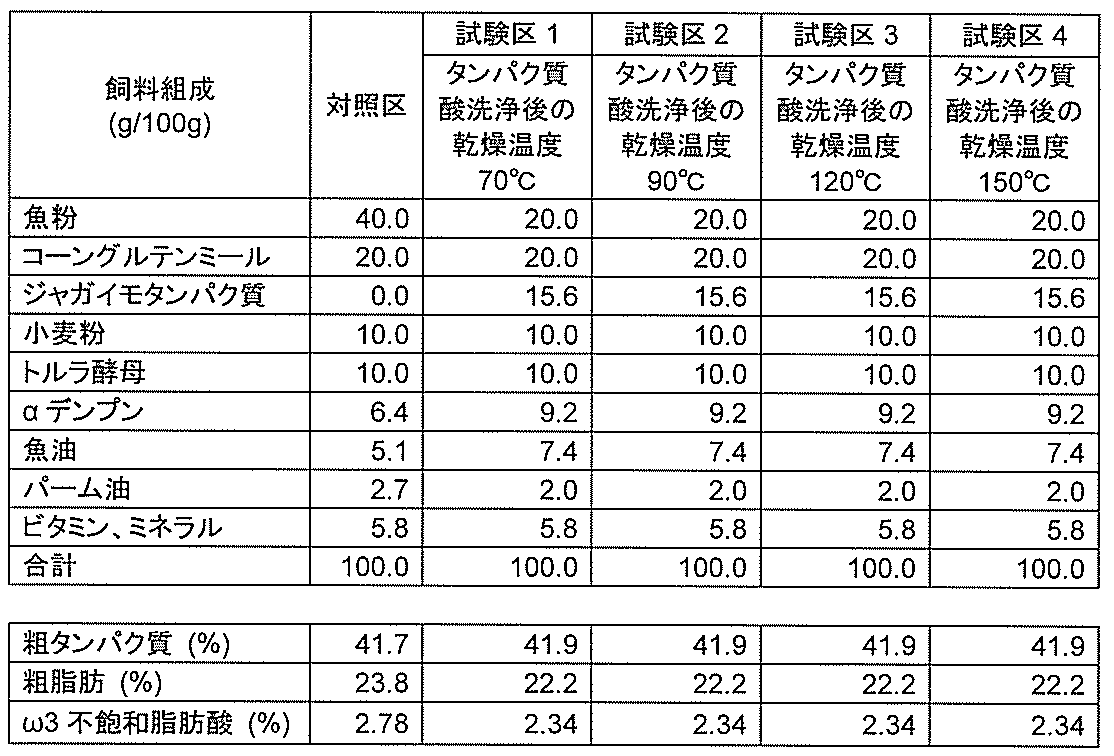
酸洗浄後の乾燥温度が異なるジャガイモタンパク質と、他の原料とを、表に示す割合で原料を配合して、対照区及び試験区1~試験区4の飼料を作製した。対照区では、タンパク質源として魚粉のみを40(g/100g)となるように添加した。試験区1~試験区4では、魚粉含量を20(g/100g)に削減して、代わりに魚粉と等タンパク質量のジャガイモタンパク質を加え、不足する重量分のαデンプンを加え等重量とした。魚粉含量を減らしたことに伴って減るω3不飽和脂肪酸は魚油で等量に調整し、またパーム油で脂質量が同じになるように調整した。
(飼料組成)
酸洗浄後の乾燥温度が異なるジャガイモタンパク質と、他の原料とを、表に示す割合で原料を配合して、対照区及び試験区1~試験区4の飼料を作製した。対照区では、タンパク質源として魚粉のみを40(g/100g)となるように添加した。試験区1~試験区4では、魚粉含量を20(g/100g)に削減して、代わりに魚粉と等タンパク質量のジャガイモタンパク質を加え、不足する重量分のαデンプンを加え等重量とした。魚粉含量を減らしたことに伴って減るω3不飽和脂肪酸は魚油で等量に調整し、またパーム油で脂質量が同じになるように調整した。
(飼料の作製)
前記の対照区及び試験区1~試験区4の試料は次の手順で作製した。
まず粉末原料をよく混合した後、魚油と水を加え混合した。
均一に混合した原料をパスタマシンで直径約1cmに成型した。
乾燥機にて90℃で水分量が5-10%になるまで加熱して乾燥した。
前記の対照区及び試験区1~試験区4の試料は次の手順で作製した。
まず粉末原料をよく混合した後、魚油と水を加え混合した。
均一に混合した原料をパスタマシンで直径約1cmに成型した。
乾燥機にて90℃で水分量が5-10%になるまで加熱して乾燥した。
(飼育方法)
マダイ(約600g)を供試魚として、供試魚を40尾ずつ収容した1000L円形水槽を各試験区に2つ用意した。水温約23℃の生海水(濾過をしない海水)を常時供給する流水による飼育とした。全試験区について、魚を水槽に収容して、約4週間各試験区の配合飼料を用いて予備飼育して、水槽間の摂餌量にばらつきが無いことを確認してから、各試験飼料を給餌する試験を開始した。
マダイ(約600g)を供試魚として、供試魚を40尾ずつ収容した1000L円形水槽を各試験区に2つ用意した。水温約23℃の生海水(濾過をしない海水)を常時供給する流水による飼育とした。全試験区について、魚を水槽に収容して、約4週間各試験区の配合飼料を用いて予備飼育して、水槽間の摂餌量にばらつきが無いことを確認してから、各試験飼料を給餌する試験を開始した。
試験飼料の給餌は毎日2回飽食するまで(魚が水槽の底に落ちた餌を瞬時に摂取しなくなるまで)給餌し、その時点までの給餌量を稚魚による1日間の摂餌量とした。給餌試験は4週間行った。この期間の開始から終了までの魚体の重量の増加量を総増重量とした。結果は以下の式によって計算した飼料効率(%)で表し、対照区の飼料効率を100%(実測値52.8%)とし、対照区と比べて80%以上をA(良)、80%未満をB(不可)とした。
飼料効率(%)=魚体の総増重量(g、湿重量)/総給餌量(g、乾重量)×100
飼料効率(%)=魚体の総増重量(g、湿重量)/総給餌量(g、乾重量)×100
(結果)
<実験2>
<サンプルの作製>
(1.ジャガイモタンパク質の抽出)
実験に用いたジャガイモタンパク質は、次の手順で製造した。
澱粉工場から得られた、ジャガイモの搾汁を使用した。
ジャガイモの搾汁を90℃で加熱して、搾汁中のジャガイモタンパク質を凝集させた。
脱水機にて、ジャガイモタンパク質を脱水した。
(1.ジャガイモタンパク質の抽出)
実験に用いたジャガイモタンパク質は、次の手順で製造した。
澱粉工場から得られた、ジャガイモの搾汁を使用した。
ジャガイモの搾汁を90℃で加熱して、搾汁中のジャガイモタンパク質を凝集させた。
脱水機にて、ジャガイモタンパク質を脱水した。
(2.ジャガイモタンパク質の乾燥)
脱水後のジャガイモタンパク質(含水率75%)を以下の条件で乾燥した。
試験区2-1では、ジャガイモタンパク質を振動流動層型乾燥機により含水率5~10%となるまで乾燥させた。乾燥時のジャガイモタンパク質の品温と含水率の経時変化を図1に示す。振動流動層乾燥機による乾燥では急速に気化する水により乾燥対象物の品温の上昇が抑制されるため、含水率が30%以下に到達するまで乾燥対象物の品温は45℃以下であった。また21分間という比較的短時間で乾燥対象物が含水率5~10%に到達した。その後、空冷することにより、乾燥対象物の品温を比較的短時間で50℃以下まで冷却し、乾燥工程を終了した。
試験区2-2では、ジャガイモタンパク質をディスク型乾燥機により乾燥温度90℃で含水率5~10%となるまで乾燥させた。乾燥時のジャガイモタンパク質の品温と含水率の経時変化を図2に示す。ディスク型乾燥機による乾燥温度90℃での乾燥では、乾燥対象物の品温は開始直後に約90℃に上昇し、この温度を維持しながら含水率が徐々に低下した。乾燥対象物が含水率5~10%に到達するまで120分を要した。
試験区2-3では、ジャガイモタンパク質を棚型乾燥機により乾燥温度120℃で含水率5~10%となるまで乾燥させた。
試験区2-4では、ジャガイモタンパク質を棚型乾燥機により乾燥温度150℃で含水率5~10%となるまで乾燥させた。
脱水後のジャガイモタンパク質(含水率75%)を以下の条件で乾燥した。
試験区2-1では、ジャガイモタンパク質を振動流動層型乾燥機により含水率5~10%となるまで乾燥させた。乾燥時のジャガイモタンパク質の品温と含水率の経時変化を図1に示す。振動流動層乾燥機による乾燥では急速に気化する水により乾燥対象物の品温の上昇が抑制されるため、含水率が30%以下に到達するまで乾燥対象物の品温は45℃以下であった。また21分間という比較的短時間で乾燥対象物が含水率5~10%に到達した。その後、空冷することにより、乾燥対象物の品温を比較的短時間で50℃以下まで冷却し、乾燥工程を終了した。
試験区2-2では、ジャガイモタンパク質をディスク型乾燥機により乾燥温度90℃で含水率5~10%となるまで乾燥させた。乾燥時のジャガイモタンパク質の品温と含水率の経時変化を図2に示す。ディスク型乾燥機による乾燥温度90℃での乾燥では、乾燥対象物の品温は開始直後に約90℃に上昇し、この温度を維持しながら含水率が徐々に低下した。乾燥対象物が含水率5~10%に到達するまで120分を要した。
試験区2-3では、ジャガイモタンパク質を棚型乾燥機により乾燥温度120℃で含水率5~10%となるまで乾燥させた。
試験区2-4では、ジャガイモタンパク質を棚型乾燥機により乾燥温度150℃で含水率5~10%となるまで乾燥させた。
(3.ジャガイモタンパク質の酸洗浄)
前記工程で得た乾燥した未洗浄ジャガイモタンパク質を使用し、次の手順に従い、撹拌槽内で酸により洗浄した。
ジャガイモタンパク質は洗浄前に粉砕した。粉砕は、卓上粉砕機にて実施した。
容器にジャガイモタンパク質を入れ、水を添加し、濃度10%の液を調製した。
撹拌しながら、硫酸を添加してpH3~3.5とした。温度は室温(20~30℃)とした。前記硫酸として10wt%以下の希硫酸を用いた。
酸添加後からすぐに、pHが上がりはじめるため、随時酸を添加しpH3~3.5を維持するようにした。
約3時間撹拌し、pHの挙動が定常状態であることを確認した。
撹拌を終了し、真空脱水を実施し、湿タンパク質を得た。
洗浄度を高めるため、ジャガイモタンパク質の濃度10%の液を調製する工程から湿タンパク質を得る工程までの洗浄操作を更に3回繰り返し、合計4回行った。
洗浄操作が終了後、ジャガイモタンパク質を水中で十分に分散させて得た分散液に5%以下の水酸化ナトリウム水溶液を適量添加して前記分散液のpHを7.0~7.5に中和した。中和中にもpHが変動するため、適宜アルカリを供給した。
前記工程で得た乾燥した未洗浄ジャガイモタンパク質を使用し、次の手順に従い、撹拌槽内で酸により洗浄した。
ジャガイモタンパク質は洗浄前に粉砕した。粉砕は、卓上粉砕機にて実施した。
容器にジャガイモタンパク質を入れ、水を添加し、濃度10%の液を調製した。
撹拌しながら、硫酸を添加してpH3~3.5とした。温度は室温(20~30℃)とした。前記硫酸として10wt%以下の希硫酸を用いた。
酸添加後からすぐに、pHが上がりはじめるため、随時酸を添加しpH3~3.5を維持するようにした。
約3時間撹拌し、pHの挙動が定常状態であることを確認した。
撹拌を終了し、真空脱水を実施し、湿タンパク質を得た。
洗浄度を高めるため、ジャガイモタンパク質の濃度10%の液を調製する工程から湿タンパク質を得る工程までの洗浄操作を更に3回繰り返し、合計4回行った。
洗浄操作が終了後、ジャガイモタンパク質を水中で十分に分散させて得た分散液に5%以下の水酸化ナトリウム水溶液を適量添加して前記分散液のpHを7.0~7.5に中和した。中和中にもpHが変動するため、適宜アルカリを供給した。
(4.ジャガイモタンパク質の酸洗浄後の乾燥)
中和後のジャガイモタンパク質を脱水し、各試験区について酸洗浄前の乾燥と同じ条件で乾燥した。
乾燥物を卓上の粉砕機(ミル)により粉砕して粉砕物を得た。粉砕物を下記の消化率の測定に用いた。この際、粒子径による影響を排除するため、篩による分級を行い、280メッシュパスのサンプルを用いた。
中和後のジャガイモタンパク質を脱水し、各試験区について酸洗浄前の乾燥と同じ条件で乾燥した。
乾燥物を卓上の粉砕機(ミル)により粉砕して粉砕物を得た。粉砕物を下記の消化率の測定に用いた。この際、粒子径による影響を排除するため、篩による分級を行い、280メッシュパスのサンプルを用いた。
<サンプルのDSC測定>
DSCの測定条件は実験1と同じである。
DSCの測定条件は実験1と同じである。
<サンプルの消化性の評価>
各試験区のジャガイモタンパク質及び標準物質(魚粉)を粗タンパク質量が同じになるよう量りとり、それぞれに胃破砕液(カンパチから採取した胃を水とともにホモジナイザーで破砕、遠心分離した上清)、リン酸緩衝液、塩酸の混合溶液を加えpH2.5に調整し、25℃で4時間振とうした。振とう後、リン酸緩衝液、クロラムフェニコールおよび幽門垂破砕液(カンパチから採取した幽門垂を水とともにホモジナイザーで破砕、遠心分離した上清)を加えてpH7.5とし、25℃で24時間振とうした。この間、0、3、6及び24時間経過時点で反応液をサンプリングし、沸騰した水に入れクエンチした。その後、遠心分離し、上清を希釈し、リン酸緩衝液およびトリニトロベンゼンスルホン酸溶液を加え、60℃で1時間加温した。加温後、塩酸を加えてクエンチした。これらの溶液の吸光度(波長420nm)を測定し、ロイシン溶液で作成した検量線から、各溶液の遊離物濃度(遊離アミノ酸および遊離ペプチドの濃度)を算出した。各ジャガイモタンパク質、標準物質の遊離物濃度が50%に達する時間を、0、3、6及び24時間経過時点の遊離物濃度から得られた近似式から算出した。各ジャガイモタンパク質の遊離物濃度が50%に達する時間の逆数を、標準物質の遊離物濃度が50%に達する時間の逆数を100%とした場合の相対値に換算し、それらを各ジャガイモタンパク質の消化率(%)とした。
<結果>
試験区2-1~試験区2-4のポテトタンパク質サンプルのDSC吸熱ピーク温度、DSC発熱ピーク温度、消化率の測定結果を下記の表に示す。消化率が80%以上のサンプルをAA(優)、消化率が50%以上80%未満のサンプルをA(良)、消化率が50%未満のサンプルをB(不可)とした。なお、試験区2-3及び試験区2-4のサンプルは著しく変性しており、DSCの吸熱ピーク温度は検出できなかった。
各試験区のジャガイモタンパク質及び標準物質(魚粉)を粗タンパク質量が同じになるよう量りとり、それぞれに胃破砕液(カンパチから採取した胃を水とともにホモジナイザーで破砕、遠心分離した上清)、リン酸緩衝液、塩酸の混合溶液を加えpH2.5に調整し、25℃で4時間振とうした。振とう後、リン酸緩衝液、クロラムフェニコールおよび幽門垂破砕液(カンパチから採取した幽門垂を水とともにホモジナイザーで破砕、遠心分離した上清)を加えてpH7.5とし、25℃で24時間振とうした。この間、0、3、6及び24時間経過時点で反応液をサンプリングし、沸騰した水に入れクエンチした。その後、遠心分離し、上清を希釈し、リン酸緩衝液およびトリニトロベンゼンスルホン酸溶液を加え、60℃で1時間加温した。加温後、塩酸を加えてクエンチした。これらの溶液の吸光度(波長420nm)を測定し、ロイシン溶液で作成した検量線から、各溶液の遊離物濃度(遊離アミノ酸および遊離ペプチドの濃度)を算出した。各ジャガイモタンパク質、標準物質の遊離物濃度が50%に達する時間を、0、3、6及び24時間経過時点の遊離物濃度から得られた近似式から算出した。各ジャガイモタンパク質の遊離物濃度が50%に達する時間の逆数を、標準物質の遊離物濃度が50%に達する時間の逆数を100%とした場合の相対値に換算し、それらを各ジャガイモタンパク質の消化率(%)とした。
<結果>
試験区2-1~試験区2-4のポテトタンパク質サンプルのDSC吸熱ピーク温度、DSC発熱ピーク温度、消化率の測定結果を下記の表に示す。消化率が80%以上のサンプルをAA(優)、消化率が50%以上80%未満のサンプルをA(良)、消化率が50%未満のサンプルをB(不可)とした。なお、試験区2-3及び試験区2-4のサンプルは著しく変性しており、DSCの吸熱ピーク温度は検出できなかった。
<ポテトグリコアルカロイド含量の測定>
各試験区のポテトタンパク質のPGA(ポテトグリコアルカロイド)含量の測定は以下の手順で行った。PGAとして、ソラニン及びチャコニンの量を測定した。
各試験区のポテトタンパク質のPGA(ポテトグリコアルカロイド)含量の測定は以下の手順で行った。PGAとして、ソラニン及びチャコニンの量を測定した。
各試験区のポテトタンパク質を粉砕機にて微粉砕した。180μm以下のメッシュにて篩分けし、篩下品を使用した。
ポテトタンパク質3~10gに対し、80%メタノール液を10~80g添加し、撹拌した。ホモジナイザーにて10000rpmで3分間せん断撹拌を実施し、PGAをメタノール水側へ抽出した。
液を回収し、遠心分離にて固液分離した。
液を回収し、フィルターにて不純物をろ過後、HPLC用バイアル瓶に収容した。
液を回収し、遠心分離にて固液分離した。
液を回収し、フィルターにて不純物をろ過後、HPLC用バイアル瓶に収容した。
分析は、HPLCにて実施した。HPLCは以下の条件で行った。
カラム:Cosmosil 5C18 AR-II(4.6mm i.d.×250mm)ナカライテスク株式会社製
移動相:55%アセトニトリル含有10mMリン酸ナトリウム水溶液0.9ml/min
カラム温度:40℃
検出波長:202nm
注入量:20μL
カラム:Cosmosil 5C18 AR-II(4.6mm i.d.×250mm)ナカライテスク株式会社製
移動相:55%アセトニトリル含有10mMリン酸ナトリウム水溶液0.9ml/min
カラム温度:40℃
検出波長:202nm
注入量:20μL
その結果、各試験区のポテトタンパク質の乾物中のソラニン及びチャコニンの合計含有量は、いずれも10ppm以下であった。
<実験3>
<サンプルの作製>
(1.ジャガイモタンパク質の抽出)
実験2でジャガイモ搾汁から抽出し脱水したジャガイモタンパク質を用いた。
(1.ジャガイモタンパク質の抽出)
実験2でジャガイモ搾汁から抽出し脱水したジャガイモタンパク質を用いた。
(2.ジャガイモタンパク質の乾燥)
脱水後のジャガイモタンパク質(含水率70%)を乾燥した。
試験区3-1では実験2の試験区2-1と同じ条件でジャガイモタンパク質乾燥した。
試験区3-2では実験2の試験区2-2と同じ条件でジャガイモタンパク質乾燥した。
試験区3-3では実験2の試験区2-3と同じ条件でジャガイモタンパク質乾燥した。
試験区3-4では実験2の試験区2-4と同じ条件でジャガイモタンパク質乾燥した。
乾燥物を卓上の粉砕機(ミル)により粉砕して粉砕物を得た。粉砕物を下記の消化率の測定に用いた。この際、粒子径による影響を排除するため、篩による分級を行い、280メッシュパスのサンプルを用いた。
脱水後のジャガイモタンパク質(含水率70%)を乾燥した。
試験区3-1では実験2の試験区2-1と同じ条件でジャガイモタンパク質乾燥した。
試験区3-2では実験2の試験区2-2と同じ条件でジャガイモタンパク質乾燥した。
試験区3-3では実験2の試験区2-3と同じ条件でジャガイモタンパク質乾燥した。
試験区3-4では実験2の試験区2-4と同じ条件でジャガイモタンパク質乾燥した。
乾燥物を卓上の粉砕機(ミル)により粉砕して粉砕物を得た。粉砕物を下記の消化率の測定に用いた。この際、粒子径による影響を排除するため、篩による分級を行い、280メッシュパスのサンプルを用いた。
<サンプルのDSC測定>
DSCの測定条件は実験1、2と同じである。
DSCの測定条件は実験1、2と同じである。
<サンプルの消化性の評価>
各試験区のジャガイモタンパク質サンプルの消化率及びPGA含量を実験2に記載の手順で測定した。
各試験区のジャガイモタンパク質サンプルの消化率及びPGA含量を実験2に記載の手順で測定した。
<結果>
試験区3-1~3-4のポテトタンパク質サンプルのDSC吸熱ピーク温度、DSC発熱ピーク温度、消化率の測定結果を下記の表に示す。消化率が80%以上のサンプルをAA(優)、消化率が50%以上80%未満のサンプルをA(良)、消化率が50%未満のサンプルをB(不可)とした。なお、試験区3-3及び試験区3-4のサンプルは著しく変性しており、DSCの吸熱ピーク温度は検出できなかった。
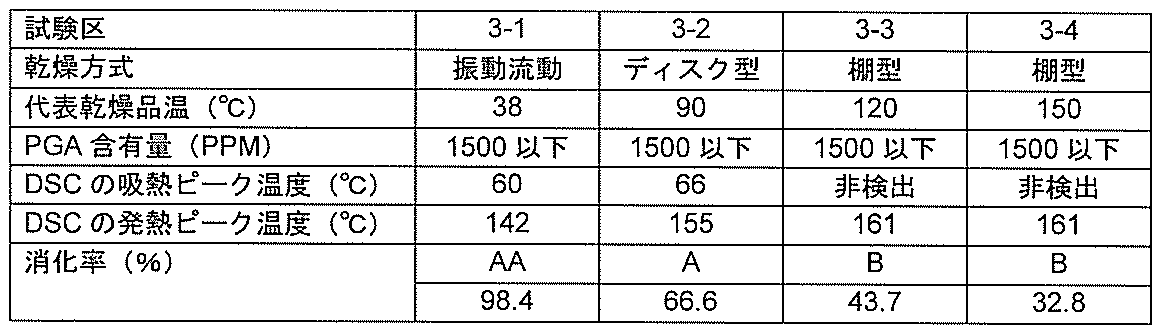
試験区3-1~3-4のポテトタンパク質サンプルのDSC吸熱ピーク温度、DSC発熱ピーク温度、消化率の測定結果を下記の表に示す。消化率が80%以上のサンプルをAA(優)、消化率が50%以上80%未満のサンプルをA(良)、消化率が50%未満のサンプルをB(不可)とした。なお、試験区3-3及び試験区3-4のサンプルは著しく変性しており、DSCの吸熱ピーク温度は検出できなかった。
本明細書で引用した全ての刊行物、特許及び特許出願はそのまま引用により本明細書に組み入れられるものとする。
Claims (12)
- 示差走査熱量測定での吸熱ピーク温度が40~80℃である、動物飼料用の植物性タンパク質。
- 示差走査熱量測定での発熱ピーク温度が120~160℃である、請求項1に記載の植物性タンパク質。
- 示差走査熱量測定での発熱ピーク温度が120~160℃である、動物飼料用の植物性タンパク質。
- 植物の搾汁に溶解したタンパク質に由来する、請求項1~3のいずれか1項に記載の植物性タンパク質。
- 前記植物が澱粉又は糖の原料植物である、請求項4に記載の植物性タンパク質。
- 前記澱粉又は糖の原料植物が、ジャガイモ、キャッサバ、ビート又はサトウキビである、請求項5に記載の植物性タンパク質。
- ジャガイモに由来し、乾物中のポテトグリコアルカロイドの含有量が合計で100ppm以下である、請求項1~6のいずれか1項に記載の植物性タンパク質。
- 請求項1~7のいずれか1項に記載の植物性タンパク質を含む、飼料組成物。
- 請求項8に記載の飼料組成物を動物に与えることを含む、動物の飼育方法。
- 前記動物が水産動物である、請求項9に記載の方法。
- 前記水産動物が、ブリ、タイ、サーモン又はエビである、請求項10に記載の方法。
- 植物性タンパク質の製造方法であって、
植物原料から植物性タンパク質を分離すること、
分離した前記植物性タンパク質の含水率を55重量%以上に調節すること、及び、
含水率55重量%以上の前記植物性タンパク質を、含水率が15重量%以下となるまで乾燥させること
を含み、
前記乾燥において、前記植物性タンパク質の含水率が30重量%に低減するまでの間の、前記植物性タンパク質の温度が50℃以下であることを特徴とする方法。
Applications Claiming Priority (2)
| Application Number | Priority Date | Filing Date | Title |
|---|---|---|---|
| JP2018-158199 | 2018-08-27 | ||
| JP2018158199 | 2018-08-27 |
Publications (1)
| Publication Number | Publication Date |
|---|---|
| WO2020045295A1 true WO2020045295A1 (ja) | 2020-03-05 |
Family
ID=69644218
Family Applications (1)
| Application Number | Title | Priority Date | Filing Date |
|---|---|---|---|
| PCT/JP2019/033099 Ceased WO2020045295A1 (ja) | 2018-08-27 | 2019-08-23 | 動物飼料用の植物性タンパク質及びその製造方法 |
Country Status (1)
| Country | Link |
|---|---|
| WO (1) | WO2020045295A1 (ja) |
Citations (4)
| Publication number | Priority date | Publication date | Assignee | Title |
|---|---|---|---|---|
| JPH11509418A (ja) * | 1995-07-18 | 1999-08-24 | コオペラティイヴェ ヴェルコオプ−エン プロダクティイヴェレニギング ヴァン アアルダップペルメエル エン デリヴァテン アヴェベ ビー.エイ. | 動物飼料に使用するための浄化した熱凝結したポテト蛋白質 |
| JP2010507596A (ja) * | 2006-10-26 | 2010-03-11 | エムスランド−シュテルケ ゲーエムベーハー | 中分子量の植物タンパク質画分を得る方法、植物タンパク質画分およびその使用 |
| JP2010227128A (ja) * | 2002-08-09 | 2010-10-14 | Nippon Suisan Kaisha Ltd | 魚類、棘皮類又は甲殻類用飼料原料の製造方法 |
| JP2015534815A (ja) * | 2012-11-02 | 2015-12-07 | エムスランド−シュテルケ ゲーエムベーハーEmsland−Staerke GmbH | デンプン含有植物部分から製造された食物製品及び該食物製品の製造方法 |
-
2019
- 2019-08-23 WO PCT/JP2019/033099 patent/WO2020045295A1/ja not_active Ceased
Patent Citations (4)
| Publication number | Priority date | Publication date | Assignee | Title |
|---|---|---|---|---|
| JPH11509418A (ja) * | 1995-07-18 | 1999-08-24 | コオペラティイヴェ ヴェルコオプ−エン プロダクティイヴェレニギング ヴァン アアルダップペルメエル エン デリヴァテン アヴェベ ビー.エイ. | 動物飼料に使用するための浄化した熱凝結したポテト蛋白質 |
| JP2010227128A (ja) * | 2002-08-09 | 2010-10-14 | Nippon Suisan Kaisha Ltd | 魚類、棘皮類又は甲殻類用飼料原料の製造方法 |
| JP2010507596A (ja) * | 2006-10-26 | 2010-03-11 | エムスランド−シュテルケ ゲーエムベーハー | 中分子量の植物タンパク質画分を得る方法、植物タンパク質画分およびその使用 |
| JP2015534815A (ja) * | 2012-11-02 | 2015-12-07 | エムスランド−シュテルケ ゲーエムベーハーEmsland−Staerke GmbH | デンプン含有植物部分から製造された食物製品及び該食物製品の製造方法 |
Similar Documents
| Publication | Publication Date | Title |
|---|---|---|
| JP6730992B2 (ja) | 甲虫粉末 | |
| JP4727989B2 (ja) | 飼料組成物および動物に給餌する方法 | |
| EP0535135B1 (en) | Method for producing a proteinaceous product by digestion of raw animal parts | |
| Evans et al. | The influence of autoclaving soybean oil meal on the availability of cystine and methionine for the chick | |
| Brasileiro et al. | Determination of the chemical composition and functional properties of shrimp waste protein concentrate and lyophilized flour | |
| CN104115989A (zh) | 一种海洋鱼肽粉及其制备方法与应用 | |
| Siulapwa et al. | Nutritional value of differently processed soybean seeds | |
| EP0925723A1 (en) | Protein-containing feedstuff and process for its manufacture | |
| TWI901603B (zh) | 可食用水黃皮組合物與其製備方法及用途 | |
| JPS60259156A (ja) | 油脂種子材料の処理方法 | |
| KR20190082837A (ko) | 가공 제품의 제조를 위한 방법 | |
| WO2020045295A1 (ja) | 動物飼料用の植物性タンパク質及びその製造方法 | |
| KR102333548B1 (ko) | 배스 추출물을 포함하는 동물용 사료 조성물 및 이의 제조방법 | |
| US20200268014A1 (en) | Protein ingredient made from oilseeds of sunflowers or rape, and the production thereof | |
| JP2022514850A (ja) | 動物用飼料用のエンドウマメベースの乾燥製品 | |
| KR20140116938A (ko) | 단백질 기질내에 홉산 염을 포함하는 비들렛 | |
| JP2020005606A (ja) | 高純度植物性タンパク質 | |
| RU2780695C1 (ru) | Способ приготовления продуктов с использованием семян сои | |
| Ristic et al. | Subsequent processing of insects | |
| JP2886327B2 (ja) | 動物飼料用加工大豆およびその製造方法 | |
| RU2801685C2 (ru) | Способ приготовления гранулированного продукта с использованием соевого зерна | |
| NL2027086B1 (en) | The method of producing soy protein (oil meal) with low, stable content of protease inhibitors | |
| RU2457691C2 (ru) | Кормовой продукт для сельскохозяйственных животных и птицы | |
| Nartey et al. | Amino acid profiles of cassava seeds (Manihot esculenta) | |
| Goyal et al. | Extraction, characterization, and functional properties of ultra-low gossypol protein from cottonseed meal. |
Legal Events
| Date | Code | Title | Description |
|---|---|---|---|
| 121 | Ep: the epo has been informed by wipo that ep was designated in this application |
Ref document number: 19853562 Country of ref document: EP Kind code of ref document: A1 |
|
| NENP | Non-entry into the national phase |
Ref country code: DE |
|
| 122 | Ep: pct application non-entry in european phase |
Ref document number: 19853562 Country of ref document: EP Kind code of ref document: A1 |
|
| NENP | Non-entry into the national phase |
Ref country code: JP |