WO2020040113A1 - ヒスタミン測定法及びキット - Google Patents
ヒスタミン測定法及びキット Download PDFInfo
- Publication number
- WO2020040113A1 WO2020040113A1 PCT/JP2019/032370 JP2019032370W WO2020040113A1 WO 2020040113 A1 WO2020040113 A1 WO 2020040113A1 JP 2019032370 W JP2019032370 W JP 2019032370W WO 2020040113 A1 WO2020040113 A1 WO 2020040113A1
- Authority
- WO
- WIPO (PCT)
- Prior art keywords
- group
- histamine
- salt
- kit
- buffer
- Prior art date
- Legal status (The legal status is an assumption and is not a legal conclusion. Google has not performed a legal analysis and makes no representation as to the accuracy of the status listed.)
- Ceased
Links
Images




Classifications
-
- C—CHEMISTRY; METALLURGY
- C12—BIOCHEMISTRY; BEER; SPIRITS; WINE; VINEGAR; MICROBIOLOGY; ENZYMOLOGY; MUTATION OR GENETIC ENGINEERING
- C12Q—MEASURING OR TESTING PROCESSES INVOLVING ENZYMES, NUCLEIC ACIDS OR MICROORGANISMS; COMPOSITIONS OR TEST PAPERS THEREFOR; PROCESSES OF PREPARING SUCH COMPOSITIONS; CONDITION-RESPONSIVE CONTROL IN MICROBIOLOGICAL OR ENZYMOLOGICAL PROCESSES
- C12Q1/00—Measuring or testing processes involving enzymes, nucleic acids or microorganisms; Compositions therefor; Processes of preparing such compositions
- C12Q1/26—Measuring or testing processes involving enzymes, nucleic acids or microorganisms; Compositions therefor; Processes of preparing such compositions involving oxidoreductase
- C12Q1/32—Measuring or testing processes involving enzymes, nucleic acids or microorganisms; Compositions therefor; Processes of preparing such compositions involving oxidoreductase involving dehydrogenase
-
- C—CHEMISTRY; METALLURGY
- C07—ORGANIC CHEMISTRY
- C07F—ACYCLIC, CARBOCYCLIC OR HETEROCYCLIC COMPOUNDS CONTAINING ELEMENTS OTHER THAN CARBON, HYDROGEN, HALOGEN, OXYGEN, NITROGEN, SULFUR, SELENIUM OR TELLURIUM
- C07F5/00—Compounds containing elements of Groups 3 or 13 of the Periodic Table
- C07F5/02—Boron compounds
- C07F5/025—Boronic and borinic acid compounds
-
- C—CHEMISTRY; METALLURGY
- C12—BIOCHEMISTRY; BEER; SPIRITS; WINE; VINEGAR; MICROBIOLOGY; ENZYMOLOGY; MUTATION OR GENETIC ENGINEERING
- C12M—APPARATUS FOR ENZYMOLOGY OR MICROBIOLOGY; APPARATUS FOR CULTURING MICROORGANISMS FOR PRODUCING BIOMASS, FOR GROWING CELLS OR FOR OBTAINING FERMENTATION OR METABOLIC PRODUCTS, i.e. BIOREACTORS OR FERMENTERS
- C12M1/00—Apparatus for enzymology or microbiology
- C12M1/40—Apparatus specially designed for the use of free, immobilised, or carrier-bound enzymes, e.g. apparatus containing a fluidised bed of immobilised enzymes
-
- G—PHYSICS
- G01—MEASURING; TESTING
- G01N—INVESTIGATING OR ANALYSING MATERIALS BY DETERMINING THEIR CHEMICAL OR PHYSICAL PROPERTIES
- G01N27/00—Investigating or analysing materials by the use of electric, electrochemical, or magnetic means
- G01N27/26—Investigating or analysing materials by the use of electric, electrochemical, or magnetic means by investigating electrochemical variables; by using electrolysis or electrophoresis
- G01N27/28—Electrolytic cell components
- G01N27/30—Electrodes, e.g. test electrodes; Half-cells
- G01N27/327—Biochemical electrodes, e.g. electrical or mechanical details for in vitro measurements
- G01N27/3271—Amperometric enzyme electrodes for analytes in body fluids, e.g. glucose in blood
-
- G—PHYSICS
- G01—MEASURING; TESTING
- G01N—INVESTIGATING OR ANALYSING MATERIALS BY DETERMINING THEIR CHEMICAL OR PHYSICAL PROPERTIES
- G01N27/00—Investigating or analysing materials by the use of electric, electrochemical, or magnetic means
- G01N27/26—Investigating or analysing materials by the use of electric, electrochemical, or magnetic means by investigating electrochemical variables; by using electrolysis or electrophoresis
- G01N27/28—Electrolytic cell components
- G01N27/30—Electrodes, e.g. test electrodes; Half-cells
- G01N27/327—Biochemical electrodes, e.g. electrical or mechanical details for in vitro measurements
- G01N27/3275—Sensing specific biomolecules, e.g. nucleic acid strands, based on an electrode surface reaction
- G01N27/3277—Sensing specific biomolecules, e.g. nucleic acid strands, based on an electrode surface reaction being a redox reaction, e.g. detection by cyclic voltammetry
-
- G—PHYSICS
- G01—MEASURING; TESTING
- G01N—INVESTIGATING OR ANALYSING MATERIALS BY DETERMINING THEIR CHEMICAL OR PHYSICAL PROPERTIES
- G01N31/00—Investigating or analysing non-biological materials by the use of the chemical methods specified in the subgroup; Apparatus specially adapted for such methods
Definitions
- the present invention relates to a kit for detecting histamine, a sensor capable of detecting histamine, a method for detecting histamine, and the like.
- Histamine is a chemical mediator of allergic reactions that occur in the body, so ingestion of foods that have accumulated a large amount of histamine causes allergy-like poisoning.
- Specific symptoms of histamine-induced allergic reactions include redness on the face within minutes to several hours after meals, followed by itching, hives and eczema, and in severe cases, hives spread throughout the body and bronchitis and blood pressure drop May cause.
- a histamine measurement method that can easily and quickly measure the amount of histamine in food processing plants, food hygiene monitoring organizations, clinical laboratories, and the like.
- JP 2001-157597 A Patent No. 3926071
- the present inventor has found that in a method for measuring histamine using histamine dehydrogenase, color development not derived from an enzymatic reaction (hereinafter, also referred to as “misreaction” or “misrepresentation” in the present specification) may occur. It has been found that color development can interfere with the detection of histamine, especially in the low concentration range. Therefore, an object of the present invention is to reduce this erroneous reaction.
- the present inventors have found that boric acid or a salt thereof, and / or boronic acid or a salt thereof, and / or an alkyl sulfate can reduce the erroneous reaction, and have completed the present invention. Therefore, the present invention includes the following embodiments.
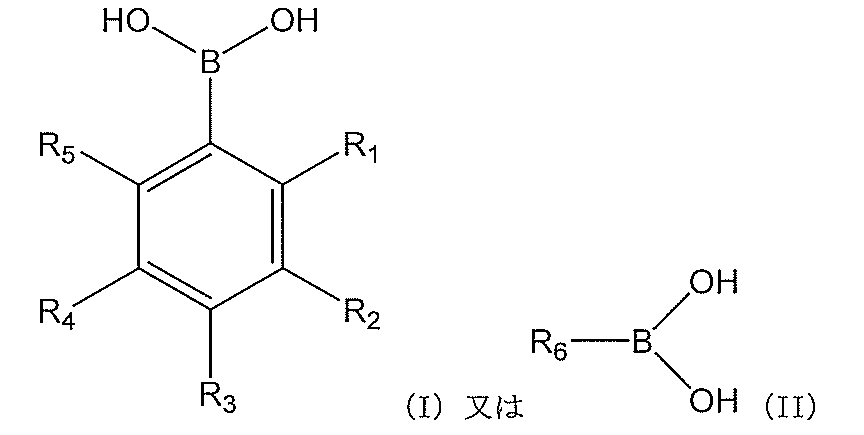
- a kit for detecting histamine comprising (i) histamine dehydrogenase, and (ii-a) boric acid or a salt thereof, and / or the following formula (I) or (II): (Wherein R 1 to R 5 each independently represent H, boronyl, halogen, hydroxy, carboxy, nitro, amino, sulfo, thiol, tert-butoxycarbonylamino, Selected from the group consisting of substituted or unsubstituted C 1 -C 10 alkyl, alkenyl, or alkynyl groups; R 6 is C 1 substituted or unsubstituted with at least one substituent selected from the group consisting of a boronyl group, a halogen group, a hydroxy group, a carboxy group, a nitro group, an amino group, a sulfo group and a thiol group.
- An electrochemical sensor capable of detecting histamine oxidation by histamine dehydrogenase comprising (i) histamine dehydrogenase, and (ii-a) boric acid or a salt thereof, and / or the following formula (I) or (II) : (Wherein R 1 to R 5 each independently represent H, boronyl, halogen, hydroxy, carboxy, nitro, amino, sulfo, thiol, tert-butoxycarbonylamino, Selected from the group consisting of substituted or unsubstituted C 1 -C 10 alkyl, alkenyl, or alkynyl groups; R 6 is C 1 substituted or unsubstituted with at least one substituent selected from the group consisting of a
- the mediator is 1-methoxy PMS (1-methoxy-5-ethylphenazinium ethyl sulfate), PMS (phenazinium methyl sulfate), PES (phenazinium ethyl sulfate) and 1-methoxy PES (1-
- the kit or sensor according to (3) which is selected from the group consisting of methoxy-5-ethylphenazinium ethyl sulfate).
- a buffer containing a compound having a zwitterion and having no carboxy group comprising BES, MOPS, TES, HEPES, EPPS, TAPS, CHES, CAPS, TAPSO, POPSO, HEPPSO, ACES, Bis
- the buffer is a buffer containing a compound having a zwitterion and having a sulfo group, wherein the buffer is BES, MOPS, TES, HEPES, EPPS, TAPS, CHES, CAPS, TAPSO, POPSO, HEPPSO, ACES.
- the kit or sensor according to (7) which is a buffer selected from the group consisting of, MES, MOPSO, and PIPES.
- the buffer is a buffer containing a compound having a zwitterion, having a sulfo group, and having a hydroxy group at the 2-position, selected from the group consisting of TAPSO, POPSO, HEPPSO, and MOPSO.
- the kit or sensor according to (8) which is a buffer solution to be used.
- (12) including a sampling section and a reaction section, The kit or sensor according to any one of (1) to (11), wherein the reaction unit contains the histamine dehydrogenase and the boric acid or a salt thereof, and / or a boronic acid or a salt thereof.
- a method for detecting histamine comprising (i) histamine dehydrogenase, and (ii-a) boric acid or a salt thereof, and / or the following formula (I) or (II):
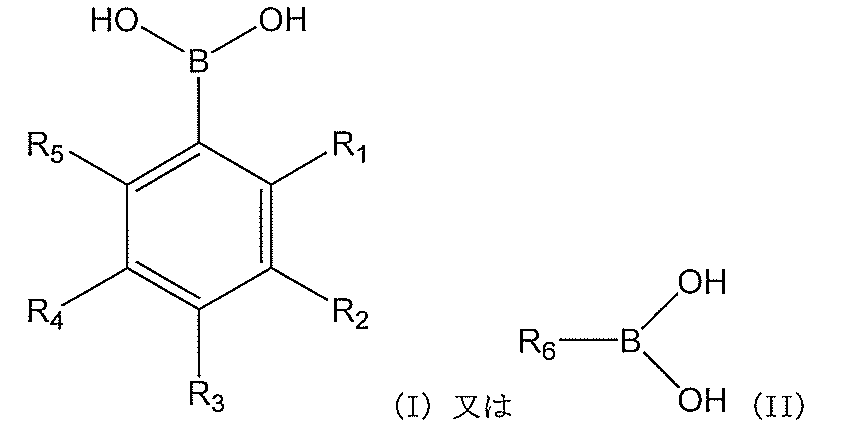
- R 1 to R 5 are each independently H, boronyl, halogen, hydroxy, carboxy, nitro, amino, sulfo, thiol, tert-butoxycarbonylamino, Selected from the group consisting of substituted or unsubstituted C 1 -C 10 alkyl, alkenyl, or alkynyl groups
- R 6 is C 1 substituted or unsubstituted with at least one substituent selected from the group consisting of a boronyl group, a halogen group, a hydroxy group, a carboxy group, a nitro group, an amino group, a sulfo group and a thiol group.
- a method for detecting histamine An electrochemical sensor capable of detecting histamine oxidation by histamine dehydrogenase is used, wherein the sensor comprises (i) histamine dehydrogenase, and (ii-a) boric acid or a salt thereof, and / or the following formula (I) or (II) ): (Wherein, R 1 to R 5 are each independently H, boronyl, halogen, hydroxy, carboxy, nitro, amino, sulfo, thiol, tert-butoxycarbonylamino, Selected from the group consisting of substituted or unsubstituted C 1 -C 10 alkyl, alkenyl, or alkynyl groups; R 6 is C 1 substituted or unsubstituted C 1 -C 10 alkyl, alkenyl, or alkynyl groups; R 6 is C 1 substituted or unsubstituted C 1 -C 10 alkyl, alkenyl, or alky
- a buffer containing a compound having a zwitterion and having no carboxy group comprising BES, MOPS, TES, HEPES, EPPS, TAPS, CHES, CAPS, TAPSO, POPSO, HEPPSO, ACES, Bis -The method according to any one of (13) to (18), further comprising a buffer selected from the group consisting of Tris, MES, MOPSO and PIPES, Tris or carbonate buffer.
- the buffer is a buffer containing a compound having a zwitterion and having a sulfo group, wherein the buffer is BES, MOPS, TES, HEPES, EPPS, TAPS, CHES, CAPS, TAPSO, POPSO, HEPPSO, ACES.
- the buffer is a buffer containing a compound having a zwitterion, having a sulfo group, and having a hydroxy group at the 2-position, selected from the group consisting of TAPSO, POPSO, HEPPSO, and MOPSO.
- (22) The method according to any one of (13) to (21), wherein boric acid or a salt thereof and / or boronic acid or a salt thereof is used at a final concentration of 120 mM or less at the time of measurement.
- (23) The method according to any one of (13) to (22), wherein the alkyl sulfate is sodium lauryl sulfate.
- the present invention in a method for measuring histamine using histamine dehydrogenase, it is possible to reduce erroneous reactions not derived from an enzymatic reaction. This makes it possible to detect histamine even in a particularly low concentration range.
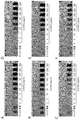
- FIG. 1-1 shows the measurement results of the amount of histamine when various coloring reagents were used.
- A shows WST-4, B shows WST-5, C shows WST-8, D shows INT, E shows NBT, and F shows the results when XTT was used as a coloring reagent.
- FIG. 1-2 shows the degree of misreaction when EDTA (2Na) was used in a system not containing histamine and histamine dehydrogenase.
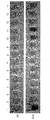
- FIG. 2 shows the degree of misreaction when various buffers were used.
- FIG. 3 shows the degree of misreaction when various buffers were used. 1 shows the result when EDTA (2Na), 2 shows carbonic acid, 3 shows boric acid, and 4 shows the result when Tris was used.
- FIG. 4 shows the degree of misreaction in the HEPPSO buffer (A) or the solution containing the HEPPSO buffer and boric acid (B).
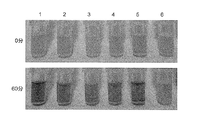
- FIG. 5 shows the degree of misreaction when using various boronic acids.
- 1 is a control without added boronic acid
- 2 is phenylboronic acid
- 3 is 4-chlorophenylboronic acid
- 4 is 4-fluorophenylboronic acid
- 5 is butylboronic acid
- 6 is 3-[(tert-butoxycarbonyl) amino]
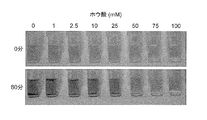
- FIG. 6 shows the degree of misreaction when boric acid at each concentration of 0 mM to 100 mM was used.
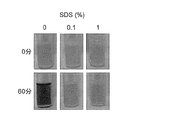
- FIG. 7 shows the degree of misreaction when using SDS at each concentration of 0% to 1%.
- FIG. 8 shows the results of measuring the histamine concentration when using 25 mM or 100 mM boric acid.
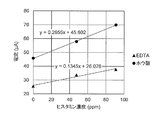
- FIG. 9 shows a histamine calibration curve obtained by cyclic voltammetry when using a boric acid solution or an EDTA solution.
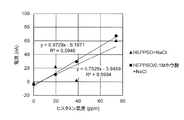
- FIG. 10 shows a histamine calibration curve obtained by chronoamperometry when using a 0.1 M HEPPSO solution (pH 8.5) or a 0.1 M HEPPSO / 0.1 M boric acid solution (pH 8.5).
- Kits or Sensors for Detecting Histamine provides (i) histamine dehydrogenase, and (ii-a) boric acid or a salt thereof, and / or boronic acid or a salt thereof, and / or (ii- b) A kit for detecting histamine, comprising an alkyl sulfate. Histamine herein includes salts thereof.
- the kit of the present invention is used for detecting histamine in a sample that may contain histamine.
- samples that may contain histamine include, for example, liquid and solid foods (such as fish meat, animal meat, cheese, soy sauce, fish sauce and wine, etc.), body fluids such as urine and plasma, biological materials, and biological tissues. Is mentioned.
- histamine dehydrogenase is classified as an oxidoreductase and has the following reaction: It is an enzyme that catalyzes the oxidation of histamine.
- the compound of formula (III) is histamine and the compound of formula (IV) is 4-imidazolylacetaldehyde.
- histamine dehydrogenase preferably acts specifically on histamine, that is, acts specifically on histamine but does not act on other amines at all, or acts weakly.
- histamine dehydrogenase preferably acts on histamine but not on cadaverine and putrescine.
- the histamine dehydrogenase is preferably derived from a bacterium, for example, a bacterium belonging to the genus Rhizobium.
- the histamine dehydrogenase may be obtained by extracting and / or purifying a histamine dehydrogenase, or may be produced by a known genetic engineering technique based on genetic information of an organism.
- the final concentration of histamine dehydrogenase at the time of measurement or storage, preferably at the time of measurement is not limited, but is not limited to 1 mU / assay to 20 U / assay, preferably 5 mU / assay.
- boric acid means an oxo acid of boron represented by the chemical formula B (OH) 3 .
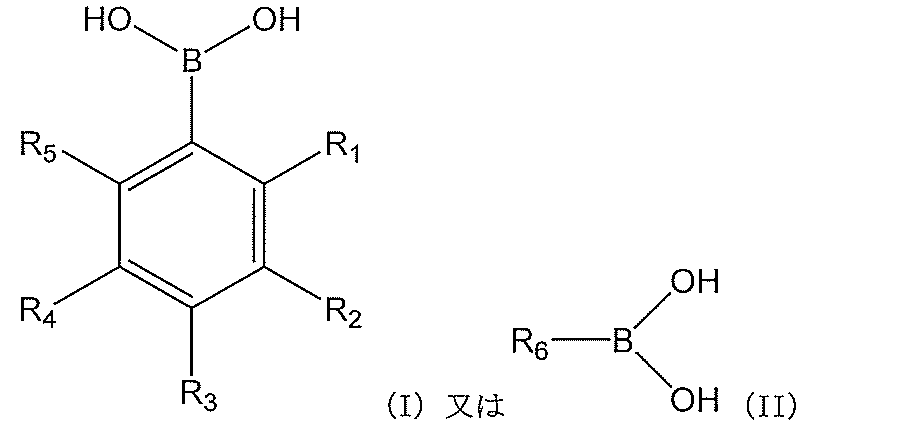
- the term “boronic acid” refers to a compound obtained by substituting a hydroxy group of boric acid, and may mean a compound represented by the following formula (I) or (II): (Wherein R 1 to R 5 each independently represent H, boronyl, halogen, hydroxy, carboxy, nitro, amino, sulfo, thiol, tert-butoxycarbonylamino, Selected from the group consisting of substituted or unsubstituted C 1 -C 10 (eg, C 1 -C 8 , C 1 -C 6 , or C 1 -C 4 ) alkyl, alkenyl, or alkynyl groups; 6 represents a C 1 to C 1 -substituted or unsubstituted by at least one substituent selected from the group consisting of a boronyl group
- C 10 (eg, C 1 -C 8 , C 1 -C 6 , or C 1 -C 4 ) selected from the group consisting of alkyl, alkenyl, or alkynyl groups.
- R 1 to R 5 is a halogen group, preferably fluorine or chlorine, or a tert-butoxycarbonylamino group.
- boronic acids herein include, but are not limited to, butylboronic acid, 4-chlorophenylboronic acid, 4-fluorophenylboronic acid, and 3-[(tert-butoxycarbonyl) amino] phenylboronic acid.
- salt refers to a salt of an active compound prepared using a base or an acid based on a specific substituent (eg, a hydroxy group) of a compound. Salts can be classified into basic addition salts and acid addition salts according to the base or acid used.
- Examples of the "basic addition salt” include alkali metal salts such as sodium salt and potassium salt, alkaline earth metal salts such as calcium salt and magnesium salt, and aliphatic amine salts such as trimethylamine salt, ethanolamine salt and brocaine salt. , Aralkylamine salts such as N, N-dibenzylethylenediamine, heterocyclic aromatic amine salts such as pyridine salts, basic amino acid salts such as arginine salts, tetramethylammonium salts, tetraethylammonium salts, benzyltrimethylammonium salts and the like. And quaternary ammonium salts and ammonium salts.
- alkali metal salts such as sodium salt and potassium salt
- alkaline earth metal salts such as calcium salt and magnesium salt
- aliphatic amine salts such as trimethylamine salt, ethanolamine salt and brocaine salt.
- Aralkylamine salts such as N, N-dibenzy
- acid addition salt for example, inorganic acid salts such as hydrochloride, sulfate, nitrate, phosphate, carbonate, hydrogencarbonate, perchlorate, acetate, propionate, lactate, maleate Organic acid salts such as acid salts, fumarate salts, tartrate salts, malate salts, citrate salts, ascorbate salts, and sulfones such as methanesulfonate, isethionate, benzenesulfonate and p-toluenesulfonate And acidic amino acids such as acid salts, aspartates and glutamates.
- inorganic acid salts such as hydrochloride, sulfate, nitrate, phosphate, carbonate, hydrogencarbonate, perchlorate, acetate, propionate, lactate, maleate
- Organic acid salts such as acid salts, fumarate salts, tartrate salts, malate salts, citrate salts, ascorbat
- the concentration of boric acid or a salt thereof and / or the concentration of boronic acid or a salt thereof may be a wrong reaction not caused by histamine oxidation by histamine dehydrogenase (hereinafter, also simply referred to as a “misreaction”). There is no limitation as long as it can reduce. Such a concentration can be easily determined by those skilled in the art with reference to the description in the present specification.
- boric acid or a salt thereof, and / or boronic acid or a salt thereof, at the time of measurement or storage preferably as a final concentration at the time of measurement, 5 mM or more, 10 mM or more, 20 mM or more, 25 mM or more, 50 mM or more, 80 mM or more Or 100 mM or more, and a concentration such that the concentration is 1000 mM or less, 500 mM or less, 400 mM or less, 300 mM or less, 200 mM or less, 150 mM or less, or 120 mM or less.
- the final concentration at the time of measurement or storage may be 5 mM to 1000 mM, 25 mM to 300 mM, or 50 mM to 200 mM.
- the type of alkyl sulfate is not limited as long as it can reduce erroneous reactions.
- the alkyl sulfate is, for example, sodium lauryl sulfate.
- the concentration of the alkyl sulfate is not limited as long as erroneous reactions can be reduced. Such a concentration can be easily determined by those skilled in the art with reference to the description in the present specification.
- the alkyl sulfate include, at the time of measurement or storage, preferably the final concentration at the time of measurement, 0.01% or more, 0.05% or more, preferably 0.1% or more, 0.5% or more, or 1% or more; %, 5% or less, or 2% or less, such as a concentration that is about 0.05% to 2% or about 0.1 to 1%.
- the degree of the erroneous reaction can be influenced by conditions such as the type of sample used in addition to the above-mentioned active ingredients such as boric acid or a salt thereof, and / or boronic acid or a salt thereof, and / or an alkyl sulfate.
- the degree of the reduction of the erroneous reaction can be evaluated, for example, by visual confirmation as described in the examples or by comparing the color tone quantified using software such as Illustrator CS2 (manufactured by Adobe).
- the kit of the present invention further comprises a mediator.
- mediator refers to a molecule that facilitates a redox reaction catalyzed by histamine dehydrogenase, for example, by acting as a cofactor.
- the mediator is preferably a substance that facilitates the transfer of electrons from the substrate to the chromogenic reagent or electrode.
- mediators in the reaction system can be readily selected by those skilled in the art, and examples of mediators include, but are not limited to, 1-methoxy PMS (1-methoxy-5-methylphenazinium methyl sulfate).
- the kit of the present invention has a final concentration of 1 ⁇ M or more, 10 ⁇ M or more, 20 ⁇ M or more, 25 ⁇ M or more, 30 ⁇ M or more, or 35 ⁇ M or more, 80 ⁇ M or less, 70 ⁇ M or less, 60 ⁇ M or less, 50 ⁇ M as the final concentration at the time of measurement or storage.
- the following includes mediators of 45 ⁇ M or less, for example 1 ⁇ M to 80 ⁇ M, 35 ⁇ M to 45 ⁇ M or about 42 ⁇ M.
- the kit of the present invention further comprises a coloring reagent.
- the coloring reagent is preferably one that develops color when histamine is oxidized by histamine dehydrogenase, and by observing such coloring, the presence of histamine can be easily detected.
- color-forming reagents include tetrazolium salts, such as WST-4 (2-benzothiazolyl-3- (4-carboxy-2-methoxyphenyl) -5- [4- (2-sulfoethylcarbamoyl) phenyl] -2H-tetrazolium) , WST-5 (2,2'-dibenzothiazolyl-5,5'-bis [4-di (2-sulfoethyl) carbamoylphenyl] -3,3 '-(3,3'-dimethoxy-4,4 '-Biphenylene) ditetrazolium, disodium salt), WST-8 (2- (2-methoxy-4-nitrophenyl) -3- (4-nitrophenyl) -5- (2,4-disulfophenyl)- 2H-tetrazolium), NBT (3,3 '-[3,3'-dimethoxy- (1,1'-biphenyl)
- Tetrazolium salts such as WST-4, WST-5, WST-8, NBT, INT, and XTT produce formazan dyes when reduced. Histamine can be detected by detecting this dye.
- the coloring reaction of the coloring reagent when histamine is oxidized is promoted via the mediator.
- the kit of the present invention has a final concentration at the time of measurement or storage of 0.1 mM or more, 0.2 mM or more, 0.3 mM or more, 0.4 mM or more, or 0.5 mM or more, 10 mM or less, 5 mM or less, or 2 mM.
- 0.1 mM to 10 mM, 0.5 mM to 2 mM, or 1.1 mM of a coloring reagent is included.
- the kit of the present invention further comprises a buffer.
- the buffer has a zwitterion selected from the group consisting of BES, MOPS, TES, HEPES, EPPS, TAPS, CHES, CAPS, TAPSO, POPSO, HEPPSO, ACES, Bis-Tris, MES, MOPSO, and PIPES.
- a buffer containing a compound having no carboxy group, Tris or a carbonate buffer is preferably selected from the group consisting of BES, MOPS, TES, HEPES, EPPS, TAPS, CHES, CAPS, TAPSO, POPSO, and HEPPSO.
- the buffer is a group consisting of BES, MOPS, TES, HEPES, EPPS, TAPS, CHES, CAPS, TAPSO, POPSO, HEPPSO, ACES, MES, MOPSO, and PIPES, preferably BES, MOPS, TES. , HEPES, EPPS, TAPS, CHES, CAPS, TAPSO, POPSO, and HEPPSO.
- the buffer Tris or carbonate buffer containing a compound having a sulfo group and having a zwitterion.
- the buffer has a zwitterion selected from the group consisting of TAPSO, POPSO, HEPPSO, and MOPSO, preferably TAPSO, POPSO, and HEPPSO, has a sulfo group, and A buffer containing a compound having a hydroxy group at the 2-position, Tris or carbonate buffer.
- the pH of the buffer is preferably about 6.0 to 11.0, more preferably 7.0 or more, 8.0 or 8.5 or more, or 10.0 or 9.5 or less, for example, about 8.5 to 9.5.
- the concentration of the buffer at the time of measurement or storage may be 1 mM or more, 10 mM or more, or 50 mM or more, 300 mM or less, 200 mM or less, or 150 mM or less, for example, 1 mM to 300 mM , 50 mM to 150 mM, or about 100 mM.
- the kit of the present invention further comprises an extract for extracting histamine from a sample that may contain histamine.
- an extract for extracting histamine from a sample that may contain histamine.
- Any known extract may be used.
- trichloroacetic acid, methanol, or a neutral phosphate buffer (JP-A-2001-099803) or an extract containing a chelating agent (JP-A-2004-129597) is used.
- water or various buffers can be used.
- kit of the present invention comprises additional components (for example, sugar (lactose, maltose, galacose, sucrose, glucose, trehalose, etc.), starch (including soluble starch), dextrin (branched dextrin, cyclodextrin, highly branched cyclic dextrin ( Cluster dextrin)) and / or instructions for use.
- additional components for example, sugar (lactose, maltose, galacose, sucrose, glucose, trehalose, etc.), starch (including soluble starch), dextrin (branched dextrin, cyclodextrin, highly branched cyclic dextrin ( Cluster dextrin)) and / or instructions for use.
- the kit of the present invention includes a sampling section and a reaction section.
- the sample collection unit is not particularly limited as long as it can collect a sample that may contain histamine, and examples include a cotton swab, a sponge, a porous plastic, a filter paper, a nonwoven fabric, and a dropper.
- the sample collection section is preferably, for example, a rod-shaped, particularly preferably a rod-shaped shape having a fibrous or sponge-shaped wiping portion, for example, a swab-like shape. is there.
- the reaction section is a site where a reaction occurs when histamine is present in the sample collected by the sample collection section.
- the histamine dehydrogenase and the boric acid or a salt thereof, and / or the boronic acid or a salt thereof, and / or the alkyl sulfate described herein are in a form contained in a solution such as the buffer solution. Or in the form of a lyophilized product, which is contained in the sample collection part or reaction part of the kit of the present invention.
- the reaction section is preferably a transparent container, which allows histamine to be detected by visually observing the presence or absence of color development.
- the kit of the present invention includes an extraction unit in addition to a sampling unit and a reaction unit.
- the extraction unit is a site for extracting histamine into the extract when histamine is present in the sample collected by the sample collection unit.
- the histamine dehydrogenase and the boric acid or a salt thereof, and / or the boronic acid or a salt thereof, and / or the alkyl sulfate described in the present specification may be contained in a solution such as the above buffer solution or a lyophilized product. May be included in the extraction part of the kit of the present invention.
- the sample containing histamine extracted in the extraction section can be transferred to the reaction section and reacted.
- Detection "of histamine in the present specification includes quantification of histamine in addition to detection of the presence or absence of histamine.
- the quantification can be performed based on the degree of color development when using a chromogenic substrate, or based on the signal (current value) when using an electrochemical sensor.
- a plurality of samples containing a known concentration of histamine are used, for example, two or more, preferably three or more, four or more, five or more, and quantification can be performed by comparison with these, preferably based on a calibration curve.
- the kit of the present invention further comprises an electrochemical sensor capable of detecting histamine oxidation by histamine dehydrogenase.
- the kit of the present invention may not contain a coloring reagent.
- Electrochemical sensors basically include electrodes and circuits.
- the electrodes may be a three-electrode system (working electrode, reference electrode and counter electrode), but are preferably performed with two electrodes (working electrode and reference electrode).
- the type of electrode is not limited.
- carbon such as platinum, gold, silver, and glassy carbon can be used as the working electrode.
- As the reference electrode a hydrogen electrode, a saturated calomel electrode, a silver-silver chloride, a silver electrode, and a palladium-hydrogen electrode can be used.
- the electrochemical sensor can measure a change in current caused by a redox reaction when histamine is oxidized by catalysis by histamine dehydrogenase to produce 4-imidazolylacetaldehyde.
- the kit contains a mediator that promotes the transfer of electrons to the electrodes.
- the histamine dehydrogenase is immobilized on the working electrode of the electrochemical sensor, preferably via a covalent bond.
- the method of detection by the electrochemical sensor is not limited, and may be, for example, a cyclic voltammetry method or a chronoamperometry method, which can be performed, for example, as described in Examples.
- a commercially available electrochemical sensor can be used.
- SCREEN-PRINTED ELECTRODES Drop-Sense, DRP-110) can be used as an electrode, and a dedicated connector (Drop-Sense) can be used as a circuit.
- DRP-CAC can be used, and an ALS electrochemical analyzer 814D (manufactured by BAS) can be used for measuring a change in current.
- the kit of the present invention comprises histamine dehydrogenase, boric acid or a salt thereof, and / or boronic acid or a salt thereof, a mediator, and a coloring reagent.
- a kit of the invention comprises histamine dehydrogenase, boric acid or a salt thereof, and / or boronic acid or a salt thereof, a mediator, and an electrochemical sensor.
- the present invention provides a histamine comprising (i) histamine dehydrogenase, and (ii-a) boric acid or a salt thereof, and / or boronic acid or a salt thereof, and / or (ii-b) an alkyl sulfate.
- the present invention relates to an electrochemical sensor capable of detecting histamine oxidation by dehydrogenase.
- the configuration of the electrochemical sensor is as described above.
- the details of histamine, histamine dehydrogenase, boric acid, boronic acid, and alkyl sulfate in the electrochemical sensor according to this embodiment are the same as those described in the above kit.
- the electrochemical sensor of the present invention further contains one or more, preferably all, of a mediator, a buffer, and an extract, and these are the same as those described in the above kit.
- the invention provides (i) histamine dehydrogenase, and (ii-a) boric acid or a salt thereof, and / or boronic acid or a salt thereof, and / or (ii-b) A method for detecting histamine using an alkyl sulfate.
- the present method may be performed using the kit described in the above “1. Kit or sensor for detecting histamine”.
- the invention comprises (i) histamine dehydrogenase, and (ii-a) boric acid or a salt thereof, and / or boronic acid or a salt thereof, and / or (ii-b) an alkyl sulfate.
- the present invention relates to a method for detecting histamine using an electrochemical sensor capable of detecting histamine oxidation by histamine dehydrogenase.
- the present method may be performed using the sensor described in the above “1. Kit or sensor for detecting histamine”.
- the method for detecting histamine of the present invention comprises a step of oxidizing histamine with histamine dehydrogenase (hereinafter, also referred to as an “oxidation step”) and a step of detecting histamine oxidation by histamine dehydrogenase (hereinafter, “detection step”). Also described).
- the oxidation step can be performed by a method known to those skilled in the art. For example, it can be performed by mixing a sample that may contain histamine with a solution containing histamine dehydrogenase described herein.
- the detection step can also be performed by a method known to those skilled in the art.
- the detection of histamine oxidation can be carried out, for example, using a chromogenic reagent or an electrochemical sensor, optionally further using a mediator. Based on the presence or degree of the oxidation step, the presence or absence of histamine can be detected or the amount of histamine can be measured.
- the method for detecting histamine of the present invention optionally includes a sampling step and / or a histamine extraction step before the oxidation step in addition to the oxidation step and the detection step.
- a sample is collected from a sample for which histamine is to be measured in a form suitable for the method of the present invention.
- Sampling is performed, for example, using a swab, sponge, porous plastic, filter paper, nonwoven fabric, a sample collection unit such as a dropper, particularly preferably a bar-like shape having a fibrous or sponge-like wiping portion, such as a histamine swab. This can be done by bringing the sample into contact with the sample to be measured.
- histamine is extracted from the collected sample to facilitate the subsequent oxidation step and detection step.
- the histamine extraction step is performed by mixing a sample for which histamine is to be measured (for example, in the case where the method of the present invention includes a sample collection step, with a histamine extract), with a histamine extract.
- the histamine extract may be a known one, for example, trichloroacetic acid, methanol, or a neutral phosphate buffer (Japanese Patent Application Laid-Open No. 2001-099803), or an extract containing a chelating agent (Japanese Patent Application Laid-Open No. 2004-129597), Water or various buffers can also be used.
- Example 1 Examination of coloring reagent> Trehalose 2%, chromogenic reagent (1.08 mM WST-4, WST-5, WST-8, INT, NBT, or XTT), 41.5 ⁇ M 1-methoxy PMS, and 0.128 U histamine dehydrogenase (prepared according to JP-A-2001-157597)
- the histamine measurement reagent containing the above was dispensed into a measurement tube in an amount of 0.2 mL each and freeze-dried.
- histamine solutions of various known concentrations were prepared, and then 0.1 mL was added to a cotton swab.
- 0.1 mL of a bar-shaped tuna drip was added to a cotton swab, or the surface of the bar-shaped tuna was wiped off with a cotton swab.
- a cotton swab was pushed into a container filled with 0.4 mL of EDTA (2Na) adjusted to pH 9.0 as an extract, and these were shaken off and transferred to a measurement tube, where the extract and the histamine measurement reagent were reacted.
- the test was performed in a system containing no histamine and histamine dehydrogenase as follows. Specifically, EDTA (2Na) was adjusted to 0.1M, pH 8.5, and 0.2 mL of a reagent containing 0.4 mL, trehalose 2%, 1.08 mM NBT, and 41.5 ⁇ M 1-methoxy PMS was lyophilized. Was added. After mixing, the mixture was left at room temperature for 60 minutes to confirm the degree of color development.
- Example 2 Study of buffer 1> In Example 1, color development was also observed in a sample containing no histamine. Therefore, a buffer was examined to suppress or reduce this erroneous reaction.
- EDTA (2Na), BES, MOPS, TES, HEPES, TAPSO, POPSO, HEPPSO, EPPS, Tricine, Bicine, TAPS, CHES, and CAPS were all adjusted to 0.1 M, pH 8.5, 0.4 mL, trehalose 0.2 mL of a reagent containing 2%, 1.08 mM NBT, and 41.5 ⁇ M 1-methoxy PMS was added to the freeze-dried one. After mixing, the mixture was left at room temperature for 60 minutes to confirm the degree of color development.
- Example 3 Study of buffer 2> EDTA (2Na), sodium bicarbonate / disodium carbonate, boric acid, Tris (tris (hydroxymethyl) aminomethane) were all adjusted to 0.1 M, pH 9.0, and 0.4 mL, trehalose 2%, 1.08 0.2 mL of a reagent containing mM NBT and 41.5 ⁇ M 1-methoxy PMS was added to the lyophilized one. After mixing, the mixture was left at room temperature for 60 minutes to confirm the degree of color development.
- Example 4 Suppression of erroneous reaction in the presence of sample 1> 1g of fish meat sample (Mackerel) finely minced using a kitchen knife 1) 0.1M HEPPSO solution (pH 8.5), 2) 0.1M HEPPSO solution (pH 9.0), 3) 0.1M HEPPSO with 25mM boric acid Solution (pH 8.5) and 4) 0.1 mM HEPPSO solution (pH 9.0) containing 25 mM boric acid, mixed with any 1 ml of the solution, mixed well with a spatula, and then stirred for 10 seconds using a vortex mixer. An extraction was performed.
- the extract was collected with a cotton swab, and the cotton swab was suspended in a polystyrene test tube previously containing 0.4 mL of the above solution of 1) to 4).
- the whole amount was trehalose 2%, 1.08 mM NBT, and 41.5 ⁇ M 1 0.2 mL of reagent containing -methoxy PMS was added to the lyophilized one. After the reaction, the mixture was left at room temperature for 60 minutes to confirm the degree of color development.
- the above reagent was dissolved in 0.4 mL of a 0.1 M HEPPSO solution (pH 8.5 or pH 9.0).
- histamine content of the fish meat sample whose histamine content was measured in advance using check color histamine was used and histamine was not detected.
- histamine dehydrogenase was not contained in the reaction system, that is, histamine was not contained in the fish meat sample, and even if trace amounts of histamine were present in the reaction system, histamine dehydrogenase was not contained Therefore, it is considered that histamine does not cause color development.
- Example 5 Suppression of erroneous reaction in the presence of sample 2> 1 g of minced fish meat sample (mackerel) was mixed with 1) control or 25 mM of the following boronic acid: 2) phenylboronic acid, 3) 4-chlorophenylboronic acid, 4) 4-fluorophenylboronic acid, 5) butylboron Acid or 6) extraction with 1 mL of 0.1 M HEPPSO (pH 8.5) containing 3-[(tert-butoxycarbonyl) amino] phenylboronic acid. In the extraction, after the fish meat and each extract were sufficiently mixed with a spatula, the mixture was stirred for 10 seconds using a vortex mixer.
- the extract was collected with a cotton swab, and the cotton swab was suspended in a polystyrene test tube previously containing 0.4 mL of the solution of 1) to 6), and the whole amount was trehalose 2%, 1.08 mM NBT, and 41.5 ⁇ M 1 0.2 mL of reagent containing -methoxy PMS was added to the lyophilized one. After the reaction, the mixture was left at room temperature for 60 minutes to confirm the degree of color development.
- Example 6 Examination of boric acid concentration> 2 g of minced fish meat sample (mackerel) was extracted in the same manner as in Example 5 with 2 mL of 0.1 M HEPPSO (pH 8.5) containing boric acid at each concentration of 0 mM to 100 mM. After extraction, suspend a cotton swab in 0.1 M HEPPSO (pH 8.5) containing 0.4 mL of boric acid at each concentration, freeze-dry 0.2 mL of reagent containing 2% trehalose, 1.08 mM NBT, and 41.5 ⁇ M 1-methoxy PMS. was added to the mixture. After the reaction, the mixture was left at room temperature for 60 minutes to confirm the degree of color development. FIG. 6 shows the results.
- boric acid reduced concentration-dependent error reactions.
- Example 7 SDS suppresses erroneous reaction> 2 g of minced fish meat sample (mackerel) was extracted in the same manner as in Example 5 with 2 mL of 0.1 M HEPPSO (pH 8.0) containing SDS at each concentration of 0% to 1%. After extraction, suspend a cotton swab in 0.4 mL of 0.1 M HEPPSO (pH 8.5) containing each concentration of SDS, and freeze-dry 0.2 mL of reagent containing 2% trehalose, 1.08 mM NBT, and 41.5 ⁇ M 1-methoxy PMS. was added to the mixture. After the reaction, the mixture was left at room temperature for 60 minutes to confirm the degree of color development.
- Example 8 Confirmation that boric acid does not inhibit color reaction>: 2 g of minced fish meat sample (mackerel) was extracted with 2 mL of 0.1 M HEPPSO (pH 9.0) containing 25 mM or 100 mM boric acid in the same manner as in Example 5. After extraction, histamine equivalent to 0, 10, 25, 50, 75, and 100 ppm was added to 0.4 mL of 0.1 M HEPPSO (pH 9.0) containing each concentration of boric acid, and a cotton swab was suspended in this solution. 0.2 mL of a reagent containing 2%, 1.08 mM NBT, and 41.5 ⁇ M 1-methoxy PMS was added to the lyophilized one. After the reaction, the mixture was left at room temperature for 15 minutes to confirm the degree of color development.
- Example 9 Preparation of histamine calibration curve by cyclic voltammetry (fish meat sample-free system)> After 0.2 mL of a reagent containing trehalose 2%, 1.08 mM NBT, 41.5 ⁇ M 1-methoxy PMS and 0.128 U histamine dehydrogenase was lyophilized, 500 ⁇ L of a 0.1 M boric acid solution (pH 8.5) was added and dissolved. As a comparison, a 0.1 M EDTA solution used as an extraction solution in Check Color Histamine (manufactured by Kikkoman Biochemifa) instead of the 0.1 M boric acid solution (pH 8.5) was similarly prepared.
- the printing electrode is a SCREEN-PRINTED ELECTRODES (DRP-110, manufactured by Drop Sense) on which a carbon working electrode (12.6 mm 2 ) and a silver reference electrode are printed, and a special connector (Drop Sense, DRP-
- the sample was connected to an ALS electrochemical analyzer 814D (manufactured by BAS) using CAC). Further, 1 and 2 ⁇ L of a 1000 ppm histamine solution were added, and cyclic voltammetry was similarly performed on each. The potential was swept at 20 mV per second. The oxidation current value of -150 mV (vs. Ag / Ag + ) was plotted, and the relationship between the histamine concentration and the current value was determined.
- Example 10 Preparation of histamine calibration curve by chronoamperometry (in the presence of fish meat sample)> 2 g of minced mackerel was extracted with 2 mL of water in the same manner as in Example 5. After freeze-drying 0.2 mL of a reagent containing trehalose 2%, 41.5 ⁇ M 1-methoxy PMS and 0.128 U histamine dehydrogenase, 0.1 M HEPPSO solution (pH 8.5) or 0.1 M HEPPSO / 0.1 M boric acid solution (pH 8.5) 30 ⁇ L, 10 ⁇ L of a fish meat extract, and 10 ⁇ L of a 3M NaCl solution were respectively dropped on the printing electrode, and chronoamperometry was performed.
- the printing electrode is a SCREEN-PRINTED ELECTRODES (DRP-110, manufactured by Drop Sense) on which a carbon working electrode (12.6 mm 2 ) and a silver reference electrode are printed, and a special connector (Drop Sense, DRP-
- DRP-110 manufactured by Drop Sense
- the sample was connected to an ALS electrochemical analyzer 814D (manufactured by BAS) using CAC). Furthermore, 1, 2, and 4 ⁇ L of a 1000 ppm histamine solution were added, and chronoamperometry was performed in the same manner. For the measurement, a potential of +200 mV (vs. Ag / AgCl) was applied. The current value 10 seconds after the start of the measurement was plotted, and the relationship between the histamine concentration and the current value was determined.
- the present invention in a method for measuring histamine using histamine dehydrogenase, it is possible to reduce erroneous reactions not derived from an enzymatic reaction. This makes it possible to detect histamine even in a particularly low concentration range.
Landscapes
- Chemical & Material Sciences (AREA)
- Life Sciences & Earth Sciences (AREA)
- Health & Medical Sciences (AREA)
- Organic Chemistry (AREA)
- Engineering & Computer Science (AREA)
- Molecular Biology (AREA)
- Physics & Mathematics (AREA)
- Biochemistry (AREA)
- General Health & Medical Sciences (AREA)
- Zoology (AREA)
- Wood Science & Technology (AREA)
- Analytical Chemistry (AREA)
- Immunology (AREA)
- Bioinformatics & Cheminformatics (AREA)
- Proteomics, Peptides & Aminoacids (AREA)
- Biotechnology (AREA)
- Pathology (AREA)
- General Physics & Mathematics (AREA)
- General Engineering & Computer Science (AREA)
- Genetics & Genomics (AREA)
- Microbiology (AREA)
- Chemical Kinetics & Catalysis (AREA)
- Electrochemistry (AREA)
- Biophysics (AREA)
- Spectroscopy & Molecular Physics (AREA)
- Hematology (AREA)
- Medicinal Chemistry (AREA)
- Biomedical Technology (AREA)
- Sustainable Development (AREA)
- Measuring Or Testing Involving Enzymes Or Micro-Organisms (AREA)
- Investigating Or Analysing Biological Materials (AREA)
- Apparatus Associated With Microorganisms And Enzymes (AREA)
Abstract
本発明は、ヒスタミンデヒドロゲナーゼを用いてヒスタミンを測定する方法における、酵素反応に由来しない誤反応を低減することを目的とする。 本発明は、(i)ヒスタミンデヒドロゲナーゼ、及び(ii-a)ホウ酸又はその塩、及び/又はボロン酸又はその塩、及び/又は(ii-b)アルキル硫酸塩を含む、ヒスタミンを検出するためのキット、又はヒスタミンの酸化を検出可能な電気化学センサーを提供する。また、本発明は、(i)ヒスタミンデヒドロゲナーゼ、及び(ii-a)ホウ酸又はその塩、及び/又はボロン酸又はその塩、又は(ii-b)ラウリル硫酸ナトリウム又はこれらを含むヒスタミンの酸化を検出可能な電気化学センサーを使用する、ヒスタミンを検出するための方法を提供する。
Description
本発明は、ヒスタミンを検出するためのキット、ヒスタミンを検出可能なセンサー、及びヒスタミンを検出するための方法等に関する。
ヒスタミンは体内で起こるアレルギー反応の化学伝達物質であるため、ヒスタミンを多量に蓄積した食品を摂取するとアレルギー様中毒が起こる。ヒスタミンによるアレルギー反応の具体的な症状としては、食後数分から数時間で顔面などに発赤が生じ、続いてかゆみ、じん麻疹や湿疹が出、ひどい場合はじん麻疹が全身に広がり気管支炎や血圧降下を起こす場合もある。これに対応して、食品加工工場や食品衛生監視機関、臨床検査室などにおいてヒスタミン量を簡易且つ迅速に測定することができるヒスタミンの測定法が強く求められていた。
ヒスタミン量の測定法としては、蛍光分析法、薄層クロマトグラフィーやペーパークロマトグラフィーを用いるクロマトグラフィー法、高速液体クロマトグラフィー(HPLC)法、抗原抗体反応法、及び酵素法等が知られている。本願出願人は、簡便であり、高精度であることから酵素法に着目し、これまでにヒスタミンデヒドロゲナーゼを用いてヒスタミンを測定する方法を開発している(特許文献1及び特許文献2)。
本発明者は、ヒスタミンデヒドロゲナーゼを用いてヒスタミンを測定する方法において、酵素反応に由来しない発色(以下、本明細書では「誤反応」又は「誤発色」とも記載する)が生じることがあり、この発色が特に低濃度域におけるヒスタミンの検出を妨げ得ることを見出した。したがって、本発明は、この誤反応を低減することを目的とする。
本発明者は、ホウ酸又はその塩、及び/又はボロン酸又はその塩、及び/又はアルキル硫酸塩が上記誤反応を低減し得ることを見出し、本願発明を完成させた。したがって、本発明は以下の態様を包含する。
(1)ヒスタミンを検出するためのキットであって、(i)ヒスタミンデヒドロゲナーゼ、及び
(ii-a)ホウ酸又はその塩、及び/又は下記式(I)又は(II):
(式中、R1~R5は、それぞれ独立に、H、ボロニル基、ハロゲン基、ヒドロキシ基、カルボキシ基、ニトロ基、アミノ基、スルホ基、チオール基、tert‐ブトキシカルボニルアミノ基、及び置換された又は置換されていないC1~C10アルキル基、アルケニル基、又はアルキニル基からなる群から選択され、
R6は、ボロニル基、ハロゲン基、ヒドロキシ基、カルボキシ基、ニトロ基、アミノ基、スルホ基及びチオール基からなる群より選択される少なくとも一種の置換基により置換された又は置換されていないC1~C10アルキル基、アルケニル基、又はアルキニル基からなる群から選択される)で表されるボロン酸又はその塩、及び/又は
(ii-b)アルキル硫酸塩
を含む、前記キット。
(2)ヒスタミンデヒドロゲナーゼによるヒスタミンの酸化を検出可能な電気化学センサーであって、(i)ヒスタミンデヒドロゲナーゼ、及び
(ii-a)ホウ酸又はその塩、及び/又は下記式(I)又は(II):
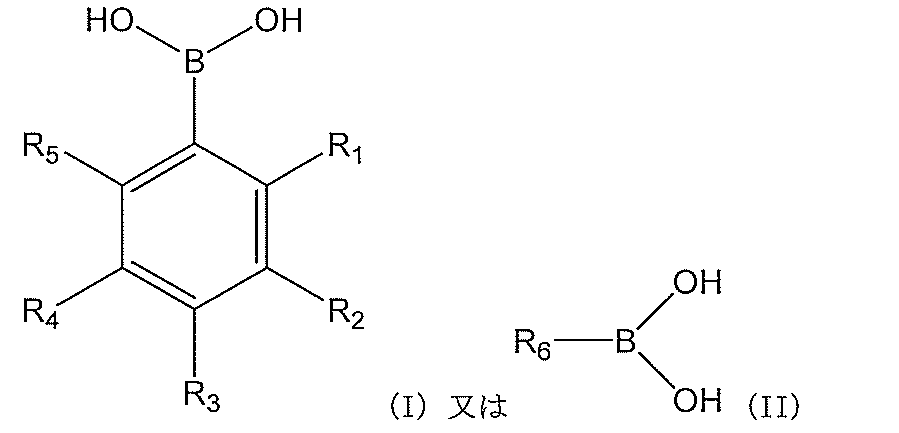
(式中、R1~R5は、それぞれ独立に、H、ボロニル基、ハロゲン基、ヒドロキシ基、カルボキシ基、ニトロ基、アミノ基、スルホ基、チオール基、tert‐ブトキシカルボニルアミノ基、及び置換された又は置換されていないC1~C10アルキル基、アルケニル基、又はアルキニル基からなる群から選択され、
R6は、ボロニル基、ハロゲン基、ヒドロキシ基、カルボキシ基、ニトロ基、アミノ基、スルホ基及びチオール基からなる群より選択される少なくとも一種の置換基により置換された又は置換されていないC1~C10アルキル基、アルケニル基、又はアルキニル基からなる群から選択される)で表されるボロン酸又はその塩、及び/又は
(ii-b)アルキル硫酸塩
を含む、前記センサー。
(3)メディエーターをさらに含む、(1)に記載のキット又は(2)に記載のセンサー。
(4)メディエーターが、1-メトキシPMS(1-メトキシ-5-エチルフェナジニウムエチルサルフェート)、PMS(フェナジニウムメチルサルフェート)、PES(フェナジニウムエチルサルフェート)及び1-メトキシPES(1-メトキシ-5-エチルフェナジニウムエチルサルフェート)からなる群から選択される、(3)に記載のキット又はセンサー。
(5)ヒスタミンがヒスタミンデヒドロゲナーゼにより酸化された際に発色する発色試薬をさらに含む、(1)~(4)のいずれかに記載のキット又はセンサー。
(6)発色試薬が、テトラゾリウム塩である、(5)に記載のキット又はセンサー。
(7)双性イオンを有し、カルボキシ基を有さない化合物を含む緩衝液であって、BES、MOPS、TES、HEPES、EPPS、TAPS、CHES、CAPS、TAPSO、POPSO、HEPPSO、ACES、Bis-Tris、MES、MOPSO、及びPIPESからなる群から選択される緩衝液、Tris(トリス(ヒドロキシメチル)アミノメタン)又は炭酸緩衝液をさらに含む、(1)~(6)のいずれかに記載のキット又はセンサー。
(8)緩衝液が、双性イオンを有し、スルホ基を有する化合物を含む緩衝液であって、BES、MOPS、TES、HEPES、EPPS、TAPS、CHES、CAPS、TAPSO、POPSO、HEPPSO、ACES、MES、MOPSO、及びPIPESからなる群から選択される緩衝液である、(7)に記載のキット又はセンサー。
(9)緩衝液が、双性イオンを有し、スルホ基を有し、かつ2位にヒドロキシ基を有する化合物を含む緩衝液であって、TAPSO、POPSO、HEPPSO、及びMOPSOからなる群から選択される緩衝液である、(8)に記載のキット又はセンサー。
(10)ホウ酸又はその塩、及び/又はボロン酸又はその塩を、測定時の終濃度が120mM以下となるように含む、(1)~(9)のいずれかに記載のキット又はセンサー。
(11)アルキル硫酸塩がラウリル硫酸ナトリウムである、(1)~(10)のいずれかに記載のキット又はセンサー。
(12)試料採取部、及び反応部を含み、
前記反応部が前記ヒスタミンデヒドロゲナーゼ及び前記ホウ酸又はその塩、及び/又はボロン酸又はその塩を含む、(1)~(11)のいずれかに記載のキット又はセンサー。
(1)ヒスタミンを検出するためのキットであって、(i)ヒスタミンデヒドロゲナーゼ、及び
(ii-a)ホウ酸又はその塩、及び/又は下記式(I)又は(II):
R6は、ボロニル基、ハロゲン基、ヒドロキシ基、カルボキシ基、ニトロ基、アミノ基、スルホ基及びチオール基からなる群より選択される少なくとも一種の置換基により置換された又は置換されていないC1~C10アルキル基、アルケニル基、又はアルキニル基からなる群から選択される)で表されるボロン酸又はその塩、及び/又は
(ii-b)アルキル硫酸塩
を含む、前記キット。
(2)ヒスタミンデヒドロゲナーゼによるヒスタミンの酸化を検出可能な電気化学センサーであって、(i)ヒスタミンデヒドロゲナーゼ、及び
(ii-a)ホウ酸又はその塩、及び/又は下記式(I)又は(II):
R6は、ボロニル基、ハロゲン基、ヒドロキシ基、カルボキシ基、ニトロ基、アミノ基、スルホ基及びチオール基からなる群より選択される少なくとも一種の置換基により置換された又は置換されていないC1~C10アルキル基、アルケニル基、又はアルキニル基からなる群から選択される)で表されるボロン酸又はその塩、及び/又は
(ii-b)アルキル硫酸塩
を含む、前記センサー。
(3)メディエーターをさらに含む、(1)に記載のキット又は(2)に記載のセンサー。
(4)メディエーターが、1-メトキシPMS(1-メトキシ-5-エチルフェナジニウムエチルサルフェート)、PMS(フェナジニウムメチルサルフェート)、PES(フェナジニウムエチルサルフェート)及び1-メトキシPES(1-メトキシ-5-エチルフェナジニウムエチルサルフェート)からなる群から選択される、(3)に記載のキット又はセンサー。
(5)ヒスタミンがヒスタミンデヒドロゲナーゼにより酸化された際に発色する発色試薬をさらに含む、(1)~(4)のいずれかに記載のキット又はセンサー。
(6)発色試薬が、テトラゾリウム塩である、(5)に記載のキット又はセンサー。
(7)双性イオンを有し、カルボキシ基を有さない化合物を含む緩衝液であって、BES、MOPS、TES、HEPES、EPPS、TAPS、CHES、CAPS、TAPSO、POPSO、HEPPSO、ACES、Bis-Tris、MES、MOPSO、及びPIPESからなる群から選択される緩衝液、Tris(トリス(ヒドロキシメチル)アミノメタン)又は炭酸緩衝液をさらに含む、(1)~(6)のいずれかに記載のキット又はセンサー。
(8)緩衝液が、双性イオンを有し、スルホ基を有する化合物を含む緩衝液であって、BES、MOPS、TES、HEPES、EPPS、TAPS、CHES、CAPS、TAPSO、POPSO、HEPPSO、ACES、MES、MOPSO、及びPIPESからなる群から選択される緩衝液である、(7)に記載のキット又はセンサー。
(9)緩衝液が、双性イオンを有し、スルホ基を有し、かつ2位にヒドロキシ基を有する化合物を含む緩衝液であって、TAPSO、POPSO、HEPPSO、及びMOPSOからなる群から選択される緩衝液である、(8)に記載のキット又はセンサー。
(10)ホウ酸又はその塩、及び/又はボロン酸又はその塩を、測定時の終濃度が120mM以下となるように含む、(1)~(9)のいずれかに記載のキット又はセンサー。
(11)アルキル硫酸塩がラウリル硫酸ナトリウムである、(1)~(10)のいずれかに記載のキット又はセンサー。
(12)試料採取部、及び反応部を含み、
前記反応部が前記ヒスタミンデヒドロゲナーゼ及び前記ホウ酸又はその塩、及び/又はボロン酸又はその塩を含む、(1)~(11)のいずれかに記載のキット又はセンサー。
(13)ヒスタミンを検出するための方法であって、(i)ヒスタミンデヒドロゲナーゼ、及び(ii-a)ホウ酸又はその塩、及び/又は下記式(I)又は(II):
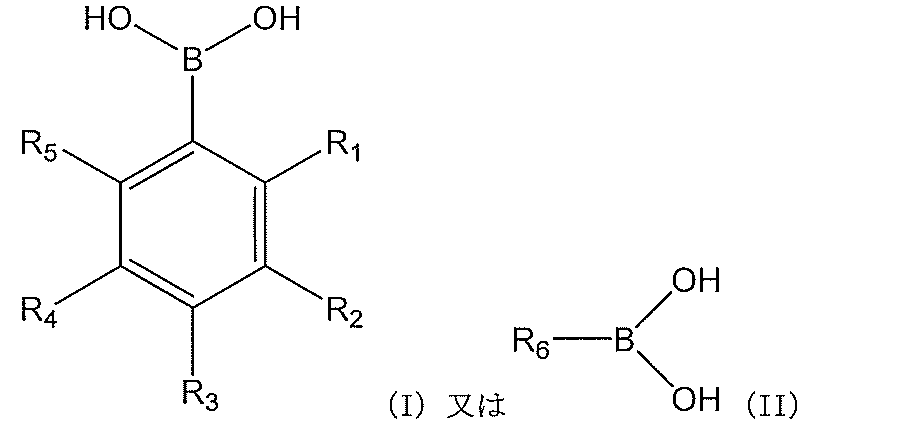
(式中、R1~R5は、それぞれ独立に、H、ボロニル基、ハロゲン基、ヒドロキシ基、カルボキシ基、ニトロ基、アミノ基、スルホ基、チオール基、tert‐ブトキシカルボニルアミノ基、又は置換された若しくは置換されていないC1~C10アルキル基、アルケニル基、又はアルキニル基からなる群から選択され、
R6は、ボロニル基、ハロゲン基、ヒドロキシ基、カルボキシ基、ニトロ基、アミノ基、スルホ基及びチオール基からなる群より選択される少なくとも一種の置換基により置換された又は置換されていないC1~C10アルキル基、アルケニル基、又はアルキニル基からなる群から選択される)で表されるボロン酸又はその塩、及び/又は
(ii-b)アルキル硫酸塩
を使用する、前記方法。
(14)ヒスタミンを検出するための方法であって、
ヒスタミンデヒドロゲナーゼによるヒスタミンの酸化を検出可能な電気化学センサーを使用し、前記センサーが、(i)ヒスタミンデヒドロゲナーゼ、及び
(ii-a)ホウ酸又はその塩、及び/又は下記式(I)又は(II):

(式中、R1~R5は、それぞれ独立に、H、ボロニル基、ハロゲン基、ヒドロキシ基、カルボキシ基、ニトロ基、アミノ基、スルホ基、チオール基、tert‐ブトキシカルボニルアミノ基、又は置換された若しくは置換されていないC1~C10アルキル基、アルケニル基、又はアルキニル基からなる群から選択され、
R6は、ボロニル基、ハロゲン基、ヒドロキシ基、カルボキシ基、ニトロ基、アミノ基、スルホ基及びチオール基からなる群より選択される少なくとも一種の置換基により置換された又は置換されていないC1~C10アルキル基、アルケニル基、又はアルキニル基からなる群から選択される)で表されるボロン酸又はその塩、及び/又は
(ii-b)アルキル硫酸塩
を含む、前記方法。
(15)メディエーターをさらに使用する、(13)又は(14)に記載の方法。
(16)メディエーターが、1-メトキシPMS、PMS、PES及び1-メトキシPESからなる群から選択される、(15)に記載の方法。
(17)ヒスタミンがヒスタミンデヒドロゲナーゼにより酸化された際に発色する発色試薬をさらに使用する、(13)~(16)のいずれかに記載の方法。
(18)発色試薬が、テトラゾリウム塩である、(17)に記載の方法。
(19)双性イオンを有し、カルボキシ基を有さない化合物を含む緩衝液であって、BES、MOPS、TES、HEPES、EPPS、TAPS、CHES、CAPS、TAPSO、POPSO、HEPPSO、ACES、Bis-Tris、MES、MOPSO、及びPIPESからなる群から選択される緩衝液、Tris又は炭酸緩衝液をさらに含む、(13)~(18)のいずれかに記載の方法。
(20)緩衝液が、双性イオンを有し、スルホ基を有する化合物を含む緩衝液であって、BES、MOPS、TES、HEPES、EPPS、TAPS、CHES、CAPS、TAPSO、POPSO、HEPPSO、ACES、MES、MOPSO、及びPIPESからなる群から選択される緩衝液である、(19)に記載の方法。
(21)緩衝液が、双性イオンを有し、スルホ基を有し、かつ2位にヒドロキシ基を有する化合物を含む緩衝液であって、TAPSO、POPSO、HEPPSO、及びMOPSOからなる群から選択される緩衝液である、(20)に記載の方法。
(22)ホウ酸又はその塩、及び/又はボロン酸又はその塩を、測定時の終濃度120mM以下で使用する、(13)~(21)のいずれかに記載の方法。
(23)アルキル硫酸塩がラウリル硫酸ナトリウムである、(13)~(22)のいずれかに記載の方法。
R6は、ボロニル基、ハロゲン基、ヒドロキシ基、カルボキシ基、ニトロ基、アミノ基、スルホ基及びチオール基からなる群より選択される少なくとも一種の置換基により置換された又は置換されていないC1~C10アルキル基、アルケニル基、又はアルキニル基からなる群から選択される)で表されるボロン酸又はその塩、及び/又は
(ii-b)アルキル硫酸塩
を使用する、前記方法。
(14)ヒスタミンを検出するための方法であって、
ヒスタミンデヒドロゲナーゼによるヒスタミンの酸化を検出可能な電気化学センサーを使用し、前記センサーが、(i)ヒスタミンデヒドロゲナーゼ、及び
(ii-a)ホウ酸又はその塩、及び/又は下記式(I)又は(II):
R6は、ボロニル基、ハロゲン基、ヒドロキシ基、カルボキシ基、ニトロ基、アミノ基、スルホ基及びチオール基からなる群より選択される少なくとも一種の置換基により置換された又は置換されていないC1~C10アルキル基、アルケニル基、又はアルキニル基からなる群から選択される)で表されるボロン酸又はその塩、及び/又は
(ii-b)アルキル硫酸塩
を含む、前記方法。
(15)メディエーターをさらに使用する、(13)又は(14)に記載の方法。
(16)メディエーターが、1-メトキシPMS、PMS、PES及び1-メトキシPESからなる群から選択される、(15)に記載の方法。
(17)ヒスタミンがヒスタミンデヒドロゲナーゼにより酸化された際に発色する発色試薬をさらに使用する、(13)~(16)のいずれかに記載の方法。
(18)発色試薬が、テトラゾリウム塩である、(17)に記載の方法。
(19)双性イオンを有し、カルボキシ基を有さない化合物を含む緩衝液であって、BES、MOPS、TES、HEPES、EPPS、TAPS、CHES、CAPS、TAPSO、POPSO、HEPPSO、ACES、Bis-Tris、MES、MOPSO、及びPIPESからなる群から選択される緩衝液、Tris又は炭酸緩衝液をさらに含む、(13)~(18)のいずれかに記載の方法。
(20)緩衝液が、双性イオンを有し、スルホ基を有する化合物を含む緩衝液であって、BES、MOPS、TES、HEPES、EPPS、TAPS、CHES、CAPS、TAPSO、POPSO、HEPPSO、ACES、MES、MOPSO、及びPIPESからなる群から選択される緩衝液である、(19)に記載の方法。
(21)緩衝液が、双性イオンを有し、スルホ基を有し、かつ2位にヒドロキシ基を有する化合物を含む緩衝液であって、TAPSO、POPSO、HEPPSO、及びMOPSOからなる群から選択される緩衝液である、(20)に記載の方法。
(22)ホウ酸又はその塩、及び/又はボロン酸又はその塩を、測定時の終濃度120mM以下で使用する、(13)~(21)のいずれかに記載の方法。
(23)アルキル硫酸塩がラウリル硫酸ナトリウムである、(13)~(22)のいずれかに記載の方法。
本明細書は本願の優先権の基礎となる日本国特許出願番号2018-153916号の開示内容を包含する。
本発明により、ヒスタミンデヒドロゲナーゼを用いてヒスタミンを測定する方法において、酵素反応に由来しない誤反応を低減することが可能となる。これにより、特に低濃度域においてもヒスタミンを検出することが可能となる。
1.ヒスタミンを検出するためのキット又はセンサー
一態様において、本発明は、(i)ヒスタミンデヒドロゲナーゼ、及び(ii-a)ホウ酸又はその塩、及び/又はボロン酸又はその塩、及び/又は(ii-b)アルキル硫酸塩を含む、ヒスタミンを検出するためのキットに関する。本明細書におけるヒスタミンには、その塩も含まれる。
一態様において、本発明は、(i)ヒスタミンデヒドロゲナーゼ、及び(ii-a)ホウ酸又はその塩、及び/又はボロン酸又はその塩、及び/又は(ii-b)アルキル硫酸塩を含む、ヒスタミンを検出するためのキットに関する。本明細書におけるヒスタミンには、その塩も含まれる。
一実施形態において、本発明のキットは、ヒスタミンを含む可能性がある試料におけるヒスタミンの検出に用いられる。ヒスタミンを含む可能性がある試料の例として、例えば液状及び固形状の食品(例えば魚肉、畜肉、チーズ、醤油、魚醤及びワイン等)、尿及び血漿等の体液、生体物質、及び生体組織等が挙げられる。
本明細書において、「ヒスタミンデヒドロゲナーゼ」とは、酸化還元酵素に分類され、以下の反応:

によるヒスタミンの酸化を触媒する酵素である。上記反応式において、式(III)の化合物はヒスタミンであり、式(IV)の化合物は4-イミダゾリルアセトアルデヒドである。一実施形態において、メディエーターは、本明細書に記載のメディエーター、例えばPMS(フェナジニウムメチルサルフェート)であり、この場合還元型メディエーターは還元型PMS(PMSH2)である。
測定精度の点から、ヒスタミンデヒドロゲナーゼは、好ましくはヒスタミンに特異的に作用する、すなわち、ヒスタミンに特異的に作用するが他のアミンに対しては全く作用しないか、又は弱く作用することが好ましい。特に、ヒスタミンデヒドロゲナーゼは、ヒスタミンには作用するが、カダベリン及びプトレシンには作用しないことが好ましい。ヒスタミンデヒドロゲナーゼは、細菌由来、例えばリゾビウム(Rhizobium)属に属する細菌に由来するものであることが好ましい。ヒスタミンデヒドロゲナーゼは、天然に由来するものを抽出及び/又は精製して得てもよいし、生物の遺伝子情報に基づき、公知の遺伝子工学的な手法により生産されたものであってもよい。ヒスタミンデヒドロゲナーゼを生産する具体的な方法は当業者には知られており、例えば、特開2001-157597号公報に記載の方法を使用することができる。また、本発明において使用できる具体的なヒスタミンデヒドロゲナーゼとしては、特開2001-157597号公報に記載のヒスタミンデヒドロゲナーゼが挙げられる。一実施形態において、本発明のキットにおいて、ヒスタミンデヒドロゲナーゼの測定時又は保管時、好ましくは測定時の終濃度は、限定するものではないが、1mU/assay~20U/assay、好ましくは、5mU/assay~2U/assay、より好ましくは10mU/assay~0.5U/assay、さらに好ましくは25mU/assay~0.25U/assayであってよい(但し、1Uは37℃pH9.0において1分間に1μmolの4-イミダゾリルアセトアルデヒドを生成する酵素量として定義される)。上記ヒスタミンデヒドロゲナーゼの濃度は例示であり、反応時間に応じて適宜調整することができる。
本明細書において「ホウ酸」とは、化学式B(OH)3で表わされるホウ素のオキソ酸を意味する。また、本明細書において、「ボロン酸」とは、ホウ酸のヒドロキシ基を置換したものであり、以下の式(I)又は(II)で表される化合物を意味し得る:
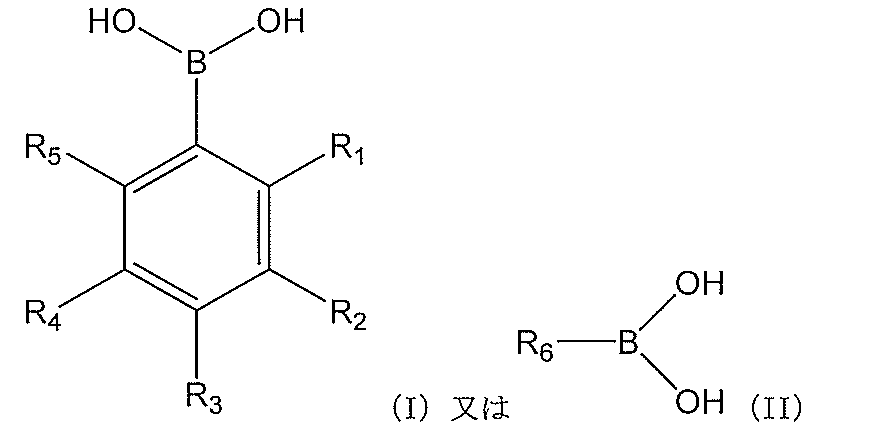
(式中、R1~R5は、それぞれ独立に、H、ボロニル基、ハロゲン基、ヒドロキシ基、カルボキシ基、ニトロ基、アミノ基、スルホ基、チオール基、tert‐ブトキシカルボニルアミノ基、及び置換された又は置換されていないC1~C10(例えばC1~C8、C1~C6、又はC1~C4)アルキル基、アルケニル基、又はアルキニル基からなる群から選択され、R6は、ボロニル基、ハロゲン基、ヒドロキシ基、カルボキシ基、ニトロ基、アミノ基、スルホ基及びチオール基からなる群より選択される少なくとも一種の置換基により置換された又は置換されていないC1~C10(例えばC1~C8、C1~C6、又はC1~C4)アルキル基、アルケニル基、又はアルキニル基からなる群から選択される)。式(I)の化合物中、R1~R5の少なくとも一つはハロゲン基、好ましくはフッ素又は塩素、又は、tert‐ブトキシカルボニルアミノ基である。本明細書におけるボロン酸の例として、限定するものではないが、ブチルボロン酸、4-クロロフェニルボロン酸、4-フルオロフェニルボロン酸、及び3-[(tert-ブトキシカルボニル)アミノ]フェニルボロン酸が挙げられる。
本明細書において、「塩」とは、ある化合物の特定の置換基(例えば、ヒドロキシ基)に基づいて、塩基又は酸を用いて調製された活性化合物の塩をいう。塩は、使用した塩基又は酸により塩基性付加塩と酸付加塩とに分類できる。
「塩基性付加塩」としては、例えば、ナトリウム塩、カリウム塩等のアルカリ金属塩、カルシウム塩、マグネシウム塩等のアルカリ土類金属塩、トリメチルアミン塩、エタノールアミン塩、ブロカイン塩等の脂肪族アミン塩、N,N-ジベンジルエチレンジアミン等のアラルキルアミン塩、ピリジン塩等の複素環芳香族アミン塩、アルギニン塩等の塩基性アミノ酸塩、テトラメチルアンモニウム塩、テトラエチルアモニウム塩、ベンジルトリメチルアンモニウム塩等の第4級アンモニウム塩、及びアンモニウム塩等が挙げられる。
「酸付加塩」としては、例えば、塩酸塩、硫酸塩、硝酸塩、リン酸塩、炭酸塩、炭酸水素塩、過塩素酸塩等の無機酸塩、酢酸塩、プロピオン酸塩、乳酸塩、マレイン酸塩、フマル酸塩、酒石酸塩、リンゴ酸塩、クエン酸塩、アスコルビン酸塩等の有機酸塩、メタンスルホン酸塩、イセチオン酸塩、ベンゼンスルホン酸塩、p-トルエンスルホン酸塩等のスルホン酸塩、アスパラギン酸塩、グルタミン酸塩等の酸性アミノ酸等が挙げられる。
本発明のキットにおいて、ホウ酸又はその塩、及び/又はボロン酸又はその塩の濃度は、ヒスタミンデヒドロゲナーゼによるヒスタミンの酸化に由来しない誤反応(本明細書では、単に「誤反応」とも記載する)を低減し得るものであれば限定しない。そのような濃度は、本願明細書の記載を参照して当業者であれば容易に決定することができる。ホウ酸又はその塩、及び/又はボロン酸又はその塩の例として、測定時又は保管時、好ましくは測定時の終濃度として、5mM以上、10mM以上、20mM以上、25mM以上、50mM以上、80mM以上、又は100mM以上であってよく、また1000mM以下、500mM以下、400mM以下、300mM以下、200mM以下、150mM以下、又は120mM以下となるような濃度が挙げられる。例えば、測定時又は保管時の終濃度は、5mM~1000mM、25mM~300mM、又は50mM~200mMであってよい。
本発明のキットにおいて、アルキル硫酸塩の種類は誤反応を低減し得るものであれば限定しないが、例えばラウリル硫酸ナトリウム、ラウリル硫酸カリウム、ステアリル硫酸ナトリウム、ステアリル硫酸ナトリウムラウリル硫酸トリエタノールアミン、ラウリル硫酸アンモニウム等のアルキル硫酸エステル塩;及びラウレス硫酸ナトリウム、ラウレス硫酸トリエタノールアミン等のポリオキシエチレンアルキル硫酸塩からなる群から選択される一種以上であってよい。アルキル硫酸塩は、例えばラウリル硫酸ナトリウムである。
本発明のキットにおいて、アルキル硫酸塩の濃度は、誤反応を低減し得るものであれば限定しない。そのような濃度は、本願明細書の記載を参照して当業者であれば容易に決定することができる。アルキル硫酸塩の例として、測定時又は保管時、好ましくは測定時の終濃度として、0.01%以上、0.05%以上、好ましくは0.1%以上、0.5%以上、又は1%以上が挙げられ、また10%以下、5%以下、又は2%以下が挙げられ、例えば約0.05%~2%又は約0.1~1%となるような濃度が挙げられる。
誤反応の程度は、上記ホウ酸又はその塩、及び/又はボロン酸又はその塩、及び/又はアルキル硫酸塩等の有効成分に加えて、用いるサンプルの種類等の条件によっても影響され得る。有効成分を含まない対照サンプルを試験系に加え、これと比較することによって、誤反応の低減の程度をより正確に評価することができる。誤反応の低減の程度は、例えば実施例で記載した様な目視確認又はIllustrator CS2(Adobe社製)等のソフトウェアを用いて数値化された色調を比較することによって評価することができる。
一実施形態において、本発明のキットは、メディエーターをさらに含む。本明細書において、「メディエーター」とは、ヒスタミンデヒドロゲナーゼによって触媒される酸化還元反応を、例えば、補因子として作用することによって、容易にする分子を指す。メディエーターは、好ましくは基質から発色試薬、又は電極への電子の移行を促す物質である。反応系における適切なメディエーターは、当業者であれば容易に選択することができ、メディエーターの例として、限定するものではないが、1-メトキシPMS(1-メトキシ-5-メチルフェナジニウムメチルサルフェート)、PMS(フェナジニウムメチルサルフェート)、PES(フェナジニウムエチルサルフェート)及び1-メトキシPES(1-メトキシ-5-エチルフェナジニウムエチルサルフェート)、ベンゾキノン及びその誘導体、フェリシアン化物(カリウム若しくはナトリウム塩)、フェロセン及びその誘導体、ジクロロフェノールインドフェノール、ナフトキノン及びその誘導体、フェナントロリンキノン及びその誘導体、フェナントレンキノン及びその誘導体、アントラキノン及びその誘導体、ルテニウム塩、ルテニウム錯体等が挙げられ、好ましくは1-メトキシPMS、PMS、PES及び1-メトキシPESであり、さらに好ましくは1-メトキシPMSである。一実施形態において、本発明のキットは、測定時又は保管時の終濃度として、1μM以上、10μM以上、20μM以上、25μM以上、30μM以上、又は35μM以上、80μM以下、70μM以下、60μM以下、50μM以下、45μM以下、例えば1μM~80μM、35μM~45μM又は約42μMのメディエーターを含む。
一実施形態において、本発明のキットは、発色試薬をさらに含む。発色試薬は、ヒスタミンデヒドロゲナーゼによってヒスタミンが酸化された際に発色するものであることが好ましく、このような発色を観察することによって、簡便にヒスタミンの存在を検出することができる。発色試薬の例として、テトラゾリウム塩、例えばWST-4(2-ベンゾチアゾリル-3-(4-カルボキシ-2-メトキシフェニル)-5-[4-(2-スルホエチルカルバモイル)フェニル]-2H-テトラゾリウム)、WST-5(2,2'-ジベンゾチアゾリル-5,5'-ビス[4-ジ(2-スルホエチル)カルバモイルフェニル]-3,3'-(3,3'-ジメトキシ-4,4'-ビフェニレン)ジテトラゾリウム、二ナトリウム塩)、WST-8(2-(2-メトキシ-4-ニトロフェニル)-3-(4-ニトロフェニル)-5-(2,4-ジスルホフェニル)-2H-テトラゾリウム)、NBT(3,3'-[3,3'-ジメトキシ-(1,1'-ビフェニル)-4,4'-ジイル]-ビス[2-(4-ニトロフェニル)-5-フェニル-2H-テトラゾリウムクロリド])、INT(2-(4-ヨードフェニル)-3-(4-ニトロフェニル)-5-フェニル-2H-テトラゾリウムクロリド)、及びXTT(2,3-ビス(2-メトキシ-4-ニトロ-5-スルフォフェニル)-5-[(フェニルアミノ)カルボニル]-2H-テトラゾリウム水酸化物)が挙げられる。WST-4、WST-5、WST-8、NBT、INT、及びXTT等のテトラゾリウム塩は、還元されるとホルマザン色素を生じる。この色素を検出することによりヒスタミンを検出することが可能となる。一実施形態において、ヒスタミンが酸化される際の発色試薬の発色反応は、前記メディエーターを介して促進される。一実施形態において、本発明のキットは、測定時又は保管時の終濃度として、0.1mM以上、0.2mM以上、0.3mM以上、0.4mM以上、又は0.5mM以上、10mM以下、5mM以下、又は2mM以下、例えば0.1mM~10mM、0.5mM~2mM又は1.1mMの発色試薬を含む。
一実施形態において、本発明のキットは、バッファーをさらに含む。バッファーとしては、BES、MOPS、TES、HEPES、EPPS、TAPS、CHES、CAPS、TAPSO、POPSO、HEPPSO、ACES、Bis-Tris、MES、MOPSO、及びPIPESからなる群から選択される双性イオンを有し、カルボキシ基を有さない化合物を含む緩衝液、Tris又は炭酸緩衝液が挙げられる。双性イオンを有し、カルボキシ基を有さない化合物を含む緩衝液は、好ましくはBES、MOPS、TES、HEPES、EPPS、TAPS、CHES、CAPS、TAPSO、POPSO、及びHEPPSOからなる群から選択され、さらに好ましくは、HEPES、TAPSO、POPSO、HEPPSO、及びEPPSからなる群より選択される。一実施形態において、緩衝液は、BES、MOPS、TES、HEPES、EPPS、TAPS、CHES、CAPS、TAPSO、POPSO、HEPPSO、ACES、MES、MOPSO、及びPIPESからなる群、好ましくはBES、MOPS、TES、HEPES、EPPS、TAPS、CHES、CAPS、TAPSO、POPSO、及びHEPPSOからなる群から選択される双性イオンを有し、スルホ基を有する化合物を含む緩衝液、Tris又は炭酸緩衝液である。一実施形態において、緩衝液は、TAPSO、POPSO、HEPPSO、及びMOPSOからなる群、好ましくはTAPSO、POPSO、及びHEPPSOからなる群から選択される双性イオンを有し、スルホ基を有し、かつ2位にヒドロキシ基を有する化合物を含む緩衝液、Tris又は炭酸緩衝液である。バッファーのpHとしては6.0~11.0程度が好ましく、より好ましくは7.0以上、8.0以上又は8.5以上であってよく、また10.0以下又は9.5以下であってよく、例えば約8.5~9.5であってよい。バッファーの濃度としては、測定時又は保管時、好ましくは測定時の終濃度として、例えば1mM以上、10mM以上、又は50mM以上であってよく、300mM以下、200mM以下、又は150mM以下、例えば1mM~300mM、50mM~150mM、又は約100mMであってよい。
一実施形態において、本発明のキットは、ヒスタミンを含む可能性がある試料からヒスタミンを抽出するための抽出液をさらに含む。抽出液は公知のものを用いればよく、例えばトリクロロ酢酸、メタノール、又は中性リン酸緩衝液(特開2001-099803号)、又はキレート剤を含む抽出液(特開2004-129597号)を使用することができ、水又は各種緩衝液を使用することもできる。また、本発明のキットは、さらなる成分(例えば、糖(ラクトース、マルトース、ガラクロース、スクロース、グルコース、トレハロースほか)、澱粉(可溶性澱粉を含む)、デキストリン(分岐デキストリン、シクロデキストリン、高度分岐環状デキストリン(クラスターデキストリン)を含む))及び/又は使用説明書を含んでもよい。
一実施形態において、本発明のキットは、試料採取部、及び反応部を含む。試料採取部は、ヒスタミンを含む可能性がある試料を採取可能なものであれば特に限定しないが、例えば、綿棒、スポンジ、多孔性プラスティック、濾紙、不織布、スポイトが挙げられる。試料採取部は、試料採取の際の簡便性の点から、例えば棒状であることが好ましく、特に好ましくは、繊維状やスポンジ状のふき取り部分を備えた棒状の形状、例えば綿棒のような形状である。
反応部は、試料採取部によって採取された試料にヒスタミンが存在する場合に、反応が生ずる部位である。一実施形態において、本明細書に記載のヒスタミンデヒドロゲナーゼ及び前記ホウ酸又はその塩、及び/又はボロン酸又はその塩、及び/又はアルキル硫酸塩は、上記緩衝液等の溶液中に含まれる形で、又は凍結乾燥物として含まれる形で、本発明のキット中の試料採取部又は反応部に含まれる。反応部は、好ましくは透明の容器であり、これにより目視により発色の有無を観察し、ヒスタミンを検出することができる。
一実施形態において、本発明のキットは、試料採取部、及び反応部に加えて抽出部を含む。抽出部は、試料採取部によって採取された試料にヒスタミンが存在する場合に、このヒスタミンを抽出液中に抽出する部位である。本明細書に記載のヒスタミンデヒドロゲナーゼ及び前記ホウ酸又はその塩、及び/又はボロン酸又はその塩、及び/又はアルキル硫酸塩は、上記緩衝液等の溶液中に含まれる形で、又は凍結乾燥物として含まれる形で、本発明のキット中の抽出部に含まれてもよい。抽出部で抽出されたヒスタミンを含む試料を反応部に移し、反応を行うことができる。
本明細書における、ヒスタミンの「検出」には、ヒスタミンの有無の検出に加えて、ヒスタミンの定量も含む。定量は、発色基質を用いる場合には発色の程度に基づいて、電気化学センサーを用いる場合には信号(電流値)に基づいて行うことができる。例えば、既知濃度のヒスタミンを含むサンプルを複数、例えば2以上、好ましくは3以上、4以上、5以上用いて、これらとの比較により、好ましくは検量線に基づいて定量を行うことができる。
一実施形態において、本発明のキットは、ヒスタミンデヒドロゲナーゼによるヒスタミンの酸化を検出可能な電気化学センサーをさらに含む。この実施形態において、本発明のキットは、発色試薬を含まないものであり得る。
電気化学センサーは、基本的には電極と回路系を含む。電極は、三電極系(作用電極、参照電極及び対極)であってもあってもよいが、二電極(作用電極及び参照電極)で行うことが好ましい。電極の種類も限定されず、例えば、作用電極としては、白金、金、銀、グラッシーカーボン等のカーボンを用いることができる。参照電極としては、水素電極、飽和カロメル電極、銀-塩化銀、銀電極、及びパラジウム・水素電極を用いることができる。
電気化学センサーは、ヒスタミンが、ヒスタミンデヒドロゲナーゼによる触媒作用によって酸化され、4-イミダゾリルアセトアルデヒドを生成する際の酸化還元反応により生じる電流の変化を測定し得る。この際、キット中に電極への電子の移行を促すメディエーターが含まれることが好ましい。
一実施形態において、ヒスタミンデヒドロゲナーゼは電気化学センサーの作用電極上に、好ましくは共有結合を介して固定されている。
電気化学センサーによる検出の方法は限定せず、例えばサイクリックボルタンメトリー法又はクロノアンペロメトリー法であってよく、例えば実施例に記載の通りに行うことができる。
電気化学センサーとしては、市販のものを使用することもでき、例えば電極としてはSCREEN-PRINTED ELECTRODES(Drop Sense社製、DRP-110)を用いることができ、回路としては専用コネクター(Drop Sense社製、DRP-CAC)を用いることができ、電流の変化の測定にはALS電気化学アナライザー814D(BAS社製)を用いることができる。
一実施形態において、本発明のキットは、ヒスタミンデヒドロゲナーゼ、ホウ酸又はその塩、及び/又はボロン酸又はその塩、メディエーター、及び発色試薬を含む。別の実施形態において、本発明のキットは、ヒスタミンデヒドロゲナーゼ、ホウ酸又はその塩、及び/又はボロン酸又はその塩、メディエーター、及び電気化学センサーを含む。
一態様において、本発明は、(i)ヒスタミンデヒドロゲナーゼ、及び(ii-a)ホウ酸又はその塩、及び/又はボロン酸又はその塩、及び/又は(ii-b)アルキル硫酸塩を含む、ヒスタミンデヒドロゲナーゼによるヒスタミンの酸化を検出可能な電気化学センサーに関する。電気化学センサーの構成は上記の通りである。また、本態様における電気化学センサーにおいて、ヒスタミン、ヒスタミンデヒドロゲナーゼ、ホウ酸、ボロン酸、アルキル硫酸塩に関する詳細は、上記キットにおいて記載したのと同様である。また、一実施形態において、本発明の電気化学センサーは、さらに、メディエーター、バッファー及び抽出液のうち一つ以上、好ましくは全て含むが、これらについても、上記キットにおいて記載したのと同様である。
2.ヒスタミンを検出するための方法
一態様において、本発明は、(i)ヒスタミンデヒドロゲナーゼ、及び(ii-a)ホウ酸又はその塩、及び/又はボロン酸又はその塩、及び/又は(ii-b)アルキル硫酸塩を使用する、ヒスタミンを検出するための方法に関する。本方法は、上記「1.ヒスタミンを検出するためのキット又はセンサー」に記載のキットを用いて行ってもよい。別の態様において、本発明は、(i)ヒスタミンデヒドロゲナーゼ、及び(ii-a)ホウ酸又はその塩、及び/又はボロン酸又はその塩、及び/又は(ii-b)アルキル硫酸塩を含む、ヒスタミンデヒドロゲナーゼによるヒスタミンの酸化を検出可能な電気化学センサーを使用する、ヒスタミンを検出するための方法に関する。本方法は、上記「1.ヒスタミンを検出するためのキット又はセンサー」に記載のセンサーを用いて行ってもよい。
一態様において、本発明は、(i)ヒスタミンデヒドロゲナーゼ、及び(ii-a)ホウ酸又はその塩、及び/又はボロン酸又はその塩、及び/又は(ii-b)アルキル硫酸塩を使用する、ヒスタミンを検出するための方法に関する。本方法は、上記「1.ヒスタミンを検出するためのキット又はセンサー」に記載のキットを用いて行ってもよい。別の態様において、本発明は、(i)ヒスタミンデヒドロゲナーゼ、及び(ii-a)ホウ酸又はその塩、及び/又はボロン酸又はその塩、及び/又は(ii-b)アルキル硫酸塩を含む、ヒスタミンデヒドロゲナーゼによるヒスタミンの酸化を検出可能な電気化学センサーを使用する、ヒスタミンを検出するための方法に関する。本方法は、上記「1.ヒスタミンを検出するためのキット又はセンサー」に記載のセンサーを用いて行ってもよい。
本発明のヒスタミンを検出するための方法は、ヒスタミンをヒスタミンデヒドロゲナーゼにより酸化する工程(以下、「酸化工程」とも記載する)、及びヒスタミンデヒドロゲナーゼによるヒスタミンの酸化を検出する工程(以下、「検出工程」とも記載する)を含む。
酸化工程は、当業者に公知の方法により行うことができる。例えば、ヒスタミンを含む可能性がある試料を、本明細書に記載のヒスタミンデヒドロゲナーゼを含む溶液と混合することにより行うことができる。
検出工程もまた、当業者に公知の方法により行うことができる。ヒスタミンの酸化の検出は、例えば発色試薬又は電気化学センサーを用いて、任意にメディエーターもさらに用いて行うことができる。酸化工程の有無又は程度に基づいて、ヒスタミンの有無を検出し、又はその存在量を測定することができる。
本発明のヒスタミンを検出するための方法は、酸化工程及び検出工程に加えて、任意にサンプル採取工程及び/又はヒスタミン抽出工程を、酸化工程の前に含む。
サンプル採取工程では、ヒスタミンを測定しようとする試料から、本発明の方法に適した形でサンプルを採取する。試料採取は、例えば、綿棒、スポンジ、多孔性プラスティック、濾紙、不織布、スポイト等の試料採取部を、特に好ましくは、繊維状やスポンジ状のふき取り部分を備えた棒状の形状、例えば綿棒をヒスタミンを測定しようとする試料に接触させることにより行うことができる。
ヒスタミン抽出工程では、前記の採取されたサンプルからヒスタミンを抽出することにより、後の酸化工程及び検出工程を容易にする。ヒスタミン抽出工程は、ヒスタミンを測定しようとする試料(例えば、本発明の方法がサンプル採取工程を含む場合には、上記試料が採取された採取部)を、ヒスタミン抽出液と混合することにより行うことができる。ヒスタミン抽出液は公知のものを用いればよく、例えばトリクロロ酢酸、メタノール、又は中性リン酸緩衝液(特開2001-099803号)、又はキレート剤を含む抽出液(特開2004-129597号)、水又は各種緩衝液を使用することもできる。
以下の実施例は、例示のみを意図したものであり、何ら本発明の技術的範囲を限定することを意図するものではない。特に断らない限り、試薬は、市販されているか、又は当技術分野で慣用の手法、公知文献の手順に従って入手又は調製する。
<実施例1:発色試薬の検討>
トレハロース2%、発色試薬(1.08mM WST-4、WST-5、WST-8、INT、NBT、又はXTT)、41.5μM 1-メトキシPMS、及び0.128U ヒスタミンデヒドロゲナーゼ(特開2001-157597に従って作製)を含むヒスタミン測定試薬を、測定チューブに0.2mLずつ分取し、凍結乾燥した。検量線の作成のために、各種既知濃度のヒスタミン溶液を調製後、0.1mLを綿棒に添加した。また、サンプルについては、柵状のマグロのドリップ0.1mLを綿棒に添加するか、又は柵状のマグロの表面を綿棒にて拭き取った。
トレハロース2%、発色試薬(1.08mM WST-4、WST-5、WST-8、INT、NBT、又はXTT)、41.5μM 1-メトキシPMS、及び0.128U ヒスタミンデヒドロゲナーゼ(特開2001-157597に従って作製)を含むヒスタミン測定試薬を、測定チューブに0.2mLずつ分取し、凍結乾燥した。検量線の作成のために、各種既知濃度のヒスタミン溶液を調製後、0.1mLを綿棒に添加した。また、サンプルについては、柵状のマグロのドリップ0.1mLを綿棒に添加するか、又は柵状のマグロの表面を綿棒にて拭き取った。
pHを9.0に調整したEDTA(2Na)0.4mLを抽出液として充填した容器に綿棒を押し込み、さらにこれらを振り落として測定チューブに移し、抽出液とヒスタミン測定試薬を反応させた。
結果を図1-1に示す。図1-1に示される通り、WST-4、WST-5、WST-8、NBT、INT、及びXTTのうちいずれの発色試薬を用いても目視によりサンプル中に含まれるヒスタミンを検出でき、そのおよその濃度も測定できることがわかった。
図1-1に示すような目視における判断を数値データでも確認する目的で、以下の方法により、色調の数値化を行った。
発色後の測定試薬チューブの写真を、STYLUS TG-4 Tough(オリンパス社製)にて撮影した。その後、測定チューブの画像の中央付近の色を、CMYK(シアン、マゼンタ、イエロー、ブラック)に数値変換した。具体的には、Illustrator CS2(Adobe社製)を使用し、ツールウィンドウのスポイトツールにより、撮影された測定チューブ中央付近を選択し、カラーウィンドウにてCMYKカラーコードに変換した数値(%)を確認することで、数値化した。数値化は、すべて「Kの値」を用いた。結果を表1に示す。
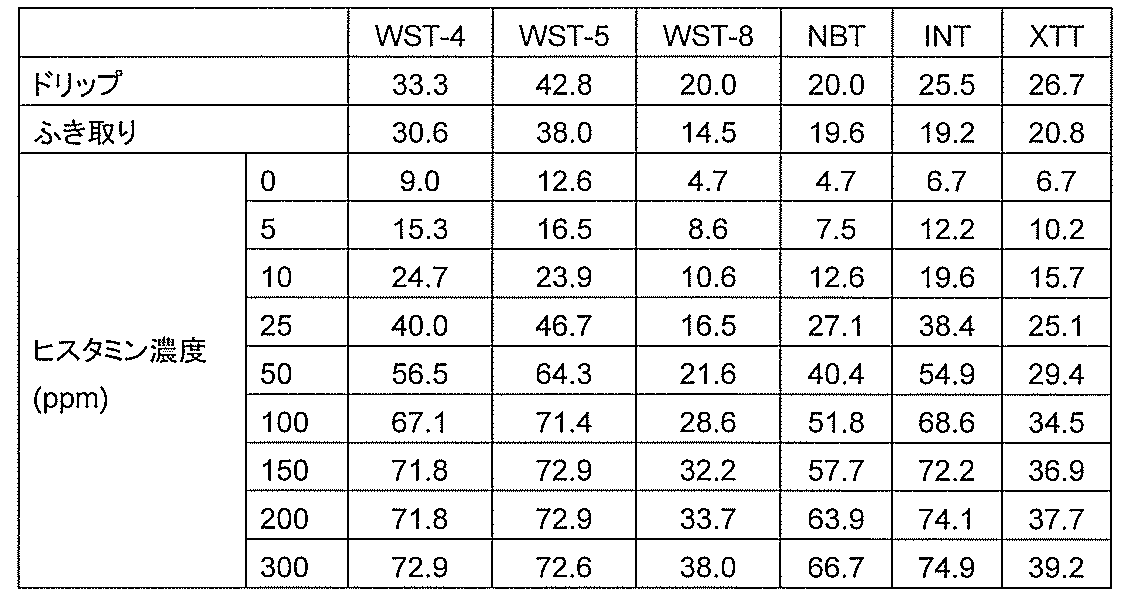
また、以下の通りヒスタミン及びヒスタミンデヒドロゲナーゼを含まない系で試験を行った。具体的には、EDTA(2Na)を0.1M、pH8.5に調製し、これを0.4mL、トレハロース2%、1.08mM NBT、及び41.5μM 1-メトキシPMSを含む試薬0.2mLを凍結乾燥したものに添加した。混合後、室温で60分放置し、発色の程度を確認した。
結果を図1-2に示す。また、図1-2に示すような目視における判断を数値データでも確認する目的で、上記と同様にして、色調の数値化を行った。数値化は、すべて「Kの値」を用い、60分放置の前後の色調の差は27.45であった。以上の通り、ヒスタミン及びヒスタミンデヒドロゲナーゼを含まない系を用いた場合でも多少の発色(誤反応)が認められた。
<実施例2:バッファーの検討1>
実施例1において、ヒスタミンを含まないサンプルについても発色が認められたことから、この誤反応を抑制又は低減するためにバッファーの検討を行った。
実施例1において、ヒスタミンを含まないサンプルについても発色が認められたことから、この誤反応を抑制又は低減するためにバッファーの検討を行った。
EDTA(2Na)、BES、MOPS、TES、HEPES、TAPSO、POPSO、HEPPSO、EPPS、Tricine、Bicine、TAPS、CHES、及びCAPSを、全て0.1M、pH8.5に調製し、これを0.4mL、トレハロース2%、1.08mM NBT、及び41.5μM 1-メトキシPMSを含む試薬0.2mLを凍結乾燥したものに添加した。混合後、室温で60分放置し、発色の程度を確認した。
結果を図2に示す。なお、実験系No.1の結果は、実施例1のものと同一である。また、図2に示すような目視における判断を数値データでも確認する目的で、実施例1と同様にして、色調の数値化を行った。数値化は、すべて「Kの値」を用い、60分放置の前後の色調の差を以下の表2に示す。

図2及び表2に示される通り、ヒスタミンを含まないサンプルについてみられる誤発色は、HEPES、TAPSO、POPSO、HEPPSO、及びEPPSバッファーを用いた実験系において、顕著に抑制された。また、BES、MOPS、TES、TAPS及びCHESについても、誤反応を抑制する傾向が認められた。
<実施例3:バッファーの検討2>
EDTA(2Na)、炭酸水素ナトリウム/炭酸二ナトリウム、ホウ酸、Tris(トリス(ヒドロキシメチル)アミノメタン)全て0.1M、pH9.0となるように調製し、これを0.4mL、トレハロース2%、1.08mM NBT、及び41.5μM 1-メトキシPMSを含む試薬0.2mLを凍結乾燥したものに添加した。混合後、室温で60分放置し、発色の程度を確認した。
EDTA(2Na)、炭酸水素ナトリウム/炭酸二ナトリウム、ホウ酸、Tris(トリス(ヒドロキシメチル)アミノメタン)全て0.1M、pH9.0となるように調製し、これを0.4mL、トレハロース2%、1.08mM NBT、及び41.5μM 1-メトキシPMSを含む試薬0.2mLを凍結乾燥したものに添加した。混合後、室温で60分放置し、発色の程度を確認した。
結果を図3に示す。また、図3に示すような目視における判断を数値データでも確認する目的で、実施例1と同様にして、色調の数値化を行った。数値化は、すべて「Kの値」を用い、60分放置の前後の色調の差を以下の表3に示す。
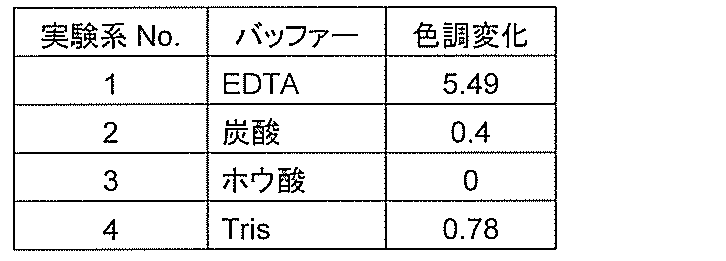
図3及び表3に示される通り、炭酸及びホウ酸において誤反応抑制効果が認められた。
<実施例4:サンプル存在下での誤反応の抑制1>
包丁を用いて細かくミンチ状にした魚肉サンプル(サバ)1gを、1)0.1M HEPPSO溶液(pH8.5)、2)0.1M HEPPSO溶液(pH9.0)、3)25mMホウ酸入り0.1M HEPPSO溶液(pH8.5)、及び4)25mMホウ酸入り0.1M HEPPSO溶液(pH9.0)のいずれか1mlと混合し、スパーテルにて十分に混合した後、ボルテックスミキサーを用いて10秒間攪拌して抽出を行った。抽出液を綿棒にて採水し、予め0.4mLの上記1)~4)の溶液を入れたポリスチレン製の試験管内で綿棒を懸濁し、全量をトレハロース2%、1.08mM NBT、及び41.5μM 1-メトキシPMSを含む試薬0.2mLを凍結乾燥したものに添加した。反応後、室温で60分放置し、発色の程度を確認した。ブランク対照としては、上記試薬を0.1M HEPPSO溶液(pH8.5又はpH9.0)0.4mLに溶解させた。なお、上記魚肉サンプルは、チェックカラーヒスタミン(キッコーマンバイオケミファ社製)を用いて事前にヒスタミン含量を測定し、ヒスタミンが検出されなかったものを用いた。本実験系ではヒスタミンデヒドロゲナーゼを反応系中に含んでおらず、すなわち、魚肉サンプル中にヒスタミンは含まれていない上に、仮に微量のヒスタミンが反応系中に存在したとしても、ヒスタミンデヒドロゲナーゼを含まないため、ヒスタミンが発色をもたらすことはないと考えられる。
包丁を用いて細かくミンチ状にした魚肉サンプル(サバ)1gを、1)0.1M HEPPSO溶液(pH8.5)、2)0.1M HEPPSO溶液(pH9.0)、3)25mMホウ酸入り0.1M HEPPSO溶液(pH8.5)、及び4)25mMホウ酸入り0.1M HEPPSO溶液(pH9.0)のいずれか1mlと混合し、スパーテルにて十分に混合した後、ボルテックスミキサーを用いて10秒間攪拌して抽出を行った。抽出液を綿棒にて採水し、予め0.4mLの上記1)~4)の溶液を入れたポリスチレン製の試験管内で綿棒を懸濁し、全量をトレハロース2%、1.08mM NBT、及び41.5μM 1-メトキシPMSを含む試薬0.2mLを凍結乾燥したものに添加した。反応後、室温で60分放置し、発色の程度を確認した。ブランク対照としては、上記試薬を0.1M HEPPSO溶液(pH8.5又はpH9.0)0.4mLに溶解させた。なお、上記魚肉サンプルは、チェックカラーヒスタミン(キッコーマンバイオケミファ社製)を用いて事前にヒスタミン含量を測定し、ヒスタミンが検出されなかったものを用いた。本実験系ではヒスタミンデヒドロゲナーゼを反応系中に含んでおらず、すなわち、魚肉サンプル中にヒスタミンは含まれていない上に、仮に微量のヒスタミンが反応系中に存在したとしても、ヒスタミンデヒドロゲナーゼを含まないため、ヒスタミンが発色をもたらすことはないと考えられる。
結果を図4に示す。図4Aに示される通り、ヒスタミン及びヒスタミンデヒドロゲナーゼ非存在下でも着色が認められたことから、HEPPSOにより試薬由来の誤反応を抑えても、さらに反応系中に魚肉などのサンプルを加えた際には、ヒスタミンに由来しない誤反応と思われる発色を完全に抑えることはできなかった。一方、図4Bに示される通り、HEPPSOにさらにホウ酸を加えることによって、魚肉などのサンプルを加えた場合であっても、ヒスタミンに由来しない誤反応と思われる発色を顕著に抑制することができた。
また、図4に示すような目視における判断を数値データでも確認する目的で、実施例1と同様にして、色調の数値化を行った。数値化は、すべて「Kの値」を用い、60分放置の前後の色調の差を以下の表4に示す。

以上の通り、誤発色は、pH8.5及び9.0いずれにも見られ、多い場合ではヒスタミン標準品を用いて発色を行わせた場合の50ppm程度に相当する発色を示し、誤発色がヒスタミン検出の判断を誤らせうることが示唆された。また、誤発色はホウ酸を添加することによって抑制できることが示唆された。
<実施例5:サンプル存在下での誤反応の抑制2>
ミンチ状にした魚肉サンプル(サバ) 1gを、1)対照、又は25mMの以下のボロン酸:2)フェニルボロン酸、3)4-クロロフェニルボロン酸、4)4-フルオロフェニルボロン酸、5)ブチルボロン酸、又は6)3-[(tert-ブトキシカルボニル)アミノ]フェニルボロン酸を含む0.1M HEPPSO(pH8.5)1mLにて抽出した。抽出は、スパーテルにて魚肉と各抽出液を十分に混合した後に、ボルテックスミキサーを用いて10秒間攪拌した。抽出液を綿棒にて採水し、予め0.4mLの上記1)~6)の溶液を入れたポリスチレン製の試験管内で綿棒を懸濁し、全量をトレハロース2%、1.08mM NBT、及び41.5μM 1-メトキシPMSを含む試薬0.2mLを凍結乾燥したものに添加した。反応後、室温で60分放置し、発色の程度を確認した。
ミンチ状にした魚肉サンプル(サバ) 1gを、1)対照、又は25mMの以下のボロン酸:2)フェニルボロン酸、3)4-クロロフェニルボロン酸、4)4-フルオロフェニルボロン酸、5)ブチルボロン酸、又は6)3-[(tert-ブトキシカルボニル)アミノ]フェニルボロン酸を含む0.1M HEPPSO(pH8.5)1mLにて抽出した。抽出は、スパーテルにて魚肉と各抽出液を十分に混合した後に、ボルテックスミキサーを用いて10秒間攪拌した。抽出液を綿棒にて採水し、予め0.4mLの上記1)~6)の溶液を入れたポリスチレン製の試験管内で綿棒を懸濁し、全量をトレハロース2%、1.08mM NBT、及び41.5μM 1-メトキシPMSを含む試薬0.2mLを凍結乾燥したものに添加した。反応後、室温で60分放置し、発色の程度を確認した。
結果を図5に示す。また、図5に示すような目視における判断を数値データでも確認する目的で、実施例1と同様にして、色調の数値化を行った。数値化は、すべて「Kの値」を用い、60分放置の前後の色調の差を以下の表5に示す。

図5及び表5に示される通り、ボロン酸を加えることによって、サンプル由来の誤反応を強く抑制することができ、特に3-[(tert-ブトキシカルボニル)アミノ]フェニルボロン酸を加えた場合にその顕著は効果であった。
<実施例6:ホウ酸濃度の検討>
ミンチ状にした魚肉サンプル(サバ) 2gを、0mM~100mMの各濃度のホウ酸を含む0.1M HEPPSO(pH8.5)2mLにて実施例5と同様の方法で抽出した。抽出後、0.4mLの各濃度ホウ酸を含む0.1MHEPPSO(pH8.5)に綿棒を懸濁し、全量をトレハロース2%、1.08mM NBT、及び41.5μM 1-メトキシPMSを含む試薬0.2mLを凍結乾燥したものに添加した。反応後、室温で60分放置し、発色の程度を確認した。結果を図6に示す。
ミンチ状にした魚肉サンプル(サバ) 2gを、0mM~100mMの各濃度のホウ酸を含む0.1M HEPPSO(pH8.5)2mLにて実施例5と同様の方法で抽出した。抽出後、0.4mLの各濃度ホウ酸を含む0.1MHEPPSO(pH8.5)に綿棒を懸濁し、全量をトレハロース2%、1.08mM NBT、及び41.5μM 1-メトキシPMSを含む試薬0.2mLを凍結乾燥したものに添加した。反応後、室温で60分放置し、発色の程度を確認した。結果を図6に示す。
また、図6に示すような目視における判断を数値データでも確認する目的で、実施例1と同様にして、色調の数値化を行った。数値化は、すべて「Kの値」を用い、60分放置の前後の色調の差を以下の表6に示す。

以上の通り、ホウ酸は濃度依存的に誤反応を低減した。
<実施例7:SDSによる誤反応の抑制>
ミンチ状にした魚肉サンプル(サバ) 2gを、0%~1%の各濃度のSDSを含む0.1M HEPPSO(pH8.0)2mLにて実施例5と同様の方法で抽出した。抽出後、0.4mLの各濃度SDSを含む0.1M HEPPSO(pH8.5)に綿棒を懸濁し、全量をトレハロース2%、1.08mM NBT、及び41.5μM 1-メトキシPMSを含む試薬0.2mLを凍結乾燥したものに添加した。反応後、室温で60分放置し、発色の程度を確認した。
ミンチ状にした魚肉サンプル(サバ) 2gを、0%~1%の各濃度のSDSを含む0.1M HEPPSO(pH8.0)2mLにて実施例5と同様の方法で抽出した。抽出後、0.4mLの各濃度SDSを含む0.1M HEPPSO(pH8.5)に綿棒を懸濁し、全量をトレハロース2%、1.08mM NBT、及び41.5μM 1-メトキシPMSを含む試薬0.2mLを凍結乾燥したものに添加した。反応後、室温で60分放置し、発色の程度を確認した。
結果を図7に示す。また、図7に示すような目視における判断を数値データでも確認する目的で、実施例1と同様にして、色調の数値化を行った。数値化は、すべて「Kの値」を用い、60分放置の前後の色調の差を以下の表7に示す。

以上の通り、SDSも誤反応を低減することが示された。
<実施例8:ホウ酸が呈色反応を阻害しないことの確認>:
ミンチ状にした魚肉サンプル(サバ) 2gを、25mM又は100mMのホウ酸を含む0.1M HEPPSO(pH9.0)2mLにて実施例5と同様の方法で抽出した。抽出後、0.4mLの各濃度ホウ酸を含む0.1M HEPPSO(pH9.0)に0、10、25、50、75、100ppm相当のヒスタミンを添加し、この溶液に綿棒を懸濁し、全量をトレハロース2%、1.08mM NBT、及び41.5μM 1-メトキシPMSを含む試薬0.2mLを凍結乾燥したものに添加した。反応後、室温で15分放置し、発色の程度を確認した。
ミンチ状にした魚肉サンプル(サバ) 2gを、25mM又は100mMのホウ酸を含む0.1M HEPPSO(pH9.0)2mLにて実施例5と同様の方法で抽出した。抽出後、0.4mLの各濃度ホウ酸を含む0.1M HEPPSO(pH9.0)に0、10、25、50、75、100ppm相当のヒスタミンを添加し、この溶液に綿棒を懸濁し、全量をトレハロース2%、1.08mM NBT、及び41.5μM 1-メトキシPMSを含む試薬0.2mLを凍結乾燥したものに添加した。反応後、室温で15分放置し、発色の程度を確認した。
結果を図8に示す。また、図8に示すような目視における判断を数値データでも確認する目的で、実施例1と同様にして、色調の数値化を行った。数値化は、すべて「Kの値」を用い、15分放置の前後の色調の差を以下の表8に示す。
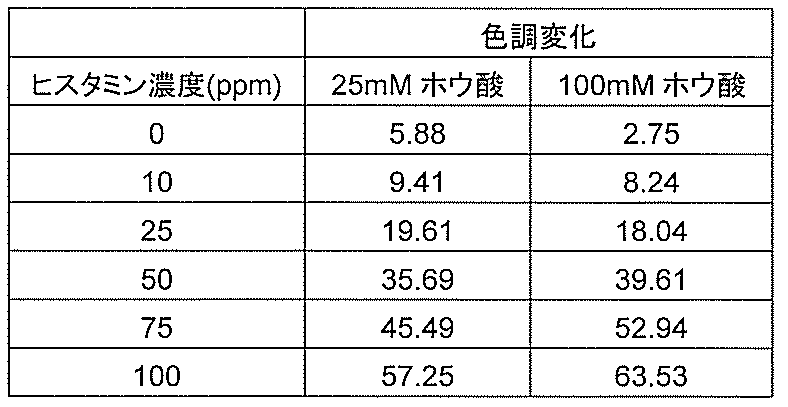
図8及び表8に示す通り、ホウ酸濃度を100mMとしても測定が行えたことから、ホウ酸の添加はヒスタミン由来の発色には悪影響を与えないことが示唆された。
<実施例9:サイクリックボルタンメトリーによるヒスタミン検量線の作成(魚肉サンプル無添加系)>
トレハロース2%、1.08mM NBT、41.5μM 1-メトキシPMS及び0.128U ヒスタミンデヒドロゲナーゼを含む試薬0.2mLを凍結乾燥した後、0.1M ホウ酸溶液(pH8.5)を500μL添加して溶解した。比較として、0.1Mホウ酸溶液(pH8.5)の代わりに、チェックカラーヒスタミン(キッコーマンバイオケミファ社製)において抽出用溶液として用いられている0.1M EDTA溶液を用いて同様に調製した。それらをそれぞれ印刷電極に20μL滴下し、サイクリックボルタンメトリーを行った。印刷電極はカーボンの作用電極(12.6mm2)、銀の参照電極が印刷されている、SCREEN-PRINTED ELECTRODES(Drop Sense社製、DRP-110)を用い、専用コネクター(Drop Sense社製、DRP-CAC)を使用して、ALS電気化学アナライザー814D(BAS社製)に接続した。さらに1000ppmヒスタミン溶液を1、2μL添加し、それぞれにおいて同様にサイクリックボルタンメトリーを行った。電位は1秒間に20mV掃引した。-150mV(vs. Ag/Ag+)の酸化電流値をプロットし、ヒスタミン濃度と電流値の関係を求めた。
トレハロース2%、1.08mM NBT、41.5μM 1-メトキシPMS及び0.128U ヒスタミンデヒドロゲナーゼを含む試薬0.2mLを凍結乾燥した後、0.1M ホウ酸溶液(pH8.5)を500μL添加して溶解した。比較として、0.1Mホウ酸溶液(pH8.5)の代わりに、チェックカラーヒスタミン(キッコーマンバイオケミファ社製)において抽出用溶液として用いられている0.1M EDTA溶液を用いて同様に調製した。それらをそれぞれ印刷電極に20μL滴下し、サイクリックボルタンメトリーを行った。印刷電極はカーボンの作用電極(12.6mm2)、銀の参照電極が印刷されている、SCREEN-PRINTED ELECTRODES(Drop Sense社製、DRP-110)を用い、専用コネクター(Drop Sense社製、DRP-CAC)を使用して、ALS電気化学アナライザー814D(BAS社製)に接続した。さらに1000ppmヒスタミン溶液を1、2μL添加し、それぞれにおいて同様にサイクリックボルタンメトリーを行った。電位は1秒間に20mV掃引した。-150mV(vs. Ag/Ag+)の酸化電流値をプロットし、ヒスタミン濃度と電流値の関係を求めた。
その結果、図9に示すとおり、ホウ酸溶液及びEDTA溶液の両者ともにヒスタミン検量線の直線性は良好であったが、ホウ酸を溶液に使用した場合、EDTAと比較して、より大きな電流値が得られ、傾きも大きく、S/N比も若干向上した。以上より、ホウ酸溶液を用いることで、サイクリックボルタンメトリーによるヒスタミン検出の精度が向上することが示された。
<実施例10:クロノアンペロメトリーによるヒスタミン検量線の作成(魚肉サンプル存在下)>
ミンチ状にしたサバ2gを2mLの水にて実施例5と同様の方法で抽出した。トレハロース2%、41.5μM 1-メトキシPMS及び0.128U ヒスタミンデヒドロゲナーゼを含む試薬0.2mLを凍結乾燥した後、0.1M HEPPSO溶液(pH8.5)又は0.1M HEPPSO/0.1M ホウ酸溶液(pH8.5)30μL、魚肉抽出液10μL、3M NaCl溶液10μLをそれぞれ印刷電極に滴下し、クロノアンペロメトリーを行った。印刷電極はカーボンの作用電極(12.6mm2)、銀の参照電極が印刷されている、SCREEN-PRINTED ELECTRODES(Drop Sense社製、DRP-110)を用い、専用コネクター(Drop Sense社製、DRP-CAC)を使用して、ALS電気化学アナライザー814D(BAS社製)に接続した。さらに1000ppmヒスタミン溶液を1、2、4μL添加し、同様にクロノアンペロメトリーを行った。測定は、+200mV(vs. Ag/AgCl)の電位を印加した。測定開始から10秒経過後の電流値をプロットし、ヒスタミン濃度と電流値の関係を求めた。
ミンチ状にしたサバ2gを2mLの水にて実施例5と同様の方法で抽出した。トレハロース2%、41.5μM 1-メトキシPMS及び0.128U ヒスタミンデヒドロゲナーゼを含む試薬0.2mLを凍結乾燥した後、0.1M HEPPSO溶液(pH8.5)又は0.1M HEPPSO/0.1M ホウ酸溶液(pH8.5)30μL、魚肉抽出液10μL、3M NaCl溶液10μLをそれぞれ印刷電極に滴下し、クロノアンペロメトリーを行った。印刷電極はカーボンの作用電極(12.6mm2)、銀の参照電極が印刷されている、SCREEN-PRINTED ELECTRODES(Drop Sense社製、DRP-110)を用い、専用コネクター(Drop Sense社製、DRP-CAC)を使用して、ALS電気化学アナライザー814D(BAS社製)に接続した。さらに1000ppmヒスタミン溶液を1、2、4μL添加し、同様にクロノアンペロメトリーを行った。測定は、+200mV(vs. Ag/AgCl)の電位を印加した。測定開始から10秒経過後の電流値をプロットし、ヒスタミン濃度と電流値の関係を求めた。
その結果、図10に示すように、魚肉サンプル存在下では、ホウ酸を添加しない場合、ヒスタミン濃度と電流値に相関関係が得られにくい傾向があった(相関係数R2=0.6994)。ホウ酸を添加することにより、魚肉サンプルの影響が抑えられ、良好な相関関係(相関係数R2=0.9946)が得られた。以上より、ホウ酸溶液を用いることで、クロノアンペロメトリーによるヒスタミン検出の精度が向上することが示された。
本発明により、ヒスタミンデヒドロゲナーゼを用いてヒスタミンを測定する方法において、酵素反応に由来しない誤反応を低減することが可能となる。これにより、特に低濃度域においてもヒスタミンを検出することが可能となる。
本明細書で引用した全ての刊行物、特許及び特許出願はそのまま引用により本明細書に組み入れられるものとする。
Claims (23)
- ヒスタミンを検出するためのキットであって、(i)ヒスタミンデヒドロゲナーゼ、及び
(ii-a)ホウ酸又はその塩、及び/又は下記式(I)又は(II):

R6は、ボロニル基、ハロゲン基、ヒドロキシ基、カルボキシ基、ニトロ基、アミノ基、スルホ基及びチオール基からなる群より選択される少なくとも一種の置換基により置換された又は置換されていないC1~C10アルキル基、アルケニル基、又はアルキニル基からなる群から選択される)で表されるボロン酸又はその塩、及び/又は
(ii-b)アルキル硫酸塩
を含む、前記キット。 - ヒスタミンデヒドロゲナーゼによるヒスタミンの酸化を検出可能な電気化学センサーであって、(i)ヒスタミンデヒドロゲナーゼ、及び
(ii-a)ホウ酸又はその塩、及び/又は下記式(I)又は(II):
R6は、ボロニル基、ハロゲン基、ヒドロキシ基、カルボキシ基、ニトロ基、アミノ基、スルホ基及びチオール基からなる群より選択される少なくとも一種の置換基により置換された又は置換されていないC1~C10アルキル基、アルケニル基、又はアルキニル基からなる群から選択される)で表されるボロン酸又はその塩、及び/又は
(ii-b)アルキル硫酸塩
を含む、前記センサー。 - メディエーターをさらに含む、請求項1に記載のキット又は請求項2に記載のセンサー。
- メディエーターが、1-メトキシPMS(1-メトキシ-5-エチルフェナジニウムエチルサルフェート)、PMS(フェナジニウムメチルサルフェート)、PES(フェナジニウムエチルサルフェート)及び1-メトキシPES(1-メトキシ-5-エチルフェナジニウムエチルサルフェート)からなる群から選択される、請求項3に記載のキット又はセンサー。
- ヒスタミンがヒスタミンデヒドロゲナーゼにより酸化された際に発色する発色試薬をさらに含む、請求項1~4のいずれか一項に記載のキット又はセンサー。
- 発色試薬が、テトラゾリウム塩である、請求項5に記載のキット又はセンサー。
- 双性イオンを有し、カルボキシ基を有さない化合物を含む緩衝液であって、BES、MOPS、TES、HEPES、EPPS、TAPS、CHES、CAPS、TAPSO、POPSO、HEPPSO、ACES、Bis-Tris、MES、MOPSO、及びPIPESからなる群から選択される緩衝液、Tris(トリス(ヒドロキシメチル)アミノメタン)又は炭酸緩衝液をさらに含む、請求項1~6のいずれか一項に記載のキット又はセンサー。
- 緩衝液が、双性イオンを有し、スルホ基を有する化合物を含む緩衝液であって、BES、MOPS、TES、HEPES、EPPS、TAPS、CHES、CAPS、TAPSO、POPSO、HEPPSO、ACES、MES、MOPSO、及びPIPESからなる群から選択される緩衝液である、請求項7に記載のキット又はセンサー。
- 緩衝液が、双性イオンを有し、スルホ基を有し、かつ2位にヒドロキシ基を有する化合物を含む緩衝液であって、TAPSO、POPSO、HEPPSO、及びMOPSOからなる群から選択される緩衝液である、請求項8に記載のキット又はセンサー。
- ホウ酸又はその塩、及び/又はボロン酸又はその塩を、測定時の終濃度が120mM以下となるように含む、請求項1~9のいずれか一項に記載のキット又はセンサー。
- アルキル硫酸塩がラウリル硫酸ナトリウムである、請求項1~10のいずれか一項に記載のキット又はセンサー。
- 試料採取部、及び反応部を含み、
前記反応部が前記ヒスタミンデヒドロゲナーゼ及び前記ホウ酸又はその塩、及び/又はボロン酸又はその塩を含む、請求項1~11のいずれか一項に記載のキット又はセンサー。 - ヒスタミンを検出するための方法であって、(i)ヒスタミンデヒドロゲナーゼ、及び(ii-a)ホウ酸又はその塩、及び/又は下記式(I)又は(II):
R6は、ボロニル基、ハロゲン基、ヒドロキシ基、カルボキシ基、ニトロ基、アミノ基、スルホ基及びチオール基からなる群より選択される少なくとも一種の置換基により置換された又は置換されていないC1~C10アルキル基、アルケニル基、又はアルキニル基からなる群から選択される)で表されるボロン酸又はその塩、及び/又は
(ii-b)アルキル硫酸塩
を使用する、前記方法。 - ヒスタミンを検出するための方法であって、
ヒスタミンデヒドロゲナーゼによるヒスタミンの酸化を検出可能な電気化学センサーを使用し、前記センサーが、(i)ヒスタミンデヒドロゲナーゼ、及び
(ii-a)ホウ酸又はその塩、及び/又は下記式(I)又は(II):
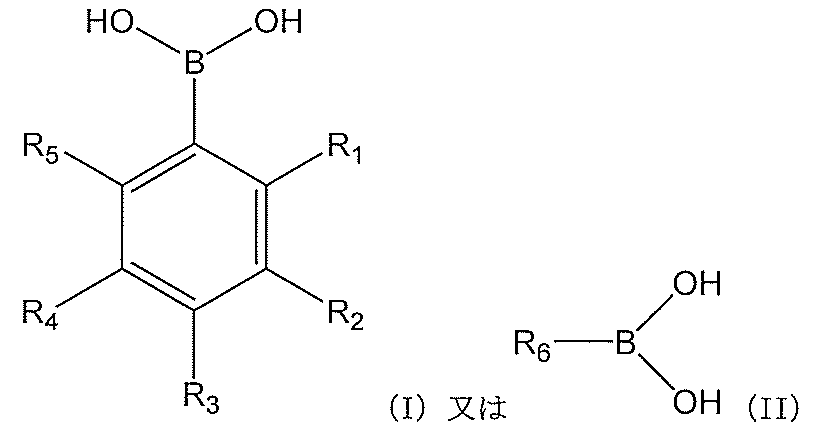
R6は、ボロニル基、ハロゲン基、ヒドロキシ基、カルボキシ基、ニトロ基、アミノ基、スルホ基及びチオール基からなる群より選択される少なくとも一種の置換基により置換された又は置換されていないC1~C10アルキル基、アルケニル基、又はアルキニル基からなる群から選択される)で表されるボロン酸又はその塩、及び/又は
(ii-b)アルキル硫酸塩
を含む、前記方法。 - メディエーターをさらに使用する、請求項13又は14に記載の方法。
- メディエーターが、1-メトキシPMS、PMS、PES及び1-メトキシPESからなる群から選択される、請求項15に記載の方法。
- ヒスタミンがヒスタミンデヒドロゲナーゼにより酸化された際に発色する発色試薬をさらに使用する、請求項13~16のいずれか一項に記載の方法。
- 発色試薬が、テトラゾリウム塩である、請求項17に記載の方法。
- 双性イオンを有し、カルボキシ基を有さない化合物を含む緩衝液であって、BES、MOPS、TES、HEPES、EPPS、TAPS、CHES、CAPS、TAPSO、POPSO、HEPPSO、ACES、Bis-Tris、MES、MOPSO、及びPIPESからなる群から選択される緩衝液、Tris又は炭酸緩衝液をさらに含む、請求項13~18のいずれか一項に記載の方法。
- 緩衝液が、双性イオンを有し、スルホ基を有する化合物を含む緩衝液であって、BES、MOPS、TES、HEPES、EPPS、TAPS、CHES、CAPS、TAPSO、POPSO、HEPPSO、ACES、MES、MOPSO、及びPIPESからなる群から選択される緩衝液である、請求項19に記載の方法。
- 緩衝液が、双性イオンを有し、スルホ基を有し、かつ2位にヒドロキシ基を有する化合物を含む緩衝液であって、TAPSO、POPSO、HEPPSO、及びMOPSOからなる群から選択される緩衝液である、請求項20に記載の方法。
- ホウ酸又はその塩、及び/又はボロン酸又はその塩を、測定時の終濃度120mM以下で使用する、請求項13~21のいずれか一項に記載の方法。
- アルキル硫酸塩がラウリル硫酸ナトリウムである、請求項13~22のいずれか一項に記載の方法。
Priority Applications (3)
| Application Number | Priority Date | Filing Date | Title |
|---|---|---|---|
| US17/269,081 US20210246485A1 (en) | 2018-08-20 | 2019-08-20 | Histamine measurement method and kit |
| JP2020538392A JP7497290B2 (ja) | 2018-08-20 | 2019-08-20 | ヒスタミン測定法及びキット |
| JP2024062918A JP2024086843A (ja) | 2018-08-20 | 2024-04-09 | ヒスタミン測定法及びキット |
Applications Claiming Priority (2)
| Application Number | Priority Date | Filing Date | Title |
|---|---|---|---|
| JP2018-153916 | 2018-08-20 | ||
| JP2018153916 | 2018-08-20 |
Publications (1)
| Publication Number | Publication Date |
|---|---|
| WO2020040113A1 true WO2020040113A1 (ja) | 2020-02-27 |
Family
ID=69593292
Family Applications (1)
| Application Number | Title | Priority Date | Filing Date |
|---|---|---|---|
| PCT/JP2019/032370 Ceased WO2020040113A1 (ja) | 2018-08-20 | 2019-08-20 | ヒスタミン測定法及びキット |
Country Status (3)
| Country | Link |
|---|---|
| US (1) | US20210246485A1 (ja) |
| JP (2) | JP7497290B2 (ja) |
| WO (1) | WO2020040113A1 (ja) |
Citations (6)
| Publication number | Priority date | Publication date | Assignee | Title |
|---|---|---|---|---|
| JP2001157597A (ja) * | 1998-09-25 | 2001-06-12 | Kikkoman Corp | ヒスタミンの定量法及び定量用試薬 |
| JP2005160399A (ja) * | 2003-12-03 | 2005-06-23 | Kikkoman Corp | ヒスタミンの定量法 |
| JP2009186350A (ja) * | 2008-02-07 | 2009-08-20 | Saitama Univ | リン酸イオンの検出方法および検出用キット |
| JP2010078448A (ja) * | 2008-09-25 | 2010-04-08 | Prima Meat Packers Ltd | 食物中のアレルギー物質の分析方法 |
| US20140099656A1 (en) * | 2012-10-01 | 2014-04-10 | Bioo Scientific Corporation | Rapid detection of histamine in food and beverages |
| WO2019049966A1 (ja) * | 2017-09-08 | 2019-03-14 | キッコーマン株式会社 | ヒスタミンの検出法およびキット |
Family Cites Families (9)
| Publication number | Priority date | Publication date | Assignee | Title |
|---|---|---|---|---|
| DE3048662A1 (de) * | 1980-12-23 | 1982-07-22 | Boehringer Mannheim Gmbh, 6800 Mannheim | Stabilisierte zubereitung von tetrazoliumsalzen |
| EP0971037A3 (en) * | 1998-07-06 | 2000-03-08 | Kirkegaard & Perry Laboratories, Inc. | Stable reagent for formazan-based assay |
| US20020004213A1 (en) * | 1998-10-22 | 2002-01-10 | Atairgin Technologies, Inc. | Enzyme method for detecting lysophospholipids and phospholipids and for detecting and correlating conditions associated with altered levels of lysophospholipids |
| WO2002018627A1 (fr) * | 2000-08-28 | 2002-03-07 | Sapporo Immuno Diagnostic Laboratory | Procede d'examen de maladies a erreurs innees du metabolisme, et appareil d'examen concu a cet effet |
| JP4336886B2 (ja) * | 2001-09-28 | 2009-09-30 | アークレイ株式会社 | テトラゾリウム化合物の保存方法、それに用いる安定化剤、および前記方法を用いたテトラゾリウム化合物試薬溶液 |
| JP2004129597A (ja) * | 2002-10-11 | 2004-04-30 | Kikkoman Corp | ヒスタミンの測定法 |
| JP5216968B2 (ja) * | 2007-08-07 | 2013-06-19 | 株式会社シノテスト | テトラゾリウム化合物を色原体として用いる試料中の測定対象物質の測定方法及び測定試薬、非特異的発色を抑制する方法、並びに非特異的発色抑制剤 |
| JP2009072136A (ja) * | 2007-09-21 | 2009-04-09 | Toyobo Co Ltd | 還元系色素を用いた安定な測定方法、およびその試薬 |
| JP2009106182A (ja) * | 2007-10-30 | 2009-05-21 | Panasonic Corp | 被検成分の定量方法、分析用デバイス、及び分析装置 |
-
2019
- 2019-08-20 WO PCT/JP2019/032370 patent/WO2020040113A1/ja not_active Ceased
- 2019-08-20 US US17/269,081 patent/US20210246485A1/en active Pending
- 2019-08-20 JP JP2020538392A patent/JP7497290B2/ja active Active
-
2024
- 2024-04-09 JP JP2024062918A patent/JP2024086843A/ja not_active Withdrawn
Patent Citations (6)
| Publication number | Priority date | Publication date | Assignee | Title |
|---|---|---|---|---|
| JP2001157597A (ja) * | 1998-09-25 | 2001-06-12 | Kikkoman Corp | ヒスタミンの定量法及び定量用試薬 |
| JP2005160399A (ja) * | 2003-12-03 | 2005-06-23 | Kikkoman Corp | ヒスタミンの定量法 |
| JP2009186350A (ja) * | 2008-02-07 | 2009-08-20 | Saitama Univ | リン酸イオンの検出方法および検出用キット |
| JP2010078448A (ja) * | 2008-09-25 | 2010-04-08 | Prima Meat Packers Ltd | 食物中のアレルギー物質の分析方法 |
| US20140099656A1 (en) * | 2012-10-01 | 2014-04-10 | Bioo Scientific Corporation | Rapid detection of histamine in food and beverages |
| WO2019049966A1 (ja) * | 2017-09-08 | 2019-03-14 | キッコーマン株式会社 | ヒスタミンの検出法およびキット |
Non-Patent Citations (1)
| Title |
|---|
| SATO, T. ET AL.: "Simple and rapid determination of histamine in food using a new histamine dehydrogenase fromRhizobium sp", ANALYTICAL BIOCHEMISTRY, vol. 346, 2005, pages 320 - 326, XP005126679, DOI: 10.1016/j.ab.2005.09.005 * |
Also Published As
| Publication number | Publication date |
|---|---|
| US20210246485A1 (en) | 2021-08-12 |
| JP7497290B2 (ja) | 2024-06-10 |
| JP2024086843A (ja) | 2024-06-28 |
| JPWO2020040113A1 (ja) | 2021-09-09 |
Similar Documents
| Publication | Publication Date | Title |
|---|---|---|
| AU2012286927B2 (en) | Reagents for electrochemical test strips | |
| EP3987059B1 (en) | A method of measuring the ph of a sample | |
| JP6817135B2 (ja) | 糖化タンパク質の分析方法、分析試薬、分析キットおよび分析用試験片 | |
| JP7227139B2 (ja) | ヒスタミンの検出法およびキット | |
| JP7497290B2 (ja) | ヒスタミン測定法及びキット | |
| JP5216968B2 (ja) | テトラゾリウム化合物を色原体として用いる試料中の測定対象物質の測定方法及び測定試薬、非特異的発色を抑制する方法、並びに非特異的発色抑制剤 | |
| JP5017614B2 (ja) | 試料中の測定対象物質の測定方法及び測定試薬、非特異的発色を抑制する方法、並びに非特異的発色抑制剤 | |
| CA3101865C (en) | Systems and methods for measuring liver enzyme levels in blood | |
| US20090148872A1 (en) | Lipoprotein sensor | |
| EP3842804B1 (en) | Sampling method and kit for histamine measurement | |
| Lucio-Rivera et al. | Sensing of disease markers at modified electrodes and commercial glucose strips: Malate dehydrogenase | |
| CA2499527A1 (en) | An analyzer for the simultaneous enzymatic detection of closely related analytes | |
| JP2020030069A (ja) | ヒスタミン測定のためのサンプリング方法及びキット | |
| HK40065077A (en) | A method of measuring the ph of a sample | |
| HK40065077B (en) | A method of measuring the ph of a sample | |
| Mendoza et al. | ELECTROCHEMICAL-BASED BIOSENSORS IN CLINICALLY RELEVANT ENZYMES | |
| Stoytcheva | Hexacyanoferrate (III)-mediated glucose oxidase ammetric electrode | |
| HK1128119A (en) | Lipovrotein senso | |
| AU2015258165A1 (en) | Reagents for electrochemical test strips | |
| JPH0814540B2 (ja) | 成分の定量方法 |
Legal Events
| Date | Code | Title | Description |
|---|---|---|---|
| 121 | Ep: the epo has been informed by wipo that ep was designated in this application |
Ref document number: 19852719 Country of ref document: EP Kind code of ref document: A1 |
|
| ENP | Entry into the national phase |
Ref document number: 2020538392 Country of ref document: JP Kind code of ref document: A |
|
| NENP | Non-entry into the national phase |
Ref country code: DE |
|
| 122 | Ep: pct application non-entry in european phase |
Ref document number: 19852719 Country of ref document: EP Kind code of ref document: A1 |