WO2020021968A1 - 磁性ペースト - Google Patents
磁性ペースト Download PDFInfo
- Publication number
- WO2020021968A1 WO2020021968A1 PCT/JP2019/025926 JP2019025926W WO2020021968A1 WO 2020021968 A1 WO2020021968 A1 WO 2020021968A1 JP 2019025926 W JP2019025926 W JP 2019025926W WO 2020021968 A1 WO2020021968 A1 WO 2020021968A1
- Authority
- WO
- WIPO (PCT)
- Prior art keywords
- resin
- magnetic
- magnetic paste
- epoxy resin
- manufactured
- Prior art date
- Legal status (The legal status is an assumption and is not a legal conclusion. Google has not performed a legal analysis and makes no representation as to the accuracy of the status listed.)
- Ceased
Links
Images
Classifications
-
- H—ELECTRICITY
- H01—ELECTRIC ELEMENTS
- H01F—MAGNETS; INDUCTANCES; TRANSFORMERS; SELECTION OF MATERIALS FOR THEIR MAGNETIC PROPERTIES
- H01F1/00—Magnets or magnetic bodies characterised by the magnetic materials therefor; Selection of materials for their magnetic properties
- H01F1/01—Magnets or magnetic bodies characterised by the magnetic materials therefor; Selection of materials for their magnetic properties of inorganic materials
- H01F1/03—Magnets or magnetic bodies characterised by the magnetic materials therefor; Selection of materials for their magnetic properties of inorganic materials characterised by their coercivity
- H01F1/12—Magnets or magnetic bodies characterised by the magnetic materials therefor; Selection of materials for their magnetic properties of inorganic materials characterised by their coercivity of soft-magnetic materials
- H01F1/34—Magnets or magnetic bodies characterised by the magnetic materials therefor; Selection of materials for their magnetic properties of inorganic materials characterised by their coercivity of soft-magnetic materials non-metallic substances, e.g. ferrites
- H01F1/36—Magnets or magnetic bodies characterised by the magnetic materials therefor; Selection of materials for their magnetic properties of inorganic materials characterised by their coercivity of soft-magnetic materials non-metallic substances, e.g. ferrites in the form of particles
- H01F1/37—Magnets or magnetic bodies characterised by the magnetic materials therefor; Selection of materials for their magnetic properties of inorganic materials characterised by their coercivity of soft-magnetic materials non-metallic substances, e.g. ferrites in the form of particles in a bonding agent
-
- H—ELECTRICITY
- H01—ELECTRIC ELEMENTS
- H01F—MAGNETS; INDUCTANCES; TRANSFORMERS; SELECTION OF MATERIALS FOR THEIR MAGNETIC PROPERTIES
- H01F17/00—Fixed inductances of the signal type
- H01F17/04—Fixed inductances of the signal type with magnetic core
-
- H—ELECTRICITY
- H05—ELECTRIC TECHNIQUES NOT OTHERWISE PROVIDED FOR
- H05K—PRINTED CIRCUITS; CASINGS OR CONSTRUCTIONAL DETAILS OF ELECTRIC APPARATUS; MANUFACTURE OF ASSEMBLAGES OF ELECTRICAL COMPONENTS
- H05K1/00—Printed circuits
- H05K1/16—Printed circuits incorporating printed electric components, e.g. printed resistors, capacitors or inductors
Definitions
- the present invention relates to a magnetic paste, an inductor element obtained by using the magnetic paste, and a circuit board.
- inductor elements are mounted on information terminals such as mobile phones and smartphones.
- an independent inductor component has been mounted on a substrate, but in recent years, a method of forming a coil using a conductor pattern of the substrate and providing an inductor element inside the substrate has been used.
- Patent Document 1 Patent Document 1
- Reference 2 Patent Document 2
- Patent Literature 1 and Patent Literature 2 describe a method of suppressing resin exudation by improving a screen printing method or improving a structure of an inductor element. The method described in No. 2 was not always satisfactory.
- the present invention has been made in view of the above circumstances, and provides a magnetic paste capable of obtaining a cured product in which resin exudation is suppressed, and an inductor element and a circuit board using the magnetic paste. With the goal.
- the present inventors have made intensive studies to achieve the above object, and as a result, have found that the use of a magnetic paste containing an organically modified layered silicate mineral suppresses resin exudation. Was completed.
- the present invention includes the following contents.
- the content of the component (B) when the non-volatile component in the magnetic paste is 100% by mass is B1, and the content of the component (C) when the non-volatile component in the magnetic paste is 100% by mass is The magnetic paste according to any one of [1] to [8], wherein C1 / B1 is 1 or more and 30 or less when C1.
- the present invention it is possible to provide a magnetic paste capable of obtaining a cured product in which resin exudation is suppressed, and an inductor element and a circuit board using the magnetic paste.
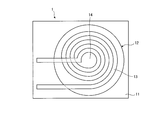
- FIG. 1 is a schematic plan view of an inductor element according to one embodiment of the present invention.
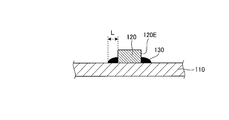
- FIG. 2 is a cross-sectional view schematically illustrating an example of a cross section of a magnetic layer formed on a substrate.
- the magnetic paste of the present invention contains (A) a magnetic powder, (B) an organically modified layered silicate mineral, and (C) a binder resin.
- the magnetic paste may further contain (D) a curing accelerator, (E) a dispersant, and (F) other additives as necessary.
- D a curing accelerator
- E a dispersant
- F other additives
- the magnetic paste contains (A) a magnetic powder.
- A) As the magnetic powder for example, pure iron powder; Mg—Zn ferrite, Fe—Mn ferrite, Mn—Zn ferrite, Mn—Mg ferrite, Cu—Zn ferrite, Mg—Mn—Sr Ferrite, Ni-Zn ferrite, Ba-Zn ferrite, Ba-Mg ferrite, Ba-Ni ferrite, Ba-Co ferrite, Ba-Ni-Co ferrite, Y ferrite, iron oxide powder (III ), Iron oxide powder such as triiron tetroxide; Fe-Si alloy powder, Fe-Si-Al alloy powder, Fe-Cr alloy powder, Fe-Cr-Si alloy powder, Fe-Ni-Cr alloy powder Alloy powder, Fe-Cr-Al alloy powder, Fe-Ni alloy powder, Fe-Ni-Mo alloy powder, Fe-Ni-Mo-Cu alloy powder, Fe-Co alloy
- the magnetic powder (A) is preferably at least one selected from iron oxide powder and iron alloy-based metal powder.
- the iron oxide powder is preferably a ferrite containing at least one selected from Ni, Cu, Mn, and Zn.
- the iron alloy-based metal powder is preferably an iron alloy-based metal powder containing at least one selected from Si, Cr, Al, Ni, and Co.
- a commercially available magnetic powder can be used as the (A) magnetic powder.
- Specific examples of commercially available magnetic powders that can be used include “M05S” manufactured by Powdertech; “PST-S” manufactured by Sanyo Special Steel Co., Ltd .; “AW2-08” and “AW2-08PF20F” manufactured by Epson Atmix.
- the magnetic powder is preferably spherical.
- the value obtained by dividing the length of the major axis of the magnetic powder by the length of the minor axis (aspect ratio) is preferably 2 or less, more preferably 1.5 or less, and even more preferably 1.2 or less.
- the relative magnetic permeability is easily improved.
- the use of a spherical magnetic powder is particularly preferable from the viewpoints of reducing the magnetic loss and obtaining a paste having a preferable viscosity.
- the average particle diameter of the magnetic powder is preferably 0.01 ⁇ m or more, more preferably 0.5 ⁇ m or more, and still more preferably 1 ⁇ m or more, from the viewpoint of improving the relative magnetic permeability. Further, it is preferably 10 ⁇ m or less, more preferably 9 ⁇ m or less, and still more preferably 8 ⁇ m or less.
- the average particle size of the magnetic powder can be measured by a laser diffraction / scattering method based on Mie scattering theory. Specifically, it can be measured by preparing a particle size distribution of a magnetic powder on a volume basis by using a laser diffraction scattering type particle size distribution measuring device, and setting a median diameter to an average particle size.
- a sample in which magnetic powder is dispersed in water by ultrasonic waves can be preferably used.
- the laser diffraction / scattering type particle size distribution measuring device “LA-500” manufactured by Horiba, Ltd., “SALD-2200” manufactured by Shimadzu, etc. can be used.
- the specific surface area of the magnetic powder can be measured by the BET method.
- the content (volume%) of the magnetic powder is preferably 10 vol% or more when the non-volatile component in the magnetic paste is 100 vol% from the viewpoint of improving the relative magnetic permeability and reducing the magnetic loss. , More preferably at least 20% by volume, still more preferably at least 30% by volume. Further, it is preferably at most 85% by volume, more preferably at most 80% by volume, further preferably at most 75% by volume.
- the content (% by mass) of the magnetic powder is preferably 60% by mass or more when the nonvolatile component in the magnetic paste is 100% by mass from the viewpoint of improving the relative magnetic permeability and reducing the magnetic loss. , More preferably 65% by mass or more, even more preferably 70% by mass or more. Further, it is preferably at most 98% by mass, more preferably at most 96% by mass, further preferably at most 94% by mass.
- the content of each component in the magnetic paste is a value when the nonvolatile component in the magnetic paste is 100% by mass, unless otherwise specified.
- the magnetic paste contains (B) an organized layered silicate mineral.
- (B) By incorporating the organic layered silicate mineral into the magnetic paste, it becomes possible to obtain a cured product with reduced resin exudation.
- organized (performed) means “ion-exchanged with an organic onium ion”.
- Layered silicate minerals are also commonly referred to as phyllosilicate minerals. Layered silicate minerals can be used alone or in combination of two or more. As the layered silicate mineral, a natural product or a synthetic product may be used. As the crystal structure of the layered silicate mineral, it is preferable to use one having a high degree of purity, which is regularly stacked in the c-axis direction, but a so-called mixed layered mineral in which the crystal cycle is disordered and a plurality of types of crystal structures are mixed. May be used.
- Examples of the layered silicate mineral include smectite, kaolinite, halloysite, talc, and mica. Among these, smectite is preferable from the viewpoint of obtaining a cured product that can effectively suppress resin exudation.
- Smectite has a general formula: X 0.2 to 0.6 Y 2 to 3 Z 4 O 10 (OH) 2 .nH 2 O (where X is a group consisting of K, Na, 1 / 2Ca, and 1 / 2Mg) Y is one or more selected from the group consisting of Mg, Fe, Mn, Ni, Zn, Li, Al, and Cr; and Z is selected from the group consisting of Si and Al.
- H 2 O represents a water molecule bonded to an interlayer ion
- n represents an integer, and may fluctuate significantly depending on the interlayer ion and relative humidity.
- smectite examples include hectorite, montmorillonite, beidellite, nontronite, saponite, iron saponite, sauconite, stevensite, bentonite, a substituted product thereof, a derivative thereof, and a mixture thereof.
- hectorite and montmorillonite are preferred from the viewpoint of obtaining a cured product that can effectively suppress resin exudation.
- the organic onium ion represents an ion having an onium ion structure containing an organic group. This organic onium ion is usually contained in the interlayer portion of the silicate layer of the layered silicate mineral in the component (B).
- Examples of the organic onium ion include an organic ammonium ion, an organic phosphonium ion, an organic sulfonium ion, and an organic imidazolium ion. Among them, from the viewpoint of obtaining a cured product in which resin exudation is effectively suppressed, an organic ammonium ion and an organic phosphonium ion are preferable, and an organic ammonium ion is particularly preferable.
- Examples of the organic group contained in the organic onium ion include a monovalent hydrocarbon group such as an alkyl group, an alkenyl group, an aryl group, and an aralkyl group; a hydroxyalkyl group; a carboxyalkyl group; a polyalkylene ether group; .
- a monovalent hydrocarbon group and a polyalkylene ether group are preferable from the viewpoint of obtaining a cured product in which the resin exudation property is effectively suppressed.
- a monovalent hydrocarbon group a monovalent aliphatic hydrocarbon group is preferable, a monovalent saturated aliphatic hydrocarbon group is more preferable, and an alkyl group is particularly preferable.
- the alkyl group may be linear or branched.
- the number of carbon atoms of the monovalent hydrocarbon group is usually 1 to 40, preferably 1 to 25, and more preferably 1 to 20.
- Preferred examples of the monovalent hydrocarbon group include methyl, ethyl, n-propyl, isopropyl, n-butyl, sec-butyl, t-butyl, isobutyl, n-pentyl, isopentyl Group, neopentyl group, t-pentyl group, n-hexyl group, isohexyl group, 1-methylpentyl group, 2-methylpentyl group, n-heptyl group, n-octyl group, n-nonyl group, n-decyl group, n-undecyl group, n-dodecyl group, n-tridecyl group, n-tetradecyl group, n-pentadecyl group, n-hexadecyl group, n-heptadecyl group, n-octadecyl group,
- the polyalkylene ether group refers to a group represented by the following formula (I). -(RO) m -H (I)
- R independently represents an alkylene group.
- the alkylene group preferably has 2 to 20 carbon atoms.
- Examples of the alkylene group include an ethylene group and a propylene group.
- m represents an integer of 1 to 20.
- organic onium ions include organic onium ions represented by the following formula (II).
- X 1 represents a non-metallic atom belonging to Group 15 of the long-period periodic table. Therefore, X 1 represents a nitrogen atom or a phosphorus atom. Among them, X 1 is preferably a nitrogen atom from the viewpoint of obtaining a cured product in which resin exudation is effectively suppressed.
- R 1 represents the aforementioned organic group.
- organic groups those selected from the group consisting of monovalent hydrocarbon groups and polyalkylene ether groups are preferable from the viewpoint of obtaining a cured product in which resin exudation is effectively suppressed, and an alkyl group or polyalkylene ether is preferred. Groups are more preferred, and alkyl groups are particularly preferred.
- R 2 , R 3 and R 4 each independently represent a group selected from the group consisting of a hydrogen atom and the organic group.
- organic groups those selected from the group consisting of monovalent hydrocarbon groups and polyalkylene ether groups are preferable from the viewpoint of obtaining a cured product in which resin exudation is effectively suppressed, and an alkyl group or polyalkylene ether is preferred. Groups are more preferred, and alkyl groups are particularly preferred.
- organic ammonium ions are preferable, secondary to quaternary organic ammonium ions are more preferable, and tertiary to quaternary organic ammonium ions are preferable. Ammonium ions are more preferred, and quaternary organic ammonium ions are particularly preferred. Therefore, in the organic onium ion represented by the formula (II), one or more of R 2 , R 3 and R 4 are preferably an organic group, and more preferably two or more are an organic group. Preferably, all three are organic groups.
- R 1 , R 2 , R 3 and R 4 is preferably a long-chain organic group. Further, it is more preferable that a part of R 1 , R 2 , R 3 and R 4 is a long-chain organic group, and the rest is a short-chain organic group. Among them, it is particularly preferable that 2 to 3 of R 1 , R 2 , R 3 and R 4 are long-chain organic groups, and the remaining 1 to 2 are short-chain organic groups.
- the long-chain organic group means an organic group having usually 8 or more, preferably 12 or more carbon atoms.
- the short-chain organic group refers to an organic group having 1 to 7 carbon atoms.
- organic onium ion examples include trimethyloctylammonium ion, trimethyldecylammonium ion, trimethyldodecylammonium ion, trimethyltetradecylammonium ion, trimethylhexadecylammonium ion, trimethyloctadecylammonium ion, and trimethyleicosylammonium ion.
- the component (B) can be produced by ion-exchanging a layered silicate mineral with an organic onium ion.
- the organic onium ion may be a salt (organic onium salt) between the organic onium ion and an anion.
- the anion include Cl ⁇ , Br ⁇ , NO 3 ⁇ , OH ⁇ , CH 3 COO ⁇ , CH 3 SO 3 ⁇ and the like.
- these anions may be used alone or in any combination of two or more.
- a method for producing the component (B) a method in which an aqueous dispersion of the layered silicate mineral and an aqueous solution of an organic onium salt are mixed at an appropriate temperature (for example, 60 ° C. to 70 ° C.).
- an appropriate temperature for example, 60 ° C. to 70 ° C.
- Another specific example is a method of appropriately kneading a layered silicate mineral and an organic onium salt.
- a commercially available product can be used as the component (B).
- Commercially available products include, for example, "Smecton STN” and “Smecton SAN” (organized hectorite) manufactured by Kunimine Industries, “Orben M” (organized montmorillonite) manufactured by Shiroishi Kogyo, and “Esven” manufactured by Hojun. NX “(organized montmorillonite),” Shinton Kasei's "Benton series” (organized montmorillonite), and the like.
- the organized layered silicate mineral may be used alone or in combination of two or more.
- the average particle size of the organized layered silicate mineral is preferably 1 nm to 100 ⁇ m, more preferably 5 nm to 50 ⁇ m, and further preferably 10 nm to 10 ⁇ m. This average particle size can be measured in the same manner as for the component (A).
- the content of the organically modified layered silicate mineral is preferably 0.1% when the nonvolatile component in the magnetic paste is set to 100% by mass from the viewpoint of obtaining a cured product in which resin exudation is suppressed. It is at least 1% by mass, more preferably at least 0.3% by mass, further preferably at least 0.5% by mass.
- the upper limit is preferably 5% by mass or less, more preferably 3% by mass or less, and still more preferably 2% by mass, from the viewpoint of maintaining good magnetic properties and improving the printability by lowering the paste viscosity. It is as follows.
- the magnetic paste contains (C) a binder resin.
- a binder resin for example, epoxy resin, phenol resin, naphthol resin, benzoxazine resin, active ester resin, cyanate ester resin, carbodiimide resin, amine resin, acid anhydride resin, etc.
- a thermoplastic resin such as a phenoxy resin, an acrylic resin, a polyvinyl acetal resin, a butyral resin, a polyimide resin, a polyamideimide resin, a polyethersulfone resin, and a polysulfone resin.
- the binder resin (C) it is preferable to use a thermosetting resin used when forming an insulating layer of a wiring board, and an epoxy resin is particularly preferable.
- the binder resin may be used alone or in combination of two or more. Hereinafter, each resin will be described. Here, it reacts with an epoxy resin, such as a phenolic resin, a naphthol resin, a benzoxazine resin, an active ester resin, a cyanate ester resin, a carbodiimide resin, an amine resin, and an acid anhydride resin.
- an epoxy resin such as a phenolic resin, a naphthol resin, a benzoxazine resin, an active ester resin, a cyanate ester resin, a carbodiimide resin, an amine resin, and an acid anhydride resin.
- the components that can cure the magnetic paste are sometimes collectively referred to as “curing agents”.
- thermosetting resins include, for example, glycylol type epoxy resin; bisphenol A type epoxy resin; bisphenol F type epoxy resin; bisphenol S type epoxy resin; bisphenol AF type epoxy resin; dicyclopentadiene type epoxy resin; Epoxy resin having a condensed ring structure such as phenol novolak type epoxy resin; tert-butyl-catechol type epoxy resin; naphthol novolak type epoxy resin, naphthalene type epoxy resin, naphthol type epoxy resin, anthracene type epoxy resin; Amine type epoxy resin; Glycidyl ester type epoxy resin; Cresol novolak type epoxy resin; Biphenyl type epoxy resin; Linear aliphatic epoxy resin; Butadiene structure Alicyclic epoxy resins; heterocyclic epoxy resin; spiro ring-containing epoxy resin; cyclohexanedimethanol type epoxy resins; trimethylol type epoxy resin; tetraphenyl ethan
- the epoxy resin preferably contains an epoxy resin having two or more epoxy groups in one molecule.
- the epoxy resin preferably has an aromatic structure, and when two or more epoxy resins are used, it is more preferable that at least one of the epoxy resins has an aromatic structure.
- the aromatic structure is a chemical structure generally defined as aromatic, and includes polycyclic aromatic and aromatic heterocyclic rings.
- the proportion of the epoxy resin having two or more epoxy groups in one molecule is preferably 50% by mass or more, more preferably 60% by mass or more, and particularly preferably 70% by mass with respect to 100% by mass of the nonvolatile component of the epoxy resin. % Or more.
- the epoxy resin may be a liquid epoxy resin at a temperature of 25 ° C. (hereinafter, sometimes referred to as “liquid epoxy resin”) or a solid epoxy resin at a temperature of 25 ° C. (hereinafter, “solid epoxy resin”). ).
- the epoxy resin may include only a liquid epoxy resin, or may include only a solid epoxy resin, or may be a combination of a liquid epoxy resin and a solid epoxy resin. Although it may be included, it is preferable to include only the liquid epoxy resin from the viewpoint of reducing the viscosity of the magnetic paste.
- liquid epoxy resin glycylol type epoxy resin, bisphenol A type epoxy resin, bisphenol F type epoxy resin, bisphenol AF type epoxy resin, naphthalene type epoxy resin, glycidyl ester type epoxy resin, glycidylamine type epoxy resin, phenol novolak type epoxy resin A resin, an alicyclic epoxy resin having an ester skeleton, a cyclohexane dimethanol type epoxy resin, and an epoxy resin having a butadiene structure are preferable, and a glycylol type epoxy resin, a bisphenol A type epoxy resin, and a bisphenol F type epoxy resin are more preferable.
- liquid epoxy resin examples include “HP4032”, “HP4032D”, and “HP4032SS” (naphthalene type epoxy resin) manufactured by DIC; “828US” and “jER828EL” (bisphenol A type epoxy resin) manufactured by Mitsubishi Chemical Corporation.
- the solid epoxy resin examples include a naphthalene type tetrafunctional epoxy resin, a cresol novolak type epoxy resin, a dicyclopentadiene type epoxy resin, a trisphenol type epoxy resin, a naphthol type epoxy resin, a biphenyl type epoxy resin, a naphthylene ether type epoxy resin, Anthracene type epoxy resin, bisphenol A type epoxy resin, and tetraphenylethane type epoxy resin are preferred, and naphthalene type tetrafunctional epoxy resin, naphthol type epoxy resin, and biphenyl type epoxy resin are more preferred.
- solid epoxy resin examples include “HP4032H” (naphthalene type epoxy resin), “HP-4700”, “HP-4710” (naphthalene type tetrafunctional epoxy resin), and “N-690” (DIC) manufactured by DIC.
- Cresol novolak type epoxy resin Cresol novolak type epoxy resin
- N-695" cresol novolak type epoxy resin
- HP-7200 "HP-7200HH”
- HP-7200H dicyclopentadiene type epoxy resin
- EXA-7311 "EXA-7311-G3", "EXA-7311-G4"
- EXA-7311-G4S "HP6000” (naphthylene ether type epoxy resin”
- EPPN-502H Nippon Kayaku
- Trisphenol type epoxy resin Trisphenol type epoxy resin
- NC7000L naphthol novolak type epoxy) Fat
- NC3000H "NC3000", “NC3000L”, “NC3100” (biphenyl type epoxy resin
- ESN475V naphthalene type epoxy resin
- ESN485" naphthol novolak type epoxy resin manufactured by Nippon Steel & Sumikin Chemical Co., Ltd.
- liquid epoxy resin and a solid epoxy resin are used in combination as the component (C), their quantitative ratio (liquid epoxy resin: solid epoxy resin) is preferably from 1: 0.1 to 1: 4, more preferably 1: 0.3 to 1: 3.5, even more preferably 1: 0.6 to 1: 3.
- the ratio between the liquid epoxy resin and the solid epoxy resin is within the above range, the desired effects of the present invention can be remarkably obtained.
- the epoxy equivalent of the epoxy resin as the component (C) is preferably from 50 to 5,000, more preferably from 50 to 3,000, further preferably from 80 to 2,000, and still more preferably from 110 to 1,000. Within this range, the crosslinked density of the cured product becomes sufficient and a magnetic layer having a small surface roughness can be obtained.
- the epoxy equivalent can be measured according to JIS K7236 and is the mass of a resin containing one equivalent of an epoxy group.
- the weight average molecular weight of the epoxy resin as the component (C) is preferably from 100 to 5000, more preferably from 250 to 3000, and still more preferably from 400 to 1500.
- the weight average molecular weight of the epoxy resin is a weight average molecular weight in terms of polystyrene measured by a gel permeation chromatography (GPC) method.
- active ester resin a resin having one or more active ester groups in one molecule can be used.
- active ester resins include two or more highly reactive ester groups in one molecule such as phenol esters, thiophenol esters, N-hydroxyamine esters, and esters of heterocyclic hydroxy compounds. Resins are preferred.
- the active ester resin is preferably obtained by a condensation reaction of a carboxylic acid compound and / or a thiocarboxylic acid compound with a hydroxy compound and / or a thiol compound.
- an active ester resin obtained from a carboxylic acid compound and a hydroxy compound is preferable, and an active ester resin obtained from a carboxylic acid compound and a phenol compound and / or a naphthol compound is more preferable.
- carboxylic acid compound examples include benzoic acid, acetic acid, succinic acid, maleic acid, itaconic acid, phthalic acid, isophthalic acid, terephthalic acid, and pyromellitic acid.
- phenol compound or naphthol compound examples include hydroquinone, resorcinol, bisphenol A, bisphenol F, bisphenol S, phenolphthalein, methylated bisphenol A, methylated bisphenol F, methylated bisphenol S, phenol, o-cresol, m- Cresol, p-cresol, catechol, ⁇ -naphthol, ⁇ -naphthol, 1,5-dihydroxynaphthalene, 1,6-dihydroxynaphthalene, 2,6-dihydroxynaphthalene, dihydroxybenzophenone, trihydroxybenzophenone, tetrahydroxybenzophenone, phloroglucin, Examples include benzenetriol, dicyclopentadiene-type diphenol compounds, phenol novolak, and the like.
- the “dicyclopentadiene-type diphenol compound” refers to a diphenol compound obtained by condensing two molecules of phenol with one molecule of dicyclopentadiene
- the active ester resin examples include an active ester resin containing a dicyclopentadiene-type diphenol structure, an active ester resin containing a naphthalene structure, an active ester resin containing an acetylated phenol novolak, and benzoyl phenol novolak. And an active ester resin containing a compound. Among them, an active ester resin having a naphthalene structure and an active ester resin having a dicyclopentadiene-type diphenol structure are more preferable.
- the “dicyclopentadiene-type diphenol structure” represents a divalent structural unit composed of phenylene-dicyclopentylene-phenylene.
- active ester resins include “EXB9451”, “EXB9460”, “EXB9460S”, “HPC-8000-65T”, and “HPC-8000H-” as active ester resins having a dicyclopentadiene-type diphenol structure.
- 65TM "," EXB-8000L-65TM "(manufactured by DIC);”
- EXB9416-70BK ",” EXB-8150-65T "(manufactured by DIC) as an active ester resin having a naphthalene structure; and acetylated phenol novolak.
- An active ester-based resin containing “DC808” (manufactured by Mitsubishi Chemical Corporation); an active ester-based resin containing benzoylated phenol novolak “YLH1026” (manufactured by Mitsubishi Chemical Corporation); an active ester-based resin that is an acetylated phenol novolak; "DC808” (manufactured by Mitsubishi Chemical Corporation); "YLH1026” (manufactured by Mitsubishi Chemical Corporation), “YLH1030” (manufactured by Mitsubishi Chemical Corporation), “YLH1048” (manufactured by Mitsubishi Chemical Corporation) as an active ester resin which is a benzoylated phenol novolak. Manufactured).
- phenol-based resin and the naphthol-based resin those having a novolak structure are preferable from the viewpoint of heat resistance and water resistance. Further, from the viewpoint of adhesion to the conductor layer, a nitrogen-containing phenol-based curing agent is preferable, and a triazine skeleton-containing phenolic resin is more preferable.
- phenolic resin and the naphthol resin include, for example, “MEH-7700”, “MEH-7810”, “MEH-7851” manufactured by Meiwa Kasei Co., Ltd., “NHN”, “CBN” manufactured by Nippon Kayaku Co., Ltd. ",” GPH “,” SN170 “,” SN180 “,” SN190 “,” SN475 “,” SN485 “,” SN495 “,” SN-495V “,” SN375 “,” SN395 “, DIC manufactured by Nippon Steel & Sumikin Chemical Co., Ltd. And “LA-2052”, “LA-7052”, “LA-7054”, “LA-1356”, “LA-3018-50P”, “EXB-9500”, and the like.
- benzoxazine resin examples include “JBZ-OD100” (benzoxazine ring equivalent 218), “JBZ-OP100D” (benzoxazine ring equivalent 218), and “ODA-BOZ” (benzoxazine ring) manufactured by JFE Chemical Company. Equivalent 218); “Pd” (benzoxazine ring equivalent 217), “Fa” (benzoxazine ring equivalent 217) manufactured by Shikoku Chemicals; “HFB2006M” (benzoxazine ring equivalent) manufactured by Showa Polymer Co., Ltd. 432) and the like.
- cyanate ester resin examples include bisphenol A dicyanate, polyphenol cyanate, oligo (3-methylene-1,5-phenylene cyanate), 4,4′-methylenebis (2,6-dimethylphenyl cyanate), and 4,4 ′.
- cyanate ester-based resin examples include “PT30” and “PT60” (phenol novolak type polyfunctional cyanate ester resin), “ULL-950S” (polyfunctional cyanate ester resin), “BA230” manufactured by Lonza Japan. "BA230S75” (a prepolymer in which part or all of bisphenol A dicyanate is triazined to be a trimer) and the like.
- carbodiimide-based resin examples include Carbodilite (registered trademark) V-03 (carbodiimide group equivalent: 216, V-05 (carbodiimide group equivalent: 262), V-07 (carbodiimide group equivalent: 200) manufactured by Nisshinbo Chemical Inc. V-09 (carbodiimide group equivalent: 200); and Stavacol (registered trademark) P (carbodiimide group equivalent: 302) manufactured by Rhein Chemie.
- the amine-based resin examples include resins having one or more amino groups in one molecule, such as aliphatic amines, polyetheramines, alicyclic amines, and aromatic amines. Among them, aromatic amines are preferred from the viewpoint of achieving the desired effects of the present invention.
- the amine resin is preferably a primary amine or a secondary amine, and more preferably a primary amine.
- Specific examples of the amine-based curing agent include 4,4′-methylenebis (2,6-dimethylaniline), diphenyldiaminosulfone, 4,4′-diaminodiphenylmethane, 4,4′-diaminodiphenylsulfone, and 3,3 ′.
- amine resins may be used. For example, “KAYABOND @ C-200S”, “KAYABOND @ C-100”, “Kayahard AA”, “Kayahard AB”, “Kayahard AB” manufactured by Nippon Kayaku Co., Ltd. AS "and” Epicure W “manufactured by Mitsubishi Chemical Corporation.
- the acid anhydride-based resin examples include resins having one or more acid anhydride groups in one molecule.
- Specific examples of the acid anhydride resin include phthalic anhydride, tetrahydrophthalic anhydride, hexahydrophthalic anhydride, methyltetrahydrophthalic anhydride, methylhexahydrophthalic anhydride, methylnadic anhydride, hydrogenated methylnadic anhydride.
- the quantitative ratio of the epoxy resin to all the curing agents is represented by [the total number of epoxy groups of the epoxy resin]: [the total number of reactive groups of the curing agent].
- the ratio is preferably in the range of 1: 0.01 to 1: 5, more preferably 1: 0.5 to 1: 3, and still more preferably 1: 1 to 1: 2.
- the “number of epoxy groups in the epoxy resin” is a value obtained by summing all values obtained by dividing the mass of the non-volatile component of the epoxy resin present in the first resin composition by the epoxy equivalent.
- the “number of active groups of the curing agent” is a value obtained by summing all values obtained by dividing the mass of the non-volatile component of the curing agent present in the first resin composition by the equivalent of the active group.
- the weight average molecular weight of the thermoplastic resin in terms of polystyrene is preferably 30,000 or more, more preferably 50,000 or more, and further preferably 100,000 or more. Further, it is preferably 1,000,000 or less, more preferably 750,000 or less, and further preferably 500,000 or less.
- the weight average molecular weight in terms of polystyrene of the thermoplastic resin is measured by a gel permeation chromatography (GPC) method.
- the polystyrene-equivalent weight average molecular weight of the thermoplastic resin is determined by using “LC-9A / RID-6A” manufactured by Shimadzu Corporation as a measuring device and “Shodex K-800P / K-804L” manufactured by Showa Denko as a column. / K-804L "can be calculated using a calibration curve of standard polystyrene by measuring the column temperature at 40 ° C. using chloroform or the like as a mobile phase.
- phenoxy resin examples include bisphenol A skeleton, bisphenol F skeleton, bisphenol S skeleton, bisphenol acetophenone skeleton, novolak skeleton, biphenyl skeleton, fluorene skeleton, dicyclopentadiene skeleton, norbornene skeleton, naphthalene skeleton, anthracene skeleton, adamantane skeleton, terpene Phenoxy resins having a skeleton and at least one skeleton selected from the group consisting of a trimethylcyclohexane skeleton.
- the terminal of the phenoxy resin may be any functional group such as a phenolic hydroxyl group and an epoxy group.
- One phenoxy resin may be used alone, or two or more phenoxy resins may be used in combination.
- Specific examples of the phenoxy resin include “1256” and “4250” (both phenoloxy resins containing a bisphenol A skeleton), “YX8100” (a phenoxy resin containing a bisphenol S skeleton), and “YX6954” (bisphenol acetophenone) manufactured by Mitsubishi Chemical Corporation. Skeleton-containing phenoxy resin), and “FX280” and “FX293” manufactured by Nippon Steel & Sumitomo Metal Corporation, “YL7500BH30”, “YX6954BH30”, “YX7553”, “YX7553BH30”, “YL7769BH30” manufactured by Mitsubishi Chemical Corporation. , “YL6794", "YL7213", “YL7290”, and "YL7482".
- the acrylic resin is preferably a functional group-containing acrylic resin, and more preferably an epoxy group-containing acrylic resin having a glass transition temperature of 25 ° C. or lower.
- the number average molecular weight (Mn) of the functional group-containing acrylic resin is preferably from 10,000 to 1,000,000, more preferably from 30,000 to 900,000.
- the functional group equivalent of the functional group-containing acrylic resin is preferably from 1,000 to 50,000, more preferably from 2,500 to 30,000.
- an epoxy group-containing acrylate copolymer resin having a glass transition temperature of 25 ° C. or lower is preferable, and specific examples thereof include “SG” manufactured by Nagase ChemteX Corporation.
- polyvinyl acetal resin and butyral resin examples include electrified butyral “4000-2”, “5000-A”, “6000-C”, “6000-EP” manufactured by Denki Kagaku Kogyo Co., Ltd., and Sekisui Chemical Co., Ltd.
- Examples include the LES series such as the ESREC BH series, the BX series and the “KS-1”, the BL series such as the “BL-1”, and the BM series.
- polyimide resin examples include “Likacoat SN20” and “Likacoat PN20” manufactured by Shin Nippon Rika Co., Ltd.
- polyimide resin examples include a linear polyimide (polyimide described in JP-A-2006-37083) obtained by reacting a bifunctional hydroxyl-terminated polybutadiene, a diisocyanate compound and a tetrabasic anhydride, and a polysiloxane skeleton. And modified polyimides such as polyimides contained therein (polyimides described in JP-A-2002-12667 and JP-A-2000-319386).
- polyamideimide resin examples include “Viromax HR11NN” and “Viromax HR16NN” manufactured by Toyobo.
- polyamideimide resin also include modified polyamideimides such as "KS9100” and “KS9300” (polysiloxane skeleton-containing polyamideimide) manufactured by Hitachi Chemical Co., Ltd.
- polyether sulfone resin examples include “PES5003P” manufactured by Sumitomo Chemical Co., Ltd.
- polyphenylene ether resin include an oligophenylene ether / styrene resin having a vinyl group “OPE-2St @ 1200” manufactured by Mitsubishi Gas Chemical Company.
- polysulfone resin examples include polysulfone “P1700” and “P3500” manufactured by Solvay Advanced Polymers.
- thermoplastic resin is preferably one or more selected from phenoxy resin, polyvinyl acetal resin, butyral resin, and acrylic resin having a weight average molecular weight of 30,000 to 1,000,000.
- the content of the binder resin is preferably 1% by mass or more, more preferably 1% by mass or more, when the nonvolatile component in the magnetic paste is 100% by mass, from the viewpoint of obtaining a magnetic layer exhibiting good mechanical strength and insulation reliability. Is at least 3% by mass, more preferably at least 5% by mass.
- the upper limit is not particularly limited as long as the effects of the present invention are exerted, but is preferably 30% by mass or less, more preferably 25% by mass or less, and further preferably 20% by mass or less.
- the magnetic paste of the present invention contains (B) an organically modified layered silicate mineral, whereby the resin exuding property of (C) the binder resin is suppressed.
- the content of the component (B) when the nonvolatile component in the magnetic paste was 100% by mass was B1, and the content of the component (C) when the nonvolatile component in the magnetic paste was 100% by mass was C1.
- C1 / B1 is preferably 1 or more, more preferably 3 or more, and still more preferably 5 or more, from the viewpoints of shape maintenance and handling after printing.
- the upper limit is preferably 30 or less, more preferably 25 or less, and even more preferably 20 or less.
- the magnetic paste may further contain (D) a curing accelerator as an optional component.
- the curing accelerator examples include an amine-based curing accelerator, an imidazole-based curing accelerator, a phosphorus-based curing accelerator, a guanidine-based curing accelerator, and a metal-based curing accelerator.
- an amine-based curing accelerator and an imidazole-based curing accelerator are preferable from the viewpoint of reducing the viscosity of the magnetic paste.
- the curing accelerator may be used alone or in combination of two or more.
- amine-based curing accelerator examples include trialkylamines such as triethylamine and tributylamine, 4-dimethylaminopyridine, benzyldimethylamine, 2,4,6-tris (dimethylaminomethyl) phenol, and 1,8-diazabicyclo. (5,4,0) -undecene and the like are preferable, and 4-dimethylaminopyridine and 1,8-diazabicyclo (5,4,0) -undecene are preferable.
- amine-based curing accelerator a commercially available product may be used, and examples thereof include “PN-50”, “PN-23”, and “MY-25” manufactured by Ajinomoto Fine-Techno.
- imidazole-based curing accelerator examples include 2-methylimidazole, 2-undecylimidazole, 2-heptadecylimidazole, 1,2-dimethylimidazole, 2-ethyl-4-methylimidazole, 1,2-dimethylimidazole, 2-ethyl-4-methylimidazole, 2-phenylimidazole, 2-phenyl-4-methylimidazole, 1-benzyl-2-methylimidazole, 1-benzyl-2-phenylimidazole, 1-cyanoethyl-2-methylimidazole, 1-cyanoethyl-2-undecylimidazole, 1-cyanoethyl-2-ethyl-4-methylimidazole, 1-cyanoethyl-2-phenylimidazole, 1-cyanoethyl-2-undecylimidazolium trimellitate, 1-cyanoethyl- -Phenylimidazolium trimellitate, 1-
- imidazole-based curing accelerator commercially available products may be used, and examples thereof include “2PHZ-PW” manufactured by Shikoku Chemicals, and “P200-H50” manufactured by Mitsubishi Chemical Corporation.
- Examples of the phosphorus-based curing accelerator include triphenylphosphine, a phosphonium borate compound, tetraphenylphosphonium tetraphenylborate, n-butylphosphonium tetraphenylborate, tetrabutylphosphonium decanoate, and (4-methylphenyl) triphenylphosphonium thiocyanate , Tetraphenylphosphonium thiocyanate, butyltriphenylphosphonium thiocyanate and the like, and triphenylphosphine and tetrabutylphosphonium decanoate are preferred.
- guanidine-based curing accelerator examples include dicyandiamide, 1-methylguanidine, 1-ethylguanidine, 1-cyclohexylguanidine, 1-phenylguanidine, 1- (o-tolyl) guanidine, dimethylguanidine, diphenylguanidine, trimethylguanidine, Tetramethylguanidine, pentamethylguanidine, 1,5,7-triazabicyclo [4.4.0] dec-5-ene, 7-methyl-1,5,7-triazabicyclo [4.4.0] Deca-5-ene, 1-methylbiguanide, 1-ethylbiguanide, 1-n-butylbiguanide, 1-n-octadecylbiguanide, 1,1-dimethylbiguanide, 1,1-diethylbiguanide, 1-cyclohexylbiguanide, 1 -Allyl biguanide, 1-phenyl biguanide, 1- o- tolyl) bigu
- the metal-based curing accelerator examples include an organic metal complex or an organic metal salt of a metal such as cobalt, copper, zinc, iron, nickel, manganese, and tin.
- a metal such as cobalt, copper, zinc, iron, nickel, manganese, and tin.
- organometallic complex examples include organic cobalt complexes such as cobalt (II) acetylacetonate and cobalt (III) acetylacetonate, organic copper complexes such as copper (II) acetylacetonate, and zinc (II) acetylacetonate.
- an organic iron complex such as iron (III) acetylacetonate, an organic nickel complex such as nickel (II) acetylacetonate, and an organic manganese complex such as manganese (II) acetylacetonate.
- the organic metal salt include zinc octylate, tin octylate, zinc naphthenate, cobalt naphthenate, tin stearate, zinc stearate and the like.
- the curing accelerator is at least one selected from acid anhydride epoxy resin curing agents, amine curing accelerators, and imidazole curing accelerators. Is preferred, and more preferably at least one selected from an amine-based curing accelerator and an imidazole-based curing accelerator.
- the content of the curing accelerator is preferably 0.1% by mass or more, more preferably 0.3% by mass, when the nonvolatile component in the magnetic paste is 100% by mass. %, More preferably 0.5% by mass or more, and the upper limit is preferably 5% by mass or less, more preferably 3% by mass or less, and even more preferably 1% by mass or less.
- the magnetic paste may further contain (E) a dispersant as an optional component.
- dispersant examples include phosphate ester dispersants such as polyoxyethylene alkyl ether phosphoric acid; and anionic dispersants such as sodium dodecylbenzenesulfonate, sodium laurate, and ammonium salts of polyoxyethylene alkyl ether sulfate.
- Dispersant organosiloxane dispersant, acetylene glycol, polyoxyethylene alkyl ether, polyoxyethylene alkyl ester, polyoxyethylene sorbitan fatty acid ester, polyoxyethylene alkylphenyl ether, polyoxyethylene alkylamine, polyoxyethylene alkylamide, etc. And the like. Of these, anionic dispersants are preferred.
- One type of dispersant may be used alone, or two or more types may be used in combination.
- a commercial product can be used as the phosphate ester-based dispersant.
- Examples of commercially available products include “RS-410”, “RS-610”, and “RS-710” of the “Phosphanol” series manufactured by Toho Chemical Industry Co., Ltd.
- organosiloxane dispersant commercially available products include “BYK347” and “BYK348” manufactured by BYK Chemie.
- the content of the dispersant is preferably 0.1% by mass or more, more preferably 0.1% by mass, when the nonvolatile component in the magnetic paste is 100% by mass, from the viewpoint of remarkably exhibiting the effects of the present invention. It is at least 3% by mass, more preferably at least 0.5% by mass, and the upper limit is preferably at most 5% by mass, more preferably at most 3% by mass, further preferably at most 1% by mass.
- the magnetic paste may further contain (F) other additives as needed.
- other additives include a curing retarder such as triethyl borate for improving pot life; Inorganic fillers (excluding those that correspond to magnetic powders or organically modified layered silicate minerals), flame retardants, organic fillers, organometallic compounds such as organocopper compounds, organozinc compounds and organocobalt compounds And a resin additive such as a thickener, an antifoaming agent, a leveling agent, an adhesion-imparting agent, and a coloring agent.
- a curing retarder such as triethyl borate for improving pot life
- Inorganic fillers excluding those that correspond to magnetic powders or organically modified layered silicate minerals
- flame retardants organic fillers
- organometallic compounds such as organocopper compounds, organozinc compounds and organocobalt compounds
- a resin additive such as a thickener, an antifoaming agent, a leveling agent, an adhesion
- the content of the solvent contained in the magnetic paste described above is preferably less than 1.0% by mass, more preferably 0.8% by mass or less, and still more preferably 0.5% by mass, based on the total mass of the magnetic paste. Or less, particularly preferably 0.1% by mass or less.
- the lower limit is not particularly limited, but is 0.001% by mass or more, or is not contained.
- the viscosity of the magnetic paste can be reduced without containing a solvent. When the amount of the solvent in the magnetic paste is small, generation of voids due to volatilization of the solvent can be suppressed, and application to vacuum printing becomes possible.
- the magnetic paste can be produced, for example, by a method of stirring the compounding components using a stirring device such as a three-roll or rotary mixer.
- FIG. 2 is a cross-sectional view schematically illustrating an example of a cross section of the magnetic layer 120 formed on the substrate 110.
- a magnetic paste (not shown) is printed on the substrate 110 and cured to form the magnetic layer 120
- a part of the resin exudes from the edge 120 ⁇ / b> E of the magnetic layer 120.
- the protrusion 130 may be formed.
- the exudation of the resin can be suppressed. Therefore, the flow distance L of the exuded resin can be shortened.
- a cured product obtained by thermally curing a magnetic paste exhibits a property that the resin exudation after screen printing is suppressed.
- the magnetic paste is screen-printed on a printed board, and after printing, thermally cured at 150 ° C. for 60 minutes to obtain an evaluation board.
- the maximum distance among the flow distances of the resin exuding from the printed pattern edge of the evaluation board is preferably 500 ⁇ m or less, more preferably 480 ⁇ m or less, and further preferably 450 ⁇ m or less.
- the lower limit may be 0.001 ⁇ m or more. Since a cured product having such a high relative magnetic permeability can be obtained, the above-mentioned magnetic paste can be used as a magnetic paste for forming an inductor element.
- the magnetic paste may contain a solvent, but preferably contains no solvent and is a paste at an appropriate temperature.
- the viscosity of the magnetic paste is, specifically, from the viewpoint of printability, at 25 ° C., usually at least 20 Pa ⁇ s, preferably at least 30 Pa ⁇ s, more preferably at least 50 Pa ⁇ s, even more preferably at least 60 Pa ⁇ s, particularly It is preferably at least 70 Pa ⁇ s, and is usually at most 200 Pa ⁇ s, preferably at most 190 Pa ⁇ s, more preferably at most 180 Pa ⁇ s, from the viewpoint of printability and the ease with which bubbles can be removed during printing.
- the viscosity can be measured using an E-type viscometer while maintaining the temperature of the magnetic paste at 25 ⁇ 2 ° C.
- a cured product obtained by thermally curing a magnetic paste (for example, a cured product obtained by thermally curing at 180 ° C. for 90 minutes) generally has a characteristic of high relative permeability at a frequency of 100 MHz.
- a sheet-like magnetic paste is thermally cured at 180 ° C. for 90 minutes to obtain a sheet-like cured product.
- the relative permeability of the cured product at a frequency of 100 MHz is preferably 3 or more, more preferably 4 or more, and still more preferably 5 or more.
- the upper limit can be usually 20 or less.
- a cured product obtained by thermally curing a magnetic paste (for example, a cured product obtained by thermally curing at 180 ° C. for 90 minutes) generally has a characteristic of low magnetic loss at a frequency of 100 MHz.
- a sheet-like magnetic paste is thermally cured at 180 ° C. for 90 minutes to obtain a sheet-like cured product.
- the magnetic loss of this cured product at a frequency of 100 MHz is preferably 0.5 or less, more preferably 0.4 or less, and even more preferably 0.3 or less.
- the lower limit can be usually 0.001 or more.
- the inductor element of the present invention includes a magnetic layer that is a cured product of the magnetic paste of the present invention.
- the inductor element includes not only an inductor element as an electronic component but also an inductor element included in a circuit board.
- FIG. 1 is a schematic plan view of an inductor element according to one embodiment of the present invention.
- the inductor element 1 includes a substrate 11, a magnetic layer 12, and a wiring 13 formed of a conductor.
- the wiring 13 is covered with the magnetic layer 12, and the wiring 13 is formed in a spiral shape around a core portion 14. Have been. Further, the magnetic layer 12 is embedded in the core portion 14.
- the magnetic layer 12 is a cured product of the magnetic paste of the present invention. Since the magnetic layer 12 is a cured product of a magnetic paste, the magnetic layer 12 is suppressed from exuding resin. Thus, the distance between the wirings 13 can be reduced.
- the inductor element and its manufacturing method will be described through the method for manufacturing the inductor element.
- the manufacturing method of the inductor element (1) printing a magnetic paste on a substrate, thermally curing the magnetic paste, and forming a first magnetic layer; (2) forming a wiring on the first magnetic layer; (3) printing a magnetic paste on the first magnetic layer, the core portion, and the wiring, thermally curing the magnetic paste, and forming a second magnetic layer; including.
- the magnetic layer 12 includes the first and second magnetic layers.
- Step (1) a magnetic paste is printed on a substrate, and the magnetic paste is thermally cured to form a first magnetic layer.
- a step of preparing a magnetic paste may be included.
- the magnetic paste is as described above.
- the substrate is usually an insulating substrate.
- the material of the substrate include an insulating substrate such as a glass epoxy substrate, a metal substrate, a polyester substrate, a polyimide substrate, a BT resin substrate, and a thermosetting polyphenylene ether substrate.
- the substrate may be an inner-layer circuit board in which wiring and the like are formed within its thickness.
- a wiring board which is a conductor layer formed by etching a copper layer using “R1515E” manufactured by Panasonic Corporation, which is a glass cloth base epoxy resin double-sided copper-clad laminate.
- the magnetic paste is applied on the substrate by printing on the entire surface or by pattern printing.
- a printing method screen printing is usually performed, but other printing methods may be adopted.
- the composition is thermally cured to obtain a first magnetic layer.
- thermosetting conditions of the magnetic paste vary depending on the composition and type of the magnetic paste, but the curing temperature is preferably 120 ° C or higher, more preferably 130 ° C or higher, even more preferably 150 ° C or higher, preferably 240 ° C or lower, The temperature is more preferably 220 ° C or lower, and further preferably 200 ° C or lower.
- the hardening time of the magnetic paste is preferably 5 minutes or more, more preferably 10 minutes or more, even more preferably 15 minutes or more, preferably 120 minutes or less, more preferably 100 minutes or less, and even more preferably 90 minutes or less. .
- the magnetic paste Before heat-curing the magnetic paste, the magnetic paste may be subjected to a preliminary heat treatment of heating at a temperature lower than the curing temperature.
- the temperature of the preheating treatment is preferably 50 ° C. or higher, preferably 60 ° C., more preferably 70 ° C. or higher, preferably less than 120 ° C., preferably 110 ° C. or lower, more preferably 100 ° C. or lower.
- the time of the preheating treatment is usually preferably 5 minutes or more, more preferably 15 minutes or more, preferably 150 minutes or less, more preferably 120 minutes or less.
- step (2) a wiring is formed on the first magnetic layer formed in step (1).
- the method for forming the wiring include a plating method, a sputtering method, and a vapor deposition method. Among them, the plating method is preferable.
- the surface of the first magnetic layer is plated by a suitable method such as a semi-additive method or a full-additive method to form a wiring having a spiral wiring pattern.
- Examples of the wiring material include single metals such as gold, platinum, palladium, silver, copper, aluminum, cobalt, chromium, zinc, nickel, titanium, tungsten, iron, tin, and indium; gold, platinum, palladium, silver, Examples include alloys of two or more metals selected from the group consisting of copper, aluminum, cobalt, chromium, zinc, nickel, titanium, tungsten, iron, tin, and indium. Among them, from the viewpoints of versatility, cost, ease of patterning, and the like, chromium, nickel, titanium, aluminum, zinc, gold, palladium, silver or copper, or a nickel-chromium alloy, a copper-nickel alloy, or a copper-titanium alloy may be used. Preferably, chromium, nickel, titanium, aluminum, zinc, gold, palladium, silver or copper, or a nickel-chromium alloy is more preferably used, and copper is more preferably used.
- a plating seed layer is formed on the surface of the first magnetic layer by electroless plating.
- an electrolytic plating layer is formed on the formed plating seed layer by electrolytic plating, and if necessary, unnecessary plating seed layers are removed by a process such as etching to form a wiring having a desired wiring pattern. it can.
- an annealing treatment may be performed as necessary for the purpose of improving the peel strength of the wiring. The annealing treatment can be performed, for example, by heating the substrate at 150 to 200 ° C. for 20 to 90 minutes.
- a mask pattern for exposing a part of the plating seed layer is formed on the formed plating seed layer corresponding to the spiral pattern.
- the mask pattern is removed. Thereafter, the unnecessary plating seed layer is removed by a process such as etching to form a wiring having a desired pattern.
- the thickness of the wiring is preferably 70 ⁇ m or less, more preferably 60 ⁇ m or less, further preferably 50 ⁇ m or less, still more preferably 40 ⁇ m or less, particularly preferably 30 ⁇ m or less, 20 ⁇ m or less, and 15 ⁇ m from the viewpoint of thinning. Or 10 ⁇ m or less.
- the lower limit is preferably at least 1 ⁇ m, more preferably at least 3 ⁇ m, even more preferably at least 5 ⁇ m.
- Step (3) a magnetic paste is printed on the first magnetic layer, the core, and the wiring, and the magnetic paste is cured by heat to form a second magnetic layer.
- the method for forming the second magnetic layer is the same as that for the first magnetic layer.
- the magnetic paste forming the first magnetic layer and the magnetic paste forming the second magnetic layer may be the same or different.
- a step of forming an insulating layer on the first magnetic layer may be provided.
- a step of forming an insulating layer on the wiring may be provided.
- the insulating layer may be formed in the same manner as the insulating layer of the printed wiring board, or may be made of the same material as the insulating layer of the printed wiring board.
- the circuit board includes the inductor element of the present invention.
- the circuit board can be used as a wiring board on which electronic components such as semiconductor chips are mounted, and can also be used as a (multi-layer) printed wiring board using such a wiring board as an inner layer board. Further, such a wiring board can be used as a chip inductor component which is divided into individual pieces, and can also be used as a printed wiring board on which the chip inductor component is surface-mounted.
- various types of semiconductor devices can be manufactured using the wiring board.
- the semiconductor device including such a wiring board can be suitably used for electric products (for example, computers, mobile phones, digital cameras, televisions, and the like) and vehicles (for example, motorcycles, automobiles, trains, ships, and aircrafts). .
- Epoxy resin (“ZX-1059”, mixture of bisphenol A type epoxy resin and bisphenol F type epoxy resin, manufactured by Nippon Steel & Sumikin Chemical Co., Ltd.) 10 parts by mass, epoxy resin (“ED-523T”, low viscosity epoxy resin, ADEKA Corporation) 5 parts, dispersant (“RS-710”, polymer anionic dispersant, manufactured by Toho Chemical Co., Ltd.) 1 part by mass, curing accelerator (“2P4MZ”, imidazole-based curing accelerator, manufactured by Shikoku Chemicals) 1 Parts by mass, 100 parts by mass of magnetic powder (“M05S”, Fe—Mn-based ferrite, average particle size 3 ⁇ m, manufactured by Powdertech), organized smectite (“Smecton STN”, trioctylmethylammonium-treated hectorite, Kunimine Industries) 2 parts by mass) and uniformly dispersed with a three-roll mill to prepare a magnetic paste.
- M05S magnetic powder
- Example 2 In Example 1, the amount of the organized smectite ("Smecton STN", hectorite treated with trioctylmethylammonium, manufactured by Kunimine Industries) was changed from 2 parts by mass to 1.5 parts by mass. A magnetic paste was prepared in the same manner as in Example 1 except for the above.
- Example 3 In Example 1, the amount of the organized smectite ("Smecton STN", hectorite treated with trioctylmethylammonium, manufactured by Kunimine Industries) was changed from 2 parts by mass to 1 part by mass. A magnetic paste was prepared in the same manner as in Example 1 except for the above.
- Example 4 In Example 1, 100 parts by mass of a magnetic powder (“M05S”, Fe—Mn-based ferrite, average particle diameter 3 ⁇ m, manufactured by Powder Tech) was mixed with a magnetic powder (“AW2-08PF3F”, Fe—Cr—Si-based). Alloy (amorphous), average particle size 3.0 ⁇ m, manufactured by Epson Atmix Co.) (100 parts by mass). A magnetic paste was prepared in the same manner as in Example 1 except for the above.
- M05S Fe—Mn-based ferrite, average particle diameter 3 ⁇ m, manufactured by Powder Tech
- AW2-08PF3F Fe—Cr—Si-based
- Alloy (amorphous), average particle size 3.0 ⁇ m, manufactured by Epson Atmix Co.) 100 parts by mass.
- Example 5 In Example 1, 2 parts by mass of an organized smectite ("Smecton STN”, a hectorite treated with trioctylmethylammonium, manufactured by Kunimine Industries Co., Ltd.) was added to 2 parts by mass of an organized smectite ("Smecton SAN", a hectorite treated with dimethyldistearylammonium, kunimine). (Manufactured by Kogyo Co., Ltd.). A magnetic paste was prepared in the same manner as in Example 1 except for the above.
- STN organized smectite
- Smecton SAN an organized smectite treated with dimethyldistearylammonium, kunimine
- Example 6 In Example 1, 2 parts by mass of organic smectite (“Smecton STN”, trioctylmethylammonium-treated hectorite, manufactured by Kunimine Industries Co., Ltd.) was treated with organically treated montmorillonite (“Orben M”, dimethyldioctadecyl ammonium-treated montmorillonite, Shiraishi Kogyo). 2 parts by mass. A magnetic paste was prepared in the same manner as in Example 1 except for the above.
- organic smectite (“Smecton STN”, trioctylmethylammonium-treated hectorite, manufactured by Kunimine Industries Co., Ltd.) was treated with organically treated montmorillonite (“Orben M”, dimethyldioctadecyl ammonium-treated montmorillonite, Shiraishi Kogyo). 2 parts by mass.
- a magnetic paste was prepared in the same manner as in Example 1 except for the above.
- Example 1 ⁇ Comparative Example 1>
- 2 parts by mass of organic smectite (“Smecton STN", a hectorite treated with trioctylmethylammonium, manufactured by Kunimine Industries) was not used.
- a magnetic paste was prepared in the same manner as in Example 1 except for the above.
- Example 2 ⁇ Comparative Example 2>
- 2 parts by mass of organic smectite (“Smecton STN”, trioctylmethylammonium-treated hectorite, manufactured by Kunimine Industries Co., Ltd.) was mixed with unorganized smectite (“Smecton SWN”, hectorite, Kunimine Industries Co., Ltd.). 1 part by mass.
- a magnetic paste was prepared in the same manner as in Example 1 except for the above.
- Example 3 In Example 1, 2 parts by mass of organized smectite ("Smecton STN", trioctylmethylammonium-treated hectorite, manufactured by Kunimine Industries) was added to 1 part by mass of hydrophobic fumed silica (AEROSIL RY200, manufactured by Nippon Aerosil Co., Ltd.). changed. A magnetic paste was prepared in the same manner as in Example 1 except for the above.
- a metal mask (plate material SUS304, opening method laser, no surface treatment, mask thickness 40 ⁇ m, opening pattern 1 mm ⁇ 3 mm rectangle, manufactured by Process Lab Micron) was prepared, and a metal squeegee (plate material SUS304, squeegee) was prepared. 0.25 mm in thickness, no surface treatment, manufactured by Taku Giken Co., Ltd.).
- the printed substrate and the printing member are closely adhered and fixed, and a metal squeegee is swept at an angle of 45 deg, a speed of 10 mm / sec, and a linear pressure of 6.5 N / cm over the magnetic paste produced in each of the examples and comparative examples. I went in.
- the printing member was removed, and the magnetic paste was cured under the curing conditions of 150 ° C. for 60 minutes to produce a print evaluation substrate.
- a polyethylene terephthalate (PET) film (“PET501010" manufactured by Lintec Corporation, thickness: 50 ⁇ m) treated with a silicone-based release agent was prepared.
- PET polyethylene terephthalate
- the magnetic paste prepared in each example and each comparative example was uniformly applied on a release surface of the PET film by a doctor blade so that the thickness of the dried paste layer was 100 ⁇ m, to obtain a resin sheet. .
- the resulting resin sheet was heated at 180 ° C. for 90 minutes to thermally cure the magnetic paste layer, and the support was peeled off to obtain a sheet-like cured product.
- the obtained cured product was cut into a test piece having a width of 5 mm and a length of 18 mm to obtain an evaluation sample.
- the relative permeability ( ⁇ ′) and the magnetic loss ( ⁇ ) were measured at room temperature 23 ° C. using Agilent Technologies (“HP8362B” manufactured by Agilent Technologies). '') was measured.
- Table 1 shows the results of Examples 1 to 6 and Comparative Examples 1 to 3. From Examples 1 to 6, it was found that the magnetic paste containing the organic smectite of the present invention greatly improved the resin exudation property. On the other hand, Comparative Example 1 contained no organic smectite, and large resin seepage was observed. Moreover, as can be seen from Comparative Example 2, when smectite that was not organized was used, the resin exudation property was not improved.
- Comparative Example 3 Although hydrophobic fumed silica, which is widely used as a thixotropic agent, was added, the resin exudation property was not improved, and the viscosity was increased, and from the viewpoint of printability and air bubble removal, It has fallen out of the preferred range.
Landscapes
- Engineering & Computer Science (AREA)
- Power Engineering (AREA)
- Microelectronics & Electronic Packaging (AREA)
- Chemical & Material Sciences (AREA)
- Dispersion Chemistry (AREA)
- Compositions Of Macromolecular Compounds (AREA)
- Epoxy Resins (AREA)
Abstract
Description
[1] (A)磁性粉体、
(B)有機化された層状ケイ酸塩鉱物、及び
(C)バインダー樹脂、を含む磁性ペースト。
[2] (B)成分が、有機化されたスメクタイトを含む、[1]に記載の磁性ペースト。
[3] (B)成分が、第4級アンモニウムイオンでイオン交換されたスメクタイトを含む、[2]に記載の磁性ペースト。
[4] (B)成分が、有機化されたヘクトライト、及び有機化されたモンモリロナイトから選ばれる少なくとも1種である、[1]~[3]のいずれかに記載の磁性ペースト。
[5] (B)成分が、第4級アンモニウムイオンでイオン交換されたヘクトライト、及び第4級アンモニウムイオンでイオン交換されたモンモリロナイトから選ばれる少なくとも1種である、[4]に記載の磁性ペースト。
[6] (C)成分が、熱硬化性樹脂を含む、[1]~[5]のいずれかに記載の磁性ペースト。
[7] (C)成分が、エポキシ樹脂を含む、[1]~[6]のいずれかに記載の磁性ペースト。
[8] (A)成分が、酸化鉄粉及び鉄合金系金属粉から選ばれる少なくとも1種である、[1]~[7]のいずれかに記載の磁性ペースト。
[9] 磁性ペースト中の不揮発成分を100質量%とした場合の(B)成分の含有量をB1とし、磁性ペースト中の不揮発成分を100質量%とした場合の(C)成分の含有量をC1とした場合、C1/B1が1以上30以下である、[1]~[8]のいずれかに記載の磁性ペースト。
[10] インダクタ素子形成用である、[1]~[9]のいずれかに記載の磁性ペースト。
[11] [1]~[10]のいずれかに記載の磁性ペーストの硬化物である磁性層を含む、インダクタ素子。
[12] [11]に記載のインダクタ素子を含む、回路基板。
本発明の磁性ペーストは、(A)磁性粉体、(B)有機化された層状ケイ酸塩鉱物、及び(C)バインダー樹脂を含む。
磁性ペーストは、(A)磁性粉体を含有する。(A)磁性粉体としては、例えば、純鉄粉末;Mg-Zn系フェライト、Fe-Mn系フェライト、Mn-Zn系フェライト、Mn-Mg系フェライト、Cu-Zn系フェライト、Mg-Mn-Sr系フェライト、Ni-Zn系フェライト、Ba-Zn系フェライト、Ba-Mg系フェライト、Ba-Ni系フェライト、Ba-Co系フェライト、Ba-Ni-Co系フェライト、Y系フェライト、酸化鉄粉(III)、四酸化三鉄などの酸化鉄粉;Fe-Si系合金粉末、Fe-Si-Al系合金粉末、Fe-Cr系合金粉末、Fe-Cr-Si系合金粉末、Fe-Ni-Cr系合金粉末、Fe-Cr-Al系合金粉末、Fe-Ni系合金粉末、Fe-Ni-Mo系合金粉末、Fe-Ni-Mo-Cu系合金粉末、Fe-Co系合金粉末、あるいはFe-Ni-Co系合金粉末などの鉄合金系金属粉;Co基アモルファスなどのアモルファス合金類、が挙げられる。
なお、本発明において、磁性ペースト中の各成分の含有量は、別途明示のない限り、磁性ペースト中の不揮発成分を100質量%としたときの値である。
磁性ペーストは、(B)有機化された層状ケイ酸塩鉱物を含有する。(B)有機化された層状ケイ酸塩鉱物を磁性ペーストに含有させることで、樹脂染み出し性が抑制された硬化物を得ることが可能となる。ここで、「有機化(された)」とは、「有機オニウムイオンでイオン交換された」ことを意味する。
-(RO)m-H (I)
式(I)において、mは、1~20の整数を表す。

磁性ペーストは、(C)バインダー樹脂を含有する。(C)バインダー樹脂としては、例えば、エポキシ樹脂、フェノール系樹脂、ナフトール系樹脂、ベンゾオキサジン系樹脂、活性エステル系樹脂、シアネートエステル系樹脂、カルボジイミド系樹脂、アミン系樹脂、酸無水物系樹脂等の熱硬化性樹脂;フェノキシ樹脂、アクリル樹脂、ポリビニルアセタール樹脂、ブチラール樹脂、ポリイミド樹脂、ポリアミドイミド樹脂、ポリエーテルスルホン樹脂、及びポリスルホン樹脂等の熱可塑性樹脂が挙げられる。(C)バインダー樹脂としては、配線板の絶縁層を形成する際に使用される熱硬化性樹脂を用いることが好ましく、中でもエポキシ樹脂が好ましい。(C)バインダー樹脂は1種単独で用いてもよく、2種以上を組み合わせて用いてもよい。以下、各樹脂について説明する。ここで、フェノール系樹脂、ナフトール系樹脂、ベンゾオキサジン系樹脂、活性エステル系樹脂、シアネートエステル系樹脂、カルボジイミド系樹脂、アミン系樹脂、及び酸無水物系樹脂のように、エポキシ樹脂と反応して磁性ペーストを硬化させられる成分をまとめて「硬化剤」ということがある。
熱硬化性樹脂としてのエポキシ樹脂は、例えば、グリシロール型エポキシ樹脂;ビスフェノールA型エポキシ樹脂;ビスフェノールF型エポキシ樹脂;ビスフェノールS型エポキシ樹脂;ビスフェノールAF型エポキシ樹脂;ジシクロペンタジエン型エポキシ樹脂;トリスフェノール型エポキシ樹脂;フェノールノボラック型エポキシ樹脂;tert-ブチル-カテコール型エポキシ樹脂;ナフトールノボラック型エポキシ樹脂、ナフタレン型エポキシ樹脂、ナフトール型エポキシ樹脂、アントラセン型エポキシ樹脂等の縮合環構造を有するエポキシ樹脂;グリシジルアミン型エポキシ樹脂;グリシジルエステル型エポキシ樹脂;クレゾールノボラック型エポキシ樹脂;ビフェニル型エポキシ樹脂;線状脂肪族エポキシ樹脂;ブタジエン構造を有するエポキシ樹脂;脂環式エポキシ樹脂;複素環式エポキシ樹脂;スピロ環含有エポキシ樹脂;シクロヘキサンジメタノール型エポキシ樹脂;トリメチロール型エポキシ樹脂;テトラフェニルエタン型エポキシ樹脂等が挙げられる。エポキシ樹脂は1種単独で用いてもよく、2種以上を組み合わせて用いてもよい。エポキシ樹脂は、ビスフェノールA型エポキシ樹脂、及びビスフェノールF型エポキシ樹脂から選ばれる1種以上であることが好ましい。
熱可塑性樹脂のポリスチレン換算の重量平均分子量は、好ましくは3万以上、より好ましくは5万以上、さらに好ましくは10万以上である。また、好ましくは100万以下、より好ましくは75万以下、さらに好ましくは50万以下である。熱可塑性樹脂のポリスチレン換算の重量平均分子量は、ゲルパーミエーションクロマトグラフィー(GPC)法で測定される。具体的には、熱可塑性樹脂のポリスチレン換算の重量平均分子量は、測定装置として島津製作所社製「LC-9A/RID-6A」を、カラムとして昭和電工社製「Shodex K-800P/K-804L/K-804L」を、移動相としてクロロホルム等を用いて、カラム温度を40℃にて測定し、標準ポリスチレンの検量線を用いて算出することができる。
磁性ペーストは、任意の成分として、さらに(D)硬化促進剤を含んでいてもよい。
磁性ペーストは、任意の成分として、さらに(E)分散剤を含んでいてもよい。
磁性ペーストは、さらに必要に応じて、(F)その他の添加剤を含んでいてもよく、斯かる他の添加剤としては、例えば、ポットライフ向上のためのホウ酸トリエチル等の硬化遅延剤、無機充填材(但し、磁性粉体又は有機化された層状ケイ酸塩鉱物に該当するものは除く)、難燃剤、有機充填材、有機銅化合物、有機亜鉛化合物及び有機コバルト化合物等の有機金属化合物、並びに増粘剤、消泡剤、レベリング剤、密着性付与剤、及び着色剤等の樹脂添加剤等が挙げられる。
磁性ペーストは、例えば、配合成分を、3本ロール、回転ミキサーなどの撹拌装置を用いて撹拌する方法によって製造できる。
図2は、基板110上に形成された磁性層120の断面の一例を模式的に示す断面図である。図2に示すように、基板110上に磁性ペースト(図示せず)を印刷し、硬化させて磁性層120を形成した場合、磁性層120の縁部120Eから樹脂の一部が染み出し、染み出し部130が形成されることがある。上述した磁性ペーストを用いた場合、樹脂の染み出しを抑制できる。よって、染み出した樹脂の流動距離Lを短くすることができる。例えば、磁性ペーストを熱硬化させた硬化物(例えば150℃で60分間熱硬化させた硬化物)は、スクリーン印刷後の樹脂染み出し性が抑制されるという特性を示す。具体的に、磁性ペーストを、印刷基板上にスクリーン印刷し、印刷後150℃で60分間熱硬化し、評価基板を得る。この評価基板の印刷パターン端部から染み出た樹脂の流動距離のうち最大距離が、好ましくは500μm以下、より好ましくは480μm以下、さらに好ましくは450μm以下である。また、下限は0.001μm以上等とし得る。このように高い比透磁率を有する硬化物を得ることができるので、上述した磁性ペーストは、インダクタ素子形成用の磁性ペーストとして使用できる。
本発明のインダクタ素子は、本発明の磁性ペーストの硬化物である磁性層を含む。ここで、インダクタ素子には、電子部品としてのインダクタ素子だけでなく、回路基板に含まれるインダクタ素子が包含される。図1は、本発明の一実施形態に係るインダクタ素子の模式的な平面図である。インダクタ素子1は、基板11と、磁性層12と、導体で形成された配線13とを備え、配線13は、磁性層12に覆われるとともに、配線13はコア部14を中心として渦巻状に形成されている。また、コア部14は、磁性層12が埋め込まれている。
(1)磁性ペーストを基板上に印刷し、該磁性ペーストを熱硬化させ、第1の磁性層を形成する工程、
(2)第1の磁性層上に配線を形成する工程、
(3)第1の磁性層、コア部及び配線上に磁性ペーストを印刷し、該磁性ペーストを熱硬化させ、第2の磁性層を形成する工程、
を含む。ここで、磁性層12は、第1及び第2の磁性層を含めたものである。
工程(1)は、磁性ペーストを基板上に印刷し、該磁性ペーストを熱硬化させ、第1の磁性層を形成する。工程(1)を行うにあたって、磁性ペーストを準備する工程を含んでいてもよい。磁性ペーストは、上記において説明したとおりである。
工程(2)では、工程(1)で形成した第1の磁性層上に配線を形成する。配線の形成方法は、例えば、めっき法、スパッタ法、蒸着法などが挙げられ、中でもめっき法が好ましい。好適な実施形態では、セミアディティブ法、フルアディティブ法等の適切な方法によって第1の磁性層の表面にめっきして、渦巻状の配線パターンを有する配線を形成する。
工程(3)は、第1の磁性層、コア部及び配線上に磁性ペーストを印刷し、該磁性ペーストを熱硬化させ、第2の磁性層を形成する。第2の磁性層の形成方法は、第1の磁性層と同様である。第1の磁性層を形成する磁性ペーストと、第2の磁性層を形成する磁性ペーストとは、同一でも相異なっていてもよい。
回路基板は、本発明のインダクタ素子を含む。回路基板は、半導体チップ等の電子部品を搭載するための配線板として用いることができ、かかる配線板を内層基板として使用した(多層)プリント配線板として用いることもできる。また、かかる配線板を個片化したチップインダクタ部品として用いることもでき、該チップインダクタ部品を表面実装したプリント配線板として用いることもできる。
エポキシ樹脂(「ZX-1059」、ビスフェノールA型エポキシ樹脂とビスフェノールF型エポキシ樹脂の混合品、新日鉄住金化学社製)10質量部、エポキシ樹脂(「ED-523T」、低粘度エポキシ樹脂、ADEKA社製)5部、分散剤(「RS-710」、高分子アニオン系分散剤、東邦化学社製)1質量部、硬化促進剤(「2P4MZ」、イミダゾール系硬化促進剤、四国化成社製)1質量部、磁性粉体(「M05S」、Fe-Mn系フェライト、平均粒径3μm、パウダーテック社製)100質量部、有機化スメクタイト(「スメクトンSTN」、トリオクチルメチルアンモニウム処理ヘクトライト、クニミネ工業社製)2質量部を混合し、3本ロールで均一に分散して、磁性ペーストを調製した。
実施例1において、有機化スメクタイト(「スメクトンSTN」、トリオクチルメチルアンモニウム処理ヘクトライト、クニミネ工業社製)の量を2質量部から1.5質量部に変えた。以上の事項以外は実施例1と同様にして磁性ペーストを調製した。
実施例1において、有機化スメクタイト(「スメクトンSTN」、トリオクチルメチルアンモニウム処理ヘクトライト、クニミネ工業社製)の量を2質量部から1質量部に変えた。以上の事項以外は実施例1と同様にして磁性ペーストを調製した。
実施例1において、磁性粉体(「M05S」、Fe-Mn系フェライト、平均粒径3μm、パウダーテック社製)100質量部を、磁性粉体(「AW2-08PF3F」、Fe-Cr-Si系合金(アモルファス)、平均粒径3.0μm、エプソンアトミックス社製)100質量部に変えた。以上の事項以外は実施例1と同様にして磁性ペーストを調製した。
実施例1において、有機化スメクタイト(「スメクトンSTN」、トリオクチルメチルアンモニウム処理ヘクトライト、クニミネ工業社製)2質量部を、有機化スメクタイト(「スメクトンSAN」、ジメチルジステアリルアンモニウム処理ヘクトライト、クニミネ工業社製)2質量部に変えた。以上の事項以外は実施例1と同様にして磁性ペーストを調製した。
実施例1において、有機化スメクタイト(「スメクトンSTN」、トリオクチルメチルアンモニウム処理ヘクトライト、クニミネ工業社製)2質量部を、有機化モンモリロナイト(「オルベンM」、ジメチルジオクタデシルアンモニウム処理モンモリロナイト、白石工業社製)2質量部に変えた。以上の事項以外は実施例1と同様にして磁性ペーストを調製した。
実施例1において、有機化スメクタイト(「スメクトンSTN」、トリオクチルメチルアンモニウム処理ヘクトライト、クニミネ工業社製)2質量部を用いなかった。以上の事項以外は実施例1と同様にして磁性ペーストを調製した。
実施例1において、有機化スメクタイト(「スメクトンSTN」、トリオクチルメチルアンモニウム処理ヘクトライト、クニミネ工業社製)2質量部を、有機化されていないスメクタイト(「スメクトンSWN」、ヘクトライト、クニミネ工業社製)1質量部に変えた。以上の事項以外は実施例1と同様にして磁性ペーストを調製した。
実施例1において、有機化スメクタイト(「スメクトンSTN」、トリオクチルメチルアンモニウム処理ヘクトライト、クニミネ工業社製)2質量部を、疎水性フュームドシリカ(AEROSIL RY200、日本アエロジル社製)1質量部に変えた。以上の事項以外は実施例1と同様にして磁性ペーストを調製した。
各実施例及び各比較例の磁性ペーストの温度を25±2℃に保ち、E型粘度計(東機産業社製「RE-80U」、3°×R9.7コーン、回転数は5rpm)を用いて粘度測定した。また、測定した粘度を印刷性および気泡の抜けやすさの観点から以下の基準で評価した。
○:20Pa・s以上200Pa・s未満
×:20Pa・s未満もしくは200Pa・s以上
(1)印刷評価基板の作製
印刷基板として、ガラス布基材エポキシ樹脂両面銅張積層板(銅箔の厚さ18μm、基板厚み0.8mm、松下電工社製R5715E)の両面をマイクロエッチング剤(メック社製CZ8100)にて1μmエッチングして銅表面の粗化処理を行ったものを用意した。印刷部材として、メタルマスク(板材SUS304、開口方法レーザー、表面処理なし、マスク厚み40μm、開口パターン1mm×3mmの長方形、プロセス・ラボ・ミクロン社製)を用意し、さらにメタルスキージ(板材SUS304、スキージ厚み0.25mm、表面処理なし、タク技研社製)を用意した。
作製した印刷評価基板の、1mm×3mm長方形の印刷パターンの縁部を、デジタルマイクロスコープ(キーエンス社製、VHX-900)を用いて撮影し、印刷評価基板から染み出た樹脂を観察した。印刷パターンの縁部から染み出た樹脂の流動距離のうち、最大距離を樹脂染み出し性(樹脂染み出し量)とし測定した。また、樹脂染み出し性を以下の基準で評価した。
○:樹脂染み出し量が500μm未満
×:樹脂染み出し量が500μm以上
支持体として、シリコン系離型剤処理を施したポリエチレンテレフタレート(PET)フィルム(リンテック社製「PET501010」、厚さ50μm)を用意した。各実施例及び各比較例で作製した磁性ペーストを上記PETフィルムの離型面上に、乾燥後のペースト層の厚みが100μmとなるよう、ドクターブレードにて均一に塗布し、樹脂シートを得た。得られた樹脂シートを180℃で90分間加熱することにより磁性ペースト層を熱硬化し、支持体を剥離することによりシート状の硬化物を得た。得られた硬化物を、幅5mm、長さ18mmの試験片に切断し、評価サンプルとした。この評価サンプルを、アジレントテクノロジーズ(Agilent Technologies社製、「HP8362B」)を用いて、3ターンコイル法にて測定周波数を100MHzとし、室温23℃にて比透磁率(μ’)及び磁性損失(μ’’)を測定した。

11 基板
12 磁性層
13 配線層
14 コア部
110 基板
120 磁性層
120E 磁性層の縁部
130 染み出し部
L 流動距離
Claims (12)
- (A)磁性粉体、
(B)有機化された層状ケイ酸塩鉱物、及び
(C)バインダー樹脂、を含む磁性ペースト。 - (B)成分が、有機化されたスメクタイトを含む、請求項1に記載の磁性ペースト。
- (B)成分が、第4級アンモニウムイオンでイオン交換されたスメクタイトを含む、請求項2に記載の磁性ペースト。
- (B)成分が、有機化されたヘクトライト、及び有機化されたモンモリロナイトから選ばれる少なくとも1種である、請求項1~3のいずれか1項に記載の磁性ペースト。
- (B)成分が、第4級アンモニウムイオンでイオン交換されたヘクトライト、及び第4級アンモニウムイオンでイオン交換されたモンモリロナイトから選ばれる少なくとも1種である、請求項4に記載の磁性ペースト。
- (C)成分が、熱硬化性樹脂を含む、請求項1~5のいずれか1項に記載の磁性ペースト。
- (C)成分が、エポキシ樹脂を含む、請求項1~6のいずれか1項に記載の磁性ペースト。
- (A)成分が、酸化鉄粉及び鉄合金系金属粉から選ばれる少なくとも1種である、請求項1~7のいずれか1項に記載の磁性ペースト。
- 磁性ペースト中の不揮発成分を100質量%とした場合の(B)成分の含有量をB1とし、磁性ペースト中の不揮発成分を100質量%とした場合の(C)成分の含有量をC1とした場合、C1/B1が1以上30以下である、請求項1~8のいずれか1項に記載の磁性ペースト。
- インダクタ素子形成用である、請求項1~9のいずれか1項に記載の磁性ペースト。
- 請求項1~10のいずれか1項に記載の磁性ペーストの硬化物である磁性層を含む、インダクタ素子。
- 請求項11に記載のインダクタ素子を含む、回路基板。
Priority Applications (11)
| Application Number | Priority Date | Filing Date | Title |
|---|---|---|---|
| JP2020532241A JP6984755B2 (ja) | 2018-07-25 | 2019-06-28 | 磁性ペースト |
| KR1020217001764A KR102617523B1 (ko) | 2018-07-25 | 2019-06-28 | 자성 페이스트 |
| CN201980048539.5A CN112470240B (zh) | 2018-07-25 | 2019-06-28 | 磁性糊料 |
| EP19841929.3A EP3828901A4 (en) | 2018-07-25 | 2019-07-24 | MAGNETIC PASTE |
| JP2020532445A JP7081667B2 (ja) | 2018-07-25 | 2019-07-24 | 磁性ペースト |
| KR1020217001807A KR102597726B1 (ko) | 2018-07-25 | 2019-07-24 | 자성 페이스트 |
| PCT/JP2019/029074 WO2020022393A1 (ja) | 2018-07-25 | 2019-07-24 | 磁性ペースト |
| KR1020237026328A KR102617535B1 (ko) | 2018-07-25 | 2019-07-24 | 자성 페이스트 |
| CN201980048580.2A CN112424889B (zh) | 2018-07-25 | 2019-07-24 | 磁性糊料 |
| TW108126324A TWI847993B (zh) | 2018-07-25 | 2019-07-25 | 磁性糊料、電路基板及電感器零件 |
| JP2022009683A JP7392743B2 (ja) | 2018-07-25 | 2022-01-25 | 磁性ペースト |
Applications Claiming Priority (2)
| Application Number | Priority Date | Filing Date | Title |
|---|---|---|---|
| JP2018139537 | 2018-07-25 | ||
| JP2018-139537 | 2018-07-25 |
Publications (1)
| Publication Number | Publication Date |
|---|---|
| WO2020021968A1 true WO2020021968A1 (ja) | 2020-01-30 |
Family
ID=69181655
Family Applications (1)
| Application Number | Title | Priority Date | Filing Date |
|---|---|---|---|
| PCT/JP2019/025926 Ceased WO2020021968A1 (ja) | 2018-07-25 | 2019-06-28 | 磁性ペースト |
Country Status (4)
| Country | Link |
|---|---|
| KR (1) | KR102617523B1 (ja) |
| CN (1) | CN112470240B (ja) |
| TW (1) | TWI884136B (ja) |
| WO (1) | WO2020021968A1 (ja) |
Cited By (2)
| Publication number | Priority date | Publication date | Assignee | Title |
|---|---|---|---|---|
| JPWO2022118916A1 (ja) * | 2020-12-04 | 2022-06-09 | ||
| WO2022190745A1 (ja) * | 2021-03-08 | 2022-09-15 | 株式会社Adeka | 硬化性樹脂組成物、硬化物及び接着剤 |
Families Citing this family (1)
| Publication number | Priority date | Publication date | Assignee | Title |
|---|---|---|---|---|
| JP7424331B2 (ja) * | 2021-03-17 | 2024-01-30 | 株式会社村田製作所 | インダクタ部品およびその製造方法 |
Citations (1)
| Publication number | Priority date | Publication date | Assignee | Title |
|---|---|---|---|---|
| JP2004262956A (ja) * | 2003-01-30 | 2004-09-24 | Taiyo Yuden Co Ltd | 電子材料組成物、電子用品及び電子材料組成物の使用方法 |
Family Cites Families (9)
| Publication number | Priority date | Publication date | Assignee | Title |
|---|---|---|---|---|
| US4975221A (en) * | 1989-05-12 | 1990-12-04 | National Starch And Chemical Investment Holding Corporation | High purity epoxy formulations for use as die attach adhesives |
| JPH0669058A (ja) | 1992-08-19 | 1994-03-11 | Tdk Corp | コイル部品の製造方法 |
| KR100611878B1 (ko) * | 1999-06-30 | 2006-08-11 | 다이요 유덴 가부시키가이샤 | 전자재료 조성물, 전자 용품 및 전자재료 조성물의 사용방법 |
| JP5980493B2 (ja) * | 2011-01-20 | 2016-08-31 | 太陽誘電株式会社 | コイル部品 |
| WO2014046136A1 (ja) * | 2012-09-18 | 2014-03-27 | 日産化学工業株式会社 | ヒドロゲル形成性組成物及びそれより作られるヒドロゲル |
| US20160311019A1 (en) * | 2013-12-20 | 2016-10-27 | Höganäs Ab (Publ) | Soft magnetic powder mix |
| JP2015126096A (ja) * | 2013-12-26 | 2015-07-06 | Ntn株式会社 | 圧粉磁心およびその製造方法 |
| WO2016199576A1 (ja) * | 2015-06-08 | 2016-12-15 | 住友電気工業株式会社 | 造粒粉、及び造粒粉の製造方法 |
| JP2017063100A (ja) | 2015-09-24 | 2017-03-30 | 株式会社デンソー | 構造体の製造方法およびインダクタ |
-
2019
- 2019-06-28 KR KR1020217001764A patent/KR102617523B1/ko active Active
- 2019-06-28 CN CN201980048539.5A patent/CN112470240B/zh active Active
- 2019-06-28 WO PCT/JP2019/025926 patent/WO2020021968A1/ja not_active Ceased
- 2019-07-17 TW TW108125167A patent/TWI884136B/zh active
Patent Citations (1)
| Publication number | Priority date | Publication date | Assignee | Title |
|---|---|---|---|---|
| JP2004262956A (ja) * | 2003-01-30 | 2004-09-24 | Taiyo Yuden Co Ltd | 電子材料組成物、電子用品及び電子材料組成物の使用方法 |
Cited By (3)
| Publication number | Priority date | Publication date | Assignee | Title |
|---|---|---|---|---|
| JPWO2022118916A1 (ja) * | 2020-12-04 | 2022-06-09 | ||
| JP7740262B2 (ja) | 2020-12-04 | 2025-09-17 | 株式会社レゾナック | ペースト |
| WO2022190745A1 (ja) * | 2021-03-08 | 2022-09-15 | 株式会社Adeka | 硬化性樹脂組成物、硬化物及び接着剤 |
Also Published As
| Publication number | Publication date |
|---|---|
| TW202022899A (zh) | 2020-06-16 |
| TWI884136B (zh) | 2025-05-21 |
| CN112470240A (zh) | 2021-03-09 |
| CN112470240B (zh) | 2022-12-16 |
| KR20210036918A (ko) | 2021-04-05 |
| KR102617523B1 (ko) | 2023-12-27 |
Similar Documents
| Publication | Publication Date | Title |
|---|---|---|
| JP7235081B2 (ja) | スルーホール充填用ペースト | |
| TWI873107B (zh) | 磁性糊劑、電路基板、電感零件、磁性糊劑的製造方法 | |
| US12014854B2 (en) | Magnetic paste | |
| JP7599833B2 (ja) | 磁性組成物 | |
| WO2020022393A1 (ja) | 磁性ペースト | |
| JP7230447B2 (ja) | 磁性ペースト | |
| JP7552583B2 (ja) | 樹脂組成物 | |
| KR102949172B1 (ko) | 수지 조성물 | |
| KR102617523B1 (ko) | 자성 페이스트 | |
| KR102786676B1 (ko) | 자성 페이스트 | |
| JP6984755B2 (ja) | 磁性ペースト | |
| WO2023068032A1 (ja) | 樹脂組成物 | |
| JP7647614B2 (ja) | 磁性ペースト | |
| KR20250057798A (ko) | 자성 기판의 제조 방법, 및, 자성 기판 |
Legal Events
| Date | Code | Title | Description |
|---|---|---|---|
| 121 | Ep: the epo has been informed by wipo that ep was designated in this application |
Ref document number: 19840004 Country of ref document: EP Kind code of ref document: A1 |
|
| ENP | Entry into the national phase |
Ref document number: 2020532241 Country of ref document: JP Kind code of ref document: A |
|
| ENP | Entry into the national phase |
Ref document number: 20217001764 Country of ref document: KR Kind code of ref document: A |
|
| NENP | Non-entry into the national phase |
Ref country code: DE |
|
| 122 | Ep: pct application non-entry in european phase |
Ref document number: 19840004 Country of ref document: EP Kind code of ref document: A1 |