WO2020004718A1 - 고추 과피의 신미 정도를 판별하기 위한 마커 및 이의 용도 - Google Patents
고추 과피의 신미 정도를 판별하기 위한 마커 및 이의 용도 Download PDFInfo
- Publication number
- WO2020004718A1 WO2020004718A1 PCT/KR2018/011991 KR2018011991W WO2020004718A1 WO 2020004718 A1 WO2020004718 A1 WO 2020004718A1 KR 2018011991 W KR2018011991 W KR 2018011991W WO 2020004718 A1 WO2020004718 A1 WO 2020004718A1
- Authority
- WO
- WIPO (PCT)
- Prior art keywords
- marker
- seq
- pepper
- snp
- chromosome
- Prior art date
- Legal status (The legal status is an assumption and is not a legal conclusion. Google has not performed a legal analysis and makes no representation as to the accuracy of the status listed.)
- Ceased
Links
Images


Classifications
-
- C—CHEMISTRY; METALLURGY
- C12—BIOCHEMISTRY; BEER; SPIRITS; WINE; VINEGAR; MICROBIOLOGY; ENZYMOLOGY; MUTATION OR GENETIC ENGINEERING
- C12Q—MEASURING OR TESTING PROCESSES INVOLVING ENZYMES, NUCLEIC ACIDS OR MICROORGANISMS; COMPOSITIONS OR TEST PAPERS THEREFOR; PROCESSES OF PREPARING SUCH COMPOSITIONS; CONDITION-RESPONSIVE CONTROL IN MICROBIOLOGICAL OR ENZYMOLOGICAL PROCESSES
- C12Q1/00—Measuring or testing processes involving enzymes, nucleic acids or microorganisms; Compositions therefor; Processes of preparing such compositions
- C12Q1/68—Measuring or testing processes involving enzymes, nucleic acids or microorganisms; Compositions therefor; Processes of preparing such compositions involving nucleic acids
- C12Q1/6876—Nucleic acid products used in the analysis of nucleic acids, e.g. primers or probes
- C12Q1/6888—Nucleic acid products used in the analysis of nucleic acids, e.g. primers or probes for detection or identification of organisms
- C12Q1/6895—Nucleic acid products used in the analysis of nucleic acids, e.g. primers or probes for detection or identification of organisms for plants, fungi or algae
-
- C—CHEMISTRY; METALLURGY
- C12—BIOCHEMISTRY; BEER; SPIRITS; WINE; VINEGAR; MICROBIOLOGY; ENZYMOLOGY; MUTATION OR GENETIC ENGINEERING
- C12Q—MEASURING OR TESTING PROCESSES INVOLVING ENZYMES, NUCLEIC ACIDS OR MICROORGANISMS; COMPOSITIONS OR TEST PAPERS THEREFOR; PROCESSES OF PREPARING SUCH COMPOSITIONS; CONDITION-RESPONSIVE CONTROL IN MICROBIOLOGICAL OR ENZYMOLOGICAL PROCESSES
- C12Q2600/00—Oligonucleotides characterized by their use
- C12Q2600/13—Plant traits
-
- C—CHEMISTRY; METALLURGY
- C12—BIOCHEMISTRY; BEER; SPIRITS; WINE; VINEGAR; MICROBIOLOGY; ENZYMOLOGY; MUTATION OR GENETIC ENGINEERING
- C12Q—MEASURING OR TESTING PROCESSES INVOLVING ENZYMES, NUCLEIC ACIDS OR MICROORGANISMS; COMPOSITIONS OR TEST PAPERS THEREFOR; PROCESSES OF PREPARING SUCH COMPOSITIONS; CONDITION-RESPONSIVE CONTROL IN MICROBIOLOGICAL OR ENZYMOLOGICAL PROCESSES
- C12Q2600/00—Oligonucleotides characterized by their use
- C12Q2600/156—Polymorphic or mutational markers
-
- C—CHEMISTRY; METALLURGY
- C12—BIOCHEMISTRY; BEER; SPIRITS; WINE; VINEGAR; MICROBIOLOGY; ENZYMOLOGY; MUTATION OR GENETIC ENGINEERING
- C12Q—MEASURING OR TESTING PROCESSES INVOLVING ENZYMES, NUCLEIC ACIDS OR MICROORGANISMS; COMPOSITIONS OR TEST PAPERS THEREFOR; PROCESSES OF PREPARING SUCH COMPOSITIONS; CONDITION-RESPONSIVE CONTROL IN MICROBIOLOGICAL OR ENZYMOLOGICAL PROCESSES
- C12Q2600/00—Oligonucleotides characterized by their use
- C12Q2600/158—Expression markers
Definitions
- the present invention relates to a marker for determining the degree of taste of red pepper skin.
- Capsaicin is an ingredient that determines the pungent taste of red pepper is an alkaloid (synthetic alkaloid) synthesized by condensation of vanillylamine and fatty acids.
- Capsaicin biosynthesis (CS) is synthesized in capillary tissues of red pepper fruits by capsaicin (capsaicin) such as capsaicin and dihydrocapsaicin, and the Pun1 gene is known to encode capsaicin biosynthesis.
- a single dominant gene is silent Pun1 a dominant gene for the US (pun1) object with a homozygous recessive gene only in the presence sinmi Pun1 the qualitative determination to represent the silent beauty properties.
- the aesthetic gene is deleted at the 1.8 kb promoter site and at the 0.7 kb first exon site.
- Capsaicin is attracting attention due to its anticancer activity and diet effect, and thus is a major target trait in the red pepper cultivation.
- the capsaicin synthesis loci can be used for breeding much hotter peppers than the conventional one by introducing the capsaicin synthesis locus into the skin, which takes up the bulk of the fruit volume.
- Korean Patent Publication No. 2009-0091629 discloses a 'marker for discriminating pepper plants that produce hot flavored peppers, kits containing them, and a method for discriminating pepper plants that produce spicy flavored peppers'.
- the Korean Patent No. 1573419 discloses a primer set for distinguishing a capsinoid-containing pepper variety and its use, but as in the present invention, a marker for determining the degree of taste of red pepper skin and Its use is not known at all.
- the present invention is derived from the above requirements, and in the present invention, two separate groups of 'habanero' ⁇ 'boot zolochia' and 'SNU11-001' ⁇ 'boot zolochia' are separated from the skin.
- a genetic map was created to explore the capsaicinoid synthesis regulatory loci in the pericarp. Two research groups were made by crossing the hot pepper cultivar 'Boot Zolokia' from the skin and the varieties 'Habanero' and 'SNU11-001', respectively, and using the Geneticping-by-Sequencing (GBS) method. A map was prepared. As a result of quantitative locus analysis, a quantitative locus was commonly found on chromosome 6.
- Two sets of molecular markers were developed to determine phenotypic predictability by comparing genotypes and phenotypes; SNPs located at 6193th of the KR (Ketoacyl-ACP reductase) gene; And the SNP located at the 1770th position of the CC.CCv1.2.scaffold31.147 (ankyrin-repeat containing protein) gene to compare phenotype and phenotype to confirm phenotypic predictability, thereby completing the present invention.
- KR Kerat-ACP reductase
- the present invention is SNP (single nucleotide polymorphism) located at 223,429,166th chromosome 6, SNP located at 226,585,896 chromosome 6 and SNP located at 38,833,824 chromosome 11; SNP located at 210,030,398th chromosome 4, SNP located at 233,547,059th chromosome 6, and SNP located at 231,953,335 chromosome 6; SNP located at No.
- SNP single nucleotide polymorphism
- a SNP marker composition for determining the degree of taste of red pepper skin comprising a polynucleotide consisting of nucleotides or a complementary polynucleotide thereof.
- the present invention also provides a marker consisting of a primer set of SEQ ID NO: 1 and 2, a marker consisting of a primer set of SEQ ID NO: 3 and 4 and a marker consisting of a primer set of SEQ ID NO: 5 and 6; Or a marker composed of primer sets of SEQ ID NOs: 7 and 8, a marker composed of primer sets of SEQ ID NOs: 9 and 10, and a marker composed of primer sets of SEQ ID NOs: 11 and 12; To provide.
- the present invention comprises the steps of separating genomic DNA from pepper samples
- Including a step of analyzing the product of the amplification step it provides a method for determining the degree of red pepper peel.
- the present invention is the marker; And it provides a kit for determining the degree of red pepper peel including a reagent for performing an amplification reaction.
- Figure 1 shows the results of the scalp Shinmi phenotype investigation in the 'habanero' ⁇ 'boot Zolokia' F 2: 3 separation group.
- Fig. 2 shows a genetic map of 'habanero' ⁇ 'boot zolocia'.
- Figure 3 shows the SNP-index plot showing the QTL-seq results carried out in the 'habanero' ⁇ 'boot Zolokia' F 3 population cultivated in 2016.
- Figure 4 shows a genetic map of 'SNU11-001' x 'Boot Zolokia'.
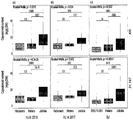
- FIG. 5 shows a box plot expressing capsaicinoid content (ug / gDW) of the skin according to genotypes analyzed by the HJ6_53 (A), HJ6_47 (B), and SJ 6_190 (C) markers for the F 2 separation group.
- FIG. 6 shows the QTL of the 'Habanero' ⁇ 'Boot Zolokia' population found on chromosome 6 and the QTL position of chromosome 11 and the SNP position used for marker development.
- Figure 7 shows the HJ16_CAP6.3_qtlseq_caps, HJ16_CAP6.4 _caps, HJ17_CAP11_caps marker polymorphism confirmation experiment.
- SJ_TCP4.1_hrm SJ_TCP6.2_hrm
- SNU SNU11-001; Jo, Butzolokia
- FIG. 12 shows fruit pictures of the stages of development of Scorpion and Habanero, ECW, used for transcriptome analysis.
- FIG. 13 shows a Venn diagram showing the distribution of differentially expressed genes in pericarp phases during fruit development.
- FIG. 14 shows heat maps expressing expression patterns in the cortex of synaptic biosynthetic pathways and some genes.
- FIG. 15 shows the positions of QTL and two candidate genes located on chromosome 6 of the 'Habanero' ⁇ 'boot Zolokia 'group and the SNU 11-001 X boot Zolokia group.
- RNA-seq results line graphs
- real-time RT-PCR results bar graphs
- FIG. 17 shows the images of 'Boot Zolokia' 34 and 45 DAP fruits used for qRT-PCR (a), and real-time RT-PCR results (bar graph) (b) conducted to investigate the expression level of the ankyrin gene. .
- FIG. 19 shows a box plot in which the average value of the percutaneous capsaicinoid content is calculated according to the genotype of Ketoacyl-ACP reductase ( KR ) and CC.CCv1.2.scaffold31.147 ( ankyrin) .
- the present invention is SNP (single nucleotide polymorphism) located at 223,429,166 of chromosome 6, SNP located at 226,585,896 of chromosome 6 and SNP located at 38,833,824 of chromosome 11; SNP located at 210,030,398th chromosome 4, SNP located at 233,547,059th chromosome 6, and SNP located at 231,953,335 chromosome 6; SNP located at No.
- SNP single nucleotide polymorphism
- a SNP marker composition for determining the degree of taste of red pepper skin comprising a polynucleotide consisting of nucleotides or a complementary polynucleotide thereof.
- the present invention is SNP (single nucleotide polymorphism) located at 223,429,166 of pepper 6 chromosome, SNP located at 226,585,896 chromosome 6 and SNP located at 38,833,824 chromosome 11; And a polynucleotide consisting of 8 or more contiguous nucleotides, including SNP located at 210,030,398 on chromosome 4, SNP located on 233,547,059 on chromosome 6, and SNP located on 231,953,335 on chromosome 6;
- SNP marker composition for determining the degree of taste of pepper rind, comprising a polynucleotide.
- the present invention is SNP located at 6193rd position of the KR (Ketoacyl-ACP reductase) gene consisting of the nucleotide sequence of SEQ ID NO: 13; And a SNP located at 1770th of the CC.CCv1.2.scaffold31.147 (ankyrin-repeat containing protein) gene consisting of the nucleotide sequence of SEQ ID NO: 14;
- a SNP marker composition for determining the degree of taste of red pepper skin comprising a polynucleotide.
- the 6193th base of the KR (Ketoacyl-ACP reductase) gene consisting of the nucleotide sequence of SEQ ID NO: 13 is Habanero genotype
- C is the scorpion genotype
- CC.CCv1.2 consisting of the nucleotide sequence of SEQ ID NO: 14 scaffold31.147 (ankyrin-repeat containing protein)
- the 1770th base of the gene is Habanero genotype if C, and the scorpion genotype, if A, the genotype of each gene coincides with the scorpion genotype. It was confirmed that the average value of the synoid content increased.
- the genotypes of two genes of an individual in a population with a scorpion or habanero it is possible to predict the skin phenomena phenotype.
- the location and sequence of the SNP can be found in C. chinense chromosome v.1.2 (http://peppergenome.snu.ac.kr) as a reference genome.
- the contiguous nucleotide may be 8 to 100 contiguous nucleotides, but is not limited thereto.
- nucleotide is a deoxyribonucleotide or ribonucleotide that exists in single- or double-stranded form and includes analogs of natural nucleotides unless specifically stated otherwise.
- SNP of the present invention is a very stable genetic marker that directly affects the determination of the degree of taste of red pepper skin.
- Determination of the degree of delicacy of pepper rind using six SNP markers of the present invention can be performed by the following method;
- the subjects to be tested in the pepper group (parents with low capillary capsaicinoid content_A: Habanero or 'SNU11-001', parents with high capillary capsaicinoid content_B: 'boot zoloski')
- Based on the combination of genotypes obtained from the marker test of the marker it is possible to predict whether it belongs to the high capsaicinoid content (B: 'Boot zoloski').
- SNP at 223,429,166 on pepper 6, SNP at 226,585,896 on pepper 6 and SNP on 38,833,824 on chromosome 11; or SNP on 210,030,398 on pepper 4, SNPs located at 233,547,059th chromosome 6 and SNPs located at 231,953,335th chromosome 6) were analyzed to investigate genotypes of populations within the population, and as a result of analysis, a combination of the three genotypes obtained from the marker test in one individual.
- the parents with low content of capillary sinusoids are Habanero or SNU11-001, and the parents with high content of peel skin capsaicinoids are butzolochia.
- the present invention also provides a marker consisting of a primer set of SEQ ID NO: 1 and 2, a marker consisting of a primer set of SEQ ID NO: 3 and 4 and a marker consisting of a primer set of SEQ ID NO: 5 and 6; Or a marker composed of primer sets of SEQ ID NOs: 7 and 8, a marker composed of primer sets of SEQ ID NOs: 9 and 10, and a marker composed of primer sets of SEQ ID NOs: 11 and 12; To provide.
- the present invention also provides a marker consisting of a primer set of SEQ ID NO: 1 and 2, a marker consisting of a primer set of SEQ ID NO: 3 and 4 and a marker consisting of a primer set of SEQ ID NO: 5 and 6; And a marker composed of a primer set of SEQ ID NOs: 7 and 8, a marker composed of a primer set of SEQ ID NOs: 9 and 10, and a marker composed of a primer set of SEQ ID NOs: 11 and 12; To provide.
- Marker is a CAPS (cleaved amplified polymorphic sequence) marker consisting of a primer set of SEQ ID NO: 1 and 2, a CAPS marker consisting of a primer set of SEQ ID NO: 3 and 4 and a primer set of SEQ ID NO: 5 and 6 CAPS marker consisting of; Or a high resolution melting (HRM) marker consisting of a primer set of SEQ ID NOs: 7 and 8, an HRM marker consisting of a primer set of SEQ ID NOs: 9 and 10, and a CAPS marker consisting of a primer set of SEQ ID NOs: 11 and 12; It may be a marker for determining the degree of beauty of the, preferably a CAPS (cleaved amplified polymorphic sequence) marker consisting of a primer set of SEQ ID NO: 1 and 2, CAPS marker consisting of a primer set of SEQ ID NO: 3 and 4 and SEQ ID NO: 5 And a CAPS marker consisting of a primer set of 6; And
- the pepper may be a pepper for synthesizing capsaicinoids in the pericarp, preferably Bhut Jolokia or Scorpion, This is not restrictive.
- High resolution melting (HRM) markers consisting of primer sets of SEQ ID NOs: 7 and 8
- HRM markers consisting of primer sets of SEQ ID NOs: 9 and 10
- CAPS markers consisting of primer sets of SEQ ID NOs.
- HRM high resolution melting
- primer refers to a single stranded oligonucleotide sequence that is complementary to the nucleic acid strand to be copied and may serve as a starting point for the synthesis of the primer extension product.
- the length and sequence of the primers should allow to start the synthesis of extension products. The specific length and sequence of the primers will depend on the primer utilization conditions such as temperature and ionic strength as well as the complexity of the DNA or RNA target required.
- Including a step of analyzing the product of the amplification step it provides a method for determining the degree of red pepper peel.
- a method for separating genomic DNA from the sample a method known in the art may be used, for example, a wizard prep kit (Promega) may be used.
- an amplification reaction may be performed using two kinds of three oligonucleotide primer sets according to one embodiment of the present invention to amplify a target sequence.
- Methods for amplifying target nucleic acids include polymerase chain reaction (PCR), ligase chain reaction, nucleic acid sequence-based amplification, transcription-based amplification systems, There are any suitable methods for amplifying via strand displacement amplification or Q ⁇ replication or for amplifying nucleic acid molecules known in the art.
- PCR is a method of amplifying a target nucleic acid from a pair of primers specifically binding to the target nucleic acid using a polymerase.
- PCR methods are well known in the art, and commercially available kits may be used.
- the analysis of the product of the amplification step may be performed through high resolution melting (HRM) analysis, sequencing or restriction enzyme cleavage, but is not limited thereto.
- HRM high resolution melting
- the determination of the degree of red pepper peel of the population can be performed as described above (see Table 14, Table 15, Figures 10 and 11).
- the present invention is the marker; And it provides a kit for determining the degree of red pepper peel including a reagent for performing an amplification reaction.
- the kit of the present invention requires restriction enzymes in addition to the primer set and reagents for carrying out the amplification reaction when the primer set comprises a CAPS marker. That is, the CAPS markers must be cleaved with the corresponding restriction enzymes after the amplification reaction to distinguish the amplification products. Restriction enzymes required in the present invention are as described above.
- the reagent may include DNA polymerase, dNTPs, buffers, and the like.
- the kit of the present invention may further include a user manual describing the conditions for performing the optimal reaction.
- HPLC HPLC was carried out according to the method of Han et al., (2013, Molecular Breeding, 31, 537-548), using HPLC on 'Habanero' ⁇ 'Boot Sologia' F 2 89 individuals and F 3 197 individuals. The content was measured. Capsaicin content was examined by HPLC in the skins of 'SNU 11-001' ⁇ 'Boot Zolokia' F 2 114 individuals and the scorpions, Habanero, and ECW for transcribtom analysis.
- DNA was extracted from main leaves in 1.5 ml tubes using a modified CTAB (cetytrimethylammonium bromide) method (Hwang et al., 2009 Molecules and cells, 27 (3), 329-336). A total of 400 ng of DNA was used to create a library for Illumina sequencing.
- CTAB cetytrimethylammonium bromide
- the PstI and EcoRI primers were designed, including the PstI and EcoRI adapters and a six-nucleotide sample ID tech, and the MseI primers were designed by adding two MesI recognition sequences and two G and T sequences. (Truong et al., 2012 PLoS ONE, 7, e37565).
- DNA cleavage and adapter ligation were performed according to the SBG 100-kit version 2.0.2 manual (KeyGene, Wageningen, The Netherlands). Identification of PCR-amplified library fragments was performed using BioAnalyzer's DNA 1000 chip (Agilent Technologies, Santa Clara, Calif., USA). In addition, the amount of library was run according to the Illumina qPCR Quantification Guidebook.
- Some of the genomes of 87 F 2 isolates were analyzed by GBS, and a number of SNP markers obtained through this were converted into bin markers by using a sliding window method.
- the sliding window method can compensate for missing SNP data by binding adjacent SNP markers of the same genotype into bins and bins recombining the recombination regions.
- a high density genetic map was prepared by converting SNP markers of 'Habanero' ⁇ 'Boot Zolochia' into bin markers.
- Carthagene program (version 1.2) was carried out with LOD (Logarithm of the odds) threshold 3.0 and distance threshold of 50 cM, and the distance between gene maps was calculated using Kosambi mapping function.
- LOD Logarithm of the odds
- the genetic map was plotted using the MapChart (version 2.2) program.
- the genetic map prepared using the GBS browser was compared with the physical map (peppergenome.snu.ac.kr).
- the epidermal neoplasm regulatory locus was searched using the composite interval mapping (CIM) function of the WinQTL carthographer (version 2.5) program.
- Primers were constructed avoiding repeating sequence sections using the pepper chromosomal sequence (Chinense.v1.2.Total.fa) based on SNPs found through GBS analysis.
- the hybridization of Habanero and Bootzolokia was performed to determine whether the regulation of the skin in the skin was done by a single gene or by multiple genes.
- Capsaicin was extracted by separating the segregation and the pericarp in order to search for the regulatory genes in the pericarp, and the content of the F 2 89 and F 3 197 individuals was measured using HPLC (FIG. 1).
- HPLC HPLC
- HJ16_DHC6.1 had the highest LOD 5.7 and HJ16_DHC6.2 the LOD 4.7.
- qHJ16_CAP6.4 was predicted to be the major quantitative locus that could explain about 27% of the phenotypic phenotype, and is therefore expected to be utilized for breeding using the HJ 6_53 marker adjacent to qHJ16_CAP6.4.
- the interactions between major quantitative loci were analyzed to determine the extent to which the quantitative loci found could explain the phenotype.
- the major quantitative loci that regulate capsaicin and total capsaicinoids are qHJ16_CAP6.3 and qHJ16_CAP6.4 on chromosome 6. The interaction between them had the dominant ⁇ dominant and additive ⁇ additive effects, which were estimated to account for 50% of the total phenotype.
- the major quantitative loci that regulate dihydrocapsaicin are qHJ16_DHC3.1 on chromosome 3 and qHJ16_DHC6.1 and qHJ16_DHC6.2 on chromosome 6, mainly with dominant ⁇ additive effects.
- QTL-seq was performed on the Habanero ⁇ Bootzolokia F 3 population using the BSA (bulked-segregant analysis) method, in addition to the traditional QTL mappin method.
- QTL-seq is a method of finding SNPs by performing full-length genome analysis by making two bulk quantitative quantum differences. Ten individuals with the highest capsaicinoid content and ten individuals with the lowest capsaicinoid content were selected and pooled into two bulks and used for full-length genome analysis.
- QTL-seq only QTL was found on chromosome 6, which overlaps with previously found QTL regions (FIG. 3).
- Quantitative trait loci were analyzed by measuring the content of three traits capsaicin, dihydrocapsaicin and total capsaicinoid (Table 10).
- qSJ_TCP4.1 was located at SJ 4_83 bin marker and the LOD value was 5.2.
- qSJ_TCP6.1 was located in the SJ 6_183 bin marker, and the LOD value was measured as 5.3.
- qSJ_TCP6.2 was located in the SJ 6_190 bin marker, and the LOD value was measured as 6.8.
- qSJ_CAP4.1 was measured at LOD 4.7 and qSJ_CAP6.1 at LOD 5.8.
- Shinmi phenotype could account for about 49% and therefore for three QTLs qSJ_TCP4.1, qSJ_TCP6.1, and qSJ_TCP6.2. It is expected that the markers can be used to breed high-yield crops.
- markers were developed for three quantitative loci (qHJ16_CAP6.3, qHJ16_CAP6.4, qHJ17_CAP11), which were predicted to account for about 50% of the total capsaicinoid content.
- SNPs located at 223.4 Mb and 226.5 Mb at chromosome 6 were converted to two CAPS markers (HJ16_CAP6.3_qtlseq_caps, HJ16_CAP6.4_caps).
- SNPs located on chromosome 11 38.8 Mb were converted to CAPS markers (HJ17_CAP11_caps) to develop markers associated with qHJ17_CAP11 found on chromosome 1 (FIGS. 6 and 7).
- Marker assays were performed on ⁇ Habanero '' x ⁇ Boot Zolokia '' F 3 149 individuals. F 3 individuals were classified according to genotyping results of each marker, and then capsaicinoid contents were averaged. When examined as heterotypes, the additives and dominant effects of the QTL in which the markers were located were converted to the 'habanero' or 'boot zolochia' genotypes.
- Marker assays were performed on SNU11-001 ⁇ Boot Zolochia F 2 126 individuals. F 2 individuals were classified according to genotyping results of each marker, and then capsaicinoid contents were averaged. When examined as heterotype, the additive and dominant effects of the QTL in which the marker is located were converted to the 'SNU11-001' or 'Boot Zolokia' genotypes.
- the capsaicinoid content tends to increase (FIG. 11).
- the average value of the capsaicinoid content of the individuals irradiated with the 'SNU11-001' type was 3,103 ug / gDW
- the average value of the capsaicinoid content of the individuals irradiated with the 'Boot Zolokia' type was 11,034 ug / gDW.
- the t-test result showed a significant difference (Table 15).
- candidate genes were searched through transcriptome analysis comparing gene expression of resources that synthesize capsaicin with those that do not synthesize in the skin.
- the transcriptome analysis compared gene expression in the scorpion skin, which is extremely spicy pepper, the 'habanero' skin, which is generally spicy, and the early calwonder (ECW), which is not spicy, without additional population growth.
- the fruit of each individual was harvested at 18 DAP (days after pollination), 34 DAP, 45 DAP to compare the gene expression pattern according to the development stage of the fruit (FIG. 12).
- Three fruits of each developmental stage and individual were studied and pooled, and RNA was extracted by making one repeat.
- RNA-seq After comparing the expression levels through RNA-seq, the sequencing results were confirmed again through real time PCR (qRT-PCR). In addition, SNPs were searched based on RNA-seq results to determine whether there was a sequence difference between 'scorpion' and 'habanero'. Finally, the empty markers located closest to the candidate genes were selected from the Habanero ⁇ Boot Zolochia F3 and SNU11-001 ⁇ Boot Zolokia F2 populations, and then caps on the pericarp according to the genotype of the marker. The average value of the cysinoid content was calculated to determine the effect of predicting the epidermal sinus phenotype through candidate genes.
- RNA sequences of each pepper variety were compared according to fruit development stages, and the differential expression genes found were expressed by Venn diagram.
- a heat map was prepared for the differentially expressed genes showing significant differences.
- the heat map is a two-dimensional graph representing the difference data by changing the color.
- the hierarchical cluster analysis can be used to easily identify the pattern of differentially expressed genes.
- Differential expression genes between Scorpion, 'Habanero', and ECW were searched and the results are shown in a Venn diagram (FIG. 13). It's also commonly known as spicy peppers like Habanero Transcriptome analysis of C. chinense PI159236 was used to select candidate genes (Kim et al., 2017 Genome Biol. 18, 210).
- capsaicinoid biosynthesis pathway genes were selected and compared. These include Pun1 at the end of the biosynthetic pathway and PAL (phenylalanine ammonia-lyase), C4H (cinnamatc 4-hydroxylase), 4CL (4-Coumarate: Coenzyme A Ligase), HCT (hydroxycinnamoyl transferase) and C3H ( coumarate3-hydroxylase), COMT (caffeoyl-CoA 3-O-methyltransferase), pAMT (putative aminotransferase) and Acl (acyl carrier protein), Fat (thioesterase) and Kas (3-keto-acyl-ACP synthase), BCAT (branched) -chain amino acid transferase) and ACS (acyl-CoA Synthetase) were used.
- Pun1 , BCAT, 4CL, and KAS showed higher expression levels in 'Scorpion' skin compared to 'Habanero' skin (Fig. 14). This expression pattern is similar to that found in spicy foci (Aza-Gonzalez et al., 2011 Plant Cell Rep . 30, 695-706).
- KR Keratin-ACP reductase
- CC.CCv1.2.scaffold31.147 Two genes, KR (Ketoacyl-ACP reductase) and CC.CCv1.2.scaffold31.147, were selected as candidate genes (FIG. 15).
- KR is a gene known to be involved in fatty acid elongation in the fatty acid synthesis pathway of the capsaicinoid biosynthetic pathway.
- CC.CCv1.2.scaffold31.147 is a gene encoding ankyrin repeat containing protein (hereinafter referred to as ankyrin), and ankyrin has been found to contain domains such as C2H2-type zinc fingers, bZIP, bHLH, etc., which act as transcription factors. There is a bar.
- RNA-seq results To verify the reliability of RNA-seq results, real time qRT-PCR was performed on nine candidate genes and nine randomly selected differentially expressed genes. The amount of expression obtained through RNA-seq is shown by a line graph of RPKM, and the amount of expression measured by qRT-PCR is shown by a bar graph (FIG. 16).
- the ankyrin gene showed a decrease in expression in scorpion compared to habanero.
- the expression level of ankyrin was lower than that of the pericarp in the placenta of 'PI159236'.
- KR and CC.CCv1.2.scaffold31.147 ( ankyrin ) 'Habanero' ⁇ 'Bootsolokia' F3 and 'SNU11-001' were used to search for quantitative trait loci to correlate the epidermal aesthetic phenotype of two candidate genes
- the percutaneous capsaicinoid content of the 'Boot Zolokia' F2 population was utilized. Analysis of empty markers close to the KR gene showed that the average genotype capsaicinoid content of individuals with genotype 'Scorpion' was significantly higher than the average value of skin capsaicinoid content of individuals with genotype such as 'Habanero'. (FIG. 19). When the empty markers close to the Ankyrin gene were used, it was confirmed that the average value of the skin capsaicinoid content of the individuals with the scorpion genotype was high.
- GBS is an efficient way to quickly generate genetic maps by exploring large numbers of markers using NGS technology.
- gene mapping using GBS-based SNPs may lead to incorrect genotypes due to NGS errors at certain locations within the chromosome.
- a sliding-window approach has been devised. Through this, high-density genetic maps were prepared and the epidermal synth-regulatory loci were searched based on the histological phenotypic investigation using HPLC.
- QSJ_TCP4.1, qSJ_TCP6.1, and qSJ_TCP6.2 found in the 'SNU11-001' ⁇ 'Boot Zolochia' population were predicted to account for 22%, 4.6%, and 5.4% phenotypes, respectively. Considering the interaction between them, 49% could be explained.
- qSJ_TCP4.1, qSJ_TCP6.1 and qSJ_TCP6.2 were converted to HRM, CAPS and HRM, respectively.
- the average value of the skin capsaicinoid content tends to increase as the genotype of the marker is 'boot zolochia' type. Therefore, genotyping through three marker tests in each population is expected to predict the epidermal neoplasm phenotype.
Landscapes
- Chemical & Material Sciences (AREA)
- Life Sciences & Earth Sciences (AREA)
- Analytical Chemistry (AREA)
- Engineering & Computer Science (AREA)
- Organic Chemistry (AREA)
- Proteomics, Peptides & Aminoacids (AREA)
- Health & Medical Sciences (AREA)
- Biotechnology (AREA)
- Zoology (AREA)
- Wood Science & Technology (AREA)
- Immunology (AREA)
- Mycology (AREA)
- Microbiology (AREA)
- Molecular Biology (AREA)
- Botany (AREA)
- Biophysics (AREA)
- Physics & Mathematics (AREA)
- Biochemistry (AREA)
- Bioinformatics & Cheminformatics (AREA)
- General Engineering & Computer Science (AREA)
- General Health & Medical Sciences (AREA)
- Genetics & Genomics (AREA)
- Measuring Or Testing Involving Enzymes Or Micro-Organisms (AREA)
Abstract
본 발명은 고추 과피의 신미 정도를 판별하기 위한 마커에 관한 것으로, 본 발명의 고추 과피의 신미 정도를 판별하기 위한 분자마커를 이용하면, 종간 교배에 따른 어려움과 태좌 부피의 한계 때문에 캡사이신 고함유 품종을 육종하는데 한계를 극복하는데 정보를 제공할 수 있어, 항암작용 및 다이어트 효과로 인해 주목받고 있는 캡사이신 고함량의 신규 고추 품종 육종 분야에 유용하게 사용될 수 있을 것이다.
Description
본 발명은 고추 과피의 신미 정도를 판별하기 위한 마커에 관한 것이다.
캡사이신(capsaicin)은 고추의 매운 맛을 결정하는 성분으로 바닐릴아민(vanillylamine)과 지방산의 축합에 의해 합성되는 알칼로이드(alkaloid) 물질이다. 고추 과실 중 태좌 조직에서 캡사이신 생합성 효소(CS)에 의해 캡사이신(capsaicin)과 다이하이드로캡사이신(dihydrocapsaicin)과 같은 캡사이시노이드(capsaicinoids)가 합성되며, Pun1 유전자가 캡사이신 생합성 효소를 암호화하는 것으로 알려져 있다. 단일 우성 유전자인 Pun1은 무신미 유전자(pun1)에 대해 우성이며 신미 유무를 질적으로 결정하는 유일한 유전자로 동형열성 Pun1을 가진 개체는 무신미 특성을 나타낸다. 무신미 유전자는 1.8 kb의 프로모터 부위와 0.7kb의 첫번째 엑손(exon) 부위에 결실이 있다.
한편, 세계에서 가장 매운 고추로 알려진 Bhut Jolokia 및 Trinidad Moruga Scorpion은 백만 스코빌 유닛(SHU; Scovile heat units) 이상으로 청양고추의 약 100배의 매운 맛을 지닌다. 최근 연구에서는 이렇게 극도로 매운 고추는 다른 고추들이 태좌에서만 캡사이신을 합성하는 것과는 달리 태좌와 과실의 안쪽 벽인 과피에서도 캡사이신을 합성하는 것으로 밝혀졌다. 또한 캡사이시노이드 생합성에 관여하는 여러 유전자의 발현이 증가함으로써 전체적인 캡사이시노이드 함량을 향상시킬 수 있음을 밝혔다. 극도로 매운 고추인 스콜피온에서는 캡사이시노이드 합성에 중요한 유전자인 Pun1과 pAMT가 다른 품종에 비해 많이 발현되는 것을 확인하였다. 또한 과실의 전체 무게와 태좌, 과피의 무게를 계산하여 과피에서의 캡사이시노이드 합성이 전체적인 캡사이시노이드 함량을 크게 증가시킨다는 것을 보였다.
캡사이신은 항암작용 및 다이어트 효과로 인해 주목받고 있어 고추 품종 육성에서 주요 목표 형질이다. 그러나 종간 교배에 따른 어려움과 태좌 부피의 한계 때문에 캡사이신 고함유 품종을 육종하는데 한계를 지닌다. 그러나 과피에서 캡사이신을 합성하는 유전자를 동정한다면 과실 부피의 대부분을 차지하는 과피에 캡사이신 합성 유전자좌를 도입함으로써 기존보다 훨씬 매운 고추를 육종하는데 활용할 수 있다.
한편, 한국공개특허 제2009-0091629호에서는 '매운 맛을 내는 고추를 생산하는 고추 식물을 분별하기 위한 마커, 그를 포함하는 키트, 및 매운 맛을 내는 고추를 생산하는 고추 식물을 분별하는 방법'이 개시되어 있고, 한국등록특허 제1573419에는 '캡시노이드 고 함유 고추 품종의 구별을 위한 프라이머 세트 및 이의 용도'가 개시되어 있으나, 본 발명에서와 같이, '고추 과피의 신미 정도를 판별하기 위한 마커 및 이의 용도'에 대해서는 밝혀진 바가 전혀 없다.
본 발명은 상기와 같은 요구에 의해 도출된 것으로서, 본 발명에서는 과피에서 신미 표현형이 분리되는 '하바네로'×'부트 졸로키아' 및 'SNU11-001'×'부트 졸로키아'인 2개의 분리집단을 구축한 후 유전자지도를 작성하여 과피에서의 캡사이시노이드 합성 조절 유전자좌를 탐색하였다. 과피에서 매운 고추 품종 '부트 졸로키아'를 과피가 맵지 않은 품종 '하바네로' 및 'SNU11-001'과 각각 교배하여 두 개의 연구집단을 만들었으며, GBS(Genotyping-by-Sequencing) 방법을 이용하여 유전자지도를 작성하였다. 양적형질 유전자좌 분석을 실시한 결과, 공통적으로 염색체 6번에서 양적형질 유전자좌가 발견되었다. '하바네로'×'부트 졸로키아' 집단에서는 염색체 11번에서, 'SNU11-001'×'부트 졸로키아' 집단에서는 염색체 4번에서 양적형질 유전자가 추가로 발견되었으며, 이 유전자좌를 대상으로 3개로 이루어진 분자마커 2 세트를 개발하여 유전형과 표현형을 비교하여 표현형 예측 가능성을 확인하였고, 또한 KR (Ketoacyl-ACP reductase) 유전자의 6193번째에 위치한 SNP; 및 CC.CCv1.2.scaffold31.147 (ankyrin-repeat containing protein) 유전자의 1770번째에 위치한 SNP를 개발하여 유전형과 표현형을 비교하여 표현형 예측 가능성을 확인함으로써, 본 발명을 완성하였다.
상기 과제를 해결하기 위해, 본 발명은 고추 6번 염색체의 223,429,166번째에 위치한 SNP(single nucleotide polymorphism), 고추 6번 염색체의 226,585,896번째에 위치한 SNP 및 고추 11번 염색체의 38,833,824번째에 위치한 SNP; 고추 4번 염색체의 210,030,398번째에 위치한 SNP, 고추 6번 염색체의 233,547,059번째에 위치한 SNP 및 고추 6번 염색체의 231,953,335번째에 위치한 SNP; 서열번호 13의 염기서열로 이루어진 KR (Ketoacyl-ACP reductase) 유전자의 6193번째에 위치한 SNP; 및 서열번호 14의 염기서열로 이루어진 CC.CCv1.2.scaffold31.147 (ankyrin-repeat containing protein) 유전자의 1770번째에 위치한 SNP;로 이루어진 군으로부터 선택된 어느 하나 이상의 SNP를 포함하는 8개 이상의 연속된 뉴클레오티드로 구성된 폴리뉴클레오티드 또는 이의 상보적인 폴리뉴클레오티드를 포함하는, 고추 과피의 신미 정도를 판별하기 위한 SNP 마커 조성물을 제공한다.
또한, 본 발명은 서열번호 1 및 2의 프라이머 세트로 구성된 마커, 서열번호 3 및 4의 프라이머 세트로 구성된 마커 및 서열번호 5 및 6의 프라이머 세트로 구성된 마커; 또는 서열번호 7 및 8의 프라이머 세트로 구성된 마커, 서열번호 9 및 10의 프라이머 세트로 구성된 마커 및 서열번호 11 및 12의 프라이머 세트로 구성된 마커;를 포함하는 고추 과피의 신미 정도를 판별하기 위한 마커를 제공한다.
또한, 본 발명은 고추 시료에서 게놈 DNA를 분리하는 단계;
상기 분리된 게놈 DNA를 주형으로 하고, 상기 마커를 이용하여 증폭 반응을 수행하여 표적 서열을 증폭하는 단계; 및
상기 증폭 단계의 산물을 분석하는 단계를 포함하는, 고추 과피의 신미 정도를 판별하는 방법을 제공한다.
또한, 본 발명은 상기 마커; 및 증폭 반응을 수행하기 위한 시약을 포함하는, 고추 과피의 신미 정도를 판별하기 위한 키트를 제공한다.
본 발명의 고추 과피의 신미 정도를 판별하기 위한 분자마커를 이용하면, 종간 교배에 따른 어려움과 태좌 부피의 한계 때문에 캡사이신 고함유 품종을 육종하는데 한계를 극복하는데 정보를 제공할 수 있어, 항암작용 및 다이어트 효과로 인해 주목받고 있는 캡사이신 고함량의 신규 고추 품종 육종 분야에 유용하게 사용될 수 있을 것이다.
도 1은 '하바네로'×'부트 졸로키아' F2:3 분리집단에서의 과피 신미 표현형 조사 결과를 나타낸다.
도 2는 '하바네로'×'부트 졸로키아'의 유전자지도를 나타낸다.
도 3은 2016년 재배된 '하바네로'×'부트 졸로키아' F3 집단에서 실시된 QTL-seq 결과를 나타낸 SNP-index plot을 나타낸다.
도 4는 'SNU11-001'×'부트 졸로키아'의 유전자지도를 나타낸다.
도 5는 HJ6_53 (A)와 HJ6_47 (B), SJ 6_190 (C) 마커로 분석한 유전형에 따른 과피의 캡사이시노이드 함량(ug/gDW)을 F2 분리집단에 대하여 표현한 box plot를 나타낸다.
도 6은 6번 염색체에서 발견된 '하바네로'×'부트 졸로키아' 집단의 QTL과 11번 염색체의 QTL 위치 및 마커 개발에 사용한 SNP 위치를 나타낸다.
도 7은 HJ16_CAP6.3_qtlseq_caps, HJ16_CAP6.4 _caps, HJ17_CAP11_caps 마커 다형성 확인 실험을 나타낸다. Haba, 하바네로; Jo, 부트 졸로키아
도 8은 4번 염색체에서 발견된 'SNU 11-001' X '부트 졸로키아' 집단의 QTL과 6번 염색체의 QTL 위치 및 마커 개발에 사용한 SNP 위치를 나타낸다.
도 9는 SJ_TCP4.1_hrm, SJ_TCP6.2_hrm, SJ_TCP6.1_caps 마커 다형성 확인 실험을 나타낸다. SNU, SNU11-001; Jo, 부트 졸로키아
도 10은 마커 검정 결과가 같은 개체들의 캡사이시노이드 함량 평균을 나타낸다. A, '하바네로'; B, '부트 졸로키아'
도 11은 마커 검정 결과가 같은 개체들의 캡사이시노이드 함량 평균을 나타낸다. A, 'SNU11-001'; B, '부트 졸로키아'
도 12는 트랜스크립톰 분석에 사용된 스콜피온과 하바네로, ECW의 발달 단계별 과실 사진을 나타낸다.
도 13은 과실의 발달 단계별 과피에서의 차등 발현 유전자 분포를 나타내는 벤 다이어그램을 나타낸다.
도 14는 신미 생합성 경로와 일부 유전자의 과피에서 발현양상을 표현하는 히트 맵을 나타낸다.
도 15는 '하바네로'Х'부트 졸로키아' 집단과 'SNU 11-001' X '부트 졸로키아' 집단의 6번 염색체에 위치하는 QTL과 두 후보 유전자의 위치를 나타낸다.
도 16은 트랜스크립톰 분석 결과 '하바네로'와 '스콜피온'의 발현이 달라지는 유전자에 대한 RNA-seq 결과(꺾은선 그래프)와 real-time RT-PCR 결과(막대 그래프)를 나타낸다.
도 17은 qRT-PCR에 사용한 '부트 졸로키아' 34와 45 DAP 과실 사진을 나타내며(a), ankyrin 유전자의 발현량 조사를 위해 실시한 real-time RT-PCR 결과(막대 그래프)(b)를 나타낸다.
도 18은 ankyrin 유전자의 예상되는 4차 구조를 시뮬레이션한 모델을 나타낸다.
도 19는 KR(Ketoacyl-ACP reductase)과 CC.CCv1.2.scaffold31.147 (ankyrin) 의 유전형에 따라 과피 캡사이시노이드 함량 평균값을 계산한 박스 플랏(box plot)을 나타낸다.
본 발명의 목적을 달성하기 위하여, 본 발명은 고추 6번 염색체의 223,429,166번째에 위치한 SNP(single nucleotide polymorphism), 고추 6번 염색체의 226,585,896번째에 위치한 SNP 및 고추 11번 염색체의 38,833,824번째에 위치한 SNP; 고추 4번 염색체의 210,030,398번째에 위치한 SNP, 고추 6번 염색체의 233,547,059번째에 위치한 SNP 및 고추 6번 염색체의 231,953,335번째에 위치한 SNP; 서열번호 13의 염기서열로 이루어진 KR (Ketoacyl-ACP reductase) 유전자의 6193번째에 위치한 SNP; 및 서열번호 14의 염기서열로 이루어진 CC.CCv1.2.scaffold31.147 (ankyrin-repeat containing protein) 유전자의 1770번째에 위치한 SNP;로 이루어진 군으로부터 선택된 어느 하나 이상의 SNP를 포함하는 8개 이상의 연속된 뉴클레오티드로 구성된 폴리뉴클레오티드 또는 이의 상보적인 폴리뉴클레오티드를 포함하는, 고추 과피의 신미 정도를 판별하기 위한 SNP 마커 조성물을 제공한다.
또한, 본 발명은 고추 6번 염색체의 223,429,166번째에 위치한 SNP(single nucleotide polymorphism), 고추 6번 염색체의 226,585,896번째에 위치한 SNP 및 고추 11번 염색체의 38,833,824번째에 위치한 SNP; 및 고추 4번 염색체의 210,030,398번째에 위치한 SNP, 고추 6번 염색체의 233,547,059번째에 위치한 SNP 및 고추 6번 염색체의 231,953,335번째에 위치한 SNP;를 포함하는 8개 이상의 연속된 뉴클레오티드로 구성된 폴리뉴클레오티드 또는 이의 상보적인 폴리뉴클레오티드를 포함하는, 고추 과피의 신미 정도를 판별하기 위한 SNP 마커 조성물을 제공한다.
또한, 본 발명은 서열번호 13의 염기서열로 이루어진 KR (Ketoacyl-ACP reductase) 유전자의 6193번째에 위치한 SNP; 및 서열번호 14의 염기서열로 이루어진 CC.CCv1.2.scaffold31.147 (ankyrin-repeat containing protein) 유전자의 1770번째에 위치한 SNP;를 포함하는 8개 이상의 연속된 뉴클레오티드로 구성된 폴리뉴클레오티드 또는 이의 상보적인 폴리뉴클레오티드를 포함하는, 고추 과피의 신미 정도를 판별하기 위한 SNP 마커 조성물을 제공한다.
상기 서열번호 13의 염기서열로 이루어진 KR (Ketoacyl-ACP reductase) 유전자의 6193번째 염기가 A이면 하바네로 유전형을 나타내고, C이면 스콜피온 유전형을 나타내며, 상기 서열번호 14의 염기서열로 이루어진 CC.CCv1.2.scaffold31.147 (ankyrin-repeat containing protein) 유전자의 1770번째 염기가 C이면 하바네로 유전형을 나타내고, A이면 스콜피온 유전형을 나타내어, 각 유전자의 유전형이 '스콜피온'의 유전형과 일치할 때, 과피에서 캡사이시노이드 함량 평균값이 증가하는 경향을 확인할 수 있었다. 따라서 집단의 개체의 두 유전자의 유전형을 '스콜피온' 혹은 '하바네로'와 비교함으로써 과피 신미 표현형을 예측할 수 있다.
상기 SNP의 위치 및 서열은 레퍼런스 게놈(reference genome)으로 고추(C. chinense) 크로모좀 v.1.2 (http://peppergenome.snu.ac.kr)에서 확인할 수 있다.
본 발명의 일 구현 예에 있어서, 상기 연속된 뉴클레오티드는 8 내지 100개의 연속된 뉴클레오티드일 수 있으나, 이에 제한되지 않는다.
본 발명에서 용어, "뉴클레오티드"는 단일 가닥 또는 이중 가닥 형태로 존재하는 디옥시리보뉴클레오티드 또는 리보뉴클레오티드이며, 특별하게 다르게 언급되어 있지 않은 한 자연의 뉴클레오티드의 유사체를 포함한다.
본 발명의 SNP는 고추 과피의 신미 정도의 판별에 직접적인 영향을 미치는 매우 안정적인 유전자 마커이다.
본 발명의 6개의 SNP 마커를 이용한 고추 과피의 신미 정도의 판별은 다음과 같은 방법으로 수행할 수 있다; 고추 집단에서 검정 대상이 되는 개체(과피 캡사이시노이드 함량이 낮은 부모_A : 하바네로 또는 'SNU11-001', 과피 캡사이시노이드 함량이 높은 부모_B : '부트 졸로스키')는 본 발명의 마커 검정 결과 얻는 유전형의 조합을 바탕으로 캡사이시노이드 함량이 높은 편(B : '부트 졸로스키')에 속하는지 예측이 가능하다. 세 개의 마커(고추 6번 염색체의 223,429,166번째에 위치한 SNP, 고추 6번 염색체의 226,585,896 번째에 위치한 SNP 및 고추 11번 염색체의 38,833,824번째에 위치한 SNP; 또는 고추 4번 염색체의 210,030,398번째에 위치한 SNP, 고추 6번 염색체의 233,547,059번째에 위치한 SNP 및 고추 6번 염색체의 231,953,335번째에 위치한 SNP)를 분석하여 집단 내 개체들의 유전형을 조사한 후, 분석 결과 하나의 개체에서 마커 검정 결과 얻어지는 세 개의 유전형의 조합 중, 캡사이시노이드 함량이 높은 품종의 유전형이 많이 나올수록 해당 개체의 과피 캡사이시노이드 함량값은 높은 군에 속하는 것으로 판단할 수 있다. 참고로, 과피 캡사이시노이드 함량이 낮은 부모는 하바네로 또는 SNU11-001이며, 과피 캡사이시노이드 함량이 높은 부모는 부트 졸로키아이다.
집단 전체 개체들을 대상으로 세 개의 마커로 검정하여 모두 AAA 타입이 나온 개체들을 분류하고, 그들의 과피 캡사이시노이드 함량의 평균을 구할 수 있다. 마찬가지로 AAB, ABA, BBB 등 타입으로 조사된 개체들의 함량 평균을 구한 후 그래프로 가시화시키고, 세 개의 유전형에서 B 타입이 많아질수록 대체적으로 과피 캡사이시노이드 함량값이 높아지는 경향성을 확인할 수 있다(표 14, 표 15, 도 10 및 도 11 참고).
또한, 본 발명은 서열번호 1 및 2의 프라이머 세트로 구성된 마커, 서열번호 3 및 4의 프라이머 세트로 구성된 마커 및 서열번호 5 및 6의 프라이머 세트로 구성된 마커; 또는 서열번호 7 및 8의 프라이머 세트로 구성된 마커, 서열번호 9 및 10의 프라이머 세트로 구성된 마커 및 서열번호 11 및 12의 프라이머 세트로 구성된 마커;를 포함하는 고추 과피의 신미 정도를 판별하기 위한 마커를 제공한다.
또한, 본 발명은 서열번호 1 및 2의 프라이머 세트로 구성된 마커, 서열번호 3 및 4의 프라이머 세트로 구성된 마커 및 서열번호 5 및 6의 프라이머 세트로 구성된 마커; 및 서열번호 7 및 8의 프라이머 세트로 구성된 마커, 서열번호 9 및 10의 프라이머 세트로 구성된 마커 및 서열번호 11 및 12의 프라이머 세트로 구성된 마커;를 포함하는 고추 과피의 신미 정도를 판별하기 위한 마커를 제공한다.
본 발명의 일 구현 예에 따른 마커는 서열번호 1 및 2의 프라이머 세트로 구성된 CAPS(cleaved amplified polymorphic sequence) 마커, 서열번호 3 및 4의 프라이머 세트로 구성된 CAPS 마커 및 서열번호 5 및 6의 프라이머 세트로 구성된 CAPS 마커; 또는 서열번호 7 및 8의 프라이머 세트로 구성된 HRM(high resolution melting) 마커, 서열번호 9 및 10의 프라이머 세트로 구성된 HRM 마커 및 서열번호 11 및 12의 프라이머 세트로 구성된 CAPS 마커;를 포함하는 고추 과피의 신미 정도를 판별하기 위한 마커일 수 있고, 바람직하게는 서열번호 1 및 2의 프라이머 세트로 구성된 CAPS(cleaved amplified polymorphic sequence) 마커, 서열번호 3 및 4의 프라이머 세트로 구성된 CAPS 마커 및 서열번호 5 및 6의 프라이머 세트로 구성된 CAPS 마커; 및 서열번호 7 및 8의 프라이머 세트로 구성된 HRM(high resolution melting) 마커, 서열번호 9 및 10의 프라이머 세트로 구성된 HRM 마커 및 서열번호 11 및 12의 프라이머 세트로 구성된 CAPS 마커;를 포함하는 고추 과피의 신미 정도를 판별하기 위한 마커일 수 있으나, 이에 제한되지 않는다.
본 발명의 일 구현 예에 따른 마커에서, 상기 고추는 과피에서 캡사이시노이드(capsaicinoids)를 합성하는 고추일 수 있으며, 바람직하게는 부트 졸로키아(Bhut Jolokia) 또는 스콜피온(Scorpion)일 수 있으나, 이에 제한되지 않는다.
본 발명의 서열번호 1 및 2의 프라이머 세트로 구성된 CAPS(cleaved amplified polymorphic sequence) 마커, 서열번호 3 및 4의 프라이머 세트로 구성된 CAPS 마커 및 서열번호 5 및 6의 프라이머 세트로 구성된 CAPS 마커는 '하바네로'×'부트 졸로키아' 집단에서 개발된 3개의 CAPS 마커를 증폭할 수 있는 프라이머 세트로, 상기 프라이머 세트로 증폭된 산물은 표 11에 기재한 바와 같이, RsaI, RsaI 및 TaqI인 제한효소 절단에 의해 분석이 가능하며,
본 발명의 서열번호 7 및 8의 프라이머 세트로 구성된 HRM(high resolution melting) 마커, 서열번호 9 및 10의 프라이머 세트로 구성된 HRM 마커 및 서열번호 11 및 12의 프라이머 세트로 구성된 CAPS 마커는 'SNU11-001'×'부트 졸로키아' 집단에서 개발된 2개의 HRM 마커와 1개의 CAPS 마커를 증폭할 수 있는 프라이머 세트로, 상기 프라이머 세트로 증폭된 산물 중 2개의 HRM 마커는 HRM (high resolution melting) 방법으로 분석하고, 1개 CAPS 마커는 표 12에 기재한 바와 같이, Sau96I인 제한효소 절단에 의해 분석이 가능하다.
본 발명에 있어서, "프라이머"는 카피하려는 핵산 가닥에 상보적인 단일 가닥 올리고뉴클레오티드 서열을 말하며, 프라이머 연장 산물의 합성을 위한 개시점으로서 작용할 수 있다. 상기 프라이머의 길이 및 서열은 연장 산물의 합성을 시작하도록 허용해야 한다. 프라이머의 구체적인 길이 및 서열은 요구되는 DNA 또는 RNA 표적의 복합도(complexity)뿐만 아니라 온도 및 이온 강도와 같은 프라이머 이용 조건에 의존할 것이다.
또한, 본 발명은
고추 시료에서 게놈 DNA를 분리하는 단계;
상기 분리된 게놈 DNA를 주형으로 하고, 상기 마커를 이용하여 증폭 반응을 수행하여 표적 서열을 증폭하는 단계; 및
상기 증폭 단계의 산물을 분석하는 단계를 포함하는, 고추 과피의 신미 정도를 판별하는 방법을 제공한다.
상기 시료에서 게놈 DNA를 분리하는 방법은 당업계에 공지된 방법을 이용할 수 있으며, 예를 들면, wizard prep 키트(Promega 사)를 이용할 수 있다. 상기 분리된 게놈 DNA를 주형으로 하고, 본 발명의 일 실시예에 따른 3개의 올리고뉴클레오티드 프라이머 세트로 이루어진 2종을 각각 이용하여 증폭 반응을 수행하여 표적 서열을 증폭할 수 있다. 표적 핵산을 증폭하는 방법은 중합효소연쇄반응(PCR), 리가아제 연쇄반응(ligase chain reaction), 핵산 서열 기재 증폭(nucleic acid sequence-based amplification), 전사 기재 증폭시스템(transcription-based amplification system), 가닥 치환 증폭(strand displacement amplification) 또는 Qβ 복제효소(replicase)를 통한 증폭 또는 당업계에 알려진 핵산 분자를 증폭하기 위한 임의의 기타 적당한 방법이 있다. 이 중에서, PCR이란 중합효소를 이용하여 표적 핵산에 특이적으로 결합하는 프라이머 쌍으로부터 표적 핵산을 증폭하는 방법이다. 이러한 PCR 방법은 당업계에 잘 알려져 있으며, 상업적으로 이용가능한 키트를 이용할 수도 있다.
본 발명의 일 구현 예에 따른 방법에서, 상기 증폭 단계의 산물의 분석은 HRM (high resolution melting) 분석, 염기서열 결정(sequencing) 또는 제한 효소 절단을 통해 수행되는 것일 수 있으나, 이에 제한되지 않는다. 또한, 증폭 단계의 산물을 통해 해당 집단의 고추 과피의 신미 정도의 판별은 상기한 바와 같이 수행할 수 있다(표 14, 표 15, 도 10 및 도 11 참고).
또한, 본 발명은 상기 마커; 및 증폭 반응을 수행하기 위한 시약을 포함하는, 고추 과피의 신미 정도를 판별하기 위한 키트를 제공한다.
본 발명의 키트는 프라이머 세트가 CAPS 마커를 포함하는 경우에는 프라이머 세트 및 증폭 반응을 수행하기 위한 시약 외에 제한효소를 필요로 한다. 즉, CAPS 마커는 증폭 반응을 수행한 후에, 해당하는 제한효소로 절단해야 증폭 산물을 구별할 수 있기 때문이다. 본 발명에서 필요한 제한효소는 상기한 바와 같다.
본 발명의 키트에서, 상기 시약은 DNA 폴리머라제, dNTPs, 버퍼 등을 포함할 수 있다. 또한, 본 발명의 키트는 최적의 반응 수행 조건을 기재한 사용자 설명서를 추가로 포함할 수 있다.
이하, 본 발명을 실시예에 의해 상세히 설명한다. 단, 하기 실시예는 본 발명을 예시하는 것일 뿐, 본 발명의 내용이 하기 실시예에 한정되는 것은 아니다.
재료 및 방법
식물 재료
과피에서 신미를 조절하는 유전자를 동정하기 위하여 태좌에서만 매운맛을 내는 '하바네로' 고추(Capsicum chinense 'Habanero')와 태좌 및 과피에서 모두 매운맛을 내는 '부트 졸로키아' 고추(C. chinense 'Bhut Jolokia')를 활용하였다. 분리집단에서의 신미 검정을 통해 과피에서의 신미 조절 유전자좌를 탐색하고자 '하바네로'와 '부트 졸로키아'를 교배한 F2:3 집단을 구축하였다. 또한, 맵지 않은 고추 'SNU11-001'(Capsicum chinense 'SNU11-001')를 '부트 졸로키아'와 교배한 F2 분리집단을 활용하여 신미 조절 유전자좌를 검증하고자 하였다. 과피 신미 조절과 관련된 유전자를 탐색하기 위한 트랜스크립톰 분석에는 태좌에서만 매운맛을 내는 '하바네로' 고추와, 태좌 및 과피에서 모두 매운맛을 내는 '스콜피온' 고추(C. chinense 'Scorpion'), 맵지 않은 고추 'ECW'(C. annuum 'ECW')를 활용하였다.
HPLC(High performance liquid chromatography)를 이용한 과피에서의 신미 표현형 조사
과피에서의 신미 조절 유전자를 탐색하기 위해 태좌와 과피를 분리하여 과피에서의 캡사이신 함량을 측정하였다. HPLC는 Han et al., (2013, Molecular Breeding, 31, 537-548)의 방법을 따라 진행했으며, '하바네로'×'부트 졸로키아' F2 89 개체와 F3 197 개체를 대상으로 HPLC를 이용해 함량을 측정하였다. 'SNU 11-001'×'부트 졸로키아' F2 114 개체와 트랜스크립톰 분석을 위한 '스콜피온', '하바네로', 'ECW'의 과피에서 HPLC를 통해 캡사이신 함량을 조사하였다.
GBS(Genotyping-by-sequencing) 라이브러리 구축
변형된 CTAB(cetytrimethylammonium bromide) 방법을 사용하여 1.5ml 튜브에 본엽으로부터 DNA를 추출하였다(Hwang et al., 2009 Molecules and cells, 27(3), 329-336). 총 400ng의 DNA가 Illumina 시퀀싱을 위한 라이브러리를 만드는 데 사용되었다. 멀티플렉스 시퀀싱을 위해서 PstI 및 EcoRI 어댑터와 여섯 개의 염기서열로 구성된 샘플 ID 테크를 포함하여 PstI 및 EcoRI 프라이머를 디자인하였고, MesI 인식 서열과 G, T인 두 개의 염기서열을 추가하여 MseI 프라이머를 디자인하였다(Truong et al., 2012 PLoS ONE, 7, e37565). DNA의 절단과 어댑터 연결은 SBG 100-kit version 2.0.2 manual (KeyGene, Wageningen, The Netherlands)에 따라 진행하였다. PCR-증폭 라이브러리 절편의 확인은 BioAnalyzer의 DNA 1000 chip (Agilent Technologies, Santa Clara, CA, USA)을 이용해 진행되었다. 추가적으로 라이브러리의 양은 Illumina qPCR 정량 가이드 북에 따라 진행되었다.
빈 맵(Bin map) 제작과 과피 신미 조절 유전자좌의 탐색
F2 분리집단 87 개체의 유전체 일부를 GBS로 분석하였고, 이를 통해 얻은 다수의 SNP 마커를 슬라이딩 윈도우(sliding window) 방법을 활용하여 빈(bin) 마커로 전환하였다. 슬라이딩 윈도우 방법은 같은 유전형을 가진 인접한 SNP 마커를 빈(bin)으로 결합시키고, 빈(bin)이 재조합 지역을 구분지음으로써 손실된 SNP 자료를 보완할 수 있다. 또한, 빈 맵(bin map)을 사용하여 효과적으로 양적형질 유전자좌를 탐색할 수 있기 때문에 '하바네로'×'부트 졸로키아'의 SNP 마커를 빈(bin) 마커로 전환하여 고밀도 유전자지도를 작성하였다.
변형된 슬라이딩 윈도운 접근 (Han et al., 2016 DNA Research, 23(2), 81-91)을 사용하여 '하바네로'×'부트 졸로키아' F2 집단과 'SNU11-001'×'부트 졸로키아' F2 집단의 빈 맵(bin map)을 작성하였다. 한 개의 윈도우에는 20개의 SNP가 들어갈 수 있도록 하였으며, 윈도우 내 유전형은 이전과 같은 방법으로 진행되었다(Han et al., 2016 DNA Research, 23(2), 81-91). 이렇게 계산된 각 윈도우의 유전형을 빈(bin)이라 칭하였다. 유전자지도 작성을 위하여 LOD (Logarithm of the odds) threshold 3.0, distance threshold를 50cM의 조건으로 Carthagene 프로그램 (version 1.2)을 수행하였고, 유전자지도 간 거리는 Kosambi mapping function을 이용해 계산하였다. 연관군을 구성한 후에는 MapChart (version 2.2) 프로그램을 사용하여 유전자지도를 도식화하였다. 이후 GBS 브라우저를 사용하여 작성한 유전자지도를 물리적 지도와 비교하여 확인하였다(peppergenome.snu.ac.kr). WinQTL carthographer (version 2.5) 프로그램의 CIM(composite interval mapping) 기능을 이용하여 과피 신미 조절 유전자좌를 탐색하였다.
과피 신미 조절 유전자좌 연관 분자마커 개발
프라이머는 GBS 분석을 통해 발견한 SNP를 기반으로 고추 염색체 서열 (Chinense.v1.2.Total.fa)을 이용하여 반복 서열 구간을 피해 제작하였다.


실시예 1. 과피에서의 캡사이시노이드 함량 조사
'하바네로'와 '부트 졸로키아'를 교배한 F2:3 분리집단에서의 신미 검정을 통해 과피에서의 신미 조절이 단일 유전자에 의해 이루어지는지 혹은 여러 개의 유전자에 의해 이루어지는지 확인하고자 하였다. 과피에서의 신미 조절 유전자를 탐색하기 위해 태좌와 과피를 분리하여 캡사이신을 추출하고, F2 89 개체와 F3 197 개체를 대상으로 HPLC를 이용해 함량을 측정하였다(도 1). 캡사이시노이드 함량별 개체수를 조사한 결과, 과피에서의 신미 조절은 여러 개의 유전자에 의한 형질임을 알 수 있었고, 따라서 양적형질 유전자좌(quantitative trit locus)를 탐색하고자 하였다.
실시예 2. '하바네로'×'부트 졸로키아' F2 집단의 유전자지도 작성 및 과피 신미 조절 양적형질 유전자좌 탐색
F2 분리집단 87개체의 유전체 일부를 GBS로 분석한 결과, 총 1,718개의 SNP를 발견하였으며, 이를 615개의 빈(bin) 마커로 전환하였다(표 8). 이를 활용하여 1,150 cM, 2,806Mb 길이의 유전자지도를 작성하였으며(도 2), 이후 유전자지도에 F3 분리집단에서의 표현형 정보를 적용하여 양적형질 유전자좌를 탐색하였다. F3 197 개체를 대상으로 과피 조직의 캡사이시노이드 함량을 HPLC를 활용하여 측정하였다. 캡사이신과 다이하이드로캡사이신, 총 캡사이시노이드 세 형질에 대한 함량을 측정하였고 F2 계통별로 각 형질의 평균을 구하였다. 캡사이시노이드 함량을 조절하는 주요 유전자를 탐색하기 위해 중간값보다 높은 캡사이시노이드 함량을 보이면 1, 낮은 캡사이시노이드 함량을 보이면 0을 부여하여 양적형질 유전자좌를 분석하였다.
2016년 캡사이신과 총 캡사이시노이드 함량에 대한 양적형질 유전자좌는 동일한 위치로 확인되었고, 4개의 양적형질 유전자좌가 발견되었다(표 10). qHJ16_CAP6.3은 HJ 6_50 빈(bin) 마커에 위치하였고 LOD 값은 4.7로 측정되었다. qHJ16_CAP6.4는 HJ 6_53 빈(bin) 마커에 위치하였고, LOD 값은 6.5로 측정되었다. HJ 6_53 마커를 활용하여 분석한 유전형을 기반으로 캡사이시노이드 함량을 측정했을 때, F2와 F3 분리집단간의 경향성을 확인할 수 있었다(도 4).
다이하이드로캡사이신을 조절하는 유전자좌의 경우, HJ16_DHC6.1가 LOD 5.7, HJ16_DHC6.2가 LOD 4.7로 가장 높았다. LOD 값이 높은 양적형질 유전자좌 중에서 qHJ16_CAP6.4는 신미 표현형을 약 27% 설명할 수 있는 주요 양적형질 유전자좌로 예측되었으며, 따라서 qHJ16_CAP6.4에 인접한 HJ 6_53 마커를 이용하여 육종에 활용할 수 있을 것으로 기대된다.
발견된 양적형질 유전자좌들이 표현형을 설명할 수 있는 정도를 확인하기 위하여 주요 양적형질 유전자좌들간의 상호작용을 분석하였다. 캡사이신과 총 캡사이시노이드를 조절하는 주요 양적형질 유전자좌는 6번 염색체에 qHJ16_CAP6.3과 qHJ16_CAP6.4가 존재한다. 이들 간의 상호작용에는 dominant×dominant 및 additive×additive 효과가 작용했으며, 전체 표현형의 50%를 설명할 수 있는 것으로 측정되었다. 다이하이드로캡사이신을 조절하는 주요 양적형질 유전자좌는 3번 염색체의 qHJ16_DHC3.1과 6번 염색체의 qHJ16_DHC6.1, qHJ16_DHC6.2이며, 주로 dominant×additive 효과가 관찰되었다.
이듬해인 2017년도에 '하바네로'×'부트 졸로키아' F3의 표현형 조사를 재실시하였고, 표현형 조사 결과를 기반으로 QTL 분석하였다. 그 결과, 6번 염색체에서 하나의 QTL (qHJ17_CAP6)을 발견하였고, 11번 염색체에서 하나의 QTL (qHJ17_CAP11)을 발견하였다. 이때, qHJ17_CAP11는 신미 표현형을 약 32.5% 설명할 수 있는 주요 양적형질 유전자좌로 예측되었으며, 따라서 11번 염색체에 위치하는 HJ 11_16 빈 마커도 육종에 활용하여야 하는 것으로 예측되었다.

발견된 QTL을 검증하기 위해 '하바네로'×'부트 졸로키아' F3 집단에 대해 전통적인 QTL 맵팽 방법 이외에 BSA(bulked-segregant analysis) 방법을 활용한 QTL-seq을 시행했다. QTL-seq은 양적형질이 극명한 차이를 보이는 두 벌크를 만들어 전장 유전체 분석을 실시하여 SNP를 찾아내는 방법이다. 가장 높은 캡사이시노이드 함량을 보이는 10 개체와 가장 낮은 컙사이시노이드 함량을 보이는 10 개체를 선발하여 두 개의 벌크로 풀링하였고, 이를 전장 유전체 분석에 사용하였다. QTL-seq 결과, 6번 염색체에서만 QTL이 발견되었고 이는 기존에 발견되었던 QTL 지역들과 겹치는 것으로 나타났다(도 3). 이 결과들을 통해 6번 염색체의 223-226 Mb 위치에 과피 캡사이시노이드 함량에 영향을 미치는 유전 요인이 존재할 것임을 추측할 수 있다.
실시예 3. 'SNU11-001'×'부트 졸로키아' F2 집단의 유전자지도 작성 및 과피 신미 조절 양적형질 유전자좌 탐색
'SNU11-001'×'부트 졸로키아' F2 분리집단 114개체의 유전체 일부를 GBS로 분석한 결과, 총 24,844개의 SNP를 발견하였으며, 이를 1,932개의 bin 마커로 전환하였다(표 9). 이를 활용하여 2,595Mb 길이의 유전자지도를 작성하였으며(도 4), 이후 유전자지도에 F2 분리집단에서의 표현형 정보를 적용하여 양적형질 유전자좌를 탐색하였다.
'SNU11-001'×'부트 졸로키아' F2 분리집단의 유전형을 분석하여 유전자지도를 작성한 뒤, F2 분리집단에서의 표현형 정보를 적용하여 양적형질 유전자좌를 탐색하였다. F2 114 개체를 대상으로 과피 조직의 캡사이시노이드 함량을 HPLC를 활용하여 측정하였다.
캡사이신과 다이하이드로캡사이신, 총 캡사이시노이드 세 형질에 대한 함량을 측정하여 양적형질 유전자좌를 분석하였다(표 10). qSJ_TCP4.1은 SJ 4_83 bin 마커에 위치하였고 LOD 값은 5.2로 측정되었다. qSJ_TCP6.1은 SJ 6_183 bin 마커에 위치하였고, LOD 값은 5.3으로 측정되었다. qSJ_TCP6.2은 SJ 6_190 bin 마커에 위치하였고, LOD 값은 6.8로 측정되었다. SJ 6_190 마커를 활용하여 분석한 유전형을 기반으로 캡사이시노이드 함량을 측정했을 때, F2 분리집단의 캡사이시노이드 함량에 대한 유전형의 영향에 대한 경향성을 확인할 수 있었다(도 4).
캡사이신을 조절하는 유전자좌의 경우, qSJ_CAP4.1이 LOD 4.7, qSJ_CAP6.1이 LOD 5.8로 측정되었다. 전체 캡사이시노이드 함량을 조절하는 QTL 간의 상호작용을 고려했을 때, 신미 표현형을 약 49% 설명할 수 있는 것으로 예측되었으며, 따라서 qSJ_TCP4.1, qSJ_TCP6.1, qSJ_TCP6.2인 세 개의 QTL에 대한 마커를 고신미 작물 육종에 활용할 수 있을 것으로 기대된다.


실시예 4. '하바네로'×'부트 졸로키아' 집단에서 과피의 신미 표현형 조절 분자마커 개발
전체 캡사이시노이드 함량을 약 50% 설명할 수 있을 것으로 예측된 3개의 양적형질 유전자좌 (qHJ16_CAP6.3, qHJ16_CAP6.4, qHJ17_CAP11)를 대상으로 분자마커를 개발하였다. 6번 염색체에서 발견된 qHJ16_CAP6.3, qHJ16_CAP6.4와 연관된 마커를 개발하기 위해 6번 염색체 223.4 Mb와 226.5 Mb에 위치한 SNP를 두 개의 CAPS 마커(HJ16_CAP6.3_qtlseq_caps, HJ16_CAP6.4_caps)로 전환하였고, 11번 염색체에서 발견된 qHJ17_CAP11와 연관된 마커를 개발하기 위해 11번 염색체 38.8 Mb에 위치한 SNP를 CAPS 마커(HJ17_CAP11_caps)로 전환하였다(도 6 및 도 7).

실시예 5. 'SNU11-001'×'부트 졸로키아' 집단에서 과피의 신미 표현형 조절 분자마커 개발
전체 캡사이시노이드 함량을 약 49% 설명할 수 있을 것으로 예측된 3개의 양적형질 유전자좌 (qSJ_TCP4.1, qSJ_TCP6.1, qSJ_TCP6.2)를 대상으로 분자마커를 개발하였다. 4번 염색체에서 발견된 qSJ_TCP4.1와 연관된 마커를 개발하기 위해 4번 염색체 210 Mb에 위치한 SNP를 HRM 마커 (SJ_TCP4.1_hrm)로 전환하였다. 6번 염색체에서 발견된 qSJ_TCP6.1와 연관된 마커를 개발하기 위해 6번 염색체 231.9 Mb에 위치한 SNP를 CAPS 마커 (SJ_TCP6.1_caps)로 전환하였다. 또한, 233.5 Mb에 위치한 SNP를 qSJ_TCP6.2와 연관된 HRM 마커 (SJ_TCP6.1_hrm)로 전환하였다(도 8 및 도 9).


실시예 6. 과피의 신미 표현형 조절 분자마커 적용
'하바네로'×'부트 졸로키아' F3 149 개체를 대상으로 마커 검정을 진행하였다. 각 마커의 유전형 조사 결과에 따라 F3 개체들을 분류한 후, 캡사이시노이드 함량의 평균을 구하였다. 헤테로 타입으로 조사되는 경우, 해당 마커가 위치한 QTL의 additive 및 dominant effect를 확인하여 '하바네로' 혹은 '부트 졸로키아' 유전형으로 전환하였다.
'부트 졸로키아' 타입의 유전형이 많이 나타날수록 캡사이시노이드 함량이 증가하는 경향성을 확인할 수 있었다(도 10). 또한, 모두 '하바네로' 타입으로 조사된 개체들의 캡사이시노이드 함량 평균값은 8,166 ug/gDW, 모두 '부트 졸로키아' 타입으로 조사된 개체들의 캡사이시노이드 함량 평균값은 19,588 ug/gDW으로 t-test 결과 유의미한 차이를 보임을 확인하였다(표 14).

'SNU11-001'×'부트 졸로키아' F2 126 개체를 대상으로 마커 검정을 진행하였다. 각 마커의 유전형 조사 결과에 따라 F2 개체들을 분류한 후, 캡사이시노이드 함량의 평균을 구하였다. 헤테로 타입으로 조사되는 경우, 해당 마커가 위치한 QTL의 additive 및 dominant effect를 확인하여 'SNU11-001' 혹은 '부트 졸로키아' 유전형으로 전환하였다.
'부트 졸로키아' 타입의 유전형이 많이 나타날수록 캡사이시노이드 함량이 증가하는 경향성을 확인할 수 있었다(도 11). 또한, 모두 'SNU11-001' 타입으로 조사된 개체들의 캡사이시노이드 함량 평균값은 3,103 ug/gDW, 모두 '부트 졸로키아' 타입으로 조사된 개체들의 캡사이시노이드 함량 평균값은 11,034 ug/gDW로 t-test 결과 유의미한 차이를 보임을 확인하였다(표 15).

실시예 7. 과피 신미 조절 후보 유전자 탐색
신미 조절 유전자와 매우 가깝게 수량성이나 병 저항성 등을 감소시킬 수 있는 유전자가 있는 경우 불필요한 유전자를 제거하는 데 소모되는 시간이 늘어날 수 있다. 따라서 빠른 품종 육성과 정확한 유전형 분석을 위해 과피 신미 조절 유전자만을 동정해야 한다. 이를 위해 과피에서 캡사이신을 합성하는 자원들과 합성하지 않는 자원들의 유전자 발현을 비교하는 실험(transcriptome analysis)을 통해 후보 유전자를 탐색하였다. 트랜스크립톰 분석은 별도의 집단 육성이 없이 극도로 매운 고추인 스콜피온 과피와 일반적으로 매운 고추인 '하바네로' 과피, 그리고 맵지 않은 고추인 Early Calwonder (ECW)에서의 유전자 발현을 비교하였다. 또한, 과실의 발달 단계별 유전자 발현 양상을 비교하기 위해 18 DAP (days after pollination), 34 DAP, 45 DAP에서 각 개체의 과실을 수확하였다(도 12). 각 발달 단계, 개체별로 3개의 과실을 수학하여 풀링하였고, 하나의 반복수를 만들어 RNA를 추출하였다.
RNA-seq을 통해 발현량을 비교한 후 real time PCR (qRT-PCR)을 통해 서열분석 결과를 다시 확인하였다. 또한, 후보로 선정된 유전자에 대해서는 '스콜피온'과 '하바네로'에서의 서열 차이가 있는지 확인하기 위해 RNA-seq 결과를 기반으로 SNP를 탐색하였다. 마지막으로 '하바네로'×'부트 졸로키아' F3와 'SNU11-001'×'부트 졸로키아' F2 집단에서 후보 유전자와 가장 가깝게 위치한 빈 마커를 선발한 후, 해당 마커의 유전형에 따른 과피에서의 캡사이시노이드 함량의 평균값을 계산하여 후보 유전자를 통해 과피 신미 표현형을 예측하는 효과를 확인하였다.
과실 발달 단계별로 각 고추 품종의 RNA 염기서열을 비교하였고, 발견된 차등 발현 유전자를 벤 다이어그램으로 표현하였다. 또한, 유의미한 차이를 보이는 차등 발현 유전자를 대상으로 히트 맵(heat map)을 작성하였다. 히트 맵은 차이를 보이는 데이터를 2차원 그래프로 색의 변화를 통해 표현한 그래프로, 위계적 군집 분석 등을 통해 차등 발현 유전자의 양상을 쉽게 확인할 수 있다. 스콜피온과 '하바네로', ECW 간의 차등발현 유전자를 탐색하여 그 결과를 벤 다이어그램으로 나타내었다(도 13). 또한 '하바네로'와 같이 일반적으로 매운 고추인 카프시쿰 치넨세(C. chinense) PI159236의 트랜스크립톰 분석 결과를 후보 유전자 선발에 활용하였다(Kim et al., 2017 Genome Biol. 18, 210).
과피에서 캡사이시노이드 합성이 조절되는 기작을 조사하기 위해 기존에 알려진 캡사이시노이드 생합성 경로 유전자들을 선발하여 발현량을 비교하였다. 여기에는 생합성 경로 마지막에 작용하는 Pun1과 페닐알라닌 경로에 포함된 PAL(phenylalanine ammonia-lyase), C4H(cinnamatc 4-hydroxylase), 4CL(4-Coumarate: Coenzyme A Ligase), HCT(hydroxycinnamoyl transferase), C3H(coumarate3-hydroxylase), COMT(caffeoyl-CoA 3-O-methyltransferase), pAMT(putative aminotransferase)과 Acl(acyl carrier protein), Fat(thioesterase) 및 Kas(3-keto-acyl-ACP synthase), BCAT(branched-chain amino acid transferase), ACS(acyl-CoA Synthetase)가 사용되었다. '하바네로' 과피와 비교하여 '스콜피온' 과피에서 Pun1과 BCAT, 4CL, KAS는 높은 발현량을 보였다 (도 14). 이와 같은 발현 패턴은 그동안 매운 태좌에서 밝혀진 바와 유사하다(Aza-Gonzalez et al., 2011 Plant Cell Rep. 30, 695-706).
이처럼 태좌와 과피에서 캡사이시노이드 합성 유무에 따른 경로의 구조 유전자의 발현패턴이 유사한 점에 따라, 후보 유전자가 조직 종류에 상관없이 매운 조직과 안매운 조직에서 유사한 발현차이가 보일 것이라 가정하여 후보 유전자 범위를 좁혔다. 'PI159236'의 안매운 과피와 비교하여 매운 태좌에서 발현되는 양상이 본 실험에서 분석한 '스콜피온'의 매운 과피가 '하바네로'의 안매운 과피와 비교하여 발현 차이를 보이는 양상과 유사한 유전자들을 탐색하였다. 그 결과, KR(Ketoacyl-ACP reductase)과 CC.CCv1.2.scaffold31.147인 두 유전자가 후보 유전자로 선발되었다(도 15). KR은 캡사이시노이드 생합성 경로 중 지방산 합성 경로에서 지방산 신장에 관여하는 것으로 알려진 유전자이다. 한편, CC.CCv1.2.scaffold31.147은 ankyrin repeat containing protein (이하 ankyrin)을 암호화하는 유전자로, ankyrin은 전사 인자로 작용하는 C2H2-유형 징크 핑거, bZIP, bHLH 등과 같은 도메인을 포함하는 것으로 밝혀진 바 있다. 두 유전자 서열을 대상으로 '하바네로'와 '스콜피온'을 비교하여 SNP을 탐색하였고, KR은 5' UTR에, ankyrin 유전자는 첫 번째 엑손에 SNP이 발생했음을 확인하였다(표 16). 또한, 유전자 발현량은 KR이 '스콜피온'에서 '하바네로' 보다 높았으나 ankyrin 유전자는 '스콜피온'에서 낮았다.

RNA-seq 결과의 신뢰성 확인을 위하여 후보 유전자 및 임의로 선발한 차등 발현 유전자 아홉 개를 대상으로 real time qRT-PCR을 수행하였다. RNA-seq을 통해 얻은 발현량을 RPKM의 꺾은선 그래프로 나타내고, qRT-PCR을 통해 측정한 발현량을 막대 그래프로 나타냈다(도 16). 특히 ankyrin 유전자는 '하바네로'와 비교하여 '스콜피온'에서 발현이 감소하는 양상을 보였다. 또한 ankyrin은 'PI159236'의 태좌에서도 과피보다 발현량이 낮았다. '부트 졸로키아'의 과피에서 RNA를 추출하여 qRT-PCR을 수행한 결과 마찬가지로 과피에서 ankyrin의 발현량이 '스콜피온'의 과피와 유사한 양상을 보임을 확인하였고(도 17), 따라서 ankyrin은 매운 조직에서 안매운 조직보다 발현량이 낮아진다는 사실을 밝혔다. 이 결과를 통해 매운 조직에서 ankyrin 단백질의 기능이 감소하여 캡사이시노이드 생합성 경로가 작동하는 것임을 추측할 수 있으며, ankyrin 단백질의 기능이 캡사이시노이드 생합성 경로에 포함되는 임의의 유전자를 억제하는 것이라고 보여진다.
Ankyrin의 입체구조를 PHYRE2 프로그램을 활용하여 예측한 결과, DNA 결합 지역으로 작용할 수 있는 도메인을 찾을 수 있었다(도 18). 또한, 캡사이시노이드 생합성 경로 유전자에서 ankyrin이 작용하는 대상을 찾기 위해 프로모터 지역에서 전사인자 결합지역 모티프를 탐색하였다. 이때, 'PI159236'의 태좌에서 PAL과 BCAT, ACS, Pun1 이 높은 발현량을 보였으며, 이 중 '스콜피온' 과피에서도 높은 발현량을 보인 KAS, BCAT과 pAMT의 프로모터 지역을 탐색하였다(표 17). BCAT에서만 프로모터 및 CDS에서 전사인자 결합 모티프 서열을 찾을 수 있었고, ankyrin이 작용하는 유전자가 BCAT일 가능성을 확인하였다.

KR과 CC.CCv1.2.scaffold31.147 (ankyrin) 두 후보 유전자의 과피 신미 표현형과 연관성을 확인하기 위해 양적형질 유전자좌 탐색에 사용했던 '하바네로'×'부트 졸로키아' F3와 'SNU11-001'×'부트 졸로키아' F2 집단의 과피 캡사이시노이드 함량값을 활용하였다. KR 유전자와 근접한 빈 마커를 통해 분석한 결과, 유전형이 '스콜피온'과 같은 개체들의 과피 캡사이시노이드 함량 평균값이 '하바네로'와 같은 유전형을 가진 개체들의 과피 캡사이시노이드 함량 평균값보다 유의미하게 높았다(도 19). Ankyrin 유전자와 근접한 빈 마커를 활용하였을 때에도 '스콜피온'의 유전형을 가진 개체들의 과피 캡사이시노이드 함량 평균값이 높은 것을 확인할 수 있었다.
본 발명의 주요 내용을 요약해 보면, 본 발명에서는 과피가 매운 고추 '부트 졸로키아'와 맵지 않은 고추 '하바네로'와 'SNU11-001'를 교배하여 두 개의 연구집단을 육성하고, 유전자지도를 작성하기 위해서 GBS 방법을 적용하였다. GBS는 NGS 기술을 이용하여 다량의 마커를 탐색하여 유전자지도를 빠르게 작성할 수 있는 효율적인 방법이다. 그러나 GBS 기반의 SNP를 이용한 유전자지도 작성은 염색체 내 특정 위치에서 NGS 오류 등으로 인해 잘못된 유전형이 관찰되기도 한다. 이러한 단점을 극복하기 위해서 sliding-window approach가 고안되었다. 이를 통해 고밀도 유전자지도를 작성하였고 HPLC를 이용한 신미 표현형 조사를 기반으로 과피 신미 조절 유전자좌를 탐색하였다. 2016년 실시한 표현형 정보를 기반으로 '하바네로'×'부트 졸로키아' F3 집단에서는 과피의 총 캡사이시노이드 함량을 조절하는 유전자좌가 염색체 6번에서 3개 발견되었다. 또한 QTL-seq 방법으로 QTL 분석을 진행했을 때, 6번 염색체에서 공통되는 QTL 지역을 발견할 수 있었다. 이렇게 발견된 QTL을 검증하기 위해 2017년에 '하바네로'×'부트 졸로키아' F3의 표현형 조사를 재반복하였고, QTL 분석 결과 6번 염색체에서 비슷한 지역에 QTL이 발견되었으며 11번에서도 추가로 발견되었다. 'SNU11-001'×'부트 졸로키아' F2 집단에서는 과피의 총 캡사이시노이드 함량을 조절하는 유전자좌가 염색체 6번에서 2개 발견되었고, 염색체 4번에서도 1개 발견되었다. 두 연구집단에서 발견된 과피 신미 조절 양적형질 유전자좌를 비교했을때, 공통적으로 염색체 6번에서 유전자좌가 존재했으며 중복되는 지역이 발견되었다.
'하바네로'×'부트 졸로키아' F3와 'SNU11-001'×'부트 졸로키아' F2 집단에서 발견한 양적형질 유전자좌 정보를 기반으로 과피 신미 표현형을 예측할 수 있는 마커를 개발하였다. qHJ16_CAP6.3, qHJ16_CAP6.4, qHJ17_CAP11는 세 개의 유전자좌간의 상호작용을 고려했을 때 2016년 표현형의 경우 50%를, 2017년 표현형의 경우 36%를 설명할 수 있는 것으로 예측되었다. 또한 세 QTL에 위치한 SNP를 대상으로 CAPS 마커를 개발하였다. 'SNU11-001'×'부트 졸로키아' 집단에서 발견된 qSJ_TCP4.1, qSJ_TCP6.1, qSJ_TCP6.2는 각각 22%, 4.6%, 5.4%의 표현형을 설명할 수 있는 것으로 예측되었으며, 세 개의 유전자좌간의 상호작용을 고려했을 때 49%를 설명할 수 있을 것으로 예측되었다. qSJ_TCP4.1, qSJ_TCP6.1, qSJ_TCP6.2를 각각 HRM, CAPS, HRM으로 전환하였다. 두 집단에서 마커 검정을 실시한 결과, 마커의 유전형이 '부트 졸로키아' 타입으로 나타날수록 과피 캡사이시노이드 함량 평균값이 증가하는 경향성을 확인할 수 있었다. 따라서 각 집단의 세 개 마커 검정을 통한 유전형 조사를 통해 과피 신미 표현형을 예측할 수 있을 것으로 기대된다.
또한, '하바네로'×'부트 졸로키아' F3와 'SNU11-001'×'부트 졸로키아' F2 집단에서 공통적으로 발견된 양적형질 유전자좌에 위치하는 유전자 중에서 트랜스크립톰 분석을 통해 발현량에서 차이가 나는 유전자를 탐색한 결과, KR과 ankyrin-repeat containing protein이 과피 신미 표현형과 유의미한 연관성을 보이는 것으로 나타났다. 각 유전자의 유전형이 '스콜피온'의 유전형과 일치할 때, 과피에서 캡사이시노이드 함량 평균값이 증가하는 경향을 확인할 수 있었다. 따라서 집단의 개체의 두 유전자의 유전형을 '스콜피온' 혹은 '하바네로'와 비교함으로써 과피 신미 표현형을 예측할 수 있을 것으로 기대된다.
Claims (7)
- 고추 6번 염색체의 223,429,166번째에 위치한 SNP(single nucleotide polymorphism), 고추 6번 염색체의 226,585,896번째에 위치한 SNP 및 고추 11번 염색체의 38,833,824번째에 위치한 SNP; 고추 4번 염색체의 210,030,398번째에 위치한 SNP, 고추 6번 염색체의 233,547,059번째에 위치한 SNP 및 고추 6번 염색체의 231,953,335번째에 위치한 SNP; 서열번호 13의 염기서열로 이루어진 KR (Ketoacyl-ACP reductase) 유전자의 6193번째에 위치한 SNP; 및 서열번호 14의 염기서열로 이루어진 CC.CCv1.2.scaffold31.147 (ankyrin-repeat containing protein) 유전자의 1770번째에 위치한 SNP;로 이루어진 군으로부터 선택된 어느 하나 이상의 SNP를 포함하는 8개 이상의 연속된 뉴클레오티드로 구성된 폴리뉴클레오티드 또는 이의 상보적인 폴리뉴클레오티드를 포함하는, 고추 과피의 신미 정도를 판별하기 위한 SNP 마커 조성물.
- 서열번호 1 및 2의 프라이머 세트로 구성된 마커, 서열번호 3 및 4의 프라이머 세트로 구성된 마커 및 서열번호 5 및 6의 프라이머 세트로 구성된 마커; 또는 서열번호 7 및 8의 프라이머 세트로 구성된 마커, 서열번호 9 및 10의 프라이머 세트로 구성된 마커 및 서열번호 11 및 12의 프라이머 세트로 구성된 마커;를 포함하는 고추 과피의 신미 정도를 판별하기 위한 마커.
- 제2항에 있어서, 상기 고추는 과피에서 캡사이시노이드(capsaicinoids)를 합성하는 고추인 것을 특징으로 하는 마커.
- 고추 시료에서 게놈 DNA를 분리하는 단계;상기 분리된 게놈 DNA를 주형으로 하고, 제2항 또는 제3항에 따른 마커를 이용하여 증폭 반응을 수행하여 표적 서열을 증폭하는 단계; 및상기 증폭 단계의 산물을 분석하는 단계를 포함하는, 고추 과피의 신미 정도를 판별하는 방법.
- 제4항에 있어서, 상기 증폭 단계의 산물의 분석은 HRM (high resolution melting) 분석, 염기서열 결정(sequencing) 또는 제한 효소 절단을 통해 수행되는 것을 특징으로 하는 방법.
- 제2항에 따른 마커; 및 증폭 반응을 수행하기 위한 시약을 포함하는, 고추 과피의 신미 정도를 판별하기 위한 키트.
- 제6항에 있어서, 상기 증폭 반응을 수행하기 위한 시약은 DNA 폴리머라제, dNTPs, 및 버퍼를 포함하는 것인 키트.
Applications Claiming Priority (2)
| Application Number | Priority Date | Filing Date | Title |
|---|---|---|---|
| KR1020180073763A KR102630102B1 (ko) | 2018-06-27 | 2018-06-27 | 고추 과피의 신미 정도를 판별하기 위한 마커 및 이의 용도 |
| KR10-2018-0073763 | 2018-06-27 |
Publications (1)
| Publication Number | Publication Date |
|---|---|
| WO2020004718A1 true WO2020004718A1 (ko) | 2020-01-02 |
Family
ID=68987357
Family Applications (1)
| Application Number | Title | Priority Date | Filing Date |
|---|---|---|---|
| PCT/KR2018/011991 Ceased WO2020004718A1 (ko) | 2018-06-27 | 2018-10-11 | 고추 과피의 신미 정도를 판별하기 위한 마커 및 이의 용도 |
Country Status (2)
| Country | Link |
|---|---|
| KR (1) | KR102630102B1 (ko) |
| WO (1) | WO2020004718A1 (ko) |
Cited By (6)
| Publication number | Priority date | Publication date | Assignee | Title |
|---|---|---|---|---|
| CN113151568A (zh) * | 2021-05-20 | 2021-07-23 | 中国农业科学院蔬菜花卉研究所 | 一种辣椒辣椒素含量紧密连锁snp位点、其caps分子标记及其应用 |
| CN113652497A (zh) * | 2021-06-01 | 2021-11-16 | 中国农业科学院蔬菜花卉研究所 | 与辣椒果实朝向紧密相关SNP37458393的应用、特异性dCAPS引物 |
| CN116042890A (zh) * | 2022-10-30 | 2023-05-02 | 中国农业科学院蔬菜花卉研究所 | 辣椒中与控制果实维生素c含量紧密连锁的snp及其caps特异性引物、鉴定方法 |
| CN119464533A (zh) * | 2024-08-26 | 2025-02-18 | 三明市农业科学研究院 | 一种辣椒辣度紧密关联的kasp标记开发方法及应用 |
| CN120989292A (zh) * | 2025-09-25 | 2025-11-21 | 广东省农业科学院蔬菜研究所 | 一种鉴定辣椒种子纯度的snp标记及其应用 |
| WO2026000325A1 (zh) * | 2024-06-27 | 2026-01-02 | 湖南农业大学 | 与辣椒果形基因紧密连锁的分子标记、引物、试剂盒和应用 |
Families Citing this family (4)
| Publication number | Priority date | Publication date | Assignee | Title |
|---|---|---|---|---|
| CN116004882B (zh) * | 2022-08-02 | 2023-12-08 | 江西省农业科学院蔬菜花卉研究所 | 一种用于构建辣椒分子身份证的snp分子标记及其应用 |
| KR102884244B1 (ko) | 2022-08-26 | 2025-11-11 | 서울대학교산학협력단 | 고추 매운맛 예측방법 |
| KR102866770B1 (ko) * | 2022-10-11 | 2025-10-01 | 서울대학교산학협력단 | 고추속 자원의 캡사이시노이드 함량 예측용 마커 조성물 및 이의 용도 |
| CN117587159B (zh) * | 2023-12-06 | 2024-06-14 | 华智生物技术有限公司 | 一种辣椒snp分子标记组合、snp芯片及其应用 |
Citations (5)
| Publication number | Priority date | Publication date | Assignee | Title |
|---|---|---|---|---|
| KR100993866B1 (ko) * | 2008-02-25 | 2010-11-15 | 대한민국 | 매운 맛을 내는 고추를 생산하는 고추 식물을 분별하기위한 마커, 그를 포함하는 키트, 및 매운 맛을 내는 고추를생산하는 고추 식물을 분별하는 방법 |
| KR20140051740A (ko) * | 2012-10-23 | 2014-05-02 | 강원대학교산학협력단 | 유채 품종 특이적 마커, 프라이머 및 이의 용도 |
| KR101573419B1 (ko) * | 2014-05-21 | 2015-12-01 | 서울대학교산학협력단 | 캡시노이드 고 함유 고추 품종의 구별을 위한 프라이머 세트 및 이의 용도 |
| KR20160053459A (ko) * | 2014-11-04 | 2016-05-13 | 대한민국(농촌진흥청장) | 고추의 매운맛 연관 snp 분자마커 개발 및 이의 용도 |
| KR20160053000A (ko) * | 2014-10-30 | 2016-05-13 | (주)고추와 육종 | 고추의 캡사이신(Capsaicin) 함량이 높은 고추 선발용 DNA 분자표지 |
-
2018
- 2018-06-27 KR KR1020180073763A patent/KR102630102B1/ko active Active
- 2018-10-11 WO PCT/KR2018/011991 patent/WO2020004718A1/ko not_active Ceased
Patent Citations (5)
| Publication number | Priority date | Publication date | Assignee | Title |
|---|---|---|---|---|
| KR100993866B1 (ko) * | 2008-02-25 | 2010-11-15 | 대한민국 | 매운 맛을 내는 고추를 생산하는 고추 식물을 분별하기위한 마커, 그를 포함하는 키트, 및 매운 맛을 내는 고추를생산하는 고추 식물을 분별하는 방법 |
| KR20140051740A (ko) * | 2012-10-23 | 2014-05-02 | 강원대학교산학협력단 | 유채 품종 특이적 마커, 프라이머 및 이의 용도 |
| KR101573419B1 (ko) * | 2014-05-21 | 2015-12-01 | 서울대학교산학협력단 | 캡시노이드 고 함유 고추 품종의 구별을 위한 프라이머 세트 및 이의 용도 |
| KR20160053000A (ko) * | 2014-10-30 | 2016-05-13 | (주)고추와 육종 | 고추의 캡사이신(Capsaicin) 함량이 높은 고추 선발용 DNA 분자표지 |
| KR20160053459A (ko) * | 2014-11-04 | 2016-05-13 | 대한민국(농촌진흥청장) | 고추의 매운맛 연관 snp 분자마커 개발 및 이의 용도 |
Cited By (8)
| Publication number | Priority date | Publication date | Assignee | Title |
|---|---|---|---|---|
| CN113151568A (zh) * | 2021-05-20 | 2021-07-23 | 中国农业科学院蔬菜花卉研究所 | 一种辣椒辣椒素含量紧密连锁snp位点、其caps分子标记及其应用 |
| CN113151568B (zh) * | 2021-05-20 | 2022-05-17 | 中国农业科学院蔬菜花卉研究所 | 一种辣椒辣椒素含量紧密连锁snp位点、其caps分子标记及其应用 |
| CN113652497A (zh) * | 2021-06-01 | 2021-11-16 | 中国农业科学院蔬菜花卉研究所 | 与辣椒果实朝向紧密相关SNP37458393的应用、特异性dCAPS引物 |
| CN113652497B (zh) * | 2021-06-01 | 2023-12-29 | 中国农业科学院蔬菜花卉研究所 | 与辣椒果实朝向紧密相关SNP37458393的应用、特异性dCAPS引物 |
| CN116042890A (zh) * | 2022-10-30 | 2023-05-02 | 中国农业科学院蔬菜花卉研究所 | 辣椒中与控制果实维生素c含量紧密连锁的snp及其caps特异性引物、鉴定方法 |
| WO2026000325A1 (zh) * | 2024-06-27 | 2026-01-02 | 湖南农业大学 | 与辣椒果形基因紧密连锁的分子标记、引物、试剂盒和应用 |
| CN119464533A (zh) * | 2024-08-26 | 2025-02-18 | 三明市农业科学研究院 | 一种辣椒辣度紧密关联的kasp标记开发方法及应用 |
| CN120989292A (zh) * | 2025-09-25 | 2025-11-21 | 广东省农业科学院蔬菜研究所 | 一种鉴定辣椒种子纯度的snp标记及其应用 |
Also Published As
| Publication number | Publication date |
|---|---|
| KR102630102B1 (ko) | 2024-01-26 |
| KR20200001159A (ko) | 2020-01-06 |
Similar Documents
| Publication | Publication Date | Title |
|---|---|---|
| Logsdon et al. | The variation and evolution of complete human centromeres | |
| Kanazin et al. | Discovery and assay of single-nucleotide polymorphisms in barley (Hordeum vulgare) | |
| Griffiths et al. | Sex identification in birds using two CHD genes | |
| KR20200001159A (ko) | 고추 과피의 신미 정도를 판별하기 위한 마커 및 이의 용도 | |
| US12331365B2 (en) | Adenosine triphosphatase sarcoplasmic/endoplasmic reticulum Ca2+ transporting 2 (ATP2A2) gene-based molecular marker for identifying chicken feed efficiency trait, and identification method and use thereof | |
| Gallavotti et al. | Positional cloning in maize (Zea mays subsp. mays, Poaceae) | |
| Martienssen et al. | Epigenomic mapping in Arabidopsis using tiling microarrays | |
| Iwata-Otsubo et al. | Highly distinct chromosomal structures in cowpea (Vigna unguiculata), as revealed by molecular cytogenetic analysis | |
| CN119265312B (zh) | 猪15号染色体上与猪耐受支原体肺炎性状相关的snp标记引物对及其应用 | |
| CN118516472B (zh) | 一种基于lyn基因鉴定鸭体重性状的分子标记和应用 | |
| WO2018101781A1 (ko) | 알로에 베라, 알로에 사포나리아 및 알로에 생장의 엽록체 게놈 및 핵 리보솜 dna 서열의 완전 해독 기반 종 식별 마커와 프라이머 세트 및 이의 용도 | |
| US20170283854A1 (en) | Multiplexed pcr assay for high throughput genotyping | |
| Dukić et al. | Male and female recombination landscapes of diploid Arabidopsis arenosa | |
| CN107460254A (zh) | 一种基于猪line1转座子插入多态性研发新型分子标记的方法 | |
| CN109234449A (zh) | 一种黑麦通用2rl染色体特异共显性kasp分子标记及其应用 | |
| Khlestkina | Molecular methods for analyzing the structure-function organization of genes and genomes in higher plants | |
| Salami et al. | Genetic mapping and molecular markers in saffron | |
| WO2020075884A1 (ko) | 고추 과피의 신미 정도를 판별하기 위한 마커 및 이의 용도 | |
| CN108118100B (zh) | 一种鉴定控制白菜叶片低温黄化性状形成的snp分子标记及其应用 | |
| KR20100079527A (ko) | 팥에서 분리된 ssr 프라이머 및 이의 용도 | |
| Goonetilleke et al. | Discovery of Quantitative Trait Loci for Nut and Quality Traits in Almond | |
| Li et al. | Unravelling the genomic basis and evolution of the pea aphid male wing dimorphism | |
| CN115786528A (zh) | 一种与马氏珠母贝生长性状关联的分子标记及其应用 | |
| CN105200136B (zh) | 与晋南牛生长性状相关的snp标记及其应用 | |
| Miyao | Somaclonal variation in rice: retrotransposon Tos17 and structural variation with NGS analysis |
Legal Events
| Date | Code | Title | Description |
|---|---|---|---|
| 121 | Ep: the epo has been informed by wipo that ep was designated in this application |
Ref document number: 18924572 Country of ref document: EP Kind code of ref document: A1 |
|
| NENP | Non-entry into the national phase |
Ref country code: DE |
|
| 122 | Ep: pct application non-entry in european phase |
Ref document number: 18924572 Country of ref document: EP Kind code of ref document: A1 |