WO2019225352A1 - 湿式塗装ブース循環水処理薬剤の薬注制御方法および制御装置 - Google Patents
湿式塗装ブース循環水処理薬剤の薬注制御方法および制御装置 Download PDFInfo
- Publication number
- WO2019225352A1 WO2019225352A1 PCT/JP2019/018718 JP2019018718W WO2019225352A1 WO 2019225352 A1 WO2019225352 A1 WO 2019225352A1 JP 2019018718 W JP2019018718 W JP 2019018718W WO 2019225352 A1 WO2019225352 A1 WO 2019225352A1
- Authority
- WO
- WIPO (PCT)
- Prior art keywords
- circulating water
- chemical
- treatment
- turbidity
- wet
- Prior art date
- Legal status (The legal status is an assumption and is not a legal conclusion. Google has not performed a legal analysis and makes no representation as to the accuracy of the status listed.)
- Ceased
Links
Images

Classifications
-
- B—PERFORMING OPERATIONS; TRANSPORTING
- B01—PHYSICAL OR CHEMICAL PROCESSES OR APPARATUS IN GENERAL
- B01D—SEPARATION
- B01D21/00—Separation of suspended solid particles from liquids by sedimentation
- B01D21/30—Control equipment
-
- B—PERFORMING OPERATIONS; TRANSPORTING
- B05—SPRAYING OR ATOMISING IN GENERAL; APPLYING FLUENT MATERIALS TO SURFACES, IN GENERAL
- B05B—SPRAYING APPARATUS; ATOMISING APPARATUS; NOZZLES
- B05B14/00—Arrangements for collecting, re-using or eliminating excess spraying material
- B05B14/40—Arrangements for collecting, re-using or eliminating excess spraying material for use in spray booths
- B05B14/46—Arrangements for collecting, re-using or eliminating excess spraying material for use in spray booths by washing the air charged with excess material
- B05B14/462—Arrangements for collecting, re-using or eliminating excess spraying material for use in spray booths by washing the air charged with excess material and separating the excess material from the washing liquid, e.g. for recovery
-
- B—PERFORMING OPERATIONS; TRANSPORTING
- B05—SPRAYING OR ATOMISING IN GENERAL; APPLYING FLUENT MATERIALS TO SURFACES, IN GENERAL
- B05B—SPRAYING APPARATUS; ATOMISING APPARATUS; NOZZLES
- B05B16/00—Spray booths
-
- C—CHEMISTRY; METALLURGY
- C02—TREATMENT OF WATER, WASTE WATER, SEWAGE, OR SLUDGE
- C02F—TREATMENT OF WATER, WASTE WATER, SEWAGE, OR SLUDGE
- C02F1/00—Treatment of water, waste water, or sewage
- C02F1/24—Treatment of water, waste water, or sewage by flotation
-
- C—CHEMISTRY; METALLURGY
- C02—TREATMENT OF WATER, WASTE WATER, SEWAGE, OR SLUDGE
- C02F—TREATMENT OF WATER, WASTE WATER, SEWAGE, OR SLUDGE
- C02F1/00—Treatment of water, waste water, or sewage
- C02F1/52—Treatment of water, waste water, or sewage by flocculation or precipitation of suspended impurities
-
- C—CHEMISTRY; METALLURGY
- C02—TREATMENT OF WATER, WASTE WATER, SEWAGE, OR SLUDGE
- C02F—TREATMENT OF WATER, WASTE WATER, SEWAGE, OR SLUDGE
- C02F1/00—Treatment of water, waste water, or sewage
- C02F1/52—Treatment of water, waste water, or sewage by flocculation or precipitation of suspended impurities
- C02F1/54—Treatment of water, waste water, or sewage by flocculation or precipitation of suspended impurities using organic material
-
- C—CHEMISTRY; METALLURGY
- C02—TREATMENT OF WATER, WASTE WATER, SEWAGE, OR SLUDGE
- C02F—TREATMENT OF WATER, WASTE WATER, SEWAGE, OR SLUDGE
- C02F1/00—Treatment of water, waste water, or sewage
- C02F1/52—Treatment of water, waste water, or sewage by flocculation or precipitation of suspended impurities
- C02F1/54—Treatment of water, waste water, or sewage by flocculation or precipitation of suspended impurities using organic material
- C02F1/56—Macromolecular compounds
Definitions
- the present invention relates to a method and apparatus for appropriately performing chemical injection control of a wet paint booth circulating water treatment chemical.
- paints are spray-painted in the painting process of the automobile industry, home appliances, and metal product manufacturing industries.
- Industrially used paints are roughly classified into solvent-based paints and water-based paints, and each paint is used alone or in combination.
- Water-based paints are roughly classified into three types: water-soluble type, dispersion type, and emulsion type. Since water-based paints use water as a solvent (some solvents may be used in combination), they are not flammable, safe and hygienic, and have the advantage of no pollution caused by solvents. In particular, its application range is being expanded.
- the yield of paint sprayed on an object to be coated is not necessarily 100%.
- the yield is about 60 to 80%, and 40 to 20% of the paint used is surplus paint to be removed in the next step.
- washing in a wet painting booth is performed. Washing water is recycled.
- a treatment chemical is added to circulating water to coagulate and separate excess paint in the circulating water.
- Patent Document 1 describes that a phenolic resin and a cationic polymer are used in combination as a treatment agent for efficiently aggregating a paint in a wet paint booth circulating water containing a water-based paint and / or a solvent-type paint. Has been.
- an effective treatment can be performed by the following mechanism.
- the phenolic resin When the phenolic resin is dissolved in an alkaline aqueous solution and injected into the wet painting booth circulating water, the phenolic resin is dispersed in a dissolved state or colloidal form. At this time, if a cationic polymer is present, the phenolic resin is neutralized by charge and coagulated and insolubilized. Paint that is dissolved or colloidally dispersed in the circulating water is also charged and neutralized by the cationic polymer to coagulate and insolubilize, but when the phenolic resin is insolubilized by the cationic polymer, the coagulated paint is involved. Flocs and aggregates.
- the flocs of phenolic resin agglomerated in the form of entraining paint become particles of a certain size, so they are easily separated and removed from the circulating water, and can be easily separated and removed by methods such as floating separation, centrifugation, and filtration. Can do.
- the amount of paint in the circulating water may increase unexpectedly.
- the conventional feed-forward control cannot cope with this sudden increase in the amount of paint, and the flocculated water is foamed or flocculated by the polymer flocculant of the water taken from the circulated water and sent to the sludge recovery device. Becomes sluggish, and sludge recovery is reduced.
- the object of the present invention is to provide a method and an apparatus capable of accurately responding to an unexpected increase in paint load of circulating water in a wet coating booth and performing appropriate chemical injection control.
- the present inventor detects an increase in the paint load of the wet paint booth circulating water by increasing the turbidity or suspended substance concentration of the circulating water, and the circulating water treatment agent is detected according to the increased turbidity or suspended substance concentration. It has been found that proper treatment of paint can be performed by performing chemical injection control.
- the gist of the present invention is as follows.
- Wet coating booth A method for controlling the chemical injection into the circulating water for the non-adhesiveness, aggregation or levitation of the paint in the circulating water, based on the turbidity or suspended substance concentration of the circulating water and the chemical injection control method of the wet paint booth circulating water treatment chemical
- medical agent characterized by controlling addition of the said chemical
- Wet coating booth A chemical injection control device for treating chemicals to the circulating water to make the paint in the circulating water non-tacky, agglomerate or float, and measure the turbidity of the circulating water or An SS meter for measuring the concentration of suspended solids, and a control means for inputting the measured value of the turbidimeter or SS meter and controlling the addition of the treatment agent to the circulating water based on the measured value Wet painting booth circulating water treatment chemical injection control device characterized by that.
- the control means starts adding the treatment chemical or increases the addition amount of the treatment chemical.
- the control means stops the addition of the treatment chemical or reduces the addition amount of the treatment chemical when the measured value of the turbidimeter or SS meter is equal to or less than a predetermined value B set in advance.
- FIG. 1 is a system diagram showing a chemical injection control device for a wet paint booth circulating water treatment chemical used in Example 1.
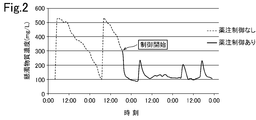
- FIG. 2 is a graph showing the change over time in the suspended matter concentration of circulating water in Example 1.
- the wet coating booth circulating water treatment chemical injection control method according to the present invention is a chemical injection control method of the processing chemical in the wet coating booth circulating water to make the coating agent non-adhesive, coagulate or float to the circulating water.
- the addition of the treatment chemical to the circulating water is controlled based on the turbidity or suspended substance concentration of the circulating water (hereinafter sometimes simply referred to as “turbidity etc.”).
- the wet coating booth circulating water treatment chemical injection control device is a chemical injection control device for treating water in the circulating water of the wet coating booth circulating water to make the paint non-adhesive, agglomerate or float.
- a turbidimeter for measuring the turbidity of the circulating water or an SS meter for measuring the concentration of suspended solids (hereinafter, both measurement sensors may be simply referred to as “turbidimeter etc.”);
- a control means for controlling the addition of the treatment chemical to the circulating water on the basis of the measured value such as a dynamometer.
- the chemical injection control of the circulating water treatment chemical in the present invention measures the turbidity of the circulating water and the measured value of the turbidity is set to a predetermined value A (hereinafter referred to as “upper limit value A”).
- the addition of the treatment chemical is started or the addition amount of the treatment chemical is increased, and a measured value such as turbidity is set to a predetermined value B (hereinafter referred to as “lower limit value B”). It is preferable to stop the addition of the treatment chemical or reduce the addition amount of the treatment chemical when the following is reached.
- the predetermined values A and B are not particularly limited, and are appropriately determined according to the quality of the circulating water, the fluctuation range of the paint load, and the like. Although not particularly limited, for example, in the case of turbidity, the predetermined value A is set in the range of 100 to 1000, and the predetermined value B is set in the range of 10 to 200. In the case of the suspended substance concentration, the predetermined value A is set in the range of 50 to 500, and the predetermined value B is set in the range of 5 to 200.
- turbidimeter a general laser type turbidity sensor or the like can be used.
- the unit of turbidity is NTU.
- SS meter a transmission type or scatterer type optical SS meter can be used. Specifically, SS checker manufactured by Optex can be used. The unit of suspended substance concentration is mg / L.
- Measurement of turbidity of circulating water using a turbidimeter or the like may be performed at any location in the circulating water system.
- turbidity etc. can be measured about circulating water returned to a circulating water tank from a wet painting booth, or circulating water in a circulating water tank. It is preferable to measure the turbidity and the like of the circulating water in the circulating water tank because the drug injection effect of the circulating water treatment chemical can be quickly grasped.
- the circulating water treatment chemical used in the present invention is preferably a chemical that floats the paint, and the combined use of a phenolic resin described later and an organic coagulant such as a cationic polymer is preferred. It is preferable to use a polymer flocculant in combination with these because the stability of the treatment can be further improved.
- the phenolic resin used in the present invention is a condensate of phenols such as monohydric phenols such as phenol, cresol, xylenol and aldehydes such as formaldehyde, or a modified product thereof, and is a phenolic resin before being crosslinked and cured. Resin. Specific examples include the following.
- phenolic resins may be novolak type or resol type.
- a phenolic resin having a weight average molecular weight of about 1,000 to 10,000 can be preferably used.
- phenolic resin one kind may be used alone, or two or more kinds may be mixed and used.
- the phenolic resin is hardly soluble in water, it is preferably used as a solution or emulsion by dissolving or dispersing it in a solvent that is soluble in water.
- the solvent used include ketones such as acetone, esters such as methyl acetate, water-soluble organic solvents such as alcohols such as methanol, alkaline aqueous solutions, and amines.
- the phenolic resin is preferably used after being dissolved in an alkaline agent such as caustic soda (NaOH) or caustic potash (KOH).
- the alkaline aqueous solution preferably has an alkali agent concentration of 1 to 25% by mass and a phenolic resin concentration of 1 to 50% by mass.
- the phenolic resin concentration is high, the phenolic resin may be dissolved by heating to about 70 to 80 ° C.
- the phenolic resin When phenolic resin is controlled according to the turbidity of the circulating water, the phenolic resin is ON / OFF controlled according to the turbidity of the circulating water.
- the addition of the phenolic resin is started when it becomes, and the addition of the phenolic resin may be stopped when the lower limit value B or less is reached.
- the phenolic resin is always added to measure turbidity, etc.
- the addition amount of the phenolic resin may be increased when the value becomes the upper limit value A or more, and the addition amount of the phenolic resin may be reduced when the value becomes the lower limit value B or less.
- the measured value such as turbidity is higher than the upper limit A within the range of 1 to 100 mg / L addition amount to the circulating water as the active ingredient amount, add the addition amount.
- the amount increases and becomes lower than the lower limit B, it is preferable to reduce the amount added.
- Organic coagulant a cationic one is preferable.
- the organic coagulant include dimethyldiallylammonium chloride, alkylamine / epichlorohydrin condensate, polyethyleneimine, alkylene dichloride / polyalkylenepolyamine condensate, dicyandichloride / polyalkylenepolyamine condensate, DMA (dimethylaminoethyl methacrylate), DADMAC Cationic polymers such as (diallyldimethylammonium chloride) can be used, but the present invention is not limited thereto.
- organic coagulants may be used alone or in combination of two or more.
- the organic coagulant When the organic coagulant is controlled by chemical injection according to the turbidity of the circulating water, the organic coagulant is ON / OFF controlled according to the turbidity of the circulating water. Addition of organic coagulant may be started when the value becomes lower, and addition of organic coagulant may be stopped when the lower limit value B or less is reached. The amount of the organic coagulant added may be increased when the value becomes the upper limit A or more, and the amount of the organic coagulant added may be decreased when the value becomes the lower limit B or less.
- the organic coagulant When the ON / OFF control of the addition of the organic coagulant to the circulating water is performed and the measured value such as turbidity is equal to or higher than the upper limit A, the organic coagulant has an effective component amount of 0. When the addition of 2 to 20 mg / L is started and the lower limit value B is reached, it is preferable to stop the addition of the organic coagulant.
- the measured value such as turbidity exceeds the upper limit A in the range of 0.2 to 20 mg / L added to the circulating water as the active ingredient amount
- the amount is increased and becomes lower than the lower limit B, it is preferable to reduce the amount added.
- a phenolic resin and an organic coagulant are added together with a phenolic resin and an organic coagulant together with a polymer flocculant composed of a water-soluble polymer having a weight average molecular weight of usually more than 1 million, preferably 5 million or more. It is preferable to further coarsen the coagulation floc of the paint by the agent with the polymer coagulant.
- polymer flocculant one or more known anionic polymer flocculants, cationic polymer flocculants, amphoteric polymer flocculants and the like can be used.
- the amount added is in the range of 0.1 to 10% by weight, preferably 0.5 to 2% by weight, based on the surplus paint as the amount of active ingredient, and a good coagulation effect can be obtained. It may be determined as appropriate.
- the chemical injection may be controlled depending on the turbidity of the circulating water, etc. Can be obtained.
- ⁇ Chemical injection point> There is no restriction
- the polymer flocculant is usually added to the sludge recovery device or the circulating water supply pipe from the circulating water tank to the sludge recovery device. As shown in the Example section described later, the water may be injected into a water intake pump to a sludge recovery device.
- the pH of the coagulation treatment system is preferably about 6.0 to 8.5 from the viewpoint of preventing corrosion of the equipment and the effect characteristics regarding the pH of the cationic polymer added as the organic coagulant. Therefore, when the pH falls outside this range, it is preferable to adjust the pH by adding an alkaline agent. Normally, the range does not deviate to the high pH side in an actual machine, but pH adjustment may be necessary if it is extremely out of range.
- the separated and recovered sludge is subjected to incineration and landfill treatment after gravity dehydration or after dehydration by a normal method.
- the present invention treats circulating water in which turbidity and the like greatly increase due to a rapid increase in paint load, such as wet painting booth circulating water containing water-based paint or wet painting booth circulating water containing water-based paint and solvent-type paint. Can be applied effectively.
- phenolic resin NaOH aqueous solution of phenol-formaldehyde polycondensate (weight average molecular weight 8,000) (phenolic resin concentration: 30% by mass, NaOH concentration: 10% by mass, pH: 12-13) (hereinafter “Phenolic resin solution”.)
- Cationic polymer aqueous solution of alkylamine / epichlorohydrin condensate (weight average molecular weight: 100,000) (cationic polymer concentration: 50% by mass)
- Polymer flocculant W / O emulsion of acrylamide / 2 (acryloyloxy) ethyltrimethylammonium chloride copolymer (weight average molecular weight 7 million) (active ingredient concentration 40% by mass)
- Example 1 In the wet paint booth circulating water treatment apparatus shown in FIG. 1, the chemical injection control of the treatment chemical based on the suspended solid concentration of the circulating water was performed according to the present invention.
- This wet painting booth circulating water treatment chemical injection control device uses a water-based paint and solvent paint to treat the wet painting booth circulating water with an average circulating water paint concentration of 100 mg / L at a circulating water volume of 10 m 3 / min. It is a device, and the paint load may rise abruptly irregularly due to the paint blowing and disposal.
- reference numeral 1 denotes a circulating water tank, and water that collects surplus paint from the wet coating booth is returned through a pipe 11.
- the circulating water in the circulating water tank 1 is treated to be non-tacky, agglomerated and floated by adding treatment chemicals, and the agglomerated treated water that has passed through the screen 2 is sent to the wet coating booth through the pipe 12 by the pump 12P.
- Water floating up in the circulating water tank 1 and water containing the aggregated flocs are taken in by the water intake pump 3 and supplied to the sludge recovery device 4 through the pipe 13.
- the sludge of the floc flocs is separated into solid and liquid by the sludge recovery device 4, and the recovered sludge is stored in the recovery sludge storage tank 5.
- the separated treated water is returned to the circulating water tank 1 through the pipe 14.
- the phenolic resin solution is added to the circulating water in the circulating water tank 1 through the pipe 15 having the chemical injection pump 15P.
- a cationic polymer is added to the circulating water in the circulating water tank 1 from the piping 17 which has the chemical injection pump 17P.
- the polymer flocculant is injected from the chemical inlet of the intake pump 3 through the pipe 16.
- an SS meter 6 for measuring the suspended solid concentration of the circulating water in the tank is provided at a position slightly above the middle of the water depth.
- the measured value of the SS meter 6 is input to the control panel 7.
- the control panel 7 controls ON / OFF signals of the medicinal pumps 15P and 17P based on the input measurement value of the SS meter 6.
- the polymer flocculant was added in an amount of 0.5% by mass as an effective component amount with an excess paint, and the addition of an alkaline solution of a phenolic resin and a cationic polymer was ON / OFF controlled according to the following control criteria. .
- the measured value of SS meter 6 is 200 mg / L or more: ON
- the measured value of SS meter 6 is 100 mg / L or less: OFF
- the drug injection pumps 15P and 17P are turned on to start the chemical injection.
- the concentration decreased to 100 mg / L or less the drug injection pumps 15P and 17P were turned off to stop the drug injection.
- the phenolic resin solution is 5.0 mg / L as the active ingredient amount and the cationic polymer is 1.0 mg / L as the active ingredient amount.
- a fixed amount was injected, and a polymer flocculant was added in an amount of 0.5% by mass as an active ingredient in an amount of excess paint.
- the paint load of the circulating water suddenly rises irregularly due to the paint blowing and disposal, but even if the chemical injection control is not performed, the polymer flocculant
- the suspended matter concentration gradually decreases with the addition. However, this decrease in suspended matter concentration is very gentle.
- the chemical injection control by the above-mentioned ON / OFF was started for the phenolic resin solution and the cationic polymer without changing the chemical injection of the polymer flocculant.
- the concentration of suspended matter in the circulating water increased by turning the medicine on when the suspended solid concentration increases and the medicine off when the suspended concentration decreases. Began to decline quickly.
- the suspended substance concentration becomes 200 mg / L or more
- the chemical injection of the phenolic resin solution and the cationic polymer is started, and these chemicals and the paint in the circulating water react and float, so the circulating water in the circulating water tank 1
- the suspended solids concentration of the liquid drops rapidly.
- the drug injection is stopped, so that waste of the drug can be eliminated.
- an effective treatment can be performed with a minimum required amount of chemical injection.
- the cost of circulating water treatment chemicals per unit time could be reduced by about 0.8 times by performing ON / OFF control compared to the case of no control.
Landscapes
- Chemical & Material Sciences (AREA)
- Life Sciences & Earth Sciences (AREA)
- Hydrology & Water Resources (AREA)
- Engineering & Computer Science (AREA)
- Environmental & Geological Engineering (AREA)
- Water Supply & Treatment (AREA)
- Organic Chemistry (AREA)
- Chemical Kinetics & Catalysis (AREA)
- Separation Of Suspended Particles By Flocculating Agents (AREA)
- Physical Water Treatments (AREA)
- Details Or Accessories Of Spraying Plant Or Apparatus (AREA)
Abstract
湿式塗装ブース循環水中の塗料の不粘着化、凝集ないしは浮上のための処理薬剤の薬注制御を循環水の濁度又は懸濁物質濃度の測定値に基づいて行う。濁度又は懸濁物質濃度の測定値が予め設定した所定値A以上となったときに処理薬剤の添加を開始するか或いは処理薬剤の添加量を増量し、濁度又は懸濁物質濃度の測定値が予め設定した所定値B以下となったときに処理薬剤の添加を停止するか或いは処理薬剤の添加量を減量する。
Description
本発明は、湿式塗装ブース循環水処理薬剤を適正に薬注制御する方法および装置に関する。
自動車工業や家庭電器、金属製品製造業等の塗装工程では、様々な塗料がスプレー塗装されている。工業的に使用されている塗料は溶剤型塗料と水性塗料とに大別され、各塗料は単独又は併用で使用されている。
水性塗料は、水可溶型、ディスパージョン型、エマルジョン型の3つに大別される。水性塗料は水を溶媒とするため(一部溶剤を併用する場合もある)、引火性がなく、安全かつ衛生的であり、溶剤による公害発生の恐れがないなどの利点を有することから、近年、特にその応用範囲が拡大されつつある。
各種工業等における塗装工程では、一般に被塗装物に噴霧された塗料の歩留りは必ずしも100%ではない。例えば自動車工業においては、歩留り60~80%程度で、使用塗料の40~20%は次工程で除去すべき余剰塗料である。この過剰に噴霧された余剰塗料を捕集するために湿式塗装ブース内での水洗が行われている。水洗水は循環使用される。
水性塗料は水に可溶ないし分散し、固液分離が難しいために、湿式塗装ブースの循環水に残留して蓄積し、次のような問題を引き起こす。
(a) 循環水は高粘性、高粘稠となり、循環ポンプの負荷を増大させ、著しい場合には循環不可能となり、操業が停止する。
(b) 析出して不溶化した塗料や、塗料以外のゴミ、SS成分が、ノズルや配管系の閉塞障害や、水膜板等への付着障害を引き起こす。
(c) 発泡障害を生じる。
(d) 循環水が高COD、高BODとなるため腐敗し、腐敗臭により、作業環境が悪化する。
(e) 高COD、高BODのため、循環水の廃水処理が困難となり、処理装置の負荷が増大する。
(a) 循環水は高粘性、高粘稠となり、循環ポンプの負荷を増大させ、著しい場合には循環不可能となり、操業が停止する。
(b) 析出して不溶化した塗料や、塗料以外のゴミ、SS成分が、ノズルや配管系の閉塞障害や、水膜板等への付着障害を引き起こす。
(c) 発泡障害を生じる。
(d) 循環水が高COD、高BODとなるため腐敗し、腐敗臭により、作業環境が悪化する。
(e) 高COD、高BODのため、循環水の廃水処理が困難となり、処理装置の負荷が増大する。
このような問題を解決するために、従来、循環水に処理薬剤を添加して循環水中の余剰塗料を凝集分離することが行われている。
特許文献1には、水性塗料及び/又は溶剤型塗料を含む湿式塗装ブース循環水中の塗料を効率的に凝集処理するための処理薬剤として、フェノール系樹脂とカチオン系ポリマーとを併用することが記載されている。フェノール系樹脂とカチオン系ポリマーとの併用により、次のようなメカニズムで効果的な処理を行える。
フェノール系樹脂をアルカリ水溶液等に溶解させて湿式塗装ブース循環水に注入すると、フェノール系樹脂は、溶解状態又はコロイド状で分散する。このとき、カチオン系ポリマーが存在するとフェノール系樹脂は荷電中和されて凝結、不溶化する。循環水中に溶解又はコロイド状に分散している塗料もカチオン系ポリマーにより、荷電中和されて凝結、不溶化するが、フェノール系樹脂がカチオン系ポリマーで不溶化するとき、この凝結した塗料を巻き込んだ形でフロック化して凝集する。塗料を巻き込んだ形で凝集したフェノール系樹脂のフロックは、ある程度の大きさの粒子となるので、循環水から分離除去され易く、浮上分離、遠心分離、濾過などの方法で容易に分離除去することができる。
湿式塗装ブース循環水の処理においては、循環水中に含まれる塗料量に対して処理薬剤を適正な薬注量で添加することが重要である。そのために、従来は、以下のような方法が行われている。
(1) 塗装している時間帯として製品を載せたコンベアーが動いている間だけ薬注する。
(2) 生産数をカウントしながらその量に合った薬注を行う。
(3) 塗料を廃棄する時間が決まっているため、(1)、(2)とは別にこの時間帯は薬注する。
(1) 塗装している時間帯として製品を載せたコンベアーが動いている間だけ薬注する。
(2) 生産数をカウントしながらその量に合った薬注を行う。
(3) 塗料を廃棄する時間が決まっているため、(1)、(2)とは別にこの時間帯は薬注する。
これらは事前に予期できる情報をもとに薬注する方法でありフィードフォワード制御といえる。
実際に薬剤が吐出されているのか、タンクの残量はあるのかという情報も適正な薬注を確保する上で重要であるので、センサーで、薬剤の吐出量や残量を記録することを上記のフィードフォワード制御と合わせて実施するのが望ましい。
塗料の種類の変更や塗料やシンナーの廃棄や捨て吹きなど、事前に予測しにくい条件変動もあり、これらの変動に対しては、フィードフォワード制御では適正な薬注制御を行うことができない。
このようなことから、湿式塗装ブース循環水の水質等を常時計測し、その変動に対して循環水処理薬剤の薬注制御(フィードバック制御)も合わせて実施できれば、より安定した薬注制御となり、循環水の安定処理が可能となると考えられる。
水性塗料や水性塗料と溶剤塗料混合塗料を用いた湿式塗装ブース循環水系では、予期せず循環水中の塗料量が急激に増加する場合がある。この場合、従来のフィードフォワード制御では、この急激な塗料量の増大に対応できず、循環水が発泡したり、循環水を取水してスラッジ回収装置へ送った水の高分子凝集剤による凝集処理が不良となり、スラッジ回収量が減ったりする。
循環水槽からスラッジ回収装置へ送給される水やスラッジ回収装置から循環水槽に戻される水の濁度又は懸濁物質濃度を測定し、この測定値をもとに高分子凝集剤を薬注制御することは従来より行われてきた。しかし、この方法では、湿式塗装ブース循環水の予期せぬ塗料負荷の増大に対応して塗料の適正処理(不粘着、凝集(一次凝集)、ピットでの浮上)を行うことはできず、塗料負荷増大時の循環水処理薬剤量の不足の根本対策にはならない。
循環水処理薬剤を塗料負荷の上昇を見越して常時過剰に添加することは薬剤コストが高くつき、好ましくない。
本発明は、湿式塗装ブース循環水の予期せぬ塗料負荷の増大に的確に対応し、適正な処理薬剤の薬注制御を行うことができる方法及び装置を提供することを目的とする。
本発明者は、湿式塗装ブース循環水の塗料負荷の増大を循環水の濁度又は懸濁物質濃度の上昇で検知し、この濁度又は懸濁物質濃度の上昇に応じて循環水処理薬剤の薬注制御を行うことで、塗料の適正処理を行えることを見出した。
本発明は以下を要旨とする。
本発明は以下を要旨とする。
[1] 湿式塗装ブース循環水中の塗料の不粘着化、凝集ないしは浮上のための処理薬剤の該循環水への薬注制御方法であって、該循環水の濁度又は懸濁物質濃度に基づいて、該循環水への該処理薬剤の添加を制御することを特徴とする湿式塗装ブース循環水処理薬剤の薬注制御方法。
[2] 前記循環水の濁度又は懸濁物質濃度を測定し、該濁度又は懸濁物質濃度の測定値が予め設定した所定値A以上となったときに前記処理薬剤の添加を開始するか或いは前記処理薬剤の添加量を増量することを特徴とする[1]に記載の湿式塗装ブース循環水処理薬剤の薬注制御方法。
[3] 前記濁度又は懸濁物質濃度の測定値が予め設定した所定値B以下となったときに前記処理薬剤の添加を停止するか或いは前記処理薬剤の添加量を減量することを特徴とする[2]に記載の湿式塗装ブース循環水処理薬剤の薬注制御方法。
[4] 前記処理薬剤が、フェノール系樹脂および有機凝結剤、或いはフェノール系樹脂、有機凝結剤および高分子凝集剤であることを特徴とする[1]ないし[3]のいずれかに記載の湿式塗装ブース循環水処理薬剤の薬注制御方法。
[5] 湿式塗装ブース循環水中の塗料の不粘着化、凝集ないしは浮上のための処理薬剤の該循環水への薬注制御装置であって、該循環水の濁度を測定する濁度計又は懸濁物質濃度を測定するSS計と、該濁度計又はSS計の測定値が入力され、該測定値に基づいて、該循環水への該処理薬剤の添加を制御する制御手段とを有することを特徴とする湿式塗装ブース循環水処理薬剤の薬注制御装置。
[6] 前記制御手段は、前記濁度計又はSS計の測定値が予め設定した所定値A以上となったときに、前記処理薬剤の添加を開始するか或いは前記処理薬剤の添加量を増量する信号を出力することを特徴とする[5]に記載の湿式塗装ブース循環水処理薬剤の薬注制御装置。
[7] 前記制御手段は、前記濁度計又はSS計の測定値が予め設定した所定値B以下となったときに前記処理薬剤の添加を停止するか或いは前記処理薬剤の添加量を減量する信号を出力することを特徴とする[6]に記載の湿式塗装ブース循環水処理薬剤の薬注制御装置。
[8] 前記処理薬剤が、フェノール系樹脂および有機凝結剤、或いはフェノール系樹脂、有機凝結剤および高分子凝集剤であることを特徴とする[5]ないし[7]のいずれかに記載の湿式塗装ブース循環水処理薬剤の薬注制御装置。
本発明によれば、湿式塗装ブース循環水の予期せぬ塗料負荷の増大に的確に対応して適正な処理薬剤の薬注制御を行えるので、処理の安定化を図ることができる。
以下に本発明の実施の形態を詳細に説明する。
本発明の湿式塗装ブース循環水処理薬剤の薬注制御方法は、湿式塗装ブース循環水中の塗料の不粘着化、凝集ないしは浮上のための処理薬剤の該循環水への薬注制御方法であって、該循環水の濁度又は懸濁物質濃度(以下、単に「濁度等」と記載する場合あり)に基づいて、該循環水への該処理薬剤の添加を制御することを特徴とする。
本発明の湿式塗装ブース循環水処理薬剤の薬注制御装置は、湿式塗装ブース循環水中の塗料の不粘着化、凝集ないしは浮上のための処理薬剤の該循環水への薬注制御装置であって、該循環水の濁度を測定する濁度計又は懸濁物質濃度を測定するSS計(以下、両測定センサを併せて単に「濁度計等」と記載する場合がある)と、該濁度計等の測定値が入力され、該測定値に基づいて、該循環水への該処理薬剤の添加を制御する制御手段とを有することを特徴とする。
本発明における循環水処理薬剤の薬注制御は、具体的には、循環水の濁度等を測定し、該濁度等の測定値が予め設定した所定値A(以下「上限値A」と称す場合がある。)以上となったときに処理薬剤の添加を開始するか或いは処理薬剤の添加量を増量し、濁度等の測定値が予め設定した所定値B(以下「下限値B」と称す場合がある。)以下となったときに処理薬剤の添加を停止するか或いは処理薬剤の添加量を減量することで行うことが好ましい。
所定値A,Bとしては特に制限はなく、循環水の水質や、塗料負荷の変動幅等に応じて適宜決定される。特に制限されるものではないが、例えば、濁度の場合には、所定値Aは100~1000の範囲で設定され、所定値Bは10~200の範囲で設定される。懸濁物質濃度の場合には所定値Aは50~500の範囲で設定され、所定値Bは5~200の範囲で設定される。
濁度計としては、一般的なレーザー式の濁度センサ等を用いることができる。濁度の単位はNTUである。
SS計としては、透過式や散乱子式の光学的SS計等を用いることができる。具体的にはオプテックス社のSSチェッカーを用いることができる。懸濁物質濃度の単位はmg/Lである。
濁度計等による循環水の濁度等の測定は、循環水系のいずれの箇所で行ってもよい。例えば、湿式塗装ブースから循環水槽に返送される循環水、或いは循環水槽内の循環水について濁度等を測定することができる。循環水処理薬剤の薬注効果を迅速に把握することができることから、循環水槽内の循環水の濁度等を測定することが好ましい。この場合、濁度計等のセンサは、循環水槽内の水深の半分程度となるような位置に設けることが、水位変動や、堆積スラッジの影響を少なくする点で好ましい。
循環水の濁度等は、循環水中の塗料が処理薬剤による処理で浮上又は沈降することで低下するが、塗料が沈降することは好ましくない。従って、本発明で用いる循環水処理薬剤は、塗料を浮上させる薬剤が好ましく、後述のフェノール系樹脂とカチオン系ポリマー等の有機凝結剤との併用が好ましい。これらに更に高分子凝集剤を併用することにより、より処理の安定性を向上させることができ好ましい。
以下に本発明の好適態様について更に詳述する。
<フェノール系樹脂>
本発明で使用されるフェノール系樹脂としては、フェノール、クレゾール、キシレノール等の一価フェノール等のフェノール類とホルムアルデヒド等のアルデヒドとの縮合物或いはその変性物であって、架橋硬化する前のフェノール系樹脂が挙げられる。具体的には次のようなものが挙げられる。
本発明で使用されるフェノール系樹脂としては、フェノール、クレゾール、キシレノール等の一価フェノール等のフェノール類とホルムアルデヒド等のアルデヒドとの縮合物或いはその変性物であって、架橋硬化する前のフェノール系樹脂が挙げられる。具体的には次のようなものが挙げられる。
[1] フェノールとホルムアルデヒドとの縮合物
[2] クレゾールとホルムアルデヒドとの縮合物
[3] キシレノールとホルムアルデヒドとの縮合物
[4] 上記[1]~[3]のフェノール系樹脂をアルキル化して得られるアルキル変性フェノール系樹脂
[5] ポリビニルフェノール
[2] クレゾールとホルムアルデヒドとの縮合物
[3] キシレノールとホルムアルデヒドとの縮合物
[4] 上記[1]~[3]のフェノール系樹脂をアルキル化して得られるアルキル変性フェノール系樹脂
[5] ポリビニルフェノール
これらのフェノール系樹脂はノボラック型であってもレゾール型であっても良い。
フェノール系樹脂としては重量平均分子量が1,000~10,000程度のものを好適に用いることができる。
フェノール系樹脂としては重量平均分子量が1,000~10,000程度のものを好適に用いることができる。
フェノール系樹脂は、1種を単独で用いても良く、2種以上を混合して用いても良い。
フェノール系樹脂は水に難溶であるので、水に溶解可能な溶媒に溶解ないし分散させるなどして溶液状又はエマルジョンとして用いるのが好ましい。使用される溶媒としてはアセトン等のケトン、酢酸メチル等のエステル、メタノール等のアルコール等の水溶性有機溶媒、アルカリ水溶液、アミン等が挙げられる。フェノール系樹脂は好ましくは、苛性ソーダ(NaOH)、苛性カリ(KOH)等のアルカリ剤に溶解して用いる。
フェノール系樹脂をアルカリ性水溶液として用いる場合、このアルカリ性水溶液はアルカリ剤濃度1~25質量%、フェノール系樹脂濃度1~50質量%の範囲とすることが好ましい。フェノール系樹脂濃度が高い場合、70~80℃程度に加温してフェノール系樹脂を溶解させるようにしても良い。
フェノール系樹脂を循環水の濁度等に応じて薬注制御する場合、フェノール系樹脂は、循環水の濁度等に応じてON・OFF制御で、濁度等の測定値が上限値A以上となった場合にフェノール系樹脂の添加を開始し、下限値B以下となった場合にフェノール系樹脂の添加を停止するようにしてもよく、フェノール系樹脂を常時添加し、濁度等の測定値が上限値A以上となったときにフェノール系樹脂の添加量を増量し、下限値B以下となったときにフェノール系樹脂の添加量を減量するようにしてもよい。
循環水へのフェノール系樹脂の添加を、ON・OFF制御する場合、濁度等の測定値が上限値A以上となった場合は、有効成分量(フェノール系樹脂の固形分量)として循環水に対して1~100mg/Lの添加を開始し、下限値B以下となった場合は、フェノール系樹脂の添加を停止することが好ましい。
フェノール系樹脂添加量を増減する場合は、有効成分量として循環水に対して1~100mg/Lの添加量の範囲で濁度等の測定値が上限値A以上となった場合は添加量を増量し、下限値B以下となった場合は添加量を減量することが好ましい。
<有機凝結剤>
有機凝結剤としては、カチオン性のものが好ましい。有機凝結剤としては例えば、ジメチルジアリルアンモニウムクロライド、アルキルアミン・エピクロルヒドリン縮合物、ポリエチレンイミン、アルキレンジクロライド・ポリアルキレンポリアミン縮合物、ジシアンジクロライド・ポリアルキレンポリアミン縮合物、DMA(ジメチルアミノエチルメタクリレート)、DADMAC(ジアリルジメチルアンモニウムクロライド)等のカチオン系ポリマーが挙げられるが、何らこれらに限定されるものではない。
有機凝結剤としては、カチオン性のものが好ましい。有機凝結剤としては例えば、ジメチルジアリルアンモニウムクロライド、アルキルアミン・エピクロルヒドリン縮合物、ポリエチレンイミン、アルキレンジクロライド・ポリアルキレンポリアミン縮合物、ジシアンジクロライド・ポリアルキレンポリアミン縮合物、DMA(ジメチルアミノエチルメタクリレート)、DADMAC(ジアリルジメチルアンモニウムクロライド)等のカチオン系ポリマーが挙げられるが、何らこれらに限定されるものではない。
これらの有機凝結剤は、1種を単独で用いても良く、2種以上を混合して用いても良い。
有機凝結剤を循環水の濁度等に応じて薬注制御する場合、有機凝結剤は、循環水の濁度等に応じてON・OFF制御で、濁度等の測定値が上限値A以上となった場合に有機凝結剤の添加を開始し、下限値B以下となった場合に有機凝結剤の添加を停止するようにしてもよく、有機凝結剤を常時添加し、濁度等の測定値が上限値A以上となったときに有機凝結剤の添加量を増量し、下限値B以下となったときに有機凝結剤の添加量を減量するようにしてもよい。
循環水への有機凝結剤の添加をON・OFF制御する場合、濁度等の測定値が上限値A以上となった場合は、有機凝結剤は、有効成分量として循環水に対して0.2~20mg/Lの添加を開始し、下限値B以下となった場合は、有機凝結剤の添加を停止することが好ましい。
有機凝結剤添加量を増減する場合は、有効成分量として循環水に対して0.2~20mg/Lの添加量の範囲で濁度等の測定値が上限値A以上となった場合は添加量を増量し、下限値B以下となった場合は添加量を減量することが好ましい。
<高分子凝集剤>
本発明では、フェノール系樹脂及び有機凝結剤と共に、重量平均分子量が、通常100万超、好ましくは500万以上の水溶性高分子よりなる高分子凝集剤を併用添加してフェノール系樹脂および有機凝結剤による塗料の凝集フロックを高分子凝集剤で更に粗大化することが好ましい。
本発明では、フェノール系樹脂及び有機凝結剤と共に、重量平均分子量が、通常100万超、好ましくは500万以上の水溶性高分子よりなる高分子凝集剤を併用添加してフェノール系樹脂および有機凝結剤による塗料の凝集フロックを高分子凝集剤で更に粗大化することが好ましい。
高分子凝集剤としては、公知のアニオン系高分子凝集剤、カチオン系高分子凝集剤、両性高分子凝集剤などの1種又は2種以上を用いることができる。
高分子凝集剤を用いる場合、その添加量は、有効成分量として余剰塗料に対して0.1~10質量%、好ましくは0.5~2質量%の範囲で、良好な凝集効果が得られるように適宜決定すればよい。
高分子凝集剤についても、フェノール系樹脂および有機凝結剤と同様に、循環水の濁度等に応じて薬注制御してもよいが、通常は高分子凝集剤は定量添加で十分な効果を得ることができる。
<薬注箇所>
フェノール系樹脂および有機凝結剤の薬注箇所としては特に制限はなく、循環水系のどのような箇所に添加してもよい。通常の場合、フェノール系樹脂および有機凝結剤は循環水槽又は湿式塗装ブースから循環水槽への戻り水配管、或いはこれらの双方に添加される。フェノール系樹脂と有機凝結剤とは同じ箇所に添加してもよく、別々の箇所に添加してもよい。
フェノール系樹脂および有機凝結剤の薬注箇所としては特に制限はなく、循環水系のどのような箇所に添加してもよい。通常の場合、フェノール系樹脂および有機凝結剤は循環水槽又は湿式塗装ブースから循環水槽への戻り水配管、或いはこれらの双方に添加される。フェノール系樹脂と有機凝結剤とは同じ箇所に添加してもよく、別々の箇所に添加してもよい。
高分子凝集剤は、通常、スラッジ回収装置或いは循環水槽からスラッジ回収装置への循環水の送水配管に添加される。後述の実施例の項に示されるように、スラッジ回収装置への取水ポンプに注入してもよい。
凝集処理系のpHは、設備の腐食防止の点と、有機凝結剤として添加するカチオン系ポリマーのpHに関する効果特性の点から、6.0~8.5程度であることが好ましい。従って、pHがこの範囲を外れて低くなる場合には、アルカリ剤を添加してpH調整を行うことが好ましい。通常、実機では高pH側に範囲が外れることはないが、極端に外れる場合はpH調整が必要になることがある。
<凝集フロックの回収>
フェノール系樹脂と有機凝結剤の添加、更には高分子凝集剤の添加により、循環水中の塗料は速やかに不粘着化、凝集、浮上してフロックを生成する。凝集により生成したフロックの分離回収には、浮上分離、ウェッジワイヤ、ロータリースクリーン、バースクリーン、サイクロン、遠心分離機、濾過装置などによる方法を採用することができる。
フェノール系樹脂と有機凝結剤の添加、更には高分子凝集剤の添加により、循環水中の塗料は速やかに不粘着化、凝集、浮上してフロックを生成する。凝集により生成したフロックの分離回収には、浮上分離、ウェッジワイヤ、ロータリースクリーン、バースクリーン、サイクロン、遠心分離機、濾過装置などによる方法を採用することができる。
分離回収されたスラッジは、重力脱水後、或いは通常の方法で脱水後、焼却、埋立処理される。
<適用循環水>
本発明は、水性塗料を含む湿式塗装ブース循環水、或いは水性塗料と溶剤型塗料を含む湿式塗装ブース循環水のように、塗料負荷の急激な上昇で濁度等が大きく上昇する循環水の処理に効果的に適用することができる。
本発明は、水性塗料を含む湿式塗装ブース循環水、或いは水性塗料と溶剤型塗料を含む湿式塗装ブース循環水のように、塗料負荷の急激な上昇で濁度等が大きく上昇する循環水の処理に効果的に適用することができる。
以下に実施例を挙げて本発明をより具体的に説明するが、本発明はその要旨を超えない限り、以下の実施例に限定されるものではない。
循環水の処理薬剤としては、以下のものを用いた。
フェノール系樹脂のアルカリ溶液:フェノール・ホルムアルデヒド重縮合物(重量平均分子量8,000)のNaOH水溶液(フェノール系樹脂濃度:30質量%、NaOH濃度:10質量%、pH:12~13)(以下「フェノール系樹脂溶液」と記載する。)
カチオン系ポリマー:アルキルアミン・エピクロルヒドリン縮合物(重量平均分子量:10万)の水溶液(カチオン系ポリマー濃度:50質量%)
高分子凝集剤:アクリルアミド・2(アクリロイルオキシ)エチルトリメチルアンモニウムクロライド共重合物(重量平均分子量700万)のW/O型エマルション(有効成分濃度40質量%)
カチオン系ポリマー:アルキルアミン・エピクロルヒドリン縮合物(重量平均分子量:10万)の水溶液(カチオン系ポリマー濃度:50質量%)
高分子凝集剤:アクリルアミド・2(アクリロイルオキシ)エチルトリメチルアンモニウムクロライド共重合物(重量平均分子量700万)のW/O型エマルション(有効成分濃度40質量%)
[実施例1]
図1に示す湿式塗装ブース循環水の処理装置において、本発明に従って、循環水の懸濁物質濃度に基づく処理薬剤の薬注制御を行った。
図1に示す湿式塗装ブース循環水の処理装置において、本発明に従って、循環水の懸濁物質濃度に基づく処理薬剤の薬注制御を行った。
この湿式塗装ブース循環水処理薬剤の薬注制御装置は、水性塗料と溶剤塗料を用いた、循環水量10m3/minで、平均的な循環水塗料濃度100mg/Lの湿式塗装ブース循環水の処理装置であり、塗料の捨て吹きや廃棄で不定期的に塗料負荷が急激に上昇することがある。
図1において、1は循環水槽であり、湿式塗装ブースからの余剰塗料を捕集した水が配管11を経て返送される。
循環水槽1内の循環水は、処理薬剤が添加されて不粘着化、凝集、浮上処理され、スクリーン2を透過した凝集処理水がポンプ12Pにより配管12を経て湿式塗装ブースに送水される。
循環水槽1内の浮上、凝集フロックを含む水が取水ポンプ3で取水され、配管13を経てスラッジ回収装置4に送給される。スラッジ回収装置4で、凝集フロックのスラッジが固液分離され、回収されたスラッジは、回収スラッジ貯槽5に貯留される。一方、分離された処理水は、配管14を経て循環水槽1に戻される。
この処理装置では、薬注ポンプ15Pを有する配管15よりフェノール系樹脂溶液が、循環水槽1内の循環水に添加される。そして、薬注ポンプ17Pを有する配管17よりカチオン系ポリマーが、循環水槽1内の循環水に添加される。高分子凝集剤は、配管16より取水ポンプ3の薬注口より注入される。
循環水槽1内には槽内の循環水の懸濁物質濃度を測定するSS計6が水深の中間からやや上方の位置に設けられている。SS計6の測定値は、制御盤7に入力される。制御盤7は入力されたSS計6の測定値に基づいて、薬注ポンプ15P,17PのON/OFF信号が制御される。
本実施例では、高分子凝集剤は有効成分量として0.5質量%対余剰塗料で定量添加とし、フェノール系樹脂のアルカリ溶液とカチオン系ポリマーの添加を下記の制御基準でON・OFF制御した。
SS計6の測定値が200mg/L以上の時:ON
SS計6の測定値が100mg/L以下の時:OFF
SS計6の測定値が200mg/L以上の時:ON
SS計6の測定値が100mg/L以下の時:OFF
循環水槽1内の懸濁物質濃度の上昇で懸濁物質濃度が200mg/L以上になったときに薬注ポンプ15P,17PをONとして薬注を開始し、薬注により循環水の懸濁物質濃度が低下し、100mg/L以下となったときに薬注ポンプ15P,17PをOFFとして薬注を停止した。
薬注ON時は、フェノール系樹脂溶液を有効成分量として10mg/L、カチオン系ポリマーを有効成分量として2.0mg/L添加した。
運転開始時は、フェノール系樹脂溶液とカチオン系ポリマーについて薬注制御を行わず、フェノール系樹脂溶液を有効成分量として5.0mg/L、カチオン系ポリマーを有効成分量として1.0mg/Lで定量注入し、高分子凝集剤を有効成分量として0.5質量%対余剰塗料で定量添加した。この時、図2の破線に示すように、塗料の捨て吹きや廃棄で不定期的に循環水の塗料負荷が急激に上昇するが、薬注制御を行っていなくても、高分子凝集剤の添加で懸濁物質濃度は徐々に低下してゆく。ただし、この懸濁物質濃度の低下は非常になだらかである。
薬注制御なしの処理後、高分子凝集剤の薬注はそのままで、フェノール系樹脂溶液とカチオン系ポリマーについて、前述のON・OFFによる薬注制御を開始した。その結果、図2の実線に示すように、循環水の懸濁物質濃度の上昇で薬注ON、懸濁物質濃度の低下で薬注OFFとすることで、上昇した循環水の懸濁物質濃度は速やかに低下するようになった。
懸濁物質濃度が200mg/L以上になるとフェノール系樹脂溶液とカチオン系ポリマーの薬注が開始され、これらの薬剤と循環水中の塗料とが反応して浮上するため、循環水槽1内の循環水の懸濁物質濃度は速やかに低下する。懸濁物質濃度が100mg/L以下となった場合には、薬注を停止するため、薬剤の無駄を省くことができる。
懸濁物質濃度が200mg/L以上になるとフェノール系樹脂溶液とカチオン系ポリマーの薬注が開始され、これらの薬剤と循環水中の塗料とが反応して浮上するため、循環水槽1内の循環水の懸濁物質濃度は速やかに低下する。懸濁物質濃度が100mg/L以下となった場合には、薬注を停止するため、薬剤の無駄を省くことができる。
このように、本発明によれば、必要最低限の薬注量で効果的な処理を行えることが分かる。単位時間当たりの循環水処理薬剤コストは、ON・OFF制御を行うことで、制御を行わない場合の約0.8倍に削減することができた。
本発明を特定の態様を用いて詳細に説明したが、本発明の意図と範囲を離れることなく様々な変更が可能であることは当業者に明らかである。
本出願は、2018年5月24日付で出願された日本特許出願2018-099815に基づいており、その全体が引用により援用される。
本出願は、2018年5月24日付で出願された日本特許出願2018-099815に基づいており、その全体が引用により援用される。
1 循環水槽
2 スクリーン
3 取水ポンプ
4 スラッジ回収装置
5 回収スラッジ貯槽
6 SS計
7 制御盤
2 スクリーン
3 取水ポンプ
4 スラッジ回収装置
5 回収スラッジ貯槽
6 SS計
7 制御盤
Claims (8)
- 湿式塗装ブース循環水中の塗料の不粘着化、凝集ないしは浮上のための処理薬剤の該循環水への薬注制御方法であって、該循環水の濁度又は懸濁物質濃度に基づいて、該循環水への該処理薬剤の添加を制御することを特徴とする湿式塗装ブース循環水処理薬剤の薬注制御方法。
- 前記循環水の濁度又は懸濁物質濃度を測定し、該濁度又は懸濁物質濃度の測定値が予め設定した所定値A以上となったときに前記処理薬剤の添加を開始するか或いは前記処理薬剤の添加量を増量することを特徴とする請求項1に記載の湿式塗装ブース循環水処理薬剤の薬注制御方法。
- 前記濁度又は懸濁物質濃度の測定値が予め設定した所定値B以下となったときに前記処理薬剤の添加を停止するか或いは前記処理薬剤の添加量を減量することを特徴とする請求項2に記載の湿式塗装ブース循環水処理薬剤の薬注制御方法。
- 前記処理薬剤が、フェノール系樹脂および有機凝結剤、或いはフェノール系樹脂、有機凝結剤および高分子凝集剤であることを特徴とする請求項1ないし3のいずれか1項に記載の湿式塗装ブース循環水処理薬剤の薬注制御方法。
- 湿式塗装ブース循環水中の塗料の不粘着化、凝集ないしは浮上のための処理薬剤の該循環水への薬注制御装置であって、該循環水の濁度を測定する濁度計又は懸濁物質濃度を測定するSS計と、該濁度計又はSS計の測定値が入力され、該測定値に基づいて、該循環水への該処理薬剤の添加を制御する制御手段とを有することを特徴とする湿式塗装ブース循環水処理薬剤の薬注制御装置。
- 前記制御手段は、前記濁度計又はSS計の測定値が予め設定した所定値A以上となったときに、前記処理薬剤の添加を開始するか或いは前記処理薬剤の添加量を増量する信号を出力することを特徴とする請求項5に記載の湿式塗装ブース循環水処理薬剤の薬注制御装置。
- 前記制御手段は、前記濁度計又はSS計の測定値が予め設定した所定値B以下となったときに前記処理薬剤の添加を停止するか或いは前記処理薬剤の添加量を減量する信号を出力することを特徴とする請求項6に記載の湿式塗装ブース循環水処理薬剤の薬注制御装置。
- 前記処理薬剤が、フェノール系樹脂および有機凝結剤、或いはフェノール系樹脂、有機凝結剤および高分子凝集剤であることを特徴とする請求項5ないし7のいずれか1項に記載の湿式塗装ブース循環水処理薬剤の薬注制御装置。
Applications Claiming Priority (2)
| Application Number | Priority Date | Filing Date | Title |
|---|---|---|---|
| JP2018099815A JP6642624B2 (ja) | 2018-05-24 | 2018-05-24 | 湿式塗装ブース循環水処理薬剤の薬注制御方法および制御装置 |
| JP2018-099815 | 2018-05-24 |
Publications (1)
| Publication Number | Publication Date |
|---|---|
| WO2019225352A1 true WO2019225352A1 (ja) | 2019-11-28 |
Family
ID=68617169
Family Applications (1)
| Application Number | Title | Priority Date | Filing Date |
|---|---|---|---|
| PCT/JP2019/018718 Ceased WO2019225352A1 (ja) | 2018-05-24 | 2019-05-10 | 湿式塗装ブース循環水処理薬剤の薬注制御方法および制御装置 |
Country Status (2)
| Country | Link |
|---|---|
| JP (1) | JP6642624B2 (ja) |
| WO (1) | WO2019225352A1 (ja) |
Families Citing this family (2)
| Publication number | Priority date | Publication date | Assignee | Title |
|---|---|---|---|---|
| CN111250318A (zh) * | 2020-04-02 | 2020-06-09 | 绍兴市上虞嘉盛涂装有限公司 | 一种喷涂用油漆回收利用装置及其工作方法 |
| JP7707680B2 (ja) * | 2021-06-18 | 2025-07-15 | 栗田工業株式会社 | 湿式塗装ブース循環水の処理装置および処理方法 |
Citations (4)
| Publication number | Priority date | Publication date | Assignee | Title |
|---|---|---|---|---|
| JP2001170528A (ja) * | 1999-12-20 | 2001-06-26 | Kurita Water Ind Ltd | 湿式塗装ブース循環水系の処理方法 |
| JP2008173562A (ja) * | 2007-01-18 | 2008-07-31 | Hakuto Co Ltd | ブース循環水の処理方法 |
| JP2011072866A (ja) * | 2009-09-29 | 2011-04-14 | Kurita Water Ind Ltd | 湿式塗装ブース循環水の処理方法 |
| JP2015027637A (ja) * | 2013-07-30 | 2015-02-12 | トリニティ工業株式会社 | 塗料分離除去装置及び塗料分離除去方法 |
-
2018
- 2018-05-24 JP JP2018099815A patent/JP6642624B2/ja active Active
-
2019
- 2019-05-10 WO PCT/JP2019/018718 patent/WO2019225352A1/ja not_active Ceased
Patent Citations (4)
| Publication number | Priority date | Publication date | Assignee | Title |
|---|---|---|---|---|
| JP2001170528A (ja) * | 1999-12-20 | 2001-06-26 | Kurita Water Ind Ltd | 湿式塗装ブース循環水系の処理方法 |
| JP2008173562A (ja) * | 2007-01-18 | 2008-07-31 | Hakuto Co Ltd | ブース循環水の処理方法 |
| JP2011072866A (ja) * | 2009-09-29 | 2011-04-14 | Kurita Water Ind Ltd | 湿式塗装ブース循環水の処理方法 |
| JP2015027637A (ja) * | 2013-07-30 | 2015-02-12 | トリニティ工業株式会社 | 塗料分離除去装置及び塗料分離除去方法 |
Also Published As
| Publication number | Publication date |
|---|---|
| JP6642624B2 (ja) | 2020-02-05 |
| JP2019202280A (ja) | 2019-11-28 |
Similar Documents
| Publication | Publication Date | Title |
|---|---|---|
| JP5407706B2 (ja) | 湿式塗装ブース循環水の処理方法 | |
| CN106536422B (zh) | 湿式涂装室循环水的处理方法及处理装置 | |
| CN101348295A (zh) | 湿式喷漆室循环水的处理方法 | |
| CN101205094A (zh) | 湿式室循环水的处理方法 | |
| WO2019225352A1 (ja) | 湿式塗装ブース循環水処理薬剤の薬注制御方法および制御装置 | |
| JP6642616B2 (ja) | 湿式塗装ブース循環水の処理方法 | |
| EP3190092B1 (en) | Agent for treating circulation water in wet painting booth and method for treating circulation water in wet painting booth | |
| WO2019225353A1 (ja) | 湿式塗装ブース循環水処理薬剤の薬注制御方法および制御装置 | |
| JP4069799B2 (ja) | 湿式塗装ブース循環水の処理方法 | |
| JP3731454B2 (ja) | 凝結剤の薬注量決定方法及び薬注制御装置 | |
| JP2008149250A (ja) | 湿式塗装ブース循環水処理剤及び湿式塗装ブース循環水の処理方法 | |
| JP5880602B2 (ja) | 湿式塗装ブース循環水処理剤 | |
| JPH07713A (ja) | 水性塗料用凝集剤組成物 | |
| JP5681828B1 (ja) | 湿式塗装ブース循環水の処理方法 | |
| JP2008264764A5 (ja) | 含油廃水の処理方法及び含油廃水の処理設備 | |
| JP2016140805A (ja) | 湿式塗装ブース循環水の処理方法及び処理装置 | |
| JP7707680B2 (ja) | 湿式塗装ブース循環水の処理装置および処理方法 | |
| JP6288361B2 (ja) | 湿式塗装ブース循環水の処理装置 | |
| JP4098415B2 (ja) | アニオン性高分子凝集剤の使用方法 | |
| JPS6027684B2 (ja) | 乳化重合体ゴムの製造方法 | |
| JP2676840B2 (ja) | 塗装ブース循環水の処理方法 | |
| JPS60102993A (ja) | 凝集処理方法 |
Legal Events
| Date | Code | Title | Description |
|---|---|---|---|
| 121 | Ep: the epo has been informed by wipo that ep was designated in this application |
Ref document number: 19807437 Country of ref document: EP Kind code of ref document: A1 |
|
| NENP | Non-entry into the national phase |
Ref country code: DE |
|
| 122 | Ep: pct application non-entry in european phase |
Ref document number: 19807437 Country of ref document: EP Kind code of ref document: A1 |