WO2019159467A1 - 電力変換装置、電力変換システム及び電力変換装置の制御方法 - Google Patents
電力変換装置、電力変換システム及び電力変換装置の制御方法 Download PDFInfo
- Publication number
- WO2019159467A1 WO2019159467A1 PCT/JP2018/042802 JP2018042802W WO2019159467A1 WO 2019159467 A1 WO2019159467 A1 WO 2019159467A1 JP 2018042802 W JP2018042802 W JP 2018042802W WO 2019159467 A1 WO2019159467 A1 WO 2019159467A1
- Authority
- WO
- WIPO (PCT)
- Prior art keywords
- power
- phase
- power conversion
- command value
- primary
- Prior art date
- Legal status (The legal status is an assumption and is not a legal conclusion. Google has not performed a legal analysis and makes no representation as to the accuracy of the status listed.)
- Ceased
Links
Images






Classifications
-
- H—ELECTRICITY
- H02—GENERATION; CONVERSION OR DISTRIBUTION OF ELECTRIC POWER
- H02M—APPARATUS FOR CONVERSION BETWEEN AC AND AC, BETWEEN AC AND DC, OR BETWEEN DC AND DC, AND FOR USE WITH MAINS OR SIMILAR POWER SUPPLY SYSTEMS; CONVERSION OF DC OR AC INPUT POWER INTO SURGE OUTPUT POWER; CONTROL OR REGULATION THEREOF
- H02M5/00—Conversion of AC power input into AC power output, e.g. for change of voltage, for change of frequency, for change of number of phases
- H02M5/40—Conversion of AC power input into AC power output, e.g. for change of voltage, for change of frequency, for change of number of phases with intermediate conversion into DC
- H02M5/42—Conversion of AC power input into AC power output, e.g. for change of voltage, for change of frequency, for change of number of phases with intermediate conversion into DC by static converters
- H02M5/44—Conversion of AC power input into AC power output, e.g. for change of voltage, for change of frequency, for change of number of phases with intermediate conversion into DC by static converters using discharge tubes or semiconductor devices to convert the intermediate DC into AC
- H02M5/443—Conversion of AC power input into AC power output, e.g. for change of voltage, for change of frequency, for change of number of phases with intermediate conversion into DC by static converters using discharge tubes or semiconductor devices to convert the intermediate DC into AC using devices of a thyratron or thyristor type requiring extinguishing means
- H02M5/45—Conversion of AC power input into AC power output, e.g. for change of voltage, for change of frequency, for change of number of phases with intermediate conversion into DC by static converters using discharge tubes or semiconductor devices to convert the intermediate DC into AC using devices of a thyratron or thyristor type requiring extinguishing means using semiconductor devices only
-
- H—ELECTRICITY
- H02—GENERATION; CONVERSION OR DISTRIBUTION OF ELECTRIC POWER
- H02M—APPARATUS FOR CONVERSION BETWEEN AC AND AC, BETWEEN AC AND DC, OR BETWEEN DC AND DC, AND FOR USE WITH MAINS OR SIMILAR POWER SUPPLY SYSTEMS; CONVERSION OF DC OR AC INPUT POWER INTO SURGE OUTPUT POWER; CONTROL OR REGULATION THEREOF
- H02M7/00—Conversion of AC power input into DC power output; Conversion of DC power input into AC power output
- H02M7/42—Conversion of DC power input into AC power output without possibility of reversal
- H02M7/44—Conversion of DC power input into AC power output without possibility of reversal by static converters
- H02M7/48—Conversion of DC power input into AC power output without possibility of reversal by static converters using discharge tubes with control electrode or semiconductor devices with control electrode
Definitions
- Patent Document 1 As background art in this technical field.
- a plurality of converter cells 20-1, 20-2,..., 20-N (where N is a natural number of 2 or more)
- 20-N of the first AC / DC converters 11 of the plurality of converter cells 20-1, 20-2,..., 20-N are connected in series, and the plurality of converters
- the AC sides of the fourth AC / DC converters 14 of the cells are connected in series. The more the number of converter cells connected in series increases, the more the AC voltage becomes multilevel strict. Have been described.
- the present invention is configured as follows.
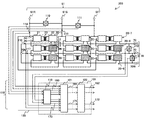
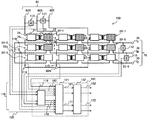
- FIG. 1 It is a schematic circuit diagram which shows the structure in Example 1 of the power converter device to which this invention is applied. It is a figure which shows the system structure for 1 phase of the power converter device 100 shown in FIG. It is a figure which shows the structural example of the converter cell shown in FIG.
- FIG. 2 is a block diagram showing an example of an internal configuration of a converter cell power command value calculator 121 shown in FIG. 1. It is a figure which shows an example of the waveform of the primary side electric power and secondary side electric power of each converter cell in the power converter device 100 shown in FIG. It is a figure which shows an example of the waveform of the voltage between the primary side terminals of each converter cell in the power converter device shown in FIG.
- the voltage amplitude, frequency, and phase are independent of each other.
- the R phase, S phase, and T phase of the primary side system 60 have a phase difference of 2 / 3 ⁇ with respect to the frequency of the primary side system 60
- the U phase and V of the secondary side system 70 The phase and the W phase have a phase difference of 2 / 3 ⁇ from each other at the frequency of the secondary system 70.
- the primary side system 60 and the secondary side system 70 for example, a commercial power system, a wind power generation system, a motor, and the like are conceivable.
- the secondary terminals 26 and 27 of the converter cells 20-1, 20-4 and 20-7 are between the U-phase line 70U and the neutral line 70N. Connected in series. Secondary terminals 26 and 27 of converter cells 20-2, 20-5 and 20-8 are connected in series between V-phase line 70V and neutral line 70N. Further, secondary terminals 26 and 27 of converter cells 20-3, 20-6 and 20-9 are connected in series between W-phase line 70W and neutral line 70N.
- the power converter 100 detects the UV line voltage and the VW line voltage of the secondary side system 70 with the voltage sensors 112 and 113, which is a configuration of an embodiment of the present invention.
- a voltage (WU line voltage) between the W-phase line 70W and the U-phase line 70U may be detected, and the configuration may be changed according to the purpose.
- the power conversion device 100 detects the line currents of the R-phase line 60R and the S-phase line 60S of the primary side system 60 by the current sensors 114 and 115, but this is a configuration of an embodiment of the present invention.
- the line current of the T-phase line 60T may be detected, and the configuration may be changed according to the purpose.
- the power conversion device 100 detects the line currents of the U-phase line 70U and the V-phase line 70V of the secondary side system 70 with the current sensors 116 and 117.
- This is the configuration of an embodiment of the present invention.
- the line current of the W-phase line 70W may be detected, and the configuration may be changed according to the purpose.
- a configuration using a current sensor for detecting a zero-phase current may be used.
- the current sensors 114 to 117 may detect the current by any means such as a method using a shunt resistor.
- the DC / DC converter 203 includes the transformer 23 shown in FIG.
- the secondary side circuit 22 illustrated in FIG. 1 includes an inverter 204.
- Converter 201 converts the AC voltage from R-phase line 60R of primary system 60 to generate the first DC link voltage (Vdc1).
- the DC / DC converter 203 converts the first DC link voltage (Vdc1) and the second DC link voltage (Vdc2) insulated from the first DC link voltage (Vdc1) via the transformer 23 shown in FIG. ) Is generated.
- the inverter 204 converts the second DC link voltage (Vdc2) into an alternating voltage (Vo) and outputs it.
- the first cell control circuit 205 controls the converter 201 and the DC / DC converter 203.
- the second cell control circuit 206 controls the inverter 204.
- the first DC link capacitor 202-1 is connected in parallel with the secondary side DC part of the converter 201 and the primary side DC part of the DC / DC converter 203.
- the second DC link capacitor 202-2 is connected in parallel with the secondary side DC part of the DC / DC converter 203 and the primary side DC part of the inverter 204.
- the converter cells 20-2 to 20-3 which are other converter cells, have the same configuration as the converter cell 20-1.
- the central control circuit 101 is connected to the converter cells 20-1 to 20-3 via the communication line 207, and each component in the converter cells 20-1 to 20-3 (for example, each converter 201, each DC / DC converter 203, The operation of each inverter 204) is controlled.
- each component in the converter cells 20-1 to 20-3 for example, each converter 201, each DC / DC converter 203, The operation of each inverter 204.
- the connection and communication between the central control circuit 101 and each of the converter cells 20-1 to 20-3 may be performed by wire or wirelessly.
- the converter cells 20-1 to 20-3 are connected in series to the primary side system 60. That is, to the primary side system 60, three converters 201 included in each of the converter cells 20-1 to 20-3 are connected in series. Further, converter cells 20-1 to 20-3 are connected in series to the secondary side system. That is, to the secondary side system 70, three inverters 204 included in each of the converter cells 20-1 to 20-3 are connected in series. Inverter 204 of converter cell 20-1 is connected to V phase line 70V constituting secondary side system 70, and inverter 204 of converter cell 20-2 is connected to U phase line 70U constituting secondary side system 70. Then, the inverter 204 of the converter cell 20-3 is connected to the W-phase line 70W constituting the secondary system 70.
- the converter 201 is configured by a full bridge circuit, and converts an AC voltage input from the R-phase line 60R of the primary side system 60 into a DC voltage.
- the DC voltage converted by the converter 201 is smoothed by the first DC link capacitor 202-1 connected to the subsequent stage of the converter 201. Further, the voltage smoothed by the first DC link capacitor 202-1 is supplied to the DC / DC converter 203 connected to the subsequent stage of the first DC link capacitor 202-1.
- the current output from the full bridge circuit 203-1 of the DC / DC converter 203 resonates with the first resonance inductor 210-1, the second resonance inductor 210-2, and the resonance capacitor 211.
- This current resonance can reduce the cut-off current of the switching element used in the full bridge circuit 203-1 of the DC / DC converter 203, can reduce the loss at turn-off, and improve the efficiency of the DC / DC converter 203. Contribute.
- the RS line voltage and ST line voltage detected by the voltage sensors 110 and 111 are input to the central control circuit 101 via the communication line 118. Further, the UV line voltage and the VW line voltage detected by the voltage sensors 112 and 113 are input to the central control circuit 101 via the communication line 118.
- the phase voltage calculator 119 included in the central control circuit 101 is based on the input line voltage values, and the R-side, S-phase, and T-phase phase voltages 160 of the primary side system 60 and the secondary side system 70.
- the U-phase, V-phase, and W-phase voltages 170 are calculated.
- the converter cell power command value calculator 121 included in the central control circuit 101 converts the converter cell 20 based on the input phase voltage and line current values of each phase and the power command value 120 of the secondary side system 70.
- the primary power command values 161 and the secondary power command values 171 of ⁇ 1 to 20-9 are calculated.
- the converter cell power command value calculator 121 is connected to the phase voltage frequency component and phase component (phase voltage component) of the phase connected to the primary side terminals 24 and 25 and to the secondary side terminals 26 and 27. It is possible to calculate a power command value for obtaining power including a phase voltage component of a certain phase.
- Converter cell power command value calculator 121 calculates each primary power command value 161 and each secondary power command value 171 of converter cells 20-1 to 20-9 at a frequency of 100 Hz or higher. Thereby, converter cell electric power command value calculator 121 can calculate the optimal electric power command value according to the situation.
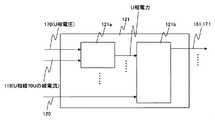
- FIG. 4 is a block diagram showing an example of the internal configuration of converter cell power command value calculator 121 shown in FIG.
- the converter cell power command value calculator 121 includes a power calculator 121a provided for each of the R phase, S phase, T phase, U phase, V phase, and W phase, and the power calculated by the power calculator 121a. And a power distributor 121b that distributes power to each phase based on the power command value 120.
- FIG. 4 shows only the power calculation unit 121a for the U phase. 4 calculates U-phase power based on the input U-phase voltage and U-phase current, and outputs the calculated U-phase power to the power distributor 121b.
- the R phase, S phase, T phase, V phase, and W phase other than the U phase also have the same configuration as the U phase.
- the power distributor 121b generates the primary power command value 161 and the secondary power command value 171 of the converter cells 20-1 to 20-9 based on the input power of each phase and the power command value 120. Calculate and output.
- the primary power command values 161 and the secondary power command values 171 of the converter cells 20-1 to 20-9 calculated by the converter cell power command value calculator 121 are the central control.
- the converter 101 is supplied to the converter cell terminal voltage command value calculator 122 included in the circuit 101, and the converter cell terminal voltage command value calculator 122 uses the primary side terminal voltage command values 162 of the converter cells 20-1 to 20-9. Secondary side terminal voltage command value 172 is calculated. Thereby, the central control circuit 101 can perform control by the voltage command value.
- Each primary side terminal voltage command value 162 and each secondary side terminal voltage command value 172 calculated by the converter cell terminal voltage command value calculator 122 are the first cell control circuit 205 shown in FIG.
- the first cell control circuit 205 and the second cell control circuit 206 control the converter 201, the DC / DC converter 203 and the inverter 204 that constitute the converter cells 20-1 to 20-9. .
- the central control circuit 101 outputs the primary side terminal voltage command value 162 and the secondary side terminal voltage command value 172.
- the present invention is not limited to this.
- the central control circuit 101 may output a drive signal that drives the converter 201, the DC / DC converter 203, and the inverter 204 that constitute the converter cells 20-1 to 20-9.
- the first cell control circuit 205 and the second cell control circuit 206 are provided separately.
- the present invention is not limited to this, and the converter 201, DC / DC converter 203 and inverter 204 may be controlled.
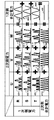
- FIG. 5 is a diagram illustrating an example of waveforms of primary power and secondary power of each converter cell in the power conversion apparatus 100 illustrated in FIG. 1.
- the power waveforms 420-1 to 420-9 shown in FIG. 5 represent the primary side power and the secondary side power of the converter cells 20-1 to 20-9 when the horizontal axis is taken at time t. As shown in FIG. 6, since both waveforms have almost the same instantaneous value, they are shown in a superimposed manner.
- the primary side terminals 24 and 25 are connected to the R phase line 60R of the primary side system 60
- the secondary side terminals 26 and 27 are connected to the U phase line 70U of the secondary side system 70.
- the power waveform of the converter cell 20-1 connected to is shown.
- power waveforms 420-2 to 420-9 are the waveforms of converter cells 20-2 to 20-9.
- the power waveforms 460R to 460T show the phase power waveforms of the R-phase, S-phase, and T-phase of the primary system 60 when the horizontal axis is at time t.
- the power waveforms 470U to 470W are horizontal
- the phase power waveforms of the U-phase, V-phase, and W-phase of the secondary system 70 when the axis is taken at time t are shown.
- the power waveform 460R of the phase power of the R phase and the power waveform 470U of the phase power of the U phase are compared, there are times when the instantaneous values of the phase power are different from each other because the frequencies and phases are different from each other. Accordingly, when the primary side terminal and the secondary side terminal of the converter cells connected in series are each connected to one phase as in the conventional configuration shown in the above Japanese Patent Application Laid-Open No. 2005-73362, The instantaneous values of the primary power and secondary power of the converter cell are also different from each other, and the problem described in the column “Problems to be Solved by the Invention” occurs.
- FIG. 6 is a diagram illustrating an example of the waveform of the voltage across the primary side terminals of each converter cell in the power conversion apparatus 100 illustrated in FIG.
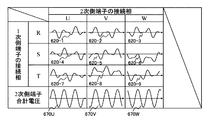
- FIG. 7 is a diagram illustrating an example of a waveform of a voltage between the secondary terminals of each converter cell in the power conversion apparatus 100 illustrated in FIG.
- primary terminals 24 and 25 of converter cells 20-1 to 20-3 are connected in series to R-phase line 60R, while secondary-side terminals 26 and 27 are connected to U-phase line of converter cell 20-1. 70U, converter cell 20-2 is connected to V-phase line 70V, and converter cell 20-3 is connected to W-phase line 70W.
- the phase power of the R phase is distributed and supplied to each phase of the secondary side system 70.
- the S-phase phase power and the T-phase phase power are also distributed and supplied to each phase of the secondary system 70. Therefore, for example, the distribution of power supplied from the R phase to the U phase, the V phase, and the W phase can be arbitrarily determined.
- the primary power and the secondary power of each converter cell 20-1 to 20-9 are converted into the phase power frequency and phase component (phase power component) of the phase connected to the primary terminals 24 and 25. ) And the phase power components of the phases connected to the secondary terminals 26 and 27 are determined.
- the primary side power and the secondary side power are controlled so as to include both the phase power component of the R phase and the phase power component of the U phase.
- command values (primary power command value 161 and secondary power command value 171) of the primary side power and the secondary side power of converter cell 20-1 are, for example, converter cells 20-1 to 20- You may determine so that the peak value of 9 electric power may become the minimum.
- the command values of the primary side power and the secondary side power (primary side power command value 161 and secondary side power command value 171) of the converter cell 20-1 are the values of the primary side power and the secondary side power.
- the ratio may be determined to vary. Thereby, the pulsating flow component can be reduced, the capacities of the first DC link capacitor 202-1 and the second DC link capacitor 202-2 can be reduced, and the apparatus can be miniaturized.
- the power waveforms 420-1 to 420-9 shown in FIG. 5 indicate the amplitude of the phase power component of the phase connected to the primary side terminals 24 and 25 of the converter cells 20-1 to 20-9 by about 1/3. And the power obtained by reducing the amplitude of the phase power component of the phase connected to the secondary side terminals 26 and 27 to about 3.
- the phase power of each phase is maintained as a sine wave as shown in the power waveforms 460R to 460T and 470U to 470W of FIG. 5, while the primary of the converter cells 20-1 to 20-9
- the instantaneous power of the side power and the secondary power can be made approximately equal.
- the voltage waveforms 520-1 to 520-9 shown in FIG. 6 represent the primary side terminal voltages of the converter cells 20-1 to 20-9 when the horizontal axis is taken at time t.
- the primary side terminals 24 and 25 are connected to the R phase line 60R of the primary side system 60, and the secondary side terminals 26 and 27 are connected to the U phase line 70U of the secondary side system 70.
- the voltage between the primary side terminals of the converter cell 20-1 connected to is shown.
- the primary side terminals 24 and 25 are connected to the R-phase line 60R of the primary side system 60, and the secondary side terminals 26 and 27 are connected to the V-phase line 70V of the secondary side system 70.
- the primary terminal voltage of the converter cell 20-2 is shown.
- the primary side terminals 24 and 25 are connected to the R phase line 60R of the primary side system 60, and the secondary side terminals 26 and 27 are connected to the W phase line 70W of the secondary side system 70.
- the primary terminal voltage of the converter cell 20-2 is shown.
- the primary side terminals 24 and 25 are connected to the S phase line 60S of the primary side system 60, and the secondary side terminals 26 and 27 are connected to the U phase line 70U of the secondary side system 70.
- the primary terminal voltage of the converter cell 20-4 is shown.
- the primary side terminals 24 and 25 are connected to the S phase line 60S of the primary side system 60, and the secondary side terminals 26 and 27 are connected to the V phase line 70V of the secondary side system 70.
- the primary terminal voltage of the converter cell 20-5 is shown.
- the primary side terminals 24 and 25 are connected to the S phase line 60S of the primary side system 60, and the secondary side terminals 26 and 27 are connected to the W phase line 70W of the secondary side system 70.
- the primary terminal voltage of the converter cell 20-6 is shown.
- the primary side terminals 24 and 25 are connected to the T phase line 60T of the primary side system 60, and the secondary side terminals 26 and 27 are connected to the U phase line 70U of the secondary side system 70.
- the primary terminal voltage of the converter cell 20-7 is shown.
- the primary side terminals 24 and 25 are connected to the T phase line 60T of the primary side system 60, and the secondary side terminals 26 and 27 are connected to the V phase line 70V of the secondary side system 70.
- the primary terminal voltage of the converter cell 20-8 is shown.
- the primary side terminals 24 and 25 are connected to the T phase line 60T of the primary side system 60, and the secondary side terminals 26 and 27 are connected to the W phase line 70W of the secondary side system 70.
- the primary terminal voltage of the converter cell 20-9 is shown.
- FIG. 6 shows a case where the primary side power and the secondary side power of each converter cell 20-1 to 20-9 are the power shown in FIG.
- the voltage waveforms 520-1 to 520-9 are the phase voltage frequency component and phase component (phase voltage component) of the phase connected to the primary side terminals 24 and 25 of the converter cells 20-1 to 20-9, and the secondary Phase voltage components of phases connected to the side terminals 26 and 27.
- the voltage waveform 560R is a sum of the voltage waveforms 520-1 to 520-3 of the voltage between the primary terminals of the converter cells 20-1 to 20-3 in which the primary terminals 24 and 25 are connected to the R-phase line 60R.
- the voltage waveform 560S is a voltage waveform 520-4 to 520-6 of the voltage between the primary terminals of the converter cells 20-4 to 20-6 in which the primary terminals 24 and 25 are connected to the S-phase line 60S. This is the total voltage.
- the voltage waveform 560T is a voltage waveform 520-7 to 520-9 of the voltage between the primary terminals of the converter cells 20-7 to 20-9 in which the primary terminals 24 and 25 are connected to the T-phase line 60T. This is the total voltage.
- the voltage waveform 560R maintains a sine wave.
- the voltage waveforms 560S and 560T of the other phase voltages similarly maintain a sine wave.
- voltage waveforms 620-1 to 620-9 shown in FIG. 7 represent the voltages across the secondary terminals of converter cells 20-1 to 20-9 when the horizontal axis is taken at time t.
- the primary side terminals 24 and 25 are connected to the R phase line 60R of the primary side system 60, and the secondary side terminals 26 and 27 are connected to the U phase line 70U of the secondary side system 70.
- the secondary terminal voltage of the converter cell 20-1 connected to is shown.
- the primary side terminals 24 and 25 are connected to the R phase line 60R of the primary side system 60, and the secondary side terminals 26 and 27 are connected to the V phase line 70V of the secondary side system 70.
- the secondary terminal voltage of the converter cell 20-2 is shown.
- the primary side terminals 24 and 25 are connected to the R phase line 60R of the primary side system 60, and the secondary side terminals 26 and 27 are connected to the W phase line 70W of the secondary side system 70.
- the secondary terminal voltage of the converter cell 20-2 is shown.
- the primary side terminals 24 and 25 are connected to the S phase line 60S of the primary side system 60, and the secondary side terminals 26 and 27 are connected to the U phase line 70U of the secondary side system 70.
- the secondary terminal voltage of the converter cell 20-4 is shown.
- the primary side terminals 24 and 25 are connected to the S phase line 60S of the primary side system 60, and the secondary side terminals 26 and 27 are connected to the V phase line 70V of the secondary side system 70.
- the secondary terminal voltage of the converter cell 20-5 is shown.
- the primary side terminals 24 and 25 are connected to the S phase line 60S of the primary side system 60, and the secondary side terminals 26 and 27 are connected to the W phase line 70W of the secondary side system 70.
- the secondary terminal voltage of the converter cell 20-6 is shown.
- the primary side terminals 24 and 25 are connected to the T phase line 60T of the primary side system 60, and the secondary side terminals 26 and 27 are connected to the U phase line 70U of the secondary side system 70.
- the secondary terminal voltage of the converter cell 20-7 is shown.
- the primary side terminals 24 and 25 are connected to the T phase line 60T of the primary side system 60, and the secondary side terminals 26 and 27 are connected to the V phase line 70V of the secondary side system 70.
- the secondary terminal voltage of the converter cell 20-8 is shown.
- the primary side terminals 24 and 25 are connected to the T phase line 60T of the primary side system 60, and the secondary side terminals 26 and 27 are connected to the W phase line 70W of the secondary side system 70.
- the secondary terminal voltage of the converter cell 20-9 is shown.
- FIG. 7 shows a case where the primary side power and the secondary side power of each converter cell 20-1 to 20-9 are the power shown in FIG.
- Voltage waveforms 620-1 to 620-9 are connected to phase voltage components of phases connected to primary terminals 24 and 25 of converter cells 20-1 to 20-9 and secondary terminals 26 and 27. Phase voltage component of the phase.
- Voltage waveform 670U is a voltage waveform 620-1, 620- of the voltage between the secondary terminals of converter cells 20-1, 20-4 and 20-7 in which secondary terminals 26, 27 are connected to U-phase line 70U. This is the total voltage of 4 and 620-7.
- the voltage waveform 670V is a voltage waveform 620-2 of the voltage between the secondary terminals of the converter cells 20-2, 20-5 and 20-8 in which the secondary terminals 26 and 27 are connected to the V-phase line 70V. This is the total voltage of 620-5 and 620-8.
- the voltage waveform 670W is a voltage waveform 620-3 of the voltage between the secondary terminals of the converter cells 20-3, 20-6 and 20-9 in which the secondary terminals 26 and 27 are connected to the W-phase line 70W. This is the total voltage of 620-6 and 620-9.
- the voltage waveform 670U maintains a sine wave.
- the voltage waveforms 670V and 670W of the other phase voltages maintain sine waves.
- the power conversion device 100 can be reduced in size and can be configured with more inexpensive components.
- the power conversion device 100 can be reduced in size and can be configured with more inexpensive components.
- FIG. 8 is a schematic circuit diagram showing a configuration of the power conversion device according to the second embodiment to which the present invention is applied.
- connection of the power conversion apparatus 100 is a YY connection, but in the power conversion apparatus 200 of the present embodiment, the connection is a ⁇ Y connection.
- portions corresponding to the respective components in FIGS. 1 to 7 are denoted by the same reference numerals, and the description thereof may be omitted.
- the power conversion device 200 shown in FIG. 8 has nine converter cells 20-1 to 20-9 as in the first embodiment. Converter cells 20-1 to 20-9 have the same configuration as that of the first embodiment.
- the power conversion device 200 performs unidirectional or bidirectional power conversion between the primary side system 61 and the secondary side system 70 which are all three-phase AC systems.
- the primary side system 61 has an R phase line 61R in which the R phase voltage appears, an S phase line 61S in which the S phase voltage appears, and a T phase line 61T in which the T phase voltage appears.
- the secondary side system 70 has the same configuration as that of the first embodiment.
- the primary terminals 24 and 25 of the converter cells 20-1 to 20-3 are connected in series between the R-phase line 61R and the S-phase line 61S.
- Primary terminals 24 and 25 of converter cells 20-4 to 20-6 are connected in series between S-phase line 61S and T-phase line 61T.
- primary terminals 24 and 25 of converter cells 20-7 to 20-9 are connected in series between T-phase line 61T and R-phase line 61R.
- the secondary terminals 26 and 27 of the converter cells 20-1 to 20-9 are connected in the same manner as in the first embodiment.
- the present embodiment can be applied to the three-phase three-wire primary side system 61 having no neutral wire, and the same effects as those of the first embodiment can be obtained.
- the primary system is ⁇ -connected and the secondary system is Y-connected.
- the present invention is not limited to this, and the primary system is Y-connected and the secondary system is ⁇ -connected. It is also good.
- FIG. 9 is a schematic circuit diagram showing a configuration in the third embodiment of the power conversion device to which the present invention is applied.
- connection is a ⁇ - ⁇ connection.
- portions corresponding to the respective components in FIGS. 1 to 8 are denoted by the same reference numerals, and description thereof may be omitted.
- the power conversion device 300 shown in FIG. 9 has nine converter cells 20-1 to 20-9 as in the first embodiment. Converter cells 20-1 to 20-9 have the same configuration as that of the first embodiment.
- the power conversion device 300 performs unidirectional or bidirectional power conversion between the primary side system 61 and the secondary side system 71, both of which are three-phase AC systems.
- the secondary side system 71 has a U-phase line 71U in which the U-phase voltage appears, a V-phase line 71V in which the V-phase voltage appears, and a W-phase line 71W in which the W-phase voltage appears.
- the primary side system 61 has the same configuration as that of the second embodiment.
- Secondary terminals 26 and 27 of converter cells 20-1, 20-4, and 20-7 are connected in series between U-phase line 71U and W-phase line 71W. Secondary terminals 26 and 27 of converter cells 20-2, 20-5, and 20-8 are connected in series between V-phase line 71V and U-phase line 71U. Further, secondary terminals 26 and 27 of converter cells 20-3, 20-6 and 20-9 are connected in series between W-phase line 71W and V-phase line 71V.
- the present embodiment can be applied to the three-phase three-wire primary side system 61 and the secondary side system 71 having no neutral wire, and the same effects as those of the first embodiment can be obtained. it can.
- Example 4 In this embodiment, the order in which the converter cells 20-1 to 20-9 in the first embodiment are connected in series is changed. The configuration will be described with reference to FIG.
- FIG. 10 is a schematic circuit diagram showing a configuration of the power conversion device according to the fourth embodiment to which the present invention is applied.
- the secondary terminals 26 and 27 of the converter cells 20-3, 20-6, and 20-9 are connected in series between the U-phase line 70U and the neutral line 70N. Further, secondary terminals 26 and 27 of converter cells 20-1, 20-4 and 20-7 are connected in series between V-phase line 70V and neutral line 70N. Further, secondary terminals 26 and 27 of converter cells 20-2, 20-5 and 20-8 are connected in series between W-phase line 70W and neutral line 70N.
- the configuration of the fourth embodiment is the same as that shown in the first embodiment. The same effect can be obtained.
- the order of the serial connection of the primary side and the secondary side of the converter cells 20-1 to 20-9 shown in this embodiment is an example, and the present invention is connected in the other order. There may be.
- Example 5 In this embodiment, the order in which the converter cells 20-1 to 20-9 are connected in series in the second embodiment is changed. The configuration will be described with reference to FIG.
- FIG. 11 is a schematic circuit diagram showing a configuration of the power conversion device according to the fifth embodiment to which the present invention is applied.
- the power conversion device 200 of the present embodiment has nine converter cells 20-1 to 20-9 as in the second embodiment.
- Converter cells 20-1 to 20-9 have the same configuration as that of the second embodiment.
- the power conversion device 200 performs unidirectional or bidirectional power conversion between the primary side system 61 and the secondary side system 70 which are all three-phase AC systems.
- the primary side system 61 has an R phase line 61R in which the R phase voltage appears, an S phase line 61S in which the S phase voltage appears, and a T phase line 61T in which the T phase voltage appears.
- the secondary side system 70 has the same configuration as that of the second embodiment.
- the primary terminals 24 and 25 of the converter cells 20-1 to 20-3 are connected in series between the R-phase line 61R and the T-phase line 61T.
- Primary terminals 24 and 25 of converter cells 20-4 to 20-6 are connected in series between S-phase line 61S and R-phase line 61R.
- primary terminals 24 and 25 of converter cells 20-7 to 20-9 are connected in series between T-phase line 61T and S-phase line 61S.
- the secondary terminals 26 and 27 of the converter cells 20-1 to 20-9 are connected in the same manner as in the fourth embodiment.
- the configuration of the fifth embodiment is the same as that shown in the second embodiment. The effect of can be obtained.
- the order of the serial connection of the primary side and the secondary side of the converter cells 20-1 to 20-9 shown in this embodiment is an example, and the present invention is connected in the other order. There may be.
- Example 6 In this embodiment, the order in which the converter cells 20-1 to 20-9 are connected in series in the third embodiment is changed. The configuration will be described with reference to FIG.
- FIG. 12 is a schematic circuit diagram showing the configuration of the power conversion device according to the sixth embodiment to which the present invention is applied.
- the power conversion apparatus 300 of the present embodiment has nine converter cells 20-1 to 20-9 as in the third embodiment.
- Converter cells 20-1 to 20-9 have the same configuration as that of the third embodiment.
- the power conversion device 300 performs unidirectional or bidirectional power conversion between the primary side system 61 and the secondary side system 71, both of which are three-phase AC systems.
- the primary side system 61 and the secondary side system 71 have the same configuration as in the third embodiment.
- Secondary terminals 26 and 27 of converter cells 20-3, 20-6, and 20-9 are connected in series between U-phase line 71U and W-phase line 71W. Secondary terminals 26 and 27 of converter cells 20-1, 20-4, and 20-7 are connected in series between V-phase line 71V and U-phase line 71U. Further, secondary terminals 26 and 27 of converter cells 20-2, 20-5 and 20-8 are connected in series between W-phase line 71W and V-phase line 71V.
- the primary terminals 24 and 25 of the converter cells 20-1 to 20-9 have the same configuration as in the third embodiment.
- the configuration of the sixth embodiment is the same as that shown in the third embodiment. The effect of can be obtained.
- the order of the serial connection of the primary side and the secondary side of the converter cells 20-1 to 20-9 shown in this embodiment is an example, and the present invention is connected in the other order. There may be.
- Example 7 A present Example shows the system to which the power converter device 100 shown in Example 1 is applied.
- FIG. 13 is a schematic block diagram showing a configuration of a system to which the power conversion device 100 shown in the first embodiment is applied.
- a three-phase power source 180 is connected to the primary side system 60 of the power conversion device 100, and a load 190 is connected to the secondary side system 70.
- the electric power from the three-phase power source 180 is supplied to the primary system 60.
- the power supplied to the primary side system 60 is converted into power suitable for the load 190 and supplied to the load 190 via the secondary side system 70.
- this invention is not limited to the above-mentioned Example, Various modifications are included.
- the above-described embodiments have been described in detail for easy understanding of the present invention, and are not necessarily limited to those having all the configurations described.
- a part of the configuration of one embodiment can be replaced with the configuration of another embodiment, and the configuration of another embodiment can be added to the configuration of one embodiment.
- SYMBOLS 100 Power converter, 101 ... Central control circuit, 110-113 ... Voltage sensor, 114-117 ... Current sensor, 118 ... Communication line, 119 ... Phase voltage calculator, 120 ... Secondary system power command value, 121 ... Converter cell power command value calculator 122 ... Converter cell terminal voltage command value calculator 160 ... Each phase (R phase, S phase, T phase) voltage, 161 ... Each primary power command value, 162 ... Each Primary side terminal voltage command value, 170 ... each phase (U phase, V phase, W phase) voltage, 171 ... each secondary side power command value, 172 ... each secondary side terminal voltage command value, 20-1 20-9 ... Converter cell, 21 ... Primary side circuit, 22 ... Secondary side circuit, 23 ... Transformer, 24, 25 ... Primary side terminal, 26, 27 ... Secondary side terminal, 60 ... Primary side system 70 ... secondary system.
Landscapes
- Engineering & Computer Science (AREA)
- Power Engineering (AREA)
- Inverter Devices (AREA)
Applications Claiming Priority (2)
| Application Number | Priority Date | Filing Date | Title |
|---|---|---|---|
| JP2018026774A JP6913042B2 (ja) | 2018-02-19 | 2018-02-19 | 電力変換装置、電力変換システム及び電力変換装置の制御方法 |
| JP2018-026774 | 2018-02-19 |
Publications (1)
| Publication Number | Publication Date |
|---|---|
| WO2019159467A1 true WO2019159467A1 (ja) | 2019-08-22 |
Family
ID=67620110
Family Applications (1)
| Application Number | Title | Priority Date | Filing Date |
|---|---|---|---|
| PCT/JP2018/042802 Ceased WO2019159467A1 (ja) | 2018-02-19 | 2018-11-20 | 電力変換装置、電力変換システム及び電力変換装置の制御方法 |
Country Status (2)
| Country | Link |
|---|---|
| JP (1) | JP6913042B2 (https=) |
| WO (1) | WO2019159467A1 (https=) |
Families Citing this family (1)
| Publication number | Priority date | Publication date | Assignee | Title |
|---|---|---|---|---|
| JP7491814B2 (ja) * | 2020-10-30 | 2024-05-28 | ナブテスコ株式会社 | Ac-acコンバータ |
Citations (3)
| Publication number | Priority date | Publication date | Assignee | Title |
|---|---|---|---|---|
| JP2000116149A (ja) * | 1998-10-06 | 2000-04-21 | Meidensha Corp | 高周波電源装置 |
| JP2004364373A (ja) * | 2003-06-03 | 2004-12-24 | Fuji Electric Systems Co Ltd | 周波数変換装置 |
| JP2013048546A (ja) * | 2011-08-29 | 2013-03-07 | General Electric Co <Ge> | 電力変換システム及び方法 |
-
2018
- 2018-02-19 JP JP2018026774A patent/JP6913042B2/ja not_active Expired - Fee Related
- 2018-11-20 WO PCT/JP2018/042802 patent/WO2019159467A1/ja not_active Ceased
Patent Citations (3)
| Publication number | Priority date | Publication date | Assignee | Title |
|---|---|---|---|---|
| JP2000116149A (ja) * | 1998-10-06 | 2000-04-21 | Meidensha Corp | 高周波電源装置 |
| JP2004364373A (ja) * | 2003-06-03 | 2004-12-24 | Fuji Electric Systems Co Ltd | 周波数変換装置 |
| JP2013048546A (ja) * | 2011-08-29 | 2013-03-07 | General Electric Co <Ge> | 電力変換システム及び方法 |
Also Published As
| Publication number | Publication date |
|---|---|
| JP6913042B2 (ja) | 2021-08-04 |
| JP2019146313A (ja) | 2019-08-29 |
Similar Documents
| Publication | Publication Date | Title |
|---|---|---|
| JP5719828B2 (ja) | 電力変換装置 | |
| US6741482B2 (en) | Power conversion device | |
| US6072707A (en) | High voltage modular inverter | |
| JP4898899B2 (ja) | 電力変換装置 | |
| US6954366B2 (en) | Multifunction hybrid intelligent universal transformer | |
| JP4512117B2 (ja) | 多重電力変換装置、及び多重変圧器 | |
| CN104779824A (zh) | 具有减小的共模电压的多电平转换器系统和方法 | |
| JP4494562B2 (ja) | 太陽光発電用電力変換装置 | |
| JPH09182441A (ja) | 三相整流装置 | |
| EP2849332B1 (en) | Multilevel inverter | |
| Liu et al. | Multi-level voltage sourced conversion by voltage reinjection at six times the fundamental frequency | |
| WO2019159467A1 (ja) | 電力変換装置、電力変換システム及び電力変換装置の制御方法 | |
| JP4178331B2 (ja) | 直列多重パルス幅変調サイクロコンバータ装置およびその制御方法 | |
| JP2003324990A (ja) | 可変速駆動装置 | |
| Kim et al. | Output current balancing method for three-phase interleaved LLC resonant converter employing Y-connected rectifier | |
| JP2013048503A (ja) | 多重マトリックスコンバータ装置とその制御方法 | |
| US20130258729A1 (en) | Medium voltage power apparatus | |
| WO2019163068A1 (ja) | 整流回路装置 | |
| JP2019146433A (ja) | 電力変換装置 | |
| Khodabandeh et al. | A new t-type direct AC/AC converter | |
| CN115224918B (zh) | 电力转换装置 | |
| CN118889887B (zh) | 一种npc拓扑结构的电力变换装置及控制方法 | |
| JP2510116B2 (ja) | 3相整流回路 | |
| KR100321875B1 (ko) | 3상 멀티 레벨 전압원 컨버터 | |
| JPS5822582A (ja) | サイクロコンバ−タ装置 |
Legal Events
| Date | Code | Title | Description |
|---|---|---|---|
| 121 | Ep: the epo has been informed by wipo that ep was designated in this application |
Ref document number: 18906590 Country of ref document: EP Kind code of ref document: A1 |
|
| NENP | Non-entry into the national phase |
Ref country code: DE |
|
| 122 | Ep: pct application non-entry in european phase |
Ref document number: 18906590 Country of ref document: EP Kind code of ref document: A1 |