WO2019156124A1 - 冷凍機油及び冷凍機用作動流体組成物 - Google Patents
冷凍機油及び冷凍機用作動流体組成物 Download PDFInfo
- Publication number
- WO2019156124A1 WO2019156124A1 PCT/JP2019/004261 JP2019004261W WO2019156124A1 WO 2019156124 A1 WO2019156124 A1 WO 2019156124A1 JP 2019004261 W JP2019004261 W JP 2019004261W WO 2019156124 A1 WO2019156124 A1 WO 2019156124A1
- Authority
- WO
- WIPO (PCT)
- Prior art keywords
- less
- mass
- refrigerating machine
- phosphate
- machine oil
- Prior art date
- Legal status (The legal status is an assumption and is not a legal conclusion. Google has not performed a legal analysis and makes no representation as to the accuracy of the status listed.)
- Ceased
Links
Images
Classifications
-
- C—CHEMISTRY; METALLURGY
- C10—PETROLEUM, GAS OR COKE INDUSTRIES; TECHNICAL GASES CONTAINING CARBON MONOXIDE; FUELS; LUBRICANTS; PEAT
- C10M—LUBRICATING COMPOSITIONS; USE OF CHEMICAL SUBSTANCES EITHER ALONE OR AS LUBRICATING INGREDIENTS IN A LUBRICATING COMPOSITION
- C10M137/00—Lubricating compositions characterised by the additive being an organic non-macromolecular compound containing phosphorus
- C10M137/02—Lubricating compositions characterised by the additive being an organic non-macromolecular compound containing phosphorus having no phosphorus-to-carbon bond
- C10M137/04—Phosphate esters
- C10M137/10—Thio derivatives
- C10M137/105—Thio derivatives not containing metal
-
- C—CHEMISTRY; METALLURGY
- C10—PETROLEUM, GAS OR COKE INDUSTRIES; TECHNICAL GASES CONTAINING CARBON MONOXIDE; FUELS; LUBRICANTS; PEAT
- C10M—LUBRICATING COMPOSITIONS; USE OF CHEMICAL SUBSTANCES EITHER ALONE OR AS LUBRICATING INGREDIENTS IN A LUBRICATING COMPOSITION
- C10M137/00—Lubricating compositions characterised by the additive being an organic non-macromolecular compound containing phosphorus
- C10M137/02—Lubricating compositions characterised by the additive being an organic non-macromolecular compound containing phosphorus having no phosphorus-to-carbon bond
- C10M137/04—Phosphate esters
- C10M137/10—Thio derivatives
-
- C—CHEMISTRY; METALLURGY
- C09—DYES; PAINTS; POLISHES; NATURAL RESINS; ADHESIVES; COMPOSITIONS NOT OTHERWISE PROVIDED FOR; APPLICATIONS OF MATERIALS NOT OTHERWISE PROVIDED FOR
- C09K—MATERIALS FOR MISCELLANEOUS APPLICATIONS, NOT PROVIDED FOR ELSEWHERE
- C09K5/00—Heat-transfer, heat-exchange or heat-storage materials, e.g. refrigerants; Materials for the production of heat or cold by chemical reactions other than by combustion
- C09K5/02—Materials undergoing a change of physical state when used
- C09K5/04—Materials undergoing a change of physical state when used the change of state being from liquid to vapour or vice versa
- C09K5/041—Materials undergoing a change of physical state when used the change of state being from liquid to vapour or vice versa for compression-type refrigeration systems
-
- C—CHEMISTRY; METALLURGY
- C10—PETROLEUM, GAS OR COKE INDUSTRIES; TECHNICAL GASES CONTAINING CARBON MONOXIDE; FUELS; LUBRICANTS; PEAT
- C10M—LUBRICATING COMPOSITIONS; USE OF CHEMICAL SUBSTANCES EITHER ALONE OR AS LUBRICATING INGREDIENTS IN A LUBRICATING COMPOSITION
- C10M105/00—Lubricating compositions characterised by the base-material being a non-macromolecular organic compound
- C10M105/08—Lubricating compositions characterised by the base-material being a non-macromolecular organic compound containing oxygen
- C10M105/32—Esters
- C10M105/34—Esters of monocarboxylic acids
-
- C—CHEMISTRY; METALLURGY
- C10—PETROLEUM, GAS OR COKE INDUSTRIES; TECHNICAL GASES CONTAINING CARBON MONOXIDE; FUELS; LUBRICANTS; PEAT
- C10M—LUBRICATING COMPOSITIONS; USE OF CHEMICAL SUBSTANCES EITHER ALONE OR AS LUBRICATING INGREDIENTS IN A LUBRICATING COMPOSITION
- C10M105/00—Lubricating compositions characterised by the base-material being a non-macromolecular organic compound
- C10M105/08—Lubricating compositions characterised by the base-material being a non-macromolecular organic compound containing oxygen
- C10M105/32—Esters
- C10M105/38—Esters of polyhydroxy compounds
-
- C—CHEMISTRY; METALLURGY
- C10—PETROLEUM, GAS OR COKE INDUSTRIES; TECHNICAL GASES CONTAINING CARBON MONOXIDE; FUELS; LUBRICANTS; PEAT
- C10M—LUBRICATING COMPOSITIONS; USE OF CHEMICAL SUBSTANCES EITHER ALONE OR AS LUBRICATING INGREDIENTS IN A LUBRICATING COMPOSITION
- C10M169/00—Lubricating compositions characterised by containing as components a mixture of at least two types of ingredient selected from base-materials, thickeners or additives, covered by the preceding groups, each of these compounds being essential
- C10M169/04—Mixtures of base-materials and additives
-
- C—CHEMISTRY; METALLURGY
- C10—PETROLEUM, GAS OR COKE INDUSTRIES; TECHNICAL GASES CONTAINING CARBON MONOXIDE; FUELS; LUBRICANTS; PEAT
- C10M—LUBRICATING COMPOSITIONS; USE OF CHEMICAL SUBSTANCES EITHER ALONE OR AS LUBRICATING INGREDIENTS IN A LUBRICATING COMPOSITION
- C10M171/00—Lubricating compositions characterised by purely physical criteria, e.g. containing as base-material, thickener or additive, ingredients which are characterised exclusively by their numerically specified physical properties, i.e. containing ingredients which are physically well-defined but for which the chemical nature is either unspecified or only very vaguely indicated
- C10M171/008—Lubricant compositions compatible with refrigerants
-
- C—CHEMISTRY; METALLURGY
- C10—PETROLEUM, GAS OR COKE INDUSTRIES; TECHNICAL GASES CONTAINING CARBON MONOXIDE; FUELS; LUBRICANTS; PEAT
- C10M—LUBRICATING COMPOSITIONS; USE OF CHEMICAL SUBSTANCES EITHER ALONE OR AS LUBRICATING INGREDIENTS IN A LUBRICATING COMPOSITION
- C10M171/00—Lubricating compositions characterised by purely physical criteria, e.g. containing as base-material, thickener or additive, ingredients which are characterised exclusively by their numerically specified physical properties, i.e. containing ingredients which are physically well-defined but for which the chemical nature is either unspecified or only very vaguely indicated
- C10M171/02—Specified values of viscosity or viscosity index
-
- F—MECHANICAL ENGINEERING; LIGHTING; HEATING; WEAPONS; BLASTING
- F25—REFRIGERATION OR COOLING; COMBINED HEATING AND REFRIGERATION SYSTEMS; HEAT PUMP SYSTEMS; MANUFACTURE OR STORAGE OF ICE; LIQUEFACTION SOLIDIFICATION OF GASES
- F25B—REFRIGERATION MACHINES, PLANTS OR SYSTEMS; COMBINED HEATING AND REFRIGERATION SYSTEMS; HEAT PUMP SYSTEMS
- F25B1/00—Compression machines, plants or systems with non-reversible cycle
-
- C—CHEMISTRY; METALLURGY
- C10—PETROLEUM, GAS OR COKE INDUSTRIES; TECHNICAL GASES CONTAINING CARBON MONOXIDE; FUELS; LUBRICANTS; PEAT
- C10M—LUBRICATING COMPOSITIONS; USE OF CHEMICAL SUBSTANCES EITHER ALONE OR AS LUBRICATING INGREDIENTS IN A LUBRICATING COMPOSITION
- C10M2207/00—Organic non-macromolecular hydrocarbon compounds containing hydrogen, carbon and oxygen as ingredients in lubricant compositions
- C10M2207/28—Esters
- C10M2207/281—Esters of (cyclo)aliphatic monocarboxylic acids
- C10M2207/2815—Esters of (cyclo)aliphatic monocarboxylic acids used as base material
-
- C—CHEMISTRY; METALLURGY
- C10—PETROLEUM, GAS OR COKE INDUSTRIES; TECHNICAL GASES CONTAINING CARBON MONOXIDE; FUELS; LUBRICANTS; PEAT
- C10M—LUBRICATING COMPOSITIONS; USE OF CHEMICAL SUBSTANCES EITHER ALONE OR AS LUBRICATING INGREDIENTS IN A LUBRICATING COMPOSITION
- C10M2207/00—Organic non-macromolecular hydrocarbon compounds containing hydrogen, carbon and oxygen as ingredients in lubricant compositions
- C10M2207/28—Esters
- C10M2207/283—Esters of polyhydroxy compounds
- C10M2207/2835—Esters of polyhydroxy compounds used as base material
-
- C—CHEMISTRY; METALLURGY
- C10—PETROLEUM, GAS OR COKE INDUSTRIES; TECHNICAL GASES CONTAINING CARBON MONOXIDE; FUELS; LUBRICANTS; PEAT
- C10M—LUBRICATING COMPOSITIONS; USE OF CHEMICAL SUBSTANCES EITHER ALONE OR AS LUBRICATING INGREDIENTS IN A LUBRICATING COMPOSITION
- C10M2207/00—Organic non-macromolecular hydrocarbon compounds containing hydrogen, carbon and oxygen as ingredients in lubricant compositions
- C10M2207/28—Esters
- C10M2207/34—Esters having a hydrocarbon substituent of thirty or more carbon atoms, e.g. substituted succinic acid derivatives
- C10M2207/345—Esters having a hydrocarbon substituent of thirty or more carbon atoms, e.g. substituted succinic acid derivatives used as base material
-
- C—CHEMISTRY; METALLURGY
- C10—PETROLEUM, GAS OR COKE INDUSTRIES; TECHNICAL GASES CONTAINING CARBON MONOXIDE; FUELS; LUBRICANTS; PEAT
- C10M—LUBRICATING COMPOSITIONS; USE OF CHEMICAL SUBSTANCES EITHER ALONE OR AS LUBRICATING INGREDIENTS IN A LUBRICATING COMPOSITION
- C10M2223/00—Organic non-macromolecular compounds containing phosphorus as ingredients in lubricant compositions
- C10M2223/02—Organic non-macromolecular compounds containing phosphorus as ingredients in lubricant compositions having no phosphorus-to-carbon bonds
- C10M2223/04—Phosphate esters
- C10M2223/041—Triaryl phosphates
-
- C—CHEMISTRY; METALLURGY
- C10—PETROLEUM, GAS OR COKE INDUSTRIES; TECHNICAL GASES CONTAINING CARBON MONOXIDE; FUELS; LUBRICANTS; PEAT
- C10M—LUBRICATING COMPOSITIONS; USE OF CHEMICAL SUBSTANCES EITHER ALONE OR AS LUBRICATING INGREDIENTS IN A LUBRICATING COMPOSITION
- C10M2223/00—Organic non-macromolecular compounds containing phosphorus as ingredients in lubricant compositions
- C10M2223/02—Organic non-macromolecular compounds containing phosphorus as ingredients in lubricant compositions having no phosphorus-to-carbon bonds
- C10M2223/04—Phosphate esters
- C10M2223/047—Thioderivatives not containing metallic elements
-
- C—CHEMISTRY; METALLURGY
- C10—PETROLEUM, GAS OR COKE INDUSTRIES; TECHNICAL GASES CONTAINING CARBON MONOXIDE; FUELS; LUBRICANTS; PEAT
- C10N—INDEXING SCHEME ASSOCIATED WITH SUBCLASS C10M RELATING TO LUBRICATING COMPOSITIONS
- C10N2020/00—Specified physical or chemical properties or characteristics, i.e. function, of component of lubricating compositions
- C10N2020/01—Physico-chemical properties
- C10N2020/02—Viscosity; Viscosity index
-
- C—CHEMISTRY; METALLURGY
- C10—PETROLEUM, GAS OR COKE INDUSTRIES; TECHNICAL GASES CONTAINING CARBON MONOXIDE; FUELS; LUBRICANTS; PEAT
- C10N—INDEXING SCHEME ASSOCIATED WITH SUBCLASS C10M RELATING TO LUBRICATING COMPOSITIONS
- C10N2020/00—Specified physical or chemical properties or characteristics, i.e. function, of component of lubricating compositions
- C10N2020/01—Physico-chemical properties
- C10N2020/071—Branched chain compounds
-
- C—CHEMISTRY; METALLURGY
- C10—PETROLEUM, GAS OR COKE INDUSTRIES; TECHNICAL GASES CONTAINING CARBON MONOXIDE; FUELS; LUBRICANTS; PEAT
- C10N—INDEXING SCHEME ASSOCIATED WITH SUBCLASS C10M RELATING TO LUBRICATING COMPOSITIONS
- C10N2030/00—Specified physical or chemical properties which is improved by the additive characterising the lubricating composition, e.g. multifunctional additives
- C10N2030/02—Pour-point; Viscosity index
-
- C—CHEMISTRY; METALLURGY
- C10—PETROLEUM, GAS OR COKE INDUSTRIES; TECHNICAL GASES CONTAINING CARBON MONOXIDE; FUELS; LUBRICANTS; PEAT
- C10N—INDEXING SCHEME ASSOCIATED WITH SUBCLASS C10M RELATING TO LUBRICATING COMPOSITIONS
- C10N2030/00—Specified physical or chemical properties which is improved by the additive characterising the lubricating composition, e.g. multifunctional additives
- C10N2030/06—Oiliness; Film-strength; Anti-wear; Resistance to extreme pressure
-
- C—CHEMISTRY; METALLURGY
- C10—PETROLEUM, GAS OR COKE INDUSTRIES; TECHNICAL GASES CONTAINING CARBON MONOXIDE; FUELS; LUBRICANTS; PEAT
- C10N—INDEXING SCHEME ASSOCIATED WITH SUBCLASS C10M RELATING TO LUBRICATING COMPOSITIONS
- C10N2040/00—Specified use or application for which the lubricating composition is intended
- C10N2040/30—Refrigerators lubricants or compressors lubricants
Definitions
- the present invention relates to a refrigerating machine oil and a working fluid composition for a refrigerating machine.
- Refrigerators such as refrigerators and air conditioners are equipped with a compressor for circulating the refrigerant in the refrigerant circulation system.
- the compressor is filled with refrigerating machine oil for lubricating the sliding member.
- the lower the viscosity of the refrigerating machine oil the lower the stirring resistance and the friction of the sliding portion. Therefore, lowering the viscosity of the refrigerating machine oil leads to energy saving of the refrigerating machine.
- Patent Document 1 discloses a predetermined refrigerating machine oil of VG3 or more and VG8 or less.
- an additive for improving the seizure resistance is added to the refrigerating machine oil.
- an additive may reduce the stability of refrigerating machine oil, it is desirable that the addition amount thereof be as small as possible. That is, a refrigerating machine oil that can provide a greater effect of improving seizure resistance when the same amount of additive is added is required.
- an object of the present invention is to obtain a large effect of improving seizure resistance in a low viscosity refrigerating machine oil.
- One aspect of the present invention contains a base oil containing an ester of an alcohol and a fatty acid, and a compound represented by the following formula (1), and has a kinematic viscosity at 40 ° C. of 10 mm 2 / s or less. It is machine oil.
- R 1 and R 2 each independently represent a monovalent hydrocarbon group
- R 3 represents a divalent hydrocarbon group
- R 4 represents a hydrogen atom or a monovalent hydrocarbon group.
- Another aspect of the present invention contains a base oil containing an ester of an alcohol and a fatty acid, and a compound represented by the above formula (1), and has a kinematic viscosity at 40 ° C. of 10 mm 2 / s or less. It is the working fluid composition for refrigerators containing refrigerator oil and a refrigerant
- the alcohol preferably contains at least one selected from the group consisting of monohydric alcohols and dihydric alcohols.
- the fatty acid preferably includes a branched fatty acid. In these cases, a greater effect of improving seizure resistance can be obtained.
- the non-polarity index of the base oil may be 60 or less.
- Refrigerator oil contains a base oil containing an ester of alcohol and fatty acid.
- the alcohol may be an aliphatic alcohol.
- the aliphatic alcohol may be linear or branched.
- Carbon number of alcohol may be 3 or more, 4 or more, or 5 or more, for example, 12 or less, 10 or less, or 8 or less.
- the alcohol preferably contains at least one selected from the group consisting of monohydric alcohols and dihydric alcohols, more preferably monohydric aliphatic alcohols and from the viewpoint of obtaining a greater effect of improving seizure resistance. It contains at least one selected from the group consisting of divalent aliphatic alcohols.
- the ratio (total) of monohydric alcohol and dihydric alcohol in the alcohol may be 50% by mass or more, 70% by mass or more, or 90% by mass or more.
- the proportion (total) of monovalent aliphatic alcohol and divalent aliphatic alcohol in the alcohol may be 50% by mass or more, 70% by mass or more, or 90% by mass or more.
- the alcohol may consist of at least one selected from the group consisting of monohydric alcohols and dihydric alcohols, and may consist of only at least one selected from the group consisting of monovalent aliphatic alcohols and divalent aliphatic alcohols. It may be.
- the monovalent aliphatic alcohol may be, for example, propanol, butanol, pentanol, hexanol, heptanol, octanol, nonanol, decanol, undecanol, dodecanol, and the like. These monovalent aliphatic alcohols may be linear or branched.
- divalent aliphatic alcohol examples include 1,3-propanediol, propylene glycol, 1,4-butanediol, 1,2-butanediol, 2-methyl-1,3-propanediol, and 1,5-pentane.
- Diol Diol, neopentyl glycol, 1,6-hexanediol, 2-ethyl-2-methyl-1,3-propanediol, 1,7-heptanediol, 2-methyl-2-propyl-1,3-propanediol, 2,2-diethyl-1,3-propanediol, 1,8-octanediol, 1,9-nonanediol, 1,10-decanediol, 1,11-undecanediol, 1,12-dodecanediol, etc. It's okay.
- the carbon number of the fatty acid may be, for example, 4 or more, 5 or more, or 6 or more, and may be 20 or less, 15 or less, or 10 or less.
- the fatty acid may contain a linear fatty acid, may contain a branched fatty acid, and preferably contains a branched fatty acid from the viewpoint of obtaining a greater effect of improving seizure resistance.
- the fatty acid is preferably selected from the group consisting of a linear fatty acid having 4 to 12 carbon atoms and a branched fatty acid having 4 to 12 carbon atoms from the viewpoint of being able to lower the viscosity and obtaining a greater effect of improving seizure resistance. It contains at least one, more preferably at least one selected from the group consisting of branched fatty acids having 6 to 8 carbon atoms.
- Such fatty acids may be, for example, n-hexanoic acid, n-heptanoic acid, n-octanoic acid, 2-methylpentanoic acid, 2-ethylbutanoic acid, 2-methylhexanoic acid, or 2-ethylhexanoic acid.
- the ratio (total) of the straight chain fatty acid having 4 to 10 carbon atoms and the branched fatty acid having 4 to 10 carbon atoms in the fatty acid may be 50 mass% or more, 70 mass% or more, or 90 mass% or more.
- the proportion (total) of the branched fatty acid having 6 to 8 carbon atoms in the fatty acid may be 50% by mass or more, 70% by mass or more, or 90% by mass or more.
- the fatty acid may consist of at least one selected from the group consisting of linear fatty acids having 4 to 10 carbon atoms and branched fatty acids having 4 to 10 carbon atoms, and selected from the group consisting of branched fatty acids having 6 to 8 carbon atoms. It may consist of at least one kind.
- the ester may contain only an ester of a monohydric alcohol (preferably a monovalent aliphatic alcohol) and a fatty acid, and may contain only an ester of a dihydric alcohol (preferably a divalent aliphatic alcohol) and a fatty acid. From the viewpoint of obtaining a greater effect of improving seizure resistance, an ester of a monohydric alcohol (preferably a monovalent aliphatic alcohol) and a fatty acid and a dihydric alcohol (preferably a divalent aliphatic alcohol) Only esters with fatty acids may be included.
- the kinematic viscosity at 40 ° C. of the base oil may be, for example, 1 mm 2 / s or more, 1.5 mm 2 / s or more, or 2 mm 2 / s or more, and a greater effect of improving seizure resistance is obtained, and From the viewpoint of excellent wear resistance (amount of wear can be reduced), it is preferably 10 mm 2 / s or less, 9 mm 2 / s or less, or 8 mm 2 / s or less.
- the base oil may be, for example, 0.5 mm 2 / s or more, 1 mm 2 / s or more, or 1.5 mm 2 / s or more, and a greater effect of improving seizure resistance is obtained.
- it is preferably 8 mm 2 / s or less, 5 mm 2 / s or less, or 2.5 mm 2 / s or less.
- the kinematic viscosity in this specification means the kinematic viscosity measured based on JIS K2283: 2000.
- the non-polarity index of the base oil is preferably 60 or less, may be 55 or less, 50 or less, 45 or less or 40 or less, and may be 20 or more, 30 or more, or 35 or more.
- the fatty acid ester having a nonpolar index of 60 or less is used, the effect of improving the abrasion resistance or seizure resistance by the compound represented by the formula (1) (improvement) is improved as compared with the case of using a fatty acid ester having a nonpolar index exceeding 60. Rate) increases.
- the improvement effect (improvement rate) of abrasion resistance or seizure resistance by the compound represented by the formula (1) is higher when the branched fatty acid ester is used as the base oil than when the straight chain fatty acid ester is used as the base oil. There is a tendency.
- the nonpolarity index of the fatty acid ester is calculated according to the following formula (A).
- Nonpolarity index (number of carbon atoms ⁇ molecular weight) / (number of ester groups ⁇ 100) (A)
- the number of carbon atoms represents the number of carbon atoms constituting the fatty acid ester
- the molecular weight represents the molecular weight of the fatty acid ester
- the number of ester groups represents the number of ester groups that one molecule of the fatty acid ester has.
- the base oil may further contain other known base oils in addition to the ester.
- the ester content may be 50% by mass or more, 70% by mass or more, or 90% by mass or more based on the total amount of the base oil.
- the base oil may consist only of the ester.
- the content of the base oil may be 50% by mass or more, 60% by mass or more, 70% by mass or more, 80% by mass or more, 90% by mass or more, or 95% by mass or more based on the total amount of refrigerating machine oil. It may be 5% by mass or less, 99% by mass or less, or 98.5% by mass or less.
- the refrigerating machine oil further contains a compound represented by the following formula (1).
- R 1 and R 2 each independently represents a monovalent hydrocarbon group.
- the monovalent hydrocarbon group include an alkyl group and an aryl group.
- the carbon number of the monovalent hydrocarbon group represented by R 1 and R 2 may be 1 or more, 2 or more, 3 or more, and may be 10 or less, 9 or less, or 8 or less.
- the total number of carbon atoms in the monovalent hydrocarbon group represented by R 1 and R 2 may be 2 or more, 3 or more, 4 or more, and 20 or less, 19 or less, or 18 or less.
- R 3 represents a divalent hydrocarbon group.
- the divalent hydrocarbon group include an alkylene group.
- the carbon number of the divalent hydrocarbon group represented by R 3 may be 1 or more, 2 or more, or 3 or more, and may be 10 or less, 9 or less, or 8 or less.
- R 4 represents a hydrogen atom or a monovalent hydrocarbon group.
- the monovalent hydrocarbon group include an alkyl group.
- the monovalent hydrocarbon group represented by R 4 may have 1 or more, 2 or more, or 3 or more carbon atoms, or 10 or less, 9 or less, or 8 or less.
- the compound represented by the formula (1) is preferably a compound represented by the following formula (2).
- R 1, R 2 and R 4 are the same meanings as R 1, R 2 and R 4 in Formula (1).
- R 5 and R 6 each independently represents a hydrogen atom or an alkyl group.
- the alkyl group may be either linear or branched, and is preferably linear.
- the alkyl group may have, for example, 1 to 4, 1 to 3, or 1 to 2 carbon atoms.
- At least one of R 5 and R 6 is preferably a hydrogen atom. More preferably, one of R 5 and R 6 is an alkyl group and the other is a hydrogen atom.
- Such compounds include 3- (diisobutoxy-thiophosphorylsulfanyl) -2-methyl-propionic acid, ethyl-3-[[bis (1-methylethoxy) phosphinothioyl] thio] propionate.
- the content of the compound represented by the formula (1) is preferably 0.001% by mass or more, more preferably 0.005% by mass or more, based on the total amount of refrigerating machine oil, from the viewpoint of further improving seizure resistance. More preferably, it is 0.01 mass% or more.
- the content of the compound represented by the formula (1) is preferably 5% by mass or less, more preferably 4% by mass or less, and further preferably 3% by mass or less, based on the total amount of refrigerating machine oil, from the viewpoint of improving stability. It is.
- the content of the compound represented by the formula (1) is preferably 0.001 to 5% by mass, 0.001 to 4% by mass, 0 from the viewpoint of further improving seizure resistance and improving stability.
- the content of the compound represented by the formula (1) is to obtain a refrigerating machine oil having excellent stability by suppressing the initial oxidation, and a phosphorus-based extreme pressure agent other than the compound represented by the formula (1) (details will be described later). ) Is further included, from the viewpoint of further enhancing the combined effect, 1% by mass or less, 0.1% by mass or less, 0.06% by mass or less, or 0.04% by mass or less, based on the total amount of refrigerating machine oil.
- the refrigerating machine oil may further contain a phosphorus-based extreme pressure agent other than the compound represented by the formula (1).
- the phosphorus extreme pressure agent only needs to contain phosphorus in the molecule.
- the phosphorus extreme pressure agent may be, for example, a phosphate ester, an acidic phosphate ester, an amine salt of an acidic phosphate ester, a chlorinated phosphate ester, a phosphite ester, a thiophosphate ester, or the like.
- Phosphate esters include tributyl phosphate, tripentyl phosphate, trihexyl phosphate, triheptyl phosphate, trioctyl phosphate, trinonyl phosphate, tridecyl phosphate, triundecyl phosphate, tridodecyl phosphate, tritridecyl phosphate, tritetradecyl phosphate , Tripentadecyl phosphate, trihexadecyl phosphate, triheptadecyl phosphate, trioctadecyl phosphate, trioleyl phosphate, triphenyl phosphate, tricresyl phosphate, tri (ethylphenyl) phosphate, tri (propylphenyl) phosphate, tri (butyl Phenyl) phosphate, trixylenyl phosphate, cresyl dipheny Phosphates, and the like x
- acidic phosphate esters include monobutyl acid phosphate, monopentyl acid phosphate, monohexyl acid phosphate, monoheptyl acid phosphate, monooctyl acid phosphate, monononyl acid phosphate, monodecyl acid phosphate, monoundecyl acid phosphate, monododecyl Acid phosphate, monotridecyl acid phosphate, monotetradecyl acid phosphate, monopentadecyl acid phosphate, monohexadecyl acid phosphate, monoheptadecyl acid phosphate, monooctadecyl acid phosphate, monooleyl acid phosphate, dibutyl acid phosphate, dipentyl acid , Dihexylua Phosphate, diheptyl acid phosphate, dioctyl acid phosphate, dinonyl acid phosphate, didecyl acid phosphate
- Examples of the amine salt of acidic phosphate ester include methylamine, ethylamine, propylamine, butylamine, pentylamine, hexylamine, heptylamine, octylamine, dimethylamine, diethylamine, dipropylamine, and dibutylamine.
- salts with amines such as dipentylamine, dihexylamine, diheptylamine, dioctylamine, trimethylamine, triethylamine, tripropylamine, tributylamine, tripentylamine, trihexylamine, triheptylamine, and trioctylamine.
- chlorinated phosphate ester examples include tris-dichloropropyl phosphate, tris-chloroethyl phosphate, tris-chlorophenyl phosphate, polyoxyalkylene bis [di (chloroalkyl)] phosphate and the like.
- thiophosphates examples include tributyl phosphorothioate, tripentyl phosphorothionate, trihexyl phosphorothionate, triheptyl phosphorothionate, trioctyl phosphorothionate, trinonyl phosphorothionate, tridecyl phosphorothioate.
- Phorothionate triundecyl phosphorothionate, tridodecyl phosphorothionate, tritridecyl phosphorothionate, tritetradecyl phosphorothionate, tripentadecyl phosphorothionate, trihexadecyl phosphorothionate, Triheptadecyl phosphorothioate, trioctadecyl phosphorothionate, trioleyl phosphorothionate, triphenyl phosphorothionate, tricresyl phosphorothionate, trikis Les sulfonyl phosphorothionate, cresyldiphenyl phosphorothionate, like carboxymethyl Les sulfonyl diphenyl phosphorothionate.
- the thiophosphate is preferably triphenyl phosphorothionate.
- the content of the phosphorus extreme pressure agent is 0.1% by mass or more, 1% by mass or more, 1.5% by mass or more, or 1.6% by mass, based on the total amount of refrigerating machine oil, from the viewpoint of further excellent seizure resistance. It may be 5 mass% or less, 3 mass% or less, 2.5 mass% or less, or 2 mass% or less.
- the ratio of the compound represented by the formula (1) to the content of the phosphorus-based extreme pressure agent may be 0.0001 / 1 or more, 0.0002 / 1 or more, or 0.0005 / 1 or more, 1/1 or less, 0.5 / 1 or less, 0. It may be 1/1 or less, 0.05 / 1 or less, or 0.01 / 1 or less.
- the kinematic viscosity at 40 ° C. of the refrigerating machine oil may be, for example, 1 mm 2 / s or more, 1.5 mm 2 / s or more, or 2 mm 2 / s or more, and a greater effect of improving seizure resistance is obtained, and From the viewpoint of excellent wear resistance (amount of wear can be reduced), it is preferably 10 mm 2 / s or less, 9 mm 2 / s or less, or 8 mm 2 / s or less.
- the refrigerating machine oil may be, for example, 0.5 mm 2 / s or more, 1 mm 2 / s or more, or 1.5 mm 2 / s or more, and a greater effect of improving seizure resistance is obtained.
- it is preferably 8 mm 2 / s or less, 5 mm 2 / s or less, or 2.5 mm 2 / s or less.
- the ISO viscosity classification of the refrigerating machine oil is not particularly limited as long as the kinematic viscosity at 40 ° C. of the refrigerating machine oil is 10 mm 2 / s or less.
- the ISO viscosity classification of the refrigerating machine oil is classified into, for example, VG2, 3, 5, 7, and 10, and is preferably VG10 or less, more preferably VG7 or less, and further preferably VG5 from the viewpoint of ensuring low friction in the fluid lubrication region. It is as follows.
- VG 7 or 5 refrigeration oil generally has a lower friction coefficient in the fluid lubrication region than the higher viscosity grade refrigeration oil, but the lubricity in the mixed lubrication or boundary lubrication region deteriorates. The coefficient of friction tends to be high.
- the lubricity in the mixed lubrication or boundary lubrication region is remarkably improved and contributes to the low friction. The degree of improvement is higher for refrigeration oil of VG10 or less.
- the ISO viscosity classification means a viscosity grade defined in JIS K 2001 (1993) “Industrial Lubricating Oil—ISO Viscosity Classification” or ISO 3448/1992 “Industrial liquid lubrication-ISO viscosity classification”. .
- the flash point of the refrigerating machine oil may be 100 ° C. or higher, 110 ° C. or higher, or 120 ° C. or higher from the viewpoint of safety, and may be 155 ° C. or lower or 145 ° C. or lower from the viewpoint of reducing the viscosity.
- the flash point in this specification means a flash point measured according to JIS K2265-4: 2007 (Cleveland Release (COC) method).
- the pour point of the refrigerating machine oil may be ⁇ 10 ° C. or lower, ⁇ 20 ° C. or lower, or ⁇ 50 ° C. or lower, and may be ⁇ 40 ° C. or higher from the viewpoint of purification cost.
- the pour point in this specification means the pour point measured according to JIS K2269: 1987.
- the acid value of the refrigerating machine oil may be 1.0 mgKOH / g or less, or 0.1 mgKOH / g or less.
- the acid value in this specification means the acid value measured based on JIS K2501: 2003.
- the volume resistivity of the refrigerating machine oil may be 1.0 ⁇ 10 9 ⁇ ⁇ m or more, 1.0 ⁇ 10 10 ⁇ ⁇ m or more, or 1.0 ⁇ 10 11 ⁇ ⁇ m or more.
- the volume resistivity in this specification means the volume resistivity at 25 ° C. measured according to JIS C2101: 1999.
- the water content of the refrigerating machine oil may be 200 ppm or less, 100 ppm or less, or 50 ppm or less based on the total amount of the refrigerating machine oil.
- the ash content of the refrigerating machine oil may be 100 ppm or less, or 50 ppm or less.
- the ash content in this specification means the ash content measured according to JIS K2272: 1998.
- Refrigerator oil exists in the state of the working fluid composition for refrigerators mixed with the refrigerant in the refrigerator. That is, refrigerating machine oil is used with a refrigerant
- the content of the refrigerating machine oil in the working fluid composition for the refrigerating machine may be 1 part by mass or more or 2 parts by mass or more with respect to 100 parts by mass of the refrigerant, and may be 500 parts by mass or less or 400 parts by mass or less. .
- refrigerant examples include hydrocarbon refrigerants, saturated fluorinated hydrocarbon refrigerants, unsaturated fluorinated hydrocarbon refrigerants, fluorinated ether refrigerants such as perfluoroethers, bis (trifluoromethyl) sulfide refrigerant, and difluoroiodomethane.
- refrigerant examples include natural refrigerants such as ammonia and carbon dioxide.
- the hydrocarbon refrigerant is preferably a hydrocarbon having 1 to 5 carbon atoms, more preferably a hydrocarbon having 2 to 4 carbon atoms.
- Specific examples of the hydrocarbon include methane, ethylene, ethane, propylene, propane (R290), cyclopropane, normal butane, isobutane (R600a), cyclobutane, methylcyclopropane, 2-methylbutane, normal pentane, and these.
- the mixture of 2 or more types is mentioned.
- the hydrocarbon refrigerant is preferably a hydrocarbon refrigerant which is gaseous at 25 ° C. and 1 atm, more preferably propane, normal butane, isobutane, 2-methylbutane or a mixture thereof.
- the saturated fluorinated hydrocarbon refrigerant is preferably a saturated fluorinated hydrocarbon having 1 to 3 carbon atoms, more preferably 1 to 2 carbon atoms.
- Specific examples of the saturated fluorinated hydrocarbon refrigerant include difluoromethane (R32), trifluoromethane (R23), pentafluoroethane (R125), 1,1,2,2-tetrafluoroethane (R134), 1, 1,1,2-tetrafluoroethane (R134a), 1,1,1-trifluoroethane (R143a), 1,1-difluoroethane (R152a), fluoroethane (R161), 1,1,1,2,3 , 3,3-heptafluoropropane (R227ea), 1,1,1,2,3,3-hexafluoropropane (R236ea), 1,1,1,3,3,3-hexafluoropropane (R236fa), 1,1,1,3,3-penta
- the saturated fluorinated hydrocarbon refrigerant is appropriately selected from the above depending on the application and required performance.
- the unsaturated fluorinated hydrocarbon (HFO) refrigerant is preferably an unsaturated fluorinated hydrocarbon having 2 to 3 carbon atoms, more preferably fluoropropene, and still more preferably fluoropropene having 3 to 5 fluorine atoms.
- the unsaturated fluorinated hydrocarbon refrigerant is preferably 1,2,3,3,3-pentafluoropropene (HFO-1225ye), 1,3,3,3-tetrafluoropropene (HFO-1234ze), 2, Any of 3,3,3-tetrafluoropropene (HFO-1234yf), 1,2,3,3-tetrafluoropropene (HFO-1234ye), and 3,3,3-trifluoropropene (HFO-1243zf) One or a mixture of two or more.
- the unsaturated fluorinated hydrocarbon refrigerant is preferably one or more selected from HFO-1225ye, HFO-1234ze and HFO-1234yf from the viewpoint of the physical properties of the refrigerant.
- the unsaturated fluorinated hydrocarbon refrigerant may be fluoroethylene, preferably 1,1,2,3-trifluoroethylene.
- the refrigerating machine oil and the working fluid composition for the refrigerating machine according to the present embodiment include an air conditioner having a reciprocating or rotating hermetic compressor, a refrigerator, an open type or a sealed car air conditioner, a dehumidifier, a water heater, and a freezer. It is suitably used for refrigerators such as refrigerators, refrigerators, vending machines, showcases, chemical plants, refrigerators having a centrifugal compressor, and the like.
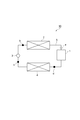
- FIG. 1 is a schematic diagram illustrating an example of a configuration of a refrigerator to which the refrigerator oil and the working fluid composition for a refrigerator according to the present embodiment are applied.
- a refrigerator 10 includes, for example, a refrigerant compressor 1, a gas cooler 2, an expansion mechanism 3 (capillary, expansion valve, etc.), and an evaporator 4 that are sequentially connected by a flow path 5.
- At least a refrigerant circulation system is provided.
- a high-temperature (usually 70 to 120 ° C.) refrigerant discharged from the refrigerant compressor 1 into the flow path 5 is mixed with a high-density fluid (supercritical fluid or the like) in the gas cooler 2. Become.
- the refrigerant is liquefied by passing through a narrow flow path of the expansion mechanism 3 and further vaporized by the evaporator 4 to become a low temperature (usually ⁇ 40 to 0 ° C.).
- refrigerant compressor 1 in FIG. 1 a small amount of refrigerant and a large amount of refrigerating machine oil coexist at high temperature (usually 70 to 120 ° C.).
- the refrigerant discharged from the refrigerant compressor 1 into the flow path 5 is in the form of gas and contains a small amount (usually 1 to 10%) of refrigerating machine oil as a mist.
- the mist refrigerating machine oil contains a small amount of refrigerating machine oil.
- the refrigerant is dissolved (point a in FIG. 1).
- the gaseous refrigerant is compressed into a high-density fluid, and a large amount of refrigerant and a small amount of refrigerating machine oil coexist at a relatively high temperature (about 50 to 70 ° C.) ( Point b) in FIG. Furthermore, a mixture of a large amount of refrigerant and a small amount of refrigerating machine oil is sequentially sent to the expansion mechanism 3 and the evaporator 4 and suddenly becomes low temperature (usually ⁇ 40 to 0 ° C.) (points c and d in FIG. 1). Returned to the refrigerant compressor 1.
- the refrigerating machine oil according to the present embodiment can be used together with the above-described refrigerant, but is particularly preferably used together with a hydrocarbon refrigerant in terms of cold temperature characteristics and compatibility at the time of refrigerant mixing.
- the working fluid composition for a refrigerator particularly preferably contains a hydrocarbon refrigerant.
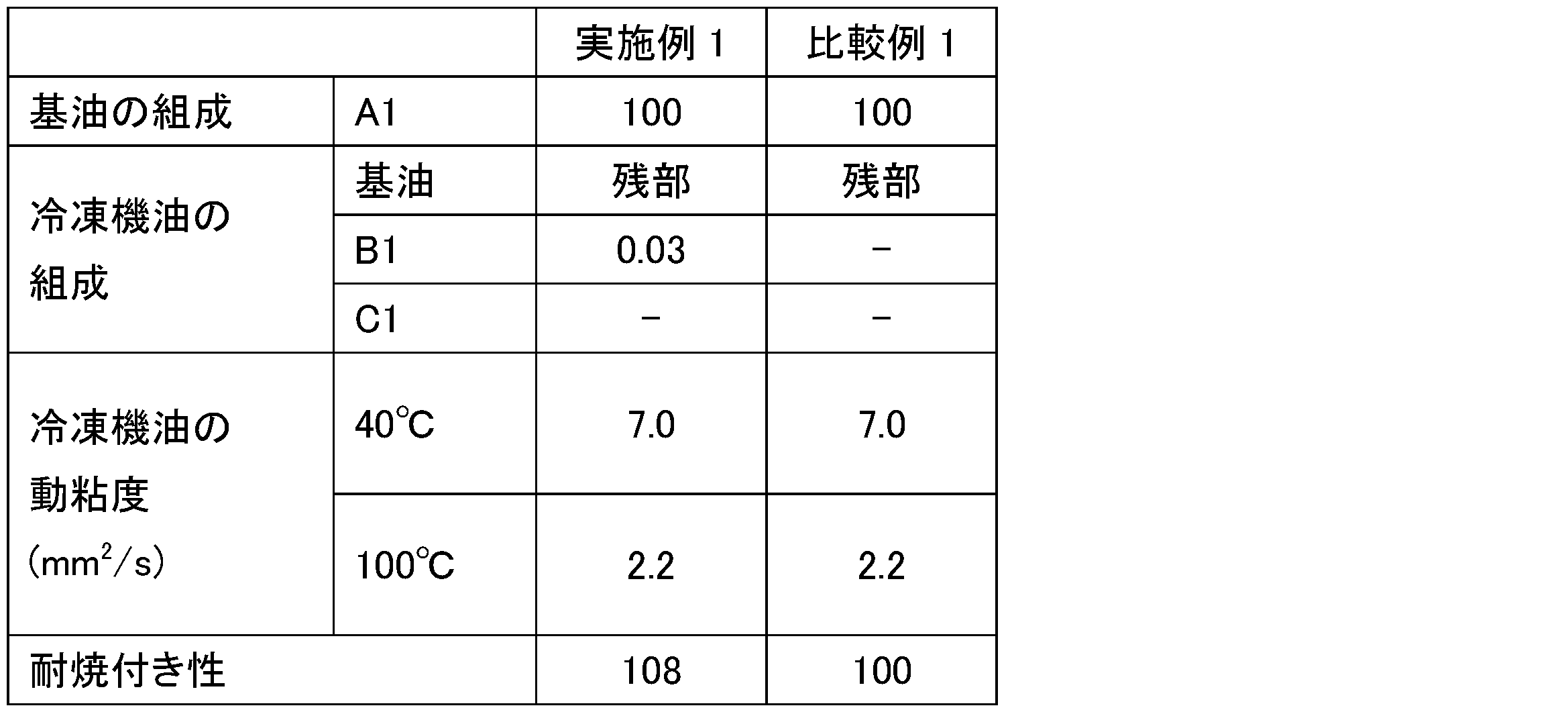
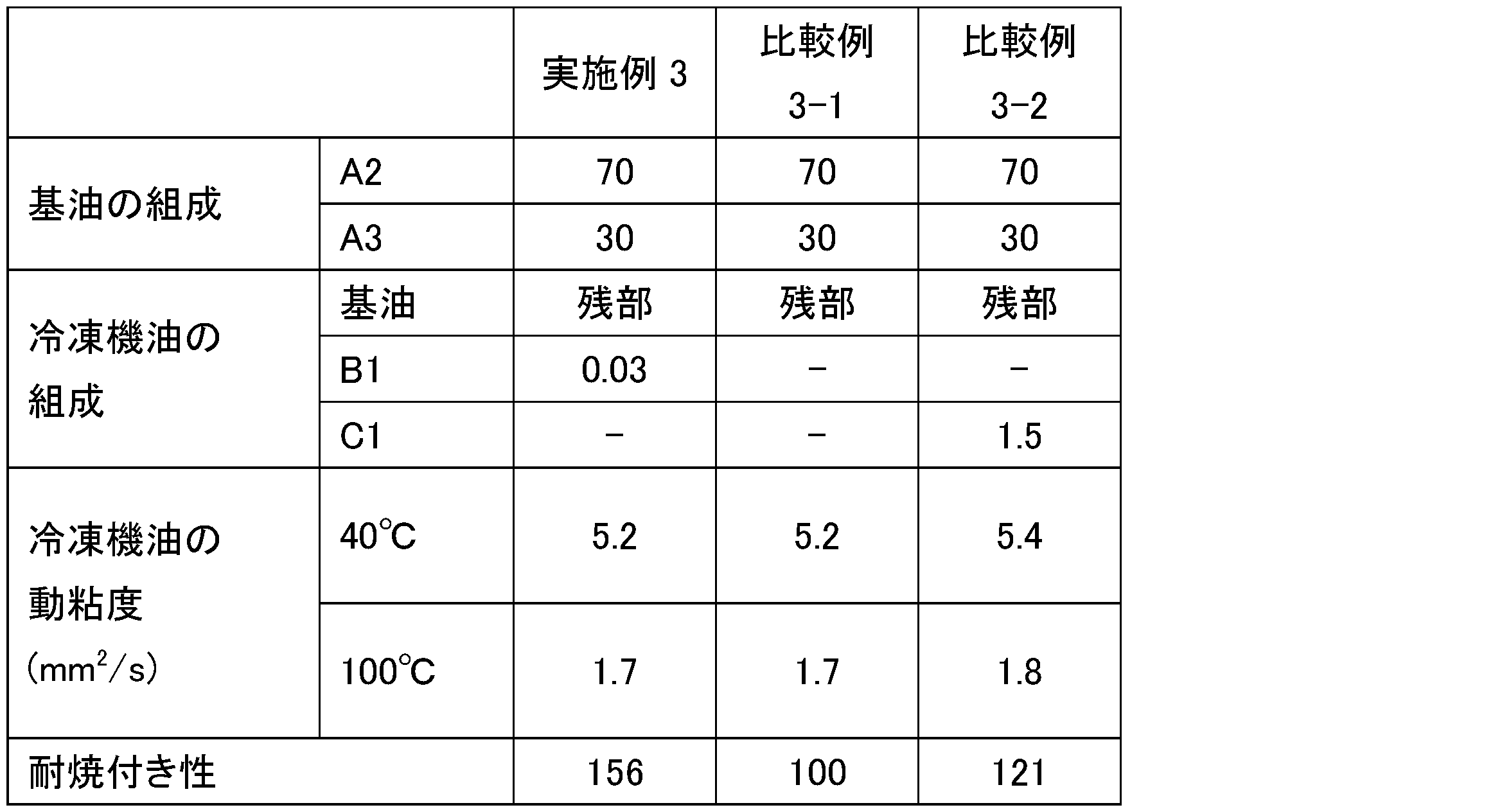
- Refrigerating machine oils having the compositions shown in Tables 1 to 4 (mass% based on the total amount of base oil and mass% based on the total amount of refrigerating machine oil for refrigerating machine oil) shown in Tables 1 to 4 were prepared using the components shown below.
- 0.1% by mass of 2,6-di-tert-butyl-p-cresol and 0.3% by mass of glycidyl neodecanoate were used. Added.
- A1 ester of neopentyl glycol and n-octanoic acid (kinematic viscosity at 40 ° C .: 7.4 mm 2 / s, nonpolar index: 38.5)
- A2 ester of neopentyl glycol and 2-ethylhexanoic acid (kinematic viscosity at 40 ° C .: 7.5 mm 2 / s, nonpolar index: 38.5)
- A3 ester of 2-ethylhexanol and 2-ethylhexanoic acid (kinematic viscosity at 40 ° C .: 2.7 mm 2 / s, nonpolar index: 41)
- a1 ester of pentaerythritol and 2-ethylhexanoic acid / 3,5,5-trimethylhexanoic acid mixed fatty acid (mass ratio: 50/50) (kinematic viscosity at 40 ° C .:
- the FALEEX Pin / Vee-Block test was performed. Rotating speed: 290 rpm, temperature: 60 ° C., oil amount: 120 mL, air atmosphere, running-in for 5 minutes under a load of 300 lbf, then applying the load and when seizure occurs The load (lbf) was set as a seizure load. In addition, the ASTM standard piece was used as a test piece. Additive B1 and / or addition when the seizure load is 100 when additive B1 and additive C1 are not included (Comparative Example 1, Comparative Example 2-1, Comparative Example 3-1, or Reference Example 2) The seizure load in the case of containing the agent C1 was determined as a relative value. The larger the seizure load value, the greater the effect of improving seizure resistance.
- Abrasion resistance was evaluated by a high-speed four-ball test according to ASTM D4172-94. Using SUJ2 as a hard sphere, the test oil amount was 20 mL, the test temperature was 80 ° C., the rotation speed was 1200 rpm, the load was 196 N, the test time was 15 minutes, and the wear scar diameter (mm) of the fixed sphere was measured. The smaller the value of the wear scar diameter, the better the wear resistance.
- the refrigerating machine oil 4 same as that of Example 2-1 or 2-2 except that the content of B1 in the refrigerating machine oil of Example 2-1 or 2-2 was changed to 0.05 mass% or 0.1 mass%. Got a seed.
- These refrigerating machine oils had a kinematic viscosity at 40 ° C. of 10 mm 2 / s or less.
- These refrigerating machine oils were found to have the same effects of improving seizure resistance and abrasion resistance as in Example 2-1 or 2-2, but the stability tends to deteriorate as the B1 content increases. It was suggested that there is.
- Example 2-1 or 2-2 the same four refrigerating machine oils as in Example 2-1 or 2-2 except that the compound represented by the following formula (4) was used instead of B1.
- These refrigerating machine oils had a kinematic viscosity at 40 ° C. of 10 mm 2 / s or less.
- These refrigerating machine oils were found to have the same effects of improving seizure resistance and wear resistance as in Example 2-1 or 2-2.
- Example 2 was carried out except that C1 was replaced with triphenyl phosphate, tri (propylphenyl) phosphate, tri (butylphenyl) phosphate or triphenylphosphorothionate.
- Eight kinds of refrigerating machine oils identical to -1 or 2-2 were obtained. These refrigerating machine oils had a kinematic viscosity at 40 ° C. of 10 mm 2 / s or less.
- These refrigerating machine oils were also found to have the same effects of improving seizure resistance and wear resistance as in Example 2-1 or 2-2.
Landscapes
- Chemical & Material Sciences (AREA)
- Chemical Kinetics & Catalysis (AREA)
- Organic Chemistry (AREA)
- General Chemical & Material Sciences (AREA)
- Oil, Petroleum & Natural Gas (AREA)
- Engineering & Computer Science (AREA)
- Physics & Mathematics (AREA)
- Thermal Sciences (AREA)
- Health & Medical Sciences (AREA)
- Emergency Medicine (AREA)
- Combustion & Propulsion (AREA)
- Materials Engineering (AREA)
- Mechanical Engineering (AREA)
- General Engineering & Computer Science (AREA)
- Lubricants (AREA)
Abstract
Description

非極性指数=(炭素原子数×分子量)/(エステル基の数×100) …(A)
式(A)中、炭素原子数は脂肪酸エステルを構成する炭素原子の数を表し、分子量は脂肪酸エステルの分子量を表し、エステル基の数は脂肪酸エステル1分子が有するエステル基の数を表す。


A1:ネオペンチルグリコールとn-オクタン酸とのエステル(40℃動粘度:7.4mm2/s、非極性指数:38.5)
A2:ネオペンチルグリコールと2-エチルヘキサン酸とのエステル(40℃動粘度:7.5mm2/s、非極性指数:38.5)
A3:2-エチルヘキサノールと2-エチルヘキサン酸とのエステル(40℃動粘度:2.7mm2/s、非極性指数:41)
a1:ペンタエリスリトールと2-エチルヘキサン酸/3,5,5-トリメチルヘキサン酸の混合脂肪酸(質量比:50/50)とのエステル(40℃動粘度:67.4mm2/s、非極性指数:65)
(添加剤)
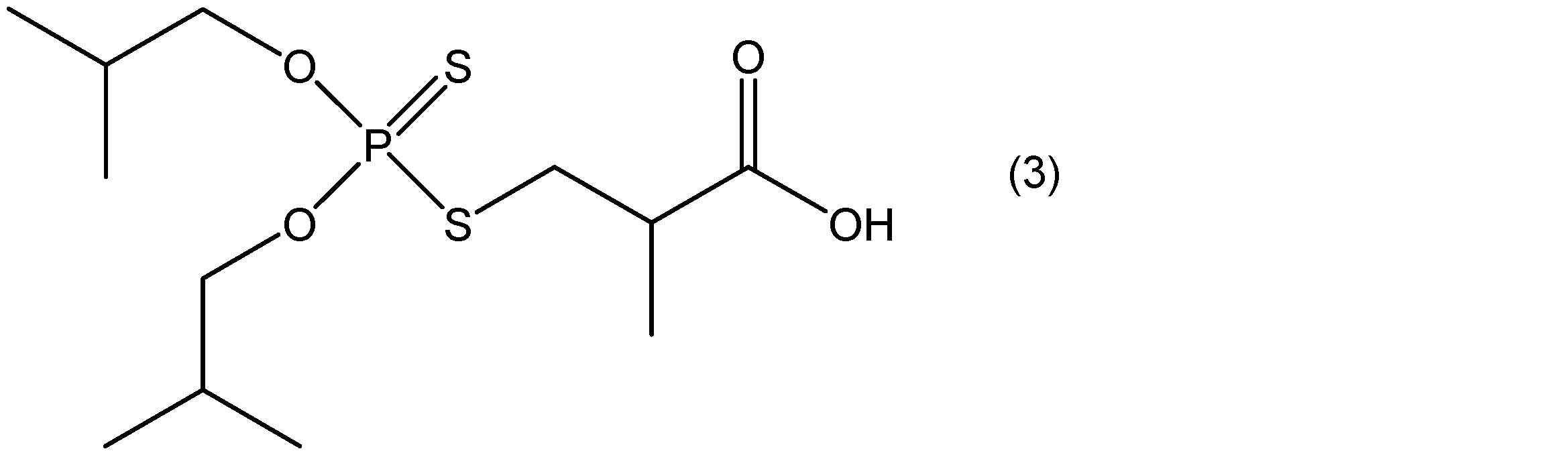
B1:3-(ジイソブトキシ-チオホスホリルスルファニル)-2-メチル-プロピオン酸(下記式(3)で表される化合物)
FALEX Pin/Vee-Block試験を実施した。回転数:290rpm、温度:60℃、油量:120mL、空気雰囲気の条件下で、300lbfの荷重の下で慣らし運転を5分間行い、次いで、荷重を加えていき、焼付きが発生した時点での荷重(lbf)を焼付き荷重とした。なお、試験片として、ASTM標準片を用いた。添加剤B1及び添加剤C1を含有しない場合(比較例1、比較例2-1、比較例3-1又は参考例2)の焼付き荷重を100としたときの、添加剤B1及び/又は添加剤C1を含有する場合の焼付き荷重を相対値として求めた。焼付き荷重の値が大きいほど、耐焼付き性の向上効果が大きいことを意味する。

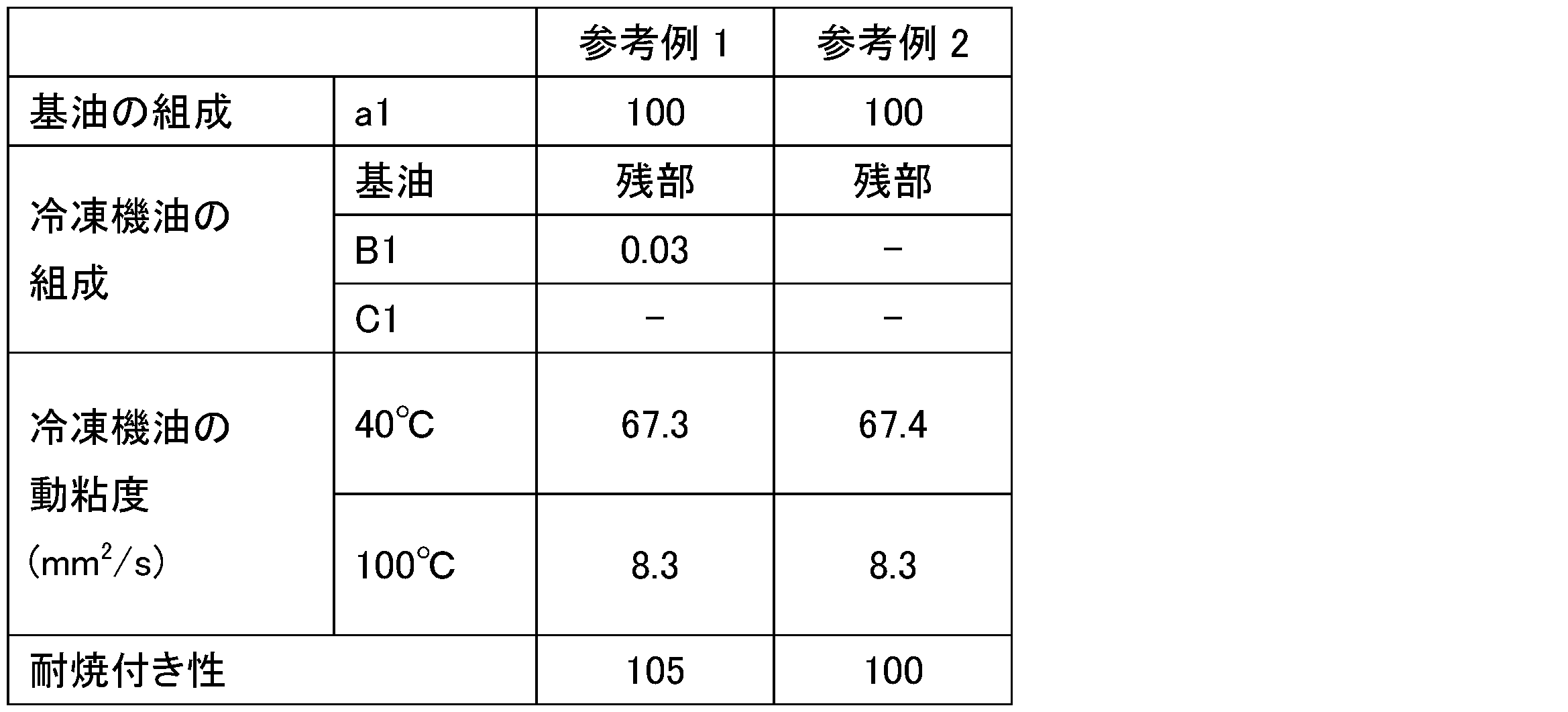
耐摩耗性は、ASTM D4172-94に準拠する高速四球試験により評価した。剛球としてSUJ2を用い、試験油量20mL、試験温度80℃、回転数1200rpm、負荷荷重196N、試験時間15分間の条件で試験を行い、固定球の摩耗痕径(mm)を測定した。摩耗痕径の値が小さいほど、耐摩耗性に優れていることを意味する。


Claims (8)
- アルコールと脂肪酸とのエステルを含む基油と、
下記式(1)で表される化合物と、を含有し、
40℃における動粘度が10mm2/s以下である、冷凍機油。

- 前記アルコールが、1価アルコール及び2価アルコールからなる群より選ばれる少なくとも1種を含む、請求項1に記載の冷凍機油。
- 前記脂肪酸が分岐脂肪酸を含む、請求項1又は2に記載の冷凍機油。
- 前記基油の非極性指数が60以下である、請求項1~3のいずれか一項に記載の冷凍機油。
- アルコールと脂肪酸とのエステルを含む基油と、下記式(1)で表される化合物とを含有し、40℃における動粘度が10mm2/s以下である、冷凍機油と、
冷媒と、を含有する冷凍機用作動流体組成物。

- 前記アルコールが、1価アルコール及び2価アルコールからなる群より選ばれる少なくとも1種を含む、請求項5に記載の冷凍機用作動流体組成物。
- 前記脂肪酸が分岐脂肪酸を含む、請求項5又は6に記載の冷凍機用作動流体組成物。
- 前記基油の非極性指数が60以下である、請求項5~7のいずれか一項に記載の冷凍機用作動流体組成物。
Priority Applications (4)
| Application Number | Priority Date | Filing Date | Title |
|---|---|---|---|
| KR1020207024879A KR102516452B1 (ko) | 2018-02-07 | 2019-02-06 | 냉동기유 및 냉동기용 작동 유체 조성물 |
| US16/967,242 US11384309B2 (en) | 2018-02-07 | 2019-02-06 | Refrigerator oil and hydraulic fluid composition for refrigerators |
| CN201980010938.2A CN111699237B (zh) | 2018-02-07 | 2019-02-06 | 冷冻机油及冷冻机用工作流体组合物 |
| JP2019570778A JP7175288B2 (ja) | 2018-02-07 | 2019-02-06 | 冷凍機油及び冷凍機用作動流体組成物 |
Applications Claiming Priority (4)
| Application Number | Priority Date | Filing Date | Title |
|---|---|---|---|
| JP2018019949 | 2018-02-07 | ||
| JP2018-019949 | 2018-02-07 | ||
| JP2018-059574 | 2018-03-27 | ||
| JP2018059574 | 2018-03-27 |
Publications (1)
| Publication Number | Publication Date |
|---|---|
| WO2019156124A1 true WO2019156124A1 (ja) | 2019-08-15 |
Family
ID=67549730
Family Applications (1)
| Application Number | Title | Priority Date | Filing Date |
|---|---|---|---|
| PCT/JP2019/004261 Ceased WO2019156124A1 (ja) | 2018-02-07 | 2019-02-06 | 冷凍機油及び冷凍機用作動流体組成物 |
Country Status (5)
| Country | Link |
|---|---|
| US (1) | US11384309B2 (ja) |
| JP (1) | JP7175288B2 (ja) |
| KR (1) | KR102516452B1 (ja) |
| CN (1) | CN111699237B (ja) |
| WO (1) | WO2019156124A1 (ja) |
Families Citing this family (5)
| Publication number | Priority date | Publication date | Assignee | Title |
|---|---|---|---|---|
| FR3093729B1 (fr) * | 2019-03-13 | 2025-10-10 | Total Marketing Services | Utilisation d’un ester dans une composition de refroidissement |
| KR102861949B1 (ko) | 2020-12-24 | 2025-09-22 | 에네오스 가부시키가이샤 | 냉동기유 및 냉동기용 작동 유체 조성물 |
| CN117642492A (zh) | 2021-07-30 | 2024-03-01 | 引能仕株式会社 | 冷冻机油用基础油、冷冻机油和冷冻机用工作流体组合物 |
| JP2024542852A (ja) * | 2021-12-10 | 2024-11-15 | ザ ルブリゾル コーポレイション | 往復圧縮機潤滑剤 |
| JP7453488B1 (ja) * | 2022-11-18 | 2024-03-19 | ソマール株式会社 | 磁気粘性流体及び機械装置 |
Citations (6)
| Publication number | Priority date | Publication date | Assignee | Title |
|---|---|---|---|---|
| JPH0570785A (ja) * | 1991-04-30 | 1993-03-23 | Tonen Corp | 潤滑油組成物 |
| JPH069978A (ja) * | 1992-06-24 | 1994-01-18 | Kao Corp | 冷凍機作動流体用組成物 |
| JP2005146010A (ja) * | 2003-11-11 | 2005-06-09 | Nippon Oil Corp | エンジン油用潤滑油組成物 |
| JP2009235226A (ja) * | 2008-03-27 | 2009-10-15 | Nippon Oil Corp | 潤滑油組成物 |
| WO2016072296A1 (ja) * | 2014-11-04 | 2016-05-12 | Jx日鉱日石エネルギー株式会社 | 冷凍機油 |
| JP2018095792A (ja) * | 2016-12-16 | 2018-06-21 | 富士フイルム株式会社 | 潤滑剤組成物 |
Family Cites Families (10)
| Publication number | Priority date | Publication date | Assignee | Title |
|---|---|---|---|---|
| FR2638168A1 (fr) * | 1988-10-21 | 1990-04-27 | Rhone Poulenc Chimie | Dispersions d'halogenures de terres rares en milieu huileux |
| JP3775843B2 (ja) * | 1995-01-23 | 2006-05-17 | 日本クエーカー・ケミカル株式会社 | 潤滑組成物 |
| JP3860942B2 (ja) | 1999-11-18 | 2006-12-20 | 株式会社ジャパンエナジー | 冷凍装置用潤滑油組成物、作動流体及び冷凍装置 |
| WO2006062245A1 (en) | 2004-12-08 | 2006-06-15 | Matsushita Electric Industrial Co., Ltd. | Refrigerant compressor |
| JP5426829B2 (ja) * | 2007-02-07 | 2014-02-26 | 昭和シェル石油株式会社 | 油圧シリンダーのビビリ、振動、鳴き防止用潤滑油組成物 |
| JP5231060B2 (ja) * | 2008-03-26 | 2013-07-10 | Jx日鉱日石エネルギー株式会社 | 冷媒用冷凍機油 |
| CN103789070B (zh) * | 2008-03-26 | 2017-04-12 | 日本能源株式会社 | 致冷剂用冷冻机油 |
| WO2011127132A1 (en) * | 2010-04-06 | 2011-10-13 | Chemtura Corporation | Refrigeration oil and compositions with carbon dioxide refrigerant |
| JP6478202B2 (ja) | 2014-11-07 | 2019-03-06 | 出光興産株式会社 | 冷凍機用潤滑油組成物及び冷凍機 |
| JP6159373B2 (ja) * | 2015-10-07 | 2017-07-05 | 出光興産株式会社 | 冷凍機油、冷凍機用組成物、冷凍機及び冷凍機油の選定方法 |
-
2019
- 2019-02-06 WO PCT/JP2019/004261 patent/WO2019156124A1/ja not_active Ceased
- 2019-02-06 KR KR1020207024879A patent/KR102516452B1/ko active Active
- 2019-02-06 JP JP2019570778A patent/JP7175288B2/ja active Active
- 2019-02-06 CN CN201980010938.2A patent/CN111699237B/zh active Active
- 2019-02-06 US US16/967,242 patent/US11384309B2/en active Active
Patent Citations (6)
| Publication number | Priority date | Publication date | Assignee | Title |
|---|---|---|---|---|
| JPH0570785A (ja) * | 1991-04-30 | 1993-03-23 | Tonen Corp | 潤滑油組成物 |
| JPH069978A (ja) * | 1992-06-24 | 1994-01-18 | Kao Corp | 冷凍機作動流体用組成物 |
| JP2005146010A (ja) * | 2003-11-11 | 2005-06-09 | Nippon Oil Corp | エンジン油用潤滑油組成物 |
| JP2009235226A (ja) * | 2008-03-27 | 2009-10-15 | Nippon Oil Corp | 潤滑油組成物 |
| WO2016072296A1 (ja) * | 2014-11-04 | 2016-05-12 | Jx日鉱日石エネルギー株式会社 | 冷凍機油 |
| JP2018095792A (ja) * | 2016-12-16 | 2018-06-21 | 富士フイルム株式会社 | 潤滑剤組成物 |
Also Published As
| Publication number | Publication date |
|---|---|
| US20210032558A1 (en) | 2021-02-04 |
| CN111699237A (zh) | 2020-09-22 |
| US11384309B2 (en) | 2022-07-12 |
| CN111699237B (zh) | 2022-08-09 |
| JP7175288B2 (ja) | 2022-11-18 |
| KR102516452B1 (ko) | 2023-03-31 |
| KR20200118086A (ko) | 2020-10-14 |
| JPWO2019156124A1 (ja) | 2021-01-28 |
Similar Documents
| Publication | Publication Date | Title |
|---|---|---|
| JP7507268B2 (ja) | 冷凍機油及び冷凍機用作動流体組成物 | |
| JP7175288B2 (ja) | 冷凍機油及び冷凍機用作動流体組成物 | |
| JP7198589B2 (ja) | 冷凍機、冷凍機油の使用、オリゴマーの溶出を抑制する方法、冷凍機油、冷凍機用作動流体組成物、及び冷凍機油の製造方法 | |
| JP6072706B2 (ja) | 冷凍機用作動流体組成物及び冷凍機油 | |
| KR102617816B1 (ko) | 냉동기유 및 냉동기용 작동 유체 조성물 | |
| JP2022121735A (ja) | 冷凍機油及び冷凍機用作動流体組成物 | |
| JP2014198854A (ja) | 冷凍機油及び冷凍機用作動流体組成物 | |
| JP6033262B2 (ja) | 冷凍機用作動流体組成物及び冷凍機油 |
Legal Events
| Date | Code | Title | Description |
|---|---|---|---|
| 121 | Ep: the epo has been informed by wipo that ep was designated in this application |
Ref document number: 19750766 Country of ref document: EP Kind code of ref document: A1 |
|
| ENP | Entry into the national phase |
Ref document number: 2019570778 Country of ref document: JP Kind code of ref document: A |
|
| NENP | Non-entry into the national phase |
Ref country code: DE |
|
| ENP | Entry into the national phase |
Ref document number: 20207024879 Country of ref document: KR Kind code of ref document: A |
|
| 122 | Ep: pct application non-entry in european phase |
Ref document number: 19750766 Country of ref document: EP Kind code of ref document: A1 |