WO2019117188A1 - 細胞増殖抑制剤及びそれを含むがんの治療若しくは予防用医薬組成物 - Google Patents
細胞増殖抑制剤及びそれを含むがんの治療若しくは予防用医薬組成物 Download PDFInfo
- Publication number
- WO2019117188A1 WO2019117188A1 PCT/JP2018/045627 JP2018045627W WO2019117188A1 WO 2019117188 A1 WO2019117188 A1 WO 2019117188A1 JP 2018045627 W JP2018045627 W JP 2018045627W WO 2019117188 A1 WO2019117188 A1 WO 2019117188A1
- Authority
- WO
- WIPO (PCT)
- Prior art keywords
- ras
- raf
- mek
- gstp1
- cancer
- Prior art date
- Legal status (The legal status is an assumption and is not a legal conclusion. Google has not performed a legal analysis and makes no representation as to the accuracy of the status listed.)
- Ceased
Links
Images



Classifications
-
- A—HUMAN NECESSITIES
- A61—MEDICAL OR VETERINARY SCIENCE; HYGIENE
- A61K—PREPARATIONS FOR MEDICAL, DENTAL OR TOILETRY PURPOSES
- A61K38/00—Medicinal preparations containing peptides
- A61K38/16—Peptides having more than 20 amino acids; Gastrins; Somatostatins; Melanotropins; Derivatives thereof
- A61K38/43—Enzymes; Proenzymes; Derivatives thereof
- A61K38/45—Transferases (2)
-
- A—HUMAN NECESSITIES
- A61—MEDICAL OR VETERINARY SCIENCE; HYGIENE
- A61K—PREPARATIONS FOR MEDICAL, DENTAL OR TOILETRY PURPOSES
- A61K31/00—Medicinal preparations containing organic active ingredients
- A61K31/70—Carbohydrates; Sugars; Derivatives thereof
- A61K31/7088—Compounds having three or more nucleosides or nucleotides
- A61K31/713—Double-stranded nucleic acids or oligonucleotides
-
- A—HUMAN NECESSITIES
- A61—MEDICAL OR VETERINARY SCIENCE; HYGIENE
- A61K—PREPARATIONS FOR MEDICAL, DENTAL OR TOILETRY PURPOSES
- A61K38/00—Medicinal preparations containing peptides
- A61K38/16—Peptides having more than 20 amino acids; Gastrins; Somatostatins; Melanotropins; Derivatives thereof
-
- A—HUMAN NECESSITIES
- A61—MEDICAL OR VETERINARY SCIENCE; HYGIENE
- A61K—PREPARATIONS FOR MEDICAL, DENTAL OR TOILETRY PURPOSES
- A61K45/00—Medicinal preparations containing active ingredients not provided for in groups A61K31/00 - A61K41/00
-
- A—HUMAN NECESSITIES
- A61—MEDICAL OR VETERINARY SCIENCE; HYGIENE
- A61K—PREPARATIONS FOR MEDICAL, DENTAL OR TOILETRY PURPOSES
- A61K45/00—Medicinal preparations containing active ingredients not provided for in groups A61K31/00 - A61K41/00
- A61K45/06—Mixtures of active ingredients without chemical characterisation, e.g. antiphlogistics and cardiaca
-
- A—HUMAN NECESSITIES
- A61—MEDICAL OR VETERINARY SCIENCE; HYGIENE
- A61K—PREPARATIONS FOR MEDICAL, DENTAL OR TOILETRY PURPOSES
- A61K48/00—Medicinal preparations containing genetic material which is inserted into cells of the living body to treat genetic diseases; Gene therapy
-
- A—HUMAN NECESSITIES
- A61—MEDICAL OR VETERINARY SCIENCE; HYGIENE
- A61P—SPECIFIC THERAPEUTIC ACTIVITY OF CHEMICAL COMPOUNDS OR MEDICINAL PREPARATIONS
- A61P1/00—Drugs for disorders of the alimentary tract or the digestive system
- A61P1/04—Drugs for disorders of the alimentary tract or the digestive system for ulcers, gastritis or reflux esophagitis, e.g. antacids, inhibitors of acid secretion, mucosal protectants
-
- A—HUMAN NECESSITIES
- A61—MEDICAL OR VETERINARY SCIENCE; HYGIENE
- A61P—SPECIFIC THERAPEUTIC ACTIVITY OF CHEMICAL COMPOUNDS OR MEDICINAL PREPARATIONS
- A61P35/00—Antineoplastic agents
-
- A—HUMAN NECESSITIES
- A61—MEDICAL OR VETERINARY SCIENCE; HYGIENE
- A61P—SPECIFIC THERAPEUTIC ACTIVITY OF CHEMICAL COMPOUNDS OR MEDICINAL PREPARATIONS
- A61P43/00—Drugs for specific purposes, not provided for in groups A61P1/00-A61P41/00
-
- C—CHEMISTRY; METALLURGY
- C07—ORGANIC CHEMISTRY
- C07K—PEPTIDES
- C07K19/00—Hybrid peptides, i.e. peptides covalently bound to nucleic acids, or non-covalently bound protein-protein complexes
-
- C—CHEMISTRY; METALLURGY
- C12—BIOCHEMISTRY; BEER; SPIRITS; WINE; VINEGAR; MICROBIOLOGY; ENZYMOLOGY; MUTATION OR GENETIC ENGINEERING
- C12N—MICROORGANISMS OR ENZYMES; COMPOSITIONS THEREOF; PROPAGATING, PRESERVING, OR MAINTAINING MICROORGANISMS; MUTATION OR GENETIC ENGINEERING; CULTURE MEDIA
- C12N15/00—Mutation or genetic engineering; DNA or RNA concerning genetic engineering, vectors, e.g. plasmids, or their isolation, preparation or purification; Use of hosts therefor
- C12N15/09—Recombinant DNA-technology
- C12N15/11—DNA or RNA fragments; Modified forms thereof; Non-coding nucleic acids having a biological activity
- C12N15/113—Non-coding nucleic acids modulating the expression of genes, e.g. antisense oligonucleotides; Antisense DNA or RNA; Triplex- forming oligonucleotides; Catalytic nucleic acids, e.g. ribozymes; Nucleic acids used in co-suppression or gene silencing
- C12N15/1135—Non-coding nucleic acids modulating the expression of genes, e.g. antisense oligonucleotides; Antisense DNA or RNA; Triplex- forming oligonucleotides; Catalytic nucleic acids, e.g. ribozymes; Nucleic acids used in co-suppression or gene silencing against oncogenes or tumor suppressor genes
-
- C—CHEMISTRY; METALLURGY
- C12—BIOCHEMISTRY; BEER; SPIRITS; WINE; VINEGAR; MICROBIOLOGY; ENZYMOLOGY; MUTATION OR GENETIC ENGINEERING
- C12N—MICROORGANISMS OR ENZYMES; COMPOSITIONS THEREOF; PROPAGATING, PRESERVING, OR MAINTAINING MICROORGANISMS; MUTATION OR GENETIC ENGINEERING; CULTURE MEDIA
- C12N15/00—Mutation or genetic engineering; DNA or RNA concerning genetic engineering, vectors, e.g. plasmids, or their isolation, preparation or purification; Use of hosts therefor
- C12N15/09—Recombinant DNA-technology
- C12N15/11—DNA or RNA fragments; Modified forms thereof; Non-coding nucleic acids having a biological activity
- C12N15/113—Non-coding nucleic acids modulating the expression of genes, e.g. antisense oligonucleotides; Antisense DNA or RNA; Triplex- forming oligonucleotides; Catalytic nucleic acids, e.g. ribozymes; Nucleic acids used in co-suppression or gene silencing
- C12N15/1137—Non-coding nucleic acids modulating the expression of genes, e.g. antisense oligonucleotides; Antisense DNA or RNA; Triplex- forming oligonucleotides; Catalytic nucleic acids, e.g. ribozymes; Nucleic acids used in co-suppression or gene silencing against enzymes
-
- C—CHEMISTRY; METALLURGY
- C12—BIOCHEMISTRY; BEER; SPIRITS; WINE; VINEGAR; MICROBIOLOGY; ENZYMOLOGY; MUTATION OR GENETIC ENGINEERING
- C12N—MICROORGANISMS OR ENZYMES; COMPOSITIONS THEREOF; PROPAGATING, PRESERVING, OR MAINTAINING MICROORGANISMS; MUTATION OR GENETIC ENGINEERING; CULTURE MEDIA
- C12N9/00—Enzymes; Proenzymes; Compositions thereof; Processes for preparing, activating, inhibiting, separating or purifying enzymes
- C12N9/10—Transferases (2.)
- C12N9/1085—Transferases (2.) transferring alkyl or aryl groups other than methyl groups (2.5)
- C12N9/1088—Glutathione transferase (2.5.1.18)
-
- C—CHEMISTRY; METALLURGY
- C12—BIOCHEMISTRY; BEER; SPIRITS; WINE; VINEGAR; MICROBIOLOGY; ENZYMOLOGY; MUTATION OR GENETIC ENGINEERING
- C12N—MICROORGANISMS OR ENZYMES; COMPOSITIONS THEREOF; PROPAGATING, PRESERVING, OR MAINTAINING MICROORGANISMS; MUTATION OR GENETIC ENGINEERING; CULTURE MEDIA
- C12N9/00—Enzymes; Proenzymes; Compositions thereof; Processes for preparing, activating, inhibiting, separating or purifying enzymes
- C12N9/10—Transferases (2.)
- C12N9/12—Transferases (2.) transferring phosphorus containing groups, e.g. kinases (2.7)
- C12N9/1205—Phosphotransferases with an alcohol group as acceptor (2.7.1), e.g. protein kinases
-
- C—CHEMISTRY; METALLURGY
- C12—BIOCHEMISTRY; BEER; SPIRITS; WINE; VINEGAR; MICROBIOLOGY; ENZYMOLOGY; MUTATION OR GENETIC ENGINEERING
- C12N—MICROORGANISMS OR ENZYMES; COMPOSITIONS THEREOF; PROPAGATING, PRESERVING, OR MAINTAINING MICROORGANISMS; MUTATION OR GENETIC ENGINEERING; CULTURE MEDIA
- C12N2310/00—Structure or type of the nucleic acid
- C12N2310/10—Type of nucleic acid
- C12N2310/14—Type of nucleic acid interfering nucleic acids [NA]
-
- C—CHEMISTRY; METALLURGY
- C12—BIOCHEMISTRY; BEER; SPIRITS; WINE; VINEGAR; MICROBIOLOGY; ENZYMOLOGY; MUTATION OR GENETIC ENGINEERING
- C12N—MICROORGANISMS OR ENZYMES; COMPOSITIONS THEREOF; PROPAGATING, PRESERVING, OR MAINTAINING MICROORGANISMS; MUTATION OR GENETIC ENGINEERING; CULTURE MEDIA
- C12N2320/00—Applications; Uses
- C12N2320/30—Special therapeutic applications
- C12N2320/31—Combination therapy
-
- C—CHEMISTRY; METALLURGY
- C12—BIOCHEMISTRY; BEER; SPIRITS; WINE; VINEGAR; MICROBIOLOGY; ENZYMOLOGY; MUTATION OR GENETIC ENGINEERING
- C12Y—ENZYMES
- C12Y205/00—Transferases transferring alkyl or aryl groups, other than methyl groups (2.5)
- C12Y205/01—Transferases transferring alkyl or aryl groups, other than methyl groups (2.5) transferring alkyl or aryl groups, other than methyl groups (2.5.1)
- C12Y205/01018—Glutathione transferase (2.5.1.18)
Definitions
- the present invention relates to a cytostatic agent, in particular, a cytostatic agent associated with GSTP1 suppression, and a pharmaceutical composition for treating or preventing cancer, etc. containing the same.
- Cancer is one of the most important and troublesome diseases facing humanity, and a great deal of research effort is being made to treat it.
- Cancer is a disease in which cells proliferate uncontrolledly due to gene mutation or epigenetic abnormality.
- Many genetic abnormalities in cancer have already been reported (for example, Non-Patent Document 1), and many of them are considered to have some connection with signal transduction for cell proliferation, differentiation, and survival. It is done.
- Non-Patent Document 1 Non-Patent Document 1
- such genetic abnormalities cause abnormal signal transduction in cells composed of normal molecules, which leads to activation or inactivation of specific signal cascades, and ultimately causes abnormal cell proliferation. It can also be a contributing factor.
- Glutathione-S-transferase is an enzyme that catalyzes glutathione conjugation which adds glutathione to substances such as drugs.
- GST plays an important role in vivo, such as in biosynthesis or drug metabolism degradation.
- GSTs are classified into multiple classes (eg, ⁇ , ⁇ , ⁇ , ⁇ , etc.) based on primary structure homology and substrate specificity.
- GSTP1 glutthione S-transferase pi, also referred to as GST- ⁇
- expression of GSTP1 is increased in various cancer cells, which may contribute to resistance to some anticancer agents.
- drug resistance is suppressed when an antisense DNA or GSTP1 inhibitor against GSTP1 is allowed to act on cancer cell lines that overexpress GSTP1 and show drug resistance (non-patent literature) 2 to 4).
- non-patent literature 2 to 4
- proliferation of androgen-independent prostate cancer cell lines that overexpress GSTP1 is inhibited by acting siRNA against GSTP1 and that apoptosis is increased.
- Patent Document 1 discloses that apoptosis of cancer cells can be induced by using a drug that inhibits GSTP1 and an autophagy inhibitor such as 3-methyladenine as active ingredients.
- Patent Document 2 simultaneous inhibition of GSTP1 and Akt expression results in suppression of cell proliferation and induction of cell death, and autophagy induced by GSTP1 expression inhibition simultaneously inhibits Akt expression. It discloses that it is significantly suppressed.
- Patent Document 3 discloses an agent for inducing apoptosis, which comprises a drug that suppresses GSTP1 and a drug that suppresses RB1CC1.
- Patent Document 4 discloses a cell death inducer of a cell having a mutation in the BRAF gene, which comprises a drug that suppresses GSTP1.
- Patent Document 5 discloses a cell death-inducing agent for cancer cells, which comprises a drug that suppresses GSTP1 and a drug that suppresses homeostasis-related proteins that exhibit synthetic lethality when suppressed together with GSTP1.
- An object of the present invention is to provide a drug that can effectively suppress cell proliferation in cancer cells.
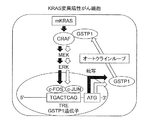
- GSTP1 induced by activation of RAS / RAF / MEK / ERK signal cascade binds to CRAF and enhances its activity. I found it. Furthermore, when GSTP1 is induced by activation of the RAS / RAF / MEK / ERK signal cascade (black arrows in FIG. 4), GSTP1 is induced independently of stimulation from the upstream of the signal cascade. The activity of CRAF, which is a component of the signal cascade, was enhanced (the GSTP1 autocrine loop; white arrow in FIG. 4), and as a result, it was found that the signal cascade was abnormally activated by both pathways.
- the inventor used a drug that suppresses GSTP1 (for example, siRNA for GSTP1 gene) and a drug that suppresses RAS / RAF / MEK / ERK signal cascade (for example, siRNA for KRAS gene), We found that inhibition of both the GSTP1 autocrine loop and the RAS / RAF / MEK / ERK signal cascade can effectively suppress the growth of cancer cells more than the respective drugs alone.
- a drug that suppresses GSTP1 for example, siRNA for GSTP1 gene
- RAS / RAF / MEK / ERK signal cascade for example, siRNA for KRAS gene
- the present inventors have also demonstrated that by blocking the interaction between GSTP1 and CRAF, which is the junction between the RAS / RAF / MEK / ERK signaling cascade and the GSTP1 autocrine loop, with drugs such as CRAF decoy peptides, cancer It was found that cell growth was suppressed. Based on these findings, the present inventors have completed the present invention.
- the present invention includes the following.
- Cell growth suppression for cancers in which the RAS / RAF / MEK / ERK signaling cascade is activated which comprises a combination of a drug that suppresses GSTP1 and a drug that suppresses the RAS / RAF / MEK / ERK signaling cascade Agent.
- (2) For cancers in which the RAS / RAF / MEK / ERK signaling cascade has been activated including a drug that inhibits GSTP1 for administration in combination with a drug that inhibits the RAS / RAF / MEK / ERK signaling cascade Cell growth inhibitor.
- the cytostatic agent according to any one of (1) to (5), wherein the drug that suppresses the RAS / RAF / MEK / ERK signal cascade is a drug that suppresses RAS.
- the cytostatic agent according to any one of (1) to (6), wherein the drug that inhibits GSTP1 is a siRNA against GSTP1.
- a cytostatic agent for cancer in which the RAS / RAF / MEK / ERK signal cascade is activated which comprises a drug that inhibits the interaction between GSTP1 and CRAF.
- the cytostatic agent according to (9), wherein the cancer in which the RAS / RAF / MEK / ERK signal cascade is activated is a cancer having an activating mutation in RAS.
- the cell proliferation inhibitor according to (9) or (10), wherein the cancer is colon cancer.
- the cytostatic agent according to any one of (9) to (11), wherein the drug that inhibits the interaction between GSTP1 and CRAF is a CRA decoy peptide or a vector expressing the same.
- the CRAF decoy peptide is (a) a polypeptide consisting of the amino acid sequence shown in SEQ ID NO: 9, (b) a polypeptide comprising an amino acid sequence in which one or several amino acids are deleted, substituted or added in the amino acid sequence shown in SEQ ID NO: 9, (c) a polypeptide consisting of an amino acid sequence having 90% or more sequence identity to the amino acid sequence shown in SEQ ID NO: 9, and (d) the polypeptide described in any of (a) to (c)
- the cytostatic agent according to (12) which is selected from the group consisting of polypeptides having 1 to 50 amino acids added to the N-terminus or C-terminus of (14)
- the present specification includes the disclosure content of Japanese Patent Application No. 2017-240652 based on which the priority of the present application is based.
- the present invention provides an agent capable of effectively suppressing cell proliferation in cancer cells.
- FIG. 1 is a schematic view showing the structure of a protein expressed by the plasmid used in the co-immunoprecipitation experiment with GSTP1 shown in Example 1.
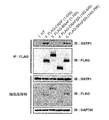
- FIG. 2 is a photograph showing the results of co-immunoprecipitation experiments with GSTP1 shown in Example 1.
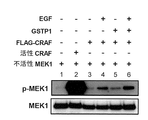
- FIG. 3 is a photograph showing the results of an in vitro kinase assay in which the effect of GSTP1 on CRAF activity shown in Example 2 was examined.
- FIG. 4 is a schematic view showing the promotion of the RAS / RAF / MEK / ERK signal cascade in KRAS mutation-positive cancer cells.
- FIG. 5 is a graph showing the results of examining the influence on cell proliferation by the CRAF protein fragment shown in Example 3.
- FIG. 6 is a graph showing the results of examining the influence on cell proliferation by dual inhibition of GSTP1 and KRAS shown in Example 4.
- Asterisks indicate P ⁇ 0.01.
- the present invention suppresses a drug that inhibits GSTP1 and the RAS / RAF / MEK / ERK signaling cascade
- the present invention relates to a cytostatic drug which contains a drug in combination.
- the present invention uses a drug that suppresses GSTP1 and a drug that suppresses the RAS / RAF / MEK / ERK signal cascade in combination, as shown in the examples described below, and the GSTP1 autocrine loop and RAS / RAF / Based on the findings of the inventor that inhibition of both MEK / ERK signaling cascades can effectively suppress the growth of cancer cells more than the respective drugs alone.
- GSTP1 (GSTP1 protein) refers to the enzyme that catalyzes glutathione conjugation, which is encoded by the GSTP1 gene. GSTP1 is present in various animals including humans, and its sequence information is also known. Sequence information of GSTP1 can be obtained, for example, from public databases such as the NCBI database.
- GSTP1 is a human-derived GSTP1 (human GSTP1) protein consisting of the amino acid sequence of 210 residues (NCBI accession number NP_000843.1) shown by SEQ ID NO: 1.
- GSTP1 also includes GSTP1 variants having an activity equivalent to that of GSTP1 shown in SEQ ID NO: 1 and GSTP1 orthologs of other species.
- GSTP1 has glutathione conjugation catalytic activity, and methods for measuring the activity are known to those skilled in the art.
- GSTP1 90% of the amino acid sequence in which one or more amino acids are deleted, substituted or added in the amino acid sequence shown in SEQ ID NO: 1 or the amino acid sequence shown in SEQ ID NO: 1 Above, GSTP1 proteins having sequence identity of 95% or more, 97% or more, 98% or more or 99% or more are included.
- the “plurality” relating to deletion, substitution or addition of amino acids or bases is, for example, 2 to 20, 2 to 15, 2 to 10, 2 to 7, 2 to 5, It means 2 to 4 or 2 to 3.
- amino acid substitution is preferably conservative amino acid substitution.
- Constant amino acid substitution refers to substitution between amino acids of similar properties such as charge, side chain, polarity, aromaticity and the like.
- Amino acids having similar properties are, for example, basic amino acids (arginine, lysine, histidine), acidic amino acids (aspartic acid, glutamic acid), uncharged polar amino acids (glycine, asparagine, glutamine, serine, threonine, cysteine, tyrosine), nonpolar Organic amino acids (leucine, isoleucine, alanine, valine, proline, phenylalanine, tryptophan, methionine), branched chain amino acids (leucine, valine, isoleucine), aromatic amino acids (phenylalanine, tyrosine, tryptophan, histidine), etc. it can.
- basic amino acids arginine, lysine, histidine
- acidic amino acids aspartic acid, glutamic acid
- uncharged polar amino acids glycine, asparagine, glutamine, serine, threonine, cysteine, tyrosine
- sequence identity refers to the identity of a base sequence between two nucleic acids or an amino acid sequence between two proteins. Sequence identity is determined by comparing two sequences aligned in the optimal state over the region of the sequences to be compared. The nucleic acid or protein to be compared may have additions or deletions (eg, gaps, etc.) in the optimal alignment of the two sequences. Sequence identity can be calculated using a search system such as BLAST or FASTA.
- the "GSTP1 gene” is a gene encoding the GSTP1.
- a specific example of the GSTP1 gene is a human GSTP1 gene encoding human GSTP1 consisting of the amino acid sequence shown by SEQ ID NO: 1. More specifically, the GSTP1 gene may be a gene consisting of the base sequence shown in SEQ ID NO: 2 (NCBI Accession No. NM — 000852.3).
- the GSTP1 gene also includes a GSTP1 gene encoding a GSTP1 variant having an activity equivalent to that of human GSTP1 consisting of the amino acid sequence shown by SEQ ID NO: 1 or a GSTP1 ortholog of another species.
- a drug that inhibits GSTP1 includes, but is not limited to, for example, a drug that inhibits GSTP1 production and / or activity, and a drug that promotes GSTP1 degradation and / or inactivation, etc.
- Examples of drugs that inhibit the production of GSTP1 include, but are not limited to, for example, inhibitory nucleic acids for GSTP1 gene, such as RNAi molecules, ribozymes, antisense nucleic acids, DNA / RNA chimeric polynucleotides, etc., and vectors expressing the same, etc. .
- inhibitory nucleic acids for GSTP1 gene such as RNAi molecules, ribozymes, antisense nucleic acids, DNA / RNA chimeric polynucleotides, etc.
- vectors expressing the same etc.
- Such inhibitory nucleic acids and vectors expressing them are preferred because they have high specificity and low possibility of side effects.
- RNAi molecule refers to any molecule that causes RNA interference, including, but not limited to, siRNA (small interfering RNA), miRNA (microRNA), shRNA (short hairpin RNA), ddRNA (DNA-directed RNA) , PiRNA (Piwi-interacting RNA), double stranded RNA such as rassi (repeat associated siRNA), and variants of these.
- siRNA small interfering RNA
- miRNA miRNA
- shRNA short hairpin RNA
- ddRNA DNA-directed RNA
- PiRNA Piwi-interacting RNA
- double stranded RNA such as rassi (repeat associated siRNA)
- an antisense nucleic acid refers to an antisense oligonucleotide having a base sequence complementary to a transcription product (sense strand) of a target gene.
- the antisense nucleic acid may be composed of RNA, DNA, PNA (peptide nucleic acid), LNA (locked nucleic acid) or a complex of these.
- the DNA / RNA chimeric polynucleotide includes, but is not limited to, for example, a double-stranded polynucleotide consisting of DNA and RNA that inhibits the expression of a target gene, as described in JP-A-2003-219893. .
- the expression vector any known vector such as, but not limited to, plasmid vector, phage vector, phagemid vector, cosmid vector, virus vector and the like can be used.
- the vector comprises at least a promoter that enhances expression of the carried nucleic acid, in which case the nucleic acid is preferably operably linked to such a promoter.
- a nucleic acid being operably linked to a promoter means that the nucleic acid and the promoter are arranged such that the protein encoded by the nucleic acid is appropriately produced by the action of the promoter.
- the vector may be replicable in host cells. Transcription of the gene from the vector may be performed outside the host cell nucleus or in the nucleus (eg, the nucleic acid is integrated into the host cell genome).
- Examples of the drug that suppresses the activity of GSTP1 include, but are not limited to, for example, substances that bind to GSTP1, such as glutathione, glutathione analogs (eg, WO 95/08563, WO 96/40205, and the like) No. 99/54346, or Nakajima et al., J Pharmacol Exp Ther. 2003; 306 (3): 861-9, etc., ketoprofen (Takahashi and Niitsu, Gan To Kagaku Ryoho. 1994; 21 (7). ): 945-51), indomethacin (Hall et al., Cancer Res.
- substances that bind to GSTP1 such as glutathione, glutathione analogs (eg, WO 95/08563, WO 96/40205, and the like) No. 99/54346, or Nakajima et al., J Pharmacol Exp Ther. 2003; 306 (3): 861-9, etc., ketoprof
- Suppression of GSTP1 can be determined by suppression of GSTP1 expression (expression amount) and / or activity in cells, as compared to the case where a drug that suppresses GSTP1 is not acted.
- GSTP1 can be any known method, for example, but not limited to, a method using an anti-GSTP1 antibody, such as immunoprecipitation, EIA (enzyme immunoassay) (for example, ELISA (enzyme-linked immunosorbent assay), etc.), RIA (radioimmunoassay) (eg, IRA (immunoradiometric assay), RAST (radioallergosorbent test), etc.), Western blotting, immunohistochemistry, immunocytochemistry or flow cytometry, or transcript of GSTP1 gene Techniques using nucleic acids that specifically hybridize to (eg, mRNA) or splicing products or fragments thereof, eg, various hybridization methods, such as Northern blot or Southern blot, or various PCR methods (eg, It can be evaluated by a real time RT-PCR method or the like.
- EIA enzyme immunoassay
- ELISA enzyme-linked immunosorbent assay
- RIA radioimmunoas
- the activity of GSTP1 may be any known method of GSTP1, such as, but not limited to, binding to a protein such as CRAF (especially phosphorylated CRAF) or EGFR (especially phosphorylated EGFR), etc.
- a protein such as CRAF (especially phosphorylated CRAF) or EGFR (especially phosphorylated EGFR), etc.
- CRAF especially phosphorylated CRAF
- EGFR especially phosphorylated EGFR
- SPR surface plasmon resonance
- signal cascade means signal transduction in which a plurality of signal transduction molecules transmit a signal in sequence.
- the “RAS / RAF / MEK / ERK signal cascade” is a signal cascade involving RAS, RAF, MEK and ERK as signal transduction molecules, and related to cell proliferation and differentiation.
- RAS which is a small G protein
- RAS phosphorylates RAF (a kind of MAPKKK). Oxidizes and activates.
- Activated RAF activates MEK (MAPK / ERK kinase, a kind of MAP2K), and activated MEK activates ERK (extracellular signal-regulated kinase, a kind of MAPK).
- Activated ERK translocates into the nucleus and promotes cell transcription by promoting transcription of various mRNAs.
- Components of the RAS / RAF / MEK / ERK signal cascade include RAS, RAF, MEK and ERK.
- RAS RAS protein
- RAS protein refers to a small GTP binding protein encoded by the RAS gene.
- RAS is present in various animals including humans, and its sequence information is also known.
- sequence information of RAS can be obtained, for example, from public databases such as the NCBI database.
- RAS includes KRAS, NRAS and HRAS.
- KRAS human-derived KRAS
- SEQ ID NO: 3 NCBI Accession No. NP — 203524.1
- KRAS also includes KRAS variants having an activity equivalent to that of KRAS shown in SEQ ID NO: 3 and KRAS orthologs of other species.
- KRAS has GTP hydrolysis activity, and methods for measuring the activity are known to those skilled in the art.
- KRAS has an amino acid sequence in which one or more amino acids are deleted, substituted or added in the amino acid sequence shown in SEQ ID NO: 3 or 90% of the amino acid sequence shown in SEQ ID NO: 3
- KRAS proteins having 95% or more, 97% or more, 98% or more or 99% or more sequence identity are included.
- the "KRAS gene” is a gene encoding the KRAS.
- a specific example of the KRAS gene is a human KRAS gene encoding human KRAS consisting of the amino acid sequence shown by SEQ ID NO: 3. More specifically, the KRAS gene may be a gene consisting of the base sequence shown in SEQ ID NO: 4 (NCBI Accession No. NM — 033360.3).
- the KRAS gene also includes a KRAS gene encoding a KRAS variant having an activity equivalent to that of human KRAS consisting of the amino acid sequence shown by SEQ ID NO: 3 or a KRAS ortholog of another species.
- RAF RAF protein
- ARAF ARAF
- BRAF BRAF
- CRAF also referred to as Raf-1
- CRAF the amino acid sequence of 648 residues shown in SEQ ID NO: 5 (NCBI Accession No. NP — 001341619.1) or the amino acid sequence of 567 residues shown in SEQ ID NO: 7 (NCBI Accession No. NP_001341620.1).
- a human-derived CRAF human CRAF
- the CRAF also includes a CRAF variant having an activity equivalent to that of the CRAF represented by SEQ ID NO: 5 or 7, and CRAF orthologs of other species.
- CRAF an amino acid sequence in which one or more amino acids are deleted, substituted or added in the amino acid sequence shown in SEQ ID NO: 5 or 7, or the amino acid sequence shown in SEQ ID NO: 5 or 7
- CRAF proteins having 90% or more, 95% or more, 97% or more, 98% or more, or 99% or more sequence identity are included.
- the "CRAF gene” is a gene encoding the above-mentioned CRAF.
- Specific examples of the CRAF gene include a human CRAF gene encoding a human CRAF consisting of the amino acid sequence shown in SEQ ID NO: 5 or 7. More specifically, the CRAF gene is a gene consisting of the nucleotide sequence shown in SEQ ID NO: 6 (NCBI Accession No. NM_001354690.1) or the nucleotide sequence shown in SEQ ID NO: 8 (NCBI Accession No. NM_001354691.1).
- the CRAF gene also includes a CRAF gene that encodes a CRAF variant having an activity equivalent to that of human CRAF consisting of the amino acid sequence shown in SEQ ID NO: 5 or 7, or a CRAF ortholog of another species. Specifically, 90% of the base sequence in which one or more bases are deleted, substituted or added in the base sequence shown in SEQ ID NO: 6 or 8 or the base sequence shown in SEQ ID NO: 6 or 8 Above, CRAF genes having a sequence identity of 95% or more, 97% or more, 98% or more or 99% or more are included.
- MEK MEK protein
- MEK protein refers to an enzyme having a kinase activity that is encoded by the MEK gene.
- MEK is present in various animals including humans, and its sequence information is also known. Sequence information of MEK can be obtained, for example, from public databases such as the NCBI database.
- MEK includes MEK1 and MEK2.
- ERK ERK protein
- ERK protein refers to an enzyme having a kinase activity that is encoded by the ERK gene. ERK is present in various animals including humans, and its sequence information is also known. Sequence information of ERK can be obtained, for example, from public databases such as the NCBI database. ERK includes ERK1 and ERK2.
- drugs that suppress the RAS / RAF / MEK / ERK signal cascade include, but are not limited to, for example, drugs that suppress the production and / or activity of components of the RAS / RAF / MEK / ERK signal cascade And drugs that promote degradation and / or inactivation of components of the RAS / RAF / MEK / ERK signal cascade, and the like.
- Drugs that inhibit the production of components of the RAS / RAF / MEK / ERK signaling cascade include, but are not limited to, for example, inhibitory nucleic acids for genes encoding components of the RAS / RAF / MEK / ERK signaling cascade, such as RNAi molecules, ribozymes , Antisense nucleic acid, DNA / RNA chimeric polynucleotide, etc., and vectors expressing the same. Such inhibitory nucleic acids and vectors expressing them are preferred because they have high specificity and low possibility of side effects.
- Drugs that inhibit the activity of components of the RAS / RAF / MEK / ERK signaling cascade include, but are not limited to, for example, MEK inhibitors selumetinib and trametinib; BRAF inhibitors Vemurafenib and PLX4720; ERK inhibitors; RAS / Substances that bind to components of the RAF / MEK / ERK signal cascade (eg, antibodies that bind to components of the RAS / RAF / MEK / ERK signal cascade, etc.), dominant negative variants of components of the RAS / RAF / MEK / ERK signal cascade Etc. These drugs are commercially available or can be appropriately produced based on known techniques.
- the drug that inhibits the RAS / RAF / MEK / ERK signaling cascade may be a drug that inhibits RAS.
- the drug that suppresses RAS may be a drug that suppresses KRAS.
- the drug that suppresses KRAS may be an inhibitory nucleic acid for the KRAS gene, such as an RNAi molecule.
- One drug may be used to inhibit the RAS / RAF / MEK / ERK signaling cascade, or two or more drugs (eg, two or more drugs that inhibit different components of the RAS / RAF / MEK / ERK signaling cascade) ) May be used.
- Suppression of the RAS / RAF / MEK / ERK signaling cascade suppresses the RAS / RAF / MEK / ERK signaling cascade in cells, as compared to the case where no drug that inhibits the RAS / RAF / MEK / ERK signaling cascade acts It can be determined by In the present specification, “suppressing the signal cascade” means not only inducing the inactivation of the signal cascade but also suppressing the activation of the signal cascade.
- Suppression of the RAS / RAF / MEK / ERK signaling cascade is not limited, but expression (expression levels) of components of the RAS / RAF / MEK / ERK signaling cascade or components of the phosphorylated RAS / RAF / MEK / ERK signaling cascade
- any known method eg, antibody-based techniques such as immunoprecipitation or Western blotting, or nucleic acid-based techniques such as various hybridization techniques such as northern blotting or Southern blotting.
- nucleic acid-based techniques such as various hybridization techniques such as northern blotting or Southern blotting.
- the cytostatic agent of the present invention can be used against cancers in which the RAS / RAF / MEK / ERK signal cascade has been activated.
- signal cascade is activated means not only that activation of the signal cascade is induced, but also that inactivation of the signal cascade is suppressed.
- a cancer in which the RAS / RAF / MEK / ERK signal cascade is activated is a cancer having an activating mutation in a component of the RAS / RAF / MEK / ERK signal cascade, or a RAS / RAF / MEK Cancer with increased expression (expression level) of components of the / ERK signaling cascade, cancer with increased amount of components of the phosphorylated RAS / RAF / MEK / ERK signaling cascade, and RAS / RAF / MEK / It may include cancers with activation of the signaling cascade by related factors other than components of the ERK signaling cascade, such as, for example, activation of receptor tyrosine kinases.
- activating mutation refers to a mutation that constitutively activates the function of a protein.
- the "cancer having a mutation” may also be referred to as "a mutation-positive cancer”.
- Detection of mutations in components of the RAS / RAF / MEK / ERK signal cascade is not limited to any known method, for example, selective hybridization with a nucleic acid probe specific to a known mutant sequence, enzyme mismatch cleavage method, A sequencing method, a PCR-RFLP (polymerase chain reaction-restriction fragment length polymorphism) method, etc. may be mentioned.
- the cancer in which the RAS / RAF / MEK / ERK signaling cascade is activated may be a cancer having an activating mutation in RAS (eg, KRAS).
- RAS eg, KRAS
- cancers having an activation mutation in RAS include cancers having a mutation that inhibits endogenous GTPase in RAS, or a mutation that increases the rate of guanine nucleotide exchange.
- KRAS having activating mutations include KRAS having mutations in at least one of the 12, 13, 61, 116, and 119 amino acids in human KRAS.
- a KRAS having an activating mutation has a mutation at amino acid 13 in human KRAS (eg, a mutation of amino acid 13 from glycine to aspartate).
- the cancer in which the RAS / RAF / MEK / ERK signaling cascade is activated may be a cancer that overexpresses GSTP1.
- detection of GSTP1 expression can be performed using any known method, including those described above. Whether GSTP1 is overexpressed in a test cell (eg, cancer cell) can be determined, for example, by comparing the expression level of GSTP1 in the test cell with the expression level of GSTP1 in a normal homologous cell, etc. It can be evaluated by In this case, if the degree of expression of GSTP1 in the test cells exceeds the degree of expression of GSTP1 in normal homologous cells, it can be said that GSTP1 is overexpressed.
- cancer includes, but is not limited to, for example, fibrosarcoma, malignant fibrohistocytoma, liposarcoma, rhabdomyosarcoma, leiomyosarcoma, hemangiosarcoma, Kaposi's sarcoma, lymphangiosarcoma, synov Sarcoma, chondrosarcoma, sarcoma such as osteosarcoma, brain tumor, head and neck cancer, breast cancer, lung cancer, esophageal cancer, stomach cancer, duodenal cancer, appendix cancer, colon cancer, rectal cancer, liver cancer, pancreatic cancer Cancer, gallbladder cancer, bile duct cancer, anal cancer, renal cancer, ureteral cancer, bladder cancer, prostate cancer, penile cancer, testicular cancer, uterine cancer, ovarian cancer, vulvar cancer Cancer, such as vaginal cancer and skin cancer, as well as leukemia and malignant lymphoma.
- fibrosarcoma mal
- cancer includes epithelial malignancies and non-epithelial malignancies. Cancer may be in any part of the body, such as brain, head and neck, chest, limbs, lung, heart, thymus, esophagus, stomach, small intestine (duodenum, jejunum, ileum), large intestine (colon, cecum, appendix, rectum) , Liver, pancreas, gallbladder, anus, kidney, ureter, bladder, prostate, penis, testis, uterus, ovary, vulva, vagina, skin, striated muscle, smooth muscle, synovium, cartilage, bone, thyroid, adrenal, It may be present in the peritoneum, mesentery, bone marrow, blood, vasculature, lymph system such as lymph node, lymph fluid and the like.
- lymph system such as lymph node, lymph fluid and the like.
- the cancer in which the RAS / RAF / MEK / ERK signaling cascade is activated may be a colon cancer having an activating mutation in KRAS.
- the cytostatic agent according to the present invention may be used as a medicine for treatment or prevention of cancer as described later, or may be used as a research reagent.
- the cytostatic agent according to the present invention can be used in vivo or in vitro.
- in vivo refers to use on an individual
- in vitro refers to use on a tissue or cell or the like isolated from the individual.
- the present invention also provides a RAS / RAF / MEK / ERK signal cascade, which comprises inhibiting both the GSTP1 autocrine loop and the RAS / RAF / MEK / ERK signal cascade using the cytostatic agent according to the present invention.
- the present invention relates to a method for treating or preventing activated cancer.
- cytostatic agent in the treatment or prevention of cancer is described in the following “3. Composition and method for treatment / prevention”.
- the present invention also relates to a method of inhibiting cell proliferation using the cytostatic agent according to the present invention described above.
- the method may be a method of suppressing cancer cell growth in vivo, comprising administering a cytostatic agent to the subject, or administering the cytostatic agent to the isolated cells or tissues May be a method of suppressing cancer cell proliferation in vitro.
- suppression of cell growth can be carried out by various known methods, for example, counting viable cell counts over time, measuring tumor size, volume or weight, measuring DNA synthesis, WST-1 method, BrdU It can be evaluated by the (bromodeoxyuridine) method, 3H thymidine incorporation method and the like.
- cells to which the in vitro cell growth inhibition method is applied include, but are not limited to, for example, cancer cells in which the RAS / RAF / MEK / ERK signal cascade has been activated, preferably RAS / Cancer cells having activating mutations in components of the RAF / MEK / ERK signal cascade, more preferably, cancer cells having activating mutations in RAS (eg, KRAS), such as M7609 cells, DLD-1 cells or HCT116. It may be a cell.
- RAS eg, KRAS
- the dose in vitro can be determined as appropriate by those skilled in the art, and may be, for example, administered in a medium to a concentration of 0.00001 nM to 100000 ⁇ M, 0.01 nM to 100 ⁇ M or 1 nM to 1 ⁇ M.
- the present invention also includes activation of the RAS / RAF / MEK / ERK signaling cascade, including drugs that inhibit GSTP1, for administration in combination with a drug that inhibits the RAS / RAF / MEK / ERK signaling cascade.
- a cytostatic agent for cancer including drugs that inhibit GSTP1, for administration in combination with a drug that inhibits the RAS / RAF / MEK / ERK signaling cascade.
- the present invention also includes activation of the RAS / RAF / MEK / ERK signaling cascade, including drugs that inhibit the RAS / RAF / MEK / ERK signaling cascade for administration in combination with a drug that inhibits GSTP1.
- a cytostatic agent for cancer including drugs that inhibit the RAS / RAF / MEK / ERK signaling cascade for administration in combination with a drug that inhibits GSTP1.
- the drug that inhibits GSTP1 and the drug that inhibits the RAS / RAF / MEK / ERK signaling cascade may be administered simultaneously or at spaced intervals.
- a formulation containing a drug that inhibits GSTP1 may be administered before or after a formulation containing a drug that inhibits the RAS / RAF / MEK / ERK signaling cascade. It is also good.
- the present invention also relates to a cell growth inhibitor, which comprises a drug that inhibits the interaction between GSTP1 and CRAF.
- the present invention is directed to a cancer by inhibiting the interaction between GSTP1 and CRAF, which is the junction between the RAS / RAF / MEK / ERK signal cascade and the GSTP1 autocrine loop, as shown in the examples below. Based on the present inventor's finding that cell proliferation is suppressed.
- decoy peptide containing a binding domain a binding domain with GSTP1 on CRAF or a binding domain with CRA on GSTP1 but having no activity
- decoy peptides can competitively inhibit the interaction between endogenous GSTP1 and CRAF.
- a decoy peptide containing a binding domain to GSTP1 on CRAF but not having CRAF activity is referred to as a CRAF decoy peptide.
- a decoy peptide containing a binding domain to CRAF on GSTP1 but not having GSTP1 activity is referred to as a GSTP1 decoy peptide.
- the drug that inhibits the interaction between GSTP1 and CRAF may be a CRAF decoy peptide or a vector that expresses it.
- CRAF decoy peptide is (a) a polypeptide consisting of the amino acid sequence shown in SEQ ID NO: 9, (b) a polypeptide comprising an amino acid sequence in which one or more amino acids are deleted, substituted or added in the amino acid sequence shown in SEQ ID NO: 9, (c) a polypeptide consisting of an amino acid sequence having a sequence identity of 90% or more, 95% or more, 97% or more, 98% or more or 99% or more to the amino acid sequence shown in SEQ ID NO: 9, 1 to 50 (for example, 1 to 30, 1 to 20, 1 to 10 or 1 to 5) at the N-terminus or C-terminus of the polypeptide described in any of (a) to (c)
- the amino acid of may be selected from the group consisting of added polypeptides.
- amino acid sequence shown in SEQ ID NO: 9 is the amino acid sequence of positions 56 to 184 of human CRAF shown in SEQ ID NO: 5.
- the inhibition of the interaction between GSTP1 and CRAF can be achieved by a known technique such as immunization of GSTP1 with CRAF when a drug that inhibits the interaction between GSTP1 and CRAF is allowed to act and when the drug is not allowed to act. It can evaluate by detecting by the sedimentation method etc.
- the cytostatic agent of the present invention can be used against cancers in which the RAS / RAF / MEK / ERK signal cascade has been activated. Cancers in which the RAS / RAF / MEK / ERK signaling cascade has been activated are described above.
- the cancer in which the RAS / RAF / MEK / ERK signaling cascade is activated may be a cancer having an activating mutation in RAS (eg, KRAS).
- the cancer in which the RAS / RAF / MEK / ERK signaling cascade is activated may be a cancer that overexpresses GSTP1.
- the cancer in which the RAS / RAF / MEK / ERK signaling cascade is activated may be a colon cancer having an activating mutation in KRAS.
- the cytostatic agent according to the present invention may be used as a medicine for treatment or prevention of cancer as described later, or may be used as a research reagent.
- the cytostatic agent according to the present invention can be used in vivo or in vitro.
- cytostatic agent in the treatment or prevention of cancer is described in the following “3. Composition and method for treatment / prevention”.
- the present invention also relates to a method of inhibiting cell proliferation using the cytostatic agent according to the present invention described above.
- the method may be a method of suppressing cancer cell growth in vivo, comprising administering a cytostatic agent to the subject, or administering the cytostatic agent to the isolated cells or tissues May be a method of suppressing cancer cell proliferation in vitro.
- the dose in vitro can be determined as appropriate by those skilled in the art, and may be, for example, administered in a medium to a concentration of 0.00001 nM to 100000 ⁇ M, 0.01 nM to 100 ⁇ M or 1 nM to 1 ⁇ M.
- the drug that inhibits the interaction between GSTP1 and CRAF may be used in combination with at least one of the drug that inhibits the RAS / RAF / MEK / ERK signaling cascade described above and the drug that inhibits GSTP1.
- composition and Therapeutic / Preventive Method also relates to a composition comprising the cytostatic agent according to the present invention described above.
- the composition may be a pharmaceutical composition.
- the composition may contain other optional ingredients in addition to the active ingredient as long as the effect of the active ingredient is not hindered.
- optional ingredients include, for example, chemotherapeutic agents, pharmaceutically acceptable carriers, excipients, diluents and the like.
- the pharmaceutical composition may be coated with a suitable material, such as an enteric coating or a time-disintegrable material, and may be incorporated into a suitable drug release system May be.
- the cytostatic agent or composition according to the present invention can be selected from various routes including both oral and parenteral, for example, but not limited to oral, intravenous, intramuscular, subcutaneous, topical, intratumoral, rectal, arterial It may be administered by the route such as intraportal, intraportal, intraventricular, transmucosal, transdermal, intranasal, intraperitoneal, intrapulmonary, intrapulmonary and intrauterine, and may be formulated into a dosage form suitable for each administration route. . Any known dosage form and preparation method can be appropriately adopted.
- dosage forms suitable for oral administration include, but are not limited to, powders, granules, tablets, capsules, solutions, suspensions, emulsions, gels, syrups and the like.
- dosage forms suitable for parenteral administration include, but are not limited to, injections such as solution injections, suspension injections, emulsion injections, and ready-to-use injections.
- Formulations for parenteral administration may be in the form of aqueous or non-aqueous isotonic sterile solutions or suspensions.
- the compounding amount of the active ingredient in the cytostatic agent or composition according to the present invention achieves a desired effect (for example, proliferation suppression of cancer cells, etc.) when the cytostatic agent or composition is administered.
- the amount may be Also preferred is an amount that does not adversely affect the benefits of administration. Such amount is known or can be appropriately determined by in vitro tests using cultured cells etc. or tests in model animals such as mice, rats, dogs or pigs, and such test methods are well known to those skilled in the art. It is done.
- the blending amount of the active ingredient may vary depending on the mode of administration of the cytostatic agent or composition. Adjustment of the compounding amount can be appropriately performed by those skilled in the art.
- the active ingredient can also be supported on various non-viral lipid or protein carriers.
- Such carriers include, but are not limited to, for example, cholesterol, liposomes, antibody protomers, cyclodextrin nanoparticles, fusion peptides, aptamers, biodegradable polylactic acid copolymers, polymers and the like, which enhance the uptake efficiency into cells (See, eg, Pirollo and Chang, Cancer Res. 2008; 68 (5): 1247-50, etc.).
- cationic liposomes or polymers eg, polyethylene imine etc.
- polymers useful as such carriers include, for example, those described in US Patent Application Publication Nos. 2008/0207553 and 2008/0312174.
- the cytostatic agent or composition according to the present invention may be targeted to a specific tissue or cell. Targeting can be achieved by any known method.
- passive targeting for example, by sizing the preparation to a diameter of 50 to 200 ⁇ m, especially 75 to 150 ⁇ m, suitable for expression of enhanced permeability and retention (EPR) effect CD19, HER2, transferrin receptor, folate receptor, VIP receptor, EGFR (Torchilin, AAPS J.
- EPR enhanced permeability and retention
- RAAG10 Japanese Patent Publication 2005-532050
- PIPA specially Ligands such as Table 2006-506071
- KID3 Japanese Patent Publication 2007-529197
- peptides having RGD motif or NGR motif; F3 or LyP-1 can be used as a targeting agent such as active targeting.
- a carrier containing retinoid as a targeting agent can also be used.
- Such carriers are described in, for example, WO 2009/036368 and WO 2010/014117 as well as the above-mentioned documents.
- the cytostatic agent or composition according to the present invention may be supplied in any form, but from the viewpoint of storage stability, it can be prepared at the time of use, for example, a doctor and It may be provided in a form that can be prepared by / or a pharmacist, a nurse, or other paramedical. Such a form is particularly useful when the cytostatic agent or composition of the present invention comprises components that are difficult to stably store, such as lipids, proteins or nucleic acids.
- the cytostatic agent or composition according to the present invention is provided in one or more containers containing at least one of the components essential to them, for example within 24 hours before use Preferably, it is prepared within 3 hours before, more preferably immediately before use.
- reagents, solvents, dispensing devices and the like usually available at the place of preparation can be appropriately used.
- Specific dosages of the cytostatic agent or composition according to the present invention may vary according to various conditions concerning the subject requiring treatment, such as severity of symptoms, general health status of the subject, age, weight, sex of the subject, diet
- the timing and frequency of administration, the drug being used in combination, the responsiveness to treatment, the dosage form, and compliance with the treatment can be determined.
- the active ingredient may be administered in an amount of 0.0000001 mg / kg body weight / day to 1000 mg / kg body weight / day or 0.0001 mg / kg body weight / day to 1 mg / kg body weight / day.
- the frequency of administration varies depending on the properties of the cytostatic agent or composition to be used and the condition of the subject including the above, for example, many times a day (ie two, three, four or more times a day), It may be once a day, every few days (i.e. every 2, 3, 4, 5, 6, 7 days etc), every week, every few weeks (i.e. every 2, 3, 4 weeks etc).
- the cytostatic agent or composition according to the present invention may be used in combination with other anticancer agents. When used in combination, they may be formulated as a combination drug for simultaneous administration or as a separate preparation for independent administration. Combinations include simultaneous and sequential administration.
- the present invention also relates to a method for treating or preventing cancer, which comprises administering the above-described cytostatic agent or composition according to the present invention to a subject.
- treatment includes killing or decreasing the number of cancer cells and suppressing the growth of cancer.
- prevention includes cancer metastasis prevention, cancer recurrence prevention and carcinogenesis prevention.
- subject refers to any living individual, preferably an animal, more preferably a mammal, more preferably a human individual.
- the subject is a subject requiring administration of the cytostatic agent according to the present invention, for example, a subject suffering from cancer, a subject at risk of metastasis or recurrence of cancer, or carcinogenicity It may be an object at risk.
- Kit The present invention is also for the preparation of a composition comprising one or more containers comprising, alone or in combination, the cytostatic agent or composition according to the present invention, or the active ingredient contained therein.
- the present invention also relates to a kit for cell growth suppression, or treatment or prevention of cancer.
- kit of the present invention may contain instructions describing the preparation method and administration method of the cytostatic agent or composition, such as instructions, or an electronic recording medium such as CD, DVD, etc. .
- Example 1 (Analysis of the domain of CRAF binding to GSTP1) (1) Cell culture KRAS mutation-positive colon cancer cell line M7609 was cultured at 37 ° C. in RPMI medium (containing 10% FBS). M7609 cells were provided by Sapporo Medical University 4th Internal Medicine. As M7609 cells have activating mutations in KRAS, the RAS / RAF / MEK / ERK signaling cascade in M7609 cells is activated.
- FIG. 1 shows the structure of a protein expressed by the plasmid used as described later in Example 1.
- (a) shows FLAG-CRAF (1-648), and amino acid residue positions of domains included in CRAF (positions 61 to 192: CR1 domain, positions 251 to 266: CR2 domain, positions 333 to 625: CR3 domain) Indicates
- (b) shows FLAG-CRAF ⁇ N (193-648).
- (c) shows FLAG-BRAF (1-766), and amino acid residue positions of domains included in BRAF (positions 2-117: BRSR domain, positions 155-280: CR1 domain, positions 360-375: CR2 domain, 457 to 717: CR3 domain) is shown.
- (d) shows FLAG-BRAF ⁇ N (149-766).
- FLAG-CRAF (1-648) shown in FIG. 1 (a) is a protein in which a FLAG tag is bound to the C-terminus of the full-length CRAF protein shown in SEQ ID NO: 5.
- FLAG-CRAF (1-648) is expressed from plasmid pcDNA3.1-FLAG-CRAF provided by Sapporo Medical University Fourth Internal Medicine.
- FLAG-CRAF ⁇ N (193-648) shown in FIG. 1 (b) is a protein in which a FLAG tag is bound to the C terminus of a deleted CRAF protein consisting of the amino acid sequence at positions 193 to 648 of SEQ ID NO: 5.
- the N-terminal part (amino acid residue 1-192 of SEQ ID NO: 5) of full-length CRAF is deleted.
- FLAG-CRAF ⁇ N (193-648) is a plasmid pCMV6-Myc- prepared by cloning a cDNA corresponding to amino acids 193 to 648 of CRAF between the AsiSI site and MluI site of pCMV6-Entry vector (OriGene). Expressed from DDK-CRAF ⁇ N.
- FLAG-BRAF (1-766) shown in FIG. 1 (c) is a protein in which a FLAG tag (DDK tag) is bound to the C terminus of full-length BRAF protein shown in SEQ ID NO: 10.
- FLAG-BRAF (1-766) is expressed from the plasmid pCMV6-Myc-DDK-BRAF (OriGene).
- FLAG-BRAF ⁇ N (149-766) shown in FIG. 1 (d) is a protein in which a FLAG tag is bound to the C terminus of a deleted BRAF protein consisting of the amino acid sequence of positions 149 to 766 of SEQ ID NO: 10. In this deleted BRAF protein, the N-terminal portion of full-length BRAF (amino acid residues 1-148 of SEQ ID NO: 10) is deleted.
- FLAG-BRAF ⁇ N (149-766) is a plasmid pCMV6-Myc- prepared by cloning a cDNA corresponding to amino acids 149-766 of BRAF between the AsiSI site and MluI site of pCMV6-Entry vector (OriGene). Expressed from DDK-BRAF ⁇ N.
- GSTP1 did not co-precipitate with the full-length BRAF protein (lane 3 in FIG. 2), but co-precipitated with the BRAF protein in which the N-terminal portion was deleted (lane 5 in FIG. 2).
- the full-length BRAF protein has high amino acid conservation with respect to the full-length CRAF protein, but has an extension at the N-terminal side (FIG. 1 c).
- the results in this example show that BRAF with this extension does not bind to GSTP1, and BRAF without extension does bind to GSTP1. This indicates that the presence of the BRAF N-terminal extension (not in the CRAF) can sterically interfere or block the binding of GSTP1 to the BRAF.
- Example 2 (Effect of GSTP1 on CRAF activity) (1) Cell culture and EGF treatment KRAS wild type HeLa cells were cultured in DMEM medium at 37 ° C. in a 5% CO 2 environment. HeLa cells were provided by Sapporo Medical University 4th Internal Medicine. HeLa cells were first incubated under serum-starved conditions for 16 hours and then treated with 50 ng / ml EGF (epidermal growth factor, BD Biosciences) solution for 10 minutes. EGF treatment activates RAS. RAS activation is required for CRAF phosphorylation.
- EGF epidermatitis
- the cell lysate was incubated with anti-FLAG M2 affinity gel (SIGMA) for 2 hours at 4 ° C. to bind FLAG-CRAF to the anti-FLAG M2 affinity gel. After incubation, the anti-FLAG M2 affinity gel was washed four times with 0.5% NP-40 lysis buffer.
- the FLAG-CRAF conjugated anti-FLAG M2 affinity gel is washed with Assay Dilution Buffer I (Merck-Millipore), and the gel is washed in Assay Dilution Buffer I (Merck-Millipore) with 1 ⁇ g of human placenta GSTP1 (Merck-Millipore).
- Example 3 (Effects of CRAF protein fragments on cell proliferation)
- the CRAF protein fragment expression plasmid pcDNA-hRAF384 (5807 bp) was placed at position 332 to 718 of human CRAF gene (SEQ ID NO: 6) under the CMV (cytomegalovirus) promoter of vector pcDNA 3.1 (+) (Thermo Fisher Scientific). The region was cloned and generated. This plasmid leads to the expression of a CRAF protein fragment (polypeptide consisting of the amino acid sequence shown in SEQ ID NO: 9) of positions 56 to 184 of human CRAF protein (SEQ ID NO: 5).
- HCT116 cells KRAS mutation-positive human colon cancer cells
- the HCT116 cells have their RAS / RAF / MEK / ERK signaling cascade activated, as HCT116 cells have KRAS in which the 13th amino acid glycine (G) is activated and mutated to aspartate (D).
- DLD-1 cells (KRAS mutation-positive human colon cancer cells) were obtained from JCRB cell bank of National Institute of Biomedical Innovation, Health and Nutrition Research Institute.
- the RAS / RAF / MEK / ERK signaling cascade in DLD-1 cells is activated because DLD-1 cells have KRAS in which the 13th amino acid glycine (G) is activated and mutated to aspartate (D) .
- HCT116 cells or DLD-1 cells are seeded at 1.0 ⁇ 10 4 or 2.0 ⁇ 10 4 cells / well in a 96-well plate, and incubated at 37 ° C. in a 5% CO 2 environment in McCoy's 5A medium. Incubated for time.
- the cultured cells were transfected with the CRAF protein fragment expression plasmid pcDNA-hRAF384 using Lipofectamine 3000 (Thermo Fisher Scientific).
- Lipofectamine 3000 Thermo Fisher Scientific
- the empty vector pcDNA3.1 (+) was transfected. Transfection was performed according to the manufacturer's protocol using 0.2 ⁇ l Lipofectamine 3000 and 100 ng of plasmid per well.
- Cells were harvested immediately after culture (0 hour) and after 24, 48, 72 and 96 hours of culture, and the number of viable cells was determined by WST assay.
- the WST assay was performed using Cell Counting Kit-8 (CCK-8, Dojin Chemical Laboratory) by incubating for 1 hour after the addition of the CCK-8 solution.
- FIG. 5A HCT116 cells
- FIG. 5B DLD-1 cells
- FIG. 5A HCT116 cells
- FIG. 5B DLD-1 cells
- Cells that expressed the CRAF protein fragment showed reduced proliferation as compared to the control.
- the same tendency was observed when 2.0 ⁇ 10 4 cells were seeded.
- This CRAF protein fragment competitively inhibits endogenous GSTP1 and CRAF binding (ie, functions as a decoy peptide), and as a result, the GSTP1 autocrine loop shown in FIG. 4 is blocked, resulting in RAS / RAF / It was shown that cell proliferation signal by MEK / ERK cascade was suppressed and cell proliferation was suppressed.
- Example 4 (Effect of dual suppression of GSTP1 and KARS on cell proliferation)
- the KRAS mutation-positive colon cancer cell line M7609 was transfected twice with siRNA. Each transfection was performed using Lipofectamine RNAiMAX (Thermo fisher scientific) according to the manufacturer's protocol. When M7609 cells are cultured at 37 ° C. in RPMI-1640 medium (without antibiotics) and reach 20-30% confluence, cells are incubated for 5 hours with siRNA in Opti-MEM I (Thermo fisher scientific) The first transfection was performed. After transfection, cells were cultured at 37 ° C. in RPMI-1640 medium (without antibiotics).
- NT non-transfected cell
- the first and second transfections were performed using the following siRNA.
- GSTP1 siRNA was obtained from Thermo fisher scientific as siRNA ID: 2385. The transfection concentration of GSTP1 siRNA was 50 nM. KRAS siRNA was obtained from Thermo fisher scientific under the siRNA ID: s7939. The transfection concentration of KRAS siRNA was 10 nM. AllStars Negative Control siRNA (Qiagen) was used as a control siRNA.
Landscapes
- Health & Medical Sciences (AREA)
- Life Sciences & Earth Sciences (AREA)
- Chemical & Material Sciences (AREA)
- Engineering & Computer Science (AREA)
- Genetics & Genomics (AREA)
- General Health & Medical Sciences (AREA)
- Organic Chemistry (AREA)
- Bioinformatics & Cheminformatics (AREA)
- Medicinal Chemistry (AREA)
- Molecular Biology (AREA)
- Biomedical Technology (AREA)
- Public Health (AREA)
- Pharmacology & Pharmacy (AREA)
- Veterinary Medicine (AREA)
- Animal Behavior & Ethology (AREA)
- Wood Science & Technology (AREA)
- Zoology (AREA)
- Biotechnology (AREA)
- General Engineering & Computer Science (AREA)
- Biochemistry (AREA)
- Epidemiology (AREA)
- Microbiology (AREA)
- Proteomics, Peptides & Aminoacids (AREA)
- Biophysics (AREA)
- Nuclear Medicine, Radiotherapy & Molecular Imaging (AREA)
- General Chemical & Material Sciences (AREA)
- Chemical Kinetics & Catalysis (AREA)
- Physics & Mathematics (AREA)
- Immunology (AREA)
- Plant Pathology (AREA)
- Gastroenterology & Hepatology (AREA)
- Virology (AREA)
- Oncology (AREA)
- Medicines That Contain Protein Lipid Enzymes And Other Medicines (AREA)
- Pharmaceuticals Containing Other Organic And Inorganic Compounds (AREA)
- Peptides Or Proteins (AREA)
- Investigating Or Analysing Biological Materials (AREA)
- Measuring Or Testing Involving Enzymes Or Micro-Organisms (AREA)
Priority Applications (1)
| Application Number | Priority Date | Filing Date | Title |
|---|---|---|---|
| US16/772,578 US20200370050A1 (en) | 2017-12-15 | 2018-12-12 | Cell proliferation inhibitor and cancer treatment or prevention pharmaceutical composition including cell proliferation inhibitor |
Applications Claiming Priority (2)
| Application Number | Priority Date | Filing Date | Title |
|---|---|---|---|
| JP2017-240652 | 2017-12-15 | ||
| JP2017240652A JP6952594B2 (ja) | 2017-12-15 | 2017-12-15 | 細胞増殖抑制剤及びそれを含むがんの治療若しくは予防用医薬組成物 |
Publications (1)
| Publication Number | Publication Date |
|---|---|
| WO2019117188A1 true WO2019117188A1 (ja) | 2019-06-20 |
Family
ID=66820498
Family Applications (1)
| Application Number | Title | Priority Date | Filing Date |
|---|---|---|---|
| PCT/JP2018/045627 Ceased WO2019117188A1 (ja) | 2017-12-15 | 2018-12-12 | 細胞増殖抑制剤及びそれを含むがんの治療若しくは予防用医薬組成物 |
Country Status (3)
| Country | Link |
|---|---|
| US (1) | US20200370050A1 (https=) |
| JP (2) | JP6952594B2 (https=) |
| WO (1) | WO2019117188A1 (https=) |
Cited By (1)
| Publication number | Priority date | Publication date | Assignee | Title |
|---|---|---|---|---|
| WO2025104494A3 (en) * | 2023-11-13 | 2025-10-09 | Versameb Ag | Compositions and methods for modulating protein interactions |
Families Citing this family (2)
| Publication number | Priority date | Publication date | Assignee | Title |
|---|---|---|---|---|
| JP6952594B2 (ja) * | 2017-12-15 | 2021-10-20 | 洋司郎 新津 | 細胞増殖抑制剤及びそれを含むがんの治療若しくは予防用医薬組成物 |
| WO2024092120A2 (en) * | 2022-10-26 | 2024-05-02 | Sirnaomics, Inc. | Sirnas against kras and raf1 |
Citations (5)
| Publication number | Priority date | Publication date | Assignee | Title |
|---|---|---|---|---|
| JPH09504860A (ja) * | 1993-06-11 | 1997-05-13 | ザ ジェネラル ホスピタル コーポレーション | タンパク質相互作用の阻害 |
| WO2009143372A2 (en) * | 2008-05-21 | 2009-11-26 | Intradigm Corporation | Compositions comprising a-raf, b-raf, and c-raf sirna and methods of use thereof |
| WO2016106404A2 (en) * | 2014-12-26 | 2016-06-30 | Nitto Denko Corporation | Methods and compositions for treating malignant tumors associated with kras mutation |
| JP2016204365A (ja) * | 2015-04-16 | 2016-12-08 | 日東電工株式会社 | Braf遺伝子変異を有する細胞に対する細胞死誘導剤、当該細胞の増殖抑制剤及び当該細胞の増殖異常に起因する疾患の治療用医薬組成物 |
| JP2017014185A (ja) * | 2014-12-26 | 2017-01-19 | 日東電工株式会社 | 細胞死誘導剤、細胞増殖抑制剤及び細胞の増殖異常に起因する疾患の治療用医薬組成物 |
Family Cites Families (2)
| Publication number | Priority date | Publication date | Assignee | Title |
|---|---|---|---|---|
| ES2708932T3 (es) * | 2011-06-21 | 2019-04-12 | Nitto Denko Corp | Agente inductor de apoptosis |
| JP6952594B2 (ja) * | 2017-12-15 | 2021-10-20 | 洋司郎 新津 | 細胞増殖抑制剤及びそれを含むがんの治療若しくは予防用医薬組成物 |
-
2017
- 2017-12-15 JP JP2017240652A patent/JP6952594B2/ja not_active Expired - Fee Related
-
2018
- 2018-12-12 US US16/772,578 patent/US20200370050A1/en not_active Abandoned
- 2018-12-12 WO PCT/JP2018/045627 patent/WO2019117188A1/ja not_active Ceased
-
2021
- 2021-07-27 JP JP2021122479A patent/JP2021183618A/ja active Pending
Patent Citations (5)
| Publication number | Priority date | Publication date | Assignee | Title |
|---|---|---|---|---|
| JPH09504860A (ja) * | 1993-06-11 | 1997-05-13 | ザ ジェネラル ホスピタル コーポレーション | タンパク質相互作用の阻害 |
| WO2009143372A2 (en) * | 2008-05-21 | 2009-11-26 | Intradigm Corporation | Compositions comprising a-raf, b-raf, and c-raf sirna and methods of use thereof |
| WO2016106404A2 (en) * | 2014-12-26 | 2016-06-30 | Nitto Denko Corporation | Methods and compositions for treating malignant tumors associated with kras mutation |
| JP2017014185A (ja) * | 2014-12-26 | 2017-01-19 | 日東電工株式会社 | 細胞死誘導剤、細胞増殖抑制剤及び細胞の増殖異常に起因する疾患の治療用医薬組成物 |
| JP2016204365A (ja) * | 2015-04-16 | 2016-12-08 | 日東電工株式会社 | Braf遺伝子変異を有する細胞に対する細胞死誘導剤、当該細胞の増殖抑制剤及び当該細胞の増殖異常に起因する疾患の治療用医薬組成物 |
Cited By (1)
| Publication number | Priority date | Publication date | Assignee | Title |
|---|---|---|---|---|
| WO2025104494A3 (en) * | 2023-11-13 | 2025-10-09 | Versameb Ag | Compositions and methods for modulating protein interactions |
Also Published As
| Publication number | Publication date |
|---|---|
| US20200370050A1 (en) | 2020-11-26 |
| JP6952594B2 (ja) | 2021-10-20 |
| JP2019108277A (ja) | 2019-07-04 |
| JP2021183618A (ja) | 2021-12-02 |
Similar Documents
| Publication | Publication Date | Title |
|---|---|---|
| KR101786905B1 (ko) | 아포토시스 유도제 | |
| TWI767883B (zh) | 針對具有braf基因突變之細胞之細胞死亡誘導劑、該細胞之增殖抑制劑及起因於該細胞之增殖異常之疾病之治療用醫藥組合物 | |
| CN107106564A (zh) | 用于治疗与kras突变相关的恶性肿瘤的方法和组合物 | |
| WO2015005473A1 (ja) | がんの治療への応答性を予測する方法 | |
| US20170165289A1 (en) | Methods and compositions for treating malignant tumors associated with kras mutation | |
| JP2021183618A (ja) | 細胞増殖抑制剤及びそれを含むがんの治療若しくは予防用医薬組成物 | |
| US11352628B2 (en) | Methods and compositions for treating malignant tumors associated with KRAS mutation | |
| JP5590693B2 (ja) | がん患者の予後推定用バイオマーカー及びその利用 | |
| US20110060029A1 (en) | Method of treating cancer by modulating epac | |
| TWI812591B (zh) | 細胞死亡誘導劑、細胞增殖抑制劑及起因於細胞之增殖異常之疾病之治療用醫藥組合物 | |
| JP4467559B2 (ja) | 細胞増殖を阻害する組成物および方法 | |
| WO2019021289A1 (en) | SMAC / DIABLO INHIBITORS USEFUL IN THE TREATMENT OF CANCER | |
| JP5246776B2 (ja) | 急性骨髄性白血病治療剤の候補物質を同定する方法 | |
| CN101039694A (zh) | 新治疗蛋白质和靶标e2-epf5 | |
| WO2020165570A1 (en) | Methods relating to disrupting the binding of af9 partner proteins to af9 and/or enl | |
| US20220275373A1 (en) | Methods and compositions for treating malignant tumors associated with kras mutation | |
| CN116271056A (zh) | 针对具有braf基因突变的细胞的细胞死亡诱导试剂、该细胞的增殖抑制试剂及用于治疗由该细胞的增殖异常导致的疾病的医药组合物 | |
| JP2019508379A (ja) | 悪性腫瘍に対する治療方法及び治療用組成物 | |
| WO2020009189A1 (ja) | Braf阻害剤によるがん細胞の逆説的増殖を抑制する薬剤 | |
| CN101940794A (zh) | Csk结合蛋白抑制剂及其应用 | |
| TW201717969A (zh) | 用於治療與kras突變相關之惡性腫瘤的方法與組成物 |
Legal Events
| Date | Code | Title | Description |
|---|---|---|---|
| 121 | Ep: the epo has been informed by wipo that ep was designated in this application |
Ref document number: 18889745 Country of ref document: EP Kind code of ref document: A1 |
|
| NENP | Non-entry into the national phase |
Ref country code: DE |
|
| 122 | Ep: pct application non-entry in european phase |
Ref document number: 18889745 Country of ref document: EP Kind code of ref document: A1 |