WO2019037862A1 - Organoschwefelverbindungen als riech- und geschmackstoffe - Google Patents
Organoschwefelverbindungen als riech- und geschmackstoffe Download PDFInfo
- Publication number
- WO2019037862A1 WO2019037862A1 PCT/EP2017/071389 EP2017071389W WO2019037862A1 WO 2019037862 A1 WO2019037862 A1 WO 2019037862A1 EP 2017071389 W EP2017071389 W EP 2017071389W WO 2019037862 A1 WO2019037862 A1 WO 2019037862A1
- Authority
- WO
- WIPO (PCT)
- Prior art keywords
- compounds
- methyl
- formula
- atom
- agents
- Prior art date
- Legal status (The legal status is an assumption and is not a legal conclusion. Google has not performed a legal analysis and makes no representation as to the accuracy of the status listed.)
- Ceased
Links
- XRNHGJTVZCTXTD-ZQTLJVIJSA-N C[C@@H]1C[C@H](C2SC2(C)C)OCC1 Chemical compound C[C@@H]1C[C@H](C2SC2(C)C)OCC1 XRNHGJTVZCTXTD-ZQTLJVIJSA-N 0.000 description 1
Classifications
-
- C—CHEMISTRY; METALLURGY
- C07—ORGANIC CHEMISTRY
- C07D—HETEROCYCLIC COMPOUNDS
- C07D409/00—Heterocyclic compounds containing two or more hetero rings, at least one ring having sulfur atoms as the only ring hetero atoms
- C07D409/02—Heterocyclic compounds containing two or more hetero rings, at least one ring having sulfur atoms as the only ring hetero atoms containing two hetero rings
- C07D409/04—Heterocyclic compounds containing two or more hetero rings, at least one ring having sulfur atoms as the only ring hetero atoms containing two hetero rings directly linked by a ring-member-to-ring-member bond
-
- C—CHEMISTRY; METALLURGY
- C07—ORGANIC CHEMISTRY
- C07D—HETEROCYCLIC COMPOUNDS
- C07D309/00—Heterocyclic compounds containing six-membered rings having one oxygen atom as the only ring hetero atom, not condensed with other rings
- C07D309/02—Heterocyclic compounds containing six-membered rings having one oxygen atom as the only ring hetero atom, not condensed with other rings having no double bonds between ring members or between ring members and non-ring members
- C07D309/04—Heterocyclic compounds containing six-membered rings having one oxygen atom as the only ring hetero atom, not condensed with other rings having no double bonds between ring members or between ring members and non-ring members with only hydrogen atoms, hydrocarbon or substituted hydrocarbon radicals, directly attached to ring carbon atoms
-
- C—CHEMISTRY; METALLURGY
- C07—ORGANIC CHEMISTRY
- C07D—HETEROCYCLIC COMPOUNDS
- C07D319/00—Heterocyclic compounds containing six-membered rings having two oxygen atoms as the only ring hetero atoms
- C07D319/04—1,3-Dioxanes; Hydrogenated 1,3-dioxanes
- C07D319/06—1,3-Dioxanes; Hydrogenated 1,3-dioxanes not condensed with other rings
Definitions
- Organosulfur compounds as fragrances and flavorings
- the invention relates to novel organosulfur compounds of the formula (I)
- the compounds of the formula (I) claimed according to the invention are present as various isomers, diastereomers and enantiomers according to the invention. Furthermore, the invention relates to the preparation of the compounds and mixtures, and their use as fragrances and flavorings or consumer goods containing these mixtures.
- High impact materials are characterized by a strong odor intensity combined with a very low concentration. Due to the low dosage in perfume oils and thus low pollution of the wastewater, they are classified as relatively environmentally friendly fragrances. Similarly, producing smaller quantities of a chemical also means lower energy and reagent consumption. In addition, transport volumes are reduced so that the carbon footprint is low compared to conventional fragrances. Finally, low dosages of chemical fragrances and flavorings improve the human health burden.
- Organo-sulfur compounds as exceptionally strong fragrances, so-called high impact materials, are known in principle.
- the invention is based on the general object to provide new high impact materials that can be used in small doses as fragrances and flavorings.
- Another object of the invention relates to the preparation of such novel high impact materials in any form of their isomers, diastereomers and enantiomers, and mixtures thereof.
- An additional object is the reduction or masking of an unpleasant odor or taste and / or enhancing positive odor or taste impressions, especially the strengthening of floral and fruity odor or taste impressions by new inventive compounds or mixtures thereof.
- Another object is to provide new compounds for use as fragrances and flavors, preferred blends, and consumer products containing these blends and their preparation.
- the invention relates in a first aspect to novel organosulfur compounds of the formula (I)
- R 1 represents a hydrogen atom or a linear or branched alkyl group having 1 to 8 carbon atoms, preferably a methyl group
- R 2 represents a hydrogen atom or a linear or branched alkyl group having 1-8 carbon atoms
- R 3 preferably represents a hydrogen atom
- R 3 represents a linear or branched alkyl radical having 1-8 carbon atoms, preferably a methyl group
- R 4 represents a hydrogen atom or a linear or branched alkyl radical having 1-8 carbon atoms, preferably a methyl group
- R 5 is a hydrogen atom or a linear or branched alkyl radical having 1-8 carbon atoms, preferably a methyl group
- R 5 is absent
- Y is a hydrogen atom, a linear or branched alkyl radical having 1-8 carbon atoms or an acetyl group, or Y is omitted, wherein there is no bond or a single bond
- a preferred embodiment of the present invention relates to compounds of the formula (I), in all forms of their positional isomers, diastereomers and enantiomers, and mixtures thereof:
- R 1 represents a hydrogen atom or a methyl, an ethyl, an iso-propyl or a butyl group.
- a further preferred embodiment of the present invention relates to compounds of formula (I) wherein R 1 represents a methyl group.
- R 1 represents a hydrogen atom or a methyl, an ethyl, an iso-propyl or a butyl group, R 2 is a hydrogen atom and R 3 is a methyl group.
- a further preferred embodiment of the present invention relates to compounds of the formula (I) in which R 1 represents a methyl group, R 2 represents a hydrogen atom and R 3 represents a methyl group.
- a more preferred embodiment of the present invention relates to compounds of formula (I) wherein R 1 represents a hydrogen atom or a methyl, an ethyl, an iso-propyl or a butyl group and X represents an oxygen atom.
- a further preferred embodiment of the present invention relates to compounds of the formula (I), wherein R 1 represents a methyl group and X represents an oxygen atom.
- a preferred embodiment of the present invention relates to compounds of the formula (I) in which R 2 represents a hydrogen atom or a methyl or an ethyl group.
- a further preferred embodiment of the present invention relates to compounds of the formula (I) in which R 2 represents a hydrogen atom.
- a further preferred embodiment of the present invention relates to compounds of the formula (I) in which R 2 represents a hydrogen atom and X represents a -CH 2 -methylene group.
- R 3 represents a hydrogen atom or a methyl, an ethyl, an iso-propyl or a butyl group.
- a further preferred embodiment of the present invention relates to compounds of formula (I) wherein R 3 represents a methyl group.
- An alternative more preferred embodiment of the present invention relates to compounds of formula (I) wherein R 3 represents a methyl group and X represents an oxygen atom.
- a further preferred embodiment of the present invention relates to compounds of formula (I) wherein R 3 represents a methyl group and X represents a -CH 2 -methylene group.
- a preferred embodiment of the present invention relates to compounds of formula (I) wherein R 4 represents a methyl, an ethyl, an iso-propyl or a butyl group.
- R 4 represents a methyl group.
- R 2 is particularly preferably H, ie a hydrogen atom or hydrogen radical.
- a further preferred embodiment of the present invention relates to compounds of the formula (I) in which R 4 represents a methyl group and X represents a -CH 2 -methylene group.
- An alternative more preferred embodiment of the present invention relates to compounds of formula (I) wherein R 5 represents a methyl, an ethyl, an iso-propyl or a butyl group and X represents a -CH 2 -methylene group.
- a further preferred embodiment of the present invention relates to compounds of the formula (I) in which R 5 represents a methyl group or an ethyl group and X represents a -CH 2 -methylene group.
- a preferred embodiment of the present invention relates to compounds of formula (I) wherein Y represents a hydrogen atom or a methyl, an ethyl, an iso-propyl, a butyl or an acetyl group.
- a further preferred embodiment of the present invention relates to compounds of the formula (I), wherein Y represents a hydrogen atom or a methyl or acetyl group.
- An alternative more preferred embodiment of the present invention relates to compounds of formula (I) wherein Y represents a hydrogen atom and X represents an oxygen atom.
- a further preferred embodiment of the present invention relates to compounds of the formula (I), wherein Y represents a hydrogen atom and X represents a -CH 2 -methylene group.
- the invention relates to compounds of the formula (II) in all forms of their positional isomers, diastereomers and enantiomers, and mixtures thereof:
- R 1 is a hydrogen atom or a linear or branched alkyl radical having 1 to 8 carbon atoms, preferably a methyl group
- R 2 is a hydrogen atom or a linear or branched alkyl radical having 1
- R 3 represents a linear or branched alkyl radical having 1-8 carbon atoms, preferably a methyl group
- R 4 represents a hydrogen atom or a linear or branched alkyl radical having 1-8 carbon atoms, preferably a methyl group
- Y represents a hydrogen atom, a linear or branched alkyl radical having 1-8 carbon atoms or an acetyl group or Y is omitted, wherein at the location of one of the dashed lines between S atom and C 8 - atom or between S atom and Ch atom respectively no bond or single bond is present, provided that at least one of the dashed bonds is present as a single bond, wherein in the presence of a single bond
- An alternative preferred embodiment of the present invention relates to compounds of the formula (II) wherein R 1 represents a hydrogen atom or a methyl, an ethyl, an iso-propyl or a butyl group, R 2 is a hydrogen atom and R 3 is a methyl group.
- a further preferred embodiment of the present invention relates to compounds of the formula (II) in which R 1 represents a methyl group, R 2 represents a hydrogen atom and R 3 represents a methyl group.
- a more preferred embodiment of the present invention relates to compounds of formula (II) wherein R 1 represents a hydrogen atom or a methyl, an ethyl, an iso-propyl or a butyl group and X represents an oxygen atom.
- a further preferred embodiment of the present invention relates to compounds of the formula (II), wherein R 1 represents a methyl group and X represents an oxygen atom.
- a preferred embodiment of the present invention relates to compounds of formula (II) wherein R 2 represents a hydrogen atom or methyl or an ethyl group.
- a further preferred embodiment of the present invention relates to compounds of the formula (II) in which R 2 represents a hydrogen atom.
- An alternative more preferred embodiment of the present invention relates to compounds of formula (II) wherein R 2 represents a hydrogen atom and X represents an oxygen atom.
- a further preferred embodiment of the present invention relates to compounds of the formula (II) in which R 2 represents a hydrogen atom and X represents a -CH 2 -methylene group. [47] A preferred embodiment of the present invention relates to compounds of formula (II) wherein R 3 represents a hydrogen atom or a methyl, an ethyl, an iso-propyl or a butyl group.
- a further preferred embodiment of the present invention relates to compounds of the formula (II) in which R 3 represents a methyl group.
- An alternative more preferred embodiment of the present invention relates to compounds of formula (II) wherein R 3 represents a methyl group and X represents an oxygen atom.
- a further preferred embodiment of the present invention relates to compounds of the formula (II) in which R 3 represents a methyl group and X represents a -CH 2 -methylene group.
- a preferred embodiment of the present invention relates to compounds of formula (II) wherein R 4 represents a hydrogen atom or a methyl, an ethyl, an iso-propyl or a butyl group.
- R 4 represents a methyl group.
- R 2 is particularly preferably H, ie a hydrogen atom or hydrogen radical.
- An alternative more preferred embodiment of the present invention relates to compounds of formula (II) wherein R 4 represents a methyl group and X represents an oxygen atom.
- a further preferred embodiment of the present invention relates to compounds of the formula (II) in which R 4 represents a methyl group and X represents a -CH 2 -methylene group.
- a preferred embodiment of the present invention relates to compounds of the formula (II), wherein Y represents a hydrogen atom or a methyl, an ethyl, an isopropyl, a butyl or an acetyl group.
- a further preferred embodiment of the present invention relates to compounds of the formula (II), wherein Y represents a hydrogen atom or a methyl or acetyl group.
- An alternative more preferred embodiment of the present invention relates to compounds of formula (II) wherein Y represents a hydrogen atom and X represents an oxygen atom.
- a further preferred embodiment of the present invention relates to compounds of the formula (II), wherein Y represents a hydrogen atom and X represents a -CH 2 -methylene group.
- the compounds of formula (II) have an outstanding and unique odor profile containing i.a. green, fruity, citrus and tropical fruity notes.
- the compounds of the invention are convincing by an exceptionally strong odor intensity.
- the invention relates to compounds of the formula (III):
- X represents an oxygen atom or a methylene group
- Is hydrogen or a linear or branched alkyl radical having 1 to 8 carbon atoms, preferably a methyl group
- R 2 is a hydrogen atom or a linear or branched alkyl radical having 1-8 carbon atoms, preferably a hydrogen atom
- R 3 is a linear or branched alkyl radical having 1 -8 carbon atoms, preferably a methyl group
- R 4 represents a hydrogen atom or a linear or branched alkyl radical with 1 -8 carbon atoms, preferably a methyl group
- R 5 represents a hydrogen atom, a linear or branched alkyl radical with 1 -8 carbon atoms
- a Y represents a hydrogen atom, a linear or branched alkyl radical having 1-8 carbon atoms or an acetyl group or Y is omitted, wherein at the location of one of the dashed lines between S atom and Cg
- a preferred embodiment of the present invention relates to compounds of the formula (III), wherein R 1 represents a methyl group.
- An alternative preferred embodiment of the present invention relates to compounds of the formula (III), wherein R 1 represents a hydrogen atom or a methyl, an ethyl, an iso-propyl or a butyl group, R 2 is a hydrogen atom and R 3 is a methyl group.
- a further preferred embodiment of the present invention relates to compounds of the formula (III) in which R 1 represents a methyl group, R 2 represents a hydrogen atom and R 3 represents a methyl group.
- R 1 represents a hydrogen atom or a methyl, an ethyl, an iso-propyl or a butyl group and X represents an oxygen atom.
- a further preferred embodiment of the present invention relates to compounds of the formula (III), wherein R 1 represents a methyl group and X represents an oxygen atom.
- a preferred embodiment of the present invention relates to compounds of the formula (III) in which R 2 represents a hydrogen atom or a methyl or an ethyl group.
- a further preferred embodiment of the present invention relates to compounds of the formula (III) in which R 2 represents a hydrogen atom.
- An alternative more preferred embodiment of the present invention relates to compounds of formula (III) wherein R 2 represents a hydrogen atom and X represents an oxygen atom.
- a further preferred embodiment of the present invention relates to compounds of the formula (III) in which R 2 represents a hydrogen atom and X represents a -CH 2 -methylene group.
- a preferred embodiment of the present invention relates to compounds of formula (III) wherein R 3 represents a hydrogen atom or a methyl, an ethyl, an iso-propyl or a butyl group.
- a further preferred embodiment of the present invention relates to compounds of the formula (III) in which R 3 represents a methyl group.
- An alternative more preferred embodiment of the present invention relates to compounds of formula (III) wherein R 3 represents a methyl group and X represents an oxygen atom.
- a further preferred embodiment of the present invention relates to compounds of the formula (III) in which R 3 represents a methyl group and X represents a -CH 2 -methylene group.
- a preferred embodiment of the present invention relates to compounds of formula (III) wherein R 4 represents a hydrogen atom or a methyl, an ethyl, an iso-propyl or a butyl group.
- a further particularly preferred embodiment of the present invention relates to compounds of the formula (III) in which R 4 represents a methyl group.
- R 2 is particularly preferably H, ie a hydrogen atom or hydrogen radical.
- a further preferred embodiment of the present invention relates to compounds of the formula (III) in which R 4 represents a methyl group and X represents a -CH 2 -methylene group.
- An alternative preferred embodiment of the present invention relates to compounds of the formula (III) wherein R 5 is a methyl, an ethyl, an isopropyl or a butyl group and X represents a -CH2- methyl group.
- a further preferred embodiment of the present invention relates to compounds of the formula (III) in which R 5 represents a methyl group or an ethyl group and X represents a -CH 2 methylene group.
- a preferred embodiment of the present invention relates to compounds of formula (III) wherein Y represents a hydrogen atom or a methyl, an ethyl, an iso-propyl, a butyl or an acetyl group.
- a further preferred embodiment of the present invention relates to compounds of the formula (III), wherein Y represents a hydrogen atom or a methyl or acetyl group.
- An alternative more preferred embodiment of the present invention relates to compounds of formula (III) wherein Y represents a hydrogen atom and X represents an oxygen atom.
- a further preferred embodiment of the present invention relates to compounds of the formula (III), wherein Y represents a hydrogen atom and X represents a -CH 2 -methylene group.
- the compounds of formula (I) or of formula (II) or (III) may be in various forms, corresponding to the possible enantiomers, diastereomers and positional isomers of formula (I). Although some of these possible compounds are preferred, as explained below, but basically the invention encompasses all forms of the isomers of formula (I), (II) or (III), as well as the diastereomeric and enantiomeric mixtures thereof.
- the novel organosulfur compounds of the formula (I), (II) or (III) are in the form of a position isomer mixture of the two compound variants each having a single bond of the C atoms C g or Ch to the S atom before.
- the position isomer with S bond to the C atom C g is particularly preferred. These are particularly odor intensive.
- the invention preferably relates to organosulfur compounds of the formula (II), wherein the compounds in the form of a position isomer mixture of the two compound variants can each be present with a single bond of the carbon atoms C g or Ch to the S atom, however, the position isomer with S bond to the C atom C g is particularly preferred.
- novel organosulfur compounds of the formula (III) where the compounds may be present in the form of a position isomer mixture of the two compound variants each having a single bond of the carbon atoms C g or Ch to the S atom, but particularly preferred the position isomer with S-bonding to the C atom C g .
- a further preferred fifth aspect of the present invention relates to compounds of the formula (I), (II) or (III), wherein the compounds are in the form of a diastereomeric mixture having stereocenters at two or more of the positions selected from the group consisting of : Cd, Cf, Cg , Ch.
- a further preferred variant of the present invention relates to compounds of the formula (III) where the compounds are in the form of the diastereomers or of a diastereomeric mixture having stereocenters at the position Cd, Cg and optionally Ch (when R 3 is different from R 4 and both each not equal to -H).
- the compounds of formula (II) stereogenic centers at all three positions Cd, and C Cf g.
- the preferred positional isomer is the carbon with the thiol group on the C g .
- X O
- X Chb and the ring is a pyran after compound 7:
- the abovementioned compounds of general formula (IIa) and in particular compound 7 are strongly odorous compounds which, depending on the isomer mixtures, have a fruity, exotic fruity, guava or agrumenic or green and sulphurous odor.
- a preferred sixth aspect of the present invention relates to compounds of the formula (I) wherein the compounds are configured at the position Cd (R) -.
- the compounds of the formula (I) are in the position Cd (R) -configured and present at the position Cf (S) -configured.
- An eighth aspect of the invention relates to compounds of the formula (I) where the compounds are present in the form of a cis: trans isomeric mixture at the positions Cd: Cf, and the cis configuration is predominantly present.
- this comprises a production process for the sulfurization of rose oxide.
- the compounds of the formula (I), (II) or (III) according to the invention can be synthesized by a process comprising at least the steps (i), (ii) and (iii).
- the corresponding rose oxide starting material of the formula (IV) where the compound of the formula (IV):
- step (i) of the process according to the invention the compound of formula (V) is preferably formed in relation to the compound of formula (Vb), as shown below, preferably in a ratio greater than 95: 5, more preferably in one Ratio greater 98: 2.
- step (i) Particularly preferred in step (i) is the use of thioacetic acid with azobis (isobutyronitrile) (AIBN).
- AIBN azobis (isobutyronitrile)
- step (ii) of the process of the invention the compound of formula (VI) is preferably formed relative to the compound of formula (VIb), as shown below.
- the product Gennisch with the formula (VI) in relation to the formula (Vlb) is preferably in a ratio greater than 95: 5, more preferably in a ratio greater than 98: 2.
- step (ii) is the use of K 2 CO 3 with methanol
- common alkylating agents can be used. Particularly preferred is methyl iodide with NaH in THF.
- steps (i), (ii) and (iii) according to the invention are ideally carried out successively in the order given, additional intermediate steps being possible.
- a preferred variant of the present invention relates to the synthesis of 2-methyl-1 - [(4R) -4-methyltetrahydropyran-2-yl] propane-1-thiol 8, which is one of the central compounds of the invention.
- the compound becomes 4-methyl-2- (2-methylprop-1-enyl) tetrahydropyran (rose oxide) dissolved and reacted with mefa-chloroperbenzoic acid to give the crude product 2- (3,3-dimethyloxiran-2-yl) -4-methyl-tetrahydropyran 30.
- the obtained 2- (3,3-dimethyloxiran-2-yl) -4-methyl-tetrahydropyran 30 is mixed with ammonium thiocyanate and cerium (IV) ammonium nitrate.
- 2- (3,3-dimethylthiiran-2-yl) -4-methyl-tetrahydropyran 29 is obtained as a colorless liquid.
- Compound 29 is obtained as a mixture of cis-29 / trans-29.
- the compounds of formula (I), (II) or (III), and their isomer mixtures are suitable as fragrances and flavorings, or as additives for fragrance mixtures. Further use find these substances in consumer goods containing these compounds and mixtures.
- the compounds of formula (I), (II) or (III) are generally novel strong odorants and flavorings. Odor or taste sensations vary from substance to substance. Special stimuli are described below
- a further eleventh aspect of the present invention relates to fragrances or flavorings which comprise compounds according to the invention, in particular of the formulas (I) to (VII), in particular according to (I), (II) or (III). This is also one of the main applications of these substances and compounds according to the invention.
- the compounds of the formulas (I) to (VII) according to the invention are outstandingly suitable for use in fragrance or flavor mixtures.
- the compounds can be used as a single substance or combined with a variety of other fragrances in numerous products.
- Particularly advantageously, the compounds can be combined with other fragrances in different, different proportions to novel perfume compositions (as a special fragrance mixtures).
- Riechoder relates to flavorings comprising a fragrance or flavoring agent according to the invention, especially of formulas (I) to (VII), in particular to (I), (II) or (III), and furthermore comprise one or more additional fragrances and / or flavorings.
- fragrances with which the compounds according to the invention are advantageously combined are found, for example, in US Pat.
- the following extracts from natural raw materials and individual fragrances are mentioned in detail:
- Extracts from natural raw materials essential oils, concretes, absolues, resines, resinoids, balms, tinctures such as. B. amber tincture; Amyrisöl; Angelica seed oil; Angelica root oil; anise oil; Valerian oil; Basil oil; Tree moss - absolute; Bay oil; Mugwort oil; Benzoeresin; Bergamot oil; Beeswax absolute; birch tar; Bitter almond oil; Savory oil; Buccoright oil; Cabreuvaöl; cade oil; calamus; camphor oil; Cananga oil; cardamom; Cascarillaöl; cassia; Cassie absolute; Beaver-absolue; Cedern diligentöl; cedarwood; cistus; citronella; lemon; copaiba balsam; Copaivabalsamöl; Coriander oil; costus root; Cuminöl; Cypress oil; Davanaöl; Dill herb oil; Dill seed oil; Eau de Brouts absolute; Oak
- hydrocarbons e.g. 3-carene; ⁇ -pinene; beta-pinene; a-terpinene; ⁇ -terpinene; p-cymene; bisabolene; camphene; caryophyllene; cedrene; farnesene; limonene; longifolene; myrcene; ocimene; valencene; (E, Z) -1, 3,5-undecatriene; styrene; diphenylmethane;
- aliphatic alcohols such as e.g. hexanol; octanol; 3-octanol; 2,6-dimethylheptanol; 2-methyl-2-heptanol; 2-methyl-2-octanol; (E) -2-hexenol; (E) - and (Z) -3-hexenol; 1-octen-3-ol; Mixture of 3,4,5,6,6-pentamethyl-3/4-hepten-2-ol and 3,5,6,6-tetramethyl-4-methyleneheptan-2-ol; (E, Z) -2,6-Nonadienol; 3,7-dimethyl-7-methoxy-octan-2-ol; 9-decenol; 10-undecenol; 4-methyl-3-decen-5-ol;
- aliphatic aldehydes and their acetals e.g. hexanal; heptanal; octanal, nonanal; decanal; undecanal; dodecanal; tridecanal; 2-methyloctanal; 2-methylnonanal; (E) -2-hexenal; (Z) -4-heptenal; 2.6-dimethyl-5-heptenal; 10- undecenal; (E) -4-decenal; 2-dodecenal; 2,6,10-trimethyl-9-undecenal; 2,6,10-trimethyl-5,9-undecadienal; Heptanaldiethylacetal; 1,1-dimethoxy-2,2,5-trimethyl-4-hexene; citronellyloxyacetaldehyde; 1 - (1-methoxy-propoxy) - (E / Z) -3-hexene;
- aliphatic ketones and their oximes such as 2-heptanone; 2-octanone; 3- Octanone; 2-nonanone; 5-methyl-3-heptanone; 5-methyl-3-heptanone oxime; 2,4,4,7-tetramethyl-6-octen-3-one; 6-methyl-5-hepten-2-one;
- aliphatic sulfur compounds such as 3-methylthio-hexanol; 3-methylthiohexyl acetate; 3-mercaptohexanol; 3-mercaptohexyl acetate; 3-mercaptohexyl butyrate; 3-acetylthiohexyl acetate; 1-Menthene-8-thiol;
- aliphatic nitriles e.g. 2-nonenoic acid nitrile; 2-Undecen Textrenitril; 2-tridecenoic acid nitrile; 3,12-Tridecadien Aciditril; 3,7-dimethyl-2,6-octadiene-acid nitrile; 3,7-dimethyl-6-octen Aciditril;
- esters of aliphatic carboxylic acids e.g. (E) - and (Z) -3-hexenylformate; ethylacetoacetate; isoamyl; hexyl acetate; 3,5,5-Thmethylhexylacetat; 3-methyl-2-butenyl acetate; (E) -2-hexenyl acetate; (E) - and (Z) -3-hexenylacetate; octyl acetate; 3-octyl acetate; 1-octen-3-yl acetate; ethyl butyrate; Butyl butyrate, isoamyl; hexyl butyrate; (E) - and (Z) -3-hexenyl isobutyrate; hexyl crotonate; Ethylisovalerianat; Ethyl 2-methylpentanoate; ethylhexanoate; ally
- acydic terpene alcohols such as. Citronellol; geraniol; nerol; linalool; Lavadulol; nerolidol; farnesol; tetrahydrolinalool; tetrahydrogeraniol; 2,6-dimethyl-7-octene-2-ol; 2,6-dimethyl octane-2-ol; 2-methyl-6-methylene-7-octen-2-ol; 2,6-dimethyl-5,7-octadien-2-ol; 2,6-dimethyl-3,5-octadiene-2-ol; 3,7-dimethyl-4,6-octadiene-3-ol; 3,7-dimethyl-1, 5,7-octatrien-3-ol 2,6-dimethyl-2,5,7-octathen-1-ol; as well as their formates, acetates, propionates, isobutyrates
- acydic terpene aldehydes and ketones such as B. Geranial; neral; citronellal; 7-hydroxy-3,7-dimethyloctanal; 7-methoxy-3,7-dimethyloctanal; 2,6,10-thymethyl-9-undecenal; geranyl acetone; and the dimethyl and diethyl acetals of geranial, neral, 7-hydroxy-3,7-dimethyloctanal;
- cyclic terpene alcohols such as. Menthol; isopulegol; alpha-terpineol; Terpinenol-4; Menthane-8-ol; Menthan-1-ol; Menthane-7-ol; borneol; soborneol; linalool; monopoly; cedrol; ambrinol; Vetyverol; guaiol; and their formates, Acetates, propionates, isobutyrates, butyrates, isovalerates, pentanoates, hexanoates, crotonates, tiglinates and 3-methyl-2-butenoates;
- the cyclic terpene aldehydes and ketones such as. Eg menthone; Isomenthone; 8-mercaptomenthan-3-one; carvone; camphor; fenchon; alpha-ionone; beta-ionone; alpha-n-methylionone; beta-n-methylionone; alpha-isomethylionone; beta-isomethyl-ionone; alpha-lron; alpha-damascone; beta-damascone; beta-damascenone; delta-damascone; gamma-damascone; 1 - (2,4,4-trimethyl-2-cyclohexene-1-yl) -2-butene
- cyclic alcohols e.g. 4-tert-butylcyclohexanol; 3,3,5-trimethylcyclohexanol; 3-lsocamphylcyclohexanol; 2,6,9-thymethyl-Z2, Z5, E9-cyclododecatriene-1-ol;
- cycloaliphatic alcohols e.g. alpha, 3,3-
- Thmethylcyclohexylnethanol 1 - (4-isopropylcyclohexyl) ethanol; 2-methyl-4- (2,2,3-trimethyl-3-cyclopent-1-yl) butanol; 2-methyl-4- (2,2,3-trimethyl-3-cyclopent-1-yl) -2-butene-1-ol; 2-ethyl-4- (2,2,3-trimethyl-3-cyclopent-1-yl) -2-butene-1-ol; 3-methyl-5- (2,2,3-trimethyl-3-cyclopent-1-yl) -pentan-2-ol; 3-methyl-5- (2,2,3-trimethyl-3-cyclopent-1-yl) -4-penten-2-ol; 3,3-dimethyl-5- (2,2,3-trin-ethyl-3-cyclopent-1-yl) -4-penten-2-ol; 1 - (2,2,6-trimethylcyclohexyl) pentan-3-ol; 1 - (2
- cyclic and cycloaliphatic ethers e.g. cineol; Cedrylnnethylether; Cyclododecyl methyl ether; 1, 1-dimethoxycyclododecane;
- cyclic and macrocyclic ketones such as 4-tert-butylcyclohexanone; 2,2,5-Trinnethyl-5-pentylcyclopentanone; 2-heptylcyclopentanone; 2-pentyl-cyclopentanone; 2-hydroxy-3-methyl-2-cyclopentene-1-one; 3-methyl-cis-2-penten-1-yl-2-cyclopenten-1-one; 3-methyl-2-pentyl-2-cyclopentene-1-one; 3-methyl-4-cyclopentanecenone; 3-methyl-5-cyclopentadecenone; 3-methylcyclopentadecanone; 4- (1-ethoxy-vinyl) -3,3,5,5-tetramethylcyclohexanone; 4-tert.-pentylcyclohexanone; 5-cyclohexa-decene-1-one; 6,7-dihydro-1,1,3,3,3-pentanethyl-4 (5H) -indanone
- cydoaliphatic ketones such as. B. 1 - (3,3-dimethylcyclohexyl) -4-penten-1-one; 2,2-dimethyl-1 - (2,4-dimethyl-3-cyclohexene-1-yl) -1-propanone; 1 - (5,5-dimethyl-1-cyclohexene-1-yl) -4-penten-1-one; 2,3,8,8-tetramethyl-1,2,3,4,5,6,7,8-octahydro-2-naphthalenyl methyl ketone; Methyl-2,6,10-thmethyl-2,5,9-cyclododecatnenylketon; tert-butyl (2,4-dimethyl-3-cyclohexene-1-yl) ketone;
- esters of cyclic alcohols e.g. 2-tert-butylcyclohexyl acetate; 4-tert-butylcyclohexyl acetate; 2-tert-pentylcyclohexyl acetate; 4-tert-pentylcyclohexyl acetate; 3,3,5-trimethylcyclohexyl acetate; Decahydro-2-naphthyl acetate; 2-cyclopentylcyclopentyl crotonate; 3-pentyltetrahydro-2H-pyran-4-yl acetate; Decahydro-2,5,5,8a-tetramethyl-2-naphthyl acetate; 4,7-methano-3a, 4,5,6,7,7a-hexahydro-5, and 6-indenyl acetate, respectively; 4,7-methano-3a, 4,5,6,7,7a-hexahydro-5, and 6-indenyl a
- esters of cydoaliphatic alcohols e.g. 1-cyclohexylethyl crotonate
- esters of cydoaliphatic carboxylic acids such as. For example, allyl-3-cyclohexylpropionate; Allylcyclohexyloxyacetat; cis and trans methyldihydrojasmonate; egg and trans methyl jasmonate; Methyl-2-hexyl-3-oxocyclopentanecarboxylate; Ethyl 2-ethyl-6,6-dimethyl-2-cyclohexene carboxylate; Ethyl 2,3,6,6-tetramethyl-2-cyclohexenecarboxylate; Ethyl 2-methyl-1,3-dioxolane-2-acetate; [153] araliphatic alcohols such as benzyl alcohol; 1-phenylethyl alcohol; 2-phenylethyl alcohol; 3-phenylpropanol; 2-phenylpropanol; 2-phenoxyethanol; 2,2-dimethyl-3-phenylpropanol; 2,2-di
- esters of araliphatic alcohols and aliphatic carboxylic acids e.g. benzyl acetate; benzylpropionate; benzyl isobutyrate; Benzylisovalerianat, 2-phenylethyl acetate; 2-phenylethyl propionate; 2-Phenylethylisobutyrat; 2-phenylethyl isovalerate; 1-phenylethyl acetate; alpha-Trichlormethylbenzylacetat; alpha, alpha-dimethylphenylethyl acetate; alpha, alpha-dimethylphenylethyl butyrate; cinnamyl; 2-phenoxyethyl isobutyrate; 4-methoxybenzyl acetate;
- araliphatic ethers such as 2-phenylethyl; 2-phenylethyl isoamyl ether; 2-phenylethyl-1-ethoxyethyl ether; Phenylacetaldehyde dimethylacetal; phenylacetaldehyde; Hydratropaaldehyddimethylacetal; Phenylacetaldehydglycerinacetal; 2,4,6-thymethyl-4-phenyl-1,3-dioxane; 4,4a, 5,9b-tetrahydroindeno [1,2-d] -m-dioxin; 4,4a, 5,9b-tetrahydro-2,4-dimethyl-indeno [1,2-d] -m-dioxin;
- aromatic and araliphatic aldehydes such as. B. benzaldehyde; Phenylacetaldehyde; 3-phenylpropanal; Hydratropaaldehyd; 4-methylbenzaldehyde; 4-methyl-phenylacetaldehyde; 3- (4-ethylphenyl) -2,2-dimethylpropanal; 2-methyl-3- (4-isopropylphenyl) propanal; propanal, 2-methyl-3- (4-tert-butylphenyl); 2-methyl-3- (4-isobutylphenyl) propanal; 3- (4-tert-butylphenyl) propanal; cinnamic aldehyde; alpha-butylcinnamaldehyde; alpha-amyl cinnamic aldehyde; -alpha hexyl cinnamic aldehyde; 3-methyl-5-phenylpentanal; 4-me
- aromatic and araliphatic ketones such as acetophenone; 4-methylacetophenone; 4-methoxyacetophenone; 4-tert-butyl-2,6-dimethylacetophenone; 4 Phenyl-2-butanone; 4- (4-hydroxyphenyl) -2-butanone; 1 - (2-naphthalenyl) ethanone; 2-benzofuranylethanone; (3-methyl-2-benzofuranyl) ethanone; benzophenone; 1, 1, 2,3,3,6-hexamethyl-5-indanylmethyl ketone; 6-tert-butyl-1, 1-dimethyl-4-indanyl methyl ketone; 1 - [2,3-dihydro-1, 1, 2,6-tetramethyl-3- (1-methylethyl) -1H-5-indenyl] ethanone; 5 ', 6', 7 ', 8'-tetrahydro-3', 5 ', 5', 6 ',
- aromatic and araliphatic carboxylic acids and their esters e.g. benzoic acid; phenylacetic acid; methylbenzoate; ethyl benzoate; hexyl benzoate; benzyl benzoate, methyl phenylacetate; ethyl phenylacetate; geranyl phenylacetate; phenylethyl phenylacetate; Methylcinnmat; ethylcinnamate; Benzyl; Phenyl ethyl cinnamate; cinnamyl cinnamate; allyl phenoxyacetate; methyl salicylate; Isoamyl salicylate; hexyl salicylate; cyclohexyl, Cis-3-hexenyl salicylate; benzyl; phenylethyl; Methyl-2,4-dihydroxy-3,6-dimethylbenzoate; Ethyl; phen
- nitrogen-containing aromatic compounds e.g. 2,4,6-trinitro-1,3-dimethyl-5-tert-butylbenzene; 3,5-dinitro-2,6-dimethyl-4-tert.-butylacetophenone; cinnamic acid; 3-methyl-5-phenyl-2-penten Aciditril; 3-methyl-5-phenylpentanenitrile; methyl anthranilate; Methyl N-methylanthranilate; Schiff's bases of methyl anthranilate with 7-hydroxy-3,7-dimethyloctanal, 2-methyl-3- (4-tert-butylphenyl) propanal or 2,4-dimethyl-3-cyclohexene carbaldehyde; 6-isopropylquinoline; 6-lsobutylchinolin; 6-sec.-butylquinoline; 2- (3-phenylpropyl) pyridine; indole; skatol; 2-methoxy-3-iso
- phenols, phenyl ethers and phenyl esters e.g. estragole; anethole; eugenol; Eugenylmethylether; isoeugenol; Isoeugenylmethylether; thymol; carvacrol; diphenyl ether; beta naphthyl methyl ether; beta-Naphthylethylether; beta-naphthyl isobutyl ether; 1, 4-dimethoxybenzene; Eugenylacetat; 2-methoxy-4-methyl phenol; 2-ethoxy-5- (1-propenyl) phenol; p-Kresylphenylacetat;
- heterocyclic compounds such as 2,5-dimethyl-4-hydroxy-2H-furan-3-one; 2-ethyl-4-hydroxy-5-methyl-2H-furan-3-one; 3-hydroxy-2-methyl-4H-pyran-4-one; 2-ethyl-3-hydroxy-4H-pyran-4-one; [162] lactones, such as 1, 4-octanolide; 3-methyl-1,4-octanolide; 1,4-nonanolide; 1, 4-decanolide; 8-decene-1,4-olide; 1,4-undecanolide; 1,4-dodecanolide; 1, 5-decanolide; 1, 5-dodecanolide; 4-methyl-1,4-decanolide; 1,15-pentadecanolide; cis and trans-1 1-pentadecene-1, 15-olide; cis- and trans-12-pentadecene-1, 15-olide; 1, 16-hexadecanolide; 9-he
- a further thirteenth variant of the invention relates to fragrance or flavor mixtures, wherein the total amount of the compounds (I) to (VII) according to the invention, in particular according to (I), (II) or (III), based on the total weight of the fragrance or flavor mixture 0.00001 to 5% by weight, preferably 0.00001 to 1 wt .-%, and particularly preferably 0.0005 to 0.01 wt .-% is.
- perfume oil compositions of perfume mixtures is the amount of compounds (I) to (VII) according to the invention, in particular of (I), (II) or (III), in the range from 0.00001 to 5% by weight .-%, preferably 0.00001 to 1 wt .-% and particularly preferably 0.0005 to 0.01 wt .-%, based on the total perfume oil composition.
- An alternative further fourteenth aspect of the invention relates to a perfumed product comprising a fragrance or a fragrance mixture according to the invention (especially according to the eleventh aspect) and a supplement, preferably a carrier, wherein the carrier comprises one or more substances comprises, selected from the following group: porous inorganic materials such as light sulphate, silica gels, zeolites, gypsum, clays, clay granules, aerated concrete etc. or organic materials such as woods, cellulose-based substances, sugars or plastics such as PVC, polyvinyl acetates or polyurethanes.
- the carrier comprises one or more substances comprises, selected from the following group: porous inorganic materials such as light sulphate, silica gels, zeolites, gypsum, clays, clay granules, aerated concrete etc. or organic materials such as woods, cellulose-based substances, sugars or plastics such as PVC, polyvinyl acetates or poly
- Particularly advantageous and therefore preferred in the context of the present invention is a perfumed product which contains one of the following compounds: 2-methyl-1- (4-methyltetrahydropyran-2-yl) propane-1-thiol 7,2-methyl-1 - (4R) -4-methyltetrahydropyran-2-yl] propane-1-thiol 8, S- [2-methyl-1 - [(4R) -4-methyltetrahydropyran-2-yl] propyl] ethaneethioate 12, 2-methyl -1- (4-methyltetrahydropyran-2-yl) propane-1-thiol 17, 2-Methyl-1 - [(4S) -4-methyltetrahydropyran-2-yl] propane-1-thiol 18, p - (1-isopropyl-6-methoxy-4-methyl-hexyl) ethanethioate 19, 8-methoxy-2,6-dimethyl-octane-3-thiol 20, 2-methyl-1 - (4-methyl
- Such carriers may be porous inorganic materials such as light sulfate, silica gels, zeolites, gypsum, clays, clay granules, aerated concrete, etc., or organic materials such as woods, cellulosic based materials, sugars or plastics such as PVC, polyvinyl acetates or polyurethanes.
- porous inorganic materials such as light sulfate, silica gels, zeolites, gypsum, clays, clay granules, aerated concrete, etc.
- organic materials such as woods, cellulosic based materials, sugars or plastics such as PVC, polyvinyl acetates or polyurethanes.
- the amount of the inventive compounds of the formula (I) to (VII) used is usually in the range of 0.00001 to 5 wt .-%, preferably 0.00001 to 1 wt .-% and particularly preferably 0.0005 to 0.01 wt .-%, based on the total perfume oil composition.
- a further preferred embodiment of the present invention relates to a perfumed product which comprises a fragrance or a fragrance mixture or the perfumed product, the compounds of the formula (I) according to the invention.
- Another fifteenth embodiment of the invention relates to a perfumed product comprising a fragrance or a fragrance mixture according to the invention or the perfumed product according to the invention as described above further comprising one or more additives selected from the following group: preservatives, abrasives, antiacne agents Anti-aging, anti-bacterial, anti-cellulite, anti-dandruff, anti-inflammatory, anti-irritant, anti-irritant, antimicrobial, antioxidant, astringent, antiperspirant, antiseptic, antistatic, binder, buffer, excipients, chelating agents, cell stimulants, cleansers, nourishing agents, depilatory agents, surface-active substances, deodorants, antiperspirants, emollients, emulsifiers, enzymes, essential oils, fibers, film formers, fixatives, foaming agents, foam stabilizers, Su foaming inhibitors, foaming boosters, fungicides, gelling agents, gelling agents, hair care products, hair styling agents, hair relaxants, mois
- Another seventeenth aspect of the invention relates to a modified perfume oil comprising a perfume oil according to any one of the preceding embodiments, wherein the perfume oil is microencapsulated, spray dried, as an inclusion complex or as an extrusion product.
- perfume oils modified in this way are further optimized in some cases by so-called “coating” with suitable materials with a view to a more targeted release of fragrance, to which end waxy plastics such as polyvinyl alcohol are preferably used.
- the microencapsulation of the perfume oils can be carried out, for example, by the so-called coacervation method with the aid of capsule materials, e.g. made of polyurethane-like substances or soft gelatin.
- the spray-dried perfume oils can be prepared, for example, by spray-drying a perfume oil-containing emulsion or dispersion, it being possible to use as starches modified starches, proteins, dextrin and vegetable gums.
- Inclusion complexes may be e.g. by incorporating dispersions of the perfume oil and cyclodextrins or urea derivatives into a suitable solvent, e.g. Water, to be produced.
- a suitable solvent e.g. Water
- Extrusion products can be made by fusing the perfume oils with one suitable waxy substance and by extrusion with subsequent solidification, optionally in a suitable solvent, for example isopropanol, take place.
- a suitable solvent for example isopropanol
- the compounds (I) to (VII) according to the invention in particular perfume oils (fragrance mixtures) containing (I), (II) or (III), can be used in concentrated form, in solutions or in another modified form for the preparation from eg Perfumes, perfumes, eau de toilettes, shaving lotions, eau de colognes, pre-shave products, splash colognes and perfumed tea towels, and the perfuming of acidic, alkaline and neutral detergents, e.g.
- Skin creams and lotions face creams and lotions, sunscreen creams and lotions, after-sun creams and lotions, hand creams and lotions, foot creams and lotions, depilatory creams and lotions, after-shave creams and lotions, tanning creams and lotions lotions, hair care products such as Hairsprays, hair gels, hair lotions, hair rinses, permanent and semi-permanent hair dyes, hair styling agents such as cold waving and hair straightening agents, hair lotions, hair creams and lotions, deodorants and antiperspirants such as hair wipes. Underarm sprays, roll-ons, deodorants, deodorants or decorative cosmetics.
- a further eighteenth aspect of the invention relates to a perfume oil composition for a shampoo or shower gel comprising a fragrance according to the invention or a perfume mixture and / or a perfumed product according to the invention one of the above inventive aspects or an inventive perfume oil and / or a modified perfume oil according to the aforementioned aspect of the invention, wherein the perfume oil composition further comprises additives suitable for shampoos or shower gels.
- a nineteenth aspect of the invention relates to laundry detergent, hygiene product, care product, shampoo or shower gel comprising a perfume or fragrance mixture according to the invention and / or a perfumed product according to one of the above aspects or embodiments and / or a perfume oil according to the invention and / or a modified one according to the invention Perfume oil and / or perfume oil composition.
- a further twentieth aspect of the invention relates to the use of a compound according to the invention of the formulas (I) to (VII), in particular according to (I), (II) or (III), as a fragrance or flavor or fragrance or flavor mixture.
- the invention also relates to the use of one of the following compounds: 2-methyl-1- (4-methyltetrahydropyran-2-yl) propane-1-thiol 7, 2-methyl-1 - [(4R) -4- methyltetrahydropyran-2-yl] propane-1-thiol 8, S- [2-methyl-1 - [(4R) -4-methyltetrahydropyran-2-yl] propyl] -ethanethioate 12, 2-methyl-1 - (4 methyltetrahydropyran-2-yl) propane-1-thiol 17.
- Embodiment 1 Synthesis of S- [2-methyl-1 - [(4R) -4-methyltetrahydropyran-2-yl] propyl] ethaneethioate 12 and 2-methyl-1 - [(4R) -4-methyltetrahydropyran -2-yl] propane-1-thiol 8:
- the combined organic phases are washed with 500 ml of saturated sodium chloride solution and the phases are separated.
- the organic phase is dried over sodium sulfate and the solvents are then removed in vacuo.
- the crude product is purified by distillation (3.6 mbar, 99-102 ° C) and 372 g (91% yield, 99% purity) of 2-methyl-1 - [(4R) -4-methyltetrahydropyran-2-yl] propane-1 - Thiol 8 obtained as a mixture of isomers.
- the composition of the mixture could be determined by GC separation to be 40% 13, 32% 14, 15% 15, 13% 16.
- the structures of the thus obtained diastereomerically pure compounds could then be elucidated by nuclear magnetic resonance spectroscopy.
- Odor description strong, fruity, tropical fruit, guava, grapefruit, green, sulfur ig.
- Compound 13, 14, 15 and 16 are shown as isomers of 8 each from stereochemically different starting compounds. Compounds 13 and 14, and 15 and 16, respectively, are diastereomers that differ by the absolute configuration at C3. Compounds 13 and 14 are C4 (S) -configured and compounds at 15 and 16 are C4 (R) -configured.
- Exemplary embodiment 2a Synthesis of 2-methyl-1- (4-methyltetrahydropyran-2-yl) propane-1-thiol 7:
- Odor description fruity, green, sulphurous notes with tropical fruity facets and grapefruit.
- Exemplary embodiment 2b Synthesis of 2-methyl-1- (4-methyltetrahydropyran-2-yl) propane-1-thiol 17:
- Odor description green, sulphurous notes with citrus.
- Odor description strongly fruity, exotic fruity notes and grapefruit.
- Taste description flowery (25 ppm in 5% sucrose).
- Embodiment 2d Synthesis of S- (1-isopropyl-6-methoxy-4-methylhexyl) ethanethioate 19:
- Odor description sulphurous, mint, gum.
- Embodiment 2e Synthesis of 8-methoxy-2,6-dimethyl-octane-3-thiol 20:
- Embodiment 2f Synthesis of 2-methyl-1- (4-methyl-1,3-dioxan-2-yl) propan-1-thiol 21:
- Embodiment 2g Synthesis of S- [2-methyl-1- (4-methyl-1,3-dioxan-2-yl) propyl] ethanethioate 22:
- Odor description fruity, rose oxide, rhubarb.
- Embodiment 2h Synthesis of 4-methyl-2- (2-methylallyl) -1,3-dioxane 23:
- Embodiment 2j Synthesis of S- [1- (1,3-dioxan-2-yl) -2-methyl-propyl] ethanethioate 25:
- Embodiment 2k Synthesis of 1- (1,3-dioxan-2-yl) -2-methyl-propane-1-thiol 26:
- Odor description Grapefruit, sulphurous, burned, exotic fruit and onion.
- Embodiment 3 Synthesis of 4-methyl-2- (2-methyl-1-methylsulfanyl-propyl) tetrahydropyran 27
- Embodiment 5a Synthesis of 2- (3,3-dimethyloxiran-2-yl) -4-methyltetrahydropyran 30:
- Embodiment 5b Synthesis of 2- (3,3-dimethylthiiran-2-yl) -4-methyltetrahydropyran 29:
- Embodiment 6 Synthesis of 4-methyl-2 - [(E) -1-methylprop-1-enyl] -1,3-dioxane 31:
- Embodiment 7a Synthesis of 2- (2-methylprop-1-enyl) -1,3-dioxane 32:
- Embodiment 7b Synthesis of 4-methyl-2- (2-methylprop-1-enyl) -1,3-dioxane 33:
- Embodiment 8 Perfume Composition I
- the following perfume oil can be used to perfume shampoos and shower gels.
- the produced perfume oil was divided into two equal parts. To exclude dilution effects, a first portion of the perfume oil was added with 0.4% by weight of dipropylene glycol (DPG), based on the total amount of the first part of the perfume oil. The second part of the perfume oil was admixed with 0.4% by weight of 2-methyl-1 - [(4R) -4-methyltetrahydropyran-2-yl] propane-1-thiol 8 1% DPG (ie a 1% solution from compound 8 in DPG) based on the total amount of the perfume oil portion. The resulting compositions were compared olfactorily.
- DPG dipropylene glycol
- the following perfume oil can be used to perfume shampoos and shower gels.
- the produced perfume oil was divided into two equal parts. To exclude dilution effects, a first portion of the perfume oil was admixed with 4% by weight of dipropylene glycol (DPG), based on the total amount of the first portion of the perfume oil. The second part of the perfume oil was mixed with 4% by weight of 2-methyl-1 - [(4R) -4-methyltetrahydropyran-2-yl] propane-1-thiol 8 1% DPG (ie a 1% solution of compound 8 in DPG), based on the total amount of the part of the perfume oil. The resulting compositions were compared olfactorily.
- DPG dipropylene glycol
- Embodiment 10 Perfume Oil Composition III
- perfume oil can be used to perfume shampoos, shower gels and air care products.
- the produced perfume oil was divided into two equal parts. In order to exclude dilution effects, a first part of the perfume oil was admixed with 2% by weight of dipropylene glycol (DPG), based on the total amount of the first part of the perfume oil. The second part of the perfume oil was admixed with 2% by weight of 2-methyl-1 - [(4R) -4-methyltetrahydropyran-2-yl] propane-1-thiol 8 1% DPG, based on the total amount of the part of the perfume oil , The resulting compositions were compared olfactorily.
- DPG dipropylene glycol
Landscapes
- Chemical & Material Sciences (AREA)
- Organic Chemistry (AREA)
- Fats And Perfumes (AREA)
- Organic Low-Molecular-Weight Compounds And Preparation Thereof (AREA)
- Cosmetics (AREA)
Abstract
Die Erfindung betrifft Organoschwefelverbindungen die sich aus Rosenoxid gewinnen lassen, die Verfahren zur Herstellung der Organoschwefelverbindungen und deren Verwendung als Riechstoffe, Geschmacksstoffe oder Inhaltsstoffe in Riechstoffmischungen und die davon abgeleiteten Produkte, insbesondere Parfümölkompositionen, Waschmittel und Duschgels.
Description
Organoschwefelverbindungen als Riech- und Geschmackstoffe
[1] Die Erfindung betrifft neue Organoschwefelverbindungen der Formel (I)

[2] Seitens der Parfümerie bzw. Flavor-Industrie besteht ein steigender Bedarf an neuen Riech- und Geschmacksstoffen, die eine Erweiterung der partum istischen bzw. der flavoristischen Palette ermöglichen. Die Einführung solcher neuen Riech- und Geschmacksstoffe wird umso wertvoller, als diese unter dem Gesichtspunkt der Nachhaltigkeit einen zusätzlichen Nutzen mitbringen.
[3] High impact materials zeichnen sich durch eine starke Geruchsintensität bei gleichzeitig sehr niedriger Konzentration aus. Aufgrund der niedrigen Dosierung in Parfümölen und der dadurch geringen Belastung der Abwässer, werden sie als vergleichsweise umweltfreundliche Riechstoffe eingestuft. Ebenso bedeutet die Herstellung kleinerer Mengen einer Chemikalie auch einen geringeren Energie- und Reagenzienverbrauch. Darüber hinaus verringern sich Transportmengen, so dass der carbon-footprint, im Vergleich zu herkömmlichen Riechstoffen, niedrig ist. Schließlich verbessert sich durch geringe Dosierungen von chemischen Riech- und Geschmackstoffen die gesundheitiche Belastung des Menschen.
[4] Organoschwefelverbindungen als außergewöhnlich starke Riechstoffe, so genannte high impact materials, sind grundsätzlich bekannt. Beispiele hierfür sind die unten gezeigten Verbindungen Thiocineol (1 ), Tropicol (2), Cassix 150 (3), Passifloran (4), Oxanthia (5) und Thiohexanol (6) die herausragende fruchtige Geruchsnoten aufweisen (Arctander „Perfume and Flavor Chemicals (Aroma Chemicals)", 2008, Vol. 1 ).

Passifloran 4 Oxanthia 5 Thiohexanol 6
[5] Der Erfindung liegt die allgemeine Aufgabe zu Grunde, neue high impact materials bereitzustellen, die in geringer Dosierung als Riech- und Geschmacksstoffe eingesetzt werden können.
[6] Eine weitere Aufgabe der Erfindung bezieht sich auf die Herstellung solcher neuartigen high impact materials in jeglicher Form ihrer Isomere, Diastereomere und Enantiomere, sowie deren Mischungen.
[7] Eine zusätzliche Aufgabe betrifft die Verminderung oder Maskierung eines unangenehmen Geruchs oder Geschmacks und/oder das Verstärken positiver Geruchs- bzw. Geschmackseindrücke, vor allem das Verstärken von blumigen und fruchtigen Geruchs- bzw. Geschmackseindrücken durch neue erfinderische Verbindungen oder deren Mischungen.
[8] Eine weitere Aufgabe betrifft die Bereitstellung von neuen Verbindungen zur Verwendung als Riech- und Geschmackstoffe, bevorzugte von Mischungen, sowie Konsumgüter enthaltend diese Mischungen und deren Herstellung.
[9] Diese Aufgaben werden durch die in den Hauptansprüchen definierten Merkmalskombinationen gelöst. Bevorzugte Ausführungsformen sind Gegenstand der Unteransprüche.
[Zusammenfassung der Erfindung]
[10] Die Erfindung betrifft in einem ersten Aspekt neue Organoschwefelverbindungen der Formel (I),

Formel (I) wobei X ein Sauerstoffatom oder eine Methylengruppe darstellt, R1 ein Wasserstoffatom oder einen linearen oder verzweigten Alkylrest mit 1 bis 8 Kohlenstoffatomen, bevorzugt eine Methylgruppe, darstellt, R2 ein Wasserstoffatom oder einen linearen oder verzweigten Alkylrest mit 1 -8 Kohlenstoffatomen, bevorzugt ein Wasserstoffatom, darstellt, R3 einen linearen oder verzweigten Alkylrest mit 1 -8 Kohlenstoffatomen, bevorzugt eine Methylgruppe, darstellt, R4 ein Wasserstoffatom oder einen linearen oder verzweigten Alkylrest mit 1 -8 Kohlenstoffatomen, bevorzugt eine Methylgruppe, darstellt, R5 ein Wasserstoffatom oder einen linearen oder verzweigten Alkylrest mit 1 -8 Kohlenstoffatomen, bevorzugt eine Methylgruppe, darstellt oder R5 entfällt, Y ein Wasserstoffatom, einen linearen oder verzweigten Alkylrest mit 1 -8 Kohlenstoffatomen oder eine Acetylgruppe darstellt oder Y entfällt,
wobei am Ort einer gestrichelt dargestellten Linie zwischen Oa-Atom und Cf-Atom keine Bindung oder eine Einfachbindung vorliegt, wobei bei Vorliegen einer Einfachbindung in Formel (I) die Gruppe R5 entfällt, und wobei am Ort einer der gestrichelt dargestellten Linien zwischen S-Atom und Cg-Atom bzw. zwischen S- Atom und Ch-Atom jeweils keine Bindung oder eine Einfachbindung vorliegt, mit der Maßgabe, dass mindestens eine der gestrichelten Bindungen als Einfachbindung vorliegt, wobei bei Vorliegen von jeweils einer Einfachbindung zwischen S-Atom und den C-Atomen Cg und Ch in Formel (I) die Gruppe Y entfällt.
[11] Hierbei und im Folgenden wird zur einheitlichen Kennzeichnung die Nummerierung der Positionen im Molekül entsprechend Formel (I) vorgenommen und durchgängig beibehalten. Die Markushformeln X, R1, R2, R3, R4, R5 und Y beziehen sich jeweils auf funktionelle Reste bzw. Radikalgruppen, die dem Fachmann geläufig sind.
[12] Eine bevorzugte Ausgestaltung der vorliegenden Erfindung betrifft Verbindungen der Formel (I), in allen Formen ihrer Positionsisomeren, Diastereomeren und Enantiomeren, sowie deren Mischungen:

Formel (I) wobei R1 ein Wasserstoffatom oder eine Methyl-, eine Ethyl-, eine iso-Propyl- oder eine Butylgruppe darstellt.
[13] Eine weitere bevorzugte Ausgestaltung der vorliegenden Erfindung betrifft Verbindungen der Formel (I), wobei R1 eine Methylgruppe darstellt.
[14] Eine alternative bevorzugte Ausgestaltung der vorliegenden Erfindung betrifft Verbindungen der Formel (I), wobei R1 ein Wasserstoffatom oder eine Methyl-, eine Ethyl-, eine iso-Propyl- oder eine Butylgruppe darstellt, R2 ein Wasserstoffatom und R3 eine Methylgruppe.
[15] Eine weitere bevorzugte Ausgestaltung der vorliegenden Erfindung betrifft Verbindungen der Formel (I), wobei R1 eine Methylgruppe darstellt, R2 ein Wasserstoffatom und R3 eine Methylgruppe.
[16] Eine bevorzugtere Ausgestaltung der vorliegenden Erfindung betrifft Verbindungen der Formel (I), wobei R1 ein Wasserstoffatom oder eine Methyl-, eine Ethyl-, eine iso-Propyl oder eine Butylgruppe und X ein Sauerstoffatom darstellt.
[17] Eine weitere bevorzugte Ausgestaltung der vorliegenden Erfindung betrifft Verbindungen der Formel (I), wobei R1 eine Methylgruppe und X ein Sauerstoffatom darstellt.
[18] Eine bevorzugte Ausgestaltung der vorliegenden Erfindung betrifft Verbindungen der Formel (I), wobei R2 ein Wasserstoffatom oder Methyl- oder eine Ethylgruppe darstellt.
[19] Eine weitere bevorzugte Ausgestaltung der vorliegenden Erfindung betrifft Verbindungen der Formel (I), wobei R2 ein Wasserstoffatom darstellt.
[20] Eine alternative bevorzugtere Ausgestaltung der vorliegenden Erfindung betrifft Verbindungen der Formel (I), wobei R2 ein Wasserstoffatom und X ein Sauerstoffatom darstellt.
[21] Eine weitere bevorzugte Ausgestaltung der vorliegenden Erfindung betrifft Verbindungen der Formel (I), wobei R2 ein Wasserstoffatom und X eine -CH2- Methylengruppe darstellt.
[22] Eine bevorzugte Ausgestaltung der vorliegenden Erfindung betrifft Verbindungen der Formel (I), wobei R3 ein Wasserstoffatom oder eine Methyl-, eine Ethyl-, eine iso-Propyl- oder eine Butylgruppe darstellt.
[23] Eine weitere bevorzugte Ausgestaltung der vorliegenden Erfindung betrifft Verbindungen der Formel (I), wobei R3 eine Methylgruppe darstellt.
[24] Eine alternative bevorzugtere Ausgestaltung der vorliegenden Erfindung betrifft Verbindungen der Formel (I), wobei R3 eine Methylgruppe und X ein Sauerstoffatom darstellt.
[25] Eine weitere bevorzugte Ausgestaltung der vorliegenden Erfindung betrifft Verbindungen der Formel (I), wobei R3 eine Methylgruppe und X eine -CH2- Methylengruppe darstellt.
[26] Eine bevorzugte Ausgestaltung der vorliegenden Erfindung betrifft Verbindungen der Formel (I), wobei R4 eine Methyl-, eine Ethyl-, eine iso-Propyl- oder eine Butylgruppe darstellt.
[27] Eine weitere besonders bevorzugte Ausgestaltung der vorliegenden Erfindung betrifft Verbindungen der Formel (I), wobei R4 eine Methylgruppe darstellt. Besonders bevorzugt ist hierbei R2 gleich H, also eine Wasserstoffatom bzw. Wasserstoffrest.
[28] Eine alternative bevorzugtere Ausgestaltung der vorliegenden Erfindung betrifft Verbindungen der Formel (I), wobei R4 eine Methylgruppe und X ein Sauerstoffatom darstellt.
[29] Eine weitere bevorzugte Ausgestaltung der vorliegenden Erfindung betrifft Verbindungen der Formel (I), wobei R4 eine Methylgruppe und X eine -CH2- Methylengruppe darstellt.
[30] Eine alternative bevorzugtere Ausgestaltung der vorliegenden Erfindung betrifft Verbindungen der Formel (I), wobei R5 eine Methyl-, eine Ethyl-, eine iso- Propyl oder eine Butylgruppe und X eine -CH2- Methylengruppe darstellt.
[31] Eine weitere bevorzugte Ausgestaltung der vorliegenden Erfindung betrifft Verbindungen der Formel (I), wobei R5 eine Methylgruppe- oder eine Ethylgruppe und X eine -CH2- Methylengruppe darstellt.
[32] Eine bevorzugte Ausgestaltung der vorliegenden Erfindung betrifft Verbindungen der Formel (I), wobei Y ein Wasserstoffatom oder eine Methyl-, eine Ethyl-, eine iso-Propyl-, eine Butyl- oder eine Acetylgruppe darstellt.
[33] Eine weitere bevorzugte Ausgestaltung der vorliegenden Erfindung betrifft Verbindungen der Formel (I), wobei Y eine Wasserstoffatom oder eine Methyl- oder Acetylgruppe darstellt.
[34] Eine alternative bevorzugtere Ausgestaltung der vorliegenden Erfindung betrifft Verbindungen der Formel (I), wobei Y eine Wasserstoffatom und X ein Sauerstoffatom darstellt.
[35] Eine weitere bevorzugte Ausgestaltung der vorliegenden Erfindung betrifft Verbindungen der Formel (I), wobei Y eine Wasserstoffatom und X eine -CH2- Methylengruppe darstellt.
[36] In einem zweiten Aspekt betrifft die Erfindung Verbindungen der Formel (II) in allen Formen ihrer Positionsisomeren, Diastereomeren und Enantiomeren, sowie deren Mischungen:

Formel (II) wobei X ein Sauerstoffatom oder eine Methylengruppe darstellt, R1 ein Wasser- stoffatom oder einen linearen oder verzweigten Alkylrest mit 1 bis 8 Kohlenstoffatomen, bevorzugt eine Methylgruppe, darstellt, R2 ein Wasserstoffatom oder einen linearen oder verzweigten Alkylrest mit 1 -8 Kohlenstoffatomen, bevorzugt ein Wasserstoffatom, darstellt, R3 einen linearen oder verzweigten Alkylrest mit 1 -8 Kohlenstoffatomen, bevorzugt eine Methylgruppe, darstellt, R4 ein Wasserstoffatom oder einen linearen oder verzweigten Alkylrest mit 1 -8 Kohlenstoffatomen, bevorzugt eine Methylgruppe, darstellt, Y ein Wasserstoffatom, einen linearen oder verzweigten Alkylrest mit 1 -8 Kohlenstoffatomen oder eine Acetylgruppe darstellt oder Y entfällt, wobei am Ort einer der gestrichelt dargestellten Linien zwischen S-Atom und C8- Atom bzw. zwischen S-Atom und Ch-Atom jeweils keine Bindung oder eine Einfachbindung vorliegt, mit der Maßgabe, dass mindestens eine der gestrichelten Bindungen als Einfachbindung vorliegt, wobei bei Vorliegen von jeweils einer Einfachbindung zwischen S-Atom und den C-Atomen Cg und Ch in Formel (II) die Gruppe Y entfällt.
[37] Die oben genannten bevorzugten Varianten von X, R1, R2, R3, R4 und Y für die allgemeine Formel (I) sind auch für die spezielle Ausgestaltung der Erfindung nach Formel (II) ebenfalls bevorzugt. Im Unterschied zur Formel (I) ist aber in Formel (II) der Ring zwischen Oa und Cf geschlossen und somit entfällt R5. Diese Variante ist nach der Erfindung vorteilhaft.
[38] Eine bevorzugte Ausgestaltung der vorliegenden Erfindung betrifft Verbindungen der Formel (II), wobei R1 eine Methylgruppe darstellt.
[39] Eine alternative bevorzugte Ausgestaltung der vorliegenden Erfindung betrifft Verbindungen der Formel (II), wobei R1 ein Wasserstoffatom oder eine Methyl-, eine Ethyl-, eine iso-Propyl- oder eine Butylgruppe darstellt, R2 ein Wasserstoffatom und R3 eine Methylgruppe.
[40] Eine weitere bevorzugte Ausgestaltung der vorliegenden Erfindung betrifft Verbindungen der Formel (II), wobei R1 eine Methylgruppe darstellt, R2 ein Wasserstoffatom und R3 eine Methylgruppe.
[41] Eine bevorzugtere Ausgestaltung der vorliegenden Erfindung betrifft Verbindungen der Formel (II), wobei R1 ein Wasserstoffatom oder eine Methyl-, eine Ethyl-, eine iso-Propyl oder eine Butylgruppe und X ein Sauerstoffatom darstellt.
[42] Eine weitere bevorzugte Ausgestaltung der vorliegenden Erfindung betrifft Verbindungen der Formel (II), wobei R1 eine Methylgruppe und X ein Sauerstoffatom darstellt.
[43] Eine bevorzugte Ausgestaltung der vorliegenden Erfindung betrifft Verbindungen der Formel (II), wobei R2 ein Wasserstoffatom oder Methyl- oder eine Ethylgruppe darstellt.
[44] Eine weitere bevorzugte Ausgestaltung der vorliegenden Erfindung betrifft Verbindungen der Formel (II), wobei R2 ein Wasserstoffatom darstellt.
[45] Eine alternative bevorzugtere Ausgestaltung der vorliegenden Erfindung betrifft Verbindungen der Formel (II), wobei R2 ein Wasserstoffatom und X ein Sauerstoffatom darstellt.
[46] Eine weitere bevorzugte Ausgestaltung der vorliegenden Erfindung betrifft Verbindungen der Formel (II), wobei R2 ein Wasserstoffatom und X eine -CH2- Methylengruppe darstellt.
[47] Eine bevorzugte Ausgestaltung der vorliegenden Erfindung betrifft Verbindungen der Formel (II), wobei R3 ein Wasserstoffatom oder eine Methyl-, eine Ethyl-, eine iso-Propyl- oder eine Butylgruppe darstellt.
[48] Eine weitere bevorzugte Ausgestaltung der vorliegenden Erfindung betrifft Verbindungen der Formel (II), wobei R3 eine Methylgruppe darstellt.
[49] Eine alternative bevorzugtere Ausgestaltung der vorliegenden Erfindung betrifft Verbindungen der Formel (II), wobei R3 eine Methylgruppe und X ein Sauerstoffatom darstellt.
[50] Eine weitere bevorzugte Ausgestaltung der vorliegenden Erfindung betrifft Verbindungen der Formel (II), wobei R3 eine Methylgruppe und X eine -CH2- Methylengruppe darstellt.
[51] Eine bevorzugte Ausgestaltung der vorliegenden Erfindung betrifft Verbindungen der Formel (II), wobei R4 ein Wasserstoffatom oder eine Methyl-, eine Ethyl-, eine iso-Propyl- oder eine Butylgruppe darstellt.
[52] Eine weitere besonders bevorzugte Ausgestaltung der vorliegenden Erfindung betrifft Verbindungen der Formel (II), wobei R4 eine Methylgruppe darstellt. Besonders bevorzugt ist hierbei R2 gleich H, also eine Wasserstoffatom bzw. Wasserstoffrest.
[53] Eine alternative bevorzugtere Ausgestaltung der vorliegenden Erfindung betrifft Verbindungen der Formel (II), wobei R4 eine Methylgruppe und X ein Sauerstoffatom darstellt.
[54] Eine weitere bevorzugte Ausgestaltung der vorliegenden Erfindung betrifft Verbindungen der Formel (II), wobei R4 eine Methylgruppe und X eine -CH2- Methylengruppe darstellt.
[55] Eine bevorzugte Ausgestaltung der vorliegenden Erfindung betrifft Verbindungen der Formel (II), wobei Y ein Wasserstoffatom oder eine Methyl-, eine Ethyl-, eine iso-Propyl-, eine Butyl- oder eine Acetylgruppe darstellt.
[56] Eine weitere bevorzugte Ausgestaltung der vorliegenden Erfindung betrifft Verbindungen der Formel (II), wobei Y eine Wasserstoffatom oder eine Methyl- oder Acetylgruppe darstellt.
[57] Eine alternative bevorzugtere Ausgestaltung der vorliegenden Erfindung betrifft Verbindungen der Formel (II), wobei Y eine Wasserstoffatom und X ein Sauerstoffatom darstellt.
[58] Eine weitere bevorzugte Ausgestaltung der vorliegenden Erfindung betrifft Verbindungen der Formel (II), wobei Y eine Wasserstoffatom und X eine -CH2- Methylengruppe darstellt.
[59] Die Verbindungen der Formel (II) besitzen ein herausragendes und einzigartiges Geruchsprofil enthaltend u.a. grüne, fruchtige, Agrumen- und tropisch fruchtige Noten auf. Darüber hinaus überzeugen die erfindungsgemäßen Verbindungen durch eine außergewöhnlich starke Geruchsintensität.
[60] In einem dritten Aspekt betrifft die Erfindung, Verbindungen der Formel (III):

Formel (III) wobei, X ein Sauerstoffatom oder eine Methylengruppe darstellt,
Wasserstoffatom oder einen linearen oder verzweigten Alkylrest mit 1 bis 8 Kohlenstoffatomen, bevorzugt eine Methylgruppe, darstellt, R2 ein Wasserstoffatom oder einen linearen oder verzweigten Alkylrest mit 1 -8 Kohlenstoffatomen, bevorzugt ein Wasserstoffatom, darstellt, R3 einen linearen oder verzweigten Alkylrest mit 1 -8 Kohlenstoffatomen, bevorzugt eine Methylgruppe, darstellt, R4 ein Wasserstoffatom oder einen linearen oder verzweigten Alkylrest mit 1 -8 Kohlenstoffatomen, bevorzugt eine Methylgruppe, darstellt, R5 ein Wasserstoffatom, einen linearen oder verzweigten Alkylrest mit 1 -8 Kohlenstoffatomen, bevorzugt eine Methylgruppe, darstellt, Y ein Wasserstoffatom, einen linearen oder verzweigten Alkylrest mit 1 -8 Kohlenstoffatomen oder eine Acetylgruppe darstellt oder Y entfällt, wobei am Ort einer der gestrichelt dargestellten Linien zwischen S-Atom und Cg-Atom bzw. zwischen S-Atom und Ch-Atom jeweils keine Bindung oder eine Einfachbindung vorliegt, mit der Maßgabe, dass mindestens eine der gestrichelten Bindungen als Einfachbindung vorliegt, wobei bei Vorliegen von jeweils einer Einfachbindung zwischen S-Atom und den C-Atomen Cg und Ch in Formel (III) die Gruppe Y entfällt.
[61] Die oben genannten bevorzugten Varianten von X, R1, R2, R3, R4, R5 und Y für die allgemeine Formel (I) sind auch für die spezielle Ausgestaltung der Erfindung nach Formel (III) ebenfalls bevorzugt.
[62] Eine bevorzugte Ausgestaltung der vorliegenden Erfindung betrifft Verbindungen der Formel (III), wobei R1 eine Methylgruppe darstellt.
[63] Eine alternative bevorzugte Ausgestaltung der vorliegenden Erfindung betrifft Verbindungen der Formel (III), wobei R1 ein Wasserstoffatom oder eine Methyl-, eine Ethyl-, eine iso-Propyl- oder eine Butylgruppe darstellt, R2 ein Wasserstoffatom und R3 eine Methylgruppe.
[64] Eine weitere bevorzugte Ausgestaltung der vorliegenden Erfindung betrifft Verbindungen der Formel (III), wobei R1 eine Methylgruppe darstellt, R2 ein Wasserstoffatom und R3 eine Methylgruppe.
[65] Eine bevorzugtere Ausgestaltung der vorliegenden Erfindung betrifft Verbindungen der Formel (III), wobei R1 ein Wasserstoffatom oder eine Methyl-, eine Ethyl-, eine iso-Propyl oder eine Butylgruppe und X ein Sauerstoffatom darstellt.
[66] Eine weitere bevorzugte Ausgestaltung der vorliegenden Erfindung betrifft Verbindungen der Formel (III), wobei R1 eine Methylgruppe und X ein Sauerstoffatom darstellt.
[67] Eine bevorzugte Ausgestaltung der vorliegenden Erfindung betrifft Verbindungen der Formel (III), wobei R2 ein Wasserstoffatom oder Methyl- oder eine Ethylgruppe darstellt.
[68] Eine weitere bevorzugte Ausgestaltung der vorliegenden Erfindung betrifft Verbindungen der Formel (III), wobei R2 ein Wasserstoffatom darstellt.
[69] Eine alternative bevorzugtere Ausgestaltung der vorliegenden Erfindung betrifft Verbindungen der Formel (III), wobei R2 ein Wasserstoffatom und X ein Sauerstoffatom darstellt.
[70] Eine weitere bevorzugte Ausgestaltung der vorliegenden Erfindung betrifft Verbindungen der Formel (III), wobei R2 ein Wasserstoffatom und X eine -CH2- Methylengruppe darstellt.
[71] Eine bevorzugte Ausgestaltung der vorliegenden Erfindung betrifft Verbindungen der Formel (III), wobei R3 ein Wasserstoffatom oder eine Methyl-, eine Ethyl-, eine iso-Propyl- oder eine Butylgruppe darstellt.
[72] Eine weitere bevorzugte Ausgestaltung der vorliegenden Erfindung betrifft Verbindungen der Formel (III), wobei R3 eine Methylgruppe darstellt.
[73] Eine alternative bevorzugtere Ausgestaltung der vorliegenden Erfindung betrifft Verbindungen der Formel (III), wobei R3 eine Methylgruppe und X ein Sauerstoffatom darstellt.
[74] Eine weitere bevorzugte Ausgestaltung der vorliegenden Erfindung betrifft Verbindungen der Formel (III), wobei R3 eine Methylgruppe und X eine -CH2- Methylengruppe darstellt.
[75] Eine bevorzugte Ausgestaltung der vorliegenden Erfindung betrifft Verbindungen der Formel (III), wobei R4 ein Wasserstoffatom oder eine Methyl-, eine Ethyl-, eine iso-Propyl- oder eine Butylgruppe darstellt.
[76] Eine weitere besonders bevorzugte Ausgestaltung der vorliegenden Erfindung betrifft Verbindungen der Formel (III), wobei R4 eine Methylgruppe darstellt. Besonders bevorzugt ist hierbei R2 gleich H, also eine Wasserstoffatom bzw. Wasserstoffrest.
[77] Eine alternative bevorzugtere Ausgestaltung der vorliegenden Erfindung betrifft Verbindungen der Formel (III), wobei R4 eine Methylgruppe und X ein Sauerstoffatom darstellt.
[78] Eine weitere bevorzugte Ausgestaltung der vorliegenden Erfindung betrifft Verbindungen der Formel (III), wobei R4 eine Methylgruppe und X eine -CH2- Methylengruppe darstellt.
[79] Eine alternative bevorzugtere Ausgestaltung der vorliegenden Erfindung betrifft Verbindungen der Formel (III), wobei R5 eine Methyl-, eine Ethyl-, eine iso- Propyl oder eine Butylgruppe und X eine -CH2- Methylengruppe darstellt.
[80] Eine weitere bevorzugte Ausgestaltung der vorliegenden Erfindung betrifft Verbindungen der Formel (III), wobei R5 eine Methylgruppe- oder eine Ethylgruppe und X eine -CH2- Methylengruppe darstellt.
[81] Eine bevorzugte Ausgestaltung der vorliegenden Erfindung betrifft Verbindungen der Formel (III), wobei Y ein Wasserstoffatom oder eine Methyl-, eine Ethyl-, eine iso-Propyl-, eine Butyl- oder eine Acetylgruppe darstellt.
[82] Eine weitere bevorzugte Ausgestaltung der vorliegenden Erfindung betrifft Verbindungen der Formel (III), wobei Y eine Wasserstoffatom oder eine Methyl- oder Acetylgruppe darstellt.
[83] Eine alternative bevorzugtere Ausgestaltung der vorliegenden Erfindung betrifft Verbindungen der Formel (III), wobei Y eine Wasserstoffatom und X ein Sauerstoffatom darstellt.
[84] Eine weitere bevorzugte Ausgestaltung der vorliegenden Erfindung betrifft Verbindungen der Formel (III), wobei Y eine Wasserstoffatom und X eine -CH2- Methylengruppe darstellt.
[85] Im Unterschied zur Formel (I) ist aber in Formel (III) der Ring zwischen Oa und Cf offen und somit ist R5 zu definieren. Bevorzugt ist R5 = -Me oder -Et. Diese offenkettige Variante ist nach der Erfindung ebenfalls vorteilhaft.
[86] Die Verbindungen der Formel (III) weisen insbesondere starke fruchtige Noten auf.
[87] Die Verbindungen der Formel (I) oder nach Formel (II) oder (III) können in verschiedenen Formen vorliegen, entsprechend der möglichen Enantiomere, Diastereomere und Positionsisomere nach Formel (I). Zwar sind einige dieser möglichen Verbindungen bevorzugt, wie im Folgenden erläutert, aber grundsätzlich umfasst die Erfindung sämtliche Formen der Isomere nach Formel (I), (II) oder (III), sowie der Diastereomeren- und Enantiomerenmischungen hieraus.
[88] In einer bevorzugte vierten Variante der vorliegenden Erfindung liegen die neue Organoschwefelverbindungen der Formel (I), (II) oder (III) in Form eines Positions-Isomerengemisches der zwei Verbindungsvarianten mit jeweils einer einzigen Bindung von den C-Atomen Cg oder Ch zum S-Atom vor. Besonders bevorzugt ist jedoch das Positionsisomer mit S-Bindung zum C-Atom Cg. Diese sind besonders geruchsintensiv.
Die Erfindung betrifft bevorzugt Organoschwefelverbindungen der Formel (II),
wobei die Verbindungen in Form eines Positions-Isomerengemisches der zwei Verbindungsvarianten mit jeweils einer einzigen Bindung von den C-Atomen Cg oder Ch zum S-Atom vorliegen kann, besonders bevorzugt ist jedoch das Positionsisomer mit S-Bindung zum C-Atom Cg.
[90] Bevorzugt sind neue Organoschwefelverbindungen der Formel (III), wobei die Verbindungen in Form eines Positions-Isomerengemisches der zwei Verbindungsvarianten mit jeweils einer einzigen Bindung von den C-Atomen Cg oder Ch zum S-Atom vorliegen kann, besonders bevorzugt ist jedoch das Positionsisomer mit S-Bindung zum C-Atom Cg.
[91] Eine weitere bevorzugte fünfte Ausgestaltung der vorliegenden Erfindung betrifft Verbindungen der Formel (I), (II) oder (III), wobei die Verbindungen in Form eines Diastereomeren-Gemisches mit Stereozentren an zwei oder mehreren der Positionen ausgewählt aus der Gruppe bestehend aus: Cd, Cf, Cg, Ch, vorliegen.
[92] Eine weitere bevorzugte Variante der vorliegenden Erfindung betrifft Verbindungen der Formel (III), wobei die Verbindungen in Form der Diastereomere oder eines Diastereomeren-Gemisches mit Stereozentren an der Position Cd, Cg und optional Ch (wenn R3 ungleich R4 und beide jeweils ungleich -H) vorliegen.
[93] Vorzugsweise weisen die Verbindungen der Formel (II) stereogene Zentren an allen drei Positionen Cd, Cf und Cg auf.
[94] In einer besonderen Variante der Erfindung ist: R1 = -Me, R2 = -H, R3 = -Me, R4 = -Me und Y = -H. Auch hier weist die Verbindung der Formel (II) stereogene Zentren an allen drei Positionen Cd, Cf und Cg auf und sämtliche Isomere, d.h. Diastereomere und Enantiomere der Formel (IIa) (unten) sind von der Erfindung erfasst.

Formel (IIa)
[95] Hierbei ist das bevorzugte Positionsisomer, das mit der Thiolgruppe am Cg Kohlenstoff. Weiterhin ist alternativ bevorzugt X = O, dies ergibt dann einen 1 ,3- Dioxacyclohexanring. Besonders bevorzugt ist jedoch X = Chb und der Ring ist ein Pyran nach der Verbindung 7:

Verbindung 7
[96] Die oben genannten Verbindungen der allgemeinen Formel (IIa) und insbesondere die Verbindung 7 sind stark riechende Verbindungen, die in Abhängigkeit der Isomerenmischungen fruchtig, exotisch fruchtig, nach Guave oder Agrumen, bzw. grün und schwefelig riechen.
[97] Eine bevorzugte sechste Ausgestaltung der vorliegenden Erfindung betrifft Verbindungen der Formel (I), wobei die Verbindungen an der Position Cd (R)- konfiguriert sind.
[98] Besonders bevorzugt sind Verbindungen der Formel (II), wobei die Verbindungen an der Position Cd (R)-konfiguriert vorliegen. Zu beachten ist, dass bei der Verbindung nach Formel (III) sich für einige Verbindungen in der offenkettigen
Variante die Stereopriorität der Reste am Zentrum Cd ändert, sodass bei gleicher stereochemischer Anordnung hier die Cd (S)-Konfigurierung bevorzugt ist.
[99] Eine alternative bevorzugte Variante der vorliegenden Erfindung betrifft daher Verbindungen der Formel (IIa), die an der Position Cd als (R)-konfigurierte Isomere 8 vorliegen.

Verbindung 8
[100] Diese zeichnen sich durch ein prägnantes Geruchsprofil aus.
[101] In einer siebten Weiterbildung liegen die Verbindungen der Formel (I), an der Position Cd (R)-konfiguriert und an der Position Cf (S)-konfiguriert vor.
[102] Besonders bevorzugt sind die Verbindungen der Formel (II), bei denen an der Position Cd {R)~ und an der Position Cf (S)-Konfiguration vorliegt. Diese Varianten nach Verbindung 9 zeichnen sich ebenfalls durch ein starkes Geruchsprofil aus.

Verbindung 9
Eine achte Weiterbildung betrifft die Erfindung Verbindungen der Formel (I), wobei die Verbindungen in Form eines cis:trans-lsomerengemisches an den Positionen Cd:Cf vorliegen, und überwiegend die cis-Konfiguration vorliegt.
[103] Bevorzugt sind also hierbei Verbindungen nach der Formel (I), bei denen an den Positionen Cd:Cf eine cis-Konfiguration der Thiorosenoxide vorliegt. Weiterhin ist hierbei das Verhältnis cis:trans vorzugsweise von 60:40 bis 90:10. Insbesondere bevorzugt sind Verbindungen der Formel (I) mit dem Verhältnis cis:trans größer 9 zu 1 . Des Weiteren besonders bevorzugt sind Verbindungen der Formel (I) mit dem Verhältnis cis:trans größer 95:5.
[104] Günstig im Sinne der Erfindung sind daher Verbindungen der Formel (II), die an den Positionen Cd und Cf cis-konfiguriert vorliegen, besonders bevorzugt mit dem Verhältnis cis:trans von 60:40 bis 90:10. Sie weisen verstärkte Geruchsprofile nach fruchtig, exotisch fruchtig, Guave, Agrumen, grün und schwefelig auf. Dies trifft vor allem auf Verbindungen 7, 8 und 9 zu mit den oben genannten cis:trans Verhältnissen.
[105] Insbesondere bevorzugter sind Verbindungen der Formel (II) mit dem Verhältnis cis:trans größer 90:10. Desweiteren besonders bevorzugter sind Verbindungen der Formel (II) mit dem Verhältnis cis:trans größer 95:5.
[106] Herstellungsverfahren
[107] In einem weiteren neunten Aspekt der Erfindung umfasst diese ein Herstellungsverfahren zur Verschwefelung von Rosenoxid.
[108] Wie nachfolgend näher erläutert wird, lassen sich die erfindungsgemäßen Verbindungen der Formel (I), (II) oder (III) durch ein Verfahren umfassend mindestens die Schritte (i), (ii) und (iii) synthetisieren. Hierzu wird von dem entsprechenden Rosenoxid-Edukt der Formel (IV) ausgegangen, wobei die Verbindung der Formel (IV):

Formel (IV)
(i) mit Thioessigsäure, bevorzugt unter radikalischer Katalyse, umgesetzt wird, um mit einer Regioselektivtät größer oder gleich 95% die Verbindung der Formel (V) zu erhalten:

Formel (V)
(ii) optional anschließend die Acetylgruppe abgespalten wird, um die folgende Verbindung der Formel (VI) zu erhalten:

Formel (VI)
(iii) und optional daran anschließend die Thiolgruppe alkyliert, bevorzugt methyliert, wird, um die Verbindungen (I), (II) oder (III) zu erhalten, wobei die Gruppen X, Y, R1, R2, R3, R4 und R5 sowie die gestrichelten Linien jeweils die nach dem ersten Aspekt der Erfindung angegebenen Bedeutungen haben.
[109] In Schritt (i) des erfindungsgemäßen Verfahrens wird die Verbindung der Formel (V) im Verhältnis zu der Verbindung der Formel (Vb), wie unten gezeigt, vorzugsweise gebildet, bevorzugt in einem Verhältnis größer 95:5, besonders bevorzugt in einem Verhältnis größer 98:2.

Formel (Vb)
[110] Besonders bevorzugt ist bei Schritt (i) der Einsatz von Thioessigsäure mit Azobis(isobutyronitril) (AIBN).
[111] In Schritt (ii) des erfindungsgemäßen Verfahrens wird die Verbindung der Formel (VI) im Verhältnis zu der Verbindung der Formel (Vlb), wie unten gezeigt, vorzugsweise gebildet. Wenn man den Schritt (ii) im direkten Anschluss an (i)
vollzieht, liegt das Produktgennisch mit der Formel (VI) im Verhältnis zu der Formel (Vlb) bevorzugt in einem Verhältnis größer 95:5, besonders bevorzugt in einem Verhältnis größer 98:2.

Formel (Vlb)
Besonders bevorzugt ist bei Schritt (ii) der Einsatz von K2CO3 mit Methanol
[113] In Schritt (iii) wird vorzugsweise derart alkyliert, dass die Radikalreste für Y = -Ac, -Me oder -Et sind. Hierzu können gängige Alkylierungsmittel eingesetzt werden. Besonders bevorzugt ist Methyliodid mit NaH in THF.
[114] Die erfindungsgemäßen Schritte (i), (ii) und (iii) erfolgen idealerweise nacheinander in der angegebenen Reihenfolge, wobei zusätzliche Zwischenschritte möglich sind.
[115] Eine bevorzugte Variante der vorliegenden Erfindung betrifft die Synthese von 2-Methyl-1 -[(4R)-4-methyltetrahydropyran-2-yl]propane-1 -thiol 8, welches eine der zentralen Verbindungen der Erfindung ist.

11 12
Geruchsbeschreibung von S-[2-methyl-1 -[(4R)-4-methyltetrahydropyran-2-
yl]propyl]-ethanethioat 12: Gummi, Knoblauch, schwefelig.

12 8
[117] Geruchsbeschreibung von 2-Methyl-1 -[(4R)-4-methyltetrahydropyran-2- yl]propane-1 -thiol 8: stark, fruchtig, tropische Frucht, Guave, Grapefruit, grün, schwefelig. Geschmacksbeschreibung: Passionsfrucht (25 ppm in 5% Sucrose), schwefelig (25 ppm in 0.5% Salzlösung).
[118] Synthese von 4-Methyl-2-(2-methyl-1 -methylsulfanyl-propyl)tetrahydropyran 27

8 27
[119] Geruchsbeschreibung von 4-Methyl-2-(2-methyl-1 -methylsulfanyl-propyl) tetrahydropyran 27: würzig, Knoblauch, stechend, grün.
[120] In einem weiteren zehnten Aspekt der Erfindung wird ein Herstellungsverfahren zur Verschwefelung von Rosenoxid beschrieben, um die Thiiran-Varianten der erfindungsgemäßen Verbindungen nach Formel (I), (II) oder (III) herzustellen. Dieses Verfahren umfasst zumindest die Schritte (i) und (ii) bei dem die Doppelbindung des entsprechenden Edukts der Formel (IV):

Formel (IV)
(i) mit einer Persäure, bevorzugt mit meta-Chlorperbenzoesäure, epoxidiert wird,
(ii) und anschließend das unter (i) gebildete Oxiran, vorzugsweise mit Ammoniumthiocyanat, zum Thiiran der untenstehenden Formel (VII) umgesetzt wird:

Formel (VII) wobei die Gruppen X, R1, R2, R3, R4 und R5 jeweils die nach dem ersten Aspekt angegebene Bedeutung haben.
[121] Beispielhaft steht hierfür die bevorzugte Synthese von 2-(3,3-Dimethylthiiran- 2-yl)-4-methyl-tetrahydropyran 29 ausgehend von 30.

30
Die Verbindung 4-Methyl-2-(2-methylprop-1 -enyl)tetrahydropyran (Rosenoxid) wird
gelöst und mit mefa-Chlorperbenzoesäure umgesetzt zum Rohprodukt 2-(3,3- dimethyloxiran-2-yl)-4-methyl-tetrahydropyran 30.

Das erhaltene 2-(3,3-Dimethyloxiran-2-yl)-4-methyl-tetrahydropyran 30 wird mit Ammoniumthiocyanat und Cer(IV)ammoniumnitrat versetzt. Es wird 2-(3,3- Dimethylthiiran-2-yl)-4-methyl-tetrahydropyran 29 als farblose Flüssigkeit erhalten. Die Verbindung 29 wird als Gemisch von cis-29/trans-29 erhalten.
[122] Geruchsbeschreibung der als Gemisch erhaltene Isomere 2-(3,3- Dimethylthiiran-2-yl)-4-methyl-tetrahydropyran 29: Rose, Gummi, grün. Die Molekülnummeherung kann im Folgenden nach der IUPAC Priorität erfolgen.
AND Enantiomer AND Enantiomer

cis-29 trans-29
[123] Die besonders bevorzugten Verbindungen der Formel (I) , (II) oder (III) werden unten aufgeführt:
2-Methyl-1 -(4-methyltetrahydropyran-2-yl)propane-1 -thiol 7, 2-Methyl-1 -[(4R)-4- methyltetrahydropyran-2-yl]propane-1 -thiol 8, S-[2-methyl-1 -[(4R)-4- methyltetrahydropyran-2-yl]propyl]-ethanethioat 12, 2-Methyl-1 -(4-methyltetrahydro- pyran-2-yl)propane-1 -thiol 17, 2-Methyl-1 -[(4S)-4-methyltetrahydropyran-2-yl]pro- pane-1 -thiol 18, S-(1 -lsopropyl-6-methoxy-4-methyl-hexyl)ethanthioat 19, 8-Methoxy-
2,6-dimethyl-octan-3-thiol 20, 2-Methyl-1 -(4-methyl-1 ,3-dioxan-2-yl)propan-1 -thiol 21 , S-[2-Methyl-1 -(4-methyl-1 ,3-dioxan-2-yl)propyl] ethanethioat 22, 4-Methyl-2-(2- methylallyl)-1 ,3-dioxan 23, 3-(4-Methyl-1 ,3-dioxan-2-yl)butan-2-thiol 24, S-[1 -(1 ,3- Dioxan-2-yl)-2-methyl-propyl] ethanethioat 25, 1 -(1 ,3-Dioxan-2-yl)-2-methyl-propan- 1 -thiol 26, 4-Methyl-2-(2-methyl-1 -methylsulfanyl-propyl)tetrahydropyran 27, 2-(3,3- Dimethylthiiran-2-yl)-4-nnethyl-tetrahydropyran 29.
[124] Die Verbindungen nach Formel (I), (II) oder (III), sowie ihre Isomerenmischungen eignen sich als Riech- und Geschmackstoffe, bzw. als Zusätze für Riechstoffmischungen. Weitere Verwendung finden diese Stoffe in Konsumgütern enthaltend diese Verbindungen und Mischungen.
[125] Die Verbindungen der Formel (I), (II) oder (III) stellen im Allgemeinen neue starke Riech- und Geschmacksstoffe dar. Die Geruchs- oder Geschmackempfindungen variieren von Stoff zu Stoff. Besondere Reize werden hierunter beschrieben
[126] Ein weiterer elfter Aspekt der vorliegenden Erfindung betrifft Riechstoffe oder Geschmackstoffe, welche erfindungsgemäße Verbindungen, insbesondere der Formeln (I) bis (VII), vor allem nach (I), (II) oder (III) umfassen. Dies ist auch eine der Hauptanwendung dieser Stoffe und Verbindungen nach der Erfindung.
[127] Die erfindungsgemäßen Verbindungen der Formeln (I) bis (VII) eignen sich wegen ihrer olfaktorischen Eigenschaften vorzüglich für den Einsatz in Riech- oder Geschmackstoffmischungen. Die Verbindungen können dabei als Einzelstoff oder mit einer Vielzahl weiterer Riechstoffe kombiniert in zahlreichen Produkten verwendet werden. Besonders vorteilhaft lassen sich die Verbindungen mit anderen Riechstoffen in verschiedenen, unterschiedlichen Mengenverhältnissen zu neuartigen Parfümkompositionen (als spezielle Riech Stoffmischungen) kombinieren.
[128] Bevorzugt lassen sich die Verbindungen auch mit anderen Geschmackstoffen in verschiedenen Mengenverhältnissen zu neuartigen Aromakompositionen als spezielle Geschmackstoffmischungen kombinieren.
[129] In einer zwölften Weiterbildung der vorliegenden Erfindung betrifft Riechoder Geschmackstoffnnischungen, welche einen Riechstoff oder Geschmackstoff nach der Erfindung, v.a. der Formeln (I) bis (VII), insbesondere nach (I), (II) oder (III), und weiterhin einen oder mehrere zusätzliche Riechstoffe und/oder Aromastoffe umfassen.
[130] Beispiele für Riechstoffe, mit denen die erfindungsgemäßen Verbindungen vorteilhaft kombiniert werden, finden sich z. B. in„S. Arctander, Perfume and Flavor Chemicals, Vol. I und II, Montclair, N. J., 1969, Selbstverlag" oder„H. Surburg und J. Panten, Common Fragrance and Flavor Materials, 5th ed., Wiley-VCH, Weinheim, 2006". Im Einzelnen seien die folgenden Extrakte aus natürlichen Rohstoffen und Einzelriechstoffe genannt:
[131] Extrakte aus natürlichen Rohstoffen: Etherische Öle, Concretes, Absolues, Resine, Resinoide, Balsame, Tinkturen wie z. B. Ambratinktur; Amyrisöl; Angelicasamenöl; Angelicawurzelöl; Anisöl; Baldrianöl; Basilikumöl; Baummoos - Absolue; Bayöl; Beifußöl; Benzoeresin; Bergamotteöl; Bienenwachs-Absolue; Birkenteeröl; Bittermandelöl; Bohnenkrautöl; Buccoblätteröl; Cabreuvaöl; Cadeöl; Calmusöl; Campheröl; Canangaöl; Cardamomenöl; Cascarillaöl; Cassiaöl; Cassie- Absolue; Castoreum-absolue; Cedernblätteröl; Cedernholzöl; Cistusöl; Citronellöl; Citronenöl; Copaivabalsam; Copaivabalsamöl; Corianderöl; Costuswurzelöl; Cuminöl; Cypressenöl; Davanaöl; Dillkrautöl; Dillsamenöl; Eau de brouts-Absolue; Eichenmoos-Absolue; Elemiöl; Estragonöl; Eucalyptus-citriodora-ÖI; Eucalyptusöl; Fenchelöl ; Fichtennadelöl; Galbanumöl; Galbanumresin; Geraniumöl; Grapefruitöl; Guajakholzöl; Gurjunbalsam; Gurjunbalsamöl; Helichrysum-Absolue; Helichrysumöl; Ingweröl; Iriswurzel-Absolue; Iriswurzelöl; Jasmin-Absolue; Kalmusöl; Kamillenöl blau; Kamillenöl römisch; Karottensamenöl; Kaskarillaöl; Kiefernadelöl; Krauseminzöl; Kümmelöl; Labdanumöl; Labdanum-Absolue; Labdanumresin; Lavan- din-Absolue; Lavandinöl ; Lavendel-Absolue; Lavendelöl; Lemongrasöl; Liebstocköl; Limetteöl destilliert; Limetteöl gepreßt; Linaloeöl; Litsea-cubeba-ÖI; Lorbeerblätteröl; Macisöl; Majoranöl; Mandarinenöl; Massoirindenöl; Mimosa-Absolue; Moschus- körneröl; Moschustinktur; Muskateller-Salbei-Öl; Muskatnußöl; Myrrhen-Absolue; Myrrhenöl; Myrtenöl; Nelkenblätteröl; Nelkenblütenöl; Neroliöl; Olibanum-Absolue; Olibanumöl; Opopanaxöl; Orangenblüten-Absolue; Orangenöl; Origanumöl; Palma-
rosaöl; Patchouliöl; Perillaöl; Perubalsamöl; Petersilienblätteröl; Petersiliensamenöl; Petitgrainöl; Pfefferminzöl; Pfefferöl; Pimentöl; Pineöl; Poleyöl; Rosen-Absolue; Rosenholzöl; Rosenöl; Rosmarinöl; Salbeiöl dalmatinisch; Salbeiöl spanisch; Sandelholzöl; Selleriesamenöl; Spiklavendelöl; Sternanisöl; Styraxöl; Tagetesöl; Tannen- nadelöl; Tea-tree-ÖI; Terpentinöl; Thymianöl; Tolubalsam; Tonka-Absolue; Tube- rosen-Absolue; Vanilleextrakt; Veilchenblätter-Absolue; Verbenaöl; Vetiveröl; Wacholderbeeröl; Weinhefenöl; Wermutöl; Wintergrünöl; Ylangöl; Ysopöl; Zibet- Absolue; Zimtblätteröl; Zimtrindenol sowie Fraktionen davon, bzw. daraus isolierten Inhaltsstoffen;
[132] Einzelriechstoffe aus den folgenden Gruppen:
[133] Kohlenwasserstoffe, wie z.B. 3-Caren; α-Pinen; ß-Pinen; a-Terpinen; γ- Terpinen; p-Cymol; Bisabolen; Camphen; Caryophyllen; Cedren; Farnesen; Limonen; Longifolen; Myrcen; Ocimen; Valencen; (E,Z)-1 ,3,5-Undecatrien; Styrol; Diphenylmethan;
[134] aliphatischen Alkohole wie z.B. Hexanol; Octanol; 3-Octanol; 2,6- Dimethylheptanol; 2-Methyl-2-heptanol; 2-Methyl-2-octanol; (E)-2-Hexenol; (E)- und (Z)-3-Hexenol; 1 -Octen-3-ol; Gemisch von 3,4,5,6,6-Pentamethyl-3/4-hepten-2-ol und 3,5,6,6-Tetramethyl-4-methyleneheptan-2-ol; (E,Z)-2,6-Nonadienol; 3,7- Dimethyl-7-methoxy-octan-2-ol; 9-Decenol; 10-Undecenol; 4-Methyl-3-decen-5-ol;
[135] aliphatischen Aldehyde und deren Acetale wie z.B. Hexanal; Heptanal; Octanal; Nonanal; Decanal; Undecanal; Dodecanal; Tridecanal; 2-Methyloctanal; 2- Methylnonanal; (E)-2-Hexenal; (Z)-4-Heptenal; 2,6-Dimethyl-5-heptenal; 10- Undecenal; (E)-4-Decenal; 2-Dodecenal;2,6,10-Trimethyl-9-undecenal; 2,6,10- Trimethyl-5,9-undecadienal; Heptanaldiethylacetal; 1 ,1 -Dimethoxy-2,2,5-trimethyl-4- hexen; Citronellyloxyacetaldehyd; 1 -(1 -Methoxy-propoxy)-(E/Z)-3-hexen;
[136] aliphatischen Ketone und deren Oxime wie z.B. 2-Heptanon; 2-Octanon; 3- Octanon; 2-Nonanon; 5-Methyl-3-heptanon ; 5-Methyl-3-heptanonoxim; 2,4,4,7- Tetramethyl-6-octen-3-on; 6-Methyl-5-hepten-2-on;
[137] aliphatischen schwefelhaltigen Verbindungen wie z.B. 3-Methylthio-hexanol; 3- Methylthiohexylacetat; 3-Mercaptohexanol; 3-Mercaptohexylacetat; 3-Mercaptohexyl- butyrat; 3-Acetylthiohexylacetat; 1 -Menthen-8-thiol;
[138] aliphatischen Nitrile, wie z.B. 2-Nonensäurenitril; 2-Undecensäurenitril; 2- Tridecensäurenitril; 3,12-Tridecadiensäurenitril; 3,7-Dimethyl-2,6-octadien-säurenitril; 3,7-Dimethyl-6-octensäurenitril;
[139] Ester von aliphatischen Carbonsäuren, wie z.B. (E)- und (Z)-3-Hexenylformiat; Ethylacetoacetat; Isoamylacetat; Hexylacetat; 3,5,5-Thmethylhexylacetat; 3-Methyl- 2-butenylacetat; (E)-2-Hexenylacetat; (E)- und (Z)-3-Hexenylacetat; Octylacetat; 3- Octylacetat; 1 -Octen-3-ylacetat; Ethylbutyrat; Butylbutyrat, ; Isoamylbutyrat; Hexylbutyrat; (E)- und (Z)-3-Hexenyl-isobutyrat; Hexylcrotonat; Ethylisovalerianat; Ethyl-2-methylpentanoat; Ethylhexanoat; Allylhexanoat; Ethylheptanoat; Allylheptanoat; Ethyloctanoat; Ethyl-(E,Z)-2,4-decadienoat; Methyl-2-octinat; Methyl- 2-noninat; Allyl-2-isoamyloxyacetat; Methyl-3,7-dimethyl-2,6-octadienoat;4-Methyl-2- pentyl-crotonat;
[140] acydischen Terpenalkohole, wie z. B. Citronellol; Geraniol; Nerol; Linalool; Lavadulol; Nerolidol; Farnesol; Tetrahydrolinalool; Tetrahydrogeraniol; 2,6-Dimethyl- 7-octen-2-ol; 2,6-Dimethyloctan-2-ol; 2-Methyl-6-methylen-7-octen-2-ol; 2,6-Dimethyl- 5,7-octadien-2-ol; 2,6-Dimethyl-3,5-octadien-2-ol; 3,7-Dimethyl-4,6-octadien-3-ol; 3,7-Dimethyl-1 ,5,7-octatrien-3-ol 2,6-Dimethyl-2,5,7-octathen-1 -ol; sowie deren Formiate, Acetate, Propionate, Isobutyrate, Butyrate, Isovalerianate, Pentanoate, Hexanoate, Crotonate, Tiglinate und 3-Methyl-2-butenoate;
[141] acydischen Terpenaldehyde und -ketone, wie z. B. Geranial; Neral; Citronellal; 7-Hydroxy-3,7-dimethyloctanal; 7-Methoxy-3,7-dimethyloctanal; 2,6,10- Thmethyl-9-undecenal; Geranylaceton; sowie die Dimethyl- und Diethylacetale von Geranial, Neral, 7-Hydroxy-3,7-dimethyloctanal;
[142] cyclischen Terpenalkohole, wie z. B. Menthol; Isopulegol; alpha-Terpineol; Terpinenol-4; Menthan-8-ol; Menthan-1 -ol; Menthan-7-ol; Borneol; Isoborneol; Linalooloxid; Nopol; Cedrol; Ambrinol; Vetiverol; Guajol; sowie deren Formiate,
Acetate, Propionate, Isobutyrate, Butyrate, Isovalerianate, Pentanoate, Hexanoate, Crotonate, Tiglinate und 3-Methyl-2-butenoate;
[143] der cyclischen Terpenaldehyde und -ketone, wie z. B. Menthon; Isomenthon ; 8-Mercaptomenthan-3-on ; Carvon; Campher; Fenchon; alpha-lonon; beta-lonon; alpha-n-Methylionon; beta-n-Methylionon; alpha-lsomethylionon; beta- Isomethylionon; alpha-lron; alpha-Damascon; beta-Damascon; beta-Damascenon; delta-Damascon; gamma-Damascon; 1 -(2,4,4-Trimethyl-2-cyclohexen-1 -yl)-2-buten-
1 - on; 1 ,3,4,6,7,8a-Hexahydro-1 ,1 ,5,5-tetramethyl-2H-2,4a-methanonaphthalen- 8(5H)-on;2-Methyl-4-(2,6,6-trimethyl-1 -cyclohexen-1 -yl)-2-butenal; Nootkaton ; Dihydronootkaton ; 4,6,8-Megastigmathen-3-on; alpha-Sinensal ; beta-Sinensal ; acetyliertes Cedernholzöl (Methylcedrylketon);
[144] cyclischen Alkohole, wie z.B. 4-tert.-Butylcyclohexanol ; 3,3,5-Trimethylcyclo- hexanol; 3-lsocamphylcyclohexanol; 2,6,9-Thmethyl-Z2,Z5,E9-cyclododecatrien-1 -ol;
2- lsobutyl-4-methyltetrahydro-2H-pyran-4-ol;
[145] cycloaliphatischen Alkohole, wie z.B. alpha,3,3-
Thmethylcyclohexylnnethanol;1 -(4-lsopropylcyclohexyl)ethanol; 2-Methyl-4-(2,2,3- trimethyl-3-cyclopent-1 -yl)butanol; 2-Methyl-4-(2,2,3-trimethyl-3-cyclopent-1 -yl)-2- buten-1 -ol; 2-Ethyl-4-(2,2,3-trimethyl-3-cyclopent-1 -yl)-2-buten-1 -ol; 3-Methyl-5- (2,2,3-trimethyl-3-cyclopent-1 -yl)-pentan-2-ol; 3-Methyl-5-(2,2,3-trimethyl-3- cyclopent-1 -yl)-4-penten-2-ol; 3,3-Dimethyl-5-(2,2,3-trinnethyl-3-cyclopent-1 -yl)-4- penten-2-ol; 1 -(2,2,6-Trimethylcyclohexyl)pentan-3-ol; 1 -(2,2,6-
Thmethylcyclohexyl)hexan-3-ol;
[146] cyclischen und cycloaliphatischen Ether, wie z.B. Cineol; Cedrylnnethylether; Cyclododecylmethylether;1 ,1 -Dimethoxycyclododecan;
(Ethoxymethoxy)cyclododecan; alpha-Cedrenepoxid; 3a,6,6,9a-Tetramethyldodeca- hydronaphtho[2,1 -b]furan; 3a-Ethyl-6,6,9a-trimethyldodecahydronaphtho[2,1 -b]furan; 1 ,5,9-Trimethyl-13-oxabicyclo[10.1 .0]trideca-4,8-dien; Rosenoxid; 2-(2,4-Dimethyl-3- cyclohexen-1 -yl)-5-methyl-5-(1 -methylpropyl)-1 ,3-dioxan;
[147] cyclischen und makrocyclischen Ketone, wie z.B. 4-tert.-Butylcyclohexanon;
2,2,5-Trinnethyl-5-pentylcyclopentanon; 2-Heptylcyclopentanon; 2-Pentyl- cyclopentanon; 2-Hydroxy-3-methyl-2-cyclopenten-1 -on; 3-Methyl-cis-2-penten-1 -yl- 2-cyclopenten-1 -on; 3-Methyl-2-pentyl-2-cyclopenten-1 -on; 3-Methyl-4-cyclopenta- decenon; 3-Methyl-5-cyclopentadecenon; 3-Methylcyclopentadecanon; 4-(1 -Ethoxy- vinyl)-3,3,5,5-tetramethylcyclohexanon; 4-tert.-Pentylcyclohexanon; 5-Cyclohexa- decen-1 -on; 6,7-Dihydro-1 ,1 ,2,3,3-pentannethyl-4(5H)-indanon; 8-Cyclohexadecen-
1 - on; 9-Cycloheptadecen-1 -on; Cyclopentadecanon; Cyclohexadecanon;
[148] cydoaliphatischen Aldehyde, wie z.B. 2,4-Dimethyl-3-cyclohexencarbaldehyd;
2- Methyl-4-(2,2,6-thmethyl-cyclohexen-1 -yl)-2-butenal; 4-(4-Hydroxy-4-methylpentyl)-
3- cyclohexencarbaldehyd; 4-(4-Methyl-3-penten-1 -yl)-3-cyclohexencarbaldehyd;
[149] cydoaliphatischen Ketone, wie z. B. 1 -(3,3-Dimethylcyclohexyl)-4-penten-1 - on; 2,2-Dimethyl-1 -(2,4-dimethyl-3-cyclohexen-1 -yl)-1 -propanon; 1 -(5,5-Dimethyl-1 - cyclohexen-1 -yl)-4-penten-1 -on; 2,3,8,8-Tetramethyl-1 ,2,3,4,5,6,7,8-octahydro-2- naphtalenylmethylketon; Methyl-2,6,10-thmethyl-2,5,9-cyclododecatnenylketon; tert.- Butyl-(2,4-dimethyl-3-cyclohexen-1 -yl)keton;
[150] Ester cyclischer Alkohole, wie z.B. 2-tert-Butylcyclohexylacetat; 4-tert-Butyl- cyclohexylacetat; 2-tert-Pentylcyclohexylacetat; 4-tert-Pentylcyclohexylacetat; 3,3,5- Trimethylcyclohexylacetat; Decahydro-2-naphthylacetat;2-Cyclopentylcyclopentyl- crotonat; 3-Pentyltetrahydro-2H-pyran-4-ylacetat; Decahydro-2,5,5,8a-tetramethyl-2- naphthylacetat; 4,7-Methano-3a,4,5,6,7,7a-hexahydro-5, bzw. 6-indenylacetat; 4,7- Methano-3a,4,5,6,7,7a-hexahydro-5, bzw. 6-indenylpropionat; 4,7-Methano- 3a,4,5,6,7,7a-hexahydro-5, bzw. 6-indenylisobutyrat; 4,7-Methanooctahydro-5, bzw. 6-indenylacetat;
[151] Ester cydoaliphatischer Alkohole, wie z.B. 1 -Cyclohexylethylcrotonat;
[152] Ester cydoaliphatischer Carbonsäuren, wie z. B. Allyl-3-cyclohexylpropionat; Allylcyclohexyloxyacetat; eis- und trans-Methyldihydrojasmonat; eis- und trans- Methyljasmonat; Methyl-2-hexyl-3-oxocyclopentancarboxylat; Ethyl-2-ethyl-6,6- dimethyl-2-cyclohexencarboxylat; Ethyl-2,3,6,6-tetramethyl-2-cyclohexencarboxylat; Ethyl-2-methyl-1 ,3-dioxolan-2-acetat;
[153] araliphatischen Alkohole wie z.B. Benzylalkohol; 1 -Phenylethylalkohol; 2- Phenylethylalkohol; 3-Phenylpropanol; 2-Phenylpropanol; 2-Phenoxyethanol; 2,2- Dimethyl-3-phenylpropanol; 2,2-Dimethyl-3-(3-nnethylphenyl)propanol; 1 ,1 -Dimethyl- 2-phenylethylalkohol; 1 ,1 -Dimethyl-3-phenylpropanol; 1 -Ethyl-1 -methyl-3-phenyl- propanol; 2-Methyl-5-phenylpentanol; 3-Methyl-5-phenylpentanol; 3-Phenyl-2- propen-1 -ol; 4-Methoxybenzylalkohol; 1 -(4-lsopropylphenyl)ethanol;
[154] Ester von araliphatischen Alkoholen und aliphatischen Carbonsäuren, wie z.B. Benzylacetat; Benzylpropionat; Benzylisobutyrat; Benzylisovalerianat; 2-Phenyl- ethylacetat; 2-Phenylethylpropionat; 2-Phenylethylisobutyrat; 2-Phenylethyl- isovalerianat; 1 -Phenylethylacetat; alpha-Trichlormethylbenzylacetat; alpha, alpha- Dimethylphenylethylacetat; alpha, alpha-Dimethylphenylethylbutyrat; Cinnamylacetat; 2-Phenoxyethyl isobutyrat; 4-Methoxybenzylacetat;
[155] araliphatischen Ether, wie z.B. 2-Phenylethylmethylether; 2- Phenylethylisoamylether; 2-Phenylethyl-1 -ethoxyethylether; Phenylacetaldehyd- dimethylacetal; Phenylacetaldehyddiethylacetal; Hydratropaaldehyddimethylacetal; Phenylacetaldehydglycerinacetal; 2,4,6-Thmethyl-4-phenyl-1 ,3-dioxan; 4,4a, 5,9b- Tetrahydroindeno[1 ,2-d]-m-dioxin; 4,4a,5,9b-Tetrahydro-2,4-dimethylindeno[1 ,2-d]- m-dioxin;
[156] aromatischen und araliphatischen Aldehyde, wie z. B. Benzaldehyd; Phenyl- acetaldehyd; 3-Phenylpropanal; Hydratropaaldehyd; 4-Methylbenzaldehyd; 4-Methyl- phenylacetaldehyd; 3-(4-Ethylphenyl)-2,2-dimethylpropanal; 2-Methyl-3-(4-isopropyl- phenyl)propanal; 2-Methyl-3-(4-tert.-butylphenyl)propanal; 2-Methyl-3-(4-isobutyl- phenyl)propanal; 3-(4-tert.-Butylphenyl)propanal; Zimtaldehyd; alpha-Butyl- zimtaldehyd; alpha-Amylzimtaldehyd; alpha-Hexylzimtaldehyd; 3-Methyl-5-phenyl- pentanal; 4-Methoxybenzaldehyd; 4-Hydroxy-3-methoxybenzaldehyd; 4-Hydroxy-3- ethoxybenzaldehyd; 3,4-Methylendioxybenzaldehyd; 3,4-Dimethoxybenzaldehyd; 2- Methyl-3-(4-methoxyphenyl)propanal; 2-Methyl-3-(4-methylendioxyphenyl)propanal;
[157] aromatischen und araliphatischen Ketone, wie z.B. Acetophenon; 4-Methyl- acetophenon; 4-Methoxyacetophenon; 4-tert.-Butyl-2,6-dimethylacetophenon; 4-
Phenyl-2-butanon; 4-(4-Hydroxyphenyl)-2-butanon; 1 -(2-Naphthalenyl)ethanon;2- Benzofuranylethanon;(3-Methyl-2-benzofuranyl)ethanon; Benzophenon; 1 ,1 ,2,3,3,6- Hexamethyl-5-indanylnnethylketon; 6-tert.-Butyl-1 ,1 -dimethyl-4-indanylmethylketon; 1 -[2,3-dihydro-1 ,1 ,2,6-tetramethyl-3-(1 -methylethyl)-1 H-5-indenyl]ethanon; 5',6',7',8'- Tetrahydro-3',5',5',6',8',8'-hexannethyl-2-acetonaphthon;
[158] aromatischen und araliphatischen Carbonsäuren und deren Ester, wie z.B. Benzoesäure; Phenylessigsäure; Methylbenzoat; Ethylbenzoat; Hexylbenzoat; Benzylbenzoat; Methylphenylacetat; Ethylphenylacetat; Geranylphenylacetat; Phenylethylphenylacetat; Methylcinnmat; Ethylcinnamat; Benzylcinnamat; Phenyl- ethylcinnamat; Cinnamylcinnamat; Allylphenoxyacetat; Methylsalicylat; Isoamyl- salicylat; Hexylsalicylat; Cyclohexylsalicylat; Cis-3-Hexenylsalicylat; Benzylsalicylat; Phenylethylsalicylat; Methyl-2,4-dihydroxy-3,6-dimethylbenzoat; Ethyl-3-phenyl- glycidat; Ethyl-3-methyl-3-phenylglycidat;
[159] stickstoffhaltigen aromatischen Verbindungen, wie z.B. 2,4,6-Trinitro-1 ,3- dimethyl-5-tert.-butylbenzol; 3,5-Dinitro-2,6-dimethyl-4-tert.-butylacetophenon; Zimtsäurenitril; 3-Methyl-5-phenyl-2-pentensäurenitril; 3-Methyl-5- phenylpentansäurenitril; Methylanthranilat; Methy-N-methylanthranilat; Schiff'sche Basen von Methylanthranilat mit 7-Hydroxy-3,7-dimethyloctanal, 2-Methyl-3-(4-tert.- butylphenyl)propanal oder 2,4-Dimethyl-3-cyclohexencarbaldehyd; 6- Isopropylchinolin; 6-lsobutylchinolin; 6-sec.-Butylchinolin;2-(3-Phenylpropyl)pyridin; Indol; Skatol; 2-Methoxy-3-isopropylpyrazin; 2-lsobutyl-3-methoxypyrazin;
[160] Phenole, Phenylether und Phenylester, wie z.B. Estragol; Anethol; Eugenol; Eugenylmethylether; Isoeugenol; Isoeugenylmethylether; Thymol; Carvacrol; Diphenylether; beta-Naphthylmethylether; beta-Naphthylethylether; beta-Naphthyl- isobutylether; 1 ,4-Dimethoxybenzol; Eugenylacetat; 2-Methoxy-4-methylphenol; 2- Ethoxy-5-(1 -propenyl)phenol; p-Kresylphenylacetat;
[161] heterocyclischen Verbindungen, wie z.B. 2,5-Dimethyl-4-hydroxy-2H-furan-3- on; 2-Ethyl-4-hydroxy-5-methyl-2H-furan-3-on; 3-Hydroxy-2-methyl-4H-pyran-4-on; 2- Ethyl-3-hydroxy-4H-pyran-4-on;
[162] Lactone, wie z.B. 1 ,4-Octanolid; 3-Methyl-1 ,4-octanolid; 1 ,4-Nonanolid; 1 ,4- Decanolid; 8-Decen-1 ,4-olid; 1 ,4-Undecanolid; 1 ,4-Dodecanolid; 1 ,5-Decanolid; 1 ,5- Dodecanolid;4-Methyl-1 ,4-decanolid; 1 ,15-Pentadecanolid; eis- und trans-1 1 - Pentadecen-1 ,15-olid; eis- und trans-12-Pentadecen-1 ,15-olid; 1 ,16-Hexadecanolid; 9-Hexadecen-1 ,16-olid; 10-Oxa-1 ,16-hexadecanolid; 1 1 -Oxa-1 ,16-hexadecanolid; 12-Oxa-1 ,16-hexadecanolid; Ethylen-1 ,12-dodecandioat; Ethylen-1 ,13-tridecandioat; Cumarin; 2,3-Dihydrocumarin; Octahydrocumarin.
[163] Die erfindungsgemäßen Verbindungen lassen sich mit weiteren Geschmackstoffen vorteilhaft kombinieren.
[164] Eine weitere dreizehnte Variante der Erfindung betrifft Riechstoff- oder Geschmackstoffmischungen, wobei die Gesamtmenge der erfindungsgemäßen Verbindungen (I) bis (VII), insbesondere nach (I), (II) oder (III), bezogen auf das Gesamtgewicht der Riechstoff- oder Geschmackstoffmischung 0,00001 bis 5 Gew.- %, vorzugsweise 0,00001 bis 1 Gew.-%, und besonders bevorzugt 0,0005 bis 0,01 Gew.-% beträgt.
[165] Insbesondere bevorzugt in Parfümöl-Kompositionen ^Riechstoffmischungen) liegt die eingesetzte Menge der erfindungsgemäßen Verbindungen (I) bis (VII), insbesondere nach (I), (II) oder (III), im Bereich von 0,00001 bis 5 Gew.-%, vorzugsweise 0,00001 bis 1 Gew.-% und besonders bevorzugt 0,0005 bis 0,01 Gew.-%, bezogen auf die gesamte Parfümöl-Komposition.
[166] Für manche Anwendungen ist es vorteilhaft, die erfindungsgemäßen Verbindungen (I) bis (VII), insbesondere nach (I), (II) oder (III), enthaltende Parfümöle (Riechstoffmischungen) an einem Trägerstoff adsorbiert einzusetzen, der sowohl für eine feine Verteilung der Riechstoffe im Produkt als auch für eine kontrollierte Freisetzung bei der Anwendung sorgt.
[167] Ein alternativer weiterer vierzehnter Aspekt der Erfindung betrifft ein parfümiertes Produkt umfassend einen Riechstoff oder eine Riechstoffmischung nach der Erfindung (v.a. nach dem elften Aspekt) und ein Ergänzungsmittel, bevorzugt einen Trägerstoff, wobei der Trägerstoff einen oder mehrere Stoffe
umfasst, ausgewählt aus der folgende Gruppe: poröse anorganische Materialien wie Leichtsulfat, Kieselgele, Zeolithe, Gipse, Tone, Tongranulate, Gasbeton usw. oder organische Materialien wie Hölzer, Cellulose-basierende Stoffe, Zucker oder Kunststoffe wie PVC, Polyvinylacetate oder Polyurethane.
Besonders vorteilhaft und daher im Rahmen der vorliegenden Erfindung bevorzugt ist ein parfümiertes Produkt, welches eines der folgenden Verbindungen: 2-Methyl-1 - (4-methyltetrahydropyran-2-yl)propane-1 -thiol 7, 2-Methyl-1 -[(4R)-4- methyltetrahydropyran-2-yl]propane-1 -thiol 8, S-[2-methyl-1 -[(4R)-4- methyltetrahydropyran-2-yl]propyl]-ethanethioat 12, 2-Methyl-1 -(4-methyltetrahydro- pyran-2-yl)propane-1 -thiol 17, 2-Methyl-1 -[(4S)-4-methyltetrahydropyran-2-yl]pro- pane-1 -thiol 18, S-(1 -lsopropyl-6-methoxy-4-methyl-hexyl)ethanthioat 19, 8-Methoxy- 2,6-dimethyl-octan-3-thiol 20, 2-Methyl-1 -(4-methyl-1 ,3-dioxan-2-yl)propan-1 -thiol 21 , S-[2-Methyl-1 -(4-methyl-1 ,3-dioxan-2-yl)propyl] ethanethioat 22, 4-Methyl-2-(2- methylallyl)-1 ,3-dioxan 23, 3-(4-Methyl-1 ,3-dioxan-2-yl)butan-2-thiol 24, S-[1 -(1 ,3- Dioxan-2-yl)-2-methyl-propyl] ethanethioat 25, 1 -(1 ,3-Dioxan-2-yl)-2-methyl-propan- 1 -thiol 26, 4-Methyl-2-(2-methyl-1 -methylsulfanyl-propyl)tetrahydropyran 27, 2-(3,3- Dimethylthiiran-2-yl)-4-methyl-tetrahydropyran 29 umfasst und ein Ergänzungsmittel, bevorzugt einen Trägerstoff, wobei der Trägerstoff einen oder mehrere Stoffe umfasst. Derartige Träger können poröse anorganische Materialien wie Leichtsulfat, Kieselgele, Zeolithe, Gipse, Tone, Tongranulate, Gasbeton usw. oder organische Materialien wie Hölzer, Cellulose-basierende Stoffe, Zucker oder Kunststoffe wie PVC, Polyvinylacetate oder Polyurethane sein.
[168] Gemäß einer bevorzugten Ausgestaltung der vorliegenden Erfindung liegt in Parfümöl-Kompositionen (=Riechstoffmischungen), die an einem Trägerstoff adsorbiert eingesetzt werden, die eingesetzte Menge der erfindungsgemäßen Verbindungen der Formel (I) bis (VII) üblicherweise im Bereich von 0,00001 bis 5 Gew.-%, vorzugsweise 0,00001 bis 1 Gew.-% und besonders bevorzugt 0,0005 bis 0,01 Gew.-%, bezogen auf die gesamte Parfümöl-Komposition.
[169] Eine weitere bevorzugten Ausgestaltung der vorliegenden Erfindung betrifft ein parfümiertes Produkt, welches einen Riechstoff oder eine Riechstoffmischung oder das parfümierte Produkt, der erfindungsgemäßen Verbindungen der Formel (I)
bis (VII), insbesondere nach (I), (II) oder (III), sowie einen oder mehrere Zusatzstoffe umfasst.
[170] Eine weitere fünfzehnte Ausgestaltung der Erfindung betrifft ein parfümiertes Produkt umfassend einen Riechstoff oder eine Riechstoffmischung nach der Erfindung oder das erfindungsgemäße parfümierte Produkt wie oben beschrieben weiterhin umfassend einen oder mehrere Zusatzstoffe, ausgewählt aus der folgenden Gruppe: Konservierungsmittel, Abrasiva, Antiakne-Mittel, Mittel gegen Hautalterung, anitbakterielle Mittel, Anticellulitis-Mittel, Antischuppen-Mittel, entzündungshemmende Mittel, irritationsverhindernde Mittel, irritationshemmende Mittel, antimikrobielle Mittel, Antioxidantien, Adstringentien, schweisshemmende Mittel, antiseptische Mittel, Antistatika, Binder, Puffer, Trägermaterialien, Chelatbildnder, Zellstimulantien, reinigende Mittel, pflegende Mittel, Enthaarungsmittel, oberflächenaktive Substanzen, deodorierende Mittel, Antiperspirantien, Weichmacher, Emulgatoren, Enzyme, ätherische Öle, Fasern, Filmbildner, Fixateure, Schaumbildner, Schaumstabilisatoren, Substanzen zum Verhindern des Schäumens, Schaumbooster, Fungizide, gelierende Mittel, gelbildende Mittel, Haarpflegemittel, Haarverformungsmittel, Haarglättungsmittel, feuchtigkeitsspendende Mittel, anfeuchtende Substanzen, feuchthaltende Substanzen, bleichende Mittel, stärkende Mittel, fleckenentfernende Mittel, optisch aufhellende Mittel, imprägnierende Mittel, schmutzabweisende Mittel, reibungsverringernde Mittel, Gleitmittel, Feuchtigkeitscremes, Salben, Trübungsmittel, plastifizierende Mittel, deckfähige Mittel, Politur, Glanzmittel, Polymere, Pulver, Proteine, rückfettende Mittel, abschleifende Mittel, Slilcone, hautberuhigende Mittel, hautreinigende Mittel, hautpflegende Mittel, hautheilende Mittel, Hautaufhellungsmittel, hautschützende Mittel, hauterweichende Mittel, kühlende Mittel, hautkühlende Mittel, wärmende Mittel, hautwärmende Mittel, Stabilisatoren, UV-absorbierende Mittel, UV-Filter, Waschmittel, Weichspüler, suspendierende Mittel, Hautbräunungsmittel, Verdickungsmittel, Vitamine, Öle, Wachse, Fette, Phospholipide, gesättigte Fettsäuren, ein- oder mehrfach ungesättigte Fettsäuren, α-Hydroxysäuren, Polyhydroxyfettsäuren, Verflüssiger, Farbstoffe, farbschützende Mittel, Pigmente, Antikorrosiva, Aromen, Geschmackstoffe, Riechstoffe, Polyole, Tenside, Elektrolyte, organische Lösungsmittel oder Silikonderivate.
[171] Ein sechzehnter Aspekt der Erfindung betrifft ein Parfümöl, welches einen Riechstoff oder eine Riechstoffmischung nach einem der obigen Ausgestaltungen und/oder ein erfindungsgemäßes parfümiertes Produkt umfasst.
[172] Für Anwendungen ist es vorteilhaft, die erfindungsgemäßen Verbindungen (I) bis (VII), insbesondere nach (I), (II) oder (III), enthaltende Parfümöle (Riechstoffmischungen) mikroverkapselt, sprühgetrocknet, als Einschluß-Komplex oder als Extrusions-Produkt einzusetzen und in dieser Form dem zu parfümierenden (Vor-)Produkt hinzuzufügen.
[173] Ein weiterer siebzehnter Aspekt der Erfindung betrifft ein modifiziertes Parfümöl, das ein Parfümöl nach einem der vorangehenden Ausführungsformen umfasst, wobei das Parfümöl mikroverkapselt, sprühgetrocknet, als Einschlusskomplex oder als Extrusionsprodukt vorliegt.
[174] Die Eigenschaften derart modifizierter Parfümöle werden in manchen Fällen durch sogenanntes „Coaten" mit geeigneten Materialien im Hinblick auf eine gezieltere Duftfreisetzung weiter optimiert, wozu vorzugsweise wachsartige Kunststoffe wie z.B. Polyvinylalkohol verwendet werden.
[175] Die Mikroverkapselung der Parfümöle kann beispielsweise durch das sogenannte Koazervationsverfahren mit Hilfe von Kapselmaterialien z.B. aus polyurethanartigen Stoffen oder Weichgelatine erfolgen. Die sprühgetrockneten Parfümöle können beispielsweise durch Sprühtrocknung einer das Parfümöl enthaltenden Emulsion, bzw. Dispersion hergestellt werden, wobei als Trägerstoffe modifizierte Stärken, Proteine, Dextrin und pflanzliche Gummen verwendet werden können.
[176] Einschluß-Komplexe können z.B. durch Eintragen von Dispersionen von dem Parfümöl und Cyclodextrinen oder Harnstoffderivaten in ein geeignetes Lösungsmittel, z.B. Wasser, hergestellt werden.
[177] Extrusions-Produkte können durch Verschmelzen der Parfümöle mit einem
geeigneten wachsartigen Stoff und durch Extrusion mit nachfolgender Erstarrung, ggf. in einem geeigneten Lösungsmittel, z.B. Isopropanol, erfolgen.
[178] Die erfindungsgemäßen Verbindungen (I) bis (VII), insbesondere nach (I), (II) oder (III), enthaltende Parfümöle (Riechstoffmischungen) können in konzentrierter Form, in Lösungen oder in sonstiger modifizierter Form verwendet werden für die Herstellung von z.B. Parfüm-Extra its, Eau de Parfüms, Eau de Toilettes, Rasierwässer, Eau de Colognes, Pre-shave-Produkte, Splash-Colognes und parftnmierten Erfrischungstüchern sowie die Parfümierung von sauren, alkalischen und neutralen Reinigungsmitteln, wie z.B. Fußbodenreinigern, Fensterglasreinigern, Geschirrspülmittel, Bad- und Sanitärreinigern, Scheuermilch, festen und flüssigen WC-Reinigern, pulver- und schaumförmigen Teppichreinigern, flüssigen Waschmitteln, pulverförm igen Waschmitteln, Wäschevorbehandlungsmitteln wie Bleichmittel, Einweichmittel und Fleckenentfernern, Wäscheweichspülern, Waschseifen, Waschtabletten, Desinfektionsmitteln, Oberflächendesinfektionsmitteln sowie von Luftverbesserern in flüssiger, gelartiger oder auf einem festen Träger aufgebrachter Form, Aerosolsprays, Wachsen und Polituren wie Möbel pol ituren, Fußbodenwachsen, Schuhcremes sowie Körperpflegemitteln wie z.B. festen und flüssigen Seifen, Duschgelen, Shampoos, Rasierseifen, Rasierschäumen, Badeölen, kosmetischen Emulsionen vom Öl-in-Wasser-, vom Wasser-in-ÖI- und vom Wasser- in-ÖI-in-Wasser-Typ wie z.B. Hautcremes- und -lotionen, Gesichtscremes und - lotionen, Sonnenschutzcremes- und lotionen, After-sun-cremes und -lotionen, Handcremes und lotionen, Fußcremes und -lotionen, Enthaarungscremes und - lotionen, After-shave-Cremes und -lotionen, Bräunungscremes und -lotionen, Haarpflegeprodukten wie z.B. Haarsprays, Haargelen, Haarlotionen, Haarspülungen, permanenten und semipermanenten Haarfärbemitteln, Haarverformungsmitteln wie Kaltwellen und Haarglättungsmitteln, Haarwässern, Haarcremes und -lotionen, Deodorantien und Antiperspirantien wie z.B. Achselsprays, Roll-ons, Deosticks, Deocremes oder Produkten der dekorativen Kosmetik.
[179] Ein weiterer achtzehnter Aspekt der Erfindung betrifft eine Parfümölkompo- sition für ein Shampoo oder Duschgel umfassend einen erfindungsgemäßen Riechstoff oder eine Riechstoffmischung und/oder ein parfümiertes Produkt nach
einem der obigen erfindungsgemäßen Aspekte oder ein erfindungsgemäßes Parfümöl und/oder ein modifiziertes Parfümöl nach dem zuvor genannten erfindungsgemäßen Aspekt, wobei die Parfümölkomposition weiterhin noch für Shampoos oder Duschgele geeignete Zusatzstoffe umfasst.
[180] Ein neunzehnter Aspekt der Erfindung betrifft Waschmittel, Hygieneprodukt, Pflegeprodukt, Shampoo oder Duschgel umfassend einen erfindungsgemäßen Riechstoff oder eine Riechstoffmischung und/oder ein parfümiertes Produkt nach einem der obigen Aspekte oder Ausgestaltungen und/oder ein erfindungsgemäßes Parfümöl und/oder ein erfindungsgemäßes modifiziertes Parfümöl und/oder Parfümölkomposition.
[181] Ein weiterer zwanzigster Aspekt der Erfindung betrifft die Verwendung einer erfindungsgemäßen Verbindung der Formeln (I) bis (VII), insbesondere nach (I), (II) oder (III), als Riech- oder Geschmackstoff oder Riech- oder Geschmackstoffmischung.
[182] Ein noch weiterer einundzwanzigster Aspekt der Erfindung betrifft die Verwendung einer erfindungsgemäßen Verbindung der Formeln (I) bis (VII), insbesondere nach (I), (II) oder (III), zum Vermindern oder Maskieren eines unangenehmen Geruchs und/oder zum Verstärken positiver Geruchseindrücke und/oder zum Verstärken von blumigen und fruchtigen Geruchseindrücken.
[183] Insbesondere betrifft die Erfindung auch die Verwendung eines der folgenden Verbindungen: 2-Methyl-1 -(4-methyltetrahydropyran-2-yl)propane-1 -thiol 7, 2-Methyl-1 -[(4R)-4-methyltetrahydropyran-2-yl]propane-1 -thiol 8, S-[2-methyl-1 - [(4R)-4-methyltetrahydropyran-2-yl]propyl]-ethanethioat 12, 2-Methyl-1 -(4- methyltetrahydropyran-2-yl)propane-1 -thiol 17, 2-Methyl-1 -[(4S)-4- methyltetrahydropyran-2-yl]propane-1 -thiol 18, S-(1 -lsopropyl-6-methoxy-4-methyl- hexyl)ethanthioat 19, 8-Methoxy-2,6-dimethyl-octan-3-thiol 20, 2-Methyl-1 -(4-methyl- 1 ,3-dioxan-2-yl)propan-1 -thiol 21 , S-[2-Methyl-1 -(4-methyl-1 ,3-dioxan-2-yl)propyl] ethanethioat 22, 4-Methyl-2-(2-methylallyl)-1 ,3-dioxan 23, 3-(4-Methyl-1 ,3-dioxan-2- yl)butan-2-thiol 24, S-[1 -(1 ,3-Dioxan-2-yl)-2-methyl-propyl] ethanethioat 25, 1 -(1 ,3- Dioxan-2-yl)-2-methyl-propan-1 -thiol 26, 4-Methyl-2-(2-methyl-1 -methylsulfanyl-
propyl)tetrahydropyran 27, 2-(3,3-Dimethylthiiran-2-yl)-4-nnethyl-tetrahydropyran 29, zum Vermindern oder Maskieren eines unangenehmen Geschmacks und/oder zum Verstärken positiver Geschmackseindrücke und/oder zum Verstärken von blumigen und fruchtigen Geschmackseindrücken.
[Ausführliche Beschreibung der Erfindung]
[184] Die Erfindung wird nachstehend anhand von Ausführungsbeispielen beschrieben. Wie nachfolgend näher erläutert wird, lassen sich die erfindungsgemäßen Verbindungen der Formel (I) in folgender unten beschriebenen Weise synthetisieren. Weiterhin ist zu beachten, dass die IUPAC Nomenklatur von der bisher verwendeten generischen Bezeichnung abweichen kann.
[185] Ausführungsbeispiel 1 : Synthese von S-[2-methyl-1 -[(4R)-4- methyltetrahydropyran-2-yl]propyl]-ethanethioat 12 und 2-Methyl-1 -[(4R)-4- methyltetrahydropyran-2-yl]propane-1 -thiol 8:
[186] Synthese von S-[2-methyl-1 -[(4R)-4-methyltetrahydropyran-2-yl]propyl]- ethanethioat 12:

463 g (3.00 mol, 1 .0 Äq.) (4R)-4-methyl-2-(2-methylprop-1 -enyl)tetrahydropyran (L-Rosenoxid) 11 und 228 g (3.00 mol, 1 .0 Äq.) Thioessigsäure werden mit 2.46 g (15 mmol, 0.005 Äq.) 2,2-Azobis-(2-methyl-propionitril) (AIBN) bei 5-10°C versetzt und anschließend 30 min bei Raumtemperatur gerührt. Anschließend wird langsam auf 60°C erwärmt und 10 h bei gleicher Temperatur bis zum vollständigem Umsatz gerührt. Nach Abkühlen auf Raumtemperatur wird die Reaktionslösung direkt einer destillativen Aufreinigung (2.0 mbar, 104-1 10°C) unterzogen. Es werden 527.69 g (76% Ausbeute, Reinheit 99%) des gewünschten Produkts S-[2-methyl-1 -[(4R)-4- methyltetrahydropyran-2-yl]propyl]-ethanethioat 12 als Diastereomerengemisch von vier Diastereomeren isoliert.
EI-MS m/z (%): 231 (1 , [M]+), 215 (1 ), 187 (1 ), 173 (1 ), 154 (4), 139 (4), 99 (100), 81 (15), 69 (12), 55 (12), 43 (42), 29 (4).
Geruchsbeschreibung: Gummi, Knoblauch, schwefelig.
[187] Synthese von 2-Methyl-1 -[(4R)-4-methyltetrahydropyran-2-yl]propane-1 - thiol 8:

Unter Stickstoff werden 501 g (2.17 mol, 1 .0 Äq.) S-[2-methyl-1 -[(4R)-4- methyltetrahydropyran-2-yl]propyl]-ethanethioat 12 in trockenem Methanol (3.3 L) gelöst und mit 300 g (2.17 mol, 1 .0 Äq.) Kaliumcarbonat versetzt. Anschließend wird bis um vollständigem Umsatz über Nacht gerührt. Anschließend wird die Reaktionsmischung mit 1 L einer 2 M Salzsäure angesäuert und mit 1 L Wasser und 1 .5 L Diethylether versetzt. Die Phasen werden daraufhin separiert und die so erhaltene wässrige Phase mit 500 ml_ Diethylether extrahiert. Die vereinigten organischen Phasen werden mit 500 ml_ gesättigter Natriumchlorid-Lösung gewaschen und die Phasen separiert. Die organische Phase wird über Natriumsulfat getrocknet und die Lösungsmittel werden anschließend im Vakuum entfernt. Das Rohprodukt wird destillativ aufgereinigt (3.6 mbar, 99-102°C) und 372 g (91 % Ausbeute, 99% Reinheit) 2-Methyl-1 -[(4R)-4-methyltetrahydropyran-2-yl]propane-1 - thiol 8 als Isomerengemisch erhalten. Die Zusammensetzung des Gemisches konnte über eine GC-Trennung zu 40% 13, 32% 14, 15% 15, 13% 16 bestimmt werden. Die Strukturen der so erhaltenen diastereomerenreinen Verbindungen konnten anschließend kernresonanz-spektroskopisch aufgeklärt werden.
EI-MS m/z (%): 188 (1 , [M]+), 170 (1 ), 139 (1 ), 1 1 1 (1 ), 99 (100), 81 (19), 69 (14), 55
(19), 43 (22), 29 (5).
Geruchsbeschreibung: stark, fruchtig, tropische Frucht, Guave, Grapefruit, grün, schwefel ig.
Geschmacksbeschreibung: Passionsfrucht (25 ppm in 5% Sucrose), schwefelig (25 ppm in 0.5% Salzlösung).
Verbindung 13, 14, 15 und 16 sind als Isomere von 8 jeweils aus stereochemisch unterschiedlichen Ausgangsverbindungen dargestellt. Bei den Verbindungen 13 und 14, bzw. 15 und 16 handelt es sich jeweils um Diastereomere, die sich durch die Absolutkonfiguration am C3 unterscheiden. Die Verbindungen 13 und 14 sind an C4 (S)-konfiguriert und die Verbindungen an 15 und 16 an C4 (R)-konfiguriert.

13
1H-NMR (600MHz, CDCIs, 300K): 0.96 (d, 9-H3), 0.98 (d, 1 -H3), 1 .01 (d, 1 '-H3), 1 .20 (m, 5-H, 7-H), 1 .52 (ddq, 7-H), 1 .60 (m, 6-H, 5'-H), 1 .64 (d, SH), 2.00 (heptd, 2-H), 2.63 ("dt", 3-H), 3.34 (ddd, 4-H), 3.41 (ddd, 8-H), 4.02 (ddd, 8'-H) ppm.
3Ji,2 = 6.7 Hz, 3Jr,2 = 6.7 Hz, 3J2,s = 5.2 Hz, 3J3,SH = 6.8 Hz, 3J3,4 = 5.6 Hz, 3J4,5i = 1 1 .0 Hz, 3J ,5c = 2.0 Hz, 3J6,9 = 6.3 Hz, 3Jj,8 = 2.2 und 12.5 Hz, 3J7,v = 4.6 und 1 .6 Hz, 2J8,8' = 1 1 .4 Hz.
13C-NMR (150MHz, CDCIs, 300K): 18.20 (1 -C), 21 .56 (1 '-C), 22.39 (9-C), 30.33 (6- C), 30.89 (2-C), 34.50 (7-C), 38.41 (5-C), 52.79 (3-C), 68.18 (8-C), 79.29 (4-C) ppm.

14
1H-NMR (600MHz, CDCIs, 300K): 0.89 (d, 1-H3), 0.96 (d, 9-H3), 0.97 (m, 5-H) , 0.98 (d, V-Hs), 1.19 (m, 7-H), 1.24 (d, SH), 1.53 (m, 7'-H), 1.61 (tdd, 6-H), 2.02 (ddt, 5'-H), 2.25 (heptd, 2-H), 2.75 (dt, 3-H), 3.23 (ddd, 4-H), 3.39 (ddd, 8-H), 4.00 (ddd, 8'-H) ppm.
3Ji,2 = 6.7 Hz, 3Jr,2 = 6.8 Hz, 3J2,s = 4.5 Hz, 3J3,SH = 7.8 Hz, 3J3,4 = 7.9 Hz, 3J4,5i = 11.0 Hz, 3J,5c = 2.0 Hz, 3J6,9 = 6.5 Hz, 3J7,8 = 2.2 und 12.5 Hz, 3J7,v = 4.7 und 1.5 Hz, 2J8,8' = 11.3 Hz.
13C-NMR (150MHz, CDCIs, 300K): 16.79 (1-C), 21.26 (1'-C), 22.40 (9-C), 27.97 (2- C), 30.35 (6-C), 34.64 (7-C), 37.66 (5-C), 52.26 (3-C), 68.41 (8-C), 79.21 (4-C) ppm.

15
1H-NMR (600MHz, CDCIs, 300K): 0.88 (d, 1-H3), 0.99 (d, 1'-H3), 1.06 (d, 9-H3), 1.11
(d, SH), 1.26 (m, 7-H), 1.64 (m, 5-H), 1.79 (m, 7'-H), 1.81 (m, 5'-H), 2.02 (m, 6-H),
2.24 (heptd, 2-H), 2.87 (dt, 3-H), 3.53 (td, 4-H), 3.67 (m, 8-H2) ppm.
3Ji,2 = 6.7 Hz, 3Jr,2 = 6.8 Hz, 3J2,s = 4.1 Hz, 3J3,SH = 8.2 Hz, 3J3,4 = 8.6 Hz, 3J6,9 = 7.1
Hz.
13C-NMR (150MHz, CDCIs, 300K): 16.18 (1-C), 19.10 (9-C), 21.34 (1'-C), 24.82 (6- C), 27.51 (2-C), 32.35 (7-C), 34.67 (5-C), 50.43 (3-C), 62.83 (8-C), 74.12 (4-C) ppm.

16
1H-NMR (600MHz, CDCIs, 300K): 0.94 (d, 1-Hs), 1.02 (d, 1'-Η3), 1.08 (d, 9-H3), 1.27 (m, 7-H), 1.37 (m, 5-H), 1.66 (d, SH), 1.77 (m, 5'-H), 1.82 (m, 7'-H), 2.07 (m, 6-H), 1.98 (heptd, 2-H), 2.78 (ddd, 3-H), 3.58 (td, 4-H), 3.68 (m, 8-H), 3.78 (m, 8'-H) ppm. 3Ji,2 = 6.7 Hz, 3Jr,2 = 6.8 Hz, 3J2,s = 4.5 Hz, 3J3,SH = 6.0 Hz, 3J3,4 = 8.6 Hz, 3J4,5i = 9.7 Hz, 3J,5c= 2.7 Hz, 3J6,9 = 7.2 Hz, 3J7,8= 2.9 und 11.1 Hz, 3J7,v = 3.5 und 4.8 Hz,

13C-NMR (150MHz, CDCIs, 300K): 17.14 (1-C), 18.46 (9-C), 21.78 (1'-C), 24.92 (6- C), 30.17 (2-C), 31.82 (7-C), 35.50 (5-C), 51.81 (3-C), 62.79 (8-C), 74.21 (4-C) ppm.
[188] Ausführungsbeispiel 2
[189] In Anlehnung an die Durchführung aus Beispiel 1 wurden folgende Isomerengemische von 2-Methyl-1-(4-methyltetrahydropyran-2-yl)propane-1-thiol 7 aus unterschiedlichen Rosenoxid-Qualitäten hergestellt:
[190] Ausführungsbeispiel 2a: Synthese von 2-Methyl-1 -(4- methyltetrahydropyran-2-yl)propane-1 -thiol 7:
[191] Aus 4-Methyl-2-(2-methylprop-1-enyl)tetrahydropyran (Rosenoxid) wurde 2- Methyl-1-(4-methyltetrahydropyran-2-yl)propane-1 -thiol 7 als Isomerengemisch hergestellt.

7
Geruchsbeschreibung: fruchtige, grüne, schwefelige Noten mit tropisch fruchtigen Facetten und Grapefruit.
[192] Ausführungsbeispiel 2b: Synthese von 2-Methyl-1 -(4- methyltetrahydropyran-2-yl)propane-1 -thiol 17:
AND Enantiomer

17
In Anlehnung an die Durchführung aus Beispiel 1 wurde folgendes Isomerengemisch von 2-Methyl-1 -(4-methyltetrahydropyran-2-yl)propane-1 -thiol 17 aus 4-Methyl-2-(2-methylprop-1 -enyl)tetrahydropyran (Rosenoxid high eis) unterschiedlicher Qualitäten hergestellt.
Geruchsbeschreibung: grüne, schwefelige Noten mit Agrumen.
[193] Ausführungsbeispiel 2c: Synthese von 2-Methyl-1 -[(4S)-4- methyltetrahydropyran-2-yl]propane-1 -thiol 18:
In Anlehnung an die Durchführung aus Beispiel 1 wurde folgendes Isomerengemisch von 2-Methyl-1 -[(4S)-4-methyltetrahydropyran-2-yl]propane-1 -thiol 18 aus (4S)-4-methyl-2-(2-methylprop-1 -enyl)tetrahydropyran (D-Rosenoxid) unterschiedlicher Qualitäten hergestellt. Der Kohlenstoff C6 liegt (S) konfiguriert vor,
und C4 ist zu 70% (R) und zu 30% (S) konfiguriert.

18
Geruchsbeschreibung: stark fruchtige, exotisch fruchtige Noten und Grapefruit. Geschmacksbeschreibung: blumig (25 ppm in 5% Sucrose).
[194] In Anlehnung an die Durchführung aus Beispiel 1 wurden folgende Thioacetate und Thiole hergestellt:
[195] Ausführungsbeispiel 2d: Synthese von S-(1 -lsopropyl-6-methoxy-4-methyl- hexyl)ethanthioat 19:

19
In Anlehnung an die Durchführung aus Beispiel 1 wurde das Thioacetat 19 hergestellt.
Geruchsbeschreibung: schwefelig, Minze, Gummi.
[196] Ausführungsbeispiel 2e: Synthese von 8-Methoxy-2,6-dimethyl-octan-3-thiol 20:

20
In Anlehnung an die Durchführung aus Beispiel 1 wurde das Thiol 20 hergestellt.
Geruchsbeschreibung: Cassis, fruchtig.
[197] Ausführungsbeispiel 2f: Synthese von 2-Methyl-1 -(4-methyl-1 ,3-dioxan-2- yl)propan-1 -thiol 21 :

21
In Anlehnung an die Durchführung aus Beispiel 1 wurde das Isomerengennisch von Thioacetat 21 hergestellt.
Geruchsbeschreibung: schwach, fleischig, Schwefel.
[198] Ausführungsbeispiel 2g: Synthese von S-[2-Methyl-1 -(4-methyl-1 ,3-dioxan- 2-yl)propyl]ethanethioat 22:

22
In Anlehnung an die Durchführung aus Beispiel 1 wurde das Isomerengennisch von Thiol 22 hergestellt.
Geruchsbeschreibung: fruchtig, Rosenoxid, Rhabarber.
[199] Ausführungsbeispiel 2h: Synthese von 4-Methyl-2-(2-methylallyl)-1 ,3-dioxan 23:

23
In Anlehnung an die Durchführung aus Beispiel 1 wurde das Isomerengemisch von Thioacetat 23 hergestellt.
Geruchsbeschreibung: Cassis, Minze.
[200] Ausführungsbeispiel 2i: Synthese von 3-(4-Methyl-1 ,3-dioxan-2-yl)butan-2- thiol 24:

24
In Anlehnung an die Durchführung aus Beispiel 1 wurde das Isomerengemisch von Thiol 24 hergestellt.
Geruchsbeschreibung: fleischig, Plastik.
[201] Ausführungsbeispiel 2j: Synthese von S-[1 -(1 ,3-Dioxan-2-yl)-2-methyl- propyl] ethanethioat 25:

25
In Anlehnung an die Durchführung aus Beispiel 1 wurde das Isomerengennisch von Thioacetat 25 hergestellt.
Geruchsbeschreibung: fleischig, würzig, schwefelig mit Facetten von Zwiebel.
[202] Ausführungsbeispiel 2k: Synthese von 1 -(1 ,3-Dioxan-2-yl)-2-methyl-propan- 1 -thiol 26:

26
In Anlehnung an die Durchführung aus Beispiel 1 wurde das Isomerengemisch von Thiol 26 hergestellt.
Geruchsbeschreibung: Grapefruit, schwefelig, verbrannt, exotische Frucht und Zwiebel.
[203] Ausführungsbeispiel 3: Synthese von 4-Methyl-2-(2-methyl-1 - methylsulfanyl-propyl)tetrahydropyran 27

27
Zu einer Suspension aus 800 mg (20 mmol, 2.0 Äq.) Natriumhydrid (60%ig in Mineralöl) in 40 mL trockenem THF werden 1 .84 g (10.00 mmol, 1 .0 Äq.) 2-Methyl-1 - [(4R)-4-methyltetrahydropyran-2-yl]propane-1 -thiol 8 bei Raumtemperatur zugetropft. Das Gemisch wird anschließend für 30 min zum Rückfluss erhitzt und nach Abkühlen auf 35°C mit 1 .56 g (1 1 .00 mmol, 1 .1 Äq.) Methyliodid versetzt. Die Reaktionsmischung wird für weitere 120 min zum Rückfluss erhitzt. Anschließend wird die auf Raumtemperatur abgekühlte Lösung vorsichtig auf 20 mL Eiswasser gegossen und mit 20 mL Toluol versetzt. Nach einer Phasentrennung wird die wässrige Phase erneut mit 15 mL Toluol extrahiert. Die vereiningten organischen Phasen werden über Natriumsulfat getrocknet, filtriert und im Vakuum von den Lösungsmitteln befreit. Das auf diesem Wege erhaltene Rohprodukt wird über eine Kugelrohrdestillation aufgereinigt (145-150°C, 1 .2 mbar). Es werden 820 mg (41 % Ausbeute, 97% Reinheit) des gewünschten Produkts 4-Methyl-2-(2-methyl-1 - methylsulfanyl-propyl)tetrahydropyran 27 als Isomerengemisch erhalten. Der Kohlenstoff C6 liegt (R) konfiguriert vor, und C4 ist zu 70% (S) und zu 30% (R) konfiguriert. Die Konfiguration an C3 ist nicht definiert.
Geruchsbeschreibung: würzig, Knoblauch, stechend, grün.
EI-MS m/z (%): 202 (10, [M]+), 154 (1 ), 139 (2), 99 (100), 81 (20), 69 (16), 55 (19), 43 (40), 29 (6).
In Anlehnung an die Durchführung aus Beispiel 3 wird folgender Ether synthetisiert: [204] Ausführungsbeispiel 4: Synthese von 8-Methoxy-2,6-dimethyl-oct-2-en 28:

In Anlehnung an Beispiel 14 werden 15.63 g (0.1 mol, 1 .0 Äq.) Citronellol in 200 ml_ THF gelöst und mit 4.80 g (0.12 mol, 1 .2 Äq.) Natriumhydrid (60%ig in Mineralöl) und 17.03 g (0.12 mol, 1 .2 Äq.) Methyliodid umgesetzt. Es werden 4.1 g (20% Ausbeute, 85% Reinheit) 8-Methoxy-2,6-dimethyl-oct-2-en 28 erhalten, die ohne Destillation in der Folgestufe eingesetzt wurden.
[205] Ausführungsbeispiel 5a: Synthese von 2-(3,3-dimethyloxiran-2-yl)-4-methyl- tetrahydropyran 30:
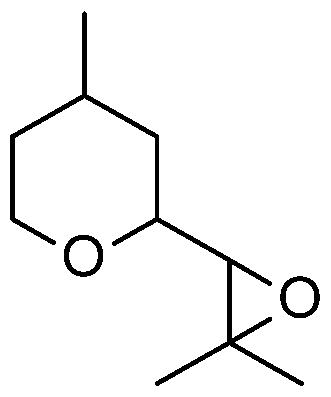
30
1 15.7 g (750 mmol, 1 .00 Äq.) 4-Methyl-2-(2-methylprop-1 -enyl)tetrahydropyran (Rosenoxid) werden in 1 .5 L Dichlormethan gelöst und auf 0°C gekühlt. Anschließend werden 207.1 g (900 mmol, 1 .20 Äq.) mefa-Chlorperbenzoesäure portionsweise binnen 3.5 Stunden zugegeben und 20 min bei gleicher Temperatur gerührt. Danach wird auf Raumtemperatur erwärmt und 2 Stunden bis zum vollständigen Umsatz gerührt. Die Reaktionsmischung wird daraufhin bei 10°C vorsichtig mit 2L einer 15%igen Natriumhydroxidlösung versetzt und mit 1 L Dichlormethan verdünnt. Die Phasen werden ausgeschüttelt und getrennt. Die organische Phase wird über Natriumsulfat getrocknet, filtriert und die Lösungsmittel
werden im Vakuum entfernt. Das auf diesem Wege erhaltene Rohprodukt von 2-(3,3- dimethyloxiran-2-yl)-4-methyl-tetrahydropyran 30 (125.0 g, 99% Reinheit, 97% Ausbeute) wird direkt in der Folgereaktion eingesetzt.
[206] Ausführungsbeispiel 5b: Synthese von 2-(3,3-Dimethylthiiran-2-yl)-4-methyl- tetrahydropyran 29:

29
42.6 g (250 mmol, 1 .00 Äq.) 2-(3,3-Dimethyloxiran-2-yl)-4-methyl-tetrahydropyran 30 werden in 125 mL Isopropanol gelöst und bei Raumtemperatur mit 19.0 g (250 mmol, 1 .00 Äq.) Ammoniumthiocyanat und 13.8 g (25 mmol, 0.10 Äq.) Cer(IV)ammoniumnitrat versetzt. Die Reaktionsmischung wird 48 Stunden bei Raumtemperatur, bis kein Reaktionsfortschritt mehr festgestellt werden kann, gerührt. Im Anschluss wird der Ansatz filtriert und das Filtrat eingeengt. Der Rückstand wird mit 70 mL te/t-Butylmethylether aufgenommen. Der ausgefallene Harnstoff wird erneut abfiltriert und die Organik über Natriumsulfat getrocknet. Nach Entfernen des Lösungsmittels werden 20 g Rohprodukt erhalten, welches destillativ (0.4 mbar, Sdp.: 40°C) und mittels Flash-Chromatographie (Cyclohexan/Essigester) aufgereinigt wird. Es werden 1 .89 g (10 mmol, 4% Ausbeute) 2-(3,3-Dimethylthiiran- 2-yl)-4-methyl-tetrahydropyran 29 als farblose Flüssigkeit erhalten. Die Verbindung 29 wird als Gemisch von cis-29/trans-29 = 5:1 erhalten.
Geruchsbeschreibung Isomerengemisch: Rose, Gummi, grün.
AND Enantiomer
z 9

cis-29
EI-MS m/z (%): 186 (9, [M]+), 171 (1), 153 (57), 139 (5), 99 (100), 81 (27), 69 (24), 55 (28), 43 (54), 29 (11).
1H-NMR (400MHz, CDCIs, 300K): 0.97 (d, 9-H3), 1.25 (m, 5-H2), 1.55 (m, 6,7-Hs), 1.61 (s, 1-Hs), 1.63 (s, 1'-H3), 2.72 (d, 3-H), 3.04 (ddd, 4-H), 3.39 (m, 8-H), 4.00 (ddd, 8'-H) ppm.
3Js,4 = 9.1 Hz, 3J4,5 = 11.1 Hz, 3J,5' = 2.1 Hz, 3J6,9 = 6.4 Hz, 3J7,8 = 4.6 Hz, 3J7',8 = 1.4

13C-NMR (100MHz, CDCIs, 300K): 22.24 (9-C), 23.02 (1-C), 30.14 (6-C), 30.57 (1'- C), 34.39 (7-C), 39.60 (5-C), 47.58 (2-C), 51.13 (3-C), 68.24 (8-C), 79.04 (4-C) ppm.
AND Enantiomer

trans-29
EI-MS m/z (%): 186 (5, [M]+), 171 (1), 153 (32), 139 (5), 99 (100), 81 (24), 69 (19), 55 (27), 43 (49), 29 (11).
1H-NMR (400MHz, CDCIs, 300K): 1.05 (d, 9-H3), 1.25 (m, 5-H), 1.62 (m, 1-Hs), 1.64 (s, 1-Hs), 1.81 (m, 5,7-Hs), 2.12 (dtd, 6-H), 2.88 (d, 3-H), 3.45 (m, 4-H), 3.68 (ddd, 8- H), 3.79 (dt, 8'-H) ppm.
3Js,4 = 9.4 Hz, 3J6,9 = 7.1 Hz, 3J7,8 = 9.5 Hz, 3J7',8 = 3.1 Hz, 2J8,8* = 1 1 .9 Hz, 3J7,8' = 4.7 Hz.
13C-NMR (100MHz, CDCIs, 300K): 18.93 (9-C), 23.03 (1 -C), 24.88 (6-C), 30.67 (1 '- C), 32.25 (7-C), 36.64 (5-C), 47.88 (2-C), 50.10 (3-C), 62.75 (8-C), 74.02 (4-C) ppm.
[207] Ausführungsbeispiel 6: Synthese von 4-Methyl-2-[(E)-1 -methylprop-1 -enyl]- 1 ,3-dioxan 31 :

31
21 .03 g (0.25 mol, 1 .0 Äq.) (E)-2-Methylbut-2-enal, 47.31 g (0.53 mol, 2.1 Äq.) 1 ,3- Butandiol und 1 .00 g (5.8 mmol, 0.02 Äq.) para-Toluolsulfonsäure werden in 250 ml_ Toluol gelöst und am Wasserabscheider 5 h zum Rückfluss erhitzt. Die Reaktionsmischung wird anschließend mit 50 ml_ einer gesättigten Natriumhydrogencarbonat- Lösung neutralisiert und die Phasen anschließend separiert. Die organische Phase wird dreimal mit jeweils 40 ml_ Wasser gewaschen und über Natriumsulfat getrocknet. Nach einer Phasentrennung werden die Lösungsmittel der organischen Phase im Vakuum entfernt. Der Rückstand wird über eine Kugelrohrdestillation (94°C, 1 .1 mbar) aufgereinigt. Es werden 15.8 g (37% Ausbeute, 93% Reinheit) eines binären Isomerengemisches von 4-Methyl-2-[(E)-1 -methylprop-1 -enyl]-1 ,3- dioxan 31 erhalten (trans-31/cis-31 = 7:1 ). Das Gemisch wurde direkt weiter eingesetzt.

trans-31
EI-MS m/z (%): 156 (3, [M]+), 141 (62), 101 (14), 87 (21 ), 84 (28), 69 (28), 55 (100),
41 (17), 29(17).
1H-NMR (400MHz, CDCIs, 300K): 1.25 (d, 9-H3), 1.43 (m, 7-H), 1.64 (dq, 1-H3), 1.67 (m, 7-H'), 1.69 (m, 4-H3), 3.81 (m, 6,8-H2), 4.13 (ddd, 8'-H), 4.82 (s, 5-H), 5.71 (ddd, 2-H) ppm.
3Ji,2 = 6.8 Hz, 3J6,9 = 6.2 Hz, 3J7,8 = 5.0 Hz, 3Jr,8 = 1.5 Hz, 2J8,8' = 11.5 Hz.
13C-NMR (100MHz, CDCIs, 300K): 13.09 (1-C), 17.78 (4-C), 21.87 (9-C), 33.03 (7- C), 66.67 (8-C), 72.87 (6-C), 98.54 (5-C), 124.52 (2-C), 133.65 (3-C) ppm.

cis-31
EI-MS m/z (%): 156 (6, [M]+), 141 (66), 101 (19), 87 (21), 84 (24), 69 (28), 55 (100), 41 (17), 29(17).
1H-NMR (400MHz, CDCIs, 300K): 1.25 (d, 9-H3), 1.43 (m, 7-H), 1.61 (d, 1-Hs), 1.67 (m, 7-H'), 1.75 (m, 4-H3), 3.81 (m, 6,8-H2), 4.13 (m, 8'-H), 5.32 (s, 5-H), 5.45 (m, 2-H) ppm.

13C-NMR (100MHz, CDCIs, 300K): 11.10 (4-C), 12.94 (1-C), 21.82 (3-C), 33.01 (7- C), 66.63 (8-C), 72.87 (6-C), 104.67 (5-C), 123.76 (2-C), 133.81 (3-C) ppm.
[208] Ausführungsbeispiel 7a: Synthese von 2-(2-Methylprop-1-enyl)-1 ,3-dioxan 32:

32
In Anlehnung an die Durchführung aus Beispiel 6 wurde dieses Acetal 32 synthetisiert.
[209] Ausführungsbeispiel 7b: Synthese von 4-Methyl-2-(2-methylprop-1 -enyl)- 1 ,3-dioxan 33:

33
In Anlehnung an die Durchführung aus Beispiel 6 wurde dieses Acetal 33 synthetisiert.
[210] Tabelle 1 : Übersicht der neuen Riechstoffe und ihre parfümistische Charakterisierung:

f 21 schwach, fleischig, Schwefel
g 22 fruchtig, floral, Rhabarber
h 23 Cassis, Minze
i 24 fleischig, Gunnnni
 fleischig, würzig, schwefelig mitj 25
Facetten von Zwiebel.
Grapefruit, schwefelig, verbrannt,k 26
exotische Frucht und Zwiebel d 19 schwefelig, fruchtig, Minze, Gummi
 2e 20 Cassis, fruchtig
5 29 Floral, Rose, Gummi, grün
[211] Ausführungsbeispiel 8: Parfumolkomposition I
Das nachfolgende angegebene Parfumöl kann zur Parfümierung von Shampoos und Duschgels benutzt werden.
[212] Tabelle 2:

DAMASCON ALPHA 2
DAMASCONE DELTA 1
DECALACTON GAMMA 20
DIHYDROMYRCENOL 35
DIMETHYLBENZYLCARBINYLBUTYRAT 25
ETHYLACETAT 1
ETHYLBUTYRAT 1
FLORAZON 1
FLOROSA 8
GERANIOL SUPRA 1
GERANYLACETAT PUR 13
GLOBALIDE® 30
HEDION 5
HERBAFLORAT 23,5
HEXENAL TRANS-2 10% DPG 3
HEXENOL CIS-3 2,5
H EXE NYLAC ETAT CIS-3 3,5
HEXENYLBENZOAT CIS-3 4
HEXENYLPROPIONAT CIS-3 0,6
HEXYLACETAT 10
HEXYLISOBUTYRAT 6,5
HEXYLSALICYLAT 30
HEXYLZIMTALDEHYD ALPHA 67
IONON BETA 25,5
ISOAMYLACETAT 1 ,4
ISOAMYLALKOHOL 10% DPG 2
ISOAMYLBUTYRAT 6,5
JASMAPRUNAT 16
LEAFOVERT® 0,5
LINALOOL 19
LINALOOLOXID 10% DPG 2
MANZANATE 5,5
NEOFOLIONE 0,8
PHENIRAT® 70
PHENYLETHYLBUTYRAT 10% DPG 1 ,5
PHENYLETHYLISOBUTYRAT 16
PRENYLACETAT 2,5
TAMARINE TYPE BASE 6
UNDECAVERTOL 7
VERTOCITRAL 6,5
FRAMBINON® 10% DPG 2
HEXENOL CIS-3 10% DPG 10
[213] Das hergestellte Parfümöl wurde in zwei gleiche Teile geteilt. Um Verdünnungseffekte auszuschließen, wurde ein erster Teil des Parfümöls mit 0,4 Gew.-% Dipropylenglycol (DPG) versetzt, bezogen auf die Gesamtmenge des ersten Teils des Parfümöls. Der zweite Teil des Parfümöls wurde mit 0,4 Gew.-% 2-Methyl- 1 -[(4R)-4-methyltetrahydropyran-2-yl]propane-1 -thiol 8 1 % DPG versetzt (also eine 1 %ige Lösung von Verbindung 8 in DPG), bezogen auf die Gesamtmenge des Teils des Parfümöls. Die resultierenden Kompositionen wurden olfaktorisch miteinander verglichen.
[214] Der Zusatz von 0,4 Gew.-% 2-Methyl-1 -[(4R)-4-methyltetrahydropyran-2- yl]propane-1 -thiol 8 1 % DPG verleiht der Komposition eine überraschende starke vibrierende Fruchtigkeit. Die frischen und saftigen Aspekte der Komposition werden hervorgehoben, so dass die Komposition mehr Ausdruck von Eleganz gewinnt.
[215] Ausführungsbeispiel 9: Parfumölkomposition II
Das nachfolgende angegebene Parfümöl kann zur Parfümierung von Shampoos und Duschgels benutzt werden.
[216] Tabelle 3:

ALDEHYD C18 SOG. 10% DPG 4
ALLYLCAPRONAT 10% DPG 3
AMBERWOOD® F 15
ANETHOL SUPRA 1
BERGAMOT IDENTOIL® 150
BUCCOXIME® 1 % DPG 18
CANTHOXAL 20
CITRONENOEL ITAL. 5
DAMASCENON TOTAL 10% DPG 6
DAMASCONE DELTA 10% DPG 5
DEWFRUIT TYPE BASE 25
ETHYLENBRASSYLAT 75
ETHYLLINALOOL 38
ETHYLMALTOL 20
ETHYLVANILLIN 30
GERANYLACETAT 60 1
GLOBALIDE® 60
GLOBANONE® 20
GUAJYLACETAT 5
HEDION 145
H EXE N YLSAL I CYLAT CIS-3 13
HEXYLACETAT 10% DPG 3
IONON BETA 20
IRON ALPHA 1
IRONAL 1
ISO E SUPER 1 15
ISORALDEIN 70 12
LIMETTENOEL TERPENE 5
LINALOOL 5
MENTHA ARV. OEL DMO 10% DPG 5
PATCHOULIOEL ENTF. DM 1 ,5
PRUNELLA TYPE BASE 6
SANDALWOOD MYSORE TYPE BASE REPL. 1
STYROLYLACETAT 2
SULFUROL 1
TERRANOL® 10% DPG 10
VANILLIN 25
VERTOCITRAL 1 ,5
YSAMBER® K 12
[217] Das hergestellte Parfümöl wurde in zwei gleiche Teile geteilt. Um Verdünnungseffekte auszuschließen, wurde ein erster Teil des Parfümöls mit 4 Gew.-% Dipropylenglycol (DPG) versetzt, bezogen auf die Gesamtmenge des ersten Teils des Parfümöls. Der zweite Teil des Parfümöls wurde mit 4 Gew.-% 2-Methyl-1 - [(4R)-4-methyltetrahydropyran-2-yl]propane-1 -thiol 8 1 % DPG versetzt (also eine 1 %ige Lösung von Verbindung 8 in DPG), bezogen auf die Gesamtmenge des Teils des Parfümöls. Die resultierenden Kompositionen wurden olfaktorisch miteinander verglichen.
[218] Der Zusatz von 4 Gew.-% 2-Methyl-1 -[(4R)-4-methyltetrahydropyran-2- yl]propane-1 -thiol 8 1 % DPG verleiht der Komposition eine starke verspielte Fruchtigkeit. Im Einzelnen harmonieren sonnengreifte exotische Noten mit spritzigen Aspekten nach Grapefruit. Die pudrige Note von schwarzer Johannisbeere verleiht der Komposition zudem mehr Fülle.
[219] Ausführungsbeispiel 10: Parfumölkomposition III
Das nachfolgende angegebene Parfümöl kann zur Parfümierung von Shampoos, Duschgels und Air Care Produkten benutzt werden.
[220] Tabelle 4:

APRIFLOREN® 30
BENZYLBENZOAT M 168
CALONE 10
DIMETHYLBENZYLCARBINYLBUTYRAT 40
DIMETHYLSULFID 10% BB 10
DIPHENYLOXID 30
ETHYLMALTOL 2
ETHYLVANILLIN 10% BB 20
FURANEOL 25
HELIONAL 80
HERBYLPROPIONAT 10
HEXENOL CIS-3 90
HEXENYLPROPIONAT CIS-3 60
METHYLPHENYLACETAT 10% BB 5
NEROL 900 30
NONALACTON DELTA 20
ORANGENOEL 100
PENTANDION-2,3 10% BB 5
THIOMENTHANON-8,3 10% BB 10
TROPICOL 0,1 % IPM 25
[221] Das hergestellte Parfümöl wurde in zwei gleiche Teile geteilt. Um Verdünnungseffekte auszuschließen, wurde ein erster Teil des Parfümöls mit 2 Gew.-% Dipropylenglycol (DPG) versetzt, bezogen auf die Gesamtmenge des ersten Teils des Parfümöls. Der zweite Teil des Parfümöls wurde mit 2 Gew.-% 2-Methyl-1 - [(4R)-4-methyltetrahydropyran-2-yl]propane-1 -thiol 8 1 % DPG versetzt, bezogen auf die Gesamtmenge des Teils des Parfümöls. Die resultierenden Kompositionen wurden olfaktorisch miteinander verglichen.
[222] Der Zusatz von 2 Gew.-% 2-Methyl-1 -[(4R)-4-methyltetrahydropyran-2- yl]propane-1 -thiol 8 1 % DPG verleiht der Komposition den Eindruck einer fleischigen gelben Mango mit Aspekten von natürlich grüner Mangoschale und deren Fasern.
Insgesamt zeichnet sich die Komposition dadurch durch mehr samtiges Volumen aus.
Claims
1 . Verbindungen der Formel (I)

wobei,
X ein Sauerstoffatom oder eine Methylengruppe darstellt,
R1 ein Wasserstoffatom oder einen linearen oder verzweigten Alkylrest mit 1 bis 8 Kohlenstoffatomen, bevorzugt eine Methylgruppe, darstellt,
R2 ein Wasserstoffatom oder einen linearen oder verzweigten Alkylrest mit 1 -8 Kohlenstoffatomen, bevorzugt ein Wasserstoffatom, darstellt,
R3 einen linearen oder verzweigten Alkylrest mit 1 -8 Kohlenstoffatomen, bevorzugt eine Methylgruppe, darstellt,
R4 ein Wasserstoffatom oder einen linearen oder verzweigten Alkylrest mit 1 -8 Kohlenstoffatomen, bevorzugt eine Methylgruppe, darstellt,
R5 einen linearen oder verzweigten Alkylrest mit 1 -8 Kohlenstoffatomen, bevorzugt eine Methylgruppe, darstellt oder R5 entfällt,
Y ein Wasserstoffatom, einen linearen oder verzweigten Alkylrest mit 1 -8 Kohlenstoffatomen oder eine Acetylgruppe darstellt oder Y entfällt,
wobei am Ort einer gestrichelt dargestellten Linie zwischen Oa-Atom und Cf- Atom keine Bindung oder eine Einfachbindung vorliegt, wobei bei Vorliegen einer Einfachbindung in Formel (I) die Gruppe R5 entfällt, wobei am Ort einer der gestrichelt dargestellten Linien zwischen S-Atom und Cg-Atom bzw. zwischen S-Atom und Ch-Atom jeweils keine Bindung oder eine Einfachbindung vorliegt, mit der Maßgabe, dass mindestens eine der gestrichelten Bindungen als Einfachbindung vorliegt, wobei bei Vorliegen von jeweils einer Einfachbindung zwischen S-Atom und den C-Atomen Cg und Ch in Formel (I) die Gruppe Y entfällt.
2. Verbindungen der Formel (II)

wobei
X ein Sauerstoffatom oder eine Methylengruppe darstellt,
R1 ein Wasserstoffatom oder einen linearen oder verzweigten Alkylrest mit 1 bis 8 Kohlenstoffatomen, bevorzugt eine Methylgruppe, darstellt,
R2 ein Wasserstoffatom oder einen linearen oder verzweigten Alkylrest mit 1 -8 Kohlenstoffatomen, bevorzugt ein Wasserstoffatom, darstellt,
R3 einen linearen oder verzweigten Alkylrest mit 1 -8 Kohlenstoffatomen, bevorzugt eine Methylgruppe, darstellt,
R4 ein Wasserstoffatom oder einen linearen oder verzweigten Alkylrest mit 1 -8 Kohlenstoffatomen, bevorzugt eine Methylgruppe, darstellt,
Y ein Wasserstoffatom, einen linearen oder verzweigten Alkylrest mit 1 -8 Kohlenstoffatomen oder eine Acetylgruppe darstellt oder Y entfällt,
wobei am Ort einer der gestrichelt dargestellten Linien zwischen S-Atom und Cg-Atom bzw. zwischen S-Atom und Ch-Atom jeweils keine Bindung oder eine Einfachbindung vorliegt, mit der Maßgabe, dass mindestens eine der gestrichelten Bindungen als Einfachbindung vorliegt, wobei bei Vorliegen von jeweils einer Einfachbindung zwischen S-Atom und den C-Atomen Cg und Ch in Formel (II) die Gruppe Y entfällt.
3. Verbindungen der Formel (III)

wobei,
X ein Sauerstoffatom oder eine Methylengruppe darstellt,
R1 ein Wasserstoffatom oder einen linearen oder verzweigten Alkylrest mit 1 bis 8 Kohlenstoffatomen, bevorzugt eine Methylgruppe, darstellt,
R2 ein Wasserstoffatom oder einen linearen oder verzweigten Alkylrest mit 1 -8 Kohlenstoffatomen, bevorzugt ein Wasserstoffatom, darstellt,
R3 einen linearen oder verzweigten Alkylrest mit 1 -8 Kohlenstoffatomen, bevorzugt eine Methylgruppe, darstellt,
R4 ein Wasserstoffatom oder einen linearen oder verzweigten Alkylrest mit 1 -8 Kohlenstoffatomen, bevorzugt eine Methylgruppe, darstellt,
R5 einen linearen oder verzweigten Alkylrest mit 1 -8 Kohlenstoffatomen, bevorzugt eine Methylgruppe, darstellt,
Y ein Wasserstoffatom, einen linearen oder verzweigten Alkylrest mit 1 -8 Kohlenstoffatomen darstellt, oder Y entfällt, wobei am Ort einer der gestrichelt dargestellten Linien zwischen S-Atom und Cg-Atom bzw. zwischen S-Atom und Ch-Atom jeweils keine Bindung oder eine Einfachbindung vorliegt, mit der Maßgabe, dass mindestens eine der gestrichelten Bindungen als Einfachbindung vorliegt, wobei bei Vorliegen von jeweils einer Einfachbindung zwischen S-Atom und den C-Atomen Cg und Ch in Formel (III) die Gruppe Y entfällt.
4. Verbindungen nach einem der vorangehenden Ansprüche, wobei die Verbindungen in Form eines Positions-Isomerengemisches der zwei Verbindungsvarianten mit jeweils einer einzigen Bindung von den C-Atomen Cg oder Ch zum S-Atom vorliegen.
5. Verbindungen nach einem der vorangehenden Ansprüche, wobei die Verbindungen in Form eines Diastereomeren-Gemisches mit Stereozentren an zwei oder mehreren der Positionen ausgewählt aus der Gruppe bestehend aus: Cd, Cf, Cg, Ch, vorliegen.
6. Verbindungen nach einem der Ansprüche 1 , 2, 4 oder 5, wobei die Verbindungen an der Position Cd (R)-konfiguriert vorliegen.
7. Verbindungen nach einem der vorangehenden Ansprüche, wobei die Verbindungen an der Position Cd (R)-konfiguriert und an der Position Cf (S)- konfiguriert vorliegen.
Verbindungen nach einem der vorangehenden Ansprüche, wobei die Verbindungen in Form eines cis:trans-lsomerengemisches an den Positionen Cd:Cf vorliegen, mit überwiegender cis-Konfiguration.
Verfahren zur Herstellung einer Verbindung (I), (II) oder (III) nach einem vorangehenden Ansprüche umfassend zumindest die Schritte (i), (ii) und dadurch gekennzeichnet, dass das entsprechende Edukt der Formel (IV)

(i) mit Thioessigsäure, bevorzugt unter radikalischer Katalyse, umgesetzt wird, um mit einer Regioselektivtät größer oder gleich 95% die Verbindung der Formel (V) zu erhalten:

(ii) optional anschließend die Acetylgruppe abgespalten wird, um die folgende Verbindung der Formel (VI) zu erhalten:

(iii) und optional daran anschließend die Thiolgruppe alkyliert wird, um die Verbindungen (I), (II) oder (III) zu erhalten, wobei die Gruppen X, Y, R1, R2, R3, R4 und R5 sowie die gestrichelten Linien jeweils die in Anspruch 1 angegebene Bedeutung haben.
Verfahren zur Herstellung einer Verbindung (I), (II) oder (III) nach einem der vorangehenden Ansprüche 1 bis 8, umfassend zumindest die Schritte (i) und (ii), dadurch gekennzeichnet, dass die Doppelbindung des entsprechenden Edukts der Formel (IV):

(i) mit einer Persäure, bevorzugt mit mefa-Chlorperbenzoesäure, epoxidiert wird,
(ii) und anschließend das unter (i) gebildete Oxiran, vorzugsweise mit Ammoniumthiocyanat, zum Thiiran der untenstehenden Formel (VII) umgesetzt wird:

1 1 . Riechstoff oder Geschmackstoff umfassend eine Verbindung der Formeln (I) bis (VII) nach einem der vorangehenden Ansprüche.
12. Riechstoff- oder Geschmackstoffmischung mit einem Riechstoff oder Geschmackstoff nach dem vorhergehenden Anspruch weiterhin umfassend einen oder mehrere zusätzliche Riechstoffe und/oder Aromastoffe, wobei die zusätzlichen bzw. ein, mehrere oder sämtliche Riechstoffe und/oder Aromastoffe ausgewählt ist bzw. sind aus der Gruppe bestehend aus: Extrakten aus natürlichen Rohstoffen, vorzugsweise Etherische Öle, Concretes, Absolues, Resine, Resinoide, Balsame, Tinkturen und/oder Einzel-Riechstoffen, vorzugsweise aus der Gruppe der Kohlenwasserstoffe, der aliphatischen Alkohole, der aliphatischen Aldehyde und deren Acetale, der aliphatischen Ketone und deren Oxime, der aliphatischen schwefelhaltigen Verbindungen, der aliphatischen Nitrile, der Ester von aliphatischen Carbonsäuren, der acyclischen Terpenalkohole, der acyclischen Terpenaldehyde und -ketone, der cyclischen Terpenalkohole, der cyclischen Terpenaldehyde und -ketone, der cyclischen Alkohole, der cycloaliphatischen Alkohole, der cyclischen und cycloaliphatischen Ether, der cyclischen und makrocyclischen Ketone, der cycloaliphatischen Aldehyde, der cycloaliphatischen Ketone, der Ester cyclischer Alkohole, der Ester cycloaliphatischer Alkohole, der araliphatischen Alkohole, der Ester von araliphatischen Alkoholen und aliphatischen Carbonsäuren, der araliphatischen Ether, der aromatischen und araliphatischen
Aldehyde, der aromatischen und araliphatischen Ketone, der aromatischen und araliphatischen Carbonsäuren und deren Ester, der stickstoffhaltigen aromatischen Verbindungen, der Phenole, Phenylether und Phenylester, der heterocyclischen Verbindungen, und der Lactone.
13. Riechstoff- oder Geschmackstoffmischung nach dem vorangehenden Anspruch, wobei die Gesamtmenge der erfindungsgemäßen Verbindungen (I) bis (VII) bezogen auf das Gesamtgewicht der Riech- oder Geschmackstoffmischung 0,00001 bis 5 Gew.-%, vorzugsweise 0,00001 bis 1 Gew.-%, und besonders bevorzugt 0,0005 bis 0,01 Gew.-%, beträgt.
14. Parfümiertes Produkt umfassend einen Riechstoff oder eine Riechstoffmischung nach einem der Ansprüche 1 1 bis 13 und ein Ergänzungsmittel, bevorzugt einen Trägerstoff, wobei der Trägerstoff einen oder mehrere Stoffe umfasst, ausgewählt aus der folgende Gruppe: poröse anorganische Materialien, wie vorzugsweise Leichtsulfat, Kieselgele, Zeolithe, Gipse, Tone, Tongranulate, Gasbeton oder organische Materialien wie vorzugsweise Hölzer, Cellulose basierende Stoffe, Zucker oder Kunststoffe wie vorzugsweise PVC, Polyvinylacetate oder Polyurethane.
15. Parfümiertes Produkt umfassend einen Riechstoff oder eine Riechstoffmischung nach einem der Ansprüche 1 1 bis 13 oder das parfümierte Produkt nach dem vorangehenden Anspruch weiterhin umfassend einen oder mehrere Zusatzstoffe, ausgewählt aus der folgenden Gruppe: Konservierungsmittel, Abrasiva, Antiakne-Mittel, Mittel gegen Hautalterung, anitbakterielle Mittel, Anticellulitis-Mittel, Antischuppen-Mittel, entzündungshemmende Mittel, irritationsverhindernde Mittel, irritationshemmende Mittel, antimikrobielle Mittel, Antioxidantien, Adstringentien, schweißhemmende Mittel, antiseptische Mittel, Antistatika, Binder, Puffer, Trägermaterialien, Chelatbildner, Zellstimulantien, reinigende Mittel, pflegende Mittel, Enthaarungsmittel, oberflächenaktive Substanzen, deodorierende Mittel, Antiperspirantien, Weichmacher, Emulgatoren, Enzyme, ätherische Öle, Fasern, Filmbildner, Fixateure, Schaumbildner, Schaumstabilisatoren, Substanzen zum Verhindern des Schäumens, Schaumbooster, Fungizide,
gelierende Mittel, gelbildende Mittel, Haarpflegemittel, Haarverformungsmittel, Haarglättungsmittel, feuchtigkeitsspendende Mittel, anfeuchtende Substanzen, feuchthaltende Substanzen, bleichende Mittel, stärkende Mittel, fleckenentfernende Mittel, optisch aufhellende Mittel, imprägnierende Mittel, schmutzabweisende Mittel, reibungsverringernde Mittel, Gleitmittel, Feuchtigkeitscremes, Salben, Trübungsmittel, plastifizierende Mittel, deckfähige Mittel, Politur, Glanzmittel, Polymere, Pulver, Proteine, rückfettende Mittel, abschleifende Mittel, Silicone, hautberuhigende Mittel, hautreinigende Mittel, hautpflegende Mittel, hautheilende Mittel, Hautaufhellungsmittel, hautschützende Mittel, hauterweichende Mittel, kühlende Mittel, hautkühlende Mittel, wärmende Mittel, hautwärmende Mittel, Stabilisatoren, UV-absorbierende Mittel, UV-Filter, Waschmittel, Weichspüler, suspendierende Mittel, Hautbräunungsmittel, Verdickungsmittel, Vitamine, Öle, Wachse, Fette, Phospholipide, gesättigte Fettsäuren, ein- oder mehrfach ungesättigte Fettsäuren, α-Hydroxysäuren, Polyhydroxyfettsäuren, Verflüssiger, Farbstoffe, farbschützende Mittel, Pigmente, Antikorrosiva, Aromen, Geschmackstoffe, Riechstoffe, Polyole, Tenside, Elektrolyte, organische Lösungsmittel oder Silikonderivate.
16. Parfümöl umfassend einen Riechstoff oder eine Riechstoffmischung nach einem der Ansprüche 1 1 bis 13 und/oder ein parfümiertes Produkt nach einem der Ansprüche 14 oder 15.
17. Modifiziertes Parfümöl umfassend ein Parfümöl nach dem vorangehenden Anspruch, wobei das Parfümöl mikroverkapselt, sprühgetrocknet, als Einschlusskomplex oder als Extrusionsprodukt vorliegt.
18. Parfümölkomposition für ein Shampoo oder Duschgel umfassend einen Riechstoff oder eine Riechstoffmischung nach einem der Ansprüche 1 1 bis 13 und/oder ein parfümiertes Produkt nach einem der Ansprüche 14 oder 15 oder ein Parfümöl nach Anspruch 16 und/oder ein modifiziertes Parfümöl nach Anspruch 17, wobei die Parfümölkomposition weiterhin noch für Shampoos oder Duschgele geeignete Zusatzstoffe umfasst.
19. Waschmittel, Hygieneprodukt, Pflegeprodukt, Shampoo oder Duschgel umfassend einen Riechstoff oder eine Riechstoffmischung nach einem der Ansprüche 1 1 bis 13 und/oder ein parfümiertes Produkt nach einem der Ansprüche 14 oder 15 und/oder ein Parfümöl nach Anspruch 16 und/oder ein modifiziertes Parfümöl nach Anspruch 17 und/oder eine Parfümölkomposition nach Anspruch 18.
20. Verwendung einer Verbindung der Formeln (I) bis (VII) nach einem der vorangehenden Ansprüche als Riech- oder Geschmackstoff oder Riech- oder Geschmackstoffmischung.
21 . Verwendung einer Verbindung der Formeln (I) bis (VII) nach einem der vorangehenden Ansprüche zum Vermindern oder Maskieren eines unangenehmen Geruchs und/oder zum Verstärken positiver Geruchseindrücke und/oder zum Verstärken von blumigen und fruchtigen Geruchseindrücken.
Priority Applications (1)
| Application Number | Priority Date | Filing Date | Title |
|---|---|---|---|
| PCT/EP2017/071389 WO2019037862A1 (de) | 2017-08-24 | 2017-08-24 | Organoschwefelverbindungen als riech- und geschmackstoffe |
Applications Claiming Priority (1)
| Application Number | Priority Date | Filing Date | Title |
|---|---|---|---|
| PCT/EP2017/071389 WO2019037862A1 (de) | 2017-08-24 | 2017-08-24 | Organoschwefelverbindungen als riech- und geschmackstoffe |
Publications (1)
| Publication Number | Publication Date |
|---|---|
| WO2019037862A1 true WO2019037862A1 (de) | 2019-02-28 |
Family
ID=59714022
Family Applications (1)
| Application Number | Title | Priority Date | Filing Date |
|---|---|---|---|
| PCT/EP2017/071389 Ceased WO2019037862A1 (de) | 2017-08-24 | 2017-08-24 | Organoschwefelverbindungen als riech- und geschmackstoffe |
Country Status (1)
| Country | Link |
|---|---|
| WO (1) | WO2019037862A1 (de) |
Cited By (1)
| Publication number | Priority date | Publication date | Assignee | Title |
|---|---|---|---|---|
| WO2023213922A1 (en) | 2022-05-04 | 2023-11-09 | Symrise Ag | PRECURSORS FOR THE CONTROLLED RELEASE OF α,β-UNSATURATED ALDEHYDES OR KETONES AND OTHER HIGH IMPACT FRAGRANCE SUBSTANCES |
Citations (1)
| Publication number | Priority date | Publication date | Assignee | Title |
|---|---|---|---|---|
| EP1458666A1 (de) * | 2001-12-19 | 2004-09-22 | Flexitral Inc. | Verbesserte geruchsstoffe |
-
2017
- 2017-08-24 WO PCT/EP2017/071389 patent/WO2019037862A1/de not_active Ceased
Patent Citations (1)
| Publication number | Priority date | Publication date | Assignee | Title |
|---|---|---|---|---|
| EP1458666A1 (de) * | 2001-12-19 | 2004-09-22 | Flexitral Inc. | Verbesserte geruchsstoffe |
Non-Patent Citations (4)
| Title |
|---|
| ARCTANDER, PERFUME AND FLAVOR CHEMICALS (AROMA CHEMICALS, vol. 1, 2008 |
| H. SURBURG; J. PANTEN: "Common Fragrance and Flavor Materials", 2006, WILEY-VCH |
| JANES J F ET AL: "Reaction of Monoterpenoids with Hydrogen Sulphide to Form Thiols and epi-Sulphides of Potential Organoleptic Significance", FLAVOUR AND FRAGRANCE JOURNAL, WILEY, NEW YORK, NY, GB, vol. 8, no. 5, 1 September 1993 (1993-09-01), pages 289 - 294, XP002595664, ISSN: 0882-5734, [retrieved on 20060626], DOI: 10.1002/FFJ.2730080510 * |
| S. ARCTANDER: "Perfume and Flavor Chemicals", vol. I und II, 1969, SELBSTVERLAG |
Cited By (1)
| Publication number | Priority date | Publication date | Assignee | Title |
|---|---|---|---|---|
| WO2023213922A1 (en) | 2022-05-04 | 2023-11-09 | Symrise Ag | PRECURSORS FOR THE CONTROLLED RELEASE OF α,β-UNSATURATED ALDEHYDES OR KETONES AND OTHER HIGH IMPACT FRAGRANCE SUBSTANCES |
Similar Documents
| Publication | Publication Date | Title |
|---|---|---|
| EP2578671B1 (de) | Riechstoffe mit Maiglöckchennote | |
| EP1914231A2 (de) | 2-Methyl-2-alkenyl-substituierte 1,3-Dioxane als Riechstoffe | |
| EP3197987B1 (de) | Verwendung von isomerenreinem oder hoch isomerenangereichertem cis- oder trans-(2-isobutyl-4-methyl-tetrahydropyran-4-yl)acetat | |
| EP2803666B1 (de) | Cyclische Acetale und Ketale sowie deren Verwendung als Riechstoff | |
| EP2524959A1 (de) | Riech- und/oder Aromastoffkompositionen enthaltend Dioxolane | |
| EP2100589A1 (de) | 4-Alkylsubstituierte Pyridine als Riechstoffe | |
| EP2848611B1 (de) | Octahydrobenzofurane und Octahydrochromene - Verfahren zur Herstellung und ihre Verwendung als Duftstoffe | |
| EP2287158A1 (de) | Ambra-Riechstoff auf Basis von 9-Methanoazuleno(5,6-d)-1,3-dioxolen | |
| DE112007000301B4 (de) | Mischungen ungesättigter makrocyclischer Epoxide als Riechstoffe | |
| EP2072083B1 (de) | Verwendung von 2,4'-Dimethyl-propiophenon als Riechstoff | |
| WO2018233804A1 (de) | Neue ambra- und/oder indolartige riechstoffkompositionen | |
| EP1697293B1 (de) | (z)-7-cyclohexadecen-1-on als riechstoff | |
| EP1654246B1 (de) | Acetale, ihre verwendung als riechstoffe und verfahren zu ihrer herstellung | |
| DE202005021550U1 (de) | 3-Methylbenzylisobutyrat | |
| DE102007055124A1 (de) | 7-(3-Methylbut-2-en-1-yl)-2H-1,5-benzodioxepin-3(4H)-on als Riechstoff | |
| EP4045490B1 (de) | Neue aromatische monothioketale als riechstoffe | |
| EP1797025B1 (de) | 4-isoamylcyclohexanol als riechstoff | |
| WO2019037862A1 (de) | Organoschwefelverbindungen als riech- und geschmackstoffe | |
| EP1992606A1 (de) | Alkenacetale und ihre Verwendung als Riechstoffe | |
| EP3112448B1 (de) | Derivate des 1-(4-methylcyclohexyl)-ethanols | |
| EP3026048B1 (de) | Hexahydrobenzofurane und Hexahydrochromene - Verfahren zur Herstellung und ihre Verwendung als Duftstoffe | |
| EP3853199B1 (de) | 2-(5-isopropyl-2-methyl-cyclohex-2-en-1-yl-) acetaldehyd und 2-(6-isopropyl-3-methyl-cyclohex-2-en-1-yl-) acetaldehyd als neue riechstoffe | |
| EP1761618A1 (de) | Verwendung eines gemisches von cis- und trans-3-methyl-g-decalacton sowie riechstoffkompositionen und parfümierte artikel umfassend ein solches gemisch | |
| EP1648526B1 (de) | Cis-3,3,5-trimethylcyclohexylester | |
| WO2007009982A1 (de) | 4-isoamylcyclohexanon als riechstoff |
Legal Events
| Date | Code | Title | Description |
|---|---|---|---|
| 121 | Ep: the epo has been informed by wipo that ep was designated in this application |
Ref document number: 17758141 Country of ref document: EP Kind code of ref document: A1 |
|
| NENP | Non-entry into the national phase |
Ref country code: DE |
|
| 122 | Ep: pct application non-entry in european phase |
Ref document number: 17758141 Country of ref document: EP Kind code of ref document: A1 |