WO2019031600A1 - ウェアラブルデバイス対応眼電位データ処理装置、それを備えた眼鏡型ウェアラブルデバイス、及びウェアラブルデバイス対応眼電位データ処理方法 - Google Patents
ウェアラブルデバイス対応眼電位データ処理装置、それを備えた眼鏡型ウェアラブルデバイス、及びウェアラブルデバイス対応眼電位データ処理方法 Download PDFInfo
- Publication number
- WO2019031600A1 WO2019031600A1 PCT/JP2018/030056 JP2018030056W WO2019031600A1 WO 2019031600 A1 WO2019031600 A1 WO 2019031600A1 JP 2018030056 W JP2018030056 W JP 2018030056W WO 2019031600 A1 WO2019031600 A1 WO 2019031600A1
- Authority
- WO
- WIPO (PCT)
- Prior art keywords
- wearable
- data
- eye
- electro
- oculogram
- Prior art date
- Legal status (The legal status is an assumption and is not a legal conclusion. Google has not performed a legal analysis and makes no representation as to the accuracy of the status listed.)
- Ceased
Links
Images



Classifications
-
- A—HUMAN NECESSITIES
- A61—MEDICAL OR VETERINARY SCIENCE; HYGIENE
- A61B—DIAGNOSIS; SURGERY; IDENTIFICATION
- A61B5/00—Measuring for diagnostic purposes; Identification of persons
- A61B5/103—Measuring devices for testing the shape, pattern, colour, size or movement of the body or parts thereof, for diagnostic purposes
- A61B5/11—Measuring movement of the entire body or parts thereof, e.g. head or hand tremor or mobility of a limb
-
- A—HUMAN NECESSITIES
- A61—MEDICAL OR VETERINARY SCIENCE; HYGIENE
- A61B—DIAGNOSIS; SURGERY; IDENTIFICATION
- A61B3/00—Apparatus for testing the eyes; Instruments for examining the eyes
- A61B3/10—Objective types, i.e. instruments for examining the eyes independent of the patients' perceptions or reactions
- A61B3/113—Objective types, i.e. instruments for examining the eyes independent of the patients' perceptions or reactions for determining or recording eye movement
-
- A—HUMAN NECESSITIES
- A61—MEDICAL OR VETERINARY SCIENCE; HYGIENE
- A61B—DIAGNOSIS; SURGERY; IDENTIFICATION
- A61B5/00—Measuring for diagnostic purposes; Identification of persons
- A61B5/24—Detecting, measuring or recording bioelectric or biomagnetic signals of the body or parts thereof
- A61B5/25—Bioelectric electrodes therefor
- A61B5/279—Bioelectric electrodes therefor specially adapted for particular uses
- A61B5/297—Bioelectric electrodes therefor specially adapted for particular uses for electrooculography [EOG]: for electroretinography [ERG]
-
- A—HUMAN NECESSITIES
- A61—MEDICAL OR VETERINARY SCIENCE; HYGIENE
- A61B—DIAGNOSIS; SURGERY; IDENTIFICATION
- A61B5/00—Measuring for diagnostic purposes; Identification of persons
- A61B5/24—Detecting, measuring or recording bioelectric or biomagnetic signals of the body or parts thereof
- A61B5/316—Modalities, i.e. specific diagnostic methods
- A61B5/398—Electrooculography [EOG], e.g. detecting nystagmus; Electroretinography [ERG]
-
- A—HUMAN NECESSITIES
- A61—MEDICAL OR VETERINARY SCIENCE; HYGIENE
- A61B—DIAGNOSIS; SURGERY; IDENTIFICATION
- A61B5/00—Measuring for diagnostic purposes; Identification of persons
- A61B5/68—Arrangements of detecting, measuring or recording means, e.g. sensors, in relation to patient
- A61B5/6801—Arrangements of detecting, measuring or recording means, e.g. sensors, in relation to patient specially adapted to be attached to or worn on the body surface
- A61B5/6802—Sensor mounted on worn items
- A61B5/6803—Head-worn items, e.g. helmets, masks, headphones or goggles
-
- G—PHYSICS
- G06—COMPUTING OR CALCULATING; COUNTING
- G06F—ELECTRIC DIGITAL DATA PROCESSING
- G06F3/00—Input arrangements for transferring data to be processed into a form capable of being handled by the computer; Output arrangements for transferring data from processing unit to output unit, e.g. interface arrangements
- G06F3/01—Input arrangements or combined input and output arrangements for interaction between user and computer
Definitions
- the present invention relates to a wearable device compatible electro-oculogram data processing apparatus, a glasses-type wearable device including the same, and a wearable device-compatible electrooculogram data processing method.
- Non-Patent Document 1 discloses a method of evaluating the driving margin using an eye potential.
- the degree of driving allowance is evaluated using eye blink rate, eye movement norm, eye movement ratio and eye movement time as eye movement related parameters calculated from eye potential.
- Patent Document 1 discloses eyewear having a biological electrode for obtaining an electro-oculogram as an eyeglass-type electro-oculography.
- the biological electrodes are respectively provided on a pair of nose pads and a bridge portion.
- the mounting position of the user may be different from the designed mounting reference position of the wearable device.
- the mounting position of the wearable device may change due to vibration or the like after mounting by the user.
- the mounting reference position may be different from the mounting position of the user.
- the wearable device when the mounting reference position and the mounting position of the user are different, the position of the biological electrode for measuring the eye potential of the user is also different from the reference position. Therefore, the data of the electrooculogram measured using the above-mentioned living body electrode changes with the wearing positions of the above-mentioned wearable device.
- the eye movement data acquired from the data of the measured electro-oculogram varies depending on the mounting position of the wearable device.
- An object of the present invention is to provide an electro-oculogram data processing device compatible with a wearable device capable of coping with the problem of the wearable device that the measurement value of the electro-oculogram varies depending on the position of the electrode measuring the electro-oculogram during wearing of the wearable device. I assume.
- the inventor considered changes in eye movement data resulting from changes in electrode positions for measuring the eye potential.
- the present inventor has considered a method of allowing a change in the position of the electrode for measuring the ocular potential, not a method of adjusting the position of the electrode for measuring the ocular potential so that the data of the ocular potential does not change.
- the wearable device-compatible electro-oculogram data processing apparatus continuously measures the electro-oculogram from the electro-oculogram measuring device provided in the wearable device that can be worn by the user and continuously measuring the user's
- the wearable electrooculogram continuation data is continuously acquired based on the generated electrooculogram, and the wearable electrooculogram continuation data acquired during the use of the wearable device is used while the wearable device is in use. Continuous wearable eye movement amount continuous data related to the movement amount of the user's eye is acquired.
- continuous wearable eye movement amount continuous data related to the eye movement amount can be continuously acquired.
- wearable eye movement amount continuation data it can be understood that the electro-oculogram measuring device is changing with respect to data obtained from the wearing reference position on the design of the wearable device. Based on the change in the data, at least one of the wearable electrooculogram continuation data and the wearable eye movement amount continuation data may be corrected or calibrated.
- the ocular potential measured by the ocular potential measuring device provided in the wearable device worn by the user not the ocular potential measuring device that directly affixes the electrode used in the laboratory to the skin It can be used for evaluation.
- the wearable device-compatible electro-oculogram data processing device of the present invention preferably includes the following configuration.
- the wearable device compatible electrooculogram data processing apparatus corrects at least one of the wearable electrooculogram continuation data and the wearable eye movement migration data based on at least one of the wearable electrogram continuation data and the wearable migration data. Do.
- the shape of the face is different for each user, even if the electro-oculogram measured by the electro-oculography device of the wearable device is different for each user, at least one of wearable electro-oculogram continuation data and wearable eye movement amount continuation data Corrections can be made.
- At least one of wearable eye potential continuation data and wearable eye movement amount continuation data may be corrected even if the eye potential measured by the electropotential measurement device of the wearable device differs due to a change in skin impedance of the same user. Can.
- the wearable device-compatible electro-oculogram data processing device of the present invention preferably includes the following configuration.
- the electro-oculogram measuring device continuously measures the electro-oculograms of the plurality of positions of the user.
- the wearable device compatible electrooculogram data processing apparatus continuously acquires a plurality of wearable electrooculogram continuation data based on the ocular potentials of the plurality of positions continuously measured by the electrooculogram measurement device.
- wearable eye movement amount continuation data can be more accurately obtained by continuously measuring a plurality of eye potentials and acquiring a plurality of wearable eye potential continuation data based on the measured eye potentials at a plurality of positions. You can get
- the wearable device-compatible electro-oculogram data processing device of the present invention preferably includes the following configuration.
- the wearable eye movement amount continuation data is data related to the magnitude of the electrooculogram.
- the wearable device-compatible electro-oculogram data processing device of the present invention preferably includes the following configuration.
- the wearable device compatible electrooculogram data processing apparatus continuously acquires wearable head movement continuation data of the user from the head movement measurement apparatus provided in the wearable device, and the continuously acquired wearable head of the user Wearable head movement amount continuation data is acquired from exercise continuation data, and wearable eye gaze movement amount continuation data is acquired from the wearable eye movement amount continuation data and the wearable head movement amount continuation data.
- head movement in addition to eye movement, head movement can be taken into consideration, so wearable gaze movement amount continuation data can be acquired more accurately.
- the wearable device-compatible electro-oculogram data processing device of the present invention preferably includes the following configuration.
- a wearable device-compatible electro-oculogram data processing device continuous wearable associated with coordinated movement of eye movement and head movement during use of the wearable device from the wearable electro-oculogram continuation data and the wearable head movement continuation data
- the head-eye coordination movement continuation data is acquired, and the wearable gaze movement amount continuation data corresponding to the predetermined wearable head-eye coordination movement continuation data is output.
- wearable eye-gaze movement amount continuation data corresponding to the predetermined wearable head-eye coordination continuous data can be output.
- the output wearable line-of-sight movement amount continuation data can be utilized also for evaluation of the driving margin.
- a glasses-type wearable device includes a wearable device-compatible electro-oculogram data processing device having the above-described configurations.
- the wearable device-compatible electro-oculogram data processing apparatus is continuously provided from an electro-oculogram measuring device provided in a wearable device that can be worn by the user and continuously measuring the user's ocular potential.
- a wearable eye potential continuation data acquisition unit for continuously acquiring wearable eye potential continuation data based on the measured eye potential, and the wearable eye acquired by the wearable eye potential continuation data acquisition unit during use of the wearable device
- a wearable eye movement amount continuation data acquisition unit configured to acquire continuous wearable eye movement amount continuation data related to the movement amount of the user's eye during use of the wearable device based on the electric potential continuation data.
- a wearable device-compatible electro-oculogram data processing method is continuously provided by an electro-oculogram measuring device provided in a wearable device that can be worn by a user and continuously measuring the user's ocular potential.
- Wearable electro-oculogram continuation data is continuously acquired based on the measured electro-oculogram, and the wearable electro-oculogram continuation data acquired continuously during use of the wearable device is used during the use of the wearable device Continuous wearable eye movement amount continuous data related to the movement amount of the user's eye is acquired.
- the wearable device-compatible electro-oculogram data processing method of the present invention preferably includes the following configuration.
- the wearable device compatible electrooculogram data processing method corrects at least one of the wearable electrooculogram continuation data and the wearable eye movement continuation data based on at least one of the wearable electrooculogram continuation data and the wearable eye movement continuity data. Do.
- the wearable device-compatible electro-oculogram data processing method of the present invention preferably includes the following configuration.
- the electro-oculogram measuring device continuously measures the electro-oculogram at a plurality of positions.
- the wearable device compatible electrooculogram data processing method continuously acquires a plurality of wearable electrooculogram continuation data based on the ocular potentials of the plurality of positions continuously measured by the electrooculogram measurement device.
- the wearable device-compatible electro-oculogram data processing method of the present invention preferably includes the following configuration.
- the wearable eye movement amount continuation data is data related to the magnitude of the electrooculogram.
- the wearable device-compatible electro-oculogram data processing method of the present invention preferably includes the following configuration.
- the wearable device-compatible electro-oculogram data processing method continuously acquires wearable head movement continuation data of the user from the head movement measurement device provided in the wearable device, and the continuously acquired wearable head Wearable head movement amount continuation data is acquired from exercise continuation data, and wearable eye gaze movement amount continuation data is acquired from the wearable eye movement amount continuation data and the wearable head movement amount continuation data.
- the wearable device-compatible electro-oculogram data processing method of the present invention preferably includes the following configuration.
- a wearable device-compatible electro-oculogram data processing method a continuous wearable associated with coordinated movement of eye movement and head movement while using the wearable device from the wearable electro-oculogram continuation data and the wearable head movement continuation data
- the head-eye coordination movement continuation data is acquired, and the wearable gaze movement amount continuation data corresponding to the predetermined wearable head-eye coordination movement continuation data is output.
- connection As used herein, “attached”, “connected”, “coupled”, and / or their equivalents are used in a broad sense, “direct and indirect” attachment, Includes both connections and bonds. Furthermore, “connected” and “coupled” are not limited to physical or mechanical connections or couplings, but can include direct or indirect connections or couplings.
- continuously acquiring wearable electrooculogram continuation data is measured not only when acquiring wearable electrooculogram continuation data from the measured electrooculogram by calculation but also using a predetermined map Also included is the case of converting wearable electro-oculograms to obtain wearable electro-oculogram continuation data.
- continuously acquiring wearable eye movement amount continuation data is not only determined when wearable eye movement amount continuation data is acquired by calculation from wearable eye potential continuation data already acquired, but is also predetermined. Also included is the case where wearable eye movement amount continuation data is acquired using a map to convert wearable eye potential continuation data already acquired.
- eye movement means movement of the eye relative to the head. That is, the eye movement means the movement of the eye relative to the head.
- the absolute value of the rotational angular velocity of the eye is at least a threshold ⁇ (for example, 30 deg / sec) and the absolute value of the momentum obtained by integrating the rotational angular velocity is at least a threshold ⁇ (for example, 3.5 deg) Saccade eye movement (Saccade, Saccadic eye movement).
- head movement means movement of the head when the head moves or rotates in upper, lower, left, and right absolute coordinates. That is, the head movement includes the movement of the head when the head moves or rotates with respect to the torso, the movement of the head when the head moves or rotates with the body, the head, and The movement of the head as the torso respectively moves or rotates.
- the effective visual field is a range in which the subject can collect visual information that is effectively utilized in an action of capturing a visual target in the visual field.
- continuously acquiring wearable head movement continuation data is not limited to the case of acquiring wearable head movement continuation data by calculation from information of the measured head movement measuring apparatus, and is also predetermined. Also included is the case where wearable head movement continuation data is acquired by converting the measured head movement measurement device information using the obtained map.
- acquiring continuous wearable head-eye coordination movement continuation data related to coordinated movement of eye movement and head movement during use of the wearable device means wearable eye potential continuation data and wearable that have already been acquired. Not only when wearable head-eye coordination movement continuation data is obtained by calculation from head movement continuation data, but wearable head potential continuation data and wearable head movement continuation already obtained using a predetermined map It also includes the case of converting data to obtain wearable head-eye coordination continuous data.
- coordinated movement of eye movement and head movement is movement including at least one of eye movement and head movement in the visual recognition when the user looks at a visual target.
- the eye movement amount is a value obtained by the sum of an eye movement amount which is an eye movement amount and a head movement amount which is a head movement amount.
- a wearable device means a device provided to a user-mounted wearing tool such as glasses, sunglasses, goggles and a head mounted display. Therefore, in the embodiment, the glasses-type wearable device is mentioned as an example of the wearable device, but the present invention is not limited to this.
- the wearable device can be worn by the user and an electropotential measuring instrument for measuring the electrooculogram can be disposed.
- the device may have any configuration.
- a wearable device-compatible electro-oculogram data processing device capable of coping with the problem of the wearable device that the measurement value of the electro-oculogram varies depending on the position of the electrode that measures the electro-oculogram during wearing of the wearable device.
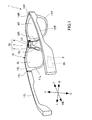
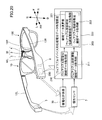
- FIG. 1 is a schematic view showing a schematic configuration of a glasses-type wearable device according to a first embodiment of the present invention.
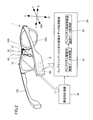
- FIG. 2 is an explanatory view showing a schematic configuration of a wearable device-compatible electro-oculogram data processing apparatus in the glasses-type wearable device according to the first embodiment of the present invention.
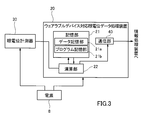
- FIG. 3 is a block diagram showing a schematic configuration of a wearable device-compatible electro-oculogram data processing apparatus according to the first embodiment of the present invention.
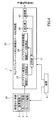
- FIG. 4 is a functional block diagram showing functions based on processing operations as functional blocks in the wearable device compatible electrooculogram data processing device shown in FIG. FIG.
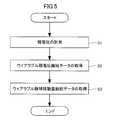
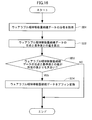
- FIG. 5 is a flowchart showing an example of a processing procedure until wearable device corresponding electrooculogram data processing device in the first embodiment obtains wearable eye movement continuation data.
- FIG. 6 is a flowchart showing an example of a processing procedure for correcting wearable eye movement amount continuation data when the glasses-type wearable device is attached.
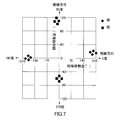
- FIG. 7 is an explanatory view showing an example of how wearable eye movement amount continuation data is corrected.
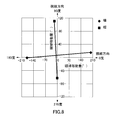
- FIG. 8 is an explanatory view showing a state in which a coordinate system is formed by the median value of the acquired wearable eyeball movement amount continuation data.
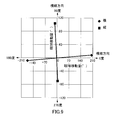
- FIG. 9 is an explanatory view showing a state in which the intersection point of the vertical axis and the horizontal axis is the origin.
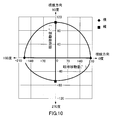
- FIG. 10 is a schematic view showing a state in which affine transformation is performed such that the horizontal axis is horizontal and the vertical axis is horizontal.
- FIG. 11 is an explanatory view showing a state in which wearable eye movement amount continuation data is corrected in each quadrant.
- FIG. 12 is a flowchart illustrating a procedure of correction processing of wearable electro-oculogram continuation data according to the second embodiment.
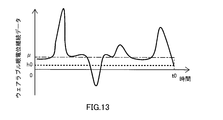
- FIG. 13 is an explanatory view showing a relationship between wearable electro-oculogram continuation data and time.
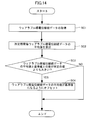
- FIG. 14 is a flowchart showing a procedure of correction processing of wearable electro-oculogram continuation data.
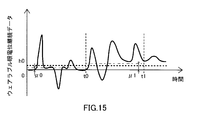
- FIG. 15 is an explanatory view showing a relationship between wearable electro-oculogram continuation data and time.
- FIG. 16 is a flowchart illustrating an example of correction processing of wearable eye movement amount continuation data according to the third embodiment.
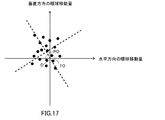
- FIG. 17 is an explanatory diagram of an example of how wearable eye movement amount continuation data is corrected.
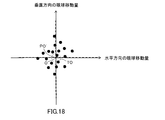
- FIG. 18 is an explanatory view showing an example in which wearable eye movement amount continuation data is corrected.
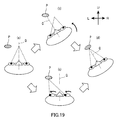
- FIG. 19 is a view schematically showing an example of the visual recognition action.
- FIG. 20 is a functional block diagram of a wearable device-compatible electro-oculogram data processing apparatus according to a fourth embodiment of the present invention.
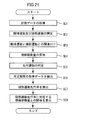
- FIG. 21 is a flowchart for explaining the operation of the fourth embodiment.
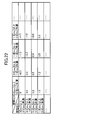
- FIG. 22 is a table showing the relationship between the measurement value of the electro-oculography and the electro-oculogram in the vertical direction.
- the left direction, the right direction, the upper direction, the lower direction, the front, and the rear are directions as viewed from the user wearing the glasses-type wearable device 1.
- the arrow L in the figure is the left direction of the glasses-type wearable device 1
- the arrow R in the figure is the right direction of the glasses-type wearable device 1
- the arrow U in the figure is the upper direction of the glasses-wearable device 1
- Arrow D in the figure indicates the downward direction of the glasses-type wearable device
- arrow F in the figure indicates the forward direction of the glasses-type wearable device
- arrow RR in the figure indicates the backward direction of the glasses-type wearable device 1. Show.
- FIG. 1 shows a schematic configuration of the glasses-type wearable device 1 of the present embodiment.
- the glasses-type wearable device 1 includes a frame 10, a left lens 6L, and a right lens 6R, which are basic configurations of glasses.
- the glasses-type wearable device 1 is an electro-oculogram measuring device 30 for measuring the electro-oculography of the user in a state of being worn by the user, and a wearable device compatible electro-oculogram for processing the electro-oculogram data measured by the electro-oculography And a data processing device 20. Therefore, the glasses-type wearable device 1 can measure the electrooculogram of the user in a state of being worn by the user, and process the acquired electrooculogram data.
- the frame 10 has a left rim 11L, a right rim 11R, a bridge 13, a left temple 12L, a right temple 12R, a left nose pad 16L, and a right nose pad 16R.
- the left rim 11L holds the left lens 6L.
- the right rim 11R holds the right lens 6R.
- the bridge 13 connects the left rim 11L and the right rim 11R.
- a left yoke 14L is provided on the left side of the left rim 11L.
- a right yoke 14R is provided to the right of the right rim 11R.
- the left temple 12L extends rearward from the left rim 11L.
- the left temple 12L is located on the left temple and the left ear of the user when the user wears the glasses-type wearable device 1.
- the right temple 12R extends rearward from the right rim 11R.
- the right temple 12R is located on the user's right temple and right ear with the user wearing the glasses-type wearable device 1.
- the left temple 12L is rotatably held relative to the left yoke 14L by a left hinge 15L provided on the left yoke 14L.
- the right temple 12R is rotatably held relative to the right yoke 14R by a right hinge 15R provided on the right yoke 14R.
- the left nose pad 16L is attached to the bridge 13, and is positioned to the right of the left rim 11L as viewed from the rear in the front-rear direction.
- the left nose pad 16L contacts the left portion of the user's nose while the user wears the glasses-type wearable device 1.
- the right nose pad 16R is attached to the bridge 13, and is positioned to the left of the right rim 11R as viewed from the rear in the front-rear direction.
- the right nose pad 16R contacts the right portion of the user's nose while the user wears the glasses-type wearable device 1.
- the electro-oculogram measuring instrument 30 is provided at the central portion of the glasses-type wearable device 1 in the left-right direction. That is, the electrooculogram 30 is positioned between the left rim 11L and the right rim 11R as viewed from the rear in the front-rear direction.
- the ocular potential measurement device 30 has a reference electrode 2, a left nose electrode 3 and a right nose electrode 4.
- the reference electrode 2 is provided at the rear of the bridge 13.
- the left nose electrode 3 is provided on the left nose pad 16L.
- the right nose electrode 4 is provided on the right nose pad 16R.
- the left nose electrode 3 and the right nose electrode 4 are provided below the reference electrode 2. Therefore, when the user wears the glasses-type wearable device 1, the reference electrode 2 contacts the intercostal portion of the user, the left nose electrode 3 contacts the left portion of the user's nose, and the right portion of the user's nose Contacts the right nose electrode 4.
- the wearable device compatible electrooculogram data processing apparatus 20 is provided in the right temple 12.
- the wearable device-compatible electro-oculogram data processing device 20 processes the data of the electro-oculogram output from the electro-oculogram measurement device 30.
- the detailed configuration of the wearable device compatible electrooculogram data processing apparatus 20 will be described later.
- the glasses-type wearable device 1 of the present embodiment further includes a power supply 8 that supplies power to the electro-oculogram measuring device 30 and the electro-oculography data processor 20 compatible with the wearable device.
- the power supply 8 is provided in the right temple 12R. That is, the wearable device compatible electrooculogram data processing device 20 and the power supply 8 are arranged in the front-rear direction in the right temple 12R.
- the power source 8 is, for example, a secondary battery such as a lithium ion battery.
- the power supply 8 may have any configuration as long as it can supply power to the electro-oculogram measuring device 30 and the electro-oculography data processing device 20 compatible with the wearable device.
- the ocular potential measurement device 30 can measure the ocular potential of the user wearing the glasses-type wearable device 1 by supplying power to the reference electrode 2, the left nose electrode 3 and the right nose electrode 4 by the power supply 8. .
- the ocular potential measurement device 30 measures the ocular potential of the user's left eye (hereinafter referred to as left eye potential) by the reference electrode 2 and the left nose electrode 3, and the reference electrode 2 and the right nose electrode 4 measure the user's right
- the eye potential of the eye (hereinafter referred to as right eye potential) is measured.
- FIG. 2 is an explanatory view showing a schematic configuration of the wearable device compatible electrooculogram data processing device 20 in the glasses-type wearable device 1.
- FIG. 3 is a block diagram showing a schematic configuration of the wearable device compatible electrooculogram data processing apparatus 20. As shown in FIG.
- the wearable device compatible electrooculogram data processing device 20 continuously acquires data of the electrooculogram continuously output from the electrooculogram measurement device 30 as wearable electrooculogram continuation data.
- the wearable device-compatible electro-oculogram data processing apparatus 20 is a wearable relating to the movement amount of the eyeball in use of the glasses-type wearable device 1 based on the wearable-elec- tric potential continuation data acquired during use of the glasses-type wearable device 1 Acquire the eye movement distance continuation data.
- the wearable device compatible electro-oculogram data processing device 20 includes a wearable electro-oculogram continuation data acquisition unit 23 and a wearable eye movement amount continuation data acquisition unit 24.
- the wearable electro-oculogram continuation data acquisition unit 23 continuously acquires the electro-oculogram continuously output from the electro-oculogram measurement device 30 as wearable electro-oculogram continuation data at a predetermined sampling frequency.
- the wearable eye movement amount continuation data acquisition unit 24 continuously acquires wearable eye movement amount continuation data related to the movement amount of the eyeball in use of the glasses-type wearable device 1 based on the wearable eye potential continuation data.
- the wearable device compatible electrooculogram data processing device 20 operates as follows.
- the electro-oculogram is continuously output from the electro-oculogram measuring device 30 that measures the electro-oculogram continuously.
- the electro-oculogram continuously output from the electro-oculogram measurement device 30 is continuously input to the wearable device compatible electro-oculogram data processing device 20.
- the electro-oculogram continuously input from the electro-oculogram measuring device 30 is continuously acquired as wearable electro-oculogram continuation data at a predetermined sampling frequency in the wearable electro-oculogram continuation data acquisition unit 23.
- the acquired wearable device electro-oculogram continuation data is held in the storage unit 21 described later.
- the wearable eye movement amount continuation data acquisition unit 24 continuously wears the eye related to the movement amount of the eye during use of the glasses-type wearable device 1 based on the wearable eye potential continuation data held in the storage unit 21. Acquisition of movement amount continuation data. The acquired wearable eyeball movement amount continuation data is held in the storage unit 21.
- FIG. 3 is a block diagram showing a schematic configuration of the wearable device compatible electrooculogram data processing apparatus 20. As shown in FIG.
- the wearable device-compatible electro-oculogram data processing device 20 includes a storage unit 21 including a non-volatile memory, an operation unit 22 including an internal memory (RAM) and a processor (not shown), and a communication unit 40. Have. As described above, power is supplied from the power supply 8 to the electro-oculogram measurement device 30 and the electro-oculography data processor 20 compatible with the wearable device.
- the storage unit 21 includes a data storage unit 21a that stores various data, and a program storage unit 21b that stores a program based on a processing algorithm or the like.
- the calculation unit 22 performs various processes based on the program stored in the program storage unit 21b.
- the calculation unit 22 operates based on the program stored in the program storage unit 21 b and functions as a wearable electro-oculogram continuation data acquisition unit 23.
- the operation unit 22 continuously loads the left eye potential and the right eye potential continuously measured by the electrooculogram measurement unit 30 into the internal memory at a predetermined sampling frequency.
- Arithmetic unit 22 calculates vertical direction potential and horizontal direction potential from the captured left and right eye potentials, and the calculated vertical direction potential and horizontal direction potential are continuously used as data storage unit 21 a of storage unit 21 as wearable eye potential continuation data.
- the calculation unit 22 operates based on the program stored in the program storage unit 21b, and also functions as a wearable eye movement amount continuation data acquisition unit 24.
- the calculation unit 22 reads the wearable eye potential continuation data stored in the data storage unit 21a of the storage unit 21, and the movement amount of the eyeball in use of the glasses-type wearable device 1 based on the read wearable eye potential continuation data. Calculate continuous wearable eye movement amount continuous data related to.
- the calculation unit 22 stores the calculated continuous wearable eye movement amount continuation data in the data storage unit 21a.
- the calculation unit 22 calculates wearable eye potential continuation data and continuation calculated according to changes in the positions of the various electrodes (the reference electrode 2, the left nose electrode 3 and the right nose electrode 4) of the electrooculogram 30 as described later. It also functions as a correction unit 60 that corrects at least one of the following wearable eye movement amount continuation data.
- the corrected wearable eye potential continuation data or the continuous wearable eye movement amount continuation data is stored in the data storage unit 21a.
- the communication unit 40 transmits the continuous wearable eye movement amount continuation data stored in the data storage unit 21 a of the storage unit 21 to the external information processing apparatus or the like through the calculation unit 22.
- a portable terminal such as a smartphone, a tablet terminal such as an electronic device equipped with a touch panel, a PC terminal or the like can be used.
- the information processing apparatus may be a cloud server.
- the glasses-type wearable device may communicate with a portable terminal such as a smartphone via the cloud server as the information processing apparatus.
- FIG. 4 is a functional block diagram showing the function based on the processing operation as a functional block in the wearable device compatible electrooculogram data processing device 20 shown in FIG.
- the wearable device compatible electrooculogram data processing apparatus 20 will be described in detail with reference to FIG.
- the wearable device compatible electrooculogram data processing device 20 includes a wearable electrooculogram continuation data acquisition unit 23, a wearable eye movement amount continuation data acquisition unit 24, a storage unit 21, a correction unit 60, and a communication unit 40. Electric power is supplied from the power source 8 to the electro-oculogram measurement device 30 and the electro-oculography data processor 20 compatible with the wearable device.
- the ocular potential measurement device 30 continuously measures the left eye potential VL of the user by the reference electrode 2 and the left nose electrode 3, and continuously measures the right eye potential VR of the user by the reference electrode 2 and the right nose electrode 4. To measure.
- the electro-oculogram measurement device 30 continuously outputs the user's left-eye potential VL and the user's right-eye potential VR, which are continuously measured.
- the wearable electro-oculogram continuation data acquisition unit 23 continuously takes in the left-oculogram VL and the right-oculogram VR, which are continuously output from the electro-oculogram measurement device 30, at a predetermined sampling frequency.
- the wearable electro-oculogram continuation data acquisition unit 23 continuously calculates the vertical electric potential Vv and the horizontal electric potential Vh from the acquired left eye electric potential VL and the right eye electric potential VR, and the continuously calculated vertical electric potential Vv and horizontal
- the directional potential Vh is stored in the storage unit 21 as wearable electro-oculogram continuation data.
- the wearable eye movement amount continuation data acquisition unit 24 reads wearable eye potential continuation data stored in the storage unit 21.
- the wearable eye movement amount continuation data acquisition unit 24 continuously performs the movement related to the movement amount of the eye in use of the glasses-type wearable device 1 based on wearable electrooculogram continuation data including the vertical electric potential Vv and the horizontal electric potential Vh.
- the wearable eye movement amount continuation data is calculated, and the calculated wearable eye movement amount continuation data is stored in the storage unit 21.
- the correction unit 60 corrects, as calibration, the calculated continuous wearable eye potential continuity data or the continuous wearable eye movement amount continuity data as necessary.
- the correction unit 60 reads continuous wearable electro-oculogram continuation data or continuous wearable eye movement amount continuous data from the storage unit 21, performs necessary correction processing, and stores the corrected data in the storage unit 21.
- the wearable eyeball movement amount continuation data stored in the storage unit 21 is transmitted to the external information processing apparatus 50 via the communication unit 40.
- FIG. 5 is a flowchart showing an example of a processing procedure until wearable eye movement amount continuation data of wearable device compatible electrooculogram data processing device 20 according to the first embodiment is obtained. The processing operation of the wearable device compatible electrooculogram data processing apparatus 20 will be described according to FIG.
- step S1 the electrooculogram is measured by the electrooculogram measurement device 30. Specifically, the left eye potential VL is measured from the left nose electrode 3 and the reference electrode 2. The right eye potential VR is measured from the right nose electrode 4 and the reference electrode 2.
- step S2 the wearable eye potential continuation data acquisition unit 23 acquires wearable eye potential continuation data.
- the wearable electro-oculogram continuation data acquisition unit 23 continuously takes in the left eye electric potential VL and the right eye electric potential VR measured in step S1 and stores the same in the storage part 21.
- the wearable electro-oculogram continuation data acquisition unit 23 calculates the vertical electric potential Vv based on the following formula (1) using the left eye electric potential VL and the right eye electric potential VR stored in the storage unit 21. Note that Vv ⁇ 0 when the eyeball moves upward (rotation) from the front view state, and Vv> 0 when the eyeball moves downward (rotation) from the front view state.
- the wearable eye potential continuation data acquisition unit 23 calculates and acquires the horizontal potential Vh based on the following formula (2).
- Vh When the eyeball moves (rotates) to the right from the front view state, Vh ⁇ 0, and when the eyeball rotates from the front view state to the left, Vh> 0.
- the wearable electro-oculogram continuation data acquisition unit 23 continuously calculates and acquires the vertical electric potential Vv and the horizontal electric potential Vh based on the left eye electric potential VL and the right eye electric potential VR which are continuously acquired.
- the vertical direction potential Vv and the horizontal direction potential Vh acquired by the wearable electro-oculogram continuation data acquisition unit 23 are stored in the storage unit 21. Therefore, the storage unit 21 stores the left eye potential VL and the right eye potential VR continuously acquired, the vertical direction potential Vv, and the horizontal direction potential Vh.
- step S3 the wearable eye movement amount continuation data acquisition unit 24 acquires wearable eye movement amount continuation data.
- the wearable eye movement amount continuation data acquisition unit 24 calculates the eye movement amount Vn based on the following mathematical expression (3) using the vertical direction potential Vv and the horizontal direction potential Vh calculated in step S2. .
- the eye movement amount Vn is data related to the magnitude of the eye potential.
- Vn (Vv 2 + Vh 2 ) 1/2 (3)
- the point in time when the amount of eye movement Vn exceeds a predetermined threshold is taken as the start of eye movement. Then, after the start of eye movement, an eye movement interval is set to a point at which the eye movement amount Vn falls below a predetermined threshold.
- the predetermined threshold is, for example, a maximum value obtained by the equation (3) from the electrooculogram measured when the user is gazing at the front.
- eye movement means movement of the eye with respect to the head. That is, the eye movement means the movement of the eye relative to the head.
- the absolute value of the rotational angular velocity of the eye is at least a threshold ⁇ (for example, 30 deg / sec) and the absolute value of the momentum obtained by integrating the rotational angular velocity is at least a threshold ⁇ (for example, 3.5 deg) Saccade eye movement (Saccade, Saccadic eye movement).
- the maximum value of the eye movement amount Vn in each eye movement section is acquired as the eye movement amount in the eye movement section. Thereby, the eyeball movement amount is continuously acquired.
- the wearable eyeball movement amount continuation data obtained by continuously acquiring the eyeball movement amount by the wearable eyeball movement amount continuation data acquisition unit 24 is stored in the storage unit 21. Thereafter, the flow shown in FIG. 5 is ended (END).
- the correction unit 60 performs calibration of the wearable electrooculogram continuation data and the wearable eye movement continuation data obtained as described above.
- FIG. 6 is a flowchart showing an example of a processing procedure for correcting wearable eye movement amount continuation data when the glasses-type wearable device 1 is attached.
- 7 to 11 are explanatory views schematically showing an example of how wearable eye movement amount continuation data is corrected.
- the correction unit 60 corrects the continuous wearable eye movement amount continuation data.
- the ocular potential measurement device 30 continuously measures the electrooculogram when the user moves the line of sight upward, downward, to the left, and to the right with the glasses-type wearable device 1 attached. It is necessary to obtain wearable electro-oculogram continuation data. Therefore, when the user wears the glasses-type wearable device 1, the eye potential at each angle when the sight line is sequentially moved in the direction of 0 degree, 90 degrees, 180 degrees, and 270 degrees is Measure continuously with.
- the angle is a counterclockwise angle with respect to 0 degree when the 3 o'clock direction of the timepiece is 0 degree as viewed from the user.
- the wearable device compatible electrooculogram data processing apparatus 20 performs a calibration operation using the measurement data.
- step SA1 of the flowchart shown in FIG. 6 the wearable eye potential continuation data acquisition unit 23 acquires wearable eye potential continuation data in each gaze direction (0 degree direction, 90 degree direction, 180 degree direction, 270 degree direction). .
- step SA2 the wearable eye movement amount continuation data acquisition unit 24 determines each line of sight based on wearable eye potential continuation data in each line of sight direction (0 degree direction, 90 degree direction, 180 degree direction, 270 degree direction). Wearable eye movement amount continuation data in the direction (0 degree direction, 90 degree direction, 180 degree direction, 270 degree direction) is acquired. Each wearable eye movement amount continuation data acquired by the wearable eye movement amount continuation data acquisition unit 24 is stored in the storage unit 21.
- FIG. 7 is a graph showing an example of wearable eye movement amount continuation data acquired by the wearable eye movement amount continuation data acquisition unit 24 as a graph of the movement amount in each gaze direction.
- wearable eye movement amount continuation data is concentrated and plotted in the 0 degree direction, the 90 degree direction, the 180 degree direction, and the 270 degree direction, respectively.
- the origin and each gaze direction are the origin and each gaze direction of a coordinate system (hereinafter referred to as a reference coordinate system) set by the wearable device compatible electrooculogram data processing apparatus 20.
- black squares indicate wearable eye movement distance continuation data when the line of sight moves in the vertical (vertical) direction
- black rhombuses indicate when the line of sight moves in the horizontal (lateral) direction.
- the wearable eye movement amount continuation data is shown.
- step SA3 the correction unit 60 calculates the median value of each gaze direction from the wearable eye movement amount continuation data acquired in each gaze direction (0 degree direction, 90 degree direction, 180 degree direction, 270 degree direction). Do.
- step SA4 the correction unit 60 creates a coordinate system in wearable eye movement amount continuation data using the median calculated in step SA3.
- FIG. 8 shows an example of a coordinate system in wearable eye movement amount continuation data created by the correction unit 60.
- the correction unit 60 moves the latitude along the vertical axis connecting two points (median in the 90 degree direction and median in the 270 degree direction) when the line of sight moves in the vertical direction, and in the lateral direction
- a coordinate system in wearable eye movement distance continuation data is created by creating a horizontal axis connecting two cases (a median in the 0 degree direction and a median in the 180 degree direction) in the case.
- step SA5 the correction unit 60 moves the wearable eyeball so that the intersection point of the vertical axis and the horizontal axis in the coordinate system created in step SA4 becomes the origin of the reference coordinate system.
- step SA4 the correction unit 60 corrects the difference between the intersection point in the coordinate system in the wearable eye movement amount continuation data and the reference coordinate system with respect to the wearable eye movement amount continuation data.
- This correction corrects the difference in the horizontal direction and the difference in the vertical direction so that the intersection and the origin of the reference coordinate system coincide.
- step SA6 the correction unit 60 determines that the vertical axis of the coordinate system in the wearable eye movement amount continuation data coincides with the vertical axis of the reference coordinate system, and the horizontal axis of the coordinate system in the wearable eye movement amount continuation data is the reference coordinate system
- the affine transformation is performed on the coordinate system in the wearable eye movement amount continuation data so as to coincide with the horizontal axis of.
- This affine transformation makes the vertical axis of the coordinate system coincide with the vertical axis of the reference coordinate system by rotating the coordinate system in wearable eye movement amount continuation data, and the horizontal axis of the coordinate system is the reference coordinate system Match the horizontal axis of.
- the size of each quadrant of the coordinate system in wearable eye movement amount continuation data after affine conversion is different only by performing the above-mentioned affine transformation. That is, distortion occurs in each quadrant of the coordinate system.
- step SA7 the correction unit 60 corrects distortion of each quadrant of the coordinate system in wearable eye movement amount continuation data after affine transformation. That is, in each quadrant of the coordinate system in wearable eye movement amount continuation data after affine transformation, correction unit 60 is such that an arc connecting medians of wearable eye movement amount continuation data in each gaze direction is an arc having the same radius. The median value of wearable eye movement amount continuation data in each eye direction is corrected based on the median value of wearable eye movement amount continuation data in the eye direction 0 degree direction.
- the correction unit 60 is a median value of wearable eye movement amount continuation data in the gaze direction 0 degree direction, and wearable eye movement amount continuation data in another gaze direction (90 degree direction, 180 degree direction, 270 degree direction) Determine the ratio to the median respectively.
- the correction unit 60 sets the ratio of the median value of wearable eye movement amount continuation data in each gaze direction to the median value of wearable eye movement amount continuation data in the gaze direction 0 degree direction obtained in this manner in each gaze direction. Used as a correction parameter for wearable eye movement amount continuation data.
- the correction unit 60 moves the wearable eye in each quadrant of the coordinate system after the above calibration.
- the following correction is made to the line of sight of the quantity continuation data.
- distortion in each quadrant is corrected.
- Second quadrant The data in the horizontal direction is multiplied by the ratio of the median in the direction of the eye direction of 0 degrees to the median in the direction of the eye direction of 180 degrees.
- the data in the vertical direction is multiplied by the ratio of the central value in the direction of the eye direction of 0 degrees to the median in the direction of the eye direction of 90 degrees.
- ⁇ Third quadrant> The data in the horizontal direction is multiplied by the ratio of the median in the direction of the eye direction of 0 degrees to the median in the direction of the eye direction of 180 degrees.
- the data in the vertical direction is multiplied by the ratio of the median value in the direction of the eye direction of 0 degrees to the median value of the direction of the eye direction of 270 degrees.
- Fourth quadrant The data in the horizontal direction is not corrected, and the data in the vertical direction is multiplied by the ratio of the median in the direction of 0 ° of the viewing direction to the median in the direction of 270 ° of the viewing direction.
- the correction unit 60 uses the obtained conversion parameter as a parameter for correcting wearable eye movement amount continuation data.
- the correction unit 60 corrects the wearable eye movement amount continuation data so that the wearable eye movement amount continuation data matches the actual eye movement amount even when distortion occurs in the wearable eye movement amount continuation data when the glasses-type wearable device 1 is attached.
- the wearable eye movement amount continuation data is corrected using the parameters for.
- the corrected wearable eye movement amount continuation data is stored in the storage unit 21.
- the wearable eye movement amount continuation data acquired by the wearable eye movement amount continuation data acquisition unit 24 can be calibrated. Thereby, when eye potential of the user is measured using the glasses-type wearable device 1, wearable eye movement amount continuation data with high accuracy can be obtained.
- the correction unit 60 may perform calibration similarly on wearable eye potential continuation data.
- the wearable device compatible electrooculogram data processing apparatus 20 is provided in a wearable device worn by a user, and can acquire eye movement amount continuation data of the user.
- the acquired eye movement amount continuation data can be used also for relative evaluation between users, etc., regarding the internal state when performing exercise or operation of a machine.
- the acquired eye movement amount can also be used for evaluation and management of the internal state of the user in the operation or work in the virtual space.
- the internal state means attention level (state), awakening level (state), concentration level (degree of concentration), margin, information processing performance, and the like. Furthermore, the internal state means not only a mental state but also a physical state (degree of fatigue).
- the “higher attention level” state is a state in which attention can be directed to various events rather than a state in which excessive attention is directed to a specific event.
- "at a relatively low level of caution” means that excessive attention is given to a specific event (including multiple events) and attention to other events is neglected. It is.
- the computing unit 22 of the wearable device compatible electrooculogram data processing apparatus 20 executes steps S1 to S3 shown in FIG. 5 and steps SA1 to SA7 shown in FIG.
- the processing unit 22 executes the processing of steps S1 to S3 and the processing of steps SA1 to SA7, whereby the wearable device compatible electrooculogram data processing device 20 and the wearable device compatible electrooculogram data processing method in the present embodiment Can be realized
- FIG. 12 and FIG. 14 show an example of a processing procedure for correcting wearable electrooculogram continuation data of the glasses-type wearable device according to the second embodiment of the present invention.
- FIGS. 13 and 15 are explanatory views schematically showing an example of how wearable electro-oculogram continuation data is corrected.
- the structure of the glasses-type wearable device of this embodiment is the same as the structure of the glasses-type wearable device 1 in Embodiment 1, detailed description of a structure is abbreviate
- omitted omitted.
- the same reference numerals are given to the same components as those of the first embodiment, and the description will be omitted.
- the correction unit 60 corrects the wearable electrooculogram continuation data using the electrooculogram measured by the electrooculogram measurement device 30. Specifically, as in the first embodiment, the correction unit 60 performs calibration of wearable electrooculogram continuation data when the glasses-type wearable device 1 is attached.
- the correction unit 60 also corrects wearable eye potential continuity data even when the positions of the various electrodes (the reference electrode 2, the left nose electrode 3 and the right nose electrode 4) of the ocular potential measurement device 30 change. That is, when the positions of the various electrodes (reference electrode 2, left nose electrode 3 and right nose electrode 4) of the ocular potential measurement device 30 change, the correction unit 60 continuously wearable ocular potential continuation data or continuous Correct the wearable eye movement distance continuation data as necessary.
- the correction unit 60 reads continuous wearable electro-oculogram continuation data or continuous wearable eye movement amount continuous data from the storage unit 21, performs necessary correction processing, and stores the corrected data in the storage unit 21.
- FIG. 12 is a flow chart showing an example of a processing procedure at the time of calibrating the wearable eye potential continuity data when the glasses-type wearable device 1 is attached.
- FIG. 13 is an explanatory view schematically showing an example of how wearable electro-oculogram continuation data is corrected.
- the correction unit 60 is wearable electro-oculogram continuation data acquired at the default position of the electro-oculogram measurement device 30 when wearing the glasses-type wearable device 1 and wearable electro-oculogram continuation data actually acquired from the electro-oculogram measurement device 30 And the wearable electrooculogram continuation data is corrected.
- the correction unit 60 performs correction processing after the electro-oculogram is continuously measured for a predetermined time by the electro-oculogram measurement device 30. Therefore, after the user wears the glasses-type wearable device 1 in step SB1, the electrooculogram measuring device 30 continuously measures the left eye potential VL and the right eye potential VR, and the wearable electrooculogram continuation data acquisition unit 23 , Acquires the measured left eye potential VL and right eye potential VR, and stores them in the storage unit 21.
- step SB2 the correction unit 60 selects wearable eye potential for a predetermined period from the time of wearing of the glasses-type wearable device 1 (time is 0) to a predetermined time t0 among wearable eye potential continuation data stored in the storage unit 21. Extract continuous data.
- FIG. 13 shows an example of wearable electro-oculogram continuation data for a predetermined period after wearing the glasses-type wearable device 1.
- the wearable eye potential continuity data shown in FIG. 13 represents an example of the left eye potential VL.
- the right eye potential VR is also obtained in the same manner as the left eye potential VL.
- step SB3 the correction unit 60 obtains the time average value ⁇ of the acquired wearable electrooculogram continuation data in a predetermined period from the wearing of the wearable device to the predetermined time t0.
- step SB4 the correction unit 60 determines whether the difference between the time average value ⁇ and the reference value is larger than a predetermined value h0.
- This reference value is a default value preset in the glasses-type wearable device 1. For example, when the reference value is zero, the difference between the time average value ⁇ and the reference value is ⁇ . In this case, in step SB4, the correction unit 60 compares the time average value ⁇ with the predetermined value h0.
- the predetermined value h0 is set in an allowable range as a measurement result of the user's electro-oculogram even when a measurement error or the like occurs in the wearable electro-oculogram continuation data.
- step SB4 When it is determined in step SB4 that the time average value ⁇ is larger than the predetermined value h0 (in the case of YES), the process proceeds to step SB5.
- step SB5 the correction unit 60 offsets the wearable eye potential continuation data such that the time average value ⁇ of the wearable eye potential continuation data becomes zero, which is a reference value. Thereafter, the correction operation shown in FIG. 12 is ended (END).
- step SB4 when it is determined in step SB4 that the time average value ⁇ is equal to or less than the predetermined value h0 (in the case of NO), the correction unit 60 ends the correction operation without correcting wearable eye potential continuity data. To (end).
- the default reference value of the glasses-type wearable device 1 can be obtained. Whether wearable electro-oculogram continuation data is changing can be determined. That is, when the time average value of wearable eye potential continuation data is changed from the reference value, the time average value is used to offset wearable eye potential continuation data obtained after the predetermined time, Wearable electro-oculogram continuation data can be corrected. Therefore, the wearable eye movement amount can be acquired more accurately.
- the calibration of wearable electro-oculogram continuation data may be performed using the method of the first embodiment.
- the mounting position of the glasses-type wearable device 1 may change.
- the value of wearable eye potential continuation data acquired by the wearable eye potential continuation data acquiring unit 23 changes. Therefore, even when the mounting position of the glasses-type wearable device 1 changes, the correction unit 60 performs the correction process. The correction process of the correction unit 60 during the wearing of the glasses-type wearable device 1 will be described.
- FIG. 14 corrects wearable eye potential continuity data when the positions of various electrodes (reference electrode 2, left nose electrode 3 and right nose electrode 4) of the electro-oculogram measuring device 30 change when the glasses-type wearable device 1 is attached. It is a flowchart which shows an example of the process sequence.
- FIG. 15 is an explanatory view schematically showing an example of how the correction unit 60 corrects wearable eye potential continuity data.
- the correction unit 60 corrects the wearable electro-oculogram continuation data when the wearable electro-oculogram continuation data changes due to a change in the mounting position of the glasses-type wearable device 1 while the user wears the glasses-type wearable device 1.
- step SC1 while the user wears the glasses-type wearable device 1, the electrooculogram measurement device 30 continuously measures the left eye potential VL and the right eye potential VR.
- the wearable eye potential continuity data acquisition unit 23 acquires the left eye potential VL and the right eye potential VR measured by the eye potential measurement device 30 as wearable eye potential continuity data, and stores the same in the storage unit 21.
- step SC2 the correction unit 60 reads wearable eye potential continuation data for each predetermined period from wearable eye potential continuation data stored in the storage unit 21, and calculates a time average value ⁇ in each predetermined period.
- FIG. 15 shows an example of changes in wearable electrooculogram continuation data while the user wears the glasses-type wearable device 1.
- an example of a change of wearable electro-oculogram continuation data shown in FIG. 15 is an example of a change of the left-eye electric potential VL.
- data similar to that of FIG. 15 can be obtained by measuring the right eye potential VR similarly by the electrooculogram measurement device 30.
- step SC3 the correction unit 60 determines whether the difference between the time average value ⁇ and the reference value is larger than a predetermined value h0.
- This reference value is a default value preset in the glasses-type wearable device 1.
- the predetermined value h0 is set in an allowable range as a measurement result of the user's electro-oculogram even when a measurement error or the like occurs in the wearable electro-oculogram continuation data. For example, in the example shown in FIG. 15, the time average value ⁇ 0 of wearable electrooculogram continuation data from time 0 to time t0 is approximately equal to the reference value (0 in the example of FIG. 15). In this case, the correction unit 60 determines that the mounting position of the glasses-type wearable device 1 has not changed, and the correction process is not performed.
- the difference between the time average value ⁇ 1 of wearable eye potential continuity data from time t0 to time t1 and the reference value is larger than the predetermined value h0.
- step SC3 the difference between the time average value ⁇ 1 and the reference value ( ⁇ 1 if the reference value is 0) is larger than the predetermined value h0.
- step SC4 the correction unit 60 offsets the wearable eye potential continuation data so that the time average value ⁇ 1 of the wearable eye potential continuation data becomes zero, which is a reference value. Thereafter, the correction unit 60 ends the correction operation.
- the correction unit 60 offsets the wearable electrooculogram continuation data to thereby wear the wearable device 1 Electropotential continuity data can be corrected. Therefore, wearable eye movement amount continuation data can be acquired more accurately.
- the correction unit 60 corrects wearable eye potential continuity data according to a change in the mounting position of the glasses-type wearable device 1.
- the correction unit 60 does not include the glasses-type wearable device 1.
- the wearable eyeball movement amount continuation data may be similarly corrected according to the change of the wearing position of.
- FIG. 16 shows an example of a processing procedure for correcting wearable eye movement amount continuation data of the glasses-type wearable device according to the third embodiment of the present invention.
- FIG.17 and FIG.18 is explanatory drawing which represented typically an example of a mode which correct
- the structure of the glasses-type wearable device of this embodiment is the same as the structure of the glasses-type wearable device 1 in Embodiment 1, detailed description of a structure is abbreviate
- the same reference numerals are given to the same components as those of the first embodiment, and the description will be omitted.
- the correction unit 60 continues the wearable eye movement amount when the wearable eye movement amount continuation data changes due to a change in the mounting position of the eyewear-type wearable device 1 while the user wears the glasses-type wearable device 1. Correct the data.
- the electro-oculogram measuring device 30 continuously measures the left eye electric potential VL and the right eye electric potential VR while the user wears the glasses-type wearable device 1.
- the wearable eye potential continuity data acquisition unit 23 acquires the measurement data as wearable eye potential continuity data, and stores the wearable eye potential continuity data in the storage unit 21.
- the wearable eye movement amount continuation data acquisition unit 24 acquires wearable eye movement amount continuation data based on the wearable eye potential continuation data, and stores the acquired wearable eye movement amount continuation data in the storage unit 21.
- the wearable eyeball movement amount continuation data is calculated by the wearable eyeball movement amount continuation data acquisition unit 24 as data of the eyeball movement amount in the horizontal direction and the vertical direction. Therefore, the wearable eyeball movement amount continuation data is stored in the storage unit 21 in association with information on which quadrant of the coordinate system the data is located by the eyeball movement amount data in the horizontal direction and the vertical direction.
- the correction unit 60 corrects the wearable eyeball movement amount continuation data during wearing of the glasses-type wearable device 1
- the correction unit 60 performs a correction process as illustrated in the flowchart of FIG.
- step SD 1 the correction unit 60 reads the wearable eye movement amount continuation data stored in the storage unit 21 and obtains the distribution of the wearable eye movement amount continuation data acquired during the wearing of the glasses-type wearable device 1.
- the correction unit 60 may calculate not only the distribution of the wearable eye movement amount continuation data but also the horizontal axis and the vertical axis of the coordinate system in the wearable eye movement amount continuation data from the distribution, as shown in FIG. it can.
- the correction unit 60 also calculates the intersection point PO between the calculated horizontal axis and the vertical axis.
- step SD2 the difference between the reference value and the intersection point PO between the horizontal axis and the vertical axis of the coordinate system in the calculated wearable eye movement distance continuation data is determined.
- the reference value is set as the origin of the reference coordinate system set by the wearable device compatible electrooculogram data processing device 20.
- step SD3 the correction unit 60 determines whether the difference between the reference value and the intersection point P0 of the horizontal axis and the vertical axis of the coordinate system in the wearable eye movement distance continuation data is larger than a predetermined value T0. .
- step SD3 if the correction unit 60 determines that the intersection point PO between the horizontal axis and the vertical axis of the coordinate system in the wearable eye movement amount continuation data is less than or equal to the predetermined value TO (in the case of NO) Since the amount is small, the operation is ended without performing the correction of the wearable eye movement amount continuation data (end).
- step SD3 if the correction unit 60 determines in step SD3 that the intersection point PO between the horizontal axis and the vertical axis of the coordinate system in the wearable eye movement amount continuation data is larger than the predetermined value TO (in the case of YES) Proceed to step SD4.
- step SD4 the correction unit 60 corrects the intersection point P0 of the horizontal axis and the vertical axis of the coordinate system in the wearable eye movement distance continuation data to coincide with the reference value, and the horizontal axis of the coordinate system is the horizontal axis of the reference coordinate system. And the correction to match the vertical axis of the coordinate system with the vertical axis of the reference coordinate system.
- the correction unit 60 performs affine transformation on the wearable eye movement amount continuation data.
- the intersection point P0 of the horizontal axis and the vertical axis of the coordinate system in the wearable eye movement distance continuation data is converted to P0 ′ by the affine transformation and matches the reference value.
- the horizontal axis of the system coincides with the horizontal axis of the reference coordinate system, and the vertical axis of said coordinate system coincides with the vertical axis of the reference coordinate system.
- the wearable eye movement amount continuation data acquisition unit 24 continuously acquires wearable eye movement amount continuation data to obtain wearable eye movement amounts. A distribution of continuous data is obtained.
- the correction unit 60 can determine whether or not the difference between the reference value and the intersection point P0 between the horizontal axis and the vertical axis of the coordinate system in the wearable eye movement distance continuation data has increased. Then, when the difference between the reference value and the intersection point P0 between the horizontal axis and the vertical axis of the coordinate system in the wearable eyeball movement amount continuation data becomes larger than a predetermined value T0, the correction unit 60 determines the wearable eyeball movement amount data By performing affine transformation, it is possible to correct wearable eye movement amount continuation data acquired when the user wears the glasses-type wearable device 1.
- amendment part 60 may correct
- the wearable device-corresponding electro-oculogram data processing device is provided in the wearable device worn by the user, and can acquire eye movement amount continuation data of the user.
- the acquired eye movement amount continuation data can be used also for relative evaluation between users, etc., regarding the internal state when performing exercise or operation of a machine.
- the acquired eye movement amount can also be used for evaluation and management of the internal state of the user in the operation or work in the virtual space.
- a person detects a visual target to be gazed next, using information obtained from within the effective visual field as a clue, and performs eye movement on the detected visual target by eye movement and head movement.
- eye movement precedes head movement.
- head movement precedes eye movement.
- the visual behavior includes at least one of eye movement (eye movement) and head movement (head movement). Eye movement means movement of the eye relative to the head.
- the eye movement means the movement of the eye relative to the head.
- the absolute value of the rotational angular velocity of the eye is at least a threshold ⁇ (for example, 30 deg / sec) and the absolute value of the momentum obtained by integrating the rotational angular velocity is at least a threshold ⁇ (for example, 3.5 deg) Saccade eye movement (Saccade, Saccadic eye movement).
- Head movement means movement of the head when the head moves or rotates in absolute coordinates in the vertical and horizontal directions. That is, the head movement includes the movement of the head when the head moves or rotates with respect to the torso, the movement of the head when the head moves or rotates with the body, the head and the body Includes movement of the head when moved or rotated, respectively.
- the size of the effective visual field of a person changes in accordance with the internal state of the person.
- the internal state means attention level (state), awakening level (state), concentration level (degree of concentration), margin, information processing performance, and the like.
- the internal state means not only a mental state but also a physical state (degree of fatigue).
- the effective visual field of a person tends to narrow as the internal state of the person decreases. Therefore, the internal state of the person can be grasped by detecting the effective visual field of the person.
- FIG. 19 is a view schematically showing an example of the visual recognition action.
- a person performs a visual action so as to visually recognize the visual object P on the center line between the left and right eyeballs in the left and right direction. Therefore, as shown in FIG. 19 (a), a center line Q (hereinafter, simply referred to as a center line between the left and right eyes) in which the object P is located at an equal distance from the left eye and the right eye in the left and right direction.
- FIG. 19 (b) or FIG. 19 (c) When it is out of the top, by performing the visual recognition action shown in FIG. 19 (b) or FIG. 19 (c), as shown in FIG. 19 (d), in the left and right direction
- At least one of the eyeball and the head of a person is in the order of (a), (b), (d), or (a), (c), (with the passage of time). Move in the order of d).
- FIG. 20 although not a cross section, the visual object P is indicated by oblique lines for the purpose of explanation.
- FIG. 19 (b) schematically shows a state in which head movement occurs first.
- the movement of the head is started so that the visual object P is located on the center line Q between the left and right eyeballs in the left and right direction. Thereafter, the movement of the left and right eyeballs is started to visually recognize the visual object P (FIG. 19 (d)).
- head movement may be performed first.
- the visual behavior in which the start of the head movement temporally precedes the start of the eye movement is referred to as the “head-leading visual action” or simply the “head-leading type”.
- FIG. 19 (c) schematically shows the state in which the eye movement first occurs.
- the movement of the eyeballs is started so that the visual object P is located on the center line Q between the left and right eyeballs in the left and right direction.
- head movement is started (FIG. 19 (d)).
- eye movement may be performed first.
- eye-front-type visual behavior or simply “eye-front-type”.
- the head leading type visual action and the eyeball are used as visual actions.
- a person is easy to perform eyeball leading type visual recognition action when the visual target is positioned within the effective visual field, and easy to perform head leading type visual recognition behavior when the visual target is not positioned within the effective visual field. Therefore, as the effective visual field is narrower, the possibility of the visual object being positioned in the effective visual field is reduced, and thus the head-leading visual behavior is increased.
- the visual action when the visual action is performed so as to visually recognize the visual object on the center line between the left and right eyeballs, whether the visual recognition action is the head leading visual action or the eye leading visual action is It is influenced by the person's effective vision. And, as described above, the effective vision of a person is influenced by the internal state of the person. Therefore, it is possible to relatively evaluate the effective visual field related to the internal state of a person by analyzing the head leading type visual behavior and the eye front type visual behavior in the visual behavior.
- FIG. 20 shows a schematic configuration of the glasses-type wearable device 100 according to the fourth embodiment.
- the glasses-type wearable device 100 according to this embodiment makes it possible to detect visual behavior by detecting eye movement (eye movement) and eye movement due to head movement.
- the glasses-type wearable device 100 includes a head movement measurement device 7 that detects head movement.
- the glasses-type wearable device 100 includes a wearable-device-compatible electro-oculogram data processing device 200 instead of the wearable-device-related electro-oculogram data processing device 20 in the glasses-type wearable device 1 of the first embodiment.
- the configuration of the glasses-type wearable device 100 according to the present embodiment is the same as the configuration of the glasses-type wearable device 1 according to the first embodiment except for the above-described configuration, and thus detailed description of the configuration is omitted.
- the same reference numerals are given to the same components as those of the first embodiment, and the description will be omitted.
- the head movement measurement device 7 is incorporated into the left temple 12L, for example.
- the head movement measurement device 7 is, for example, an inertial sensor.
- the head movement measurement device 7 may be a six-axis gyro sensor, or may be configured by only an acceleration sensor or only an angular velocity sensor.
- the head movement measurement device 7 may be configured to estimate the movement of the head from imaging data obtained by an image sensor.
- the head movement measurement device 7 outputs head movement data based on the movement of the user's head.
- This head movement data is time series data (information on the angular velocity and angle of the head at each time) related to the angular velocity and angle of the head.
- the output head movement data is provided to the wearable device-compatible electro-oculogram data processing apparatus 200.
- the wearable device compatible electro-oculogram data processing device 200 includes a wearable electro-oculogram continuation data acquisition unit 210, a wearable head movement continuation data acquisition unit 211, and a continuation data calculation unit 220.
- the electro-oculogram measuring device 30 outputs the electro-oculogram continuously.
- the wearable electro-oculogram continuation data acquisition unit 210 continuously acquires the electro-oculogram output continuously from the electro-oculogram measurement device 30 as wearable electro-oculogram continuation data.
- the acquired wearable electro-oculogram continuation data is output to the continuation data calculation unit 220.
- the wearable head movement continuation data acquisition unit 211 continuously acquires the sensor output continuously output from the head movement measurement device 7.
- the wearable head movement continuation data acquisition unit 211 calculates wearable head movement continuation data based on the input sensor output, and outputs the calculated wearable head movement continuation data to the continuation data calculation unit 220.
- the continuous data calculation unit 220 includes a wearable head-eye coordination continuous data acquisition unit 221 and a wearable eye movement amount continuous data acquisition unit 222.
- the wearable head-eye coordination movement continuation data acquisition unit 221 performs coordinated movement of eye movement (eye movement) and head movement while using the glasses-type wearable device 1 from wearable electrooculogram continuation data and wearable head movement continuation data Calculate continuous wearable head-eye coordination continuous data related to Furthermore, the wearable head-eye coordinated movement continuation data acquisition unit 221 calculates wearable eye movement continuation data from the wearable eye potential continuation data.
- the wearable eye movement amount continuation data acquisition unit 222 copes with predetermined wearable head eye coordination movement continuation data while using the glasses-type wearable device 1 based on wearable eye movement continuation data and wearable head eye coordination movement continuation data The wearable eye gaze movement amount continuation data is calculated.
- the wearable device-compatible electro-oculogram data processing apparatus 200 transmits wearable gaze movement amount continuation data corresponding to predetermined wearable head-eye coordination continuous data from the communication unit (not shown) to the external processing apparatus (not shown).
- the external processing device determines the internal state of the user, for example, based on the wearable eye-gaze movement amount continuation data corresponding to the predetermined wearable head-eye coordination movement continuation data sent. It is configured to perform various notifications.
- the wearable device-compatible electro-oculogram data processing apparatus 200 acquires and outputs a gaze movement related value related to the movement of the user's gaze based on the measurement results of the electro-oculogram measurement device 30 and the head movement measurement device 7.
- the wearable electro-oculogram continuation data acquisition unit 210 acquires the user's electro-oculogram continuously measured by the electro-oculogram measurement device 30 as wearable electro-oculogram continuation data.
- the wearable head movement continuation data acquisition unit 211 acquires wearable head movement continuation data of the user from the continuation measurement data obtained from the head movement measurement device 7.
- the continuation data calculation unit 220 moves the user's line of sight based on the wearable eye potential continuation data and wearable head exercise continuation data of the user acquired by the wearable eye potential continuation data acquisition unit 210 and the wearable head movement continuation data acquisition unit 211.
- the eye movement related value which is a value related to is calculated.
- the continuous data calculation unit 220 continuously calculates the eye movement amount from the wearable electrooculogram continuation data, and continuously performs the head movement amount of the head movement data corresponding to the eye movement data. It calculates and the sum of the said eyeball movement amount and the said head movement amount is calculated
- the eye movement amount of the user is represented by the sum of the eye movement amount of the user and the head movement amount. That is, in the fourth embodiment, the sum of the eye movement amount and the head movement amount is the eye movement amount of the user.
- the continuous data calculation unit 220 continuously obtains the eye movement amount of the user.
- the continuous data calculation unit 220 includes a wearable head-eye coordinated movement continuous data acquisition unit 221 and a wearable eye movement amount continuous data acquisition unit 222.
- the wearable head-eye coordination continuous movement data acquisition unit 221 has a function of calculating an eye movement amount, a function of specifying an eye movement, a function of specifying a head movement, and a function of associating a movement.
- the wearable gaze movement amount continuation data acquisition unit 222 has a function of calculating the gaze movement amount and a function of determining the advance of the exercise.
- the function of identifying the eye movement of the wearable head-eye coordination continuous data acquisition unit 221 calculates the eye movement amount from the wearable electro-oculogram continuation data obtained by the wearable electro-oculogram continuation data acquisition unit 210.
- the function of specifying the eye movement of the wearable head-eye coordination continuous data acquisition unit 221 specifies an eye movement section from the eye movement amount of the user and specifies the timing of the start of the eye movement.
- the function for specifying the head movement of the wearable head-eye coordination movement continuation data acquisition unit 221 specifies a head movement segment from the head movement data of the user acquired by the wearable head movement continuation data acquisition unit 211 And specify the timing of the start of the head movement.
- the function of associating the movement of the wearable head-eye coordination continuous data acquisition unit 221 associates the calculated eye movement with the calculated head movement at the timing when the movement is identified.
- the function of calculating the line-of-sight movement of the wearable line-of-sight movement continuation data acquisition unit 222 calculates the total of the momentum (an integral value of the rotational angular velocity) of the section in which each movement is specified in the associated eye movement and head movement Calculated as the eye movement amount.
- the function of determining the precedence of the movement of the wearable eye movement amount continuation data acquisition unit 222 determines the preceding movement of the associated eye movement and head movement.
- FIG. 21 shows a flowchart of the operation of the wearable device compatible electrooculogram data processing apparatus 200.
- the wearable electro-oculogram continuation data acquisition unit 210 and the wearable head movement continuation data acquisition unit 211 continue from the electro-oculogram measurement device 30 and the head movement measurement device 7 in step SE1. Acquisition of measured data
- step SE2 the wearable head-eye coordination continuous data acquisition unit 221 calculates the eye movement amount from the wearable electro-oculogram continuation data acquired by the wearable electro-oculogram continuation data acquisition unit 210. Then, the function of specifying the eye movement specifies the movement of the eye based on the calculated eye movement data, and specifies the timing of the start of the eye movement.
- the head movement-cognitive movement continuation data acquisition unit 221 has a function of specifying the head movement based on the head movement data acquired by the wearable head movement continuation data acquisition unit 211. And identify the timing of the start of head movement.
- the movement association function of the wearable head-eye coordination continuous movement data acquisition unit 221 associates the calculated eye movement with the head movement at the timing at which the movement is identified.
- step SE4 the eye movement amount calculation function of the wearable eye movement amount continuation data acquisition unit 222 calculates the total of the amount of movement (an integral value of the rotational angular velocity) of the section in which each movement is specified in the associated eye movement and head movement. Is calculated as the eye movement amount.
- step SE5 the function of the wearable eye movement amount continuation data acquisition unit 222 that determines the movement precedent determines the movement that precedes the associated eye movement and head movement.
- the function of determining the movement precedent is that, in the section specified as eye movement, even if movement specified as head movement is present, the start of eye movement is earlier than the start of head movement Is determined to be preceded by eye movement.
- the function of determining the movement precedent is that the head movement start is earlier than the eye movement start when the movement specified as the eye movement is present in the section specified as the head movement. It is determined that the head movement precedes.
- the determination result (preceding exercise information) in which the exercise precedent is determined is linked with the gaze movement amount calculated by the wearable gaze movement amount continuation data acquisition unit 222.
- step SE6 among the data in which the preceding motion information and the eye movement amount are linked, the acquired data acquired in a predetermined period is extracted.
- step SE7 in the predetermined number of extracted data, the ratio of data in which head movement precedes, that is, head movement leading rate is calculated.
- step SE8 after calculating the sight line movement amount corresponding to the head movement leading rate, the operation is ended.
- the eye movement amount corresponding to the head movement leading rate it is possible to obtain the eye movement amount corresponding to the head movement leading rate. That is, for example, it is possible to obtain the eye movement amount when the head movement leading rate is predetermined.
- the head movement leading rate is influenced by the effective visual field of a person. Therefore, the eye movement amount when the head movement leading rate is predetermined is a parameter related to the effective visual field of a person. Therefore, it is possible to estimate the internal state of a person using the eye movement amount.
- the user can wear the wearable device according to the fourth embodiment to obtain the eye movement amount corresponding to the head movement leading rate.
- the eye movement amount corresponding to the acquired head movement leading rate can be provided as data associated with the effective visual field when estimating the internal state of the user.
- the wearable device according to the fourth embodiment acquires the parameter associated with the effective field of view, thereby performing motion or machine operation with respect to the parameter associated with the acquired effective field of view. It can be used to determine the internal state of the user.
- the parameter associated with the acquired effective field of view can be used also for the relative evaluation of the users, etc. in relation to the internal state when performing the motion or the operation of the machine.
- the acquired eye movement amount can also be used for evaluation and management of the internal state of the user in the operation or work in the virtual space.
- the wearable electro-oculogram continuation data acquisition unit 23 acquires wearable electro-oculogram continuation data by calculation based on the measurement value of the electro-oculogram measurement device 30.
- the wearable electro-oculogram continuation data acquisition unit 23 may acquire wearable electro-oculogram continuation data using a table.
- FIG. 22 shows an example of a table for acquiring wearable electro-oculogram continuation data.
- This table is data in which the left eye potential VL and the right eye potential VR are associated with the wearable eye potential continuity data in the vertical direction, and is stored in the storage unit 21.
- the wearable electro-oculogram continuation data acquiring unit 23 can acquire wearable electro-oculogram continuation data in the vertical direction from the left eye potential VL and the right eye potential VR measured by the electro-oculogram measurement device 30.
- the left eye potential VL and the right eye potential VR may be associated with wearable eye potential continuation data in the horizontal direction and stored in the storage unit 21 as table data.
- the wearable electro-oculogram continuation data acquisition unit can acquire wearable electro-oculogram continuation data in the horizontal direction from the right-eye electric potential VR and the left-eye electric potential VL measured by the electro-oculogram measurement device 30.
- the wearable device compatible electrooculogram data processing apparatus 20, 200 is provided in the right temple 12 of the glasses-type wearable device 1.
- the wearable device compatible electrooculogram data processing device may be provided at a position other than the right temple 12 of the glasses-type wearable device 1.
- the position at which the wearable device-compatible electro-oculogram data processing device is provided in the glasses-type wearable device 1 is determined by the size and weight relationship between the glasses-type wearable device 1 and the wearable device-compatible electro-oculogram data processing device.
- the left nose electrode 3 and the right nose electrode 4 are provided on the left nose pad 16L and the right nose pad 16R.
- the reference electrode 2 is provided on the bridge 13. However, if the left nose electrode 3, the right nose electrode 4 and the reference electrode 2 are positions where eye potentials of the left eye and the right eye of the user wearing the glasses-type wearable device 1 can be measured, It may be provided at any position.
- the glasses-type wearable device 1 measures the eye potentials of the left eye and the right eye of the user.
- the glasses-type wearable device may measure only one eye potential, or may measure three or more eye potentials.
- the electrodes may be provided at any position as long as the electrooculogram of the user can be measured.
- a pair of electrodes may be provided above and below either the right eye or the left eye, and an electrode may be provided at the right end of the eyelid of the right eye at the left end of the eyelid of the left eye.
- the correction unit 60 corrects wearable electro-oculogram continuation data using only wearable electro-oculogram continuation data. Further, the correction unit 60 corrects wearable electrooculogram continuation data using only wearable eye movement amount continuation data. However, the correction unit 60 may correct the wearable eye potential continuation data using both wearable eye potential continuation data and wearable eye movement continuation data, or may correct wearable eye movement continuation data. . In addition, both wearable electro-oculogram continuation data and wearable eye-movement continuation data may be corrected using both wearable electro-oculogram continuation data and wearable eye movement continuation data.
- correction unit 60 may correct wearable eye movement amount continuation data using wearable electrooculogram continuation data, or may correct wearable eye electropotential continuation data using wearable eye movement continuation data. Good.
- the wearable electro-oculogram continuation data acquisition unit 23 acquires the vertical potential and the horizontal electric potential calculated from the left and right eye potentials as wearable electro-oculogram continuation data.
- the wearable eye movement continuation data acquisition unit 23 may calculate the vertical direction potential and the horizontal direction potential after the wearable eye potential continuation data acquisition unit 23 acquires the left and right eye potentials.
- the storage unit 21 includes a data storage unit 21 a and a program storage unit 21 b.
- the data storage unit 21a and the program storage unit 21b may be configured by separate storage devices.
- the program storage unit 21 b may be provided in an external information processing apparatus.
- the wearable device compatible electrooculogram data processing apparatus 20, 200 is provided in the glasses-type wearable device 1.
- the wearable device compatible electro-oculogram data processing device 20, 200 may be provided in a wearable device that can be worn by the user and can measure the electro-oculogram.
- the wearable device compatible electro-oculogram data processing device 20, 200 may be provided in a sunglasses-type wearable device, a goggle-type wearable device, a head-mounted display-type wearable device, or the like.
- the wearable device compatible electrooculogram data processing apparatus 20 includes, as an example, a storage unit 21 that performs various processes based on a program stored in the program storage unit 21b.
- the wearable device compatible electro-oculogram data processing apparatus may be configured to perform various processes depending on the configuration of hardware such as a circuit.
- the present invention relates to the amount of movement of the eye of the user while using a wearable device, using an electro-oculogram measuring device provided on a wearable device that can be worn by the user and measuring the electro-oculogram of the user continuously.
- the present invention can be used in a wearable device-compatible electro-oculogram data processing apparatus that acquires continuous wearable eye movement amount continuous data.
Landscapes
- Health & Medical Sciences (AREA)
- Life Sciences & Earth Sciences (AREA)
- Engineering & Computer Science (AREA)
- Physics & Mathematics (AREA)
- Animal Behavior & Ethology (AREA)
- Veterinary Medicine (AREA)
- Biophysics (AREA)
- Biomedical Technology (AREA)
- Heart & Thoracic Surgery (AREA)
- Medical Informatics (AREA)
- Molecular Biology (AREA)
- Surgery (AREA)
- Public Health (AREA)
- General Health & Medical Sciences (AREA)
- Ophthalmology & Optometry (AREA)
- Pathology (AREA)
- General Engineering & Computer Science (AREA)
- Human Computer Interaction (AREA)
- Theoretical Computer Science (AREA)
- Physiology (AREA)
- Dentistry (AREA)
- Oral & Maxillofacial Surgery (AREA)
- General Physics & Mathematics (AREA)
- Eye Examination Apparatus (AREA)
- Measuring And Recording Apparatus For Diagnosis (AREA)
- Measurement And Recording Of Electrical Phenomena And Electrical Characteristics Of The Living Body (AREA)
Priority Applications (3)
| Application Number | Priority Date | Filing Date | Title |
|---|---|---|---|
| EP18843467.4A EP3662813B1 (en) | 2017-08-10 | 2018-08-10 | Wearable device-compatible electrooculography data processing device, spectacle-type wearable device provided with same, and wearable device-compatible electrooculography data processing method |
| ES18843467T ES2904376T3 (es) | 2017-08-10 | 2018-08-10 | Dispositivo de procesamiento de datos de electrooculografía compatible con dispositivo ponible, dispositivo ponible de tipo gafas dotado del mismo y método de procesamiento de datos de electrooculografía compatible con dispositivo ponible |
| AU2018314050A AU2018314050B2 (en) | 2017-08-10 | 2018-08-10 | Wearable device-compatible electrooculography data processing device, spectacle-type wearable device provided with same, and wearable device-compatible electrooculography data processing method |
Applications Claiming Priority (2)
| Application Number | Priority Date | Filing Date | Title |
|---|---|---|---|
| JP2017-155948 | 2017-08-10 | ||
| JP2017155948 | 2017-08-10 |
Publications (1)
| Publication Number | Publication Date |
|---|---|
| WO2019031600A1 true WO2019031600A1 (ja) | 2019-02-14 |
Family
ID=65271995
Family Applications (1)
| Application Number | Title | Priority Date | Filing Date |
|---|---|---|---|
| PCT/JP2018/030056 Ceased WO2019031600A1 (ja) | 2017-08-10 | 2018-08-10 | ウェアラブルデバイス対応眼電位データ処理装置、それを備えた眼鏡型ウェアラブルデバイス、及びウェアラブルデバイス対応眼電位データ処理方法 |
Country Status (5)
| Country | Link |
|---|---|
| EP (1) | EP3662813B1 (enExample) |
| JP (1) | JP7170258B2 (enExample) |
| AU (1) | AU2018314050B2 (enExample) |
| ES (1) | ES2904376T3 (enExample) |
| WO (1) | WO2019031600A1 (enExample) |
Cited By (2)
| Publication number | Priority date | Publication date | Assignee | Title |
|---|---|---|---|---|
| CN109700428A (zh) * | 2019-02-28 | 2019-05-03 | 中国人民解放军第306医院 | 一种内置眼睛注视跟踪系统的角膜接触电极及工作方法 |
| CN110693453A (zh) * | 2019-10-28 | 2020-01-17 | 上海志听医疗科技有限公司 | 一种甩头抑制试验仪 |
Citations (4)
| Publication number | Priority date | Publication date | Assignee | Title |
|---|---|---|---|---|
| JP2014124308A (ja) * | 2012-12-26 | 2014-07-07 | Panasonic Corp | 眼電位生成装置、眼電位生成方法およびビューワー |
| JP2015202197A (ja) * | 2014-04-14 | 2015-11-16 | 株式会社ジェイアイエヌ | 眼電位情報処理装置、眼電位情報処理システム、装着具及びプログラム |
| JP2017070602A (ja) | 2015-10-08 | 2017-04-13 | 株式会社ジェイアイエヌ | 情報処理方法、情報処理装置及びプログラム |
| JP2017094121A (ja) * | 2016-12-26 | 2017-06-01 | ヤマハ発動機株式会社 | 人の状態推定装置およびそれを備えた輸送機器 |
Family Cites Families (2)
| Publication number | Priority date | Publication date | Assignee | Title |
|---|---|---|---|---|
| US20040070729A1 (en) * | 2001-02-19 | 2004-04-15 | Peter Wiebe | Device and method for determining the viewing direction in terms of a fix reference co-ordinates system |
| JP6426589B2 (ja) * | 2015-11-27 | 2018-11-21 | 株式会社東芝 | 眼電位検出装置、眼電位検出方法、アイウエア及びフレーム |
-
2018
- 2018-08-10 AU AU2018314050A patent/AU2018314050B2/en active Active
- 2018-08-10 JP JP2018151327A patent/JP7170258B2/ja active Active
- 2018-08-10 EP EP18843467.4A patent/EP3662813B1/en active Active
- 2018-08-10 ES ES18843467T patent/ES2904376T3/es active Active
- 2018-08-10 WO PCT/JP2018/030056 patent/WO2019031600A1/ja not_active Ceased
Patent Citations (4)
| Publication number | Priority date | Publication date | Assignee | Title |
|---|---|---|---|---|
| JP2014124308A (ja) * | 2012-12-26 | 2014-07-07 | Panasonic Corp | 眼電位生成装置、眼電位生成方法およびビューワー |
| JP2015202197A (ja) * | 2014-04-14 | 2015-11-16 | 株式会社ジェイアイエヌ | 眼電位情報処理装置、眼電位情報処理システム、装着具及びプログラム |
| JP2017070602A (ja) | 2015-10-08 | 2017-04-13 | 株式会社ジェイアイエヌ | 情報処理方法、情報処理装置及びプログラム |
| JP2017094121A (ja) * | 2016-12-26 | 2017-06-01 | ヤマハ発動機株式会社 | 人の状態推定装置およびそれを備えた輸送機器 |
Non-Patent Citations (2)
| Title |
|---|
| See also references of EP3662813A4 |
| SOICHIRO YOKOO: "Evaluation of Driver's Safety Margin Using Parameters Related to EOG and Head Movements for Wearable Device", 6 September 2016, HUMAN INTERFACE SOCIETY |
Cited By (2)
| Publication number | Priority date | Publication date | Assignee | Title |
|---|---|---|---|---|
| CN109700428A (zh) * | 2019-02-28 | 2019-05-03 | 中国人民解放军第306医院 | 一种内置眼睛注视跟踪系统的角膜接触电极及工作方法 |
| CN110693453A (zh) * | 2019-10-28 | 2020-01-17 | 上海志听医疗科技有限公司 | 一种甩头抑制试验仪 |
Also Published As
| Publication number | Publication date |
|---|---|
| ES2904376T3 (es) | 2022-04-04 |
| AU2018314050A1 (en) | 2020-03-26 |
| JP7170258B2 (ja) | 2022-11-14 |
| AU2018314050B2 (en) | 2021-05-20 |
| JP2019034144A (ja) | 2019-03-07 |
| EP3662813A1 (en) | 2020-06-10 |
| EP3662813B1 (en) | 2021-11-24 |
| EP3662813A4 (en) | 2020-08-12 |
Similar Documents
| Publication | Publication Date | Title |
|---|---|---|
| EP3979897B1 (en) | Methods, devices and systems for determining eye parameters | |
| US10602953B2 (en) | Electro-oculographic detector and electro-oculographic detection method | |
| JP6077720B2 (ja) | 視覚補償デバイスをカスタマイズするためのパラメータの少なくとも1つの値を判定する方法 | |
| CN106840112B (zh) | 一种利用自由空间视线凝视点测量的空间几何量测量方法 | |
| JP2014124308A (ja) | 眼電位生成装置、眼電位生成方法およびビューワー | |
| US20040070729A1 (en) | Device and method for determining the viewing direction in terms of a fix reference co-ordinates system | |
| CN102466893A (zh) | 渐进屈光力镜片及其设计方法 | |
| JP2016200753A (ja) | 画像表示装置 | |
| Dunn | Required accuracy of gaze tracking for varifocal displays | |
| WO2018145460A1 (zh) | 一种智能用户体验设备及智能头盔 | |
| JP7170258B2 (ja) | ウェアラブルデバイス対応眼電位データ処理装置、それを備えた眼鏡型ウェアラブルデバイス、及びウェアラブルデバイス対応眼電位データ処理方法 | |
| WO2015159853A1 (ja) | 眼電位情報処理装置、眼電位情報処理システム、装着具及びプログラム | |
| JP6535694B2 (ja) | 情報処理方法、情報処理装置及びプログラム | |
| JPWO2017094492A1 (ja) | キャリブレーション方法、携帯機器およびプログラム | |
| CN111587397B (zh) | 图像生成装置、眼镜片选择系统、图像生成方法以及程序 | |
| WO2015159851A1 (ja) | 検出ユニット、アイウエア、及び眼電位検出システム | |
| CN117561020A (zh) | 用于检测身体对眼睛配戴物上的视觉刺激的反应的系统以及用于该系统的方法和眼睛配戴物 | |
| JP6581192B2 (ja) | 累進型眼科用レンズ | |
| US11988901B2 (en) | Two-eye tracking based on measurements from a pair of electronic contact lenses | |
| JP2015202199A (ja) | 眼電位情報処理装置、眼電位情報処理システム、装着具及びプログラム | |
| JP2019034144A5 (enExample) | ||
| EP4086693A1 (en) | Method, processing device and system for determining at least one centration parameter for aligning spectacle lenses in a spectacle frame to eyes of a wearer | |
| JP2021072601A (ja) | 頭部装着型表示装置、頭部装着型表示装置の制御方法 | |
| JP6538203B2 (ja) | 眼電位キャリブレーション装置、眼鏡型電子機器、眼電位キャリブレーション方法およびプログラム | |
| CN122653416A (zh) | 姿态矫正方法、头戴显示设备、存储介质及程序产品 |
Legal Events
| Date | Code | Title | Description |
|---|---|---|---|
| 121 | Ep: the epo has been informed by wipo that ep was designated in this application |
Ref document number: 18843467 Country of ref document: EP Kind code of ref document: A1 |
|
| NENP | Non-entry into the national phase |
Ref country code: DE |
|
| ENP | Entry into the national phase |
Ref document number: 2018843467 Country of ref document: EP Effective date: 20200306 |
|
| ENP | Entry into the national phase |
Ref document number: 2018314050 Country of ref document: AU Date of ref document: 20180810 Kind code of ref document: A |