WO2019021836A1 - 有機白金化合物からなる気相蒸着用原料及び該気相蒸着用原料を用いた気相蒸着法 - Google Patents
有機白金化合物からなる気相蒸着用原料及び該気相蒸着用原料を用いた気相蒸着法 Download PDFInfo
- Publication number
- WO2019021836A1 WO2019021836A1 PCT/JP2018/026261 JP2018026261W WO2019021836A1 WO 2019021836 A1 WO2019021836 A1 WO 2019021836A1 JP 2018026261 W JP2018026261 W JP 2018026261W WO 2019021836 A1 WO2019021836 A1 WO 2019021836A1
- Authority
- WO
- WIPO (PCT)
- Prior art keywords
- raw material
- group
- vapor deposition
- platinum
- thin film
- Prior art date
- Legal status (The legal status is an assumption and is not a legal conclusion. Google has not performed a legal analysis and makes no representation as to the accuracy of the status listed.)
- Ceased
Links
- LJSBEPFUQWPNBZ-UHFFFAOYSA-N NC1CC=CC1 Chemical compound NC1CC=CC1 LJSBEPFUQWPNBZ-UHFFFAOYSA-N 0.000 description 1
Images


Classifications
-
- C—CHEMISTRY; METALLURGY
- C07—ORGANIC CHEMISTRY
- C07C—ACYCLIC OR CARBOCYCLIC COMPOUNDS
- C07C211/00—Compounds containing amino groups bound to a carbon skeleton
- C07C211/33—Compounds containing amino groups bound to a carbon skeleton having amino groups bound to carbon atoms of rings other than six-membered aromatic rings
- C07C211/39—Compounds containing amino groups bound to a carbon skeleton having amino groups bound to carbon atoms of rings other than six-membered aromatic rings of an unsaturated carbon skeleton
- C07C211/40—Compounds containing amino groups bound to a carbon skeleton having amino groups bound to carbon atoms of rings other than six-membered aromatic rings of an unsaturated carbon skeleton containing only non-condensed rings
-
- C—CHEMISTRY; METALLURGY
- C07—ORGANIC CHEMISTRY
- C07F—ACYCLIC, CARBOCYCLIC OR HETEROCYCLIC COMPOUNDS CONTAINING ELEMENTS OTHER THAN CARBON, HYDROGEN, HALOGEN, OXYGEN, NITROGEN, SULFUR, SELENIUM OR TELLURIUM
- C07F15/00—Compounds containing elements of Groups 8, 9, 10 or 18 of the Periodic Table
- C07F15/0006—Compounds containing elements of Groups 8, 9, 10 or 18 of the Periodic Table compounds of the platinum group
- C07F15/0086—Platinum compounds
-
- C—CHEMISTRY; METALLURGY
- C23—COATING METALLIC MATERIAL; COATING MATERIAL WITH METALLIC MATERIAL; CHEMICAL SURFACE TREATMENT; DIFFUSION TREATMENT OF METALLIC MATERIAL; COATING BY VACUUM EVAPORATION, BY SPUTTERING, BY ION IMPLANTATION OR BY CHEMICAL VAPOUR DEPOSITION, IN GENERAL; INHIBITING CORROSION OF METALLIC MATERIAL OR INCRUSTATION IN GENERAL
- C23C—COATING METALLIC MATERIAL; COATING MATERIAL WITH METALLIC MATERIAL; SURFACE TREATMENT OF METALLIC MATERIAL BY DIFFUSION INTO THE SURFACE, BY CHEMICAL CONVERSION OR SUBSTITUTION; COATING BY VACUUM EVAPORATION, BY SPUTTERING, BY ION IMPLANTATION OR BY CHEMICAL VAPOUR DEPOSITION, IN GENERAL
- C23C16/00—Chemical coating by decomposition of gaseous compounds, without leaving reaction products of surface material in the coating, i.e. chemical vapour deposition [CVD] processes
- C23C16/06—Chemical coating by decomposition of gaseous compounds, without leaving reaction products of surface material in the coating, i.e. chemical vapour deposition [CVD] processes characterised by the deposition of metallic material
- C23C16/18—Chemical coating by decomposition of gaseous compounds, without leaving reaction products of surface material in the coating, i.e. chemical vapour deposition [CVD] processes characterised by the deposition of metallic material from metallo-organic compounds
-
- C—CHEMISTRY; METALLURGY
- C23—COATING METALLIC MATERIAL; COATING MATERIAL WITH METALLIC MATERIAL; CHEMICAL SURFACE TREATMENT; DIFFUSION TREATMENT OF METALLIC MATERIAL; COATING BY VACUUM EVAPORATION, BY SPUTTERING, BY ION IMPLANTATION OR BY CHEMICAL VAPOUR DEPOSITION, IN GENERAL; INHIBITING CORROSION OF METALLIC MATERIAL OR INCRUSTATION IN GENERAL
- C23C—COATING METALLIC MATERIAL; COATING MATERIAL WITH METALLIC MATERIAL; SURFACE TREATMENT OF METALLIC MATERIAL BY DIFFUSION INTO THE SURFACE, BY CHEMICAL CONVERSION OR SUBSTITUTION; COATING BY VACUUM EVAPORATION, BY SPUTTERING, BY ION IMPLANTATION OR BY CHEMICAL VAPOUR DEPOSITION, IN GENERAL
- C23C16/00—Chemical coating by decomposition of gaseous compounds, without leaving reaction products of surface material in the coating, i.e. chemical vapour deposition [CVD] processes
- C23C16/22—Chemical coating by decomposition of gaseous compounds, without leaving reaction products of surface material in the coating, i.e. chemical vapour deposition [CVD] processes characterised by the deposition of inorganic material, other than metallic material
- C23C16/30—Deposition of compounds, mixtures or solid solutions, e.g. borides, carbides, nitrides
- C23C16/42—Silicides
-
- C—CHEMISTRY; METALLURGY
- C23—COATING METALLIC MATERIAL; COATING MATERIAL WITH METALLIC MATERIAL; CHEMICAL SURFACE TREATMENT; DIFFUSION TREATMENT OF METALLIC MATERIAL; COATING BY VACUUM EVAPORATION, BY SPUTTERING, BY ION IMPLANTATION OR BY CHEMICAL VAPOUR DEPOSITION, IN GENERAL; INHIBITING CORROSION OF METALLIC MATERIAL OR INCRUSTATION IN GENERAL
- C23C—COATING METALLIC MATERIAL; COATING MATERIAL WITH METALLIC MATERIAL; SURFACE TREATMENT OF METALLIC MATERIAL BY DIFFUSION INTO THE SURFACE, BY CHEMICAL CONVERSION OR SUBSTITUTION; COATING BY VACUUM EVAPORATION, BY SPUTTERING, BY ION IMPLANTATION OR BY CHEMICAL VAPOUR DEPOSITION, IN GENERAL
- C23C16/00—Chemical coating by decomposition of gaseous compounds, without leaving reaction products of surface material in the coating, i.e. chemical vapour deposition [CVD] processes
- C23C16/44—Chemical coating by decomposition of gaseous compounds, without leaving reaction products of surface material in the coating, i.e. chemical vapour deposition [CVD] processes characterised by the method of coating
- C23C16/455—Chemical coating by decomposition of gaseous compounds, without leaving reaction products of surface material in the coating, i.e. chemical vapour deposition [CVD] processes characterised by the method of coating characterised by the method used for introducing gases into reaction chamber or for modifying gas flows in reaction chamber
- C23C16/45523—Pulsed gas flow or change of composition over time
- C23C16/45525—Atomic layer deposition [ALD]
- C23C16/45553—Atomic layer deposition [ALD] characterized by the use of precursors specially adapted for ALD
-
- H—ELECTRICITY
- H10—SEMICONDUCTOR DEVICES; ELECTRIC SOLID-STATE DEVICES NOT OTHERWISE PROVIDED FOR
- H10D—INORGANIC ELECTRIC SEMICONDUCTOR DEVICES
- H10D64/00—Electrodes of devices having potential barriers
- H10D64/01—Manufacture or treatment
- H10D64/011—Manufacture or treatment of electrodes ohmically coupled to a semiconductor
-
- H—ELECTRICITY
- H10—SEMICONDUCTOR DEVICES; ELECTRIC SOLID-STATE DEVICES NOT OTHERWISE PROVIDED FOR
- H10D—INORGANIC ELECTRIC SEMICONDUCTOR DEVICES
- H10D64/00—Electrodes of devices having potential barriers
- H10D64/01—Manufacture or treatment
- H10D64/013—Manufacture or treatment of electrodes having a conductor capacitively coupled to a semiconductor by an insulator
- H10D64/01302—Manufacture or treatment of electrodes having a conductor capacitively coupled to a semiconductor by an insulator the insulator being formed after the semiconductor body, the semiconductor being silicon
- H10D64/01304—Manufacture or treatment of electrodes having a conductor capacitively coupled to a semiconductor by an insulator the insulator being formed after the semiconductor body, the semiconductor being silicon characterised by the conductor
- H10D64/01318—Manufacture or treatment of electrodes having a conductor capacitively coupled to a semiconductor by an insulator the insulator being formed after the semiconductor body, the semiconductor being silicon characterised by the conductor the conductor comprising a layer of alloy material, compound material or organic material contacting the insulator, e.g. TiN
- H10D64/0132—Manufacture or treatment of electrodes having a conductor capacitively coupled to a semiconductor by an insulator the insulator being formed after the semiconductor body, the semiconductor being silicon characterised by the conductor the conductor comprising a layer of alloy material, compound material or organic material contacting the insulator, e.g. TiN the conductor being a metallic silicide
-
- H—ELECTRICITY
- H10—SEMICONDUCTOR DEVICES; ELECTRIC SOLID-STATE DEVICES NOT OTHERWISE PROVIDED FOR
- H10D—INORGANIC ELECTRIC SEMICONDUCTOR DEVICES
- H10D64/00—Electrodes of devices having potential barriers
- H10D64/60—Electrodes characterised by their materials
- H10D64/62—Electrodes ohmically coupled to a semiconductor
-
- H—ELECTRICITY
- H10—SEMICONDUCTOR DEVICES; ELECTRIC SOLID-STATE DEVICES NOT OTHERWISE PROVIDED FOR
- H10P—GENERIC PROCESSES OR APPARATUS FOR THE MANUFACTURE OR TREATMENT OF DEVICES COVERED BY CLASS H10
- H10P14/00—Formation of materials, e.g. in the shape of layers or pillars
- H10P14/40—Formation of materials, e.g. in the shape of layers or pillars of conductive or resistive materials
- H10P14/42—Formation of materials, e.g. in the shape of layers or pillars of conductive or resistive materials using a gas or vapour
-
- H—ELECTRICITY
- H10—SEMICONDUCTOR DEVICES; ELECTRIC SOLID-STATE DEVICES NOT OTHERWISE PROVIDED FOR
- H10D—INORGANIC ELECTRIC SEMICONDUCTOR DEVICES
- H10D64/00—Electrodes of devices having potential barriers
- H10D64/01—Manufacture or treatment
- H10D64/011—Manufacture or treatment of electrodes ohmically coupled to a semiconductor
- H10D64/0111—Manufacture or treatment of electrodes ohmically coupled to a semiconductor to Group IV semiconductors
- H10D64/0112—Manufacture or treatment of electrodes ohmically coupled to a semiconductor to Group IV semiconductors using conductive layers comprising silicides
-
- H—ELECTRICITY
- H10—SEMICONDUCTOR DEVICES; ELECTRIC SOLID-STATE DEVICES NOT OTHERWISE PROVIDED FOR
- H10P—GENERIC PROCESSES OR APPARATUS FOR THE MANUFACTURE OR TREATMENT OF DEVICES COVERED BY CLASS H10
- H10P14/00—Formation of materials, e.g. in the shape of layers or pillars
- H10P14/40—Formation of materials, e.g. in the shape of layers or pillars of conductive or resistive materials
- H10P14/42—Formation of materials, e.g. in the shape of layers or pillars of conductive or resistive materials using a gas or vapour
- H10P14/43—Chemical deposition, e.g. chemical vapour deposition [CVD]
Definitions
- the present invention relates to a raw material for vapor phase deposition comprising an organic platinum compound for producing a platinum thin film or a platinum compound thin film by vapor deposition such as CVD (chemical vapor deposition) and ALD (atomic layer deposition). . More particularly, the present invention relates to a raw material for vapor phase deposition which can form a platinum thin film or the like having an appropriate thermal stability while enabling film formation at a low temperature.
- CVD chemical vapor deposition
- ALD atomic layer deposition
- a platinum thin film or a platinum compound thin film (hereinafter referred to as a platinum thin film or the like) has been applied as an electrode / wiring material for various semiconductor elements and semiconductor devices. And in manufacture of a platinum thin film etc., vapor phase deposition methods, such as CVD method and ALD method, are utilized.
- the required performance of the raw material for vapor deposition is, in general, that the film can be formed at a low temperature and has adequate thermal stability.
- the above two types of organic platinum compounds do not have this required performance in a well-balanced manner. That is, although (cyclopentadienyl) trimethylplatinum (IV) of Patent Document 1 has good vaporization characteristics, it is a raw material unsuitable for low temperature film formation because the decomposition temperature is high and the thermal stability is too high.
- (1,5-hexadiene) dimethylplatinum (II) of Patent Document 2 can cope with low-temperature film formation by reducing the decomposition temperature, but it is rarely a compound in storage or in the vaporization stage before film formation. could break down.
- Patent Document 3 A raw material comprising the following organic platinum compound in which an alkene-amine ligand and an alkyl ligand are coordinated to platinum is proposed (Patent Document 3).
- n is 1 or more and 5 or less.
- R 1 to R 5 each represents a hydrogen atom, an alkyl group, an alkenyl group, an alkynyl group, an amino group, an imino group, a cyano group or an isocyano group) And all have 4 or less carbon atoms, and each of R 6 and R 7 is an alkyl group having 1 or more and 3 or less carbon atoms.
- the raw material consisting of the organic platinum compound according to the applicant of the present invention is capable of film formation at a low temperature, and its thermal stability is also improved, and the decomposition of the organic platinum compound in storage or vaporization stage is also suppressed. Therefore, it has been possible to effectively cope with the required characteristics for the conventional platinum thin film and the like, the film forming environment and the film forming conditions so far.
- the present invention has been made under the background as described above, and exhibits better characteristics than the prior art with respect to the required characteristics of the raw material for vapor deposition, that is, the balance between the vaporization characteristics and the thermal stability. It is an object of the present invention to find an organic platinum compound that can cope with low temperature film formation. And this invention provides the optimal raw material for vapor phase deposition which applies such an organic platinum compound.
- the thermal conditions of the organic platinum compound applied to these film formation conditions It is possible that there is a lack of stability. Therefore, the present inventors have intensively studied to find an organic platinum compound having a good balance between the low temperature film forming property and the vaporization property while appropriately improving the thermal stability while considering the constitution of the conventional organic platinum compound. Did. Then, as a preferable organic platinum compound, a compound in which a cyclopentene-amine ligand and two alkyl ligands are coordinated to bivalent platinum was found and considered to the present invention.
- a cyclopentene-amine ligand and an alkyl group are attached to divalent platinum represented by the following formula. It is a raw material for vapor phase deposition which consists of the organic platinum compound which the ligand coordinated.
- R 1 , R 2 and R 3 each represent a hydrogen atom, an alkyl group, an alkenyl group, an alkynyl group, an amino group, an imino group, a cyano group or an isocyano group, and any one thereof
- the carbon number is also 4 or less
- each of R 4 and R 5 is an alkyl group having 1 or more and 3 or less carbon atoms.
- the organic platinum compound which comprises the raw material for vapor phase deposition which concerns on this invention is demonstrated in detail.
- the organic platinum compound to be applied in the present invention is one to which a cyclopentene-amine ligand and an alkyl ligand are applied as a ligand for platinum.
- This organoplatinum compound is thermally treated by converting the chain alkene ligand in the alkene-amine ligand of the above-mentioned conventional organoplatinum compound (patent document 3) into a cyclic alkene ligand (cyclopentene ligand). It is intended to optimize the stability.
- the thermal stability of the compound is improved by reducing the double bond in the ligand
- a ligand in which one amine is bound and the number of double bonds is one It was decided to apply. This is because it was considered that the application of a double bond-free ligand, for example, a diamine ligand, tends to excessively increase the thermal stability of the compound and to deteriorate the vaporization characteristics.
- a ligand (cyclopentene-amine ligand) consisting of cyclopentene, which is a cyclic alkene ligand, and an amine is applied as a ligand configuration.
- a chain alkene ligand as a cyclic alkene ligand
- the thermal stability of the entire platinum compound can be appropriately improved.
- the deterioration of the low temperature film forming property and the vaporization characteristic does not occur.
- the organic platinum compound according to the present invention can exhibit optimum properties in all in terms of low-temperature film forming property, vaporization property and thermal stability. Thereby, in the case of forming a platinum film or the like in a wide range, a stable thin film can be manufactured without causing an unexpected decomposition of the organic platinum compound.
- an alkyl ligand (R 4 , R 5 ) is coordinated to platinum together with a cyclopentene-amine ligand.
- the alkyl ligand is a hydrocarbon group having a simple constitution, and is a useful ligand for adjusting the molecular weight of the platinum compound. And, since the alkyl ligand is released as a low boiling point hydrocarbon after the platinum compound is decomposed, it is unlikely to become a residual impurity. From the above merits, the alkyl ligand is an essential ligand together with the cyclopentene-amine ligand.
- a cyclopentene-amine ligand and a derivative thereof can have a predetermined range of substituents (R 1 , R 2 , R 3 ).
- Substituents R 1 and R 2 to the nitrogen part of the cyclopentene-amine ligand are each one of hydrogen atom, alkyl group, alkenyl group, alkynyl group, amino group, imino group, cyano group and isocyano group And all have 4 or less carbon atoms.
- Each of substituents R 1 and R 2 is preferably any one of a hydrogen atom, a methyl group, an ethyl group and a propyl group, and particularly preferably a hydrogen, a methyl group or an ethyl group.
- an alkyl group having 3 or more carbon atoms it may be either a structural isomer, linear (n-) or branched (iso-, sec-, tert-), preferably a linear alkyl group. It is.
- the substituent R 3 to cyclopentene of the cyclopentene-amine ligand is also a hydrogen atom, an alkyl group, an alkenyl group, an alkynyl group, an amino group, an imino group, a cyano group, or an isocyano group, and carbon It becomes the number 4 or less.
- the substituent R 3 is preferably a hydrogen atom, a methyl group or an ethyl group, particularly preferably a hydrogen atom.
- an alkyl group having 3 or more carbon atoms When an alkyl group having 3 or more carbon atoms is applied, it may be either a structural isomer, linear (n-) or branched (iso-, sec-, tert-), preferably a linear alkyl group. It is.
- alkyl ligands R 4 and R 5 are each an alkyl group having 1 or more and 3 or less carbon atoms, that is, a methyl group, an ethyl group, a propyl group (n-, iso-) Is one of the two.
- R 4 and R 5 may be the same alkyl group but may be different alkyl groups.
- the carbon number of the alkyl group tends to decrease the stability of the entire platinum compound as the carbon number of the alkyl group increases, the carbon number of these alkyl ligands is 3 or less.
- Preferred as R 4 and R 5 is the case where both are methyl groups.
- the methyl group becomes methane having a low boiling point after complex decomposition, and thus can be released without leaving an impurity in the formed metal thin film.
- platinum which is a central metal coordinated between the cyclopentene-amine ligand and the two alkyl ligands described above, is divalent platinum.
- Most of the organic platinum compounds (platinum complexes) having a divalent or tetravalent positive charge as the central metal are stable. According to the present inventors, it is a compound of bivalent platinum that can exhibit appropriate stability in consideration of the handleability of the compound at each stage of synthesis, purification and storage.
- the raw material for vapor phase deposition of the present invention described above can be produced by using an appropriate platinum salt (platinum compound) as a starting material, and reacting it with a cyclopentene-amine compound.
- the platinum salt is preferably an organic platinum compound of divalent platinum, which is coordinated with a target alkyl ligand (R 4 , R 5 ), for example, (1,5-hexadiene) dimethyl platinum (above Organic platinum compounds such as Chemical Formula 2 and Patent Document 2) can be applied.
- the raw material for vapor phase deposition which concerns on this invention is useful to manufacture of the platinum thin film etc. by vapor phase deposition methods, such as CVD method and ALD method.
- a raw material composed of an organic platinum compound is vaporized to be a reaction gas, the reaction gas is introduced onto the surface of the substrate, the organic platinum compound is decomposed to deposit platinum, and The organic platinum compound according to the present invention is used.
- a reducing atmosphere As a reaction atmosphere at the time of platinum formation, a reducing atmosphere is preferable.
- the raw materials of the present invention tend to exhibit good low-temperature film-forming properties, particularly in a reducing atmosphere.
- a reducing atmosphere is used to form another metal thin film together with a platinum thin film, there is an advantage that oxidation of the other metal thin film can be suppressed.
- platinum thin films are known to be applied to three-dimensional electrodes (Ni-Pt silicide electrodes) of FETs (field effect transistors). By setting the film formation conditions of the platinum thin film to a reducing atmosphere, the oxidation of the Ni thin film can be suppressed.
- hydrogen or ammonia is preferably introduced as a reaction gas, and hydrogen is particularly preferred.
- the film forming temperature of the platinum thin film or the like that is, the heating temperature of the organic platinum compound on the substrate is preferably 100 ° C. or more and 350 ° C. or less. If the temperature is less than 100 ° C., it is difficult for the film formation reaction to progress and the required film thickness is difficult to obtain. If the temperature exceeds 350 ° C., the influence on the substrate may be concerned. Also, in view of the purpose of the present invention of low temperature film formation, film formation temperatures exceeding 350 ° C. are not suitable.
- the organic platinum compound constituting the raw material for vapor deposition according to the present invention has a high vapor pressure, can produce a platinum thin film at a low temperature, and also has appropriate thermal stability.
- the raw material according to the present invention is suitable for vapor deposition such as CVD and ALD.
- Example 1 In a flask containing 90 ml of hexane, 1.62 g (14.6 mmol) of N, N-dimethyl-3-cyclopenten-1-amine, 1.78 g (5.8 mmol) of (1,5-hexadiene) dimethyl platinum. After each addition in the order of b), the mixture was stirred at room temperature for 16 hours. After completion of the reaction, it was concentrated to obtain a white solid. Sublimation purification was performed on the obtained white solid to obtain 1.68 g (5.0 mmol) of the desired product (N, N-dimethyl-3-cyclopenten-1-amine) dimethylplatinum (yield 86%) ).
- the synthesis reaction formula of the organic platinum compound of Example 1 is as follows.
- Example 2 In a flask containing 50 ml of hexane, 0.27 g (3.3 mmol) of 3-cyclopenten-1-amine and 0.68 g (2.2 mmol) of (1,5-hexadiene) dimethylplatinum are added in this order. The mixture was stirred at room temperature for 3 hours. After completion of the reaction, it was concentrated to obtain a white solid. Sublimation purification was performed on the obtained white solid to obtain 0.61 g (2.0 mmol) of the desired product (3-cyclopenten-1-amine) dimethylplatinum (yield 91%).
- the synthesis reaction formula of the organic platinum compound of Example 2 is as follows.
- Example 3 0.21 g (2.2 mmol) of N-methyl-3-cyclopenten-1-amine, 0.45 g (1.5 mmol) of (1,5-hexadiene) dimethylplatinum in a flask containing 30 ml of hexane After each addition in order, it stirred at room temperature for 15 hours. After completion of the reaction, it was concentrated to obtain a white solid. Sublimation purification was performed on the obtained white solid to obtain 0.43 g (1.3 mmol) of the target product dimethyl (N-methyl-3-cyclopenten-1-amine) platinum (yield 87%).
- the synthesis reaction formula of the organic platinum compound of Example 3 is as follows.
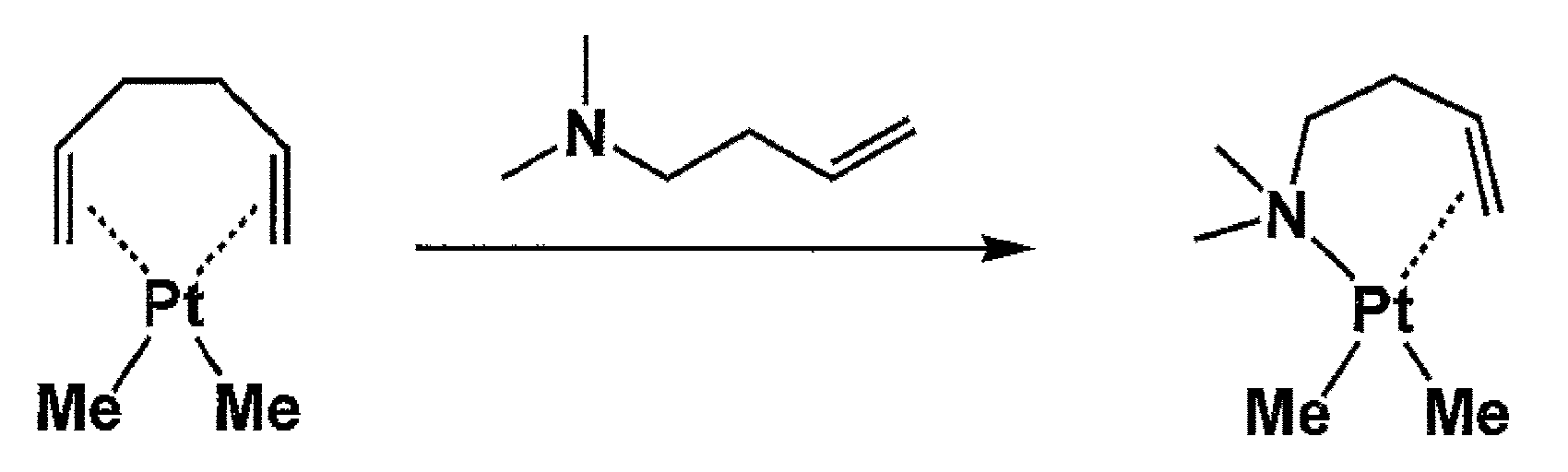
- Comparative Example As a comparative example for each of the above examples, dimethyl (N, N-dimethyl-3-buten-1-amine) platinum, which is an organic platinum compound described in the prior art (Patent Document 3), was produced.
- the organic platinum compound ((N, N-dimethyl-3-cyclopenten-1-amine) dimethyl platinum) produced in Example 1 was subjected to physical property evaluation by TG-DTA.
- the analysis was carried out by heating the sample temperature of the organic platinum compound sample (5 mg) at a temperature rising rate of 5 ° C./min in a temperature range of room temperature to 450 ° C. in a nitrogen atmosphere using TG-DTA2000SA manufactured by BRUKER. The weight change was observed. The results are shown in FIG.
- the organic platinum compound of Example 1 has a melting point of about 159 ° C. from the endothermic peak and a decomposition temperature of about 186 ° C. from the exothermic peak.
- the heating temperature of the raw material in the vapor deposition method is generally set to a temperature around 100 ° C. in many cases, but it can be seen that the organic platinum compound of Example 1 has sufficient thermal stability at the heating temperature of the raw material. In order to obtain higher vapor pressure, it is assumed that the heating temperature is raised by about 10 ° C. to 30 ° C., but it can be said that the organic platinum compound of Example 1 can cope with such heating conditions. .
- the melting point of the organic platinum compounds of Examples 2 and 3 was lower than that of the compound of Example 1, the decomposition temperatures were comparable or slightly lower. Therefore, it was shown that the organic platinum compounds of the respective examples all have suitable vaporization characteristics and thermal stability. It can be seen that the organic platinum compound of the comparative example has a lower melting point and decomposition temperature as compared with each example. Therefore, it was confirmed that the platinum compounds of the respective examples have high thermal stability as compared with the prior art.
- Thermal stability evaluation by heating test The above TG-DTA is an excellent analysis method in that the physical properties (decomposition temperature) specific to a compound are measured statically and accurately.
- the physical properties (decomposition temperature) specific to a compound are measured statically and accurately.
- the raw material heating operation at the time of actual thin film production even if it is heating below the decomposition temperature, local decomposition may occur in the organic compound by heating for a long time. Also, such local decomposition may be the starting point, and chained decomposition may occur. Therefore, we decided to perform dynamic thermal stability evaluation assuming raw material heating operation in thin film production. In this evaluation test, the organic platinum compounds of Example 1 and Comparative Example were heated for a certain period of time to determine the presence or absence of decomposition of the compounds.
- the organic platinum compound of Example 1 did not show any change in appearance before and after heating and maintained a white solid state.
- the organic platinum compound of the comparative example was changed to a black solid after heating for 1 hour. This is considered to indicate the decomposition (partial decomposition) of the organic platinum compound.
- the heating temperature (100 ° C.) in this heating test is a temperature below the decomposition temperature for both organic platinum compounds.
- Example 1 no decomposition of the compound was observed, but in the comparative example, decomposition occurred. This indicates that the organic platinum compound of the comparative example may be decomposed by heating for a long time even if the temperature is lower than the decomposition temperature, that is, the thermal stability is poor.
- an organic platinum compound raw material having a high vapor pressure is required.
- Film forming test Next, using the organic platinum compound ((N, N-dimethyl-3-cyclopentene-1-amine) dimethyl platinum) produced in Example 1 as a raw material compound, a film forming test of a platinum thin film by the CVD method Did.
- a hot wall type thermal CVD apparatus was used as the film forming apparatus.
- hydrogen was flowed at a constant flow rate by a mass flow controller.
- the film formation conditions are as follows.
- Substrate SiO 2 , Si Board dimensions: 15 mm x 15 mm Deposition temperature 175 ° C.
- a platinum thin film can be formed on any of the substrates (SiO 2 , Si).
- the film thickness and specific resistance were measured, a Pt film thickness of 18 nm was obtained for the SiO 2 substrate, and a Pt film thickness of 13 nm was obtained for the Si substrate. Been formed.
- the specific resistance of each thin film was measured, the values were as good as 36 ⁇ ⁇ cm and 40 ⁇ ⁇ cm, respectively.
- FIG. 2 is a SEM photograph of a cross section of a platinum thin film formed in the present embodiment.
- the thin films formed in the present embodiment were all uniform in film thickness, and the surface smoothness was also good. From the results of the film formation test, it is confirmed that the organic platinum compounds of the examples have suitable vaporization characteristics and thermal stability as raw material compounds for vapor deposition, and are useful for low temperature film formation.
- the raw material for vapor deposition according to the present invention has a high vapor pressure, can form a platinum thin film or the like at a low temperature and a high accuracy, also has appropriate thermal stability, and is excellent in handleability.
- the present invention is useful for forming various semiconductor elements and electrode / wiring materials for semiconductor devices. In particular, it is also effective for film formation to a three-dimensional structure, and formation of a three-dimensional electrode (three-dimensional Ni—Pt silicide) or the like having a three-dimensional structure of a field effect transistor can also be applied.
Landscapes
- Chemical & Material Sciences (AREA)
- Organic Chemistry (AREA)
- General Chemical & Material Sciences (AREA)
- Chemical Kinetics & Catalysis (AREA)
- Engineering & Computer Science (AREA)
- Materials Engineering (AREA)
- Mechanical Engineering (AREA)
- Metallurgy (AREA)
- Inorganic Chemistry (AREA)
- Chemical Vapour Deposition (AREA)
- Organic Low-Molecular-Weight Compounds And Preparation Thereof (AREA)
- Electrodes Of Semiconductors (AREA)
Abstract
本発明は、気相蒸着法により白金薄膜又は白金化合物薄膜を製造するための気相蒸着用原料に関する。この気相蒸着用原料は、次式で示される、2価の白金に、シクロペンテン-アミン配位子とアルキル配位子が配位した有機白金化合物からなるものである。本発明で適用する有機白金化合物は、適度な熱安定性を備え、成膜エリアの広範囲化やハイスループット化等といった厳しい成膜条件にも柔軟に対応できる。 (式中、R1、R2、R3は、それぞれ、水素原子、アルキル基、アルケニル基、アルキニル基、アミノ基、イミノ基、シアノ基、イソシアノ基のいずれか1種であり、且つ、いずれも炭素数4以下である。R4及びR5は、それぞれ、炭素数1以上3以下のアルキル基である。)
Description
本発明は、CVD(化学気相蒸着)法、ALD(原子層堆積)法等の気相蒸着法により白金薄膜又は白金化合物薄膜を製造するための、有機白金化合物からなる気相蒸着用原料に関する。詳しくは、低温での成膜を可能としつつも適度な熱安定性を有し、効率的な白金薄膜等を形成できる気相蒸着用原料に関する。
各種半導体素子、半導体デバイスの電極・配線材料として、従来から、白金薄膜又は白金化合物薄膜(以下、白金薄膜等と称する)が適用されている。そして、白金薄膜等の製造にあっては、CVD法、ALD法等の気相蒸着法が利用されている。
気相蒸着法により白金薄膜等を製造する原料としては、従来から多くの有機白金化合物からなるものが知られている。この有機白金化合物としては、例えば、下記の(シクロペンタジエニル)トリメチル白金(IV))錯体(特許文献1)、(1,5-ヘキサジエン)ジメチル白金(II)(特許文献2)等が提案されている。
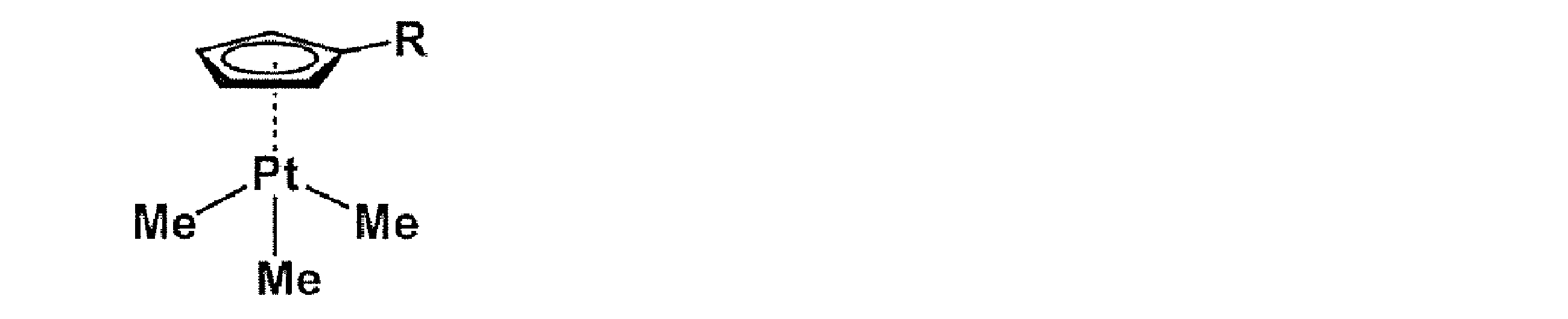
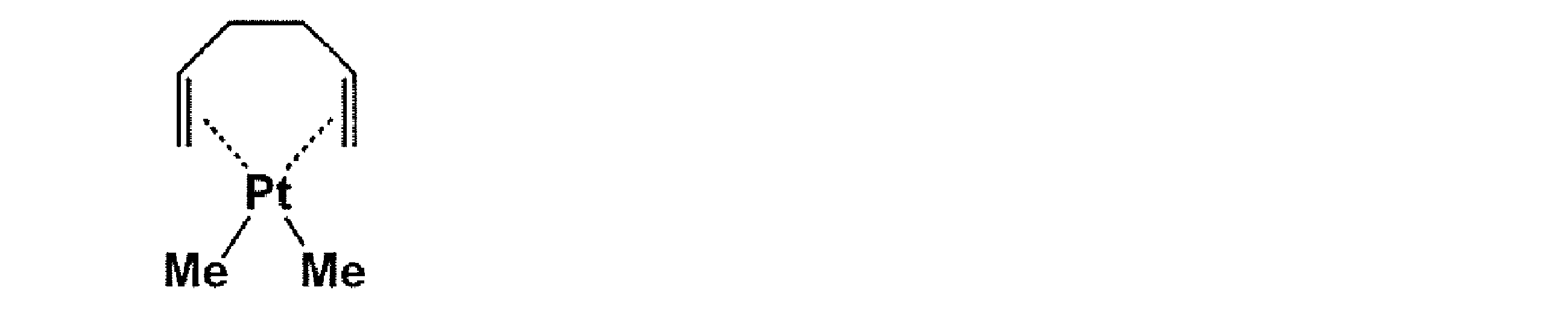
ここで気相蒸着用原料の要求性能としては、一般に、蒸気圧が高く気化特性が良好であることに加えて、低温で成膜可能でありながら適度な熱安定性を有することが挙げられる。上記した2種の有機白金化合物は、この要求性能をバランス良く具備するものではない。即ち、特許文献1の(シクロペンタジエニル)トリメチル白金(IV)は、良好な気化特性を有するものの、分解温度が高く熱安定性が高過ぎるため低温成膜に不向きの原料である。一方、特許文献2の(1,5-ヘキサジエン)ジメチル白金(II)は、分解温度の低減により低温成膜に対応可能であるが、保管時や成膜前の気化段階等において、稀に化合物が分解することがあった。
そこで、本願出願人は、上記の従来技術に対して、低温での成膜を可能としつつも好適な熱安定性を有し、気化段階等では熱分解し難い気相蒸着用の白金原料として、白金にアルケン-アミン配位子とアルキル配位子が配位する下記の有機白金化合物からなる原料を提案している(特許文献3)。
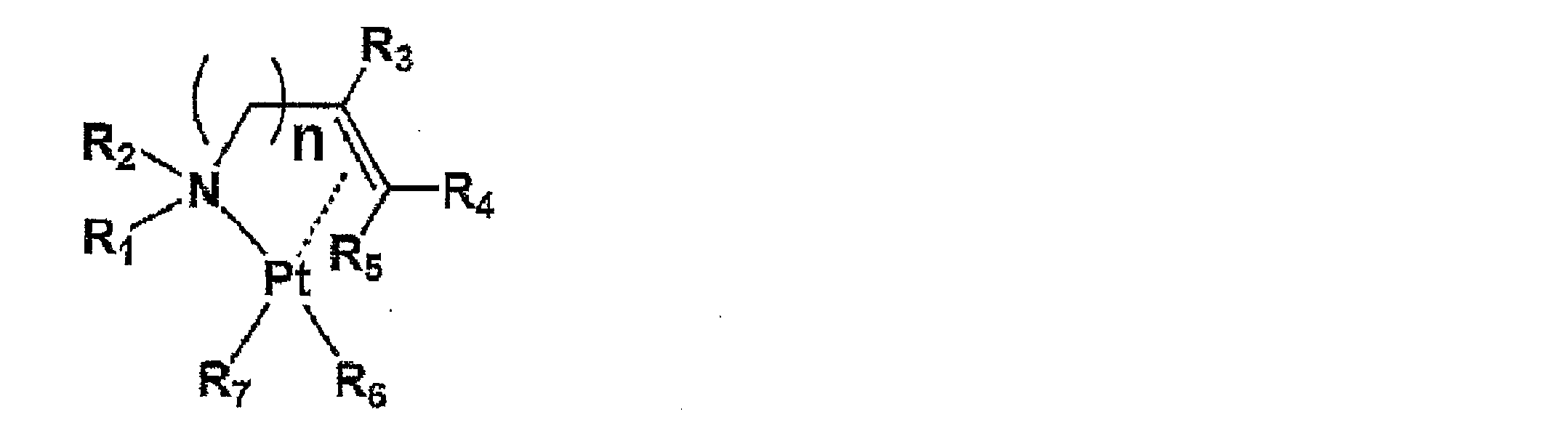
上記した本願出願人による有機白金化合物からなる原料は、低温成膜が可能でありながら熱安定性も改良されており、保管時や気化段階等での有機白金化合物の分解も抑制されている。よって、この有機白金化合物からなる原料は、これまでの白金薄膜等に対する要求特性や成膜環境・成膜条件に対して有効に対応することが可能であった。
しかしながら、半導体デバイス等の製造効率向上のため、成膜条件・成膜環境がよりシビアになりつつある近年においては、上記した有機白金化合物からなる原料でも対応が困難となっている。具体的には、薄膜製造装置における成膜エリアの広範囲化やハイスループット化が要求されており、そのような条件のもとでは、上記従来の原料には、有機白金化合物の不意な分解や、膜厚不足等による成膜不良が発生するおそれがある。
本発明は、以上のような背景のもとになされたものであり、気相蒸着用原料の要求特性、即ち、気化特性と熱安定性とのバランスに関して、従来以上に良好な特性を発揮し、低温成膜に対応し得る有機白金化合物を見出すことを目的とする。そして、本発明は、かかる有機白金化合物を適用する最適な気相蒸着用原料を提供する。
上記課題に関して、成膜エリアの広範囲化やハイスループット化等によって、有機白金化合物の分解や成膜不良が発生するとすれば、それらの成膜条件に対しては、適用される有機白金化合物の熱安定性に不足があることが考えられる。そこで、本発明者等は、従来の有機白金化合物の構成を考慮しつつ、熱安定性を適切に改善し、低温成膜性及び気化特性とのバランスを良好な有機白金化合物を見出すべく鋭意検討を行った。そして好適な有機白金化合物として、2価の白金に、シクロペンテン-アミン配位子と2つのアルキル配位子が配位する化合物を見出し、本発明に想到した。
即ち、本発明は、気相蒸着法により白金薄膜又は白金化合物薄膜を製造するための気相蒸着用原料において、次式で示される、2価の白金に、シクロペンテン-アミン配位子とアルキル配位子が配位した有機白金化合物からなる気相蒸着用原料である。
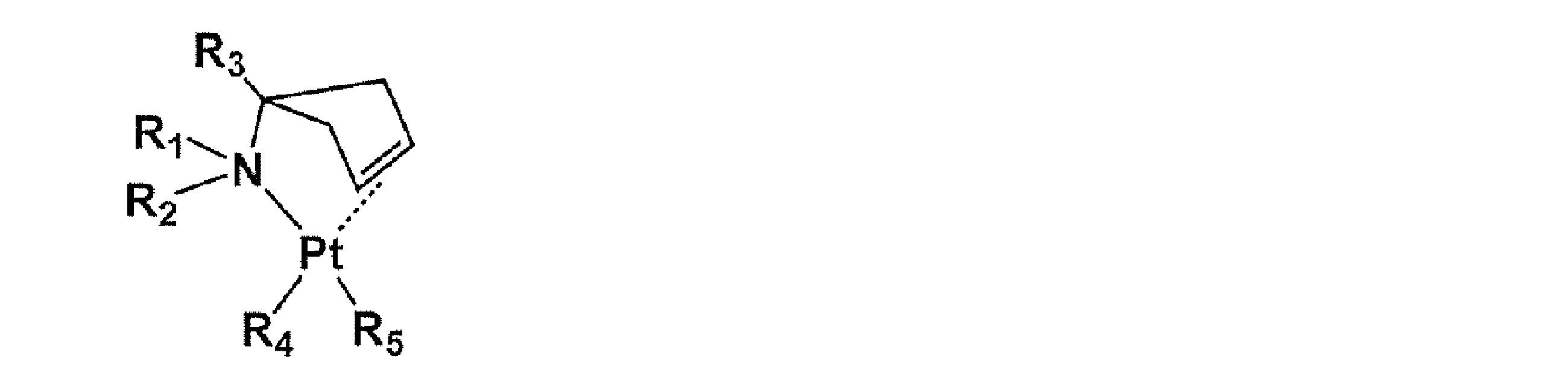
以下、本発明に係る気相蒸着用原料を構成する有機白金化合物について詳細に説明する。上記のとおり、本発明で適用する有機白金化合物は、白金に対する配位子としてシクロペンテン-アミン配位子とアルキル配位子を適用するものである。この有機白金化合物は、上述した従来の有機白金化合物(特許文献3)のアルケン-アミン配位子における鎖状アルケン配位子を、環状アルケン配位子(シクロペンテン配位子)とすることで熱安定性の最適化を図るものである。
本発明で適用されるシクロペンテン-アミン配位子は、特許文献3記載の有機白金化合物で適用されたアルケン-アミン配位子と同じく、1つのアミンと1つの二重結合を有する配位子である。即ち、本発明も、配位子中の2重結合(C=C結合)の数を適正にすることを前提とし、これにより熱安定性と気化特性等とのバランスを好適化している。配位子中の二重結合が減ることで、化合物の熱安定性は向上するが、本発明では特許文献3と同じく、アミンを1つ結合させて二重結合の数が1つの配位子を適用することとした。これは、二重結合のない配位子、例えば、ジアミン配位子を適用すると、化合物の熱安定性が過度に高くなると共に、気化特性が悪化する傾向があることを考慮したからである。
そして、本発明は、配位子の構成として、環状のアルケン配位子であるシクロペンテンとアミンとからなる配位子(シクロペンテン-アミン配位子)を適用している。本発明者等によれば、鎖状アルケン配位子を環状アルケン配位子とすることで、白金化合物全体の熱安定性を適度に向上させることができる。そして、この場合において低温成膜性や気化特性の悪化は生じない。その結果、本発明に係る有機白金化合物は、低温成膜性と気化特性と熱安定性においてトータルで最適な特性を発揮し得る。これにより、広範囲で白金膜等を成膜する場合等において、有機白金化合物の不測の分解を生じさせることなく安定的な薄膜製造が可能となる。
更に、本発明の有機白金化合物では、シクロペンテン-アミン配位子と共にアルキル配位子(R4、R5)が白金に配位している。アルキル配位子は構成が簡易な炭化水素基であり、白金化合物の分子量の調整のために有益な配位子である。そして、アルキル配位子は、白金化合物が分解した後、低沸点の炭化水素として放出されるので残留不純物になりにくい。以上のようなメリットから、アルキル配位子は、シクロペンテン-アミン配位子と共に必須の配位子となっている。
ここで、本発明で適用される有機白金化合物においては、シクロペンテン-アミン配位子及びその誘導体として、所定範囲の置換基(R1、R2、R3)を有することができる。
シクロペンテン-アミン配位子の窒素部分への置換基R1及びR2は、それぞれ、水素原子、アルキル基、アルケニル基、アルキニル基、アミノ基、イミノ基、シアノ基、イソシアノ基のいずれか1種であり、且つ、いずれも炭素数4以下のものである。置換基R1及びR2は、それぞれ、水素原子、メチル基、エチル基、プロピル基のいずれか1種が好ましく、水素、メチル基又はエチル基が特に好ましい。炭素数3以上のアルキル基を適用する場合、構造異性体である直鎖(n-)、分岐鎖(iso-、sec-、tert-)のいずれとしてもよいが、好ましくは直鎖のアルキル基である。
シクロペンテン-アミン配位子のシクロペンテンへの置換基R3についても、水素原子、アルキル基、アルケニル基、アルキニル基、アミノ基、イミノ基、シアノ基、又はイソシアノ基のいずれかであり、且つ、炭素数4以下のものとなる。置換基R3は、水素原子、メチル基又はエチル基が好ましく、水素原子が特に好ましい。炭素数3以上のアルキル基を適用する場合、構造異性体である直鎖(n-)、分岐鎖(iso-、sec-、tert-)のいずれとしてもよいが、好ましくは直鎖のアルキル基である。
また、もう一方の配位子であるアルキル配位子R4及びR5は、それぞれ、炭素数1以上3以下のアルキル基、すなわち、メチル基、エチル基、プロピル基(n-、iso-)のいずれか1種である。R4とR5とは、同じアルキル基であっても良いが、異なるアルキル基でも良い。アルキル基の炭素数増大により白金化合物全体の安定性が減少する傾向にあるため、これらのアルキル配位子の炭素数は3以下とする。R4、R5として好ましいのは双方をメチル基とする場合である。メチル基は、錯体分解後に低沸点のメタンになるため、形成される金属薄膜中に不純物を残さずに放出できるからである。
尚、以上で説明したシクロペンテン-アミン配位子と2つのアルキル配位子が配位する中心金属である白金は、2価の白金である。有機白金化合物(白金錯体)の多くは2価又は4価の正電荷を持つ白金を中心金属とするものが安定である。本発明者等によれば、合成・精製・保存の各段階における化合物の取り扱性を考慮したとき、適度な安定性を発揮し得るのは2価白金の化合物である。
以上説明した本発明に係る気相蒸着用原料について、これを構成する有機白金化合物の構成の具体例を以下に例示列挙する。但し、本発明は、これらに限定されるものではない。

以上説明した本発明の気相蒸着用原料は、適宜の白金塩(白金化合物)を出発原料とし、それにシクロペンテン-アミン化合物を反応させることで製造可能である。白金塩としては、2価白金の有機白金化合物であって、目的となるアルキル配位子(R4、R5)が配位したもの好ましく、例えば、(1,5-ヘキサジエン)ジメチル白金(上記化2、特許文献2)等の有機白金化合物が適用できる。
そして、本発明に係る気相蒸着用原料は、CVD法、ALD法等の気相蒸着法による白金薄膜等の製造に有用である。この薄膜形成方法は、有機白金化合物からなる原料を気化して反応ガスとし、前記反応ガスを基板表面に導入し、前記有機白金化合物を分解して白金を析出させるものであり、原料として、上記した本発明に係る有機白金化合物を用いるものである。
白金形成時の反応雰囲気としては、還元性雰囲気が好ましい。本発明の原料は、特に還元性雰囲気において、良好な低温成膜性を示す傾向がある。また、還元性雰囲気とすると、白金薄膜と共に他の金属薄膜を形成する場合、当該他の金属薄膜の酸化を抑制できるというメリットもある。例えば、白金薄膜はFET(電界効果トランジスタ)の立体電極(Ni-Ptシリサイド電極)への適用が知られている。白金薄膜の成膜条件を還元性雰囲気とすることで、Ni薄膜の酸化を抑制できる。尚、還元性雰囲気としては、水素又はアンモニアを反応ガスとして導入するのが好ましく、水素が特に好ましい。
白金薄膜等の成膜温度、即ち、基板上における有機白金化合物の加熱温度は、100℃以上350℃以下とするのが好ましい。100℃未満では、成膜反応が進行し難く必要な膜厚が得られ難いためである。また、350℃を超えると、基板への影響が懸念されるからである。また、低温成膜という本発明の趣旨を考慮すると、350℃を超える成膜温度は好適ではない。
以上説明したように、本発明に係る気相蒸着用原料を構成する有機白金化合物は、蒸気圧が高く、低温で白金薄膜の製造が可能であるとともに、適度な熱安定性も兼ね備えている。尚、本発明に係る原料は、CVD法やALD法等の気相蒸着法に好適である。
以下、本発明における最良の実施形態について説明する。本実施形態では、3種類の有機白金化合物(実施例1~実施例3)を合成した。合成した有機白金化合物について物性を評価し、気相蒸着用原料として成膜試験を行った。
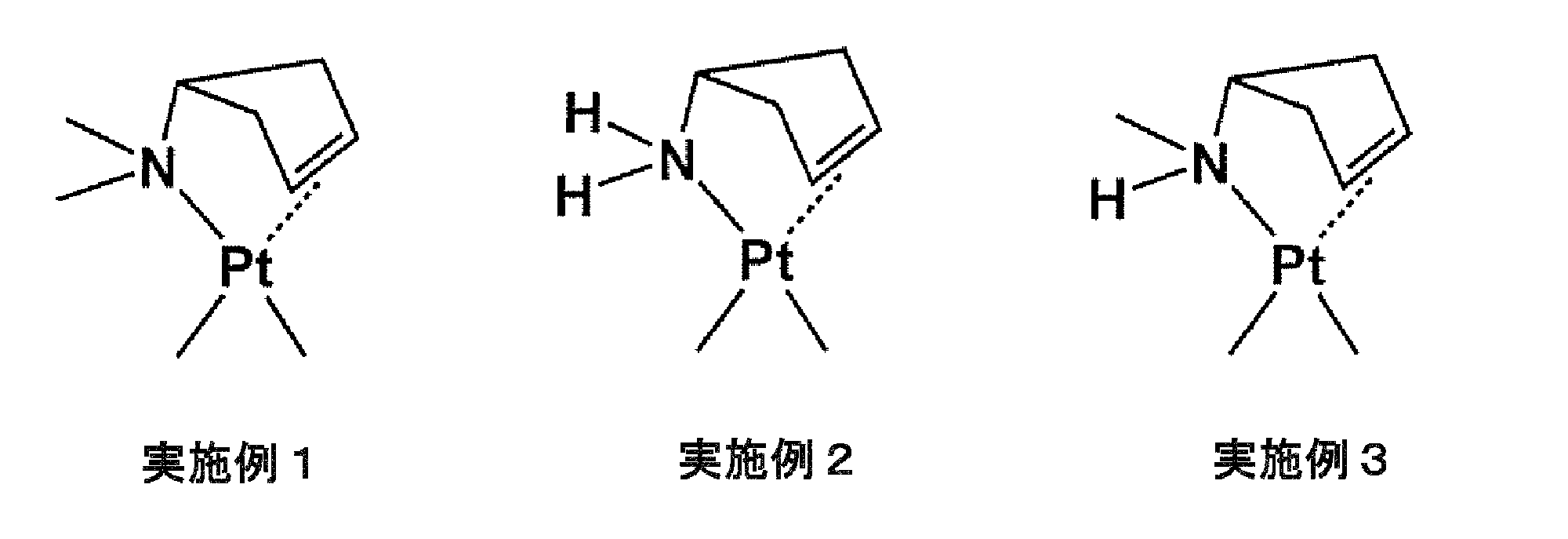
実施例1:ヘキサン90mlを入れたフラスコに、N,N-ジメチル-3-シクロペンテン-1-アミン1.62g(14.6mmol)、(1,5-ヘキサジエン)ジメチル白金1.78g(5.8mmol)の順でそれぞれ加えた後、室温で16時間攪拌した。反応終了後、濃縮して白色固体を得た。得られた白色固体について昇華精製を行うことで目的物である、(N,N-ジメチル-3-シクロペンテン-1-アミン)ジメチル白金1.68g(5.0mmol)を得た(収率86%)。この実施例1の有機白金化合物の合成反応式は、次のとおりである。
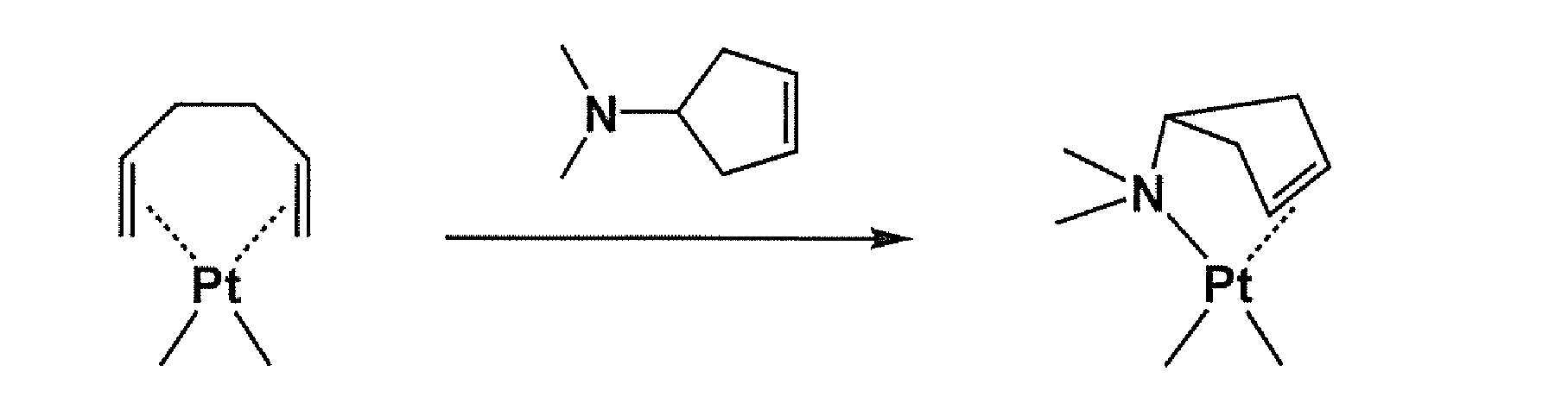
実施例2:ヘキサン50mlを入れたフラスコに、3-シクロペンテン-1-アミン0.27g(3.3mmol)、(1,5-ヘキサジエン)ジメチル白金0.68g(2.2mmol)の順でそれぞれ加えた後、室温で3時間攪拌した。反応終了後、濃縮して白色固体を得た。得られた白色固体について昇華精製を行うことで目的物である(3-シクロペンテン-1-アミン)ジメチル白金0.61g(2.0mmol)を得た(収率91%)。この実施例2の有機白金化合物の合成反応式は、次のとおりである。
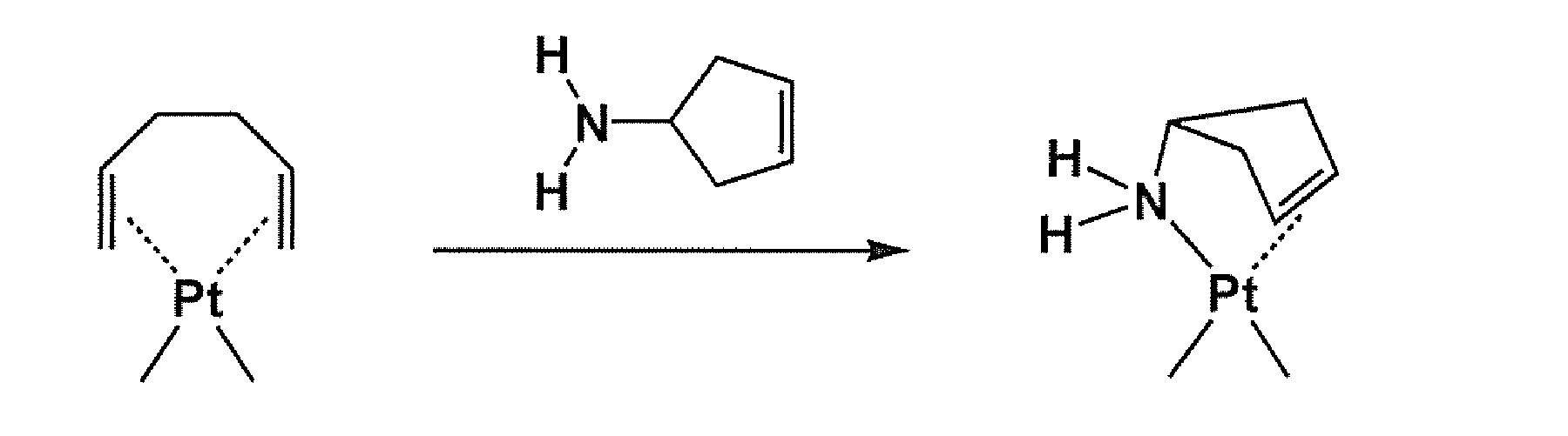
実施例3:ヘキサン30mlを入れたフラスコに、N-メチル-3-シクロペンテン-1-アミン0.21g(2.2mmol)、(1,5-ヘキサジエン)ジメチル白金0.45g(1.5mmol)の順でそれぞれ加えた後、室温で15時間攪拌した。反応終了後、濃縮して白色固体を得た。得られた白色固体について昇華精製を行うことで目的物であるジメチル(N-メチル-3-シクロペンテン-1-アミン)白金0.43g(1.3mmol)を得た(収率87%)。この実施例3の有機白金化合物の合成反応式は、次のとおりである。

比較例:上記各実施例に対する比較例として、従来技術(特許文献3)記載の有機白金化合物であるジメチル(N,N-ジメチル-3-ブテン-1-アミン)白金を製造した。
ヘキサン50mlを入れたフラスコに、N,N-ジメチル-3-ブテン-1-アミン0.75g(7.5mmol)、(1,4-ヘキサジエン)ジメチル白金1.54g(5.0mmol)の順でそれぞれ加えた後、室温で20時間攪拌させた。反応終了後、濃縮して白色固体を得た。得られた白色固体について昇華精製を行うことで目的物であるジメチル(N,N-ジメチル-3-ブテン-1-アミン)白金1.55g(4.8mmol)を得た(収率96%)。この比較例の有機白金化合物の合成反応式は、次のとおりである。
物性評価:実施例1で製造した有機白金化合物((N,N-ジメチル-3-シクロペンテン-1-アミン)ジメチル白金)について、TG-DTAによる物性評価を行った。分析は、BRUKER社製TG‐DTA2000SAにて、窒素雰囲気下、有機白金化合物試料(5mg)を昇温速度5℃/minにて、測定温度範囲の室温~450℃加熱した際の試料の熱量及び重量変化を観察した。結果を図1に示す。
図1について、DTAの結果より、実施例1の有機白金化合物は、吸熱ピークより融点が約159℃、発熱ピークより分解温度が約186℃である。気相蒸着法における原料加熱温度は、一般に100℃付近の温度が設定されることが多いが、実施例1の有機白金化合物は、かかる原料加熱温度において十分な熱安定性を有することが分かる。また、より高い蒸気圧を得るためには、加熱温度を10℃~30℃程度上昇させることが想定されるが、実施例1の有機白金化合物は、そのような加熱条件にも対応できるといえる。
また、TGの結果を検討すると、実施例1の有機白金化合物は、分解温度に達した時点で気化がほぼ完了していることがわかる。この白金化合物は、比較的低温で速やかに気化しており気化特性も良好であることが分かる。また、化合物分解により生じる残渣量も比較的多い。この残渣は金属白金と推定される。このTG-DTAの結果は、実施例1の白金化合物は、比較的低温で気化可能であり、気化と共に分解も速やかに生じることを示し、低温成膜に好適であることも示している。
そして、実施例2、実施例3、比較例の有機白金化合物についても同様の分析を行った。各実施例のTG-DTAの結果を表1に示す。
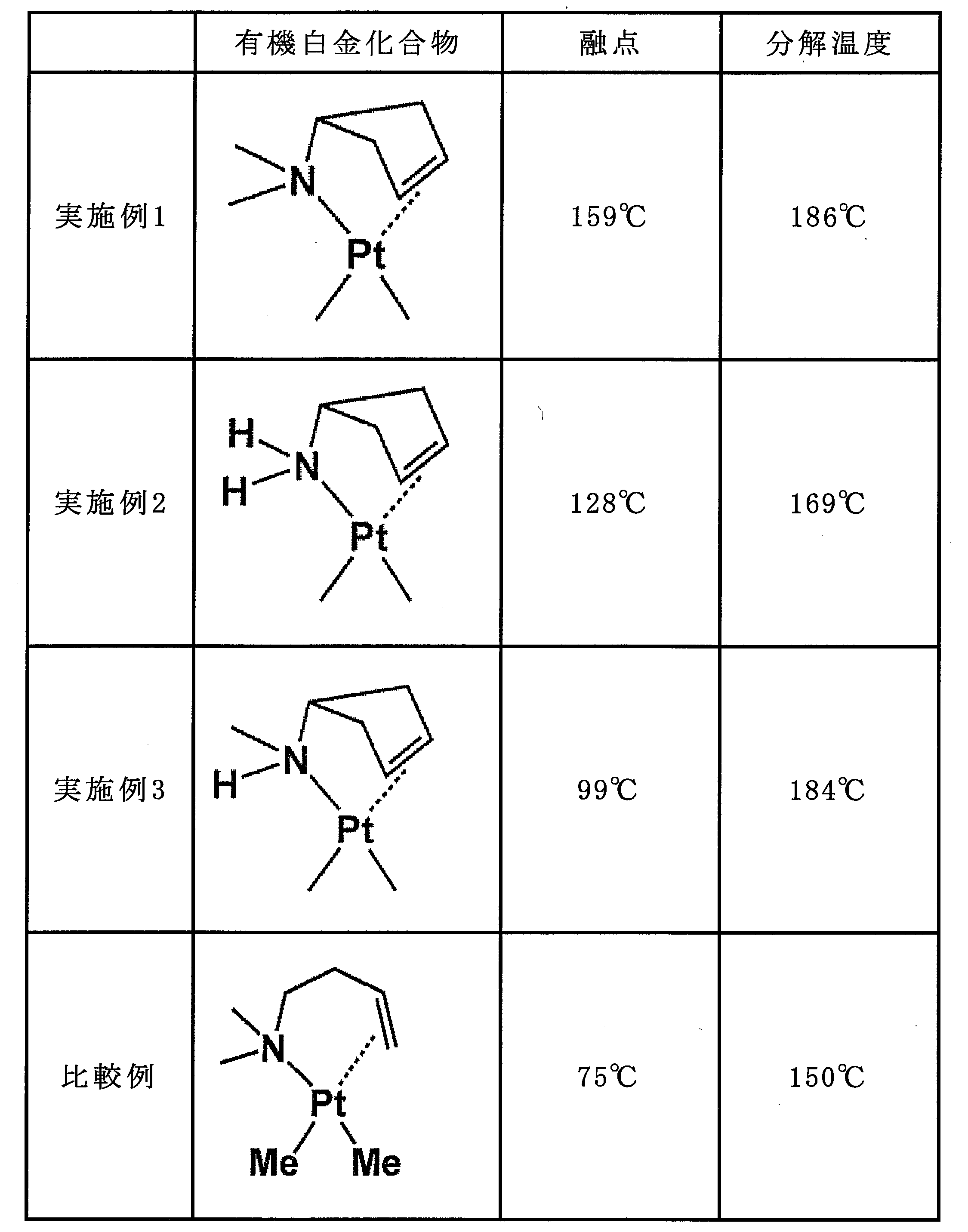
実施例2、3の有機白金化合物については、実施例1の化合物よりも融点の低下は見られたものの、分解温度は同等あるいは若干低い程度であった。よって、各実施例の有機白金化合物は、いずれも好適な気化特性と熱安定性を有することが示された。比較例の有機白金化合物は、融点及び分解温度が各実施例と比較して低いことがわかる。よって、各実施例の白金化合物は、従来技術に対して熱安定性が高いことが確認された。
加熱試験による熱安定性評価:
上記のTG-DTAは、化合物固有の物性(分解温度)を静的に且つ正確に測定する点で優れた分析法である。もっとも、実際の薄膜製造の際の原料加熱操作においては、分解温度未満の加熱であっても長時間加熱により有機化合物に局所的な分解が生じることがある。また、そのような局所的な分解が起点となり、連鎖的な分解が生じることがある。そこで、薄膜製造における原料加熱操作を想定した動的な熱安定性評価を行うこととした。この評価試験は、実施例1と比較例の有機白金化合物を一定時間加熱して化合物分解の有無を判定した。具体的方法としては、実施例1と比較例の有機白金化合物をそれぞれ0.2g採取して試験管に入れ、大気中、100℃で1時間加熱した。そして、この1時間の加熱後、白金化合物の外観変化の有無を確認した。
上記のTG-DTAは、化合物固有の物性(分解温度)を静的に且つ正確に測定する点で優れた分析法である。もっとも、実際の薄膜製造の際の原料加熱操作においては、分解温度未満の加熱であっても長時間加熱により有機化合物に局所的な分解が生じることがある。また、そのような局所的な分解が起点となり、連鎖的な分解が生じることがある。そこで、薄膜製造における原料加熱操作を想定した動的な熱安定性評価を行うこととした。この評価試験は、実施例1と比較例の有機白金化合物を一定時間加熱して化合物分解の有無を判定した。具体的方法としては、実施例1と比較例の有機白金化合物をそれぞれ0.2g採取して試験管に入れ、大気中、100℃で1時間加熱した。そして、この1時間の加熱後、白金化合物の外観変化の有無を確認した。
この加熱試験において、実施例1の有機白金化合物には、加熱前後で外観上の変化は見られず白色の固体状態を維持していた。一方、比較例の有機白金化合物には、1時間の加熱後で黒色の固体に変化していた。これは、有機白金化合物の分解(一部分解)を示すものと考えられる。今回の加熱試験における加熱温度(100℃)は、双方の有機白金化合物にとって分解温度未満の温度である。実施例1では、化合物の分解は全く見られなかったが、比較例では分解が生じていた。これは、比較例の有機白金化合物は、分解温度未満の温度であっても、長時間の加熱によって分解する可能性があること、即ち、熱安定性に乏しいことを示している。
本発明の課題である広範囲成膜や高スループット成膜等の成膜条件に対応するためには、蒸気圧の高い有機白金化合物原料が要求される。これは、所望の蒸気圧を示す温度まで加熱可能な、熱安定性の高い有機白金化合物の適用を意味する。上記加熱試験の結果から、実施例の有機白金化合物は、比較例と対比して熱安定性が高いことが確認された。つまり、実施例の有機白金化合物は、比較例よりも熱安定性と気化特性とのバランスが良好であるといえる。そして、実施例の有機白金化合物は、広範囲成膜や高スループット成膜にも好適に対応できる。
成膜試験:次に、実施例1で製造した有機白金化合物((N,N-ジメチル-3-シクロペンテン-1-アミン)ジメチル白金)を原料化合物とし、CVD法にて白金薄膜の成膜試験を行った。この成膜試験では、成膜装置としては、ホットウォールタイプの熱CVD装置を用いた。反応ガスとして水素をマスフローコントローラーにより一定流量で流した。成膜条件は、次の通りである。
基板:SiO2、Si
基板寸法:15mm×15mm
成膜温度175℃
試料温度:100℃
成膜圧力:5torr
反応ガス(水素)流量:100sccm
成膜時間:120min
基板寸法:15mm×15mm
成膜温度175℃
試料温度:100℃
成膜圧力:5torr
反応ガス(水素)流量:100sccm
成膜時間:120min
この成膜試験の結果、いずれの基板(SiO2、Si)に対しても白金薄膜を成膜できることが確認された。膜厚及び比抵抗を測定したところ、SiO2基板に対しては、Pt膜厚18nmであり、Si基板に対しては、Pt膜厚13nmであり、いずれも十分な膜厚での白金薄膜が形成された。また、各薄膜の比抵抗を測定したところ、それぞれ、36μΩ・cm、40μΩ・cmと良好な値であった。
図2は、本実施形態で形成した白金薄膜断面のSEM写真である。本実施形態で形成した薄膜は、いずれも均一な膜厚であり、表面の平滑性も良好であった。この成膜試験の結果から、実施例の有機白金化合物は、気相蒸着用の原料化合物として、好適な気化特性と熱安定性を有し、低温成膜に有用であることが確認された。
本発明に係る気相蒸着用原料は、蒸気圧が高く、低温で高精度の白金薄膜等を形成できるとともに、適度な熱安定性も有し、取扱い性に優れる。本発明は、各種半導体素子、半導体デバイスの電極・配線材料の形成に有用である。特に、立体構造への成膜にも有効であり、電界効果トランジスタの3次元構造を有する立体電極(立体型Ni-Ptシリサイド電)等の形成も適用できる。
Claims (5)
- 気相蒸着法により白金薄膜又は白金化合物薄膜を製造するための気相蒸着用原料において、
次式で示される、2価の白金に、シクロペンテン-アミン配位子とアルキル配位子が配位した有機白金化合物からなる気相蒸着用原料。

- R1、R2は、それぞれ、水素、メチル基又はエチル基のいずれかである請求項1に記載の気相蒸着用原料。
- R3は、水素である請求項1又は請求項2に記載の気相蒸着用原料。
- R4及びR5は、いずれもメチル基である請求項1~請求項3のいずれかに記載の気相蒸着用原料。
- 有機白金化合物からなる原料を気化して原料ガスとし、前記原料ガスを基板表面に導入しつつ加熱する白金薄膜又は白金化合物薄膜の気相蒸着法において、
前記原料として請求項1~請求項4のいずれかに記載された気相蒸着用原料を用いる気相蒸着法。
Priority Applications (2)
| Application Number | Priority Date | Filing Date | Title |
|---|---|---|---|
| US16/628,195 US11149045B2 (en) | 2017-07-25 | 2018-07-12 | Raw material for vapor deposition including organoplatinum compound and vapor deposition method using the raw material for vapor deposition |
| KR1020197038515A KR102351888B1 (ko) | 2017-07-25 | 2018-07-12 | 유기 백금 화합물을 포함하는 기상 증착용 원료 및 해당 기상 증착용 원료를 사용한 기상 증착법 |
Applications Claiming Priority (2)
| Application Number | Priority Date | Filing Date | Title |
|---|---|---|---|
| JP2017-143327 | 2017-07-25 | ||
| JP2017143327A JP6407370B1 (ja) | 2017-07-25 | 2017-07-25 | 有機白金化合物からなる気相蒸着用原料及び該気相蒸着用原料を用いた気相蒸着法 |
Publications (1)
| Publication Number | Publication Date |
|---|---|
| WO2019021836A1 true WO2019021836A1 (ja) | 2019-01-31 |
Family
ID=63855265
Family Applications (1)
| Application Number | Title | Priority Date | Filing Date |
|---|---|---|---|
| PCT/JP2018/026261 Ceased WO2019021836A1 (ja) | 2017-07-25 | 2018-07-12 | 有機白金化合物からなる気相蒸着用原料及び該気相蒸着用原料を用いた気相蒸着法 |
Country Status (5)
| Country | Link |
|---|---|
| US (1) | US11149045B2 (ja) |
| JP (1) | JP6407370B1 (ja) |
| KR (1) | KR102351888B1 (ja) |
| TW (1) | TWI676630B (ja) |
| WO (1) | WO2019021836A1 (ja) |
Citations (6)
| Publication number | Priority date | Publication date | Assignee | Title |
|---|---|---|---|---|
| JPH11292889A (ja) * | 1998-04-03 | 1999-10-26 | Kojundo Chem Lab Co Ltd | トリメチル(エチルシクロペンタジエニル)白金とそ の製造方法及びそれを用いた白金含有薄膜の製造方法 |
| JP2001504159A (ja) * | 1996-06-28 | 2001-03-27 | アドバンスド テクノロジー マテリアルズ,インク. | 白金の化学蒸着のための白金ソース組成物 |
| WO2010052672A2 (en) * | 2008-11-07 | 2010-05-14 | L'air Liquide-Societe Anonyme Pour L'etude Et L'exploitation Des Procedes Georges Claude | Allyl-containing precursors for the deposition of metal-containing films |
| WO2012144455A1 (ja) * | 2011-04-20 | 2012-10-26 | 田中貴金属工業株式会社 | 化学蒸着用の有機白金化合物及び該有機白金化合物を用いた化学蒸着方法 |
| WO2013054863A1 (ja) * | 2011-10-14 | 2013-04-18 | 田中貴金属工業株式会社 | 有機白金化合物からなる化学蒸着用原料及び該化学蒸着用原料を用いた化学蒸着法 |
| JP2016211048A (ja) * | 2015-05-12 | 2016-12-15 | 田中貴金属工業株式会社 | 有機白金化合物からなる化学蒸着用原料及び該化学蒸着用原料を用いた化学蒸着法 |
Family Cites Families (1)
| Publication number | Priority date | Publication date | Assignee | Title |
|---|---|---|---|---|
| TW201024312A (en) * | 2008-11-07 | 2010-07-01 | Air Liquide | Allyl-containing precursors for the depostion of metal-containing films |
-
2017
- 2017-07-25 JP JP2017143327A patent/JP6407370B1/ja active Active
-
2018
- 2018-06-27 TW TW107121996A patent/TWI676630B/zh active
- 2018-07-12 WO PCT/JP2018/026261 patent/WO2019021836A1/ja not_active Ceased
- 2018-07-12 US US16/628,195 patent/US11149045B2/en active Active
- 2018-07-12 KR KR1020197038515A patent/KR102351888B1/ko active Active
Patent Citations (6)
| Publication number | Priority date | Publication date | Assignee | Title |
|---|---|---|---|---|
| JP2001504159A (ja) * | 1996-06-28 | 2001-03-27 | アドバンスド テクノロジー マテリアルズ,インク. | 白金の化学蒸着のための白金ソース組成物 |
| JPH11292889A (ja) * | 1998-04-03 | 1999-10-26 | Kojundo Chem Lab Co Ltd | トリメチル(エチルシクロペンタジエニル)白金とそ の製造方法及びそれを用いた白金含有薄膜の製造方法 |
| WO2010052672A2 (en) * | 2008-11-07 | 2010-05-14 | L'air Liquide-Societe Anonyme Pour L'etude Et L'exploitation Des Procedes Georges Claude | Allyl-containing precursors for the deposition of metal-containing films |
| WO2012144455A1 (ja) * | 2011-04-20 | 2012-10-26 | 田中貴金属工業株式会社 | 化学蒸着用の有機白金化合物及び該有機白金化合物を用いた化学蒸着方法 |
| WO2013054863A1 (ja) * | 2011-10-14 | 2013-04-18 | 田中貴金属工業株式会社 | 有機白金化合物からなる化学蒸着用原料及び該化学蒸着用原料を用いた化学蒸着法 |
| JP2016211048A (ja) * | 2015-05-12 | 2016-12-15 | 田中貴金属工業株式会社 | 有機白金化合物からなる化学蒸着用原料及び該化学蒸着用原料を用いた化学蒸着法 |
Also Published As
| Publication number | Publication date |
|---|---|
| US11149045B2 (en) | 2021-10-19 |
| US20200148713A1 (en) | 2020-05-14 |
| KR102351888B1 (ko) | 2022-01-18 |
| TWI676630B (zh) | 2019-11-11 |
| KR20200013712A (ko) | 2020-02-07 |
| JP2019023336A (ja) | 2019-02-14 |
| JP6407370B1 (ja) | 2018-10-17 |
| TW201920223A (zh) | 2019-06-01 |
Similar Documents
| Publication | Publication Date | Title |
|---|---|---|
| US20070160761A1 (en) | Tungsten and molybdenum compounds and thier use for chemical vapour deposition (CVD) | |
| WO2017043620A1 (ja) | 有機ルテニウム化合物からなる化学蒸着用原料及び該化学蒸着用原料を用いた化学蒸着法 | |
| TW202334479A (zh) | 鉬前驅物化合物、其製備方法以及使用其形成含鉬薄膜之方法 | |
| CN107923038B (zh) | 由双核钌配合物构成的化学蒸镀用原料及使用该化学蒸镀用原料的化学蒸镀法 | |
| JP5960321B1 (ja) | 有機白金化合物からなる化学蒸着用原料及び該化学蒸着用原料を用いた化学蒸着法 | |
| WO2016052288A1 (ja) | 有機ルテニウム化合物からなる化学蒸着用原料及び該化学蒸着用原料を用いた化学蒸着法 | |
| WO2019021836A1 (ja) | 有機白金化合物からなる気相蒸着用原料及び該気相蒸着用原料を用いた気相蒸着法 | |
| JP5952460B1 (ja) | 有機白金化合物からなる化学蒸着用原料及び該化学蒸着用原料を用いた化学蒸着法 | |
| CN110431253A (zh) | 由铱配合物构成的化学气相沉积用原料及使用该化学气相沉积用原料的化学气相沉积法 | |
| WO2019078195A1 (ja) | シクロペンタジエニルニッケル錯体化合物 | |
| KR101306812B1 (ko) | 신규의 텅스텐 실릴아미드 화합물, 이의 제조방법 및 이를 이용하여 박막을 형성하는 방법 |
Legal Events
| Date | Code | Title | Description |
|---|---|---|---|
| 121 | Ep: the epo has been informed by wipo that ep was designated in this application |
Ref document number: 18838964 Country of ref document: EP Kind code of ref document: A1 |
|
| ENP | Entry into the national phase |
Ref document number: 20197038515 Country of ref document: KR Kind code of ref document: A |
|
| NENP | Non-entry into the national phase |
Ref country code: DE |
|
| 122 | Ep: pct application non-entry in european phase |
Ref document number: 18838964 Country of ref document: EP Kind code of ref document: A1 |