WO2019013133A1 - 被験物質の絶対定量法 - Google Patents
被験物質の絶対定量法 Download PDFInfo
- Publication number
- WO2019013133A1 WO2019013133A1 PCT/JP2018/025730 JP2018025730W WO2019013133A1 WO 2019013133 A1 WO2019013133 A1 WO 2019013133A1 JP 2018025730 W JP2018025730 W JP 2018025730W WO 2019013133 A1 WO2019013133 A1 WO 2019013133A1
- Authority
- WO
- WIPO (PCT)
- Prior art keywords
- biorelevant
- substance
- molecule
- chemical composition
- molecules
- Prior art date
- Legal status (The legal status is an assumption and is not a legal conclusion. Google has not performed a legal analysis and makes no representation as to the accuracy of the status listed.)
- Ceased
Links
Images


Classifications
-
- C—CHEMISTRY; METALLURGY
- C12—BIOCHEMISTRY; BEER; SPIRITS; WINE; VINEGAR; MICROBIOLOGY; ENZYMOLOGY; MUTATION OR GENETIC ENGINEERING
- C12Q—MEASURING OR TESTING PROCESSES INVOLVING ENZYMES, NUCLEIC ACIDS OR MICROORGANISMS; COMPOSITIONS OR TEST PAPERS THEREFOR; PROCESSES OF PREPARING SUCH COMPOSITIONS; CONDITION-RESPONSIVE CONTROL IN MICROBIOLOGICAL OR ENZYMOLOGICAL PROCESSES
- C12Q1/00—Measuring or testing processes involving enzymes, nucleic acids or microorganisms; Compositions therefor; Processes of preparing such compositions
- C12Q1/68—Measuring or testing processes involving enzymes, nucleic acids or microorganisms; Compositions therefor; Processes of preparing such compositions involving nucleic acids
- C12Q1/6844—Nucleic acid amplification reactions
- C12Q1/686—Polymerase chain reaction [PCR]
Definitions
- the present invention relates to a technique for measuring a biorelated molecule, and more specifically, a biorelated molecule such as a nucleic acid or a protein contained in a sample solution prepared by extraction processing from a bioderived material such as a biocell or tissue,
- a biorelated molecule such as a nucleic acid or a protein contained in a sample solution prepared by extraction processing from a bioderived material such as a biocell or tissue
- the present invention relates to a technology for absolute quantification by techniques such as digital PCR, digital ELISA, and counting.
- digital PCR is performed by amplifying a gene sequence to be detected and using reagents such as a primer pair for detection and a reagent such as TaqMan probe, and a sample solution containing a gene to be detected (for example, minute wells or chips separated on a chip) It is a method of partitioning into separated reaction fields such as aqueous droplets in oil, advancing the PCR reaction, and quantifying the gene to be detected contained in the sample solution from the number of partitions in which the reaction has progressed.
- a sample solution is diluted so that the concentration of the gene to be detected is sufficiently diluted, and the concentration of the gene to be detected is distributed to a large number of partitions, so that the gene to be detected is not distributed to each partition It occurs.
- the partitions into which the gene has been distributed can be identified by detecting the progress of the PCR reaction. From the number of partitions in which the PCR reaction occurred (positive partitions) and the number of partitions not generated (negative partitions), it is possible to know the number of partitions into which the gene was distributed and the number of partitions into which the gene was not distributed. Thus, genes distributed to each partition can be counted by a statistical rule based on Poisson distribution. Therefore, the concentration of genes in the diluted sample solution distributed to each partition is calculated from the number and volume of genes per partition, and the concentration before dilution is calculated. Specifically, quantification of DNA in a sample solution by digital PCR is performed according to the following formula (1).
- N is the concentration of DNA in the sample solution (DNA number / volume)
- k is the number of positive partitions
- j is the number of negative partitions
- v is the volume of one partition
- D Is the dilution rate of the sample solution performed for measuring the sample solution by digital PCR.
- the protein concentration of the sample solution can be estimated by distributing a sufficiently diluted protein solution to a large number of wells and detecting the presence or absence of the protein by the ELISA reaction.
- digital PCR which is one of nucleic acid quantification methods, is a technique said to be capable of absolute quantification capable of quantifying nucleic acids with high accuracy and without using other preparations.
- digital PCR is an absolute quantification method that does not refer to other preparations in quantification, it can not generally be evaluated whether the quantitative value itself obtained by digital PCR is accurate.
- the present inventors quantified several times by digital PCR about the same DNA sample solution, it was discovered that the variation occurs in the quantified value for each experiment.
- the first task is to suppress the variation and to evaluate the accuracy and validity of the quantitative value obtained as a result of measurement, and furthermore, to control the accuracy of the measurement results including the extraction process of biorelated molecules.
- the second issue to be solved.
- the present inventors have been able to verify the accuracy and validity of the quantitative value by digital PCR by amplifying the DNA authentication standard substance (DNA CRM) whose substance amount is known by digital PCR and obtaining the quantitative value. Found out.
- a certified reference material is a certification that describes the value of a specified property, its uncertainty, and its metrological traceability, using one or more of the specified properties, priced according to a metrologically appropriate procedure.
- Standard material with a reference Non-patent document 4
- the mass concentration or substance for a single molecule whose chemical composition and structure are known and defined by the chemical composition and structure. It is the substance to which the amount content is given.
- DNA CRM DNA authentication standard substance
- the present inventors obtain a DNA solution containing the target DNA and the DNA CRM by performing extraction operation after adding a prescribed amount of DNA CRM to the sample.
- the quantitative value of the target DNA and the standard substance by digital PCR was simultaneously obtained respectively, and it was found that the accuracy control of the digital PCR including the extraction step becomes possible by verifying with the above method.
- the present invention has been made based on the above findings by the present inventors.
- the above findings are obtained for the absolute quantification of DNA by digital PCR, but the invention is not limited to this, for example, as in the absolute quantification of protein by digital ELISA, it is sufficiently diluted as in digital PCR
- a solution of biorelated molecules is distributed into multiple partitions, the presence or absence of biorelated molecules in each partition is detected, and each partition is statistically processed from the number of partitioned partitions of the biorelated molecule and the number of partitions not distributed.
- the same kind of authentication as the target molecule is identified for general analysis methods that count bio-related molecules distributed in the sample and absolutely quantify bio-related molecule concentration in sample solution from the number and volume of bio-related molecules per partition It is clear that the same applies by using a standard substance.
- this application provides the following invention.
- a solution of sufficiently diluted bio-related molecules is distributed into multiple partitions, the presence or absence of bio-related molecules in each partition is detected, and the number of partitioned partitions of bio-related molecules and the number of non-partitioned partitions
- An absolute quantification as a sample of a substance whose chemical composition and structure are known and to which a mass concentration or substance mass content is given for a single molecule defined by the chemical composition and structure is obtained as a sample
- a solution of sufficiently diluted bio-related molecules is distributed into a large number of partitions, the presence or absence of bio-related molecules in each partition is detected, and the number of partitioned partitions of bio-related molecules and the number of non-partitioned partitions
- the analysis method of counting biorelevant molecules distributed to each partition by statistical processing from the number, and absolutely quantifying biorelevant molecular concentration in the sample solution from the number and volume of biorelevant molecules per partition Extracting the biorelevant molecule from the biosample, wherein the biorelevant molecule is different in chemical composition and structure from the biorelevant molecule in the extracting step, but the chemical composition and structure are known and the chemical composition
- adding a substance having a mass concentration or substance mass content to a single molecule defined in a structure, and performing an extraction step to obtain a sample solution containing a biorelevant molecule and the substance.
- the biorelevant molecule and the substance are quantified simultaneously by the above analysis method, and the same quantitative analysis is performed on the biorelevant molecule and the sample solution containing the substance similarly prepared by different extraction steps.
- the chemical composition and structure are different from the molecule to be quantified, but the chemical composition and structure are known, and the chemistry
- a substance whose mass concentration or substance mass content is given to a single molecule defined by the composition and structure as an internal standard, it is possible to simultaneously quantify the molecule to be quantified and the substance in the same quantitative analysis test.
- the molecule to be quantified is obtained by extraction from a biological sample
- the result of the above-mentioned quantitative analysis performed on the sample solution obtained by extraction is used for each extraction method used or by the same extraction method.
- the validity of the extraction method used can be evaluated, including the extraction efficiency and the reproducibility of the extraction.
- the schematic diagram which shows the procedure of quantifying detection object DNA using DNA recognition standard substance (DNA CRM) as an internal standard in digital PCR by this invention.
- DNA CRM DNA recognition standard substance
- the schematic diagram which shows the procedure which evaluates the process of extracting detection object DNA from a biological sample using digital PCR by this invention.
- the solution of fully diluted biorelevant molecules used in the present invention is distributed into multiple partitions, and the presence or absence of biorelevant molecules in each partition is detected, and not distributed with the number of partitioned partitions of biorelevant molecules
- an analytical method to count biorelevant molecules distributed to each partition by statistical processing from the number of partitions, and to absolutely quantify biorelevant molecular concentration in sample solution from the number and volume of biorelevant molecules per partition Examples include digital PCR and digital ELISA.
- sufficient dilution and a large number of partitions can not be determined uniquely because the appropriate dilution rate changes depending on the number of partitions, but if, for example, the number of partitions is 15000 or more, It is appropriate to dilute the sample solution to a concentration of about 1 ⁇ 10 ⁇ 9 mol / l.
- NMIJ CRM 6203-a and NMIJ CRM 6205-a are known as DNA authentication standard substances.
- NMIJ CRM 6201-b and NMIJ CRM 6202-a are known as protein certification standard substances.
- Example 1 Validity evaluation as an absolute quantification method of digital PCR using DNA CRM
- a DNA authentication standard substance NMIJ CRM 6203-a D001-600 -A, certified value: 12.4 ng / ⁇ L ⁇ 0.8 ng / ⁇ L
- a 10 6 dilution of DNA CRM was used as a measurement sample for digital PCR, and the same sample was measured independently three times. The results are shown in Table 1.
- DNA CRM DNA authentication standard substance
- Example 2 Suppression of measurement variation of digital PCR of detection target DNA by DNA CRM Measurement of a DNA solution containing the detection target DNA ( ⁇ 073496) and a DNA authentication standard substance (DNA CRM) was performed using digital PCR.
- the procedure for performing digital PCR is shown in FIG. In FIG. 1, a primer pair for amplifying a DNA to be detected and a primer pair for amplifying a DNA recognition standard substance as primers, and a TaqMan probe for detecting DNA to be detected and a TaqMan probe for detecting a DNA authentication standard substance as a TaqMan probe At the time of measurement, the detection target DNA and the DNA recognition standard substance were simultaneously quantified by performing duplex PCR that can measure two DNAs on one chip.
- DNA CRM which has the same characteristics as the DNA to be detected, is used as an internal standard and quantified simultaneously by the same digital PCR test, resulting in heterogeneity in sample distribution in digital PCR, inhomogeneity in amplification reaction and amplification detection efficiency. It is thought that the variation has become smaller because problems such as gender have been offset.
- Example 3 Quality control of digital PCR including DNA extraction process by DNA CRM (Quantification of gene (FatA) in rape) DNA was extracted from the ground rapeseed powder and the genes contained in the extract were quantified. About 30 ⁇ L of DNA CRM was added (corrected by weighing) to rapeseed powder (200 mg), and DNA was extracted from rapeseed in the presence of DNA CRM. The procedure from DNA extraction to digital PCR and the timing of adding DNA CRM are shown in FIG. Extraction was performed independently three times (each extraction 1, 2, 3), and for each extract, simultaneous quantification of rapeseed gene (FatA) and DNA CRM was performed three times by digital PCR (for example, extraction 1) About extraction 1-1, 1-2, 1-3). The results are shown in Table 3.
- the quantified values of FatA and DNA CRM by digital PCR are almost identical among the three digital PCR tests in each extraction step, but are largely different among each extraction step, This indicates that the difference is mainly based on the difference in the amount of DNA finally recovered in the extract by each extraction step. Since the extraction steps 1 to 3 are performed by the same procedure shown in FIG. 3, this means that the procedure of extraction shown in FIG. 3 is not described in FIG. It indicates that there are more factors that can cause variations in the amount of extraction per implementation, and indicates that it is necessary to eliminate the influence of the factors by some means in order to suppress variations in the amount of extraction. . Thus, the DNA extraction process can be evaluated using the method of quantifying the detection target DNA and the DNA CRM in the same digital PCR test, and the accuracy management of digital PCR measurement including the DNA extraction process is performed. Is possible.
Landscapes
- Chemical & Material Sciences (AREA)
- Organic Chemistry (AREA)
- Life Sciences & Earth Sciences (AREA)
- Chemical Kinetics & Catalysis (AREA)
- Zoology (AREA)
- Wood Science & Technology (AREA)
- Proteomics, Peptides & Aminoacids (AREA)
- Health & Medical Sciences (AREA)
- Engineering & Computer Science (AREA)
- Biophysics (AREA)
- Immunology (AREA)
- Microbiology (AREA)
- Molecular Biology (AREA)
- Biotechnology (AREA)
- Analytical Chemistry (AREA)
- Physics & Mathematics (AREA)
- Biochemistry (AREA)
- Bioinformatics & Cheminformatics (AREA)
- General Engineering & Computer Science (AREA)
- General Health & Medical Sciences (AREA)
- Genetics & Genomics (AREA)
- Measuring Or Testing Involving Enzymes Or Micro-Organisms (AREA)
Abstract
デジタルPCRなどによる生体関連分子の絶対定量試験において、パーティションの体積の不均一性、試料の分配の不均一性、検出反応や被検出物の検出効率の不均一性などから生じる定量値のばらつきを抑制し、測定の結果得られた定量値の正確さ・妥当性を評価することを第一の課題とし、さらには、生体関連分子の抽出工程も含めた測定結果の精度管理を行うことを解決すべき第二の課題とする。定量対象の分子を含む試料に、定量対象の分子とは化学組成、構造が異なるが、化学組成、構造が既知で、かつ、その化学組成、構造で規定される単一の分子に対して質量濃度あるいは物質量含有量が付与されている物質を添加し、試料中に含まれる定量対象分子と当該物質を同時に定量分析する。
Description
本発明は、生体関連分子の計測技術に関し、具体的には、生体細胞や組織などの生体由来物から抽出処理などにより作製した試料溶液中に含まれる、核酸やタンパク質などの生体関連分子を、デジタルPCR、デジタルELISA、カウンティングなどの手法により、絶対定量する技術に関する。
核酸やタンパク質などの生体関連分子を対象とした計測分野では、検出対象分子の配列や構造情報、抗原性などを解析することで当該分子の有する特性を明らかにする定性的な測定から始まり、さらに検出対象分子の存在量を検出する定量的な評価へと技術が展開している。
これらの分子の定量分析の手法として、核酸については例えば定量PCRがあげられ、タンパク質については例えばELISAがあげられる。これらの定量法では、濃度既知の標品で作成された検量線を用いた定量が行われている(相対定量)。しかしながら、昨今の技術革新により定量の際に濃度既知の標品で作成された検量線が不要な定量法が開発された。このような定量法(絶対定量法)として、核酸については例えばデジタルPCRが挙げられ、タンパク質については例えばデジタルELISAが挙げられる(非特許文献1~3)。
これらの分子の定量分析の手法として、核酸については例えば定量PCRがあげられ、タンパク質については例えばELISAがあげられる。これらの定量法では、濃度既知の標品で作成された検量線を用いた定量が行われている(相対定量)。しかしながら、昨今の技術革新により定量の際に濃度既知の標品で作成された検量線が不要な定量法が開発された。このような定量法(絶対定量法)として、核酸については例えばデジタルPCRが挙げられ、タンパク質については例えばデジタルELISAが挙げられる(非特許文献1~3)。
これらのうち、デジタルPCRは、検出対象の遺伝子配列を増幅し、検出するためのプライマー対及びTaqManプローブ等の試薬と検出対象の遺伝子を含む試料溶液をパーティション(例えばチップ上にあいた微小なウエルやオイル中の水性液滴のような区切られた反応場)に分配し、PCR反応を進行させ、反応が進行したパーティションの数から試料溶液中に含まれる検出対象遺伝子を定量する手法である。
試料溶液を希釈し、検出対象遺伝子の濃度を十分に希薄なものとするとともに、これを膨大な数のパーティションに分配することにより、各パーティションには検出対象遺伝子が分配されるものとされないものが生じる。遺伝子が分配されたパーティションはPCR反応が進行したことを検出することにより識別できる。PCR反応が生じたパーティション(ポジティブパーティション)の数と生じなかったパーティション(ネガティブパーティション)の数から、遺伝子が分配されたパーティションの数と分配されなかったパーティションの数を知ることができ、これらの数から、Poisson分布に基づいた統計則により、各パーティションに分配された遺伝子を計数することができる。従って、1パーティションあたりの遺伝子の数と体積から、各パーティションに分配された、希釈された試料溶液における遺伝子の濃度が算出され、さらには希釈前の濃度が算出される。
具体的には、デジタルPCRによる試料溶液中のDNAの定量は、以下の式(1)に従って行われる。

ここで、Nは試料溶液中のDNAの濃度(DNA個数/体積)であり、kはポジティブパーティションの数であり、jはネガティブパーティションの数であり、vはパーティション1個の体積であり、Dは試料溶液をデジタルPCRにより計測するに当たり行われる試料溶液の希釈率である。
デジタルELISAにおいても、同様に、十分に希釈されたタンパク質溶液を多数のウエルに分配し、ELISA反応によりタンパク質の有無を検出することにより、試料溶液のタンパク質濃度を見積もることができる。
試料溶液を希釈し、検出対象遺伝子の濃度を十分に希薄なものとするとともに、これを膨大な数のパーティションに分配することにより、各パーティションには検出対象遺伝子が分配されるものとされないものが生じる。遺伝子が分配されたパーティションはPCR反応が進行したことを検出することにより識別できる。PCR反応が生じたパーティション(ポジティブパーティション)の数と生じなかったパーティション(ネガティブパーティション)の数から、遺伝子が分配されたパーティションの数と分配されなかったパーティションの数を知ることができ、これらの数から、Poisson分布に基づいた統計則により、各パーティションに分配された遺伝子を計数することができる。従って、1パーティションあたりの遺伝子の数と体積から、各パーティションに分配された、希釈された試料溶液における遺伝子の濃度が算出され、さらには希釈前の濃度が算出される。
具体的には、デジタルPCRによる試料溶液中のDNAの定量は、以下の式(1)に従って行われる。
デジタルELISAにおいても、同様に、十分に希釈されたタンパク質溶液を多数のウエルに分配し、ELISA反応によりタンパク質の有無を検出することにより、試料溶液のタンパク質濃度を見積もることができる。
Corbisier, et al., Anal. Bioanal. Chem., 407, 1831-1840 (2015)
Tessler, et al., Anal. Chem. 81, 7141-7148 (2009)
H. M. Lim, et al., Metrologia, 46, 375-387 (2009)
ISO Guide 35:2006, ISO, Geneva, 64 (2006).
核酸定量法の1つである、上述のデジタルPCRは、核酸を高精度にかつ他の標品を用いずに定量できる絶対定量が可能であると言われている技術である。
しかしながら、デジタルPCRは定量の際に他の標品を参照しない絶対定量法であるがために、デジタルPCRで得られた定量値自体が正確であるかどうかを一般的に評価することができない。
また、本発明者らが同一のDNA試料溶液について、デジタルPCRにより定量を複数回行ったところ、実験ごとの定量値にばらつきが生じることが見出された。
これは、デジタルPCRにより定量を正確に行うためには、各パーティションに分配された遺伝子が確実にPCR増幅され、確実に検出可能な信号を発するとともに、各パーティションに分配される試料溶液の量が常に一定であることが必要であるが、デジタルPCRにおける微小な体積かつ膨大な数のパーティションに常時均一に同一量の試料溶液を分配することが技術的に困難なこと、さらには、各パーティションに分配された遺伝子の全てが常に確実にPCR増幅され、確実に検出されるとは限らないことなどが原因ではないかと推察される。
また、生体関連分子の測定に際しては、生体試料から測定対象の生体関連分子を抽出する工程が含まれることがあるが、この抽出工程のばらつきは、後の測定結果に影響を及ぼすことも考えられる。
従って、本発明は、生体関連分子の上記絶対定量試験において、パーティションの体積の不均一性、試料の分配の不均一性、増幅反応や増幅物の検出効率の不均一性などから生じる定量値のばらつきを抑制し、測定の結果得られた定量値の正確さ・妥当性を評価することを第一の課題とし、さらには、生体関連分子の抽出工程も含めた測定結果の精度管理を行うことを解決すべき第二の課題とする。
しかしながら、デジタルPCRは定量の際に他の標品を参照しない絶対定量法であるがために、デジタルPCRで得られた定量値自体が正確であるかどうかを一般的に評価することができない。
また、本発明者らが同一のDNA試料溶液について、デジタルPCRにより定量を複数回行ったところ、実験ごとの定量値にばらつきが生じることが見出された。
これは、デジタルPCRにより定量を正確に行うためには、各パーティションに分配された遺伝子が確実にPCR増幅され、確実に検出可能な信号を発するとともに、各パーティションに分配される試料溶液の量が常に一定であることが必要であるが、デジタルPCRにおける微小な体積かつ膨大な数のパーティションに常時均一に同一量の試料溶液を分配することが技術的に困難なこと、さらには、各パーティションに分配された遺伝子の全てが常に確実にPCR増幅され、確実に検出されるとは限らないことなどが原因ではないかと推察される。
また、生体関連分子の測定に際しては、生体試料から測定対象の生体関連分子を抽出する工程が含まれることがあるが、この抽出工程のばらつきは、後の測定結果に影響を及ぼすことも考えられる。
従って、本発明は、生体関連分子の上記絶対定量試験において、パーティションの体積の不均一性、試料の分配の不均一性、増幅反応や増幅物の検出効率の不均一性などから生じる定量値のばらつきを抑制し、測定の結果得られた定量値の正確さ・妥当性を評価することを第一の課題とし、さらには、生体関連分子の抽出工程も含めた測定結果の精度管理を行うことを解決すべき第二の課題とする。
本発明者らは、デジタルPCRにより物質量が既知のDNA認証標準物質(DNA CRM)を増幅させて、定量値を得ることで、デジタルPCRによる定量値の正確性・妥当性について検証可能なことを見出した。
なお、認証標準物質とは、一つ以上の指定された特性について、計量学的に妥当な手順によって値付けされ、指定された特性の値およびその不確かさ、並びに計量学的トレーサビリティを記述した認証書が付いている標準物質のこと(非特許文献4)であり、例えば、化学組成、構造が既知で、かつ、その化学組成、構造で規定される単一の分子に対して質量濃度あるいは物質量含有量が付与されている物質のことである。
本発明者らは、また、デジタルPCRにより試料溶液中のDNA分子を定量する際に、試料溶液に物質量が既知のDNA認証標準物質(DNA CRM)を規定量加え、同一のデジタルPCRの試験において検出対象のDNA分子とともにDNA CRMをも増幅させて、検出対象DNA分子とDNA CRMのデジタルPCRによる定量値をそれぞれ同時に得ることで、物質量既知のDNA CRMを内標準として使用し、検出対象DNAの定量値を標準物質の定量値で補正することが可能となること、さらに、これにより、対象DNAの定量値のデジタルPCRによる測定ばらつきが抑制されることを見出した。
本発明者らは、さらに、生体試料からのDNA抽出に際しても、試料に対してDNA CRMを規定量加えた後に、抽出操作を行うことで、目的DNAとDNA CRMが含まれたDNA溶液を得、これについて目的DNAと標準物質のデジタルPCRによる定量値をそれぞれ同時に得、上記の手法で検証することで、抽出工程まで含めたデジタルPCRの精度管理が可能となることを見出した。
本発明は、本発明者らによる上記知見に基づいてなされたものである。
なお、認証標準物質とは、一つ以上の指定された特性について、計量学的に妥当な手順によって値付けされ、指定された特性の値およびその不確かさ、並びに計量学的トレーサビリティを記述した認証書が付いている標準物質のこと(非特許文献4)であり、例えば、化学組成、構造が既知で、かつ、その化学組成、構造で規定される単一の分子に対して質量濃度あるいは物質量含有量が付与されている物質のことである。
本発明者らは、また、デジタルPCRにより試料溶液中のDNA分子を定量する際に、試料溶液に物質量が既知のDNA認証標準物質(DNA CRM)を規定量加え、同一のデジタルPCRの試験において検出対象のDNA分子とともにDNA CRMをも増幅させて、検出対象DNA分子とDNA CRMのデジタルPCRによる定量値をそれぞれ同時に得ることで、物質量既知のDNA CRMを内標準として使用し、検出対象DNAの定量値を標準物質の定量値で補正することが可能となること、さらに、これにより、対象DNAの定量値のデジタルPCRによる測定ばらつきが抑制されることを見出した。
本発明者らは、さらに、生体試料からのDNA抽出に際しても、試料に対してDNA CRMを規定量加えた後に、抽出操作を行うことで、目的DNAとDNA CRMが含まれたDNA溶液を得、これについて目的DNAと標準物質のデジタルPCRによる定量値をそれぞれ同時に得、上記の手法で検証することで、抽出工程まで含めたデジタルPCRの精度管理が可能となることを見出した。
本発明は、本発明者らによる上記知見に基づいてなされたものである。
また、上記知見は、DNAのデジタルPCRによる絶対定量に関して得られたものであるが、これに限られず、例えばタンパク質のデジタルELISAによる絶対定量のように、デジタルPCRと同様に、十分に希釈された生体関連分子の溶液を多数のパーティションに分配し、各パーティションにおける生体関連分子の有無を検出し、生体関連分子の分配されたパーティションの数と分配されなかったパーティションの数から統計的処理により各パーティションに分配された生体関連分子を計数し、1パーティションあたりの生体関連分子の数と体積から、試料溶液中の生体関連分子濃度を絶対定量する分析手法一般に対し、定量対象の分子と同じ種類の認証標準物質を用いることで、同様に適用できることは明らかである。
すなわち、この出願は、以下の発明を提供するものである。
〈1〉十分に希釈された生体関連分子の溶液を多数のパーティションに分配し、各パーティションにおける生体関連分子の有無を検出し、生体関連分子の分配されたパーティションの数と分配されなかったパーティションの数から統計的処理により各パーティションに分配された生体関連分子を計数し、1パーティションあたりの生体関連分子の数と体積から、試料溶液中の生体関連分子濃度を絶対定量する分析手法において、
化学組成、構造が既知で、かつ、その化学組成、構造で規定される単一の分子に対して質量濃度あるいは物質量含有量が付与されている物質を試料として絶対定量し、得られた定量値と当該物質について付与された質量濃度あるいは物質量含有量を対比することにより、当該分析手法の絶対定量法としての妥当性を評価する方法。
〈2〉十分に希釈された生体関連分子の溶液を多数のパーティションに分配し、各パーティションにおける生体関連分子の有無を検出し、生体関連分子の分配されたパーティションの数と分配されなかったパーティションの数から統計的処理により各パーティションに分配された生体関連分子を計数し、1パーティションあたりの生体関連分子の数と体積から、試料溶液中の生体関連分子濃度を絶対定量する分析手法において、
定量対象の分子を含む試料に、定量対象の分子とは化学組成、構造が異なるが、化学組成、構造が既知で、かつ、その化学組成、構造で規定される単一の分子に対して質量濃度あるいは物質量含有量が付与されている物質を添加し、試料中に含まれる定量対象分子と当該物質を同時に定量分析し、得られた定量対象分子の定量値の当該物質の定量値に対する比率に対し、当該物質の試料に対する添加量を乗ずることにより定量対象分子の定量値を補正することで、試料中に含まれる定量対象分子の定量精度を向上させる方法。
〈3〉十分に希釈された生体関連分子の溶液を多数のパーティションに分配し、各パーティションにおける生体関連分子の有無を検出し、生体関連分子の分配されたパーティションの数と分配されなかったパーティションの数から統計的処理により各パーティションに分配された生体関連分子を計数し、1パーティションあたりの生体関連分子の数と体積から、試料溶液中の生体関連分子濃度を絶対定量する分析手法において、
生体試料から生体関連分子を抽出する工程を含み、当該抽出工程において、生体試料に対し、当該生体関連分子とは化学組成、構造が異なるが、化学組成、構造が既知で、かつ、その化学組成、構造で規定される単一の分子に対して質量濃度あるいは物質量含有量が付与されている物質を添加し、抽出工程を行うことで、生体関連分子と当該物質を含む試料溶液を得、当該溶液について生体関連分子と当該物質を上記分析手法で同時に定量分析し、さらに同様の定量分析を、異なる抽出工程により同様に作製された生体関連分子と当該物質を含む試料溶液について行い、それぞれの抽出工程を用いた際に得られた定量結果を対比することで、生体関連分子の抽出方法を評価する方法。
〈4〉生体関連分子がDNAであり、化学組成、構造が既知で、かつ、その化学組成、構造で規定される単一の分子に対して質量濃度あるいは物質量含有量が付与されている物質がDNA認証標準物質であり、分析手法がデジタルPCRである、〈1〉~〈3〉のいずれかに記載の方法。
〈1〉十分に希釈された生体関連分子の溶液を多数のパーティションに分配し、各パーティションにおける生体関連分子の有無を検出し、生体関連分子の分配されたパーティションの数と分配されなかったパーティションの数から統計的処理により各パーティションに分配された生体関連分子を計数し、1パーティションあたりの生体関連分子の数と体積から、試料溶液中の生体関連分子濃度を絶対定量する分析手法において、
化学組成、構造が既知で、かつ、その化学組成、構造で規定される単一の分子に対して質量濃度あるいは物質量含有量が付与されている物質を試料として絶対定量し、得られた定量値と当該物質について付与された質量濃度あるいは物質量含有量を対比することにより、当該分析手法の絶対定量法としての妥当性を評価する方法。
〈2〉十分に希釈された生体関連分子の溶液を多数のパーティションに分配し、各パーティションにおける生体関連分子の有無を検出し、生体関連分子の分配されたパーティションの数と分配されなかったパーティションの数から統計的処理により各パーティションに分配された生体関連分子を計数し、1パーティションあたりの生体関連分子の数と体積から、試料溶液中の生体関連分子濃度を絶対定量する分析手法において、
定量対象の分子を含む試料に、定量対象の分子とは化学組成、構造が異なるが、化学組成、構造が既知で、かつ、その化学組成、構造で規定される単一の分子に対して質量濃度あるいは物質量含有量が付与されている物質を添加し、試料中に含まれる定量対象分子と当該物質を同時に定量分析し、得られた定量対象分子の定量値の当該物質の定量値に対する比率に対し、当該物質の試料に対する添加量を乗ずることにより定量対象分子の定量値を補正することで、試料中に含まれる定量対象分子の定量精度を向上させる方法。
〈3〉十分に希釈された生体関連分子の溶液を多数のパーティションに分配し、各パーティションにおける生体関連分子の有無を検出し、生体関連分子の分配されたパーティションの数と分配されなかったパーティションの数から統計的処理により各パーティションに分配された生体関連分子を計数し、1パーティションあたりの生体関連分子の数と体積から、試料溶液中の生体関連分子濃度を絶対定量する分析手法において、
生体試料から生体関連分子を抽出する工程を含み、当該抽出工程において、生体試料に対し、当該生体関連分子とは化学組成、構造が異なるが、化学組成、構造が既知で、かつ、その化学組成、構造で規定される単一の分子に対して質量濃度あるいは物質量含有量が付与されている物質を添加し、抽出工程を行うことで、生体関連分子と当該物質を含む試料溶液を得、当該溶液について生体関連分子と当該物質を上記分析手法で同時に定量分析し、さらに同様の定量分析を、異なる抽出工程により同様に作製された生体関連分子と当該物質を含む試料溶液について行い、それぞれの抽出工程を用いた際に得られた定量結果を対比することで、生体関連分子の抽出方法を評価する方法。
〈4〉生体関連分子がDNAであり、化学組成、構造が既知で、かつ、その化学組成、構造で規定される単一の分子に対して質量濃度あるいは物質量含有量が付与されている物質がDNA認証標準物質であり、分析手法がデジタルPCRである、〈1〉~〈3〉のいずれかに記載の方法。
本発明によれば、上記絶対定量の定量分析の手法で生体関連分子を定量する際に、定量対象の分子とは化学組成、構造が異なるが、化学組成、構造が既知で、かつ、その化学組成、構造で規定される単一の分子に対して質量濃度あるいは物質量含有量が付与されている物質を内標準とし、同一の定量分析試験において定量対象分子と当該物質を同時に定量することで、
(i)定量分析により得られた当該物質の定量結果と試料に添加したその量を対比することによって、定量分析で得られた定量値の正確さを評価することができるとともに、
(ii)定量分析で得られた定量対象分子の定量値の当該物質の定量値に対する比率に対し、当該物質の試料に対する添加量を乗ずることにより定量対象分子の定量値を補正することで、定量分析試験ごとに生じ得る試料の分配についてのばらつきや反応・検出効率についてのばらつきをキャンセルでき、生体関連分子の絶対定量法における測定ばらつきを低減させることができ、
これによって、試料中に含まれる定量対象分子の定量精度を向上させることができる。
また、本発明において、定量対象分子が生体試料から抽出により得られる場合、抽出により得られた試料溶液について行った上記定量分析の結果を、用いた抽出方法ごとに、あるいは、同一の抽出方法による1回の抽出ごとに対比することにより、抽出効率、抽出の再現性を含め、用いた抽出方法の妥当性を評価することができる。
(i)定量分析により得られた当該物質の定量結果と試料に添加したその量を対比することによって、定量分析で得られた定量値の正確さを評価することができるとともに、
(ii)定量分析で得られた定量対象分子の定量値の当該物質の定量値に対する比率に対し、当該物質の試料に対する添加量を乗ずることにより定量対象分子の定量値を補正することで、定量分析試験ごとに生じ得る試料の分配についてのばらつきや反応・検出効率についてのばらつきをキャンセルでき、生体関連分子の絶対定量法における測定ばらつきを低減させることができ、
これによって、試料中に含まれる定量対象分子の定量精度を向上させることができる。
また、本発明において、定量対象分子が生体試料から抽出により得られる場合、抽出により得られた試料溶液について行った上記定量分析の結果を、用いた抽出方法ごとに、あるいは、同一の抽出方法による1回の抽出ごとに対比することにより、抽出効率、抽出の再現性を含め、用いた抽出方法の妥当性を評価することができる。
本発明において用いられる、十分に希釈された生体関連分子の溶液を多数のパーティションに分配し、各パーティションにおける生体関連分子の有無を検出し、生体関連分子の分配されたパーティションの数と分配されなかったパーティションの数から統計的処理により各パーティションに分配された生体関連分子を計数し、1パーティションあたりの生体関連分子の数と体積から、試料溶液中の生体関連分子濃度を絶対定量する分析手法としては、例えば、デジタルPCRやデジタルELISAが挙げられる。
ここで、十分な希釈および多数のパーティションについては、パーティションの個数によって適切な希釈率が変化するため一概に決められないが、例えば、パーティション数が15000個以上の場合、測定対象の生体関連物質の濃度が1×10⁻⁹mol/l程度の濃度まで試料溶液を希釈することが適切である。
ここで、十分な希釈および多数のパーティションについては、パーティションの個数によって適切な希釈率が変化するため一概に決められないが、例えば、パーティション数が15000個以上の場合、測定対象の生体関連物質の濃度が1×10⁻⁹mol/l程度の濃度まで試料溶液を希釈することが適切である。
本発明において用いられる上記手法がデジタルPCRである場合、化学組成、構造が既知で、かつ、その化学組成、構造で規定される単一の分子に対して質量濃度あるいは物質量含有量が付与されている物質としては、DNA認証標準物質を用いる。DNA認証標準物質としては、NMIJ CRM 6203-aやNMIJ CRM 6205-aが知られている。
本発明において用いられる上記手法がデジタルELISAである場合、化学組成、構造が既知で、かつ、その化学組成、構造で規定される単一の分子に対して質量濃度あるいは物質量含有量が付与されている物質としては、タンパク質認証標準物質を用いる。タンパク質認証標準物質としては、NMIJ CRM 6201-bやNMIJ CRM 6202-aが知られている。
次に、本発明を実施例によりさらに具体的に説明するが、本発明はこれらの実施例に限定されるものではない。
実施例1:DNA CRMを用いた、デジタルPCRの絶対定量法としての妥当性評価
デジタルPCRの絶対定量法としての妥当性を評価するために、DNA認証標準物質(NMIJ CRM 6203-a D001-600-A、認証値:12.4ng/μL±0.8ng/μL)の定量を行った。DNA CRMを106希釈したものをデジタルPCR用の測定試料とし、同一試料を独立に3回測定した。その結果を表1に示す。
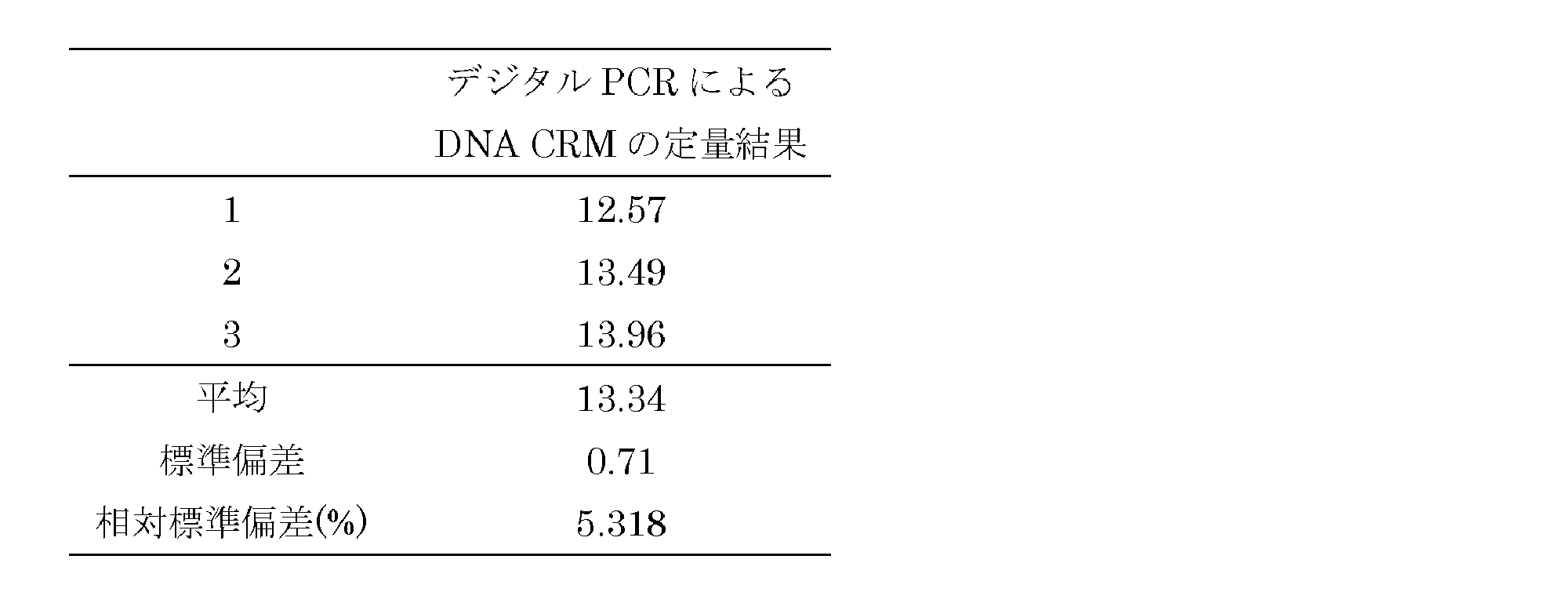
この実験では、デジタルPCRによる定量結果(13.34ng/μL±0.71ng/μL)は、認証値と不確かさの範囲内で一致したことから、デジタルPCRの絶対定量法としての妥当性が評価できたことになる。
一方で、仮にデジタルPCRによる定量結果が認証値と不確かさの範囲内で一致しなかった場合は、何らかの理由により当該デジタルPCR試験の定量が妥当ではなかったことが評価できる。これにより、例えば、検出対象DNAと規定量のDNA認証標準物質(DNA CRM)を含むDNA溶液についてデジタルPCR試験を行い、当該試験におけるDNA CRMの定量結果が妥当でないと評価された場合は、検出対象DNAの定量結果も妥当ではない可能性が高いと評価できる。
デジタルPCRの絶対定量法としての妥当性を評価するために、DNA認証標準物質(NMIJ CRM 6203-a D001-600-A、認証値:12.4ng/μL±0.8ng/μL)の定量を行った。DNA CRMを106希釈したものをデジタルPCR用の測定試料とし、同一試料を独立に3回測定した。その結果を表1に示す。
一方で、仮にデジタルPCRによる定量結果が認証値と不確かさの範囲内で一致しなかった場合は、何らかの理由により当該デジタルPCR試験の定量が妥当ではなかったことが評価できる。これにより、例えば、検出対象DNAと規定量のDNA認証標準物質(DNA CRM)を含むDNA溶液についてデジタルPCR試験を行い、当該試験におけるDNA CRMの定量結果が妥当でないと評価された場合は、検出対象DNAの定量結果も妥当ではない可能性が高いと評価できる。
実施例2:DNA CRMによる、検出対象DNAのデジタルPCRの測定ばらつきの抑制
デジタルPCRを用いて、検出対象DNA(φ073496)とDNA認証標準物質(DNA CRM)を含むDNA溶液の測定を行った。デジタルPCRを行う際の手順を図1に示す。
図1において、プライマーとして、検出対象DNAを増幅するプライマー対およびDNA認証標準物質を増幅するプライマー対を用い、TaqManプローブとして、検出対象DNAを検出するTaqManプローブおよびDNA認証標準物質を検出するTaqManプローブを用い、測定の際には、1つのチップ上で2つのDNAを測定可能なduplex PCRを行うことで、検出対象DNAとDNA認証標準物質を同時に定量した。測定は独立に3回行い、その結果を図2および表2に示す。

表2に示すように、3回のデジタルPCR試験から求めたDNA溶液中のφ073496の濃度のばらつきは、相対標準偏差で1.94%であった。一方で、同一のデジタルPCR試験により得られたDNA CRMの定量値による補正を行うことにより、補正後のDNA溶液中のφ073496の濃度のばらつきは、相対標準偏差で0.84%となり、ばらつきが半減した(すなわち、上記3回のデジタルPCR試験について、同一のデジタルPCR試験におけるφ073496の濃度をDNA CRM濃度で除した濃度比のばらつきは、相対標準偏差で0.84%となり、従って、当該濃度比にDNA溶液に加えたDNA CRMの量を乗することにより算出される補正後のφ073496の濃度についても、そのばらつきは、相対標準偏差で0.84%となる)。
これは、検出対象DNAと性状が同一のDNA CRMを内標準とし、同一のデジタルPCR試験により同時に定量したことで、デジタルPCRにおける試料分配の不均一性や、増幅反応や増幅検出効率の不均一性などの問題点が相殺されたため、ばらつきが小さくなったと考えられる。
デジタルPCRを用いて、検出対象DNA(φ073496)とDNA認証標準物質(DNA CRM)を含むDNA溶液の測定を行った。デジタルPCRを行う際の手順を図1に示す。
図1において、プライマーとして、検出対象DNAを増幅するプライマー対およびDNA認証標準物質を増幅するプライマー対を用い、TaqManプローブとして、検出対象DNAを検出するTaqManプローブおよびDNA認証標準物質を検出するTaqManプローブを用い、測定の際には、1つのチップ上で2つのDNAを測定可能なduplex PCRを行うことで、検出対象DNAとDNA認証標準物質を同時に定量した。測定は独立に3回行い、その結果を図2および表2に示す。
これは、検出対象DNAと性状が同一のDNA CRMを内標準とし、同一のデジタルPCR試験により同時に定量したことで、デジタルPCRにおける試料分配の不均一性や、増幅反応や増幅検出効率の不均一性などの問題点が相殺されたため、ばらつきが小さくなったと考えられる。
実施例3:DNA CRMによる、DNA抽出工程を含めたデジタルPCRの精度管理(ナタネ中の遺伝子(FatA)の定量)
粉砕したナタネ粉末中からDNAを抽出し、抽出液に含まれる遺伝子の定量を行った。ナタネ粉末(200mg)にDNA CRMを約30μL添加(秤量で補正)し、DNA CRM共存下でナタネからDNA抽出を行った。DNA抽出からデジタルPCRまでの手順およびDNA CRMを添加するタイミングを図3に示す。抽出は独立に3回(それぞれ抽出1、2、3)行い、各抽出液に対して、ナタネ中遺伝子(FatA)およびDNA CRMの同時定量を3回ずつデジタルPCRで行った(例えば、抽出1について、抽出1-1、1-2、1-3)。その結果を表3に示す。
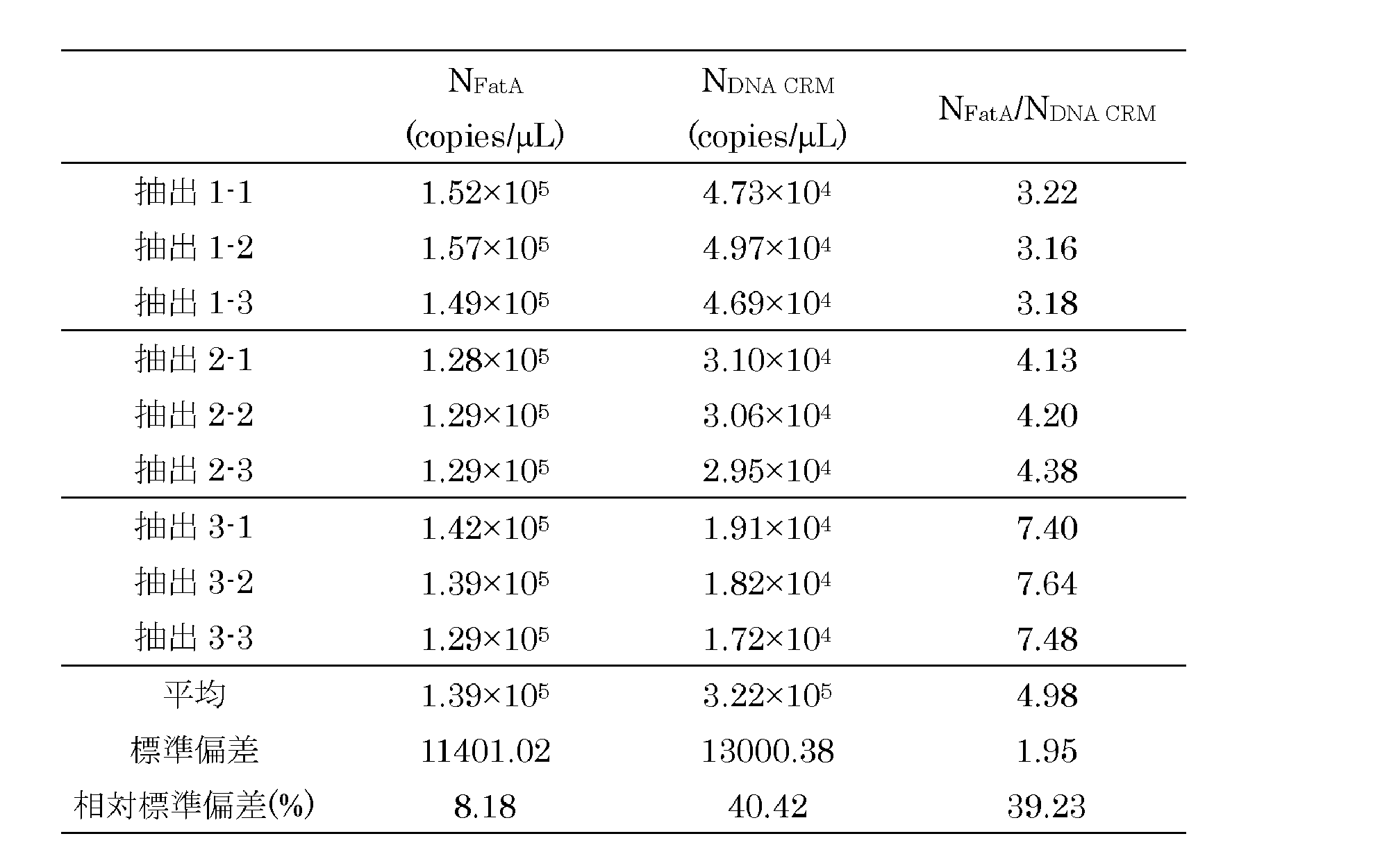
表3に示すように、FatAとDNA CRMのデジタルPCRによる定量値は、各抽出工程における3回のデジタルPCR試験間においてはほぼ一致する一方で、各抽出工程間では大きく相異しており、このことは、当該相異が主に各抽出工程により最終的に抽出液中に回収されたDNAの量の相異に基づくものであることを示している。抽出工程1~3は図3に示した同一の手順によって行われるものであるから、このことは、図3に示した抽出の手順には、図3には記載しきれていない、その手順を実施するに当たり抽出量のばらつきを生じ得る要素がさらに存在することを示しており、抽出量のばらつきを抑制するためには、何らかの手段により当該要素による影響を排除する必要があることを示している。
このようにして、検出対象DNAとDNA CRMを同一のデジタルPCR試験で定量する手法を用いてDNA抽出工程の評価を行うことができ、DNA抽出工程を含めたデジタルPCR測定の精度管理を行うことが可能である。
粉砕したナタネ粉末中からDNAを抽出し、抽出液に含まれる遺伝子の定量を行った。ナタネ粉末(200mg)にDNA CRMを約30μL添加(秤量で補正)し、DNA CRM共存下でナタネからDNA抽出を行った。DNA抽出からデジタルPCRまでの手順およびDNA CRMを添加するタイミングを図3に示す。抽出は独立に3回(それぞれ抽出1、2、3)行い、各抽出液に対して、ナタネ中遺伝子(FatA)およびDNA CRMの同時定量を3回ずつデジタルPCRで行った(例えば、抽出1について、抽出1-1、1-2、1-3)。その結果を表3に示す。
このようにして、検出対象DNAとDNA CRMを同一のデジタルPCR試験で定量する手法を用いてDNA抽出工程の評価を行うことができ、DNA抽出工程を含めたデジタルPCR測定の精度管理を行うことが可能である。
Claims (4)
- 十分に希釈された生体関連分子の溶液を多数のパーティションに分配し、各パーティションにおける生体関連分子の有無を検出し、生体関連分子の分配されたパーティションの数と分配されなかったパーティションの数から統計的処理により各パーティションに分配された生体関連分子を計数し、1パーティションあたりの生体関連分子の数と体積から、試料溶液中の生体関連分子濃度を絶対定量する分析手法において、
化学組成、構造が既知で、かつ、その化学組成、構造で規定される単一の分子に対して質量濃度あるいは物質量含有量が付与されている物質を試料として絶対定量し、得られた定量値と当該物質について付与された質量濃度あるいは物質量含有量を対比することにより、当該分析手法の絶対定量法としての妥当性を評価する方法。 - 十分に希釈された生体関連分子の溶液を多数のパーティションに分配し、各パーティションにおける生体関連分子の有無を検出し、生体関連分子の分配されたパーティションの数と分配されなかったパーティションの数から統計的処理により各パーティションに分配された生体関連分子を計数し、1パーティションあたりの生体関連分子の数と体積から、試料溶液中の生体関連分子濃度を絶対定量する分析手法において、
定量対象の分子を含む試料に、定量対象の分子とは化学組成、構造が異なるが、化学組成、構造が既知で、かつ、その化学組成、構造で規定される単一の分子に対して質量濃度あるいは物質量含有量が付与されている物質を添加し、試料中に含まれる定量対象分子と当該物質を同時に定量分析し、得られた定量対象分子の定量値の当該物質の定量値に対する比率に対し、当該物質の試料に対する添加量を乗ずることにより定量対象分子の定量値を補正することで、試料中に含まれる定量対象分子の定量精度を向上させる方法。 - 十分に希釈された生体関連分子の溶液を多数のパーティションに分配し、各パーティションにおける生体関連分子の有無を検出し、生体関連分子の分配されたパーティションの数と分配されなかったパーティションの数から統計的処理により各パーティションに分配された生体関連分子を計数し、1パーティションあたりの生体関連分子の数と体積から、試料溶液中の生体関連分子濃度を絶対定量する分析手法において、
生体試料から生体関連分子を抽出する工程を含み、当該抽出工程において、生体試料に対し、当該生体関連分子とは化学組成、構造が異なるが、化学組成、構造が既知で、かつ、その化学組成、構造で規定される単一の分子に対して質量濃度あるいは物質量含有量が付与されている物質を添加することで、生体関連分子と当該物質を含む試料溶液を得、当該溶液について生体関連分子と当該物質を上記分析手法で同時に定量分析し、同様の定量分析を、異なる抽出工程により同様に作製された生体関連分子と当該物質を含む試料溶液について行い、それぞれの抽出工程を用いた際に得られた定量結果を対比することで、生体関連分子の抽出方法を評価する方法。 - 生体関連分子がDNAであり、化学組成、構造が既知で、かつ、その化学組成、構造で規定される単一の分子に対して質量濃度あるいは物質量含有量が付与されている物質がDNA認証標準物質であり、分析手法がデジタルPCRである、請求項1~3のいずれか一項に記載の方法。
Applications Claiming Priority (2)
| Application Number | Priority Date | Filing Date | Title |
|---|---|---|---|
| JP2017-136604 | 2017-07-12 | ||
| JP2017136604 | 2017-07-12 |
Publications (1)
| Publication Number | Publication Date |
|---|---|
| WO2019013133A1 true WO2019013133A1 (ja) | 2019-01-17 |
Family
ID=65002658
Family Applications (1)
| Application Number | Title | Priority Date | Filing Date |
|---|---|---|---|
| PCT/JP2018/025730 Ceased WO2019013133A1 (ja) | 2017-07-12 | 2018-07-06 | 被験物質の絶対定量法 |
Country Status (1)
| Country | Link |
|---|---|
| WO (1) | WO2019013133A1 (ja) |
Citations (2)
| Publication number | Priority date | Publication date | Assignee | Title |
|---|---|---|---|---|
| US20120164652A1 (en) * | 2010-12-27 | 2012-06-28 | Ibis Biosciences, Inc. | Quantitating high titer samples by digital pcr |
| JP2018046818A (ja) * | 2016-09-23 | 2018-03-29 | エフ.ホフマン−ラ ロシュ アーゲーF. Hoffmann−La Roche Aktiengesellschaft | プロセシングしていない試料において、関心対象の核酸の量を決定するための方法 |
-
2018
- 2018-07-06 WO PCT/JP2018/025730 patent/WO2019013133A1/ja not_active Ceased
Patent Citations (2)
| Publication number | Priority date | Publication date | Assignee | Title |
|---|---|---|---|---|
| US20120164652A1 (en) * | 2010-12-27 | 2012-06-28 | Ibis Biosciences, Inc. | Quantitating high titer samples by digital pcr |
| JP2018046818A (ja) * | 2016-09-23 | 2018-03-29 | エフ.ホフマン−ラ ロシュ アーゲーF. Hoffmann−La Roche Aktiengesellschaft | プロセシングしていない試料において、関心対象の核酸の量を決定するための方法 |
Non-Patent Citations (6)
| Title |
|---|
| DEVONSHIRE AS ET AL.: "Highly reproducible absolute quantification of Mycobacterium tuberculosis complex by digital PCR", ANAL. CHEM., vol. 87, no. 7, 2015, pages 3706 - 3713, XP055354256, DOI: 10.1021/ac5041617 * |
| DONG L ET AL.: "Comparison of four digital PCR platforms for accurate quantification of DNA copy number of a certified plasmid DNA reference material", SCI. REP., vol. 5, 2015, pages 13174, XP055340722, DOI: 10.1038/srep13174 * |
| HUGGETT JF ET AL.: "Considerations for digital PCR as an accurate molecular diagnostic tool", CLIN. CHEM., vol. 61, no. 1, 2015, pages 79 - 88, XP009187655, DOI: 10.1373/clinchem.2014.221366 * |
| MALATINKOVA E ET AL.: "Accurate quantification of episomal HIV-1 two-long terminal repeat circles by use of optimized DNA isolation and droplet digital PCR", J. CLIN. MICROBIOL., vol. 53, no. 2, 2015, pages 699 - 701, XP055677362 * |
| SEDLAK RH ET AL.: "A multiplexed droplet digital PCR assay performs better than qPCR on inhibition prone samples", DIAGN. MICROBIOL. INFECT. DIS., vol. 80, no. 4, 2014, pages 285 - 286, XP029103972, DOI: 10.1016/j.diagmicrobio.2014.09.004 * |
| TANG H ET AL.: "Comparison of droplet digital PCR to real-time PCR for quantification of hepatitis B virus DNA", BIOSCI. BIOTECHNOL. BIOCHEM., vol. 80, no. 11, 2016, pages 2159 - 2164, XP055677363 * |
Similar Documents
| Publication | Publication Date | Title |
|---|---|---|
| Deprez et al. | Validation of a digital PCR method for quantification of DNA copy number concentrations by using a certified reference material | |
| Messner et al. | Ultra-fast proteomics with Scanning SWATH | |
| Gumustas et al. | The role of and the place of method validation in drug analysis using electroanalytical techniques | |
| EP2732386A1 (en) | Computation of real-world error using meta-analysis of replicates | |
| KR102166979B1 (ko) | 대두의 원산지 판별용 바이오마커 및 이를 이용한 원산지 판별방법 | |
| CN110878333A (zh) | 一种制备基因突变参考品的方法 | |
| CN102337341B (zh) | Maldi-tof质谱双内标及其定量检测方法 | |
| Saudagar et al. | Bioanalytical method validation: a concise review | |
| CN105548115B (zh) | 土壤中总汞的测定方法 | |
| Barabasz et al. | The use of high-content screening for the discovery and characterization of compounds that modulate mitotic index and cell cycle progression by differing mechanisms of action | |
| CN110484607A (zh) | 一种实时荧光定量pcr仪校准用标准物质及其应用 | |
| CN106520914A (zh) | 用于羊源性成分精准定量检测的引物探针、试剂盒及方法 | |
| CN104178563B (zh) | 用于核酸样品的测量方法 | |
| CN105695571A (zh) | 一种基于滚环扩增的dna定量方法 | |
| Mueller et al. | Combining the “sibling technologies” of laser capture microdissection and reverse phase protein microarrays | |
| Misiewicz-Krzeminska et al. | Capillary nano-immunoassay for quantification of proteins from CD138-purified myeloma cells | |
| CN105648102A (zh) | 检测疫苗中mdck细胞dna残留的试剂盒 | |
| CN105886618B (zh) | 一种定量检测液体样品中汞离子的方法及试剂盒 | |
| Ubhi et al. | A novel lipid screening platform that provides a complete solution for lipidomics research | |
| CN111718978B (zh) | 基因扩增参考品及其应用 | |
| CN111718979B (zh) | 基因扩增参考品及其应用 | |
| Wang et al. | Biometrology and standard: Research and application | |
| CN114371239A (zh) | 用于测定氧化三甲胺的试剂盒及其制备方法和应用 | |
| CN103173559B (zh) | 实时荧光pcr中目的基因的表达量的校正方法 | |
| CN116515976B (zh) | 一种转录组测序的校正方法及其试剂盒 |
Legal Events
| Date | Code | Title | Description |
|---|---|---|---|
| 121 | Ep: the epo has been informed by wipo that ep was designated in this application |
Ref document number: 18831782 Country of ref document: EP Kind code of ref document: A1 |
|
| NENP | Non-entry into the national phase |
Ref country code: DE |
|
| 122 | Ep: pct application non-entry in european phase |
Ref document number: 18831782 Country of ref document: EP Kind code of ref document: A1 |
|
| NENP | Non-entry into the national phase |
Ref country code: JP |