WO2019002149A1 - Cosmetic composition comprising organosilanes, cationic polymers, liquid fatty substances, particular anionic surfactants, and non-ionic and amphoteric surfactants, cosmetic treatment process and use - Google Patents
Cosmetic composition comprising organosilanes, cationic polymers, liquid fatty substances, particular anionic surfactants, and non-ionic and amphoteric surfactants, cosmetic treatment process and use Download PDFInfo
- Publication number
- WO2019002149A1 WO2019002149A1 PCT/EP2018/066821 EP2018066821W WO2019002149A1 WO 2019002149 A1 WO2019002149 A1 WO 2019002149A1 EP 2018066821 W EP2018066821 W EP 2018066821W WO 2019002149 A1 WO2019002149 A1 WO 2019002149A1
- Authority
- WO
- WIPO (PCT)
- Prior art keywords
- weight
- alkyl
- group
- denotes
- chosen
- Prior art date
- Legal status (The legal status is an assumption and is not a legal conclusion. Google has not performed a legal analysis and makes no representation as to the accuracy of the status listed.)
- Ceased
Links
Classifications
-
- A—HUMAN NECESSITIES
- A61—MEDICAL OR VETERINARY SCIENCE; HYGIENE
- A61Q—SPECIFIC USE OF COSMETICS OR SIMILAR TOILETRY PREPARATIONS
- A61Q5/00—Preparations for care of the hair
- A61Q5/02—Preparations for cleaning the hair
-
- A—HUMAN NECESSITIES
- A61—MEDICAL OR VETERINARY SCIENCE; HYGIENE
- A61K—PREPARATIONS FOR MEDICAL, DENTAL OR TOILETRY PURPOSES
- A61K8/00—Cosmetics or similar toiletry preparations
- A61K8/18—Cosmetics or similar toiletry preparations characterised by the composition
- A61K8/30—Cosmetics or similar toiletry preparations characterised by the composition containing organic compounds
- A61K8/33—Cosmetics or similar toiletry preparations characterised by the composition containing organic compounds containing oxygen
- A61K8/34—Alcohols
- A61K8/342—Alcohols having more than seven atoms in an unbroken chain
-
- A—HUMAN NECESSITIES
- A61—MEDICAL OR VETERINARY SCIENCE; HYGIENE
- A61K—PREPARATIONS FOR MEDICAL, DENTAL OR TOILETRY PURPOSES
- A61K8/00—Cosmetics or similar toiletry preparations
- A61K8/18—Cosmetics or similar toiletry preparations characterised by the composition
- A61K8/30—Cosmetics or similar toiletry preparations characterised by the composition containing organic compounds
- A61K8/33—Cosmetics or similar toiletry preparations characterised by the composition containing organic compounds containing oxygen
- A61K8/39—Derivatives containing from 2 to 10 oxyalkylene groups
-
- A—HUMAN NECESSITIES
- A61—MEDICAL OR VETERINARY SCIENCE; HYGIENE
- A61K—PREPARATIONS FOR MEDICAL, DENTAL OR TOILETRY PURPOSES
- A61K8/00—Cosmetics or similar toiletry preparations
- A61K8/18—Cosmetics or similar toiletry preparations characterised by the composition
- A61K8/30—Cosmetics or similar toiletry preparations characterised by the composition containing organic compounds
- A61K8/40—Cosmetics or similar toiletry preparations characterised by the composition containing organic compounds containing nitrogen
- A61K8/44—Aminocarboxylic acids or derivatives thereof, e.g. aminocarboxylic acids containing sulfur; Salts; Esters or N-acylated derivatives thereof
-
- A—HUMAN NECESSITIES
- A61—MEDICAL OR VETERINARY SCIENCE; HYGIENE
- A61K—PREPARATIONS FOR MEDICAL, DENTAL OR TOILETRY PURPOSES
- A61K8/00—Cosmetics or similar toiletry preparations
- A61K8/18—Cosmetics or similar toiletry preparations characterised by the composition
- A61K8/30—Cosmetics or similar toiletry preparations characterised by the composition containing organic compounds
- A61K8/58—Cosmetics or similar toiletry preparations characterised by the composition containing organic compounds containing atoms other than carbon, hydrogen, halogen, oxygen, nitrogen, sulfur or phosphorus
- A61K8/585—Organosilicon compounds
-
- A—HUMAN NECESSITIES
- A61—MEDICAL OR VETERINARY SCIENCE; HYGIENE
- A61K—PREPARATIONS FOR MEDICAL, DENTAL OR TOILETRY PURPOSES
- A61K8/00—Cosmetics or similar toiletry preparations
- A61K8/18—Cosmetics or similar toiletry preparations characterised by the composition
- A61K8/72—Cosmetics or similar toiletry preparations characterised by the composition containing organic macromolecular compounds
- A61K8/81—Cosmetics or similar toiletry preparations characterised by the composition containing organic macromolecular compounds obtained by reactions involving only carbon-to-carbon unsaturated bonds
- A61K8/817—Compositions of homopolymers or copolymers of compounds having one or more unsaturated aliphatic radicals, each having only one carbon-to-carbon double bond, and at least one being terminated by a single or double bond to nitrogen or by a heterocyclic ring containing nitrogen; Compositions or derivatives of such polymers, e.g. vinylimidazol, vinylcaprolactame, allylamines (Polyquaternium 6)
-
- A—HUMAN NECESSITIES
- A61—MEDICAL OR VETERINARY SCIENCE; HYGIENE
- A61K—PREPARATIONS FOR MEDICAL, DENTAL OR TOILETRY PURPOSES
- A61K8/00—Cosmetics or similar toiletry preparations
- A61K8/18—Cosmetics or similar toiletry preparations characterised by the composition
- A61K8/72—Cosmetics or similar toiletry preparations characterised by the composition containing organic macromolecular compounds
- A61K8/84—Cosmetics or similar toiletry preparations characterised by the composition containing organic macromolecular compounds obtained by reactions otherwise than those involving only carbon-carbon unsaturated bonds
- A61K8/86—Polyethers
-
- A—HUMAN NECESSITIES
- A61—MEDICAL OR VETERINARY SCIENCE; HYGIENE
- A61K—PREPARATIONS FOR MEDICAL, DENTAL OR TOILETRY PURPOSES
- A61K8/00—Cosmetics or similar toiletry preparations
- A61K8/18—Cosmetics or similar toiletry preparations characterised by the composition
- A61K8/92—Oils, fats or waxes; Derivatives thereof, e.g. hydrogenation products thereof
-
- A—HUMAN NECESSITIES
- A61—MEDICAL OR VETERINARY SCIENCE; HYGIENE
- A61Q—SPECIFIC USE OF COSMETICS OR SIMILAR TOILETRY PREPARATIONS
- A61Q5/00—Preparations for care of the hair
- A61Q5/12—Preparations containing hair conditioners
Definitions
- Cosmetic composition comprising organosilanes, cationic polymers, liquid fatty substances, particular anionic surfactants, and non-ionic and
- amphoteric surfactants cosmetic treatment process and use
- the present invention relates to a cosmetic composition for the treatment of keratin fibres, in particular human keratin fibres such as the hair, comprising, in a cosmetically acceptable medium, one or more organosilanes, one or more cationic and/or amphoteric polymers, one or more liquid fatty substances and a particular combination of surfactants comprising anionic, non-ionic and amphoteric surfactants.
- the present invention also relates to a process for the cosmetic treatment of keratin fibres, in particular in human keratin fibres, using said composition, and also to the use of said composition for the cosmetic treatment of keratin fibres, in particular human keratin fibres such as the hair, for conferring conditioning properties on said fibres, said properties being advantageously persistent with respect to several shampooing operations.
- Hair can generally be damaged and embrittled by the action of external atmospheric agents such as light and bad weather, and/or by mechanical or chemical treatments, such as brushing, combing, dyeing, bleaching, permanent-waving and/or relaxing.
- external atmospheric agents such as light and bad weather
- mechanical or chemical treatments such as brushing, combing, dyeing, bleaching, permanent-waving and/or relaxing.
- haircare compositions which make it possible to condition the hair after these treatments to give it in particular sheen, softness, suppleness, lightness, a natural feel and disentangling properties.
- These hair compositions may be, for example, conditioning shampoos, compositions to be applied before shampooing (pre-shampoo) or compositions to be applied after shampooing (conditioner), and may be in the form of gels, hair lotions or creams of varying thickness.
- Hair compositions in particular intended for hair cleansing and conditioning, comprising anionic surfactants, non-ionic surfactants, amphoteric surfactants and particular cationic and amphoteric polymers are thus known, in particular through ap- plications FR 3 040 300 and FR 3 040 302. These compositions are very stable in terms of viscosity and visual appearance, and make it possible to improve the cosmetic properties conferred on the hair, in particular the disentangling, the suppleness and the feel of said hair.
- the care compositions described in the prior art provide conditioning properties which do not last for a sufficiently long time, in particular which do not generally sufficiently withstand washing of the hair, and which have a tendency to rapidly decrease.
- curly or frizzy hair requires particular care, in particular in order to maintain an appropriate curl definition, and/or to avoid unattractive frizz- iness (anti-frizz effect). It is also preferable to provide it with good care properties by nourishing it, generally with liquid fatty substances such as oils.
- a cosmetic composition in particular for washing, caring for or conditioning keratin fibres, in particular human keratin fibres such as the hair, comprising liquid fatty substances, and which is capable of providing conditioning properties that are not only satisfactory, but also per- sistent with respect to washing, for example persistent for at least five shampooing operations.
- composition comprising, in addition to one or more liquid fatty substances, the combination of one or more organosilanes and of one or more cationic and/or amphoteric polymers, with a particular combination of surfactants comprising anionic surfactants, non-ionic surfactants and amphoteric surfactants.
- a subject of the present invention is therefore a cosmetic composition comprising: - one or more organosilanes,
- anionic surfactants chosen from polyoxyalkylenated alkyl(amido)ether carboxylic acids and/or salts thereof, in particular those comprising from 2 to 50 alkylene oxide and in particular ethylene oxide groups,
- composition according to the invention has the advantage of being stable on storage both at ambient temperature (20-25°C) and at 45°C, especially as regards its visual aspect and its viscosity.
- stable refers to a composition which, after two months of storage at a temperature of 20 to 45°C, shows no change in appearance, colour, odour or viscosity.
- the composition can advantageously be transparent, although it contains liquid fatty substances; it can also be nacreous, where appropriate.
- composition according to the invention may also have satisfactory foaming power.
- composition according to the invention also makes it possible to apply conditioning agents, such as cationic or amphoteric polymers, organosilanes and liquid fatty substances, in an amount sufficient to obtain the appropriate cosmetic, in particular conditioning, properties.
- conditioning agents such as cationic or amphoteric polymers, organosilanes and liquid fatty substances
- composition according to the invention confers in particular on the hair a beautiful curl definition, and a natural non-greasy and non-laden feel, although the composition comprises liquid fatty substances. It can also give the hair softness and manageability, make it straight, and give it lightness, volume and an improved ability to be disentangled.
- the properties afforded by the composition according to the invention and in particular the curl definition and feel properties, satisfactorily withstand the various attacks to which the hair may be subjected, such as light, bad weather, washing and perspiration. They are particularly persistent with respect to shampooing operations, especially after at least three or even five shampooing operations.
- the cosmetic composition according to the invention comprises one or more orga- nosilanes.
- the organosilane(s) that can be used according to the invention are preferably chosen from the compounds of formula (I) and/or hydrolysis products thereof and/or oligomers thereof:
- Ri is a cyclic or acyclic, linear or branched, saturated or unsaturated Ci to C22, in particular C2 to C20, hydrocarbon-based chain, which may be substituted with one or more group(s) chosen from amine groups NH2 or NHR, R being a linear or branched Ci to C20, in particular Ci to C6, alkyl, or a C3 to C 4 o cycloalkyl or a C6 to C30 aromatic radical; the hydroxyl group; a thiol group; an aryl group, more particu- larly benzyl, which is unsubstituted or substituted with an NH2 or NHR group; it being possible for Ri to be interrupted with an oxygen, sulfur or nitrogen heteroatom or a carbonyl group;
- R2 and R3 which may be identical or different, represent a linear or branched alkyl group comprising from 1 to 6 carbon atoms,
- - y denotes an integer ranging from 0 to 3
- - z denotes an integer ranging from 0 to 3
- - x denotes an integer ranging from 0 to 2
- oligomer is intended to mean the polymerization products of the compounds of formula (I) comprising from 2 to 10 silicon atoms.
- Ri is a linear or branched, more preferentially linear, saturated Ci to C22, in particular C2 to C12, hydrocarbon-based chain, which may be substituted with one or more amine group(s) Nh or NHR, R being a Ci to C20, in particular Ci to C6, alkyl.
- R2 represents an alkyl group comprising from 1 to 4 carbon atoms, more preferentially a linear alkyl group comprising from 1 to 4 carbon atoms, and in par- ticular an ethyl group.
- z ranges from 1 to 3.
- y is equal to 0.
- z is equal to 3.
- x and y are equal to 0 and z is equal to 0.
- the organosilane(s) are chosen from the compounds of formula (I) in which Ri represents a linear alkyl group comprising from 7 to 18 carbon atoms and more particularly from 7 to 12 carbon atoms, or a Ci to C6, preferably C2 to C 4 , aminoalkyl group.
- Ri represents an octyl group.
- the organosilane(s) are chosen from the compounds of formula (I) in which Ri is a linear or branched, saturated or unsaturated Ci to C22 hydrocarbon-based chain, substituted with one or more amine groups NH2 or NHR, R being a linear or branched Ci to C20, preferably Ci to C6, alkyl, or a C3 to C 4 o cycloalkyl or a C6 to C30 aromatic ring.
- Ri represents a Ci to C6 and more preferentially C2 to C 4 aminoalkyl group.
- the organosilane(s) that can be used according to the invention are chosen from octyltriethoxysilane, dodecyltriethoxysilane, octadecyltriethoxysilane, hex- adecyltriethoxysilane, 3-aminopropyltriethoxysilane, 2-aminoethyltriethoxysilane, 3- aminopropylmethyldiethoxysilane, N-(2-aminoethyl)-3-aminopropyltriethoxysilane, 3-(m-aminophenoxy)propyltrimethoxysilane, p-aminophenyltrimethoxysilane, N-(2- aminoethylaminomethyl)phenethyltrimethoxysilane, hydrolysis products thereof, oligomers thereof and mixtures thereof.
- the organosilanes are chosen from octyltriethoxysilane, 3-aminopropyltriethoxysilane, hydrolysis products thereof, oligomers thereof and mixtures thereof; and particularly preferably, the organosilane is 3-aminopropyltriethoxysilane (APTES).
- APTES 3-aminopropyltriethoxysilane
- the organosilanes used in the composition of the invention especially those comprising a basic function, may be partially or totally neutralized in order to improve the water solubility thereof.
- the neutralizing agent can be chosen from organic or mineral acids, preferably from saturated or unsaturated, hydroxylated or non-hydroxylated carboxylic organic acids; mention may be made of citric acid, tar- taric acid, lactic acid and hydrochloric acid, preferentially lactic acid.
- the composition preferably comprises the organosilane(s) in a content of from 0.1 % to 15% by weight, preferably from 0.5% to 10% by weight, preferentially from 1 % to 8% by weight, relative to the total weight of the composition according to the invention.
- the composition may comprise the organic or mineral acid(s), when they are present, in a content ranging from 0.1 % to 1 0% by weight, preferably from 0.5% to 5% by weight, relative to the total weight of the composition.
- the cosmetic composition according to the invention also comprises one or more polymers chosen from cationic polymers, amphoteric polymers, and mixtures thereof.
- cationic polymer denotes any non-silicone (not comprising any silicon atoms) polymer containing cationic groups and/or groups that can be ionized into cationic groups and not containing any ani- onic groups and/or groups that can be ionized into anionic groups.
- the cationic polymers that may be used preferably have a weight-average molar mass (Mw) of between 500 and 5x 1 0 6 approximately and preferably between 1 0 3 and 3x 1 0 6 approximately.
- Mw weight-average molar mass
- the cationic polymers that can be used in the cosmetic composition according to the invention may be chosen from:
- R3 which may be identical or different, denote a hydrogen atom or a CH3 radical
- A which may be identical or different, represent a linear or branched alkyl group of 1 to 6 carbon atoms, preferably 2 or 3 carbon atoms, or a hydroxyalkyl group of 1 to 4 carbon atoms;
- R 4 , R5 and R6, which may be identical or different, represent an alkyl group containing from 1 to 1 8 carbon atoms or a benzyl radical and preferably an alkyl group containing from 1 to 6 carbon atoms;
- Ri and R2 which may be identical or different, represent a hydrogen atom or an alkyl group containing from 1 to 6 carbon atoms, and preferably a methyl or ethyl radical;
- X denotes an anion derived from a mineral or organic acid, such as a methosulfate anion or a halide such as chloride or bromide.
- the polymers of family (1 ) may also contain one or more units derived from comon- omers which may be chosen from the family of acrylamides, methacrylamides, di- acetone acrylamides, acrylamides and methacrylamides substituted on the nitrogen with lower (Ci-C 4 ) alkyls, acrylic or methacrylic acids or esters thereof, vinyllactams such as vinylpyrrolidone or vinylcaprolactam, and vinyl esters.
- comon- omers which may be chosen from the family of acrylamides, methacrylamides, di- acetone acrylamides, acrylamides and methacrylamides substituted on the nitrogen with lower (Ci-C 4 ) alkyls, acrylic or methacrylic acids or esters thereof, vinyllactams such as vinylpyrrolidone or vinylcaprolactam, and vinyl esters.
- the crosslinked polymers of methacryloyloxy(Ci-C 4 )alkyl tri(Ci-C 4 )alkylammonium salts such as the polymers obtained by homopolymerization of dimethylaminoethyl methacrylate quaternized with methyl chloride, or by copolymerization of acrylamide with dimethylaminoethyl methacrylate quaternized with methyl chloride, the homo- or copolymerization being followed by crosslinking with an olefinically unsaturated compound, in particular methylenebisacrylamide.
- Use may more particularly be made of a crosslinked acrylamide/methacryloyloxyethyltrimethylammonium chloride copolymer (20/80 by weight) in the form of a dispersion containing 50% by weight of said copolymer in mineral oil.
- This dispersion is sold under the name Sal- care ® SC 92 by the company Ciba.
- Use may also be made of a crosslinked homo- polymer of methacryloyloxyethyltrimethylammonium chloride containing approxi- mately 50% by weight of the homopolymer in mineral oil or in a liquid ester. These dispersions are sold under the names Salcare ® SC 95 and Salcare ® SC 96 by the company Ciba.
- Cationic guar gums in particular those described more particularly in US patents 3 589 578 and 4 031 307, such as guar gums containing cationic trialkylammonium groups.
- Guar gums modified with a salt (e.g. chloride) of 2,3-epoxypropyltrime- thylammonium are used, for example.
- Such products are sold in particular under the trade names Jaguar C13 S, Jaguar C 15, Jaguar C 17 or Jaguar C162 by the company Rhodia.
- Water-soluble polyaminoamides prepared in particular by polycondensation of an acidic compound with a polyamine; these polyaminoamides can be crosslinked with an epihalohydrin, a diepoxide, a dianhydride, an unsaturated dianhydride, a bis-unsaturated derivative, a bis-halohydrin, a bis-azetidinium, a bis-haloacyldia- mine, a bis-alkyl halide or alternatively with an oligomer resulting from the reaction of a difunctional compound which is reactive with a bis-halohydrin, a bis-azetidinium, a bis-haloacyldiamine, a bis-alkyl halide, an epihalohydrin, a diepoxide or a bis-unsaturated derivative; the crosslinking agent being used in proportions ranging from 0.025 to 0.35 mol per amine group of the polyaminoamide; these polyamino
- Such polymers are described in particular in US patents 3 227 615 and 2 961 347;
- Polymers of this type are sold in particular under the name Hercosett 57 by the com- pany Hercules Inc. or else under the name PD 170 or Delsette 101 by the company Hercules in the case of the adipic acid/epoxypropyl/diethylenetriamine copolymer.
- k and t are equal to 0 or 1 , the sum k + t being equal to 1 ;
- Rg denotes a hydrogen atom or a methyl radical
- R 7 and Re independently of one another, denote an alkyl group containing from 1 to 6 carbon atoms, a hydroxyalkyi group in which the alkyl group preferably contains 1 to 5 carbon atoms, a (Ci-C 4 ) lower amidoalkyl group, or R 7 and Rs may denote, together with the nitrogen atom to which they are attached, heterocyclic groups such as piperidyl or morpholinyl; R 7 and Rs, independently of one another, preferably denote an alkyl group containing from 1 to 4 carbon atoms; Y " is an anion such as bromide, chloride, acetate, borate, citrate, tartrate, bisulfate, bisulfite, sulfate or phosphate. These polymers are in particular described in French patent 2 080 759 and in its Certificate of Addition 2 190 406.
- Rio, Ri 1 , Ri2 and R13 which may be identical or different, represent aliphatic, alicy-rod or arylaliphatic radicals containing from 1 to 6 carbon atoms or lower hydroxy- alkylaliphatic radicals, or alternatively R10, R11 , R12 and R13, together or separately, constitute, with the nitrogen atoms to which they are attached, heterocycles optionally containing a second heteroatom other than nitrogen, or alternatively R10, R11 , R12 and Ri3 represent a linear or branched C1-C6 alkyl radical substituted with a nitrile, ester, acyl or amide group or a group -CO-O-Ri 4 -D or -CO-NH-Ri 4 -D where Ri 4 is an alkylene and D is a quaternary ammonium group;
- Ai and Bi represent polymethylene groups containing from 2 to 8 carbon atoms which may be linear or branched, and saturated or unsaturated, and which may contain, linked to or inserted in the main chain, one or more aromatic rings, or one or more oxygen or sulfur atoms or sulfoxide, sulfone, disulfide, amino, alkylamino, hydroxyl, quaternary ammonium, ureido, amide or ester groups, and
- X denotes an anion derived from an inorganic or organic acid
- R10 and R12 can form, with the two nitrogen atoms to which they are attached, a piperazine ring;
- Bi may also denote a group
- x and y denote an integer from 1 to 4 representing a defined and unique degree of polymerization or any number from 1 to 4 representing an average degree of polymerization; b) a bis-secondary diamine residue, such as a piperazine derivative;
- X " is an anion, such as chloride or bromide.
- These polymers have a number-average molecular weight generally between 1 ,000 and 100 000.
- R10, Rn , R12 and R13 which may be identical or different, denote an alkyl or hydroxyalkyi radical containing from 1 to 4 carbon atoms approximately, n and p are integers ranging from 2 to 8 approximately, and X " is an anion derived from a mineral or organic acid. Mention may be made in particular of Mexomere PO sold by the company Chimex.
- D may be zero or may represent a group (Ch V-CO- in which r denotes a number equal to 4 or 7, and X " is an anion.
- examples that may be mentioned include the products Mirapol A 15, Mirapol AD1 , Mirapol AZ1 and Mirapol 175 sold by the company Mi- ranol.
- Quaternary polymers of vinylpyrrolidone and of vinylimidazole for instance the products sold under the names Luviquat FC 905, FC 550 and FC 370 by the company BASF. These polymers may also comprise other monomers, for instance dial- lyldialkylammonium halides. Mention may be made in particular of the product sold under the name Luviquat Sensation by the company BASF.
- Cationic polyamines such as Polyquart H sold by Henkel, which is referenced under the name Polyethylene glycol (15) Tallow Polyamine in the CTFA dictionary, or oxyethylenated (15 OE) coconut polyamines.
- cationic polymers that may be used in the context of the invention are poly- alkyleneimines, in particular polyethyleneimines, polymers containing vinylpyridine or vinylpyridinium units, condensates of polyamines and of epichlorohydrin, polyquaternary ureylenes and chitin derivatives.
- cationic polymers that may be used in the context of the present in- vention, it is preferred to use the polymers of families (1 ), (2), (3), (4), (9), (10) and (12), more particularly the polymers of families (2) and (9), and better still from the polymers of family (9).
- the composition comprises one or more cationic polymers having a cat- ionic charge density greater than or equal to 3 milliequivalents/gram (meq/g), preferably greater than or equal to 4 meq/g, better still greater than or equal to 5 meq/g, for example ranging from 3 to 20 meq/g, in particular from 4 to 20 meq/g, or even from 5 to 18 meq/g.
- meq/g milliequivalents/gram
- the cationic charge density of a polymer corresponds to the number of moles of cationic charges per unit mass of polymer under conditions in which it is totally ionized. It may be determined by calculation if the structure of the polymer is known, i.e. the structure of the monomers constituting the polymer and their molar proportion or weight proportion. It may also be determined experimentally by the Kjeldahl method.
- the cationic polymers are chosen from crosslinked polymers of meth- acryloyloxy(Ci-C 4 )alkyl tri(Ci-C 4 )alkylammonium salts, and alkyldiallylamine or dial- kyldiallylammonium cyclopolymers, and even more preferentially from homopoly- mers of dimethyldiallylammonium chloride (Polyquaternium 6), copolymers of dial- lyldimethylammonium chloride and of acrylamide (Polyquaternium 7), and homopol- ymers of 2-methacryloyloxyethyltrimethylammonium chloride (Polyquaternium-37).
- composition according to the invention preferably comprises the cationic polymers) in a content ranging from 0.01 % to 15% by weight, preferably from 0.05% to 10% by weight, and preferentially from 0.1 % 5% by weight, relative to the total weight of the composition.
- amphoteric polymer denotes any non-silicone (not comprising any silicon atoms) polymer containing cationic groups and/or groups that can be ionized into cationic groups and also anionic groups and/or groups that can be ionized into anionic groups.
- the amphoteric polymer(s) may be chosen from amphoteric polymers comprising the repetition of:
- the units derived from a (meth)acrylamide-type monomer are units of structure (la) below: in which Ri denotes H or Chb and R2 is chosen from an amino, dimethylamino, tert- butylamino, dodecylamino and -NH-CH2OH radical.
- said amphoteric polymer comprises the repetition of only one unit of formula (la).
- the unit derived from a monomer of (meth)acrylamide type of formula (la) in which Ri denotes H and R2 is an amino radical (NH2) is particularly preferred. It corresponds to the acrylamide monomer per se.
- the units derived from a monomer of (meth)acrylamidoalkyltrialkyl nium type are units of structure (I la) below:
- R 4 denotes a group (Ch jk, with k being an integer ranging from 1 to 6 and preferably from 2 to 4;
- R5 - R5, R6 and R 7 which may be identical or different, denote a Ci-C 4 alkyl
- - Y " is an anion such as bromide, chloride, acetate, borate, citrate, tartrate, bisulfate, bisulfite, sulfate or phosphate.
- said amphoteric polymer comprises the repetition of only one unit of formula (I la).
- these units derived from a monomer of (meth)acrylamidoalkyltrialkylammo- nium type of formula (I la)
- the ones that are preferred are those derived from the methacrylamidopropyltrimethylammonium chloride monomer, for which R3 denotes a methyl radical, k is equal to 3, R5, R6 and R 7 denote a methyl radical, and Y ⁇ denotes a chloride anion.
- the units derived from a monomer of (meth)acrylic acid type are units of formula (Ilia):
- the preferred units of formula (Ilia) correspond to the acrylic acid, methacrylic acid and 2-acrylamido-2-methylpropanesulfonic acid monomers.
- the unit derived from a monomer of (meth)acrylic acid type of formula (Ilia) is that derived from acrylic acid, for which Rs denotes a hydrogen atom and R9 denotes a hydroxyl radical.
- the acidic monomer(s) of (meth)acrylic acid type may be non-neutralized or partially or totally neutralized with an organic or mineral base.
- said amphoteric polymer comprises the repetition of only one unit of formula (Ilia).
- the amphoteric polymer or polymers of this type comprise at least 30 mol% of units derived from a monomer of (meth)acrylamide type (i). Preferably, they comprise from 30 mol% to 70 mol% and more preferably from 40 mol% to 60 mol% of units derived from a monomer of (meth)acrylamide type.
- the content of units derived from a monomer of (meth)acrylamidoalkyltrialkylammo- nium type (ii) may advantageously be from 10 mol% to 60 mol% and preferentially from 20 mol% to 55 mol%.
- the content of units derived from an acidic monomer of (meth)acrylic acid type (iii) may advantageously be from 1 mol% to 20 mol% and preferentially from 5 mol% to 15 mol%.
- amphoteric polymer of this type comprises:
- Amphoteric polymers of this type may also comprise additional units, other than the units derived from a monomer of (meth)acrylamide type, of (meth)acrylamidoalkyltri- alkylammonium type and of (meth)acrylic acid type as described above.
- said amphoteric polymers are constituted solely of units derived from monomers of (meth)acrylamide type (i), of (meth)acrylamidoalkyltrialkylammonium type (ii) and of (meth)acrylic acid type (iii).
- amphoteric polymers of acrylamide/methacrylamidopropyltrimethylammonium chloride/acrylic acid terpol- ymers. Such polymers are listed in the CTFA dictionary (INCI) under the name "Polyquaternium 53". Corresponding products are in particular sold under the names Merquat 2003 and Merquat 2003 PR by Nalco.
- amphoteric polymer As another type of amphoteric polymer that may be used, mention may also be made of copolymers based on (meth)acrylic acid and on a dialkyldiallylammonium salt, such as copolymers of (meth)acrylic acid and of dimethyldiallylammonium chlo- ride.
- copolymers based on (meth)acrylic acid and on a dialkyldiallylammonium salt such as copolymers of (meth)acrylic acid and of dimethyldiallylammonium chlo- ride.
- An example that may be mentioned is Merquat 280 sold by the company Nalco.
- composition according to the invention may comprise the amphoteric polymers) in an amount of between 0.01 % and 15% by weight, in particular from 0.05% to 10% by weight and preferentially from 0.1 % to 5% by weight, relative to the total weight of the composition.
- composition according to the invention may comprise the polymer(s) chosen from the cation ic polymers and the amphoteric polymers in an amount of between 0.01 % and 15% by weight, in particular from 0.05% to 10% by weight and preferentially from 0.1 % to 7% by weight, relative to the total weight of the composition.
- the composition according to the invention also comprises one or more, preferably non-silicone, liquid fatty substances.
- fatty substance means an organic compound that is insoluble in water at ambient temperature (25°C) and at atmospheric pressure (1 atm), i.e. which has a solubility of less than 5% by weight, preferably less than 1 % by weight.
- the fatty substances are generally soluble, under the same temperature and pressure conditions, in organic solvents such as chloroform, ethanol, benzene, liquid petroleum jelly or decamethylcyclopentasiloxane.
- non-silicone fatty substance is intended to mean a fatty substance of which the structure does not comprise a silicon atom, and therefore does not comprise in particular a siloxane group. They generally bear in their structure a hydrocarbon-based chain comprising at least 6 carbon atoms. Advantageously, they are not oxyalkylenated and do not contain any -COOH functions.
- liquid fatty substance is intended to mean a fatty substance that is liquid at ambient temperature and at atmospheric pressure (25°C, 1 atm.); they preferably have a viscosity of less than or equal to 2 Pa.s, better still less than or equal to 1 Pa.s and even better still less than or equal to 0.1 Pa.s, measured at 25°C and at a shear rate of 1 s-1 .
- liquid fatty substances according to the invention can be advantageously chosen from fatty alcohols, fatty esters, hydrocarbons, oils of animal origin, plant oils, in particular of triglyceride type, synthetic triglycerides, and mixture thereof.
- liquid fatty substances according to the invention are preferentially chosen from mineral oils (or hydrocarbons), plant oils, in particular of triglyceride type, and mixtures thereof.
- the fatty alcohols that can be used in the context of the invention are non-glycer- olated and non-oxyalkylenated; they preferably comprise from 8 to 30 carbon atoms, and can be saturated or unsaturated, and linear or branched.
- the saturated liquid fatty alcohols are preferably branched .
- the unsaturated liquid fatty alcohols contain in their structure at least one double or triple bond, and preferably one or more double bonds. When several double bonds are present, there are preferably 2 or 3 of them, and they may be conjugated or unconjugated. These unsaturated fatty alcohols may be linear or branched.
- the fatty alcohols preferably have the structure R-OH, in which R preferably denotes a branched C12-C24 alkyl or C12-C24 alkenyl group, R possibly being substituted with one or more hydroxyl groups. They are preferably saturated and branched. Prefer- ably, R does not contain any hydroxyl groups.
- the fatty alcohol is chosen from octyldodecanol, isostearyl alcohol and 2-hexyldecanol.
- liquid fatty esters is intended to mean an ester derived from a fatty acid, in particular a C6-C32 fatty acid, and/or from a fatty alcohol, in particular a C6-C32 fatty alcohol, which is in particular liquid at 25°C, 1 atm.
- esters are preferably liquid esters of saturated or unsaturated, linear or branched C1 -C26 aliphatic monoacids or polyacids and of saturated or unsaturated, linear or branched C1 -C26 aliphatic monoalcohols or polyalcohols, the total number of carbon atoms of the esters being greater than or equal to 10.
- the esters of monoalcohols at least one from among the alcohol and the acid from which the esters of the invention are derived is branched.
- ethyl palmitate isopropyl palmitate
- alkyl myristates such as isopropyl myristate or ethyl myristate
- isocetyl stearate 2-ethylhexyl isononanoate
- isononyl isonona- noate isodecyl neopentanoate and isostearyl neopentanoate.
- Esters of C4-C22 dicarboxylic or tricarboxylic acids and of C1 -C22 alcohols and esters of monocarboxylic, dicarboxylic or tricarboxylic acids and of C4-C26 dihy- droxy, trihydroxy, tetrahydroxy or pentahydroxy non-sugar alcohols may also be used.
- composition may also comprise, as liquid fatty ester, sugar esters and diesters of C6-C30 and preferably C12-C22 fatty acids.
- sugar esters means oxygen-bearing hydrocarbon-based compounds containing several alcohol functions, with or without aldehyde or ketone functions, and which comprise at least 4 carbon atoms.
- sugars may be monosaccharides, oligosaccharides or polysaccharides.
- sugars examples include saccharose, glucose, galactose, ribose, fucose, maltose, fructose, mannose, arabinose, xylose and lactose, and derivatives thereof, especially alkyl derivatives, such as methyl derivatives, for instance methylglucose.
- the sugar and fatty acid esters may be chosen especially from the group comprising the esters or mixtures of esters of sugars described previously and of linear or branched, saturated or unsaturated C6- C30 and preferably C12-C22 fatty acids. If they are unsaturated, these compounds may have one to three conjugated or non-conjugated carbon-carbon double bonds.
- esters according to this variant may also be chosen from mono-, di-, tri- and tetraesters, and polyesters, and mixtures thereof.
- These esters may be, for example, oleates, laurates, palmitates, myristates, behenates, cocoates, stearates, lino- leates, linolenates, caprates and arachidonates, and mixtures thereof, such as, especially, oleopalmitate, oleostearate or palmitostearate mixed esters.
- monoesters and diesters and especially of sucrose, glucose or methylglucose mono- or dioleates, stearates, behenates, oleopalmitates, linoleates, linolenates or oleostearates.
- Glucate® DO the product sold under the name Glucate® DO by the company Amerchol, which is a methylglucose dioleate.
- Use may also be made of natural or synthetic glycerol esters of mono-, di- or triacids. Among these, mention may be made of plant oils.
- oils of plant origin or synthetic triglycerides such as liquid fatty acid triglycerides containing from 6 to 30 carbon atoms, for instance heptanoic or octanoic acid triglycerides, or alternatively, for example, sunflower oil, maize oil, soya bean oil, marrow oil, grapeseed oil, sesame oil, hazelnut oil, apricot oil, macadamia oil, arara oil, castor oil, avocado oil, olive oil, rapeseed oil, copra oil, wheatgerm oil, sweet almond oil, apricot oil, safflower oil, candlenut oil, coconut camelina oil, tamanu oil, babassu oil, argan oil and pracaxi oil, caprylic/capric acid triglycerides, for instance those sold by the company Stearineries Dubois or those sold under the names Miglyol® 810,
- hydrocarbon-based oils of animal origin mention may be made of perhydrosqua- lene.
- liquid hydrocarbon that may be used in the composition according to the inven- tion, mention may be made of:
- hydrocarbons of mineral, animal or synthetic origin with more than 16 carbon atoms such as volatile or non-volatile liquid paraffins, petroleum jelly, liquid petroleum jelly, polydecenes, hydrogenated polyisobutene such as the product sold under the brand name Parleam® by the company NOF Corporation, and squalane.
- the liquid hydrocarbons are chosen from volatile or non-volatile liquid paraffins, and derivatives thereof, and liquid petroleum jelly.
- the composition according to the invention comprises one or more liquid fatty substances chosen from, alone or as a mixture, (i) hydrocarbons, in particular linear or branched hydrocarbons, having more than 16 carbon atoms, such as liquid petroleum jelly, and (ii) triglyceride oils of plant origin, such as coconut oil and/or soya oil.
- liquid fatty substances chosen from, alone or as a mixture, (i) hydrocarbons, in particular linear or branched hydrocarbons, having more than 16 carbon atoms, such as liquid petroleum jelly, and (ii) triglyceride oils of plant origin, such as coconut oil and/or soya oil.
- the composition according to the invention comprises the liquid fatty substance(s) in a total amount of between 0.1 % and 15% by weight, in particular between 0.2% 10% by weight, even better still between 0.3% and 8% by weight, or even between 0.4% and 5% by weight, preferentially between 0.5% and 2.5% by weight, relative to the total weight of the composition.
- the cosmetic composition according to the invention also comprises one or more anionic surfactants chosen from polyoxyalkylenated alkyl(amido)ether carboxylic acids and/or salts thereof, in particular those comprising from 2 to 50 alkylene oxide and in particular ethylene oxide groups,
- the polyoxyalkylenated alkyl(amido) ether carboxylic acids that may be used are preferably chosen from those of formula (1 ): R, -(OC 2 H 4 )— OCH 2 COOA ( )
- - Ri represents a linear or branched C6-C24 alkyl or alkenyl radical, an alkyl(Cs- Cg)phenyl radical, a radical R2CONH-CH2-CH2- with R2 denoting a linear or branched C9-C21 alkyl or alkenyl radical,
- Ri is a C8-C20 and preferably Cs-Cis alkyl radical, and aryl preferably denotes phenyl,
- - n is an integer or decimal number (average value) ranging from 2 to 24 and preferably from 2 to 10,
- - A denotes H, ammonium, Na, K, Li, Mg, Ca or a monoethanolamine or triethano- lamine residue.
- polyoxyalkylenated alkyl(amido)ether carboxylic acids that are particularly pre- ferred are those of formula (1 ) in which:
- Ri denotes a Ci2-Ci 4 alkyl, cocoyl, oleyl, nonylphenyl or octylphenyl radical,
- - A denotes a hydrogen or sodium atom
- - n ranges from 2 to 20, preferably from 2 to 10.
- R de- notes a C12 alkyl radical
- A denotes a hydrogen or sodium atom
- n ranges from 2 to 10.
- Use is preferably made of polyoxyalkylenated (C6-C24)alkyl ether carboxylic acids and salts thereof, polyoxyalkylenated (C6-C24)alkylamido ether carboxylic acids, in particular those comprising from 2 to 15 alkylene oxide groups, salts thereof, and mixtures thereof.
- said salt may be chosen from alkali metal salts, such as the sodium or potassium salt, ammonium salts, amine salts and in particular amino alcohol salts, and alkaline-earth metal salts, such as the magne- sium salt.
- amino alcohol salts examples include monoethanolamine, diethanolamine and triethanolamine salts, monoisopropanolamine, diisopropanola- mine or triisopropanolamine salts, 2-amino-2-methyl-1 -propanol salts, 2-amino-2- methyl-1 ,3-propanediol salts and tris(hydroxymethyl)aminomethane salts.
- Alkali metal or alkaline-earth metal salts and in particular the sodium or magnesium salts are preferably used.
- composition according to the invention comprises said polyoxyalkylenated al- kyl(amido)ether carboxylic acid(s) and/or salts thereof in an amount ranging from 0.1 % to 30% by weight, preferably from 0.5% to 20% by weight, better still from 1 % to 15% by weight and preferentially from 2% to 10% by weight, relative to the total weight of the composition.
- composition according to the invention may also comprise one or more additional anionic surfactants other than the polyoxyalkylenated alkyl(am- ido)ether carboxylic acids and/or salts thereof described above.
- anionic surfactant means a surfactant comprising, as ionic or ionizable groups, only anionic groups.
- a species is termed "anionic" when it bears at least one permanent negative charge or when it can be ionized into a negatively charged species, under the conditions of use of the composition of the invention (for example the medium or the pH) and not comprising any cationic charge.
- the additional anionic surfactants are chosen from anionic surfactants comprising in their structure one or more sulfate and/or sulfonate and/or phosphate and/or carboxylate groups, and/or mixtures thereof, preferably sulfate groups.
- the additional anionic surfactant(s) may be oxyethylenated and/or oxypropylenated.
- the total average number of ethylene oxide (EO) and/or propylene oxide (PO) groups may then range from 1 to 50 and especially from 1 to 10.
- the carboxylic anionic surfactants that may be used thus comprise at least one car- boxylic or carboxylate function.
- acylglycinates can be chosen from the following compounds: acylglycinates, acyllactylates, acylsarcosinates, acylglutamates, alkyl-D-galactoside-uronic acids, and also the salts of these compounds; the alkyl and/or acyl groups of these compounds comprising from 6 to 30 carbon atoms, in particular from 12 to 28, better still from 14 to 24 or even from 16 to 22 carbon atoms; these compounds possibly being polyoxy- alkylenated, in particular polyoxyethylenated, and then preferably comprising from 1 to 50 ethylene oxide units, better still from 1 to 10 ethylene oxide units;
- C6-C24 alkyl monoesters of polyglycoside-polycarbox- ylic acids such as C6-C24 alkyl polyglycoside-citrates, C6-C24 alkyl polyglycoside- tartrates and C6-C24 alkyl polyglycoside-sulfosuccinates, and salts thereof.
- carboxylic anionic surfactants are chosen, alone or as a mixture, from:
- - acylglutamates especially of C6-C24 or even C12-C20, such as stearoylglutamates, and in particular disodium stearoylglutamate;
- acylsarcosinates in particular of C6-C24 or even C12-C20, such as palmitoylsar- cosinates, and in particular sodium palmitoylsarcosinate;
- acyllactylates in particular of C12-C28 or even C14-C24, such as behenoyllactylates, and in particular sodium behenoyllactylate;
- sulfonate anionic surfactants that may be used comprise at least one sulfonate function.
- alkylsulfonates alkylsulfonates, alkylamidesul- fonates, alkylarylsulfonates, a-olefinsulfonates, paraffin sulfonates, alkylsulfosuc- cinates, alkyl ether sulfosuccinates, alkylamidesulfosuccinat.es, alkylsulfoacetates, N-acyltaurates, acylisethionates; alkylsulfolaurates; and also the salts of these compounds;
- alkyl groups of these compounds comprising from 6 to 30 carbon atoms, in particular from 12 to 28, better still from 14 to 24 or even from 16 to 22 carbon atoms;
- aryl group preferably denotes a phenyl or benzyl group;
- these compounds possibly being polyoxyalkylenated, in particular polyoxyethylenated, and then preferably comprising from 1 to 50 ethylene oxide units and better still from 2 to 10 ethylene oxide units.
- the sulfonate anionic surfactants are chosen, alone or as a mixture, from:
- alkali metal or alkaline-earth metal, ammonium or amino alcohol salts in particular in the form of alkali metal or alkaline-earth metal, ammonium or amino alcohol salts.
- the sulfate anionic surfactants that may be used comprise at least one sulfate func- tion.
- alkyl sulfates alkyl sulfates, alkyl ether sulfates, alkylamido ether sulfates, alkylaryl polyether sulfates, monoglyceride sulfates; and the salts of these compounds;
- alkyl groups of these compounds comprising from 6 to 30 carbon atoms, in par- ticular from 12 to 28, better still from 14 to 24 or even from 16 to 22 carbon atoms;
- aryl group preferably denotes a phenyl or benzyl group;
- these compounds possibly being polyoxyalkylenated, in particular polyoxyethyle- nated, and then preferably comprising from 1 to 50 ethylene oxide units and better still from 2 to 10 ethylene oxide units.
- the sulfate anionic surfactants are chosen, alone or as a mixture, from:
- alkyl ether sulfates in particular of C6-C24 or even C12-C20, preferably comprising from 2 to 20 ethylene oxide units;
- alkali metal or alkaline-earth metal, ammonium or amino alcohol salts in particular in the form of alkali metal or alkaline-earth metal, ammonium or amino alcohol salts.
- said salt may be chosen from alkali metal salts, such as the sodium or potassium salt, ammonium salts, amine salts and in particular amino alcohol salts, and alkaline-earth metal salts, such as the magnesium or calcium salt.
- amino alcohol salts examples include monoethanolamine, diethanolamine and triethanolamine salts, monoisopropanolamine, diisopropanola- mine or triisopropanolamine salts, 2-amino-2-methyl-1 -propanol salts, 2-amino-2- methyl-1 ,3-propanediol salts and tris(hydroxymethyl)aminomethane salts.
- Alkali metal or alkaline-earth metal salts and in particular the sodium or magnesium salts are preferably used.
- the additional anionic surfactants when they are present, are chosen, alone or as a mixture, from:
- - C6-C24 and especially C12-C20 alkyl ether sulfates preferably comprising from 2 to 20 ethylene oxide units; - C6-C24 and especially C12-C20 alkylsulfosuccinates, especially laurylsulfosuccin- ates;
- acylsarcosinates in particular palmitoylsar- cosinates
- alkali metal or alkaline-earth metal, ammonium or amino alcohol salts in particular in the form of alkali metal or alkaline-earth metal, ammonium or amino alcohol salts.
- anionic surfactants use is preferably made of one or more sulfate anionic surfactants, preferentially chosen from CS-CM and more particularly C12-C14 alkyl sulfates and alkyl ether sulfates, and more particularly lauryl (ether) sulfates.
- the additional anionic surfactant(s) are in the form of salts, and in particular alkaline salts, especially sodium salts, ammonium salts, amine salts, including amino alcohol salts, and/or magnesium salts.
- alkaline salts especially sodium salts, ammonium salts, amine salts, including amino alcohol salts, and/or magnesium salts.
- These salts preferably comprise from 2 to 5 ethylene oxide groups.
- the additional anionic surfactant(s) may be present in the composition according to the invention in a content ranging from 0.05% to 30% by weight, preferably ranging from 0.1 % to 25% by weight and better still from 0.5% to 20% by weight, even better still from 1 % to 15% by weight, relative to the total weight of the composition.
- composition according to the invention comprises all of the anionic surfactant(s) in a total amount ranging from 0.1 % to 40% by weight, preferably from 0.5% to 30% by weight, better still from 1 % to 25% by weight and preferentially from 2% to 20% by weight, relative to the total weight of the composition.
- the composition according to the invention also comprises one or more amphoteric surfactants.
- the amphoteric surfactants are non-silicone surfactants. They may especially be optionally quaternized secondary or tertiary aliphatic amine derivatives, in which the aliphatic group is a linear or branched chain comprising from 8 to 22 carbon atoms, said amine derivatives containing at least one anionic group, for in- stance a carboxylate, sulfonate, sulfate, phosphate or phosphonate group.
- - R a represents a Cio to C30 alkyl or alkenyl group derived from an acid R a COOH preferably present in hydrolyzed coconut oil, or a heptyl, nonyl or undecyl group; - Rb represents a beta-hydroxyethyl group; and
- - M + represents a cationic counterion derived from an alkali metal or alkaline-earth metal, such as sodium, an ammonium ion or an ion derived from an organic amine, and
- - X " represents an organic or mineral anionic counterion, such as that chosen from halides, acetates, phosphates, nitrates, (Ci-C 4 )alkyl sulfates, (Ci-C 4 )alkyl- or (Ci- C 4 )alkylarylsulfonates, in particular methyl sulfate and ethyl sulfate; or alternatively M + and X " are absent; R a ⁇ -CONHCH2CH2-N(B)(B') (III)
- - B represents the group -CH2CH2OX'
- - X' represents the group -CH2COOH, -CH2-COOZ', -CH2CH2COOH or CH2CH2- COOZ', or a hydrogen atom;
- - Y' represents the group -COOH, -COOZ' or -CH 2 -CH(OH)SO 3 H or the group CH 2 CH(OH)SO 3 -Z';
- - Z' represents a cationic counterion derived from an alkali metal or alkaline-earth metal, such as sodium, an ammonium ion or an ion derived from an organic amine
- - Ra' represents a C10 to C30 alkyl or alkenyl group of an acid R a -COOH which is preferably present in coconut oil or in hydrolyzed linseed oil, or an alkyl group, especially a Ci7 group, and its iso form, or an unsaturated C17 group;
- - Y represents the group -COOH, -COOZ", CH 2 CH(OH)SO 3 H or the group CH 2 CH(OH)SO 3 -Z";
- Rd and R e independently of one another, represent a Ci to C 4 alkyl or hydroxyalkyl radical
- - Z" represents a cationic counterion derived from an alkali metal or alkaline-earth metal, such as sodium, an ammonium ion or an ion derived from an organic amine;
- - Ra- represents a Cio to C30 alkyl or alkenyl group of an acid R a -COOH which is preferably present in coconut oil or in hydrolyzed linseed oil;
- n denote, independently of one another, an integer ranging from 1 to 3. Mention may be made, among the compounds of formula (II), of the compound classified in the CTFA dictionary under the name sodium diethylaminopropyl cocoas- partamide and sold by Chimex under the name Chimexane HB.
- amphoteric surfactants use is preferably made of (C8-C 2 o)alkylbetaines such as cocoylbetaine, (C8-C 2 o)alkylamido(C3-C8)alkylbetaines such as cocami- dopropylbetaine, and mixtures thereof, and the compounds of formula (IV) such as the sodium salt of diethylaminopropyl laurylaminosuccinamate (INCI name: sodium diethylaminopropyl cocoaspartamide).
- amphoteric or zwitterionic surfactants are chosen from (Cs-C 2 o)al- kylamido(C3-C8)alkylbetaines such as cocamidopropyl betaine.
- the composition according to the invention comprises the amphoteric surfactant(s) in a total content ranging from 0.1 % to 20% by weight, preferentially in a content ranging from 1 % to 15% by weight and better still from 2% to 10% by weight relative to the total weight of the composition.
- the cosmetic composition according to the invention also comprises one or more non-ionic surfactants, in particular such as those described in "Handbook of Surfactants” by M.R. Porter, published by Blackie & Son (Glasgow and London), 1991 , pages 1 16-178.
- non-ionic surfactants examples include the following compounds, alone is a mixture:
- the oxyalkylene units are more particularly oxyethylene or oxypropylene units, or a combination thereof, preferably oxyethylene units.
- the number of moles of ethylene oxide and/or propylene oxide preferably ranges from 1 to 250, more particularly from 2 to 100 and better still from 2 to 50; the number of moles of glycerol ranges in particular from 1 to 50 and better still from 1 to 10.
- the non-ionic surfactants according to the invention do not comprise any oxypropylene units.
- glycerolated non-ionic surfactants use is preferably made of monoglycerolated or polyglycerolated Cs to C 4 o alcohols comprising from 1 to 50 mol of glycerol, preferably from 1 to 10 mol of glycerol.
- lauryl alcohol containing 4 mol of glycerol (INCI name: Polyglyceryl-4 Lauryl Ether), lauryl alcohol comprising 1 .5 mol of glycerol, oleyl alcohol comprising 4 mol of glycerol (INCI name: Polyglyceryl-4 Oleyl Ether), oleyl alcohol comprising 2 mol of glycerol (INCI name: Polyglyceryl-2 Oleyl Ether), cetearyl alcohol containing 2 mol of glycerol, ce- tearyl alcohol containing 6 mol of glycerol, oleyl/cetyl alcohol containing 6 mol of glycerol, and octadecanol containing 6 mol of glycerol.
- the glycerolated alcohols it is more particularly preferred to use the Cs to Cio alcohol containing 1 mol of glycerol, the Cio to C12 alcohol containing 1 mol of glycerol and the C12 alcohol containing 1 .5 mol of glycerol.
- non-ionic surfactant(s) used in the composition according to the invention are preferentially chosen from, alone or as a mixture:
- - saturated or unsaturated, linear or branched, oxyethylenated Cs to C 4 o alcohols comprising from 1 to 100 mol of ethylene oxide, preferably from 2 to 50 and more particularly from 2 to 40 mol of ethylene oxide and preferably comprising one or two fatty chains;
- - monoglycerolated or polyglycerolated Cs to C 4 o alcohols comprising from 1 to 50 mol of glycerol and preferably from 1 to 10 mol of glycerol;
- non-ionic surfactant(s) used in the composition according to the invention are chosen from, alone or as a mixture:
- - saturated or unsaturated, linear or branched, oxyethylenated Cs to C 4 o alcohols comprising from 1 to 100 mol of ethylene oxide, preferably from 2 to 50 and more particularly from 2 to 40 mol of ethylene oxide and comprising one or two fatty chains, in particular at least one C8-C20, in particular C10-C18, alkyl chain.
- the non-ionic surfactants are chosen from saturated or unsaturated, linear or branched, oxyethylenated Cs to C 4 o alcohols comprising from 1 to 100 mol of ethylene oxide, preferably from 2 to 50, more particularly from 2 to 40 mol, or even from 3 to 20 mol of ethylene oxide and comprising at least one Cs- C20 and especially C10-C18 alkyl chain; especially lauryl alcohol containing 4 mol of ethylene oxide (INCI name: Laureth-4) and lauryl alcohol containing 12 mol of ethylene oxide (INCI name: Laureth-12), and esters of saturated or unsaturated, linear or branched, Cs to C30 acids and of sorbitol, which are preferably oxyethylenated.
- saturated or unsaturated, linear or branched, oxyethylenated Cs to C 4 o alcohols comprising from 1 to 100 mol of ethylene oxide, preferably from 2 to 50, more particularly from 2 to 40 mol
- the composition according to the invention comprises the non-ionic surfactants) in a content ranging from 0.1 % to 20% by weight, preferably from 1 % to 15% by weight, preferentially from 2% to 12% by weight and better still from 4% to 10% by weight, relative to the total weight of the composition.
- the weight ratio of the total amount of anionic surfactants to the total amount of non-ionic surfactants is less than or equal to 5; preferably, this weight ratio ranges from 0.1 to 5, more preferentially ranges from 0.2 to 4.5, even more preferentially ranges from 0.3 to 4, better still ranges from 0.35 to 3, and even better still from 0.4 to 2.5.
- the weight ratio of the total amount of anionic surfactants to the total amount of non-ionic surfactants is less than or equal to 1 , preferably between 0.1 and 1 , better still between 0.2 to 1 and even better still from 0.35 to 0.95.
- the composition according to the invention comprises the anionic, amphoteric and non-ionic surfactant(s) in a total content ranging from 5% to 40% by weight, preferably from 10% to 30% by weight, preferentially from 12% to 25% by weight, relative to the total weight of the composition. 71
- Other ingredients preferably from 10% to 30% by weight, preferentially from 12% to 25% by weight, relative to the total weight of the composition.
- composition according to the invention may comprise water or a mixture of water and one or more cosmetically acceptable solvents chosen from Ci-C 4 alcohols, such as ethanol, isopropanol, tert-butanol or n-butanol; polyols such as glycerol, propylene glycol and polyethylene glycols; and mixtures thereof.
- Ci-C 4 alcohols such as ethanol, isopropanol, tert-butanol or n-butanol
- polyols such as glycerol, propylene glycol and polyethylene glycols
- the composition according to the invention has a total water content of between 40% and 95% by weight, preferably between 50% and 90%, preferentially between 60% and 85% by weight relative to the total weight of the composition.
- the pH of the compositions according to the invention generally ranges from 3 to 8, preferably from 3.5 to 7 and better still from 4 to 6.5.
- composition according to the invention may also comprise one or more additives that are conventional in cosmetics, such as natural or synthetic thickeners or viscosity regulators different from the cationic or amphoteric polymers described above; ceramides, vitamins or provitamins; amphoteric or anionic polymers; pH agents, preservatives; dyes; fragrances.
- additives that are conventional in cosmetics, such as natural or synthetic thickeners or viscosity regulators different from the cationic or amphoteric polymers described above; ceramides, vitamins or provitamins; amphoteric or anionic polymers; pH agents, preservatives; dyes; fragrances.
- the present invention also relates to a process for the cosmetic treatment of keratin fibres, in particular human keratin fibres such as the hair, using said composition.
- the composition according to the invention may be applied to wet or dry keratin fibres, preferably wet keratin fibres.
- this process consists in particular in applying the composition according to the invention to dry or wet keratin fibres, preferably wet keratin fibres, after a step of washing said fibres, for example with a shampoo.
- This is a use of the composition according to the invention as a conditioner.
- this process consists in particular in applying the composition according to the invention to dry or wet keratin fibres, preferably wet keratin fibres, prior to a step of washing said fibres, for example with a shampoo.
- This is a use of the composition according to the invention as a pre-sham- poo.
- this process consists in particular in applying the composition according to the invention to dry or wet keratin fibres, preferably wet keratin fibres.
- This is a use of the composition according to the invention as a shampoo.
- composition according to the present invention is generally applied with a leave- on time that may range from 1 to 15 minutes, preferably from 2 to 10 minutes.
- a leave-on time that may range from 1 to 15 minutes, preferably from 2 to 10 minutes.
- the keratin fibres are optionally rinsed with water, optionally washed with a shampoo and then rinsed with water, before being dried or left to dry.
- composition according to the invention can be used before a shampoo (as a pre-shampoo) or as a care product, preferably to be rinsed off after a shampoo (as a conditioner), or even as a shampoo.
- the present invention relates to the use of said composition for the cosmetic treatment of keratin fibres, in particular human keratin fibres such as the hair, in particular for conferring conditioning properties on said fibres, said conditioning properties advantageously being persistent with respect to several shampooing operations; in particular curl definition and/or feel properties, in particular properties giving a soft, natural, non-laden and non-greasy feel.
- Example 1 The examples that follow serve to illustrate the invention without, however, being limiting in nature.
- Example 1 The examples that follow serve to illustrate the invention without, however, being limiting in nature.
- compositions according to the invention A and B and the comparative composition C are prepared from the ingredients indicated in the table below, the amounts of which are expressed by weight of active material (AM) relative to the total weight of the composition.
- AM active material
- composition A is applied to a lock of wet hair
- Lock B treatment identical to lock A, but replacing composition A with composition B.
- Lock C treatment identical to lock A, but replacing composition A with composition C.
- Lock D (control):
- the locks are then left to dry in a controlled-humidity box at 80% RH, at ambient temperature (25°C) for 24 hours.
- Locks A and B treated respectively with compositions A and B according to the invention, exhibit a better curl definition, and therefore a better resistance to humidity, compared with the other locks.
- locks A and B also have a non-greasy feel, with no transfer, contrary to lock C treated with composition C not comprising oil.
- compositions A and B according to the invention result in an anti-frizz effect, con- trary to the other compositions.
Landscapes
- Health & Medical Sciences (AREA)
- Life Sciences & Earth Sciences (AREA)
- Public Health (AREA)
- Veterinary Medicine (AREA)
- Animal Behavior & Ethology (AREA)
- General Health & Medical Sciences (AREA)
- Epidemiology (AREA)
- Birds (AREA)
- Emergency Medicine (AREA)
- Chemical & Material Sciences (AREA)
- Oil, Petroleum & Natural Gas (AREA)
- Dermatology (AREA)
- Cosmetics (AREA)
Abstract
The present invention relates to a cosmetic composition comprising organosilanes, cationic or amphoteric polymers, liquid fatty substances, polyoxyalkylenated al- kyl(amido)ether carboxylic acids, non-ionic surfactants and amphoteric surfactants. The invention also relates to a process for the cosmetic treatment of the hair using said composition, and also to the use of this composition for the cosmetic treatment of the hair, for conferring conditioning properties on said hair, said properties being advantageously persistent with respect to several shampooing operations.
Description
Cosmetic composition comprising organosilanes, cationic polymers, liquid fatty substances, particular anionic surfactants, and non-ionic and
amphoteric surfactants, cosmetic treatment process and use The present invention relates to a cosmetic composition for the treatment of keratin fibres, in particular human keratin fibres such as the hair, comprising, in a cosmetically acceptable medium, one or more organosilanes, one or more cationic and/or amphoteric polymers, one or more liquid fatty substances and a particular combination of surfactants comprising anionic, non-ionic and amphoteric surfactants. The present invention also relates to a process for the cosmetic treatment of keratin fibres, in particular in human keratin fibres, using said composition, and also to the use of said composition for the cosmetic treatment of keratin fibres, in particular human keratin fibres such as the hair, for conferring conditioning properties on said fibres, said properties being advantageously persistent with respect to several shampooing operations.
Hair can generally be damaged and embrittled by the action of external atmospheric agents such as light and bad weather, and/or by mechanical or chemical treatments, such as brushing, combing, dyeing, bleaching, permanent-waving and/or relaxing. To remedy these drawbacks, it is now common practice to pursue haircare compositions which make it possible to condition the hair after these treatments to give it in particular sheen, softness, suppleness, lightness, a natural feel and disentangling properties. These hair compositions may be, for example, conditioning shampoos, compositions to be applied before shampooing (pre-shampoo) or compositions to be applied after shampooing (conditioner), and may be in the form of gels, hair lotions or creams of varying thickness.
Hair compositions, in particular intended for hair cleansing and conditioning, comprising anionic surfactants, non-ionic surfactants, amphoteric surfactants and particular cationic and amphoteric polymers are thus known, in particular through ap- plications FR 3 040 300 and FR 3 040 302. These compositions are very stable in terms of viscosity and visual appearance, and make it possible to improve the cosmetic properties conferred on the hair, in particular the disentangling, the suppleness and the feel of said hair. However, the care compositions described in the prior art provide conditioning properties which do not last for a sufficiently long time, in particular which do not generally sufficiently withstand washing of the hair, and which have a tendency to rapidly decrease.
Furthermore, it is known that curly or frizzy hair requires particular care, in particular in order to maintain an appropriate curl definition, and/or to avoid unattractive frizz- iness (anti-frizz effect). It is also preferable to provide it with good care properties by nourishing it, generally with liquid fatty substances such as oils.
There is therefore a real need to provide consumers with a cosmetic composition, in particular for washing, caring for or conditioning keratin fibres, in particular human keratin fibres such as the hair, comprising liquid fatty substances, and which is capable of providing conditioning properties that are not only satisfactory, but also per- sistent with respect to washing, for example persistent for at least five shampooing operations.
The applicant has discovered, surprisingly, that this objective can be achieved by virtue of a composition comprising, in addition to one or more liquid fatty substances, the combination of one or more organosilanes and of one or more cationic and/or amphoteric polymers, with a particular combination of surfactants comprising anionic surfactants, non-ionic surfactants and amphoteric surfactants.
A subject of the present invention is therefore a cosmetic composition comprising: - one or more organosilanes,
- one or more polymers chosen from cationic polymers and amphoteric polymers, and mixtures thereof,
- one or more liquid fatty substances,
- one or more anionic surfactants chosen from polyoxyalkylenated alkyl(amido)ether carboxylic acids and/or salts thereof, in particular those comprising from 2 to 50 alkylene oxide and in particular ethylene oxide groups,
- one or more non-ionic surfactants, and
- one or more amphoteric surfactants. It has been noted that the composition according to the invention has the advantage of being stable on storage both at ambient temperature (20-25°C) and at 45°C, especially as regards its visual aspect and its viscosity.
For the purposes of the present invention, the term "stable" refers to a composition which, after two months of storage at a temperature of 20 to 45°C, shows no change in appearance, colour, odour or viscosity.
The composition can advantageously be transparent, although it contains liquid fatty substances; it can also be nacreous, where appropriate.
The composition according to the invention may also have satisfactory foaming power.
The composition according to the invention also makes it possible to apply conditioning agents, such as cationic or amphoteric polymers, organosilanes and liquid fatty substances, in an amount sufficient to obtain the appropriate cosmetic, in particular conditioning, properties.
The composition according to the invention confers in particular on the hair a beautiful curl definition, and a natural non-greasy and non-laden feel, although the composition comprises liquid fatty substances. It can also give the hair softness and
manageability, make it straight, and give it lightness, volume and an improved ability to be disentangled.
Moreover, the properties afforded by the composition according to the invention, and in particular the curl definition and feel properties, satisfactorily withstand the various attacks to which the hair may be subjected, such as light, bad weather, washing and perspiration. They are particularly persistent with respect to shampooing operations, especially after at least three or even five shampooing operations.
In the text hereinbelow, and unless otherwise indicated, the limits of a range of val- ues are included within that range, especially in the expressions "between" and "ranging from ... to
Moreover, the expressions "at least one" and "at least" used in the present description are equivalent to the expressions "one or more" and "greater than or equal to", respectively.
1/ Orqanosilanes
The cosmetic composition according to the invention comprises one or more orga- nosilanes. The organosilane(s) that can be used according to the invention are preferably chosen from the compounds of formula (I) and/or hydrolysis products thereof and/or oligomers thereof:
RiSi(OR2)z(R3)x(OH)y (I)
in which
- Ri is a cyclic or acyclic, linear or branched, saturated or unsaturated Ci to C22, in particular C2 to C20, hydrocarbon-based chain, which may be substituted with one or more group(s) chosen from amine groups NH2 or NHR, R being a linear or branched Ci to C20, in particular Ci to C6, alkyl, or a C3 to C4o cycloalkyl or a C6 to C30 aromatic radical; the hydroxyl group; a thiol group; an aryl group, more particu- larly benzyl, which is unsubstituted or substituted with an NH2 or NHR group; it being possible for Ri to be interrupted with an oxygen, sulfur or nitrogen heteroatom or a carbonyl group;
- R2 and R3, which may be identical or different, represent a linear or branched alkyl group comprising from 1 to 6 carbon atoms,
- y denotes an integer ranging from 0 to 3,
- z denotes an integer ranging from 0 to 3, and
- x denotes an integer ranging from 0 to 2,
- with z + x + y = 3.
For the purposes of the present invention, the term "oligomer" is intended to mean the polymerization products of the compounds of formula (I) comprising from 2 to 10 silicon atoms.
Preferably, Ri is a linear or branched, more preferentially linear, saturated Ci to C22, in particular C2 to C12, hydrocarbon-based chain, which may be substituted with one
or more amine group(s) Nh or NHR, R being a Ci to C20, in particular Ci to C6, alkyl.
Preferably, R2 represents an alkyl group comprising from 1 to 4 carbon atoms, more preferentially a linear alkyl group comprising from 1 to 4 carbon atoms, and in par- ticular an ethyl group.
Preferably, z ranges from 1 to 3.
Preferably, y is equal to 0.
Preferentially, z is equal to 3.
Even more preferentially, x and y are equal to 0 and z is equal to 0.
In one embodiment of the invention, the organosilane(s) are chosen from the compounds of formula (I) in which Ri represents a linear alkyl group comprising from 7 to 18 carbon atoms and more particularly from 7 to 12 carbon atoms, or a Ci to C6, preferably C2 to C4, aminoalkyl group.
Particularly preferably, in this embodiment, Ri represents an octyl group.
In another embodiment of the invention, the organosilane(s) are chosen from the compounds of formula (I) in which Ri is a linear or branched, saturated or unsaturated Ci to C22 hydrocarbon-based chain, substituted with one or more amine groups NH2 or NHR, R being a linear or branched Ci to C20, preferably Ci to C6, alkyl, or a C3 to C4o cycloalkyl or a C6 to C30 aromatic ring.
Particularly preferably, in this other embodiment, Ri represents a Ci to C6 and more preferentially C2 to C4 aminoalkyl group.
Preferably, the organosilane(s) that can be used according to the invention are chosen from octyltriethoxysilane, dodecyltriethoxysilane, octadecyltriethoxysilane, hex- adecyltriethoxysilane, 3-aminopropyltriethoxysilane, 2-aminoethyltriethoxysilane, 3- aminopropylmethyldiethoxysilane, N-(2-aminoethyl)-3-aminopropyltriethoxysilane, 3-(m-aminophenoxy)propyltrimethoxysilane, p-aminophenyltrimethoxysilane, N-(2- aminoethylaminomethyl)phenethyltrimethoxysilane, hydrolysis products thereof, oligomers thereof and mixtures thereof.
More particularly, the organosilanes are chosen from octyltriethoxysilane, 3-aminopropyltriethoxysilane, hydrolysis products thereof, oligomers thereof and mixtures thereof; and particularly preferably, the organosilane is 3-aminopropyltriethoxysilane (APTES). The organosilanes used in the composition of the invention, especially those comprising a basic function, may be partially or totally neutralized in order to improve the water solubility thereof. In particular, the neutralizing agent can be chosen from organic or mineral acids, preferably from saturated or unsaturated, hydroxylated or non-hydroxylated carboxylic organic acids; mention may be made of citric acid, tar- taric acid, lactic acid and hydrochloric acid, preferentially lactic acid.
The composition preferably comprises the organosilane(s) in a content of from 0.1 % to 15% by weight, preferably from 0.5% to 10% by weight, preferentially from 1 % to
8% by weight, relative to the total weight of the composition according to the invention.
The composition may comprise the organic or mineral acid(s), when they are present, in a content ranging from 0.1 % to 1 0% by weight, preferably from 0.5% to 5% by weight, relative to the total weight of the composition.
21 Cationic and/or amphoteric polymers
The cosmetic composition according to the invention also comprises one or more polymers chosen from cationic polymers, amphoteric polymers, and mixtures thereof.
For the purposes of the present invention, the term "cationic polymer" denotes any non-silicone (not comprising any silicon atoms) polymer containing cationic groups and/or groups that can be ionized into cationic groups and not containing any ani- onic groups and/or groups that can be ionized into anionic groups.
The cationic polymers that may be used preferably have a weight-average molar mass (Mw) of between 500 and 5x 1 06 approximately and preferably between 1 03 and 3x 1 06 approximately. The cationic polymers that can be used in the cosmetic composition according to the invention may be chosen from:
(1 ) Homopolymers or copolymers derived from acrylic or methacrylic esters or amides and comprising at least one of the units of following formulae:

in which:
R3, which may be identical or different, denote a hydrogen atom or a CH3 radical; A, which may be identical or different, represent a linear or branched alkyl group of 1 to 6 carbon atoms, preferably 2 or 3 carbon atoms, or a hydroxyalkyl group of 1 to 4 carbon atoms;
R4, R5 and R6, which may be identical or different, represent an alkyl group containing from 1 to 1 8 carbon atoms or a benzyl radical and preferably an alkyl group containing from 1 to 6 carbon atoms;
Ri and R2, which may be identical or different, represent a hydrogen atom or an alkyl group containing from 1 to 6 carbon atoms, and preferably a methyl or ethyl radical;
X denotes an anion derived from a mineral or organic acid, such as a methosulfate anion or a halide such as chloride or bromide.
The polymers of family (1 ) may also contain one or more units derived from comon- omers which may be chosen from the family of acrylamides, methacrylamides, di- acetone acrylamides, acrylamides and methacrylamides substituted on the nitrogen with lower (Ci-C4) alkyls, acrylic or methacrylic acids or esters thereof, vinyllactams such as vinylpyrrolidone or vinylcaprolactam, and vinyl esters.
Thus, among these polymers of family (1 ), mention may be made of:
- copolymers of acrylamide and of dimethylaminoethyl methacrylate quaternized with dimethyl sulfate or with a dimethyl halide, such as the product sold under the name Hercofloc by the company Hercules,
- the copolymers of acrylamide and of methacryloyloxyethyltrimethylammonium chloride described, for example, in patent application EP-A-080 976 and sold under the name Bina Quat P 100 by the company Ciba Geigy,
- the copolymer of acrylamide and of methacryloyloxyethyltrimethylammonium methosulfate sold under the name Reten by the company Hercules,
- quaternized or non-quaternized vinylpyrrolidone/dialkylaminoalkyl acrylate or methacrylate copolymers, such as the products sold under the name Gafquat by the company ISP, for instance Gafquat 734 or Gafquat 755, or alternatively the products known as Copolymer 845, 958 and 937. These polymers are described in detail in French patents 2 077 143 and 2 393 573,
- dimethylaminoethyl methacrylate/vinylcaprolactam/vinylpyrrolidone terpolymers, such as the product sold under the name Gaffix VC 713 by the company ISP, - vinylpyrrolidone/methacrylamidopropyldimethylamine copolymers sold in particular under the name Styleze CC 10 by ISP,
- quaternized vinylpyrrolidone/dimethylaminopropylmethacrylamide copolymers such as the product sold under the name Gafquat HS 100 by the company ISP, and
- the crosslinked polymers of methacryloyloxy(Ci-C4)alkyl tri(Ci-C4)alkylammonium salts, such as the polymers obtained by homopolymerization of dimethylaminoethyl methacrylate quaternized with methyl chloride, or by copolymerization of acrylamide with dimethylaminoethyl methacrylate quaternized with methyl chloride, the homo- or copolymerization being followed by crosslinking with an olefinically unsaturated compound, in particular methylenebisacrylamide. Use may more particularly be made of a crosslinked acrylamide/methacryloyloxyethyltrimethylammonium chloride copolymer (20/80 by weight) in the form of a dispersion containing 50% by weight of said copolymer in mineral oil. This dispersion is sold under the name Sal- care® SC 92 by the company Ciba. Use may also be made of a crosslinked homo- polymer of methacryloyloxyethyltrimethylammonium chloride containing approxi- mately 50% by weight of the homopolymer in mineral oil or in a liquid ester. These dispersions are sold under the names Salcare® SC 95 and Salcare® SC 96 by the company Ciba.
(2) Cellulose ether derivatives containing quaternary ammonium groups, such as those described in French patent 1 492 597, and in particular polymers sold under the names Ucare Polymer JR (JR 400, JR 125 and JR 30M) or LR (LR 400 or LR 30M) by the company Amerchol . These polymers are also defined in the CTFA dictionary as quaternary ammoniums of hydroxyethylcellulose that have reacted with an epoxide substituted with a trimethylammonium group.
(3) Cellulose copolymers or cellulose derivatives grafted with a water-soluble monomer of quaternary ammonium, and described especially in US patent 4 131 576, such as hydroxyalkylcelluloses, for instance hydroxymethyl-, hydroxyethyl- or hy- droxypropyl celluloses grafted, in particular, with a methacryloylethyltrimethylammo- nium, methacrylamidopropyltrimethylammonium or dimethyldiallylammonium salt. The commercial products corresponding to this definition are more particularly the products sold under the names Celquat L 200 and Celquat H 100 by the company National Starch.
(4) Cationic guar gums, in particular those described more particularly in US patents 3 589 578 and 4 031 307, such as guar gums containing cationic trialkylammonium groups. Guar gums modified with a salt (e.g. chloride) of 2,3-epoxypropyltrime- thylammonium are used, for example.
Such products are sold in particular under the trade names Jaguar C13 S, Jaguar C 15, Jaguar C 17 or Jaguar C162 by the company Rhodia.
(5) Polymers constituted of piperazinyl units and of divalent alkylene or hydroxy- alkylene radicals containing straight or branched chains, optionally interrupted with oxygen, sulfur or nitrogen atoms or with aromatic or heterocyclic rings, and also the oxidation and/or quaternization products of these polymers. Such polymers are described, in particular, in French patents 2 162 025 and 2 280 361 . (6) Water-soluble polyaminoamides prepared in particular by polycondensation of an acidic compound with a polyamine; these polyaminoamides can be crosslinked with an epihalohydrin, a diepoxide, a dianhydride, an unsaturated dianhydride, a bis-unsaturated derivative, a bis-halohydrin, a bis-azetidinium, a bis-haloacyldia- mine, a bis-alkyl halide or alternatively with an oligomer resulting from the reaction of a difunctional compound which is reactive with a bis-halohydrin, a bis-azetidinium, a bis-haloacyldiamine, a bis-alkyl halide, an epihalohydrin, a diepoxide or a bis-unsaturated derivative; the crosslinking agent being used in proportions ranging from 0.025 to 0.35 mol per amine group of the polyaminoamide; these polyaminoamides can be alkylated or, if they contain one or more tertiary amine functions, they can be quaternized. Such polymers are especially described in French patents 2 252 840 and 2 368 508.
(7) Polyaminoamide derivatives resulting from the condensation of polyalkylene pol- yamines with polycarboxylic acids followed by alkylation with difunctional agents. Mention may be made, for example, of adipic acid/dialkylaminohydroxyalkyldial- kylenetriamine copolymers in which the alkyl radical comprises from 1 to 4 carbon atoms and preferably denotes methyl, ethyl or propyl radicals. Such polymers are in particular described in French patent 1 583 363;
Among these derivatives, mention may be made more particularly of the adipic acid/dimethylaminohydroxypropyl/diethylenetriamine polymers sold under the name Cartaretine F, F4 or F8 by the company Sandoz.
(8) Polymers obtained by reaction of a polyalkylene polyamine containing two primary amine groups and at least one secondary amine group with a dicarboxylic acid chosen from diglycolic acid and saturated aliphatic dicarboxylic acids having from 3 to 8 carbon atoms, the mole ratio between the polyalkylene polyamine and the di- carboxylic acid being between 0.8:1 and 1 .4:1 and the resulting polyaminoamide being reacted with epichlorohydrin in a mole ratio of epichlorohydrin relative to the secondary amine group of the polyaminoamide of between 0.5:1 and 1 .8:1 . Such polymers are described in particular in US patents 3 227 615 and 2 961 347;
Polymers of this type are sold in particular under the name Hercosett 57 by the com- pany Hercules Inc. or else under the name PD 170 or Delsette 101 by the company Hercules in the case of the adipic acid/epoxypropyl/diethylenetriamine copolymer.
(9) Cyclopolymers of alkyldiallylamine or of dialkyldiallylammonium, such as homo- polymers or copolymers comprising, as main constituent of the chain, units of one or other of the following formulae:

in which:
k and t are equal to 0 or 1 , the sum k + t being equal to 1 ;
Rg denotes a hydrogen atom or a methyl radical;
R7 and Re, independently of one another, denote an alkyl group containing from 1 to 6 carbon atoms, a hydroxyalkyi group in which the alkyl group preferably contains 1 to 5 carbon atoms, a (Ci-C4) lower amidoalkyl group, or R7 and Rs may denote, together with the nitrogen atom to which they are attached, heterocyclic groups such as piperidyl or morpholinyl; R7 and Rs, independently of one another, preferably denote an alkyl group containing from 1 to 4 carbon atoms;
Y" is an anion such as bromide, chloride, acetate, borate, citrate, tartrate, bisulfate, bisulfite, sulfate or phosphate. These polymers are in particular described in French patent 2 080 759 and in its Certificate of Addition 2 190 406.
Among the polymers defined above, mention may be made more particularly of the dimethyldiallylammonium chloride homopolymer sold under the name Merquat 100 by the company Nalco (and its homologues of low weight-average molecular weight) and the copolymers of diallyldimethylammonium chloride and of acrylamide, sold under the names Merquat 550 and Merquat 7SPR. (10) Quaternary diammonium polymers containing repeating units corresponding to the formula below:

in which:
Rio, Ri 1 , Ri2 and R13, which may be identical or different, represent aliphatic, alicy- clic or arylaliphatic radicals containing from 1 to 6 carbon atoms or lower hydroxy- alkylaliphatic radicals, or alternatively R10, R11 , R12 and R13, together or separately, constitute, with the nitrogen atoms to which they are attached, heterocycles optionally containing a second heteroatom other than nitrogen, or alternatively R10, R11 , R12 and Ri3 represent a linear or branched C1-C6 alkyl radical substituted with a nitrile, ester, acyl or amide group or a group -CO-O-Ri4-D or -CO-NH-Ri4-D where Ri4 is an alkylene and D is a quaternary ammonium group;
Ai and Bi represent polymethylene groups containing from 2 to 8 carbon atoms which may be linear or branched, and saturated or unsaturated, and which may contain, linked to or inserted in the main chain, one or more aromatic rings, or one or more oxygen or sulfur atoms or sulfoxide, sulfone, disulfide, amino, alkylamino, hydroxyl, quaternary ammonium, ureido, amide or ester groups, and
X" denotes an anion derived from an inorganic or organic acid;
Ai, R10 and R12 can form, with the two nitrogen atoms to which they are attached, a piperazine ring;
in addition, if Ai denotes a linear or branched, saturated or unsaturated alkylene or hydroxyalkylene radical, Bi may also denote a group
-(CH2)n-CO-D-OC-(CH2)n- in which D denotes:
a) a glycol residue of formula: -O-Z-O-, where Z denotes a linear or branched hy- drocarbon-based radical or a group corresponding to one of the following formulae:
-(CH2-CH2-O)x-CH2-CH2- -[CH2-CH(CH3)-O]y-CH2-CH(CH3)- where x and y denote an integer from 1 to 4 representing a defined and unique degree of polymerization or any number from 1 to 4 representing an average degree of polymerization;
b) a bis-secondary diamine residue, such as a piperazine derivative;
c) a bis-primary diamine residue of formula: -NH-Y-NH-, where Y denotes a linear or branched hydrocarbon-based radical, or else the divalent radical
-CH2-CH2-S-S-CH2-CH2-;
d) a ureylene group of formula: -NH-CO-NH- .
Preferably, X" is an anion, such as chloride or bromide.
These polymers have a number-average molecular weight generally between 1 ,000 and 100 000.
It is more particularly possible to use polymers that are constituted of repeating units corresponding to the following formula (IX):

in which R10, Rn , R12 and R13, which may be identical or different, denote an alkyl or hydroxyalkyi radical containing from 1 to 4 carbon atoms approximately, n and p are integers ranging from 2 to 8 approximately, and X" is an anion derived from a mineral or organic acid. Mention may be made in particular of Mexomere PO sold by the company Chimex.
(1 1 ) Polyquaternary ammoniums constituted of repeating units of formula (X):

Among these polymers, examples that may be mentioned include the products Mirapol A 15, Mirapol AD1 , Mirapol AZ1 and Mirapol 175 sold by the company Mi- ranol.
(12) Quaternary polymers of vinylpyrrolidone and of vinylimidazole, for instance the products sold under the names Luviquat FC 905, FC 550 and FC 370 by the company BASF. These polymers may also comprise other monomers, for instance dial- lyldialkylammonium halides. Mention may be made in particular of the product sold under the name Luviquat Sensation by the company BASF.
(13) Cationic polyamines such as Polyquart H sold by Henkel, which is referenced under the name Polyethylene glycol (15) Tallow Polyamine in the CTFA dictionary, or oxyethylenated (15 OE) coconut polyamines. Other cationic polymers that may be used in the context of the invention are poly- alkyleneimines, in particular polyethyleneimines, polymers containing vinylpyridine or vinylpyridinium units, condensates of polyamines and of epichlorohydrin, polyquaternary ureylenes and chitin derivatives.
Among all the cationic polymers that may be used in the context of the present in- vention, it is preferred to use the polymers of families (1 ), (2), (3), (4), (9), (10) and (12), more particularly the polymers of families (2) and (9), and better still from the polymers of family (9).
Preferably, the composition comprises one or more cationic polymers having a cat- ionic charge density greater than or equal to 3 milliequivalents/gram (meq/g), preferably greater than or equal to 4 meq/g, better still greater than or equal to 5 meq/g, for example ranging from 3 to 20 meq/g, in particular from 4 to 20 meq/g, or even from 5 to 18 meq/g.
The cationic charge density of a polymer corresponds to the number of moles of cationic charges per unit mass of polymer under conditions in which it is totally ionized. It may be determined by calculation if the structure of the polymer is known, i.e. the structure of the monomers constituting the polymer and their molar proportion or weight proportion. It may also be determined experimentally by the Kjeldahl method.
Preferentially, the cationic polymers are chosen from crosslinked polymers of meth- acryloyloxy(Ci-C4)alkyl tri(Ci-C4)alkylammonium salts, and alkyldiallylamine or dial- kyldiallylammonium cyclopolymers, and even more preferentially from homopoly- mers of dimethyldiallylammonium chloride (Polyquaternium 6), copolymers of dial- lyldimethylammonium chloride and of acrylamide (Polyquaternium 7), and homopol- ymers of 2-methacryloyloxyethyltrimethylammonium chloride (Polyquaternium-37).
The composition according to the invention preferably comprises the cationic polymers) in a content ranging from 0.01 % to 15% by weight, preferably from 0.05% to 10% by weight, and preferentially from 0.1 % 5% by weight, relative to the total weight of the composition.
It is also possible to use one or more amphoteric polymers.
For the purposes of the present invention, the term "amphoteric polymer" denotes any non-silicone (not comprising any silicon atoms) polymer containing cationic groups and/or groups that can be ionized into cationic groups and also anionic groups and/or groups that can be ionized into anionic groups.
The amphoteric polymer(s) may be chosen from amphoteric polymers comprising the repetition of:
(i) one or more units derived from a (meth)acrylamide-type monomer,
(ii) one or more units derived from a monomer of (meth)acrylamidoalkyltrial- kylammonium type, and
(iii) one or more units derived from a (meth)acrylic acid-type acid monomer,
Preferably, the units derived from a (meth)acrylamide-type monomer are units of structure (la) below:
 in which Ri denotes H or Chb and R2 is chosen from an amino, dimethylamino, tert- butylamino, dodecylamino and -NH-CH2OH radical.
Preferably, said amphoteric polymer comprises the repetition of only one unit of formula (la).
The unit derived from a monomer of (meth)acrylamide type of formula (la) in which Ri denotes H and R2 is an amino radical (NH2) is particularly preferred. It corresponds to the acrylamide monomer per se.
Preferably, the units derived from a monomer of (meth)acrylamidoalkyltrialkyl nium type are units of structure (I la) below:

in which:
- R3 denotes H or CH3,
- R4 denotes a group (Ch jk, with k being an integer ranging from 1 to 6 and preferably from 2 to 4;
- R5, R6 and R7, which may be identical or different, denote a Ci-C4 alkyl,
- Y" is an anion such as bromide, chloride, acetate, borate, citrate, tartrate, bisulfate, bisulfite, sulfate or phosphate.
Preferably, said amphoteric polymer comprises the repetition of only one unit of formula (I la).
Among these units derived from a monomer of (meth)acrylamidoalkyltrialkylammo- nium type of formula (I la), the ones that are preferred are those derived from the methacrylamidopropyltrimethylammonium chloride monomer, for which R3 denotes a methyl radical, k is equal to 3, R5, R6 and R7 denote a methyl radical, and Y~ denotes a chloride anion.
Preferably, the units derived from a monomer of (meth)acrylic acid type are units of formula (Ilia):

in which Rs denotes H or CH3 and R9 denotes a hydroxyl radical or an -NH-C(CH3)2- CH2-SO3H radical.
The preferred units of formula (Ilia) correspond to the acrylic acid, methacrylic acid and 2-acrylamido-2-methylpropanesulfonic acid monomers.
Preferably, the unit derived from a monomer of (meth)acrylic acid type of formula (Ilia) is that derived from acrylic acid, for which Rs denotes a hydrogen atom and R9 denotes a hydroxyl radical.
The acidic monomer(s) of (meth)acrylic acid type may be non-neutralized or partially or totally neutralized with an organic or mineral base.
Preferably, said amphoteric polymer comprises the repetition of only one unit of formula (Ilia).
According to a preferred embodiment of the invention, the amphoteric polymer or polymers of this type comprise at least 30 mol% of units derived from a monomer of (meth)acrylamide type (i). Preferably, they comprise from 30 mol% to 70 mol% and more preferably from 40 mol% to 60 mol% of units derived from a monomer of (meth)acrylamide type.
The content of units derived from a monomer of (meth)acrylamidoalkyltrialkylammo- nium type (ii) may advantageously be from 10 mol% to 60 mol% and preferentially from 20 mol% to 55 mol%.
The content of units derived from an acidic monomer of (meth)acrylic acid type (iii) may advantageously be from 1 mol% to 20 mol% and preferentially from 5 mol% to 15 mol%.
According to a particularly preferred embodiment of the invention, the amphoteric polymer of this type comprises:
- from 30 mol% to 70 mol% and more preferably from 40 mol% to 60 mol% of units derived from a monomer of (meth)acrylamide type (i),
- from 10 mol% to 60 mol% and preferentially from 20 mol% to 55 mol% of units derived from a monomer of (meth)acrylamidoalkyltrialkylammonium type (ii), and
- from 1 mol% to 20 mol% and preferentially from 5 mol% to 15 mol% of units derived from a monomer of (meth)acrylic acid type (iii).
Amphoteric polymers of this type may also comprise additional units, other than the units derived from a monomer of (meth)acrylamide type, of (meth)acrylamidoalkyltri- alkylammonium type and of (meth)acrylic acid type as described above.
However, according to a preferred embodiment of the invention, said amphoteric polymers are constituted solely of units derived from monomers of (meth)acrylamide type (i), of (meth)acrylamidoalkyltrialkylammonium type (ii) and of (meth)acrylic acid type (iii).
Mention may be made, as examples of particularly preferred amphoteric polymers, of acrylamide/methacrylamidopropyltrimethylammonium chloride/acrylic acid terpol- ymers. Such polymers are listed in the CTFA dictionary (INCI) under the name "Polyquaternium 53". Corresponding products are in particular sold under the names Merquat 2003 and Merquat 2003 PR by Nalco.
As another type of amphoteric polymer that may be used, mention may also be made of copolymers based on (meth)acrylic acid and on a dialkyldiallylammonium salt, such as copolymers of (meth)acrylic acid and of dimethyldiallylammonium chlo- ride. An example that may be mentioned is Merquat 280 sold by the company Nalco.
The composition according to the invention may comprise the amphoteric polymers) in an amount of between 0.01 % and 15% by weight, in particular from 0.05% to 10% by weight and preferentially from 0.1 % to 5% by weight, relative to the total weight of the composition.
The composition according to the invention may comprise the polymer(s) chosen from the cation ic polymers and the amphoteric polymers in an amount of between 0.01 % and 15% by weight, in particular from 0.05% to 10% by weight and preferentially from 0.1 % to 7% by weight, relative to the total weight of the composition.
3/ Liquid fatty substances
The composition according to the invention also comprises one or more, preferably non-silicone, liquid fatty substances. The term "fatty substance" means an organic compound that is insoluble in water at ambient temperature (25°C) and at atmospheric pressure (1 atm), i.e. which has a solubility of less than 5% by weight, preferably less than 1 % by weight. The fatty substances are generally soluble, under the same temperature and pressure conditions, in organic solvents such as chloroform, ethanol, benzene, liquid petroleum jelly or decamethylcyclopentasiloxane.
The term "non-silicone fatty substance" is intended to mean a fatty substance of
which the structure does not comprise a silicon atom, and therefore does not comprise in particular a siloxane group. They generally bear in their structure a hydrocarbon-based chain comprising at least 6 carbon atoms. Advantageously, they are not oxyalkylenated and do not contain any -COOH functions.
The term "liquid fatty substance" is intended to mean a fatty substance that is liquid at ambient temperature and at atmospheric pressure (25°C, 1 atm.); they preferably have a viscosity of less than or equal to 2 Pa.s, better still less than or equal to 1 Pa.s and even better still less than or equal to 0.1 Pa.s, measured at 25°C and at a shear rate of 1 s-1 .
The liquid fatty substances according to the invention can be advantageously chosen from fatty alcohols, fatty esters, hydrocarbons, oils of animal origin, plant oils, in particular of triglyceride type, synthetic triglycerides, and mixture thereof.
The liquid fatty substances according to the invention are preferentially chosen from mineral oils (or hydrocarbons), plant oils, in particular of triglyceride type, and mixtures thereof.
The fatty alcohols that can be used in the context of the invention are non-glycer- olated and non-oxyalkylenated; they preferably comprise from 8 to 30 carbon atoms, and can be saturated or unsaturated, and linear or branched.
The saturated liquid fatty alcohols are preferably branched . The unsaturated liquid fatty alcohols contain in their structure at least one double or triple bond, and preferably one or more double bonds. When several double bonds are present, there are preferably 2 or 3 of them, and they may be conjugated or unconjugated. These unsaturated fatty alcohols may be linear or branched.
The fatty alcohols preferably have the structure R-OH, in which R preferably denotes a branched C12-C24 alkyl or C12-C24 alkenyl group, R possibly being substituted with one or more hydroxyl groups. They are preferably saturated and branched. Prefer- ably, R does not contain any hydroxyl groups.
Mention may in particular be made of oleyl alcohol, linoleyl alcohol, linolenyl alcohol, isocetyl alcohol, isostearyl alcohol, undecylenyl alcohol, 2-octyl-1 -dodecanol, 2-bu- tyloctanol, 2-hexyl-1 -decanol, 2-decyl-1 -tetradecanol and 2-tetradecyl-1 -cetanol, and mixtures thereof. Preferentially, the fatty alcohol is chosen from octyldodecanol, isostearyl alcohol and 2-hexyldecanol.
The term "liquid fatty esters" is intended to mean an ester derived from a fatty acid, in particular a C6-C32 fatty acid, and/or from a fatty alcohol, in particular a C6-C32 fatty alcohol, which is in particular liquid at 25°C, 1 atm.
These esters are preferably liquid esters of saturated or unsaturated, linear or branched C1 -C26 aliphatic monoacids or polyacids and of saturated or unsaturated, linear or branched C1 -C26 aliphatic monoalcohols or polyalcohols, the total number of carbon atoms of the esters being greater than or equal to 10.
Preferably, for the esters of monoalcohols, at least one from among the alcohol and the acid from which the esters of the invention are derived is branched.
Among the monoesters of monoacids and of monoalcohols, mention may be made of ethyl palmitate, isopropyl palmitate, alkyl myristates such as isopropyl myristate or ethyl myristate, isocetyl stearate, 2-ethylhexyl isononanoate, isononyl isonona- noate, isodecyl neopentanoate and isostearyl neopentanoate.
Esters of C4-C22 dicarboxylic or tricarboxylic acids and of C1 -C22 alcohols and esters of monocarboxylic, dicarboxylic or tricarboxylic acids and of C4-C26 dihy- droxy, trihydroxy, tetrahydroxy or pentahydroxy non-sugar alcohols may also be used. Mention may be made especially of diethyl sebacate, diisopropyl sebacate, bis(2-ethylhexyl) sebacate, diisopropyl adipate, di-n-propyl adipate, dioctyl adipate, bis(2-ethylhexyl) adipate, diisostearyl adipate, bis(2-ethylhexyl) maleate, triisopropyl citrate, triisocetyl citrate, triisostearyl citrate, glyceryl trilactate, glyceryl trioctanoate, trioctyldodecyl citrate, trioleyl citrate, neopentyl glycol diheptanoate, and diethylene glycol diisononanoate.
The composition may also comprise, as liquid fatty ester, sugar esters and diesters of C6-C30 and preferably C12-C22 fatty acids. It is recalled that the term "sugar" means oxygen-bearing hydrocarbon-based compounds containing several alcohol functions, with or without aldehyde or ketone functions, and which comprise at least 4 carbon atoms. These sugars may be monosaccharides, oligosaccharides or polysaccharides. Examples of suitable sugars that may be mentioned include saccharose, glucose, galactose, ribose, fucose, maltose, fructose, mannose, arabinose, xylose and lactose, and derivatives thereof, especially alkyl derivatives, such as methyl derivatives, for instance methylglucose. The sugar and fatty acid esters may be chosen especially from the group comprising the esters or mixtures of esters of sugars described previously and of linear or branched, saturated or unsaturated C6- C30 and preferably C12-C22 fatty acids. If they are unsaturated, these compounds may have one to three conjugated or non-conjugated carbon-carbon double bonds. The esters according to this variant may also be chosen from mono-, di-, tri- and tetraesters, and polyesters, and mixtures thereof. These esters may be, for example, oleates, laurates, palmitates, myristates, behenates, cocoates, stearates, lino- leates, linolenates, caprates and arachidonates, and mixtures thereof, such as, especially, oleopalmitate, oleostearate or palmitostearate mixed esters. More particularly, use is made of monoesters and diesters and especially of sucrose, glucose or methylglucose mono- or dioleates, stearates, behenates, oleopalmitates, linoleates, linolenates or oleostearates. An example that may be mentioned is the product sold under the name Glucate® DO by the company Amerchol, which is a methylglucose dioleate. Use may also be made of natural or synthetic glycerol esters of mono-, di- or triacids. Among these, mention may be made of plant oils. As oils of plant origin or synthetic triglycerides, mention may be made of triglyceride oils of plant or synthetic origin,
such as liquid fatty acid triglycerides containing from 6 to 30 carbon atoms, for instance heptanoic or octanoic acid triglycerides, or alternatively, for example, sunflower oil, maize oil, soya bean oil, marrow oil, grapeseed oil, sesame oil, hazelnut oil, apricot oil, macadamia oil, arara oil, castor oil, avocado oil, olive oil, rapeseed oil, copra oil, wheatgerm oil, sweet almond oil, apricot oil, safflower oil, candlenut oil, coconut camelina oil, tamanu oil, babassu oil, argan oil and pracaxi oil, caprylic/capric acid triglycerides, for instance those sold by the company Stearineries Dubois or those sold under the names Miglyol® 810, 81 2 and 81 8 by the company Dynamit Nobel, jojoba oil and shea butter oil.
As hydrocarbon-based oils of animal origin, mention may be made of perhydrosqua- lene.
As liquid hydrocarbon that may be used in the composition according to the inven- tion, mention may be made of:
- linear or branched, optionally cyclic, C6-C16 alkanes; mention may be made of hexane, undecane, dodecane, tridecane, and isoparaffins, for instance isohexade- cane, isododecane and isodecane;
- linear or branched hydrocarbons of mineral, animal or synthetic origin with more than 16 carbon atoms, such as volatile or non-volatile liquid paraffins, petroleum jelly, liquid petroleum jelly, polydecenes, hydrogenated polyisobutene such as the product sold under the brand name Parleam® by the company NOF Corporation, and squalane.
Preferably, the liquid hydrocarbons are chosen from volatile or non-volatile liquid paraffins, and derivatives thereof, and liquid petroleum jelly.
Preferably, the composition according to the invention comprises one or more liquid fatty substances chosen from, alone or as a mixture, (i) hydrocarbons, in particular linear or branched hydrocarbons, having more than 16 carbon atoms, such as liquid petroleum jelly, and (ii) triglyceride oils of plant origin, such as coconut oil and/or soya oil.
The composition according to the invention comprises the liquid fatty substance(s) in a total amount of between 0.1 % and 15% by weight, in particular between 0.2% 10% by weight, even better still between 0.3% and 8% by weight, or even between 0.4% and 5% by weight, preferentially between 0.5% and 2.5% by weight, relative to the total weight of the composition.
4/ Anionic surfactants
The cosmetic composition according to the invention also comprises one or more anionic surfactants chosen from polyoxyalkylenated alkyl(amido)ether carboxylic acids and/or salts thereof, in particular those comprising from 2 to 50 alkylene oxide and in particular ethylene oxide groups,
The polyoxyalkylenated alkyl(amido) ether carboxylic acids that may be used are preferably chosen from those of formula (1 ): R, -(OC2H4)— OCH2COOA ( )
in which:
- Ri represents a linear or branched C6-C24 alkyl or alkenyl radical, an alkyl(Cs- Cg)phenyl radical, a radical R2CONH-CH2-CH2- with R2 denoting a linear or branched C9-C21 alkyl or alkenyl radical,
preferably, Ri is a C8-C20 and preferably Cs-Cis alkyl radical, and aryl preferably denotes phenyl,
- n is an integer or decimal number (average value) ranging from 2 to 24 and preferably from 2 to 10,
- A denotes H, ammonium, Na, K, Li, Mg, Ca or a monoethanolamine or triethano- lamine residue.
It is also possible to use mixtures of compounds of formula (1 ), in particular mixtures of compounds containing different groups Ri.
The polyoxyalkylenated alkyl(amido)ether carboxylic acids that are particularly pre- ferred are those of formula (1 ) in which:
- Ri denotes a Ci2-Ci4 alkyl, cocoyl, oleyl, nonylphenyl or octylphenyl radical,
- A denotes a hydrogen or sodium atom, and
- n ranges from 2 to 20, preferably from 2 to 10.
Even more preferentially, use is made of compounds of formula (1 ) in which R de- notes a C12 alkyl radical, A denotes a hydrogen or sodium atom and n ranges from 2 to 10.
Use is preferably made of polyoxyalkylenated (C6-C24)alkyl ether carboxylic acids and salts thereof, polyoxyalkylenated (C6-C24)alkylamido ether carboxylic acids, in particular those comprising from 2 to 15 alkylene oxide groups, salts thereof, and mixtures thereof.
When the anionic surfactant is in salt form, said salt may be chosen from alkali metal salts, such as the sodium or potassium salt, ammonium salts, amine salts and in particular amino alcohol salts, and alkaline-earth metal salts, such as the magne- sium salt.
Examples of amino alcohol salts that may be mentioned include monoethanolamine, diethanolamine and triethanolamine salts, monoisopropanolamine, diisopropanola- mine or triisopropanolamine salts, 2-amino-2-methyl-1 -propanol salts, 2-amino-2- methyl-1 ,3-propanediol salts and tris(hydroxymethyl)aminomethane salts.
Alkali metal or alkaline-earth metal salts and in particular the sodium or magnesium salts are preferably used.
Among the commercial products that may preferably be used are the products sold
by the company KAO under the names:
Akypo® NP 70 (Ri = nonylphenyl, n = 7, A = H)
Akypo® NP 40 (Ri = nonylphenyl, n = 4, A = H)
Akypo® OP 40 (Ri = octylphenyl, n = 4, A = H)
Akypo® OP 80 (Ri = octylphenyl, n = 8, A = H)
Akypo® OP 190 (Ri = octylphenyl, n = 19, A = H)
Akypo® RLM 38 (Ri = (Ci2-Ci4)alkyl, n = 4, A = H)
Akypo® RLM 38 NV (Ri = (Ci2-Ci4)alkyl, n = 4, A = Na)
Akypo® RLM 45 CA (Ri = (Ci2-Ci )alkyl, n = 4.5, A = H)
Akypo® RLM 45 NV (Ri = (Ci2-Ci )alkyl, n = 4.5, A = Na)
Akypo® RLM 100 (Ri = (Ci2-Ci4)alkyl, n = 10, A = H)
Akypo® RLM 100 NV (Ri = (Ci2-Ci4)alkyl, n = 10, A = Na)
Akypo® RLM 130 (Ri = (Ci2-Ci4)alkyl, n = 13, A = H)
Akypo® RLM 160 NV (Ri = (Ci2-Ci4)alkyl, n = 16, A = Na)
or by the company Sandoz under the names:
Sandopan DTC-Acid (Ri = (Ci3)alkyl, n = 6, A = H)
Sandopan DTC (Ri = (Ci3)alkyl, n = 6, A = Na)
Sandopan LS 24 (Ri = (Ci2-Ci )alkyl, n = 12, A = Na)
Sandopan JA 36 (Ri = (Ci3)alkyl, n = 18, A = H),
and more particularly the products sold under the following names:
Akypo® RLM 45 (INCI: Laureth-5 carboxylic acid)
Akypo® RLM 100
Akypo® RLM 38. The composition according to the invention comprises said polyoxyalkylenated al- kyl(amido)ether carboxylic acid(s) and/or salts thereof in an amount ranging from 0.1 % to 30% by weight, preferably from 0.5% to 20% by weight, better still from 1 % to 15% by weight and preferentially from 2% to 10% by weight, relative to the total weight of the composition.
Optionally, the composition according to the invention may also comprise one or more additional anionic surfactants other than the polyoxyalkylenated alkyl(am- ido)ether carboxylic acids and/or salts thereof described above. The term "anionic surfactant" means a surfactant comprising, as ionic or ionizable groups, only anionic groups.
In the present description, a species is termed "anionic" when it bears at least one permanent negative charge or when it can be ionized into a negatively charged species, under the conditions of use of the composition of the invention (for example the medium or the pH) and not comprising any cationic charge.
Preferably, the additional anionic surfactants are chosen from anionic surfactants comprising in their structure one or more sulfate and/or sulfonate and/or phosphate
and/or carboxylate groups, and/or mixtures thereof, preferably sulfate groups. The additional anionic surfactant(s) may be oxyethylenated and/or oxypropylenated. The total average number of ethylene oxide (EO) and/or propylene oxide (PO) groups may then range from 1 to 50 and especially from 1 to 10.
The carboxylic anionic surfactants that may be used thus comprise at least one car- boxylic or carboxylate function.
They can be chosen from the following compounds: acylglycinates, acyllactylates, acylsarcosinates, acylglutamates, alkyl-D-galactoside-uronic acids, and also the salts of these compounds; the alkyl and/or acyl groups of these compounds comprising from 6 to 30 carbon atoms, in particular from 12 to 28, better still from 14 to 24 or even from 16 to 22 carbon atoms; these compounds possibly being polyoxy- alkylenated, in particular polyoxyethylenated, and then preferably comprising from 1 to 50 ethylene oxide units, better still from 1 to 10 ethylene oxide units;
Use may also be made of the C6-C24 alkyl monoesters of polyglycoside-polycarbox- ylic acids, such as C6-C24 alkyl polyglycoside-citrates, C6-C24 alkyl polyglycoside- tartrates and C6-C24 alkyl polyglycoside-sulfosuccinates, and salts thereof.
Preferentially, the carboxylic anionic surfactants are chosen, alone or as a mixture, from:
- acylglutamates, especially of C6-C24 or even C12-C20, such as stearoylglutamates, and in particular disodium stearoylglutamate;
- acylsarcosinates, in particular of C6-C24 or even C12-C20, such as palmitoylsar- cosinates, and in particular sodium palmitoylsarcosinate;
- acyllactylates, in particular of C12-C28 or even C14-C24, such as behenoyllactylates, and in particular sodium behenoyllactylate;
- C6-C24 and especially C12-C20 acylglycinates;
in particular in the form of alkali metal or alkaline-earth metal, ammonium or amino alcohol salts. The sulfonate anionic surfactants that may be used comprise at least one sulfonate function.
They may be chosen from the following compounds: alkylsulfonates, alkylamidesul- fonates, alkylarylsulfonates, a-olefinsulfonates, paraffin sulfonates, alkylsulfosuc- cinates, alkyl ether sulfosuccinates, alkylamidesulfosuccinat.es, alkylsulfoacetates, N-acyltaurates, acylisethionates; alkylsulfolaurates; and also the salts of these compounds;
the alkyl groups of these compounds comprising from 6 to 30 carbon atoms, in particular from 12 to 28, better still from 14 to 24 or even from 16 to 22 carbon atoms; where the aryl group preferably denotes a phenyl or benzyl group;
these compounds possibly being polyoxyalkylenated, in particular polyoxyethylenated, and then preferably comprising from 1 to 50 ethylene oxide units and better still from 2 to 10 ethylene oxide units.
Preferentially, the sulfonate anionic surfactants are chosen, alone or as a mixture,
from:
- C6-C24 and especially C12-C20 alkylsulfosuccinates, especially laurylsulfosuccin- ates;
- C6-C24 and especially C12-C20 alkyl ether sulfosuccinates;
- (C6-C24)acylisethionates and preferably (Ci2-Ci8)acylisethionates;
in particular in the form of alkali metal or alkaline-earth metal, ammonium or amino alcohol salts.
The sulfate anionic surfactants that may be used comprise at least one sulfate func- tion.
They may be chosen from the following compounds: alkyl sulfates, alkyl ether sulfates, alkylamido ether sulfates, alkylaryl polyether sulfates, monoglyceride sulfates; and the salts of these compounds;
the alkyl groups of these compounds comprising from 6 to 30 carbon atoms, in par- ticular from 12 to 28, better still from 14 to 24 or even from 16 to 22 carbon atoms; where the aryl group preferably denotes a phenyl or benzyl group;
these compounds possibly being polyoxyalkylenated, in particular polyoxyethyle- nated, and then preferably comprising from 1 to 50 ethylene oxide units and better still from 2 to 10 ethylene oxide units.
Preferentially, the sulfate anionic surfactants are chosen, alone or as a mixture, from:
- alkyl sulfates, in particular of C6-C24 or even C12-C20,
- alkyl ether sulfates, in particular of C6-C24 or even C12-C20, preferably comprising from 2 to 20 ethylene oxide units;
in particular in the form of alkali metal or alkaline-earth metal, ammonium or amino alcohol salts.
When the anionic surfactant is in salt form, said salt may be chosen from alkali metal salts, such as the sodium or potassium salt, ammonium salts, amine salts and in particular amino alcohol salts, and alkaline-earth metal salts, such as the magnesium or calcium salt.
Examples of amino alcohol salts that may be mentioned include monoethanolamine, diethanolamine and triethanolamine salts, monoisopropanolamine, diisopropanola- mine or triisopropanolamine salts, 2-amino-2-methyl-1 -propanol salts, 2-amino-2- methyl-1 ,3-propanediol salts and tris(hydroxymethyl)aminomethane salts.
Alkali metal or alkaline-earth metal salts and in particular the sodium or magnesium salts are preferably used.
Preferentially, the additional anionic surfactants, when they are present, are chosen, alone or as a mixture, from:
- C6-C24 and especially C12-C20 alkyl sulfates;
- C6-C24 and especially C12-C20 alkyl ether sulfates; preferably comprising from 2 to 20 ethylene oxide units;
- C6-C24 and especially C12-C20 alkylsulfosuccinates, especially laurylsulfosuccin- ates;
- C6-C24 and especially C12-C20 alkyl ether sulfosuccinates;
- (C6-C24)acylisethionates and preferably (Ci2-Ci8)acylisethionates;
- C6-C24 and in particular C12-C20 acylsarcosinates; in particular palmitoylsar- cosinates;
- C6-C24 and especially C12-C20 acylglutamates;
- C6-C24 and especially C12-C20 acylglycinates;
in particular in the form of alkali metal or alkaline-earth metal, ammonium or amino alcohol salts.
Among the additional anionic surfactants, use is preferably made of one or more sulfate anionic surfactants, preferentially chosen from CS-CM and more particularly C12-C14 alkyl sulfates and alkyl ether sulfates, and more particularly lauryl (ether) sulfates.
Preferably, the additional anionic surfactant(s) are in the form of salts, and in particular alkaline salts, especially sodium salts, ammonium salts, amine salts, including amino alcohol salts, and/or magnesium salts. These salts preferably comprise from 2 to 5 ethylene oxide groups.
Among these salts, sodium, triethanolamine, magnesium or ammonium (Ci2-Ci4)al- kyl sulfates and/or sodium, ammonium or magnesium (Ci2-Ci4)alkyl ether sulfates, which are oxyethylenated, for example with 1 to 10 mol of ethylene oxide, are more preferably used.
Better still, use is made of sodium, ammonium or magnesium (Ci2-Ci4)alkyl ether sulfates oxyethylenated with 2.2 mol of ethylene oxide, as sold under the name Tex- apon N702 by the company Cognis. When they are present, the additional anionic surfactant(s) may be present in the composition according to the invention in a content ranging from 0.05% to 30% by weight, preferably ranging from 0.1 % to 25% by weight and better still from 0.5% to 20% by weight, even better still from 1 % to 15% by weight, relative to the total weight of the composition.
The composition according to the invention comprises all of the anionic surfactant(s) in a total amount ranging from 0.1 % to 40% by weight, preferably from 0.5% to 30% by weight, better still from 1 % to 25% by weight and preferentially from 2% to 20% by weight, relative to the total weight of the composition.
5/ Amphoteric surfactants
The composition according to the invention also comprises one or more amphoteric surfactants.
In particular, the amphoteric surfactants are non-silicone surfactants. They may especially be optionally quaternized secondary or tertiary aliphatic amine derivatives, in which the aliphatic group is a linear or branched chain comprising from 8 to 22 carbon atoms, said amine derivatives containing at least one anionic group, for in- stance a carboxylate, sulfonate, sulfate, phosphate or phosphonate group.
Mention may in particular be made of (C8-C2o)alkylbetaines, (C8-C2o)alkylsulfobeta- ines, (C8-C2o)alkylamido(C3-C8)alkylbetaines and (C8-C2o)alkylamido(C6-C8)alkyl- sulfobetaines; alone or as a mixture, in particular with the compounds mentioned below.
Among the optionally quaternized derivatives of secondary or tertiary aliphatic amines that may be used, as defined above, mention may also be made of the compounds having the respective structures (II) and (III) below:
Ra-CONHCH2CH2-N+(Rb)(Rc)-CH2COO-, M+ , X" (II)
in which:
- Ra represents a Cio to C30 alkyl or alkenyl group derived from an acid RaCOOH preferably present in hydrolyzed coconut oil, or a heptyl, nonyl or undecyl group; - Rb represents a beta-hydroxyethyl group; and
- Rc represents a carboxymethyl group;
- M+ represents a cationic counterion derived from an alkali metal or alkaline-earth metal, such as sodium, an ammonium ion or an ion derived from an organic amine, and
- X" represents an organic or mineral anionic counterion, such as that chosen from halides, acetates, phosphates, nitrates, (Ci-C4)alkyl sulfates, (Ci-C4)alkyl- or (Ci- C4)alkylarylsulfonates, in particular methyl sulfate and ethyl sulfate; or alternatively M+ and X" are absent; Ra <-CONHCH2CH2-N(B)(B') (III)
in which:
- B represents the group -CH2CH2OX';
- B' represents the group
 with z = 1 or 2;
- X' represents the group -CH2COOH, -CH2-COOZ', -CH2CH2COOH or CH2CH2- COOZ', or a hydrogen atom;
- Y' represents the group -COOH, -COOZ' or -CH2-CH(OH)SO3H or the group CH2CH(OH)SO3-Z';
- Z' represents a cationic counterion derived from an alkali metal or alkaline-earth metal, such as sodium, an ammonium ion or an ion derived from an organic amine; - Ra' represents a C10 to C30 alkyl or alkenyl group of an acid Ra-COOH which is preferably present in coconut oil or in hydrolyzed linseed oil, or an alkyl group, especially a Ci7 group, and its iso form, or an unsaturated C17 group;
These compounds are classified in the CTFA dictionary, 5th edition, 1993, under the names disodium cocoamphodiacetate, disodium lauroamphodiacetate, diso- dium caprylamphodiacetate, disodium capryloamphodiacetate, disodium cocoam- phodipropionate, disodium lauroamphodipropionate, disodium caprylamphodipropi- onate, disodium capryloamphodipropionate, lauroamphodipropionic acid and co- coamphodipropionic acid.
By way of example, mention may be made of the cocoamphodiacetate sold by the company Rhodia under the trade name Miranol® C2M Concentrate. Use may also be made of compounds of formula (IV):
Ra »-N HCH (Y")-(CH2)nCON H(CH2)n-N(Rd)(Re) (IV)
in which:
- Y" represents the group -COOH, -COOZ", CH2CH(OH)SO3H or the group CH2CH(OH)SO3-Z";
- Rd and Re, independently of one another, represent a Ci to C4 alkyl or hydroxyalkyl radical;
- Z" represents a cationic counterion derived from an alkali metal or alkaline-earth metal, such as sodium, an ammonium ion or an ion derived from an organic amine; - Ra- represents a Cio to C30 alkyl or alkenyl group of an acid Ra-COOH which is preferably present in coconut oil or in hydrolyzed linseed oil;
- n and n' denote, independently of one another, an integer ranging from 1 to 3. Mention may be made, among the compounds of formula (II), of the compound classified in the CTFA dictionary under the name sodium diethylaminopropyl cocoas- partamide and sold by Chimex under the name Chimexane HB.
These compounds may be used alone or as mixtures.
Among the amphoteric surfactants, use is preferably made of (C8-C2o)alkylbetaines such as cocoylbetaine, (C8-C2o)alkylamido(C3-C8)alkylbetaines such as cocami- dopropylbetaine, and mixtures thereof, and the compounds of formula (IV) such as the sodium salt of diethylaminopropyl laurylaminosuccinamate (INCI name: sodium diethylaminopropyl cocoaspartamide).
Preferentially, the amphoteric or zwitterionic surfactants are chosen from (Cs-C2o)al- kylamido(C3-C8)alkylbetaines such as cocamidopropyl betaine.
Preferably, the composition according to the invention comprises the amphoteric surfactant(s) in a total content ranging from 0.1 % to 20% by weight, preferentially in a content ranging from 1 % to 15% by weight and better still from 2% to 10% by weight relative to the total weight of the composition. 6/ Non-ionic surfactants
The cosmetic composition according to the invention also comprises one or more non-ionic surfactants, in particular such as those described in "Handbook of Surfactants" by M.R. Porter, published by Blackie & Son (Glasgow and London), 1991 , pages 1 16-178.
Examples of non-ionic surfactants that may be mentioned include the following compounds, alone is a mixture:
- oxyalkylenated (C8-C24)alkylphenols;
- saturated or unsaturated, linear or branched, oxyalkylenated or glycerolated Cs to C4o alcohols, preferably comprising one or two fatty chains;
- saturated or unsaturated, linear or branched, oxyalkylenated Cs to C30 fatty acid amides;
- esters of saturated or unsaturated, linear or branched, Cs to C30 acids and of polyethylene glycols;
- preferably oxyethylenated esters of saturated or unsaturated, linear or branched, Cs to C30 acids and of sorbitol;
- esters of fatty acids and of sucrose;
- (C8-C3o)alkyl(poly)glucosides, (C8-C3o)alkenyl(poly)glucosides, which are optionally oxyalkylenated (0 to 10 oxyalkylene units) and comprising from 1 to 15 glucose units, (C8-C3o)alkyl(poly)glucoside esters;
- saturated or unsaturated oxyethylenated plant oils;
- condensates of ethylene oxide and/or of propylene oxide;
- N-(C8-C3o)alkylglucamine and N-(C8-C3o)acylmethylglucamine derivatives;
- amine oxides.
The oxyalkylene units are more particularly oxyethylene or oxypropylene units, or a combination thereof, preferably oxyethylene units.
The number of moles of ethylene oxide and/or propylene oxide preferably ranges from 1 to 250, more particularly from 2 to 100 and better still from 2 to 50; the number of moles of glycerol ranges in particular from 1 to 50 and better still from 1 to 10. Advantageously, the non-ionic surfactants according to the invention do not comprise any oxypropylene units.
Preferably, they comprise a number of moles of ethylene oxide ranging from 1 to 250, in particular from 2 to 100 and better still from 2 to 50. By way of example of glycerolated non-ionic surfactants, use is preferably made of monoglycerolated or polyglycerolated Cs to C4o alcohols comprising from 1 to 50 mol of glycerol, preferably from 1 to 10 mol of glycerol.
As examples of compounds of this type, mention may be made of lauryl alcohol containing 4 mol of glycerol (INCI name: Polyglyceryl-4 Lauryl Ether), lauryl alcohol comprising 1 .5 mol of glycerol, oleyl alcohol comprising 4 mol of glycerol (INCI name: Polyglyceryl-4 Oleyl Ether), oleyl alcohol comprising 2 mol of glycerol (INCI
name: Polyglyceryl-2 Oleyl Ether), cetearyl alcohol containing 2 mol of glycerol, ce- tearyl alcohol containing 6 mol of glycerol, oleyl/cetyl alcohol containing 6 mol of glycerol, and octadecanol containing 6 mol of glycerol.
Among the glycerolated alcohols, it is more particularly preferred to use the Cs to Cio alcohol containing 1 mol of glycerol, the Cio to C12 alcohol containing 1 mol of glycerol and the C12 alcohol containing 1 .5 mol of glycerol.
The non-ionic surfactant(s) used in the composition according to the invention are preferentially chosen from, alone or as a mixture:
- saturated or unsaturated, linear or branched, oxyethylenated Cs to C4o alcohols comprising from 1 to 100 mol of ethylene oxide, preferably from 2 to 50 and more particularly from 2 to 40 mol of ethylene oxide and preferably comprising one or two fatty chains;
- saturated or unsaturated oxyethylenated plant oils comprising from 1 to 100 and preferably from 2 to 50 mol of ethylene oxide;
- (C8-C3o)alkyl(poly)glucosides, which are optionally oxyalkylenated, preferably with 0 to 10 mol of ethylene oxide and comprising 1 to 15 glucose units;
- monoglycerolated or polyglycerolated Cs to C4o alcohols, comprising from 1 to 50 mol of glycerol and preferably from 1 to 10 mol of glycerol;
- saturated or unsaturated, linear or branched, oxyalkylenated Cs to C30 fatty acid amides;
- esters of saturated or unsaturated, linear or branched, Cs to C30 acids and of polyethylene glycols;
- preferably oxyethylenated esters of saturated or unsaturated, linear or branched, Cs to C30 acids and of sorbitol;
More preferentially, the non-ionic surfactant(s) used in the composition according to the invention are chosen from, alone or as a mixture:
- saturated or unsaturated, linear or branched, oxyethylenated Cs to C4o alcohols comprising from 1 to 100 mol of ethylene oxide, preferably from 2 to 50 and more particularly from 2 to 40 mol of ethylene oxide and comprising one or two fatty chains, in particular at least one C8-C20, in particular C10-C18, alkyl chain.
- preferably oxyethylenated esters of saturated or unsaturated, linear or branched, Cs to C30 acids and of sorbitol, and
- (C8-C3o)alkyl(poly)glucosides, which are optionally oxyalkylenated, preferably comprising from 0 to 10 mol of ethylene oxide and comprising 1 to 15 glucose units.
Even more preferentially, the non-ionic surfactants are chosen from saturated or unsaturated, linear or branched, oxyethylenated Cs to C4o alcohols comprising from 1 to 100 mol of ethylene oxide, preferably from 2 to 50, more particularly from 2 to 40 mol, or even from 3 to 20 mol of ethylene oxide and comprising at least one Cs- C20 and especially C10-C18 alkyl chain; especially lauryl alcohol containing 4 mol of
ethylene oxide (INCI name: Laureth-4) and lauryl alcohol containing 12 mol of ethylene oxide (INCI name: Laureth-12), and esters of saturated or unsaturated, linear or branched, Cs to C30 acids and of sorbitol, which are preferably oxyethylenated. Preferably, the composition according to the invention comprises the non-ionic surfactants) in a content ranging from 0.1 % to 20% by weight, preferably from 1 % to 15% by weight, preferentially from 2% to 12% by weight and better still from 4% to 10% by weight, relative to the total weight of the composition. In one preferred embodiment, the weight ratio of the total amount of anionic surfactants to the total amount of non-ionic surfactants is less than or equal to 5; preferably, this weight ratio ranges from 0.1 to 5, more preferentially ranges from 0.2 to 4.5, even more preferentially ranges from 0.3 to 4, better still ranges from 0.35 to 3, and even better still from 0.4 to 2.5.
In one particular embodiment of the invention, the weight ratio of the total amount of anionic surfactants to the total amount of non-ionic surfactants is less than or equal to 1 , preferably between 0.1 and 1 , better still between 0.2 to 1 and even better still from 0.35 to 0.95. Preferably, the composition according to the invention comprises the anionic, amphoteric and non-ionic surfactant(s) in a total content ranging from 5% to 40% by weight, preferably from 10% to 30% by weight, preferentially from 12% to 25% by weight, relative to the total weight of the composition. 71 Other ingredients
The composition according to the invention may comprise water or a mixture of water and one or more cosmetically acceptable solvents chosen from Ci-C4 alcohols, such as ethanol, isopropanol, tert-butanol or n-butanol; polyols such as glycerol, propylene glycol and polyethylene glycols; and mixtures thereof.
Preferably, the composition according to the invention has a total water content of between 40% and 95% by weight, preferably between 50% and 90%, preferentially between 60% and 85% by weight relative to the total weight of the composition. The pH of the compositions according to the invention generally ranges from 3 to 8, preferably from 3.5 to 7 and better still from 4 to 6.5.
The composition according to the invention may also comprise one or more additives that are conventional in cosmetics, such as natural or synthetic thickeners or viscosity regulators different from the cationic or amphoteric polymers described above; ceramides, vitamins or provitamins; amphoteric or anionic polymers; pH agents, preservatives; dyes; fragrances. Those skilled in the art will take care to select the optional additives and the amount thereof such that they do not harm the properties of the compositions of the present invention.
The present invention also relates to a process for the cosmetic treatment of keratin fibres, in particular human keratin fibres such as the hair, using said composition. The composition according to the invention may be applied to wet or dry keratin fibres, preferably wet keratin fibres.
According to a first particular embodiment, this process consists in particular in applying the composition according to the invention to dry or wet keratin fibres, preferably wet keratin fibres, after a step of washing said fibres, for example with a shampoo. This is a use of the composition according to the invention as a conditioner.
According to a second particular embodiment, this process consists in particular in applying the composition according to the invention to dry or wet keratin fibres, preferably wet keratin fibres, prior to a step of washing said fibres, for example with a shampoo. This is a use of the composition according to the invention as a pre-sham- poo.
According to a third particular embodiment, this process consists in particular in applying the composition according to the invention to dry or wet keratin fibres, preferably wet keratin fibres. This is a use of the composition according to the invention as a shampoo.
The composition according to the present invention is generally applied with a leave- on time that may range from 1 to 15 minutes, preferably from 2 to 10 minutes. After an optional leave-on time, the keratin fibres are optionally rinsed with water, optionally washed with a shampoo and then rinsed with water, before being dried or left to dry.
Thus, as indicated above, the composition according to the invention can be used before a shampoo (as a pre-shampoo) or as a care product, preferably to be rinsed off after a shampoo (as a conditioner), or even as a shampoo.
Finally, the present invention relates to the use of said composition for the cosmetic treatment of keratin fibres, in particular human keratin fibres such as the hair, in particular for conferring conditioning properties on said fibres, said conditioning properties advantageously being persistent with respect to several shampooing operations; in particular curl definition and/or feel properties, in particular properties giving a soft, natural, non-laden and non-greasy feel.
The examples that follow serve to illustrate the invention without, however, being limiting in nature.
Example 1
The compositions according to the invention A and B and the comparative composition C are prepared from the ingredients indicated in the table below, the amounts of which are expressed by weight of active material (AM) relative to the total weight of the composition.
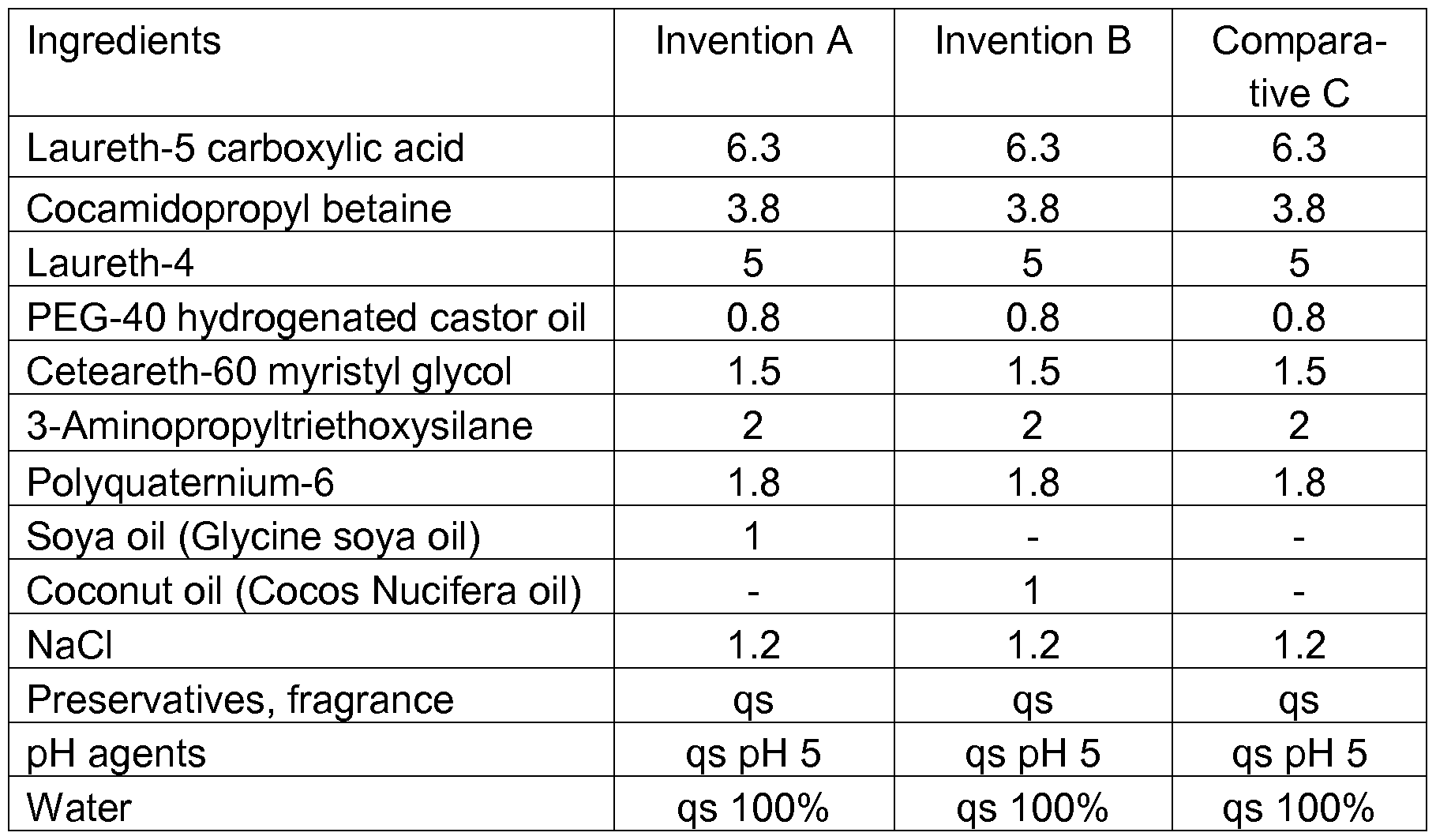
Compositions which can be used as a pre-shampoo are obtained. Example 2:
In preparation, locks of frizzy hair (type IV) weighing 2.7 g are washed with a commercial DOP shampoo in a proportion of 0.4 g of shampoo per gram of hair, and are rinsed with water. Lock A:
- 1 g of composition A is applied to a lock of wet hair,
- it is left on for 2 minutes and then rinsed off with water (35°C, flow rate 300 l/h), passing the lock between the fingers 15 times,
- the lock is then washed with a DOP shampoo, in a proportion of 0.4 g of shampoo per gram of hair,
- and rinsed with water (35°C, flow rate 300 l/h), passing the lock between the fingers 15 times.
Lock B: treatment identical to lock A, but replacing composition A with composition B.
Lock C: treatment identical to lock A, but replacing composition A with composition C.
Lock D (control):
- the lock is washed with a DOP shampoo, in a proportion of 0.4 g of shampoo per gram of hair,
- and rinsed with water (35°C, flow rate 300 l/h), passing the lock between the fingers 15 times.
Lock E (prior art):
- the lock is washed with a DOP shampoo, in a proportion of 0.4 g of shampoo per gram of hair,
- it is rinsed with water (35°C, flow rate 300 l/h), passing the lock between the fingers 15 times.
- 1 g of a conventional conditioner (Colorvive-Elseve) is applied to the lock of wet hair,
- it is left on for 2 minutes and then rinsed off with water (35°C, flow rate 300 l/h), passing the lock between the fingers 15 times.
The locks are then left to dry in a controlled-humidity box at 80% RH, at ambient temperature (25°C) for 24 hours.
An expert then visually evaluates the curl definition in the following way:
very poor curl definition
"-": poor curl definition
"+": good curl definition
"+ +": very good curl definition
The following results are obtained:

Locks A and B, treated respectively with compositions A and B according to the invention, exhibit a better curl definition, and therefore a better resistance to humidity, compared with the other locks.
Furthermore, locks A and B also have a non-greasy feel, with no transfer, contrary to lock C treated with composition C not comprising oil.
Compositions A and B according to the invention result in an anti-frizz effect, con- trary to the other compositions.
Claims
1 . Cosmetic composition comprising:
- one or more organosilanes,
- one or more polymers chosen from cationic polymers and amphoteric polymers, and mixtures thereof,
- one or more liquid fatty substances,
- one or more anionic surfactants chosen from polyoxyalkylenated alkyl(amido)ether carboxylic acids and/or salts thereof, in particular those comprising from 2 to 50 alkylene oxide and in particular ethylene oxide groups,
- one or more non-ionic surfactants, and
- one or more amphoteric surfactants. 2. Composition according to Claim 1 , in which the organosilane(s) are chosen from the compounds of formula (I) and/or hydrolysis products thereof and/or oligomers thereof:
RiSi(OR2)z(R3)x(OH)y (I)
in which:
- Ri is a cyclic or acyclic, linear or branched, saturated or unsaturated Ci to C22, in particular C2 to C20, hydrocarbon-based chain, which may be substituted with one or more group(s) chosen from amine groups NH2 or NHR, R being a linear or branched Ci to C20, in particular Ci to C6, alkyl, or a C3 to C4o cycloalkyl or a C6 to C30 aromatic radical; the hydroxyl group; a thiol group; an aryl group, more particu- larly benzyl, which is unsubstituted or substituted with an NH2 or NHR group; it being possible for Ri to be interrupted with an oxygen, sulfur or nitrogen heteroatom or a carbonyl group;
- R2 and R3, which may be identical or different, represent a linear or branched alkyl group comprising from 1 to 6 carbon atoms,
- y denotes an integer ranging from 0 to 3,
- z denotes an integer ranging from 0 to 3, and
- x denotes an integer ranging from 0 to 2,
- with z + x + y = 3.
preferably chosen from the compounds of formula (I) in which Ri is a linear or branched, saturated or unsaturated Ci to C22 hydrocarbon-based chain, substituted with one or more amine groups NH2 or NHR, R being a linear or branched Ci to C20 and especially Ci to C6 alkyl, or a C3 to C4o cycloalkyl or a C6 to C30 aromatic ring, and preferably Ri represents a Ci to C6 and preferentially C2 to C4 aminoalkyl group. 3. Composition according to either one of the preceding claims, characterized in that the organosilanes are chosen from octyltriethoxysilane, dodecyltriethoxysilane, oc- tadecyltriethoxysilane, hexadecyltriethoxysilane, 3-aminopropyltriethoxysilane, 2- aminoethyltriethoxysilane, 3-aminopropylmethyldiethoxysilane, N-(2-aminoethyl)-3-
aminopropyltriethoxysilane, 3-(m-aminophenoxy)propyltrimethoxysilane, p-amino- phenyltrimethoxysilane, N-(2-aminoethylaminomethyl)phenethyltrimethoxysilane, hydrolysis products thereof, oligomers thereof and mixtures thereof; preferably the organosilanes are chosen from octyltriethoxysilane and 3-aminopropyltriethox- ysilane, hydrolysis products thereof, oligomers thereof and mixtures thereof, and more preferentially the organosilane is 3-aminopropyltriethoxysilane (APTES).
4. Composition according to any one of the preceding claims, comprising the orga- nosilane(s) in a content of from 0.1 % to 15% by weight, preferably from 0.5% to 10% by weight and preferentially from 1 % to 8% by weight, relative to the total weight of the composition.
5. Composition according to any one of the preceding claims, in which the cationic polymer(s) are chosen from:
(1 ) Homopolymers or copolymers derived from acrylic or methacrylic esters or amides and comprising at least one of the units of following formulae:

in which:
R3, which may be identical or different, denote a hydrogen atom or a CH3 radical; A, which may be identical or different, represent a linear or branched alkyl group of 1 to 6 carbon atoms, preferably 2 or 3 carbon atoms, or a hydroxyalkyl group of 1 to 4 carbon atoms;
R4, R5 and R6, which may be identical or different, represent an alkyl group contain- ing from 1 to 18 carbon atoms or a benzyl radical and preferably an alkyl group containing from 1 to 6 carbon atoms;
Ri and R2, which may be identical or different, represent a hydrogen atom or an alkyl group containing from 1 to 6 carbon atoms, and preferably a methyl or ethyl radical;
X denotes an anion derived from a mineral or organic acid, such as a methosulfate anion or a halide such as chloride or bromide.
(2) Cellulose ether derivatives comprising quaternary ammonium groups.
(3) Cellulose copolymers or cellulose derivatives grafted with a water-soluble monomer of quaternary ammonium, such as hydroxyalkylcelluloses, for instance hy- droxymethyl-, hydroxyethyl- or hydroxypropyl celluloses grafted, in particular, with a
methacryloylethyltrimethylammonium, methacrylamidopropyltrimethylammonium or dimethyldiallylammonium salt.
(4) Cationic guar gums, such as guar gums containing cationic trialkylammonium groups, in particular quar gums modified with a 2,3-epoxypropyltrimethylammonium salt (for example chloride).
(5) Polymers constituted of piperazinyl units and divalent alkylene or hydroxy- alkylene radicals containing straight or branched chains, optionally interrupted with oxygen, sulfur or nitrogen atoms or with aromatic or heterocyclic rings, and also the oxidation and/or quaternization products of these polymers.
(6) Water-soluble polyaminoamides prepared in particular by polycondensation of an acidic compound with a polyamine; these polyaminoamides can be crosslinked with an epihalohydrin, a diepoxide, a dianhydride, an unsaturated dianhydride, a bis-unsaturated derivative, a bis-halohydrin, a bis-azetidinium, a bis-haloacyldia- mine, a bis-alkyl halide or alternatively with an oligomer resulting from the reaction of a difunctional compound which is reactive with a bis-halohydrin, a bis-azetidinium, a bis-haloacyldiamine, a bis-alkyl halide, an epihalohydrin, a diepoxide or a bis-un- saturated derivative; the crosslinking agent being used in proportions ranging from 0.025 to 0.35 mol per amine group of the polyaminoamide; these polyaminoamides can be alkylated or, if they contain one or more tertiary amine functions, they can be quaternized.
(7) Polyaminoamide derivatives resulting from the condensation of polyalkylene pol- yamines with polycarboxylic acids followed by alkylation with difunctional agents; such as adipic acid-dialkylaminohydroxyalkyldialkylenetriamine copolymers in which the alkyl radical comprises from 1 to 4 carbon atoms and preferably denotes methyl, ethyl and propyl radicals.
(8) Polymers obtained by reaction of a polyalkylene polyamine containing two primary amine groups and at least one secondary amine group with a dicarboxylic acid chosen from diglycolic acid and saturated aliphatic dicarboxylic acids having from 3 to 8 carbon atoms, the mole ratio between the polyalkylene polyamine and the di- carboxylic acid being between 0.8:1 and 1 .4:1 and the resulting polyaminoamide being reacted with epichlorohydrin in a mole ratio of epichlorohydrin relative to the secondary amine group of the polyaminoamide of between 0.5:1 and 1 .8:1 .
(9) Cyclopolymers of alkyldiallylamine or of dialkyldiallylammonium, such as homo- polymers or copolymers comprising, as main constituent of the chain, units of one or other of the following formulae:

in which :
k and t are equal to 0 or 1 , the sum k + t being equal to 1 ;
R9 denotes a hydrogen atom or a methyl radical ;
R7 and Re, independently of one another, denote an alkyl group containing from 1 to 6 carbon atoms, a hydroxyalkyi group in which the alkyl group preferably contains 1 to 5 carbon atoms, a (Ci-C4) lower amidoalkyl group, or R7 and Rs may denote, together with the nitrogen atom to which they are attached, heterocyclic groups such as piperidyl or morpholinyl; R7 and Rs, independently of one another, preferably de- note an alkyl group containing from 1 to 4 carbon atoms;
Y" is an anion such as bromide, chloride, acetate, borate, citrate, tartrate, bisulfate, bisulfite, sulfate, phosphate;
more particularly, homopolymers of dimethyldiallylammonium chloride and copolymers of diallyldimethylammonium chloride and of acrylamide.
(10) Quaternary diammonium polymers containing repeating units corresponding to the formula below:
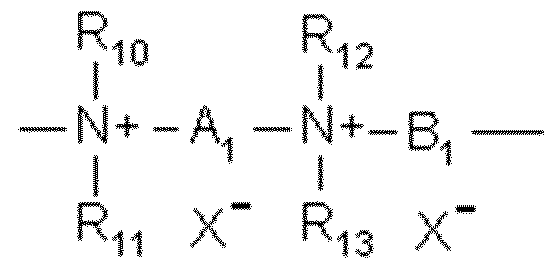
in which :
R10, R11 , R12 and Ri3, which may be identical or different, represent aliphatic, alicy- cl ic or arylal iphatic radicals containing from 1 to 6 carbon atoms or lower hydroxy- alkylaliphatic radicals, or alternatively R10, R11 , R12 and R13, together or separately, constitute, with the nitrogen atoms to which they are attached, heterocycles option- ally containing a second heteroatom other than nitrogen, or alternatively R10, R11 , R12 and Ri3 represent a linear or branched C1-C6 alkyl radical substituted with a nitrile, ester, acyl or amide group or a group -CO-O-Ri4-D or -CO-NH-Ri4-D where Ri4 is an alkylene and D is a quaternary ammonium group;
Ai and Bi represent polymethylene groups containing from 2 to 8 carbon atoms which may be linear or branched, and saturated or unsaturated, and which may contain, linked to or inserted in the main chain, one or more aromatic rings, or one or more oxygen or sulfur atoms or sulfoxide, sulfone, d isulfide, amino, alkylamino, hydroxyl, quaternary ammonium, ureido, amide or ester groups, and
X" denotes an anion derived from an inorganic or organic acid;
Ai , Rio and R12 can form, with the two nitrogen atoms to which they are attached, a piperazine ring;
in addition, if Ai denotes a linear or branched, saturated or unsaturated alkylene or hydroxyalkylene radical, Bi may also denote a group
-(CH2)n-CO-D-OC-(CH2)n- in which D denotes:
a) a glycol residue of formula: -O-Z-O-, where Z denotes a linear or branched hydrocarbon-based radical or a group corresponding to one of the following formulae:
-(CH2-CH2-O)x-CH2-CH2- -[CH2-CH(CH3)-O]y-CH2-CH(CH3)- where x and y denote an integer from 1 to 4 representing a defined and unique degree of polymerization or any number from 1 to 4 representing an average degree of polymerization;
b) a bis-secondary diamine residue, such as a piperazine derivative;
c) a bis-primary diamine residue of formula: -NH-Y-NH-, where Y denotes a linear or branched hydrocarbon-based radical, or else the divalent radical
-CH2-CH2-S-S-CH2-CH2-;
d) a ureylene group of formula: -NH-CO-NH-.
(1 1 ) Polyquaternary ammoniums constituted of repeating units of formula (X):
CH, x X CH,
(CH2) -NH-CO-D-NH - (CH2)n - N - (CH2)2 - O— (CH2
■2'P ,
CH, CH,
(X) in which p denotes an integer ranging from 1 to 6 approximately, D may be zero or may represent a group (Ch V-CO- in which r denotes a number equal to 4 or 7, and X" is an anion.
(12) Quaternary polymers of vinylpyrrolidone and of vinylimidazole which may also comprise other monomers, such as diallyldialkylammonium halides. (13) Cationic polyamines, oxyethylenated (15 OE) coconut polyamines.
(14) Polyalkyleneimines, in particular polyethyleneimines, polymers containing vi- nylpyridine or vinylpyridinium units, condensates of polyamines and of epichlorohy- drin, quaternary polyureylenes and chitin derivatives, preferably chosen from crossl inked polymers of methacryloyloxy(Ci-C4)alkyl tri(Ci- C4)alkylammonium salts, and alkyldiallylamine or dialkyldiallylammonium cyclopol- ymers, and even more preferentially from homopolymers of dimethyldiallylammo- nium chloride, copolymers of diallyldimethylammonium chloride and of acrylamide,
and homopolymers of 2-methacryloyloxyethylthmethylammonium chloride.
6. Connposition according to any one of the preceding claims, comprising one or more cationic polymers having a cationic charge density greater than or equal to 3 milliequivalents/gram (meq/g), preferably greater than or equal to 4 meq/g, better still greater than or equal to 5 meq/g, for example ranging from 3 to 20 meq/g, in particular from 4 to 20 meq/g, or even from 5 to 18 meq/g.
7. Composition according to any one of the preceding claims, comprising one or more amphoteric polymers chosen from:
- amphoteric polymers comprising the repetition of:
(i) one or more units derived from a (meth)acrylamide-type monomer,
(ii) one or more units derived from a monomer of (meth)acrylamidoalkyltrial- kylammonium type, and
(iii) one or more units derived from a (meth)acrylic acid-type acid monomer;
the units derived from a (meth)acrylamide-type monomer preferably being units of structure (la) below:

in which Ri denotes H or Chb and R2 is chosen from an amino, dimethylamino, tert- butylamino, dodecylamino and -NH-CH2OH radical; and/or
the units derived from a monomer of (meth)acrylamidoalkyltrialkylammonium type preferably being units of structure (I la) below:

in which:
- R3 denotes H or CH3,
- R4 denotes a group (Ch jk, with k being an integer ranging from 1 to 6 and preferably from 2 to 4;
- R5, R6 and R7, which may be identical or different, denote a Ci-C4 alkyl,
- Y" is an anion such as bromide, chloride, acetate, borate, citrate, tartrate, bisulfate, bisulfite, sulfate, phosphate; and/or
the units derived from a monomer of (meth)acrylic acid type preferably being units
of formula (Ilia):

in which Rs denotes H or CH3 and R9 denotes a hydroxyl radical or an -NH-C(CH3)2- CH2-SO3H radical.
- copolymers based on (meth)acrylic acid and on a dialkyldiallylammonium salt, such as copolymers of (meth)acrylic acid and of dimethyldiallylammonium chloride. 8. Composition according to any one of the preceding claims, comprising:
- the cationic polymer(s) in a content ranging from 0.01 % to 15% by weight, preferably from 0.05% to 10% by weight, and preferentially from 0.1 % 5% by weight, relative to the total weight of the composition; and/or
- the amphoteric polymer(s) in an amount of between 0.01 % and 15% by weight, in particular from 0.05% to 10% by weight and preferentially from 0.1 % to 5% by weight, relative to the total weight of the composition.
- the polymer(s) chosen from the cationic polymers and the amphoteric polymers in an amount of between 0.01 % and 15% by weight, in particular from 0.05% to 10% by weight and preferentially from 0.1 % to 7% by weight, relative to the total weight of the composition.
9. Composition according to any one of the preceding claims, in which the liquid fatty substances are chosen from fatty alcohols, fatty esters, hydrocarbons, oils of animal origin, plant oils, in particular of triglyceride type, synthetic triglycerides, and mixtures thereof; preferably chosen, alone or as a mixture, from (i) hydrocarbons, in particular linear or branched hydrocarbons, having more than 16 carbon atoms, such as liquid petroleum jelly, and (ii) triglyceride oils of plant origin, such as coconut oil and/or soya oil . 10. Composition according to any one of the preceding claims, comprising the liquid fatty substance(s) in a total amount of between 0.1 % and 15% by weight, in particular between 0.2% 10% by weight, even better still between 0.3% and 8% by weight, or even between 0.4% and 5% by weight, preferentially between 0.5% and 2.5% by weight, relative to the total weight of the composition.
1 1 . Composition according to one of the preceding claims, in which the anionic surfactants) are chosen from polyoxyalkylenated alkyl(amido)ether carboxylic acids and/or salts thereof, corresponding to formula (1 ):
R1 -(OC2H4)— OCH2COOA (1 )
in which:
- Ri represents a linear or branched C6-C24 alkyl or alkenyl radical, an alkyl(Cs- Cg)phenyl radical, a radical R2CONH-CH2-CH2- with R2 denoting a linear or branched C9-C21 alkyl or alkenyl radical,
preferably, Ri is a C8-C20 and preferably Cs-Cis alkyl radical, and aryl preferably denotes phenyl,
- n is an integer or decimal number (average value) ranging from 2 to 24 and preferably from 2 to 10,
- A denotes H, ammonium, Na, K, Li, Mg, Ca or a monoethanolamine or triethano- lamine residue;
preferably in which Ri denotes a C12-C14 alkyl, cocoyl, oleyl, nonylphenyl or oc- tylphenyl radical, A denotes a hydrogen or sodium atom and n ranges from 2 to 20, preferably 2 to 10;
preferentially in which R denotes a C12 alkyl radical, A denotes a hydrogen or sodium atom and n ranges from 2 to 10.
12. Composition according to one of the preceding claims, comprising the anionic surfactants chosen from polyoxyalkylenated alkyl(amido)ether carboxylic acid(s) and/or salts thereof in an amount ranging from 0.1 % to 30% by weight, preferably from 0.5% to 20% by weight, better still from 1 % to 15% by weight and preferentially from 2% to 10% by weight, relative to the total weight of the composition.
13. Composition according to one of the preceding claims, also comprising one or more additional anionic surfactants different from polyoxyalylenated alkyl(am- ido)ether carboxylic acids and salts thereof; in particular chosen from, alone or as a mixture,
- C6-C24 and especially C12-C20 alkyl sulfates;
- C6-C24 and especially C12-C20 alkyl ether sulfates; preferably comprising from 2 to 20 ethylene oxide units;
- C6-C24 and especially C12-C20 alkylsulfosuccinates, especially laurylsulfosuccin- ates;
- C6-C24 and especially C12-C20 alkyl ether sulfosuccinates;
- (C6-C24)acylisethionates and preferably (Ci2-Ci8)acylisethionates;
- C6-C24 and in particular C12-C20 acylsarcosinates; in particular palmitoylsar- cosinates;
- C6-C24 and especially C12-C20 acylglutamates;
- C6-C24 and especially C12-C20 acylglycinates;
in particular in the form of alkali metal or alkaline-earth metal, ammonium or amino alcohol salts; in particular in a content ranging from 0.05% to 30% by weight, preferably ranging from 0.1 % to 25%, better still from 0.5% to 20% by weight, even better still from 1 % to 15% by weight, relative to the total weight of the composition.
14. Connposition according to one of the preceding claims, in which the amphoteric surfactants are chosen from, alone or as a mixture:
- (C8-C2o)alkylbetaines, (C8-C2o)alkylsulfobetaines, (C8-C2o)alkylamido(C3-C8)al- kylbetaines and (C8-C2o)alkylamido(C6-C8)alkylsulfobetaines;
- optionally quaternized secondary or tertiary aliphatic amine derivatives having the respective structures (II) and ( III) below: Ra-CONHCH2CH2-N+(Rb)(Rc)-CH2COO-, M+ , X" (II)
in which:
- Ra represents a Cio to C30 alkyl or alkenyl group derived from an acid RaCOOH preferably present in hydrolyzed coconut oil, or a heptyl, nonyl or undecyl group;
- Rb represents a β-hydroxyethyl group; and
- Rc represents a carboxymethyl group;
- M+ represents a cationic counterion derived from an alkali metal or alkaline-earth metal, such as sodium, an ammonium ion or an ion derived from an organic amine, and
- X" represents an organic or mineral anionic counterion, such as that chosen from halides, acetates, phosphates, nitrates, (Ci-C4)alkyl sulfates, (Ci-C4)alkyl- or (Ci-
C4)alkylarylsulfonates, in particular methyl sulfate and ethyl sulfate; or alternatively M+ and X" are absent;
Ra'-CONHCH2CH2-N(B)(B') (III)
in which:
- B represents the group -CH2CH2OX';
- B' represents the group
 with z = 1 or 2;
- X' represents the group -CH2COOH, -CH2-COOZ', -CH2CH2COOH or CH2CH2- COOZ', or a hydrogen atom;
- Y' represents the group -COOH, -COOZ' or -CH2-CH(OH)SO3H or the group CH2CH(OH)SO3-Z';
- Z' represents a cationic counterion derived from an alkali metal or alkaline-earth metal, such as sodium, an ammonium ion or an ion derived from an organic amine;
- Ra' represents a C10 to C30 alkyl or alkenyl group of an acid Ra-COOH which is preferably present in coconut oil or in hydrolyzed linseed oil, or an alkyl group, especially a Ci 7 group, and its iso form, or an unsaturated C17 group;
Ra »-N HCH (Y")-(CH2)nCON H(CH2)n-N(Rd)(Re) (IV)
in which:
- Y" represents the group -COOH, -COOZ", CH2CH(OH)SO3H or the group CH2CH(OH)SO3-Z";
Rd and Re, independently of one another, represent a Ci to C4 alkyl or hy- droxyalkyl radical;
- Z" represents a cationic counterion derived from an alkali metal or alkaline-earth metal, such as sodium, an ammonium ion or an ion derived from an organic amine;
- Ra- represents a C10 to C30 alkyl or alkenyl group of an acid Ra-COOH which is preferably present in coconut oil or in hydrolyzed linseed oil;
- n and n' denote, independently of one another, an integer ranging from 1 to 3; preferably chosen from (C8-C2o)alkylbetaines such as cocobetaine, (Cs-C2o)alkyl- amido(C3-C8)alkylbetaines such as cocamidopropylbetaine, and mixtures thereof, and the compounds of formula (IV) such as the sodium salt of diethylaminopropyl laurylaminosuccinamate; preferentially from (C8-C2o)alkylamido(C3-C8)alkylbetaines such as cocamidipropylbetaine.
15. Composition according to one of the preceding claims, comprising the amphoteric surfactant(s) in a total content ranging from 0.1 % to 20% by weight, preferen- tially in a content ranging from 1 % to 15% by weight and better still from 2% to 10% by weight relative to the total weight of the composition.
16. Composition according to one of the preceding claims, in which the non-ionic surfactants are chosen, alone or as a mixture, from:
- saturated or unsaturated, linear or branched, oxyethylenated Cs to C4o alcohols comprising from 1 to 100 mol of ethylene oxide, preferably from 2 to 50 and more particularly from 2 to 40 mol of ethylene oxide and preferably comprising one or two fatty chains;
- saturated or unsaturated oxyethylenated plant oils comprising from 1 to 100 and preferably from 2 to 50 mol of ethylene oxide;
- (C8-C3o)alkyl(poly)glucosides, which are optionally oxyalkylenated, preferably with 0 to 10 mol of ethylene oxide and comprising 1 to 15 glucose units;
- monoglycerolated or polyglycerolated Cs to C4o alcohols, comprising from 1 to 50 mol of glycerol and preferably from 1 to 10 mol of glycerol;
- saturated or unsaturated, linear or branched, oxyalkylenated Cs to C30 fatty acid amides;
- esters of saturated or unsaturated, linear or branched, Cs to C30 acids and of polyethylene glycols;
- preferably oxyethylenated esters of saturated or unsaturated, linear or branched, Cs to C30 acids and of sorbitol; preferably chosen from:
- saturated or unsaturated, linear or branched, oxyethylenated Cs to C4o alcohols comprising from 1 to 100 mol of ethylene oxide, preferably from 2 to 50 and more particularly from 2 to 40 mol of ethylene oxide and comprising one or two fatty chains, in particular at least one C8-C20, in particular C10-C18, alkyl chain.
- preferably oxyethylenated, esters of saturated or unsaturated, linear or branched, Cs to C30 acids and of sorbitol; and
- (C8-C3o)alkyl(poly)glucosides, which are optionally oxyalkylenated, preferably comprising from 0 to 10 mol of ethylene oxide and comprising 1 to 15 glucose units.
17. Composition according to one of the preceding claims, comprising the non-ionic surfactant(s) in a content ranging from 0.1 % to 20% by weight, preferably from 1 % to 15% by weight, preferentially from 2% to 12% by weight and better still from 4% to 10% by weight, relative to the total weight of the composition.
18. Composition according to one of the preceding claims, comprising the anionic, amphoteric and non-ionic surfactant(s) in a total content ranging from 5% to 40% by weight, preferably from 10% to 30% by weight, preferentially from 12% to 25% by weight, relative to the total weight of the composition.
19. Composition according to one of the preceding claims, in which the weight ratio of the total amount of anionic surfactants to the total amount of non-ionic surfactants is less than or equal to 5; preferably, ranges from 0.1 to 5, more preferentially ranges from 0.2 to 4.5, even more preferentially ranges from 0.3 to 4, better still ranges from 0.35 to 3, and even better still from 0.4 to 2.5.
20. Composition according to one of the preceding claims, comprising water in a total water content of between 40% and 95% by weight, preferably between 50% and 90%, preferentially between 60% and 85% by weight, relative to the total weight of the composition.
21 . Process for the cosmetic treatment of keratin fibres, in particular human keratin fibres such as the hair, in particular dry or wet keratin fibres, preferably wet keratin fibres, using the composition according to one of the preceding claims.
22. Process according to Claim 21 , consisting in particular:
- in applying said composition to dry or wet keratin fibres, preferably wet keratin fibres, after a step of washing said fibres, for example with a shampoo; or
- in applying said composition to dry or wet keratin fibres, preferably wet keratin fibres, prior to a step of washing said fibres, for example with a shampoo; or
- in applying said composition to wet or dry keratin fibres, preferably wet keratin fibres.
23. Use of the composition as defined in any one of Claims 1 to 20, for the cosmetic treatment of keratin fibres, in particular human keratin fibres such as the hair, in particular for conferring conditioning properties on said fibres, said conditioning properties advantageously being persistent with respect to several shampooing operations; in particular curl definition and/or feel properties, in particular properties giving a soft, natural, non-laden and non-greasy feel
Applications Claiming Priority (2)
| Application Number | Priority Date | Filing Date | Title |
|---|---|---|---|
| FR1756090 | 2017-06-30 | ||
| FR1756090A FR3068250B1 (en) | 2017-06-30 | 2017-06-30 | COSMETIC COMPOSITION COMPRISING ORGANOSILANES, CATIONIC POLYMERS, LIQUID FATTY BODIES, PARTICULAR ANIONIC SURFACTANTS, AND NONIONIC AND AMPHOTERIAL SURFACTANTS, METHOD OF COSMETIC TREATMENT AND USE |
Publications (1)
| Publication Number | Publication Date |
|---|---|
| WO2019002149A1 true WO2019002149A1 (en) | 2019-01-03 |
Family
ID=59974568
Family Applications (1)
| Application Number | Title | Priority Date | Filing Date |
|---|---|---|---|
| PCT/EP2018/066821 Ceased WO2019002149A1 (en) | 2017-06-30 | 2018-06-22 | Cosmetic composition comprising organosilanes, cationic polymers, liquid fatty substances, particular anionic surfactants, and non-ionic and amphoteric surfactants, cosmetic treatment process and use |
Country Status (2)
| Country | Link |
|---|---|
| FR (1) | FR3068250B1 (en) |
| WO (1) | WO2019002149A1 (en) |
Cited By (2)
| Publication number | Priority date | Publication date | Assignee | Title |
|---|---|---|---|---|
| WO2020089359A1 (en) * | 2018-10-31 | 2020-05-07 | Henkel Ag & Co. Kgaa | Surfactant-containing cosmetic product combined with bis(triethoxysilylpropyl) amine, for cleaning and care of human hair |
| WO2021110625A1 (en) * | 2019-12-06 | 2021-06-10 | L'oreal | Hair treatment process comprising the application of a composition comprising cationic polymers and organosilanes, followed by a washing step |
Families Citing this family (1)
| Publication number | Priority date | Publication date | Assignee | Title |
|---|---|---|---|---|
| FR3104967B1 (en) * | 2019-12-18 | 2022-08-05 | Oreal | Hair treatment process |
Citations (20)
| Publication number | Priority date | Publication date | Assignee | Title |
|---|---|---|---|---|
| US2961347A (en) | 1957-11-13 | 1960-11-22 | Hercules Powder Co Ltd | Process for preventing shrinkage and felting of wool |
| US3227615A (en) | 1962-05-29 | 1966-01-04 | Hercules Powder Co Ltd | Process and composition for the permanent waving of hair |
| FR1492597A (en) | 1965-09-14 | 1967-08-18 | Union Carbide Corp | New cellulose ethers containing quaternary nitrogen |
| FR1583363A (en) | 1967-09-28 | 1969-10-24 | ||
| US3589578A (en) | 1968-01-20 | 1971-06-29 | Monforts Fa A | Tension-relieving device for stretchable sheet material |
| FR2077143A5 (en) | 1970-01-30 | 1971-10-15 | Gaf Corp | |
| FR2080759A1 (en) | 1970-02-25 | 1971-11-19 | Gillette Co | |
| FR2162025A1 (en) | 1971-11-29 | 1973-07-13 | Oreal | |
| FR2190406A2 (en) | 1972-06-29 | 1974-02-01 | Gillette Co | |
| FR2252840A1 (en) | 1973-11-30 | 1975-06-27 | Oreal | |
| FR2280361A2 (en) | 1974-08-02 | 1976-02-27 | Oreal | HAIR TREATMENT AND CONDITIONING COMPOSITIONS |
| US4031307A (en) | 1976-05-03 | 1977-06-21 | Celanese Corporation | Cationic polygalactomannan compositions |
| FR2368508A2 (en) | 1977-03-02 | 1978-05-19 | Oreal | HAIR CONDITIONING COMPOSITION |
| US4131576A (en) | 1977-12-15 | 1978-12-26 | National Starch And Chemical Corporation | Process for the preparation of graft copolymers of a water soluble monomer and polysaccharide employing a two-phase reaction system |
| FR2393573A1 (en) | 1977-06-10 | 1979-01-05 | Gaf Corp | HAIR PREPARATIONS CONTAINING A VINYLPYRROLIDONE COPOLYMER |
| EP0080976A1 (en) | 1981-11-30 | 1983-06-08 | Ciba-Geigy Ag | Mixtures of quaternary polymeric acrylic ammonium salts, quaternary mono- or oligomeric ammonium salts and surfactants, their preparation and their use in cosmetic compositions |
| FR2976800A1 (en) * | 2011-06-23 | 2012-12-28 | Oreal | COSMETIC COMPOSITION COMPRISING AT LEAST ONE ORGANIC COMPOUND OF THE SILICON AND AT LEAST ONE PARTICULAR AMPHOTERIC POLYMER |
| FR3029110A1 (en) * | 2014-11-27 | 2016-06-03 | Oreal | COSMETIC COMPOSITION COMPRISING AN ORGANOSILANE, A CATIONIC SURFACTANT AND A CATIONIC POLYMER HAVING A CHARGE DENSITY OF MORE THAN 4 MEQ / G |
| FR3040300A1 (en) | 2015-09-01 | 2017-03-03 | Oreal | COMPOSITION COMPRISING AT LEAST ONE ANIONIC SURFACTANT, AT LEAST ONE NON-IONIC SURFACTANT, AT LEAST ONE AMPHOTERIC SURFACTANT, AT LEAST ONE CATIONIC POLYMER AND AT LEAST ONE AMPHOTERIC POLYMER |
| FR3040302A1 (en) | 2015-09-01 | 2017-03-03 | Oreal | COMPOSITION COMPRISING AT LEAST ONE ANIONIC SURFACTANT, AT LEAST ONE NON-IONIC SURFACTANT, AT LEAST ONE AMPHOTERIC SURFACTANT AND AT LEAST TWO PARTICULATE CATIONIC POLYMERS |
-
2017
- 2017-06-30 FR FR1756090A patent/FR3068250B1/en active Active
-
2018
- 2018-06-22 WO PCT/EP2018/066821 patent/WO2019002149A1/en not_active Ceased
Patent Citations (20)
| Publication number | Priority date | Publication date | Assignee | Title |
|---|---|---|---|---|
| US2961347A (en) | 1957-11-13 | 1960-11-22 | Hercules Powder Co Ltd | Process for preventing shrinkage and felting of wool |
| US3227615A (en) | 1962-05-29 | 1966-01-04 | Hercules Powder Co Ltd | Process and composition for the permanent waving of hair |
| FR1492597A (en) | 1965-09-14 | 1967-08-18 | Union Carbide Corp | New cellulose ethers containing quaternary nitrogen |
| FR1583363A (en) | 1967-09-28 | 1969-10-24 | ||
| US3589578A (en) | 1968-01-20 | 1971-06-29 | Monforts Fa A | Tension-relieving device for stretchable sheet material |
| FR2077143A5 (en) | 1970-01-30 | 1971-10-15 | Gaf Corp | |
| FR2080759A1 (en) | 1970-02-25 | 1971-11-19 | Gillette Co | |
| FR2162025A1 (en) | 1971-11-29 | 1973-07-13 | Oreal | |
| FR2190406A2 (en) | 1972-06-29 | 1974-02-01 | Gillette Co | |
| FR2252840A1 (en) | 1973-11-30 | 1975-06-27 | Oreal | |
| FR2280361A2 (en) | 1974-08-02 | 1976-02-27 | Oreal | HAIR TREATMENT AND CONDITIONING COMPOSITIONS |
| US4031307A (en) | 1976-05-03 | 1977-06-21 | Celanese Corporation | Cationic polygalactomannan compositions |
| FR2368508A2 (en) | 1977-03-02 | 1978-05-19 | Oreal | HAIR CONDITIONING COMPOSITION |
| FR2393573A1 (en) | 1977-06-10 | 1979-01-05 | Gaf Corp | HAIR PREPARATIONS CONTAINING A VINYLPYRROLIDONE COPOLYMER |
| US4131576A (en) | 1977-12-15 | 1978-12-26 | National Starch And Chemical Corporation | Process for the preparation of graft copolymers of a water soluble monomer and polysaccharide employing a two-phase reaction system |
| EP0080976A1 (en) | 1981-11-30 | 1983-06-08 | Ciba-Geigy Ag | Mixtures of quaternary polymeric acrylic ammonium salts, quaternary mono- or oligomeric ammonium salts and surfactants, their preparation and their use in cosmetic compositions |
| FR2976800A1 (en) * | 2011-06-23 | 2012-12-28 | Oreal | COSMETIC COMPOSITION COMPRISING AT LEAST ONE ORGANIC COMPOUND OF THE SILICON AND AT LEAST ONE PARTICULAR AMPHOTERIC POLYMER |
| FR3029110A1 (en) * | 2014-11-27 | 2016-06-03 | Oreal | COSMETIC COMPOSITION COMPRISING AN ORGANOSILANE, A CATIONIC SURFACTANT AND A CATIONIC POLYMER HAVING A CHARGE DENSITY OF MORE THAN 4 MEQ / G |
| FR3040300A1 (en) | 2015-09-01 | 2017-03-03 | Oreal | COMPOSITION COMPRISING AT LEAST ONE ANIONIC SURFACTANT, AT LEAST ONE NON-IONIC SURFACTANT, AT LEAST ONE AMPHOTERIC SURFACTANT, AT LEAST ONE CATIONIC POLYMER AND AT LEAST ONE AMPHOTERIC POLYMER |
| FR3040302A1 (en) | 2015-09-01 | 2017-03-03 | Oreal | COMPOSITION COMPRISING AT LEAST ONE ANIONIC SURFACTANT, AT LEAST ONE NON-IONIC SURFACTANT, AT LEAST ONE AMPHOTERIC SURFACTANT AND AT LEAST TWO PARTICULATE CATIONIC POLYMERS |
Non-Patent Citations (4)
| Title |
|---|
| "Shampoo", GNPD, MINTEL, 27 April 2017 (2017-04-27), XP002769658 * |
| KAO: "John Frieda Sheer", GNPD, MINTEL, 2 September 2013 (2013-09-02), XP002774208 * |
| M.R. PORTER: "Handbook of Surfactants", 1991, BLACKIE & SON, pages: 116 - 178 |
| UNILEVER: "Dove Baby Rich Moisture", GNPD, MINTEL, 1 May 2017 (2017-05-01), XP002774207 * |
Cited By (3)
| Publication number | Priority date | Publication date | Assignee | Title |
|---|---|---|---|---|
| WO2020089359A1 (en) * | 2018-10-31 | 2020-05-07 | Henkel Ag & Co. Kgaa | Surfactant-containing cosmetic product combined with bis(triethoxysilylpropyl) amine, for cleaning and care of human hair |
| WO2021110625A1 (en) * | 2019-12-06 | 2021-06-10 | L'oreal | Hair treatment process comprising the application of a composition comprising cationic polymers and organosilanes, followed by a washing step |
| FR3104030A1 (en) * | 2019-12-06 | 2021-06-11 | L'oreal | Hair treatment process comprising the application of a cosmetic care composition comprising a cationic polymer and an organosilane, then a washing cosmetic composition |
Also Published As
| Publication number | Publication date |
|---|---|
| FR3068250A1 (en) | 2019-01-04 |
| FR3068250B1 (en) | 2019-07-19 |
Similar Documents
| Publication | Publication Date | Title |
|---|---|---|
| EP3049051B1 (en) | Cosmetic composition comprising a combination of surfactants of carboxylate, acylisethionate and alkyl(poly)glycoside type | |
| US10524999B2 (en) | Composition comprising a combination of particular alkoxysilanes and a fatty substance | |
| EP3893834B1 (en) | Straightening process for keratin fibers | |
| EP3393449B1 (en) | Non-dyeing composition comprising a cationic acrylic copolymer and a conditioning agent | |
| US20130233333A1 (en) | Process for treating keratin fibres using at least one sulfureous reducing agent, at least one cationic polymer and at least one mercaptosiloxane | |
| EP3082727B1 (en) | Non-coloring composition for reshaping or removing hair | |
| US20180064619A1 (en) | Method for cosmetic treatment of the hair | |
| EP2618801B1 (en) | Cosmetic composition comprising at least one hygroscopic salt, at least one aromatic polyol ether and at least one diol, and cosmetic treatment process | |
| EP3694478B1 (en) | Process for reshaping keratin fibres | |
| US11376204B2 (en) | Cosmetic composition comprising anionic surfactants, amphoteric surfac-tants, cationic polymers and liquid fatty substances chosen from fatty alco-hols and fatty esters, and cosmetic treatment process | |
| US11246824B2 (en) | Cosmetic composition comprising a particular combination of surfactants, a silicone, a cationic polymer, a fatty alcohol and a clay | |
| WO2018108919A1 (en) | Cosmetic composition comprising an organosilane, at least one cationic polymer and a particular combination of surfactants | |
| US20200261339A1 (en) | Cosmetic composition comprising an anionic surfactant, a solid fatty alcohol and a solid fatty ester, and cosmetic treatment process | |
| EP3049052B1 (en) | Cosmetic composition comprising a combination of anionic surfactants of carboxylate and acylisethionate type | |
| WO2019002149A1 (en) | Cosmetic composition comprising organosilanes, cationic polymers, liquid fatty substances, particular anionic surfactants, and non-ionic and amphoteric surfactants, cosmetic treatment process and use | |
| WO2014002290A1 (en) | Cosmetic composition for keratin fibers | |
| CN108430443B (en) | Cosmetic composition comprising anionic surfactant, at least 3.5% by weight of fatty acid and antidandruff agent | |
| WO2021110625A1 (en) | Hair treatment process comprising the application of a composition comprising cationic polymers and organosilanes, followed by a washing step | |
| WO2019002150A1 (en) | Cosmetic composition comprising a mixture of particular carboxylic surfactants, non-ionic and amphoteric surfactants, and cationic polymers, cosmetic treatment process and use | |
| WO2015013781A1 (en) | Composition comprising particular anionic surfactant, a particular amphoteric surfactant and a diester of polyethylene glycol, and treatment process | |
| WO2015013782A1 (en) | Composition comprising a particular anionic surfactant and a particular alkylbetaine and treatment process | |
| US11147758B2 (en) | Cosmetic composition comprising non-amino polyalkylsiloxanes, oxyethylenated polymers and fatty alcohols | |
| WO2021121859A1 (en) | Hair treatment process | |
| US20210052476A1 (en) | Composition comprising a monoester of a fatty acid and of polyglycerol, an oil, and a polyo, process and use | |
| WO2022028809A1 (en) | Cosmetic composition comprising anionic and amphoteric surfactants, a cationic polymer, at least 2% of solid fatty alcohol and a particular amino silicone; and process |
Legal Events
| Date | Code | Title | Description |
|---|---|---|---|
| 121 | Ep: the epo has been informed by wipo that ep was designated in this application |
Ref document number: 18733268 Country of ref document: EP Kind code of ref document: A1 |
|
| NENP | Non-entry into the national phase |
Ref country code: DE |
|
| 122 | Ep: pct application non-entry in european phase |
Ref document number: 18733268 Country of ref document: EP Kind code of ref document: A1 |