WO2018193983A1 - イミドオリゴマー、硬化剤、接着剤、及び、イミドオリゴマーの製造方法 - Google Patents
イミドオリゴマー、硬化剤、接着剤、及び、イミドオリゴマーの製造方法 Download PDFInfo
- Publication number
- WO2018193983A1 WO2018193983A1 PCT/JP2018/015524 JP2018015524W WO2018193983A1 WO 2018193983 A1 WO2018193983 A1 WO 2018193983A1 JP 2018015524 W JP2018015524 W JP 2018015524W WO 2018193983 A1 WO2018193983 A1 WO 2018193983A1
- Authority
- WO
- WIPO (PCT)
- Prior art keywords
- imide oligomer
- oligomer
- adhesive
- imide
- curing agent
- Prior art date
- Legal status (The legal status is an assumption and is not a legal conclusion. Google has not performed a legal analysis and makes no representation as to the accuracy of the status listed.)
- Ceased
Links
- 0 CN(BN(*)*)S Chemical compound CN(BN(*)*)S 0.000 description 1
Classifications
-
- C—CHEMISTRY; METALLURGY
- C08—ORGANIC MACROMOLECULAR COMPOUNDS; THEIR PREPARATION OR CHEMICAL WORKING-UP; COMPOSITIONS BASED THEREON
- C08G—MACROMOLECULAR COMPOUNDS OBTAINED OTHERWISE THAN BY REACTIONS ONLY INVOLVING UNSATURATED CARBON-TO-CARBON BONDS
- C08G73/00—Macromolecular compounds obtained by reactions forming a linkage containing nitrogen with or without oxygen or carbon in the main chain of the macromolecule, not provided for in groups C08G12/00 - C08G71/00
- C08G73/06—Polycondensates having nitrogen-containing heterocyclic rings in the main chain of the macromolecule
- C08G73/10—Polyimides; Polyester-imides; Polyamide-imides; Polyamide acids or similar polyimide precursors
-
- C—CHEMISTRY; METALLURGY
- C07—ORGANIC CHEMISTRY
- C07D—HETEROCYCLIC COMPOUNDS
- C07D209/00—Heterocyclic compounds containing five-membered rings, condensed with other rings, with one nitrogen atom as the only ring hetero atom
- C07D209/02—Heterocyclic compounds containing five-membered rings, condensed with other rings, with one nitrogen atom as the only ring hetero atom condensed with one carbocyclic ring
- C07D209/44—Iso-indoles; Hydrogenated iso-indoles
- C07D209/48—Iso-indoles; Hydrogenated iso-indoles with oxygen atoms in positions 1 and 3, e.g. phthalimide
-
- C—CHEMISTRY; METALLURGY
- C08—ORGANIC MACROMOLECULAR COMPOUNDS; THEIR PREPARATION OR CHEMICAL WORKING-UP; COMPOSITIONS BASED THEREON
- C08G—MACROMOLECULAR COMPOUNDS OBTAINED OTHERWISE THAN BY REACTIONS ONLY INVOLVING UNSATURATED CARBON-TO-CARBON BONDS
- C08G59/00—Polycondensates containing more than one epoxy group per molecule; Macromolecules obtained by polymerising compounds containing more than one epoxy group per molecule using curing agents or catalysts which react with the epoxy groups
- C08G59/18—Macromolecules obtained by polymerising compounds containing more than one epoxy group per molecule using curing agents or catalysts which react with the epoxy groups ; e.g. general methods of curing
- C08G59/40—Macromolecules obtained by polymerising compounds containing more than one epoxy group per molecule using curing agents or catalysts which react with the epoxy groups ; e.g. general methods of curing characterised by the curing agents used
-
- C—CHEMISTRY; METALLURGY
- C08—ORGANIC MACROMOLECULAR COMPOUNDS; THEIR PREPARATION OR CHEMICAL WORKING-UP; COMPOSITIONS BASED THEREON
- C08G—MACROMOLECULAR COMPOUNDS OBTAINED OTHERWISE THAN BY REACTIONS ONLY INVOLVING UNSATURATED CARBON-TO-CARBON BONDS
- C08G59/00—Polycondensates containing more than one epoxy group per molecule; Macromolecules obtained by polymerising compounds containing more than one epoxy group per molecule using curing agents or catalysts which react with the epoxy groups
- C08G59/18—Macromolecules obtained by polymerising compounds containing more than one epoxy group per molecule using curing agents or catalysts which react with the epoxy groups ; e.g. general methods of curing
- C08G59/40—Macromolecules obtained by polymerising compounds containing more than one epoxy group per molecule using curing agents or catalysts which react with the epoxy groups ; e.g. general methods of curing characterised by the curing agents used
- C08G59/4007—Curing agents not provided for by the groups C08G59/42 - C08G59/66
- C08G59/4014—Nitrogen containing compounds
- C08G59/4042—Imines; Imides
-
- C—CHEMISTRY; METALLURGY
- C08—ORGANIC MACROMOLECULAR COMPOUNDS; THEIR PREPARATION OR CHEMICAL WORKING-UP; COMPOSITIONS BASED THEREON
- C08G—MACROMOLECULAR COMPOUNDS OBTAINED OTHERWISE THAN BY REACTIONS ONLY INVOLVING UNSATURATED CARBON-TO-CARBON BONDS
- C08G73/00—Macromolecular compounds obtained by reactions forming a linkage containing nitrogen with or without oxygen or carbon in the main chain of the macromolecule, not provided for in groups C08G12/00 - C08G71/00
-
- C—CHEMISTRY; METALLURGY
- C08—ORGANIC MACROMOLECULAR COMPOUNDS; THEIR PREPARATION OR CHEMICAL WORKING-UP; COMPOSITIONS BASED THEREON
- C08K—Use of inorganic or non-macromolecular organic substances as compounding ingredients
- C08K5/00—Use of organic ingredients
- C08K5/16—Nitrogen-containing compounds
-
- C—CHEMISTRY; METALLURGY
- C08—ORGANIC MACROMOLECULAR COMPOUNDS; THEIR PREPARATION OR CHEMICAL WORKING-UP; COMPOSITIONS BASED THEREON
- C08L—COMPOSITIONS OF MACROMOLECULAR COMPOUNDS
- C08L79/00—Compositions of macromolecular compounds obtained by reactions forming in the main chain of the macromolecule a linkage containing nitrogen with or without oxygen or carbon only, not provided for in groups C08L61/00 - C08L77/00
- C08L79/04—Polycondensates having nitrogen-containing heterocyclic rings in the main chain; Polyhydrazides; Polyamide acids or similar polyimide precursors
- C08L79/08—Polyimides; Polyester-imides; Polyamide-imides; Polyamide acids or similar polyimide precursors
-
- C—CHEMISTRY; METALLURGY
- C09—DYES; PAINTS; POLISHES; NATURAL RESINS; ADHESIVES; COMPOSITIONS NOT OTHERWISE PROVIDED FOR; APPLICATIONS OF MATERIALS NOT OTHERWISE PROVIDED FOR
- C09J—ADHESIVES; NON-MECHANICAL ASPECTS OF ADHESIVE PROCESSES IN GENERAL; ADHESIVE PROCESSES NOT PROVIDED FOR ELSEWHERE; USE OF MATERIALS AS ADHESIVES
- C09J11/00—Features of adhesives not provided for in group C09J9/00, e.g. additives
- C09J11/08—Macromolecular additives
-
- C—CHEMISTRY; METALLURGY
- C09—DYES; PAINTS; POLISHES; NATURAL RESINS; ADHESIVES; COMPOSITIONS NOT OTHERWISE PROVIDED FOR; APPLICATIONS OF MATERIALS NOT OTHERWISE PROVIDED FOR
- C09J—ADHESIVES; NON-MECHANICAL ASPECTS OF ADHESIVE PROCESSES IN GENERAL; ADHESIVE PROCESSES NOT PROVIDED FOR ELSEWHERE; USE OF MATERIALS AS ADHESIVES
- C09J179/00—Adhesives based on macromolecular compounds obtained by reactions forming in the main chain of the macromolecule a linkage containing nitrogen, with or without oxygen, or carbon only, not provided for in groups C09J161/00 - C09J177/00
- C09J179/04—Polycondensates having nitrogen-containing heterocyclic rings in the main chain; Polyhydrazides; Polyamide acids or similar polyimide precursors
-
- C—CHEMISTRY; METALLURGY
- C09—DYES; PAINTS; POLISHES; NATURAL RESINS; ADHESIVES; COMPOSITIONS NOT OTHERWISE PROVIDED FOR; APPLICATIONS OF MATERIALS NOT OTHERWISE PROVIDED FOR
- C09J—ADHESIVES; NON-MECHANICAL ASPECTS OF ADHESIVE PROCESSES IN GENERAL; ADHESIVE PROCESSES NOT PROVIDED FOR ELSEWHERE; USE OF MATERIALS AS ADHESIVES
- C09J179/00—Adhesives based on macromolecular compounds obtained by reactions forming in the main chain of the macromolecule a linkage containing nitrogen, with or without oxygen, or carbon only, not provided for in groups C09J161/00 - C09J177/00
- C09J179/04—Polycondensates having nitrogen-containing heterocyclic rings in the main chain; Polyhydrazides; Polyamide acids or similar polyimide precursors
- C09J179/08—Polyimides; Polyester-imides; Polyamide-imides; Polyamide acids or similar polyimide precursors
-
- C—CHEMISTRY; METALLURGY
- C09—DYES; PAINTS; POLISHES; NATURAL RESINS; ADHESIVES; COMPOSITIONS NOT OTHERWISE PROVIDED FOR; APPLICATIONS OF MATERIALS NOT OTHERWISE PROVIDED FOR
- C09J—ADHESIVES; NON-MECHANICAL ASPECTS OF ADHESIVE PROCESSES IN GENERAL; ADHESIVE PROCESSES NOT PROVIDED FOR ELSEWHERE; USE OF MATERIALS AS ADHESIVES
- C09J201/00—Adhesives based on unspecified macromolecular compounds
Definitions
- the present invention relates to an imide oligomer that can be used for a cured product having excellent long-term heat resistance.
- the present invention also relates to a curing agent comprising the imide oligomer, and an adhesive using the curing agent. Furthermore, this invention relates to the manufacturing method of this imide oligomer.
- Curable resins such as epoxy resins that have low shrinkage and are excellent in adhesion, insulation, and chemical resistance are used in many industrial products.
- curable resin compositions are used that can give good results in a solder reflow test for short-term heat resistance and a thermal cycle test for repeated heat resistance.
- Patent Document 1 discloses an imide oligomer curing agent having an acid anhydride structure at both ends, but has compatibility with a curable resin such as an epoxy resin. Since it was insufficient, there was a problem that the obtained curable resin composition had poor long-term heat resistance.
- Patent Documents 2 and 3 disclose a curable resin composition using a polyimide having a flexible silicone skeleton or an alicyclic skeleton introduced as a curing agent in order to improve compatibility with the curable resin. Yes. However, when a silicone skeleton or an alicyclic skeleton is introduced, the glass transition temperature of the resulting cured product is likely to decrease, resulting in inferior mechanical strength and long-term heat resistance at the operating temperature of ECUs, power devices, etc. was there. Patent Document 4 discloses that the adhesiveness and heat resistance of the thermosetting resin composition are improved by using a specific imide oligomer having a phenolic hydroxyl group at both ends as a curing agent. However, even when such an imide oligomer is used, the long-term heat resistance may decrease.
- An object of this invention is to provide the imide oligomer which can be used for the hardened
- Another object of the present invention is to provide a curing agent comprising the imide oligomer, and an adhesive using the curing agent. Furthermore, this invention aims at providing the manufacturing method of this imide oligomer.
- the present invention is an imide oligomer having a phenolic hydroxyl group, and the content ratio of the imide oligomer having an ester bond is 7% or less.
- the present invention is described in detail below.
- an imide oligomer having a phenolic hydroxyl group having an ester bond has a poor effect of improving the long-term heat resistance of the cured product when used as a curing agent, and has a phenolic hydroxyl group. Then, the use of an imide oligomer having no ester bond was studied. However, even when an imide oligomer having a phenolic hydroxyl group and having no ester bond is used, the long-term heat resistance of the cured product cannot be sufficiently improved.
- the inventors of the present invention were unable to sufficiently improve the long-term heat resistance of the cured product because the ester bond as an impurity was incorporated into the imide oligomer having a phenolic hydroxyl group used as having no ester bond. It was thought that this was because a slight amount of imide oligomer was present.
- the present inventors obtained a cured product having excellent long-term heat resistance by using an imide oligomer having a phenolic hydroxyl group in which the content ratio of an imide oligomer having an ester bond as an impurity is 7% or less. As a result, the present invention has been completed.
- the imide oligomer of the present invention has a phenolic hydroxyl group.
- the content ratio of the imide oligomer having an ester bond is 7% or less.
- the imide oligomer of the present invention is excellent in the effect of improving the long-term heat resistance of a cured product obtained when used as a curing agent.
- the content ratio of the imide oligomer having an ester bond is preferably 5% or less, and most preferably 0%, that is, not containing the imide oligomer having an ester bond.
- the content ratio of the imide oligomer having an ester bond is derived from the ester bond by Fourier transform infrared spectroscopy (FT-IR) after fractionating each peak using gel permeation chromatography (GPC). It can be determined from the weight ratio of the compound having absorption. Specifically, first, tetrahydrofuran (THF) was used as a free liquid, and a recycle preparative HPLC (manufactured by Nippon Analytical Industrial Co., Ltd.) equipped with a GPC column (for example, “JAIGEL-2H” manufactured by Nippon Analytical Industrial Co., Ltd.) Use to separate each peak.
- FT-IR Fourier transform infrared spectroscopy
- GPC gel permeation chromatography
- the compound obtained by removing the free liquid by heating or the like is measured by a total reflection measurement method (ATR method) using a Fourier transform infrared spectrophotometer (for example, “UMA600” manufactured by Agilent Technologies). I do. From the obtained measurement results, it can be derived by determining the weight ratio of the compound having a peak (1159 cm ⁇ 1 ) derived from an ester bond to the total peak compound.
- ATR method total reflection measurement method
- UMA600 Fourier transform infrared spectrophotometer
- the imide oligomer of the present invention preferably has a phenolic hydroxyl group at the ends of the main chain, and more preferably at both ends.
- the minimum with a preferable number average molecular weight of the imide oligomer of this invention is 400, and a preferable upper limit is 4200.
- a cured product obtained when the imide oligomer of the present invention is used as a curing agent has excellent long-term heat resistance.
- the more preferable lower limit of the number average molecular weight of the imide oligomer of the present invention is 420, and the more preferable upper limit is 4000.
- the “number average molecular weight” is a value determined by gel conversion chromatography (GPC) using tetrahydrofuran as a solvent and converted to polystyrene. Examples of the column used when measuring the number average molecular weight in terms of polystyrene by GPC include JAIGEL-2H-A (manufactured by Nippon Analytical Industrial Co., Ltd.).
- the imide oligomer of the present invention preferably contains as a main component an imide oligomer represented by the following formula (1-1) and / or an imide oligomer represented by the following formula (1-2).
- the “main component” means that the content ratio is 60 mol% or more.
- R 1 and R 2 each independently represent a hydrogen atom, a halogen atom, or an optionally substituted monovalent hydrocarbon group, Is a bond, an oxygen atom, or a divalent hydrocarbon group that may be substituted.
- Y is a bond, an oxygen atom, or may be substituted. It is a divalent hydrocarbon group.
- a method for producing the imide oligomer of the present invention a method in which the amount of monoamine having a phenolic hydroxyl group used as a raw material is excessive is preferably used.
- a step of reacting a compound having an acid anhydride group with a monoamine having a phenolic hydroxyl group, wherein the amount of the monoamine having a phenolic hydroxyl group is used relative to the acid anhydride group of the compound having the acid anhydride group A method for producing an imide oligomer having 1.5 equivalents or more is also one aspect of the present invention.
- the imide oligomer of the present invention in which the content ratio of the imide oligomer having an ester bond generated as a by-product is 7% or less can be easily produced.
- a monoamine having a phenolic hydroxyl group is dissolved in advance in a solvent in which an amic acid oligomer obtained by the reaction is soluble (for example, N, N-dimethylformamide, etc.), and acid dianhydride is added to the resulting solution.
- an amic acid oligomer solution is obtained.
- the obtained amic acid oligomer solution is added to hydrochloric acid or the like, and the operation of collecting the precipitate is performed several times.
- An imide oligomer having a phenolic hydroxyl group can be obtained by heating the obtained precipitate to advance an imidization reaction.
- the content of the imide oligomer having an ester bond is determined by setting the amount of the monoamine having a phenolic hydroxyl group to 1.5 equivalents or more based on the acid anhydride group of the acid dianhydride. Can be made 7% or less.
- diamine is dissolved in advance in a solvent in which the amic acid oligomer obtained by the reaction is soluble (for example, N, N-dimethylformamide and the like), and acid dianhydride is added to the resulting solution to cause reaction.
- a solution of the amic acid oligomer (A) having acid anhydride groups at both ends is obtained.
- a monoamine having a phenolic hydroxyl group is added to the obtained solution of the amic acid oligomer (A) and reacted to obtain a solution of the amic acid oligomer (B).
- the solution of the obtained amic acid oligomer (B) is added to hydrochloric acid or the like, and the operation of collecting the precipitate is performed several times.
- An imide oligomer having a phenolic hydroxyl group can be obtained by heating the obtained precipitate to advance an imidization reaction.
- the amount of the monoamine having a phenolic hydroxyl group is 1.5 equivalents or more with respect to the acid anhydride group of the amic acid oligomer (A), whereby the imide oligomer having an ester bond is used.
- the content ratio can be 7% or less.
- the monoamine having a phenolic hydroxyl group a compound represented by the following formula (2) is preferably used.
- Specific examples of the monoamine having a phenolic hydroxyl group include 3-aminophenol, 4-aminophenol, 4-amino-o-cresol, 5-amino-o-cresol, 4-amino-2,3- Xylenol, 4-amino-2,5-xylenol, 4-amino-2,6-xylenol, 4-amino-1-naphthol, 5-amino-2-naphthol, 6-amino-1-naphthol, 4-amino- Examples include 2,6-diphenylphenol. Among them, a cured product having excellent availability and storage stability and a high glass transition temperature can be obtained, so that 3-aminophenol, 4-aminophenol, 4-amino-o-cresol, 5-amino-o- Cresol is preferred.
- Ar is a divalent aromatic group which may be substituted
- R 3 and R 4 are each independently a hydrogen atom or a monovalent hydrocarbon group which may be substituted. It is.
- the compound represented by following formula (3) is used suitably.
- Specific examples of the acid dianhydride include pyromellitic dianhydride, 3,3′-oxydiphthalic dianhydride, 3,4′-oxydiphthalic dianhydride, and 4,4′-oxydiphthalic acid.
- Dianhydrides 4,4 '-(4,4'-isopropylidenediphenoxy) diphthalic anhydride, 4,4'-bis (3,4-dicarboxylphenoxy) diphenyl ether, p-phenylenebis (trimellitate anhydride) ), 2,3,3 ′, 4′-biphenyltetracarboxylic dianhydride, 3,3 ′, 4,4′-biphenyltetracarboxylic dianhydride, 4,4′-carbonyldiphthalic dianhydride Etc.
- A is a tetravalent group represented by the following formula (4-1) or the following formula (4-2).
- * represents a bonding position
- Z represents a bond, an oxygen atom, a carbonyl group, or may be substituted. It is a divalent hydrocarbon group that may have an oxygen atom at the bonding position.
- the hydrogen atom of the aromatic ring in formula (4-1) and formula (4-2) may be substituted.
- the compound represented by following formula (5) is used suitably.
- the diamine include, for example, 3,3′-diaminodiphenylmethane, 3,4′-diaminodiphenylmethane, 4,4′-diaminodiphenylmethane, 3,3′-diaminodiphenyl ether, 3,4′- Diaminodiphenyl ether, 4,4′-diaminodiphenyl ether, 1,2-phenylenediamine, 1,3-phenylenediamine, 1,4-phenylenediamine, 3,3′-diaminodiphenylsulfone, 4,4′-diaminodiphenylsulfone, Bis (4- (3-aminophenoxy) phenyl) sulfone, bis (4- (4-aminophenoxy) phenyl) sulfone, 1,3-bis (3-aminophenoxy) benzene, 1,3-
- B is a divalent group represented by the following formula (6-1) or the following formula (6-2), and R 5 to R 8 are each independently a hydrogen atom or 1 Valent hydrocarbon group.
- a preferable lower limit of the imidization ratio of the imide oligomer of the present invention is 70%.
- the imidation ratio is 70% or more, a cured product excellent in mechanical strength at high temperature and long-term heat resistance can be obtained when used as a curing agent.
- a more preferable lower limit of the imidization ratio is 75%, and a more preferable lower limit is 80%.
- the “imidation ratio” can be determined by Fourier transform infrared spectroscopy (FT-IR).
- measurement is performed by a total reflection measurement method (ATR method) using a Fourier transform infrared spectrophotometer (for example, “UMA600” manufactured by Agilent Technologies), and is derived from a carbonyl group of an amic acid. It can be derived from the peak absorbance area around 1660 cm ⁇ 1 by the following equation.
- the imide oligomer of the present invention can provide a cured product having excellent long-term heat resistance when used as a curing agent.
- the curing agent comprising the imide oligomer of the present invention is also one aspect of the present invention.
- curing agent of this invention is also one of this invention.
- the content of the curing agent of the present invention in the adhesive of the present invention is preferably 50 parts by weight with a preferred lower limit and 500 parts by weight with respect to 100 parts by weight of the curable resin.
- a cured product of the obtained adhesive is superior in long-term heat resistance.
- curing agent of this invention is 70 weight part, and a more preferable upper limit is 400 weight part.
- the adhesive of the present invention may contain other curing agents in addition to the curing agent of the present invention as long as the object of the present invention is not impaired, for example, in order to improve processability in an uncured state.
- the other curing agents include phenolic curing agents, thiol curing agents, amine curing agents, acid anhydride curing agents, cyanate curing agents, and active ester curing agents. Of these, phenolic curing agents, acid anhydride curing agents, cyanate curing agents, and active ester curing agents are preferred.
- the preferable upper limit of the content of the other curing agent in the entire curing agent is 70% by weight, the more preferable upper limit is 50% by weight, and the more preferable upper limit is 30. % By weight.
- the adhesive of the present invention contains a curable resin.
- the curable resin is preferably liquid at 25 ° C. from the viewpoint of fluidity and workability of the resulting adhesive.
- An epoxy resin is preferably used as the curable resin.
- the epoxy resin include bisphenol A type epoxy resin, bisphenol F type epoxy resin, bisphenol E type epoxy resin, bisphenol S type epoxy resin, 2,2′-diallyl bisphenol A type epoxy resin, and hydrogenated bisphenol type epoxy resin.
- the adhesive of the present invention may contain a curing accelerator.
- a curing accelerator By containing the said hardening accelerator, hardening time can be shortened and productivity can be improved.
- curing accelerator examples include imidazole-based curing accelerators, tertiary amine-based curing accelerators, phosphine-based curing accelerators, photobase generators, sulfonium salt-based curing accelerators, and the like. Of these, imidazole curing accelerators are preferable.
- the content of the curing accelerator is preferably 0.01 parts by weight and preferably 10 parts by weight with respect to 100 parts by weight of the curable resin. When the content of the curing accelerator is within this range, the effect of shortening the curing time is maintained while maintaining excellent adhesiveness and the like.
- the minimum with more preferable content of the said hardening accelerator is 0.05 weight part, and a more preferable upper limit is 5 weight part.
- the adhesive of the present invention may contain an organic filler for the purpose of stress relaxation, toughness imparting, flame retardancy imparting and the like.
- organic filler include silicone rubber particles, acrylic rubber particles, urethane rubber particles, polyamide particles, polyamideimide particles, polyimide particles, benzoguanamine particles, and core-shell particles thereof. Of these, polyamide particles, polyamideimide particles, and polyimide particles are preferable.
- the content of the organic filler is preferably 10 parts by weight and preferably 500 parts by weight with respect to 100 parts by weight of the curable resin. When the content of the organic filler is within this range, the obtained cured product is excellent in toughness and the like while maintaining excellent adhesiveness and the like.
- the minimum with more preferable content of the said organic filler is 30 weight part, and a more preferable upper limit is 400 weight part.
- the adhesive of the present invention contains an inorganic filler for the purpose of reducing warpage by reducing the linear expansion coefficient after curing, imparting flame retardancy, improving adhesion reliability, and the like. Also good.
- examples of the inorganic filler include silica such as colloidal silica, alumina, aluminum nitride, boron nitride, silicon nitride, aluminum hydroxide, magnesium hydroxide, glass powder, glass frit, glass fiber, carbon fiber, and inorganic ion exchange. Examples include the body.
- the content of the inorganic filler is such that the preferred lower limit is 10 parts by weight and the preferred upper limit is 1000 parts by weight with respect to 100 parts by weight of the curable resin.
- the adhesive reliability is improved while maintaining excellent processability and the like.
- the minimum with more preferable content of the said inorganic filler is 20 weight part, and a more preferable upper limit is 900 weight part.
- the inorganic filler can also be used as a flow regulator for the purpose of improving the paintability and shape retention in a short time on the adherend.
- inorganic filler used as the flow regulator examples include fumed silica and layered silicate.
- the content of the inorganic filler used as the flow regulator is preferably 0.1 parts by weight and preferably 50 parts by weight with respect to 100 parts by weight of the curable resin.
- the minimum with more preferable content of the inorganic filler used as the said flow regulator is 0.5 weight part, and a more preferable upper limit is 30 weight part.
- the adhesive of the present invention may contain a polymer compound as long as the object of the present invention is not impaired.
- the polymer compound serves as a film forming component.
- the polymer compound may have a reactive functional group.
- the reactive functional group include an amino group, a urethane group, an imide group, a hydroxyl group, a carboxyl group, and an epoxy group.
- the polymer compound may form a phase separation structure in the cured product or may not form a phase separation structure.
- the polymer compound is superior in mechanical strength at high temperatures, long-term heat resistance, and moisture resistance.
- a polymer compound having an epoxy group is preferred.
- the adhesive of the present invention may contain a reactive diluent as long as the object of the present invention is not impaired.
- a reactive diluent a reactive diluent having two or more reactive functional groups in one molecule is preferable from the viewpoint of adhesion reliability.
- a reactive functional group which the said reactive diluent has the thing similar to the reactive functional group which the high molecular compound mentioned above has is mentioned.
- the adhesive of the present invention may further contain additives such as a solvent, a coupling agent, a dispersant, a storage stabilizer, a bleed inhibitor, a flux agent, and a liquid flame retardant.
- additives such as a solvent, a coupling agent, a dispersant, a storage stabilizer, a bleed inhibitor, a flux agent, and a liquid flame retardant.
- the adhesive of the present invention for example, using a mixer such as a homodisper, a universal mixer, a Banbury mixer, a kneader, etc., a curable resin, the curing agent of the present invention and, if necessary, are added. Examples thereof include a method of mixing with other curing agents and curing accelerators.
- the adhesive film which consists of an adhesive agent of this invention can be obtained by apply
- the adhesive of the present invention can be used for a wide range of applications, but can be suitably used for electronic materials that require particularly high heat resistance.
- it can be used for die attach agents in aviation, in-vehicle electric control unit (ECU) applications, power device applications using SiC, and GaN.
- ECU electric control unit
- it can be used as an adhesive for power overlay packages, an adhesive for printed wiring boards, an adhesive for coverlays of flexible printed circuit boards, an adhesive for semiconductor bonding, an adhesive for structural materials, and the like.
- the curable composition can be used, for example, as a sealant, a copper clad laminate, a semiconductor bonding adhesive, an interlayer insulating film, a prepreg, and the like.
- the imide oligomer which can be used for the hardened
- the obtained amic acid oligomer solution was added to 2 L of 1 mol / L hydrochloric acid to collect precipitates.
- the obtained precipitate was dissolved in 100 mL of N, N-dimethylformamide, and the obtained solution was added to 2 L of 0.5 mol / L hydrochloric acid to collect the precipitate.
- the obtained precipitate was dissolved in 100 mL of N, N-dimethylformamide, and the obtained solution was added to 2 L of 0.1 mol / L hydrochloric acid to collect the precipitate.
- the obtained precipitate was heated at 180 ° C. for 2 hours and then reacted under imidization conditions of heating at 300 ° C.
- the imide oligomer A was confirmed to contain the imide oligomer represented by the above formula (1-1) as a main component by 1 H-NMR, GPC, and FT-IR analysis. Further, it was confirmed by GPC preparative analysis and FT-IR analysis that the content ratio of the imide oligomer having an ester bond in the imide oligomer A was 5.5%. Furthermore, the number average molecular weight of the imide oligomer A was 506.
- the content ratio of the imide oligomer C having an ester bond in the imide oligomer C was 4.7%. Furthermore, the number average molecular weight of the imide oligomer C was 506.
- the content ratio of the imide oligomer D having an ester bond in the imide oligomer D was 5.3%. Furthermore, the number average molecular weight of the imide oligomer D was 531.
- the imide oligomer E was confirmed to contain the imide oligomer represented by the above formula (1-1) as a main component by 1 H-NMR, GPC, and FT-IR analysis. Further, it was confirmed by GPC preparative analysis and FT-IR analysis that the content ratio of the imide oligomer E having an ester bond was 5.4%. Furthermore, the number average molecular weight of the imide oligomer E was 712.
- the obtained precipitate was dissolved in 100 mL of N, N-dimethylformamide, and the obtained solution was added to 2 L of 0.5 mol / L hydrochloric acid to collect the precipitate.
- the obtained precipitate was dissolved in 100 mL of N, N-dimethylformamide, and the obtained solution was added to 2 L of 0.1 mol / L hydrochloric acid to collect the precipitate.
- About the obtained deposit after heating at 180 degreeC for 2 hours, it was made to react on the imidation conditions heated at 300 degreeC for 2 hours, and the imide oligomer F (imidation rate 92%) which has a phenolic hydroxyl group was obtained. .
- the imide oligomer F was confirmed to contain the imide oligomer represented by the above formula (1-2) as a main component by 1 H-NMR, GPC, and FT-IR analysis. Further, it was confirmed by GPC preparative analysis and FT-IR analysis that the content ratio of the imide oligomer F having an ester bond in the imide oligomer F was 5.5%. Furthermore, the number average molecular weight of the imide oligomer F was 1548.
- the imide oligomer G was confirmed to contain the imide oligomer represented by the above formula (1-2) as a main component by 1 H-NMR, GPC, and FT-IR analysis. Further, it was confirmed by GPC fractionation and FT-IR analysis that the imide oligomer G had a content of imide oligomer having an ester bond of 5.4%. Furthermore, the number average molecular weight of the imide oligomer G was 1126.
- amic acid oligomer solution (A) 32.74 parts by weight of 3-aminophenol (manufactured by Tokyo Chemical Industry Co., Ltd.) (1.5% with respect to the acid anhydride group of the amic acid oligomer (A) to be reacted) Equivalent) was added and stirred at 25 ° C. for 2 hours for reaction to obtain an amic acid oligomer solution (B).
- the solution of the obtained amic acid oligomer (B) was added to 2 L of 1 mol / L hydrochloric acid to collect the precipitate.
- the obtained precipitate was dissolved in 100 mL of N, N-dimethylformamide, and the obtained solution was added to 2 L of 0.5 mol / L hydrochloric acid to collect the precipitate.
- the obtained precipitate was dissolved in 100 mL of N, N-dimethylformamide, and the obtained solution was added to 2 L of 0.1 mol / L hydrochloric acid to collect the precipitate.
- About the obtained deposit after heating at 180 degreeC for 2 hours, it was made to react on the imidation conditions heated at 300 degreeC for 2 hours, and the imide oligomer H (imidation rate 92%) which has a phenolic hydroxyl group was obtained. .
- the imide oligomer H was confirmed to contain the imide oligomer represented by the above formula (1-2) as a main component by 1 H-NMR, GPC, and FT-IR analysis. Further, it was confirmed by GPC preparative analysis and FT-IR analysis that the content of the imide oligomer having an ester bond in the imide oligomer H was 5.5%. Furthermore, the number average molecular weight of the imide oligomer H was 2720.
- the content ratio of the imide oligomer I having an ester bond in the imide oligomer I was 5.4%. Furthermore, the number average molecular weight of the imide oligomer I was 1490.
- the content ratio of the imide oligomer having an ester bond in the imide oligomer J was 8.2%. Furthermore, the number average molecular weight of the imide oligomer J was 543.
- Imide oligomer K (imidation ratio: 44%) was obtained in the same manner as in Synthesis Example 10 except that the imidization conditions of the precipitate were changed to heating at 200 ° C. and 5 mmHg for 3 hours using a vacuum drying oven. Obtained.
- the imide oligomer K was confirmed to contain the imide oligomer represented by the above formula (1-1) by 1 H-NMR, GPC, and FT-IR analysis. Further, it was confirmed by GPC fractionation and FT-IR analysis that the content ratio of the imide oligomer having an ester bond in the imide oligomer K was 8.2%. Furthermore, the number average molecular weight of the imide oligomer K was 556.
- the content ratio of the imide oligomer L having an ester bond in the imide oligomer L was 8.0%. Furthermore, the number average molecular weight of the imide oligomer L was 1710.
- the content ratio of the imide oligomer M having an ester bond in the imide oligomer M was 8.1%. Furthermore, the number average molecular weight of the imide oligomer M was 1241.
- the content ratio of the imide oligomer N having an ester bond in the imide oligomer N was 8.4%. Furthermore, the number average molecular weight of the imide oligomer N was 1571.
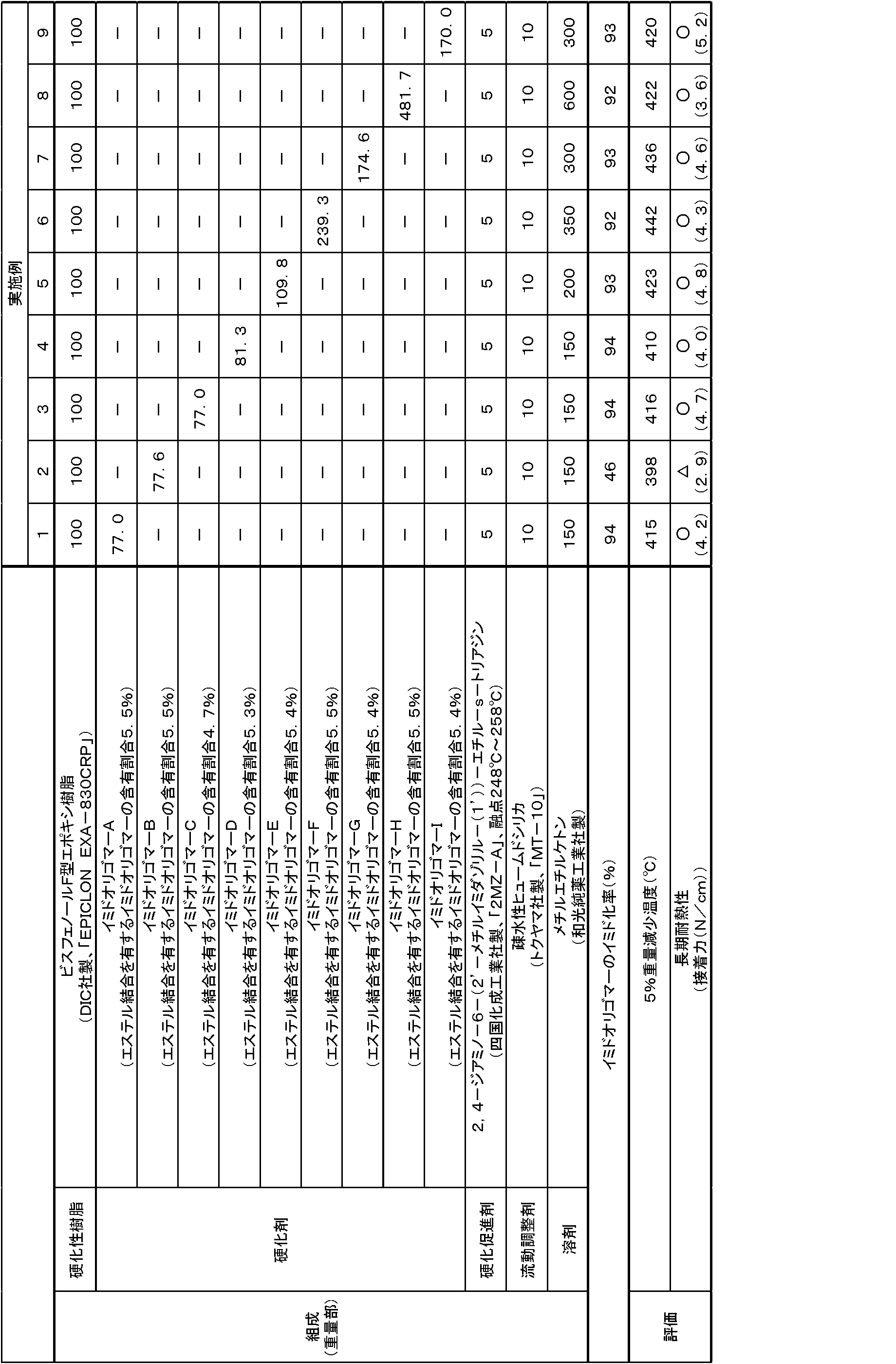
- Examples 1 to 9, Comparative Examples 1 to 5 According to the blending ratios described in Tables 1 and 2, the materials were stirred and mixed to prepare adhesives of Examples 1 to 9 and Comparative Examples 1 to 5.
- Kapton Long-term heat resistance (adhesive strength) 50 ⁇ m thick Kapton (registered trademark) was laminated on both sides of each adhesive obtained in the examples and comparative examples, and cured and adhered by heating at 190 ° C. for 1 hour, and then cut into 1 cm wide strips. A test piece was obtained. The obtained test piece was heat-treated at 175 ° C. for 1000 hours. About the test piece after heat processing, the adhesive force was measured on conditions with a peeling speed of 20 mm / min using the tensile tester (the product made by ORIENTEC, "UCT-500").
- the imide oligomer which can be used for the hardened
Landscapes
- Chemical & Material Sciences (AREA)
- Organic Chemistry (AREA)
- Chemical Kinetics & Catalysis (AREA)
- Health & Medical Sciences (AREA)
- Medicinal Chemistry (AREA)
- Polymers & Plastics (AREA)
- Macromolecular Compounds Obtained By Forming Nitrogen-Containing Linkages In General (AREA)
- Adhesives Or Adhesive Processes (AREA)
- Indole Compounds (AREA)
- Addition Polymer Or Copolymer, Post-Treatments, Or Chemical Modifications (AREA)
- Pyrrole Compounds (AREA)
Abstract
Description
以下に本発明を詳述する。
本発明のイミドオリゴマーは、エステル結合を有するイミドオリゴマーの含有割合が7%以下である。上記エステル結合を有するイミドオリゴマーの含有割合が7%以下であることにより、本発明のイミドオリゴマーは、硬化剤として用いた際に得られる硬化物の長期耐熱性を向上させる効果に優れるものとなる。上記エステル結合を有するイミドオリゴマーの含有割合は、5%以下であることが好ましく、0%であること、即ち、上記エステル結合を有するイミドオリゴマーを含有しないことが最も好ましい。
なお、上記エステル結合を有するイミドオリゴマーの含有割合は、ゲルパーミエーションクロマトグラフィー(GPC)を用いて各ピークを分取した後、フーリエ変換赤外分光法(FT-IR)によりエステル結合に由来する吸収をもつ化合物の重量比率から求めることができる。具体的には、まず、遊離液にテトラヒドロフラン(THF)を用い、GPCカラム(例えば、日本分析工業社製、「JAIGEL-2H」等)を装着したリサイクル分取HPLC(日本分析工業社製)を用いて各ピークを分取する。その後、遊離液を加熱等により除去することで得られる化合物をフーリエ変換赤外分光光度計(例えば、Agilent Technologies社製、「UMA600」等)を用いて全反射測定法(ATR法)にて測定を行う。得られた測定結果から、エステル結合に由来するピーク(1159cm-1)を有する化合物の重量の、全ピーク化合物に対する重量比率を求めることにより導出することができる。
なお、本明細書において上記「数平均分子量」は、ゲルパーミエーションクロマトグラフィー(GPC)で溶媒としてテトラヒドロフランを用いて測定を行い、ポリスチレン換算により求められる値である。GPCによってポリスチレン換算による数平均分子量を測定する際に用いるカラムとしては、例えば、JAIGEL-2H-A(日本分析工業社製)等が挙げられる。
なお、本明細書において上記「主成分」は、含有割合が60モル%以上であることを意味する。

酸無水物基を有する化合物とフェノール性水酸基を有するモノアミンとを反応させる工程を有し、上記フェノール性水酸基を有するモノアミンの使用量が上記酸無水物基を有する化合物の酸無水物基に対して1.5当量以上であるイミドオリゴマーの製造方法もまた、本発明の1つである。本発明のイミドオリゴマーの製造方法によれば、副生物として発生するエステル結合を有するイミドオリゴマーの含有割合を7%以下とした本発明のイミドオリゴマーを容易に製造することができる。
まず、予めフェノール性水酸基を有するモノアミンを、反応により得られるアミック酸オリゴマーが可溶な溶媒(例えば、N,N-ジメチルホルムアミド等)に溶解させ、得られた溶液に酸二無水物を添加して反応させてアミック酸オリゴマー溶液を得る。次いで、得られたアミック酸オリゴマー溶液を塩酸等に加え、析出物を回収する操作を数回行う。得られた析出物を加熱してイミド化反応を進行させることにより、フェノール性水酸基を有するイミドオリゴマーを得ることができる。この方法を用いる場合、上記フェノール性水酸基を有するモノアミンの使用量を上記酸二無水物の有する酸無水物基に対して1.5当量以上とすることにより、エステル結合を有するイミドオリゴマーの含有割合を7%以下とすることができる。
まず、予めジアミンを、反応により得られるアミック酸オリゴマーが可溶な溶媒(例えば、N,N-ジメチルホルムアミド等)に溶解させ、得られた溶液に酸二無水物を添加して反応させて、両末端に酸無水物基を有するアミック酸オリゴマー(A)の溶液を得る。得られたアミック酸オリゴマー(A)の溶液に、フェノール性水酸基を有するモノアミンを添加して反応させてアミック酸オリゴマー(B)の溶液を得る。次いで、得られたアミック酸オリゴマー(B)の溶液を塩酸等に加え、析出物を回収する操作を数回行う。得られた析出物を加熱してイミド化反応を進行させることにより、フェノール性水酸基を有するイミドオリゴマーを得ることができる。この方法を用いる場合、上記フェノール性水酸基を有するモノアミンの使用量を、上記アミック酸オリゴマー(A)の酸無水物基に対して1.5当量以上とすることにより、エステル結合を有するイミドオリゴマーの含有割合を7%以下とすることができる。
上記フェノール性水酸基を有するモノアミンとしては、具体的には例えば、3-アミノフェノール、4-アミノフェノール、4-アミノ-o-クレゾール、5-アミノ-o-クレゾール、4-アミノ-2,3-キシレノール、4-アミノ-2,5-キシレノール、4-アミノ-2,6-キシレノール、4-アミノ-1-ナフトール、5-アミノ-2-ナフトール、6-アミノ-1-ナフトール、4-アミノ-2,6-ジフェニルフェノール等が挙げられる。なかでも、入手性及び保存安定性に優れ、高いガラス転移温度を有する硬化物が得られることから、3-アミノフェノール、4-アミノフェノール、4-アミノ-o-クレゾール、5-アミノ-o-クレゾールが好ましい。

上記酸二無水物としては、具体的には例えば、ピロメリット酸二無水物、3,3’-オキシジフタル酸二無水物、3,4’-オキシジフタル酸二無水物、4,4’-オキシジフタル酸二無水物、4,4’-(4,4’-イソプロピリデンジフェノキシ)ジフタル酸無水物、4,4’-ビス(3,4-ジカルボキシルフェノキシ)ジフェニルエーテル、p-フェニレンビス(トリメリテート無水物)、2,3,3’,4’-ビフェニルテトラカルボン酸二無水物、3,3’,4,4’-ビフェニルテトラカルボン酸二無水物、4,4’-カルボニルジフタル酸二無水物等が挙げられる。なかでも、溶解性、耐熱性、及び、入手性に優れることから、4,4’-(4,4’-イソプロピリデンジフェノキシ)ジフタル酸無水物、3,4’-オキシジフタル酸二無水物、4,4’-オキシジフタル酸二無水物、4,4’-カルボニルジフタル酸二無水物が好ましい。


上記ジアミンとしては、具体的には例えば、例えば、3,3’-ジアミノジフェニルメタン、3,4’-ジアミノジフェニルメタン、4,4’-ジアミノジフェニルメタン、3,3’-ジアミノジフェニルエーテル、3,4’-ジアミノジフェニルエーテル、4,4’-ジアミノジフェニルエーテル、1,2-フェニレンジアミン、1,3-フェニレンジアミン、1,4-フェニレンジアミン、3,3’-ジアミノジフェニルスルフォン、4,4’-ジアミノジフェニルスルフォン、ビス(4-(3-アミノフェノキシ)フェニル)スルフォン、ビス(4-(4-アミノフェノキシ)フェニル)スルフォン、1,3-ビス(3-アミノフェノキシ)ベンゼン、1,3-ビス(4-アミノフェノキシ)ベンゼン、1,4-ビス(4-アミノフェノキシ)ベンゼン、ビス(4-(4-アミノフェノキシ)フェニル)メタン、2,2-ビス(4-(4-アミノフェノキシ)フェニル)プロパン、1,3-ビス(2-(4-アミノフェニル)-2-プロピル)ベンゼン、1,4-ビス(2-(4-アミノフェニル)-2-プロピル)ベンゼン、3,3’-ジアミノ-4,4’-ジヒドロキシジフェニルメタン、4,4’-ジアミノ-3,3’-ジヒドロキシジフェニルメタン、3,3’-ジアミノ-4,4’-ジヒドロキシジフェニルエーテル、2,2-ビス(3-アミノ-4-ヒドロキシフェニル)プロパン、2,2-ビス(3-ヒドロキシ-4-アミノフェニル)プロパン、ビスアミノフェニルフルオレン、ビストルイジンフルオレン、4,4’-ビス(4-アミノフェノキシ)ビフェニル、4,4’-ジアミノ-3,3’-ジヒドロキシジフェニルエーテル、3,3’-ジアミノ-4,4’-ジヒドロキシビフェニル、4,4’-ジアミノ-2,2’-ジヒドロキシビフェニル、4,4’-ジアミノ-3,3’-ジヒドロキシビフェニル、4,4’-ビス(4-アミノベンザミド)-3,3’-ジヒドロキシビフェニル、4,4’-ビス(3-アミノベンザミド)-3,3’-ジヒドロキシビフェニル等が挙げられる。なかでも、溶解性、耐熱性、及び、入手性に優れることから、3,4’-ジアミノジフェニルエーテル、4,4’-ジアミノジフェニルエーテル、1,2-フェニレンジアミン、1,3-フェニレンジアミン、1,4-フェニレンジアミン、ビス(4-(3-アミノフェノキシ)フェニル)スルフォン、ビス(4-(4-アミノフェノキシ)フェニル)スルフォン、1,3-ビス(2-(4-アミノフェニル)-2-プロピル)ベンゼン、1,4-ビス(2-(4-アミノフェニル)-2-プロピル)ベンゼンが好ましい。


なお、上記「イミド化率」は、フーリエ変換赤外分光法(FT-IR)により求めることができる。具体的には、フーリエ変換赤外分光光度計(例えば、Agilent Technologies社製、「UMA600」等)を用いて全反射測定法(ATR法)にて測定を行い、アミック酸のカルボニル基に由来する1660cm-1付近のピーク吸光度面積から下記式にて導出することができる。なお、下記式中における「アミック酸オリゴマーのピーク吸光度面積」は、酸無水物基を有する化合物とフェノール性水酸基を有するモノアミンとを反応させた後、イミド化工程を行わずに溶媒をエバポレーションにより除去することで得られるアミック酸オリゴマーの吸光度面積である。
イミド化率(%)=100×(1-(イミド化後のピーク吸光度面積)/(アミック酸オリゴマーのピーク吸光度面積))
上記他の硬化剤としては、例えば、フェノール系硬化剤、チオール系硬化剤、アミン系硬化剤、酸無水物系硬化剤、シアネート系硬化剤、活性エステル系硬化剤等が挙げられる。なかでも、フェノール系硬化剤、酸無水物系硬化剤、シアネート系硬化剤、活性エステル系硬化剤が好ましい。
上記硬化性樹脂は、得られる接着剤の流動性及び加工性の観点から、25℃で液状であることが好ましい。
上記エポキシ樹脂としては、例えば、ビスフェノールA型エポキシ樹脂、ビスフェノールF型エポキシ樹脂、ビスフェノールE型エポキシ樹脂、ビスフェノールS型エポキシ樹脂、2,2’-ジアリルビスフェノールA型エポキシ樹脂、水添ビスフェノール型エポキシ樹脂、プロピレンオキシド付加ビスフェノールA型エポキシ樹脂、レゾルシノール型エポキシ樹脂、ビフェニル型エポキシ樹脂、スルフィド型エポキシ樹脂、ジフェニルエーテル型エポキシ樹脂、ジシクロペンタジエン型エポキシ樹脂、ナフタレン型エポキシ樹脂、フルオレン型エポキシ樹脂、ナフチレンエーテル型エポキシ樹脂、フェノールノボラック型エポキシ樹脂、オルトクレゾールノボラック型エポキシ樹脂、ジシクロペンタジエンノボラック型エポキシ樹脂、ビフェニルノボラック型エポキシ樹脂、ナフタレンフェノールノボラック型エポキシ樹脂、グリシジルアミン型エポキシ樹脂、アルキルポリオール型エポキシ樹脂、ゴム変性型エポキシ樹脂、グリシジルエステル化合物等が挙げられる。なかでも、粘度が低く、得られる接着剤の室温における加工性を調整しやすいことから、ビスフェノールA型エポキシ樹脂、ビスフェノールF型エポキシ樹脂、レゾルシノール型エポキシ樹脂が好ましい。
上記有機充填剤としては、例えば、シリコーンゴム粒子、アクリルゴム粒子、ウレタンゴム粒子、ポリアミド粒子、ポリアミドイミド粒子、ポリイミド粒子、ベンゾグアナミン粒子、及び、これらのコアシェル粒子等が挙げられる。なかでも、ポリアミド粒子、ポリアミドイミド粒子、ポリイミド粒子が好ましい。
上記反応性官能基としては、例えば、アミノ基、ウレタン基、イミド基、水酸基、カルボキシル基、エポキシ基等が挙げられる。
上記反応性希釈剤としては、接着信頼性の観点から、1分子中に2つ以上の反応性官能基を有する反応性希釈剤が好ましい。
上記反応性希釈剤の有する反応性官能基としては、上述した高分子化合物が有する反応性官能基と同様のものが挙げられる。
また、本発明の接着剤を離型フィルム上に塗工し、乾燥させることにより、本発明の接着剤からなる接着フィルムを得ることができる。
3-アミノフェノール(東京化成工業社製)32.74重量部(反応させる3,4’-オキシジフタル酸二無水物の酸無水物基に対して1.5当量)をN,N-ジメチルホルムアミド200mLに溶解させた。得られた溶液に3,4’-オキシジフタル酸二無水物(東京化成工業社製)31.0重量部を添加し、25℃で2時間撹拌して反応させてアミック酸オリゴマー溶液を得た。得られたアミック酸オリゴマー溶液を1mol/Lの塩酸2Lに加えて析出物を回収した。得られた析出物をN,N-ジメチルホルムアミド100mLに溶解させ、得られた溶液を0.5mol/Lの塩酸2Lに加えて析出物を回収した。得られた析出物をN,N-ジメチルホルムアミド100mLに溶解させ、得られた溶液を0.1mol/Lの塩酸2Lに加えて析出物を回収した。得られた析出物について、180℃で2時間加熱した後、300℃で2時間加熱するイミド化条件で反応させることにより、フェノール性水酸基を有するイミドオリゴマーA(イミド化率94%)を得た。
なお、イミドオリゴマーAは、1H-NMR、GPC、及び、FT-IR分析により、上記式(1-1)で表されるイミドオリゴマーを主成分とすることを確認した。また、GPC分取、FT-IR分析により、イミドオリゴマーAは、エステル結合を有するイミドオリゴマーの含有割合が5.5%であることを確認した。更に、イミドオリゴマーAの数平均分子量は506であった。
析出物のイミド化条件を、真空乾燥オーブンを用いて、200℃、5mmHgで3時間加熱することに変更したこと以外は合成例1と同様にして、フェノール性水酸基を有するイミドオリゴマーB(イミド化率46%)を得た。
イミドオリゴマーBは、1H-NMR、GPC、及び、FT-IR分析により、上記式(1-1)で表されるイミドオリゴマーを含むことを確認した。また、GPC分取、FT-IR分析により、イミドオリゴマーBは、エステル結合を有するイミドオリゴマーの含有割合が5.5%であることを確認した。更に、イミドオリゴマーBの数平均分子量は510であった。
3-アミノフェノールの使用量を65.48重量部(反応させる3,4’-オキシジフタル酸二無水物の酸無水物基に対して3当量)に変更したこと以外は合成例1と同様にして、フェノール性水酸基を有するイミドオリゴマーC(イミド化率94%)を得た。
なお、イミドオリゴマーCは、1H-NMR、GPC、及び、FT-IR分析により、上記式(1-1)で表されるイミドオリゴマーを主成分とすることを確認した。また、GPC分取、FT-IR分析により、イミドオリゴマーCは、エステル結合を有するイミドオリゴマーの含有割合が4.7%であることを確認した。更に、イミドオリゴマーCの数平均分子量は506であった。
3-アミノフェノール32.74重量部を、5-アミノ-o-クレゾール(東京化成工業社製)36.95重量部(反応させる3,4’-オキシジフタル酸二無水物の酸無水物基に対して1.5当量)に変更したこと以外は合成例1と同様にして、フェノール性水酸基を有するイミドオリゴマーD(イミド化率94%)を得た。
なお、イミドオリゴマーDは、1H-NMR、GPC、及び、FT-IR分析により、上記式(1-1)で表されるイミドオリゴマーを主成分とすることを確認した。また、GPC分取、FT-IR分析により、イミドオリゴマーDは、エステル結合を有するイミドオリゴマーの含有割合が5.3%であることを確認した。更に、イミドオリゴマーDの数平均分子量は531であった。
3,4’-オキシジフタル酸二無水物31.0重量部に代えて、4,4’-(4,4’-イソプロピリデンジフェノキシ)ジフタル酸無水物(東京化成工業社製)52.0重量部を添加したこと以外は合成例1と同様にして、フェノール性水酸基を有するイミドオリゴマーE(イミド化率93%)を得た。3-アミノフェノールの使用量は、反応させる4,4’-(4,4’-イソプロピリデンジフェノキシ)ジフタル酸無水物の酸無水物基に対して1.5当量である。
なお、イミドオリゴマーEは、1H-NMR、GPC、及び、FT-IR分析により、上記式(1-1)で表されるイミドオリゴマーを主成分とすることを確認した。また、GPC分取、FT-IR分析により、イミドオリゴマーEは、エステル結合を有するイミドオリゴマーの含有割合が5.4%であることを確認した。更に、イミドオリゴマーEの数平均分子量は712であった。
1,3-ビス(2-(4-アミノフェニル)-2-プロピル)ベンゼン(三井化学ファイン社製、「ビスアニリンM」)34.45重量部をN,N-ジメチルホルムアミド200mLに溶解させた。得られた溶液に4,4’-(4,4’-イソプロピリデンジフェノキシ)ジフタル酸無水物(東京化成工業社製)104.1重量部を添加し、25℃で2時間撹拌して反応させて両末端に酸無水物基を有するアミック酸オリゴマー(A)の溶液を得た。得られたアミック酸オリゴマー(A)の溶液に3-アミノフェノール(東京化成工業社製)32.74重量部(反応させるアミック酸オリゴマー(A)の酸無水物基に対して1.5当量)を添加し、25℃で2時間撹拌して反応させてアミック酸オリゴマー(B)の溶液を得た。得られたアミック酸オリゴマー(B)の溶液を1mol/Lの塩酸2Lに加えて析出物を回収した。得られた析出物をN,N-ジメチルホルムアミド100mLに溶解させ、得られた溶液を0.5mol/Lの塩酸2Lに加えて析出物を回収した。得られた析出物をN,N-ジメチルホルムアミド100mLに溶解させ、得られた溶液を0.1mol/Lの塩酸2Lに加えて析出物を回収した。得られた析出物について、180℃で2時間加熱した後、300℃で2時間加熱するイミド化条件で反応させることにより、フェノール性水酸基を有するイミドオリゴマーF(イミド化率92%)を得た。
なお、イミドオリゴマーFは、1H-NMR、GPC、及び、FT-IR分析により、上記式(1-2)で表されるイミドオリゴマーを主成分とすることを確認した。また、GPC分取、FT-IR分析により、イミドオリゴマーFは、エステル結合を有するイミドオリゴマーの含有割合が5.5%であることを確認した。更に、イミドオリゴマーFの数平均分子量は1548であった。
1,3-ビス(2-(4-アミノフェニル)-2-プロピル)ベンゼンの使用量を17.23重量部に変更し、かつ、3-アミノフェノールの使用量を49.11重量部に変更したこと以外は合成例6と同様にして、フェノール性水酸基を有するイミドオリゴマーG(イミド化率93%)を得た。3-アミノフェノールの使用量は、反応させるアミック酸オリゴマー(A)の酸無水物基に対して1.5当量である。
なお、イミドオリゴマーGは、1H-NMR、GPC、及び、FT-IR分析により、上記式(1-2)で表されるイミドオリゴマーを主成分とすることを確認した。また、GPC分取、FT-IR分析により、イミドオリゴマーGは、エステル結合を有するイミドオリゴマーの含有割合が5.4%であることを確認した。更に、イミドオリゴマーGの数平均分子量は1126であった。
1,3-ビス(2-(4-アミノフェニル)-2-プロピル)ベンゼン(三井化学ファイン社製、「ビスアニリンM」)34.5重量部をN-メチルピロリドン(和光純薬工業社製、「NMP」)200mLに溶解させた。得られた溶液に4,4’-(4,4’-イソプロピリデンジフェノキシ)ジフタル酸無水物(東京化成工業社製)104.1重量部を添加し、25℃で2時間撹拌して反応させてアミック酸オリゴマー溶液(A)を得た。得られたアミック酸オリゴマー溶液(A)に対し、更に3-アミノフェノール(東京化成工業社製)32.74重量部(反応させるアミック酸オリゴマー(A)の酸無水物基に対して1.5当量)を添加し25℃で2時間撹拌して反応させてアミック酸オリゴマー溶液(B)を得た。得られたアミック酸オリゴマー(B)の溶液を1mol/Lの塩酸2Lに加えて析出物を回収した。得られた析出物をN,N-ジメチルホルムアミド100mLに溶解させ、得られた溶液を0.5mol/Lの塩酸2Lに加えて析出物を回収した。得られた析出物をN,N-ジメチルホルムアミド100mLに溶解させ、得られた溶液を0.1mol/Lの塩酸2Lに加えて析出物を回収した。得られた析出物について、180℃で2時間加熱した後、300℃で2時間加熱するイミド化条件で反応させることにより、フェノール性水酸基を有するイミドオリゴマーH(イミド化率92%)を得た。
なお、イミドオリゴマーHは、1H-NMR、GPC、及び、FT-IR分析により、上記式(1-2)で表されるイミドオリゴマーを主成分とすることを確認した。また、GPC分取、FT-IR分析により、イミドオリゴマーHは、エステル結合を有するイミドオリゴマーの含有割合が5.5%であることを確認した。更に、イミドオリゴマーHの数平均分子量は2720であった。
1,3-ビス(2-(4-アミノフェニル)-2-プロピル)ベンゼン34.45重量部を、2,2-ビス(3-アミノ-4-ヒドロキシフェニル)プロパン25.83重量部に変更したこと以外は合成例6と同様にして、フェノール性水酸基を有するイミドオリゴマーI(イミド化率93%)を得た。
なお、イミドオリゴマーIは、1H-NMR、GPC、及び、FT-IR分析により、上記式(1-2)で表されるイミドオリゴマーを主成分とすることを確認した。また、GPC分取、FT-IR分析により、イミドオリゴマーIは、エステル結合を有するイミドオリゴマーの含有割合が5.4%であることを確認した。更に、イミドオリゴマーIの数平均分子量は1490であった。
3-アミノフェノールの使用量を21.83重量部(反応させる3,4’-オキシジフタル酸二無水物の酸無水物基に対して1当量)に変更したこと以外は合成例1と同様にして、フェノール性水酸基を有するイミドオリゴマーJ(イミド化率93%)を得た。
なお、イミドオリゴマーJは、1H-NMR、GPC、及び、FT-IR分析により、上記式(1-1)で表されるイミドオリゴマーを主成分とすることを確認した。また、GPC分取、FT-IR分析により、イミドオリゴマーJは、エステル結合を有するイミドオリゴマーの含有割合が8.2%であることを確認した。更に、イミドオリゴマーJの数平均分子量は543であった。
析出物のイミド化条件を、真空乾燥オーブンを用いて、200℃、5mmHgで3時間加熱することに変更したこと以外は合成例10と同様にして、イミドオリゴマーK(イミド化率44%)を得た。
イミドオリゴマーKは、1H-NMR、GPC、及び、FT-IR分析により、上記式(1-1)で表されるイミドオリゴマーを含むことを確認した。また、GPC分取、FT-IR分析により、イミドオリゴマーKは、エステル結合を有するイミドオリゴマーの含有割合が8.2%であることを確認した。更に、イミドオリゴマーKの数平均分子量は556であった。
3-アミノフェノールの使用量を21.83重量部に変更したこと以外は合成例6と同様にして、フェノール性水酸基を有するイミドオリゴマーL(イミド化率92%)を得た。3-アミノフェノールの使用量は、反応させるアミック酸オリゴマー(A)の酸無水物基に対して1当量である。
なお、イミドオリゴマーLは、1H-NMR、GPC、及び、FT-IR分析により、上記式(1-2)で表されるイミドオリゴマーを主成分とすることを確認した。また、GPC分取、FT-IR分析により、イミドオリゴマーLは、エステル結合を有するイミドオリゴマーの含有割合が8.0%であることを確認した。更に、イミドオリゴマーLの数平均分子量は1710であった。
1,3-ビス(2-(4-アミノフェニル)-2-プロピル)ベンゼンの使用量を17.23重量部に変更したこと以外は合成例6と同様にして、フェノール性水酸基を有するイミドオリゴマーM(イミド化率92%)を得た。3-アミノフェノールの使用量は、反応させるアミック酸オリゴマー(A)の酸無水物基に対して1当量である。
なお、イミドオリゴマーMは、1H-NMR、GPC、及び、FT-IR分析により、上記式(1-2)で表されるイミドオリゴマーを主成分とすることを確認した。また、GPC分取、FT-IR分析により、イミドオリゴマーMは、エステル結合を有するイミドオリゴマーの含有割合が8.1%であることを確認した。更に、イミドオリゴマーMの数平均分子量は1241であった。
3-アミノフェノールの使用量を21.83重量部(反応させるアミック酸オリゴマー(A)の酸無水物基に対して1当量)に変更したこと以外は合成例9と同様にして、フェノール性水酸基を有するイミドオリゴマーN(イミド化率94%)を得た。
なお、イミドオリゴマーNは、1H-NMR、GPC、及び、FT-IR分析により、上記式(1-2)で表されるイミドオリゴマーを主成分とすることを確認した。また、GPC分取、FT-IR分析により、イミドオリゴマーNは、エステル結合を有するイミドオリゴマーの含有割合が8.4%であることを確認した。更に、イミドオリゴマーNの数平均分子量は1571であった。
表1、2に記載された配合比に従い、各材料を撹拌混合し、実施例1~9、比較例1~5の各接着剤を作製した。
実施例及び比較例で得られた各接着剤について以下の評価を行った。結果を表1、2に示した。
実施例及び比較例で得られた各接着剤を離型フィルム上に塗工し、乾燥させることにより、25μm厚の接着フィルムを得た。
得られた接着フィルムを190℃で1時間加熱することにより硬化させた接着フィルムについて、熱重量測定装置(エスアイアイ・ナノテクノロジー社製、「EXTEAR TG/DTA6200」)を用いて、40℃~450℃の温度範囲、10℃/minの昇温条件で5%重量減少温度を測定した。
実施例及び比較例で得られた各接着剤の両面に50μm厚のカプトン(登録商標)を積層し、190℃で1時間加熱することにより硬化、接着させた後、1cm幅の短冊状に切り出して試験片を得た。得られた試験片について、175℃で1000時間熱処理を行った。熱処理後の試験片について、引張試験機(ORIENTEC社製、「UCT-500」)を用いて、剥離速度20mm/minの条件で接着力を測定した。
接着力が3.4N/cm以上であった場合を「○」、3.4N/cm未満2.4N/cm以上であった場合を「△」、2.4N/cm未満であった場合を「×」として長期耐熱性を評価した。

Claims (6)
- フェノール性水酸基を有するイミドオリゴマーであって、
エステル結合を有するイミドオリゴマーの含有割合が7%以下である
ことを特徴とするイミドオリゴマー。 - 数平均分子量が400以上4200以下であることを特徴とする請求項1記載のイミドオリゴマー。
- イミド化率が70%以上である請求項1又は2記載のイミドオリゴマー。
- 請求項1、2又は3記載のイミドオリゴマーからなることを特徴とする硬化剤。
- 硬化性樹脂と請求項4記載の硬化剤とを含有することを特徴とする接着剤。
- 酸無水物基を有する化合物とフェノール性水酸基を有するモノアミンとを反応させる工程を有し、
前記フェノール性水酸基を有するモノアミンの使用量が前記酸無水物基を有する化合物の酸無水物基に対して1.5当量以上であることを特徴とするイミドオリゴマーの製造方法。
Priority Applications (3)
| Application Number | Priority Date | Filing Date | Title |
|---|---|---|---|
| KR1020197009277A KR102556129B1 (ko) | 2017-04-21 | 2018-04-13 | 이미드 올리고머, 경화제, 접착제, 및 이미드 올리고머의 제조 방법 |
| JP2018522818A JP7103940B2 (ja) | 2017-04-21 | 2018-04-13 | イミドオリゴマー組成物、硬化剤、接着剤、及び、イミドオリゴマー組成物の製造方法 |
| CN201880019956.2A CN110461818B (zh) | 2017-04-21 | 2018-04-13 | 酰亚胺低聚物、固化剂、粘接剂和酰亚胺低聚物的制造方法 |
Applications Claiming Priority (4)
| Application Number | Priority Date | Filing Date | Title |
|---|---|---|---|
| JP2017084405 | 2017-04-21 | ||
| JP2017-084405 | 2017-04-21 | ||
| JP2017126529 | 2017-06-28 | ||
| JP2017-126529 | 2017-06-28 |
Publications (1)
| Publication Number | Publication Date |
|---|---|
| WO2018193983A1 true WO2018193983A1 (ja) | 2018-10-25 |
Family
ID=63856283
Family Applications (1)
| Application Number | Title | Priority Date | Filing Date |
|---|---|---|---|
| PCT/JP2018/015524 Ceased WO2018193983A1 (ja) | 2017-04-21 | 2018-04-13 | イミドオリゴマー、硬化剤、接着剤、及び、イミドオリゴマーの製造方法 |
Country Status (5)
| Country | Link |
|---|---|
| JP (1) | JP7103940B2 (ja) |
| KR (1) | KR102556129B1 (ja) |
| CN (1) | CN110461818B (ja) |
| TW (1) | TWI797117B (ja) |
| WO (1) | WO2018193983A1 (ja) |
Cited By (3)
| Publication number | Priority date | Publication date | Assignee | Title |
|---|---|---|---|---|
| JP2020200413A (ja) * | 2019-06-12 | 2020-12-17 | 積水化学工業株式会社 | 硬化性樹脂組成物、接着剤、接着剤ワニス、接着フィルム、及び、硬化物 |
| WO2022138407A1 (ja) * | 2020-12-23 | 2022-06-30 | 積水化学工業株式会社 | 硬化性樹脂組成物、硬化物、接着剤、及び、接着フィルム |
| JP2023118158A (ja) * | 2022-02-15 | 2023-08-25 | 日鉄ケミカル&マテリアル株式会社 | ジヒドロキシ樹脂、エポキシ樹脂、その製造方法、及びエポキシ樹脂組成物並びに硬化物 |
Citations (4)
| Publication number | Priority date | Publication date | Assignee | Title |
|---|---|---|---|---|
| JPH03209858A (ja) * | 1990-01-12 | 1991-09-12 | Nitto Denko Corp | 半導体装置 |
| JPH03275669A (ja) * | 1990-03-23 | 1991-12-06 | Mitsui Toatsu Chem Inc | イミド環を有する新規ビスフェノール類およびその製造方法 |
| JP2004051794A (ja) * | 2002-07-19 | 2004-02-19 | Shin Etsu Chem Co Ltd | フェノール性水酸基を有するポリイミド樹脂、その製造方法、及びポリイミド樹脂組成物 |
| JP2010053070A (ja) * | 2008-08-28 | 2010-03-11 | Japan Epoxy Resin Kk | ビスイミドフェノール化合物及びその製造方法並びに高分子化合物 |
Family Cites Families (6)
| Publication number | Priority date | Publication date | Assignee | Title |
|---|---|---|---|---|
| JPS61270852A (ja) | 1985-05-24 | 1986-12-01 | Nitto Electric Ind Co Ltd | 半導体装置 |
| CN1938357A (zh) | 2004-04-19 | 2007-03-28 | 株式会社钟化 | 热固性树脂组合物、以及使用该组合物形成的叠层体、电路基板 |
| JP5510498B2 (ja) | 2005-11-08 | 2014-06-04 | 日立化成株式会社 | 接着層付き金属箔、金属張積層板、並びに、この金属張積層板を用いて得られる印刷配線板及び多層配線板 |
| JP5672073B2 (ja) * | 2010-03-08 | 2015-02-18 | 三菱化学株式会社 | エポキシ樹脂用硬化剤、硬化性樹脂組成物、およびその硬化物 |
| KR101906687B1 (ko) * | 2010-03-08 | 2018-12-05 | 아지노모토 가부시키가이샤 | 트렌치형 회로 기판의 제조방법 |
| JP2016020437A (ja) | 2014-07-14 | 2016-02-04 | 住友電気工業株式会社 | プリント配線板用接着剤組成物、プリント配線板用ボンディングフィルム、プリント配線板用カバーレイ、銅張積層板及びプリント配線板 |
-
2018
- 2018-04-13 KR KR1020197009277A patent/KR102556129B1/ko active Active
- 2018-04-13 WO PCT/JP2018/015524 patent/WO2018193983A1/ja not_active Ceased
- 2018-04-13 JP JP2018522818A patent/JP7103940B2/ja active Active
- 2018-04-13 CN CN201880019956.2A patent/CN110461818B/zh active Active
- 2018-04-18 TW TW107113205A patent/TWI797117B/zh active
Patent Citations (4)
| Publication number | Priority date | Publication date | Assignee | Title |
|---|---|---|---|---|
| JPH03209858A (ja) * | 1990-01-12 | 1991-09-12 | Nitto Denko Corp | 半導体装置 |
| JPH03275669A (ja) * | 1990-03-23 | 1991-12-06 | Mitsui Toatsu Chem Inc | イミド環を有する新規ビスフェノール類およびその製造方法 |
| JP2004051794A (ja) * | 2002-07-19 | 2004-02-19 | Shin Etsu Chem Co Ltd | フェノール性水酸基を有するポリイミド樹脂、その製造方法、及びポリイミド樹脂組成物 |
| JP2010053070A (ja) * | 2008-08-28 | 2010-03-11 | Japan Epoxy Resin Kk | ビスイミドフェノール化合物及びその製造方法並びに高分子化合物 |
Cited By (3)
| Publication number | Priority date | Publication date | Assignee | Title |
|---|---|---|---|---|
| JP2020200413A (ja) * | 2019-06-12 | 2020-12-17 | 積水化学工業株式会社 | 硬化性樹脂組成物、接着剤、接着剤ワニス、接着フィルム、及び、硬化物 |
| WO2022138407A1 (ja) * | 2020-12-23 | 2022-06-30 | 積水化学工業株式会社 | 硬化性樹脂組成物、硬化物、接着剤、及び、接着フィルム |
| JP2023118158A (ja) * | 2022-02-15 | 2023-08-25 | 日鉄ケミカル&マテリアル株式会社 | ジヒドロキシ樹脂、エポキシ樹脂、その製造方法、及びエポキシ樹脂組成物並びに硬化物 |
Also Published As
| Publication number | Publication date |
|---|---|
| JP7103940B2 (ja) | 2022-07-20 |
| CN110461818A (zh) | 2019-11-15 |
| KR102556129B1 (ko) | 2023-07-14 |
| KR20190140895A (ko) | 2019-12-20 |
| CN110461818B (zh) | 2023-11-14 |
| TWI797117B (zh) | 2023-04-01 |
| JPWO2018193983A1 (ja) | 2020-02-27 |
| TW201843137A (zh) | 2018-12-16 |
Similar Documents
| Publication | Publication Date | Title |
|---|---|---|
| US11802177B2 (en) | Curable resin composition, adhesive, imide oligomer, imide oligomer composition, and curing agent | |
| JP7171365B2 (ja) | 硬化性樹脂組成物、硬化物、接着剤、及び、接着フィルム | |
| US11421107B2 (en) | Curable resin composition, cured product, adhesive, bonding film, coverlay film, flexible copper-clad laminate and circuit board | |
| JP7103940B2 (ja) | イミドオリゴマー組成物、硬化剤、接着剤、及び、イミドオリゴマー組成物の製造方法 | |
| JP2020007397A (ja) | 硬化性樹脂組成物、イミド化合物、接着剤、接着フィルム、カバーレイフィルム、及び、フレキシブル銅張積層板 | |
| WO2018221217A1 (ja) | 硬化性樹脂組成物、硬化物、接着剤、接着フィルム、カバーレイフィルム、及び、プリント配線板 | |
| JP7132084B2 (ja) | 硬化性樹脂組成物、硬化物、接着剤、及び、接着フィルム | |
| KR102692137B1 (ko) | 경화성 수지 조성물, 경화물, 접착제, 및, 접착 필름 | |
| TWI826633B (zh) | 酯化合物、樹脂組成物、硬化物及增層膜 | |
| JP7144182B2 (ja) | 硬化性樹脂組成物、硬化物、接着剤、及び、接着フィルム | |
| JP7265474B2 (ja) | 硬化性樹脂組成物、接着剤、接着フィルム、カバーレイフィルム、及び、フレキシブル銅張積層板 | |
| JP2022121514A (ja) | 硬化性樹脂組成物 | |
| JP7211715B2 (ja) | 硬化性樹脂組成物、硬化物、接着剤、接着フィルム、カバーレイフィルム、及び、プリント配線板 | |
| JP7168325B2 (ja) | 硬化性樹脂組成物、硬化物、接着剤、接着フィルム、カバーレイフィルム、フレキシブル銅張積層板、及び、回路基板 | |
| JP7667633B2 (ja) | 硬化性樹脂組成物、接着剤、接着剤ワニス、接着フィルム、及び、硬化物 | |
| WO2019083006A1 (ja) | 硬化性樹脂組成物、硬化物、接着剤、及び、接着フィルム | |
| JP7207863B2 (ja) | 硬化性樹脂組成物、硬化物、接着剤、及び、接着フィルム |
Legal Events
| Date | Code | Title | Description |
|---|---|---|---|
| ENP | Entry into the national phase |
Ref document number: 2018522818 Country of ref document: JP Kind code of ref document: A |
|
| 121 | Ep: the epo has been informed by wipo that ep was designated in this application |
Ref document number: 18788319 Country of ref document: EP Kind code of ref document: A1 |
|
| ENP | Entry into the national phase |
Ref document number: 20197009277 Country of ref document: KR Kind code of ref document: A |
|
| NENP | Non-entry into the national phase |
Ref country code: DE |
|
| 122 | Ep: pct application non-entry in european phase |
Ref document number: 18788319 Country of ref document: EP Kind code of ref document: A1 |