WO2018181093A1 - 情報処理装置、情報処理方法およびプログラム - Google Patents
情報処理装置、情報処理方法およびプログラム Download PDFInfo
- Publication number
- WO2018181093A1 WO2018181093A1 PCT/JP2018/011976 JP2018011976W WO2018181093A1 WO 2018181093 A1 WO2018181093 A1 WO 2018181093A1 JP 2018011976 W JP2018011976 W JP 2018011976W WO 2018181093 A1 WO2018181093 A1 WO 2018181093A1
- Authority
- WO
- WIPO (PCT)
- Prior art keywords
- value
- state quantity
- management
- values
- evaluation
- Prior art date
- Legal status (The legal status is an assumption and is not a legal conclusion. Google has not performed a legal analysis and makes no representation as to the accuracy of the status listed.)
- Ceased
Links
Images




Classifications
-
- G—PHYSICS
- G06—COMPUTING OR CALCULATING; COUNTING
- G06F—ELECTRIC DIGITAL DATA PROCESSING
- G06F17/00—Digital computing or data processing equipment or methods, specially adapted for specific functions
- G06F17/10—Complex mathematical operations
- G06F17/18—Complex mathematical operations for evaluating statistical data, e.g. average values, frequency distributions, probability functions, regression analysis
-
- G—PHYSICS
- G06—COMPUTING OR CALCULATING; COUNTING
- G06N—COMPUTING ARRANGEMENTS BASED ON SPECIFIC COMPUTATIONAL MODELS
- G06N5/00—Computing arrangements using knowledge-based models
- G06N5/04—Inference or reasoning models
- G06N5/041—Abduction
-
- G—PHYSICS
- G01—MEASURING; TESTING
- G01D—MEASURING NOT SPECIALLY ADAPTED FOR A SPECIFIC VARIABLE; ARRANGEMENTS FOR MEASURING TWO OR MORE VARIABLES NOT COVERED IN A SINGLE OTHER SUBCLASS; TARIFF METERING APPARATUS; MEASURING OR TESTING NOT OTHERWISE PROVIDED FOR
- G01D21/00—Measuring or testing not otherwise provided for
- G01D21/02—Measuring two or more variables by means not covered by a single other subclass
-
- G—PHYSICS
- G05—CONTROLLING; REGULATING
- G05B—CONTROL OR REGULATING SYSTEMS IN GENERAL; FUNCTIONAL ELEMENTS OF SUCH SYSTEMS; MONITORING OR TESTING ARRANGEMENTS FOR SUCH SYSTEMS OR ELEMENTS
- G05B23/00—Testing or monitoring of control systems or parts thereof
- G05B23/02—Electric testing or monitoring
-
- G—PHYSICS
- G06—COMPUTING OR CALCULATING; COUNTING
- G06N—COMPUTING ARRANGEMENTS BASED ON SPECIFIC COMPUTATIONAL MODELS
- G06N20/00—Machine learning
- G06N20/20—Ensemble learning
-
- G—PHYSICS
- G06—COMPUTING OR CALCULATING; COUNTING
- G06N—COMPUTING ARRANGEMENTS BASED ON SPECIFIC COMPUTATIONAL MODELS
- G06N7/00—Computing arrangements based on specific mathematical models
-
- G—PHYSICS
- G06—COMPUTING OR CALCULATING; COUNTING
- G06N—COMPUTING ARRANGEMENTS BASED ON SPECIFIC COMPUTATIONAL MODELS
- G06N7/00—Computing arrangements based on specific mathematical models
- G06N7/01—Probabilistic graphical models, e.g. probabilistic networks
-
- G—PHYSICS
- G06—COMPUTING OR CALCULATING; COUNTING
- G06Q—INFORMATION AND COMMUNICATION TECHNOLOGY [ICT] SPECIALLY ADAPTED FOR ADMINISTRATIVE, COMMERCIAL, FINANCIAL, MANAGERIAL OR SUPERVISORY PURPOSES; SYSTEMS OR METHODS SPECIALLY ADAPTED FOR ADMINISTRATIVE, COMMERCIAL, FINANCIAL, MANAGERIAL OR SUPERVISORY PURPOSES, NOT OTHERWISE PROVIDED FOR
- G06Q10/00—Administration; Management
- G06Q10/04—Forecasting or optimisation specially adapted for administrative or management purposes, e.g. linear programming or "cutting stock problem"
Definitions
- the present invention relates to an information processing apparatus, an information processing method, and a program.
- the monitoring device collects the state quantity of the target device such as temperature and pressure during operation of the target device constituting the plant, and uses the collected state quantity for maintenance and monitoring of the device. Is being considered. It has been proposed that the monitoring device processes the state quantity collected so that the operator of the device can easily use it, and performs maintenance and monitoring of the device.
- Patent Document 1 proposes that when a computer detects a missing portion of a collected state quantity of an industrial plant, a complementary process is executed to calculate a missing state quantity value.
- models such as a physical model and a statistical model are used when setting the value of a missing state quantity by complement processing.
- Patent Document 1 discloses that an information processing apparatus performs a complementing process to supplement a missing state quantity value, a specific method for setting a missing state quantity value is disclosed. It has not been.
- the present invention has been made in view of the above-described problem, and takes into account the probability distribution of the value of the state quantity, and manages the target device based on the estimated value of the state quantity calculated by each model. It aims at setting the value of the state quantity to be used appropriately.
- the information processing apparatus relates to an estimation unit that estimates a plurality of estimated values related to the target state quantity using a plurality of models that describe the target apparatus, and the target state quantity Based on the probability distribution of the value of the state quantity, a probability specifying unit that respectively specifies a plurality of probabilities corresponding to the plurality of estimated values, and based on the plurality of estimated values and the plurality of probabilities, A management value specifying unit for specifying a value used for management.
- the information processing apparatus calculates, based on the plurality of estimated values, a plurality of evaluation values that are values of evaluation items for management of the target device, respectively.
- the evaluation value calculation unit may further include a probability identification unit that identifies the plurality of probabilities corresponding to each of the plurality of evaluation values based on a probability distribution of the values of the evaluation items.
- the evaluation value calculation unit is based on a plurality of values that can be taken by an unknown state quantity that is an unknown state quantity.
- a plurality of evaluation values are calculated for each of the plurality of estimation values, and the probability specifying unit is configured to calculate the plurality of estimations based on a conditional probability distribution of the values of the evaluation items with the unknown state quantity value as a precondition.
- the plurality of probabilities corresponding to each of a plurality of evaluation values for each value are specified, and the management value specifying unit is configured to determine the target based on a sum of probabilities corresponding to each of the plurality of evaluation values for each of the plurality of estimation values.
- a value used for management of the apparatus may be specified.
- the evaluation value calculation unit relates to each of a plurality of types of the evaluation items based on the plurality of estimated values.
- a plurality of evaluation values are calculated, and the management value specifying unit uses values for managing the target device based on respective probabilities corresponding to the plurality of types of evaluation items for each of the plurality of target state quantity values. May be specified.
- the management value specifying unit determines the value of the target state quantity related to the highest probability as the target device. It may be specified as a value used for management.
- the plurality of models include at least one of a statistical model and a physical model. Good.
- the information processing apparatus further includes a model update unit that updates the statistical model based on a past value of the state quantity, and the probability specifying unit includes: The probability corresponding to the estimated value estimated using the updated statistical model may be specified.
- an information processing method that estimates a plurality of estimated values related to a target state quantity using a plurality of models that describe a target device, and a value related to the target state quantity. Identifying a plurality of probabilities corresponding to the plurality of estimated values based on the probability distribution of the plurality of estimated values, and identifying a value used for managing the target device based on the plurality of estimated values and the plurality of probabilities To have.
- a program relates to estimating a plurality of estimated values related to a target state quantity using a plurality of models that explain a target device, and a program related to the target state quantity. Identifying a plurality of probabilities corresponding to the plurality of estimated values based on a probability distribution of the values, and values used for managing the target device based on the plurality of estimated values and the plurality of probabilities To identify and execute.
- the information processing apparatus takes into account the probability distribution of the value of the state quantity and uses the state value used for managing the target apparatus based on the estimated value of the target state quantity calculated by each model The amount value can be set appropriately.
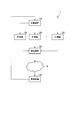
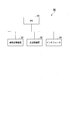
- FIG. 1 is a schematic block diagram showing the configuration of the management system according to the first embodiment.
- the management system 1 includes a target device 10, a plurality of measuring instruments 20, a communication device 30, and a management device 40.
- the target device 10 is a device to be managed by the management device 40. Examples of the target device 10 include a gas turbine, a steam turbine, a boiler, a coal gasifier, and the like. It may also be a transportation system such as an environmental plant, a chemical plant, and an aircraft.
- the measuring instrument 20 is provided in the target device 10 and measures a state quantity of the target device 10.
- the communication device 30 transmits the measurement value of the state quantity measured by the measuring instrument 20 to the management device 40 via the network N.
- the management device 40 manages the target device 10 based on the measurement value received from the communication device 30.
- the management device 40 is an example of an information processing device.
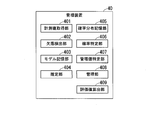
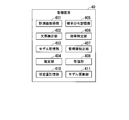
- FIG. 2 is a schematic block diagram illustrating the configuration of the management apparatus according to the first embodiment.
- the management device 40 includes a measurement value acquisition unit 401, a missing detection unit 402, a model storage unit 403, an estimation unit 404, a probability distribution storage unit 405, a probability specification unit 406, a management value specification unit 407, a management Unit 408.
- the measurement value acquisition unit 401 receives measurement values of state quantities measured by the plurality of measuring devices 20 from the communication device 30. Based on the plurality of measurement values acquired by the measurement value acquisition unit 401, the missing detection unit 402 detects a missing value among state quantities to be managed.
- the missing value means a temporal or spatial loss. For example, when the management unit 408 manages the state quantity for each time ⁇ t and the measurement value at the time T and the measurement value at the time T + 2 ⁇ t are acquired, the missing detection unit 402 detects the lack of the measurement value at the time T + ⁇ t. To do.
- the management unit 408 manages the state quantity for each distance ⁇ d
- the measured values of the position (0, 0), the position (2 ⁇ d, 0), the position (0, 2 ⁇ d), and the position (2 ⁇ d, 2 ⁇ d) are If acquired, the lack of measured values at position (0, ⁇ d), position ( ⁇ d, 0), position ( ⁇ d, ⁇ d), position ( ⁇ d, 2 ⁇ d), and position (2 ⁇ d, ⁇ d) is detected.
- the model storage unit 403 stores a plurality of models that explain the behavior of the target device 10.
- a statistical model or a physical model can be used.
- a rule model or a knowledge model may be used.
- the statistical model is a model that statistically reproduces the behavior of the target device 10 based on the value of the state quantity in the past operation of the target device 10.
- the statistical model is updated based on the accumulated state quantity value in the past operation.
- the physical model is a model that reproduces the behavior of the target device 10 by a mathematical formula (for example, a thermodynamic equation) that follows the natural law based on the design information of the target device 10.
- the estimation unit 404 estimates the value of the state quantity for each model stored in the model storage unit 403 based on the measurement value acquired by the measurement value acquisition unit 401.
- the state quantity to be estimated by the estimation unit 404 is referred to as a target state quantity. That is, the estimation unit 404 calculates a plurality of target state quantity values using different models.
- the probability distribution storage unit 405 stores a probability distribution table in which the value of the target state quantity is associated with the probability of taking the value.
- the probability distribution table is obtained in advance based on design information of the target device 10 or statistics of past state quantities.
- the probability distribution storage unit 405 may store a probability distribution function instead of the probability distribution table.
- the probability specifying unit 406 specifies the probability of taking the value for each estimated value of the target state quantity by the estimating unit 404.
- the management value specifying unit 407 selects one of a plurality of estimated values estimated by the estimating unit 404 based on the probability specified by the probability specifying unit 406, and a value (management value) used for managing the target device 10. To do.
- the management unit 408 manages the target device 10 based on the measurement value acquired by the measurement value acquisition unit 401 and the value specified by the management value specifying unit 407. Examples of management of the target device 10 include monitoring whether the state quantity of the target device 10 does not deviate from the allowable operating range, monitoring whether the output related to the evaluation item of the target device 10 satisfies the target, And outputting a control signal to the target device 10. Examples of evaluation items include NOx emissions, power sales revenue, gas temperature, and the like.
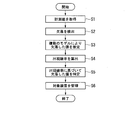
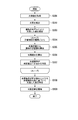
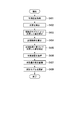
- FIG. 3 is a flowchart illustrating the operation of the management apparatus according to the first embodiment.
- the measurement value acquisition unit 401 acquires the measurement value of the state quantity by the measuring device 20 from the communication device 30 (step S1).
- the missing detection unit 402 detects a missing measurement value acquired by the measurement value acquisition unit 401 (step S2).
- the estimation unit 404 applies the measurement value acquired by the measurement value acquisition unit 401 to each of the plurality of models, and obtains the estimated value of the state quantity (target state quantity) in which the loss is detected (step S3).
- the probability specifying unit 406 specifies the appearance probability of each estimated value based on the probability distribution stored in the probability distribution storage unit 405 (step S4).
- the management value specifying unit 407 specifies the highest probability among the probabilities specified by the probability specifying unit 406, and specifies the value of the state quantity in which the loss is detected by selecting an estimated value related to the probability. (Step S5).
- the management unit 408 manages the target device 10 based on the measurement value acquired by the measurement value acquisition unit 401 and the value specified by the management value specifying unit 407 (step S6).
- the target device 10 is a gas turbine
- the target device 10 is changed based on the management value specified by changing the gas turbine output command value, changing the IGV opening setting, changing the fuel flow rate, or the like. Manage.
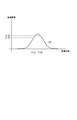
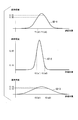
- FIG. 4 is a diagram illustrating a specific example of a management value specifying method according to the first embodiment.
- the case where the probability distribution of the value of the target state quantity is the distribution shown in FIG. 4 and the estimation unit 404 outputs the estimated value e1 based on the first model and the estimated value e2 based on the second model will be described.
- a graph G1 included in FIG. 4 is a graph in which the vertical axis represents the probability density and the horizontal axis represents the value of the target state quantity.
- the probability specifying unit 406 obtains the appearance probability of the estimated value e1 based on the probability distribution of the target state quantity.
- the probability density of the appearance probability of the estimated value e1 is 0.2.
- the probability specifying unit 406 obtains the appearance probability of the estimated value e2 based on the probability distribution of the target state quantity.
- the probability density of the appearance probability of the estimated value e2 is 0.3.
- the management value specifying unit 407 specifies the estimated value related to the larger one of the occurrence probabilities of the specified estimated values as the management value. In the example shown in FIG. 4, since the appearance probability of the estimated value e2 is larger than the appearance probability of the estimated value e1, the management value specifying unit 407 determines the management value as the estimated value e2.
- the management device 40 specifies a value used for managing the target device 10 from a plurality of estimated values based on the probability distribution of the value of the target state quantity. That is, according to the first embodiment, the management device 40 considers the probability distribution of the value of the target state quantity, and based on the estimated value of the target state quantity calculated by each model, The value of the target state quantity used for management can be set appropriately.
- the management apparatus 40 according to the first embodiment sets the value of the target state quantity used for management of the target apparatus 10 based on the probability distribution of the value of the target state quantity.
- the management device 40 according to the second embodiment sets the value of the target state quantity used for management of the target device 10 based on the probability distribution of the evaluation item values of the management of the target device 10. Examples of evaluation items include NOx emissions, power sales revenue, gas temperature, and the like.
- FIG. 5 is a schematic block diagram illustrating the configuration of the management apparatus according to the second embodiment.
- the management apparatus 40 according to the second embodiment further includes an evaluation value calculation unit 409 in addition to the configuration of the first embodiment.
- the evaluation value calculation unit 409 calculates the value of the evaluation item of the target device 10 for each of the plurality of estimation values estimated by the estimation unit 404 using the estimated value and the measurement value measured by the measurement value acquisition unit 401. To do.
- the probability distribution storage unit 405 stores a probability distribution table that associates the value of the evaluation item with the probability of taking the value.
- the probability specifying unit 406 specifies the probability of taking the value for each evaluation value calculated by the evaluation value calculating unit 409 based on the probability distribution stored in the probability distribution storage unit 405.
- FIG. 6 is a flowchart illustrating the operation of the management apparatus according to the second embodiment.
- the measurement value acquisition unit 401 acquires a state quantity measurement value by the measuring instrument 20 from the communication apparatus 30 (step S ⁇ b> 101).
- the missing detection unit 402 detects a missing measurement value acquired by the measurement value acquisition unit 401 (step S102).
- the estimation unit 404 applies the measurement value acquired by the measurement value acquisition unit 401 to each of the plurality of models, and obtains the estimated value of the state quantity in which the loss is detected (step S103).
- the evaluation value calculation unit 409 calculates values of a plurality of evaluation items based on each of the plurality of estimation values estimated by the estimation unit 404 (step S104).
- the value of the evaluation item can be obtained by a function having a plurality of state quantity values as explanatory variables.
- the evaluation value calculation unit 409 calculates the evaluation value by substituting the measured value or the estimated value for the explanatory variable of the function.
- the probability specifying unit 406 specifies the appearance probability of each evaluation value based on the probability distribution stored in the probability distribution storage unit 405 (step S105). Then, the management value specifying unit 407 specifies the highest probability among the probabilities specified by the probability specifying unit 406, and the missing value is detected by selecting the estimated value used for calculating the evaluation value related to the probability. The value of the state quantity is specified (step S106). Then, the management unit 408 manages the target device 10 based on the measurement value acquired by the measurement value acquisition unit 401 and the value specified by the management value specifying unit 407 (step S107).
- FIG. 7 is a diagram illustrating a specific example of the management value specifying method according to the second embodiment.
- a case will be described in which the probability distribution of values to be evaluated is the distribution shown in FIG. 7, and the estimation unit 404 outputs an estimated value e1 based on the first model and an estimated value e2 based on the second model.
- the graph G2 included in FIG. 6 is a graph in which the vertical axis represents the probability density and the horizontal axis represents the probability distribution value.
- the evaluation value calculation unit 409 calculates an evaluation value f (e1) that is a value of the evaluation item based on the estimated value e1.
- the evaluation value calculation unit 409 calculates an evaluation value f (e2) that is a value of the evaluation item based on the estimated value e2.
- the probability specifying unit 406 obtains the appearance probability of the evaluation value f (e1) based on the probability distribution of the evaluation item values. In the example shown in FIG. 7, the probability density of the appearance probability of the evaluation value f (e1) is 0.30.
- the probability specifying unit 406 obtains the appearance probability of the evaluation value f (e2) based on the probability distribution of the evaluation item values. In the example shown in FIG. 7, the probability density of the appearance probability of the evaluation value f (e2) is 0.35.
- the management value specifying unit 407 specifies the estimated value used for the calculation of the larger one of the occurrence probabilities of the specified evaluation values as the management value.
- the management value specifying unit 407 since the appearance probability of the evaluation value f (e2) is larger than the appearance probability of the evaluation value f (e1), the management value specifying unit 407 is used for calculating the evaluation value f (e2).
- the estimated value e2 is used as a management value.
- the management device 40 is used to manage the target device 10 from a plurality of estimated values based on the probability distribution of the evaluation target value calculated based on the target state quantity. Identify the value. That is, according to the second embodiment, the management device 40 manages the target device 10 based on the estimated value of the target state quantity calculated by each model in consideration of the probability distribution of the evaluation target values. It is possible to appropriately set the value of the target state quantity used for.
- the management device 40 according to the second embodiment sets the value of the target state quantity used for management of the target device 10 based on the probability distribution of the evaluation item values for management of the target device 10.
- the evaluation item there is a value that varies depending on a state quantity that cannot be measured or predicted.
- the NOx emission amount which is one of the evaluation items, varies depending on the oxygen concentration during combustion and the residence time of the high-frequency combustion gas, but these values cannot be measured or predicted.
- a state quantity that cannot be measured or predicted is referred to as an unknown state quantity.
- the management apparatus 40 according to the third embodiment sets the value of the target state quantity used for management of the target apparatus 10 in view of the unknown state quantity.
- the probability distribution storage unit 405 stores a probability distribution table in which the value of the evaluation item is associated with the probability of taking the value for each value of the unknown state quantity.
- the probability distribution table according to the third embodiment is a table showing a conditional probability distribution with the unknown state quantity as a precondition.
- the probability distribution storage unit 405 has a probability distribution table when the value of the unknown state quantity is within the first range (the value is relatively large) and the value of the unknown state quantity is the second value. Are stored in a probability distribution table when the value of the unknown state quantity is within the third range (value is relatively small).
- FIG. 8 is a flowchart illustrating the operation of the management apparatus according to the third embodiment.
- the measurement value acquisition unit 401 acquires the measurement value of the state quantity by the measuring instrument 20 from the communication device 30 (step S ⁇ b> 201).
- the missing detection unit 402 detects a missing measurement value acquired by the measurement value acquisition unit 401 (step S202).
- the estimation unit 404 applies the measurement value acquired by the measurement value acquisition unit 401 to each of the plurality of models, and obtains the estimated value of the state quantity in which the loss is detected (step S203).
- the management device 40 selects the unknown state quantity values (first range, second range, and third range) one by one (step S204), and executes the processes of steps S205 and S206. . That is, the evaluation value calculation unit 409, for each of a plurality of estimation values estimated by the estimation unit 404, based on the estimated value, the value of the unknown state quantity selected in step S204, and the measurement value acquired in step S101. The values of a plurality of evaluation items are calculated (step S205). The probability specifying unit 406 specifies the appearance probability of each evaluation value based on the probability distribution table associated with the value of the unknown state quantity selected in step S204 (step S206).
- the management value specifying unit 407 calculates the sum of the appearance probabilities for each evaluation value calculated from the same state quantity (step S207). . That is, the management value specifying unit 407, for each evaluation value calculated from the same state quantity, the appearance probability of the evaluation value that assumes that the value of the unknown state quantity is in the first range, and the unknown state quantity The sum of the appearance probability of the evaluation value that assumes that the value of the value is in the second range and the appearance probability of the evaluation value that assumes that the value of the unknown state quantity is in the third range is calculated To do.
- the management value specifying unit 407 specifies the highest sum of the probabilities calculated by the probability specifying unit 406, and selects an estimated value used to calculate the evaluation value related to the probability, thereby detecting a lack.
- the value of the state quantity thus determined is specified (step S208).
- the management unit 408 manages the target device 10 based on the measurement value acquired by the measurement value acquisition unit 401 and the value specified by the management value specifying unit 407 (step S209).
- FIG. 9 is a diagram illustrating a specific example of the management value specifying method according to the third embodiment.
- the probability distribution of the value to be evaluated changes depending on the value of the unknown state quantity as shown in FIG. 9, and the estimation unit 404 outputs the estimated value e1 based on the first model and the estimated value e2 based on the second model.
- the case will be described.
- Each of the graphs G2-1, G2-2, and G2-3 included in FIG. 9 is a graph that has a probability density on the vertical axis and a probability distribution value on the horizontal axis.
- a graph G2-1 represents a distribution of appearance probabilities of values to be evaluated when the value of the unknown state quantity is in the first range.
- a graph G2-2 represents a distribution of appearance probabilities of values to be evaluated when the value of the unknown state quantity is in the second range.
- Graph G2-3 represents the distribution of appearance probabilities of the value to be evaluated when the value of the unknown state quantity is in the third range.
- step S204 the management device 40 selects a value in the first range as the unknown state quantity value.
- the evaluation value calculation unit 409 calculates an evaluation value f1 (e1) that is a value of the evaluation item when the value of the unknown state quantity is in the first range based on the estimated value e1. Further, the evaluation value calculation unit 409 calculates an evaluation value f1 (e2) that is a value of an evaluation item when the value of the unknown state quantity is in the first range based on the estimated value e2.
- the probability specifying unit 406 obtains the appearance probability of the evaluation value f1 (e1) based on the probability distribution shown in the graph G2-1. In the example shown in FIG. 9, the probability density of the appearance probability of the evaluation value f1 (e1) is 0.30.
- the probability specifying unit 406 obtains the appearance probability of the evaluation value f1 (e2) based on the probability distribution shown in the graph G2-1.
- the probability density of the appearance probability of the evaluation value f1 (e2) is 0.35.
- the management device 40 selects a value in the second range as the unknown state quantity value.
- the evaluation value calculation unit 409 calculates an evaluation value f2 (e1) that is a value of the evaluation item when the value of the unknown state quantity is in the second range based on the estimated value e1. Further, the evaluation value calculation unit 409 calculates an evaluation value f2 (e2) that is a value of an evaluation item when the value of the unknown state quantity is in the second range based on the estimated value e2.
- the probability specifying unit 406 obtains the appearance probability of the evaluation value f2 (e1) based on the probability distribution shown in the graph G2-2. In the example shown in FIG. 9, the probability density of the appearance probability of the evaluation value f2 (e1) is 0.50.
- the probability specifying unit 406 obtains the appearance probability of the evaluation value f2 (e2) based on the probability distribution shown in the graph G2-2. In the example shown in FIG. 9, the probability density of the appearance probability of the evaluation value f2 (e2) is 0.10.
- the management device 40 selects a value in the third range as the unknown state quantity value. Based on the estimated value e1, the evaluation value calculation unit 409 calculates an evaluation value f3 (e1) that is the value of the evaluation item when the value of the unknown state quantity is in the third range. Further, the evaluation value calculation unit 409 calculates an evaluation value f3 (e2) that is a value of an evaluation item when the value of the unknown state quantity is in the third range based on the estimated value e2. Next, the probability specifying unit 406 obtains the appearance probability of the evaluation value f3 (e1) based on the probability distribution shown in the graph G2-3. In the example shown in FIG. 9, the probability density of the appearance probability of the evaluation value f3 (e1) is 0.18.
- the probability specifying unit 406 obtains the appearance probability of the evaluation value f3 (e2) based on the probability distribution shown in the graph G2-3.
- the probability density of the appearance probability of the evaluation value f3 (e2) is 0.15.
- the management device 40 identifies the appearance probability of the evaluation value based on the plurality of values that the unknown state quantity can take, and assigns each of the plurality of evaluation values for each estimated value. Based on the sum of the corresponding probabilities, a value used for management of the target device 10 is specified. Accordingly, the management device 40 appropriately sets the value of the target state quantity used for management of the target device 10 even when there is an unknown value that cannot be measured or predicted when calculating the value of the evaluation target. can do.
- the management device 40 specifies the value of the target state quantity based on the appearance probability of the value of a certain evaluation item.
- the management device 40 according to the fourth embodiment specifies the value of the target state quantity based on the values of a plurality of evaluation items.
- the management device 40 specifies the value of the target state quantity based on the value of the NOx emission value, the value of the power sales revenue, and the value of the exhaust gas temperature.
- the configuration of the management device 40 is the same as that in the second embodiment.
- FIG. 10 is a flowchart illustrating the operation of the management apparatus according to the fourth embodiment.
- the measurement value acquisition unit 401 acquires a state quantity measurement value by the measuring instrument 20 from the communication apparatus 30 (step S ⁇ b> 301).
- the missing detection unit 402 detects a missing measurement value acquired by the measurement value acquisition unit 401 (step S302).
- the estimation unit 404 applies the measurement value acquired by the measurement value acquisition unit 401 to each of the plurality of models, and obtains the estimated value of the state quantity in which the loss is detected (step S303).
- the management device 40 selects the types of evaluation items one by one, and executes the following steps S205 to S207 (step S204).
- the evaluation value calculation unit 409 calculates the value of the evaluation item related to the type selected in step S204 based on each of the plurality of estimation values estimated by the estimation unit 404 (step S205).
- the probability specifying unit 406 specifies the appearance probability of each evaluation value based on the probability distribution stored in the probability distribution storage unit 405 (step S206).
- the management value specifying unit 407 determines whether or not the specified appearance probability is equal to or higher than a predetermined threshold (for example, probability density 0.3) (step S207).
- a predetermined threshold for example, probability density 0.3
- the management value specifying unit 407 determines whether or not the appearance probability is equal to or higher than a predetermined threshold for each type of evaluation item, the management value specifying unit 407 selects an estimated value having the largest number of items for which the appearance probability is equal to or higher than the predetermined threshold. By doing so, the value of the state quantity in which the loss is detected is specified (step S208). Then, the management unit 408 manages the target device 10 based on the measurement value acquired by the measurement value acquisition unit 401 and the value specified by the management value specifying unit 407 (step S209).
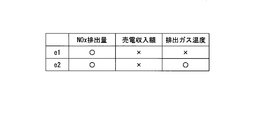
- FIG. 11 is a diagram illustrating a specific example of a management value specifying method according to the fourth embodiment.
- the estimation unit 404 outputs an estimated value e1 based on the first model and an estimated value e2 based on the second model, and the types of evaluation items to be calculated are NOx emissions, power sales revenue, exhaust gas temperature. The case where it is is demonstrated.
- the evaluation value calculation unit 409 calculates the evaluation value of the NOx emission amount, the evaluation value of the power sales revenue, and the evaluation value of the exhaust gas temperature based on the estimated value e1.
- the evaluation value calculation unit 409 calculates the evaluation value of the NOx emission amount, the evaluation value of the amount of electric power sales, and the evaluation value of the exhaust gas temperature based on the estimated value e2.
- the probability specifying unit 406 obtains the appearance probability for each of the evaluation value of the NOx emission amount, the evaluation value of the power sales revenue, and the evaluation value of the exhaust gas temperature obtained from the estimated value e1.
- the probability specifying unit 406 calculates the appearance probability for each of the evaluation value of the NOx emission amount, the evaluation value of the amount of electric power sales, and the evaluation value of the exhaust gas temperature obtained from the estimated value e2.
- the management value specifying unit 407 obtains from the appearance probability of the evaluation value of the NOx emission amount obtained from the estimated value e1, the appearance probability of the evaluation value of the power sales revenue amount obtained from the estimated value e1, and the estimated value e1.
- the appearance probability of the evaluation value of the exhaust gas temperature obtained, the appearance probability of the evaluation value of the NOx emission amount obtained from the estimated value e2, the appearance probability of the evaluation value of the electric power sales revenue amount obtained from the estimated value e2, and the estimated value e2 It is determined whether each of the appearance probabilities of the evaluation value of the exhaust gas temperature obtained from the above is equal to or higher than a predetermined threshold value.
- a predetermined threshold value As shown in FIG.
- the appearance probability of the evaluation value of the NOx emission amount obtained from the estimated value e1 is obtained.
- the appearance probability of the evaluation value of the exhaust gas temperature obtained is equal to or higher than the threshold (represented by “ ⁇ ” in FIG. 11), and the others are less than the threshold (represented by “x” in FIG. 11).
- the management value specifying unit 407 specifies an estimated value having the largest number of items whose appearance probability is equal to or higher than the threshold value as the management value. In the example shown in FIG.
- the management value specifying unit 407 sets the estimated value e2 as the management value.
- the management device 40 specifies values used for management of the target device 10 based on a plurality of evaluation items. Thereby, the management apparatus 40 can set appropriately the value of the target state quantity used for management of the target apparatus 10 so that the evaluation item used for management of the target apparatus 10 becomes a reasonable value.
- the management device 40 specifies the management value based on the number of items for which the appearance probability is determined to be equal to or greater than the threshold value, but is not limited thereto.
- the management device 40 may specify a management value based on the sum of appearance probabilities for each evaluation item or a weighted average, or manage based on the number of items with the highest appearance probability. A value may be specified.
- the management device 40 generates an estimated value of the state quantity based on a plurality of models.
- an operation when one of a plurality of models is a statistical model will be described.
- FIG. 12 is a schematic block diagram illustrating a configuration of a management device according to the fifth embodiment.
- the management apparatus 40 according to the fifth embodiment further includes a state quantity storage unit 410 and a model update unit 411 in addition to the configuration of the first embodiment.
- the model update unit 411 updates the statistical model among the plurality of models stored in the model storage unit 403 based on the past state quantity values stored in the state quantity storage unit 410.
- FIG. 13 is a flowchart illustrating the operation of the management apparatus according to the fifth embodiment.
- the measurement value acquisition unit 401 acquires a state quantity measurement value by the measuring instrument 20 from the communication apparatus 30 (step S ⁇ b> 301).
- the missing detection unit 402 detects a missing measurement value acquired by the measurement value acquisition unit 401 (step S302).
- the estimation unit 404 applies the measurement value acquired by the measurement value acquisition unit 401 to each of a plurality of models including the statistical model, and obtains the estimated value of the state quantity (target state quantity) in which the loss is detected (step S303). ).
- the probability specifying unit 406 specifies the appearance probability of each estimated value based on the probability distribution stored in the probability distribution storage unit 405 (step S304). Then, the management value specifying unit 407 specifies the highest probability among the probabilities specified by the probability specifying unit 406, and specifies the value of the state quantity in which the loss is detected by selecting an estimated value related to the probability. (Step S305).
- the management unit 408 manages the target device 10 based on the measurement value acquired by the measurement value acquisition unit 401 and the value specified by the management value specifying unit 407 (step S306).
- the measurement value acquisition unit 401 and the management value specifying unit 407 accumulate the values used for management of the target device 10 in the state quantity storage unit 410 (step S307).
- the model update unit 411 updates the statistical model stored in the model storage unit 403 based on the value accumulated in the state quantity storage unit 410 (step S308).
- the estimation unit 404 can estimate the value of the state quantity using the statistical model updated at the previous management timing at each management timing.
- the probability specifying unit 406 specifies the appearance probability of the estimated value based on the updated statistical model. That is, according to the fifth embodiment, the statistical estimated value can be estimated with higher accuracy by updating not only the statistical data but also the statistical model itself at each management timing.
- the management apparatus 40 which concerns on 5th Embodiment updates a statistical model based on the value of the past state quantity, it is not restricted to this. For example, in another embodiment, the management device 40 may accumulate the state quantity in the state quantity storage unit 410 while not updating the statistical model.
- the accuracy of estimation by the statistical model can be improved by accumulating values of past state quantities.
- the estimated accuracy can be expected to be improved by accumulating data so that the estimated value of the average value approaches the true value according to the “Law of Large Numbers” and the range of dispersion is narrowed down.
- the management device 40 in the management system 1 according to the above-described embodiment has a function of extracting and specifying a value used for management of the target device 10, but is not limited thereto.
- the management system 1 according to another embodiment includes an information processing device that extracts and specifies values used for management of the target device 10 separately from the management device 40.
- the management device 40 is specified by the information processing device.
- the target device 10 may be managed using the obtained value.
- the management apparatus 40 which concerns on embodiment mentioned above acquires a measured value via the network N, it is not restricted to this.
- the management apparatus 40 according to another embodiment may acquire the measurement value directly from the measuring instrument 20. In this case, the management system 1 may not include the communication device 30.
- the management device 40 selects one of a plurality of estimated values and sets this as the value of the state quantity used for management of the target device 10. I can't.
- the management device 40 may obtain a weighted average value of estimated values using weighting factors according to the appearance probability, and may use this as the value of the state quantity used for management of the target device 10.
- the weight coefficient of each estimated value increases monotonously with respect to the appearance probability.
- the management device 40 may use the appearance probability of the estimated value as it is as the weighting coefficient.
- the management device 40 obtains a value in which a loss is detected by estimation, but is not limited thereto.
- the management device 40 obtains the value of the state quantity by estimation regardless of the presence or absence of a missing value, and is a value used for managing the target device 10 based on the probability distribution for each of the measured value and the estimated value. May be specified.
- FIG. 12 is a schematic block diagram illustrating a configuration of a computer according to at least one embodiment.
- the computer 90 includes a CPU 91, a main storage device 92, an auxiliary storage device 93, and an interface 94.
- the management device 40 described above is mounted on the computer 90.
- the operation of each processing unit described above is stored in the auxiliary storage device 93 in the form of a program.
- the CPU 91 reads out the program from the auxiliary storage device 93 and develops it in the main storage device 92, and executes the above processing according to the program. Further, the CPU 91 secures storage areas corresponding to the model storage unit 403 and the probability distribution storage unit 405 in the main storage device 92 according to the program.
- auxiliary storage device 93 examples include an HDD (Hard Disk Drive), an SSD (Solid State Drive), a magnetic disk, a magneto-optical disk, a CD-ROM (Compact Disc Read Only Memory), and a DVD-ROM (Digital Versatile Disc Read Only. Memory), semiconductor memory, and the like.
- the auxiliary storage device 93 may be an internal medium directly connected to the bus of the computer 90 or an external medium connected to the computer 90 via the interface 94 or a communication line. When this program is distributed to the computer 90 via a communication line, the computer 90 that has received the distribution may develop the program in the main storage device 92 and execute the above processing.
- the auxiliary storage device 93 is a tangible storage medium that is not temporary.
- the program may be for realizing a part of the functions described above. Further, the program may be a so-called difference file (difference program) that realizes the above-described function in combination with another program already stored in the auxiliary storage device 93.
- difference file difference program
- the information processing apparatus appropriately determines the value of the state quantity used for management of the target apparatus based on the estimated value of the target state quantity calculated by each model in consideration of the probability distribution of the value of the state quantity. Can be set.
Landscapes
- Engineering & Computer Science (AREA)
- Physics & Mathematics (AREA)
- General Physics & Mathematics (AREA)
- Theoretical Computer Science (AREA)
- Data Mining & Analysis (AREA)
- Mathematical Physics (AREA)
- Software Systems (AREA)
- General Engineering & Computer Science (AREA)
- Computational Mathematics (AREA)
- Mathematical Analysis (AREA)
- Mathematical Optimization (AREA)
- Pure & Applied Mathematics (AREA)
- Computing Systems (AREA)
- Evolutionary Computation (AREA)
- Artificial Intelligence (AREA)
- Algebra (AREA)
- Business, Economics & Management (AREA)
- Operations Research (AREA)
- Probability & Statistics with Applications (AREA)
- Economics (AREA)
- Human Resources & Organizations (AREA)
- Strategic Management (AREA)
- Databases & Information Systems (AREA)
- Evolutionary Biology (AREA)
- Bioinformatics & Computational Biology (AREA)
- Bioinformatics & Cheminformatics (AREA)
- Life Sciences & Earth Sciences (AREA)
- Development Economics (AREA)
- Quality & Reliability (AREA)
- Tourism & Hospitality (AREA)
- General Business, Economics & Management (AREA)
- Marketing (AREA)
- Entrepreneurship & Innovation (AREA)
- Game Theory and Decision Science (AREA)
- Automation & Control Theory (AREA)
- Computational Linguistics (AREA)
- Computer Vision & Pattern Recognition (AREA)
- Medical Informatics (AREA)
- Testing And Monitoring For Control Systems (AREA)
- Management, Administration, Business Operations System, And Electronic Commerce (AREA)
Priority Applications (4)
| Application Number | Priority Date | Filing Date | Title |
|---|---|---|---|
| DE112018001727.3T DE112018001727B4 (de) | 2017-03-29 | 2018-03-26 | Informationsberarbeitungsvorrichtung, informationsverarbeitungsverfahren und programm |
| CN201880020929.7A CN110462539B (zh) | 2017-03-29 | 2018-03-26 | 信息处理装置、信息处理方法以及计算机可读存储介质 |
| US16/496,683 US11429693B2 (en) | 2017-03-29 | 2018-03-26 | Information processing device, information processing method, and program |
| US17/873,306 US12182225B2 (en) | 2017-03-29 | 2022-07-26 | Information processing device, information processing method, and program |
Applications Claiming Priority (2)
| Application Number | Priority Date | Filing Date | Title |
|---|---|---|---|
| JP2017065894A JP7048216B2 (ja) | 2017-03-29 | 2017-03-29 | 情報処理装置、情報処理方法およびプログラム |
| JP2017-065894 | 2017-03-29 |
Related Child Applications (2)
| Application Number | Title | Priority Date | Filing Date |
|---|---|---|---|
| US16/496,683 A-371-Of-International US11429693B2 (en) | 2017-03-29 | 2018-03-26 | Information processing device, information processing method, and program |
| US17/873,306 Division US12182225B2 (en) | 2017-03-29 | 2022-07-26 | Information processing device, information processing method, and program |
Publications (1)
| Publication Number | Publication Date |
|---|---|
| WO2018181093A1 true WO2018181093A1 (ja) | 2018-10-04 |
Family
ID=63676101
Family Applications (1)
| Application Number | Title | Priority Date | Filing Date |
|---|---|---|---|
| PCT/JP2018/011976 Ceased WO2018181093A1 (ja) | 2017-03-29 | 2018-03-26 | 情報処理装置、情報処理方法およびプログラム |
Country Status (5)
| Country | Link |
|---|---|
| US (2) | US11429693B2 (enExample) |
| JP (1) | JP7048216B2 (enExample) |
| CN (1) | CN110462539B (enExample) |
| DE (1) | DE112018001727B4 (enExample) |
| WO (1) | WO2018181093A1 (enExample) |
Families Citing this family (3)
| Publication number | Priority date | Publication date | Assignee | Title |
|---|---|---|---|---|
| EP4645014A2 (en) | 2019-09-11 | 2025-11-05 | C3.ai, Inc. | Methods, system and medium for predicting manufacturing process risks |
| CN114429795B (zh) * | 2020-10-29 | 2025-04-11 | 新奥新智科技有限公司 | 一种锅炉烟气含氧量的预测方法及装置 |
| JP2024108024A (ja) * | 2023-01-30 | 2024-08-09 | 横河電機株式会社 | 機器、情報処理装置及び情報処理方法 |
Citations (3)
| Publication number | Priority date | Publication date | Assignee | Title |
|---|---|---|---|---|
| JPS6415808A (en) * | 1987-07-10 | 1989-01-19 | Idemitsu Petrochemical Co | Process identifying method |
| JP2007233639A (ja) * | 2006-02-28 | 2007-09-13 | Tohoku Electric Power Co Inc | 風力発電出力予測方法、風力発電出力予測装置およびプログラム |
| JP2011253275A (ja) * | 2010-06-01 | 2011-12-15 | Yokogawa Electric Corp | プラントシミュレータ |
Family Cites Families (15)
| Publication number | Priority date | Publication date | Assignee | Title |
|---|---|---|---|---|
| JP4989399B2 (ja) * | 2007-09-27 | 2012-08-01 | 三菱電機株式会社 | 情報処理装置及び情報処理方法及びプログラム |
| GB0719969D0 (en) * | 2007-10-12 | 2007-11-21 | Cambridge Entpr Ltd | Substance monitoring and control in human or animal bodies |
| JP2009205464A (ja) * | 2008-02-28 | 2009-09-10 | Gifu Univ | 医療情報処理装置、医療情報処理方法、及び医療情報処理プログラム |
| JP5117232B2 (ja) * | 2008-03-18 | 2013-01-16 | 株式会社日立製作所 | ボイラを備えたプラントの制御装置、及びボイラを備えたプラントの制御方法 |
| US8140248B2 (en) * | 2009-04-07 | 2012-03-20 | General Electric Company | System and method for obtaining an optimal estimate of NOx emissions |
| GB201004228D0 (en) | 2010-03-15 | 2010-04-28 | Bae Systems Plc | Target tracking |
| JP5433640B2 (ja) | 2011-06-30 | 2014-03-05 | 楽天株式会社 | 情報提供装置、情報提供方法、情報提供プログラム及び記録媒体 |
| JP5783025B2 (ja) * | 2011-12-12 | 2015-09-24 | 三菱マテリアル株式会社 | 切削インサートおよび刃先交換式エンドミル |
| EP2615561A1 (en) * | 2012-01-13 | 2013-07-17 | ATS Group (IP Holdings) Limited | Spatio-temporal regression using decision criteria and rules to select data for regression |
| JP5963019B2 (ja) * | 2012-02-13 | 2016-08-03 | 日本電気株式会社 | 情報処理装置、情報処理方法、及び情報処理プログラム |
| CN104364805A (zh) | 2012-06-13 | 2015-02-18 | 索尼公司 | 信息处理器、信息处理方法和程序 |
| JP2014164336A (ja) | 2013-02-21 | 2014-09-08 | Mitsubishi Electric Corp | モデル分析装置及びモデル分析方法及びモデル分析プログラム |
| US20160004794A1 (en) | 2014-07-02 | 2016-01-07 | General Electric Company | System and method using generative model to supplement incomplete industrial plant information |
| JP6597137B2 (ja) | 2015-09-30 | 2019-10-30 | セイコーエプソン株式会社 | 印刷装置 |
| US11244091B2 (en) * | 2017-01-23 | 2022-02-08 | International Business Machines Corporation | Missing sensor value estimation |
-
2017
- 2017-03-29 JP JP2017065894A patent/JP7048216B2/ja active Active
-
2018
- 2018-03-26 US US16/496,683 patent/US11429693B2/en active Active
- 2018-03-26 CN CN201880020929.7A patent/CN110462539B/zh active Active
- 2018-03-26 DE DE112018001727.3T patent/DE112018001727B4/de active Active
- 2018-03-26 WO PCT/JP2018/011976 patent/WO2018181093A1/ja not_active Ceased
-
2022
- 2022-07-26 US US17/873,306 patent/US12182225B2/en active Active
Patent Citations (3)
| Publication number | Priority date | Publication date | Assignee | Title |
|---|---|---|---|---|
| JPS6415808A (en) * | 1987-07-10 | 1989-01-19 | Idemitsu Petrochemical Co | Process identifying method |
| JP2007233639A (ja) * | 2006-02-28 | 2007-09-13 | Tohoku Electric Power Co Inc | 風力発電出力予測方法、風力発電出力予測装置およびプログラム |
| JP2011253275A (ja) * | 2010-06-01 | 2011-12-15 | Yokogawa Electric Corp | プラントシミュレータ |
Also Published As
| Publication number | Publication date |
|---|---|
| CN110462539A (zh) | 2019-11-15 |
| CN110462539B (zh) | 2022-07-22 |
| US20200034407A1 (en) | 2020-01-30 |
| JP7048216B2 (ja) | 2022-04-05 |
| US12182225B2 (en) | 2024-12-31 |
| US20220366012A1 (en) | 2022-11-17 |
| DE112018001727B4 (de) | 2025-09-04 |
| US11429693B2 (en) | 2022-08-30 |
| JP2018169748A (ja) | 2018-11-01 |
| DE112018001727T5 (de) | 2019-12-19 |
Similar Documents
| Publication | Publication Date | Title |
|---|---|---|
| JP4361582B2 (ja) | ガスタービンの性能診断方法及び性能診断システム | |
| CN1837767B (zh) | 降级系统的健康参数或症状的估计 | |
| US20220366012A1 (en) | Information processing device, information processing method, and program | |
| JP5437328B2 (ja) | 観測値信頼度評価装置、観測値信頼度評価方法及び観測値信頼度評価プログラム | |
| JP7431070B2 (ja) | データ管理システム、および、データ管理方法 | |
| JP6200076B2 (ja) | システムから取得される測定値を評価する方法及びシステム | |
| WO2018138880A9 (ja) | モデルパラメータ値推定装置及び推定方法、プログラム、プログラムを記録した記録媒体、モデルパラメータ値推定システム | |
| US9652728B2 (en) | Methods and systems for generating a business process control chart for monitoring building processes | |
| JP6803788B2 (ja) | 情報処理装置、情報処理方法およびプログラム | |
| KR20220061713A (ko) | 스마트 미터의 결측치 대체 방법 및 이를 이용하는 스마트 미터 제어 시스템 | |
| CN110520807B (zh) | 信息处理装置、信息处理方法以及存储介质 | |
| JP6800065B2 (ja) | 管理システム、情報処理方法、プログラム、通信装置 | |
| US20250021646A1 (en) | Security countermeasure planning system, security countermeasure planning method, and program | |
| CN119697047B (zh) | 网元健康评估方法、装置、设备及计算机可读存储介质 | |
| CN119598151A (zh) | 模型评估方法、装置、计算机设备、存储介质和程序产品 | |
| KR101583506B1 (ko) | 차량 데이터 생성 방법, 이를 수행하는 차량 데이터 생성 서버 및 이를 저장하는 기록매체 | |
| Roy et al. | Prediction problems related to a first-order autoregressive process in the presence of outliers | |
| JP2014185980A (ja) | データ処理装置およびその方法、ならびにプログラム | |
| JP2019040265A (ja) | 予測装置、予測方法及び予測プログラム |
Legal Events
| Date | Code | Title | Description |
|---|---|---|---|
| 121 | Ep: the epo has been informed by wipo that ep was designated in this application |
Ref document number: 18775459 Country of ref document: EP Kind code of ref document: A1 |
|
| 122 | Ep: pct application non-entry in european phase |
Ref document number: 18775459 Country of ref document: EP Kind code of ref document: A1 |
|
| WWG | Wipo information: grant in national office |
Ref document number: 112018001727 Country of ref document: DE |