WO2018173328A1 - 用水処理方法 - Google Patents
用水処理方法 Download PDFInfo
- Publication number
- WO2018173328A1 WO2018173328A1 PCT/JP2017/033548 JP2017033548W WO2018173328A1 WO 2018173328 A1 WO2018173328 A1 WO 2018173328A1 JP 2017033548 W JP2017033548 W JP 2017033548W WO 2018173328 A1 WO2018173328 A1 WO 2018173328A1
- Authority
- WO
- WIPO (PCT)
- Prior art keywords
- water
- flocculant
- polymer compound
- hydroxyl group
- phenolic hydroxyl
- Prior art date
- Legal status (The legal status is an assumption and is not a legal conclusion. Google has not performed a legal analysis and makes no representation as to the accuracy of the status listed.)
- Ceased
Links
Images
Classifications
-
- B—PERFORMING OPERATIONS; TRANSPORTING
- B01—PHYSICAL OR CHEMICAL PROCESSES OR APPARATUS IN GENERAL
- B01D—SEPARATION
- B01D61/00—Processes of separation using semi-permeable membranes, e.g. dialysis, osmosis or ultrafiltration; Apparatus, accessories or auxiliary operations specially adapted therefor
- B01D61/02—Reverse osmosis; Hyperfiltration ; Nanofiltration
- B01D61/04—Feed pretreatment
-
- C—CHEMISTRY; METALLURGY
- C02—TREATMENT OF WATER, WASTE WATER, SEWAGE, OR SLUDGE
- C02F—TREATMENT OF WATER, WASTE WATER, SEWAGE, OR SLUDGE
- C02F1/00—Treatment of water, waste water, or sewage
- C02F1/52—Treatment of water, waste water, or sewage by flocculation or precipitation of suspended impurities
- C02F1/5209—Regulation methods for flocculation or precipitation
-
- B—PERFORMING OPERATIONS; TRANSPORTING
- B01—PHYSICAL OR CHEMICAL PROCESSES OR APPARATUS IN GENERAL
- B01D—SEPARATION
- B01D21/00—Separation of suspended solid particles from liquids by sedimentation
- B01D21/01—Separation of suspended solid particles from liquids by sedimentation using flocculating agents
-
- B—PERFORMING OPERATIONS; TRANSPORTING
- B01—PHYSICAL OR CHEMICAL PROCESSES OR APPARATUS IN GENERAL
- B01D—SEPARATION
- B01D35/00—Filtering devices having features not specifically covered by groups B01D24/00 - B01D33/00, or for applications not specifically covered by groups B01D24/00 - B01D33/00; Auxiliary devices for filtration; Filter housing constructions
- B01D35/02—Filters adapted for location in special places, e.g. pipe-lines, pumps, stop-cocks
-
- B—PERFORMING OPERATIONS; TRANSPORTING
- B01—PHYSICAL OR CHEMICAL PROCESSES OR APPARATUS IN GENERAL
- B01D—SEPARATION
- B01D61/00—Processes of separation using semi-permeable membranes, e.g. dialysis, osmosis or ultrafiltration; Apparatus, accessories or auxiliary operations specially adapted therefor
- B01D61/02—Reverse osmosis; Hyperfiltration ; Nanofiltration
- B01D61/025—Reverse osmosis; Hyperfiltration
-
- B—PERFORMING OPERATIONS; TRANSPORTING
- B01—PHYSICAL OR CHEMICAL PROCESSES OR APPARATUS IN GENERAL
- B01D—SEPARATION
- B01D65/00—Accessories or auxiliary operations, in general, for separation processes or apparatus using semi-permeable membranes
- B01D65/08—Prevention of membrane fouling or of concentration polarisation
-
- B—PERFORMING OPERATIONS; TRANSPORTING
- B03—SEPARATION OF SOLID MATERIALS USING LIQUIDS OR USING PNEUMATIC TABLES OR JIGS; MAGNETIC OR ELECTROSTATIC SEPARATION OF SOLID MATERIALS FROM SOLID MATERIALS OR FLUIDS; SEPARATION BY HIGH-VOLTAGE ELECTRIC FIELDS
- B03D—FLOTATION; DIFFERENTIAL SEDIMENTATION
- B03D3/00—Differential sedimentation
- B03D3/02—Coagulation
-
- B—PERFORMING OPERATIONS; TRANSPORTING
- B03—SEPARATION OF SOLID MATERIALS USING LIQUIDS OR USING PNEUMATIC TABLES OR JIGS; MAGNETIC OR ELECTROSTATIC SEPARATION OF SOLID MATERIALS FROM SOLID MATERIALS OR FLUIDS; SEPARATION BY HIGH-VOLTAGE ELECTRIC FIELDS
- B03D—FLOTATION; DIFFERENTIAL SEDIMENTATION
- B03D3/00—Differential sedimentation
- B03D3/06—Flocculation
-
- C—CHEMISTRY; METALLURGY
- C02—TREATMENT OF WATER, WASTE WATER, SEWAGE, OR SLUDGE
- C02F—TREATMENT OF WATER, WASTE WATER, SEWAGE, OR SLUDGE
- C02F1/00—Treatment of water, waste water, or sewage
- C02F1/44—Treatment of water, waste water, or sewage by dialysis, osmosis or reverse osmosis
-
- C—CHEMISTRY; METALLURGY
- C02—TREATMENT OF WATER, WASTE WATER, SEWAGE, OR SLUDGE
- C02F—TREATMENT OF WATER, WASTE WATER, SEWAGE, OR SLUDGE
- C02F1/00—Treatment of water, waste water, or sewage
- C02F1/52—Treatment of water, waste water, or sewage by flocculation or precipitation of suspended impurities
- C02F1/5236—Treatment of water, waste water, or sewage by flocculation or precipitation of suspended impurities using inorganic agents
-
- C—CHEMISTRY; METALLURGY
- C02—TREATMENT OF WATER, WASTE WATER, SEWAGE, OR SLUDGE
- C02F—TREATMENT OF WATER, WASTE WATER, SEWAGE, OR SLUDGE
- C02F9/00—Multistage treatment of water, waste water or sewage
-
- B—PERFORMING OPERATIONS; TRANSPORTING
- B01—PHYSICAL OR CHEMICAL PROCESSES OR APPARATUS IN GENERAL
- B01D—SEPARATION
- B01D2311/00—Details relating to membrane separation process operations and control
- B01D2311/04—Specific process operations in the feed stream; Feed pretreatment
-
- B—PERFORMING OPERATIONS; TRANSPORTING
- B01—PHYSICAL OR CHEMICAL PROCESSES OR APPARATUS IN GENERAL
- B01D—SEPARATION
- B01D2311/00—Details relating to membrane separation process operations and control
- B01D2311/12—Addition of chemical agents
-
- B—PERFORMING OPERATIONS; TRANSPORTING
- B01—PHYSICAL OR CHEMICAL PROCESSES OR APPARATUS IN GENERAL
- B01D—SEPARATION
- B01D2311/00—Details relating to membrane separation process operations and control
- B01D2311/26—Further operations combined with membrane separation processes
- B01D2311/2642—Aggregation, sedimentation, flocculation, precipitation or coagulation
-
- B—PERFORMING OPERATIONS; TRANSPORTING
- B01—PHYSICAL OR CHEMICAL PROCESSES OR APPARATUS IN GENERAL
- B01D—SEPARATION
- B01D2311/00—Details relating to membrane separation process operations and control
- B01D2311/26—Further operations combined with membrane separation processes
- B01D2311/2649—Filtration
-
- C—CHEMISTRY; METALLURGY
- C02—TREATMENT OF WATER, WASTE WATER, SEWAGE, OR SLUDGE
- C02F—TREATMENT OF WATER, WASTE WATER, SEWAGE, OR SLUDGE
- C02F1/00—Treatment of water, waste water, or sewage
- C02F1/28—Treatment of water, waste water, or sewage by sorption
- C02F1/283—Treatment of water, waste water, or sewage by sorption using coal, charred products, or inorganic mixtures containing them
-
- C—CHEMISTRY; METALLURGY
- C02—TREATMENT OF WATER, WASTE WATER, SEWAGE, OR SLUDGE
- C02F—TREATMENT OF WATER, WASTE WATER, SEWAGE, OR SLUDGE
- C02F1/00—Treatment of water, waste water, or sewage
- C02F1/42—Treatment of water, waste water, or sewage by ion-exchange
-
- C—CHEMISTRY; METALLURGY
- C02—TREATMENT OF WATER, WASTE WATER, SEWAGE, OR SLUDGE
- C02F—TREATMENT OF WATER, WASTE WATER, SEWAGE, OR SLUDGE
- C02F1/00—Treatment of water, waste water, or sewage
- C02F1/44—Treatment of water, waste water, or sewage by dialysis, osmosis or reverse osmosis
- C02F1/441—Treatment of water, waste water, or sewage by dialysis, osmosis or reverse osmosis by reverse osmosis
-
- C—CHEMISTRY; METALLURGY
- C02—TREATMENT OF WATER, WASTE WATER, SEWAGE, OR SLUDGE
- C02F—TREATMENT OF WATER, WASTE WATER, SEWAGE, OR SLUDGE
- C02F1/00—Treatment of water, waste water, or sewage
- C02F1/44—Treatment of water, waste water, or sewage by dialysis, osmosis or reverse osmosis
- C02F1/444—Treatment of water, waste water, or sewage by dialysis, osmosis or reverse osmosis by ultrafiltration or microfiltration
-
- C—CHEMISTRY; METALLURGY
- C02—TREATMENT OF WATER, WASTE WATER, SEWAGE, OR SLUDGE
- C02F—TREATMENT OF WATER, WASTE WATER, SEWAGE, OR SLUDGE
- C02F1/00—Treatment of water, waste water, or sewage
- C02F1/52—Treatment of water, waste water, or sewage by flocculation or precipitation of suspended impurities
- C02F1/5236—Treatment of water, waste water, or sewage by flocculation or precipitation of suspended impurities using inorganic agents
- C02F1/5245—Treatment of water, waste water, or sewage by flocculation or precipitation of suspended impurities using inorganic agents using basic salts, e.g. of aluminium and iron
-
- C—CHEMISTRY; METALLURGY
- C02—TREATMENT OF WATER, WASTE WATER, SEWAGE, OR SLUDGE
- C02F—TREATMENT OF WATER, WASTE WATER, SEWAGE, OR SLUDGE
- C02F1/00—Treatment of water, waste water, or sewage
- C02F1/52—Treatment of water, waste water, or sewage by flocculation or precipitation of suspended impurities
- C02F1/54—Treatment of water, waste water, or sewage by flocculation or precipitation of suspended impurities using organic material
- C02F1/56—Macromolecular compounds
-
- C—CHEMISTRY; METALLURGY
- C02—TREATMENT OF WATER, WASTE WATER, SEWAGE, OR SLUDGE
- C02F—TREATMENT OF WATER, WASTE WATER, SEWAGE, OR SLUDGE
- C02F1/00—Treatment of water, waste water, or sewage
- C02F1/66—Treatment of water, waste water, or sewage by neutralisation; pH adjustment
-
- C—CHEMISTRY; METALLURGY
- C02—TREATMENT OF WATER, WASTE WATER, SEWAGE, OR SLUDGE
- C02F—TREATMENT OF WATER, WASTE WATER, SEWAGE, OR SLUDGE
- C02F1/00—Treatment of water, waste water, or sewage
- C02F1/72—Treatment of water, waste water, or sewage by oxidation
- C02F1/76—Treatment of water, waste water, or sewage by oxidation with halogens or compounds of halogens
-
- C—CHEMISTRY; METALLURGY
- C02—TREATMENT OF WATER, WASTE WATER, SEWAGE, OR SLUDGE
- C02F—TREATMENT OF WATER, WASTE WATER, SEWAGE, OR SLUDGE
- C02F2301/00—General aspects of water treatment
- C02F2301/08—Multistage treatments, e.g. repetition of the same process step under different conditions
-
- C—CHEMISTRY; METALLURGY
- C02—TREATMENT OF WATER, WASTE WATER, SEWAGE, OR SLUDGE
- C02F—TREATMENT OF WATER, WASTE WATER, SEWAGE, OR SLUDGE
- C02F2303/00—Specific treatment goals
- C02F2303/22—Eliminating or preventing deposits, scale removal, scale prevention
-
- C—CHEMISTRY; METALLURGY
- C02—TREATMENT OF WATER, WASTE WATER, SEWAGE, OR SLUDGE
- C02F—TREATMENT OF WATER, WASTE WATER, SEWAGE, OR SLUDGE
- C02F2305/00—Use of specific compounds during water treatment
- C02F2305/02—Specific form of oxidant
Definitions
- the present invention relates to a water treatment method for treating raw water with agglomeration, turbidity, and reverse osmosis membrane, and more particularly to a water treatment method using a polymer compound having a phenolic hydroxyl group and an iron-based flocculant as a flocculant.
- a flocculant is added to the raw water to condense and coarsen suspended solids, colloidal components and organic substances in the raw water, and then precipitate, A method of solid-liquid separation by levitation, filtration, membrane filtration, or the like, or turbidity / sterilization by membrane filtration alone to recover treated water are performed.
- inorganic coagulants such as ferric chloride and PAC have been used for the coagulation treatment.
- coagulation of only salt iron (ferric chloride) generates iron colloid depending on the quality of raw water and water. May lead to turbid membrane contamination.
- Patent Document 1 a method of adding a polymer compound having a phenolic hydroxyl group prior to the addition of an inorganic flocculant.
- a low molecular weight component is added by adding a polymer compound having a phenolic hydroxyl group and an inorganic flocculant to water to be treated and then adding a cationic polymer flocculant having an intrinsic viscosity of 0.23 dL / g or more. It is described that the leak is suppressed. However, when a cationic polymer flocculant is newly added, the number of flocculants becomes three, and it is expected that both the cost and the flocculant addition control will be difficult.
- Patent Documents 3 and 4 describe that after adding a novolac-type phenol resin flocculant to the water to be treated, an inorganic flocculant is added to perform RO treatment.
- JP 2017-7563 A Japanese Patent Laying-Open No. 2015-157265 JP 2011-56496 A JP 2012-166118 A
- the present invention includes a step of adding a polymer compound having a phenolic hydroxyl group as an aggregating agent and an iron-based aggregating agent to water to be treated, a step of filtering the agglomerated water with a turbidity filter, and reversing the filtered water.
- An object of the present invention is to provide a water treatment method having a step of treating an osmotic membrane so that good flocs are formed and adhesion contamination, iron leak, and low molecular leak to a turbidity membrane are suppressed.
- the gist of the present invention is as follows.
- the addition of the flocculant is controlled so that the ratio between the addition concentration of the polymer compound having a phenolic hydroxyl group and the addition concentration of the iron-based flocculant is constant. Water treatment method.
- the addition concentration of the iron-based flocculant is varied according to the raw water quality and / or treated water quality, and the addition concentration follows the addition concentration of the iron-based flocculant.
- a water treatment method characterized by controlling the addition amount of a polymer compound having a phenolic hydroxyl group so as to be constant.
- a step of adding a polymer compound having a phenolic hydroxyl group and an iron-based flocculant as a flocculant to the water to be treated, a step of filtering the flocculant water with a turbidity filter, and the filtered water are reversed.
- the water treatment method comprising the step of osmotic membrane treatment, first, the ratio between the addition concentration of the polymer compound having a phenolic hydroxyl group and the addition concentration of the iron-based flocculant is determined, and the phenol is adjusted so that this ratio is constant.
- the addition amount of the polymer compound having a functional hydroxyl group and the iron-based flocculant is controlled. Thereby, a good floc is formed, and adhesion contamination to the turbidity removal film, iron leak, and low molecular leak are suppressed.
- an oxidant is added to the water to be treated as necessary, and then a polymer compound having a phenolic hydroxyl group and an iron-based flocculant are added, followed by turbidity treatment, and then the reverse Osmotic membrane treatment (hereinafter sometimes referred to as RO treatment) is performed.
- RO treatment reverse Osmotic membrane treatment
- the TOC concentration in the water to be treated is preferably about 0.1 to 5.0 mg / L.
- the polymer compound having a phenolic hydroxyl group is a reaction product obtained by subjecting a novolac type phenol resin to a resol type secondary reaction, and in the form of an alkaline solution.
- a novolac type phenol resin to a resol type secondary reaction, and in the form of an alkaline solution.
- This polymer compound having a phenolic hydroxyl group is obtained by adding an aldehyde to an alkaline solution of a novolak-type phenol resin obtained by reacting a phenol and an aldehyde in the presence of an acid catalyst, to form a resole type 2
- a water treatment flocculant comprising an alkaline solution of a phenol-based resin obtained by performing the next reaction, and preferably the phenols contain methylphenols.
- the novolak type phenolic resin used as a raw material for the resol type secondary reaction is subjected to an addition condensation reaction of phenols and aldehydes in the presence of an acidic catalyst in a reaction vessel according to a conventional method, and then under normal pressure and reduced pressure. It is produced by dehydration and removal of unreacted phenols.
- aldehydes include, but are not limited to, formaldehyde, paraformaldehyde, acetaldehyde, propyl aldehyde, benzaldehyde, salicylaldehyde, and glyoxal. These aldehydes may be used individually by 1 type, and may mix and use 2 or more types.
- the melting point of the novolac-type methylphenol resin used as a raw material for the resol-type secondary reaction there is no limitation on the melting point of the novolac-type methylphenol resin used as a raw material for the resol-type secondary reaction, but usually the raw material phenols mainly composed of methylphenols such as cresol are 60 to 135 ° C.
- the novolak-type methylphenol resin used as the raw material for the resol-type secondary reaction there is no restriction on the molecular weight of the novolak-type methylphenol resin used as the raw material for the resol-type secondary reaction, but the higher molecular weight resin not only does not participate in the aggregation but also remains in the agglomerated water after the completion of the secondary reaction. Thus, the content of low molecular weight components that contaminate treated water is reduced, which is preferable. For this reason, it is preferable that the novolak-type methylphenol-type resin to be used is 1000 or more in weight average molecular weight, and it is especially preferable that it is 2000 or more.
- limiting in the upper limit of the molecular weight of a novolak-type methylphenol-type resin Usually, it is about 8000 in a weight average molecular weight.
- the weight average molecular weight of this secondary reaction methylphenol resin is preferably 5,000 or more, more preferably 10,000 or more. On the other hand, when the weight average molecular weight exceeds 50,000, some molecules having a molecular weight of 1 million or more are formed, the viscosity is high, and further crosslinking occurs over time, so that insoluble matter is likely to be generated.
- the weight average molecular weight of the phenolic resin is preferably 50000 or less, particularly preferably 30000 or less.
- the alkaline solution of methylphenol resin obtained by this resol type secondary reaction is a liquid that can be pumped, and a commercially available product (for example, Krivata BP-201 manufactured by Kurita Kogyo Co., Ltd.) can be used.
- ferric chloride ferric sulfate, polyferric sulfate and the like can be used.
- the addition concentration of the iron-based flocculant is varied according to the raw water quality (for example, TOC concentration) and / or the treated water quality (for example, TOC concentration), and added in accordance with the addition concentration of the iron-based flocculant. It is preferable to control the addition amount of the polymer compound having a phenolic hydroxyl group so that the concentration is constant. For example, when the TOC concentration varies in the range of 0.1 to 5.0 mg / L, the iron-based flocculant is controlled in the range of 5 to 300 mg / L.
- the iron-based flocculant is 5 to 50 mg / L (preferably 10 to 30 mg / L) for a TOC concentration of 0.1 mg / L, and the iron-based flocculant is 40 for a TOC concentration of 2 mg / L.
- About 150 to 300 mg / L (preferably 200 to 250 mg / L) of iron-based flocculant is added to ⁇ 120 mg / L (preferably 50 to 100 mg / L) and TOC concentration of 5 mg / L.
- these numerical values are suitably changed while observing treated water quality and operating conditions, and are not limited to these ranges.
- the polymer compound having a phenolic hydroxyl group has a constant ratio of [addition concentration of polymer compound having phenolic hydroxyl group] / [addition concentration of iron-based flocculant] (hereinafter also referred to as flocculant ratio).
- flocculant ratio the addition concentration of iron-based flocculant
- it is preferably added so as to have a constant value selected from 0.01 to 0.25, particularly from 0.01 to 0.2.
- the polymer compound having a phenolic hydroxyl group is preferably added so that the addition concentration is 20 mg / L or less.
- the reaction is carried out so that the aggregation reaction time after addition of each flocculant is about 1 to 30 minutes, preferably about 4 to 15 minutes. Either of the addition order of the polymer compound having a phenolic hydroxyl group and the iron-based flocculant may be first, but the polymer compound having a phenolic hydroxyl group is more preferable.
- the aggregation pH is preferably 4.5 to 6, particularly 5 to 5.5. If the pH is less than 4.5, there is a risk of reverse osmosis membrane blockage due to iron leakage. Above pH 6, there is a possibility of poor aggregation.
- An oxidizing agent preferably a chlorine-based oxidizing agent such as sodium hypochlorite
- This added concentration is preferably about 0.3 to 1.0 mg / LasCl 2 .
- the flocculated water is preferably subjected to turbidity treatment without pretreatment.
- a turbidizer a general gravity filter, a pressure filter, or a turbidity membrane can be used.
- the turbidity removal membrane is preferably made of PVDF from the viewpoint of chemical resistance, and a UF membrane, MF membrane, etc. having a pore diameter of 0.02 to 0.1 ⁇ m are preferred.
- the turbidity-eliminating device may be a cross-flow type or a total filtration type.
- the turbidity treatment using the turbidity membrane device is performed by the steps of water passing through the turbidity membrane, air bubbling, backwashing, and water filling.
- the filtration water passing time is preferably about 20 to 40 minutes.
- the differential pressure (inlet pressure-outlet pressure) is preferably about 0.02 to 0.04 MPa. When the differential pressure rises to 0.07 to 0.10 MPa, stationary cleaning is performed.
- the preferable conditions when the turbidity-treated water is treated with the reverse osmosis membrane are as follows. (1) The amount of brine is preferably 3.6 m 3 / h or more. (2) The reverse osmosis membrane is preferably an ultra-low pressure membrane having a standard pressure of 0.735 MPa. The membrane area is preferably 35 to 41 m 2 . (3) The initial pure water flux is preferably 1.0 m / d (25 ° C. or higher, 0.735 MPa). The initial desalting rate is preferably 98% or more. (4) It is preferable to set the recovery rate such that the calcium hardness Langeria index is 0 or less. Moreover, it is preferable to set the recovery rate so that the silica concentration in the brine water is within the solubility of silica. The recovery rate is preferably 50 to 80%.
- the RO-treated water may be further deionized with an electrodeionization device or an ion exchanger.
- an electrodeionization device or an ion exchanger When residual chlorine may leak from RO, it is preferable to provide an activated carbon filter or a safety filter in front of these devices.
- Well water is 0.221 mg / L for UV-260 and 1.0 mg / L for TOC.
- the agglomeration treatment was performed at pH 5.5 using a jar tester.
- the flocculant ratio was set to 0, 0.01, 0.1, 0.2, 0.5, and 1.
- Experimental Example 6 with a flocculant ratio of 1 has a higher TOC than Experimental Example 1. This is presumably because part of the low molecular components (impurities) in the polymer compound having a phenolic hydroxyl group leaked.
- the aggregation pH was adjusted to 5.5.
- the flux reduction coefficient is set to an allowable value of 0.030 or less.
- F Flux
- F 0 Initial flux
- T Time m: Flux reduction coefficient
- Example 1 Comparative Examples 3 to 6
- the RO treatment operation was performed under the conditions in which Canadian fulvo was added and the TOC was as shown in Table 3.
- the polymer compound having a phenolic hydroxyl group and the iron-based flocculant were subjected to the conditions in which the ratio of the flocculant was fixed at 0.16 (Examples 3 to 6), and the concentration of the iron-based flocculant was changed.
- the test was carried out under the conditions (Comparative Examples 3 to 6) in which the concentration of the polymer compound having ⁇ was fixed.
- the flux reduction coefficient of RO tended to be lower than that of the example.
- the addition control of the flocculant was performed using TOC as an index, but the measured value of UV-260, iron ion concentration, turbidity, etc. may be used as the control index.
- a control unit that automatically performs chemical injection control based on a measurement value from a sensor provided in raw water or treated water may be provided to construct a system that implements the treatment method of the present invention.
Landscapes
- Chemical & Material Sciences (AREA)
- Engineering & Computer Science (AREA)
- Water Supply & Treatment (AREA)
- Life Sciences & Earth Sciences (AREA)
- Hydrology & Water Resources (AREA)
- Environmental & Geological Engineering (AREA)
- Organic Chemistry (AREA)
- Chemical Kinetics & Catalysis (AREA)
- Nanotechnology (AREA)
- Inorganic Chemistry (AREA)
- Separation Using Semi-Permeable Membranes (AREA)
- Separation Of Suspended Particles By Flocculating Agents (AREA)
Abstract
被処理水に凝集剤としてフェノール性水酸基を有する高分子化合物と鉄系凝集剤を添加する工程と、この凝集水を除濁用濾過器で濾過する工程と、この濾過水を逆浸透膜処理する工程とを有する用水処理方法において、フェノール性水酸基を有する高分子化合物の添加濃度と鉄系凝集剤の添加濃度との比が一定となるように凝集剤の添加を制御することを特徴とする用水処理方法。
Description
本発明は、凝集、除濁、及び逆浸透膜によって原水を処理する用水処理方法に係り、特に凝集剤としてフェノール性水酸基を有する高分子化合物と鉄系凝集剤とを用いる用水処理方法に関する。
井戸水、工業用水、水道水などを原水とする用水処理においては、原水に凝集剤を添加して、原水中の懸濁物質、コロイダル成分や有機物質等を凝結かつ粗大化させた後、沈殿、浮上、濾過、膜濾過等により固液分離する方法や、膜濾過単独で除濁・除菌して処理水を回収することが行われている。
従来、凝集処理には、塩化第二鉄やPACなどの無機凝集剤が用いられてきたが、例えば、塩鉄(塩化第二鉄)のみの凝集では原水水質によっては鉄コロイドが発生し、除濁膜汚染に繋がることもある。
逆浸透(RO)膜における膜閉塞を引き起こす、被処理水中のUV-260成分を低減させるために、無機凝集剤の添加量を増やす必要があり、汚泥発生量の増加の問題がある。逆浸透膜の洗浄頻度の目安としては6ヶ月に一回程度である。洗浄頻度が3ヶ月以内に一回であった場合、コストが高くなること、洗浄により膜の劣化が生じるリスクが高くなる。
この問題を解決するものとして、無機凝集剤の添加に先立ちフェノール性水酸基を有する高分子化合物を添加する方法が提案されている。フェノール性水酸基を有する高分子化合物を添加することで、無機凝集剤の添加量を低減するとともに、凝集処理水の水質を向上させることができる(特許文献1)。
フェノール性水酸基を有する高分子化合物と無機凝集剤とを用いた凝集処理を行う場合、低分子成分が凝集処理水中に残存して、逆浸透膜を閉塞させる可能性がある。また、凝集処理水を除濁膜で除濁処理した後、RO処理する場合であっても、フェノール性水酸基を有する高分子化合物を添加した後に、除濁膜にて直接処理しようとすると、該高分子化合物等が除濁膜に付着して濾過性能が急激に悪化したり、また、除濁膜からリークしてRO膜を閉塞させることがある。
特許文献2には、被処理水にフェノール性水酸基を有する高分子化合物と無機凝集剤を添加した後、固有粘度0.23dL/g以上のカチオン性高分子凝集剤を添加することで低分子成分のリークをおさえることが記載されている。しかし、新たにカチオン性高分子凝集剤を添加すると、凝集剤は3剤となり、コスト面でも、凝集剤添加制御面でも困難が予想される。
特許文献3,4には、被処理水にノボラック型フェノール樹脂系凝集剤を添加した後、無機凝集剤を添加し、RO処理することが記載されている。
本発明は、被処理水に凝集剤としてフェノール性水酸基を有する高分子化合物と鉄系凝集剤を添加する工程と、この凝集水を除濁用濾過器で濾過する工程と、この濾過水を逆浸透膜処理する工程とを有する用水処理方法において、良好なフロックが形成され、除濁膜への付着汚染、鉄リーク、低分子リークが抑制されるようにすることを目的とする。
本発明の要旨は次の通りである。
[1] 被処理水に凝集剤としてフェノール性水酸基を有する高分子化合物と鉄系凝集剤を添加する工程と、この凝集水を除濁用濾過器で濾過する工程と、この濾過水を逆浸透膜処理する工程とを有する用水処理方法において、フェノール性水酸基を有する高分子化合物の添加濃度と鉄系凝集剤の添加濃度との比が一定となるように凝集剤の添加を制御することを特徴とする用水処理方法。
[2] [1]において、フェノール性水酸基を有する高分子化合物の添加濃度と鉄系凝集剤の添加濃度との比が0.01~0.25となるように凝集剤の添加を制御すること特徴とする用水処理方法。
[3] [1]又は[2]において、鉄系凝集剤の添加濃度を原水水質、または/および処理水水質に応じて変動させ、この鉄系凝集剤の添加濃度に追従して添加濃度が一定となるようにフェノール性水酸基を有する高分子化合物の添加量を制御することを特徴とする用水処理方法。
[4] [1]ないし[3]のいずれかにおいて、フェノール性水酸基を有する高分子化合物添加濃度は1~15mg/Lであることを特徴とする用水処理方法。
[5] [1]~[4]のいずれかにおいて、前記凝集水を直接に前記除濁用濾過器に供給することを特徴とする用水処理方法。
本発明では、被処理水に凝集剤としてフェノール性水酸基を有する高分子化合物と鉄系凝集剤を添加する工程と、この凝集水を除濁用濾過器で濾過する工程と、この濾過水を逆浸透膜処理する工程とを有する用水処理方法において、最初にフェノール性水酸基を有する高分子化合物の添加濃度と鉄系凝集剤の添加濃度との比を決定し、この比が一定となるようにフェノール性水酸基を有する高分子化合物及び鉄系凝集剤の添加量を制御する。これにより、良好なフロックが形成され、除濁膜への付着汚染、鉄リーク、低分子リークが抑制される。
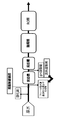
本発明では、図1のように、被処理水に必要に応じ酸化剤を添加した後、フェノール性水酸基を有する高分子化合物と鉄系凝集剤とを添加した後、除濁処理し、次いで逆浸透膜処理(以下、RO処理ということがある。)を行う。
被処理水としては、水道水、工業用水、井戸水などが挙げられる。工業用水としては、河川水、湖沼水などが例示される。本発明では、被処理水中のTOC濃度は0.1~5.0mg/L程度が好適である。
フェノール性水酸基を有する高分子化合物としては、ノボラック型フェノール樹脂にレゾール型の2次反応を行って得られた反応物であり、アルカリ溶液の形態のものが用いられ、特許文献3,4に記載のものが好ましい。
このフェノール性水酸基を有する高分子化合物は、フェノール類とアルデヒド類とを酸触媒の存在下に反応させて得られたノボラック型フェノール系樹脂のアルカリ溶液に、アルデヒド類を添加してレゾール型の2次反応を行って得られるフェノール系樹脂のアルカリ溶液よりなる水処理凝集剤であって、好ましくは該フェノール類がメチルフェノール類を含む。
レゾール型2次反応の原料となるノボラック型フェノール系樹脂は、常法に従って、反応釜において、フェノール類及びアルデヒド類を、酸性触媒の存在下で付加縮合反応させた後、常圧及び減圧下で、脱水と未反応フェノール類の除去を行って製造される。
アルデヒド類としては、ホルムアルデヒド、パラホルムアルデヒド、アセトアルデヒド、プロピルアルデヒド、ベンズアルデヒド、サリチルアルデヒド、グリオキザールなどが挙げられるが、何らこれらに限定されるものではない。これらのアルデヒド類は1種を単独で用いても良く、2種以上を混合して用いても良い。
これらのうち、実用的な物質は、ホルムアルデヒド、パラホルムアルデヒドである。
レゾール型2次反応の原料となるノボラック型メチルフェノール系樹脂の融点に制限はないが通常、原料フェノール類としてクレゾール等のメチルフェノール類を主体とするものは60~135℃である。
レゾール型2次反応の原料となるノボラック型メチルフェノール系樹脂の分子量に制限はないが、分子量のより高い樹脂の方が、2次反応終了後に、凝集に関与しないだけでなく凝集処理水中に残留して処理水を汚染する低分子量成分含有率が少なくなるため、好ましい。このため、用いるノボラック型メチルフェノール系樹脂は、重量平均分子量で1000以上であることが好ましく、特に2000以上であることが好ましい。ノボラック型メチルフェノール系樹脂の分子量の上限に制限はないが、通常、重量平均分子量で8000程度である。
この2次反応メチルフェノール系樹脂の重量平均分子量は5,000以上が好ましく、さらに好ましくは10000以上である。一方、重量平均分子量が50000を超える場合は、一部分子量100万以上の分子が生成し、粘度が高く、時間経過でさらに架橋し、不溶物が発生する可能性が高いため、2次反応メチルフェノール系樹脂の重量平均分子量は50000以下、特に30000以下であることが好ましい。
このレゾール型2次反応で得られるメチルフェノール系樹脂のアルカリ溶液は、ポンプ薬注可能な液体であり、市販品(例えば、栗田工業株式会社製クリバーターBP-201)を使用することができる。
鉄系凝集剤としては、塩化第二鉄、硫酸第二鉄、ポリ硫酸第二鉄などを用いることができる。
本発明では、鉄系凝集剤の添加濃度を原水水質(例えばTOC濃度)、または/および処理水水質(例えばTOC濃度)に応じて変動させ、この鉄系凝集剤の添加濃度に追従して添加濃度が一定となるようにフェノール性水酸基を有する高分子化合物の添加量を制御することが好ましい。例えば、TOC濃度が0.1~5.0mg/Lの範囲で変動するような場合、鉄系凝集剤は5~300mg/Lの範囲で制御する。具体的には、TOC濃度0.1mg/Lに対して、鉄系凝集剤を5~50mg/L(好ましくは10~30mg/L)、TOC濃度2mg/Lに対し、鉄系凝集剤を40~120mg/L(好ましくは50~100mg/L)、TOC濃度5mg/Lに対し、鉄系凝集剤を150~300mg/L(好ましくは200~250mg/L)程度添加する。なお、これらの数値は、処理水質や運転状況を見ながら適宜変更されるものであり、これらの範囲に限られるものではない。
フェノール性水酸基を有する高分子化合物は、[フェノール性水酸基を有する高分子化合物の添加濃度]/[鉄系凝集剤の添加濃度]比(以下、凝集剤比ということがある。)が一定値、特に0.01~0.25とりわけ0.01~0.2の間から選ばれた一定値となるように添加されることが好ましい。
フェノール性水酸基を有する高分子化合物は、添加濃度が20mg/L以下となるように添加されることが好ましい。各凝集剤添加後の凝集反応時間は各々1~30分程度、好ましくは4~15分程度となるように反応される。フェノール性水酸基を有する高分子化合物と鉄系凝集剤との添加順序はどちらが先でもよいが、フェノール性水酸基を有する高分子化合物が先のほうが望ましい。
凝集pHは4.5~6、特に5~5.5が好ましい。pH4.5未満では鉄リークにより逆浸透膜閉塞のおそれがある。pH6超では凝集不良の可能性がある。
被処理水にFe2+イオンが存在する場合、ROを詰まらせるため、Fe2+イオンからFe3+イオンにして凝集及び除濁処理で除去しやすくするため、凝集剤を添加する前の被処理水に酸化剤(好ましくは次亜塩素酸ナトリウムなどの塩素系酸化剤)を添加してもよい。この添加濃度は0.3~1.0mg/LasCl2程度が好ましい。
凝集水は、前処理することなく除濁処理することが好ましい。除濁器としては、一般的な重力濾過器、圧力濾過器、または除濁膜を用いることができる。除濁膜としては、耐薬品性の点からPVDF製のものが好ましく、孔径0.02~0.1μmのUF膜、MF膜などが好ましい。除濁膜装置は、クロスフロー方式のものであっても全量濾過方式のものであってもよい。
除濁膜装置を用いた除濁処理は、除濁膜への通水、エアバブリング、逆洗、水張りの工程により行われる。濾過通水時間は20~40分程度が好ましい。差圧(入口圧力-出口圧力)は0.02~0.04MPa程度が好ましい。差圧が0.07~0.10MPaに上昇した場合、定置洗浄する。
除濁処理水を逆浸透膜処理する際の好ましい条件は次の通りである。
(1) ブライン量は3.6m3/h以上が好ましい。
(2) 逆浸透膜は、標準圧力0.735MPaの超低圧膜が好ましい。膜面積は35~41m2が好ましい。
(3) 初期純水フラックスは1.0m/d(25℃以上、0.735MPa)が好ましい。初期脱塩率は98%以上が好ましい。
(4) カルシウム硬度ランゲリア指数が0以下となるように回収率を設定することが好ましい。また、ブライン水中のシリカ濃度がシリカの溶解度以内となるように回収率を設定することが好ましい。回収率は50~80%が好ましい。
(1) ブライン量は3.6m3/h以上が好ましい。
(2) 逆浸透膜は、標準圧力0.735MPaの超低圧膜が好ましい。膜面積は35~41m2が好ましい。
(3) 初期純水フラックスは1.0m/d(25℃以上、0.735MPa)が好ましい。初期脱塩率は98%以上が好ましい。
(4) カルシウム硬度ランゲリア指数が0以下となるように回収率を設定することが好ましい。また、ブライン水中のシリカ濃度がシリカの溶解度以内となるように回収率を設定することが好ましい。回収率は50~80%が好ましい。
RO処理水をさらに電気脱イオン装置やイオン交換器で脱イオン処理してもよい。ROから残留塩素がリークする可能性がある場合は、これらの機器の前段に活性炭濾過器や保安フィルターを設けることが好ましい。
[実験例1~6]
井戸水を種々の凝集剤比で凝集処理した後、濾過処理し、凝集効果を試験した。
井戸水を種々の凝集剤比で凝集処理した後、濾過処理し、凝集効果を試験した。
フェノール性水酸基を有する高分子化合物としては、栗田工業株式会社製クリバーターBP-201(レゾール型)を用いた。鉄系凝集剤としては塩化第二鉄(塩鉄)を用いた。
井戸水は、UV-260が0.221mg/L、TOCが1.0mg/Lである。
凝集処理は、ジャーテスターを用い、pH5.5で行った。
凝集剤比は、表1の通り、0、0.01、0.1、0.2、0.5、1とした。
濾過には、No.5A濾紙を用いた。濾過水質(UV-260,TOC)を測定し、結果を表1に示した。

<考察>
表1の通り、凝集剤比を0.01~0.5とした実験例2~5は、凝集剤比が0の実験例1よりもTOC濃度が低い。
表1の通り、凝集剤比を0.01~0.5とした実験例2~5は、凝集剤比が0の実験例1よりもTOC濃度が低い。
凝集剤比が1である実験例6は、実験例1に比べてTOCが高い。これは、フェノール性水酸基を有する高分子化合物中の低分子成分(不純物)の一部がリークしたためであると考えられる。
[実施例1,2、比較例1,2]
<実験条件>
原水(日本国栃木県野木町水:TOC0.9mg/L)に対して、フェノール性水酸基を有する高分子化合物(クリバーターBP-201(レゾール型))を表2の添加量にて添加後、塩化第二鉄を表2の添加量にて添加した。その後、孔径0.02μmの除濁膜にて濾過し、RO処理した。RO処理条件は以下の通りである。
<RO処理条件>
処理水量3.8L/min
循環水量15L/min
回収率65%
<実験条件>
原水(日本国栃木県野木町水:TOC0.9mg/L)に対して、フェノール性水酸基を有する高分子化合物(クリバーターBP-201(レゾール型))を表2の添加量にて添加後、塩化第二鉄を表2の添加量にて添加した。その後、孔径0.02μmの除濁膜にて濾過し、RO処理した。RO処理条件は以下の通りである。
<RO処理条件>
処理水量3.8L/min
循環水量15L/min
回収率65%
フェノール性水酸基を有する高分子化合物(クリバーターBP-201(レゾール型))の添加濃度は、塩化第二鉄の略16%(凝集剤比([フェノール性水酸基を有する高分子化合物/鉄系凝集剤]=略0.16))となるようにした。凝集pHは5.5に調整した。
2週間通水して除濁膜差圧、RO膜のフラックス挙動(フラックス低下係数)を評価した。結果を表2に示す。洗浄頻度、洗浄回復性の観点から、フラックス低下係数は0.030以下を許容値とした。フラックス低下係数はF=F0×Tmにおけるmの値である。
F:フラックス
F0:初期フラックス
T:時間
m:フラックス低下係数
F:フラックス
F0:初期フラックス
T:時間
m:フラックス低下係数

<考察>
表2のとおり、凝集剤比が同じであっても、フェノール性水酸基を有する高分子化合物の添加濃度が多くなると、差圧の上昇、又はフラックスの低下が認められた。これは、除濁膜への付着による差圧上昇、フェノール性水酸基を有する高分子化合物中の低分子成分の一部がROへリークして膜閉塞を引き起こしたものと考えられる。
表2のとおり、凝集剤比が同じであっても、フェノール性水酸基を有する高分子化合物の添加濃度が多くなると、差圧の上昇、又はフラックスの低下が認められた。これは、除濁膜への付着による差圧上昇、フェノール性水酸基を有する高分子化合物中の低分子成分の一部がROへリークして膜閉塞を引き起こしたものと考えられる。
[実施例3~6、比較例3~6]
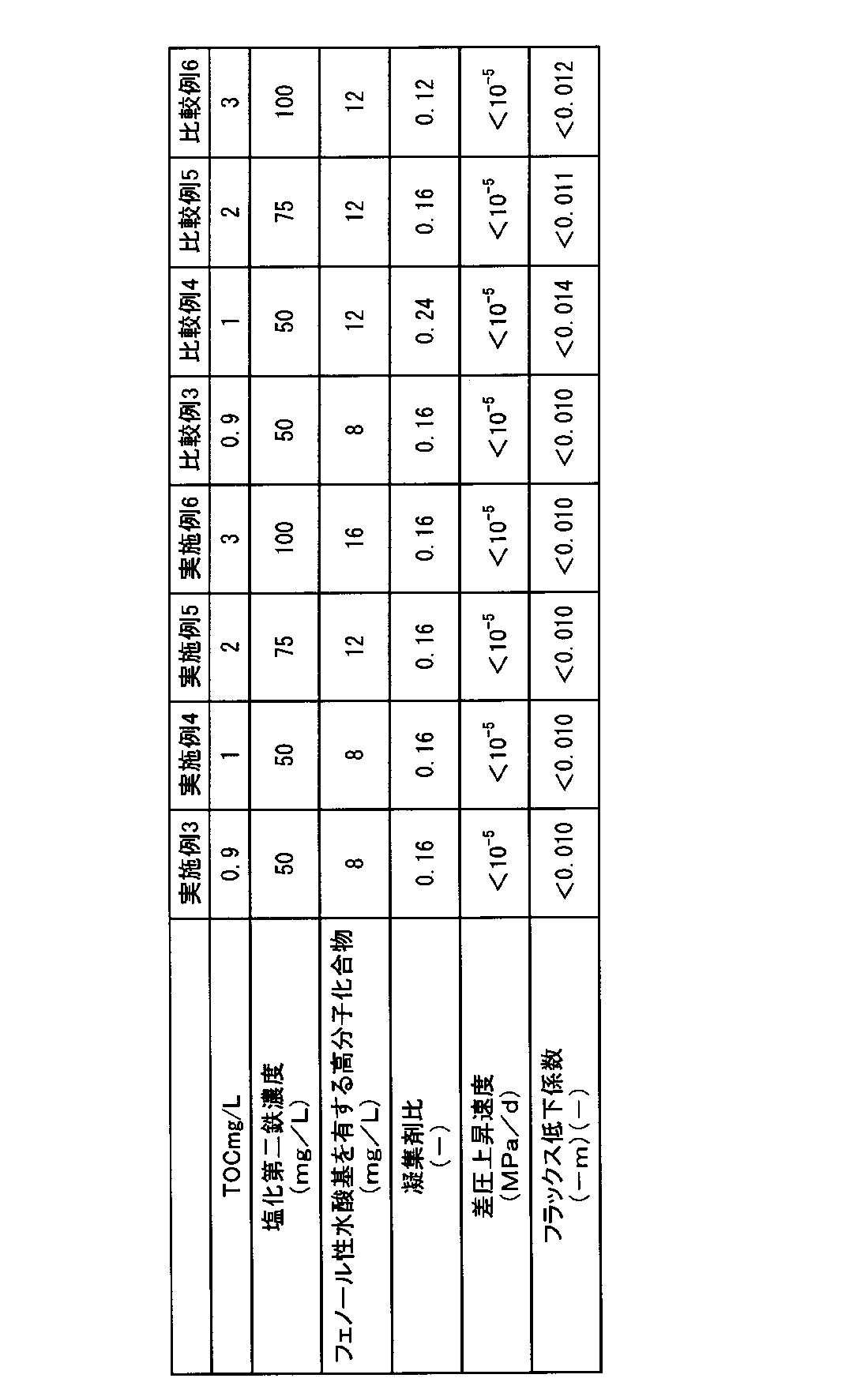
実施例1において、カナディアンフルボを添加してTOCを表3の通りとした条件で、RO処理運転した。その際、フェノール性水酸基を有する高分子化合物と鉄系凝集剤は、凝集剤比を0.16に固定した条件(実施例3~6)、鉄系凝集剤の濃度を変化させ、フェノール性水酸基を有する高分子化合物の濃度を固定した条件(比較例3~6)で行った。なお、カナディアンフルボの添加は1週間に一度行い、1週間通水して除濁膜差圧、RO膜のフラックス挙動(フラックス低下係数)を評価した。結果を表3に示す。なお、TOCを添加する際、一旦RO膜の運転を停止した。各フラックス低下係数は、それぞれTOCを追添加する前のフラックスを初期フラックスとして換算している。
実施例1において、カナディアンフルボを添加してTOCを表3の通りとした条件で、RO処理運転した。その際、フェノール性水酸基を有する高分子化合物と鉄系凝集剤は、凝集剤比を0.16に固定した条件(実施例3~6)、鉄系凝集剤の濃度を変化させ、フェノール性水酸基を有する高分子化合物の濃度を固定した条件(比較例3~6)で行った。なお、カナディアンフルボの添加は1週間に一度行い、1週間通水して除濁膜差圧、RO膜のフラックス挙動(フラックス低下係数)を評価した。結果を表3に示す。なお、TOCを添加する際、一旦RO膜の運転を停止した。各フラックス低下係数は、それぞれTOCを追添加する前のフラックスを初期フラックスとして換算している。
<考察>
実施例3~6と比較例3~6とでは、鉄系凝集剤とフェノール性水酸基を有する高分子化合物それぞれの総添加量は同じである。凝集剤の添加量はいずれも適正範囲である。
実施例3~6と比較例3~6とでは、鉄系凝集剤とフェノール性水酸基を有する高分子化合物それぞれの総添加量は同じである。凝集剤の添加量はいずれも適正範囲である。
表3より、凝集剤比を固定した実施例では差圧の上昇やフラックス低下係数の変化は見られなかった。また、除濁膜の差圧は凝集剤比を固定した場合とフェノール性水酸基を有する高分子化合物の添加量を固定した場合とで変化はない。このことは、除濁膜への付着は抑制されていると考えられる。
一方、比較例では、ROのフラックス低下係数は実施例に比較して、より低下する傾向がみられた。
これは、凝集剤比及び添加濃度が適正範囲(表1、表2)であるにもかかわらず、フェノール性水酸基を有する高分子化合物の添加量変化に対し、塩化第二鉄の添加効果の追従性が悪かったためであると考えられる。そのため、比較例において凝集剤比を0.24に変化させた場合には、フェノール性水酸基を有する高分子化合物から低分子成分がROへリークし、また、凝集剤比を0.12に変化させた場合には、鉄イオンやTOC成分がROへリークしやすい状況となり、フラックス低下係数がより低下する傾向を示したと考えられる。
実験例及び実施例、比較例では、TOCを指標として凝集剤の添加制御を行ったが、UV-260の測定値や鉄イオン濃度、濁度等を制御指標としても良い。また、原水や処理水に設けたセンサからの測定値に基づいて自動で薬注制御を行う制御ユニットを設け、本発明の処理方法を実施するシステムを構築しても良い。
本発明を特定の態様を用いて詳細に説明したが、本発明の意図と範囲を離れることなく様々な変更が可能であることは当業者に明らかである。
本出願は、2017年3月23日付で出願された日本特許出願2017-057674に基づいており、その全体が引用により援用される。
本出願は、2017年3月23日付で出願された日本特許出願2017-057674に基づいており、その全体が引用により援用される。
Claims (5)
- 被処理水に凝集剤としてフェノール性水酸基を有する高分子化合物と鉄系凝集剤を添加する工程と、
この凝集水を除濁用濾過器で濾過する工程と、
この濾過水を逆浸透膜処理する工程と
を有する用水処理方法において、
フェノール性水酸基を有する高分子化合物の添加濃度と鉄系凝集剤の添加濃度との比が一定となるように凝集剤の添加を制御することを特徴とする用水処理方法。 - 請求項1において、フェノール性水酸基を有する高分子化合物の添加濃度と鉄系凝集剤の添加濃度との比が0.01~0.25となるように凝集剤の添加を制御すること特徴とする用水処理方法。
- 請求項1又は2において、鉄系凝集剤の添加濃度を原水水質、または/および処理水水質に応じて変動させ、この鉄系凝集剤の添加濃度に追従して添加濃度が一定となるようにフェノール性水酸基を有する高分子化合物の添加量を制御することを特徴とする用水処理方法。
- 請求項1ないし3のいずれか1項において、フェノール性水酸基を有する高分子化合物添加濃度は1~15mg/Lであることを特徴とする用水処理方法。
- 請求項1~4のいずれか1項において、前記凝集水を直接に前記除濁用濾過器に供給することを特徴とする用水処理方法。
Priority Applications (4)
| Application Number | Priority Date | Filing Date | Title |
|---|---|---|---|
| KR1020197011071A KR20190127654A (ko) | 2017-03-23 | 2017-09-15 | 용수 처리 방법 |
| US16/490,161 US11077403B2 (en) | 2017-03-23 | 2017-09-15 | Water treatment method |
| CN202210093128.1A CN114291939A (zh) | 2017-03-23 | 2017-09-15 | 用水处理方法 |
| CN201780081905.8A CN110337322A (zh) | 2017-03-23 | 2017-09-15 | 用水处理方法 |
Applications Claiming Priority (2)
| Application Number | Priority Date | Filing Date | Title |
|---|---|---|---|
| JP2017057674A JP6644014B2 (ja) | 2017-03-23 | 2017-03-23 | 用水処理方法 |
| JP2017-057674 | 2017-03-23 |
Publications (1)
| Publication Number | Publication Date |
|---|---|
| WO2018173328A1 true WO2018173328A1 (ja) | 2018-09-27 |
Family
ID=63585215
Family Applications (1)
| Application Number | Title | Priority Date | Filing Date |
|---|---|---|---|
| PCT/JP2017/033548 Ceased WO2018173328A1 (ja) | 2017-03-23 | 2017-09-15 | 用水処理方法 |
Country Status (6)
| Country | Link |
|---|---|
| US (1) | US11077403B2 (ja) |
| JP (1) | JP6644014B2 (ja) |
| KR (1) | KR20190127654A (ja) |
| CN (2) | CN110337322A (ja) |
| TW (1) | TWI732943B (ja) |
| WO (1) | WO2018173328A1 (ja) |
Families Citing this family (2)
| Publication number | Priority date | Publication date | Assignee | Title |
|---|---|---|---|---|
| KR102497219B1 (ko) * | 2021-03-29 | 2023-02-06 | 부산대학교 산학협력단 | 미세플라스틱 제거 방법 |
| CN114249462A (zh) * | 2021-12-30 | 2022-03-29 | 艾德旺斯环保科技南通有限公司 | 一种便于使用的高效污废水处理设备 |
Citations (4)
| Publication number | Priority date | Publication date | Assignee | Title |
|---|---|---|---|---|
| JP2010017688A (ja) * | 2008-07-14 | 2010-01-28 | Kurita Water Ind Ltd | 生物処理水の高度処理方法 |
| WO2013099857A1 (ja) * | 2011-12-28 | 2013-07-04 | 栗田工業株式会社 | 海水の処理方法 |
| JP2013255923A (ja) * | 2009-08-11 | 2013-12-26 | Kurita Water Ind Ltd | 水処理方法及び水処理凝集剤 |
| JP2015229121A (ja) * | 2014-06-03 | 2015-12-21 | 栗田工業株式会社 | 凝集処理方法および凝集処理装置 |
Family Cites Families (16)
| Publication number | Priority date | Publication date | Assignee | Title |
|---|---|---|---|---|
| JP4577122B2 (ja) | 2005-06-30 | 2010-11-10 | 栗田工業株式会社 | 生物処理水の高度処理方法及び生物処理水用凝集促進剤 |
| JP2008264723A (ja) * | 2007-04-24 | 2008-11-06 | Toray Ind Inc | 不純物の凝集方法および凝集装置 |
| JP2010131469A (ja) * | 2008-10-30 | 2010-06-17 | Kurita Water Ind Ltd | 膜分離処理方法 |
| US20110000854A1 (en) * | 2009-07-06 | 2011-01-06 | Halosource, Inc. | Use of a dual polymer system for enhanced water recovery and improved separation of suspended solids and other substances from an aqueous media |
| JP5407994B2 (ja) | 2009-08-11 | 2014-02-05 | 栗田工業株式会社 | 水処理方法及び水処理凝集剤 |
| CN101717162A (zh) * | 2009-12-02 | 2010-06-02 | 厦门世达膜科技有限公司 | 一种铝型材表面处理废水治理回用方法 |
| JP2012166118A (ja) | 2011-02-10 | 2012-09-06 | Kurita Water Ind Ltd | 水処理凝集剤及び水処理方法 |
| JP5935967B2 (ja) * | 2011-03-31 | 2016-06-15 | 栗田工業株式会社 | 凝集剤の添加量決定方法、水処理方法及び水処理装置 |
| JP5782931B2 (ja) * | 2011-09-05 | 2015-09-24 | 富士電機株式会社 | 水処理方法及び水処理装置 |
| US20130313199A1 (en) * | 2012-05-23 | 2013-11-28 | High Sierra Energy, LP | System and method for treatment of produced waters |
| JP5949206B2 (ja) * | 2012-06-25 | 2016-07-06 | 栗田工業株式会社 | 冷却水ブロー水の処理方法及び処理装置 |
| CN103910444A (zh) * | 2012-12-28 | 2014-07-09 | 栗田工业株式会社 | 含有淤泥的水的凝集处理方法及装置 |
| JP2015044149A (ja) * | 2013-08-28 | 2015-03-12 | 株式会社日立製作所 | 凝集処理方法、凝集処理装置及び水処理装置 |
| JP2015157265A (ja) | 2014-02-25 | 2015-09-03 | 栗田工業株式会社 | 凝集固液分離方法及び凝集固液分離装置 |
| JP5867532B2 (ja) | 2014-03-18 | 2016-02-24 | 栗田工業株式会社 | 水処理用分散剤及び水処理方法 |
| JP6535233B2 (ja) | 2015-06-24 | 2019-06-26 | 株式会社デンソー | 車両用乗員判定装置 |
-
2017
- 2017-03-23 JP JP2017057674A patent/JP6644014B2/ja active Active
- 2017-09-15 KR KR1020197011071A patent/KR20190127654A/ko not_active Ceased
- 2017-09-15 CN CN201780081905.8A patent/CN110337322A/zh active Pending
- 2017-09-15 US US16/490,161 patent/US11077403B2/en active Active
- 2017-09-15 WO PCT/JP2017/033548 patent/WO2018173328A1/ja not_active Ceased
- 2017-09-15 CN CN202210093128.1A patent/CN114291939A/zh active Pending
- 2017-09-26 TW TW106132879A patent/TWI732943B/zh active
Patent Citations (4)
| Publication number | Priority date | Publication date | Assignee | Title |
|---|---|---|---|---|
| JP2010017688A (ja) * | 2008-07-14 | 2010-01-28 | Kurita Water Ind Ltd | 生物処理水の高度処理方法 |
| JP2013255923A (ja) * | 2009-08-11 | 2013-12-26 | Kurita Water Ind Ltd | 水処理方法及び水処理凝集剤 |
| WO2013099857A1 (ja) * | 2011-12-28 | 2013-07-04 | 栗田工業株式会社 | 海水の処理方法 |
| JP2015229121A (ja) * | 2014-06-03 | 2015-12-21 | 栗田工業株式会社 | 凝集処理方法および凝集処理装置 |
Also Published As
| Publication number | Publication date |
|---|---|
| CN114291939A (zh) | 2022-04-08 |
| TWI732943B (zh) | 2021-07-11 |
| JP2018158310A (ja) | 2018-10-11 |
| JP6644014B2 (ja) | 2020-02-12 |
| CN110337322A (zh) | 2019-10-15 |
| US11077403B2 (en) | 2021-08-03 |
| TW201838928A (zh) | 2018-11-01 |
| KR20190127654A (ko) | 2019-11-13 |
| US20190388840A1 (en) | 2019-12-26 |
Similar Documents
| Publication | Publication Date | Title |
|---|---|---|
| CN103768947B (zh) | 膜分离方法 | |
| KR101726010B1 (ko) | 수처리 방법 및 수처리 응집제 | |
| CN104854038B (zh) | 水处理方法 | |
| JP7311951B2 (ja) | 水処理方法および水処理装置 | |
| JP6287594B2 (ja) | 凝集処理方法および凝集処理装置 | |
| JP5867532B2 (ja) | 水処理用分散剤及び水処理方法 | |
| JP2010017688A (ja) | 生物処理水の高度処理方法 | |
| JP2010131469A (ja) | 膜分離処理方法 | |
| JP6644014B2 (ja) | 用水処理方法 | |
| JP2016144778A (ja) | 水処理凝集剤および水処理方法 | |
| JP6202115B2 (ja) | 工業用水の清澄化方法及び清澄化装置 | |
| JPWO2019008822A1 (ja) | 水処理方法および水処理装置 | |
| JPWO2013099857A1 (ja) | 海水の処理方法 | |
| JP6015811B1 (ja) | 水処理方法及び水処理装置 | |
| JP6565268B2 (ja) | 無機炭素含有水の処理方法及び装置 | |
| WO2021246161A1 (ja) | 水処理方法及び水処理装置 | |
| JP2012187467A (ja) | 膜分離方法及び膜分離装置 | |
| JP2015157265A (ja) | 凝集固液分離方法及び凝集固液分離装置 | |
| Tran et al. | Decentralised, small-scale coagulation-membrane treatment of wastewater from metal recycling villages–a case study from Vietnam | |
| JP6648579B2 (ja) | 高アルカリ度水中のカルシウム除去方法 | |
| CN103910444A (zh) | 含有淤泥的水的凝集处理方法及装置 | |
| JP2017113681A (ja) | 海水の処理方法及び処理装置 | |
| JP6287402B2 (ja) | 凝集固液分離方法及び凝集固液分離装置 | |
| KR20210051405A (ko) | 칼슘 이온을 포함하는 오폐수의 처리 방법 | |
| JP7808357B1 (ja) | 親水コロイドを含む排水の処理方法 |
Legal Events
| Date | Code | Title | Description |
|---|---|---|---|
| 121 | Ep: the epo has been informed by wipo that ep was designated in this application |
Ref document number: 17901497 Country of ref document: EP Kind code of ref document: A1 |
|
| ENP | Entry into the national phase |
Ref document number: 20197011071 Country of ref document: KR Kind code of ref document: A |
|
| NENP | Non-entry into the national phase |
Ref country code: DE |
|
| 122 | Ep: pct application non-entry in european phase |
Ref document number: 17901497 Country of ref document: EP Kind code of ref document: A1 |