WO2018168138A1 - 血圧計、評価システム、および血圧計の制御方法 - Google Patents
血圧計、評価システム、および血圧計の制御方法 Download PDFInfo
- Publication number
- WO2018168138A1 WO2018168138A1 PCT/JP2017/045460 JP2017045460W WO2018168138A1 WO 2018168138 A1 WO2018168138 A1 WO 2018168138A1 JP 2017045460 W JP2017045460 W JP 2017045460W WO 2018168138 A1 WO2018168138 A1 WO 2018168138A1
- Authority
- WO
- WIPO (PCT)
- Prior art keywords
- pressure
- subject
- cuff
- blood pressure
- unit
- Prior art date
- Legal status (The legal status is an assumption and is not a legal conclusion. Google has not performed a legal analysis and makes no representation as to the accuracy of the status listed.)
- Ceased
Links
Images



Classifications
-
- A—HUMAN NECESSITIES
- A61—MEDICAL OR VETERINARY SCIENCE; HYGIENE
- A61B—DIAGNOSIS; SURGERY; IDENTIFICATION
- A61B5/00—Measuring for diagnostic purposes; Identification of persons
- A61B5/02—Detecting, measuring or recording for evaluating the cardiovascular system, e.g. pulse, heart rate, blood pressure or blood flow
- A61B5/021—Measuring pressure in heart or blood vessels
- A61B5/022—Measuring pressure in heart or blood vessels by applying pressure to close blood vessels, e.g. against the skin; Ophthalmodynamometers
-
- A—HUMAN NECESSITIES
- A61—MEDICAL OR VETERINARY SCIENCE; HYGIENE
- A61B—DIAGNOSIS; SURGERY; IDENTIFICATION
- A61B10/00—Instruments for taking body samples for diagnostic purposes; Other methods or instruments for diagnosis, e.g. for vaccination diagnosis, sex determination or ovulation-period determination; Throat striking implements
-
- A—HUMAN NECESSITIES
- A61—MEDICAL OR VETERINARY SCIENCE; HYGIENE
- A61B—DIAGNOSIS; SURGERY; IDENTIFICATION
- A61B5/00—Measuring for diagnostic purposes; Identification of persons
-
- A—HUMAN NECESSITIES
- A61—MEDICAL OR VETERINARY SCIENCE; HYGIENE
- A61B—DIAGNOSIS; SURGERY; IDENTIFICATION
- A61B5/00—Measuring for diagnostic purposes; Identification of persons
- A61B5/02—Detecting, measuring or recording for evaluating the cardiovascular system, e.g. pulse, heart rate, blood pressure or blood flow
- A61B5/021—Measuring pressure in heart or blood vessels
- A61B5/02108—Measuring pressure in heart or blood vessels from analysis of pulse wave characteristics
- A61B5/02116—Measuring pressure in heart or blood vessels from analysis of pulse wave characteristics of pulse wave amplitude
-
- A—HUMAN NECESSITIES
- A61—MEDICAL OR VETERINARY SCIENCE; HYGIENE
- A61B—DIAGNOSIS; SURGERY; IDENTIFICATION
- A61B5/00—Measuring for diagnostic purposes; Identification of persons
- A61B5/02—Detecting, measuring or recording for evaluating the cardiovascular system, e.g. pulse, heart rate, blood pressure or blood flow
- A61B5/021—Measuring pressure in heart or blood vessels
- A61B5/022—Measuring pressure in heart or blood vessels by applying pressure to close blood vessels, e.g. against the skin; Ophthalmodynamometers
- A61B5/0225—Measuring pressure in heart or blood vessels by applying pressure to close blood vessels, e.g. against the skin; Ophthalmodynamometers the pressure being controlled by electric signals, e.g. derived from Korotkoff sounds
-
- A—HUMAN NECESSITIES
- A61—MEDICAL OR VETERINARY SCIENCE; HYGIENE
- A61B—DIAGNOSIS; SURGERY; IDENTIFICATION
- A61B5/00—Measuring for diagnostic purposes; Identification of persons
- A61B5/40—Detecting, measuring or recording for evaluating the nervous system
- A61B5/4029—Detecting, measuring or recording for evaluating the nervous system for evaluating the peripheral nervous systems
- A61B5/4035—Evaluating the autonomic nervous system
-
- A—HUMAN NECESSITIES
- A61—MEDICAL OR VETERINARY SCIENCE; HYGIENE
- A61B—DIAGNOSIS; SURGERY; IDENTIFICATION
- A61B5/00—Measuring for diagnostic purposes; Identification of persons
- A61B5/68—Arrangements of detecting, measuring or recording means, e.g. sensors, in relation to patient
- A61B5/6801—Arrangements of detecting, measuring or recording means, e.g. sensors, in relation to patient specially adapted to be attached to or worn on the body surface
- A61B5/6813—Specially adapted to be attached to a specific body part
- A61B5/6824—Arm or wrist
-
- A—HUMAN NECESSITIES
- A61—MEDICAL OR VETERINARY SCIENCE; HYGIENE
- A61B—DIAGNOSIS; SURGERY; IDENTIFICATION
- A61B5/00—Measuring for diagnostic purposes; Identification of persons
- A61B5/0002—Remote monitoring of patients using telemetry, e.g. transmission of vital signals via a communication network
- A61B5/0015—Remote monitoring of patients using telemetry, e.g. transmission of vital signals via a communication network characterised by features of the telemetry system
- A61B5/0022—Monitoring a patient using a global network, e.g. telephone networks, internet
-
- A—HUMAN NECESSITIES
- A61—MEDICAL OR VETERINARY SCIENCE; HYGIENE
- A61B—DIAGNOSIS; SURGERY; IDENTIFICATION
- A61B5/00—Measuring for diagnostic purposes; Identification of persons
- A61B5/02—Detecting, measuring or recording for evaluating the cardiovascular system, e.g. pulse, heart rate, blood pressure or blood flow
- A61B5/021—Measuring pressure in heart or blood vessels
- A61B5/02141—Details of apparatus construction, e.g. pump units or housings therefor, cuff pressurising systems, arrangements of fluid conduits or circuits
-
- A—HUMAN NECESSITIES
- A61—MEDICAL OR VETERINARY SCIENCE; HYGIENE
- A61B—DIAGNOSIS; SURGERY; IDENTIFICATION
- A61B5/00—Measuring for diagnostic purposes; Identification of persons
- A61B5/74—Details of notification to user or communication with user or patient; User input means
- A61B5/742—Details of notification to user or communication with user or patient; User input means using visual displays
Definitions
- the present disclosure relates to a sphygmomanometer, an evaluation system, and a control method of the sphygmomanometer, and more particularly, to a sphygmomanometer, an evaluation system, and a control method of the sphygmomanometer for evaluating a subject's autonomic nervous function.
- autonomic nerves There are two types of autonomic nerves: sympathetic nerves that function when in an active state and parasympathetic nerves that mainly function when in a resting state.
- autonomic nerve function When the autonomic nerve function is normal, switching between the sympathetic nerve dominant state and the parasympathetic nerve dominant state is performed while maintaining a balance between the sympathetic nerve and the parasympathetic nerve.
- the autonomic nerve function if the autonomic nerve function is not in a normal state, the balance of the autonomic nerve is lost, causing various symptoms such as dizziness and dizziness on standing up.
- Various techniques for diagnosing such autonomic nervous function have been proposed.
- Patent Document 1 discloses an autonomic nervous function diagnostic apparatus.
- the apparatus includes a heart rate measuring means for measuring a heart rate of a person to be diagnosed, a display means for displaying biological information, an instruction means for instructing the person to be diagnosed to stand up, and a standing action by the instruction means.
- the heart rate increase amount which is the difference between the heart rate after the command is instructed and the heart rate before the stand-up operation is commanded by the command means, is within the preset normal range
- Control means for determining the presence or absence of abnormality of the autonomic nerve function and controlling the display means to display the determination result.
- Patent Document 1 discloses determining whether or not there is an abnormality in the autonomic nerve function of the subject by determining whether or not the difference in heart rate before and after the standing motion is within a preset normal range. There is no disclosure about an evaluation method of autonomic nervous function using values.
- the present disclosure aims to provide a sphygmomanometer, an evaluation system, and a sphygmomanometer control method that can more accurately evaluate the autonomic nervous function of a subject.
- a sphygmomanometer includes a pressure control unit that controls a cuff pressure that indicates an internal pressure of a cuff attached to a measurement site of a subject, a cuff pressure signal that indicates a cuff pressure, and a cuff pressure signal that is superimposed on the cuff pressure signal. And a calculation unit for calculating blood pressure information of the subject based on the pulse wave signal. The calculation unit calculates the first blood pressure information of the subject who has maintained the prone state for a predetermined time. The pressure control unit maintains the cuff pressure at the first pressure that is smaller than the maximum blood pressure included in the first blood pressure information by a predetermined value.
- the sphygmomanometer determines whether or not the amplitude of the pulse wave signal of the subject is equal to or greater than a threshold when the cuff pressure is maintained at the first pressure and the subject is in a standing position. And an evaluation unit that evaluates the autonomic nervous function of the subject based on the determination result of the determination unit, and an output control unit that outputs the evaluation result of the evaluation unit.
- the pressure control unit controls the cuff pressure to be reduced from the first pressure.
- the calculation unit calculates the second blood pressure information of the subject in the process of reducing the cuff pressure from the first pressure.
- the evaluation unit evaluates the subject's autonomic function based further on the first blood pressure information and the second blood pressure information.
- the evaluation unit evaluates the autonomic nervous function of the subject based on the difference between the pulse rate included in the first blood pressure information and the pulse rate included in the second blood pressure information.
- the evaluation unit evaluates the autonomic nervous function of the subject based on the difference between the pulse pressure included in the first blood pressure information and the pulse pressure included in the second blood pressure information.
- the pressure controller controls the cuff pressure to be increased after the second blood pressure information is calculated.
- the sphygmomanometer includes a cuff pressure calculation unit that continuously calculates a cuff pressure at which the amplitude of the pulse wave signal of the subject is less than a threshold in the process of increasing the cuff pressure, and a pulse wave signal of the subject by the determination unit. And a time calculation unit that calculates an elapsed time from the first time at which the amplitude is determined to be less than the threshold to the second time when the cuff pressure calculated by the cuff pressure calculation unit is stable.
- the evaluation unit evaluates the subject's autonomic function based on the elapsed time.
- the evaluation result is an evaluation result regarding orthostatic regulation disorder.
- the sphygmomanometer further includes a notifying unit for notifying the subject so as to shift from the lying state to the standing state after the calculation of the first blood pressure information by the calculating unit.
- an evaluation system for evaluating the subject's autonomic nervous function includes a pressure control unit that controls the cuff pressure indicating the internal pressure of the cuff attached to the measurement site of the subject, a cuff pressure signal that indicates the cuff pressure, and a pulse wave signal that is superimposed on the cuff pressure signal. And a calculation unit for calculating blood pressure information of the subject.
- the calculation unit calculates the first blood pressure information of the subject who has maintained the prone state for a predetermined time.
- the pressure control unit maintains the cuff pressure at the first pressure that is smaller than the maximum blood pressure included in the first blood pressure information by a predetermined value.
- the evaluation system determines whether the amplitude of the pulse wave signal of the subject is equal to or greater than a threshold when the cuff pressure is maintained at the first pressure and the subject is in a standing position. And an evaluation unit that evaluates the autonomic nervous function of the subject based on the determination result of the determination unit, and an output control unit that outputs the evaluation result of the evaluation unit.
- a method for controlling a sphygmomanometer includes a step of controlling a cuff pressure indicating an internal pressure of a cuff attached to a measurement site of a subject, a cuff pressure signal indicating a cuff pressure, and a cuff pressure signal. Calculating blood pressure information of the subject based on the superimposed pulse wave signal.
- the step of calculating includes calculating first blood pressure information of the subject who has maintained the prone state for a predetermined time.
- the step of controlling includes maintaining the cuff pressure at a first pressure smaller than a maximum blood pressure included in the first blood pressure information by a predetermined value.
- the method further includes a step of evaluating the autonomic nervous function of the subject based on the determination result of the step, and a step of outputting the evaluation result of the step of evaluating.
- FIG. 1 It is a figure which shows the schematic structure of an evaluation system. It is a block diagram showing an example of the hardware constitutions of a terminal device. It is a block diagram showing an example of the hardware constitutions of a blood pressure meter. It is a figure which shows the operation
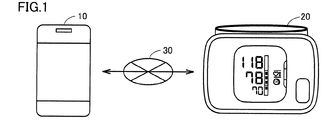
- FIG. 1 is a diagram showing a schematic configuration of the evaluation system 1000.
- evaluation system 1000 includes a terminal device 10 that is a user terminal, a sphygmomanometer 20 for measuring blood pressure of a subject who is the user, and a network 30.
- the blood pressure monitor 20 is a wrist blood pressure monitor in which the main body and the cuff are integrated.
- the sphygmomanometer 20 has an apparatus main body and a cuff as its main components. At the time of blood pressure measurement, the sphygmomanometer 20 is worn in a state where the cuff is wound around the wrist of the subject.
- the sphygmomanometer 20 may be an upper arm sphygmomanometer in which a main body and a cuff (arm band) are integrated.
- the terminal device 10 is, for example, a smartphone.
- a smartphone will be described as a representative example of a “terminal device”.
- the terminal device may be another terminal device such as a foldable mobile phone, a tablet terminal device, a PC (personal computer), or a PDA (Personal Data Assistance).
- the network 30 for connecting the terminal device 10 and the sphygmomanometer 20 to each other employs a short-range wireless communication system, and typically employs BLE (Bluetooth (registered trademark) low energy). Therefore, the terminal device 10 and the sphygmomanometer 20 are BLE devices having a function of performing wireless communication using BLE.
- the network 30 is not limited to this, and other wireless communication methods such as Bluetooth (registered trademark), wireless LAN (local area network), or a wired communication method using USB (Universal Serial Bus) may be adopted. Good.
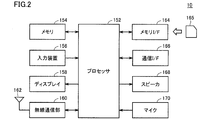
- FIG. 2 is a block diagram illustrating an example of a hardware configuration of the terminal device 10.
- the terminal device 10 includes, as main components, a processor 152, a memory 154, an input device 156, a display 158, a wireless communication unit 160, a communication antenna 162, a memory interface (I / I). F) 164, a communication interface (I / F) 166, a speaker 168, and a microphone 170.
- the processor 152 is typically an arithmetic processing unit such as a CPU (Central Processing Unit) or an MPU (Multi Processing Unit).
- the processor 152 controls the operation of each unit of the terminal device 10 by reading and executing the program stored in the memory 154.
- the memory 154 is realized by a RAM (Random Access Memory), a ROM (Read-Only Memory), a flash memory, or the like.
- the memory 154 stores a program executed by the processor 152, data used by the processor 152, and the like.
- the input device 156 accepts an operation input to the terminal device 10.
- the input device 156 is realized by a touch panel.
- the touch panel is provided on a display 158 having a function as a display unit, and is, for example, a capacitance type.
- the touch panel detects a touch operation on the touch panel by an external object every predetermined time, and inputs touch coordinates to the processor 152.
- the input device 156 may include a button or the like.
- the wireless communication unit 160 connects to the mobile communication network via the communication antenna 162 and transmits and receives signals for wireless communication. Thereby, the terminal device 10 can communicate with other communication devices via a mobile communication network such as LTE (Long Term Evolution).
- LTE Long Term Evolution
- Memory interface 164 reads data from external storage medium 165.
- the processor 152 reads data stored in the storage medium 165 via the memory interface 164 and stores the data in the memory 154.
- the processor 152 reads data from the memory 154 and stores the data in the external storage medium 165 via the memory interface 164.
- the storage medium 165 is non-volatile such as CD (Compact Disc), DVD (Digital Versatile Disk), BD (Blu-ray (registered trademark) Disc), USB (Universal Serial Bus) memory, SD (Secure Digital) memory card, etc. Includes media for storing programs.
- CD Compact Disc
- DVD Digital Versatile Disk
- BD Blu-ray (registered trademark) Disc
- USB Universal Serial Bus
- SD Secure Digital
- the communication interface (I / F) 166 is a communication interface for exchanging various data with other devices, and is realized by an adapter or a connector.
- BLE is adopted as a communication method.
- the speaker 168 converts the audio signal given from the processor 152 into audio and outputs it to the outside of the terminal device 10.
- the microphone 170 receives an audio input to the terminal device 10 and gives an audio signal corresponding to the audio input to the processor 152.
- the terminal device 10 further includes an acceleration sensor, an angular velocity sensor, a timer unit for measuring time, and the like.
- FIG. 3 is a block diagram illustrating an example of a hardware configuration of the sphygmomanometer 20.
- sphygmomanometer 20 includes a device main body 210 and a cuff 220 as main components.
- An air bag 222 is included in the cuff 220.
- the apparatus body 210 includes a processor 230, an air system component 240 for blood pressure measurement, an oscillation circuit 252, a pump drive circuit 254, a valve drive circuit 256, a display 260, a memory 270, a communication interface 272, a power supply Part 280 and an input interface 290.
- the processor 230 is an arithmetic processing unit such as a CPU or MPU.
- the processor 230 reads out and executes the program stored in the memory 270, thereby realizing each process (step) of the sphygmomanometer 20 described later.
- the air system component 240 supplies or discharges air to the air bag 222 included in the cuff 220 through the pipe.
- the air system component 240 includes a pressure sensor 242 for detecting the pressure in the air bag 222, and a pump 243 and a valve 245 as an expansion / contraction mechanism 241 for expanding and contracting the air bag 222.
- the pressure sensor 242 detects the pressure (cuff pressure) in the air bag 220 and outputs a signal (cuff pressure signal) corresponding to the detected pressure to the oscillation circuit 252.
- the pressure sensor 242 is, for example, a piezoresistive pressure sensor, and is connected to the air bag 222 included in the pump 243, the valve 245, and the cuff 220 via a cuff air tube.
- the pump 243 supplies air to the air bag 222 through the piping in order to increase the cuff pressure.
- the valve 245 is opened and closed to control the cuff pressure by maintaining the pressure in the air bag 222 or discharging the air in the air bag 222.
- the oscillation circuit 252 outputs an oscillation frequency signal corresponding to the output value of the pressure sensor 242 to the processor 230.
- the oscillation circuit 252 oscillates based on an electrical signal value corresponding to a change in electrical resistance due to the piezoresistance effect from the pressure sensor 242.
- the oscillation circuit 252 outputs a frequency signal having a frequency corresponding to the electric signal value of the pressure sensor 242 to the processor 230.
- the pump drive circuit 254 controls the drive of the pump 243 based on a control signal given from the processor 230.
- the valve drive circuit 256 controls opening and closing of the valve 245 based on a control signal given from the processor 230.
- a cuff is wound around the measurement site (wrist, arm, etc.) of the subject in advance, and at the time of measurement, the pump and valve are controlled to increase the cuff pressure higher than the maximum blood pressure, and then gradually Depressurize.
- the cuff pressure is detected by a pressure sensor, and the fluctuation of the arterial volume generated in the artery at the measurement site is extracted as a pulse wave signal. Based on the change in the amplitude of the pulse wave signal (mainly rising and falling) accompanying the change in cuff pressure at that time, the systolic blood pressure and the diastolic blood pressure are calculated.
- Display 260 displays various types of information including blood pressure measurement results based on control signals from processor 230.
- the memory 270 stores various information such as a program for causing the processor 230 to perform a predetermined operation and a measured blood pressure value.
- the communication interface 272 exchanges various information with the terminal device 10.
- the power supply unit 280 supplies power to the processor 230 and each hardware.
- the input interface 290 receives various instructions from the subject.
- the sphygmomanometer 20 further includes a timer unit for measuring time.
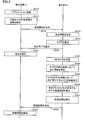
- FIG. 4 is a diagram showing an outline of the operation of the evaluation system 1000.
- the sphygmomanometer 20 evaluates the autonomic nervous function of the subject who is the user of the terminal device 10. Specifically, the sphygmomanometer 20 evaluates the subject's orthostatic disorder.
- terminal device 10 activates an autonomic nervous function evaluation application in accordance with an instruction from the subject (sequence SQ10). After starting the evaluation application, the terminal device 10 notifies the subject of information that prompts the user to remain in a supine position for a predetermined time (for example, 10 minutes) (sequence SQ12). In accordance with the notification, the subject rests for a predetermined time in the supine position. Terminal apparatus 10 instructs sphygmomanometer 20 to start blood pressure measurement after a predetermined time has elapsed (sequence SQ14).
- the predetermined value is set to 21 mmHg.
- the sphygmomanometer 20 transmits a notification that the measurement of blood pressure information is completed to the terminal device 10 (sequence SQ20).
- the terminal device 10 receives the notification, the terminal device 10 notifies the subject of information that prompts the standing-up operation (sequence SQ22).
- the subject performs a standing motion.
- Sphygmomanometer 20 determines whether or not the pulse has disappeared based on the amplitude of the pulse wave signal (sequence SQ24).
- the cuff pressure is maintained at a pressure Pk that is smaller than the maximum blood pressure by a predetermined value. Therefore, if the pulse does not disappear, it means that the systolic blood pressure does not decrease remarkably even when shifting to the standing position. On the other hand, when the pulse disappears, it means that the maximum blood pressure is remarkably lowered when shifting to the standing position. In this case, it may be one factor for evaluating that there is a suspicion of orthostatic regulation disorder. Here, it is assumed that the sphygmomanometer 20 determines that the pulse has disappeared.
- the sphygmomanometer 20 When it is determined that the pulse has disappeared, the sphygmomanometer 20 gradually reduces the cuff pressure, and measures blood pressure information X2 in the process of reducing the pressure (decompression process) (sequence SQ26). Specifically, when the sphygmomanometer 20 detects the resumption of the pulse based on the pulse wave signal, the sphygmomanometer 20 measures the maximum blood pressure SY2 and the pulse rate PR2 based on the cuff pressure at the time of detection. The sphygmomanometer 20 further reduces the cuff pressure.
- the sphygmomanometer 20 measures the minimum blood pressure D2 based on the cuff pressure at the time of detection.
- the sphygmomanometer 20 pressurizes the cuff pressure, and continuously measures the cuff pressure at which the disappearance of the pulse is detected in this pressurization process (pressurization process) (sequence SQ28).
- pressing process pressurization process
- the blood pressure temporarily decreases immediately after standing, and then the blood pressure increases. Therefore, it takes a certain time for the blood pressure to stabilize. Therefore, in the blood pressure increase process, the amplitude of the pulse wave signal is not stable, and the cuff pressure at which the disappearance of the pulse is detected is not stable (that is, the maximum blood pressure is not stable). Therefore, the sphygmomanometer 20 can grasp the time when the blood pressure of the subject is stabilized by continuously measuring the cuff pressure at which the disappearance of the pulse is detected.
- the sphygmomanometer 20 calculates an elapsed time Te until the cuff pressure at which the disappearance of the pulse is detected is stabilized in the pressurization process (sequence SQ30). Specifically, the sphygmomanometer 20 calculates an elapsed time Te from when it is determined that the pulse disappears in the sequence SQ24 until the cuff pressure is stabilized. The sphygmomanometer 20 executes an evaluation process related to the orthostatic disorder based on the determination result in the sequence SQ24, the blood pressure information X1 and X2, and the measurement result including the elapsed time Te (sequence SQ32).
- the sphygmomanometer 20 uses the determination result in the sequence SQ24, the difference in pulse pressure before and after standing, the amount of increase in the pulse rate before and after standing, and the elapsed time Te as evaluation criteria. Details of the evaluation process will be described later.
- the sphygmomanometer 20 transmits the evaluation result regarding the orthostatic disorder to the terminal device 10 (sequence SQ34). Terminal apparatus 10 notifies the subject of the received evaluation result (sequence SQ36).
- the evaluation results are expressed, for example, in five levels of levels 1 to 5 in order from the lowest possibility of orthostatic regulation disorder.
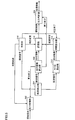
- FIG. 5 is a block diagram showing a functional configuration of the sphygmomanometer 20.
- sphygmomanometer 20 includes, as main functional configurations, a pressure control unit 302, a pulse wave detection unit 304, a blood pressure information calculation unit 306, an output control unit 308, a determination unit 310, a cuff.
- a pressure calculation unit 312, a time calculation unit 314, and an evaluation unit 316 are included.
- Each of these functions is realized, for example, when the processor 152 of the sphygmomanometer 20 executes a program stored in the memory 154. Note that some or all of these functions may be implemented by hardware.
- the pressure control unit 302 controls the cuff pressure according to an instruction from the subject via the input interface 290 or an instruction from the terminal device 10. Specifically, the pressure control unit 302 controls to drive the pump 243 via the pump drive circuit 254 and to drive the valve 245 via the valve drive circuit 256. The valve 245 is opened and closed to discharge or enclose the air in the air bladder 222 to control the cuff pressure.
- the pulse wave detection unit 304 receives the cuff pressure signal detected by the pressure sensor 242 and extracts a pulse wave signal representing the pulse wave of the measurement site superimposed on the cuff pressure signal. That is, the pulse wave detection unit 304 detects a pulse wave that is a pressure component superimposed on the cuff pressure signal in synchronization with the heartbeat of the subject from the cuff pressure signal.
- the blood pressure information calculation unit 306 calculates the blood pressure information of the subject based on the cuff pressure signal and the pulse wave signal superimposed on the cuff pressure signal. Specifically, the blood pressure information calculation unit 306, when adopting a decompression measurement method that detects a pulse wave when the air bag 222 is decompressed, has a pulse wave signal whose amplitude has suddenly increased (at the time of rising). The maximum blood pressure based on the cuff pressure, the minimum blood pressure based on the cuff pressure when it suddenly decreases (at the time of falling), the pulse rate, and the pulse pressure are calculated. The blood pressure information calculation unit 306 may employ a so-called pressurization measurement method that detects a pulse wave when the air bag 222 is pressurized.
- the blood pressure information calculation unit 306 calculates blood pressure information X1 of the subject who has maintained the supine position for a predetermined time (for example, 10 minutes). After completing the calculation of the blood pressure information X1, the pressure control unit 302 maintains the cuff pressure at a pressure Pk that is smaller than the maximum blood pressure SY1 included in the blood pressure information X1 by a predetermined value.
- the output control unit 308 notifies the terminal device 10 of the end of the calculation after the calculation of the blood pressure information X1 through the communication interface 272.
- the terminal device 10 notifies the subject of the standing motion via the display 158 or the speaker 168.
- the determination unit 310 determines whether or not the amplitude of the pulse wave signal of the subject is equal to or greater than the threshold Th1 when the cuff pressure is maintained at the pressure Pk and the subject is in the standing position (that is, Whether or not the pulse disappeared is determined.
- the determination unit 310 determines that the pulse has not disappeared when the amplitude of the pulse wave signal is greater than or equal to the threshold Th1, and determines that the pulse has disappeared when the amplitude of the pulse wave signal is less than the threshold Th1. judge.
- the pressure control unit 302 controls the cuff pressure to gradually decrease from the pressure Pk when the determination unit 310 determines that the amplitude of the pulse wave signal of the subject is less than the threshold Th1.
- the blood pressure information calculation unit 306 calculates the blood pressure information X2 of the subject in the process of reducing the cuff pressure from the pressure Pk (decompression process). Specifically, the blood pressure information calculation unit 306 calculates the maximum blood pressure SY2 corresponding to the cuff pressure when the pulse wave signal amplitude rises (when the pulse resumes) and the cuff pressure when the pulse wave signal falls (when the pulse disappears). Corresponding diastolic blood pressure D2, pulse rate PR2, and pulse pressure PU2 are calculated.
- the pressure controller 302 controls the cuff pressure to be increased after the blood pressure information X2 is calculated.
- the cuff pressure calculation unit 312 continuously calculates the cuff pressure at which the amplitude of the pulse wave signal of the subject is less than the threshold Th1 in the process of increasing the cuff pressure. Specifically, the cuff pressure calculation unit 312 sequentially calculates the maximum blood pressure corresponding to the cuff pressure at which the amplitude of the pulse wave signal is less than the threshold value Th1 at a constant period.
- the time calculation unit 314 calculates the cuff pressure (that is, the maximum blood pressure) calculated by the cuff pressure calculation unit 312 from time t1 when the determination unit 310 determines that the amplitude of the pulse wave signal of the subject is less than the threshold Th1. Elapsed time Te until time t2 when is stabilized is calculated.
- the state where the cuff pressure is stable refers to, for example, the difference between the maximum value and the minimum value among the cuff pressure values sequentially calculated by the cuff pressure calculation unit 312 in a predetermined period. 1 mmHg) or less.
- the evaluation unit 316 evaluates the subject's autonomic nervous function based on predetermined evaluation standard information (specifically, evaluates orthostatic disorder).
- the evaluation criterion information is included in the blood pressure information X1 and the reference L1 regarding the difference between the reference L1 regarding the determination result of the determination unit 310, the pulse rate PR1 included in the blood pressure information X1, and the pulse rate PR2 included in the blood pressure information X2.
- a reference L3 related to the difference between the pulse pressure PU1 and the pulse pressure PU2 included in the blood pressure information X2 and a reference L4 related to the elapsed time Te are included.
- orthostatic disorder decrease in autonomic function
- orthostatic disorder decrease in autonomic function
- the evaluation unit 316 evaluates the subject's autonomic nervous function based at least on the criterion L1 regarding the determination result of the determination unit 310. Specifically, the evaluation unit 316 determines the reference L1 when the determination unit 310 determines that the amplitude of the pulse wave signal of the subject is equal to or greater than the threshold Th1 (that is, when the pulse does not disappear). Assess that they are satisfied (ie orthostatic dysregulation is not suspected). On the other hand, the evaluation unit 316 does not satisfy the reference L1 when the determination unit 310 determines that the amplitude of the pulse wave signal of the subject is less than the threshold value Th1 (that is, when the pulse disappears). (Ie, suspected orthostatic dysregulation).
- the evaluation unit 316 evaluates the subject's autonomic function according to the standard L2 regarding the difference between the pulse rate PR1 and the pulse rate PR2. Specifically, the evaluation unit 316 determines the reference when the pulse rate increase (PR2 ⁇ PR1), which is the difference between the pulse rate PR1 and the pulse rate PR2, is less than a threshold Th2 (for example, 21 times / minute). Evaluate that L2 is satisfied. On the other hand, the evaluation unit 316 evaluates that the reference L2 is not satisfied when the pulse rate increase is equal to or greater than the threshold Th2.
- the evaluation unit 316 evaluates the subject's autonomic nerve function according to the standard L3 regarding the difference between the pulse pressure PU1 and the pulse pressure PU2. Specifically, the evaluation unit 316 satisfies the criterion L3 when the pulse pressure decrease amount (PU1-PU2) that is the difference between the pulse pressure PU1 and the pulse pressure PU2 is less than a threshold Th3 (for example, 16 mmHg). Assess that On the other hand, the evaluation unit 316 evaluates that the reference L3 is not satisfied when the pulse pressure reduction amount is equal to or greater than the threshold Th3.
- a threshold Th3 for example, 16 mmHg
- the evaluation unit 316 evaluates the subject's autonomic nervous function according to the standard L4 regarding the elapsed time Te. Specifically, the evaluation unit 316 evaluates that the criterion L4 is satisfied when the elapsed time Te is less than a threshold Th4 (for example, 17 seconds). On the other hand, the evaluation unit 316 evaluates that the criterion L4 is not satisfied when the elapsed time Te is equal to or greater than the threshold Th4.
- a threshold Th4 for example, 17 seconds
- the evaluation unit 316 evaluates to level 1 indicating that the possibility of orthostatic disorder is extremely low. When three criteria out of the criteria L1 to L4 are satisfied, it is evaluated as level 2 indicating that the possibility of orthostatic regulation disorder is low. When two of the criteria L1 to L4 are satisfied, it is evaluated as level 3 indicating that the possibility of the orthostatic adjustment disorder is slightly low. When one of the criteria L1 to L4 is satisfied, it is evaluated as level 4 indicating that the possibility of the orthostatic adjustment disorder is slightly high. If all the criteria L1 to L4 are not satisfied, the evaluation unit 316 evaluates to level 5 indicating that there is a high possibility of the orthostatic adjustment disorder.
- the output control unit 308 transmits the evaluation result of the evaluation unit 316 to the terminal device 10 via the communication interface 272.
- FIG. 6 is a flowchart illustrating an example of a processing procedure of the sphygmomanometer 20. It is assumed that the subject wearing the cuff 220 of the sphygmomanometer 20 is in a supine position and in a state of resting for a predetermined time at the start of processing.
- the processor 230 of the sphygmomanometer 20 calculates blood pressure information X1 of the subject who has maintained the supine position for a predetermined time (step S10).
- the sphygmomanometer 20 maintains the cuff pressure at a pressure Pk that is smaller than the maximum blood pressure SY1 included in the blood pressure information X1 by a predetermined value (step S12).
- the processor 230 notifies the terminal device 10 of the end of calculation of the blood pressure information X1 via the communication interface 272 (step S14). Thereby, the terminal device 10 notifies the subject of the standing motion.
- the processor 230 determines whether or not the amplitude of the pulse wave signal of the standing subject is equal to or greater than the threshold Th1 (step S16). If the amplitude is greater than or equal to threshold Th1 (ie, the pulse has not disappeared) (YES in step S16), processor 230 calculates standing pulse rate PR2 (step S18). Subsequently, the processor 230 calculates the difference between the pulse rate PR1 in the supine position and the pulse rate PR2 in the standing state (step S20), and executes the process of step S30 described later.
- step S16 If the amplitude of the pulse wave signal of the subject in the standing state is less than the threshold Th1 (that is, the pulse has disappeared) (NO in step S16), the processor 230 performs the test in the process of reducing the cuff pressure.
- the blood pressure information X2 of the person is calculated (step S22).
- the processor 230 continuously calculates the cuff pressure at which the amplitude of the pulse wave signal is less than the threshold value Th1 in the process of increasing the cuff pressure (step S24).
- the processor 230 calculates an elapsed time Te from time t1 at which the pulse disappears in step S16 to time t2 when the cuff pressure continuously calculated in step S24 is stabilized (step S26).
- An evaluation process is executed (step S30).
- FIG. 7 is a flowchart showing an example of an evaluation process procedure of the sphygmomanometer 20.
- processor 230 determines whether or not criterion L1 regarding the determination result of pulse disappearance is satisfied (step S302).
- the processor 230 determines that the reference L1 is satisfied when the amplitude of the pulse wave signal is greater than or equal to the threshold Th1, and determines that the reference L1 is not satisfied when the amplitude is less than the threshold Th1.
- the processor 230 determines whether or not the standard L2 regarding the pulse rate before and after standing up is satisfied (step S304). The processor 230 determines that the reference L2 is satisfied when the pulse rate increase amount (PR2-PR1) is less than the threshold Th2, and determines that the reference L2 is not satisfied when the pulse rate increase is equal to or greater than the threshold Th2. To do.
- step S304 If the standard L2 is satisfied (YES in step S304), it is evaluated that the possibility that the subject is an orthostatic disorder is very low (level 1) (step S306). On the other hand, when the criterion L2 is not satisfied (NO in step S304), it is evaluated that the possibility that the subject is an orthostatic adjustment disorder is low (level 2) (step S308).
- step S302 when the reference L1 is not satisfied in step S302 (NO in step S302), the processor 230 satisfies all of the reference L2, the reference L3 related to the pulse pressure before and after standing, and the reference L4 related to the elapsed time Te. It is determined whether or not (step S310).
- the processor 230 determines that the criterion L3 is satisfied when the pulse pressure decrease amount (PU1-PU2) is less than the threshold Th3, and satisfies the criterion L3 when the pulse pressure decrease amount is equal to or greater than the threshold Th3. Judge that there is no. The processor 230 determines that the reference L4 is satisfied when the elapsed time Te is less than the threshold Th4, and determines that the reference L4 is not satisfied when the elapsed time Te is equal to or greater than the threshold Th4.
- step S310 If all of the criteria L2 to L4 are satisfied (YES in step S310), the processor 230 evaluates that the possibility that the subject has an orthostatic adjustment disorder is low (level 2) (step S308). Otherwise (NO in step S310), processor 230 determines whether or not two of criteria L2 to L4 are satisfied (step S312).
- step S312 If two of the criteria L2 to L4 are satisfied (YES in step S312), the processor 230 evaluates that the possibility that the subject has an orthostatic disorder is somewhat low (level 3) (step 3). S314). Otherwise (NO in step S312), processor 230 determines whether or not one of criteria L2 to L4 is satisfied (step S316).
- step S316 When one of the criteria L2 to L4 is satisfied (YES in step S316), the processor 230 evaluates that the possibility that the subject has orthostatic disorder is somewhat high (level 4) (step 4). S318). If not (that is, if none of the criteria L2 to L4 is satisfied) (NO in step S316), the processor 230 indicates that the subject is likely to have orthostatic disorder (level 5). Evaluate (step S320).
- sphygmomanometer 20 transmits the evaluation result obtained by the evaluation process to terminal device 10 via communication interface 272 (step S32). Thereby, the terminal device 10 receives the evaluation result and broadcasts information based on the received evaluation result.
- the configuration in which the state before the subject stands is the supine position is described, but the configuration is not limited thereto.
- the state before standing may be a prone state including a prone position and a lateral position.
- the terminal device 10 may be configured to execute part of the function of the sphygmomanometer 20.
- the structure which performs the function of the evaluation part 316 of the blood pressure meter 20 with the terminal device 10 may be sufficient.
- the sphygmomanometer 20 transmits the measurement result including the pulse disappearance determination result, the blood pressure information X1 and X2, and the elapsed time Te to the terminal device 10.
- the terminal device 10 executes the same evaluation process as the evaluation unit 316 described above based on the measurement result.
- a configuration in which a series of processing from a measurement start instruction to notification of an evaluation result is executed by the blood pressure monitor 20 alone may be used.
- the sphygmomanometer 20 receives an input of an evaluation start instruction from the subject via the input interface 290.
- the sphygmomanometer 20 notifies the subject to shift from the supine position to the standing position after executing the processing of steps S10 and S12S in FIG. Specifically, the processor 230 (notification unit) of the sphygmomanometer 20 displays information prompting the transition from the supine position to the standing position on the display 260. In the case where the sphygmomanometer 20 is equipped with a speaker, the processor 230 may output the information as a voice via the speaker.
- the sphygmomanometer 20 outputs the evaluation result after executing steps S16 to S30 in FIG.
- the sphygmomanometer 20 (the output control unit 308) displays the evaluation result on the display 260 or outputs the sound via a speaker.
- FIG. 4 illustrates the configuration in which the terminal device 10 instructs the sphygmomanometer 20 to start blood pressure measurement after a predetermined time has elapsed, but the configuration is not limited thereto.
- the terminal device 10 may be configured to notify the subject of information prompting the user to start blood pressure measurement via the speaker 168 after a predetermined time has elapsed.
- the sphygmomanometer 20 starts measuring the blood pressure information X1 of the subject by receiving a measurement start instruction from the subject via the input interface 290 (for example, a measurement start button).
- a program that causes a computer to function and execute control as described in the above flowchart.
- a program is recorded on a non-temporary computer-readable recording medium such as a flexible disk attached to the computer, a CD (Compact Disk Read Only Memory), a secondary storage device, a main storage device, and a memory card. It can also be provided as a program product.
- the program can be provided by being recorded on a recording medium such as a hard disk built in the computer.
- a program can also be provided by downloading via a network.
- the program may be a program module that is provided as a part of an operating system (OS) of a computer and that calls necessary modules in a predetermined arrangement at a predetermined timing to execute processing.
- OS operating system
- the program itself does not include the module, and the process is executed in cooperation with the OS.
- a program that does not include such a module can also be included in the program according to the present embodiment.
- the program according to the present embodiment may be provided by being incorporated in a part of another program. Even in this case, the program itself does not include the module included in the other program, and the process is executed in cooperation with the other program. A program incorporated in such another program can also be included in the program according to the present embodiment.
- the configuration exemplified as the above-described embodiment is an example of the configuration of the present invention, and can be combined with another known technique. A part of the configuration is within the scope of the present invention. It is also possible to change and configure such as omitting. In the above-described embodiment, the processing and configuration described in the other embodiments may be adopted as appropriate.
- 10 terminal device 20 blood pressure monitor, 30 network, 152,230 processor, 154,270 memory, 156 input device, 158,260 display, 160 wireless communication unit, 162 communication antenna, 164 memory interface, 165 storage medium, 168 speaker, 170 microphone, 210 device body, 220 cuff, 222 air bag, 240 air system component, 241 expansion / contraction mechanism, 242 pressure sensor, 243 pump, 245 valve, 252 oscillation circuit, 254 pump drive circuit, 256 valve drive circuit, 272 Communication interface, 280 power supply unit, 290 input interface, 302 pressure control unit, 304 pulse wave detection unit, 306 blood pressure information calculation unit, 308 output control unit, 310 determination unit, 31 Cuff pressure calculating unit, 314 hours calculating unit, 316 evaluation unit, 1000 evaluation system.
Landscapes
- Health & Medical Sciences (AREA)
- Life Sciences & Earth Sciences (AREA)
- Cardiology (AREA)
- Heart & Thoracic Surgery (AREA)
- Molecular Biology (AREA)
- Veterinary Medicine (AREA)
- Public Health (AREA)
- Pathology (AREA)
- Engineering & Computer Science (AREA)
- Biomedical Technology (AREA)
- General Health & Medical Sciences (AREA)
- Medical Informatics (AREA)
- Animal Behavior & Ethology (AREA)
- Surgery (AREA)
- Physics & Mathematics (AREA)
- Vascular Medicine (AREA)
- Biophysics (AREA)
- Physiology (AREA)
- Ophthalmology & Optometry (AREA)
- Neurology (AREA)
- Neurosurgery (AREA)
- Measuring Pulse, Heart Rate, Blood Pressure Or Blood Flow (AREA)
- Measuring And Recording Apparatus For Diagnosis (AREA)
Priority Applications (3)
| Application Number | Priority Date | Filing Date | Title |
|---|---|---|---|
| CN201780088313.9A CN110402101A (zh) | 2017-03-14 | 2017-12-19 | 血压计、评价系统及血压计的控制方法 |
| DE112017007254.9T DE112017007254T5 (de) | 2017-03-14 | 2017-12-19 | Blutdrucküberwachungsgerät, Beurteilungssystem und Verfahren zum Steuern eines Blutdrucküberwachungsgeräts |
| US16/568,651 US11266318B2 (en) | 2017-03-14 | 2019-09-12 | Blood pressure monitor, assessment system, and method of controlling blood pressure monitor for assessing autonomic nerve function of a subject |
Applications Claiming Priority (2)
| Application Number | Priority Date | Filing Date | Title |
|---|---|---|---|
| JP2017-048594 | 2017-03-14 | ||
| JP2017048594A JP6827856B2 (ja) | 2017-03-14 | 2017-03-14 | 血圧計、評価システム、および血圧計の制御方法 |
Related Child Applications (1)
| Application Number | Title | Priority Date | Filing Date |
|---|---|---|---|
| US16/568,651 Continuation US11266318B2 (en) | 2017-03-14 | 2019-09-12 | Blood pressure monitor, assessment system, and method of controlling blood pressure monitor for assessing autonomic nerve function of a subject |
Publications (1)
| Publication Number | Publication Date |
|---|---|
| WO2018168138A1 true WO2018168138A1 (ja) | 2018-09-20 |
Family
ID=63522008
Family Applications (1)
| Application Number | Title | Priority Date | Filing Date |
|---|---|---|---|
| PCT/JP2017/045460 Ceased WO2018168138A1 (ja) | 2017-03-14 | 2017-12-19 | 血圧計、評価システム、および血圧計の制御方法 |
Country Status (5)
| Country | Link |
|---|---|
| US (1) | US11266318B2 (enExample) |
| JP (1) | JP6827856B2 (enExample) |
| CN (1) | CN110402101A (enExample) |
| DE (1) | DE112017007254T5 (enExample) |
| WO (1) | WO2018168138A1 (enExample) |
Families Citing this family (2)
| Publication number | Priority date | Publication date | Assignee | Title |
|---|---|---|---|---|
| CN114521873B (zh) * | 2020-11-23 | 2025-09-19 | 深圳迈瑞生物医疗电子股份有限公司 | 体征参数测量方法及相关设备 |
| CN113100736B (zh) * | 2021-03-31 | 2023-07-07 | 徐蔚海 | 脑血流自主神经障碍评估装置、系统及存储介质 |
Citations (3)
| Publication number | Priority date | Publication date | Assignee | Title |
|---|---|---|---|---|
| JP2006102265A (ja) * | 2004-10-06 | 2006-04-20 | Terumo Corp | 自律神経機能評価装置および評価方法 |
| JP2008099876A (ja) * | 2006-10-19 | 2008-05-01 | Crosswell:Kk | 生体モニタリングシステムとプログラム |
| JP2012508056A (ja) * | 2008-11-10 | 2012-04-05 | ヘルススタッツ インターナショナル ピーティーイー リミテッド | 自立神経機能不全テストのパラメータを測定するための方法およびシステム |
Family Cites Families (5)
| Publication number | Priority date | Publication date | Assignee | Title |
|---|---|---|---|---|
| US3585987A (en) * | 1967-08-11 | 1971-06-22 | Bofors Ab | Method for automatic continuous measuring and recording of blood pressure and arrangements for executing said method |
| US5522395A (en) * | 1991-05-01 | 1996-06-04 | Omron Corporation | Electronic sphygmomanometer and method of controlling operation of same |
| JP2009178456A (ja) * | 2008-01-31 | 2009-08-13 | Nippon Koden Corp | 自律神経活動計測装置及び計測方法 |
| US20160029904A1 (en) * | 2014-08-04 | 2016-02-04 | Welch Allyn, Inc. | Automated blood pressure measurement system |
| JP5944550B1 (ja) * | 2015-04-03 | 2016-07-05 | 株式会社クロスウェル | 自律神経機能診断装置およびプログラム |
-
2017
- 2017-03-14 JP JP2017048594A patent/JP6827856B2/ja active Active
- 2017-12-19 CN CN201780088313.9A patent/CN110402101A/zh active Pending
- 2017-12-19 WO PCT/JP2017/045460 patent/WO2018168138A1/ja not_active Ceased
- 2017-12-19 DE DE112017007254.9T patent/DE112017007254T5/de not_active Withdrawn
-
2019
- 2019-09-12 US US16/568,651 patent/US11266318B2/en active Active
Patent Citations (3)
| Publication number | Priority date | Publication date | Assignee | Title |
|---|---|---|---|---|
| JP2006102265A (ja) * | 2004-10-06 | 2006-04-20 | Terumo Corp | 自律神経機能評価装置および評価方法 |
| JP2008099876A (ja) * | 2006-10-19 | 2008-05-01 | Crosswell:Kk | 生体モニタリングシステムとプログラム |
| JP2012508056A (ja) * | 2008-11-10 | 2012-04-05 | ヘルススタッツ インターナショナル ピーティーイー リミテッド | 自立神経機能不全テストのパラメータを測定するための方法およびシステム |
Also Published As
| Publication number | Publication date |
|---|---|
| CN110402101A (zh) | 2019-11-01 |
| JP6827856B2 (ja) | 2021-02-10 |
| DE112017007254T5 (de) | 2019-12-19 |
| US11266318B2 (en) | 2022-03-08 |
| JP2018149167A (ja) | 2018-09-27 |
| US20200000343A1 (en) | 2020-01-02 |
Similar Documents
| Publication | Publication Date | Title |
|---|---|---|
| JP5026541B2 (ja) | 電子血圧計 | |
| JP5152153B2 (ja) | 電子血圧計 | |
| US20140207009A1 (en) | Blood pressure measurement device | |
| JP2007111119A (ja) | 電子血圧計 | |
| JPWO2015122193A1 (ja) | 血圧推定装置、血圧推定方法、血圧測定装置、及び、血圧推定プログラム | |
| JP2019154864A (ja) | 脈波伝播時間測定装置及び血圧測定装置 | |
| US11266318B2 (en) | Blood pressure monitor, assessment system, and method of controlling blood pressure monitor for assessing autonomic nerve function of a subject | |
| JP5208150B2 (ja) | 電子血圧計 | |
| JP7727713B2 (ja) | 動脈圧推定装置、動脈圧推定システム、及び動脈圧推定方法 | |
| WO2024057620A1 (ja) | 血圧計、および血圧測定方法 | |
| JP2019111036A (ja) | 血圧計およびその制御方法 | |
| JP5223590B2 (ja) | 血圧計 | |
| US20250120606A1 (en) | Sphygmomanometer and method for measuring blood pressure | |
| JP7176711B2 (ja) | 血圧測定装置 | |
| JP7852444B2 (ja) | 血圧計 | |
| JP5070103B2 (ja) | シャント狭窄検出装置 | |
| JPH0538332A (ja) | 動脈硬化度測定装置 | |
| JP2010167181A (ja) | 電子血圧計、情報処理装置、測定管理システム、測定管理プログラム、および測定管理方法 | |
| JP6226289B2 (ja) | 循環器機能判定装置 | |
| CN119255748A (zh) | 血压计以及血压计的控制方法 | |
| US20250120601A1 (en) | Blood-pressure gauge and method for measuring blood pressure | |
| JP2024043197A (ja) | 血圧計、および血圧測定方法 | |
| JP2024037520A (ja) | 血圧計、および血圧測定方法 | |
| JP2008049011A (ja) | コロトコフ音測定装置 | |
| JPH0311221B2 (enExample) |
Legal Events
| Date | Code | Title | Description |
|---|---|---|---|
| 121 | Ep: the epo has been informed by wipo that ep was designated in this application |
Ref document number: 17901256 Country of ref document: EP Kind code of ref document: A1 |
|
| 122 | Ep: pct application non-entry in european phase |
Ref document number: 17901256 Country of ref document: EP Kind code of ref document: A1 |