WO2018163671A1 - 土壌中水分の保水層、緑化システムおよび緑化システムの施工方法 - Google Patents
土壌中水分の保水層、緑化システムおよび緑化システムの施工方法 Download PDFInfo
- Publication number
- WO2018163671A1 WO2018163671A1 PCT/JP2018/002976 JP2018002976W WO2018163671A1 WO 2018163671 A1 WO2018163671 A1 WO 2018163671A1 JP 2018002976 W JP2018002976 W JP 2018002976W WO 2018163671 A1 WO2018163671 A1 WO 2018163671A1
- Authority
- WO
- WIPO (PCT)
- Prior art keywords
- natural rubber
- rubber latex
- soil
- water
- coagulant
- Prior art date
- Legal status (The legal status is an assumption and is not a legal conclusion. Google has not performed a legal analysis and makes no representation as to the accuracy of the status listed.)
- Ceased
Links
Classifications
-
- A—HUMAN NECESSITIES
- A01—AGRICULTURE; FORESTRY; ANIMAL HUSBANDRY; HUNTING; TRAPPING; FISHING
- A01G—HORTICULTURE; CULTIVATION OF VEGETABLES, FLOWERS, RICE, FRUIT, VINES, HOPS OR SEAWEED; FORESTRY; WATERING
- A01G24/00—Growth substrates; Culture media; Apparatus or methods therefor
- A01G24/20—Growth substrates; Culture media; Apparatus or methods therefor based on or containing natural organic material
-
- A—HUMAN NECESSITIES
- A01—AGRICULTURE; FORESTRY; ANIMAL HUSBANDRY; HUNTING; TRAPPING; FISHING
- A01G—HORTICULTURE; CULTIVATION OF VEGETABLES, FLOWERS, RICE, FRUIT, VINES, HOPS OR SEAWEED; FORESTRY; WATERING
- A01G20/00—Cultivation of turf, lawn or the like; Apparatus or methods therefor
-
- A—HUMAN NECESSITIES
- A01—AGRICULTURE; FORESTRY; ANIMAL HUSBANDRY; HUNTING; TRAPPING; FISHING
- A01G—HORTICULTURE; CULTIVATION OF VEGETABLES, FLOWERS, RICE, FRUIT, VINES, HOPS OR SEAWEED; FORESTRY; WATERING
- A01G25/00—Watering gardens, fields, sports grounds or the like
- A01G25/003—Watering gardens, fields, sports grounds or the like with an impermeable layer in the ground
-
- A—HUMAN NECESSITIES
- A01—AGRICULTURE; FORESTRY; ANIMAL HUSBANDRY; HUNTING; TRAPPING; FISHING
- A01G—HORTICULTURE; CULTIVATION OF VEGETABLES, FLOWERS, RICE, FRUIT, VINES, HOPS OR SEAWEED; FORESTRY; WATERING
- A01G27/00—Self-acting watering devices, e.g. for flower-pots
- A01G27/008—Component parts, e.g. dispensing fittings, level indicators
-
- A—HUMAN NECESSITIES
- A01—AGRICULTURE; FORESTRY; ANIMAL HUSBANDRY; HUNTING; TRAPPING; FISHING
- A01G—HORTICULTURE; CULTIVATION OF VEGETABLES, FLOWERS, RICE, FRUIT, VINES, HOPS OR SEAWEED; FORESTRY; WATERING
- A01G7/00—Botany in general
-
- E—FIXED CONSTRUCTIONS
- E02—HYDRAULIC ENGINEERING; FOUNDATIONS; SOIL SHIFTING
- E02D—FOUNDATIONS; EXCAVATIONS; EMBANKMENTS; UNDERGROUND OR UNDERWATER STRUCTURES
- E02D17/00—Excavations; Bordering of excavations; Making embankments
- E02D17/20—Securing of slopes or inclines
-
- A—HUMAN NECESSITIES
- A01—AGRICULTURE; FORESTRY; ANIMAL HUSBANDRY; HUNTING; TRAPPING; FISHING
- A01G—HORTICULTURE; CULTIVATION OF VEGETABLES, FLOWERS, RICE, FRUIT, VINES, HOPS OR SEAWEED; FORESTRY; WATERING
- A01G13/00—Protection of plants
- A01G13/30—Ground coverings
- A01G13/35—Mulches, i.e. loose material
Definitions
- the present invention relates to a water retention layer for soil moisture, a greening system in which the water retention layer is constructed, and a method for constructing the greening system.
- Patent Document 1 a method of covering the soil surface with a film or sheet
- Patent Document 2 a method of covering the soil surface with a mulching material having water retention
- Patent Documents 3 and 4 a method in which a water retaining material or the like is embedded in soil has also been proposed.
- the method of embedding a water retaining material or the like in the soil can prevent moisture from penetrating deeply into the soil, but there are problems such as high environmental load, difficulty in embedding, and high cost.
- the present invention relates to a water retention layer for moisture in soil composed of coagulated natural rubber latex.
- the natural rubber latex is preferably a high ammonia natural rubber latex.
- the coagulated natural rubber latex preferably contains a coagulant.
- the present invention relates to a greening system in which the above water-retaining layer is constructed 3 to 300 cm from the soil surface.
- the present invention removes the top soil of the construction target site, exposing the underground soil, Spraying process of spraying natural rubber latex on the exposed soil surface, A coagulation process in which natural rubber latex is coagulated to form a water retention layer; It is related with the construction method of the said greening system including the coating
- the present invention it is possible to provide a water retention layer of soil moisture that can be easily constructed with a low environmental load, a greening system in which the water retention layer is constructed, and a method for constructing the greening system.
- the water retention layer for soil moisture is characterized by comprising a solidified natural rubber latex.
- the main component of natural rubber latex is cis-1,4-isoprene, which is hydrophobic. Therefore, by forming a film of natural rubber latex in the soil, water that has permeated from the ground surface can be shielded by rainwater or the like, and water can be stored in the soil above the film.
- natural rubber latex unlike natural rubber latex laid or buried in the soil, natural rubber latex is decomposed into the soil, so there is no need to recover and dispose of natural rubber latex. , Environmental load can be reduced.
- natural rubber latex raw latex collected from rubber-producing plants (field latex) or concentrated natural rubber latex concentrated by removing protein from the field latex by a known concentration method such as centrifugation is used. can do.
- the concentrated natural rubber latex include a high ammonia natural rubber latex mainly containing ammonia as a preservative, and a low ammonia natural rubber latex containing lauric acid and boric acid in addition to ammonia. Of these, high ammonia natural rubber latex is preferred because it is low in cost and does not contain chemical substances.
- TMTD tetramethylthiuram disulfide
- Zinc is often added.
- TMTD has great hazards such as irritation to skin and eyes, allergic effects on skin, mutagenicity to microorganisms, induction of chromosomal abnormalities in mammalian cells, etc.
- Zinc oxide is also known to be harmful to the aquatic environment. It has been.
- by using the high ammonia natural rubber latex it is possible to prevent the harmful substances from flowing out into the natural environment and to reduce the environmental load.
- the water retention layer is a coagulated natural rubber latex.
- the method of coagulating the uncoagulated natural rubber latex is not particularly limited.
- the natural rubber latex is coagulated by drying by natural drying or heating, or the coagulant is added to the coagulated natural rubber latex to coagulate. A method is mentioned.
- the coagulant examples include inorganic acids such as hydrochloric acid, nitric acid, phosphoric acid, sulfuric acid; formic acid, acetic acid, lactic acid, oxalic acid, malic acid, tartaric acid, succinic acid, fumaric acid, maleic acid, citric acid, ascorbic acid, gluconic acid And organic acids such as glucuronic acid; and salts of these acids; and flocculants such as anionic polymer flocculants, cationic polymer flocculants, and nonionic polymer flocculants. Cost and ease of use From this point of view, organic acids are preferably used.
- the coagulant can be used by dissolving or suspending in a solvent, and examples of such a solvent include water.
- organic acid those having high solubility in water, good decomposability, and low health damage and environmental burden on the user are preferably used.
- organic acid include hydroxy acids having 3 to 7 carbon atoms such as lactic acid, malic acid, tartaric acid, and citric acid, and citric acid is preferred.
- environmental impact can be reduced by the neutralization action of ammonia derived from high ammonia natural rubber latex and these organic acids, and ammonium salts of these organic acids generated by the neutralization reaction are also less harmful.
- the water-retaining layer may be a layer (sheet-like layer) composed only of coagulated natural rubber latex, or may be a layer containing a soil component in coagulated natural rubber latex.
- the “soil component-containing layer” means that the natural rubber latex penetrates into the gaps in the soil component and solidifies, and there is an island structure of soil components in the sea structure composed of the solidified natural rubber latex. It is a layer composed of natural rubber latex and soil components such as the state of the sea-island structure.
- uncoagulated natural rubber latex is sprayed on the ground soil exposed by removing the topsoil and solidified, or previously collected soil and uncoagulated natural rubber latex are mixed. It can be formed by, for example, a method in which the material is spread on the ground soil from which the material is exposed and solidified.
- the layer containing the soil component is preferably embedded in the ground by 3 cm or more from the soil surface of the construction target site because water can be prevented from penetrating deeply into the soil.
- the layer containing the soil component can absorb and store moisture in a gap between the solidified natural rubber latex and the soil component. Since the absorbed water is gradually supplied to the soil, the water in the soil can be secured more. Furthermore, the layer containing a soil component can adjust the layer thickness and density by the quantity and density
- the layer thickness in the case of a layer containing a soil component is preferably 0.3 mm or more, more preferably 1.0 mm or more, further preferably 1.5 mm or more, and more preferably 10 mm or more from the reason of securing the amount of moisture to be absorbed and stored. Particularly preferred. Further, from the viewpoint of securing moisture, it is preferable that the layer is thick, but if the layer becomes too thick, the amount of natural rubber latex used increases, so that the cost is high, and is preferably 300 mm or less. 100 mm or less is more preferable.
- the amount of natural rubber latex used in the layer containing the soil component is appropriately adjusted according to the type of plant to be cultivated, but for the reason of securing the amount of water to be absorbed and stored, 300 g / m 2 or more is required. Preferably, 500 g / m 2 or more is more preferable.
- the amount of the natural rubber latex, a material cost, (1/10 amount of the sheet-like layer thickness 300mm assumed) the amount of natural rubber is 27300g / m 2 or less are preferred, 9100g / m 2 or less (sheet layer thickness 100 mm is assumed).
- the coagulant is preferably dissolved or suspended in a solvent.
- a solvent By dissolving or suspending the coagulant in a solvent and spraying it, the coagulant can be sprayed uniformly over the entire ground surface, and the thickness of the water retention layer can be made uniform.
- the concentration of the coagulant varies depending on the type of coagulant, but if the concentration is too low, the natural rubber latex coagulates too slowly, which may cause a problem that the layer may not be formed. If it is too high, the natural rubber latex begins to coagulate rapidly, which may be difficult to form a layer containing soil components.
- the concentration of the coagulant is preferably in the range of 4.0 to 30.0% by mass.
- the concentration of the organic acid aqueous solution is preferably 4.0% by mass or more. 0.0 mass% or more is more preferable, 7.0 mass% or more is further more preferable, and 9.0 mass% or more is particularly preferable.
- the concentration of the organic acid aqueous solution is preferably 30.0% by mass or less, more preferably 20.0% by mass or less, further preferably 18.0% by mass or less, and particularly preferably 15.0% by mass or less.
- the amount of coagulant solution used relative to the amount of natural rubber latex used when the coagulant is dissolved or suspended in a solvent (the amount of coagulant solution used / the amount of natural rubber latex).
- the amount used varies depending on the type and concentration of the coagulant in the coagulant liquid, but when the amount of the coagulant liquid is small, coagulation of the natural rubber latex does not proceed and a layer containing soil is formed. If the amount of the coagulant liquid is large, the entire natural rubber latex surface may coagulate rapidly, resulting in a continuous sheet-like layer. There is. A person skilled in the art can set an appropriate amount of use according to the type of coagulant in consideration of such a viewpoint.
- the amount of coagulant solution used relative to the amount of natural rubber latex used is preferably 0.3 or more, more preferably 0.4 or more, and even more preferably 0.5 or more.
- the use amount is preferably 2.0 or less, more preferably 1.0 or less, further preferably 0.8 or less, and particularly preferably 0.55 or less. preferable.
- the sheet-like layer may be prepared by a method of coagulating an uncoagulated natural rubber latex thinly spread on a flat plate by drying or adding a coagulant, or a method of thinning a natural rubber latex pre-added with a coagulant. it can.
- the obtained sheet-like layer is preferably embedded in the ground by 3 cm or more from the soil surface of the construction target site.
- the layer thickness in the case of a sheet-like layer is preferably 0.1 mm or more, because a force is applied to the soil on the layer, and the latex layer may tear when the layer is displaced, 0.3 mm or more is more preferable, 0.5 mm or more is further preferable, 0.7 mm or more is further preferable, 0.9 mm or more is further preferable, and 1 mm or more is further preferable.
- it is preferably 30 mm or less, more preferably 25 mm or less, further preferably 20 mm or less, further preferably 17 mm or less, and further preferably 15 mm or less.
- the amount of natural rubber latex used is 90 g / m for the reason that the latex layer may tear when force is applied to the soil on the layer and the layer is displaced. 2 or more is preferable, and 900 / m 2 or more is more preferable.
- the concentration of the coagulant when the coagulant is dissolved or suspended in a solvent varies depending on the type of coagulant, but the natural rubber latex coagulates when the concentration is too low. If the concentration is too high, the amount of active ingredient in the coagulant required to spread the coagulant over the entire surface on which the latex has been applied increases. There is an adverse effect that the cost may be high.
- a person skilled in the art can set an appropriate concentration according to the type of coagulant in consideration of such a viewpoint.
- the concentration of the coagulant is preferably 10% by mass or more, and more preferably 20% by mass or more.
- the concentration is preferably 60% by mass or less, and more preferably 40% by mass or less.
- the amount of coagulant solution used relative to the amount of natural rubber latex used when the coagulant is dissolved or suspended in a solvent (the amount of coagulant solution used / the amount of natural rubber latex used) ) Varies depending on the type and concentration of the coagulant in the coagulant liquid, but when the amount of coagulant liquid sprayed on the latex surface is small, the entire natural rubber latex surface does not coagulate and is a discontinuous sheet.
- the amount of active ingredients in the coagulant liquid increases and the cost increases. There is an adverse effect that may be.
- a person skilled in the art can set an appropriate amount of use according to the type of coagulant in consideration of such a viewpoint.
- the amount of coagulant solution used relative to the amount of natural rubber latex used is usually preferably 0.6 or more, and more preferably 0.8 or more.
- the use amount is preferably 2.0 or less, more preferably 1.5 or less, and even more preferably 1.0 or less.
- the greening system which is one embodiment of the present invention is characterized in that the water retention layer is buried in the ground.
- this tree planting system since it has a water retention layer composed of natural rubber latex in the ground, it is possible to prevent irrigation and rainwater from penetrating deeply into the soil and secure moisture in the soil. Therefore, the water required for the growth of the plant can be secured by planting the plant on the water retention layer.
- an environment where the plant can grow can be maintained by using the greening system.
- the water-retaining layer can be a layer containing the above-mentioned soil components or a sheet-like layer. Especially, it is preferable to set it as the layer containing a soil component from the reason that the water
- the depth from the soil surface on which the water retaining layer is constructed can be appropriately adjusted according to the plant to be cultivated, and is preferably 3 to 300 cm. If it is shallower than 3 cm, there is not enough soil to secure moisture, which is insufficient for plant growth. Moreover, when deeper than 300 cm, construction tends to be difficult. In addition, it does not specifically limit as a plant cultivated using the said greening system.
- the plant cultivation method is not particularly limited, and can be cultivated by a conventional method.
- the said greening system can be equipped with the apparatus with which a normal greening system is provided, such as an irrigation apparatus other than the said water retention layer.
- the water retaining layer is a layer containing a soil component.
- the water retention layer is a layer containing soil components, it is possible to spray a solution or suspension of natural rubber latex and coagulant with a commonly used agricultural chemical spraying machine, unlike the heavy load such as a sheet. Therefore, no special equipment or heavy equipment is required, and construction can be easily performed even in remote areas such as dry land.
- the surface soil of the construction target site is removed, an exposure process of exposing the underground soil, and natural rubber latex is sprayed on the exposed soil surface
- the construction method of the greening system which includes a spraying process, a coagulation process for coagulating natural rubber latex to form a water retention layer, and a covering process for covering the topsoil removed on the water retention layer can be mentioned.
- the exposure step is a step of removing the top soil of the construction target site to a depth for constructing the water retaining film and exposing the underground soil.
- the method for removing the topsoil is not particularly limited, and a conventional method can be adopted depending on the depth and area.
- the spraying step is a step of spraying the uncoagulated natural rubber latex on the exposed soil surface, and the layer thickness can be adjusted according to the spraying amount, the concentration of the natural rubber latex, and the time to move to the coagulation step. It does not specifically limit as a spraying means, It can adjust suitably according to the area and topography of construction object. For example, it may be sprayed by a small sprayer such as a watering can or spray, or may be sprayed by a hydrocedar or a helicopter.
- the coagulation step is a step of coagulating the dispersed natural rubber latex to form a water retention layer.
- the coagulation method include a method of coagulating by drying by natural drying or heating, and a method of coagulating by adding a coagulant to uncoagulated natural rubber latex.
- the coagulant can be used by dissolving or suspending in a solvent.
- the type and concentration of the coagulant are as described above.
- the layer thickness of the water retaining layer can also be adjusted by the amount and concentration of the coagulant.
- the covering step is a step of covering the removed soil on the water retaining layer. It does not specifically limit as a method to coat
- the solidification state of a water retention layer is not specifically limited, You may perform a coating process in the middle of solidification.
- the layer containing the soil component is formed by a method in which a mixture of pre-collected soil and uncoagulated natural rubber latex is exposed on the ground soil exposed and solidified.
- the step may be a step of spreading on a ground soil in which a mixture of previously collected soil and natural rubber latex is exposed.
- the surface soil of the construction target site is removed, an exposure step of exposing the underground soil, a sheet-form prepared in advance on the exposed soil surface
- a method for constructing a greening system including a laying step of laying a water retaining layer and a covering step of covering the topsoil removed on the water retaining layer can be mentioned.
- the exposure step and the covering step can be the same steps as in the case of a layer containing a soil component.
- the laying step is a sheet-like preparation prepared by a method of coagulating an uncoagulated natural rubber latex thinly spread on a flat plate by drying or adding a coagulant, or a method of thinning a natural rubber latex pre-added with a coagulant. It is a step of laying natural rubber latex on the exposed soil surface. In addition, it does not specifically limit as a method to lay, It can carry out by the conventional method.
- a construction method including a coagulation step of coagulating natural rubber latex to form a water retention layer and a covering step of covering the topsoil removed on the water retention layer is preferable.
- a water retention layer for moisture in the soil composed of coagulated natural rubber latex.
- [4] A greening system in which the water retention layer according to any one of [1] to [3] is constructed in the ground from 3 to 300 cm from the soil surface.
- a method for forming a water-retaining layer for moisture in the soil comprising a step of spraying uncoagulated natural rubber latex on the target soil and solidifying the latex.
- the amount of the coagulant liquid used (the amount of coagulant liquid used / the amount of natural rubber latex used) relative to the amount of natural rubber latex used is 0.3 to 2.0.
- the formation method of crab is 0.3 to 2.0.
- a method for constructing a greening system including a covering step of covering 3 to 300 cm of topsoil on a water retaining layer formed by the forming method according to any one of [6] to [12].
- citric acid aqueous solution having the concentration and amount shown in Table 1 was sprayed using a reciprocating sprayer (manufactured by Full Plastic Co., Ltd.) to evaluate the presence or absence of a water retaining layer. Furthermore, Toyoura standard sand was thrown up to a height of 40 cm from the bottom plate, 1 L of water was poured, and the moisture content on the first day (immediately), the second day, and the seventh day was measured. In addition, after the moisture content measurement of the 1st day, it was left still at 23 degreeC and 30% of humidity.
- the water retention layer of soil moisture according to the present invention composed of coagulated natural rubber latex is excellent in water retention capacity, has a low environmental load, and can be easily constructed. Useful in system construction.
Landscapes
- Life Sciences & Earth Sciences (AREA)
- Engineering & Computer Science (AREA)
- Environmental Sciences (AREA)
- Mining & Mineral Resources (AREA)
- General Engineering & Computer Science (AREA)
- General Life Sciences & Earth Sciences (AREA)
- Paleontology (AREA)
- Civil Engineering (AREA)
- Water Supply & Treatment (AREA)
- Structural Engineering (AREA)
- Biodiversity & Conservation Biology (AREA)
- Botany (AREA)
- Ecology (AREA)
- Forests & Forestry (AREA)
- Cultivation Of Plants (AREA)
- Processing Of Solid Wastes (AREA)
- Pit Excavations, Shoring, Fill Or Stabilisation Of Slopes (AREA)
Abstract
凝固した天然ゴムラテックスにより構成される土壌中水分の保水層、前記保水層が施工されてなる緑化システム、ならびに、施工対象地の表土を取り除き、地中土壌を露出させる露出工程、露出させた土壌表面に天然ゴムラテックスを散布する散布工程、天然ゴムラテックスを凝固させて保水層を形成させる凝固工程、保水層の上に取り除いた表土を被せる被覆工程を含む前記緑化システムの施工方法。
Description
本発明は土壌中水分の保水層、該保水層が施工されてなる緑化システム、および該緑化システムの施工方法に関する。
従来、植物の生育に必要な土壌中水分を確保するための方法として、フィルムまたはシートで土壌表面を覆う方法(特許文献1)や、保水性を有するマルチング材で土壌表面を覆う方法(特許文献2)等が提案されている。また、保水材等を土壌中に埋設する方法(特許文献3および4)も提案されている。
しかしながら、前記の土壌表面を覆うことにより土壌中水分を確保する方法では、土壌中水分の蒸発を抑制することはできるが、乾燥地にあるような砂質の土壌等では、水分が土中深くに浸透することを抑制することはできず、灌水や雨水の利用効率が低いという問題がある。
また、保水材等を土壌中に埋設する方法では、水分が土中深くに浸透することを抑制することはできるが、環境負荷が大きい、埋設が容易でない、コストが高い等の問題がある。
そこで、環境負荷が小さく、容易に施工できる土壌中水分の保水層およびその形成方法の開発が求められている。
本発明は、凝固した天然ゴムラテックスにより構成される土壌中水分の保水層に関する。
前記天然ゴムラテックスがハイアンモニア天然ゴムラテックスであることが好ましい。
前記凝固した天然ゴムラテックスが凝固剤を含むことが好ましい。
本発明は、土壌表面から3~300cm地中に、前記の保水層が施工されてなる緑化システムに関する。
また、本発明は施工対象地の表土を取り除き、地中土壌を露出させる露出工程、
露出させた土壌表面に天然ゴムラテックスを散布する散布工程、
天然ゴムラテックスを凝固させて保水層を形成させる凝固工程、
保水層の上に取り除いた表土を被せる被覆工程を含む前記緑化システムの施工方法に関する。
露出させた土壌表面に天然ゴムラテックスを散布する散布工程、
天然ゴムラテックスを凝固させて保水層を形成させる凝固工程、
保水層の上に取り除いた表土を被せる被覆工程を含む前記緑化システムの施工方法に関する。
本発明によれば、環境負荷が小さく、容易に施工できる土壌中水分の保水層、該保水層が施工されてなる緑化システム、および該緑化システムの施工方法を提供することができる。
<保水層>
本発明の一実施形態である土壌中水分の保水層は、凝固した天然ゴムラテックスにより構成されることを特徴とする。
本発明の一実施形態である土壌中水分の保水層は、凝固した天然ゴムラテックスにより構成されることを特徴とする。
天然ゴムラテックスの主成分は、シス-1,4-イソプレンであり、疎水性である。したがって、土壌中に天然ゴムラテックスの膜を形成することで、雨水等により、地表から浸透してきた水を遮水することができ、その膜上部の土壌に水を貯えることができる。また、天然ゴムラテックスを用いた場合、土壌中に塩化ビニルのようなシートを敷設ないし埋設した場合と異なり、天然ゴムラテックスが土壌中に分解されていくので、天然ゴムラテックス回収処分が不要なため、環境負荷を小さくすることができる。
天然ゴムラテックスとしては、ゴム産生植物から採取される生ラテックス(フィールドラテックス)、あるいは、フィールドラテックスを遠心分離などの公知の濃縮法により蛋白質を除去するなどして濃縮した濃縮天然ゴムラテックス等を使用することができる。濃縮天然ゴムラテックスとしては、保存剤として主にアンモニアを配合したハイアンモニア天然ゴムラテックスや、アンモニア以外にラウリン酸やホウ酸を配合したローアンモニア天然ゴムラテックスが挙げられる。なかでも、低コストであり化学物質を含有しないという理由からハイアンモニア天然ゴムラテックスが好ましい。
通常ラテックスは時間経過とともにバクテリアが増殖し凝固してしまうため、バクテリアの増殖抑制剤としてアンモニアが添加されているが、ローアンモニア天然ゴムラテックスは、アンモニアの代替としてテトラメチルチウラムジスルフィド(TMTD)や酸化亜鉛が添加されていることが多い。TMTDは、皮膚・眼に対する刺激性、皮膚に対するアレルギー作用、微生物に対する変異原性、哺乳動物細胞に対する染色体異常の誘発等、有害性が大きく、また酸化亜鉛も、水生環境有害性を有することが知られている。本実施形態において、ハイアンモニア天然ゴムラテックスを使用することにより、前記の有害物質の自然環境への流出を防止でき、環境負荷を小さくすることができる。
前記保水層は天然ゴムラテックスが凝固したものである。未凝固の天然ゴムラテックスを凝固させる方法は特に限定されないが、例えば天然ゴムラテックスを自然乾燥または加熱等により乾燥させて凝固させる方法や、未凝固の天然ゴムラテックスに凝固剤を添加して凝固させる方法が挙げられる。
前記凝固剤としては、塩酸、硝酸、リン酸、硫酸等の無機酸;ギ酸、酢酸、乳酸、シュウ酸、リンゴ酸、酒石酸、コハク酸、フマル酸、マレイン酸、クエン酸、アスコルビン酸、グルコン酸、グルクロン酸等の有機酸;およびこれらの酸の塩;ならびにアニオン型高分子凝集剤、カチオン型高分子凝集剤、ノニオン型高分子凝集剤等の凝集剤が挙げられ、コストおよび使用の簡便さの観点から、有機酸が好適に用いられる。凝固剤は溶媒に溶解ないし懸濁して使用することができ、そのような溶媒としては、水等が挙げられる。
有機酸としては、水への溶解度が高く、かつ分解性がよく、使用者の健康被害や環境負荷が小さいものが好適に用いられる。このような有機酸としては、例えば、乳酸、リンゴ酸、酒石酸、クエン酸等の炭素数が3~7のヒドロキシ酸が挙げられ、クエン酸が好ましい。また、ハイアンモニア天然ゴムラテックスに由来するアンモニアとこれらの有機酸との中和作用により、環境負荷を低減でき、中和反応により生じるこれらの有機酸のアンモニウム塩も有害性が低い。
前記保水層は、凝固した天然ゴムラテックスのみにより構成された層(シート状の層)であってもよいし、凝固した天然ゴムラテックス中に土壌成分を含む層であってもよい。ここで、「土壌成分を含む層」とは、土壌成分中の隙間に天然ゴムラテックスが浸透し、凝固した状態、凝固した天然ゴムラテックスにより構成された海構造に土壌成分の島構造が存在する海島構造の状態等の天然ゴムラテックスと土壌成分とで構成される層をいう。
(土壌成分を含む層)
土壌成分を含む層は、表土を取り除いて露出させた地中土壌に未凝固の天然ゴムラテックスを散布し、これを凝固させる方法や、予め採取した土壌と未凝固の天然ゴムラテックスとを混合したものを露出させた地中土壌上に撒き、これを凝固させる方法等により形成することができる。土壌成分を含む層は、施工対象地の土壌表面から3cm以上地中に埋設することが、水分が土中深くに浸透することを抑制できるという理由から好ましい。
土壌成分を含む層は、表土を取り除いて露出させた地中土壌に未凝固の天然ゴムラテックスを散布し、これを凝固させる方法や、予め採取した土壌と未凝固の天然ゴムラテックスとを混合したものを露出させた地中土壌上に撒き、これを凝固させる方法等により形成することができる。土壌成分を含む層は、施工対象地の土壌表面から3cm以上地中に埋設することが、水分が土中深くに浸透することを抑制できるという理由から好ましい。
土壌成分を含む層は、凝固した天然ゴムラテックスと土壌成分との隙間等に水分を吸水して蓄えることができる。吸水した水分は徐々に土壌中に供給されることから、より土壌中の水分を確保することができる。さらに、土壌成分を含む層はその層厚や密度を天然ゴムラテックスの量や濃度により調整することができ、これにより適度に水を漏出させることもできる。適度に水を漏出させることで、灌水や雨水が保水層上に溜まることによる根腐れやバクテリアの異常繁殖等の問題を抑制することができる。
土壌成分を含む層とする場合の層厚は、吸収し蓄える水分量を確保するという理由から0.3mm以上が好ましく、1.0mm以上がより好ましく、1.5mm以上がさらに好ましく、10mm以上が特に好ましい。また、水分を確保するという観点からは層が厚い方が好ましいが、層が厚くなりすぎると、天然ゴムラテックスの使用量が増えてしまうため、コスト高となるという理由から、300mm以下が好ましく、100mm以下がより好ましい。
土壌成分を含む層とする場合の天然ゴムラテックスの使用量は、栽培する植物の種類等に応じて適宜調整されるが、吸収し蓄える水分量を確保するという理由から、300g/m2以上が好ましく、500g/m2以上がより好ましい。また、天然ゴムラテックスの使用量は、材料コスト面から、天然ゴム量が27300g/m2(シート状層厚300mm想定の1/10量)以下が好ましく、9100g/m2以下(シート状層厚100mm想定)がより好ましい。
土壌成分を含む層とする場合、凝固剤は溶媒に溶解または懸濁して使用することが好ましい。凝固剤を溶媒に溶解または懸濁して散布することにより、凝固剤を地表面全体に均一に散布し、保水層の層厚を均一にすることができる。かかる場合の凝固剤の濃度は、凝固剤の種類により変動するが、濃度が低すぎると、天然ゴムラテックスの凝固が遅すぎるため、層を形成することができない場合があるという弊害があり、濃度が高すぎると、天然ゴムラテックスの凝固が急速に始まり、土壌成分を含む層になりにくくなる場合があるという弊害がある。当業者であれば、かかる観点を考慮し、凝固剤の種類に応じて、適切な濃度を設定することができる。凝固剤の濃度は、一般には、4.0~30.0質量%の範囲が好ましい。例えば、凝固剤として有機酸(好ましくは、炭素数が3~7のヒドロキシ酸)を用い、これを水溶液として使用する場合、該有機酸水溶液の濃度は、4.0質量%以上が好ましく、5.0質量%以上がより好ましく、7.0質量%以上がさらに好ましく、9.0質量%以上が特に好ましい。一方、該有機酸水溶液の濃度は、30.0質量%以下が好ましく、20.0質量%以下がより好ましく、18.0質量%以下がさらに好ましく、15.0質量%以下が特に好ましい。
土壌成分を含む層とする場合において、凝固剤を溶媒に溶解または懸濁して使用する場合の、天然ゴムラテックスの使用量に対する凝固剤液の使用量(凝固剤液の使用量/天然ゴムラテックスの使用量)は、凝固剤液における凝固剤の種類、濃度等により変動するが、凝固剤液の量が少ない場合には、天然ゴムラテックスの凝固が進まず、土壌を含む層を形成することができなくなる場合があるという弊害があり、凝固剤液の量が多い場合には、天然ゴムラテックス表面全体が急速に凝固してしまい、連続的なシート状の層になってしまう場合があるとう弊害がある。当業者であれば、かかる観点を考慮し、凝固剤の種類に応じて、適切な使用量を設定することができる。例えば、凝固剤液として有機酸水溶液(好ましくは、炭素数が3~7のヒドロキシ酸の水溶液)を用いる場合、天然ゴムラテックスの使用量に対する凝固剤液の使用量(凝固剤液の使用量/天然ゴムラテックスの使用量)は、0.3以上が好ましく、0.4以上がより好ましく、0.5以上がさらに好ましい。一方、該使用量(凝固剤の使用量/天然ゴムラテックスの使用量)は、2.0以下が好ましく、1.0以下がより好ましく、0.8以下がさらに好ましく、0.55以下が特に好ましい。
(シート状の層)
シート状の層は、平板上に薄く広げた未凝固の天然ゴムラテックスを乾燥または凝固剤の添加により凝固させる方法や、予め凝固剤を添加した天然ゴムラテックスを薄く広げる方法等により調製することができる。得られたシート状の層は、施工対象地の土壌表面から3cm以上地中に埋設することが好ましい。
シート状の層は、平板上に薄く広げた未凝固の天然ゴムラテックスを乾燥または凝固剤の添加により凝固させる方法や、予め凝固剤を添加した天然ゴムラテックスを薄く広げる方法等により調製することができる。得られたシート状の層は、施工対象地の土壌表面から3cm以上地中に埋設することが好ましい。
シート状の層とする場合の層厚は、層上の土壌に力が加わり、層が変位した際に、ラテックス層が断裂してしまう可能性があるという理由から、0.1mm以上が好ましく、0.3mm以上がより好ましく、0.5mm以上がさらに好ましく、0.7mm以上がさらに好ましく、0.9mm以上がさらに好ましく、1mm以上がさらに好ましい。また、材料コスト面から、30mm以下が好ましく、25mm以下がより好ましく、20mm以下がさらに好ましく、17mm以下がさらに好ましく、15mm以下がさらに好ましい。
シート状の層とする場合、層上の土壌に力が加わり、層が変位した際に、ラテックス層が断裂してしまう可能性があるという理由から、天然ゴムラテックスの使用量は、90g/m2以上が好ましく、900/m2以上がより好ましい。また、天然ゴムラテックスの使用量は、材料コスト面から、27500g/m2以下が好ましく、13700g/m2以下がより好ましい。
シート状の層とする場合において、凝固剤を溶媒に溶解または懸濁して使用する場合の凝固剤の濃度は、凝固剤の種類により変動するが、濃度が低くなりすぎると天然ゴムラテックスが凝固せず、層を形成することができない場合があるという弊害があり、濃度が高くなりすぎると、ラテックスを散布した表面全体に凝固剤を散布するために必要になる凝固剤有効成分の量が多くなり、コスト高になる場合があるという弊害がある。当業者であれば、かかる観点を考慮し、凝固剤の種類に応じて、適切な濃度を設定することができる。一般には、凝固剤の濃度は、10質量%以上が好ましく、20質量%以上がより好ましい。一方、該濃度は、60質量%以下が好ましく、40質量%以下がより好ましい。
シート状の層とする場合において、凝固剤を溶媒に溶解または懸濁して使用する場合の天然ゴムラテックスの使用量に対する凝固剤液の使用量(凝固剤液の使用量/天然ゴムラテックスの使用量)は、凝固剤液における凝固剤の種類、濃度等により変動するが、ラテックス表面に散布する凝固剤液の量が少ない場合には、天然ゴムラテックス表面全体で凝固せず、非連続的なシートになってしまい、連続したシート状の層を形成させることができなくなるという弊害があり、凝固剤液の量が多い場合には、凝固剤液中の有効成分の量が多くなり、コスト高になる場合があるという弊害がある。当業者であれば、かかる観点を考慮し、凝固剤の種類に応じて、適切な使用量を設定することができる。天然ゴムラテックスの使用量に対する凝固剤液の使用量(凝固剤液の使用量/天然ゴムラテックスの使用量)は、通常、0.6以上が好ましく、0.8以上がより好ましい。一方、該使用量(凝固剤の使用量/天然ゴムラテックスの使用量)は、2.0以下が好ましく、1.5以下がより好ましく、1.0以下がさらに好ましい。
<緑化システム>
本発明の一実施形態である緑化システムは、地中に前記保水層が埋設されてなることを特徴とする。この緑化システムによれば、地中に天然ゴムラテックスにより構成された保水層を有することから、灌水や雨水が土中深くに浸透することを抑制し、土壌中水分を確保することができる。よって、保水層上に植物を植えることで、植物の生育に必要な水分を確保することができる。特に、土壌成分が砂質の地域、雨量が少ない地域等の植物が生育し難い地域において、当該緑化システムを利用することで、植物が生育可能な環境を整備することができる。
本発明の一実施形態である緑化システムは、地中に前記保水層が埋設されてなることを特徴とする。この緑化システムによれば、地中に天然ゴムラテックスにより構成された保水層を有することから、灌水や雨水が土中深くに浸透することを抑制し、土壌中水分を確保することができる。よって、保水層上に植物を植えることで、植物の生育に必要な水分を確保することができる。特に、土壌成分が砂質の地域、雨量が少ない地域等の植物が生育し難い地域において、当該緑化システムを利用することで、植物が生育可能な環境を整備することができる。
前記の保水層としては、前述の土壌成分を含む層やシート状の層とすることができる。なかでも、より土壌中の水分を確保でき、施工が容易であるという理由から、土壌成分を含む層とすることが好ましい。
保水層を施工する土壌表面からの深さは、栽培する植物等に応じて適宜調整することができ、3~300cmが好ましい。3cmより浅い場合は、水分確保できる土壌が少なく植物の生育には不十分である。また、300cmより深い場合は施工が困難となる傾向がある。なお、前記緑化システムを利用して栽培する植物としては特に限定されない。
植物の栽培方法についても特に限定されず、従来の方法で栽培することができる。また、前記緑化システムは、前記保水層以外に灌漑装置等、通常の緑化システムが備える装置を備えることができる。
<施工方法>
緑化システムの施工においては、保水層を土壌成分を含む層とすることが好ましい。保水層を土壌成分を含む層とした場合、シートのような重量物を張り巡らせるのとは異なり、一般的に用いられる農薬散布機で天然ゴムラテックスおよび凝固剤の溶液もしくは懸濁液を散布可能なため、特別な設備や重機が不要であり、乾燥地等の僻地においても容易に施工が可能となる。
緑化システムの施工においては、保水層を土壌成分を含む層とすることが好ましい。保水層を土壌成分を含む層とした場合、シートのような重量物を張り巡らせるのとは異なり、一般的に用いられる農薬散布機で天然ゴムラテックスおよび凝固剤の溶液もしくは懸濁液を散布可能なため、特別な設備や重機が不要であり、乾燥地等の僻地においても容易に施工が可能となる。
前記緑化システムの保水層が土壌成分を含む層である場合の施工方法としては、施工対象地の表土を取り除き、地中土壌を露出させる露出工程、露出させた土壌表面に天然ゴムラテックスを散布する散布工程、天然ゴムラテックスを凝固させて保水層を形成させる凝固工程、保水層の上に取り除いた表土を被せる被覆工程を含む緑化システムの施工方法が挙げられる。
前記露出工程は、施工対象地の表土を保水膜を施工する深さまで取り除き、地中土壌を露出させる工程である。表土を取り除く方法としては特に限定されず、深さや面積に応じて、従来の方法を採用することができる。
前記散布工程は、露出させた土壌表面に未凝固の天然ゴムラテックスを散布する工程であり、散布量、天然ゴムラテックスの濃度、凝固工程に移るまでの時間により層厚を調整することができる。散布手段としては特に限定されず、施工対象の面積や地形に応じて適宜調整することができる。例えば、じょうろやスプレー等の小型の散布器により散布してもよいし、ハイドロシーダーやヘリコプター等により散布してもよい。
前記凝固工程は、散布した天然ゴムラテックスを凝固させて保水層を形成させる工程である。凝固方法としては、自然乾燥または加熱等により乾燥させて凝固させる方法や、未凝固の天然ゴムラテックスに凝固剤を添加して凝固させる方法が挙げられる。凝固剤により凝固させる場合は、凝固剤を溶媒に溶解または懸濁して使用することができ、その場合の凝固剤の種類および濃度は前記のとおりである。また、前記散布工程で挙げた散布方法等により凝固剤を散布することが好ましい。凝固剤の量や濃度によっても保水層の層厚を調整することができる。
前記被覆工程は、保水層の上に取り除いた表土を被せる工程である。被覆する方法としては特に限定されず、表土の量や面積に応じて、従来の方法を採用することができる。被覆工程を行う場合、保水層の凝固状態は特に限定されず、凝固途中に被覆工程を行ってもよい。
なお、土壌成分を含む層が、予め採取した土壌と未凝固の天然ゴムラテックスとを混合したものを露出させた地中土壌上に撒き、これを凝固させる方法により形成されるものである場合は、前記散布工程に替えて、予め採取した土壌と天然ゴムラテックスとを混合したものを露出させた地中土壌上に撒く工程とすればよい。
また、前記緑化システムの保水層がシート状の層である場合の施工方法としては、施工対象地の表土を取り除き、地中土壌を露出させる露出工程、露出させた土壌表面に予め調製したシート状の保水層を敷設する敷設工程、保水層の上に取り除いた表土を被せる被覆工程を含む緑化システムの施工方法が挙げられる。
前記の露出工程および被覆工程は、土壌成分を含む層の場合と同様の工程とすることができる。
前記敷設工程は、平板上に薄く広げた未凝固の天然ゴムラテックスを乾燥または凝固剤の添加により凝固させる方法や、予め凝固剤を添加した天然ゴムラテックスを薄く広げる方法等により調製したシート状の天然ゴムラテックスを、露出させた土壌表面に敷設する工程である。なお、敷設する方法としては特に限定されず、従来の方法により行うことができる。
これらの施工方法のなかでも、容易かつ短時間で施工できるという理由から、施工対象地の表土を取り除き、地中土壌を露出させる露出工程、露出させた土壌表面に天然ゴムラテックスを散布する散布工程、天然ゴムラテックスを凝固させて保水層を形成させる凝固工程、保水層の上に取り除いた表土を被せる被覆工程を含む施工方法が好ましい。
以上のように、本実施形態においては、例えば以下の〔1〕~〔15〕等を提供する。
〔1〕凝固した天然ゴムラテックスにより構成される土壌中水分の保水層。
〔2〕前記天然ゴムラテックスがハイアンモニア天然ゴムラテックスである〔1〕記載の保水層。
〔3〕前記凝固した天然ゴムラテックスが凝固剤を含む〔1〕または〔2〕記載の保水層。
〔4〕土壌表面から3~300cm地中に、〔1〕~〔3〕のいずれかに記載の保水層が施工されてなる緑化システム。
〔5〕施工対象地の表土を取り除き、地中土壌を露出させる露出工程、露出させた土壌表面に天然ゴムラテックスを散布する散布工程、天然ゴムラテックスを凝固させて保水層を形成させる凝固工程、保水層の上に取り除いた表土を被せる被覆工程を含む〔4〕記載の緑化システムの施工方法。
〔6〕対象とする土壌に対して未凝固の天然ゴムラテックスを散布し、これを凝固させる工程を含む、土壌中水分の保水層の形成方法。
〔7〕保水層の層厚が0.3mm以上である〔6〕記載の形成方法。
〔8〕天然ゴムラテックスの使用量が300g/m2以上である〔6〕または〔7〕に記載の形成方法。
〔9〕凝固剤を散布して未凝固の天然ゴムラテックス凝固させることを特徴とする〔6〕~〔8〕のいずれかに記載の形成方法。
〔10〕凝固剤が有機酸である〔9〕記載の形成方法。
〔11〕凝固剤を溶媒に溶解または懸濁して散布する際の凝固剤の濃度が4.0~30.0質量%である〔9〕または〔10〕記載の形成方法。
〔12〕天然ゴムラテックスの使用量に対する凝固剤液の使用量(凝固剤液の使用量/天然ゴムラテックスの使用量)が0.3~2.0である〔9〕~〔11〕のいずれかに記載の形成方法。
〔13〕〔6〕~〔12〕のいずれかに記載の形成方法により形成された土壌中水分の保水層。
〔14〕〔13〕に記載の保水層が土壌表面から3~300cm地中に施工されてなる緑化システム。
〔15〕〔6〕~〔12〕のいずれかに記載の形成方法により形成された保水層の上に3~300cm表土を被せる被覆工程を含む緑化システムの施工方法。
本発明を実施例に基づいて説明するが、本発明は実施例のみに限定されるものではない。
外径100mm、内径90mm、長さ550mmのアクリル製透明パイプの下端に、直径5mmの穴を30個有する透明アクリル板で200メッシュのナイロンメッシュを挟んだ底板を固定し、ナイロンメッシュおよびアクリル板を介して通気が可能な状態とした。透明パイプ内に豊浦標準砂(豊浦硅石鉱業株式会社製)を底板から20cmの高さまで投入した。パイプ内の砂表面に、フレキシブルノズルをつけたペイントスプレーヤーST60H(アサヒペン株式会社製)を用いて、表1に示す量のハイアンモニア天然ゴムラテックス(ゴム分60重量%)を散布した。さらに、表1に示す濃度および量のクエン酸水溶液を、往復式噴霧器(株式会社フルプラ製)を用いて散布し、保水層の有無を評価した。さらに豊浦標準砂を底板から40cmまでの高さまで投入し、1Lの水を流し込み、1日目(直後)、2日目および7日目の含水率を測定した。なお、1日目の含水率測定後は、23℃、湿度30%で静置させた。
<保水層の有無>
クエン酸水溶液を散布した直後の砂表面をスパチュラで触れるか、もしくは目視により保水層の有無を評価した。保水層が確認できたものを「有り」、できなかったものを「無し」で示す。評価結果を表1に示す。
クエン酸水溶液を散布した直後の砂表面をスパチュラで触れるか、もしくは目視により保水層の有無を評価した。保水層が確認できたものを「有り」、できなかったものを「無し」で示す。評価結果を表1に示す。
<保水層の層厚>
保水層の有無の評価が「有り」のものについて、評価終了後の段階で層厚を測定した。測定結果を表1に示す。
保水層の有無の評価が「有り」のものについて、評価終了後の段階で層厚を測定した。測定結果を表1に示す。
<含水率>
ペン型土壌水分計(株式会社FUSO製のペン型土壌水分計 IP-65防水型)を、アクリル製透明パイプの中央部分で10cmの深さまで差し込み、砂中の含水率を測定した。なお、「含水率=(水分質量/乾砂質量)×100」である。また、1日目の含水率に対する7日目の含水率を「保水率((7日目の含水率/1日目の含水率)×100)」として算出した。結果を表1に示す。
ペン型土壌水分計(株式会社FUSO製のペン型土壌水分計 IP-65防水型)を、アクリル製透明パイプの中央部分で10cmの深さまで差し込み、砂中の含水率を測定した。なお、「含水率=(水分質量/乾砂質量)×100」である。また、1日目の含水率に対する7日目の含水率を「保水率((7日目の含水率/1日目の含水率)×100)」として算出した。結果を表1に示す。
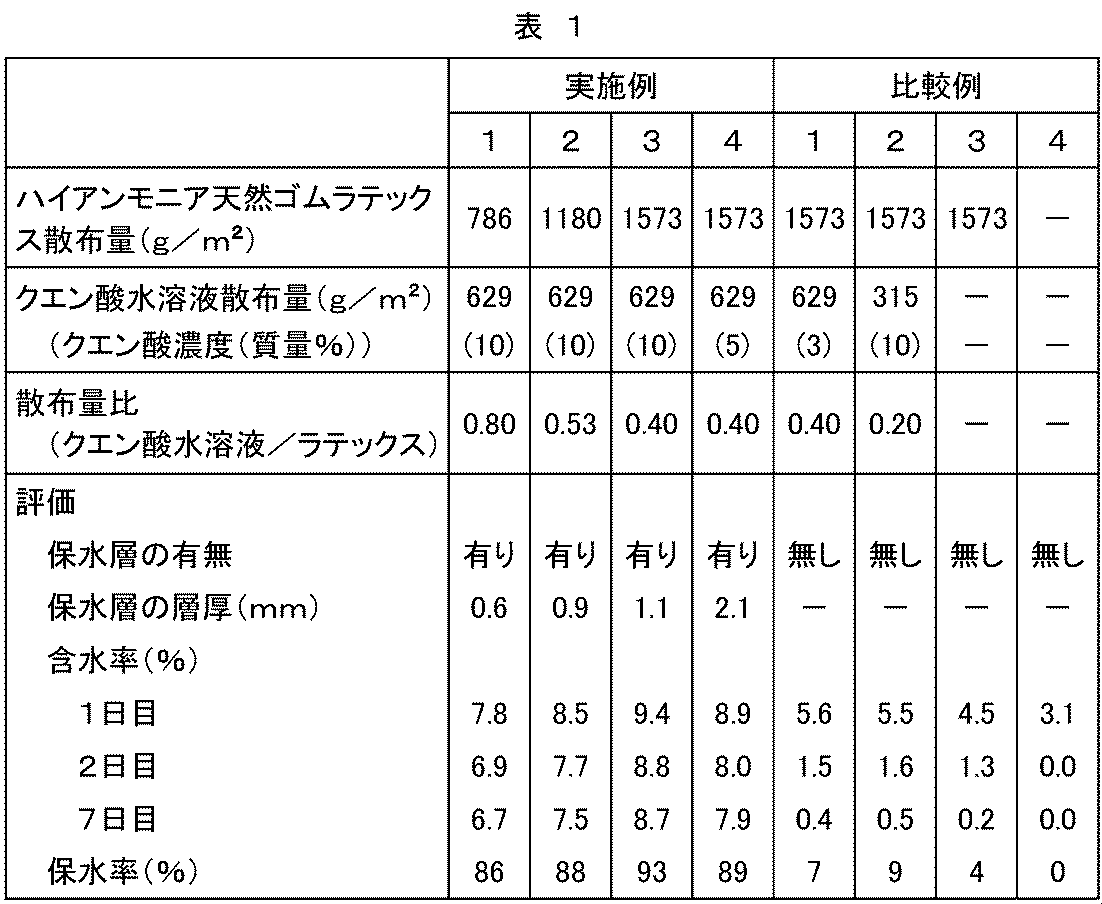
表1の結果より、凝固した天然ゴムラテックスにより構成される本発明にかかる土壌中水分の保水層は、良好な保水率を示すことがわかる。
凝固した天然ゴムラテックスにより構成される本発明にかかる土壌中水分の保水層は、保水能力に優れ、かつ、環境負荷が小さく、容易に施工が可能であるため、特に乾燥地等の僻地における緑化システムの施工において有用である。
Claims (15)
- 凝固した天然ゴムラテックスにより構成される土壌中水分の保水層。
- 前記天然ゴムラテックスがハイアンモニア天然ゴムラテックスである請求項1記載の保水層。
- 前記凝固した天然ゴムラテックスが凝固剤を含む請求項1または2記載の保水層。
- 土壌表面から3~300cm地中に、請求項1~3のいずれか一項に記載の保水層が施工されてなる緑化システム。
- 施工対象地の表土を取り除き、地中土壌を露出させる露出工程、
露出させた土壌表面に天然ゴムラテックスを散布する散布工程、
天然ゴムラテックスを凝固させて保水層を形成させる凝固工程、
保水層の上に取り除いた表土を被せる被覆工程を含む請求項4記載の緑化システムの施工方法。 - 対象とする土壌に対して未凝固の天然ゴムラテックスを散布し、これを凝固させる工程を含む、土壌中水分の保水層の形成方法。
- 保水層の層厚が0.3mm以上である請求項6記載の形成方法。
- 天然ゴムラテックスの使用量が300g/m2以上である請求項6または7に記載の形成方法。
- 凝固剤を散布して未凝固の天然ゴムラテックス凝固させることを特徴とする請求項6~8のいずれか一項に記載の形成方法。
- 凝固剤が有機酸である請求項9記載の形成方法。
- 凝固剤を溶媒に溶解または懸濁して散布する際の凝固剤の濃度が4.0~30.0質量%である請求項9または10記載の形成方法。
- 天然ゴムラテックスの使用量に対する凝固剤液の使用量(凝固剤液の使用量/天然ゴムラテックスの使用量)が0.3~2.0である請求項9~11のいずれか一項に記載の形成方法。
- 請求項6~12のいずれか一項に記載の形成方法により形成された土壌中水分の保水層。
- 請求項13に記載の保水層が土壌表面から3~300cm地中に施工されてなる緑化システム。
- 請求項6~12のいずれか一項に記載の形成方法により形成された保水層の上に3~300cm表土を被せる被覆工程を含む緑化システムの施工方法。
Priority Applications (3)
| Application Number | Priority Date | Filing Date | Title |
|---|---|---|---|
| JP2018528086A JPWO2018163671A1 (ja) | 2017-03-09 | 2018-01-30 | 土壌中水分の保水層、緑化システムおよび緑化システムの施工方法 |
| CN201880016670.9A CN110392524A (zh) | 2017-03-09 | 2018-01-30 | 用于在土壤中保水的保水层、绿化系统以及绿化系统的构建方法 |
| US16/491,954 US20200068818A1 (en) | 2017-03-09 | 2018-01-30 | Water-retaining layer for retaining water in soil, greening system and construction method of greening system |
Applications Claiming Priority (2)
| Application Number | Priority Date | Filing Date | Title |
|---|---|---|---|
| JP2017-044955 | 2017-03-09 | ||
| JP2017044955 | 2017-03-09 |
Publications (1)
| Publication Number | Publication Date |
|---|---|
| WO2018163671A1 true WO2018163671A1 (ja) | 2018-09-13 |
Family
ID=63448695
Family Applications (1)
| Application Number | Title | Priority Date | Filing Date |
|---|---|---|---|
| PCT/JP2018/002976 Ceased WO2018163671A1 (ja) | 2017-03-09 | 2018-01-30 | 土壌中水分の保水層、緑化システムおよび緑化システムの施工方法 |
Country Status (4)
| Country | Link |
|---|---|
| US (1) | US20200068818A1 (ja) |
| JP (1) | JPWO2018163671A1 (ja) |
| CN (1) | CN110392524A (ja) |
| WO (1) | WO2018163671A1 (ja) |
Cited By (1)
| Publication number | Priority date | Publication date | Assignee | Title |
|---|---|---|---|---|
| CN117296670A (zh) * | 2023-11-30 | 2023-12-29 | 中国矿业大学(北京) | 一种排土场重构土壤及其制备方法和应用 |
Citations (5)
| Publication number | Priority date | Publication date | Assignee | Title |
|---|---|---|---|---|
| JPS5114710A (ja) * | 1974-07-24 | 1976-02-05 | Nippon Shokusei Kk | Sunajiryotsukakoho |
| JPH11318204A (ja) * | 1998-05-14 | 1999-11-24 | Nisshoku Corp | 植物育成マット及び植物ブロック構造体 |
| JP2002530124A (ja) * | 1998-12-03 | 2002-09-17 | アントワーヌ フアン ルネ | グランドカバー及びグランドカバーの製造方法及び装置 |
| JP2003325037A (ja) * | 2002-05-09 | 2003-11-18 | Kuwaharagumi | 植生培地構造及び緑化用マット |
| JP2004261073A (ja) * | 2003-02-28 | 2004-09-24 | Nitto Kako Kk | 屋上緑化用下地構造 |
Family Cites Families (4)
| Publication number | Priority date | Publication date | Assignee | Title |
|---|---|---|---|---|
| JP2012244934A (ja) * | 2011-05-27 | 2012-12-13 | Kumagai Gumi Co Ltd | 屋上緑化のための植物生育材料 |
| WO2013018314A1 (ja) * | 2011-07-29 | 2013-02-07 | パナソニック株式会社 | 人工土壌構造体及びその形成方法 |
| CN105862888B (zh) * | 2016-04-20 | 2018-05-11 | 中国水利水电第十一工程局有限公司 | 一种高陡岩质边坡的综合防护方法 |
| CN106171611A (zh) * | 2016-08-26 | 2016-12-07 | 北京顺景园林有限公司 | 一种新型树池模块及其构建树池的方法 |
-
2018
- 2018-01-30 JP JP2018528086A patent/JPWO2018163671A1/ja active Pending
- 2018-01-30 WO PCT/JP2018/002976 patent/WO2018163671A1/ja not_active Ceased
- 2018-01-30 CN CN201880016670.9A patent/CN110392524A/zh active Pending
- 2018-01-30 US US16/491,954 patent/US20200068818A1/en not_active Abandoned
Patent Citations (5)
| Publication number | Priority date | Publication date | Assignee | Title |
|---|---|---|---|---|
| JPS5114710A (ja) * | 1974-07-24 | 1976-02-05 | Nippon Shokusei Kk | Sunajiryotsukakoho |
| JPH11318204A (ja) * | 1998-05-14 | 1999-11-24 | Nisshoku Corp | 植物育成マット及び植物ブロック構造体 |
| JP2002530124A (ja) * | 1998-12-03 | 2002-09-17 | アントワーヌ フアン ルネ | グランドカバー及びグランドカバーの製造方法及び装置 |
| JP2003325037A (ja) * | 2002-05-09 | 2003-11-18 | Kuwaharagumi | 植生培地構造及び緑化用マット |
| JP2004261073A (ja) * | 2003-02-28 | 2004-09-24 | Nitto Kako Kk | 屋上緑化用下地構造 |
Cited By (2)
| Publication number | Priority date | Publication date | Assignee | Title |
|---|---|---|---|---|
| CN117296670A (zh) * | 2023-11-30 | 2023-12-29 | 中国矿业大学(北京) | 一种排土场重构土壤及其制备方法和应用 |
| CN117296670B (zh) * | 2023-11-30 | 2024-03-12 | 中国矿业大学(北京) | 一种排土场重构土壤及其制备方法和应用 |
Also Published As
| Publication number | Publication date |
|---|---|
| CN110392524A (zh) | 2019-10-29 |
| JPWO2018163671A1 (ja) | 2020-01-09 |
| US20200068818A1 (en) | 2020-03-05 |
Similar Documents
| Publication | Publication Date | Title |
|---|---|---|
| WO2024230102A1 (zh) | 一种半干旱区盐碱化土壤综合治理方法 | |
| CN108990460A (zh) | 滨海盐碱地改良方法、滨海盐碱地改良结构及应用 | |
| CN101390487B (zh) | 一种小穴改良原位修复盐碱地营造人工林的方法 | |
| CN105432177B (zh) | 滨海盐碱滩地快速治理方法 | |
| CN102138508A (zh) | 利用生物结皮对陡峭道路边坡进行绿化和防护的方法 | |
| CN104541642A (zh) | 一种重度盐碱化草地的治理方法 | |
| CN101919331A (zh) | 重盐碱地开沟覆膜滴灌土壤改良技术 | |
| CN104969682A (zh) | 一种盐碱土除盐方法 | |
| CN107996243A (zh) | 盐碱地种植白蜡的方法 | |
| JPWO2018163671A1 (ja) | 土壌中水分の保水層、緑化システムおよび緑化システムの施工方法 | |
| CN108142029A (zh) | 沿海滩涂退养还田的方法 | |
| JP5937553B2 (ja) | 土壌処理組成物 | |
| BR112016021837B1 (pt) | Composição aquosa concentrada, e, método para umidificação de solos | |
| WO2019187045A1 (ja) | 土壌水分の浸透抑制層、緑化システムおよび緑化システムの施工方法 | |
| CN105532238B (zh) | 一种滨海重盐碱地种植多年生宿根花卉的方法 | |
| CN104429535A (zh) | 一种边坡绿化的方法 | |
| CN102523772A (zh) | 一种盐碱地的改良和治理方法 | |
| CN109832098A (zh) | 一种草坪铺植工艺 | |
| CN105993473A (zh) | 一种采用功能性营养土种植绿地盐碱草的工艺 | |
| CN106358486A (zh) | 一种黄河灌区避盐耕作方法 | |
| CN207167001U (zh) | 盐碱地园林绿化水土改良系统 | |
| CN110574518A (zh) | 一种重度粘性盐碱地土壤改良种植灌木的方法及其应用 | |
| CN203446265U (zh) | 一种盐碱地植物种植系统 | |
| JPS645130B2 (ja) | ||
| CN107935669A (zh) | 一种促进生长的香樟树营养液及其应用 |
Legal Events
| Date | Code | Title | Description |
|---|---|---|---|
| ENP | Entry into the national phase |
Ref document number: 2018528086 Country of ref document: JP Kind code of ref document: A |
|
| 121 | Ep: the epo has been informed by wipo that ep was designated in this application |
Ref document number: 18763530 Country of ref document: EP Kind code of ref document: A1 |
|
| NENP | Non-entry into the national phase |
Ref country code: DE |
|
| 122 | Ep: pct application non-entry in european phase |
Ref document number: 18763530 Country of ref document: EP Kind code of ref document: A1 |