WO2018160037A1 - 양자점 제조용 포스핀 전구체 및 이로 부터 제조되는 양자점 - Google Patents
양자점 제조용 포스핀 전구체 및 이로 부터 제조되는 양자점 Download PDFInfo
- Publication number
- WO2018160037A1 WO2018160037A1 PCT/KR2018/002543 KR2018002543W WO2018160037A1 WO 2018160037 A1 WO2018160037 A1 WO 2018160037A1 KR 2018002543 W KR2018002543 W KR 2018002543W WO 2018160037 A1 WO2018160037 A1 WO 2018160037A1
- Authority
- WO
- WIPO (PCT)
- Prior art keywords
- phosphine
- precursor
- carbon atoms
- quantum dot
- formula
- Prior art date
- Legal status (The legal status is an assumption and is not a legal conclusion. Google has not performed a legal analysis and makes no representation as to the accuracy of the status listed.)
- Ceased
Links
Classifications
-
- C—CHEMISTRY; METALLURGY
- C07—ORGANIC CHEMISTRY
- C07F—ACYCLIC, CARBOCYCLIC OR HETEROCYCLIC COMPOUNDS CONTAINING ELEMENTS OTHER THAN CARBON, HYDROGEN, HALOGEN, OXYGEN, NITROGEN, SULFUR, SELENIUM OR TELLURIUM
- C07F19/00—Metal compounds according to more than one of main groups C07F1/00 - C07F17/00
-
- C—CHEMISTRY; METALLURGY
- C09—DYES; PAINTS; POLISHES; NATURAL RESINS; ADHESIVES; COMPOSITIONS NOT OTHERWISE PROVIDED FOR; APPLICATIONS OF MATERIALS NOT OTHERWISE PROVIDED FOR
- C09K—MATERIALS FOR MISCELLANEOUS APPLICATIONS, NOT PROVIDED FOR ELSEWHERE
- C09K11/00—Luminescent materials, e.g. electroluminescent or chemiluminescent
- C09K11/06—Luminescent materials, e.g. electroluminescent or chemiluminescent containing organic luminescent materials
-
- C—CHEMISTRY; METALLURGY
- C07—ORGANIC CHEMISTRY
- C07F—ACYCLIC, CARBOCYCLIC OR HETEROCYCLIC COMPOUNDS CONTAINING ELEMENTS OTHER THAN CARBON, HYDROGEN, HALOGEN, OXYGEN, NITROGEN, SULFUR, SELENIUM OR TELLURIUM
- C07F9/00—Compounds containing elements of Groups 5 or 15 of the Periodic Table
- C07F9/02—Phosphorus compounds
- C07F9/06—Phosphorus compounds without P—C bonds
-
- C—CHEMISTRY; METALLURGY
- C09—DYES; PAINTS; POLISHES; NATURAL RESINS; ADHESIVES; COMPOSITIONS NOT OTHERWISE PROVIDED FOR; APPLICATIONS OF MATERIALS NOT OTHERWISE PROVIDED FOR
- C09K—MATERIALS FOR MISCELLANEOUS APPLICATIONS, NOT PROVIDED FOR ELSEWHERE
- C09K11/00—Luminescent materials, e.g. electroluminescent or chemiluminescent
- C09K11/08—Luminescent materials, e.g. electroluminescent or chemiluminescent containing inorganic luminescent materials
- C09K11/70—Luminescent materials, e.g. electroluminescent or chemiluminescent containing inorganic luminescent materials containing phosphorus
-
- B—PERFORMING OPERATIONS; TRANSPORTING
- B82—NANOTECHNOLOGY
- B82Y—SPECIFIC USES OR APPLICATIONS OF NANOSTRUCTURES; MEASUREMENT OR ANALYSIS OF NANOSTRUCTURES; MANUFACTURE OR TREATMENT OF NANOSTRUCTURES
- B82Y20/00—Nanooptics, e.g. quantum optics or photonic crystals
-
- B—PERFORMING OPERATIONS; TRANSPORTING
- B82—NANOTECHNOLOGY
- B82Y—SPECIFIC USES OR APPLICATIONS OF NANOSTRUCTURES; MEASUREMENT OR ANALYSIS OF NANOSTRUCTURES; MANUFACTURE OR TREATMENT OF NANOSTRUCTURES
- B82Y30/00—Nanotechnology for materials or surface science, e.g. nanocomposites
-
- B—PERFORMING OPERATIONS; TRANSPORTING
- B82—NANOTECHNOLOGY
- B82Y—SPECIFIC USES OR APPLICATIONS OF NANOSTRUCTURES; MEASUREMENT OR ANALYSIS OF NANOSTRUCTURES; MANUFACTURE OR TREATMENT OF NANOSTRUCTURES
- B82Y40/00—Manufacture or treatment of nanostructures
-
- C—CHEMISTRY; METALLURGY
- C09—DYES; PAINTS; POLISHES; NATURAL RESINS; ADHESIVES; COMPOSITIONS NOT OTHERWISE PROVIDED FOR; APPLICATIONS OF MATERIALS NOT OTHERWISE PROVIDED FOR
- C09K—MATERIALS FOR MISCELLANEOUS APPLICATIONS, NOT PROVIDED FOR ELSEWHERE
- C09K2211/00—Chemical nature of organic luminescent or tenebrescent compounds
- C09K2211/10—Non-macromolecular compounds
- C09K2211/1003—Carbocyclic compounds
- C09K2211/1014—Carbocyclic compounds bridged by heteroatoms, e.g. N, P, Si or B
-
- C—CHEMISTRY; METALLURGY
- C09—DYES; PAINTS; POLISHES; NATURAL RESINS; ADHESIVES; COMPOSITIONS NOT OTHERWISE PROVIDED FOR; APPLICATIONS OF MATERIALS NOT OTHERWISE PROVIDED FOR
- C09K—MATERIALS FOR MISCELLANEOUS APPLICATIONS, NOT PROVIDED FOR ELSEWHERE
- C09K2211/00—Chemical nature of organic luminescent or tenebrescent compounds
- C09K2211/18—Metal complexes
- C09K2211/188—Metal complexes of other metals not provided for in one of the previous groups
Definitions
- Phosphine precursor for producing quantum dots and quantum dots produced therefrom Phosphine precursor for producing quantum dots and quantum dots produced therefrom
- the present invention relates to a phosphine precursor for preparing quantum dots and a quantum dot prepared therefrom.
- Nanocrystals called quantum dots (QDs)
- QDs quantum dots
- These crystal structures ranging in size from a few nanometers to a few-third nanoscale, and are made up of hundreds to thousands of atoms, depending on the unique crystal structure and particle size. They have unique electrical, magnetic, optical, chemical, and mechanical properties that differ from those of the material itself.
- the quantum dot has been attracting attention for its applicability to various devices such as next-generation light emitting diodes (LEDs), organic-inorganic hybrid electroluminescent devices, inorganic electroluminescent devices, solar cells, and transistors.
- LEDs next-generation light emitting diodes
- organic-inorganic hybrid electroluminescent devices organic-inorganic hybrid electroluminescent devices
- inorganic electroluminescent devices solar cells
- transistors transistors
- the color purity is evaluated to be excellent with a narrower full width at half maximum (FWHM). That is, the narrower the half width is, the more uniform the crystals are.
- the quantum dot is particularly popular as a next-generation light emitting device due to its higher luminous efficiency and color reproducibility than the conventional organic light emitter.
- the quantum dot using the ⁇ -V [group compound on the periodic table is highly luminous There is an area where the most research is conducted.
- InP quantum dots are representative ⁇ -V quantum dots having a wide range of light emission from visible to near infrared. In general, however, InP quantum dots have a relatively low luminous efficiency and relatively low color purity compared to CdSe-based quantum dots, and many studies have been conducted to prepare InP quantum dots having improved luminous efficiency.
- InP quantum dots are prepared by reacting a phosphorus precursor with an indium precursor.
- a phosphine compound TMSP (tris (trimethylsilyl) phosphine) is generally used as a precursor of phosphorus.
- TMSP has a high risk of explosion in the air and contains fatal toxicity
- InP quantum dots produced by known methods from TMSP are not sufficiently competitive color purity, and have a narrower half-value width than TMSP. It is required to develop a phosphorus precursor that can be prepared and ensures stability in the process.
- tertiary phosphine tertiary phosphine
- TMSP tertiary phosphine
- an aspect of the present invention provides a phosphine precursor for preparing a quantum dot represented by Formula (I):
- Q 2 is hydrogen or Provided that Q, and Q 2 are both hydrogen
- R, to R 6 are each independently the same or differently hydrogen, straight or branched chain alkyl of 1 to 20 carbon atoms, aryl of 6 to 30 carbon atoms, alkylaryl of 7 to 30 carbon atoms, or arylalkyl of 7 to 30 carbon atoms Except when all of R 6 are hydrogen.
- Another aspect of the invention provides a method for producing the phosphine precursor.
- Another aspect of the present invention provides a precursor composition for preparing a quantum dot comprising the phosphine precursor.
- Yet another aspect of the present invention provides a quantum dot that is taxed from the phosphine precursor.
- Another aspect of the present invention provides a method of manufacturing a quantum dot using one or more of the phosphine precursors.
- the phosphine precursor for producing quantum dots according to the present invention is conventionally InP Unlike TMSP, which is generally used to prepare quantum dots, it contains two or less silyl ligands and has a more uniform crystal size by controlling the reaction rate with other precursors by various substituents linked to the silyl ligands. Enable manufacturing.
- the precursor of the present invention it is possible to provide quantum dots with improved luminous efficiency and higher emission color purity.
- 1 is a graph showing light emission characteristics of a quantum dot according to an embodiment and a comparative example of the present invention.
- Figure 2 is a graph showing the light absorption characteristics of the quantum dots according to the Examples and Comparative Examples of the present invention.
- a phosphine precursor for preparing a quantum dot according to one embodiment of the present invention is represented by Formula 1:
- R, to R 6 are each independently the same or differently hydrogen, straight or branched chain alkyl of 1 to 20 carbon atoms, aryl of 6 to 30 carbon atoms, alkylaryl of 7 to 30 carbon atoms, or arylalkyl of 7 to 30 carbon atoms Except that R, 1 to 6 are all hydrogen.
- Nanocrystals are crystals with crystal structures ranging in size from several nanos to tens of nanoscales. They consist of hundreds to thousands of atoms, and the material itself possesses a specific crystal structure and particle size. It has unique electrical, magnetic, optical, chemical and mechanical properties that are different from its unique properties. In addition, by adjusting the size of the nanocrystals it is possible to control the above characteristics.
- quantum dots are made of the same material, the color of light emitted may vary depending on the size of the nanocrystals. Due to such characteristics, the quantum dot has attracted much attention because of its high applicability to various devices such as next-generation light emitting diodes (LEDs), organic-inorganic hybrid electroluminescent devices, inorganic electroluminescent devices, solar cells, and transistors.
- LEDs next-generation light emitting diodes
- organic-inorganic hybrid electroluminescent devices organic-inorganic hybrid electroluminescent devices
- inorganic electroluminescent devices inorganic electroluminescent devices
- solar cells and transistors.
- the color purity is evaluated as the narrower the full width at half maximum (FWHM). In other words, the more uniform the crystal size, the narrower the half width.
- reaction temperature and reaction time There are various factors that control the crystal size of the quantum dots, such as reaction temperature and reaction time, and one of them is to control the reaction rate between precursors for preparing the quantum dots.
- the lower the reaction properties of the precursors that is, the slower the reaction speed
- quantum dots with crystal sizes of uniform distribution are produced.
- the quantum dots having a uniform size are not necessarily generated, and according to the structural characteristics of the precursor, it can be confirmed that quantum dots having various characteristics that are unexpected may be manufactured. Based on this, the present invention has been completed.
- the crystal size and distribution of the quantum dots appears to depend on the structure of each ligand linked to the precursor, and the organic properties as a whole of the precursor, which appear to be not simply arithmetic predicted.
- the inventors of the present invention prepared a quantum dot using a variety of phosphine precursors for the production of quantum dots and evaluated the physical and optical properties of the prepared quantum dots, the excellent luminescent efficiency and It was confirmed that quantum dots having color purity can be provided.
- Q 2 is hydrogen or Except that when Q, and Q 2 are both hydrogen,
- R ! To R 6 are each independently the same or differently hydrogen, straight or branched chain alkyl of 1 to 20 carbon atoms, aryl of 6 to 30 carbon atoms, alkylaryl of 7 to 30 carbon atoms, or arylalkyl of 7 to 30 carbon atoms, R Except when R to R 6 are all hydrogen.
- the phosphine precursor for preparing quantum dots of Chemical Formula 1 is characterized by being primary phosphine or secondary phosphine, and is a novel compound that is not known for use as a precursor for preparing quantum dots. That is, one of the ligands of phosphorus (P) is hydrogen, and at least one of the other two ligands (QQ 2 ) is a silyl ligand substituted with various hydrocarbon groups such as alkyl, aryl, alkylaryl or arylalkyl. According to the kind of substituents connected to the silyl ligand, the bulkiness of the entire precursor is controlled in various ways, and thus, the reaction properties are different in reaction with other precursors for preparing quantum dots.
- the phosphine precursor for preparing the quantum dot of Chemical Formula 1 does not include three ligands having the same structure in phosphorus (P) as in the conventionally known TMSP, and one is necessarily hydrogen and the other two additional one or two ligands are
- the silyl group structure is asymmetric ligand structure with respect to the central atom phosphorus (P), and this asymmetric structure shows complex reactivity.
- the phosphine precursor for preparing quantum dots of Formula 1 of the present invention exhibits a faster reaction rate than TMSP, which is a tertiary phosphine, and thus may be capable of producing quantum dots at a lower temperature than when using conventional TMSP.
- Q and Q 2 are the same as or different from each other, and Q! And Q 2 increase may be hydrogen.
- the phosphine precursor of Formula 1 when any one of Q and Q 2 is hydrogen, the phosphine precursor of Formula 1 has a characteristic of being a secondary phosphine, and if both Q and Q 2 are not hydrogen, the phosphine of Formula 1 The precursor has the characteristic of being primary phosphine.
- R to 6 may be each independently a linear alkyl of 1 to 6 carbon atoms, branched alkyl of 3 to 6 carbon atoms, or aryl of 6 to 12 carbon atoms.
- R and R 6 may be each independently methyl, ethyl, n-propyl, iso-propyl, ⁇ -butyl, tert-butyl, iso-butyl, or phenyl.
- the compound of Formula 1 may be a compound represented by the following Formula 1-1.
- R, ' to R 6 are each independently the same or differently hydrogen, straight or branched chain alkyl of 1 to 20 carbon atoms, aryl of 6 to 30 carbon atoms, alkylaryl of 7 to 30 carbon atoms, or arylalkyl of 7 to 30 carbon atoms Except when all of R 6 are hydrogen.
- to R 6 may be each independently a linear alkyl of 1 to 6 carbon atoms, branched alkyl of 3 to 6 carbon atoms, or aryl of 6 to 12 carbon atoms.
- the R 1 ' to 3 ⁇ 4 ' may each independently be methyl, ethyl, n-propyl, iso-propyl, ⁇ -butyl, tert-butyl, iso-butyl, or phenyl.
- the compound of Chemical Formula 1 may be a compound represented by the following Chemical Formula 1-2.
- R, '' to R 3 ′ ' are each independently the same or differently hydrogen, straight or branched chain alkyl of 1 to 20 carbon atoms, aryl of 6 to 30 carbon atoms, alkylaryl of 7 to 30 carbon atoms, or 7 to 30 carbon atoms Arylalkyl, except that R, " to R / are all hydrogen.
- R / ' to R 3 " may be each independently a linear alkyl of 1 to 6 carbon atoms, branched alkyl of 3 to 6 carbon atoms, or aryl of 6 to 12 carbon atoms.
- the R 1 "to R 3 ′ may each independently be methyl, ethyl, ⁇ -propyl, iso-propyl, ⁇ -butyl, tert-butyl, iso-butyl, or phenyl.
- the compound of formula 1 is
- the phosphine precursor for preparing the quantum dot of Chemical Formula 1 may be prepared by reacting a silyl triflate compound with a phosphine (PH 3 ), or a silyl triflate compound with a primary phosphine compound.
- TfO means trifluoromethanesulfonate, triflate.
- the preparation method is represented by the following reaction formula:
- Trifluoromethanesulfonate (triflate). As shown in Scheme 2 above, when performing banung of the silyl triflate compound with a primary phosphine compound I of the primary phosphine. Hydrogen may be substituted with to give a secondary phosphine precursor.
- halogenated hydrocarbons are commonly known as polar and non-flammable materials, but are not used as reaction solvents in highly reactive reactions using polar solvents or raw materials that pose a fire hazard.
- some hydrogenated halogenated hydrocarbons are decomposed and acidic, and are also used as oxidizing agents of oxidation reactions, they are not used in reactions using raw materials having high reaction properties.
- the halogenated hydrocarbon is used as the reaction solvent, it was confirmed that the desired phosphine precursor compound can be obtained with high process yield and high purity.
- the halogenated hydrocarbons include difluoromethane, tribromethane, trifluoride methane, tetrafluoroethane, pentoxide ethane, hexafluoroethane, dichloromethane (dichloromethane), chloroform, carbon tetrachloride, ethane tetrachloride, ethane chlorochloride, hexachloride It may be one or more selected from the group consisting of ethane, propane hexachloride, propane chloride, propane hexachloride, iodide methane, methane tribromethane, tetrabromethane, ethane tetrabromide, ashamed ethane, and hexabromethane. It doesn't happen.
- the halogenated hydrocarbon does not exhibit reactivity with other raw materials, and is preferably substituted with cheap chlorine. Accordingly, the halogenated hydrocarbon may be at least one selected from the group consisting of dichloromethane, chloroform, carbon tetrachloride, ethane tetrachloride, ethane contaminated, hexachloride ethane, propane chloride, propane chloride, and propane chloride, more preferably. May be dichloromethane or ethane tetrachloride.
- the halogenated hydrocarbon may be used by appropriately adjusting its amount in consideration of ease of handling, stability of reaction, reaction yield, and product purity.
- the tertiary amine may include one or more substituents selected from the group consisting of methyl, ethyl, propyl, isopropyl, butyl, isobutyl, t-butyl and phenyl. have.
- the tertiary amine is, for example, trimethylamine, triethylamine, tripropylamine, tributylamine, triphenylamine, dimethylethylamine, methyldiethylamine, dimethylpropylamine, methyldipropylamine, methylethylpropylamine , Diethylpropylamine, ethyldipropylamine and ethyldiaisopropylamine, and may be preferably triethylamine.
- the tertiary amine may be used in 0.5 to 2 molar equivalents relative to 1 mole of the silyl triflate compound.
- the precursor composition for preparing quantum dots includes the phosphine precursor.
- the precursor composition for preparing quantum dots includes the phosphine precursor of Chemical Formula 1 described above.
- the phosphine precursor of Formula 1 may include only one kind, or may include two or more kinds of phosphine precursors corresponding to Formula 1.
- phosphine precursor of Formula 1 in addition to the phosphine precursor of Formula 1, it may further include tris (trimethylsilyl) phosphine (tris (trimethylsilyl) phosphine).
- the precursor composition for preparing a quantum dot is a phosphine precursor of formula
- the mixing ratio will not be specifically limited.
- the precursor composition for preparing a quantum dot is a phosphine precursor of formula 1 and tris (trimethylsilyl) phosphine (tris (trimethylsilyl) phosphine) 1:10 to 10: 1, or 1: 5 to 5: 1, or It may be included in a molar ratio of 1: 2 to 2: 1.
- it provides a quantum dot prepared from the phosphine precursor.
- At least one phosphine precursor It provides a method for producing a quantum dot using.
- the quantum dot manufactured by using the phosphine precursor of Formula 1 of the present invention may exhibit an effect of narrower half-value width and excellent luminous efficiency than a quantum dot conventionally manufactured using TMSP as a phosphine precursor.
- quantum dots prepared from the precursor means a quantum dot manufactured by using at least one of the above-described phosphine precursors of Formula 1 as a source of phosphorus at any stage of the production of the quantum dots. It does not matter the size, shape, or structure of the quantum dot.
- the quantum dot may be a quantum dot including InP.
- the quantum dot may be a quantum dot of the core / shell structure consisting of a core layer and a shell layer. More specifically, the quantum dot may be a quantum dot having a core / shell structure including InP as a core and ZnS and / or GaP as a shell.
- the quantum dot may be prepared by the following manufacturing method.
- the method of manufacturing a quantum dot heating the mixture of indium precursor, zinc precursor, myristic acid (myristic acid) and 1-octadecene (1-octadecene); Subjecting the mixture to room temperature; Adding at least one of the above-described phosphine precursors, gallium precursor, and 1-octadecene to the cooled mixture and reacting them by heating; And dodecanethiol (dodecanethiol) in the counterungung and comprises the step of cooling.
- a quantum dot including InP as a core and ZnS and GaP as a shell will be described in more detail.
- step 2 The mixture of step 1 is allowed to stand at room temperature (step 2).
- 1-octadecene, a gallium precursor, and the phosphine precursor of Chemical Formula 1 described above are added to the mixture of Step 1, which is sensed at room temperature.
- the phosphine precursor of Chemical Formula 1 may be added only one type, or a combination of two or more types.
- TMSP may be further mixed.
- the mixture is heated to a temperature of 200 to 320 ° C. and reacted for 1 to 30 minutes (step 3).
- Dodecanethiol was added to the reactant of step 3, followed by cooling to room temperature (step 4).
- the quantum dot obtained by using the phosphine precursor of Chemical Formula 1 of the present invention may exhibit uniform crystal size, excellent luminous efficiency and color purity.
- the quantum dots obtained using the phosphine precursor of the present invention have the same effect as other conditions, and exhibit an effect of improving the quantum efficiency and / or half width by about 1 to about 15% compared to when using TMSP alone. Can be.
- the quantum dots obtained using the phosphine precursor of the present invention may exhibit a half width of about 35 to about 60 nm, or about 40 to about 60 nm.
- the quantum dots obtained using the phosphine precursor of the present invention may have a particle size in the range of about 2 to about ⁇ .
- the quantum dot obtained by using the phosphine precursor of the present invention can be variously applied to various devices such as light emitting diodes (LEDs), displays, organic / inorganic hybrid electroluminescent devices, inorganic electroluminescent devices, solar cells, transistors, and the like. It is expected to be.
- LEDs light emitting diodes
- displays organic / inorganic hybrid electroluminescent devices
- inorganic electroluminescent devices inorganic electroluminescent devices
- solar cells solar cells
- transistors transistors, and the like. It is expected to be.
- the reactant in the form of a mixture thus obtained was fractionally distilled under reduced pressure without filtration to obtain 52.4 g of bis (tert-butyldimethyl silyl) phosphine ((bis (tert-butyldimethyl silyl) phosphine) as a target compound (yield: 50%). It was.
- tris (trimethylsilyl) phosphine prepared in step 1 above was added to 500 ml of dichloromethane and cooled to 0 ° C in a 2 L volumetric bottom-bottom flask under a nitrogen atmosphere. 7.6 g of methanol was added dropwise over 1 hour while maintaining 0 ° C angle. The resulting trimethylsilyl phosphine was used in the next step without additional concentration or purification.
- the trimethylsilylphosphine mixture dissolved in the dichloromethane prepared in step 2 was cooled to 0 ° C., followed by 12.1 g of triethylamine and tert-butyldimethyl silyl triflate. 32.7 g was added dropwise over 1 hour. The reaction product thus obtained was distilled under reduced pressure without filtration to obtain the target compound.
- Phosphine (phosphine, PH 3 ) gas was introduced at a rate of 3 ml / min through the cannula while maintaining the temperature of the mixture below 25 ° C. When a total of 5.6 g of phosphine was added, phosphine was stopped. The reactant in the form of a mixture thus obtained was fractionally distilled under reduced pressure without filtration to obtain 40.2 g (yield: 71%) of bis (triisopropylsilyl) phosphine ((bis (triisopropylsilyl) phosphine)) as a target compound.
- the trimethylsilylphosphine mixture dissolved in the dichloromethane prepared in step 2 of Example 4 was cooled to 0 ° C., followed by 38.0 g of triisopropylsilyl triflate and 12.1 g of triethylamine. Were added dropwise over 1 hour each. The semi-ungmul thus obtained is distilled under reduced pressure without filtration to obtain the target compound.
- the mixed solution (1) was cooled to room temperature.
- a mixed solution (1) cooled to room temperature 15 ml of gallium chloride (GaCl 3 ) was added to 1 ml of 1-octadecene (ODE).
- TMSP tris (trimethylsilyl) phosphine
- An injection solution of 27.8 mg (0.095 mmol) of bis (tert-butyldimethylsilyl) phosphine in 1 ml of octadecene (1-octadecene, ODE) was added thereto to prepare a mixed solution (2).
- the mixed solution (2) was heated for 10 minutes 300 ° C was raised to 300 ° C.
- Dodecanethiol (DDT) 0.25tnl (lmmol) was added to the mixed solution (2) and cooled to room temperature.
- Example 14 Except for the use of 14 mg (0.095 mmol) of the tertiary-butyldimethylsilylphosphine obtained in Example 2 instead of the bis (tertiary-butyldimethylsilyl) phosphine of Example 1 in Example 12, except that InP / GaP / ZnS quantum dots were prepared using the same method as in Example 5.
- Example 14
- Example 12 except that 29 mg (0.095 mmol) of bis (dimethylphenylsilyl) phosphine obtained in Example 3 was used instead of the bis (tertiary-butyldimethylsilyl) phosphine of Example 1 in Example 12.
- InP / GaP / ZnS quantum dots were prepared using the same method as in 12.
- Example 15
- Example 16 instead of the bis (tertary-butyldimethylsilyl) phosphine of Example 1 in Example 12, the (tertiary-butyldimethylsilyl) (trimethylsilyl) phosphine 24m g (0.095 mmol) obtained in Example 4 was used. Except that, using the same method as in Example 12. InP / GaP / ZnS quantum dots were prepared.
- Example 16
- Example 18 Except for using the triethylsilyl phosphine 14mg (0.095minol) obtained in Example 6 in place of the bis (tertiary-butyldimethylsilyl) phosphine of Example 1 in Example 12, the same as in Example 12 InP / GaP / ZnS quantum dots were prepared using the method.
- Example 18 Except for using the triethylsilyl phosphine 14mg (0.095minol) obtained in Example 6 in place of the bis (tertiary-butyldimethylsilyl) phosphine of Example 1 in Example 12, the same as in Example 12 InP / GaP / ZnS quantum dots were prepared using the method.
- Example 18 Except for using the triethylsilyl phosphine 14mg (0.095minol) obtained in Example 6 in place of the bis (tertiary-butyldimethylsilyl) phosphine of Example 1 in Example 12, the same as in Example
- Example 19 Except for the use of the bis (tert-butyldimethylsilyl) phosphine of Example 1 in Example 12 instead of 34 mg (0.095 mmol) of the bis (triisopropylsilyl) phosphine obtained in Example 7 above. InP / GaP / ZnS quantum dots were prepared in the same manner as in Example 12.
- Example 19
- Example 20 Except for using the triisopropyl silyl phosphine 18mg (0.095mmol) obtained in Example 8 in place of the bis (tertiary-butyldimethylsilyl) phosphine of Example 1 in Example 12, InP / GaP / ZnS quantum dots were prepared using the same method.
- Example 20 Except for using the triisopropyl silyl phosphine 18mg (0.095mmol) obtained in Example 8 in place of the bis (tertiary-butyldimethylsilyl) phosphine of Example 1 in Example 12, InP / GaP / ZnS quantum dots were prepared using the same method.
- Example 20 Except for using the triisopropyl silyl phosphine 18mg (0.095mmol) obtained in Example 8 in place of the bis (tertiary-butyldimethylsilyl) phosphine of Example 1 in Example 12, InP / GaP / ZnS quantum dots were prepared
- Example 21 Except for using the bis (tertiary-butyldimethylsilyl) phosphine of Example 1 in Example 12 22 mg (0.095 mmol) of bis (dimethylisopropylsilyl) phosphine obtained in Example 9 instead of the bis (tertiary -butyldimethylsilyl) phosphine of Example 1, InP / GaP / ZnS quantum dots were prepared in the same manner as in Example 12.
- Example 21 Example 21
- Example 22 Bis (tertiary-butyldimethylsilyl) phosphine of Example 1 in Example 12 above Instead 25 mg (0.095 mmol) of (triisopropylsilyl) (trimethylsilyl) phosphine obtained in Example 10. Except for the use, InP / GaP / ZnS quantum dots were prepared in the same manner as in Example 12.
- Example 22
- Example 1 20 mg (0.095 mmol) of (dimethylisopropylsilyl) (trimethylsilyl) phosphine obtained in Example 1 1 was used instead of the bis (tertary-butyldimethylsilyl) phosphine of Example 1 in Example 12.
- InP / GaP / ZnS quantum dots were prepared using the same method as in Example 12. Comparative Example 1
- Example 12 Except for using the bis (tertiary-butyldimethylsilyl) phosphine of Example 1 as the phosphine precursor in Example 12, using tris (trimethylsilyl) phosphine in 55.6 mg (0.19 mmol), InP / GaP / ZnS quantum dots were prepared using the same method as in Example 12.
- optical properties of the quantum dots prepared in Examples and Comparative Examples optical properties of InP / GaP / ZnS quantum dots prepared in Example 12 and Comparative Example 1 were measured using a fluorescence photometer (device name: Perkin Emer-LS55). The results are shown in Table 1.
- a light emission graph of wavelengths of quantum dots according to Example 12 and Comparative Example 1 of the present invention is shown in FIG. 1.
- quantum dots were prepared using only tris (trimethylsilylphosphine) (TMSP) which is a known phosphine precursor.
- TMSP tris (trimethylsilylphosphine)
- Example 12 in which a quantum dot was prepared by mixing bis (tertiary-butyldimethylsilyl) phosphine as a phosphine precursor of the present invention and tris (trimethylsilylphosphine) as a known substance at a molar ratio of 1: 1. Comparing the quantum dot and half width of Example 1, the half width was reduced by about 9%. Therefore, it can be seen that when the quantum dots are prepared using the novel phosphine precursor of the present invention, the quantum dots having excellent physical properties can be prepared with uniform size and high purity.
Landscapes
- Chemical & Material Sciences (AREA)
- Organic Chemistry (AREA)
- Engineering & Computer Science (AREA)
- Materials Engineering (AREA)
- Inorganic Chemistry (AREA)
- Health & Medical Sciences (AREA)
- Life Sciences & Earth Sciences (AREA)
- Biochemistry (AREA)
- General Health & Medical Sciences (AREA)
- Molecular Biology (AREA)
- Electroluminescent Light Sources (AREA)
- Luminescent Compositions (AREA)
Abstract
본 발명은 양자점 제조용 포스핀 전구체 및 이로부터 제조되는 양자점에 관한 것이다. 본 발명의 양자점 제조용 포스핀 전구체를 이용하면, 발광 효율이 개선되고 발광 색순도가 보다 높은 양자점을 제공할 수 있다.
Description
【발명의 설명】
【발명의 명칭】
양자점 제조용 포스핀 전구체 및 이로부터 제조되는 양자점 【기술분야】
관련 출원 (들ᅵ과의 상호 인용
본 출원은 2017년 3월 3일자 한국 특허 출원 제 10-2017-0027887호에 기초한 우선권의 이익을 주장하며, 해당 한국 특허 출원의 문헌에 개시된 모든 내용은 본 명세서의 일부로서 포함된다.
본 발명은 양자점 제조용 포스핀 전구체 및 이로부터 제조되는 양자점에 관한 것이다.
【발명의 배경이 되는 기술】
양자점 (quantum dot, QD)이라 불리는 나노 결정은 수 나노 내지 수¾ 나노 크기의 결정 구조를 가진 물질로, 수백 내지 수천 개의 원자로 구성되어 있고, 이러한 특유의 결정 구조 및 입자 크기에 따라 원래 물질이 가진 물질 자체의 고유한 특성과는 다른 독특한 전기적, 자기적, 광학적, 화학적, 기계적 특성을 가지게 된다. 또한, 나노 결정의 크기를 조¾함으로써 상기한 특성의 조절이 가능하게 된다. 이와 같은 특성에 의하여 양자점은 차세대 발광 다이오드 (light emitting diode. LED), 유무기 하이브리드 전기 발광소자, 무기 전기 발광소자, 태양전지, 트랜지스터 등의 각종 소자에의 적용 가능성으로 주목받고 있다.
양자점에 있어 우수한 발광 스펙트럼을 확보하기 위해서는 높은 발광 효율과 우수한 낵순도를 가질 것이 요구되는데, 색순도는 반치폭 (full width at half maximum, FWHM)이 좁을수록 우수한 것으로 평가되며, 양자점의 결정 크기가 일정할수록, 즉, 균일한 크기의 결정을 가질수록 좁은 반치폭을 나타낸다.
양자점은 특히 기존의 유기물 발광체에 비하여 발광효율과 색 재현율이 높아 차세대 발광 소자로 각광받고 있으며, 이 증에서도 주기율표상의 Π -V【족 화합물을 이용한 양자점이 높은 발광 효율과 발광
영역을 가져 가장 많은 연구가 진행되고 있다.
InP 양자점은 가시광선에서 근적외선 영역까지 광범위한 발광 영역을 갖는 대표적인 ΙΠ-V족 양자점이다. 하지만, 일반적으로 InP 양자점은 CdSe 계열의 양자점과 비교해서, 다소 낮은 발광 효율과 비교적 낮은 색순도를 나타내어 향상된 발광 효율을 갖는 InP 양자점을 제조하기 위해 많은 연구가 진행되어 왔다.
InP 양자점은 인 (phosphorus) 전구체와 인듬 (indium) 전구체를 반응시켜 제조하는데, 이 중 인의 소스가 되는 전구체로는 포스핀 화합물인 TMSP (tris(trimethylsilyl)phosphine)를 사용하는 것이 일반적이다.
그런데, TMSP는 정도로 공기 중에서의 폭발 위험성이 크고 치명적 독성을 함유하고 있고, TMSP으로부터 공지의 방법으로 제조되는 InP 양자점은 충분히 경쟁력있는 색순도를 나타낸다고 볼 수 없어, TMSP를 대체하여 보다 좁은 반치폭을 갖는 양자점을 제조할 수 있고 공정시 안정성이 확보된 인 전구체의 개발이 요구되고 있다.
. 대한민국 등톡특허 제 104331 1호에서는 TMSP를 대체하는 인 전구체로 트리스 (디메틸터셔리부틸 실릴)포스핀 (tris(dimethyl tert-butyl)silyl phosphine, P(SiMe2-tert-Bu)3)을 이용한 InP 양자점의 제조방법을 개시하였다. 그러나, 상기 트리스 (디메틸터셔리 ^틸 실릴)포스핀은 TMSP와 마찬가지로 중심원자인 인 (P)에 세 개의 동일한 리간드 (디메틸터셔리부틸 실릴기)를 .도입한 3차 포스핀 (tertiary phosphine) 구조로, TMSP를 이용하여 제조한 양자점과 비교하여 반치폭이 감소되는 효과가 거의 없어 TMSP를 대체하기에 층분치 않으며 보다 높은 색순도를 갖는 양자점을 제조할 수 있는 전구체가 요구된다. 【발명의 내용】
【해결하고자 하는 과제】
상기와 같은 과제를 해결하기 위하여, 본 발명은 보다 균일한 결정 크기를 가져 높은 색순도를 나타내는 양자점의 제조를 가능케 하는, 신규한 포스핀 전구체 및 이로부터 제조되는 양자점을 제공하는 것을 목적으로 한다.
【과제의 해결 수단】
상기와 같은 문제를 해결하기 위해서 본 발명의 일 측면은, 하기 화학식 I로 표시되는 양자점 제조용 포스핀 전구체를 제공한다:
[화학식 1]
Q2. ^Qi
P
H
상기 화학식 1에서,
(^은 수소 또는
Q2는 수소 또는
 단, Q, 및 Q2가 모두 수소인 경우는 제외하며 ,
이때 R, 내지 R6는 각각 독립적으로 동일하거나 상이하게 수소, 탄소수 1 내지 20의 직쇄 또는 분지쇄 알킬, 탄소수 6 내지 30의 아릴, 탄소수 7 내지 30의 알킬아릴, 또는 탄소수 7 내지 30의 아릴알킬이며, 내지 R6가 모두 수소인 경우는 제외한다.
본 발명의 다른 일 측면은, 상기 포스핀 전구체의 제조방법을 제공한다.
본 발명의 다른 일 측면은, 상기 포스핀 전구체를 포함하는 양자점 제조용 전구체 조성물을 제공한다.
본 발명의 또 다른 일 측면은, 상기 포스핀 전구체로부터 쎄조되는 양자점을 제공한다.
본 발명의 또 다른 일 측면은, 상기 포스핀 전구체 1종 이상을 이용하여 양자점을 제조하는 방법을 제공한다.
【발명의 효과】 .
본 발명에 따른 양자점 제조용 포스핀 전구체는, 종래에 InP
양자점을 제조하기 위해 일반적으로 사용되는 TMSP와 달리, 실릴 리간드를 두 개 이하로 포함하고, 상기 실릴 리간드에 연결된 다양한 치환기에 의해 다른 전구체와의 반응 속도를 조절함으로써 보다 균일한 결정 크기를 갖는 양자점의 제조를 가능하게 한다.
이에 따라, 본 발명의 전구체를 이용하면, 발광 효율이 개선되고 발광 색순도가 보다 높은 양자점을 제공할 수 있다.
【도면의 간단한 설명】
도 1은 본 발명의 실시예 및 비교예에 따른 양자점의 발광 특성을 보여주는 그래프이다.
도 2는 본 발명의 실시예 및 비교예에 따른 양자점의 흡광 특성을 보여주는 그래프이다.
【발명을 실시하기 위한 구체적인 내용】
본 발명은 다양한 변경올 가할 수 있고 여러 가지 형태를 가질 수 있는 바, 특정 실시예들을 예시하고 하기에서 상세하게 설명하고자 한다. 그러나, 이는 본 발명을 특정한 개시 형태에 대해 한정하려는 것이 아니며, 본 발명의 사상 및 기술 범위에 포함되는 모든 변경, 균둥물 내지 대체물을 포함하는 것으로 이해되어야 한다.
이하, 본 발명의 양자점 제조용 포스핀 전구체 및 이로부터 제조되는 양자점에 대해 보다 상세히 설명한다.
I. 포스핀 전구체 및 이의 제조방법
본 발명의 일 구현예에 따른 양자점 제조용 포스핀 전구체 화학식 1로 표시된다:
[화학식 1]

상기 화학식 1에서
은 수소 또는
¾는 수소 또는
 고, 단, Q Q2가 모두 수소인 경우는 제외하며
이때 R, 내지 R6는 각각 독립적으로 동일하거나 상이하게 수소, 탄소수 1 내지 20의 직쇄 또는 분지쇄 알킬, 탄소수 6 내지 30의 아릴, 탄소수 7 내지 30의 알킬아릴, 또는 탄소수 7 내지 30의 아릴알킬이며, R, 내지 1 6가 모두 수소인 경우는 제외한다.
양자점 (quantum dot, QD)이라 불리우는 나노 결정은 수 나노 내지 수십 나노 크기의 결정 구조를 가진 물질로, 수백 내지 수천 개의 원자로 구성되어 있고, 특유의 결정 구조 및 입자 크기에 따라 원래 물질이 가진 물질 자체의 고유한 특성과는 다른 독특한 전기적, 자기적, 광학적, 화학적, 기계적 특성을 가지게 된다. 또한, 나노 결정의 크기를 조절함으로써 상기한 특성의 조절이 가능하게 된다.
양자점은 같은 물질로 만들어지더라도 나노 결정의 크기에 따라서 방출하는 빛의 색상이 달라질 수 있다. 이와 같은 특성에 의하여 양자점은 차세대 발광 다이오드 (light emitting diode, LED), 유무기 하이브리드 전기 발광소자, 무기 전기 발광소자, 태양전지, 트랜지스터 등의 각종 소자에의 적용 가능성이 커서 크게 주목받고 있다.
양자점에 있어 우수한 발광 스펙트럼을 확보하기 위해서는 높은 발광 효율과 우수한 색순도를 가질 것이 요구되는데, 색순도는 반치폭 (full width at half maximum, FWHM)이 좁을수록 우수한 것으로 평가되며, 양자점의 결정 크기가 일정할수록, 즉, 균일한 크기의 결정을 가질수록 좁은 반치폭을 나타낸다.
양자점의 결정 크기를 조절하는 인자 (factor)는 반응 온도, 반응 시간 등 여러가지가 있는데, 그 중 하나가 양자점을 제조하기 위한 전구체들 사이의 반웅 속도를 조절하는 것이다.
이때 전구체들의 반웅성이 낮을수록, 즉 반웅 속도가 느릴수록
균알한 분포의 결정 크기를 갖는 양자점이 생성된다고 일반적으로 알려져 있다. 그러나, 본 발명의 발명자들에 의하면 전구체의 반웅성이 낮을수록 이에 반드시 균일한 크기의 양자점이 생성되는 것은 아니며, 전구체의 구조적 특징에 따라 예측하지 못한 다양한 특성을 갖는 양자점이 제조될 수 있음을 확인하였으며 이에 기초하여 본 발명을 완성하였다.
보다 구체적으로, 양자점의 결정 크기와 분포는 전구체에 연결된 각 리간드의 구조, 및 전구체 전체로서의 유기적 특성에 의해 달라지는 것으로 보이며, 산술적으로 단순히 예측되지는 않는 것으로 나타났다.
이에, 본 발명의 발명자들은 양자점 제조를 위한 다양한 포스핀 전구체들을 이용하여 양자점을 제조하고 제조된 양자점의 물리적, 광학적 특성 등을 평가한 결과, 하기 화학식 1와 같은 포스핀 전구체에 의해 우수한 발광 효율과 색순도를 갖는 양자점을 제공할 수 있음을 확인하였다.

상기 화학식 1에
(^은 수소 또는
Q2는 수소 또는
 이고, 단, Q, 및 Q2가 모두 수소인 경우는 제외하며,
이때 R! 내지 R6는 각각 독립적으로 동일하거나 상이하게 수소, 탄소수 1 내지 20의 직쇄 또는 분지쇄 알킬, 탄소수 6 내지 30의 아릴, 탄소수 7 내지 30의 알킬아릴, 또는 탄소수 7 내지 30의 아릴알킬이며, R, 내지 R6가 모두 수소인 경우는 제외한다.
상기 화학식 1의 양자점 제조용 포스핀 전구체는, 1차 포스핀 (primary phosphine) 또는 2차 포스핀 (secondary phosphine)인 특징을 갖는 것으로, 양자점 제조용 전구체의 용도로 알려진 바 없는 신규한 용도의 화합물이다.
즉, 인 (P)의 리간드 중 하나는 수소이고, 나머지 두 개의 리간드 (Q Q2) 중 하나 이상이 알킬, 아릴, 알킬아릴 또는 아릴알킬과 같은 다양한 탄화수소기로 치환된 실릴 리간드인 것을 특징으로 한다. 상기 실릴 리간드에 연결된 치환기의 종류에 따라 전체 전구체의 벌키한 정도 (bulkiness)가 다양하게 조절되며, 이로 인해 양자점 제조를 위한 다른 전구체와의 반웅에서 반웅성이 달라지게 된다
즉, 상기 화학식 1의 양자점 제조용 포스핀 전구체는 종래에 알려진 TMSP와 같이 인 (P)에 동일한 구조의 세 개의 리간드를 포함하는 것이 아니라, 하나는 반드시 수소이고 나머지 두 개 증 하나 또는 두 개의 리간드가 실릴기인 구조로 중심원자인 인 (P)에 대해 비대칭적인 리간드 구조를 나타내며, 이러한 비대칭 구조가 복합적인 반응성을 나타내게 된다. 또한, 본 발명의 화학식 1의 양자점 제조용 포스핀 전구체는 3차 포스핀인 TMSP 보다 빠른 반응 속도를 나타내며, 이에 따라 종래의 TMSP를 이용하는 경우보다 낮은 온도에서 양자점 제조가 가능할 수 있다. 상기 화학식 1에서, Q, 및 Q2는 서로 동일하거나 상이하며, 또한 Q! 및 Q2 증 어느 하나는 수소일 수 있다.
상기 화학식 1에서, Q, 및 Q2 중 어느 하나가 수소일 때, 상기 화학식 1의 포스핀 전구체는 2차 포스핀인 특징을 가지며, Q, 및 Q2모두 수소가 아니면상기 화학식 1의 포스핀 전구체는 1차 포스핀인 특징을 가진다.
상기 화학식 1에서 바람직하게는, 상기 내지 R6는 각각 독립적으로 탄소수 1 내지 6의 직쇄 알킬, 탄소수 3 내지 6의 분지쇄 알킬, 또는 탄소수 6 내지 12의 아릴일 수 있다.
보다 바람직하게는, 상기 R, 내지 R6는 각각 독립적으로 메틸, 에틸, n-프로필, iso-프로필 , η-부틸, tert-부틸, iso-부틸, 또는 페닐일 수 있다.
본 발명의 일 실시예에. 따르면, 상기 화학식 1의 화합물은 하기 화학식 1-1로 표시되는 화합물일 수 있다.
[화학식 1 - 1]

상기 화학식 1-1에서,
R,' 내지 R6는 각각 독립적으로 동일하거나 상이하게 수소, 탄소수 1 내지 20의 직쇄 또는 분지쇄 알킬, 탄소수 6 내지 30의 아릴, 탄소수 7 내지 30의 알킬아릴, 또는 탄소수 7 내지 30의 아릴알킬이며, 내지 R6가 모두 수소인 경우는 제외한다.
상기 화학식 1- 1에서 바람직하게는, 상기 내지 R6는 각각 독립적으로 탄소수 1 내지 6의 직쇄 알킬, 탄소수 3 내지 6의 분지쇄 알킬, 또는 탄소수 6 내지 12의 아릴일 수 있다.
보다 바람직하게는, 상기 Rl ' 내지 ¾ '는 각각 독립적으로 메틸, 에틸, n-프로필, iso-프로필 , η-부틸, tert—부틸, iso-부틸, 또는 페닐일 수 있다.
본 발명의 일 실시예에 따르면, 상기 화학식 1의 화합물은 하기 화학식 1-2로 표시되는 화합물일 수 있다.

상기 화학식 1-2에서,
R,'' 내지 R3 ' '는 각각 독립적으로 동일하거나 상이하게 수소, 탄소수 1 내지 20의 직쇄 또는 분지쇄 알킬, 탄소수 6 내지 30의 아릴, 탄소수 7 내지 30의 알킬아릴, 또는 탄소수 7 내지 30의 아릴알킬이며, R," 내지 R /가 모두 수소인 경우는 제외한다.
상기 화학식 1-2에서 바람직하게는, 상기 R/' 내지 R3 "는 각각 독립적으로 탄소수 1 내지 6의 직쇄 알킬, 탄소수 3 내지 6의 분지쇄 알킬, 또는 탄소수 6 내지 12의 아릴일 수 있다.
보다 바람직하게는, 상기 Rl" 내지 R3 '는 각각 독립적으로 메틸, 에틸, η-프로필, iso-프로필 , η-부틸, tert-부틸, iso-부틸, 또는 페닐일 수 있다.
본 발명의 일 실시예에 따르면, 화학식 1의 화합물은 하기

상기 화학식 1의 양자점 제조용 포스핀 전구체는, 실릴 트리플레이트 화합물과 포스핀 (PH3), 또는 실릴 트리플레이트 화합물과 1차 포스핀 화합물을 반응시켜 제조할 수 있다.
보다 구체적으로, 본 발명의 일 구현예에 따른 상기 화학식 1의 양자점 제조용 포스핀 전구체의 제조방법은, '
실릴 트리플레이트 화합물, 할로겐화 탄화수소, 및 3차 아민의 흔합,물을 제조하는 단계; 및
상기 흔합물에 포스핀을 첨가하는 단계를 포함한다.
상기 제조방법을 구체적인 반웅식으로 나타내면 다음 반응식 1과 같다:
[반웅식 1]

상기 반응식 1에서,
^은 상기 화학식 1에서 정와한 바와 같고 (단, Q j 수소인 경우는 제외), TfO는 트리플루오로메탄술포닐기 (trifluoromethanesulfonate, triflate)를 의미한다.
상기 반응식 1과 같이, 실릴 트리플레이트 화합물과 포스핀의 반웅을 수행하면 포스핀의 수소가 하나의 으로 치환된 1차 포스핀 전구체 및 두 개의 Q!으로 치환된 2차 포스핀 전구체의 혼합물 형태로 수득되며, 이를 분별증류하여 1차 포스핀 전구체 및 2차 포스핀 전구체를 각각 수득할 수 있다.
본 발명의 다른 일 구현예에 따른 상기 화학식 1의 양자점 제조용 포스핀 전구체의 제조방법은,
1차 포스핀 화합물, 할로겐화 탄화수소, 및 3차 아민의 흔합물을 제조하는 단계; 및
상기 혼합물에 실릴 트리플레이트 화합물을 첨가하는 단계를 포함한다.
상기 제조방법을 구체적인 반웅식으로 나타내면 다음 반응식 2와 같다:

상기 반응식 2에서,
Qi 및 Q2은 상기 화학식 1에서 정의한 바와 같고 단, 및 수소인 경우는 제외),
트리플루오로메탄술포닐기 (trifluoromethanesulfonate, triflate)를 의미한다.
상기 반응식 2와 같이, 실릴 트리플레이트 화합물과 I차 포스핀 화합물과의 반웅을 수행하면 1차 포스핀의 .수소가 로 치환되어 2차 포스핀 전구체를 수득할 수 있다.
상기 제조방법에서 사용되는 물질에 대한 구체적인 설명은 다음과 같다.
상기 할로겐화 탄화수소는.보통 극성이며 비발화성 물질로 잘 알려져 있으나, 극성 용매를 사용하거나 화재의 위험이 있는 원료를 이용하는 반응성이 높은 반응에서는 반웅 용매로서 사용하지 않는다. 또한 일부 수소화 할로겐화 탄화수소는 분해되어 산성을 띠고 산화 반응의 산화제로도 사용되기 때문에, 반웅성이 높은 원료를 이용하는 반응에서는 더욱 사용되지 않는다. 그러나, 본 발명의 제조방법에서는 상기 할로겐화 탄화수소를 반응 용매로 사용시 대량 공정 안정성을 나타내고 오히려 고수율 및 고순도로 목적하는 포스핀 전구체 화합물을 얻을 수 있음을 확인하였다.
상기 할로겐화 탄화수소는 이불소화 메탄, 삼블소화 메탄, 사불소화 메탄, 사불소화 에탄, 오불소화 에탄, 육불소화 에탄, 이염화메탄 (디클로로메탄), 클로로포름, 사염화 탄소, 사염화 에탄, 오염화 에탄, 육염화 에탄, 육염화 프로판, 칠염화 프로판, 팔염화 프로판, 이브름화 메탄, 삼브름화 메탄, 사브름화 메탄, 사브롬화 에탄, 오브름화 에탄 및 육브름화 에탄으로 이루어진 군에서 선택되는 1종 이상일 수 있으나 이에 한정되는 것은 아니다.
상기 할로겐화 탄화수소는 다른 원료와 반응성을 나타내지 않고, 가격이 저렴한 염소로 치환된 것이 바람직하다. 따라서, 할로겐화 탄화수소는 디클로로메탄, 클로로포름, 사염화 탄소, 사염화 에탄, 오염화 에탄, 육염화 에탄, 육염화 프로판, 칠염화 프로판 및 팔염화 프로판으로 이루어진 군에서 선택되는 1종 이상일 수 있으며, 보다 바람직하게는, 디클로로메탄 또는 사염화 에탄일 수 있다.
상기 할로겐화 탄화수소는 취급의 용이성, 반응의 안정성, 반응 수율 및 제품 순도를 고려하여 그 사용량을 적절히 조절하여 사용할 수 있다. 상기 3차 아민은 메틸, 에틸, 프로필, 이소프로필, 부틸, 이소부틸, t-부틸 및 페닐로 이루어진 군에서 선택되는 1종 이상의 치환기를 포함할 수
있다.
상기 3차 아민은 예를 들어, 트리메틸아민, 트리에틸아민, 트리프로필아민, 트리부틸아민, 트리페닐아민, 디메틸에틸아민, 메틸디에틸아민, 디메틸프로필아민, 메틸디프로필아민, 메틸에틸프로필아민, 디에틸프로필아민, 에틸디프로필아민 및 에틸디아이소프로필아민으로 이루어진 군에서 선택될 수 있으며, 바람직하게는 트리에틸아민일 수 있다. 상기 3차 아민은 실릴 트리플레이트 화합물 I몰에 대하여 0.5 내지 2몰 당량으로 사용될 수 있다. II. 양자점 제.조용 전구체 조성물
본 발명의 다른 일 구현예에 따른 양자점 제조용 전구체 조성물은 상기 포스핀 전구체를 포함한다.
상기 양자점 제조용 전구체 조성물은 상술한 화학식 1의 포스핀 전구체를 포함한다. 이때 상기 화학식 1의 포스핀 전구체는 1종만을 포함하거나, 또는 상기 화학식 1에 해당하는 2종 이상의 포스핀 전구체를 포함할 수도 있다.
또한 본 발명의 일 실시예에 따르면, 화학식 1의 포스핀 전구체에 더하여, 트리스 (트리메틸실릴)포스핀 (tris(trimethylsilyl)phosphine)을 더 포함할 수도 있다.
상기 양자점 제조용 전구체 조성물이 화학식 1의 포스핀 전구체를
2종 이상 포함하거나, 트리스 (트리메틸실릴)포스핀을 추가로 포함할 경우 그 흔합비는 특별히 제한되지 않는다.
예를 들어, 상기 양자점 제조용 전구체 조성물은 화학식 1의 포스핀 전구체 및 트리스 (트리메틸실릴)포스핀 (tris(trimethylsilyl)phosphine)을 1 : 10 내지 10: 1, 또는 1 :5 내지 5: 1 , 또는 1 :2 내지 2: 1의 몰비로 포함할 수 있다.
III. 양자점
본 발명의 다른 일 구현예에 따르면, 상기 포스핀 전구체로부터 제조되는 양자점을 제공한다.
본 발명의 또 다른 일 구현예에 따르면, 포스핀 전구체 1종 이상을
이용하여 양자점을 제조하는 방법을 제공한다.
본 발명의 화학식 1의 포스핀 전구체를 이용하여 제조되는 양자점은 종래에 포스핀 전구체로 TMSP를 이용하여 제조되는 양자점보다 반치폭이 좁고 발광 효율이 우수한 효과를 나타낼 수 있다.
본 발명의 명세서에 있어, "상기 전구체로부터 제조되는 양자점"이란, 양자점의 제조 단계 중 어느 단계에서든 상술한 화학식 1의 포스핀 전구체 1종 이상을 인 (phosphorus)의 소스로 이용하여 제조되는 양자점을 의미하며, 양자점의 크기, 형태, 또는 구조 등에 구애받지 않는다.
본 발명의 일 실시예에 따르면, 상기 양자점은 InP를 포함하는 양자점일 수 있다.
본 발명의 다른 일 실시예에 따르면, 상기 양자점은 코어충과 쉘층으로 이루어진 코어 /쉘 구조의 양자점일 수 있다. 보다 구체적으로, 상기 양자점은 InP를 코어 (core)로 포함하고, ZnS 및 /또는 GaP를 쉘 (shell)로 포함하는 코어 /쉘 구조의 양자점일 수 있다.
상기 양자점은 하기와 같은 제조방법에 의해 제조될 수 있다.
예를 들어, 본 발명의 일 실시예에 따른 양자점의 제조방법은, 인듐 전구체, 아연 전구체, 미리스트산 (myristic acid) 및 1-옥타데센 (1-octadecene)의 흔합물을 가열하는 단계; 상기 흔합물을 상온으로 넁각하는 단계; 냉각된 혼합물에 상술한 본 발명의 포스핀 전구체 1종 이상, 갈륨 전구체, 및 1-옥타데센을 투입하고 가열하여 반웅시키는 단계; 및 상기 반웅물에 도데칸티올 (dodecanethiol)을 투입하고 냉각하는 단계를 포함한다.
보다 구체적으로, InP를 코어로 포함하고, ZnS 및 GaP를 쉘로 포함하는 양자점을 제조하는 방법을 보다 구체적으로 설명하면, 먼저 미리스트산 (myristic acid, MA)과 1-옥타데센 (1-octadecene, ODE)의 혼합물에 인듬 전구체 및 아연 전구체를 첨가하여 100 내지 140 °C로 가열하는 단계를 수행한다 (단계 1).
상기 단계 1의 흔합물을 상온으로 넁각한다 (단계 2).
다음에, 상온으로 넁각된 상기 단계 1의 흔합물에 1-옥타데센, 갈륨 전구체 및 상술한 화학식 1의 포스핀 전구체를 투입한다. 상기 화학식 1의 포스핀 전구체는 1종만 투빕하거나, 2종 이상을 흔합하여 투입할 수도 있다.
또한, 화학식 1의 포스핀 전구체에 더하여 TMSP를 더 흔합하여 사용할 수도 있다.
상기 혼합물을 200 내지 320 °C의 온도로 승온하여 1 내지 30분 동안 반응시킨다 (단계 3).
상기 단계 3의 반응물에 도데칸티을 (dodecanethiol, DDT)을 투입한 후 상온으로 냉각한다 (단계 4).
상온으로 냉각된 반응물을 침전시킨 후 정제하여 InP/GaP/ZnS 양자점을 '수득할 수 있다.
상기와 같이 본 발명의 화학식 1의 포스핀 전구체를 이용하여 수득된 양자점은 균일한 결정 크기, 우수한 발광 효율 및 색순도를 나타낼 수 있다. 예를 들어, 본 발명의 포스핀 전구체를 이용하여 수득된 양자점은 다른 조건은 동일하게 하고 TMSP를 단독으로 사용하였을 때보다 양자 효율 및 /또는 반치폭이 약 1 내지 약 15%까지 개선되는 효과를 보일 수 있다. 본 발명의 일 실시예에 따르면, 본 발명의 포스핀 전구체를 이용하여 수득된 양자점은 약 35 내지 약 60nm, 또는 약 40 내지 약 60nm의 반치폭을 나타낼 수 있다.
또한 본 발명의 포스핀 전구체를 이용하여 수득된 양자점은 입경이 약 2 내지 약 ^ 의 범위일 수 있다.
상기 본 발명의 포스핀 전구체를 이용하여 수득된 양자점은 발광 다이오드 (light emitting diode, LED), 디스플레이, 유무기 하이브리드 전기 발광소자, 무기 전기 발광소자, 태양전지, 트랜지스터 등 각종 소자에 다양하게 적용될 수 있을 것으로 기대된다.
이하, 발명의 구체적인 실시예를 통해, 발명의 작용 및 효과를 보다 상술하기로 한다, 다만, 이러한 실시예는 발명의 예시로 제시된 것에 불과하며, 이에 의해 발명의 권리범위가 정해지는 것은 아니다.
〈실시예>
하기 실시예 및 비교예는 모두 비활성 환경에서 진행하였다. 분석은 무수벤젠 -D6 용매 하에 600 MHz에서 NMR 분석기를 이용하였고, 또한 비활성 환경에서 GC-MS를 이용하여 분석하였다. 반응 및 분석에 사용된
모든 용매는 분자체 (molecular sieve)를 이용하여 수분을 제거한 후 사용 하였다.
<포스핀 전구체 제조실시예 >
실시예 1 : 비스 (터셔리 -부틸디메틸실릴)포스핀 ibisitert-butyldimethyl silyDphosphine, (t-BuMe?Si)7PH)의 합성

질소 분위기 하의 2L 용량의 등근 바닥 3구 플라스크에 상은에서 터서리-부틸디메틸실릴 트리플레이트 (tert-butyldimethyl silyl triflate) 100g 및 트리에틸아민 (triethyl amine) 61g을 디클로로메탄 (dichloromethane) 1ᄂ에 첨가하고 교반하여 흔합하였다. 상기 혼합물의 온도를 25 °C 이하로 유지하면서 포스핀 (phosphine, PH3) 가스를 케뉼라를 통해 3ml/분의 속도로 투입하였다. 총 17g의 포스핀이 투입되면 포스핀 투입을 중단하였다. 이렇게 얻어진 혼합물 형태의 반응물을 여과의 과정없이 감압 분별 증류하여 목적 화합물인 비스 (터셔리 -부틸디메틸실릴)포스핀 ((bis(tert-butyldimethyl silyl)phosphine) 52.4g (수율 : 50%)을 수득하였다.
MS (ESI): [M+H]+ 262
Ή Ν通 (600MHz, benzene-d6): δ 0.92 (s, 18H), 0.14 (d, 12H)
3 IP NMR(243MHz, benzene-d6): δ -262.2 (s) 실시예 2 : 터셔리-부틸디메틸실릴포스핀 ((tert-butyldimethyl silyl hosphine, (t-BuMe Si)PH2)의 합성

상기 실시예 1과 동일한 시약 및 방법을 이용하여 흔합물 형태의 반웅물을 얻고, 감압 분별 증류하여 목적 화합물인 터서리-부틸디메틸실릴포스핀 ((tert-butyldimethyl silyDphosphine) 10.2g (수을 : 17%)을 수득하였다.
MS (ESI): [M+H]+ 148
H NMR(600MHz, benzene-d6): δ 0.92 (s, 18H), 0.14 (d, 12H)
1 P NMR(243 MHz, benzene-d6): δ -241.5 (s) 실시예 3 : 비스 (디메틸페닐실릴)포스핀 (bis(dhnethylphenyl silvDphosphine, ( hMe^Si^PH의 합성

터셔리부틸디메틸실릴 트리플레이트 대신 디메틸페닐실릴 트리플레이트 (dimethylphenyl silyl triflate)를 사용한 것을 제외하고는, 상기 실시예 1과 동일한 방법올 이용하여 비스 (디메틸페닐실릴)포스핀 (bis(dimethylphenyl silyl)phosphine) 42.4g (수율 : 35%)을 수득하였다.
MS (ESI): [M+H]+ 302
Ή NMR(600MHz, benzene-d6): δ 0.29 (s, 12H), 6.99-6.53 (m, 10H) . 3 IP NMR(243MHz, benzene-d6): δ -237.4 (s) 실시예 4 : (터셔리-부틸디메틸실릴 ¥트리메틸실릴ᅵ포스핀 ((tert-butyldimethvl silvDitrimethyl silvDphosphine, it-BuMe2Si) V [ Si)PH)의 합성
Me OH : SI + I EU-¾I— „. ,구 >- gi Me U" MC ^ Ύ 2 \ \ MC P
' I、- 단계 1 : 트리스 (트리메틸실릴ᅵ포스핀의 제조
. 질소 분위기 하의 2L 용량의 등근 바닥 3구 플라스크에 상온에서 트리메틸실릴 트리플레이트 (trimethylsilyl triflate) 90ml 및 트리에틸아민 104ml을 디클로로메탄 1 L에 첨가하고 교반하여 흔합하였다. 흔합물의 온도가 10°C 이하가 되도록 냉각시킨 후 포스핀 가스를 케뉼라를 통해 10ml/분의 속도로 투입하였다. 총 9g의 포스핀이 투입되면 포스핀 투입을 중단하였다. 얻어진 액상의 반웅물을 여과의 과정 없이 감압 증류하여 트리스 (트리메틸실릴)포스핀 (tris(trimethylsilyl)phosphine) 50.5g (수율 : 92%)을 수득하였다.
단계 2 : 트리메틸실릴포스핀의 제조
질소 분위기 하의 2L 용량의 등근 바닥 3구 플라스크에 상기 단계 1에서 제조한 트리스 (트리메틸실릴)포스핀 30g을 디클로로메탄 500ml에 첨가하고 0°C로 냉각하였다. 0°C 넁각을 유지한 상태에서 메탄올 7.6g을 1시간에 걸쳐 적가하였다. 생성된 트리메틸실릴포스핀 (trimethylsilyl phosphine)을 별도의 농축이나 정제 과정 없이 다음 과정에 사용하였다.
단계 3: (터셔리-부틸디메틸실릴 K트리메틸실릴)포스핀의 제조
상기 단계 2에서 제조한 디클로로메탄에 용해된 트리메틸실릴포스핀 흔합물을 0°C로 냉각한 뒤 트리에틸아민 (triethyl amine) 12.1g과 터셔리-부틸디메틸실릴 트리플레이트 (tert-butyldimethyl silyl triflate) 32.7g을 1시간에 걸쳐 적가하였다. 이렇게 얻어진 반응물을 여과의 과정없이 감압 증류하여 목적 화합물인
(터셔리-부틸디메틸실릴) (트리메틸실릴)포스핀 ((tert-butyldimethyl silyl)(trimethyl sUyl)phosphine) 5.2g (수율 : 20%)을 수득하였다.
MS (ESI): [M+H]+ 220.4
'Η NMR(600MHz, benzene-d6): δ 0.90 (s, 9H), 0.19 (d, 9H), 0.14 (d, 6H)
3 IP NMR(243MHz, benzene-d6): δ -248.1 (s) 실시예 5 : 비스 (트리에틸실릴ᅵ포스핀 ibisitriethylsilyl hosphine, (Et.Si) ᅵ의 합성 셰 Si

MS (ESI): [M+H]+ 262
Ή NMR(600MHz, benzene-d6): δ 0.95(t, 18H), 0.65 (m, 12H)
3 IP NMR(243MHz, benzene-d6): δ -276.5 (s)

MS (ESI): [M+H]+ 148
Ή NMR(600MHz, benzene-d6): δ 0.93(t, 9H), 0.64 (m, 6H)
IP NMR(243MHz, benzene-d6): δ -260.6 (s) 실시예 7 ; 비스 (트리이소프로필실릴ᅵ포스핀 bis(triisopropvlsilyl)phosphine, (i-PnSi) 2PH)의 합성
 질소 분위기 하의 2L 용량의 등근 바닥 3구 플라스크에 상온에서 트리이소프로필실릴 트리플레이트 (triisopropylsilyl triflate) 100g 및
트리에틸아민 (triethyl amine) 39.6g을 디클로로메탄 (dichloromethane) 1ᄂ에 첨가하고 교반하여 혼합하였다. 상기 흔합물의 온도를 25 °C 이하로 유지하면서 포스핀 (phosphine, PH3) 가스를 케뉼라를 통해 3ml/분의 속도로 투입하였다. 총 5.6g의 포스핀이 투입되면 포스핀 투입을 중단하였다. 이렇게 얻어진 흔합물 형태의 반응물을 여과의 과정없이 감압 분별 증류하여 목적 화합물인 비스 (트리이소프로필실릴)포스핀 ((bis(triisopropylsilyl)phosphine) 40.2g (수율 : 71%)을 수득하였다.
질소 분위기 하의 2L 용량의 등근 바닥 3구 플라스크에 상온에서 트리이소프로필실릴 트리플레이트 (triisopropylsilyl triflate) 100g 및
트리에틸아민 (triethyl amine) 39.6g을 디클로로메탄 (dichloromethane) 1ᄂ에 첨가하고 교반하여 혼합하였다. 상기 흔합물의 온도를 25 °C 이하로 유지하면서 포스핀 (phosphine, PH3) 가스를 케뉼라를 통해 3ml/분의 속도로 투입하였다. 총 5.6g의 포스핀이 투입되면 포스핀 투입을 중단하였다. 이렇게 얻어진 흔합물 형태의 반응물을 여과의 과정없이 감압 분별 증류하여 목적 화합물인 비스 (트리이소프로필실릴)포스핀 ((bis(triisopropylsilyl)phosphine) 40.2g (수율 : 71%)을 수득하였다.
MS (ESI): [M+H]+ 346
1 H NMR(600MHz, benzene-d6): δ 1.18 (m, 42H)
3 IP NMR(243MHz, benzene-d6): δ -286.3 (s) 실시예 8 : 트리이소프로필실릴포스핀 (tnisopropylsi lDhosphine, ii-P Si) PH )의 합성
 질소 분위기 하의 2L 용량의 등근 바닥 3구 플라스크에 상온에서 트리이소프로필실릴 트리플레이트 (triisopropylsilyl triflate) 100g 및 트리에틸아민 (triethyl amine) 39.6g을 디클로로메탄 (dichloromethane) 1ᄂ에 첨가하고 교반하여 혼합하였다. 상기 흔합물의 온도를 25 °C 이하로 유지하면서 포스핀 (phosphine, PH3) 가스를 케뉼라를 통해 3ml/분의 .속도로 투입하였다. 총 1 1.2g의 포스핀이 투입되면 포스핀 투입을 중단하였다. 이렇게 얻어진 혼합물 형태의 반웅물을 여과의 과정없이 감압 분별 증류하여 목적 화합물인 (트리이소프로필실릴)포스핀 ((triisopropylsilyl)phospWne) 1 1.8g (수율 : 19%)을 수득하였다.
MS (ESI): [M+H]+ 190
Ή NMR(600MHz, benzene-d6): δ 0.88 (m, 21 H)
3 IP N R(243MHz, benzene-d6): δ -273.8 (s)
실시예 9 : 비스 (디메틸이소프로필실릴)포스핀
(bis(dimethylisopropvlsilvl)phosphine, (Me?i-PrSi) 2PH)의 합성
 질소 분위기 하의 2L 용량의 등근 바닥 3구 플라스크에 상온에서 디메틸이소프로필실릴 트리플레이트 (dimethylisopropylsilyl triflate) 100g 및 트리에틸아민 (triethyl amine) 48.5g을 디클로로메탄 (dichloromethane) 1 L에 첨가하고 교반하여 혼합하였다. 상기 흔합물의 온도를 25 °C 이하로 유지하면서 포스핀 (phosphine, PH3) 가스를 케뉼라를 통해 3ml/분의 속도로 투입하였다. 총 6.8g의 포스핀이 투입되면 포스핀 투입을 중단하였다. 이렇게 얻어진 혼합물 형태의 반응물을 여과의 과정없이 감압 분별 증류하여 목적 화합물인 비스 (디메틸이소프로필실릴)포스핀 ((dimethylisopropylsilyl)phosphine) 34.2g (수율 : 73%)을 수득하였다.
MS (ESI): [M+H]+ 234
Ή NMR(600MHz, benzene-d6): δ 1.01 (d, 12H), 0.93 (m, 2H), 0.19 (d, 12H) 31P NMR(243 Hz, benzene-d6): δ -255.2 (s) 실시예 10 : (트리이소프로필실릴 x트리메틸실릴ᅵ포스핀

상기 실시예 4의 단계 2에서 제조한 디클로로메탄에 용해된 트리메틸실릴포스핀 혼합물을 0°C로 냉각한 뒤 트리이소프로필실릴 트리플레이트 (triisopropylsilyl triflate) 38.0g과 트리에틸아민 (triethyl amine) 12.1 g을 각각 1시간에 걸쳐 적가하였다. 이렇게 얻어진 반웅물을 여과의 과정없이 감압 증류하여 목적 화합물인
(트리이소프로필실릴) (트리메틸실릴)포스핀 ((triisopropylsilyl)(tr nethyl silyl)phosphine) 7.2g (수율 : 23%)을 수득하였다.
MS (ESI): [M+H]+ 262
H NMR(600MHz, benzene-d6): δ 1.05 (m, 21 H), 0.23 (d, 9H)
'P NMR(243MHz, benzene— d6): δ -261.8 (s) 실시예 U (디메틸이소프로필실릴) (트리메틸실릴ᅵ포스핀 ((dimethylisopropvlsilvDftrimethylsilvDphosphine, (Me2i-PrSi)(Me3Si)PH)의 합성
1 人 S P S'\
 H 상기 실시예 4의 단계 2에서 제조한 디클로로메탄에 용해된 트리메틸실릴포스핀 흔합물을 0 °C로 냉각한 뒤 트리이소프로필실릴 트리플레이트 (dimethylisopropylsilyl triflate) 31.1g과 트리에틸아민 (triethyl amine) 12.1g을 각각 1시간에 걸쳐 적가하였다. 이렇게 얻어진 반웅물을 여과와 과정없이 감압 증류하여 목적 화합물인
(디메틸이소프로필실릴) (트리메틸실릴)포스핀
((dimethylisopropylsilyl)(trimethylsilyl) 4.0g (수율 : 16%)을 수득하였다 .
MS (ESI): [M+H]+ 206
Ή NMR(600MHz, benzene-d6): δ 1.10 (d, 6H), 0.93 (m, IH), 0.25 (d, 9H),
0.19 (d, 6H)
3 l P NMR(243MHz, benzene-d6): δ. -247.2 (s)
<양자점 제조실시예 >
실시예 12
인듐아세테이트 (In(Ac)3) 70mg(0.24mmol), 징크아세테이트 (Zn(Ac)2) 183mg( lmmol), 미리스트산 (myristic acid, MA) 496mg(2.17mmol) 및 1-옥타데센 (1 -octadecene, ODE) 4ml를 25ml 용량의 3구 플라스크에 넣은 흔합 용액 (1)에 2시간 동안 진공을 걸어 1 KTC로 가열하였다.
상기 흔합 용액 (1)을 상온으로 식혔다. 상온으로 냉각된 흔합 용액 (1)에 갈륨클로라이드 (GaCl3) 15mg을 1-옥타데센 ( 1 -octadecene, ODE) lml에 녹인 주입액을 투입하 다. 그리고 연속적으로 트리스 (트리메틸실릴)포스핀 (tris(trimethylsilyl)phosphine), TMSP) 24mg(0.095mmol), 및 실시예 1에서 수득한
비스 (터셔리 -부틸디메틸실릴)포스핀 27.8mg(0.095mmol)을 옥타데센 (1-octadecene, ODE) 1ml에 녹인 주입액을 투입하여 혼합 용액 (2)을 제조하였다.
상기 혼합 용액 (2)을 300°C로 승온한 후 10분간 300°C로 가열하였다. 도데칸티을 (dodecanethiol, DDT) 0.25tnl(lmmol)을 상기 흔합 용액 (2)에 투입한 뒤 상온으로 넁각하였다. ' '
상온으로 냉각된 상기 혼합 용액 (2)에 과량의 메탄올과 부탄올 흔합 용액을 첨가하여 침전시킨 후 필터 및 건조하여 InP를 코어로 포함하고, ZnS 및 GaP를 쉘로 포함하는 양자점 (이하 , ΙηΡ/GaP/ZnS 양자점)을 수득하였다. 실시예 13
상기 실시예 12에서 실시예 1의 비스 (터셔리 -부틸디메틸실릴)포스핀 대신 실시예 2에서 수득한 터셔리-부틸디메틸실릴포스핀 14mg(0.095mmol)을 사용한 것올 제외하고는, 상기 실시예 5와 동일한 방법을 이용하여 InP/GaP/ZnS 양자점을 제조하였다. 실시예 14
상기 실시예 12에서 실시예 1의 비스 (터셔리 -부틸디메틸실릴)포스핀 대신 실시예 3에서 수득한 비스 (디메틸페닐실릴)포스핀 29mg(0.095mmol)을 사용한 것을 제외하고는, 상기 실시예 12와 동일한 방법을 이용하여 InP/GaP/ZnS 양자점을 제조하였다. 실시예 15
상기 실시예 12에서 실시예 1의 비스 (터셔리 -부틸디메틸실릴)포스핀 대신 실시예 4에서 수득한 (터셔리 -부틸디메틸실릴) (트리메틸실릴)포스핀 24mg(0.095mmol)을 사용한 것을 제외하고는, 상기 실시예 12와 동일한 방법을 이용하여 . InP/GaP/ZnS 양자점을 제조하였다. 실시예 16
상기 실시예 12에서 실시예 1의 비스 (터셔리 -부틸디메틸실릴)포스핀
대신 실시예 5에서 수득한 비스 (트리에틸실릴)포스핀 24mg(0.095mmol)을 사용한 것을 제외하고는, 상기 실시예 12와 동일한 방법을 이용하여 InP/GaP/ZnS 양자점을 제조하였다. 실시예 17
상기 실시예 12에서 실시예 1의 비스 (터셔리 -부틸디메틸실릴)포스핀 대신 실시예 6에서 수득한 트리에틸실릴포스핀 14mg(0.095minol)을 사용한 것을 제외하고는, 상기 실시예 12와 동일한 방법을 이용하여 InP/GaP/ZnS 양자점을 제조하였다. 실시예 18
상기 .실시예 12에서 실시예 1의 비스 (터셔리 -부틸디메틸실릴)포스핀 대신 실시예 7에서 수득한 비스 (트리이소프로필실릴)포스핀 34mg(0.095mmol)을 사용한 것을 제외하고는, 상기 실시예 12와 동일한 방법을 이용하여 InP/GaP/ZnS 양자점을 제조하였다. 실시예 19
상기 실시예 12에서 실시예 1의 비스 (터셔리 -부틸디메틸실릴)포스핀 대신 실시예 8에서 수득한 트리이소프로필실릴포스핀 18mg(0.095mmol)을 사용한 것을 제외하고는, 상기 실시예 12와 동일한 방법을 이용하여 InP/GaP/ZnS 양자점을 제조하였다. 실시예 20
상기 실시예 12에서 실시예 1의 비스 (터셔리 -부틸디메틸실릴)포스핀 대신 실시예 9에서 수득한 비스 (디메틸이소프로필실릴)포스핀 22mg(0.095mmol)을 사용한 것을 제외하고는, 상기 실시예 12와 동일한 방법을 이용하여 InP/GaP/ZnS 양자점을 제조하였다. 실시예 21
상기 실시예 12에서 실시예 1의 비스 (터셔리 -부틸디메틸실릴)포스핀
대신 실시예 10에서 수득한 (트리이소프로필실릴) (트리메틸실릴)포스핀 25mg(0.095mmol)을. 사용한 것을 제외하고는, 상기 실시예 12와 동일한 방법을 이용하여 InP/GaP/ZnS 양자점을 제조하였다. 실시예 22
상기 실시예 12에서 실시예 1의 비스 (터셔리 -부틸디메틸실릴)포스핀 대신 실시예 1 1에서 수득한 (디메틸이소프로필실릴) (트리메틸실릴)포스핀 20mg(0.095mmol)을 사용한 것을 제외하고는, 상기 실시예 12와 동일한 방법을 이용하여 InP/GaP/ZnS 양자점을 제조하였다. 비교예 1
상기 실시예 12에서 포스핀 전구체로 실시예 1의 비스 (터셔리 -부틸디메틸실릴)포스핀을 사용하지 않고, 트리스 (트리메틸실릴)포스핀을 55.6mg(0.19mmol)로 사용한 것을 제외하고는, 상기 실시예 12와 동알한 방법을 이용하여 InP/GaP/ZnS 양자점을 제조하였다.
<실험예 >
실험예 1: InP/GaP/ZnS 양자점의 광학 특성 평가
실시예 및 비교예에서 제조한 양자점의 광학적 특성올 알아보기 위하여 형광 광도계 (기기명 : Perkin Emer - LS55)를 이용하여 실시예 12 및 비교예 1에서 제조된 InP/GaP/ZnS 양자점의 광학 특성을 측정하여 그 결과를 표 1에 나타내었다.
본 발명의 실시예 12 및 비교예 1에 따른 양자점의 파장에 따른 발광 그래프를 도 1에 나타내었다.
또한, 본 발명의 실시예 12 및 비교예 1에 따른 양자점의 파장에 따른 흡광 그래프를 도 2에 나타내었다.
【표 1】
양자점 포스핀 전구체 FWHM (nm) 실시예 12 실시예 1 및 TMSP 1 : 1 흔합물 58
비교예 1 TMSP 62 상기 표 1의 FWHM(full width at half maximum)은 발광 피크의 반치폭을 뜻하는 것으로 반치폭이 작을수록 사이즈가 균일하며 순도가 높은 양자점이 제조 되었음을 의미한다.
비교예 1은 공지된 포스핀 전구체인 트리스 (트리메틸실릴포스핀) (TMSP)만을 사용하여 양자점을 제조한 것이다. 본 발명의 포스핀 전구체인 비스 (터셔리 -부틸디메틸실릴)포스핀과 공지의 물질인 트리스 (트리메틸실릴포스핀)을 1 : 1의 몰비율로 흔합하여 양자점을 제조한 실시예 12와, 비교예 1의 양자점과 반치폭을 비교하면 반치폭이 약 9% 가량 줄어들었음을 확인할 수 있었다. 따라서, 본 발명의 신규한 포스핀 전구체를 이용하여 양자점을 제조하면, 사이즈가 균일하며 순도가 높은, 우수한 물성의 양자점을 제조할 수 있음을 알 수 있다.
Claims
[화학식 1]
Q2. ,Qi
P
H
상기 화학식 1에서,
(^은 수소 또는
Q2는 수소 또는
 단, Q, 및 Q2가 모두 수소인 경우는 제외하며,
이때 내지 1 6는 각각 독립적으로 동일하거나 상이하게 수소, 탄소수 1 내지 20의 직쇄 또는 분지쇄 알킬, 탄소수 6 내지 30의 아릴, 탄소수 7 내지 30의 알킬아릴, 또는 탄소수 7 내지 30의 아릴알킬이며, 내지 가 모두 수소인 경우는 제외한다. 【청구항 2】
제 I항에 있어서,
상기 R, 내지 ,는 각각 독립적으로 탄소수 1 내지 6의 직쇄 알킬, 탄소수 3 내지 6의 분지쇄 알킬, 또는 탄소수 6 내지 12의 아릴인, 포스핀 전구체.
【청구항 3 ]
제 1항에 있어서,
상기 R | 내지 ^는 각각 독립적으로 메틸, 에틸, n-프로필, iso-프로필, n-부틸, tert-부틸, iso-부틸, 또는 페닐인, 포스핀 전구체 .
【청구항 4】
제 1항에 있어서, 상기 화학식 1의 화합물은
이루어 군으로부터 선택되는 것인, 포스핀 전구체:
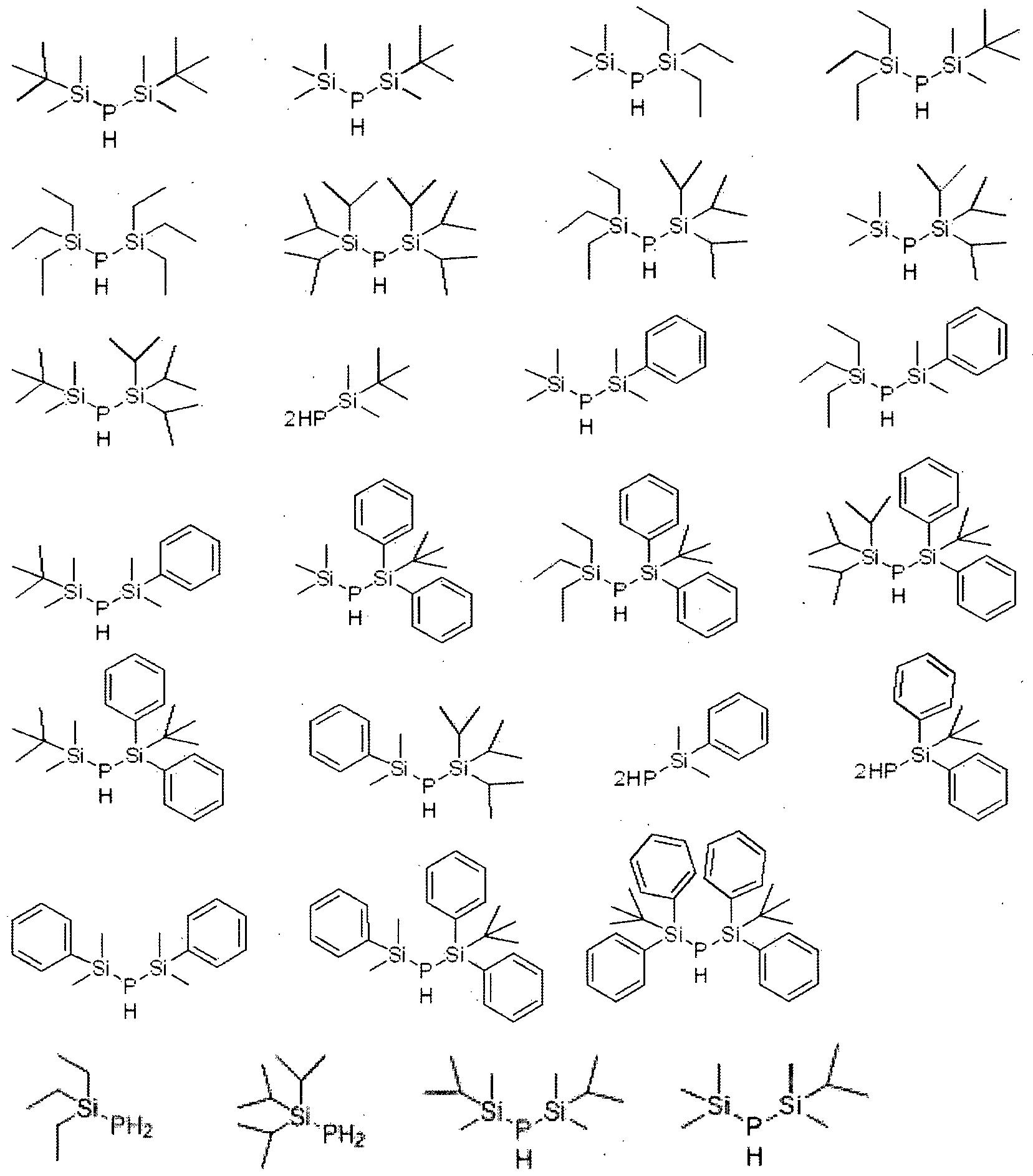
【청구항 5]
제 1항에 있어서, 상기 화학식 1은 하기 화학식 1-1로 표시되는 화합물인, 포스핀 전구체:
[화학식 1-1]
\
R6'
H
상기 화학식 1 -1에서,
Ri' 내지 R6 '는 각각 독립적으로 동일하거나 상이하게 수소, 탄소수 1 내지 20의 직쇄 또는 분지쇄 알킬, 탄소수 6 내지 30의 아릴, 탄소수 7 내지 30의 알킬아릴, 또는 탄소수 7 내지 30의 아릴알킬이며, R/ 내지 R6가 모두 수소인 경우는 제외한다.
【청구항 6】
제 1항에 있어서, 상기 화학식 1은 하기 화학식 1-2로 표시되는 화합물인, 포스핀 전구체:

상기 화학식 1 -2에서,
내지 R '는 각각 독립적으로 동일하거나 상이하게 수소, 탄소수 1 내지 20의 직쇄 또는 분지쇄 알킬, 탄소수 6 내지 30의 아릴, 탄소수 1 내지 30의 알킬아릴, 또는 탄소수 7 내지 30의 아릴알킬이며, 내지 R3 "가 모두 수소인 경우는 제외한다.
【청구항 7]
실릴 트리플레이트 화합물, 할로겐화 탄화수소, 및 3차 아민의 흔합물을 제조하는 단계; 및
상기 흔합물에 포스핀을 첨가하는 단계를 포함하는,
제 1항의 포스핀 전구체의 제조방법.
【청구항 8】
1차 포스핀 화합물, 할로겐화 탄화수소, 및 3차 아민의 혼합물을 제조하는 단계; 및
상기 혼합물에 실릴 트리플레이트 화합물을 첨가하는 단계를 포함하는,
' 제 1항의 포스핀 전구체의 제조방법.
【청구항 9】
제 7항 또는 제 8항에 있어서,
상기 할로겐화 탄화수소는 디클로로메탄이고, 상기 3차 아민은 트리메틸아민인, 포스핀 전구체의 제조방법ᅳ
[청구항 10】
제 1항의 포스핀 전구체를 포함하는 양자점 제조용 전구체 조성물.
【청구항 11】
제 10항에 있어서,
트리스 (트리메틸실릴)포스핀 (tris(trimethylsilyl)phosphine)를 더 포함하는, 양자점 제조용 전구체 조성물.
【청구항 12】
제 1항의 포스핀 전구체로부터 제조되는 양자점.
【청구항 13 ]
제 12항에 있어서,
상기 양자점은 InP를 코어로 포함하는, 양자점.
【청구항 14】
저 U항의 포스핀 전구체 1종 이상을 이용하여 양자점을 제조하는 방법.
【청구항 15】
제 14항에 있어서,
인듐 전구체, 아연 전구체, 미리스트산 (myristic acid) 및 1-옥타데센 (1ᅳ octadecene)의 흔합물을 가열하는 단계;
상기 혼합물을 상온으로 냉각하는 단계;
냉각된 흔합물에 제 1항의 포스핀 전구체 1종 이상, 갈륨 전구체, 및 1-옥타데센을 투입하여 가열하여 반웅시키는 단계; 및
상기 반웅물에 도데칸티올 (dodecanethiol)을 투입하고 냉,각하는 단계를 포함하는 양자점을 제조하는 방법
【청구항 16】
제 14항에 있어서,
상기 제 1항의 포스핀 전구체 1종 이상에 추가로 트리스 (트리메틸실릴)포스핀 (tris(trimethylsilyl)phosphine)를 더 흔합하는, 양자점을 제조하는 방법.
Priority Applications (3)
| Application Number | Priority Date | Filing Date | Title |
|---|---|---|---|
| CN201880011576.4A CN110312729B (zh) | 2017-03-03 | 2018-03-02 | 用于制备量子点的膦前体及由其制备的量子点 |
| JP2019548069A JP2020510674A (ja) | 2017-03-03 | 2018-03-02 | 量子ドット製造用ホスフィン前駆体およびそれから製造される量子ドット |
| US16/489,412 US11912915B2 (en) | 2017-03-03 | 2018-03-02 | Phosphine precursor for preparing quantum dot and quantum dot prepared therefrom |
Applications Claiming Priority (2)
| Application Number | Priority Date | Filing Date | Title |
|---|---|---|---|
| KR20170027887 | 2017-03-03 | ||
| KR10-2017-0027887 | 2017-03-03 |
Publications (1)
| Publication Number | Publication Date |
|---|---|
| WO2018160037A1 true WO2018160037A1 (ko) | 2018-09-07 |
Family
ID=63370098
Family Applications (1)
| Application Number | Title | Priority Date | Filing Date |
|---|---|---|---|
| PCT/KR2018/002543 Ceased WO2018160037A1 (ko) | 2017-03-03 | 2018-03-02 | 양자점 제조용 포스핀 전구체 및 이로 부터 제조되는 양자점 |
Country Status (6)
| Country | Link |
|---|---|
| US (1) | US11912915B2 (ko) |
| JP (1) | JP2020510674A (ko) |
| KR (1) | KR102657851B1 (ko) |
| CN (1) | CN110312729B (ko) |
| TW (1) | TWI743325B (ko) |
| WO (1) | WO2018160037A1 (ko) |
Cited By (1)
| Publication number | Priority date | Publication date | Assignee | Title |
|---|---|---|---|---|
| JP2020519670A (ja) * | 2017-05-18 | 2020-07-02 | エスケー ケミカルズ カンパニー リミテッド | 量子ドット製造用ホスフィン前駆体およびこれから製造される量子ドット |
Families Citing this family (1)
| Publication number | Priority date | Publication date | Assignee | Title |
|---|---|---|---|---|
| JP7721081B2 (ja) * | 2021-09-01 | 2025-08-12 | 国立研究開発法人物質・材料研究機構 | 量子ドットおよびその製造方法、緑色の蛍光体、可視化染料並びに顔料 |
Citations (3)
| Publication number | Priority date | Publication date | Assignee | Title |
|---|---|---|---|---|
| KR20100067769A (ko) * | 2008-12-12 | 2010-06-22 | 포항공과대학교 산학협력단 | 양자점 덴드리머 및 그의 합성방법 |
| JP2015104691A (ja) * | 2013-11-29 | 2015-06-08 | コニカミノルタ株式会社 | 光学フィルムの製造方法および光学フィルム |
| JP2016177220A (ja) * | 2015-03-23 | 2016-10-06 | コニカミノルタ株式会社 | 色域拡大フィルム |
Family Cites Families (4)
| Publication number | Priority date | Publication date | Assignee | Title |
|---|---|---|---|---|
| KR101043311B1 (ko) | 2010-10-28 | 2011-06-22 | 한국기계연구원 | InP 양자점 제조를 위한 전구체 P(SiMe2-tert-Bu)3, 이의 제조방법 및 이를 포함하는 InP 양자점과 이의 제조방법 |
| KR101355120B1 (ko) | 2012-01-04 | 2014-01-27 | 아주대학교산학협력단 | InP/GaP/ZnS 양자점과 이를 이용한 백색 LED |
| KR102334258B1 (ko) * | 2014-11-18 | 2021-12-03 | 에스케이케미칼 주식회사 | 트리스(트리알킬실릴)포스핀의 제조방법 |
| CN114957316B (zh) * | 2016-09-29 | 2025-02-07 | 日本化学工业株式会社 | 硅烷基膦化合物的制造方法和硅烷基膦化合物 |
-
2018
- 2018-03-02 CN CN201880011576.4A patent/CN110312729B/zh active Active
- 2018-03-02 US US16/489,412 patent/US11912915B2/en active Active
- 2018-03-02 KR KR1020180025354A patent/KR102657851B1/ko active Active
- 2018-03-02 JP JP2019548069A patent/JP2020510674A/ja active Pending
- 2018-03-02 WO PCT/KR2018/002543 patent/WO2018160037A1/ko not_active Ceased
- 2018-03-05 TW TW107107264A patent/TWI743325B/zh active
Patent Citations (3)
| Publication number | Priority date | Publication date | Assignee | Title |
|---|---|---|---|---|
| KR20100067769A (ko) * | 2008-12-12 | 2010-06-22 | 포항공과대학교 산학협력단 | 양자점 덴드리머 및 그의 합성방법 |
| JP2015104691A (ja) * | 2013-11-29 | 2015-06-08 | コニカミノルタ株式会社 | 光学フィルムの製造方法および光学フィルム |
| JP2016177220A (ja) * | 2015-03-23 | 2016-10-06 | コニカミノルタ株式会社 | 色域拡大フィルム |
Non-Patent Citations (3)
| Title |
|---|
| CAPPELLO, V. ET AL.: "Monophosphanes and Diphosphanes with the Hypersilyl Substituent", EUROPEAN JOURNAL OF INORGANIC CHEMISTRY, 2006, pages 4589 - 4599, XP055554830 * |
| GARY, D. C. ET AL.: "Role of Acid in Precursor Conversion During 1nP Quantum Dot Synthesis", CHEMISTRY OF MATERIALS, vol. 25, no. 12, 2013, pages 2463 - 2469, XP055554828 * |
| UHLIG, W. ET AL.: "Eine neue Methode zur Darstellung von Organosilylphosphinen", ZEITSCHRIFT FUR ANORGANISCHE CHEMIE, vol. 576, 1989, pages 281 - 283, XP009503051 * |
Cited By (1)
| Publication number | Priority date | Publication date | Assignee | Title |
|---|---|---|---|---|
| JP2020519670A (ja) * | 2017-05-18 | 2020-07-02 | エスケー ケミカルズ カンパニー リミテッド | 量子ドット製造用ホスフィン前駆体およびこれから製造される量子ドット |
Also Published As
| Publication number | Publication date |
|---|---|
| JP2020510674A (ja) | 2020-04-09 |
| CN110312729A (zh) | 2019-10-08 |
| KR20180101266A (ko) | 2018-09-12 |
| US20200071608A1 (en) | 2020-03-05 |
| TW201841930A (zh) | 2018-12-01 |
| KR102657851B1 (ko) | 2024-04-16 |
| US11912915B2 (en) | 2024-02-27 |
| CN110312729B (zh) | 2023-09-15 |
| TWI743325B (zh) | 2021-10-21 |
Similar Documents
| Publication | Publication Date | Title |
|---|---|---|
| JP5904600B2 (ja) | 希土類錯体ポリマー及びプラスチック成形体 | |
| WO2010015824A1 (en) | Surface functionalised nanoparticles | |
| CN106010524A (zh) | Iii-v族量子点、其制备方法及其应用 | |
| JP6378010B2 (ja) | 希土類錯体ポリマーとその製造方法、及びプラスチック成形体 | |
| CN113249124A (zh) | 一种钙钛矿量子点荧光粉制备方法 | |
| WO2018160037A1 (ko) | 양자점 제조용 포스핀 전구체 및 이로 부터 제조되는 양자점 | |
| US11999762B2 (en) | Phosphine precursor for preparing quantum dot and quantum dot prepared therefrom | |
| JP4420660B2 (ja) | 有機ボラジン化合物およびその製造法 | |
| US12291545B2 (en) | Rare earth complex, rare earth complex solution, luminescent molded article, method for producing luminescent product, luminescent sheet, and vinyl greenhouse for agriculture | |
| JP7274134B2 (ja) | 希土類化合物、発光体、発光デバイス、波長変換材料及びセキュリティ材料 | |
| US20040242885A1 (en) | Manufacture of vitamin b6 | |
| WO2020137638A1 (ja) | 希土類化合物、ホスフィンオキシド化合物及び発光体 | |
| Toulokhonova et al. | Reactions of 1, 1-dichloro-2, 3, 4, 5-tetraphenylsilole with water and alcohols | |
| JP2023123882A (ja) | 発光材料、発光インク、発光体及び発光デバイス | |
| KR20250179896A (ko) | 아미노포스핀 계열 인 전구체 및 이를 활용한 ⅲ-ⅴ족 양자점 | |
| WO2023080042A1 (ja) | 反応性シリル基含有オリゴフラン化合物の製造方法、及び反応性シリル基含有オリゴフラン化合物 | |
| Zheng et al. | Wire like diplatinum, triplatinum, and tetraplatinum complexes featuring X [PtC [triple bond, length as m-dash] CC [triple bond, length as m-dash] CC [triple bond, length as m-dash] CC [triple bond, length as m-dash] C] m PtX segments; iterative syntheses and functionalization for measurements of single molecule properties | |
| Dhar | Synthesis and reactivity of metal acetylide complexes | |
| JP2004035418A (ja) | 高周期14族元素ラジカル及びその製造方法 |
Legal Events
| Date | Code | Title | Description |
|---|---|---|---|
| 121 | Ep: the epo has been informed by wipo that ep was designated in this application |
Ref document number: 18760710 Country of ref document: EP Kind code of ref document: A1 |
|
| ENP | Entry into the national phase |
Ref document number: 2019548069 Country of ref document: JP Kind code of ref document: A |
|
| NENP | Non-entry into the national phase |
Ref country code: DE |
|
| 122 | Ep: pct application non-entry in european phase |
Ref document number: 18760710 Country of ref document: EP Kind code of ref document: A1 |