WO2018147314A1 - 位置情報処理システム、及び位置情報処理装置 - Google Patents
位置情報処理システム、及び位置情報処理装置 Download PDFInfo
- Publication number
- WO2018147314A1 WO2018147314A1 PCT/JP2018/004166 JP2018004166W WO2018147314A1 WO 2018147314 A1 WO2018147314 A1 WO 2018147314A1 JP 2018004166 W JP2018004166 W JP 2018004166W WO 2018147314 A1 WO2018147314 A1 WO 2018147314A1
- Authority
- WO
- WIPO (PCT)
- Prior art keywords
- information
- position information
- sequential
- recording
- signal
- Prior art date
- Legal status (The legal status is an assumption and is not a legal conclusion. Google has not performed a legal analysis and makes no representation as to the accuracy of the status listed.)
- Ceased
Links
Images




Classifications
-
- G—PHYSICS
- G01—MEASURING; TESTING
- G01S—RADIO DIRECTION-FINDING; RADIO NAVIGATION; DETERMINING DISTANCE OR VELOCITY BY USE OF RADIO WAVES; LOCATING OR PRESENCE-DETECTING BY USE OF THE REFLECTION OR RERADIATION OF RADIO WAVES; ANALOGOUS ARRANGEMENTS USING OTHER WAVES
- G01S5/00—Position-fixing by co-ordinating two or more direction or position line determinations; Position-fixing by co-ordinating two or more distance determinations
- G01S5/0009—Transmission of position information to remote stations
- G01S5/0018—Transmission from mobile station to base station
- G01S5/0027—Transmission from mobile station to base station of actual mobile position, i.e. position determined on mobile
-
- G—PHYSICS
- G01—MEASURING; TESTING
- G01S—RADIO DIRECTION-FINDING; RADIO NAVIGATION; DETERMINING DISTANCE OR VELOCITY BY USE OF RADIO WAVES; LOCATING OR PRESENCE-DETECTING BY USE OF THE REFLECTION OR RERADIATION OF RADIO WAVES; ANALOGOUS ARRANGEMENTS USING OTHER WAVES
- G01S19/00—Satellite radio beacon positioning systems; Determining position, velocity or attitude using signals transmitted by such systems
- G01S19/01—Satellite radio beacon positioning systems transmitting time-stamped messages, e.g. GPS [Global Positioning System], GLONASS [Global Orbiting Navigation Satellite System] or GALILEO
- G01S19/13—Receivers
- G01S19/21—Interference related issues ; Issues related to cross-correlation, spoofing or other methods of denial of service
- G01S19/215—Interference related issues ; Issues related to cross-correlation, spoofing or other methods of denial of service issues related to spoofing
-
- G—PHYSICS
- G01—MEASURING; TESTING
- G01S—RADIO DIRECTION-FINDING; RADIO NAVIGATION; DETERMINING DISTANCE OR VELOCITY BY USE OF RADIO WAVES; LOCATING OR PRESENCE-DETECTING BY USE OF THE REFLECTION OR RERADIATION OF RADIO WAVES; ANALOGOUS ARRANGEMENTS USING OTHER WAVES
- G01S19/00—Satellite radio beacon positioning systems; Determining position, velocity or attitude using signals transmitted by such systems
- G01S19/01—Satellite radio beacon positioning systems transmitting time-stamped messages, e.g. GPS [Global Positioning System], GLONASS [Global Orbiting Navigation Satellite System] or GALILEO
- G01S19/13—Receivers
- G01S19/35—Constructional details or hardware or software details of the signal processing chain
- G01S19/37—Hardware or software details of the signal processing chain
-
- G—PHYSICS
- G01—MEASURING; TESTING
- G01S—RADIO DIRECTION-FINDING; RADIO NAVIGATION; DETERMINING DISTANCE OR VELOCITY BY USE OF RADIO WAVES; LOCATING OR PRESENCE-DETECTING BY USE OF THE REFLECTION OR RERADIATION OF RADIO WAVES; ANALOGOUS ARRANGEMENTS USING OTHER WAVES
- G01S19/00—Satellite radio beacon positioning systems; Determining position, velocity or attitude using signals transmitted by such systems
- G01S19/38—Determining a navigation solution using signals transmitted by a satellite radio beacon positioning system
-
- G—PHYSICS
- G01—MEASURING; TESTING
- G01S—RADIO DIRECTION-FINDING; RADIO NAVIGATION; DETERMINING DISTANCE OR VELOCITY BY USE OF RADIO WAVES; LOCATING OR PRESENCE-DETECTING BY USE OF THE REFLECTION OR RERADIATION OF RADIO WAVES; ANALOGOUS ARRANGEMENTS USING OTHER WAVES
- G01S19/00—Satellite radio beacon positioning systems; Determining position, velocity or attitude using signals transmitted by such systems
- G01S19/01—Satellite radio beacon positioning systems transmitting time-stamped messages, e.g. GPS [Global Positioning System], GLONASS [Global Orbiting Navigation Satellite System] or GALILEO
- G01S19/13—Receivers
- G01S19/14—Receivers specially adapted for specific applications
-
- G—PHYSICS
- G01—MEASURING; TESTING
- G01S—RADIO DIRECTION-FINDING; RADIO NAVIGATION; DETERMINING DISTANCE OR VELOCITY BY USE OF RADIO WAVES; LOCATING OR PRESENCE-DETECTING BY USE OF THE REFLECTION OR RERADIATION OF RADIO WAVES; ANALOGOUS ARRANGEMENTS USING OTHER WAVES
- G01S19/00—Satellite radio beacon positioning systems; Determining position, velocity or attitude using signals transmitted by such systems
- G01S19/01—Satellite radio beacon positioning systems transmitting time-stamped messages, e.g. GPS [Global Positioning System], GLONASS [Global Orbiting Navigation Satellite System] or GALILEO
- G01S19/13—Receivers
- G01S19/21—Interference related issues ; Issues related to cross-correlation, spoofing or other methods of denial of service
-
- G—PHYSICS
- G01—MEASURING; TESTING
- G01S—RADIO DIRECTION-FINDING; RADIO NAVIGATION; DETERMINING DISTANCE OR VELOCITY BY USE OF RADIO WAVES; LOCATING OR PRESENCE-DETECTING BY USE OF THE REFLECTION OR RERADIATION OF RADIO WAVES; ANALOGOUS ARRANGEMENTS USING OTHER WAVES
- G01S19/00—Satellite radio beacon positioning systems; Determining position, velocity or attitude using signals transmitted by such systems
- G01S19/38—Determining a navigation solution using signals transmitted by a satellite radio beacon positioning system
- G01S19/39—Determining a navigation solution using signals transmitted by a satellite radio beacon positioning system the satellite radio beacon positioning system transmitting time-stamped messages, e.g. GPS [Global Positioning System], GLONASS [Global Orbiting Navigation Satellite System] or GALILEO
- G01S19/42—Determining position
Definitions
- the present invention relates to a position information processing system and a position information processing apparatus using satellite signals.
- Patent Documents 1 and 2 disclose a technique for using a quasi-zenith satellite (QZSS) together with a GPS satellite to prevent falsification of position information obtained using signals transmitted by these satellites.
- QZSS quasi-zenith satellite
- position information for example, when recording a trajectory of movement of a moving body over a predetermined period, it may be necessary to continuously record position information over a certain period of time. is there.
- position information for example, information for authenticating the driver of the moving body
- the amount of information generally becomes enormous, and there is a concern that the storage capacity of the storage device may be compressed.
- One aspect of the present invention has been made in view of the above circumstances, and one of its purposes is to provide a position information processing system and a position information processing apparatus capable of efficiently recording position information.
- Another aspect of the present invention is to provide a position information processing system and a position information processing apparatus capable of preventing falsification of position information even when a fake GPS satellite signal is used. To do.
- the position information processing apparatus includes a receiving unit that sequentially and repeatedly receives a plurality of types of information that can change with time, including position information obtained using satellite signals, and the received plurality of types of information together with time information. Recording means for recording in association with each other, wherein the recording means selects information serving as a basis for prediction from among the information repeatedly received, information serving as a basis for prediction, and information serving as a basis for prediction To selectively record information determined to be unpredictable by a predetermined method.
- an aspect of the present invention that solves the problems of the conventional example includes a position information processing apparatus.
- the position information processing apparatus includes a receiving unit that sequentially and repeatedly receives a plurality of types of information that can change with time, including position information obtained using satellite signals, and the received plurality of types of information together with time information.
- Recording means for recording in association with each other wherein the receiving means records information relating to the satellite signal that is the basis of the calculation of the position information, and is used for authentication processing, and the recording means is a plurality of different ones When the information related to the position is obtained, information representing the obtained different positions is recorded.
- position information can be recorded efficiently.
- the position information processing system 1 receives signals (navigation messages and the like) from the GPS satellite 2 and the quasi-zenith satellite (QZSS) 3 as illustrated in FIG. Based on this, position information is obtained. Further, the position information processing system 1 according to the example of the present embodiment includes a position information processing apparatus 10 disposed on a moving body, and a center side apparatus 20 generally disposed at a position away from the moving body. Consists of including.
- GPS satellite 2 and the quasi-zenith satellite 3 are taken as an example, but this embodiment is not limited to this, and the global navigation satellite system uses signals such as GLONASS, Gallileo, Hokuto, etc.
- the satellite navigation augmentation system (SBAS: Satellite Based Augmentation System) includes quasi-zenith satellites (QZSS), EGNOS in Europe, WAAS in the United States, GAGAN in India, SDCM in Russia, and MSAS in Japan. May be used.
- the center-side device 20 uplinks predetermined encryption information (encryption code) that changes according to time to the quasi-zenith satellite 3, and the cipher zenith satellite 3 receives this encryption.
- Information may be sent together with a navigation message or the like. Since this operation is the same as that disclosed in Japanese Patent No. 5667967 (Patent Document 2) and the like, detailed description thereof is omitted here.
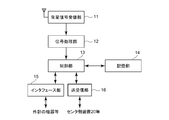
- the position information processing apparatus 10 includes a satellite signal receiving unit 11, a signal processing unit 12, a control unit 13, a storage unit 14, an interface unit 15, and a transmission / reception unit 16. It consists of
- the satellite signal receiving unit 11 receives signals transmitted from the GPS satellite 2 and the quasi-zenith satellite (QZSS) 3 and outputs the received signals to the signal processing unit 12.
- the signal processing unit 12 converts the signal (RF signal) received by the satellite signal receiving unit 11 into an intermediate frequency signal (IF signal) and amplifies it with a variable gain amplifier using AGC (Auto Gain Control), Further, it is converted into a digital signal by A / D conversion and output to the control unit 13.
- AGC Automatic Gain Control
- the signal processing unit 12 (1) When a false signal transmitter (a so-called spoofer) is transmitting a false signal imitating a signal transmitted from the GPS satellite 2, (2) When a signal that interferes with the signal transmitted by the GPS satellite 2 is transmitted, or (3) when a jamming signal (jamming) is transmitted, the IF including this false signal or the like The signal (digitized one) is output to the control unit 13.
- a false signal transmitter a so-called spoofer
- a jamming signal jamming
- the control unit 13 is a program-controllable CPU or DSP (Digital Signal Processor) or the like, and repeatedly calculates position information at predetermined timings based on an input signal. Since the processing of this calculation is widely known, a detailed description thereof is omitted here.
- DSP Digital Signal Processor
- the control unit 13 operates in accordance with a program stored in the storage unit 14, and executes an acquisition process of incidental information, a recording process of position information and incidental information, and a detection process such as a false signal. The contents of each of these processes will be described in detail later.
- the storage unit 14 is a semiconductor recording element or the like, and records information such as position information and accompanying information in accordance with an instruction input from the control unit 13.
- the storage unit 14 includes a memory element, and holds a program executed by the control unit 13. Further, the storage unit 14 also operates as a work memory for the control unit 13.
- the interface unit 15 is connected to various devices that collect incidental information, and outputs information output by these various devices to the control unit 13.
- devices that collect accompanying information include authentication devices that authenticate users, measuring devices that measure the weight of a moving object (a vehicle, a hull, or a loading platform), and imaging devices that output captured image information. is there.
- the device that collects the accompanying information includes a biometric sensor for identifying the user.
- This device converts the biometric data detected by the biometric sensor into digital information and outputs it to the control unit 13.
- This biometric sensor may be of any type such as face authentication, fingerprint authentication, vein authentication, iris authentication, and the like.
- a camera that tracks the driver's face is installed in the driver's seat, and a fingerprint sensor and vein sensor are provided on the steering wheel and rudder.
- the information to be output may be associated in synchronization with time, and the associated information may be output to the control unit 13. This makes it possible to perform user authentication with higher accuracy.
- the device that collects the accompanying information may collect detection information of a predetermined object other than the user as accompanying information and output it to the control unit 13.
- the object includes not only a moving object such as a car and a ship used by the user, but also an object received or delivered by the user using these moving objects.
- a moving object such as a car and a ship used by the user
- an object received or delivered by the user using these moving objects For example, in the case of a fishing boat, a fish obtained by fishing by a captain as a user is also included in the example of the object.
- the type of harvested fish can be specified by a camera, and the amount of catch can be measured by measuring the weight or the volume occupation rate of the storage space for the harvested fish, and using information associated with these information.
- the transmission / reception unit 16 is, for example, a wireless communication device or the like, and communicates with the center side device 20 in accordance with an instruction input from the control unit 13.
- the transmission / reception unit 16 sends information to the center side device 20 in accordance with an instruction input from the control unit 13.
- the transmission / reception unit 16 receives a signal transmitted from the center side device 20 to the position information processing device 10, decodes and acquires information included in the signal, and outputs the information to the control unit 13.
- the transmission / reception unit 16 may also communicate with the center side device 20 through a wired connection.
- control unit 13 includes an accompanying information receiving unit 31, a position information receiving unit 32, a sequential information generation processing unit 33, and an interpolation processing unit 34. And a recording information generation unit 35 and an output unit 36 functionally.
- the control unit 13 and the storage unit 14 may be configured as a single chip or may include a plurality of ICs.
- the incidental information receiving unit 31 sequentially outputs incidental information input from the devices that collect the incidental information via the interface unit 15 (if there are a plurality of devices) to the information generation processing unit 33.
- the position information receiving unit 32 generates position information by a widely known method based on the signal received from the signal processing unit 12.
- the accompanying information may be of a plurality of types, for example, user authentication information and load information.
- the sequential information generation processing unit 33 generates sequential information including the accompanying information received by the accompanying information receiving unit 31 and the position information received by the position information receiving unit 32. Specifically, the sequential information generation processing unit 33 repeatedly issues time information at every predetermined timing. Here, it is assumed that time information is issued periodically every ⁇ t seconds. Then, the sequential information generation processing unit 33 associates a plurality of types of information such as incidental information received immediately before the timing of issuing the time information and position information with respect to the issued time information. Is generated and output.
- the interpolation processing unit 34 uses a predetermined interpolation function (for example, a spline function), the position information included in the earliest one (Rj) of the sequential information for the latest N times (Rj), the value of the accompanying information, Included in sequential information Rj + 1, Rj + 2,...
- Rj + N-1 using corresponding position information and accompanying information values included in sequential information Rj + N (after ⁇ t ⁇ N from the output of Rj) Corresponding position information and associated information values are predicted. Then, the interpolation processing unit 34 compares the predicted value with the actually input value.
- the interpolation processing unit 34 holds whether or not the predicted value is within a predetermined error range from the value output by the sequential information generation processing unit 33. Is determined for each sequential information, and the determination result is recorded for each stored sequential information.
- the recorded information generation unit 35 refers to the judgment results recorded by the interpolation processing unit 34 in order from the most recent information held among the sequential information held by the interpolation processing unit 34, and the predicted value is When sequential information including information at a point in time when it is determined that it is not within the error range from the value output from the information generation processing unit 33 is found, the sequential information Rj, Rj + N used for the interpolation calculation and the prediction Sequential information Rj + n (n is an integer satisfying 1 ⁇ n ⁇ N ⁇ 1) including information at a time point when it is determined that the value is not within the error range from the value output from the sequential information generation processing unit 33.
- the data is output to the output unit 36 as a recording target.
- the recorded information generation unit 35 deletes the sequential information Rj, Rj + 1,... Rj + N ⁇ 1, Rj + N that is held, and waits until new sequential information R is held N times.
- the interpolation processing unit 34 is caused to generate a determination result.
- the amount of information to be recorded by selectively recording information that is the basis of prediction and information that is determined to be unpredictable by a predetermined method from the information that is the basis of the prediction. Reduce.
- the recorded information generation unit 35 also finds that sequential information including information at a time point when the predicted value is determined not to be within the error range from the value output from the sequential information generation processing unit 33 is found. From the sequential information Rj held most recently and the sequential information Rj + N held last, various information included in the sequential information Rj + 1,. When prediction can be made within a predetermined error range by a predetermined interpolation function, the output information is recorded with the most recent sequential information Rj and the last sequential information Rj + N being recorded. To 36. Then, the recorded information generation unit 35 deletes the sequential information Rj, Rj + 1,... Rj + N ⁇ 1, Rj + N that is held, and waits until new sequential information R is held N times. The interpolation processing unit 34 is caused to generate a determination result. The output unit 36 accumulates and stores the sequential information output from the recording information generation unit 35 in the storage unit 14.
- the recorded information generating unit 35 replaces the sequential information with the sequential information that is not recorded (for example, sequential information including only information that can be predicted by the interpolation calculation based on the preceding and following sequential information).
- Prediction method specification information for specifying a prediction method in association with time information indicating a time point at which information should be recorded (for example, information for specifying an interpolation function used for prediction, information for specifying sequential information used for prediction, etc. ) May be output instead of the sequential information.
- the recording information generation unit 35 determines the sequential information itself as to the sequential information that is the basis of the prediction and the sequential information that is determined to be unpredictable by a predetermined method from the sequential information that is the basis of the prediction. (Referred to as actual information for convenience) are output in association with time information representing each time point when they are input.
- the recording information generation unit 35 uses a prediction for predicting the sequential information as time information indicating a point in time when the sequential information determined to be predictable by a predetermined method from the sequential information that is the basis of the prediction is input. Outputs method specific information in association with each other. That is, the information output by the recording information generation unit 35 here is composite information obtained by combining actual information and prediction method specifying information.
- the position information processing apparatus 10 performs predetermined time with respect to actual information obtained sequentially (for example, actual information such as actual position data and user authentication information).
- An operation for example, an operation for fitting a trajectory with a spline function for predicting information obtained during the time period from the buffered real information group by interpolation is performed.
- the position information processing apparatus 10 compares the actual information with the prediction information obtained by interpolation, and determines whether or not the difference between the prediction information and the actual information is within a predetermined range.
- the position information processing apparatus 10 When the prediction information is within the predetermined range from the actual information, the position information processing apparatus 10 records the prediction method specifying information (for example, an interpolation function) without specifying the actual information of the time zone. Record information to identify). Alternatively, the position information processing apparatus 10 does not need to record information for specifying the interpolation function when the interpolation function is determined in advance, and therefore does not need to record the prediction method specifying information. In this case, no information is recorded at the time when the prediction can be performed, or only time information that is not associated with other information (information that can be predicted) may be recorded. Further, when the prediction information is not within the predetermined range from the actual information, the position information processing apparatus 10 records the actual information.
- the prediction method specifying information for example, an interpolation function
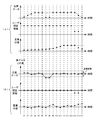
- FIG. 4 shows an example of sequential information that the sequential information generation processing unit 33 outputs from time t1 to time t17.
- FIG. 4 shows an example in which three types of time-series information including position data, user authentication information, and load weight information are to be recorded.
- each information is a one-dimensional value, but the actual information may be vector information or the like.
- values actually obtained by satellite signals and measurement are shown as discrete points.
- the position information processing apparatus 10 approximates each of these various types of information with a predetermined interpolation function (the interpolation function varies for each type of information). Specifically, the position data and the weight information of the load are approximated by a spline function, and the user authentication information is assumed to be zero-order approximation (approximation assuming that the information does not change). The result of this approximation is shown by a dashed curve (or a dashed straight line) in FIG.
- FIG. 4B shows the difference between the approximation result and the actual value of the corresponding type of information at the corresponding time point (the degree to which the approximate value matches the actual measurement value, and hence the difference “ It may be the difference from “1”, the magnitude of the distance between vectors, etc.).
- the position data changes sequentially with the movement of the moving body, but this sequentially changing movement path is approximated by a predetermined interpolation function and obtained from the interpolation function.
- Information when the correlation value (here, difference) between the predicted information and the comparison result of the actual information exceeds a predetermined threshold value (low correlation) (at times t7 and t8 in FIG. 4) Information).
- the same processing is performed for the user authentication information and the load weight information.
- the user authentication information and the prediction information at the corresponding time obtained from the interpolation function are lower than a predetermined correlation value.
- Information at time (t15, t16 in FIG. 4) at the time (the difference is large) is to be recorded.
- at least one of the information at the time of being information that can not be predicted from the previous and subsequent information is the target of recording, in addition to the information necessary as the basis of prediction, By recording only information selected as a recording target by this method, the amount of information to be recorded is reduced.
- the sequential information recorded in this way is determined in advance by the center side device 20 or in advance by an instruction from the user or under predetermined conditions (conditions such as enabling communication with the center side device 20). Sent to a device (a device authenticated in advance). In the apparatus that receives the sequential information, at the time when the real information is recorded, each type of information included in the real information is reproduced based on the real information.
- the actual information (or the interpolation data related to the interpolation data) recorded immediately before and after the information related to the interpolation data is recorded.
- Prediction based on information based on actual information specified as information serving as a basis for prediction) and a predetermined interpolation function (or an interpolation function specified by information recorded as information related to interpolation data) A value is generated, and associated information such as location information history, user authentication information associated with each location information, and load weight information at each time point is reproduced.
- a record relating to the moving object can be obtained from the information reproduced based on the actual information or the information relating to the interpolation data. For example, in a fishing boat, authentication is performed that fishing has been performed at a predetermined fishing ground. Thus, the vehicle can authenticate that the vehicle has been driven by a predetermined driver in a predetermined region.
- the control unit 13 may detect a false signal that is a false signal from a satellite, and the processing for that purpose will be described below.
- the control unit 13 executes the following process.
- the control unit 13 here may not include the interpolation processing unit 34 and the recording information generation unit 35 functionally as illustrated in FIG. That is, the control unit 13 in this case does not necessarily perform the processing of the interpolation processing unit 34 and the recording information generation unit 35, and does not perform these operations (functionally in FIG. 3B).
- the control unit 13 accumulates and records information (actual information) sequentially output by the sequential information generation processing unit 33 in the storage unit 14 respectively.
- the control unit 13 for detecting a false signal accepts a signal (IF signal) obtained by converting the signal (RF signal) received by the satellite signal receiving unit 11 into an intermediate frequency signal.
- the control unit 13 performs a coherent integration (Coherent Integration) process for performing an FFT operation on the IF signal (the signal after digitization) with the replica signal for 10 milliseconds.
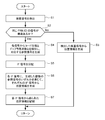
- the satellite signal detection process is executed (S1).
- the replica signal is a signal simulating a C / A (Coarse / Acquisition) signal, which is a kind of PRN (Pseudo Random Noise) included in the signal of the GPS satellite 2 to be captured, generated in a pseudo manner by the control unit 13. It is. Since this operation is the same as the satellite signal detection process that is widely performed at present, a detailed description thereof is omitted here.
- the control unit 13 determines whether or not there are a plurality of peaks in the signal (the matrix of correlation values) resulting from the FFT operation (whether there is a set of code phase and Doppler frequency exceeding a predetermined threshold).
- FIG. 6 illustrates a matrix of correlation values, where the axis in the height direction (Z) indicates the intensity (power), the depth direction (Y) indicates the code phase, and the left-right direction (X) indicates the Doppler frequency. .
- the highest peak is detected from this correlation value matrix.
- there is no spoofer there is one peak (one satellite signal) (FIG. 6 (a)), so the code phase and the carrier frequency can be estimated.
- the control unit 13 not only detects the code phase and the carrier frequency corresponding to the highest peak, but also has a power exceeding a predetermined threshold value. When there are a plurality of sets of code phase and Doppler frequency (which are peaks), a plurality of pieces of information are detected.
- the control unit 13 performs signal processing of a plurality of channels in parallel for each PRN ID.
- the control unit 13 checks whether there are a plurality of satellite signals detected in the process S1 (S2). If the detected signal is singular (processing S2: No), position information is obtained from the one satellite signal, and the position information is output as a recording target (S3).
- the position information processing apparatus 10 arranges a detection line (signal line or the like) for detecting whether or not the antenna line is pulled out in parallel, and this detection. When the line is disconnected, an operation such as issuing an alarm as a failure may be performed.
- control unit 13 uses information on a combination of a plurality of detected code phases and Doppler frequencies to A reference signal (so-called C / A reference signal) that is a spread code is generated using the corresponding code phase based on the code phase and the Doppler frequency included in the code.
- the control unit 13 also outputs information on the corresponding carrier frequency (S4).
- the control unit 13 distributes (duplicates) the input IF signal (the signal after digitization) by the number of peaks detected in the process S2 (or the smaller one of the upper limit values of the number of channels that can be processed).
- the signals are different from each other (S5).
- the control unit 13 multiplies the signals of the respective channels by the plurality of reference signals obtained in the process S4 and the corresponding carrier frequency, outputs the signals through the low-pass filter, and outputs the plurality of reference signals obtained in the process S4 (and A navigation message corresponding to each carrier frequency is taken out (S6).
- the control unit 13 sequentially generates position information (including position information based on a satellite signal such as GPS satellite 2 and position information based on a spoofer spoof signal) from each of the plurality of navigation messages extracted here. In the processing as the unit 33, they are recorded in association with common time information and accompanying information supplied from other devices (S7). The control unit 13 repeatedly executes the processing illustrated in FIG. 5 until there is an instruction to end the recording of the position information and the accompanying information.
- position information including position information based on a satellite signal such as GPS satellite 2 and position information based on a spoofer spoof signal
- control unit 13 repeatedly checks whether or not communication with the center side device 20 is possible.
- communication with the center side device 20 becomes possible, for example, based on the plurality of navigation messages recorded using the method disclosed in Japanese Patent No. 5400529 (Patent Document 1).
- Each authentication process of position information (including position information based on a satellite signal such as GPS satellite 2 and position information based on a false signal of a spoofer) is executed.
- the authenticated position information is regarded as true position information (position information based on a satellite signal such as GPS satellite 2), and other related position information (position information based on a spoofer false signal) is removed.
- the sequential information after removal is output to the outside.
- the control unit 13 adds the signals obtained by coherent integration enhancement at a plurality of different timings to each other and synthesizes them, and further performs incoherent synthesis that increases the signal strength, and then executes the processing after processing S1 in FIG. Also good.
- the satellite signal from the GPS satellite 2 or the like is weaker than the spoofer signal. It is preferable to perform such a synthesis process.
- the center side device 20 generates a public key encryption private key and a public key pair in advance. Then, a hash value (hash function is predetermined) of the reference authentication navigation data (RAND message) generated by a predetermined method is obtained, and this hash value is encrypted with the generated secret key.
- the reference authentication navigation data (RAND message) is disclosed in Japanese Patent No. 5667967 (Patent Document 2), and the signal generation time is selected from the bit string of the L1C / A signal transmitted from the GPS satellite 2.
- Time of Week bit string data and ephemeris data (celestial position coordinates) TOC, Af0, and Af1 are extracted, and the anti-spoof flag AS flag (Anti-Spoof flag) and the satellite identification number PRN (Pseudo Range Noise) ID is added. Accordingly, since the RAND message frequently changes over time, the center-side device 20 updates and generates the RAND message relatively frequently, calculates the hash value, and generates encryption information (encryption code). .
- the center side device 20 uplinks the encrypted information obtained by encrypting the hash value of the RAND message to the QZSS3.
- the QZSS 3 sends the uplink encrypted information at a predetermined timing.
- the QZSS 3 may transmit this encryption information using the L6 signal.
- the L6 signal is a signal having a transmission rate of 2000 bps, and can sequentially transmit encrypted information that changes with time relatively frequently.
- the position information processing apparatus 10 acquires the public key from the center side apparatus 20.
- This public key is acquired via the Internet, via a wireless LAN system, via a communication satellite, or via QZSS3 (uplink the public key from the center side device 20 to QZSS3 and QZSS3 sends out the public key).
- QZSS3 uplink the public key from the center side device 20 to QZSS3 and QZSS3 sends out the public key.
- the L6 signal has two channels, the same encryption information may be transmitted on each channel, or the public key described here may be transmitted on one channel.
- the position information processing apparatus 10 sequentially selects a signal received from the GPS satellite 2 or a signal output from a spoofer (a signal that is unknown), and uses the selected signal to perform RAND in the same manner as the center-side apparatus 20. A message is generated, and this hash value (referred to as a comparison hash value) is calculated in the same manner as the center side device 20. Further, the location information processing device 10 decrypts the encrypted information received from the QZSS 3 with the public key, and obtains the hash value of the RAND message uplinked from the center side device 20. The location information processing apparatus 10 compares the hash value obtained here with the comparison hash value, and if they match, generates a comparison hash value that matches the hash value of the RAND message.
- a comparison hash value referred to as a comparison hash value
- the position information processing apparatus 10 determines that the signal selected as the source for generating the comparison hash value is the signal output by the spoofer.
- the position information processing apparatus 10 uses a plurality of channels to receive intermediate frequency signals after digitization (digitized IF signals) based on the signals received from the GPS satellite 2 or the signals output from the spoofer. Record.
- the position information processing apparatus 10 selects position information generated based on the signal determined to be a signal transmitted from the GPS satellite 2 by the above method, and sets it as the most likely information (maximum likelihood information). Record or output. This makes it possible to make a determination in real time.
- the QZSS 3 may send the encryption information using the L5s signal. Since the L5s signal has a high strength, the position information processing apparatus 10 may be able to be received even in an environment such as indoors or in a tunnel. Accordingly, it is possible to track the movement from the indoor to the outdoor.
- encryption information does not necessarily have to be transmitted to the position information processing apparatus 10 via the QZSS3.
- encryption information can be used for information such as micro-satellite, small satellite, space shuttle and other reusable manned spacecraft, communication satellite, etc.
- the information may be transmitted to the position information processing apparatus 10 via any moving body.
- the position information processing apparatus 10 determines whether the received signal is only a signal transmitted from the GPS satellite 2 or includes a plurality of signals based on the signal strength information (that is, A so-called sanity check may be performed to check whether or not a false signal exists.
- the position information processing apparatus 10 generates appearance frequency information (histogram) of each output value of the amplified intermediate frequency signal (IF signal after digitization) after being amplified.
- the signal received as a signal from each GPS satellite 2 is a signal transmitted from the GPS satellite 2
- an AGC Auto-Gain-Control: not shown
- the gain never saturates, this histogram is distributed in a normal distribution centered on the median “0” as illustrated in FIG. 7A.
- FIG. 7 illustrates a case where the intermediate frequency signal is expressed as a 4-bit digital signal and the value can be from ⁇ 8 to +7.
- the received signal includes a signal other than the signal transmitted from the GPS satellite 2 (a signal output from the spoofer, a signal coming from the outside and interfering with a signal transmitted from the GPS satellite 2, or a jamming signal).
- the input signal will be stronger than the expected signal (since a spoofer will generally cause the device to malfunction by outputting a signal stronger than the signal received from the GPS satellite),
- the AGC gain used for amplifying the IF signal is saturated, and the histogram generated by the position information processing apparatus 10 has all possible values as illustrated in FIG. 7B or FIG. 7C. Therefore, it becomes almost the same number or becomes the smallest in the median value and becomes a concave distribution, and it does not become a normal distribution.
- the position information processing apparatus 10 performs a sanity check on each IF signal of the GPS satellite 2 from which the signal is received as described above, and information indicating the result (the IF signal is clean (transmitted from the GPS satellite 2). Is generated in real time, and is stored together with the sequential information. (Signal other than signals transmitted from GPS satellite 2 can be included)) Part 14 is recorded.
- the position information processing apparatus 10 accepts the signal depending on whether or not there is a plurality of peaks in the signal of the result of coherent integration enhancement (in the case of performing incoherent synthesis, the result of incoherent synthesis). Whether the signal is in a state where one signal is received from each GPS satellite 2 or whether it is determined that a plurality of signals are received from at least one GPS satellite 2. You may investigate.
- the position information processing apparatus 10 has a plurality of peaks in the signal of the result of coherent integration enhancement corresponding to the signal of a specific GPS satellite 2 (or the result of incoherent combining when incoherent combining is performed). If the received signal includes not only the signal transmitted from the specific GPS satellite 2 but also a plurality of signals (determined that a plurality of signals are transmitted from one satellite), IF Information indicating that the signal is dirty (a signal other than a signal transmitted from the GPS satellite 2 may be included) is sequentially recorded in the storage unit 14 together with the information.
- position information position information based on a satellite signal such as GPS satellite 2 and position information based on a spoofer false signal is obtained from each of the extracted navigation messages. Are recorded in association with common time information and accompanying information supplied from other devices.
- the position information processing apparatus 10 determines that an accepted signal is present if there is no plurality of peaks in the signal of the result of coherent integration enhancement (incoherent synthesis if incoherent synthesis is performed).
- Information indicating that the IF signal is clean (not including a signal other than the signal transmitted from the GPS satellite 2) is recorded in the storage unit 14 together with the sequential information on the assumption that the signal is only the signal transmitted from the GPS satellite 2. .
- the IF signal when it is determined that the IF signal is clean (a signal other than the signal transmitted from the GPS satellite 2 is not included), information indicating that is sequentially recorded together with the information.
- the IF signal when it is determined that the IF signal is clean, information indicating that is sequentially recorded together with the information.
- the IF signal when it is dirty, information indicating that may be recorded together with the sequential information, and when it is clean, only the sequential information may be recorded.
- the position information processing apparatus 10 can be used in other mobile objects such as vehicles and airplanes.
- SYMBOLS 1 Position information processing system 2 GPS satellite, 3 QZSS, 10 Position information processing apparatus, 11 Satellite signal receiving part, 12 Signal processing part, 13 Control part, 14 Storage part, 15 Interface part, 16 Transmission / reception part, 20 Center side apparatus , 31 Accompanying information receiving unit, 32 Position information receiving unit, 33 Sequential information generation processing unit, 34 Interpolation processing unit, 35 Recording information generation unit, 36 Output unit.
Landscapes
- Engineering & Computer Science (AREA)
- Radar, Positioning & Navigation (AREA)
- Remote Sensing (AREA)
- Physics & Mathematics (AREA)
- General Physics & Mathematics (AREA)
- Computer Networks & Wireless Communication (AREA)
- Signal Processing (AREA)
- Position Fixing By Use Of Radio Waves (AREA)
- Debugging And Monitoring (AREA)
Priority Applications (11)
| Application Number | Priority Date | Filing Date | Title |
|---|---|---|---|
| CN202310474722.XA CN116500656A (zh) | 2017-02-09 | 2018-02-07 | 位置信息处理装置 |
| JP2018567458A JP6895465B2 (ja) | 2017-02-09 | 2018-02-07 | 位置情報処理システム、及び位置情報処理装置 |
| SG11201907221XA SG11201907221XA (en) | 2017-02-09 | 2018-02-07 | Position information processing system and position information processing apparatus |
| US16/483,438 US11567215B2 (en) | 2017-02-09 | 2018-02-07 | Position information processing system and position information processing apparatus |
| EP21210289.1A EP3988966A3 (en) | 2017-02-09 | 2018-02-07 | Position information processing system and position information processing apparatus |
| EP18751261.1A EP3581966B1 (en) | 2017-02-09 | 2018-02-07 | Position information processing system and position information processing apparatus |
| AU2018218371A AU2018218371B2 (en) | 2017-02-09 | 2018-02-07 | Position information processing system and position information processing device |
| KR1020197023437A KR102343016B1 (ko) | 2017-02-09 | 2018-02-07 | 위치정보 처리 시스템, 및 위치정보 처리 장치 |
| CN201880011718.7A CN110337599B (zh) | 2017-02-09 | 2018-02-07 | 位置信息处理系统以及位置信息处理装置 |
| AU2021202701A AU2021202701B2 (en) | 2017-02-09 | 2021-04-30 | Position information processing system and position information processing device |
| US18/060,606 US20230108167A1 (en) | 2017-02-09 | 2022-12-01 | Position information processing system and position information processing apparatus |
Applications Claiming Priority (2)
| Application Number | Priority Date | Filing Date | Title |
|---|---|---|---|
| JP2017-022536 | 2017-02-09 | ||
| JP2017022536 | 2017-02-09 |
Related Child Applications (2)
| Application Number | Title | Priority Date | Filing Date |
|---|---|---|---|
| US16/483,438 A-371-Of-International US11567215B2 (en) | 2017-02-09 | 2018-02-07 | Position information processing system and position information processing apparatus |
| US18/060,606 Continuation US20230108167A1 (en) | 2017-02-09 | 2022-12-01 | Position information processing system and position information processing apparatus |
Publications (1)
| Publication Number | Publication Date |
|---|---|
| WO2018147314A1 true WO2018147314A1 (ja) | 2018-08-16 |
Family
ID=63108263
Family Applications (1)
| Application Number | Title | Priority Date | Filing Date |
|---|---|---|---|
| PCT/JP2018/004166 Ceased WO2018147314A1 (ja) | 2017-02-09 | 2018-02-07 | 位置情報処理システム、及び位置情報処理装置 |
Country Status (9)
| Country | Link |
|---|---|
| US (2) | US11567215B2 (cg-RX-API-DMAC7.html) |
| EP (2) | EP3581966B1 (cg-RX-API-DMAC7.html) |
| JP (2) | JP6895465B2 (cg-RX-API-DMAC7.html) |
| KR (1) | KR102343016B1 (cg-RX-API-DMAC7.html) |
| CN (2) | CN116500656A (cg-RX-API-DMAC7.html) |
| AU (2) | AU2018218371B2 (cg-RX-API-DMAC7.html) |
| SG (2) | SG10202108743YA (cg-RX-API-DMAC7.html) |
| TW (2) | TWI724277B (cg-RX-API-DMAC7.html) |
| WO (1) | WO2018147314A1 (cg-RX-API-DMAC7.html) |
Cited By (2)
| Publication number | Priority date | Publication date | Assignee | Title |
|---|---|---|---|---|
| JPWO2021048970A1 (cg-RX-API-DMAC7.html) * | 2019-09-12 | 2021-03-18 | ||
| JP2021071413A (ja) * | 2019-10-31 | 2021-05-06 | 日本電気株式会社 | 衛星測位システム、地上受信機及び位置算出方法 |
Families Citing this family (3)
| Publication number | Priority date | Publication date | Assignee | Title |
|---|---|---|---|---|
| US10742257B1 (en) * | 2018-09-26 | 2020-08-11 | Novatel Inc. | System and method for demodulating code shift keying data from a satellite signal utilizing a binary search |
| CN114615712B (zh) * | 2020-12-04 | 2023-11-28 | 大唐移动通信设备有限公司 | 一种信息处理方法、装置、设备和处理器可读存储介质 |
| KR102679597B1 (ko) * | 2021-07-16 | 2024-07-01 | 충남대학교 산학협력단 | 위치측위 오차를 최소화하기 위한 실내위치측정시스템 및 방법 |
Citations (6)
| Publication number | Priority date | Publication date | Assignee | Title |
|---|---|---|---|---|
| JPS54529B2 (cg-RX-API-DMAC7.html) | 1975-06-24 | 1979-01-11 | ||
| JP2005157979A (ja) * | 2003-11-28 | 2005-06-16 | Tdk Corp | 位置認証システムおよびコンピュータプログラム |
| US20060119507A1 (en) * | 2004-12-07 | 2006-06-08 | Fast Track Technologies Inc. | Apparatus and method for optimally recording geographical position data |
| JP2010505370A (ja) * | 2006-09-26 | 2010-02-18 | クゥアルコム・インコーポレイテッド | 無線装置に基づいたセンサネットワーク |
| JP2013534622A (ja) * | 2010-06-15 | 2013-09-05 | ジ ヨーロピアン ユニオン,リプレゼンテッド バイ ジ ヨーロピアン コミッション | 認証可能な時間および場所の指標を提供する方法 |
| JP5667967B2 (ja) | 2011-12-20 | 2015-02-12 | 株式会社 日立産業制御ソリューションズ | 位置情報認証システムおよび位置情報認証方法 |
Family Cites Families (26)
| Publication number | Priority date | Publication date | Assignee | Title |
|---|---|---|---|---|
| US6757545B2 (en) | 2001-03-01 | 2004-06-29 | Steven P. Nowak | Location information management system and method for mobile communications unit |
| US6535163B1 (en) * | 2001-06-22 | 2003-03-18 | Enuvis, Inc. | Determining location information using sampled data containing location-determining signals and noise |
| WO2003079136A2 (en) * | 2001-10-10 | 2003-09-25 | Mcloughlin Pacific Corporation | Method and apparatus for tracking aircraft and securing against unauthorized access |
| US6995689B2 (en) * | 2001-10-10 | 2006-02-07 | Crank Kelly C | Method and apparatus for tracking aircraft and securing against unauthorized access |
| WO2005062196A2 (en) * | 2003-12-11 | 2005-07-07 | Geoenergy, Inc. | Method and apparatus for efficient data acquisition and interpolation |
| KR20060135868A (ko) * | 2004-04-08 | 2006-12-29 | 미쓰비시덴키 가부시키가이샤 | 위치 보증 서버, 위치 보증 시스템 및 위치 보증 방법 |
| US7408506B2 (en) * | 2004-11-19 | 2008-08-05 | Intel Corporation | Method and apparatus for conserving power on a mobile device through motion awareness |
| KR100651912B1 (ko) | 2005-08-25 | 2006-12-01 | 엘지전자 주식회사 | 위치 정보 서비스 시스템 및 이를 이용한 이동통신 단말의위치정보 갱신방법 |
| US7605751B2 (en) | 2006-09-14 | 2009-10-20 | Honeywell International Inc. | Global navigation satellite system repeater disruption monitoring |
| BRPI0806197A2 (pt) | 2007-01-26 | 2011-08-30 | Interdigital Tech Corp | método e aparelho de garantia da segurança de informações de localização e controle de acesso utilizando as informações de localização |
| US20090153397A1 (en) * | 2007-12-14 | 2009-06-18 | Mediatek Inc. | Gnss satellite signal interference handling method and correlator implementing the same |
| DE602008005837D1 (de) * | 2008-02-20 | 2011-05-12 | Cambridge Positioning Sys Ltd | Verarbeitung empfangener Satellitenfunksignale |
| GB2463481A (en) * | 2008-09-12 | 2010-03-17 | Geotate Bv | Means for estimating the location of an event using a satellite positioning system |
| JP2010101695A (ja) * | 2008-10-22 | 2010-05-06 | Pioneer Electronic Corp | 信号受信装置、相関処理方法、相関処理プログラム |
| JP5400529B2 (ja) | 2009-08-12 | 2014-01-29 | 株式会社日立情報制御ソリューションズ | 秘匿された暗号コードを用いた位置情報認証方法および位置情報認証システム |
| US20110063166A1 (en) | 2009-09-14 | 2011-03-17 | GTA Electronics Co., Ltd. | Positioning Data Producing Unit and Position Tracking Device |
| US8531332B2 (en) * | 2010-03-22 | 2013-09-10 | Qualcomm Incorporated | Anti-spoofing detection system |
| US7952519B1 (en) | 2010-04-16 | 2011-05-31 | John Nielsen | Method and system for detecting GNSS spoofing signals |
| SG190540A1 (en) * | 2011-11-17 | 2013-06-28 | Flight Focus Pte Ltd | Aircraft computer system for executing inflight entertainment and electronic flight bag applications |
| TWI486613B (zh) | 2012-02-14 | 2015-06-01 | Htc Corp | 定位資訊處理方法、電子裝置與電腦可讀記錄媒體 |
| US8792905B1 (en) * | 2012-03-01 | 2014-07-29 | Google Inc. | Location monitoring using clusters of entities |
| CN102608626B (zh) * | 2012-03-09 | 2013-11-06 | 暨南大学 | 一种高灵敏度卫星导航信号捕获方法及系统 |
| JP2015207919A (ja) | 2014-04-21 | 2015-11-19 | 株式会社インテック | 測位手段を備える機器、該機器と通信するサーバ装置、位置に応じたサービスを受けるための方法及びプログラム |
| KR102258696B1 (ko) | 2015-02-02 | 2021-06-01 | 한국전자통신연구원 | 위성 항법해를 생성하는 장치 및 방법 |
| WO2019168571A2 (en) * | 2017-11-20 | 2019-09-06 | Javad Gnss, Inc. | Spoofing detection and rejection |
| US11831679B2 (en) * | 2020-07-14 | 2023-11-28 | T-Mobile Usa, Inc. | Global navigation satellite system interference attack detection |
-
2018
- 2018-02-07 AU AU2018218371A patent/AU2018218371B2/en active Active
- 2018-02-07 CN CN202310474722.XA patent/CN116500656A/zh active Pending
- 2018-02-07 JP JP2018567458A patent/JP6895465B2/ja active Active
- 2018-02-07 WO PCT/JP2018/004166 patent/WO2018147314A1/ja not_active Ceased
- 2018-02-07 KR KR1020197023437A patent/KR102343016B1/ko active Active
- 2018-02-07 EP EP18751261.1A patent/EP3581966B1/en active Active
- 2018-02-07 US US16/483,438 patent/US11567215B2/en active Active
- 2018-02-07 SG SG10202108743YA patent/SG10202108743YA/en unknown
- 2018-02-07 EP EP21210289.1A patent/EP3988966A3/en active Pending
- 2018-02-07 CN CN201880011718.7A patent/CN110337599B/zh active Active
- 2018-02-07 SG SG11201907221XA patent/SG11201907221XA/en unknown
- 2018-02-08 TW TW107104483A patent/TWI724277B/zh active
- 2018-02-08 TW TW109140756A patent/TWI770682B/zh active
-
2020
- 2020-08-19 JP JP2020138840A patent/JP7002613B2/ja active Active
-
2021
- 2021-04-30 AU AU2021202701A patent/AU2021202701B2/en active Active
-
2022
- 2022-12-01 US US18/060,606 patent/US20230108167A1/en active Pending
Patent Citations (6)
| Publication number | Priority date | Publication date | Assignee | Title |
|---|---|---|---|---|
| JPS54529B2 (cg-RX-API-DMAC7.html) | 1975-06-24 | 1979-01-11 | ||
| JP2005157979A (ja) * | 2003-11-28 | 2005-06-16 | Tdk Corp | 位置認証システムおよびコンピュータプログラム |
| US20060119507A1 (en) * | 2004-12-07 | 2006-06-08 | Fast Track Technologies Inc. | Apparatus and method for optimally recording geographical position data |
| JP2010505370A (ja) * | 2006-09-26 | 2010-02-18 | クゥアルコム・インコーポレイテッド | 無線装置に基づいたセンサネットワーク |
| JP2013534622A (ja) * | 2010-06-15 | 2013-09-05 | ジ ヨーロピアン ユニオン,リプレゼンテッド バイ ジ ヨーロピアン コミッション | 認証可能な時間および場所の指標を提供する方法 |
| JP5667967B2 (ja) | 2011-12-20 | 2015-02-12 | 株式会社 日立産業制御ソリューションズ | 位置情報認証システムおよび位置情報認証方法 |
Non-Patent Citations (1)
| Title |
|---|
| See also references of EP3581966A4 |
Cited By (3)
| Publication number | Priority date | Publication date | Assignee | Title |
|---|---|---|---|---|
| JPWO2021048970A1 (cg-RX-API-DMAC7.html) * | 2019-09-12 | 2021-03-18 | ||
| JP7517343B2 (ja) | 2019-09-12 | 2024-07-17 | 日本電信電話株式会社 | 認証システム、認証方法及びプログラム |
| JP2021071413A (ja) * | 2019-10-31 | 2021-05-06 | 日本電気株式会社 | 衛星測位システム、地上受信機及び位置算出方法 |
Also Published As
| Publication number | Publication date |
|---|---|
| CN110337599A (zh) | 2019-10-15 |
| US20190353797A1 (en) | 2019-11-21 |
| JP2020190572A (ja) | 2020-11-26 |
| JP7002613B2 (ja) | 2022-01-20 |
| AU2018218371B2 (en) | 2021-05-20 |
| KR20190113825A (ko) | 2019-10-08 |
| US11567215B2 (en) | 2023-01-31 |
| EP3581966B1 (en) | 2025-11-19 |
| KR102343016B1 (ko) | 2021-12-24 |
| EP3988966A2 (en) | 2022-04-27 |
| AU2021202701B2 (en) | 2023-02-02 |
| TW201841001A (zh) | 2018-11-16 |
| SG10202108743YA (en) | 2021-09-29 |
| EP3581966A4 (en) | 2021-04-21 |
| CN110337599B (zh) | 2023-07-07 |
| JP6895465B2 (ja) | 2021-06-30 |
| US20230108167A1 (en) | 2023-04-06 |
| JPWO2018147314A1 (ja) | 2019-12-12 |
| EP3988966A3 (en) | 2022-07-27 |
| AU2018218371A1 (en) | 2019-08-29 |
| CN116500656A (zh) | 2023-07-28 |
| TWI724277B (zh) | 2021-04-11 |
| AU2021202701A1 (en) | 2021-05-27 |
| SG11201907221XA (en) | 2019-09-27 |
| TW202120964A (zh) | 2021-06-01 |
| TWI770682B (zh) | 2022-07-11 |
| EP3581966A1 (en) | 2019-12-18 |
Similar Documents
| Publication | Publication Date | Title |
|---|---|---|
| US20230108167A1 (en) | Position information processing system and position information processing apparatus | |
| CN115398273B (zh) | 在存在gnss欺骗的情况下确定正确位置 | |
| JP6625974B2 (ja) | 信号処理 | |
| TWI820089B (zh) | 在即時動態定位中的欺騙檢測 | |
| KR20170059984A (ko) | 위성 성단으로부터 수신된 신호를 인증하기 위한 방법 | |
| EP2770340A1 (en) | Positioning by using encrypted GNSS navigation signals | |
| JP5636552B2 (ja) | 移動受信機による、衛星からの拡散スペクトル信号の取得を最適化する方法 | |
| US20130176168A1 (en) | Controlled access satellite navigation receiver | |
| Rustamov et al. | Gnss anti-spoofing defense based on cooperative positioning | |
| US8599068B2 (en) | Systems and methods for mobile terminal location verification | |
| KR101077553B1 (ko) | 근거리 무선통신을 이용한 위성항법 수신 장치 및 그 방법 | |
| JP2007155581A (ja) | 測位システム,測位演算装置,及び測位システム用回路 |
Legal Events
| Date | Code | Title | Description |
|---|---|---|---|
| 121 | Ep: the epo has been informed by wipo that ep was designated in this application |
Ref document number: 18751261 Country of ref document: EP Kind code of ref document: A1 |
|
| ENP | Entry into the national phase |
Ref document number: 2018567458 Country of ref document: JP Kind code of ref document: A |
|
| ENP | Entry into the national phase |
Ref document number: 20197023437 Country of ref document: KR Kind code of ref document: A |
|
| NENP | Non-entry into the national phase |
Ref country code: DE |
|
| ENP | Entry into the national phase |
Ref document number: 2018218371 Country of ref document: AU Date of ref document: 20180207 Kind code of ref document: A |
|
| ENP | Entry into the national phase |
Ref document number: 2018751261 Country of ref document: EP Effective date: 20190909 |
|
| WWG | Wipo information: grant in national office |
Ref document number: 2018751261 Country of ref document: EP |