WO2018124166A1 - 液晶配向剤、液晶配向膜、及び液晶表示素子 - Google Patents
液晶配向剤、液晶配向膜、及び液晶表示素子 Download PDFInfo
- Publication number
- WO2018124166A1 WO2018124166A1 PCT/JP2017/046853 JP2017046853W WO2018124166A1 WO 2018124166 A1 WO2018124166 A1 WO 2018124166A1 JP 2017046853 W JP2017046853 W JP 2017046853W WO 2018124166 A1 WO2018124166 A1 WO 2018124166A1
- Authority
- WO
- WIPO (PCT)
- Prior art keywords
- liquid crystal
- group
- carbon atoms
- aligning agent
- crystal alignment
- Prior art date
- Legal status (The legal status is an assumption and is not a legal conclusion. Google has not performed a legal analysis and makes no representation as to the accuracy of the status listed.)
- Ceased
Links
- 0 Cc1ccc(*c(cc2)ccc2N=Nc2ccc(*c3ccc(C)cc3)cc2)cc1 Chemical compound Cc1ccc(*c(cc2)ccc2N=Nc2ccc(*c3ccc(C)cc3)cc2)cc1 0.000 description 3
- YRZCGFAOJBQYOJ-UBKPWBPPSA-N CC(CC1)CCC1C(CC1)CCC1c1ccc(/C=C/C(OCCc(c(N)c2)ccc2N)=O)cc1 Chemical compound CC(CC1)CCC1C(CC1)CCC1c1ccc(/C=C/C(OCCc(c(N)c2)ccc2N)=O)cc1 YRZCGFAOJBQYOJ-UBKPWBPPSA-N 0.000 description 1
- UBSOMLGWXMMKBE-GIDUJCDVSA-N CC(CC1)CCC1C(CC1)CCC1c1ccc(/C=C/C(OCc2cc(N)cc(N)c2)=O)cc1 Chemical compound CC(CC1)CCC1C(CC1)CCC1c1ccc(/C=C/C(OCc2cc(N)cc(N)c2)=O)cc1 UBSOMLGWXMMKBE-GIDUJCDVSA-N 0.000 description 1
- MSEVTYOWFRVMFA-AWNIVKPZSA-N CC(CC1)CCC1c1ccc(/C=C/C(OCCc(ccc(N)c2)c2N)=O)cc1 Chemical compound CC(CC1)CCC1c1ccc(/C=C/C(OCCc(ccc(N)c2)c2N)=O)cc1 MSEVTYOWFRVMFA-AWNIVKPZSA-N 0.000 description 1
- DHGBWUAZZIRESQ-IZZDOVSWSA-N CC(CC1)CCC1c1ccc(/C=C/C(OCc2cc(N)cc(N)c2)=O)cc1 Chemical compound CC(CC1)CCC1c1ccc(/C=C/C(OCc2cc(N)cc(N)c2)=O)cc1 DHGBWUAZZIRESQ-IZZDOVSWSA-N 0.000 description 1
- BHJLSLJRLJODPU-ISLYRVAYSA-N CC1C=CC(/N=N/C2=C(C)CC(C)C(OC)=C2)=CC1 Chemical compound CC1C=CC(/N=N/C2=C(C)CC(C)C(OC)=C2)=CC1 BHJLSLJRLJODPU-ISLYRVAYSA-N 0.000 description 1
- ZIFHEQNZFUABBR-YIXHJXPBSA-N COc(cc1)ccc1C(Oc1ccc(/C=C/C(OCCc(c(N)c2)ccc2N)=O)cc1)=O Chemical compound COc(cc1)ccc1C(Oc1ccc(/C=C/C(OCCc(c(N)c2)ccc2N)=O)cc1)=O ZIFHEQNZFUABBR-YIXHJXPBSA-N 0.000 description 1
- PVARCSWNDYSAHN-NYYWCZLTSA-N COc(cc1)ccc1C(Oc1ccc(/C=C/C(OCc2cc(N)cc(N)c2)=O)cc1)=O Chemical compound COc(cc1)ccc1C(Oc1ccc(/C=C/C(OCc2cc(N)cc(N)c2)=O)cc1)=O PVARCSWNDYSAHN-NYYWCZLTSA-N 0.000 description 1
- GYVGXEWAOAAJEU-UHFFFAOYSA-N Cc(cc1)ccc1N(C)C Chemical compound Cc(cc1)ccc1N(C)C GYVGXEWAOAAJEU-UHFFFAOYSA-N 0.000 description 1
- LSIQVFWXLSXWHM-UHFFFAOYSA-N Cc(cc1)ccc1Oc1cc(OC(C(C2C3c(ccc(OC4C=CC(C)=CC4)c4)c4O4)C3C4=O)=O)c2cc1 Chemical compound Cc(cc1)ccc1Oc1cc(OC(C(C2C3c(ccc(OC4C=CC(C)=CC4)c4)c4O4)C3C4=O)=O)c2cc1 LSIQVFWXLSXWHM-UHFFFAOYSA-N 0.000 description 1
Classifications
-
- G—PHYSICS
- G02—OPTICS
- G02F—OPTICAL DEVICES OR ARRANGEMENTS FOR THE CONTROL OF LIGHT BY MODIFICATION OF THE OPTICAL PROPERTIES OF THE MEDIA OF THE ELEMENTS INVOLVED THEREIN; NON-LINEAR OPTICS; FREQUENCY-CHANGING OF LIGHT; OPTICAL LOGIC ELEMENTS; OPTICAL ANALOGUE/DIGITAL CONVERTERS
- G02F1/00—Devices or arrangements for the control of the intensity, colour, phase, polarisation or direction of light arriving from an independent light source, e.g. switching, gating or modulating; Non-linear optics
- G02F1/01—Devices or arrangements for the control of the intensity, colour, phase, polarisation or direction of light arriving from an independent light source, e.g. switching, gating or modulating; Non-linear optics for the control of the intensity, phase, polarisation or colour
- G02F1/13—Devices or arrangements for the control of the intensity, colour, phase, polarisation or direction of light arriving from an independent light source, e.g. switching, gating or modulating; Non-linear optics for the control of the intensity, phase, polarisation or colour based on liquid crystals, e.g. single liquid crystal display cells
- G02F1/133—Constructional arrangements; Operation of liquid crystal cells; Circuit arrangements
- G02F1/1333—Constructional arrangements; Manufacturing methods
- G02F1/1337—Surface-induced orientation of the liquid crystal molecules, e.g. by alignment layers
- G02F1/133711—Surface-induced orientation of the liquid crystal molecules, e.g. by alignment layers by organic films, e.g. polymeric films
- G02F1/133723—Polyimide, polyamide-imide
-
- C—CHEMISTRY; METALLURGY
- C08—ORGANIC MACROMOLECULAR COMPOUNDS; THEIR PREPARATION OR CHEMICAL WORKING-UP; COMPOSITIONS BASED THEREON
- C08G—MACROMOLECULAR COMPOUNDS OBTAINED OTHERWISE THAN BY REACTIONS ONLY INVOLVING UNSATURATED CARBON-TO-CARBON BONDS
- C08G73/00—Macromolecular compounds obtained by reactions forming a linkage containing nitrogen with or without oxygen or carbon in the main chain of the macromolecule, not provided for in groups C08G12/00 - C08G71/00
- C08G73/06—Polycondensates having nitrogen-containing heterocyclic rings in the main chain of the macromolecule
- C08G73/10—Polyimides; Polyester-imides; Polyamide-imides; Polyamide acids or similar polyimide precursors
-
- C—CHEMISTRY; METALLURGY
- C08—ORGANIC MACROMOLECULAR COMPOUNDS; THEIR PREPARATION OR CHEMICAL WORKING-UP; COMPOSITIONS BASED THEREON
- C08G—MACROMOLECULAR COMPOUNDS OBTAINED OTHERWISE THAN BY REACTIONS ONLY INVOLVING UNSATURATED CARBON-TO-CARBON BONDS
- C08G73/00—Macromolecular compounds obtained by reactions forming a linkage containing nitrogen with or without oxygen or carbon in the main chain of the macromolecule, not provided for in groups C08G12/00 - C08G71/00
- C08G73/06—Polycondensates having nitrogen-containing heterocyclic rings in the main chain of the macromolecule
- C08G73/10—Polyimides; Polyester-imides; Polyamide-imides; Polyamide acids or similar polyimide precursors
- C08G73/1042—Copolyimides derived from at least two different tetracarboxylic compounds or two different diamino compounds
-
- C—CHEMISTRY; METALLURGY
- C08—ORGANIC MACROMOLECULAR COMPOUNDS; THEIR PREPARATION OR CHEMICAL WORKING-UP; COMPOSITIONS BASED THEREON
- C08G—MACROMOLECULAR COMPOUNDS OBTAINED OTHERWISE THAN BY REACTIONS ONLY INVOLVING UNSATURATED CARBON-TO-CARBON BONDS
- C08G73/00—Macromolecular compounds obtained by reactions forming a linkage containing nitrogen with or without oxygen or carbon in the main chain of the macromolecule, not provided for in groups C08G12/00 - C08G71/00
- C08G73/06—Polycondensates having nitrogen-containing heterocyclic rings in the main chain of the macromolecule
- C08G73/10—Polyimides; Polyester-imides; Polyamide-imides; Polyamide acids or similar polyimide precursors
- C08G73/1046—Polyimides containing oxygen in the form of ether bonds in the main chain
- C08G73/105—Polyimides containing oxygen in the form of ether bonds in the main chain with oxygen only in the diamino moiety
-
- C—CHEMISTRY; METALLURGY
- C08—ORGANIC MACROMOLECULAR COMPOUNDS; THEIR PREPARATION OR CHEMICAL WORKING-UP; COMPOSITIONS BASED THEREON
- C08G—MACROMOLECULAR COMPOUNDS OBTAINED OTHERWISE THAN BY REACTIONS ONLY INVOLVING UNSATURATED CARBON-TO-CARBON BONDS
- C08G73/00—Macromolecular compounds obtained by reactions forming a linkage containing nitrogen with or without oxygen or carbon in the main chain of the macromolecule, not provided for in groups C08G12/00 - C08G71/00
- C08G73/06—Polycondensates having nitrogen-containing heterocyclic rings in the main chain of the macromolecule
- C08G73/10—Polyimides; Polyester-imides; Polyamide-imides; Polyamide acids or similar polyimide precursors
- C08G73/1075—Partially aromatic polyimides
- C08G73/1078—Partially aromatic polyimides wholly aromatic in the diamino moiety
-
- C—CHEMISTRY; METALLURGY
- C08—ORGANIC MACROMOLECULAR COMPOUNDS; THEIR PREPARATION OR CHEMICAL WORKING-UP; COMPOSITIONS BASED THEREON
- C08G—MACROMOLECULAR COMPOUNDS OBTAINED OTHERWISE THAN BY REACTIONS ONLY INVOLVING UNSATURATED CARBON-TO-CARBON BONDS
- C08G73/00—Macromolecular compounds obtained by reactions forming a linkage containing nitrogen with or without oxygen or carbon in the main chain of the macromolecule, not provided for in groups C08G12/00 - C08G71/00
- C08G73/06—Polycondensates having nitrogen-containing heterocyclic rings in the main chain of the macromolecule
- C08G73/10—Polyimides; Polyester-imides; Polyamide-imides; Polyamide acids or similar polyimide precursors
- C08G73/12—Unsaturated polyimide precursors
-
- C—CHEMISTRY; METALLURGY
- C08—ORGANIC MACROMOLECULAR COMPOUNDS; THEIR PREPARATION OR CHEMICAL WORKING-UP; COMPOSITIONS BASED THEREON
- C08K—Use of inorganic or non-macromolecular organic substances as compounding ingredients
- C08K5/00—Use of organic ingredients
-
- C—CHEMISTRY; METALLURGY
- C08—ORGANIC MACROMOLECULAR COMPOUNDS; THEIR PREPARATION OR CHEMICAL WORKING-UP; COMPOSITIONS BASED THEREON
- C08L—COMPOSITIONS OF MACROMOLECULAR COMPOUNDS
- C08L101/00—Compositions of unspecified macromolecular compounds
-
- C—CHEMISTRY; METALLURGY
- C09—DYES; PAINTS; POLISHES; NATURAL RESINS; ADHESIVES; COMPOSITIONS NOT OTHERWISE PROVIDED FOR; APPLICATIONS OF MATERIALS NOT OTHERWISE PROVIDED FOR
- C09K—MATERIALS FOR MISCELLANEOUS APPLICATIONS, NOT PROVIDED FOR ELSEWHERE
- C09K19/00—Liquid crystal materials
- C09K19/52—Liquid crystal materials characterised by components which are not liquid crystals, e.g. additives with special physical aspect: solvents, solid particles
- C09K19/54—Additives having no specific mesophase characterised by their chemical composition
- C09K19/56—Aligning agents
-
- G—PHYSICS
- G02—OPTICS
- G02F—OPTICAL DEVICES OR ARRANGEMENTS FOR THE CONTROL OF LIGHT BY MODIFICATION OF THE OPTICAL PROPERTIES OF THE MEDIA OF THE ELEMENTS INVOLVED THEREIN; NON-LINEAR OPTICS; FREQUENCY-CHANGING OF LIGHT; OPTICAL LOGIC ELEMENTS; OPTICAL ANALOGUE/DIGITAL CONVERTERS
- G02F1/00—Devices or arrangements for the control of the intensity, colour, phase, polarisation or direction of light arriving from an independent light source, e.g. switching, gating or modulating; Non-linear optics
- G02F1/01—Devices or arrangements for the control of the intensity, colour, phase, polarisation or direction of light arriving from an independent light source, e.g. switching, gating or modulating; Non-linear optics for the control of the intensity, phase, polarisation or colour
- G02F1/13—Devices or arrangements for the control of the intensity, colour, phase, polarisation or direction of light arriving from an independent light source, e.g. switching, gating or modulating; Non-linear optics for the control of the intensity, phase, polarisation or colour based on liquid crystals, e.g. single liquid crystal display cells
- G02F1/133—Constructional arrangements; Operation of liquid crystal cells; Circuit arrangements
- G02F1/1333—Constructional arrangements; Manufacturing methods
- G02F1/1337—Surface-induced orientation of the liquid crystal molecules, e.g. by alignment layers
Definitions
- the present invention relates to a liquid crystal aligning agent that exhibits good adhesion even when a low-temperature firing step is used, a liquid crystal aligning film obtained from the liquid crystal aligning agent, and a liquid crystal display element including the liquid crystal aligning film.
- a flexible liquid crystal display element using a flexible resin film as a substrate has various advantages such as being thin and light, or being foldable for storage and movement. Suitable for viewing content.
- the resin film has poor heat resistance, a low temperature process for manufacturing individual elements constituting the liquid crystal display element, for example, a liquid crystal alignment film has been proposed, and accordingly, a liquid crystal alignment film material capable of low-temperature baking is required. (Patent Document 1).
- the resin film is generally weak against impact from the outside as compared with the glass substrate, it is required that the adhesion between the alignment film and the resin film substrate is high.
- an object of the present invention is to provide a liquid crystal alignment film that has good adhesion even after undergoing a low-temperature firing process, a liquid crystal alignment agent that forms the liquid crystal alignment film, and a liquid crystal display device including the liquid crystal alignment film. is there.
- the objective of this invention is providing the manufacturing method of the said liquid crystal aligning film in addition to the said objective.
- A At least one polymer selected from the group consisting of polyimide, polyamic acid, polyamic acid ester, polyorganosiloxane, polyester, polyamide, and a polymer of monomers having a polymerizable unsaturated bond;
- B at least one compound selected from the group consisting of a compound represented by the following formula [CL-1]; and a compound represented by the following formula [CL-2] (in the formula [CL-1], r 1 represents a hydrogen atom or a methyl group; r 2 represents a linear or branched alkylene group having 2 to 20 carbon atoms, a divalent organic group composed of an aliphatic ring having 5 to 6 carbon atoms, or a divalent group containing an aliphatic ring having 5 to 6 carbon atoms.
- r 3 includes a k-valent linear or branched aliphatic group having 2 to 20 carbon atoms, a k-valent group consisting of an aliphatic ring having 5 to 6 carbon atoms, or an aliphatic ring having 5 to 6 carbon atoms represents a k-valent aliphatic group, and in these groups, —CH 2 — in the structure thereof may be substituted with —O—
- Z is the following formula (1a) (Wherein r 4 includes a linear or branched alkyl group having 1 to 20 carbon atoms, a monovalent group consisting of an aliphatic ring having 5 to 6 carbon atoms, or an aliphatic ring having 5 to 6 carbon atoms.
- Represents a divalent group represented by k is a natural number of 2 or more and 9 or less.
- R CL1 represents a hydrogen atom or a methyl group
- R CL2 and R CL3 are each independently a hydrogen atom, a linear or branched alkyl group having 1 to 20 carbon atoms, or a linear or branched hydroxyl alkyl group having 1 to 20 carbon atoms
- R CL4 is a hydroxyl group or a linear or branched hydroxylalkyl group having 1 to 20 carbon atoms.
- C an organic solvent.
- the present invention it is possible to provide a liquid crystal alignment film having good adhesion even after a low-temperature firing process, a liquid crystal alignment agent that forms the liquid crystal alignment film, and a liquid crystal display element including the liquid crystal alignment film.
- the present invention can provide a method for producing the liquid crystal alignment film.
- the present application provides a liquid crystal aligning agent, a liquid crystal aligning film obtained from the liquid crystal aligning agent, and a liquid crystal display device including the liquid crystal aligning film.
- a liquid crystal aligning agent contains (A) component; (B) component; and (C) component: Organic solvent.
- the component (A) is at least one polymer selected from the group consisting of polyimide, polyamic acid, polyamic acid ester, polyorganosiloxane, polyester, polyamide, and a polymer of a monomer having a polymerizable unsaturated bond.
- the component (A) will be described in detail below.
- the polyamic acid used in the present invention can be obtained by reacting a diamine compound with tetracarboxylic dianhydride.
- the diamine used for the polymerization of the polyamic acid of the present invention can be generalized by the following formula (1).
- A1 and A2 in the above formula (1) are each independently a hydrogen atom, an alkyl group having 1 to 5 carbon atoms, an alkenyl group having 2 to 5 carbon atoms, or an alkynyl group having 2 to 5 carbon atoms; 1 is a divalent organic group. From the viewpoint of liquid crystal alignment, A1 and A2 are preferably a hydrogen atom or a methyl group.
- a diamine of the following formula (DA-1) is used as the diamine.
- Y d is a divalent organic group represented by the following formulas (Y-1) to (Y-171).
- X 1 is a sulfur atom, an oxygen atom or —NH—
- R 8 and R 9 are each independently a divalent organic group, and at least one of R 8 and R 9 is One has an aromatic ring, and at least one bond in “—CO—X 1 —” is bonded to the aromatic ring, preferably described in paragraphs [0047] to [0048] of JP-A-2015-135464.
- R 1 and R 2 are each an ethylene group, —COO—, —OCO—, —NHCO—, —N (CH 3 ) CO—.
- n is an integer of 1 to 6.
- One preferred embodiment of the diamine that can be used in the present invention is a diamine having an alkyl group or fluorine-containing alkyl group in the side chain represented by the following formulas [Sd-1] to [Sd-4]. .
- each A 1 independently represents an alkyl group having 1 to 22 carbon atoms or a fluorine-containing alkyl group having 1 to 22 carbon atoms.
- the diamine is preferable in terms of accelerating the curing rate of the liquid crystal alignment film, and more preferably used in combination with a diamine that imparts vertical alignment described later. These diamines are preferably at least 10 mol%, more preferably at least 20 mol%, based on the total diamine component used in the liquid crystal aligning agent.
- diamine that can be used in the present invention is represented by the following formulas [2a-1] to [2a-9] (n is each independently an integer of 2 to 12). Diamines.
- Another preferred embodiment of the diamine that can be used in the present invention includes a diamine having a heterocyclic ring represented by the following formula (bs).
- X 1 is at least one divalent organic group selected from the group consisting of —O—, —NQ 1 —, —CONQ 1 —, —NQ 1 CO—, —CH 2 O—, and —OCO—
- Q 1 is A hydrogen atom or an alkyl group having 1 to 3 carbon atoms
- X 2 represents a single bond or at least one divalent organic group selected from the group consisting of an aliphatic hydrocarbon group having 1 to 20 carbon atoms, a non-aromatic cyclic hydrocarbon group, and an aromatic hydrocarbon group.
- X 3 is a single bond, or —O—, —NQ 2 —, —CONQ 2 —, —NQ 2 CO—, —COO—, —OCO—, and —O (CH 2 ) m— (m is an integer of 1 to 5)
- Q2 is a hydrogen atom or an alkyl group having 1 to 3 carbon atoms
- X 4 is a nitrogen-containing aromatic heterocycle
- n is an integer of 1 to 4, preferably a combination described in Tables 1 to 3 in paragraphs [0036] to [0038] of International Publication No. WO2009 / 093707 It is.
- Another preferred embodiment of the diamine that can be used in the present invention includes a diamine having a photoreactive group represented by the following formula (PV-0).
- X 2 represents a substituent, and is a group having a structure represented by the following formula (2A) or the following formula (2B).
- R is a hydrogen atom, an alkyl group having 1 to 18 carbon atoms (however, any hydrogen atom may be substituted with a fluorine atom), or Represents an alkoxy group having 1 to 18 carbon atoms (wherein any hydrogen atom may be substituted with a fluorine atom).
- a and B each independently represent a single bond or any one of the ring structures represented by the following formulae. However, any hydrogen atom in the ring structure may be substituted with an alkoxy group having 1 to 10 carbon atoms.
- T 1 to T 4 each independently represents a single bond, an ether, an ester, an amide or a ketone bond.
- S represents a single bond or an alkylene group having 1 to 10 carbon atoms.
- diamines that can be used in the present invention are represented by the formulas [2-1] to [2-31] described in paragraphs [0033] to [0042] of International Publication WO2013 / 125595.
- the diamines shown can be exemplified, and these diamines are preferably 5 mol% or more, more preferably 10 mol% or more, and more preferably 20 mol% or more with respect to the entire diamine component. preferable. From the viewpoint of increasing the curing rate, 90 mol% or less is preferable, and 80 mol% or less is more preferable. More preferred diamines are at least one selected from the following formulas [2a-24] to [2a-33].
- R 1 s when they are ortho to one of the amino groups, R 1 s independently represent —O—, —OCH 2 —, —CH 2 O—, —COOCH 2 —. And at least one linking group selected from —CH 2 OCO—, and when in the meta position with respect to two amino groups, R 1 represents —CONH—, —NHCO, in addition to the linking group shown above. Represents at least one linking group selected from — and —CH 2 —, wherein each R 2 independently represents a linear or branched alkyl group having 1 to 22 carbon atoms, or a straight chain having 1 to 22 carbon atoms.
- Cy represents a chain or branched alkoxy group, and Cy is a group selected from a 4,4′-biphenyldiyl group, a 4,4′-phenylcyclohexyl group, and a 4,4′-dicyclohexyl group.
- R 3 represents —O— or —CH 2 O—
- Cy2 has the same meaning as Cy
- each R 7 independently represents a linear or branched group having 3 to 12 carbon atoms.
- the cis-trans isomerism of 1,4-cyclohexylene indicates the trans isomer.
- 4- (2- (methylamino) ethyl) aniline or a diamine described in JP 2010-97188 A can be used.
- the photoreactive diamines the following compounds are preferable from the viewpoint of photoreactivity and the like.
- n represents an integer of 0 to 18.
- tetracarboxylic dianhydrides include aliphatic tetracarboxylic dianhydrides, alicyclic tetracarboxylic dianhydrides, and aromatic tetracarboxylic dianhydrides. Specific examples of these include the following groups [1] to [5].
- R 3 to R 23 are each Independently, a hydrogen atom, a halogen atom, an alkyl group having 1 to 6 carbon atoms, an alkenyl group having 2 to 6 carbon atoms, an alkynyl group having 2 to 6 carbon atoms, or a monovalent having 1 to 6 carbon atoms containing a fluorine atom
- R M represents a hydrogen atom or a methyl group
- Xa is a tetravalent organic group represented by the following formulas (Xa-1) to (
- aromatic tetracarboxylic dianhydrides for example, pyromellitic anhydride, 4,4 ′-(hexafluoroisopropylidene) diphthalic anhydride, 3,3 ′, 4,4′-diphenylsulfonetetracarboxylic Acid dianhydrides, acid dianhydrides represented by the following formulas (Xb-1) to (Xb-10); and
- the said tetracarboxylic dianhydride can be used individually by 1 type or in combination of 2 or more types.
- the polyamic acid used in the present invention can be synthesized by a known method (for example, see International Publication WO2014 / 034792).
- the organic solvent used in the above reaction is preferably N, N-dimethylformamide, N-methyl-2-pyrrolidone, or ⁇ -butyrolactone in view of the solubility of the monomer and polymer. These may be used alone or in combination of two or more. It may be used.
- the concentration of the polymer is preferably 1 to 30% by mass, and more preferably 5 to 20% by mass from the viewpoint that polymer precipitation is difficult to occur and a high molecular weight body is easily obtained.
- polyamic acid ester The polyamic acid ester used in the present invention can be obtained as follows.
- the polyamic acid ester used in the present invention is (1) synthesized from a polyamic acid, (2) synthesized a polyamic acid ester from a tetracarboxylic acid diester and a diamine, or (3) a tetracarboxylic acid diester dichloride and a diamine.
- synthesis by reaction it can be synthesized by any known method (for example, see International Publication WO2014 / 034792).
- Examples of the tetracarboxylic acid diester include the following reaction formula (wherein R 1 is an alkyl group having 1 to 5 carbon atoms, and A is a tetravalent organic group derived from the tetracarboxylic dianhydride).
- R 1 is an alkyl group having 1 to 5 carbon atoms
- A is a tetravalent organic group derived from the tetracarboxylic dianhydride.
- the compound represented by [5-p-1] is preferable from the viewpoint of obtaining a high molecular weight and low-dispersion polyamic acid ester.
- the tetracarboxylic acid diester dichloride can be produced, for example, by a known method of chlorinating the tetracarboxylic acid dialkyl ester (see, for example, International Publication WO2010 / 092989).
- tetracarboxylic acid diester dichloride is represented by the formula [5-Cl] (in the above formula (5-Cl), A is the same as A in the above formula (5). Is preferred).
- the solvent used in the above reaction is preferably N-methyl-2-pyrrolidone or ⁇ -butyrolactone from the viewpoint of solubility of the polyamic acid ester, and these may be used alone or in combination.
- the polymer concentration at the time of synthesis is preferably 1 to 30% by mass, and more preferably 5 to 20% by mass from the viewpoint that polymer precipitation is difficult to occur and a high molecular weight product is easily obtained.
- the polyimide used in the present invention can be obtained by a known method (for example, see International Publication WO2013 / 125595).
- the polyimide may be a complete imidized product obtained by dehydrating and ring-closing all of the amic acid structure that the polyamic acid had or the amic acid ester structure that the polyamic acid ester had, and it may have an amic acid or amic acid ester structure. It may be a partially imidized product in which only a part is dehydrated and closed and an amic acid structure or an amic acid ester structure and an imide ring structure coexist.
- the polyimide to be used preferably has an imidization ratio of 20% or more, and is preferably 90% or less, and more preferably 60% or less, from the viewpoint of ensuring solubility in a solvent.
- This imidation ratio represents the ratio of the number of imide ring structures to the total of the number of amic acid structures or amic acid ester structures of polyimide and the number of imide ring structures, expressed as a percentage.
- a part of the imide ring may be an isoimide ring.
- the polyorganosiloxane according to the present invention can be obtained, for example, by a known method (for example, see International Publication No. WO2009 / 025386) in which a hydrolyzable silane compound is hydrolyzed and condensed.
- silane compounds used in the synthesis of polyorganosiloxane include alkoxysilane compounds such as tetramethoxysilane, methyltriethoxysilane, phenyltrimethoxysilane, phenyltriethoxysilane, and dimethyldiethoxysilane; 3-mercaptopropyltriethoxy Nitrogen / sulfur-containing alkoxysilane compounds such as silane, mercaptomethyltriethoxysilane, 3-aminopropyltrimethoxysilane, N- (3-cyclohexylamino) propyltrimethoxysilane; 3-glycidoxypropyltrimethoxysilane, 3- Epoxy group-containing silanization such as glycidoxypropyltriethoxysilane, 3-glycidoxypropylmethyldimethoxysilane, 2- (3,4-epoxycyclohexyl) ethyltriethoxysilane Uns
- silane compounds examples thereof include silane compounds; trimethoxysilylpropyl succinic anhydride.
- hydrolyzable silane compounds can be used alone or in combination of two or more. Note that “(meth) acryloxy” means “acryloxy” and “methacryloxy”.
- the polystyrene-reduced weight average molecular weight (Mw) measured by GPC is preferably in the range of 100 to 50,000, more preferably in the range of 200 to 10,000.
- a polyorganosiloxane having a repeating unit represented by the following formula (P-Si-Ep) is preferable.
- X 1 is an epoxy group containing the following formula (X 1 -1) or (X 1 -2) (wherein “*” represents a bond).
- Y 1 is a hydroxyl group, an alkoxyl group having 1 to 10 carbon atoms, an alkyl group having 1 to 20 carbon atoms, or an aryl group having 6 to 20 carbon atoms.
- the polyorganosiloxane of the present invention it is desirable that the following cinnamic acid derivative (Cn-1) or (Cn-2) is used as the carboxylic acid having a liquid crystal aligning group from the viewpoint of the effects of the present invention.
- the polyester used in the present invention can be obtained, for example, by reacting a dicarboxylic acid with a diepoxy compound.
- a diepoxy compound for example, ethylene glycol diglycidyl ether, polyethylene glycol diglycidyl ether, propylene glycol diglycidyl ether, 1,4-butanediol diglycidyl ether, 1,6-hexanediol diglycidyl ether, Examples thereof include diepoxy compounds described in JP2013-113937A.
- the use ratio of the diepoxy compound and dicarboxylic acid compound used in the polyester synthesis reaction is preferably 0.2 to 2 equivalents of the epoxy group of the diepoxy compound with respect to 1 equivalent of the carboxy group contained in the dicarboxylic acid compound. More preferred is 3 equivalents to 1.2 equivalents.
- the reaction between the dicarboxylic acid and the diepoxy compound is preferably performed in the presence of an organic solvent.
- organic solvent examples include N-methyl-2-pyrrolidone, N, N-dimethylacetamide, N, N-dimethylformamide, N, N-dimethylimidazolidinone, dimethyl sulfoxide, ⁇ -butyrolactone, tetramethylurea,
- aprotic polar solvents such as hexamethylphosphoric triamide
- phenolic solvents such as m-cresol, xylenol, phenol and halogenated phenol.
- a solution containing the polyester as the polymer (A) can be obtained.
- This reaction solution may be used as it is for the preparation of the liquid crystal aligning agent, may be used for the preparation of the liquid crystal aligning agent after isolating the polyester contained in the reaction solution, or after the isolated polyester is purified. It may be used for the preparation of a liquid crystal aligning agent. Isolation and purification of the polyester can be performed according to a known method.
- the polyester obtained as described above has a polystyrene-equivalent number average molecular weight (Mn) measured by GPC, which improves the liquid crystal alignment of the liquid crystal alignment film to be formed and the stability of the liquid crystal alignment over time. From the standpoint of securing, it is preferably 250 to 500,000, more preferably 500 to 100,000, and still more preferably 1,000 to 50,000.
- polyamide used in the present invention can be obtained by, for example, a method of reacting dicarboxylic acid and diamine.
- the dicarboxylic acid is preferably subjected to a reaction with a diamine after acid chloride using an appropriate chlorinating agent such as thionyl chloride.
- combination of polyamide for example, aliphatic dicarboxylic acids, such as oxalic acid, malonic acid, dimethylmalonic acid, succinic acid, glutaric acid, adipic acid, fumaric acid; cyclobutane dicarboxylic acid, cyclohexane Dicarboxylic acids having an alicyclic structure such as dicarboxylic acids; phthalic acid, isophthalic acid, terephthalic acid, naphthalenedicarboxylic acid, 4,4′-biphenyldicarboxylic acid, 4,4′-diphenylether dicarboxylic acid, 4,4′-carbonyl And dicarboxylic acids having an aromatic ring such as dibenzoic acid, 4-carboxycinnamic acid, and p-phenylenediacrylic acid.
- aliphatic dicarboxylic acids such as oxalic acid, malonic acid, dimethylmalonic
- dicarboxylic acid can be used individually by 1 type or in combination of 2 or more types.
- the diamine used when synthesizing the polyamide of the present invention the diamine used for the polyimide precursor is used at least in part to obtain a polyamide. In the synthesis, other diamines may be used in combination as necessary.
- a diamine can be used individually by 1 type or in combination of 2 or more types.
- the proportion of dicarboxylic acid and diamine used in the polyamide synthesis reaction is preferably such that the carboxyl group of the dicarboxylic acid is 0.2 to 2 equivalents relative to 1 equivalent of the amino group of the diamine.
- the reaction between a dicarboxylic acid (preferably an acid-chloride dicarboxylic acid) and a diamine is preferably carried out in an organic solvent in the presence of a base.
- the organic solvent for example, tetrahydrofuran, dioxane, toluene, chloroform, dimethylformamide, dimethylacetamide, dimethyl sulfoxide, N-methyl-2-pyrrolidone and the like can be preferably used.
- the amount of the organic solvent used is preferably 400 to 900 parts by weight with respect to 100 parts by weight of the total amount of dicarboxylic acid and diamine.
- a base used in the above reaction for example, a tertiary amine such as pyridine, triethylamine, N-ethyl-N, N-diisopropylamine can be preferably used.
- the amount of base used is preferably 2 to 4 moles per mole of diamine.
- a reaction solution obtained by dissolving polyamide is obtained. This reaction solution may be used for the preparation of the liquid crystal aligning agent as it is, or may be used for the preparation of the liquid crystal aligning agent after isolating the polyamide contained in the reaction solution.
- the polystyrene-reduced weight average molecular weight (Mw) measured by GPC is preferably 1,000 to 500,000, more preferably 5,000 to 300,000.
- polymer of monomer having polymerizable unsaturated bond examples of the polymerizable unsaturated bond possessed by the monomer include (meth) acryloyl group, vinyl group, and styryl group. And a maleimide group.
- Such a monomer having a polymerizable unsaturated bond include, for example, (meth) acrylic acid, ⁇ -ethylacrylic acid, maleic acid, fumaric acid, vinyl benzoic acid and other unsaturated carboxylic acids: (meth) acrylic acid Alkyl (meth) acrylate cycloalkyl, benzyl (meth) acrylate, 2-ethylhexyl (meth) acrylate, trimethoxysilylpropyl (meth) acrylate, 2-hydroxyethyl (meth) acrylate, (meth) acrylic Unsaturated carboxylic esters such as glycidyl acid, 3,4-epoxycyclohexylmethyl (meth) acrylate, 3,4-epoxybutyl (meth) acrylate, 4-hydroxybutyl glycidyl ether: (Meth) acrylic compounds such as saturated polycarboxylic acid anhydrides; Aromatic vinyl compounds such as len,
- the polymer (PAc) is preferably a monomer polymer containing a (meth) acrylic compound from the viewpoints of transparency and material strength.
- the proportion of the (meth) acrylic compound used is preferably 50 mol% or more, preferably 60 mol% or more, based on the total amount of monomers used for the synthesis. More preferably, it is more preferably 70 mol or more.
- a photoreactive monomer represented by the structure of the following formula (3m) -1 may be used.
- Mc represents a polymerizable unsaturated bond such as (meth) acryloyl, vinyl group, styryl group, maleimide group
- Sb is a linear or branched alkylene group having 1 to 10 carbon atoms, a divalent aromatic group or a divalent alicyclic group
- Md is a single bond, divalent heterocycle, trivalent heterocycle, tetravalent heterocycle, substituted or unsubstituted alkyl group having 1 to 10 carbon atoms, divalent aromatic group, trivalent Aromatic group, tetravalent aromatic ring, divalent alicyclic group, trivalent alicyclic group, tetravalent alicyclic group, divalent condensed cyclic group, trivalent condensed cyclic group Or a tetravalent fused cyclic group, each group is unsubstituted or one or more hydrogen atoms may be substituted by a fluorine atom, a chlorine atom, a
- Xa and Xb are each independently a hydrogen atom, a fluorine atom, a chlorine atom, a cyano group or an alkyl group having 1 to 3 carbon atoms
- R 1 is a single bond, an oxygen atom, —COO— or —OCO—, preferably a single bond, —COO— or —OCO—
- R 2 is a divalent aromatic group, divalent alicyclic group, divalent heterocyclic group or divalent condensed cyclic group
- R 3 is a single bond, oxygen atom, —COO— or —OCO.
- R 4 is a monovalent organic group having 3 to 40 carbon atoms including a linear or branched alkyl group having 1 to 40 carbon atoms or an alicyclic group
- R 5 is an alkyl group having 1 to 3 carbon atoms, an alkoxy group having 1 to 3 carbon atoms, a fluorine atom or a cyano group, preferably a methyl group, a methoxy group or a fluorine atom
- a is an integer of 0 to 3
- b is an integer of 0 to 4.
- Examples of the monomer represented by the above formula (3m) -1 include, but are not limited to, the following.
- the proportion of the photoreactive monomer used is preferably 10 to 95 mol, more preferably 10 to 90 mol%, still more preferably 20 to 70 mol based on the total amount of monomers used in the synthesis. %.
- the polymer (PAc) can be obtained, for example, by polymerizing a monomer having a polymerizable group unsaturated bond in the presence of a polymerization initiator.
- a polymerization initiator examples include 2,2′-azobis (isobutyronitrile), 2,2′-azobis (2,4-dimethylvaleronitrile), and 2,2′-azobis (4-methoxy-2). , 4-dimethylvaleronitrile) and the like are preferred.
- the use ratio of the polymerization initiator is preferably 0.01 to 30 parts by mass with respect to 100 parts by mass of all monomers used in the reaction.
- the polymerization reaction is preferably performed in an organic solvent.
- organic solvent used in the reaction examples include alcohols, ethers, ketones, amides, esters, hydrocarbon compounds, and the like, and diethylene glycol ethyl methyl ether, propylene glycol monomethyl ether acetate, and the like are preferable.
- the amount of organic solvent used (a) should be such that the total amount of monomers (b) used in the reaction is 0.1 to 60% by mass relative to the total amount of reaction solution (a + b). Is preferred.
- the component (A) is at least one polymer selected from the group consisting of polyimide, polyamic acid, polyamic acid ester, and a polymer of monomers having a polymerizable unsaturated bond.
- the component (A) comprises at least one tetracarboxylic acid derivative selected from the group consisting of tetracarboxylic dianhydride, tetracarboxylic diester and tetracarboxylic diester dichloride, and a diamine. It is a polymer obtained by making these react.
- the tetracarboxylic dianhydride, tetracarboxylic diester and tetracarboxylic diester dichloride are preferably the aliphatic tetracarboxylic dianhydride, alicyclic tetracarboxylic dianhydride, aromatic tetracarboxylic It is preferable to include at least one structure selected from the group consisting of acid dianhydrides and their tetracarboxylic acid diesters and tetracarboxylic acid diester dichlorides.
- the amount of these preferred compounds (T) used (the total amount when two or more are used) is 10 mol% with respect to the total amount of tetracarboxylic dianhydride and its derivative used for the synthesis of polyamic acid.
- the content is 20 mol% or more, and more preferably 30 mol% or more.
- the molecular weight of the polyamic acid, polyamic acid ester and polyimide described in the present invention is preferably 2,000 to 500,000 in weight average molecular weight, more preferably 5,000 to 300,000, still more preferably 10, 000 to 100,000.
- the number average molecular weight is preferably 1,000 to 250,000, more preferably 2,500 to 150,000, and still more preferably 5,000 to 50,000.
- the component (A) may be 1 to 15% by weight, preferably 1 to 8% by weight, more preferably 1.5 to 7% by weight when the total amount of the liquid crystal aligning agent is 100% by weight.
- the liquid crystal aligning agent of this application contains (B) component.
- the component (B) is at least one compound selected from the group consisting of a compound represented by the following formula [CL-1] and a compound represented by the following formula [CL-2].
- r 1 represents a hydrogen atom or a methyl group
- r 2 is an alkylene group having 2 to 20 carbon atoms, more preferably an alkylene group having 2 to 10 carbon atoms, a divalent organic group composed of an aliphatic ring having 5 to 6 carbon atoms, or an aliphatic group having 5 to 6 carbon atoms.
- r 4 represents an alkyl group having 1 to 20 carbon atoms, preferably an alkyl group having 1 to 10 carbon atoms, more preferably a linear or branched alkyl group having 1 to 6 carbon atoms, or an aliphatic ring having 5 to 6 carbon atoms. Or a monovalent aliphatic group containing an aliphatic ring having 5 to 6 carbon atoms, and these groups may be substituted even if —CH 2 — in the structure is substituted by —O—. It is preferably a methyl group.
- One of * 1 and * 2 represents a bond to a nitrogen atom, and the other represents a bond to r 3 .
- alkylene group having 2 to 20 carbon atoms in the definition of r 2 include a divalent group in which one hydrogen atom is further removed from an alkyl group having 2 to 20 carbon atoms.
- alkyl group having 2 to 20 carbon atoms include ethyl, n-propyl, i-propyl, n-butyl, i-butyl, s-butyl, t-butyl, n- Pentyl group, 1-methyl-n-butyl group, 2-methyl-n-butyl group, 3-methyl-n-butyl group, 1,1-dimethyl-n-propyl group, n-hexyl group, 1-methyl- n-pentyl group, 2-methyl-n-pentyl group, 1,1-dimethyl-n-butyl group, 1-ethyl-n-butyl group, 1,1,2-trimethyl-n-propyl group, n-heptyl Group, n-
- Examples of the monovalent group consisting of an aliphatic ring having 5 to 6 carbon atoms in the definition of r 2 include a cyclopentyl group and a cyclohexyl group; Examples of the monovalent aliphatic group containing an aliphatic ring having 5 to 6 carbon atoms in the definition of r 2 include an alkyl group containing a cyclopentyl ring or a cyclohexane ring.
- k-valent aliphatic group having 2 to 20 carbon atoms in the definition of r 3 include a k-valence obtained by further removing 1 to (k ⁇ 1) hydrogen atoms from an alkyl group having 2 to 20 carbon atoms. The group of is mentioned.
- the alkyl group having 2 to 20 carbon atoms has the same definition as r 2 above.
- Examples of the k-valent group comprising an aliphatic ring having 5 to 6 carbon atoms in the definition of r 3 include a k-valent group comprising a structure in which k hydrogen atoms are removed from a cyclopentyl ring or a cyclohexane ring. It is done.
- Examples of the k-valent aliphatic group containing an aliphatic ring having 5 to 6 carbon atoms in the definition of r 3 include a k-valent alkyl group containing a cyclopentyl ring or a cyclohexane ring.
- r 2 is an ethylene group and r 3 is an n-hexylene group.
- Examples of the alkyl group having 1 to 20 carbon atoms in the definition of r 4 include a methyl group in addition to the alkyl group having 2 to 20 carbon atoms in the definition of r2, Examples of the monovalent group consisting of an aliphatic ring having 5 to 6 carbon atoms in the definition of r 4 include a cyclopentyl group and a cyclohexyl group; Examples of the monovalent aliphatic group containing an aliphatic ring having 5 to 6 carbon atoms in the definition of r 4 include an alkyl group containing a cyclopentyl ring or a cyclohexane ring.
- R CL1 represents a hydrogen atom or a methyl group
- R CL2 and R CL3 are each independently a hydrogen atom, an alkyl group having 1 to 20 carbon atoms, or a hydroxylalkyl group having 1 to 20 carbon atoms, preferably an alkyl group having 1 to 10 carbon atoms or 1 carbon atom.
- a hydroxylalkyl group having ⁇ 20 more preferably a linear or branched alkyl group having 1 to 10 carbon atoms or a linear or branched hydroxylalkyl group having 1 to 20 carbon atoms
- R CL4 is a hydroxyl group or a hydroxylalkyl group having 1 to 20 carbon atoms, preferably a hydroxyl group or a hydroxyalkyl group having 1 to 10 carbon atoms, more preferably a hydroxyl group or a straight chain having 1 to 6 carbon atoms. Or a branched-chain hydroxylalkyl group.
- alkyl group having 1 to 20 carbon atoms in R CL2 and R CL3 include methyl, ethyl, n-propyl, i-propyl, n-butyl, i-butyl, s-butyl, t-butyl, n- Pentyl, 1-methyl-n-butyl, 2-methyl-n-butyl, 3-methyl-n-butyl, 1,1-dimethyl-n-propyl, n-hexyl, 1-methyl-n-pentyl, 2- Methyl-n-pentyl, 1,1-dimethyl-n-butyl, 1-ethyl-n-butyl, 1,1,2-trimethyl-n-propyl, n-heptyl, n-octyl, n-nonyl, n- Decyl, n-undecyl, n-dodecyl, n-tridecyl, n-N-but
- hydroxyalkyl group having 1 to 20 carbon atoms in R CL2 and R CL3 are preferably those in which a hydroxy group is substituted at the terminal of the alkyl group, and hydroxymethyl, 2-hydroxyethyl, 3-hydroxypropyl, 4- Hydroxybutyl, 5-hydroxypentyl, 6-hydroxyhexyl, 7-hydroxyheptyl, 8-hydroxyoctyl, 9-hydroxynonyl, 10-hydroxydecyl, 11-hydroxyundecyl, 12-hydroxydodecyl, 13-hydroxytridecyl, Examples include 14-hydroxytetradecyl, 15-hydroxypentadecyl, 16-hydroxyhexadecyl, 17-hydroxyheptadecyl, 18-hydroxyoctadecyl, 19-hydroxynonadecyl and 20-hydroxyeicosyl. And the like Te.
- Examples of the compound represented by the formula (CL-1) include (MA-M1) to (MA-M3) below, but are not limited thereto.
- (MA-M1) and (MA-M3) are preferable, and (MA-M1) is more preferable.
- Examples of the compound represented by the formula (CL-2) include the following (G-M1) to (G-M4), but are not limited thereto.
- (G-M1), (G-M2), and (G-M4) are preferable, and (G-M1) is more preferable.
- the component (B) is 0.1 to 50 parts by weight, preferably 0.1 to 30 parts by weight, more preferably 0.1 to 20 parts by weight with respect to 100 parts by weight of the component (A). It is good to be part by weight.
- the liquid crystal aligning agent of this application contains an organic solvent as (C) component.
- An organic solvent will not be specifically limited if it has the characteristic to melt
- the organic solvent is preferably a solvent that is suitable for a low-temperature baking process.
- organic solvent of the component (C) of the present application examples include, but are not limited to, solvents belonging to the following groups A and B. One or more of these may be used, or a combination thereof may be used.
- Solvents belonging to Group A are shown below when it is desired to increase the solubility of the above-mentioned polyimide, polyamic acid, polyamic acid ester, polyorganosiloxane, polyester, polyamide, and a polymer of a monomer having a polymerizable unsaturated bond. It is preferable to use such a solvent (also referred to as Group A).
- N-methyl-2-pyrrolidone a compound represented by the following formula (NP)
- NP a compound represented by the following (NAm)
- NAm a compound represented by the following (NAm)
- ⁇ -butyrolactone a compound represented by the following (NAm)
- ⁇ -valerolactone 1,3-dimethyl-2-imidazolid It is at least one solvent selected from the group consisting of non.
- R 1 is a monovalent hydrocarbon group having 2 to 5 carbon atoms or a monovalent group having “—O—” between carbon-carbon bonds in the hydrocarbon group.
- R 2 and R 3 each independently have a hydrogen atom, a monovalent hydrocarbon group having 1 to 6 carbon atoms, or “—O—” between the carbon-carbon bonds of the hydrocarbon group. It is a monovalent group, and R2 and R3 may be bonded to each other to form a ring structure.
- R4 is an alkyl group having 1 to 6 carbon atoms. ) And these solvents dissolve the polymer in the liquid crystal aligning agent.
- NP Specific examples of the compound represented by the formula (NP) include, for example, N-ethyl-2-pyrrolidone, N- (n-propyl) -2-pyrrolidone, N-isopropyl-2-pyrrolidone, N- (n- Butyl) -2-pyrrolidone, N- (t-butyl) -2-pyrrolidone, N- (n-pentyl) -2-pyrrolidone, N-methoxypropyl-2-pyrrolidone, N-ethoxyethyl-2-pyrrolidone, N -Methoxybutyl-2-pyrrolidone and the like.
- NAm Specific examples of the compound represented by the above formula (NAm) include, for example, 3-butoxy-N, N-dimethylpropanamide, 3-methoxy-N, N-dimethylpropanamide, 3-hexyloxy-N, N— Examples thereof include dimethylpropanamide, isopropoxy-N-isopropyl-propionamide, n-butoxy-N-isopropyl-propionamide and the like.
- at least one compound selected from the group consisting of N-methyl-2-pyrrolidone, ⁇ -butyrolactone, and 1,3-dimethyl-2-imidazolidinone is more preferable.
- the liquid crystal aligning agent according to the present invention can improve the applicability of the liquid crystal aligning agent to the substrate even at low temperature firing, and increases the drying speed of the liquid crystal aligning agent.
- Formula (Sol-2) solvent represented by the following formula (a), methyl ethyl ketone, cyclohexanone, cyclopentanone, 4-hydroxy-4-methyl-2-pentanone, 1-butanol, tert-butyl alcohol, 1-pen Tanol, 2-methyl-1-butanol, neopentyl alcohol, 1-hexanol, 2-methyl-1-pentanol, 2-ethyl-1-butanol, 1-heptanol, 1-octanol, 2-ethyl-1-hexanol , Cyclohexanol, 1-methylcyclohexanol, 2-methylcyclohexanol, 3-methylcyclohexa , Dipropyl ether, dibutyl ether, dihexa
- Ys 7 and Ys 8 are each independently a hydrogen atom or a monovalent hydrocarbon group having 1 to 6 carbon atoms, preferably a monovalent chain hydrocarbon group having 1 to 6 carbon atoms, or 1 to 6 carbon atoms. And monovalent alicyclic hydrocarbon groups and monovalent aromatic hydrocarbon groups having 1 to 6 carbon atoms. More preferred is an alkyl group having 1 to 6 carbon atoms.
- Xs 1 is an oxygen atom or —COO—.
- Xs 2 is a single bond or a carbonyl group
- Rs 7 is an alkanediyl group having 2 to 4 carbon atoms
- the alkanediyl group of R S 7 may be linear or branched.
- ns 1 is an integer of 1 to 3
- ns 1 is 2 or 3
- a plurality of Rs 7 may be the same or different, and preferably 1 or 2.
- Zs 1 is a divalent hydrocarbon group having 1 to 6 carbon atoms, preferably an alkanediyl group, such as a methylene group, an ethylene group, a 1,3-propanediyl group, or a 1,4-butanediyl group.
- Etc. Ys 9 and Ys 10 are each independently a hydrogen atom or a monovalent hydrocarbon group having 1 to 6 carbon atoms, preferably a monovalent chain hydrocarbon group having 1 to 6 carbon atoms, or 1 to 6 carbon atoms.
- monovalent alicyclic hydrocarbon groups and monovalent aromatic hydrocarbon groups having 1 to 6 carbon atoms More preferred is an alkyl group having 1 to 6 carbon atoms.
- R 1 and R 2 are each independently a linear or branched alkyl group having 1 to 8 carbon atoms. However, R 1 + R 2 is an integer greater than 3.
- the solvent represented by the formula (Sol-1) include, for example, ethylene glycol monomethyl ether, ethylene glycol monoethyl ether, ethylene glycol-n-propyl ether, ethylene glycol-i-propyl ether, ethylene glycol monobutyl ether ( Butyl cellosolve), ethylene glycol monohexyl ether, ethylene glycol dimethyl ether, ethylene glycol monoacetate, ethylene glycol diacetate, ethylene glycol ethyl ether acetate, diethylene glycol dimethyl ether, diethylene glycol diethyl ether, diethylene glycol monomethyl ether, diethylene glycol monoethyl ether, diethylene glycol monomethyl ether Ether acetate, di Tylene glycol monoethyl ether acetate, propylene glycol monoethyl ether acetate, propylene glycol monobutyl ether, dipropylene glycol dimethyl ether, dipropylene glycol monomethyl ether
- Preferred examples of formulas (Sol-1) to (Sol-2) include ethylene glycol monomethyl ether, ethylene glycol monoethyl ether, ethylene glycol-n-propyl ether, ethylene glycol-i-propyl ether, ethylene glycol monobutyl ether (Butyl cellosolve), ethylene glycol dimethyl ether, ethylene glycol ethyl ether acetate, diethylene glycol dimethyl ether, diethylene glycol diethyl ether, diethylene glycol monomethyl ether, diethylene glycol monoethyl ether, diethylene glycol monomethyl ether acetate, diethylene glycol monoethyl ether acetate, propylene glycol monobutyl ether, dipropylene Recall dimethyl ether, dipropylene glycol monomethyl ether, propylene glycol diacetate, ethyl 3-ethoxypropionate, methyl 3-methoxypropionate.
- diisobutyl carbinol can be mentioned.
- the B group is preferably 5 to 95% by mass or less based on the total amount of the solvent contained in the liquid crystal aligning agent.
- the following is more preferable, and further preferably 30 to 80% by mass or less.
- the A group is preferably 5 to 95% by mass or less, more preferably 20 to 95% by mass or more preferably 20 to 70% by mass or less of the total amount of the solvent contained in the liquid crystal aligning agent.
- liquid crystal aligning agent of the present application may optionally contain components other than the components (A) to (C) described above.
- ⁇ Other crosslinkable compounds Compounds having an epoxy group, an isocyanate group, an oxetane group, or a cyclocarbonate group described in paragraphs [0109] to [0113] of International Publication WO2016 / 047771 as components other than the components (A) to (C), Or a compound having a block isocyanate group in addition to a compound having at least one group selected from the group consisting of a hydroxy group, a hydroxyalkyl group and a lower alkoxyalkyl group (these are also collectively referred to as other crosslinkable compounds). .) Can be used.
- Examples of the compound having a blocked isocyanate group include the following formulas (bl-1) to (bl-3).
- the content of other crosslinkable compounds is preferably 0.1 to 150 parts by mass with respect to 100 parts by mass of all polymer components.
- the amount is preferably 0.1 to 100 parts by mass with respect to 100 parts by mass of the polymer component. More preferred is 1 to 50 parts by mass.
- the liquid crystal aligning agent of this invention can use the compound which improves the uniformity of the film thickness of a liquid crystal aligning film at the time of apply
- the compound that improves the film thickness uniformity and surface smoothness of the liquid crystal alignment film include fluorine-based surfactants, silicone-based surfactants, and nonionic surfactants. Specific examples of these include surfactants described in paragraph [0117] of International Publication No. WO2016 / 047771.
- the amount of the surfactant used is preferably 0.01 to 2 parts by mass, more preferably 0.01 to 1 part by mass with respect to 100 parts by mass of all the polymer components contained in the liquid crystal aligning agent.
- the liquid crystal aligning agent is disclosed in International Publication No. WO2011 / 132751 (published 2011.10.27) on pages 69 to 73 as a compound that promotes charge transfer in the liquid crystal alignment film and promotes charge release of the device.
- Nitrogen-containing heterocyclic amine compounds represented by the formulas [M1] to [M156] can also be added.
- the amine compound may be added directly to the liquid crystal aligning agent, but it is preferable to add the amine compound after forming a solution having a concentration of 0.1 to 10% by mass, preferably 1 to 7% by mass.
- the solvent is not particularly limited as long as the specific polymer (A) is dissolved.
- the liquid crystal aligning agent of the present invention includes, in addition to the above-mentioned poor solvent, crosslinkable compound, resin film or compound that improves the film thickness uniformity and surface smoothness of the liquid crystal aligning film, and a compound that promotes charge removal.
- An imidization accelerator or the like for the purpose may be added.
- the liquid crystal aligning agent of the present application has a form of a solution containing the above-mentioned components (A) to (C).
- the liquid crystal aligning agent used in the present invention has a form of a solution in which a polymer having a specific structure is dissolved in an organic solvent.
- the concentration of the polymer of the liquid crystal aligning agent used in the present invention can be appropriately changed by setting the thickness of the coating film to be formed, but it is 1% by weight or more from the viewpoint of forming a uniform and defect-free coating film. It is preferable to be 10% by weight or less from the viewpoint of storage stability of the solution.
- the liquid crystal aligning agent of this application changes suitably solid content concentration (ratio which the total weight of components other than (C) component of a liquid crystal aligning agent accounts to the total weight of a liquid crystal aligning agent) by the setting of the thickness of the coating film to form.
- solid content concentration ratio which the total weight of components other than (C) component of a liquid crystal aligning agent accounts to the total weight of a liquid crystal aligning agent
- it is preferably 1% by weight or more from the viewpoint of forming a uniform and defect-free coating film, and preferably 10% by weight or less from the viewpoint of storage stability of the solution.
- the particularly preferable solid content concentration range varies depending on the method of applying the liquid crystal aligning agent to the substrate.
- the polymer concentration is particularly preferably in the range of 1.5 to 4.5% by weight.
- the solid content concentration is in the range of 3 to 9% by weight, and thereby the solution viscosity is in the range of 12 to 50 mPa ⁇ s.
- the solid content concentration is particularly preferably in the range of 1 to 5% by weight, and thereby the solution viscosity is preferably in the range of 3 to 15 mPa ⁇ s.
- liquid crystal alignment film formed using the liquid crystal aligning agent of the present invention.
- the step of applying the liquid crystal aligning agent of the present invention onto a substrate to form a coating film, and the coating film is not in contact with the liquid crystal layer or the liquid crystal layer there is provided a method for producing a liquid crystal alignment film, comprising a step of irradiating the coating film with light in contact.
- liquid crystal display device comprising the liquid crystal alignment film according to the present invention or the liquid crystal alignment film obtained by the production method of the present invention. Details are shown below.
- the liquid crystal display element which concerns on this invention comprises the liquid crystal aligning film formed using the said liquid crystal aligning agent.
- the operation mode of the liquid crystal display element according to the present invention is not particularly limited. For example, a TN (Twisted Nematic) type, STN type, vertical alignment type (including VA-MVA type, VA-PVA type, etc.), in-plane switching type. (IPS type), FFS (Fringe Field Switching) type, optical compensation bend type (OCB type), etc., can be applied.
- the liquid crystal display device according to the present invention can be manufactured, for example, by steps including the following steps (1-1) to (1-3).
- step (1-1) the substrate to be used varies depending on the desired operation mode.
- step (1-2) and step (1-3) are common to each operation mode.
- the liquid crystal aligning agent of this invention is apply
- (1-1A) For example, when manufacturing a TN type, STN type, or VA type liquid crystal display element, first, a pair of two substrates provided with a patterned transparent conductive film is formed, and each transparent conductive film is formed. On the surface, the liquid crystal aligning agent prepared above is preferably applied by an offset printing method, a spin coating method, a roll coater method or an ink jet printing method.
- the substrate for example, glass such as float glass or soda glass; a transparent substrate made of plastic such as polyethylene terephthalate, polybutylene terephthalate, polyethersulfone, polycarbonate, poly (cycloaliphatic olefin) can be used.
- a transparent conductive film provided on one surface of the substrate, a NESA film (registered trademark of US PPG) made of tin oxide (SnO 2 ), an ITO film made of indium oxide-tin oxide (In 2 O 3 -SnO 2 ), etc. Can be used.
- a method of forming a pattern by photo-etching a method of using a mask having a desired pattern when forming a transparent conductive film; And so on.
- a functional silane compound or a functional titanium compound is formed on the surface of the substrate surface on which the coating film is formed. It is also possible to perform a pretreatment to apply the above in advance.
- preheating is preferably performed for the purpose of preventing dripping of the applied liquid crystal aligning agent.
- the prebake temperature is preferably 30 to 200 ° C., more preferably 40 to 150 ° C., and particularly preferably 40 to 100 ° C.
- the prebake time is preferably 0.25 to 10 minutes, more preferably 0.5 to 5 minutes.
- a baking (post-baking) process is implemented for the purpose of removing a solvent completely and heat imidating the amic acid structure which exists in a polymer as needed.
- the firing temperature (post-bake temperature) at this time is preferably 80 to 300 ° C., more preferably 120 to 250 ° C.
- the post-bake time is preferably 5 to 200 minutes, more preferably 10 to 100 minutes.
- the thickness of the film thus formed is preferably 0.001 to 1 ⁇ m, more preferably 0.005 to 0.5 ⁇ m.
- an electrode forming surface of a substrate provided with an electrode made of a transparent conductive film or a metal film patterned in a comb shape, and an electrode are provided.
- a liquid crystal aligning agent is apply
- the coating method, the heating conditions after coating, the patterning method for the transparent conductive film or the metal film, the pretreatment of the substrate, and the preferred film thickness of the coating film to be formed The same as (1-1A).
- the metal film for example, a film made of a metal such as chromium can be used.
- a treatment for imparting liquid crystal alignment ability to the coating film formed in the step (1-1) is performed.
- the orientation ability of a liquid crystal molecule is provided to a coating film, and it becomes a liquid crystal aligning film.
- the alignment ability imparting treatment include a rubbing treatment in which a coating film is rubbed in a fixed direction with a roll wound with a cloth made of fibers such as nylon, rayon, and cotton, and photo-alignment in which the coating film is irradiated with polarized or non-polarized radiation. Processing.
- the coating film formed in the above step (1-1) can be used as it is as a liquid crystal alignment film. May be.
- ultraviolet rays and visible rays including light having a wavelength of 150 to 800 nm can be used as the radiation applied to the coating film.
- the radiation When the radiation is polarized light, it may be linearly polarized light or partially polarized light.
- irradiation may be performed from a direction perpendicular to the substrate surface, an oblique direction, or a combination thereof.
- the direction of irradiation is an oblique direction.
- a light source to be used for example, a low-pressure mercury lamp, a high-pressure mercury lamp, a deuterium lamp, a metal halide lamp, an argon resonance lamp, a xenon lamp, an excimer laser, or the like can be used.
- Ultraviolet rays in a preferable wavelength region can be obtained by means of using a light source in combination with, for example, a filter or a diffraction grating.
- the irradiation dose is preferably 10 to 5,000 mJ / cm 2, more preferably 30 to 2,000 mJ / cm 2.
- the temperature at the time of heating is usually 30 to 250 ° C, preferably 40 to 200 ° C, more preferably 50 to 150 ° C.
- the light irradiation film obtained in the above step can be used as a liquid crystal alignment film as it is. Also good.
- the firing temperature at this time is preferably 80 to 300 ° C, more preferably 120 to 250 ° C.
- the firing time is preferably 5 to 200 minutes, more preferably 10 to 100 minutes.
- the photo-alignment process here corresponds to a light irradiation process in a state where it is not in contact with the liquid crystal layer.
- the liquid crystal alignment film after the rubbing treatment is further subjected to a process for changing the pretilt angle of a part of the liquid crystal alignment film by irradiating a part of the liquid crystal alignment film with ultraviolet rays or a surface of the liquid crystal alignment film.
- a resist film is formed on the part, and a rubbing process is performed in a direction different from the previous rubbing process, followed by a process of removing the resist film, so that the liquid crystal alignment film has different liquid crystal alignment capabilities for each region. .
- a liquid crystal alignment film suitable for a VA liquid crystal display element can also be suitably used for a PSA (Polymer Sustained Alignment) type liquid crystal display element.
- Step (1-3): Construction of liquid crystal cell (1-3A) Two substrates on which the liquid crystal alignment film is formed as described above are prepared, and a liquid crystal cell is manufactured by disposing a liquid crystal between the two substrates facing each other.
- the first method is a conventionally known method. First, two substrates are arranged opposite to each other through a gap (cell gap) so that the respective liquid crystal alignment films are opposed to each other, and the peripheral portions of the two substrates are bonded together using a sealant, and the substrate surface and the sealant are bonded.
- a liquid crystal cell is manufactured by injecting and filling the liquid crystal into the cell gap partitioned by the step of sealing the injection hole.
- the second method is a method called an ODF (One Drop Fill) method.
- ODF One Drop Fill
- an ultraviolet light curable sealant is applied to a predetermined location on one of the two substrates on which the liquid crystal alignment film is formed, and liquid crystal is dropped at predetermined locations on the liquid crystal alignment film surface.
- the other substrate is bonded so that the liquid crystal alignment films face each other and the liquid crystal is spread over the entire surface of the substrate, and then the entire surface of the substrate is irradiated with ultraviolet light to cure the sealant, thereby manufacturing a liquid crystal cell.
- the liquid crystal cell produced as described above is further heated to a temperature at which the liquid crystal used takes an isotropic phase and then gradually cooled to room temperature. It is desirable to remove.
- an epoxy resin containing a curing agent and aluminum oxide spheres as a spacer can be used.
- the liquid crystal include nematic liquid crystal and smectic liquid crystal. Among them, nematic liquid crystal is preferable.
- Cyclohexane liquid crystals, pyrimidine liquid crystals, dioxane liquid crystals, bicyclooctane liquid crystals, cubane liquid crystals, and the like can be used.
- cholesteric liquid crystals such as cholestyl chloride, cholesteryl nonate and cholesteryl carbonate; chiral agents such as those sold under the trade names “C-15” and “CB-15” (manufactured by Merck)
- a ferroelectric liquid crystal such as p-decyloxybenzylidene-p-amino-2-methylbutylcinnamate may be added and used.
- the liquid crystal can also contain additional anisotropic dyes.
- the term “dye” can mean a substance capable of intensively absorbing or deforming light in the visible light region, for example, at least partly or entirely within the wavelength range of 400 nm to 700 nm.
- isotropic dye may mean a substance capable of anisotropic absorption of light in at least a part or the entire range of the visible light region.
- the color sensation of the liquid crystal cell can be adjusted through the use of the dye as described above.
- the kind of the anisotropic dye is not particularly limited, and for example, a black dye or a color dye can be used.
- the ratio of the anisotropic dye to the liquid crystal is appropriately selected within a range that does not impair the intended physical properties.
- the ratio of the anisotropic dye is 0.01 to 5 parts by weight with respect to 100 parts by weight of the liquid crystal compound. However, the above ratio can be changed to an appropriate range if necessary.
- a liquid crystal cell is constructed in the same manner as in (1-3A) except that a photopolymerizable compound is injected or dropped together with liquid crystal. Thereafter, the liquid crystal cell is irradiated with light while a voltage is applied between the conductive films of the pair of substrates.
- the voltage applied here can be, for example, 5 to 50 V direct current or alternating current.
- the light to be irradiated for example, ultraviolet rays including visible light having a wavelength of 150 to 800 nm and visible light can be used, but ultraviolet rays including light having a wavelength of 300 to 400 nm are preferable.
- a light source of irradiation light for example, a low pressure mercury lamp, a high pressure mercury lamp, a deuterium lamp, a metal halide lamp, an argon resonance lamp, a xenon lamp, an excimer laser, or the like can be used.
- the ultraviolet rays in the above preferable wavelength region can be obtained by means of using a light source in combination with, for example, a filter diffraction grating.
- the irradiation dose of light preferably less than 100 mJ / cm 2 or more 20,000mJ / cm 2, more preferably 100 ⁇ 10,000mJ / cm 2.
- a liquid crystal cell is prepared in the same manner as (1-3A) above. Then, a method of manufacturing a liquid crystal display element may be adopted by performing a step of irradiating light to the liquid crystal cell in a state where a voltage is applied between the conductive films of the pair of substrates. According to this method, the PSA mode can be realized with a small amount of light irradiation.
- the light irradiation to the liquid crystal cell may be performed in a state where the liquid crystal is driven by applying a voltage, or may be performed in a state where a low voltage is applied so as not to drive the liquid crystal.
- the applied voltage can be, for example, 0.1 to 30 V direct current or alternating current.
- the description of (1-3B) above can be applied to the conditions of light to be irradiated.
- the light irradiation process here corresponds to a light irradiation process in a state of contact with the liquid crystal layer.
- the liquid crystal display element according to the present invention can be obtained by attaching a polarizing plate to the outer surface of the liquid crystal cell.
- a polarizing plate to be bonded to the outer surface of the liquid crystal cell a polarizing film or an H film itself in which a polarizing film called an “H film” in which iodine is absorbed while stretching and aligning polyvinyl alcohol is sandwiched between cellulose acetate protective films
- the polarizing plate which consists of can be mentioned.
- the liquid crystal display device can be effectively applied to various devices, such as watches, portable games, word processors, notebook computers, car navigation systems, camcorders, PDAs, digital cameras, mobile phones, smartphones. It can be used in various display devices such as various monitors, liquid crystal televisions, and information displays.
- liquid crystal aligning agent of the present invention As described above, by using the liquid crystal aligning agent of the present invention, a liquid crystal aligning film having good adhesion can be obtained even when low-temperature baking is performed.
- B1 3,5-diaminobenzoic acid
- B2 2,4-diamino-N, N-diallylaniline (diamine compound represented by the following formula [B2])
- C1 p-phenylenediamine
- C2 m-phenylenediamine
- C3 1,5-bis (4-aminophenoxy) pentane
- C4 1,3-bis (4-aminophenethyl) urea
- C5 4- (2- (methylamino ) Ethyl) aniline (compound represented by formula [C5])
- C6 Compound represented by the formula [C6]
- C8 4,4′-diaminodiphenylmethane
- DA-N-A6 4,4′-diaminodiphenylamine
- DA-N -A7 Bis (4-aminophenyl) -N-methylamine
- G-M1 Adhesive compound represented by the formula [G-M1]
- MA-M1 Adhesive compound represented by the formula [MA-M1]
- K1 Compound represented by the formula [K1]
- NMP N-methyl-2-pyrrolidone
- NEP N-ethyl-2-pyrrolidone
- ⁇ -BL ⁇ -butyrolactone
- DMI 1,3-dimethyl-2-imidazolidinone
- PGME propylene glycol monomethyl ether
- ECS ethylene glycol monoethyl Ether
- BCS Ethylene glycol monobutyl ether
- PB Propylene glycol monobutyl ether
- EC Diethylene glycol monoethyl ether EEP: Ethyl-3-ethoxypropionate
- DDE Diethylene glycol diethyl ether
- DME Dipropylene glycol dimethyl ether
- DME Diethylene glycol dimethyl ether
- DPM Dipropylene glycol monomethyl ether
- the molecular weight of the polyimide precursor and polyimide is as follows using a normal temperature gel permeation chromatography (GPC) apparatus (GPC-101) (manufactured by Showa Denko KK) and a column (KD-803, KD-805) (manufactured by Shodex). It measured as follows.
- the imidation rate is determined based on protons derived from structures that do not change before and after imidation as reference protons, and the peak integrated value of these protons and proton peaks derived from NH groups of amic acid appearing in the vicinity of 9.5 to 10.0 ppm. It calculated
- Imidization rate (%) (1 ⁇ ⁇ x / y) ⁇ 100
- x is a proton peak integrated value derived from NH group of amic acid
- y is a peak integrated value of reference proton
- ⁇ is one NH group proton of amic acid in the case of polyamic acid (imidation rate is 0%) Is the number ratio of the reference proton to.
- Table 1 shows the polyimide polymers obtained in Synthesis Examples 1 to 11 as described above.
- the number average molecular weight and the weight average molecular weight are shown in Table 2, respectively.
- This polyamic acid ester solution was put into 550 g of methanol, and the precipitated solid was recovered. The solid was washed several times with methanol and dried under reduced pressure at 100 ° C. to obtain a polyamic acid ester powder (14).
- the number average molecular weight of this polyamic acid ester was 16,478, and the weight average molecular weight was 39,754.
- the pressure-filtered liquid crystal aligning agent is spin-coated on the substrate, and heat-treated on a hot plate at 80 ° C. for 2 minutes and in a heat-circulating clean oven at 230 ° C. for 30 minutes. A 100 nm coated substrate was obtained.
- the coated substrate is rubbed with a rayon cloth (YA-20R manufactured by Yoshikawa Chemical Industries) (roller diameter: 120 nm, roller rotation speed: 1000 rpm, moving speed: 20 mm / sec, indentation length: 0.4 mm), and then into pure water.
- the substrate was cleaned by ultrasonic treatment for 1 minute, water droplets were removed by air blow, and then dried at 80 ° C. for 15 minutes to obtain a substrate with a liquid crystal alignment film.
- a sealing agent is printed on the substrate, and the other substrate is bonded so that the liquid crystal alignment film faces and the alignment direction is 0 °, The sealant was cured.
- liquid crystal composition (LC-I1) was injected by a reduced pressure injection method, and the injection port was sealed to obtain an FFS type liquid crystal display element.
- the obtained liquid crystal display element was heated at 110 ° C. for 1 hour and allowed to stand at room temperature overnight before being used for each evaluation.
- the liquid crystal aligning agent (I-14) obtained in the example was filtered under pressure through a membrane filter having a pore diameter of 1 ⁇ m.
- a glass substrate having an electrode-attached substrate and a 4 ⁇ m-high columnar spacer on which an ITO film is formed on the back surface is prepared. And washed with pure water and IPA (isopropyl alcohol).
- the pressure-filtered liquid crystal aligning agent is spin-coated on the substrate, and heat-treated on a hot plate at 80 ° C. for 2 minutes and in a heat-circulating clean oven at 230 ° C. for 30 minutes. A 100 nm coated substrate was obtained.
- the coated film surface of this coated film substrate was irradiated with 800 mJ / cm 2 of 254 nm linearly polarized ultraviolet light having an extinction ratio of 26: 1 through a polarizing plate.
- This substrate was heat-treated at 230 ° C. for 30 minutes in a thermal circulation clean oven to obtain a substrate with a liquid crystal alignment film.
- a sealing agent is printed on the substrate, and the other substrate is bonded so that the liquid crystal alignment film faces and the alignment direction is 0 °, The sealant was cured.
- liquid crystal (LC-I2) was injected by a reduced pressure injection method, and the injection port was sealed to obtain an FFS type liquid crystal display element. Thereafter, the obtained liquid crystal display element was heated at 110 ° C. for 1 hour and allowed to stand at room temperature overnight before being used for each evaluation.
- Liquid crystal aligning agents (V-1) to (V-6), (I-7) to (I-13) obtained in Examples and liquid crystal aligning agents (R-V1) obtained in Comparative Examples (R-V2) was filtered under pressure through a membrane filter having a pore diameter of 1 ⁇ m.
- the liquid crystal alignment treatment agent was applied onto a 100 ⁇ 100 mm glass substrate with ITO electrodes (length: 100 mm, width: 100 mm, thickness: 0.7 mm) washed with pure water and IPA (isopropyl alcohol), and on a hot plate At 80 ° C. for 2 minutes, except for Comparative Examples 3 and 7, heat treatment at 120 ° C.
- this test sample substrate is fixed from the upper part of the center of the substrate after fixing the upper and lower substrate ends with a desktop precision universal testing machine (AGS-X 500N) (manufactured by Shimadzu Corporation)
- AWS-X 500N desktop precision universal testing machine
- the stress (N) at the time of peeling, that is, the peeling stress (N) was measured.
- the larger the value of the peeling stress (N), the better the adhesion with the sealing agent and the base substrate (the value of the peeling stress (N) is shown in Table 3).
- Example 3 A peel test was performed using the liquid crystal aligning agent obtained by the method of Example 2.
- Example 4 NMP (35.4 g) and BCS (24.2 g) were added to the polyimide powder (3) (2.33 g) obtained in Synthesis Example 3, and dissolved by stirring at 70 ° C. for 24 hours. Thereafter, MA-M1 (0.23 g) was added to this solution, followed by stirring at 25 ° C. for 2 hours to obtain a liquid crystal aligning agent (V-3).
- This liquid crystal aligning agent was confirmed to be a uniform solution without any abnormality such as turbidity or precipitation.
- production of a liquid crystal display element, evaluation of liquid crystal alignment, and evaluation of adhesion of the liquid crystal alignment film were performed.
- Example 5 A peel test was performed using the liquid crystal aligning agent (V-3) obtained by the method of Example 4.
- NEP (32.8 g) and PB (18.2 g) were added to the polyimide powder (3) (1.86 g) obtained in Synthesis Example 3, and dissolved by stirring at 70 ° C. for 24 hours. Thereafter, MA-M1 (0.09 g) was added to this solution, followed by stirring at 25 ° C. for 2 hours to obtain a liquid crystal aligning agent (V-4).
- This liquid crystal aligning agent was confirmed to be a uniform solution without any abnormality such as turbidity or precipitation.
- production of a liquid crystal display element, evaluation of liquid crystal alignment, and evaluation of adhesion of the liquid crystal alignment film were performed.
- Example 7 ⁇ -BL (6.40 g) and PGME (42.5 g) were added to the polyimide powder (3) (1.65 g) obtained in Synthesis Example 3, and dissolved by stirring at 70 ° C. for 24 hours. Thereafter, GM1 (0.08 g) and K1 (0.08 g) were added to this solution, and the mixture was stirred at 25 ° C. for 2 hours to obtain a liquid crystal aligning agent (V-5).
- This liquid crystal aligning agent was confirmed to be a uniform solution without any abnormality such as turbidity or precipitation. Using the obtained liquid crystal aligning agent (V-5), production of a liquid crystal display element, evaluation of liquid crystal alignment, and evaluation of adhesion of the liquid crystal alignment film were performed.
- NEP (34.0 g), BCS (12.4 g) and PB (14.6 g) are added to the polyimide powder (4) (2.55 g) obtained in Synthesis Example 4, and the mixture is stirred at 70 ° C. for 24 hours. Dissolved. Thereafter, MA-M1 (0.08 g) was added to this solution and stirred at 25 ° C. for 2 hours to obtain a liquid crystal aligning agent (V-6).
- This liquid crystal aligning agent was confirmed to be a uniform solution without any abnormality such as turbidity or precipitation.
- production of a liquid crystal display element, evaluation of liquid crystal alignment, and evaluation of adhesion of the liquid crystal alignment film were performed.
- Example 9 ⁇ -BL (6.40 g) and PGME (42.5 g) were added to the polyimide powder (3) (1.65 g) obtained in Synthesis Example 3, and dissolved by stirring at 70 ° C. for 24 hours. Thereafter, MA-M1 (0.05 g) was added to this solution, and the mixture was stirred at 25 ° C. for 2 hours to obtain a liquid crystal aligning agent (V-7).
- V-7 liquid crystal aligning agent
- Example 10 ⁇ -BL (6.40 g) and PGME (42.5 g) were added to the polyimide powder (3) (1.65 g) obtained in Synthesis Example 3, and dissolved by stirring at 70 ° C. for 24 hours. Thereafter, MA-M1 (0.08 g) and K1 (0.08 g) were added to this solution, followed by stirring at 25 ° C. for 2 hours to obtain a liquid crystal aligning agent (V-8).
- This liquid crystal aligning agent was confirmed to be a uniform solution without any abnormality such as turbidity or precipitation.
- production of a liquid crystal display element evaluation of liquid crystal alignment, and evaluation of adhesion of the liquid crystal alignment film were performed.
- Example 11 ⁇ -BL (6.40 g) and PGME (42.5 g) were added to the polyimide powder (3) (1.65 g) obtained in Synthesis Example 3, and dissolved by stirring at 70 ° C. for 24 hours. Thereafter, MA-M1 (0.08 g) and GM1 (0.08 g) were added to this solution, and the mixture was stirred at 25 ° C. for 2 hours to obtain a liquid crystal aligning agent (V-9). This liquid crystal aligning agent was confirmed to be a uniform solution without any abnormality such as turbidity or precipitation. Using the obtained liquid crystal aligning agent (V-9), production of a liquid crystal display element, evaluation of liquid crystal alignment, and evaluation of adhesion of the liquid crystal alignment film were performed.
- Example 12 GBL (6.00 g), DMI (6.00 g), and EEP (8.00 g) were added to the polyamic acid solution (12) (20.0 g) having a resin solid content concentration of 10% by mass obtained in Synthesis Example 12. In addition, the mixture was stirred at 50 ° C. for 5 hours. Thereafter, MA-M1 (0.60 g) was added to this solution, and the mixture was stirred at 25 ° C. for 2 hours to obtain a liquid crystal aligning agent (I-10). This liquid crystal aligning agent was confirmed to be a uniform solution without any abnormality such as turbidity or precipitation. Using the obtained liquid crystal aligning agent (I-10), production of a liquid crystal display element, evaluation of liquid crystal alignment, and evaluation of adhesion of the liquid crystal alignment film were performed.
- Example 13 GBL (12.0 g) and DEDE (8.00 g) were added to the polyamic acid solution (13) (20.0 g) having a resin solid content concentration of 10% by mass obtained in Synthesis Example 13, and stirred at 50 ° C. for 5 hours. did. Thereafter, GM1 (0.60 g) was added to this solution, followed by stirring at 25 ° C. for 2 hours to obtain a liquid crystal aligning agent (I-11).
- This liquid crystal aligning agent was confirmed to be a uniform solution without any abnormality such as turbidity or precipitation. Using the obtained liquid crystal aligning agent (I-11), production of a liquid crystal display element, evaluation of liquid crystal alignment, and evaluation of adhesion of the liquid crystal alignment film were performed.
- Example 14 GBL (30.0 g) and DME (8.00 g) were added to the polyamic acid ester powder (14) (2.0 g) obtained in Synthesis Example 14, and the mixture was stirred at 50 ° C. for 5 hours. Thereafter, MA-M1 (0.20 g) was added to this solution, followed by stirring at 25 ° C. for 2 hours to obtain a liquid crystal aligning agent (I-12).
- This liquid crystal aligning agent was confirmed to be a uniform solution without any abnormality such as turbidity or precipitation.
- production of a liquid crystal display element, evaluation of liquid crystal alignment, and evaluation of adhesion of the liquid crystal alignment film were performed.
- Example 15 GBL (12.0 g) and DEME (8.00 g) were added to the polyamic acid solution (15) (20.0 g) having a resin solid content concentration of 10% by mass obtained in Synthesis Example 15, and stirred at 50 ° C. for 5 hours. did. Thereafter, GM1 (0.20 g) was added to this solution, followed by stirring at 25 ° C. for 2 hours to obtain a liquid crystal aligning agent (I-13).
- This liquid crystal aligning agent was confirmed to be a uniform solution without any abnormality such as turbidity or precipitation.
- production of a liquid crystal display element, evaluation of liquid crystal alignment, and evaluation of adhesion of the liquid crystal alignment film were performed.
- Example 16 ⁇ Example 16> GBL (12.0 g) and DEME (8.00 g) were added to the polyamic acid solution (16) (20.0 g) having a resin solid content concentration of 10% by mass obtained in Synthesis Example 16, and the mixture was stirred at 50 ° C. for 5 hours. did. Thereafter, MA-M1 (0.10 g) was added to this solution, followed by stirring at 25 ° C. for 2 hours to obtain a liquid crystal aligning agent (I-14). This liquid crystal aligning agent was confirmed to be a uniform solution without any abnormality such as turbidity or precipitation. Using the obtained liquid crystal aligning agent (I-14), production of a liquid crystal display element, evaluation of liquid crystal alignment, and evaluation of adhesion of the liquid crystal alignment film were performed.
- Example 17 > GBL (16.0 g) and DPM (4.00 g) were added to the polyamic acid solution (17) (20.0 g) having a resin solid content concentration of 10% by mass obtained in Synthesis Example 17, and stirred at 50 ° C. for 5 hours. did. Thereafter, GM1 (0.10 g) was added to this solution and stirred at 25 ° C. for 2 hours to obtain a liquid crystal aligning agent (I-15). This liquid crystal aligning agent was confirmed to be a uniform solution without any abnormality such as turbidity or precipitation. Using the obtained liquid crystal aligning agent (I-15), production of a liquid crystal display element, evaluation of liquid crystal alignment, and evaluation of adhesion of the liquid crystal alignment film were performed.
- Example 18> to ⁇ Example 20> Adhesive compounds and other adhesive compounds were added in the same manner as in Example 17 so that the compositions shown in Table 3 were obtained, to obtain liquid crystal aligning agents (I-16) to (I-18). .
- This liquid crystal aligning agent was confirmed to be a uniform solution without any abnormality such as turbidity or precipitation. Using the obtained liquid crystal aligning agents (I-16) to (I-18), production of liquid crystal display elements, evaluation of liquid crystal alignment, and evaluation of adhesion of liquid crystal alignment films were performed.
- Example 21 A liquid crystal aligning agent (V-19) was obtained in the same manner as in Example 7 except that K2 was used instead of K1. This liquid crystal aligning agent was confirmed to be a uniform solution without any abnormality such as turbidity or precipitation. Using the obtained liquid crystal aligning agent (V-19), production of a liquid crystal display element, evaluation of liquid crystal alignment, and evaluation of adhesion of the liquid crystal alignment film were performed.
- Example 22 A liquid crystal aligning agent (V-20) was obtained in the same manner as in Example 10 except that K2 was used instead of K1. This liquid crystal aligning agent was confirmed to be a uniform solution without any abnormality such as turbidity or precipitation. Using the obtained liquid crystal aligning agent (V-20), production of a liquid crystal display element, evaluation of liquid crystal alignment, and evaluation of adhesion of the liquid crystal alignment film were performed.
- Example 23 3.00 g of the polyimide powder (18) obtained in Synthesis Example 18 was dissolved in GBL (34.50 g) by stirring at 50 ° C. for 20 hours at 50 ° C. Furthermore, GBL was added so that the density
- liquid crystal aligning agent No abnormality such as turbidity or precipitation was observed in the liquid crystal aligning agent, and it was confirmed to be a uniform solution.
- a liquid crystal display element and an adhesion evaluation substrate were obtained in the same manner as in Example 16 except that the obtained liquid crystal aligning agent (T-21) was used for bonding so that the alignment direction was 90 °. The liquid crystal display element was manufactured, the liquid crystal alignment was evaluated, and the adhesion of the liquid crystal alignment film was evaluated.
- Example 24 A liquid crystal aligning agent (T-22) was obtained in the same manner as in Example 23 except that MA-M1 was used instead of G-M1. Liquid crystal aligning agent No abnormality such as turbidity or precipitation was observed in the liquid crystal aligning agent, and it was confirmed to be a uniform solution. Using the obtained liquid crystal aligning agent (T-22), production of a liquid crystal display element, evaluation of liquid crystal alignment, and evaluation of adhesion of the liquid crystal alignment film were performed.
- NEP (22.7 g) and BCS (20.8 g) are added to the polyamic acid solution (1) (7.43 g) having a resin solid content concentration of 25% by mass obtained in Synthesis Example 1, and the mixture is added at 50 ° C. for 5 hours. Stir. Thereafter, K1 (0.18 g) was added to this solution, followed by stirring at 25 ° C. for 2 hours to obtain a liquid crystal aligning agent (R-V2).
- R-V2 liquid crystal aligning agent
- a liquid crystal aligning agent (RT6) was obtained in the same manner as in Example 23 except that GM1 was not added. No abnormality such as turbidity or precipitation was observed in this alignment treatment agent, and it was confirmed that the solution was uniform.
- R-T6 liquid crystal aligning agent
- the liquid crystal aligning agent () obtained in the examples and the liquid crystal aligning agent () obtained in the comparative example were filtered under pressure with a membrane filter having a pore diameter of 1 ⁇ m.
- the liquid crystal aligning agent was applied onto a 100 ⁇ 100 mm ITO film-attached PET film substrate (length: 100 mm, width: 100 mm, thickness: 50 ⁇ m), and was subjected to heat treatment at 120 ° C. for 5 minutes on a hot plate. Later, it was cut into a size of 100 ⁇ 20 mm, and two ITO substrates with a liquid crystal alignment film having a film thickness of 100 nm were produced.
- a 30 ⁇ m bead spacer was applied to one substrate, and a sealing agent (723K1 manufactured by Mitsui Chemicals) was further printed on the liquid crystal alignment film of the other substrate, and these substrates were bonded together. At that time, the amount of the sealing agent was adjusted so that the area of the sealing agent after bonding was 50 ⁇ 10 mm.
- test sample substrate After the two bonded substrates were fixed with a clip, ultraviolet light was irradiated at 3 J / cm 2 and then heat cured at 120 ° C. for 1 hour to prepare a test sample substrate for this evaluation. After that, the test sample substrate was fixed with the desktop precision universal testing machine (AGS-X 500N) (manufactured by Shimadzu Corporation), and the stress (N / 25 mm), that is, peel strength (N / 25 mm) was measured. In the evaluation, the larger the peel strength (N / 25 mm) value, the better the adhesion with the sealant and the base substrate (Table 3 shows the peel strength (N / 25 mm) value).
- the liquid crystal display element using the liquid crystal alignment film obtained from the liquid crystal alignment treatment agent of the present invention has good liquid crystal alignment, and the adhesion of the liquid crystal alignment film is also that of the comparative example.
- the result was high.
- the comparison between the example including the adhesive compound of the present invention and the comparative example not including that is, the comparison between Example 1 and Comparative Example 1
- the comparison between Example 12 and Comparative Examples 6 to 8. is there.
- the liquid crystal display element using the liquid crystal alignment film obtained from the liquid crystal aligning agent of the present invention can be suitably used for display elements of various liquid crystal modes. These elements are also useful in liquid crystal displays for display purposes, and in light control windows and optical shutters for controlling transmission and blocking of light.
Landscapes
- Chemical & Material Sciences (AREA)
- Physics & Mathematics (AREA)
- Organic Chemistry (AREA)
- Chemical Kinetics & Catalysis (AREA)
- Medicinal Chemistry (AREA)
- Polymers & Plastics (AREA)
- Health & Medical Sciences (AREA)
- Nonlinear Science (AREA)
- Crystallography & Structural Chemistry (AREA)
- Mathematical Physics (AREA)
- Spectroscopy & Molecular Physics (AREA)
- General Physics & Mathematics (AREA)
- Optics & Photonics (AREA)
- Engineering & Computer Science (AREA)
- Materials Engineering (AREA)
- Liquid Crystal (AREA)
- Macromolecular Compounds Obtained By Forming Nitrogen-Containing Linkages In General (AREA)
Abstract
Description
しかしながら、樹脂フィルムは耐熱性に乏しいため、液晶表示素子を構成する個々の要素、例えば液晶配向膜を製造するための低温プロセスが提案され、それに伴い低温焼成が可能な液晶配向膜材料が求められている(特許文献1)。
また、樹脂フィルムはガラス基板に比べて一般的に外部からの衝撃に弱いため、配向膜と樹脂フィルム基板との密着性は高いことが要求されている。
液晶配向性を有する硬化膜の形成に適した組成物に関しては、例えば、特許文献2などで報告されている。またポリカーボネートを必須成分とする液晶配向膜については、例えば、特許文献3に開示されている。しかしながら、これらでは、低温焼成を行っても密着性が良好となる液晶配向剤の提供という目的のためには十分とはいえない。
また、本発明の目的は、上記目的に加えて、上記液晶配向膜の製造方法を提供することにある。
<1> (A) ポリイミド、ポリアミック酸、ポリアミック酸エステル、ポリオルガノシロキサン、ポリエステル、ポリアミド、及び重合性不飽和結合を有するモノマーの重合体からなる群より選ばれる少なくとも一種の重合体;
(B) 下記式[CL-1]で表される化合物;及び下記式[CL-2]で表される化合物;からなる群から選ばれる少なくとも1種の化合物
(式[CL-1]中、r1は水素原子またはメチル基を表し、
r2は炭素数2~20の直鎖又は分岐鎖のアルキレン基、炭素数5~6の脂肪族環からなる2価の有機基、又は炭素数5~6の脂肪族環を含む2価の脂肪族基を表し、これらの基はその構造中の-CH2-が-O-で置換されていてもよく、
r3は炭素数2~20のk価の直鎖又は分岐鎖の脂肪族基、炭素数5~6の脂肪族環からなるk価の基、又は炭素数5~6の脂肪族環を含むk価の脂肪族基を表し、これらの基はその構造中の-CH2-が-O-で置換されていてもよく、
Zは下記式(1a)
(式中、r4は炭素数1~20の直鎖又は分岐鎖のアルキル基、炭素数5~6の脂肪族環からなる1価の基、又は炭素数5~6の脂肪族環を含む1価の脂肪族基を表し、これらの基はその構造中の-CH2-が-O-で置換されていてもよく、
*1及び*2は、いずれか一方が窒素原子との結合手を、他方がr3との結合手を示す。)で表される2価の基を示し、
kは2以上9以下の自然数である。
式[CL-2]中、RCL1は水素原子またはメチル基であり、
RCL2及びRCL3は互いに独立して、水素原子、炭素数1から20の直鎖又は分岐鎖のアルキル基または炭素数1から20の直鎖又は分岐鎖のヒドロキシルアルキル基であり、
RCL4は、ヒドロキシル基または炭素数1から20の直鎖又は分岐鎖のヒドロキシルアルキル基である。);及び
(C)有機溶媒;を含有する液晶配向剤。
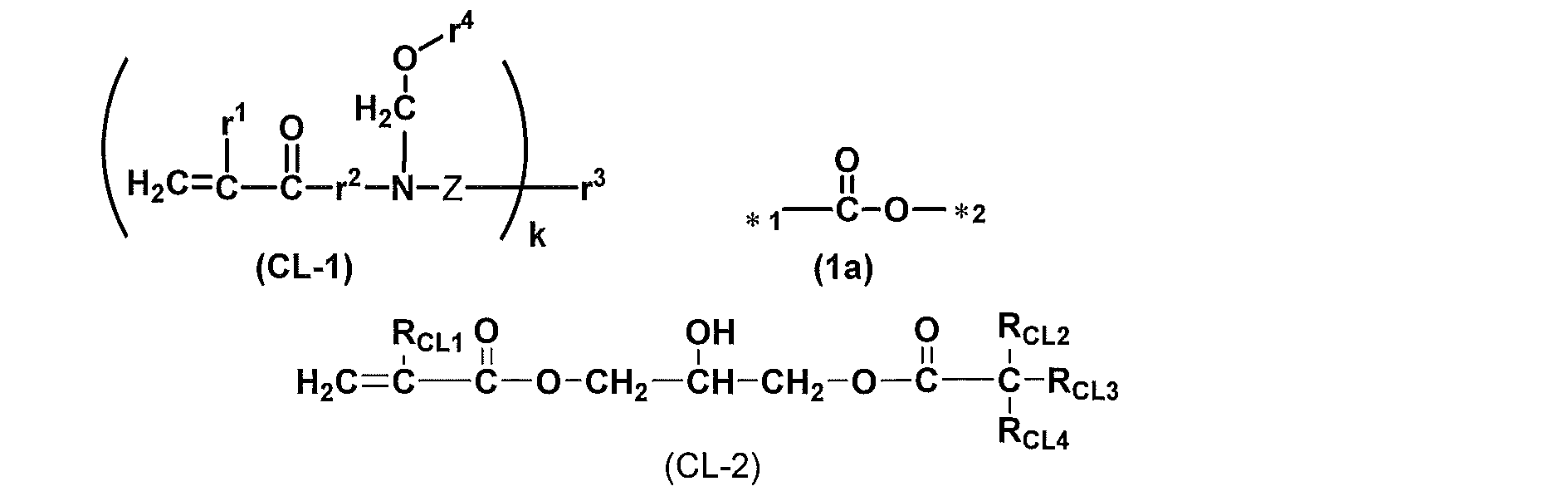
また、本発明により、上記効果に加えて、上記液晶配向膜の製造方法を提供することができる。
<液晶配向剤>
本願の液晶配向剤は、(A)成分;(B)成分;及び(C)成分:有機溶媒;を含有する。
(A)成分は、ポリイミド、ポリアミック酸、ポリアミック酸エステル、ポリオルガノシロキサン、ポリエステル、ポリアミド、及び重合性不飽和結合を有するモノマーの重合体からなる群から選ばれる少なくとも一種の重合体である。
[ポリアミック酸]
本発明に用いられるポリアミック酸は、ジアミン化合物とテトラカルボン酸二無水物とを反応させることにより得ることができる。
本発明のポリアミック酸の重合に用いられるジアミンは以下の式(1)で一般式化することができる。


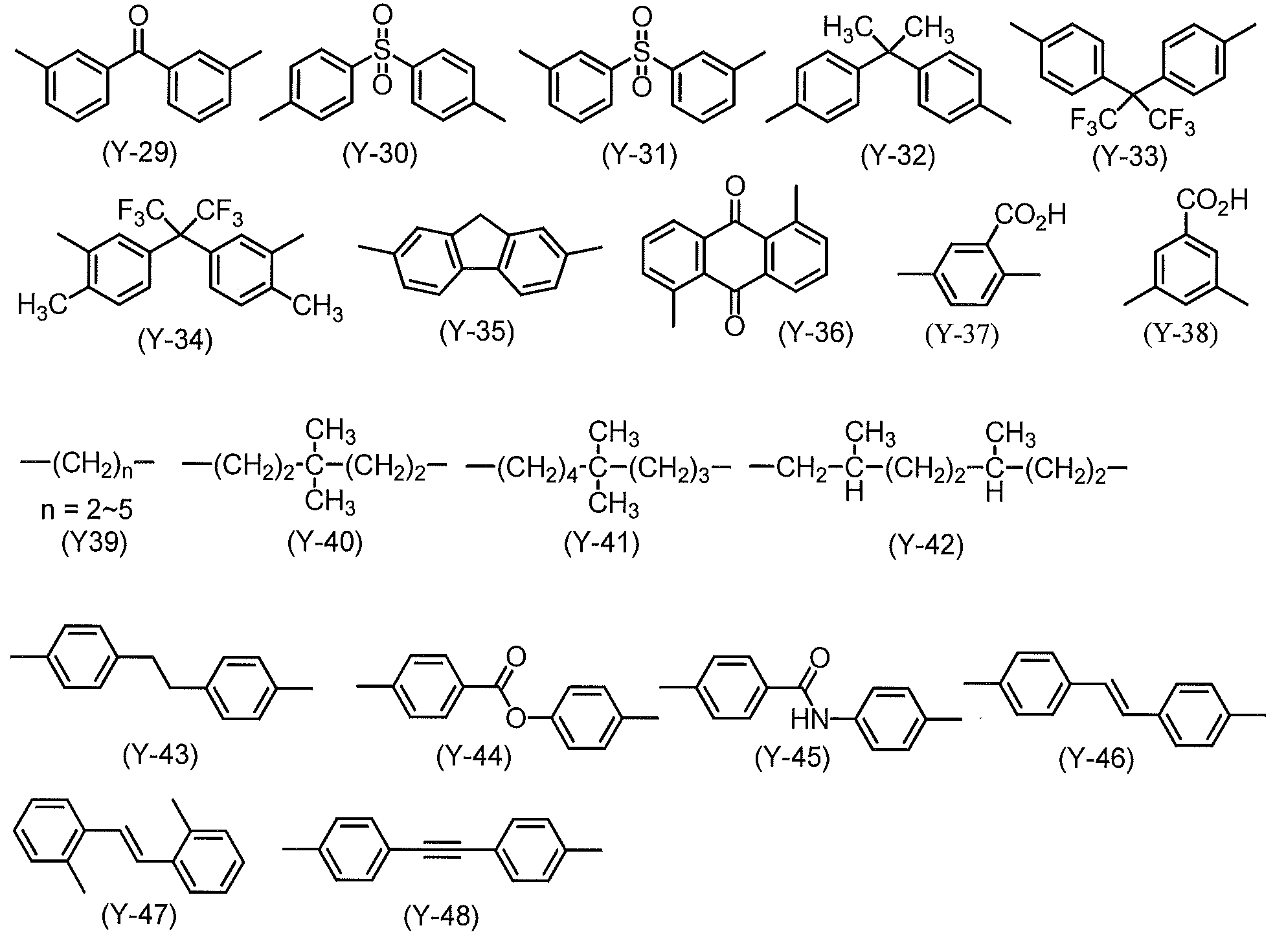
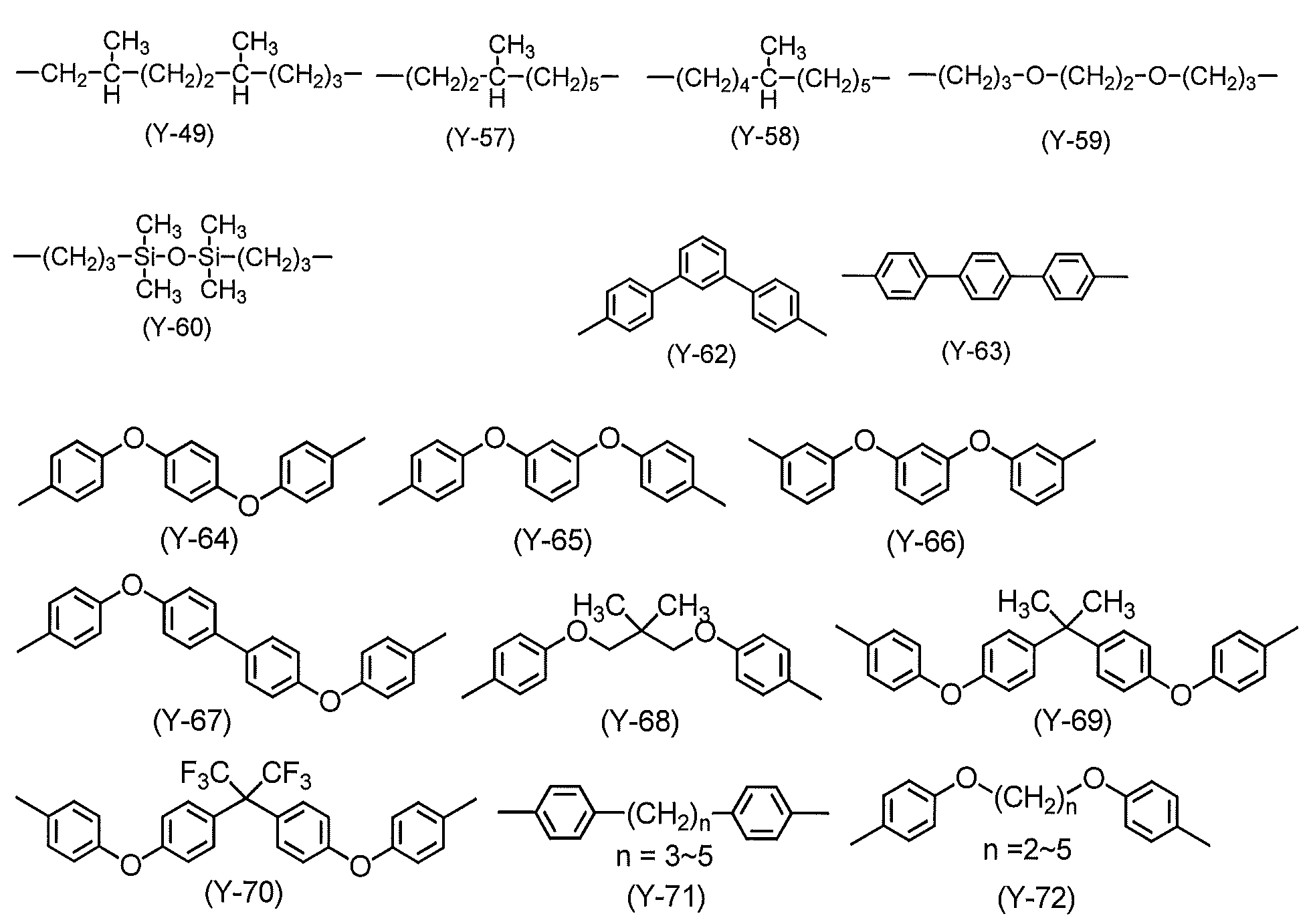

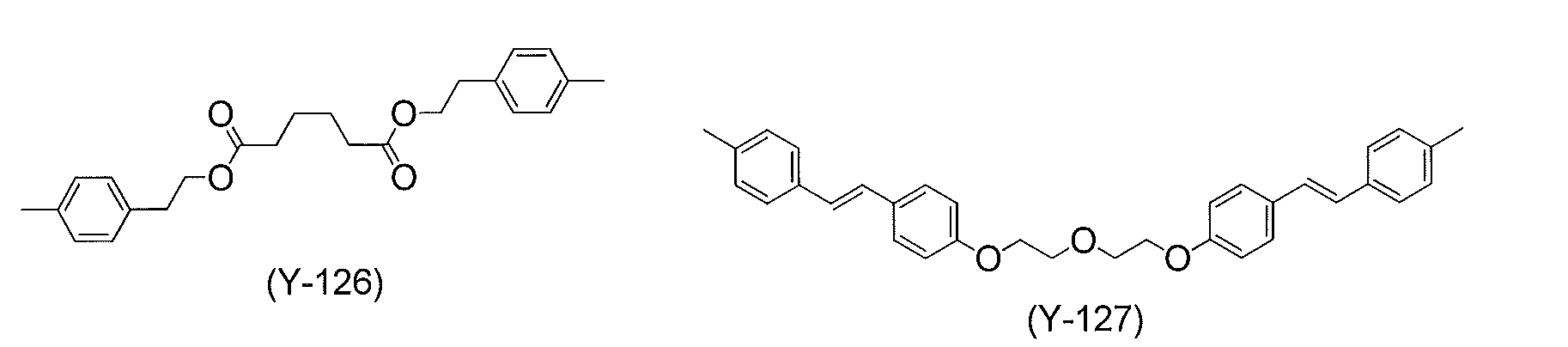
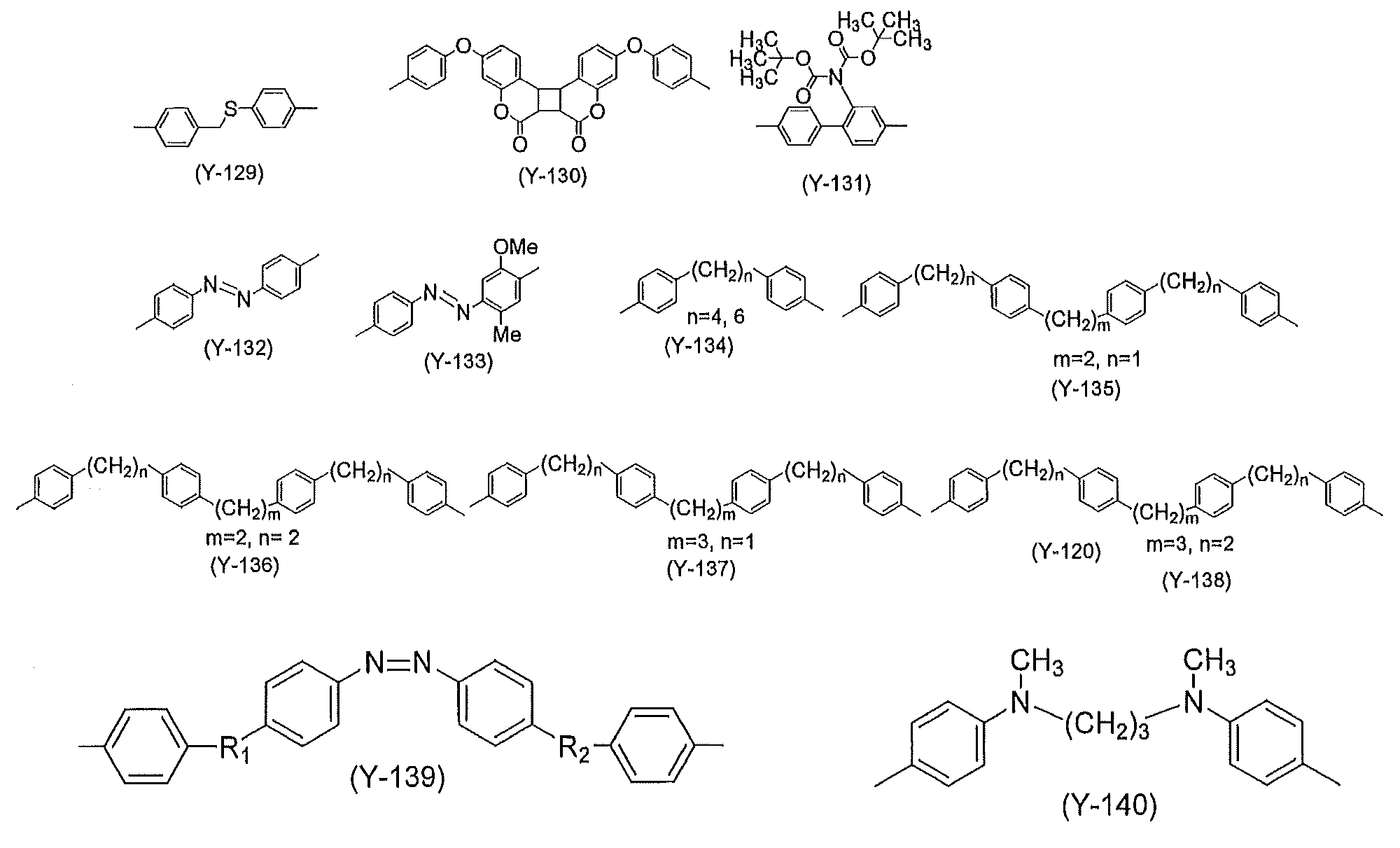
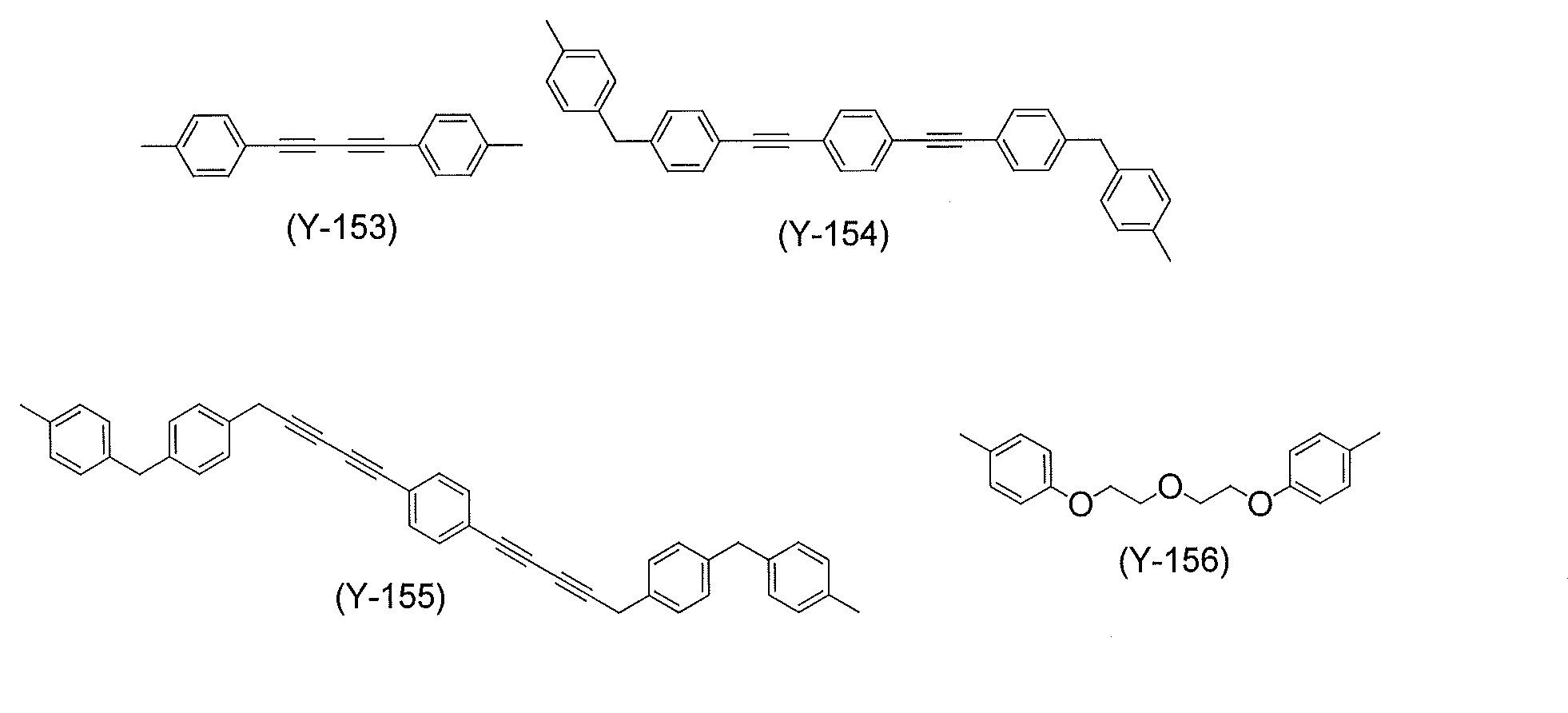

本発明において使用可能なジアミンの一つの好ましい態様としては、下記式[Sd―1]~式[Sd-4]で表される、側鎖にアルキル基、フッ素含有アルキル基を有するジアミンが挙げられる。
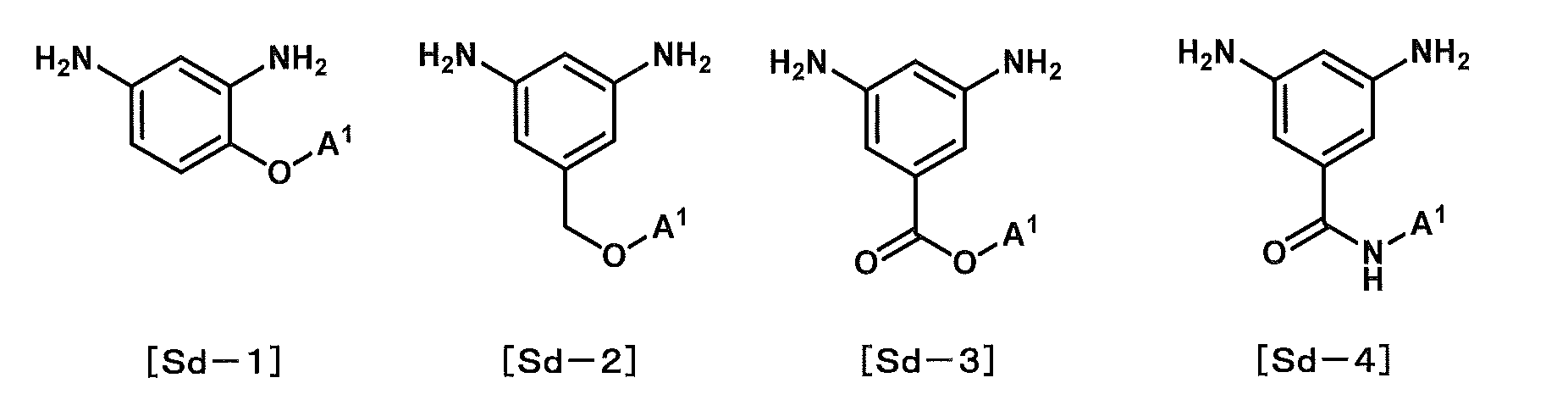

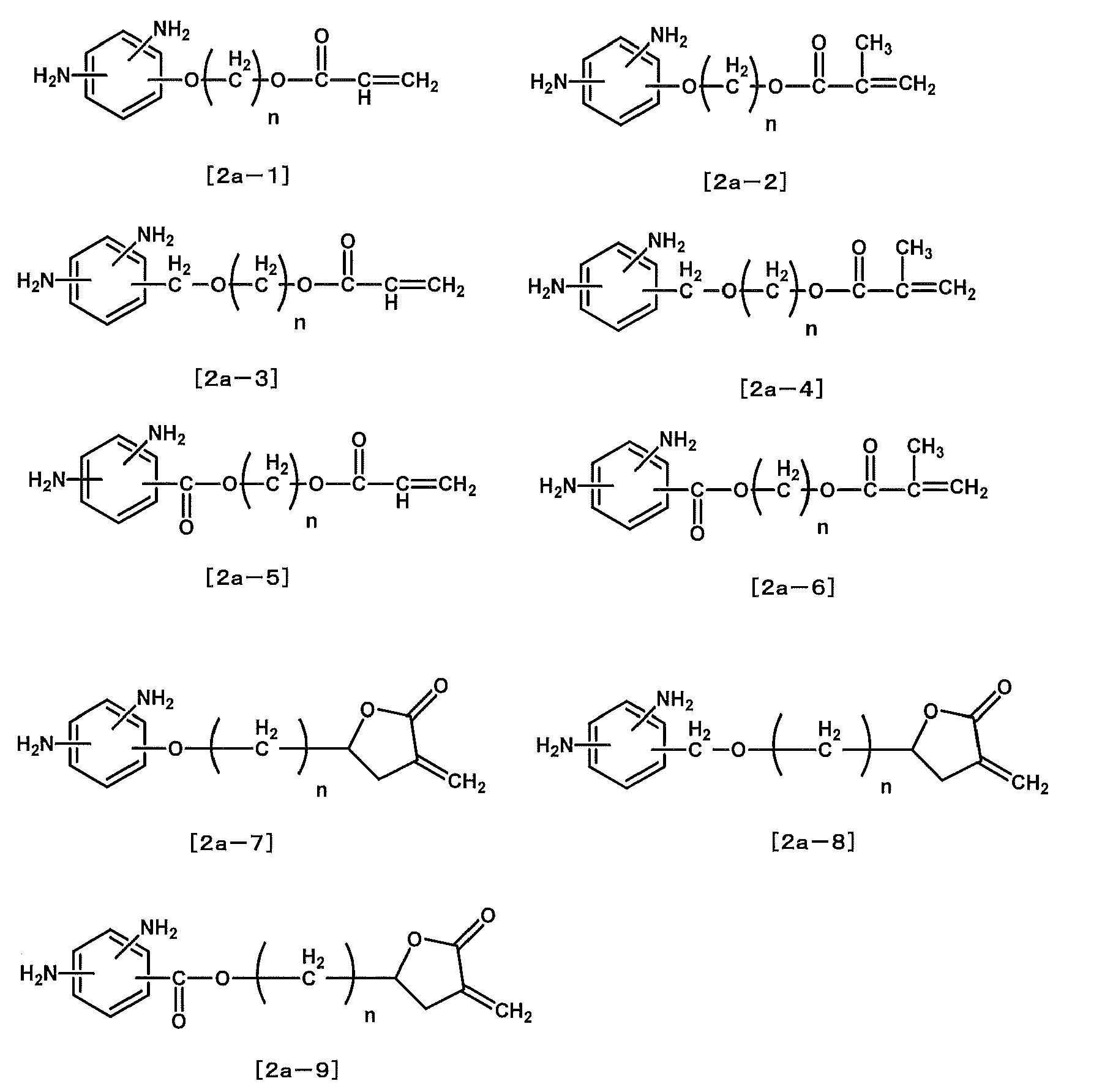

X1は、-O-、-NQ1-、-CONQ1-、-NQ1CO-、-CH2O-、及び-OCO-からなる群より選ばれる少なくとも1種の2価の有機基であり、Q1は水素原子又は炭素数1から3のアルキル基であり、
X2は、単結合、又は炭素数1から20の脂肪族炭化水素基、非芳香族環式炭化水素基、及び芳香族炭化水素基からなる群より選ばれる少なくとも1種の2価の有機基であり、
X3は、単結合、又は-O-、-NQ2-、-CONQ2-、-NQ2CO-、-COO-、-OCO-、及び-O(CH2)m-(mは1から5の整数である)からなる群より選ばれる少なくとも1種の2価の有機基であり、
Q2は、水素原子又は炭素数1から3のアルキル基であり、
X4は窒素含有芳香族複素環であり、nは1から4の整数であり、好ましくは、国際公開公報WO2009/093707の段落[0036]~[0038]の表1~表3に記載の組合せである。



また、上記で挙げたジアミン以外に、4-(2-(メチルアミノ)エチル)アニリン、若しくは特開2010-97188号公報に記載のジアミンを使用することができる。
上記光反応性ジアミンの中でも、光反応性等の観点からは、以下の化合物が好ましい。

テトラカルボン酸二無水物としては、例えば脂肪族テトラカルボン酸二無水物、脂環式テトラカルボン酸二無水物、芳香族テトラカルボン酸二無水物などを挙げることができる。 これらの具体例としては、以下の[1]~[5]の群のものなどをそれぞれ挙げることができる。
[2] 脂環式テトラカルボン酸二無水物として、例えば下記式(X1-1)~(X1-13)(式(X1-1)~(X1-4)において、R3からR23はそれぞれ独立して、水素原子、ハロゲン原子、炭素数1~6のアルキル基、炭素数2~6のアルケニル基、炭素数2~6のアルキニル基、フッ素原子を含有する炭素数1~6の1価の有機基、又はフェニル基であり、同一でも異なってもよく、
前記式中、RMは水素原子、又はメチル基であり、
Xa、は下記式(Xa-1)~(Xa-7)で表される4価の有機基である)などの酸二無水物;
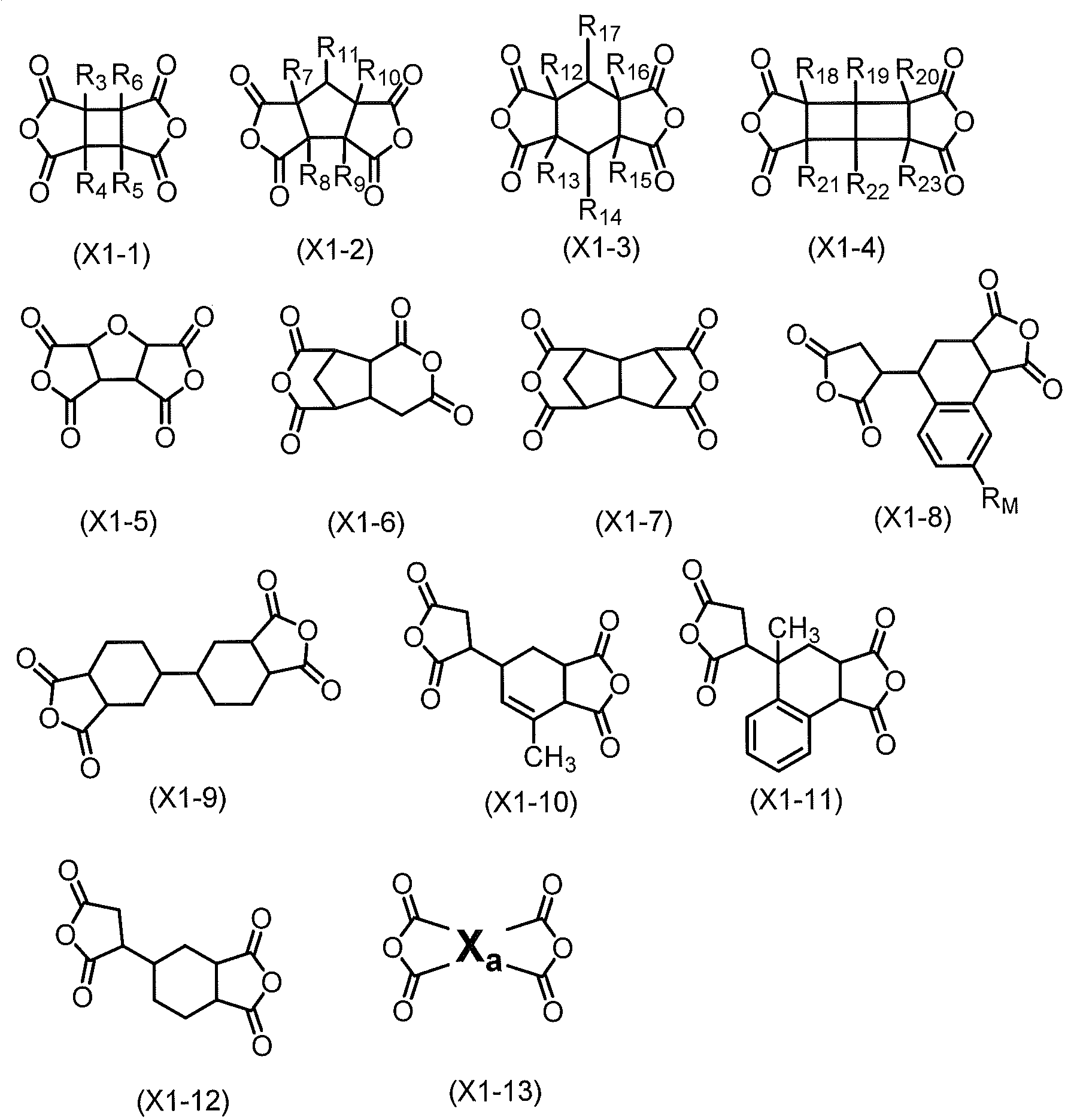


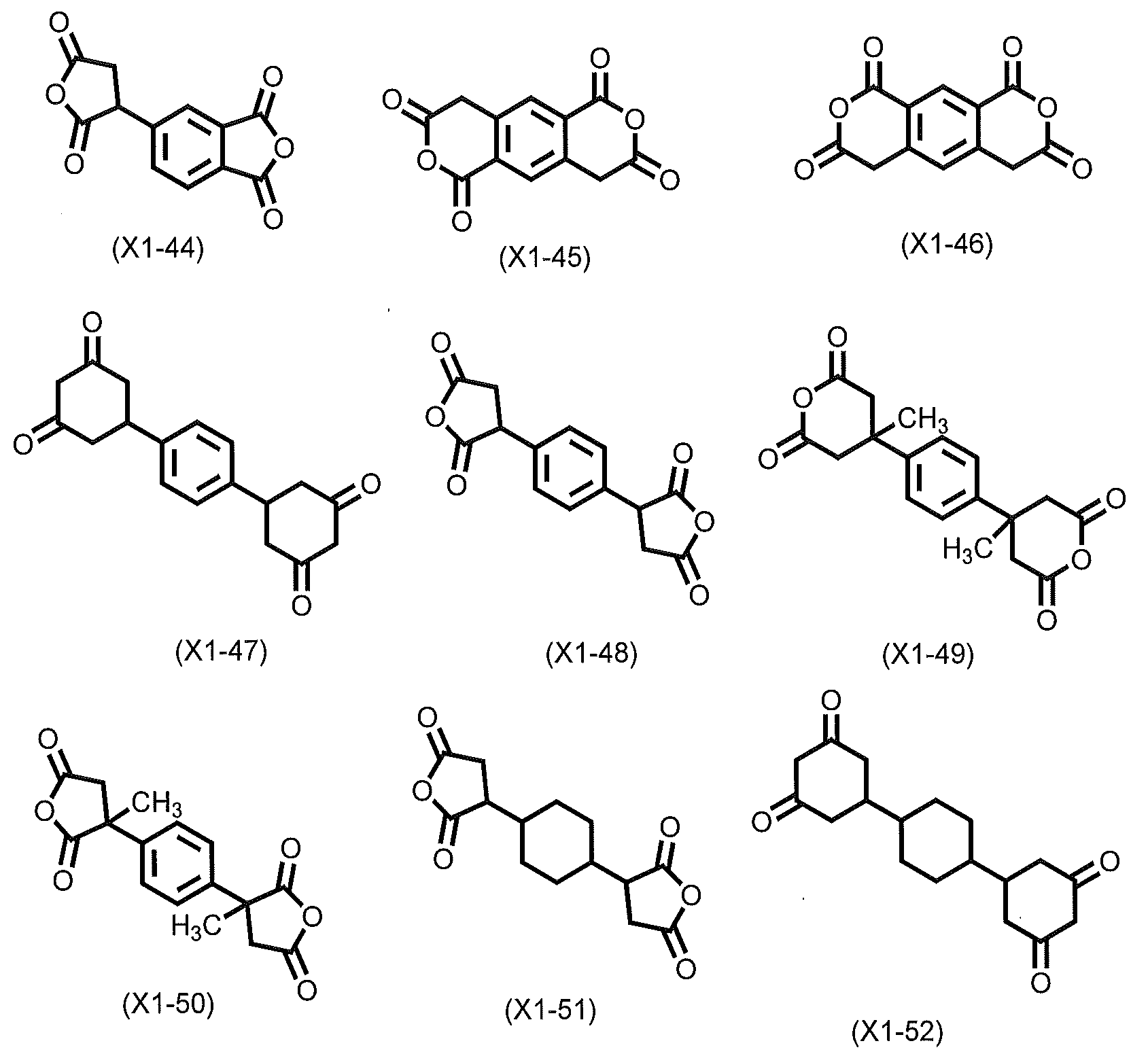
本発明に用いられるポリアミック酸は、公知の方法(例えば、国際公開公報WO2014/034792参照)により合成することができる。
本発明に用いられるポリアミック酸エステルは、下記のようにして得ることができる。
本発明に用いられるポリアミック酸エステルは、(1)ポリアミック酸から合成する場合、(2)テトラカルボン酸ジエステルとジアミンからポリアミック酸エステルを合成する場合又は(3)テトラカルボン酸ジエステルジクロリドとジアミンとの反応により合成する場合の、いずれかの公知の方法(例えば、国際公開公報WO2014/034792参照)で合成することができる。


[ポリイミド]
本発明に用いられるポリイミドは、公知の方法(例えば国際公開公報WO2013/125595参照)で得ることができる。
本発明に係るポリオルガノシロキサンは、例えば加水分解性のシラン化合物を加水分解・縮合する、公知の方法(例えば国際公開公報WO2009/025386参照)により得ることができる。



本発明に用いられるポリエステルとしては、例えば、ジカルボン酸と、ジエポキシ化合物とを反応させることにより得ることができる。ここで、上記ジエポキシ化合物としては、例えばエチレングリコールジグリシジルエーテル、ポリエチレングリコールジグリシジルエーテル、プロピレングリコールジグリシジルエーテル、1,4-ブタンジオールジグリシジルエーテル、1,6-ヘキサンジオールジグリシジルエーテルのほか、特開2013-113937号公報に記載のジエポキシ化合物等が挙げられる。
本発明に用いられるポリアミドは、例えばジカルボン酸とジアミンとを反応させる方法などによって得ることができる。ここで、ジカルボン酸は、例えば塩化チオニル等の適当な塩素化剤を用いて酸クロリド化した後にジアミンとの反応に供することが好ましい。
本発明のポリアミドを合成する際に使用するジアミンとして、上記ポリイミド前駆体に用いられるジアミンを少なくとも一部に用いることにより、ポリアミドが得られる。なお、合成に際しては、必要に応じてその他のジアミンを併用してもよい。ジアミンは1種を単独で又は2種以上を組み合わせて使用することができる。
以上のようにして、ポリアミドを溶解してなる反応溶液が得られる。この反応溶液はそのまま液晶配向剤の調製に供してもよく、反応溶液中に含まれるポリアミドを単離したうえで液晶配向剤の調製に供してもよい。
重合性不飽和結合を有するモノマーの重合体(以下、「重合体(PAc)」ともいう。)において、モノマーが有する重合性不飽和結合としては、例えば(メタ)アクリロイル基、ビニル基、スチリル基、マレイミド基などが挙げられる。こうした重合性不飽和結合を有するモノマーの具体例としては、例えば、(メタ)アクリル酸、α-エチルアクリル酸、マレイン酸、フマル酸、ビニル安息香酸等の不飽和カルボン酸:(メタ)アクリル酸アルキル(メタ)アクリル酸シクロアルキル、(メタ)アクリル酸ベンジル、(メタ)アクリル酸-2-エチルヘキシル、(メタ)アクリル酸トリメトキシシリルプロピル、(メタ)アクリル酸2-ヒドロキシエチル、(メタ)アクリル酸グリシジル、(メタ)アクリル酸3,4-エポキシシクロヘキシルメチル、(メタ)アクリル酸3,4-エポキシブチル、アクリル酸4-ヒドロキシブチルグリシジルエーテル等の不飽和カルボン酸エステル:無水マレイン酸等の不飽和多価カルボン酸無水物:などの(メタ)アクリル系化合物;スチレン、メチルスチレン、ジビニルベンゼン等の芳香族ビニル化合物;1,3-ブタジエン、2-メチル-1,3-ブタジエン等の共役ジエン化合物;N-メチルマレイミド、N-シクロヘキシルマレイミド、N-フェニルマレイミド等のマレイミド基含有化合物;などが挙げられる。なお、重合性基不飽和結合を有するモノマーは、1種を単独で又は2種以上を組み合わせて使用することができる。

Sbは、炭素数1~10の直鎖又は分岐鎖のアルキレン基、2価の芳香族基又は2価の脂環式基、
Mdは、単結合、2価の複素環、3価の複素環、4価の複素環、置換又は非置換の分岐である炭素数1~10のアルキル基、2価の芳香族基、3価の芳香族基、4価の芳香族環、2価の脂環式基、3価の脂環式基、4価の脂環式基、2価の縮合環式基、3価縮合環式基または4価の縮合環式基であり、それぞれの基は無置換であるか又は一個以上の水素原子がフッ素原子、塩素原子、シアノ基、メチル基又はメトキシ基によって置換されていてもよく、
dは、1から3の整数であり、Zは酸素原子、または硫黄原子である。
Xa及びXbは、それぞれ独立して水素原子、フッ素原子、塩素原子、シアノ基又は炭素数1~3のアルキル基であり、
R1は単結合、酸素原子、-COO-または-OCO-、好ましくは単結合、-COO-又は-OCO-であり、
R2は2価の芳香族基、2価の脂環式基、2価の複素環式基または2価の縮合環式基であり
R3は単結合、酸素原子、-COO-または-OCO-であり、
R4は炭素数1~40の直鎖又は分岐鎖のアルキル基または脂環式基を含む炭素数3~40の1価の有機基であり、
R5は炭素数1~3のアルキル基、炭素数1~3のアルコキシ基、フッ素原子またはシアノ基、好ましくはメチル基、メトキシ基又はフッ素原子であり、
aは0~3の整数であり、bは0~4の整数である。
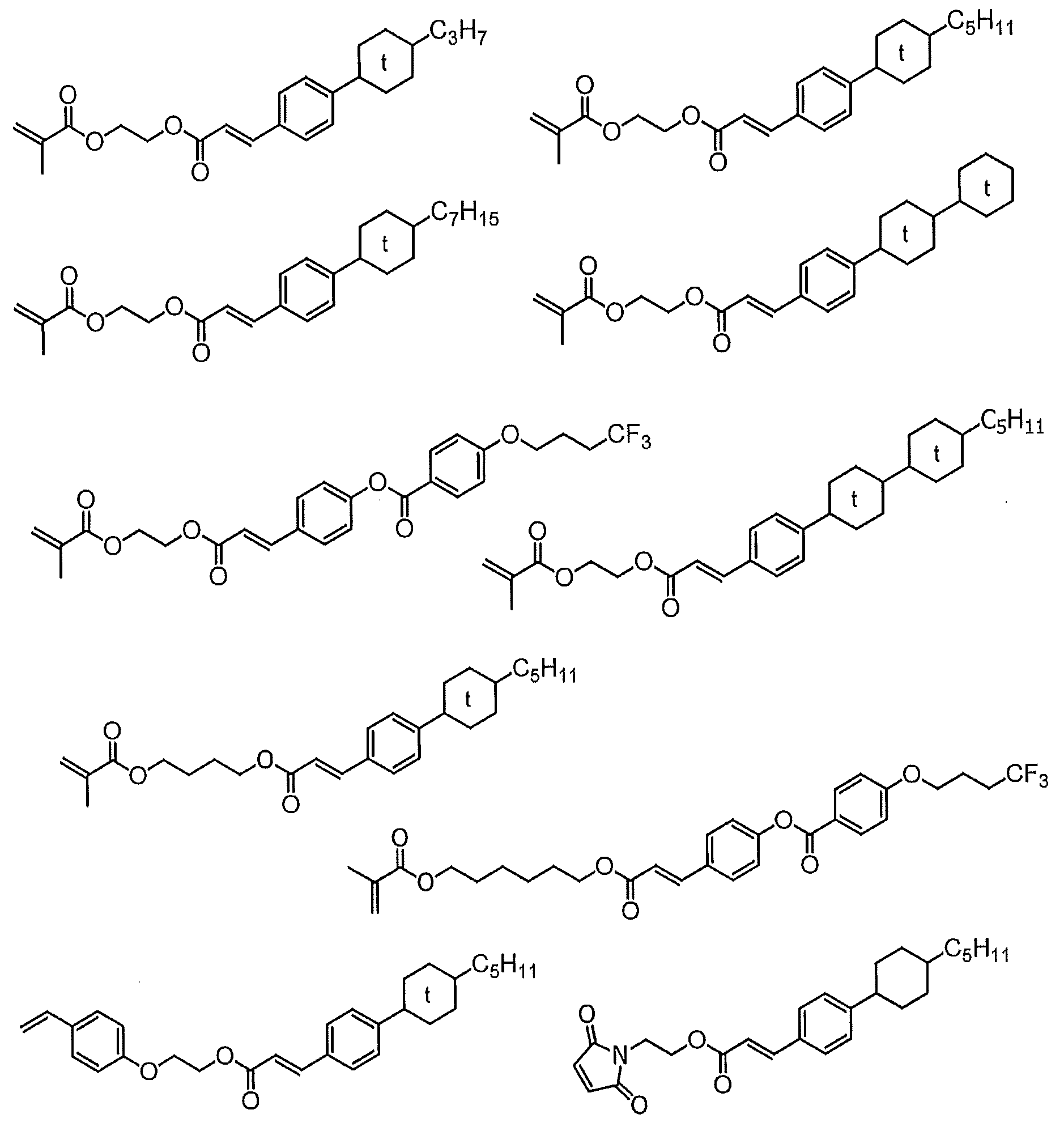
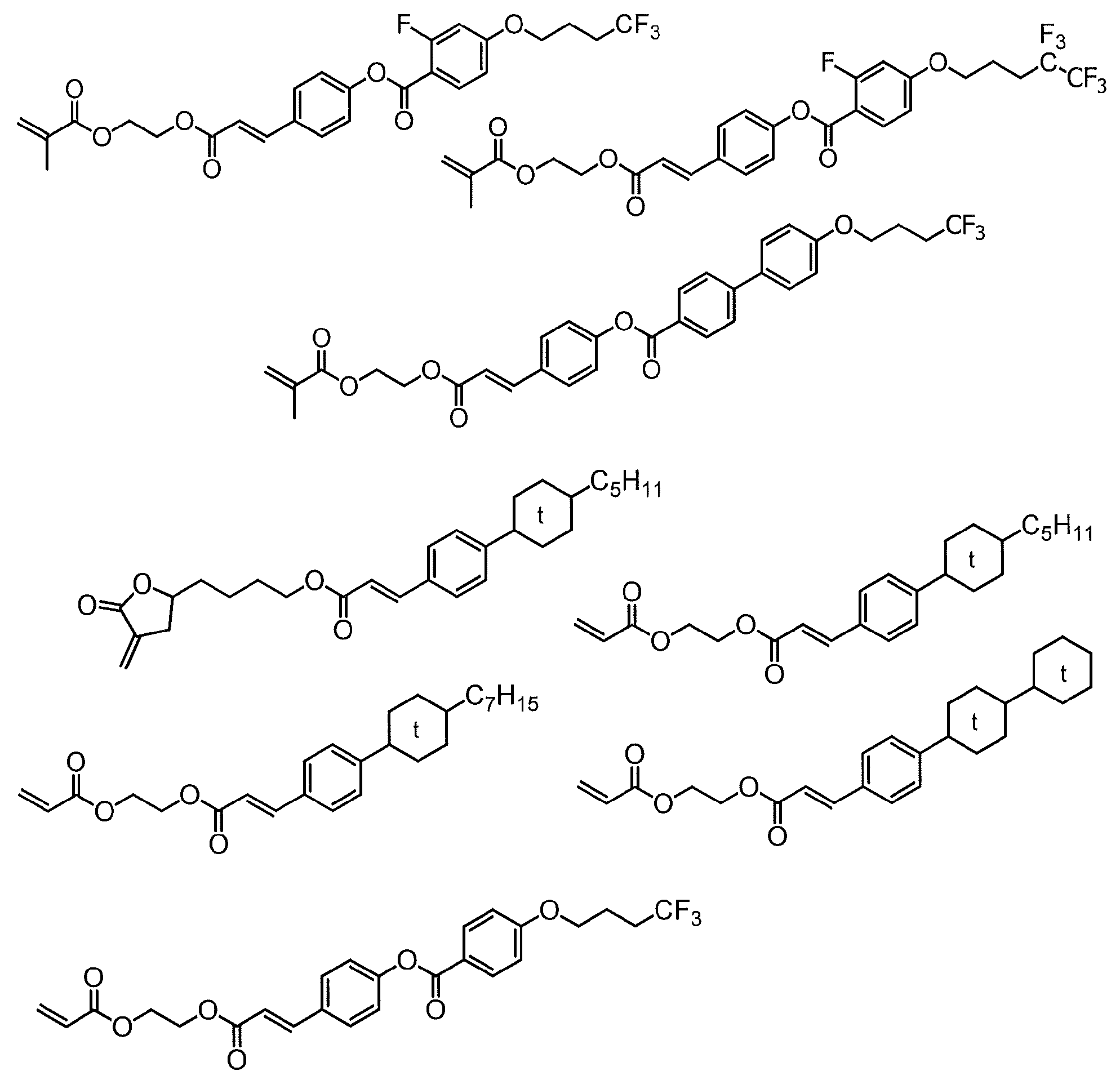
さらに好ましくは、シクロブタン環構造、シクロペンタン環構造、シクロヘキサン環構造、及びベンゼン環構造からなる群より選ばれる少なくとも一種を有する構造を含むことが好ましい。具体的には、ポリアミック酸、及びポリアミック酸エステルや、これらをイミド化して得られるポリイミドの溶媒に対する溶解性の観点から、前記式(X1-1)~(X1-3)、(X1-6)~(X1-12)、(Xa-1)~(Xa-2)、ピロメリット酸無水物、4,4’-(ヘキサフルオロイソプロピリデン)ジフタル酸無水物、(Xb-6)~(Xb-8)、(X1-44)、(X1-47)~(X1-52)が好ましく、より好ましくは(X1-1)~(X1-3)、(X1-6)~(X1-12)、(Xa-1)~(Xa-2)、(Xb-6)~(Xb-8)、(X1-44)、(X1-49)が挙げられる。

(A)成分は、液晶配向剤の総量を100重量%とした場合、1~15重量%、好ましくは1~8重量%、より好ましくは1.5~7重量%であるのがよい。
本願の液晶配向剤は、(B)成分を含有する。
(B)成分は、下記式[CL-1]である化合物及び下記式[CL-2]で表される化合物;からなる群から選ばれる少なくとも1種の化合物である。
これらの化合物を含有することにより、液晶配向剤から液晶配向膜が形成されると、該液晶配向膜と基板との密着性を向上させるか、及び/又は液晶配向膜とその直上に設けられる部材との密着性を向上させることができる。
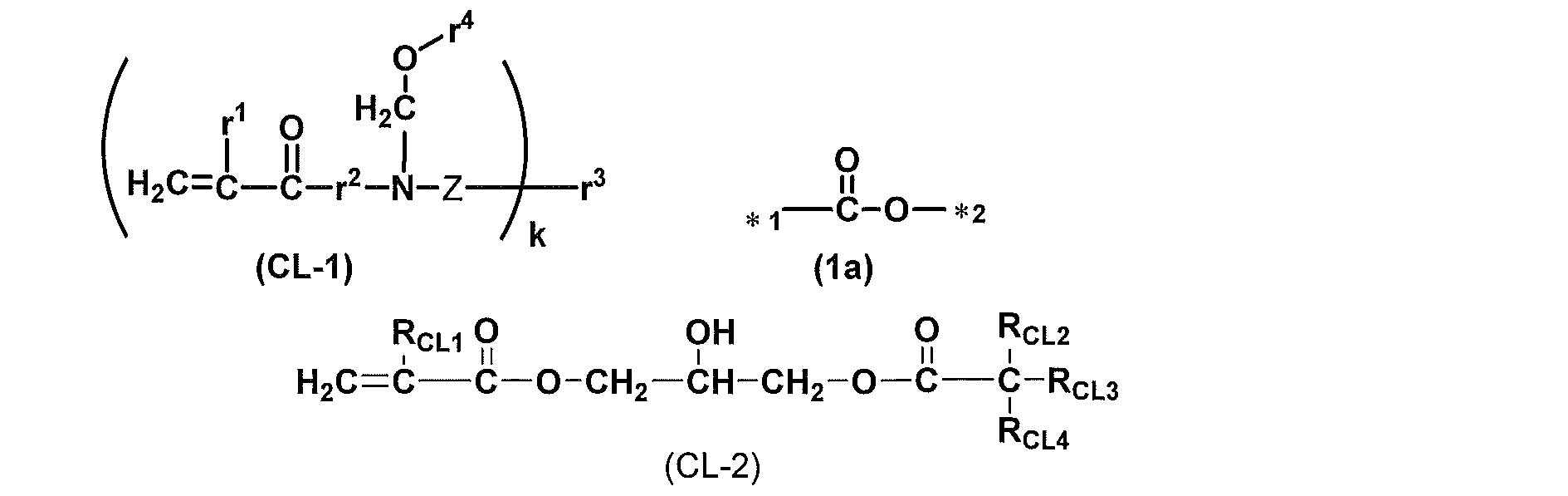
r2は炭素数2~20のアルキレン基、より好ましくは炭素数2~10のアルキレン基、炭素数5~6の脂肪族環からなる2価の有機基、又は炭素数5~6の脂肪族環を含む2価の脂肪族基を表し、これらの基はその構造中の-CH2-が-O-で置換されていてもよく、
r3は炭素数2~20のk価の脂肪族基、炭素数2~20のk価の直鎖又は分岐鎖のアルキレン基、炭素数5~6の脂肪族環からなるk価の基、又は炭素数5~6の脂肪族環を含むk価の脂肪族基を表し、これらの基はその構造中の-CH2-が-O-で置換されていてもよく、より好ましくは炭素数2~10のk価の脂肪族基、より好ましくは炭素数2~10のk価のアルキル基を表し、
Zは、上記式(1a)で表される2価の基を示し、
kは2以上9以下、好ましくは2~6の自然数である。
なお、式(1a)中、
r4は炭素数1~20のアルキル基、好ましくは炭素数1~10のアルキル基、より好ましくは炭素数1~6の直鎖又は分岐鎖のアルキル基、炭素数5~6の脂肪族環からなる1価の基、又は炭素数5~6の脂肪族環を含む1価の脂肪族基を表し、これらの基はその構造中の-CH2-が-O-で置換されていてもよく、好ましくはメチル基である。
*1及び*2は、いずれか一方が窒素原子との結合手を、他方がr3との結合手を示す。
当該炭素数2乃至20のアルキル基の具体例としては、エチル基、n-プロピル基、i-プロピル基、n-ブチル基、i-ブチル基、s-ブチル基、t-ブチル基、n-ペンチル基、1-メチル-n-ブチル基、2-メチル-n-ブチル基、3-メチル-n-ブチル基、1,1-ジメチル-n-プロピル基、n-ヘキシル基、1-メチル-n-ペンチル基、2-メチル-n-ペンチル基、1,1-ジメチル-n-ブチル基、1-エチル-n-ブチル基、1,1,2-トリメチル-n-プロピル基、n-ヘプチル基、n-オクチル基、n-ノニル基、n-デシル基、n-ウンデシル基、n-ドデシル基、n-トリデシル基、n-テトラデシル基、n-ペンタデシル基、n-ヘキサデシル基、n-ヘプタデシル基、n-オクタデシル基、n-ノナデシル基、n-エイコシル基、シクロペンチル基、シクロヘキシル基、及びそれらの一種又は複数種が炭素原子数20までの範囲で結合した基と、これらの基の一つのメチレン基又は隣り合わない複数のメチレン基がエーテル結合に置き換わった基等が一例として挙げられる。
r2の定義における炭素数5乃至6の脂肪族環を含む1価の脂肪族基としては、例えば、シクロペンチル環又はシクロヘキサン環を含むアルキル基などが挙げられる。
r3の定義における炭素原子数5乃至6の脂肪族環からなるk価の基としては、例えば、シクロペンチル環又はシクロヘキサン環から、k個の水素原子を取り去った構造からなるk価の基が挙げられる。
また、r3の定義における炭素原子数5乃至6の脂肪族環を含むk価の脂肪族基としては、例えば、シクロペンチル環又はシクロヘキサン環を含むk価のアルキル基が挙げられる。
r4の定義における炭素数5~6の脂肪族環からなる1価の基としては、例えば、シクロペンチル基及びシクロヘキシル基などを;
また、r4の定義における炭素数5~6の脂肪族環を含む1価の脂肪族基としては、例えば、シクロペンチル環又はシクロヘキサン環を含むアルキル基などが挙げられる。
RCL2及びRCL3は互いに独立して、水素原子、炭素数1から20のアルキル基、又は炭素数1から20のヒドロキシルアルキル基であり、好ましくは炭素数1~10のアルキル基又は炭素数1~20のヒドロキシルアルキル基であり、より好ましくは炭素数1~10の直鎖又は分岐鎖のアルキル基または炭素数1から20の直鎖又は分岐鎖のヒドロキシルアルキル基であり、
RCL4は、ヒドロキシル基または炭素数1から20のヒドロキシルアルキル基であり、好ましくはヒドロキシル基又は炭素数1~10のヒドロキシアルキル基であり、より好ましくはヒドロキシル基又は炭素数1~6の直鎖又は分岐鎖のヒドロキシルアルキル基である。
なお、nはノルマルを、iはイソを、sはセカンダリーを、tはターシャリーを、それぞれ表す。
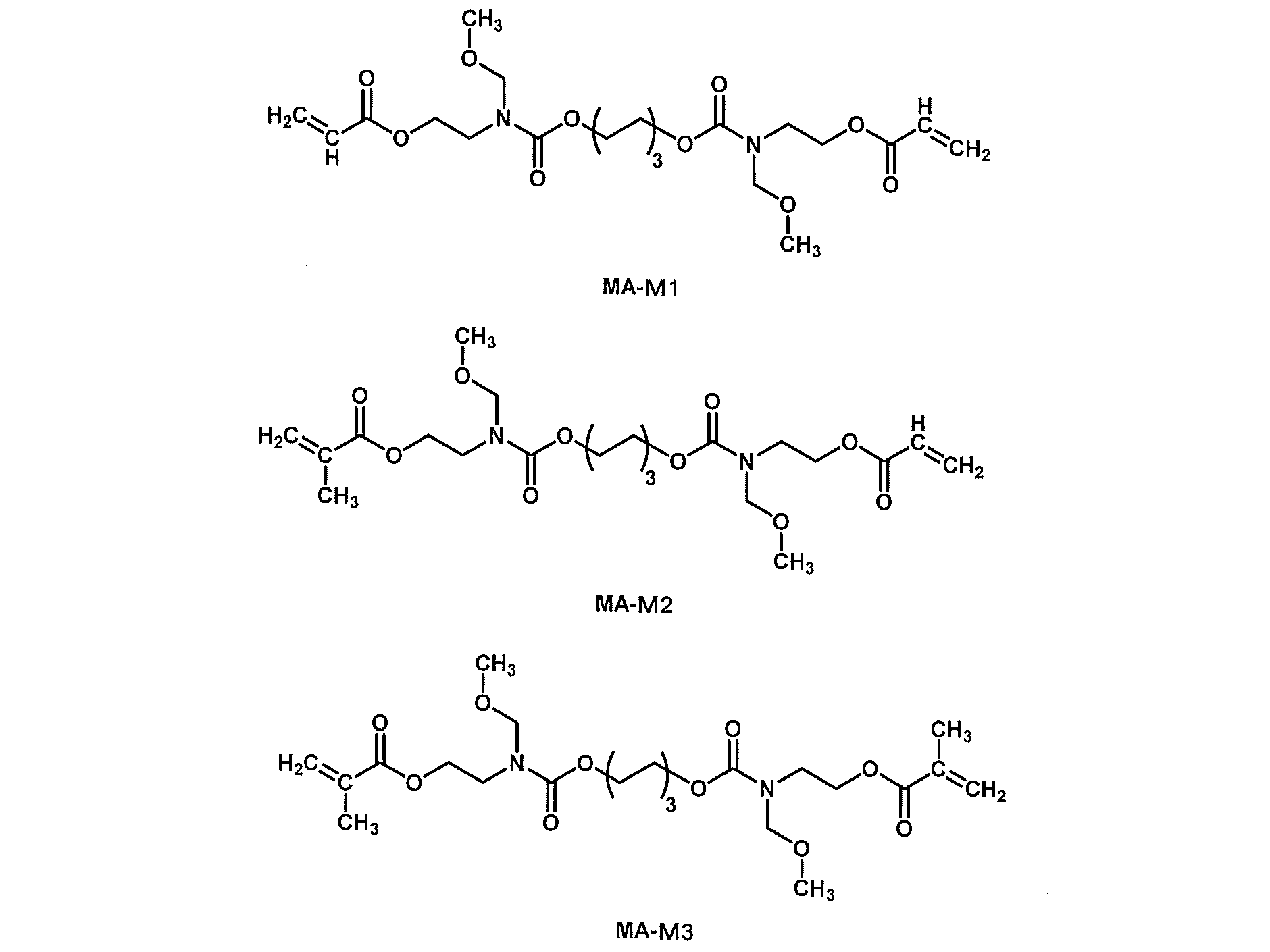
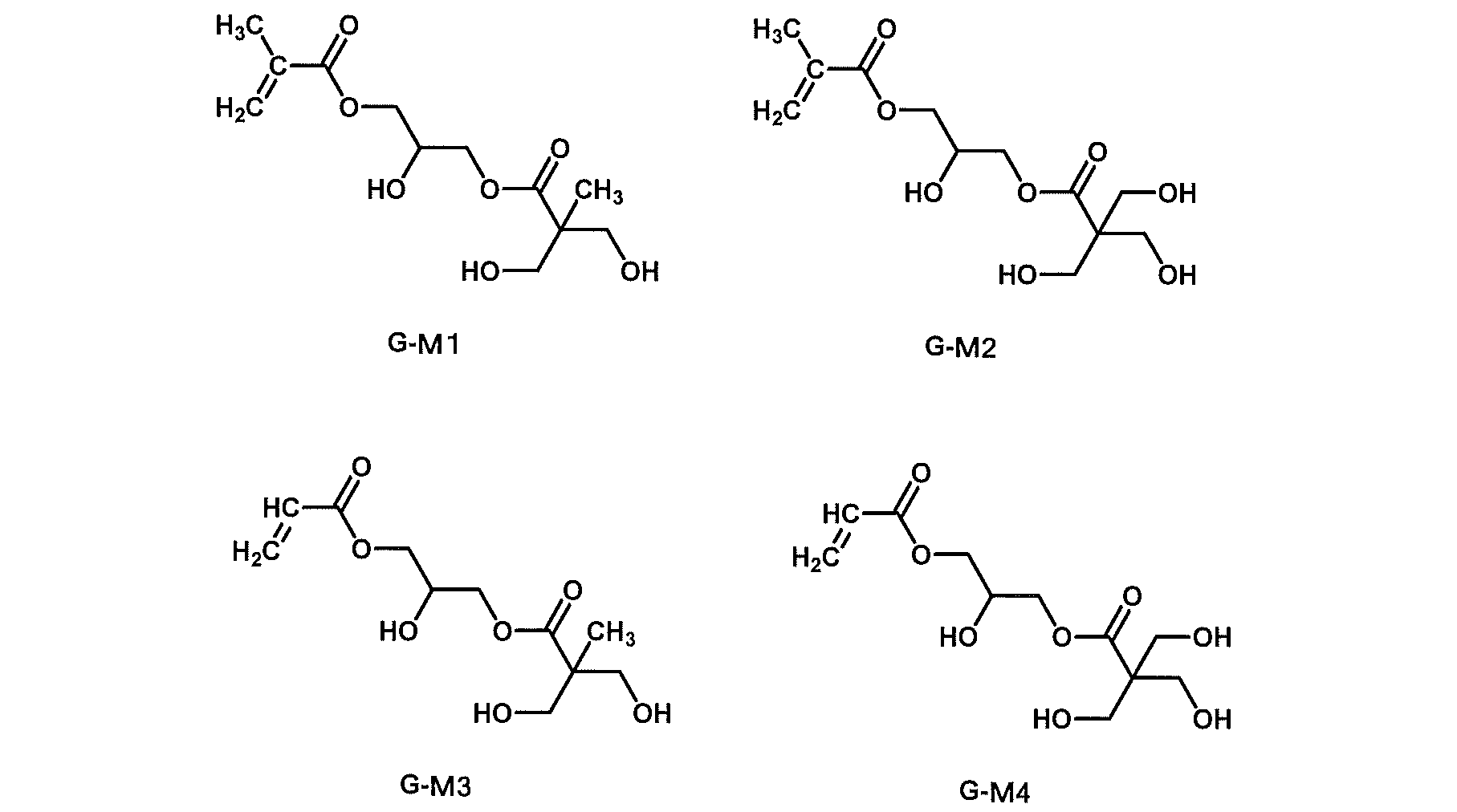
本願の液晶配向剤中、(B)成分は、(A)成分100重量部に対して、0.1~50重量部、好ましくは0.1~30重量部、より好ましくは0.1~20重量部であるのがよい。
本願の液晶配向剤は、(C)成分として有機溶媒を含有する。
有機溶媒は、上述の(A)成分及び(B)成分を溶解する特性を有するものであれば、特に限定されない。
有機溶媒は、低温焼成プロセスに好適な溶媒であれば、好ましい。
Aグループに属する溶媒は、上記ポリイミド、ポリアミック酸、ポリアミック酸エステル、ポリオルガノシロキサン、ポリエステル、ポリアミド、及び重合性不飽和結合を有するモノマーの重合体などの溶解性を高めたい場合は、下記に示すような溶媒(Aグループともいう)を用いることが好ましい。

本発明に係る液晶配向剤は、低温焼成においても液晶配向剤の基板に対する塗布性を向上でき、液晶配向剤の乾燥速度を高める点で、下記式(Sol-1)で表される化合物、下記式(Sol-2)、下記式(a)で表される溶媒、メチルエチルケトン、シクロヘキサノン、シクロペンタノン、4-ヒドロキシ-4-メチル-2-ペンタノン、1-ブタノール、tert-ブチルアルコール、1-ペンタノール、2-メチル-1-ブタノール、ネオペンチルアルコール、1-ヘキサノール、2-メチル-1-ペンタノール、2-エチル-1-ブタノール、1-ヘプタノール、1-オクタノール、2-エチル-1-ヘキサノール、シクロヘキサノール、1-メチルシクロヘキサノール、2-メチルシクロヘキサノール、3-メチルシクロヘキサノール、ジプロピルエーテル、ジブチルエーテル、ジヘキシルエーテル、ジオキサン、2-ペンタノン、3-ペンタノン、2-ヘキサノン、2-ヘプタノン、4-ヘプタノン、1-メチルペンチルアセタート、2-エチルブチルアセタート、2-エチルヘキシルアセタート、プロピレンカーボネート、エチレンカーボネート、フルフリルアルコール、酢酸メチル、酢酸エチル、酢酸n-ブチル、ピルビン酸メチル、ピルビン酸エチル、ジイソブチルケトンで表される化合物よりなる群から選ばれる少なくとも一種の化合物(以下、Bグループ)を含むことが好ましい。下記式(Sol-1)で表される化合物及び下記式(Sol-2)で表される化合物よりなる群から選ばれる少なくとも一種の化合物を含むことが好ましい。

Ys7及びYs8はそれぞれ独立に、水素原子又は炭素数1~6の1価の炭化水素基であり、好ましくは炭素数1~6の1価の鎖状炭化水素基、炭素数1~6の1価の脂環式炭化水素基及び炭素数1~6の1価の芳香族炭化水素基などが挙げられる。より好ましくは炭素数1~6のアルキル基である。
Xs1は、酸素原子又は-COO-である。
Xs2は単結合又はカルボニル基であり、
Rs7は、炭素数2~4のアルカンジイル基であり、RS 7のアルカンジイル基は直鎖状でも分岐状でもよく、例えばメチレン基、エチレン基、1,3-プロパンジイル基、1,2-プロパンジイル基、1,4-ブタンジイル基、1,3-ブタンジイル基等が挙げられる。Rs 7は、好ましくはエチレン基、1,3-プロパンジイル基又は1,4-ブタンジイル基である。
ns1は、1~3の整数であり、ns1が2又は3の場合、複数のRs7は同じでも異なっていてもよく、好ましくは1又は2であることが好ましい。
式(Sol-2)中、
Zs1は炭素数1~6の2価の炭化水素基であり、好ましくはアルカンジイル基であることが好ましく、例えばメチレン基、エチレン基、1,3-プロパンジイル基、1,4-ブタンジイル基等が挙げられる。
Ys9及びYs10はそれぞれ独立に、水素原子又は炭素数1~6の1価の炭化水素基であり、好ましくは炭素数1~6の1価の鎖状炭化水素基、炭素数1~6の1価の脂環式炭化水素基及び炭素数1~6の1価の芳香族炭化水素基などが挙げられる。より好ましくは炭素数1~6のアルキル基である。

上記式(Sol-1)で表される化合物、上記式(Sol-2)、上記式(a)、メチルエチルケトン、シクロヘキサノン、シクロペンタノン、4-ヒドロキシ-4-メチル-2-ペンタノン、ジプロピルエーテル、ジブチルエーテル、ジヘキシルエーテル、2-ペンタノン、3-ペンタノン、2-ヘキサノン、2-ヘプタノン、4-ヘプタノン、1-メチルペンチルアセタート、2-エチルブチルアセタート、2-エチルヘキシルアセタート、プロピレンカーボネート、エチレンカーボネートジイソブチルケトンで表される化合物よりなる群から選ばれる少なくとも一種の化合物がより好ましい。最も好ましいのは、上記式(Sol-1)で表される化合物、上記式(Sol-2)で表される化合物よりなる群から選ばれる少なくとも一種の化合物である。
(Sol-2)で表される溶媒の具体例としては、例えばグリコール酸メチル、グリコール酸エチル、グリコール酸ブチル、乳酸エチル、乳酸ブチル、乳酸イソアミル、エチル-3-エトキシプロピオネート、メチル-3-メトキシプロピオネート、3-メトキシプロピオン酸エチル、3-エトキシプロピオン酸、3-メトキシプロピオン酸、3-メトキシプロピオン酸プロピル、3-メトキシプロピオン酸ブチルなどを;
それぞれ挙げることができる。
本願の液晶配向剤は、上述の(A)成分~(C)成分以外の成分を、適宜、任意に含有してもよい。
(A)成分~(C)成分以外の成分として、国際公開公報WO2016/047771の段落[0109]~[0113]に記載の、エポキシ基、イソシアネート基、オキセタン基、若しくはシクロカーボネート基を有する化合物、又は、ヒドロキシ基、ヒドロキシアルキル基及び低級アルコキシアルキル基からなる群より選ばれる少なくとも1種の基を有する化合物の他、ブロックイソシアネート基を有する化合物(これらを総称して、その他の架橋性化合物ともいう。)を使用することができる。
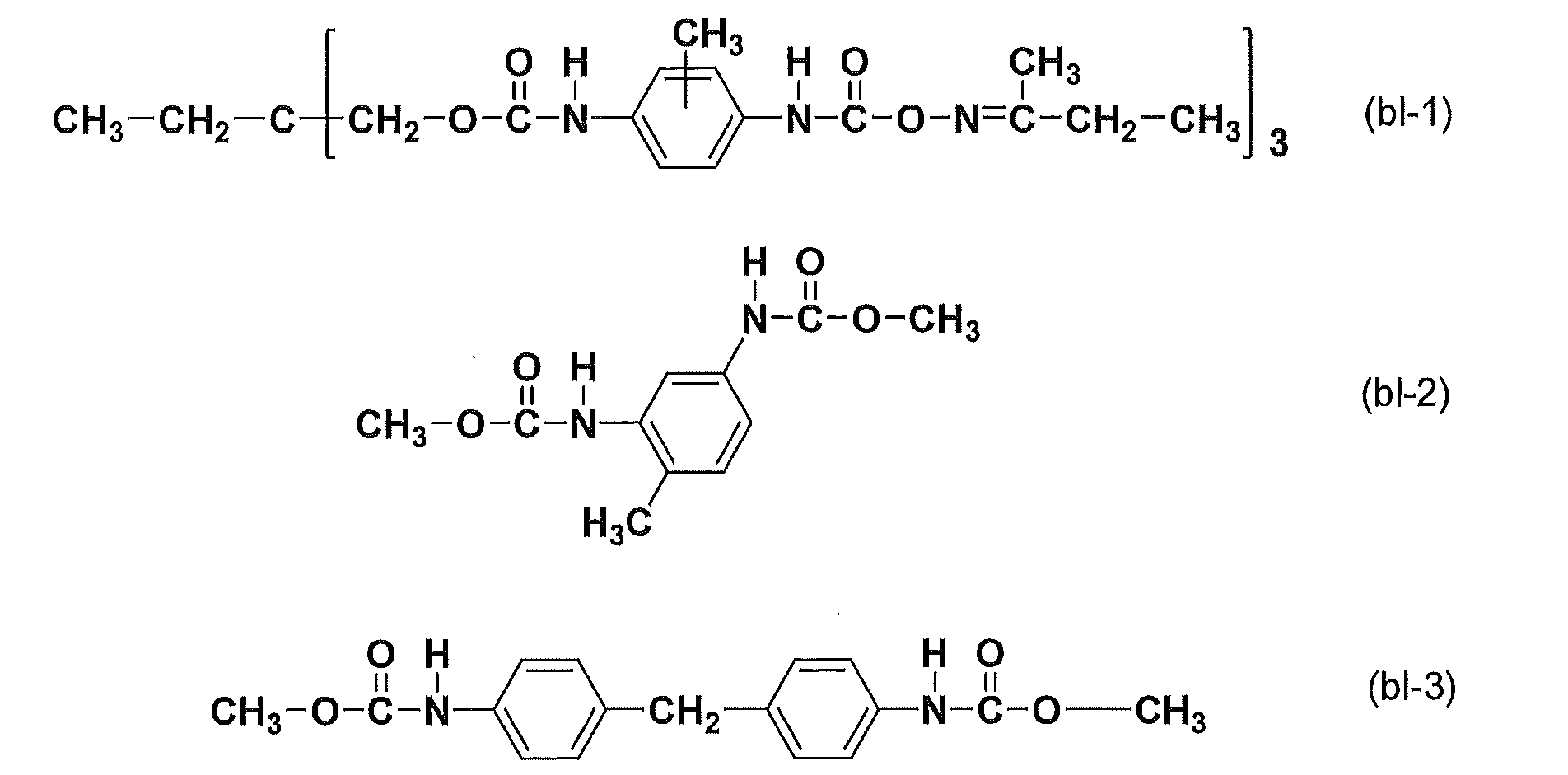
本発明の液晶配向剤は、液晶配向剤を塗布した際の液晶配向膜の膜厚の均一性や表面平滑性を向上させる化合物を用いることができる。
液晶配向膜の膜厚の均一性や表面平滑性を向上させる化合物としては、フッ素系界面活性剤、シリコーン系界面活性剤、ノ二オン系界面活性剤などが挙げられる。これらの具体例は、国際公開公報WO2016/047771の段落[0117]に記載の界面活性剤が挙げられる。界面活性剤の使用量は、液晶配向剤に含有される全ての重合体成分100質量部に対して、好ましくは0.01~2質量部、より好ましくは0.01~1質量部である。
本発明に用いられる液晶配向剤は、特定構造の重合体が有機溶媒中に溶解された溶液の形態を有する。
例えばスピンナー法による場合には、重合体の濃度が1.5~4.5重量%の範囲であることが特に好ましい。印刷法による場合には、固形分濃度を3~9重量%の範囲とし、それにより溶液粘度を12~50mPa・sの範囲とすることが特に好ましい。インクジェット法による場合には、固形分濃度を1~5重量%の範囲とし、それにより、溶液粘度を3~15mPa・sの範囲とすることが特に好ましい。
上記液晶配向剤を用いることにより、液晶配向膜を製造することができる。また、本発明に係る液晶表示素子は、上記液晶配向剤を用いて形成した液晶配向膜を具備する。本発明に係る液晶表示素子の動作モードは特に限定せず、例えばTN(Twisted Nematic)型、STN型、垂直配向型(VA-MVA型、VA-PVA型などを含む。)、面内スイッチング型(IPS型)、FFS(Fringe Field Switching)型、光学補償ベンド型(OCB型)など種々の動作モードに適用することができる。
より製造することができる。工程(1-1)は、所望の動作モードによって使用基板が異
なる。工程(1-2)及び工程(1-3)は各動作モード共通である。
先ず、基板上に本発明の液晶配向剤を塗布し、次いで塗布面を加熱することにより基板上に塗膜を形成する。
(1-1A)例えばTN型、STN型又はVA型の液晶表示素子を製造する場合、まず、パターニングされた透明導電膜が設けられている基板二枚を一対として、その各透明性導電膜形成面上に、上記で調製した液晶配向剤を、好ましくはオフセット印刷法、スピンコート法、ロールコーター法又はインクジェット印刷法によりそれぞれ塗布する。基板としては、例えばフロートガラス、ソーダガラスなどのガラス;ポリエチレンテレフタレート、ポリブチレンテレフタレート、ポリエーテルスルホン、ポリカーボネート、ポリ(脂環式オレフィン)などのプラスチックからなる透明基板を用いることができる。基板の一面に設けられる透明導電膜としては、酸化スズ(SnO2)からなるNESA膜(米国PPG社登録商標)、酸化インジウム-酸化スズ(In2O3-SnO2)からなるITO膜などを用いることができる。パターニングされた透明導電膜を得るには、例えばパターンなし透明導電膜を形成した後、フォト・エッチングによりパターンを形成する方法;透明導電膜を形成する際に所望のパターンを有するマスクを用いる方法;などによることができる。液晶配向剤の塗布に際しては、基板表面及び透明導電膜と塗膜との接着性をさらに良好にするために、基板表面のうち塗膜を形成する面に、官能性シラン化合物、官能性チタン化合物などを予め塗布する前処理を施しておいてもよい。
TN型、STN型、IPS型又はFFS型の液晶表示素子を製造する場合、上記工程(1-1)で形成した塗膜に液晶配向能を付与する処理を実施する。これにより、液晶分子の配向能が塗膜に付与されて液晶配向膜となる。配向能付与処理としては、例えばナイロン、レーヨン、コットンなどの繊維からなる布を巻き付けたロールで塗膜を一定方向に擦るラビング処理、塗膜に対して偏光又は非偏光の放射線を照射する光配向処理などが挙げられる。一方、VA型液晶表示素子を製造する場合には、上記工程(1-1)で形成した塗膜をそのまま液晶配向膜として使用することができるが、該塗膜に対し配向能付与処理を施してもよい。
使用する光源としては、例えば低圧水銀ランプ、高圧水銀ランプ、重水素ランプ、メタルハライドランプ、アルゴン共鳴ランプ、キセノンランプ、エキシマレーザーなどを使用することができる。好ましい波長領域の紫外線は、光源を、例えばフィルター、回折格子などと併用する手段などにより得ることができる。放射線の照射量は、好ましくは10~5,000mJ/cm2であり、より好ましくは30~2,000mJ/cm2である。
また、塗膜に対する光照射は、反応性を高めるために塗膜を加温しながら行ってもよい。加温の際の温度は、通常30~250℃であり、好ましくは40~200℃であり、より好ましくは50~150℃である。
また、150~800nmの波長の光を含む紫外線を使用する場合には、上記工程で得られた光照射膜をそのまま液晶配向膜をとして使用することができるが、該光照射膜を焼成してもよい。このときの焼成温度は、好ましくは80~300℃であり、より好ましくは120~250℃である。焼成時間は、好ましくは5~200分であり、より好ましくは10~100分である。ここでの光配向処理が、液晶層と接触していない状態での光照射の処理に相当する。
(1-3A) 上記のようにして液晶配向膜が形成された基板を2枚準備し、対向配置した2枚の基板間に液晶を配置することにより液晶セルを製造する。液晶セルを製造するには、例えば以下の2つの方法が挙げられる。第一の方法は、従来から知られている方法である。先ず、それぞれの液晶配向膜が対向するように間隙(セルギャップ)を介して2枚の基板を対向配置し、2枚の基板の周辺部をシール剤を用いて貼り合わせ、基板表面及びシール剤により区画されたセルギャップ内に液晶を注入充填した後、注入孔を封止することにより液晶セルを製造する。第二の方法は、ODF(One Drop Fill)方式と呼ばれる手法である。液晶配向膜を形成した2枚の基板のうちの一方の基板上の所定の場所に、例えば紫外光硬化性のシール剤を塗布し、さらに液晶配向膜面上の所定の数箇所に液晶を滴下した後、液晶配向膜が対向するように他方の基板を貼り合わせるとともに液晶を基板の全面に押し広げ、次いで基板の全面に紫外光を照射してシール剤を硬化することにより液晶セルを製造する。いずれの方法による場合でも、上記のようにして製造した液晶セルにつき、さらに、用いた液晶が等方相をとる温度まで加熱した後、室温まで徐冷することにより、液晶充填時の流動配向を除去することが望ましい。
液晶としては、ネマチック液晶及びスメクチック液晶を挙げることができ、その中でもネマチック液晶が好ましく、例えばシッフベース系液晶、アゾキシ系液晶、ビフェニル系液晶、フェニルシクロヘキサン系液晶、エステル系液晶、ターフェニル系液晶、ビフェニルシクロヘキサン系液晶、ピリミジン系液晶、ジオキサン系液晶、ビシクロオクタン系液晶、キュバン系液晶などを用いることができる。また、これらの液晶に、例えばコレスチルクロライド、コレステリルノナエート、コレステリルカーボネートなどのコレステリック液晶;商品名「C-15」、「CB-15」(メルク社製)として販売されているようなカイラル剤;p-デシロキシベンジリデン-p-アミノ-2-メチルブチルシンナメートなどの強誘電性液晶などを、添加して使用してもよい。液晶はまた、異方性染料を追加で含むことができる。用語「染料」は、可視光領域、例えば、400nmないし700nm波長範囲内で少なくとも一部または全体範囲内の光を集中的に吸収または変形させることができる物質を意味することができ、用語「異方性染料」は前記可視光領域の少なくとも一部または全体範囲で光の異方性吸収が可能な物質を意味することができる。 前記のような染料の使用を通じて液晶セルの色感を調節することができる。 異方性染料の種類は特別に制限されないし、例えば、黒色染料(black dye)またはカラー染料(color dye)を使用することができる。異方性染料の液晶に対する割合は目的とする物性を損なわない範囲内で適切に選択され、例えば、異方性染料は液晶化合物100重量部に対して0.01重量部~5重量部の割合で含まれることができるが、前記の割合は必要によって適正範囲に変更することができる。
(液晶)
LC-V1:MLC-6608(メルク社製)
LC-I1:MLC-2041(メルク社製)
LC-I2:MLC-7026-100(メルク社製)
A1:1,3-ジアミノ-4-〔4-(トランス-4-n-ヘプチルシクロへキシル)フェノキシ〕ベンゼン
A2:1,3-ジアミノ-4-〔4-(トランス-4-n-ヘプチルシクロへキシル)フェノキシメチル〕ベンゼン
A3:1,3-ジアミノ-4-{4-〔トランス-4-(トランス-4-n-ペンチルシクロへキシル)シクロへキシル〕フェノキシ}ベンゼン
A4:式[A4]で示されるジアミン化合物
A5:1,3-ジアミノ-4-オクタデシルオキシベンゼン
A6:1,3-ジアミノ-4-ヘキサデシルオキシベンゼン
A8:N-(2,4-ジアミノフェニル)-4-(トランス―4-ヘプチルシクロヘキシル)ベンズアミド(式[A8]で表される化合物 )
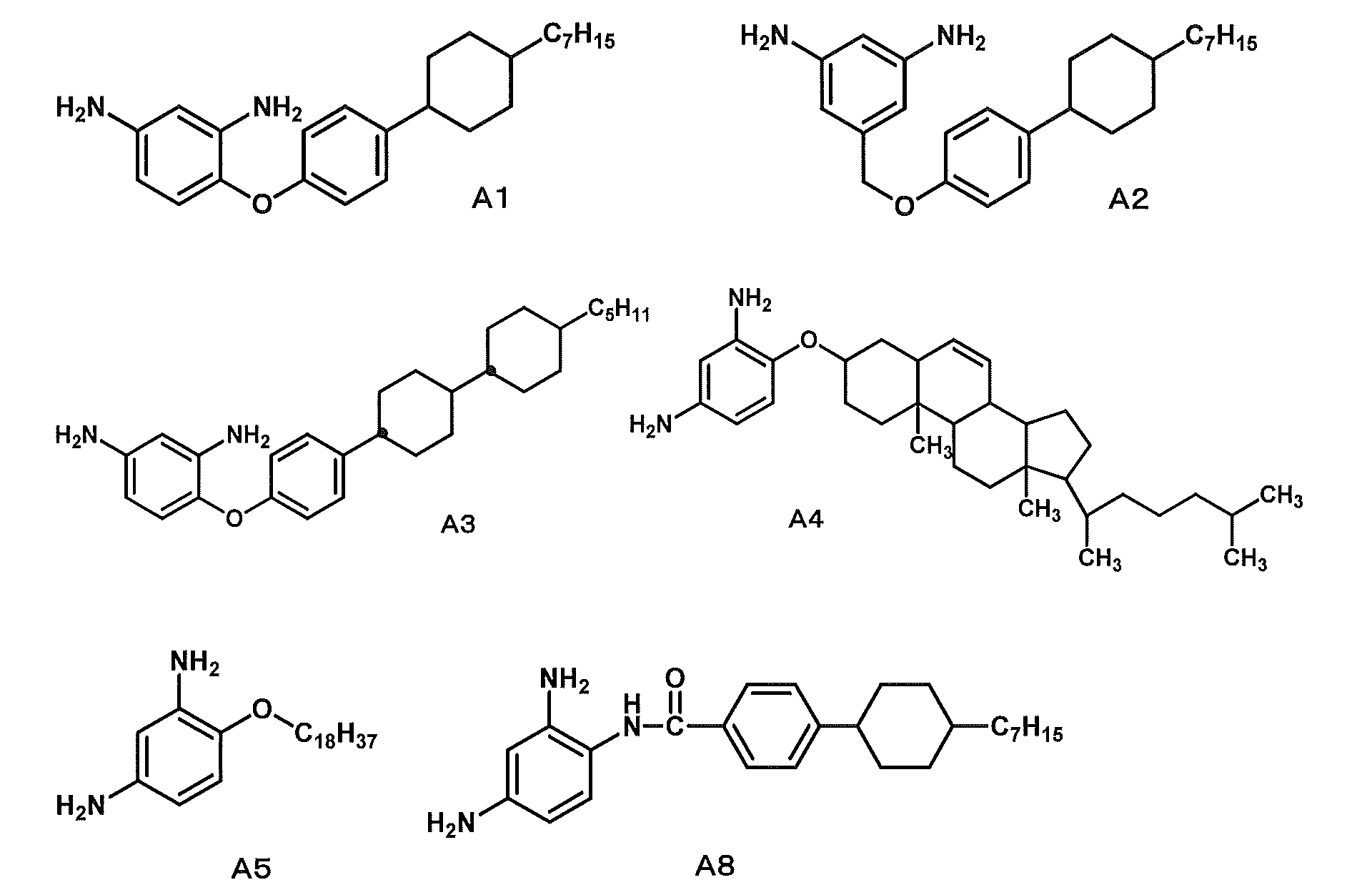
B2:2,4-ジアミノ-N,N-ジアリルアニリン(下記式[B2]で示されるジアミン化合物)
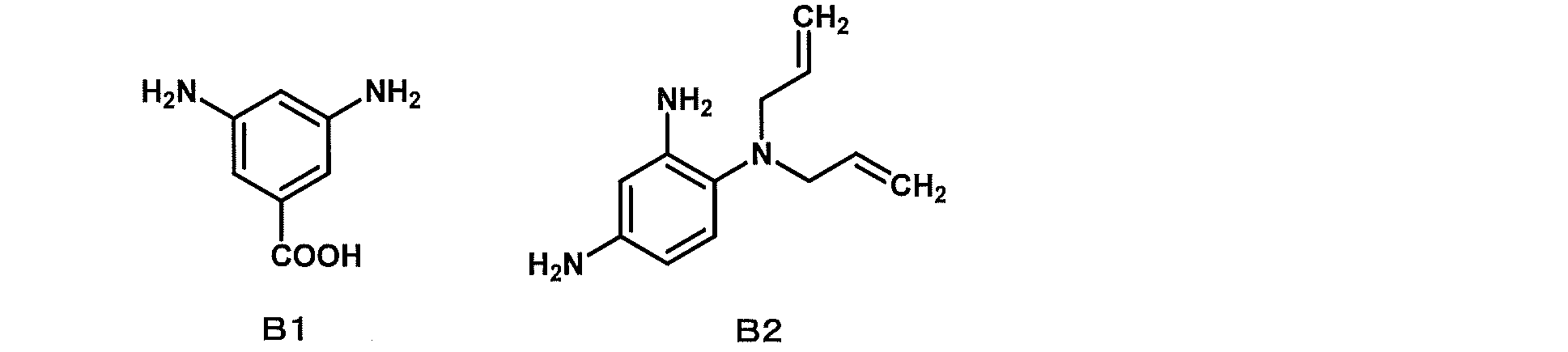
C2:m-フェニレンジアミン
C3:1,5-ビス(4-アミノフェノキシ)ペンタン
C4:1,3-ビス(4-アミノフェネチル)ウレア
C5:4-(2-(メチルアミノ)エチル)アニリン(式[C5]で表される化合物)
C6:式[C6]で表される化合物
C7:1,2-ビス(4-アミノフェノキシ)エタン
C8:4,4’-ジアミノジフェニルメタン
DA-N-A6:4,4’-ジアミノジフェニルアミン
DA-N-A7:ビス(4-アミノフェニル)-N-メチルアミン

D1:1,2,3,4-シクロブタンテトラカルボン酸二無水物
D2:ビシクロ[3,3,0]オクタン-2,4,6,8-テトラカルボン酸二無水物
D3:式[D3]で示されるテトラカルボン酸二無水物
D4:式[D4]で示されるテトラカルボン酸二無水物
D5:式[D5]で示されるテトラカルボン酸二無水物
D6:1,2,3,4-ブタンテトラカルボン酸二無水物
D7:ピロメリット酸無水物
D8:3,3’,4,4’-ビフェニルテトラカルボン酸二無水物
D9:2,4-ビス(メトキシカルボニル)シクロブタン-1,3-ジカルボン酸(式[D9]で示される化合物)
D10:2,5-ビス(メトキシカルボニル)ベンゼン-1,4-ジカルボン酸(式[10]で示される化合物。)
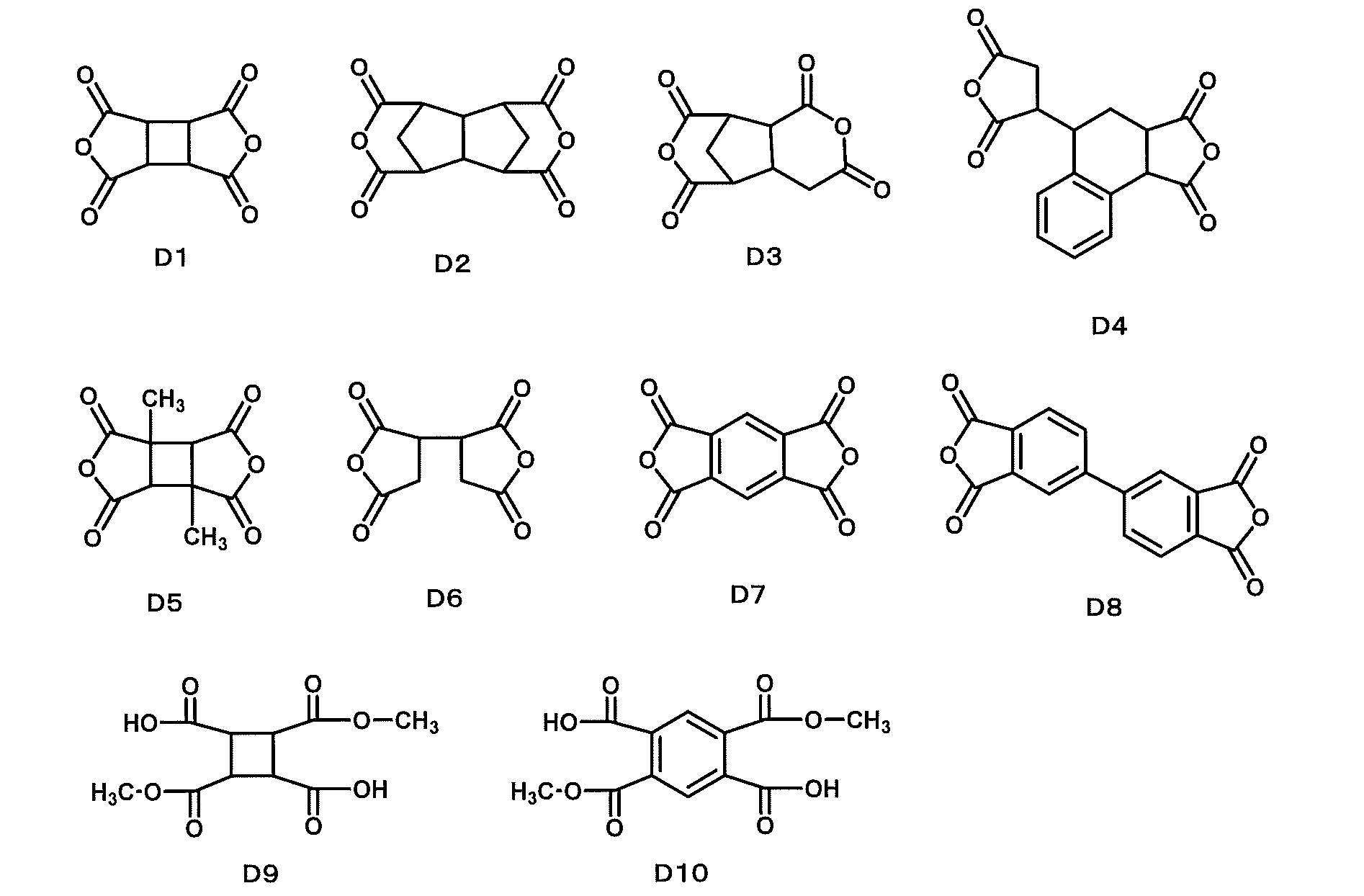
DMT-MM:4-(4,6-ジメトキシ-1,3,5-トリアジン-2-イル)-4-メチルモルホリン-4-ニウム
G-M1:式[G-M1]で示される密着性化合物
MA-M1:式[MA-M1]で示される密着性化合物

K1:式[K1]で示される化合物

NMP:N-メチル-2-ピロリドン
NEP:N-エチル-2-ピロリドン
γ-BL:γ-ブチロラクトン
DMI:1,3-ジメチル-2-イミダゾリジノン
PGME:プロピレングリコールモノメチルエーテル
ECS:エチレングリコールモノエチルエーテル
BCS:エチレングリコールモノブチルエーテル
PB:プロピレングリコールモノブチルエーテル
EC:ジエチレングリコールモノエチルエーテル
EEP:エチル-3-エトキシプロピオネート
DEDE:ジエチレングリコールジエチルエーテル
DME:ジプロピレングリコールジメチルエーテル
DEME:ジエチレングリコールジメチルエーテル
DPM:ジプロピレングリコールモノメチルエーテル
ポリイミド前駆体及びポリイミドの分子量は、常温ゲル浸透クロマトグラフィー(GPC)装置(GPC-101)(昭和電工社製)、カラム(KD-803,KD-805)(Shodex社製)を用いて、以下のようにして測定した。
カラム温度:50℃
溶離液:N,N’-ジメチルホルムアミド(添加剤として、臭化リチウム-水和物(LiBr・H2O)が30mmol/L(リットル)、リン酸・無水結晶(o-リン酸)が30mmol/L、テトラヒドロフラン(THF)が10ml/L)
流速:1.0ml/分
検量線作成用標準サンプル:TSK 標準ポリエチレンオキサイド(分子量;約900,000、150,000、100,000及び30,000)(東ソー社製)及びポリエチレングリコール(分子量;約12,000、4,000及び1,000)(ポリマーラボラトリー社製)。
ポリイミド粉末20mgをNMR(核磁気共鳴)サンプル管(NMRサンプリングチューブスタンダード,φ5(草野科学社製))に入れ、重水素化ジメチルスルホキシド(DMSO-d6,0.05質量%TMS(テトラメチルシラン)混合品)(0.53ml)を添加し、超音波をかけて完全に溶解させた。この溶液をNMR測定機(JNW-ECA500)(日本電子データム社製)にて、500MHzのプロトンNMRを測定した。イミド化率は、イミド化前後で変化しない構造に由来するプロトンを基準プロトンとして決め、このプロトンのピーク積算値と、9.5~10.0ppm付近に現れるアミド酸のNH基に由来するプロトンピーク積算値とを用い以下の式によって求めた。
イミド化率(%)=(1-α・x/y)×100
上記式において、xはアミド酸のNH基由来のプロトンピーク積算値、yは基準プロトンのピーク積算値、αはポリアミド酸(イミド化率が0%)の場合におけるアミド酸のNH基プロトン1個に対する基準プロトンの個数割合である。
<合成例1>
D1(3.32g,16.9mmol)、A1(3.26g,8.57mmol)、B1(1.04g,6.84mmol)及びC2(0.19g,1.76mmol)をNEP(23.4g)中で混合し、40℃で8時間反応させ、樹脂固形分濃度25質量%のポリアミド酸溶液(1)を得た。このポリアミド酸の数平均分子量は、23,200であり、重量平均分子量は、70,100であった。
D2(4.29g,17.1mmol)、A2(6.76g,17.1mmol)及びB1(2.61g,17.1mmol)をNMP(33.9g)中で混合し、50℃で2時間反応させた後、D1(3.29g,16.8mmol)とNMP(17.0g)を加え、40℃で6時間反応させ、樹脂固形分濃度が25質量%のポリアミド酸溶液(2)を得た。このポリアミド酸の数平均分子量は、23,800であり、重量平均分子量は、69,500であった。
合成例2の合成手法で得られたポリアミド酸溶液(2)(30.5g)に、NMPを加え6質量%に希釈した後、イミド化触媒として無水酢酸(3.90g)及びピリジン(2.41g)を加え、70℃で2時間反応させた。この反応溶液をメタノール(460ml)中に投入し、得られた沈殿物を濾別した。この沈殿物をメタノールで洗浄し、100℃で減圧乾燥しポリイミド粉末(3)を得た。このポリイミドのイミド化率は61%であり、数平均分子量は21,900であり、重量平均分子量は59,900であった。
表1に示す組成に変更した以外は、合成例2、合成例3と同様にしてポリイミド粉末(4)~(9)、(11)、及び樹脂固形分濃度が25質量%のポリアミド酸溶液(10)を得た。
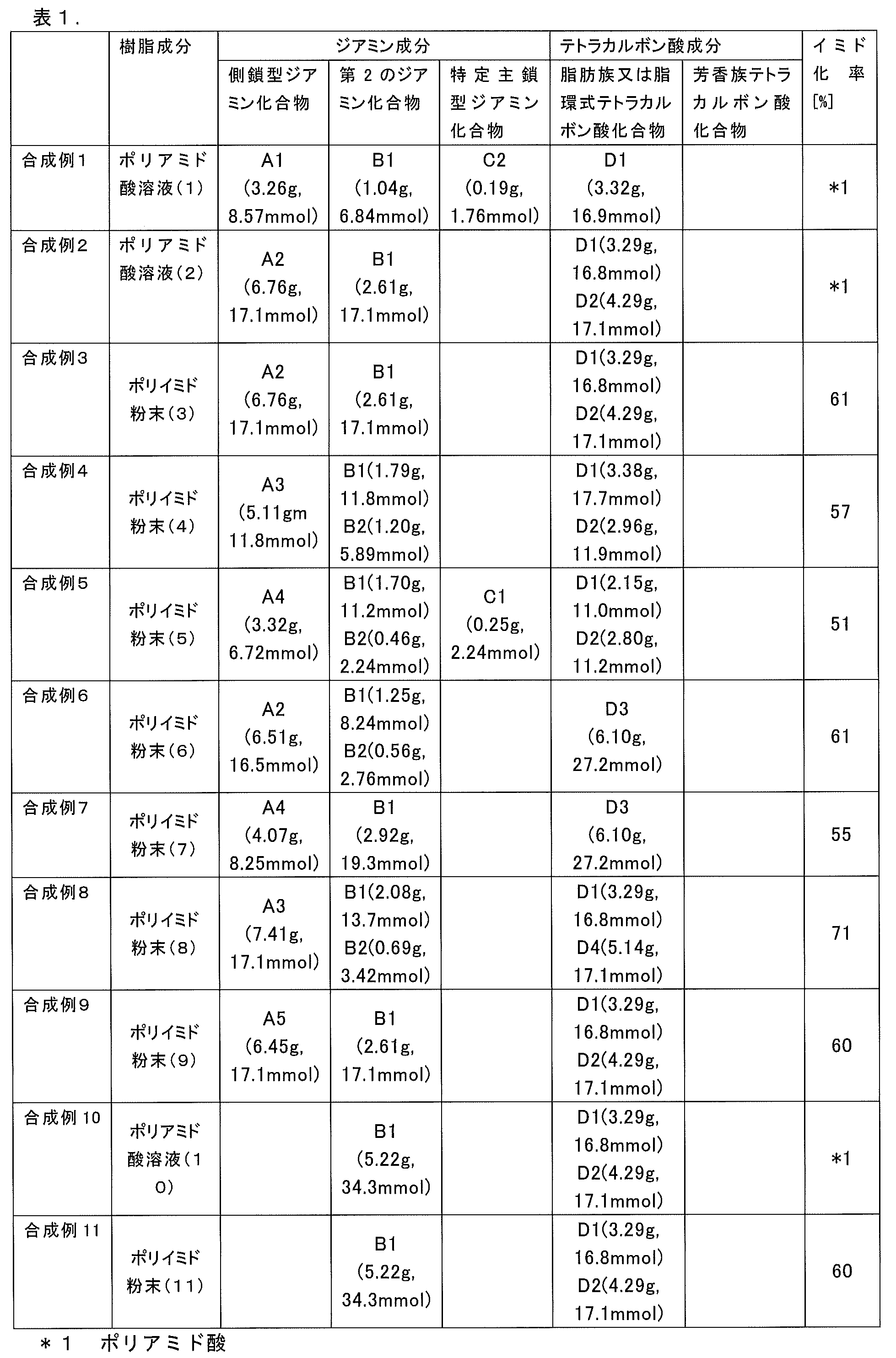
テトラカルボン酸成分としてD1(19.61g,0.1mol)、ジアミン成分としてDA-N-A6(18.73g,0.094mol)をNMP(345.1g)中で混合し、室温で5時間反応させて、樹脂固形分濃度が10質量%のポリアミド酸溶液(12)を得た。このポリアミド酸の数平均分子量は14,100であり、重量平均分子量は29,500であった。
テトラカルボン酸成分として、D1(34.47g,0.18mol)、ジアミン成分として、DA-N-A7(28.38g,0.13mol)、C3(16.40g,0.057mol)を用い、NMP(713.25g)中、室温で1時間反応させ樹脂固形分濃度が10質量%のポリアミド酸溶液(13)を得た。このポリアミド酸の数平均分子量は13,300であり、重量平均分子量は27,800であった。
テトラカルボン酸として、D9(2.03g,7.80mmol)、D10(1.02g,3.60mmol)、ジアミン成分として、C4(1.07g,3.60mmol)、C1(0.79g,7.20mmol)、A8(0.49g,1.20mmol)、塩基としてトリエチルアミン(0.61g,0.0060mol)、縮合剤としてDMT-MM(9.96g,36.0mmol)を用い、NMP(84.4g)中、室温で3.5時間反応させポリアミド酸エステル溶液を得た。
このポリアミド酸エステル溶液をメタノール550g中に投入し、沈殿した固形物を
回収した。さらに、この固形物をメタノールで数回洗浄した後、100℃で減圧乾燥して
、ポリアミド酸エステルの粉末(14)を得た。このポリアミド酸エステルの数平均分子量は16,478、重量平均分子量は39,754であった。
ジアミン成分として、C5(2.83g,18.8mmol)、C4(5.61g,18.8mmol)、およびC3(2.70g,9.40mmol)を、NMP(126g)中に加え、窒素を送りながら撹拌して溶解させた。このジアミン溶液を撹拌しながら、テトラカルボン酸成分として、D1を(8.84g,45.1mmol)を添加し、更に樹脂固形分濃度が10質量%になるようにNMPを加え、窒素雰囲気下、室温で2時間撹拌してポリアミド酸溶液(15)を得た。このポリアミド酸の数平均分子量は15,600であり、重量平均分子量は38,400であった。
ジアミン成分として、C1(45.96g,0.425mmol)及びC6(17.80g,0.075mol)を、NMP(1390g)中に加えて、窒素を送りながら撹拌し溶解させた。このジアミン溶液を撹拌しながらD5(107.83g,0.481mol)を添加し、更に樹脂固形分濃度が10質量%になるようにNMPを加え、室温で24時間撹拌してポリアミド酸溶液(16)を得た。このポリアミド酸の数平均分子量は12629、重量平均分子量は29521であった。
ジアミン成分として、C7(79.4g,0.33mol)、DA-N-A6(64.8g,0.33mol)を、NMP(911g)、及びGBL(911g)中に加え、窒素を送りながら撹拌して溶解させた。このジアミン溶液を撹拌しながら、D1(65.0g,0.33mol)を添加し、2時間室温で攪拌した後、D8(86.1g,0.29mol)を加えて、更に、NMP(390g)、及びGBL(390g)を加え、窒素雰囲気下、40℃で30時間撹拌して、樹脂固形分濃度が10%のポリアミド酸溶液(17)を得た。このポリアミド酸溶液の数平均分子量は15,773、重量平均分子量は31,242であった。

ジアミン成分として、テトラカルボン酸成分としてD4を(30.03g,0.100mol)、ジアミン成分として、C1を(9.19g,0.085mol)と、A6を(5.23g,0.015mol)とを、NMP(252g)中、50℃で24時間反応させ、樹脂固形分濃度が15質量%のポリアミド酸溶液を調製した。
このポリアミド酸溶液50gにNMPを加えて5質量%に希釈し、さらにイミド化触媒としてピリジン(8.0g)、無水酢酸(17.2g)を加え、40℃で3時間反応させた。この溶液を600mlのメタノール中に投入し、得られた沈殿物を濾別し、乾燥し、白色のポリイミド粉末(18)を得た。このポリイミドのイミド化率は、83%であり、数平均分子量が9,834、重量平均分子量が21,659であった。
テトラカルボン酸成分として、D1を(9.81g,0.05mol)と、D7を(9.60g,0.044mol)と、ジアミン成分として、C8を(19.83g,0.100mol)とを、NMP(222g)中、室温で5時間反応させ、樹脂固形分濃度が15質量%のポリアミド酸溶液(19)を調製した。このポリアミド酸は、数平均分子量が10,893、重量平均分子量が25,972であった。
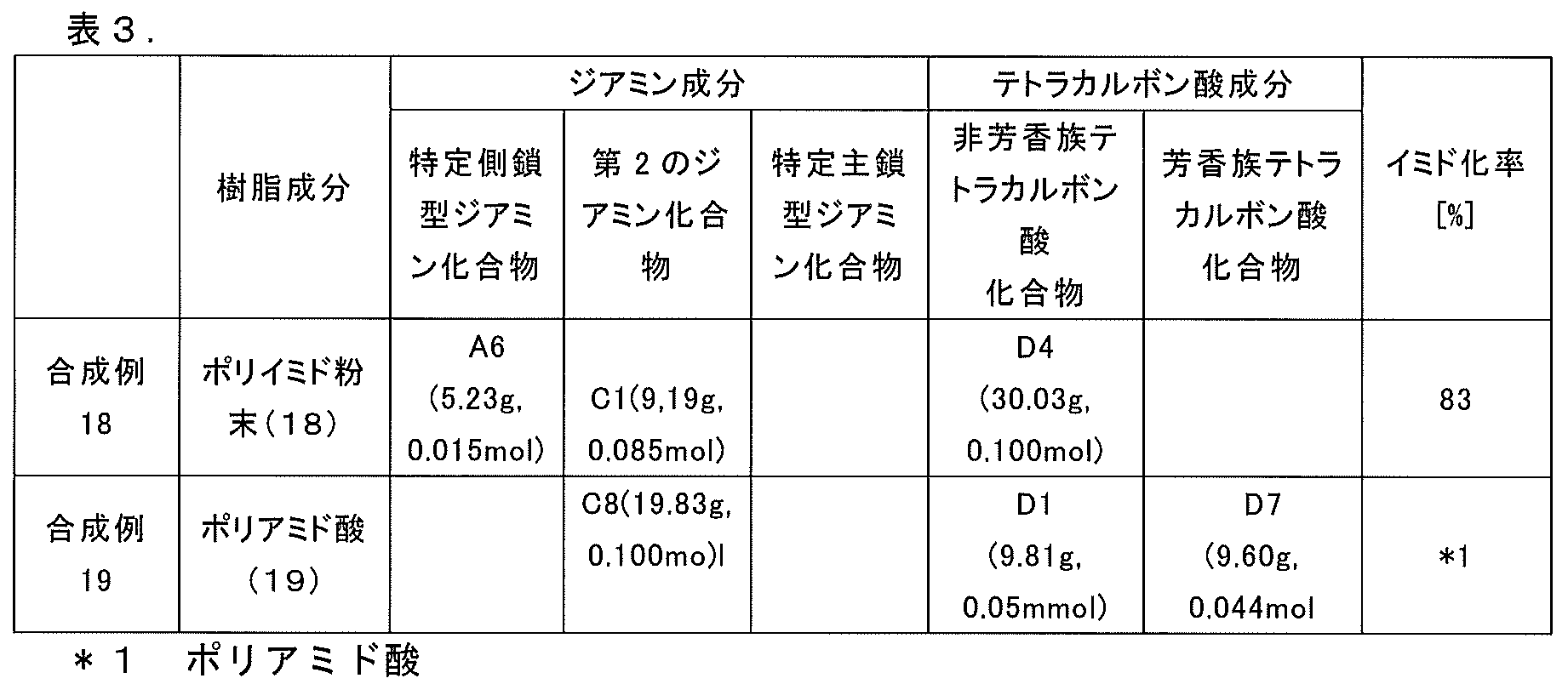
実施例及び比較例では、液晶配向処理剤の調製例を記載する。実施例及び比較例で得られた液晶配向処理剤を用い、「液晶表示素子の作製」、「液晶配向性の評価」、「液晶配向膜の密着性の評価」又は「ピール試験」を行った。
(垂直配向型液晶表示素子の作製)
実施例で得られた液晶配向処理剤(V-1)~(V-9)及び比較例で得られた液晶配向処理剤(R-V1)~(R-V2)を、細孔径1μmのメンブランフィルタで加圧濾過した。得られた溶液を純水及びIPA(イソプロピルアルコール)で洗浄した100×100mmのITO電極付きガラス基板(縦:100mm、横:100mm、厚さ:0.7mm)のITO面上にスピンコートし、ホットプレート上にて100℃で2分間、熱循環型クリーンオーブンにて210℃で10分間加熱処理をして、膜厚が100nmの液晶配向膜付きのITO基板を得た。得られた液晶配向膜付きのITO基板を2枚用意し、その一方の基板の液晶配向膜面に、6μmのスペーサーを塗布した。
次に、シール剤(協立化学製XN-1500T)で周囲を塗布した。その後、その基板の液晶配向膜面に、ODF(One Drop Filling)法にて前記液晶組成物(LC-V1)を滴下し、次いで、他方の基板の液晶配向膜界面が向き合うように貼り合わせを行い、シール剤を硬化させて垂直配向型液晶表示素子を得た。得られた液晶表示素子を110℃で1時間加熱して、一晩室温で放置してから各評価に使用した。
<ラビング配向処理>
実施例で得られた液晶配向処理剤(I-10)~(I-13)、(I-15)~(I-18)及び比較例で得られた液晶配向処理剤(R-I3)~(R-I4)を、細孔径1μmのメンブランフィルタで加圧濾過した。
次に、国際公開公報(WO2014-084364)の段落[0060]~[0062]に記載の、電極付き基板及び裏面にITO膜が成膜されている高さ4μmの柱状スペーサーを有するガラス基板を準備し、純水及びIPA(イソプロピルアルコール)で洗浄した。
前記加圧濾過した液晶配向剤を、前記基板上にスピンコートし、ホットプレート上にて80℃で2分間、熱循環型クリーンオーブンにて230℃で30分間加熱処理をして、膜厚が100nmの塗膜基板を得た。
上記、2枚の基板を一組とし、基板上にシール剤を印刷し、もう1枚の基板を、液晶配向膜面が向き合い、且つ、配向方向が0°になるようにして張り合わせた後、シール剤を硬化させた。次に減圧注入法によって、前記液晶組成物(LC-I1)を注入し、注入口を封止して、FFS型液晶表示素子を得た。得られた液晶表示素子を110℃で1時間加熱して、一晩室温で放置してから各評価に使用した。
実施例で得られた液晶配向処理剤(I-14)を、細孔径1μmのメンブランフィルタで加圧濾過した。
次に、国際公開公報(WO2014-084364)の段落[0060]~[0062]に記載の、電極付き基板及び裏面にITO膜が成膜されている高さ4μmの柱状スペーサーを有するガラス基板を準備し、純水及びIPA(イソプロピルアルコール)で洗浄した。
前記加圧濾過した液晶配向剤を、前記基板上にスピンコートし、ホットプレート上にて80℃で2分間、熱循環型クリーンオーブンにて230℃で30分間加熱処理をして、膜厚が100nmの塗膜基板を得た。
(液晶配向性)
液晶表示素子の液晶配向性は、偏光顕微鏡(ECLIPSE E600WPOL)(ニコン社製)で観察し、液晶が水平又は垂直に配向しているかどうかを確認した。具体的には、液晶の流動による不良が見られていないものを、良好とした。
液晶表示素子の液晶配向性の評価の結果は、表3にまとめて示した。
実施例で得られた液晶配向処理剤(V-1)~(V-6)、(I-7)~(I-13)及び比較例で得られた液晶配向処理剤(R-V1)~(R-V2)を、細孔径1μmのメンブランフィルタで加圧濾過した。前記液晶配向処理剤を純水及びIPA(イソプロピルアルコール)で洗浄した100×100mmのITO電極付きガラス基板(縦:100mm、横:100mm、厚さ:0.7mm)上に塗布し、ホットプレート上にて80℃で2分間、比較例3,7以外は、熱循環型クリーンオーブンにて120℃で10分間の加熱処理を、比較例3,7については210℃で10分間加熱処理をして、膜厚が100nmの液晶配向膜付きのITO基板を2枚作製した。片方の基板に、6μmビーズスペーサーを塗布し、更に、もう一方の基板の液晶配向膜上にシール剤(協立化学製XN-1500T)を印刷し、これら基板を、基板の重なり幅が1cmになるように、貼り合わせを行った。その際、シール剤の量は、貼り合わせ後のシール剤の直径が3mmとなるように調整した。貼り合わせた2枚の基板をクリップにて固定した後、150℃1時間熱硬化させて、本評価用のテストサンプル基板を作製した。
評価は、前記剥離応力(N)の値が大きいものほど、シール剤及び下地基板との密着性が優れている(表3に、剥離応力(N)の値を示す)。
合成例1で得られた樹脂固形分濃度25質量%のポリアミド酸溶液(1)(7.43g)に、NEP(22.7g)、及びBCS(20.8g)を加え、50℃で5時間攪拌した。その後、この溶液に、MA-M1(0.56g)を加え、25℃で2時間攪拌して、液晶配向処理剤(V-1)を得た。この液晶配向処理剤に、濁りや析出などの異常は見られず、均一な溶液であることが確認された。
得られた液晶配向処理剤(V-1)を用いて、液晶表示素子の作製、液晶配向性の評価、液晶配向膜の密着性の評価を行った。
以下の実施例2~16、及び比較例1~8についても同様に、液晶表示素子の作製、及び各種評価を行った。実施例及び比較例の結果は、まとめて、表3に示した。
合成例2で得られた樹脂固形分濃度25質量%のポリアミド酸溶液(2)(9.80g)に、NMP(27.3g)、及びBCS(25.5g)を加え、50℃で5時間攪拌した。その後、この溶液に、G-M1(0.74g)を加え、25℃で2時間攪拌して、液晶配向処理剤(V-2)を得た。この液晶配向処理剤に、濁りや析出などの異常は見られず、均一な溶液であることが確認された。
得られた液晶配向処理剤(V-2)を用いて、液晶表示素子の作製、液晶配向性の評価、液晶配向膜の密着性の評価を行った。
実施例2の手法で得られた液晶配向処理剤を用いて、ピール試験を行った。
合成例3で得られたポリイミド粉末(3)(2.33g)に、NMP(35.4g)及びBCS(24.2g)を加え、70℃で24時間攪拌して溶解させた。その後、この溶液に、MA-M1(0.23g)を加え、25℃で2時間攪拌して、液晶配向処理剤(V-3)を得た。この液晶配向処理剤に、濁りや析出などの異常は見られず、均一な溶液であることが確認された。
得られた液晶配向処理剤(V-3)を用いて、液晶表示素子の作製、液晶配向性の評価、液晶配向膜の密着性の評価を行った。
実施例4の手法で得られた液晶配向処理剤(V-3)を用いて、ピール試験を行った。
合成例3で得られたポリイミド粉末(3)(1.86g)に、NEP(32.8g)及びPB(18.2g)を加え、70℃で24時間攪拌して溶解させた。その後、この溶液に、MA-M1(0.09g)を加え、25℃で2時間攪拌して、液晶配向処理剤(V-4)を得た。この液晶配向処理剤に、濁りや析出などの異常は見られず、均一な溶液であることが確認された。
得られた液晶配向処理剤(V-4)を用いて、液晶表示素子の作製、液晶配向性の評価、液晶配向膜の密着性の評価を行った。
合成例3で得られたポリイミド粉末(3)(1.65g)に、γ-BL(6.40g)及びPGME(42.5g)を加え、70℃で24時間攪拌して溶解させた。その後、この溶液に、G-M1(0.08g)及びK1(0.08g)を加え、25℃で2時間攪拌して、液晶配向処理剤(V-5)を得た。この液晶配向処理剤に、濁りや析出などの異常は見られず、均一な溶液であることが確認された。
得られた液晶配向処理剤(V-5)を用いて、液晶表示素子の作製、液晶配向性の評価、液晶配向膜の密着性の評価を行った。
合成例4で得られたポリイミド粉末(4)(2.55g)に、NEP(34.0g)、BCS(12.4g)及びPB(14.6g)を加え、70℃で24時間攪拌して溶解させた。その後、この溶液に、MA-M1(0.08g)を加え、25℃で2時間攪拌して、液晶配向処理剤(V-6)を得た。この液晶配向処理剤に、濁りや析出などの異常は見られず、均一な溶液であることが確認された。
得られた液晶配向処理剤(V-6)を用いて、液晶表示素子の作製、液晶配向性の評価、液晶配向膜の密着性の評価を行った。
合成例3で得られたポリイミド粉末(3)(1.65g)に、γ-BL(6.40g)及びPGME(42.5g)を加え、70℃で24時間攪拌して溶解させた。その後、この溶液に、MA-M1(0.05g)を加え、25℃で2時間攪拌して、液晶配向処理剤(V-7)を得た。この液晶配向処理剤に、濁りや析出などの異常は見られず、均一な溶液であることが確認された。
得られた液晶配向処理剤(V-7)を用いて、液晶表示素子の作製、液晶配向性の評価、液晶配向膜の密着性の評価を行った。
合成例3で得られたポリイミド粉末(3)(1.65g)に、γ-BL(6.40g)及びPGME(42.5g)を加え、70℃で24時間攪拌して溶解させた。その後、この溶液に、MA-M1(0.08g)及びK1(0.08g)を加え、25℃で2時間攪拌して、液晶配向処理剤(V-8)を得た。この液晶配向処理剤に、濁りや析出などの異常は見られず、均一な溶液であることが確認された。
得られた液晶配向処理剤(V-8)を用いて、液晶表示素子の作製、液晶配向性の評価、液晶配向膜の密着性の評価を行った。
合成例3で得られたポリイミド粉末(3)(1.65g)に、γ-BL(6.40g)及びPGME(42.5g)を加え、70℃で24時間攪拌して溶解させた。その後、この溶液に、MA-M1(0.08g)及びG-M1(0.08g)を加え、25℃で2時間攪拌して、液晶配向処理剤(V-9)を得た。この液晶配向処理剤に、濁りや析出などの異常は見られず、均一な溶液であることが確認された。
得られた液晶配向処理剤(V-9)を用いて、液晶表示素子の作製、液晶配向性の評価、液晶配向膜の密着性の評価を行った。
合成例12で得られた樹脂固形分濃度10質量%のポリアミド酸溶液(12)(20.0g)に、GBL(6.00g)、DMI(6.00g)、及びEEP(8.00g)を加え、50℃で5時間攪拌した。その後、この溶液に、MA-M1(0.60g)を加え、25℃で2時間攪拌して、液晶配向処理剤(I-10)を得た。この液晶配向処理剤に、濁りや析出などの異常は見られず、均一な溶液であることが確認された。
得られた液晶配向処理剤(I-10)を用いて、液晶表示素子の作製、液晶配向性の評価、液晶配向膜の密着性の評価を行った。
合成例13で得られた樹脂固形分濃度10質量%のポリアミド酸溶液(13)(20.0g)に、GBL(12.0g)及びDEDE(8.00g)を加え、50℃で5時間攪拌した。その後、この溶液に、G-M1(0.60g)を加え、25℃で2時間攪拌して、液晶配向処理剤(I-11)を得た。この液晶配向処理剤に、濁りや析出などの異常は見られず、均一な溶液であることが確認された。
得られた液晶配向処理剤(I-11)を用いて、液晶表示素子の作製、液晶配向性の評価、液晶配向膜の密着性の評価を行った。
合成例14で得られたポリアミド酸エステルの粉末(14)(2.0g)に、GBL(30.0g)及びDME(8.00g)を加え、50℃で5時間攪拌した。その後、この溶液に、MA-M1(0.20g)を加え、25℃で2時間攪拌して、液晶配向処理剤(I-12)を得た。この液晶配向処理剤に、濁りや析出などの異常は見られず、均一な溶液であることが確認された。
得られた液晶配向処理剤(I-12)を用いて、液晶表示素子の作製、液晶配向性の評価、液晶配向膜の密着性の評価を行った。
合成例15で得られた樹脂固形分濃度10質量%のポリアミド酸溶液(15)(20.0g)に、GBL(12.0g)及びDEME(8.00g)を加え、50℃で5時間攪拌した。その後、この溶液に、G-M1(0.20g)を加え、25℃で2時間攪拌して、液晶配向処理剤(I-13)を得た。この液晶配向処理剤に、濁りや析出などの異常は見られず、均一な溶液であることが確認された。
得られた液晶配向処理剤(I-13)を用いて、液晶表示素子の作製、液晶配向性の評価、液晶配向膜の密着性の評価を行った。
合成例16で得られた樹脂固形分濃度10質量%のポリアミド酸溶液(16)(20.0g)に、GBL(12.0g)及びDEME(8.00g)を加え、50℃で5時間攪拌した。その後、この溶液に、MA-M1(0.10g)を加え、25℃で2時間攪拌して、液晶配向処理剤(I-14)を得た。この液晶配向処理剤に、濁りや析出などの異常は見られず、均一な溶液であることが確認された。
得られた液晶配向処理剤(I-14)を用いて、液晶表示素子の作製、液晶配向性の評価、液晶配向膜の密着性の評価を行った。
合成例17で得られた樹脂固形分濃度10質量%のポリアミド酸溶液(17)(20.0g)に、GBL(16.0g)及びDPM(4.00g)を加え、50℃で5時間攪拌した。その後、この溶液に、G-M1(0.10g)を加え、25℃で2時間攪拌して、液晶配向処理剤(I-15)を得た。この液晶配向処理剤に、濁りや析出などの異常は見られず、均一な溶液であることが確認された。
得られた液晶配向処理剤(I-15)を用いて、液晶表示素子の作製、液晶配向性の評価、液晶配向膜の密着性の評価を行った。
表3に示す組成になるように、実施例17と同様にして、密着性化合物、その他の密着性化合物を添加して、液晶配向処理剤(I-16)~(I-18)を得た。この液晶配向処理剤に、濁りや析出などの異常は見られず、均一な溶液であることが確認された。
得られた液晶配向処理剤(I-16)~(I-18)を用いて、液晶表示素子の作製、液晶配向性の評価、液晶配向膜の密着性の評価を行った。
K1の代わりにK2を用いた以外は、実施例7と同様にして、液晶配向剤(V-19)を得た。この液晶配向処理剤に、濁りや析出などの異常は見られず、均一な溶液であることが確認された。
得られた液晶配向処理剤(V-19)を用いて、液晶表示素子の作製、液晶配向性の評価、液晶配向膜の密着性の評価を行った
K1の代わりにK2を用いた以外は、実施例10と同様にして、液晶配向剤(V-20)を得た。この液晶配向処理剤に、濁りや析出などの異常は見られず、均一な溶液であることが確認された。
得られた液晶配向処理剤(V-20)を用いて、液晶表示素子の作製、液晶配向性の評価、液晶配向膜の密着性の評価を行った
合成例18で得られたポリイミド粉末(18)3.00gをGBL(34.50g)中、50℃にて、50℃にて20時間攪拌し溶解させた。
さらにこの溶液中のポリイミドの濃度が6質量%になるようにGBLを加え、50℃にて20h攪拌した。
合成例19で得られた樹脂固形分濃度が15質量%のポリアミド酸溶液(19)(40.0g)に、NMP、GBL、BCSを加え、ポリアミック酸が6質量%、NMPが20質量%、GBLが59質量%、BCSが15質量%になるよう調製した。
上記で調製したポリイミド液20gと、ポリアミド酸の希釈液80gとを混合し、室温で20時間攪拌し、更に、G-M1を(0.30g)加えて、液晶配向剤(T-20)を得た。液晶配向処理剤液晶配向剤に、濁りや析出などの異常は見られず、均一な溶液であることが確認された。
得られた液晶配向剤(T-21)を用いて、配向方向が90°となるようにして貼り合わせた以外は、実施例16と同様にして液晶表示素子、及び密着性評価用基板を得て、液晶表示素子の作製、液晶配向性の評価、液晶配向膜の密着性の評価を行った。
G-M1の代わりにMA-M1を用いた以外は、実施例23と同様にして液晶配向処理剤(T-22)を得た。液晶配向処理剤液晶配向剤に、濁りや析出などの異常は見られず、均一な溶液であることが確認された。
得られた液晶配向剤(T-22)を用いて、液晶表示素子の作製、液晶配向性の評価、液晶配向膜の密着性の評価を行った。
合成例1で得られた樹脂固形分濃度25質量%のポリアミド酸溶液(1)(7.43g)に、NEP(22.7g)、及びBCS(20.8g)を加え、50℃で5時間攪拌して、液晶配向処理剤(R-V1)を得た。この液晶配向処理剤に、濁りや析出などの異常は見られず、均一な溶液であることが確認された。
得られた液晶配向処理剤(R-V1)を用いて、液晶表示素子の作製、液晶配向性の評価、液晶配向膜の密着性の評価を行った。
合成例1で得られた樹脂固形分濃度25質量%のポリアミド酸溶液(1)(7.43g)に、NEP(22.7g)、及びBCS(20.8g)を加え、50℃で5時間攪拌した。その後、この溶液に、K1(0.18g)を加え、25℃で2時間攪拌して、液晶配向処理剤(R-V2)を得た。この液晶配向処理剤に、濁りや析出などの異常は見られず、均一な溶液であることが確認された。
得られた液晶配向処理剤(R-V2)を用いて、液晶表示素子の作製、液晶配向性の評価、液晶配向膜の密着性の評価を行った。
熱循環型クリーンオーブンの温度を210℃にして10分間加熱処理をした以外は、比較例2と同様にして、液晶表示素子の作製、液晶配向性の評価、液晶配向膜の密着性の評価を行った。
比較例1の手法で得られた液晶配向処理剤を用いて、ピール試験を行った。
合成例12で得られた樹脂固形分濃度10質量%のポリアミド酸溶液(12)(20.0g)に、GBL(6.00g)、DMI(6.00g)、及びEEP(8.00g)を加え、50℃で5時間攪拌して、液晶配向処理剤(R-I3)を得た。この液晶配向処理剤に、濁りや析出などの異常は見られず、均一な溶液であることが確認された。
得られた液晶配向処理剤(R-I3)を用いて、ピール試験を行った。
合成例12で得られた樹脂固形分濃度10質量%のポリアミド酸溶液(12)(20.0g)に、GBL(6.00g)、DMI(6.00g)、及びEEP(8.00g)を加え、50℃で5時間攪拌した。その後、この溶液に、K1(0.20g)を加え、25℃で2時間攪拌して、液晶配向処理剤(R-I4)を得た。この液晶配向処理剤に、濁りや析出などの異常は見られず、均一な溶液であることが確認された。
得られた液晶配向処理剤(R-I4)を用いて、液晶表示素子の作製、液晶配向性の評価、液晶配向膜の密着性の評価を行った。
熱循環型クリーンオーブンの温度を210℃にして10分間加熱処理をした以外は、比較例6と同様にして、液晶表示素子の作製、液晶配向性の評価、液晶配向膜の密着性の評価を行った。
合成例12で得られた樹脂固形分濃度10質量%のポリアミド酸溶液(12)(20.0g)に、GBL(6.00g)、DMI(6.00g)、及びEEP(8.00g)を加え、50℃で5時間攪拌した。その後、この溶液に、K1(0.60g)を加え、25℃で2時間攪拌して、液晶配向処理剤(R-I5)を得た。この液晶配向処理剤に、濁りや析出などの異常は見られず、均一な溶液であることが確認された。
得られた液晶配向処理剤(R-I5)を用いて、液晶表示素子の作製、液晶配向性の評価、液晶配向膜の密着性の評価を行った。なお、実施例3、5及び比較例4については、ピール試験を行った。ピール試験は次のように行った。
G-M1を加えなかった以外は、実施例23と同様にして液晶配向剤(R-T6)を得た。この配向処理剤に、濁りや析出などの異常は見られず、均一な溶液であることが確認された。
得られた液晶配向処理剤(R-T6)を用いて、液晶表示素子の作製、液晶配向性の評価、液晶配向膜の密着性の評価を行った。
実施例で得られた液晶配向処理剤()及び比較例で得られた液晶配向処理剤()を、細孔径1μmのメンブランフィルタで加圧濾過した。
前記液晶配向処理剤を100×100mmのITO電極付きPETフィルム基板(縦:100mm、横:100mm、厚さ:50um)上に塗布し、ホットプレート上にて120℃で5分間の加熱処理をした後に100×20mmの大きさに切り取り、膜厚が100nmの液晶配向膜付きのITO基板を2枚作製した。
片方の基板に、30μmビーズスペーサーを塗布し、更に、もう一方の基板の液晶配向膜上にシール剤(三井化学製723K1)を印刷し、これらの基板を重なるように貼り合わせた。その際、シール剤の量は、貼り合わせ後のシール剤の面積が50×10mmとなるように調整した。
その後、本テストサンプル基板を、卓上形精密万能試験機(AGS-X 500N)(島津製作所社製)にて、上下基板の端の部分を固定した後、上方向に引っ張る際の応力(N/25mm)、すなわちピール強度(N/25mm)を測定した。
評価は、前記ピール強度(N/25mm)の値が大きいものほど、シール剤及び下地基板との密着性が優れている(表3に、ピール強度(N/25mm)の値を示す)。


具体的には、本発明の密着性化合物を含む実施例と含まない比較例との比較、すなわち、実施例1と比較例1との比較、実施例12と比較例6~8との比較である。
また、垂直配向性を有するジアミン(表中、側鎖型ジアミン)を用いた液晶配向処理剤から得られる液晶配向膜に比べて、水平配向性を有するジアミン(主鎖型ジアミン)を用いた液晶配向処理剤から得られる液晶配向膜の密着性が高い結果となった。具体的には、実施例1と実施例12との比較である。
加えて、本発明の液晶配向処理剤に、その他の密着性化合物を導入すると、液晶配向膜との密着性が、より優れた液晶表示素子となった。具体的には、実施例6と実施例7及び実施例10との比較である。
Claims (7)
- (A) ポリイミド、ポリアミック酸、ポリアミック酸エステル、ポリオルガノシロキサン、ポリエステル、ポリアミド、及び重合性不飽和結合を有するモノマーの重合体からなる群より選ばれる少なくとも一種の重合体;
(B) 下記式[CL-1]で表される化合物;及び下記式[CL-2]で表される化合物;からなる群から選ばれる少なくとも1種の化合物
(式[CL-1]中、r1は水素原子またはメチル基を表し、
r2は炭素数2~20の直鎖又は分岐鎖のアルキレン基、炭素数5~6の脂肪族環からなる2価の有機基、又は炭素数5~6の脂肪族環を含む2価の脂肪族基を表し、これらの基はその構造中の-CH2-が-O-で置換されていてもよく、
r3は炭素数2~20のk価の直鎖又は分岐鎖の脂肪族基、炭素数5~6の脂肪族環からなるk価の基、又は炭素数5~6の脂肪族環を含むk価の脂肪族基を表し、これらの基はその構造中の-CH2-が-O-で置換されていてもよく、
Zは下記式(1a)
(式中、r4は炭素数1~20の直鎖又は分岐鎖のアルキル基、炭素数5~6の脂肪族環からなる1価の基、又は炭素数5~6の脂肪族環を含む1価の脂肪族基を表し、これらの基はその構造中の-CH2-が-O-で置換されていてもよく、
*1及び*2は、いずれか一方が窒素原子との結合手を、他方がr3との結合手を示す。)で表される2価の基を示し、
kは2以上9以下の自然数である。
式[CL-2]中、RCL1は水素原子またはメチル基であり、
RCL2及びRCL3は互いに独立して、水素原子、炭素数1から20の直鎖又は分岐鎖のアルキル基または炭素数1から20の直鎖又は分岐鎖のヒドロキシルアルキル基であり、
RCL4は、ヒドロキシル基または炭素数1から20の直鎖又は分岐鎖のヒドロキシルアルキル基である。);及び
(C)有機溶媒;を含有する液晶配向剤。

- (A)成分が、ポリイミド、ポリアミック酸、ポリアミック酸エステル、重合性不飽和結合を有するモノマーの重合体からなる群から選ばれる少なくとも一種の重合体である、請求項1に記載の液晶配向剤。
- (A)成分が、テトラカルボン酸二無水物、テトラカルボン酸ジエステル及びテトラカルボン酸ジエステルジハロゲン化物よりなる群から選ばれる少なくとも一種であるテトラカルボン酸誘導体と、ジアミンとを反応させて得られる重合体であり、
前記テトラカルボン酸誘導体は、シクロブタン環構造、シクロペンタン環構造及びシクロヘキサン環構造、ベンゼン環構造よりなる群から選ばれる少なくとも一種を有する化合物を含む、請求項1又は2に記載の液晶配向剤。 - (C)成分が、下記式(Sol-1)及び(Sol-2)
(式(Sol-1)中、Ys 7及びYs 8はそれぞれ独立に水素原子又は炭素数1~6の1価の炭化水素基であり、
Xs 1は酸素原子又は-COO-であり、
Xs 2は単結合又はカルボニル基であり、
Rs 7は炭素数2~4のアルカンジイル基であり、
ns 1は1~3の整数である(ns 1が2又は3の場合、複数のRs 7は同じでも異なっていてもよい)。
式(Sol-2)中、Zs 1は炭素数1~6の2価の炭化水素基であり、
Ys 9及びYs 10はそれぞれ独立に水素原子又は炭素数1~6の1価の炭化水素基である。)
からなる群から選ばれる少なくとも一種を有する、請求項1~3のいずれか一項に記載の液晶配向剤。

- 請求項1~4のいずれか一項に記載の液晶配向剤を用いて形成された液晶配向膜。
- 請求項1~4のいずれか一項に記載の液晶配向剤を基板上に塗布して塗膜を形成する工程と、前記塗膜が液晶層と接触していない状態で又は液晶層と接触した状態で前記塗膜に光照射する工程と、を含む液晶配向膜の製造方法。
- 請求項5に記載の液晶配向膜;又は請求項6に記載の製造方法により得られた液晶配向膜;を具備する液晶表示素子。
Priority Applications (4)
| Application Number | Priority Date | Filing Date | Title |
|---|---|---|---|
| JP2018559568A JP7139950B2 (ja) | 2016-12-28 | 2017-12-27 | 液晶配向剤、液晶配向膜、及び液晶表示素子 |
| KR1020197021827A KR102548025B1 (ko) | 2016-12-28 | 2017-12-27 | 액정 배향제, 액정 배향막, 및 액정 표시 소자 |
| CN202411849305.XA CN119614213A (zh) | 2016-12-28 | 2017-12-27 | 液晶取向剂、液晶取向膜和液晶表示元件 |
| CN201780087533.XA CN110352381A (zh) | 2016-12-28 | 2017-12-27 | 液晶取向剂、液晶取向膜和液晶表示元件 |
Applications Claiming Priority (2)
| Application Number | Priority Date | Filing Date | Title |
|---|---|---|---|
| JP2016-255577 | 2016-12-28 | ||
| JP2016255577 | 2016-12-28 |
Publications (1)
| Publication Number | Publication Date |
|---|---|
| WO2018124166A1 true WO2018124166A1 (ja) | 2018-07-05 |
Family
ID=62710642
Family Applications (1)
| Application Number | Title | Priority Date | Filing Date |
|---|---|---|---|
| PCT/JP2017/046853 Ceased WO2018124166A1 (ja) | 2016-12-28 | 2017-12-27 | 液晶配向剤、液晶配向膜、及び液晶表示素子 |
Country Status (5)
| Country | Link |
|---|---|
| JP (1) | JP7139950B2 (ja) |
| KR (1) | KR102548025B1 (ja) |
| CN (2) | CN110352381A (ja) |
| TW (1) | TWI767970B (ja) |
| WO (1) | WO2018124166A1 (ja) |
Cited By (1)
| Publication number | Priority date | Publication date | Assignee | Title |
|---|---|---|---|---|
| CN114502695A (zh) * | 2019-10-07 | 2022-05-13 | 日产化学株式会社 | 液晶取向剂、液晶取向膜、以及液晶显示元件 |
Families Citing this family (2)
| Publication number | Priority date | Publication date | Assignee | Title |
|---|---|---|---|---|
| CN114761866B (zh) * | 2019-12-06 | 2024-07-30 | 日产化学株式会社 | 液晶取向剂、液晶取向膜、液晶显示元件以及液晶显示元件的制造方法 |
| JP7819636B2 (ja) | 2021-01-14 | 2026-02-25 | 日産化学株式会社 | 液晶配向剤、液晶配向膜、及び液晶表示素子 |
Citations (2)
| Publication number | Priority date | Publication date | Assignee | Title |
|---|---|---|---|---|
| WO2014073658A1 (ja) * | 2012-11-08 | 2014-05-15 | 日産化学工業株式会社 | 硬化膜を形成したフィルム、配向材および位相差材 |
| WO2016143865A1 (ja) * | 2015-03-11 | 2016-09-15 | 日産化学工業株式会社 | 硬化膜形成組成物、配向材及び位相差材 |
Family Cites Families (6)
| Publication number | Priority date | Publication date | Assignee | Title |
|---|---|---|---|---|
| JPH11119225A (ja) | 1997-10-20 | 1999-04-30 | Sumitomo Bakelite Co Ltd | 液晶配向膜 |
| JP4985609B2 (ja) * | 2007-12-26 | 2012-07-25 | Jnc株式会社 | 液晶配向剤、液晶配向膜及び液晶表示素子 |
| WO2012121259A1 (ja) | 2011-03-07 | 2012-09-13 | 日産化学工業株式会社 | 組成物、液晶配向処理剤、液晶配向膜、及び液晶表示素子 |
| KR102184058B1 (ko) * | 2013-02-28 | 2020-11-27 | 닛산 가가쿠 가부시키가이샤 | 중합체, 액정 배향 처리제, 액정 배향막 및 액정 표시 소자 |
| CN105849630B (zh) * | 2013-10-23 | 2019-06-07 | 日产化学工业株式会社 | 液晶取向剂、液晶取向膜和液晶表示元件 |
| WO2015129890A1 (ja) | 2014-02-28 | 2015-09-03 | 日産化学工業株式会社 | 硬化膜形成組成物、配向材および位相差材 |
-
2017
- 2017-12-27 CN CN201780087533.XA patent/CN110352381A/zh active Pending
- 2017-12-27 JP JP2018559568A patent/JP7139950B2/ja active Active
- 2017-12-27 WO PCT/JP2017/046853 patent/WO2018124166A1/ja not_active Ceased
- 2017-12-27 KR KR1020197021827A patent/KR102548025B1/ko active Active
- 2017-12-27 TW TW106145948A patent/TWI767970B/zh active
- 2017-12-27 CN CN202411849305.XA patent/CN119614213A/zh active Pending
Patent Citations (2)
| Publication number | Priority date | Publication date | Assignee | Title |
|---|---|---|---|---|
| WO2014073658A1 (ja) * | 2012-11-08 | 2014-05-15 | 日産化学工業株式会社 | 硬化膜を形成したフィルム、配向材および位相差材 |
| WO2016143865A1 (ja) * | 2015-03-11 | 2016-09-15 | 日産化学工業株式会社 | 硬化膜形成組成物、配向材及び位相差材 |
Cited By (1)
| Publication number | Priority date | Publication date | Assignee | Title |
|---|---|---|---|---|
| CN114502695A (zh) * | 2019-10-07 | 2022-05-13 | 日产化学株式会社 | 液晶取向剂、液晶取向膜、以及液晶显示元件 |
Also Published As
| Publication number | Publication date |
|---|---|
| JP7139950B2 (ja) | 2022-09-21 |
| CN110352381A (zh) | 2019-10-18 |
| CN119614213A (zh) | 2025-03-14 |
| TWI767970B (zh) | 2022-06-21 |
| JPWO2018124166A1 (ja) | 2019-11-07 |
| KR20190100958A (ko) | 2019-08-29 |
| TW201839053A (zh) | 2018-11-01 |
| KR102548025B1 (ko) | 2023-06-26 |
Similar Documents
| Publication | Publication Date | Title |
|---|---|---|
| TWI718117B (zh) | 液晶配向劑、液晶配向膜、液晶配向膜的製造方法、液晶元件、聚合物、二胺及酸二酐 | |
| TWI691526B (zh) | 液晶配向劑、液晶配向膜、液晶配向膜的製造方法、液晶顯示元件、聚合物、二胺化合物及羧酸 | |
| TWI850211B (zh) | 液晶配向劑、液晶配向膜及液晶元件 | |
| TW201815843A (zh) | 液晶配向劑、液晶配向膜及液晶元件 | |
| TWI791817B (zh) | 液晶配向劑及其製造方法、液晶配向膜及其製造方法以及液晶元件 | |
| WO2020148953A1 (ja) | 液晶配向剤、液晶配向膜及び液晶素子 | |
| TWI851748B (zh) | 液晶配向劑、液晶配向膜、液晶元件、聚合物及化合物 | |
| JP7139950B2 (ja) | 液晶配向剤、液晶配向膜、及び液晶表示素子 | |
| JP5672762B2 (ja) | 液晶配向剤、液晶配向膜及び液晶表示素子 | |
| TW202328408A (zh) | 液晶配向劑、液晶配向膜以及液晶顯示元件 | |
| JP7494852B2 (ja) | 液晶配向剤、液晶配向膜及びそれを用いた液晶表示素子 | |
| JP6492982B2 (ja) | 液晶配向剤、液晶配向膜及び液晶表示素子 | |
| JP6424609B2 (ja) | 液晶配向剤、液晶表示素子の製造方法、液晶配向膜及び液晶表示素子 | |
| WO2018124167A1 (ja) | 液晶配向剤、液晶配向膜、及び液晶表示素子 | |
| JP7768017B2 (ja) | 液晶配向剤、液晶配向膜及びその製造方法、液晶素子、液晶表示装置、並びに重合体 | |
| JP7517208B2 (ja) | 液晶配向剤、液晶配向膜、液晶素子及び液晶素子の製造方法 | |
| JP2024061619A (ja) | 液晶配向剤、液晶配向膜、液晶素子、重合体及びジアミン | |
| JP7764799B2 (ja) | 液晶配向剤、液晶配向膜、液晶素子及び重合体 | |
| JP7167715B2 (ja) | 液晶配向剤、液晶配向膜、及び液晶表示素子 | |
| TW202509194A (zh) | 液晶配向劑、液晶配向膜、液晶元件及化合物 | |
| WO2025079517A1 (ja) | 液晶配向剤、液晶配向膜及び液晶表示素子 | |
| JP2025083855A (ja) | 液晶配向剤及びその製造方法、液晶配向膜、並びに液晶素子 |
Legal Events
| Date | Code | Title | Description |
|---|---|---|---|
| 121 | Ep: the epo has been informed by wipo that ep was designated in this application |
Ref document number: 17887796 Country of ref document: EP Kind code of ref document: A1 |
|
| ENP | Entry into the national phase |
Ref document number: 2018559568 Country of ref document: JP Kind code of ref document: A |
|
| NENP | Non-entry into the national phase |
Ref country code: DE |
|
| ENP | Entry into the national phase |
Ref document number: 20197021827 Country of ref document: KR Kind code of ref document: A |
|
| 122 | Ep: pct application non-entry in european phase |
Ref document number: 17887796 Country of ref document: EP Kind code of ref document: A1 |