WO2018095188A1 - 一种聚碳酸酯组合物及其制备方法 - Google Patents
一种聚碳酸酯组合物及其制备方法 Download PDFInfo
- Publication number
- WO2018095188A1 WO2018095188A1 PCT/CN2017/107745 CN2017107745W WO2018095188A1 WO 2018095188 A1 WO2018095188 A1 WO 2018095188A1 CN 2017107745 W CN2017107745 W CN 2017107745W WO 2018095188 A1 WO2018095188 A1 WO 2018095188A1
- Authority
- WO
- WIPO (PCT)
- Prior art keywords
- polycarbonate
- polycarbonate composition
- chromium
- flame retardant
- ppm
- Prior art date
- Legal status (The legal status is an assumption and is not a legal conclusion. Google has not performed a legal analysis and makes no representation as to the accuracy of the status listed.)
- Ceased
Links
Classifications
-
- C—CHEMISTRY; METALLURGY
- C08—ORGANIC MACROMOLECULAR COMPOUNDS; THEIR PREPARATION OR CHEMICAL WORKING-UP; COMPOSITIONS BASED THEREON
- C08K—Use of inorganic or non-macromolecular organic substances as compounding ingredients
- C08K13/00—Use of mixtures of ingredients not covered by one single of the preceding main groups, each of these compounds being essential
- C08K13/02—Organic and inorganic ingredients
-
- C—CHEMISTRY; METALLURGY
- C08—ORGANIC MACROMOLECULAR COMPOUNDS; THEIR PREPARATION OR CHEMICAL WORKING-UP; COMPOSITIONS BASED THEREON
- C08K—Use of inorganic or non-macromolecular organic substances as compounding ingredients
- C08K3/00—Use of inorganic substances as compounding ingredients
- C08K3/10—Metal compounds
-
- C—CHEMISTRY; METALLURGY
- C08—ORGANIC MACROMOLECULAR COMPOUNDS; THEIR PREPARATION OR CHEMICAL WORKING-UP; COMPOSITIONS BASED THEREON
- C08K—Use of inorganic or non-macromolecular organic substances as compounding ingredients
- C08K3/00—Use of inorganic substances as compounding ingredients
- C08K3/16—Halogen-containing compounds
-
- C—CHEMISTRY; METALLURGY
- C08—ORGANIC MACROMOLECULAR COMPOUNDS; THEIR PREPARATION OR CHEMICAL WORKING-UP; COMPOSITIONS BASED THEREON
- C08K—Use of inorganic or non-macromolecular organic substances as compounding ingredients
- C08K3/00—Use of inorganic substances as compounding ingredients
- C08K3/30—Sulfur-, selenium- or tellurium-containing compounds
-
- C—CHEMISTRY; METALLURGY
- C08—ORGANIC MACROMOLECULAR COMPOUNDS; THEIR PREPARATION OR CHEMICAL WORKING-UP; COMPOSITIONS BASED THEREON
- C08K—Use of inorganic or non-macromolecular organic substances as compounding ingredients
- C08K5/00—Use of organic ingredients
- C08K5/36—Sulfur-, selenium-, or tellurium-containing compounds
- C08K5/41—Compounds containing sulfur bound to oxygen
- C08K5/42—Sulfonic acids; Derivatives thereof
-
- C—CHEMISTRY; METALLURGY
- C08—ORGANIC MACROMOLECULAR COMPOUNDS; THEIR PREPARATION OR CHEMICAL WORKING-UP; COMPOSITIONS BASED THEREON
- C08L—COMPOSITIONS OF MACROMOLECULAR COMPOUNDS
- C08L27/00—Compositions of homopolymers or copolymers of compounds having one or more unsaturated aliphatic radicals, each having only one carbon-to-carbon double bond, and at least one being terminated by a halogen; Compositions of derivatives of such polymers
- C08L27/02—Compositions of homopolymers or copolymers of compounds having one or more unsaturated aliphatic radicals, each having only one carbon-to-carbon double bond, and at least one being terminated by a halogen; Compositions of derivatives of such polymers not modified by chemical after-treatment
- C08L27/12—Compositions of homopolymers or copolymers of compounds having one or more unsaturated aliphatic radicals, each having only one carbon-to-carbon double bond, and at least one being terminated by a halogen; Compositions of derivatives of such polymers not modified by chemical after-treatment containing fluorine atoms
- C08L27/18—Homopolymers or copolymers or tetrafluoroethene
-
- C—CHEMISTRY; METALLURGY
- C08—ORGANIC MACROMOLECULAR COMPOUNDS; THEIR PREPARATION OR CHEMICAL WORKING-UP; COMPOSITIONS BASED THEREON
- C08L—COMPOSITIONS OF MACROMOLECULAR COMPOUNDS
- C08L51/00—Compositions of graft polymers in which the grafted component is obtained by reactions only involving carbon-to-carbon unsaturated bonds; Compositions of derivatives of such polymers
- C08L51/04—Compositions of graft polymers in which the grafted component is obtained by reactions only involving carbon-to-carbon unsaturated bonds; Compositions of derivatives of such polymers grafted on to rubbers
-
- C—CHEMISTRY; METALLURGY
- C08—ORGANIC MACROMOLECULAR COMPOUNDS; THEIR PREPARATION OR CHEMICAL WORKING-UP; COMPOSITIONS BASED THEREON
- C08L—COMPOSITIONS OF MACROMOLECULAR COMPOUNDS
- C08L55/00—Compositions of homopolymers or copolymers, obtained by polymerisation reactions only involving carbon-to-carbon unsaturated bonds, not provided for in groups C08L23/00 - C08L53/00
- C08L55/02—ABS [Acrylonitrile-Butadiene-Styrene] polymers
-
- C—CHEMISTRY; METALLURGY
- C08—ORGANIC MACROMOLECULAR COMPOUNDS; THEIR PREPARATION OR CHEMICAL WORKING-UP; COMPOSITIONS BASED THEREON
- C08L—COMPOSITIONS OF MACROMOLECULAR COMPOUNDS
- C08L69/00—Compositions of polycarbonates; Compositions of derivatives of polycarbonates
-
- C—CHEMISTRY; METALLURGY
- C08—ORGANIC MACROMOLECULAR COMPOUNDS; THEIR PREPARATION OR CHEMICAL WORKING-UP; COMPOSITIONS BASED THEREON
- C08L—COMPOSITIONS OF MACROMOLECULAR COMPOUNDS
- C08L91/00—Compositions of oils, fats or waxes; Compositions of derivatives thereof
- C08L91/06—Waxes
-
- C—CHEMISTRY; METALLURGY
- C08—ORGANIC MACROMOLECULAR COMPOUNDS; THEIR PREPARATION OR CHEMICAL WORKING-UP; COMPOSITIONS BASED THEREON
- C08L—COMPOSITIONS OF MACROMOLECULAR COMPOUNDS
- C08L2201/00—Properties
- C08L2201/08—Stabilised against heat, light or radiation or oxydation
-
- C—CHEMISTRY; METALLURGY
- C08—ORGANIC MACROMOLECULAR COMPOUNDS; THEIR PREPARATION OR CHEMICAL WORKING-UP; COMPOSITIONS BASED THEREON
- C08L—COMPOSITIONS OF MACROMOLECULAR COMPOUNDS
- C08L2205/00—Polymer mixtures characterised by other features
- C08L2205/03—Polymer mixtures characterised by other features containing three or more polymers in a blend
- C08L2205/035—Polymer mixtures characterised by other features containing three or more polymers in a blend containing four or more polymers in a blend
Definitions
- the invention relates to the technical field of engineering plastics, in particular to a polycarbonate composition and a preparation method thereof.
- Polycarbonate PC has high impact resistance and heat resistance. In order to improve its processing properties and sensitivity to notch impact, it is usually added to rubber-modified polymers such as ABS, MBS, etc., especially PC.
- PC/ABS alloy with ABS as the main raw material is an important engineering plastic, which can combine the excellent performance of both, and improve the physical properties and processing performance.
- ABS due to the addition of ABS, the double bond in the system will bring long-term Hot oxygen aging performance and weathering performance hazards, especially when the use environment is relatively high, the surface is easy to form defects and its color is easy to change.
- Patent CN102292393 discloses that the use of salt inclusions can improve the surface quality after hot wet storage and is therefore suitable for the preparation of molded articles having an ageing resistant defect-free A-grade surface;
- chromium is added to the polycarbonate composition by adding a chromium-containing compound having a lower soluble chromium content and reducing or avoiding the addition of other chromium-containing compounds.
- the content is controlled in the range of 10 to 200 ppm, and the resulting polycarbonate composition can have a high molding toughness and a markedly improved thermo-oxygen stability.
- Still another object of the present invention is to provide a process for the preparation of the above polycarbonate composition.
- a polycarbonate composition comprising, by weight, the following components:
- the chromium element has a weight content of 10 ppm to 200 ppm based on the total weight of the polycarbonate composition.
- the weight content of the chromium element is determined by the following method: weighing 200 mg of the polycarbonate composition sample, accurate to 0.1 mg, into a 50 ml volumetric flask, adding 5 ml of nitric acid, 0.1-1 ml of hydrogen peroxide, and adding water to a designated scale. ,cover The upper cap is placed in a microwave oven to dissolve. Open the cap, cool to room temperature, add 4ml HCL solution, cover the cap, put it into the microwave for secondary digestion, then cool to room temperature, filter, take 1ml of digestion solution and test it by ICP-MS mixing method of Agilent Tcechnologies 700series Finally, the chromium content in the polycarbonate composition was measured, and the detection limit was 2 ppm.
- the present inventors have found that by adding a chromium-containing compound having a lower soluble chromium content in a polycarbonate composition, and reducing or avoiding the addition of other chromium-containing compounds, and controlling the content of chromium in the polycarbonate composition.
- chromium is the hardest metal, soluble in strong alkali solution, and a small amount of chromium salt is present in the composition system to help balance the acid-base stability of the system, which can make the obtained polymer
- the carbonate composition has high molding toughness and has significantly improved thermo-oxygen stability.
- the content of chromium element is higher than 200 ppm, adhesion to the mineral filler will have a destructive effect on the processing screw.
- the content of chromium element is less than 10 ppm, the effect on acid-base balance is small.
- the chromium element has a weight content of from 30 ppm to 150 ppm, more preferably from 60 ppm to 120 ppm, based on the total weight of the polycarbonate composition.
- the chromium element is derived from a chromium-containing compound selected from chromium-containing compounds having a pH of not less than 5.5 and not more than 8.5 in purified water at 60 ° C, preferably a halide of chromium (such as chromium chloride)
- a chromium sulfonate such as chromium sulfate, chromium sulfonate, etc.
- organic complex of chromium such as chromium sulfate, chromium sulfonate, etc.
- the polycarbonate is selected from one or more of an aromatic polycarbonate, an aliphatic polycarbonate, an aromatic-aliphatic polycarbonate, a branched polycarbonate, and a siloxane copolycarbonate; It is preferably an aromatic polycarbonate.
- the polycarbonate is an aromatic polycarbonate having a viscosity average molecular weight of 13,000 to 40,000, more preferably an aromatic polycarbonate having a viscosity average molecular weight of 16,000 to 28,000.
- the viscosity average molecular weight is within the above range, the mechanical strength is good and excellent moldability can be maintained.
- the viscosity average molecular weight was tested by a viscosity method using dichloromethane as a solvent at a test temperature of 25 °C.
- the above polycarbonate can be produced by an interfacial polymerization method and a transesterification method, and the terminal hydroxyl group content can be controlled in the process.
- the graft copolymer is selected from one or more of a graft copolymer prepared by bulk polymerization, emulsion polymerization, bulk-suspension polymerization.
- Bulk polymerization method including sol, prepolymerization, polymerization, devolatilization and granulation.
- the rubber is dissolved in ethylbenzene and styrene, and the monomer is mixed into a raw material liquid according to the formula amount, and the prepared raw material liquid is input.
- the prepolymerization is carried out in a prepolymerization kettle.
- the rubber grafting monomer while the monomer is copolymerized, is separated from the solution to form a discontinuous phase dispersed in the continuous phase of the raw material liquid, when there are enough single
- the discontinuous phase of the copolymer becomes a continuous phase
- the grafted rubber forms a discontinuous phase dispersed in the continuous copolymer phase, completes the phase transition, and finally undergoes further polymerization, vacuum degassing, extrusion, cooling and Pelletizing to obtain the final product;
- Bulk-suspension polymerization adjust the rubber and monomer solution according to the formulation, and notify the addition of polymerization regulator and free radical initiator,
- the monomer mixture is bulk polymerized at 80 ° C to 120 ° C, stirring is continued during the polymerization, and deionized water and a suspending agent are added to the mixture to disperse the mixture, and then suspension polymerization is carried out by using a radical catalyst to obtain a certain polymerization. After concentrating, filtering, washing, dehydrating and drying, granulation to obtain a product;
- Emulsion polymerization method the rubber is grafted by adding the monomer mixture to the rubber latex at a polymerization temperature of 50 ° C to 80 ° C in an initiator, deionized water, an emulsifier and a crosslinking agent, and finally washing, dehydrating and drying. After granulation, the product is obtained.
- the graft copolymer is selected from the group consisting of acrylonitrile-styrene copolymer AS, acrylonitrile-butadiene-styrene graft copolymer ABS, methyl methacrylate-acrylonitrile-butadiene styrene copolymer MABS, One or more of acrylonitrile-styrene-acrylic acid terpolymer ASA, methyl methacrylate-butadiene-styrene graft copolymer MBS; wherein the particle size of MBS is preferably 0.1 um-0.5 um,
- the bulk polymerization method ABS particle size is preferably 0.1 um to 2 um
- the emulsion polymerization method ABS particle diameter is preferably 0.05 um to 0.2 um.
- ABS acrylonitrile-butadiene-styrene graft copolymer ABS in which the butadiene rubber polymer has a weight fraction of 5 wt% to 50 wt% in ABS, and the particle size distribution may be uniform or have two Or multiple distributions of the above peaks.
- the flame retardant is selected from the group consisting of a halogen-based flame retardant or a halogen-free flame retardant, preferably a halogen-free flame retardant;
- the halogen-based flame retardant is selected from the group consisting of brominated polystyrene, brominated polyphenylene ether, and bromine Bisphenol A type epoxy resin, brominated styrene-maleic anhydride copolymer, brominated epoxy resin, brominated phenoxy resin, decabromodiphenyl ether, decabromobiphenyl, brominated polycarbonate Or one or more of perfluorotricyclopentadecane or brominated aromatic crosslinked polymer, preferably brominated polystyrene;
- the halogen-free flame retardant is selected from the group consisting of nitrogen-containing flame retardants and phosphorus-containing resistors
- One or more of a flammant or a flame retardant containing nitrogen and phosphorus is
- the phosphorus-containing flame retardant is selected from the group consisting of triphenyl phosphate, tricresyl phosphate, tolyl diphenyl phosphate, trimethylphenyl phosphate, and tris(2,4,6-trimethyl phosphate).
- Phenyl) ester tris(2,4-di-tert-butylphenyl) phosphate, tris(2,6-di-tert-butylphenyl) phosphate, resorcinol bis(diphenyl phosphate) , hydroquinone bis(diphenyl phosphate), bisphenol A-bis(diphenyl phosphate), resorcinol bis(2,6-di-tert-butylphenyl phosphate), p-phenylene One or more of phenol bis(2,6-dimethylphenyl phosphate).
- the mineral filler may specifically be talc, wollastonite, kaolin, clay, whiskers, diatomaceous earth, etc., the mineral filler may be without any surface treatment, or may be coated, such as an alkyl group. Surface coating, epoxy surface treatment, amide surface treatment, hydroxy silicone oil, alkyl silane, methoxy silane, sulfonic acid group, etc.
- the polycarbonate composition of the present invention may further comprise 0-20 parts by weight of other auxiliaries, such as selected from the group consisting of stabilizers, anti-drip agents, lubricants, mold release agents, plasticizers, One or several of the colorants.
- auxiliaries such as selected from the group consisting of stabilizers, anti-drip agents, lubricants, mold release agents, plasticizers, One or several of the colorants.
- Suitable stabilizers include organic phosphites such as triphenyl phosphite, tris-(2,6-dimethylphenyl) phosphite, tri-decylphenyl phosphite, dimethylphenylphosphonic acid Ester, trimethyl phosphate, etc., pentaerythritol diphosphate (such as double (2,6-two) Tert-butyl-4-methylphenyl)pentaerythritol diphosphate), organic phosphite, alkylated monohydric or polyhydric phenol, alkylation reaction product of polyhydric phenol and diene, p-cresol or bicyclo Butylated reaction product of pentadiene, alkylated hydroquinone, hydroxylated thiodiphenyl ether, alkylene-bisphenol, benzyl compound, polyol ester, benzotriazole , one or more combinations of benzophenones.
- Suitable anti-drip agents are preferably fluorinated polyolefins such as polytetrafluoroethylene.
- a suitable plasticizer is a phthalate.
- the lubricant is one or a mixture of two or more of talc, ethylene bisstearamide EBS, erucamide, zinc stearate, silicone oil, and C wax.
- Suitable release agents include metal stearates, alkyl stearates, pentaerythritol stearate, paraffin, montan wax, and the like.
- Suitable colorants include various pigments, dyes such as carbon black and the like.
- the preparation method of the above polycarbonate composition comprises the following steps:
- the invention has the following beneficial effects:
- the invention relates to the content of chromium element in the polycarbonate composition in the range of 10-200 ppm in the polycarbonate composition by adding a chromium-containing compound having a lower soluble chromium content and reducing or avoiding the addition of other chromium-containing compounds.
- the polycarbonate composition obtained can have a high molding toughness and a markedly improved thermo-oxygen stability.
- PC has a molecular weight of 24,000 (Mitsubishi, Japan);
- the graft copolymer used in the present invention is graft copolymer used in the present invention:
- ABS emulsion polymerization method particle size 0.05um-0.2um, wherein the weight fraction of butadiene rubber polymer in ABS is 25wt%, 757 (Taiwan Chi Mei);
- the chromium-containing compounds used in the present invention are all commercially available;
- Chromium chloride pH of 6.5 in purified water at 60 ° C;
- Chromium fluoride, pH of purified water in 60 ° C is 6.8;
- Chromium sulfate pH of 6.0 in purified water at 60 ° C;
- Chromium sulfonate, pH of purified water in 60 ° C is 5.8;
- PEP-36 bis(2,6-di-tert-butyl-4-methylphenyl)pentaerythritol diphosphate
- Lubricant C wax
- Anti-drip agent PTFE (polytetrafluoroethylene);
- Colorant carbon black M717.
- Test method for chromium content Weigh 200mg of polycarbonate composition (accurate to 0.1mg) into a 50ml volumetric flask, add 5ml of nitric acid, 0.1-1ml of hydrogen peroxide, add water to the specified scale, cover with cap Into the microwave to dissolve. Open the cap, cool to room temperature, add 4ml HCL solution, cover the cap, put it into the microwave for secondary digestion, then cool to room temperature, filter, take 1ml of digestion solution and test it by ICP-MS mixing method of Agilent Tcechnologies 700series Finally, the chromium content in the composition was measured, and the detection limit was 2 ppm. ;
- thermo-oxidation stability The extruded particles were molded into a test plate of 100 mm*100 mm*2 mm at an injection temperature of 270 ° C, and placed at a temperature of 25 ° C and a constant humidity of 25% humidity for 48 hours after injection molding. Record the YI value as YI0, then put the test board in a constant temperature oven for baking for 200h, and take it out.
- Test standard for forming toughness according to ASTM D256 standard type I spline, finely ground to 2mm, placed on a tester with a span of 40mm, test speed is 2mm/min, record the displacement at 6mm, the force is more Large, the higher the molding toughness, if the fracture has occurred at 6 mm, the recording force is zero.
- the chromium-containing compound and ethanol are formulated into an ethanol suspension having a mass fraction of 12.5 ppm to 2000 ppm; the ethanol suspension is used as a liquid Pump uniform spraying in a high-mixer containing quantitative polycarbonate and mineral filler to obtain pre-treated polycarbonate; pre-treated polycarbonate, graft copolymer, flame retardant according to the formulation of Table 1.
- the agent and other auxiliary agents are weighed according to the ratio, the blending is completed by a high-mixer or a mixer, extruded, cooled by water, granulated to obtain a polycarbonate composition of columnar particles; performance test of the polycarbonate composition The data is shown in Table 1.
- the chromium content in the polycarbonate composition is controlled to 10 by adding a chromium-containing compound having a lower soluble chromium content to the polycarbonate composition.
- the obtained polycarbonate composition can have high molding toughness and has significantly improved thermo-oxygen stability.
- the content of chromium element in the polycarbonate composition is lower than that.
- the polycarbonate composition has lower molding toughness and poor thermo-oxidation stability.
Landscapes
- Chemical & Material Sciences (AREA)
- Health & Medical Sciences (AREA)
- Chemical Kinetics & Catalysis (AREA)
- Medicinal Chemistry (AREA)
- Polymers & Plastics (AREA)
- Organic Chemistry (AREA)
- Oil, Petroleum & Natural Gas (AREA)
- Compositions Of Macromolecular Compounds (AREA)
Abstract
一种聚碳酸酯组合物,按重量份计,包括以下组份: 35份-85份的聚碳酸酯; 0份-40份的接枝共聚物; 5份-30份的阻燃剂; 5份-40份的矿物填料;其中,基于聚碳酸酯组合物的总重量,铬元素的重量含量为10ppm-200ppm。通过在聚碳酸酯组合物中添加具有较低可溶性铬含量的含铬化合物以及减少或者避免其它含铬化合物的加入,将聚碳酸酯组合物中铬元素的含量控制在10-200ppm范围内,可以使制得的聚碳酸酯组合物具有较高的成型韧性,且具有明显改善的热氧稳定性。
Description
本发明涉及工程塑料技术领域,特别涉及一种聚碳酸酯组合物及其制备方法。
聚碳酸酯PC具有较高耐冲击性及耐热性等特性,为改善其加工性能及对缺口冲击敏感的缺点,通常可加入橡胶类改性聚合物,如ABS、MBS等,特别是以PC和ABS为主要原料的PC/ABS合金是一种重要的工程塑料,可综合两者的优良性能,做到物理性能以及加工性能得到提高,但是由于ABS的加入,体系中双键会带来长期热氧老化性能以及耐候性能的隐患,特别是对使用环境要求比较高的场合,其表面容易形成缺陷以及其颜色容易发生变化。
专利CN102292393公开了使用盐夹杂物能改善在热湿储存之后的表面质量,因此适合于制备具有耐老化的无缺陷A级表面的模塑品;
本发明人经过大量实验惊讶地发现,在聚碳酸酯组合物中,通过添加具有较低可溶性铬含量的含铬化合物以及减少或者避免其它含铬化合物的加入,将聚碳酸酯组合物中铬元素的含量控制在10-200ppm范围内,可以使制得的聚碳酸酯组合物具有较高的成型韧性,且具有明显改善的热氧稳定性。
发明内容
为了克服现有技术的缺点与不足,本发明的首要目的在于提供一种具有较高的成型韧性,且具有明显改善的热氧稳定性的聚碳酸酯组合物。
本发明的再一目的是提供上述聚碳酸酯组合物的制备方法。
本发明是通过以下技术方案实现的:
一种聚碳酸酯组合物,按重量份计,包括以下组份:
35份-85份的聚碳酸酯;
0份-40份的接枝共聚物;
5份-30份的阻燃剂;
5份-40份的矿物填料。
其中,基于聚碳酸酯组合物的总重量,铬元素的重量含量为10ppm-200ppm。
所述铬元素的重量含量采用如下方法测定:称取200mg聚碳酸酯组合物样品,精确到0.1mg,到50ml容量瓶中,加入5ml硝酸,0.1-1ml过氧化氢,加水定容到指定刻度,盖
上瓶盖放入微波炉消解。打开瓶盖,冷却到室温,加入4mlHCL液,盖上瓶盖,放入微波炉中二次消解,后冷却到室温,过滤,将消解液取1ml通过Agilent Tcechnologies 700series的ICP-MS混标法进行测试,最后测出聚碳酸酯组合物中的铬元素含量,检出限为2ppm。
本发明经过研究发现,在聚碳酸酯组合物中通过添加具有较低可溶性铬含量的含铬化合物,以及减少或者避免其它含铬化合物的加入,并将聚碳酸酯组合物中铬元素的含量控制在10ppm-200ppm范围内,铬是硬度最大的金属,能溶于强碱溶液中,少量的铬盐类存在于组合物体系中有助于体系的酸碱稳定性平衡,可以使制得的聚碳酸酯组合物具有较高的成型韧性,且具有明显改善的热氧稳定性。当铬元素的含量高于200ppm时,黏附在矿物填料上会对加工螺杆有破坏作用,当铬元素的含量低于10ppm时,对酸碱平衡作用小。
优选的,基于聚碳酸酯组合物的总重量,铬元素的重量含量为30ppm-150ppm,更优选为60ppm-120ppm。
其中,所述铬元素来源于含铬化合物,所述含铬化合物选自60℃纯净水中的pH值不小于5.5且不大于8.5的含铬的化合物,优选为铬的卤化物(如氯化铬、氟化铬等)、铬的磺化物(如硫酸铬,磺酸铬等)或铬的有机络合物中的一种或几种。
其中,所述聚碳酸酯选自芳香族聚碳酸酯、脂肪族聚碳酸酯、芳香族-脂肪族聚碳酸酯、支化聚碳酸酯、硅氧烷共聚碳酸酯中的一种或几种;优选为芳香族聚碳酸酯。
所述聚碳酸酯为粘均分子量13000-40000的芳香族聚碳酸酯,更优选为粘均分子量16000-28000的芳香族聚碳酸酯。当粘均分子量在上述范围内,机械强度良好并且能保持优异的成型性。其中,粘均分子量通过粘度法测试:以二氯甲烷作为溶剂,测试温度为25℃。
上述聚碳酸酯的制备方法可以通过界面聚合法和酯交换法制得,并且可以在过程中控制端羟基的含量。
其中,所述接枝共聚物选自本体聚合法、乳液聚合法、本体-悬浮聚合法制备的接枝共聚物的一种或几种。
本体聚合法:包括溶胶,预聚合,聚合,脱挥和造粒五个步骤:将橡胶溶解在乙苯和苯乙烯中,按照配方量加入单体配成原料液,将配好的原料液输入预聚釜中进行预聚合,在聚合过程中,橡胶接枝单体,同时单体共聚,从溶液中分离出来,形成分散在原料液中连续相中的不连续相,当具有足够多的单体聚合后,不连续相的共聚物变成连续相,接枝的橡胶形成不连续相分散在连续的共聚物相中,完成相转变,最后经过进一步聚合,真空脱气,挤出,冷却和切粒得到最终制品;
本体-悬浮聚合法:按照配方调节橡胶和单体溶液,并通知加入聚合调节剂和自由基引发剂,
将单体混合物在80℃-120℃进行本体聚合,聚合过程中不断搅拌,并将去离子水和悬浮剂加入到混合物中,使混合物得到分散,然后利用自由基催化剂进行悬浮聚合,得到一定聚合度后经过凝聚,过滤,洗涤,脱水和干燥后造粒获得制品;
乳液聚合法:橡胶通过在引发剂,去离子水,乳化剂和交联剂,聚合温度控制在50℃-80℃,将单体混合物加到橡胶乳胶进行接枝,最后进行洗涤,脱水和干燥后造粒获得制品。
所述接枝共聚物选自丙烯腈-苯乙烯共聚物AS、丙烯腈-丁二烯-苯乙烯接枝共聚物ABS、甲基丙烯酸甲酯-丙烯腈-丁二烯苯乙烯共聚物MABS、丙烯腈-苯乙烯-丙烯酸三元共聚物ASA、甲基丙烯酸甲酯-丁二烯-苯乙烯接枝共聚物MBS中的一种或几种;其中MBS的粒径优选0.1um-0.5um,本体聚合法ABS粒径优选0.1um-2um,乳液聚合法ABS粒径优选0.05um-0.2um。
进一步优选为丙烯腈-丁二烯-苯乙烯接枝共聚物ABS,其中丁二烯橡胶质聚合物在ABS中的重量分数为5wt%-50wt%,粒径分布可以是均匀的或者具有两个或者以上峰值的多分布。
其中,所述阻燃剂选自卤系阻燃剂或无卤阻燃剂,优选无卤阻燃剂;所述卤系阻燃剂选自溴化聚苯乙烯、溴化聚苯醚、溴化双酚A型环氧树脂、溴化苯乙烯-马来酸酐共聚物、溴化环氧树脂、溴化苯氧基树脂、十溴二苯醚、十溴代联苯、溴化聚碳酸酯、全溴三环十五烷或溴化芳香族交联聚合物的一种或几种,优选为溴化聚苯乙烯;所述无卤阻燃剂选自含氮阻燃剂、含磷阻燃剂或含氮和磷的阻燃剂中的一种或几种,优选为含磷阻燃剂。
优选地,所述含磷阻燃剂选自磷酸三苯基酯、磷酸三甲苯基酯、磷酸甲苯基二苯基酯、磷酸三二甲苯基酯、磷酸三(2,4,6-三甲基苯基)酯、磷酸三(2,4-二叔丁基苯基)酯、磷酸三(2,6-二叔丁基苯基)酯、间苯二酚双(磷酸二苯基酯)、对苯二酚双(磷酸二苯基酯)、双酚A-双(磷酸二苯基酯)、间苯二酚双(2,6-二叔丁基苯基磷酸酯)、对苯二酚双(2,6-二甲基苯基磷酸酯)的一种或几种。
所述矿物填料,具体可以为滑石粉、硅灰石、高岭土、黏土、晶须、硅藻土等等,矿物填料可以是不进行任何表面处理的,也可以是涂覆处理的,例如烷基表面包覆,环氧表面处理,酰胺表面处理,羟基硅油,烷基硅烷,甲氧基硅烷,磺酸基等处理。
根据不同的用途需要,本发明的聚碳酸酯组合物中还可以包含0-20重量份的其它助剂,如选自稳定剂、抗滴落剂、润滑剂、脱模剂、增塑剂、着色剂的一种或几种。
合适的稳定剂包括有机亚磷酸酯,如亚磷酸三苯酯,亚磷酸三-(2,6-二甲基苯基)酯,亚磷酸三-壬基苯基酯,二甲基苯膦酸酯,磷酸三甲酯等,季戊四醇双磷酸酯(如双(2,6-二
叔丁基-4-甲基苯基)季戊四醇二磷酸酯),有机亚磷酸酯,烷基化的一元酚或者多元酚,多元酚和二烯的烷基化反应产物,对甲酚或者二环戊二烯的丁基化反应产物,烷基化的氢醌类,羟基化的硫代二苯基醚类,亚烷基-双酚,苄基化合物,多元醇酯类,苯并三唑类,二苯甲酮类的一种或者多种组合。
合适的抗滴落剂为优选为氟化聚烯烃,如聚四氟乙烯。
合适的增塑剂为邻苯二甲酸酯。
所述润滑剂为滑石粉、乙撑双硬脂酰胺EBS、芥酸酰胺、硬脂酸锌、硅油、C蜡中的一种或者两种及以上的混合物。
合适的脱模剂包括硬脂酸金属盐类,硬脂酸烷基酯类,硬脂酸季戊四醇酯类,石蜡,褐煤蜡等等。
合适的着色剂包括各种颜料,染料,如炭黑等。
上述聚碳酸酯组合物的制备方法,包括如下步骤:
1)将含铬化合物与乙醇配成质量分数为12.5ppm-2000ppm的乙醇悬浊液;
2)将1)乙醇悬浊液用液体泵匀速喷淋在含有定量聚碳酸酯和矿物填料的高混机中进行共混,得到预处理的聚碳酸酯混合物;
3)将预处理的聚碳酸酯混合物、接枝共聚物、阻燃剂、其它助剂按照比例称量后,通过高混机或者混合机完成共混,挤出,过水冷却,造粒得到柱状颗粒的聚碳酸酯组合物。
本发明与现有技术相比,具有如下有益效果:
本发明在聚碳酸酯组合物中,通过添加具有较低可溶性铬含量的含铬化合物以及减少或者避免其它含铬化合物的加入,将聚碳酸酯组合物中铬元素的含量控制在10-200ppm范围内,可以使制得的聚碳酸酯组合物具有较高的成型韧性,且具有明显改善的热氧稳定性。
下面通过具体实施方式来进一步说明本发明,以下实施例为本发明较佳的实施方式,但本发明的实施方式并不受下述实施例的限制。
本发明中使用的聚碳酸酯:
PC 粘分子量为24000(日本三菱);;
本发明中使用的接枝共聚物:
ABS 乳液聚合法粒径0.05um-0.2um,其中丁二烯橡胶质聚合物在ABS中的重量分数为25wt%,757(台湾奇美);
MBS 粒径0.1um-0.5um,EM500(韩国LG);
本发明中使用的阻燃剂:
BDP,双酚A-双(磷酸二苯基酯)(艾迪科);
矿物填料:滑石粉H30,(林华成);
本发明中使用的含铬化合物均来源于市购;
氯化铬,60℃纯净水中的pH为6.5;
氟化铬,60℃纯净水中的pH为6.8;
硫酸铬,60℃纯净水中的pH为6.0;
磺酸铬,60℃纯净水中的pH为5.8;
本发明中使用的其它助剂:
稳定剂:PEP-36(双(2,6-二叔丁基-4-甲基苯基)季戊四醇二磷酸酯);
润滑剂:C蜡;
抗滴落剂:PTFE(聚四氟乙烯);
着色剂:炭黑M717。
各性能的测试标准或方法:
铬元素含量的测试方法:称取200mg聚碳酸酯组合物(精确到0.1mg)到50ml容量瓶中,加入5ml硝酸,0.1-1ml过氧化氢,加水定容到指定刻度,盖上瓶盖放入微波炉消解。打开瓶盖,冷却到室温,加入4mlHCL液,盖上瓶盖,放入微波炉中二次消解,后冷却到室温,过滤,将消解液取1ml通过Agilent Tcechnologies 700series的ICP-MS混标法进行测试,最后测出组合物中的铬元素含量,检出限为2ppm。;
热氧稳定性的测定方法:将挤出的粒子在270℃注塑温度下成型为100mm*100mm*2mm的测试板材,注塑后放置在25℃温度以及25%湿度的恒温恒湿环境下48h后,记录YI值为YI0,后将测试板放于85℃恒温烘箱烘烤200h后取出,放置在25℃温度以及25%湿度的恒温恒湿环境下48h后,记录YI值为YI,通过公式YI-YI0计算等级,计算值<3为等级1,3<计算值<5为等级2;5<计算值<8为等级3;计算值>8为等级4;
成型韧性的测试标准:按照ASTM D256标准I型样条,精细打磨到2mm,放于跨距为40mm的测试仪上,测试速度为2mm/min,记录位移在6mm处的作用力,作用力越大,成型韧性越高,若在6mm处已经发生断裂,则记录作用力为0。
实施例1-16及对比例1-2:聚碳酸酯组合物的制备
将含铬化合物与乙醇配成质量分数为12.5ppm-2000ppm的乙醇悬浊液;将乙醇悬浊液用液体
泵匀速喷淋在含有定量聚碳酸酯和矿物填料的高混机中进行共混,得到预处理的聚碳酸酯;按表1的配方将预处理的聚碳酸酯、接枝共聚物、阻燃剂、其它助剂按照比例称量后,通过高混机或者混合机完成共混,挤出,过水冷却,造粒得到柱状颗粒的聚碳酸酯组合物;对聚碳酸酯组合物进行性能测试,数据见表1。
表1实施例1-16及对比例1-2的具体配比(重量份)及其测试性能结果
[根据细则26改正29.11.2017]

[根据细则26改正29.11.2017]
[根据细则26改正29.11.2017]
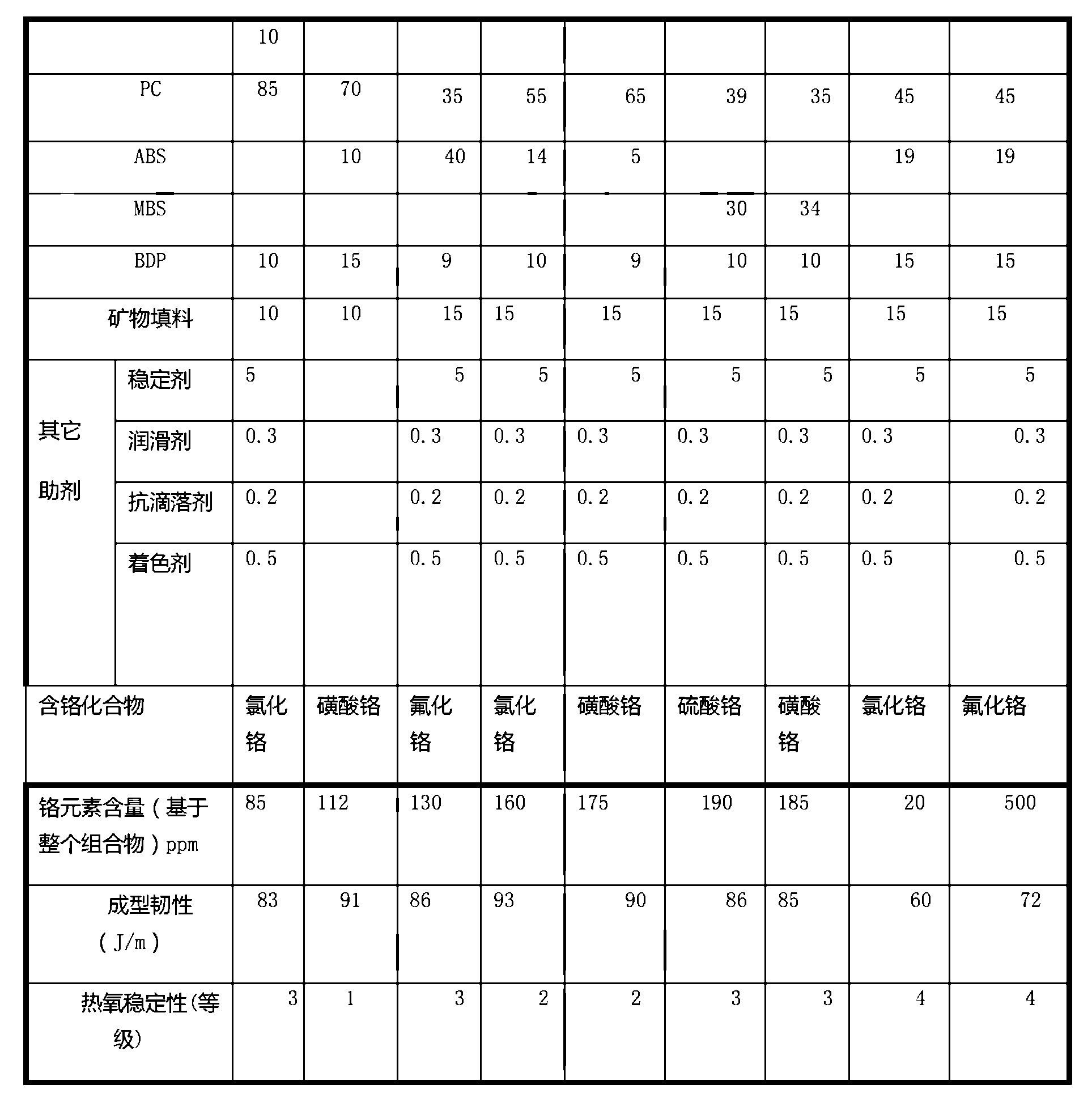
从表1的实施例和对比例的比较可以看出:通过在聚碳酸酯组合物中添加具有较低可溶性铬含量的含铬化合物,将聚碳酸酯组合物中铬元素的含量控制在10-200ppm范围内,可以使制得的聚碳酸酯组合物具有较高的成型韧性,且具有明显改善的热氧稳定性,对比例1-2中,聚碳酸酯组合物中铬元素的含量低于10ppm或高于200ppm时,聚碳酸酯组合物的成型韧性较低,热氧稳定性较差。
Claims (12)
- 一种聚碳酸酯组合物,其特征在于,按重量份计,包括以下组份:35份-85份的聚碳酸酯;0份-40份的接枝共聚物;5份-30份的阻燃剂;5份-40份的矿物填料。
- 根据权利要求1所述的聚碳酸酯组合物,其特征在于,基于聚碳酸酯组合物的总重量,铬元素的重量含量为10ppm-200ppm。
- 根据权利要求2所述的聚碳酸酯组合物,其特征在于,所述铬元素的重量含量采用如下方法测定:称取200mg聚碳酸酯组合物样品,精确到0.1mg,到50ml容量瓶中,加入5ml硝酸,0.1-1ml过氧化氢,加水定容到指定刻度,盖上瓶盖放入微波炉消解。打开瓶盖,冷却到室温,加入4mlHCL液,盖上瓶盖,放入微波炉中二次消解,后冷却到室温,过滤,将消解液取1ml通过Agilent Tcechnologies 700 series的ICP-MS混标法进行测试,最后测出聚碳酸酯组合物中的铬元素含量,检出限为2ppm。
- 根据权利要求2所述的聚碳酸酯组合物,其特征在于,基于聚碳酸酯复合材料的总重量,铬元素的重量含量为30ppm-150ppm,优选为60ppm-120ppm。
- 根据权利要求1-4任一项所述的聚碳酸酯组合物,其特征在于,所述聚碳酸酯选自芳香族聚碳酸酯、脂肪族聚碳酸酯、芳香族-脂肪族聚碳酸酯、支化聚碳酸酯、硅氧烷共聚碳酸酯中的一种或几种;优选为芳香族聚碳酸酯。
- 根据权利要求5所述的聚碳酸酯组合物,其特征在于,所述芳香族聚碳酸酯选自粘均分子量13000-40000的芳香族聚碳酸酯,粘均分子量通过粘度法测试:以二氯甲烷作为溶剂,测试温度为25℃,优选为粘均分子量16000-28000的芳香族聚碳酸酯。
- 根据权利要求1-4任一项所述的聚碳酸酯组合物,其特征在于,所述接枝共聚物选自丙烯腈-苯乙烯共聚物AS、丙烯腈-丁二烯-苯乙烯接枝共聚物ABS、甲基丙烯酸甲酯-丙烯腈-丁二烯苯乙烯共聚物MABS、丙烯腈-苯乙烯-丙烯酸三元共聚物ASA、甲基丙烯酸甲酯-丁二烯-苯乙烯接枝共聚物MBS中的一种或几种;优选为丙烯腈-丁二烯-苯乙烯接枝共聚物ABS。
- 根据权利要求1-4任一项所述的聚碳酸酯组合物,其特征在于,所述阻燃剂选自卤系阻燃剂或无卤阻燃剂,优选无卤阻燃剂;所述卤系阻燃剂选自溴化聚苯乙烯、溴化聚苯醚、溴化双酚A型环氧树脂、溴化苯乙烯-马来酸酐共聚物、溴化环氧树脂、溴化苯氧基树脂、十溴二苯醚、十溴代联苯、溴化聚碳酸酯、全溴三环十五烷或溴化芳香族交联聚合物的一种或几种,优选为溴化聚苯乙烯;所述无卤阻燃剂选自含氮阻燃剂、含磷阻燃剂、含氮和磷的阻燃 剂中的一种或几种,优选为含磷阻燃剂。
- 根据权利要求8所述的聚碳酸酯组合物,其特征在于,所述含磷阻燃剂选自磷酸三苯基酯、磷酸三甲苯基酯、磷酸甲苯基二苯基酯、磷酸三二甲苯基酯、磷酸三(2,4,6-三甲基苯基)酯、磷酸三(2,4-二叔丁基苯基)酯、磷酸三(2,6-二叔丁基苯基)酯、间苯二酚双(磷酸二苯基酯)、对苯二酚双(磷酸二苯基酯)、双酚A-双(磷酸二苯基酯)、间苯二酚双(2,6-二叔丁基苯基磷酸酯)、对苯二酚双(2,6-二甲基苯基磷酸酯)的一种或几种。
- 根据权利要求1-4任一项所述的聚碳酸酯组合物,其特征在于,所述铬元素来源于含铬化合物,所述含铬化合物选自60℃纯净水中的pH值不小于5.5且不大于8.5的含铬的化合物,优选为铬的卤化物、铬的磺化物或铬的有机络合物中的一种或几种。
- 根据权利要求1-4任一项所述的聚碳酸酯组合物,其特征在于,所述聚碳酸酯组合物还包括0-20重量份其它助剂,所述其它助剂选自稳定剂、抗滴落剂、润滑剂、脱模剂、增塑剂、着色剂的一种或几种。
- 根据权利要求1-11任一项所述的聚碳酸酯组合物的制备方法,其特征在于,包括如下步骤:1)将含铬化合物与乙醇配成质量分数为12.5ppm-2000ppm的乙醇悬浊液;2)将1)乙醇悬浊液用液体泵匀速喷淋在含有定量聚碳酸酯和矿物填料的高混机中进行共混,得到预处理的聚碳酸酯混合物;3)将预处理的聚碳酸酯混合物、接枝共聚物、阻燃剂、其它助剂按照比例称量后,通过高混机或者混合机完成共混,挤出,过水冷却,造粒得到柱状颗粒的聚碳酸酯组合物。
Applications Claiming Priority (2)
| Application Number | Priority Date | Filing Date | Title |
|---|---|---|---|
| CN201611026960.0 | 2016-11-22 | ||
| CN201611026960.0A CN107793721A (zh) | 2016-11-22 | 2016-11-22 | 一种聚碳酸酯组合物及其制备方法 |
Publications (1)
| Publication Number | Publication Date |
|---|---|
| WO2018095188A1 true WO2018095188A1 (zh) | 2018-05-31 |
Family
ID=61530127
Family Applications (1)
| Application Number | Title | Priority Date | Filing Date |
|---|---|---|---|
| PCT/CN2017/107745 Ceased WO2018095188A1 (zh) | 2016-11-22 | 2017-10-26 | 一种聚碳酸酯组合物及其制备方法 |
Country Status (2)
| Country | Link |
|---|---|
| CN (1) | CN107793721A (zh) |
| WO (1) | WO2018095188A1 (zh) |
Cited By (1)
| Publication number | Priority date | Publication date | Assignee | Title |
|---|---|---|---|---|
| CN114644818A (zh) * | 2022-03-10 | 2022-06-21 | 江西创宏新锐科技有限公司 | 一种3d打印用改性全降解增韧聚乳酸材料及其制备方法 |
Citations (7)
| Publication number | Priority date | Publication date | Assignee | Title |
|---|---|---|---|---|
| CN1659225A (zh) * | 2002-04-12 | 2005-08-24 | Mba聚合物公司 | 包含回收塑料的组合物 |
| CN101076559A (zh) * | 2004-10-12 | 2007-11-21 | 通用电气公司 | 聚碳酸酯与乳液衍生的聚合物的稳定共混物 |
| JP2008214554A (ja) * | 2007-03-06 | 2008-09-18 | Sumitomo Metal Mining Co Ltd | 熱線遮蔽ポリカーカーボネート樹脂組成物及びそれから得られる成形体 |
| US20090304762A1 (en) * | 2008-06-05 | 2009-12-10 | Bayer Materialscience Llc | Antimicrobial thermoplastic molding composition |
| CN105482426A (zh) * | 2015-12-25 | 2016-04-13 | 金发科技股份有限公司 | 一种聚碳酸酯复合材料 |
| CN105482425A (zh) * | 2015-12-25 | 2016-04-13 | 金发科技股份有限公司 | 一种聚碳酸酯复合材料 |
| CN105504745A (zh) * | 2015-12-25 | 2016-04-20 | 金发科技股份有限公司 | 一种聚碳酸酯复合材料 |
Family Cites Families (3)
| Publication number | Priority date | Publication date | Assignee | Title |
|---|---|---|---|---|
| CN105315641B (zh) * | 2015-05-27 | 2018-09-28 | 金发科技股份有限公司 | 一种聚碳酸酯组合物及其制备方法 |
| CN104987689B (zh) * | 2015-06-08 | 2016-09-14 | 金发科技股份有限公司 | 一种聚碳酸酯组合物及其制备方法 |
| CN104987691B (zh) * | 2015-06-09 | 2016-11-02 | 金发科技股份有限公司 | 一种聚碳酸酯组合物及其制备方法 |
-
2016
- 2016-11-22 CN CN201611026960.0A patent/CN107793721A/zh active Pending
-
2017
- 2017-10-26 WO PCT/CN2017/107745 patent/WO2018095188A1/zh not_active Ceased
Patent Citations (7)
| Publication number | Priority date | Publication date | Assignee | Title |
|---|---|---|---|---|
| CN1659225A (zh) * | 2002-04-12 | 2005-08-24 | Mba聚合物公司 | 包含回收塑料的组合物 |
| CN101076559A (zh) * | 2004-10-12 | 2007-11-21 | 通用电气公司 | 聚碳酸酯与乳液衍生的聚合物的稳定共混物 |
| JP2008214554A (ja) * | 2007-03-06 | 2008-09-18 | Sumitomo Metal Mining Co Ltd | 熱線遮蔽ポリカーカーボネート樹脂組成物及びそれから得られる成形体 |
| US20090304762A1 (en) * | 2008-06-05 | 2009-12-10 | Bayer Materialscience Llc | Antimicrobial thermoplastic molding composition |
| CN105482426A (zh) * | 2015-12-25 | 2016-04-13 | 金发科技股份有限公司 | 一种聚碳酸酯复合材料 |
| CN105482425A (zh) * | 2015-12-25 | 2016-04-13 | 金发科技股份有限公司 | 一种聚碳酸酯复合材料 |
| CN105504745A (zh) * | 2015-12-25 | 2016-04-20 | 金发科技股份有限公司 | 一种聚碳酸酯复合材料 |
Cited By (2)
| Publication number | Priority date | Publication date | Assignee | Title |
|---|---|---|---|---|
| CN114644818A (zh) * | 2022-03-10 | 2022-06-21 | 江西创宏新锐科技有限公司 | 一种3d打印用改性全降解增韧聚乳酸材料及其制备方法 |
| CN114644818B (zh) * | 2022-03-10 | 2023-11-03 | 江西创宏新锐科技有限公司 | 一种3d打印用改性全降解增韧聚乳酸材料及其制备方法 |
Also Published As
| Publication number | Publication date |
|---|---|
| CN107793721A (zh) | 2018-03-13 |
Similar Documents
| Publication | Publication Date | Title |
|---|---|---|
| US6630524B1 (en) | Flame retardant thermoplastic resin composition | |
| KR101795132B1 (ko) | 폴리카보네이트 수지 조성물 및 이로부터 제조된 성형품 | |
| US20070249768A1 (en) | Flame Retardant Polycarbonate Resin Composition | |
| US20070249767A1 (en) | Flame Retardant Polycarbonate Thermoplastic Resin Composition Having Good Extrusion Moldability and Impact Resistance | |
| JP2003525991A (ja) | 特定のグラフトゴムを有するポリカーボネート成形用組成物 | |
| GB2339431A (en) | Flame retardant thermoplastic resin composition | |
| CN101061179B (zh) | 阻燃热塑性树脂组合物 | |
| WO2016197907A1 (zh) | 一种聚碳酸酯组合物及其制备方法 | |
| WO2018095191A1 (zh) | 一种聚碳酸酯组合物及其制备方法 | |
| WO2018095189A1 (zh) | 聚碳酸酯组合物及其制备方法 | |
| WO2016188474A1 (zh) | 一种聚碳酸酯组合物及其制备方法 | |
| WO2018099218A1 (zh) | 一种聚碳酸酯组合物及其制备方法 | |
| WO2016188476A2 (zh) | 一种聚碳酸酯组合物及其制备方法 | |
| WO2020134844A1 (zh) | 聚苯乙烯复合材料及其制备方法 | |
| CN105315641B (zh) | 一种聚碳酸酯组合物及其制备方法 | |
| WO2016188475A1 (zh) | 一种聚碳酸酯组合物及其制备方法 | |
| KR20120021786A (ko) | 알루미늄 증착성 및 밀착성이 우수한 열가소성 수지 조성물 | |
| KR100425984B1 (ko) | 내충격성이우수한난연성을갖는폴리카보네이트계열가소성수지조성물 | |
| WO2018095190A1 (zh) | 一种聚碳酸酯组合物及其制备方法 | |
| WO2016202160A1 (zh) | 一种聚碳酸酯组合物及其制备方法 | |
| WO2016188478A1 (zh) | 一种聚碳酸酯组合物及其制备方法 | |
| WO2018095188A1 (zh) | 一种聚碳酸酯组合物及其制备方法 | |
| JP5008224B2 (ja) | ポリカーボネート系着色難燃樹脂組成物からなるハウジング材料及びその製法 | |
| WO2018099217A1 (zh) | 一种聚碳酸酯组合物及其制备方法 | |
| US20080275161A1 (en) | Flameproof Thermoplastic Resin Composition |
Legal Events
| Date | Code | Title | Description |
|---|---|---|---|
| 121 | Ep: the epo has been informed by wipo that ep was designated in this application |
Ref document number: 17873594 Country of ref document: EP Kind code of ref document: A1 |
|
| NENP | Non-entry into the national phase |
Ref country code: DE |
|
| 122 | Ep: pct application non-entry in european phase |
Ref document number: 17873594 Country of ref document: EP Kind code of ref document: A1 |