WO2018086593A1 - 含氮杂环化合物、制备方法、中间体、药物组合物和应用 - Google Patents
含氮杂环化合物、制备方法、中间体、药物组合物和应用 Download PDFInfo
- Publication number
- WO2018086593A1 WO2018086593A1 PCT/CN2017/110493 CN2017110493W WO2018086593A1 WO 2018086593 A1 WO2018086593 A1 WO 2018086593A1 CN 2017110493 W CN2017110493 W CN 2017110493W WO 2018086593 A1 WO2018086593 A1 WO 2018086593A1
- Authority
- WO
- WIPO (PCT)
- Prior art keywords
- group
- independently
- alkyl
- substituted
- butyl
- Prior art date
- Legal status (The legal status is an assumption and is not a legal conclusion. Google has not performed a legal analysis and makes no representation as to the accuracy of the status listed.)
- Ceased
Links
- 0 CN1CC(*)CC1 Chemical compound CN1CC(*)CC1 0.000 description 6
- ODIQTOYGORNLPE-UHFFFAOYSA-N CC(C)N1CCN(C)CC1 Chemical compound CC(C)N1CCN(C)CC1 ODIQTOYGORNLPE-UHFFFAOYSA-N 0.000 description 1
- PHCNOXXRLRQNDT-UHFFFAOYSA-N CC(C)OCCOc(nc1N2Cc3ccc(CN4CCCC4)cc3)ncc1NC2=O Chemical compound CC(C)OCCOc(nc1N2Cc3ccc(CN4CCCC4)cc3)ncc1NC2=O PHCNOXXRLRQNDT-UHFFFAOYSA-N 0.000 description 1
- VAXZLLOEXQZIAW-UHFFFAOYSA-N CCCCOc(nc1N2Cc3cccc(CN4CCCC4)c3)ncc1NC2=O Chemical compound CCCCOc(nc1N2Cc3cccc(CN4CCCC4)c3)ncc1NC2=O VAXZLLOEXQZIAW-UHFFFAOYSA-N 0.000 description 1
- LEFYMZQITIKTHP-UHFFFAOYSA-N CCCCOc(nc1NCc2cccc(CN3CCCC3)c2)ncc1N Chemical compound CCCCOc(nc1NCc2cccc(CN3CCCC3)c2)ncc1N LEFYMZQITIKTHP-UHFFFAOYSA-N 0.000 description 1
- FIQZKSZCHXSWQQ-UHFFFAOYSA-N CCCCOc(nc1NCc2cccc(CN3CCCC3)c2)ncc1[N+]([O-])=O Chemical compound CCCCOc(nc1NCc2cccc(CN3CCCC3)c2)ncc1[N+]([O-])=O FIQZKSZCHXSWQQ-UHFFFAOYSA-N 0.000 description 1
- VUIFBEFKIIRBSU-UHFFFAOYSA-N CCCCS(c(nc1N2Cc3cc(CN4CCCC4)ccc3)ncc1NC2=O)(=O)=O Chemical compound CCCCS(c(nc1N2Cc3cc(CN4CCCC4)ccc3)ncc1NC2=O)(=O)=O VUIFBEFKIIRBSU-UHFFFAOYSA-N 0.000 description 1
- PSSBUIQSZIWSEM-UHFFFAOYSA-N CCCCS(c(nc1N2Cc3cccc(CN4CCCC4)c3)ncc1NC2=O)=O Chemical compound CCCCS(c(nc1N2Cc3cccc(CN4CCCC4)c3)ncc1NC2=O)=O PSSBUIQSZIWSEM-UHFFFAOYSA-N 0.000 description 1
- OXAYXDHAFROKMM-UHFFFAOYSA-N CCCCSc(nc1N2Cc3cccc(CN4CCCC4)c3)ncc1NC2=O Chemical compound CCCCSc(nc1N2Cc3cccc(CN4CCCC4)c3)ncc1NC2=O OXAYXDHAFROKMM-UHFFFAOYSA-N 0.000 description 1
- VYTDBFAOHHHAIY-UHFFFAOYSA-N CCN(CC)Cc1ccc(CN(c2nc(OCCOC)ncc2N2)C2=O)cc1 Chemical compound CCN(CC)Cc1ccc(CN(c2nc(OCCOC)ncc2N2)C2=O)cc1 VYTDBFAOHHHAIY-UHFFFAOYSA-N 0.000 description 1
- DJKLYZNCOHXDIK-UHFFFAOYSA-N CC[N](C)(CC1)CC1OI Chemical compound CC[N](C)(CC1)CC1OI DJKLYZNCOHXDIK-UHFFFAOYSA-N 0.000 description 1
- HUSGIMGPSCQRKA-UHFFFAOYSA-N CN(CC1)CC1(F)F Chemical compound CN(CC1)CC1(F)F HUSGIMGPSCQRKA-UHFFFAOYSA-N 0.000 description 1
- CAFWHFDCQORFGP-UHFFFAOYSA-N CN1C2CCC1CC2 Chemical compound CN1C2CCC1CC2 CAFWHFDCQORFGP-UHFFFAOYSA-N 0.000 description 1
- YQURLNGUWNDBIR-UHFFFAOYSA-N CN1CC(CNC2)C2C1 Chemical compound CN1CC(CNC2)C2C1 YQURLNGUWNDBIR-UHFFFAOYSA-N 0.000 description 1
- PAMIQIKDUOTOBW-UHFFFAOYSA-N CN1CCCCC1 Chemical compound CN1CCCCC1 PAMIQIKDUOTOBW-UHFFFAOYSA-N 0.000 description 1
- PVOAHINGSUIXLS-UHFFFAOYSA-N CN1CCNCC1 Chemical compound CN1CCNCC1 PVOAHINGSUIXLS-UHFFFAOYSA-N 0.000 description 1
- WUPAQEFFXFKUSV-UHFFFAOYSA-N COCCNc(nc1N2Cc3cc(CN4CCCC4)ccc3)ncc1NC2=O Chemical compound COCCNc(nc1N2Cc3cc(CN4CCCC4)ccc3)ncc1NC2=O WUPAQEFFXFKUSV-UHFFFAOYSA-N 0.000 description 1
- ODKIKYREQOEZER-UHFFFAOYSA-N IN1CCC2(COC2)CC1 Chemical compound IN1CCC2(COC2)CC1 ODKIKYREQOEZER-UHFFFAOYSA-N 0.000 description 1
- VDCYNMDJOIFESI-UHFFFAOYSA-O I[F]C1C[NH2+]CC1 Chemical compound I[F]C1C[NH2+]CC1 VDCYNMDJOIFESI-UHFFFAOYSA-O 0.000 description 1
- AAVUHDFNXPJROH-UHFFFAOYSA-N N#Cc1cc(CN2CCCC2)ccc1 Chemical compound N#Cc1cc(CN2CCCC2)ccc1 AAVUHDFNXPJROH-UHFFFAOYSA-N 0.000 description 1
- CVKOOKPNCVYHNY-UHFFFAOYSA-N N#Cc1cccc(CBr)c1 Chemical compound N#Cc1cccc(CBr)c1 CVKOOKPNCVYHNY-UHFFFAOYSA-N 0.000 description 1
- RTUWXPVILJUANC-UHFFFAOYSA-N NCc1cc(CN2CCCC2)ccc1 Chemical compound NCc1cc(CN2CCCC2)ccc1 RTUWXPVILJUANC-UHFFFAOYSA-N 0.000 description 1
- INUSQTPGSHFGHM-UHFFFAOYSA-N [O-][N+](c(c(Cl)n1)cnc1Cl)=O Chemical compound [O-][N+](c(c(Cl)n1)cnc1Cl)=O INUSQTPGSHFGHM-UHFFFAOYSA-N 0.000 description 1
- NZLRFGHVMVSPCY-UHFFFAOYSA-N [O-][N+](c(c(NCc1cccc(CN2CCCC2)c1)n1)cnc1Cl)=O Chemical compound [O-][N+](c(c(NCc1cccc(CN2CCCC2)c1)n1)cnc1Cl)=O NZLRFGHVMVSPCY-UHFFFAOYSA-N 0.000 description 1
Classifications
-
- C—CHEMISTRY; METALLURGY
- C07—ORGANIC CHEMISTRY
- C07D—HETEROCYCLIC COMPOUNDS
- C07D473/00—Heterocyclic compounds containing purine ring systems
- C07D473/02—Heterocyclic compounds containing purine ring systems with oxygen, sulphur, or nitrogen atoms directly attached in positions 2 and 6
- C07D473/04—Heterocyclic compounds containing purine ring systems with oxygen, sulphur, or nitrogen atoms directly attached in positions 2 and 6 two oxygen atoms
- C07D473/06—Heterocyclic compounds containing purine ring systems with oxygen, sulphur, or nitrogen atoms directly attached in positions 2 and 6 two oxygen atoms with radicals containing only hydrogen and carbon atoms, attached in position 1 or 3
-
- A—HUMAN NECESSITIES
- A61—MEDICAL OR VETERINARY SCIENCE; HYGIENE
- A61P—SPECIFIC THERAPEUTIC ACTIVITY OF CHEMICAL COMPOUNDS OR MEDICINAL PREPARATIONS
- A61P31/00—Antiinfectives, i.e. antibiotics, antiseptics, chemotherapeutics
- A61P31/12—Antivirals
- A61P31/14—Antivirals for RNA viruses
-
- A—HUMAN NECESSITIES
- A61—MEDICAL OR VETERINARY SCIENCE; HYGIENE
- A61P—SPECIFIC THERAPEUTIC ACTIVITY OF CHEMICAL COMPOUNDS OR MEDICINAL PREPARATIONS
- A61P31/00—Antiinfectives, i.e. antibiotics, antiseptics, chemotherapeutics
- A61P31/12—Antivirals
- A61P31/20—Antivirals for DNA viruses
-
- A—HUMAN NECESSITIES
- A61—MEDICAL OR VETERINARY SCIENCE; HYGIENE
- A61P—SPECIFIC THERAPEUTIC ACTIVITY OF CHEMICAL COMPOUNDS OR MEDICINAL PREPARATIONS
- A61P35/00—Antineoplastic agents
-
- C—CHEMISTRY; METALLURGY
- C07—ORGANIC CHEMISTRY
- C07D—HETEROCYCLIC COMPOUNDS
- C07D239/00—Heterocyclic compounds containing 1,3-diazine or hydrogenated 1,3-diazine rings
- C07D239/02—Heterocyclic compounds containing 1,3-diazine or hydrogenated 1,3-diazine rings not condensed with other rings
- C07D239/24—Heterocyclic compounds containing 1,3-diazine or hydrogenated 1,3-diazine rings not condensed with other rings having three or more double bonds between ring members or between ring members and non-ring members
- C07D239/28—Heterocyclic compounds containing 1,3-diazine or hydrogenated 1,3-diazine rings not condensed with other rings having three or more double bonds between ring members or between ring members and non-ring members with hetero atoms or with carbon atoms having three bonds to hetero atoms with at the most one bond to halogen, directly attached to ring carbon atoms
- C07D239/46—Two or more oxygen, sulphur or nitrogen atoms
-
- C—CHEMISTRY; METALLURGY
- C07—ORGANIC CHEMISTRY
- C07D—HETEROCYCLIC COMPOUNDS
- C07D239/00—Heterocyclic compounds containing 1,3-diazine or hydrogenated 1,3-diazine rings
- C07D239/02—Heterocyclic compounds containing 1,3-diazine or hydrogenated 1,3-diazine rings not condensed with other rings
- C07D239/24—Heterocyclic compounds containing 1,3-diazine or hydrogenated 1,3-diazine rings not condensed with other rings having three or more double bonds between ring members or between ring members and non-ring members
- C07D239/28—Heterocyclic compounds containing 1,3-diazine or hydrogenated 1,3-diazine rings not condensed with other rings having three or more double bonds between ring members or between ring members and non-ring members with hetero atoms or with carbon atoms having three bonds to hetero atoms with at the most one bond to halogen, directly attached to ring carbon atoms
- C07D239/46—Two or more oxygen, sulphur or nitrogen atoms
- C07D239/48—Two nitrogen atoms
-
- C—CHEMISTRY; METALLURGY
- C07—ORGANIC CHEMISTRY
- C07D—HETEROCYCLIC COMPOUNDS
- C07D403/00—Heterocyclic compounds containing two or more hetero rings, having nitrogen atoms as the only ring hetero atoms, not provided for by group C07D401/00
- C07D403/02—Heterocyclic compounds containing two or more hetero rings, having nitrogen atoms as the only ring hetero atoms, not provided for by group C07D401/00 containing two hetero rings
- C07D403/10—Heterocyclic compounds containing two or more hetero rings, having nitrogen atoms as the only ring hetero atoms, not provided for by group C07D401/00 containing two hetero rings linked by a carbon chain containing aromatic rings
-
- C—CHEMISTRY; METALLURGY
- C07—ORGANIC CHEMISTRY
- C07D—HETEROCYCLIC COMPOUNDS
- C07D471/00—Heterocyclic compounds containing nitrogen atoms as the only ring hetero atoms in the condensed system, at least one ring being a six-membered ring with one nitrogen atom, not provided for by groups C07D451/00 - C07D463/00
- C07D471/02—Heterocyclic compounds containing nitrogen atoms as the only ring hetero atoms in the condensed system, at least one ring being a six-membered ring with one nitrogen atom, not provided for by groups C07D451/00 - C07D463/00 in which the condensed system contains two hetero rings
- C07D471/04—Ortho-condensed systems
-
- C—CHEMISTRY; METALLURGY
- C07—ORGANIC CHEMISTRY
- C07D—HETEROCYCLIC COMPOUNDS
- C07D473/00—Heterocyclic compounds containing purine ring systems
- C07D473/02—Heterocyclic compounds containing purine ring systems with oxygen, sulphur, or nitrogen atoms directly attached in positions 2 and 6
- C07D473/04—Heterocyclic compounds containing purine ring systems with oxygen, sulphur, or nitrogen atoms directly attached in positions 2 and 6 two oxygen atoms
-
- C—CHEMISTRY; METALLURGY
- C07—ORGANIC CHEMISTRY
- C07D—HETEROCYCLIC COMPOUNDS
- C07D473/00—Heterocyclic compounds containing purine ring systems
- C07D473/02—Heterocyclic compounds containing purine ring systems with oxygen, sulphur, or nitrogen atoms directly attached in positions 2 and 6
- C07D473/18—Heterocyclic compounds containing purine ring systems with oxygen, sulphur, or nitrogen atoms directly attached in positions 2 and 6 one oxygen and one nitrogen atom, e.g. guanine
-
- C—CHEMISTRY; METALLURGY
- C07—ORGANIC CHEMISTRY
- C07D—HETEROCYCLIC COMPOUNDS
- C07D473/00—Heterocyclic compounds containing purine ring systems
- C07D473/02—Heterocyclic compounds containing purine ring systems with oxygen, sulphur, or nitrogen atoms directly attached in positions 2 and 6
- C07D473/22—Heterocyclic compounds containing purine ring systems with oxygen, sulphur, or nitrogen atoms directly attached in positions 2 and 6 one oxygen and one sulfur atom
-
- C—CHEMISTRY; METALLURGY
- C07—ORGANIC CHEMISTRY
- C07D—HETEROCYCLIC COMPOUNDS
- C07D473/00—Heterocyclic compounds containing purine ring systems
- C07D473/26—Heterocyclic compounds containing purine ring systems with an oxygen, sulphur, or nitrogen atom directly attached in position 2 or 6, but not in both
- C07D473/28—Oxygen atom
-
- C—CHEMISTRY; METALLURGY
- C07—ORGANIC CHEMISTRY
- C07D—HETEROCYCLIC COMPOUNDS
- C07D473/00—Heterocyclic compounds containing purine ring systems
- C07D473/26—Heterocyclic compounds containing purine ring systems with an oxygen, sulphur, or nitrogen atom directly attached in position 2 or 6, but not in both
- C07D473/32—Nitrogen atom
-
- C—CHEMISTRY; METALLURGY
- C07—ORGANIC CHEMISTRY
- C07D—HETEROCYCLIC COMPOUNDS
- C07D473/00—Heterocyclic compounds containing purine ring systems
- C07D473/26—Heterocyclic compounds containing purine ring systems with an oxygen, sulphur, or nitrogen atom directly attached in position 2 or 6, but not in both
- C07D473/36—Sulfur atom
-
- C—CHEMISTRY; METALLURGY
- C07—ORGANIC CHEMISTRY
- C07D—HETEROCYCLIC COMPOUNDS
- C07D473/00—Heterocyclic compounds containing purine ring systems
- C07D473/40—Heterocyclic compounds containing purine ring systems with halogen atoms or perhalogeno-alkyl radicals directly attached in position 2 or 6
-
- C—CHEMISTRY; METALLURGY
- C07—ORGANIC CHEMISTRY
- C07D—HETEROCYCLIC COMPOUNDS
- C07D519/00—Heterocyclic compounds containing more than one system of two or more relevant hetero rings condensed among themselves or condensed with a common carbocyclic ring system not provided for in groups C07D453/00 or C07D455/00
Definitions
- the present invention relates to a nitrogen-containing heterocyclic compound, a process for the preparation, an intermediate, a pharmaceutical composition and use.
- Toll-like receptors are a class of evolutionarily highly conserved natural immune receptors that are widely expressed in a variety of tissues and cells (Toll-like receptors. Curr Biol, 2011, 21: R488-93). At present, as a well-researched pattern recognition receptors (PRRs), Toll-like receptors can recognize potential pathogenic microorganisms and non-pathogenic commensal bacteria, and perform important functions of removing pathogenic microorganisms. Is the body's first barrier against pathogen invasion (The role of pattern recognition receptors in intestinal inflammation. Mucosal Immunol, 2013, 6: 451-63).
- the Toll-like receptor belongs to the type I transmembrane protein, which consists of three parts: the extracellular region, the transmembrane region, and the intracellular region.
- Toll-like receptors can be divided into two categories, including TLR1, TLR2, TLR4, TLR5, TLR6, TLR11, and TLR12, which are mainly expressed on the membrane surface and mainly recognize membrane components of microorganisms such as lipids, lipoproteins and proteins.
- the other class includes TLR3, TLR7, TLR8, and TLR9, which are mainly expressed in intracellular vesicles, such as endoplasmic reticulum, endosomes, etc., and mainly recognize nucleic acids of pathogenic microorganisms.
- TLR7 and TLR8 are highly homologous, have similar phylogeny and characterize small molecule compounds, but differ greatly in function.
- TLR7 agonists are more effective at inducing chemokines regulated by IFN- ⁇ and IFN- ⁇ , whereas TLR8 agonists are biased to induce inflammatory cytokines TNF- ⁇ and IL-12 (Synthetic TLR agonists reveal functional differences between human TLR7) And TLR 8. J Immunol, 2005, 174: 1259-68).
- IFN- ⁇ is one of the main drugs for the treatment of chronic hepatitis B and hepatitis C
- TNF- ⁇ is a pro-inflammatory cytokine. Excessive activation can cause serious side effects.
- TLR7 agonists such as Imiquimod, Resiquimod and GS9620, which have been developed and reported, have shown good clinical application prospects, but existing TLR7 agonists exist.
- TLR7 problem of poor selectivity as reported in the literature WO2016023511A1 and GS9620 hTLR7 hTLR8 of the EC 50 are 0.517 ⁇ M and 7.867 ⁇ M, it shows poor selectivity for TLR7.
- the technical problem to be solved by the present invention is to provide a nitrogen-containing heterocyclic compound, a preparation method, an intermediate, a pharmaceutical composition and use thereof in order to find a structurally novel TLR7 agonist.
- the nitrogen-containing heterocyclic compound of the present invention has novel structure, high TLR7 agonistic activity, high selectivity and good safety.
- the present invention provides a compound of formula I or formula II, a tautomer, an optical isomer, a hydrate, a solvate, a polymorph, a pharmaceutically acceptable salt thereof or a compound thereof medicine;
- X, Y, X' and Y' are each independently selected from C or N (preferably, X and Y are simultaneously N, or X' and Y' are simultaneously N);
- R 2 and R′ 2 are each independently hydrogen, C 1 -C 10 alkyl, C 2 -C 10 heteroalkyl, C 3 -C 10 cycloalkyl, C 3 -C 10 heterocycloalkyl, C 2 a C 10 alkenyl group or a C 2 -C 10 alkynyl group; wherein the C 1 -C 10 alkyl group, the C 2 -C 10 heteroalkyl group, the C 3 -C 10 cycloalkyl group Said C 3 -C 10 heterocycloalkyl, said C 2 -C 10 alkenyl and said C 2 -C 10 alkynyl are each independently one or more (eg 2, 3 or 4) R 4 substituted, when substituted with a plurality of R 4 , the substituents are the same or different: R 4 is selected from the group consisting of hydrogen, hydroxy, halogen, C 1 -C 6 alkyl, C 3 -C 10 cycloalkyl and C 3 ⁇ C
- L 1 and L' 1 are each independently -O-, -C(R a1 R a2 )-, -C(O)-, -S-, -S(O)-, -S(O) 2 -, -N(R a3 )-, -N(R a4 )C(O)- or -N(R a5 )S(O) 2 -; wherein R a1 , R a2 , R a3 , R a4 and R a5 are each Independently hydrogen or C 1 -C 6 alkyl (eg methyl, ethyl, n-propyl, isobutyl, n-butyl, isobutyl or tert-butyl);
- R 1 and R′ 1 are each independently -NR 5 R 6 ;
- R 5 and R 6 are each independently hydrogen or a C 1 -C 10 alkyl group; wherein said C 1 -C 10 alkyl group is substituted by one or more (e.g., 2, 3 or 4) R 7 When substituted with a plurality of R 7 , the substituents are the same or different: R 7 is selected from the group consisting of hydrogen, hydroxy, halogen, C 3 -C 10 cycloalkyl and C 3 -C 10 heterocycloalkyl;
- R 5 , R 6 together with the N atom to which they are attached form a substituted or unsubstituted heterocyclic ring
- the heterocyclic ring may be a monocyclic ring, a fused ring, a spiro ring or a bridged ring
- the heterocyclic ring may be a heteroaromatic ring or a heteroalicyclic ring
- the heterocyclic ring is preferably a 3- to 10-membered heterocyclic ring
- the hetero atom may be selected from one or more of O, S and N
- the number of heteroatoms is preferably 1, 2 or 3
- the substitution in the substituted heterocyclic ring means that one or more (for example, 2, 3 or 4) R 8 is substituted, and when a plurality of R 8 are substituted, the substituents are the same or different, and R 8 is selected from the group consisting of Halogen, hydroxy, C 1 -C 6 alkyl, C 3 -C 10 cycloalkyl
- Z is C, N, O or S
- Z' is -O-, -S-, -N(R' 4 )- or -C(R' 5 R' 6 )-;
- R 3 , R′ 3 , R′ 4 , R′ 5 and R′ 6 are each independently hydrogen, C 1 -C 10 alkyl or C 3 -C 10 cycloalkyl; wherein C 1 -C The 10 alkyl group and the C 3 -C 10 cycloalkyl group are each independently substituted by one or more (for example, 2, 3 or 4) R 9 , and when a plurality of R 9 are substituted, the substituents are the same or different R 9 is selected from the group consisting of hydrogen, halogen, C 1 -C 6 alkyl, C 3 -C 10 cycloalkyl and C 3 -C 10 heterocycloalkyl;
- D is a C 6 -C 10 arylene group (for example, a phenylene group) or a C 5 -C 10 heteroarylene group;
- R 10 and R′ 10 are each independently: halogen, nitro, cyano, hydroxy, decyl, C 1 -C 6 alkyl, C 1 -C 6 alkoxy, C 3 -C 10 cycloalkyl, C 3 to C 10 heterocycloalkyl, -C(O)OR c1 , -C(O)R c2 , -OC(O)R c3 , -NR c4 R c5 , -NR c6 C(O)R c7 ,- C(O)NR c8 , -OC(O)NR c9 , -NR c10 C(O)NR c11 , -SR c12 , -S(O)NR c13 R c14 , -S(O) 2 NR c15 R c16 , -NR c17 S(O) 2 R c18 or -NR c19 S(O)R c20 ; wherein R
- n and m' are each independently 0, 1, 2, 3 or 4; when there are a plurality of R 10 substitutions on D, the substituents are the same or different; when there are a plurality of R' 10 substitutions on D', the substituent Same or different;
- L 2 , L' 2 , L 3 and L' 3 are each independently a C 1 -C 6 alkylene group (e.g., -CH 2 -, -CH 2 CH 2 -, -CH(CH 3 )-, -CH 2 CH 2 CH 2 -, -CH(CH 3 )CH 2 - or -CH(CH 2 CH 3 )-) or C 2 -C 6 heteroalkylene (in the C 2 -C 6 heteroalkylene group)
- the hetero atom may be selected from one or more of O, S and N; the number of heteroatoms may be 1, 2 or 3, such as -CH 2 OCH 2 -); the C 1 -C 6 alkylene And the C 2 -C 6 heteroalkylene group are each independently substituted by one or more (for example 2, 3 or 4) R 11 , when a plurality of R 11 substituents are present, the substituents are the same or different, R 11 is selected From hydrogen, halogen, cyano, C 1
- R and R' is independently hydrogen, halogen, hydroxy, C 1 -C 10 alkyl, C 2 -C 10 heteroalkyl, C 3 -C 10 cycloalkyl, C 3 -C 10 heterocycloalkyl a C 2 -C 10 alkenyl group or a C 2 -C 10 alkynyl group; wherein said C 1 -C 10 alkyl group, said C 2 -C 10 heteroalkyl group, said C 3 -C 10 a cycloalkyl group, said C 3 -C 10 heterocycloalkyl group, said C 2 -C 10 alkenyl group and said C 2 -C 10 alkynyl group are each independently one or more R 12 (eg 2, 3 or 4) substitutions, when substituted with a plurality of R 12 , the substituents being the same or different: R 12 is selected from the group consisting of hydrogen, halogen, C 1 -C 6 alkyl, C 3 -C 10 cycloalky
- R 2 , R′ 2 , R 3 , R′ 3 , R′ 4 , R 5 , R 6 , R′ 5 , R′ 6 , R or R′ is a C 1 —C 10 alkyl group;
- the C 1 -C 10 alkyl group is preferably a C 1 -C 6 alkyl group; the C 1 -C 6 alkyl group is preferably a methyl group, an ethyl group, a n-propyl group, an isobutyl group, a n-butyl group, an isobutyl group or a tertiary group. Butyl.
- R 2 '2, R or R' is a C 2 ⁇ C 10 heteroalkyl
- hetero atoms in the C 2 ⁇ C 10 heteroaryl group selected from one of O, S and N The number of hetero atoms is preferably 1 to 5 (for example, 1, 2, 3 or 4).
- the hetero atom in the C 2 -C 10 heteroalkyl group is an oxygen atom, and the number of hetero atoms is 1 or 2; more preferably, the C 2 -C 10 heteroalkyl group is more preferably
- R 2 , R′ 2 , R 3 , R′ 3 , R′ 4 , R′ 5 , R′ 6 , R or R′ is a C 3 —C 10 cycloalkyl group
- the cycloalkyl group is preferably a cyclopropyl group, a cyclopentyl group or a cyclohexyl group.
- R 2 When R 2, R '2, R or R' is a C 3 ⁇ C 10 heterocycloalkyl group, hetero atoms C 3 ⁇ C 10 heterocycloalkyl group selected from one of O, S and N One or more; the number of hetero atoms is preferably 1 to 3 (for example, 2); and the C 3 - C 10 heterocycloalkyl group is more preferably
- R 2 , R' 2 , R or R' is a C 2 -C 10 alkenyl group
- the C 2 -C 10 alkenyl group is preferably a vinyl group.
- R 2 , R' 2 , R or R' is a C 2 -C 10 alkynyl group
- the C 2 -C 10 alkynyl group is preferably an ethynyl group.
- R 4 , R 7 , R 8 , R 9 , R 10 , R' 10 , R 11 or R 12 is halogen
- the halogen is preferably fluorine, chlorine, bromine or iodine.
- R 4 , R 7 , R 8 , R 9 , R 10 , R' 10 , R 11 or R 12 is a C 3 -C 10 cycloalkyl group
- the C 3 -C 10 cycloalkyl group is preferably cyclopropyl.
- Base cyclopentyl or cyclohexyl.
- R 4 is C 3 C 10 - heterocycloalkyl
- said C 3 ⁇ C 10 heterocycloalkyl heteroatoms One or more selected from the group consisting of O, S and N; the number of heteroatoms is preferably from 1 to 3 (for example, two); the position of the hetero atom may be in the ortho, meta or para position of the linking site;
- the C 3 -C 10 heterocycloalkyl group may be bonded through a carbon atom or an N atom; the C 3 -C 10 heterocycloalkyl group is more preferably
- R 4 , R 8 , R 9 , R 10 , R' 10 , R 11 or R 12 is a C 1 -C 6 alkyl group
- the C 1 -C 6 alkyl group is preferably a methyl group, an ethyl group or a positive group.
- R 10 or R' 10 is a C 1 -C 6 alkoxy group
- the C 1 -C 6 alkoxy group is preferably a methoxy group, an ethoxy group, a n-propoxy group or an isobutoxy group. , n-butoxy, isobutoxy or tert-butoxy.
- the heterocyclic ring preferably has any of the following structures:
- the substituted heterocyclic ring preferably has any of the following structures:
- said R 2 - is preferably any of the following structures:
- said R 2 -L 1 - is preferably any of the following structures:
- -L 3 -R 1 is in the ortho, meta or para position of L 2 .
- the compounds of formula I are preferably: More preferred
- R is H and m is 0.
- Said compound of formula II is preferably More preferred
- R' is H
- m' is 0.
- R 2 '2, R or R' is a C 2 ⁇ C 10 heteroalkyl
- hetero atoms in the C 2 ⁇ C 10 heteroaryl group selected from one of O, S and N The number of hetero atoms is preferably 1 to 5 (for example, 1, 2, 3 or 4).
- the hetero atom in the C 2 -C 10 heteroalkyl group is an oxygen atom, and the number of hetero atoms is 1 or 2; more preferably, the C 2 -C 10 heteroalkyl group is more preferably
- said R 2 - is preferably any of the following structures:
- said R 2 -L 1 - is preferably any of the following structures:
- the present invention provides a compound of the formula I, a tautomer thereof, an optical isomer thereof, a halogenated product thereof, a hydrate thereof, a solvate thereof, a polymorph thereof, and a pharmaceutically acceptable compound thereof Salt or its prodrug;
- X and Y are independently C or N (eg, X and Y are both N; and, for example, X is N and Y is C);
- R 2 is hydrogen, C 1 -C 10 alkyl (for example, C 1 -C 6 alkyl, and further, for example, C 1 -C 4 alkyl, further such as methyl, ethyl, n-propyl, isopropyl, n-butyl a base, an isobutyl or a tert-butyl group, for example, a methyl group;
- the "R 4 -substituted C 1 -C 10 alkyl group” is, for example, a C 2 -C 10 heteroalkyl group (wherein the hetero atom may be selected from one or more of O, S and N, and may be only an oxygen atom; the number of heteroatoms may be one or two, 3, 4 or 5, which may be 1 or 2, or 1; when the "C 2 -C 10 heteroalkyl" is substituted by a halogen and the hetero atom is O,
- the terminal may be a trifluoromethoxy group;
- An alkyl group (wherein the hetero atom may be selected from one or more of O, S and N, and may be only an oxygen atom; the number of heteroatoms may be 1, 2, 3, 4 or 5 Further, it may be one; the "C 3 -C 10 heterocycloalkyl group” may be a C 4 -C 5 heterocycloalkyl group, or a tetrahydropyranyl group or a tetrahydrofuranyl group; Pyridine It may be tetrahydropyran-4-yl group; a tetrahydrofuranyl may tetrahydrofuran-2-yl);
- L 1 is -O-, -C(R a1 R a2 )-, -C(O)-, -S-, -S(O)-, -S(O) 2 -, -N(R a3 )- , -N(R a4 )C(O)- or -N(R a5 )S(O) 2 -; wherein R a1 , R a2 , R a3 , R a4 and R a5 are independently hydrogen or C 1 ⁇ C 6 alkyl (for example methyl, ethyl, n-propyl, isopropyl, n-butyl, isobutyl or tert-butyl);
- R is hydrogen, halogen, hydroxy, C 1 -C 10 alkyl (for example, C 1 -C 6 alkyl, further such as C 1 -C 4 alkyl, also for example methyl, ethyl, n-propyl, isopropyl , n-butyl, sec-butyl, isobutyl or tert-butyl, further such as methyl), C 2 -C 10 heteroalkyl, C 3 -C 10 cycloalkyl, C 3 -C 10 heterocycloalkyl a C 2 -C 10 alkenyl group or a C 2 -C 10 alkynyl group; wherein said C 1 -C 10 alkyl group, said C 2 -C 10 heteroalkyl group, said C 3 -C 10 a cycloalkyl group, said C 3 -C 10 heterocycloalkyl group, said C 2 -C 10 alkenyl group and said C 2 -C 10 alkyny
- R 3 is hydrogen, C 1 -C 10 alkyl (for example, C 1 -C 6 alkyl, and further, for example, C 1 -C 4 alkyl, further such as methyl, ethyl, n-propyl, isopropyl, n-butyl a sec-butylene, isobutyl or tert-butyl group, such as methyl or n-propyl) or a C 3 -C 10 cycloalkyl group; wherein said C 1 -C 10 alkyl group and said C 3 to 10 10 cycloalkyl are independently substituted by one or more (for example 2, 3 or 4) R 9 , and when substituted with a plurality of R 9 , R 9 is the same or different; R 9 is independently selected from hydrogen, Halogen, C 1 -C 6 alkyl, C 3 -C 10 cycloalkyl and C 3 -C 10 heterocycloalkyl;
- Z is CH 2 , NH, O or S (when Z is CH 2 and R 3 is hydrogen, the tautomer of the compound I may be The tautomers of NH, O and S are the same);
- L 2 and L 3 are independently a C 1 -C 6 alkylene group (e.g., -CH 2 -, -CH 2 CH 2 -, -CH(CH 3 )-, -CH 2 CH 2 CH 2 -, -CH ( CH 3 )CH 2 - or -CH(CH 2 CH 3 )-; further, for example, L 2 is -CH 2 -; for example, L 3 is -CH 2 -, -CH 2 CH 2 -, -CH(CH 3 ) - or -CH(CH 2 CH 3 )-; when the "C 1 -C 6 alkylene group" contains a chiral carbon atom, the chiral carbon atom is R type, S type or a mixture thereof ⁇ eg, a racemic carbon atom>) or a C 2 -C 6 heteroalkylene group (the hetero atom in the C 2 -C 6 heteroalkylene group may be selected from one or more of O, S and N) The number of hetero
- D is a C 6 -C 10 arylene group (for example, a phenylene group; when the C 6 -C 10 arylene group is a phenylene group, the L 2 and L 3 may be para-positional to each other, and may be mutually Or a C 5 -C 10 heteroarylene; (for example, D is a C 6 -C 10 arylene group)
- n 0, 1, 2, 3 or 4; when there are a plurality of R 10 substitutions on D, R 10 is the same or different;
- R 10 is independently halogen (e.g., fluorine, chlorine, bromine or iodine), nitro, cyano, hydroxy, decyl, R 10-1 substituted or unsubstituted C 1 -C 6 alkyl (described R 10-
- the number of 1 may be one or more [for example, 2, 3 or 4], and when there are a plurality of R 10-1 , R 10-1 is the same or different; the "C 1 -C 6 alkane”
- the group " may be a C 1 -C 4 alkyl group, and may be a methyl group, an ethyl group, a n-propyl group, an isopropyl group, a n-butyl group, a sec-butyl group, an isobutyl group or a t-butyl group; 10-1 substituted C 1 -C 6 alkyl” such as trifluoromethyl), R 10-2 substituted or unsubstituted C 1 -
- R 1 is -NR 5 R 6 ;
- R 5 and R 6 are independently hydrogen or a C 1 -C 10 alkyl group (e.g., a C 1 - C 6 alkyl group, for example, a C 1 -C 4 alkyl group, and also, for example, a methyl group, an ethyl group, a n-propyl group, or a different group).
- a C 1 -C 10 alkyl group e.g., a C 1 - C 6 alkyl group, for example, a C 1 -C 4 alkyl group, and also, for example, a methyl group, an ethyl group, a n-propyl group, or a different group.
- R 5 , R 6 and the N atom to which they are attached form a substituted or unsubstituted heterocyclic ring
- the heterocyclic ring may be a monocyclic ring, a fused ring, a spiro ring or a bridged ring, or a monocyclic ring
- the heterocyclic ring may be a heteroaryl ring or a heteroalicyclic ring or a heteroalicyclic ring
- the heteroalicyclic ring may be a heterocycloalkyl group or a heterocycloalkenyl group, or a heterocycloalkyl group
- the heterocyclic ring may be a 3 to 10 membered heterocyclic ring or a 4 to 9 membered heterocyclic ring, and may also be a 5 to 7 membered heterocyclic ring
- the hetero atom may be selected from one or more of O, S and N [its Necessarily containing N atoms, which are connected to L 3
- the compound I, a tautomer thereof, an optical isomer thereof, a halogenated product thereof, a hydrate thereof, a solvate thereof, a polymorph thereof, a pharmaceutically acceptable salt thereof Or a prodrug thereof the definition of each group can be as follows, the undefined group is as described in any of the preceding schemes:
- X and Y may be selected from N.
- the compound I, a tautomer thereof, an optical isomer thereof, a halogenated product thereof, a hydrate thereof, a solvate thereof, a polymorph thereof, a pharmaceutically acceptable salt thereof Or a prodrug thereof the definition of each group can be as follows, the undefined group is as described in any of the preceding schemes:
- R 2 may be hydrogen, C 1 -C 10 alkyl (for example, C 1 -C 6 alkyl, further such as C 1 -C 4 alkyl, also for example methyl, ethyl, n-propyl, isopropyl, positive Butyl, isobutyl or tert-butyl, and further, for example, methyl), C 2 -C 10 heteroalkyl (wherein the hetero atom may be selected from one or more of O, S and N, or only Oxygen atom; the number of heteroatoms may be 1, 2, 3, 4 or 5, or 1 or 2, or 1; the "C 2 - C 10 heteroalkane"
- the group " may be a C 2 - C 5 heteroalkyl group; when the "C 2 - C 10 heteroalkyl group” is substituted by a halogen and the hetero atom is O, the terminal may be a trifluoromethoxy group), C a 3 - C10 cycloalkyl group or a C
- C 1 ⁇ C 6 alkyl group C 3 ⁇ C 10 cycloalkyl group (e.g., C 3 ⁇ C 6 cycloalkyl group, and for example cyclopropyl, cyclobutyl, cyclopentyl or cyclohexyl, further For example, cyclopropyl) and C 3 -C 10 heterocycloalkyl (wherein the hetero atom may be selected from one or more of O, S and N, and may be only an oxygen atom; the number of heteroatoms may be 1 , 2, 3, 4 or 5, and may be 1; the "C 3 -C 10 heterocycloalkyl" may be a C 4 -C 5 heterocycloalkyl group or a tetra a hydropyranyl or tetrahydrofuranyl; the tetrahydropyranyl group may be tetrahydropyran-4-yl; the
- R 2 may be a C 1 -C 10 alkyl group (for example, a C 1 -C 6 alkyl group, for example, a C 1 -C 4 alkyl group, and also, for example, a methyl group, an ethyl group, a n-propyl group, an isopropyl group, a n-butyl group.
- a C 1 -C 10 alkyl group for example, a C 1 -C 6 alkyl group, for example, a C 1 -C 4 alkyl group, and also, for example, a methyl group, an ethyl group, a n-propyl group, an isopropyl group, a n-butyl group.
- a base an isobutyl or a tert-butyl group, for example, a methyl group, or a hetero atom (here only referred to as a hetero atom for substituting -CH 2 - on the alkyl chain, not for the purpose of substituting hydrogen a C 2 -C 10 heteroalkyl group of a hetero atom of an atom [e.g., a halogen]
- the hetero atom may be O, S or N, or may be O
- the "C 2 - C 10 heteroalkyl group” may be Is a C 2 -C 5 heteroalkyl group, which may be a C 3 -C 4 heteroalkyl group, and may also be a 2-methoxyethyl group; when the "C 2 -C 10 heteroalkyl group" is replaced by a halogen
- the terminal may be a trifluoromethoxy group; wherein the C 1 -C 10 alkyl group is one
- R 4 is independently substituted by hydrogen or halogen [e.g., fluorine, chlorine, bromine or iodine, for example, fluorine]), and when a plurality of R 4 are substituted, R 4 is the same Or different.
- halogen e.g., fluorine, chlorine, bromine or iodine, for example, fluorine
- the compound I, a tautomer thereof, an optical isomer thereof, a halogenated product thereof, a hydrate thereof, a solvate thereof, a polymorph thereof, a pharmaceutically acceptable salt thereof Or a prodrug thereof the definition of each group can be as follows, the undefined group is as described in any of the preceding schemes:
- L 1 may be -O-.
- the compound I, a tautomer thereof, an optical isomer thereof, a halogenated product thereof, a hydrate thereof, a solvate thereof, a polymorph thereof, a pharmaceutically acceptable salt thereof Or a prodrug thereof the definition of each group can be as follows, the undefined group is as described in any of the preceding schemes:
- R may be hydrogen, a halogen (such as fluorine, chlorine, bromine or iodine, but also fluorine, or a hydroxyl group; or hydrogen).
- a halogen such as fluorine, chlorine, bromine or iodine, but also fluorine, or a hydroxyl group; or hydrogen.
- the compound I, a tautomer thereof, an optical isomer thereof, a halogenated product thereof, a hydrate thereof, a solvate thereof, a polymorph thereof, a pharmaceutically acceptable salt thereof Or a prodrug thereof the definition of each group can be as follows, the undefined group is as described in any of the preceding schemes:
- R 3 can be hydrogen.
- the compound I, a tautomer thereof, an optical isomer thereof, a halogenated product thereof, a hydrate thereof, a solvate thereof, a polymorph thereof, a pharmaceutically acceptable salt thereof Or a prodrug thereof the definition of each group can be as follows, the undefined group is as described in any of the preceding schemes:
- Z may be NH or O or O.
- the compound I, a tautomer thereof, an optical isomer thereof, a halogenated product thereof, a hydrate thereof, a solvate thereof, a polymorph thereof, a pharmaceutically acceptable salt thereof Or a prodrug thereof the definition of each group can be as follows, the undefined group is as described in any of the preceding schemes:
- L 2 may be a C 1 -C 6 alkylene group or a -CH 2 -.
- the compound I, a tautomer thereof, an optical isomer thereof, a halogenated product thereof, a hydrate thereof, a solvate thereof, a polymorph thereof, a pharmaceutically acceptable salt thereof Or a prodrug thereof the definition of each group can be as follows, the undefined group is as described in any of the preceding schemes:
- L 3 may be a C 1 -C 6 alkylene group.
- the compound I, a tautomer thereof, an optical isomer thereof, a halogenated product thereof, a hydrate thereof, a solvate thereof, a polymorph thereof, a pharmaceutically acceptable salt thereof Or a prodrug thereof the definition of each group can be as follows, the undefined group is as described in any of the preceding schemes:
- D may be a C 6 -C 10 arylene group (for example, a phenylene group; when the C 6 -C 10 arylene group is a phenylene group, the L 2 and L 3 may be para-positional to each other, and may be mutually Interdigit).
- C 6 -C 10 arylene group for example, a phenylene group; when the C 6 -C 10 arylene group is a phenylene group, the L 2 and L 3 may be para-positional to each other, and may be mutually Interdigit).
- the compound I, a tautomer thereof, an optical isomer thereof, a halogenated product thereof, a hydrate thereof, a solvate thereof, a polymorph thereof, a pharmaceutically acceptable salt thereof Or a prodrug thereof the definition of each group can be as follows, the undefined group is as described in any of the preceding schemes:
- m can be 0 or 1.
- the compound I, a tautomer thereof, an optical isomer thereof, a halogenated product thereof, a hydrate thereof, a solvate thereof, a polymorph thereof, a pharmaceutically acceptable salt thereof Or a prodrug thereof the definition of each group can be as follows, the undefined group is as described in any of the preceding schemes:
- R 10 may be halogen, cyano, R 10-1 substituted or unsubstituted C 1 -C 6 alkyl, R 10-2 substituted or unsubstituted C 1 -C 6 alkoxy, R 10-3 substituted or Unsubstituted C 3 -C 10 cycloalkyl, or R 10-4 substituted or unsubstituted C 3 -C 10 heterocycloalkyl, may also be halogen (eg, fluorine, chlorine, bromine or iodine, such as fluorine) ).
- halogen eg, fluorine, chlorine, bromine or iodine, such as fluorine
- the compound I, a tautomer thereof, an optical isomer thereof, a halogenated product thereof, a hydrate thereof, a solvate thereof, a polymorph thereof, a pharmaceutically acceptable salt thereof Or a prodrug thereof the definition of each group can be as follows, the undefined group is as described in any of the preceding schemes:
- X and Y are independently C or N (eg, X and Y are both N; and, for example, X is N and Y is C);
- R 2 is hydrogen, C 1 -C 10 alkyl (for example, C 1 -C 6 alkyl, and further, for example, C 1 -C 4 alkyl, further such as methyl, ethyl, n-propyl, isopropyl, n-butyl a base, an isobutyl or a tert-butyl group, such as a methyl group, a C 2 -C 10 heteroalkyl group (wherein the hetero atom may be selected from one or more of O, S and N, and may be only oxygen) Atom; the number of heteroatoms may be 1, 2, 3, 4 or 5, and may be 1 or 2, and may also be 1; the "C 2 - C 10 heteroalkyl group"" may be a C 2 -C 5 heteroalkyl group; when the "C 2 -C 10 heteroalkyl group" is substituted by a halogen and the hetero atom is O, the terminal may be a trifluoromethoxy group), C 3 a
- fluorine chlorine, bromine or iodine, E.g. fluorine
- C 1 ⁇ C 6 alkyl group C 3 ⁇ C 10 cycloalkyl group (e.g., C 3 ⁇ C 6 cycloalkyl group, and for example cyclopropyl, cyclobutyl, cyclopentyl or cyclohexyl, further e.g.
- a cyclopropyl) group and a C 3 -C 10 heterocycloalkyl group (wherein the hetero atom may be selected from one or more of O, S and N, and may be only an oxygen atom; the number of heteroatoms may be one) , 2, 3, 4 or 5, and may be 1; the "C 3 -C 10 heterocycloalkyl group” may be a C 4 -C 5 heterocycloalkyl group or a tetrahydrogen group.
- L 1 is -O-
- R is hydrogen, halogen (such as fluorine, chlorine, bromine or iodine, such as fluorine), or a hydroxyl group;
- R 3 is hydrogen
- Z is CH 2 , NH, O or S
- L 2 and L 3 are independently a C 1 -C 6 alkylene group (e.g., -CH 2 -, -CH 2 CH 2 -, -CH(CH 3 )-, -CH 2 CH 2 CH 2 -, -CH ( CH 3 )CH 2 - or -CH(CH 2 CH 3 )-; further, for example, L 2 is -CH 2 -; for example, L 3 is -CH 2 -, -CH 2 CH 2 -, -CH(CH 3 ) - or -CH(CH 2 CH 3 )-; when the "C 1 -C 6 alkylene group" contains a chiral carbon atom, the chiral carbon atom is R type, S type or a mixture thereof ⁇ eg, racemic carbon atom>);
- D is a C 6 -C 10 arylene group (for example, a phenylene group; when the C 6 -C 10 arylene group is a phenylene group, the L 2 and L 3 may be para-positional to each other, and may be mutually Or a C 5 -C 10 heteroarylene; (for example, D is a C 6 -C 10 arylene group)
- n 0, 1, 2, 3 or 4; when there are a plurality of R 10 substitutions on D, R 10 is the same or different;
- R 10 is independently halogen (e.g., fluorine, chlorine, bromine or iodine), cyano, R 10-1 substituted or unsubstituted C 1 -C 6 alkyl (the number of R 10-1 may be one Or a plurality [for example, 2, 3 or 4], when a plurality of R 10-1 are present, R 10-1 is the same or different; and the "C 1 -C 6 alkyl group" may be C 1 - C 4 alkyl, which may in turn be methyl, ethyl, n-propyl, isopropyl, n-butyl, sec-butyl, isobutyl or tert-butyl; said "R 10-1 substituted C 1 -C 6 alkyl” such as trifluoromethyl), R 10-2 substituted or unsubstituted C 1 -C 6 alkoxy (the number of R 10-2 may be one or more [eg 2 , 3 or 4], when a plurality of R 10
- R 10-2 Substituted C 1 -C 6 alkoxy” such as trifluoromethoxy
- R 10-3 substituted or unsubstituted C 3 -C 10 cycloalkyl
- the number of R 10-3 may be one Or multiple [for example, 2 or 3 4], the time when a plurality of R 10-3, R 10-3 are the same or different
- the "C 3 ⁇ C 10 cycloalkyl group” may be a C 3 ⁇ C 6 cycloalkyl group, but also a ring a propyl group, a cyclobutyl group, a cyclopentyl group or a cyclohexyl group, or a R 10 -4 substituted or unsubstituted C 3 -C 10 heterocycloalkyl group (the number of
- R 1 is -NR 5 R 6 ;
- R 5 and R 6 are independently hydrogen or a C 1 -C 10 alkyl group (e.g., a C 1 - C 6 alkyl group, for example, a C 1 -C 4 alkyl group, and also, for example, a methyl group, an ethyl group, a n-propyl group, or a different group).
- a C 1 -C 10 alkyl group e.g., a C 1 - C 6 alkyl group, for example, a C 1 -C 4 alkyl group, and also, for example, a methyl group, an ethyl group, a n-propyl group, or a different group.
- R 5 , R 6 and the N atom to which they are attached form a substituted or unsubstituted heterocyclic ring
- the heterocyclic ring may be a monocyclic ring, a fused ring, a spiro ring or a bridged ring, or a monocyclic ring
- the heterocyclic ring may be a heteroaryl ring or a heteroalicyclic ring or a heteroalicyclic ring
- the heteroalicyclic ring may be a heteroalkyl or heterocycloalkenyl group or a heteroalkyl group
- It may be a 3 to 10 membered heterocyclic ring, or a 4 to 9 membered heterocyclic ring, or a 5 to 7 membered heterocyclic ring
- the hetero atom may be selected from one or more of O, S and N [it must contain N atom, the N atom is connected to L 3 ], and may be only N atom; the number of hetero atoms may be
- the compound I, a tautomer thereof, an optical isomer thereof, a halogenated product thereof, a hydrate thereof, a solvate thereof, a polymorph thereof, a pharmaceutically acceptable salt thereof Or a prodrug thereof the definition of each group can be as follows, the undefined group is as described in any of the preceding schemes:
- X and Y are selected from N;
- R 2 is a C 1 -C 10 alkyl group (for example, a C 1 -C 6 alkyl group, for example, a C 1 -C 4 alkyl group, and also, for example, a methyl group, an ethyl group, a n-propyl group, an isopropyl group, an n-butyl group, Isobutyl or tert-butyl, further such as methyl), or, containing 1 heteroatom (here only referred to as a hetero atom for substituting -CH 2 - on the alkyl chain, not for substituting a hydrogen atom hereinafter) a C 2 -C 10 heteroalkyl group of a hetero atom [eg, halogen] (wherein the hetero atom may be O, S or N, or may be O; the "C 2 -C 10 heteroalkyl" may be C a 2 to C 5 heteroalkyl group, which may be a C 3 -C 4 heteroalky
- L 1 is -O-
- R is hydrogen, halogen (such as fluorine, chlorine, bromine or iodine, such as fluorine), or a hydroxyl group;
- R 3 is hydrogen
- Z is NH or O
- L 2 is -CH 2 -;
- L 3 is a C 1 -C 6 alkylene group (e.g., -CH 2 -, -CH 2 CH 2 -, -CH(CH 3 )-, -CH 2 CH 2 CH 2 -, -CH(CH 3 )CH 2 - or -CH(CH 2 CH 3 )-; when the "C 1 -C 6 alkylene group" contains a chiral carbon atom, the chiral carbon atom is R type, S type or a mixture thereof ⁇ eg, racemic carbon atom>);
- D is a C 6 -C 10 arylene group (for example, a phenylene group; when the C 6 -C 10 arylene group is a phenylene group, the L 2 and L 3 may be para-positional to each other, and may be mutually Bit);
- n 0 or 1
- R 10 is halogen (for example, fluorine, chlorine, bromine or iodine, and further, for example, fluorine), R 10-1 substituted or unsubstituted C 1 -C 6 alkyl (the number of R 10-1 may be one or a plurality [for example, 2, 3 or 4], when a plurality of R 10-1 are present, R 10-1 is the same or different; and the "C 1 -C 6 alkyl group" may be C 1 -C 4 alkyl, which may be methyl, ethyl, n-propyl, isopropyl, n-butyl, sec-butyl, isobutyl or tert-butyl; said "R 10-1 substituted C 1 ⁇ a C 6 alkyl group such as a trifluoromethyl group, a R 10-2 substituted or unsubstituted C 1 -C 6 alkoxy group (the number of said R 10-2 may be one or more [for example, 2 , 3
- R 1 is -NR 5 R 6 ;
- R 5 and R 6 are independently a C 1 -C 10 alkyl group (for example, a C 1 -C 6 alkyl group, for example, a C 1 -C 4 alkyl group, and also, for example, a methyl group, an ethyl group, a n-propyl group, an isopropyl group. , n-butyl, isobutyl or tert-butyl, such as methyl or ethyl);
- R 5 , R 6 and the N atom to which they are attached form a substituted or unsubstituted heterocyclic ring
- the heterocyclic ring may be a monocyclic ring, a fused ring, a spiro ring or a bridged ring, or a monocyclic ring
- the heterocyclic ring may be a heteroaryl ring or a heteroalicyclic ring or a heteroalicyclic ring
- the heteroalicyclic ring may be a heteroalkyl or heterocycloalkenyl group or a heteroalkyl group
- It may be a 3 to 10 membered heterocyclic ring, or a 4 to 9 membered heterocyclic ring, or a 5 to 7 membered heterocyclic ring
- the hetero atom may be selected from one or more of O, S and N [it must contain N atom, the N atom is connected to L 3 ], and may be only N atom; the number of hetero atoms may be
- the compound I, a tautomer thereof, an optical isomer thereof, a halogenated product thereof, a hydrate thereof, a solvate thereof, a polymorph thereof, a pharmaceutically acceptable salt thereof Or a prodrug thereof the definition of each group can be as follows, the undefined group is as described in any of the preceding schemes:
- X and Y are selected from N;
- R 2 is a C 1 -C 10 alkyl group (for example, a C 1 -C 6 alkyl group, for example, a C 1 -C 4 alkyl group, and also, for example, a methyl group, an ethyl group, a n-propyl group, an isopropyl group, an n-butyl group, Isobutyl or tert-butyl, further such as methyl), or, containing 1 heteroatom (here only referred to as a hetero atom for substituting -CH 2 - on the alkyl chain, not for substituting a hydrogen atom hereinafter) a C 2 -C 10 heteroalkyl group of a hetero atom [eg, halogen] (wherein the hetero atom may be O, S or N, or may be O; the "C 2 -C 10 heteroalkyl" may be C a 2 to C 5 heteroalkyl group, which may be a C 3 -C 4 heteroalky
- R 4 is independently substituted by hydrogen or halogen [e.g., fluorine, chlorine, bromine or iodine, for example, fluorine]), and when a plurality of R 4 are substituted, R 4 is the same Or different;
- halogen e.g., fluorine, chlorine, bromine or iodine, for example, fluorine
- L 1 is -O-
- R is hydrogen
- R 3 is hydrogen
- Z is O
- L 2 is -CH 2 -;
- L 3 is a C 1 -C 6 alkylene group (e.g., -CH 2 -, -CH 2 CH 2 -, -CH(CH 3 )-, -CH 2 CH 2 CH 2 -, -CH(CH 3 )CH 2 - or -CH(CH 2 CH 3 )-; when the "C 1 -C 6 alkylene group" contains a chiral carbon atom, the chiral carbon atom is R type, S type or a mixture thereof ⁇ eg, racemic carbon atom>);
- D is a C 6 -C 10 arylene group (for example, a phenylene group; when the C 6 -C 10 arylene group is a phenylene group, the L 2 and L 3 may be para-positional to each other, and may be mutually Bit);
- n 0 or 1
- R 10 is halogen (for example, fluorine, chlorine, bromine or iodine, and further, for example, fluorine);
- R 1 is -NR 5 R 6 ;
- R 5 and R 6 are independently a C 1 -C 10 alkyl group (for example, a C 1 -C 6 alkyl group, for example, a C 1 -C 4 alkyl group, and also, for example, a methyl group, an ethyl group, a n-propyl group, an isopropyl group. , n-butyl, isobutyl or tert-butyl, such as methyl or ethyl);
- R 5 , R 6 and the N atom to which they are attached form a substituted or unsubstituted heterocyclic ring
- the heterocyclic ring may be a monocyclic ring, a fused ring, a spiro ring or a bridged ring, or a monocyclic ring
- the heterocyclic ring may be a heteroaryl ring or a heteroalicyclic ring or a heteroalicyclic ring
- the heteroalicyclic ring may be a heteroalkyl or heterocycloalkenyl group or a heteroalkyl group
- It may be a 3 to 10 membered heterocyclic ring, or a 4 to 9 membered heterocyclic ring, or a 5 to 7 membered heterocyclic ring
- the hetero atom may be selected from one or more of O, S and N [it must contain N atom, the N atom is connected to L 3 ], and may be only N atom; the number of hetero atoms may be
- the compound I, a tautomer thereof, an optical isomer thereof, a halogenated product thereof, a hydrate thereof, a solvate thereof, a polymorph thereof, a pharmaceutically acceptable salt thereof Or a prodrug thereof the definition of each group can be as follows, the undefined group is as described in any of the preceding schemes:
- R 2 , R 3 , R 5 , R 6 or R is a C 1 -C 10 alkyl group;
- the C 1 -C 10 alkyl group is preferably a C 1 -C 6 alkyl group;
- the C 1 -C The 6 alkyl group is preferably a methyl group, an ethyl group, a n-propyl group, an isobutyl group, a n-butyl group, an isobutyl group or a t-butyl group.
- the compound I in one embodiment, the compound I, its tautomer, its optical isomer, its progeny, and its hydration
- each group may be as defined below, and the undefined group is as described in any of the preceding schemes:
- hetero atoms in the C 2 ⁇ C 10 heteroaryl group may be selected from O, S and N in one or more of a hetero atom
- the number is preferably 1 to 5 (for example, 1, 2, 3 or 4).
- the hetero atom in the C 2 -C 10 heteroalkyl group is an oxygen atom, and the number of hetero atoms is 1 or 2; more preferably, the C 2 -C 10 heteroalkyl group is more preferably
- the compound I, a tautomer thereof, an optical isomer thereof, a halogenated product thereof, a hydrate thereof, a solvate thereof, a polymorph thereof, a pharmaceutically acceptable salt thereof Or a prodrug thereof the definition of each group can be as follows, the undefined group is as described in any of the preceding schemes:
- R 2 , R 3 or R is a C 3 -C 10 cycloalkyl group
- the C 3 -C 10 cycloalkyl group is preferably a cyclopropyl group, a cyclopentyl group or a cyclohexyl group.
- the compound I, a tautomer thereof, an optical isomer thereof, a halogenated product thereof, a hydrate thereof, a solvate thereof, a polymorph thereof, a pharmaceutically acceptable salt thereof Or a prodrug thereof the definition of each group can be as follows, the undefined group is as described in any of the preceding schemes:
- R 2 or R is C 3 ⁇ C 10 heterocycloalkyl group
- a hetero atom of C 3 ⁇ C 10 heterocycloalkyl group is selected from one or more O, S and N; heterozygous
- the number of atoms is preferably 1 to 3 (for example, 2); and the C 3 to C 10 heterocycloalkyl group is more preferably
- the compound I, a tautomer thereof, an optical isomer thereof, a halogenated product thereof, a hydrate thereof, a solvate thereof, a polymorph thereof, a pharmaceutically acceptable salt thereof Or a prodrug thereof the definition of each group can be as follows, the undefined group is as described in any of the preceding schemes:
- R 2 or R is a C 2 -C 10 alkenyl group
- the C 2 -C 10 alkenyl group is preferably a vinyl group.
- the compound I, a tautomer thereof, an optical isomer thereof, a halogenated product thereof, a hydrate thereof, a solvate thereof, a polymorph thereof, a pharmaceutically acceptable salt thereof Or a prodrug thereof the definition of each group can be as follows, the undefined group is as described in any of the preceding schemes:
- R 2 or R is a C 2 -C 10 alkynyl group
- the C 2 -C 10 alkynyl group is preferably an ethynyl group.
- the compound I, a tautomer thereof, an optical isomer thereof, a halogenated product thereof, a hydrate thereof, a solvate thereof, a polymorph thereof, a pharmaceutically acceptable salt thereof Or a prodrug thereof the definition of each group can be as follows, the undefined group is as described in any of the preceding schemes:
- R 4 , R 7 , R 8 , R 9 and R 10 are halogen
- the halogen is preferably fluorine, chlorine, bromine or iodine.
- the compound I in one embodiment, the compound I, its tautomer, its optical isomer, its progeny, and its hydration
- each group may be as defined below, and the undefined group is as described in any of the preceding schemes:
- R 4 , R 7 , R 8 , R 9 , R 10 , R 11 or R 12 is a C 3 -C 10 cycloalkyl group
- the C 3 -C 10 cycloalkyl group is preferably a cyclopropyl group or a cyclopentyl group.
- the compound I, a tautomer thereof, an optical isomer thereof, a halogenated product thereof, a hydrate thereof, a solvate thereof, a polymorph thereof, a pharmaceutically acceptable salt thereof Or a prodrug thereof the definition of each group can be as follows, the undefined group is as described in any of the preceding schemes:
- C 3 C 10 hetero atom of the heterocycloalkyl may be selected from O - One or more of S, N and N; the number of heteroatoms is preferably 1 to 3 (for example, 2); the position of the hetero atom may be at the ortho, meta or para position of the linking site;
- the 3- to C 10 heterocycloalkyl group may be bonded through a carbon atom or an N atom; more preferably, the C 3 -C 10 heterocycloalkyl group is
- the compound I, a tautomer thereof, an optical isomer thereof, a halogenated product thereof, a hydrate thereof, a solvate thereof, a polymorph thereof, a pharmaceutically acceptable salt thereof Or a prodrug thereof the definition of each group can be as follows, the undefined group is as described in any of the preceding schemes:
- R 4 , R 8 , R 9 , R 10 , R 11 or R 12 is a C 1 -C 6 alkyl group
- the C 1 -C 6 alkyl group is preferably a methyl group, an ethyl group, a n-propyl group or a different group.
- the compound I, a tautomer thereof, an optical isomer thereof, a halogenated product thereof, a hydrate thereof, a solvate thereof, a polymorph thereof, a pharmaceutically acceptable salt thereof Or a prodrug thereof the definition of each group can be as follows, the undefined group is as described in any of the preceding schemes:
- R 10 is a C 1 -C 6 alkoxy group
- the C 1 -C 6 alkoxy group is preferably a methoxy group, an ethoxy group, a n-propoxy group, an isobutoxy group or a n-butoxy group.
- Base isobutoxy or tert-butoxy.
- the compound I, a tautomer thereof, an optical isomer thereof, a halogenated product thereof, a hydrate thereof, a solvate thereof, a polymorph thereof, a pharmaceutically acceptable salt thereof Or a prodrug thereof the definition of each group can be as follows, the undefined group is as described in any of the preceding schemes:
- the heterocyclic ring preferably has any of the following structures:
- the substituted heterocyclic ring preferably has any of the following structures:
- chiral carbon center which may be an S configuration carbon, an R configuration carbon or a racemate; for example: Can be Said Can be Said Can be or Said Can be
- the compound I, a tautomer thereof, an optical isomer thereof, a halogenated product thereof, a hydrate thereof, a solvate thereof, a polymorph thereof, a pharmaceutically acceptable salt thereof Or a prodrug thereof the definition of each group can be as follows, the undefined group is as described in any of the preceding schemes:
- said R 2 - is preferably any of the following structures:
- the compound I, a tautomer thereof, an optical isomer thereof, a halogenated product thereof, a hydrate thereof, a solvate thereof, a polymorph thereof, a pharmaceutically acceptable salt thereof Or a prodrug thereof the definition of each group can be as follows, the undefined group is as described in any of the preceding schemes:
- said R 2 -L 1 - is preferably any of the following structures:
- the compound I, a tautomer thereof, an optical isomer thereof, a halogenated product thereof, a hydrate thereof, a solvate thereof, a polymorph thereof, a pharmaceutically acceptable salt thereof Or a prodrug thereof the definition of each group can be as follows, the undefined group is as described in any of the preceding schemes:
- -L 3 -R 1 is in the ortho, meta or para position of L 2 .
- the compound I, a tautomer thereof, an optical isomer thereof, a halogenated product thereof, a hydrate thereof, a solvate thereof, a polymorph thereof, a pharmaceutically acceptable salt thereof Or a prodrug thereof the definition of each group can be as follows, the undefined group is as described in any of the preceding schemes:
- the compounds of formula I are preferably: More preferred
- R is H and m is 0.
- the compound I, a tautomer thereof, an optical isomer thereof, a halogenated product thereof, a hydrate thereof, a solvate thereof, a polymorph thereof, a pharmaceutically acceptable salt thereof Or a prodrug thereof the definition of each group can be as follows, the undefined group is as described in any of the preceding schemes:
- hetero atoms in the C 2 ⁇ C 10 heteroaryl group may be selected from O, S and N in one or more of a hetero atom
- the number is preferably 1 to 5 (for example, 1, 2, 3 or 4).
- the hetero atom in the C 2 -C 10 heteroalkyl group is an oxygen atom, and the number of hetero atoms is 1 or 2; more preferably, the C 2 -C 10 heteroalkyl group is more preferably
- the compound I, a tautomer thereof, an optical isomer thereof, a halogenated product thereof, a hydrate thereof, a solvate thereof, a polymorph thereof, a pharmaceutically acceptable salt thereof Or a prodrug thereof the definition of each group can be as follows, the undefined group is as described in any of the preceding schemes:
- said R 2 - is preferably any of the following structures:
- the compound I, a tautomer thereof, an optical isomer thereof, a halogenated product thereof, a hydrate thereof, a solvate thereof, a polymorph thereof, a pharmaceutically acceptable salt thereof Or a prodrug thereof the definition of each group can be as follows, the undefined group is as described in any of the preceding schemes:
- said R 2 -L 1 - is preferably any of the following structures:
- the compounds of formula I according to the invention may be selected from any of the following compounds:
- the present invention also provides a process for the preparation of a compound of formula I, comprising the steps of: the compound of formula A and the compound of formula B are subjected to a reductive amination reaction as shown below to give said formula I Compound, ie;
- L 3 is a C 1 alkylene group .
- reaction conditions of the reductive amination can be selected according to the routine of the reaction in the art.
- the present invention also provides a process for the preparation of a compound of formula II, comprising the steps of: the compound of formula C and the compound of formula D are subjected to a reductive amination reaction as shown below to give said formula II Compound, ie;
- L '3 is a C 1 alkylene group.
- reaction conditions of the reductive amination can be selected according to the routine of the reaction in the art.
- the invention also provides any of the following compounds:
- the present invention also provides a compound of the formula I, a tautomer thereof, an optical isomer thereof, a halogenated product thereof, a hydrate thereof, a solvate thereof, a polymorph thereof, and a pharmaceutically acceptable substance thereof.
- a salt or a prodrug thereof for the preparation of a TLR7 agonist.
- the present invention also provides a compound of the above formula II, a tautomer thereof, an optical isomer thereof, a halogenated product thereof, a hydrate thereof, a solvate thereof, a polymorph thereof, and a pharmaceutically acceptable substance thereof.
- a salt or a prodrug thereof for the preparation of a TLR7 agonist.
- the present invention also provides a compound of the formula I, a tautomer thereof, an optical isomer thereof, a halogenated product thereof, a hydrate thereof, a solvate thereof, a polymorph thereof, and a pharmaceutically acceptable substance thereof.
- a salt or a prodrug thereof for the preparation of a medicament for the prevention and treatment of a disease associated with TLR7 activity.
- the present invention also provides a compound of the above formula II, a tautomer thereof, an optical isomer thereof, a halogenated product thereof, a hydrate thereof, a solvate thereof, a polymorph thereof, and a pharmaceutically acceptable substance thereof.
- a salt or a prodrug thereof for the preparation of a medicament for the prevention and treatment of a disease associated with TLR7 activity.
- the "disease associated with TLR7 activity” includes, but is not limited to, melanoma, non-small cell lung cancer, hepatocellular carcinoma, basal cell carcinoma, renal cell carcinoma, myeloma, allergic rhinitis, asthma, COPD, ulcerative colitis , liver fibrosis, HBV, HCV, HPV, RSV, SARS, HIV, influenza or other viral infections.
- the invention also provides a pharmaceutical composition
- a pharmaceutical composition comprising a therapeutically effective amount of the formula I, tautomerized as described above , optical isomer thereof, its progeny, hydrate thereof, solvate thereof, polymorph thereof, pharmaceutically acceptable salt thereof or prodrug thereof, and pharmaceutically acceptable one or more drugs Use accessories.
- the present invention also provides a pharmaceutical composition
- a pharmaceutical composition comprising a therapeutically effective amount of the above formula II, its tautomer, its optical isomer, its progeny, its hydrate, its solvate, A polymorph, a pharmaceutically acceptable salt thereof, or a prodrug thereof, and one or more pharmaceutically acceptable excipients.
- the atoms in the compound I and the compound II described in the present invention are natural atoms, that is, a mixture of their isotopes.
- Hydrogen for example, to which a mixture of natural proportions of protium (1 H) deuterium (2 H) and tritium (3 H).
- deuterated means that the abundance of hydrazine in one (or some) of the hydrogen atoms in the molecule is greater than its natural abundance of 0.0156% up to 100%.
- pharmaceutically acceptable salt refers to a salt of a compound of the invention prepared from a compound having a particular substituent found in the present invention and a relatively non-toxic acid or base.
- a base addition salt can be obtained by contacting a neutral amount of such a compound with a sufficient amount of a base in a neat solution or a suitable inert solvent.
- Pharmaceutically acceptable base addition salts include sodium, potassium, calcium, ammonium, organic ammonia or magnesium salts or similar salts.
- an acid addition salt can be obtained by contacting a neutral form of such a compound with a sufficient amount of an acid in a neat solution or a suitable inert solvent.
- pharmaceutically acceptable acid addition salts include inorganic acid salts including, for example, hydrochloric acid, hydrobromic acid, nitric acid, carbonic acid, hydrogencarbonate, phosphoric acid, monohydrogen phosphate, dihydrogen phosphate, sulfuric acid, Hydrogen sulfate, hydroiodic acid, phosphorous acid, etc.; and an organic acid salt, such as acetic acid, propionic acid, isobutyric acid, maleic acid, malonic acid, benzoic acid, succinic acid, suberic acid, Similar acids such as fumaric acid, lactic acid, mandelic acid, phthalic acid, benzenesulfonic acid, p-toluenesulfonic acid, citric acid, tartaric acid, and me
- prodrug refers to a substance that readily undergoes chemical changes under physiological conditions to convert to a compound of the invention.
- an "effective amount” or “therapeutically effective amount” with respect to a pharmaceutical or pharmacologically active agent refers to a sufficient amount of a drug or agent that is non-toxic but that achieves the desired effect.
- an "effective amount” of an active substance in a composition refers to the amount required to achieve the desired effect when used in combination with another active substance in the composition. The determination of the effective amount will vary from person to person, depending on the age and general condition of the recipient, and also on the particular active substance, and a suitable effective amount in a case can be determined by one skilled in the art based on routine experimentation.
- alkyl is a branched or straight-chain saturated aliphatic hydrocarbon group having the specified number of carbon atoms; as in “C 1 -C 10 alkyl” it is generally meant to include 1, 2, in a straight or branched chain structure. a group of 3, 4, 5, 6, 7, 8, 9 or 10 carbon atoms.
- C 1 -C 10 alkyl specifically includes methyl, ethyl, n-propyl, isopropyl, n-butyl, t-butyl, isobutyl, pentyl, hexyl, heptyl, octyl, ⁇ and so on.
- the heteroalkyl group (e.g., C 2 -C 10 heteroalkyl) in the present invention generally refers to one or more of an alkyl group (the alkyl group may be a branched or a linear alkyl group) (e.g., 2, 3). Or 4, etc. -CH 2 - is replaced by one or more heteroatoms (the heteroatoms may be one or more of O, S and N), it being understood that the heteroalkyl group is a carbon atom Connected to other groups.
- an alkyl group the alkyl group may be a branched or a linear alkyl group
- the heteroatoms may be one or more of O, S and N
- the heteroalkylene group in the present invention generally refers to one or more of an alkylene group (the alkylene group may be a branched or linear alkylene group). (eg 2, 3 or 4, etc.) -CH 2 - is replaced by one or more heteroatoms (the heteroatoms may be one or more of O, S and N), which should be understood as sub
- a heteroalkyl group is bonded to another group by a carbon atom; when a substituent is present on the heteroalkylene group, the substituent may be bonded to a carbon atom and/or a nitrogen atom.
- cycloalkyl means a non-aromatic saturated or partially unsaturated cyclic monovalent hydrocarbon radical having three to ten carbon atoms (e.g., C 3 -C 6 cycloalkyl).
- monocyclic carbon ring radicals include, but are not limited to, cyclopropyl, cyclobutyl, cyclopentyl, cyclohexyl, cycloheptyl, cyclooctyl, cyclodecyl, cyclodecyl, cycloundecyl and cyclic. Dodecyl.
- cycloalkyl also includes polycyclic (eg, bicyclic and tricyclic) cycloalkyl structures.
- a bicyclic carbon ring having 7 to 12 atoms may be arranged, for example, as a bicyclo[4,5], [5,5], [5,6] or [6,6] system, or as a bridged ring system such as a double [2.2 .1] heptane, bicyclo [2.2.2] octane and bicyclo [3.2.2] decane.
- heterocycloalkyl refers to a saturated carbocyclic group having 3 to 8 ring atoms, wherein at least one ring atom (for example, 1 to 5) is independently selected from N, O, S, SO, and SO. 2 heteroatoms, the remaining ring atoms are C.
- This group can be a carbon group or a hetero atom group.
- heterocycloalkyl groups include, but are not limited to, pyrrolidinyl, tetrahydrofuranyl, dihydrofuranyl, tetrahydrothiophenyl, tetrahydropyranyl, dihydropyranyl, tetrahydrothiopyranyl, piperidinyl, Lolinyl, 4-thiomorpholinyl, thiamethane, piperazinyl, homopiperazinyl, azetidinyl, oxetanyl, thioheterobutyl, homopiperidinyl, oxa Cycloheptyl, thiaheptanyl, oxazepine, diazepine, thiazepine, 2-pyrroline, 3-pyrrolyl, indanyl, 2H- Pyranyl, 4H-pyranyl, dioxanyl, 1,3-dioxolyl, pyrazolinyl, dithia
- Heterocycloalkyl can be C-attached or N-attached as long as it is possible (in some cases in this application, it can only be linked via N, such as R 5 , R 6 and the N atom to which they are attached) A substituted or unsubstituted heterocyclic ring is formed together).
- alkenyl refers to a straight or branched chain monovalent hydrocarbon radical of two to twelve carbon atoms having at least one unsaturated position, i.e., a carbon-carbon sp 2 double bond (e.g., a C 2 -C 6 alkenyl group, For example, C 2 -C 4 alkenyl), and includes groups having "cis” and “trans” orientations or "E” and "Z” orientations.
- Examples thereof include, but are not limited to, vinyl, allyl, 1-cyclopent-1-enyl, 1-cyclopent-2-enyl, 1-cyclopent-3-enyl, 5-hexenyl, 1 - cyclohex-1-enyl, 1-cyclohex-2-enyl, and 1-cyclohex-3-enyl.
- alkynyl refers to a straight or branched chain monovalent hydrocarbon radical of two to twelve carbon atoms having at least one unsaturated position, ie, a carbon-carbon sp triple bond (eg, a C 2 -C 6 alkynyl group, such as C. 2 -C 4 alkynyl). Examples thereof include, but are not limited to, ethynyl and propynyl.
- halogen generally refers to fluoro, chloro, bromo or iodo.
- heterocycle and “heterocyclyl” are used interchangeably and refer to a saturated and partially unsaturated carbocyclic group having from 3 to 8 ring atoms, wherein at least one ring atom is independently selected from N. , O, S, SO and SO 2 heteroatoms, the remaining ring atoms are C. This group can be a carbon group or a hetero atom group.
- heterocyclyl includes heterocycloalkyloxy.
- Heterocyclyl also includes groups wherein the heterocyclyl is fused to a saturated, partially unsaturated, or fully unsaturated (ie, aromatic) carbocyclic or heterocyclic ring.
- heterocyclic groups include, but are not limited to, pyrrolidinyl, tetrahydrofuranyl, dihydrofuranyl, tetrahydrothiophenyl, tetrahydropyranyl, dihydropyranyl, tetrahydrothiopyranyl, piperidinyl, morpholine.
- the spiral portion is also included within the scope of this definition.
- the heterocyclic group may be C-attached or N-linked as long as it is possible.
- a group derived from pyrrole can be pyrrol-1-yl (N-attached) or pyrrol-3-yl (C-attached).
- the group derived from imidazole may be imidazol-1-yl (N-attached) or imidazol-3-yl (C-attached).
- a carbon-bonded heterocycle is bonded at the 2, 3, 4, 5 or 6 position of the pyridine; at the 3, 4, 5 or 6 position of the pyridazine; Binding at position 4, 5 or 6; binding at the 2, 3, 5 or 6 position of pyrazine; binding at the 2, 3, 4 or 5 position of furan, tetrahydrofuran, thiophene, pyrrole or tetrahydropyrrole; in oxazole, imidazole Or 2, 4 or 5 positions of thiazole; at the 3, 4 or 5 position of isoxazole, pyrazole or isothiazole; at the 2 or 3 position of aziridine; 2 in azetidine Binding at the 3 or 4 position; binding at the 2, 3, 4, 5, 6, 7, or 8 position of the quinoline; or at the 1, 3, 4, 5, 6, 7, or 8 position of the isoquinoline.
- carbon-bonded heterocyclic rings include 2-pyridyl, 3-pyridyl, 4-pyridyl, 5-pyridyl, 6-pyridyl, 3-pyridazinyl, 4-pyridazinyl, 5-indole Azinyl, 6-pyridazinyl, 2-pyrimidinyl, 4-pyrimidinyl, 5-pyrimidinyl, 6-pyrimidinyl, 2-pyrazinyl, 3-pyrazinyl, 5-pyrazinyl, 6-pyridyl Azinyl, 2-thiazolyl, 4-thiazolyl, or 5-thiazolyl.
- nitrogen-bonded heterocycles are aziridine, azetidine, pyrrole, pyrrolidine, 2-pyrroline, 3-pyrroline, imidazole, imidazoene, 2-imidazoline, 3-imidazoline, pyrazole, pyrazoline, 2-pyrazoline, 3-pyrazoline, piperidine, piperazine, The indole, indoline, 1H-carbazole bond at the 1-position, at the 2-position of isoindole or dihydroisoindole, at the 4-position of morpholine, and in the carbazole or ⁇ - The 9-position bond of the oxazoline. More typically, the nitrogen-bonded heterocyclic ring includes 1-aziridine, 1-azetidinyl, 1-pyrrolyl, 1-imidazolyl, 1-pyrazolyl, and 1-piperidinyl.
- the reagents and starting materials used in the present invention are commercially available.
- the positive progress of the present invention is that the nitrogen-containing heterocyclic compound of the present invention has high TLR7 agonistic activity, high selectivity and good safety.
- Intermediate 1.6 was obtained according to the synthesis procedure of Example 1. Intermediate 1.6 (600 mg, 1.84 mmol) was added to dry THF, and a solution of 3M methylmagnesium bromide in THF (3.7 ml, 11.1 mmol) was added dropwise in an ice bath. The mixture was stirred at room temperature for 1 h, and then the reaction was refluxed overnight. The reaction mixture was cooled to room temperature, and then added to a saturated aqueous solution of ammonium chloride, and the mixture was evaporated.
- Example 14 The dried product was purified by silica gel chromatography eluting to afford of Example 14 (30 mg, 25.8%).
- the intermediate 17.1 (85 mg, 0.24 mmol) was added to 5 ml of dry tetrahydrofuran, tetrahydropyrrole (51 mg, 0.72 mmol) and tetraisopropyltitanium oxide (204 mg, 0.72 mmol) were added, and the mixture was heated to 60 ° C under a tube. After overnight, it was cooled to room temperature, and then sodium triacetoxyborohydride (153 mg, 0.72 mmol) was added. After the addition, the mixture was stirred at 60 ° C for 6 h, and a small amount of raw material was detected by LCMS. Ethyl acetate was added to the reaction mixture, and washed with saturated brine.
- Example 18 Referring to the synthesis procedure of Example 1, the compound of Example 18 was obtained from the starting material 3-cyanobenzyl bromide in 8 steps.
- Example 28 the compound of Example 28 was obtained by substituting (tetrahydro-2H-pyran-4-yl)methanol for n-butanol and intermediate 27.3, followed by reduction and cyclization.
- Example 29 the compound of Example 29 was obtained by substituting 2-cyclopropylethanol for the reaction of n-butanol and the intermediate 27.3, followed by reduction and cyclization.
- Example 32 the compound of Example 32 was obtained by substituting 2-methoxyethylamine for the reaction of n-butylamine and intermediate 27.3, followed by reduction and cyclization.
- 1 H-NMR 400 MHz, d-DMSO
- LC-MS: M+H + 383.
- Example 27 According to the practice of Example 27, the reaction of n-butanol and the intermediate 27.3 was replaced with thio-n-butanol, followed by reduction and cyclization to give the compound of Example 33.
- 1 H-NMR 400 MHz, d-DMSO
- Example 33 The compound of Example 33 (160 mg, 0.40 mmol) was dissolved in 5 ml of methylene chloride. m.p. 20 ml of dichloromethane was added to the reaction mixture, and the mixture was washed with EtOAc EtOAc.
- the preparation method was the same as in Example 34.
- Phthalimide (76.29 g, 43 mmol), triphenylphosphine (11.22 g, 43 mmol) and 4-(1-hydroxyethyl)benzonitrile (4.34 g, 29 mmol) were added to 200 mL anhydrous THF.
- DIAD 8.65g, 43mmol
- the reaction solution was concentrated, and the mixture was evaporated.
- LC-MS: M+H + 277.
- Example 39 According to the practice of Example 1, the intermediate 1.2 and 2,4-dichloro-5-nitropyridine are reacted, substituted by ethylene glycol monomethyl ether, nitro reduction, ring closure, cyano aldehyde formation and reductive amination.
- Example 39 1 H-NMR (400 MHz, d 6 -DMSO) ⁇ 10.96 (s, 1H), 7.66 (s, 1H), 7.24 (s, 4H), 6.50 (s, 1H), 4.90 (s, 2H), 4.34 – 4.12 (m, 2H), 3.66–3.55 (m, 2H), 3.53 (s, 2H), 3.22 (s, 3H), 2.40 (s, 4H), 1.64 (s, 4H).
- Example 40 According to the practice of Example 1, the intermediate 1.2 and 2,6-dichloro-3-nitropyridine were reacted, substituted by ethylene glycol monomethyl ether, nitro reduction, ring closure, cyano aldehyde formation and reductive amination.
- Example 40 According to the practice of Example 1, the intermediate 1.2 and 2,6-dichloro-3-nitropyridine were reacted, substituted by ethylene glycol monomethyl ether, nitro reduction, ring closure, cyano aldehyde formation and reductive amination. Example 40.
- Example 14 was subjected to chiral separation by SFC to obtain Example 41 and Example 42.
- Example 44 2-difluoromethoxy-1-ethanol was used instead of 2-trifluoromethoxy-1-ethanol to give Example 44.
- Example 45 According to the synthesis method of Example 43, 3-methoxy-1-propanol was used instead of 2-trifluoromethoxy-1-ethanol to give Example 45.
- Example 46 2-trifluorofuran-2-methanol was used instead of 2-trifluoromethoxy-1-ethanol to give Example 46.
- Example 47 According to the synthesis method of Example 43, 4-methoxy-1-butanol was used instead of 2-trifluoromethoxy-1-ethanol to give Example 47.
- Example 48 2-(2,2,2-trifluoroethoxy)-1-ethanol was used instead of 2-trifluoromethoxy-1-ethanol to give Example 48.
- Example 49 3-methoxy-1-butanol was used instead of 2-trifluoromethoxy-1-ethanol to give Example 49.
- Example 50 3-trifluoromethoxy-1-propanol was used instead of 2-trifluoromethoxy-1-ethanol to give Example 50.
- Example 51 According to the synthesis method of Example 43, 3-trifluoromethoxy-1-butanol was used instead of 2-trifluoromethoxy-1-ethanol to give Example 51.
- Example 52 According to the synthesis method of Example 1, in the reductive amination step, tetrahydropyrrole was replaced with 3-azabicyclo[3.1.1]heptane to give Example 52.
- Example 53 According to the synthesis method of Example 1, in the reductive amination step, 7-azabicyclo[2.2.1]heptane was used in place of tetrahydropyrrole to give Example 53.
- Example 54 According to the synthesis method of Example 1, in the reductive amination step, 3,3-difluoropyrrolidine was used in place of tetrahydropyrrole to obtain Example 54.
- Example 55 According to the synthesis method of Example 43, in the reductive amination step, a tetrahydropyrrole was replaced with 2,5-dihydro-1H-pyrrole to give Example 55.
- Example 56 According to the synthesis method of Example 56, 1-iodopropane was used instead of methyl iodide to give Example 57.
- the intermediate 59.1 (756 mg, 2.34 mmol) was dissolved in 75% formic acid (15 ml), added to wet Raney Ni (about 1 g), reacted at 50 ° C for 4 h, monitored by TLC, after the reaction was completed, filtered with celite, filter cake After washing with EA, the filtrate was poured into a saturated NaHCO3 solution and extracted with EtOAc. EtOAc was evaporated. Yield 17%).
- the intermediate 61.1 (132 mg, 0.29 mmol) was dissolved in 5 ml of methanol, then 5 ml of 4M aqueous solution of LiOH (20 mmol) was added, and the reaction was carried out at 90 ° C for 48 h, and monitored by TLC. After completion of the reaction, water was added, extracted with DCM, and the organic layer was dried. The plate was purified to give Example 61 (brown solid, 29 mg, 26%).
- Example 64 2-isopropyloxy-1-ethanol was used instead of 2-trifluoromethoxy-1-ethanol to give Example 64.
- Example 65 2-trifluoropropoxy-1-ethanol was used instead of 2-trifluoromethoxy-1-ethanol to give Example 65.
- Example 43 According to the synthesis method of Example 43, n-butanol was used instead of 2-trifluoromethoxy-1-ethanol to give Example 66.
- the intermediate 67.1 (10 g, 46 mmol) was added to 150 mL of THF, and the mixture was added dropwise with BH 3 /THF (150 mL). After cooling to room temperature, methanol was added to quench, filtered, and the filtrate was concentrated. Water was added, and the mixture was combined with dichloromethane. The mixture was combined with dichloromethane. The rate is 56%).
- LC-MS: M+H + 200, 202.
- 6-Amino-2-(2-methoxyethoxy)-9-(4-(pyrrolidin-1-ylmethyl)benzyl)-7,9-dihydro-indol-8-one 150mg, 0.37mmol, the synthesis method refers to CN01784548B) dissolved in 5mL 95% acetic acid, added sodium nitrite (78mg, 1.13mmol) at 0 ° C, stirred at room temperature for 3h, after the reaction is finished, add sodium carbonate to quench, extract, and evaporate the solvent.
- test compound was formulated into a 60 mM concentrated stock solution in DMSO and stored in a nitrogen cabinet.
- Each test compound was added to the cell plate in a 3-fold gradient with Echo for a total of 10 concentrations, each double well.
- the negative control wells were filled with 1 ⁇ l of DMSO per well, and the positive control wells were supplemented with 1 ⁇ l of 2 mg/ml of R848 per well.
- Active compound 2.6 OD 650 value analysis using GraphPad Prism software, and dose response curves fitted compound, the compound EC 50 values were calculated.
- the positive control R848 showed strong agonistic activity against TLR8, demonstrating poor selectivity and low safety.
- some of the compounds of the present application not only have higher agonistic activity on TLR7, but also have much better selectivity than the positive control R848, and the safety is higher.
Landscapes
- Organic Chemistry (AREA)
- Chemical & Material Sciences (AREA)
- Health & Medical Sciences (AREA)
- Life Sciences & Earth Sciences (AREA)
- Virology (AREA)
- General Health & Medical Sciences (AREA)
- Chemical Kinetics & Catalysis (AREA)
- Pharmacology & Pharmacy (AREA)
- Medicinal Chemistry (AREA)
- Animal Behavior & Ethology (AREA)
- General Chemical & Material Sciences (AREA)
- Public Health (AREA)
- Veterinary Medicine (AREA)
- Nuclear Medicine, Radiotherapy & Molecular Imaging (AREA)
- Molecular Biology (AREA)
- Communicable Diseases (AREA)
- Oncology (AREA)
- Engineering & Computer Science (AREA)
- Biotechnology (AREA)
- Pharmaceuticals Containing Other Organic And Inorganic Compounds (AREA)
- Nitrogen Condensed Heterocyclic Rings (AREA)
- Nitrogen And Oxygen Or Sulfur-Condensed Heterocyclic Ring Systems (AREA)
Abstract
本发明公开了一种含氮杂环化合物、制备方法、中间体、药物组合物和应用。本发明中的含氮杂环化合物结构新颖、具有较高的TLR7激动活性,且选择性高,安全性好。
Description
本申请要求申请日为2016年11月11日的中国专利申请CN201610994573.X的优先权。本申请引用上述中国专利申请的全文。
本发明涉及一种含氮杂环化合物、制备方法、中间体、药物组合物和应用。
Toll样受体(Toll-like receptors,TLRs)是一类进化上高度保守的天然免疫受体,广泛表达于多种组织和细胞中(Toll-like receptors.Curr Biol,2011,21:R488-93),目前,作为研究比较清楚的一类模式识别受体(pattern recognition receptors,PRRs),Toll样受体能识别潜在的病原微生物和非致病性共生菌,并执行清除病原微生物这一重要功能,是机体抵制病原体入侵的第一道屏障(The role of pattern recognition receptors in intestinal inflammation.Mucosal Immunol,2013,6:451-63)。
从结构来看,Toll样受体属于Ⅰ型跨膜蛋白,由胞外区、跨膜区、胞内区等三部分组成。Toll样受体可以分为两类,一类包括TLR1、TLR2、TLR4、TLR5、TLR6、TLR11、TLR12,它们主要表达于膜表面,主要识别微生物的膜组成成分,如脂质、脂蛋白和蛋白质;另一类包括TLR3、TLR7、TLR8、TLR9,它们主要表达于细胞内的囊泡,如内质网、核内体等,主要识别病原微生物的核酸。
TLR7和TLR8高度同源,具有相似的系统发育和识别小分子化合物的特性,但是,功能上却差异较大。TLR7激动剂在诱导IFN-α和IFN-γ调节的趋化因子方面更有效,而TLR8激动剂则偏向于诱导炎性细胞因子TNF-α和IL-12(Synthetic TLR agonists reveal functional differences between human TLR7 and TLR8.J Immunol,2005,174:1259-68)。IFN-α是治疗慢性乙型肝炎和丙型肝炎的主要药物之一,而TNF-α是一种促炎细胞因子,过度激活会造成严重的副反应。目前,已经开发和报道的几个TLR7激动剂,如咪喹莫特(Imiquimod)、瑞喹莫德(Resiquimod)和GS9620,均表现出良好的临床应用前景,但现有的TLR7激动剂存在对TLR7选择性较差的问题,如文献WO2016023511A1中报道了GS9620对hTLR7和hTLR8的EC50分别为0.517μM和7.867μM,可见其对TLR7的选择性较差。
所以,开发出具有高TLR7激动活性,且选择性高和安全性好的小分子化合物具有十
分重要的意义。
发明内容
本发明所要解决的技术问题是为了寻找结构新颖的TLR7激动剂,而提供了一种含氮杂环化合物、制备方法、中间体、药物组合物和应用。本发明中的含氮杂环化合物结构新颖、具有较高的TLR7激动活性,且选择性高,安全性好。
本发明提供了一种如式I或式Ⅱ所示的化合物,其互变异构体、光学异构体、水合物、溶剂化物、多晶型物、其药学上可接受的盐或其前药;

其中,X、Y、X’和Y’各自独立地选自C或N(优选地,X和Y同时为N,或X’和Y’同时为N);
R2和R’2各自独立地为氢、C1~C10烷基、C2~C10杂烷基、C3~C10环烷基、C3~C10杂环烷基、C2~C10烯基或C2~C10炔基;其中,所述的C1~C10烷基、所述的C2~C10杂烷基、所述的C3~C10环烷基、所述的C3~C10杂环烷基、所述的C2~C10烯基和所述的C2~C10炔基各自独立地被一个或多个(例如2、3或4个)R4取代,当有多个R4取代时,取代基相同或者不同:R4选自氢、羟基、卤素、C1~C6烷基、C3~C10环烷基和C3~C10杂环烷基;
L1和L’1各自独立地为-O-、-C(Ra1Ra2)-、-C(O)-、-S-、-S(O)-、-S(O)2-、-N(Ra3)-、-N(Ra4)C(O)-或-N(Ra5)S(O)2-;其中,Ra1、Ra2、Ra3、Ra4和Ra5各自独立地为氢或C1~C6烷基(例如甲基、乙基、正丙基、异丁基、正丁基、异丁基或叔丁基);
R1和R’1各自独立地为-NR5R6;
R5和R6各自独立地为氢或C1~C10烷基;其中,所述的C1~C10烷基被一个或多个(例如2、3或4个)R7取代,当有多个R7取代时,取代基相同或者不同:R7选自氢、羟基、卤素、C3~C10环烷基和C3~C10杂环烷基;
或者,R5、R6和与它们相连的N原子一起形成取代或未取代的杂环(所述的杂环可为单环、稠环、螺环或桥环;所述的杂环可为杂芳环或杂脂环;所述的杂环优选为3~10
元杂环;杂原子可选自O、S和N中的一种或多种;杂原子个数优选1、2或3个);所述取代的杂环中的取代指被一个或多个(例如2、3或4个)R8取代,当有多个R8取代时,取代基相同或者不同,R8选自卤素、羟基、C1~C6烷基、C3~C10环烷基、-C(O)ORb1、-C(O)Rb2、-NRb3Rb4、-C(O)NRb5、-OC(O)NRb6或-NRb7C(O)NRb8;其中,Rb1、Rb2、Rb3、Rb4、Rb5、Rb6、Rb7和Rb8各自独立地为氢或C1~C6烷基(例如甲基、乙基、正丙基、异丁基、正丁基、异丁基或叔丁基);
Z为C、N、O或S;
Z’为-O-、-S-、-N(R’4)-或-C(R’5R’6)-;
R3、R’3、R’4、R’5和R’6各自独立地为氢、C1~C10烷基或C3~C10环烷基;其中,所述的C1~C10烷基和所述的C3~C10环烷基各自独立地被一个或多个(例如2、3或4个)R9取代,当有多个R9取代时,取代基相同或者不同:R9选自氢、卤素、C1~C6烷基、C3~C10环烷基和C3~C10杂环烷基;
D为C6~C10亚芳基(例如亚苯基)或C5~C10亚杂芳基;
R10和R’10各自独立地为:卤素、硝基、氰基、羟基、巯基、C1~C6烷基、C1~C6烷氧基、C3~C10环烷基、C3~C10杂环烷基、-C(O)ORc1、-C(O)Rc2、-OC(O)Rc3、-NRc4Rc5、-NRc6C(O)Rc7、-C(O)NRc8、-OC(O)NRc9、-NRc10C(O)NRc11、-SRc12、-S(O)NRc13Rc14、-S(O)2NRc15Rc16、-NRc17S(O)2Rc18或-NRc19S(O)Rc20;其中,Rc1、Rc2、Rc3、Rc4、Rc5、Rc6、Rc7、Rc8、Rc9、Rc10、Rc11、Rc12、Rc13、Rc14、Rc15、Rc16、Rc17、Rc18、Rc19和Rc20各自独立地为氢或C1~C6烷基(例如甲基、乙基、正丙基、异丁基、正丁基、异丁基或叔丁基);
m和m’各自独立地为0、1、2、3或4;当D上有多个R10取代时,取代基相同或不同;当D’上有多个R’10取代时,取代基相同或不同;
L2、L’2、L3和L’3各自独立地为C1~C6亚烷基(例如-CH2-、-CH2CH2-、-CH(CH3)-、-CH2CH2CH2-、-CH(CH3)CH2-或-CH(CH2CH3)-)或C2~C6亚杂烷基(所述的C2~C6亚杂烷基中的杂原子可选自O、S和N中的一种或多种;杂原子个数可为1、2或3,例如-CH2OCH2-);所述的C1~C6亚烷基和C2~C6亚杂烷基各自独立地被一个或多个(例如2、3或4个)R11取代,当存在多个R11取代时,取代基相同或者不同,R11选自氢、卤素、氰基、C1~C6烷基、C3~C10环烷基、C3~C10杂环烷基、-ORd1、-SRd2、-NRd3Rd4,其中,Rd1、Rd2、Rd3和Rd4各自独立地为氢或C1~C6烷基(例如甲基、乙基、正丙基、异丁基、正丁基、异丁基或叔丁基);
R和R’各组独立地为氢、卤素、羟基、C1~C10烷基、C2~C10杂烷基、C3~C10环烷基、C3~C10杂环烷基、C2~C10烯基或C2~C10炔基;其中,所述的C1~C10烷基、所述的C2~C10
杂烷基、所述的C3~C10环烷基、所述的C3~C10杂环烷基、所述的C2~C10烯基和所述的C2~C10炔基各自独立地被一个或多个R12(例如2、3或4个)取代,当有多个R12取代时,取代基相同或者不同:R12选自氢、卤素、C1~C6烷基、C3~C10环烷基和C3~C10杂环烷基。
当R2、R’2、R3、R’3、R’4、R5、R6、R’5、R’6、R或R’为C1~C10烷基时;所述的C1~C10烷基优选C1~C6烷基;所述的C1~C6烷基优选甲基、乙基、正丙基、异丁基、正丁基、异丁基或叔丁基。
当R2、R’2、R或R’为C2~C10杂烷基时,所述的C2~C10杂烷基中的杂原子可选自O、S和N中的一种或多种,杂原子个数优选1~5个(例如1、2、3或4)。优选地,所述的C2~C10杂烷基中杂原子为氧原子,杂原子个数为1个或2个;更优选地,所述的C2~C10杂烷基更优选
当R2、R’2、R3、R’3、R’4、R’5、R’6、R或R’为C3~C10环烷基时,所述的C3~C10环烷基优选环丙基、环戊基或环己基。
当R2、R’2、R或R’为C3~C10杂环烷基时,所述的C3~C10杂环烷基中的杂原子可选自O、S和N中的一种或多种;杂原子个数优选1~3个(例如2个);所述的C3~C10杂环烷基更优选地为
当R2、R’2、R或R’为C2~C10烯基时,所述的C2~C10烯基优选乙烯基。
当R2、R’2、R或R’为C2~C10炔基时,所述的C2~C10炔基优选乙炔基。
当R4、R7、R8、R9、R10、R’10、R11或R12为卤素时,所述的卤素优选氟、氯、溴或碘。
当R4、R7、R8、R9、R10、R’10、R11或R12为C3~C10环烷基时,所述的C3~C10环烷基优选环丙基、环戊基或环己基。
当R4、R7、R9、R10、R’10、R11或R12为C3~C10杂环烷基时,所述的C3~C10杂环烷基中的杂原子可选自O、S和N中的一种或多种;杂原子个数优选1~3个(例如2个);杂原子的位置可位于连接位点的邻位、间位或对位;所述的C3~C10杂环烷基可通过碳原子或N原子进行连接;所述的C3~C10杂环烷基更优选地为
当R4、R8、R9、R10、R’10、R11或R12为C1~C6烷基时,所述的C1~C6烷基优选甲基、乙基、正丙基、异丁基、正丁基、异丁基或叔丁基。
当所述的R10或R’10为C1~C6烷氧基时,所述的C1~C6烷氧基优选甲氧基、乙氧基、正丙氧基、异丁氧基、正丁氧基、异丁氧基或叔丁氧基。
R1或R’1中,当R5、R6和与它们相连的N原子一起形成取代或未取代的杂环时,所述的杂环优选以下述任一结构:

更优选地;所述取代的杂环优选以下任一结构:

*表示手性碳中心,其可为S构型碳、R构型碳或消旋体;例如:所述的 可为
可为 所述的
所述的 可为
可为 所述的
所述的 可为
可为
 所述的
所述的 可为
可为
优选地,所述的R2-优选以下任一结构:

优选地,所述的R2-L1-优选以下任一结构:

优选地,当所述的D为亚苯基时,-L3-R1在L2的邻位、间位或对位。
优选地,当所述的D’为亚苯基时,-L’3-R’1在L’2的邻位、间位或对位。
所述的式I化合物优选: 更优选
更优选 优选地,所述的式I-2中,R为H,m为0。
所述的式II化合物优选 更优选
更优选 优选地,所述的式II-2中,R’为H,m’为0。
当R2、R’2、R或R’为C2~C10杂烷基时,所述的C2~C10杂烷基中的杂原子可选自O、S和N中的一种或多种,杂原子个数优选1~5个(例如1、2、3或4)。优选地,所述的C2~C10杂烷基中杂原子为氧原子,杂原子个数为1个或2个;更优选地,所述的C2~C10杂烷基更优选

优选地,所述的R2-优选以下任一结构:

优选地,所述的R2-L1-优选以下任一结构:

本发明提供了一种如式I所示的化合物、其互变异构体、其光学异构体、其氘代物、其水合物、其溶剂化物、其多晶型物、其药学上可接受的盐或其前药;

其中,X和Y独立地为C或N(例如,X和Y同时为N;又例如,X为N,Y为C);
R2为氢、C1~C10烷基(例如C1~C6烷基,又例如C1~C4烷基,还例如甲基、乙基、正丙基、异丙基、正丁基、异丁基或叔丁基,再例如甲基;所述的“R4取代的C1~C10烷基”例如 )、C2~C10杂烷基(其中,杂原子可选自O、S和N中的一种或多种,又可仅为氧原子;杂原子个数可为1个、2个、3个、4个或5个,又可为1个或2个,还可为1个;当所述的“C2~C10杂烷基”被卤素取代、且杂原子为O时,其末端可为三氟甲氧基;所述的“C2~C10杂烷基”可为C2~C5杂烷基,又可为

 )、C3~C10环烷基、C3~C10杂环烷基、C2~C10烯基或C2~C10炔基;其中,所述的C1~C10烷基、所述的C2~C10杂烷基、所述的C3~C10环烷基、所述的C3~C10杂环烷基、所述的C2~C10烯基和所述的C2~C10炔基独立地被一个或多个(例如2、3或4个,又例如3个)R4取代,当有多个R4取代时,R4相同或者不同;R4独立地选自氢(但C1~C10烷基中的R4不均为氢)、羟基、卤素(例如氟、氯、溴或碘,又例如氟)、C1~C6烷基、C3~C10环烷基(例如C3~C6环烷基,又例如环丙基、环丁基、环戊基或环己基,还例如环丙基)和C3~C10杂环烷基(其中,杂原子可选自O、S和N中的一种或多种,又可仅为氧原子;杂原子个数可为1个、2个、3个、4个或5个,又可为1个;所述的“C3~C10杂环烷基”可为C4~C5杂环烷基,又可为四氢吡喃基或四氢呋喃基;所述的四氢吡喃基可为四氢吡喃-4-基;所述的四氢呋喃基可为四氢呋喃-2-基);
L1为-O-、-C(Ra1Ra2)-、-C(O)-、-S-、-S(O)-、-S(O)2-、-N(Ra3)-、-N(Ra4)C(O)-或-N(Ra5)S(O)2-;其中,Ra1、Ra2、Ra3、Ra4和Ra5独立地为氢或C1~C6烷基(例如甲基、乙
基、正丙基、异丙基、正丁基、异丁基或叔丁基);
R为氢、卤素、羟基、C1~C10烷基(例如C1~C6烷基,又例如C1~C4烷基,还例如甲基、乙基、正丙基、异丙基、正丁基、仲丁基、异丁基或叔丁基,再例如甲基)、C2~C10杂烷基、C3~C10环烷基、C3~C10杂环烷基、C2~C10烯基或C2~C10炔基;其中,所述的C1~C10烷基、所述的C2~C10杂烷基、所述的C3~C10环烷基、所述的C3~C10杂环烷基、所述的C2~C10烯基和所述的C2~C10炔基独立地被一个或多个R12(例如2、3或4个)取代,当有多个R12取代时,R12相同或者不同;R12独立地选自氢、卤素、C1~C6烷基、C3~C10环烷基和C3~C10杂环烷基;
R3为氢、C1~C10烷基(例如C1~C6烷基,又例如C1~C4烷基,还例如甲基、乙基、正丙基、异丙基、正丁基、仲丁基、异丁基或叔丁基,再例如甲基或正丙基)或C3~C10环烷基;其中,所述的C1~C10烷基和所述的C3~C10环烷基独立地被一个或多个(例如2、3或4个)R9取代,当有多个R9取代时,R9相同或者不同;R9独立地选自氢、卤素、C1~C6烷基、C3~C10环烷基和C3~C10杂环烷基;
Z为CH2、NH、O或S(当Z为CH2、R3为氢时,所述的化合物I的互变异构体可为 NH、O和S的互变异构体同此);
L2和L3独立地为C1~C6亚烷基(例如-CH2-、-CH2CH2-、-CH(CH3)-、-CH2CH2CH2-、-CH(CH3)CH2-或-CH(CH2CH3)-;又例如L2为-CH2-;还例如L3为-CH2-、-CH2CH2-、-CH(CH3)-或-CH(CH2CH3)-;当所述的“C1~C6亚烷基”含有手性碳原子时,所述的手性碳原子为R型、S型或它们的混合物<例如消旋碳原子>)或C2~C6亚杂烷基(所述的C2~C6亚杂烷基中的杂原子可选自O、S和N中的一种或多种;所述的C2~C6亚杂烷基中的杂原子个数可为1、2或3;所述的“C2~C6亚杂烷基”例如-CH2OCH2-);所述的C1~C6亚烷基和C2~C6亚杂烷基独立地被一个或多个(例如2、3或4个)R11取代,当存在多个R11取代时,R11相同或者不同;R11独立地选自氢、卤素、氰基、C1~C6烷基、C3~C10环烷基、C3~C10杂环烷基、-ORd1、-SRd2、-NRd3Rd4,其中,Rd1、Rd2、Rd3和Rd4独立地为氢或C1~C6烷基(例如甲基、乙基、正丙基、异丙基、正丁基、异丁基或叔丁基);(例如,L2和L3独立地为C1~C6亚烷基)
D为C6~C10亚芳基(例如亚苯基;当C6~C10亚芳基为亚苯基时,所述的L2和L3可互为对位,还可互为间位)或C5~C10亚杂芳基;(例如,D为C6~C10亚芳基)
m为0、1、2、3或4;当D上有多个R10取代时,R10相同或不同;
R10独立地为卤素(例如氟、氯、溴或碘)、硝基、氰基、羟基、巯基、R10-1取代或未取代的C1~C6烷基(所述的R10-1的个数可为一个或多个[例如2个、3个或4个],当存在多个R10-1时,R10-1相同或不同;所述的“C1~C6烷基”可为C1~C4烷基,又可为甲基、乙基、正丙基、异丙基、正丁基、仲丁基、异丁基或叔丁基;所述的“R10-1取代的C1~C6烷基”例如三氟甲基)、R10-2取代或未取代的C1~C6烷氧基(所述的R10-2的个数可为一个或多个[例如2个、3个或4个],当存在多个R10-2时,R10-2相同或不同;所述的“C1~C6烷氧基”可为C1~C4烷氧基,又可为甲氧基、乙氧基、正丙氧基、异丙氧基、正丁氧基、仲丁氧基、异丁氧基或叔丁氧基;所述的“R10-2取代的C1~C6烷氧基”例如三氟甲氧基)、R10-3取代或未取代的C3~C10环烷基(所述的R10-3的个数可为一个或多个[例如2个、3个或4个],当存在多个R10-3时,R10-3相同或不同;所述的“C3~C10环烷基”可为C3~C6环烷基,又可为环丙基、环丁基、环戊基或环己基)、R10-4取代或未取代的C3~C10杂环烷基(所述的R10-4的个数可为一个或多个[例如2个、3个或4个],当存在多个R10-4时,R10-4相同或不同)、-C(O)ORc1、-C(O)Rc2、-OC(O)Rc3、-NRc4Rc5、-NRc6C(O)Rc7、-C(O)NRc8、-OC(O)NRc9、-NRc10C(O)NRc11、-SRc12、-S(O)NRc13Rc14、-S(O)2NRc15Rc16、-NRc17S(O)2Rc18或-NRc19S(O)Rc20;其中,Rc1、Rc2、Rc3、Rc4、Rc5、Rc6、Rc7、Rc8、Rc9、Rc10、Rc11、Rc12、Rc13、Rc14、Rc15、Rc16、Rc17、Rc18、Rc19和Rc20独立地为氢或C1~C6烷基(例如甲基、乙基、正丙基、异丙基、正丁基、异丁基或叔丁基);所有的R10-1、R10-2、R10-3和R10-4独立地为氟、氯、溴或碘(例如氟);
R1为-NR5R6;
R5和R6独立地为氢或C1~C10烷基(例如C1~C6烷基,又例如C1~C4烷基,还例如甲基、乙基、正丙基、异丙基、正丁基、异丁基或叔丁基,再例如甲基或乙基);其中,所述的C1~C10烷基被一个或多个(例如2、3或4个)R7取代,当有多个R7取代时,R7相同或者不同;R7独立地选自氢、羟基、卤素、C3~C10环烷基和C3~C10杂环烷基;
或者,R5、R6和与它们相连的N原子一起形成取代或未取代的杂环(所述的杂环可为单环、稠环、螺环或桥环,又可为单环;所述的杂环可为杂芳环或杂脂环,又可为杂脂环;所述的杂脂环可为杂环烷基或杂环烯基,又可为杂环烷基;所述的杂环可为3~10元杂环,又可为4~9元杂环,还可为5~7元杂环;杂原子可选自O、S和N中的一种或多种[其必然含有N原子,该N原子与L3连接],又可仅为N原子;杂原子个数可为1、2或3个,又可为1个或2个,还可为1个;所述的“杂环”<无论取代,还是未取代>
可为以下述任一结构:
 所述的“取代的杂环”可为以下任一结构:
 [其中,所有的*独立地表示手性碳中心,其可为S构型碳、R构型碳或它们的混合物<例如消旋体>;例如,所述的
 可为
可为 所述的
所述的 可为
可为 所述的
所述的 可为
可为 ]);所述取代的杂环中的“取代”是指被一个或多个(例如2、3或4个,又例如2个)R8取代,当有多个R8取代时,R8相同或者不同;R8独立地为卤素(例如氟、氯、溴或碘,又例如氟)、羟基、C1~C6烷基(例如C1~C4烷基,又例如甲基、乙基、正丙基、异丙基、正丁基、异丁基或叔丁基)、C3~C10环烷基、-C(O)ORb1、-C(O)Rb2、-NRb3Rb4、-C(O)NRb5、-OC(O)NRb6或-NRb7C(O)NRb8;其中,Rb1、Rb2、Rb3、Rb4、Rb5、Rb6、Rb7和Rb8独立地为氢或C1~C6烷基(例如甲基、乙基、正丙基、异丙基、正丁基、异丁基或叔丁基)。
在某一方案中,所述的化合物I、其互变异构体、其光学异构体、其氘代物、其水合物、其溶剂化物、其多晶型物、其药学上可接受的盐或其前药里,各基团的定义可如下所述,未定义的基团如前任一方案所述:
X和Y可选自N。
在某一方案中,所述的化合物I、其互变异构体、其光学异构体、其氘代物、其水合物、其溶剂化物、其多晶型物、其药学上可接受的盐或其前药里,各基团的定义可如下所述,未定义的基团如前任一方案所述:
R2可为氢、C1~C10烷基(例如C1~C6烷基,又例如C1~C4烷基,还例如甲基、乙基、正丙基、异丙基、正丁基、异丁基或叔丁基,再例如甲基)、C2~C10杂烷基(其中,杂原
子可选自O、S和N中的一种或多种,又可仅为氧原子;杂原子个数可为1个、2个、3个、4个或5个,又可为1个或2个,还可为1个;所述的“C2~C10杂烷基”可为C2~C5杂烷基;当所述的“C2~C10杂烷基”被卤素取代、且杂原子为O时,其末端可为三氟甲氧基)、C3~C10环烷基、或、C3~C10杂环烷基;其中,所述的C1~C10烷基、所述的C2~C10杂烷基、所述的C3~C10环烷基、和、所述的C3~C10杂环烷基独立地被一个或多个(例如2、3或4个,又例如3个)R4取代,当有多个R4取代时,R4相同或者不同;R4独立地选自氢(但C1~C10烷基中的R4不均为氢)、羟基、卤素(例如氟、氯、溴或碘,又例如氟)、C1~C6烷基、C3~C10环烷基(例如C3~C6环烷基,又例如环丙基、环丁基、环戊基或环己基,还例如环丙基)和C3~C10杂环烷基(其中,杂原子可选自O、S和N中的一种或多种,又可仅为氧原子;杂原子个数可为1个、2个、3个、4个或5个,又可为1个;所述的“C3~C10杂环烷基”可为C4~C5杂环烷基,又可为四氢吡喃基或四氢呋喃基;所述的四氢吡喃基可为四氢吡喃-4-基;所述的四氢呋喃基可为四氢呋喃-2-基);
R2又可为C1~C10烷基(例如C1~C6烷基,又例如C1~C4烷基,还例如甲基、乙基、正丙基、异丙基、正丁基、异丁基或叔丁基,再例如甲基)、或、含1个杂原子(此处仅指用于取代烷基链上-CH2-的杂原子,并非下文中用于取代氢原子的杂原子[例如卤素])的C2~C10杂烷基(其中,杂原子可为O、S或N,又可为O;所述的“C2~C10杂烷基”可为C2~C5杂烷基,又可为C3~C4杂烷基,还可为2-甲氧基乙基;当所述的“C2~C10杂烷基”被卤素取代、且杂原子为O时,其末端可为三氟甲氧基);其中,所述的C1~C10烷基被一个或多个(例如2、3或4个,又例如3个)R4(其中,所述的R4独立地为羟基或C3~C4杂环烷基[其中,杂原子可选自O、S和N中的一种或多种,又可仅为氧原子;杂原子个数可为1个或2个,又可为1个;所述的“C3~C4杂环烷基”可为四氢呋喃基,又可为四氢呋喃-2-基])取代,当有多个R4取代时,R4相同或者不同;所述的C2~C10杂烷基被一个或多个(例如2、3或4个,又例如3个)R4(其中,所述的R4独立地为氢或卤素[例如氟、氯、溴或碘,又例如氟])取代,当有多个R4取代时,R4相同或者不同。
在某一方案中,所述的化合物I、其互变异构体、其光学异构体、其氘代物、其水合物、其溶剂化物、其多晶型物、其药学上可接受的盐或其前药里,各基团的定义可如下所述,未定义的基团如前任一方案所述:
L1可为-O-。
在某一方案中,所述的化合物I、其互变异构体、其光学异构体、其氘代物、其水合物、其溶剂化物、其多晶型物、其药学上可接受的盐或其前药里,各基团的定义可如下所述,未定义的基团如前任一方案所述:
R可为氢、卤素(例如氟、氯、溴或碘,又例如氟)、或、羟基;又可为氢。
在某一方案中,所述的化合物I、其互变异构体、其光学异构体、其氘代物、其水合物、其溶剂化物、其多晶型物、其药学上可接受的盐或其前药里,各基团的定义可如下所述,未定义的基团如前任一方案所述:
R3可为氢。
在某一方案中,所述的化合物I、其互变异构体、其光学异构体、其氘代物、其水合物、其溶剂化物、其多晶型物、其药学上可接受的盐或其前药里,各基团的定义可如下所述,未定义的基团如前任一方案所述:
Z可为NH或O,又可为O。
在某一方案中,所述的化合物I、其互变异构体、其光学异构体、其氘代物、其水合物、其溶剂化物、其多晶型物、其药学上可接受的盐或其前药里,各基团的定义可如下所述,未定义的基团如前任一方案所述:
L2可为C1~C6亚烷基,又可为-CH2-。
在某一方案中,所述的化合物I、其互变异构体、其光学异构体、其氘代物、其水合物、其溶剂化物、其多晶型物、其药学上可接受的盐或其前药里,各基团的定义可如下所述,未定义的基团如前任一方案所述:
L3可为C1~C6亚烷基。
在某一方案中,所述的化合物I、其互变异构体、其光学异构体、其氘代物、其水合物、其溶剂化物、其多晶型物、其药学上可接受的盐或其前药里,各基团的定义可如下所述,未定义的基团如前任一方案所述:
D可为C6~C10亚芳基(例如亚苯基;当C6~C10亚芳基为亚苯基时,所述的L2和L3可互为对位,还可互为间位)。
在某一方案中,所述的化合物I、其互变异构体、其光学异构体、其氘代物、其水合物、其溶剂化物、其多晶型物、其药学上可接受的盐或其前药里,各基团的定义可如下所述,未定义的基团如前任一方案所述:
m可为0或1。
在某一方案中,所述的化合物I、其互变异构体、其光学异构体、其氘代物、其水合物、其溶剂化物、其多晶型物、其药学上可接受的盐或其前药里,各基团的定义可如下所述,未定义的基团如前任一方案所述:
R10可为卤素、氰基、R10-1取代或未取代的C1~C6烷基、R10-2取代或未取代的C1~C6烷氧基、R10-3取代或未取代的C3~C10环烷基、或者、R10-4取代或未取代的C3~C10杂环烷
基,又可为卤素(例如氟、氯、溴或碘,又例如氟)。
在某一方案中,所述的化合物I、其互变异构体、其光学异构体、其氘代物、其水合物、其溶剂化物、其多晶型物、其药学上可接受的盐或其前药里,各基团的定义可如下所述,未定义的基团如前任一方案所述:
其中,X和Y独立地为C或N(例如,X和Y同时为N;又例如,X为N,Y为C);
R2为氢、C1~C10烷基(例如C1~C6烷基,又例如C1~C4烷基,还例如甲基、乙基、正丙基、异丙基、正丁基、异丁基或叔丁基,再例如甲基)、C2~C10杂烷基(其中,杂原子可选自O、S和N中的一种或多种,又可仅为氧原子;杂原子个数可为1个、2个、3个、4个或5个,又可为1个或2个,还可为1个;所述的“C2~C10杂烷基”可为C2~C5杂烷基;当所述的“C2~C10杂烷基”被卤素取代、且杂原子为O时,其末端可为三氟甲氧基)、C3~C10环烷基、或、C3~C10杂环烷基;其中,所述的C1~C10烷基、所述的C2~C10杂烷基、所述的C3~C10环烷基、和、所述的C3~C10杂环烷基独立地被一个或多个(例如2、3或4个,又例如3个)R4取代,当有多个R4取代时,R4相同或者不同;R4独立地选自氢(但C1~C10烷基中的R4不均为氢)、羟基、卤素(例如氟、氯、溴或碘,又例如氟)、C1~C6烷基、C3~C10环烷基(例如C3~C6环烷基,又例如环丙基、环丁基、环戊基或环己基,还例如环丙基)和C3~C10杂环烷基(其中,杂原子可选自O、S和N中的一种或多种,又可仅为氧原子;杂原子个数可为1个、2个、3个、4个或5个,又可为1个;所述的“C3~C10杂环烷基”可为C4~C5杂环烷基,又可为四氢吡喃基或四氢呋喃基;所述的四氢吡喃基可为四氢吡喃-4-基;所述的四氢呋喃基可为四氢呋喃-2-基);
L1为-O-;
R为氢、卤素(例如氟、氯、溴或碘,又例如氟)、或、羟基;
R3为氢;
Z为CH2、NH、O或S;
L2和L3独立地为C1~C6亚烷基(例如-CH2-、-CH2CH2-、-CH(CH3)-、-CH2CH2CH2-、-CH(CH3)CH2-或-CH(CH2CH3)-;又例如L2为-CH2-;还例如L3为-CH2-、-CH2CH2-、-CH(CH3)-或-CH(CH2CH3)-;当所述的“C1~C6亚烷基”含有手性碳原子时,所述的手性碳原子为R型、S型或它们的混合物<例如消旋碳原子>);
D为C6~C10亚芳基(例如亚苯基;当C6~C10亚芳基为亚苯基时,所述的L2和L3可互为对位,还可互为间位)或C5~C10亚杂芳基;(例如,D为C6~C10亚芳基)
m为0、1、2、3或4;当D上有多个R10取代时,R10相同或不同;
R10独立地为卤素(例如氟、氯、溴或碘)、氰基、R10-1取代或未取代的C1~C6烷基
(所述的R10-1的个数可为一个或多个[例如2个、3个或4个],当存在多个R10-1时,R10-1相同或不同;所述的“C1~C6烷基”可为C1~C4烷基,又可为甲基、乙基、正丙基、异丙基、正丁基、仲丁基、异丁基或叔丁基;所述的“R10-1取代的C1~C6烷基”例如三氟甲基)、R10-2取代或未取代的C1~C6烷氧基(所述的R10-2的个数可为一个或多个[例如2个、3个或4个],当存在多个R10-2时,R10-2相同或不同;所述的“C1~C6烷氧基”可为C1~C4烷氧基,又可为甲氧基、乙氧基、正丙氧基、异丙氧基、正丁氧基、仲丁氧基、异丁氧基或叔丁氧基;所述的“R10-2取代的C1~C6烷氧基”例如三氟甲氧基)、R10-3取代或未取代的C3~C10环烷基(所述的R10-3的个数可为一个或多个[例如2个、3个或4个],当存在多个R10-3时,R10-3相同或不同;所述的“C3~C10环烷基”可为C3~C6环烷基,又可为环丙基、环丁基、环戊基或环己基)、或者、R10-4取代或未取代的C3~C10杂环烷基(所述的R10-4的个数可为一个或多个[例如2个、3个或4个],当存在多个R10-4时,R10-4相同或不同);所有的R10-1、R10-2、R10-3和R10-4独立地为氟、氯、溴或碘(例如氟);
R1为-NR5R6;
R5和R6独立地为氢或C1~C10烷基(例如C1~C6烷基,又例如C1~C4烷基,还例如甲基、乙基、正丙基、异丙基、正丁基、异丁基或叔丁基,再例如甲基或乙基);其中,所述的C1~C10烷基被一个或多个(例如2、3或4个)R7取代,当有多个R7取代时,R7相同或者不同;R7独立地选自氢、羟基、卤素、C3~C10环烷基和C3~C10杂环烷基;
或者,R5、R6和与它们相连的N原子一起形成取代或未取代的杂环(所述的杂环可为单环、稠环、螺环或桥环,又可为单环;所述的杂环可为杂芳环或杂脂环,又可为杂脂环;所述的杂脂环可为杂烷基或杂环烯基,又可为杂烷基;所述的杂环可为3~10元杂环,又可为4~9元杂环,还可为5~7元杂环;杂原子可选自O、S和N中的一种或多种[其必然含有N原子,该N原子与L3连接],又可仅为N原子;杂原子个数可为1、2或3个,又可为1个或2个,还可为1个);所述取代的杂环中的“取代”是指被一个或多个(例如2、3或4个,又例如2个)R8取代,当有多个R8取代时,R8相同或者不同;R8独立地为卤素(例如氟、氯、溴或碘,又例如氟)、羟基、C1~C6烷基(例如C1~C4烷基,又例如甲基、乙基、正丙基、异丙基、正丁基、异丁基或叔丁基)、或、C3~C10环烷基。
在某一方案中,所述的化合物I、其互变异构体、其光学异构体、其氘代物、其水合物、其溶剂化物、其多晶型物、其药学上可接受的盐或其前药里,各基团的定义可如下所述,未定义的基团如前任一方案所述:
X和Y选自N;
R2为C1~C10烷基(例如C1~C6烷基,又例如C1~C4烷基,还例如甲基、乙基、正丙
基、异丙基、正丁基、异丁基或叔丁基,再例如甲基)、或、含1个杂原子(此处仅指用于取代烷基链上-CH2-的杂原子,并非下文中用于取代氢原子的杂原子[例如卤素])的C2~C10杂烷基(其中,杂原子可为O、S或N,又可为O;所述的“C2~C10杂烷基”可为C2~C5杂烷基,又可为C3~C4杂烷基,还可为2-甲氧基乙基;当所述的“C2~C10杂烷基”被卤素取代、且杂原子为O时,其末端可为三氟甲氧基);其中,所述的C1~C10烷基被一个或多个(例如2、3或4个,又例如3个)R4(其中,所述的R4独立地为羟基或C3~C4杂环烷基[其中,杂原子可选自O、S和N中的一种或多种,又可仅为氧原子;杂原子个数可为1个或2个,又可为1个;所述的“C3~C4杂环烷基”可为四氢呋喃基,又可为四氢呋喃-2-基])取代,当有多个R4取代时,R4相同或者不同;所述的C2~C10杂烷基被一个或多个(例如2、3或4个,又例如3个)R4(其中,所述的R4独立地为氢或卤素[例如氟、氯、溴或碘,又例如氟])取代,当有多个R4取代时,R4相同或者不同;
L1为-O-;
R为氢、卤素(例如氟、氯、溴或碘,又例如氟)、或、羟基;
R3为氢;
Z为NH或O;
L2为-CH2-;
L3为C1~C6亚烷基(例如-CH2-、-CH2CH2-、-CH(CH3)-、-CH2CH2CH2-、-CH(CH3)CH2-或-CH(CH2CH3)-;当所述的“C1~C6亚烷基”含有手性碳原子时,所述的手性碳原子为R型、S型或它们的混合物<例如消旋碳原子>);
D为C6~C10亚芳基(例如亚苯基;当C6~C10亚芳基为亚苯基时,所述的L2和L3可互为对位,还可互为间位);
m为0或1;
R10为卤素(例如氟、氯、溴或碘,又例如氟)、R10-1取代或未取代的C1~C6烷基(所述的R10-1的个数可为一个或多个[例如2个、3个或4个],当存在多个R10-1时,R10-1相同或不同;所述的“C1~C6烷基”可为C1~C4烷基,又可为甲基、乙基、正丙基、异丙基、正丁基、仲丁基、异丁基或叔丁基;所述的“R10-1取代的C1~C6烷基”例如三氟甲基)、R10-2取代或未取代的C1~C6烷氧基(所述的R10-2的个数可为一个或多个[例如2个、3个或4个],当存在多个R10-2时,R10-2相同或不同;所述的“C1~C6烷氧基”可为C1~C4烷氧基,又可为甲氧基、乙氧基、正丙氧基、异丙氧基、正丁氧基、仲丁氧基、异丁氧基或叔丁氧基;所述的“R10-2取代的C1~C6烷氧基”例如三氟甲氧基)、R10-3取代或未取代的C3~C10环烷基(所述的R10-3的个数可为一个或多个[例如2个、3个或4个],当存在
多个R10-3时,R10-3相同或不同;所述的“C3~C10环烷基”可为C3~C6环烷基,又可为环丙基、环丁基、环戊基或环己基)、或者、R10-4取代或未取代的C3~C10杂环烷基(所述的R10-4的个数可为一个或多个[例如2个、3个或4个],当存在多个R10-4时,R10-4相同或不同);所有的R10-1、R10-2、R10-3和R10-4独立地为氟、氯、溴或碘(例如氟);
R1为-NR5R6;
R5和R6独立地为C1~C10烷基(例如C1~C6烷基,又例如C1~C4烷基,还例如甲基、乙基、正丙基、异丙基、正丁基、异丁基或叔丁基,再例如甲基或乙基);
或者,R5、R6和与它们相连的N原子一起形成取代或未取代的杂环(所述的杂环可为单环、稠环、螺环或桥环,又可为单环;所述的杂环可为杂芳环或杂脂环,又可为杂脂环;所述的杂脂环可为杂烷基或杂环烯基,又可为杂烷基;所述的杂环可为3~10元杂环,又可为4~9元杂环,还可为5~7元杂环;杂原子可选自O、S和N中的一种或多种[其必然含有N原子,该N原子与L3连接],又可仅为N原子;杂原子个数可为1、2或3个,又可为1个或2个,还可为1个);所述取代的杂环中的“取代”是指被一个或多个(例如2、3或4个,又例如2个)R8取代,当有多个R8取代时,R8相同或者不同;R8独立地为卤素(例如氟、氯、溴或碘,又例如氟)、羟基、或、C1~C6烷基(例如C1~C4烷基,又例如甲基、乙基、正丙基、异丙基、正丁基、异丁基或叔丁基,还例如甲基)。
在某一方案中,所述的化合物I、其互变异构体、其光学异构体、其氘代物、其水合物、其溶剂化物、其多晶型物、其药学上可接受的盐或其前药里,各基团的定义可如下所述,未定义的基团如前任一方案所述:
X和Y选自N;
R2为C1~C10烷基(例如C1~C6烷基,又例如C1~C4烷基,还例如甲基、乙基、正丙基、异丙基、正丁基、异丁基或叔丁基,再例如甲基)、或、含1个杂原子(此处仅指用于取代烷基链上-CH2-的杂原子,并非下文中用于取代氢原子的杂原子[例如卤素])的C2~C10杂烷基(其中,杂原子可为O、S或N,又可为O;所述的“C2~C10杂烷基”可为C2~C5杂烷基,又可为C3~C4杂烷基,还可为2-甲氧基乙基;当所述的“C2~C10杂烷基”被卤素取代、且杂原子为O时,其末端可为三氟甲氧基);其中,所述的C1~C10烷基被一个或多个(例如2、3或4个,又例如3个)R4(其中,所述的R4独立地为羟基或C3~C4杂环烷基[其中,杂原子可选自O、S和N中的一种或多种,又可仅为氧原子;杂原子个数可为1个或2个,又可为1个;所述的“C3~C4杂环烷基”可为四氢呋喃基,又可为四氢呋喃-2-基])取代,当有多个R4取代时,R4相同或者不同;所述的C2~C10杂烷基被一个或多个(例如2、3或4个,又例如3个)R4(其中,所述的R4独立地为氢或卤素[例如
氟、氯、溴或碘,又例如氟])取代,当有多个R4取代时,R4相同或者不同;
L1为-O-;
R为氢;
R3为氢;
Z为O;
L2为-CH2-;
L3为C1~C6亚烷基(例如-CH2-、-CH2CH2-、-CH(CH3)-、-CH2CH2CH2-、-CH(CH3)CH2-或-CH(CH2CH3)-;当所述的“C1~C6亚烷基”含有手性碳原子时,所述的手性碳原子为R型、S型或它们的混合物<例如消旋碳原子>);
D为C6~C10亚芳基(例如亚苯基;当C6~C10亚芳基为亚苯基时,所述的L2和L3可互为对位,还可互为间位);
m为0或1;
R10为卤素(例如氟、氯、溴或碘,又例如氟);
R1为-NR5R6;
R5和R6独立地为C1~C10烷基(例如C1~C6烷基,又例如C1~C4烷基,还例如甲基、乙基、正丙基、异丙基、正丁基、异丁基或叔丁基,再例如甲基或乙基);
或者,R5、R6和与它们相连的N原子一起形成取代或未取代的杂环(所述的杂环可为单环、稠环、螺环或桥环,又可为单环;所述的杂环可为杂芳环或杂脂环,又可为杂脂环;所述的杂脂环可为杂烷基或杂环烯基,又可为杂烷基;所述的杂环可为3~10元杂环,又可为4~9元杂环,还可为5~7元杂环;杂原子可选自O、S和N中的一种或多种[其必然含有N原子,该N原子与L3连接],又可仅为N原子;杂原子个数可为1、2或3个,又可为1个或2个,还可为1个);所述取代的杂环中的“取代”是指被一个或多个(例如2、3或4个,又例如2个)R8取代,当有多个R8取代时,R8相同或者不同;R8独立地为卤素(例如氟、氯、溴或碘,又例如氟)、羟基、或、C1~C6烷基(例如C1~C4烷基,又例如甲基、乙基、正丙基、异丙基、正丁基、异丁基或叔丁基,还例如甲基)。
在某一方案中,所述的化合物I、其互变异构体、其光学异构体、其氘代物、其水合物、其溶剂化物、其多晶型物、其药学上可接受的盐或其前药里,各基团的定义可如下所述,未定义的基团如前任一方案所述:
当R2、R3、R5、R6或R为C1~C10烷基时;所述的C1~C10烷基优选C1~C6烷基;所述的C1~C6烷基优选甲基、乙基、正丙基、异丁基、正丁基、异丁基或叔丁基。
在某一方案中,所述的化合物I、其互变异构体、其光学异构体、其氘代物、其水合
物、其溶剂化物、其多晶型物、其药学上可接受的盐或其前药里,各基团的定义可如下所述,未定义的基团如前任一方案所述:
当R2或R为C2~C10杂烷基时,所述的C2~C10杂烷基中的杂原子可选自O、S和N中的一种或多种,杂原子个数优选1~5个(例如1、2、3或4)。优选地,所述的C2~C10杂烷基中杂原子为氧原子,杂原子个数为1个或2个;更优选地,所述的C2~C10杂烷基更优选
在某一方案中,所述的化合物I、其互变异构体、其光学异构体、其氘代物、其水合物、其溶剂化物、其多晶型物、其药学上可接受的盐或其前药里,各基团的定义可如下所述,未定义的基团如前任一方案所述:
当R2、R3或R为C3~C10环烷基时,所述的C3~C10环烷基优选环丙基、环戊基或环己基。
在某一方案中,所述的化合物I、其互变异构体、其光学异构体、其氘代物、其水合物、其溶剂化物、其多晶型物、其药学上可接受的盐或其前药里,各基团的定义可如下所述,未定义的基团如前任一方案所述:
当R2或R为C3~C10杂环烷基时,所述的C3~C10杂环烷基中的杂原子可选自O、S和N中的一种或多种;杂原子个数优选1~3个(例如2个);所述的C3~C10杂环烷基更优选地为
在某一方案中,所述的化合物I、其互变异构体、其光学异构体、其氘代物、其水合物、其溶剂化物、其多晶型物、其药学上可接受的盐或其前药里,各基团的定义可如下所述,未定义的基团如前任一方案所述:
当R2或R为C2~C10烯基时,所述的C2~C10烯基优选乙烯基。
在某一方案中,所述的化合物I、其互变异构体、其光学异构体、其氘代物、其水合物、其溶剂化物、其多晶型物、其药学上可接受的盐或其前药里,各基团的定义可如下所述,未定义的基团如前任一方案所述:
当R2或R为C2~C10炔基时,所述的C2~C10炔基优选乙炔基。
在某一方案中,所述的化合物I、其互变异构体、其光学异构体、其氘代物、其水合物、其溶剂化物、其多晶型物、其药学上可接受的盐或其前药里,各基团的定义可如下所述,未定义的基团如前任一方案所述:
当R4、R7、R8、R9、R10为卤素时,所述的卤素优选氟、氯、溴或碘。
在某一方案中,所述的化合物I、其互变异构体、其光学异构体、其氘代物、其水合
物、其溶剂化物、其多晶型物、其药学上可接受的盐或其前药里,各基团的定义可如下所述,未定义的基团如前任一方案所述:
当R4、R7、R8、R9、R10、R11或R12为C3~C10环烷基时,所述的C3~C10环烷基优选环丙基、环戊基或环己基。
在某一方案中,所述的化合物I、其互变异构体、其光学异构体、其氘代物、其水合物、其溶剂化物、其多晶型物、其药学上可接受的盐或其前药里,各基团的定义可如下所述,未定义的基团如前任一方案所述:
当R4、R7、R9、R10、R11或R12为C3~C10杂环烷基时,所述的C3~C10杂环烷基中的杂原子可选自O、S和N中的一种或多种;杂原子个数优选1~3个(例如2个);杂原子的位置可位于连接位点的邻位、间位或对位;所述的C3~C10杂环烷基可通过碳原子或N原子进行连接;所述的C3~C10杂环烷基更优选地为
在某一方案中,所述的化合物I、其互变异构体、其光学异构体、其氘代物、其水合物、其溶剂化物、其多晶型物、其药学上可接受的盐或其前药里,各基团的定义可如下所述,未定义的基团如前任一方案所述:
当R4、R8、R9、R10、R11或R12为C1~C6烷基时,所述的C1~C6烷基优选甲基、乙基、正丙基、异丁基、正丁基、异丁基或叔丁基。
在某一方案中,所述的化合物I、其互变异构体、其光学异构体、其氘代物、其水合物、其溶剂化物、其多晶型物、其药学上可接受的盐或其前药里,各基团的定义可如下所述,未定义的基团如前任一方案所述:
当所述的R10为C1~C6烷氧基时,所述的C1~C6烷氧基优选甲氧基、乙氧基、正丙氧基、异丁氧基、正丁氧基、异丁氧基或叔丁氧基。
在某一方案中,所述的化合物I、其互变异构体、其光学异构体、其氘代物、其水合物、其溶剂化物、其多晶型物、其药学上可接受的盐或其前药里,各基团的定义可如下所述,未定义的基团如前任一方案所述:
R1中,当R5、R6和与它们相连的N原子一起形成取代或未取代的杂环时,所述的杂环优选以下述任一结构:

更优选地;所述取代的杂环优选以下任一结构:

*表示手性碳中心,其可为S构型碳、R构型碳或消旋体;例如:所述的 可为
可为 所述的
所述的 可为
可为 所述的
所述的 可为
可为 或
或 所述的
所述的 可为
可为
在某一方案中,所述的化合物I、其互变异构体、其光学异构体、其氘代物、其水合物、其溶剂化物、其多晶型物、其药学上可接受的盐或其前药里,各基团的定义可如下所述,未定义的基团如前任一方案所述:
优选地,所述的R2-优选以下任一结构:

在某一方案中,所述的化合物I、其互变异构体、其光学异构体、其氘代物、其水合物、其溶剂化物、其多晶型物、其药学上可接受的盐或其前药里,各基团的定义可如下所述,未定义的基团如前任一方案所述:
优选地,所述的R2-L1-优选以下任一结构:

在某一方案中,所述的化合物I、其互变异构体、其光学异构体、其氘代物、其水合物、其溶剂化物、其多晶型物、其药学上可接受的盐或其前药里,各基团的定义可如下所述,未定义的基团如前任一方案所述:
优选地,当所述的D为亚苯基时,-L3-R1在L2的邻位、间位或对位。
在某一方案中,所述的化合物I、其互变异构体、其光学异构体、其氘代物、其水合物、其溶剂化物、其多晶型物、其药学上可接受的盐或其前药里,各基团的定义可如下所述,未定义的基团如前任一方案所述:
所述的式I化合物优选: 更优选
更优选 优选地,所述的式I-2中,R为H,m为0。
在某一方案中,所述的化合物I、其互变异构体、其光学异构体、其氘代物、其水合物、其溶剂化物、其多晶型物、其药学上可接受的盐或其前药里,各基团的定义可如下所述,未定义的基团如前任一方案所述:
当R2或R为C2~C10杂烷基时,所述的C2~C10杂烷基中的杂原子可选自O、S和N中的一种或多种,杂原子个数优选1~5个(例如1、2、3或4)。优选地,所述的C2~C10
杂烷基中杂原子为氧原子,杂原子个数为1个或2个;更优选地,所述的C2~C10杂烷基更优选

在某一方案中,所述的化合物I、其互变异构体、其光学异构体、其氘代物、其水合物、其溶剂化物、其多晶型物、其药学上可接受的盐或其前药里,各基团的定义可如下所述,未定义的基团如前任一方案所述:
优选地,所述的R2-优选以下任一结构:

在某一方案中,所述的化合物I、其互变异构体、其光学异构体、其氘代物、其水合物、其溶剂化物、其多晶型物、其药学上可接受的盐或其前药里,各基团的定义可如下所述,未定义的基团如前任一方案所述:
优选地,所述的R2-L1-优选以下任一结构:

本发明所述的式I化合物可选自以下任一化合物:


所述式I化合物和式II化合物的制备,本领域技术人员可根据本申请具体实施方式公开的内容,相应地调整反应物的结构并结合本领域常识制备得到。
优选地,本发明还提供了一种如式I所示化合物的制备方法,包括以下步骤:所述的式A化合物与式B化合物进行如下所示的还原胺化反应,得到所述的式I化合物,即可;

其中,X、Y、Z、R2、R3、R5、R6、R10、m、L1、L2、D和R11的定义同前所述;L3为C1亚烷基。
所述的式I化合物的制备方法中,所述的还原胺化的反应条件可参照本领域该类反应的常规进行选择。
优选地,本发明还提供了一种如式II所示化合物的制备方法,包括以下步骤:所述的式C化合物与式D化合物进行如下所示的还原胺化反应,得到所述的式II化合物,即可;

其中,X’、Y’、Z’、R’2、R’3、R5、R6、R’10、m’、L’1、L’2、L’3、D’和R11的定义同前所述,L’3为C1亚烷基。
所述的式II化合物的制备方法中,所述的还原胺化的反应条件可参照本领域该类反应的常规进行选择。
本发明还提供了以下任一化合物:


本发明还提供了一种所述的式I化合物、其互变异构体、其光学异构体、其氘代物、其水合物、其溶剂化物、其多晶型物、其药学上可接受的盐或其前药,在制备TLR7激动剂中的应用。
本发明还提供了一种所述的式II化合物、其互变异构体、其光学异构体、其氘代物、其水合物、其溶剂化物、其多晶型物、其药学上可接受的盐或其前药,在制备TLR7激动剂中的应用。
本发明还提供了一种所述的式I化合物、其互变异构体、其光学异构体、其氘代物、其水合物、其溶剂化物、其多晶型物、其药学上可接受的盐或其前药,在制备用于预防和治疗与TLR7活性相关疾病的药物中的应用。
本发明还提供了一种所述的式II化合物、其互变异构体、其光学异构体、其氘代物、其水合物、其溶剂化物、其多晶型物、其药学上可接受的盐或其前药,在制备用于预防和治疗与TLR7活性相关疾病的药物中的应用。
所述的“与TLR7活性相关疾病”包括但不限于黑色素瘤、非小细胞肺癌、肝细胞癌、基底细胞癌、肾细胞癌、骨髓瘤、变应性鼻炎、哮喘、COPD、溃疡性结肠炎、肝纤维化、HBV、HCV、HPV、RSV、SARS、HIV、流感或其它病毒感染。
本发明还提供了一种药物组合物,其含有治疗有效量的如上所述的式I、其互变异构
体、其光学异构体、其氘代物、其水合物、其溶剂化物、其多晶型物、其药学上可接受的盐或其前药,以及药学上可接受的一种或多种药用辅料。
本发明还提供了一种药物组合物,其含有治疗有效量的如上所述的式II、其互变异构体、其光学异构体、其氘代物、其水合物、其溶剂化物、其多晶型物、其药学上可接受的盐或其前药,以及药学上可接受的一种或多种药用辅料。
除非另有说明,在本发明说明书和权利要求书中出现的以下术语具有下述含义:
本发明中所述的化合物I和化合物Ⅱ中的原子为天然原子,即为其同位素的混合物。以氢为例,其为氕(1H)、氘(2H)和氚(3H)以天然比例的混合物。
本发明中所述的“氘代物”是指分子中的某一(或某些)氢原子中氘的丰度大于其自然丰度0.0156%,直至100%。
术语“药学上可接受的盐”是指本发明化合物的盐,由本发明发现的具有特定取代基的化合物与相对无毒的酸或碱制备。当本发明的化合物中含有相对酸性的功能团时,可以通过在纯的溶液或合适的惰性溶剂中用足够量的碱与这类化合物的中性形式接触的方式获得碱加成盐。药学上可接受的碱加成盐包括钠、钾、钙、铵、有机氨或镁盐或类似的盐。当本发明的化合物中含有相对碱性的官能团时,可以通过在纯的溶液或合适的惰性溶剂中用足够量的酸与这类化合物的中性形式接触的方式获得酸加成盐。药学上可接受的酸加成盐的实例包括无机酸盐,所述无机酸包括例如盐酸、氢溴酸、硝酸、碳酸,碳酸氢根,磷酸、磷酸一氢根、磷酸二氢根、硫酸、硫酸氢根、氢碘酸、亚磷酸等;以及有机酸盐,所述有机酸包括如乙酸、丙酸、异丁酸、马来酸、丙二酸、苯甲酸、琥珀酸、辛二酸、反丁烯二酸、乳酸、扁桃酸、邻苯二甲酸、苯磺酸、对甲苯磺酸、柠檬酸、酒石酸和甲磺酸等类似的酸;还包括氨基酸(如精氨酸等)的盐,以及如葡糖醛酸等有机酸的盐(参见Berge et al.,"Pharmaceutical Salts",Journal of Pharmaceutical Science 66:1-19(1977))。本发明的某些特定的化合物含有碱性和酸性的官能团,从而可以被转换成任一碱或酸加成盐。
术语“前药”是指容易地在生理条件下发生化学变化从而转化成本发明的化合物的物质。
针对药物或药理学活性剂而言,术语“有效量”或“治疗有效量”是指无毒的但能达到预期效果的药物或药剂的足够用量。对于本发明中的口服剂型,组合物中一种活性物质的“有效量”是指与该组合物中另一种活性物质联用时为了达到预期效果所需要的用量。有效量的确定因人而异,取决于受体的年龄和一般情况,也取决于具体的活性物质,个案中合适的有效量可以由本领域技术人员根据常规试验确定。
术语“烷基”为具有指定碳原子数目的支链或直链的饱和脂肪族烃基;如在“C1-C10烷基”一般指包括在直链或者支链结构中具有1、2、3、4、5、6、7、8、9或者10个碳原子的基团。例如,“C1-C10烷基”具体包括甲基、乙基、正丙基、异丙基、正丁基、叔丁基、异丁基、戊基、己基、庚基、辛基、壬基和癸基等等。
本发明中的杂烷基(例如C2~C10杂烷基)一般指烷基(所述的烷基可为支链或直链烷基)中的一个或多个(例如2个、3个或4个等)-CH2-被一个或多个杂原子(所述的杂原子可为O、S和N中的一种或多种)替代,应该理解为杂烷基是以碳原子与其他基团相连。
本发明中的亚杂烷基(例如C2~C6亚杂烷基)一般指亚烷基(所述的亚烷基可为支链或直链的亚烷基)中的一个或多个(例如2个、3个或4个等)-CH2-被一个或多个杂原子(所述的杂原子可为O、S和N中的一种或多种)替代,应该理解为亚杂烷基是以碳原子与其他基团相连;当所述的亚杂烷基上有取代时,取代基可以连接在碳原子和/或氮原子上。
术语“环烷基”是指具有三到十个碳原子的单价的非芳香族的饱和或部分不饱和的环烃原子团(例如C3-C6环烷基)。单环的碳环原子团的实例包括但不仅限于环丙基、环丁基、环戊基、环己基、环庚基、环辛基、环壬基、环癸基、环十一烷基和环十二烷基。术语“环烷基”还包括多环的(例如,二环和三环)环烷基结构。具有7到12个原子的双环碳环可以布置为例如双环[4,5]、[5,5]、[5,6]或[6,6]系统,或布置为桥接环系统例如双[2.2.1]庚烷、双环[2.2.2]辛烷和双环[3.2.2]壬烷。
术语“杂环烷基”是指具有3到8个环原子的饱和的碳环基团,其中至少一个环原子(例如1~5个)为独立地选自N、O、S、SO和SO2的杂原子,其余的环原子为C。该基团可为碳基团或杂原子基团。杂环烷基的实例包括但不仅限于吡咯烷基、四氢呋喃基、二氢呋喃基、四氢噻吩基、四氢吡喃基、二氢吡喃基、四氢噻喃基、哌啶基、吗啉基、4-硫代吗啉基、噻恶烷基、哌嗪基、高哌嗪基、氮杂环丁基、氧杂环丁基、硫杂环丁基、高哌啶基、氧杂环庚烷基、硫杂环庚烷基、氧氮杂卓基、二氮杂卓基、硫氮杂卓基、2-吡咯啉基、3-吡咯啉基、二氢吲哚基、2H-吡喃基、4H-吡喃基、二氧杂环己基、1,3-二氧杂环戊基、吡唑啉基、二硫杂环己基、二硫杂环戊基、二氢吡喃基、二氢噻吩基、二氢呋喃基、吡唑烷基、咪唑啉基、咪唑烷基、3-氮杂双环[3.1.0]己烷、3-氮杂双环[4.1.0]庚烷基、氮杂双环[2.2.2]己烷基、3H-吲哚基、喹嗪基和N-吡啶基脲。螺环、桥环部分也被包括在该定义的范围内。杂环烷基可为C-连接的或N-连接的,只要其是可能的即可(本申请中的某些情况只能通过N连接,例如R5、R6和与它们相连的N原子一起形成取代或未取代的杂环)。
术语“烯基”是指具有至少一个不饱和位置即碳-碳sp2双键的二到十二个碳原子的
直链或支链的一价烃基(例如C2-C6烯基,又例如C2-C4烯基),并且包括具有“顺式”和“反式”取向或者“E”和“Z”取向的基团。其实例包括但不仅限于乙烯基、烯丙基、1-环戊-1-烯基、1-环戊-2-烯基、1-环戊-3-烯基、5-己烯基、1-环己-1-烯基、1-环己-2-烯基、和1-环己-3-烯基。
术语“炔基”是指具有至少一个不饱和位置即碳-碳sp三键的二到十二个碳原子的直链或支链的单价烃基(例如C2-C6炔基,又例如C2-C4炔基)。其实例包括但不仅限于乙炔基和丙炔基。
术语“卤素”一般指氟、氯、溴或碘。
术语“杂环”和“杂环基”可互换地使用,并且是指具有3到8个环原子的饱和和部分不饱和的碳环基团,其中至少一个环原子为独立地选自N、O、S、SO和SO2的杂原子,其余的环原子为C。该基团可为碳基团或杂原子基团。术语“杂环基”包括杂环烷氧基。“杂环基”还包括其中杂环基与饱和、部分不饱和的、或完全不饱和的(即,芳香族的)碳环或杂环稠合的基团。杂环基的实例包括但不仅限于吡咯烷基、四氢呋喃基、二氢呋喃基、四氢噻吩基、四氢吡喃基、二氢吡喃基、四氢噻喃基、哌啶基、吗啉基、4-硫代吗啉基、噻恶烷基、哌嗪基、高哌嗪基、氮杂环丁基、氧杂环丁基、硫杂环丁基、高哌啶基、氧杂环庚烷基、硫杂环庚烷基、氧氮杂卓基、二氮杂卓基、硫氮杂卓基、2-吡咯啉基、3-吡咯啉基、二氢吲哚基、2H-吡喃基、4H-吡喃基、二氧杂环己基、1,3-二氧杂环戊基、吡唑啉基、二硫杂环己基、二硫杂环戊基、二氢吡喃基、二氢噻吩基、二氢呋喃基、吡唑烷基、咪唑啉基、咪唑烷基、3-氮杂双环[3.1.0]己烷、3-氮杂双环[4.1.0]庚烷基、氮杂双环[2.2.2]己烷基、3H-吲哚基、喹嗪基和N-吡啶基脲。螺环部分也被包括在该定义的范围内。杂环基可为C-连接的或N-连接的,只要其是可能的即可。例如,由吡咯衍生的基团可为吡咯-1-基(N-连接的)或吡咯-3-基(C-连接的)。此外,由咪唑衍生的基团可为咪唑-1-基(N-连接的)或咪唑-3-基(C-连接的)。其中2个环碳原子被氧代(=O)部分取代的杂环基团的实例为二氢异吲哚-1,3-二酮基和1,1-二氧代-硫代吗啉基。
举例来说并且是非限制性的,碳键合的杂环是在吡啶的2、3、4、5或6位结合;在哒嗪的3、4、5或6位结合;在嘧啶的2、4、5或6位结合;在吡嗪的2、3、5或6位结合;在呋喃、四氢呋喃、噻吩、吡咯或四氢吡咯的2、3、4或5位结合;在噁唑、咪唑或噻唑的2、4或5位结合;在异噁唑、吡唑或异噻唑的3、4或5位结合;在氮丙啶的2或3位结合;在氮杂环丁烷的2、3或4位结合;在喹啉的2、3、4、5、6、7或8位结合;或在异喹啉的1、3、4、5、6、7或8位结合。碳键合杂环的另外的实例包括2-吡啶基、3-吡啶基、4-吡啶基、5-吡啶基、6-吡啶基、3-哒嗪基、4-哒嗪基、5-哒嗪基、6-哒嗪基、2-嘧啶基、4-嘧啶基、5-嘧啶基、6-嘧啶基、2-吡嗪基、3-吡嗪基、5-吡嗪基、6-吡嗪基、2-噻唑基、4-噻唑基、或5-噻唑基。
举例来说并且是非限制性的,氮键合的杂环在氮丙啶、氮杂环丁烷、吡咯、吡咯烷、
2-吡咯啉、3-吡咯啉、咪唑、咪唑烯、2-咪唑啉、3-咪唑啉、吡唑、吡唑啉、2-吡唑啉、3-吡唑啉、哌啶、哌嗪、吲哚、二氢吲哚、1H-吲唑的1位键合,在异吲哚或二氢异吲哚的2位键合,在吗啉的4位键合,和在咔唑或β-咔唑啉的9位键合。更典型地,氮键合的杂环包括1-氮丙啶基、1-氮杂环丁烷基、1-吡咯基、1-咪唑基、1-吡唑基、和1-哌啶基。
在不违背本领域常识的基础上,上述各优选条件,可任意组合,即得本发明各较佳实例。
本发明所用试剂和原料均市售可得。
本发明的积极进步效果在于:本发明中的含氮杂环化合物具有较高的TLR7激动活性,且选择性高,安全性好。
下面通过实施例的方式进一步说明本发明,但并不因此将本发明限制在所述的实施例范围之中。下列实施例中未注明具体条件的实验方法,按照常规方法和条件,或按照商品说明书选择。
实施例1:2-(2-甲氧基乙氧基)-9-(4-(吡咯烷-1-基甲基)苄基)-7,9-二氢-8H-嘌呤-8-酮的制备

1、中间体1.1的合成
将邻苯二甲酰钾(7.3g,37mmol)加入到25ml无水DMF中,室温搅拌下加入对氰基苄溴(7.6g,41mmol)的无水THF溶液25ml,加毕,加热到60℃,反应3h,TLC检测原料消失(PE/EA=5/1)。将反应液冷至室温,搅拌下加入50ml水,搅拌30min,过滤,滤饼水洗,乙醇淋洗,干燥得到中间体1.1(白色固体,9g,收率93%)。LC-MS:M+H+=263。
2、中间体1.2的合成
将中间体1.1(9g,34mmol)加入到200ml乙醇中,加入85%水合肼9ml,机械搅拌下,加热回流2h,有大量白色固体析出,LCMS检测原料消失。反应液冷至室温,过滤,滤液浓缩后加入1N的氢氧化钠溶液100ml,二氯甲烷萃取(50ml*3),有机相干燥后浓缩,得到中间体1.2(无色液体,4g,收率88%)。LC-MS:M+H+=132。
3、中间体1.3的合成
向250ml三口瓶中加入2,4-二氯-5-硝基嘧啶(90%,6.2g,28.9mmol),氮气保护下,加入50ml无水THF,降温至-70℃,缓慢滴加DIPEA(7.46g,57.8mmol),加毕,滴加中间体1.2(4g,30mmol)的THF溶液50ml,维持反应温度不超过-60℃,加毕,-60℃下
反应2h,TLC检测无原料(PE/EA=2/1)。将反应液缓慢倒入100ml冰水中,乙酸乙酯萃取(50ml*3),有机相水洗,饱和食盐水洗,干燥,浓缩,20ml乙酸乙酯室温下打浆,得到中间体1.3(棕色固体,6g,收率72%)。LC-MS:M+H+=290。
4、中间体1.4的合成
100ml三口瓶中加入NaH(0.91g,22.8mmol),冰浴下加入无水THF 10ml,缓慢滴加超干乙二醇单甲醚(4.73g,62.1mmol),加毕,冰浴下搅拌30min。将此反应液缓慢滴加到溶解有中间体1.3(6g,20.7mmol)的无水THF溶液50ml中,保持温度不超过10℃,加毕,室温反应2h,TLC检测原料消失(PE/EA=2/1)。将反应液缓慢倒入50ml冰水中,乙酸乙酯萃取(30ml*3),合并有机相,饱和食盐水洗,无水硫酸钠干燥,浓缩,20ml乙酸乙酯打浆,得到中间体1.4(棕色固体,5g,收率73%)。LC-MS:M+H+=330。
5、中间体1.5的合成
向250ml三口瓶中加入80ml乙醇和40ml水,搅拌下加入氯化铵固体(4.87g,91.1mmol)和还原铁粉(4.24g,75.9mmol),加毕,升温至回流,反应30min,然后加入中间体1.4(5g,15.2mmol),反应回流2h,TLC检测原料消失(DCM/MeOH=20/1),趁热过滤,滤饼乙醇洗,滤液浓缩除去乙醇,乙酸乙酯萃取(30ml*3),有机相水洗,饱和食盐水洗,干燥浓缩得到中间体1.5(棕红色固体,3.2g,收率70%)。LC-MS:M+H+=300。
6、中间体1.6的合成
将中间体1.5(3.2g,10.7mmol)加入到60ml干燥乙腈中,室温搅拌下加入羰基二咪唑(3.45g,21.4mmol),加毕,回流反应16h,TLC检测原料消失(DCM/MeOH=20/1),浓缩反应液,浓缩液加水,搅拌30min,乙酸乙酯萃取(30ml*3),有机相水洗,饱和食盐水洗,干燥浓缩,粗品经乙酸乙酯打浆,得到中间体1.6(棕黄色固体,2.5g,收率72%)。LC-MS:M+H+=326。
7、中间体1.7的合成
将中间体1.6(2.5g,7.7mmol)加入到75%的甲酸水溶液20ml中,加入湿的Raney Ni,加热回流1h,TLC检测原料消失(DCM/MeOH=20:1),过滤,滤液浓缩,残余物倒入50ml饱和碳酸氢钠水溶液中,乙酸乙酯萃取(20ml*3),有机相水洗,饱和食盐水洗,干燥浓缩,粗品经硅胶柱层析纯化得到中间体1.7(白色固体,1.3g,收率40%)。LC-MS:M+H+=329。
8、实施例1化合物的合成
将中间体1.7(100mg,0.3mmol),四氢吡咯(43mg,0.6mmol),冰醋酸(55mg,0.9mmol)加入到1,2-二氯乙烷(5ml)中,搅拌下加入三乙酰氧基硼氢化钠(194mg,
0.9mmol),加毕,室温下搅拌过夜,补加三乙酰氧基硼氢化钠(65mg,0.3mmol),室温搅拌2h,TLC检测原料消失(DCM/MeOH=10:1),向反应液中加入10ml饱和碳酸氢钠水溶液,DCM萃取(10ml*3),有机相干燥后,产品经硅胶制备板纯化,得到实施例1(白色固体,20mg,收率17%)。1H-NMR(400MHz,d6-DMSO)δ11.25(s,1H),7.97(s,1H),7.34(m,4H),4.93(s,2H),4.29(m,2H),3.62–3.54(m,2H),3.27(s,2H),3.24(s,3H),3.07–2.77(m,4H),1.78(m,4H).LC-MS:M+H+=384。
实施例2:2-(2-甲氧基乙氧基)-9-(4-(氮杂环丁-1-基甲基)苄基)-7,9-二氢-8H-嘌呤-8-酮的制备

根据实施例1的做法,将中间体1.7和氮杂环丁烷经还原胺化得到实施例2化合物。1H-NMR(400MHz,d6-DMSO)δ11.24(s,1H),7.95(s,1H),7.27(q,J=8.3Hz,4H),4.89(s,2H),4.37–4.25(m,2H),3.80(s,2H),3.64–3.56(m,2H),3.45(s,4H),3.19(s,3H),2.13–2.01(m,2H).LC-MS:M+H+=370。
实施例3:2-(2-甲氧基乙氧基)-9-(4-(哌啶-1-基甲基)苄基)-7,9-二氢-8H-嘌呤-8-酮的制备

根据实施例1的做法,中间体1.7和哌啶经还原胺化得到实施例3化合物。1H-NMR(400MHz,d6-DMSO)δ11.26(s,1H),7.95(s,1H),7.26(m,4H),4.91(s,2H),4.33–4.26(m,2H),3.61–3.55(m,2H),3.27(s,2H),3.24(s,3H),2.63(m,2H),2.02(m,2H),1.75–1.24(m,6H).LC-MS:M+H=398。
实施例4:2-(2-甲氧基乙氧基)-9-(4-(氮杂环庚烷-1-基甲基)苄基)-7,9-二氢-8H-嘌呤-8-酮的制备

根据实施例1的做法,中间体1.7和氮杂环庚烷经还原胺化得到实施例4化合物。1H-NMR(400MHz,d6-DMSO)δ11.27(s,1H),7.95(s,1H),7.40(d,J=66.7Hz,4H),4.93(s,2H),4.33–4.26(m,2H),3.62–3.56(m,2H),3.29(m,4H),3.23(s,3H),2.97(m,2H),1.95–1.43(m,8H).LC-MS:M+H+=412。
实施例5:(R)-9-(4-((3-氟吡咯烷-1-基)甲基)苄基)-2-(2-甲氧基乙氧基)-7,9-二氢-8H-嘌呤-8-酮的制备

根据实施例1的做法,中间体1.7和(R)-3-氟吡咯烷经还原胺化得到实施例5化合物。1H-NMR(400MHz,d6-DMSO)δ=11.26(s,1H),7.99(s,1H),7.28(s,4H),5.25(s,1H),5.11(s,1H),4.92(s,2H),4.33(t,J=4.8Hz,2H),3.63(t,J=4.8Hz,2H),3.58(s,2H),3.27(s,3H),2.73(s,2H),2.29(s,1H),2.07-2.16(m,1H),1.83-1.91(m,1H).LC-MS:M+H+=402。
实施例6:(R)-9-(4-((3-羟基吡咯烷-1-基)甲基)苄基)-2-(2-甲氧基乙氧基)-7,9-二氢-8H-嘌呤-8-酮的制备

根据实施例1的做法,中间体1.7和(R)吡咯烷-3-醇经还原胺化得到实施例6化合物。1H-NMR(400MHz,d6-DMSO)δ11.23(s,1H),7.96(s,1H),7.29(t,J=12.0Hz,4H),4.90(s,2H),4.34–4.26(m,2H),4.22(s,1H),3.62–3.56(m,2H),3.23(S,3H),3.10–2.57(m,4H),1.93(m,2H),1.62(m,1H).LC-MS:M+H+=400。
实施例7:(4-((2-(2-甲氧基乙氧基)-8-氧代-7,8-二氢-9H-嘌呤-9-基)甲基)苄基)-D-脯氨酸甲酯的制备

根据实施例1的做法,中间体1.7和D-脯氨酸甲酯盐酸盐经还原胺化得到实施例7
化合物。1H-NMR(400MHz,CDCl3)δ=9.40(s,1H),7.98(s,1H),7.39-7.41(d,2H),7.26-7.31(m,2H),5.05(s,2H),4.50(t,J=4.8Hz,2H),3.93(s,1H),3.77(t,J=4.8Hz,2H),3.64(s,4H),3.43(s,3H),3.32(s,1H),3.10(s,1H),2.43(s,1H),2.15(s,1H),1.82-1.94(m,3H).LC-MS:M+H+=442.5。
实施例8:(4-((2-(2-甲氧基乙氧基)-8-氧代-7,8-二氢-9H-嘌呤-9-基)甲基)苄基)-L-脯氨酸甲酯

根据实施例1的做法,中间体1.7和L-脯氨酸甲酯盐酸盐经还原胺化得到实施例8化合物。1H-NMR(400MHz,CDCl3)δ=9.74(s,1H),7.99(s,1H),7.39-7.41(d,2H),7.27-7.29(d,2H),5.05(s,2H),4.49(t,J=4.8Hz,2H),3.87-3.92(m,1H),3.77(t,J=4.8Hz,2H),3.61-3.61(m,4H),3.43(s,3H),3.31(s,1H),3.09(s,1H),2.43(s,1H),2.15(s,1H),1.81-1.96(m,3H).LC-MS:M+H+=442。
实施例9:9-(4-((二甲胺基)甲基)苄基)-2-(2-甲氧基乙氧基)-7,9-二氢-8H-嘌呤-8-酮的制备

根据实施例1的做法,中间体1.7和二甲胺盐酸盐经还原胺化得到实施例9化合物。1H-NMR(400MHz,d6-DMSO)δ=11.29(s,1H),7.99(s,1H),7.29-7.38(m,4H),4.94(s,2H),4.33(t,J=4.8Hz,2H),3.52-3.64(m,4H),3.33(s,3H)2.27(s,6H).LC-MS:M+H+=358。
实施例10:9-(4-((二甲胺基)甲基)苄基)-2-(2-甲氧基乙氧基)-7,9-二氢-8H-嘌呤-8-酮的制备

根据实施例1的做法,中间体1.7和二乙胺经还原胺化得到实施例10化合物。1H-NMR(400MHz,d6-DMSO)δ11.26(s,1H),7.96(s,1H),7.58–7.17(m,4H),4.9(s,2H),4.29(dd,J=5.4,3.9Hz,2H),3.59(dd,J=5.3,3.9Hz,2H),3.23(s,3H),2.99(m,4H),1.34–
0.94(m,6H).LC-MS:M+H+=386。
实施例11:9-(4-((2-噁唑-7-氮杂螺[3.5]壬烷-7-基)甲基)苄基)-2-(2-甲氧基乙氧基)-7,9-二氢-8H-嘌呤-8-酮的制备

根据实施例1的做法,中间体1.7和2-噁唑-7-氮杂螺[3.5]壬烷半草酸盐经还原胺化得到实施例11化合物。1H-NMR(CDCl3,400MHz)δ9.10(s,1H),7.93(s,1H),7.39(d,J=8.1Hz,2H),7.30–7.24(m,2H),5.03(s,2H),4.48(dd,J=5.4,4.2Hz,2H),4.37(s,4H),3.81–3.73(m,2H),3.49(s,2H),3.42(s,3H),2.37(s,4H),1.91(s,4H).LC-MS:M+H+=440。
实施例12:2-(2-甲氧基乙氧基)-9-(4-((顺式-5-甲基六氢吡咯并[3,4-c]吡咯-2(1H)-基)甲基)苄基)-7,9-二氢-8H-嘌呤-8-酮的制备

根据实施例1的做法,中间体1.7和顺式-2-甲基六氢吡咯并[3,4-C]吡咯经还原胺化得到实施例12化合物。1H-NMR(400MHz,d6-DMSO)δ=11.25(s,1H),7.99(s,1H),7.28(s,4H),4.92(s,2H),4.33(t,J=4.8Hz,2H),3.63(t,J=4.8Hz,2H),3.53(s,2H),3.28(s,3H),2.67-2.79(m,4H),2.31-2.48(m,9H).LC-MS:M+H+=439.
实施例13:2-(2-甲氧基乙氧基)-9-(4-((2-氮杂-双环[2,2,1]庚烷-2-基)甲基)苄基)-7,9-二氢-8H-嘌呤-8-酮的制备

根据实施例1的做法,中间体1.7和2-氮杂-双环[2,2,1]庚烷经还原胺化得到实施例13化合物。1H-NMR(400MHz,d6-DMSO)δ11.27(s,1H),7.96(s,1H),7.54(d,J=6.8Hz,
2H),7.33(d,J=7.7Hz,2H),4.93(s,2H),4.32–4.27(m,2H),4.10(s,1H),3.85(s,1H),3.65–3.53(m,2H),3.28(s,2H),3.24(s,3H),2.98(m,2H),2.07(s,1H),1.88(m,1H),1.68–1.37(m,4H).LC-MS:M+H+=410。
实施例14:2-(2-甲氧基乙氧基)-9-(4-(1-(吡咯烷-1-基)乙基)苄基)-7,9-二氢-8H-嘌呤-8-酮的制备

1、中间体14.1的合成
根据实施例1的合成操作,得到中间体1.6,将中间体1.6(600mg,1.84mmol)加入到无水THF中,冰浴下滴加3M甲基溴化镁的THF溶液(3.7ml,11.1mmol),加毕室温下搅拌1h,后反应回流过夜,LCMS检测无原料。将反应液冷至室温,缓慢加入到饱和的氯化铵水溶液中淬灭,乙酸乙酯萃取(15ml*3),合并有机相,饱和食盐水洗,无水硫酸钠干燥,浓缩,经硅胶柱层析纯化,得到产品9-(4-乙酰基苄基)-2-(2-甲氧基乙氧基)-7,9-二氢-8H-嘌呤-8-酮(无色粘稠液体,300mg,收率:47.5%)。LC-MS:M+H+=343。
2、实施例14的合成
将中间体14.1(100mg,0.29mmol)加入到5ml干燥四氢呋喃中,加入四氢吡咯(62mg,0.88mmol)和四异丙基氧钛(250mg,0.88mmol),封管下加热至60℃,反应过夜,冷至室温,再加入三乙酰氧基硼氢化钠(186mg,0.88mmol),加毕,60℃下搅拌6h,LCMS检测少量原料剩余,反应液中加入乙酸乙酯,水洗,饱和食盐水洗,干燥,粗品经硅胶制备板纯化得到实施例14(30mg,25.8%)。1H-NMR(400MHz,d6-DMSO)δ11.27(s,1H),7.97(s,1H),7.52(d,J=6.8Hz,2H),7.34(d,J=8.0Hz,2H),4.93(s,2H),4.41–4.21(m,3H),4.08(q,J=5.3Hz,1H),3.64–3.54(m,3H),3.24(s,3H),3.13(d,J=5.2Hz,3H),2.83–2.73(m,2H),1.97-1.73(m,4H),1.54-1.52(m,2H).LC-MS:M+H+=398。
实施例15:2-(2-甲氧基乙氧基)-9-(4-(1-(哌啶-1-基)乙基)苄基)-7,9-二氢-8H-嘌呤-8-酮的制备

根据实施例14的合成操作,中间体14.1和哌啶经还原胺化得到实施例15化合物。1H-NMR(400MHz,d6-DMSO)δ=11.31(s,1H),10.29(s,1H),8.01(s,1H),7.56(s,2H),7.39(s,2H),4.97(s,2H),4.41(s,1H),4.32-4.35(m,2H),3.61-3.64(m,2H),3.57(s,1H),3.27(s,3H),3.10(s,1H),2.67(s,1H),2.54(s,1H),1.63-1.85(s,7H),1.27-1.33(m,2H).LC-MS:M+H+=412。
实施例16:2-(2-甲氧基乙氧基)-9-(4-(1-(氮杂还庚烷-1-基)乙基)苄基)-7,9-二氢-8H-嘌呤-8-酮的制备

根据实施例14的合成操作,中间体14.1和氮杂环庚烷经还原胺化得到实施例16化合物。1H-NMR(400MHz,d6-DMSO)δ=11.27(s,1H),10.17(s,1H),7.97(s,1H),7.56-7.57(d,2H),7.33-7.35(d,2H),4.93(s,2H),4.49(s,1H),4.28-4.30(m,2H),3.58-3.60(m,2H),3.41(s,1H),3.24(s,3H),3.18(s,1H),2.96(s,1H),2.79(s,1H),1.48-1.75(m,11H).LC-MS:M+H+=426。
实施例17:

1、中间体17.1的合成
根据实施例1的合成操作,得到中间体1.6,将中间体1.6(150mg,0.46mmol)加入到无水THF中,冰浴下滴加2M乙基溴化镁的THF溶液(1.4ml,2.76mmol),加毕室温下搅拌1h,后反应回流过夜,LCMS检测无原料。将反应液冷至室温,缓慢加入到饱和的氯化铵水溶液中淬灭,乙酸乙酯萃取(10ml*3),合并有机相,饱和食盐水洗,无水硫酸钠干燥,浓缩,经硅胶柱层析纯化,得到产品9-(4-乙酰基苄基)-2-(2-甲氧基乙氧基)-7,9-二氢-8H-嘌呤-8-酮(淡黄色固体,85mg,收率:52%)。LC-MS:M+H+=357。
2、实施例17的合成
将中间体17.1(85mg,0.24mmol)加入到5ml干燥四氢呋喃中,加入四氢吡咯(51mg,0.72mmol)和四异丙基氧钛(204mg,0.72mmol),封管下加热至60℃,反应过夜,冷至室温,再加入三乙酰氧基硼氢化钠(153mg,0.72mmol),加毕,60℃下搅拌6h,LCMS检测少量原料剩余,反应液中加入乙酸乙酯,水洗,饱和食盐水洗,干燥,粗品经硅胶制备板纯化得到实施例17(20mg,20.4%)。1H-NMR(400MHz,d6-DMSO)δ11.26(s,1H),7.98(s,1H),7.48(d,J=7.2Hz,2H),7.36(d,J=8.1Hz,2H),4.95(s,2H),4.31-4.29(m,2H),3.69-3.62(m,1H),3.60-3.58(m,2H),3.24(s,3H),2.87–2.66(m,4H),2.13–1.64(m,6H),0.56(t,J=7.3Hz,3H).LC-MS:M+H+=412。
实施例18

参照据实施例1的合成操作,由起始原料3-氰基溴苄经过8步反应得到实施例18化合物。1H-NMR(400MHz,CDCl3),δ=7.77(s,1H),7.46(s,1H),7.37(d,J=6.5Hz,1H),7.26-7.29(m,3H),5.04(s,2H),4.48(t,J=4.4Hz,2H),3.77(t,J=4.4Hz,2H),3.69(s,2H),3.43(s,3H),2.62(s,4H),1.80(s,4H).LC-MS:M+H+=384。
实施例19:2-(2-甲氧基乙氧基)-9-(3-(氮杂环丁-1-基甲基)苄基)-7,9-二氢-8H-嘌呤-8-酮制备

根据实施例18的做法,中间体18.7和氮杂环丁烷经还原胺化得到实施例19化合物。1H-NMR(400MHz,d6-DMSO)δ=7.99(s,1H),7.23–7.27(m,2H),7.13-7.17(m,3H),4.92(s,
2H),4.34(t,J=4.4Hz,2H),3.63(t,J=4.4Hz,2H),3.47(s,2H),3.28(s,3H),3.07(t,J=6.8Hz,4H),1.91-1.98(m,2H).LC-MS:M+H+=370。
实施例20:2-(2-甲氧基乙氧基)-9-(3-(哌啶-1-基甲基)苄基)-7,9-二氢-8H-嘌呤-8-酮的制备

根据实施例18的做法,中间体18.7和哌啶经还原胺化得到实施例20化合物。1H-NMR(400MHz,d6-DMSO)δ=11.23(s,1H),7.99(s,1H),7.25–7.28(m,2H),7.16-7.18(m,2H),4.93(s,2H),4.33(t,J=4.8Hz,2H),3.62(t,J=4.8Hz,2H),3.37(s,2H),3.27(s,3H),2.26(s,4H),1.41–1.47(m,4H),1.33-1.38(m,2H).LC-MS:M+H+=398。
实施例21:2-(2-甲氧基乙氧基)-9-(3-(氮杂环庚烷-1-基甲基)苄基)-7,9-二氢-8H-嘌呤-8-酮的制备

根据实施例18的做法,中间体18.7和氮杂环庚烷经还原胺化得到实施例21化合物。1H-NMR(400MHz,d6-DMSO)δ=11.33(s,1H),8.00(s,1H),7.33–7.46(m,4H),4.96(s,2H),4.32(t,J=4.8Hz,2H),3.60-3.63(m,4H),2.97(s,4H),1.70(m,4H),1.57(m,4H).LC-MS:M+H+=412。
实施例22:(R)-9-(3-((3-氟吡咯烷-1-基)甲基)苄基)-2-(2-甲氧基乙氧基)-7,9-二氢-8H-嘌呤-8-酮的制备

根据实施例18的做法,中间体18.7和(R)-3-氟吡咯烷经还原胺化得到实施例22化合物。1H-NMR(400MHz,d6-DMSO)δ11.22(s,1H),7.95(s,1H),7.25-7.22(m,2H),7.18-7.12(m,2H),5.22-5.14(m,0.5H),5.10–5.02(m,0.5H),4.90(s,2H),4.34–4.24(m,2H),3.61–3.56(m,2H),3.53(s,2H),3.24(s,3H),2.75-2.65(m,2H),2.60-2.50(m,1H),2.28-2.22(m,1H),2.15-2.00(m,1H),1.91–1.71(m,1H).LC-MS:M+H+=402。
实施例23:(3-((2-(2-甲氧基乙氧基)-8-氧代-7,8-二氢-9H-嘌呤-9-基)甲基)苄基)-D-脯氨酸甲酯的制备

根据实施例18的做法,中间体18.7和D-脯氨酸甲酯盐酸盐经还原胺化得到实施例23化合物。1H-NMR(400MHz,d6-DMSO)δ11.21(s,1H),7.95(s,1H),7.25-7.22(m,2H),7.18-7.12(m,2H),4.89(s,2H),4.32–4.25(m,2H),3.78(d,J=13.4Hz,1H),3.61–3.56(m,2H),3.50(s,3H),3.43(d,J=13.4Hz,1H),3.24(s,3H),3.21–3.17(m,1H),2.78–2.73(m,1H),2.29(dd,J=16.4,8.2Hz,1H),2.02–1.95(m,1H),1.80-1.70(m,1H),1.66(dd,J=14.4,7.3Hz,2H).LC-MS:M+H+=442。
实施例24:(3-((2-(2-甲氧基乙氧基)-8-氧代-7,8-二氢-9H-嘌呤-9-基)甲基)苄基)-L-脯氨酸甲酯的制备

根据实施例18的做法,中间体18.7和L-脯氨酸甲酯盐酸盐经还原胺化得到实施例24化合物。1H-NMR(400MHz,d6-DMSO)δ11.21(s,1H),7.95(s,1H),7.25-7.22(m,2H),7.18-7.12(m,2H),4.89(s,2H),4.32–4.25(m,2H),3.78(d,J=13.4Hz,1H),3.61–3.56(m,2H),3.50(s,3H),3.43(d,J=13.4Hz,1H),3.24(s,3H),3.21–3.17(m,1H),2.78–2.73(m,1H),2.29(dd,J=16.4,8.2Hz,1H),2.02–1.95(m,1H),1.80-1.70(m,1H),1.66(dd,J=14.4,7.3Hz,2H).LC-MS:M+H+=442。
实施例25:2-(2-甲氧基乙氧基)-9-(3-((4-甲基哌嗪-1-基)甲基)苄基)-7,9-二氢-8H-嘌呤-8-酮的制备

根据实施例18的做法,中间体18.7和N-甲基哌嗪经还原胺化得到实施例25化合物。1H-NMR(400MHz,CDCl3)δ=7.85(s,1H),7.41(s,1H),7.35(d,J=7.2Hz,1H),7.21-7.28(m,3H),5.05(s,2H),4.49(t,J=4.4Hz,2H),3.77(t,J=4.4Hz,2H),3.51(s,2H),3.43(s,3H),2.52
(s,8H),2.34(s,3H).LC-MS:M+H+=413。
实施例26:2-(2-甲氧基乙氧基)-9-(3-(1-(吡咯烷-1-基)乙基)苄基)-7,9-二氢-8H-嘌呤-8-酮

参考实施例14的合成方法,由中间体18.6经过格氏反应,还原胺化得到实施例26化合物。1H-NMR(400MHz,d6-DMSO)δ11.20(s,1H),7.96(s,1H),7.30(s,1H),7.30–7.22(m,2H),7.16(d,J=6.5Hz,1H),4.89(s,2H),4.34–4.23(m,2H),3.63–3.55(m,2H),3.23(s,3H),2.65-2.52(m,4H),1.60-1.40(m,4H),1.21(d,J=9.7Hz,3H).LC-MS:M+H+=398。
实施例27:2-丁氧基-9-(3-(吡咯烷-1-基甲基)苄基)-7,9-二氢-8H-嘌呤-8-酮的制备

1、中间体27.1的合成
向150ml无水乙醇中依次加入3-氰基溴苄(15g,76.51mmol),四氢吡咯(5.99g,84.15mmol)和碳酸钾(31.7g,229.5mmol),加热至65℃,反应2h,TLC检测原料消失(DCM/MeOH=10:1)。反应液冷至室温,过滤,滤液浓缩,加入二氯甲烷,水洗,干燥,经硅胶柱层析纯化得到中间体27.1(黄色油状物,12g,收率:84%)。LC-MS:M+H+=187。
2、中间体27.2的合成
将氢化铝锂(4.9g,129mmol)加入到干燥THF中,氮气保护下冷却到0℃,搅拌下缓慢滴加中间体27.1的THF溶液,保持温度不超过10℃,加毕,室温搅拌下反应2h。LCMS检测原料消失。冰浴下,向反应液中缓慢滴加4.9ml水,15%的氢氧化钠水溶液4.9ml和14.7ml水,加毕搅拌30min后过滤,滤饼二氯甲烷洗,有机相浓缩,蒸干得到中间体27.2(黄色油状液体,9.9g,收率:81%)。LC-MS:M+H+=191。
3、中间体27.3的合成
将2,4-二氯-5-硝基嘧啶(9.62g,49.5mmol)加入到50ml干燥THF中,冷却到-70℃,滴加DIPEA(9.62g,74.4mmol),加毕,滴加中间体27.2(9.9g,52.1mmol)的THF溶液,保持温度不超过-60℃,加毕,-70℃下反应2h,LCMS检测原料消失。将反应液缓慢倒入冰水中,乙酸乙酯萃取(50ml*3),有机相经饱和食盐水洗,干燥浓缩后,粗品经乙酸乙酯打浆得到中间体27.3(黄色固体,4.1g,收率:24%)。LC-MS:M+H+=348。
4、中间体27.4的合成
50ml三口瓶中加入NaH(31mg,1.3mmol),冰浴下加入无水THF5ml,缓慢滴加超干正丁醇(2.62g,35mmol),加毕,冰浴下搅拌30min。将此反应液缓慢滴加到溶解有中间体27.3(410mg,1.18mmol)的无水THF溶液10ml中,保持温度不超过10℃,加毕,室温反应2h,TLC检测原料消失(DCM/MeOH=20/1)。将反应液缓慢倒入20ml冰水中,乙酸乙酯萃取(10ml*3),合并有机相,饱和食盐水洗,无水硫酸钠干燥,浓缩,经硅胶柱层析纯化得到中间体27.4(棕色固体,300mg,收率66%)。LC-MS:M+H+=386。
5、中间体27.5的合成
向100ml三口瓶中加入20ml乙醇和10ml水,搅拌下加入氯化铵固体(250mg,4.67mmol)和还原铁粉(217mg,3.89mmol),加毕,升温至回流,反应30min,然后加入中间体27.4(300mg,0.78mmol),反应回流2h,TLC检测原料消失(DCM/MeOH=20/1),趁热过滤,滤饼乙醇洗,滤液浓缩除去乙醇,乙酸乙酯萃取(30ml*3),有机相水洗,饱和食盐水洗,干燥浓缩粗品经硅胶柱层析纯化得到中间体27.5(棕红色固体,150mg,收率54%)。LC-MS:M+H+=356。
6、实施例27的合成
将中间体27.5(150mg,0.42mmol)加入到5ml干燥乙腈中,室温搅拌下加入羰基二咪唑(137mg,0.84mmol),加毕,外温90℃封管反应16h,TLC检测原料消失(DCM/MeOH=20/1),反应液加水,搅拌30min,乙酸乙酯萃取(10ml*3),有机相经饱和食盐水洗,干燥浓缩,硅胶柱层析纯化得到实施例27(棕黄色固体,40mg,收率25%)。
1H-NMR(400MHz,CDCl3),δ=8.32(s,1H),7.89(s,1H),7.49(s,1H),7.42(d,J=7.4Hz,1H),7.24-7.31(m,2H),5.01(s,2H),4.47(s,2H),3.56(t,J=6.6Hz,4H),3.45(t,J=6.6Hz,2H),1.99(m,4H),1.54-1.61(m,2H),1.32-1.41(m,2H),0.90(t,J=7.4Hz,3H).LC-MS:M+H+=382。
实施例28:9-(3-(吡咯烷-1-基甲基)苄基)-2-((四氢-2H-吡喃-4-基)甲氧基)-7,9-二氢-8H-嘌呤-8-酮的制备

根据实施例27的做法,用(四氢-2H-吡喃-4-基)甲醇代替正丁醇和中间体27.3反应,再经过还原和环合得到实施例28化合物。1H-NMR(400MHz,d6-DMSO)δ10.72(s,1H),7.82(s,1H),7.30(s,1H),7.30–7.22(m,2H),7.16(d,J=6.5Hz,1H),4.86(s,2H),4.39(s,2H),3.77(dd,J=11.1,3.1Hz,2H),3.40(t,J=6.4Hz,4H),3.25-3.17(m,4H),1.87(t,J=6.6Hz,4H),1.75-1.67(m,1H),1.47(d,J=12.9Hz,2H),1.11(dt,J=12.0,7.6Hz,2H).LC-MS:M+H+=424。
实施例29:2-(2-环丙基乙氧基)-9-(3-(吡咯烷-1-基甲基)苄基)-7,9-二氢-8H-嘌呤-8-酮的制备

根据实施例27的做法,用2-环丙基乙醇代替正丁醇和中间体27.3反应,再经过还原和环合得到实施例29化合物。1H-NMR(400MHz,d6-DMSO)δ10.72(s,1H),7.82(s,1H),7.34(s,1H),7.30–7.22(m,2H),7.17(d,J=6.7Hz,1H),4.85(s,2H),4.40(s,2H),3.43-3.37(m,6H),1.87(t,J=6.6Hz,4H),1.37(q,J=6.7Hz,2H),0.70–0.59(m,1H),0.38–0.27(m,2H),0.01-0.08(m,2H).LC-MS:M+H+=394。
实施例30:2-(2-(2-甲氧基乙氧基)乙氧基)-9-(3-(吡咯烷-1-基甲基)苄基)-7,9-二氢-8H-嘌呤-8-酮的制备

根据实施例27的做法,用2-(2-甲氧基乙氧基)乙醇代替正丁醇和中间体27.3反应,
再经过还原和环合得到实施例30化合物。1H-NMR(400MHz,d6-DMSO)δ10.73(s,1H),7.82(s,1H),7.25(ddd,J=30.6,20.9,9.1Hz,4H),4.85(s,2H),4.42(s,2H),3.57–3.46(m,5H),3.39(dt,J=6.7,5.4Hz,6H),3.28(d,J=9.6Hz,6H),1.97–1.78(m,4H).LC-MS:M+H+=428。
实施例31:2-(丁胺基)-9-(3-(吡咯烷-1-基甲基)苄基)-7,9-二氢-8H-嘌呤-8-酮

1、中间体31.1的合成
将中间体27.1(500mg,1.44mmol),正丁胺(126mg,1.72mmol)和碳酸钾(597mg,4.32mmol)加入到5ml无水DMF中,加热到50℃反应16h,LCMS检测原料消失。将反应液加入到20ml水中,乙酸乙酯萃取(10ml*3),有机相经饱和氯化钠水溶液洗,干燥,硅胶柱层析纯化,得到中间体31.1(棕色固体,290mg,52.4%)。LC-MS:M+H+=384。
2、中间体31.2的合成
向100ml三口瓶中加入20ml乙醇和10ml水,搅拌下加入氯化铵固体(242mg,4.53mmol)和还原铁粉(211mg,3.77mmol),加毕,升温至回流,反应30min,然后加入中间体31.1(290mg,0.75mmol),反应回流2h,TLC检测原料消失(DCM/MeOH=20/1),趁热过滤,滤饼乙醇洗,滤液浓缩除去乙醇,乙酸乙酯萃取(30ml*3),有机相水洗,饱和食盐水洗,干燥浓缩粗品经硅胶柱层析纯化得到中间体31.2(棕红色固体,210mg,收率78.5%)。LC-MS:M+H+=355。
3、实施例31的合成
将中间体31.2(210mg,0.59mmol)加入到5ml干燥乙腈中,室温搅拌下加入羰基二咪唑(144mg,0.89mmol),加毕,外温90℃封管反应16h,TLC检测原料消失(DCM/MeOH=20/1),反应液加水,搅拌30min,乙酸乙酯萃取(10ml*3),有机相经饱和食盐水洗,干燥浓缩,硅胶柱层析纯化得到实施例31(棕黄色固体,30mg,收率13%)。1H-NMR(400MHz,d-DMSO),δ=10.83(s,1H),8.93(s,1H),7.87(s,1H),7.41-7.45(m,4H),
4.91(s,2H),4.07(s,2H),3.42(s,4H),2.80–2.84(m,2H),1.89(s,4H),1.53–1.61(m,2H),1.25-1.33(m,2H),0.86(t,J=7.4Hz,3H).LC-MS:M+H+=381。
实施例32:2-((2-甲氧基乙基)胺)-9-(3-(吡咯烷-1-基甲基)苄基)-7,9-二氢-8H-嘌呤-8-酮的制备

根据实施例31的做法,用2-甲氧基乙基胺代替正丁胺和中间体27.3反应,再经过还原和环合得到实施例32化合物。1H-NMR(400MHz,d-DMSO),δ=11.26(s,1H),7.99(s,1H),7.28(s,4H),5.25(s,1H),5.11(s,1H),4.92(s,2H),4.33(t,J=4.8Hz,2H),3.58-3.64(m,4H),3.27(s,3H),2.73(s,2H),2.29(s,1H),2.07–2.16(m,1H),1.83-1.91(m,1H).LC-MS:M+H+=383。
实施例33:2-丁基硫代-9-(3-(吡咯烷-1-基甲基)苄基)-7,9-二氢-8H-嘌呤-8-酮的制备

根据实施例27的做法,用硫代正丁醇代替正丁醇和中间体27.3反应,再经过还原和环合得到实施例33化合物。1H-NMR(400MHz,d-DMSO),δ=10.79(s,1H),9.75(s,1H),7.85(s,1H),7.33(s,1H),7.19-7.33(m,3H),4.87(s,2H),3.67(s,2H),3.44(t,J=6.4Hz,4H),2.32(t,J=7.2Hz,2H),1.90(t,J=6.6Hz,4H),1.34–1.44(m,2H),1.21-1.29(m,2H),0.78(t,J=7.2Hz,3H).LC-MS:M+H+=398。
实施例34:2-丁基亚磺酰基-9-(3-(吡咯烷-1-基甲基)苄基)-7,9-二氢-8H-嘌呤-8-酮

将实施例33化合物(160mg,0.40mmol)加入到5ml二氯甲烷中溶解,室温下加入m-CPBA(122mg,0.60mmol),加毕,室温下搅拌2h,TLC检测原料消失。向反应液中加入20ml二氯甲烷,10ml饱和碳酸氢钠水溶液洗,干燥,经硅胶柱层析纯化,分别得到实施例34化合物和实施例35化合物。

1H-NMR(400MHz,d-DMSO),δ=10.74(s,1H),7.82(s,1H),7.29–7.30(m,3H),7.17-7.21(m,1H),4.86(s,2H),4.07(d,J=12.8Hz,1H),3.88(d,J=12.8Hz,1H),3.40(t,J=6.4Hz,4H),2.60-2.68(m,1H),2.50-2.55(m,1H),1.86(t,J=6.6Hz,4H),1.50–1.58(m,2H),1.24-1.38(m,2H),0.83(t,J=7.2Hz,3H).LC-MS:M+H+=414.
实施例35:2-丁基磺酰基-9-(3-(吡咯烷-1-基甲基)苄基)-7,9-二氢-8H-嘌呤-8-酮

制备方法同实施例34。
1H-NMR(400MHz,d-DMSO),δ=10.77(s,1H),7.86(s,1H),7.34-7.39(m,3H),7.29-7.31(m,1H),4.90(s,2H),4.44(s,2H),3.43(t,J=6.4Hz,4H),2.95(m,2H),1.89(t,J=6.4Hz,4H),1.56-1.64(m,2H),1.27-1.37(m,2H),0.84(t,J=7.2Hz,3H).LC-MS:M+H+=430.
实施例36 2-(2-甲氧基乙基)-9-(1-(4-吡咯烷-1-基甲基)苯基)乙基)-7,9-二氢-8H-嘌呤-8-酮的制备

1、中间体36.1的合成
将邻苯二甲酰亚胺(76.29g,43mmol),三苯基膦(11.22g,43mmol)和4-(1-羟乙基)苯腈(4.34g,29mmol)加入到200ml无水THF中,冰浴下滴加DIAD(8.65g,43mmol),加毕室温搅拌16h,TLC检测原料消失(PE/EA=2/1)。将反应液浓缩,甲醇置换两次,浓缩至甲醇溶液约100ml,室温搅拌30min,过滤,滤饼甲醇洗,干燥得中间体36.1(白色固体,5.6g,收率70%)。LC-MS:M+H+=277。
2、中间体36.2的合成
将中间体36.1(5.6g,20mmol)加入到200ml乙醇中,加入85%水合肼2.1g,机械搅拌下,加热回流2h,有大量白色固体析出,LCMS检测原料消失。反应液冷至室温,过滤,滤液浓缩后加入1N的氢氧化钠溶液100ml,二氯甲烷萃取(50ml*3),有机相干燥后浓缩,得到中间体36.2(无色液体,2.9g,收率99%)。LC-MS:M+H+=147。
3、中间体36.3的合成
向250ml三口瓶中加入2,4-二氯-5-硝基嘧啶(90%,4.78g,22mmol),氮气保护下,加入50ml无水THF,降温至-70℃,缓慢滴加DIPEA(5.73g,44mmol),加毕,滴加中间体36.2(3.4g,23mmol)的THF溶液50ml,维持反应温度不超过-60℃,加毕,-60℃下反应2h,TLC检测无原料(PE/EA=2/1)。将反应液缓慢倒入100ml冰水中,乙酸乙酯萃取(50ml*3),有机相水洗,饱和食盐水洗,干燥,浓缩,20ml乙酸乙酯室温下打浆,得到中间体36.3(棕色固体,4.7g,收率70%)。LC-MS:M+H+=304。
4、中间体36.4的合成
100ml三口瓶中加入NaH(0.68g,17mmol),冰浴下加入无水THF10ml,缓慢滴加超干乙二醇单甲醚(3.53g,46mmol),加毕,冰浴下搅拌30min。将此反应液缓慢滴加到溶解有中间体36.3(4.7g,15mmol)的无水THF溶液50ml中,保持温度不超过10℃,加毕,室温反应2h,TLC检测原料消失(PE/EA=2/1)。将反应液缓慢倒入50ml冰水中,乙酸乙酯萃取(30ml*3),合并有机相,饱和食盐水洗,无水硫酸钠干燥,浓缩,20ml乙酸乙酯打浆,得到中间体36.4(棕色固体,3.4g,收率65%)。LC-MS:M+H+=344。
5、中间体36.5的合成
向250ml三口瓶中加入80ml乙醇和40ml水,搅拌下加入氯化铵固体(2.68g,50mmol)和还原铁粉(3.36g,60mmol),加毕,升温至回流,反应30min,然后加入中间体36.4(3.4g,10mmol),反应回流2h,TLC检测原料消失(DCM/MeOH=20/1),趁热过滤,滤饼乙醇洗,滤液浓缩除去乙醇,乙酸乙酯萃取(30ml*3),有机相水洗,饱和食盐水洗,干燥浓缩得到中间体36.5(棕红色油状物,3.1g,收率99%)。LC-MS:M+H+=314。
6、中间体36.6的合成
将中间体36.5(3.13g,10mmol)加入到60ml干燥乙腈中,室温搅拌下加入羰基二咪唑(3.24g,20mmol),加毕,回流反应16h,TLC检测原料消失(DCM/MeOH=20/1),浓缩反应液,浓缩液加水,搅拌30min,乙酸乙酯萃取(30ml*3),有机相水洗,饱和食盐水洗,干燥浓缩,粗品经硅胶柱层析纯化,得到中间体36.6(棕黄色固体,1.3g,收率38%)。LC-MS:M+H+=340。
7、中间体36.7的合成
将中间体36.6(0.6g,1.8mmol)加入到75%的甲酸水溶液20ml中,加入湿的Raney Ni,加热回流1h,TLC检测原料消失(DCM/MeOH=20:1),过滤,滤液浓缩,残余物倒入50ml饱和碳酸氢钠水溶液中,乙酸乙酯萃取(20ml*3),有机相水洗,饱和食盐水洗,干燥浓缩,粗品经硅胶柱层析纯化得到中间体36.7(白色固体,0.3g,收率50%)。LC-MS:M+H+=343。
8、实施例36的合成
将中间体36.7(100mg,0.3mmol),四氢吡咯(43mg,0.6mmol),冰醋酸(55mg,0.9mmol)加入到1,2-二氯乙烷(5ml)中,搅拌下加入三乙酰氧基硼氢化钠(194mg,0.9mmol),加毕,室温下搅拌过夜,补加三乙酰氧基硼氢化钠(65mg,0.3mmol),室温搅拌2h,TLC检测原料消失(DCM/MeOH=10:1),向反应液中加入10ml饱和碳酸氢钠水溶液,DCM萃取(10ml*3),有机相干燥后,产品经硅胶制备板纯化,得到实施例36(白色固体,30mg,收率26%)。1H-NMR(400MHz,d6-DMSO)δ11.25(s,1H),7.95(s,1H),7.48(d,J=7.4Hz,2H),7.41(d,J=8.1Hz,2H),5.58(q,J=7.2Hz,1H),4.28-4.26(m,2H),4.23–4.10(m,1H),3.61–3.55(m,2H),3.24(s,3H),3.12–2.85(m,4H),1.88(d,J=7.3Hz,3H),1.89-1.86(m,4H).LC-MS:M+H+=398。
实施例37:2-(2-乙氧基乙氧基)-9-(4-(吡咯烷-1-基甲基)苄基)-7,9-二氢-8H-嘌呤-8-酮的制备

根据实施例1的做法,将中间体1.3和乙二醇单乙醚反应,经过硝基还原,关环,氰基成醛和还原胺化得到实施例37。1H-NMR(400MHz,d6-DMSO)δ11.26(s,1H),7.97(s,1H),7.46(d,J=6.6Hz,2H),7.34(d,J=8.5Hz,2H),4.94(s,2H),4.33–4.25(m,2H),3.66–3.59(m,2H),3.43(q,J=7.0Hz,2H),3.27(s,3H),2.99(s,2H),1.76(d,J=28.9Hz,4H),1.07(t,J=7.0Hz,3H).LC-MS:M+H=398。
实施例38:2-(2-羟基乙氧基)-9-(4-(吡咯烷-1-基甲基)苄基)-7,9-二氢-8H-嘌呤-8-酮的制备

根据实施例1的做法,将中间体1.3和乙二醇反应,经过硝基还原,关环,氰基成醛和还原胺化得到实施例38。1H-NMR(400MHz,d6-DMSO)δ11.24(s,1H),7.97(s,1H),7.43(s,2H),7.32(d,J=7.8Hz,2H),4.93(s,2H),4.82(t,J=5.5Hz,1H),4.23–4.16(m,2H),3.65(dd,J=10.3,5.5Hz,2H),3.26(s,2H),2.93(s,4H),1.81(s,4H).LC-MS:M+H=370。
实施例39:6-(2-甲氧基乙氧基)-1-(4-(吡咯烷-1-基甲基)苄基)-1,3-二氢-2H-咪唑[4,5-c]
并吡啶-2-酮的制备

根据实施例1的做法,将中间体1.2和2,4-二氯-5-硝基吡啶反应,经过乙二醇单甲醚取代,硝基还原,关环,氰基成醛和还原胺化得到实施例39。1H-NMR(400MHz,d6-DMSO)δ10.96(s,1H),7.66(s,1H),7.24(s,4H),6.50(s,1H),4.90(s,2H),4.34–4.12(m,2H),3.66–3.55(m,2H),3.53(s,2H),3.22(s,3H),2.40(s,4H),1.64(s,4H).LC-MS:M+H=383。
实施例40:5-(2-甲氧基乙氧基)-3-(4-(吡咯烷-1-基甲基)苄基)-1,3-二氢-2H-咪唑[4,5-b]并吡啶-2-酮的制备

根据实施例1的做法,将中间体1.2和2,6-二氯-3-硝基吡啶反应,经过乙二醇单甲醚取代,硝基还原,关环,氰基成醛和还原胺化得到实施例40。1H-NMR(400MHz,d6-DMSO)δ10.97(s,1H),7.35(s,4H),7.27(d,J=8.3Hz,1H),6.39(d,J=8.3Hz,1H),4.93(s,2H),4.35–4.20(m,2H),3.97(s,2H),3.65–3.52(m,2H),3.23(s,3H),2.83(s,4H),1.78(s,4H).LC-MS:M+H=383。

将实施例14通过SFC进行手性分离,得到实施例41和实施例42。
实施例41:(S)-2-(2-甲氧基乙氧基)-9-(4-(1-(吡咯烷-1-基)乙基)苄基)-7,9-二氢-8H-嘌呤-8-酮的制备
1H-NMR(400MHz,d6-DMSO)δ11.27(s,1H),7.97(s,1H),7.52(d,J=6.8Hz,2H),7.34(d,J=8.0Hz,2H),4.93(s,2H),4.41–4.21(m,3H),4.08(q,J=5.3Hz,1H),3.64–3.54(m,3H),3.24(s,3H),3.13(d,J=5.2Hz,3H),2.83–2.73(m,2H),1.97-1.73(m,4H),1.54-1.52(m,2H).LC-MS:M+H+=398。
实施例42:(R)-2-(2-甲氧基乙氧基)-9-(4-(1-(吡咯烷-1-基)乙基)苄基)-7,9-二氢-8H-嘌
呤-8-酮的制备
1H-NMR(400MHz,d6-DMSO)δ11.27(s,1H),7.97(s,1H),7.52(d,J=6.8Hz,2H),7.34(d,J=8.0Hz,2H),4.93(s,2H),4.41–4.21(m,3H),4.08(q,J=5.3Hz,1H),3.64–3.54(m,3H),3.24(s,3H),3.13(d,J=5.2Hz,3H),2.83–2.73(m,2H),1.97-1.73(m,4H),1.54-1.52(m,2H).LC-MS:M+H+=398。
实施例43:9-(4-(吡咯烷-1-基甲基)苄基)-2-(2-(三氟甲基)乙氧基)-7,9-二氢-8H-嘌呤-8-酮的制备
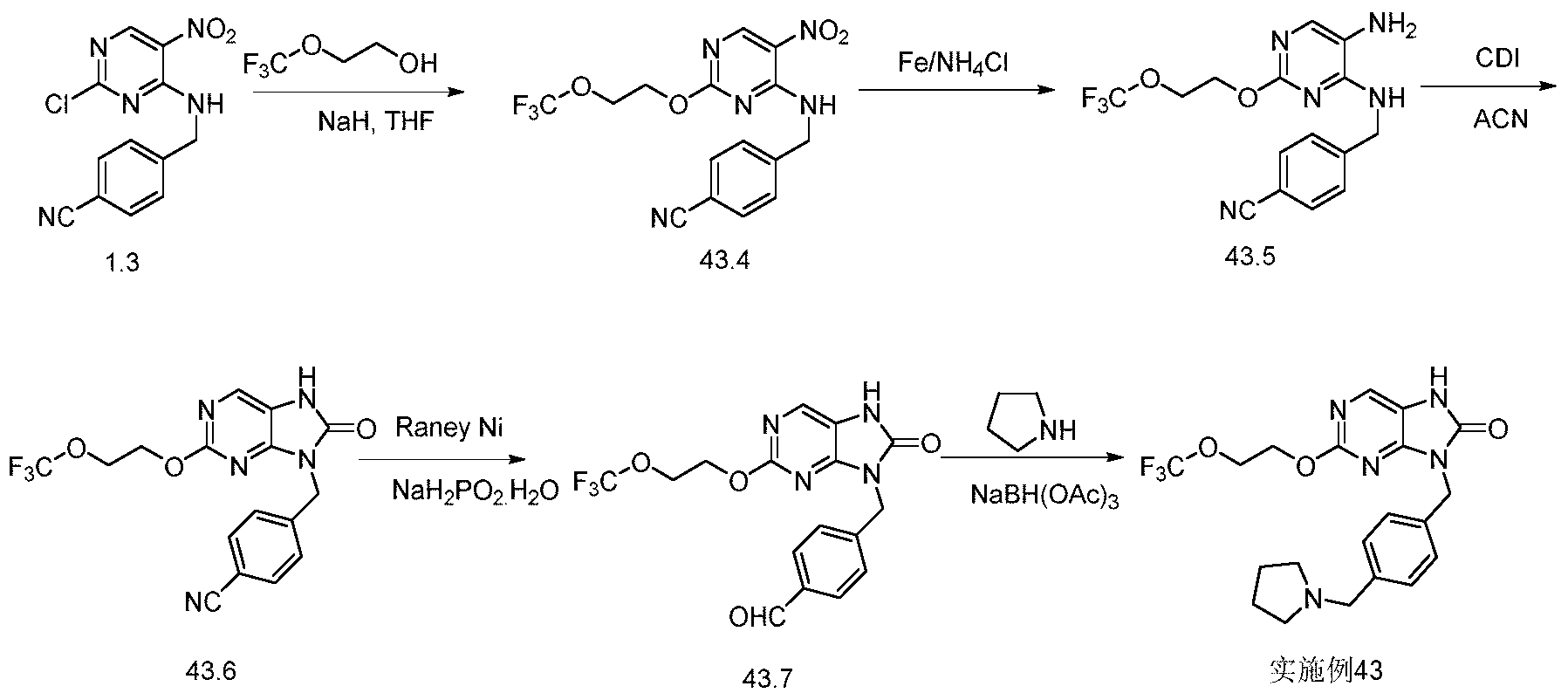
1、中间体43.4的合成
100ml三口瓶中加入NaH(0.41g,10.4mmol),冰浴下加入无水THF 10ml,缓慢滴加2-三氟甲氧基-1-乙醇(2.69g,20.7mmol)的THF溶液10ml,加毕,冰浴下搅拌30min。将此反应液缓慢滴加到溶解有中间体1.3(2g,6.90mmol)的无水THF溶液50ml中,保持温度不超过10℃,加毕,室温反应2h,TLC检测原料消失(PE/EA=2/1)。将反应液缓慢倒入50ml冰水中,乙酸乙酯萃取(30ml*3),合并有机相,饱和食盐水洗,无水硫酸钠干燥,浓缩,粗品经硅胶柱层析纯化得到中间体43.4(黄色固体,1.9g,收率72%)。LC-MS:M+H+=384。
2、中间体43.5的合成
向100ml三口瓶中加入20ml乙醇和10ml水,搅拌下加入氯化铵固体(0.26g,4.96mmol)和还原铁粉(1.38g,24.8mmol),加毕,升温至回流,活化30min,然后加入中间体43.4(1.90g,4.96mmol),50℃反应2h,TLC检测原料消失(DCM/MeOH=20/1),趁热过滤,滤饼乙醇洗,滤液浓缩除去乙醇,乙酸乙酯萃取(30ml*3),有机相水洗,饱和食盐水洗,干燥,粗品经硅胶柱层析纯化得到中间体43.5(棕红色固体,1.4g,收率80%)。LC-MS:M+H+=354。
3、中间体43.6的合成
将中间体43.5(1.4g,3.96mmol)加入到30ml干燥乙腈中,室温搅拌下加入羰基二咪唑(1.29g,7.93mmol),加毕,50℃反应2h,TLC检测原料消失(DCM/MeOH=20/1),浓缩反应液,浓缩液倒入水中,搅拌30min,乙酸乙酯萃取(20ml*3),有机相水洗,饱和食盐水洗,干燥浓缩,粗品经硅胶柱层析纯化得到中间体43.6(类白色固体,0.9g,收率60%)。LC-MS:M+H+=380。
4、中间体43.7的合成
冰浴下,将5ml水,加入到5ml醋酸中,加毕,缓慢加入10ml吡啶,向此混合溶液中加入中间体43.6(0.9g,2.37mmol),次亚磷酸钠一水合物(5g,475mmol),搅拌溶解后,分批加入湿的Raney Ni(约1g),45℃反应2h,LCMS检测反应完全。过滤,滤液中加入30ml水,乙酸乙酯萃取(20ml*3),有机相1N盐酸洗,水洗,饱和食盐水洗,干燥后浓缩得到中间体43.7(淡黄色固体,0.58g,收率64%)。LC-MS:M+H+=383。
5、实施例43的合成
将中间体43.7(580mg,1.52mmol),四氢吡咯(216mg,3.03mmol),加入到超干THF(10ml)中,室温搅拌30min后,加入三乙酰氧基硼氢化钠(965mg,4.55mmol),加毕,室温下搅拌2h,TLC检测原料消失(DCM/MeOH=10:1),向反应液中加入20ml半饱和碳酸氢钠水溶液,乙酸乙酯萃取(20ml*3),有机相干燥后,产品经硅胶柱层析纯化,得到实施例43(白色固体,340mg,收率51%)。1H-NMR(400MHz,CDCl3):δ7.93(s,1H),7.41(d,J=7.9Hz,2H),7.32(d,J=7.9Hz,2H),5.06(s,2H),4.59(t,J=4.8Hz,2H),4.32(t,J=4.8Hz,2H),3.67(s,2H),2.60(s,4H),1.81(s,4H).LC-MS:M+H+=438。
实施例44:9-(4-(吡咯烷-1-基甲基)苄基)-2-(2-(二氟甲基)乙氧基)-7,9-二氢-8H-嘌呤-8-酮的制备

依据实施例43的合成方法,用2-二氟甲氧基-1-乙醇代替2-三氟甲氧基-1-乙醇,得到实施例44。1H-NMR(400MHz,CDCl3):δ8.31(s,1H),7.92(s,1H),7.53(d,J=8.0Hz,2H),7.31(d,J=8.0Hz,2H),6.28(t,J=74.7Hz,1H),5.04(s,2H),4.56(s,2H),4.02(t,J=4.8Hz,2H),3.67(t,J=4.8Hz,2H),3.59(t,J=6.6Hz,4H),2.08–1.93(m,4H).LC-MS:M+H+=420。
实施例45:9-(4-(吡咯烷-1-基甲基)苄基)-2-(3-甲氧基丙氧基)-7,9-二氢-8H-嘌呤-8-酮的制备

依据实施例43的合成方法,用3-甲氧基-1-丙醇代替2-三氟甲氧基-1-乙醇,得到实施例45。1H-NMR(400MHz,CDCl3):δ8.01(s,1H),7.47(s,4H),5.08(s,2H),4.45(t,J=6.5Hz,2H),3.99(s,2H),3.60(t,J=6.2Hz,2H),3.38(s,3H),2.97(s,4H),2.18–2.07(m,2H),2.00(s,4H).LC-MS:M+H+=398。
实施例46:9-(4-(吡咯烷-1-基甲基)苄基)-2-((四氢呋喃-2-基)甲氧基)-7,9-二氢-8H-嘌呤-8-酮的制备

依据实施例43的合成方法,用四氢呋喃-2-甲醇代替2-三氟甲氧基-1-乙醇,得到实施例46。1H-NMR(400MHz,CDCl3):δ7.87(s,1H),7.42(d,J=7.9Hz,2H),7.30(d,J=7.9Hz,2H),5.04(s,2H),4.38-4.31(m,3H),3.94(dd,J=14.6,6.8Hz,1H),3.83(dd,J=14.4,7.5Hz,1H),3.66(s,2H),2.59(s,4H),2.13–1.86(m,4H),1.80(s,4H).LC-MS:M+H+=410。
实施例47:9-(4-(吡咯烷-1-基甲基)苄基)-2-(4-甲氧基丁氧基)-7,9-二氢-8H-嘌呤-8-酮的制备

依据实施例43的合成方法,用4-甲氧基-1-丁醇代替2-三氟甲氧基-1-乙醇,得到实施例47。1H-NMR(400MHz,CDCl3):δ7.96(s,1H),7.44(d,J=8.0Hz,2H),7.37(d,J=7.9Hz,2H),5.06(s,2H),4.36(t,J=6.5Hz,2H),3.77(s,2H),3.45(t,J=6.4Hz,2H),3.35(s,3H),2.72(s,4H),1.91-1.86(m,6H),1.80-1.73(m,2H).LC-MS:M+H+=412。
实施例48:9-(4-(吡咯烷-1-基甲基)苄基)-2-(2-(2,2,2-三氟乙氧基)乙氧基)-7,9-二氢
-8H-嘌呤-8-酮的制备

依据实施例43的合成方法,用2-(2,2,2-三氟乙氧基)-1-乙醇代替2-三氟甲氧基-1-乙醇,得到实施例48。1H-NMR(400MHz,CDCl3):δ7.92(s,1H),7.41(d,J=7.9Hz,2H),7.30(d,J=7.9Hz,2H),5.06(s,2H),4.53(t,J=4.8Hz,2H),4.01(t,J=4.8Hz,2H),3.95(q,J=8.8Hz,2H),3.63(s,2H),2.56(s,4H),1.79(s,4H).LC-MS:M+H+=452。
实施例49:9-(4-(吡咯烷-1-基甲基)苄基)-2-(3-甲氧基丁氧基)-7,9-二氢-8H-嘌呤-8-酮的制备

依据实施例43的合成方法,用3-甲氧基-1-丁醇代替2-三氟甲氧基-1-乙醇,得到实施例49。1H-NMR(400MHz,CDCl3):δ7.97(s,1H),7.45(d,J=8.0Hz,2H),7.38(d,J=7.9Hz,2H),5.07(s,2H),4.45-4.41(m,2H),3.80(s,2H),3.62-3.57(m,1H),3.34(s,3H),2.76(br,4H),2.05–1.94(m,2H),1.89(br,4H),1.21(d,J=6.1Hz,3H).LC-MS:M+H+=412。
实施例50:9-(4-(吡咯烷-1-基甲基)苄基)-2-(3-(三氟甲氧基)丙氧基)-7,9-二氢-8H-嘌呤-8-酮的制备

依据实施例43的合成方法,用3-三氟甲氧基-1-丙醇代替2-三氟甲氧基-1-乙醇,得到实施例50。1H-NMR(400MHz,CDCl3):δ7.99(s,1H),7.47(s,4H),5.07(s,2H),4.46(t,J=6.1Hz,2H),4.19(t,J=6.2Hz,2H),3.96(s,2H),2.94(s,4H),2.24-2.18(m,2H),1.99(s,4H).LC-MS:M+H+=452。
实施例51:9-(4-(吡咯烷-1-基甲基)苄基)-2-(4-(三氟甲氧基)丁氧基)-7,9-二氢-8H-
嘌呤-8-酮的制备

依据实施例43的合成方法,用3-三氟甲氧基-1-丁醇代替2-三氟甲氧基-1-乙醇,得到实施例51。1H-NMR(400MHz,CDCl3):δ7.97(s,1H),7.44(d,J=7.9Hz,2H),7.39(d,J=8.1Hz,2H),5.06(s,2H),4.38(t,J=5.6Hz,2H),4.04(t,J=5.7Hz,2H),3.80(s,2H),2.75(br,4H),1.92-1.89(m,2H).LC-MS:M+H+=466。
实施例52:9-(4-((3-氮杂双环[3.1.1]庚烷-3-基)甲基)苄基)-2-(2-甲氧基乙氧基)-7,9-二氢-8H-嘌呤-8-酮的制备

依据实施例1的合成方法,在还原胺化步骤,用3-氮杂双环[3.1.1]庚烷代替四氢吡咯,得到实施例52。1H-NMR(400MHz,CDCl3):δ8.03(s,1H),7.53(s,2H),7.47(d,J=7.9Hz,2H),5.08(s,2H),4.54–4.50(m,2H),4.04(s,2H),3.82–3.78(m,2H),3.46(s,3H),3.24(s,4H),2.42(s,2H),2.16-2.04(m,4H).LC-MS:M+H+=410。
实施例53:9-(4-((7-氮杂双环[2.2.1]庚烷-7-基)甲基)苄基)-2-(2-甲氧基乙氧基)-7,9-二氢-8H-嘌呤-8-酮的制备

依据实施例1的合成方法,在还原胺化步骤,用7-氮杂双环[2.2.1]庚烷代替四氢吡咯,得到实施例53。1H-NMR(400MHz,CDCl3):δ7.99(s,1H),7.62(d,J=7.2Hz,2H),7.44(d,J=8.1Hz,2H),5.03(s,2H),4.52–4.43(m,2H),4.04(s,2H),3.84–3.74(m,4H),3.42(s,3H),2.33-2.19(m,8H).LC-MS:M+H+=410。
实施例54:9-(4-((3,3-二氟吡咯烷-1-基)甲基)苄基)-2-(2-甲氧基乙氧基)-7,9-二氢-8H-
嘌呤-8-酮的制备

依据实施例1的合成方法,在还原胺化步骤,用3,3-二氟吡咯烷代替四氢吡咯,得到实施例54。1H-NMR(400MHz,CDCl3):δ8.76(s,1H),7.96(s,1H),7.42(d,J=8.1Hz,2H),7.24(d,J=8.1Hz,2H),5.05(s,2H),4.53–4.43(m,2H),3.80–3.70(m,2H),3.57(s,2H),3.42(s,3H),2.82(t,J=13.2Hz,2H),2.68(t,J=6.9Hz,2H),2.31–2.15(m,2H).LC-MS:M+H+=420。
实施例55:9-(4-((2,5-二氢-1H-吡咯-1-基)甲基)苄基)-2-(2-甲氧基乙氧基)-7,9-二氢-8H-嘌呤-8-酮的制备

依据实施例43的合成方法,在还原胺化步骤,用2,5-二氢-1H-吡咯代替四氢吡咯,得到实施例55。1H-NMR(400MHz,CDCl3):δ7.85(s,1H),7.34(d,J=8.0Hz,2H),7.26(d,J=8.0Hz,2H),5.71(s,2H),5.00(s,2H),4.52(t,J=4.8Hz,2H),4.29–4.21(m,2H),3.74(s,2H),3.42(s,4H).LC-MS:M+H+=436。
实施例56:9-(4-(吡咯烷-1-基甲基)苄基)-7-甲基-2-(2-甲氧基乙氧基)-7,9-二氢-8H-嘌呤-8-酮的制备

1、中间体56.7的合成
将中间体1.6(500mg,1.54mmol)加入到10ml无水DMF中,室温搅拌溶解,加入碳酸钾(319mg,2.31mmol),碘甲烷(262mg,1.84mmol),加毕,外温70℃反应16h,LCMS检测原料转化完全。反应液冷至室温,倒入50ml水中,乙酸乙酯萃取(20ml*3),有机相合并,水洗,饱和食盐水洗,干燥后经硅胶柱层析纯化得到中间体56.7(棕色固体,300mg,收率58%)。LC-MS:M+H+=340。
2、中间体56.8的合成
将中间体56.7(300mg,0.88mmol)加入到75%的甲酸水溶液10ml中,加入湿的Raney Ni(约0.5g),50℃反应4h,LCMS检测原料转化完全,过滤,滤液浓缩,残余物倒入50ml饱和碳酸氢钠水溶液中,乙酸乙酯萃取(20ml*3),有机相水洗,饱和食盐水洗,干燥浓缩,粗品经硅胶柱层析纯化得到中间体56.8(白色固体,0.2g,收率66%)。LC-MS:M+H+=329。
3、实施例56的制备
将中间体56.8(200mg,0.58mmol),四氢吡咯(83mg,1.17mmol),加入到干燥的THF(10ml)中,室温下反应30min,搅拌下加入三乙酰氧基硼氢化钠(371mg,1.75mmol),加毕,室温反应2h,TLC检测原料消失(DCM/MeOH=10:1),向反应液中加入20ml半饱和碳酸氢钠水溶液,DCM萃取(10ml*3),有机相干燥后,产品经硅胶制备板纯化,得到实施例56(棕色固体,100mg,收率43%)。1H-NMR(400MHz,CDCl3):δ7.85(s,1H),7.46(s,4H),5.05(s,2H),4.49(t,J=4.8Hz,2H),3.77(t,J=4.8Hz,2H),3.42(s,3H),3.39(s,3H),2.66(s,4H),1.99(s,4H).LC-MS:M+H+=398。
实施例57:9-(4-(吡咯烷-1-基甲基)苄基)-7-丙基-2-(2-甲氧基乙氧基)-7,9-二氢-8H-嘌呤-8-酮的制备

依据实施例56的合成方法,用1-碘丙烷代替碘甲烷,得到实施例57。1H-NMR(400MHz,CDCl3):δ7.87(s,1H),7.53–7.40(m,4H),5.05(s,2H),4.53–4.42(m,2H),3.94(s,2H),3.84–3.71(m,4H),3.41(s,3H),2.95(s,4H),1.98(s,4H),1.76(dd,J=
14.5,7.3Hz,2H),0.94(t,J=7.4Hz,3H).LC-MS:M+H+=426。
实施例58:9-(4-(吡咯烷-1-基甲基)苄基)-6-甲基-2-(2-甲氧基乙氧基)-7,9-二氢-8H-嘌呤-8-酮的制备

1、中间体58.1的合成
将4-氰基苄胺盐酸盐(4.18g,24.8mmol),6-甲基-2,4-二氯-5-硝基嘧啶(5.67g,27.3mmol)加入到70ml DCM中,-78℃下滴加DIPEA(7.05g,54.5mmol),加完升至室温,反应2h,TLC监测,浓缩掉DCM,再加入水50ml,搅拌,过滤,滤饼用水洗,冷EA洗涤,干燥,得到中间体58.1(黄色固体,4.8g,收率64%)。LC-MS:M+H+=304。
2、中间体58.2的合成
将NaH(60%in oil,695mg,17.4mmol)悬于10ml THF中,N2保护,0℃下滴加乙二醇单甲醚(3.61g,47.4mmol),搅拌30min,向此溶液中加入中间体58.1(4.8g,15.8mmol)的20ml THF溶液中,加完室温反应2h,TLC监测,原料转化完全。反应液加入到半饱
和氯化铵溶液中,EA萃取,有机层用无水硫酸钠干燥,旋干,粗品经EA打浆得到中间体58.2(黄色固体,5.15g,收率95%)。LC-MS:M+H+=344。
3、中间体58.3的合成
将中间体58.2(5.15g,15mmol),Fe(4.2g,75mmol),NH4Cl(4.8g,90mmol)加入到150ml EtOH和75ml H2O中,50℃下反应4h,TLC监测反应完全,趁热加硅藻土抽滤,滤饼用EA洗涤,滤液浓缩,加50ml水,EA萃取(30ml*3),有机相无水硫酸钠干燥后经硅胶柱层析纯化,得到中间体58.3(棕红色固体,2g,收率43%)。LC-MS:M+H+=314。
4、中间体58.4的合成
将中间体58.3(2.0g,6.38mmol),CDI(2.07g,12.8mmol)置于封管中,再加入30ml ACN,80℃下反应2h,TLC监测转化完全,浓缩,加EA打浆,抽滤,水洗,滤饼用EA洗涤,得到中间体58.4(类白色固体,1.35g,收率62%)。LC-MS:M+H+=340。
5、中间体58.5的合成
将中间体58.4(1.35g,3.98mmol)加入到75%的甲酸中(15ml),室温下加入湿Raney Ni(约1g),80℃反应4h,TLC监测原料转化完全。过滤,滤饼用EA洗涤,滤液再倒入饱和NaHCO3溶液中,用EA萃取,有机层再用饱和食盐水溶液洗涤,无水硫酸钠干燥,旋干,得到中间体58.5(类白色固体,700mg,收率51%)。LC-MS:M+H+=343。
6、实施例58的合成
将中间体58.5(675mg,1.97mmol),吡咯烷(280mg,3.94mmol)溶于20ml DCM中,搅拌15min,0℃下,分批加入三乙酰氧基硼氢化钠(1.25g,5.91mmol),加完,室温反应3h,TLC监测原料转化完全,加水,用DCM萃取,有机层用饱和NaCl溶液洗涤,无水硫酸钠干燥,旋干,制备板纯化,得到实施例58(浅黄色固体,350mg,收率45%)。1H-NMR(400MHz,CDCl3):δ7.44(d,J=8.2Hz,2H),7.40(d,J=8.1Hz,2H),5.04(s,2H),4.49(t,J=4.5Hz,2H),3.91(s,2H),3.77(t,J=4.5Hz,2H),3.43(s,3H),2.88(s,4H),2.45(s,3H),1.94(s,4H).LC-MS:M+H+=398。
实施例59:2-(2-甲氧基乙氧基)-8-甲基-9-(4-(吡咯烷-1-基甲基)苄基)-9H-嘌呤的制备

1、中间体59.1的合成
将中间体1.5(1.80g,6mmol),原乙酸三乙酯(2.93g,18mmol),乙基磺酸(199mg,1.8mmol)加入到15ml乙酸酐中,微波120℃下反应2h,TLC监测,反应完后,加水,用DCM萃取,有机层用饱和NaCl溶液洗涤,无水硫酸钠干燥,旋干,柱层析得到含有部分杂点的中间体。(黄色固体,756mg,收率39%)。LC-MS:M+H+=324。
2、中间体59.2的合成
将中间体59.1(756mg,2.34mmol)溶于75%甲酸中(15ml),加入湿Raney Ni(约1g),50℃反应4h,TLC监测,反应完后,加硅藻土抽滤,滤饼用EA洗涤,滤液再倒入饱和NaHCO3溶液中,用EA萃取,有机层再用饱和NaCl溶液洗涤,无水硫酸钠干燥,旋干,制备板纯化,得到中间体59.2(类白色固体,132mg,收率17%)。
3、实施例59的合成
将中间体59.2(278mg,0.85mmol),吡咯烷(123mg,1.7mmol)溶于6ml DCM中,搅拌15min,0℃下加入三乙酰氧基硼氢化钠(541mg,2.55mmol),加完,室温反应3h,TLC监测,反应完后,加水,用DCM萃取,有机层用饱和NaCl溶液洗涤,无水硫酸钠干燥,旋干,制备板纯化,得到实施例59化合物(浅黄色固体,180mg,收率55%)。1H-NMR(400MHz,CDCl3):δ8.73(s,1H),7.44(d,J=7.8Hz,2H),7.17(d,J=7.9Hz,2H),5.34(s,2H),4.58(t,J=4.5Hz,2H),3.84(s,2H),3.81(t,J=4.5Hz,2H),3.44(s,3H),2.80(s,4H),2.50(s,3H),1.93(s,4H).LC-MS:M+H+=382。
实施例60:2-(2-甲氧基乙氧基)-9-(4-(吡咯烷-1-基甲基)苄基)-7,9-二氢-8H-嘌呤-8-硫酮的制备

1、中间体60.1的合成
100ml三口瓶中加入NaH(276mg,6.9mmol),冰浴下加入无水THF10ml,缓慢滴加超干乙二醇单甲醚(1.31g,17.25mmol),加毕,冰浴下搅拌30min。将此反应液缓慢滴加到溶解有中间体27.3(2g,5.75mmol)的无水THF溶液10ml中,保持温度不超过10℃,加毕,室温反应2h,TLC检测原料消失(DCM/MeOH=20/1)。将反应液缓慢倒入30ml冰水中,乙酸乙酯萃取(20ml*3),合并有机相,饱和食盐水洗,无水硫酸钠干燥,浓缩,经硅胶柱层析纯化得到中间体60.1(棕色固体,800mg,收率36%)。LC-MS:M+H+=388。
2、中间体60.2的合成
向100ml三口瓶中加入20ml乙醇和10ml水,搅拌下加入氯化铵固体(663mg,12.4mmol)和还原铁粉(576mg,10.32mmol),加毕,升温至回流,反应30min,然后加入中间体60.1(800mg,2.06mmol),80℃反应2h,TLC检测原料消失(DCM/MeOH=20/1),趁热过滤,滤饼乙醇洗,滤液浓缩除去乙醇,乙酸乙酯萃取(30ml*3),有机相水洗,饱和食盐水洗,干燥浓缩粗品经硅胶柱层析纯化得到中间体60.2(棕红色固体,400mg,收率54%)。LC-MS:M+H+=358。
3、实施例60的合成
将中间体60.2(100mg,0.28mmol)加入到10ml乙醇中,室温搅拌下加入乙基黄原酸钾(90mg,0.56mmol),加毕,外温90℃,反应16h,TLC检测原料消失(DCM/MeOH=20/1),加硅藻土抽滤,滤饼用EA洗涤,滤液旋干,加入水,用EA萃取,有机层干燥浓缩后,粗品经硅胶柱层析纯化,得到实施例60。(棕黄色固体,56mg,收率50%)。1H-NMR(400MHz,CDCl3),δ9.28(s,1H),8.08(s,1H),7.62(d,J=7.9Hz,2H),7.29(d,J=8.0Hz,2H),5.40(s,2H),4.53(s,2H),3.66–3.50(m,8H),3.38(s,3H),2.01(t,J
=6.6Hz,4H).LC-MS:M+H+=400。
实施例61:2-(2-甲氧基乙氧基)-9-(4-(吡咯烷-1-基甲基)苄基)-7,9-二氢-8H-嘌呤-8-胺的制备

1、中间体61.1的合成
将中间体60.2(666mg,1.87mmol)加入到10ml ACN中,再加入Et3N(566.6mg,5.61mmol),0℃下加入异硫氰酰甲酸乙酯(294mg,2.24mmol)的ACN溶液6ml,室温条件下搅拌30min,再加入N,N-二异丙基碳二亚胺(306.3mg,2.43mmol),加完,回流反应,TLC监测,反应完后加水,DCM萃取,有机层旋干,经硅胶柱层析纯化,得到中间体61.1(棕色油状物,298mg,收率35%)。LC-MS:M+H+=400。
2、实施例61的合成
将中间体61.1(132mg,0.29mmol)溶解于5ml甲醇中,再加入5ml 4M的LiOH水溶液(20mmol),90℃下反应48h,TLC监测,反应完后,加水,用DCM萃取,有机层旋干,制备板纯化,得到实施例61(棕色固体,29mg,26%)。1H-NMR(400MHz,d6-DMSO),δ8.06(s,1H),7.32-7.25(m,4H),6.80(br,2H),5.15(s,2H),4.43(s,2H),3.53–3.41(m,8H),3.23(s,3H),1.90(br,4H).LC-MS:M+H+=383。
实施例62:2-(2-甲氧基乙氧基)-9-(3-氟-4-(吡咯烷-1-基甲基)苄基)-7,9-二氢-8H-嘌呤-8-酮的制备

根据实施例1的合成方法,将起始物料4-氰基苄溴换成4-氰基-3-氟苄溴,合成得到实施例62的化合物。1H-NMR(400MHz,CDCl3)δ7.96(s,1H),7.59(s,1H),7.22(d,J=7.9Hz,1H),7.15(d,J=10.7Hz,1H),5.02(s,2H),4.48(d,J=4.8Hz,1H),3.95(s,2H),3.76(d,J=4.8Hz,1H),3.42(s,3H),2.89(s,4H),1.94(s,4H).LC-MS:M+H+=402。
实施例63:2-(2-甲氧基乙氧基)-9-(2-氟-4-(吡咯烷-1-基甲基)苄基)-7,9-二氢-8H-嘌呤-8-酮的制备

根据实施例1的合成方法,将起始物料4-氰基苄溴换成4-氰基-2-氟苄溴,合成得到实施例63的化合物。1H-NMR(400MHz,CDCl3)δ7.98(s,1H),7.23–7.19(m,1H),7.17–7.08(m,2H),5.11(s,2H),4.50–4.40(m,2H),3.77–3.73(m,4H),3.40(s,3H),2.73(s,4H),1.88(s,4H).LC-MS:M+H+=402。
实施例64:9-(4-(吡咯烷-1-基甲基)苄基)-2-(2-异丙氧基乙氧基)-7,9-二氢-8H-嘌呤-8-酮的制备

依据实施例43的合成方法,用2-异丙氧基-1-乙醇代替2-三氟甲氧基-1-乙醇,得到实施例64。1H-NMR(400MHz,CDCl3):δ7.95(s,1H),7.45(d,J=8.2Hz,2H),7.41(d,J=
8.1Hz,2H),5.07(s,2H),4.50(d,J=4.9Hz,2H),3.87(s,2H),3.83(d,J=4.9Hz,2H),3.76-3.67(m,1H),2.84(s,4H),1.94(s,4H),1.22(d,J=6.1Hz,6H).LC-MS:M+H+=412。
实施例65:9-(4-(吡咯烷-1-基甲基)苄基)-2-(2-(环丙甲氧基)乙氧基)-7,9-二氢-8H-嘌呤-8-酮的制备

依据实施例43的合成方法,用2-环丙甲氧基-1-乙醇代替2-三氟甲氧基-1-乙醇,得到实施例65。1H-NMR(400MHz,CDCl3):δ7.95(s,1H),7.43(s,4H),5.05(s,2H),4.51(t,J=4.9Hz,2H),3.94(s,2H),3.85(t,J=4.9Hz,2H),3.39(d,J=6.9Hz,2H),2.93(s,4H),1.97(s,4H),1.14–1.01(m,1H),0.54(d,J=7.6Hz,2H),0.22(d,J=5.0Hz,2H).LC-MS:M+H+=424。
实施例66:9-(4-(吡咯烷-1-基甲基)苄基)-2-丁氧基-7,9-二氢-8H-嘌呤-8-酮的制备

依据实施例43的合成方法,用正丁醇代替2-三氟甲氧基-1-乙醇,得到实施例66。1H-NMR(400MHz,d6-DMSO):δ10.74(s,1H),7.82(s,1H),7.30(d,J=7.6Hz,2H),7.22(d,J=7.6Hz,2H),4.84(s,2H),4.36(s,2H),3.39–3.33(m,6H),1.86(br,4H),1.47–1.43(m,2H),1.30–1.19(m,2H),0.82(t,J=7.2Hz,3H).LC-MS:M+H+=382。
实施例67:9-(4-(吡咯烷-1-基甲基)苯乙基)-2-(2-甲氧基乙氧基)-7,9-二氢-8H-嘌呤-8-酮的制备

1、中间体67.1的合成
将2-(4-溴苯基)乙酸(10g,46mmol)加入50mL DCM中,滴加入草酰氯(7.08g,56mmol),升温至45度搅拌3h。冷却至室温浓缩,余液加入50mL THF配成溶液,0℃下缓慢滴加入50mL氨水中,室温搅拌3h,过滤,滤饼水洗,乙醇淋洗,干燥得到中间体67.1(白色固体,9.9g,收率99%)。LC-MS:M+H+=214,216。
2、中间体67.2的合成
将中间体67.1(10g,46mmol)加入150mL THF中,滴加入BH3/THF(150mL)加毕,升温至80度搅拌过夜。冷却至室温加入甲醇淬灭,过滤,滤液浓缩后加水,用二氯甲烷萃取三次,合并二氯甲烷相后水洗三次,无水硫酸钠干燥后浓缩得到中间体67.2(无色液体,5g,收率56%)。LC-MS:M+H+=200,202。
3、中间体67.3的合成
将2,4-二氯-5-硝基嘧啶(5g,25.8mmol)溶于50mL THF中,降温至-78度,滴加入中间体67.2(5g,25.8mmol)和DIPEA(6.6g,51.6mmol),然后在-78度搅拌1h。将反
应液倒入冰水中,DCM萃取三次,合并有机相,饱和食盐水洗,无水硫酸钠干燥浓缩,余渣用甲醇打浆后过滤得到中间体67.3(淡黄色固体,3g,收率35%)。LC-MS:M+H+=357,359。
4、中间体67.4的合成
向乙二醇单甲醚(10mL)中分批加入NaH(0.5g,12mmol),室温搅拌0.5h,然后滴加入中间体67.3(3g,8.39mmol)的四氢呋喃溶液,室温搅拌1h。TLC检测反应结束后,将反应液倒入冰水中,过滤干燥得到中间体67.4(黄色固体,3g,收率88%)。LC-MS:M+H+=397,399。
5、中间体67.5的合成
将中间体67.4(3g,7.5mmol)溶于30m乙醇和20mL水中,向反应液中依次加入铁粉(2.1g,37.7mmol)及氯化铵(0.4g,7.5mmol),加热至80℃搅拌2h。TLC检测反应结束后,停止加热,反应液热滤,蒸干溶剂,粗品经硅胶柱层析纯化,得到中间体67.5(红棕色固体,3g,96%)。LC-MS:M+H+=367,369。
6、中间体67.6的合成
将中间体67.5(3g,8.17mmol)溶于100mACN中,室温下加入羰基二咪唑(2.3g,16.35mmol),加完后,升温至回流搅拌过夜。反应结束后,蒸干溶剂,残余物硅胶柱层析纯化,得到中间体67.6(黄色固体,2g,收率62%)。LC-MS:M+H+=393,395。
7、中间体67.7的合成
将中间体67.6(500mg,1.27mmol),氰化锌(232mg,2.5mmol),Pd(PPh3)4(80mg,0.07mmol),加入6mL DMF中,氮气保护下升温至120度搅拌过夜。反应结束后,加水,乙酸乙酯萃取,残余物硅胶柱层析纯化,得到中间体67.7(黄色固体,300mg,收率69%)。LC-MS:M+H+=340。
8、中间体67.8的合成
将中间体67.7(0.3g,0.8mmol)溶于3mL 75%甲酸中,室温下加入Raney Ni(10mg),加完后,升温至回流搅拌0.5h。反应结束后,过滤蒸干溶剂,残余物倒入饱和碳酸氢钠水溶液中,DCM萃取三次,无水硫酸钠干燥后浓缩得到中间体67.8(黄色固体,150mg,收率49%)。LC-MS:M+H+=343。
9、实施例67的合成
将中间体67.8(100mg,0.29mmol)和四氢吡咯(42mg,0.58mmol)溶于3mL THF中,室温下搅拌4h,然后加入三乙酰氧基硼氢化钠(76mg,0.36mmol),加完后,室温
搅拌过夜。反应结束后,用饱和NaHCO3淬灭,DCM萃取后蒸干溶剂,残余物硅胶柱层析纯化,得到实施例67(黄色固体,20mg,收率17%)。1H-NMR(400MHz,d6-DMSO)δ8.01(s,1H),7.43(d,J=8.1Hz,2H),7.10(d,J=8.1Hz,2H),4.52–4.50(m,2H),4.14–4.13(m,2H),4.11(s,2H),3.47(s,2H),3.13(m,2H),3.12-3.10(m,2H),2.13(m,4H),1.31–1.28(m,2H).LC-MS:M+H+=398。
实施例68:9-(4-(2-(吡咯烷-1-基)乙基)苄基)-2-(2-甲氧基乙氧基)-7,9-二氢-8H-嘌呤-8-酮的制备

1、中间体68.1的合成
将2-(4-溴苯基)乙酸(10g,46mmol)加入50mL DCM中,滴加入草酰氯(7.08g,56mmol),升温至45度搅拌3h。冷却至室温浓缩,余液加入50mL THF配成溶液,滴加入50mL四氢吡咯(6.61g,93mmol)的THF溶液中室温搅拌过夜,过滤,滤饼水洗,乙醇淋洗,干燥得到中间体68.1(白色固体,10g,收率80%)。LC-MS:M+H+=268,270。
2、中间体68.2的合成
将中间体68.1,氰化锌(2.73g,29.83mmol),Pd(PPh3)4(0.86g,0.75mmol),加入40mL DMF中,氮气保护下升温至120度搅拌过夜。反应结束后,加水,乙酸乙酯萃取,残余物硅胶柱层析纯化,得到中间体68.2(黄色固体,3g,收率90%)。LC-MS:M+H+=215。
3、中间体68.3的合成
将中间体68.2(3g,466mmol)溶于20mNH3/MeOH中,加入雷尼镍(0.2g)然后在氢气下(2atm)室温搅拌过夜,TLC检测原料转化完全。将反应液过滤,浓缩至干得到中间体68.3(棕色油状物,2g,收率65%)。LC-MS:M+H+=219。
4、中间体68.4的合成
将2,4-二氯-5-硝基嘧啶(0.5g,2.58mmol)溶于5mL THF中,降温至-78度,滴加入中间体68.3(0.5g,2.3mmol)和DIPEA(0.6g,4.6mmol),然后在-78度搅拌1h。将反应液倒入冰水中,DCM萃取三次,合并有机相,饱和食盐水洗,无水硫酸钠干燥浓缩,粗品用甲醇打浆后过滤得到中间体68.4(淡黄色固体,0.5g,收率58%)。LC-MS:M+H+=376。
5、中间体68.5的合成
向乙二醇单甲醚(5mL)中分批加入NaH(0.13g,3.2mmol)室温搅拌0.5h,然后分批加入中间体68.4(1g,2.66mmol),室温搅拌1h。TLC检测反应结束后,将反应液倒入冰水中,过滤干燥得到中间体68.5(黄色固体,0.9g,收率81%)。LC-MS:M+H+=416。
6、中间体68.6的合成
将中间体68.5(0.9g,2.17mmol)溶于9mL 乙醇和5mL水中,向反应液中依次加入铁粉(0.6g,10.8mmol)及氯化铵(0.7g,13mmol),加热至80℃搅拌2h。TLC检测反应结束后,停止加热,反应液冷却至室温,过滤,蒸干溶剂,残余物硅胶柱层析纯化,得到中间体68.6(红棕色固体,0.6g,收率70%)。LC-MS:M+H+=386。
7、中间体68.7的制备
将中间体68.7(300mg,0.78mmol)加入10mL THF中,零度下加入四氢锂铝(90mg,2.34mmol),氮气保护下10度搅拌1h。反应结束后,加水,乙酸乙酯萃取,残余物硅胶柱层析纯化,得到中间体68.7(黄色固体,250mg,收率80%)。LC-MS:M+H+=372。
8、实施例68的合成
将中间体68.7(200mg,0.53mmol)和CDI(175mg,1.08mmol)溶于5mL ACN中,50度下搅拌2h,反应结束后,蒸干溶剂,残余物硅胶柱层析纯化,得到实施例68(黄色固体,60mg,收率30%)。1H-NMR(400MHz,CDCl3)δ7.91(s,1H),7.65(s,1H),7.28(d,J=8.1Hz,2H),7.05(d,J=8.1Hz,2H),4.94(s,2H),4.43–4.40(m,2H),3.71–3.69(m,2H),3.3(s,3H),3.18-3.06(m,8H),2.01(s,4H).LC-MS:M+H+=398。
实施例69:6-羟基-2-(2-甲氧基乙氧基)-9-(4-(吡咯烷-1-基甲基)苄基)-7,9-二氢-8H-嘌呤-8-酮的制备

将6-氨基-2-(2-甲氧基乙氧基)-9-(4-(吡咯烷-1-基甲基)苄基)-7,9-二氢-嘌呤-8-酮(150mg,0.37mmol,合成方法参考CN01784548B)溶于5mL 95%醋酸中,0℃下加入亚硝酸钠(78mg,1.13mmol)室温搅拌3h,反应结束后加碳酸钠淬灭,萃取,蒸干溶剂,残余物硅胶柱层析纯化,得到实施例69(黄色固体,60mg,39%)。1H-NMR(400MHz,DMSO)δ10.94(s,1H),7.26(m,4H),4.82(s,2H),4.42(t,J=4.0Hz,2H),3.61(t,J=4.0Hz,2H),3.52(s,2H),3.26(s,3H),2.39(br,4H),1.66(br,4H).LC-MS:M+H+=400。
实施例70:6-氟-2-(2-甲氧基乙氧基)-9-(4-(吡咯烷-1-基甲基)苄基)-7,9-二氢-8H-嘌呤-8-酮的制备

将6-氨基-2-(2-甲氧基乙氧基)-9-(4-(吡咯烷-1-基甲基)苄基)-7,9-二氢-嘌呤-8-酮(150mg,0.37mmol,合成方法参考CN01784548B)溶于5mL 70%氟化氢吡啶中,0℃下加入亚硝酸钠(78mg,1.13mmol)室温搅拌3h,反应结束后加氢氧化钠淬灭,萃取,蒸干溶剂,残余物硅胶柱层析纯化,得到实施例70(黄色固体,80mg,52%)。1H-NMR(400MHz,CDCl3)δ7.46(d,J=8.0Hz,2H),7.38(d,J=8.0Hz,2H),4.98(s,2H),4.42(t,J=4.0Hz,2H),4.05(s,2H),3.70(t,J=4.0Hz,2H),3.37(s,3H),3.08(br,4H),2.01(br,4H).LC-MS:M+H+=402。
效果实施例1 hTLR7与hTLR8的激活活性测试
1、试剂和材料:
细胞株:HEK-BlueTMhTLR7和HEK-BlueTMhTLR8(InvivoGen公司)。
主要试剂:QUANTI-BlueTM(InvivoGen)和ATPlite 1Step(PerkinElmer)。
主要仪器:自动化液体工作站(Labcyte,型号Echo)、细胞计数仪(Countstar,IC1000)和多功能酶标仪(Molecular Device,Flexstation III)。
2、实验方法:
2.1将受试化合物用DMSO配制成60mM浓储液保存于氮气柜中。阳性对照化合物
R848,用DMSO配制成2mg/ml浓储液保存于-20℃冰箱中。
2.2用Echo将每个受试化合物按3倍梯度加入到细胞板中,共10个浓度,每个浓度双复孔。阴性对照孔每孔加入1μl DMSO,阳性对照孔每孔加入1μl 2mg/ml的R848。
2.3从CO2培养箱取出T150培养的细胞,弃去细胞培养上清,用PBS清洗细胞一次,加入约10ml培养液,然后轻拍细胞培养瓶使细胞脱壁,然后用移液器将细胞团轻轻吹打均匀。细胞计数,并将细胞悬液用培养液调整到200,000细胞/毫升。然后在含有化合物的96孔板中每孔加入200μl稀释后的细胞(40,000细胞/孔)。
2.4将化合物和细胞在37℃、5%CO2培养箱共孵育24小时。
2.5化合物活性检测:取20μl诱导后每个孔的细胞上清液,加入到含有180μlQUANTI-BlueTM试剂的细胞培养板中,37℃孵育1.5小时之后,用多功能酶标仪Flexstation III检测每孔在650nm的光密度吸收值(OD650)。
2.6化合物活性:OD650值用GraphPad Prism软件分析,并拟合化合物剂量效应曲线,计算化合物的EC50值。
实验结果如表1:
表1


注:1nM≤A≤1000nM;1uM<B≤10uM;10uM<C≤100uM;100uM<D。
由表1结果可知,阳性对照R848对TLR8表现出了很强的激动活性,证明其选择性差,安全性低。而本申请的部分化合物不仅对TLR7具有较高的激动活性,且选择性远优于阳性对照R848,安全性更高。
Claims (21)
- 一种如式I或式Ⅱ所示的化合物、其互变异构体、其光学异构体、其氘代物、其水合物、其溶剂化物、其多晶型物、其药学上可接受的盐或其前药;
 其中,X、Y、X’和Y’各自独立地选自C或N;R2和R’2各自独立地为氢、C1~C10烷基、C2~C10杂烷基、C3~C10环烷基、C3~C10杂环烷基、C2~C10烯基或C2~C10炔基;其中,所述的C1~C10烷基、所述的C2~C10杂烷基、所述的C3~C10环烷基、所述的C3~C10杂环烷基、所述的C2~C10烯基和所述的C2~C10炔基各自独立地被一个或多个R4取代,当有多个R4取代时,取代基相同或者不同:R4选自氢、羟基、卤素、C1~C6烷基、C3~C10环烷基和C3~C10杂环烷基;L1和L’1各自独立地为-O-、-C(Ra1Ra2)-、-C(O)-、-S-、-S(O)-、-S(O)2-、-N(Ra3)-、-N(Ra4)C(O)-或-N(Ra5)S(O)2-;其中,Ra1、Ra2、Ra3、Ra4和Ra5各自独立地为氢或C1~C6烷基;R1和R’1各自独立地为-NR5R6;R5和R6各自独立地为氢或C1~C10烷基;其中,所述的C1~C10烷基被一个或多个R7取代,当有多个R7取代时,取代基相同或者不同:R7选自氢、羟基、卤素、C3~C10环烷基和C3~C10杂环烷基;或者,R5、R6和与它们相连的N原子一起形成取代或未取代的杂环;所述取代的杂环中的取代指被一个或多个R8取代,当有多个R8取代时,取代基相同或者不同,R8选自卤素、羟基、C1~C6烷基、C3~C10环烷基、-C(O)ORb1、-C(O)Rb2、-NRb3Rb4、-C(O)NRb5、-OC(O)NRb6或-NRb7C(O)NRb8;其中,Rb1、Rb2、Rb3、Rb4、Rb5、Rb6、Rb7和Rb8各自独立地为氢或C1~C6烷基;Z为C、N、O或S;Z’为-O-、-S-、-N(R’4)-或-C(R’5R’6)-;R3、R’3、R’4、R’5和R’6各自独立地为氢、C1~C10烷基或C3~C10环烷基;其中,所述的C1~C10烷基和所述的C3~C10环烷基各自独立地被一个或多个R9取代,当有多个R9 取代时,取代基相同或者不同:R9选自氢、卤素、C1~C6烷基、C3~C10环烷基和C3~C10杂环烷基;D为C6~C10亚芳基或C5~C10亚杂芳基;R10和R’10各自独立地为;卤素、硝基、氰基、羟基、巯基、C1~C6烷基、C1~C6烷氧基、C3~C10环烷基、C3~C10杂环烷基、-C(O)ORc1、-C(O)Rc2、-OC(O)Rc3、-NRc4Rc5、-NRc6C(O)Rc7、-C(O)NRc8、-OC(O)NRc9、-NRc10C(O)NRc11、-SRc12、-S(O)NRc13Rc14、-S(O)2NRc15Rc16、-NRc17S(O)2Rc18或-NRc19S(O)Rc20;其中,Rc1、Rc2、Rc3、Rc4、Rc5、Rc6、Rc7、Rc8、Rc9、Rc10、Rc11、Rc12、Rc13、Rc14、Rc15、Rc16、Rc17、Rc18、Rc19和Rc20各自独立地为氢或C1~C6烷基;m和m’各自独立地为0、1、2、3或4;当D上有多个R10取代时,取代基相同或不同;当D’上有多个R’10取代时,取代基相同或不同;L2、L’2、L3和L’3各自独立地为C1~C6亚烷基或C2~C6亚杂烷基;所述的C1~C6亚烷基和C2~C6亚杂烷基各自独立地被一个或多个R11取代,当存在多个R11取代时,取代基相同或者不同,R11选自氢、卤素、氰基、C1~C6烷基、C3~C10环烷基、C3~C10杂环烷基、-ORd1、-SRd2、-NRd3Rd4,其中,Rd1、Rd2、Rd3和Rd4各自独立地为氢或C1~C6烷基;R和R’各组独立地为氢、卤素、羟基、C1~C10烷基、C2~C10杂烷基、C3~C10环烷基、C3~C10杂环烷基、C2~C10烯基或C2~C10炔基;其中,所述的C1~C10烷基、所述的C2~C10杂烷基、所述的C3~C10环烷基、所述的C3~C10杂环烷基、所述的C2~C10烯基和所述的C2~C10炔基各自独立地被一个或多个R12取代,当有多个R12取代时,取代基相同或者不同:R12选自氢、卤素、C1~C6烷基、C3~C10环烷基和C3~C10杂环烷基。
 - 如权利要求1所述的式I或式Ⅱ所示的化合物、其互变异构体、其光学异构体、其氘代物、其水合物、其溶剂化物、其多晶型物、其药学上可接受的盐或其前药,其特征在于,X和Y同时为N;和/或,X’和Y’同时为N;和/或,当R2、R’2、R3、R’3、R’4、R’5、R’6、R5、R6、R或R’为C1~C10烷基时;所述的C1~C10烷基为C1~C6烷基;和/或,当R2、R’2、R或R’为C2~C10杂烷基时,所述的C2~C10杂烷基中的杂原子选自O、S和N中的一种或多种,杂原子个数为1、2、3、4或5个;和/或,当R2、R’2、R3、R’3、R’4、R’5、R’6、R或R’为C3~C10环烷基时,所述的C3~C10环烷基为环丙基、环戊基或环己基;和/或,当R2、R’2、R或R’为C3~C10杂环烷基时,所述的C3~C10杂环烷基中的杂原子选自O、S和N中的一种或多种;杂原子个数为1、2或3个;和/或,当R2、R’2、R或R’为C2~C10烯基时,所述的C2~C10烯基为乙烯基;和/或,当R2、R’2、R或R’为C2~C10炔基时,所述的C2~C10炔基为乙炔基;和/或,当R4、R7、R8、R9、R10、R’10、R11或R12为卤素时,所述的卤素为氟、氯、溴或碘;和/或,当R4、R8、R9、R10、R’10、R11或R12为C1~C6烷基时,所述的C1~C6烷基为甲基、乙基、正丙基、异丁基、正丁基、异丁基或叔丁基;和/或,当R4、R7、R8、R9、R10、R’10、R11或R12为C3~C10环烷基时,所述的C3~C10环烷基为环丙基、环戊基或环己基;和/或,当R4、R7、R9、R10、R’10、R11或R12为C3~C10杂环烷基时,所述的C3~C10杂环烷基中的杂原子选自O、S和N中的一种或多种;杂原子个数为1、2或3个;和/或,当所述的R10或R’10为C1~C6烷氧基时,所述的C1~C6烷氧基为甲氧基、乙氧基、正丙氧基、异丁氧基、正丁氧基、异丁氧基或叔丁氧基;和/或,当Ra1、Ra2、Ra3、Ra4或Ra5为C1~C6烷基时,所述的C1~C6烷基为甲基、乙基、正丙基、异丁基、正丁基、异丁基或叔丁基;和/或,R1或R’1中,当R5、R6和与它们相连的N原子一起形成取代或未取代的杂环时,所述的杂环为3~10元杂环;杂原子选自O、S和N中的一种或多种;杂原子个数为1~3个;和/或,当Rb1、Rb2、Rb3、Rb4、Rb5、Rb6、Rb7或Rb8为C1~C6烷基时,所述的C1~C6烷基为甲基、乙基、正丙基、异丁基、正丁基、异丁基或叔丁基;和/或,当Rc1、Rc2、Rc3、Rc4、Rc5、Rc6、Rc7、Rc8、Rc9、Rc10、Rc11、Rc12、Rc13、Rc14、Rc15、Rc16、Rc17、Rc18、Rc19或Rc20为C1~C6烷基时,所述的C1~C6烷基为甲基、乙基、正丙基、异丁基、正丁基、异丁基或叔丁基;和/或,当L2、L’2、L3或L’3为C1~C6亚烷基时,所述的C1~C6亚烷基为-CH2-、-CH2CH2-、-CH(CH3)-、-CH2CH2CH2-、-CH(CH3)CH2-或-CH(CH2CH3)-;和/或,当L2、L’2、L3或L’3为C2~C6亚杂烷基时,所述的C2~C6亚杂烷基中的杂原子选自O、S和N中的一种或多种;杂原子个数为1、2或3;和/或,当Rd1、Rd2、Rd3或Rd4为C1~C6烷基时,所述的C1~C6烷基为甲基、乙基、正丙基、异丁基、正丁基、异丁基或叔丁基;和/或,当D或D’为C6~C10亚芳基时,所述的C6~C10亚芳基为亚苯基。
- 如权利要求2所述的式I或式Ⅱ所示的化合物、其互变异构体、其光学异构体、其氘代物、其水合物、其溶剂化物、其多晶型物、其药学上可接受的盐或其前药,其特征在于,当R2、R’2、R3、R’3、R’4、R’5、R’6、R5、R6、R或R’为C1~C6烷基;所述的C1~C6烷基为甲基、乙基、正丙基、异丁基、正丁基、异丁基或叔丁基;和/或,当R2、R’2、R或R’为C2~C10杂烷基时,所述的C2~C10杂烷基为

 和/或,当R2、R’2、R或R’为C3~C10杂环烷基时,所述的C3~C10杂环烷基为
 和/或,当R4、R7、R9、R10、R’10、R11或R12为C3~C10杂环烷基时,所述的C3~C10杂环烷基为
 和/或,R1或R’1中,当R5、R6和与它们相连的N原子一起形成取代或未取代的杂环时,所述的杂环为以下述任一结构:
 和/或,当D为亚苯基时,-L3-R1在L2的邻位、间位或对位;和/或,当D’为亚苯基时,-L’3-R’1在L’2的邻位、间位或对位。
 - 如权利要求3所述的式I或式Ⅱ所示的化合物、其互变异构体、其光学异构体、其氘代物、其水合物、其溶剂化物、其多晶型物、其药学上可接受的盐或其前药,其特征在于,R1或R’1中,当R5、R6和与它们相连的N原子一起形成取代或未取代的杂环时,所述取代的杂环为以下任一结构:
 和/或,所述的R2-L1-为以下任一结构:
- 如权利要求1所述的式I所示的化合物、其互变异构体、其光学异构体、其氘代物、其水合物、其溶剂化物、其多晶型物、其药学上可接受的盐或其前药,其特征在于,X和Y独立地为C或N;R2为氢、C1~C10烷基、C2~C10杂烷基、C3~C10环烷基、C3~C10杂环烷基、C2~C10烯基或C2~C10炔基;其中,所述的C1~C10烷基、所述的C2~C10杂烷基、所述的C3~C10环烷基、所述的C3~C10杂环烷基、所述的C2~C10烯基和所述的C2~C10炔基独立地被一个或多个R4取代,当有多个R4取代时,R4相同或者不同;R4独立地选自氢、羟基、卤素、C1~C6烷基、C3~C10环烷基和C3~C10杂环烷基;但C1~C10烷基中的R4不均为氢;L1为-O-、-C(Ra1Ra2)-、-C(O)-、-S-、-S(O)-、-S(O)2-、-N(Ra3)-、-N(Ra4)C(O)-或-N(Ra5)S(O)2-;其中,Ra1、Ra2、Ra3、Ra4和Ra5独立地为氢或C1~C6烷基;R为氢、卤素、羟基、C1~C10烷基、C2~C10杂烷基、C3~C10环烷基、C3~C10杂环烷基、C2~C10烯基或C2~C10炔基;其中,所述的C1~C10烷基、所述的C2~C10杂烷基、所述的C3~C10环烷基、所述的C3~C10杂环烷基、所述的C2~C10烯基和所述的C2~C10炔基独立地被一个或多个R12取代,当有多个R12取代时,R12相同或者不同;R12独立地选自氢、卤素、C1~C6烷基、C3~C10环烷基和C3~C10杂环烷基;R3为氢、C1~C10烷基或C3~C10环烷基;其中,所述的C1~C10烷基和所述的C3~C10环烷基独立地被一个或多个R9取代,当有多个R9取代时,R9相同或者不同;R9独立地 选自氢、卤素、C1~C6烷基、C3~C10环烷基和C3~C10杂环烷基;Z为CH2、NH、O或S;L2和L3独立地为C1~C6亚烷基或C2~C6亚杂烷基;所述的C1~C6亚烷基和C2~C6亚杂烷基独立地被一个或多个R11取代,当存在多个R11取代时,R11相同或者不同;R11独立地选自氢、卤素、氰基、C1~C6烷基、C3~C10环烷基、C3~C10杂环烷基、-ORd1、-SRd2和-NRd3Rd4,其中,Rd1、Rd2、Rd3和Rd4独立地为氢或C1~C6烷基;D为C6~C10亚芳基或C5~C10亚杂芳基;m为0、1、2、3或4;当D上有多个R10取代时,R10相同或不同;R10独立地为卤素、硝基、氰基、羟基、巯基、R10-1取代或未取代的C1~C6烷基、R10-2取代或未取代的C1~C6烷氧基、R10-3取代或未取代的C3~C10环烷基、R10-4取代或未取代的C3~C10杂环烷基、-C(O)ORc1、-C(O)Rc2、-OC(O)Rc3、-NRc4Rc5、-NRc6C(O)Rc7、-C(O)NRc8、-OC(O)NRc9、-NRc10C(O)NRc11、-SRc12、-S(O)NRc13Rc14、-S(O)2NRc15Rc16、-NRc17S(O)2Rc18或-NRc19S(O)Rc20;其中,所有的R10-1、R10-2、R10-3和R10-4独立地为氟、氯、溴或碘;Rc1、Rc2、Rc3、Rc4、Rc5、Rc6、Rc7、Rc8、Rc9、Rc10、Rc11、Rc12、Rc13、Rc14、Rc15、Rc16、Rc17、Rc18、Rc19和Rc20独立地为氢或C1~C6烷基;R1为-NR5R6;R5和R6独立地为氢或C1~C10烷基;其中,所述的C1~C10烷基被一个或多个R7取代,当有多个R7取代时,R7相同或者不同;R7独立地选自氢、羟基、卤素、C3~C10环烷基和C3~C10杂环烷基;或者,R5、R6和与它们相连的N原子一起形成取代或未取代的杂环;所述取代的杂环中的“取代”是指被一个或多个R8取代,当有多个R8取代时,R8相同或者不同;R8独立地为卤素、羟基、C1~C6烷基、C3~C10环烷基、-C(O)ORb1、-C(O)Rb2、-NRb3Rb4、-C(O)NRb5、-OC(O)NRb6或-NRb7C(O)NRb8;其中,Rb1、Rb2、Rb3、Rb4、Rb5、Rb6、Rb7和Rb8独立地为氢或C1~C6烷基。
- 如权利要求5所述的式I所示的化合物、其互变异构体、其光学异构体、其氘代物、其水合物、其溶剂化物、其多晶型物、其药学上可接受的盐或其前药,其特征在于,当所述的R2为C1~C10烷基时,所述的C1~C10烷基为C1~C6烷基;和/或,当所述的R2为C2~C10杂烷基时,所述的杂原子选自O、S和N中的一种或多种;和/或,当所述的R2为C2~C10杂烷基时,所述的杂原子的个数为1个、2个、3个、4个或5个;和/或,当所述的R2为C2~C10杂烷基时,所述的“C2~C10杂烷基”为C2~C5杂烷基;和/或,当所述的R2中,所述的C1~C10烷基、所述的C2~C10杂烷基、所述的C3~C10环烷基、所述的C3~C10杂环烷基、所述的C2~C10烯基和所述的C2~C10炔基独立地被一个或多个R4取代时,所述的多个独立地为2个、3个或4个;和/或,当所述的R4独立地为卤素时,所述的卤素独立地为氟、氯、溴或碘;和/或,当所述的R4独立地为C3~C10环烷基时,所述的C3~C10环烷基独立地为C3~C6环烷基;和/或,当所述的R4独立地为C3~C10杂环烷基时,所述的杂原子选自O、S和N中的一种或多种;和/或,当所述的R4独立地为C3~C10杂环烷基时,所述的杂原子个数为1个、2个、3个、4个或5个;和/或,当所述的R4独立地为C3~C10杂环烷基时,所述的“C3~C10杂环烷基”为C4~C5杂环烷基;和/或,当所述的L1为-C(Ra1Ra2)-、所述的Ra1为C1~C6烷基时,所述的C1~C6烷基为甲基、乙基、正丙基、异丙基、正丁基、异丁基或叔丁基;和/或,当所述的L1为-C(Ra1Ra2)-、所述的Ra2为C1~C6烷基时,所述的C1~C6烷基为甲基、乙基、正丙基、异丙基、正丁基、异丁基或叔丁基;和/或,当所述的L1为-N(Ra3)-、所述的Ra3为C1~C6烷基时,所述的C1~C6烷基为甲基、乙基、正丙基、异丙基、正丁基、异丁基或叔丁基;和/或,当所述的L1为-N(Ra4)C(O)-、所述的Ra4为C1~C6烷基时,所述的C1~C6烷基为甲基、乙基、正丙基、异丙基、正丁基、异丁基或叔丁基;和/或,当所述的L1为-N(Ra5)S(O)2-、所述的Ra5为C1~C6烷基时,所述的C1~C6烷基为甲基、乙基、正丙基、异丙基、正丁基、异丁基或叔丁基;和/或,当所述的R为C1~C10烷基时,所述的C1~C10烷基为C1~C6烷基;和/或,当所述的R中,所述的C1~C10烷基、所述的C2~C10杂烷基、所述的C3~C10环烷基、所述的C3~C10杂环烷基、所述的C2~C10烯基和所述的C2~C10炔基独立地被一个或多个R12取代时,所述的多个独立地为2个、3个或4个;和/或,当所述的R3为C1~C10烷基时,所述的C1~C10烷基为C1~C6烷基;和/或,当所述的R3中,所述的C1~C10烷基和所述的C3~C10环烷基独立地被一个或多个R9取代时,所述的多个独立地为2个、3个或4个;和/或,当所述的L2为C1~C6亚烷基时,所述的C1~C6亚烷基为-CH2-、-CH2CH2-、 -CH(CH3)-、-CH2CH2CH2-、-CH(CH3)CH2-或-CH(CH2CH3)-;和/或,当所述的L2为C1~C6亚烷基、且所述的“C1~C6亚烷基”含有手性碳原子时,所述的手性碳原子为R型、S型或它们的混合物;和/或,当所述的L2为C2~C6亚杂烷基时,所述的杂原子选自O、S和N中的一种或多种;和/或,当所述的L2为C2~C6亚杂烷基时,所述的杂原子的个数为1个、2个或3个;和/或,当所述的L2中,所述的C1~C6亚烷基和C2~C6亚杂烷基独立地被一个或多个R11取代时,所述的多个独立地为2个、3个或4个;和/或,当所述的L2中、R11独立地选自-ORd1、所述的Rd1独立地为C1~C6烷基时,所述的C1~C6烷基为甲基、乙基、正丙基、异丙基、正丁基、异丁基或叔丁基;和/或,当所述的L2中、R11独立地选自-SRd2、所述的Rd2独立地为C1~C6烷基时,所述的C1~C6烷基为甲基、乙基、正丙基、异丙基、正丁基、异丁基或叔丁基;和/或,当所述的L2中、R11独立地选自-NRd3Rd4、所述的Rd3独立地为C1~C6烷基时,所述的C1~C6烷基为甲基、乙基、正丙基、异丙基、正丁基、异丁基或叔丁基;和/或,当所述的L2中、R11独立地选自-NRd3Rd4、所述的Rd4独立地为C1~C6烷基时,所述的C1~C6烷基为甲基、乙基、正丙基、异丙基、正丁基、异丁基或叔丁基;和/或,当所述的L3为C1~C6亚烷基时,所述的C1~C6亚烷基为-CH2-、-CH2CH2-、-CH(CH3)-、-CH2CH2CH2-、-CH(CH3)CH2-或-CH(CH2CH3)-;和/或,当所述的L3为C1~C6亚烷基、且所述的“C1~C6亚烷基”含有手性碳原子时,所述的手性碳原子为R型、S型或它们的混合物;和/或,当所述的L3为C2~C6亚杂烷基时,所述的杂原子选自O、S和N中的一种或多种;和/或,当所述的L3为C2~C6亚杂烷基时,所述的杂原子的个数为1个、2个或3个;和/或,当所述的L3中,所述的C1~C6亚烷基和C2~C6亚杂烷基独立地被一个或多个R11取代时,所述的多个独立地为2个、3个或4个;和/或,当所述的L3中、R11独立地选自-ORd1、所述的Rd1独立地为C1~C6烷基时,所述的C1~C6烷基为甲基、乙基、正丙基、异丙基、正丁基、异丁基或叔丁基;和/或,当所述的L3中、R11独立地选自-SRd2、所述的Rd2独立地为C1~C6烷基时,所述的C1~C6烷基为甲基、乙基、正丙基、异丙基、正丁基、异丁基或叔丁基;和/或,当所述的L3中、R11独立地选自-NRd3Rd4、所述的Rd3独立地为C1~C6烷基时,所述的C1~C6烷基为甲基、乙基、正丙基、异丙基、正丁基、异丁基或叔丁基;和/或,当所述的L3中、R11独立地选自-NRd3Rd4、所述的Rd4独立地为C1~C6烷基时,所述的C1~C6烷基为甲基、乙基、正丙基、异丙基、正丁基、异丁基或叔丁基;和/或,当所述的D为C6~C10亚芳基时,所述的C6~C10亚芳基为亚苯基;和/或,当m不为0、所述的R10独立地为卤素时,所述的卤素为氟、氯、溴或碘;和/或,当m不为0、所述的R10独立地为R10-1取代或未取代的C1~C6烷基时,所述的R10-1的个数为一个或多个,当存在多个R10-1时,R10-1相同或不同;和/或,当m不为0、所述的R10独立地为R10-1取代或未取代的C1~C6烷基时,所述的“C1~C6烷基”为C1~C4烷基;和/或,当m不为0、所述的R10独立地为R10-1取代或未取代的C1~C6烷基时,所述的R10-1为氟;和/或,当m不为0、所述的R10独立地为R10-2取代或未取代的C1~C6烷氧基时,所述的R10-2的个数为一个或多个,当存在多个R10-2时,R10-2相同或不同;和/或,当m不为0、所述的R10独立地为R10-2取代或未取代的C1~C6烷氧基时,所述的“C1~C6烷氧基”为C1~C4烷氧基;和/或,当m不为0、所述的R10独立地为R10-2取代或未取代的C1~C6烷氧基时,所述的R10-2为氟;和/或,当m不为0、所述的R10独立地为R10-3取代或未取代的C3~C10环烷基时,所述的R10-3的个数为一个或多个,当存在多个R10-3时,R10-3相同或不同;和/或,当m不为0、所述的R10独立地为R10-3取代或未取代的C3~C10环烷基时,所述的“C3~C10环烷基”为C3~C6环烷基;和/或,当m不为0、所述的R10独立地为R10-3取代或未取代的C3~C10环烷基时,所述的R10-3为氟;和/或,当m不为0、所述的R10独立地为R10-4取代或未取代的C3~C10杂环烷基时,所述的R10-4的个数为一个或多个,当存在多个R10-4时,R10-4相同或不同;和/或,当m不为0、所述的R10独立地为R10-4取代或未取代的C3~C10杂环烷基时,所述的R10-4为氟;和/或,当m不为0、所述的R10独立地为-C(O)ORc1、所述的Rc1独立地为C1~C6烷基时,所述的C1~C6烷基为甲基、乙基、正丙基、异丙基、正丁基、异丁基或叔丁基;和/或,当m不为0、所述的R10独立地为-C(O)Rc2、所述的Rc2独立地为C1~C6烷基时,所述的C1~C6烷基为甲基、乙基、正丙基、异丙基、正丁基、异丁基或叔丁基;和/或,当m不为0、所述的R10独立地为-OC(O)Rc3、所述的Rc3独立地为C1~C6烷 基时,所述的C1~C6烷基为甲基、乙基、正丙基、异丙基、正丁基、异丁基或叔丁基;和/或,当m不为0、所述的R10独立地为-NRc4Rc5、所述的Rc4独立地为C1~C6烷基时,所述的C1~C6烷基为甲基、乙基、正丙基、异丙基、正丁基、异丁基或叔丁基;和/或,当m不为0、所述的R10独立地为-NRc4Rc5、所述的Rc5独立地为C1~C6烷基时,所述的C1~C6烷基为甲基、乙基、正丙基、异丙基、正丁基、异丁基或叔丁基;和/或,当m不为0、所述的R10独立地为-NRc6C(O)Rc7、所述的Rc6独立地为C1~C6烷基时,所述的C1~C6烷基为甲基、乙基、正丙基、异丙基、正丁基、异丁基或叔丁基;和/或,当m不为0、所述的R10独立地为-NRc6C(O)Rc7、所述的Rc7独立地为C1~C6烷基时,所述的C1~C6烷基为甲基、乙基、正丙基、异丙基、正丁基、异丁基或叔丁基;和/或,当m不为0、所述的R10独立地为-C(O)NRc8、所述的Rc8独立地为C1~C6烷基时,所述的C1~C6烷基为甲基、乙基、正丙基、异丙基、正丁基、异丁基或叔丁基;和/或,当m不为0、所述的R10独立地为-OC(O)NRc9、所述的Rc9独立地为C1~C6烷基时,所述的C1~C6烷基为甲基、乙基、正丙基、异丙基、正丁基、异丁基或叔丁基;和/或,当m不为0、所述的R10独立地为-NRc10C(O)NRc11、所述的Rc10独立地为C1~C6烷基时,所述的C1~C6烷基为甲基、乙基、正丙基、异丙基、正丁基、异丁基或叔丁基;和/或,当m不为0、所述的R10独立地为-NRc10C(O)NRc11、所述的Rc11独立地为C1~C6烷基时,所述的C1~C6烷基为甲基、乙基、正丙基、异丙基、正丁基、异丁基或叔丁基;和/或,当m不为0、所述的R10独立地为-SRc12、所述的Rc12独立地为C1~C6烷基时,所述的C1~C6烷基为甲基、乙基、正丙基、异丙基、正丁基、异丁基或叔丁基;和/或,当m不为0、所述的R10独立地为-S(O)NRc13Rc14、所述的Rc13独立地为C1~C6烷基时,所述的C1~C6烷基为甲基、乙基、正丙基、异丙基、正丁基、异丁基或叔丁基;和/或,当m不为0、所述的R10独立地为-S(O)NRc13Rc14、所述的Rc14独立地为C1~C6烷基时,所述的C1~C6烷基为甲基、乙基、正丙基、异丙基、正丁基、异丁基或叔丁基;和/或,当m不为0、所述的R10独立地为-S(O)2NRc15Rc16、所述的Rc15独立地为C1~C6烷基时,所述的C1~C6烷基为甲基、乙基、正丙基、异丙基、正丁基、异丁基或叔丁基;和/或,当m不为0、所述的R10独立地为-S(O)2NRc15Rc16、所述的Rc16独立地为C1~C6烷基时,所述的C1~C6烷基为甲基、乙基、正丙基、异丙基、正丁基、异丁基或叔丁基;和/或,当m不为0、所述的R10独立地为-NRc17S(O)2Rc18、所述的Rc17独立地为C1~C6烷基时,所述的C1~C6烷基为甲基、乙基、正丙基、异丙基、正丁基、异丁基或叔丁基;和/或,当m不为0、所述的R10独立地为-NRc17S(O)2Rc18、所述的Rc18独立地为C1~C6烷基时,所述的C1~C6烷基为甲基、乙基、正丙基、异丙基、正丁基、异丁基或叔丁基;和/或,当m不为0、所述的R10独立地为-NRc19S(O)Rc20、所述的Rc19独立地为C1~C6烷基时,所述的C1~C6烷基为甲基、乙基、正丙基、异丙基、正丁基、异丁基或叔丁基;和/或,当m不为0、所述的R10独立地为-NRc19S(O)Rc20、所述的Rc20独立地为C1~C6烷基时,所述的C1~C6烷基为甲基、乙基、正丙基、异丙基、正丁基、异丁基或叔丁基;和/或,当所述的R5为C1~C10烷基时,所述的C1~C10烷基为C1~C6烷基;和/或,当所述的R5中,所述的C1~C10烷基被一个或多个R7取代时,所述的多个独立地为2个、3个或4个;和/或,当所述的R6为C1~C10烷基时,所述的C1~C10烷基为C1~C6烷基;和/或,当所述的R6中,所述的C1~C10烷基被一个或多个R7取代时,所述的多个独立地为2个、3个或4个;和/或,当所述的R5、R6和与它们相连的N原子一起形成取代或未取代的杂环时,所述的杂环为单环、稠环、螺环或桥环;和/或,当所述的R5、R6和与它们相连的N原子一起形成取代或未取代的杂环时,所述的杂环为杂芳环或杂脂环;和/或,当所述的R5、R6和与它们相连的N原子一起形成取代或未取代的杂环时,所述的杂环为3~10元杂环;和/或,当所述的R5、R6和与它们相连的N原子一起形成取代或未取代的杂环时,所述的杂原子选自O、S和N中的一种或多种;和/或,当所述的R5、R6和与它们相连的N原子一起形成取代或未取代的杂环时,所述的杂原子个数为1、2或3个;和/或,当所述的R5、R6和与它们相连的N原子一起形成取代的杂环、所述的R8独立地为卤素时,所述的卤素为氟、氯、溴或碘;和/或,当所述的R5、R6和与它们相连的N原子一起形成取代的杂环、所述的R8独立地为C1~C6烷基时,所述的C1~C6烷基为C1~C4烷基;和/或,当所述的R5、R6和与它们相连的N原子一起形成取代的杂环、所述的R8独立地为-C(O)ORb1、所述的Rb1独立地为C1~C6烷基时,所述的C1~C6烷基为甲基、乙基、正丙基、异丙基、正丁基、异丁基或叔丁基;和/或,当所述的R5、R6和与它们相连的N原子一起形成取代的杂环、所述的R8独立地为-C(O)Rb2、所述的Rb2独立地为C1~C6烷基时,所述的C1~C6烷基为甲基、乙基、正丙基、异丙基、正丁基、异丁基或叔丁基;和/或,当所述的R5、R6和与它们相连的N原子一起形成取代的杂环、所述的R8独 立地为-NRb3Rb4、所述的Rb3独立地为C1~C6烷基时,所述的C1~C6烷基为甲基、乙基、正丙基、异丙基、正丁基、异丁基或叔丁基;和/或,当所述的R5、R6和与它们相连的N原子一起形成取代的杂环、所述的R8独立地为-NRb3Rb4、所述的Rb4独立地为C1~C6烷基时,所述的C1~C6烷基为甲基、乙基、正丙基、异丙基、正丁基、异丁基或叔丁基;和/或,当所述的R5、R6和与它们相连的N原子一起形成取代的杂环、所述的R8独立地为-C(O)NRb5、所述的Rb5独立地为C1~C6烷基时,所述的C1~C6烷基为甲基、乙基、正丙基、异丙基、正丁基、异丁基或叔丁基;和/或,当所述的R5、R6和与它们相连的N原子一起形成取代的杂环、所述的R8独立地为-OC(O)NRb6、所述的Rb6独立地为C1~C6烷基时,所述的C1~C6烷基为甲基、乙基、正丙基、异丙基、正丁基、异丁基或叔丁基;和/或,当所述的R5、R6和与它们相连的N原子一起形成取代的杂环、所述的R8独立地为-NRb7C(O)NRb8、所述的Rb7独立地为C1~C6烷基时,所述的C1~C6烷基为甲基、乙基、正丙基、异丙基、正丁基、异丁基或叔丁基;和/或,当所述的R5、R6和与它们相连的N原子一起形成取代的杂环、所述的R8独立地为-NRb7C(O)NRb8、所述的Rb8独立地为C1~C6烷基时,所述的C1~C6烷基为甲基、乙基、正丙基、异丙基、正丁基、异丁基或叔丁基。
- 如权利要求6所述的式I所示的化合物、其互变异构体、其光学异构体、其氘代物、其水合物、其溶剂化物、其多晶型物、其药学上可接受的盐或其前药,其特征在于,当所述的R2为C1~C10烷基时,所述的C1~C10烷基为C1~C4烷基;和/或,当所述的R2为C2~C10杂烷基时,所述的杂原子C2~C10杂烷基为

 和/或,当所述的R4独立地为卤素时,所述的卤素独立地为氟;和/或,当所述的R4独立地为C3~C10环烷基时,所述的C3~C10环烷基独立地为环丙基、环丁基、环戊基或环己基;和/或,当所述的R4独立地为C3~C10杂环烷基时,所述的“C3~C10杂环烷基”为四氢吡喃基或四氢呋喃基;和/或,当所述的R为C1~C10烷基时,所述的C1~C10烷基为C1~C4烷基;和/或,当所述的R3为C1~C10烷基时,所述的C1~C10烷基为C1~C4烷基;和/或,当所述的L2为C1~C6亚烷基时,所述的C1~C6亚烷基为-CH2-;和/或,当所述的L2为C2~C6亚杂烷基时,所述的“C2~C6亚杂烷基”为-CH2OCH2-;和/或,当所述的L3为C1~C6亚烷基时,所述的C1~C6亚烷基为-CH2-、-CH2CH2-、-CH(CH3)-或-CH(CH2CH3)-;和/或,当所述的L3为C2~C6亚杂烷基时,所述的“C2~C6亚杂烷基”为-CH2OCH2-;和/或,当所述的D为C6~C10亚芳基、所述的C6~C10亚芳基为亚苯基时,所述的L2和L3互为对位或间位;和/或,当m不为0、所述的R10独立地为卤素时,所述的卤素为氟或氯;和/或,当m不为0、所述的R10独立地为R10-1取代或未取代的C1~C6烷基时,所述的“C1~C6烷基”为甲基、乙基、正丙基、异丙基、正丁基、仲丁基、异丁基或叔丁基;和/或,当m不为0、所述的R10独立地为R10-2取代或未取代的C1~C6烷氧基时,所述的“C1~C6烷氧基”为甲氧基、乙氧基、正丙氧基、异丙氧基、正丁氧基、仲丁氧基、异丁氧基或叔丁氧基;和/或,当m不为0、所述的R10独立地为R10-3取代或未取代的C3~C10环烷基时,所述的“C3~C10环烷基”为环丙基、环丁基、环戊基或环己基;和/或,当所述的R5为C1~C10烷基时,所述的C1~C10烷基为C1~C4烷基;和/或,当所述的R6为C1~C10烷基时,所述的C1~C10烷基为C1~C4烷基;和/或,当所述的R5、R6和与它们相连的N原子一起形成取代或未取代的杂环时,所述的杂环为单环;和/或,当所述的R5、R6和与它们相连的N原子一起形成取代或未取代的杂环、所述的杂环为杂脂环时,所述的杂脂环为杂环烷基或杂环烯基;和/或,当所述的R5、R6和与它们相连的N原子一起形成取代或未取代的杂环时,所述的杂环为4~9元杂环;和/或,当所述的R5、R6和与它们相连的N原子一起形成取代或未取代的杂环时,所述的杂原子仅为N原子;和/或,当所述的R5、R6和与它们相连的N原子一起形成取代或未取代的杂环时,所述的杂原子个数为1个或2个;和/或,当所述的R5、R6和与它们相连的N原子一起形成取代的杂环、所述的R8独立地为卤素时,所述的卤素为氟;和/或,当所述的R5、R6和与它们相连的N原子一起形成取代的杂环、所述的R8独立地为C1~C6烷基时,所述的C1~C6烷基为甲基、乙基、正丙基、异丙基、正丁基、异丁基或叔丁基。
 - 如权利要求7所述的式I所示的化合物、其互变异构体、其光学异构体、其氘代物、其水合物、其溶剂化物、其多晶型物、其药学上可接受的盐或其前药,其特征在于,当所述的R2为C1~C10烷基时,所述的C1~C10烷基为甲基、乙基、正丙基、异丙基、正丁基、异丁基或叔丁基;和/或,当所述的R4独立地为C3~C10环烷基时,所述的C3~C10环烷基独立地为环丙基;和/或,当所述的R4独立地为C3~C10杂环烷基、所述的“C3~C10杂环烷基”为四氢吡喃基时,所述的四氢吡喃基为四氢吡喃-4-基;和/或,当所述的R4独立地为C3~C10杂环烷基、所述的“C3~C10杂环烷基”为四氢呋喃基时,所述的四氢呋喃基为四氢呋喃-2-基;和/或,当所述的R为C1~C10烷基时,所述的C1~C10烷基为甲基、乙基、正丙基、异丙基、正丁基、仲丁基、异丁基或叔丁基;和/或,当所述的R3为C1~C10烷基时,所述的C1~C10烷基为甲基、乙基、正丙基、异丙基、正丁基、仲丁基、异丁基或叔丁基;和/或,当所述的L3为C1~C6亚烷基时,所述的C1~C6亚烷基为-CH2-;和/或,当所述的D为C6~C10亚芳基、所述的C6~C10亚芳基为亚苯基时,所述的L2和L3互为对位;和/或,当m不为0、所述的R10独立地为R10-1取代或未取代的C1~C6烷基时,所述的“R10-1取代的C1~C6烷基”为三氟甲基;和/或,当m不为0、所述的R10独立地为R10-2取代或未取代的C1~C6烷氧基时,所述的“R10-2取代的C1~C6烷氧基”为三氟甲氧基;和/或,当所述的R5为C1~C10烷基时,所述的C1~C10烷基为甲基、乙基、正丙基、异丙基、正丁基、异丁基或叔丁基;和/或,当所述的R6为C1~C10烷基时,所述的C1~C10烷基为甲基、乙基、正丙基、异丙基、正丁基、异丁基或叔丁基;和/或,当所述的R5、R6和与它们相连的N原子一起形成取代或未取代的杂环、所述的杂环为杂脂环时,所述的杂脂环为杂环烷基;和/或,当所述的R5、R6和与它们相连的N原子一起形成取代或未取代的杂环时, 所述的杂环为5~7元杂环;和/或,当所述的R5、R6和与它们相连的N原子一起形成取代或未取代的杂环时,所述的杂原子个数为1个。
- 如权利要求8所述的式I所示的化合物、其互变异构体、其光学异构体、其氘代物、其水合物、其溶剂化物、其多晶型物、其药学上可接受的盐或其前药,其特征在于,当所述的R2为R4取代的C1~C10烷基时,所述的“R4取代的C1~C10烷基”为

 和/或,当所述的R为C1~C10烷基时,所述的C1~C10烷基为甲基;和/或,当所述的R3为C1~C10烷基时,所述的C1~C10烷基为甲基或正丙基;和/或,当所述的R5为C1~C10烷基时,所述的C1~C10烷基为甲基或乙基;和/或,当所述的R6为C1~C10烷基时,所述的C1~C10烷基为甲基或乙基;和/或,当所述的R5、R6和与它们相连的N原子一起形成取代或未取代的杂环时,所述的杂环为以下述任一结构:

- 如权利要求9所述的式I所示的化合物、其互变异构体、其光学异构体、其氘代物、其水合物、其溶剂化物、其多晶型物、其药学上可接受的盐或其前药,其特征在于,当所述的R5、R6和与它们相连的N原子一起形成取代或未取代的杂环时,所述的“取代的杂环”为以下任一结构:其中,所有的*独立地表示手性碳中心,其为S构型碳、R构型碳或它们的混合物。

- 如权利要求10所述的式I所示的化合物、其互变异构体、其光学异构体、其氘代物、其水合物、其溶剂化物、其多晶型物、其药学上可接受的盐或其前药,其特征在于,当所述的R5、R6和与它们相连的N原子一起形成取代或未取代的杂环、所述的“取 代的杂环”为时,所述的
 为
为
 和/或,当所述的R5、R6和与它们相连的N原子一起形成取代或未取代的杂环、所述的“取代的杂环”为时,所述的
 为
为
 和/或,当所述的R5、R6和与它们相连的N原子一起形成取代或未取代的杂环、所述的“取代的杂环”为时,所述的
 为
为

- 如权利要求5所述的式I所示的化合物、其互变异构体、其光学异构体、其氘代物、其水合物、其溶剂化物、其多晶型物、其药学上可接受的盐或其前药,其特征在于,X和Y同时为N,或者,X为N,Y为C;和/或,R2为氢、C1~C10烷基、C2~C10杂烷基、C3~C10环烷基、或、C3~C10杂环烷基;其中,所述的C1~C10烷基、所述的C2~C10杂烷基、所述的C3~C10环烷基、和、所述的C3~C10杂环烷基独立地被一个或多个R4取代,当有多个R4取代时,R4相同或者不同;R4独立地选自氢、羟基、卤素、C1~C6烷基、C3~C10环烷基和C3~C10杂环烷基;和/或,L1为-O-;和/或,R为氢、卤素、或、羟基;和/或,R3为氢;和/或,Z为NH或O;和/或,L2为C1~C6亚烷基;和/或,L3为C1~C6亚烷基;和/或,D为C6~C10亚芳基;和/或,m为0或1;和/或,R10为卤素、氰基、R10-1取代或未取代的C1~C6烷基、R10-2取代或未取代的C1~C6烷氧基、R10-3取代或未取代的C3~C10环烷基、或者、R10-4取代或未取代的C3~C10杂环烷基;所有的R10-1、R10-2、R10-3和R10-4独立地为氟、氯、溴或碘;和/或,R1为-NR5R6,R5、R6和与它们相连的N原子一起形成取代或未取代的杂环。
- 如权利要求12所述的式I所示的化合物、其互变异构体、其光学异构体、其氘代物、其水合物、其溶剂化物、其多晶型物、其药学上可接受的盐或其前药,其特征在 于,X和Y同时为N;和/或,R2为C1~C10烷基、或、含1个杂原子的C2~C10杂烷基;其中,所述的C1~C10烷基被一个或多个R4取代,当有多个R4取代时,R4相同或者不同;所述的C2~C10杂烷基被一个或多个R4取代,当有多个R4取代时,R4相同或者不同;其中,所述的C1~C10烷基中的R4独立地为羟基或C3~C4杂环烷基,所述的C2~C10杂烷基中的R4独立地为氢或卤素;和/或,R为氢;和/或,Z为O;和/或,R11独立地选自氢;和/或,R10为卤素。
- 如权利要求5所述的式I所示的化合物、其互变异构体、其光学异构体、其氘代物、其水合物、其溶剂化物、其多晶型物、其药学上可接受的盐或其前药,其特征在于,X和Y独立地为C或N;R2为氢、C1~C10烷基、C2~C10杂烷基、C3~C10环烷基、或、C3~C10杂环烷基;其中,所述的C1~C10烷基、所述的C2~C10杂烷基、所述的C3~C10环烷基、和、所述的C3~C10杂环烷基独立地被一个或多个R4取代,当有多个R4取代时,R4相同或者不同;R4独立地选自氢、羟基、卤素、C1~C6烷基、C3~C10环烷基和C3~C10杂环烷基;但是,C1~C10烷基中的R4不均为氢;L1为-O-;R为氢、卤素、或、羟基;R3为氢;Z为CH2、NH、O或S;L2和L3独立地为C1~C6亚烷基;D为C6~C10亚芳基或C5~C10亚杂芳基;m为0、1、2、3或4;当D上有多个R10取代时,R10相同或不同;R10独立地为卤素、氰基、R10-1取代或未取代的C1~C6烷基、R10-2取代或未取代的C1~C6烷氧基、R10-3取代或未取代的C3~C10环烷基、或者、R10-4取代或未取代的C3~C10杂环烷基;所有的R10-1、R10-2、R10-3和R10-4独立地为氟、氯、溴或碘;R1为-NR5R6;R5和R6独立地为氢或C1~C10烷基;其中,所述的C1~C10烷基被一个或多个R7取代,当有多个R7取代时,R7相同或者不同;R7独立地选自氢、羟基、卤素、C3~C10环烷基 和C3~C10杂环烷基;或者,R5、R6和与它们相连的N原子一起形成取代或未取代的杂环;所述取代的杂环中的“取代”是指被一个或多个R8取代,当有多个R8取代时,R8相同或者不同;R8独立地为卤素、羟基、C1~C6烷基、或、C3~C10环烷基。
- 如权利要求5所述的式I所示的化合物、其互变异构体、其光学异构体、其氘代物、其水合物、其溶剂化物、其多晶型物、其药学上可接受的盐或其前药,其特征在于,X和Y选自N;R2为C1~C10烷基、或、含1个杂原子的C2~C10杂烷基;其中,所述的C1~C10烷基被一个或多个R4取代,当有多个R4取代时,R4相同或者不同;所述的C2~C10杂烷基被一个或多个R4取代,当有多个R4取代时,R4相同或者不同;其中,所述的C1~C10烷基中的R4独立地为羟基或C3~C4杂环烷基,所述的C2~C10杂烷基中的R4独立地为氢或卤素;L1为-O-;R为氢、卤素、或、羟基;R3为氢;Z为NH或O;L2为-CH2-;L3为C1~C6亚烷基;D为C6~C10亚芳基;m为0或1;R10为卤素、R10-1取代或未取代的C1~C6烷基、R10-2取代或未取代的C1~C6烷氧基、R10-3取代或未取代的C3~C10环烷基、或者、R10-4取代或未取代的C3~C10杂环烷基;所有的R10-1、R10-2、R10-3和R10-4独立地为氟、氯、溴或碘;R1为-NR5R6;R5和R6独立地为C1~C10烷基;或者,R5、R6和与它们相连的N原子一起形成取代或未取代的杂环;所述取代的杂环中的“取代”是指被一个或多个R8取代,当有多个R8取代时,R8相同或者不同;R8独立地为卤素、羟基、或、C1~C6烷基。
- 如权利要求5所述的式I所示的化合物、其互变异构体、其光学异构体、其氘代物、其水合物、其溶剂化物、其多晶型物、其药学上可接受的盐或其前药,其特征在于,X和Y选自N;R2为C1~C10烷基、或、含1个杂原子的C2~C10杂烷基;其中,所述的C1~C10烷基被一个或多个R4取代,当有多个R4取代时,R4相同或者不同;所述的C2~C10杂烷基被一个或多个R4取代,当有多个R4取代时,R4相同或者不同;其中,所述的C1~C10烷基中的R4独立地为羟基或C3~C4杂环烷基,所述的C2~C10杂烷基中的R4独立地为氢或卤素;L1为-O-;R为氢;R3为氢;Z为O;L2为-CH2-;L3为C1~C6亚烷基;D为C6~C10亚芳基;m为0或1;R10为卤素;R1为-NR5R6;R5和R6独立地为C1~C10烷基;或者,R5、R6和与它们相连的N原子一起形成取代或未取代的杂环;所述取代的杂环中的“取代”是指被一个或多个R8取代,当有多个R8取代时,R8相同或者不同;R8独立地为卤素、羟基、或、C1~C6烷基。
- 如权利要求1所述的式I或式Ⅱ所示的化合物、其互变异构体、其光学异构体、其氘代物、其水合物、其溶剂化物、其多晶型物、其药学上可接受的盐或其前药,其特征在于,所述的式I化合物选自以下任一结构:


- 一种如权利要求1-17中至少一项所述的式I或式Ⅱ所示的化合物的制备方法,其为以下任一方法:方法1、包括以下步骤:所述的式A化合物与式B化合物进行如下所示的还原胺化反应,得到所述的式I化合物,即可;
 其中,X、Y、Z、R2、R3、R5、R6、R10、m、L1、L2、D和R11的定义如权利要求1-17中至少一项所述;L3为C1亚烷基;或方法2、包括以下步骤:所述的式C化合物与式D化合物进行如下所示的还原胺化反应,得到所述的式II化合物,即可;
 其中,X’、Y’、Z’、R’2、R’3、R5、R6、R’10、m’、L’1、L’2、L’3、D’和R11的定义如权利要求1-17中至少一项所述,L’3为C1亚烷基。
 - 一种如下所示的化合物:


- 一种如权利要求1-17中至少一项所述的式I或式Ⅱ化合物、其互变异构体、其光学异构体、其氘代物、其水合物、其溶剂化物、其多晶型物、其药学上可接受的盐或其前药,在制备TLR7激动剂、或者、用于预防和治疗与TLR7活性相关疾病的药物中的应用。
- 一种药物组合物,其含有治疗有效量的如权利要求1-17中至少一项所述的式I或式Ⅱ化合物、其互变异构体、其光学异构体、其氘代物、其水合物、其溶剂化物、其多晶型物、其药学上可接受的盐或其前药,以及药学上可接受的一种或多种药用辅料。
Priority Applications (3)
| Application Number | Priority Date | Filing Date | Title |
|---|---|---|---|
| JP2019546962A JP6932394B2 (ja) | 2016-11-11 | 2017-11-10 | 含窒素複素環化合物、製造方法、中間体、医薬組成物及び応用 |
| EP17869097.0A EP3539963A4 (en) | 2016-11-11 | 2017-11-10 | NITROGEN-CONTAINING HETEROCYCLIC COMPOUND, PREPARATION METHOD, INTERMEDIATE, PHARMACEUTICAL COMPOSITION AND USE |
| US16/348,504 US11084818B2 (en) | 2016-11-11 | 2017-11-10 | Nitrogen-containing heterocyclic compound, preparation method, intermediate, pharmaceutical composition and use |
Applications Claiming Priority (2)
| Application Number | Priority Date | Filing Date | Title |
|---|---|---|---|
| CN201610994573.X | 2016-11-11 | ||
| CN201610994573 | 2016-11-11 |
Publications (1)
| Publication Number | Publication Date |
|---|---|
| WO2018086593A1 true WO2018086593A1 (zh) | 2018-05-17 |
Family
ID=62109116
Family Applications (1)
| Application Number | Title | Priority Date | Filing Date |
|---|---|---|---|
| PCT/CN2017/110493 Ceased WO2018086593A1 (zh) | 2016-11-11 | 2017-11-10 | 含氮杂环化合物、制备方法、中间体、药物组合物和应用 |
Country Status (5)
| Country | Link |
|---|---|
| US (1) | US11084818B2 (zh) |
| EP (1) | EP3539963A4 (zh) |
| JP (1) | JP6932394B2 (zh) |
| CN (1) | CN108069969B (zh) |
| WO (1) | WO2018086593A1 (zh) |
Cited By (34)
| Publication number | Priority date | Publication date | Assignee | Title |
|---|---|---|---|---|
| WO2019165374A1 (en) | 2018-02-26 | 2019-08-29 | Gilead Sciences, Inc. | Substituted pyrrolizine compounds as hbv replication inhibitors |
| WO2019193543A1 (en) | 2018-04-06 | 2019-10-10 | Institute Of Organic Chemistry And Biochemistry Ascr, V.V.I. | 3'3'-cyclic dinucleotides |
| WO2019195181A1 (en) | 2018-04-05 | 2019-10-10 | Gilead Sciences, Inc. | Antibodies and fragments thereof that bind hepatitis b virus protein x |
| WO2019193533A1 (en) | 2018-04-06 | 2019-10-10 | Institute Of Organic Chemistry And Biochemistry Ascr, V.V.I. | 2'2'-cyclic dinucleotides |
| WO2019193542A1 (en) | 2018-04-06 | 2019-10-10 | Institute Of Organic Chemistry And Biochemistry Ascr, V.V.I. | 2'3'-cyclic dinucleotides |
| WO2019200247A1 (en) | 2018-04-12 | 2019-10-17 | Precision Biosciences, Inc. | Optimized engineered meganucleases having specificity for a recognition sequence in the hepatitis b virus genome |
| WO2019211799A1 (en) | 2018-05-03 | 2019-11-07 | Institute Of Organic Chemistry And Biochemistry Ascr, V.V.I. | 2'3'-cyclic dinucleotide analogue comprising a cyclopentanyl modified nucleotide |
| WO2020028097A1 (en) | 2018-08-01 | 2020-02-06 | Gilead Sciences, Inc. | Solid forms of (r)-11-(methoxymethyl)-12-(3-methoxypropoxy)-3,3-dimethyl-8-0x0-2,3,8,13b-tetrahydro-1h-pyrido[2,1-a]pyrrolo[1,2-c] phthalazine-7-c arboxylic acid |
| WO2020092528A1 (en) | 2018-10-31 | 2020-05-07 | Gilead Sciences, Inc. | Substituted 6-azabenzimidazole compounds having hpk1 inhibitory activity |
| WO2020092621A1 (en) | 2018-10-31 | 2020-05-07 | Gilead Sciences, Inc. | Substituted 6-azabenzimidazole compounds as hpk1 inhibitors |
| US10662416B2 (en) | 2016-10-14 | 2020-05-26 | Precision Biosciences, Inc. | Engineered meganucleases specific for recognition sequences in the hepatitis B virus genome |
| WO2020178770A1 (en) | 2019-03-07 | 2020-09-10 | Institute Of Organic Chemistry And Biochemistry Ascr, V.V.I. | 3'3'-cyclic dinucleotides and prodrugs thereof |
| WO2020178769A1 (en) | 2019-03-07 | 2020-09-10 | Institute Of Organic Chemistry And Biochemistry Ascr, V.V.I. | 2'3'-cyclic dinucleotides and prodrugs thereof |
| WO2020178768A1 (en) | 2019-03-07 | 2020-09-10 | Institute Of Organic Chemistry And Biochemistry Ascr, V.V.I. | 3'3'-cyclic dinucleotide analogue comprising a cyclopentanyl modified nucleotide as sting modulator |
| WO2020214663A1 (en) | 2019-04-17 | 2020-10-22 | Gilead Sciences, Inc. | Solid forms of a toll-like receptor modulator |
| WO2020214652A1 (en) | 2019-04-17 | 2020-10-22 | Gilead Sciences, Inc. | Solid forms of a toll-like receptor modulator |
| WO2020237025A1 (en) | 2019-05-23 | 2020-11-26 | Gilead Sciences, Inc. | Substituted exo-methylene-oxindoles which are hpk1/map4k1 inhibitors |
| WO2021034804A1 (en) | 2019-08-19 | 2021-02-25 | Gilead Sciences, Inc. | Pharmaceutical formulations of tenofovir alafenamide |
| US10966999B2 (en) | 2017-12-20 | 2021-04-06 | Institute Of Organic Chemistry And Biochemistry Ascr, V.V.I. | 3′3′ cyclic dinucleotides with phosphonate bond activating the sting adaptor protein |
| WO2021067181A1 (en) | 2019-09-30 | 2021-04-08 | Gilead Sciences, Inc. | Hbv vaccines and methods treating hbv |
| WO2021113765A1 (en) | 2019-12-06 | 2021-06-10 | Precision Biosciences, Inc. | Optimized engineered meganucleases having specificity for a recognition sequence in the hepatitis b virus genome |
| WO2021188959A1 (en) | 2020-03-20 | 2021-09-23 | Gilead Sciences, Inc. | Prodrugs of 4'-c-substituted-2-halo-2'-deoxyadenosine nucleosides and methods of making and using the same |
| US11203610B2 (en) | 2017-12-20 | 2021-12-21 | Institute Of Organic Chemistry And Biochemistry Ascr, V.V.I. | 2′3′ cyclic dinucleotides with phosphonate bond activating the sting adaptor protein |
| WO2022241134A1 (en) | 2021-05-13 | 2022-11-17 | Gilead Sciences, Inc. | COMBINATION OF A TLR8 MODULATING COMPOUND AND ANTI-HBV siRNA THERAPEUTICS |
| WO2022271684A1 (en) | 2021-06-23 | 2022-12-29 | Gilead Sciences, Inc. | Diacylglyercol kinase modulating compounds |
| WO2022271650A1 (en) | 2021-06-23 | 2022-12-29 | Gilead Sciences, Inc. | Diacylglyercol kinase modulating compounds |
| WO2022271659A1 (en) | 2021-06-23 | 2022-12-29 | Gilead Sciences, Inc. | Diacylglyercol kinase modulating compounds |
| WO2022271677A1 (en) | 2021-06-23 | 2022-12-29 | Gilead Sciences, Inc. | Diacylglyercol kinase modulating compounds |
| WO2023025160A1 (zh) * | 2021-08-23 | 2023-03-02 | 成都百裕制药股份有限公司 | 一种咪唑啉酮衍生物的制备工艺及其中间体 |
| US12084453B2 (en) | 2021-12-10 | 2024-09-10 | Incyte Corporation | Bicyclic amines as CDK12 inhibitors |
| WO2025240246A1 (en) | 2024-05-13 | 2025-11-20 | Gilead Sciences, Inc. | Combination therapies with ribavirin |
| WO2025240243A1 (en) | 2024-05-13 | 2025-11-20 | Gilead Sciences, Inc. | Combination therapies with bulevirtide and an inhibitory nucleic acid targeting hepatitis b virus |
| WO2025240244A1 (en) | 2024-05-13 | 2025-11-20 | Gilead Sciences, Inc. | Combination therapies comprising bulevirtide and lonafarnib for use in the treatment of hepatitis d virus infection |
| WO2025240242A1 (en) | 2024-05-13 | 2025-11-20 | Gilead Sciences, Inc. | Combination therapies with ribavirin |
Families Citing this family (11)
| Publication number | Priority date | Publication date | Assignee | Title |
|---|---|---|---|---|
| US12415816B2 (en) | 2018-11-07 | 2025-09-16 | Dana-Farber Cancer Institute, Inc. | Benzothiazole derivatives and 7-aza-benzothiazole derivatives as janus kinase 2 inhibitors and uses thereof |
| EP3921319B1 (en) | 2019-02-07 | 2024-03-06 | BeiGene, Ltd. | Imidazo [2, 1-f] [1, 2, 4] triazin-4-amine derivatives as tlr7 agonist |
| EP4008720A4 (en) * | 2019-08-02 | 2023-08-02 | BeiGene, Ltd. | IMIDAZO[2,1-F][1,2,4]TRIAZIN-4-AMINE DERIVATIVE USED AS A TLR8 AGONIST |
| EP4146639A1 (en) | 2020-05-06 | 2023-03-15 | Ajax Therapeutics, Inc. | 6-heteroaryloxy benzimidazoles and azabenzimidazoles as jak2 inhibitors |
| CN114315861A (zh) * | 2020-09-27 | 2022-04-12 | 上海维申医药有限公司 | 大环tlr7激动剂、其制备方法、药物组合物及其用途 |
| CN114621230B (zh) * | 2020-12-10 | 2023-06-16 | 江苏恒瑞医药股份有限公司 | 含氮杂环化合物、其制备方法及其在医药上的应用 |
| TW202241889A (zh) | 2020-12-23 | 2022-11-01 | 美商雅捷可斯治療公司 | 作為jak2抑制劑之6-雜芳基氧基苯并咪唑及氮雜苯并咪唑 |
| WO2023086320A1 (en) | 2021-11-09 | 2023-05-19 | Ajax Therapeutics, Inc. | Forms and compositions of inhibitors of jak2 |
| JP7782035B2 (ja) | 2021-11-09 | 2025-12-08 | エイジャックス セラピューティクス, インコーポレイテッド | Jak2阻害剤としての6-ヘテロアリールオキシベンゾイミダゾール及びアザベンゾイミダゾール |
| WO2024027712A1 (zh) * | 2022-08-01 | 2024-02-08 | 索智生物科技(浙江)有限公司 | 含氮杂环类化合物、其制备方法及其应用 |
| CN118724963A (zh) * | 2023-03-30 | 2024-10-01 | 浙江养生堂天然药物研究所有限公司 | 含磷或含硫的大环化合物及其用途 |
Citations (6)
| Publication number | Priority date | Publication date | Assignee | Title |
|---|---|---|---|---|
| CN1114318A (zh) * | 1994-03-25 | 1996-01-03 | 日本脏器制药株式会社 | 新型嘌呤衍生物及其药学上允许的盐 |
| CN101027295A (zh) * | 2004-06-02 | 2007-08-29 | 先灵公司 | 用于治疗炎性疾病的化合物和含它们的药物组合物 |
| US20070213361A1 (en) * | 2004-02-26 | 2007-09-13 | Kyoichiro Iida | Preventive and/or therapeutic agent for neutrophilic inflammatory diseases |
| CN101784548A (zh) | 2007-06-29 | 2010-07-21 | 吉里德科学公司 | 嘌呤衍生物及其作为toll样受体7的调节剂的用途 |
| WO2016023511A1 (zh) | 2014-08-15 | 2016-02-18 | 正大天晴药业集团股份有限公司 | 作为tlr7激动剂的吡咯并嘧啶化合物 |
| WO2017064675A1 (en) * | 2015-10-16 | 2017-04-20 | Genentech, Inc. | Hindered disulfide drug conjugates |
Family Cites Families (5)
| Publication number | Priority date | Publication date | Assignee | Title |
|---|---|---|---|---|
| US20090118263A1 (en) * | 2005-09-22 | 2009-05-07 | Dainippon Sumitomo Pharma Co., Ltd. | Novel Adenine Compound |
| PE20081887A1 (es) * | 2007-03-20 | 2009-01-16 | Dainippon Sumitomo Pharma Co | Nuevo compuesto de adenina |
| WO2015023958A1 (en) | 2013-08-15 | 2015-02-19 | The University Of Kansas | Toll-like receptor agonists |
| WO2015036044A1 (en) * | 2013-09-13 | 2015-03-19 | Telormedix Sa | Cationic lipid vehicles for delivery of tlr7 agonists for specific targeting of human cd14+ monocytes in whole blood |
| WO2016164640A1 (en) * | 2015-04-09 | 2016-10-13 | Carson Dennis A | Synthetic tlr4 and tlr7 ligands to prevent, inhibit or treat liver disease |
-
2017
- 2017-11-10 CN CN201711107567.9A patent/CN108069969B/zh active Active
- 2017-11-10 US US16/348,504 patent/US11084818B2/en active Active
- 2017-11-10 EP EP17869097.0A patent/EP3539963A4/en active Pending
- 2017-11-10 JP JP2019546962A patent/JP6932394B2/ja active Active
- 2017-11-10 WO PCT/CN2017/110493 patent/WO2018086593A1/zh not_active Ceased
Patent Citations (6)
| Publication number | Priority date | Publication date | Assignee | Title |
|---|---|---|---|---|
| CN1114318A (zh) * | 1994-03-25 | 1996-01-03 | 日本脏器制药株式会社 | 新型嘌呤衍生物及其药学上允许的盐 |
| US20070213361A1 (en) * | 2004-02-26 | 2007-09-13 | Kyoichiro Iida | Preventive and/or therapeutic agent for neutrophilic inflammatory diseases |
| CN101027295A (zh) * | 2004-06-02 | 2007-08-29 | 先灵公司 | 用于治疗炎性疾病的化合物和含它们的药物组合物 |
| CN101784548A (zh) | 2007-06-29 | 2010-07-21 | 吉里德科学公司 | 嘌呤衍生物及其作为toll样受体7的调节剂的用途 |
| WO2016023511A1 (zh) | 2014-08-15 | 2016-02-18 | 正大天晴药业集团股份有限公司 | 作为tlr7激动剂的吡咯并嘧啶化合物 |
| WO2017064675A1 (en) * | 2015-10-16 | 2017-04-20 | Genentech, Inc. | Hindered disulfide drug conjugates |
Non-Patent Citations (5)
| Title |
|---|
| "Synthetic TLR agonists reveal functional differences between human TLR7 and TLR8", J IMMUNOL, vol. 174, 2005, pages 1259 - 68 |
| "The role ofpattern recognition receptors in intestinal inflammation", MUCOSAL IMMUNOL, vol. 6, 2013, pages 451 - 63 |
| "Toll-like receptors", CURR BIOL, vol. 21, 2011, pages R488 - 93 |
| BERGE ET AL.: "Pharmaceutical Salts", JOURNAL OF PHARMACEUTICAL SCIENCE, vol. 66, 1977, pages 1 - 19, XP002675560, DOI: doi:10.1002/jps.2600660104 |
| See also references of EP3539963A4 |
Cited By (46)
| Publication number | Priority date | Publication date | Assignee | Title |
|---|---|---|---|---|
| US11274285B2 (en) | 2016-10-14 | 2022-03-15 | Precision Biosciences, Inc. | Engineered meganucleases specific for recognition sequences in the Hepatitis B virus genome |
| US10662416B2 (en) | 2016-10-14 | 2020-05-26 | Precision Biosciences, Inc. | Engineered meganucleases specific for recognition sequences in the hepatitis B virus genome |
| US10966999B2 (en) | 2017-12-20 | 2021-04-06 | Institute Of Organic Chemistry And Biochemistry Ascr, V.V.I. | 3′3′ cyclic dinucleotides with phosphonate bond activating the sting adaptor protein |
| US11203610B2 (en) | 2017-12-20 | 2021-12-21 | Institute Of Organic Chemistry And Biochemistry Ascr, V.V.I. | 2′3′ cyclic dinucleotides with phosphonate bond activating the sting adaptor protein |
| WO2019165374A1 (en) | 2018-02-26 | 2019-08-29 | Gilead Sciences, Inc. | Substituted pyrrolizine compounds as hbv replication inhibitors |
| WO2019195181A1 (en) | 2018-04-05 | 2019-10-10 | Gilead Sciences, Inc. | Antibodies and fragments thereof that bind hepatitis b virus protein x |
| US11149052B2 (en) | 2018-04-06 | 2021-10-19 | Institute Of Organic Chemistry And Biochemistry Ascr, V.V.I. | 2′3′-cyclic dinucleotides |
| WO2019193542A1 (en) | 2018-04-06 | 2019-10-10 | Institute Of Organic Chemistry And Biochemistry Ascr, V.V.I. | 2'3'-cyclic dinucleotides |
| WO2019193533A1 (en) | 2018-04-06 | 2019-10-10 | Institute Of Organic Chemistry And Biochemistry Ascr, V.V.I. | 2'2'-cyclic dinucleotides |
| US11292812B2 (en) | 2018-04-06 | 2022-04-05 | Institute Of Organic Chemistry And Biochemistry Ascr, V.V.I. | 3′3′-cyclic dinucleotides |
| WO2019193543A1 (en) | 2018-04-06 | 2019-10-10 | Institute Of Organic Chemistry And Biochemistry Ascr, V.V.I. | 3'3'-cyclic dinucleotides |
| US11142750B2 (en) | 2018-04-12 | 2021-10-12 | Precision Biosciences, Inc. | Optimized engineered meganucleases having specificity for a recognition sequence in the Hepatitis B virus genome |
| WO2019200247A1 (en) | 2018-04-12 | 2019-10-17 | Precision Biosciences, Inc. | Optimized engineered meganucleases having specificity for a recognition sequence in the hepatitis b virus genome |
| US11788077B2 (en) | 2018-04-12 | 2023-10-17 | Precision Biosciences, Inc. | Polynucleotides encoding optimized engineered meganucleases having specificity for a recognition sequence in the Hepatitis B virus genome |
| WO2019211799A1 (en) | 2018-05-03 | 2019-11-07 | Institute Of Organic Chemistry And Biochemistry Ascr, V.V.I. | 2'3'-cyclic dinucleotide analogue comprising a cyclopentanyl modified nucleotide |
| WO2020028097A1 (en) | 2018-08-01 | 2020-02-06 | Gilead Sciences, Inc. | Solid forms of (r)-11-(methoxymethyl)-12-(3-methoxypropoxy)-3,3-dimethyl-8-0x0-2,3,8,13b-tetrahydro-1h-pyrido[2,1-a]pyrrolo[1,2-c] phthalazine-7-c arboxylic acid |
| WO2020092528A1 (en) | 2018-10-31 | 2020-05-07 | Gilead Sciences, Inc. | Substituted 6-azabenzimidazole compounds having hpk1 inhibitory activity |
| EP4371987A1 (en) | 2018-10-31 | 2024-05-22 | Gilead Sciences, Inc. | Substituted 6-azabenzimidazole compounds as hpk1 inhibitors |
| WO2020092621A1 (en) | 2018-10-31 | 2020-05-07 | Gilead Sciences, Inc. | Substituted 6-azabenzimidazole compounds as hpk1 inhibitors |
| WO2020178770A1 (en) | 2019-03-07 | 2020-09-10 | Institute Of Organic Chemistry And Biochemistry Ascr, V.V.I. | 3'3'-cyclic dinucleotides and prodrugs thereof |
| US11766447B2 (en) | 2019-03-07 | 2023-09-26 | Institute Of Organic Chemistry And Biochemistry Ascr, V.V.I. | 3′3′-cyclic dinucleotide analogue comprising a cyclopentanyl modified nucleotide as sting modulator |
| US12318403B2 (en) | 2019-03-07 | 2025-06-03 | Institute Of Organic Chemistry And Biochemistry Ascr, V.V.I. | 2′3′-cyclic dinucleotides and prodrugs thereof |
| WO2020178769A1 (en) | 2019-03-07 | 2020-09-10 | Institute Of Organic Chemistry And Biochemistry Ascr, V.V.I. | 2'3'-cyclic dinucleotides and prodrugs thereof |
| WO2020178768A1 (en) | 2019-03-07 | 2020-09-10 | Institute Of Organic Chemistry And Biochemistry Ascr, V.V.I. | 3'3'-cyclic dinucleotide analogue comprising a cyclopentanyl modified nucleotide as sting modulator |
| EP4458416A2 (en) | 2019-04-17 | 2024-11-06 | Gilead Sciences, Inc. | Solid forms of a toll-like receptor modulator |
| WO2020214652A1 (en) | 2019-04-17 | 2020-10-22 | Gilead Sciences, Inc. | Solid forms of a toll-like receptor modulator |
| WO2020214663A1 (en) | 2019-04-17 | 2020-10-22 | Gilead Sciences, Inc. | Solid forms of a toll-like receptor modulator |
| WO2020237025A1 (en) | 2019-05-23 | 2020-11-26 | Gilead Sciences, Inc. | Substituted exo-methylene-oxindoles which are hpk1/map4k1 inhibitors |
| WO2021034804A1 (en) | 2019-08-19 | 2021-02-25 | Gilead Sciences, Inc. | Pharmaceutical formulations of tenofovir alafenamide |
| EP4458975A2 (en) | 2019-09-30 | 2024-11-06 | Gilead Sciences, Inc. | Hbv vaccines and methods treating hbv |
| WO2021067181A1 (en) | 2019-09-30 | 2021-04-08 | Gilead Sciences, Inc. | Hbv vaccines and methods treating hbv |
| US12410418B2 (en) | 2019-12-06 | 2025-09-09 | Precision Biosciences, Inc. | Optimized engineered meganucleases having specificity for a recognition sequence in the Hepatitis B virus genome |
| EP4567109A2 (en) | 2019-12-06 | 2025-06-11 | Precision Biosciences, Inc. | Optimized engineered meganucleases having specificity for a recognition sequence in the hepatitis b virus genome |
| WO2021113765A1 (en) | 2019-12-06 | 2021-06-10 | Precision Biosciences, Inc. | Optimized engineered meganucleases having specificity for a recognition sequence in the hepatitis b virus genome |
| WO2021188959A1 (en) | 2020-03-20 | 2021-09-23 | Gilead Sciences, Inc. | Prodrugs of 4'-c-substituted-2-halo-2'-deoxyadenosine nucleosides and methods of making and using the same |
| WO2022241134A1 (en) | 2021-05-13 | 2022-11-17 | Gilead Sciences, Inc. | COMBINATION OF A TLR8 MODULATING COMPOUND AND ANTI-HBV siRNA THERAPEUTICS |
| WO2022271684A1 (en) | 2021-06-23 | 2022-12-29 | Gilead Sciences, Inc. | Diacylglyercol kinase modulating compounds |
| WO2022271659A1 (en) | 2021-06-23 | 2022-12-29 | Gilead Sciences, Inc. | Diacylglyercol kinase modulating compounds |
| WO2022271650A1 (en) | 2021-06-23 | 2022-12-29 | Gilead Sciences, Inc. | Diacylglyercol kinase modulating compounds |
| WO2022271677A1 (en) | 2021-06-23 | 2022-12-29 | Gilead Sciences, Inc. | Diacylglyercol kinase modulating compounds |
| WO2023025160A1 (zh) * | 2021-08-23 | 2023-03-02 | 成都百裕制药股份有限公司 | 一种咪唑啉酮衍生物的制备工艺及其中间体 |
| US12084453B2 (en) | 2021-12-10 | 2024-09-10 | Incyte Corporation | Bicyclic amines as CDK12 inhibitors |
| WO2025240246A1 (en) | 2024-05-13 | 2025-11-20 | Gilead Sciences, Inc. | Combination therapies with ribavirin |
| WO2025240243A1 (en) | 2024-05-13 | 2025-11-20 | Gilead Sciences, Inc. | Combination therapies with bulevirtide and an inhibitory nucleic acid targeting hepatitis b virus |
| WO2025240244A1 (en) | 2024-05-13 | 2025-11-20 | Gilead Sciences, Inc. | Combination therapies comprising bulevirtide and lonafarnib for use in the treatment of hepatitis d virus infection |
| WO2025240242A1 (en) | 2024-05-13 | 2025-11-20 | Gilead Sciences, Inc. | Combination therapies with ribavirin |
Also Published As
| Publication number | Publication date |
|---|---|
| US20200062758A1 (en) | 2020-02-27 |
| JP2019534337A (ja) | 2019-11-28 |
| EP3539963A4 (en) | 2020-05-13 |
| CN108069969B (zh) | 2020-09-18 |
| CN108069969A (zh) | 2018-05-25 |
| JP6932394B2 (ja) | 2021-09-08 |
| EP3539963A1 (en) | 2019-09-18 |
| US11084818B2 (en) | 2021-08-10 |
Similar Documents
| Publication | Publication Date | Title |
|---|---|---|
| WO2018086593A1 (zh) | 含氮杂环化合物、制备方法、中间体、药物组合物和应用 | |
| JP7675777B2 (ja) | 免疫調節剤としての複素環式化合物 | |
| JP7328995B2 (ja) | Pd-l1免疫調節剤としてのテトラヒドロ-イミダゾ[4,5-c]ピリジン誘導体 | |
| CA2971024C (en) | Fused ring heteroaryl compounds and their use as trk inhibitors | |
| CN103764653B (zh) | 作为c-Kit激酶抑制剂的化合物和组合物 | |
| CN103797011B (zh) | 作为c-Kit激酶抑制剂的化合物和组合物 | |
| CN111050765B (zh) | 螺环化合物及其制造和使用方法 | |
| KR101821903B1 (ko) | 헤테로바이사이클로아릴 rorc2 억제제 및 이의 사용 방법 | |
| TW201121970A (en) | New fused pyrimidine derivatives | |
| WO2022088551A1 (zh) | 吲唑类衍生物及其制备方法和应用 | |
| BR112016011788B1 (pt) | Derivados de benzotriazol como moduladores de atividade de tnf | |
| WO2023104165A1 (zh) | 作为TLR7/8激动剂的吡啶[4,3-d]嘧啶类化合物 | |
| JP2017507967A (ja) | Perk阻害剤として作用する化合物 | |
| CN109535164B (zh) | Jak激酶抑制剂及其制备方法和在医药领域的应用 | |
| JP2024508017A (ja) | Nlrp3を調節する4-アルコキシ-6-オキソ-ピリダジン誘導体 | |
| WO2022087422A9 (en) | Pyrrolidine-3-carboxamide derivatives and related uses | |
| TW202300485A (zh) | Plk4抑制劑及其用途 | |
| AU2016343551A1 (en) | Oxa-diazaspiro compounds having activity against pain | |
| HK1234388A1 (zh) | Rorc2的甲基及三氟甲基取代的吡咯并吡啶调节剂及其使用方法 | |
| HK1144423A (zh) | 用作組胺h3受體配體的四氫萘啶衍生物 |
Legal Events
| Date | Code | Title | Description |
|---|---|---|---|
| 121 | Ep: the epo has been informed by wipo that ep was designated in this application |
Ref document number: 17869097 Country of ref document: EP Kind code of ref document: A1 |
|
| ENP | Entry into the national phase |
Ref document number: 2019546962 Country of ref document: JP Kind code of ref document: A |
|
| NENP | Non-entry into the national phase |
Ref country code: DE |
|
| ENP | Entry into the national phase |
Ref document number: 2017869097 Country of ref document: EP Effective date: 20190611 |