WO2018084065A1 - ポリエステルポリオール樹脂及び塗料 - Google Patents
ポリエステルポリオール樹脂及び塗料 Download PDFInfo
- Publication number
- WO2018084065A1 WO2018084065A1 PCT/JP2017/038680 JP2017038680W WO2018084065A1 WO 2018084065 A1 WO2018084065 A1 WO 2018084065A1 JP 2017038680 W JP2017038680 W JP 2017038680W WO 2018084065 A1 WO2018084065 A1 WO 2018084065A1
- Authority
- WO
- WIPO (PCT)
- Prior art keywords
- polyester polyol
- mass
- polyol resin
- compound
- resin
- Prior art date
- Legal status (The legal status is an assumption and is not a legal conclusion. Google has not performed a legal analysis and makes no representation as to the accuracy of the status listed.)
- Ceased
Links
Classifications
-
- B—PERFORMING OPERATIONS; TRANSPORTING
- B32—LAYERED PRODUCTS
- B32B—LAYERED PRODUCTS, i.e. PRODUCTS BUILT-UP OF STRATA OF FLAT OR NON-FLAT, e.g. CELLULAR OR HONEYCOMB, FORM
- B32B15/00—Layered products comprising a layer of metal
- B32B15/04—Layered products comprising a layer of metal comprising metal as the main or only constituent of a layer, which is next to another layer of the same or of a different material
- B32B15/08—Layered products comprising a layer of metal comprising metal as the main or only constituent of a layer, which is next to another layer of the same or of a different material of synthetic resin
-
- C—CHEMISTRY; METALLURGY
- C08—ORGANIC MACROMOLECULAR COMPOUNDS; THEIR PREPARATION OR CHEMICAL WORKING-UP; COMPOSITIONS BASED THEREON
- C08G—MACROMOLECULAR COMPOUNDS OBTAINED OTHERWISE THAN BY REACTIONS ONLY INVOLVING UNSATURATED CARBON-TO-CARBON BONDS
- C08G63/00—Macromolecular compounds obtained by reactions forming a carboxylic ester link in the main chain of the macromolecule
- C08G63/66—Polyesters containing oxygen in the form of ether groups
- C08G63/668—Polyesters containing oxygen in the form of ether groups derived from polycarboxylic acids and polyhydroxy compounds
-
- C—CHEMISTRY; METALLURGY
- C08—ORGANIC MACROMOLECULAR COMPOUNDS; THEIR PREPARATION OR CHEMICAL WORKING-UP; COMPOSITIONS BASED THEREON
- C08L—COMPOSITIONS OF MACROMOLECULAR COMPOUNDS
- C08L67/00—Compositions of polyesters obtained by reactions forming a carboxylic ester link in the main chain; Compositions of derivatives of such polymers
- C08L67/02—Polyesters derived from dicarboxylic acids and dihydroxy compounds
-
- C—CHEMISTRY; METALLURGY
- C09—DYES; PAINTS; POLISHES; NATURAL RESINS; ADHESIVES; COMPOSITIONS NOT OTHERWISE PROVIDED FOR; APPLICATIONS OF MATERIALS NOT OTHERWISE PROVIDED FOR
- C09D—COATING COMPOSITIONS, e.g. PAINTS, VARNISHES OR LACQUERS; FILLING PASTES; CHEMICAL PAINT OR INK REMOVERS; INKS; CORRECTING FLUIDS; WOODSTAINS; PASTES OR SOLIDS FOR COLOURING OR PRINTING; USE OF MATERIALS THEREFOR
- C09D167/00—Coating compositions based on polyesters obtained by reactions forming a carboxylic ester link in the main chain; Coating compositions based on derivatives of such polymers
Definitions
- the present invention relates to a polyester polyol resin having high solubility in a weak solvent and excellent balance between hardness and flexibility in a cured coating film, a curable resin composition using the same, a paint, and a coated steel sheet.
- PCM pre-coated metal
- a weak solvent high solubility in a solvent having a low environmental load generally called a weak solvent, storage stability of the weak solvent solution, and the like are also important performances.
- Various types of paint such as two-component curing type, ultraviolet curing type, and volatile drying type are used for PCM paint, and there are various types of resin such as polyester resin, fluorine resin, acrylic resin, etc.
- a two-component curable coating mainly comprising a polyester resin is widely used.
- polyester resins examples include, for example, number average molecular weights using terephthalic acid, isophthalic acid, 2-methyl-1,3-propanediol, and 1,6-hexanediol as reaction raw materials (although a coating mainly composed of a polyester resin having a Mn of 11,000 is known (see Patent Document 1), the polyester resin described in Patent Document 1 has low solubility in a weak solvent and surface hardness in a cured coating film. The balance between performance and flexibility was not sufficient.
- the problem to be solved by the present invention is a polyester polyol resin having high solubility in a weak solvent and excellent balance between hardness and flexibility in a cured coating film, a curable resin composition using the same, a coating material, and a coating material. It is to provide a coated steel sheet.
- a diol compound having an ether bond site in the molecular structure an aliphatic diol compound having a branched structure in the molecular structure, and a trifunctional or higher functional polyol compound.
- a polyester polyol resin using a polycarboxylic acid compound having three or more functionals as an essential reaction raw material has been found to have a high solubility in a weak solvent and an excellent balance between hardness and flexibility in a cured coating film. It came to complete.
- the present invention is a polyester polyol resin having a weight average molecular weight (Mw) in the range of 3,000 to 120,000, comprising the following (A) and (B) and (C1) or (C2):
- the present invention relates to a polyester polyol resin characterized by being an essential reaction raw material.
- Diol compound having an ether bond site in the molecular structure A) Aliphatic diol compound (B) having a branched structure in the molecular structure Trifunctional or higher polyol compound (C1) Trifunctional or higher polycarboxylic acid compound or derivative (C2)
- the present invention further relates to a curable resin composition
- a curable resin composition comprising a main component containing the polyester polyol resin and a curing agent.
- the present invention further relates to a paint comprising the curable resin composition.
- the present invention further relates to a coated steel sheet having a coating film made of the paint.
- a polyester polyol resin having high solubility in a weak solvent and excellent balance between hardness and flexibility in a cured coating film, a curable resin composition using the same, a paint, and a coated steel sheet are provided. Can do.
- the polyester polyol resin of the present invention has a weight average molecular weight (Mw) in the range of 3,000 to 120,000, and the following (A) and (B) and (C1) or (C2) are essential reaction raw materials. It is characterized by. Diol compound having an ether bond site in the molecular structure (A) Aliphatic diol compound (B) having a branched structure in the molecular structure Trifunctional or higher polyol compound (C1) Trifunctional or higher polycarboxylic acid compound or derivative (C2)
- the diol compound (A) having an ether bond site in the molecular structure is not particularly limited as long as it is a diol compound having one or more ether bond sites in the molecular structure, and various compounds can be used.
- Specific examples of the diol compound (B) having an ether bond site in the molecular structure include, for example, the following structural formula (1)
- each R is independently an aliphatic hydrocarbon group having 1 to 6 carbon atoms, and n is an integer of 1 or more.
- R is an aliphatic hydrocarbon group having 1 to 6 carbon atoms, and may be linear or branched. Specifically, methylene group, ethylene group, 1,2-propylene group, 1,3-propylene group, tetramethylene group, 2-methyl-1,3-propylene group, pentamethylene group, 2,2-dimethyl- Examples include 1,3-propylene group, hexamethylene group, 3-methyl-1,5-pentylene group and the like. Among these, an aliphatic hydrocarbon group having 2 to 4 carbon atoms is preferable because of excellent balance between hardness and flexibility in a cured coating film and excellent solvent resistance.
- N in the structural formula (1) is an integer of 1 or more. Among these, an integer of 1 to 4 is preferable because a balance between hardness and flexibility in a cured coating film is excellent, and it is particularly preferable to use a compound in which n is 1 as an essential component.
- the aliphatic diol compound (B) having a branched structure in the molecular structure is an aliphatic hydrocarbon diol compound having a branched chain
- the number and molecular weight of the branched chain are not particularly limited. May be.
- the aliphatic diol compound (B) having a branched structure in the molecular structure may be used alone or in combination of two or more. Among them, a compound having 4 to 6 carbon atoms is preferable, and 2-methyl-1,3-propanediol is more preferable from the viewpoint of excellent balance between hardness and flexibility in a cured coating film.
- the polyester polyol resin of the present invention uses other diol compounds as reaction raw materials. You may use as a part of.
- Other diol compounds include, for example, linear aliphatic diol compounds, alicyclic structure-containing diol compounds such as cyclohexane diol and cyclohexane dialcohol, aromatic ring-containing diol compounds such as biphenol and bisphenol, polyether diol, polycarbonate diol, and the like. Can be mentioned.
- the polyester polyol resin of the present invention is excellent in the balance between hardness and flexibility in the cured coating film, and sufficiently exhibits the effect of high solubility in a weak solvent.
- the total mass of the diol compound (A) having an ether bond site in the molecular structure and the aliphatic diol compound (B) having a branched structure in the molecular structure is preferably 60% by mass or more, and 90% by mass or more. It is more preferable that Further, the ratio of the diol compound (A) having an ether bond site in the molecular structure to the total mass of the diol raw material is preferably in the range of 30 to 98% by mass, and in the range of 40 to 95% by mass. preferable.
- the ratio of the aliphatic diol compound (B) having a branched structure in the molecular structure to the total mass of the diol raw material is preferably in the range of 1 to 70% by mass, and preferably in the range of 5 to 55% by mass. . Furthermore, the mass ratio [(A) / (B)] of the diol compound (A) having an ether bond site in the molecular structure and the aliphatic diol compound (B) having a branched structure in the molecular structure is 40 / The range of 60 to 95/5 is preferable.
- the tri- or higher functional polyol compound (C1) is not particularly limited as long as it is a compound having three or more hydroxyl groups in one molecule, and a wide variety of compounds can be used.
- Specific examples of the tri- or higher functional polyol compound (C1) include, for example, aliphatic polyol compounds such as trimethylolethane, trimethylolpropane, glycerin, hexanetriol, and pentaerythritol; aromatic polyol compounds such as trihydroxybenzene; Obtained by ring-opening polymerization of the aliphatic polyol compound or aromatic polyol compound and a cyclic ether compound such as ethylene oxide, propylene oxide, tetrahydrofuran, ethyl glycidyl ether, propyl glycidyl ether, butyl glycidyl ether, phenyl glycidyl ether, and allyl glycidyl ether.
- the trifunctional or higher functional polyol compound (C1) may be used alone or in combination of two or more. Especially, it is preferable to use an aliphatic polyol compound and it is more preferable to use a trifunctional aliphatic polyol compound at the point which is excellent in the balance of the hardness and the softness
- the tri- or higher functional polycarboxylic acid compound or derivative thereof (C2) is not particularly limited as long as it is a compound having three or more carboxy groups in one molecule, and various compounds are used. Can do.
- Specific examples of the trifunctional or higher functional polycarboxylic acid compound or derivative (C2) include aliphatic polycarboxylic acid compounds such as 1,2,5-hexanetricarboxylic acid and 1,2,4-cyclohexanetricarboxylic acid.
- aromatic polycarboxylic acid compounds such as trimellitic acid, trimellitic anhydride, 1,2,5-benzenetricarboxylic acid, 2,5,7-naphthalenetricarboxylic acid, and the like
- trimellitic acid trimellitic anhydride
- 1,2,5-benzenetricarboxylic acid 1,2,5-benzenetricarboxylic acid
- 2,5,7-naphthalenetricarboxylic acid and the like
- An acid anhydride, an acid halide, etc. are mentioned. These may be used alone or in combination of two or more.
- the trifunctional or higher functional polyol compound (C1) and the trifunctional or higher functional polycarboxylic acid compound or its derivative (C2) are components used for introducing a branched structure into the resin structure. Both can be used equally.
- the polyester polyol resin of the present invention is excellent in the balance between hardness and flexibility in a cured coating film, and sufficiently exhibits the effect of high solubility in a weak solvent.
- the trifunctional or higher functional polyol compound (C1) or the trifunctional or higher functional polycarboxylic acid compound or its derivative (C2) is preferably used in the range of 0.05 to 15% by mass, preferably in the range of 0.1 to 10% by mass. It is more preferable to use in.
- the polyester polyol resin of the present invention preferably uses a dicarboxylic acid compound or a derivative thereof as a reaction raw material in addition to the component (A), the component (B), the component (C1) or the component (C2).
- the dicarboxylic acid compound or derivative thereof include, for example, an aliphatic dicarboxylic acid compound or derivative thereof (D1), an aromatic dicarboxylic acid compound or derivative thereof (D2), an alicyclic dicarboxylic acid compound or derivative thereof (D3), and the like. Is mentioned.
- Examples of the aliphatic dicarboxylic acid compound or derivative (D1) thereof include oxalic acid, malonic acid, succinic acid, maleic acid, fumaric acid, glutaric acid, adipic acid, pimelic acid, suberic acid, azelaic acid, sebacic acid, and These acid anhydrides and acid halides can be mentioned.
- Examples of the aromatic dicarboxylic acid compound or derivative (D2) include phthalic acid, isophthalic acid, terephthalic acid, and acid anhydrides and acid halides thereof.
- Examples of the alicyclic dicarboxylic acid compound or derivative (D3) thereof include hexahydrophthalic acid, tetrahydrophthalic acid, methyltetrahydrophthalic acid, and acid anhydrides and acid halides thereof. These may be used alone or in combination of two or more.
- the aliphatic dicarboxylic acid compound or a derivative thereof (D1) is preferably used from the viewpoint of excellent flexibility in a cured coating film, and a linear saturated aliphatic dicarboxylic acid compound having 4 to 8 carbon atoms or a derivative thereof. It is more preferable to use Moreover, it is preferable to use the said aromatic dicarboxylic acid compound or its derivative (D2) in the point which is excellent in the hardness in a cured coating film.
- the polyester polyol resin of the present invention is excellent in the balance between hardness and flexibility in the cured coating film, and since the effect of high solubility in a weak solvent is sufficiently exerted, relative to the total mass of the dicarboxylic acid raw material,
- the aliphatic dicarboxylic acid compound or derivative thereof (D1) is preferably used in an amount of 1% by mass or more, more preferably 1-30% by mass.
- the aromatic dicarboxylic acid compound or derivative thereof (D2) is preferably used in an amount of 70% by mass or more, more preferably 75 to 99% by mass, based on the total mass of the dicarboxylic acid raw material.
- the total mass of the aliphatic dicarboxylic acid compound or derivative (D1) and the aromatic dicarboxylic acid compound or derivative (D2) is preferably 60% by mass or more based on the total mass of the dicarboxylic acid raw material. 90% by mass or more is more preferable. Further, the mass ratio [(D1) / (D2)] of the aliphatic dicarboxylic acid compound or derivative (D1) and the aromatic dicarboxylic acid compound or derivative (D2) is in the range of 1/97 to 30/70. It is preferable that
- the production method of the polyester polyol resin of the present invention is not particularly limited, and may be produced by any method. Specifically, all of the reaction raw materials may be reacted at once, or may be produced by a method of adding a part of the reaction raw materials in a divided manner.
- the reaction temperature is preferably about 180 to 300 ° C., similar to the reaction temperature of general polyester resins, and a known and usual esterification catalyst may be used if necessary.
- the polyester polyol resin of the present invention may be reacted in an organic solvent as necessary, or the viscosity or the like may be adjusted by adding an organic solvent after completion of the reaction.
- the organic solvent is not particularly limited as long as it can dissolve the polyester polyol resin, and known and conventional solvents can be used.
- the polyester polyol resin of the present invention has high solubility in an organic solvent of a kind generally called a weak solvent. Examples of organic solvents generally called weak solvents include “Naphtha No.
- examples of the organic solvent having high solubility of the polyester polyol resin of the present invention include alkylene glycols such as ethylene glycol monomethyl ether, ethylene glycol monoethyl ether, ethylene glycol monopropyl ether, ethylene glycol monobutyl ether, and propylene glycol monomethyl ether.
- Monoalkyl ethers such as diethylene glycol dimethyl ether, diethylene glycol diethyl ether, diethylene glycol dipropyl ether, diethylene glycol dibutyl ether; ethylene glycol monomethyl ether acetate, ethylene glycol monoethyl ether acetate, propylene glycol monomethyl ether acetate, etc.
- the dilution rate with these organic solvents is appropriately adjusted depending on the application, etc.
- the polyester polyol resin when used for coating, it is preferable to dilute the non-volatile content to 40 to 80% by mass. .
- the weight average molecular weight (Mw) of the polyester polyol resin of the present invention is preferably in the range of 3,000 to 120,000, in terms of excellent balance between hardness and flexibility in the cured coating film. More preferably, it is in the range of 100,000.
- the number average molecular weight (Mn) is preferably in the range of 2,000 to 10,000.
- the molecular weight distribution (Mw) / (Mn) is preferably in the range of 2-20.
- the molecular weight of the polyester polyol resin is a value measured by gel permeation chromatography (GPC) under the following conditions.
- Measuring device HLC-8320GPC manufactured by Tosoh Corporation Column: Tosoh Corporation TSKgel 4000HXL, TSKgel 3000HXL, TSKgel 2000HXL, TSKgel 1000HXL Detector: RI (differential refractometer) Data processing; Multi-station GPC-8020 model II manufactured by Tosoh Corporation Measurement conditions; Column temperature 40 ° C Solvent Tetrahydrofuran Flow rate 0.35 ml / min Standard; Monodisperse polystyrene Sample; Filtered 0.2% tetrahydrofuran solution in terms of resin solids with a microfilter (100 ⁇ l)
- the hydroxyl value of the polyester polyol resin of the present invention is preferably in the range of 2 to 100 mgKOH / g, more preferably 5 to 50 mgKOH / g, since it becomes a resin having excellent curability. Moreover, it is preferable that the acid value of the polyester polyol resin of this invention is 10 mgKOH / g or less.
- the curable resin composition of the present invention comprises a main agent containing the polyester polyol resin and a curing agent.
- the main agent may contain other resins other than the polyester polyol resin of the present invention.
- other resins include other polyol resins other than the polyester polyol resin of the present invention.
- the main agent is contained because the effect of excellent balance between hardness and flexibility in the cured coating film produced by the present invention and high solubility in weak solvents is exhibited.
- the polyester polyol resin of the present invention is preferably used in an amount of 50% by mass or more, more preferably 80% by mass or more based on the total mass of the resin component to be processed.
- the curing agent only needs to contain a component capable of causing a curing reaction with the polyester polyol resin of the present invention.
- a component capable of causing a curing reaction with the polyester polyol resin of the present invention.
- examples of such a component include an amino resin, a polyisocyanate resin, a resole resin, and an epoxy resin. Can be mentioned. These may be used alone or in combination of two or more.
- the components of the curing agent are appropriately selected according to the use and use environment of the curable resin composition, desired cured product properties, etc., as long as the polyester polyol resin of the present invention is used as the main agent, any curing agent was used. Even if it is a case, the effect which is excellent in the balance of the hardness and the softness
- the amino resin include, for example, a methylolated amino resin synthesized from at least one of melamine, urea, and benzoguanamine and formaldehyde; methanol or a part or all of the methylol group of the methylolated amino resin;
- alkyl etherified compounds with lower monohydric alcohols such as ethanol, propanol, isopropanol, butanol, and isobutanol.
- amino resin products include, for example, “Cymel 303” (methylated melamine resin) manufactured by Allnex, “Cymel 350” (methylated melamine resin), “Uban 520” manufactured by Mitsui Chemicals, Inc. ( n-Butylated Modified Melamine Resin), “Uban 20-SE-60” (n-Butylated Modified Melamine Resin), “Uban 2021” (n-Butylated Modified Melamine Resin), “Uban 220” (n-Butylated) Modified melamine resin), “Uban 22R” (n-butylated modified melamine resin), “Uban 2028” (n-butylated modified melamine resin), “Uban 165” (isobutylated modified melamine resin), “Uban 114” ( Isobutylated modified melamine resin), “Uban 62” (isobutylated modified melamine resin), “you Emissions 60R "(isobutyl-modified melamine
- polyisocyanate resin examples include aliphatic diisocyanate compounds such as butane diisocyanate, hexamethylene diisocyanate, 2,2,4-trimethylhexamethylene diisocyanate, and 2,4,4-trimethylhexamethylene diisocyanate; norbornane diisocyanate, Cycloaliphatic diisocyanate compounds such as isophorone diisocyanate, hydrogenated xylylene diisocyanate, hydrogenated diphenylmethane diisocyanate; aromatic diisocyanate compounds such as tolylene diisocyanate, xylylene diisocyanate, tetramethylxylylene diisocyanate, diphenylmethane diisocyanate, 1,5-naphthalene diisocyanate
- R 1 is independently a hydrogen atom or a hydrocarbon group having 1 to 6 carbon atoms.
- R 2 is each independently an alkyl group having 1 to 4 carbon atoms or a bonding point linked to a structural moiety represented by the structural formula (2) via a methylene group marked with *.
- m is 0 or an integer of 1 to 3
- l is an integer of 1 or more.
- the epoxy resin examples include a polyglycidyl ether of a polyol compound, a polyglycidyl ester of a polycarboxylic acid compound, a bisphenol type epoxy resin, a novolac type epoxy resin, and the like.
- the curable resin composition of the present invention includes a curing catalyst, a curing accelerator, a pigment, a pigment dispersant, a matting agent, a leveling agent, a drying inhibitor, an ultraviolet absorber, an antifoaming agent, a thickener, an antisettling agent, An organic solvent or the like may be added.
- the blending ratio of these components and the kind of the blend are appropriately adjusted depending on the use and desired performance of the curable resin composition.
- the curable resin composition of the present invention may be a one-pack type or a two-pack type. When the curable resin composition of the present invention is a two-pack type, the various additives can be added to either or both of the main agent and the curing agent.
- the use of the curable resin composition of the present invention is not particularly limited, it can be preferably used for paints and adhesives because of its excellent balance between hardness and flexibility in a cured coating, and is particularly suitable as a paint for coated steel sheets. Can be used.
- the coated steel sheet of the present invention can be used, for example, for various metal parts such as home appliances, automobile parts, building materials, pre-coated metal for metal molded products, can manufacturing applications, and the like.
- the paint of the present invention When the paint of the present invention is used for a coated steel sheet, the paint may be applied directly to the steel sheet, or after forming a primer layer on the steel sheet, the paint of the present invention may be applied thereon.
- the primer layer can be formed using, for example, a primer coating mainly composed of polyester resin, urethane resin, epoxy resin, or the like.
- the thickness of the primer layer is preferably about 0.5 to 30 ⁇ m. Any known and commonly used method can be used for applying the paint, and examples thereof include spray coating, dip coating, spin coating, flow coating, and roller coating.
- the film thickness when applying the paint is preferably about 1 to 60 ⁇ m.
- the curing conditions of the coating are appropriately adjusted depending on the selection of the curing agent, the film thickness, and the like, but a method of heat curing for about several seconds to several minutes in a temperature range of about 120 to 350 ° C. is preferable.
- the number average molecular weight (Mn), the weight average molecular weight (Mw), and the molecular weight distribution (Mw / Mn) were measured by gel permeation chromatography (GPC) under the following conditions.
- Measuring device HLC-8320GPC manufactured by Tosoh Corporation Column: Tosoh Corporation TSKgel 4000HXL, TSKgel 3000HXL, TSKgel 2000HXL, TSKgel 1000HXL Detector: RI (differential refractometer) Data processing; Multi-station GPC-8020 model II manufactured by Tosoh Corporation Measurement conditions; Column temperature 40 ° C Solvent Tetrahydrofuran Flow rate 0.35 ml / min Standard; Monodisperse polystyrene Sample; Filtered 0.2% tetrahydrofuran solution in terms of resin solids with a microfilter (100 ⁇ l)
- Example 1 Production of Polyester Polyol Resin (1) Solution In a reaction vessel equipped with a stirrer, a condenser and a thermometer, 528.4 parts by mass of 2-methyl-1,3-propanediol, 650 parts by mass of diethylene glycol, 172 of trimethylolpropane Part by mass, 1549 parts by mass of terephthalic acid, 100 parts by mass of adipic acid, 450 parts by mass of isophthalic acid, and 1.72 parts by mass of a titanium phosphate catalyst (“Orgatechs TA-21” manufactured by Matsumoto Fine Chemical Co., Ltd.) were added. The mixture was reacted for 10 hours at 200 to 250 ° C.
- a polyester polyol resin (1) was obtained.
- the obtained polyester polyol resin (1) was dissolved in a mixed solvent of 1452 parts by mass of “Solvesso 100” manufactured by ExxonMobil Co., Ltd. and 622 parts by mass of propylene glycol monomethyl ether acetate, and the non-volatile content was 56.9% by mass and the Gardner viscosity.
- a polyester polyol resin (1) solution of Z3 2 -Z4 was obtained.
- Example 2 Production of Polyester Polyol Resin (2) Solution
- a reaction vessel equipped with a stirrer, a condenser and a thermometer 146.3 parts by mass of 2-methyl-1,3-propanediol, 1200 parts by mass of diethylene glycol, 1700 parts by mass of terephthalic acid Parts, 200 parts by mass of adipic acid, 100 parts by mass of trimellitic anhydride, and 1.67 parts by mass of a titanium phosphate catalyst (“Orgatechs TA-21” manufactured by Matsumoto Fine Chemical Co., Ltd.).
- the reaction was carried out at 200 to 250 ° C.
- polyester polyol resin (2) is dissolved in a mixed solvent of 1233 parts by mass of “Solvesso 100” manufactured by ExxonMobil Co., Ltd. and 528 parts by mass of propylene glycol monomethyl ether acetate, and has a nonvolatile content of 59.7% by mass and a Gardner viscosity.
- a polyester polyol resin (2) solution of Z2 2 -Z3 was obtained.
- the polyester polyol resin (1 ′) having a weight average molecular weight (Mw) of 12,000, an acid value of 8.5 mgKOH / g, and a hydroxyl value of 52 mgKOH / g was reacted by stirring for 13 hours at 180 to 250 ° C. with stirring in a nitrogen stream. Obtained.
- the obtained polyester polyol resin (1 ′) was dissolved in a mixed solvent of 1364.4 parts by mass of “Solvesso 100” manufactured by ExxonMobil Co., Ltd. and 151.8 parts by mass of propylene glycol monomethyl ether acetate to give a nonvolatile content of 65.0.
- a mass% polyester polyol resin (1 ′) solution was obtained.
- the Gardner viscosity of the polyester polyol resin (1 ′) solution was ZZ1.
- polyester polyol resin solutions obtained in Examples 1 and 2 and Comparative Example 1 were stored at room temperature of 25 ° C., and the state after one month was visually evaluated.
- Polyester polyol resin (1 ′) had no cloudiness and fluidity was good.
- Example 3 Production of Top Coat Paint (1) 82.9 parts by mass of polyester polyol resin (1) solution, 94.5 parts by mass of titanium oxide, 0.9 part by mass of silica, 16 parts by mass of mixed solvent (1) Dispersion was performed with a paint shaker until the particle size of titanium oxide became 10 ⁇ m or less. Next, 82.9 parts by mass of the polyester polyol resin (1) solution, 16.7 parts by mass of the amino resin, 0.9 parts by mass of the curing accelerator, 0.9 parts by mass of the matting agent, and 1.5 parts by mass of the leveling agent are mixed. 2.8 parts by mass of the solvent (1) was added and mixed, and further the Ford Cup # 4 viscosity at 25 ° C. was adjusted with the mixed solvent to be about 100 seconds to obtain a topcoat paint (1).
- Example 4 Production of Top Coat Paint (2) 78.8 parts by mass of polyester polyol resin (2) solution, 94.5 parts by mass of titanium oxide, 0.9 part by mass of silica, 23 parts by mass of mixed solvent (1) Dispersion was performed with a paint shaker until the particle size of titanium oxide became 10 ⁇ m or less. Next, 78.8 parts by mass of polyester polyol resin (2) solution, 16.7 parts by mass of amino resin, 0.9 parts by mass of curing accelerator, 0.9 parts by mass of matting agent, 1.5 parts by mass of leveling agent, and mixing 4.1 parts by weight of solvent (1) was added and mixed, and the viscosity was adjusted with a mixed solvent so that the Ford Cup # 4 viscosity at 25 ° C. was about 100 seconds to obtain a topcoat paint (2).
- Production Example 1 Production of Primer Paint
- a reaction vessel equipped with a stirrer, a condenser and a thermometer 946 parts by mass of neopentyl glycol, 178 parts by mass of trimethylolpropane, 371 parts by mass of 1,6-hexanediol, 1881 parts by mass of isophthalic acid, 176 parts by mass of adipic acid was added.
- the mixture was reacted at 200 to 250 ° C. for 12 hours with stirring under a nitrogen stream to obtain a polyester polyol resin having a weight average molecular weight (Mw) of 4,500, an acid value of 10.8 mgKOH / g, and a hydroxyl value of 55 mgKOH / g.
- Mw weight average molecular weight
- the obtained polyester polyol resin was dissolved in a mixed solvent of 1151.3 parts by mass of “Solvesso 100” manufactured by ExxonMobil Co., Ltd. and 127.9 parts by mass of butyl cellosolve, and a polyester having a nonvolatile content of 70% by mass and a Gardner viscosity of Z2-Z3 A polyol resin solution was obtained. 67.5 parts by mass of the polyester polyol resin solution obtained above, 23.9 parts by mass of calcium phosphate, 70.6 parts by mass of titanium oxide, 0.9 part by mass of silica, and 43.4 parts by mass of the mixed solvent (2) were mixed. The dispersion was performed with a paint shaker until the particle size of the titanium oxide was 10 ⁇ m or less.
- Titanium oxide “Ti-PureR960” manufactured by Dupont Silica: “Aerosil R972” manufactured by Evonik Industries
- Mixed solvent (1) “Solvesso 100” manufactured by ExxonMobil Co., Ltd. and propylene glycol monomethyl ether acetate mixed at a mass ratio of 7: 3
- Mixed solvent (2) “Solvesso 100” manufactured by ExxonMobil Co., Ltd.
- Primer paint is applied to a 0.5mm thick hot dip galvanized chromate-treated steel sheet with a bar coater and heat-dried in an oven at 250 ° C for 20 seconds (metal peak temperature is 199 to 204 ° C) to form a dry film A primer layer having a thickness of 5 ⁇ m was formed.
- a top coat paint is applied onto the primer layer with a bar coater, and heated and dried in an oven at 250 ° C. for 40 seconds (metal peak temperature is 232 to 241 ° C.), and a coated steel sheet having a top coat layer with a dry film thickness of 15 ⁇ m.
Landscapes
- Chemical & Material Sciences (AREA)
- Chemical Kinetics & Catalysis (AREA)
- Organic Chemistry (AREA)
- Health & Medical Sciences (AREA)
- Medicinal Chemistry (AREA)
- Polymers & Plastics (AREA)
- Life Sciences & Earth Sciences (AREA)
- Engineering & Computer Science (AREA)
- Materials Engineering (AREA)
- Wood Science & Technology (AREA)
- Paints Or Removers (AREA)
Abstract
硬化塗膜における硬度と柔軟性とのバランスに優れ、弱溶剤への溶解性が高いポリエステルポリオール樹脂、これを用いた硬化性樹脂組成物、塗料及び塗装鋼板を提供すること。重量平均分子量(Mw)が3,000~120,000の範囲であるポリエステルポリオール樹脂であって、下記(A)及び(B)と、(C1)又は(C2)とを必須の反応原料とすることを特徴とするポリエステルポリオール樹脂。 分子構造中にエーテル結合部位を有するジオール化合物(A) 分子構造中に分岐構造を有する脂肪族ジオール化合物(B) 3官能以上のポリオール化合物(C1) 3官能以上のポリカルボン酸化合物或いはその誘導体(C2)
Description
本発明は、弱溶剤への溶解性が高く、硬化塗膜における硬度と柔軟性とのバランスに優れるポリエステルポリオール樹脂、これを用いた硬化性樹脂組成物、塗料及び塗装鋼板に関する。
家電や自動車部品、建材、製缶用途等の各種金属部品或いは金属成型品の塗装方法として、鋼板に予め塗装を施すプレコート法と、鋼板を成形した後に塗装するポストコート法が知られている。プレコート法に用いる鋼板は一般にプレコートメタル(以下「PCM」と略記することがある)と呼ばれており、予め塗装した鋼板を用途に応じて切断し、様々な形状に成形加工して用いるため、PCM塗料には塗膜表面の硬度や光沢に加え、非常に高い柔軟性と鋼板密着性とが求められる。また、塗装作業環境改善の観点から、一般に弱溶剤と呼ばれる環境負荷の低い溶剤への溶解性が高いことや、弱溶剤溶液の保存安定性等も重要な性能である。PCM塗料には二液硬化型、紫外線硬化型、揮発乾燥型等様々な形態の塗料が用いられており、また、樹脂系もポリエステル樹脂、フッ素樹脂、アクリル樹脂等多種多様であるが、これらの中でも特にポリエステル樹脂を主剤とする二液硬化型の塗料が広く利用されている。
ポリエステル樹脂を主剤とする二液硬化型のPCM塗料としては、例えば、テレフタル酸、イソフタル酸、2-メチル-1,3-プロパンジオール、1,6-ヘキサンジオールを反応原料とする数平均分子量(Mn)11,000のポリエステル樹脂を主剤とする塗料が知られているが(特許文献1参照)、特許文献1記載のポリエステル樹脂は弱溶剤への溶解性が低い上、硬化塗膜における表面硬度と柔軟性との性能バランスも十分なものではなかった。
従って、本発明が解決しようとする課題は、弱溶剤への溶解性が高く、硬化塗膜における硬度と柔軟性とのバランスに優れるポリエステルポリオール樹脂、これを用いた硬化性樹脂組成物、塗料及び塗装鋼板を提供することにある。
本発明者らは上記課題を解決すべく鋭意検討を重ねた結果、分子構造中にエーテル結合部位を有するジオール化合物、分子構造中に分岐構造を有する脂肪族ジオール化合物、及び3官能以上のポリオール化合物或いは3官能以上のポリカルボン酸化合物を必須の反応原料とするポリエステルポリオール樹脂は、弱溶剤への溶解性が高く、硬化塗膜における硬度と柔軟性とのバランスにも優れることを見出し、本発明を完成するに至った。
即ち、本発明は、重量平均分子量(Mw)が3,000~120,000の範囲であるポリエステルポリオール樹脂であって、下記(A)及び(B)と、(C1)又は(C2)とを必須の反応原料とすることを特徴とするポリエステルポリオール樹脂に関する。
分子構造中にエーテル結合部位を有するジオール化合物(A)
分子構造中に分岐構造を有する脂肪族ジオール化合物(B)
3官能以上のポリオール化合物(C1)
3官能以上のポリカルボン酸化合物或いはその誘導体(C2)
分子構造中にエーテル結合部位を有するジオール化合物(A)
分子構造中に分岐構造を有する脂肪族ジオール化合物(B)
3官能以上のポリオール化合物(C1)
3官能以上のポリカルボン酸化合物或いはその誘導体(C2)
本発明は更に、前記ポリエステルポリオール樹脂を含有する主剤と、硬化剤とからなる硬化性樹脂組成物に関する。
本発明は更に、前記硬化性樹脂組成物からなる塗料に関する。
本発明は更に、前記塗料からなる塗膜を有する塗装鋼板に関する。
本発明によれば、弱溶剤への溶解性が高く、硬化塗膜における硬度と柔軟性とのバランスに優れるポリエステルポリオール樹脂、これを用いた硬化性樹脂組成物、塗料及び塗装鋼板を提供することができる。
本発明のポリエステルポリオール樹脂は、重量平均分子量(Mw)が3,000~120,000の範囲であり、下記(A)及び(B)と、(C1)又は(C2)とを必須の反応原料とすることを特徴とする。
分子構造中にエーテル結合部位を有するジオール化合物(A)
分子構造中に分岐構造を有する脂肪族ジオール化合物(B)
3官能以上のポリオール化合物(C1)
3官能以上のポリカルボン酸化合物或いはその誘導体(C2)
分子構造中にエーテル結合部位を有するジオール化合物(A)
分子構造中に分岐構造を有する脂肪族ジオール化合物(B)
3官能以上のポリオール化合物(C1)
3官能以上のポリカルボン酸化合物或いはその誘導体(C2)
分子構造中にエーテル結合部位を有するジオール化合物(A)は、分子構造中にエーテル結合部位を一つ以上有するジオール化合物であればその他の構造部位は特に限定なく種々様々な化合物を用いることができる。前記分子構造中にエーテル結合部位を有するジオール化合物(B)の具体例としては、例えば、下記構造式(1)

で表される分子構造を有するものが挙げられる。
前記構造式(1)中のRは炭素原子数1~6の脂肪族炭化水素基であり、直鎖でも分岐鎖を有するものであっても良い。具体的には、メチレン基、エチレン基、1,2-プロピレン基、1,3-プロピレン基、テトラメチレン基、2-メチル-1,3-プロピレン基、ペンタメチレン基、2,2-ジメチル-1,3-プロピレン基、ヘキサメチレン基、3-メチル-1,5-ペンチレン基等が挙げられる。中でも、硬化塗膜における硬度と柔軟性とのバランス及び耐溶剤性に優れることから、炭素原子数2~4の脂肪族炭化水素基が好ましい。前記構造式(1)中のnは1以上の整数である。中でも、硬化塗膜における硬度と柔軟性とのバランスに優れることから1~4の整数であることが好ましく、nが1である化合物を必須として用いることが特に好ましい。
前記分子構造中に分岐構造を有する脂肪族ジオール化合物(B)は、分岐鎖を有する脂肪族炭化水素のジオール化合物であれば、分岐鎖の数や分子量は特に限定されず、何れの化合物であっても良い。具体的には、2-メチル-1,3-プロパンジオール、ネオペンチルグリコール、2-エチル-1,3-プロパンジオール、2-メチル-1,4-ブタンジオール、2-エチル-2-メチル-1,3-プロパンジオール、2-エチルブタン-14-ブタンジオール、2,3-ジメチル-1,4-ブタンジオール、3-メチル-1,5-ペンタンジオール、2,4-ジメチル-1,5-ペンタンジオール、3,3-ジメチルペンタン-1,5-ジオール、2,2-ジエチル-1,3-プロパンジオール、3-プロピルペンタン-1,5-ジオール、2,2-ジエチル-1,4-ブタンジオール、2,4-ジエチル-1,5-ペンタンジオール、2,2-ジプロピル-1,3-プロパンジオール、2-エチル-2-ブチル-1,3-プロパンジオール、2,5-ジエチル-1,6-ヘキサンジオール等が挙げられる。前記分子構造中に分岐構造を有する脂肪族ジオール化合物(B)はそれぞれ単独で用いても良いし、2種類以上を併用しても良い。中でも、硬化塗膜における硬度と柔軟性とのバランスに優れる点で、炭素原子数が4~6の範囲である化合物が好ましく、2-メチル-1,3-プロパンジオールがより好ましい。
本発明のポリエステルポリオール樹脂は、前記分子構造中にエーテル結合部位を有するジオール化合物(A)及び前記分子構造中に分岐構造を有する脂肪族ジオール化合物(B)の他、その他のジオール化合物を反応原料の一部として用いても良い。その他のジオール化合物は、例えば、直鎖の脂肪族ジオール化合物、シクロヘキサンジオールやシクロヘキサンジアルコール等の脂環構造含有ジオール化合物、ビフェノールやビスフェノール等の芳香環含有ジオール化合物、ポリエーテルジオール、ポリカーボネートジオール等が挙げられる。
本発明のポリエステルポリオール樹脂は、硬化塗膜における硬度と柔軟性とのバランスに優れ、弱溶剤への溶解性が高いという効果が十分に発揮されることから、ジオール原料の総質量に対し、前記分子構造中にエーテル結合部位を有するジオール化合物(A)と前記分子構造中に分岐構造を有する脂肪族ジオール化合物(B)との合計質量が60質量%以上であることが好ましく、90質量%以上であることがより好ましい。また、ジオール原料の総質量に対する前記分子構造中にエーテル結合部位を有するジオール化合物(A)の割合は30~98質量%の範囲であることが好ましく、40~95質量%の範囲であることが好ましい。ジオール原料の総質量に対する前記分子構造中に分岐構造を有する脂肪族ジオール化合物(B)の割合は1~70質量%の範囲であることが好ましく、5~55質量%の範囲であることが好ましい。更に、前記分子構造中にエーテル結合部位を有するジオール化合物(A)と前記分子構造中に分岐構造を有する脂肪族ジオール化合物(B)との質量比[(A)/(B)]は40/60~95/5の範囲であることが好ましい。
前記3官能以上のポリオール化合物(C1)は、一分子中に水酸基を3つ以上有する化合物であれば、その他の具体構造は特に限定されず、多種多様な化合物を用いることができる。前記3官能以上のポリオール化合物(C1)の具体例としては、例えば、トリメチロールエタン、トリメチロールプロパン、グリセリン、ヘキサントリオール、ペンタエリスリトール等の脂肪族ポリオール化合物;トリヒドロキシベンゼン等の芳香族ポリオール化合物;前記脂肪族ポリオール化合物又は芳香族ポリオール化合物と、エチレンオキシド、プロピレンオキシド、テトラヒドロフラン、エチルグリシジルエーテル、プロピルグリシジルエーテル、ブチルグリシジルエーテル、フェニルグリシジルエーテル、アリルグリシジルエーテル等の環状エーテル化合物との開環重合によって得られるポリエーテル変性ポリオール化合物等が挙げられる。前記3官能以上のポリオール化合物(C1)はそれぞれ単独で用いても良いし、二種類以上を併用しても良い。中でも、硬化塗膜における硬度と柔軟性とのバランスに優れる点で、脂肪族ポリオール化合物を用いることが好ましく、3官能の脂肪族ポリオール化合物を用いることがより好ましい。
前記3官能以上のポリカルボン酸化合物或いはその誘導体(C2)は、一分子中にカルボキシ基を3つ以上有する化合物であれば、その他の具体構造は特に限定されず、多種多様な化合物を用いることができる。前記3官能以上のポリカルボン酸化合物或いはその誘導体(C2)の具体例としては、例えば、1,2,5-ヘキサントリカルボン酸、1,2,4-シクロヘキサントリカルボン酸等の脂肪族ポリカルボン酸化合物及びこれらの酸無水物や酸ハロゲン化物;トリメリット酸、無水トリメリット酸、1,2,5-ベンゼントリカルボン酸、2,5,7-ナフタレントリカルボン酸等の芳香族ポリカルボン酸化合物及びこれらの酸無水物や酸ハロゲン化物等が挙げられる。これらはそれぞれ単独で用いても良いし、二種類以上を併用しても良い。
本発明のポリエステルポリオール樹脂において、前記3官能以上のポリオール化合物(C1)及び前記3官能以上のポリカルボン酸化合物或いはその誘導体(C2)は樹脂構造中に分岐構造を導入するために用いる成分であり、両者等しく用いることができる。本発明のポリエステルポリオール樹脂は、硬化塗膜における硬度と柔軟性とのバランスに優れ、弱溶剤への溶解性が高いという効果が十分に発揮されることから、反応原料の総質量に対し、前記3官能以上のポリオール化合物(C1)又は前記3官能以上のポリカルボン酸化合物或いはその誘導体(C2)を0.05~15質量%の範囲で用いることが好ましく、0.1~10質量%の範囲で用いることがより好ましい。
本発明のポリエステルポリオール樹脂は、前記(A)成分、(B)成分、(C1)成分又は(C2)成分の他、ジカルボン酸化合物或いはその誘導体を反応原料とすることが好ましい。ジカルボン酸化合物或いはその誘導体の例としては、例えば、脂肪族ジカルボン酸化合物或いはその誘導体(D1)、芳香族ジカルボン酸化合物或いはその誘導体(D2)、脂環式ジカルボン酸化合物或いはその誘導体(D3)等が挙げられる。
前記脂肪族ジカルボン酸化合物或いはその誘導体(D1)は、例えば、シュウ酸、マロン酸、コハク酸、マレイン酸、フマル酸、グルタル酸、アジピン酸、ピメリン酸、スベリン酸、アゼライン酸、セバシン酸、及びこれらの酸無水物や酸ハロゲン化物等が挙げられる。前記芳香族ジカルボン酸化合物或いはその誘導体(D2)は、例えば、フタル酸、イソフタル酸、テレフタル酸、及びこれらの酸無水物や酸ハロゲン化物等が挙げられる。前記脂環式ジカルボン酸化合物或いはその誘導体(D3)は、例えば、ヘキサヒドロフタル酸、テトラヒドロフタル酸、メチルテトラヒドロフタル酸、及びこれらの酸無水物や酸ハロゲン化物等が挙げられる。これらはそれぞれ単独で用いても良いし、2種類以上を併用しても良い。中でも、硬化塗膜における柔軟性に優れる点では、前記脂肪族ジカルボン酸化合物或いはその誘導体(D1)を用いることが好ましく、炭素原子数4~8の直鎖の飽和脂肪族ジカルボン酸化合物或いはその誘導体を用いることがより好ましい。また、硬化塗膜における硬度に優れる点では、前記芳香族ジカルボン酸化合物或いはその誘導体(D2)を用いることが好ましい。
本発明のポリエステルポリオール樹脂は、硬化塗膜における硬度と柔軟性とのバランスに優れ、弱溶剤への溶解性が高いという効果が十分に発揮されることから、ジカルボン酸原料の総質量に対し、前記脂肪族ジカルボン酸化合物或いはその誘導体(D1)を1質量%以上用いることが好ましく、1~30質量%の割合で用いることがより好ましい。また、ジカルボン酸原料の総質量に対し、前記芳香族ジカルボン酸化合物或いはその誘導体(D2)を70質量%以上用いることが好ましく、75~99質量%の割合で用いることがより好ましい。更に、ジカルボン酸原料の総質量に対し、前記脂肪族ジカルボン酸化合物或いはその誘導体(D1)と前記芳香族ジカルボン酸化合物或いはその誘導体(D2)との合計質量が60質量%以上であることが好ましく、90質量%以上であることがより好ましい。更に、前記脂肪族ジカルボン酸化合物或いはその誘導体(D1)と前記芳香族ジカルボン酸化合物或いはその誘導体(D2)との質量比[(D1)/(D2)]が1/97~30/70の範囲であることが好ましい。
本発明のポリエステルポリオール樹脂の製造方法は特に限定されず、どのような方法にて製造したものであっても良い。具体的には、反応原料の全てを一括で反応させても良いし、反応原料の一部を分割添加する方法等で製造しても良い。反応温度は一般的なポリエステル樹脂の反応温度同様180~300℃程度であることが好ましく、必要に応じて公知慣用のエステル化触媒を用いても良い。
本発明のポリエステルポリオール樹脂は、必要に応じて有機溶剤中で反応させても良いし、反応終了後に有機溶剤を添加して粘度等を調整しても良い。前記有機溶剤は前記ポリエステルポリオール樹脂を溶解し得るものであれば特に限定なく、公知慣用のものを用いることができる。特に、本発明のポリエステルポリオール樹脂は一般に弱溶剤と呼ばれる種類の有機溶剤に対しても高い溶解性を有する。一般に弱溶剤と呼ばれる有機溶剤としては、例えば、山一化学工業株式会社製「ナフサNo.6」、JX日鉱日石エネルギー株式会社製「ミネラルスピリット」、JX日鉱日石エネルギー株式会社製「Aソルベント」、エクソンモービル有限会社製「ソルベッソ100」、「ソルベッソ150」等が挙げられる。これらはそれぞれ単独で用いても良いし、二種類以上を併用しても良い。
その他、本発明のポリエステルポリオール樹脂の溶解性が高い有機溶剤としては、例えば、エチレングリコールモノメチルエーテル、エチレングリコールモノエチルエーテル、エチレングリコールモノプロピルエーテル、エチレングリコールモノブチルエーテル、プロピレングリコールモノメチルエーテル等のアルキレングリコールモノアルキルエーテル;ジエチレングリコールジメチルエーテル、ジエチレングリコールジエチルエーテル、ジエチレングリコールジプロピルエーテル、ジエチレングリコールジブチルエーテル等のジアルキレングリコールジアルキルエーテル;エチレングリコールモノメチルエーテルアセテート、エチレングリコールモノエチルエーテルアセテート、プロピレングリコールモノメチルエーテルアセテート等のアルキレングリコールアルキルエーテルアセテート;トルエン、キシレン等の芳香族炭化水素等が挙げられる。これらはそれぞれ単独で用いても良いし、二種類以上を併用しても良い。
これら有機溶剤による希釈率は用途等に応じて適宜調整されるが、例えば、前記ポリエステルポリオール樹脂を塗料用途に用いる場合には、不揮発分が40~80質量%となる程度に希釈することが好ましい。また、用いる有機溶剤のうち、弱溶剤を70質量%以上用いることが好ましく、90質量%以上用いることがより好ましい。
本発明のポリエステルポリオール樹脂の重量平均分子量(Mw)は、硬化塗膜における硬度と柔軟性とのバランスに優れる点で、3,000~120,000の範囲であることが好ましく、15,000~100,000の範囲であることがより好ましい。また、数平均分子量(Mn)は2,000~10,000の範囲であることが好ましい。分子量分布(Mw)/(Mn)は2~20の範囲であることが好ましい。尚、本発明においてポリエステルポリオール樹脂の分子量は下記条件のゲルパーミエーションクロマトグラフィー(GPC)により測定される値である。
測定装置 ;東ソー株式会社製 HLC-8320GPC
カラム ;東ソー株式会社製 TSKgel 4000HXL、TSKgel 3000HXL、TSKgel 2000HXL、TSKgel 1000HXL
検出器 ;RI(示差屈折計)
データ処理;東ソー株式会社製 マルチステーションGPC-8020modelII 測定条件 ;カラム温度 40℃
溶媒 テトラヒドロフラン
流速 0.35ml/分
標準 ;単分散ポリスチレン
試料 ;樹脂固形分換算で0.2%のテトラヒドロフラン溶液をマイクロフィルターでろ過したもの(100μl)
カラム ;東ソー株式会社製 TSKgel 4000HXL、TSKgel 3000HXL、TSKgel 2000HXL、TSKgel 1000HXL
検出器 ;RI(示差屈折計)
データ処理;東ソー株式会社製 マルチステーションGPC-8020modelII 測定条件 ;カラム温度 40℃
溶媒 テトラヒドロフラン
流速 0.35ml/分
標準 ;単分散ポリスチレン
試料 ;樹脂固形分換算で0.2%のテトラヒドロフラン溶液をマイクロフィルターでろ過したもの(100μl)
本発明のポリエステルポリオール樹脂の水酸基価は、硬化性に優れる樹脂となることから、2~100mgKOH/gの範囲であることが好ましく、5~50mgKOH/gであることがより好ましい。また、本発明のポリエステルポリオール樹脂の酸価は、10mgKOH/g以下であることが好ましい。
本発明の硬化性樹脂組成物は、前記ポリエステルポリオール樹脂を含有する主剤と、硬化剤とからなる。
前記主剤は本発明のポリエステルポリオール樹脂以外のその他樹脂を含有しても良い。その他の樹脂としては、本発明のポリエステルポリオール樹脂以外のその他のポリオール樹脂等が挙げられる。これらその他の樹脂を用いる場合には、本発明が奏する硬化塗膜における硬度と柔軟性とのバランスに優れ、弱溶剤への溶解性が高いという効果が十分に発揮されることから、主剤が含有する樹脂成分の総質量に対し前記本発明のポリエステルポリオール樹脂を50質量%以上用いることが好ましく、80質量%以上用いることが好ましい。
前記硬化剤は、前記本発明のポリエステルポリオール樹脂と硬化反応を生じ得る成分を含有していればよく、このような成分としては、例えば、アミノ樹脂、ポリイソシアネート樹脂、レゾール樹脂、エポキシ樹脂等が挙げられる。これらはそれぞれ単独で用いても良いし、二種類以上を併用しても良い。硬化剤の成分は硬化性樹脂組成物の用途や使用環境、所望の硬化物物性等に応じて適宜選択されるが、主剤として本発明のポリエステルポリオール樹脂を用いる限り、いずれの硬化剤を用いた場合であっても、本発明が奏する硬化塗膜における硬度と柔軟性とのバランスに優れる効果は十分に発揮される。
前記アミノ樹脂の具体例としては、例えば、メラミン、尿素及びベンゾグアナミンのうち少なくとも1種とホルムアルデヒド類とから合成されるメチロール化アミノ樹脂;前記メチロール化アミノ樹脂のメチロール基の一部又は全部をメタノール、エタノール、プロパノール、イソプロパノール、ブタノール、イソブタノール等の低級一価アルコールによって、アルキルエーテル化したもの等を挙げることができる。
このようなアミノ樹脂の製品例としては、例えば、Allnex社製「Cymel 303」(メチル化メラミン樹指)、「Cymel 350」(メチル化メラミン樹脂)、三井化学株式会社社製「ユーバン520」(n-ブチル化変性メラミン樹脂)、「ユーバン20-SE-60」(n-ブチル化変性メラミン樹脂)、「ユーバン2021」(n-ブチル化変性メラミン樹脂)、「ユーバン220」(n-ブチル化変性メラミン樹脂)、「ユーバン22R」(n-ブチル化変性メラミン樹脂)、「ユーバン2028」(n-ブチル化変性メラミン樹脂)、「ユーバン165」(イソブチル化変性メラミン樹脂)、「ユーバン114」(イソブチル化変性メラミン樹脂)、「ユーバン62」(イソブチル化変性メラミン樹脂)、「ユーバン60R」(イソブチル化変性メラミン樹脂)等が挙げられる。これらアミノ樹脂を用いる場合には、リン酸エステル等の酸化合物を硬化促進剤として添加しても良い。
前記ポリイソシアネート樹脂の具体例としては、例えば、ブタンジイソシアネート、ヘキサメチレンジイソシアネート、2,2,4-トリメチルヘキサメチレンジイソシアネート、2,4,4-トリメチルヘキサメチレンジイソシアネート等の脂肪族ジイソシアネート化合物;ノルボルナンジイソシアネート、イソホロンジイソシアネート、水添キシリレンジイソシアネート、水添ジフェニルメタンジイソシアネート等の脂環式ジイソシアネート化合物;トリレンジイソシアネート、キシリレンジイソシアネート、テトラメチルキシリレンジイソシアネート、ジフェニルメタンジイソシアネート、1,5-ナフタレンジイソシアネート等の芳香族ジイソシアネート化合物;下記構造式(2)で表される繰り返し構造を有するポリメチレンポリフェニルポリイソシアネート;これらのイソシアヌレート変性体、ビウレット変性体、アロファネート変性体、ブロック化ポリイソシアネート樹脂等が挙げられる。

前記エポキシ樹脂の具体例としては、例えば、ポリオール化合物のポリグリシジルエーテル、ポリカルボン酸化合物のポリグリシジルエステル、ビスフェノール型エポキシ樹脂、ノボラック型エポキシ樹脂等が挙げられる。
本発明の硬化性樹脂組成物は、硬化触媒、硬化促進剤、顔料、顔料分散剤、マッティング剤、レベリング剤、乾燥抑制剤、紫外線吸収剤、消泡剤、増粘剤、沈降防止剤、有機溶剤等を添加しても良い。これら各成分の配合割合や、配合物の種類は硬化性樹脂組成物の用途や所望の性能によって適宜調整される。本発明の硬化性樹脂組成物は、一液型であっても良いし、二液型であっても良い。本発明の硬化性樹脂組成物が二液型である場合、前記各種の添加剤は、主剤又は硬化剤のどちらか一方又は両方に添加することができる。
本発明の硬化性樹脂組成物の用途は特に限定されないが、硬化塗膜における硬度と柔軟性のバランスに優れることから、塗料や接着剤用途に好ましく用いることができ、特に塗装鋼板用塗料として好適に用いることができる。本発明の塗装鋼板は、例えば、家電や自動車部品、建材等の各種金属部品或いは金属成型品用のプレコートメタルや、製缶用途等に用いることができる。
本発明の塗料を塗装鋼板に用いる場合、当該塗料を直接鋼板に塗布しても良いし、鋼板上にプライマー層を形成した後、その上に本発明の塗料を塗布しても良い。前記プライマー層は、例えば、ポリエステル樹脂やウレタン樹脂、エポキシ樹脂等を主剤とするプライマー用塗料を用いて形成することができる。プライマー層の膜厚は凡そ0.5~30μm程度であることが好ましい。塗料の塗布方法は、公知慣用の方法を何れも利用でき、例えば、スプレーコート、ディップコート、スピンコート、フローコート、ローラーコート等が挙げられる。塗料を塗布する際の膜厚は凡そ1~60μm程度であることが好ましい。塗料の硬化条件は、硬化剤の選択や膜厚等によって適宜調整されるが、120~350℃程度の温度範囲で数秒から数分間程度加熱硬化させる方法が好ましい。
以下に本発明を具体的な合成例、実施例を挙げてより詳細に説明する。以下、「部」「%」は、特に記載のない限り、質量基準である。
本願実施例において数平均分子量(Mn)、重量平均分子量(Mw)、分子量分布(Mw/Mn)は下記条件のゲルパーミエーションクロマトグラフィー(GPC)により測定した。
測定装置 ;東ソー株式会社製 HLC-8320GPC
カラム ;東ソー株式会社製 TSKgel 4000HXL、TSKgel 3000HXL、TSKgel 2000HXL、TSKgel 1000HXL
検出器 ;RI(示差屈折計)
データ処理;東ソー株式会社製 マルチステーションGPC-8020modelII 測定条件 ;カラム温度 40℃
溶媒 テトラヒドロフラン
流速 0.35ml/分
標準 ;単分散ポリスチレン
試料 ;樹脂固形分換算で0.2%のテトラヒドロフラン溶液をマイクロフィルターでろ過したもの(100μl)
カラム ;東ソー株式会社製 TSKgel 4000HXL、TSKgel 3000HXL、TSKgel 2000HXL、TSKgel 1000HXL
検出器 ;RI(示差屈折計)
データ処理;東ソー株式会社製 マルチステーションGPC-8020modelII 測定条件 ;カラム温度 40℃
溶媒 テトラヒドロフラン
流速 0.35ml/分
標準 ;単分散ポリスチレン
試料 ;樹脂固形分換算で0.2%のテトラヒドロフラン溶液をマイクロフィルターでろ過したもの(100μl)
実施例1 ポリエステルポリオール樹脂(1)溶液の製造
攪拌機、コンデンサー、温度計が備えられた反応容器に2-メチル-1,3-プロパンジオール528.4質量部、ジエチレングリコール650質量部、トリメチロールプロパン172質量部、テレフタル酸1549質量部、アジピン酸100質量部、イソフタル酸450質量部、リン酸チタン触媒(マツモトファインケミカル株式会社製「オルガチックスTA-21」)1.72質量部を投入した。窒素気流下で撹拌しながら200~250℃で10時間反応させて、数平均分子量(Mn)4000、重量平均分子量(Mw)60,900、酸価7.4mgKOH/g、水酸基価41mgKOH/gのポリエステルポリオール樹脂(1)を得た。得られたポリエステルポリオール樹脂(1)をエクソンモービル有限会社製「ソルベッソ100」1452質量部とプロピレングリコールモノメチルエーテルアセテート622質量部との混合溶剤に溶解させて、不揮発分56.9質量%、ガードナー粘度Z32-Z4のポリエステルポリオール樹脂(1)溶液を得た。
攪拌機、コンデンサー、温度計が備えられた反応容器に2-メチル-1,3-プロパンジオール528.4質量部、ジエチレングリコール650質量部、トリメチロールプロパン172質量部、テレフタル酸1549質量部、アジピン酸100質量部、イソフタル酸450質量部、リン酸チタン触媒(マツモトファインケミカル株式会社製「オルガチックスTA-21」)1.72質量部を投入した。窒素気流下で撹拌しながら200~250℃で10時間反応させて、数平均分子量(Mn)4000、重量平均分子量(Mw)60,900、酸価7.4mgKOH/g、水酸基価41mgKOH/gのポリエステルポリオール樹脂(1)を得た。得られたポリエステルポリオール樹脂(1)をエクソンモービル有限会社製「ソルベッソ100」1452質量部とプロピレングリコールモノメチルエーテルアセテート622質量部との混合溶剤に溶解させて、不揮発分56.9質量%、ガードナー粘度Z32-Z4のポリエステルポリオール樹脂(1)溶液を得た。
実施例2 ポリエステルポリオール樹脂(2)溶液の製造
攪拌機、コンデンサー、温度計が備えられた反応容器に2-メチル-1,3-プロパンジオール146.3質量部、ジエチレングリコール1200質量部、テレフタル酸1700質量部、アジピン酸200質量部、無水トリメリット酸100質量部、リン酸チタン触媒(マツモトファインケミカル株式会社製「オルガチックスTA-21」)1.67質量部を投入した。窒素気流下で撹拌しながら200~250℃で18時間反応させて、数平均分子量(Mn)4,800、重量平均分子量(Mw)27,600、酸価9.4mgKOH/g、水酸基価15mgKOH/gのポリエステルポリオール樹脂(2)を得た。得られたポリエステルポリオール樹脂(2)をエクソンモービル有限会社製「ソルベッソ100」1233質量部とプロピレングリコールモノメチルエーテルアセテート528質量部との混合溶剤に溶解させて、不揮発分59.7質量%、ガードナー粘度Z22-Z3のポリエステルポリオール樹脂(2)溶液を得た。
攪拌機、コンデンサー、温度計が備えられた反応容器に2-メチル-1,3-プロパンジオール146.3質量部、ジエチレングリコール1200質量部、テレフタル酸1700質量部、アジピン酸200質量部、無水トリメリット酸100質量部、リン酸チタン触媒(マツモトファインケミカル株式会社製「オルガチックスTA-21」)1.67質量部を投入した。窒素気流下で撹拌しながら200~250℃で18時間反応させて、数平均分子量(Mn)4,800、重量平均分子量(Mw)27,600、酸価9.4mgKOH/g、水酸基価15mgKOH/gのポリエステルポリオール樹脂(2)を得た。得られたポリエステルポリオール樹脂(2)をエクソンモービル有限会社製「ソルベッソ100」1233質量部とプロピレングリコールモノメチルエーテルアセテート528質量部との混合溶剤に溶解させて、不揮発分59.7質量%、ガードナー粘度Z22-Z3のポリエステルポリオール樹脂(2)溶液を得た。
比較例1 ポリエステルポリオール樹脂(1’)溶液の製造
攪拌機、コンデンサ、温度計が備えられた反応容器にネオペンチルグリコール453.2質量部、1,6-ヘキサンジオール440.0質量部、トリメチロールプロパン190.0質量部、無水フタル酸464.4質量部、イソフタル酸1215.3質量部、ネオデカン酸グリシジルエステルを464.4質量部投入した。窒素気流下で撹拌しながら180~250℃で13時間反応させて、重量平均分子量(Mw)12,000、酸価8.5mgKOH/g、水酸基価52mgKOH/gのポリエステルポリオール樹脂(1’)を得た。得られたポリエステルポリオール樹脂(1’)をエクソンモービル有限会社製「ソルベッソ100」1364.4質量部とプロピレングリコールモノメチルエーテルアセテート151.8質量部との混合溶剤に溶解させて、不揮発分65.0質量%のポリエステルポリオール樹脂(1’)溶液を得た。ポリエステルポリオール樹脂(1’)溶液のガードナー粘度はZ-Z1であった。
攪拌機、コンデンサ、温度計が備えられた反応容器にネオペンチルグリコール453.2質量部、1,6-ヘキサンジオール440.0質量部、トリメチロールプロパン190.0質量部、無水フタル酸464.4質量部、イソフタル酸1215.3質量部、ネオデカン酸グリシジルエステルを464.4質量部投入した。窒素気流下で撹拌しながら180~250℃で13時間反応させて、重量平均分子量(Mw)12,000、酸価8.5mgKOH/g、水酸基価52mgKOH/gのポリエステルポリオール樹脂(1’)を得た。得られたポリエステルポリオール樹脂(1’)をエクソンモービル有限会社製「ソルベッソ100」1364.4質量部とプロピレングリコールモノメチルエーテルアセテート151.8質量部との混合溶剤に溶解させて、不揮発分65.0質量%のポリエステルポリオール樹脂(1’)溶液を得た。ポリエステルポリオール樹脂(1’)溶液のガードナー粘度はZ-Z1であった。
弱溶剤への溶解性試験
実施例1、2及び比較例1で得たポリエステルポリオール樹脂溶液を室温25℃の条件下で保存し、1か月後の状態を目視で評価した。
ポリエステルポリオール樹脂(1)溶液:白濁は一切見られず、流動性も良好であった。
ポリエステルポリオール樹脂(2)溶液:白濁は一切見られず、流動性も良好であった。
ポリエステルポリオール樹脂(1’)白濁は一切見られず、流動性も良好であった。
実施例1、2及び比較例1で得たポリエステルポリオール樹脂溶液を室温25℃の条件下で保存し、1か月後の状態を目視で評価した。
ポリエステルポリオール樹脂(1)溶液:白濁は一切見られず、流動性も良好であった。
ポリエステルポリオール樹脂(2)溶液:白濁は一切見られず、流動性も良好であった。
ポリエステルポリオール樹脂(1’)白濁は一切見られず、流動性も良好であった。
実施例3 トップコート塗料(1)の製造
ポリエステルポリオール樹脂(1)溶液82.9質量部、酸化チタン94.5質量部、シリカ0.9質量部、混合溶剤(1)16質量部混合し、酸化チタンの粒径が10μm以下となるまでペイントシェーカーで分散を行った。次いで、ポリエステルポリオール樹脂(1)溶液82.9質量部、アミノ樹脂16.7質量部、硬化促進剤0.9質量部、マッティング剤0.9質量部、レベリング剤1.5質量部、混合溶剤(1)2.8質量部を加えて混合し、さらに25℃でのフォードカップ♯4粘度が約100秒になるよう混合溶剤で調節し、トップコート塗料(1)を得た。
ポリエステルポリオール樹脂(1)溶液82.9質量部、酸化チタン94.5質量部、シリカ0.9質量部、混合溶剤(1)16質量部混合し、酸化チタンの粒径が10μm以下となるまでペイントシェーカーで分散を行った。次いで、ポリエステルポリオール樹脂(1)溶液82.9質量部、アミノ樹脂16.7質量部、硬化促進剤0.9質量部、マッティング剤0.9質量部、レベリング剤1.5質量部、混合溶剤(1)2.8質量部を加えて混合し、さらに25℃でのフォードカップ♯4粘度が約100秒になるよう混合溶剤で調節し、トップコート塗料(1)を得た。
実施例4 トップコート塗料(2)の製造
ポリエステルポリオール樹脂(2)溶液78.8質量部、酸化チタン94.5質量部、シリカ0.9質量部、混合溶剤(1)23質量部混合し、酸化チタンの粒径が10μm以下となるまでペイントシェーカーで分散を行った。次いで、ポリエステルポリオール樹脂(2)溶液78.8質量部、アミノ樹脂16.7質量部、硬化促進剤0.9質量部、マッティング剤0.9質量部、レベリング剤1.5質量部、混合溶剤(1)4.1質量部を加えて混合し、さらに25℃でのフォードカップ♯4粘度が約100秒になるよう混合溶剤で調節し、トップコート塗料(2)を得た。
ポリエステルポリオール樹脂(2)溶液78.8質量部、酸化チタン94.5質量部、シリカ0.9質量部、混合溶剤(1)23質量部混合し、酸化チタンの粒径が10μm以下となるまでペイントシェーカーで分散を行った。次いで、ポリエステルポリオール樹脂(2)溶液78.8質量部、アミノ樹脂16.7質量部、硬化促進剤0.9質量部、マッティング剤0.9質量部、レベリング剤1.5質量部、混合溶剤(1)4.1質量部を加えて混合し、さらに25℃でのフォードカップ♯4粘度が約100秒になるよう混合溶剤で調節し、トップコート塗料(2)を得た。
比較例2 トップコート塗料(1’)の製造
先で得たポリエステルポリール樹脂(1’)溶液72.7質量部、酸化チタン94.5質量部、シリカ0.9質量部、混合溶剤(1)33.3質量部を混合し、酸化チタンの粒径が10μm以下となるまでペイントシェーカーで分散を行った。次いで、ポリエステルポリオール樹脂(1)溶液72.7質量部、アミノ樹脂16.7質量部、硬化促進剤0.9質量部、マッティング剤0.9質量部、レベリング剤1.5質量部、混合溶剤(1)6.2質量部を加えて混合し、さらに25℃でのフォードカップ♯4粘度が約100秒になるよう混合溶剤で調節し、トップコート塗料(1’)を得た。
先で得たポリエステルポリール樹脂(1’)溶液72.7質量部、酸化チタン94.5質量部、シリカ0.9質量部、混合溶剤(1)33.3質量部を混合し、酸化チタンの粒径が10μm以下となるまでペイントシェーカーで分散を行った。次いで、ポリエステルポリオール樹脂(1)溶液72.7質量部、アミノ樹脂16.7質量部、硬化促進剤0.9質量部、マッティング剤0.9質量部、レベリング剤1.5質量部、混合溶剤(1)6.2質量部を加えて混合し、さらに25℃でのフォードカップ♯4粘度が約100秒になるよう混合溶剤で調節し、トップコート塗料(1’)を得た。
製造例1 プライマー塗料の製造
攪拌機、コンデンサー、温度計が備えられた反応容器にネオペンチルグリコール946質量部、トリメチロールプロパン178質量部、1,6-ヘキサンジオール371質量部、イソフタル酸1881質量部、アジピン酸176質量部を投入した。窒素気流下で撹拌しながら200~250℃で12時間反応させて、重量平均分子量(Mw)4,500、酸価10.8mgKOH/g、水酸基価55mgKOH/gのポリエステルポリオール樹脂を得た。得られたポリエステルポリオール樹脂をエクソンモービル有限会社製「ソルベッソ100」1151.3質量部とブチルセロソルブ127.9質量部との混合溶剤に溶解させて、不揮発分70質量%、ガードナー粘度Z2-Z3のポリエステルポリオール樹脂溶液を得た。
先で得たポリエステルポリール樹脂溶液67.5質量部、リン酸カルシウム23.9質量部、酸化チタン70.6質量部、シリカ0.9質量部、混合溶剤(2)43.4質量部を混合し、酸化チタンの粒径が10μm以下となるまでペイントシェーカーで分散を行った。次いで、ポリエステルポリオール樹脂溶液67.5質量部、アミノ樹脂16.7質量部、硬化促進剤0.9質量部、マッティング剤0.9質量部、混合溶剤(2)7.7質量部を加えて混合し、さらに25℃でのフォードカップ♯4粘度が約100秒になるよう混合溶剤で調節して、プライマー塗料を得た。
攪拌機、コンデンサー、温度計が備えられた反応容器にネオペンチルグリコール946質量部、トリメチロールプロパン178質量部、1,6-ヘキサンジオール371質量部、イソフタル酸1881質量部、アジピン酸176質量部を投入した。窒素気流下で撹拌しながら200~250℃で12時間反応させて、重量平均分子量(Mw)4,500、酸価10.8mgKOH/g、水酸基価55mgKOH/gのポリエステルポリオール樹脂を得た。得られたポリエステルポリオール樹脂をエクソンモービル有限会社製「ソルベッソ100」1151.3質量部とブチルセロソルブ127.9質量部との混合溶剤に溶解させて、不揮発分70質量%、ガードナー粘度Z2-Z3のポリエステルポリオール樹脂溶液を得た。
先で得たポリエステルポリール樹脂溶液67.5質量部、リン酸カルシウム23.9質量部、酸化チタン70.6質量部、シリカ0.9質量部、混合溶剤(2)43.4質量部を混合し、酸化チタンの粒径が10μm以下となるまでペイントシェーカーで分散を行った。次いで、ポリエステルポリオール樹脂溶液67.5質量部、アミノ樹脂16.7質量部、硬化促進剤0.9質量部、マッティング剤0.9質量部、混合溶剤(2)7.7質量部を加えて混合し、さらに25℃でのフォードカップ♯4粘度が約100秒になるよう混合溶剤で調節して、プライマー塗料を得た。
塗料及びプライマー塗料の製造で用いた各配合成分の詳細は以下の通り
酸化チタン:Dupont社製「Ti-PureR960」
シリカ:Evonik Industries社製「Aerosil R972」
混合溶剤(1):エクソンモービル有限会社製「ソルベッソ100」とプロピレングリコールモノメチルエーテルアセテートとを質量比7:3で混合したもの
混合溶剤(2):エクソンモービル有限会社製「ソルベッソ100」とブチルセロソルブとを質量比7:3で混合したもの
アミノ樹脂:Allnex社製「Cymel 303」
硬化促進剤:Allnex社製「Cycat 4040」:スルホン酸系触媒
マッティング剤:Allnex社製「Syloid ED3」:シリカ系マッティング剤
レベリング剤:Allnex社製「Modaflow 2100」:
リン酸カルシウム:ICL/Advanced additives社製「Halox 430」)
酸化チタン:Dupont社製「Ti-PureR960」
シリカ:Evonik Industries社製「Aerosil R972」
混合溶剤(1):エクソンモービル有限会社製「ソルベッソ100」とプロピレングリコールモノメチルエーテルアセテートとを質量比7:3で混合したもの
混合溶剤(2):エクソンモービル有限会社製「ソルベッソ100」とブチルセロソルブとを質量比7:3で混合したもの
アミノ樹脂:Allnex社製「Cymel 303」
硬化促進剤:Allnex社製「Cycat 4040」:スルホン酸系触媒
マッティング剤:Allnex社製「Syloid ED3」:シリカ系マッティング剤
レベリング剤:Allnex社製「Modaflow 2100」:
リン酸カルシウム:ICL/Advanced additives社製「Halox 430」)
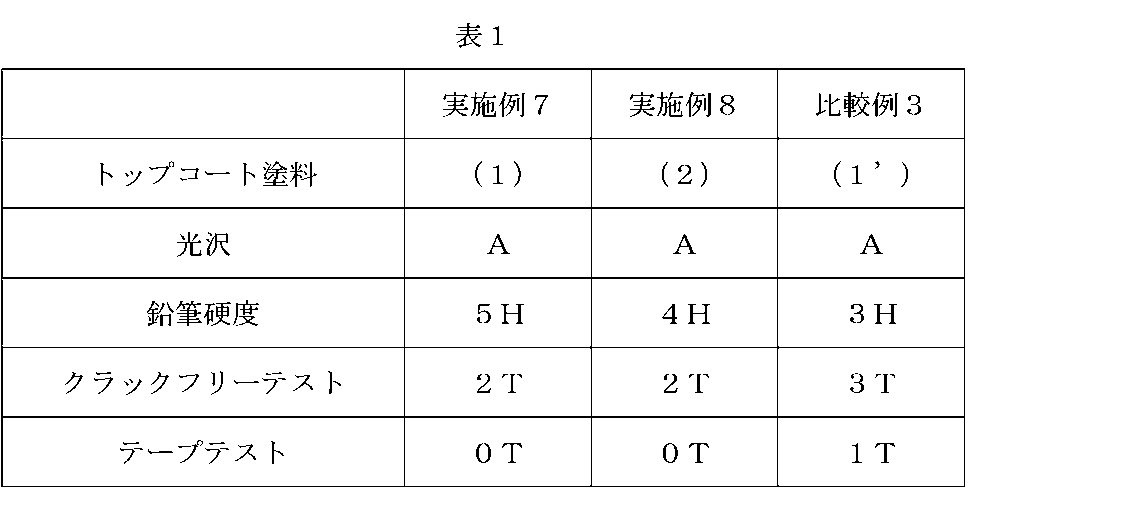
実施例5、6及び比較例3 塗装鋼板の製造と評価
下記要領で塗装鋼板を製造し、各種評価を行った。結果を表1に示す。
下記要領で塗装鋼板を製造し、各種評価を行った。結果を表1に示す。
塗装鋼板の製造
厚さ0.5mmの溶融亜鉛めっきクロメート処理鋼板に、プライマー塗料をバーコーターで塗装し、250℃のオーブンで20秒間加熱乾燥し(メタルピーク温度は199~204℃)、乾燥膜厚5μmのプライマー層を形成した。次いで、プライマー層の上にトップコート塗料をバーコーターで塗装し、250℃のオーブンで40秒加熱乾燥し(メタルピーク温度は232~241℃)、乾燥膜厚15μmのトップコート層を有する塗装鋼板を得た。
厚さ0.5mmの溶融亜鉛めっきクロメート処理鋼板に、プライマー塗料をバーコーターで塗装し、250℃のオーブンで20秒間加熱乾燥し(メタルピーク温度は199~204℃)、乾燥膜厚5μmのプライマー層を形成した。次いで、プライマー層の上にトップコート塗料をバーコーターで塗装し、250℃のオーブンで40秒加熱乾燥し(メタルピーク温度は232~241℃)、乾燥膜厚15μmのトップコート層を有する塗装鋼板を得た。
光沢の測定
先で得た塗装鋼板の塗装面の60°反射率をEN 13523-2に準じて測定し、以下のように評価した。
A:90%以上
B:90%未満
先で得た塗装鋼板の塗装面の60°反射率をEN 13523-2に準じて測定し、以下のように評価した。
A:90%以上
B:90%未満
鉛筆硬度の測定
先で得た塗装鋼板の塗装面の鉛筆硬度をEN 13523-4に準じて測定した。
先で得た塗装鋼板の塗装面の鉛筆硬度をEN 13523-4に準じて測定した。
柔軟性の評価(1) クラックフリーテスト
T-ベンド折り曲げ試験にて塗膜の柔軟性を評価した。EN 13523-7に準拠して、先で得た塗装鋼板を180°折り曲げ、屈曲部に発生するクラックを10倍のルーペで観察した。屈曲部に何もはさまずに塗装鋼板を180°折り曲げた場合を0T、屈曲部に塗装鋼板と同じ厚さの板をX枚挟んで折り曲げた場合を(X/2)Tとし、屈曲部にクラックが発生しない最小値で評価した。
T-ベンド折り曲げ試験にて塗膜の柔軟性を評価した。EN 13523-7に準拠して、先で得た塗装鋼板を180°折り曲げ、屈曲部に発生するクラックを10倍のルーペで観察した。屈曲部に何もはさまずに塗装鋼板を180°折り曲げた場合を0T、屈曲部に塗装鋼板と同じ厚さの板をX枚挟んで折り曲げた場合を(X/2)Tとし、屈曲部にクラックが発生しない最小値で評価した。
柔軟性の評価(2) テープテスト
T-ベンド折り曲げ試験にて塗膜の柔軟性を評価した。EN 13523-7に準拠して、塗装鋼板を180°折り曲げ、屈曲部にニチバン社製「セロテープ」を貼り、急速に剥がした場合の塗膜の剥がれの有無で評価した。屈曲部に何もはさまずに塗装鋼板を180°折り曲げた場合を0T、屈曲部に塗装鋼板と同じ厚さの板をX枚挟んで折り曲げた場合を(X/2)Tとし、剥がれが発生しない最小値で評価した。
T-ベンド折り曲げ試験にて塗膜の柔軟性を評価した。EN 13523-7に準拠して、塗装鋼板を180°折り曲げ、屈曲部にニチバン社製「セロテープ」を貼り、急速に剥がした場合の塗膜の剥がれの有無で評価した。屈曲部に何もはさまずに塗装鋼板を180°折り曲げた場合を0T、屈曲部に塗装鋼板と同じ厚さの板をX枚挟んで折り曲げた場合を(X/2)Tとし、剥がれが発生しない最小値で評価した。
Claims (8)
- 重量平均分子量(Mw)が3,000~120,000の範囲であるポリエステルポリオール樹脂であって、下記(A)及び(B)と、(C1)又は(C2)とを必須の反応原料とすることを特徴とするポリエステルポリオール樹脂。
分子構造中にエーテル結合部位を有するジオール化合物(A)
分子構造中に分岐構造を有する脂肪族ジオール化合物(B)
3官能以上のポリオール化合物(C1)
3官能以上のポリカルボン酸化合物或いはその誘導体(C2) - 前記分子構造中にエーテル結合部位を有するジオール化合物(A)が、下記構造式(1)

で表される分子構造を有する化合物である請求項1記載のポリエステルポリオール樹脂。 - 分子構造中に分岐構造を有する脂肪族ジオール化合物(B)が、2-メチル-1,3-プロパンジオールである請求項1記載のポリエステルポリオール樹脂。
- 更に、炭素原子数4~8の脂肪族ジカルボン酸化合物或いはその誘導体を必須の反応原料とする請求項1記載のポリエステルポリオール樹脂。
- 水酸基価が2~100mgKOH/gの範囲である請求項1記載のポリエステルポリオール樹脂。
- 請求項1~5の何れか一つに記載のポリエステルポリオール樹脂を含有する主剤と、硬化剤とからなる硬化性樹脂組成物。
- 請求項6記載の硬化性樹脂組成物からなる塗料。
- 請求項7記載の塗料からなる塗膜を有する塗装鋼板。
Applications Claiming Priority (2)
| Application Number | Priority Date | Filing Date | Title |
|---|---|---|---|
| JP2016-216192 | 2016-11-04 | ||
| JP2016216192 | 2016-11-04 |
Publications (1)
| Publication Number | Publication Date |
|---|---|
| WO2018084065A1 true WO2018084065A1 (ja) | 2018-05-11 |
Family
ID=62076061
Family Applications (1)
| Application Number | Title | Priority Date | Filing Date |
|---|---|---|---|
| PCT/JP2017/038680 Ceased WO2018084065A1 (ja) | 2016-11-04 | 2017-10-26 | ポリエステルポリオール樹脂及び塗料 |
Country Status (1)
| Country | Link |
|---|---|
| WO (1) | WO2018084065A1 (ja) |
Citations (10)
| Publication number | Priority date | Publication date | Assignee | Title |
|---|---|---|---|---|
| JPH06157979A (ja) * | 1992-11-24 | 1994-06-07 | Toray Ind Inc | 塗装鋼板用塗料組成物 |
| JPH08337646A (ja) * | 1995-06-09 | 1996-12-24 | Mitsubishi Rayon Co Ltd | 共重合ポリエステル樹脂 |
| JP2002302643A (ja) * | 2001-04-04 | 2002-10-18 | Unitika Ltd | 金属缶内面被膜形成用共重合ポリエステル樹脂 |
| JP2006206860A (ja) * | 2004-12-27 | 2006-08-10 | Toyobo Co Ltd | ポリエステル樹脂の製造方法 |
| JP2009001707A (ja) * | 2007-06-22 | 2009-01-08 | Toyo Ink Mfg Co Ltd | ポリエステル樹脂及び感圧式接着剤組成物 |
| JP2009214531A (ja) * | 2007-10-05 | 2009-09-24 | Unitika Ltd | 易接着フィルム |
| JP2013227467A (ja) * | 2012-03-30 | 2013-11-07 | Unitika Ltd | 活性エネルギー線硬化型ポリエステル樹脂 |
| JP2016079243A (ja) * | 2014-10-14 | 2016-05-16 | 日本エステル株式会社 | 接着剤用共重合ポリエステル樹脂 |
| JP2016113615A (ja) * | 2014-12-10 | 2016-06-23 | ユニチカ株式会社 | ポリエステル樹脂およびそれを用いた積層体 |
| WO2017047197A1 (ja) * | 2015-09-16 | 2017-03-23 | 東洋紡株式会社 | 共重合ポリエステルおよびこれを用いた金属プライマー塗料 |
-
2017
- 2017-10-26 WO PCT/JP2017/038680 patent/WO2018084065A1/ja not_active Ceased
Patent Citations (10)
| Publication number | Priority date | Publication date | Assignee | Title |
|---|---|---|---|---|
| JPH06157979A (ja) * | 1992-11-24 | 1994-06-07 | Toray Ind Inc | 塗装鋼板用塗料組成物 |
| JPH08337646A (ja) * | 1995-06-09 | 1996-12-24 | Mitsubishi Rayon Co Ltd | 共重合ポリエステル樹脂 |
| JP2002302643A (ja) * | 2001-04-04 | 2002-10-18 | Unitika Ltd | 金属缶内面被膜形成用共重合ポリエステル樹脂 |
| JP2006206860A (ja) * | 2004-12-27 | 2006-08-10 | Toyobo Co Ltd | ポリエステル樹脂の製造方法 |
| JP2009001707A (ja) * | 2007-06-22 | 2009-01-08 | Toyo Ink Mfg Co Ltd | ポリエステル樹脂及び感圧式接着剤組成物 |
| JP2009214531A (ja) * | 2007-10-05 | 2009-09-24 | Unitika Ltd | 易接着フィルム |
| JP2013227467A (ja) * | 2012-03-30 | 2013-11-07 | Unitika Ltd | 活性エネルギー線硬化型ポリエステル樹脂 |
| JP2016079243A (ja) * | 2014-10-14 | 2016-05-16 | 日本エステル株式会社 | 接着剤用共重合ポリエステル樹脂 |
| JP2016113615A (ja) * | 2014-12-10 | 2016-06-23 | ユニチカ株式会社 | ポリエステル樹脂およびそれを用いた積層体 |
| WO2017047197A1 (ja) * | 2015-09-16 | 2017-03-23 | 東洋紡株式会社 | 共重合ポリエステルおよびこれを用いた金属プライマー塗料 |
Similar Documents
| Publication | Publication Date | Title |
|---|---|---|
| JP7031705B2 (ja) | ポリエステルポリオール樹脂及び塗料 | |
| TWI413660B (zh) | 來自可再生油之低揮發性之塗料、密封劑及黏合劑 | |
| CN107001588B (zh) | 可固化环氧树脂组合物 | |
| WO2015037280A1 (ja) | 塗料組成物及び塗装物品 | |
| JP2010512427A (ja) | カラープラスクリア複合コーティング | |
| WO2017047197A1 (ja) | 共重合ポリエステルおよびこれを用いた金属プライマー塗料 | |
| KR101783122B1 (ko) | 카르복실 폴리에스터 수지 및 이를 포함하는 분체도료 조성물 | |
| JP7109372B2 (ja) | ポリエステルポリオール樹脂及び塗料 | |
| WO2018084066A1 (ja) | ポリエステルポリオール樹脂及び塗料 | |
| JPH0335336B2 (ja) | ||
| JP6045670B2 (ja) | コーティング組成物に用いる樹脂 | |
| WO2018084064A1 (ja) | ポリエステルポリオール樹脂及び塗料 | |
| US10822518B2 (en) | Curable coating compositions using succinic acid | |
| US6849693B2 (en) | Hydroxyl group-containing polymers, their preparation and use | |
| TWI791082B (zh) | 聚合物與塗料 | |
| JP7243075B2 (ja) | 塗料用ポリエステルウレタン樹脂、それを用いた組成物及び塗料 | |
| AU2018387869B2 (en) | Paint, aircraft paint, and aircraft | |
| JP6725895B2 (ja) | (メタ)アクリル変性ポリエステル樹脂、硬化性樹脂組成物、塗料及び塗装鋼板 | |
| WO2021146083A1 (en) | Polyester-urethane compositions useful for producing ultraviolet light resistant coatings | |
| JP2001516368A (ja) | フェノール系ウレタン反応性希釈剤を含むポリマービヒクル |
Legal Events
| Date | Code | Title | Description |
|---|---|---|---|
| 121 | Ep: the epo has been informed by wipo that ep was designated in this application |
Ref document number: 17867664 Country of ref document: EP Kind code of ref document: A1 |
|
| NENP | Non-entry into the national phase |
Ref country code: DE |
|
| 122 | Ep: pct application non-entry in european phase |
Ref document number: 17867664 Country of ref document: EP Kind code of ref document: A1 |
|
| NENP | Non-entry into the national phase |
Ref country code: JP |