WO2018043006A1 - 重力測定装置 - Google Patents
重力測定装置 Download PDFInfo
- Publication number
- WO2018043006A1 WO2018043006A1 PCT/JP2017/027945 JP2017027945W WO2018043006A1 WO 2018043006 A1 WO2018043006 A1 WO 2018043006A1 JP 2017027945 W JP2017027945 W JP 2017027945W WO 2018043006 A1 WO2018043006 A1 WO 2018043006A1
- Authority
- WO
- WIPO (PCT)
- Prior art keywords
- gravity
- water
- landing
- unit
- measuring device
- Prior art date
- Legal status (The legal status is an assumption and is not a legal conclusion. Google has not performed a legal analysis and makes no representation as to the accuracy of the status listed.)
- Ceased
Links
Images


Classifications
-
- B—PERFORMING OPERATIONS; TRANSPORTING
- B63—SHIPS OR OTHER WATERBORNE VESSELS; RELATED EQUIPMENT
- B63C—LAUNCHING, HAULING-OUT, OR DRY-DOCKING OF VESSELS; LIFE-SAVING IN WATER; EQUIPMENT FOR DWELLING OR WORKING UNDER WATER; MEANS FOR SALVAGING OR SEARCHING FOR UNDERWATER OBJECTS
- B63C11/00—Equipment for dwelling or working underwater; Means for searching for underwater objects
-
- B—PERFORMING OPERATIONS; TRANSPORTING
- B63—SHIPS OR OTHER WATERBORNE VESSELS; RELATED EQUIPMENT
- B63G—OFFENSIVE OR DEFENSIVE ARRANGEMENTS ON VESSELS; MINE-LAYING; MINE-SWEEPING; SUBMARINES; AIRCRAFT CARRIERS
- B63G8/00—Underwater vessels, e.g. submarines; Equipment specially adapted therefor
- B63G8/39—Arrangements of sonic watch equipment, e.g. low-frequency, sonar
-
- B—PERFORMING OPERATIONS; TRANSPORTING
- B63—SHIPS OR OTHER WATERBORNE VESSELS; RELATED EQUIPMENT
- B63H—MARINE PROPULSION OR STEERING
- B63H25/00—Steering; Slowing-down otherwise than by use of propulsive elements; Dynamic anchoring, i.e. positioning vessels by means of main or auxiliary propulsive elements
- B63H25/02—Initiating means for steering, for slowing down, otherwise than by use of propulsive elements, or for dynamic anchoring
- B63H25/04—Initiating means for steering, for slowing down, otherwise than by use of propulsive elements, or for dynamic anchoring automatic, e.g. reacting to compass
-
- G—PHYSICS
- G01—MEASURING; TESTING
- G01B—MEASURING LENGTH, THICKNESS OR SIMILAR LINEAR DIMENSIONS; MEASURING ANGLES; MEASURING AREAS; MEASURING IRREGULARITIES OF SURFACES OR CONTOURS
- G01B11/00—Measuring arrangements characterised by the use of optical techniques
- G01B11/24—Measuring arrangements characterised by the use of optical techniques for measuring contours or curvatures
-
- G—PHYSICS
- G01—MEASURING; TESTING
- G01B—MEASURING LENGTH, THICKNESS OR SIMILAR LINEAR DIMENSIONS; MEASURING ANGLES; MEASURING AREAS; MEASURING IRREGULARITIES OF SURFACES OR CONTOURS
- G01B17/00—Measuring arrangements characterised by the use of infrasonic, sonic or ultrasonic vibrations
- G01B17/06—Measuring arrangements characterised by the use of infrasonic, sonic or ultrasonic vibrations for measuring contours or curvatures
-
- G—PHYSICS
- G01—MEASURING; TESTING
- G01C—MEASURING DISTANCES, LEVELS OR BEARINGS; SURVEYING; NAVIGATION; GYROSCOPIC INSTRUMENTS; PHOTOGRAMMETRY OR VIDEOGRAMMETRY
- G01C15/00—Surveying instruments or accessories not provided for in groups G01C1/00 - G01C13/00
-
- G—PHYSICS
- G01—MEASURING; TESTING
- G01V—GEOPHYSICS; GRAVITATIONAL MEASUREMENTS; DETECTING MASSES OR OBJECTS; TAGS
- G01V7/00—Measuring gravitational fields or waves; Gravimetric prospecting or detecting
- G01V7/16—Measuring gravitational fields or waves; Gravimetric prospecting or detecting specially adapted for use on moving platforms, e.g. ship, aircraft
Definitions
- the present invention relates to a gravity measurement apparatus, and more particularly to a gravity measurement apparatus that measures gravity at, for example, the seabed.
- Gravity is known to slightly differ in size depending on the distance from the measurement point to the center of the earth, the density structure of the underground, and the like. It is known to investigate underground density structure by measuring gravity using this.
- Patent Document 1 discloses a gravimetric measurement apparatus which mounts a gravimeter on a navigation body such as a helicopter and measures the gravity while flying by the navigation body.
- An object of the present invention is to provide a gravity measurement apparatus capable of stably executing gravity measurement on the bottom of the water without a cable.
- the present invention is a gravity measuring device capable of autonomous navigation and hovering in water and achieving the above object, and being grounded to measure the gravity, wherein the gravity measuring unit measures the gravity;
- the image was taken with a propulsive force generation unit that generates a propulsive force so that the measurement device can move in water, a laser that irradiates laser light to the water bottom, a camera that photographs the water bottom irradiated with laser light by the laser,
- a bottom shape acquisition unit that acquires a three-dimensional bottom shape based on an image; and a bottom position determination unit that determines a target bottom position of the gravity measurement device based on the bottom shape acquired by the bottom shape acquisition unit;
- a control unit for controlling the propulsive force generation unit to reach the desired landing position determined by the desired landing position determination unit, and for causing the gravity measurement device to be grounded at the desired landing position;
- An attitude sensor for detecting the variation in position, with a, characterized in that.
- the present invention is also a gravity measuring device capable of autonomous navigation and hovering in water and measuring the gravity by grounding on the bottom of the water, wherein the gravity measuring unit for measuring the gravity, and the gravity measuring device can move in water And a bottom shape acquiring unit that acquires a three-dimensional water bottom shape based on the measurement result by the sonar, and a water bottom shape acquiring unit Controlling the propulsive force generation unit to reach the landing target position determined by the landing position determination unit, which determines the landing target position of the gravity measurement device based on the shape of the bottom of the water; And a bottom control unit that causes the gravity measurement device to bottom at the bottom target position, and a posture sensor that detects a change in posture of the gravity measurement device.
- the present invention it is possible to provide a gravity measurement device capable of stably performing gravity measurement on the bottom of the water without a cable.
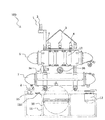
- FIG. 1 is a left side view of a gravity measuring apparatus according to an embodiment of the present invention
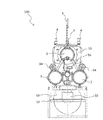
- FIG. 2 is a front view of the gravity measuring apparatus shown in FIG. 1
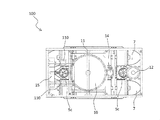
- FIG. 3 is a gravity shown in FIG. It is a bottom view of a measuring device.
- the gravity measurement apparatus 100 mainly includes a main container 6 containing various control boards and the like, and a battery container 7 containing a battery 115 (see FIG. 4) which is a power source for operating the gravity measurement apparatus 100. And the spherical container 10 which accommodated the gravimeter 111 (refer FIG. 4) which performs gravity measurement.
- the gravity measuring apparatus 100 is configured to be able to navigate in water, which will be described in detail later, and is grounded on the bottom of the water to perform gravity measurement using the gravimeter 111.
- the gravity measurement apparatus 100 can be grounded by measuring on the bottom of the seabed such as the seabed, the bottom of the lake, the bottom of the river, etc., an example in the case of landing on the seabed will be described below.
- the main container 6, the battery container 7 and the spherical container 10 are waterproofed so that seawater does not enter inside, and are pressure-processed so as to withstand water pressure.
- the gravimeter 111 is housed in the spherical container 10, and is configured to be held horizontal by, for example, a gimbal mechanism (not shown). Holding the horizontal of the gravimeter 111 ensures that the gravity measured by the gravimeter 111 is gravity in the vertical direction. Although the gravimeter 111 is supported by the gimbal mechanism, the measurement result by the gravimeter 111 may be corrected according to the case where the level can not be maintained completely or there is another external source.
- the spherical container 10 accommodating the gravimeter 111 is fixed to a skid 11 which is a receiving rack, and is provided at the lower center of the gravity measuring apparatus 100.
- a ballast releaser 110, a Doppler type ground speedometer 12, and a CTD 15 are provided in the lower part of the gravity measurement apparatus 100.
- the CTD data is stored, for example, inside the CTD 15 together with the measurement time.
- a wireless LAN antenna 1 is provided on the upper portion of the gravity measurement apparatus 100, and the wireless LAN communication device 103 (see FIG. 4) in the main container 6 communicates data with the outside through the wireless LAN via the wireless LAN antenna 1. It is feasible.
- a GPS antenna 2 is provided on the upper portion of the gravity measurement apparatus 100 adjacent to the wireless LAN antenna 1, and the GPS device 105 (see FIG. 4) in the main container 6 is not suitable via the GPS antenna 2.
- one transmission antenna 3 and four reception antennas 4 used in the acoustic positioning communication device 104 (refer to FIG. 4) in the main container 6 that enables data communication by sound in the upper center of the gravity measurement device 100.
- the wireless LAN communication apparatus 103 can communicate with the outside such as a ship on the sea, for example.
- the gravity measurement device 100 dives into the sea, communication by the wireless LAN communication device 103 becomes difficult. Therefore, in the present embodiment, the gravity measurement device 100 is provided with the acoustic positioning communication device 104, thereby enabling communication between the gravity measurement device 100 in the sea and the outside such as a ship on the sea.
- the gravity measurement device 100 is provided with thrusters 108 (see FIG. 4) that generate a propulsive force so that the gravity measurement device 100 can move in the sea.
- the thruster 108 according to this embodiment is a propeller-like member, and includes two surge thrusters 5a that generate thrust in the front-rear direction, one thruster 5b that generates thrust in the left-right direction, and propulsion in the vertical direction. And two Heaves rasters 5c for generating force.
- a buoyancy material 13 is provided around the main container 6 in the gravity measurement apparatus 100. Further, the gravity measuring apparatus 100 is provided with a ballast (a weight for balancing the buoyancy) not shown, and when all the thrusters 108 are stopped, the gravity measuring apparatus 100 is in a grounded state. Also, when the ballast is released (discarded) by the ballast releaser 110 (see FIG. 4), the gravity measurement device 100 floats to the sea surface by the buoyancy of the buoyancy material 13.
- a ballast a weight for balancing the buoyancy
- the bottom of the battery container 7 of the gravity measurement apparatus 100 is provided with a laser 8 capable of irradiating the bottom with a laser beam, and the bottom of the gravity measurement apparatus 100 can be photographed with the bottom of the laser light irradiated by the laser 8
- a camera 14 is provided.
- a linear laser beam is emitted from the laser 8 to the seabed, and the image thereof is photographed by the camera 14.
- the three-dimensional shape of the seabed can be acquired by a light cutting method.
- the three-dimensional shape of the seabed is obtained by the light cutting method, but the present invention is not limited to this, and any known method may be used.
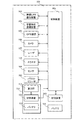
- FIG. 4 is a schematic block diagram of the gravity measuring apparatus shown in FIG.
- the control device 101 of FIG. 4 includes, for example, an arithmetic device called a CPU and an MPU, and is accommodated in the main container 6.
- the operation control of the gravity measurement apparatus 100 is performed by the control device 101.
- the storage device 102 is a storage device such as a RAM or a ROM, includes a non-volatile storage device, and stores programs executed by the control device 101 to operate the gravity measurement device 100 and various data.
- the storage device 102 may store various measurement data in association with the time and position acquired by the GPS device 105.
- the control device 101 may have a clock (not shown), and when the time can not be obtained by the GPS device 105 because it is under the sea, the control device 101 is associated with the time obtained by the clock of the control device 101.
- Various measurement data may be stored in the storage device 102. Further, by previously installing a station (not shown) on the seabed, the relative position of the gravity measurement device 100 to the station can be acquired using the acoustic positioning communication device 104. When the position can not be obtained by the GPS device 105 because it is under the sea, the relative position obtained by the acoustic positioning communication device 104 is stored in the storage device 102 in association with time and various measurement data. It is also good.
- the control device 101 operates according to a program stored in advance in the storage device 102, and controls each part of the gravity measurement device 100.
- the control device 101 can also control each part of the gravity measurement device 100 by remote control according to an operation instruction obtained through the wireless LAN communication device 103 or the acoustic positioning communication device 104.
- the camera 106 includes the camera 14 shown in FIG. 3 and includes other cameras (not shown) (for example, another camera for photographing the seabed, another camera for photographing the periphery of the gravity measurement device 100) It is also good.
- the camera 106 captures an image according to an instruction from the control device 101, sends the captured image (or video) to the control device 101, and the control device 101 receives the image and stores it in the storage device 102.
- the laser 107 includes the laser 8 shown in FIG. 1 and may include another laser (not shown) (for example, a laser different from the laser 8).
- the laser 107 emits a laser beam according to an instruction from the control device 101.
- the camera 106 and the laser 107 may alternatively be sonars (not shown).
- the thruster 108 switches rotation start, rotation stop, rotation direction, and rotation speed of the propeller according to an instruction from the control device 101.
- the directions of the surge thruster 5 a, the sway thruster 5 b, and the heaves raster 5 c are fixed, but may be changed to any direction by an instruction from the control device 101.
- the sensor 109 is a Doppler type ground velocity meter (Doppler Velocity Log, DVL) 12 that measures ground velocity, a fiber optic Gyro (FOG) (not shown) that measures azimuth angular velocity, and a pressure gauge (not shown) that measures water depth. And a posture sensor (not shown), etc., operates according to an instruction from the control device 101, and transmits the measurement result and the detection result to the control device 101.
- a magnetic compass is attached to the attitude sensor and the DVL. Further, by replacing the fiber optic gyro and the attitude sensor with an inertial navigation system (INS), more accurate position and attitude data can be obtained.
- INS inertial navigation system
- a scanning sonar (not shown) is mounted for detecting an obstacle
- a flasher (not shown) and a transponder are provided as a safety measure when operating in the actual sea area. Do.
- the ballast releaser 110 releases (discards) the above-mentioned ballast under the instruction from the controller 101.
- the gravimeter 111 always measures the gravity and transmits the measurement result to the storage device 112.
- the storage device 112 may start storage of the measurement result of gravity and stop storage of the measurement result according to an instruction from the control device 101, or a program stored in advance in the storage device 112. Storage of the measurement result of gravity according to the measurement result may be transmitted to the control device 101. Alternatively, the control device 101 may receive an error or other operation condition during measurement. It may be sent.
- the storage device 112 is, for example, a device called a data logger.
- the battery 115 supplies power to each component of the gravity measurement apparatus 100.
- the gravimeter 111 and the storage device 112 need to be energized at all times (for example, the gravimeter 111 needs to be measured in an environment where the ambient temperature is kept constant). Therefore, the power is supplied from the dedicated battery 113.
- the gravity measuring unit 114 is configured by the gravimeter 111, the storage device 112, and the battery 113.
- FIG. 5 is a flow chart showing an example of the operation of the gravity measuring apparatus shown in FIG.
- the gravity measurement apparatus 100 is placed on a ship or the like, travels on the sea, transported to the area where the gravity measurement is to be performed, and the gravity measurement apparatus 100 is lowered to the sea surface.
- the gravity measuring apparatus 100 can autonomously navigate and hover in the sea by driving the thruster 108, and the thruster 108 is stopped by the buoyancy balance between the gravity of the gravity measuring apparatus 100 and the buoyancy material 13 and the above-described ballast. In the state, it is configured to have negative buoyancy so as to be stable on the seabed.
- the present invention is not limited to this, and neutral buoyancy may be used, and downward thrust may be continued by the heaves raster 5c at the bottom, or, for example, the buoyancy is adjusted by a buoyancy adjuster (not shown). You may
- the control device 101 executes a program stored in advance in the storage device 102, and the processing shown in the flowchart of FIG. 5 is automatically executed.
- remote control via the acoustic positioning communication device 104 is also possible.
- the control device 101 analyzes the bottom image taken by the camera 106 based on the measurement result by the sensor 109 and the detection result, and also on the basis of the positioning result by the acoustic positioning communication device 104. Then, the thruster 108 is driven so as to dive and reach a predetermined landing area (steps S-0 and S-1). One or more landing areas are stored in advance in the storage device 102, one of the landing areas is selected, and gravity measurement is sequentially performed on each landing area as described later.
- the control device 101 irradiates the bottom of the line with the laser light with the laser 8 and photographs the bottom of the sea irradiated with the laser light with the camera 14.
- the three-dimensional shape of the seabed is acquired, for example, by light cutting using the photographed image (step S-2).
- the seabed topography is measured by the sonar, and a three-dimensional seabed shape is acquired based on the measurement result by the sonar. You may do so.
- the control device 101 refers to the three-dimensional shape of the seabed acquired in step S-2, and determines a landing point, that is, a landing target position (step S-3).
- a landing target position a gravity measurement apparatus 100 with small unevenness and small inclination (at an angle as close to horizontal as possible) in the seabed is selected and determined as a position at which the landing can be performed.
- the control device 101 drives the thruster 108 to land the gravity measurement device 100 at the landing target position (step S-4).
- the gravity measuring apparatus 100 measures the flow direction with the flow meter of the sensor 109 in a state of being stationary with respect to the seabed surface, and faces in the direction opposite to the flow. While maintaining the orientation, for example, while measuring the height from the seabed and the ground speed with the Doppler type ground speed meter 12 of the sensor 109, the thrust of the heaves raster 5c is lowered to descend straight and then stand.
- the thrusters 108 ie, all thrusters of the surge thruster 5a, sway thruster 5b, heaves raster 5c) are stopped.
- the posture sensor of the sensor 109 monitors the posture of the gravity measurement apparatus 100 for a predetermined time (for example, several seconds to several minutes) (step S-5). 5: Yes), the base continues to be fixed, and the gravity measurement with the gravimeter 111 is executed (step S-6). The measurement results are stored in the storage devices 102 and 112.
- step S-5 If there is a change in posture at step S-5 (step S-5: No), the process returns to step S-1 and starts from the selection of the landing target position.
- step S-6 it is determined whether or not the gravity measurement in all the landing areas stored in advance in the storage device 102 is completed (step S-7). (Step S-7: No) Returning to step S-1, the gravity measurement in the new landing area is performed. If it is completed (Step S-7: Yes), it will progress to Step S-8 and will rise to the sea level. At this time, in the control device 101, the flying speed can be increased by driving the thruster and releasing the ballast by the ballast releaser 110 to increase the buoyancy and make it a positive buoyancy.
- FIG. 6 is a diagram for explaining an example of the operation of the gravity measuring apparatus shown in FIG.
- the example of FIG. 6 shows the case where the gravity measurement apparatus 100 performs gravity measurement at point A, point B, point C and point D.
- the gravity measurement apparatus 100 first executes the processing of steps S-1 to S-7 of FIG. 5 at point A, and then performs the processing of steps S-1 to S-7 of FIG. Then, the processing of steps S-1 to S-7 in FIG. 5 is performed at point C, and the processing of steps S-1 to S-7 in FIG. As blockage measurement, the process returns to the point A (starting point), the processes of steps S-1 to S-7 of FIG. 5 are executed at the point A, and then the surface is floated to the sea surface by the process of step S-8 of FIG.
- the gravity at points B and C is greater than the gravity at points A and D, and a dense substance is observed from point B to point C compared to the surrounding area. It is conceivable that (for example, a hydrothermal deposit or the like) is present.
- the present embodiment by acquiring the three-dimensional shape of the seabed and determining the landing target position based on the three-dimensional shape of the seabed, it is possible to safely and stably land the gravity measuring device, Measurement of gravity at
- gravity measurement can be performed on the seabed, and gravity can be measured with high accuracy as compared to the case of measurement in the air, the sea, or the sea.
- a series of gravity measurement processing can be performed by operating according to a program stored in advance in the storage device 102, for example, it is necessary to make a wired connection with a ship at sea. It is also possible to measure gravity at deeper seabeds.
- a gravity measuring device e.g., a gravity measuring device 100 capable of autonomous navigation and hovering in the water and measuring the gravity on the bottom of the water,
- a gravity measurement unit for example, a gravity measurement unit 114) that measures the gravity;
- a propulsive force generation unit for example, thruster 108) that generates a propulsive force so that the gravity measurement device can move in water;
- a laser eg, laser 107) for irradiating the bottom of the water with a laser beam;
- a camera for example, a camera 106) for photographing the bottom of the water irradiated with laser light by the laser;
- a bottom shape acquisition unit for example, the control device 101
- a landing position determination unit for example, the control device 101) that determines a landing target position of the gravity measurement device based on the water bottom shape acquired by the water bottom shape acquisition unit;
- a landing control unit for example, the control
- a posture sensor for example, a posture sensor included in the sensor 109 that detects a change in posture of the gravity measurement device; Equipped with Because it was a gravity measuring device, which was characterized by -It is possible to provide a gravity measurement apparatus capable of stably performing unmanned gravity measurement at the bottom of the water.
- the present invention 2.
- a gravity measuring device capable of autonomous navigation and hovering in the water and measuring the gravity on the bottom of the water, A gravity measurement unit that measures gravity, A propulsive force generation unit that generates a propulsive force so that the gravity measurement device can move in water;
- a sonar that measures underwater topography, A bottom shape acquisition unit that acquires a three-dimensional bottom shape based on the measurement result by the sonar;
- a landing position determination unit that determines a landing target position of the gravity measurement device based on the water bottom shape acquired by the water bottom shape acquisition unit;
- a landing control unit for controlling the propulsive force generation unit to reach the landing target position determined by the landing position determination unit, and landing the gravity measurement device at the landing target position;
- An attitude sensor that detects an attitude change of the gravity measuring device; Equipped with Because it was a gravity measuring device, which was characterized by -It is possible to provide a gravity measurement apparatus capable of stably performing unmanned gravity measurement at the bottom of the water.
- the present invention 3. 1. Or 2.
- the landing position determination unit changes the landing target position and determines a new landing target position when there is a change in the posture detected by the posture sensor in a state where the gravity measurement device is in the bottom position.
- a gravity measuring device characterized by
Landscapes
- Engineering & Computer Science (AREA)
- General Physics & Mathematics (AREA)
- Physics & Mathematics (AREA)
- Mechanical Engineering (AREA)
- Ocean & Marine Engineering (AREA)
- Radar, Positioning & Navigation (AREA)
- Aviation & Aerospace Engineering (AREA)
- General Life Sciences & Earth Sciences (AREA)
- Geophysics (AREA)
- Life Sciences & Earth Sciences (AREA)
- Remote Sensing (AREA)
- Chemical & Material Sciences (AREA)
- Combustion & Propulsion (AREA)
- Length Measuring Devices By Optical Means (AREA)
- Length Measuring Devices Characterised By Use Of Acoustic Means (AREA)
- Geophysics And Detection Of Objects (AREA)
- Measurement Of Velocity Or Position Using Acoustic Or Ultrasonic Waves (AREA)
Applications Claiming Priority (2)
| Application Number | Priority Date | Filing Date | Title |
|---|---|---|---|
| JP2016-166497 | 2016-08-29 | ||
| JP2016166497A JP6723111B2 (ja) | 2016-08-29 | 2016-08-29 | 重力測定装置 |
Publications (1)
| Publication Number | Publication Date |
|---|---|
| WO2018043006A1 true WO2018043006A1 (ja) | 2018-03-08 |
Family
ID=61309144
Family Applications (1)
| Application Number | Title | Priority Date | Filing Date |
|---|---|---|---|
| PCT/JP2017/027945 Ceased WO2018043006A1 (ja) | 2016-08-29 | 2017-08-01 | 重力測定装置 |
Country Status (2)
| Country | Link |
|---|---|
| JP (1) | JP6723111B2 (https=) |
| WO (1) | WO2018043006A1 (https=) |
Cited By (1)
| Publication number | Priority date | Publication date | Assignee | Title |
|---|---|---|---|---|
| WO2021253487A1 (zh) * | 2020-06-17 | 2021-12-23 | 东南大学 | 水下导航与重力测量一体化系统 |
Families Citing this family (2)
| Publication number | Priority date | Publication date | Assignee | Title |
|---|---|---|---|---|
| JP7280799B2 (ja) * | 2019-10-10 | 2023-05-24 | 株式会社フジタ | 水中測定装置 |
| CN114670996B (zh) * | 2022-05-31 | 2022-08-23 | 中国海洋大学 | 三体水下机器人 |
Citations (1)
| Publication number | Priority date | Publication date | Assignee | Title |
|---|---|---|---|---|
| US20100153050A1 (en) * | 2008-11-11 | 2010-06-17 | Zumberge Mark A | Autonomous Underwater Vehicle Borne Gravity Meter |
-
2016
- 2016-08-29 JP JP2016166497A patent/JP6723111B2/ja active Active
-
2017
- 2017-08-01 WO PCT/JP2017/027945 patent/WO2018043006A1/ja not_active Ceased
Patent Citations (1)
| Publication number | Priority date | Publication date | Assignee | Title |
|---|---|---|---|---|
| US20100153050A1 (en) * | 2008-11-11 | 2010-06-17 | Zumberge Mark A | Autonomous Underwater Vehicle Borne Gravity Meter |
Non-Patent Citations (3)
| Title |
|---|
| KINSEY, JAMES C. ET AL.: "Toward High-Spatial Resolution Gravity Surveying of the Mid-Ocean Ridges with Autonomous Underwater Vehicles", OCEANS 2008, September 2008 (2008-09-01), pages 1 - 10, XP031482999 * |
| MAKI ET AL: "Autonomous Underwater Vehicle "Tri-Dog 1"", JOURNAL OF THE JAPAN INSTITUTE OF MARINE ENGINEERING, vol. 43, no. 4, 2008, pages 73 - 76, XP055604208 * |
| MAKI: "Maps for Underwater Vehicles", JOURNAL OF THE ROBOTICS SOCIETY OF JAPAN, vol. 33, no. 10, 2015, pages 766 - 772, XP055604215 * |
Cited By (1)
| Publication number | Priority date | Publication date | Assignee | Title |
|---|---|---|---|---|
| WO2021253487A1 (zh) * | 2020-06-17 | 2021-12-23 | 东南大学 | 水下导航与重力测量一体化系统 |
Also Published As
| Publication number | Publication date |
|---|---|
| JP2018036055A (ja) | 2018-03-08 |
| JP6723111B2 (ja) | 2020-07-15 |
Similar Documents
| Publication | Publication Date | Title |
|---|---|---|
| US11072405B2 (en) | Autonomous underwater survey apparatus and system | |
| JP6761216B2 (ja) | 水中航走体の経路設定方法、それを用いた水中航走体の最適制御方法及び水中航走体並びに移動体の経路設定方法 | |
| KR101804184B1 (ko) | 드론을 이용한 연안지형 조사장치 | |
| US20090216444A1 (en) | System and method for determining the position of an underwater vehicle | |
| JP7086144B2 (ja) | 移動体、探査測量装置および探査測量方法 | |
| JP6556516B2 (ja) | 海洋探査装置及び海洋探査方法 | |
| NO339088B1 (no) | Autonomt styringsutstyr for havbunnen og fremgangsmåte for innsamling av seismikkdata | |
| JP2017144784A (ja) | 飛行計画作成方法及び飛行体誘導システム | |
| KR101987655B1 (ko) | 수중 지형 측정용 무인 보트 | |
| CN116997508A (zh) | 水上中继机与水中航行体的连结系统及其运用方法 | |
| WO2018043006A1 (ja) | 重力測定装置 | |
| JP2020049981A (ja) | 無人航空機 | |
| JP2020118641A (ja) | マルチコプター | |
| US8297162B2 (en) | Method and a device for identifying and neutralizing an undersea mine | |
| JP7668510B2 (ja) | 水中航走体の自己位置推定誤差補正方法及び水中航走体の自己位置推定誤差補正システム | |
| KR102343504B1 (ko) | 수중드론의 운항시스템 및 운항방법 | |
| Cruz et al. | Cooperative deep water seafloor mapping with heterogeneous robotic platforms | |
| JP7376780B2 (ja) | 飛行制御システム、飛行制御装置、飛行体、及び飛行制御方法 | |
| KR20150122446A (ko) | 제트스키를 이용한 연안 해저지형 측량장치 | |
| JP7333565B1 (ja) | 飛行体および飛行体の制御方法 | |
| US20230273021A1 (en) | Detection system, suspended device, and detection method | |
| JP7325284B2 (ja) | 水底形状測定装置 | |
| US20240308632A1 (en) | Linked system of surface repeater vehicle and underwater vehicle, and operation method therefor | |
| JP7280786B2 (ja) | 水底形状測定装置 | |
| Diercks et al. | Advanced technology in motion: NIUST's AUV fleet |
Legal Events
| Date | Code | Title | Description |
|---|---|---|---|
| 121 | Ep: the epo has been informed by wipo that ep was designated in this application |
Ref document number: 17846015 Country of ref document: EP Kind code of ref document: A1 |
|
| NENP | Non-entry into the national phase |
Ref country code: DE |
|
| 122 | Ep: pct application non-entry in european phase |
Ref document number: 17846015 Country of ref document: EP Kind code of ref document: A1 |