WO2017208912A1 - ドリル孔あけ用エントリーシート及びそれを用いたドリル孔あけ加工方法 - Google Patents
ドリル孔あけ用エントリーシート及びそれを用いたドリル孔あけ加工方法 Download PDFInfo
- Publication number
- WO2017208912A1 WO2017208912A1 PCT/JP2017/019285 JP2017019285W WO2017208912A1 WO 2017208912 A1 WO2017208912 A1 WO 2017208912A1 JP 2017019285 W JP2017019285 W JP 2017019285W WO 2017208912 A1 WO2017208912 A1 WO 2017208912A1
- Authority
- WO
- WIPO (PCT)
- Prior art keywords
- mass
- resin
- parts
- entry sheet
- drilling
- Prior art date
- Legal status (The legal status is an assumption and is not a legal conclusion. Google has not performed a legal analysis and makes no representation as to the accuracy of the status listed.)
- Ceased
Links
Images

Classifications
-
- B—PERFORMING OPERATIONS; TRANSPORTING
- B23—MACHINE TOOLS; METAL-WORKING NOT OTHERWISE PROVIDED FOR
- B23B—TURNING; BORING
- B23B35/00—Methods for boring or drilling, or for working essentially requiring the use of boring or drilling machines; Use of auxiliary equipment in connection with such methods
-
- B—PERFORMING OPERATIONS; TRANSPORTING
- B26—HAND CUTTING TOOLS; CUTTING; SEVERING
- B26D—CUTTING; DETAILS COMMON TO MACHINES FOR PERFORATING, PUNCHING, CUTTING-OUT, STAMPING-OUT OR SEVERING
- B26D7/00—Details of apparatus for cutting, cutting-out, stamping-out, punching, perforating, or severing by means other than cutting
- B26D7/08—Means for treating work or cutting member to facilitate cutting
-
- B—PERFORMING OPERATIONS; TRANSPORTING
- B26—HAND CUTTING TOOLS; CUTTING; SEVERING
- B26F—PERFORATING; PUNCHING; CUTTING-OUT; STAMPING-OUT; SEVERING BY MEANS OTHER THAN CUTTING
- B26F1/00—Perforating; Punching; Cutting-out; Stamping-out; Apparatus therefor
- B26F1/16—Perforating by tool or tools of the drill type
-
- C—CHEMISTRY; METALLURGY
- C10—PETROLEUM, GAS OR COKE INDUSTRIES; TECHNICAL GASES CONTAINING CARBON MONOXIDE; FUELS; LUBRICANTS; PEAT
- C10M—LUBRICATING COMPOSITIONS; USE OF CHEMICAL SUBSTANCES EITHER ALONE OR AS LUBRICATING INGREDIENTS IN A LUBRICATING COMPOSITION
- C10M125/00—Lubricating compositions characterised by the additive being an inorganic material
- C10M125/02—Carbon; Graphite
-
- C—CHEMISTRY; METALLURGY
- C10—PETROLEUM, GAS OR COKE INDUSTRIES; TECHNICAL GASES CONTAINING CARBON MONOXIDE; FUELS; LUBRICANTS; PEAT
- C10M—LUBRICATING COMPOSITIONS; USE OF CHEMICAL SUBSTANCES EITHER ALONE OR AS LUBRICATING INGREDIENTS IN A LUBRICATING COMPOSITION
- C10M125/00—Lubricating compositions characterised by the additive being an inorganic material
- C10M125/26—Compounds containing silicon or boron, e.g. silica, sand
-
- C—CHEMISTRY; METALLURGY
- C10—PETROLEUM, GAS OR COKE INDUSTRIES; TECHNICAL GASES CONTAINING CARBON MONOXIDE; FUELS; LUBRICANTS; PEAT
- C10M—LUBRICATING COMPOSITIONS; USE OF CHEMICAL SUBSTANCES EITHER ALONE OR AS LUBRICATING INGREDIENTS IN A LUBRICATING COMPOSITION
- C10M133/00—Lubricating compositions characterised by the additive being an organic non-macromolecular compound containing nitrogen
- C10M133/02—Lubricating compositions characterised by the additive being an organic non-macromolecular compound containing nitrogen having a carbon chain of less than 30 atoms
- C10M133/38—Heterocyclic nitrogen compounds
- C10M133/40—Six-membered ring containing nitrogen and carbon only
- C10M133/42—Triazines
-
- H—ELECTRICITY
- H05—ELECTRIC TECHNIQUES NOT OTHERWISE PROVIDED FOR
- H05K—PRINTED CIRCUITS; CASINGS OR CONSTRUCTIONAL DETAILS OF ELECTRIC APPARATUS; MANUFACTURE OF ASSEMBLAGES OF ELECTRICAL COMPONENTS
- H05K3/00—Apparatus or processes for manufacturing printed circuits
Definitions
- the present invention relates to an entry sheet for drilling and a drilling method using the same.
- a drilling method for a laminated board or multilayer board used as a printed wiring board material generally one or a plurality of laminated boards or multilayer boards are stacked, and an aluminum foil alone or A method is employed in which a sheet in which a layer of a resin composition is formed on the surface of an aluminum foil (hereinafter, this “sheet” is referred to as “drill drilling entry sheet”) is drilled. .
- Patent Document 1 discloses a water-soluble resin layer on an aluminum foil on which a thermosetting resin thin film is formed in order to meet the demands for reducing the inner wall roughness and improving the hole position accuracy at the time of drilling.
- An entry sheet for drilling is disclosed.
- Patent Document 2 discloses a lubricant sheet for drilling in which a non-halogen colorant is blended in a resin composition.
- Patent Document 3 discloses a drilling auxiliary plate comprising a lubricating layer, a composite material including a nanostructured powder such as tungsten disulfide and a solid wear-resistant lubricating layer that is a high heat transfer compound, and a support.
- Patent Document 4 discloses a drill hole entry sheet including a layer of a resin composition in which a water-soluble resin, a water-soluble lubricant and carbon powder are mixed.
- Patent Document 5 discloses a heat-dissipating lubricated aluminum cover for drilling that contains graphite as an inorganic filler in a composite material.
- the use range of the drill bit diameter in mass production is mostly from 0.5 mm to 0.105 mm. Specific examples include 0.5 mm, 0.45 mm, 0.4 mm, 0.35 mm, 0.3 mm, 0.25 mm, 0.2 mm, 0.15 mm, and 0.105 mm. Further, the minimum drill bit diameter is also shifting from 0.105 mm to 0.075 mm, and a small portion of 0.05 mm drilling has been attempted against the laser drilling technology.
- the frictional heat between the drill bit and the laminate or multilayer board melts the resin composition containing the water-soluble resin around the drill bit, resulting in lubricity. Is expressed.
- the effect of the lubricity of the resin composition layer is not sufficient, and the requirements for improving the inner wall roughness and hole position accuracy are not sufficiently met. In other words, it is desired to develop an entry sheet for drilling that meets the requirements for higher inner wall roughness and hole position accuracy.
- the present invention has been made in view of the above-mentioned problems, and can be used for drilling that can reduce the inner wall roughness during drilling and can further improve the accuracy of hole positioning.
- An object of the present invention is to provide an entry sheet and a drilling method using the entry sheet for drilling.
- the present inventors have provided a metal foil and a layer of a resin composition formed on at least one surface of the metal foil, and the resin composition is solid-lubricated. It has been found that the above-mentioned problems can be solved by an entry sheet for drilling holes containing an agent and a thermoplastic resin, and the present invention has been completed.
- the present invention is as follows.
- the resin composition includes a solid lubricant (A) having a cleaving property, and a thermoplastic resin (B),
- the solid lubricant (A) has a thermal conductivity of 100 to 5000 W / m ⁇ K. Entry sheet for drilling.
- the median diameter of the solid lubricant (A) is 1 ⁇ m or more and 10 ⁇ m or less, and the difference between the 90% particle diameter and the 10% particle diameter of the solid lubricant (A) is 1 ⁇ m or more and 20 ⁇ m or less.
- the entry sheet for drilling according to [1].
- [3] Content of the said solid lubricant (A) in the said resin composition is 5 mass parts or more and 150 mass parts or less with respect to 100 mass parts of the said thermoplastic resins (B).
- the median diameter of the solid lubricant (A) is 1 ⁇ m or more and 8 ⁇ m or less, and the difference between the 90% particle diameter and the 10% particle diameter of the solid lubricant (A) is 1 ⁇ m or more and 17 ⁇ m or less.
- the content of the solid lubricant (A) in the resin composition is 15 parts by mass or more and 120 parts by mass or less with respect to 100 parts by mass of the thermoplastic resin (B).
- the thermoplastic resin (B) includes a water-insoluble resin (C).
- the content of the water-insoluble resin (C) is 25 parts by mass or more and 80 parts by mass or less with respect to 100 parts by mass of the thermoplastic resin (B).
- the water-insoluble resin (C) includes a polyolefin resin (C-1).
- the polyolefin resin (C-1) contains an ethylene- (meth) acrylic acid copolymer, The entry sheet for drilling according to [8].
- the ethylene- (meth) acrylic acid copolymer includes a polymer having a structure represented by the following general formula (1): The entry sheet for drilling according to [9].
- R 1 , R 2 and R 3 each independently represents a hydrogen atom or a methyl group, and m and n are each independently an integer of 1 or more.
- the ratio of the number of moles of structural units derived from ethylene and the number of moles of structural units derived from (meth) acrylic acid in the ethylene- (meth) acrylic acid copolymer is the number of moles of structural units derived from ethylene: (meth) Expressed in moles of structural units derived from acrylic acid, the range is 60:40 to 99: 1. [9] or the entry sheet for drilling according to [10].
- the content of the polyolefin resin (C-1) in the resin composition is 25 parts by mass or more and 80 parts by mass or less with respect to 100 parts by mass of the thermoplastic resin (B).
- the polyolefin resin (C-1) has a weight average molecular weight of 5 ⁇ 10 3 or more and 1 ⁇ 10 5 or less.
- the thermoplastic resin (B) includes a water-soluble resin (D). The entry sheet for drilling according to any one of [1] to [13].
- the water-soluble resin (D) is polyethylene oxide, polypropylene oxide, polyvinylpyrrolidone, cellulose derivative, polyethylene glycol, polypropylene glycol, polytetramethylene glycol, polyoxyethylene monoether compound, polyoxyethylene monostearate, polyoxyethylene Including one or more selected from the group consisting of sorbitan monostearate, polyoxyethylene sorbitan monolaurate, polyglycerin monostearate, polyethylene oxide-polypropylene oxide copolymer and derivatives thereof, [14] The drill hole entry sheet according to [14]. [16] Content of the water-soluble resin (D) is 20 parts by mass or more and 100 parts by mass or less with respect to 100 parts by mass of the thermoplastic resin (B).
- the entry sheet for drilling according to [15].
- the water-soluble resin (D) is a polymer water-soluble resin (d1) having a weight average molecular weight of 5 ⁇ 10 4 or more and 1.5 ⁇ 10 6 or less, and a weight average molecular weight of 5 ⁇ 10 2 or more and 3 ⁇ 10 4 or less.
- a low-molecular water-soluble resin (d2), and the high-molecular water-soluble resin (d1) includes one or more selected from the group consisting of polyethylene oxide, polypropylene oxide, polyvinylpyrrolidone, and cellulose derivatives.
- the low-molecular water-soluble resin (d2) is polyethylene glycol, polypropylene glycol, polytetramethylene glycol, polyoxyethylene oleyl ether, polyoxyethylene cetyl ether, polyoxyethylene stearyl ether, polyoxyethylene lauryl ether, polyoxyethylene nonyl.
- the content of the low-molecular water-soluble resin (d2) is 3 parts by mass or more and 60 parts by mass or less with respect to 100 parts by mass of the thermoplastic resin (B).
- the resin composition layer has a thickness of 0.02 to 0.3 mm.
- the metal foil has a thickness of 0.05 mm to 0.5 mm.
- the entry sheet for drilling which can reduce the inner wall roughness in the case of drilling, and can improve a hole position accuracy further, and this entry sheet for drilling It is possible to provide a drilling method using this.
- the present embodiment the embodiment of the present invention (hereinafter referred to as “the present embodiment”) will be described in detail.
- the present invention is not limited to this, and various modifications are possible without departing from the scope of the present invention. It is.
- An entry sheet for drilling holes includes a metal foil and a resin composition layer formed on at least one surface of the metal foil,
- the resin composition contains a solid lubricant (A) having a cleavage property and a thermoplastic resin (B), and the thermal conductivity of the solid lubricant (A) is 100 to 5000 W / m ⁇ K.
- FIG. 1 shows one embodiment of an entry sheet for drilling according to the present embodiment and a drilling method using the same.
- the entry sheet of the present embodiment includes a metal foil 2 and a resin composition layer 1 disposed on at least one surface of the metal foil 2.
- the layer 1 of the resin composition containing the solid lubricant (A) and the thermoplastic resin (B) By using the layer 1 of the resin composition containing the solid lubricant (A) and the thermoplastic resin (B), the inner wall roughness of the processed hole at the time of drilling can be reduced. This is because the solid lubricant (A) dispersed in the resin composition as the thermoplastic resin (B) contained in the resin composition melts due to frictional heat generated during drilling. It is possible to reduce the friction between the drill bit and the inner wall of the processing hole, and the friction between the printed wiring board cutting waste generated by drilling and the inner wall of the processing hole. is there.
- the cutting edge at the tip of the rotating drill bit bites on the surface of the resin composition layer while sliding.
- the cutting edge at the tip of the drill bit tends to slide sideways, so that the centripetality is low and the hole position accuracy is deteriorated.
- centering property means straightness in the cutting direction during cutting.
- the layer of the resin composition has an excellent centripetal property, it is possible to obtain excellent hole position accuracy during drilling.
- the layer of the resin composition has an excellent centripetal property, it is possible to obtain excellent hole position accuracy during drilling.
- the excellent hole position accuracy due to the excellent hole position accuracy, the number of substrates that can be drilled at a time can be increased, contributing to productivity improvement and cost reduction.
- Metal foil Although it does not specifically limit as metal foil, The metal material which has high adhesiveness with the layer of the said resin composition and can endure the impact by a drill bit is preferable.
- a metal seed species of metal foil, aluminum is mentioned from a viewpoint of availability, cost, and workability, for example.
- a material of the aluminum foil aluminum having a purity of 95% or more is preferable. Examples of such an aluminum foil include 5052, 3004, 3003, 1N30, 1N99, 1050, 1070, 1085, and 8021 defined in JIS-H4160.
- the impact of the drill bit is reduced and the biting property with the tip of the drill bit is improved, combined with the lubricating effect of the drill bit by the resin composition.
- the hole position accuracy of the processed hole can be further increased.
- the thickness of the metal foil is preferably 0.05 to 0.5 mm, more preferably 0.05 to 0.3 mm, and still more preferably 0.07 mm to 0.15 mm.
- the thickness of the metal foil is 0.05 mm or more, the occurrence of burrs on a drilling object (for example, a laminated plate) in the drilling process tends to be suppressed.
- the thickness of the metal foil is 0.5 mm or less, the discharge of chips generated during drilling tends to be easier.
- the method of measuring the thickness of each layer constituting the entry sheet is not particularly limited, for example, it can be measured as follows. First, using a cross section polisher (manufactured by JEOL Datum Co., Ltd., trade name “CROSS-SECTION POLISTER SM-09010”) or ultramicrotome (Leica, product number “EM UC7”) Cut in the stacking direction. Thereafter, using a scanning electron microscope (Scanning Electron Microscope, KEYENCE product number “VE-7800”), the cross-sections that were cut and observed were observed from the vertical direction, and each layer constituting the layers was observed. For example, the thickness of the metal foil, the adhesive layer described later, and the layer of the resin composition is measured. The thickness of five places is measured for one visual field, and the average value is taken as the thickness of each layer.
- a cross section polisher manufactured by JEOL Datum Co., Ltd., trade name “CROSS-SECTION POLISTER SM-09010” or ultramicrotome (Leica,
- the entry sheet of the present embodiment may have an adhesive layer that is a resin film between the metal foil and the resin composition layer.
- the thickness of the adhesive layer is preferably 0.002 to 0.02 mm, and more preferably 0.002 to 0.01 mm.
- the resin used for the adhesive layer is not particularly limited as long as it improves the adhesion between the metal foil and the resin composition layer, and may be either a thermoplastic resin or a thermosetting resin. Resin may be used.
- the thermoplastic resin include urethane polymers, vinyl acetate polymers, vinyl chloride polymers, polyester polymers, acrylic polymers, and copolymers thereof.
- the thermosetting resin include epoxy resins and cyanate resins.
- the adhesive resin include synthetic resins such as melamine resin, urea resin, and phenol resin, and synthetic rubbers such as chloroprene rubber, nitrile rubber, styrene butadiene rubber, and silicone rubber, in addition to the above resins. These may be used alone or in combination of two or more. In addition, when the layer of a resin composition has an adhesive function with metal foil, it is not necessary to use an adhesive layer.
- the layer of a resin composition will not be restrict
- the thickness of the resin composition layer is appropriately selected depending on the diameter of the drill bit used for drilling and the configuration of the drilling object (for example, a printed wiring board material such as a laminate or multilayer board). can do.
- the thickness of such a resin composition layer is preferably 0.02 to 0.3 mm, and more preferably 0.02 to 0.2 mm.
- the thickness of the layer of the resin composition is 0.02 mm or more, a more sufficient lubricating effect is obtained and the load on the drill bit is reduced, so that breakage of the drill bit can be further suppressed.
- the winding of the resin composition around a drill bit can be suppressed when the thickness of the layer of the resin composition is 0.3 mm or less.
- Solid lubricant (A) The solid lubricant (A) having a cleavage property used in the entry sheet of the present embodiment is used as a thin film or powder in order to suppress the wear rate of the drill bit and reduce the friction during drilling. Since it is solid and cleaves in contact with the drill bit during drilling, the cutting resistance during drilling can be further reduced, and wear of the drill bit can be further reduced. Further, by using the solid lubricant (A) and the thermoplastic resin (B) in combination, the uniform dispersion of the solid lubricant (A) in the layer of the resin composition is further improved, so that the cleavage is more effective. Can act on. “Cleavage” refers to the property that the solid lubricant (A) is easily cracked in a specific direction.
- an inorganic solid lubricant and / or an organic solid lubricant can be used as the solid lubricant (A) having cleavage property.
- the inorganic solid lubricant is not particularly limited, and examples thereof include inorganic solid lubricants such as graphite, boron nitride, carbon nanotube, and graphene oxide; organic solid lubricants such as melamine cyanurate. Of these, inorganic solid lubricants are preferable, and graphite is preferable.
- the graphite is not particularly limited, and examples thereof include natural graphite such as flaky graphite, earthy graphite, scaled graphite, and semi-scaled graphite; artificial graphite such as coke and pyrolytic graphite.
- pyrolytic graphite refers to, for example, coal coke that has been heat treated at 2500 ° C. or higher and pulverized.
- scaly graphite, earthy graphite, and scaly graphite are preferable, and scaly graphite and earthy graphite are more preferable.
- Such graphite tends to be excellent in cleavage, dispersibility, and thermal conductivity due to its shape and / or properties such as crystals.
- the scaly graphite is not particularly limited, but is, for example, a naturally occurring scaly graphite having high crystallinity.
- the earthy graphite is not particularly limited, but refers to microcrystalline graphite having lower crystallinity than scale-like graphite.
- One type of solid lubricant (A) may be used alone, or two or more types may be used in combination.
- the solid lubricant (A) has lubricity and has a high melting point.
- the melting point of the solid lubricant (A) is preferably 700 ° C. or higher, more preferably 500 ° C. or higher, and further preferably 400 ° C. or higher.
- the thermal conductivity of the solid lubricant (A) is 100 to 5000 W / m ⁇ K, preferably 100 to 4500 W / m ⁇ K, more preferably 100 to 3000 W / m ⁇ K, and still more preferably. 100 to 2000 W / m ⁇ K, even more preferably 100 to 1000 W / m ⁇ K, and particularly preferably 100 to 250 W / m ⁇ K.
- the thermal conductivity of the solid lubricant (A) is within the above range, the frictional heat generated during drilling can be efficiently diffused, and the resin composition layer is excessively generated by the frictional heat. There exists a tendency which can suppress softening more.
- the thermal conductivity of graphite is 100 to 250 W / m ⁇ K.
- the thermal conductivity of boron nitride is 30 to 99 W / m ⁇ K
- the thermal conductivity of carbon nanotubes is 3000 to 5500 W / m ⁇ K
- the thermal conductivity of graphene oxide is 3000 to 5000 W / m.
- the thermal conductivity of melamine cyanurate is 0.5 to 3.0 W / m ⁇ K.
- the method for measuring the thermal conductivity of the solid lubricant (A) is not particularly limited as long as it is a general method, and examples thereof include a flash method and a DSC method described in JIS-R16011.
- the solid lubricant (A) has a cleavage property, is uniformly dispersed in the resin composition layer, has lubricity, is a solid that does not melt in the range of 25 ° C. to 400 ° C., and is an inorganic substance.
- a solid having a thermal conductivity of 100 to 5000 W / m ⁇ K is particularly preferable.
- the median diameter (average particle diameter) of the solid lubricant (A) is preferably 1 ⁇ m to 10 ⁇ m, more preferably 1 ⁇ m to 8 ⁇ m, still more preferably 1 ⁇ m to 6 ⁇ m, and even more preferably 1 ⁇ m.
- the thickness is 5 ⁇ m or less, and more preferably 1 ⁇ m or more and 4 ⁇ m or less. Since the median diameter of the solid lubricant (A) is 1 ⁇ m or more, the solid lubricant particles are uniformly aggregated in the resin composition layer without agglomeration, so that high centripetality develops and drill holes There is a tendency that the accuracy of the hole position during the drilling process is further improved.
- the median diameter of the solid lubricant (A) is 8 ⁇ m or less, the unevenness of the surface of the resin composition layer becomes smoother and the centripetality is further improved. The position accuracy tends to be further improved. Moreover, the inner wall roughness during drilling tends to be further reduced.
- the median diameter is, for example, a particle diameter (D50) having a height of 50% in a cumulative particle diameter distribution curve (number basis) measured by a particle diameter measuring method such as a laser diffraction method. It is.
- the particle distribution of the solid lubricant (A) can be indicated by the difference between the 90% particle size and the 10% particle size (hereinafter, sometimes referred to as “ ⁇ D” in this specification).
- ⁇ D is preferably 1 ⁇ m or more and 20 ⁇ m or less, more preferably 1 ⁇ m or more and 17 ⁇ m or less, further preferably 1 ⁇ m or more and 14 ⁇ m or less, still more preferably 1 ⁇ m or more and 9 ⁇ m or less, and particularly preferably 1 ⁇ m or more and 5 ⁇ m or less. It is as follows. Since ⁇ D is 1 ⁇ m or more, the solid lubricant particles are more uniformly dispersed in the layer of the resin composition without agglomerating with each other.
- the hole position accuracy at the time of drilling is further improved.
- ⁇ D is 20 ⁇ m or less
- a large hole shift (hereinafter sometimes referred to as “drill chute”) occurs when a drill bit steps on a large solid lubricant particle during drilling.
- the hole position accuracy during drilling tends to be further improved.
- the inner wall roughness during drilling tends to be further reduced.
- the “90% particle diameter” means, for example, 90% of the cumulative distribution curve (number basis) of particle diameters measured by a particle diameter measuring method such as laser diffraction method. It is the particle diameter (D90) that becomes the height.
- 10% particle diameter means, for example, a cumulative distribution curve (number basis) of particle diameters measured by a particle diameter measuring method such as laser diffraction method, which is 10% higher from the smallest. Is the particle diameter (D10). ⁇ D can be obtained by subtracting the value of D10 from the value of D90.
- D90 of the solid lubricant (A) is preferably 2 ⁇ m or more and 20 ⁇ m or less, more preferably 2 ⁇ m or more and 15 ⁇ m or less, further preferably 3 ⁇ m or more and 10 ⁇ m or less, and particularly preferably 3 ⁇ m or more and 7 ⁇ m or less.
- the solid lubricant particles are uniformly dispersed in the layer of the resin composition without agglomeration, so that high centripetality is exhibited and the hole position accuracy during drilling is high. Tend to improve more.
- D10 of the solid lubricant (A) is preferably 0.08 ⁇ m or more and 4.0 ⁇ m or less, more preferably 0.5 ⁇ m or more and 3.0 ⁇ m or less, and further preferably 0.5 ⁇ m or more and 2.0 ⁇ m or less. .
- D10 is 0.08 ⁇ m or more
- the solid lubricant particles are not aggregated and are uniformly dispersed in the resin composition layer, so that high centripetality is exhibited and the hole position during drilling The accuracy tends to be improved.
- D10 is 4.0 ⁇ m or less
- solid lubricant particles can be dispersed with high density in the layer of the resin composition, so that the hole position accuracy during drilling is more improved. It is in. Moreover, the inner wall roughness during drilling tends to be further reduced.
- the solid lubricant (A) preferably has a median diameter of 1 ⁇ m or more and 10 ⁇ m or less, and the difference between the 90% particle diameter and the 10% particle diameter is 1 ⁇ m or more and 20 ⁇ m or less, and the median diameter is 1 ⁇ m or more and 8 ⁇ m. More preferably, the difference between the 90% particle size and the 10% particle size is 1 ⁇ m or more and 17 ⁇ m or less.
- the median diameter of the solid lubricant (A) and the difference between the 90% particle diameter and the 10% particle diameter are within the above range, the solid lubricant (A) is heated without agglomeration in the resin composition layer.
- the drill chute hardly occurs and the solid lubricant is not melted and is held by the drill bit, so that the hole position accuracy during drilling tends to be remarkably excellent.
- the particle size distribution measuring method for obtaining the median diameter (D50), D90 and D10 of the solid lubricant (A) described above is not particularly limited, and a known method can be used. Specifically, a laser diffraction / scattering method for measuring the particle diameter and the content ratio thereof from a diffracted light pattern or a scattered light pattern obtained by irradiating the solid lubricant particles with laser light can be used.
- the method for adjusting the median diameter (D50), D90 and D10 of the solid lubricant (A) is not particularly limited, but can be controlled by pulverizing and classifying the solid lubricant (A).
- the content of the solid lubricant (A) in the resin composition is not particularly limited, but it is 5 to 150 parts by mass with respect to 100 parts by mass of the thermoplastic resin (B). In this case, the inner wall roughness becomes good.
- the content of the solid lubricant (A) is 5 parts by mass or more with respect to 100 parts by mass of the thermoplastic resin (B) from the viewpoint of inner wall roughness. 50 parts by mass or less is more preferable.
- the content of the solid lubricant (A) is 15 parts by mass or more and 120 parts by mass with respect to 100 parts by mass of the thermoplastic resin (B).
- the content of the solid lubricant (A) is 15 parts by mass or more, the centripetal property of the drill bit is further improved, and therefore the hole position accuracy during drilling tends to be further improved.
- the content of the solid lubricant (A) is 120 parts by mass or less, the aggregation of the solid lubricant (A) is further suppressed, and the hole position accuracy during drilling tends to be further improved.
- the content of the solid lubricant (A) is 40 parts by mass or more and 50 parts by mass or less with respect to 100 parts by mass of the thermoplastic resin (B), both the inner wall roughness and the hole position accuracy are excellent. There is a tendency.
- the aspect of the solid lubricant (A) when producing the entry sheet of the present embodiment that is, the aspect of the solid lubricant (A) when forming the resin composition layer is not particularly limited. It may be used in the form.
- the powder manufacturing method of a solid lubricant (A) is not specifically limited, A well-known method can be used. Examples of such a method include a method of obtaining a solid lubricant fine powder using a pulverizer such as a jet mill and a bead mill.
- the solid lubricant (A) may be further pulverized to a median diameter or ⁇ D as described above using a pulverizer such as a jet mill or a bead mill, if necessary.
- thermoplastic resin (B) When the resin composition contains the thermoplastic resin (B), the layer of the resin composition is easily softened by the frictional heat generated during drilling, and the resistance to the traveling direction of the drill bit is reduced. The inner wall roughness during drilling is further reduced, and the hole position accuracy is further improved.
- the content of the thermoplastic resin (B) in the resin composition is preferably 70 parts by mass to 100 parts by mass, and preferably 80 parts by mass to 100 parts by mass with respect to 100 parts by mass in total of the resin components forming the resin composition layer. Part is more preferred.
- the “resin component” refers to the total amount of the remainder obtained by removing the solid lubricant (A) from the constituent components of the resin composition layer.
- thermoplastic resin (B) A water-insoluble resin (C) and / or a water-soluble resin (D) are mentioned. Either one of water-insoluble resin (C) and water-soluble resin (D) may be used alone, or both may be used in combination. Among these, it is preferable to use a water-insoluble resin (C) and a water-soluble resin (D) in combination.
- thermoplastic resin (B) By using such a thermoplastic resin (B), the inner wall roughness during drilling is further reduced, and the hole position accuracy tends to be further improved.
- the water-insoluble resin (C) and the water-soluble resin (D) will be described.
- the water-insoluble resin (C) is not particularly limited as long as it is a water-insoluble thermoplastic resin, and examples thereof include polyolefin resin (C-1), polyurethane resin (C-2), and polyester resin (C-3). Can be mentioned. Among these, polyolefin resin (C-1) is preferable. By using such a water-insoluble resin (C), the uniform dispersibility of the solid lubricant (A) in the resin composition is further improved, so that the inner wall roughness during drilling is further reduced. It is preferable because the hole position accuracy tends to be improved. Further, the use of the polyolefin resin (C-1) tends to increase the adhesive strength between the metal foil and the resin composition layer. Note that “water-insoluble” refers to a resin having a dissolution amount of less than 1 g in 100 g of water at 25 ° C. and 1 atm.
- the content of the water-insoluble resin (C) in the resin composition is preferably 25 parts by weight or more and 80 parts by weight or less, more preferably 25 parts by weight or more and 60 parts by weight or less with respect to 100 parts by weight of the thermoplastic resin (B). It is not more than part by mass, and more preferably not less than 30 parts by mass and not more than 50 parts by mass.
- the content of the water-insoluble resin (C) is 80 parts by mass or less, the inner wall roughness during drilling tends to be further reduced.
- the content of the water-insoluble resin (C) is 25 parts by mass or more, the dispersibility of the solid lubricant (A) in the resin composition layer is improved, and the hole position at the time of drilling processing is improved. The accuracy tends to improve.
- the polyolefin resin (C-1) is not particularly limited, and examples thereof include olefin homopolymers; copolymers of olefins and other comonomers copolymerizable with olefins.
- examples of the olefin include ethylene, propylene, butylene, hexene, octene and the like. Among these, ethylene and propylene are preferable, and ethylene is more preferable.
- the polyolefin resin (C-1) may be used alone or in combination of two or more.
- the olefin homopolymer is not particularly limited, and examples thereof include polyethylene resins, polypropylene resins, polybutadiene resins, cycloolefin resins, and polybutene resins.
- the comonomer constituting the olefin copolymer is not particularly limited as long as it has a functional group polymerizable with olefin, and examples thereof include vinyl monomers such as vinyl acetate and vinyl alcohol; acrylic acid and methacrylic acid. And unsaturated carboxylic acid monomers such as maleic acid, itaconic acid and fumaric acid; and unsaturated ester monomers such as methacrylate and acrylate. Among these, unsaturated carboxylic acid monomers are preferable, acrylic acid and methacrylic acid are more preferable, and acrylic acid is more preferable. Resins having structural units derived from two types of olefins such as ethylene-propylene copolymer resins are also included in the olefin copolymer.
- the polyolefin resin (C-1) includes a copolymer containing a structural unit derived from an olefin and a structural unit derived from an unsaturated carboxylic acid monomer (hereinafter referred to as “olefin-unsaturated carboxylic acid”).
- a copolymer comprising a structural unit derived from an olefin and a structural unit derived from acrylic acid and / or methacrylic acid, more preferably a structural unit derived from ethylene, acrylic acid and And / or a copolymer containing a structural unit derived from methacrylic acid (hereinafter also referred to as “ethylene- (meth) acrylic acid copolymer”), more preferably a structural unit derived from ethylene and acrylic acid.
- ethylene- (meth) acrylic acid copolymer ethylene- (meth) acrylic acid copolymer
- a copolymer containing a structural unit is particularly preferred.
- the production method of the polyolefin resin (A) which is a homopolymer is not particularly limited, and a conventionally known method can be used. Moreover, the manufacturing method in particular of polyolefin resin (A) which is a copolymer is not restrict
- the method for producing the above-mentioned olefin-unsaturated carboxylic acid copolymer is not particularly limited, but it may be produced by copolymerizing an olefin monomer such as ethylene monomer or propylene monomer with an unsaturated carboxylic acid monomer. Can do.
- the ethylene- (meth) acrylic acid copolymer described above is not particularly limited, and examples thereof include an ethylene- (meth) acrylic acid copolymer having a structure represented by the following general formula (1).
- an ethylene- (meth) acrylic acid copolymer having a structure represented by the following general formula (1) By using such an ethylene- (meth) acrylic acid copolymer, the adhesive strength between the metal foil and the resin composition layer is further improved, and the hole position accuracy during drilling is further improved. There is a tendency.
- R 1 , R 2 and R 3 each independently represents a hydrogen atom or a methyl group, and m and n are each independently an integer of 1 or more.
- m is 1 or more, preferably 200 or more, more preferably 500 or more.
- the upper limit of m is not specifically limited, Preferably it is 3400 or less, More preferably, it is 2500 or less, More preferably, it is 2000 or less.
- n is 1 or more, Preferably it is 50 or more, More preferably, it is 100 or more.
- the upper limit of n is not specifically limited, Preferably it is 870 or less, More preferably, it is 750 or less, More preferably, it is 500 or less.
- the ethylene- (meth) acrylic acid copolymer may be used alone or in combination of two or more polymers having different R 1 , R 2 , R 3 , m, and n.
- the ratio of the number of moles ( ⁇ ) of structural units derived from the olefin in the copolymer to the number of moles ( ⁇ ) of structural units derived from the unsaturated carboxylic acid monomer. ( ⁇ : ⁇ ) is preferably 60:40 to 99: 1, more preferably 65:35 to 95: 5, and still more preferably 80:20 to 95: 5.
- the molar ratio of the structural unit derived from the olefin is 60 or more, the copolymer has sufficient crystallinity and melts efficiently at the time of drilling. The hole position accuracy tends to be excellent.
- the molar ratio of the structural units derived from the unsaturated carboxylic acid monomer is 1 or more, the stability in producing the copolymer as an aqueous dispersion tends to be further improved.
- the number of moles ( ⁇ ′) of structural units derived from ethylene in the copolymer and (meth) acrylic acid The ratio ( ⁇ ′: ⁇ ′) of the number of moles ( ⁇ ′) of the structural units derived is preferably 60:40 to 99: 1, more preferably 65:35 to 95: 5, and still more preferably 80:20 to 95: 5.
- the copolymer has sufficient crystallinity and melts efficiently at the time of drilling. The hole position accuracy tends to be excellent.
- the stability when the copolymer is produced as an aqueous dispersion tends to be further improved.
- the ratio ( ⁇ ′: ⁇ ′) in the ethylene- (meth) acrylic acid copolymer is in the range of 80:20 to 95: 5, the hole position accuracy at the time of drilling tends to be superior. It is in.
- the ethylene- (meth) acrylic acid copolymer represented by the general formula (1) is an ethylene-acrylic acid copolymer
- the ratio ( ⁇ ′′: ⁇ ′′) of ⁇ ′′) to the number of moles of structural units derived from acrylic acid ( ⁇ ′′: ⁇ ′′) is preferably 60:40 to 99: 1, more preferably 65: 35 to 95: 5, more preferably 80:20 to 95: 5.
- the molar ratio of the structural unit derived from ethylene is 60 or more, the copolymer has sufficient crystallinity and efficiently melts during drilling, so that the cutting waste can be discharged well. The hole position accuracy tends to be excellent.
- the stability in producing the copolymer as an aqueous dispersion tends to be further improved.
- the ratio ( ⁇ ′′: ⁇ ′′) of the number of moles of structural units derived from ethylene to the number of moles of structural units derived from acrylic acid in the ethylene-acrylic acid copolymer is in the range of 80:20 to 95: 5.
- the weight average molecular weight of the polyolefin resin (C-1) is not particularly limited, but is preferably 5 ⁇ 10 3 or more and 1 ⁇ 10 5 or less, more preferably 2 ⁇ 10 4 or more and 8 ⁇ 10 4 or less, It is preferably 4 ⁇ 10 4 or more and 8 ⁇ 10 4 or less.
- the weight average molecular weight of the polyolefin resin can be measured using a GPC column and polystyrene as a standard substance according to a conventional method.
- the content of the polyolefin resin (C-1) in the resin composition is preferably 25 parts by weight or more and 80 parts by weight or less, more preferably 30 parts by weight or more and 60 parts by weight or less with respect to 100 parts by weight of the thermoplastic resin (B). Or less, more preferably 35 parts by mass or more and 55 parts by mass or less.
- the content of the polyolefin resin (C-1) is 80 parts by mass or less, the inner wall roughness during drilling tends to be further reduced.
- the content of the polyolefin resin (C-1) is 25 parts by mass or more, the dispersibility of the solid lubricant (A) in the resin composition layer is improved, and the hole position during drilling is increased. The accuracy tends to improve.
- the content of the polyolefin resin (C-1) is 30 parts by mass or more and 60 parts by mass or less
- the high thermal conductivity of the solid lubricant (A) in the resin composition layer is effectively acted on. Therefore, the hole position accuracy in the drilling process tends to be more excellent.
- the adhesive strength between the metal foil and the resin composition layer tends to be good. That is, when the content of the polyolefin resin (C-1) is 30 parts by mass or more and 60 parts by mass or less, the adhesive strength between the metal foil and the resin composition layer, and the hole position accuracy during drilling processing Both tend to be better.
- the polyurethane resin (C-2) is not particularly limited, and examples thereof include a resin obtained by reacting a polyisocyanate compound, a polyol compound, and, if necessary, another compound.
- Examples of the synthesis reaction of the polyurethane resin include an acetone method, a prepolymer mixing method, a ketimine method, and a hot melt dispersion method.
- the polyisocyanate compound is not particularly limited, and examples thereof include organic polyisocyanate compounds having two or more isocyanate groups in the molecule, which are used in the production of ordinary polyurethane resins. Specifically, 1,4-tetramethylene diisocyanate, 1,6-hexamethylene diisocyanate (HDI), 3-isocyanate methyl-3,5,5-trimethylcyclohexyl isocyanate, methylcyclohexyl-2,4-diisocyanate, methylcyclohexyl Aliphatic diisocyanates such as -2,6-diisocyanate, xylylene diisocyanate (XDI), tetramethylxylylene diisocyanate, lysine diisocyanate; 1,5'-naphthene diisocyanate, tolidine diisocyanate, diphenylmethylmethane diisocyanate, tetraalkyldiphenylmethane diis
- the polyol compound is not particularly limited, and examples thereof include a polyol compound having two or more hydroxyl groups in the molecule, which is used for the production of ordinary polyurethane.
- polyhydric alcohols such as ethylene glycol, diethylene glycol, propylene glycol, 1,4-butanediol, 1,6-hexanediol, neopentyl glycol, trimethylolpropane, glycerin; polyethylene glycol, polypropylene glycol, polytetra Polyether polyol compounds such as methylene ether glycol; adipic acid, sebacic acid, itaconic acid, maleic anhydride, terephthalic acid, isophthalic acid, fumaric acid, succinic acid, oxalic acid, malonic acid, glutaric acid, pimelic acid, suberic acid, Dicarboxylic acids such as azelaic acid, ethylene glycol, diethylene glycol, propylene glycol, 1,
- polyester resin (C-3) The polyester resin (C-3) is not particularly limited.
- the polyester resin (C-3) is obtained by condensation polymerization of a raw material composed of a polyol compound having two or more hydroxyl groups and a polyvalent carboxylic acid having two or more carboxyl groups. Resin.
- the polyol compound is not particularly limited as long as it has two or more hydroxyl groups.
- ethylene glycol diethylene glycol, 1,3-propanediol, 1,2-propanediol, triethylene glycol, 2-methyl- 1,3-propanediol, 2,2-dimethyl-1,3-propanediol, 2-butyl-2-ethyl-1,3-propanediol, 1,4-butanediol, 2-methyl-1,4- Butanediol, 2-methyl-3-methyl-1,4-butanediol, 3-methyl-1,5-pentanediol, 1,5-pentanediol, 3-methyl-1,5-pentanediol, 1,6 -Alkanediols such as hexanediol; ethylene oxide adducts of bisphenol A, propylene amine of bisphenol A Side adduct, sorbitol
- the polyvalent carboxylic acid is not particularly limited as long as it has two or more carboxyl groups.
- terephthalic acid isophthalic acid, orthophthalic acid, 2,6-naphthalenedicarboxylic acid, 1,2-cyclohexanedicarboxylic acid, 1,3-cyclohexanedicarboxylic acid, 1,4-cyclohexanedicarboxylic acid, 1,2,4-benzenetricarboxylic acid, 2,5,7-naphthalenetricarboxylic acid, 1,2,4-naphthalenetricarboxylic acid, 1,2, 4-butanetricarboxylic acid, 1,2,5-hexanetricarboxylic acid, 1,3-dicarboxyl-2-methyl-2-methylenecarboxypropane, 1,2,4-cyclohexanetricarboxylic acid, tetra (methylenecarboxyl) methane, 1,2,7,8-octanetetracarboxylic acid, t
- the water-soluble resin (D) is not particularly limited as long as it is a water-soluble thermoplastic resin.
- glycol compounds such as polyethylene oxide, polypropylene oxide, polyvinyl pyrrolidone, cellulose derivatives, polyethylene glycol, polypropylene glycol, and polytetramethylene glycol.
- Polyoxyethylene monoether compounds such as polyoxyethylene oleyl ether, polyoxyethylene cetyl ether, polyoxyethylene stearyl ether, polyoxyethylene lauryl ether, polyoxyethylene nonylphenyl ether, polyoxyethylene octylphenyl ether; Ethylene monostearate, polyoxyethylene sorbitan monostearate, polyoxyethylene sorbitan monolaurate, polyg Serine monostearate; polyethylene oxide - polypropylene oxide copolymer and one or more kinds selected from the group consisting of their derivatives. These compounds and copolymers may be used alone or in combination of two or more.
- the “water-soluble resin” refers to a resin having a dissolution amount of 1 g or more with respect to 100 g of water at 25 ° C. and 1 atm.
- the content of the water-soluble resin (D) in the resin composition is preferably 20 parts by mass or more and 100 parts by mass or less, more preferably 20 parts by mass or more and 75 parts by mass with respect to 100 parts by mass of the thermoplastic resin (B). Part or less, more preferably 25 parts by mass or more and 70 parts by mass or less.
- the content of the water-soluble resin (D) is within the above range, the inner wall roughness during drilling tends to be further reduced.
- the content of the water-soluble resin (D) is 20 parts by mass or more and 75 parts by mass or less, the hole position accuracy in drilling processing tends to be further improved.
- the water-soluble resin (D) is a polymer water-soluble resin (d1) having a weight average molecular weight of 5 ⁇ 10 4 to 1.5 ⁇ 10 6 and / or a weight average molecular weight of 5 ⁇ 10 2 to 3 ⁇ 10 4 . It is preferable to contain a certain low molecular weight water-soluble resin (d2), and it is more preferable to include a high molecular weight water-soluble resin (d1) and a low molecular weight water-soluble resin (d2). By using such a water-soluble resin (D), the hole position accuracy during drilling tends to be further improved.
- the polymer water-soluble resin (d1) is a water-soluble thermoplastic resin having a weight average molecular weight of 5 ⁇ 10 4 or more and 1.5 ⁇ 10 6 or less.
- a polymer water-soluble resin (d1) By using such a polymer water-soluble resin (d1), the sheet-forming property of the resin composition layer can be further improved, a stronger resin composition layer can be formed, and the resin composition layer Since the thickness can be made uniform and the adhesion between the surface of the resin composition layer and the metal foil surface is increased, the hole position accuracy during drilling is further improved. The adhesive force between the metal foil and the resin composition layer is increased.
- the polymer water-soluble resin (d1) is not particularly limited, and examples thereof include one type or two or more types selected from the group consisting of polyethylene oxide, polypropylene oxide, polyvinyl pyrrolidone, and cellulose derivatives. Among these, polyethylene oxide is more preferable. By using such a polymer water-soluble resin (d1), the sheet formability is further improved, and the hole position accuracy during drilling tends to be further improved. As the polymer water-soluble resin (d1), one type may be used alone, or two or more types may be used in combination.
- the weight average molecular weight of the water-soluble polymer (d1) is 5 ⁇ 10 4 or more and 1.5 ⁇ 10 6 or less, preferably 1 ⁇ 10 5 or more and 1.5 ⁇ 10 6 or less, more preferably 2 ⁇ 10 5 or more and 1.5 ⁇ 10 6 or less.
- the weight average molecular weight of the polymer water-soluble resin (d1) is within the above range, the film-forming property of the layer of the resin composition at the time of manufacturing the entry sheet is further improved, and the inner wall at the time of drilling processing There is a tendency that the roughness is further reduced and the hole position accuracy is further improved.
- the weight average molecular weight can be measured by a general method such as liquid chromatography equipped with a GPC column.
- the content of the polymer water-soluble resin (d1) is preferably 2 parts by mass or more and 50 parts by mass or less, more preferably 3 parts by mass or more and 20 parts by mass or less with respect to 100 parts by mass of the thermoplastic resin (B). More preferably, it is 5 parts by mass or more and 15 parts by mass or less.
- the content of the polymer water-soluble resin (d1) is 2 parts by mass or more and 50 parts by mass or less, the inner wall roughness during drilling tends to be further reduced.
- the content of the polymer water-soluble resin (d1) is 3 parts by mass or more and 20 parts by mass or less, the hole position accuracy during drilling tends to be further improved.
- the low molecular weight water-soluble resin (d2) is a water-soluble thermoplastic resin having a weight average molecular weight of 5 ⁇ 10 2 or more and 3 ⁇ 10 4 or less.
- glycol compounds such as polyethylene glycol, polypropylene glycol, polytetramethylene glycol; Polyoxyethylene oleyl ether, polyoxyethylene cetyl ether, polyoxyethylene stearyl ether , Polyoxyethylene monoether compounds such as polyoxyethylene lauryl ether, polyoxyethylene nonyl phenyl ether, polyoxyethylene octyl phenyl ether; polyoxyethylene monostearate, polyoxyethylene sorbitan monostearate, polyoxyethylene sorbitan mono Laurate, polyglycerol monostearate, polyethylene oxide-polypropylene oxide copolymer and derivatives thereof One or more kinds selected from the group consisting of and the like.
- a glycol compound is preferable and polyethylene glycol is more preferable.
- a glycol compound is preferable and polyethylene glycol is more preferable.
- the low-molecular water-soluble resin (d2) one type may be used alone, or two or more types may be used in combination.
- the weight average molecular weight of the low molecular weight water-soluble resin (d2) is 5 ⁇ 10 2 or more and 3 ⁇ 10 4 or less, preferably 1 ⁇ 10 3 or more and 3 ⁇ 10 4 or less, more preferably 1 ⁇ 10 3 or more. 1 ⁇ 10 4 or less.
- the weight average molecular weight of the low-molecular water-soluble resin (d2) is within the above range, the lubricity during drilling is further improved, and the inner wall roughness during drilling is further reduced. The position accuracy tends to be further improved.
- the weight average molecular weight can be measured by a general method such as liquid chromatography equipped with a GPC column.
- the content of the low molecular weight water-soluble resin (d2) is preferably 3 parts by mass or more and 60 parts by mass or less, more preferably 20 parts by mass or more and 60 parts by mass or less, with respect to 100 parts by mass of the thermoplastic resin (B). More preferably, they are 30 to 55 mass parts.
- the content of the low-molecular water-soluble resin (d2) is within the above range, both the adhesive strength between the metal foil and the resin composition layer and the hole position accuracy during drilling tend to be excellent. .
- the water-soluble resin (D) is a polymer water-soluble resin (d1) having a weight average molecular weight of 5 ⁇ 10 4 to 1.5 ⁇ 10 6 and a weight average molecular weight of 5 ⁇ 10 2 to 3 ⁇ .
- d1 a polymer water-soluble resin having a weight average molecular weight of 5 ⁇ 10 4 to 1.5 ⁇ 10 6 and a weight average molecular weight of 5 ⁇ 10 2 to 3 ⁇ .
- the low-molecular water-soluble resin (d2) is a glycol compound such as polyethylene glycol, polypropylene glycol, polytetramethylene glycol, polyoxyethylene oleyl ether, polyoxyethylene cetyl ether, polyoxyethylene stearyl ether, polyoxyethylene.
- Lauryl ether polyoxyethylene nonylph Nyl ether, polyoxyethylene monoether compound such as polyoxyethylene octylphenyl ether, polyoxyethylene monostearate, polyoxyethylene sorbitan monostearate, polyoxyethylene sorbitan monolaurate, polyglycerin monostearate, polyethylene oxide It is more preferable that it is one type or two or more types selected from the group consisting of polypropylene oxide copolymers and derivatives thereof.
- a water-soluble resin (D) the inner wall roughness and / or hole position accuracy during drilling tends to be further improved.
- the weight average molecular weight of the polymer water-soluble resin (d1) is 1 ⁇ 10 5 or more and 1.5 ⁇ 10 6 or less, and further 2 ⁇ 10 5 or more and 1.5 ⁇ 10 6 or less. It is particularly preferable that the weight average molecular weight of the conductive resin (d2) is 1 ⁇ 10 3 or more and 3 ⁇ 10 4 or less because the hole position accuracy at the time of drilling tends to be particularly excellent.
- the resin composition may contain an additive as necessary.
- the type of additive is not particularly limited, but for example, surface conditioner, leveling agent, antistatic agent, emulsifier, antifoaming agent, wax additive, coupling agent, rheology control agent, preservative, antifungal agent , Antioxidants, light stabilizers, nucleating agents such as sodium formate, heat stabilizers, and colorants.
- the manufacturing method of the entry sheet for drilling of this embodiment is not specifically limited, A general manufacturing method can be used if it is a method of forming the resin composition layer on at least one surface of the metal foil. .
- the method for forming the resin composition layer is not particularly limited, and a known method can be used.
- a method for example, the above-described solid lubricant (A), water-insoluble resin (C), water-soluble resin (D), and additives added as necessary are dissolved or dispersed in a solvent.
- a method of coating the solution of the resin composition on the metal foil by a method such as a coating method, and further drying and / or cooling and solidifying.
- the water-insoluble resin (C) may be added, for example, as an aqueous dispersion of the polyolefin resin (C-1).
- the solvent used in the resin composition solution is preferably water, and in particular, ions Exchange water is more preferred. It is also possible to use a mixed solution composed of water and a solvent having a boiling point lower than that of water. By using a mixed solution composed of water and a solvent having a boiling point lower than that of water, residual bubbles in the layer of the resin composition can be effectively reduced.
- the type of the solvent having a boiling point lower than that of water is not particularly limited, and examples thereof include alcohol compounds such as ethanol, methanol, and isopropyl alcohol, and low boiling point solvents such as methyl ethyl ketone and acetone can also be used. Furthermore, as other solvents, it is also possible to use a solvent obtained by partially mixing tetrahydrofuran or acetonitrile having high compatibility with the resin composition in water or an alcohol compound.
- the aspect of the polyolefin resin (C-1) when manufacturing the entry sheet for drilling that is, the aspect of the polyolefin resin (C-1) when forming the resin composition layer is not particularly limited. It is preferable to be in the form of a dispersion.
- the method for producing the aqueous dispersion of the polyolefin resin (C-1) is not particularly limited, and a known method can be used. For example, a method of stirring the above-mentioned olefin-unsaturated carboxylic acid copolymer, an aqueous solvent, and other components such as a base and an emulsifier as necessary using a solid-liquid stirring device or the like can be mentioned.
- the base used for the production of the aqueous dispersion of the polyolefin resin (C-1) is not particularly limited, and examples thereof include amines such as ammonia, diethylamine, triethylamine, monoethanolamine, dimethylethanolamine, and diethylethanolamine. Examples thereof include compounds and alkali metal hydroxides such as sodium hydroxide and potassium hydroxide. Among these, diethylamine, triethylamine, monoethanolamine, dimethylethanolamine, and diethylethanolamine are used from the viewpoint of compatibility with a solvent when preparing a resin composition solution for forming a resin composition layer to be described later. preferable.
- the emulsifier used in the production of the aqueous dispersion of the polyolefin resin (C-1) is not particularly limited, and examples thereof include saturated fatty acids such as stearic acid, lauric acid, tridecylic acid, myristic acid, palmitic acid, and linolene. Examples include unsaturated fatty acids such as acid, linoleic acid, and oleic acid. Of these, stearic acid is preferable from the viewpoint of compatibility with an aqueous solvent and oxidation resistance.
- a commercially available product may be used as the aqueous dispersion of the polyolefin resin (C-1).
- the drill drilling method of this embodiment has a hole formation process which forms a hole in a laminated board or a multilayer board using the drill drilling entry sheet mentioned above.
- a “copper-clad laminate” is often used as the laminate, but the laminate of this embodiment may be a “laminate without an outer layer of copper foil”. That is, in the present embodiment, unless otherwise specified, the laminated board means “copper-clad laminated board” and / or “laminated board having no copper foil in the outer layer”.
- the drill 3 may be penetrated from the layer side of the resin composition of an entry sheet like FIG. 1, and a drill may be penetrated from the metal foil side.
- the drilling method is not particularly limited and can be performed by a known method.
- the diameter of the drill bit is preferably 0.50 mm ⁇ or less, more preferably 0.05 mm ⁇ or more and 0.50 mm ⁇ or less, Preferably they are 0.05 mm ⁇ or more and 0.20 mm ⁇ or less.
- the object of the present embodiment can be more effectively and reliably achieved.
- the life of the drill bit is greatly improved, which is preferable.
- the drill bit diameter of 0.05 mm ⁇ is the lower limit of the available drill bit diameter, and is not limited to the above as long as a drill bit having a smaller diameter becomes available.
- the entry sheet of the present embodiment is adopted for drilling using a drill bit having a diameter of more than 0.50 mm ⁇ .
- the entry sheet for drilling according to the present embodiment can be suitably used for drilling a printed wiring board material, more specifically, a laminated board or a multilayer board.
- an entry sheet is arranged on at least the uppermost surface of one or more laminated boards or multilayer boards (printed wiring board material) so that the metal foil side is in contact with the printed wiring board material. Drilling can be performed from the upper surface (the layer side of the resin composition) of the sheet.
- Polyethylene glycol may be abbreviated as “PEG” and “polyethylene oxide” may be abbreviated as “PEO”.
- the inner wall roughness was measured as follows. On the upper surface where four copper clad laminates (HL830, copper foil thickness 12 ⁇ m, double-sided board, manufactured by Mitsubishi Gas Chemical Co., Ltd.) with a thickness of 0.8 mm are stacked, the layer side of the resin composition of the entry sheet for drilling is Arranged so as to be the upper surface, a 1.5 mm-thick backing plate (paper phenolic laminate SPB-W, manufactured by Nippon Decorac Co., Ltd.) was placed on the back surface (lower surface) of the bottom plate of the stacked copper-clad laminates. .
- a 1.5 mm-thick backing plate paper phenolic laminate SPB-W, manufactured by Nippon Decorac Co., Ltd.
- the inner wall roughness was determined based on the average value obtained as described above.
- the criteria for determining the hole position accuracy are as follows. A: Less than 14.0 ⁇ m B: 14.0 ⁇ m or more and less than 15.0 ⁇ m C: 15.0 ⁇ m or more and less than 16.0 ⁇ m D: 16.0 ⁇ m or more and less than 17.0 ⁇ m E: 17.0 ⁇ m or more
- the hole position accuracy was measured as follows. Entry sheet resin for drilling holes on the top surface of five laminated copper-clad laminates (trade name: HL832NXA-EX, copper foil thickness 12 ⁇ m, double-sided board, manufactured by Mitsubishi Gas Chemical Co., Ltd.) Arranged so that the layer side of the composition is the upper surface, a 1.5 mm-thick backing plate (paper phenol laminate PS1160-G, manufactured by Risho Co., Ltd.) ) was placed.
- the hole position accuracy was evaluated as follows. The gap between the hole position on the back surface (lower surface) of the bottom plate of the stacked copper-clad laminate and the designated coordinates was measured using a hole analyzer (model number: HA-1AM, manufactured by Hitachi Via Mechanics Co., Ltd.). For each drill bit, an average value and a standard deviation ( ⁇ ) were calculated for the deviation, and “average value + 3 ⁇ ” was calculated. Then, the average value with respect to the value of “average value + 3 ⁇ ” for each of the two drill bits used was calculated as the hole position accuracy of the entire drilling process. The formula used to calculate the hole position accuracy is as follows. (Here, n indicates the number of drills used.)
- the hole position accuracy was determined based on the hole position accuracy calculated by the above formula.
- the criteria for determining the hole position accuracy are as follows. A: Less than 10.0 ⁇ m B: 10.0 ⁇ m or more and less than 12.0 ⁇ m C: 12.0 ⁇ m or more and less than 15.0 ⁇ m D: 15.0 ⁇ m or more and less than 17.5 ⁇ m E: 17.5 ⁇ m or more
- Table 1 shows the specifications of the raw materials used in the manufacture of the drilling entry sheets of Examples, Reference Examples and Comparative Examples.
- solid lubricant (A) scaly graphite, earthy graphite, artificial graphite, boron nitride, and melamine cyanurate were used. The symbols are used to indicate the raw materials used in Table 4 or 5.
- the median diameter, 10% particle diameter, and 90% particle diameter were determined as follows. A substance for measuring the particle size was dispersed in isopropyl alcohol and projected using a laser diffraction particle size distribution measuring device, and the maximum length of each particle of the particle size measuring substance was measured. Then, a cumulative distribution curve (number basis) of the particle diameter was calculated. The particle diameter at a height of 50% in the cumulative distribution curve (number basis) was defined as the median diameter (D50). In addition, the particle diameter at which the particle diameter becomes 10% by integrating from the smaller particle diameter is defined as 10% particle diameter (D10). In addition, the particle diameter at which the particle diameter becomes 90% by integrating from the smaller particle diameter was defined as 90% particle diameter (D90). ⁇ D was calculated by subtracting the value of D10 from the value of D90.
- Table 3 shows the specifications of the polyolefin resin (C-1).
- the embodiment of these polyolefin resins (C-1) is an aqueous dispersion, and the resin solid content concentration in the aqueous dispersion is shown in Table 3.
- the polyolefin resin (C-1) is an ethylene-acrylic acid copolymer, and the ratio of the number of structural units derived from ethylene (m) to the number of structural units derived from (meth) acrylic acid (n).
- M: n ethylene-acrylic acid copolymer
- the ratio (m: n) was calculated from 1 H-NMR method and DQF-COSY method, which are one of nuclear magnetic resonance spectroscopy.
- the weight average molecular weight was measured by the method described later.
- the symbols are used to indicate the raw materials used in Table 4 or 5.
- the resin composition solution obtained was dried and solidified on an aluminum foil (use aluminum foil: JIS-A1100H18, thickness 0.1 mm, manufactured by Mitsubishi Aluminum Co., Ltd.). It was applied so that the thickness of the layer was 0.05 mm. Next, it was dried at 120 ° C. for 3 minutes using a dryer, and then cooled and solidified to produce an entry sheet for drilling.
- the inner wall roughness and hole position accuracy were measured by the method described above, and these results are shown in Table 4 or 5.
- the content of the water-insoluble resin (C) is a content as a resin solid content.
- Example 2 to 24 and 26 In accordance with Example 1, a resin composition solution was prepared with the types and contents of raw materials indicated by symbols in Table 4 or 5, and the thickness of the resin composition layer after drying and solidification was 0.05 mm. An entry sheet for drilling was prepared. The obtained drill hole entry sheet was measured for inner wall roughness and hole position accuracy, and Table 4 or 5 shows these results.
- Example 25 An aluminum foil with an adhesive layer (aluminum foil used: JIS-A1100H18, thickness 0.1 mm, manufactured by Mitsubishi Aluminum Co., Ltd., adhesive layer: epoxy resin) was used instead of the aluminum foil.
- a resin composition solution is prepared with the types and contents of raw materials indicated by symbols in Table 5, and drilled with a thickness of 0.05 mm after drying and solidifying the resin composition layer
- An entry sheet was prepared. The obtained drill hole entry sheet was measured for inner wall roughness and hole position accuracy, and Table 5 shows these results.
- Example 27 to 28> In accordance with Example 1, a resin composition solution was prepared with the types and contents of raw materials indicated by symbols in Table 5, and the thickness of the resin composition layer after drying and solidification was 0.05 mm. An entry sheet for drilling was prepared. The obtained drill hole entry sheet was measured for inner wall roughness and hole position accuracy, and Table 5 shows these results.
- Example 1 a resin composition solution was prepared with the types and contents of raw materials indicated by symbols in Table 5, and the thickness of the resin composition layer after drying and solidification was 0.05 mm. An entry sheet for drilling was prepared. The obtained drill hole entry sheet was measured for inner wall roughness and hole position accuracy, and Table 5 shows these results.
- Example 3 An aluminum foil with an adhesive layer (aluminum foil used: JIS-A1100H18, thickness 0.1 mm, manufactured by Mitsubishi Aluminum Co., Ltd., adhesive layer: epoxy resin) was used instead of the aluminum foil.
- a resin composition solution is prepared with the types and contents of raw materials indicated by symbols in Table 5, and drilled with a thickness of 0.05 mm after drying and solidifying the resin composition layer
- An entry sheet was prepared. The obtained drill hole entry sheet was measured for inner wall roughness and hole position accuracy, and Table 5 shows these results.
- Example 5 a resin composition solution was prepared with the types and contents of raw materials indicated by symbols in Table 5, and the thickness of the resin composition layer after drying and solidification was 0.05 mm. An entry sheet for drilling was prepared. The obtained drill hole entry sheet was measured for inner wall roughness and hole position accuracy, and Table 5 shows these results.
- the median diameter of the solid lubricant (A) contained in the resin composition is 1 ⁇ m or more and 8 ⁇ m or less, and the difference between the 90% particle diameter and the 10% particle diameter of the solid lubricant (A) is 1 ⁇ m or more and 17 ⁇ m or less. It can be seen that the hole position accuracy during drilling tends to be excellent.
- thermoplastic resin (B) forming the resin composition layer does not contain the solid lubricant (A)
- thermoplastic resin (B) forming the resin composition layer does not contain the solid lubricant (A)
- an entry sheet for drilling comprises a metal foil and a resin composition layer formed on at least one surface of the metal foil, and the resin composition comprises a solid lubricant (A) and a thermoplastic resin (B). It can be seen that the inner wall roughness of the processed hole at the time of drilling is good.
- the median diameter of the solid lubricant (A) is 1 ⁇ m or more and 8 ⁇ m or less, and the difference between the 90% particle diameter and the 10% particle diameter of the solid lubricant (A) is 1 ⁇ m or more and 17 ⁇ m or less, It can be seen that the hole position accuracy during drilling tends to be excellent.
- the entry sheet for drilling according to the present invention has industrial applicability in drilling a laminated plate or multilayer plate.
Landscapes
- Chemical & Material Sciences (AREA)
- Engineering & Computer Science (AREA)
- Oil, Petroleum & Natural Gas (AREA)
- Chemical Kinetics & Catalysis (AREA)
- General Chemical & Material Sciences (AREA)
- Organic Chemistry (AREA)
- Mechanical Engineering (AREA)
- Inorganic Chemistry (AREA)
- Life Sciences & Earth Sciences (AREA)
- Forests & Forestry (AREA)
- Microelectronics & Electronic Packaging (AREA)
- Manufacturing & Machinery (AREA)
- Perforating, Stamping-Out Or Severing By Means Other Than Cutting (AREA)
- Drilling And Boring (AREA)
- Lubricants (AREA)
Abstract
金属箔と、該金属箔の少なくとも片面上に形成された樹脂組成物の層と、を備え、 前記樹脂組成物が、劈開性を有する固体潤滑剤(A)と、熱可塑性樹脂(B)と、を含み、前記固体潤滑剤(A)の熱伝導率が、100~5000W/m・Kである、 ドリル孔あけ用エントリーシート。
Description
本発明は、ドリル孔あけ用エントリーシート及びそれを用いたドリル孔あけ加工方法に関する。
プリント配線板材料に使用される積層板や多層板のドリル孔あけ加工方法としては、一般的に積層板又は多層板を1枚又は複数枚重ねて、その最上部に当て板としてアルミニウム箔単体又はアルミニウム箔表面に樹脂組成物の層を形成したシート(以下、本明細書ではこの「シート」を「ドリル孔あけ用エントリーシート」という)を配置して孔あけ加工を行う方法が採用されている。
近年、プリント配線板に対する信頼性向上の要求や高密度化の進展に伴い、積層板又は多層板のドリル孔あけ加工に対して、ドリル孔あけ加工時の内壁粗さの低減や孔位置精度の向上など、高品質なドリル孔あけ加工が要求されている。
上述したドリル孔あけ加工時の内壁粗さの低減や孔位置精度の向上などの要求に対応すべく、例えば、特許文献1には、熱硬化性樹脂薄膜を形成したアルミニウム箔に水溶性樹脂層を形成したドリル孔あけ用エントリーシートが開示されている。また、特許文献2には、樹脂組成物にノンハロゲンの着色剤を配合した孔あけ用滑剤シートが開示されている。
更に、固体潤滑剤を使用したドリル孔あけ用エントリーシートも開示されている。例えば、特許文献3には、潤滑層と、二硫化タングステンなどのナノ構造粉と高伝熱化合物である固体の耐摩耗潤滑層が含まれる複合材と、支持体とからなる孔あけ用補助板が開示されている。また、特許文献4には、水溶性樹脂、水溶性滑剤と炭素粉とを混合した樹脂組成物の層を含むドリル孔あけ用エントリーシートが開示されている。さらに、特許文献5には、複合材中に無機充填剤としてグラファイトを含む穿孔用放熱潤滑アルミニウムカバーが開示されている。
ところで、半導体技術の進展にともなって、プリント配線板に対する高密度化及び信頼性向上の要求は、益々高度化している。量産におけるドリルビット径の使用範囲は、0.5mmから0.105mmが多くを占めている。具体的には0.5mm、0.45mm、0.4mm、0.35mm、0.3mm、0.25mm、0.2mm、0.15mm、0.105mmなどがある。また最小ドリルビット径も0.105mmから0.075mmに移行しつつあり、レーザー孔あけ技術に対抗して、ごく一部では、0.05mmのドリル孔あけが試みられている。また、0.2mm、0.15mmのドリルビット径でのプリント配線板加工においても、内壁粗さと孔位置精度の向上への要求が強く、特に内壁粗さへの要求が著しい。更には、グローバル化による競争と新興国需要の取り込みの為、生産性向上及びコスト低減要求もまた、とどまることを知らない。
従来のドリル孔あけ用エントリーシートを用いた加工においては、ドリルビットと積層板又は多層板との摩擦熱によって、ドリルビット周囲の水溶性樹脂などを含む樹脂組成物が溶融することで、潤滑性が発現する。しかし、従来のドリル孔あけ用エントリーシートにおいては、樹脂組成物の層の潤滑性の効果は十分でなく、内壁粗さと孔位置精度の向上への要求に十分に応えられていない。すなわち、より高度な内壁粗さ及び孔位置精度の要求に応えるドリル孔あけ用エントリーシートの開発が望まれている。
本発明は、上記問題点に鑑みてなされたものであり、ドリル孔あけ加工の際の内壁粗さを低減することができ、かつ、孔位置精度をより一層向上させることのできるドリル孔あけ用エントリーシート及び該ドリル孔あけ用エントリーシートを用いたドリル孔あけ加工方法を提供することを目的とする。
本発明者らは、上記課題を解決するため種々の検討を行った結果、金属箔と該金属箔の少なくとも片面上に形成された樹脂組成物の層とを備え、前記樹脂組成物が固体潤滑剤と熱可塑性樹脂とを含むドリル孔あけ用エントリーシートにより上記課題を解決できることを見出し、本発明を完成させるに至った。
即ち、本発明は以下のとおりである。
〔1〕
金属箔と、該金属箔の少なくとも片面上に形成された樹脂組成物の層と、を備え、
前記樹脂組成物が、劈開性を有する固体潤滑剤(A)と、熱可塑性樹脂(B)と、を含み、
前記固体潤滑剤(A)の熱伝導率が、100~5000W/m・Kである、
ドリル孔あけ用エントリーシート。
〔2〕
前記固体潤滑剤(A)のメディアン径が1μm以上10μm以下であり、かつ、前記固体潤滑剤(A)の90%粒子径と10%粒子径の差が1μm以上20μm以下である、
〔1〕に記載のドリル孔あけ用エントリーシート。
〔3〕
前記樹脂組成物における前記固体潤滑剤(A)の含有量が、前記熱可塑性樹脂(B)100質量部に対して5質量部以上150質量部以下である、
〔1〕又は〔2〕に記載のドリル孔あけ用エントリーシート。
〔4〕
前記固体潤滑剤(A)のメディアン径が1μm以上8μm以下であり、かつ、前記固体潤滑剤(A)の90%粒子径と10%粒子径の差が1μm以上17μm以下である、
〔1〕~〔3〕のいずれか一項に記載のドリル孔あけ用エントリーシート。
〔5〕
前記樹脂組成物における前記固体潤滑剤(A)の含有量が、前記熱可塑性樹脂(B)100質量部に対して15質量部以上120質量部以下である、
〔1〕~〔4〕のいずれか一項に記載のドリル孔あけ用エントリーシート。
〔6〕
前記熱可塑性樹脂(B)が、非水溶性樹脂(C)を含む、
〔1〕~〔5〕のいずれか一項に記載のドリル孔あけ用エントリーシート。
〔7〕
前記非水溶性樹脂(C)の含有量が、前記熱可塑性樹脂(B)100質量部に対して25質量部以上80質量部以下である、
〔6〕に記載のドリル孔あけ用エントリーシート。
〔8〕
前記非水溶性樹脂(C)が、ポリオレフィン樹脂(C-1)を含む、
〔6〕又は〔7〕に記載のドリル孔あけ用エントリーシート。
〔9〕
前記ポリオレフィン樹脂(C-1)が、エチレン-(メタ)アクリル酸共重合体を含む、
〔8〕に記載のドリル孔あけ用エントリーシート。
〔10〕
前記エチレン-(メタ)アクリル酸共重合体が、下記一般式(1)の構造を有する高分子を含む、
〔9〕に記載のドリル孔あけ用エントリーシート。

(式(1)中、R1、R2、R3は、各々独立して、水素原子又はメチル基を表し、mとnは、各々独立して、1以上の整数である。)。
〔11〕
前記エチレン-(メタ)アクリル酸共重合体中のエチレン由来の構成単位のモル数と(メタ)アクリル酸由来の構成単位のモル数の比が、エチレン由来の構成単位のモル数:(メタ)アクリル酸由来の構成単位のモル数で表して、60:40~99:1の範囲である、
〔9〕又は〔10〕に記載のドリル孔あけ用エントリーシート。
〔12〕
前記樹脂組成物における前記ポリオレフィン樹脂(C-1)の含有量が、前記熱可塑性樹脂(B)100質量部に対して、25質量部以上80質量部以下である、
〔8〕~〔11〕のいずれか一項に記載のドリル孔あけ用エントリーシート。
〔13〕
前記ポリオレフィン樹脂(C-1)の重量平均分子量が、5×10³以上1×10⁵以下である、
〔8〕~〔12〕のいずれか一項に記載のドリル孔あけ用エントリーシート。
〔14〕
前記熱可塑性樹脂(B)が、水溶性樹脂(D)を含む、
〔1〕~〔13〕のいずれか一項に記載のドリル孔あけ用エントリーシート。
〔15〕
前記水溶性樹脂(D)が、ポリエチレンオキサイド、ポリプロピレンオキサイド、ポリビニルピロリドン、セルロース誘導体、ポリエチレングリコール、ポリプロピレングリコール、ポリテトラメチレングリコール、ポリオキシエチレンのモノエーテル化合物、ポリオキシエチレンモノステアレート、ポリオキシエチレンソルビタンモノステアレート、ポリオキシエチレンソルビタンモノラウレート、ポリグリセリンモノステアレート、ポリエチレンオキサイド-ポリプロピレンオキサイド共重合体及びそれらの誘導体からなる群より選択される1種類又は2種類以上を含む、
〔14〕に記載のドリル孔あけ用エントリーシート。
〔16〕
前記水溶性樹脂(D)の含有量が、前記熱可塑性樹脂(B)100質量部に対して、20質量部以上100質量部以下である、
〔14〕又は〔15〕に記載のドリル孔あけ用エントリーシート。
〔17〕
前記水溶性樹脂(D)が、重量平均分子量5×10⁴以上1.5×10⁶以下である高分子水溶性樹脂(d1)と、重量平均分子量5×10²以上3×10⁴以下である低分子水溶性樹脂(d2)とを含み、 前記高分子水溶性樹脂(d1)が、ポリエチレンオキサイド、ポリプロピレンオキサイド、ポリビニルピロリドン及びセルロース誘導体からなる群より選択される1種類又は2種類以上を含み、
前記低分子水溶性樹脂(d2)が、ポリエチレングリコール、ポリプロピレングリコール、ポリテトラメチレングリコール、ポリオキシエチレンオレイルエーテル、ポリオキシエチレンセチルエーテル、ポリオキシエチレンステアリルエーテル、ポリオキシエチレンラウリルエーテル、ポリオキシエチレンノニルフェニルエーテル、ポリオキシエチレンオクチルフェニルエーテル、ポリオキシエチレンモノステアレート、ポリオキシエチレンソルビタンモノステアレート、ポリオキシエチレンソルビタンモノラウレート、ポリグリセリンモノステアレート、ポリエチレンオキサイド-ポリプロピレンオキサイド共重合体及びそれらの誘導体からなる群より選択される1種類又は2種類以上である、
〔14〕~〔16〕のいずれか一項に記載のドリル孔あけ用エントリーシート。
〔18〕
前記高分子水溶性樹脂(d1)の含有量が、前記熱可塑性樹脂(B)100質量部に対し、2質量部以上50質量部以下である、
〔17〕に記載のドリル孔あけ用エントリーシート。
〔19〕
前記低分子水溶性樹脂(d2)の含有量が、前記熱可塑性樹脂(B)100質量部に対し、3質量部以上60質量部以下である、
〔17〕又は〔18〕に記載のドリル孔あけ用エントリーシート。
〔20〕
前記樹脂組成物の層の厚さが、0.02~0.3mmである、
〔1〕~〔19〕のいずれか一項に記載のドリル孔あけ用エントリーシート。
〔21〕
前記金属箔の厚さが、0.05mm~0.5mmである、
〔1〕~〔20〕のいずれかに一項に記載のドリル孔あけ用エントリーシート。
〔22〕
〔1〕~〔21〕のいずれか一項に記載のドリル孔あけ用エントリーシートを用いて、積層板又は多層板に孔を形成する、
ドリル孔あけ加工方法。
〔1〕
金属箔と、該金属箔の少なくとも片面上に形成された樹脂組成物の層と、を備え、
前記樹脂組成物が、劈開性を有する固体潤滑剤(A)と、熱可塑性樹脂(B)と、を含み、
前記固体潤滑剤(A)の熱伝導率が、100~5000W/m・Kである、
ドリル孔あけ用エントリーシート。
〔2〕
前記固体潤滑剤(A)のメディアン径が1μm以上10μm以下であり、かつ、前記固体潤滑剤(A)の90%粒子径と10%粒子径の差が1μm以上20μm以下である、
〔1〕に記載のドリル孔あけ用エントリーシート。
〔3〕
前記樹脂組成物における前記固体潤滑剤(A)の含有量が、前記熱可塑性樹脂(B)100質量部に対して5質量部以上150質量部以下である、
〔1〕又は〔2〕に記載のドリル孔あけ用エントリーシート。
〔4〕
前記固体潤滑剤(A)のメディアン径が1μm以上8μm以下であり、かつ、前記固体潤滑剤(A)の90%粒子径と10%粒子径の差が1μm以上17μm以下である、
〔1〕~〔3〕のいずれか一項に記載のドリル孔あけ用エントリーシート。
〔5〕
前記樹脂組成物における前記固体潤滑剤(A)の含有量が、前記熱可塑性樹脂(B)100質量部に対して15質量部以上120質量部以下である、
〔1〕~〔4〕のいずれか一項に記載のドリル孔あけ用エントリーシート。
〔6〕
前記熱可塑性樹脂(B)が、非水溶性樹脂(C)を含む、
〔1〕~〔5〕のいずれか一項に記載のドリル孔あけ用エントリーシート。
〔7〕
前記非水溶性樹脂(C)の含有量が、前記熱可塑性樹脂(B)100質量部に対して25質量部以上80質量部以下である、
〔6〕に記載のドリル孔あけ用エントリーシート。
〔8〕
前記非水溶性樹脂(C)が、ポリオレフィン樹脂(C-1)を含む、
〔6〕又は〔7〕に記載のドリル孔あけ用エントリーシート。
〔9〕
前記ポリオレフィン樹脂(C-1)が、エチレン-(メタ)アクリル酸共重合体を含む、
〔8〕に記載のドリル孔あけ用エントリーシート。
〔10〕
前記エチレン-(メタ)アクリル酸共重合体が、下記一般式(1)の構造を有する高分子を含む、
〔9〕に記載のドリル孔あけ用エントリーシート。
〔11〕
前記エチレン-(メタ)アクリル酸共重合体中のエチレン由来の構成単位のモル数と(メタ)アクリル酸由来の構成単位のモル数の比が、エチレン由来の構成単位のモル数:(メタ)アクリル酸由来の構成単位のモル数で表して、60:40~99:1の範囲である、
〔9〕又は〔10〕に記載のドリル孔あけ用エントリーシート。
〔12〕
前記樹脂組成物における前記ポリオレフィン樹脂(C-1)の含有量が、前記熱可塑性樹脂(B)100質量部に対して、25質量部以上80質量部以下である、
〔8〕~〔11〕のいずれか一項に記載のドリル孔あけ用エントリーシート。
〔13〕
前記ポリオレフィン樹脂(C-1)の重量平均分子量が、5×10³以上1×10⁵以下である、
〔8〕~〔12〕のいずれか一項に記載のドリル孔あけ用エントリーシート。
〔14〕
前記熱可塑性樹脂(B)が、水溶性樹脂(D)を含む、
〔1〕~〔13〕のいずれか一項に記載のドリル孔あけ用エントリーシート。
〔15〕
前記水溶性樹脂(D)が、ポリエチレンオキサイド、ポリプロピレンオキサイド、ポリビニルピロリドン、セルロース誘導体、ポリエチレングリコール、ポリプロピレングリコール、ポリテトラメチレングリコール、ポリオキシエチレンのモノエーテル化合物、ポリオキシエチレンモノステアレート、ポリオキシエチレンソルビタンモノステアレート、ポリオキシエチレンソルビタンモノラウレート、ポリグリセリンモノステアレート、ポリエチレンオキサイド-ポリプロピレンオキサイド共重合体及びそれらの誘導体からなる群より選択される1種類又は2種類以上を含む、
〔14〕に記載のドリル孔あけ用エントリーシート。
〔16〕
前記水溶性樹脂(D)の含有量が、前記熱可塑性樹脂(B)100質量部に対して、20質量部以上100質量部以下である、
〔14〕又は〔15〕に記載のドリル孔あけ用エントリーシート。
〔17〕
前記水溶性樹脂(D)が、重量平均分子量5×10⁴以上1.5×10⁶以下である高分子水溶性樹脂(d1)と、重量平均分子量5×10²以上3×10⁴以下である低分子水溶性樹脂(d2)とを含み、 前記高分子水溶性樹脂(d1)が、ポリエチレンオキサイド、ポリプロピレンオキサイド、ポリビニルピロリドン及びセルロース誘導体からなる群より選択される1種類又は2種類以上を含み、
前記低分子水溶性樹脂(d2)が、ポリエチレングリコール、ポリプロピレングリコール、ポリテトラメチレングリコール、ポリオキシエチレンオレイルエーテル、ポリオキシエチレンセチルエーテル、ポリオキシエチレンステアリルエーテル、ポリオキシエチレンラウリルエーテル、ポリオキシエチレンノニルフェニルエーテル、ポリオキシエチレンオクチルフェニルエーテル、ポリオキシエチレンモノステアレート、ポリオキシエチレンソルビタンモノステアレート、ポリオキシエチレンソルビタンモノラウレート、ポリグリセリンモノステアレート、ポリエチレンオキサイド-ポリプロピレンオキサイド共重合体及びそれらの誘導体からなる群より選択される1種類又は2種類以上である、
〔14〕~〔16〕のいずれか一項に記載のドリル孔あけ用エントリーシート。
〔18〕
前記高分子水溶性樹脂(d1)の含有量が、前記熱可塑性樹脂(B)100質量部に対し、2質量部以上50質量部以下である、
〔17〕に記載のドリル孔あけ用エントリーシート。
〔19〕
前記低分子水溶性樹脂(d2)の含有量が、前記熱可塑性樹脂(B)100質量部に対し、3質量部以上60質量部以下である、
〔17〕又は〔18〕に記載のドリル孔あけ用エントリーシート。
〔20〕
前記樹脂組成物の層の厚さが、0.02~0.3mmである、
〔1〕~〔19〕のいずれか一項に記載のドリル孔あけ用エントリーシート。
〔21〕
前記金属箔の厚さが、0.05mm~0.5mmである、
〔1〕~〔20〕のいずれかに一項に記載のドリル孔あけ用エントリーシート。
〔22〕
〔1〕~〔21〕のいずれか一項に記載のドリル孔あけ用エントリーシートを用いて、積層板又は多層板に孔を形成する、
ドリル孔あけ加工方法。
本発明によれば、ドリル孔あけ加工の際の内壁粗さを低減することができ、かつ、孔位置精度をより一層向上させることのできるドリル孔あけ用エントリーシート及び該ドリル孔あけ用エントリーシートを用いたドリル孔あけ加工方法を提供することができる。
以下、本発明の実施の形態(以下、「本実施形態」という。)について詳細に説明するが、本発明はこれに限定されるものではなく、その要旨を逸脱しない範囲で様々な変形が可能である。
[ドリル孔あけ用エントリーシート]
本実施形態のドリル孔あけ用エントリーシート(以下、単に「エントリーシート」ともいう。)は、金属箔と、該金属箔の少なくとも片面上に形成された樹脂組成物の層と、を備え、前記樹脂組成物が劈開性を有する固体潤滑剤(A)と熱可塑性樹脂(B)とを含み、前記固体潤滑剤(A)の熱伝導率が、100~5000W/m・Kである。
本実施形態のドリル孔あけ用エントリーシート(以下、単に「エントリーシート」ともいう。)は、金属箔と、該金属箔の少なくとも片面上に形成された樹脂組成物の層と、を備え、前記樹脂組成物が劈開性を有する固体潤滑剤(A)と熱可塑性樹脂(B)とを含み、前記固体潤滑剤(A)の熱伝導率が、100~5000W/m・Kである。
図1に、本実施形態のドリル孔あけ用エントリーシート、及びそれを用いたドリル孔あけ加工方法の一態様を示す。図1に示すように本実施形態のエントリーシートは、金属箔2と、該金属箔2の少なくとも片面に配された樹脂組成物の層1とを有する。固体潤滑剤(A)と熱可塑性樹脂(B)とを含む樹脂組成物の層1を用いることにより、ドリル孔あけ加工時の加工孔の内壁粗さを低減することができる。これは、ドリル孔あけ加工時に発生する摩擦熱により、樹脂組成物に含まれる熱可塑性樹脂(B)が溶融するのに伴って、樹脂組成物中に分散している固体潤滑剤(A)が加工孔内部に侵入し、ドリルビットと加工孔内壁との摩擦を低減し、また、ドリル孔あけ加工によって発生するプリント配線板の切削屑と加工孔内壁との摩擦を低減することができるからである。
また、ドリルビットがエントリーシートに備えられる樹脂組成物の層に接する点において、回転するドリルビット先端の切刃は、滑り動きながら樹脂組成物の層表面に食いつく。この際、潤滑性を単に高めただけのエントリーシートでは、ドリルビット先端の切刃は横滑りしやすい傾向があるので求芯性が低く、孔位置精度は悪くなってしまう。なお、本明細書において、「求芯性」とは、切削加工時の切削方向の直進性を意味する。
これに対して、本実施形態のエントリーシートは、樹脂組成物の層が優れた求芯性を有するので、ドリル孔あけ加工の際、優れた孔位置精度を得ることができる。その結果、プリント配線板の製造において、より一層の高密度設計が可能となり、また、高品質で、生産性に優れる孔あけ加工が可能となる。更に、その優れた孔位置精度により、一度に孔あけ加工できる基板の枚数を増やすことができ、生産性向上とコストダウンに寄与できる。
以下、本実施形態のエントリーシートの構成するについてより詳細に説明する。
[金属箔]
金属箔としては、特に限定されないが、上記樹脂組成物の層との密着性が高く、ドリルビットによる衝撃に耐え得る金属材料が好ましい。金属箔の金属種としては、入手性、コストおよび加工性の観点から、例えばアルミニウムが挙げられる。アルミニウム箔の材質としては、純度95%以上のアルミニウムが好ましい。そのようなアルミニウム箔としては、例えば、JIS-H4160に規定される、5052、3004、3003、1N30、1N99、1050、1070、1085、8021が挙げられる。金属箔にアルミニウム純度95%以上のアルミニウム箔を用いることによって、ドリルビットによる衝撃の緩和、およびドリルビット先端部との食いつき性が向上し、樹脂組成物によるドリルビットの潤滑効果と相俟って、加工孔の孔位置精度を一層高めることができる。
金属箔としては、特に限定されないが、上記樹脂組成物の層との密着性が高く、ドリルビットによる衝撃に耐え得る金属材料が好ましい。金属箔の金属種としては、入手性、コストおよび加工性の観点から、例えばアルミニウムが挙げられる。アルミニウム箔の材質としては、純度95%以上のアルミニウムが好ましい。そのようなアルミニウム箔としては、例えば、JIS-H4160に規定される、5052、3004、3003、1N30、1N99、1050、1070、1085、8021が挙げられる。金属箔にアルミニウム純度95%以上のアルミニウム箔を用いることによって、ドリルビットによる衝撃の緩和、およびドリルビット先端部との食いつき性が向上し、樹脂組成物によるドリルビットの潤滑効果と相俟って、加工孔の孔位置精度を一層高めることができる。
金属箔の厚さは、好ましくは0.05~0.5mmであり、より好ましくは0.05~0.3mmであり、さらに好ましくは0.07mm~0.15mmである。金属箔の厚さが0.05mm以上であることにより、ドリル孔あけ加工の孔あけ対象物(例えば、積層板)のバリの発生を抑制することができる傾向にある。また、金属箔の厚さが0.5mm以下であることにより、ドリル孔あけ加工時に発生する切り粉の排出がより容易になる傾向にある。
エントリーシートを構成する各層の厚さを測定する方法は、特に限定されないが、例えば、次のようにして測定できる。まず、クロスセクションポリッシャー(日本電子データム株式会社製、商品名「CROSS-SECTION POLISHER SM-09010」)、又はウルトラミクロトーム(Leica社製、品番「EM UC7」)を用いて、エントリーシートを、各層の積層方向に切断する。その後、SEM(走査型電子顕微鏡(Scanning Electron Microscope)、KEYENCE社製 品番「VE-7800」)を用いて、切断して現れた断面に対して垂直方向からその断面を観察し、構成する各層、例えば、金属箔、後述する接着層及び樹脂組成物の層の厚さを測定する。1視野に対して、5箇所の厚さを測定し、その平均値を各層の厚さとする。
[接着層]
また、樹脂組成物の層との密着性の点から、予め、金属箔表面上に接着層の機能を有する樹脂皮膜が形成された金属箔を用いることも可能である。即ち、本実施形態のエントリーシートは、金属箔と樹脂組成物の層との間に樹脂皮膜である接着層を有していてもよい。
また、樹脂組成物の層との密着性の点から、予め、金属箔表面上に接着層の機能を有する樹脂皮膜が形成された金属箔を用いることも可能である。即ち、本実施形態のエントリーシートは、金属箔と樹脂組成物の層との間に樹脂皮膜である接着層を有していてもよい。
密着性、コスト及び孔あけ特性の観点から、接着層の厚さは、好ましくは0.002~0.02mmであり、より好ましくは0.002~0.01mmである。
接着層に用いられる樹脂は、金属箔と樹脂組成物の層との密着性を向上させるものであれば特に限定されず、熱可塑性樹脂及び熱硬化性樹脂のいずれであってもよく、接着性樹脂であってもよい。熱可塑性樹脂としては、ウレタン系重合体、酢酸ビニル系重合体、塩化ビニル系重合体、ポリエステル系重合体及びアクリル系重合体、並びにそれらの共重合体が例示される。熱硬化性樹脂としては、エポキシ系樹脂及びシアネート系樹脂が例示される。接着性樹脂としては、上記樹脂以外に、メラミン樹脂、ユリア樹脂、及びフェノール樹脂などの合成樹脂やクロロプレンゴム、ニトリルゴム、スチレンブタジエンゴム、及びシリコーンゴムなどの合成ゴムが例示される。これらは1種類を単独で用いてもよく、2種類以上を組み合わせて用いてもよい。なお、樹脂組成物の層が、金属箔との接着機能を有する場合は、接着層を用いても、用いなくてもよい。
[樹脂組成物の層]
樹脂組成物の層は、劈開性を有する固体潤滑剤(A)と熱可塑性樹脂(B)とを含む樹脂組成物からなる層であれば特に制限されない。
樹脂組成物の層は、劈開性を有する固体潤滑剤(A)と熱可塑性樹脂(B)とを含む樹脂組成物からなる層であれば特に制限されない。
樹脂組成物の層の厚さは、ドリル孔あけ加工の際に使用するドリルビットの径や、孔あけ対象物(例えば、積層板または多層板などのプリント配線板材料)の構成などによって適宜選択することができる。このような樹脂組成物の層の厚さとしては、好ましくは0.02~0.3mmであり、より好ましくは0.02~0.2mmである。樹脂組成物の層の厚さが0.02mm以上であることにより、より十分な潤滑効果が得られ、ドリルビットへの負荷が軽減されるので、ドリルビットの折損をさらに抑制することができる。また、樹脂組成物の層の厚さが0.3mm以下であることにより、ドリルビットへの樹脂組成物の巻き付きを抑制することができる。
(固体潤滑剤(A))
本実施形態のエントリーシートに用いられる劈開性を有する固体潤滑剤(A)は、ドリルビットの摩耗速度を抑制させ、かつ、孔あけ加工時の摩擦を減少させるために、薄膜または粉末として使用する固体であり、孔あけ加工中にドリルビットと接触して劈開することにより、ドリル孔あけ加工時の切削抵抗をより低下させて、ドリルビットの摩耗をより低減させることができる。また、固体潤滑剤(A)と熱可塑性樹脂(B)とを併用することにより、樹脂組成物の層内における固体潤滑剤(A)の均一分散性がより向上するため、劈開性がより有効に作用することができる。なお、「劈開性」とは、固体潤滑剤(A)が特定方向に割れやすい性質をいう。
本実施形態のエントリーシートに用いられる劈開性を有する固体潤滑剤(A)は、ドリルビットの摩耗速度を抑制させ、かつ、孔あけ加工時の摩擦を減少させるために、薄膜または粉末として使用する固体であり、孔あけ加工中にドリルビットと接触して劈開することにより、ドリル孔あけ加工時の切削抵抗をより低下させて、ドリルビットの摩耗をより低減させることができる。また、固体潤滑剤(A)と熱可塑性樹脂(B)とを併用することにより、樹脂組成物の層内における固体潤滑剤(A)の均一分散性がより向上するため、劈開性がより有効に作用することができる。なお、「劈開性」とは、固体潤滑剤(A)が特定方向に割れやすい性質をいう。
劈開性を有する固体潤滑剤(A)としては、無機系固体潤滑剤及び/又は有機系固体潤滑剤を用いることができる。無機系固体潤滑剤としては、特に制限されないが、例えば、黒鉛、窒化ホウ素、カーボンナノチューブ、酸化グラフェンのような無機系固体潤滑剤;メラミンシアヌレートのような有機系固体潤滑剤が挙げられる。このなかでも、無機系固体潤滑剤が好ましく、黒鉛が好ましい。このような固体潤滑剤(A)を用いることにより、劈開性、分散性、熱伝導性がより向上し、ドリル孔あけ加工の際の内壁粗さ及び/又は孔位置精度がより向上する傾向にある。
黒鉛としては、特に制限されないが、例えば、鱗片状黒鉛、土状黒鉛、鱗状黒鉛、半鱗状黒鉛等の天然黒鉛;コークス、熱分解黒鉛のような人造黒鉛等が挙げられる。なお、熱分解黒鉛とは、例えば、石炭コークスを2,500℃以上で熱処理し粉砕したものをいう。このなかでも、鱗片状黒鉛、土状黒鉛、鱗状黒鉛が好ましく、鱗片状黒鉛、土状黒鉛がより好ましい。このような黒鉛は、その形状及び/又は結晶等の性質から、劈開性、分散性、及び熱伝導性に優れる傾向にある。そのため、ドリル孔あけ加工時に発生する摩擦熱を拡散させて、樹脂組成物の層の過度の軟化を一層防ぐ作用があり、これにより、樹脂組成物の層の求芯性がより向上し、また、加工孔内部における摩擦を低減することができる。その結果として、ドリル孔あけ加工の際の内壁粗さ、孔位置精度がより向上する傾向にある。ここで、鱗片状黒鉛とは、特に限定されないが、例えば、天然に存在する結晶性の高い鱗片形状の黒鉛である。また、土状黒鉛とは、特に限定されないが、鱗片状黒鉛に比べて結晶性が低い微小結晶の黒鉛をいう。固体潤滑剤(A)は1種類を単独で用いてもよく、2種類以上を組み合わせて用いてもよい。
固体潤滑剤(A)は、潤滑性を有し、かつ高い融点を有することが好ましい。固体潤滑剤(A)の融点は、好ましくは700℃以上であり、より好ましくは500℃以上であり、さらに好ましくは400℃以上である。このような固体潤滑剤(A)を使用することにより、高い摩擦熱が生じたとしても潤滑性が発揮されるため、ドリルビットと加工孔内壁との接触面積を減らして、摩擦熱の一層の向上を低減できる傾向にある。これにより、ドリル孔あけ加工の際の内壁粗さ及び/又は孔位置精度がより向上する傾向にある。
固体潤滑剤(A)の熱伝導率は、100~5000W/m・Kであり、好ましくは100~4500W/m・Kであり、より好ましくは100~3000W/m・Kであり、さらに好ましくは100~2000W/m・Kであり、さらにより好ましくは100~1000W/m・Kであり、特に好ましくは100~250W/m・Kである。固体潤滑剤(A)の熱伝導率が上記範囲内であることにより、ドリル孔あけ加工時に発生する摩擦熱を効率的に拡散させることが可能となり、摩擦熱による樹脂組成物の層の過度の軟化をより抑制できる傾向にある。なお、特に限定されるものではないが、黒鉛の熱伝導率は100~250W/m・Kである。また、参考として、窒化ホウ素の熱伝導率は30~99W/m・Kであり、カーボンナノチューブの熱伝導率は3000~5500W/m・Kであり、酸化グラフェンの熱伝導率は3000~5000W/m・Kであり、メラミンシアヌレートの熱伝導率は0.5~3.0W/m・Kである。固体潤滑剤(A)の熱伝導率の測定方法は、一般的な方法であれば特に限定されないが、例えばJIS-R16011に記載されるフラッシュ法、DSC法が挙げられる。
上述したなかで、固体潤滑剤(A)は、劈開性を有し、樹脂組成物の層に均一に分散し、潤滑性があり、25℃から400℃の範囲において溶融しない固体であり、無機物であり、熱伝導率が100~5000W/m・Kである固体が特に好ましい。本実施形態における樹脂組成物の層が、このような固体潤滑剤(A)を含有することでドリル孔あけ加工の際の内壁粗さ及び/又は孔位置精度がより向上する傾向にある。
固体潤滑剤(A)のメディアン径(平均粒子径)は、好ましくは1μm以上10μm以下であり、より好ましくは1μm以上8μm以下であり、さらに好ましくは1μm以上6μm以下であり、よりさらに好ましくは1μm以上5μm以下であり、さらにより好ましくは1μm以上4μm以下である。固体潤滑剤(A)のメディアン径が1μm以上であることにより、固体潤滑剤粒子同士が凝集せずに樹脂組成物の層中に均一に分散するので、高い求芯性が発現し、ドリル孔あけ加工の際の孔位置精度がより向上する傾向にある。また、固体潤滑剤(A)のメディアン径が8μm以下であることにより、樹脂組成物の層の表面の凹凸がより平滑となり、求芯性がより向上するため、ドリル孔あけ加工の際の孔位置精度がより向上する傾向にある。また、ドリル孔あけ加工の際の内壁粗さがより低減される傾向にある。ここで、メディアン径とは、例えば、レーザー回折法などの粒子径の測定方法で測定される、粒子径の累積分布曲線(個数基準)において、50%の高さとなる粒子直径(D50)のことである。
固体潤滑剤(A)の粒子分布は、90%粒子径と10%粒子径の差(以下、本明細書では「△D」ということがある)により示すことができる。△Dは、好ましくは1μm以上20μm以下であり、より好ましくは1μm以上17μm以下であり、さらに好ましくは1μm以上14μm以下であり、よりさらに好ましくは1μm以上9μm以下であり、特に好ましくは1μm以上5μm以下である。△Dが1μm以上であることにより、固体潤滑剤粒子同士が凝集せずに樹脂組成物の層中により一層均一に分散するので、樹脂組成物の層の求芯性がより一層高くなり、ドリル孔あけ加工の際の孔位置精度がより一層向上する傾向にある。また、△Dが20μm以下であることにより、ドリル孔あけ加工の際に大きな固体潤滑剤粒子をドリルビットが踏むことで発生する大きな孔ズレ(以下、「ドリルシュート」ということがある)が発生しにくく、ドリル孔あけ加工の際の孔位置精度がより一層向上する傾向にある。また、ドリル孔あけ加工の際の内壁粗さがより低減される傾向にある。ここで、「90%粒子径」とは、例えば、レーザー回折法などの粒子径の測定方法で測定される、粒子径の累積分布曲線(個数基準)において、小さい方から積算して90%の高さとなる粒子直径(D90)のことである。また、「10%粒子径」とは、例えば、レーザー回折法などの粒子径の測定方法で測定される、粒子径の累積分布曲線(個数基準)において、小さい方から積算して10%の高さとなる粒子直径(D10)のことである。△Dは、D90の値からD10の値を減じて、求めることができる。
固体潤滑剤(A)のD90は、好ましくは2μm以上20μm以下であり、より好ましくは2μm以上15μm以下であり、さらに好ましくは3μm以上10μm以下であり、特に好ましくは3μm以上7μm以下である。D90が2μm以上であることにより、固体潤滑剤粒子同士が凝集せずに樹脂組成物の層中に均一に分散するので、高い求芯性が発現し、ドリル孔あけ加工の際の孔位置精度がより向上する傾向にある。また、D90が20μm以下であることにより、樹脂組成物の層の表面の凹凸がより平滑となり、求芯性により優れ、ドリル孔あけ加工の際の孔位置精度がより向上する傾向にある。また、ドリル孔あけ加工の際の内壁粗さがより低減される傾向にある。
固体潤滑剤(A)のD10は、好ましくは0.08μm以上4.0μm以下であり、より好ましくは0.5μm以上3.0μm以下であり、さらに好ましくは0.5μm以上2.0μm以下である。D10が0.08μm以上であることにより、固体潤滑剤粒子同士が凝集せずに樹脂組成物の層に均一に分散するので、高い求芯性が発現し、ドリル孔あけ加工の際の孔位置精度がより向上する傾向にある。また、D10が4.0μm以下であることにより、樹脂組成物の層中に固体潤滑剤粒子を高密度に分散させることができるので、ドリル孔あけ加工の際の孔位置精度がより向上する傾向にある。また、ドリル孔あけ加工の際の内壁粗さがより低減される傾向にある。
特に、固体潤滑剤(A)は、メディアン径が1μm以上10μm以下であり、かつ、90%粒子径と10%粒子径の差が1μm以上20μm以下であることが好ましく、メディアン径が1μm以上8μm以下であり、かつ、90%粒子径と10%粒子径の差が1μm以上17μm以下であることがより好ましい。固体潤滑剤(A)のメディアン径、及び90%粒子径と10%粒子径の差が、上記範囲であることにより、樹脂組成物の層において、固体潤滑剤(A)が凝集することなく熱可塑性樹脂(B)を含めた樹脂組成物の層中に適度に分散し、固体潤滑剤(A)としての効果を充分に発揮でき、内壁粗さがより一層低減される傾向にある。また、ドリルシュートが起こりにくく、かつ、固体潤滑剤は溶融せずにドリルビットに保持されるため、ドリル孔あけ加工の際の孔位置精度が格段に優れる傾向にある。
上述した固体潤滑剤(A)のメディアン径(D50)、D90及びD10を得る粒度分布測定方法は特に限定されず、公知の方法が使用できる。具体的には、固体潤滑剤粒子にレーザー光を照射することで得られる回折光パターンや散乱光パターンから粒子径とその含有割合を計測するレーザー回折・散乱法を使用することができる。また、固体潤滑剤(A)のメディアン径(D50)、D90及びD10の調整方法は特に制限されないが固体潤滑剤(A)を粉砕、分級することにより制御することができる。
樹脂組成物における固体潤滑剤(A)の含有量は、特に限定されないが、熱可塑性樹脂(B)100質量部に対して、5質量部以上150質量部以下とすることで、ドリル孔あけ加工の際の内壁粗さが良好となる。そのなかで、内壁粗さを重視する加工の際は、内壁粗さの観点から、固体潤滑剤(A)の含有量は、熱可塑性樹脂(B)100質量部に対して、5質量部以上50質量部以下がより好ましい。一方、孔位置精度を重視する加工においては、孔位置精度の観点から、固体潤滑剤(A)の含有量は、熱可塑性樹脂(B)100質量部に対して、15質量部以上120質量部以下がより好ましく、35質量部以上100質量部以下がさらに好ましく、45質量部以上60質量部以下が特に好ましい。固体潤滑剤(A)の含有量が15質量部以上であることにより、ドリルビットの求芯性がより向上するため、ドリル孔あけ加工の際の孔位置精度がより一層向上する傾向にある。固体潤滑剤(A)の含有量が120質量部以下であることにより、固体潤滑剤(A)の凝集がより抑制され、ドリル孔あけ加工の際の孔位置精度がより一層向上する傾向にある。特に、固体潤滑剤(A)の含有量が、熱可塑性樹脂(B)100質量部に対して、40質量部以上50質量部以下であることにより、内壁粗さ、孔位置精度の両方に優れる傾向にある。
本実施形態のエントリーシートを製造する際の固体潤滑剤(A)の態様、即ち樹脂組成物の層を形成する際の固体潤滑剤(A)の態様は、特に限定されず、例えば、粉末の形態で使用してもよい。固体潤滑剤(A)の粉末製造方法は、特に限定されるものではなく、公知の方法が使用できる。そのような方法としては、例えば、ジェットミル、ビーズミル等の粉砕装置を用いて固体潤滑剤微粉末を得る方法が挙げられる。
その際、固体潤滑剤(A)は、必要に応じてさらにジェットミル、ビーズミル等の粉砕装置を用いて、好ましくは上述したメディアン径や△Dとなるように粉砕して使用してもよい。
(熱可塑性樹脂(B))
樹脂組成物が熱可塑性樹脂(B)を含むことにより、ドリル孔あけ加工の際に発生する摩擦熱によって樹脂組成物の層が軟化しやすくなり、ドリルビットの進行方向に対する抵抗が小さくなり、ドリル孔あけ加工の際の内壁粗さがより低減し、孔位置精度がより向上する。
樹脂組成物が熱可塑性樹脂(B)を含むことにより、ドリル孔あけ加工の際に発生する摩擦熱によって樹脂組成物の層が軟化しやすくなり、ドリルビットの進行方向に対する抵抗が小さくなり、ドリル孔あけ加工の際の内壁粗さがより低減し、孔位置精度がより向上する。
樹脂組成物における熱可塑性樹脂(B)の含有量は、樹脂組成物の層を形成する樹脂成分の合計100質量部に対して、70質量部~100質量部が好ましく、80質量部~100質量部がより好ましい。ここで、「樹脂成分」とは、樹脂組成物の層の構成成分から固体潤滑剤(A)を除いた残部の総量をいう。
熱可塑性樹脂(B)としては、特に限定されないが、非水溶性樹脂(C)及び/又は水溶性樹脂(D)が挙げられる。非水溶性樹脂(C)及び水溶性樹脂(D)は、いずれか一方を単独で使用しても、両方を併用してもよい。このなかでも、非水溶性樹脂(C)及び水溶性樹脂(D)を併用することが好ましい。このような熱可塑性樹脂(B)を用いることにより、ドリル孔あけ加工の際の内壁粗さがより低減し、孔位置精度がより向上する傾向にある。以下、非水溶性樹脂(C)、水溶性樹脂(D)について説明する。
(非水溶性樹脂(C))
非水溶性樹脂(C)は、非水溶性の熱可塑性樹脂であれば特に限定されず、例えば、ポリオレフィン樹脂(C-1)、ポリウレタン樹脂(C-2)、ポリエステル樹脂(C-3)が挙げられる。このなかでも、ポリオレフィン樹脂(C-1)が好ましい。このような非水溶性樹脂(C)を用いることにより、樹脂組成物中の固体潤滑剤(A)の均一分散性がより向上するため、ドリル孔あけ加工の際の内壁粗さがより低減し、孔位置精度が向上する傾向にあるので好ましい。また、ポリオレフィン樹脂(C-1)を用いることにより、金属箔と樹脂組成物の層との接着強度が強くなる傾向にある。なお、「非水溶性」とは、25℃、1気圧における、水100gに対する溶解量が1g未満の樹脂を指す。
非水溶性樹脂(C)は、非水溶性の熱可塑性樹脂であれば特に限定されず、例えば、ポリオレフィン樹脂(C-1)、ポリウレタン樹脂(C-2)、ポリエステル樹脂(C-3)が挙げられる。このなかでも、ポリオレフィン樹脂(C-1)が好ましい。このような非水溶性樹脂(C)を用いることにより、樹脂組成物中の固体潤滑剤(A)の均一分散性がより向上するため、ドリル孔あけ加工の際の内壁粗さがより低減し、孔位置精度が向上する傾向にあるので好ましい。また、ポリオレフィン樹脂(C-1)を用いることにより、金属箔と樹脂組成物の層との接着強度が強くなる傾向にある。なお、「非水溶性」とは、25℃、1気圧における、水100gに対する溶解量が1g未満の樹脂を指す。
樹脂組成物における非水溶性樹脂(C)の含有量は、熱可塑性樹脂(B)100質量部に対して、好ましくは25質量部以上80質量部以下であり、より好ましくは25質量部以上60質量部以下であり、さらに好ましくは30質量部以上50質量部以下である。非水溶性樹脂(C)の含有量が80質量部以下であることにより、ドリル孔あけ加工の際の内壁粗さがより低減する傾向にある。また、非水溶性樹脂(C)の含有量が25質量部以上であることにより、樹脂組成物の層における固体潤滑剤(A)の分散性が向上し、ドリル孔あけ加工の際の孔位置精度が向上する傾向にある。
(ポリオレフィン樹脂(C-1))
ポリオレフィン樹脂(C-1)としては、特に限定されないが、例えば、オレフィンの単独重合体;オレフィンと、オレフィンと共重合可能な他のコモノマーと、の共重合体が挙げられる。ここで、オレフィンとしては、エチレン、プロピレン、ブチレン、ヘキセン、オクテン等が挙げられる。このなかでも、エチレン、プロピレンが好ましく、エチレンがより好ましい。ポリオレフィン樹脂(C-1)は1種単独で用いても、2種以上を併用してもよい。
ポリオレフィン樹脂(C-1)としては、特に限定されないが、例えば、オレフィンの単独重合体;オレフィンと、オレフィンと共重合可能な他のコモノマーと、の共重合体が挙げられる。ここで、オレフィンとしては、エチレン、プロピレン、ブチレン、ヘキセン、オクテン等が挙げられる。このなかでも、エチレン、プロピレンが好ましく、エチレンがより好ましい。ポリオレフィン樹脂(C-1)は1種単独で用いても、2種以上を併用してもよい。
オレフィンの単独重合体としては、特に限定されないが、例えば、ポリエチレン系樹脂、ポリプロピレン系樹脂、ポリブタジエン系樹脂、シクロオレフィン系樹脂、ポリブテン系樹脂が挙げられる。
また、オレフィンの共重合体を構成するコモノマーとしては、オレフィンと重合可能な官能基を有するものであれば特に限定されないが、例えば、酢酸ビニル、ビニルアルコール等のビニル系モノマー;アクリル酸、メタクリル酸、マレイン酸、イタコン酸、フマル酸等の不飽和カルボン酸系モノマー;メタクリレート、アクリレート等の不飽和エステル系モノマー等が挙げられる。このなかでも、不飽和カルボン酸系モノマーが好ましく、アクリル酸、メタクリル酸がより好ましく、アクリル酸がさらに好ましい。
また、エチレン-プロピレン共重合体系樹脂等の2種類のオレフィンに由来する構成単位を有する樹脂もオレフィンの共重合体に含まれる。
また、エチレン-プロピレン共重合体系樹脂等の2種類のオレフィンに由来する構成単位を有する樹脂もオレフィンの共重合体に含まれる。
このなかでも、ポリオレフィン樹脂(C-1)が、としては、オレフィンに由来する構成単位と不飽和カルボン酸系モノマーに由来する構成単位とを含む共重合体(以下、「オレフィン-不飽和カルボン酸共重合体」ともいう。)が好ましく、オレフィンに由来する構成単位とアクリル酸及び/又はメタクリル酸に由来する構成単位とを含む共重合体がより好ましく、エチレンに由来する構成単位とアクリル酸及び/又はメタクリル酸に由来する構成単位とを含む共重合体(以下、「エチレン-(メタ)アクリル酸共重合体」ともいう。)がさらに好ましく、エチレンに由来する構成単位とアクリル酸に由来する構成単位とを含む共重合体が特に好ましい。このようなポリオレフィン樹脂(C-1)を用いることにより、金属箔と樹脂組成物の層との接着強度がより向上する他、樹脂組成物の層における固体潤滑剤(A)の分散性がより向上することにより、ドリル孔あけ加工の際の孔位置精度がより向上する傾向にある。共重合体は、1種類を単独で用いてもよく、2種類以上を併用して用いてもよい。
単独重合体であるポリオレフィン樹脂(A)の製造方法は特に制限されず、従来公知の方法を使用することができる。また、共重合体であるポリオレフィン樹脂(A)の製造方法も、特に制限されず、従来公知の方法により、オレフィンモノマーとコモノマーを重合させる方法を使用することができる。例えば、上述したオレフィン-不飽和カルボン酸共重合体の製造方法としては、特に限定されないが、エチレンモノマー、プロピレンモノマー等のオレフィンモノマーと不飽和カルボン酸系モノマーとを共重合反応させて製造することができる。
上述したエチレン-(メタ)アクリル酸共重合体としては、特に制限されないが、例えば、下記一般式(1)の構造を有するエチレン-(メタ)アクリル酸共重合体が挙げられる。このようなエチレン-(メタ)アクリル酸共重合体を用いることにより、金属箔と樹脂組成物の層との接着強度がより向上し、かつドリル孔あけ加工の際の孔位置精度がより向上する傾向にある。

(式(1)中、R1、R2、R3は、各々独立して、水素原子又はメチル基を表し、mとnは、各々独立して、1以上の整数である。)
上記一般式(1)において、mは、1以上であり、好ましくは200以上であり、より好ましくは500以上である。mの上限は、特に限定されないが、好ましくは3400以下であり、より好ましくは2500以下であり、さらに好ましくは2000以下である。また、一般式(1)において、nは、1以上であり、好ましくは50以上であり、より好ましくは100以上である。nの上限は、特に限定されないが、好ましくは870以下であり、より好ましくは750以下であり、さらに好ましくは500以下である。
また、エチレン-(メタ)アクリル酸共重合体は、1種単独で用いても、R1、R2、R3、m、及びnが異なる2種以上の重合体を併用してもよい。
上記オレフィン-不飽和カルボン酸共重合体において、当該共重合体中のオレフィンに由来する構成単位のモル数(α)と不飽和カルボン酸系モノマーに由来する構成単位のモル数(β)の比(α:β)は、好ましくは60:40~99:1であり、より好ましくは65:35~95:5であり、さらに好ましくは80:20~95:5である。オレフィンに由来する構成単位のモル比が60以上であることにより、当該共重合体の結晶性が十分であり、ドリル孔あけ加工時に効率良く溶融するので、切削屑の排出性がよく、これによって孔位置精度が優れる傾向にある。一方、不飽和カルボン酸系モノマーに由来する構成単位のモル比が1以上であることにより、当該共重合体を水分散体として製造する際の安定性がより向上する傾向にある。
また、上記一般式(1)で表されるエチレン-(メタ)アクリル酸共重合体において、当該共重合体中のエチレンに由来する構成単位のモル数(α’)と(メタ)アクリル酸に由来する構成単位のモル数(β’)の比(α’:β’)は、好ましくは60:40~99:1であり、より好ましくは65:35~95:5であり、さらに好ましくは80:20~95:5である。エチレンに由来の構成単位のモル比が60以上であることにより、当該共重合体の結晶性が十分であり、ドリル孔あけ加工時に効率良く溶融するので、切削屑の排出性がよく、これによって孔位置精度が優れる傾向にある。一方、(メタ)アクリル酸由来の構成単位のモル比が1以上であることにより、当該共重合体を水分散体として製造する際の安定性がより向上する傾向にある。特に、エチレン-(メタ)アクリル酸共重合体中の比(α’:β’)が80:20~95:5の範囲であることにより、ドリル孔あけ加工時の孔位置精度がより優れる傾向にある。
さらに、上記一般式(1)で表されるエチレン-(メタ)アクリル酸共重合体がエチレン-アクリル酸共重合体であるとき、当該共重合体中のエチレンに由来する構成単位のモル数(α’’)とアクリル酸に由来する構成単位のモル数(β’’)の比(α’’:β’’)は、好ましくは60:40~99:1であり、より好ましくは65:35~95:5であり、さらに好ましくは80:20~95:5である。エチレンに由来する構成単位のモル比が60以上であることにより、当該共重合体の結晶性が十分であり、ドリル孔あけ加工時に効率良く溶融するので、切削屑の排出性がよく、これによって孔位置精度が優れる傾向にある。一方、アクリル酸に由来する構成単位のモル比が1以上であることにより、当該共重合体を水分散体として製造する際の安定性がより向上する傾向にある。特に、エチレン-アクリル酸共重合体中のエチレン由来の構成単位のモル数とアクリル酸由来の構成単位のモル数の比(α’’:β’’)が80:20~95:5の範囲であることにより、ドリル孔あけ加工時の孔位置精度がより優れる傾向にある。
ポリオレフィン樹脂(C-1)の重量平均分子量は、特に限定されないが、好ましくは5×10³以上1×10⁵以下であり、より好ましくは2×10⁴以上8×10⁴以下であり、さらに好ましくは4×10⁴以上8×10⁴以下である。重量平均分子量が5×10³以上であることにより、ブロッキングがより抑制され、ハンドリング性がより向上する傾向にある。一方、重量平均分子量が1×10⁵以下であることにより、ドリル孔あけ加工の際の切削屑の排出性がより向上するため、孔位置精度がより向上する傾向にある。ポリオレフィン樹脂の重量平均分子量は定法に従い、GPCカラムを用いて、ポリスチレンを標準物質として測定することができる。
樹脂組成物におけるポリオレフィン樹脂(C-1)の含有量は、熱可塑性樹脂(B)100質量部に対して、好ましくは25質量部以上80質量部以下であり、より好ましくは30質量部以上60質量部以下であり、さらに好ましくは35質量部以上55質量部以下である。ポリオレフィン樹脂(C-1)の含有量が80質量部以下であることにより、ドリル孔あけ加工の際の内壁粗さがより低減する傾向にある。また、ポリオレフィン樹脂(C-1)の含有量が25質量部以上であることにより、樹脂組成物の層における固体潤滑剤(A)の分散性が向上し、ドリル孔あけ加工の際の孔位置精度が向上する傾向にある。特に、ポリオレフィン樹脂(C-1)の含有量が30質量部以上60質量部以下であることにより、樹脂組成物の層における固体潤滑剤(A)が有する高い熱伝導性を効果的に作用させることができるので、孔あけ加工の際の孔位置精度がより優れる傾向にある。また、金属箔と樹脂組成物の層との接着強度も良好となる傾向にある。即ち、ポリオレフィン樹脂(C-1)の含有量が30質量部以上60質量部以下であることにより、金属箔と樹脂組成物の層との接着強度と、ドリル孔あけ加工の際の孔位置精度の両方が優れる傾向にある。
(ポリウレタン樹脂(C-2))
ポリウレタン樹脂(C-2)としては、特に限定されないが、例えば、ポリイソシアネート化合物と、ポリオール化合物と、必要に応じて他の化合物とを反応させて得られた樹脂が挙げられる。ポリウレタン樹脂の合成反応としては、アセトン法、プレポリマーミキシング法、ケチミン法、ホットメルトディスパージョン法等が例示できる。
ポリウレタン樹脂(C-2)としては、特に限定されないが、例えば、ポリイソシアネート化合物と、ポリオール化合物と、必要に応じて他の化合物とを反応させて得られた樹脂が挙げられる。ポリウレタン樹脂の合成反応としては、アセトン法、プレポリマーミキシング法、ケチミン法、ホットメルトディスパージョン法等が例示できる。
ポリイソシアネート化合物は、特に限定されず、例えば、通常のポリウレタン樹脂の製造に使用される、分子内にイソシアネート基を2個以上有する有機ポリイソシアネート化合物が挙げられる。具体的には、1,4-テトラメチレンジイソシアネート、1,6-ヘキサメチレンジイソシアネート(HDI)、3-イソシアネートメチル-3,5,5-トリメチルシクロヘキシルイソシアネート、メチルシクロヘキシル-2,4-ジイソシアネート、メチルシクロヘキシル-2,6-ジイソシアネート、キシリレンジイソシアネート(XDI)、テトラメチルキシリレンジイソシアネート、リジンジイソシアネート等の脂肪族ジイソシアネート類;1,5’-ナフテンジイソシアネート、トリジンジイソシアネート、ジフェニルメチルメタンジイソシアネート、テトラアルキルジフェニルメタンジイソシアネート、4,4’-ジベンジルジイソシアネート、1,3-フェニレンジイソシアネート等の芳香族ジイソシアネート類;リジンエステルトリイソシアネート、トリフェニルメタントリイソシアネート、1,6,11-ウンデカントリイソシアネート、1,8-イソシアネート-4,4-イソシアネートメチルオクタン、1,3,6-ヘキサメチレントリイソシアネート、ビシクロヘプタントリイソシアネート、トリメチロールプロパンとトルイレンジイソシアネートとのアダクト体、トリメチロールプロパンと1,6-ヘキサメチレンジイソシアネートとのアダクト体等のトリイソシアネート類などが挙げられる。これらの化合物は、1種類を単独で用いてもよく、又は2種類以上を組み合わせて用いてもよい。
ポリオール化合物は、特に限定されず、例えば、通常のポリウレタンの製造に使用される、分子内に水酸基を2個以上有するポリオール化合物が挙げられる。具体的には、エチレングリコール、ジエチレングリコール、プロピレングリコール、1,4-ブタンジオール、1,6-ヘキサンジオール、ネオペンチルグリコール、トリメチロールプロパン、グリセリン等の多価アルコール;ポリエチレングリコール、ポリプロピレングリコール、ポリテトラメチレンエーテルグリコール等のポリエーテルポリオール化合物;アジピン酸、セバシン酸、イタコン酸、無水マレイン酸、テレフタル酸、イソフタル酸、フマル酸、コハク酸、シュウ酸、マロン酸、グルタル酸、ピメリン酸、スベリン酸、アゼライン酸等のジカルボン酸と、エチレングリコール、ジエチレングリコール、プロピレングリコール、1,4-ブタンジオール、1,6-ヘキサンジオール、ネオペンチルグリコール、1,2-プロパンジオール、1,3-プロパンジオール、1,9-ノナンジオール、3-メチル-1,5-ペンタンジオール、1,3-プロパンジオール、トリプロピレングリコール、トリメチロールプロパン、グリセリン等の多価アルコールとから得られるポリエステルポリオール化合物;ポリカプロラクトンポリオール、ポリβ-メチル-δ-バレロラクトン等のポリラクトン系ポリエステルポリオール化合物;ポリブタジエンポリオール又はその水添物、ポリカーボネートポリオール、ポリチオエーテルポリオール、ポリアクリル酸エステルポリオールなどが例示される。これらの化合物は、1種類を単独で用いてもよく、又は2種類以上を組み合わせて用いてもよい。
(ポリエステル樹脂(C-3))
ポリエステル樹脂(C-3)としては、特に限定されないが、例えば、2つ以上のヒドロキシル基を有するポリオール化合物と2つ以上のカルボキシル基を有する多価カルボン酸からなる原料を縮重合して得られる樹脂が挙げられる。
ポリエステル樹脂(C-3)としては、特に限定されないが、例えば、2つ以上のヒドロキシル基を有するポリオール化合物と2つ以上のカルボキシル基を有する多価カルボン酸からなる原料を縮重合して得られる樹脂が挙げられる。
ポリオール化合物は2つ以上のヒドロキシル基を有していれば、特に限定されず、例えば、エチレングリコール、ジエチレングリコール、1,3-プロパンジオール、1,2-プロパンジオール、トリエチレングリコール、2-メチル-1,3-プロパンジオール、2,2-ジメチル-1,3-プロパンジオール、2-ブチル-2-エチル-1,3-プロパンジオール、1,4-ブタンジオール、2-メチル-1,4-ブタンジオール、2-メチル-3-メチル-1,4-ブタンジオール、3-メチル-1,5-ペンタンジオール、1,5-ペンタンジオール、3-メチル-1,5-ペンタンジオール、1,6-ヘキサンジオールなどのアルカンジオール;ビスフェノールAのエチレンオキサイド付加物、ビスフェノールAのプロピレンオキサイド付加物、ソルビトール、1,2,3,6-ヘキサンテトロール、1,4-ソルビタン、ペンタエリスリトール、ジペンタエリスリトール、トリペンタエリスリトール、1,2,4-ブタントリオール、1,2,5-ペンタントリオール、グリセロール、2-メチルプロパントリオール、2-メチル-1,2,4-ブタントリオール、トリメチロールエタン、トリメチロールプロパン、1,3,5-トリヒドロキシメチルベンゼン等の芳香族構造を有するグリコールが挙げられる。これらの化合物は、1種類を単独で用いてもよく、又は2種類以上を組み合わせて用いてもよい。
多価カルボン酸は2つ以上のカルボキシル基を有していれば、特に限定されず、例えば、テレフタル酸、イソフタル酸、オルソフタル酸、2,6-ナフタレンジカルボン酸、1,2-シクロヘキサンジカルボン酸、1,3-シクロヘキサンジカルボン酸、1,4-シクロヘキサンジカルボン酸、1,2,4-ベンゼントリカルボン酸、2,5,7-ナフタレントリカルボン酸、1,2,4-ナフタレントリカルボン酸、1,2,4-ブタントリカルボン酸、1,2,5-ヘキサントリカルボン酸、1,3-ジカルボキシルー2-メチル-2-メチレンカルボキシルプロパン、1,2,4-シクロヘキサントリカルボン酸、テトラ(メチレンカルボキシル)メタン、1,2,7,8-オクタンテトラカルボン酸、ピロメリット酸が挙げられる。これらの化合物は、1種類を単独で用いてもよく、又は2種類以上を組み合わせて用いてもよい。
(水溶性樹脂(D))
水溶性樹脂(D)は、水溶性の熱可塑性樹脂であれば特に限定されず、例えば、ポリエチレンオキサイド、ポリプロピレンオキサイド、ポリビニルピロリドン、セルロース誘導体、ポリエチレングリコール、ポリプロピレングリコール、ポリテトラメチレングリコール等のグリコール化合物;ポリオキシエチレンオレイルエーテル、ポリオキシエチレンセチルエーテル、ポリオキシエチレンステアリルエーテル、ポリオキシエチレンラウリルエーテル、ポリオキシエチレンノニルフェニルエーテル、ポリオキシエチレンオクチルフェニルエーテル等のポリオキシエチレンのモノエーテル化合物;ポリオキシエチレンモノステアレート、ポリオキシエチレンソルビタンモノステアレート、ポリオキシエチレンソルビタンモノラウレート、ポリグリセリンモノステアレート;ポリエチレンオキサイド-ポリプロピレンオキサイド共重合体及びそれらの誘導体からなる群より選択される1種類又は2種類以上が挙げられる。これらの化合物や共重合体は、1種類を単独で用いてもよく、2種類以上を組み合わせて用いてもよい。このような水溶性樹脂(D)を用いることにより、孔位置精度がより向上し、内壁粗さがより低減する傾向にある。なお、「水溶性樹脂」とは、25℃、1気圧における、水100gに対する溶解量が1g以上である樹脂を指す。
水溶性樹脂(D)は、水溶性の熱可塑性樹脂であれば特に限定されず、例えば、ポリエチレンオキサイド、ポリプロピレンオキサイド、ポリビニルピロリドン、セルロース誘導体、ポリエチレングリコール、ポリプロピレングリコール、ポリテトラメチレングリコール等のグリコール化合物;ポリオキシエチレンオレイルエーテル、ポリオキシエチレンセチルエーテル、ポリオキシエチレンステアリルエーテル、ポリオキシエチレンラウリルエーテル、ポリオキシエチレンノニルフェニルエーテル、ポリオキシエチレンオクチルフェニルエーテル等のポリオキシエチレンのモノエーテル化合物;ポリオキシエチレンモノステアレート、ポリオキシエチレンソルビタンモノステアレート、ポリオキシエチレンソルビタンモノラウレート、ポリグリセリンモノステアレート;ポリエチレンオキサイド-ポリプロピレンオキサイド共重合体及びそれらの誘導体からなる群より選択される1種類又は2種類以上が挙げられる。これらの化合物や共重合体は、1種類を単独で用いてもよく、2種類以上を組み合わせて用いてもよい。このような水溶性樹脂(D)を用いることにより、孔位置精度がより向上し、内壁粗さがより低減する傾向にある。なお、「水溶性樹脂」とは、25℃、1気圧における、水100gに対する溶解量が1g以上である樹脂を指す。
樹脂組成物における水溶性樹脂(D)の含有量は、熱可塑性樹脂(B)100質量部に対して、好ましくは20質量部以上100質量部以下であり、より好ましくは20質量部以上75質量部以下であり、さらに好ましくは25質量部以上70質量部以下である。水溶性樹脂(D)の含有量が上記範囲内であることにより、ドリル孔あけ加工の際の内壁粗さがより低減する傾向にある。特に、水溶性樹脂(D)の含有量が20質量部以上75質量部以下であることにより、ドリル孔あけ加工の際の孔位置精度がより向上する傾向にある。
水溶性樹脂(D)は、重量平均分子量5×10⁴以上1.5×10⁶以下である高分子水溶性樹脂(d1)及び/又は重量平均分子量5×102以上3×104以下である低分子水溶性樹脂(d2)を含むことが好ましく、高分子水溶性樹脂(d1)及び低分子水溶性樹脂(d2)を含むことがより好ましい。このような水溶性樹脂(D)を用いることにより、ドリル孔あけ加工の際の孔位置精度がより向上する傾向にある。
(高分子水溶性樹脂(d1))
高分子水溶性樹脂(d1)は、水溶性の熱可塑性樹脂のうち、重量平均分子量が5×10⁴以上1.5×10⁶以下であるものである。このような高分子水溶性樹脂(d1)を用いることにより、樹脂組成物の層のシート形成性がより向上し、より強度の強い樹脂組成物の層が形成でき、また樹脂組成物の層の厚さを均一にすることができ、さらに樹脂組成物の層の表面と金属箔面との密着性が高くなるので、結果として、ドリル孔あけ加工の際の孔位置精度がより向上し、また金属箔と樹脂組成物の層との間の接着力が強くなる。
高分子水溶性樹脂(d1)は、水溶性の熱可塑性樹脂のうち、重量平均分子量が5×10⁴以上1.5×10⁶以下であるものである。このような高分子水溶性樹脂(d1)を用いることにより、樹脂組成物の層のシート形成性がより向上し、より強度の強い樹脂組成物の層が形成でき、また樹脂組成物の層の厚さを均一にすることができ、さらに樹脂組成物の層の表面と金属箔面との密着性が高くなるので、結果として、ドリル孔あけ加工の際の孔位置精度がより向上し、また金属箔と樹脂組成物の層との間の接着力が強くなる。
高分子水溶性樹脂(d1)としては、特に限定されないが、例えば、ポリエチレンオキサイド、ポリプロピレンオキサイド、ポリビニルピロリドン及びセルロース誘導体からなる群より選択される1種類又は2種類以上が挙げられる。このなかでも、ポリエチレンオキサイドがより好ましい。このような高分子水溶性樹脂(d1)を用いることにより、シート形成性がより向上し、ドリル孔あけ加工の際の孔位置精度がより向上する傾向にある。高分子水溶性樹脂(d1)は、1種類を単独で用いてもよく、2種類以上を組み合わせて用いてもよい。
高分子水溶性樹脂(d1)の重量平均分子量は、5×10⁴以上1.5×10⁶以下であり、好ましくは1×10⁵以上1.5×10⁶以下であり、さらに好ましくは2×10⁵以上1.5×10⁶以下である。高分子水溶性樹脂(d1)の重量平均分子量が上記範囲内であることにより、エントリーシートを製造する際の樹脂組成物の層の製膜性がより向上し、ドリル孔あけ加工の際の内壁粗さがより低減され、孔位置精度がより向上する傾向にある。重量平均分子量は、GPCカラムを備えた液体クロマトグラフィーなどの一般的な方法で測定できる。
高分子水溶性樹脂(d1)の含有量は、熱可塑性樹脂(B)100質量部に対して、好ましくは2質量部以上50質量部以下であり、より好ましくは3質量部以上20質量部以下であり、さらに好ましくは5質量部以上15質量部以下である。高分子水溶性樹脂(d1)の含有量が2質量部以上50質量部以下であることにより、ドリル孔あけ加工の際の内壁粗さがより低減する傾向にある。また、高分子水溶性樹脂(d1)の含有量が3質量部以上20質量部以下であることにより、ドリル孔あけ加工の際の孔位置精度がより向上する傾向にある。
(低分子水溶性樹脂(d2))
低分子水溶性樹脂(d2)は、水溶性の熱可塑性樹脂のうち、重量平均分子量が5×10²以上3×10⁴以下であるであるものである。このような低分子水溶性樹脂(d2)を用いることにより、エントリーシートの潤滑材としての効果がより向上し、ドリル孔あけ加工の際の孔位置精度がより向上する傾向にある。
低分子水溶性樹脂(d2)は、水溶性の熱可塑性樹脂のうち、重量平均分子量が5×10²以上3×10⁴以下であるであるものである。このような低分子水溶性樹脂(d2)を用いることにより、エントリーシートの潤滑材としての効果がより向上し、ドリル孔あけ加工の際の孔位置精度がより向上する傾向にある。
低分子水溶性樹脂(d2)としては、特に限定されないが、例えば、ポリエチレングリコール、ポリプロピレングリコール、ポリテトラメチレングリコール等のグリコール化合物;ポリオキシエチレンオレイルエーテル、ポリオキシエチレンセチルエーテル、ポリオキシエチレンステアリルエーテル、ポリオキシエチレンラウリルエーテル、ポリオキシエチレンノニルフェニルエーテル、ポリオキシエチレンオクチルフェニルエーテル等のポリオキシエチレンのモノエーテル化合物;ポリオキシエチレンモノステアレート、ポリオキシエチレンソルビタンモノステアレート、ポリオキシエチレンソルビタンモノラウレート、ポリグリセリンモノステアレート、ポリエチレンオキサイド-ポリプロピレンオキサイド共重合体及びそれらの誘導体からなる群より選択される1種類又は2種類以上が挙げられる。このなかでも、グリコール化合物が好ましく、ポリエチレングリコールがより好ましい。このような低分子水溶性樹脂(d2)を用いることにより、エントリーシートの潤滑材としての効果がより向上し、ドリル孔あけ加工の際の孔位置精度がより向上する傾向にある。低分子水溶性樹脂(d2)は、1種類を単独で用いてもよく、2種類以上を組み合わせて用いてもよい。
低分子水溶性樹脂(d2)の重量平均分子量は、5×10²以上3×10⁴以下であり、好ましくは1×10³以上3×10⁴以下であり、より好ましくは1×10³以上1×10⁴以下である。低分子水溶性樹脂(d2)の重量平均分子量が上記範囲内であることにより、ドリル孔あけ加工時の潤滑性がより向上し、ドリル孔あけ加工の際の内壁粗さがより低減し、孔位置精度がより向上する傾向にある。重量平均分子量は、GPCカラムを備えた液体クロマトグラフィーなどの一般的な方法で測定できる。
低分子水溶性樹脂(d2)の含有量は、熱可塑性樹脂(B)100質量部に対して、好ましくは3質量部以上60質量部以下であり、より好ましくは20質量部以上60質量部以下であり、さらに好ましくは30質量部以上55質量部以下である。低分子水溶性樹脂(d2)の含有量が上記範囲内であることにより、金属箔と樹脂組成物の層との接着強度と、孔あけ加工の際の孔位置精度の両方が優れる傾向にある。
上述したなかで、水溶性樹脂(D)が、重量平均分子量5×104以上1.5×106以下である高分子水溶性樹脂(d1)と、重量平均分子量5×102以上3×104以下である低分子水溶性樹脂(d2)とを含み、高分子水溶性樹脂(d1)が、ポリエチレンオキサイド、ポリプロピレンオキサイド、ポリビニルピロリドン及びセルロース誘導体からなる群より選択される1種類又は2種類以上であり、低分子水溶性樹脂(d2)が、ポリエチレングリコール、ポリプロピレングリコール、ポリテトラメチレングリコール等のグリコール化合物、ポリオキシエチレンオレイルエーテル、ポリオキシエチレンセチルエーテル、ポリオキシエチレンステアリルエーテル、ポリオキシエチレンラウリルエーテル、ポリオキシエチレンノニルフェニルエーテル、ポリオキシエチレンオクチルフェニルエーテル等のポリオキシエチレンのモノエーテル化合物、ポリオキシエチレンモノステアレート、ポリオキシエチレンソルビタンモノステアレート、ポリオキシエチレンソルビタンモノラウレート、ポリグリセリンモノステアレート、ポリエチレンオキサイド-ポリプロピレンオキサイド共重合体及びそれらの誘導体からなる群より選択される1種類又は2種類以上であることがより好ましい。このような水溶性樹脂(D)を用いることにより、ドリル孔あけ加工の際の内壁粗さ及び/又は孔位置精度がより一層向上する傾向にある。なかでも、高分子水溶性樹脂(d1)の重量平均分子量が1×105以上1.5×106以下であり、更に2×105以上1.5×106以下であり、低分子水溶性樹脂(d2)の重量平均分子量が1×103以上3×104以下であることが、ドリル孔あけ加工の際の孔位置精度が特に優れる傾向にあるので特に好ましい。
(その他の成分)
樹脂組成物は、必要に応じて、添加剤を含有してもよい。添加剤の種類しては、特に限定されないが、例えば、表面調整剤、レベリング剤、帯電防止剤、乳化剤、消泡剤、ワックス添加剤、カップリング剤、レオロジーコントロール剤、防腐剤、防黴剤、酸化防止剤、光安定剤、ギ酸Naなどの核剤、熱安定化剤、および着色剤などが挙げられる。
樹脂組成物は、必要に応じて、添加剤を含有してもよい。添加剤の種類しては、特に限定されないが、例えば、表面調整剤、レベリング剤、帯電防止剤、乳化剤、消泡剤、ワックス添加剤、カップリング剤、レオロジーコントロール剤、防腐剤、防黴剤、酸化防止剤、光安定剤、ギ酸Naなどの核剤、熱安定化剤、および着色剤などが挙げられる。
[ドリル孔あけ用エントリーシートの製造方法]
本実施形態のドリル孔あけ用エントリーシートの製造方法は、特に限定されるものではなく、金属箔の少なくとも片面上に樹脂組成物の層を形成する方法であれば一般的な製造方法が使用できる。
本実施形態のドリル孔あけ用エントリーシートの製造方法は、特に限定されるものではなく、金属箔の少なくとも片面上に樹脂組成物の層を形成する方法であれば一般的な製造方法が使用できる。
樹脂組成物の層を形成させる方法は、特に限定されず、公知の方法が使用できる。そのような方法としては、例えば、上述した固体潤滑剤(A)、非水溶性樹脂(C)、水溶性樹脂(D)、及び必要に応じて添加される添加剤を溶媒に溶解又は分散させた樹脂組成物の溶液を、コーティング法などの方法で、金属箔上に塗工して、更に乾燥させる及び/又は冷却固化させる方法が挙げられる。ここで、非水溶性樹脂(C)は、例えば、ポリオレフィン樹脂(C-1)の水分散体として添加してもよい。
コーティング法などによって、樹脂組成物の溶液を金属箔上に塗工して、乾燥させて樹脂組成物の層を形成する場合、樹脂組成物の溶液に用いる溶媒は、水が好ましく、なかでもイオン交換水がより好ましい。また、水と水よりも沸点が低い溶媒とからなる混合溶液を用いることも可能である。水と、水よりも沸点が低い溶媒からなる混合溶液を用いることにより、樹脂組成物の層中の残留気泡を効果的に低減できる。水よりも沸点が低い溶媒の種類は、特に限定されないが、例えば、エタノール、メタノール、イソプロピルアルコールなどのアルコール化合物が挙げられ、また、メチルエチルケトンやアセトンなどの低沸点溶剤も用いることも可能である。さらにその他の溶媒として、水やアルコール化合物に、樹脂組成物との相溶性が高いテトラヒドロフランやアセトニトリルを一部混合させた溶媒などを用いることもできる。
なお、ドリル孔あけ用エントリーシートを製造する際のポリオレフィン樹脂(C-1)の態様、即ち樹脂組成物の層を形成する際のポリオレフィン樹脂(C-1)の態様は特に限定されないが、水分散体の態様であることが好ましい。ポリオレフィン樹脂(C-1)の水分散体の製造方法は、特に限定されず、公知の方法が使用できる。例えば、上述したオレフィン-不飽和カルボン酸共重合体、水性溶媒、及び必要に応じて塩基や乳化剤などのその他の成分を、固液撹拌装置などを用いて撹拌する方法が挙げられる。
ポリオレフィン樹脂(C-1)の水分散体の製造に使用される塩基は、特に限定されるものではなく、例えば、アンモニア、ジエチルアミン、トリエチルアミン、モノエタノールアミン、ジメチルエタノールアミン、ジエチルエタノールアミン等のアミン化合物や、水酸化ナトリウム、水酸化カリウム等のアルカリ金属水酸化物などが挙げられる。なかでも、後述する樹脂組成物の層を形成するための樹脂組成物の溶液を調製する際の溶媒との相溶性の観点から、ジエチルアミン、トリエチルアミン、モノエタノールアミン、ジメチルエタノールアミン、ジエチルエタノールアミンが好ましい。
ポリオレフィン樹脂(C-1)の水分散体の製造に使用される乳化剤は、特に限定されるものではなく、例えば、ステアリン酸、ラウリン酸、トリデシル酸、ミリスチン酸、パルミチン酸等の飽和脂肪酸、リノレン酸、リノール酸、オレイン酸等の不飽和脂肪酸が挙げられる。なかでも、水性溶媒との相溶性、耐酸化性の観点からステアリン酸が好ましい。
ポリオレフィン樹脂(C-1)の水分散体は、市販品を使用してもよい。ポリオレフィン樹脂(C-1)の水分散体の市販品としては、東邦化学工業株式会社製ハイテックS3121(エチレン-アクリル酸共重合体、重量平均分子量6×10⁴、エチレン由来の構成単位のモル数:アクリル酸由来の構成単位のモル数=90:10、乳化剤としてステアリン酸を配合)、住友精化株式会社製ザイクセンL(エチレン-アクリル酸共重合体、重量平均分子量5×10⁴、エチレン由来の構成単位のモル数:アクリル酸由来の構成単位のモル数=70:30、塩基としてジメチルエタノールアミンを配合)が例示できる。
[ドリル孔あけ加工方法]
本実施形態のドリル孔あけ加工方法は、上述したドリル孔あけ用エントリーシートを用いて積層板又は多層板に孔を形成する、孔形成工程を有する。なお、積層板としては、一般に「銅張積層板」が使用されることが多いが、本実施形態の積層板は「外層に銅箔のない積層板」であってもよい。即ち、本実施形態では特に明記しない限り、積層板は「銅張積層板」及び/又は「外層に銅箔のない積層板」の事をいう。また、ドリル孔あけ加工の際には、図1のようにエントリーシートの樹脂組成物の層側からドリル3を侵入させてもよいし、金属箔側からドリルを侵入させてもよい。
本実施形態のドリル孔あけ加工方法は、上述したドリル孔あけ用エントリーシートを用いて積層板又は多層板に孔を形成する、孔形成工程を有する。なお、積層板としては、一般に「銅張積層板」が使用されることが多いが、本実施形態の積層板は「外層に銅箔のない積層板」であってもよい。即ち、本実施形態では特に明記しない限り、積層板は「銅張積層板」及び/又は「外層に銅箔のない積層板」の事をいう。また、ドリル孔あけ加工の際には、図1のようにエントリーシートの樹脂組成物の層側からドリル3を侵入させてもよいし、金属箔側からドリルを侵入させてもよい。
ドリル孔あけ加工方法は、特に制限されず公知の方法で行うことができる。本実施形態の目的をより有効かつ確実に奏する観点から、ドリルビットの直径(ドリルビット径)は、好ましくは0.50mmφ以下であり、より好ましくは0.05mmφ以上0.50mmφ以下であり、さらに好ましくは0.05mmφ以上0.20mmφ以下である。このなかでも、孔位置精度が重要になる直径0.05mmφ以上0.20mmφ以下の小径のドリルビット径を有するドリルを用いることにより、本実施形態の目的をより有効かつ確実に奏することができ、その上ドリルビットの寿命も大きく向上するので好適である。なお、0.05mmφのドリルビット径は、入手可能なドリルビット径の下限であり、これよりも小径のドリルビットが入手可能になれば、上記の限りではない。また、直径0.50mmφ超のドリルビットを用いるドリル孔あけ加工に、本実施形態のエントリーシートを採用しても問題ない。
本実施形態のドリル孔あけ用エントリーシートは、例えば、プリント配線板材料、より具体的には、積層板又は多層板をドリル孔あけ加工する際に好適に用いることができる。具体的には、積層板又は多層板を1枚又は複数枚重ねたもの(プリント配線板材料)の少なくとも最上面に、金属箔側がプリント配線板材料に接するようにエントリーシートを配置し、そのエントリーシートの上面(樹脂組成物の層側)から、ドリル孔あけ加工を行うことができる。
以下に、本発明の実施例の効果を、本発明の範囲から外れる比較例と比較して説明する。なお、「ポリエチレングリコール」を「PEG」、「ポリエチレンオキサイド」を「PEO」と略記することがある。
以下に、実施例及び比較例における、内壁粗さ及び孔位置精度の測定方法について説明する。
<内壁粗さの測定>
内壁粗さは、次のようにして測定した。厚さ0.8mmの銅張積層板(HL830、銅箔厚さ12μm、両面板、三菱ガス化学株式会社製)を4枚重ねた上面に、ドリル孔あけ用エントリーシートの樹脂組成物の層側が上面になるように配置し、積み重ねた銅張積層板の最下板の裏面(下面)に厚さ1.5mmの当て板(紙フェノール積層板SPB-W、日本デコラック株式会社製)を配置した。そして、0.25mmφドリルビット(商品名:NEUL026、ユニオンツール株式会社製)を用い、回転数:160,000rpm、送り速度:14.1μm/rev.の条件で孔あけ加工を行った。孔あけ加工は、1本のドリルビットを用いて3,000孔の孔あけを行った。内壁粗さの評価は、以下のように行った。ドリル孔あけ加工を行った銅張積層板の最上板に対してメッキ処理を施した後、加工孔が見えるまで断面研磨を行った。各スルーホールの内側の壁の粗さの最大値を、倒立型光学顕微鏡GX51(オリンパス社製)を用いて基板断面の写真を撮影し、倒立型光学顕微鏡付属の計測システムを使用して計測した。測定箇所は2,991孔目から3,000孔目の10個のスルーホールで、計20点の平均値を算出した。
内壁粗さは、次のようにして測定した。厚さ0.8mmの銅張積層板(HL830、銅箔厚さ12μm、両面板、三菱ガス化学株式会社製)を4枚重ねた上面に、ドリル孔あけ用エントリーシートの樹脂組成物の層側が上面になるように配置し、積み重ねた銅張積層板の最下板の裏面(下面)に厚さ1.5mmの当て板(紙フェノール積層板SPB-W、日本デコラック株式会社製)を配置した。そして、0.25mmφドリルビット(商品名:NEUL026、ユニオンツール株式会社製)を用い、回転数:160,000rpm、送り速度:14.1μm/rev.の条件で孔あけ加工を行った。孔あけ加工は、1本のドリルビットを用いて3,000孔の孔あけを行った。内壁粗さの評価は、以下のように行った。ドリル孔あけ加工を行った銅張積層板の最上板に対してメッキ処理を施した後、加工孔が見えるまで断面研磨を行った。各スルーホールの内側の壁の粗さの最大値を、倒立型光学顕微鏡GX51(オリンパス社製)を用いて基板断面の写真を撮影し、倒立型光学顕微鏡付属の計測システムを使用して計測した。測定箇所は2,991孔目から3,000孔目の10個のスルーホールで、計20点の平均値を算出した。
上記のようにして得られた平均値に基づいて内壁粗さを判定した。孔位置精度の判定基準は、以下のとおりである。
A:14.0μm未満
B:14.0μm以上15.0μm未満
C:15.0μm以上16.0μm未満
D:16.0μm以上17.0μm未満
E:17.0μm以上
A:14.0μm未満
B:14.0μm以上15.0μm未満
C:15.0μm以上16.0μm未満
D:16.0μm以上17.0μm未満
E:17.0μm以上
<孔位置精度の測定>
孔位置精度は、次のようにして測定した。厚さ0.2mmの銅張積層板(商品名:HL832NXA-EX、銅箔厚さ12μm、両面板、三菱ガス化学株式会社製)を5枚重ねた上面に、ドリル孔あけ用エントリーシートの樹脂組成物の層側が上面になるように配置し、積み重ねた銅張積層板の最下板の裏面(下面)に厚さ1.5mmの当て板(紙フェノール積層板PS1160-G、利昌株式会社製)を配置した。そして、0.2mmφドリルビット(商品名:MCL897W、ユニオンツール株式会社製)を用い、回転数:200,000rpm、送り速度:2.6m/minの条件で孔あけ加工を行った。孔あけ加工は2本のドリルビットを用い、それぞれにつき3,000孔、合計6000孔の孔あけを行った。
孔位置精度は、次のようにして測定した。厚さ0.2mmの銅張積層板(商品名:HL832NXA-EX、銅箔厚さ12μm、両面板、三菱ガス化学株式会社製)を5枚重ねた上面に、ドリル孔あけ用エントリーシートの樹脂組成物の層側が上面になるように配置し、積み重ねた銅張積層板の最下板の裏面(下面)に厚さ1.5mmの当て板(紙フェノール積層板PS1160-G、利昌株式会社製)を配置した。そして、0.2mmφドリルビット(商品名:MCL897W、ユニオンツール株式会社製)を用い、回転数:200,000rpm、送り速度:2.6m/minの条件で孔あけ加工を行った。孔あけ加工は2本のドリルビットを用い、それぞれにつき3,000孔、合計6000孔の孔あけを行った。
孔位置精度の評価は、以下のように行った。積み重ねた銅張積層板の最下板の裏面(下面)における孔位置と指定座標とのズレを、ホールアナライザー(型番:HA-1AM、日立ビアメカニクス株式会社製)を用いて測定した。ドリルビット1本分ごとに、そのズレについて、平均値及び標準偏差(σ)を計算し、「平均値+3σ」を算出した。その後、ドリル孔あけ加工全体の孔位置精度として、使用した2本のドリルビットについてそれぞれの「平均値+3σ」の値に対する平均値を算出した。孔位置精度の算出に用いた式は、下記のとおりである。

(ここで、nは使用したドリルの本数を示す。)
(ここで、nは使用したドリルの本数を示す。)
上記計算式で算出される孔位置精度に基づいて孔位置精度を判定した。孔位置精度の判定基準は、以下のとおりである。
A:10.0μm未満
B:10.0μm以上12.0μm未満
C:12.0μm以上15.0μm未満
D:15.0μm以上17.5μm未満
E:17.5μm以上
A:10.0μm未満
B:10.0μm以上12.0μm未満
C:12.0μm以上15.0μm未満
D:15.0μm以上17.5μm未満
E:17.5μm以上
<原材料>
表1に、実施例、参考例及び比較例のドリル孔あけ用エントリーシートの製造に用いた原材料の仕様を示した。固体潤滑剤(A)としては、鱗片状黒鉛、土状黒鉛、人造黒鉛、窒化ホウ素、メラミンシアヌレートを用いた。なお、記号は、表4又は5中で用いた原材料を示すためのものである。
表1に、実施例、参考例及び比較例のドリル孔あけ用エントリーシートの製造に用いた原材料の仕様を示した。固体潤滑剤(A)としては、鱗片状黒鉛、土状黒鉛、人造黒鉛、窒化ホウ素、メラミンシアヌレートを用いた。なお、記号は、表4又は5中で用いた原材料を示すためのものである。

表2に、実施例、参考例及び比較例で用いた、固体潤滑剤(A)と、比較例において固体潤滑剤(A)の代わりに充填剤として用いたカーボンブラックとアルミナについて、使用原料、前処理の有無と、粒子径の仕様を示した。固体潤滑剤(A)については、未処理品に加え、粉砕処理などの前処理を行って、表2に記載したメディアン径(D50)、10%粒子径(D10)、90%粒子径(D90)、及び△Dとなるように調整したものを用いた。なお、記号は、表4又は5中で用いた原材料を示すためのものである。
メディアン径、10%粒子径、90%粒子径は、以下のようにして求めた。粒子径を測定する物質をイソプロピルアルコールに分散させ、レーザー回折式粒度分布測定装置を用いて投影し、粒子径測定物質の粒子それぞれの最大長さを測定した。そして、粒子径の累積分布曲線(個数基準)を算出した。その累積分布曲線(個数基準)において50%の高さとなる粒子直径をメディアン径(D50)とした。また、粒子径が小さい方から積算して、10%の高さとなる粒子直径を10%粒子径(D10)とした。また、粒子径が小さい方から積算して、90%の高さとなる粒子直径を90%粒子径(D90)とした。△Dは、D90の値からD10の値を減じて、算出した。

表3に、ポリオレフィン樹脂(C-1)の仕様を示した。これらのポリオレフィン樹脂(C-1)の態様は水分散体であり、水分散体中の樹脂固形分濃度を表3に記載した。ポリオレフィン樹脂(C-1)は、いずれも、エチレン-アクリル酸共重合体であり、そのエチレンに由来する構造単位数(m)と(メタ)アクリル酸に由来する構造単位数(n)の比(m:n)と、重量平均分子量は以下に示すとおりである。なお、比(m:n)は核磁気共鳴分光法の一つである1H-NMR法とDQF-COSY法から算出した。また、重量平均分子量は、後述する方法で測定した。なお、記号は、表4又は5中で用いた原材料を示すためのものである。

<ポリオレフィン樹脂(C-1)の重量平均分子量の測定方法>
ポリオレフィン樹脂(C-1)の重量平均分子量は、GPCカラムを備えた液体クロマトグラフィー(株式会社島津製作所製)を用いて、ポリスチレンを標準物質として測定し、相対平均分子量として算出した。以下に使用機器、分析条件を示す。
(使用機器)
島津高速液体クロマトグラフProminenceLIQUID
システムコントローラ :CBM-20A
液送ユニット :LC-20AD
オンラインデガッサ :DGU-20A3
オートサンプラ :SIL-20AHT
カラムオーブン :CTO-20A
視差屈折率検出器 :RIO-10A
LCワークステーション:LCSolution
(分析条件)
カラム :下記Phenomenex製カラムを以下の順で直列に接続した
Phenogel 5μ 10E5A 7.8×300×1本
Phenogel 5μ 10E4A 7.8×300×1本
Phenogel 5μ 10E3A 7.8×300×1本
ガードカラム:Phenogel guard column 7.8×50×1本 Phenomenex製
溶離液 :高速液体クロマトグラフ用テトラヒドロフラン 関東化学株式会社製
流量 :1.00mL/min
カラム温度 :45℃
(検量線作製用ポリスチレン)
昭和電工製 Shodex standard SL105、SM105
標準ポリスチレンの重量平均分子量: 580、1390、2750、6790、13200、18500、50600、123000、259000、639000、1320000、2480000
ポリオレフィン樹脂(C-1)の重量平均分子量は、GPCカラムを備えた液体クロマトグラフィー(株式会社島津製作所製)を用いて、ポリスチレンを標準物質として測定し、相対平均分子量として算出した。以下に使用機器、分析条件を示す。
(使用機器)
島津高速液体クロマトグラフProminenceLIQUID
システムコントローラ :CBM-20A
液送ユニット :LC-20AD
オンラインデガッサ :DGU-20A3
オートサンプラ :SIL-20AHT
カラムオーブン :CTO-20A
視差屈折率検出器 :RIO-10A
LCワークステーション:LCSolution
(分析条件)
カラム :下記Phenomenex製カラムを以下の順で直列に接続した
Phenogel 5μ 10E5A 7.8×300×1本
Phenogel 5μ 10E4A 7.8×300×1本
Phenogel 5μ 10E3A 7.8×300×1本
ガードカラム:Phenogel guard column 7.8×50×1本 Phenomenex製
溶離液 :高速液体クロマトグラフ用テトラヒドロフラン 関東化学株式会社製
流量 :1.00mL/min
カラム温度 :45℃
(検量線作製用ポリスチレン)
昭和電工製 Shodex standard SL105、SM105
標準ポリスチレンの重量平均分子量: 580、1390、2750、6790、13200、18500、50600、123000、259000、639000、1320000、2480000
以下に、実施例、参考例及び比較例におけるドリル孔あけ用エントリーシートの製造方法を説明する。
<実施例1>
ポリオレフィン樹脂(C-1)の水分散体(ハイテックS3121、東邦化学工業株式会社製、重量平均分子量6×10⁴、m:n=90:10)を樹脂固形分含有量として35質量部、高分子水溶性樹脂(d1)であるポリエチレンオキサイド(アルコックスE-45、明成化学工業株式会社製、重量平均分子量5.6×10⁵)8質量部、低分子水溶性樹脂(d2)であるポリエチレングリコール(PEG4000S、三洋化成工業株式会社製、重量平均分子量3.3×10³)57質量部を、水に溶解して水溶液を得た。得られた水溶液に、固体潤滑剤(A)である黒鉛(a-1)(W-5、伊藤固体潤滑剤工業株式会社製、メディアン径3.4μm、△D=4.65μm)18質量部を混合・分散させて、樹脂組成物としての固形分(固体潤滑剤を含む)の濃度が30質量%である溶液を調製した。
ポリオレフィン樹脂(C-1)の水分散体(ハイテックS3121、東邦化学工業株式会社製、重量平均分子量6×10⁴、m:n=90:10)を樹脂固形分含有量として35質量部、高分子水溶性樹脂(d1)であるポリエチレンオキサイド(アルコックスE-45、明成化学工業株式会社製、重量平均分子量5.6×10⁵)8質量部、低分子水溶性樹脂(d2)であるポリエチレングリコール(PEG4000S、三洋化成工業株式会社製、重量平均分子量3.3×10³)57質量部を、水に溶解して水溶液を得た。得られた水溶液に、固体潤滑剤(A)である黒鉛(a-1)(W-5、伊藤固体潤滑剤工業株式会社製、メディアン径3.4μm、△D=4.65μm)18質量部を混合・分散させて、樹脂組成物としての固形分(固体潤滑剤を含む)の濃度が30質量%である溶液を調製した。
この溶液中の樹脂固形分(固体潤滑剤を含まない)100質量部に対して、1.2質量部の表面調整剤(BYK349、ビックケミー・ジャパン株式会社製)を添加して、均一に分散させ、樹脂組成物の層を形成するための樹脂組成物の溶液を得た。
得られた樹脂組成物の溶液を、アルミニウム箔(使用アルミニウム箔:JIS-A1100H18、厚さ0.1mm、三菱アルミニウム株式会社製)に、バーコーターを用いて、乾燥・固化後の樹脂組成物の層の厚さが0.05mmになるように塗布した。次いで、乾燥機を用いて120℃、3分間乾燥し、その後、冷却、固化させて、ドリル孔あけ用エントリーシートを作製した。
上述した方法で、内壁粗さと孔位置精度を測定し、表4又は5にこれらの結果を示した。なお、表4又は5中、非水溶性樹脂(C)の含有量は、樹脂固形分としての含有量である。
<実施例2~24、26>
実施例1に準じて、表4又は5に記号で示した原材料の種類と含有量にて樹脂組成物の溶液を調製し、乾燥・固化後の樹脂組成物の層の厚さが0.05mmのドリル孔あけ用エントリーシートを作製した。得られたドリル孔あけ用エントリーシートについて、内壁粗さと孔位置精度を測定し、表4又は5にこれらの結果を示した。
実施例1に準じて、表4又は5に記号で示した原材料の種類と含有量にて樹脂組成物の溶液を調製し、乾燥・固化後の樹脂組成物の層の厚さが0.05mmのドリル孔あけ用エントリーシートを作製した。得られたドリル孔あけ用エントリーシートについて、内壁粗さと孔位置精度を測定し、表4又は5にこれらの結果を示した。
<実施例25>
実施例1において、アルミニウム箔の代わりに、接着層付アルミニウム箔(使用アルミニウム箔:JIS-A1100H18,厚さ0.1mm、三菱アルミニウム株式会社製、接着層:エポキシ樹脂)を用い、また、実施例1に準じて、表5に記号で示した原材料の種類及び含有量にて樹脂組成物の溶液を調製し、乾燥・固化後の樹脂組成物の層の厚さが0.05mmのドリル孔あけ用エントリーシートを作製した。得られたドリル孔あけ用エントリーシートについて、内壁粗さと孔位置精度を測定し、表5にこれらの結果を示した。
実施例1において、アルミニウム箔の代わりに、接着層付アルミニウム箔(使用アルミニウム箔:JIS-A1100H18,厚さ0.1mm、三菱アルミニウム株式会社製、接着層:エポキシ樹脂)を用い、また、実施例1に準じて、表5に記号で示した原材料の種類及び含有量にて樹脂組成物の溶液を調製し、乾燥・固化後の樹脂組成物の層の厚さが0.05mmのドリル孔あけ用エントリーシートを作製した。得られたドリル孔あけ用エントリーシートについて、内壁粗さと孔位置精度を測定し、表5にこれらの結果を示した。
<実施例27~28>
実施例1に準じて、表5に記号で示した原材料の種類及び含有量にて樹脂組成物の溶液を調製し、乾燥・固化後の樹脂組成物の層の厚さが0.05mmのドリル孔あけ用エントリーシートを作製した。得られたドリル孔あけ用エントリーシートについて、内壁粗さと孔位置精度を測定し、表5にこれらの結果を示した。
実施例1に準じて、表5に記号で示した原材料の種類及び含有量にて樹脂組成物の溶液を調製し、乾燥・固化後の樹脂組成物の層の厚さが0.05mmのドリル孔あけ用エントリーシートを作製した。得られたドリル孔あけ用エントリーシートについて、内壁粗さと孔位置精度を測定し、表5にこれらの結果を示した。
<比較例1,2,4>
実施例1に準じて、表5に記号で示した原材料の種類及び含有量にて樹脂組成物の溶液を調製し、乾燥・固化後の樹脂組成物の層の厚さが0.05mmのドリル孔あけ用エントリーシートを作製した。得られたドリル孔あけ用エントリーシートについて、内壁粗さと孔位置精度を測定し、表5にこれらの結果を示した。
実施例1に準じて、表5に記号で示した原材料の種類及び含有量にて樹脂組成物の溶液を調製し、乾燥・固化後の樹脂組成物の層の厚さが0.05mmのドリル孔あけ用エントリーシートを作製した。得られたドリル孔あけ用エントリーシートについて、内壁粗さと孔位置精度を測定し、表5にこれらの結果を示した。
<比較例3>
実施例1において、アルミニウム箔の代わりに、接着層付アルミニウム箔(使用アルミニウム箔:JIS-A1100H18,厚さ0.1mm、三菱アルミニウム株式会社製、接着層:エポキシ樹脂)を用い、また、実施例1に準じて、表5に記号で示した原材料の種類及び含有量にて樹脂組成物の溶液を調製し、乾燥・固化後の樹脂組成物の層の厚さが0.05mmのドリル孔あけ用エントリーシートを作製した。得られたドリル孔あけ用エントリーシートについて、内壁粗さと孔位置精度を測定し、表5にこれらの結果を示した。
実施例1において、アルミニウム箔の代わりに、接着層付アルミニウム箔(使用アルミニウム箔:JIS-A1100H18,厚さ0.1mm、三菱アルミニウム株式会社製、接着層:エポキシ樹脂)を用い、また、実施例1に準じて、表5に記号で示した原材料の種類及び含有量にて樹脂組成物の溶液を調製し、乾燥・固化後の樹脂組成物の層の厚さが0.05mmのドリル孔あけ用エントリーシートを作製した。得られたドリル孔あけ用エントリーシートについて、内壁粗さと孔位置精度を測定し、表5にこれらの結果を示した。
<比較例5~6>
実施例1に準じて、表5に記号で示した原材料の種類及び含有量にて樹脂組成物の溶液を調製し、乾燥・固化後の樹脂組成物の層の厚さが0.05mmのドリル孔あけ用エントリーシートを作製した。得られたドリル孔あけ用エントリーシートについて、内壁粗さと孔位置精度を測定し、表5にこれらの結果を示した。
実施例1に準じて、表5に記号で示した原材料の種類及び含有量にて樹脂組成物の溶液を調製し、乾燥・固化後の樹脂組成物の層の厚さが0.05mmのドリル孔あけ用エントリーシートを作製した。得られたドリル孔あけ用エントリーシートについて、内壁粗さと孔位置精度を測定し、表5にこれらの結果を示した。

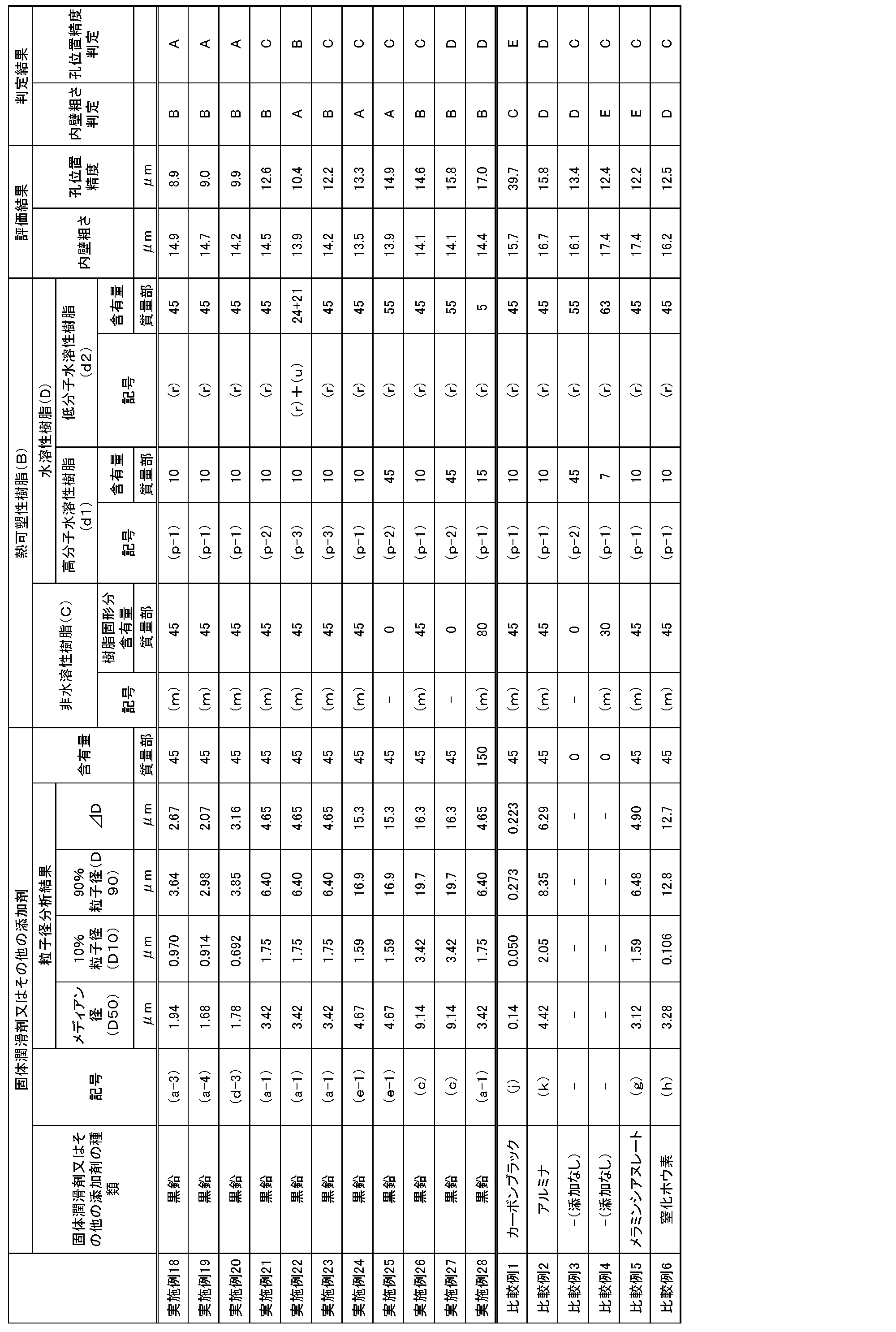
表4の実施例1~26から、ドリル孔あけ用エントリーシートにおいて、樹脂組成物の層を形成する樹脂組成物が、固体潤滑剤(A)と熱可塑性樹脂(B)とを含むと、ドリル孔あけ加工時の加工孔の内壁粗さが良好であることがわかる。
特に、樹脂組成物に含まれる固体潤滑剤(A)のメディアン径が1μm以上8μm以下であり、かつ、固体潤滑剤(A)の90%粒子径と10%粒子径の差が1μm以上17μm以下であると、ドリル孔あけ加工時の孔位置精度が優れる傾向にあることが分かる。
固体潤滑剤(A)としてメラミンシアヌレート、窒化ホウ素を用いた参考例1,2では、実施例1~26と比較して、内壁粗さが悪かった。また、非水溶性樹脂(C)を用いていない参考例3では、内壁粗さが良好であったが、やや孔位置精度が劣る結果となった。参考例4では孔位置精度がやや劣る結果となった。
固体潤滑剤(A)の代わりに、カーボンブラック、アルミナを用いた比較例1、2では、内壁粗さが悪かった。なかでも、固体潤滑剤(A)と異なる炭素粉であり劈開性を有しないカーボンブラックを用いた比較例1では、孔位置精度が特に悪かった。
また、樹脂組成物の層を形成する熱可塑性樹脂(B)が固体潤滑剤(A)を含有しない比較例3,4では、固体潤滑剤(A)による潤滑性の向上がないため、内壁粗さが悪かった。
以上実施例の結果から、本発明で開示した固体潤滑剤は格別の効果を奏するといえる。すなわちドリル孔あけ用エントリーシートが、金属箔と該金属箔の少なくとも片面上に形成された樹脂組成物の層とを備え、前記樹脂組成物が固体潤滑剤(A)と熱可塑性樹脂(B)とを含むと、ドリル孔あけ加工時の加工孔の内壁粗さが良好となることが分かる。また、固体潤滑剤(A)のメディアン径が1μm以上8μm以下であり、かつ、固体潤滑剤(A)の90%粒子径と10%粒子径の差が1μm以上17μm以下であると、ドリル孔あけ加工時の孔位置精度が優れる傾向にあることが分かる。
本出願は、2016年5月31日に日本国特許庁へ出願された日本特許出願(特願2016-108437)に基づくものであり、その内容はここに参照として取り込まれる。
本発明のドリル孔あけ用エントリーシートは、積層板又は多層板のドリル孔あけ加工において、産業上の利用可能性を有する。
Claims (22)
- 金属箔と、該金属箔の少なくとも片面上に形成された樹脂組成物の層と、を備え、
前記樹脂組成物が、劈開性を有する固体潤滑剤(A)と、熱可塑性樹脂(B)と、を含み、
前記固体潤滑剤(A)の熱伝導率が、100~5000W/m・Kである、
ドリル孔あけ用エントリーシート。 - 前記固体潤滑剤(A)のメディアン径が1μm以上10μm以下であり、かつ、前記固体潤滑剤(A)の90%粒子径と10%粒子径の差が1μm以上20μm以下である、
請求項1に記載のドリル孔あけ用エントリーシート。 - 前記樹脂組成物における前記固体潤滑剤(A)の含有量が、前記熱可塑性樹脂(B)100質量部に対して5質量部以上150質量部以下である、
請求項1又は2に記載のドリル孔あけ用エントリーシート。 - 前記固体潤滑剤(A)のメディアン径が1μm以上8μm以下であり、かつ、前記固体潤滑剤(A)の90%粒子径と10%粒子径の差が1μm以上17μm以下である、
請求項1~3のいずれか一項に記載のドリル孔あけ用エントリーシート。 - 前記樹脂組成物における前記固体潤滑剤(A)の含有量が、前記熱可塑性樹脂(B)100質量部に対して15質量部以上120質量部以下である、
請求項1~4のいずれか一項に記載のドリル孔あけ用エントリーシート。 - 前記熱可塑性樹脂(B)が、非水溶性樹脂(C)を含む、
請求項1~5のいずれか一項に記載のドリル孔あけ用エントリーシート。 - 前記非水溶性樹脂(C)の含有量が、前記熱可塑性樹脂(B)100質量部に対して25質量部以上80質量部以下である、
請求項6に記載のドリル孔あけ用エントリーシート。 - 前記非水溶性樹脂(C)が、ポリオレフィン樹脂(C-1)を含む、
請求項6又は7に記載のドリル孔あけ用エントリーシート。 - 前記ポリオレフィン樹脂(C-1)が、エチレン-(メタ)アクリル酸共重合体を含む、
請求項8に記載のドリル孔あけ用エントリーシート。 - 前記エチレン-(メタ)アクリル酸共重合体が、下記一般式(1)の構造を有する高分子を含む、
請求項9に記載のドリル孔あけ用エントリーシート。

- 前記エチレン-(メタ)アクリル酸共重合体中のエチレン由来の構成単位のモル数と(メタ)アクリル酸由来の構成単位のモル数の比が、エチレン由来の構成単位のモル数:(メタ)アクリル酸由来の構成単位のモル数で表して、60:40~99:1の範囲である、
請求項9又は10に記載のドリル孔あけ用エントリーシート。 - 前記樹脂組成物における前記ポリオレフィン樹脂(C-1)の含有量が、前記熱可塑性樹脂(B)100質量部に対して、25質量部以上80質量部以下である、
請求項8~11のいずれか一項に記載のドリル孔あけ用エントリーシート。 - 前記ポリオレフィン樹脂(C-1)の重量平均分子量が、5×10³以上1×10⁵以下である、
請求項8~12のいずれか一項に記載のドリル孔あけ用エントリーシート。 - 前記熱可塑性樹脂(B)が、水溶性樹脂(D)を含む、
請求項1~13のいずれか一項に記載のドリル孔あけ用エントリーシート。 - 前記水溶性樹脂(D)が、ポリエチレンオキサイド、ポリプロピレンオキサイド、ポリビニルピロリドン、セルロース誘導体、ポリエチレングリコール、ポリプロピレングリコール、ポリテトラメチレングリコール、ポリオキシエチレンのモノエーテル化合物、ポリオキシエチレンモノステアレート、ポリオキシエチレンソルビタンモノステアレート、ポリオキシエチレンソルビタンモノラウレート、ポリグリセリンモノステアレート、ポリエチレンオキサイド-ポリプロピレンオキサイド共重合体及びそれらの誘導体からなる群より選択される1種類又は2種類以上を含む、
請求項14に記載のドリル孔あけ用エントリーシート。 - 前記水溶性樹脂(D)の含有量が、前記熱可塑性樹脂(B)100質量部に対して、20質量部以上100質量部以下である、
請求項14又は15に記載のドリル孔あけ用エントリーシート。 - 前記水溶性樹脂(D)が、重量平均分子量5×10⁴以上1.5×10⁶以下である高分子水溶性樹脂(d1)と、重量平均分子量5×10²以上3×10⁴以下である低分子水溶性樹脂(d2)とを含み、 前記高分子水溶性樹脂(d1)が、ポリエチレンオキサイド、ポリプロピレンオキサイド、ポリビニルピロリドン及びセルロース誘導体からなる群より選択される1種類又は2種類以上を含み、
前記低分子水溶性樹脂(d2)が、ポリエチレングリコール、ポリプロピレングリコール、ポリテトラメチレングリコール、ポリオキシエチレンオレイルエーテル、ポリオキシエチレンセチルエーテル、ポリオキシエチレンステアリルエーテル、ポリオキシエチレンラウリルエーテル、ポリオキシエチレンノニルフェニルエーテル、ポリオキシエチレンオクチルフェニルエーテル、ポリオキシエチレンモノステアレート、ポリオキシエチレンソルビタンモノステアレート、ポリオキシエチレンソルビタンモノラウレート、ポリグリセリンモノステアレート、ポリエチレンオキサイド-ポリプロピレンオキサイド共重合体及びそれらの誘導体からなる群より選択される1種類又は2種類以上である、
請求項14~16のいずれか一項に記載のドリル孔あけ用エントリーシート。 - 前記高分子水溶性樹脂(d1)の含有量が、前記熱可塑性樹脂(B)100質量部に対し、2質量部以上50質量部以下である、
請求項17に記載のドリル孔あけ用エントリーシート。 - 前記低分子水溶性樹脂(d2)の含有量が、前記熱可塑性樹脂(B)100質量部に対し、3質量部以上60質量部以下である、
請求項17又は18に記載のドリル孔あけ用エントリーシート。 - 前記樹脂組成物の層の厚さが、0.02~0.3mmである、
請求項1~19のいずれか一項に記載のドリル孔あけ用エントリーシート。 - 前記金属箔の厚さが、0.05mm~0.5mmである、
請求項1~20のいずれかに一項に記載のドリル孔あけ用エントリーシート。 - 請求項1~21のいずれか一項に記載のドリル孔あけ用エントリーシートを用いて、積層板又は多層板に孔を形成する、
ドリル孔あけ加工方法。
Priority Applications (1)
| Application Number | Priority Date | Filing Date | Title |
|---|---|---|---|
| JP2018520826A JP6940823B2 (ja) | 2016-05-31 | 2017-05-23 | ドリル孔あけ用エントリーシート及びそれを用いたドリル孔あけ加工方法 |
Applications Claiming Priority (2)
| Application Number | Priority Date | Filing Date | Title |
|---|---|---|---|
| JP2016108437 | 2016-05-31 | ||
| JP2016-108437 | 2016-05-31 |
Publications (1)
| Publication Number | Publication Date |
|---|---|
| WO2017208912A1 true WO2017208912A1 (ja) | 2017-12-07 |
Family
ID=60477744
Family Applications (1)
| Application Number | Title | Priority Date | Filing Date |
|---|---|---|---|
| PCT/JP2017/019285 Ceased WO2017208912A1 (ja) | 2016-05-31 | 2017-05-23 | ドリル孔あけ用エントリーシート及びそれを用いたドリル孔あけ加工方法 |
Country Status (3)
| Country | Link |
|---|---|
| JP (1) | JP6940823B2 (ja) |
| TW (1) | TW201802225A (ja) |
| WO (1) | WO2017208912A1 (ja) |
Cited By (4)
| Publication number | Priority date | Publication date | Assignee | Title |
|---|---|---|---|---|
| JP2020190063A (ja) * | 2019-05-20 | 2020-11-26 | 王子ホールディングス株式会社 | 防湿紙および包装容器 |
| TWI711518B (zh) * | 2019-05-22 | 2020-12-01 | 大陸商深圳市柳鑫實業股份有限公司 | 一種改善pcb鑽孔的方法 |
| TWI718907B (zh) * | 2020-03-18 | 2021-02-11 | 易華電子股份有限公司 | 用於印刷電路板雷射鑽孔之墊板 |
| JP7606865B2 (ja) | 2020-12-09 | 2024-12-26 | 大智化学産業株式会社 | 孔あけ加工用当て板 |
Families Citing this family (1)
| Publication number | Priority date | Publication date | Assignee | Title |
|---|---|---|---|---|
| JP7129030B2 (ja) * | 2018-03-30 | 2022-09-01 | 三菱瓦斯化学株式会社 | ドリル孔あけ用エントリーシート及びそれを用いたドリル孔あけ加工方法 |
Citations (4)
| Publication number | Priority date | Publication date | Assignee | Title |
|---|---|---|---|---|
| JP2001347602A (ja) * | 2000-04-06 | 2001-12-18 | Kobe Steel Ltd | 潤滑性樹脂被覆金属板及びそれを使用したプリント配線基板の孔開け加工方法 |
| JP2003136485A (ja) * | 2001-10-31 | 2003-05-14 | Mitsubishi Gas Chem Co Inc | 孔明け用エントリーシート及びドリル孔明け加工法 |
| JP2008222762A (ja) * | 2007-03-09 | 2008-09-25 | Mitsubishi Gas Chem Co Inc | ドリル孔明け用エントリーシート |
| JP2013119490A (ja) * | 2011-12-06 | 2013-06-17 | Toyota Central R&D Labs Inc | 親水化グラファイト材料およびその製造方法 |
-
2017
- 2017-05-23 WO PCT/JP2017/019285 patent/WO2017208912A1/ja not_active Ceased
- 2017-05-23 JP JP2018520826A patent/JP6940823B2/ja not_active Expired - Fee Related
- 2017-05-26 TW TW106117498A patent/TW201802225A/zh unknown
Patent Citations (4)
| Publication number | Priority date | Publication date | Assignee | Title |
|---|---|---|---|---|
| JP2001347602A (ja) * | 2000-04-06 | 2001-12-18 | Kobe Steel Ltd | 潤滑性樹脂被覆金属板及びそれを使用したプリント配線基板の孔開け加工方法 |
| JP2003136485A (ja) * | 2001-10-31 | 2003-05-14 | Mitsubishi Gas Chem Co Inc | 孔明け用エントリーシート及びドリル孔明け加工法 |
| JP2008222762A (ja) * | 2007-03-09 | 2008-09-25 | Mitsubishi Gas Chem Co Inc | ドリル孔明け用エントリーシート |
| JP2013119490A (ja) * | 2011-12-06 | 2013-06-17 | Toyota Central R&D Labs Inc | 親水化グラファイト材料およびその製造方法 |
Cited By (5)
| Publication number | Priority date | Publication date | Assignee | Title |
|---|---|---|---|---|
| JP2020190063A (ja) * | 2019-05-20 | 2020-11-26 | 王子ホールディングス株式会社 | 防湿紙および包装容器 |
| JP7424190B2 (ja) | 2019-05-20 | 2024-01-30 | 王子ホールディングス株式会社 | 防湿紙および包装容器 |
| TWI711518B (zh) * | 2019-05-22 | 2020-12-01 | 大陸商深圳市柳鑫實業股份有限公司 | 一種改善pcb鑽孔的方法 |
| TWI718907B (zh) * | 2020-03-18 | 2021-02-11 | 易華電子股份有限公司 | 用於印刷電路板雷射鑽孔之墊板 |
| JP7606865B2 (ja) | 2020-12-09 | 2024-12-26 | 大智化学産業株式会社 | 孔あけ加工用当て板 |
Also Published As
| Publication number | Publication date |
|---|---|
| TW201802225A (zh) | 2018-01-16 |
| JP6940823B2 (ja) | 2021-09-29 |
| JPWO2017208912A1 (ja) | 2019-06-20 |
Similar Documents
| Publication | Publication Date | Title |
|---|---|---|
| JP6940823B2 (ja) | ドリル孔あけ用エントリーシート及びそれを用いたドリル孔あけ加工方法 | |
| US10159153B2 (en) | Entry sheet for drilling | |
| CN101468343B (zh) | 钻孔用盖板的制造方法和盖板 | |
| US9826643B2 (en) | Entry sheet for drilling and drilling method | |
| CN103282168B (zh) | 钻孔用盖板 | |
| JP6315226B2 (ja) | ドリル孔あけ用エントリーシート、及びそれを用いたドリル孔あけ加工方法 | |
| TWI519365B (zh) | Drilling cover | |
| TW201544317A (zh) | 鑽孔用輔助板 | |
| JP4551654B2 (ja) | プリント配線基板の穴あけ加工に使用する樹脂被覆金属板 | |
| JP2008055644A (ja) | 樹脂被覆金属板およびこれを用いたプリント配線基板の穴あけ加工方法 | |
| JP6351865B1 (ja) | エントリーシート、エントリーシートの製造方法及びフレキシブル基板の製造方法 | |
| JP7129030B2 (ja) | ドリル孔あけ用エントリーシート及びそれを用いたドリル孔あけ加工方法 | |
| JP7157931B2 (ja) | 微細径用ドリル孔あけ用エントリーシート、及びそれを用いたドリル孔あけ加工方法 | |
| TWI680865B (zh) | 鑽孔用輔助板及利用該輔助板的鑽孔加工方法 | |
| JP7606865B2 (ja) | 孔あけ加工用当て板 | |
| Zhou et al. | Preparation and performances of coated and aluminous entry boards with water-soluble resins for PCB drilling | |
| JP6369796B2 (ja) | ドリル孔あけ用エントリーシート、及びそれを用いたドリル孔あけ加工方法 | |
| JPWO2016147817A1 (ja) | ドリル孔あけ用エントリーシート、及びそれを用いたドリル孔あけ加工方法 | |
| CN107848135B (zh) | 钻孔用盖板和使用其的钻孔加工方法 | |
| HK1130221B (en) | Process for the production of entry sheet for drilling and entry sheet |
Legal Events
| Date | Code | Title | Description |
|---|---|---|---|
| 121 | Ep: the epo has been informed by wipo that ep was designated in this application |
Ref document number: 17806469 Country of ref document: EP Kind code of ref document: A1 |
|
| NENP | Non-entry into the national phase |
Ref country code: DE |
|
| ENP | Entry into the national phase |
Ref document number: 2018520826 Country of ref document: JP Kind code of ref document: A |
|
| 122 | Ep: pct application non-entry in european phase |
Ref document number: 17806469 Country of ref document: EP Kind code of ref document: A1 |