WO2017208577A1 - 座席用ヒータに用いるヒータ線及び座席用ヒータ - Google Patents
座席用ヒータに用いるヒータ線及び座席用ヒータ Download PDFInfo
- Publication number
- WO2017208577A1 WO2017208577A1 PCT/JP2017/011357 JP2017011357W WO2017208577A1 WO 2017208577 A1 WO2017208577 A1 WO 2017208577A1 JP 2017011357 W JP2017011357 W JP 2017011357W WO 2017208577 A1 WO2017208577 A1 WO 2017208577A1
- Authority
- WO
- WIPO (PCT)
- Prior art keywords
- wire
- fiber yarn
- heater
- heating
- diameter
- Prior art date
- Legal status (The legal status is an assumption and is not a legal conclusion. Google has not performed a legal analysis and makes no representation as to the accuracy of the status listed.)
- Ceased
Links
Images




Classifications
-
- H—ELECTRICITY
- H05—ELECTRIC TECHNIQUES NOT OTHERWISE PROVIDED FOR
- H05B—ELECTRIC HEATING; ELECTRIC LIGHT SOURCES NOT OTHERWISE PROVIDED FOR; CIRCUIT ARRANGEMENTS FOR ELECTRIC LIGHT SOURCES, IN GENERAL
- H05B3/00—Ohmic-resistance heating
- H05B3/20—Heating elements having extended surface area substantially in a two-dimensional [2D] plane, e.g. plate-heater
-
- H—ELECTRICITY
- H05—ELECTRIC TECHNIQUES NOT OTHERWISE PROVIDED FOR
- H05B—ELECTRIC HEATING; ELECTRIC LIGHT SOURCES NOT OTHERWISE PROVIDED FOR; CIRCUIT ARRANGEMENTS FOR ELECTRIC LIGHT SOURCES, IN GENERAL
- H05B3/00—Ohmic-resistance heating
- H05B3/40—Heating elements having the shape of rods or tubes
- H05B3/54—Heating elements having the shape of rods or tubes flexible
- H05B3/56—Heating cables
Definitions
- the present invention relates to a heater wire and a seat heater which are used for a seat heater of an automobile or the like and have a bending durability with reduced foreign object feeling when seated.
- Patent Document 1 discloses the following.
- a heating element is formed by twisting a plurality of heating element wires, and an insulating sheath is provided on the heating element.
- B) A ribbon-like heating element wire is wound around a core body of polyester or the like in a spiral shape, and an insulating sheath is provided thereon.
- a heating element in which a plurality of heating element wires are twisted together is spirally wound around a core body such as polyester, and an insulating sheath is provided thereon.
- a heating element composed of one or a plurality of heating element wires coated with insulation is spirally wound around a core body such as polyester, and an insulating sheath is provided thereon. This document aims to provide a heating wire that is resistant to tensile strength and bending.
- Patent Document 2 proposes a heating wire for a seat heater in which a conductor made of a copper-silver alloy wire is coated with polyurethane and then six coated wires extrusion-coated with ultra high molecular weight polyethylene are twisted together.
- This technology solves the problem that when a twisted wire is bent repeatedly, the polyurethane coating may be worn by friction between the coated wires, which may lead to disconnection, and a sheet heater with mechanical strength, flexibility, solderability, etc.
- the object is to improve the bending durability without impairing other characteristics required for the heating wire.
- the heater wire that constitutes the seat heater of an automobile is required to have high bending durability and further to reduce the cost.
- An object of the present invention is to provide a heater wire for high bending durability and a heater for a seat that are used for a heater for a seat of an automobile or the like and reduce a foreign object feeling when sitting.
- the heater wire according to the present invention has a stranded wire in which one or two or more fiber yarns and four or more heating wires having an insulating film are twisted at a pitch of 6 mm or more and 12 mm or less, The outer circumference of the stranded wire is not provided with an insulating sheath.
- this invention consists of a stranded wire in which one or two or more fiber yarns and four or more exothermic wires are twisted at a pitch in the above range, and an insulating sheath is provided on the outer periphery of the stranded wire. Because it is flexible, it is more flexible when it is seated, compared to a heater wire that twists only the heating wire or a heater wire that is wound around the outer periphery of a bundle of fiber yarns (also called a fiber bundle). It is easy to be deformed when receiving an external force at the time of vibration, and a foreign object feeling can be reduced.
- the heating wire has an insulating film, it is possible to prevent the heating wires from directly rubbing and to suppress disconnection of the heating wire. Moreover, since the fiber yarn and the heating wire are twisted together, the friction between the heating wires and the wear of the insulating film can be reduced, and the disconnection of the heating wire can be suppressed. As a result, the heater wire has a simple configuration that can realize cost reduction and can exhibit high bending durability.
- the stranded wire can be configured as follows. (1) A secondary stranded wire formed by twisting a plurality of primary stranded wires of the fiber yarn and the heating wire. (2) The outer diameter of the fiber yarn is four times or more the diameter of the heating wire, and the number of heating wires is larger than the number of fiber yarns. (3) The outer diameter of the fiber yarn is not more than twice the diameter of the heating wire, and the number of the heating wire is larger than the number of the fiber yarn. (4) It has two or more types of fiber yarns having different outer diameters.
- the stranded wire can be formed in various forms.
- the fiber yarn and the heating wire are paired and distributed.
- the fiber yarn is in the center and the heating wire is arranged around it.
- the fiber yarn is disposed near the center and the heating wire is disposed near the outer periphery, but is relatively dispersed.
- the stranded wire of (4) the large outer diameter fiber yarn is located at the center, and the heating wire and the small outer diameter fiber yarn are dispersedly arranged at unspecified (random) positions around them.
- one or more fiber yarns may be further provided on the outer periphery of the stranded wire.
- the fiber yarn provided on the outer periphery of the stranded wire acts so as to make the flexibility and deformability easier when receiving external force during sitting or vibration, further reducing the feeling of foreign matter. can do.
- the seat heater according to the present invention is characterized in that the heater wire according to the present invention is provided on a base material. According to the present invention, the heater wire that is easily flexible and deformable when seated on the seat or receives external force during vibration is provided on the base material. Compared to a heater wire formed by horizontally winding a wire or a heat generating wire around the outer periphery of a bundle of fiber yarns (fiber bundle), it is possible to reduce a foreign object feeling when seated on the seat.
- the present invention it is possible to provide a heater wire and a seat heater which are used for a seat heater of an automobile or the like and reduce the feeling of foreign matters when seated.
- the heater wire has a simple configuration that can realize cost reduction and can exhibit high bending durability.
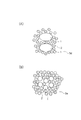
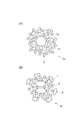
- FIG. 3 is a schematic explanatory view showing a heater wire of Example 1. It is typical explanatory drawing of the fiber yarn which comprises a heater wire, and a heating wire. It is typical explanatory drawing which shows the heater wire of Example 2 and Example 3. FIG. It is typical explanatory drawing which shows the heater wire of Example 4 and Example 5. FIG. It is typical explanatory drawing which shows the heater wire of Example 6 and Example 7. It is typical explanatory drawing which shows the heater wire of Example 8 and Example 9. FIG. It is typical explanatory drawing which shows the heater wire of the comparative example 1 and the comparative example 2.
- the heater wire 10 includes one or two or more fiber yarns 1 and four or more heating wires 2 each having an insulating film 3b of 6 mm or more and 12 mm or less.
- the stranded wire 5 is twisted at a pitch, and the outer periphery of the stranded wire 5 is not provided with an insulating sheath (for example, reference numeral 100 in FIG. 7).
- the heater wire 10 is flexible, and is formed by horizontally winding a heater wire or a heating wire 2 formed by twisting only the heating wire 2 around the outer periphery of the fiber yarn 1 or a fiber bundle (a bundle of fiber yarns). Compared to the heater wire, it can be easily deformed when it receives an external force during sitting or vibration, and the feeling of foreign matter can be reduced. Moreover, since the heating wire 2 has the insulating film 3b, it is possible to prevent the heating wires 2 (3a, 3a) from directly rubbing and to suppress the disconnection of the heating wire 2.
- the heater wire 10 has a simple configuration capable of realizing cost reduction and can exhibit high bending durability.
- the heater wire 10 may be comprised only with the strand wire 5, and the structure of other than that may be contained in the range which does not inhibit the effect of this invention.
- a fiber yarn 4 further provided on the outer periphery of the stranded wire 5i can be cited.
- the fiber yarn 1 is an essential component of the stranded wire 5 and is a flexible and strong yarn.
- the fiber yarn 1 is twisted together with the heating wire 2 to form a twisted wire 5.
- the fiber yarn 1 is a thread-like material composed of a plurality of fibers 1 ′.
- the fiber 1 ′ may be any heat-resistant fiber that has strength and has no thermal influence even when the heating wire 2 is heated.
- Examples of the fiber 1 ′ include polyester fibers such as Tetoron (registered trademark), wholly aromatic polyamide fibers such as Kevlar (registered trademark), polyarylate fibers such as Vectran (registered trademark), and glass fibers. Can do.
- the fiber yarn 1 is usually represented by “dtex”. 1 dtex means 1 g with a length of 10,000 m.
- the fiber yarn 1 has a concentric cross section in which a plurality of fibers 1 'are combined or twisted together, and is flexible, easily deformed, and easily flattened (see FIGS. 4A and 6). (See (B).)
- the number of the fiber yarns 1 is one or more, and is selected in consideration of the size of the outer diameter D1, flexibility, and the like. The number is preferably 1 or more and 6 or less as shown in the examples described later, but is not particularly limited. Moreover, as shown in Example 2, you may use many fiber yarns 1 like 32 pieces.
- the outer diameter D1 of the fiber yarn 1 is not specifically limited, For example, the range of 0.1 mm or more and 0.5 mm or less can be illustrated.
- the outer diameter D1 of the fiber yarn 1 is the diameter when the fiber yarn 1 is a perfect circle, and the cross-sectional area when the fiber yarn 1 is a flat shape. To be evaluated as a diameter converted into a true circular cross-sectional area.
- a plurality of types of fiber yarns 1 may be used simultaneously.
- fiber yarns having different materials may be used together, or fiber yarns having different outer diameters may be used together.
- two or more types of fiber yarns 1a and 1b having different outer diameters D1 are used.
- the strand 5h produced in this way has a configuration in which the large outer diameter fiber yarn 1a is located in the center, and the heating wire 2 and the small outer diameter fiber yarn 1b are dispersedly arranged at unspecified (random) positions around them. It has become.
- the heating wire 2 is an essential component of the stranded wire 5 and generates heat by current.
- the heating wire 2 is twisted together with the fiber yarn 1 to form a stranded wire 5.
- the heating wire 2 includes a heating wire 3a and an insulating film 3b provided on the outer periphery of the heating wire 3a.
- the heating element wire 3a is a resistance wire that generates heat due to an electric current, and the diameter and the number of the heating element wires 3a are arbitrarily selected so as to have a resistance value of the heat generation specification.
- Examples of the exothermic wire 3a include a copper wire and a copper alloy wire.
- Examples of the copper alloy wire include a CuAg alloy, a CuSn alloy, and a CuNi alloy.
- examples of the insulating film 3b also referred to as enamel film
- examples of the insulating film 3b include heat-resistant polyester imide (PEI), polyimide (PI), and polyamide imide (PAI).
- the exothermic wire 3a is selected on the assumption that the resistance value of the exothermic specification is used, and the diameter thereof is preferably selected in the range of 0.02 mm or more and 0.1 mm or less.
- the thickness of the insulating film 3b is about 1, 2 or 3 according to the general Japanese Industrial Standard (JIS C 3202: 2014), and an arbitrary thickness can be selected from them. . Since the insulating film 3b insulates the heat generating element wires 3a and 3a, even if a disconnection occurs, the occurrence of a heat spot at that part can be suppressed.
- the diameter D2 of the heating wire 2 composed of the heating wire 3a and the insulating film 3b is in the range of 0.03 mm or more and 0.12 mm or less.
- the number of heating wires 2 is designed in consideration of the resistance value and the diameter, but is preferably in the range of 4 or more and 200 or less, preferably in the range of 4 or more and 32 or less. More preferably.
- the diameter D2 and the number of the heating wires 2 are arbitrarily set in consideration of the outer diameter D1 of the fiber yarn 1 twisted together and the flexibility and deformability of the heater wire 1 to be obtained. Various forms such as 1 to 9 can be mentioned.
- the stranded wire 5 is formed by twisting one or two or more fiber yarns 1 and four or more heating wires 2 having an insulating film 3b at a pitch of 6 mm or more and 12 mm or less. It is a thing. As a twist form, any of the following may be sufficient.
- the fiber yarn 1 is arranged on the center side and the heating wire 2 is arranged on the outer peripheral side and twisted together. Therefore, it can be set as various twist forms. Further, the outer diameter D1 and the ratio of the fiber yarn 1 may be changed, or the diameter D2 and the ratio of the heating wire 2 may be changed.
- the fiber yarn 1 itself has strength and flexibility, and further has functions and functions such as alleviating rubbing between the heating wires, and the heating wire 2 itself is a heating element. It has functions and functions such as Therefore, various configurations and forms of the stranded wire can be designed depending on how much the respective functions and functions are exhibited as components of the stranded wire 5.
- the first process (determining the heater wire specifications) was made in accordance with the state of use so that the stranded wire 5 had characteristics suitable for the state of use of the seat heater for automobiles. While determining the specifications of the type, thickness and number of fiber yarns 1 (determination process of fiber yarn specifications), the type, diameter and number of heating wires 2 (determination process of heating line specifications) are determined. In the next process (manufacturing preparation process), the fiber yarn 1 and the heating wire 2 based on the fiber yarn specification and the heating wire specification are obtained and prepared and supplied to the manufacturing line. In the next process (twisting process), the fiber yarn 1 supplied to the production line and the heating wire 2 are twisted together to produce the stranded wire 5.
- the stranded wire 5 corresponding to the use state can be designed and manufactured.
- the stranded wire 5 becomes the heater wire 10
- another fiber yarn 4 or the like is provided on the outer periphery of the stranded wire 5, this is the heater wire. 10
- the stranded wire 5 manufactured by such a design / manufacturing process include the following. (1) The primary stranded wire 11 of the fiber yarn 1 and the heating wire 2 is configured to be a secondary stranded wire formed by twisting a plurality. (2) The outer diameter D1 of the fiber yarn 1 is four times or more the diameter D2 of the heating wire 2, and the number of the heating wires 2 is larger than the number of the fiber yarns 1. (3) The outer diameter D1 of the fiber yarn 1 is less than twice the diameter D2 of the heating wire 2, and the number of the heating wires 2 is larger than the number of the fiber yarns 1. (4) It comprises so that it may have 2 or more types of fiber yarns 1a and 1b from which the outer diameter D1 differs.
- the stranded wire 5 can be formed in various forms.
- the fiber yarn 1 and the heating wire 2 are likely to be distributed and arranged in pairs.
- the fiber yarn 1 is likely to be in the center and the heating wire 2 is arranged around it.
- the fiber yarn 1 is arranged near the center and the heating wire 2 is arranged near the outer periphery, but it tends to be relatively dispersed.
- the strand 5 of (4) has a configuration in which the large outer diameter fiber yarn 1a is located in the center, and the heating wire 2 and the small outer diameter fiber yarn 1b are dispersedly arranged at unspecified (random) positions around it. It is easy to become.
- various stranded wires having different forms can be obtained. 1 and 3 to 6 show examples of specific cross-sectional shapes.
- the fiber yarn 1 is relatively near the center, but as a whole, the fiber yarn 1 and the heating wire 2 are dispersedly arranged at unspecified (random) positions.
- the stranded wire 5a is easily deformed when subjected to an external force during sitting or vibration, and further, the friction between the heating wires and the wear of the insulating coating 3b are reduced to suppress the disconnection of the heating wire 2. be able to.
- a stranded wire 5b shown in FIG. 3 (A) is a secondary stranded wire in which a plurality of primary stranded wires 11 of the fiber yarn 1 and the heating wire 2 are twisted.
- This stranded wire 5b is a secondary stranded wire in which 32 pairs of primary stranded wires 11 obtained by twisting one fiber yarn 1 and one heating wire 2 at the same pitch are prepared and twisted at the same pitch. It is. Since the strand 5b is a pair of the fiber yarn 1 and the heating wire 2, the strand 5b is a strand 5b scattered in a highly dispersed state in a pair state, and particularly has good deformability when subjected to external force, When used in a heater, the feeling of foreign matter can be reduced.
- the primary stranded wire 11 is composed of one fiber yarn 1 and one heating wire 2, but two or more fiber yarns 1 and two or more heating wires 2 are used. It is good also as the primary strand 11, and it is good also as a primary strand in other combinations.
- the fiber yarn 1 and the heating wire 2 may be the same number of one-to-one, or may not be the same number, the fiber yarn 1 may be a larger primary stranded wire, or the heating wire 2 may be a larger primary stranded wire. Good.
- a twisted wire 5c shown in FIG. 3 (B) is obtained by twisting one fiber yarn 1 and six heating wires 2 around it.
- the fiber yarn 1 and the heating wire 2 have substantially the same outer diameter, for example, the outer diameter D1 of the fiber yarn 1 is about twice or less than the diameter D2 of the heating wire 2. Since this strand 5c uses the single fiber yarn 1, the fiber yarn 1 tends to approach the center, and the fiber yarn 1 acts as a cushioning material for the heating wire 2 positioned around, and serves as a seat heater. When used, the feeling of foreign matter can be reduced. Further, friction between the heating wires 2 can be reduced.
- a twisted wire 5d shown in FIG. 4 (A) is obtained by twisting two fiber yarns 1 and 32 heating wires 2 together.
- the twisted wire 5d has a difference in outer diameter between the fiber yarn 1 and the heating wire 2.
- the outer diameter D1 of the fiber yarn 1 is four times or more the diameter D2 of the heating wire 2.
- the outer diameter D1 of the fiber yarn 1 is relatively larger than the diameter D2 of the heating wire 2. Therefore, the deformability of the fiber yarn 1 is particularly good when receiving external force, and the degree of deformation is large. As a result, it is possible to reduce the feeling of foreign matter when used in a seat heater.
- the friction between the small-diameter heating wires 2 can be reduced by the good buffering action of the fiber yarn 1, the wear of the small-diameter heating wires 2 that are easily disconnected can be reduced and the disconnection can be suppressed. Can do.
- the number of fiber yarns 1 and heating wires 2 can be arbitrarily designed. For example, by increasing the number of fiber yarns 1, the deformability can be increased, and a large number of heating wires 2 can be twisted together.
- a stranded wire 5e shown in FIG. 4 (B) is obtained by twisting six fiber yarns 1 and 48 heating wires 2 together.
- the fiber yarn 1 and the heating wire 2 have substantially the same outer diameter, for example, the outer diameter D1 of the fiber yarn 1 is about twice or less than the diameter D2 of the heating wire 2.
- the six fiber yarns 1 are easy to move toward the center, but the heating wire 2 easily enters between the fiber yarns 1.
- due to the action of the fiber yarn 1 that is flexible and easily deformed it is possible to reduce the feeling of foreign matter when used in the seat heater and to reduce the friction of the heating wire 2.
- a twisted wire 5f shown in FIG. 5 (A) is obtained by twisting one fiber yarn 1 and four heating wires 2 around it.
- the stranded wire 5f has a difference in outer diameter between the fiber yarn 1 and the heating wire 2.
- the outer diameter D1 of the fiber yarn 1 is more than four times the diameter D2 of the heating wire 2.
- This strand 5f uses a single fiber yarn 1, so that the fiber yarn 1 tends to move toward the center, and the fiber yarn 1 acts as a cushioning material for the four heating wires 2 positioned around it, and the seat When used in a heater, the feeling of foreign matter can be reduced. Further, friction between the heating wires 2 can be reduced.
- the outer diameter D1 of the fiber yarn 1 is relatively larger than the diameter D2 of the heating wire 2.
- the deformability of the fiber yarn 1 is particularly good when receiving external force, and the degree of deformation is large. As a result, it is possible to reduce the feeling of foreign matter when used in a seat heater. Moreover, the friction between the small-diameter heating wires 2 can be reduced by the good buffering action of the fiber yarn 1. Therefore, it is possible to reduce wear of the small-diameter heating wire 2 that is easily disconnected, and to suppress disconnection.
- the number of fiber yarns 1 and heating wires 2 can be arbitrarily designed. For example, by increasing the number of fiber yarns 1, the deformability can be increased, and a large number of heating wires 2 can be twisted together.
- a twisted wire 5g shown in FIG. 5 (B) is obtained by twisting one fiber yarn 1 and 32 heating wires 2 around it.
- the stranded wire 5g has a difference in outer diameter between the fiber yarn 1 and the heating wire 2.
- the outer diameter D1 of the fiber yarn 1 is more than four times the diameter D2 of the heating wire 2.
- a single fiber yarn 1 is used for the stranded wire 5g. Therefore, the fiber yarn 1 tends to move toward the center, and the fiber yarn 1 acts as a cushioning material for the 32 small-diameter heating wires 2 positioned around the fiber yarn 1 to reduce the feeling of foreign matter when used for a seat heater. it can.
- the outer diameter D1 of the fiber yarn 1 is relatively larger than the diameter D2 of the heating wire 2.
- the deformability of the fiber yarn 1 is particularly good when receiving external force, and the degree of deformation is large. As a result, it is possible to reduce the feeling of foreign matter when used in a seat heater.
- the number of fiber yarns 1 and heating wires 2 can be arbitrarily designed. For example, by increasing the number of fiber yarns 1, the deformability can be increased, and a large number of heating wires 2 can be twisted together.
- a twisted wire 5h shown in FIG. 6 (A) is obtained by twisting two kinds of fiber yarns 1a and 1b having different outer diameters and 32 heating wires 2.
- the fiber yarns 1a and 1b one fiber yarn 1a having a relatively large outer diameter and twelve fiber yarns 1b having a relatively small outer diameter are used.
- the outer diameter D1 of the large-diameter fiber yarn 1a is four times or more the diameter D2 of the heating wire 2
- the outer diameter D1 of the small-diameter fiber yarn 1b is two or less times the diameter D2 of the heating wire 2.
- the large-diameter fiber yarn 1 is likely to move toward the center, and the small-diameter fiber yarn 1b is easily disposed around the large-diameter fiber yarn 1a.
- the heating wire 2 is arranged around the outer periphery of the large-diameter fiber yarn 1a or dispersed around the small-diameter fiber yarn 1b.
- the large-diameter fiber yarn 1a is positioned at the center to enhance the flexibility of the entire stranded wire.
- the small-diameter fiber yarn 1b is positioned around the large-diameter fiber yarn 1a, and is further entangled between a large number of the heating wires 2 so as to reduce friction between the heating wires. Due to the two or more types of fiber yarns 1a and 1b having different outer diameters having the respective roles, the twisted wire 5h has good deformability and a large degree of deformation when the fiber yarn 1 is subjected to external force. As a result, it is possible to reduce the feeling of foreign matter when used in a seat heater. Further, the action of the fiber yarn 1b can relieve the friction between the heating wires 2, reduce the wear of the heating wires 2, and suppress the disconnection. Also in this case, the number of fiber yarns 1a and 1b and the number of heating wires 2 can be arbitrarily designed. For example, the outer diameter of the fiber yarn 1a can be changed, or the number of fiber yarns 1b can be increased.
- a twisted wire 5i shown in FIG. 6 (B) is obtained by twisting two fiber yarns 1 and 32 heating wires 2 as in FIG. 4 (A).
- the stranded wire 5i has an outer diameter difference between the fiber yarn 1 and the heating wire 2.
- the outer diameter D1 of the fiber yarn 1 is four times or more the diameter D2 of the heating wire 2.
- six more fiber yarns 4 are provided on the outer periphery of the stranded wire 5i.
- the fiber yarn 4 is flexible and is often deformed into a flat shape as illustrated.
- This stranded wire 5i has a relatively large outer diameter D1 of the fiber yarn 1 compared to the diameter D2 of the heating wire 2 in the same manner as the above-described stranded wire 5d. Therefore, the deformability of the fiber yarn 1 is particularly good when receiving external force, and the degree of deformation is large. As a result, it is possible to reduce the feeling of foreign matter when used in a seat heater. Moreover, the friction between the small-diameter heating wires 2 can be reduced by the good buffering action of the fiber yarn 1. Therefore, it is possible to reduce wear of the small-diameter heating wire 2 that is easily disconnected, and to suppress disconnection.
- the six fiber yarns 4 twisted around the outer periphery of the stranded wire 5i act so as to make the flexibility and deformability easier when subjected to an external force during sitting or vibration, thereby further enhancing the sense of foreign matter. Can be reduced.
- the number of fiber yarns 1 and heating wires 2 can be arbitrarily designed. For example, by increasing the number of fiber yarns 1, the deformability can be increased, and a large number of heating wires 2 can be twisted together.
- the stranded wire 5 has an outer diameter D1 of the fiber yarn 1 in the range of 0.1 mm to 0.5 mm, and the heating wire 2 has a diameter D2 in the range of 0.03 mm to 0.12 mm.
- the twist pitch is preferably 6 mm or more and 12 mm or less.
- the stranded wire 5 can be attached to the base material of the seat heater as the heater wire 10.
- the size of the fiber yarn 1 and the heating wire 2 is such that the outer diameter D1 of the fiber yarn 1 is in the range of 0.1 mm to 0.5 mm, and the diameter D2 of the heating wire 2 is 0.03 mm to 0.22 mm. And the outer diameter D1 of the fiber yarn 1 is larger than the diameter D2 of the heating wire 2 (D1> D2). Therefore, even if the fiber yarn 1 and the heating wire 2 are within the above range, D1 ⁇ D2 does not occur.
- D1> D2 is that the fiber yarn 1 having a relatively large outer diameter D1 is easily available, and the fiber yarn 1 having a diameter larger than that of the heating wire 2 is easily seated or vibrated due to its flexibility and deformability. This is because it can be easily deformed when receiving an external force to reduce the foreign object feeling.
- the diameter of each fiber 1 ′ constituting the fiber yarn 1 is smaller than or equal to the diameter of the heating wire 2.
- the relationship between the outer diameter D1 of the fiber yarn 1 and the diameter D2 of the heating wire 2 is preferably at least D1> D2.
- D1 is 4 times or more of D2 and when D1 is 2 times or less of D2.
- D1 is 4 times or more as large as D2
- the fiber yarn is in the center and the heating wire is arranged around it, and the large-diameter fiber yarn 1 at the center further increases the flexibility of the entire twisted wire. It is thought that it is acting to raise it further.
- D1 is equal to or less than twice D2
- the fiber yarn 1 is arranged near the center and the heating wire 2 is arranged near the outer periphery, but the fiber yarn 1 and the heating wire 2 are relatively dispersed.
- a fiber yarn 4 may be provided on the outer periphery of the stranded wire 5 as necessary, as shown in FIG.
- the fiber yarn 4 is provided on the outer periphery of the stranded wire 5 and acts to protect the stranded wire 5 while further improving the flexibility of the heater wire 10.
- the fiber yarn 4 used here has an arbitrary outer diameter, and the same fiber yarn 1 as that described above can be applied. Preferably, those having an outer diameter in the range of 0.1 mm or more and 0.5 mm or less can be used.
- the heater wire 10 according to the present invention is effectively applied when the outer diameter is about 0.3 mm to 1.0 mm.
- the heater wire 10 having an outer diameter in this range is preferably used as a heater for a seat of an automobile or the like, and can be a heater wire having high bending durability with reduced foreign object feeling when seated.
- the outer diameter of the heater wire 10 is the diameter when the heater wire 10 is a perfect circle, and the heater wire 10 is flat. In this case, the cross-sectional area is evaluated as a diameter converted into a true circular cross-sectional area.
- Such a heater wire 10 is controlled in a temperature range of 20 ° C. to 60 ° C. (maximum 100 ° C.) as a seat heater for automobiles and the like, and its resistance value is about 0.15 ⁇ / m to 3.8 ⁇ / m. Those within the range are preferably applied.
- the heater wire 10 according to the present invention is not provided with an insulating sheath 100 (also referred to as an insulating coating layer) formed by melt extrusion as in the prior art. In this respect, it differs greatly from the conventional heater wire 101. As a result, the heater wire 10 becomes more flexible, and is easily deformed when subjected to an external force during sitting or vibration, and the foreign object feeling can be further reduced.
- an insulating sheath 100 also referred to as an insulating coating layer
- the heater for seats according to the present invention employs the heater wire 10 according to the present invention as a heater wire.
- the seat heater according to the present invention is a planar heating element in which the heater wire 10 according to the present invention is disposed on a base material. Therefore, compared to the case where the heating wire is horizontally wound around the outer periphery of the fiber yarn or fiber bundle as shown in FIG. 7 (A) or the case where the heating wire is twisted only with the heating wire as shown in FIG. It is possible to provide a seat heater provided with a highly reliable heater wire that can be easily deformed when subjected to external force during vibration or vibration, can reduce the feeling of foreign matter.
- the heater wire 10 according to the present invention can realize a flexible and high bending durability heater wire with reduced foreign object feeling when seated. Therefore, the heater wire 10 can be easily sewn to the seat base material constituting the seat heater, and the minimum bending radius can be reduced.
- the sewing of the heater wire to the sheet base material is preferable as the heater wire 10 has a small diameter and is flexible.
- the heater wire 10 according to the present invention is advantageous in that it can be sewn with a minimum bend radius small because it does not have a conventional insulating sheath.
- Example 1 As the fiber yarn 1, six fiber yarns (110 dtex, outer diameter D1 about 0.1 mm) in which a plurality of polyarylate fibers are gathered were used. Thirty-two heat generating wires 2 having a diameter (D2) of 0.06 mm in which a polyesterimide film (insulating film 3b) having a thickness of 0.005 mm was provided on a heat generating element wire 3a having a diameter of 0.05 mm were used. The fiber yarn 1 and the heating wire 2 were dispersedly arranged and assembled, and twisted at a twist pitch of 6 mm. As the heating element wire 3a, a CuSn alloy wire was used, and 32 wires having a resistance of about 0.3 ⁇ / m were adopted.
- a stranded wire 5a having an outer diameter of 0.4 mm was produced. Since the stranded wire 5a is flexible and crushed and deformed, there was no foreign object feeling when applied as a heater wire for a seat.
- Example 2 As the fiber yarn 1, 32 fiber yarns (110 dtex, outer diameter D1 of about 0.1 mm) in which a plurality of polyarylate fibers were assembled were used. Thirty-two heat generating wires 2 having a diameter (D2) of 0.06 mm in which a polyesterimide film (insulating film 3b) having a thickness of 0.005 mm was provided on a heat generating element wire 3a having a diameter of 0.05 mm were used. First, one fiber yarn 1 and one heating wire 2 were twisted to form a primary stranded wire 11, and then 32 primary stranded wires were twisted to produce a stranded wire 5b as a secondary stranded wire.
- the twist pitch of the primary stranded wire 11 was 6 mm, and the twist pitch of the secondary stranded wire was 12 mm.
- As the heating element wire 3a a CuSn alloy wire was used, and 32 wires having a resistance of about 0.3 ⁇ / m were adopted. Thus, as shown in FIG. 3A, a stranded wire 5b having an outer diameter of 0.7 mm was produced. Since this stranded wire 5b is flexible and crushed and deformed, there was no foreign object feeling when applied as a heater wire for a seat.
- Example 3 As the fiber yarn 1, one fiber yarn (280 dtex, outer diameter D1 of about 0.17 mm) in which a plurality of polyarylate fibers are aggregated was used. Eight heating wires 2 having a diameter (D2) of 0.12 mm in which a polyesterimide coating (insulating coating 3b) having a thickness of 0.01 mm was provided on a heating element wire 3a having a diameter of 0.1 mm were used. The fiber yarn 1 and the heating wire 2 were dispersedly arranged and assembled and twisted at a twist pitch of 12 mm. As the heating element wire 3a, a CuSn alloy wire was used, and eight wires having a resistance of about 0.3 ⁇ / m were adopted. Thus, a stranded wire 5c having a diameter of 0.4 mm was produced as shown in FIG. Since this stranded wire 5c is flexible and crushed and deformed, there was no foreign object feeling when applied as a heater wire for seats.
- Example 4 As the fiber yarn 1, two fiber yarns (560 dtex, outer diameter D1 of about 0.27 mm) in which a plurality of polyarylate fibers are gathered were used. Thirty-two heat generating wires 2 having a diameter (D2) of 0.035 mm in which a polyesterimide film (insulating film 3b) having a thickness of 0.005 mm was provided on a heat generating element wire 3a having a diameter of 0.025 mm were used. The fiber yarn 1 and the heating wire 2 were dispersedly arranged and assembled, and twisted at a twist pitch of 6 mm. As the heating element wire 3a, a CuSn alloy wire having 32 resistances of about 1.2 ⁇ / m was adopted. Thus, a stranded wire 5d having an outer diameter of 0.4 mm was produced as shown in FIG. Since this stranded wire 5d is flexible and crushed and deformed, there was no foreign object feeling when applied as a heater wire for a seat.
- Example 5 As the fiber yarn 1, six fiber yarns (110 dtex, outer diameter D1 about 0.1 mm) in which a plurality of polyarylate fibers are gathered were used.
- the fiber yarn 1 and the heating wire 2 were dispersedly arranged and assembled and twisted at a twist pitch of 12 mm.
- As the heating element wire 3a a CuSn alloy wire with 48 resistors having a resistance of about 0.15 ⁇ / m was adopted.
- FIG. 4B a stranded wire 5e having an outer diameter of 0.6 mm was produced. Since this stranded wire 5e is flexible and crushed and deformed, there was no foreign object feeling when applied as a heater wire for a seat.
- Example 6 As the fiber yarn 1, one fiber yarn (560 dtex, outer diameter D1 of about 0.27 mm) in which a plurality of polyarylate fibers are aggregated was used. Four exothermic wires 2 having a diameter (D2) of 0.06 mm in which a polyesterimide film (insulating film 3b) having a thickness of 0.005 mm was provided on an exothermic element wire 3a having a diameter of 0.05 mm were used. The fiber yarn 1 and the heating wire 2 were dispersedly arranged and assembled, and twisted at a twist pitch of 6 mm. As the heating element wire 3a, a CuSn alloy wire was used, and four wires having a resistance of about 2.3 ⁇ / m were adopted.
- a stranded wire 5f having an outer diameter of 0.5 mm was produced. Since this stranded wire 5f is flexible and crushed and deformed, there was no foreign object feeling when applied as a heater wire for a seat.
- Example 7 As the fiber yarn 1, one fiber yarn (560 dtex, outer diameter D1 of about 0.27 mm) in which a plurality of polyarylate fibers are aggregated was used. Thirty-two heat generating wires 2 having a diameter (D2) of 0.06 mm in which a polyesterimide film (insulating film 3b) having a thickness of 0.005 mm was provided on a heat generating element wire 3a having a diameter of 0.05 mm were used. The fiber yarn 1 and the heating wire 2 were assembled and twisted at a twist pitch of 8 mm. As the heating element wire 3a, a CuSn alloy wire was used, and 32 wires having a resistance of about 0.3 ⁇ / m were adopted.
- the fiber yarn 1 was shifted to the center, and the 32 heating wires 2 were positioned around it.
- a stranded wire 5g having an outer diameter of 0.4 mm was produced. Since this stranded wire 5g is flexible and crushed and deformed, there was no foreign object feeling when applied as a heater wire for a seat.
- the fiber yarn 1 is arrange
- Example 8 As the fiber yarn 1, one fiber yarn 1a (560 dtex, outer diameter D1 about 0.27 mm) in which a plurality of polyarylate fibers are aggregated and one fiber yarn 1b (110 dtex, outer diameter D1 in an outer diameter D1 of about 0.2 mm). 1 mm) and 12 pieces were used. Thirty-two heat generating wires 2 having a diameter (D2) of 0.06 mm in which a polyesterimide film (insulating film 3b) having a thickness of 0.005 mm was provided on a heat generating element wire 3a having a diameter of 0.05 mm were used. These were twisted together with a twist pitch of 8 mm.
- the heating element wire 3a As the heating element wire 3a, a CuSn alloy wire was used, and 32 wires having a resistance of about 0.3 ⁇ / m were adopted. After the twisting, the large-diameter fiber yarn 1a is moved toward the center, the small-diameter fiber yarn 1b is positioned around the center, and the 32 heating wires 2 are dispersed around the small-diameter fiber yarn 1b while moving outward. Was located. Thus, as shown in FIG. 6A, a stranded wire 5h having an outer diameter of 0.6 mm was produced. Since this stranded wire 5h is flexible and crushed and deformed, there was no foreign object feeling when applied as a heater wire for a seat.
- Example 6 many of the fiber yarns are arranged at the center, and many exothermic lines are arranged around the center, so that Comparative Example 1 described later (the exothermic lines are spirally formed in the core material). The feeling of foreign matter could be reduced compared with the wound heater wire).
- Example 9 As the fiber yarn 1, two fiber yarns (280 dtex, outer diameter D1 about 0.17 mm) in which a plurality of polyarylate fibers are gathered were used. Thirty-two heat generating wires 2 having a diameter (D2) of 0.06 mm in which a polyesterimide film (insulating film 3b) having a thickness of 0.005 mm was provided on a heat generating element wire 3a having a diameter of 0.05 mm were used. The fiber yarns 1 and the heating wires 2 are dispersedly arranged and assembled, and twisted at a twist pitch of 6 mm to produce a stranded wire 5i.
- the heating element wire 3a As the heating element wire 3a, a CuSn alloy wire was used, and 32 wires having a resistance of about 0.3 ⁇ / m were adopted. Next, 6 polyarylate fiber yarns 4 with 110 dtex (outer diameter of about 0.1 mm) were further twisted around the outer periphery of the stranded wire 5i. Thus, as shown in FIG. 6B, a stranded wire 5i (heater wire 10) having an outer diameter of 0.5 mm was produced. Since this heater wire is flexible and crushed and deformed, there was no foreign object feeling when it was applied as a heater wire for a seat.
- a fiber yarn (560 dtex, outer diameter of about 0.27 mm) in which a plurality of polyarylate fibers were assembled was used.
- the heating element wire was Cu wire so that the resistance of the seven wires was about 0.3 ⁇ / m.
- a nylon resin was formed with a thickness of 0.2 mm by melt extrusion, and a heater wire with an outer diameter of 0.9 mm was produced as shown in FIG.
- the obtained heater wire was applied to a heater for a seat, even when the heater wire had an outer diameter of about 0.5 to 1 mm, there was a foreign object feeling when seated.
- Example 3 a heater wire with an insulating coating layer was produced in the same manner as in Example 1 except that the insulating coating layer was formed by resin extrusion as an insulating skin.
- the insulating coating layer was formed by melt-extruding a nylon resin to a thickness of 0.2 mm to produce a heater wire having an outer diameter of 0.9 mm.
- the obtained heater wire is less flexible and flexible than the first embodiment due to the presence of the insulating coating layer, and the insulating coating layer is not crushed and deformed. was there.
- the bending endurance test was conducted for each example and comparative example.
- the heater wire produced in each of the examples and comparative examples was sandwiched between mandrels with a radius of 5 mm, and the number of bendings was measured by bending at 90 degrees on both sides in the direction perpendicular to the mandrel. Evaluation of the number of bendings was the number of times until one heating wire was cut. The presence or absence of cutting was determined by measuring the resistance value of each heating wire. Since all of the heater wires of Examples 1 to 9 and Comparative Examples 1 and 3 exceeded 200,000 times of bending, the measurement was completed when the number exceeded. On the other hand, the heater wire of Comparative Example 2 had 70,000 bends and did not reach 200,000 times.
Landscapes
- Surface Heating Bodies (AREA)
- Resistance Heating (AREA)
Applications Claiming Priority (2)
| Application Number | Priority Date | Filing Date | Title |
|---|---|---|---|
| JP2016-106898 | 2016-05-30 | ||
| JP2016106898A JP6708477B2 (ja) | 2016-05-30 | 2016-05-30 | 座席用ヒータに用いるヒータ線及び座席用ヒータ |
Publications (1)
| Publication Number | Publication Date |
|---|---|
| WO2017208577A1 true WO2017208577A1 (ja) | 2017-12-07 |
Family
ID=60478231
Family Applications (1)
| Application Number | Title | Priority Date | Filing Date |
|---|---|---|---|
| PCT/JP2017/011357 Ceased WO2017208577A1 (ja) | 2016-05-30 | 2017-03-22 | 座席用ヒータに用いるヒータ線及び座席用ヒータ |
Country Status (2)
| Country | Link |
|---|---|
| JP (1) | JP6708477B2 (https=) |
| WO (1) | WO2017208577A1 (https=) |
Families Citing this family (2)
| Publication number | Priority date | Publication date | Assignee | Title |
|---|---|---|---|---|
| WO2023047792A1 (ja) * | 2021-09-27 | 2023-03-30 | パナソニックIpマネジメント株式会社 | ヒータ制御システム |
| JP2023048090A (ja) * | 2021-09-27 | 2023-04-06 | パナソニックIpマネジメント株式会社 | ヒータ制御システム |
Citations (5)
| Publication number | Priority date | Publication date | Assignee | Title |
|---|---|---|---|---|
| JPS57113392U (https=) * | 1981-01-06 | 1982-07-13 | ||
| JPH02132788A (ja) * | 1988-07-01 | 1990-05-22 | Matsushita Electric Works Ltd | 感熱線及び感熱発熱線 |
| JP2007134341A (ja) * | 2006-11-30 | 2007-05-31 | Matsushita Electric Ind Co Ltd | 面状発熱体 |
| JP2011074538A (ja) * | 2009-09-30 | 2011-04-14 | Toyota Boshoku Corp | 布材 |
| EP2797383A1 (en) * | 2013-04-25 | 2014-10-29 | NV Bekaert SA | Heating cable |
-
2016
- 2016-05-30 JP JP2016106898A patent/JP6708477B2/ja active Active
-
2017
- 2017-03-22 WO PCT/JP2017/011357 patent/WO2017208577A1/ja not_active Ceased
Patent Citations (5)
| Publication number | Priority date | Publication date | Assignee | Title |
|---|---|---|---|---|
| JPS57113392U (https=) * | 1981-01-06 | 1982-07-13 | ||
| JPH02132788A (ja) * | 1988-07-01 | 1990-05-22 | Matsushita Electric Works Ltd | 感熱線及び感熱発熱線 |
| JP2007134341A (ja) * | 2006-11-30 | 2007-05-31 | Matsushita Electric Ind Co Ltd | 面状発熱体 |
| JP2011074538A (ja) * | 2009-09-30 | 2011-04-14 | Toyota Boshoku Corp | 布材 |
| EP2797383A1 (en) * | 2013-04-25 | 2014-10-29 | NV Bekaert SA | Heating cable |
Also Published As
| Publication number | Publication date |
|---|---|
| JP6708477B2 (ja) | 2020-06-10 |
| JP2017216039A (ja) | 2017-12-07 |
Similar Documents
| Publication | Publication Date | Title |
|---|---|---|
| JP6783550B2 (ja) | 高屈曲ヒータ線及び面状発熱体 | |
| US9963056B2 (en) | Seat heater and a manufacturing method of seat heater | |
| JP6044498B2 (ja) | 電気ケーブル | |
| CN102057089B (zh) | 具有减少扭转的导电的股绳 | |
| EP2761977B1 (en) | Vehicle seat heating element comprising a heating cable with metallic filaments | |
| KR101394415B1 (ko) | 내굴곡성이 우수한 열선 케이블 | |
| US7987659B2 (en) | Twisted electric heating cables and method for manufacturing thereof | |
| WO2017208577A1 (ja) | 座席用ヒータに用いるヒータ線及び座席用ヒータ | |
| JP5686891B2 (ja) | 発熱線 | |
| JP7537911B2 (ja) | 難燃性に優れた高屈曲ヒータ線及び発熱体 | |
| JP2021190169A (ja) | 高屈曲ヒータ線及び発熱体 | |
| JP2022017006A (ja) | 耐湿熱ヒータ線用発熱線、耐湿熱ヒータ線及び発熱体 | |
| EP4115706B1 (en) | Heating conductive wire-like element | |
| JP4774174B2 (ja) | コード状抵抗体及びそれを用いたシートヒータ | |
| JP7437236B2 (ja) | 高屈曲ヒータ線及び発熱体 | |
| JP2021190172A (ja) | 高屈曲ヒータ線及び発熱体 | |
| JPH0251237B2 (https=) | ||
| JP7486300B2 (ja) | 耐屈曲絶縁電線 | |
| CN115996492A (zh) | 高弯曲加热线和放热体 | |
| CN115996490A (zh) | 高弯曲加热线和放热体 | |
| CN115996493A (zh) | 高弯曲加热线和放热体 | |
| JP2021068575A (ja) | 耐屈曲絶縁電線 | |
| CN117121633A (zh) | 加热线和发热体 | |
| JP2021068574A (ja) | 耐屈曲絶縁電線 | |
| JP2021068572A (ja) | 耐屈曲絶縁電線 |
Legal Events
| Date | Code | Title | Description |
|---|---|---|---|
| NENP | Non-entry into the national phase |
Ref country code: DE |
|
| 121 | Ep: the epo has been informed by wipo that ep was designated in this application |
Ref document number: 17806139 Country of ref document: EP Kind code of ref document: A1 |
|
| 122 | Ep: pct application non-entry in european phase |
Ref document number: 17806139 Country of ref document: EP Kind code of ref document: A1 |