WO2017199996A1 - 水処理方法および装置ならびにイオン交換樹脂の再生方法 - Google Patents
水処理方法および装置ならびにイオン交換樹脂の再生方法 Download PDFInfo
- Publication number
- WO2017199996A1 WO2017199996A1 PCT/JP2017/018493 JP2017018493W WO2017199996A1 WO 2017199996 A1 WO2017199996 A1 WO 2017199996A1 JP 2017018493 W JP2017018493 W JP 2017018493W WO 2017199996 A1 WO2017199996 A1 WO 2017199996A1
- Authority
- WO
- WIPO (PCT)
- Prior art keywords
- water
- membrane
- ion exchange
- exchange resin
- reverse osmosis
- Prior art date
- Legal status (The legal status is an assumption and is not a legal conclusion. Google has not performed a legal analysis and makes no representation as to the accuracy of the status listed.)
- Ceased
Links
Images

Classifications
-
- B—PERFORMING OPERATIONS; TRANSPORTING
- B01—PHYSICAL OR CHEMICAL PROCESSES OR APPARATUS IN GENERAL
- B01D—SEPARATION
- B01D61/00—Processes of separation using semi-permeable membranes, e.g. dialysis, osmosis or ultrafiltration; Apparatus, accessories or auxiliary operations specially adapted therefor
- B01D61/02—Reverse osmosis; Hyperfiltration ; Nanofiltration
-
- B—PERFORMING OPERATIONS; TRANSPORTING
- B01—PHYSICAL OR CHEMICAL PROCESSES OR APPARATUS IN GENERAL
- B01D—SEPARATION
- B01D61/00—Processes of separation using semi-permeable membranes, e.g. dialysis, osmosis or ultrafiltration; Apparatus, accessories or auxiliary operations specially adapted therefor
- B01D61/58—Multistep processes
-
- B—PERFORMING OPERATIONS; TRANSPORTING
- B01—PHYSICAL OR CHEMICAL PROCESSES OR APPARATUS IN GENERAL
- B01J—CHEMICAL OR PHYSICAL PROCESSES, e.g. CATALYSIS OR COLLOID CHEMISTRY; THEIR RELEVANT APPARATUS
- B01J39/00—Cation exchange; Use of material as cation exchangers; Treatment of material for improving the cation exchange properties
- B01J39/04—Processes using organic exchangers
- B01J39/05—Processes using organic exchangers in the strongly acidic form
-
- B—PERFORMING OPERATIONS; TRANSPORTING
- B01—PHYSICAL OR CHEMICAL PROCESSES OR APPARATUS IN GENERAL
- B01J—CHEMICAL OR PHYSICAL PROCESSES, e.g. CATALYSIS OR COLLOID CHEMISTRY; THEIR RELEVANT APPARATUS
- B01J49/00—Regeneration or reactivation of ion-exchangers; Apparatus therefor
- B01J49/50—Regeneration or reactivation of ion-exchangers; Apparatus therefor characterised by the regeneration reagents
- B01J49/53—Regeneration or reactivation of ion-exchangers; Apparatus therefor characterised by the regeneration reagents for cationic exchangers
-
- B—PERFORMING OPERATIONS; TRANSPORTING
- B01—PHYSICAL OR CHEMICAL PROCESSES OR APPARATUS IN GENERAL
- B01J—CHEMICAL OR PHYSICAL PROCESSES, e.g. CATALYSIS OR COLLOID CHEMISTRY; THEIR RELEVANT APPARATUS
- B01J49/00—Regeneration or reactivation of ion-exchangers; Apparatus therefor
- B01J49/75—Regeneration or reactivation of ion-exchangers; Apparatus therefor of water softeners
-
- C—CHEMISTRY; METALLURGY
- C02—TREATMENT OF WATER, WASTE WATER, SEWAGE, OR SLUDGE
- C02F—TREATMENT OF WATER, WASTE WATER, SEWAGE, OR SLUDGE
- C02F1/00—Treatment of water, waste water, or sewage
- C02F1/42—Treatment of water, waste water, or sewage by ion-exchange
-
- C—CHEMISTRY; METALLURGY
- C02—TREATMENT OF WATER, WASTE WATER, SEWAGE, OR SLUDGE
- C02F—TREATMENT OF WATER, WASTE WATER, SEWAGE, OR SLUDGE
- C02F1/00—Treatment of water, waste water, or sewage
- C02F1/44—Treatment of water, waste water, or sewage by dialysis, osmosis or reverse osmosis
Definitions
- the present invention relates to a water treatment method and apparatus suitable for treating waste water in the electronics industry, for example.
- the present invention also relates to a method for regenerating an ion exchange resin.
- Patent Document 1 wastewater containing free acid in the copper alloy industry, plating industry, steel industry or food industry is passed through an ion exchange resin, and then separated into a concentrated solution and a membrane permeate by a reverse osmotic pressure method. To be disclosed.
- Patent Document 2 discloses a steam plant that can reduce water consumption and an operation method thereof.
- water softened in a softening vessel equipped with a resin is passed through a reverse osmosis device equipped with a semipermeable membrane, the osmosis water of the reverse osmosis device is supplied to the boiler, and the concentrated solution of the reverse osmosis device is supplied to the softening vessel It is described that it is used for playback.
- the amount of raw water normally used for washing the softening container is reduced by using the concentrate of the reverse osmosis device for the regeneration of the softening container (resin). Can do.
- regenerant for regenerating an ion exchange resin for softening treatment a high-concentration NaCl aqueous solution is generally used, but the cost of the regenerant is high and a step for dissolving solid NaCl is necessary. Therefore, the operation becomes complicated.
- An object of the present invention is a water treatment method using an ion exchange resin and a reverse osmosis membrane. Even when the water to be treated contains sulfate ions SO 4 2 ⁇ and carbonate ions CO 3 2 ⁇ , the cost is lower. It is to provide a method that can regenerate the ion exchange resin more easily.
- Another object of the present invention is to provide a water treatment apparatus suitable for carrying out the above method.
- Still another object of the present invention is to provide an ion exchange resin regeneration method capable of easily regenerating an ion exchange resin at a lower cost, and in particular, an ion exchange resin and a reverse osmosis membrane.
- the reverse osmosis membrane concentrated water obtained from the water treatment method used can be used to regenerate the ion exchange resin even when the water to be treated includes sulfate ions SO 4 2 ⁇ and carbonate ions CO 3 2 ⁇ . Is to enable it.
- To-be-treated water containing one or two divalent anions selected from the group consisting of SO 4 2 ⁇ and CO 3 2 ⁇ , a hardness component, Na + , and Cl ⁇ is used using an ion exchange resin.
- Softening process to soften Separating the water softened in the softening step into a permeated water and a concentrate of the nanofiltration membrane using a nanofiltration membrane;
- a reverse osmosis step of separating the permeated water of the nanofiltration membrane into a permeated water and concentrated water of a reverse osmosis membrane using a reverse osmosis membrane;
- a water treatment method including an ion exchange resin regeneration step of regenerating the ion exchange resin using concentrated water of the reverse osmosis membrane.
- a softening device comprising an ion exchange resin;
- a nanofiltration device comprising a nanofiltration membrane;
- a reverse osmosis device comprising a reverse osmosis membrane;
- a water treatment device is provided that includes a line connecting a concentrate outlet of the reverse osmosis device to a regenerant inlet of the softening device.
- To-be-treated water containing one or two divalent anions selected from the group consisting of SO 4 2 ⁇ and CO 3 2 ⁇ , a hardness component, Na + , and Cl ⁇ is used using an ion exchange resin.
- Softening process to soften Separating the water softened in the softening step into a permeated water and a concentrate of the nanofiltration membrane using a nanofiltration membrane;
- Ion exchange resin using concentrated water of the reverse osmosis membrane may be an ion exchange resin used in the softening step or an ion exchange resin different from the ion exchange resin used in the softening step)
- An ion exchange resin regeneration process A method for regenerating an ion exchange resin is provided.
- the cost is lower.
- a method capable of more easily regenerating the ion exchange resin is provided.
- a water treatment apparatus suitable for carrying out the above method is provided.
- an ion exchange resin regeneration method capable of easily regenerating the ion exchange resin at a lower cost, and in particular, from a water treatment method using an ion exchange resin and a reverse osmosis membrane.
- the obtained reverse osmosis membrane concentrated water can be used to regenerate the ion exchange resin even if the water to be treated includes sulfate ions SO 4 2 ⁇ and carbonate ions CO 3 2 ⁇ .
- the water treatment method or ion exchange resin regeneration method of the present invention includes a softening step, a nanofiltration step, a reverse osmosis step, and an ion exchange resin regeneration step.
- NF nanofiltration
- RO reverse osmosis
- the blocking rate is obtained by the following formula.
- the water to be treated is softened using an ion exchange resin.
- the water to be treated contains a divalent anion, a hardness component, sodium ion Na + , and chlorine ion Cl ⁇ .
- the divalent anion is one or two selected from the group consisting of sulfate ion SO 4 2- and carbonate ion CO 3 2- .
- the divalent anion is in particular SO 4 2- .
- the hardness component is known in the field of water treatment and is typically a divalent cation represented by Ca 2+ and Mg 2+ . In the softening process, the concentration of the hardness component is reduced.
- ion exchange resin known ion exchange resins used for softening treatment, particularly Na-type strongly acidic cation exchange resins, can be used as appropriate, and there are gel type, porous type, and MR type. It may be used.
- ion exchange resin for example, Amber Jet 1020 (trade name, the same applies hereinafter), Amber Jet 1024, Amberlite IR124, Amberlite IR120B manufactured by Organo Corporation can be used.
- the water softened in the softening step (softened water) is passed through the NF membrane to obtain permeated water and concentrated water of the NF membrane. That is, using the NF membrane, the softened water is separated into permeated water of the NF membrane (liquid that has passed through the NF membrane) and concentrated water of the NF membrane (liquid that has not passed through the NF membrane).
- the permeated water of the NF membrane is supplied to the reverse osmosis process.
- the concentrated water of the NF membrane is appropriately discharged to the outside or treated as industrial waste according to the concentration of the divalent anion.
- the NF membrane is used to reduce in advance the concentration of divalent anions (SO 4 2 ⁇ and / or CO 3 2 ⁇ ) in the liquid supplied to the RO membrane. This prevents the precipitation of CaSO 4 and CaCO 3 when the RO membrane concentrated water is used for the regeneration of the ion exchange resin. Therefore, the divalent anion is preferably concentrated as much as possible in the concentrated water of the NF membrane. On the other hand, it is preferable that monovalent ions (Na + and Cl ⁇ ) permeate through the NF membrane as much as possible and exist as much as possible in the concentrated water of the RO membrane, and be used as a regenerant for the ion exchange resin.
- the NaCl rejection of the NF film is preferably 70% or less, and more preferably 50% or less.
- the blocking rate of divalent anions (SO 4 2 ⁇ and / or CO 3 2 ⁇ ) in the NF film is preferably 90% or more, and more preferably 98% or more.
- NF-245 (trade name) manufactured by The Dow Chemical Company can be used.
- the permeated water of the NF membrane is passed through the RO membrane to obtain the permeated water and concentrated water of the RO membrane. That is, using the RO membrane, the permeated water of the NF membrane is separated into the permeated water of the RO membrane (liquid that has passed through the RO membrane) and the concentrated water of the RO membrane (liquid that did not permeate the RO membrane).
- the permeated water of RO membrane is high purity water. Therefore, it can be discharged to the outside, but it is preferably reused as recovered water.
- Na + and Cl ⁇ are concentrated in the concentrated water of the RO membrane.
- SO 4 2 ⁇ and CO 3 2 ⁇ are separated in the NF membrane, and the concentration of SO 4 2 ⁇ and CO 3 2 ⁇ in the concentrated water of the RO membrane can be very low. Therefore, this concentrated water is suitable as a regenerant for the ion exchange resin and is supplied to the ion exchange resin regeneration step.
- the RO membrane is preferably one that can be used at a higher pressure from the viewpoint of containing more Na + and Cl ⁇ in the RO membrane concentrated water.
- RO membrane for example, SW-30HR (trade name) manufactured by The Dow Chemical Company can be used.
- the ion exchange resin is regenerated using the concentrated water of the RO membrane.
- the RO membrane concentrated water can be used as a regenerant for the ion exchange resin used in the softening treatment.
- the RO membrane concentrated water obtained from the reverse osmosis step is used to regenerate the ion exchange resin used in the softening step. can do. In a water treatment method or apparatus, this form will usually be adopted.
- RO membrane concentrated water may be used for regeneration of an ion exchange resin different from the ion exchange resin used in the softening step.
- the above-described form regenerating the ion exchange resin used for the softening treatment
- such a form may be employed.
- NaCl can be added to the concentrated water of the RO membrane to increase the NaCl concentration. Further, the concentrated water of the RO membrane can be used as a regenerant after being concentrated by another method such as an evaporation method.
- the RO membrane concentrated water Prior to the regeneration of the ion exchange resin, if necessary, the RO membrane concentrated water can be subjected to another treatment. For example, to remove SO 4 2 ⁇ and CO 3 2 ⁇ or to remove fluorine ions (F ⁇ ), the RO membrane concentrated water is treated by a method using an ion exchange resin or a fluorine adsorbent. Can do. Alternatively, the concentrated water of the RO membrane can be treated by a decarboxylation method or the like.
- This water treatment device includes a softening device 3 having an ion exchange resin, a nanofiltration device (NF device) 4 having a nanofiltration membrane, and a reverse osmosis device (RO device) 5 having a reverse osmosis membrane.
- NF device nanofiltration device
- RO device reverse osmosis device
- the softened water outlet of the softening device 3 and the inlet of the NF device 4 are connected by a line L2 and can communicate with each other.
- the permeated water outlet of the NF device 4 and the inlet of the RO device 5 are connected by a line L3 and can communicate with each other.
- the concentrated solution outlet of the RO device 5 and the regenerant inlet of the softening device 3 are connected by lines L6 and L7 (the RO membrane concentrated water tank 6 is provided between these lines), and can communicate with each other. Yes.
- this water treatment apparatus has the to-be-processed water tank 1, and the pump 2 is provided in the line (L1) which connects the to-be-processed water tank 1 and the softening apparatus 3.
- the to-be-treated water tank 1, the pump 2, and the RO membrane concentrated water tank 6 are not necessarily required, and are appropriately provided.
- the concentrated solution outlet of the RO device and the regenerant inlet of the softening device are connected by a line.
- a plurality of softening devices are provided, and the ion exchange resin of another system can be regenerated while performing water treatment in one system.
- Each line can be configured using piping as appropriate.
- Each line can be appropriately provided with valves and instrumentation control products in accordance with the purpose of switching between the water treatment operation and the ion exchange resin regeneration operation.
- water to be treated is supplied from the water tank 1 to be treated to the softening device 3 through the line L1.
- the water to be treated is pressurized by the pump 2.
- the softened water is supplied from the softening device 3 to the NF device 4 through the line L2.
- the permeated liquid of the NF membrane is supplied to the RO apparatus through the line L3.
- the concentrated water of the NF membrane is discharged from the water treatment device through the line L4, and is appropriately discharged to the outside or treated as industrial waste.
- the permeated liquid of the RO membrane is discharged out of the apparatus through the line L5, and is appropriately used as recovered water or discharged to the outside.
- the concentrated solution of the RO membrane is supplied to the RO membrane concentrated water tank 6 through the line L6.
- the RO membrane concentrated water is supplied from the RO membrane concentrated water tank 6 to the softening device through the line L7, and the ion exchange resin is regenerated by the RO membrane concentrated water.
- the recycled waste liquid is discharged from the line L8 to the outside of the water treatment apparatus, and is appropriately discharged to the outside world or treated as industrial waste.
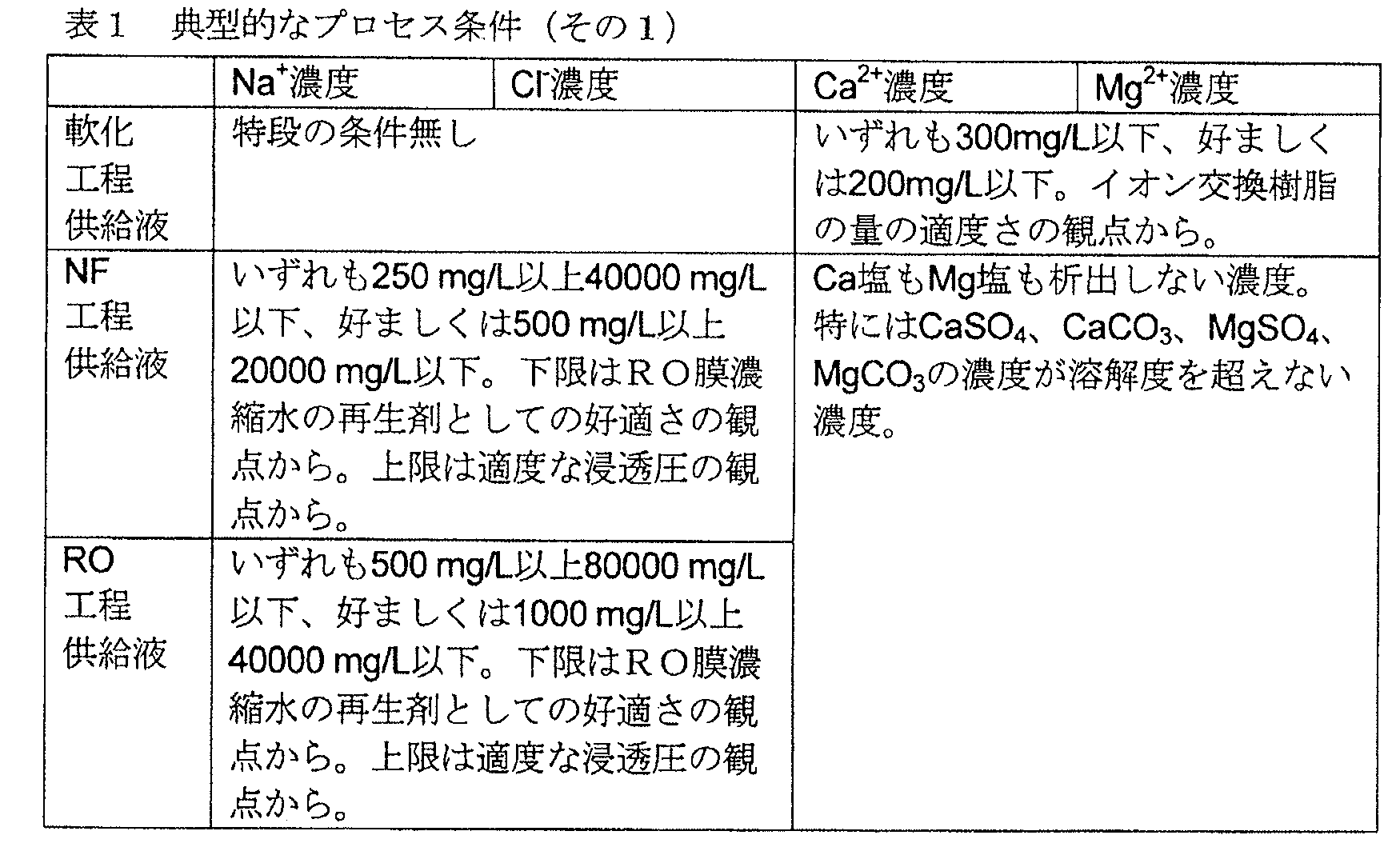
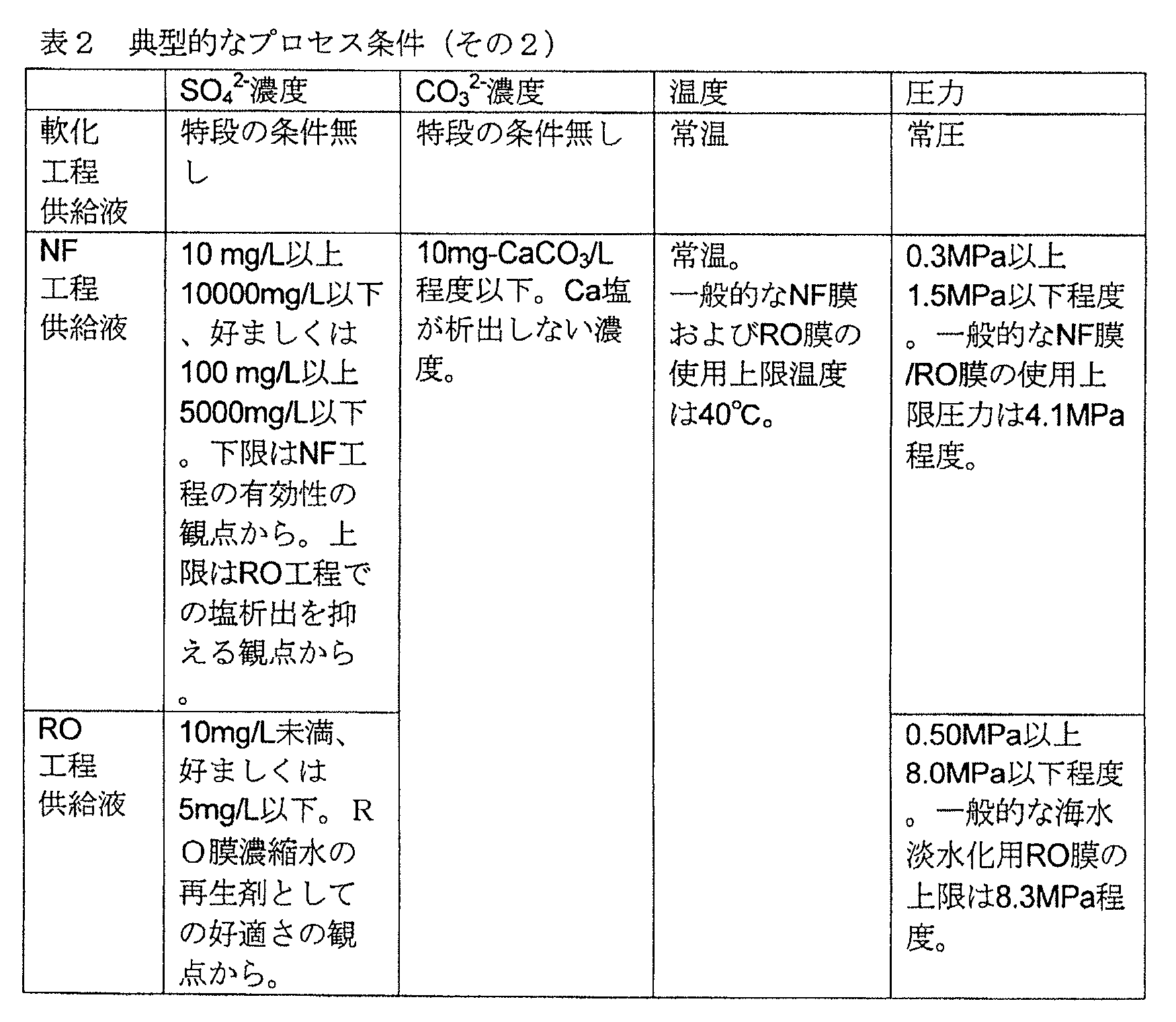
- Tables 1 and 2 show typical examples of process conditions for the softening process supply liquid (treated water), the NF process supply liquid (softening water), and the RO process supply liquid (NF membrane permeated water).
- the NaCl concentration in the concentrated water obtained from the RO step is preferably 2% by mass or more, and more preferably 4% by mass or more. Moreover, 10 mass% or less is preferable from a viewpoint of appropriate osmotic pressure. If the typical process conditions shown in Tables 1 and 2 are employed, it is easy to bring the NaCl concentration in the RO membrane concentrated water into the preferred range as a result.
- the NaCl concentration in the RO membrane permeate is preferably 150 mg / L or less from the viewpoint of recovery and reuse.
- the RO membrane concentrate can be used for the regeneration of the ion exchange resin. Therefore, the cost for the regenerant of the ion exchange resin can be reduced, and the process of dissolving the solid NaCl can be omitted, so that the operation management becomes easy.
- the softened water is treated with the NF membrane before being treated with the RO membrane.
- the salt concentration in the liquid to be treated with the RO membrane can be lowered, that is, the osmotic pressure can be lowered. Therefore, it is easy to increase the concentration ratio in the RO membrane and increase the NaCl concentration in the RO membrane concentrate, or to lower the operating pressure of the RO membrane.
- Aluminum ions may promote the formation of silica scale when coexisting with ionic silica.
- the aluminum ions are also flown into the NF membrane and the RO membrane in the subsequent stage by removing the aluminum ions with the ion exchange resin. Can be prevented.
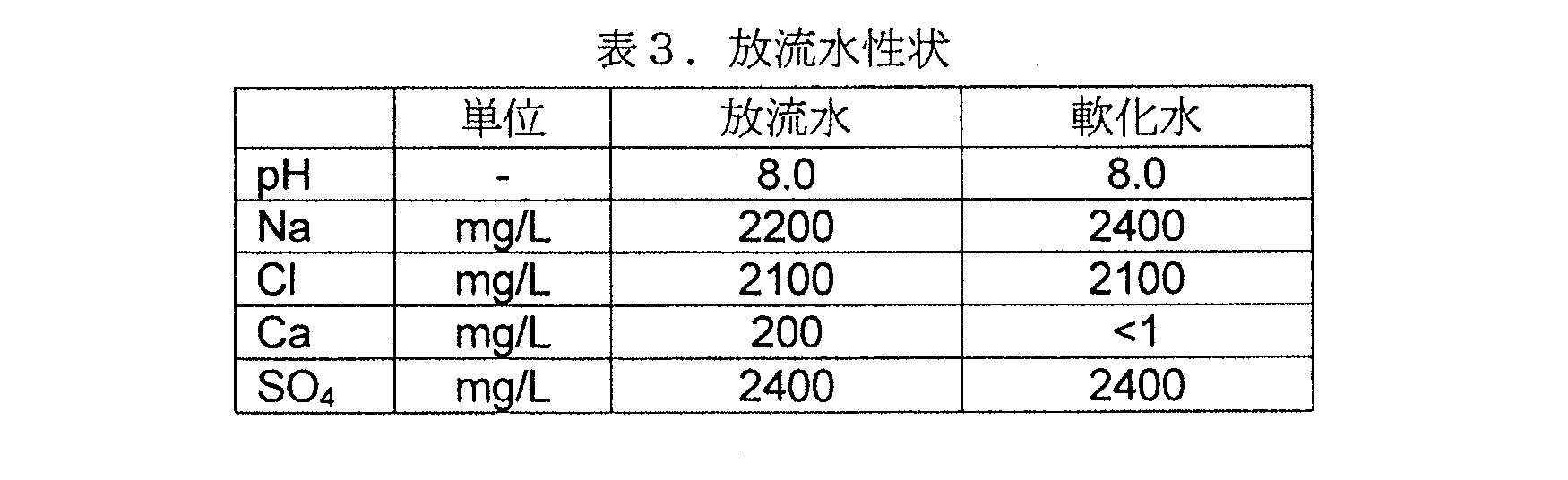
- Example 1 Semiconductor factory discharge water whose properties are shown in Table 3 was used as the liquid to be treated. This discharged water was softened using a softening device equipped with an ion exchange resin to remove Ca ions. Table 3 also shows the properties of the softened water.
- the softener (ion exchanger) used and the operating conditions are as follows: Ion exchange resin: Amberjet 1020 (trade name), manufactured by Organo Corporation Resin amount: 1L Column used: ⁇ (diameter) 45 mm x H (height) 600 mm, Water flow rate: 40L, SV (space velocity): 20 (1 / h), Operating temperature, pressure: normal temperature, normal pressure (25 ° C., 0.10 MPa).
- the softened water shown in Table 3 was concentrated using NF flat membrane, and the concentrated water and permeated water shown in Table 4 were obtained.
- the softened water (40 L) was concentrated twice, and 20 L of concentrated water and 20 L of permeated water were obtained.
- NF membrane used and the operating conditions are as follows: NF membrane: NF-245 (trade name) ⁇ 75 mm flat membrane manufactured by The Dow Chemical Company Operating pressure: 0.75 MPa, Water temperature: 25 ° C.
- the permeated water of NF membrane was further concentrated using the RO flat membrane, and the concentrated water and permeated water shown in Table 4 were obtained.
- the NF membrane permeated water (20 L) was concentrated about 12 times, and 1.7 L of concentrated water and 18.3 L of permeated water were obtained.
- RO membranes used and the operating conditions are as follows: RO membrane: SW30-HR (trade name) ⁇ 75 mm flat membrane manufactured by The Dow Chemical Company Operating pressure: 4.5 MPa Water temperature: 25 ° C.
- This RO membrane concentrated water has a high concentration of Na + and Cl ⁇ , and can be used as it is as a regenerant of the ion exchange resin.
- the NF membrane concentrated water and the RO membrane permeate were discarded.
- the RO membrane concentrated water of Comparative Example 1 has slightly lower concentrations of Na + and Cl ⁇ . Since this RO membrane concentrated water contains SO 4 2 ⁇ at a high concentration, it is unsuitable as a regenerant for the ion exchange resin (the possibility of CaSO 4 precipitation during ion exchange resin regeneration is high).
- the present invention is useful for treating factory effluents such as semiconductor factories and refined sugar factories and recovering high-purity water.
Landscapes
- Chemical & Material Sciences (AREA)
- Engineering & Computer Science (AREA)
- Water Supply & Treatment (AREA)
- Chemical Kinetics & Catalysis (AREA)
- Organic Chemistry (AREA)
- Life Sciences & Earth Sciences (AREA)
- Hydrology & Water Resources (AREA)
- Environmental & Geological Engineering (AREA)
- Nanotechnology (AREA)
- Separation Using Semi-Permeable Membranes (AREA)
- Treatment Of Water By Ion Exchange (AREA)
Abstract
イオン交換樹脂と逆浸透膜を用いる水処理法において、被処理水にSO4
2-やCO3
2-が含まれる場合でも、より低コストでより簡易にイオン交換樹脂の再生を行う。SO4
2-及び/又はCO3
2-と硬度成分とNa+とCl-とを含む被処理水を、イオン交換樹脂を用いて軟化する軟化工程;前記軟化工程で軟化された水をナノろ過膜を用いてナノろ過膜の透過水と濃縮液とに分離する、ナノろ過工程;前記ナノろ過膜の透過水を逆浸透膜を用いて逆浸透膜の透過水と濃縮水とに分離する逆浸透工程;および、前記逆浸透膜の濃縮水を用いて前記イオン交換樹脂を再生する、イオン交換樹脂再生工程を含む水処理方法。この方法を行うに好適な水処理装置。前記軟化工程と前記ナノろ過工程と前記逆浸透工程と、前記逆浸透膜の濃縮水を用いてイオン交換樹脂を再生する工程を含むイオン交換樹脂の再生方法。
Description
本発明は、例えば電子産業における排水を処理するために好適な、水処理方法および装置に関する。本発明はまた、イオン交換樹脂の再生方法に関する。
イオン交換樹脂と逆浸透膜とを用いた水処理方法が知られている。特許文献1には、伸銅工業、メッキ工業、鉄鋼工業あるいは食品工業などにおける、遊離酸を含有する排水を、イオン交換樹脂に通液した後、逆浸透圧法で濃縮液と膜透過液に分離することが開示される。
また、特許文献2には、水の消費量を低減することのできる蒸気プラント及びその操作方法が開示される。この文献には、樹脂を備える軟化容器で軟化した水を、半透膜を備える逆浸透装置に通液し、逆浸透装置の浸透水をボイラーに供給し、逆浸透装置の濃縮液を軟化容器の再生に使用することが記載される。
特許文献2に記載の技術によれば、逆浸透装置の濃縮液を軟化容器(樹脂)の再生に使用することによって、通常軟化容器を洗浄するために使用される原水の使用量を減少させることができる。
しかし、イオン交換樹脂と逆浸透膜とを用いる水処理方法では、被処理水に硫酸イオンSO4
2-や炭酸イオンCO3
2-が含まれる場合、これら2価アニオンはイオン交換樹脂を通過し、逆浸透膜の濃縮水中に濃縮されることになる。この濃縮水をイオン交換樹脂の再生に使用するとCaSO4やCaCO3が析出する恐れがあるので、このような場合には逆浸透膜の濃縮水をイオン交換樹脂の再生に使用することは回避すべきである。
一方、軟化処理のためのイオン交換樹脂を再生する再生剤として、一般的に高濃度NaCl水溶液を用いることが多いが、再生剤のコストが高額になり、また固体のNaClを溶解させる工程が必要となるため操作が煩雑になる。
本発明の目的は、イオン交換樹脂と逆浸透膜とを用いる水処理方法において、被処理水に硫酸イオンSO4
2-や炭酸イオンCO3
2-が含まれる場合であっても、より低コストでより簡易にイオン交換樹脂の再生を行うことのできる方法を提供することである。
本発明の別の目的は、上記方法を実施するに好適な水処理装置を提供することである。
本発明のさらに別の目的は、より低コストでより簡易にイオン交換樹脂の再生を行うことのできるイオン交換樹脂再生方法を提供することであり、特には、イオン交換樹脂と逆浸透膜とを用いる水処理方法から得られる逆浸透膜濃縮水を、当該水処理の被処理水に硫酸イオンSO4
2-や炭酸イオンCO3
2-が含まれる場合であっても、イオン交換樹脂の再生に使用可能にすることである。
本発明の一態様により、
SO4 2-及びCO3 2-からなる群から選ばれる1種もしくは2種の2価アニオンと、硬度成分と、Na+と、Cl-と、を含む被処理水を、イオン交換樹脂を用いて軟化する軟化工程と、
前記軟化工程で軟化された水を、ナノろ過膜を用いて、ナノろ過膜の透過水と濃縮液とに分離する、ナノろ過工程と、
前記ナノろ過膜の透過水を、逆浸透膜を用いて、逆浸透膜の透過水と濃縮水とに分離する、逆浸透工程と、
前記逆浸透膜の濃縮水を用いて前記イオン交換樹脂を再生する、イオン交換樹脂再生工程と
を含む、水処理方法が提供される。
SO4 2-及びCO3 2-からなる群から選ばれる1種もしくは2種の2価アニオンと、硬度成分と、Na+と、Cl-と、を含む被処理水を、イオン交換樹脂を用いて軟化する軟化工程と、
前記軟化工程で軟化された水を、ナノろ過膜を用いて、ナノろ過膜の透過水と濃縮液とに分離する、ナノろ過工程と、
前記ナノろ過膜の透過水を、逆浸透膜を用いて、逆浸透膜の透過水と濃縮水とに分離する、逆浸透工程と、
前記逆浸透膜の濃縮水を用いて前記イオン交換樹脂を再生する、イオン交換樹脂再生工程と
を含む、水処理方法が提供される。
本発明の別の態様により、
イオン交換樹脂を備える軟化装置と、
ナノろ過膜を備えるナノろ過装置と、
逆浸透膜を備える逆浸透装置と、
前記軟化装置の軟化水出口を前記ナノろ過装置入口に接続するラインと、
前記ナノろ過装置の透過水出口を前記逆浸透装置の入口に接続するラインと、
前記逆浸透装置の濃縮液出口を前記軟化装置の再生剤入口に接続するラインと
を含む、水処理装置が提供される。
イオン交換樹脂を備える軟化装置と、
ナノろ過膜を備えるナノろ過装置と、
逆浸透膜を備える逆浸透装置と、
前記軟化装置の軟化水出口を前記ナノろ過装置入口に接続するラインと、
前記ナノろ過装置の透過水出口を前記逆浸透装置の入口に接続するラインと、
前記逆浸透装置の濃縮液出口を前記軟化装置の再生剤入口に接続するラインと
を含む、水処理装置が提供される。
本発明のさらなる態様により、
SO4 2-及びCO3 2-からなる群から選ばれる1種もしくは2種の2価アニオンと、硬度成分と、Na+と、Cl-と、を含む被処理水を、イオン交換樹脂を用いて軟化する軟化工程と、
前記軟化工程で軟化された水を、ナノろ過膜を用いて、ナノろ過膜の透過水と濃縮液とに分離する、ナノろ過工程と、
前記ナノろ過膜の透過水を、逆浸透膜を用いて、逆浸透膜の透過水と濃縮水とに分離する、逆浸透工程と、
前記逆浸透膜の濃縮水を用いてイオン交換樹脂(前記軟化工程で用いたイオン交換樹脂であっても、前記軟化工程で用いたイオン交換樹脂とは別のイオン交換樹脂であってもよい)を再生する、イオン交換樹脂再生工程と、
を含む、イオン交換樹脂の再生方法が提供される。
SO4 2-及びCO3 2-からなる群から選ばれる1種もしくは2種の2価アニオンと、硬度成分と、Na+と、Cl-と、を含む被処理水を、イオン交換樹脂を用いて軟化する軟化工程と、
前記軟化工程で軟化された水を、ナノろ過膜を用いて、ナノろ過膜の透過水と濃縮液とに分離する、ナノろ過工程と、
前記ナノろ過膜の透過水を、逆浸透膜を用いて、逆浸透膜の透過水と濃縮水とに分離する、逆浸透工程と、
前記逆浸透膜の濃縮水を用いてイオン交換樹脂(前記軟化工程で用いたイオン交換樹脂であっても、前記軟化工程で用いたイオン交換樹脂とは別のイオン交換樹脂であってもよい)を再生する、イオン交換樹脂再生工程と、
を含む、イオン交換樹脂の再生方法が提供される。
本発明によれば、イオン交換樹脂と逆浸透膜とを用いる水処理方法において、被処理水に硫酸イオンSO4
2-や炭酸イオンCO3
2-が含まれる場合であっても、より低コストでより簡易にイオン交換樹脂の再生を行うことのできる方法が提供される。
また、本発明によれば、上記方法を実施するに好適な水処理装置が提供される。
さらに本発明によれば、より低コストでより簡易にイオン交換樹脂の再生を行うことのできるイオン交換樹脂再生方法が提供され、特には、イオン交換樹脂と逆浸透膜とを用いる水処理方法から得られる逆浸透膜濃縮水が、当該水処理の被処理水に硫酸イオンSO4
2-や炭酸イオンCO3
2-が含まれる場合であっても、イオン交換樹脂の再生に使用可能になる。
本発明の水処理方法もしくはイオン交換樹脂の再生方法は、軟化工程、ナノろ過工程、逆浸透工程およびイオン交換樹脂再生工程を含む。
〔ナノろ過膜、逆浸透膜〕
本発明に関しては、NaCl濃度500mg/L、pH6.5、温度25℃、操作圧力1.5MPaの条件下で、NaCl阻止率が5%以上93%未満の膜をナノろ過(NF)膜といい、同条件下で、NaCl阻止率が93%以上の膜を逆浸透(RO)膜という。
本発明に関しては、NaCl濃度500mg/L、pH6.5、温度25℃、操作圧力1.5MPaの条件下で、NaCl阻止率が5%以上93%未満の膜をナノろ過(NF)膜といい、同条件下で、NaCl阻止率が93%以上の膜を逆浸透(RO)膜という。
阻止率は次式によって求められる。

〔軟化工程〕
軟化工程では、イオン交換樹脂を用いて被処理水を軟化する。被処理水は、2価アニオンと、硬度成分と、ナトリウムイオンNa+と、塩素イオンCl-と、を含む。2価アニオンは硫酸イオンSO4 2-及び炭酸イオンCO3 2-からなる群から選ばれる1種もしくは2種である。2価アニオンは特にはSO4 2-である。
軟化工程では、イオン交換樹脂を用いて被処理水を軟化する。被処理水は、2価アニオンと、硬度成分と、ナトリウムイオンNa+と、塩素イオンCl-と、を含む。2価アニオンは硫酸イオンSO4 2-及び炭酸イオンCO3 2-からなる群から選ばれる1種もしくは2種である。2価アニオンは特にはSO4 2-である。
硬度成分は水処理の分野で知られているものであり、典型的には、Ca2+およびMg2+に代表される2価カチオンである。軟化工程において、硬度成分の濃度が低減される。
イオン交換樹脂としては、軟化処理に用いられる公知のイオン交換樹脂、特にはNa形の強酸性陽イオン交換樹脂を適宜使用することができ、ゲル型、ポーラス型、MR型があるが、いずれを用いてもよい。イオン交換樹脂として、例えばオルガノ株式会社製アンバージェット1020(商品名、以下同様)、アンバージェット1024、アンバーライトIR124、アンバーライトIR120Bなどを用いることができる。
〔ナノろ過工程〕
この工程では、軟化工程で軟化された水(軟化水)を、NF膜に通水して、NF膜の透過水と濃縮水とを得る。つまり、NF膜を用いて、軟化水を、NF膜の透過水(NF膜を透過した液)と、NF膜の濃縮水(NF膜を透過しなかった液)とに分離する。
この工程では、軟化工程で軟化された水(軟化水)を、NF膜に通水して、NF膜の透過水と濃縮水とを得る。つまり、NF膜を用いて、軟化水を、NF膜の透過水(NF膜を透過した液)と、NF膜の濃縮水(NF膜を透過しなかった液)とに分離する。
NF膜の透過水は、逆浸透工程に供給される。NF膜の濃縮水は、2価アニオンの濃度等に応じて、適宜、外界に放流されるか、産業廃棄物として処理される。
NF膜は、RO膜に供給する液の2価アニオン(SO4
2-および/またはCO3
2-)濃度を、前もって低減するために用いられる。これによって、RO膜の濃縮水をイオン交換樹脂の再生に用いた場合にCaSO4やCaCO3が析出することを防止する。したがって、2価アニオンはNF膜の濃縮水中にできるだけ濃縮することが好ましい。一方、1価イオン(Na+およびCl-)は、できるだけNF膜を透過させ、RO膜の濃縮水中にできるだけ多く存在させ、イオン交換樹脂の再生剤として利用することが好ましい。
この観点から、NF膜のNaClの阻止率は70%以下が好ましく、50%以下がより好ましい。また、NF膜の2価アニオン(SO4
2-および/またはCO3
2-)の阻止率は90%以上が好ましく、98%以上がより好ましい。
NF膜として、例えば、ザ・ダウ・ケミカル・カンパニー社製のNF-245(商品名)を用いることができる。
〔逆浸透工程〕
この工程では、NF膜の透過水を、RO膜に通水して、RO膜の透過水と濃縮水を得る。つまり、RO膜を用いて、NF膜の透過水を、RO膜の透過水(RO膜を透過した液)と、RO膜の濃縮水(RO膜を透過しなかった液)とに分離する。
この工程では、NF膜の透過水を、RO膜に通水して、RO膜の透過水と濃縮水を得る。つまり、RO膜を用いて、NF膜の透過水を、RO膜の透過水(RO膜を透過した液)と、RO膜の濃縮水(RO膜を透過しなかった液)とに分離する。
RO膜の透過水は、純度の高い水である。したがって、外界に放流することもできるが、回収水として再利用することが好ましい。
RO膜の濃縮水中には、Na+およびCl-が濃縮されている。一方、SO4
2-およびCO3
2-はNF膜において分離されており、RO膜の濃縮水中のSO4
2-およびCO3
2-の濃度は非常に低くできる。したがって、この濃縮水は、イオン交換樹脂の再生剤として好適であり、イオン交換樹脂再生工程に供給される。
RO膜としては、より多くのNa+およびCl-がRO膜濃縮水中に含まれるようにする観点から、より高圧で使用できるものが好ましい。
RO膜として、例えば、ザ・ダウ・ケミカル・カンパニー社製のSW-30HR(商品名)を用いることができる。
〔イオン交換樹脂再生工程〕
この工程では、RO膜の濃縮水を用いて、イオン交換樹脂を再生する。RO膜の濃縮水は、軟化処理に用いたイオン交換樹脂の再生剤として利用できる。つまり、被処理水を、軟化工程、ナノろ過工程、次いで逆浸透工程で処理する場合に、当該軟化工程で用いたイオン交換樹脂の再生に、逆浸透工程から得られるRO膜の濃縮水を利用することができる。水処理方法もしくは水処理装置においては、通例この形態が採用されるであろう。
この工程では、RO膜の濃縮水を用いて、イオン交換樹脂を再生する。RO膜の濃縮水は、軟化処理に用いたイオン交換樹脂の再生剤として利用できる。つまり、被処理水を、軟化工程、ナノろ過工程、次いで逆浸透工程で処理する場合に、当該軟化工程で用いたイオン交換樹脂の再生に、逆浸透工程から得られるRO膜の濃縮水を利用することができる。水処理方法もしくは水処理装置においては、通例この形態が採用されるであろう。
しかし、その限りではなく、当該軟化工程で用いたイオン交換樹脂とは別のイオン交換樹脂の再生に、RO膜の濃縮水を利用してもよい。イオン交換樹脂の再生方法においては、前述の形態(軟化処理に用いたイオン交換樹脂を再生する)が採用されることも、またこのような形態を採用されることもあろう。
イオン交換樹脂の再生より前に、必要に応じて、RO膜の濃縮水にNaClを添加して、NaCl濃度を上げることもできる。また、RO膜の濃縮水を、蒸発法などの、さらに別の方法で濃縮したうえで再生剤として利用することもできる。
イオン交換樹脂の再生より前に、必要に応じて、RO膜の濃縮水を、別の処理に付すこともできる。例えば、SO4
2-およびCO3
2-を除去するため、あるいは、フッ素イオン(F-)を除去するために、イオン交換樹脂やフッ素吸着剤を用いる方法によってRO膜の濃縮水を処理することができる。あるいは脱炭酸法などによって、RO膜の濃縮水を処理することができる。
〔水処理装置〕
以下、図面を参照しつつ、本発明について説明するが、本発明はこれによって限定されるものではない。本発明の方法は、図1に示すプロセスフローを有する水処理装置によって、実施することができる。
以下、図面を参照しつつ、本発明について説明するが、本発明はこれによって限定されるものではない。本発明の方法は、図1に示すプロセスフローを有する水処理装置によって、実施することができる。
この水処理装置は、イオン交換樹脂を備える軟化装置3と、ナノろ過膜を備えるナノろ過装置(NF装置)4と、逆浸透膜を備える逆浸透装置(RO装置)5を含む。軟化装置、ナノろ過装置、逆浸透装置の個々の装置の構造には、公知の構造を適宜採用できる。
軟化装置3の軟化水出口とNF装置4の入口とが、ラインL2によって接続されて、連通可能となっている。NF装置4の透過水出口とRO装置5の入口とが、ラインL3によって接続されて、連通可能となっている。RO装置5の濃縮液出口と軟化装置3の再生剤入口とが、ラインL6およびL7(これらのラインの間に、RO膜濃縮水タンク6が設けられる)によって接続されて、連通可能となっている。
また、この水処理装置は被処理水タンク1を有し、被処理水タンク1と軟化装置3とを接続するライン(L1)に、ポンプ2が設けられている。被処理水タンク1、ポンプ2、RO膜濃縮水タンク6は、必ずしも必要ではなく、適宜設けられる。RO膜濃縮水タンク6を設けない場合、RO装置の濃縮液出口と軟化装置の再生剤入口とがラインで接続される。この場合、例えば、軟化装置を複数系統設け、1つの系統で水処理を行っている間に、他の系統のイオン交換樹脂を再生することができる。
各ラインは適宜配管を用いて構成することができる。各ラインには、水処理運転とイオン交換樹脂再生運転とを切り替えること等の目的に応じて、バルブや計装制御品を適宜設けることができる。
水処理を行う際には、被処理水タンク1から、ラインL1を通して、軟化装置3に被処理水が供給される。このとき被処理水がポンプ2によって昇圧される。軟化された水が軟化装置3からラインL2を通してNF装置4に供給される。NF膜の透過液が、ラインL3を通してRO装置に供給される。NF膜の濃縮水は、ラインL4を通して水処理装置から排出され、適宜、外界に放流されるか、産業廃棄物として処理される。RO膜の透過液は、ラインL5を通して装置外に排出され、適宜、回収水として利用されるか、外界に放流される。RO膜の濃縮液は、ラインL6を通してRO膜濃縮水タンク6に供給される。
軟化装置3に備わるイオン交換樹脂を再生する際には、RO膜濃縮水タンク6からRO膜濃縮水がラインL7を通して軟化装置に供給され、RO膜濃縮水によってイオン交換樹脂が再生される。再生廃液はラインL8から水処理装置外に排出され、適宜、外界に放流されるか、産業廃棄物として処理される。
〔プロセス条件〕
表1および2に、軟化工程供給液(被処理水)、NF工程供給液(軟化水)、RO工程供給液(NF膜透過水)について、プロセス条件の典型例を示す。
表1および2に、軟化工程供給液(被処理水)、NF工程供給液(軟化水)、RO工程供給液(NF膜透過水)について、プロセス条件の典型例を示す。
RO工程から得られる濃縮水中のNaCl濃度は、イオン交換樹脂を効率的に再生する観点から、2質量%以上が好ましく、4質量%以上がより好ましい。また、適正な浸透圧の観点から、10質量%以下が好ましい。表1および2に示される典型的なプロセス条件を採用すれば、その結果として、RO膜濃縮水中のNaCl濃度を前記好ましい範囲にすることが容易である。
RO膜透過水中のNaCl濃度は、回収再利用する観点から150mg/L以下が好ましい。
本発明によれば、被処理水にSO4
2-やCO3
2-が含まれる場合であっても、RO膜濃縮液をイオン交換樹脂の再生に利用することができる。したがって、イオン交換樹脂の再生剤にかかるコストを削減でき、また、固体NaClを溶解させる工程を省くことができるので運転管理が容易になる。
また本発明によれば、軟化水を、RO膜で処理する前に、NF膜で処理する。軟化水を直接RO膜で処理する場合と比べて、本発明によれば、RO膜処理すべき液中の塩濃度を低くすることができ、すなわち浸透圧を下げることができる。したがって、RO膜における濃縮倍率を高めてRO膜濃縮液中のNaCl濃度を高くすることが容易であり、あるいは、RO膜の操作圧力をより低くすることができる。
またアルミニウムイオンは、イオン状シリカと共存するとシリカスケールの生成を促進することがある。しかし本発明によれば、被処理水中にアルミニウムイオンが共存する場合であっても、イオン交換樹脂にてアルミニウムイオンも除去することにより、後段のNF膜およびRO膜にアルミニウムイオンが流入することを防ぐことができる。
以下、本発明を実施例に基づき更に詳細に説明するが、本発明はこれによって限定されるものではない。
〔実施例1〕
・軟化工程
被処理液として、表3に性状を示す半導体工場放流水を用いた。この放流水を、イオン交換樹脂を備えた軟化装置を用いて軟化処理し、Caイオンを除去した。軟化処理された水の性状も表3に示す。
・軟化工程
被処理液として、表3に性状を示す半導体工場放流水を用いた。この放流水を、イオン交換樹脂を備えた軟化装置を用いて軟化処理し、Caイオンを除去した。軟化処理された水の性状も表3に示す。
使用した軟化装置(イオン交換装置)と操作条件は次のとおりである:
イオン交換樹脂 :オルガノ株式会社製、Amberjet1020(商品名)、
樹脂量 :1L、
使用カラム :Φ(直径)45mm×H(高さ)600mm、
通水量 :40L、
SV(空間速度):20(1/h)、
操作温度、圧力 :常温、常圧(25℃、0.10MPa)。
イオン交換樹脂 :オルガノ株式会社製、Amberjet1020(商品名)、
樹脂量 :1L、
使用カラム :Φ(直径)45mm×H(高さ)600mm、
通水量 :40L、
SV(空間速度):20(1/h)、
操作温度、圧力 :常温、常圧(25℃、0.10MPa)。
・NF工程
表3に示す軟化水を、NF平膜を用いて濃縮して、表4に示す濃縮水と透過水を得た。軟化後の水(40L)が2倍に濃縮され、濃縮水20Lと透過水20Lが得られた。
表3に示す軟化水を、NF平膜を用いて濃縮して、表4に示す濃縮水と透過水を得た。軟化後の水(40L)が2倍に濃縮され、濃縮水20Lと透過水20Lが得られた。
使用したNF膜と操作条件は次のとおりである:
NF膜:ザ・ダウ・ケミカル・カンパニー社製NF-245(商品名)Φ75mm平膜、
操作圧:0.75MPa、
水温:25℃。
NF膜:ザ・ダウ・ケミカル・カンパニー社製NF-245(商品名)Φ75mm平膜、
操作圧:0.75MPa、
水温:25℃。
・RO工程
次に、NF膜の透過水を、RO平膜を用いてさらに濃縮して、表4に示す濃縮水と透過水を得た。NF膜透過水(20L)が約12倍に濃縮され、濃縮水1.7Lと透過水18.3Lが得られた。
次に、NF膜の透過水を、RO平膜を用いてさらに濃縮して、表4に示す濃縮水と透過水を得た。NF膜透過水(20L)が約12倍に濃縮され、濃縮水1.7Lと透過水18.3Lが得られた。
使用したRO膜と操作条件は次のとおりである:
RO膜:ザ・ダウ・ケミカル・カンパニー社製SW30-HR(商品名)Φ75mm平膜、
操作圧:4.5MPa、
水温:25℃。
RO膜:ザ・ダウ・ケミカル・カンパニー社製SW30-HR(商品名)Φ75mm平膜、
操作圧:4.5MPa、
水温:25℃。

このRO膜濃縮水は、Na+およびCl-の濃度が高く、そのままイオン交換樹脂の再生剤として利用可能である。なお、NF膜濃縮水およびRO膜透過水は廃棄した。
〔比較例1〕
表3に示す軟化水(40L)を、NF膜による処理を行わずに、RO平膜を用いて直接濃縮した。このとき使用したRO膜と、RO工程の操作圧、水温は実施例1と同じであった。軟化水は約8倍に濃縮され、表5に示す濃縮水(5L)と、透過水(35L)とが得られた。
表3に示す軟化水(40L)を、NF膜による処理を行わずに、RO平膜を用いて直接濃縮した。このとき使用したRO膜と、RO工程の操作圧、水温は実施例1と同じであった。軟化水は約8倍に濃縮され、表5に示す濃縮水(5L)と、透過水(35L)とが得られた。

実施例1と同じ操作圧(4.5MPa)では、浸透圧の影響で約8倍濃縮までしかできなかった。実施例1のRO膜濃縮水と比較して、比較例1のRO膜濃縮水はNa+、Cl-の濃度がやや低い。このRO膜濃縮水は、SO4
2-を高濃度で含むためイオン交換樹脂の再生剤としては不適である(イオン交換樹脂再生時にCaSO4析出の可能性が高い)。
本発明は、半導体工場や精糖工場などの工場排水を処理し、純度の高い水を回収するために有用である。
1 被処理水タンク
2 ポンプ
3 軟化装置
4 ナノろ過装置(NF装置)
5 逆浸透装置(RO装置)
6 RO膜濃縮水タンク
2 ポンプ
3 軟化装置
4 ナノろ過装置(NF装置)
5 逆浸透装置(RO装置)
6 RO膜濃縮水タンク
Claims (6)
- SO4 2-及びCO3 2-からなる群から選ばれる1種もしくは2種の2価アニオンと、硬度成分と、Na+と、Cl-と、を含む被処理水を、イオン交換樹脂を用いて軟化する軟化工程と、
前記軟化工程で軟化された水を、ナノろ過膜を用いて、ナノろ過膜の透過水と濃縮液とに分離する、ナノろ過工程と、
前記ナノろ過膜の透過水を、逆浸透膜を用いて、逆浸透膜の透過水と濃縮水とに分離する、逆浸透工程と、
前記逆浸透膜の濃縮水を用いて前記イオン交換樹脂を再生する、イオン交換樹脂再生工程と、
を含む、水処理方法。 - 前記軟化工程で軟化された水は、SO4 2-濃度が10mg/L以上10000mg/L以下であり、CO3 2-含有量がCaCO3換算で10mg/L以下である、請求項1記載の方法。
- 前記ナノろ過膜の透過水において、SO4 2-濃度が10mg/L未満である請求項1または2記載の方法。
- 前記2価アニオンがSO4 2-である、請求項1~3の何れか一項記載の方法。
- イオン交換樹脂を備える軟化装置と、
ナノろ過膜を備えるナノろ過装置と、
逆浸透膜を備える逆浸透装置と、
前記軟化装置の軟化水出口を前記ナノろ過装置入口に接続するラインと、
前記ナノろ過装置の透過水出口を前記逆浸透装置の入口に接続するラインと、
前記逆浸透装置の濃縮液出口を前記軟化装置の再生剤入口に接続するラインと
を含む、水処理装置。 - SO4 2-及びCO3 2-からなる群から選ばれる1種もしくは2種の2価アニオンと、硬度成分と、Na+と、Cl-と、を含む被処理水を、イオン交換樹脂を用いて軟化する軟化工程と、
前記軟化工程で軟化された水を、ナノろ過膜を用いて、ナノろ過膜の透過水と濃縮液とに分離する、ナノろ過工程と、
前記ナノろ過膜の透過水を、逆浸透膜を用いて、逆浸透膜の透過水と濃縮水とに分離する、逆浸透工程と、
前記逆浸透膜の濃縮水を用いてイオン交換樹脂を再生する、イオン交換樹脂再生工程と、
を含む、イオン交換樹脂の再生方法。
Priority Applications (2)
| Application Number | Priority Date | Filing Date | Title |
|---|---|---|---|
| SG11201810044QA SG11201810044QA (en) | 2016-05-18 | 2017-05-17 | Water treatment method and apparatus and method for regenerating ion exchange resin |
| CN201780030369.9A CN109153585A (zh) | 2016-05-18 | 2017-05-17 | 水处理方法和装置以及用于再生离子交换树脂方法 |
Applications Claiming Priority (2)
| Application Number | Priority Date | Filing Date | Title |
|---|---|---|---|
| JP2016099418A JP6764686B2 (ja) | 2016-05-18 | 2016-05-18 | 水処理方法および装置ならびにイオン交換樹脂の再生方法 |
| JP2016-099418 | 2016-05-18 |
Publications (1)
| Publication Number | Publication Date |
|---|---|
| WO2017199996A1 true WO2017199996A1 (ja) | 2017-11-23 |
Family
ID=60326234
Family Applications (1)
| Application Number | Title | Priority Date | Filing Date |
|---|---|---|---|
| PCT/JP2017/018493 Ceased WO2017199996A1 (ja) | 2016-05-18 | 2017-05-17 | 水処理方法および装置ならびにイオン交換樹脂の再生方法 |
Country Status (5)
| Country | Link |
|---|---|
| JP (1) | JP6764686B2 (ja) |
| CN (1) | CN109153585A (ja) |
| SG (1) | SG11201810044QA (ja) |
| TW (1) | TWI727046B (ja) |
| WO (1) | WO2017199996A1 (ja) |
Cited By (4)
| Publication number | Priority date | Publication date | Assignee | Title |
|---|---|---|---|---|
| CN112062221A (zh) * | 2020-10-10 | 2020-12-11 | 武汉恩孚水务有限公司 | 一种水冷却系统防垢、阻垢装置及工艺 |
| CN114272961A (zh) * | 2021-12-20 | 2022-04-05 | 江西永兴特钢新能源科技有限公司 | 一种用于硫酸锂溶液去杂的离子交换树脂再生方法 |
| EP4116265A1 (de) * | 2021-07-05 | 2023-01-11 | Veolia Water Technologies Deutschland GmbH | Verfahren und vorrichtung zur wasseraufbereitung mit ionenaustauschern und nachgeschalteter membranentsalzung und regeneration im kreislaufverfahren |
| CN117735785A (zh) * | 2024-01-19 | 2024-03-22 | 华东理工大学 | 一种利用反渗透浓水再生离子交换树脂的方法 |
Families Citing this family (9)
| Publication number | Priority date | Publication date | Assignee | Title |
|---|---|---|---|---|
| JP6967466B2 (ja) * | 2018-02-01 | 2021-11-17 | オルガノ株式会社 | 溶存性アルミニウムの除去方法及び装置 |
| CN110078282A (zh) * | 2019-04-19 | 2019-08-02 | 苏州希图环保科技有限公司 | 一种重金属废水处理工艺 |
| JP2021007927A (ja) * | 2019-07-02 | 2021-01-28 | 栗田工業株式会社 | 軟水器の再生方法及び脱塩水製造装置 |
| TWI846715B (zh) * | 2019-07-19 | 2024-07-01 | 日商奧璐佳瑙股份有限公司 | 溶存性鋁之除去方法及裝置 |
| JP7257908B2 (ja) * | 2019-07-24 | 2023-04-14 | オルガノ株式会社 | 水処理方法及び水処理装置 |
| CN110436669A (zh) * | 2019-08-22 | 2019-11-12 | 新疆天富能源股份有限公司 | 一种热电厂生产废水的处理方法 |
| CN112978857A (zh) * | 2021-02-07 | 2021-06-18 | 南京大学 | 一种基于电中和再生的离子交换树脂的废水处理方法 |
| JP7641198B2 (ja) * | 2021-07-14 | 2025-03-06 | オルガノ株式会社 | リチウム水溶液の精製方法 |
| CN114163010A (zh) * | 2021-07-19 | 2022-03-11 | 佛山市美的清湖净水设备有限公司 | 净水处理系统、设备及控制方法 |
Citations (9)
| Publication number | Priority date | Publication date | Assignee | Title |
|---|---|---|---|---|
| JPH1015356A (ja) * | 1996-07-09 | 1998-01-20 | Kubota Corp | 水処理方法 |
| JP2001510730A (ja) * | 1997-07-24 | 2001-08-07 | ユニバーシティ オブ ウエスタン シドニー、ホークスベリ | 食品加工処理物から栄養素を精製するための処理工程 |
| JP2006095425A (ja) * | 2004-09-29 | 2006-04-13 | Kurita Water Ind Ltd | 廃水の生物処理水含有水の浄化方法及び浄化装置 |
| JP2008157577A (ja) * | 2006-12-26 | 2008-07-10 | Miura Co Ltd | ボイラ給水用補給水の供給方法 |
| US20100282675A1 (en) * | 2009-05-08 | 2010-11-11 | Lehigh University | System and method for reversible cation-exchange desalination |
| JP2011212628A (ja) * | 2010-04-01 | 2011-10-27 | Mitsubishi Rayon Cleansui Co Ltd | 精製水製造装置 |
| JP2013528487A (ja) * | 2010-05-13 | 2013-07-11 | クリーン テク ホールディングス リミテッド | 水処理プロセス |
| JP2013212504A (ja) * | 2012-03-30 | 2013-10-17 | Spirax-Sarco Ltd | 蒸気プラント及びその操作方法 |
| US20140202957A1 (en) * | 2013-01-18 | 2014-07-24 | Chevron U.S.A. Inc. | Method for improving the percent recovery and water quality in high total hardness water |
Family Cites Families (1)
| Publication number | Priority date | Publication date | Assignee | Title |
|---|---|---|---|---|
| CN103214115B (zh) * | 2013-03-15 | 2015-02-18 | 广州汉泰环境技术有限公司 | 一种强酸阳离子交换树脂贫再生的水处理方法 |
-
2016
- 2016-05-18 JP JP2016099418A patent/JP6764686B2/ja active Active
-
2017
- 2017-05-17 SG SG11201810044QA patent/SG11201810044QA/en unknown
- 2017-05-17 WO PCT/JP2017/018493 patent/WO2017199996A1/ja not_active Ceased
- 2017-05-17 TW TW106116221A patent/TWI727046B/zh active
- 2017-05-17 CN CN201780030369.9A patent/CN109153585A/zh active Pending
Patent Citations (9)
| Publication number | Priority date | Publication date | Assignee | Title |
|---|---|---|---|---|
| JPH1015356A (ja) * | 1996-07-09 | 1998-01-20 | Kubota Corp | 水処理方法 |
| JP2001510730A (ja) * | 1997-07-24 | 2001-08-07 | ユニバーシティ オブ ウエスタン シドニー、ホークスベリ | 食品加工処理物から栄養素を精製するための処理工程 |
| JP2006095425A (ja) * | 2004-09-29 | 2006-04-13 | Kurita Water Ind Ltd | 廃水の生物処理水含有水の浄化方法及び浄化装置 |
| JP2008157577A (ja) * | 2006-12-26 | 2008-07-10 | Miura Co Ltd | ボイラ給水用補給水の供給方法 |
| US20100282675A1 (en) * | 2009-05-08 | 2010-11-11 | Lehigh University | System and method for reversible cation-exchange desalination |
| JP2011212628A (ja) * | 2010-04-01 | 2011-10-27 | Mitsubishi Rayon Cleansui Co Ltd | 精製水製造装置 |
| JP2013528487A (ja) * | 2010-05-13 | 2013-07-11 | クリーン テク ホールディングス リミテッド | 水処理プロセス |
| JP2013212504A (ja) * | 2012-03-30 | 2013-10-17 | Spirax-Sarco Ltd | 蒸気プラント及びその操作方法 |
| US20140202957A1 (en) * | 2013-01-18 | 2014-07-24 | Chevron U.S.A. Inc. | Method for improving the percent recovery and water quality in high total hardness water |
Cited By (5)
| Publication number | Priority date | Publication date | Assignee | Title |
|---|---|---|---|---|
| CN112062221A (zh) * | 2020-10-10 | 2020-12-11 | 武汉恩孚水务有限公司 | 一种水冷却系统防垢、阻垢装置及工艺 |
| EP4116265A1 (de) * | 2021-07-05 | 2023-01-11 | Veolia Water Technologies Deutschland GmbH | Verfahren und vorrichtung zur wasseraufbereitung mit ionenaustauschern und nachgeschalteter membranentsalzung und regeneration im kreislaufverfahren |
| CN114272961A (zh) * | 2021-12-20 | 2022-04-05 | 江西永兴特钢新能源科技有限公司 | 一种用于硫酸锂溶液去杂的离子交换树脂再生方法 |
| CN114272961B (zh) * | 2021-12-20 | 2023-10-03 | 江西永兴特钢新能源科技有限公司 | 一种用于硫酸锂溶液去杂的离子交换树脂再生方法 |
| CN117735785A (zh) * | 2024-01-19 | 2024-03-22 | 华东理工大学 | 一种利用反渗透浓水再生离子交换树脂的方法 |
Also Published As
| Publication number | Publication date |
|---|---|
| JP6764686B2 (ja) | 2020-10-07 |
| CN109153585A (zh) | 2019-01-04 |
| TWI727046B (zh) | 2021-05-11 |
| JP2017205703A (ja) | 2017-11-24 |
| TW201806875A (zh) | 2018-03-01 |
| SG11201810044QA (en) | 2018-12-28 |
Similar Documents
| Publication | Publication Date | Title |
|---|---|---|
| JP6764686B2 (ja) | 水処理方法および装置ならびにイオン交換樹脂の再生方法 | |
| CN1625433B (zh) | 用反渗透法在酸性条件下处理流体的方法和设备 | |
| TWI616404B (zh) | 含硼水的處理方法及裝置 | |
| CN110603339B (zh) | 使用纳滤软化锂盐水的方法 | |
| JP5189255B2 (ja) | 偏光フィルム製造廃液からのヨウ素回収方法 | |
| WO2018096700A1 (ja) | 超純水製造システム及び超純水製造方法 | |
| JP2021030189A (ja) | 水処理装置および水処理方法 | |
| CN115485245B (zh) | 排水处理方法、超纯水制造方法及排水处理装置 | |
| JP7261711B2 (ja) | 超純水製造システム及び超純水製造方法 | |
| JP3278918B2 (ja) | 脱塩方法 | |
| CN103449627B (zh) | 一种废水处理方法 | |
| JPH10128075A (ja) | 逆浸透膜装置および逆浸透膜を用いた処理方法 | |
| JP2019118891A (ja) | 純水製造装置及び純水製造方法 | |
| CN116239268A (zh) | 净化高盐废水并从废水中回收盐的方法和系统 | |
| JP7819283B1 (ja) | 純水製造システムおよび純水製造方法 | |
| JP7804453B2 (ja) | Ca硬度含有水の処理方法 | |
| JP2001170658A (ja) | フッ素含有排水の処理装置及び処理方法 | |
| US20240239692A1 (en) | Method for regenerating water softener | |
| JPH0368758B2 (ja) | ||
| Buecker | Current Technology for Power Plant Makeup Water Treatment and Wastewater Recovery | |
| HK1073271B (en) | Method and apparatus for fluid treatment by reverse osmosis under acidic conditions |
Legal Events
| Date | Code | Title | Description |
|---|---|---|---|
| NENP | Non-entry into the national phase |
Ref country code: DE |
|
| 121 | Ep: the epo has been informed by wipo that ep was designated in this application |
Ref document number: 17799420 Country of ref document: EP Kind code of ref document: A1 |
|
| 122 | Ep: pct application non-entry in european phase |
Ref document number: 17799420 Country of ref document: EP Kind code of ref document: A1 |