WO2017191795A1 - 希土類錯体ポリマー - Google Patents
希土類錯体ポリマー Download PDFInfo
- Publication number
- WO2017191795A1 WO2017191795A1 PCT/JP2017/016574 JP2017016574W WO2017191795A1 WO 2017191795 A1 WO2017191795 A1 WO 2017191795A1 JP 2017016574 W JP2017016574 W JP 2017016574W WO 2017191795 A1 WO2017191795 A1 WO 2017191795A1
- Authority
- WO
- WIPO (PCT)
- Prior art keywords
- rare earth
- ions
- polymer
- iii
- complex polymer
- Prior art date
- Legal status (The legal status is an assumption and is not a legal conclusion. Google has not performed a legal analysis and makes no representation as to the accuracy of the status listed.)
- Ceased
Links
- 0 CP(*)(c([o]1)c(*)c(*)c1P(*)([Al])=O)=O Chemical compound CP(*)(c([o]1)c(*)c(*)c1P(*)([Al])=O)=O 0.000 description 1
Images


Classifications
-
- C—CHEMISTRY; METALLURGY
- C09—DYES; PAINTS; POLISHES; NATURAL RESINS; ADHESIVES; COMPOSITIONS NOT OTHERWISE PROVIDED FOR; APPLICATIONS OF MATERIALS NOT OTHERWISE PROVIDED FOR
- C09K—MATERIALS FOR MISCELLANEOUS APPLICATIONS, NOT PROVIDED FOR ELSEWHERE
- C09K11/00—Luminescent materials, e.g. electroluminescent or chemiluminescent
- C09K11/06—Luminescent materials, e.g. electroluminescent or chemiluminescent containing organic luminescent materials
-
- C—CHEMISTRY; METALLURGY
- C07—ORGANIC CHEMISTRY
- C07C—ACYCLIC OR CARBOCYCLIC COMPOUNDS
- C07C49/00—Ketones; Ketenes; Dimeric ketenes; Ketonic chelates
- C07C49/92—Ketonic chelates
-
- C—CHEMISTRY; METALLURGY
- C07—ORGANIC CHEMISTRY
- C07F—ACYCLIC, CARBOCYCLIC OR HETEROCYCLIC COMPOUNDS CONTAINING ELEMENTS OTHER THAN CARBON, HYDROGEN, HALOGEN, OXYGEN, NITROGEN, SULFUR, SELENIUM OR TELLURIUM
- C07F15/00—Compounds containing elements of Groups 8, 9, 10 or 18 of the Periodic Table
-
- C—CHEMISTRY; METALLURGY
- C07—ORGANIC CHEMISTRY
- C07F—ACYCLIC, CARBOCYCLIC OR HETEROCYCLIC COMPOUNDS CONTAINING ELEMENTS OTHER THAN CARBON, HYDROGEN, HALOGEN, OXYGEN, NITROGEN, SULFUR, SELENIUM OR TELLURIUM
- C07F5/00—Compounds containing elements of Groups 3 or 13 of the Periodic Table
- C07F5/003—Compounds containing elements of Groups 3 or 13 of the Periodic Table without C-Metal linkages
-
- C—CHEMISTRY; METALLURGY
- C07—ORGANIC CHEMISTRY
- C07F—ACYCLIC, CARBOCYCLIC OR HETEROCYCLIC COMPOUNDS CONTAINING ELEMENTS OTHER THAN CARBON, HYDROGEN, HALOGEN, OXYGEN, NITROGEN, SULFUR, SELENIUM OR TELLURIUM
- C07F9/00—Compounds containing elements of Groups 5 or 15 of the Periodic Table
- C07F9/02—Phosphorus compounds
- C07F9/547—Heterocyclic compounds, e.g. containing phosphorus as a ring hetero atom
- C07F9/655—Heterocyclic compounds, e.g. containing phosphorus as a ring hetero atom having oxygen atoms, with or without sulfur, selenium, or tellurium atoms, as the only ring hetero atoms
- C07F9/65515—Heterocyclic compounds, e.g. containing phosphorus as a ring hetero atom having oxygen atoms, with or without sulfur, selenium, or tellurium atoms, as the only ring hetero atoms the oxygen atom being part of a five-membered ring
-
- C—CHEMISTRY; METALLURGY
- C08—ORGANIC MACROMOLECULAR COMPOUNDS; THEIR PREPARATION OR CHEMICAL WORKING-UP; COMPOSITIONS BASED THEREON
- C08G—MACROMOLECULAR COMPOUNDS OBTAINED OTHERWISE THAN BY REACTIONS ONLY INVOLVING UNSATURATED CARBON-TO-CARBON BONDS
- C08G79/00—Macromolecular compounds obtained by reactions forming a linkage containing atoms other than silicon, sulfur, nitrogen, oxygen, and carbon with or without the latter elements in the main chain of the macromolecule
- C08G79/02—Macromolecular compounds obtained by reactions forming a linkage containing atoms other than silicon, sulfur, nitrogen, oxygen, and carbon with or without the latter elements in the main chain of the macromolecule a linkage containing phosphorus
- C08G79/04—Phosphorus linked to oxygen or to oxygen and carbon
-
- C—CHEMISTRY; METALLURGY
- C08—ORGANIC MACROMOLECULAR COMPOUNDS; THEIR PREPARATION OR CHEMICAL WORKING-UP; COMPOSITIONS BASED THEREON
- C08G—MACROMOLECULAR COMPOUNDS OBTAINED OTHERWISE THAN BY REACTIONS ONLY INVOLVING UNSATURATED CARBON-TO-CARBON BONDS
- C08G79/00—Macromolecular compounds obtained by reactions forming a linkage containing atoms other than silicon, sulfur, nitrogen, oxygen, and carbon with or without the latter elements in the main chain of the macromolecule
- C08G79/14—Macromolecular compounds obtained by reactions forming a linkage containing atoms other than silicon, sulfur, nitrogen, oxygen, and carbon with or without the latter elements in the main chain of the macromolecule a linkage containing two or more elements other than carbon, oxygen, nitrogen, sulfur and silicon
-
- C—CHEMISTRY; METALLURGY
- C07—ORGANIC CHEMISTRY
- C07F—ACYCLIC, CARBOCYCLIC OR HETEROCYCLIC COMPOUNDS CONTAINING ELEMENTS OTHER THAN CARBON, HYDROGEN, HALOGEN, OXYGEN, NITROGEN, SULFUR, SELENIUM OR TELLURIUM
- C07F9/00—Compounds containing elements of Groups 5 or 15 of the Periodic Table
- C07F9/02—Phosphorus compounds
- C07F9/547—Heterocyclic compounds, e.g. containing phosphorus as a ring hetero atom
- C07F9/6553—Heterocyclic compounds, e.g. containing phosphorus as a ring hetero atom having sulfur atoms, with or without selenium or tellurium atoms, as the only ring hetero atoms
- C07F9/655345—Heterocyclic compounds, e.g. containing phosphorus as a ring hetero atom having sulfur atoms, with or without selenium or tellurium atoms, as the only ring hetero atoms the sulfur atom being part of a five-membered ring
-
- C—CHEMISTRY; METALLURGY
- C07—ORGANIC CHEMISTRY
- C07F—ACYCLIC, CARBOCYCLIC OR HETEROCYCLIC COMPOUNDS CONTAINING ELEMENTS OTHER THAN CARBON, HYDROGEN, HALOGEN, OXYGEN, NITROGEN, SULFUR, SELENIUM OR TELLURIUM
- C07F9/00—Compounds containing elements of Groups 5 or 15 of the Periodic Table
- C07F9/02—Phosphorus compounds
- C07F9/547—Heterocyclic compounds, e.g. containing phosphorus as a ring hetero atom
- C07F9/6561—Heterocyclic compounds, e.g. containing phosphorus as a ring hetero atom containing systems of two or more relevant hetero rings condensed among themselves or condensed with a common carbocyclic ring or ring system, with or without other non-condensed hetero rings
-
- C—CHEMISTRY; METALLURGY
- C09—DYES; PAINTS; POLISHES; NATURAL RESINS; ADHESIVES; COMPOSITIONS NOT OTHERWISE PROVIDED FOR; APPLICATIONS OF MATERIALS NOT OTHERWISE PROVIDED FOR
- C09K—MATERIALS FOR MISCELLANEOUS APPLICATIONS, NOT PROVIDED FOR ELSEWHERE
- C09K2211/00—Chemical nature of organic luminescent or tenebrescent compounds
- C09K2211/14—Macromolecular compounds
- C09K2211/1441—Heterocyclic
- C09K2211/145—Heterocyclic containing oxygen as the only heteroatom
-
- C—CHEMISTRY; METALLURGY
- C09—DYES; PAINTS; POLISHES; NATURAL RESINS; ADHESIVES; COMPOSITIONS NOT OTHERWISE PROVIDED FOR; APPLICATIONS OF MATERIALS NOT OTHERWISE PROVIDED FOR
- C09K—MATERIALS FOR MISCELLANEOUS APPLICATIONS, NOT PROVIDED FOR ELSEWHERE
- C09K2211/00—Chemical nature of organic luminescent or tenebrescent compounds
- C09K2211/14—Macromolecular compounds
- C09K2211/1441—Heterocyclic
- C09K2211/1458—Heterocyclic containing sulfur as the only heteroatom
-
- C—CHEMISTRY; METALLURGY
- C09—DYES; PAINTS; POLISHES; NATURAL RESINS; ADHESIVES; COMPOSITIONS NOT OTHERWISE PROVIDED FOR; APPLICATIONS OF MATERIALS NOT OTHERWISE PROVIDED FOR
- C09K—MATERIALS FOR MISCELLANEOUS APPLICATIONS, NOT PROVIDED FOR ELSEWHERE
- C09K2211/00—Chemical nature of organic luminescent or tenebrescent compounds
- C09K2211/18—Metal complexes
- C09K2211/182—Metal complexes of the rare earth metals, i.e. Sc, Y or lanthanide
Definitions
- the present invention relates to a rare earth complex polymer.
- Patent Document 1 a rare earth complex polymer that functions as a light emitting material has been proposed (for example, Patent Document 1).
- An object of one aspect of the present invention is to provide a rare earth complex polymer that has both light emission by excitation light and light emission by stress stimulation, and is excellent in solubility in a solvent.
- the present inventors have found that by using a specific phosphine oxide bidentate ligand having a furan ring, a rare-earth complex polymer having luminescence against excitation light and stress stimulation and good solubility can be obtained. It was.
- One aspect of the present invention is based on these findings.
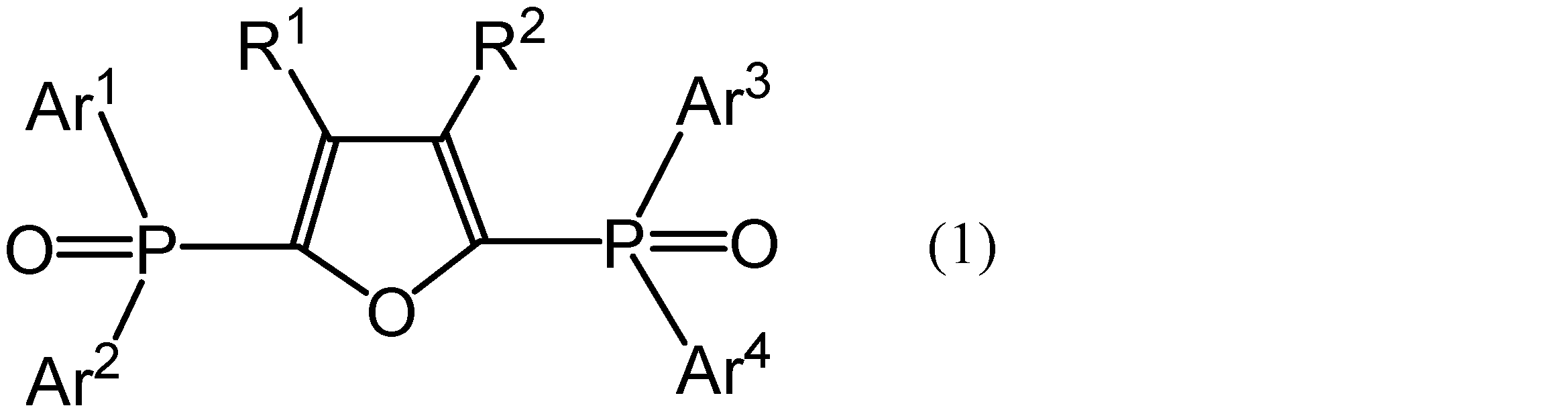
- one aspect of the present invention includes a trivalent rare earth ion and a phosphine oxide bidentate ligand represented by the formula (1), and one phosphine oxide bidentate ligand includes two rare earth elements.
- the present invention relates to a rare earth complex polymer that coordinates to ions and bridges two rare earth ions.
- R 1 and R 2 each independently represent a hydrogen atom or a monovalent organic group, and Ar 1 , Ar 2 , Ar 3 and Ar 4 each independently have a substituent.
- R 1 and R 2 may be bonded to each other, and two groups selected from Ar 1 , Ar 2 , Ar 3 and Ar 4 may be bonded to each other.
- the present invention it is possible to provide a rare earth complex polymer which has both luminescence by excitation light and luminescence by stress stimulation and is excellent in solubility in a solvent.
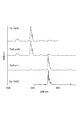
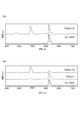
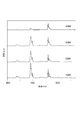
- It is an emission spectrum of the rare earth complex polymer from which rare earth ions differ. It is an emission spectrum of the rare earth complex polymer from which the ratio of rare earth ions differs. It is the emission spectrum (a) obtained by irradiation of excitation light, and the emission spectrum (b) obtained by stress stimulation. It is an emission spectrum of the rare earth complex polymer ([Tb, Eu (hfa) 3 (dpf)] n polymer (Tb / Eu 10)) under various temperature conditions.
- the rare earth complex polymer of this embodiment contains a trivalent rare earth ion and a phosphine oxide bidentate ligand represented by the formula (1).
- R 1 and R 2 each independently represent a hydrogen atom or a monovalent organic group, and Ar 1 , Ar 2 , Ar 3 and Ar 4 each independently have a substituent.
- R 1 and R 2 may be bonded to each other, and Ar 1 , Ar 2 , Ar 3 and Ar 4 may be bonded to each other.
- Formula (I) shows an example of a repeating unit of a rare earth complex polymer containing a trivalent rare earth ion M (III) and a phosphine oxide ligand represented by the formula (1).
- N in the formula is an integer representing the number of repeating units.
- Two coordinating sites of one phosphine oxide bidentate ligand of formula (1) coordinate to two different trivalent rare earth ions (M (III) in formula (I)), respectively. Thus, the two rare earth ions are bridged.
- the rare earth ions are bridged one after another, thereby forming a rare earth complex polymer. ing.
- the rare earth complex polymer in the present specification refers to a coordination polymer having a structure in which a plurality of metal ions are linked via a coordination bond with a ligand.
- the trivalent rare earth ions are not particularly limited, and can be appropriately selected according to the desired emission color of the rare earth complex polymer.
- the rare earth ions include, for example, Eu (III) ions, Tb (III) ions, Gd (III) ions, Sm (III) ions, Yb (III) ions, Nd (III) ions, Er (III) ions, Y ( III) At least one selected from the group consisting of ions, Dy (III) ions, Ce (III) ions, and Pr (III) ions.
- the rare earth ions may be at least one selected from the group consisting of Eu (III) ions, Tb (III) ions, and Gd (III) ions.
- the amount of trivalent rare earth ions contained in the rare earth complex polymer may be 0.1 to 20% by mass based on the mass of the rare earth complex polymer.
- the trivalent rare earth ions contained in the rare earth complex polymer may be one kind or a combination of two or more kinds.
- the rare earth complex polymer of this embodiment contains two or more types of rare earth ions, it is difficult to obtain a polymer containing a single rare earth ion by adjusting the ratio (molar ratio) of the rare earth ions contained in the rare earth complex polymer. Neutral color emission can be obtained. Thereby, the luminescent color can be adjusted more finely.
- Rare earth complex polymers containing two or more kinds of rare earth ions exhibit different colors of light emission due to differences in excitation light irradiation or stress stimulation, excitation wavelength differences, temperature differences, and the like. Therefore, by using two or more kinds of rare earth ions, various properties can be further imparted to the rare earth complex polymer. As a result, for example, characteristics as a security material can be further improved.
- Examples of combinations of two or more rare earth ions include Eu (III) and Tb (III), Eu (III) and Gd (III), and Tb (III) and Gd (III).
- the ratio of the second rare earth ion to the first rare earth ion may be, for example, 0 to 1000.
- the monovalent organic group as R 1 or R 2 in the formula (1) is not particularly limited, and examples thereof include a hydrocarbon group having 1 to 20 carbon atoms, a hydroxyl group, a nitro group, an amino group, a sulfonyl group, and a cyano group.
- R 1 and R 2 may be bonded to each other to form a divalent organic group.
- the divalent organic group formed by combining R 1 and R 2 may be, for example, an alkylene group or a hydrocarbon group such as an arylene group.
- the carbon atom in the hydrocarbon group may be substituted with a divalent functional group such as a carbonyl group or an oxy group.
- the monovalent aromatic group as Ar 1 , Ar 2 , Ar 3 or Ar 4 in the formula (1) is a group consisting of an aromatic ring having one bond bonded to a phosphorus atom, and this aromatic ring is In addition to the bonding site with the phosphorus atom, it may further have a substituent.
- the aromatic ring include a benzene ring, a thiophene ring, and a pyridine ring.
- the group similar to the monovalent organic group as R ⁇ 1 > or R ⁇ 2 >, a phosphine oxide group, etc. are illustrated.
- Ar 1 , Ar 2 , Ar 3 and Ar 4 When the aromatic ring constituting Ar 1 , Ar 2 , Ar 3 and Ar 4 has a phosphine oxide group as a substituent, it may be coordinated to a rare earth ion. Furthermore, two groups selected from Ar 1 , Ar 2 , Ar 3 and Ar 4 (for example, Ar 1 and Ar 3 , Ar 2 and Ar 4 ) are bonded to each other directly or via a divalent linking group. A divalent group may be formed. Examples of the linking group include an alkylene group, an arylene group, and a carbonyl group.
- Ar 1 , Ar 2 , Ar 3 and Ar 4 may be a group represented by the following formula (3).
- R 5 , R 6 , R 7 , R 8 and R 9 are each independently a hydrogen atom, a hydrocarbon group having 1 to 20 carbon atoms, a hydroxyl group, a nitro group, an amino group, a sulfonyl group, A cyano group, a silyl group, a phosphonic acid group, a diazo group, a mercapto group, an alkoxy group, or a vinyl group is shown.
- a plurality of other ligands may be coordinated to the rare earth ions constituting the rare earth complex polymer in addition to the phosphine oxide bidentate ligand.
- the other ligand may be a multidentate ligand in order to increase the emission intensity of the rare earth complex polymer.
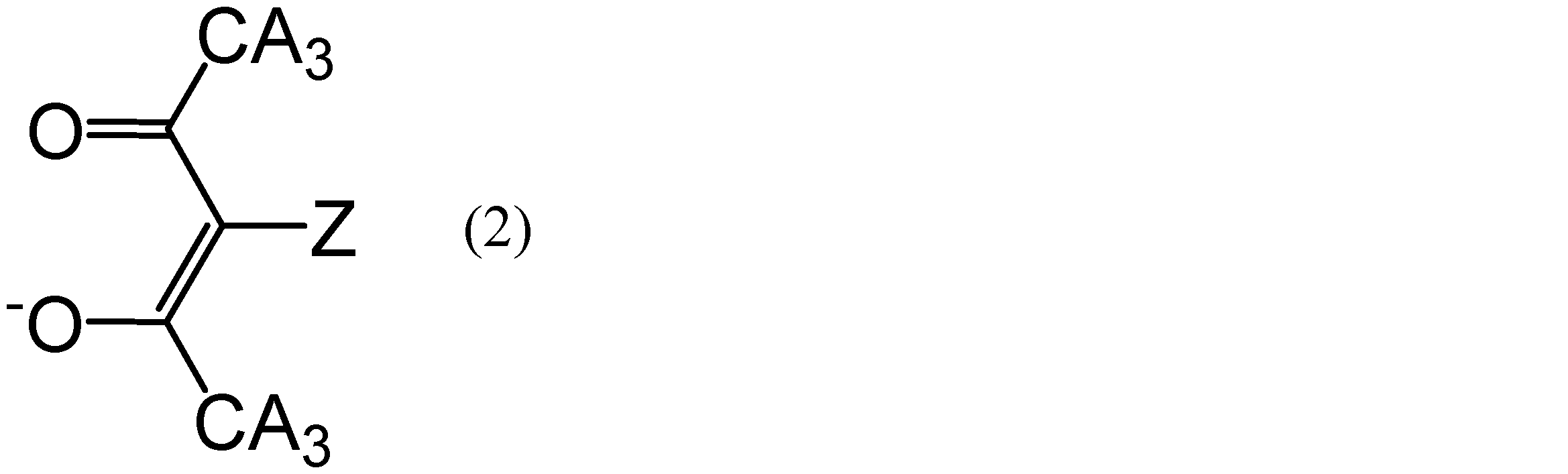
- the multidentate ligand may be, for example, a diketone ligand represented by the following formula (2).
- the diketone ligand can have a photosensitizing action.
- A represents a hydrogen atom or a halogen atom
- Z represents a hydrogen atom or a deuterium atom.
- a plurality of A in the same molecule may be the same or different.
- a plurality of polymer chains are arranged so that the multidentate ligands face each other in close proximity. Easy to arrange. The presence of many sites where multidentate ligands having a photosensitizing action face each other tends to further increase the emission intensity of light emission (triboluminescence) by stress stimulation.
- the rare earth complex polymer has an 8-coordinate or higher coordination structure containing two or more phosphine oxide bidentate ligands and two or more diketone ligands.
- the formed rare earth ions may be included.
- the rare earth complex polymer of the present embodiment includes, for example, a rare earth metal compound that is a raw material of rare earth ions and a phosphine oxide bidentate ligand having a structure represented by the formula (1), if necessary, in the presence of a catalyst.
- a catalyst for synthesize
- the solvent those suitable for the rare earth metal compound and the compound to be the ligand may be mixed and used.
- the catalyst for example, trimethylamine, lithium hydroxide and the like can be added as necessary.
- the temperature during the synthesis can be -80 to 70 ° C.
- the compounding ratio of the rare earth metal compound and the phosphine oxide bidentate ligand that are the raw materials for the rare earth ions ([number of moles of rare earth metal compound]: [number of moles of phosphine oxide bidentate ligand]] ) May be from 1: 0.5 to 1: 5, or from 1: 0.77 to 1: 1.
- two or more kinds of rare earth metal compounds containing them can be combined at an arbitrary ratio.
- the rare earth complex polymer of this embodiment has a light-emitting property to excitation light, a light-emitting property to stress stimulation, and an excellent solubility in a solvent.
- the half-value width of the peak observed in the spectrum of the rare earth complex polymer of the present embodiment is narrow, and the rare earth complex polymer can exhibit a beautiful emission color corresponding to the rare earth ions. By combining two or more rare earth ions, the emission color can be easily adjusted, and the emission color depending on the excitation method can be obtained.
- the rare earth complex polymer having such characteristics is useful as a security material that gives cryptographic information to various materials such as plastic materials.
- the rare earth complex polymer of this embodiment has excellent solubility and characteristics as a phosphor. Therefore, this rare earth complex polymer can be easily used as a phosphor blended in various plastic materials.
- the rare earth complex polymer is contained in the plastic material, for example, the rare earth complex polymer is dissolved in a solvent in advance to prepare a polymer solution, and this solution is mixed with the plastic material or the like.
- a plastic material and a plastic molded body in which the rare earth complex polymer is uniformly distributed can be easily obtained.
- the obtained plastic molding can have high transparency.
- Examples of the solvent in which the rare earth complex polymer can be dissolved well include methanol and acetone.
- the plastic material in which the rare earth complex polymer is blended is not particularly limited.
- the plastic material include polyethylene resin, polypropylene resin, polyvinyl chloride resin, urea resin, fluorine resin, polyester resin, polyamide resin, polyacetal resin, polycarbonate resin, polyarylate resin, polysulfone resin, polyphenylene sulfide resin, and polyether.
- examples include sulfone resins, polyallyl sulfone resins, polytetrafluoroethylene resins, phenol resins, unsaturated polyester resins, epoxy resins, polyimide resins, and polyamideimide resins.
- the method of blending and processing the rare earth complex polymer is not particularly limited, and examples thereof include injection molding, blow molding, compression molding, extrusion molding, reaction molding, hollow molding, thermoforming, and FRP molding.
- the product obtained by removing the solvent was dissolved in 30 mL of dichloromethane and cooled to 0 ° C. 25 mL of hydrogen peroxide was added to the cooled reaction solution and stirred for 2 hours. From this reaction solution, the product was extracted with dichloromethane and then dehydrated. The solvent was removed from the dehydrated solution and recrystallization was performed to obtain 3.8 g of 2,5-bis (diphenylphosphoryl) furan (dpf) crystals.
- a rare earth complex polymer and a stirrer were placed in a flask, and the light emission of the rare earth complex polymer when the stirrer was rotated at a constant rotation speed was captured with a CCD camera, and the light emission was integrated to obtain a stress emission spectrum by grinding. The same applies to other evaluation examples of stress luminescence.
- n polymers containing ligands containing furan groups include [Eu (hfa) 3 (dpt)] n polymers containing ligands with other skeletons and [Eu (hfa ) 3 (dpedot)] Compared with the n polymer, it showed a large stress luminescence intensity.
- the luminous efficiency ⁇ Ln indicates the luminous efficiency when the rare earth ion of the polymer itself is directly excited.
- the luminous efficiency ⁇ tot indicates the luminous efficiency when the polymer organic ligand is excited. [Eu (hfa) 3 (dpf)] n exhibited the same characteristics as other polymers in terms of thermal decomposition temperature, luminous efficiency ⁇ Ln , and luminous efficiency ⁇ tot .
- Solubility Solubility of [Eu (hfa) 3 (dpf)] n polymer and [Eu (hfa) 3 (dpedot)] n polymer in an organic solvent was evaluated. The solubility was evaluated by a test in which 30 mg of a rare earth complex polymer and 2 mL of methanol were stirred in a glass container and the state of the mixed solution was observed.
- the fluorescence spectrum pattern was different depending on the type of rare earth element contained in the polymer.
- the emission colors are red for [Eu (hfa) 3 (dpf)] n polymer, blue for [Gd (hfa) 3 (dpf)] n polymer, and [Tb (hfa) 3 (dpf)] n.
- the polymer was green. From this result, it was shown that the emission color of the polymer can be adjusted by changing the kind of rare earth element.
- FIG. 2 shows an emission spectrum of each rare earth complex polymer.
- the emission spectra of polymers containing two kinds of rare earth elements differed depending on the excitation method.
- the polymer with Tb / Eu 10 emitted yellow light when excited and emitted yellow-green light when stress-stimulated.
- the polymer with Tb / Eu 1 emitted orange light by stress stimulation. From this result, it was shown that the polymer can obtain light emission depending on the excitation method by changing the ratio of rare earth elements.
Landscapes
- Chemical & Material Sciences (AREA)
- Organic Chemistry (AREA)
- Health & Medical Sciences (AREA)
- Chemical Kinetics & Catalysis (AREA)
- Medicinal Chemistry (AREA)
- Polymers & Plastics (AREA)
- Engineering & Computer Science (AREA)
- Materials Engineering (AREA)
- Life Sciences & Earth Sciences (AREA)
- Biochemistry (AREA)
- General Health & Medical Sciences (AREA)
- Molecular Biology (AREA)
- Polymers With Sulfur, Phosphorus Or Metals In The Main Chain (AREA)
- Compositions Of Macromolecular Compounds (AREA)
Abstract
三価の希土類イオンと、式(1)で表されるホスフィンオキシド二座配位子と、を含む希土類錯体ポリマーが開示される。1つのホスフィンオキシド二座配位子が、2つの希土類イオンに配位してそれらを橋かけしている。
Description
本発明は、希土類錯体ポリマーに関する。
従来、発光材料として機能する希土類錯体ポリマーが提案されている(例えば、特許文献1)。
本発明の一側面は、励起光による発光性及び応力刺激による発光性を併せ持ち、更に溶媒に対する溶解性に優れる希土類錯体ポリマーを提供することを目的とする。
本発明者らは、フラン環を有する特定のホスフィンオキシド二座配位子を用いることで、励起光及び応力刺激に対する発光性と、良好な溶解性とを有する希土類錯体ポリマーが得られることを見出した。本発明の一側面は、これらの知見に基づくものである。
すなわち、本発明の一側面は、三価の希土類イオンと、式(1)で表されるホスフィンオキシド二座配位子と、を含み、1つのホスフィンオキシド二座配位子が、2つの希土類イオンに配位して2つの希土類イオン同士を橋かけしている、希土類錯体ポリマーに関する。
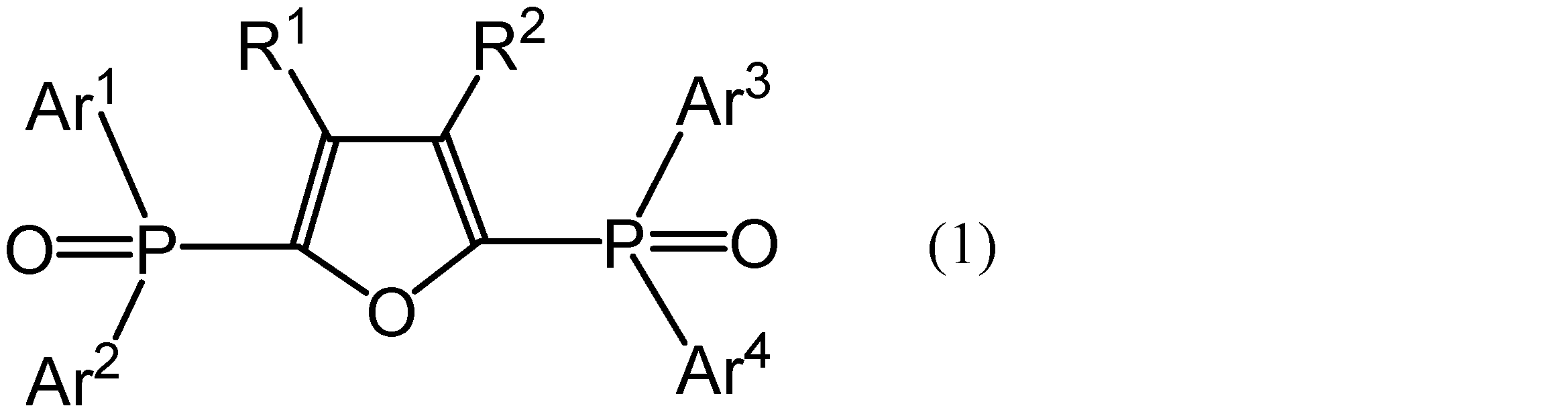
式(1)中、R1及びR2は、それぞれ独立に、水素原子又は一価の有機基を示し、Ar1、Ar2、Ar3及びAr4は、それぞれ独立に、置換基を有していてもよい一価の芳香族基を示す。R1及びR2が互いに結合していてもよく、Ar1、Ar2、Ar3及びAr4から選ばれる2つの基が互いに結合していてもよい。
本発明によれば、励起光による発光性及び応力刺激による発光性を併せ持ち、更に溶媒に対する溶解性に優れる希土類錯体ポリマーを提供することができる。
以下、本発明のいくつかの実施形態について詳細に説明する。ただし、本発明は、以下の実施形態に限定されるものではない。
<希土類錯体ポリマー>
本実施形態の希土類錯体ポリマーは、三価の希土類イオンと、式(1)で表されるホスフィンオキシド二座配位子と、を含む。
本実施形態の希土類錯体ポリマーは、三価の希土類イオンと、式(1)で表されるホスフィンオキシド二座配位子と、を含む。

式(1)中、R1及びR2は、それぞれ独立に、水素原子又は一価の有機基を示し、Ar1、Ar2、Ar3及びAr4は、それぞれ独立に、置換基を有していてもよい一価の芳香族基を示す。R1及びR2が互いに結合していてもよく、Ar1、Ar2、Ar3及びAr4が互いに結合していてもよい。

式(I)は、三価の希土類イオンM(III)及び式(1)で表されるホスフィンオキシド配位子を含む、希土類錯体ポリマーの繰り返し単位の例を示す。式中のnは繰り返し単位の繰返し数を表す整数である。式(1)の1つのホスフィンオキシド二座配位子が有する2つの配位可能な部位が、それぞれ異なる2つの三価の希土類イオン(式(I)ではM(III))に配位することにより、それらの2つの希土類イオン同士を橋かけしている。ホスフィンオキシド二座配位子が配位した希土類イオンに、更に別のホスフィンオキシド二座配位子が配位することによって、次々と希土類イオン同士が橋かけされ、それにより希土類錯体ポリマーが形成されている。式(I)中の希土類イオンには、後述のジケトン配位子が更に配位している。このように、本明細書における希土類錯体ポリマーとは、複数の金属イオンが配位子による配位結合を介して連結された構造を有する配位高分子をいう。
三価の希土類イオンは特に限定されず、所望する希土類錯体ポリマーの発光色に応じて、適宜選択することができる。希土類イオンは、例えば、Eu(III)イオン、Tb(III)イオン、Gd(III)イオン、Sm(III)イオン、Yb(III)イオン、Nd(III)イオン、Er(III)イオン、Y(III)イオン、Dy(III)イオン、Ce(III)イオン、及びPr(III)イオンからなる群より選ばれる少なくとも一種であることができる。なかでも、高い発光強度を得る観点から、希土類イオンは、Eu(III)イオン、Tb(III)イオン及びGd(III)イオンからなる群より選ばれる少なくとも一種であってもよい。希土類錯体ポリマーに含まれる三価の希土類イオンの量は、希土類錯体ポリマーの質量を基準として、0.1~20質量%であってもよい。
希土類錯体ポリマーに含まれる三価の希土類イオンは、1種であってもよいし、任意の2種以上の組み合わせであってもよい。本実施形態の希土類錯体ポリマーが2種以上の希土類イオンを含む場合、希土類錯体ポリマーに含まれる希土類イオンの割合(モル比)を調整することで、単一の希土類イオンを含むポリマーでは得られ難い中間色の発光を得ることができる。これにより、発光色をより細かく調整することができる。2種以上の希土類イオンを含む希土類錯体ポリマーは、励起光の照射又は応力刺激の違い、励起波長の違い、温度の違い等によって、異なる色の発光を示す。そのため、2種以上の希土類イオンを用いることで、希土類錯体ポリマーに更に様々な性質を付与することができる。その結果、例えばセキュリティ材料としての特性を一層向上させることができる。
2種以上の希土類イオンの組み合わせとしては、例えば、Eu(III)とTb(III)、Eu(III)とGd(III)、Tb(III)とGd(III)が挙げられる。2種類の希土類イオン(第一の希土類イオン及び第二の希土類イオン)を組み合わせる場合、第一の希土類イオンに対する第二の希土類イオンの割合([第二の希土類イオンのモル数]/[第一の希土類イオンのモル数])は、例えば0~1000であってもよい。
式(1)中のR1又はR2としての一価の有機基は、特に限定されず、例えば、炭素数1~20の炭化水素基、水酸基、ニトロ基、アミノ基、スルホニル基、シアノ基、シリル基、ホスホン酸基、ジアゾ基、メルカプト基、アルコキシ基、又はビニル基であってもよい。R1とR2は互いに結合して二価の有機基を形成していてもよい。R1及びR2が結合して形成される二価の有機基は、例えば、アルキレン基、又はアリーレン基等の炭化水素基であってもよい。炭化水素基中の炭素原子がカルボニル基、オキシ基等の二価の官能基に置換されていてもよい。
式(1)中のAr1、Ar2、Ar3又はAr4としての一価の芳香族基は、リン原子と結合する結合手を1つ有する芳香環からなる基であり、この芳香環は、リン原子との結合部位以外において更に置換基を有していてもよい。芳香環としては、ベンゼン環、チオフェン環、ピリジン環等が挙げられる。芳香環が有する置換基としては、R1又はR2としての一価の有機基と同様の基、及び、ホスフィンオキシド基等が例示される。Ar1、Ar2、Ar3及びAr4を構成する芳香環が、置換基としてホスフィンオキシド基を有する場合は、それが希土類イオンに配位してもよい。更に、Ar1、Ar2、Ar3及びAr4から選ばれる2つの基(例えばAr1とAr3、Ar2とAr4)は、互いに直接、又は二価の連結基を介して結合して二価の基を形成していてもよい。連結基としては、例えばアルキレン基、アリーレン基、及びカルボニル基が挙げられる。
Ar1、Ar2、Ar3及びAr4は、下記式(3)で表される基であってもよい。
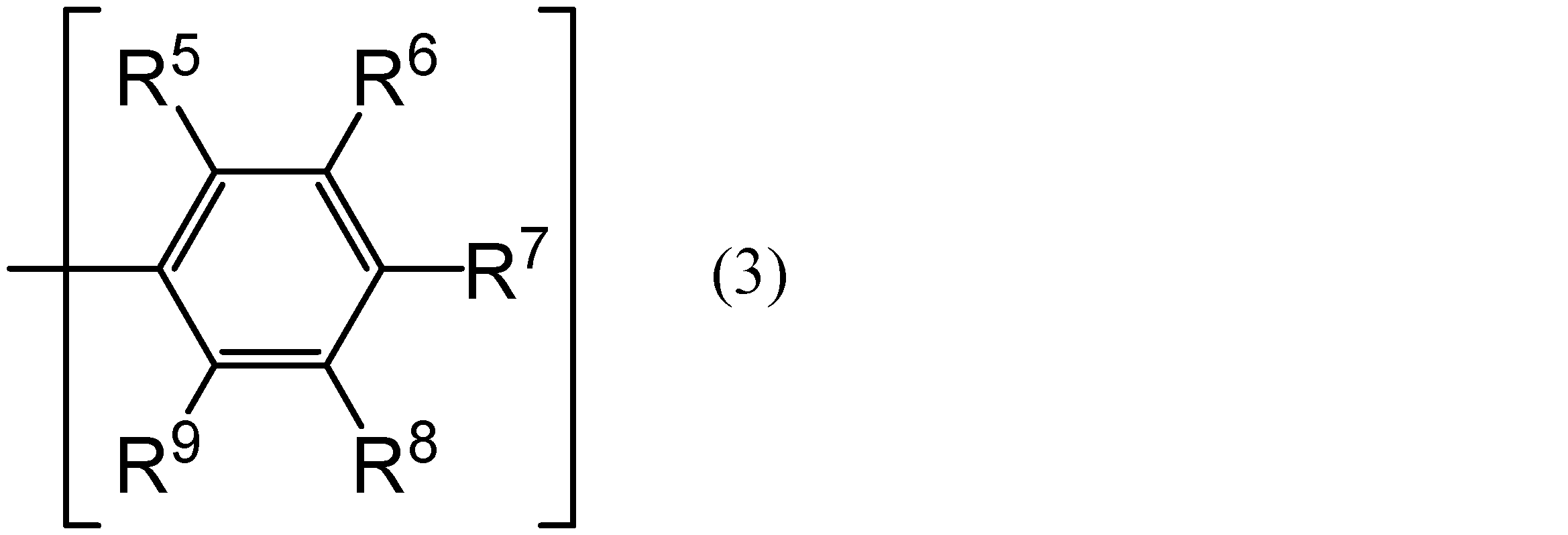
式(3)中、R5、R6、R7、R8及びR9は、それぞれ独立に、水素原子、炭素数1~20の炭化水素基、水酸基、ニトロ基、アミノ基、スルホニル基、シアノ基、シリル基、ホスホン酸基、ジアゾ基、メルカプト基、アルコキシ基、又はビニル基を示す。
希土類錯体ポリマーの安定性の観点から、希土類錯体ポリマーを構成している希土類イオンに、上記ホスフィンオキシド二座配位子に加えて、その他の配位子が複数配位していてもよい。その他の配位子は、希土類錯体ポリマーの発光強度を高めるために、多座配位子であってもよい。多座配位子は、例えば、下記式(2)で表されるジケトン配位子であってもよい。ジケトン配位子は、光増感作用を有することができる。

式(2)中、Aは水素原子又はハロゲン原子を示し、Zは水素原子又は重水素原子を示す。同一分子中の複数のAは同一であっても異なっていてもよい。
式(1)で表されるホスフィンオキシド二座配位子及び多座配位子を含む希土類錯体ポリマーの結晶中では、複数のポリマー鎖が、多座配位子同士が近接して向かい合うように配列し易い。光増感作用を有する多座配位子同士が向かい合っている部位が多数存在することで、応力刺激による発光(トリボルミネッセンス)の発光強度が更に大きくなる傾向がある。
発光強度及び光耐久性をより一層高めるために、希土類錯体ポリマーは、2つ以上のホスフィンオキシド二座配位子と2つ以上のジケトン配位子とを含む8配位以上の配位構造を形成している希土類イオンを含んでいてもよい。
本実施形態の希土類錯体ポリマーは、例えば、希土類イオンの原料である希土類金属化合物と、式(1)で表される構造を有するホスフィンオキシド二座配位子とを、必要に応じて触媒の存在下で、これらを溶解又は分散できる溶媒中にて攪拌する方法によって合成することができる。溶媒としては、希土類金属化合物及び配位子となるべき化合物に対してそれぞれ好適なものを混合して用いてもよい。例えば、メタノール、ジクロロメタン/メタノールの混合溶媒等を適用することができる。触媒としては、例えば、必要に応じてトリメチルアミン、水酸化リチウム等を添加することができる。合成時の温度は、-80~70℃とすることができる。
希土類錯体ポリマーの合成において、希土類イオンの原料である希土類金属化合物とホスフィンオキシド二座配位子との配合比([希土類金属化合物のモル数]:[ホスフィンオキシド二座配位子のモル数])は、1:0.5~1:5、又は1:0.77~1:1であってもよい。2種以上の希土類イオンを含む希土類錯体ポリマーを合成する場合、それらを含む2種以上の希土類金属化合物を任意の比率で組み合わせることができる。
本実施形態の希土類錯体ポリマーは、励起光に対する発光性に加え、応力刺激に対する発光性を有しており、更に溶媒に対する溶解性にも優れている。本実施形態の希土類錯体ポリマーの分光スペクトルにおいて観測されるピークの半値幅が狭く、希土類錯体ポリマーが希土類イオンに応じた美しい発光色を呈することができる。そして、希土類イオンを2種以上組み合わせることで、発光色の調整が容易であり、また、励起方法に依存した発光色を得ることができる。このような特性を有する希土類錯体ポリマーは、例えば、プラスチック材料等の各種の材料に暗号情報を付与するセキュリティ材料として有用である。
本実施形態の希土類錯体ポリマーは優れた溶解性と、蛍光体としての特性を有している。そのため、この希土類錯体ポリマーは、各種のプラスチック材料に配合される蛍光体としても容易に用いることができる。
プラスチック材料に希土類錯体ポリマーを含有させる際には、例えば、希土類錯体ポリマーを予め溶媒に溶解させてポリマー溶液を調製し、この溶液をプラスチック材料等と混合する。本実施形態に係る希土類錯体ポリマーを含有する溶液をプラスチック材料等に適用することによって、希土類錯体ポリマーが均一に分布するプラスチック材料及びプラスチック成形体を容易に得ることができる。得られるプラスチック成形体は、高い透明性を有することができる。
希土類錯体ポリマーが良好に溶解し得る溶媒としては、例えば、メタノール、及びアセトンが挙げられる。
希土類錯体ポリマーが配合されるプラスチック材料は、特に制限されない。プラスチック材料としては、例えば、ポリエチレン樹脂、ポリプロピレン樹脂、ポリ塩化ビニル樹脂、尿素樹脂、フッ素樹脂、ポリエステル樹脂、ポリアミド樹脂、ポリアセタール樹脂、ポリカーボネート樹脂、ポリアリレート樹脂、ポリスルフォン樹脂、ポリフェニレンスルフィド樹脂、ポリエーテルスルホン樹脂、ポリアリルスルホン樹脂、ポリテトラフルオロエチレン樹脂、フェノール樹脂、不飽和ポリエステル樹脂、エポキシ樹脂、ポリイミド樹脂及びポリアミドイミド樹脂が挙げられる。
希土類錯体ポリマーを配合して成形加工する方法としては、特に限定されず、射出成形、ブロー成形、圧縮成形、押出成形、反応成形、中空成形、熱成形、及びFRP成形等が挙げられる。
以下、実施例に基づき本発明を具体的に説明する。ただし、本発明は以下の実施例に限定されるものではない。
1.2,5-ビス(ジフェニルホスホリル)フラン(dpf)の合成
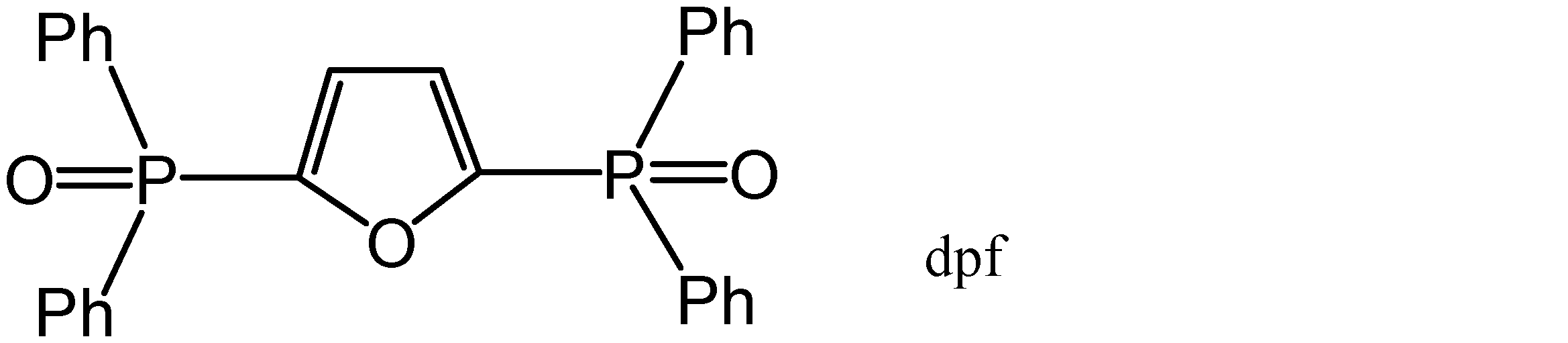
フラスコに2mL(18.7mol)の2,5-ジブロモフラン及び60mLのジエチルエーテルを加え、攪拌した。この反応液に、29mL(46mol)のn-ブチルリチウムを-78℃で加え、3時間攪拌しながら-20℃まで昇温した。その後、反応液を再度-78℃に冷却し、8.5mL(46mol)のクロロジフェニルホスフィンを加え、8時間攪拌した。この反応液から、ジクロロメタンを用いて生成物を抽出し、その後脱水した。脱水した溶液から溶媒を除去した。溶媒を除去して得られた生成物を30mLのジクロロメタンで溶解し、0℃に冷却した。冷却した反応液に25mLの過酸化水素を加え、2時間攪拌した。この反応液から、ジクロロメタンを用いて生成物を抽出し、その後脱水した。脱水した溶液から溶媒を除去し、再結晶化を行うことで、2,5-ビス(ジフェニルホスホリル)フラン(dpf)の結晶を3.8g得た。
2.希土類錯体ポリマーの作製<作製例1:[Eu(hfa)3(dpf)]nポリマー(Eu100%)>
フラスコに0.65gのEu(hfa)3(H2O)2、0.37gのdpf及び80mLのメタノールを加えた。この溶液を60℃で攪拌しながら、3時間加熱還流した。その後、反応液中の沈殿物を分離し、これを洗浄することで目的とする希土類錯体ポリマーの粉末を得た。
フラスコに0.65gのEu(hfa)3(H2O)2、0.37gのdpf及び80mLのメタノールを加えた。この溶液を60℃で攪拌しながら、3時間加熱還流した。その後、反応液中の沈殿物を分離し、これを洗浄することで目的とする希土類錯体ポリマーの粉末を得た。
<作製例2:[Gd(hfa)3(dpf)]nポリマー(Gd100%)>
Eu(hfa)3(H2O)2の代わりにGd(hfa)3(H2O)2を用いたこと以外は、作製例1と同様の方法により希土類錯体ポリマーの粉末を得た。
Eu(hfa)3(H2O)2の代わりにGd(hfa)3(H2O)2を用いたこと以外は、作製例1と同様の方法により希土類錯体ポリマーの粉末を得た。
<作製例3:[Tb(hfa)3(dpf)]nポリマー(Tb100%)>
Eu(hfa)3(H2O)2の代わりにTb(hfa)3(H2O)2を用いたこと以外は、作製例1と同様の方法により希土類錯体ポリマーの粉末を得た。
Eu(hfa)3(H2O)2の代わりにTb(hfa)3(H2O)2を用いたこと以外は、作製例1と同様の方法により希土類錯体ポリマーの粉末を得た。
<作製例4~6:[Tb,Eu(hfa)3(dpf)]nポリマー(Tb/Eu=1、10、99)>
Eu(hfa)3(H2O)2の代わりにTb(hfa)3(H2O)2及びEu(hfa)3(H2O)2を1:1、10:1又は99:1のモル比で用いたこと以外は、作製例1と同様の方法により希土類錯体ポリマーの粉末を得た。
Eu(hfa)3(H2O)2の代わりにTb(hfa)3(H2O)2及びEu(hfa)3(H2O)2を1:1、10:1又は99:1のモル比で用いたこと以外は、作製例1と同様の方法により希土類錯体ポリマーの粉末を得た。
3.応力発光強度、熱耐久性及び発光効率の測定
[Eu(hfa)3(dpf)]nポリマー、下記式で表されるチオフェン配位子(dpt)を有する[Eu(hfa)3(dpt)]nポリマー、下記式で表されるEDOT配位子(dpedot)を有する[Eu(hfa)3(dpedot)]nポリマーについて、応力刺激による発光(応力発光)の強度を測定した。
[Eu(hfa)3(dpf)]nポリマー、下記式で表されるチオフェン配位子(dpt)を有する[Eu(hfa)3(dpt)]nポリマー、下記式で表されるEDOT配位子(dpedot)を有する[Eu(hfa)3(dpedot)]nポリマーについて、応力刺激による発光(応力発光)の強度を測定した。

フラスコに希土類錯体ポリマーと攪拌子を入れ、攪拌子を一定の回転数で回転した際の希土類錯体ポリマーの発光をCCDカメラで取り込み、発光を積算することで粉砕による応力発光スペクトルを得た。これは他の応力発光の評価例でも同様である。
フラン基を含む配位子を含む[Eu(hfa)3(dpf)]nポリマーは、その他の骨格を持つ配位子を含む[Eu(hfa)3(dpt)]nポリマー及び[Eu(hfa)3(dpedot)]nポリマーと比較して、大きな応力発光強度を示した。
各ポリマーの熱耐久性及び380nmの波長の励起光を照射した際の発光の発光効率を測定した。熱耐久性を、熱重量測定装置(TGA)を用いた熱重量測定により測定した熱分解温度(℃)によって評価した。評価結果を表1に示す。

発光効率ΦLnは、ポリマーの希土類イオン自体を直接励起した際の発光効率を示す。発光効率Φtotは、ポリマーの有機配位子を励起した際の発光効率を示す。[Eu(hfa)3(dpf)]nは、熱分解温度、発光効率ΦLn、及び発光効率Φtotのいずれについても、他のポリマーと同等の特性を示した。
4.溶解性
[Eu(hfa)3(dpf)]nポリマー、及び[Eu(hfa)3(dpedot)]nポリマーについて有機溶媒に対する溶解性を評価した。溶解性は、希土類錯体ポリマー30mg及びメタノール2mLをガラス容器中で攪拌し、混合液の状態を観察する試験によって評価した。
[Eu(hfa)3(dpf)]nポリマー、及び[Eu(hfa)3(dpedot)]nポリマーについて有機溶媒に対する溶解性を評価した。溶解性は、希土類錯体ポリマー30mg及びメタノール2mLをガラス容器中で攪拌し、混合液の状態を観察する試験によって評価した。
その結果、[Eu(hfa)3(dpf)]nポリマーはメタノールに対し完全に溶解し、透明な液体になった。一方、[Eu(hfa)3(dpedot)]nポリマーはメタノールに分散するのみであり、白色の沈殿が見られた。[Eu(hfa)3(dpf)]nポリマーはメタノールに溶解した状態でも、紫外線照射により発光した。
5.金属元素の種類が異なるポリマーの発光色の測定
[Eu(hfa)3(dpf)]nポリマー、[Gd(hfa)3(dpf)]nポリマー及び[Tb(hfa)3(dpf)]nポリマーの粉末に対し、380nmの波長の励起光を照射し、希土類錯体ポリマーからの発光を測定した。UV励起による発光特性の測定装置として、HORIBA Fluorolog-3 spectrofluorometerを用いた。図1は、各希土類錯体ポリマーの発光スペクトルである。
[Eu(hfa)3(dpf)]nポリマー、[Gd(hfa)3(dpf)]nポリマー及び[Tb(hfa)3(dpf)]nポリマーの粉末に対し、380nmの波長の励起光を照射し、希土類錯体ポリマーからの発光を測定した。UV励起による発光特性の測定装置として、HORIBA Fluorolog-3 spectrofluorometerを用いた。図1は、各希土類錯体ポリマーの発光スペクトルである。
図1に示すとおり、ポリマーに含まれる希土類元素の種類によって、蛍光スペクトルのパターンが異なった。発光色はそれぞれ、[Eu(hfa)3(dpf)]nポリマーでは赤色であり、[Gd(hfa)3(dpf)]nポリマーでは青色であり、[Tb(hfa)3(dpf)]nポリマーでは緑色であった。この結果から、希土類元素の種類を変えることで、ポリマーの発光色を調整できることが示された。
6.希土類元素の比率が異なるポリマーの発光色の測定
EuとTbの比率(モル比、Eu:Tb)が100:0、1:1、1:99、又は0:100の希土類錯体ポリマーの粉末を用いて応力発光を測定した。図2は、各希土類錯体ポリマーの発光スペクトルを示す。
EuとTbの比率(モル比、Eu:Tb)が100:0、1:1、1:99、又は0:100の希土類錯体ポリマーの粉末を用いて応力発光を測定した。図2は、各希土類錯体ポリマーの発光スペクトルを示す。
[Eu(hfa)3(dpf)]nポリマーでは赤色(612nm)の蛍光が得られ、[Tb(hfa)3(dpf)]nポリマーでは緑色(545nm)の蛍光が得られた。また、ポリマー中の希土類元素の割合を変えることで、ポリマーが発する612nm及び545nmの蛍光の強度の比率が変化し、赤色と緑色の中間色を示した。この結果から、ポリマー中の希土類元素の割合を変えることで、発光色を調整できることが示された。
7.励起方法の発光色への影響
[Eu(hfa)3(dpf)]nポリマー、及び[Tb,Eu(hfa)3(dpf)]nポリマー(Tb/Eu=1又は10)の粉末に対し、380nmの波長の励起光の照射又は応力刺激を与え、ポリマーからの発光を測定した。図3の(a)は励起光の照射により得られた発光スペクトルを示し、図3の(b)は応力刺激により得られた発光スペクトルを示す。
[Eu(hfa)3(dpf)]nポリマー、及び[Tb,Eu(hfa)3(dpf)]nポリマー(Tb/Eu=1又は10)の粉末に対し、380nmの波長の励起光の照射又は応力刺激を与え、ポリマーからの発光を測定した。図3の(a)は励起光の照射により得られた発光スペクトルを示し、図3の(b)は応力刺激により得られた発光スペクトルを示す。
測定に用いた全てのポリマーが、励起光及び応力刺激の励起方法によって発光した。特に2種類の希土類元素を含むポリマーの発光スペクトルは、励起方法によって異なった。Euのみを含むポリマーは、励起光及び応力刺激の励起方法により赤色の光を発した。Tb/Eu=10のポリマーは、励起光では黄色の光を発し、応力刺激では黄緑色の光を発した。Tb/Eu=1のポリマーは応力刺激により橙色の光を発した。この結果から、希土類元素の割合を変えることで、ポリマーは励起方法に依存した発光を得られることが示された。
8.温度条件の発光色への影響
[Tb,Eu(hfa)3(dpf)]nポリマー(Tb/Eu=10)の粉末に対し、380nmの波長の励起光を照射して、温度条件の違いによる発光色を測定した。温度条件は、100K、200K、300K、又は400Kとした。図4は、各温度条件におけるポリマーの発光スペクトルを示す。
[Tb,Eu(hfa)3(dpf)]nポリマー(Tb/Eu=10)の粉末に対し、380nmの波長の励起光を照射して、温度条件の違いによる発光色を測定した。温度条件は、100K、200K、300K、又は400Kとした。図4は、各温度条件におけるポリマーの発光スペクトルを示す。
[Tb,Eu(hfa)3(dpf)]nポリマー(Tb/Eu=10)は、低温であるほど545nmの波長で強い発光強度を示し、高温になるほど613nmの波長で強い発光強度を示した。この結果から、[Tb,Eu(hfa)3(dpf)]nポリマーは、温度に応じて発光波長が変化することが示された。
9.励起波長の発光色への影響
1,4-ビス(ジフェニルホスホリル)ビフェニル(dpbp)により架橋された[Tb,Eu(hfa)3(dpbp)]nポリマー(Tb/Eu=150)、及び[Tb,Eu(hfa)3(dpf)]nポリマー(Tb/Eu=10)の粉末に対し、350nm、375nm、400nm、又は425nmの波長の励起光を照射し、ポリマーからの発光を測定した。図5の(a)はEu(hfa)3(dpbp)]nポリマー(Tb/Eu=150)の発光スペクトルを示し、図5の(b)は[Tb,Eu(hfa)3(dpf)]nポリマー(Tb/Eu=10)の発光スペクトルを示す。
1,4-ビス(ジフェニルホスホリル)ビフェニル(dpbp)により架橋された[Tb,Eu(hfa)3(dpbp)]nポリマー(Tb/Eu=150)、及び[Tb,Eu(hfa)3(dpf)]nポリマー(Tb/Eu=10)の粉末に対し、350nm、375nm、400nm、又は425nmの波長の励起光を照射し、ポリマーからの発光を測定した。図5の(a)はEu(hfa)3(dpbp)]nポリマー(Tb/Eu=150)の発光スペクトルを示し、図5の(b)は[Tb,Eu(hfa)3(dpf)]nポリマー(Tb/Eu=10)の発光スペクトルを示す。
[Tb,Eu(hfa)3(dpbp)]nポリマーは、いずれの波長の励起光によっても同じ発光スペクトルを示した。一方、[Tb,Eu(hfa)3(dpf)]nポリマーは、励起光の波長によって異なる発光スペクトルを示し、特に610nm~630nm付近の発光スペクトルに変化が見られた。この結果から、[Tb,Eu(hfa)3(dpf)]nポリマーは、励起光の波長に応じて発光波長が変化することが示された。
Claims (4)
- 三価の希土類イオンと、式(1)で表されるホスフィンオキシド二座配位子と、を含み、
1つの前記ホスフィンオキシド二座配位子が、2つの前記希土類イオンに配位して2つの前記希土類イオン同士を橋かけしている、希土類錯体ポリマー。
- 2種以上の前記希土類イオンを含む、請求項1に記載の希土類錯体ポリマー。
- 前記希土類イオンが、Eu(III)イオン、Tb(III)イオン、Gd(III)イオン、Sm(III)イオン、Yb(III)イオン、Nd(III)イオン、Er(III)イオン、Y(III)イオン、Dy(III)イオン、Ce(III)イオン、及びPr(III)イオンからなる群から選択される少なくとも一種の希土類イオンである、請求項1又は2に記載の希土類錯体ポリマー。
- 前記希土類イオンに配位している、式(2)で表されるジケトン配位子を更に含む、請求項1~3のいずれか一項に記載の希土類錯体ポリマー。
Priority Applications (2)
| Application Number | Priority Date | Filing Date | Title |
|---|---|---|---|
| US16/098,297 US10745614B2 (en) | 2016-05-02 | 2017-04-26 | Rare-earth complex polymer |
| JP2018515708A JP6917596B2 (ja) | 2016-05-02 | 2017-04-26 | 希土類錯体ポリマー |
Applications Claiming Priority (2)
| Application Number | Priority Date | Filing Date | Title |
|---|---|---|---|
| JP2016092667 | 2016-05-02 | ||
| JP2016-092667 | 2016-05-02 |
Publications (1)
| Publication Number | Publication Date |
|---|---|
| WO2017191795A1 true WO2017191795A1 (ja) | 2017-11-09 |
Family
ID=60203705
Family Applications (1)
| Application Number | Title | Priority Date | Filing Date |
|---|---|---|---|
| PCT/JP2017/016574 Ceased WO2017191795A1 (ja) | 2016-05-02 | 2017-04-26 | 希土類錯体ポリマー |
Country Status (3)
| Country | Link |
|---|---|
| US (1) | US10745614B2 (ja) |
| JP (1) | JP6917596B2 (ja) |
| WO (1) | WO2017191795A1 (ja) |
Cited By (1)
| Publication number | Priority date | Publication date | Assignee | Title |
|---|---|---|---|---|
| JP2019127560A (ja) * | 2018-01-26 | 2019-08-01 | 国立大学法人北海道大学 | 希土類錯体ポリマー及び発光体 |
Families Citing this family (2)
| Publication number | Priority date | Publication date | Assignee | Title |
|---|---|---|---|---|
| WO2019103155A1 (ja) * | 2017-11-27 | 2019-05-31 | 東ソー株式会社 | ユウロピウム錯体 |
| JP7688398B2 (ja) * | 2019-12-25 | 2025-06-04 | 国立大学法人北海道大学 | 希土類錯体 |
Citations (2)
| Publication number | Priority date | Publication date | Assignee | Title |
|---|---|---|---|---|
| WO2011013520A1 (ja) * | 2009-07-29 | 2011-02-03 | 国立大学法人奈良先端科学技術大学院大学 | 希土類錯体及びその利用 |
| WO2012150712A1 (ja) * | 2011-05-02 | 2012-11-08 | 国立大学法人北海道大学 | 希土類錯体ポリマー及びプラスチック成形体 |
-
2017
- 2017-04-26 WO PCT/JP2017/016574 patent/WO2017191795A1/ja not_active Ceased
- 2017-04-26 JP JP2018515708A patent/JP6917596B2/ja active Active
- 2017-04-26 US US16/098,297 patent/US10745614B2/en active Active
Patent Citations (2)
| Publication number | Priority date | Publication date | Assignee | Title |
|---|---|---|---|---|
| WO2011013520A1 (ja) * | 2009-07-29 | 2011-02-03 | 国立大学法人奈良先端科学技術大学院大学 | 希土類錯体及びその利用 |
| WO2012150712A1 (ja) * | 2011-05-02 | 2012-11-08 | 国立大学法人北海道大学 | 希土類錯体ポリマー及びプラスチック成形体 |
Non-Patent Citations (1)
| Title |
|---|
| DATABASE CAS [o] 29 May 2017 (2017-05-29), retrieved from STN Database accession no. 959298-05-6 * |
Cited By (2)
| Publication number | Priority date | Publication date | Assignee | Title |
|---|---|---|---|---|
| JP2019127560A (ja) * | 2018-01-26 | 2019-08-01 | 国立大学法人北海道大学 | 希土類錯体ポリマー及び発光体 |
| JP7044319B2 (ja) | 2018-01-26 | 2022-03-30 | 国立大学法人北海道大学 | 希土類錯体ポリマー及び発光体 |
Also Published As
| Publication number | Publication date |
|---|---|
| US20190119567A1 (en) | 2019-04-25 |
| US10745614B2 (en) | 2020-08-18 |
| JPWO2017191795A1 (ja) | 2019-03-14 |
| JP6917596B2 (ja) | 2021-08-11 |
Similar Documents
| Publication | Publication Date | Title |
|---|---|---|
| US9051427B2 (en) | Rare-earth complex polymer and plastic molded product | |
| JP6378010B2 (ja) | 希土類錯体ポリマーとその製造方法、及びプラスチック成形体 | |
| US20160160121A1 (en) | Sheet integrated rare earth complex and use thereof | |
| JP6917596B2 (ja) | 希土類錯体ポリマー | |
| CN111344361A (zh) | 墨水组合物、印刷物以及真伪判定方法 | |
| JP6270093B2 (ja) | 発光性複合材料および発光体ナノ結晶 | |
| JP7081602B2 (ja) | インキ組成物、及び印刷物 | |
| Forniés et al. | Pt–Ag clusters and their neutral mononuclear Pt (II) starting complexes: structural and luminescence studies | |
| JP2016166140A (ja) | 希土類錯体及びその製造方法、並びにプラスチック成形体 | |
| Song et al. | Luminescent properties of Ag (I)/Cu (I) coordination polymers: crystal structures and high intensity luminescence of a PMMA-doped hybrid material based on a quinoline-2, 3-dicarboxylic acid ligand | |
| WO2005044770A1 (ja) | 耐熱性を有する希土類錯体 | |
| Wang et al. | Photofunctional binary and ternary Eu3+/Tb3+ hybrid materials with copolymer linkage methacrylic acid–vinyltrimethoxysilane and 1, 10-phenanthroline | |
| Wu et al. | Pressure-induced white-light emission of a Cu (i) cluster with effective blue phosphorescence | |
| JP6666009B2 (ja) | 高分子錯体及びその製造方法 | |
| US10954435B2 (en) | Luminescent rare earth element compound and dichroic phosphor composition containing same | |
| Wang et al. | Photoactive rare earth (Eu3+, Tb3+) hybrids with organically modified silica covalently bonded polymeric chain | |
| JP2025156083A (ja) | 発光材料、塗料、印刷物、及び樹脂成形体 | |
| JP7335377B2 (ja) | 希土類金属錯体及びそれを用いる発光装置 | |
| Guo et al. | Cooperative sol–gel assembly, characterization and photoluminescence of rare earth hybrids with novel dihydroxyl linkages and 1, 10-phenanthroline | |
| Feng et al. | Single-component white-light-emitting Eu3+-metallopolymer for near-ultraviolet white light-emitting diode (n-UV-WLED) | |
| JPWO2019053964A1 (ja) | インキ組成物及び印刷物 | |
| JP6749816B2 (ja) | Eu錯体及び有機EL素子 | |
| Fu et al. | Organic afterglow coating materials via emulsion polymerization | |
| KR20180079622A (ko) | 녹색 유무기 복합 발광 재료를 포함하는 디스플레이용 led 장치 | |
| Yan et al. | Photofunctional Eu3+/Tb3+ hybrid material with inorganic silica covalently linking polymer chain through their double functionalization |
Legal Events
| Date | Code | Title | Description |
|---|---|---|---|
| DPE1 | Request for preliminary examination filed after expiration of 19th month from priority date (pct application filed from 20040101) | ||
| ENP | Entry into the national phase |
Ref document number: 2018515708 Country of ref document: JP Kind code of ref document: A |
|
| NENP | Non-entry into the national phase |
Ref country code: DE |
|
| 121 | Ep: the epo has been informed by wipo that ep was designated in this application |
Ref document number: 17792728 Country of ref document: EP Kind code of ref document: A1 |
|
| 122 | Ep: pct application non-entry in european phase |
Ref document number: 17792728 Country of ref document: EP Kind code of ref document: A1 |