WO2017175987A1 - 유기 화합물 및 이를 이용한 유기 전계 발광 소자 - Google Patents

유기 화합물 및 이를 이용한 유기 전계 발광 소자 Download PDF

Info

Publication number
WO2017175987A1
WO2017175987A1 PCT/KR2017/002848 KR2017002848W WO2017175987A1 WO 2017175987 A1 WO2017175987 A1 WO 2017175987A1 KR 2017002848 W KR2017002848 W KR 2017002848W WO 2017175987 A1 WO2017175987 A1 WO 2017175987A1
Authority
WO
WIPO (PCT)
Prior art keywords
group
mol
formula
mmol
aryl
Prior art date
Legal status (The legal status is an assumption and is not a legal conclusion. Google has not performed a legal analysis and makes no representation as to the accuracy of the status listed.)
Ceased
Application number
PCT/KR2017/002848
Other languages
English (en)
French (fr)
Inventor
김홍석
라종규
Current Assignee (The listed assignees may be inaccurate. Google has not performed a legal analysis and makes no representation or warranty as to the accuracy of the list.)
Doosan Corp
Original Assignee
Doosan Corp
Priority date (The priority date is an assumption and is not a legal conclusion. Google has not performed a legal analysis and makes no representation as to the accuracy of the date listed.)
Filing date
Publication date
Application filed by Doosan Corp filed Critical Doosan Corp
Publication of WO2017175987A1 publication Critical patent/WO2017175987A1/ko
Anticipated expiration legal-status Critical
Ceased legal-status Critical Current

Links

Classifications

    • HELECTRICITY
    • H10SEMICONDUCTOR DEVICES; ELECTRIC SOLID-STATE DEVICES NOT OTHERWISE PROVIDED FOR
    • H10KORGANIC ELECTRIC SOLID-STATE DEVICES
    • H10K50/00Organic light-emitting devices
    • CCHEMISTRY; METALLURGY
    • C07ORGANIC CHEMISTRY
    • C07DHETEROCYCLIC COMPOUNDS
    • C07D209/00Heterocyclic compounds containing five-membered rings, condensed with other rings, with one nitrogen atom as the only ring hetero atom
    • C07D209/56Ring systems containing three or more rings
    • CCHEMISTRY; METALLURGY
    • C07ORGANIC CHEMISTRY
    • C07DHETEROCYCLIC COMPOUNDS
    • C07D209/00Heterocyclic compounds containing five-membered rings, condensed with other rings, with one nitrogen atom as the only ring hetero atom
    • C07D209/56Ring systems containing three or more rings
    • C07D209/80[b, c]- or [b, d]-condensed
    • C07D209/82Carbazoles; Hydrogenated carbazoles
    • CCHEMISTRY; METALLURGY
    • C07ORGANIC CHEMISTRY
    • C07DHETEROCYCLIC COMPOUNDS
    • C07D487/00Heterocyclic compounds containing nitrogen atoms as the only ring hetero atoms in the condensed system, not provided for by groups C07D451/00 - C07D477/00
    • C07D487/02Heterocyclic compounds containing nitrogen atoms as the only ring hetero atoms in the condensed system, not provided for by groups C07D451/00 - C07D477/00 in which the condensed system contains two hetero rings
    • C07D487/04Ortho-condensed systems
    • CCHEMISTRY; METALLURGY
    • C07ORGANIC CHEMISTRY
    • C07DHETEROCYCLIC COMPOUNDS
    • C07D491/00Heterocyclic compounds containing in the condensed ring system both one or more rings having oxygen atoms as the only ring hetero atoms and one or more rings having nitrogen atoms as the only ring hetero atoms, not provided for by groups C07D451/00 - C07D459/00, C07D463/00, C07D477/00 or C07D489/00
    • C07D491/02Heterocyclic compounds containing in the condensed ring system both one or more rings having oxygen atoms as the only ring hetero atoms and one or more rings having nitrogen atoms as the only ring hetero atoms, not provided for by groups C07D451/00 - C07D459/00, C07D463/00, C07D477/00 or C07D489/00 in which the condensed system contains two hetero rings
    • C07D491/04Ortho-condensed systems
    • C07D491/044Ortho-condensed systems with only one oxygen atom as ring hetero atom in the oxygen-containing ring
    • C07D491/048Ortho-condensed systems with only one oxygen atom as ring hetero atom in the oxygen-containing ring the oxygen-containing ring being five-membered
    • CCHEMISTRY; METALLURGY
    • C07ORGANIC CHEMISTRY
    • C07DHETEROCYCLIC COMPOUNDS
    • C07D495/00Heterocyclic compounds containing in the condensed system at least one hetero ring having sulfur atoms as the only ring hetero atoms
    • C07D495/02Heterocyclic compounds containing in the condensed system at least one hetero ring having sulfur atoms as the only ring hetero atoms in which the condensed system contains two hetero rings
    • C07D495/04Ortho-condensed systems
    • CCHEMISTRY; METALLURGY
    • C09DYES; PAINTS; POLISHES; NATURAL RESINS; ADHESIVES; COMPOSITIONS NOT OTHERWISE PROVIDED FOR; APPLICATIONS OF MATERIALS NOT OTHERWISE PROVIDED FOR
    • C09KMATERIALS FOR MISCELLANEOUS APPLICATIONS, NOT PROVIDED FOR ELSEWHERE
    • C09K11/00Luminescent materials, e.g. electroluminescent or chemiluminescent
    • C09K11/06Luminescent materials, e.g. electroluminescent or chemiluminescent containing organic luminescent materials
    • HELECTRICITY
    • H10SEMICONDUCTOR DEVICES; ELECTRIC SOLID-STATE DEVICES NOT OTHERWISE PROVIDED FOR
    • H10KORGANIC ELECTRIC SOLID-STATE DEVICES
    • H10K50/00Organic light-emitting devices
    • H10K50/10OLEDs or polymer light-emitting diodes [PLED]
    • H10K50/14Carrier transporting layers
    • H10K50/15Hole transporting layers
    • HELECTRICITY
    • H10SEMICONDUCTOR DEVICES; ELECTRIC SOLID-STATE DEVICES NOT OTHERWISE PROVIDED FOR
    • H10KORGANIC ELECTRIC SOLID-STATE DEVICES
    • H10K85/00Organic materials used in the body or electrodes of devices covered by this subclass
    • H10K85/60Organic compounds having low molecular weight
    • H10K85/649Aromatic compounds comprising a hetero atom
    • H10K85/657Polycyclic condensed heteroaromatic hydrocarbons
    • CCHEMISTRY; METALLURGY
    • C09DYES; PAINTS; POLISHES; NATURAL RESINS; ADHESIVES; COMPOSITIONS NOT OTHERWISE PROVIDED FOR; APPLICATIONS OF MATERIALS NOT OTHERWISE PROVIDED FOR
    • C09KMATERIALS FOR MISCELLANEOUS APPLICATIONS, NOT PROVIDED FOR ELSEWHERE
    • C09K2211/00Chemical nature of organic luminescent or tenebrescent compounds
    • C09K2211/10Non-macromolecular compounds
    • C09K2211/1003Carbocyclic compounds
    • C09K2211/1011Condensed systems
    • CCHEMISTRY; METALLURGY
    • C09DYES; PAINTS; POLISHES; NATURAL RESINS; ADHESIVES; COMPOSITIONS NOT OTHERWISE PROVIDED FOR; APPLICATIONS OF MATERIALS NOT OTHERWISE PROVIDED FOR
    • C09KMATERIALS FOR MISCELLANEOUS APPLICATIONS, NOT PROVIDED FOR ELSEWHERE
    • C09K2211/00Chemical nature of organic luminescent or tenebrescent compounds
    • C09K2211/10Non-macromolecular compounds
    • C09K2211/1018Heterocyclic compounds
    • C09K2211/1025Heterocyclic compounds characterised by ligands
    • C09K2211/1044Heterocyclic compounds characterised by ligands containing two nitrogen atoms as heteroatoms
    • C09K2211/1048Heterocyclic compounds characterised by ligands containing two nitrogen atoms as heteroatoms with oxygen
    • CCHEMISTRY; METALLURGY
    • C09DYES; PAINTS; POLISHES; NATURAL RESINS; ADHESIVES; COMPOSITIONS NOT OTHERWISE PROVIDED FOR; APPLICATIONS OF MATERIALS NOT OTHERWISE PROVIDED FOR
    • C09KMATERIALS FOR MISCELLANEOUS APPLICATIONS, NOT PROVIDED FOR ELSEWHERE
    • C09K2211/00Chemical nature of organic luminescent or tenebrescent compounds
    • C09K2211/10Non-macromolecular compounds
    • C09K2211/1018Heterocyclic compounds
    • C09K2211/1025Heterocyclic compounds characterised by ligands
    • C09K2211/1044Heterocyclic compounds characterised by ligands containing two nitrogen atoms as heteroatoms
    • C09K2211/1051Heterocyclic compounds characterised by ligands containing two nitrogen atoms as heteroatoms with sulfur
    • HELECTRICITY
    • H10SEMICONDUCTOR DEVICES; ELECTRIC SOLID-STATE DEVICES NOT OTHERWISE PROVIDED FOR
    • H10KORGANIC ELECTRIC SOLID-STATE DEVICES
    • H10K50/00Organic light-emitting devices
    • H10K50/10OLEDs or polymer light-emitting diodes [PLED]
    • H10K50/11OLEDs or polymer light-emitting diodes [PLED] characterised by the electroluminescent [EL] layers

Definitions

  • the present invention relates to a novel organic compound and an organic electroluminescent device using the same, and more particularly, a novel organic compound having excellent hole transporting ability, electron transporting ability, light emitting ability, etc. and the compound as a material of an organic material layer, and thus luminous efficiency.
  • the present invention relates to an organic EL device having improved characteristics such as driving voltage and lifetime.
  • the organic electroluminescent device when a voltage is applied between two electrodes, holes are injected into the organic material layer from the anode, and electrons are injected into the organic material layer from the cathode. When the injected holes and electrons meet, excitons are formed, and when the excitons fall to the ground, they shine.
  • the material included in the organic material layer may be classified into a light emitting material, a hole injection material, a hole transport material, an electron transport material, an electron injection material, and the like according to its function.
  • the light emitting material may be classified into blue, green, and red light emitting materials according to the light emitting color, and yellow and orange light emitting materials required to realize a better natural color.
  • a host / dopant system may be used as a light emitting material to increase luminous efficiency through an increase in color purity and energy transfer.
  • the dopant material may be divided into a fluorescent dopant using an organic material and a phosphorescent dopant using a metal complex compound containing heavy atoms such as Ir and Pt.
  • a metal complex compound containing heavy atoms such as Ir and Pt.
  • anthracene derivatives are known as fluorescent dopant / host materials used in the light emitting layer.
  • a phosphorescent dopant material used in the light emitting layer metal complex compounds containing Ir such as Firpic, Ir (ppy) 3 and (acac) Ir (btp) 2 are known, and as phosphorescent host materials, 4,4- dicarbazolybiphenyl (CBP) is known.
  • the existing materials have a low glass transition temperature and poor thermal stability, and thus are not satisfactory in terms of lifespan in the organic EL device, and still need improvement in terms of light emission characteristics.
  • An object of the present invention is to provide a novel organic compound that can be used as an organic material layer having excellent light emitting ability, hole transporting ability, hole injection ability and the like.
  • Another object of the present invention is to provide an organic electroluminescent device including the novel organic compound having a low driving voltage, high luminous efficiency, and an improved lifetime.
  • the present invention provides a compound represented by the following formula (1).
  • A is a 5-membered ring containing or not containing one or more atoms of N, O, S,
  • B is a 6 membered aromatic ring
  • Ar 1 is selected from the group consisting of hydrogen, a C 6 ⁇ C 60 aryl group and a heteroaryl group of 5 to 60 nuclear atoms,
  • L 1 and L 2 are the same as or different from each other, and each independently a single bond, or is selected from the group consisting of a C 6 ⁇ C 60 arylene group and a heteroarylene group having 5 to 60 nuclear atoms, wherein L 1 is Connected to carbon or nitrogen of any one of X 1 , X 2 , Y 1 to Y 4 ,
  • X 1 is NR 1 or CR 2 R 3 ,
  • X 2 to X 4 are the same as or different from each other, and each independently a single bond, or is selected from the group consisting of S, O, NR 4 and CR 5 R 6 , wherein at least one of X 2 and X 4 is a single bond Except that X 3 and X 4 are both single bonds,
  • Y 1 to Y 8 and Y 11 to Y 18 are each independently CR 7, wherein a plurality of R 7 are the same as or different from each other,
  • R 1 to R 7 are the same as or different from each other, and are each independently selected from hydrogen, an aryl group having 6 to 60 carbon atoms and a heteroaryl group having 5 to 60 nuclear atoms, or are bonded to an adjacent group (preferably , R 5 and other R 5 are bonded to form a condensed aromatic ring or a condensed heteroaromatic ring,
  • the group and heteroaryl group are each independently deuterium, halogen, cyano, C 1 ⁇ C 40 alkyl group, C 3 ⁇ C 40 cycloalkyl group, nuclear 3 to 40 heterocycloalkyl group, C 6 ⁇ C 60 aryl group, nuclear atoms aryl of from 5 to 60 heteroaryl group, a C 1 ⁇ C 40 of the alkyloxy group, C 6 ⁇ C 60 aryloxy group, C 1 ⁇ C 40 alkylsilyl group, C 6 ⁇ aryl of C 60 silyl group, C 2 ⁇ C 40 group of an alkyl boron, C 6 ⁇ C group 60 arylboronic of, C 6 ⁇ C 60 aryl phosphine group,
  • the present invention is an organic electroluminescent device comprising an anode, a cathode and at least one organic layer interposed between the anode and the cathode, at least one of the at least one organic layer is a compound represented by the formula (1) It provides an organic electroluminescent device comprising.
  • the compound of the present invention is excellent in heat resistance, hole injecting ability, hole transporting ability, light emitting ability, etc., it can be used as an organic material layer material of the organic electroluminescent device, preferably a hole injection layer material, a hole transporting layer material or a light emitting layer material.
  • the organic electroluminescent device including the compound of the present invention in the hole injection layer, the hole transport layer and / or the light emitting layer can be greatly improved aspects such as light emission performance, driving voltage, lifespan, efficiency, such organic electroluminescent device It can be effectively applied to a full color display panel and the like.
  • the organic compound of the present invention is a 'moiety in which a quinazoline and a 5-membered ring (A) are bonded' or 'two substituents directly connected through a linker group (L 2 )' is directly connected or a linker group (L 1 )
  • the substituent is a carbazole moiety, a dimethylfluorene moiety, a dibenzothiophene moiety, a dibenzofuran moiety, a dimethylacridine moiety, a thianthrene (thianthrene) moiety, dibenzodioxin moiety, spirofluorene and the like.
  • the compound represented by Formula 1 of the present invention is that a quinazoline is bonded to a 5-membered ring (A) such as cyclopentane, furan, pyrazole, imidazole, oxazole, thiophene, etc. Because of the similar energy level, it can be adjusted higher than the energy level of the dopant, which can be applied as a host material, and has a triplet energy higher than that of the quinazoline-coupled structure. You can expect. In particular, the compound in which thiophene is bound to quinazoline may exhibit a longer wavelength than the compound in which the five-membered ring is bound to quinazoline. In addition, when an aryl group (for example, phenyl, biphenyl) is introduced into the 5-membered ring (A), the thermal stability is improved by blocking the reaction site.
  • a aryl group for example, phenyl, biphenyl
  • the compound of Formula 1 has a higher molecular weight and glass transition temperature than the compound in which one substituent is bonded to a 'moiety in which a quinazoline and a 5-membered ring are bonded', thereby providing excellent thermal stability.
  • the compound of Formula 1 since the compound of Formula 1 has a narrow bandgap, the HOMO energy level and LUMO energy level suitable for the host material of the organic material layer have excellent carrier transport properties and luminescence properties.
  • the carbazole moiety forms a condensed aromatic ring (benzocarbazole)
  • it may have a narrower band gap, and the organic electroluminescent device including such a compound has a long lifespan. Can be improved.
  • the compound represented by Chemical Formula 1 has a high electron-absorbing electron withdrawing group (EWG) such as a nitrogen-containing hetero ring (eg, pyridine group, pyrimidine group, triazine group, etc.) to the basic skeleton, Since the whole molecule has a bipolar characteristic, it is possible to increase the binding force between the hole and the electron, and exhibit excellent carrier transport and luminescence properties.
  • EWG electron-absorbing electron withdrawing group
  • a nitrogen-containing hetero ring eg, pyridine group, pyrimidine group, triazine group, etc.
  • Such a compound can be used not only as the light emitting layer material of the organic electroluminescent device, but also as the electron injection layer / transport layer material and the life improvement layer material.
  • the compound of Formula 1 when the electron donor group (EDG) having a large electron donor such as an arylamine group, carbazole group, terphenyl group, triphenylene group is bonded to the basic skeleton, the hole injection and transport is smooth
  • the compound having a large electron donor has high triplet energy, and thus, when used as a hole transporting material, an excellent efficiency increase may be expected due to the triple-triplet fusion effect.
  • the compound represented by Formula 1 of the present invention is an organic material layer material of the organic electroluminescent device, preferably a light emitting layer material (red phosphorescent host material), an electron transport layer / injection layer material and a hole transport layer / injection layer material, light emitting auxiliary layer Material, life improvement layer material, more preferably, light emitting layer material, electron injection layer material, hole transport layer material.
  • the organic electroluminescent device including the compound of Formula 1 may significantly improve performance and lifespan characteristics, and the full-color organic light emitting panel to which the organic electroluminescent device is applied may also maximize its performance.
  • the compound represented by Formula 1 of the present invention may be embodied as a compound represented by any one of the following Formulas 2 to 5.
  • A, B, Ar 1 , L 2 , X 1 to X 4 , Y 1 to Y 8 , Y 11 to Y 18 are the same as defined in Chemical Formula 1.
  • the compound represented by Formula 1 may be a compound represented by any one of the following Formulas 6 to 8.
  • A, B, Ar 1 , L 2 , X 3 , X 4 , Y 5 to Y 8 , Y 11 to Y 18 are the same as defined in Chemical Formula 1.
  • the compound represented by Chemical Formula 1 may be a compound represented by any one of the following Chemical Formulas 9 to 11.
  • A, B, Ar 1 , L 2 , X 1 , X 2 , Y 5 to Y 8 , Y 11 to Y 18 are the same as defined in Chemical Formula 1.
  • (* Means a site which binds to L 1 of Formula 1) is preferably represented by any one of the substituents represented by the following A-1 to A-18.
  • Ar 1 is as defined in Formula 1,
  • R 8 is the same as or different from each other, and each independently selected from hydrogen, an aryl group having 6 to 60 carbon atoms and a heteroaryl group having 5 to 60 nuclear atoms,
  • the aryl group of said R 8, heteroaryl groups each independently selected from deuterium, halogen, cyano, C 1 ⁇ C 40 alkyl group, C 3 ⁇ C 40 cycloalkyl group, nuclear atoms, 3 to 40 heterocycloalkyl group of the, C 6 Aryl group of ⁇ C 60 , heteroaryl group of 5 to 60 nuclear atoms, alkyloxy group of C 1 ⁇ C 40 , aryloxy group of C 6 ⁇ C 60 , alkylsilyl group of C 1 ⁇ C 40 , C 6 An arylsilyl group of ⁇ C 60 , an alkyl boron group of C 2 ⁇ C 40, an aryl boron group of C 6 ⁇ C 60 , an arylphosphine group of C 6 ⁇ C 60 , an arylphosphine oxide group of C 6 ⁇ C 60 , and It may be substituted with one or more substituents selected from the group consisting of C 6 ⁇ C 60
  • At this time, at least one of the plurality of R 6 is preferably an aryl group of C 6 ⁇ C 60 , more preferably phenyl.
  • R 4 to R 6 are the same as defined in Chemical Formula 1.
  • the compound represented by Chemical Formula 1 of the present invention described above may be embodied by the following compounds R1 to R635, but is not limited thereto.
  • alkyl refers to a monovalent substituent derived from a straight or branched chain saturated hydrocarbon having 1 to 40 carbon atoms.
  • alkyl include, but are not limited to, methyl, ethyl, propyl, isobutyl, sec-butyl, pentyl, iso-amyl, hexyl and the like.
  • aryl means a monovalent substituent derived from an aromatic hydrocarbon having 6 to 60 carbon atoms combined with a single ring or two or more rings.
  • a form in which two or more rings are attached to each other (pendant) or condensed may also be included.
  • aryl include, but are not limited to, phenyl, naphthyl, phenanthryl, anthryl, and the like.
  • Heteroaryl in the present invention means a monovalent substituent derived from monoheterocyclic or polyheterocyclic aromatic hydrocarbon having 5 to 60 nuclear atoms. At least one carbon in the ring, preferably 1 to 3 carbons, is substituted with a heteroatom such as N, O, S or Se.
  • a form in which two or more rings are pendant or condensed with each other may be included, and may also include a form in which the two or more rings are condensed with an aryl group.
  • heteroaryl examples include 6-membered monocyclic rings such as pyridyl, pyrazinyl, pyrimidinyl, pyridazinyl, triazinyl; Polycyclics such as phenoxathienyl, indolinzinyl, indolyl, purinyl, quinolyl, benzothiazole, carbazolyl ring; And 2-furanyl, N-imidazolyl, 2-isoxazolyl, 2-pyridinyl, 2-pyrimidinyl, and the like, but are not limited thereto.
  • aryloxy is a monovalent substituent represented by RO-, wherein R means aryl having 6 to 60 carbon atoms.
  • R means aryl having 6 to 60 carbon atoms.
  • aryloxy include, but are not limited to, phenyloxy, naphthyloxy, diphenyloxy, and the like.
  • alkyloxy is a monovalent substituent represented by R'O-, wherein R 'means alkyl having 1 to 40 carbon atoms, and includes a linear, branched or cyclic structure. can do.
  • alkyloxy include, but are not limited to, methoxy, ethoxy, n-propoxy, 1-propoxy, t-butoxy, n-butoxy, pentoxy and the like.
  • arylamine means an amine substituted with aryl having 6 to 60 carbon atoms.
  • Cycloalkyl in the present invention means monovalent substituents derived from monocyclic or polycyclic non-aromatic hydrocarbons having 3 to 40 carbon atoms.
  • Examples of cycloalkyl include, but are not limited to, cyclopropyl, cyclopentyl, cyclohexyl, norbornyl, adamantine, and the like.
  • Heterocycloalkyl in the present invention means a monovalent substituent derived from a non-aromatic hydrocarbon having 3 to 40 nuclear atoms, wherein at least one carbon in the ring, preferably 1 to 3 carbons is N, O, S or Se Is substituted with a hetero atom such as
  • heterocycloalkyl include, but are not limited to, morpholine, piperazine, and the like.
  • alkylsilyl is silyl substituted with alkyl having 1 to 40 carbon atoms
  • arylsilyl means silyl substituted with aryl having 6 to 60 carbon atoms.
  • the present invention provides an organic electroluminescent device comprising a compound represented by the formula (1).
  • the organic electroluminescent device of the present invention comprises an anode, a cathode and at least one organic layer interposed between the anode and the cathode, at least one of the at least one organic layer It includes a compound represented by the formula (1).
  • the compound may be used alone, or two or more may be used in combination.
  • the at least one organic material layer may be any one or more of a hole injection layer, a hole transport layer, a light emitting auxiliary layer, a light emitting layer, a life improvement layer, an electron transport layer and an electron injection layer, wherein at least one organic material layer is a compound represented by Formula 1 It may include.
  • the organic material layer containing the compound of Formula 1 is preferably a light emitting layer.
  • the emission layer may include a host material (preferably, a phosphorescent host material), in which case, the host material may include the compound of Formula 1 above.
  • the light emitting layer of the organic EL device of the present invention may include a compound other than the compound of Formula 1 as a host.
  • the structure of the organic EL device of the present invention is not particularly limited, but non-limiting examples include a substrate, an anode, a hole injection layer, a hole transport layer, a light emission auxiliary layer, a light emitting layer, a life improvement layer, an electron transport layer, an electron injection layer, and a cathode. It may be a stacked structure sequentially. In this case, at least one of the hole injection layer, the hole transport layer, the light emitting layer, the electron transport layer and the electron injection layer may include a compound represented by the formula (1), preferably the hole transport layer, the electron transport layer, the light emitting layer is represented by the formula (1) It may include a compound represented.
  • the structure of the organic EL device of the present invention may be a structure in which an insulating layer or an adhesive layer is inserted between the electrode and the organic material layer interface.
  • the organic electroluminescent device of the present invention can be manufactured by forming an organic material layer and an electrode by materials and methods known in the art, except that at least one layer of the organic material layer includes a compound represented by the formula (1). have.
  • the organic material layer may be formed by a vacuum deposition method or a solution coating method.
  • the solution coating method include, but are not limited to, spin coating, dip coating, doctor blading, inkjet printing, or thermal transfer.
  • the substrate used in the manufacture of the organic EL device of the present invention is not particularly limited, but silicon wafers, quartz, glass plates, metal plates, plastic films, sheets, and the like can be used.
  • the anode material may be a metal such as vanadium, chromium, copper, zinc, gold or an alloy thereof; Metal oxides such as zinc oxide, indium oxide, indium tin oxide (ITO), indium zinc oxide (IZO); Combinations of oxides with metals such as ZnO: Al or SnO 2: Sb; Conductive polymers such as polythiophene, poly (3-methylthiophene), poly [3,4- (ethylene-1,2-dioxy) thiophene] (PEDT), polypyrrole or polyaniline; And carbon black, but are not limited thereto.
  • a metal such as vanadium, chromium, copper, zinc, gold or an alloy thereof.
  • Metal oxides such as zinc oxide, indium oxide, indium tin oxide (ITO), indium zinc oxide (IZO); Combinations of oxides with metals such as ZnO: Al or SnO 2: Sb
  • Conductive polymers such as polythiophene, poly (3-methylthiophene),
  • the negative electrode material may be a metal such as magnesium, calcium, sodium, potassium, titanium, indium, yttrium, lithium, gadolinium, aluminum, silver, tin, or lead or an alloy thereof; And multilayer structure materials such as LiF / Al or LiO 2 / Al, and the like, but are not limited thereto.
  • the hole injection layer, the hole transport layer, the electron injection layer and the electron transport layer is not particularly limited, and conventional materials known in the art may be used.
  • the organic layer was separated using methylene chloride and water was removed using MgSO 4 . After removing the solvent of the organic layer was purified by column chromatography to give the target compound A1 (5.6g, 12.1mmol, 72% yield).
  • the organic layer was separated using methylene chloride and water was removed using MgSO 4 . After removing the solvent of the organic layer was purified by column chromatography to give the target compound A2 (8.5g, 11.8mmol, yield 70%).
  • the organic layer was separated using methylene chloride and water was removed using MgSO 4 . After removing the solvent of the organic layer was purified by column chromatography to give the target compound A5 (9,7g, 12.7mmol, yield 75%).
  • the organic layer was separated using methylene chloride and water was removed using MgSO 4 . After removing the solvent of the organic layer was purified by column chromatography to give the target compound A6 (9,7g, 12.1mmol, 72% yield).
  • the organic layer was separated using methylene chloride and water was removed using MgSO 4 . After removing the solvent of the organic layer was purified by column chromatography to give the target compound A8 (9.8g, 11.8mmol, 70% yield).
  • the organic layer was separated using methylene chloride and water was removed using MgSO 4 . After removing the solvent of the organic layer was purified by column chromatography to give the target compound A9 (5.4g, 11.8mmol, 70% yield).
  • the organic layer was separated using methylene chloride and water was removed using MgSO 4 . After removing the solvent of the organic layer was purified by column chromatography to give the target compound A10 (5.4g, 11.8mmol, yield 70%).
  • the organic layer was separated using methylene chloride and water was removed using MgSO 4 . After removing the solvent of the organic layer was purified by column chromatography to give the target compound A11 (8.9g, 12.7mmol, 75% yield).
  • the compound synthesized in Synthesis Example was subjected to high purity sublimation purification by a conventionally known method, and then a red organic EL device was manufactured according to the following procedure.
  • ITO Indium tin oxide
  • distilled water glass substrate coated with a thin film of 1500 ⁇ thickness After washing the distilled water, ultrasonic cleaning with a solvent such as isopropyl alcohol, acetone, methanol, etc. is dried and transferred to a UV OZONE cleaner (Power sonic 405, Hwasin Tech). The substrate was transferred to.
  • a solvent such as isopropyl alcohol, acetone, methanol, etc.
  • a red organic electroluminescent device was manufactured in the same manner as in Example 1, except that CBP was used instead of the compound R41 as the light emitting host material.
  • a red organic electroluminescent device was manufactured in the same manner as in Example 1, except that D1 was used instead of the compound R41 as the light emitting host material.
  • Example 1 R41 4.0 621 16.5
  • Example 2 R42 4.1 621 16.4
  • Example 3 R43 4.1 621 17.8
  • Example 4 R44 4.3 621 17.2
  • Example 5 R45 4.3 621 16.5
  • Example 6 R57 4.3 621 17.4
  • Example 7 R381 4.2 621 17.8
  • Example 8 R383 4.5 621 17.1
  • Example 9 R384 4.4 621 17.1
  • Example 10 R397 4.3 621 16.3
  • Example 11 R399 4.2 621 17.1
  • Example 12 R542 4.6 621 15.8
  • Example 13 R541 4.2 621 15.8
  • Example 14 R551 4.5 621 15.9
  • Example 15 R141 4.1 621 16.3
  • Example 16 R241 4.2 621 18.7
  • Example 17 R556 4.3 621 17.2
  • Example 18 R561 4.4 621 16.3
  • Example 19 R567 4.1 621 18.7
  • Example 20 R571 4.2 621 19.2
  • a glass substrate coated with ITO (Indium tin oxide) having a thickness of 1500 mm 3 was ultrasonically cleaned with distilled water. After washing with distilled water, ultrasonic washing with a solvent such as isopropyl alcohol, acetone, methanol, and drying was carried out. The substrate was then transferred to a vacuum depositor.
  • ITO Indium tin oxide
  • M-MTDATA 60 nm) / Compounds 4, 25, 26, 28 of Compound (80 nm) / DS-H522 (Doosan Electronics Co., Ltd.) + 5% DS-501 Doosan Electronics) (300 nm) / BCP (10 nm) / Alq 3 (30 nm) / LiF (1 nm) / Al (200 nm) in order to prepare an organic EL device.
  • An organic electroluminescent device was manufactured in the same manner as in Example 33, except that NPB was used instead of the compound R44 used as the hole transport layer.
  • the structure of the NPB used is as follows.
  • a glass substrate coated with ITO (Indium tin oxide) to a thickness of 1500 ⁇ was washed with distilled water ultrasonically. After washing the distilled water, ultrasonic cleaning with a solvent such as isopropyl alcohol, acetone, methanol, dried, transferred to a UV OZONE cleaner (Power sonic 405, Hwasin Tech), and then the substrate using UV for 5 minutes The substrate was cleaned and transferred to a vacuum evaporator.
  • ITO Indium tin oxide
  • An organic electroluminescent device was manufactured in the same manner as in Example 37, except for depositing at 30 nm using Alq 3 instead of the compound R41 used as the material of the electron transporting layer.
  • ADN The structure of ADN used is as follows.

Landscapes

  • Chemical & Material Sciences (AREA)
  • Organic Chemistry (AREA)
  • Physics & Mathematics (AREA)
  • Engineering & Computer Science (AREA)
  • Materials Engineering (AREA)
  • Optics & Photonics (AREA)
  • Spectroscopy & Molecular Physics (AREA)
  • Electroluminescent Light Sources (AREA)
  • Plural Heterocyclic Compounds (AREA)
  • Indole Compounds (AREA)

Abstract

본 발명은 신규 유기 화합물 및 이를 포함하는 유기 전계 발광 소자에 관한 것으로서, 본 발명에 따른 화합물은 유기 전계 발광 소자의 유기물층, 바람직하게는 발광층에 사용됨에 따라 유기 전계 발광 소자의 발광효율, 구동 전압, 수명 등을 향상시킬 수 있다.

Description

유기 화합물 및 이를 이용한 유기 전계 발광 소자
본 발명은 신규한 유기 화합물 및 이를 이용한 유기 전계 발광 소자에 관한 것으로, 보다 구체적으로는 정공 수송능, 전자 수송능, 발광능 등이 우수한 신규 유기 화합물 및 상기 화합물을 유기물층의 재료로서 포함하여 발광효율, 구동전압, 수명 등의 특성이 향상된 유기 전계 발광 소자에 관한 것이다.
유기 전계 발광 소자는 두 전극 사이에 전압을 걸어 주면 양극에서 정공이 유기물층으로 주입되고, 음극에서 전자가 유기물층으로 주입된다. 주입된 정공과 전자가 만났을 때 엑시톤(exciton)이 형성되며, 이 엑시톤이 바닥상태로 떨어질 때 빛이 나게 된다. 상기 유기물층에 포함되는 물질은 그 기능에 따라, 발광 물질, 정공 주입 물질, 정공 수송 물질, 전자 수송 물질, 전자 주입 물질 등으로 분류될 수 있다.
상기 발광 물질은 발광색에 따라 청색, 녹색, 적색의 발광 물질과, 보다 나은 천연색을 구현하기 위해 필요한 노란색 및 주황색의 발광 물질로 구분될 수 있다. 또한, 색순도의 증가와 에너지 전이를 통해 발광 효율을 증가시키기 위하여 발광 물질로서 호스트/도판트 계를 사용할 수 있다.
도판트 물질은 유기 물질을 사용하는 형광 도판트와 Ir, Pt 등의 중원자(heavy atoms)가 포함된 금속 착체 화합물을 사용하는 인광 도판트로 나눌 수 있다. 이때 인광 도판트는 이론적으로 형광 도판트에 비해 최대 4배의 발광 효율을 향상시킬 수 있기 때문에 인광 도판트뿐만 아니라 인광 호스트에 대한 연구가 많이 진행되고 있다.
현재 발광층에 사용되는 형광 도판트/호스트 물질로는 안트라센 유도체들이 알려져 있다. 또한, 발광층에 사용되는 인광 도판트 물질로는 Firpic, Ir(ppy)3, (acac)Ir(btp)2 등의 Ir을 포함하는 금속 착체 화합물이 알려져 있고, 인광 호스트 물질로는 4,4-dicarbazolybiphenyl(CBP)가 알려져 있다.
그러나, 기존의 재료들은 유리전이온도가 낮고 열적 안정성이 좋지 않아 유기 전계 발광 소자에서의 수명 측면에서 만족할만한 수준이 되지 못하고 있으며, 발광 특성 측면에서도 여전히 개선이 필요하다.
본 발명은 발광능, 정공 수송능, 정공 주입능 등이 우수하여 유기물층 재료로 사용될 수 있는 신규 유기 화합물을 제공하는 것을 목적으로 한다.
또한, 본 발명은 상기 신규 유기 화합물을 포함하여 구동전압이 낮고, 발광효율이 높으며, 수명이 향상된 유기 전계 발광 소자를 제공하는 것을 또 다른 목적으로 한다.
상기 목적을 달성하기 위하여, 본 발명은 하기 화학식 1로 표시되는 화합물을 제공한다.
Figure PCTKR2017002848-appb-C000001
상기 화학식 1에서,
A는 N, O, S 중 하나 이상의 원자를 함유 또는 비함유하는 5원 고리이고,
B는 6원 방향족 고리이고,
Ar1은 수소, C6~C60의 아릴기 및 핵원자수 5 내지 60의 헤테로아릴기로 이루어진 군에서 선택되고,
L1 및 L2는 서로 동일하거나 상이하며, 각각 독립적으로 단일결합이거나, 혹은 C6~C60의 아릴렌기 및 핵원자수 5 내지 60의 헤테로아릴렌기로 이루어진 군에서 선택되며, 이때 L1은 X1, X2, Y1 내지 Y4 중 어느 하나의 탄소 또는 질소와 연결되고,
X1은 NR1 또는 CR2R3이고,
X2 내지 X4는 서로 동일하거나 상이하며, 각각 독립적으로 단일결합이거나, 혹은 S, O, NR4 및 CR5R6로 이루어진 군에서 선택되고, 이때 X2 및 X4 중 하나 이상은 단일결합이며, X3 및 X4가 모두 단일결합인 경우는 제외하고,
Y1 내지 Y8 및 Y11 내지 Y18은 각각 독립적으로 CR7이고, 이때 복수의 R7는 서로 동일하거나 상이하며,
R1 내지 R7는 서로 동일하거나 상이하며, 각각 독립적으로 수소, C6~C60의 아릴기 및 핵원자수 5 내지 60의 헤테로아릴기로 이루어진 군에서 선택되거나, 혹은 인접한 기와 결합(바람직하게는, R5와 다른 R5가 결합)하여 축합 방향족 고리 또는 축합 헤테로방향족 고리를 형성하며,
상기 A의 5원 고리와, B의 6원 방향족 고리와, 상기 Ar1의 아릴기, 헤테로아릴기와, 상기 L1 및 L2의 아릴렌기, 헤테로아릴렌기와, 상기 R1 내지 R7의 아릴기, 헤테로아릴기는 각각 독립적으로 중수소, 할로겐, 시아노, C1~C40의 알킬기, C3~C40의 시클로알킬기, 핵원자수 3 내지 40의 헤테로시클로알킬기, C6~C60의 아릴기, 핵원자수 5 내지 60의 헤테로아릴기, C1~C40의 알킬옥시기, C6~C60의 아릴옥시기, C1~C40의 알킬실릴기, C6~C60의 아릴실릴기, C2~C40의 알킬보론기, C6~C60의 아릴보론기, C6~C60의 아릴포스핀기, C6~C60의 아릴포스핀옥사이드기 및 C6~C60의 아릴아민기로 이루어진 군에서 선택된 1종 이상의 치환기로 치환될 수 있으며, 이때 상기 치환기가 복수인 경우, 이들은 서로 동일하거나 상이할 수 있다.
또한, 본 발명은 양극, 음극 및 상기 양극과 음극 사이에 개재(介在)된 1층 이상의 유기물층을 포함하는 유기 전계 발광 소자로서, 상기 1층 이상의 유기물층 중 적어도 하나가 상기 화학식 1로 표시되는 화합물을 포함하는 유기 전계 발광 소자를 제공한다.
본 발명의 화합물은 내열성, 정공 주입능, 정공 수송능, 발광능 등이 우수하기 때문에, 유기 전계 발광 소자의 유기물층 재료, 바람직하게는 정공 주입층 재료, 정공 수송층 재료 또는 발광층 재료로 사용될 수 있다.
또한, 본 발명의 화합물을 정공 주입층, 정공 수송층 및/또는 발광층에 포함하는 유기 전계 발광 소자는 발광성능, 구동전압, 수명, 효율 등의 측면이 크게 향상될 수 있고, 이러한 유기 전계 발광 소자는 풀 칼라 디스플레이 패널 등에 효과적으로 적용될 수 있다.
이하, 본 발명을 상세히 설명한다.
1. 유기 화합물
본 발명의 유기 화합물은 '퀴나졸린과 5원 고리(A)가 결합된 모이어티'에 '직접 연결되거나 링커기(L2)를 통해 연결된 두 개의 치환기'가 직접 연결되거나 링커기(L1)를 통해 연결된 구조를 기본 골격으로 가지는 화합물로, 상기 화학식 1로 표시된다. 이때, 상기 치환기는 카바졸 모이어티, 디메틸플루오렌(dimethylfluorene) 모이어티, 디벤조티오펜(dibenzothiophene) 모이어티, 디벤조퓨란(dibenzofuran) 모이어티, 디메틸아크리딘(dimethylacridine) 모이어티, 티안트렌(thianthrene) 모이어티, 디벤조디옥사인(dibenzodioxin) 모이어티, 스피로플루오렌(spirofluorene) 등 일 수 있다.
보다 구체적으로, 본 발명의 화학식 1로 표시되는 화합물은 퀴나졸린에 싸이클로펜탄, 퓨란, 피라졸, 이미다졸, 옥사졸, 싸이오펜 등과 같은 5원 고리(A)가 결합되는 것으로, 이때 퀴나졸린과 유사한 에너지 준위를 갖기 때문에 도펀트의 에너지 준위에 비해 높게 조절될 수 있어 호스트 물질로 적용 가능하고, 퀴나졸린이 결합된 구조보다 높은 삼중항 에너지를 가지기 때문에 유기 전계 발광 소자의 발광층 재료로 사용시 우수한 효율 상승을 기대할 수 있다. 특히, 퀴나졸린에 싸이오펜이 결합된 화합물은 퀴나졸린에 다른 5원 고리가 결합된 화합물에 비해 장파장을 나타낼 수 있다. 또한, 상기 5원 고리(A)에 아릴기(예컨대, 페닐, 비페닐)가 도입될 경우, 반응 위치를 막아서 열안정성이 향상된다.
이러한 상기 화학식 1의 화합물은 '퀴나졸린과 5원 고리가 결합된 모이어티'에 하나의 치환기가 결합된 화합물에 비해 분자량 및 유리전이온도가 높아 열적 안정성이 우수하다. 또한, 화학식 1의 화합물은 좁은 밴드갭을 갖기 때문에 유기물층의 호스트 재료에 적합한 HOMO 에너지 준위, LUMO 에너지 준위를 가져 캐리어 수송성 및 발광 특성도 우수하다. 이때, 상기 화학식 1의 화합물에서, 카바졸 모이어티가 축합 방향족 고리를 형성할 경우(벤조카바졸)에는 더욱 좁은 밴드갭을 가질 수 있고, 이러한 화합물을 포함하는 유기 전계 발광 소자는 수명 특성이 크게 향상될 수 있다.
나아가, 상기 화학식 1로 표시되는 화합물은 상기 기본 골격에 질소-함유 헤테로고리(예컨대, 피리딘기, 피리미딘기, 트리아진기 등)와 같이 전자 흡수성이 큰 전자 끌개기(EWG)가 결합될 경우, 분자 전체가 바이폴라(bipolar) 특성을 갖기 때문에 정공과 전자의 결합력을 높일 수 있고, 우수한 캐리어 수송성 및 발광 특성을 나타낼 수 있다. 이러한 화합물은 유기 전계 발광 소자의 발광층 재료뿐만 아니라, 전자주입층/수송층 재료, 수명 개선층 재료로도 사용될 수 있다.
또한, 상기 화학식 1의 화합물은 상기 기본 골격에 아릴아민기, 카바졸기, 터페닐기, 트리페닐렌기 등과 같이 전자 공여성이 큰 전자 주게기(EDG)가 결합될 경우, 정공의 주입 및 수송이 원활하게 이루어지기 때문에 발광층 재료뿐만 아니라, 정공주입층/수송층 또는 발광 보조층 재료로도 유용하게 사용될 수 있다. 특히, 큰 전자 주게기가 결합된 화합물은 삼중항 에너지가 높기 때문에 정공 수송 재료로 사용할 경우, TTF(triplet-triplet fusion)효과로 인해 우수한 효율 상승을 기대할 수 있다.
따라서, 본 발명의 화학식 1로 표시되는 화합물은 유기 전계 발광 소자의 유기물층 재료, 바람직하게는 발광층 재료(적색의 인광 호스트 재료), 전자 수송층/주입층 재료 및 정공 수송층/주입층 재료, 발광보조층 재료, 수명 개선층 재료, 더욱 바람직하게는 발광층 재료, 전자 주입층 재료, 정공 수송층 재료로 사용될 수 있다. 또한, 상기 화학식 1의 화합물을 포함하는 유기 전계 발광 소자는 성능 및 수명 특성이 크게 향상될 수 있고, 이러한 유기 전계 발광 소자가 적용된 풀 칼라 유기 발광 패널도 성능이 극대화될 수 있다.
이러한 본 발명의 화학식 1로 표시되는 화합물은 하기 화학식 2 내지 5 중 어느 하나로 표시되는 화합물로 구체화될 수 있다.
Figure PCTKR2017002848-appb-C000002
Figure PCTKR2017002848-appb-C000003
Figure PCTKR2017002848-appb-C000004
Figure PCTKR2017002848-appb-C000005
상기 화학식 2 내지 5에서,
A, B, Ar1 , L2, X1 내지 X4, Y1 내지 Y8, Y11 내지 Y18은 상기 화학식 1에서 정의한 바와 같다.
보다 구체적으로, 상기 화학식 1로 표시되는 화합물은 하기 화학식 6 내지 8 중 어느 하나로 표시되는 화합물일 수 있다.
Figure PCTKR2017002848-appb-C000006
Figure PCTKR2017002848-appb-C000007
Figure PCTKR2017002848-appb-C000008
상기 화학식 6 내지 8에서,
A, B, Ar1 , L2, X3, X4, Y5 내지 Y8, Y11 내지 Y18은 상기 화학식 1에서 정의한 바와 같다.
또한, 상기 화학식 1로 표시되는 화합물은 하기 화학식 9 내지 11 중 어느 하나로 표시되는 화합물일 수 있다.
Figure PCTKR2017002848-appb-C000009
Figure PCTKR2017002848-appb-C000010
Figure PCTKR2017002848-appb-C000011
상기 화학식 9 내지 11에서,
A, B, Ar1 , L2, X1, X2, Y5 내지 Y8, Y11 내지 Y18은 상기 화학식 1에서 정의한 바와 같다.
이러한 상기 화학식 1로 표시되는 화합물에서,
Figure PCTKR2017002848-appb-I000001
(*는 화학식 1의 L1과 결합하는 부위를 의미함)는 하기 A-1 내지 A-18로 표시되는 치환체 중 어느 하나로 표시되는 것이 바람직하다.
Figure PCTKR2017002848-appb-I000002
상기 A-1 내지 A-18에서,
Ar1은 상기 화학식 1에서 정의한 바와 같고,
R8는 서로 동일하거나 상이하며, 각각 독립적으로 수소, C6~C60의 아릴기 및 핵원자수 5 내지 60의 헤테로아릴기로 이루어진 군에서 선택되며,
상기 R8의 아릴기, 헤테로아릴기는 각각 독립적으로 중수소, 할로겐, 시아노, C1~C40의 알킬기, C3~C40의 시클로알킬기, 핵원자수 3 내지 40의 헤테로시클로알킬기, C6~C60의 아릴기, 핵원자수 5 내지 60의 헤테로아릴기, C1~C40의 알킬옥시기, C6~C60의 아릴옥시기, C1~C40의 알킬실릴기, C6~C60의 아릴실릴기, C2~C40의 알킬보론기, C6~C60의 아릴보론기, C6~C60의 아릴포스핀기, C6~C60의 아릴포스핀옥사이드기 및 C6~C60의 아릴아민기로 이루어진 군에서 선택된 1종 이상의 치환기로 치환될 수 있으며, 이때 상기 치환기가 복수인 경우, 이들은 서로 동일하거나 상이할 수 있다.
이때, 상기 복수의 R6 중 적어도 하나는 C6~C60의 아릴기인 것이 바람직하고, 페닐인 것이 더욱 바람직하다.
또한, 상기 화학식 1로 표시되는 화합물에서,
Figure PCTKR2017002848-appb-I000003
는 하기 B-1 내지 B-12로 표시되는 치환체 중 어느 하나로 표시되는 것이 바람직하다.
Figure PCTKR2017002848-appb-I000004
상기 B-1 내지 B-12에서,
R4 내지 R6는 상기 화학식 1에서 정의한 바와 같다.
이상에서 설명한 본 발명의 화학식 1로 표시되는 화합물은 하기 화합물 R1 내지 R635으로 구체화될 수 있으나, 이들로 한정되는 것은 아니다.
Figure PCTKR2017002848-appb-I000005
Figure PCTKR2017002848-appb-I000006
Figure PCTKR2017002848-appb-I000007
Figure PCTKR2017002848-appb-I000008
Figure PCTKR2017002848-appb-I000009
Figure PCTKR2017002848-appb-I000010
Figure PCTKR2017002848-appb-I000011
Figure PCTKR2017002848-appb-I000012
Figure PCTKR2017002848-appb-I000013
Figure PCTKR2017002848-appb-I000014
Figure PCTKR2017002848-appb-I000015
Figure PCTKR2017002848-appb-I000016
Figure PCTKR2017002848-appb-I000017
Figure PCTKR2017002848-appb-I000018
Figure PCTKR2017002848-appb-I000019
Figure PCTKR2017002848-appb-I000020
Figure PCTKR2017002848-appb-I000021
Figure PCTKR2017002848-appb-I000022
Figure PCTKR2017002848-appb-I000023
Figure PCTKR2017002848-appb-I000024
Figure PCTKR2017002848-appb-I000025
Figure PCTKR2017002848-appb-I000026
Figure PCTKR2017002848-appb-I000027
Figure PCTKR2017002848-appb-I000028
Figure PCTKR2017002848-appb-I000029
Figure PCTKR2017002848-appb-I000030
Figure PCTKR2017002848-appb-I000031
Figure PCTKR2017002848-appb-I000032
Figure PCTKR2017002848-appb-I000033
Figure PCTKR2017002848-appb-I000034
Figure PCTKR2017002848-appb-I000035
Figure PCTKR2017002848-appb-I000036
Figure PCTKR2017002848-appb-I000037
한편, 본 발명에서 알킬은 탄소수 1 내지 40의 직쇄 또는 측쇄의 포화 탄화수소에서 유래되는 1가의 치환기를 의미한다. 알킬의 예로는 메틸, 에틸, 프로필, 이소부틸, sec-부틸, 펜틸, iso-아밀, 헥실 등을 들 수 있으나, 이에 한정되지는 않는다.
본 발명에서 아릴은 단독 고리 또는 2 이상의 고리가 조합된 탄소수 6 내지 60의 방향족 탄화수소로부터 유래된 1가의 치환기를 의미한다. 또한, 2 이상의 고리가 서로 단순 부착(pendant)되거나 축합된 형태도 포함될 수 있다. 아릴의 예로는 페닐, 나프틸, 페난트릴, 안트릴 등을 들 수 있으나, 이에 한정되지는 않는다.
본 발명에서 헤테로아릴은 핵원자수 5 내지 60의 모노헤테로사이클릭 또는 폴리헤테로사이클릭 방향족 탄화수소로부터 유래된 1가의 치환기를 의미한다. 이때, 고리 중 하나 이상의 탄소, 바람직하게는 1 내지 3개의 탄소가 N, O, S 또는 Se와 같은 헤테로원자로 치환된다. 또한, 2 이상의 고리가 서로 단순 부착(pendant)되거나 축합된 형태도 포함될 수 있고, 나아가 아릴기와의 축합된 형태도 포함될 수 있다. 헤테로아릴의 예로는 피리딜, 피라지닐, 피리미디닐, 피리다지닐, 트리아지닐과 같은 6-원 모노사이클릭 고리; 페녹사티에닐(phenoxathienyl), 인돌리지닐(indolizinyl), 인돌릴(indolyl), 퓨리닐(purinyl), 퀴놀릴(quinolyl), 벤조티아졸(benzothiazole), 카바졸릴(carbazolyl)과 같은 폴리사이클릭 고리; 및 2-퓨라닐, N-이미다졸릴, 2-이속사졸릴, 2-피리디닐, 2-피리미디닐 등을 들 수 있으나, 이에 한정되지는 않는다.
본 발명에서 아릴옥시는 RO-로 표시되는 1가의 치환기로, 상기 R은 탄소수 6 내지 60의 아릴을 의미한다. 아릴옥시의 예로는 페닐옥시, 나프틸옥시, 디페닐옥시 등을 들 수 있으나, 이에 한정되지는 않는다.
본 발명에서 알킬옥시는 R'O-로 표시되는 1가의 치환기로, 상기 R'는 탄소수 1 내지 40의 알킬을 의미하며, 직쇄(linear), 측쇄(branched) 또는 사이클릭(cyclic) 구조를 포함할 수 있다. 알킬옥시의 예로는 메톡시, 에톡시, n-프로폭시, 1-프로폭시, t-부톡시, n-부톡시, 펜톡시 등을 들 수 있으나, 이에 한정되지는 않는다.
본 발명에서 아릴아민은 탄소수 6 내지 60의 아릴로 치환된 아민을 의미한다.
본 발명에서 시클로알킬은 탄소수 3 내지 40의 모노사이클릭 또는 폴리사이클릭 비-방향족 탄화수소로부터 유래된 1가의 치환기를 의미한다. 시클로알킬의 예로는 사이클로프로필, 사이클로펜틸, 사이클로헥실, 노르보닐(norbornyl), 아다만틴(adamantine) 등을 들 수 있으나, 이에 한정되지는 않는다.
본 발명에서 헤테로시클로알킬은 핵원자수 3 내지 40의 비-방향족 탄화수소로부터 유래된 1가의 치환기를 의미하며, 고리 중 하나 이상의 탄소, 바람직하게는 1 내지 3개의 탄소가 N, O, S 또는 Se와 같은 헤테로 원자로 치환된다. 헤테로시클로알킬의 예로는 모르폴린, 피페라진 등을 들 수 있으나, 이에 한정되지는 않는다.
본 발명에서 알킬실릴은 탄소수 1 내지 40의 알킬로 치환된 실릴이고, 아릴실릴은 탄소수 6 내지 60의 아릴로 치환된 실릴을 의미한다.
2. 유기 전계 발광 소자
본 발명은 상기 화학식 1로 표시되는 화합물을 포함하는 유기 전계 발광 소자를 제공한다.
보다 구체적으로, 본 발명의 유기 전계 발광 소자는 양극(anode), 음극(cathode) 및 상기 양극과 음극 사이에 개재(介在)된 1층 이상의 유기물층을 포함하며, 상기 1층 이상의 유기물층 중 적어도 하나는 상기 화학식 1로 표시되는 화합물을 포함한다. 이때, 상기 화합물은 단독으로 사용되거나, 또는 2 이상이 혼합되어 사용될 수 있다.
상기 1층 이상의 유기물층은 정공 주입층, 정공 수송층, 발광 보조층, 발광층, 수명 개선층, 전자 수송층 및 전자 주입층 중 어느 하나 이상일 수 있고, 이 중에서 적어도 하나의 유기물층은 상기 화학식 1로 표시되는 화합물을 포함할 수 있다. 구체적으로, 상기 화학식 1의 화합물을 포함하는 유기물층은 발광층인 것이 바람직하다.
상기 발광층은 호스트 재료(바람직하게는, 인광 호스트 재료)를 포함할 수 있는데, 이때, 호스트 재료로서 상기 화학식 1의 화합물을 포함할 수 있다. 또한, 본 발명의 유기 전계 발광 소자의 발광층은 상기 화학식 1의 화합물 이외의 화합물을 호스트로 포함할 수 있다.
이러한 본 발명의 유기 전계 발광 소자의 구조는 특별히 한정되지 않으나, 비제한적인 예로 기판, 양극, 정공 주입층, 정공 수송층, 발광 보조층, 발광층, 수명 개선층, 전자 수송층, 전자 주입층 및 음극이 순차적으로 적층된 구조일 수 있다. 이때, 상기 정공 주입층, 정공 수송층, 발광층, 전자 수송층 및 전자 주입층 중 하나 이상은 상기 화학식 1로 표시되는 화합물을 포함할 수 있고, 바람직하게는 정공 수송층, 전자 수송층, 발광층이 상기 화학식 1로 표시되는 화합물을 포함할 수 있다. 또한, 본 발명의 유기 전계 발광 소자의 구조는 전극과 유기물층 계면에 절연층 또는 접착층이 삽입된 구조일 수 있다.
한편, 본 발명의 유기 전계 발광 소자는 상기 유기물층 중 1층 이상이 상기 화학식 1로 표시되는 화합물을 포함하는 것을 제외하고는, 당업계에 공지된 재료 및 방법으로 유기물층 및 전극을 형성하여 제조할 수 있다.
상기 유기물층은 진공 증착법이나 용액 도포법에 의하여 형성될 수 있다. 상기 용액 도포법의 예로는 스핀 코팅, 딥코팅, 닥터 블레이딩, 잉크젯 프린팅 또는 열 전사법 등이 있으나, 이에 한정되지는 않는다.
본 발명의 유기 전계 발광 소자 제조시 사용되는 기판은 특별히 한정되지 않으나, 실리콘 웨이퍼, 석영, 유리판, 금속판, 플라스틱 필름 및 시트 등을 사용할 수 있다.
또한, 양극 물질로는 바나듐, 크롬, 구리, 아연, 금과 같은 금속 또는 이들의 합금; 아연산화물, 인듐산화물, 인듐 주석 산화물(ITO), 인듐 아연 산화물(IZO)과 같은 금속 산화물; ZnO:Al 또는 SnO2:Sb와 같은 금속과 산화물의 조합; 폴리티오펜, 폴리(3-메틸티오펜), 폴리[3,4-(에틸렌-1,2-디옥시)티오펜](PEDT), 폴리피롤 또는 폴리아닐린과 같은 전도성 고분자; 및 카본블랙 등을 들 수 있으나, 이에 한정되지는 않는다.
또한, 음극 물질로는 마그네슘, 칼슘, 나트륨, 칼륨, 타이타늄, 인듐, 이트륨, 리튬, 가돌리늄, 알루미늄, 은, 주석, 또는 납과 같은 금속 또는 이들의 합금; 및 LiF/Al 또는 LiO2/Al과 같은 다층 구조 물질 등을 들 수 있으나, 이에 한정되지는 않는다.
또한, 정공 주입층, 정공 수송층, 전자 주입층 및 전자 수송층은 특별히 한정되는 것은 아니며, 당 업계에 알려진 통상의 물질을 사용할 수 있다.
이하, 본 발명을 실시예를 통하여 상세히 설명하면 다음과 같다. 단, 하기 실시예는 본 발명을 예시하는 것일 뿐, 본 발명이 하기 실시예에 의해 한정되는 것은 아니다.
[ 준비예 1] A1의 합성
Figure PCTKR2017002848-appb-I000038
질소 기류 하에서 10-bromo-7H-benzo[c]carbazole 5.0g (16.9 mmol), 9-phenyl-9H-carbazole-3-ylboronic acid 5.8g (20.2 mmol), Pd(PPh3)4 1.0g (5 mol%), 및 potassium carbonate 7.0g (50.6 mmol)와 Toluene/H2O/Ethanol 80ml/40ml/40ml를 넣고 110℃에서 3시간 동안 교반하였다.
반응 종료 후, 메틸렌클로라이드를 이용하여 유기층을 분리하고 MgSO4를 사용하여 물을 제거하였다. 유기층의 용매를 제거한 후 컬럼크로마토그래피로 정제하여 목적 화합물인 A1 (5.6g, 12.1mmol, 수율 72%)을 얻었다.
GC-Mass (이론치: 458.55g/mol, 측정치: 458g/mol)
1H-NMR: δ 7.25~7.28(m, 2H), 7.50~7.67(m, 13H), 7.85~7.91(m, 3H), 8.15(d, 1H), 8.48(t, 2H), 10.01(s, 1H)
[ 준비예 2] A2의 합성
Figure PCTKR2017002848-appb-I000039
질소 기류 하에서 7-(10-bromo-7H-benzo[c]carbazole-7-yl)-2,9-diphenylthieno[2,3-f]quinazoline 10.7g (16.9 mmol), 9H-carbazole-3-ylboronic acid 4.3g (20.2 mmol), Pd(PPh3)4 1.0g (5 mol%), 및 potassium carbonate 7.0g (50.6 mmol)와 Toluene/H2O/Ethanol 80ml/40ml/40ml를 넣고 110℃에서 3시간 동안 교반하였다.
반응 종료 후, 메틸렌클로라이드를 이용하여 유기층을 분리하고 MgSO4를 사용하여 물을 제거하였다. 유기층의 용매를 제거한 후 컬럼크로마토그래피로 정제하여 목적 화합물인 A2 (8.5g, 11.8mmol, 수율 70%)을 얻었다.
GC-Mass (이론치: 718.87g/mol, 측정치: 718g/mol)
1H-NMR: δ 7.29(m, 1H), 7.42~7.50(m, 8H), 7.64~7.75(m 15H), 9.05~8.15(m. 7H), 8.54(d, 1H), 10.01(s, 1H)
[ 준비예 3] A3의 합성
Figure PCTKR2017002848-appb-I000040
질소 기류 하에서 10-bromo-7H-benzo[c]carbazole 5.0 (16.8 mmol), 9-(2,9-diphenylthieno[2,3-f]quinazoline-7-yl)-9H-carbazole-3-ylboronic acid 11.1g (20.2 mmol), Pd(PPh3)4 0.6g (5 mol%), 및 potassium carbonate 7.0g (50.6 mmol)와 Toluene/H2O/Ethano l80ml/40ml/40ml를 넣고 110℃에서 3시간 동안 교반하였다.
반응 종료 후, 메틸렌클로라이드를 이용하여 유기층을 분리하고 MgSO4를 사용하여 물을 제거하였다. 유기층의 용매를 제거한 후 컬럼크로마토그래피로 정제하여 목적 화합물인 A3 (8.5g, 11.8mmol, 수율 70%)을 얻었다.
GC-Mass (이론치: 718.87g/mol, 측정치: 718g/mol)
1H-NMR: δ 7.26~7.48(m, 8H), 7.65~7.85(m, 17H), 8.05(d, 1H), 8.15(d, 1H), 8.54(d, 2H), 10.01(s, 1H)
[ 준비예 4] A4의 합성
Figure PCTKR2017002848-appb-I000041
질소 기류 하에서 10-bromo-7H-benzo[c]carbazole 5.0g (16.9 mmol), 7-phenyl-7H-benzo[c]carbazole-10-ylboronic acid 6.8g (20.2 mmol), Pd(PPh3)4 1.0g (5 mol%), 및 potassium carbonate 7.0g (50.6 mmol)와 Toluene/H2O/Ethanol 80ml/40ml/40ml를 넣고 110℃에서 3시간 동안 교반하였다.
반응 종료 후, 메틸렌클로라이드를 이용하여 유기층을 분리하고 MgSO4를 사용하여 물을 제거하였다. 유기층의 용매를 제거한 후 컬럼크로마토그래피로 정제하여 목적 화합물인 A4 (6.4g, 12.7mmol, 수율 75%)을 얻었다.
GC-Mass (이론치: 508.61g/mol, 측정치: 508g/mol)
1H-NMR: δ 7.45~7.63(m, 15H), 7.88~7.93(m, 4H), 8.15(d, 2H), 8.50(d, 2H), 10.01(s, 1H)
[ 준비예 5] A5의 합성
Figure PCTKR2017002848-appb-I000042
질소 기류 하에서 10-bromo-7H-benzo[c]carbazole 5.0g (16.9 mmol), 7-(2,9-diphenylthieno[2,3-f]quinazoline-7-yl)-7H-benzo[c]carbazole-10-ylboronic acid 12.1g (20.2 mmol), Pd(PPh3)4 1.0g (5 mol%), 및 potassium carbonate 7.0g (50.6 mmol)와 Toluene/H2O/Ethanol 80ml/40ml/40ml를 넣고 110℃에서 3시간 동안 교반하였다.
반응 종료 후, 메틸렌클로라이드를 이용하여 유기층을 분리하고 MgSO4를 사용하여 물을 제거하였다. 유기층의 용매를 제거한 후 컬럼크로마토그래피로 정제하여 목적 화합물인 A5 (9,7g, 12.7mmol, 수율 75%)을 얻었다.
GC-Mass (이론치: 768.92g/mol, 측정치: 768g/mol)
1H-NMR: δ 7.42~7.49(m, 6H), 7.63~7.79(m, 20H), 8.05(d, 1H), 8.15(d, 2H), 8.54(d, 2H), 10.01(s, 1H)
[ 준비예 6] A6의 합성
Figure PCTKR2017002848-appb-I000043
질소 기류 하에서 10-bromo-7H-benzo[c]carbazole 5.0g (16.9 mmol), 9-(4,6-diphenylthieno[3,2-d]quinazoline-2-yl)-6-phenyl-9H-carbazole-3-ylboronic acid 11.6g (20.2 mmol), Pd(PPh3)4 1.0g (5 mol%), 및 potassium carbonate 7.0g (50.6 mmol)와 Toluene/H2O/Ethanol 80ml/40ml/40ml를 넣고 110℃에서 3시간 동안 교반하였다.
반응 종료 후, 메틸렌클로라이드를 이용하여 유기층을 분리하고 MgSO4를 사용하여 물을 제거하였다. 유기층의 용매를 제거한 후 컬럼크로마토그래피로 정제하여 목적 화합물인 A6 (9,7g, 12.1mmol, 수율 72%)을 얻었다.
GC-Mass (이론치: 794.96g/mol, 측정치: 794g/mol)
1H-NMR: δ 7.42~7.50(m, 11H), 7.63~7.81(m, 15H), 8.01(d, 1H), 8.05(d, 1H), 8.15(d, 3H), 8.54(d, 2H), 10.01(s, 1H)
[ 준비예 7] A7의 합성
Figure PCTKR2017002848-appb-I000044
질소 기류 하에서 10-bromo-7H-benzo[c]carbazole 5.0g (16.9 mmol) 3-(9-phenyl-9H-carbazole-3-yl)phenylboronic acid 7.4g (20.2 mmol), Pd(PPh3)4 1.0g (5 mol%), 및 potassium carbonate 7.0g (50.6 mmol)와 Toluene/H2O/Ethano l80ml/40ml/40ml를 넣고 110℃에서 3시간 동안 교반하였다.
반응 종료 후, 메틸렌클로라이드를 이용하여 유기층을 분리하고 MgSO4를 사용하여 물을 제거하였다. 유기층의 용매를 제거한 후 컬럼크로마토그래피로 정제하여 목적 화합물인 A7 (6.5g, 12.1mmol, 수율 72%)을 얻었다.
GC-Mass (이론치: 534.65g/mol, 측정치: 534g/mol)
1H-NMR: δ 7.25(m, 1H), 7.51~7.69(m, 18H), 7.82(d, 1H), 8.01(d, 1H), 8.14~8.17(m, 3H), 8.53(d, 1H), 10.01(s, 1H)
[ 준비예 8] A8의 합성
Figure PCTKR2017002848-appb-I000045
질소 기류 하에서 10-bromo-7H-benzo[c]carbazole 9.8g (16.9 mmol), 9-phenyl-9'-(4-phenylquinazoline-2-yl)-9H,9'H-3,3'-bicarbazole-6-ylboronic acid 13.3g (20.2 mmol), Pd(PPh3)4 1.0g (5 mol%), 및 potassium carbonate 7.0g (50.6 mmol)와 Toluene/H2O/Ethanol 80ml/40ml/40ml를 넣고 110℃에서 3시간 동안 교반하였다.
반응 종료 후, 메틸렌클로라이드를 이용하여 유기층을 분리하고 MgSO4를 사용하여 물을 제거하였다. 유기층의 용매를 제거한 후 컬럼크로마토그래피로 정제하여 목적 화합물인 A8 (9.8g, 11.8mmol, 수율 70%)을 얻었다.
GC-Mass (이론치: 827.97g/mol, 측정치: 827g/mol)
1H-NMR: δ 7.25(m, 1H), 7.43~7.78(m, 25H), 8.02~8.17(m, 9H), 8.53(d, 1H), 10.01(s, 1H)
[ 준비예 9] A9의 합성
Figure PCTKR2017002848-appb-I000046
질소 기류 하에서 2-bromo-5H-benzo[b]carbazole 5.0g (16.9 mmol) 9-phenyl-9H-carbazole-3-ylboronic acid 5.8g (20.2 mmol), Pd(PPh3)4 1.0g (5 mol%), 및 potassium carbonate 7.0g (50.6 mmol)와 Toluene/H2O/Ethanol 80ml/40ml/40ml를 넣고 110℃에서 3시간 동안 교반하였다.
반응 종료 후, 메틸렌클로라이드를 이용하여 유기층을 분리하고 MgSO4를 사용하여 물을 제거하였다. 유기층의 용매를 제거한 후 컬럼크로마토그래피로 정제하여 목적 화합물인 A9 (5.4g, 11.8mmol, 수율 70%)을 얻었다.
GC-Mass (이론치: 458.55g/mol, 측정치: 458g/mol)
1H-NMR: δ 7.28~7.59(m, 16H), 7.88~7.93(m, 3H), 8.15(d, 1H), 8.54(d, 1H), 10.01(s, 1H)
[ 준비예 10] A10의 합성
Figure PCTKR2017002848-appb-I000047
질소 기류 하에서 8-bromo-11H-benzo[a]carbazole 5.0g (16.9 mmol), 9-phenyl-9H-carbazole-3-ylboronic acid 5.8g (20.2 mmol), Pd(PPh3)4 1.0g (5 mol%), 및 potassium carbonate 7.0g (50.6 mmol)와 Toluene/H2O/Ethanol 80ml/40ml/40ml를 넣고 110℃에서 3시간 동안 교반하였다.
반응 종료 후, 메틸렌클로라이드를 이용하여 유기층을 분리하고 MgSO4를 사용하여 물을 제거하였다. 유기층의 용매를 제거한 후 컬럼크로마토그래피로 정제하여 목적 화합물인 A10 (5.4g, 11.8mmol, 수율 70%)을 얻었다.
GC-Mass (이론치: 458.55g/mol, 측정치: 458g/mol)
1H-NMR: δ 7.27~7.33(m, 2H), 7.42~7.65(m, 12H), 7.77~7.84(m, 3H), 8.12~8.14(m, 2H), 8.52~8.54(m, 2H), 10.01(s, 1H)
[ 준비예 11] A11의 합성
Figure PCTKR2017002848-appb-I000048
질소 기류 하에서 10-bromo-7-(4-phenylquinazoline-2-yl)-7H-benzo[c]carbazole 8.4g (16.9 mmol), 9-phenyl-9H-carbazole-3,6-diyldiboronic acid 6.7g (20.2 mmol), Pd(PPh3)4 1.0g (5 mol%), 및 potassium carbonate 7.0g (50.6 mmol)와 Toluene/H2O/Ethanol 80ml/40ml/40ml를 넣고 110℃에서 3시간 동안 교반하였다.
반응 종료 후, 메틸렌클로라이드를 이용하여 유기층을 분리하고 MgSO4를 사용하여 물을 제거하였다. 유기층의 용매를 제거한 후 컬럼크로마토그래피로 정제하여 목적 화합물인 A11 (8.9g, 12.7mmol, 수율 75%)을 얻었다.
GC-Mass (이론치: 706.60g/mol, 측정치: 706g/mol)
1H-NMR: δ 2.0(s, 2H), 7.45~7.58(m, 15H), 7.72~7.78(m,5H),8.02~8.06(m, 4H), 8.16~8.18(m, 4H), 8.54(d, 1H)
[ 준비예 12] A12의 합성
Figure PCTKR2017002848-appb-I000049
질소 기류 하에서 10-bromo-7H-benzo[c]carbazole 5.0g (16.9 mmol), 9,9-dimethyl-9H-fluoren-2-ylboronic acid 4.8 g (20.2 mmol), Pd(PPh3)4 1.0g (5 mol%), 및 potassium carbonate 7.0g (50.6 mmol)와 Toluene/H2O/Ethanol 80ml/40ml/40ml를 넣고 110℃에서 3시간 동안 교반하였다.
반응 종료 후, 메틸렌클로라이드를 이용하여 유기층을 분리하고 MgSO4를 사용하여 물을 제거하였다. 유기층의 용매를 제거한 후 컬럼크로마토그래피로 정제하여 목적 화합물인 A12 (5.0g, 12.1mmol, 수율 72%)을 얻었다.
GC-Mass (이론치: 409.52g/mol, 측정치: 409g/mol)
1H-NMR: δ 1.73(m, 6H), 7.25(m, 1H), 7.34(m, 1H), 7.55~7.62(m, 7H), 7.76(s, 2H), 7.76~7.79(m, 3H), 8.16(d, 1H), 8.54(d, 1H), 10.01(s, 1H)
[ 준비예 13] A13의 합성
Figure PCTKR2017002848-appb-I000050
질소 기류 하에서 10-bromo-7H-benzo[c]carbazole 5.0g (16.9 mmol), dibenzo[b,d]thiophen-2-ylboronic acid 4.6 g (20.2 mmol), Pd(PPh3)4 1.0g (5 mol%), 및 potassium carbonate 7.0g (50.6 mmol)와 Toluene/H2O/Ethanol 80ml/40ml/40ml를 넣고 110℃에서 3시간 동안 교반하였다.
반응 종료 후, 메틸렌클로라이드를 이용하여 유기층을 분리하고 MgSO4를 사용하여 물을 제거하였다. 유기층의 용매를 제거한 후 컬럼크로마토그래피로 정제하여 목적 화합물인 A13 (4.7g, 11.8mmol, 수율 70%)을 얻었다.
GC-Mass (이론치: 399.51g/mol, 측정치: 399g/mol)
1H-NMR: δ 7.50~7.51(m, 2H), 7.65~7.76(m, 6H), 7.88~7.89(m, 2H), 7.98~8.00(m, 3H), 8.15(d, 1H), 8.45~49(d, 2H), 10.01(s, 1H)
[ 준비예 14] A14의 합성
Figure PCTKR2017002848-appb-I000051
질소 기류 하에서 10-bromo-7H-benzo[c]carbazole 5.0g (16.9 mmol), dibenzo[b,d]furane-2-ylboronic acid 4.3 g (20.2 mmol), Pd(PPh3)4 1.0g (5 mol%), 및 potassium carbonate 7.0g (50.6 mmol)와 Toluene/H2O/Ethanol 80ml/40ml/40ml를 넣고 110℃에서 3시간 동안 교반하였다.
반응 종료 후, 메틸렌클로라이드를 이용하여 유기층을 분리하고 MgSO4를 사용하여 물을 제거하였다. 유기층의 용매를 제거한 후 컬럼크로마토그래피로 정제하여 목적 화합물인 A14 (4.5g, 11.8mmol, 수율 70%)을 얻었다.
GC-Mass (이론치: 383.44g/mol, 측정치: 383g/mol)
1H-NMR: δ 7.35~38(m, 2H), 7.65~7.85 (m, 12H), 8.15(d, 1H), 8.53(d, 1H), 10.01(s, 1H)
[ 준비예 15] A15의 합성
Figure PCTKR2017002848-appb-I000052
질소 기류 하에서 10-bromo-7H-benzo[c]carbazole 5.0g (16.9 mmol) 9,9'-spirobi[fluorene]-2-ylboronic acid 7.3 g (20.2 mmol), Pd(PPh3)4 1.0g (5 mol%), 및 potassium carbonate 7.0g (50.6 mmol)와 Toluene/H2O/Ethanol 80ml/40ml/40ml를 넣고 110℃에서 3시간 동안 교반하였다.
반응 종료 후, 메틸렌클로라이드를 이용하여 유기층을 분리하고 MgSO4를 사용하여 물을 제거하였다. 유기층의 용매를 제거한 후 컬럼크로마토그래피로 정제하여 목적 화합물인 A15 (9.0g, 12.1mmol, 수율 72%)을 얻었다.
GC-Mass (이론치: 531.64g/mol, 측정치: 531g/mol)
1H-NMR: δ 7.16~7.35(m, 8H), 7.65~7.75(m, 11H), 7.86~7.89(m,3H), 8.16(d, 1H), 8.54(d, 1H), 10.01(s, 1H)
[ 준비예 16] A16의 합성
Figure PCTKR2017002848-appb-I000053
질소 기류 하에서 10-bromo-7H-benzo[c]carbazole 5.0g (16.9 mmol), thianthren-2-ylboronic acid 5.3 g (20.2 mmol), Pd(PPh3)4 1.0g (5 mol%), 및 potassium carbonate 7.0g (50.6 mmol)와 Toluene/H2O/Ethanol 80ml/40ml/40ml를 넣고 110℃에서 3시간 동안 교반하였다.
반응 종료 후, 메틸렌클로라이드를 이용하여 유기층을 분리하고 MgSO4를 사용하여 물을 제거하였다. 유기층의 용매를 제거한 후 컬럼크로마토그래피로 정제하여 목적 화합물인 A16 (5.2g, 12.0mmol, 수율 71%)을 얻었다.
GC-Mass (이론치: 431.57g/mol, 측정치: 431g/mol)
1H-NMR: δ 6.99(m, 2H), 7.21~7.24(m, 5H), 7.63~7.67(m, 5H), 7.76(s, 1H), 7.87(d, 1H), 8.15(d, 1H), 8.54(d, 1H), 10.01(s, 1H)
[ 준비예 17] A17의 합성
Figure PCTKR2017002848-appb-I000054
질소 기류 하에서 10-bromo-7H-benzo[c]carbazole 5.0g (16.9 mmol), dibenzo[b,e][1,4]dioxin-2-ylboronic acid 4.6 g (20.2 mmol), Pd(PPh3)4 1.0g (5 mol%), 및 potassium carbonate 7.0g (50.6 mmol)와 Toluene/H2O/Ethanol 80ml/40ml/40ml를 넣고 110℃에서 3시간 동안 교반하였다.
반응 종료 후, 메틸렌클로라이드를 이용하여 유기층을 분리하고 MgSO4를 사용하여 물을 제거하였다. 유기층의 용매를 제거한 후 컬럼크로마토그래피로 정제하여 목적 화합물인 A17 (4.9g, 12.1mmol, 수율 72%)을 얻었다.
GC-Mass (이론치: 399.44g/mol, 측정치: 399g/mol)
1H-NMR: δ 6.83(m, 2H), 7.13~7.16(m, 3H), 7.41~7.43(m, 2H), 7.63~7.67(m, 5H), 7.76(s, 1H), 7.87(d, 1H), 8.15(d, 1H), 8.54(d, 1H), 10.01(s, 1H)
[ 준비예 18] A18의 합성
Figure PCTKR2017002848-appb-I000055
질소 기류 하에서 10-bromo-7H-benzo[c]carbazole 5.0g (16.9 mmol), 9,9-dimethyl-10-phenyl-9,10-dihydroacridin-2-ylboronic acid 6.7 g (20.2 mmol), Pd(PPh3)4 1.0g (5 mol%), 및 potassium carbonate 7.0g (50.6 mmol)와 Toluene/H2O/Ethanol 80ml/40ml/40ml를 넣고 110℃에서 3시간 동안 교반하였다.
반응 종료 후, 메틸렌클로라이드를 이용하여 유기층을 분리하고 MgSO4를 사용하여 물을 제거하였다. 유기층의 용매를 제거한 후 컬럼크로마토그래피로 정제하여 목적 화합물인 A18 (6.1g, 12.1mmol, 수율 72%)을 얻었다.
GC-Mass (이론치: 500.63g/mol, 측정치: 500g/mol)
1H-NMR: δ 1.72(m, 6H), 6.35~6,54(m, 3H), 6.73~6.79(m, 4H), 7.11~7.20(m, 5H), 7.63~7.68(m, 5H), 7.76(s, 1H), 7.87(d, 1H), 8.15(d, 1H), 8.54(d, 1H), 10.01(s, 1H)
[ 준비예 19] A19의 합성
Figure PCTKR2017002848-appb-I000056
질소 기류 하에서 10-bromo-7-(4-phenylbenzo[h]quinazolin-2-yl)-7H-benzo[c]carbazole 9.3g(16.9 mmol), 9-phenyl-9H-carbazole-3,6-diyldiboronic acid 6.7g (20.2 mmol), Pd(PPh3)4 1.0g (5 mol%) 및 potassium carbonate 7.0g (50.6 mmol)와 Toluene/H2O/Ethanol 80ml/40ml/40ml를 넣고 110℃에서 3시간 동안 교반하였다.
반응 종료 후, 메틸렌클로라이드를 이용하여 유기층을 분리하고 MgSO4를 사용하여 물을 제거하였다. 유기층의 용매를 제거한 후 컬럼크로마토그래피로 정제하여 목적 화합물인 A19 (9,2g, 12.1mmol, 수율 72%)을 얻었다.
GC-Mass (이론치: 756.66g/mol, 측정치: 756g/mol)
1H-NMR: δ 2.0(s, 2H), 7.45~8.12(m, 27H), 8.16~8.81(m, 3H), 8.54(d, 1H)
[ 준비예 20] A20의 합성
Figure PCTKR2017002848-appb-I000057
질소 기류 하에서 10-bromo-7-(4-phenylquinazolin-2-yl)-7H-benzo[c]carbazole 8.4g (16.9 mmol), 9,9-dimethyl-9H-fluorene-2,7-diyldiboronic acid 5.7g (20.2 mmol), Pd(PPh3)4 1.0g (5 mol%), 및 potassium carbonate 7.0g (50.6 mmol)와 Toluene/H2O/Ethanol 80ml/40ml/40ml를 넣고 110℃에서 3시간 동안 교반하였다.
반응 종료 후, 메틸렌클로라이드를 이용하여 유기층을 분리하고 MgSO4를 사용하여 물을 제거하였다. 유기층의 용매를 제거한 후 컬럼크로마토그래피로 정제하여 목적 화합물인 A20 (7.8g, 11.8mmol, 수율 70%)을 얻었다.
GC-Mass (이론치: 657.57g/mol, 측정치: 657g/mol)
1H-NMR: δ 1.72(s, 6H), 2.0(s, 2H), 7.17(d, 1H), 7.34(s, 1H), 7.41(m, 1H), 7.51(m, 2H), 7.56(s, 1H), 7.64~7.67(m, 5H), 7.78~8.03(m, 9H), 8.16~8.81(m, 3H), 8.54(d, 1H)
[ 합성예 1] R41의 합성
Figure PCTKR2017002848-appb-I000058
질소 기류 하에서 A1 5.6g (12.1mmol), 7-chloro-2,9-diphenylthieno[2,3-f]quinazoline 5.0g (13.4mmol), Pd2(dba)3 0.6g (5 mol%), tri-tert-butylphosphine 0.1g (0.6mmol) 및 Sodium tert-butoxide 3.5g (36.4mmol)와 Toluene 100ml를 넣고 110℃에서 4시간 동안 교반하였다.
반응이 종결된 후 메틸렌클로라이드로 유기층을 분리한 다음 MgSO4를 사용하여 물을 제거하였다. 컬럼크로마토그래피로 정제하여 목적 화합물인 R41 6.3g (7.9mmol, 수율 65%)을 얻었다.
GC-Mass (이론치: 794.96g/mol, 측정치: 794g/mol)
[ 합성예 2] R42의 합성
Figure PCTKR2017002848-appb-I000059
질소 기류 하에서 A1 5.6g (12.1mmol), 3-chloro-1,8-diphenylthieno[3,2-f]quinazoline 5.0g (13.4mmol), Pd2(dba)3 0.6g (5 mol%), tri-tert-butylphosphine 0.1g (0.6mmol) 및 Sodium tert-butoxide 3.5g (36.4mmol)와 Toluene 100ml를 넣고 110℃에서 4시간 동안 교반하였다.
반응이 종결된 후 메틸렌클로라이드로 유기층을 분리한 다음 MgSO4를 사용하여 물을 제거하였다. 컬럼크로마토그래피로 정제하여 목적 화합물인 R42 6.3g (7.9mmol, 수율 65%)을 얻었다.
GC-Mass (이론치: 794.96g/mol, 측정치: 794g/mol)
[ 합성예 3] R43의 합성
Figure PCTKR2017002848-appb-I000060
질소 기류 하에서 A1 5.6g (12.1mmol), 7-chloro-2-phenyl-9-(9-phenyl-9H-carbazole-3-yl)thieno[2,3-f]quinazoline 7.2g (13.4mmol), Pd2(dba)3 0.6g (5 mol%), tri-tert-butylphosphine 0.1g (0.6mmol) 및 Sodium tert-butoxide 3.5g (36.4mmol)와 Toluene 100ml를 넣고 110℃에서 4시간 동안 교반하였다.
반응이 종결된 후 메틸렌클로라이드로 유기층을 분리한 다음 MgSO4를 사용하여 물을 제거하였다. 컬럼크로마토그래피로 정제하여 목적 화합물인 R43 7.3g (7.7mmol, 수율 63%)을 얻었다.
GC-Mass (이론치: 960.15g/mol, 측정치: 960g/mol)
[ 합성예 4] R44의 합성
Figure PCTKR2017002848-appb-I000061
질소 기류 하에서 A1 5.6g (12.1mmol), 4-(7-chloro-2-phenylthieno[2,3-f]quinazoline-9-yl)-N,N-diphenylaniline 7.2g (13.4mmol), Pd2(dba)3 0.6g (5 mol%), tri-tert-butylphosphine 0.1g (0.6mmol) 및 Sodium tert-butoxide 3.5g (36.4mmol)와 Toluene 100ml를 넣고 110℃에서 4시간 동안 교반하였다.
반응이 종결된 후 메틸렌클로라이드로 유기층을 분리한 다음 MgSO4를 사용하여 물을 제거하였다. 컬럼크로마토그래피로 정제하여 목적 화합물인 R44 7.1g (7.4mmol, 수율 61%)을 얻었다.
GC-Mass (이론치: 962.17g/mol, 측정치: 962g/mol)
[ 합성예 5] R45의 합성
Figure PCTKR2017002848-appb-I000062
질소 기류 하에서 A3 8.5g (11.8mmol), bromobenzene 2.0g (13.0mmol), Pd2(dba)3 0.7g (5 mol%), tri-tert-butylphosphine 0.1g (0.6mmol) 및 Sodium tert-butoxide 4.1g (35.4mmol)와 Toluene 100ml를 넣고 110℃에서 4시간 동안 교반하였다.
반응이 종결된 후 메틸렌클로라이드로 유기층을 분리한 다음 MgSO4를 사용하여 물을 제거하였다. 컬럼크로마토그래피로 정제하여 목적 화합물인 R45 6.1g (7.7mmol, 수율 65%)을 얻었다.
GC-Mass (이론치: 794.96g/mol, 측정치: 794g/mol)
[ 합성예 6] R57의 합성
Figure PCTKR2017002848-appb-I000063
질소 기류 하에서 A2 8.5g (11.8mmol), 2-chloro-4-phenylquinazoline 3.1g (13.0mmol), Pd2(dba)3 0.7g (5 mol%), tri-tert-butylphosphine 0.1g (0.6mmol) 및 Sodium tert-butoxide 4.1g (35.4mmol)와 Toluene 100ml를 넣고 110℃에서 4시간 동안 교반하였다.
반응이 종결된 후 메틸렌클로라이드로 유기층을 분리한 다음 MgSO4를 사용하여 물을 제거하였다. 컬럼크로마토그래피로 정제하여 목적 화합물인 R57 7.1g (7.7mmol, 수율 65%)을 얻었다.
GC-Mass (이론치: 923.09g/mol, 측정치: 923g/mol)
[ 합성예 7] R381의 합성
Figure PCTKR2017002848-appb-I000064
질소 기류 하에서 A4 6.4g (12.7mmol), 7-chloro-2,9-diphenylthieno[2,3-f]quinazoline 5.2g (13.9mmol), Pd2(dba)3 0.6g (5 mol%), tri-tert-butylphosphine 0.1g (0.6mmol) 및 Sodium tert-butoxide 3.6g (38.0mmol)와 Toluene 100ml를 넣고 110℃에서 4시간 동안 교반하였다.
반응이 종결된 후 메틸렌클로라이드로 유기층을 분리한 다음 MgSO4를 사용하여 물을 제거하였다. 컬럼크로마토그래피로 정제하여 목적 화합물인 R381 7.1g (8.4mmol, 수율 66%)을 얻었다.
GC-Mass (이론치: 845.02g/mol, 측정치: 845g/mol)
[ 합성예 8] R383의 합성
Figure PCTKR2017002848-appb-I000065
질소 기류 하에서 A4 6.4g (12.7mmol), 7-chloro-2-phenyl-9-(9-phenyl-9H-carbazole-3-yl)thieno[2,3-f]quinazoline 7.5g (13.9mmol), Pd2(dba)3 0.6g (5 mol%), tri-tert-butylphosphine 0.1g (0.6mmol) 및 Sodium tert-butoxide 3.6g (38.0mmol)와 Toluene 100ml를 넣고 110℃에서 4시간 동안 교반하였다.
반응이 종결된 후 메틸렌클로라이드로 유기층을 분리한 다음 MgSO4를 사용하여 물을 제거하였다. 컬럼크로마토그래피로 정제하여 목적 화합물인 R383 8.4g (8.4mmol, 수율 66%)을 얻었다.
GC-Mass (이론치: 1010.21g/mol, 측정치: 1010g/mol)
[ 합성예 9] R384의 합성
Figure PCTKR2017002848-appb-I000066
질소 기류 하에서 A4 6.4g (12.7mmol), 4-(7-chloro-2-phenylthieno[2,3-f]quinazoline-9-yl)-N,N-diphenylaniline 7.5g (13.9mmol), Pd2(dba)3 0.6g (5 mol%), tri-tert-butylphosphine 0.1g (0.6mmol) 및 Sodium tert-butoxide 3.6g (38.0mmol)와 Toluene 100ml를 넣고 110℃에서 4시간 동안 교반하였다.
반응이 종결된 후 메틸렌클로라이드로 유기층을 분리한 다음 MgSO4를 사용하여 물을 제거하였다. 컬럼크로마토그래피로 정제하여 목적 화합물인 R384 8.5g (8.4mmol, 수율 66%)을 얻었다.
GC-Mass (이론치: 1012.23g/mol, 측정치: 1012g/mol)
[ 합성예 10] R397의 합성
Figure PCTKR2017002848-appb-I000067
질소 기류 하에서 A5 9.7g (12.7mmol), 2-chloro-4-phenylquinazoline 3.4g (13.9mmol), Pd2(dba)3 0.6g (5 mol%), tri-tert-butylphosphine 0.1g (0.6mmol) 및 Sodium tert-butoxide 3.6g (38.0mmol)와 Toluene 100ml를 넣고 110℃에서 4시간 동안 교반하였다.
반응이 종결된 후 메틸렌클로라이드로 유기층을 분리한 다음 MgSO4를 사용하여 물을 제거하였다. 컬럼크로마토그래피로 정제하여 목적 화합물인 R397 8.0g (8.2mmol, 수율 65%)을 얻었다.
GC-Mass (이론치: 973.15g/mol, 측정치: 973g/mol)
[ 합성예 11] R399의 합성
Figure PCTKR2017002848-appb-I000068
질소 기류 하에서 A5 9.7g (12.7mmol), 2-bromodibenzo[b,d]furane 3.4g (13.9mmol), Pd2(dba)3 0.6g (5 mol%), tri-tert-butylphosphine 0.1g (0.6mmol) 및 Sodium tert-butoxide 3.6g (38.0mmol)와 Toluene 100ml를 넣고 110℃에서 4시간 동안 교반하였다.
반응이 종결된 후 메틸렌클로라이드로 유기층을 분리한 다음 MgSO4를 사용하여 물을 제거하였다. 컬럼크로마토그래피로 정제하여 목적 화합물인 R399 7.3g (7.8mmol, 수율 62%)을 얻었다.
GC-Mass (이론치: 935.10g/mol, 측정치: 935g/mol)
[ 합성예 12] R542의 합성
Figure PCTKR2017002848-appb-I000069
질소 기류 하에서 A6 9.1g (12.1mmol), bromobenzene 3.4g (13.9mmol), Pd2(dba)3 0.6g (5 mol%), tri-tert-butylphosphine 0.1g (0.6mmol) 및 Sodium tert-butoxide 3.6g (38.0mmol)와 Toluene 100ml를 넣고 110℃에서 4시간 동안 교반하였다.
반응이 종결된 후 메틸렌클로라이드로 유기층을 분리한 다음 MgSO4를 사용하여 물을 제거하였다. 컬럼크로마토그래피로 정제하여 목적 화합물인 R542 6.9g (7.8mmol, 수율 62%)을 얻었다.
GC-Mass (이론치: 871.06g/mol, 측정치: 871g/mol)
[ 합성예 13] R541의 합성
Figure PCTKR2017002848-appb-I000070
질소 기류 하에서 A7 6.5g (12.1mmol), 7-chloro-2,9-diphenylthieno[2,3-f]quinazoline 4.4g (13.4mmol), Pd2(dba)3 0.6g (5 mol%), tri-tert-butylphosphine 0.1g (0.6mmol) 및 Sodium tert-butoxide 3.5g (36.4mmol)와 의 Toluene 100ml를 넣고 110℃에서 4시간 동안 교반하였다.
반응이 종결된 후 메틸렌클로라이드로 유기층을 분리한 다음 MgSO4를 사용하여 물을 제거하였다. 컬럼크로마토그래피로 정제하여 목적 화합물인 R541 6.8g (7.8mmol, 수율 64%)을 얻었다.
GC-Mass (이론치: 871.06g/mol, 측정치: 871g/mol)
[ 합성예 14] R551의 합성
Figure PCTKR2017002848-appb-I000071
질소 기류 하에서 A8 9.8g (11.8mmol), 3-chloro-1,8-diphenylthieno[3,2-f]quinazoline 4.3g (13.0mmol), Pd2(dba)3 0.6g (5 mol%), tri-tert-butylphosphine 0.1g (0.6mmol) 및 Sodium tert-butoxide 3.4g (35.4mmol)와 Toluene 100ml를 넣고 110℃에서 4시간 동안 교반하였다.
반응이 종결된 후 메틸렌클로라이드로 유기층을 분리한 다음 MgSO4를 사용하여 물을 제거하였다. 컬럼크로마토그래피로 정제하여 목적 화합물인 R551 8.4g (7.2mmol, 수율 61%)을 얻었다.
GC-Mass (이론치: 1164.38g/mol, 측정치: 1164g/mol)
[ 합성예 15] R141의 합성
Figure PCTKR2017002848-appb-I000072
질소 기류 하에서 A9 5.4g (11.8mmol), 7-chloro-2,9-diphenylthieno[2,3-f]quinazoline 4.2g (13.0mmol), Pd2(dba)3 0.6g (5 mol%), tri-tert-butylphosphine 0.1g (0.6mmol) 및 Sodium tert-butoxide 3.4g (35.4mmol)와 Toluene 100ml를 넣고 110℃에서 4시간 동안 교반하였다.
반응이 종결된 후 메틸렌클로라이드로 유기층을 분리한 다음 MgSO4를 사용하여 물을 제거하였다. 컬럼크로마토그래피로 정제하여 목적 화합물인 R141 5.7g (7.2mmol, 수율 61%)을 얻었다.
GC-Mass (이론치: 794.96g/mol, 측정치: 794g/mol)
[ 합성예 16] R241의 합성
Figure PCTKR2017002848-appb-I000073
질소 기류 하에서 A10 5.4g (11.8mmol), 7-chloro-2,9-diphenylthieno[2,3-f]quinazoline 4.8g (13.0mmol), Pd2(dba)3 0.6g (5 mol%), tri-tert-butylphosphine 0.1g (0.6mmol) 및 Sodium tert-butoxide 3.4g (35.4mmol)와 Toluene 100ml를 넣고 110℃에서 4시간 동안 교반하였다.
반응이 종결된 후 메틸렌클로라이드로 유기층을 분리한 다음 MgSO4를 사용하여 물을 제거하였다. 컬럼크로마토그래피로 정제하여 목적 화합물인 R241 5.7g (7.2mmol, 수율 61%)을 얻었다.
GC-Mass (이론치: 794.96g/mol, 측정치: 794g/mol)
[ 합성예 17] R556의 합성
Figure PCTKR2017002848-appb-I000074
질소 기류 하에서 A11 8.9g (12.7mmol), 3-chloro-1,8-diphenylthieno[3,2-f]quinazoline 4.6g (13.9mmol), Pd2(dba)3 0.6g (5 mol%), tri-tert-butylphosphine 0.1g (0.6mmol) 및 Sodium tert-butoxide 3.6g (38.0mmol)와 Toluene 100ml를 넣고 110℃에서 4시간 동안 교반하였다.
반응이 종결된 후 메틸렌클로라이드로 유기층을 분리한 다음 MgSO4를 사용하여 물을 제거하였다. 컬럼크로마토그래피로 정제하여 목적 화합물인 R556 7.7g (7.7mmol, 수율 61%)을 얻었다.
GC-Mass (이론치: 999.19g/mol, 측정치: 999g/mol)
[ 합성예 18] R561의 합성
Figure PCTKR2017002848-appb-I000075
질소 기류 하에서 A1 5.6g (12.1mmol), 3-chloro-9,9-dimethyl-1,8-diphenyl-9H-cyclopenta[f]quinazoline 5.1g (13.4mmol), Pd2(dba)3 0.6g (5 mol%), tri-tert-butylphosphine 0.1g (0.6mmol) 및 Sodium tert-butoxide 3.5g (36.4mmol)와 Toluene 100ml를 넣고 110℃에서 4시간 동안 교반하였다.
반응이 종결된 후 메틸렌클로라이드로 유기층을 분리한 다음 MgSO4를 사용하여 물을 제거하였다. 컬럼크로마토그래피로 정제하여 목적 화합물인 R561 6.4g (7.9mmol, 수율 65%)을 얻었다.
GC-Mass (이론치: 804.98g/mol, 측정치: 804g/mol)
[ 합성예 19] R567의 합성
Figure PCTKR2017002848-appb-I000076
질소 기류 하에서 A1 5.6g (12.1mmol), 3-chloro-1,8-diphenylfuro[3,2-f]quinazoline 4.8g (13.4mmol), Pd2(dba)3 0.6g (5 mol%), tri-tert-butylphosphine 0.1g (0.6mmol) 및 Sodium tert-butoxide 3.5g (36.4mmol)와 Toluene 100ml를 넣고 110℃에서 4시간 동안 교반하였다.
반응이 종결된 후 메틸렌클로라이드로 유기층을 분리한 다음 MgSO4를 사용하여 물을 제거하였다. 컬럼크로마토그래피로 정제하여 목적 화합물인 R567 6.0g (7.7mmol, 수율 63%)을 얻었다.
GC-Mass (이론치: 778.90g/mol, 측정치: 778g/mol)
[ 합성예20 ] R571의 합성
Figure PCTKR2017002848-appb-I000077
질소 기류 하에서 A1 5.6g (12.1mmol), 7-chloro-1,2,9-triphenyl-1H-pyrrolo[2,3-f]quinazoline 5.8g (13.4mmol), Pd2(dba)3 0.6g (5 mol%), tri-tert-butylphosphine 0.1g (0.6mmol) 및 Sodium tert-butoxide 3.5g (36.4mmol)와 Toluene 100ml를 넣고 110℃에서 4시간 동안 교반하였다.
반응이 종결된 후 메틸렌클로라이드로 유기층을 분리한 다음 MgSO4를 사용하여 물을 제거하였다. 컬럼크로마토그래피로 정제하여 목적 화합물인 R571 6.4g (7.5mmol, 수율 62%)을 얻었다.
GC-Mass (이론치: 854.01g/mol, 측정치: 854g/mol)
[ 합성예 21] R581의 합성
Figure PCTKR2017002848-appb-I000078
질소 기류 하에서 A12 5.0g (12.1mmol), 3-chloro-9,9-dimethyl-1,8-diphenyl-9H-cyclopenta[f]quinazoline 5.1g (13.4mmol), Pd2(dba)3 0.6g (5 mol%), tri-tert-butylphosphine 0.1g (0.6mmol) 및 Sodium tert-butoxide 3.5g (36.4mmol)와 Toluene 100ml를 넣고 110℃에서 4시간 동안 교반하였다.
반응이 종결된 후 메틸렌클로라이드로 유기층을 분리한 다음 MgSO4를 사용하여 물을 제거하였다. 컬럼크로마토그래피로 정제하여 목적 화합물인 R581 6.1g (7.9mmol, 수율 65%)을 얻었다.
GC-Mass (이론치: 775.94g/mol, 측정치: 775g/mol)
[ 합성예 22] R582의 합성
Figure PCTKR2017002848-appb-I000079
질소 기류 하에서 A12 5.0g (12.1mmol), 7-chloro-2,9-diphenylfuro[2,3-f]quinazoline 4.8g (13.4mmol), Pd2(dba)3 0.6g (5 mol%), tri-tert-butylphosphine 0.1g (0.6mmol) 및 Sodium tert-butoxide 3.5g (36.4mmol)와 Toluene 100ml를 넣고 110℃에서 4시간 동안 교반하였다.
반응이 종결된 후 메틸렌클로라이드로 유기층을 분리한 다음 MgSO4를 사용하여 물을 제거하였다. 컬럼크로마토그래피로 정제하여 목적 화합물인 R582 5.6g (7.7mmol, 수율 63%)을 얻었다.
GC-Mass (이론치: 729.86g/mol, 측정치: 729g/mol)
[ 합성예23 ] R583의 합성
Figure PCTKR2017002848-appb-I000080
질소 기류 하에서 A12 5.0g (12.1mmol), 7-chloro-1,2,9-triphenyl-1H-pyrrolo[2,3-f]quinazoline 5.8g (13.4mmol), Pd2(dba)3 0.6g (5 mol%), tri-tert-butylphosphine 0.1g (0.6mmol) 및 Sodium tert-butoxide 3.5g (36.4mmol) Toluene 100ml를 넣고 110℃에서 4시간 동안 교반하였다.
반응이 종결된 후 메틸렌클로라이드로 유기층을 분리한 다음 MgSO4를 사용하여 물을 제거하였다. 컬럼크로마토그래피로 정제하여 목적 화합물인 R583 6.1g (7.5mmol, 수율 62%)을 얻었다.
GC-Mass (이론치: 804.98g/mol, 측정치: 804g/mol)
[ 합성예 24] R584의 합성
Figure PCTKR2017002848-appb-I000081
질소 기류 하에서 A13 4.7g (11.8mmol), 3-chloro-9,9-dimethyl-1,8-diphenyl-9H-cyclopenta[f]quinazoline 5.0g (13.0mmol), Pd2(dba)3 0.6g (5 mol%), tri-tert-butylphosphine 0.1g (0.6mmol) 및 Sodium tert-butoxide 3.4g (35.4mmol)와 Toluene 100ml를 넣고 110℃에서 4시간 동안 교반하였다.
반응이 종결된 후 메틸렌클로라이드로 유기층을 분리한 다음 MgSO4를 사용하여 물을 제거하였다. 컬럼크로마토그래피로 정제하여 목적 화합물인 R584 5.7g (7.7mmol, 수율 65%)을 얻었다.
GC-Mass (이론치: 745.93g/mol, 측정치: 745g/mol)
[ 합성예 25] R587의 합성
Figure PCTKR2017002848-appb-I000082
질소 기류 하에서 A14 4.5g (11.8mmol), 3-chloro-9,9-dimethyl-1,8-diphenyl-9H-cyclopenta[f]quinazoline 5.0g (13.0mmol), Pd2(dba)3 0.6g (5 mol%), tri-tert-butylphosphine 0.1g (0.6mmol) 및 Sodium tert-butoxide 3.4g (35.4mmol)와 Toluene 100ml를 넣고 110℃에서 4시간 동안 교반하였다.
반응이 종결된 후 메틸렌클로라이드로 유기층을 분리한 다음 MgSO4를 사용하여 물을 제거하였다. 컬럼크로마토그래피로 정제하여 목적 화합물인 R587 5.6g (7.7mmol, 수율 65%)을 얻었다.
GC-Mass (이론치: 729.86g/mol, 측정치: 729g/mol)
[ 합성예 26] R590의 합성
Figure PCTKR2017002848-appb-I000083
질소 기류 하에서 A15 6.5g (12.1mmol), 3-chloro-9,9-dimethyl-1,8-diphenyl-9H-cyclopenta[f]quinazoline 5.1g (13.4mmol), Pd2(dba)3 0.6g (5 mol%), tri-tert-butylphosphine 0.1g (0.6mmol) 및 Sodium tert-butoxide 3.5g (36.4mmol)와 Toluene 100ml를 넣고 110℃에서 4시간 동안 교반하였다.
반응이 종결된 후 메틸렌클로라이드로 유기층을 분리한 다음 MgSO4를 사용하여 물을 제거하였다. 컬럼크로마토그래피로 정제하여 목적 화합물인 R590 6.9g (7.9mmol, 수율 65%)을 얻었다.
GC-Mass (이론치: 878.07g/mol, 측정치: 878g/mol)
[ 합성예 27] R593의 합성
Figure PCTKR2017002848-appb-I000084
질소 기류 하에서 A16 5.2g (12.0mmol), 3-chloro-9,9-dimethyl-1,8-diphenyl-9H-cyclopenta[f]quinazoline 5.0g (13.2mmol), Pd2(dba)3 0.6g (5 mol%), tri-tert-butylphosphine 0.1g (0.6mmol) 및 Sodium tert-butoxide 3.5g (35.9mmol)와 Toluene 100ml를 넣고 110℃에서 4시간 동안 교반하였다.
반응이 종결된 후 메틸렌클로라이드로 유기층을 분리한 다음 MgSO4를 사용하여 물을 제거하였다. 컬럼크로마토그래피로 정제하여 목적 화합물인 R593 6.1g (7.8mmol, 수율 65%)을 얻었다.
GC-Mass (이론치: 778.00g/mol, 측정치: 778g/mol)
[ 합성예 28] R596의 합성
Figure PCTKR2017002848-appb-I000085
질소 기류 하에서 A17 4.9g (12.1mmol), 3-chloro-9,9-dimethyl-1,8-diphenyl-9H-cyclopenta[f]quinazoline 5.1g (13.4mmol), Pd2(dba)3 0.6g (5 mol%), tri-tert-butylphosphine 0.1g (0.6mmol) 및 Sodium tert-butoxide 3.5g (36.4mmol)와 Toluene 100ml를 넣고 110℃에서 4시간 동안 교반하였다.
반응이 종결된 후 메틸렌클로라이드로 유기층을 분리한 다음 MgSO4를 사용하여 물을 제거하였다. 컬럼크로마토그래피로 정제하여 목적 화합물인 R596 5.9g (7.9mmol, 수율 65%)을 얻었다.
GC-Mass (이론치: 745.85g/mol, 측정치: 745g/mol)
[ 합성예 29] R599의 합성
Figure PCTKR2017002848-appb-I000086
질소 기류 하에서 A18 6.1g (12.1mmol), 3-chloro-9,9-dimethyl-1,8-diphenyl-9H-cyclopenta[f]quinazoline 5.1g (13.4mmol), Pd2(dba)3 0.6g (5 mol%), tri-tert-butylphosphine 0.1g (0.6mmol) 및 Sodium tert-butoxide 3.5g (36.4mmol)와 Toluene 100ml를 넣고 110℃에서 4시간 동안 교반하였다.
반응이 종결된 후 메틸렌클로라이드로 유기층을 분리한 다음 MgSO4를 사용하여 물을 제거하였다. 컬럼크로마토그래피로 정제하여 목적 화합물인 R599 6.7g (7.9mmol, 수율 65%)을 얻었다.
GC-Mass (이론치: 847.06g/mol, 측정치: 847g/mol)
[ 합성예 30] R608의 합성
Figure PCTKR2017002848-appb-I000087
질소 기류 하에서 A1 5.6g (12.1mmol), 7-chloro-1,9-diphenyl-1H-pyrazolo[3,4-f]quinazoline 4.8g (13.4mmol), Pd2(dba)3 0.6g (5 mol%), tri-tert-butylphosphine 0.1g (0.6mmol) 및 Sodium tert-butoxide 3.5g (36.4mmol)와 Toluene 100ml를 넣고 110℃에서 4시간 동안 교반하였다.
반응이 종결된 후 메틸렌클로라이드로 유기층을 분리한 다음 MgSO4를 사용하여 물을 제거하였다. 컬럼크로마토그래피로 정제하여 목적 화합물인 R608 6.1g (7.9mmol, 수율 65%)을 얻었다.
GC-Mass (이론치: 778.90g/mol, 측정치: 778g/mol)
[ 합성예 31] R611의 합성
Figure PCTKR2017002848-appb-I000088
질소 기류 하에서 A1 5.6g (12.1mmol), 7-chloro-2,9-diphenyloxazolo[4,5-f]quinazoline 4.8g (13.4mmol), Pd2(dba)3 0.6g (5 mol%), tri-tert-butylphosphine 0.1g (0.6mmol) 및 Sodium tert-butoxide 3.5g (36.4mmol)와 Toluene 100ml를 넣고 110℃에서 4시간 동안 교반하였다.
반응이 종결된 후 메틸렌클로라이드로 유기층을 분리한 다음 MgSO4를 사용하여 물을 제거하였다. 컬럼크로마토그래피로 정제하여 목적 화합물인 R611 6.2g (7.9mmol, 수율 65%)을 얻었다.
GC-Mass (이론치: 779.88g/mol, 측정치: 799g/mol)
[ 합성예 32] R614의 합성
Figure PCTKR2017002848-appb-I000089
질소 기류 하에서 A1 5.6g (12.1mmol), 7-chloro-1,2,9-triphenyl-1H-imidazo[4,5-f]quinazoline 5.8g (13.4mmol), Pd2(dba)3 0.6g (5 mol%), tri-tert-butylphosphine 0.1g (0.6mmol) 및 Sodium tert-butoxide 3.5g (36.4mmol)와 Toluene 100ml를 넣고 110℃에서 4시간 동안 교반하였다.
반응이 종결된 후 메틸렌클로라이드로 유기층을 분리한 다음 MgSO4를 사용하여 물을 제거하였다. 컬럼크로마토그래피로 정제하여 목적 화합물인 R614 6.8g (7.9mmol, 수율 65%)을 얻었다.
GC-Mass (이론치: 854.99g/mol, 측정치: 854g/mol)
[ 합성예 33] R615의 합성
Figure PCTKR2017002848-appb-I000090
질소 기류 하에서 A12 5.0g (12.1mmol), 7-chloro-1,9-diphenyl-1H-pyrazolo[3,4-f]quinazoline 4.8g (13.4mmol), Pd2(dba)3 0.6g (5 mol%), tri-tert-butylphosphine 0.1g (0.6mmol) 및 Sodium tert-butoxide 3.5g (36.4mmol)와 Toluene 100ml를 넣고 110℃에서 4시간 동안 교반하였다.
반응이 종결된 후 메틸렌클로라이드로 유기층을 분리한 다음 MgSO4를 사용하여 물을 제거하였다. 컬럼크로마토그래피로 정제하여 목적 화합물인 R615 5.8g (7.9mmol, 수율 65%)을 얻었다.
GC-Mass (이론치: 729.87g/mol, 측정치: 729g/mol)
[ 합성예 34] R616의 합성
Figure PCTKR2017002848-appb-I000091
질소 기류 하에서 A12 5.0g (12.1mmol), 7-chloro-2,9-diphenyloxazolo[4,5-f]quinazoline 4.8g (13.4mmol), Pd2(dba)3 0.6g (5 mol%), tri-tert-butylphosphine 0.1g (0.6mmol) 및 Sodium tert-butoxide 3.5g (36.4mmol)와 Toluene 100ml를 넣고 110℃에서 4시간 동안 교반하였다.
반응이 종결된 후 메틸렌클로라이드로 유기층을 분리한 다음 MgSO4를 사용하여 물을 제거하였다. 컬럼크로마토그래피로 정제하여 목적 화합물인 R616 5.6g (7.7mmol, 수율 63%)을 얻었다.
GC-Mass (이론치: 730.85g/mol, 측정치: 730g/mol)
[ 합성예 35] R617의 합성
Figure PCTKR2017002848-appb-I000092
질소 기류 하에서 A12 5.0g (12.1mmol), 7-chloro-1,2,9-triphenyl-1H-imidazo[4,5-f]quinazoline 5.8g (13.4mmol), Pd2(dba)3 0.6g (5 mol%), tri-tert-butylphosphine 0.1g (0.6mmol) 및 Sodium tert-butoxide 3.5g (36.4mmol)와 Toluene 100ml를 넣고 110℃에서 4시간 동안 교반하였다.
반응이 종결된 후 메틸렌클로라이드로 유기층을 분리한 다음 MgSO4를 사용하여 물을 제거하였다. 컬럼크로마토그래피로 정제하여 목적 화합물인 R617 6.1g (7.5mmol, 수율 62%)을 얻었다.
GC-Mass (이론치: 805.96g/mol, 측정치: 805g/mol)
[ 합성예 36] R621의 합성
Figure PCTKR2017002848-appb-I000093
질소 기류 하에서 A19 9.2g (12.1 mmol), 7-bromo-2,9-diphenylthieno[2,3-f]quinazoline 6.1g (14.5 mmol), Pd(PPh3)4 0.7g (5 mol%) 및 potassium carbonate 7.0g (36.3 mmol)를 Toluene/H2O/Ethanol 80ml/40ml/40ml에 넣고 110℃에서 3시간 동안 교반하였다.
반응 종료 후, 메틸렌클로라이드를 이용하여 유기층을 분리하고 MgSO4를 사용하여 물을 제거하였다. 유기층의 용매를 제거한 후 컬럼크로마토그래피로 정제하여 목적 화합물인 R621 (9.1g, 8.7mmol, 수율 72%)을 얻었다.
GC-Mass (이론치: 1049.25g/mol, 측정치: 1049g/mol
[ 합성예 37] R622의 합성
Figure PCTKR2017002848-appb-I000094
질소 기류 하에서 A19 7.8g (11.8 mmol), 7-bromo-2,9-diphenylthieno[2,3-f]quinazoline 5.9g (14.2 mmol), Pd(PPh3)4 0.7g (5 mol%) 및 potassium carbonate 4.9g (35.4 mmol)를 Toluene/H2O/Ethanol 80ml/40ml/40ml에 넣고 110℃에서 3시간 동안 교반하였다.
반응 종료 후, 메틸렌클로라이드를 이용하여 유기층을 분리하고 MgSO4를 사용하여 물을 제거하였다. 유기층의 용매를 제거한 후 컬럼크로마토그래피로 정제하여 목적 화합물인 R622 (8.1g, 8.5mmol, 수율 72%)을 얻었다.
GC-Mass (이론치: 950.16g/mol, 측정치: 950g/mol)
[ 실시예 1 내지 32] 적색 유기 전계 발광 소자의 제작
합성예에서 합성한 화합물을 통상적으로 알려진 방법으로 고순도 승화정제를 한 후 아래의 과정에 따라 적색 유기 전계 발광 소자를 제작하였다.
먼저, ITO (Indium tin oxide)가 1500Å 두께로 박막 코팅된 유리 기판을 증류수로 초음파 세척하였다. 증류수 세척이 끝나면 이소프로필 알코올, 아세톤, 메탄올 등의 용제로 초음파 세척을 하고 건조시킨 후 UV OZONE 세정기 (Power sonic 405, 화신테크)로 이송시킨 다음 UV를 이용하여 상기 기판을 5분간 세정하고 진공 증착기로 기판을 이송하였다.
이렇게 준비된 ITO 투명 전극 위에 m-MTDATA (60 nm)/TCTA (80 nm)/90% 합성예 1 내지 30, 36, 37의 각각의 화합물 + 10% (piq)2Ir(acac) (300 nm)/BCP (10 nm)/Alq3 (30 nm)/LiF (1 nm)/Al (200 nm) 순으로 적층하여 유기 전계 발광 소자를 제작하였다.
[ 비교예 1]
발광 호스트 물질로서 화합물 R41 대신 CBP를 사용하는 것을 제외하고는 상기 실시예 1과 동일한 과정으로 적색 유기 전계 발광 소자를 제작하였다.
[ 비교예 2]
발광 호스트 물질로서 화합물 R41 대신 D1을 사용하는 것을 제외하고는 상기 실시예 1과 동일한 과정으로 적색 유기 전계 발광 소자를 제작하였다.
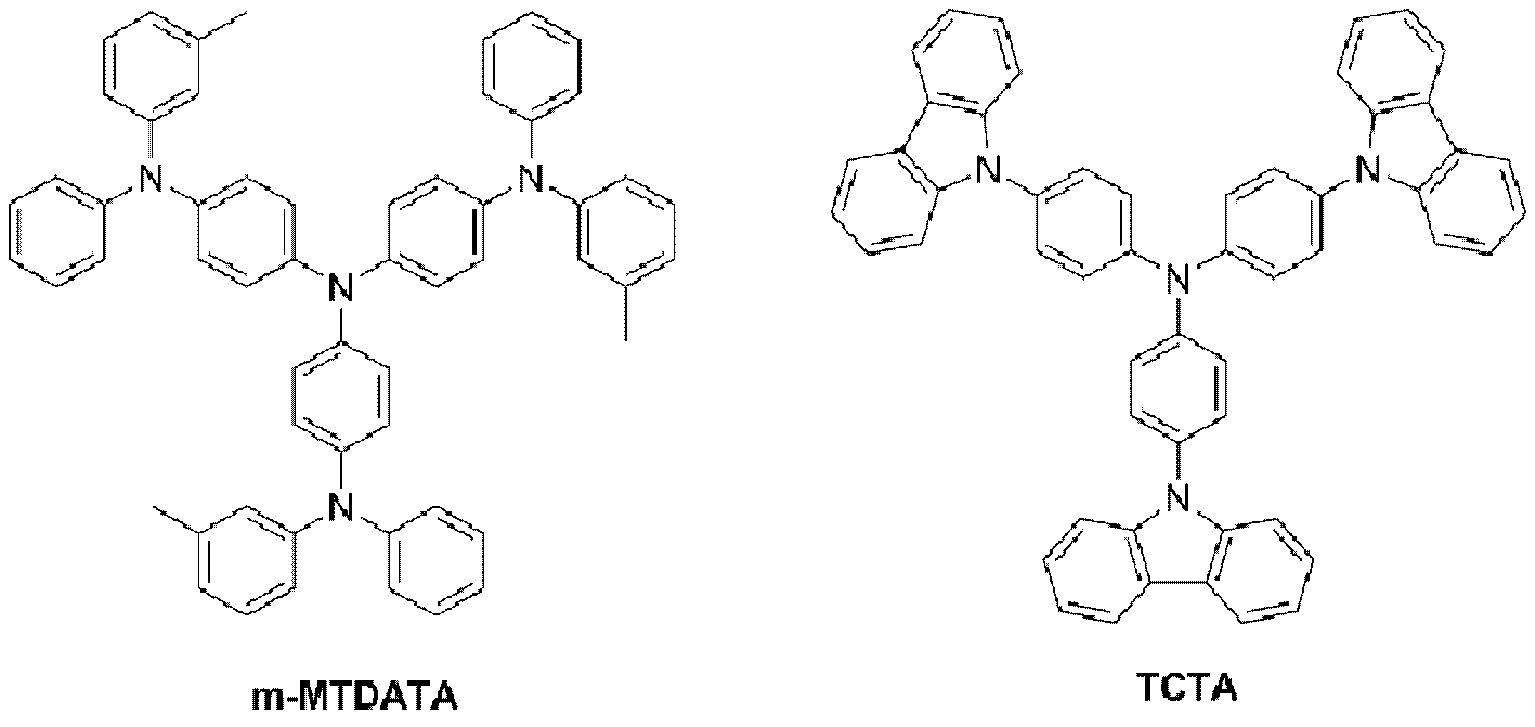
사용된 m-MTDATA, TCTA, (piq)2Ir(acac), BCP, Alq3, CBP 및 D1의 구조는 하기와 같다.
Figure PCTKR2017002848-appb-I000095
Figure PCTKR2017002848-appb-I000096
Figure PCTKR2017002848-appb-I000097
Figure PCTKR2017002848-appb-I000098
[ 평가예 1]
실시예 1 내지 32, 비교예 1 및 2에서 제작한 각각의 유기 전계 발광 소자에 대하여 전류밀도 10 mA/㎠에서의 구동전압, 발광피크 및 전류효율을 측정하고, 그 결과를 하기 표 1에 나타내었다.
샘플 발광층 호스트 구동전압 (V) 발광피크 (nm) 전류효율 (cd/A)
실시예 1 R41 4.0 621 16.5
실시예 2 R42 4.1 621 16.4
실시예 3 R43 4.1 621 17.8
실시예 4 R44 4.3 621 17.2
실시예 5 R45 4.3 621 16.5
실시예 6 R57 4.3 621 17.4
실시예 7 R381 4.2 621 17.8
실시예 8 R383 4.5 621 17.1
실시예 9 R384 4.4 621 17.1
실시예 10 R397 4.3 621 16.3
실시예 11 R399 4.2 621 17.1
실시예 12 R542 4.6 621 15.8
실시예 13 R541 4.2 621 15.8
실시예 14 R551 4.5 621 15.9
실시예 15 R141 4.1 621 16.3
실시예 16 R241 4.2 621 18.7
실시예 17 R556 4.3 621 17.2
실시예 18 R561 4.4 621 16.3
실시예 19 R567 4.1 621 18.7
실시예 20 R571 4.2 621 19.2
실시예 21 R581 3.0 621 15.9
실시예 22 R582 3.1 621 17.5
실시예 23 R583 3.3 621 15.9
실시예 24 R584 3.5 621 15.2
실시예 25 R587 3.2 621 16.7
실시예 26 R590 3.5 623 15.3
실시예 27 R593 3.1 621 16.2
실시예 28 R596 3.0 621 16.1
실시예 29 R599 3.2 621 17.3
실시예 30 R608 3.3 621 15.1
실시예 31 R621 3.5 621 16.3
실시예 32 R622 3.6 621 15.5
비교예 1 CBP 5.7 622 9.2
비교예 2 D1 4.2 622 14.7
상기 표 1에 나타낸 바와 같이, 본 발명에 따른 화합물을 적색 유기 전계 발광 소자의 발광층 재료로 사용한 경우(실시예 1 내지 32)가 종래 CBP를 적색 유기 전계 발광 소자의 발광층 재료로 사용한 경우(비교예 1)에 비해 효율 및 구동전압이 우수한 것을 알 수 있었고, D1을 적색 유기 전계 발광 소자의 발광층 재료로 사용한 경우(비교예 2)에 비해 효율이 우수한 것을 알 수 있었다.
[ 실시예 33 내지 36] 유기 전계 발광 소자의 제작
ITO (Indium tin oxide)가 1500 Å 두께로 박막 코팅된 유리 기판을 증류수로 초음파 세척하였다. 증류수 세척이 끝나면 이소프로필 알코올, 아세톤, 메탄올 등의 용제로 초음파 세척을 하고 건조시킨 후, UV OZONE 세정기(Power sonic 405, 화신테크)로 이송시킨 다음, UV를 이용하여 상기 기판을 5 분간 세정한 후 진공 층착기로 기판을 이송하였다.
상기와 같이 준비된 ITO 투명 전극 위에 m-MTDATA (60 nm)/ 합성예 4, 25, 26, 28의 각각의 화합물 (80 nm)/DS-H522(㈜두산전자) + 5% DS-501(㈜두산전자) (300 nm)/BCP (10 nm)/Alq3 (30 nm)/LiF (1 nm)/Al (200 nm) 순서로 유기 전계 발광 소자를 제조하였다.
[ 비교예 3]
정공 수송층 물질로 사용된 화합물 R44 대신 NPB를 사용하는 것을 제외하고는 실시예 33과 동일한 과정으로 유기 전계 발광 소자를 제작하였다.
사용된 NPB의 구조는 하기와 같다.
Figure PCTKR2017002848-appb-I000099
[ 평가예 2]
실시예 33 내지 36, 비교예 4에서 제작한 각각의 유기 전계 발광 소자에 대하여 전류밀도 10 mA/㎠에서의 구동전압 및 전류효율을 측정하고, 그 결과를 하기 표 2에 나타내었다.
샘플 정공 수송층 구동 전압 (V) 전류효율 (cd/A)
실시예 33 R44 2.9 22.2
실시예 34 R587 3.0 24.5
실시예 35 R590 3.6 36.8
실시예 36 R596 3.9 34.8
비교예 3 NPB 5.3 18.0
상기 표 2에 나타낸 바와 같이, 본 발명에 따른 화합물을 유기 전계 발광 소자의 정공 수송층 재료로 사용한 경우(실시예 33 내지 36)가 종래 NPB를 사용한 유기 전계 발광 소자의 정공 수송층 재료로 사용한 경우(비교예 3)에 비해 효율 및 구동전압이 우수한 것을 알 수 있었다.
[ 실시예 37 내지 43] 유기 전계 발광 소자의 제조
ITO (Indium tin oxide)가 1500 Å 두께로 박막 코팅된 유리 기판을 증류수 초음파로 세척하였다. 증류수 세척이 끝나면, 이소프로필 알코올, 아세톤, 메탄올 등의 용제로 초음파 세척을 하고, 건조시킨 후, UV OZONE 세정기(Power sonic 405, 화신테크)로 이송시킨 다음, UV를 이용하여 상기 기판을 5분간 세정하고 진공 증착기로 기판을 이송하였다.
상기와 같이 준비된 ITO 투명 전극 위에, DS-205(㈜두산전자) (80 nm)/NPB (15 nm)/ADN + 5% DS-405(㈜두산전자) (30 nm)/ 합성예 1, 18, 31 내지 35의 각각의 화합물 (80 nm) /LiF (1 nm)/Al (200 nm) 순으로 적층하여 유기 전계 발광 소자를 제조하였다.
[ 비교예 4] 유기 전계 발광 소자의 제조
전자 수송층의 물질로 사용된 화합물 R41 대신 Alq3을 사용하여 30 nm로 증착하는 것을 제외하고는 실시예 37과 동일한 과정으로 유기 전계 발광 소자를 제작하였다.
사용된 ADN의 구조는 하기와 같다.
Figure PCTKR2017002848-appb-I000100
[ 평가예 3]
실시예 37 내지 43, 비교예 4에서 각각 제조된 유기 전계 발광 소자에 대하여, 전류밀도 10 mA/㎠에서의 구동전압, 전류효율, 발광파장을 측정하였고, 그 결과를 하기 표 3에 나타내었다.
샘플 전자 수송층 구동전압 (V) 전류효율 (cd/A) 발광피크 (nm)
실시예 37 R41 2.8 9.9 458
실시예 38 R561 2.9 9.8 458
실시예 39 R611 3.0 9.9 458
실시예 40 R614 3.1 10.6 458
실시예 41 R615 3.4 11.8 458
실시예 42 R616 3.5 12.3 458
실시예 43 R617 3.4 13.2 458
비교예 4 Alq3 5.2 5.4 458
상기 표 3에 나타낸 바와 같이, 본 발명에 따른 화합물을 유기 전계 발광 소자의 전자 수송층 재료로 사용한 경우(실시예 38 내지 43)가 종래 Alq3를 사용한 유기 전계 발광 소자의 정공 수송층 재료로 사용한 경우(비교예 4)에 비해 효율 및 구동전압이 우수한 것을 알 수 있었다.

Claims (10)

  1. 하기 화학식 1로 표시되는 화합물:
    [화학식 1]
    Figure PCTKR2017002848-appb-I000101
    상기 화학식 1에서,
    A는 N, O, S 중 하나 이상의 원자를 함유 또는 비함유하는 5원 고리이고,
    B는 6원 방향족 고리이고,
    Ar1은 수소, C6~C60의 아릴기 및 핵원자수 5 내지 60의 헤테로아릴기로 이루어진 군에서 선택되고,
    L1 및 L2는 서로 동일하거나 상이하며, 각각 독립적으로 단일결합이거나, 혹은 C6~C60의 아릴렌기 및 핵원자수 5 내지 60의 헤테로아릴렌기로 이루어진 군에서 선택되며, 이때 L1은 X1, X2, Y1 내지 Y4 중 어느 하나의 탄소 또는 질소와 연결되고,
    X1은 NR1 또는 CR2R3이고,
    X2 내지 X4는 서로 동일하거나 상이하며, 각각 독립적으로 단일결합이거나, 혹은 S, O, NR4 및 CR5R6로 이루어진 군에서 선택되고, 이때 X2 및 X4 중 하나 이상은 단일결합이며, X3 및 X4가 모두 단일결합인 경우는 제외하고,
    Y1 내지 Y8 및 Y11 내지 Y18은 각각 독립적으로 CR7이고, 이때 복수의 R7는 서로 동일하거나 상이하며,
    R1 내지 R7는 서로 동일하거나 상이하며, 각각 독립적으로 수소, C6~C60의 아릴기 및 핵원자수 5 내지 60의 헤테로아릴기로 이루어진 군에서 선택되거나, 혹은 인접한 기와 결합하여 축합 방향족 고리 또는 축합 헤테로방향족 고리를 형성하며,
    상기 A의 5원 고리와, B의 6원 방향족 고리와, 상기 Ar1의 아릴기, 헤테로아릴기와, 상기 L1 및 L2의 아릴렌기, 헤테로아릴렌기와, 상기 R1 내지 R7의 아릴기, 헤테로아릴기는 각각 독립적으로 중수소, 할로겐, 시아노, C1~C40의 알킬기, C3~C40의 시클로알킬기, 핵원자수 3 내지 40의 헤테로시클로알킬기, C6~C60의 아릴기, 핵원자수 5 내지 60의 헤테로아릴기, C1~C40의 알킬옥시기, C6~C60의 아릴옥시기, C1~C40의 알킬실릴기, C6~C60의 아릴실릴기, C2~C40의 알킬보론기, C6~C60의 아릴보론기, C6~C60의 아릴포스핀기, C6~C60의 아릴포스핀옥사이드기 및 C6~C60의 아릴아민기로 이루어진 군에서 선택된 1종 이상의 치환기로 치환될 수 있으며, 이때 상기 치환기가 복수인 경우, 이들은 서로 동일하거나 상이할 수 있다.
  2. 제1항에 있어서,
    상기 화학식 1로 표시되는 화합물은 하기 화학식 2 내지 5 중 어느 하나로 표시되는 것인 화합물.
    [화학식 2]
    Figure PCTKR2017002848-appb-I000102
    [화학식 3]
    Figure PCTKR2017002848-appb-I000103
    [화학식 4]
    Figure PCTKR2017002848-appb-I000104
    [화학식 5]
    Figure PCTKR2017002848-appb-I000105
    상기 화학식 2 내지 5에서,
    A, B, Ar1 , L2, X1 내지 X4, Y1 내지 Y8, Y11 내지 Y18은 제1항에서 정의한 바와 같다.
  3. 제1항에 있어서,
    상기 화학식 1로 표시되는 화합물은 하기 화학식 6 내지 8 중 어느 하나로 표시되는 것인 화합물.
    [화학식 6]
    Figure PCTKR2017002848-appb-I000106
    [화학식 7]
    Figure PCTKR2017002848-appb-I000107
    [화학식 8]
    Figure PCTKR2017002848-appb-I000108
    상기 화학식 6 내지 8에서,
    A, B, Ar1 , L2, X3, X4, Y5 내지 Y8, Y11 내지 Y18은 제1항에서 정의한 바와 같다.
  4. 제1항에 있어서,
    상기 화학식 1로 표시되는 화합물은 하기 화학식 9 내지 11 중 어느 하나로 표시되는 것인 화합물.
    [화학식 9]
    Figure PCTKR2017002848-appb-I000109
    [화학식 10]
    Figure PCTKR2017002848-appb-I000110
    [화학식 11]
    Figure PCTKR2017002848-appb-I000111
    상기 화학식 9 내지 11에서,
    A, B, Ar1 , L2, X1, X2, Y5 내지 Y8, Y11 내지 Y18은 제1항에서 정의한 바와 같다.
  5. 제1항에 있어서,
    상기 화학식 1의
    Figure PCTKR2017002848-appb-I000112
    (*는 화학식 1의 L1과 결합하는 부위를 의미함)는 하기 A-1 내지 A-18로 표시되는 치환체 중 어느 하나로 표시되는 것인 화합물.
    Figure PCTKR2017002848-appb-I000113
    상기 A-1 내지 A-18에서,
    Ar1은 제1항에서 정의한 바와 같고,
    R8는 서로 동일하거나 상이하며, 각각 독립적으로 수소, C6~C60의 아릴기 및 핵원자수 5 내지 60의 헤테로아릴기로 이루어진 군에서 선택되며,
    상기 R8의 아릴기, 헤테로아릴기는 각각 독립적으로 중수소, 할로겐, 시아노, C1~C40의 알킬기, C3~C40의 시클로알킬기, 핵원자수 3 내지 40의 헤테로시클로알킬기, C6~C60의 아릴기, 핵원자수 5 내지 60의 헤테로아릴기, C1~C40의 알킬옥시기, C6~C60의 아릴옥시기, C1~C40의 알킬실릴기, C6~C60의 아릴실릴기, C2~C40의 알킬보론기, C6~C60의 아릴보론기, C6~C60의 아릴포스핀기, C6~C60의 아릴포스핀옥사이드기 및 C6~C60의 아릴아민기로 이루어진 군에서 선택된 1종 이상의 치환기로 치환될 수 있으며, 이때 상기 치환기가 복수인 경우, 이들은 서로 동일하거나 상이할 수 있다.
  6. 제1항에 있어서,
    상기 A는 N, O, S 중 하나 이상의 원자를 함유 또는 비함유하는 5원 고리이고,
    이때, 상기 A의 5원 고리는 하나 이상의 C6~C60의 아릴기로 치환되는 것인 화합물.
  7. 제1항에 있어서,
    상기 화학식 1의
    Figure PCTKR2017002848-appb-I000114
    는 하기 B-1 내지 B-12로 표시되는 치환체 중 어느 하나로 표시되는 것인 화합물.
    Figure PCTKR2017002848-appb-I000115
    상기 B-1 내지 B-12에서,
    R4 내지 R6는 제1항에서 정의한 바와 같다.
  8. 양극, 음극 및 상기 양극과 음극 사이에 개재(介在)된 1층 이상의 유기물층을 포함하는 유기 전계 발광 소자로서,
    상기 1층 이상의 유기물층 중 적어도 하나는 제1항 내지 제7항 중 어느 한 항에 기재된 화합물을 포함하는 것인 유기 전계 발광 소자.
  9. 제8항에 있어서,
    상기 화합물을 포함하는 유기물층은 정공 주입층, 정공 수송층 및 발광층으로 이루어진 군에서 선택되는 것인 유기 전계 발광 소자.
  10. 제8항에 있어서,
    상기 화합물을 포함하는 유기물층은 인광 발광층인 유기 전계 발광 소자.
PCT/KR2017/002848 2016-04-06 2017-03-16 유기 화합물 및 이를 이용한 유기 전계 발광 소자 Ceased WO2017175987A1 (ko)

Applications Claiming Priority (2)

Application Number Priority Date Filing Date Title
KR1020160042382A KR102592187B1 (ko) 2016-04-06 2016-04-06 유기 화합물 및 이를 이용한 유기 전계 발광 소자
KR10-2016-0042382 2016-04-06

Publications (1)

Publication Number Publication Date
WO2017175987A1 true WO2017175987A1 (ko) 2017-10-12

Family

ID=60000526

Family Applications (1)

Application Number Title Priority Date Filing Date
PCT/KR2017/002848 Ceased WO2017175987A1 (ko) 2016-04-06 2017-03-16 유기 화합물 및 이를 이용한 유기 전계 발광 소자

Country Status (2)

Country Link
KR (1) KR102592187B1 (ko)
WO (1) WO2017175987A1 (ko)

Families Citing this family (1)

* Cited by examiner, † Cited by third party
Publication number Priority date Publication date Assignee Title
KR102526511B1 (ko) * 2018-06-12 2023-04-27 덕산네오룩스 주식회사 유기전기 소자용 화합물, 이를 이용한 유기전기소자 및 그 전자 장치

Citations (5)

* Cited by examiner, † Cited by third party
Publication number Priority date Publication date Assignee Title
KR20120080508A (ko) * 2011-01-07 2012-07-17 (주)씨에스엘쏠라 유기 광화합물 및 이를 구비한 유기 광소자
KR20140012440A (ko) * 2012-07-20 2014-02-03 롬엔드하스전자재료코리아유한회사 유기 전계 발광 소자
KR20140061968A (ko) * 2012-11-13 2014-05-22 가부시키가이샤 한도오따이 에네루기 켄큐쇼 발광 소자, 발광 장치, 조명 장치, 및 전자 기기
KR20160010373A (ko) * 2014-07-18 2016-01-27 롬엔드하스전자재료코리아유한회사 유기 전계 발광 소자
KR20160029721A (ko) * 2014-09-05 2016-03-15 주식회사 엘지화학 함질소 다환 화합물 및 이를 이용한 유기 전자 소자

Family Cites Families (2)

* Cited by examiner, † Cited by third party
Publication number Priority date Publication date Assignee Title
KR101954980B1 (ko) 2011-11-03 2019-05-31 삼성디스플레이 주식회사 헤테로고리 화합물 및 이를 포함하는 유기 전계 발광 소자
KR101609031B1 (ko) * 2013-12-27 2016-04-04 주식회사 두산 유기 화합물 및 이를 포함하는 유기 전계 발광 소자

Patent Citations (5)

* Cited by examiner, † Cited by third party
Publication number Priority date Publication date Assignee Title
KR20120080508A (ko) * 2011-01-07 2012-07-17 (주)씨에스엘쏠라 유기 광화합물 및 이를 구비한 유기 광소자
KR20140012440A (ko) * 2012-07-20 2014-02-03 롬엔드하스전자재료코리아유한회사 유기 전계 발광 소자
KR20140061968A (ko) * 2012-11-13 2014-05-22 가부시키가이샤 한도오따이 에네루기 켄큐쇼 발광 소자, 발광 장치, 조명 장치, 및 전자 기기
KR20160010373A (ko) * 2014-07-18 2016-01-27 롬엔드하스전자재료코리아유한회사 유기 전계 발광 소자
KR20160029721A (ko) * 2014-09-05 2016-03-15 주식회사 엘지화학 함질소 다환 화합물 및 이를 이용한 유기 전자 소자

Also Published As

Publication number Publication date
KR20170114814A (ko) 2017-10-16
KR102592187B1 (ko) 2023-10-20

Similar Documents

Publication Publication Date Title
WO2021066623A1 (ko) 유기 발광 소자
WO2016089080A1 (ko) 유기 발광 화합물 및 이를 포함하는 유기 전계 발광 소자
WO2015190718A1 (ko) 유기 전계 발광 소자
WO2016105165A2 (ko) 유기 발광 화합물 및 이를 이용한 유기 전계 발광 소자
WO2018038401A1 (ko) 유기 화합물 및 이를 포함하는 유기 전계 발광 소자
WO2020027463A1 (ko) 유기 화합물 및 이를 이용한 유기 전계 발광 소자
WO2020159019A1 (ko) 유기 발광 화합물 및 이를 이용한 유기 전계 발광 소자
WO2014010810A1 (ko) 신규 화합물 및 이를 포함하는 유기 전계 발광 소자
WO2018080068A1 (ko) 유기 화합물 및 이를 포함하는 유기 전계 발광 소자
WO2016105123A2 (ko) 유기 화합물 및 이를 포함하는 유기 전계 발광 소자
WO2020209679A1 (ko) 유기 화합물 및 이를 포함하는 유기 전계 발광 소자
WO2018038400A1 (ko) 유기 화합물 및 이를 포함하는 유기 전계 발광 소자
WO2014092354A1 (ko) 유기 화합물 및 이를 포함하는 유기 전계 발광 소자
WO2019004584A1 (ko) 유기 화합물 및 이를 포함하는 유기 전계 발광 소자
WO2017209488A1 (ko) 유기 화합물 및 이를 포함하는 유기 전계 발광 소자
WO2018093231A1 (ko) 유기 발광 화합물 및 이를 이용한 유기 전계 발광 소자
WO2015111864A1 (ko) 유기 화합물 및 이를 포함하는 유기 전계 발광 소자
WO2017111544A1 (ko) 유기 화합물 및 이를 포함하는 유기 전계 발광 소자
WO2016068640A2 (ko) 헤테로고리 화합물 및 이를 이용한 유기발광소자
WO2020218680A1 (ko) 유기 화합물 및 이를 이용한 유기 전계 발광 소자
WO2015133804A1 (ko) 유기 화합물 및 이를 포함하는 유기 전계 발광 소자
WO2015111943A1 (ko) 유기 화합물 및 이를 포함하는 유기 전계 발광 소자
WO2015125986A1 (ko) 유기 화합물 및 이를 포함하는 유기 전계 발광 소자
WO2016122178A9 (ko) 유기 발광 화합물 및 이를 이용한 유기 전계 발광 소자
WO2015133808A1 (ko) 유기 화합물 및 이를 포함하는 유기 전계 발광 소자

Legal Events

Date Code Title Description
NENP Non-entry into the national phase

Ref country code: DE

121 Ep: the epo has been informed by wipo that ep was designated in this application

Ref document number: 17779287

Country of ref document: EP

Kind code of ref document: A1

32PN Ep: public notification in the ep bulletin as address of the adressee cannot be established

Free format text: NOTING OF LOSS OF RIGHTS PURSUANT TO RULE 112(1) EPC (EPO FORM 1205A DATED 08/02/2019)

122 Ep: pct application non-entry in european phase

Ref document number: 17779287

Country of ref document: EP

Kind code of ref document: A1

122 Ep: pct application non-entry in european phase

Ref document number: 17779287

Country of ref document: EP

Kind code of ref document: A1