WO2017170941A1 - ポリオレフィン系樹脂発泡シート及び粘着テープ - Google Patents
ポリオレフィン系樹脂発泡シート及び粘着テープ Download PDFInfo
- Publication number
- WO2017170941A1 WO2017170941A1 PCT/JP2017/013416 JP2017013416W WO2017170941A1 WO 2017170941 A1 WO2017170941 A1 WO 2017170941A1 JP 2017013416 W JP2017013416 W JP 2017013416W WO 2017170941 A1 WO2017170941 A1 WO 2017170941A1
- Authority
- WO
- WIPO (PCT)
- Prior art keywords
- polyolefin resin
- foam sheet
- less
- mass
- resin foam
- Prior art date
- Legal status (The legal status is an assumption and is not a legal conclusion. Google has not performed a legal analysis and makes no representation as to the accuracy of the status listed.)
- Ceased
Links
Classifications
-
- C—CHEMISTRY; METALLURGY
- C08—ORGANIC MACROMOLECULAR COMPOUNDS; THEIR PREPARATION OR CHEMICAL WORKING-UP; COMPOSITIONS BASED THEREON
- C08J—WORKING-UP; GENERAL PROCESSES OF COMPOUNDING; AFTER-TREATMENT NOT COVERED BY SUBCLASSES C08B, C08C, C08F, C08G or C08H
- C08J9/00—Working-up of macromolecular substances to porous or cellular articles or materials; After-treatment thereof
- C08J9/04—Working-up of macromolecular substances to porous or cellular articles or materials; After-treatment thereof using blowing gases generated by a previously added blowing agent
- C08J9/06—Working-up of macromolecular substances to porous or cellular articles or materials; After-treatment thereof using blowing gases generated by a previously added blowing agent by a chemical blowing agent
- C08J9/10—Working-up of macromolecular substances to porous or cellular articles or materials; After-treatment thereof using blowing gases generated by a previously added blowing agent by a chemical blowing agent developing nitrogen, the blowing agent being a compound containing a nitrogen-to-nitrogen bond
- C08J9/102—Azo-compounds
- C08J9/103—Azodicarbonamide
-
- C—CHEMISTRY; METALLURGY
- C08—ORGANIC MACROMOLECULAR COMPOUNDS; THEIR PREPARATION OR CHEMICAL WORKING-UP; COMPOSITIONS BASED THEREON
- C08J—WORKING-UP; GENERAL PROCESSES OF COMPOUNDING; AFTER-TREATMENT NOT COVERED BY SUBCLASSES C08B, C08C, C08F, C08G or C08H
- C08J9/00—Working-up of macromolecular substances to porous or cellular articles or materials; After-treatment thereof
- C08J9/36—After-treatment
- C08J9/365—Coating
-
- C—CHEMISTRY; METALLURGY
- C08—ORGANIC MACROMOLECULAR COMPOUNDS; THEIR PREPARATION OR CHEMICAL WORKING-UP; COMPOSITIONS BASED THEREON
- C08J—WORKING-UP; GENERAL PROCESSES OF COMPOUNDING; AFTER-TREATMENT NOT COVERED BY SUBCLASSES C08B, C08C, C08F, C08G or C08H
- C08J5/00—Manufacture of articles or shaped materials containing macromolecular substances
- C08J5/18—Manufacture of films or sheets
-
- C—CHEMISTRY; METALLURGY
- C08—ORGANIC MACROMOLECULAR COMPOUNDS; THEIR PREPARATION OR CHEMICAL WORKING-UP; COMPOSITIONS BASED THEREON
- C08J—WORKING-UP; GENERAL PROCESSES OF COMPOUNDING; AFTER-TREATMENT NOT COVERED BY SUBCLASSES C08B, C08C, C08F, C08G or C08H
- C08J9/00—Working-up of macromolecular substances to porous or cellular articles or materials; After-treatment thereof
- C08J9/04—Working-up of macromolecular substances to porous or cellular articles or materials; After-treatment thereof using blowing gases generated by a previously added blowing agent
-
- C—CHEMISTRY; METALLURGY
- C09—DYES; PAINTS; POLISHES; NATURAL RESINS; ADHESIVES; COMPOSITIONS NOT OTHERWISE PROVIDED FOR; APPLICATIONS OF MATERIALS NOT OTHERWISE PROVIDED FOR
- C09J—ADHESIVES; NON-MECHANICAL ASPECTS OF ADHESIVE PROCESSES IN GENERAL; ADHESIVE PROCESSES NOT PROVIDED FOR ELSEWHERE; USE OF MATERIALS AS ADHESIVES
- C09J7/00—Adhesives in the form of films or foils
- C09J7/20—Adhesives in the form of films or foils characterised by their carriers
-
- C—CHEMISTRY; METALLURGY
- C09—DYES; PAINTS; POLISHES; NATURAL RESINS; ADHESIVES; COMPOSITIONS NOT OTHERWISE PROVIDED FOR; APPLICATIONS OF MATERIALS NOT OTHERWISE PROVIDED FOR
- C09J—ADHESIVES; NON-MECHANICAL ASPECTS OF ADHESIVE PROCESSES IN GENERAL; ADHESIVE PROCESSES NOT PROVIDED FOR ELSEWHERE; USE OF MATERIALS AS ADHESIVES
- C09J7/00—Adhesives in the form of films or foils
- C09J7/20—Adhesives in the form of films or foils characterised by their carriers
- C09J7/22—Plastics; Metallised plastics
- C09J7/24—Plastics; Metallised plastics based on macromolecular compounds obtained by reactions involving only carbon-to-carbon unsaturated bonds
- C09J7/241—Polyolefin, e.g.rubber
- C09J7/243—Ethylene or propylene polymers
-
- C—CHEMISTRY; METALLURGY
- C09—DYES; PAINTS; POLISHES; NATURAL RESINS; ADHESIVES; COMPOSITIONS NOT OTHERWISE PROVIDED FOR; APPLICATIONS OF MATERIALS NOT OTHERWISE PROVIDED FOR
- C09J—ADHESIVES; NON-MECHANICAL ASPECTS OF ADHESIVE PROCESSES IN GENERAL; ADHESIVE PROCESSES NOT PROVIDED FOR ELSEWHERE; USE OF MATERIALS AS ADHESIVES
- C09J7/00—Adhesives in the form of films or foils
- C09J7/20—Adhesives in the form of films or foils characterised by their carriers
- C09J7/22—Plastics; Metallised plastics
- C09J7/26—Porous or cellular plastics
-
- C—CHEMISTRY; METALLURGY
- C08—ORGANIC MACROMOLECULAR COMPOUNDS; THEIR PREPARATION OR CHEMICAL WORKING-UP; COMPOSITIONS BASED THEREON
- C08J—WORKING-UP; GENERAL PROCESSES OF COMPOUNDING; AFTER-TREATMENT NOT COVERED BY SUBCLASSES C08B, C08C, C08F, C08G or C08H
- C08J2203/00—Foams characterized by the expanding agent
- C08J2203/04—N2 releasing, ex azodicarbonamide or nitroso compound
-
- C—CHEMISTRY; METALLURGY
- C08—ORGANIC MACROMOLECULAR COMPOUNDS; THEIR PREPARATION OR CHEMICAL WORKING-UP; COMPOSITIONS BASED THEREON
- C08J—WORKING-UP; GENERAL PROCESSES OF COMPOUNDING; AFTER-TREATMENT NOT COVERED BY SUBCLASSES C08B, C08C, C08F, C08G or C08H
- C08J2205/00—Foams characterised by their properties
- C08J2205/04—Foams characterised by their properties characterised by the foam pores
- C08J2205/044—Micropores, i.e. average diameter being between 0,1 micrometer and 0,1 millimeter
-
- C—CHEMISTRY; METALLURGY
- C08—ORGANIC MACROMOLECULAR COMPOUNDS; THEIR PREPARATION OR CHEMICAL WORKING-UP; COMPOSITIONS BASED THEREON
- C08J—WORKING-UP; GENERAL PROCESSES OF COMPOUNDING; AFTER-TREATMENT NOT COVERED BY SUBCLASSES C08B, C08C, C08F, C08G or C08H
- C08J2205/00—Foams characterised by their properties
- C08J2205/04—Foams characterised by their properties characterised by the foam pores
- C08J2205/052—Closed cells, i.e. more than 50% of the pores are closed
-
- C—CHEMISTRY; METALLURGY
- C08—ORGANIC MACROMOLECULAR COMPOUNDS; THEIR PREPARATION OR CHEMICAL WORKING-UP; COMPOSITIONS BASED THEREON
- C08J—WORKING-UP; GENERAL PROCESSES OF COMPOUNDING; AFTER-TREATMENT NOT COVERED BY SUBCLASSES C08B, C08C, C08F, C08G or C08H
- C08J2323/00—Characterised by the use of homopolymers or copolymers of unsaturated aliphatic hydrocarbons having only one carbon-to-carbon double bond; Derivatives of such polymers
- C08J2323/02—Characterised by the use of homopolymers or copolymers of unsaturated aliphatic hydrocarbons having only one carbon-to-carbon double bond; Derivatives of such polymers not modified by chemical after treatment
- C08J2323/04—Homopolymers or copolymers of ethene
- C08J2323/06—Polyethene
-
- C—CHEMISTRY; METALLURGY
- C09—DYES; PAINTS; POLISHES; NATURAL RESINS; ADHESIVES; COMPOSITIONS NOT OTHERWISE PROVIDED FOR; APPLICATIONS OF MATERIALS NOT OTHERWISE PROVIDED FOR
- C09J—ADHESIVES; NON-MECHANICAL ASPECTS OF ADHESIVE PROCESSES IN GENERAL; ADHESIVE PROCESSES NOT PROVIDED FOR ELSEWHERE; USE OF MATERIALS AS ADHESIVES
- C09J2400/00—Presence of inorganic and organic materials
- C09J2400/20—Presence of organic materials
- C09J2400/24—Presence of a foam
- C09J2400/243—Presence of a foam in the substrate
-
- C—CHEMISTRY; METALLURGY
- C09—DYES; PAINTS; POLISHES; NATURAL RESINS; ADHESIVES; COMPOSITIONS NOT OTHERWISE PROVIDED FOR; APPLICATIONS OF MATERIALS NOT OTHERWISE PROVIDED FOR
- C09J—ADHESIVES; NON-MECHANICAL ASPECTS OF ADHESIVE PROCESSES IN GENERAL; ADHESIVE PROCESSES NOT PROVIDED FOR ELSEWHERE; USE OF MATERIALS AS ADHESIVES
- C09J2423/00—Presence of polyolefin
- C09J2423/04—Presence of homo or copolymers of ethene
- C09J2423/046—Presence of homo or copolymers of ethene in the substrate
Definitions
- the present invention relates to a polyolefin resin foam sheet and an adhesive tape using the same.
- a foamed sheet in which a large number of bubbles are formed inside the resin layer has excellent buffering properties, and is therefore widely used as a shock absorber for various electronic devices.
- the shock absorbing material is used by being disposed between a glass plate constituting the surface of the device and an image display member.
- Patent Document 1 discloses an adhesive tape based on a polyolefin-based resin.
- the foam sheet and sealing material used in such applications need to be thinned and narrowed by downsizing the device, but when used in a position close to a light emitting part such as a backlight of a display device, There has been a problem that the light passes through the thin part of the foam sheet and the sealing material and leaks to the outside of the device.
- a method for solving this problem a method of lowering the expansion ratio of the foamed sheet or a method of increasing the thickness of the foamed sheet can be considered.
- the flexibility of the foamed sheet is lost or a small electronic device is used.
- the present invention has been made in view of the above-described conventional circumstances, and provides a polyolefin resin foam sheet having excellent light shielding properties and excellent flexibility, and an adhesive tape using the same. Objective.
- the gist of the present invention is the following [1] to [2].
- [1] A polyolefin resin foam sheet obtained by foaming a polyolefin resin composition containing a polyolefin resin and a pigment, having a 25% compression stress of 80 to 1400 kPa and a pigment content of 0.60 with respect to 100 parts by mass of the resin.
- a polyolefin-based resin foam sheet having a content of ⁇ 10.00 parts by mass, a density of 0.10 to 0.60 g / cm 3 , and a gel fraction of 25 to 60% by mass.
- An adhesive tape in which an adhesive layer is provided on at least one surface of the polyolefin resin foam sheet described in [1].
- the polyolefin resin foam sheet of the present invention (hereinafter also referred to as “foam sheet”) is a polyolefin resin foam sheet obtained by foaming a polyolefin resin composition containing a polyolefin resin and a pigment, and has a 25% compression stress. Is 80 to 1400 kPa, the pigment is 0.60 to 10.00 parts by mass with respect to 100 parts by mass of the resin, the density is 0.10 to 0.60 g / cm 3 , and the gel fraction is 25 to 60% by mass. It is what is.
- the 25% compressive stress of the foamed sheet of the present invention is 80 kPa or more, preferably 90 kPa or more, more preferably 100 kPa or more, and 1400 kPa or less, preferably 1200 kPa or less, more preferably 1000 kPa or less, more preferably 900 kPa or less, Still more preferably, it is 800 kPa or less, More preferably, it is 700 kPa or less, More preferably, it is 600 kPa or less, More preferably, it is 550 kPa or less.
- 25% compression stress is equal to or higher than the lower limit, the impact absorbability is improved, and when it is equal to or lower than the upper limit, the flexibility of the foamed sheet is improved.
- the adhesive tape is used, the followability to the adherend is good. This makes it difficult for water and air to enter the electronic device.
- 25% compressive stress can be measured according to the method as described in the Example mentioned later.
- An organic pigment and an inorganic pigment can be used.
- the organic pigment include azo pigments, diazo pigments, phthalocyanine pigments, quinacridone pigments, isoindolinone pigments, dioxazine pigments, perylene pigments, perinone pigments, thioindigo pigments, anthraquinone pigments, and quinophthalone pigments.
- the inorganic pigment include carbon black, metal oxide, metal sulfide, and metal chloride. These pigments may be used alone or in combination of two or more.
- the amount of the pigment relative to 100 parts by mass of the polyolefin resin is 0.60 parts by mass or more, preferably 0.70 parts by mass or more, more preferably 0.80 parts by mass or more, from the viewpoint of improving the light shielding properties of the foamed sheet.
- it is 0.90 parts by mass or more, more preferably 1.00 parts by mass or more, and from the viewpoint of preventing a decrease in flexibility of the foamed sheet, it is 10.00 parts by mass or less, preferably 5.00 parts by mass.
- it is more preferably 3.00 parts by mass or less, and still more preferably 1.50 parts by mass.
- the density of the foamed sheet of the present invention from the viewpoint of improving the light-blocking foam sheet, 0.10 g / cm 3 or higher, preferably 0.15 g / cm 3 or more, more preferably 0.20 g / cm 3 or more, further Preferably it is 0.25 g / cm 3 or more, more preferably 0.30 g / cm 3 or more, still more preferably 0.35 g / cm 3 or more, and from the viewpoint of preventing a decrease in flexibility of the foam sheet, 0.60 g / cm 3 or less, preferably 0.55 g / cm 3 or less, more preferably 0.50 g / cm 3 or less, more preferably 0.45 g / cm 3 or less, even more preferably 0.40 g / cm 3 It is as follows.
- the expansion ratio of the foam sheet of the present invention can be defined by the reciprocal of the density of the foam sheet, preferably 1.5 cm 3 / g or more, more preferably 1.6 cm 3 / g or more, and still more preferably 1.7 cm. 3 / g or more, even more preferably at 1.8 cm 3 / g or more, and preferably 10.0 cm 3 / g or less, more preferably 8.0 cm 3 / g or less, more preferably 7.0 cm 3 / g or less, still more preferably 6.0 cm 3 / g or less, still more preferably 5.5 cm 3 / g or less, still more preferably 5.0 cm 3 / g or less.
- the expansion ratio is within the above range, the light shielding property of the foamed sheet can be improved, and the shock absorbing property and the step following property of the foamed sheet can be easily secured.
- the foam sheet of the present invention is crosslinked from the viewpoint of reducing the average cell diameter in the ZD direction, and the gel fraction is 25% by mass or more, preferably 30% by mass or more, more preferably 35% by mass or more. And it is 60 mass% or less, Preferably it is 55 mass% or less, More preferably, it is 53 mass% or less.
- the gel fraction is equal to or higher than the lower limit, sufficient cross-linking is formed, and a foamed sheet having a small average cell diameter can be obtained by foaming this. Moreover, it becomes easy to ensure the softness
- a gel fraction can be measured according to the method as described in the Example mentioned later.
- the average cell diameter in the MD direction in the foamed sheet of the present invention is preferably 10 ⁇ m or more, more preferably 20 ⁇ m or more, still more preferably 25 ⁇ m or more, from the viewpoint of improving the light shielding property, flexibility, and step following ability of the foamed sheet. More preferably 30 ⁇ m or more, still more preferably 32 ⁇ m or more, and preferably 150 ⁇ m or less, more preferably 140 ⁇ m or less, still more preferably 135 ⁇ m or less, even more preferably 130 ⁇ m or less, even more preferably 125 ⁇ m or less, more More preferably, it is 120 micrometers or less, More preferably, it is 115 micrometers or less.
- the average bubble diameter in the MD direction is equal to or greater than the lower limit, flexibility and step following ability are improved.
- the light shielding property of a foam sheet improves that the average bubble of MD direction is below the said upper limit.
- the average cell diameter in the TD direction in the foamed sheet of the present invention is preferably 10 ⁇ m or more, more preferably 20 ⁇ m or more, still more preferably 25 ⁇ m or more, from the viewpoint of improving the light shielding property, flexibility, and step following property of the foamed sheet. More preferably 30 ⁇ m or more, still more preferably 35 ⁇ m or more, still more preferably 38 ⁇ m or more, and preferably 250 ⁇ m or less, more preferably 210 ⁇ m or less, still more preferably 170 ⁇ m or less, even more preferably 130 ⁇ m or less, more More preferably, it is 125 micrometers or less, More preferably, it is 120 micrometers or less, More preferably, it is 115 micrometers or less.
- the average bubble diameter in the MD direction is equal to or greater than the lower limit, flexibility and step following ability are improved.
- the light shielding property of a foam sheet improves that the average bubble of MD direction is below the said upper limit.
- the average cell diameter in the ZD direction in the foamed sheet of the present invention is preferably 5 ⁇ m or more, more preferably 7 ⁇ m or more, and even more preferably 9 ⁇ m or more, from the viewpoint of improving the light shielding properties, flexibility, and step following ability of the foamed sheet. More preferably, it is 11 ⁇ m or more, more preferably 13 ⁇ m or more, still more preferably 15 ⁇ m or more, and preferably 60 ⁇ m or less, more preferably 55 ⁇ m or less, still more preferably 50 ⁇ m or less, even more preferably 45 ⁇ m or less, more More preferably, it is 40 ⁇ m or less.
- the average bubble diameter in the ZD direction is equal to or greater than the lower limit, flexibility and step following ability are improved.
- the light shielding property of a foam sheet improves that the average bubble of a ZD direction is below the said upper limit.
- the maximum cell diameter in the MD direction in the foamed sheet of the present invention is preferably 30 ⁇ m or more, more preferably 40 ⁇ m or more, and even more preferably 50 ⁇ m or more, from the viewpoint of improving the light shielding property, flexibility, and step following ability of the foamed sheet. And preferably 400 ⁇ m or less, more preferably 350 ⁇ m or less, and still more preferably 300 ⁇ m or less.
- the maximum bubble diameter in the MD direction is equal to or greater than the lower limit, flexibility and step following ability are improved.
- the light shielding property of a foam sheet improves that the largest bubble of MD direction is below the said upper limit.
- the maximum cell diameter in the TD direction in the foamed sheet of the present invention is preferably 80 ⁇ m or more, more preferably 90 ⁇ m or more, and still more preferably 100 ⁇ m or more, from the viewpoint of improving the light shielding property, flexibility, and step following ability of the foamed sheet. And preferably 500 ⁇ m or less, more preferably 450 ⁇ m or less, and still more preferably 400 ⁇ m or less.
- the maximum bubble diameter in the TD direction is equal to or greater than the lower limit, flexibility and step following ability are improved.
- the light shielding property of a foam sheet improves that the largest bubble of TD direction is below the said upper limit.
- the maximum cell diameter in the ZD direction in the foamed sheet of the present invention is preferably 10 ⁇ m or more, more preferably 20 ⁇ m or more, and even more preferably 30 ⁇ m or more, from the viewpoint of improving the light shielding properties, flexibility, and step following ability of the foamed sheet. And preferably 150 ⁇ m or less, more preferably 140 ⁇ m or less, and still more preferably 130 ⁇ m or less.
- the maximum bubble diameter in the ZD direction is equal to or greater than the lower limit value, flexibility and step following ability are improved.
- the light-shielding property of a foam sheet improves that the largest bubble of a ZD direction is below the said upper limit.
- MD means “Machine Direction” and means a direction that coincides with the extrusion direction of the polyolefin-based resin foam sheet.
- TD means Transverse Direction, which means a direction perpendicular to MD and parallel to the foam sheet.
- ZD means Thickness Direction, which is a direction perpendicular to both MD and TD.
- the said average bubble diameter can be measured according to the method of the Example mentioned later.
- the thickness of the foam sheet of the present invention is preferably 0.020 mm or more, more preferably 0.030 mm or more, and further preferably 0.040 mm or more, from the viewpoint of improving the light shielding properties, flexibility, and step following ability of the foam sheet. More preferably, it is 0.050 mm or more, and preferably 0.38 mm or less, more preferably 0.35 mm or less, still more preferably 0.32 mm or less, and still more preferably 0.30 mm or less.
- the thickness of the foamed sheet is not less than the lower limit, the light shielding properties and strength of the foamed sheet can be improved.
- the thickness of the foamed sheet is not more than the above upper limit value, it can be used inside a thin electronic device, and the flexibility and the step following ability can be further improved.
- the average number of cells per 0.5 mm in the MD direction of the foamed sheet of the present invention is preferably 2 or more, more preferably 3 or more, from the viewpoint of improving the light shielding properties, flexibility, and step following ability of the foamed sheet. 4 or more, and preferably 20 or less, more preferably 18 or less, still more preferably 17 or less, still more preferably 15 or less, still more preferably 13 or less, and even more.
- the number is preferably 11 or less, more preferably 9 or less, and still more preferably 8 or less.
- the average number of bubbles per 0.5 mm in the TD direction of the foamed sheet of the present invention is preferably 1 or more, more preferably 2 from the viewpoint of improving the light shielding property, flexibility, and step following ability of the foamed sheet. More preferably 3 or more, and preferably 18 or less, more preferably 16 or less, still more preferably 14 or less, still more preferably 12 or less, even more preferably 10 or less, More preferably, it is 8 or less.
- the average number of bubbles per 0.5 mm in the ZD direction of the foamed sheet of the present invention is preferably 1 or more, more preferably 2 or more, from the viewpoint of improving the light shielding property, flexibility, and step following ability of the foamed sheet.
- the number is more preferably 3 or more, and preferably 13 or less, more preferably 11 or less, still more preferably 9 or less, still more preferably 8 or less, and still more preferably 6 or less.
- the average number of bubbles per 0.5 mm of the foamed sheet is equal to or more than the lower limit, the light shielding property of the foamed sheet can be improved.
- it can use for the inside of a thin electronic device as the average number of bubbles per 0.5 mm is below the said upper limit, and also a softness
- the average number of bubbles per 0.5 mm can be measured according to the method of the example described later.
- the foam sheet of the present invention preferably has closed cells.
- the bubbles are closed cells, the amount of deformation of the bubbles can be suppressed when subjected to an impact, the amount of deformation of the foamed sheet with respect to the impact can be suppressed, and as a result, the impact absorbability can be further improved.
- the closed cell ratio is preferably 70 to 100%, more preferably 80 to 100%, and still more preferably 90 to 100% in order to further improve the impact absorbability.
- the movement of the air inside a foam sheet is restrict
- the closed cell rate means what was measured based on ASTM D2856 (1998).
- polyolefin resin examples of the polyolefin resin used to form the foamed sheet include a polyethylene resin, a polypropylene resin, or a mixture thereof.
- the polyethylene resin may be an ethylene homopolymer, but is obtained by copolymerizing ethylene with a small amount (for example, 30% by mass or less, preferably 10% by mass or less of the total monomers) of ⁇ -olefin as required.
- Polyethylene resins are preferred, and among them, linear low density polyethylene is preferred.
- ⁇ -olefin constituting the polyethylene resin examples include propylene, 1-butene, 1-pentene, 4-methyl-1-pentene, 1-hexene, 1-heptene, and 1-octene. . Of these, ⁇ -olefins having 4 to 10 carbon atoms are preferred.
- the polyethylene resin an ethylene-vinyl acetate copolymer is also preferable.
- the ethylene-vinyl acetate copolymer is usually a copolymer containing 50% by mass or more of ethylene units.
- the polyethylene-based resin preferably has a low density in order to increase the flexibility of the foamed sheet and increase the shock absorption.
- the density of the polyethylene resin particularly preferably from 0.920 g / cm 3 or less, more preferably 0.880 ⁇ 0.915g / cm 3, more preferably 0.885 ⁇ 0.910g / cm 3. The density is measured according to ASTM D792.
- polypropylene resin examples include a propylene homopolymer, a propylene-ethylene copolymer containing 50% by mass or more of propylene units, and a propylene- ⁇ -olefin copolymer. These may be used alone or in combination of two or more.
- Specific examples of the ⁇ -olefin constituting the propylene- ⁇ -olefin copolymer include 1-butene, 1-pentene, 4-methyl-1-pentene, 1-hexene, 1-heptene, 1-octene and the like. Of these, ⁇ -olefins having 6 to 12 carbon atoms are preferred.
- Polyolefin resins in the present invention include polyethylene resins and polypropylene resins polymerized by using metallocene compounds, Ziegler-Natta compounds, chromium oxide compounds, etc. as catalysts from the viewpoint of improving flexibility and impact absorption. Or a mixture thereof, and among the polyethylene resins, linear low density polyethylene is more preferable.
- the content is preferably 40% by mass or more of the entire polyolefin resin, 50 mass% or more is more preferable, 60 mass% or more is still more preferable, and 100 mass% is still more preferable.
- Suitable metallocene compounds include compounds such as bis (cyclopentadienyl) metal complexes having a structure in which a transition metal is sandwiched between ⁇ -electron unsaturated compounds. More specifically, tetravalent transition metals such as titanium, zirconium, nickel, palladium, hafnium, and platinum have one or more cyclopentadienyl rings or their analogs as ligands (ligands). The compound to be mentioned is mentioned. Such metallocene compounds have uniform active site properties and each active site has the same activity. A polymer synthesized using a metallocene compound has high uniformity such as molecular weight, molecular weight distribution, composition, and composition distribution.
- Examples of the ligand include a cyclopentadienyl ring and an indenyl ring. These cyclic compounds may be substituted with a hydrocarbon group, a substituted hydrocarbon group or a hydrocarbon-substituted metalloid group.
- Examples of the hydrocarbon group include a methyl group, an ethyl group, various propyl groups, various butyl groups, various amyl groups, various hexyl groups, 2-ethylhexyl groups, various heptyl groups, various octyl groups, various nonyl groups, and various decyl groups. , Various cetyl groups, phenyl groups and the like.
- the “various” means various isomers including n-, sec-, tert-, and iso-. Moreover, what polymerized the cyclic compound as an oligomer may be used as a ligand. In addition to ⁇ -electron unsaturated compounds, monovalent anion ligands such as chlorine and bromine or divalent anion chelate ligands, hydrocarbons, alkoxides, arylamides, aryloxides, amides, arylamides, phosphides, aryls Phosphide or the like may be used.
- monovalent anion ligands such as chlorine and bromine or divalent anion chelate ligands, hydrocarbons, alkoxides, arylamides, aryloxides, amides, arylamides, phosphides, aryls Phosphide or the like may be used.
- metallocene compounds containing tetravalent transition metals and ligands include, for example, cyclopentadienyl titanium tris (dimethylamide), methylcyclopentadienyl titanium tris (dimethylamide), bis (cyclopentadienyl) titanium dichloride, dimethyl And silyltetramethylcyclopentadienyl-t-butylamidozirconium dichloride.
- the metallocene compound exhibits an action as a catalyst in the polymerization of various olefins by combining with a specific cocatalyst (co-catalyst).
- specific cocatalyst include methylaluminoxane (MAO) and boron compounds.
- the proportion of the cocatalyst used with respect to the metallocene compound is preferably 100,000 to 1,000,000 mole times, more preferably 50 to 5,000 mole times.
- the Ziegler-Natta compound is a triethylaluminum-titanium tetrachloride solid composite, which is obtained by reducing titanium tetrachloride with an organoaluminum compound and then treating with various electron donors and electron acceptors.
- a method of combining a composition, an organoaluminum compound, and an aromatic carboxylic acid ester see JP-A 56-1000080, JP-A 56-120712, JP-A 58-104907), halogens Method of supported catalyst in which magnesium tetrachloride is brought into contact with magnesium tetrachloride and various electron donors (see JP-A-57-63310, JP-A-63-43915, JP-A-63-83116), etc. What was manufactured by is preferable.
- the polyolefin resin a resin other than the above-described polyolefin resin can be used in combination. Furthermore, you may mix the various additives mentioned later and other arbitrary components with polyolefin resin.
- optional components contained in the foamed sheet include resins and rubbers other than polyolefin-based resins. These are a total of less content than polyolefin-based resins, and are usually 50 parts per 100 parts by mass of polyolefin-based resin. It is about 30 parts by mass or less, preferably about 30 parts by mass or less.
- the foam sheet of the present invention can be produced by foaming a polyolefin resin composition by a general method. There is no restriction
- Step (1) Polyolefin resin, pigment, pyrolyzable foaming agent, and other additives are supplied to an extruder, melt-kneaded, and extruded into a sheet using the extruder, thereby forming a sheet-like polyolefin Step of obtaining the resin composition
- Step (2) Step of crosslinking the sheet-shaped polyolefin resin composition
- Step (3) Heating the crosslinked sheet-shaped polyolefin resin composition to thermally decompose foaming agent
- a manufacturing method of a crosslinked polyolefin resin foamed sheet it is also possible to manufacture by a method described in International Publication No. 2005/007731.
- the pyrolytic foaming agent is not particularly limited, and examples thereof include azodicarbonamide, N, N′-dinitrosopentamethylenetetramine, p-toluenesulfonyl semicarbazide and the like. Of these, azodicarbonamide is preferred.
- a thermal decomposition type foaming agent may be used individually or in combination of 2 or more types.
- the content of the thermally decomposable foaming agent in the polyolefin resin composition is preferably 1 to 12 parts by mass and more preferably 1 to 8 parts by mass with respect to 100 parts by mass of the polyolefin resin.
- the foamability of the polyolefin resin composition is improved, and it becomes easier to obtain a polyolefin resin foam sheet having a desired foaming ratio, as well as tensile strength and compression recovery. Improves.
- Examples of other additives used in the step (1) include a decomposition temperature adjusting agent, a crosslinking aid, and an antioxidant.
- the decomposition temperature adjusting agent is blended to lower the decomposition temperature of the pyrolytic foaming agent or to increase or adjust the decomposition rate.
- Specific examples of the compound include zinc oxide, zinc stearate, urea and the like.
- the decomposition temperature adjusting agent is blended in an amount of 0.01 to 5 parts by mass with respect to 100 parts by mass of the polyolefin resin, for example, in order to adjust the surface state of the foam sheet.
- a polyfunctional monomer can be used as a crosslinking aid.
- the ionizing radiation dose to be irradiated in the step (2) described later can be reduced, thereby preventing the resin molecules from being cut and deteriorated by the irradiation of ionizing radiation. can do.
- Specific examples of the crosslinking aid include one molecule such as trimethylolpropane trimethacrylate, trimethylolpropane triacrylate, trimellitic acid triallyl ester, 1,2,4-benzenetricarboxylic acid triallyl ester, triallyl isocyanurate, and the like.
- Two compounds in one molecule such as a compound having three functional groups, 1,6-hexanediol dimethacrylate, 1,9-nonanediol dimethacrylate, 1,10-decanediol dimethacrylate, divinylbenzene, etc.
- Examples thereof include compounds having a functional group, diallyl phthalate, diallyl terephthalate, diallyl isophthalate, ethyl vinyl benzene, neopentyl glycol dimethacrylate, lauryl methacrylate, stearyl methacrylate and the like.
- These crosslinking aids are used alone or in combination of two or more.
- the addition amount of the crosslinking aid is preferably 0.2 to 10 parts by mass, more preferably 0.3 to 5 parts by mass, and still more preferably 0.5 to 5 parts by mass with respect to 100 parts by mass of the resin component.
- the addition amount is 0.2 parts by mass or more, it is possible to stably obtain a foam sheet having a gel fraction desired by the foam sheet, and when it is 10 parts by mass or less, the gel fraction of the foam sheet can be controlled. It becomes easy.
- the antioxidant include phenolic antioxidants such as 2,6-di-t-butyl-p-cresol.
- the method for foaming the polyolefin resin composition is not particularly limited.
- the method of heating the polyolefin resin composition with hot air the method of heating with infrared rays, the method of heating with a salt bath, or the method of heating with an oil bath. Etc., and these may be used in combination.
- the foaming of the polyolefin-based resin composition is not limited to an example using a pyrolytic foaming agent, and physical foaming with butane gas or the like may be used.
- Examples of the method for crosslinking the polyolefin resin composition include a method in which an organic peroxide is blended in advance with the polyolefin resin composition, and the organic peroxide is decomposed by heating the polyolefin resin composition. It is done.
- Examples of the organic peroxide used for crosslinking include 1,1-bis (t-butylperoxy) 3,3,5-trimethylcyclohexane, 1,1-bis (t-butylperoxy) cyclohexane, and the like. It is done. These may be used alone or in combination of two or more.
- the addition amount of the organic peroxide is preferably 0.01 to 5 parts by mass, more preferably 0.1 to 3 parts by mass with respect to 100 parts by mass of the polyolefin resin.
- the amount of the organic peroxide added is within the above range, the crosslinking of the polyolefin resin composition is likely to proceed, and the amount of decomposition residue of the organic peroxide is suppressed in the obtained crosslinked polyolefin resin foam sheet. can do.
- Examples of the method for crosslinking the polyolefin resin composition include a method of irradiating the polyolefin resin composition with ionizing radiation such as electron beam, ⁇ ray, ⁇ ray, and ⁇ ray.
- the dose of ionizing radiation is preferably 5 to 200 kGy, more preferably 30 to 120 kGy so that the gel fraction is 25 to 60% by mass.
- a method of irradiating ionizing radiation is preferable from the viewpoint of homogeneous crosslinking.
- the polyolefin resin foam sheet of the present invention is preferably stretched in one or both of the MD direction and the TD direction.
- stretched in one or both of the MD direction and the TD direction the average cell diameter in the ZD direction is reduced, and heat is hardly transmitted by increasing the distance between the thermally conductive resin portions, thereby improving the heat insulation.
- the stretching may be performed after foaming the polyolefin-based resin composition to obtain a foamed sheet, or may be performed while foaming the polyolefin-based resin composition.
- the foamed sheet may be heated again to be in a molten or softened state and then stretched.
- the draw ratio in the MD direction of the foamed sheet is preferably 1.1 to 3.2 times, and more preferably 1.3 to 3.0 times.
- the draw ratio in the MD direction of the foamed sheet is set to the above lower limit value or more, the flexibility and tensile strength of the foamed sheet are likely to be good.
- the upper limit value is not exceeded, the foamed sheet is prevented from breaking during stretching, or the foaming gas escapes from the foamed sheet being foamed and the foaming ratio is reduced, thereby reducing the flexibility and tensile strength of the foamed sheet. It becomes good and it becomes easy to make the quality uniform.
- the draw ratio in the TD direction of the foamed sheet is preferably 1.3 to 3.8 times, and more preferably 1.5 to 3.5 times.
- the pressure-sensitive adhesive tape of the present invention uses the foamed sheet according to the present invention as a base material, and is provided with a pressure-sensitive adhesive layer on one side or both sides of the foamed sheet.
- the thickness of the adhesive tape is usually 0.03 to 2.0 mm, preferably 0.05 to 1.0 mm.
- the thickness of the pressure-sensitive adhesive layer constituting the pressure-sensitive adhesive tape is preferably 5 to 200 ⁇ m, more preferably 7 to 150 ⁇ m, still more preferably 10 to 100 ⁇ m.
- the thickness of the pressure-sensitive adhesive layer constituting the pressure-sensitive adhesive tape is 5 to 200 ⁇ m, it is possible to reduce the thickness of the pressure-sensitive adhesive tape and contribute to the miniaturization and thickness reduction of the electronic device itself in which the pressure-sensitive adhesive tape is used. Can do.
- an adhesive which comprises the adhesive layer provided in one side or both surfaces of a foam sheet For example, an acrylic adhesive, a urethane type adhesive, a rubber-type adhesive, etc. are used.
- a method of applying a pressure-sensitive adhesive to the foamed sheet and laminating the pressure-sensitive adhesive layer on the foamed sheet for example, a method of applying the pressure-sensitive adhesive using a coating machine such as a coater on at least one surface of the foamed sheet, Examples thereof include a method of spraying and applying a pressure-sensitive adhesive using a spray on at least one surface of the foamed sheet, a method of applying a pressure-sensitive adhesive using a brush on one surface of the foamed sheet, and the like.
- the pressure-sensitive adhesive tape using the foam sheet of the present invention is an impact absorbing material that prevents an impact applied to an electronic component built in an electronic device body such as a mobile phone or a video camera, and dust or dirt in the electronic device body. It can be used as a sealing material that prevents moisture and the like from entering.
- ⁇ Density and expansion ratio> The density of the foamed sheets obtained in Examples and Comparative Examples was measured according to JIS K7222, and the reciprocal number was taken as the foaming ratio.
- the 25% compressive stress was measured in accordance with JIS K6767 for a polyolefin resin foam sheet. In the present invention, it is preferable that the 25% compressive stress is smaller from the viewpoint of improving flexibility and step following ability.
- a foam sample for measurement was prepared by cutting the foam sheet obtained in each of the examples and comparative examples into 50 mm squares. This was immersed in liquid nitrogen for 1 minute, and then cut with a razor blade in the thickness direction along the MD direction, the TD direction, and the ZD direction. This cross section was taken with a digital microscope (Keyence Co., Ltd. “VHX-900”), and a 200x magnified photograph was taken. All independent sections existing on the cut surface for a length of 2 mm in each of the MD and TD directions. The bubble diameter was measured about the bubble, and the operation was repeated 5 times.
- the bubble diameter of closed cells present in a 2 mm ⁇ 2 mm square was measured, and the operation was repeated 5 times. And the average value of all the bubbles of each direction was made into the average bubble diameter of MD direction, TD direction, and ZD direction, and the largest bubble diameter in the measured bubble diameter was made into the largest bubble diameter.
- Total light transmittance The total light transmittance was measured with a haze meter (“NDH2000” manufactured by Nippon Denshoku Industries Co., Ltd.). The total light transmittance was measured for each of the ZD, MD, and TD directions of the foam sheet. In the MD and TD directions, after punching to a width of 0.5 mm and a length of 25 mm, stacking is performed until the thickness reaches 5 mm or more, fixing both ends of 25 mm so that there is no gap, and a width direction of 0.5 mm Measured against.
- Example 1 Linear low-density polyethylene (exon chemical “Exact3027”, density: 0.900 g / cm 3 ) 100 parts by mass as a polyolefin resin, pigment (Daiichi Seika Kogyo Co., Ltd., AP-091979) 1.13 Parts by mass, 2.1 parts by mass of azodicarbonamide as a pyrolytic foaming agent, 1 part by mass of zinc oxide as a decomposition temperature adjusting agent, and 2,6-di-t-butyl-p-cresol as an antioxidant After 0.5 parts by mass was supplied to an extruder and melt-kneaded at 130 ° C., the polyolefin resin composition was extruded into a long sheet having a thickness of about 0.3 mm.
- the long sheet-like polyolefin resin composition is crosslinked by irradiating 70 kGy of an electron beam with an acceleration voltage of 500 kV on both sides thereof, and then continuously in a foaming furnace maintained at 250 ° C. by hot air and an infrared heater.
- the foamed sheet having a thickness of 0.14 mm was obtained by foaming by heating and foaming and stretching the MD with a stretching ratio of 1.3 times and a TD with a stretching ratio of 2.0.
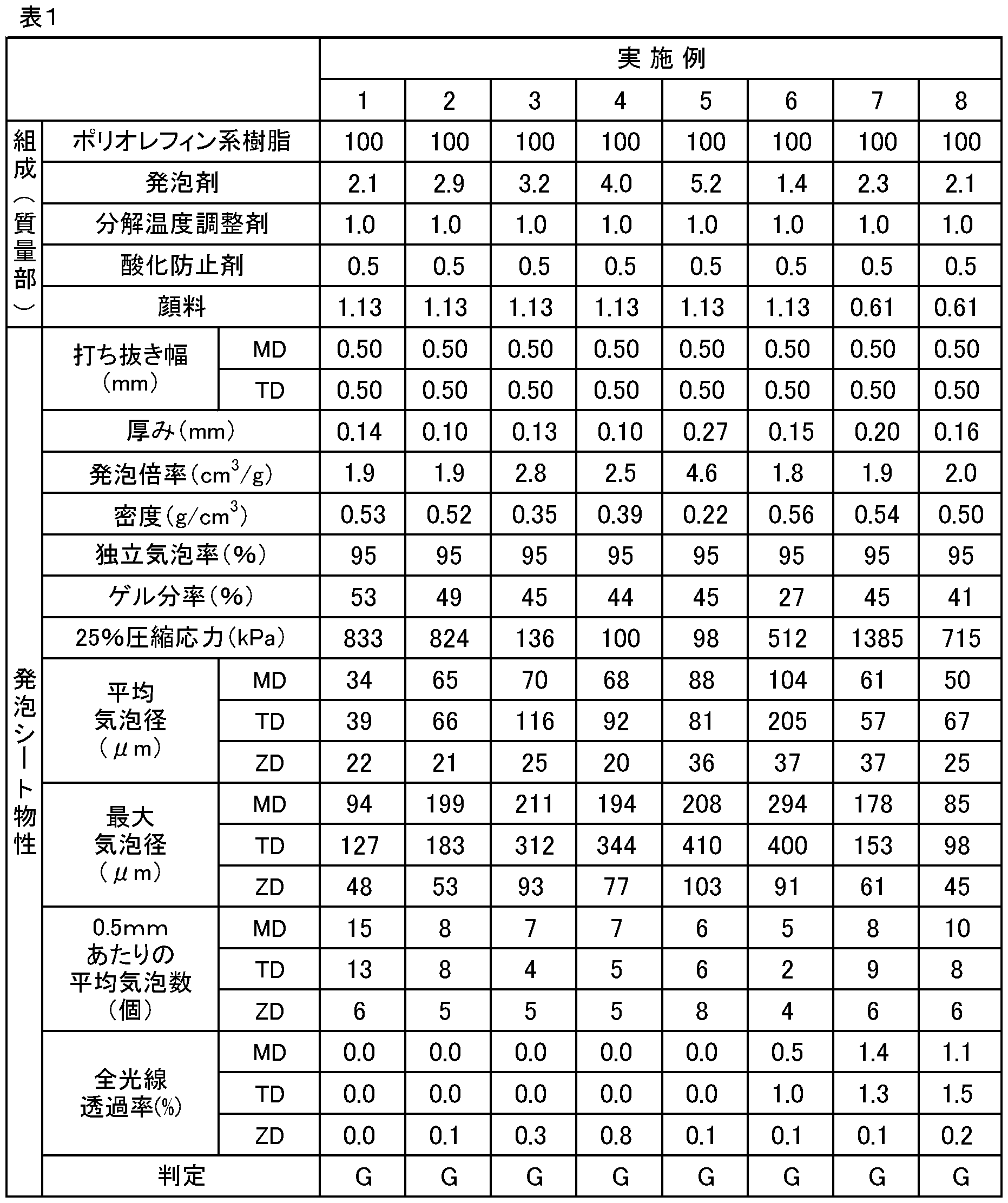
- Table 1 shows the evaluation results of the obtained foamed sheet.
- Example 2-8 Comparative Examples 1-8
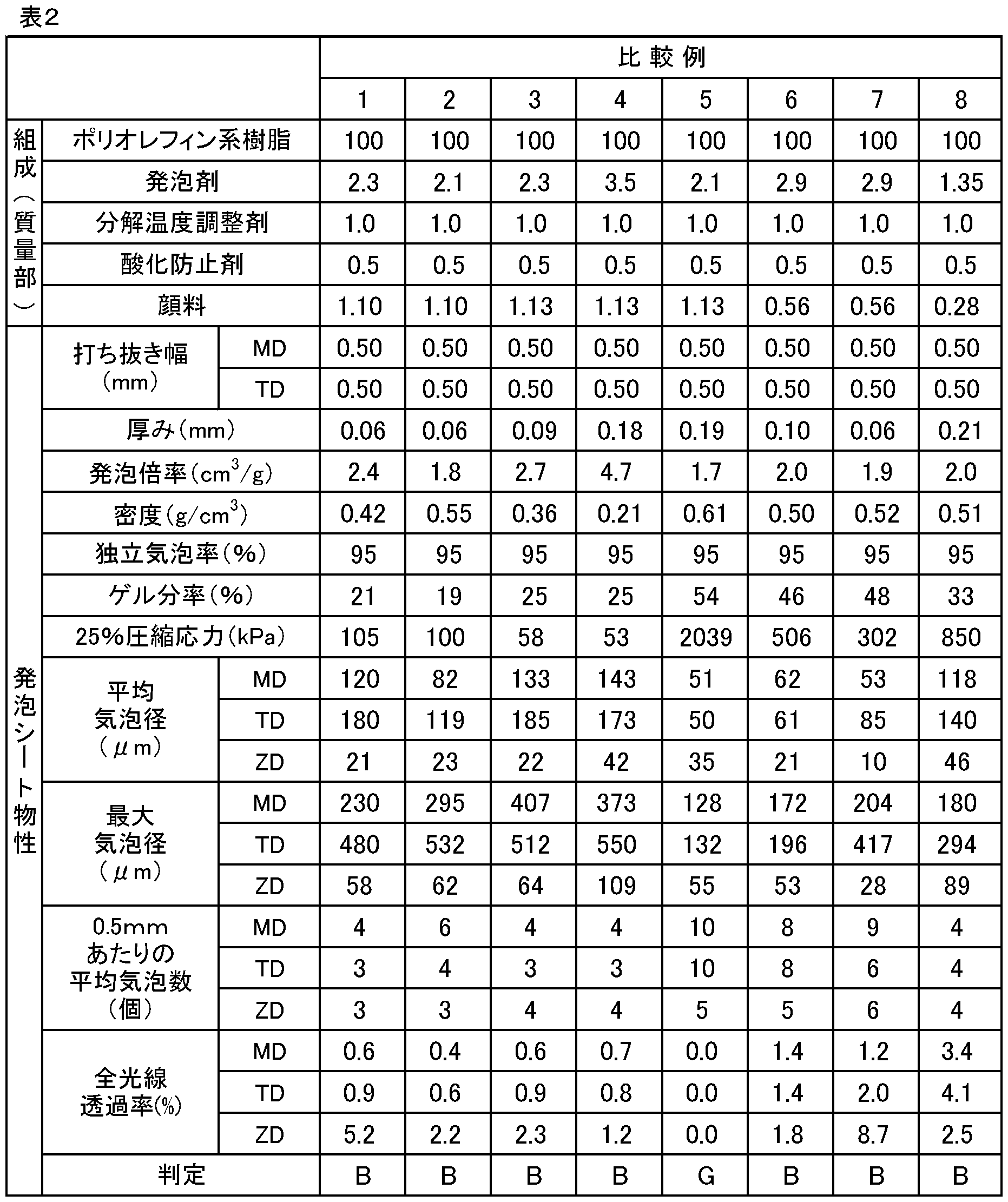
- the composition of the polyolefin-based resin composition was changed as shown in Tables 1 and 2, and the dose at the time of crosslinking was adjusted to the gel fractions in Tables 1 and 2, and the MD and TD draw ratios were 1.
- the same operation as in Example 1 was carried out except that it was adjusted to 2 times to 4.0 times.
Landscapes
- Chemical & Material Sciences (AREA)
- Organic Chemistry (AREA)
- Chemical Kinetics & Catalysis (AREA)
- Engineering & Computer Science (AREA)
- Materials Engineering (AREA)
- Health & Medical Sciences (AREA)
- Medicinal Chemistry (AREA)
- Polymers & Plastics (AREA)
- Manufacturing & Machinery (AREA)
- General Chemical & Material Sciences (AREA)
- Manufacture Of Porous Articles, And Recovery And Treatment Of Waste Products (AREA)
- Adhesive Tapes (AREA)
- Laminated Bodies (AREA)
- Adhesives Or Adhesive Processes (AREA)
Abstract
Description
この問題を解決する方法としては、発泡シートの発泡倍率を下げる方法や発泡シートを厚くする方法が考えられるが、これらの方法を採用した場合、発泡シートの柔軟性が失われたり、小型の電子機器に用いることができないという問題があった。
本発明は、上記従来の事情を鑑みてなされたものであって、優れた遮光性を有し、かつ柔軟性にも優れるポリオレフィン系樹脂発泡シート、及びこれを用いた粘着テープを提供することを目的とする。
[1]ポリオレフィン系樹脂及び顔料を含有するポリオレフィン系樹脂組成物を発泡させたポリオレフィン系樹脂発泡シートであって、25%圧縮応力が80~1400kPaであり、樹脂100質量部に対する顔料が0.60~10.00質量部であり、密度が0.10~0.60g/cm3であり、ゲル分率が25~60質量%である、ポリオレフィン系樹脂発泡シート。
[2]前記[1]に記載されたポリオレフィン系樹脂発泡シートの少なくとも一方の面に粘着剤層を設けた粘着テープ。
本発明のポリオレフィン系樹脂発泡シート(以下、「発泡シート」ともいう)は、ポリオレフィン系樹脂及び顔料を含有するポリオレフィン系樹脂組成物を発泡させたポリオレフィン系樹脂発泡シートであって、25%圧縮応力が80~1400kPaであり、樹脂100質量部に対する顔料が0.60~10.00質量部であり、密度が0.10~0.60g/cm3であり、ゲル分率が25~60質量%であるものである。
本発明の発泡シートの25%圧縮応力は、80kPa以上、好ましくは90kPa以上、より好ましくは100kPa以上であり、そして、1400kPa以下、好ましくは1200kPa以下、より好ましくは1000kPa以下、更に好ましくは900kPa以下、より更に好ましくは800kPa以下、より更に好ましくは700kPa以下、より更に好ましくは600kPa以下、より更に好ましくは550kPa以下である。25%圧縮応力が前記下限値以上であると衝撃吸収性が向上し、前記上限値以下であると発泡シートの柔軟性が向上し、粘着テープにした際に被着体への追従性が良好となり電子機器内部に水や空気が侵入しにくくなる。
なお、25%圧縮応力は後述する実施例に記載の方法にしたがって測定することができる。
本発明に用いることができる顔料に特に制限はなく、有機顔料及び無機顔料を用いることができる。
有機顔料としては、例えば、アゾ顔料、ジアゾ顔料、フタロシアニン顔料、キナクリドン顔料、イソインドリノン顔料、ジオキサジン顔料、ペリレン顔料、ペリノン顔料、チオインジゴ顔料、アントラキノン顔料、及びキノフタロン顔料等が挙げられる。
無機顔料としては、例えば、カーボンブラック、金属酸化物、金属硫化物、及び金属塩化物等が挙げられる。これらの顔料は、単独でも、2種以上を組み合わせて用いてもよい。
ポリオレフィン系樹脂100質量部に対する顔料の量は、発泡シートの遮光性を向上させる観点から、0.60質量部以上、好ましくは0.70質量部以上、より好ましくは0.80質量部以上、更に好ましくは0.90質量部以上、より更に好ましくは1.00質量部以上であり、そして、発泡シートの柔軟性の低下を防ぐ観点から、10.00質量部以下、好ましくは5.00質量部以下、より好ましくは3.00質量部以下、更に好ましくは1.50質量部以下である。
本発明における発泡シートの密度は、発泡シートの遮光性を向上させる観点から、0.10g/cm3以上、好ましくは0.15g/cm3以上、より好ましくは0.20g/cm3以上、更に好ましくは0.25g/cm3以上、より更に好ましくは0.30g/cm3以上、より更に好ましくは0.35g/cm3以上であり、そして、発泡シートの柔軟性の低下を防ぐ観点から、0.60g/cm3以下、好ましくは0.55g/cm3以下、より好ましくは0.50g/cm3以下、更に好ましくは0.45g/cm3以下、より更に好ましくは0.40g/cm3以下である。
本発明の発泡シートの発泡倍率は、発泡シートの密度の逆数で定義することができ、好ましくは1.5cm3/g以上、より好ましくは1.6cm3/g以上、更に好ましくは1.7cm3/g以上、より更に好ましくは1.8cm3/g以上であり、そして、好ましくは10.0cm3/g以下、より好ましくは8.0cm3/g以下、更に好ましくは7.0cm3/g以下、より更に好ましくは6.0cm3/g以下、より更に好ましくは5.5cm3/g以下、より更に好ましくは5.0cm3/g以下である。発泡倍率が前記範囲内であると、発泡シートの遮光性を向上させることができ、更に発泡シートの衝撃吸収性及び段差追従性を確保しやすくなる。
本発明の発泡シートは、ZD方向の平均気泡径を小さくする観点から架橋したものであってゲル分率は、25質量%以上、好ましくは30質量%以上、より好ましくは35質量%以上であり、そして、60質量%以下、好ましくは55質量%以下、より好ましくは53質量%以下である。ゲル分率が前記下限値以上であると、十分な架橋が形成され、これを発泡させることにより平均気泡径が小さい発泡シートを得ることができる。また、ゲル分率が前記上限値以下であると、発泡シートの柔軟性を確保しやすくなる。
なお、ゲル分率は後述する実施例に記載の方法にしたがって測定することができる。
本発明の発泡シートにおけるMD方向の平均気泡径は、発泡シートの遮光性、柔軟性、及び段差追従性を向上させる観点から、好ましくは10μm以上、より好ましくは20μm以上、更に好ましくは25μm以上、より更に好ましくは30μm以上、より更に好ましくは32μm以上であり、そして、好ましくは150μm以下、より好ましくは140μm以下、更に好ましくは135μm以下、より更に好ましくは130μm以下、より更に好ましくは125μm以下、より更に好ましくは120μm以下、より更に好ましくは115μm以下である。MD方向の平均気泡径が前記下限値以上であると柔軟性及び段差追従性が向上する。また、MD方向の平均気泡が前記上限値以下であると発泡シートの遮光性が向上する。
本発明の発泡シートにおけるMD方向の最大気泡径は、発泡シートの遮光性、柔軟性、及び段差追従性を向上させる観点から、好ましくは30μm以上、より好ましくは40μm以上、更に好ましくは50μm以上であり、そして、好ましくは400μm以下、より好ましくは350μm以下、更に好ましくは300μm以下である。MD方向の最大気泡径が前記下限値以上であると柔軟性及び段差追従性が向上する。また、MD方向の最大気泡が前記上限値以下であると発泡シートの遮光性が向上する。
なお、前記平均気泡径は、後述する実施例の方法にしたがって測定することができる。
本発明の発泡シートの厚みは、発泡シートの遮光性、柔軟性、及び段差追従性を向上させる観点から、好ましくは0.020mm以上、より好ましくは0.030mm以上、更に好ましくは0.040mm以上、更に好ましくは0.050mm以上であり、そして、好ましくは0.38mm以下、より好ましくは0.35mm以下、更に好ましくは0.32mm以下、より更に好ましくは0.30mm以下である。発泡シートの厚みが前記下限値以上であると発泡シートの遮光性、及び強度を向上させることができる。また、発泡シートの厚みが前記上限値以下であると薄型の電子機器の内部に用いることができ、更に柔軟性、及び段差追従性を向上させることができる。
本発明の発泡シートのMD方向における0.5mmあたりの平均気泡数は、発泡シートの遮光性、柔軟性、及び段差追従性を向上させる観点から、好ましくは2個以上、より好ましくは3個以上、更に好ましくは4個以上であり、そして、好ましくは20個以下、より好ましくは18個以下、更に好ましくは17個以下、より更に好ましくは15個以下、より更に好ましくは13個以下、より更に好ましくは11個以下、より更に好ましくは9個以下、より更に好ましくは8個以下である。
また、本発明の発泡シートのTD方向における0.5mmあたりの平均気泡数は、発泡シートの遮光性、柔軟性、及び段差追従性を向上させる観点から、好ましくは1個以上、より好ましくは2個以上、更に好ましくは3個以上であり、そして、好ましくは18個以下、より好ましくは16個以下、更に好ましくは14個以下、より更に好ましくは12個以下、より更に好ましくは10個以下、より更に好ましくは8個以下である。
本発明の発泡シートのZD方向における0.5mmあたりの平均気泡数は、発泡シートの遮光性、柔軟性、及び段差追従性を向上させる観点から、好ましくは1個以上、より好ましくは2個以上、更に好ましくは3個以上であり、そして、好ましくは13個以下、より好ましくは11個以下、更に好ましくは9個以下、より更に好ましくは8個以下、より更に好ましくは6個以下である。
発泡シートの0.5mmあたりの平均気泡数が前記下限値以上であると発泡シートの遮光性を向上させることができる。また、0.5mmあたりの平均気泡数が前記上限値以下であると薄型の電子機器の内部に用いることができ、更に柔軟性、及び段差追従性を向上させることができる。
なお、前記0.5mmあたりの平均気泡数は、後述する実施例の方法にしたがって測定することができる。
本発明の発泡シートは、気泡が独立気泡であることが好ましい。気泡が独立気泡であると、衝撃を受けた際に気泡の変形量を抑えられることができ、衝撃に対する発泡シートの変形量が抑えられ、結果として衝撃吸収性をより向上させることができる。
前記独立気泡率は、衝撃吸収性をより向上させるために、70~100%が好ましく、80~100%がより好ましく、90~100%が更に好ましい。
また、独立気泡が前記範囲であると発泡シート内部の空気の移動が制限され、空気の対流による熱伝導を抑えることができ、断熱性が向上する。
なお、独立気泡率とは、ASTM D2856(1998)に準拠して測定したものをいう。
発泡シートを形成するために使用されるポリオレフィン系樹脂としては、ポリエチレン系樹脂、ポリプロピレン系樹脂、又はこれらの混合物が挙げられる。
<ポリエチレン系樹脂>
ポリエチレン系樹脂は、エチレン単独重合体でもよいが、エチレンと必要に応じて少量(例えば、全モノマーの30質量%以下、好ましくは10質量%以下)のα-オレフィンとを共重合することにより得られるポリエチレン系樹脂が好ましく、その中でも、直鎖状低密度ポリエチレンが好ましい。
ポリエチレン系樹脂を構成するα-オレフィンとして、具体的には、プロピレン、1-ブテン、1-ペンテン、4-メチル-1-ペンテン、1-ヘキセン、1-ヘプテン、及び1-オクテン等が挙げられる。なかでも、炭素数4~10のα-オレフィンが好ましい。
また、ポリエチレン系樹脂としては、エチレン-酢酸ビニル共重合体も好ましい。エチレン-酢酸ビニル共重合体は、通常、エチレン単位を50質量%以上含有する共重合体である。
なお、密度はASTM D792に準拠して測定したものである。
ポリプロピレン系樹脂としては、例えば、プロピレン単独重合体、プロピレン単位を50質量%以上含有するプロピレン-エチレン共重合体、プロピレン-α-オレフィン共重合体等が挙げられる。これらは1種を単独で用いてもよく、2種以上を併用してもよい。
プロピレン-α-オレフィン共重合体を構成するα-オレフィンとしては、具体的には、1-ブテン、1-ペンテン、4-メチル-1-ペンテン、1-ヘキセン、1-ヘプテン、1-オクテン等が挙げられ、これらの中では、炭素数6~12のα-オレフィンが好ましい。
なお、メタロセン化合物を触媒として用いることにより得られたポリエチレン系樹脂、エチレン-酢酸ビニル共重合体、又はこれらの混合物を用いる場合、その含有量は、ポリオレフィン系樹脂全体の40質量%以上が好ましく、50質量%以上がより好ましく、60質量%以上が更に好ましく、100質量%がより更に好ましい。
好適なメタロセン化合物としては、遷移金属をπ電子系の不飽和化合物で挟んだ構造を有するビス(シクロペンタジエニル)金属錯体等の化合物が挙げられる。より具体的には、チタン、ジルコニウム、ニッケル、パラジウム、ハフニウム、及び白金等の四価の遷移金属に、1又は2以上のシクロペンタジエニル環又はその類縁体がリガンド(配位子)として存在する化合物が挙げられる。
このようなメタロセン化合物は、活性点の性質が均一であり各活性点が同じ活性度を備えている。メタロセン化合物を用いて合成した重合体は、分子量、分子量分布、組成、組成分布等の均一性が高くなるため、メタロセン化合物を用いて合成した重合体を含むシートを架橋した場合には、架橋が均一に進行する。均一に架橋されたシートは、均一に延伸しやすくなるため、架橋ポリオレフィン系樹脂発泡シートの厚みを均一にしやすくなる。
また、環式化合物をオリゴマーとして重合したものをリガンドとして用いてもよい。
更に、π電子系の不飽和化合物以外にも、塩素や臭素等の一価のアニオンリガンド又は二価のアニオンキレートリガンド、炭化水素、アルコキシド、アリールアミド、アリールオキシド、アミド、アリールアミド、ホスフィド、アリールホスフィド等を用いてもよい。
メタロセン化合物は、特定の共触媒(助触媒)と組み合わせることにより、各種オレフィンの重合の際に触媒としての作用を発揮する。具体的な共触媒としては、メチルアルミノキサン(MAO)、ホウ素系化合物等が挙げられる。なお、メタロセン化合物に対する共触媒の使用割合は、10~100万モル倍が好ましく、50~5,000モル倍がより好ましい。
チーグラー・ナッタ化合物は、トリエチルアルミニウム-四塩化チタン固体複合物であって、四塩化チタンを有機アルミニウム化合物で還元し、更に各種の電子供与体及び電子受容体で処理して得られた三塩化チタン組成物と、有機アルミニウム化合物と、芳香族カルボン酸エステルとを組み合わせる方法(特開昭56-100806号、特開昭56-120712号、特開昭58-104907号の各公報参照)、及びハロゲン化マグネシウムに四塩化チタンと各種の電子供与体を接触させる担持型触媒の方法(特開昭57-63310号、特開昭63-43915号、特開昭63-83116号の各公報参照)等で製造されたものが好ましい。
ポリオレフィン系樹脂としては、上記したポリオレフィン系樹脂以外の樹脂も併用することが可能である。
更に、ポリオレフィン系樹脂には、後述する各種添加剤、その他の任意成分を混合してもよい。
発泡シートに含有される任意成分としては、ポリオレフィン系樹脂以外の樹脂、ゴムが挙げられ、これらは合計で、ポリオレフィン系樹脂よりも含有量が少なく、ポリオレフィン系樹脂100質量部に対して、通常50質量部以下、好ましくは30質量部以下程度である。
本発明の発泡シートは、ポリオレフィン系樹脂組成物を一般的な方法で発泡することにより製造することができるものである。本発明の発泡シートの製造方法に制限はなく、ポリオレフィン系樹脂組成物を架橋した後、発泡することにより製造することができる。
具体的に、本発明の発泡シートは、例えば以下の工程(1)~(3)を有する方法により製造することができる。
工程(1):ポリオレフィン系樹脂、顔料、熱分解型発泡剤、及びその他の添加剤を押出機に供給して溶融混練し、押出機を用いてシート状に押出すことによりシート状のポリオレフィン系樹脂組成物を得る工程
工程(2):シート状にされたポリオレフィン系樹脂組成物を架橋する工程
工程(3):架橋させたシート状のポリオレフィン系樹脂組成物を加熱し、熱分解型発泡剤を発泡させる工程
なお、架橋ポリオレフィン系樹脂発泡シートの製造方法としては、この方法のほかに、国際公開第2005/007731号に記載された方法により製造することも可能である。
ポリオレフィン系樹脂組成物中における熱分解型発泡剤の含有量は、ポリオレフィン系樹脂100質量部に対して1~12質量部が好ましく、1~8質量部がより好ましい。熱分解型発泡剤の含有量が上記範囲内であると、ポリオレフィン系樹脂組成物の発泡性が向上し、所望の発泡倍率を有するポリオレフィン系樹脂発泡シートを得やすくなると共に、引張強度及び圧縮回復性が向上する。
分解温度調整剤は、熱分解型発泡剤の分解温度を低くしたり、分解速度を速めたり調節するものとして配合されるものである。具体的な化合物としては、酸化亜鉛、ステアリン酸亜鉛、尿素等が挙げられる。分解温度調整剤は、発泡シートの表面状態等を調整するために、例えばポリオレフィン系樹脂100質量部に対して0.01~5質量部配合する。
架橋助剤としては、多官能モノマーを使用することができる。架橋助剤をポリオレフィン系樹脂組成物に添加した場合、後述する工程(2)において照射する電離性放射線量を低減することができるため、電離性放射線の照射に伴う樹脂分子の切断、劣化を防止することができる。
架橋助剤としては具体的には、トリメチロールプロパントリメタクリレート、トリメチロールプロパントリアクリレート、トリメリット酸トリアリルエステル、1,2,4-ベンゼントリカルボン酸トリアリルエステル、トリアリルイソシアヌレート等の1分子中に3個の官能基を持つ化合物や、1,6-ヘキサンジオールジメタクリレート、1,9-ノナンジオールジメタクリレート、1,10-デカンジオールジメタクリレート、ジビニルベンゼン等の1分子中に2個の官能基を持つ化合物、フタル酸ジアリル、テレフタル酸ジアリル、イソフタル酸ジアリル、エチルビニルベンゼン、ネオペンチルグリコールジメタクリレート、ラウリルメタクリレート、ステアリルメタクリレート等が挙げられる。
これらの架橋助剤は、単独で又は2以上を組み合わせて使用する。
架橋助剤の添加量は、樹脂成分100質量部に対して0.2~10質量部が好ましく、0.3~5質量部がより好ましく、0.5~5質量部が更に好ましい。該添加量が0.2質量部以上であると発泡シートが所望するゲル分率の発泡シートを安定して得ることが可能となり、10質量部以下であると発泡シートのゲル分率の制御が容易となる。
また、酸化防止剤としては、2,6-ジ-t-ブチル-p-クレゾール等のフェノール系酸化防止剤等が挙げられる。
なお、ポリオレフィン系樹脂組成物の発泡は、熱分解型発泡剤を用いる例に限定されず、ブタンガス等による物理発泡を用いてもよい。
架橋に使用する有機過酸化物としては、例えば、1,1-ビス(t-ブチルパーオキシ)3,3,5-トリメチルシクロヘキサン、1,1-ビス(t-ブチルパーオキシ)シクロヘキサン等が挙げられる。これらは1種を単独で用いてもよく、2種以上を併用してもよい。有機過酸化物の添加量は、ポリオレフィン系樹脂100質量部に対し、0.01~5質量部が好ましく、0.1~3質量部がより好ましい。有機過酸化物の添加量が上記範囲内であると、ポリオレフィン系樹脂組成物の架橋が進行しやすく、また、得られる架橋ポリオレフィン系樹脂発泡シート中に有機過酸化物の分解残渣の量を抑制することができる。
電離性放射線の照射量は、ゲル分率が25~60質量%となるように、5~200kGyが好ましく、30~120kGyがより好ましい。
前述のポリオレフィン系樹脂組成物を架橋する方法は併用されてもよいが、均質に架橋を行う観点から、電離性放射線を照射する方法が好ましい。
前記延伸はポリオレフィン系樹脂組成物を発泡させて発泡シートを得た後に行ってもよいし、ポリオレフィン系樹脂組成物を発泡させつつ行ってもよい。なお、ポリオレフィン系樹脂組成物を発泡させて発泡シートを得た後、発泡シートを延伸する場合には、発泡シートを冷却することなく発泡時の溶融状態を維持したまま続けて発泡シートを延伸したほうがよいが、発泡シートを冷却した後、再度、発泡シートを加熱して溶融又は軟化状態とした上で発泡シートを延伸してもよい。
本発明の粘着テープは、本発明に係る発泡シートを基材として用い、発泡シートの一方の面又は両面に粘着剤層を設けたものである。粘着テープの厚みは、通常0.03~2.0mm、好ましくは0.05~1.0mmである。
粘着テープを構成する粘着剤層の厚みは、5~200μmが好ましく、7~150μmがより好ましく、10~100μmが更に好ましい。粘着テープを構成する粘着剤層の厚みが5~200μmであると、粘着テープの厚みを薄くすることができると共に、粘着テープが使用される電子機器自体の小型化、及び薄厚化に寄与することができる。
発泡シートに粘着剤を塗布して、粘着剤層を発泡シート上に積層する方法としては、例えば、発泡シートの少なくとも一方の面にコーター等の塗工機を用いて粘着剤を塗布する方法、発泡シートの少なくとも一方の面にスプレーを用いて粘着剤を噴霧、塗布する方法、発泡シートの一方の面に刷毛を用いて粘着剤を塗布する方法等が挙げられる。
[測定方法]
本明細書における各物性の測定方法は、次の通りである。
JIS K 6767に準拠して測定した。
実施例及び比較例で得られた発泡シートの密度を、JIS K7222に準拠して測定し、その逆数を発泡倍率とした。
<独立気泡率>
独立気泡率は、ASTM D2856(1998)に準拠して測定した。
実施例及び比較例で得られた発泡シートから約50mgの試験片を採取し、試験片の重量A(mg)を精秤する。次に、この試験片を105℃のキシレン30ml中に浸漬して24時間放置した後、200メッシュの金網で濾過して金網上の不溶解分を採取、真空乾燥し、不溶解分の重量B(mg)を精秤する。得られた値から、下記式によりゲル分率(質量%)を算出する。
ゲル分率(質量%)=(B/A)×100
25%圧縮応力は、ポリオレフィン系樹脂発泡シートをJIS K6767に準拠して測定した。本発明においては、柔軟性及び段差追従性を向上させる観点から、25%圧縮応力が小さい方が好ましい。
各実施例及び比較例で得られた発泡シートを50mm四方にカットしたものを測定用の発泡体サンプルとして用意した。これを液体窒素に1分間浸した後にカミソリ刃でMD方向、TD方向及びZD方向に沿ってそれぞれ厚み方向に切断した。この断面をデジタルマイクロスコープ(株式会社キーエンス製「VHX-900」)を用いて200倍の拡大写真を撮り、MD方向、及びTD方向のそれぞれにおける長さ2mm分の切断面に存在する全ての独立気泡について気泡径を測定し、その操作を5回繰り返した。一方、ZD方向については、2mm×2mmの正方形内に存在する独立気泡の気泡径を測定し、その操作を5回繰り返した。そして、各方向の全ての気泡の平均値をMD方向、TD方向及びZD方向の平均気泡径とし、測定した気泡径の中で1番大きい気泡径を最大気泡径とした。
MD方向、TD方向における平均気泡数は、上記方法により平均気泡径を測定した後、実使用時の打ち抜き幅である0.5mmを平均気泡径で割ることによって算出した。
0.5mmあたりの平均気泡数(個)=0.5(mm)/平均気泡径(μm)×1000
ZD方向における0.5mmあたりの平均気泡数は、発泡シートの厚みをZD方向の平均気泡径で割ることによって算出した。
ZD方向の平均気泡数(個)=厚み(mm)/平均気泡径(μm)×1000
全光線透過率はヘーズ計(日本電色工業株式会社製「NDH2000」)により測定した。全光線透過率は、発泡シートのZD、MD,TD方向それぞれについて測定した。
MD、TD方向については、幅0.5mm、長さ25mmに打ち抜き加工した後、厚さが5mm以上になるまで積層し、隙間があかないよう25mmの両端を固定し、0.5mmの幅方向に対して測定した。
ZD方向の全光線透過率が1%以下である場合を「合格:G」、そうでない場合を「不合格:B」とした。
ポリオレフィン系樹脂としての直鎖状低密度ポリエチレン(エクソンケミカル社製「Exact3027」、密度:0.900g/cm3)100質量部、顔料(大日精化工業株式会社製、AP-09979)1.13質量部、熱分解型発泡剤としてのアゾジカルボンアミド2.1質量部、分解温度調整剤としての酸化亜鉛1質量部、及び酸化防止剤としての2,6-ジ-t-ブチル-p-クレゾール0.5質量部を押出機に供給して130℃で溶融混練した後、ポリオレフィン系樹脂組成物を厚み約0.3mmの長尺シート状に押出した。
次に、上記長尺シート状のポリオレフィン系樹脂組成物を、その両面に加速電圧500kVの電子線を70kGy照射して架橋した後、熱風及び赤外線ヒーターにより250℃に保持された発泡炉内に連続的に送り込んで加熱して発泡させると共に、発泡させながらMDの延伸倍率を1.3倍、TDの延伸倍率を2.0倍として延伸させることにより、厚み0.14mmの発泡シートを得た。得られた発泡シートの評価結果を表1に示す。
ポリオレフィン系樹脂組成物の配合を表1及び2に示すように変更すると共に、架橋時の線量を表1及び2のゲル分率となるように調整した点、MD、TDの延伸倍率を1.2倍~4.0倍に調整した点を除いて実施例1と同様に実施した。
Claims (7)
- ポリオレフィン系樹脂及び顔料を含有するポリオレフィン系樹脂組成物を発泡させたポリオレフィン系樹脂発泡シートであって、25%圧縮応力が80~1400kPaであり、樹脂100質量部に対する顔料が0.60~10.00質量部であり、密度が0.10~0.60g/cm3であり、ゲル分率が25~60質量%である、ポリオレフィン系樹脂発泡シート。
- MD方向における0.5mmあたりの平均気泡数が2~20個である、請求項1に記載のポリオレフィン系樹脂発泡シート。
- 前記ポリオレフィン系樹脂発泡シートの独立気泡率が70~100%である、請求項1又は2に記載のポリオレフィン系樹脂発泡シート。
- 前記ポリオレフィン系樹脂発泡シートのMD方向の平均気泡径が150μm以下である、請求項1~3のいずれかに記載のポリオレフィン系樹脂発泡シート。
- 前記ポリオレフィン系樹脂発泡シートのTD方向の平均気泡径が250μm以下である、請求項1~4のいずれかに記載のポリオレフィン系樹脂発泡シート。
- 前記ポリオレフィン系樹脂発泡シートのZD方向の平均気泡径が60μm以下である、請求項1~5のいずれかに記載のポリオレフィン系樹脂発泡シート。
- 請求項1~6のいずれかに記載されたポリオレフィン系樹脂発泡シートの少なくとも一方の面に粘着剤層を設けた粘着テープ。
Priority Applications (3)
| Application Number | Priority Date | Filing Date | Title |
|---|---|---|---|
| JP2017520991A JP6550131B2 (ja) | 2016-03-30 | 2017-03-30 | ポリオレフィン系樹脂発泡シート及び粘着テープ |
| CN201780005106.2A CN108431105B (zh) | 2016-03-30 | 2017-03-30 | 聚烯烃系树脂发泡片和胶带 |
| KR1020187025932A KR102078236B1 (ko) | 2016-03-30 | 2017-03-30 | 폴리올레핀계 수지 발포 시트 및 점착 테이프 |
Applications Claiming Priority (2)
| Application Number | Priority Date | Filing Date | Title |
|---|---|---|---|
| JP2016068797 | 2016-03-30 | ||
| JP2016-068797 | 2016-03-30 |
Publications (1)
| Publication Number | Publication Date |
|---|---|
| WO2017170941A1 true WO2017170941A1 (ja) | 2017-10-05 |
Family
ID=59965884
Family Applications (1)
| Application Number | Title | Priority Date | Filing Date |
|---|---|---|---|
| PCT/JP2017/013416 Ceased WO2017170941A1 (ja) | 2016-03-30 | 2017-03-30 | ポリオレフィン系樹脂発泡シート及び粘着テープ |
Country Status (4)
| Country | Link |
|---|---|
| JP (3) | JP6550131B2 (ja) |
| KR (1) | KR102078236B1 (ja) |
| CN (4) | CN110746678B (ja) |
| WO (1) | WO2017170941A1 (ja) |
Cited By (4)
| Publication number | Priority date | Publication date | Assignee | Title |
|---|---|---|---|---|
| JP2020055917A (ja) * | 2018-09-28 | 2020-04-09 | 積水化学工業株式会社 | 架橋ポリオレフィン系樹脂発泡体 |
| WO2020195676A1 (ja) * | 2019-03-26 | 2020-10-01 | 東レ株式会社 | ポリオレフィン系樹脂発泡シート |
| WO2021025007A1 (ja) * | 2019-08-05 | 2021-02-11 | 株式会社ジェイエスピー | 着座用クッション体 |
| US12331177B2 (en) | 2018-09-28 | 2025-06-17 | Sekisui Chemical Co., Ltd. | Crosslinked polyolefin resin foam and multilayer body |
Citations (7)
| Publication number | Priority date | Publication date | Assignee | Title |
|---|---|---|---|---|
| JP2013053179A (ja) * | 2011-08-31 | 2013-03-21 | Sekisui Chem Co Ltd | 架橋ポリオレフィン樹脂発泡シート、粘着テープ及びシール材 |
| WO2013099755A1 (ja) * | 2011-12-26 | 2013-07-04 | Dic株式会社 | 粘着テープ |
| JP2013213104A (ja) * | 2012-03-30 | 2013-10-17 | Sekisui Chem Co Ltd | 架橋ポリオレフィン樹脂発泡シート |
| WO2013176031A1 (ja) * | 2012-05-21 | 2013-11-28 | Dic株式会社 | 粘着テープ |
| JP2014189658A (ja) * | 2013-03-27 | 2014-10-06 | Sekisui Plastics Co Ltd | 遮光用ポリオレフィン系樹脂発泡シートおよびその製造方法、その用途 |
| WO2015046526A1 (ja) * | 2013-09-30 | 2015-04-02 | 積水化学工業株式会社 | 架橋ポリオレフィン系樹脂発泡シート |
| WO2015152222A1 (ja) * | 2014-03-31 | 2015-10-08 | 積水化学工業株式会社 | ポリオレフィン系発泡シート及び粘着テープ |
Family Cites Families (7)
| Publication number | Priority date | Publication date | Assignee | Title |
|---|---|---|---|---|
| JPS58136433A (ja) * | 1982-02-08 | 1983-08-13 | 池田物産株式会社 | 内装材の製造方法 |
| JPH0631840A (ja) * | 1992-07-14 | 1994-02-08 | Sekisui Chem Co Ltd | 断熱材もしくは断熱板の製造方法及び断熱材及び積層シート |
| JPH1024512A (ja) * | 1996-07-09 | 1998-01-27 | Sekisui Chem Co Ltd | 建築用下地材 |
| JP3739258B2 (ja) * | 2000-08-03 | 2006-01-25 | 積水化学工業株式会社 | プラスチック製コンクリート型枠 |
| JP2003231870A (ja) * | 2002-02-08 | 2003-08-19 | Sekisui Chem Co Ltd | ポリオレフィン系樹脂発泡体シート |
| JP2014018965A (ja) * | 2012-07-12 | 2014-02-03 | Tosoh Corp | 金属部材−ポリフェニレンスルフィド発泡部材複合体及びその製造方法 |
| JP6279925B2 (ja) * | 2014-02-14 | 2018-02-14 | 日本特殊陶業株式会社 | グロープラグ |
-
2017
- 2017-03-30 KR KR1020187025932A patent/KR102078236B1/ko active Active
- 2017-03-30 CN CN201911110806.5A patent/CN110746678B/zh active Active
- 2017-03-30 CN CN201911110807.XA patent/CN110790972A/zh active Pending
- 2017-03-30 CN CN201780005106.2A patent/CN108431105B/zh active Active
- 2017-03-30 WO PCT/JP2017/013416 patent/WO2017170941A1/ja not_active Ceased
- 2017-03-30 CN CN202110641508.XA patent/CN113308041A/zh active Pending
- 2017-03-30 JP JP2017520991A patent/JP6550131B2/ja active Active
-
2019
- 2019-06-26 JP JP2019118354A patent/JP6665336B2/ja active Active
- 2019-09-06 JP JP2019162789A patent/JP6665340B2/ja active Active
Patent Citations (7)
| Publication number | Priority date | Publication date | Assignee | Title |
|---|---|---|---|---|
| JP2013053179A (ja) * | 2011-08-31 | 2013-03-21 | Sekisui Chem Co Ltd | 架橋ポリオレフィン樹脂発泡シート、粘着テープ及びシール材 |
| WO2013099755A1 (ja) * | 2011-12-26 | 2013-07-04 | Dic株式会社 | 粘着テープ |
| JP2013213104A (ja) * | 2012-03-30 | 2013-10-17 | Sekisui Chem Co Ltd | 架橋ポリオレフィン樹脂発泡シート |
| WO2013176031A1 (ja) * | 2012-05-21 | 2013-11-28 | Dic株式会社 | 粘着テープ |
| JP2014189658A (ja) * | 2013-03-27 | 2014-10-06 | Sekisui Plastics Co Ltd | 遮光用ポリオレフィン系樹脂発泡シートおよびその製造方法、その用途 |
| WO2015046526A1 (ja) * | 2013-09-30 | 2015-04-02 | 積水化学工業株式会社 | 架橋ポリオレフィン系樹脂発泡シート |
| WO2015152222A1 (ja) * | 2014-03-31 | 2015-10-08 | 積水化学工業株式会社 | ポリオレフィン系発泡シート及び粘着テープ |
Cited By (8)
| Publication number | Priority date | Publication date | Assignee | Title |
|---|---|---|---|---|
| JP2020055917A (ja) * | 2018-09-28 | 2020-04-09 | 積水化学工業株式会社 | 架橋ポリオレフィン系樹脂発泡体 |
| JP7193292B2 (ja) | 2018-09-28 | 2022-12-20 | 積水化学工業株式会社 | 架橋ポリオレフィン系樹脂発泡体 |
| US12331177B2 (en) | 2018-09-28 | 2025-06-17 | Sekisui Chemical Co., Ltd. | Crosslinked polyolefin resin foam and multilayer body |
| WO2020195676A1 (ja) * | 2019-03-26 | 2020-10-01 | 東レ株式会社 | ポリオレフィン系樹脂発泡シート |
| JPWO2020195676A1 (ja) * | 2019-03-26 | 2021-12-16 | 東レ株式会社 | ポリオレフィン系樹脂発泡シート |
| JP7029685B2 (ja) | 2019-03-26 | 2022-03-04 | 東レ株式会社 | ポリオレフィン系樹脂発泡シート |
| WO2021025007A1 (ja) * | 2019-08-05 | 2021-02-11 | 株式会社ジェイエスピー | 着座用クッション体 |
| US11882940B2 (en) | 2019-08-05 | 2024-01-30 | Jsp Corporation | Cushion body for sitting |
Also Published As
| Publication number | Publication date |
|---|---|
| CN110790972A (zh) | 2020-02-14 |
| KR102078236B1 (ko) | 2020-02-17 |
| KR20180127337A (ko) | 2018-11-28 |
| JP2019218563A (ja) | 2019-12-26 |
| CN108431105A (zh) | 2018-08-21 |
| CN110746678A (zh) | 2020-02-04 |
| JP2019178341A (ja) | 2019-10-17 |
| JP6550131B2 (ja) | 2019-07-24 |
| CN110746678B (zh) | 2020-12-08 |
| JP6665340B2 (ja) | 2020-03-13 |
| CN108431105B (zh) | 2021-06-29 |
| JPWO2017170941A1 (ja) | 2018-12-06 |
| CN113308041A (zh) | 2021-08-27 |
| JP6665336B2 (ja) | 2020-03-13 |
Similar Documents
| Publication | Publication Date | Title |
|---|---|---|
| JP6709300B2 (ja) | ポリオレフィン系樹脂発泡シート及び粘着テープ | |
| JP6207009B2 (ja) | 架橋ポリオレフィン樹脂発泡シート | |
| JP6466384B2 (ja) | ポリオレフィン系樹脂発泡シート及び粘着テープ | |
| JP6496414B2 (ja) | ポリオレフィン系樹脂発泡シート及び粘着テープ | |
| JP6379040B2 (ja) | 架橋ポリオレフィン系樹脂発泡シート | |
| WO2016052557A1 (ja) | ポリオレフィン系樹脂発泡シート及び粘着テープ | |
| JP6665340B2 (ja) | ポリオレフィン系樹脂発泡シート及び粘着テープ | |
| JP6773816B2 (ja) | ポリオレフィン系樹脂発泡シート及び粘着テープ | |
| JP2017061669A (ja) | ポリオレフィン系樹脂発泡シート及び粘着テープ | |
| EP3357958B1 (en) | Polyolefin resin foamed sheet and adhesive tape | |
| WO2017170794A1 (ja) | 独立気泡発泡シート、及び表示装置 |
Legal Events
| Date | Code | Title | Description |
|---|---|---|---|
| ENP | Entry into the national phase |
Ref document number: 2017520991 Country of ref document: JP Kind code of ref document: A |
|
| ENP | Entry into the national phase |
Ref document number: 20187025932 Country of ref document: KR Kind code of ref document: A |
|
| NENP | Non-entry into the national phase |
Ref country code: DE |
|
| 121 | Ep: the epo has been informed by wipo that ep was designated in this application |
Ref document number: 17775475 Country of ref document: EP Kind code of ref document: A1 |
|
| 122 | Ep: pct application non-entry in european phase |
Ref document number: 17775475 Country of ref document: EP Kind code of ref document: A1 |