WO2017170681A1 - 液晶配向剤、液晶配向膜及び液晶表示素子 - Google Patents
液晶配向剤、液晶配向膜及び液晶表示素子 Download PDFInfo
- Publication number
- WO2017170681A1 WO2017170681A1 PCT/JP2017/012877 JP2017012877W WO2017170681A1 WO 2017170681 A1 WO2017170681 A1 WO 2017170681A1 JP 2017012877 W JP2017012877 W JP 2017012877W WO 2017170681 A1 WO2017170681 A1 WO 2017170681A1
- Authority
- WO
- WIPO (PCT)
- Prior art keywords
- liquid crystal
- polymer
- group
- ring
- carbon atoms
- Prior art date
- Legal status (The legal status is an assumption and is not a legal conclusion. Google has not performed a legal analysis and makes no representation as to the accuracy of the status listed.)
- Ceased
Links
- 0 CC1(C)C(*)(*2)C2(*)*C1* Chemical compound CC1(C)C(*)(*2)C2(*)*C1* 0.000 description 1
Classifications
-
- C—CHEMISTRY; METALLURGY
- C08—ORGANIC MACROMOLECULAR COMPOUNDS; THEIR PREPARATION OR CHEMICAL WORKING-UP; COMPOSITIONS BASED THEREON
- C08L—COMPOSITIONS OF MACROMOLECULAR COMPOUNDS
- C08L75/00—Compositions of polyureas or polyurethanes; Compositions of derivatives of such polymers
- C08L75/02—Polyureas
-
- C—CHEMISTRY; METALLURGY
- C08—ORGANIC MACROMOLECULAR COMPOUNDS; THEIR PREPARATION OR CHEMICAL WORKING-UP; COMPOSITIONS BASED THEREON
- C08G—MACROMOLECULAR COMPOUNDS OBTAINED OTHERWISE THAN BY REACTIONS ONLY INVOLVING UNSATURATED CARBON-TO-CARBON BONDS
- C08G18/00—Polymeric products of isocyanates or isothiocyanates
- C08G18/06—Polymeric products of isocyanates or isothiocyanates with compounds having active hydrogen
- C08G18/28—Polymeric products of isocyanates or isothiocyanates with compounds having active hydrogen characterised by the compounds used containing active hydrogen
- C08G18/30—Low-molecular-weight compounds
- C08G18/32—Polyhydroxy compounds; Polyamines; Hydroxyamines
- C08G18/3225—Polyamines
-
- C—CHEMISTRY; METALLURGY
- C08—ORGANIC MACROMOLECULAR COMPOUNDS; THEIR PREPARATION OR CHEMICAL WORKING-UP; COMPOSITIONS BASED THEREON
- C08G—MACROMOLECULAR COMPOUNDS OBTAINED OTHERWISE THAN BY REACTIONS ONLY INVOLVING UNSATURATED CARBON-TO-CARBON BONDS
- C08G73/00—Macromolecular compounds obtained by reactions forming a linkage containing nitrogen with or without oxygen or carbon in the main chain of the macromolecule, not provided for in groups C08G12/00 - C08G71/00
- C08G73/06—Polycondensates having nitrogen-containing heterocyclic rings in the main chain of the macromolecule
- C08G73/10—Polyimides; Polyester-imides; Polyamide-imides; Polyamide acids or similar polyimide precursors
- C08G73/1003—Preparatory processes
- C08G73/1007—Preparatory processes from tetracarboxylic acids or derivatives and diamines
-
- C—CHEMISTRY; METALLURGY
- C08—ORGANIC MACROMOLECULAR COMPOUNDS; THEIR PREPARATION OR CHEMICAL WORKING-UP; COMPOSITIONS BASED THEREON
- C08G—MACROMOLECULAR COMPOUNDS OBTAINED OTHERWISE THAN BY REACTIONS ONLY INVOLVING UNSATURATED CARBON-TO-CARBON BONDS
- C08G73/00—Macromolecular compounds obtained by reactions forming a linkage containing nitrogen with or without oxygen or carbon in the main chain of the macromolecule, not provided for in groups C08G12/00 - C08G71/00
- C08G73/06—Polycondensates having nitrogen-containing heterocyclic rings in the main chain of the macromolecule
- C08G73/10—Polyimides; Polyester-imides; Polyamide-imides; Polyamide acids or similar polyimide precursors
- C08G73/1003—Preparatory processes
- C08G73/1035—Preparatory processes from tetracarboxylic acids or derivatives and diisocyanates
-
- C—CHEMISTRY; METALLURGY
- C08—ORGANIC MACROMOLECULAR COMPOUNDS; THEIR PREPARATION OR CHEMICAL WORKING-UP; COMPOSITIONS BASED THEREON
- C08L—COMPOSITIONS OF MACROMOLECULAR COMPOUNDS
- C08L101/00—Compositions of unspecified macromolecular compounds
- C08L101/12—Compositions of unspecified macromolecular compounds characterised by physical features, e.g. anisotropy, viscosity or electrical conductivity
-
- C—CHEMISTRY; METALLURGY
- C08—ORGANIC MACROMOLECULAR COMPOUNDS; THEIR PREPARATION OR CHEMICAL WORKING-UP; COMPOSITIONS BASED THEREON
- C08L—COMPOSITIONS OF MACROMOLECULAR COMPOUNDS
- C08L79/00—Compositions of macromolecular compounds obtained by reactions forming in the main chain of the macromolecule a linkage containing nitrogen with or without oxygen or carbon only, not provided for in groups C08L61/00 - C08L77/00
- C08L79/04—Polycondensates having nitrogen-containing heterocyclic rings in the main chain; Polyhydrazides; Polyamide acids or similar polyimide precursors
- C08L79/08—Polyimides; Polyester-imides; Polyamide-imides; Polyamide acids or similar polyimide precursors
-
- C—CHEMISTRY; METALLURGY
- C09—DYES; PAINTS; POLISHES; NATURAL RESINS; ADHESIVES; COMPOSITIONS NOT OTHERWISE PROVIDED FOR; APPLICATIONS OF MATERIALS NOT OTHERWISE PROVIDED FOR
- C09K—MATERIALS FOR MISCELLANEOUS APPLICATIONS, NOT PROVIDED FOR ELSEWHERE
- C09K19/00—Liquid crystal materials
- C09K19/52—Liquid crystal materials characterised by components which are not liquid crystals, e.g. additives with special physical aspect: solvents, solid particles
- C09K19/54—Additives having no specific mesophase characterised by their chemical composition
- C09K19/56—Aligning agents
-
- G—PHYSICS
- G02—OPTICS
- G02F—OPTICAL DEVICES OR ARRANGEMENTS FOR THE CONTROL OF LIGHT BY MODIFICATION OF THE OPTICAL PROPERTIES OF THE MEDIA OF THE ELEMENTS INVOLVED THEREIN; NON-LINEAR OPTICS; FREQUENCY-CHANGING OF LIGHT; OPTICAL LOGIC ELEMENTS; OPTICAL ANALOGUE/DIGITAL CONVERTERS
- G02F1/00—Devices or arrangements for the control of the intensity, colour, phase, polarisation or direction of light arriving from an independent light source, e.g. switching, gating or modulating; Non-linear optics
- G02F1/01—Devices or arrangements for the control of the intensity, colour, phase, polarisation or direction of light arriving from an independent light source, e.g. switching, gating or modulating; Non-linear optics for the control of the intensity, phase, polarisation or colour
- G02F1/13—Devices or arrangements for the control of the intensity, colour, phase, polarisation or direction of light arriving from an independent light source, e.g. switching, gating or modulating; Non-linear optics for the control of the intensity, phase, polarisation or colour based on liquid crystals, e.g. single liquid crystal display cells
- G02F1/133—Constructional arrangements; Operation of liquid crystal cells; Circuit arrangements
- G02F1/1333—Constructional arrangements; Manufacturing methods
- G02F1/1337—Surface-induced orientation of the liquid crystal molecules, e.g. by alignment layers
Definitions
- the present invention relates to a polymer composition for a liquid crystal aligning agent, in particular, a liquid crystal aligning agent for a lateral electric field drive type liquid crystal display element, consisting of the composition alone, consisting essentially of the composition or the composition.
- a liquid crystal aligning agent having liquid crystal particularly a liquid crystal aligning agent for a horizontal electric field drive type liquid crystal display element, a liquid crystal alignment film formed from the liquid crystal aligning agent, particularly a liquid crystal alignment film for a horizontal electric field drive type liquid crystal display element, and the liquid crystal alignment film
- the present invention relates to a substrate, particularly a substrate for a horizontal electric field drive type liquid crystal display element, and a liquid crystal display element having the substrate, particularly a horizontal electric field drive type liquid crystal display element.
- the liquid crystal display element is known as a light, thin, and low power consumption display device and has been remarkably developed in recent years.
- the liquid crystal display element is configured, for example, by sandwiching a liquid crystal layer between a pair of transparent substrates provided with electrodes.
- an organic film made of an organic material is used as the liquid crystal alignment film so that the liquid crystal is in a desired alignment state between the substrates.
- the liquid crystal alignment film is a component of the liquid crystal display element, and is formed on the surface of the substrate that holds the liquid crystal in contact with the liquid crystal, and plays a role of aligning the liquid crystal in a certain direction between the substrates.
- the liquid crystal alignment film may be required to play a role of controlling the pretilt angle of the liquid crystal in addition to the role of aligning the liquid crystal in a certain direction such as a direction parallel to the substrate.
- alignment control ability is given by performing an alignment treatment on the organic film constituting the liquid crystal alignment film.
- a photo-alignment method is known as an alignment treatment method for a liquid crystal alignment film for imparting alignment control ability.
- the photo-alignment method eliminates the need for rubbing, does not cause the generation of dust and static electricity, and can perform the alignment treatment even on the substrate of the liquid crystal display element having the uneven surface. There is an advantage that you can.
- the photo-alignment method As the photo-alignment method, a decomposition-type photo-alignment method, a photo-crosslinking type, a photo-isomerization-type photo-alignment method, and the like are known.
- the decomposition type photo-alignment method is, for example, that a polyimide film is irradiated with polarized ultraviolet rays, and an anisotropic decomposition is generated by utilizing the polarization direction dependency of ultraviolet absorption of the molecular structure. This is a method of aligning the liquid crystal by the method (for example, see Patent Document 1).
- the photo-crosslinking type or photoisomerization type photo-alignment method uses, for example, polyvinyl cinnamate, irradiates polarized ultraviolet rays, and performs a dimerization reaction (cross-linking reaction) at the double bond portion of two side chains parallel to the polarized light. This is a method of generating and aligning the liquid crystal in a direction orthogonal to the polarization direction (see, for example, Non-Patent Document 1).
- Patent Document 3 discloses a liquid crystal alignment film obtained by using a photo-alignment method by photocrosslinking, photoisomerization or photo-fleece rearrangement.
- the photo-alignment method has a great advantage because it eliminates the rubbing process itself as compared with the rubbing method conventionally used industrially as an alignment treatment method for liquid crystal display elements. And compared with the rubbing method in which the alignment control ability becomes almost constant by rubbing, the photo alignment method can control the alignment control ability by changing the irradiation amount of polarized light.
- the alignment controllability of the main component used in the photo-alignment method is too sensitive to the amount of polarized light, the alignment may be incomplete in part or all of the liquid crystal alignment film, and stable liquid crystal alignment cannot be realized. Occurs.
- an object of the present invention is to increase the range of light irradiation amount in which the alignment control ability is stably generated, and to efficiently obtain a high-quality liquid crystal alignment film, a polymer composition for producing a liquid crystal alignment film, specifically Specifically, it is to provide a composition for producing a liquid crystal alignment film for a horizontal electric field drive type liquid crystal display element.
- the object of the present invention is to provide a liquid crystal aligning agent having the composition, a liquid crystal aligning film produced using the liquid crystal aligning agent, and a substrate having the liquid crystal aligning film.
- An object of the present invention is to provide a liquid crystal display element having the liquid crystal alignment film and / or the substrate, particularly a lateral electric field drive type liquid crystal display element.
- A At least two polymers having a structure that exhibits photoreactivity and a structure that exhibits liquid crystallinity;
- B a polymer produced using at least one selected from a diisocyanate component and a tetracarboxylic acid derivative and a diamine compound;
- C an organic solvent;
- a polymer composition for producing a liquid crystal alignment film more particularly a composition for producing a liquid crystal alignment film for a lateral electric field drive type liquid crystal display element.
- one of the polymers (A1) and the other polymer (A2) out of at least two types of the polymer (A) is different in the amount of the structure that exhibits photoreactivity. It is good.
- At least two kinds of polymers as the component (A) each preferably have a structure that exhibits photoreactivity and a structure that exhibits only liquid crystallinity.
- “liquid crystallinity only” in “structure that expresses only liquid crystallinity” is a term used when considering “photoreactivity” and “liquid crystallinity”.
- the expression “only” means that “liquid crystallinity” is expressed but “liquidity” is not expressed.
- the structure exhibiting photoreactivity in the above ⁇ 1> to ⁇ 3> is:
- the following formulas (1) to (6) (Wherein A, B and D are each independently a single bond, —O—, —CH 2 —, —COO—, —OCO—, —CONH—, —NH—CO—, —CH ⁇ CH—CO Represents —O— or —O—CO—CH ⁇ CH—;
- S is an alkylene group having 1 to 12 carbon atoms, and the hydrogen atom bonded thereto may be replaced by a halogen group;
- T is a single bond or an alkylene group having 1 to 12 carbon atoms, and a hydrogen atom bonded thereto may be replaced with a halogen group;
- Y 1 represents a ring selected from a monovalent benzene ring, naphthalene ring, biphenyl ring, furan ring, pyrrole ring and alicyclic hydrocarbon having 5 to 8 carbon
- R 0 is a hydrogen atom or a carbon number of 1 to 5 represents an alkyl group
- R 0 is a hydrogen atom or a carbon number of 1 to 5 represents an alkyl group
- Y 2 is a group selected from the group consisting of a divalent benzene ring, naphthalene ring, biphenyl ring, furan ring, pyrrole ring, alicyclic hydrocarbon having 5 to 8 carbon atoms, and combinations thereof
- the hydrogen atom bonded to each independently represents —NO 2 , —CN, —CH ⁇ C (CN) 2 , —CH ⁇ CH—CN, a
- R May be substituted with an alkyloxy group of R represents a hydroxy group, an alkoxy group having 1 to 6 carbon atoms, or the same definition as Y 1 ;
- X is a single bond, —COO—, —OCO—, —N ⁇ N—, —CH ⁇ CH—, —C ⁇ C—, —CH ⁇ CH—CO—O—, or —O—CO—CH ⁇ .
- X may be the same or different;
- Cou represents a coumarin-6-yl group or a coumarin-7-yl group, and the hydrogen atoms bonded thereto are independently —NO 2 , —CN, —CH ⁇ C (CN) 2 , —CH ⁇ CH— May be substituted with CN, a halogen group, an alkyl group having 1 to 5 carbon atoms, or an alkyloxy group having 1 to 5 carbon atoms; one of q1 and q2 is 1 and the other is 0; q3 is 0 or 1; P and Q are each independently selected from the group consisting of a divalent benzene ring, naphthalene ring, biphenyl ring, furan ring, pyrrole ring, alicyclic hydrocarbon having 5 to 8 carbon atoms, and combinations thereof.
- ⁇ 5> In the above ⁇ 3> or ⁇ 4>, Structures that exhibit only liquid crystallinity are represented by the following formulas (21) to (31). Wherein A and B have the same definition as above; Y 3 is a group selected from the group consisting of a monovalent benzene ring, naphthalene ring, biphenyl ring, furan ring, nitrogen-containing heterocycle, alicyclic hydrocarbon having 5 to 8 carbon atoms, and combinations thereof.
- each hydrogen atom bonded thereto may be independently substituted with —NO 2 , —CN, a halogen group, an alkyl group having 1 to 5 carbon atoms, or an alkyloxy group having 1 to 5 carbon atoms;
- R 3 is a hydrogen atom, —NO 2 , —CN, —CH ⁇ C (CN) 2 , —CH ⁇ CH—CN, halogen group, monovalent benzene ring, naphthalene ring, biphenyl ring, furan ring, nitrogen-containing Represents a heterocyclic ring, an alicyclic hydrocarbon having 5 to 8 carbon atoms, an alkyl group having 1 to 12 carbon atoms, or an alkoxy group having 1 to 12 carbon atoms; one of q1 and q2 is 1 and the other is 0; l represents an integer of 1 to 12, m represents an integer of 0 to 2, provided that in formulas (23) to (24), the sum of all m is 2 or more,
- the amount of the structure expressing the photoreactivity of the polymer (A1) is the same as the structure expressing the photoreactivity of the polymer (A1) and the liquid crystallinity.
- ⁇ mol% ⁇ is 15 or more, preferably 15 to 100, more preferably 20 to 80
- the amount of the structure expressing the photoreactivity of the polymer (A2) is 0.95 ⁇ mol% or less, assuming that the structure expressing the photoreactivity of the polymer (A2) and the structure expressing liquid crystal are 100 mol%, It is preferably 0.1 ⁇ to 0.8 ⁇ mol%, more preferably 0.25 ⁇ to 0.5 ⁇ mol%.
- the weight average molecular weight of the polymer (A1) is ⁇ ( ⁇ is 30,000 or more, preferably 30,000 to 300,000, more preferably 40,000 to 200,000, More preferably, the weight average molecular weight of the polymer (A2) is 0.1 ⁇ to 0.9 ⁇ , preferably 0.2 ⁇ to 0.8 ⁇ , more preferably 0.3 ⁇ to 0.7 ⁇ .
- the polymer (A1) is 20 to 95 wt%, preferably 50 to 90 wt%. %, More preferably 60 to 80 wt%.
- At least two types of polymers are (M-1) a monomer (M1) having a structure that exhibits photoreactivity and liquid crystallinity; and (M-2) And a monomer (M2) having a structure exhibiting only liquid crystallinity.
- the monomer (M1) preferably has a structure represented by any one of the above formulas (1) to (20).
- the monomer (M2) may have a structure represented by the above formulas (21) to (31).
- the monomer (M1) is represented by the following formulas MA1, MA3, MA4, MA5, MA14, MA16 to MA23, MA25, MA28 to MA30, MA32, MA34, MA36, MA38. It is preferable that it is at least one selected from the group consisting of MA42, MA44 and MA46.
- the monomer (M2) is selected from the group consisting of the following formulas MA2, MA9 to MA13, MA15, MA24, MA26, MA27, MA31, MA35, MA37, MA43, and MA45. It is good to be at least one selected.
- the polymer (A1) has a monomer (M1) of ⁇ mol% ( ⁇ is 15 or more, preferably 15 to 100, more preferably 20 to 80) and the remainder is monomer (M2)
- the polymer (A2) has a monomer (M1) of 0.95 ⁇ mol% or less, preferably 0.1 ⁇ to 0.8 ⁇ mol%, more preferably 0.25 ⁇ to 0.5 ⁇ mol%, and the remainder is monomer (M2 ) To be formed.
- the component (B) is a polymer produced using at least one selected from a diisocyanate component and a tetracarboxylic acid derivative and two or more diamine compounds.
- a polymer having a structure represented by the formula (Y2-1) as a structure derived from diamine is preferable.
- Z 3 is an alkylene group having 1 to 20 carbon atoms which may be interrupted by a bond selected from an ether bond, an ester bond, an amide bond and a urea bond, and the bond part between Z 3 and the benzene ring is a single bond , An ether bond, an ester bond, a urea bond or an amide bond.
- the polymer of the component (B) is preferably a polyurea obtained by polymerizing a diisocyanate component and a diamine component.
- the polymer of the component (B) is a polyurea polyimide precursor obtained by polymerizing a diisocyanate component, a tetracarboxylic acid derivative, and a diamine component. Is good.
- the polymer of the component (B) may be a polyimide precursor obtained by polymerizing a tetracarboxylic acid derivative and a diamine component.
- a liquid crystal aligning agent comprising the polymer composition according to any one of the above ⁇ 1> to ⁇ 18>, particularly a liquid crystal aligning agent for a lateral electric field drive type liquid crystal display element.
- a liquid crystal display device having a substrate obtained in the above ⁇ 23>, particularly a substrate for a horizontal electric field drive type liquid crystal display device, particularly a horizontal electric field drive type liquid crystal display device.
- a polymer composition for producing a liquid crystal alignment film specifically a lateral liquid crystal alignment film capable of efficiently obtaining a high-quality liquid crystal alignment film by expanding the range of light irradiation amount in which the alignment control ability is stably generated.
- a composition for producing a liquid crystal alignment film for an electric field driven liquid crystal display element can be provided.
- a liquid crystal alignment agent having the composition, a liquid crystal alignment film produced using the liquid crystal alignment agent, a substrate having the liquid crystal alignment film, A liquid crystal display element having a liquid crystal alignment film and / or the substrate, in particular, a lateral electric field drive type liquid crystal display element can be provided.
- the present application relates to a polymer composition for a liquid crystal aligning agent, in particular a liquid crystal aligning agent for a lateral electric field drive type liquid crystal display element, consisting of the composition alone, consisting essentially of the composition, or comprising the composition.
- Liquid crystal aligning agent especially liquid crystal aligning agent for lateral electric field drive type liquid crystal display element
- liquid crystal alignment film formed from the liquid crystal aligning agent, especially liquid crystal alignment film for lateral electric field drive type liquid crystal display element, and substrate having the liquid crystal alignment film
- a lateral electric field drive type liquid crystal display element substrate and a liquid crystal display element having the substrate, particularly a lateral electric field drive type liquid crystal display element are provided.
- the present application provides a polymer composition, particularly a polymer composition for a liquid crystal aligning agent, more particularly for a liquid crystal aligning agent for a lateral electric field drive type liquid crystal display element.
- the polymer composition of the present application is (A) manufactured using at least two polymers having a photoreactive structure and a liquid crystallinity structure; (B) at least one selected from a diisocyanate component and a tetracarboxylic acid derivative, and a diamine compound. And (C) an organic solvent.
- the at least two kinds of polymers as the component (A) it is preferable that one polymer (A1) and the other polymer (A2) have different amounts of structures that exhibit photoreactivity.
- At least two kinds of polymers as the component (A) each have a structure that exhibits photoreactivity and liquid crystallinity, and a structure that exhibits only liquid crystallinity.
- “liquid crystallinity only” in “structure that expresses only liquid crystallinity” is a term used when considering “photoreactivity” and “liquid crystallinity”.
- the expression “only” means that “liquid crystallinity” is expressed but “liquidity” is not expressed.
- the “structure that exhibits photoreactivity” refers to a structure that reacts with light in a certain wavelength range, particularly light in the wavelength range of 250 nm to 400 nm.
- the structure is a polymer that is component (A). It is good to have in the side chain.
- photoreactivity is not particularly limited, but means that it reacts with light to show a crosslinking reaction, an isomerization reaction, or a photo-Fries rearrangement, and preferably shows a crosslinking reaction. It is good.
- the achieved orientation control ability can be stably maintained for a long period of time even when exposed to an external stress such as heat.
- the “structure exhibiting liquid crystallinity” refers to a structure exhibiting liquid crystallinity in a certain temperature range, in particular, a temperature range of 100 to 300 ° C., for example, a mesogenic group or a mesogenic component in a polymer side chain. It is preferable that the structure has When a polymer having a “structure that exhibits liquid crystallinity” is used, stable liquid crystal alignment can be obtained when the polymer is used as a liquid crystal alignment film.
- the polymer structure preferably has, for example, a main chain and a side chain bonded to the main chain, and the side chain has a “structure that exhibits photoreactivity” and a “structure that exhibits liquid crystallinity”.
- the “structure that exhibits photoreactivity” and the “structure that exhibits liquid crystallinity” may be included in the same side chain or in different side chains.
- the polymer is provided with a structure that exhibits photoreactivity and liquid crystallinity in a certain side chain, and a structure that exhibits only liquid crystallinity in another side chain.
- a mesogenic component such as a biphenyl group, a terphenyl group, a phenylcyclohexyl group, a phenylbenzoate group, or an azobenzene group
- the side chain has a “structure that expresses photoreactivity” that is bonded to the tip and exhibits a crosslinking reaction or isomerization reaction in response to light
- the side chain is a “structure that exhibits liquid crystallinity”
- the structure is a mesogenic component and has a phenylbenzoate group that undergoes a photo-Fries rearrangement reaction, which is a “structure that exhibits photoreactivity”.
- the main chain of at least two kinds of polymers that are the component (A) of the present invention are not particularly limited, but each independently includes hydrocarbon, (meth) acrylate, itaconate, fumarate, maleate, ⁇ - It may be composed of at least one selected from the group consisting of radically polymerizable groups such as methylene- ⁇ -butyrolactone, styrene, vinyl, maleimide, norbornene, and siloxane.
- the structure that exhibits photoreactivity may be a structure represented by any one selected from the group consisting of formulas (1) to (6).
- A, B, D, S, Y 1 , Y 2 , R, X, Cou, q1 and q2, q3, P and Q, l1, l2, H, and I have the same definitions as described above. Have.
- the side chain may be any one type of photosensitive side chain selected from the group consisting of the following formulas (7) to (10).
- the side chain may be any one type of photosensitive side chain selected from the group consisting of the following formulas (11) to (13).
- A, X, l, m, m1 and R have the same definition as above.
- the side chain may be a photosensitive side chain represented by the following formula (14) or (15).
- A, Y 1 , l, m1 and m2 have the same definition as above.
- the side chain may be a photosensitive side chain represented by the following formula (16) or (17).
- A, X, l and m have the same definition as above.
- the side chain is preferably a photosensitive side chain represented by the following formula (18) or (19).
- A, B, Y1, q1, q2, m1, and m2 have the same definition as above.
- R 1 represents a hydrogen atom, —NO 2 , —CN, —CH ⁇ C (CN) 2 , —CH ⁇ CH—CN, a halogen group, an alkyl group having 1 to 5 carbon atoms, or an alkyl group having 1 to 5 carbon atoms. Represents an oxy group.
- the side chain is preferably a photosensitive side chain represented by the following formula (20).
- A, Y 1 , X, l and m have the same definition as above.
- the structure exhibiting only liquid crystallinity is preferably a structure represented by any one selected from the group consisting of formulas (21) to (31).
- A, B, Y 3 , R 3 , q 1, q 2, l, m, m 1, m 2 , m 3, R 2 , Z 1 , Z 2 have the same definition as described above.
- ⁇ Amount of structure expressing photoreactivity of each of at least two kinds of polymers as component (A) when the total of the structure that exhibits photoreactivity and the structure that exhibits only liquid crystallinity is 100 mol%,
- the amount of the structure expressing the photoreactivity of the polymer (A1) is ⁇ mol% ( ⁇ is 15 or more, preferably 15 to 100, more preferably 20 to 80),
- the amount of the structure expressing the photoreactivity of the polymer (A2) should be less than the amount of the structure expressing the photoreactivity of the polymer (A1), specifically 0.95 ⁇ mol% or less, preferably
- the content is 0.1 ⁇ to 0.8 ⁇ mol%, more preferably 0.25 ⁇ to 0.5 ⁇ mol%.
- Weight average molecular weight of each of at least two types of polymers as component (A) is ⁇ ( ⁇ is 30,000 or more, preferably 30,000 to 300,000, more preferably 40,000 to 200,000, and more preferably 60,000-150,000)
- the other weight average molecular weight is 0.1 ⁇ to 0.9 ⁇ , preferably 0.2 ⁇ to 0.8 ⁇ , more preferably 0.3 ⁇ to 0.7 ⁇ .
- the weight average molecular weight is measured by GPC (Gel Permeation Chromatography) method.
- the polymer (A1) having a relatively large amount of structure that exhibits photoreactivity has a weight average molecular weight of ⁇ ( ⁇ is 30,000 or more, preferably 30,000 to 300,000, more preferably 40,000 to 20 10,000, more preferably 60,000 to 150,000)
- the polymer (A2) having a relatively small amount of structure that exhibits photoreactivity has a weight average molecular weight of 0.1 ⁇ to 0.9 ⁇ , preferably 0.2 ⁇ to 0.8 ⁇ , more preferably 0.3 ⁇ to It should be 0.7 ⁇ .
- the polymer having a large weight average molecular weight is a relatively lower layer of the liquid crystal alignment film.
- the polymer having a small weight average molecular weight tends to be formed in a relatively upper layer of the liquid crystal alignment film (a layer relatively far from the substrate). is there.
- the polymer (A1) having a relatively large structure that exhibits photoreactivity and a large weight average molecular weight is formed in a relatively lower layer (a layer relatively closer to the substrate) of the liquid crystal alignment film.
- the polymer (A2) having a relatively small structure that exhibits photoreactivity and a small weight average molecular weight is formed in a relatively upper layer (a layer far from the substrate) of the liquid crystal alignment film.
- the polymer (A1) in the lower layer (layer relatively close to the substrate) is oriented according to the polarized ultraviolet rays.
- the polymer (A2) of the upper layer (layer relatively far from the substrate) is oriented along the orientation of the polymer (A1).
- the polymer (A1) is 20 to 95 wt%, preferably 50 to 90 wt%, more preferably 60 to 80 wt%.
- (A2) should be the remainder.
- At least two kinds of polymers as component (A) of the present invention include (M-1) a monomer (M1) having a structure that exhibits photoreactivity and liquid crystallinity; and (M-2) only liquid crystallinity. And a monomer (M2) having a developing structure. In addition, it can copolymerize with another monomer in the range which does not impair photoreactive property and / or liquid crystallinity expression ability.
- the monomer (M1) and the monomer (M2) are formed having the monomer (M1) and the monomer (M2), and the total of the monomer (M1) and the monomer (M2) is calculated.
- the monomer (M1) is ⁇ mol% ( ⁇ is 15 or more, preferably 15 to 100, more preferably 20 to 80).
- the monomer (M1) is 0.95 ⁇ mol% or less, preferably 0.1 ⁇ to 0.8 ⁇ mol%, more preferably 0.25 ⁇ to 0.5 ⁇ mol%, and the remainder is monomer. It may be formed so as to be (M2).
- the monomer (M1) and the monomer (M2) used in the polymer (A1) and the polymer (A2) are common to each other.
- Monomer (M1) having a structure that exhibits photoreactivity and liquid crystallinity and its production method At least two kinds of polymers as component (A) of the present invention include the monomer (M1) having a structure that exhibits the above-described photoreactivity and liquid crystallinity; and (M-2) a monomer having a structure that exhibits only liquid crystallinity. (M2); and specifically, it may be obtained by copolymerization.
- the monomer (M1) having a structure that exhibits photoreactivity and liquid crystallinity may form a polymer having a structure that exhibits photoreactivity and liquid crystallinity at the side chain site of the polymer when the polymer is formed. It is a monomer that can be used.
- the structure that exhibits photoreactivity at the side chain site the following structures and derivatives thereof are preferable.
- the monomer (M1) include hydrocarbon, (meth) acrylate, itaconate, fumarate, maleate, ⁇ -methylene- ⁇ -butyrolactone, radical polymerizable groups such as styrene, vinyl, maleimide, norbornene, and siloxane
- the monomer (M1) is polymerized in the following formulas MA1, MA3, MA4, MA5, MA14, MA16 to MA23, MA25, MA28 to MA30, MA32, MA34, MA36, MA38 to MA42, MA44 and MA46, and their compounds.
- the polymerizable group of the compound having methacrylate as a functional group is replaced with a polymerizable group selected from the group consisting of acrylate, itaconate, fumarate, maleate, ⁇ -methylene- ⁇ -butyrolactone, styrene, vinyl, maleimide, norbornene and siloxane. It is good that it is at least one selected from compounds.
- the monomer (M1) may have (meth) acrylate as a polymerizable group, and preferably, for example, the end of the side chain is COOH. Note that MA1 to MA46 can be synthesized as follows.
- MA1 can be synthesized by a synthesis method described in a patent document (WO2011-084546).
- MA2 can be synthesized by the synthesis method described in the patent document (Japanese Patent Laid-Open No. 9-118717).
- MA3 can be synthesized by a synthesis method described in non-patent literature (Macromolecules 2002, 35, 706-713).
- MA4 can be synthesized by a synthesis method described in a patent document (WO2014 / 054785).
- MA5 can be synthesized by a synthesis method described in a patent document (Japanese Patent Laid-Open No. 2010-18807).
- MA6 to MA9 can be synthesized by the synthesis method described in the patent document (WO2014 / 054785).
- As MA10 commercially available M6BC (manufactured by Midori Chemical Co., Ltd.) can be used.
- MA11 to 13 can be synthesized by the synthesis method described in the patent document
- MA14 to 18 are commercially available, and M4CA, M4BA, M2CA, M3CA, and M5CA (all of which are manufactured by Midori Chemical Co., Ltd.) can be used.
- MA19 to 23 can be synthesized by the synthesis method described in the patent document (WO2014 / 054785).
- MA24 can be synthesized by a synthesis method described in non-patent literature (Polymer Journal, Vol. 29, No. 4, pp 303-308 (1997)).
- MA25 can be synthesized by a synthesis method described in a patent document (WO2014 / 054785).
- MA26 and MA27 are the synthesis methods described in non-patent literature (Macromolecules (2012), 45 (21), 8547-8554) and non-patent literature (Liquid Crystals (1995), 19 (4), 433-40), respectively. Can be synthesized.
- MA28 to 33 can be synthesized by the synthesis method described in the patent document (WO2014 / 054785).
- MA34 to 39 can be synthesized by the synthesis method described in the patent document (WO2014 / 054785).
- MA40 and 41 can be synthesized by a synthesis method described in a patent document (Japanese Patent Publication No. 2009-511431).
- MA42 can be synthesized by a synthesis method described in a patent document (WO2014 / 054785).
- MA43 can be synthesized by a synthesis method described in a patent document (WO2012-115129).
- MA44 can be synthesized by a synthesis method described in a patent document (WO2013-1333078).
- MA45 can be synthesized by the synthesis method described in the patent document (WO2008-072652).
- MA46 can be synthesized by a synthesis method described in a patent document (WO2014 / 054785).
- the monomer (M2) having a structure that exhibits only liquid crystallinity is a monomer that allows a polymer derived from the monomer to exhibit liquid crystallinity and to form a mesogenic group at a side chain site.
- mesogenic group having a side chain even if it is a group having a mesogen structure alone such as biphenyl or phenylbenzoate, or a group having a mesogen structure by hydrogen bonding between side chains such as benzoic acid Good.
- mesogenic group possessed by the side chain the following structure is preferable.
- the monomer (M2) having a structure exhibiting only liquid crystallinity include hydrocarbon, (meth) acrylate, itaconate, fumarate, maleate, ⁇ -methylene- ⁇ -butyrolactone, styrene, vinyl, maleimide, A structure having a structure composed of at least one polymerizable group selected from the group consisting of radically polymerizable groups such as norbornene and siloxane and at least one of the above formulas (21) to (31). Is preferred.
- the monomer (M2) is composed of the above-described formulas MA2, MA9 to MA13, MA15, MA24, MA26, MA27, MA31, MA35, MA37, MA43 and MA45, and compounds having a methacrylate as a polymerizable group in these compounds. At least one selected from the group consisting of compounds in which the group is replaced by a polymerizable group selected from the group consisting of acrylate, itaconate, fumarate, maleate, ⁇ -methylene- ⁇ -butyrolactone, styrene, vinyl, maleimide, norbornene and siloxane It is good to be.
- the monomer (M2) may have (meth) acrylate as a polymerizable group, and preferably, for example, the end of the side chain is COOH.
- the polymer (A1) and / or the polymer (A2) is an (M-3) monomer having a crosslinkable group, specifically the following formulas (G-1), (G-2), (G-3) and ( A monomer (M3) having at least one group selected from the group consisting of G-4), more specifically a monomer having a structure represented by the following formula (0). .
- monomers having an epoxy group include compounds such as glycidyl (meth) acrylate, (3,4-epoxycyclohexyl) methyl (meth) acrylate, and allyl glycidyl ether.
- Specific examples of the monomer having thiirane include those obtained by replacing the epoxy structure of the monomer having an epoxy group with thiirane.
- Specific examples of the monomer having an aziridine include those in which the epoxy structure of the monomer having an epoxy group is replaced with aziridine or 1-methylaziridine.
- Examples of the monomer having an oxetane group include (meth) acrylic acid ester having an oxetane group.
- monomers 3- (methacryloyloxymethyl) oxetane, 3- (acryloyloxymethyl) oxetane, 3- (methacryloyloxymethyl) -3-methyl-oxetane, 3- (acryloyloxymethyl) -3- Methyl-oxetane, 3- (methacryloyloxymethyl) -3-ethyl-oxetane, 3- (acryloyloxymethyl) -3-ethyl-oxetane, 3- (methacryloyloxymethyl) -2-trifluoromethyloxetane, 3- ( Acryloyloxymethyl) -2-trifluoromethyloxetane, 3- (methacryloyloxymethyl) -2-phenyl-oxetane, 3- (acryloyl
- the monomer having a thietane group for example, a monomer in which the oxetane group of the monomer having an oxetane group is replaced with a thietane group is preferable.
- the monomer having an azetidine group for example, a monomer in which an oxetane group of a monomer having an oxetane group is replaced with an azetidine group is preferable.
- a monomer having an epoxy group and a monomer having an oxetane group are preferable from the viewpoint of availability and the like, and a monomer having an epoxy group is more preferable.
- glycidyl (meth) acrylate is preferable from the viewpoint of availability.
- Monomer having nitrogen-containing aromatic heterocyclic group (M4) >> The polymer (A1) and / or the polymer (A2) are optionally a monomer (M4) having at least one group selected from the group consisting of (M-4) a nitrogen-containing aromatic heterocyclic group, an amide group and a urethane group. ); May be formed.
- the nitrogen-containing aromatic heterocycle is selected from the group consisting of the following formula [20a], formula [20b] and formula [20c] (wherein Z 2 is a linear or branched alkyl group having 1 to 5 carbon atoms). It may be an aromatic cyclic hydrocarbon containing at least one selected structure, preferably 1 to 4 structures.
- the polymer composition of the present invention has an ionicity.
- the cross-linking reaction of the group represented by the above formula (0), or a more durable liquid crystal alignment film Obtainable In order to reduce the elution of impurities and promote the cross-linking reaction of the cross-linkable group, more specifically, the cross-linking reaction of the group represented by the above formula (0), or a more durable liquid crystal alignment film Obtainable.
- the monomer (M4) is replaced with the monomer (M1) and the monomer (M2), and optionally with the monomer (M3). What is necessary is just to copolymerize.
- the monomer (M4) is selected from the group consisting of hydrocarbon, (meth) acrylate, itaconate, fumarate, maleate, ⁇ -methylene- ⁇ -butyrolactone, radical polymerizable groups such as styrene, vinyl, maleimide, norbornene, and siloxane. It preferably has a polymerizable group composed of at least one kind and a structure having a nitrogen-containing aromatic heterocyclic group, an amide group and a urethane group. NH in the amide group and urethane group may or may not be substituted. Examples of the substituent in the case where it may be substituted include an alkyl group, an amino-protecting group, and a benzyl group.
- the monomer having a nitrogen-containing aromatic heterocyclic group examples include 2- (2-pyridylcarbonyloxy) ethyl (meth) acrylate and 2- (3-pyridylcarbonyloxy). And ethyl (meth) acrylate, 2- (4-pyridylcarbonyloxy) ethyl (meth) acrylate, and the like.
- the monomer having an amide group or a urethane group examples include 2- (4-methylpiperidin-1-ylcarbonylamino) ethyl (meth) acrylate and 4- (6-methacryloyloxyhexyloxy) benzoic acid.
- Examples thereof include N- (tertiary butyloxycarbonyl) piperidin-4-yl ester, 4- (6-methacryloyloxyhexyloxy) benzoic acid, 2- (tertiary butyloxycarbonylamino) ethyl ester, and the like.
- the monomer (M4) having at least one group selected from the group consisting of a nitrogen-containing aromatic heterocyclic group, an amide group and a urethane group includes the above formulas MA6 to MA8 and MA33, and Polymerizability wherein the polymerizable group of the compound having a methacrylate as a polymerizable group in the compound is selected from the group consisting of acrylate, itaconate, fumarate, maleate, ⁇ -methylene- ⁇ -butyrolactone, styrene, vinyl, maleimide, norbornene and siloxane It may be at least one selected from the group consisting of compounds in which the group is replaced.
- monomers include unsaturated carboxylic acid, acrylic ester compound, methacrylic ester compound, maleimide compound, acrylonitrile, maleic anhydride, styrene compound and vinyl compound.
- unsaturated carboxylic acid examples include acrylic acid, methacrylic acid, itaconic acid, maleic acid, fumaric acid and the like.
- acrylic ester compound examples include methyl acrylate, ethyl acrylate, isopropyl acrylate, benzyl acrylate, naphthyl acrylate, anthryl acrylate, anthryl methyl acrylate, phenyl acrylate, 2,2,2-trifluoroethyl acrylate, tert-butyl.
- methacrylic acid ester compound examples include methyl methacrylate, ethyl methacrylate, isopropyl methacrylate, benzyl methacrylate, naphthyl methacrylate, anthryl methacrylate, anthryl methyl methacrylate, phenyl methacrylate, 2,2,2-trifluoroethyl methacrylate, tert-butyl.
- Examples of the vinyl compound include vinyl ether, methyl vinyl ether, benzyl vinyl ether, 2-hydroxyethyl vinyl ether, phenyl vinyl ether, and propyl vinyl ether.
- Examples of the styrene compound include styrene, methylstyrene, chlorostyrene, bromostyrene, and the like.
- Examples of maleimide compounds include maleimide, N-methylmaleimide, N-phenylmaleimide, and N-cyclohexylmaleimide.
- the method for producing at least two kinds of polymers of the present invention is not particularly limited, and a general-purpose method handled industrially can be used.
- the above-described monomer (M1) having a structure exhibiting photoreactivity and liquid crystallinity; and (M-2) a cation utilizing the vinyl group of the monomer (M2) having a structure exhibiting only liquid crystallinity can be produced by polymerization, radical polymerization, or anionic polymerization.
- radical polymerization is particularly preferable from the viewpoint of ease of reaction control.
- RAFT reversible addition-cleavage chain transfer
- a radical thermal polymerization initiator is a compound that generates radicals when heated to a decomposition temperature or higher.
- radical thermal polymerization initiators include ketone peroxides (methyl ethyl ketone peroxide, cyclohexanone peroxide, etc.), diacyl peroxides (acetyl peroxide, benzoyl peroxide, etc.), hydroperoxides (peroxidation).
- the radical photopolymerization initiator is not particularly limited as long as it is a compound that initiates radical polymerization by light irradiation.
- examples of such radical photopolymerization initiators include benzophenone, Michler's ketone, 4,4′-bis (diethylamino) benzophenone, xanthone, thioxanthone, isopropylxanthone, 2,4-diethylthioxanthone, 2-ethylanthraquinone, acetophenone, 2-hydroxy -2-methylpropiophenone, 2-hydroxy-2-methyl-4'-isopropylpropiophenone, 1-hydroxycyclohexyl phenyl ketone, isopropyl benzoin ether, isobutyl benzoin ether, 2,2-diethoxyacetophenone, 2,2 -Dimethoxy-2-phenylacetophenone, camphorquinone, benzanthrone, 2-methyl-1- [4- (
- the radical polymerization method is not particularly limited, and an emulsion polymerization method, suspension polymerization method, dispersion polymerization method, precipitation polymerization method, bulk polymerization method, solution polymerization method and the like can be used.
- the monomer (M1) having a structure exhibiting photoreactivity and liquid crystallinity; and (M-2) the monomer (M2) having a structure exhibiting only liquid crystallinity are copolymerized to form at least two polymers of the present invention.
- the organic solvent used in the reaction for obtaining each is not particularly limited as long as the produced polymer is soluble. Specific examples are given below.
- organic solvents may be used alone or in combination. Furthermore, even if it is a solvent which does not dissolve the produced
- the polymerization temperature at the time of radical polymerization can be selected from any temperature of 30 ° C. to 150 ° C., but is preferably in the range of 50 ° C. to 100 ° C.
- the reaction can be carried out at any concentration, but if the concentration is too low, it is difficult to obtain a high molecular weight polymer, and if the concentration is too high, the viscosity of the reaction solution becomes too high and uniform stirring is difficult. Therefore, the monomer concentration is preferably 1% by mass to 50% by mass, more preferably 5% by mass to 30% by mass.
- the initial stage of the reaction is carried out at a high concentration, and then an organic solvent can be added.
- the molecular weight of the obtained polymer is decreased when the ratio of the radical polymerization initiator is large relative to the monomer, and the molecular weight of the obtained polymer is increased when the ratio is small, the ratio of the radical initiator is
- the content is preferably 0.1 mol% to 10 mol% with respect to the monomer to be polymerized. Further, various monomer components, solvents, initiators and the like can be added during the polymerization.
- the reaction solution may be poured into a poor solvent to precipitate these polymers.
- the poor solvent used for precipitation include methanol, acetone, hexane, heptane, butyl cellosolve, heptane, methyl ethyl ketone, methyl isobutyl ketone, ethanol, toluene, benzene, diethyl ether, methyl ethyl ether, and water.
- the polymer deposited in a poor solvent and precipitated can be recovered by filtration and then dried at normal temperature or under reduced pressure at room temperature or by heating.
- the polymer collected by precipitation is redissolved in an organic solvent and reprecipitation and collection is repeated 2 to 10 times, impurities in the polymer can be reduced.
- the poor solvent at this time include alcohols, ketones, hydrocarbons and the like, and it is preferable to use three or more kinds of poor solvents selected from these because purification efficiency is further improved.
- the polymer composition used for this invention has the polymer manufactured using the diamine compound and at least 1 type chosen from the diisocyanate component and the tetracarboxylic acid derivative as (B) component.
- the polymer of the component (B) includes a polyurea produced using a diisocyanate component and a diamine component, a polyimide precursor produced using a diisocyanate component and a tetracarboxylic acid derivative, and a diisocyanate component and a tetracarboxylic acid derivative.
- a polyurea polyimide precursor produced using a diamine component that is, a copolymer of polyurea and a polyimide precursor.
- the polymer composition used in the present invention comprises, as component (B), a polymerization reaction of a diisocyanate compound, a tetracarboxylic acid derivative, and a diamine compound, and then imidization. It has polyurea polyimide manufactured by doing.
- Diisocyanate component ⁇ Diisocyanate component
- Examples of the diisocyanate component that is a raw material for the component (B) include aromatic diisocyanates and aliphatic diisocyanates.
- Preferred diisocyanate components are aromatic diisocyanates and aliphatic diisocyanates.
- the aromatic diisocyanate means one in which the R group of the diisocyanate structure (O ⁇ C ⁇ N—R ⁇ N ⁇ C ⁇ O) contains a structure containing an aromatic ring.
- the aliphatic diisocyanate means that the R group of the isocyanate structure is composed of a cyclic or acyclic aliphatic structure.
- aromatic diisocyanates include o-phenylene diisocyanate, m-phenylene diisocyanate, p-phenylene diisocyanate, toluene diisocyanates (eg, tolylene 2,4-diisocyanate), and 1,4-diisocyanate-2-methoxybenzene.
- 2,5-diisocyanate xylenes 2,2′-bis (phenyl diisocyanate) propane, 4,4′-diisocyanate diphenylmethane, 4,4′-diisocyanate diphenyl ether, 4,4′-diisocyanate Examples include diphenyl sulfone, 3,3′-diisocyanate diphenyl sulfone, and 2,2′-diisocyanate benzophenone.
- the aromatic diisocyanate is preferably tolylene 2,4-diisocyanate.
- aliphatic diisocyanate examples include isophorone diisocyanate, hexamethylene diisocyanate, and tetramethylethylene diisocyanate.
- isophorone diisocyanate preferably, isophorone diisocyanate is used.
- isophorone diisocyanate and tolylene 2,4-diisocyanate are preferable from the viewpoint of polymerization reactivity and voltage holding ratio, and isophorone diisocyanate is more preferable from the viewpoint of availability, polymerization reactivity, and voltage holding ratio.
- tetracarboxylic acid derivative ⁇ tetracarboxylic acid derivative
- tetracarboxylic acid derivative that is a raw material for the component (B)
- tetracarboxylic dianhydrides examples include the following tetracarboxylic dianhydrides.
- Examples of the tetracarboxylic dianhydride having an alicyclic structure or an aliphatic structure include 1,2,3,4-cyclobutanetetracarboxylic dianhydride, 1,2-dimethyl-1,2,3,4-cyclobutane.
- Tetracarboxylic dianhydride 1,3-dimethyl-1,2,3,4-cyclobutanetetracarboxylic dianhydride, 1,2,3,4-tetramethyl-1,2,3,4-cyclobutanetetra Carboxylic dianhydride, 1,2,3,4-cyclopentanetetracarboxylic dianhydride, 2,3,4,5-tetrahydrofurantetracarboxylic dianhydride, 1,2,4,5-cyclohexanetetracarboxylic Acid dianhydride, 3,4-dicarboxy-1-cyclohexylsuccinic dianhydride, 1,2,3,4-butanetetracarboxylic dianhydride, 1,2,4,5-pentanetetracarboxylic Dianhydride, bicyclo [3.3.0] octane-2,4,6,8-tetracarboxylic dianhydride, 3,3 ′, 4,4′-dicyclohexyltetracarboxylic dianhydride
- nonane-3,4,7,8-tetracarboxylic acid-3,4 7,8-dianhydride, hexacyclo [6.6.0.1 2,7 . 0 3,6 . 1 9,14 . 0 10,13] hexadecane -4,5,11,12- tetracarboxylic acid-4,5: 11,12-dianhydride, 3,4-dicarboxy-1,2,3,4-tetrahydro-1 And naphthalene succinic dianhydride.
- Aromatic tetracarboxylic dianhydrides include pyromellitic dianhydride, 3,3 ′, 4,4′-biphenyltetracarboxylic dianhydride, 2,2 ′, 3,3′-biphenyltetracarboxylic acid Dianhydride, 2,3,3 ′, 4′-biphenyltetracarboxylic dianhydride, 3,3 ′, 4,4′-benzophenonetetracarboxylic dianhydride, 2,3,3 ′, 4′- Benzophenonetetracarboxylic dianhydride, bis (3,4-dicarboxyphenyl) ether dianhydride, bis (3,4-dicarboxyphenyl) sulfone dianhydride, 1,2,5,6-naphthalenetetracarboxylic acid And dianhydrides and 2,3,6,7-naphthalenetetracarboxylic dianhydride.
- the above-mentioned tetracarboxylic dianhydrides can be used alone or in combination of two or more according to the properties of the liquid crystal alignment film to be formed, such as liquid crystal alignment properties, voltage holding properties, and accumulated charges.
- tetracarboxylic-acid dialkyl ester and tetracarboxylic-acid dialkyl diester dichloride as a tetracarboxylic-acid component which is a raw material of (B) component.
- the tetracarboxylic acid component contains such a tetracarboxylic acid dialkyl ester or tetracarboxylic acid dialkyl ester dichloride, the polymer becomes a polyamic acid ester that is a polyimide precursor.
- the tetracarboxylic acid dialkyl ester that can be used is not particularly limited, and examples thereof include aliphatic tetracarboxylic acid diesters and aromatic tetracarboxylic acid dialkyl esters. Specific examples are given below.
- aliphatic tetracarboxylic acid diester examples include 1,2,3,4-cyclobutanetetracarboxylic acid dialkyl ester, 1,2-dimethyl-1,2,3,4-cyclobutanetetracarboxylic acid dialkyl ester, 1,3-dimethyl-1,2,3,4-cyclobutanetetracarboxylic acid dialkyl ester, 1,2,3,4-tetramethyl-1,2,3,4-cyclobutanetetracarboxylic acid dialkyl ester, 1,2 , 3,4-cyclopentanetetracarboxylic acid dialkyl ester, 2,3,4,5-tetrahydrofurantetracarboxylic acid dialkyl ester, 1,2,4,5-cyclohexanetetracarboxylic acid dialkyl ester, 3,4-dicarboxy- 1-cyclohexyl succinic acid dialkyl ester, 3,4-dicarboxy 1,2,3,4-tetrahydro-1-naphthalene
- aromatic tetracarboxylic acid dialkyl ester examples include pyromellitic acid dialkyl ester, 3,3 ′, 4,4′-biphenyltetracarboxylic acid dialkyl ester, and 2,2 ′, 3,3′-biphenyltetra.
- Carboxylic acid dialkyl ester 2,3,3 ′, 4′-biphenyltetracarboxylic acid dialkyl ester, 3,3 ′, 4,4′-benzophenone tetracarboxylic acid dialkyl ester, 2,3,3 ′, 4′-benzophenone Tetracarboxylic acid dialkyl ester, bis (3,4-dicarboxyphenyl) ether dialkyl ester, bis (3,4-dicarboxyphenyl) sulfone dialkyl ester, 1,2,5,6-naphthalene tetracarboxylic acid dialkyl ester, 2 , 3,6,7-Naphthalenetetracarboxylic Dialkyl ester, and the like.
- Examples of the tetracarboxylic acid diester dichloride include diester dichloride obtained by converting the carboxyl group of the tetracarboxylic acid dialkyl ester into a chlorocarbonyl group by a known method.
- tetracarboxylic dianhydrides tetracarboxylic acid diesters, tetracarboxylic acid diester dichlorides, etc. are each one or two depending on the properties such as liquid crystal alignment properties, voltage holding properties, accumulated charges, etc. when formed into a liquid crystal alignment film. More than one type can be used in combination.
- diamine component which is a raw material of (B) component
- the following alicyclic diamine, aromatic diamine, heterocyclic diamine, aliphatic diamine, and urea bond containing diamine are mentioned, for example.
- alicyclic diamines examples include 1,4-diaminocyclohexane, 1,3-diaminocyclohexane, 4,4′-diaminodicyclohexylmethane, 4,4′-diamino-3,3′-dimethyldicyclohexylamine, isophorone diamine Etc.
- aromatic diamines examples include o-phenylene diamine, m-phenylene diamine, p-phenylene diamine, 2,4-diaminotoluene, 2,5-diaminotoluene, 3,5-diaminotoluene, 1,4-diamino- 2-methoxybenzene, 2,5-diamino-p-xylene, 1,3-diamino-4-chlorobenzene, 3,5-diaminobenzoic acid, 1,4-diamino-2,5-dichlorobenzene, 4,4 ′ -Diamino-1,2-diphenylethane, 4,4'-diamino-2,2'-dimethylbibenzyl, 4,4'-diaminodiphenylmethane, 3,3'-diaminodiphenylmethane, 3,4'-diaminodiphenylmethane, 4,4'-diamino-3
- aromatic-aliphatic diamines examples include diamines represented by the following formula [DAM].
- Ar represents a benzene ring or a naphthalene ring
- R 1 represents an alkylene group having 1 to 5 carbon atoms
- R 2 represents a hydrogen atom or a methyl group.
- aromatic-aliphatic diamine examples include 3-aminobenzylamine, 4-aminobenzylamine, 3-amino-N-methylbenzylamine, 4-amino-N-methylbenzylamine, 3-aminophenethylamine, 4 -Aminophenethylamine, 3-amino-N-methylphenethylamine, 4-amino-N-methylphenethylamine, 3- (3-aminopropyl) aniline, 4- (3-aminopropyl) aniline, 3- (3-methylaminopropyl) ) Aniline, 4- (3-methylaminopropyl) aniline, 3- (4-aminobutyl) aniline, 4- (4-aminobutyl) aniline, 3- (4-methylaminobutyl) aniline, 4- (4- Methylaminobutyl) aniline, 3- (5-aminopentyl) aniline, 4- (5-aminopen) L) aniline, 3- (5-methylaminopenty
- heterocyclic diamines examples include 2,6-diaminopyridine, 2,4-diaminopyridine, 2,4-diamino-1,3,5-triazine, 2,7-diaminodibenzofuran, 3,6-diaminocarbazole 2,4-diamino-6-isopropyl-1,3,5-triazine, 2,5-bis (4-aminophenyl) -1,3,4-oxadiazole and the like.
- aliphatic diamines examples include 1,2-diaminoethane, 1,3-diaminopropane, 1,4-diaminobutane, 1,5-diaminopentane, 1,6-diaminohexane, 1,7-diaminoheptane, 1,8-diaminooctane, 1,9-diaminononane, 1,10-diaminodecane, 1,3-diamino-2,2-dimethylpropane, 1,6-diamino-2,5-dimethylhexane, 1,7- Diamino-2,5-dimethylheptane, 1,7-diamino-4,4-dimethylheptane, 1,7-diamino-3-methylheptane, 1,9-diamino-5-methylnonane, 1,12-diaminododecane, Examples thereof include 1,18-diaminooc
- urea bond-containing diamines examples include N, N′-bis (4-aminophenethyl) urea.
- the diamine component that undergoes a polymerization reaction with the diisocyanate component may include a diamine having a vertical alignment side chain as long as the effects of the present invention are not impaired.
- the diamine component in (B) component may contain the following diamines.
- n and n are each an integer from 1 to 11
- m + n is an integer from 2 to 12
- h is an integer from 1 to 3
- j is an integer from 0 to 3.
- examples of the diamine component in the component (B) include diaminosiloxanes represented by the following formula (wherein m is an integer of 1 to 10).
- the diamine compound further has a nitrogen atom between two amino groups
- the nitrogen atom present between the two amino groups is bonded to carbonyl or has two or more benzene rings and a single atom. Bonding by bonding is preferable in that salt formation with the component (A) can be prevented.
- a diamine component that is a raw material of the component (B), for example, a diamine having a structure represented by the following formula (Y2-1) can be mentioned.
- Z 3 is an alkylene group having 1 to 20 carbon atoms which may be interrupted by a bond selected from an ether bond, an ester bond, an amide bond and a urea bond, and Z 3 and a benzene ring
- the bonding part is a single bond, an ether bond, an ester bond, a urea bond or an amide bond.
- formula (Y2-1) include the following formulas (Y2-2) to (Y2-9).
- R 13 is a hydrogen atom or an alkyl group having 1 to 10 carbon atoms. If the number of carbon atoms is too large, the liquid crystal orientation is lowered. A methyl group or an ethyl group is preferred.
- Y 2 is preferably formula (Y2-2), (Y2-3), or (Y2-5), and particularly preferably formula (Y2-2) or formula (Y2-5).
- the polymer represented by the formula (Y2-1) can be used when the polymer as the component (B) is produced.
- a diamine having a structure may be used.
- Such diamines include 4,4′-diaminodiphenylmethane, 1,2-bis (4-aminophenyl) ethane, 1,3-bis (4-aminophenyl) propane, 1,4-bis (4-amino).
- Phenyl) butane 1,5-bis (4-aminophenyl) pentane, 1,6-bis (4-aminophenyl) hexane, 1,7-bis (4-aminophenyl) heptane, 1,8-bis (4 -Aminophenyl) octane, 1,9-bis (4-aminophenyl) nonane, 1,10-bis (4-aminophenyl) decane, bis (4-aminophenoxy) methane, 1,2-bis (4-amino) Phenoxy) ethane, 1,3-bis (4-aminophenoxy) propane, 1,4-bis (4-aminophenoxy) butane, 1,5-bis (4-aminophenoxy) pen 1,6-bis (4-aminophenoxy) hexane, 1,7-bis (4-aminophenoxy) heptane, 1,8-bis (4-aminophenoxy) octane, 1,9-bis (4-amin
- the proportion in the case where the structure represented by the above formula (Y2-1) is contained is preferably 15 to 90 mol%, and preferably 40 to 85 mol, based on all structural units derived from diamine. % Is more preferable.
- diamine components in the component (B) can be used singly or in combination of two or more depending on the properties such as liquid crystal alignment properties, voltage holding properties, and accumulated charges when the liquid crystal alignment film is formed.
- the mixing ratio is not limited.
- the molecular weight of the polymer of component (B) is measured by a GPC (Gel Permeation Chromatography) method in consideration of the strength of the obtained liquid crystal alignment film, workability when forming the liquid crystal alignment film, and uniformity of the liquid crystal alignment film.
- the weight average molecular weight is preferably 5,000 to 1,000,000, and more preferably 10,000 to 200,000.
- a known synthesis method can be used. Generally, it is a method in which at least one selected from a diisocyanate component and a tetracarboxylic acid derivative and a diamine component are reacted in an organic solvent.
- the reaction of at least one selected from a diisocyanate component and a tetracarboxylic acid derivative with a diamine component is advantageous in that it proceeds relatively easily in an organic solvent and no by-product is generated.
- the organic solvent used for the reaction of at least one selected from a diisocyanate component and a tetracarboxylic acid derivative and a diamine component is not particularly limited as long as the produced polymer is soluble. Specific examples are given below.
- organic solvents examples include N, N-dimethylformamide, N, N-dimethylacetamide, N-methyl-2-pyrrolidone, N-ethyl-2-pyrrolidone, N-methylcaprolactam, dimethyl sulfoxide, and tetramethyl.
- a method of adding at least one selected from the above as it is or dispersed or dissolved in an organic solvent and conversely, adding a diamine component to a solution in which at least one selected from a diisocyanate component and a tetracarboxylic acid derivative is dispersed or dissolved in an organic solvent
- a method of alternately adding at least one selected from a diisocyanate component and a tetracarboxylic acid derivative and a diamine component may be used.
- a diisocyanate component and a tetracarboxylic acid derivative or a diamine component consists of a plurality of kinds of compounds
- they may be reacted in a premixed state, individually in order, or individually.
- the reacted low molecular weight substance may be mixed and reacted to obtain a high molecular weight substance.
- the polymerization temperature at that time can be selected from -20 ° C. to 150 ° C., but is preferably in the range of ⁇ 5 ° C. to 100 ° C.
- the reaction can be carried out at any concentration, but if the concentration is too low, it is difficult to obtain a high molecular weight polymer, and if the concentration is too high, the viscosity of the reaction solution becomes too high and uniform stirring is difficult. Therefore, the total concentration of at least one selected from the diisocyanate component and the tetracarboxylic acid derivative and the diamine component in the reaction solution is preferably 1 to 50% by mass, more preferably 5 to 30% by mass.
- the initial stage of the reaction is carried out at a high concentration, and then an organic solvent can be added.
- the ratio of the total number of moles of at least one selected from the diisocyanate component and the tetracarboxylic acid derivative to the total number of moles of the diamine component is 0.8 to 1.2. It is preferable. Similar to a normal polycondensation reaction, the closer the molar ratio is to 1.0, the higher the molecular weight of the polymer produced.
- the reaction solution may be poured into a poor solvent and precipitated.
- the poor solvent used for precipitation include methanol, acetone, hexane, butyl cellosolve, heptane, methyl ethyl ketone, methyl isobutyl ketone, ethanol, toluene, benzene, and water.
- the polymer precipitated in a poor solvent and collected by filtration can be dried at normal temperature or under reduced pressure at room temperature or by heating.
- impurities in the polymer can be reduced.
- the poor solvent at this time include alcohols, ketones, hydrocarbons and the like, and it is preferable to use three or more kinds of poor solvents selected from these because purification efficiency is further improved.
- polyurea is, for example, the following formula [1] (in the formula [1], A 1 is a divalent organic group, and A 2 is a divalent organic group. And C 1 and C 2 are a hydrogen atom or an alkyl group having 1 to 3 carbon atoms, which may be the same or different. It is a polymer which has a repeating unit shown by these.
- a 1 and A 2 may each be one kind and a polymer having the same repeating unit, or A 1 and A 2 may be plural kinds and a polymer having a repeating unit having a different structure. But you can.
- a 1 is a group derived from a diisocyanate component as a raw material.
- a 2 is a group derived from a diamine component as a raw material.
- a 1 is preferably a group derived from the preferred diisocyanate components listed above. Further, as A 2 are groups derived from the preferred diamine components listed above are preferred.
- the polyimide precursor is, for example, a polymer having a repeating unit represented by the following formula [2].
- a 3 is each independently a tetravalent organic group
- a 2 is each independently a divalent organic group.
- R 11 is a hydrogen atom or an alkyl group having 1 to 5 carbon atoms
- C 1 to C 2 are each independently a hydrogen atom or an alkyl group having 1 to 10 carbon atoms which may have a substituent, An alkenyl group having 2 to 10 carbon atoms or an alkynyl group having 2 to 10 carbon atoms.
- R 11 Specific examples of the alkyl group in R 11 include methyl group, ethyl group, propyl group, i-propyl group, n-butyl group, i-butyl group, s-butyl group, t-butyl group, and n-pentyl group. Etc. From the viewpoint of ease of imidization by heating, R 11 is preferably a hydrogen atom or a methyl group.
- the polyurea polyimide precursor is, for example, a polymer having a repeating unit represented by the above formula [1] and a repeating unit represented by the above formula [2].
- the molar ratio of the tetracarboxylic acid derivative and the diisocyanate in the polyurea polyimide precursor is preferably 99: 1 to 1:99.
- Polyurea polyimide is obtained by ring-closing the above-mentioned polyurea polyamic acid or polyurea polyamic acid ester.
- the ring closure rate (also referred to as imidation rate) of the amic acid group is not necessarily 100%, and can be arbitrarily adjusted according to the application and purpose.
- Examples of the method for imidizing polyurea polyamic acid or polyurea polyamic acid ester include thermal imidization in which a solution of a polyimide precursor is heated as it is or catalytic imidization in which a catalyst is added to a solution of polyurea polyamic acid or polyurea polyamic acid ester. .
- the temperature when the polyurea polyamic acid or polyurea polyamic acid ester is thermally imidized in the solution is 100 ° C. to 400 ° C., preferably 120 ° C. to 250 ° C., while removing water generated by the imidization reaction from the system. It is preferable to do this.
- the catalytic imidation of polyurea polyamic acid or polyurea polyamic acid ester is carried out by adding a basic catalyst and an acid anhydride to a solution of polyurea polyamic acid or polyurea polyamic acid ester, and ⁇ 20 ° C. to 250 ° C., preferably 0 ° C. to It can carry out by stirring at 180 degreeC.
- the amount of the basic catalyst is 0.5 mol times to 30 mol times, preferably 2 mol times to 20 mol times of the amic acid groups, and the amount of the acid anhydride is 1 mol times to 50 mol times of the amic acid groups, The amount is preferably 3 mole times to 30 mole times.
- Examples of the basic catalyst include pyridine, triethylamine, trimethylamine, tributylamine, and trioctylamine. Among them, pyridine is preferable because it has an appropriate basicity for proceeding with the reaction.
- Examples of the acid anhydride include acetic anhydride, trimellitic anhydride, pyromellitic anhydride, and the like. Among them, use of acetic anhydride is preferable because purification after completion of the reaction is facilitated.
- the imidization rate by catalytic imidation can be controlled by adjusting the amount of catalyst, reaction temperature, and reaction time.
- the reaction solution may be poured into a solvent and precipitated.
- the solvent used for precipitation include methanol, ethanol, isopropyl alcohol, acetone, hexane, butyl cellosolve, heptane, methyl ethyl ketone, methyl isobutyl ketone, toluene, benzene, and water.
- the polymer precipitated in the solvent can be collected by filtration, and then dried by normal temperature or reduced pressure at room temperature or by heating.
- the polymer collected by precipitation is redissolved in a solvent and then re-precipitation and collection is repeated 2 to 10 times, impurities in the polymer can be reduced.
- the solvent at this time include alcohols, ketones, and hydrocarbons, and it is preferable to use three or more kinds of solvents selected from these because purification efficiency is further increased.
- the blending ratio (mass basis) of the component (A) and the component (B) described above is the total (the sum of the component (A) and the component (B). ) Is 1, the component (A) is 0.01 to 0.99, more preferably 0.1 to 0.9, and still more preferably 0.2 to 0.5.
- Organic solvent used for the polymer composition used in the present invention is not particularly limited as long as it is an organic solvent that dissolves the resin component. Specific examples are given below. N, N-dimethylformamide, N, N-dimethylacetamide, N-methyl-2-pyrrolidone, N-methylcaprolactam, 2-pyrrolidone, N-ethylpyrrolidone, N-vinylpyrrolidone, dimethylsulfoxide, tetramethylurea, pyridine, Dimethylsulfone, hexamethylsulfoxide, ⁇ -butyrolactone, 3-methoxy-N, N-dimethylpropanamide, 3-ethoxy-N, N-dimethylpropanamide, 3-butoxy-N, N-dimethylpropanamide, 1,3 -Dimethyl-imidazolidinone, ethyl amyl ketone, methyl nonyl ketone, methyl ethyl ketone
- the polymer composition used in the present invention is preferably prepared as a coating solution so as to be suitable for forming a liquid crystal alignment film. That is, the polymer composition used in the present invention is preferably prepared as a solution in which a resin component for forming a resin film is dissolved in an organic solvent.
- the resin component refers to (A) at least two polymers having a structure that exhibits photoreactivity and a structure that exhibits liquid crystallinity, and (B) a diisocyanate component and a tetracarboxylic acid derivative. It is a resin component comprising at least one selected and a polymer produced using a diamine compound. In that case, the content of the resin component is preferably 1% by mass to 20% by mass, more preferably 1% by mass to 15% by mass, and particularly preferably 1% by mass to 10% by mass.
- the above-mentioned resin components may all be the above-described component (A) and component (B), but other than those as long as the liquid crystal expression ability and the photosensitive performance are not impaired.
- Other polymers may be mixed.
- the content of the other polymer in the resin component is 0.5 to 80% by mass, preferably 1 to 50% by mass.
- examples of such other polymers include poly (meth) acrylates and the like, and examples include polymers that are not polymers having a structure that exhibits photoreactivity and a structure that exhibits liquid crystallinity.
- the polymer composition used in the present invention may contain components other than the above components (A), (B) and (C). Examples thereof include solvents and compounds that improve the film thickness uniformity and surface smoothness when the polymer composition is applied, and compounds that improve the adhesion between the liquid crystal alignment film and the substrate.
- the present invention is not limited to this.
- solvent poor solvent which improves the uniformity of film thickness and surface smoothness.
- solvents may be used alone or in combination.
- it is preferably 5% by mass to 80% by mass of the total solvent, and more preferably so as not to significantly reduce the solubility of the entire solvent contained in the polymer composition. Is 20% by mass to 60% by mass.
- Examples of the compound that improves film thickness uniformity and surface smoothness include fluorine-based surfactants, silicone-based surfactants, and nonionic surfactants. More specifically, for example, Ftop (registered trademark) 301, EF303, EF352 (manufactured by Tochem Products), MegaFac (registered trademark) F171, F173, R-30 (manufactured by DIC), Florard FC430, FC431 (Manufactured by Sumitomo 3M), Asahi Guard (registered trademark) AG710 (manufactured by Asahi Glass Company), Surflon (registered trademark) S-382, SC101, SC102, SC103, SC104, SC105, SC106 (manufactured by AGC Seimi Chemical Co., Ltd.) It is done.
- the use ratio of these surfactants is preferably 0.01 to 2 parts by mass, more preferably 0.01 to 1 part by mass with respect to 100 parts by mass of the resin component contained in the polymer
- the compound that improves the adhesion between the liquid crystal alignment film and the substrate include the following functional silane-containing compounds.
- phenoplasts and epoxy group-containing compounds for the purpose of preventing the deterioration of electrical characteristics due to the backlight when the liquid crystal display element is constructed
- An agent may be contained in the polymer composition. Specific phenoplast additives are shown below, but are not limited to this structure.
- Specific epoxy group-containing compounds include ethylene glycol diglycidyl ether, polyethylene glycol diglycidyl ether, propylene glycol diglycidyl ether, tripropylene glycol diglycidyl ether, polypropylene glycol diglycidyl ether, neopentyl glycol diglycidyl ether, 1, 6-hexanediol diglycidyl ether, glycerin diglycidyl ether, 2,2-dibromoneopentyl glycol diglycidyl ether, 1,3,5,6-tetraglycidyl-2,4-hexanediol, N, N, N ′, N ′,-tetraglycidyl-m-xylenediamine, 1,3-bis (N, N-diglycidylaminomethyl) cyclohexane, N, N, N ′, N ′,-tetraglycidyl- , 4'-diaminodip
- the amount used is preferably 0.1 to 30 parts by mass with respect to 100 parts by mass of the resin component contained in the polymer composition. More preferably, it is 1 to 20 parts by mass. If the amount used is less than 0.1 parts by mass, the effect of improving the adhesion cannot be expected, and if it exceeds 30 parts by mass, the orientation of the liquid crystal may deteriorate.
- a photosensitizer can also be used as an additive. Colorless and triplet sensitizers are preferred.
- Aromatic 2-hydroxyketones (2-hydroxybenzophenone, mono- or di-p- (dimethylamino) -2-hydroxybenzophenone), acetophenone, anthraquinone, xanthone, thioxanthone, benzanthrone, thiazoline (2-benzoylmethylene-3 -Methyl- ⁇ -naphthothiazoline, 2- ( ⁇ -naphthoylmethylene) -3-methylbenzothiazoline, 2- ( ⁇ -naphthoylmethylene) -3-methylbenzothiazoline, 2- (4-biphenoylmethylene)- 3-methylbenzothia Phosphorus, 2- ( ⁇ -nap
- Aromatic 2-hydroxy ketone (benzophenone), coumarin, ketocoumarin, carbonyl biscoumarin, acetophenone, anthraquinone, xanthone, thioxanthone, and acetophenone ketal are preferred.
- a dielectric, a conductive substance, or the like for the purpose of changing the electrical properties such as the dielectric constant and conductivity of the liquid crystal alignment film, as long as the effects of the present invention are not impaired.
- a crosslinkable compound may be added for the purpose of increasing the hardness and density of the liquid crystal alignment film.
- the present application has a polymer composition as described above, or consists essentially of the polymer composition as described above, or a liquid crystal aligning agent composed of only the polymer composition as described above, particularly for a liquid crystal display element, more particularly laterally.
- a liquid crystal aligning agent for an electric field driven liquid crystal display element is provided.
- liquid crystal aligning film formed from the above-mentioned liquid crystal aligning agent, especially the liquid crystal aligning film for liquid crystal display elements, and more especially for a horizontal electric field drive type liquid crystal display element.
- present application relates to a liquid crystal alignment film formed from the liquid crystal alignment agent described above, particularly a substrate having a liquid crystal alignment film for a liquid crystal display element, more particularly a lateral electric field drive type liquid crystal display element, particularly a liquid crystal display element.
- a substrate for a horizontal electric field drive type liquid crystal display element is provided.
- the liquid crystal alignment film described above is [I] The process of apply
- a liquid crystal alignment film imparted with an alignment control ability, particularly a liquid crystal alignment film for a liquid crystal display element, more particularly a lateral electric field drive type liquid crystal display element, or a substrate having the liquid crystal alignment film can be obtained.
- ⁇ Board Although it does not specifically limit about a board
- the substrate has a conductive film for driving a horizontal electric field when used in a horizontal electric field drive type liquid crystal display element.
- the conductive film include, but are not limited to, ITO (Indium Tin Oxide) and IZO (Indium Zinc Oxide) when the liquid crystal display element is a transmission type.
- examples of the conductive film include a material that reflects light such as aluminum, but are not limited thereto.
- a method for forming a conductive film on a substrate a conventionally known method can be used.
- Step [I] on the substrate having the conductive film for driving the lateral electric field, the (A) structure exhibiting photoreactivity and the structure exhibiting liquid crystallinity of the present invention exhibit liquid crystallinity within a predetermined temperature range.
- (C) a polymer composition containing an organic solvent Is applied to form a coating film.
- the liquid crystal phase expression temperature of the polymer of component (A) is a temperature at which at least two polymers of component (A) exhibit a liquid crystal phase as a whole.
- the method for applying the polymer composition described above or the liquid crystal aligning agent described above onto a substrate having a conductive film for driving a lateral electric field is not particularly limited.
- the application method is generally performed by screen printing, offset printing, flexographic printing, an inkjet method, or the like.
- Other coating methods include a dipping method, a roll coater method, a slit coater method, a spinner method (rotary coating method), or a spray method, and these may be used depending on the purpose.
- the heating means such as a hot plate, a thermal circulation oven or an IR (infrared) oven is used.
- the solvent can be evaporated at 50 to 150 ° C. to obtain a coating film.
- the drying temperature at this time is preferably lower than the liquid crystal phase expression temperature of the polymer of the component (A) of the present invention.
- the thickness of the coating film is preferably 5 nm to 300 nm, more preferably 10 nm to 150 nm. It is.
- step [II] the coating film obtained in step [I] is irradiated with polarized ultraviolet rays.
- the substrate is irradiated with polarized ultraviolet rays through a polarizing plate from a certain direction.
- ultraviolet rays to be used ultraviolet rays having a wavelength in the range of 100 nm to 400 nm can be used.
- the optimum wavelength is selected through a filter or the like depending on the type of coating film to be used.
- ultraviolet light having a wavelength in the range of 290 nm to 400 nm can be selected and used so that the photocrosslinking reaction can be selectively induced.
- the ultraviolet light for example, light emitted from a high-pressure mercury lamp can be used.
- the irradiation amount of polarized ultraviolet rays depends on the coating film used.
- the amount of irradiation is polarized ultraviolet light that realizes the maximum value of ⁇ A (hereinafter also referred to as ⁇ Amax), which is the difference between the ultraviolet light absorbance in a direction parallel to the polarization direction of polarized ultraviolet light and the ultraviolet light absorbance in a direction perpendicular to the polarization direction of the polarized ultraviolet light.
- the amount is preferably in the range of 1% to 70%, more preferably in the range of 1% to 50%.
- Step [III] the ultraviolet-irradiated coating film polarized in step [II] is heated.
- An orientation control ability can be imparted to the coating film by heating.
- a heating means such as a hot plate, a heat circulation type oven, or an IR (infrared) type oven can be used.
- the heating temperature can be determined in consideration of the temperature at which the liquid crystallinity of the coating film used is developed.
- the heating temperature is preferably within the temperature range of the temperature at which the polymer of the component (A) of the present invention exhibits liquid crystallinity (hereinafter referred to as liquid crystallinity expression temperature).
- the liquid crystallinity expression temperature on the coating film surface is expected to be lower than the liquid crystallinity expression temperature when the polymer of the component (A) of the present invention is observed in bulk.
- the heating temperature is more preferably within the temperature range of the liquid crystallinity expression temperature on the coating film surface. That is, the temperature range of the heating temperature after irradiation with polarized ultraviolet rays is 10 ° C.
- the temperature of the range which makes an upper limit If the heating temperature is lower than the above temperature range, the anisotropic amplification effect due to heat in the coating film tends to be insufficient, and if the heating temperature is too higher than the above temperature range, the state of the coating film Tends to be close to an isotropic liquid state (isotropic phase), and in this case, self-organization may make it difficult to reorient in one direction.
- the liquid crystalline expression temperature is equal to or higher than the glass transition temperature (Tg) at which the polymer or coating film surface of the component (A) of the present invention undergoes a phase transition from the solid phase to the liquid crystal phase, and from the liquid crystal phase to the isotropic phase ( A temperature below the isotropic phase transition temperature (Tiso) that causes a phase transition in the isotropic phase.
- Tg glass transition temperature
- Tiso isotropic phase transition temperature
- the thickness of the coating film formed after heating is preferably 5 nm to 300 nm, more preferably 50 nm to 150 nm, for the same reason described in the step [I].
- the production method of the present invention can realize highly efficient introduction of anisotropy into the coating film. And a board
- liquid crystal display element> and ⁇ Method for manufacturing liquid crystal display element>
- the present application provides a liquid crystal display element having a substrate having a liquid crystal alignment film obtained as described above, particularly a lateral electric field drive type liquid crystal display element.
- a second substrate is prepared, whereby a lateral electric field drive type liquid crystal display element can be obtained.
- the second substrate uses a substrate having no lateral electric field driving conductive film instead of the substrate having the lateral electric field driving conductive film, the second electric field driving conductive film as in the first substrate is used.
- a substrate having In addition, the second substrate preferably has a liquid crystal alignment film as in the first substrate.
- the step [IV] is performed in the same manner as in the above [I ′] to [III ′], similarly to the substrate (first substrate) obtained in [III] and having the liquid crystal alignment film on the conductive film for lateral electric field driving.
- the obtained liquid crystal alignment film-attached substrate (second substrate) is arranged to face each other with the liquid crystal alignment film facing each other through the liquid crystal, and a liquid crystal cell is manufactured by a known method.
- This is a step of manufacturing a drive type liquid crystal display element.
- the steps [I ′] to [III ′] can be performed in the same manner as the steps [I] to [III] except for the difference in the presence or absence of the conductive film for driving the lateral electric field in the step [I]. Since the difference between the steps [I] to [III] and the steps [I ′] to [III ′] is only the presence or absence of the conductive film, the description of the steps [I ′] to [III ′] is omitted. To do.
- the first and second substrates described above are prepared, spacers are dispersed on the liquid crystal alignment film of one substrate, and the liquid crystal alignment film surface is on the inside.
- the other substrate is bonded and the liquid crystal is injected under reduced pressure, or the liquid crystal is dropped on the liquid crystal alignment film surface on which the spacers are dispersed, and then the substrate is bonded and sealed.
- Etc. can be illustrated.
- the diameter of the spacer is preferably 1 ⁇ m to 30 ⁇ m, more preferably 2 ⁇ m to 10 ⁇ m. This spacer diameter determines the distance between the pair of substrates that sandwich the liquid crystal layer, that is, the thickness of the liquid crystal layer.
- the polymer composition or the liquid crystal aligning agent of the present invention As described above, the polymer composition or the liquid crystal aligning agent of the present invention, the liquid crystal alignment film formed using the composition or the liquid crystal aligning agent, the substrate having the alignment film, and the liquid crystal alignment film or substrate are provided.
- the liquid crystal display element formed in this manner has excellent reliability and can be suitably used for a large-screen and high-definition liquid crystal television.
- MA1 as a monomer having a photoreactive group used in Examples MA2 as a monomer having a liquid crystal group, HBAGE as a monomer having a crosslinking group, and A1 as a monomer having an amide group are shown below.
- MA1 and MA2 were synthesized as follows. That is, MA1 was synthesized by a synthesis method described in a patent document (WO2011-084546). MA2 was synthesized by the synthesis method described in the patent document (Japanese Patent Laid-Open No. 9-118717). A polymer formed using MA1 as a monomer has photoreactivity and liquid crystallinity, and a polymer formed using MA2 as a monomer has only liquid crystallinity.
- the monomer A1 to be copolymerized was synthesized by the synthesis method described in WO2014 / 054785 pamphlet.
- HBAGE hydroxybutyl acrylate glycidyl ether
- a commercially available product was used.
- DDM 4,4′-diaminodiphenylmethane
- Me-4APhA N-methyl-2- (4-aminophenyl) ethylamine
- Me-DADPA 4,4′-diaminodiphenyl (N-methyl) amine
- DA-2MG 1,2 -Bis (4-aminophenoxy) ethane
- TDA 3,4-dicarboxy-1,2,3,4-tetrahydro-1-naphthalene succinic dianhydride
- Example 1 The methacrylate polymer powder P1 (0.11 g) obtained in the photoalignment polymer synthesis example P1 and the methacrylate polymer powder P2 (0.25 g) obtained in the photoalignment polymer synthesis example P2 are added to NMP (8.04 g). In addition, the mixture was dissolved by stirring at room temperature for 1 hour. To this solution, the polymer solution T1 was obtained by adding and stirring the polyamic acid solution L1 (5.6 g) obtained in Polymer Synthesis Example L1 and BCS (6.0 g). This polymer solution T1 was used as a liquid crystal aligning agent for forming a liquid crystal alignment film as it was.
- Example 2 The methacrylate polymer powder P1 (0.11 g) obtained in the photoalignment polymer synthesis example P1 and the methacrylate polymer powder P2 (0.25 g) obtained in the photoalignment polymer synthesis example P2 are added to NMP (8.04 g). In addition, the mixture was dissolved by stirring at room temperature for 1 hour. To this solution, the polyurea solution L2 (5.6 g) obtained in Polymer Synthesis Example L2 and BCS (6.0 g) were added and stirred to obtain a polymer solution T2. This polymer solution T2 was used as a liquid crystal aligning agent for forming a liquid crystal alignment film as it was.
- Example 3 The methacrylate polymer powder P1 (0.11 g) obtained in the photoalignment polymer synthesis example P1 and the methacrylate polymer powder P2 (0.25 g) obtained in the photoalignment polymer synthesis example P2 are added to NMP (8.04 g). In addition, the mixture was dissolved by stirring at room temperature for 1 hour. To this solution, the polyurea solution L3 (5.6 g) obtained in Polymer Synthesis Example L3 and BCS (6.0 g) were added and stirred to obtain a polymer solution T3. This polymer solution T3 was used as a liquid crystal aligning agent for forming a liquid crystal alignment film as it was.
- the polymer type used and its wt%, and two photo-aligning polymers are used for the examples.
- the amount of the photoreactive group in each photo-alignment polymer, the “photoreactive group” in each photo-alignment polymer, the monomer species from which the “liquid crystalline group” is derived, and the “amount of photoreactive group” in the monomer is summarized in Table 2 below.
- the “photoreactive group amount in each photo-alignment polymer” and “total photoreactive group amount” in Table 2 can be determined, for example, as follows.
- photo-alignment polymer species P1 and P2 are used, and P1 is 30 wt% and P2 is 70 wt% in the total weight.
- the monomer from which the “photoreactive group” in the photo-alignment polymer species P1 is derived is MA1.
- MA2 has only “liquid crystalline groups”. “Amount of photoreactive group in each photo-alignment polymer” is a mol% value of “photoreactive group” when the total of “liquid crystalline group” and “photoreactive group” is 100 mol%.
- the “photoreactive group amount” of the polymer species P1 is 100 ⁇ ⁇ 0.1 / (0.1 + 0.9) ⁇ , which is 10 mol%.
- the “photoreactive group amount” in the photo-alignment polymer species P2 is 20 mol%.
- the “total photoreactive group amount” in the photo-alignment polymer is determined from the weight ratio of the photo-alignment polymer species P1 and P2 and the “photoreactive group amount” in the photo-alignment polymer species P1 and P2. 0.17 mol% is obtained from 0.1 mol% x 0.3 (P1 species is derived from 30 wt%) + 0.2 mol% x 0.7 (P2 species is derived from 70 wt%).
- the liquid crystal aligning agent (T1) obtained in Example 1 was filtered through a 0.45 ⁇ m filter, spin-coated on a glass substrate with a transparent electrode, dried on a hot plate at 70 ° C. for 90 seconds, and a film thickness of 100 nm. A liquid crystal alignment film was formed. Next, the coating film surface was irradiated with 5 to 50 mJ / cm 2 of 313 nm ultraviolet rays via a polarizing plate and then heated on a hot plate at 150 ° C. for 10 minutes to obtain a substrate with a liquid crystal alignment film.
- liquid crystal alignment film Two substrates with such a liquid crystal alignment film are prepared, a 6 ⁇ m spacer is set on the liquid crystal alignment film surface of one substrate, and the two substrates are combined so that the rubbing directions are parallel to each other.
- the periphery was sealed, and an empty cell with a cell gap of 4 ⁇ m was produced.
- Liquid crystal MLC-3019 (manufactured by Merck & Co., Inc.) was injected into this empty cell by a reduced pressure injection method, and the injection port was sealed to obtain a liquid crystal cell in which liquid crystals were aligned in parallel.
- liquid crystal cells were prepared using the liquid crystal aligning agents T2 and T3 obtained in Examples 2 and 3 and the liquid crystal aligning agents CT1 to 7 obtained in Controls 1 to 7.
- VHR voltage holding ratio
- Examples 1 to 3 two photo-alignment polymers having different photoreactive group amounts were used and blended with a polyamic acid or a polyurea solution to achieve good alignment in a wide range of UV irradiation doses. And good VHR. Specifically, when Examples 1 to 3 and Controls 1 to 3 are compared, the total photoreactive group amount is almost the same (Examples 1 to 3: 0.17; Controls 1 to 3: 0. 20) and a polymer having an epoxy group (derived from HBAGE) and a nitrogen-containing aromatic heterocyclic group in both of them, and VHR shows almost the same value.
- Example 1 two types (P1 and P2) are used as the polymer type, while in Control 1, only one type (P2) is used as the polymer type.
- P1 and P2 two types
- P2 only one type
- This difference while the excellent orientation to UV irradiation dose 30 mJ / cm 2 in Example 1 is confirmed, a non-oriented in UV dose 30 mJ / cm 2 in the control 1 found the following Example 1, Control Compared with 1, it can be seen that a good orientation is exhibited in a wide range of UV irradiation doses. Comparing Examples 1 to 3 with Controls 4 to 6, the total photoreactive group amount is the same (Examples 1 to 3: 0.17; Controls 4 to 6: 0.17).
Landscapes
- Chemical & Material Sciences (AREA)
- Organic Chemistry (AREA)
- Physics & Mathematics (AREA)
- Health & Medical Sciences (AREA)
- Chemical Kinetics & Catalysis (AREA)
- Medicinal Chemistry (AREA)
- Polymers & Plastics (AREA)
- Nonlinear Science (AREA)
- Crystallography & Structural Chemistry (AREA)
- Mathematical Physics (AREA)
- Spectroscopy & Molecular Physics (AREA)
- General Physics & Mathematics (AREA)
- Optics & Photonics (AREA)
- Engineering & Computer Science (AREA)
- Materials Engineering (AREA)
- Liquid Crystal (AREA)
- Compositions Of Macromolecular Compounds (AREA)
- Polyurethanes Or Polyureas (AREA)
- Macromolecular Compounds Obtained By Forming Nitrogen-Containing Linkages In General (AREA)
- Addition Polymer Or Copolymer, Post-Treatments, Or Chemical Modifications (AREA)
Abstract
Description
光配向法には様々な方法があるが、直線偏光またはコリメートした光によって液晶配向膜を構成する有機膜内に異方性を形成し、その異方性に従って液晶を配向させる。
分解型の光配向法は、例えば、ポリイミド膜に偏光紫外線を照射し、分子構造の紫外線吸収の偏光方向依存性を利用して異方的な分解を生じさせ、分解せずに残されたポリイミドにより液晶を配向させる手法である(例えば、特許文献1を参照)。
しかしながら、光配向法において用いる主成分の配向制御能が偏光した光の照射量に敏感すぎると、液晶配向膜の一部又は全体において配向が不完全になり、安定な液晶の配向が実現できない場合が生じる。
また、本発明の目的は、上記目的以外に、又は上記目的に加えて、該組成物を有する液晶配向剤、該液晶配向剤を用いて製造される液晶配向膜、該液晶配向膜を有する基板、該液晶配向膜及び/又は該基板を有する液晶表示素子、特に横電界駆動型液晶表示素子を提供することにある。
<1> (A)光反応性を発現する構造及び液晶性を発現する構造を有するポリマーを少なくとも2種;
(B)ジイソシアネート成分及びテトラカルボン酸誘導体から選ばれる少なくとも一種とジアミン化合物とを用いて製造された重合体;
及び
(C)有機溶媒;
を含有する重合体組成物、特に液晶配向膜製造用の重合体組成物、より特に横電界駆動型液晶表示素子用液晶配向膜製造用組成物。
<2> 上記<1>において、(A)成分である少なくとも2種のポリマーのうち、一方のポリマー(A1)と他方のポリマー(A2)とは互いに光反応性を発現する構造の量が異なるのがよい。
下記式(1)~(6)
(式中、A、B、Dはそれぞれ独立に、単結合、-O-、-CH2-、-COO-、-OCO-、-CONH-、-NH-CO-、-CH=CH-CO-O-、又は-O-CO-CH=CH-を表す;
Sは、炭素数1~12のアルキレン基であり、それらに結合する水素原子はハロゲン基に置き換えられていてもよい;
Tは、単結合または炭素数1~12のアルキレン基であり、それらに結合する水素原子はハロゲン基に置き換えられていてもよい;
Y1は、1価のベンゼン環、ナフタレン環、ビフェニル環、フラン環、ピロール環および炭素数5~8の脂環式炭化水素から選ばれる環を表すか、それらの置換基から選ばれる同一又は相異なった2~6の環が結合基Bを介して結合してなる基であり、それらに結合する水素原子はそれぞれ独立に-COOR0(式中、R0は水素原子又は炭素数1~5のアルキル基を表す)、-NO2、-CN、-CH=C(CN)2、-CH=CH-CN、ハロゲン基、炭素数1~5のアルキル基、又は炭素数1~5のアルキルオキシ基で置換されても良い;
Y2は、2価のベンゼン環、ナフタレン環、ビフェニル環、フラン環、ピロール環、炭素数5~8の脂環式炭化水素、および、それらの組み合わせからなる群から選ばれる基であり、それらに結合する水素原子はそれぞれ独立に-NO2、-CN、-CH=C(CN)2、-CH=CH-CN、ハロゲン基、炭素数1~5のアルキル基、又は炭素数1~5のアルキルオキシ基で置換されても良い;
Rは、ヒドロキシ基、炭素数1~6のアルコキシ基を表すか、又はY1と同じ定義を表す;
Xは、単結合、-COO-、-OCO-、-N=N-、-CH=CH-、-C≡C-、-CH=CH-CO-O-、又は-O-CO-CH=CH-を表し、Xの数が2となるときは、X同士は同一でも異なっていてもよい;
Couは、クマリン-6-イル基またはクマリン-7-イル基を表し、それらに結合する水素原子はそれぞれ独立に-NO2、-CN、-CH=C(CN)2、-CH=CH-CN、ハロゲン基、炭素数1~5のアルキル基、又は炭素数1~5のアルキルオキシ基で置換されても良い;
q1とq2は、一方が1で他方が0である;
q3は0または1である;
P及びQは、各々独立に、2価のベンゼン環、ナフタレン環、ビフェニル環、フラン環、ピロール環、炭素数5~8の脂環式炭化水素、および、それらの組み合わせからなる群から選ばれる基である;ただし、Xが-CH=CH-CO-O-、-O-CO-CH=CH-である場合、-CH=CH-が結合する側のP又はQは芳香環であり、Pの数が2以上となるときは、P同士は同一でも異なっていてもよく、Qの数が2以上となるときは、Q同士は同一でも異なっていてもよい;
l1は0または1である;
l2は0~2の整数である;
l1とl2がともに0であるときは、Tが単結合であるときはAも単結合を表す;
l1が1であるときは、Tが単結合であるときはBも単結合を表す;
H及びIは、各々独立に、2価のベンゼン環、ナフタレン環、ビフェニル環、フラン環、ピロール環、およびそれらの組み合わせから選ばれる基である。)
からなる群から選ばれるいずれか1種の構造であるのがよい。
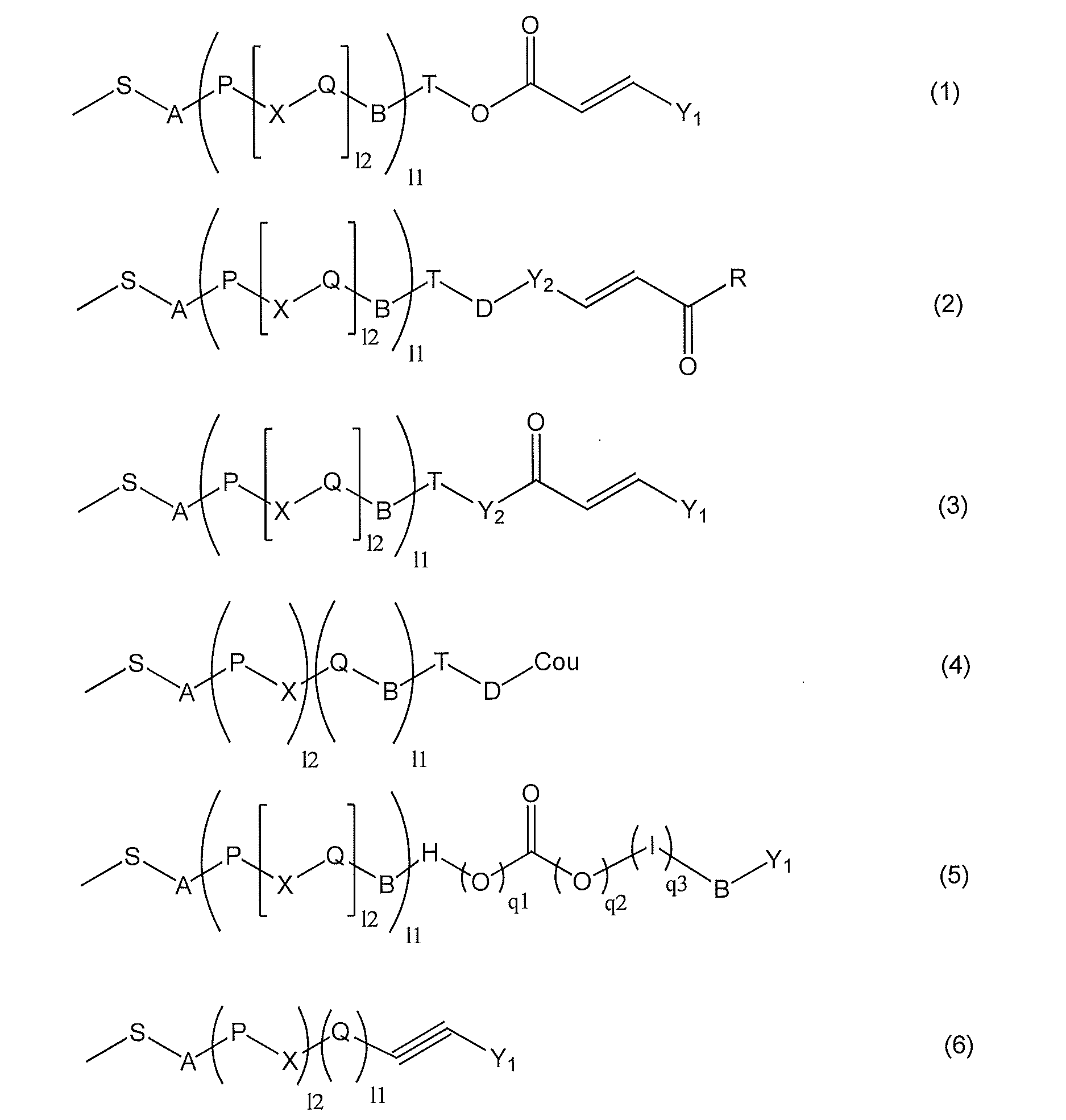
液晶性のみを発現する構造は、下記式(21)~(31)
(式中、A及びBは上記と同じ定義を有する;
Y3は、1価のベンゼン環、ナフタレン環、ビフェニル環、フラン環、窒素含有複素環、及び炭素数5~8の脂環式炭化水素、および、それらの組み合わせからなる群から選ばれる基であり、それらに結合する水素原子はそれぞれ独立に-NO2、-CN、ハロゲン基、炭素数1~5のアルキル基、又は炭素数1~5のアルキルオキシ基で置換されても良い;
R3は、水素原子、-NO2、-CN、-CH=C(CN)2、-CH=CH-CN、ハロゲン基、1価のベンゼン環、ナフタレン環、ビフェニル環、フラン環、窒素含有複素環、炭素数5~8の脂環式炭化水素、炭素数1~12のアルキル基、又は炭素数1~12のアルコキシ基を表す;
q1とq2は、一方が1で他方が0である;
lは1~12の整数を表し、mは0から2の整数を表し、但し、式(23)~(24)において、全てのmの合計は2以上であり、式(25)~(26)において、全てのmの合計は1以上であり、m1、m2およびm3は、それぞれ独立に1~3の整数を表す;
R2は、水素原子、-NO2、-CN、ハロゲン基、1価のベンゼン環、ナフタレン環、ビフェニル環、フラン環、窒素含有複素環、及び炭素数5~8の脂環式炭化水素、および、アルキル基、又はアルキルオキシ基を表す;
Z1、Z2は単結合、-CO-、-CH2O-、-CH=N-、-CF2-を表す)からなる群から選ばれるいずれか1種の構造であるのがよい。

ポリマー(A2)の光反応性を発現する構造の量は、ポリマー(A2)の光反応性を発現する構造と液晶性を発現する構造を100モル%とした場合、0.95αモル%以下、好ましくは0.1α~0.8αモル%、より好ましくは0.25α~0.5αモル%であるのがよい。
<7> 上記<2>~<6>のいずれかにおいて、ポリマー(A1)の重量平均分子量がβ(βは3万以上、好ましくは3万~30万、より好ましくは4万~20万、さらに好ましくは6万~15万)であり、ポリマー(A2)の重量平均分子量が0.1β~0.9β、好ましくは0.2β~0.8β、より好ましくは0.3β~0.7βであるのがよい。
<8> 上記<2>~<7>のいずれかにおいて、ポリマー(A1)とポリマー(A2)との合計重量を100wt%とすると、ポリマー(A1)が20~95wt%、好ましくは50~90wt%、より好ましくは60~80wt%であるのがよい。
<10> 上記<9>において、モノマー(M1)が上記式(1)~(20)のいずれかで表される構造を有するのがよい。
<11> 上記<9>又は<10>において、モノマー(M2)が上記式(21)~(31)で表される構造を有するのがよい。
<13> 上記<9>~<12>のいずれかにおいて、モノマー(M2)が下記式MA2、MA9~MA13、MA15、MA24、MA26、MA27、MA31、MA35、MA37、MA43及びMA45からなる群から選ばれる少なくとも1種であるのがよい。
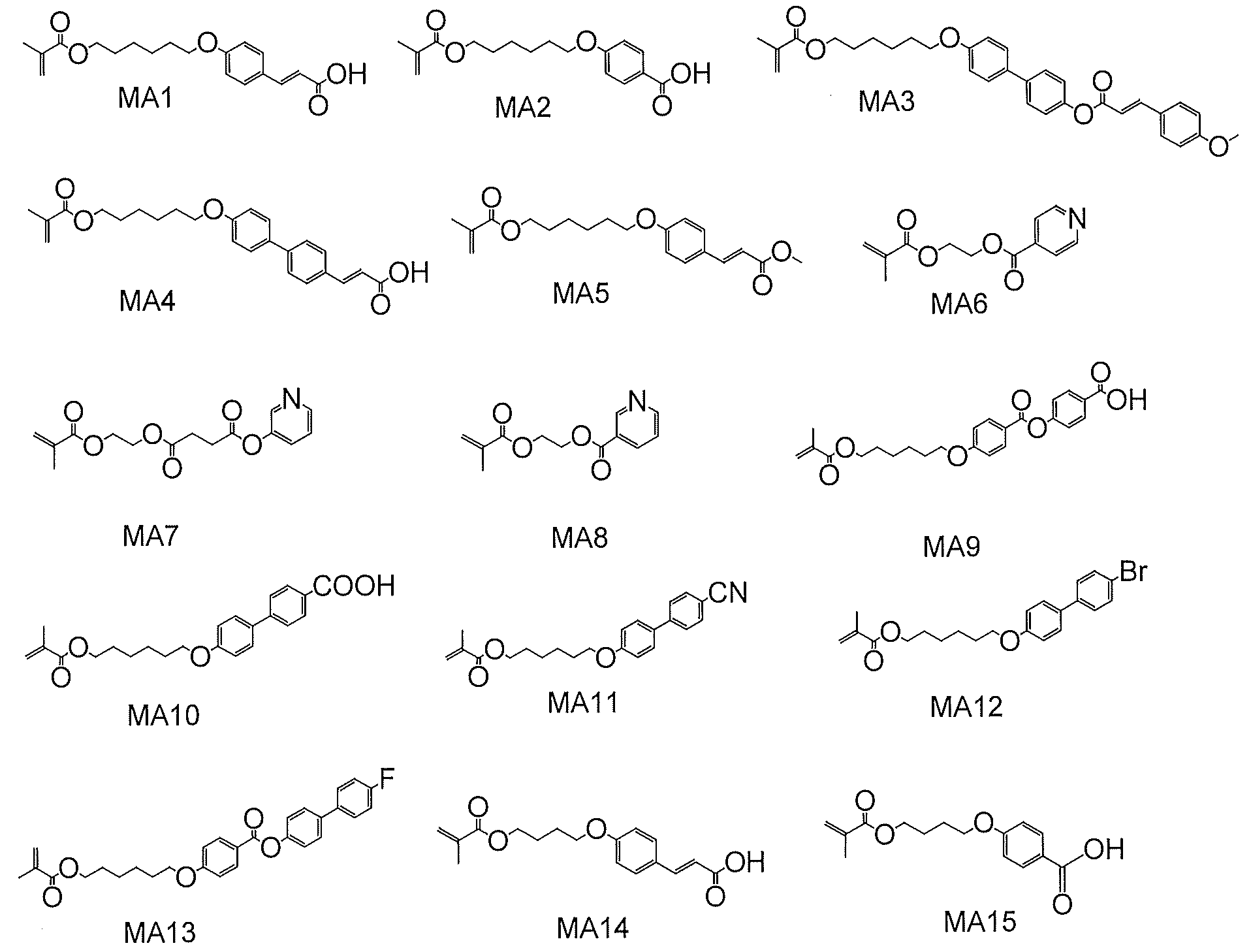
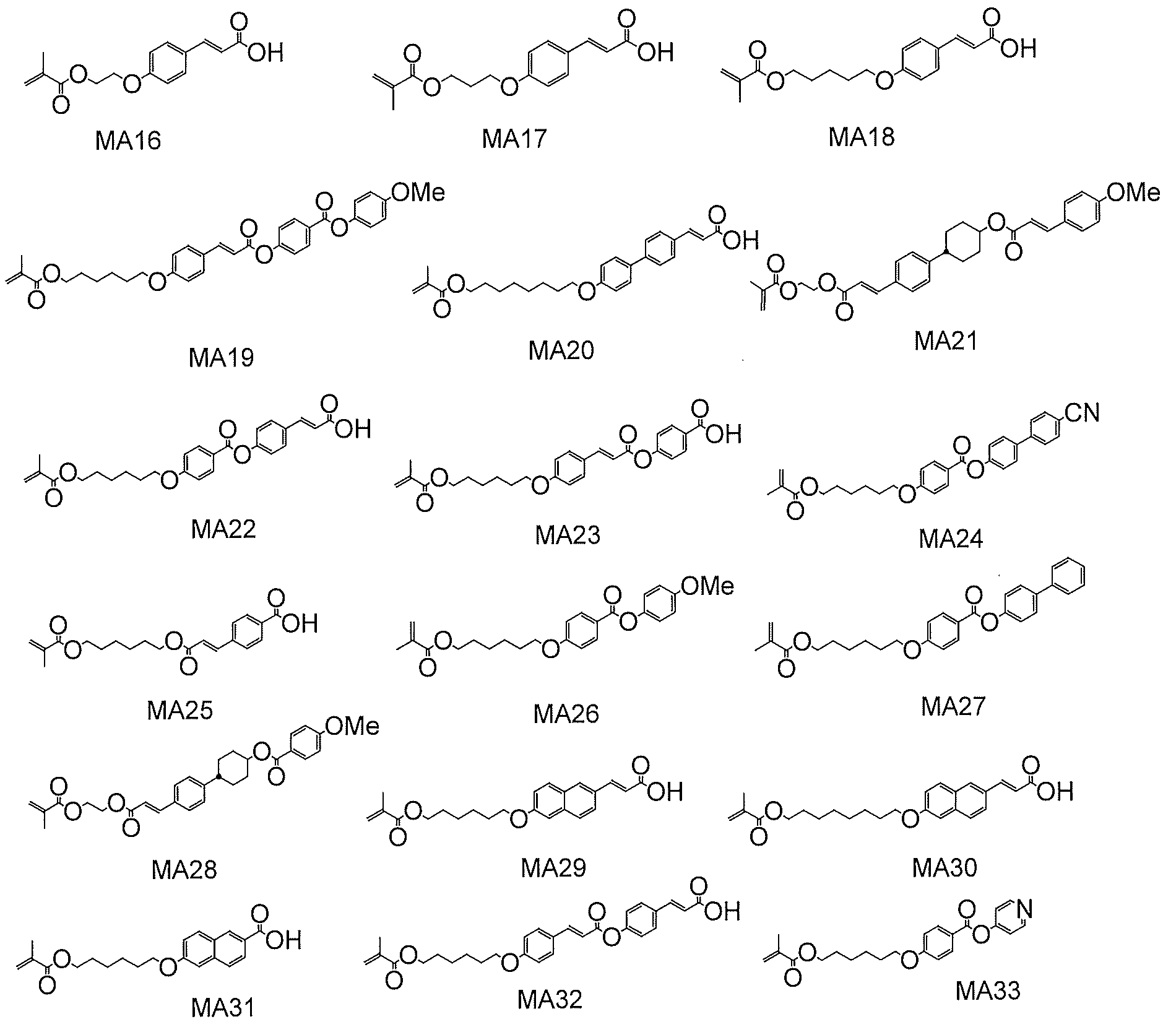

ポリマー(A2)は、モノマー(M1)が0.95αモル%以下、好ましくは0.1α~0.8αモル%、より好ましくは0.25α~0.5αモル%であり且つ残余がモノマー(M2)であるように、形成されるのがよい。

<17> 上記<1>~<15>において、(B)成分の重合体が、ジイソシアネート成分と、テトラカルボン酸誘導体と、ジアミン成分とを重合反応させることにより得られるポリウレアポリイミド前駆体であるのがよい。
<18> 上記<1>~<15>において、(B)成分の重合体が、テトラカルボン酸誘導体と、ジアミン成分とを重合反応させることにより得られるポリイミド前駆体であるのがよい。
<20> 上記<19>に記載される液晶配向剤、特に横電界駆動型液晶表示素子用液晶配向剤から形成される液晶配向膜、特に横電界駆動型液晶表示素子用液晶配向膜。
[II] [I]で得られた塗膜に偏光した紫外線を照射する工程;及び
[III] [II]で得られた塗膜を加熱する工程;
を有することによって配向制御能が付与された液晶配向膜、特に横電界駆動型液晶表示素子用液晶配向膜を得る、該液晶配向膜の製造方法。
<22> 上記<21>の液晶配向膜、特に横電界駆動型液晶表示素子用液晶配向膜を有する基板、特に横電界駆動型液晶表示素子用基板。
<23> [I] 上記<1>~<18>のいずれかに記載される重合体組成物を、横電界駆動用の導電膜を有する基板上に塗布して塗膜を形成する工程;
[II] [I]で得られた塗膜に偏光した紫外線を照射する工程;及び
[III] [II]で得られた塗膜を加熱する工程;
を有することによって配向制御能が付与された液晶配向膜、特に横電界駆動型液晶表示素子用液晶配向膜を得る、該液晶配向膜を有する基板の製造方法。
<25> 上記<23>に従い、基板(第1の基板)を製造する工程;
[I’] 第2の基板上に上記<1>~<18>のいずれかに記載される重合体組成物を塗布して塗膜を形成する工程;
[II’] [I’]で得られた塗膜に偏光した紫外線を照射する工程;
[III’] [II’]で得られた塗膜を加熱する工程;
を有することによって配向制御能が付与された液晶配向膜を得る、前記液晶配向膜を有する第2の基板を得る工程;及び
[IV] 液晶を介して前記第1及び第2の基板の液晶配向膜が相対するように、前記第1及び第2の基板を対向配置して液晶表示素子を得る工程;
を有することにより、液晶表示素子、特に横電界駆動型液晶表示素子を得る、液晶表示素子の製造方法。
また、本発明により、上記効果以外に、又は上記効果に加えて、該組成物を有する液晶配向剤、該液晶配向剤を用いて製造される液晶配向膜、該液晶配向膜を有する基板、該液晶配向膜及び/又は該基板を有する液晶表示素子、特に横電界駆動型液晶表示素子を提供することができる。
本願は、重合体組成物、特に液晶配向剤用の、より特に横電界駆動型液晶表示素子用液晶配向剤用の重合体組成物を提供する。
本願の重合体組成物は、
(A)光反応性を発現する構造及び液晶性を発現する構造を有するポリマーを少なくとも2種;(B)ジイソシアネート成分及びテトラカルボン酸誘導体から選ばれる少なくとも一種と、ジアミン化合物とを用いて製造された重合体;及び(C)有機溶媒を含有する。
また、(A)成分である少なくとも2種のポリマーのうち、一方のポリマー(A1)と他方のポリマー(A2)とは互いに光反応性を発現する構造の量が異なるのがよい。
本明細書において、「光反応性を発現する構造」とは、ある波長範囲の光、特に250nm~400nmの波長範囲の光で反応する構造をいい、例えば該構造は(A)成分であるポリマーの側鎖に有するのがよい。
本明細書において、「液晶性を発現する構造」とは、ある温度範囲、特に100~300℃の温度範囲で、液晶性を示す構造をいい、例えば、ポリマーの側鎖にメソゲン基又はメソゲン成分を有する構造であるのがよい。
「液晶性を発現する構造」を有するポリマーを用いる場合、該ポリマーを液晶配向膜とした際に、安定な液晶配向を得ることができる。
「光反応性を発現する構造」と「液晶性を発現する構造」とが同じ側鎖に有する場合、ビフェニル基、ターフェニル基、フェニルシクロヘキシル基、フェニルベンゾエート基、アゾベンゼン基などのメソゲン成分と、先端部に結合された、光に感応して架橋反応や異性化反応を示す「光反応性を発現する構造」が側鎖に有する場合、その側鎖が「液晶性を発現する構造」であるメソゲン成分ともなり、かつ「光反応性を発現する構造」である光フリース転位反応をするフェニルベンゾエート基を有する構造とする場合、などがある。
光反応性を発現する構造、特に光反応性及び液晶性を発現する構造は、式(1)~(6)からなる群から選ばれるいずれか1種で表される構造であるのがよい。なお、式中、A、B、D、S、Y1、Y2、R、X、Cou、q1とq2、q3、P及びQ、l1、l2、H、並びにIは、上述と同じ定義を有する。
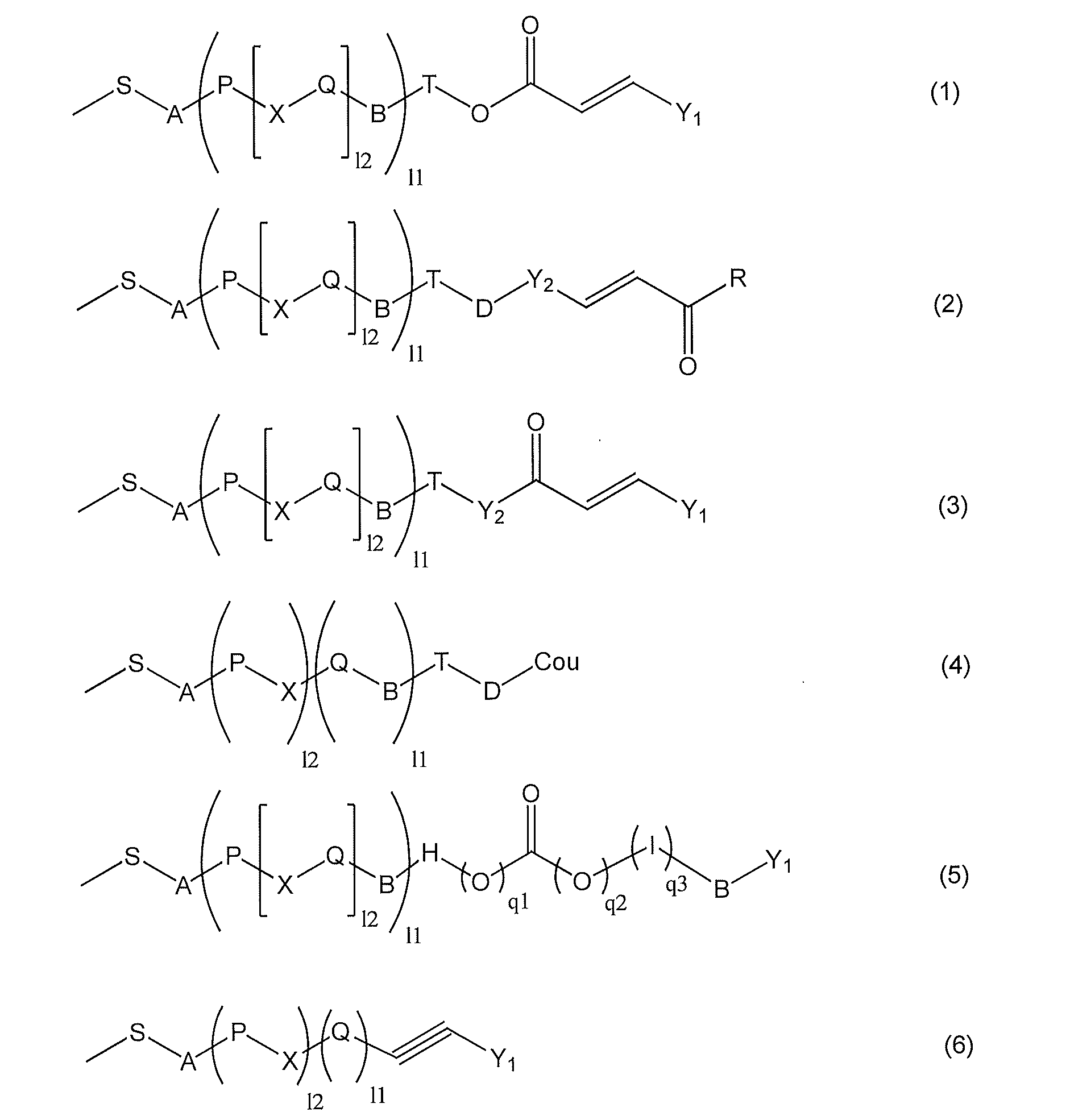
式中、A、B、D、Y1、X、Y2、及びRは、上記と同じ定義を有する;
lは1~12の整数を表す;
mは、0~2の整数を表し、m1、m2は1~3の整数を表す;
nは0~12の整数(ただしn=0のときBは単結合である)を表す。
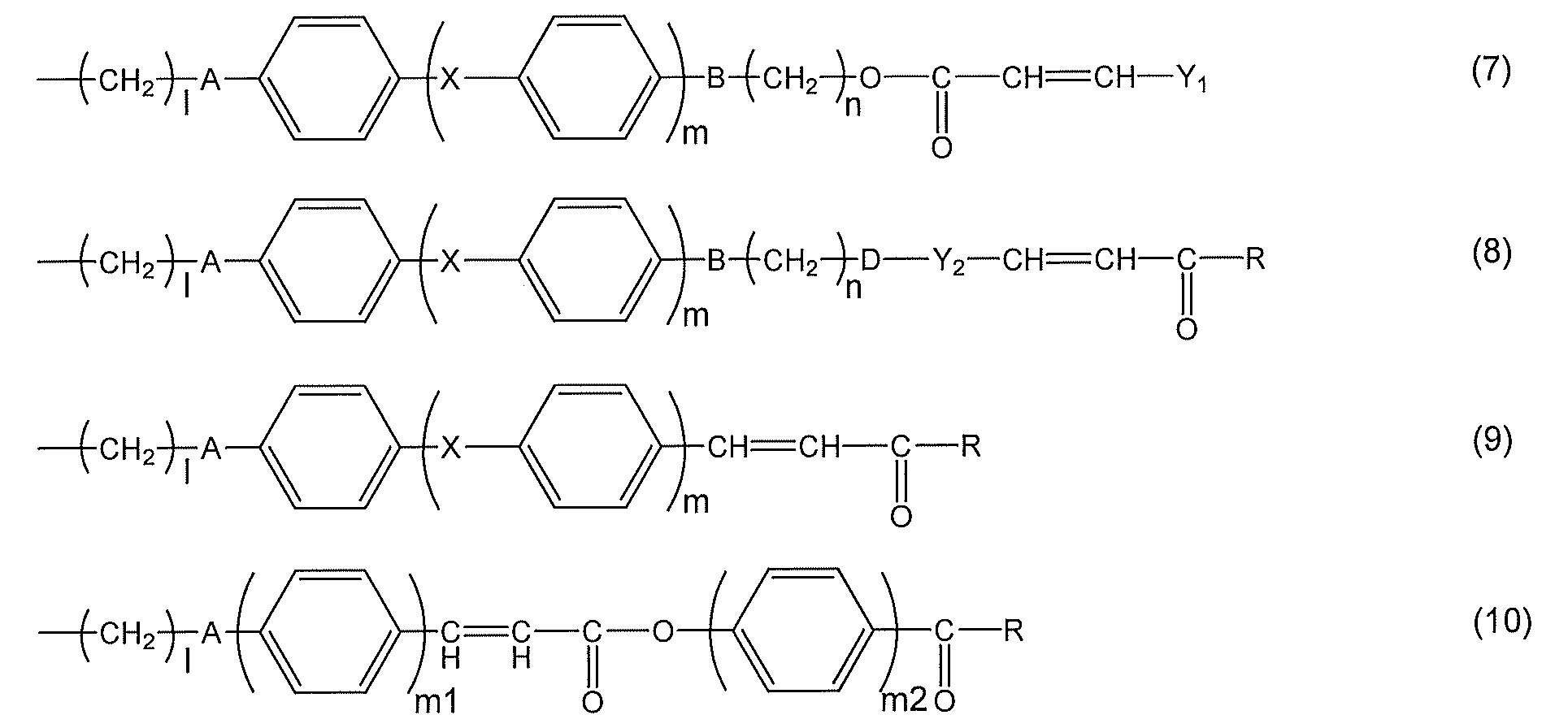
式中、A、X、l、m、m1及びRは、上記と同じ定義を有する。

式中、A、Y1、l、m1及びm2は上記と同じ定義を有する。
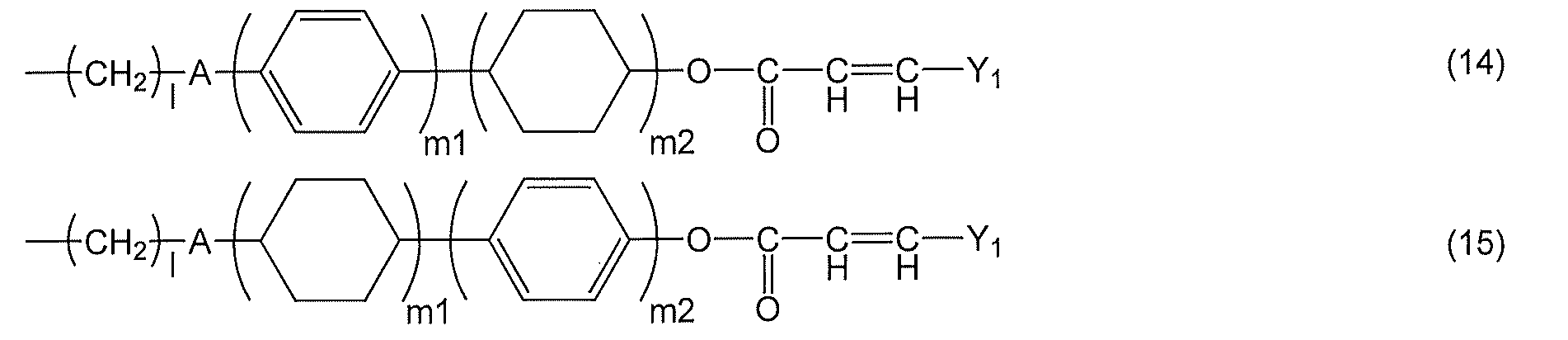
式中、A、X、l及びmは、上記と同じ定義を有する。
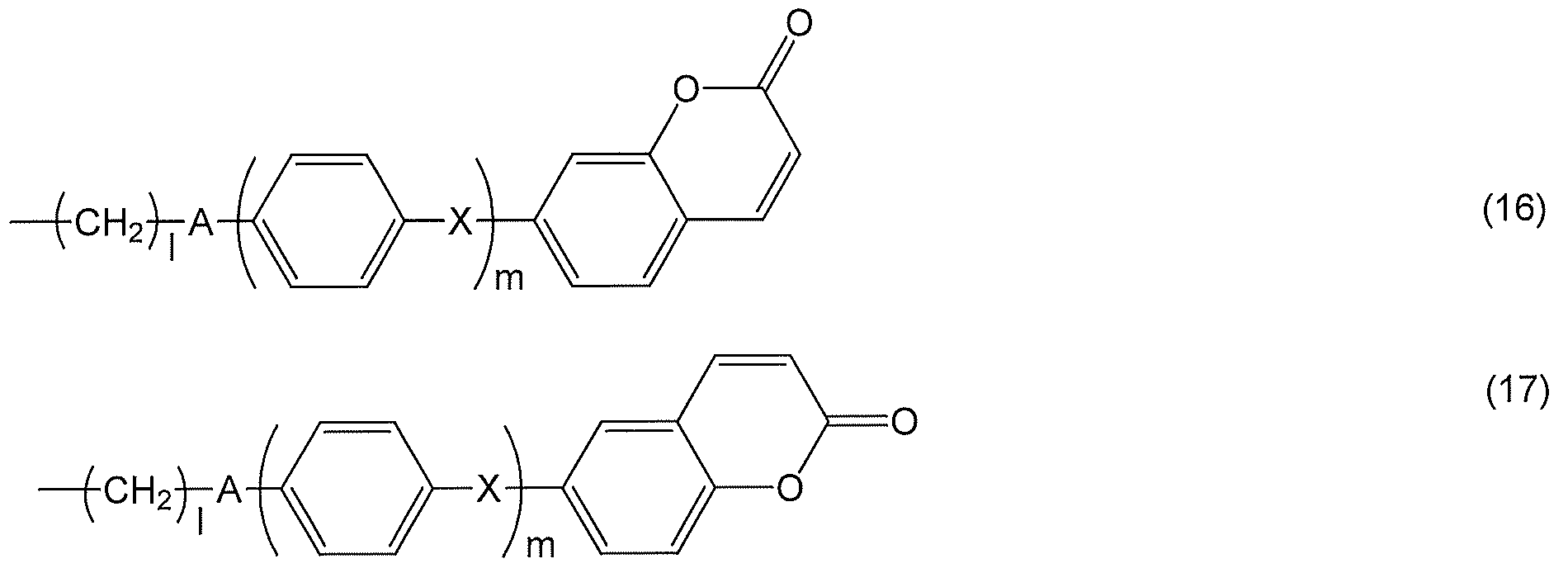
式中、A、B、Y1、q1、q2、m1、及びm2は、上記と同じ定義を有する。
R1は、水素原子、-NO2、-CN、-CH=C(CN)2、-CH=CH-CN、ハロゲン基、炭素数1~5のアルキル基、又は炭素数1~5のアルキルオキシ基を表す。
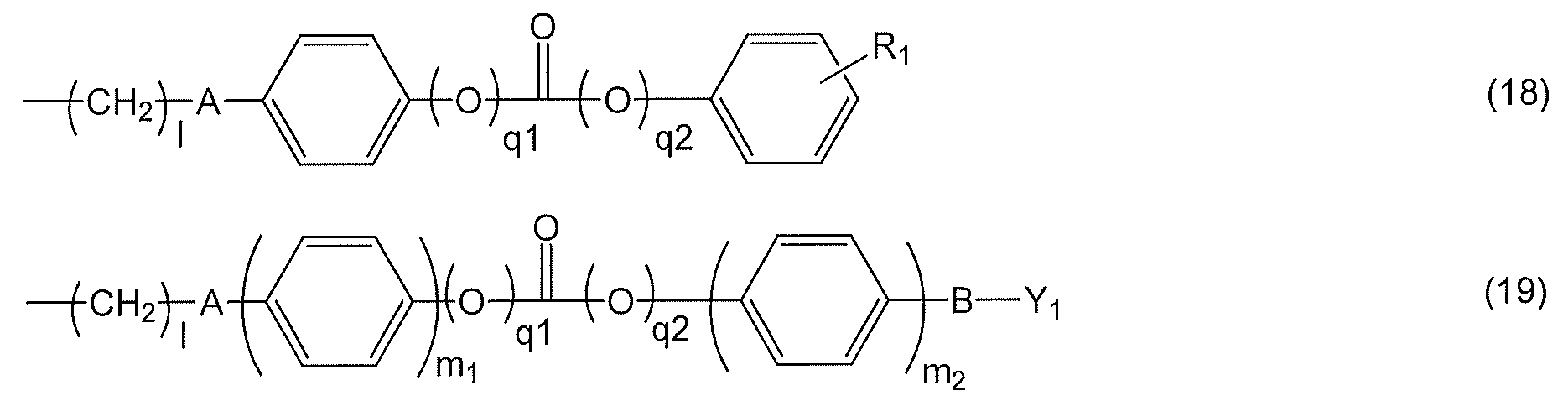
式中、A、Y1、X、l及びmは上記と同じ定義を有する。

液晶性のみを発現する構造は、式(21)~(31)からなる群から選ばれるいずれか1種で表される構造であるのがよい。なお、式中、A、B、Y3、R3、q1、q2、l、m、m1、m2、m3、R2、Z1、Z2は、上述と同じ定義を有する。
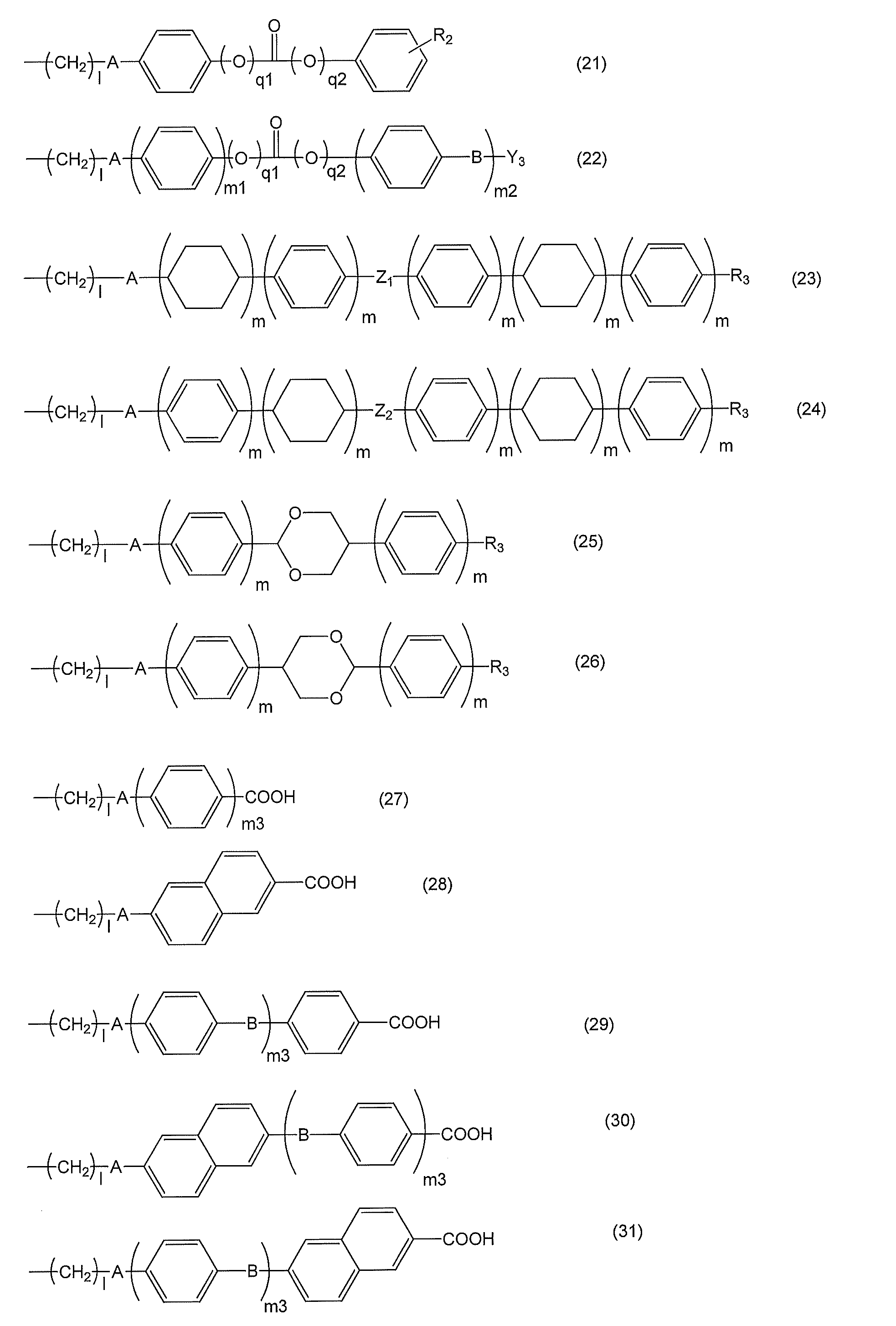
(A)成分である少なくとも2種のポリマーの各々において、光反応性を発現する構造と液晶性のみを発現する構造との合計を100モル%とした場合、
ポリマー(A1)の光反応性を発現する構造の量はαモル%(αは15以上、好ましくは15~100、より好ましくは20~80)であり、
ポリマー(A2)の光反応性を発現する構造の量は、ポリマー(A1)の光反応性を発現する構造の量よりも少ないのがよく、具体的には0.95αモル%以下、好ましくは0.1α~0.8αモル%、より好ましくは0.25α~0.5αモル%であるのがよい。
(A)成分として、光反応性を発現する構造の量が互い異なるポリマーを用いることにより、次のような作用を有するものと考えられる。即ち、光反応性を発現する構造が相対的に多いポリマー(ポリマー(A1))により、紫外線照射による配向性が定められる。一方、光反応性を発現する構造が相対的に少ないが液晶性を発現する構造が相対的に多いポリマー(ポリマー(A2))は、ポリマー(A1)によって定められた配向性にしたがって配向する。少なくとも2種のポリマーのうち、各ポリマーは、各々が有する作用を分担し且つ該作用を有効に発揮することができる。
また、(A)成分である少なくとも2種のポリマーのうち、一方の重量平均分子量がβ(βは3万以上、好ましくは3万~30万、より好ましくは4万~20万、さらに好ましくは6万~15万)であり、
他方の重量平均分子量が0.1β~0.9β、好ましくは0.2β~0.8β、より好ましくは0.3β~0.7βであるのがよい。
なお、本明細書において、特記しない限り、重量平均分子量は、GPC(Gel Permeation Chromatography)法で測定したものである。
特に、光反応性を発現する構造の量が相対的に多いポリマー(A1)は、その重量平均分子量がβ(βは3万以上、好ましくは3万~30万、より好ましくは4万~20万、さらに好ましくは6万~15万)であり、
光反応性を発現する構造の量が相対的に少ないポリマー(A2)は、その重量平均分子量が0.1β~0.9β、好ましくは0.2β~0.8β、より好ましくは0.3β~0.7βであるのがよい。
このような構成を有することにより次のような作用を奏するものと考えられる。
即ち、光反応性を発現する構造が相対的に多く且つ重量平均分子量が大であるポリマー(A1)は、液晶配向膜の相対的に下層(相対的に基板に近い層)に形成される。一方、光反応性を発現する構造が相対的に少なく且つ重量平均分子量が小であるポリマー(A2)は、液晶配向膜の相対的に上層(相対的に基板に遠い層)に形成される。この状況で、偏光紫外線を照射すると、相対的に下層(相対的に基板に近い層)のポリマー(A1)が、偏光紫外線にしたがって、配向する。一方、相対的に上層(相対的に基板に遠い層)のポリマー(A2)は、ポリマー(A1)の配向に沿って、配向する、という作用を生じるものと考えられる。
なお、ポリマー(A1)とポリマー(A2)との合計重量を100wt%とすると、ポリマー(A1)が20~95wt%、好ましくは50~90wt%、より好ましくは60~80wt%である一方、ポリマー(A2)はその残余であるのがよい。
本発明の(A)成分である少なくとも2種のポリマーは、上述の構成を有するのであれば、その製造方法は特に限定されない。例えば、本発明の(A)成分である少なくとも2種のポリマーは、(M-1)光反応性及び液晶性を発現する構造を有するモノマー(M1);及び(M-2)液晶性のみを発現する構造を有するモノマー(M2);を有して形成されるのがよい。なお、光反応性及び/又は液晶性の発現能を損なわない範囲でその他のモノマーと共重合することができる。
上述のとおり、本発明の(A)成分である少なくとも2種のポリマーが、モノマー(M1)及びモノマー(M2)を有して形成されるが、モノマー(M1)及びモノマー(M2)の合計を100モル%とした場合、少なくとも2種のポリマーのうちのポリマー(A1)は、モノマー(M1)がαモル%(αは15以上、好ましくは15~100、より好ましくは20~80)であり且つ残余がモノマー(M2)であるように、形成されるのがよい。
また、ポリマー(A2)は、モノマー(M1)が0.95αモル%以下、好ましくは0.1α~0.8αモル%、より好ましくは0.25α~0.5αモル%であり且つ残余がモノマー(M2)であるように、形成されるのがよい。
なお、ポリマー(A1)及びポリマー(A2)において用いるモノマー(M1)及びモノマー(M2)は、互いに共通であるのが好ましい。
本発明の(A)成分である少なくとも2種のポリマーは、上記光反応性及び液晶性を発現する構造を有するモノマー(M1);及び(M-2)液晶性のみを発現する構造を有するモノマー(M2);を有して形成、具体的には共重合することによって得るのががよい。
光反応性及び液晶性を発現する構造を有するモノマー(M1)とは、ポリマーを形成した場合に、ポリマーの側鎖部位に光反応性及び液晶性を発現する構造を有するポリマーを形成することができるモノマーのことである。
側鎖部位に光反応性を発現する構造としては下記の構造およびその誘導体が好ましい。

なお、MA1~MA46は、次のように合成することができる。
MA2は特許文献(特開平9-118717)に記載の合成法にて合成を行うことができる。
MA3が非特許文献(Macromolecules 2002, 35, 706-713)に記載の合成法にて合成を行うことができる。
MA4は、特許文献(WO2014/054785)に記載の合成方法にて合成を行うことができる。
MA5は特許文献(特開2010-18807)に記載の合成法にて合成を行うことができる。
MA6~MA9は、特許文献(WO2014/054785)に記載の合成方法にて合成を行うことができる。
MA10は市販購入可能であるM6BC(みどり化学株式会社製)を用いることができる。
MA11~13は、特許文献(WO2014/054785)に記載の合成方法にて合成を行うことができる。
MA19~23は、特許文献(WO2014/054785)に記載の合成方法にて合成を行うことができる。
MA24は、非特許文献(Polymer Journal, Vol.29, No.4, pp303-308(1997))に記載の合成方法にて合成を行うことができる。
MA25は、特許文献(WO2014/054785)に記載の合成方法にて合成を行うことができる。
MA26及びMA27は、各々、非特許文献(Macromolecules (2012),45(21),8547-8554)、非特許文献(Liquid Crystals (1995), 19(4),433-40)に記載の合成方法にて合成を行うことができる。
MA28~33は、特許文献(WO2014/054785)に記載の合成方法にて合成を行うことができる。
MA34~39は、特許文献(WO2014/054785)に記載の合成方法にて合成を行うことができる。
MA40及び41は、特許文献(特表2009-511431号)に記載の合成方法にて合成を行うことができる。
MA42は、特許文献(WO2014/054785)に記載の合成方法にて合成を行うことができる。
MA43は、特許文献(WO2012-115129)に記載の合成方法にて合成を行うことができる。
MA44は、特許文献(WO2013-133078)に記載の合成方法にて合成を行うことができる。
MA45は、特許文献(WO2008-072652)に記載の合成方法にて合成を行うことができる。
MA46は、特許文献(WO2014/054785)に記載の合成方法にて合成を行うことができる。
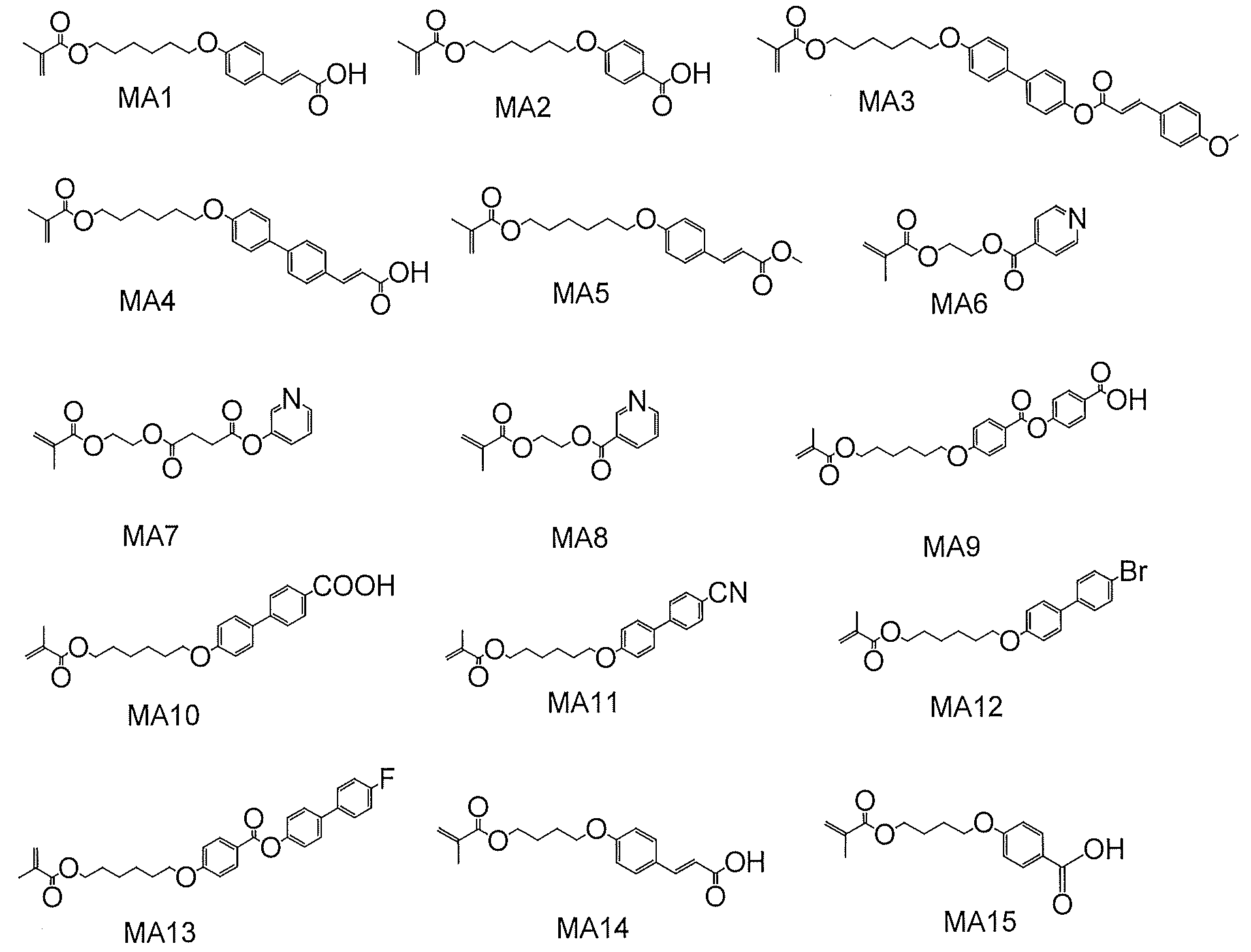


液晶性のみを発現する構造を有するモノマー(M2)とは、該モノマー由来のポリマーが液晶性を発現し、該ポリマーが側鎖部位にメソゲン基を形成することができるモノマーのことである。

ポリマー(A1)及び/又はポリマー(A2)は、(M-3)架橋性基を有するモノマー、具体的には下記式(G-1)、(G-2)、(G-3)及び(G-4)からなる群から選ばれる少なくとも1種の基を有するモノマー(M3)、より具体的には下記式(0)で表される構造を有するモノマー;を有して形成されてもよい。

上記式(0)で表される構造を有するモノマーのより具体的な例としては、炭化水素、(メタ)アクリレート、イタコネート、フマレート、マレエート、α-メチレン-γ-ブチロラクトン、スチレン、ビニル、マレイミド、ノルボルネン等のラジカル重合性基およびシロキサンからなる群から選択される少なくとも1種から構成された重合性基と、上記式(0)で表される構造とを有するのが好ましい。
アジリジンを有するモノマーとしては、具体的には、例えば、上記エポキシ基を有するモノマーの エポキシ構造がアジリジンまたは1-メチルアジリジンに置き換わったもの等が挙げられる。
ポリマー(A1)及び/又はポリマー(A2)は、所望により、(M-4)窒素含有芳香族複素環基、アミド基及びウレタン基からなる群から選ばれる少なくとも1種の基を有するモノマー(M4);を有して形成されてもよい。

これらのうち、例えば、ピリジン環が好ましい。
その他のモノマーとしては、例えば工業的に入手できるラジカル重合反応可能なモノマーが挙げられる。
スチレン化合物としては、例えば、スチレン、メチルスチレン、クロロスチレン、ブロモスチレン等が挙げられる。
マレイミド化合物としては、例えば、マレイミド、N-メチルマレイミド、N-フェニルマレイミド、及びN-シクロヘキシルマレイミド等が挙げられる。
また、ラジカル重合において有機溶媒中の酸素は重合反応を阻害する原因となるので、有機溶媒は可能な程度に脱気されたものを用いることが好ましい。
上述の反応により得られた反応溶液から、生成したポリマーを回収する場合には、反応溶液を貧溶媒に投入して、それら重合体を沈殿させれば良い。沈殿に用いる貧溶媒としては、メタノール、アセトン、ヘキサン、ヘプタン、ブチルセルソルブ、ヘプタン、メチルエチルケトン、メチルイソブチルケトン、エタノール、トルエン、ベンゼン、ジエチルエーテル、メチルエチルエーテル、水等を挙げることができる。貧溶媒に投入して沈殿させた重合体は、濾過して回収した後、常圧あるいは減圧下で、常温あるいは加熱して乾燥することができる。また、沈殿回収した重合体を、有機溶媒に再溶解させ、再沈殿回収する操作を2回~10回繰り返すと、重合体中の不純物を少なくすることができる。この際の貧溶媒として、例えば、アルコール類、ケトン類、炭化水素等が挙げられ、これらの中から選ばれる3種類以上の貧溶媒を用いると、より一層精製の効率が上がるので好ましい。
本発明に用いられる重合体組成物は、(B)成分として、ジイソシアネート成分及びテトラカルボン酸誘導体から選ばれる少なくとも一種と、ジアミン化合物とを用いて製造された重合体を有する。かかる(B)成分の重合体は、ジイソシアネート成分及びジアミン成分とを用いて製造されたポリウレア、ジイソシアネート成分及びテトラカルボン酸誘導体を用いて製造されたポリイミド前駆体、および、ジイソシアネート成分、テトラカルボン酸誘導体及びジアミン成分を用いて製造されたポリウレアポリイミド前駆体、すなわち、ポリウレアとポリイミド前駆体との共重合体が挙げられる。
(B)成分の原料であるジイソシアネート成分として、例えば、芳香族ジイソシアネート、脂肪族ジイソシアネートなどが挙げられる。好ましいジイソシアネート成分は、芳香族ジイソシアネート、脂肪族ジイソシアネートである。
(B)成分の原料であるテトラカルボン酸誘導体として、例えば以下のテトラカルボン酸二無水物が挙げられる。
その具体例を以下に挙げる。
(B)成分の原料であるジアミン成分としては、例えば、以下の脂環式ジアミン、芳香族ジアミン、複素環式ジアミン、脂肪族ジアミンやウレア結合含有ジアミンが挙げられる。

また、(B)成分におけるジアミン成分は、以下のジアミンを含有しても良い。



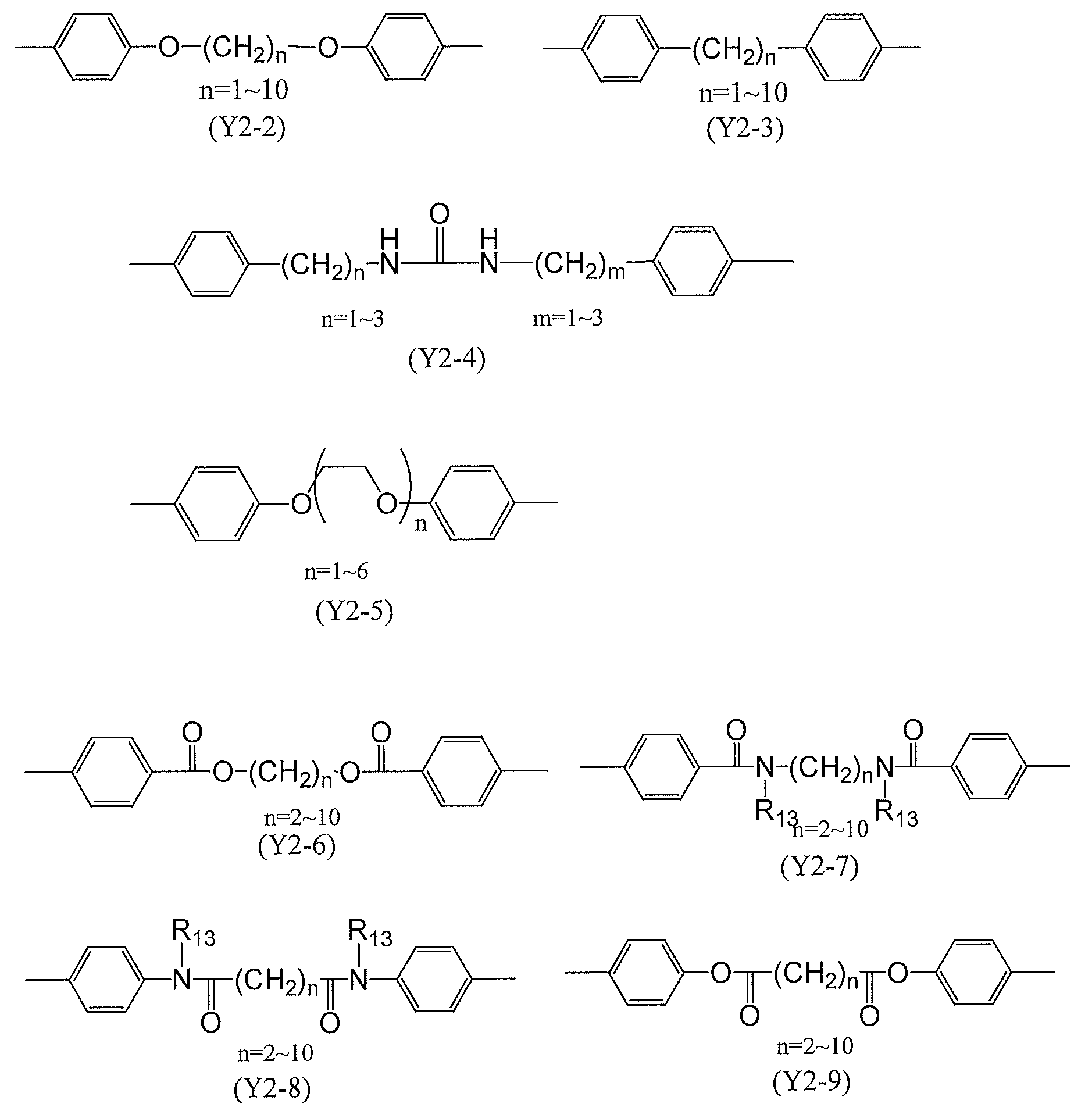
その具体例を以下に挙げる。
で示される繰り返し単位を有する重合体である。


本発明に用いられる重合体組成物に用いる有機溶媒は、樹脂成分を溶解させる有機溶媒であれば特に限定されない。その具体例を以下に挙げる。
N,N-ジメチルホルムアミド、N,N-ジメチルアセトアミド、N-メチル-2-ピロリドン、N-メチルカプロラクタム、2-ピロリドン、N-エチルピロリドン、N-ビニルピロリドン、ジメチルスルホキシド、テトラメチル尿素、ピリジン、ジメチルスルホン、ヘキサメチルスルホキシド、γ-ブチロラクトン、3-メトキシ-N,N-ジメチルプロパンアミド、3-エトキシ-N,N-ジメチルプロパンアミド、3-ブトキシ-N,N-ジメチルプロパンアミド、1,3-ジメチル-イミダゾリジノン、エチルアミルケトン、メチルノニルケトン、メチルエチルケトン、メチルイソアミルケトン、メチルイソプロピルケトン、シクロヘキサノン、エチレンカーボネート、プロピレンカーボネート、ジグライム、4-ヒドロキシ-4-メチル-2-ペンタノン、プロピレングリコールモノアセテート、プロピレングリコールモノメチルエーテル、プロピレングリコール-tert-ブチルエーテル、ジプロピレングリコールモノメチルエーテル、ジエチレングリコール、ジエチレングリコールモノアセテート、ジエチレングリコールジメチルエーテル、ジプロピレングリコールモノアセテートモノメチルエーテル、ジプロピレングリコールモノメチルエーテル、ジプロピレングリコールモノエチルエーテル、ジプロピレングリコールモノアセテートモノエチルエーテル、ジプロピレングリコールモノプロピルエーテル、ジプロピレングリコールモノアセテートモノプロピルエーテル、3-メチル-3-メトキシブチルアセテート、トリプロピレングリコールメチルエーテル等が挙げられる。これらは単独で使用しても、混合して使用してもよい。
本発明に用いられる重合体組成物は、液晶配向膜の形成に好適となるように塗布液として調製されることが好ましい。すなわち、本発明に用いられる重合体組成物は、樹脂被膜を形成するための樹脂成分が有機溶媒に溶解した溶液として調製されることが好ましい。ここで、その樹脂成分とは、既に説明した、(A)光反応性を発現する構造及び液晶性を発現する構造を有するポリマーを少なくとも2種と、(B)ジイソシアネート成分及びテトラカルボン酸誘導体から選ばれる少なくとも一種と、ジアミン化合物とを用いて製造された重合体とを含む樹脂成分である。その際、樹脂成分の含有量は、1質量%~20質量%が好ましく、より好ましくは1質量%~15質量%、特に好ましくは1質量%~10質量%である。
そのような他の重合体は、例えば、ポリ(メタ)アクリレート等からなり、光反応性を発現する構造及び液晶性を発現する構造を有するポリマーではない重合体等が挙げられる。
例えば、イソプロピルアルコール、メトキシメチルペンタノール、メチルセロソルブ、エチルセロソルブ、ブチルセロソルブ、メチルセロソルブアセテート、エチルセロソルブアセテート、ブチルカルビトール、エチルカルビトール、エチルカルビトールアセテート、エチレングリコール、エチレングリコールモノアセテート、エチレングリコールモノイソプロピルエーテル、エチレングリコールモノブチルエーテル、プロピレングリコール、プロピレングリコールモノアセテート、プロピレングリコールモノメチルエーテル、プロピレングリコール-tert-ブチルエーテル、ジプロピレングリコールモノメチルエーテル、ジエチレングリコール、ジエチレングリコールモノアセテート、ジエチレングリコールジメチルエーテル、ジプロピレングリコールモノアセテートモノメチルエーテル、ジプロピレングリコールモノメチルエーテル、ジプロピレングリコールモノエチルエーテル、ジプロピレングリコールモノアセテートモノエチルエーテル、ジプロピレングリコールモノプロピルエーテル、ジプロピレングリコールモノアセテートモノプロピルエーテル、3-メチル-3-メトキシブチルアセテート、トリプロピレングリコールメチルエーテル、3-メチル-3-メトキシブタノール、ジイソプロピルエーテル、エチルイソブチルエーテル、ジイソブチレン、アミルアセテート、ブチルブチレート、ブチルエーテル、ジイソブチルケトン、メチルシクロへキセン、プロピルエーテル、ジヘキシルエーテル、1-ヘキサノール、n-へキサン、n-ペンタン、n-オクタン、ジエチルエーテル、乳酸メチル、乳酸エチル、酢酸メチル、酢酸エチル、酢酸n-ブチル、酢酸プロピレングリコールモノエチルエーテル、ピルビン酸メチル、ピルビン酸エチル、3-メトキシプロピオン酸メチル、3-エトキシプロピオン酸メチルエチル、3-メトキシプロピオン酸エチル、3-エトキシプロピオン酸、3-メトキシプロピオン酸、3-メトキシプロピオン酸プロピル、3-メトキシプロピオン酸ブチル、1-メトキシ-2-プロパノール、1-エトキシ-2-プロパノール、1-ブトキシ-2-プロパノール、1-フェノキシ-2-プロパノール、プロピレングリコールモノアセテート、プロピレングリコールジアセテート、プロピレングリコール-1-モノメチルエーテル-2-アセテート、プロピレングリコール-1-モノエチルエーテル-2-アセテート、ジプロピレングリコール、2-(2-エトキシプロポキシ)プロパノール、乳酸メチルエステル、乳酸エチルエステル、乳酸n-プロピルエステル、乳酸n-ブチルエステル、乳酸イソアミルエステル等の低表面張力を有する溶媒等が挙げられる。
より具体的には、例えば、エフトップ(登録商標)301、EF303、EF352(トーケムプロダクツ社製)、メガファック(登録商標)F171、F173、R-30(DIC社製)、フロラードFC430、FC431(住友スリーエム社製)、アサヒガード(登録商標)AG710(旭硝子社製)、サーフロン(登録商標)S-382、SC101、SC102、SC103、SC104、SC105、SC106(AGCセイミケミカル社製)等が挙げられる。これらの界面活性剤の使用割合は、重合体組成物に含有される樹脂成分の100質量部に対して、好ましくは0.01質量部~2質量部、より好ましくは0.01質量部~1質量部である。
例えば、3-アミノプロピルトリメトキシシラン、3-アミノプロピルトリエトキシシラン、2-アミノプロピルトリメトキシシラン、2-アミノプロピルトリエトキシシラン、N-(2-アミノエチル)-3-アミノプロピルトリメトキシシラン、N-(2-アミノエチル)-3-アミノプロピルメチルジメトキシシラン、3-ウレイドプロピルトリメトキシシラン、3-ウレイドプロピルトリエトキシシラン、N-エトキシカルボニル-3-アミノプロピルトリメトキシシラン、N-エトキシカルボニル-3-アミノプロピルトリエトキシシラン、N-トリエトキシシリルプロピルトリエチレントリアミン、N-トリメトキシシリルプロピルトリエチレントリアミン、10-トリメトキシシリル-1,4,7-トリアザデカン、10-トリエトキシシリル-1,4,7-トリアザデカン、9-トリメトキシシリル-3,6-ジアザノニルアセテート、9-トリエトキシシリル-3,6-ジアザノニルアセテート、N-ベンジル-3-アミノプロピルトリメトキシシラン、N-ベンジル-3-アミノプロピルトリエトキシシラン、N-フェニル-3-アミノプロピルトリメトキシシラン、N-フェニル-3-アミノプロピルトリエトキシシラン、N-ビス(オキシエチレン)-3-アミノプロピルトリメトキシシラン、N-ビス(オキシエチレン)-3-アミノプロピルトリエトキシシラン等が挙げられる。
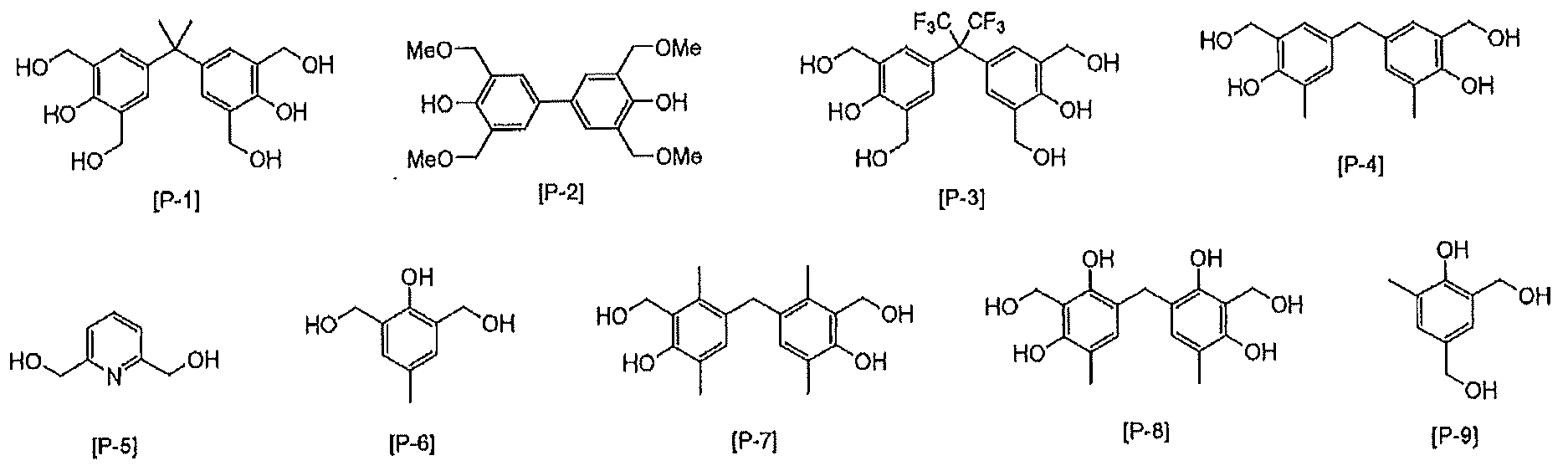
好ましくは、芳香族2-ヒドロキシケトン(ベンゾフェノン)、クマリン、ケトクマリン、カルボニルビスクマリン、アセトフェノン、アントラキノン、キサントン、チオキサントン、およびアセトフェノンケタールである。
本願は、上述の重合体組成物を有するか、又は上述の重合体組成物から本質的になるか、又は上述の重合体組成物のみからなる液晶配向剤、特に液晶表示素子用、より特に横電界駆動型液晶表示素子用の液晶配向剤を提供する。
本願は、上述の液晶配向剤から形成される液晶配向膜、特に液晶表示素子用、より特に横電界駆動型液晶表示素子用の液晶配向膜を提供する。
また、本願は、上述の液晶配向剤から形成される液晶配向膜、特に液晶表示素子用、より特に横電界駆動型液晶表示素子用の液晶配向膜を有する基板、特に液晶表示素子用、より特に横電界駆動型液晶表示素子用の基板を提供する。
上述の液晶配向膜は、
[I] 上述の重合体組成物又は上述の液晶配向剤を、基板上に、例えば横電界駆動用の導電膜を有する基板上に塗布して塗膜を形成する工程;
[II] [I]で得られた塗膜に偏光した紫外線を照射する工程;及び
[III] [II]で得られた塗膜を加熱する工程;
を有することによって、配向制御能が付与された液晶配向膜、特に液晶表示素子用、より特に横電界駆動型液晶表示素子用の液晶配向膜又は該液晶配向膜を有する基板を得ることができる。
基板については、特に限定はされないが、製造される液晶表示素子が透過型である場合、透明性の高い基板が用いられることが好ましい。その場合、特に限定はされず、ガラス基板、またはアクリル基板やポリカーボネート基板等のプラスチック基板等を用いることができる。
また、反射型の液晶表示素子への適用を考慮し、シリコンウェハなどの不透明な基板も使用できる。
基板は、横電界駆動型液晶表示素子に用いる場合、横電界駆動用の導電膜を有する。
該導電膜として、液晶表示素子が透過型である場合、ITO(Indium Tin Oxide:酸化インジウムスズ)、IZO(Indium Zinc Oxide:酸化インジウム亜鉛)などを挙げることができるが、これらに限定されない。
また、反射型の液晶表示素子の場合、導電膜として、アルミなどの光を反射する材料などを挙げることができるがこれらに限定されない。
基板に導電膜を形成する方法は、従来公知の手法を用いることができる。
工程[I]では、横電界駆動用の導電膜を有する基板上に、所定の温度範囲で液晶性を発現する、本発明の(A)光反応性を発現する構造及び液晶性を発現する構造を有するポリマーを少なくとも2種;(B)ジイソシアネート成分及びテトラカルボン酸誘導体から選ばれる少なくとも一種と、ジアミン化合物とを用いて製造された重合体;及び(C)有機溶媒を含有する重合体組成物を塗布して塗膜を形成する。なお、ここで(A)成分のポリマーの液晶相発現温度とは、(A)成分の少なくとも2種のポリマーが全体として液晶相を発現する温度のことである。
塗布方法は、工業的には、スクリーン印刷、オフセット印刷、フレキソ印刷またはインクジェット法などで行う方法が一般的である。その他の塗布方法としては、ディップ法、ロールコータ法、スリットコータ法、スピンナ法(回転塗布法)またはスプレー法などがあり、目的に応じてこれらを用いてもよい。
尚、[I]工程の後、続く[II]工程の前に塗膜の形成された基板を室温にまで冷却する工程を設けることも可能である。
工程[II]では、工程[I]で得られた塗膜に偏光した紫外線を照射する。塗膜の膜面に偏光した紫外線を照射する場合、基板に対して一定の方向から偏光板を介して偏光された紫外線を照射する。使用する紫外線としては、波長100nm~400nmの範囲の紫外線を使用することができる。好ましくは、使用する塗膜の種類によりフィルター等を介して最適な波長を選択する。そして、例えば、選択的に光架橋反応を誘起できるように、波長290nm~400nmの範囲の紫外線を選択して使用することができる。紫外線としては、例えば、高圧水銀灯から放射される光を用いることができる。
工程[III]では、工程[II]で偏光した紫外線の照射された塗膜を加熱する。加熱により、塗膜に配向制御能を付与することができる。
加熱は、ホットプレート、熱循環型オーブンまたはIR(赤外線)型オーブンなどの加熱手段を用いることができる。加熱温度は、使用する塗膜の液晶性を発現させる温度を考慮して決めることができる。
なお、液晶性発現温度は、本発明の(A)成分のポリマーまたは塗膜表面が固体相から液晶相に相転移がおきるガラス転移温度(Tg)以上であって、液晶相からアイソトロピック相(等方相)に相転移を起こすアイソトロピック相転移温度(Tiso)以下の温度をいう。
本願は、上記で得られた液晶配向膜を有する基板を有する液晶表示素子、特に横電界駆動型液晶表示素子を提供する。
第2の基板は、横電界駆動用の導電膜を有する基板に代わって、横電界駆動用の導電膜を有しない基板を用いる場合、第1の基板と同様に、横電界駆動用の導電膜を有する基板を用いる場合がある。また、第2の基板には、第1の基板と同様に、液晶配向膜を有するのがよい。
[IV] 上記で得られた第1及び第2の基板を、液晶を介して第1及び第2の基板の液晶配向膜が相対するように、対向配置して液晶表示素子を得る工程;
を有する。これにより、液晶表示素子、特に横電界駆動型液晶表示素子を得ることができる。
[IV]工程は、[III]で得られた、横電界駆動用の導電膜上に液晶配向膜を有する基板(第1の基板)と、同様に上記[I’]~[III’]で得られた、液晶配向膜付基板(第2の基板)とを、液晶を介して、双方の液晶配向膜が相対するように対向配置して、公知の方法で液晶セルを作製し、横電界駆動型液晶表示素子を作製する工程である。なお、工程[I’]~[III’]は、工程[I]において、横電界駆動用の導電膜の有無の違い以外、工程[I]~[III]と同様に行うことができる。工程[I]~[III]と工程[I’]~[III’]との相違点は、上述した導電膜の有無だけであるため、工程[I’]~[III’]の説明を省略する。
スペーサの径は、好ましくは1μm~30μm、より好ましくは2μm~10μmである。このスペーサ径が、液晶層を挟持する一対の基板間距離、すなわち、液晶層の厚みを決めることになる。
MA1、MA2は、それぞれ、次のようにして合成した。即ち、MA1は特許文献(WO2011-084546)に記載の合成法にて合成した。MA2は特許文献(特開平9-118717)に記載の合成法にて合成した。なお、MA1をモノマーとして形成されるポリマーは光反応性及び液晶性を有し、MA2をモノマーとして形成されるポリマーは液晶性のみを有する。
共重合するモノマーA1はWO2014/054785号パンフレットに記載の合成法にて合成した。
HBAGE(ヒドロキシブチルアクリレートグリシジルエーテル)は、市販購入可能であるものを用いた。
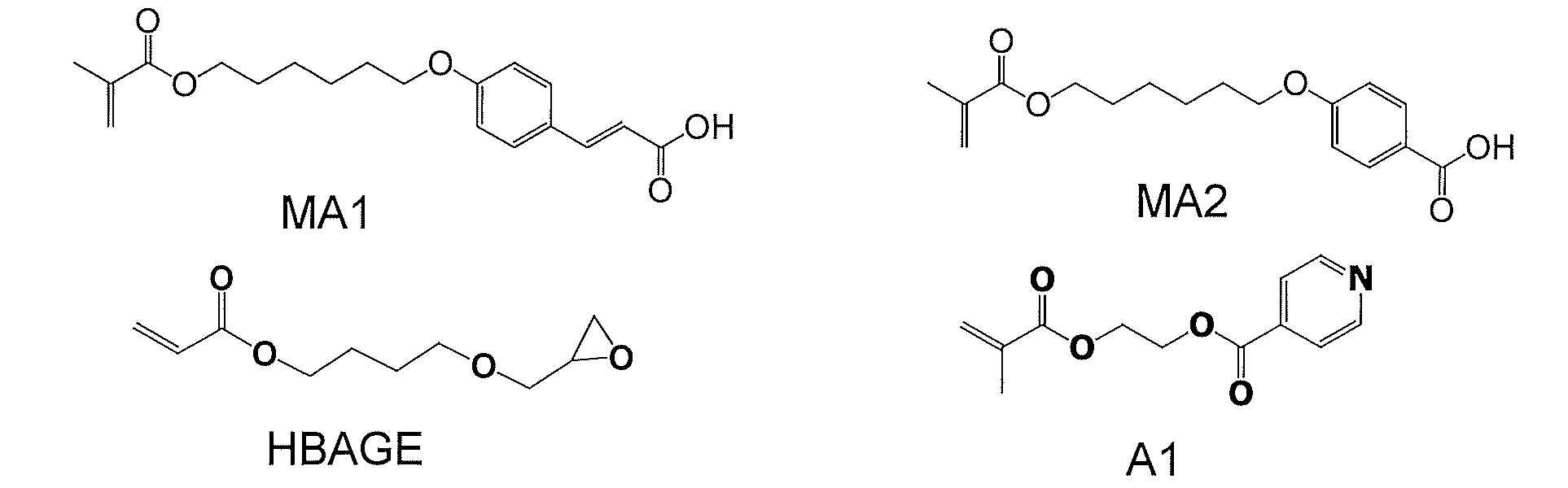
ISPDA:イソフォロンジイソシアネート
DDM:4,4’-ジアミノジフェニルメタン
Me-4APhA:N-メチル-2-(4-アミノフェニル)エチルアミン
Me-DADPA: 4,4’-ジアミノジフェニル(N-メチル)アミン
DA-2MG:1,2-ビス(4-アミノフェノキシ)エタン
TDA: 3,4-ジカルボキシ-1,2,3,4-テトラヒドロ-1-ナフタレンコハク酸二無水物
(有機溶媒)
THF:テトラヒドロフラン
NMP:N-エチル-2-ピロリドン
BCS:ブチルセロソロブ
(重合開始剤)
AIBN:2,2’-アゾビスイソブチロニトリル
MA1(1.66g:0.1mol%)、MA2(13.79g:0.9mol%)をTHF(146.42g)中に溶解し、ダイアフラムポンプで脱気を行った後、AIBN(0.82g)を加え再び脱気を行った。この後、60℃で8時間反応させメタクリレートのポリマー溶液を得た。このポリマー溶液をメタノール(300ml)に滴下し、得られた沈殿物をろ過した。この沈澱物をメタノールで洗浄し、減圧乾燥しメタクリレートポリマー粉末P1を得た。
表1に示す組成を用いた以外、光配向ポリマー合成例P1と同様の方法を用いて、メタクリレートポリマー粉末P2~P3を合成した。
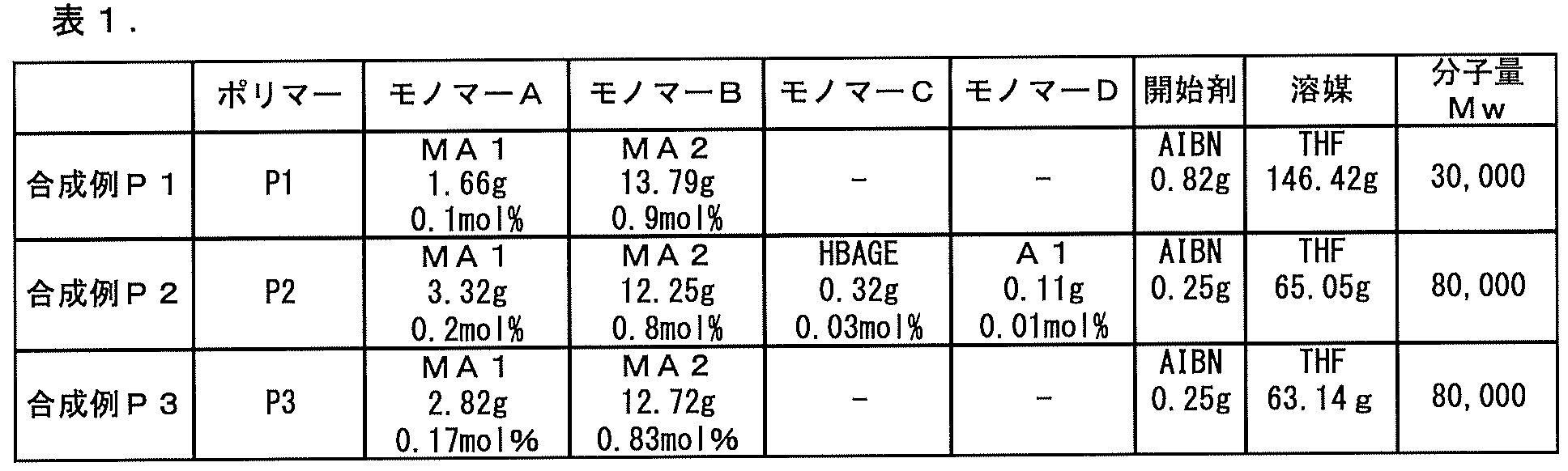
テトラカルボン酸二無水物成分として、TDAを4.85g、ジイソシアネート成分として、ISPDAを3.67g、ジアミン成分として、DDMを5.89g、Me-DADPAを0.35g、Me-4APhAを0.25用い、NMP85.06g中、室温で18時間反応させポリアミック酸(L1)の濃度15wt%の溶液を得た。
テトラカルボン酸二無水物成分として、TDAを4.47g、ジイソシアネート成分として、ISPDAを3.45g、ジアミン成分として、DA-2MGを6.01g、Me-DADPAを1.32g用い、NMP86.67g中、室温で18時間反応させポリウレア(L2)の濃度15wt%の溶液を得た。
ジイソシアネート成分として、ISPDAを7.11g、ジアミン成分として、DA-2MGを6.45g、Me-DADPAを1.41g用い、NMP84.84g中、室温で18時間反応させポリウレア(L3)の濃度15wt%の溶液を得た。
NMP(8.04g)に光配向ポリマー合成例P1にて得られたメタクリレートポリマー粉末P1(0.11g)と、光配向ポリマー合成例P2にて得られたメタクリレートポリマー粉末P2(0.25g)を加え、室温で1時間攪拌して溶解させた。この溶液に、ポリマー合成例L1にて得られたポリアミック酸溶液L1(5.6g)と、BCS(6.0g)を加え攪拌することにより、ポリマー溶液T1を得た。このポリマー溶液T1は、そのまま液晶配向膜を形成するための液晶配向剤とした。
NMP(8.04g)に光配向ポリマー合成例P1にて得られたメタクリレートポリマー粉末P1(0.11g)と、光配向ポリマー合成例P2にて得られたメタクリレートポリマー粉末P2(0.25g)を加え、室温で1時間攪拌して溶解させた。この溶液に、ポリマー合成例L2にて得られたポリウレア溶液L2(5.6g)と、BCS(6.0g)を加え攪拌することにより、ポリマー溶液T2を得た。このポリマー溶液T2は、そのまま液晶配向膜を形成するための液晶配向剤とした。
NMP(8.04g)に光配向ポリマー合成例P1にて得られたメタクリレートポリマー粉末P1(0.11g)と、光配向ポリマー合成例P2にて得られたメタクリレートポリマー粉末P2(0.25g)を加え、室温で1時間攪拌して溶解させた。この溶液に、ポリマー合成例L3にて得られたポリウレア溶液L3(5.6g)と、BCS(6.0g)を加え攪拌することにより、ポリマー溶液T3を得た。このポリマー溶液T3は、そのまま液晶配向膜を形成するための液晶配向剤とした。
NMP(8.04g)に光配向ポリマー合成例P2にて得られたメタクリレートポリマー粉末P2(0.36g)を加え、室温で1時間攪拌して溶解させた。この溶液に、ポリマー合成例L1にて得られたポリアミック酸溶液L1(5.6g)と、BCS(6.0g)を加え攪拌することにより、ポリマー溶液CT1を得た。このポリマー溶液CT1は、そのまま液晶配向膜を形成するための液晶配向剤とした。
NMP(8.04g)に光配向ポリマー合成例P2にて得られたメタクリレートポリマー粉末P2(0.36g)を加え、室温で1時間攪拌して溶解させた。この溶液に、ポリマー合成例L2にて得られたポリウレア溶液L2(5.6g)と、BCS(6.0g)を加え攪拌することにより、ポリマー溶液CT2を得た。このポリマー溶液CT2は、そのまま液晶配向膜を形成するための液晶配向剤とした。
NMP(8.04g)に光配向ポリマー合成例P2にて得られたメタクリレートポリマー粉末P2(0.36g)を加え、室温で1時間攪拌して溶解させた。この溶液に、ポリマー合成例L3にて得られたポリウレア溶液L3(5.6g)と、BCS(6.0g)を加え攪拌することにより、ポリマー溶液CT3を得た。このポリマー溶液CT3は、そのまま液晶配向膜を形成するための液晶配向剤とした。
NMP(8.04g)に光配向ポリマー合成例P3にて得られたメタクリレートポリマー粉末P3(0.36g)を加え、室温で1時間攪拌して溶解させた。この溶液に、ポリマー合成例L1にて得られたポリアミック酸溶液L1(5.6g)と、BCS(6.0g)を加え攪拌することにより、ポリマー溶液CT4を得た。このポリマー溶液CT4は、そのまま液晶配向膜を形成するための液晶配向剤とした。
NMP(8.04g)に光配向ポリマー合成例P3にて得られたメタクリレートポリマー粉末P3(0.36g)を加え、室温で1時間攪拌して溶解させた。この溶液に、ポリマー合成例L2にて得られたポリウレア溶液L2(5.6g)と、BCS(6.0g)を加え攪拌することにより、ポリマー溶液CT5を得た。このポリマー溶液CT5は、そのまま液晶配向膜を形成するための液晶配向剤とした。
NMP(8.04g)に光配向ポリマー合成例P3にて得られたメタクリレートポリマー粉末P3(0.36g)を加え、室温で1時間攪拌して溶解させた。この溶液に、ポリマー合成例L3にて得られたポリウレア溶液L3(5.6g)と、BCS(6.0g)を加え攪拌することにより、ポリマー溶液CT6を得た。このポリマー溶液CT6は、そのまま液晶配向膜を形成するための液晶配向剤とした。
NMP(12.8g)に光配向ポリマー合成例P1にて得られたメタクリレートポリマー粉末P1(0.36g)と、光配向ポリマー合成例P2にて得られたメタクリレートポリマー粉末P2(0.84g)を加え、室温で1時間攪拌して溶解させた。BCS(6.0g)を加え攪拌することにより、ポリマー溶液CT7を得た。このポリマー溶液CT7は、そのまま液晶配向膜を形成するための液晶配向剤とした。
なお、表2中の「各光配向ポリマー中の光反応性基量」及び「全光反応性基量」については、例えば次のように求めることができる。
光配向ポリマー中の「全光反応性基量」は、光配向ポリマー種P1とP2との重量比と、上記光配向ポリマー種P1及びP2における「光反応性基量」とから求められ、0.1mol%×0.3(P1種が30wt%に由来)+0.2mol%×0.7(P2種が70wt%に由来)から、0.17mol%が求められる。
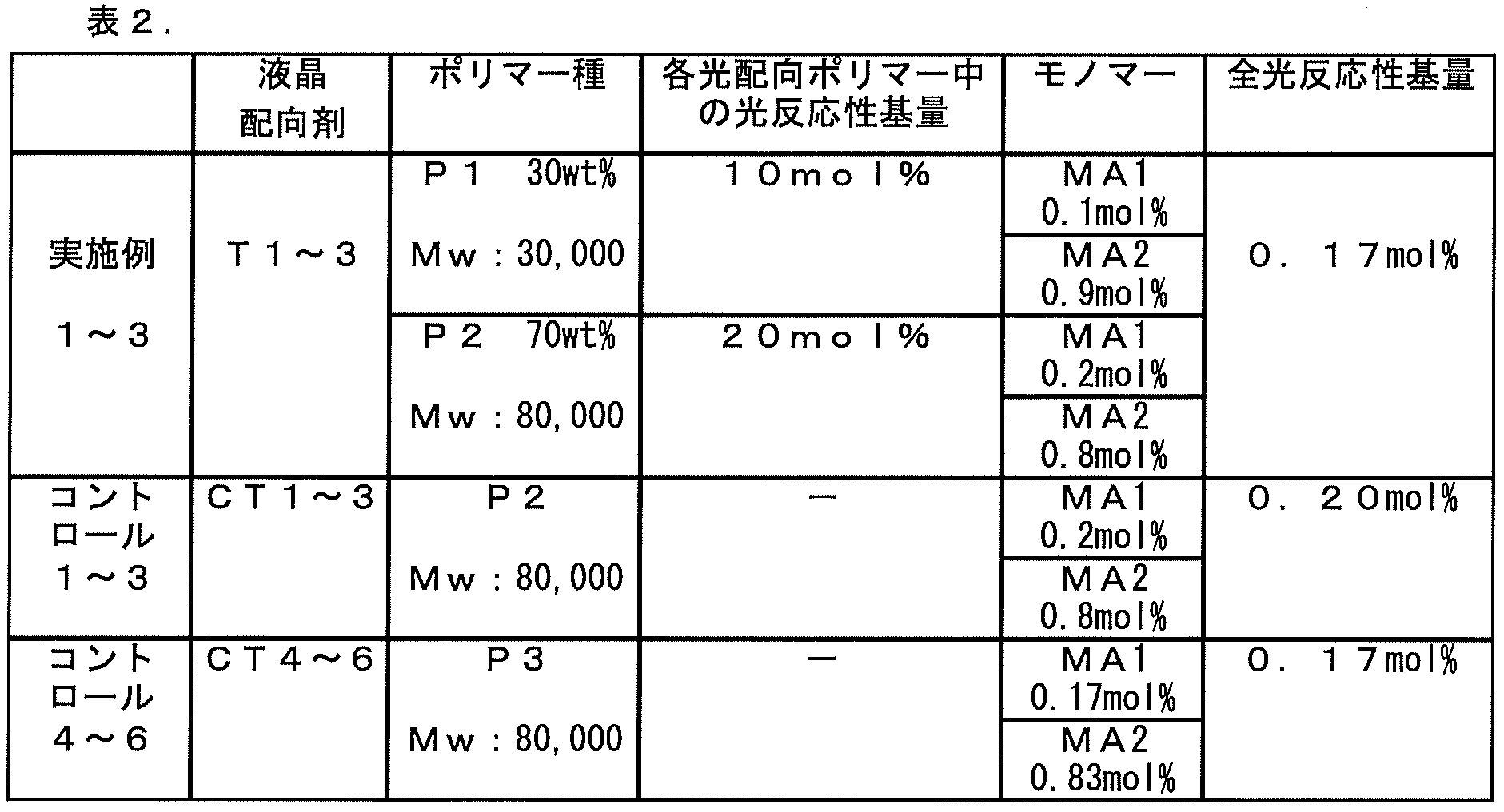
実施例1で得られた液晶配向剤(T1)を0.45μmのフィルターで濾過した後、透明電極付きガラス基板上にスピンコートし、70℃のホットプレート上で90秒間乾燥後、膜厚100nmの液晶配向膜を形成した。次いで、塗膜面に偏光板を介して313nmの紫外線を5~50mJ/cm2照射した後に150℃のホットプレートで10分間加熱し、液晶配向膜付き基板を得た。このような液晶配向膜付き基板を2枚用意し、一方の基板の液晶配向膜面に6μmのスペーサを設置した後、2枚の基板のラビング方向が平行になるようにして組み合わせ、液晶注入口を残して周囲をシールし、セルギャップが4μmの空セルを作製した。この空セルに減圧注入法によって、液晶MLC-3019(メルク株式会社製)を注入し、注入口を封止して、液晶が平行配向した液晶セルを得た。
同様に実施例2,3で得られた液晶配向剤T2、T3及び、コントロール1~7で得られた液晶配向剤CT1~7を用いて、液晶セルを作成した。
実施例1~3、コントロール1~7で作製した液晶セルを偏光軸が直交するように配置された2枚の偏光板の間に設置し、電圧無印加の状態でバックライトを点灯させておき、透過光の輝度が最も小さくなるように液晶セルの配置角度を調整した。その液晶セルを目視にて確認。この液晶セルが良好に配向し、流動配向が確認されなければ「○」、配向したものの流動配向が確認されれば「△」、無配向であれば「×」とした。
上記で作製した液晶セルを用い、70℃温下で5Vの電圧を60μs間印加し、16.67ms後の電圧を測定し、電圧がどのくらい保持できているかを電圧保持率(VHR)として計算した。なお、電圧保持率の測定には、東陽テクニカ社製の電圧保持率測定装置VHR-1を使用した。
実施例1~3およびコントロール1~7のVHRの結果を、<配向性評価>の結果及び光配向ポリマー成分中の「全光反応性基量」と併せて、表3に示す。

具体的には、実施例1~3とコントロール1~3とを比較すると、両者は全光反応性基量がほぼ同程度(実施例1~3:0.17;コントロール1~3:0.20)であり且つ両者においてエポキシ基(HBAGE由来)及び窒素含有芳香族複素環基を有するポリマーを用いており、それによってVHRはほぼ同程度の値を示している。しかしながら、両者において、実施例1では、ポリマー種として2種(P1及びP2)を用いている一方、コントロール1ではポリマー種として1種(P2)のみを用いている。この違いにより、実施例1ではUV照射量30mJ/cm2まで良好な配向性が確認される一方、コントロール1ではUV照射量30mJ/cm2では無配向であり、実施例1の方が、コントロール1と比較して、広範囲のUV照射量において良好な配向性を示していることがわかる。
実施例1~3とコントロール4~6とを比較すると、両者は全光反応性基量が同じ(実施例1~3:0.17;コントロール4~6:0.17)であるが、光配向ポリマー種として2種(P1及びP2)を用いている一方、コントロール3では光配向ポリマー種として1種(P3)のみを用いている。この違いにより、実施例1~3ではUV照射量30mJ/cm2まで良好な配向性が確認される一方、コントロール1ではUV照射量30mJ/cm2では流動配向が確認され、実施例1~3の方が、コントロール4~6と比較して、広範囲のUV照射量において良好な配向性を示していることがわかる。また、実施例1~3は、コントロール7に比べてVHRが向上していることがわかる。
Claims (20)
- (A)光反応性を発現する構造及び液晶性を発現する構造を有するポリマーを少なくとも2種;
(B)ジイソシアネート成分及びテトラカルボン酸誘導体から選ばれる少なくとも一種とジアミン化合物とを用いて製造された重合体;
及び
(C)有機溶媒;
を含有する重合体組成物。 - 前記(A)少なくとも2種のポリマーのうち、一方のポリマー(A1)と他方のポリマー(A2)とは互いに光反応性を発現する構造の量が異なる請求項1に記載の重合体組成物。
- 前記(A)少なくとも2種のポリマーは各々、光反応性を発現する構造、及び液晶性のみを発現する構造を有する請求項1又は請求項2に記載の組成物。
- 前記光反応性を発現する構造は、
下記式(1)~(6)
(式中、A、B、Dはそれぞれ独立に、単結合、-O-、-CH2-、-COO-、-OCO-、-CONH-、-NH-CO-、-CH=CH-CO-O-、又は-O-CO-CH=CH-を表す;
Sは、炭素数1~12のアルキレン基であり、それらに結合する水素原子はハロゲン基に置き換えられていてもよい;
Tは、単結合または炭素数1~12のアルキレン基であり、それらに結合する水素原子はハロゲン基に置き換えられていてもよい;
Y1は、1価のベンゼン環、ナフタレン環、ビフェニル環、フラン環、ピロール環および炭素数5~8の脂環式炭化水素から選ばれる環を表すか、それらの置換基から選ばれる同一又は相異なった2~6の環が結合基Bを介して結合してなる基であり、それらに結合する水素原子はそれぞれ独立に-COOR0(式中、R0は水素原子又は炭素数1~5のアルキル基を表す)、-NO2、-CN、-CH=C(CN)2、-CH=CH-CN、ハロゲン基、炭素数1~5のアルキル基、又は炭素数1~5のアルキルオキシ基で置換されても良い;
Y2は、2価のベンゼン環、ナフタレン環、ビフェニル環、フラン環、ピロール環、炭素数5~8の脂環式炭化水素、および、それらの組み合わせからなる群から選ばれる基であり、それらに結合する水素原子はそれぞれ独立に-NO2、-CN、-CH=C(CN)2、-CH=CH-CN、ハロゲン基、炭素数1~5のアルキル基、又は炭素数1~5のアルキルオキシ基で置換されても良い;
Rは、ヒドロキシ基、炭素数1~6のアルコキシ基を表すか、又はY1と同じ定義を表す;
Xは、単結合、-COO-、-OCO-、-N=N-、-CH=CH-、-C≡C-、-CH=CH-CO-O-、又は-O-CO-CH=CH-を表し、Xの数が2となるときは、X同士は同一でも異なっていてもよい;
Couは、クマリン-6-イル基またはクマリン-7-イル基を表し、それらに結合する水素原子はそれぞれ独立に-NO2、-CN、-CH=C(CN)2、-CH=CH-CN、ハロゲン基、炭素数1~5のアルキル基、又は炭素数1~5のアルキルオキシ基で置換されても良い;
q1とq2は、一方が1で他方が0である;
q3は0または1である;
P及びQは、各々独立に、2価のベンゼン環、ナフタレン環、ビフェニル環、フラン環、ピロール環、炭素数5~8の脂環式炭化水素、および、それらの組み合わせからなる群から選ばれる基である;ただし、Xが-CH=CH-CO-O-、-O-CO-CH=CH-である場合、-CH=CH-が結合する側のP又はQは芳香環であり、Pの数が2以上となるときは、P同士は同一でも異なっていてもよく、Qの数が2以上となるときは、Q同士は同一でも異なっていてもよい;
l1は0または1である;
l2は0~2の整数である;
l1とl2がともに0であるときは、Tが単結合であるときはAも単結合を表す;
l1が1であるときは、Tが単結合であるときはBも単結合を表す;
H及びIは、各々独立に、2価のベンゼン環、ナフタレン環、ビフェニル環、フラン環、ピロール環、およびそれらの組み合わせから選ばれる基である。)
からなる群から選ばれるいずれか1種の構造である請求項1~3のいずれか1項に記載の重合体組成物。

- 前記液晶性のみを発現する構造は、下記式(21)~(31)
(式中、A及びBは上記と同じ定義を有する;
Y3は、1価のベンゼン環、ナフタレン環、ビフェニル環、フラン環、窒素含有複素環、及び炭素数5~8の脂環式炭化水素、および、それらの組み合わせからなる群から選ばれる基であり、それらに結合する水素原子はそれぞれ独立に-NO2、-CN、ハロゲン基、炭素数1~5のアルキル基、又は炭素数1~5のアルキルオキシ基で置換されても良い;
R3は、水素原子、-NO2、-CN、-CH=C(CN)2、-CH=CH-CN、ハロゲン基、1価のベンゼン環、ナフタレン環、ビフェニル環、フラン環、窒素含有複素環、炭素数5~8の脂環式炭化水素、炭素数1~12のアルキル基、又は炭素数1~12のアルコキシ基を表す;
q1とq2は、一方が1で他方が0である;
lは1~12の整数を表し、mは0から2の整数を表し、但し、式(23)~(24)において、全てのmの合計は2以上であり、式(25)~(26)において、全てのmの合計は1以上であり、m1、m2およびm3は、それぞれ独立に1~3の整数を表す;
R2は、水素原子、-NO2、-CN、ハロゲン基、1価のベンゼン環、ナフタレン環、ビフェニル環、フラン環、窒素含有複素環、及び炭素数5~8の脂環式炭化水素、および、アルキル基、又はアルキルオキシ基を表す;
Z1、Z2は単結合、-CO-、-CH2O-、-CH=N-、-CF2-を表す)からなる群から選ばれるいずれか1種のの構造である請求項3又は4に記載の重合体組成物。
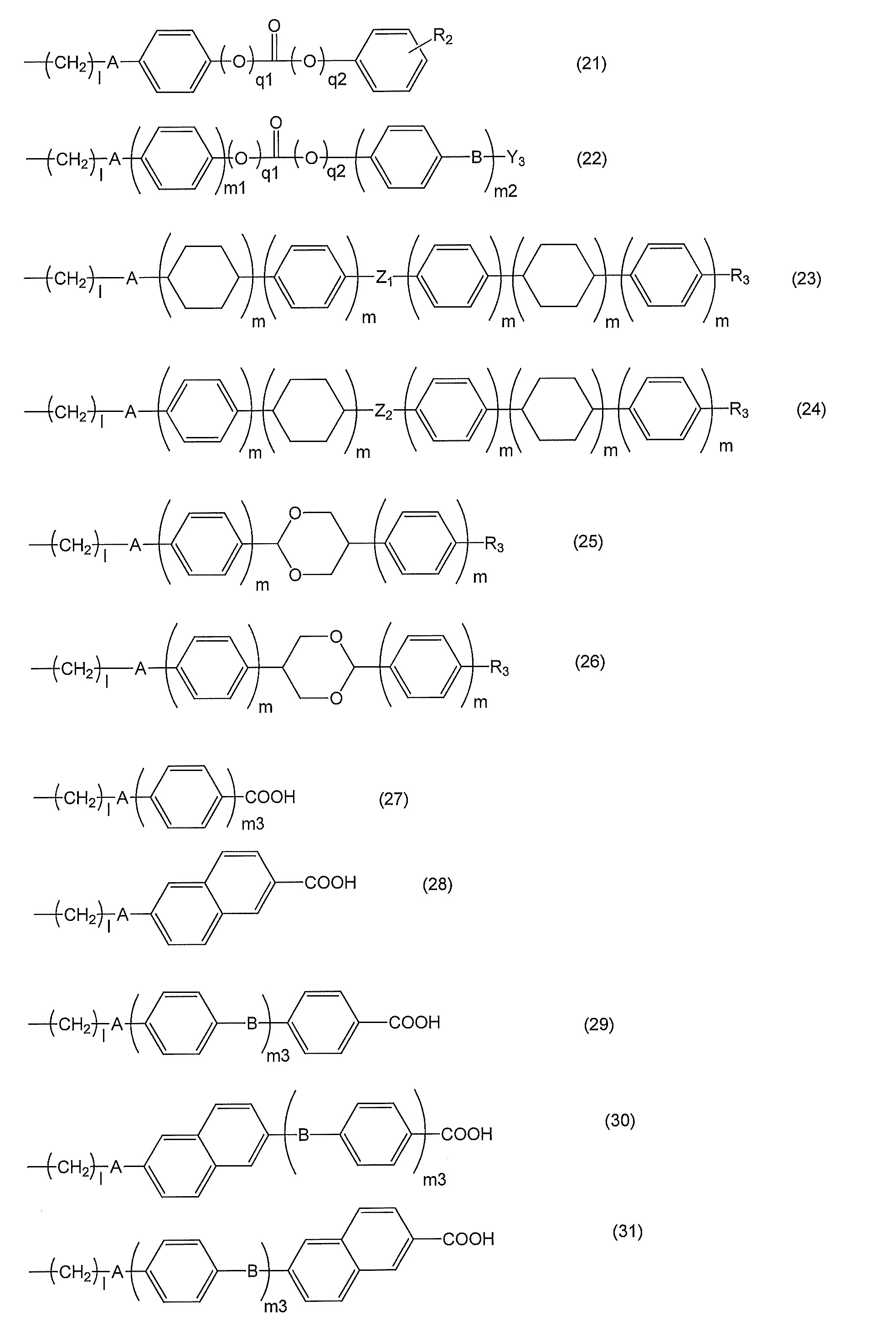
- 前記ポリマー(A1)の光反応性を発現する構造の量は、前記ポリマー(A1)の光反応性を発現する構造と液晶性を発現する構造との合計を100モル%とした場合、αモル%(αは15以上)であり、
前記ポリマー(A2)の光反応性を発現する構造の量は、前記ポリマー(A2)の光反応性を発現する構造と液晶性を発現する構造を100モル%とした場合、0.95αモル%以下である請求項2~5のいずれか1項に記載の重合体組成物。 - 前記ポリマー(A1)の重量平均分子量がβ(βは3万以上)であり、前記ポリマー(A2)の重量平均分子量が0.1β~0.9βである請求項2~6のいずれか1項に記載の重合体組成物。
- 前記少なくとも2種のポリマーが(M-1)光反応性及び液晶性を発現する構造を有するモノマー(M1);及び(M-2)液晶性のみを発現する構造を有するモノマー(M2);を有して形成される請求項1~7のいずれか1項に記載の重合体組成物。
- 前記モノマー(M1)及び前記モノマー(M2)の合計を100モル%とした場合、
前記ポリマー(A1)は、前記モノマー(M1)がαモル%(αは15以上)であり、前記モノマー(M2)が残余であるように、形成され、
前記ポリマー(A2)は、前記モノマー(M1)が0.95αモル%以下であり、前記モノマー(M2)が残余であるように、形成される請求項6~8のいずれかに記載の重合体組成物。 - (B)成分が、ジイソシアネート成分及びテトラカルボン酸誘導体から選ばれる少なくとも一種と、ジアミン化合物の2種以上とを用いて製造された重合体であって、ジアミン由来の構造として式(Y2-1)(式中、Z3はエーテル結合、エステル結合、アミド結合及びウレア結合から選ばれる結合で中断されていてもよい炭素数1~20のアルキレン基であり、Z3とベンゼン環との結合部分は単結合、エーテル結合、エステル結合、ウレア結合又はアミド結合である)で表される構造を有する重合体である、請求項1~9のいずれか一項に記載の重合体組成物。

- (B)成分の重合体が、ジイソシアネート成分とジアミン成分とを重合反応させることにより得られるポリウレアである請求項1~10のいずれか一項に記載の重合体組成物。
- (B)成分の重合体が、ジイソシアネート成分と、テトラカルボン酸誘導体と、ジアミン成分とを重合反応させることにより得られるポリウレアポリイミド前駆体である請求項1~10のいずれか一項に記載の重合体組成物。
- (B)成分の重合体が、テトラカルボン酸誘導体と、ジアミン成分とを重合反応させることにより得られるポリイミド前駆体である請求項1~10のいずれか一項に記載の重合体組成物。
- 請求項1~13のいずれか1項に記載の重合体組成物を含有する液晶配向剤。
- 請求項14記載の液晶配向剤から形成される液晶配向膜。
- [I] 請求項1~13のいずれか1項に記載の重合体組成物を、横電界駆動用の導電膜を有する基板上に塗布して塗膜を形成する工程;
[II] [I]で得られた塗膜に偏光した紫外線を照射する工程;及び
[III] [II]で得られた塗膜を加熱する工程;
を有することによって配向制御能が付与された液晶配向膜を得る、液晶配向膜の製造方法。 - 請求項16記載の液晶配向膜を有する基板。
- [I] 請求項1~13のいずれか1項に記載の重合体組成物を、横電界駆動用の導電膜を有する基板上に塗布して塗膜を形成する工程;
[II] [I]で得られた塗膜に偏光した紫外線を照射する工程;及び
[III] [II]で得られた塗膜を加熱する工程;
を有することによって配向制御能が付与された液晶配向膜を得る、液晶配向膜を有する基板の製造方法。 - 請求項18記載の製造方法で得られる基板を有する液晶表示素子。
- 請求項18記載にしたがい、基板(第1の基板)を製造する工程;
[I’] 第2の基板上に請求項1~13のいずれか1項に記載の重合体組成物を塗布して塗膜を形成する工程;
[II’] [I’]で得られた塗膜に偏光した紫外線を照射する工程;
[III’] [II’]で得られた塗膜を加熱する工程;
を有することによって配向制御能が付与された液晶配向膜を得る、前記液晶配向膜を有する第2の基板を得る工程;及び
[IV] 液晶を介して前記第1及び第2の基板の液晶配向膜が相対するように、前記第1及び第2の基板を対向配置して液晶表示素子を得る工程;
を有することにより、液晶表示素子を得る、液晶表示素子の製造方法。
Priority Applications (3)
| Application Number | Priority Date | Filing Date | Title |
|---|---|---|---|
| KR1020187027061A KR102280115B1 (ko) | 2016-03-30 | 2017-03-29 | 액정 배향제, 액정 배향막 및 액정 표시 소자 |
| JP2018509332A JP7012945B2 (ja) | 2016-03-30 | 2017-03-29 | 液晶配向剤、液晶配向膜及び液晶表示素子 |
| CN201780032527.4A CN109312166B (zh) | 2016-03-30 | 2017-03-29 | 液晶取向剂、液晶取向膜及液晶表示元件 |
Applications Claiming Priority (2)
| Application Number | Priority Date | Filing Date | Title |
|---|---|---|---|
| JP2016-069085 | 2016-03-30 | ||
| JP2016069085 | 2016-03-30 |
Publications (1)
| Publication Number | Publication Date |
|---|---|
| WO2017170681A1 true WO2017170681A1 (ja) | 2017-10-05 |
Family
ID=59965828
Family Applications (1)
| Application Number | Title | Priority Date | Filing Date |
|---|---|---|---|
| PCT/JP2017/012877 Ceased WO2017170681A1 (ja) | 2016-03-30 | 2017-03-29 | 液晶配向剤、液晶配向膜及び液晶表示素子 |
Country Status (5)
| Country | Link |
|---|---|
| JP (1) | JP7012945B2 (ja) |
| KR (1) | KR102280115B1 (ja) |
| CN (1) | CN109312166B (ja) |
| TW (1) | TWI770016B (ja) |
| WO (1) | WO2017170681A1 (ja) |
Cited By (6)
| Publication number | Priority date | Publication date | Assignee | Title |
|---|---|---|---|---|
| WO2019107518A1 (ja) * | 2017-11-30 | 2019-06-06 | 日産化学株式会社 | 液晶配向剤、液晶配向膜及び液晶表示素子 |
| CN114958393A (zh) * | 2022-06-16 | 2022-08-30 | 长沙道尔顿电子材料有限公司 | 一种含氮芳香环结构聚酰胺酸液晶取向剂和液晶取向膜及其制备方法 |
| WO2023095925A1 (ja) * | 2021-11-29 | 2023-06-01 | 日産化学株式会社 | 重合体組成物及び単層位相差材 |
| WO2023171760A1 (ja) * | 2022-03-10 | 2023-09-14 | 日産化学株式会社 | 位相差膜用組成物及び単層位相差材 |
| JP2024037839A (ja) * | 2018-12-27 | 2024-03-19 | 日産化学株式会社 | 液晶配向剤、液晶配向膜、液晶表示素子及び新規モノマー |
| WO2024162343A1 (ja) * | 2023-01-31 | 2024-08-08 | 日産化学株式会社 | 単層位相差材及び位相差フィルム |
Families Citing this family (2)
| Publication number | Priority date | Publication date | Assignee | Title |
|---|---|---|---|---|
| JP7392646B2 (ja) * | 2018-08-20 | 2023-12-06 | 日産化学株式会社 | 液晶配向剤、その製造方法、液晶配向膜、及び液晶表示素子 |
| CN116529303B (zh) * | 2020-11-13 | 2024-02-13 | 日产化学株式会社 | 液晶取向剂、液晶取向膜以及液晶显示元件 |
Citations (6)
| Publication number | Priority date | Publication date | Assignee | Title |
|---|---|---|---|---|
| WO2014054785A2 (ja) * | 2012-10-05 | 2014-04-10 | 日産化学工業株式会社 | 横電界駆動型液晶表示素子用液晶配向膜を有する基板の製造方法 |
| WO2014185412A1 (ja) * | 2013-05-13 | 2014-11-20 | 日産化学工業株式会社 | 横電界駆動型液晶表示素子用液晶配向膜を有する基板の製造方法 |
| WO2015002291A1 (ja) * | 2013-07-05 | 2015-01-08 | 日産化学工業株式会社 | 重合体組成物および横電界駆動型液晶表示素子用液晶配向膜 |
| WO2016076348A1 (ja) * | 2014-11-12 | 2016-05-19 | 日産化学工業株式会社 | 液晶配向剤、液晶配向膜及び液晶表示素子 |
| WO2016186190A1 (ja) * | 2015-05-20 | 2016-11-24 | 日産化学工業株式会社 | 重合体組成物、液晶配向剤、液晶配向膜、該液晶配向膜を有する基板及び該液晶配向膜を有する液晶表示素子 |
| WO2016186189A1 (ja) * | 2015-05-20 | 2016-11-24 | 日産化学工業株式会社 | 重合体組成物、液晶配向剤、液晶配向膜、該液晶配向膜を有する基板及び該液晶配向膜を有する液晶表示素子 |
Family Cites Families (5)
| Publication number | Priority date | Publication date | Assignee | Title |
|---|---|---|---|---|
| JPH0237324A (ja) | 1988-07-27 | 1990-02-07 | Sanyo Electric Co Ltd | ポリイミド配向膜の製造方法 |
| JP3893659B2 (ja) | 1996-03-05 | 2007-03-14 | 日産化学工業株式会社 | 液晶配向処理方法 |
| JP4565294B2 (ja) * | 2000-05-30 | 2010-10-20 | 林テレンプ株式会社 | 配向膜の製造方法 |
| US20130331482A1 (en) * | 2012-06-06 | 2013-12-12 | Jnc Petrochemical Corporation | Polymer composition having photoalignable group, liquid crystal alignment film formed of the polymer composition, and optical device having phase difference plate formed of the liquid crystal alignment film |
| WO2014185411A1 (ja) * | 2013-05-13 | 2014-11-20 | 日産化学工業株式会社 | 横電界駆動型液晶表示素子用液晶配向膜を有する基板の製造方法 |
-
2017
- 2017-03-29 WO PCT/JP2017/012877 patent/WO2017170681A1/ja not_active Ceased
- 2017-03-29 KR KR1020187027061A patent/KR102280115B1/ko active Active
- 2017-03-29 TW TW106110569A patent/TWI770016B/zh active
- 2017-03-29 JP JP2018509332A patent/JP7012945B2/ja active Active
- 2017-03-29 CN CN201780032527.4A patent/CN109312166B/zh active Active
Patent Citations (6)
| Publication number | Priority date | Publication date | Assignee | Title |
|---|---|---|---|---|
| WO2014054785A2 (ja) * | 2012-10-05 | 2014-04-10 | 日産化学工業株式会社 | 横電界駆動型液晶表示素子用液晶配向膜を有する基板の製造方法 |
| WO2014185412A1 (ja) * | 2013-05-13 | 2014-11-20 | 日産化学工業株式会社 | 横電界駆動型液晶表示素子用液晶配向膜を有する基板の製造方法 |
| WO2015002291A1 (ja) * | 2013-07-05 | 2015-01-08 | 日産化学工業株式会社 | 重合体組成物および横電界駆動型液晶表示素子用液晶配向膜 |
| WO2016076348A1 (ja) * | 2014-11-12 | 2016-05-19 | 日産化学工業株式会社 | 液晶配向剤、液晶配向膜及び液晶表示素子 |
| WO2016186190A1 (ja) * | 2015-05-20 | 2016-11-24 | 日産化学工業株式会社 | 重合体組成物、液晶配向剤、液晶配向膜、該液晶配向膜を有する基板及び該液晶配向膜を有する液晶表示素子 |
| WO2016186189A1 (ja) * | 2015-05-20 | 2016-11-24 | 日産化学工業株式会社 | 重合体組成物、液晶配向剤、液晶配向膜、該液晶配向膜を有する基板及び該液晶配向膜を有する液晶表示素子 |
Cited By (12)
| Publication number | Priority date | Publication date | Assignee | Title |
|---|---|---|---|---|
| WO2019107518A1 (ja) * | 2017-11-30 | 2019-06-06 | 日産化学株式会社 | 液晶配向剤、液晶配向膜及び液晶表示素子 |
| KR20200088846A (ko) * | 2017-11-30 | 2020-07-23 | 닛산 가가쿠 가부시키가이샤 | 액정 배향제, 액정 배향막 및 액정 표시 소자 |
| JPWO2019107518A1 (ja) * | 2017-11-30 | 2020-12-10 | 日産化学株式会社 | 液晶配向剤、液晶配向膜及び液晶表示素子 |
| JP7193782B2 (ja) | 2017-11-30 | 2022-12-21 | 日産化学株式会社 | 液晶配向剤、液晶配向膜及び液晶表示素子 |
| KR102688702B1 (ko) | 2017-11-30 | 2024-07-25 | 닛산 가가쿠 가부시키가이샤 | 액정 배향제, 액정 배향막 및 액정 표시 소자 |
| JP2024037839A (ja) * | 2018-12-27 | 2024-03-19 | 日産化学株式会社 | 液晶配向剤、液晶配向膜、液晶表示素子及び新規モノマー |
| JP7718471B2 (ja) | 2018-12-27 | 2025-08-05 | 日産化学株式会社 | 液晶配向剤、液晶配向膜、液晶表示素子及び新規モノマー |
| WO2023095925A1 (ja) * | 2021-11-29 | 2023-06-01 | 日産化学株式会社 | 重合体組成物及び単層位相差材 |
| WO2023171760A1 (ja) * | 2022-03-10 | 2023-09-14 | 日産化学株式会社 | 位相差膜用組成物及び単層位相差材 |
| CN114958393A (zh) * | 2022-06-16 | 2022-08-30 | 长沙道尔顿电子材料有限公司 | 一种含氮芳香环结构聚酰胺酸液晶取向剂和液晶取向膜及其制备方法 |
| CN114958393B (zh) * | 2022-06-16 | 2023-09-05 | 长沙道尔顿电子材料有限公司 | 一种含氮芳香环结构聚酰胺酸液晶取向剂和液晶取向膜及其制备方法 |
| WO2024162343A1 (ja) * | 2023-01-31 | 2024-08-08 | 日産化学株式会社 | 単層位相差材及び位相差フィルム |
Also Published As
| Publication number | Publication date |
|---|---|
| TWI770016B (zh) | 2022-07-11 |
| CN109312166B (zh) | 2021-04-09 |
| KR20180132057A (ko) | 2018-12-11 |
| JPWO2017170681A1 (ja) | 2019-02-14 |
| JP7012945B2 (ja) | 2022-01-31 |
| KR102280115B1 (ko) | 2021-07-20 |
| TW201805366A (zh) | 2018-02-16 |
| CN109312166A (zh) | 2019-02-05 |
Similar Documents
| Publication | Publication Date | Title |
|---|---|---|
| JP6618043B2 (ja) | 液晶配向剤、液晶配向膜及び液晶表示素子 | |
| KR102214302B1 (ko) | 횡전계 구동형 액정 표시 소자용 액정 배향막을 갖는 기판의 제조 방법 | |
| CN105518521B (zh) | 聚合物组合物和横向电场驱动型液晶表示元件用液晶取向膜 | |
| JP7012945B2 (ja) | 液晶配向剤、液晶配向膜及び液晶表示素子 | |
| JP2020042288A (ja) | 液晶配向剤、液晶配向膜及び液晶表示素子 | |
| WO2017199986A1 (ja) | 液晶配向剤、液晶配向膜及び液晶表示素子 | |
| JP2014206715A (ja) | 横電界駆動型液晶表示素子用液晶配向膜を有する基板の製造方法 | |
| JP6523169B2 (ja) | 重合体、重合体組成物および横電界駆動型液晶表示素子用液晶配向膜 | |
| WO2015156314A1 (ja) | 液晶配向剤、液晶配向膜及び液晶表示素子 | |
| JP6510975B2 (ja) | 横電界駆動型液晶表示素子用液晶配向膜を有する基板の製造方法 | |
| JP2017142453A (ja) | 液晶配向膜の製造方法、液晶配向膜及び液晶表示素子 | |
| WO2014196590A1 (ja) | 横電界駆動型液晶表示素子用液晶配向膜を有する基板の製造方法 | |
| WO2016186189A1 (ja) | 重合体組成物、液晶配向剤、液晶配向膜、該液晶配向膜を有する基板及び該液晶配向膜を有する液晶表示素子 | |
| JP6676932B2 (ja) | 液晶配向剤、液晶配向膜及び液晶表示素子 | |
| WO2016021570A1 (ja) | 液晶配向剤、液晶配向膜および液晶表示素子 | |
| JP6601605B2 (ja) | 液晶配向剤、液晶配向膜及び液晶表示素子 |
Legal Events
| Date | Code | Title | Description |
|---|---|---|---|
| WWE | Wipo information: entry into national phase |
Ref document number: 2018509332 Country of ref document: JP |
|
| ENP | Entry into the national phase |
Ref document number: 20187027061 Country of ref document: KR Kind code of ref document: A |
|
| NENP | Non-entry into the national phase |
Ref country code: DE |
|
| 121 | Ep: the epo has been informed by wipo that ep was designated in this application |
Ref document number: 17775215 Country of ref document: EP Kind code of ref document: A1 |
|
| 122 | Ep: pct application non-entry in european phase |
Ref document number: 17775215 Country of ref document: EP Kind code of ref document: A1 |