WO2017169288A1 - 感放射線性組成物及びパターン形成方法 - Google Patents
感放射線性組成物及びパターン形成方法 Download PDFInfo
- Publication number
- WO2017169288A1 WO2017169288A1 PCT/JP2017/006242 JP2017006242W WO2017169288A1 WO 2017169288 A1 WO2017169288 A1 WO 2017169288A1 JP 2017006242 W JP2017006242 W JP 2017006242W WO 2017169288 A1 WO2017169288 A1 WO 2017169288A1
- Authority
- WO
- WIPO (PCT)
- Prior art keywords
- acid
- radiation
- group
- sensitive composition
- mass
- Prior art date
- Legal status (The legal status is an assumption and is not a legal conclusion. Google has not performed a legal analysis and makes no representation as to the accuracy of the status listed.)
- Ceased
Links
Classifications
-
- G—PHYSICS
- G03—PHOTOGRAPHY; CINEMATOGRAPHY; ANALOGOUS TECHNIQUES USING WAVES OTHER THAN OPTICAL WAVES; ELECTROGRAPHY; HOLOGRAPHY
- G03F—PHOTOMECHANICAL PRODUCTION OF TEXTURED OR PATTERNED SURFACES, e.g. FOR PRINTING, FOR PROCESSING OF SEMICONDUCTOR DEVICES; MATERIALS THEREFOR; ORIGINALS THEREFOR; APPARATUS SPECIALLY ADAPTED THEREFOR
- G03F7/00—Photomechanical, e.g. photolithographic, production of textured or patterned surfaces, e.g. printing surfaces; Materials therefor, e.g. comprising photoresists; Apparatus specially adapted therefor
- G03F7/004—Photosensitive materials
-
- G—PHYSICS
- G03—PHOTOGRAPHY; CINEMATOGRAPHY; ANALOGOUS TECHNIQUES USING WAVES OTHER THAN OPTICAL WAVES; ELECTROGRAPHY; HOLOGRAPHY
- G03F—PHOTOMECHANICAL PRODUCTION OF TEXTURED OR PATTERNED SURFACES, e.g. FOR PRINTING, FOR PROCESSING OF SEMICONDUCTOR DEVICES; MATERIALS THEREFOR; ORIGINALS THEREFOR; APPARATUS SPECIALLY ADAPTED THEREFOR
- G03F7/00—Photomechanical, e.g. photolithographic, production of textured or patterned surfaces, e.g. printing surfaces; Materials therefor, e.g. comprising photoresists; Apparatus specially adapted therefor
- G03F7/004—Photosensitive materials
- G03F7/0045—Photosensitive materials with organic non-macromolecular light-sensitive compounds not otherwise provided for, e.g. dissolution inhibitors
-
- G—PHYSICS
- G03—PHOTOGRAPHY; CINEMATOGRAPHY; ANALOGOUS TECHNIQUES USING WAVES OTHER THAN OPTICAL WAVES; ELECTROGRAPHY; HOLOGRAPHY
- G03F—PHOTOMECHANICAL PRODUCTION OF TEXTURED OR PATTERNED SURFACES, e.g. FOR PRINTING, FOR PROCESSING OF SEMICONDUCTOR DEVICES; MATERIALS THEREFOR; ORIGINALS THEREFOR; APPARATUS SPECIALLY ADAPTED THEREFOR
- G03F7/00—Photomechanical, e.g. photolithographic, production of textured or patterned surfaces, e.g. printing surfaces; Materials therefor, e.g. comprising photoresists; Apparatus specially adapted therefor
- G03F7/004—Photosensitive materials
- G03F7/0042—Photosensitive materials with inorganic or organometallic light-sensitive compounds not otherwise provided for, e.g. inorganic resists
-
- G—PHYSICS
- G03—PHOTOGRAPHY; CINEMATOGRAPHY; ANALOGOUS TECHNIQUES USING WAVES OTHER THAN OPTICAL WAVES; ELECTROGRAPHY; HOLOGRAPHY
- G03F—PHOTOMECHANICAL PRODUCTION OF TEXTURED OR PATTERNED SURFACES, e.g. FOR PRINTING, FOR PROCESSING OF SEMICONDUCTOR DEVICES; MATERIALS THEREFOR; ORIGINALS THEREFOR; APPARATUS SPECIALLY ADAPTED THEREFOR
- G03F7/00—Photomechanical, e.g. photolithographic, production of textured or patterned surfaces, e.g. printing surfaces; Materials therefor, e.g. comprising photoresists; Apparatus specially adapted therefor
- G03F7/004—Photosensitive materials
- G03F7/0042—Photosensitive materials with inorganic or organometallic light-sensitive compounds not otherwise provided for, e.g. inorganic resists
- G03F7/0043—Chalcogenides; Silicon, germanium, arsenic or derivatives thereof; Metals, oxides or alloys thereof
-
- G—PHYSICS
- G03—PHOTOGRAPHY; CINEMATOGRAPHY; ANALOGOUS TECHNIQUES USING WAVES OTHER THAN OPTICAL WAVES; ELECTROGRAPHY; HOLOGRAPHY
- G03F—PHOTOMECHANICAL PRODUCTION OF TEXTURED OR PATTERNED SURFACES, e.g. FOR PRINTING, FOR PROCESSING OF SEMICONDUCTOR DEVICES; MATERIALS THEREFOR; ORIGINALS THEREFOR; APPARATUS SPECIALLY ADAPTED THEREFOR
- G03F7/00—Photomechanical, e.g. photolithographic, production of textured or patterned surfaces, e.g. printing surfaces; Materials therefor, e.g. comprising photoresists; Apparatus specially adapted therefor
- G03F7/004—Photosensitive materials
- G03F7/0047—Photosensitive materials characterised by additives for obtaining a metallic or ceramic pattern, e.g. by firing
-
- G—PHYSICS
- G03—PHOTOGRAPHY; CINEMATOGRAPHY; ANALOGOUS TECHNIQUES USING WAVES OTHER THAN OPTICAL WAVES; ELECTROGRAPHY; HOLOGRAPHY
- G03F—PHOTOMECHANICAL PRODUCTION OF TEXTURED OR PATTERNED SURFACES, e.g. FOR PRINTING, FOR PROCESSING OF SEMICONDUCTOR DEVICES; MATERIALS THEREFOR; ORIGINALS THEREFOR; APPARATUS SPECIALLY ADAPTED THEREFOR
- G03F7/00—Photomechanical, e.g. photolithographic, production of textured or patterned surfaces, e.g. printing surfaces; Materials therefor, e.g. comprising photoresists; Apparatus specially adapted therefor
- G03F7/004—Photosensitive materials
- G03F7/038—Macromolecular compounds which are rendered insoluble or differentially wettable
-
- G—PHYSICS
- G03—PHOTOGRAPHY; CINEMATOGRAPHY; ANALOGOUS TECHNIQUES USING WAVES OTHER THAN OPTICAL WAVES; ELECTROGRAPHY; HOLOGRAPHY
- G03F—PHOTOMECHANICAL PRODUCTION OF TEXTURED OR PATTERNED SURFACES, e.g. FOR PRINTING, FOR PROCESSING OF SEMICONDUCTOR DEVICES; MATERIALS THEREFOR; ORIGINALS THEREFOR; APPARATUS SPECIALLY ADAPTED THEREFOR
- G03F7/00—Photomechanical, e.g. photolithographic, production of textured or patterned surfaces, e.g. printing surfaces; Materials therefor, e.g. comprising photoresists; Apparatus specially adapted therefor
- G03F7/16—Coating processes; Apparatus therefor
- G03F7/162—Coating on a rotating support, e.g. using a whirler or a spinner
-
- G—PHYSICS
- G03—PHOTOGRAPHY; CINEMATOGRAPHY; ANALOGOUS TECHNIQUES USING WAVES OTHER THAN OPTICAL WAVES; ELECTROGRAPHY; HOLOGRAPHY
- G03F—PHOTOMECHANICAL PRODUCTION OF TEXTURED OR PATTERNED SURFACES, e.g. FOR PRINTING, FOR PROCESSING OF SEMICONDUCTOR DEVICES; MATERIALS THEREFOR; ORIGINALS THEREFOR; APPARATUS SPECIALLY ADAPTED THEREFOR
- G03F7/00—Photomechanical, e.g. photolithographic, production of textured or patterned surfaces, e.g. printing surfaces; Materials therefor, e.g. comprising photoresists; Apparatus specially adapted therefor
- G03F7/16—Coating processes; Apparatus therefor
- G03F7/168—Finishing the coated layer, e.g. drying, baking, soaking
-
- G—PHYSICS
- G03—PHOTOGRAPHY; CINEMATOGRAPHY; ANALOGOUS TECHNIQUES USING WAVES OTHER THAN OPTICAL WAVES; ELECTROGRAPHY; HOLOGRAPHY
- G03F—PHOTOMECHANICAL PRODUCTION OF TEXTURED OR PATTERNED SURFACES, e.g. FOR PRINTING, FOR PROCESSING OF SEMICONDUCTOR DEVICES; MATERIALS THEREFOR; ORIGINALS THEREFOR; APPARATUS SPECIALLY ADAPTED THEREFOR
- G03F7/00—Photomechanical, e.g. photolithographic, production of textured or patterned surfaces, e.g. printing surfaces; Materials therefor, e.g. comprising photoresists; Apparatus specially adapted therefor
- G03F7/20—Exposure; Apparatus therefor
- G03F7/2002—Exposure; Apparatus therefor with visible light or UV light, through an original having an opaque pattern on a transparent support, e.g. film printing, projection printing; by reflection of visible or UV light from an original such as a printed image
- G03F7/2004—Exposure; Apparatus therefor with visible light or UV light, through an original having an opaque pattern on a transparent support, e.g. film printing, projection printing; by reflection of visible or UV light from an original such as a printed image characterised by the use of a particular light source, e.g. fluorescent lamps or deep UV light
-
- G—PHYSICS
- G03—PHOTOGRAPHY; CINEMATOGRAPHY; ANALOGOUS TECHNIQUES USING WAVES OTHER THAN OPTICAL WAVES; ELECTROGRAPHY; HOLOGRAPHY
- G03F—PHOTOMECHANICAL PRODUCTION OF TEXTURED OR PATTERNED SURFACES, e.g. FOR PRINTING, FOR PROCESSING OF SEMICONDUCTOR DEVICES; MATERIALS THEREFOR; ORIGINALS THEREFOR; APPARATUS SPECIALLY ADAPTED THEREFOR
- G03F7/00—Photomechanical, e.g. photolithographic, production of textured or patterned surfaces, e.g. printing surfaces; Materials therefor, e.g. comprising photoresists; Apparatus specially adapted therefor
- G03F7/20—Exposure; Apparatus therefor
- G03F7/2037—Exposure with X-ray radiation or corpuscular radiation, through a mask with a pattern opaque to that radiation
-
- G—PHYSICS
- G03—PHOTOGRAPHY; CINEMATOGRAPHY; ANALOGOUS TECHNIQUES USING WAVES OTHER THAN OPTICAL WAVES; ELECTROGRAPHY; HOLOGRAPHY
- G03F—PHOTOMECHANICAL PRODUCTION OF TEXTURED OR PATTERNED SURFACES, e.g. FOR PRINTING, FOR PROCESSING OF SEMICONDUCTOR DEVICES; MATERIALS THEREFOR; ORIGINALS THEREFOR; APPARATUS SPECIALLY ADAPTED THEREFOR
- G03F7/00—Photomechanical, e.g. photolithographic, production of textured or patterned surfaces, e.g. printing surfaces; Materials therefor, e.g. comprising photoresists; Apparatus specially adapted therefor
- G03F7/26—Processing photosensitive materials; Apparatus therefor
- G03F7/30—Imagewise removal using liquid means
- G03F7/32—Liquid compositions therefor, e.g. developers
- G03F7/322—Aqueous alkaline compositions
-
- G—PHYSICS
- G03—PHOTOGRAPHY; CINEMATOGRAPHY; ANALOGOUS TECHNIQUES USING WAVES OTHER THAN OPTICAL WAVES; ELECTROGRAPHY; HOLOGRAPHY
- G03F—PHOTOMECHANICAL PRODUCTION OF TEXTURED OR PATTERNED SURFACES, e.g. FOR PRINTING, FOR PROCESSING OF SEMICONDUCTOR DEVICES; MATERIALS THEREFOR; ORIGINALS THEREFOR; APPARATUS SPECIALLY ADAPTED THEREFOR
- G03F7/00—Photomechanical, e.g. photolithographic, production of textured or patterned surfaces, e.g. printing surfaces; Materials therefor, e.g. comprising photoresists; Apparatus specially adapted therefor
- G03F7/26—Processing photosensitive materials; Apparatus therefor
- G03F7/30—Imagewise removal using liquid means
- G03F7/32—Liquid compositions therefor, e.g. developers
- G03F7/325—Non-aqueous compositions
-
- G—PHYSICS
- G03—PHOTOGRAPHY; CINEMATOGRAPHY; ANALOGOUS TECHNIQUES USING WAVES OTHER THAN OPTICAL WAVES; ELECTROGRAPHY; HOLOGRAPHY
- G03F—PHOTOMECHANICAL PRODUCTION OF TEXTURED OR PATTERNED SURFACES, e.g. FOR PRINTING, FOR PROCESSING OF SEMICONDUCTOR DEVICES; MATERIALS THEREFOR; ORIGINALS THEREFOR; APPARATUS SPECIALLY ADAPTED THEREFOR
- G03F7/00—Photomechanical, e.g. photolithographic, production of textured or patterned surfaces, e.g. printing surfaces; Materials therefor, e.g. comprising photoresists; Apparatus specially adapted therefor
- G03F7/26—Processing photosensitive materials; Apparatus therefor
- G03F7/38—Treatment before imagewise removal, e.g. prebaking
Definitions
- the present invention relates to a radiation-sensitive composition and a pattern forming method.
- Common radiation-sensitive compositions used for fine processing by lithography are electromagnetic waves such as deep ultraviolet rays (for example, ArF excimer laser light, KrF excimer laser light, etc.), extreme ultraviolet rays (EUV), and charged particle beams such as electron beams.
- An acid is generated in the exposed area by exposure such as the above, and a chemical reaction using this acid as a catalyst causes a difference in the dissolution rate in the developing solution between the exposed area and the unexposed area, thereby forming a pattern on the substrate.
- the formed pattern can be used as a mask or the like in substrate processing.
- Such radiation-sensitive compositions are required to improve resist performance as processing technology becomes finer.
- the types of polymers, acid generators, and other components used in the composition, the molecular structure, and the like have been studied, and further their combinations have been studied in detail (Japanese Patent Laid-Open No. 11-125907, (See JP-A-8-146610 and JP-A-2000-298347).
- pattern miniaturization has progressed to the level of 40 nm or less at present, but the radiation-sensitive composition is required to have higher resist performance, and in particular, a pattern with excellent resolution can be formed with high sensitivity. Is required.
- the present invention has been made based on the above circumstances, and an object thereof is to provide a radiation-sensitive composition and a pattern forming method capable of forming a pattern having excellent resolution with high sensitivity.
- the invention made in order to solve the above problems includes a particle mainly composed of a metal oxide (hereinafter also referred to as “[A] particle”) and a radiation-sensitive acid generator (hereinafter referred to as “[B] acid generation”).
- Another invention made in order to solve the above problems includes a step of forming a film by applying the above-described radiation-sensitive composition to a substrate, a step of exposing the film, and the exposed film. And a developing process.
- metal oxide refers to a compound containing at least a metal atom and an oxygen atom.
- Metal atom is a concept including a metalloid atom, and “metalloid atom” refers to boron, silicon, germanium, arsenic, antimony and tellurium.
- the “main component” is a component having the largest content, for example, a component having a content of 50% by mass or more.
- Particle refers to a substance having an average particle diameter of, for example, 1 nm or more.
- a pattern having excellent resolution can be formed with high sensitivity. Accordingly, these can be suitably used for semiconductor device processing processes and the like that are expected to be further miniaturized in the future.
- the radiation-sensitive composition contains [A] particles, a [B] acid generator, and a [C] acid scavenger.
- the radiation-sensitive composition preferably contains an organic solvent (hereinafter also referred to as “[D] solvent”), and may contain other optional components as long as the effects of the present invention are not impaired.
- the content rate of the silicon atom with respect to all the metal atoms in the said radiation sensitive composition is less than 50 atomic%.
- the radiation-sensitive composition contains [A] particles, a [B] acid generator, and a [C] acid scavenger, and the content of silicon atoms with respect to all metal atoms in the composition is less than the above upper limit. Thus, a pattern with excellent resolution can be formed with high sensitivity.
- the reason why the radiation-sensitive composition has the above-described configuration provides the above-mentioned effect is not necessarily clear, but can be estimated as follows, for example. That is, in the film formed from the radiation-sensitive composition, the metal atom contained in the [A] particle or the like absorbs the exposure light and emits secondary electrons in the exposed portion, and the secondary electrons and the like work. [B] Acid is generated from the acid generator.
- This acid changes the structure of the [A] particles and generates OH groups on the metal atoms contained in the [A] particles, and then crosslinks the metal atoms to which the OH groups are bonded.
- a cross-linked body including a partial structure represented by (O-metal atom) is formed.
- the solubility of the [A] particles in the developer changes at the exposed portion of the film, so that the pattern of the film can be formed.
- the stability of the metal atom to which the OH group is bonded is easily influenced by pH, when the pH is extremely lowered due to excessive generation of acid in the exposed portion of the film, the metal to which the OH group is bonded.
- the radiation-sensitive composition contains a [C] acid-capturing body, when excessive acid is generated in the exposed portion of the film, it can be captured to suppress an extreme decrease in pH. It is possible to effectively promote the change in solubility of [A] particles in the developer.
- the radiation-sensitive composition has a silicon atom content that is considered to be relatively low in the emission of secondary electrons due to absorption of exposure light and the formation efficiency of a crosslinked product by the acid, and is less than the upper limit.
- the change in the solubility of the [A] particles in the developer can be further promoted.
- the radiation-sensitive composition is considered to be excellent in sensitivity and resolution.
- the content of silicon atoms with respect to all metal atoms in the radiation-sensitive composition is less than 50 atomic%.
- the upper limit of the silicon atom content is preferably 20 atomic percent, more preferably 5 atomic percent, and even more preferably 1 atomic percent.
- the silicon atom content may be 0 atomic%.
- [[A] particles] [A]
- the particles are particles mainly composed of a metal oxide.
- grains have a metal oxide as a main component, they also contribute to the improvement of the etching tolerance of the pattern formed from the said radiation sensitive composition.
- the lower limit of the average particle diameter of [A] particles is preferably 1.1 nm, and more preferably 1.2 nm.
- the upper limit of the average particle diameter is preferably 20 nm, more preferably 10 nm, still more preferably 3.0 nm, and particularly preferably 2.5 nm.
- [A] By making the average particle diameter of the particles within the above range, the generation of secondary electrons by the [A] particles can be more effectively promoted. As a result, the sensitivity and resolution of the radiation-sensitive composition can be improved. It can be improved.
- the “average particle diameter” refers to the harmonic average particle diameter based on the scattered light intensity measured by a DLS (Dynamic Light Scattering) method using a light scattering measurement apparatus.
- the metal atom constituting the metal oxide as the main component of the particle is not particularly limited, and examples thereof include group 3 to group 16 metal atoms (excluding silicon atoms). Specific examples of the metal atom include a group 4 metal atom such as titanium, zirconium and hafnium, a group 5 metal atom such as tantalum, a group 6 metal atom such as chromium and tungsten, iron, ruthenium and the like.
- a Group 4 metal atom, a Group 12 metal atom, and a Group 13 metal atom are preferable, and hafnium, zirconium, zinc, and indium are more preferable.
- the metal atom which comprises the said metal oxide can be used individually by 1 type or in combination of 2 or more types.
- the metal oxide may contain other atoms other than metal atoms and oxygen atoms.
- a carbon atom a hydrogen atom, a nitrogen atom, a phosphorus atom, a sulfur atom, a halogen atom etc. are mentioned, for example.
- the lower limit of the total content of metal atoms and oxygen atoms in the metal oxide is preferably 5% by mass, more preferably 10% by mass, and even more preferably 25% by mass.
- the upper limit of the total content of metal atoms and oxygen atoms is preferably 99.9% by mass, more preferably 80% by mass, and even more preferably 70% by mass.
- Examples of the metal oxide include metal oxides composed only of metal atoms and oxygen atoms, and metal oxides containing metal atoms and organic ligands.
- Examples of the metal oxide containing a metal atom and an organic ligand include a compound containing a repeating structure of (metal atom-organic ligand-metal atom).
- the ligand derived from [a] organic acid is preferable.
- Examples of the ligand derived from an organic acid include an anion in which one or more protons are eliminated from the [a] organic acid.
- organic acid refers to an organic compound that exhibits acidity
- organic compound refers to a compound having at least one carbon atom.
- the sensitivity and resolution of the radiation-sensitive composition are further improved when the [A] particles are mainly composed of a metal oxide containing a metal atom and a ligand derived from [a] an organic acid. .
- the reason why the radiation-sensitive composition has the above-described configuration provides the above-described effect is not necessarily clear, but can be inferred as follows, for example. That is, it is considered that the ligand derived from [a] organic acid is present in the vicinity of the surface of the [A] particle due to the interaction with the metal atom, and the solubility of the [A] particle in the developer is improved.
- the ligand derived from [a] organic acid is desorbed from [A] particles due to the structural change of [A] particles, and [A] particles It is considered that the solubility of the toner in the developer changes more greatly. As a result, it is considered that the sensitivity and resolution of the radiation-sensitive composition are further improved.
- the lower limit of the pKa of the organic acid is preferably 0, more preferably 1, more preferably 1.5, and particularly preferably 2.
- the upper limit of the pKa is preferably 7, more preferably 6, more preferably 5.5, and particularly preferably 5.
- the interaction between the ligand derived from the organic acid and the metal atom can be adjusted to a moderately weak one. The sensitivity and resolution of the radiation composition can be further improved.
- the pKa of the [a] organic acid refers to the first acid dissociation constant, that is, the logarithmic value of the dissociation constant in the dissociation of the first proton.
- the organic acid may be a low molecular compound or a high molecular compound, but a low molecular compound is preferable from the viewpoint of adjusting the interaction with the metal atom to a moderately weak one.
- the low molecular compound means a compound having a molecular weight of 1,500 or less
- the high molecular compound means a compound having a molecular weight of more than 1,500.
- the lower limit of the molecular weight of the organic acid is preferably 50, more preferably 70.
- the upper limit of the molecular weight is preferably 1,000, more preferably 500, still more preferably 400, and particularly preferably 300.
- organic acid examples include carboxylic acid, sulfonic acid, sulfinic acid, organic phosphinic acid, organic phosphonic acid, phenols, enol, thiol, acid imide, oxime, sulfonamide and the like.
- carboxylic acid examples include formic acid, acetic acid, propionic acid, butanoic acid, pentanoic acid, hexanoic acid, heptanoic acid, octanoic acid, nonanoic acid, decanoic acid, 2-ethylhexanoic acid, tiglic acid, oleic acid, acrylic acid, Methacrylic acid, trans-2,3-dimethylacrylic acid, stearic acid, linoleic acid, linolenic acid, arachidonic acid, salicylic acid, benzoic acid, p-aminobenzoic acid, iodobenzoic acid (eg 2-iodobenzoic acid, 3-iodo Benzoic acid, 4-iodobenzoic acid, etc.), monochloroacetic acid, dichloroacetic acid, trichloroacetic acid, o-toluic acid, m-toluic acid, p-tol
- Monocarboxylic acid, oxalic acid, malonic acid, maleic acid, methylmalonic acid, fumaric acid, azide examples thereof include dicarboxylic acids such as pinic acid, sebacic acid, phthalic acid, and tartaric acid, and carboxylic acids having three or more carboxy groups such as citric acid.
- sulfonic acid examples include benzenesulfonic acid and p-toluenesulfonic acid.
- sulfinic acid examples include benzenesulfinic acid and p-toluenesulfinic acid.
- organic phosphinic acid examples include diethylphosphinic acid, methylphenylphosphinic acid, diphenylphosphinic acid and the like.
- organic phosphonic acid examples include methylphosphonic acid, ethylphosphonic acid, t-butylphosphonic acid, cyclohexylphosphonic acid, and phenylphosphonic acid.
- phenols examples include monovalent phenols such as phenol, cresol, 2,6-xylenol and naphthol, divalent phenols such as catechol, resorcinol, hydroquinone and 1,2-naphthalenediol, pyrogallol, 2, And trivalent or higher phenols such as 3,6-naphthalenetriol.
- monovalent phenols such as phenol, cresol, 2,6-xylenol and naphthol
- divalent phenols such as catechol, resorcinol, hydroquinone and 1,2-naphthalenediol, pyrogallol, 2, And trivalent or higher phenols such as 3,6-naphthalenetriol.
- Examples of the enol include 2-hydroxy-3-methyl-2-butene and 3-hydroxy-4-methyl-3-hexene.
- Examples of the thiol include mercaptoethanol and mercaptopropanol.
- the acid imide examples include carboxylic acid imides such as maleimide and succinimide, and sulfonic acid imides such as di (trifluoromethanesulfonic acid) imide and di (pentafluoroethanesulfonic acid) imide.
- oxime examples include aldoximes such as benzaldoxime and salicylaldoxime, and ketoximes such as diethyl ketoxime, methyl ethyl ketoxime, and cyclohexanone oxime.
- aldoximes such as benzaldoxime and salicylaldoxime
- ketoximes such as diethyl ketoxime, methyl ethyl ketoxime, and cyclohexanone oxime.
- sulfonamide examples include methylsulfonamide, ethylsulfonamide, benzenesulfonamide, and toluenesulfonamide.
- organic acid from the viewpoint of further improving the sensitivity and resolution of the radiation-sensitive composition, carboxylic acid is preferable, monocarboxylic acid is more preferable, methacrylic acid, tiglic acid, benzoic acid and m- Toluic acid is more preferred.
- the metal oxide is a coordination derived from at least one metal atom of zinc, indium, hafnium and zirconium and at least one organic acid of methacrylic acid, tiglic acid, benzoic acid and m-toluic acid.
- a metal oxide containing zinc and a ligand derived from methacrylic acid, a metal oxide containing a ligand derived from indium and tiglic acid, derived from hafnium and methacrylic acid And metal oxides containing a ligand derived from benzoic acid and zirconium and a metal oxide containing a ligand.
- the lower limit of the metal oxide content in the [A] particles is preferably 60% by mass, more preferably 80% by mass, and still more preferably 95% by mass. Moreover, 100 mass% may be sufficient as the content rate of the said metal oxide. By making the content rate of the said metal oxide more than the said minimum, the sensitivity and the resolution of the said radiation sensitive composition can be improved more.
- the particles may contain only one kind of the metal oxide or two or more kinds.
- the lower limit of the number of metal atoms contained in the particles is preferably 2, and more preferably 4.
- the upper limit of the number of metal atoms contained in the [A] particles is preferably 30, more preferably 10, and still more preferably 6.
- the lower limit of the content of the ligand derived from the [a] organic acid in the [A] particle is preferably 1% by mass, 20 mass% is more preferable, 40 mass% is further more preferable, and 60 mass% is especially preferable.
- an upper limit of the content rate of the ligand derived from [a] organic acid 95 mass% is preferable and 90 mass% is more preferable.
- the solubility of the [A] particles in the developer can be adjusted to a more appropriate level. The sensitivity and resolution of the composition can be further improved.
- grains may contain only 1 type of the ligand derived from [a] organic acid, and may contain it 2 or more types.
- the lower limit of the content of [A] particles with respect to the total solid content in the composition is preferably 10% by mass, more preferably 50% by mass, still more preferably 70% by mass, and particularly preferably 85% by mass.
- the upper limit of the content of [A] particles with respect to the total solid content in the composition is preferably 99% by mass, and more preferably 95% by mass.
- the radiation-sensitive composition may contain only one type of [A] particles, or two or more types.
- the “solid content” refers to a component obtained by removing the [D] solvent and inorganic solvent described later from the radiation-sensitive composition.
- [A] Particles can be obtained, for example, by [b] a method of performing a hydrolysis-condensation reaction on a metal-containing compound described later, [b] a method of performing a ligand exchange reaction on a metal-containing compound, or the like.
- the “hydrolysis condensation reaction” means that [b] the hydrolyzable group of the metal-containing compound is hydrolyzed to be converted to —OH, and the obtained two —OH are dehydrated and condensed to —O— Refers to the reaction in which is formed.
- the metal-containing compound includes a metal compound (I) having a metal atom and a hydrolyzable group, a hydrolyzate of the metal compound (I) having a metal atom and a hydrolyzable group, a metal atom and a hydrolyzable group. It is a hydrolysis-condensation product of these metal compounds (I), or these combination.
- Metal compound (I) can be used individually by 1 type or in combination of 2 or more types.
- hydrolyzable group examples include a halogen atom, an alkoxy group, and an acyloxy group.
- halogen atom examples include a fluorine atom, a chlorine atom, a bromine atom, and an iodine atom.
- alkoxy group examples include a methoxy group, an ethoxy group, an n-propoxy group, an isopropoxy group, and a butoxy group.
- acyloxy group examples include an acetoxy group, an ethylyloxy group, a propionyloxy group, an n-butyryloxy group, a t-butyryloxy group, a t-amylyloxy group, an n-hexane carbonyloxy group, and an n-octane carbonyloxy group. It is done.
- an alkoxy group and an acyloxy group are preferable, and an isopropoxy group and an acetoxy group are more preferable.
- Examples of the metal compound (I) include a compound represented by the following formula (1) (hereinafter also referred to as “metal compound (I-1)”).
- metal compound (I-1) a compound represented by the following formula (1)
- a stable metal oxide can be formed, and as a result, the sensitivity and resolution of the radiation-sensitive composition can be further improved.
- M is a metal atom.
- L is a ligand.
- a is an integer of 0-2.
- Y is a hydrolyzable group selected from a halogen atom, an alkoxy group and an acyloxy group.
- b is an integer of 2 to 6.
- a plurality of Y may be the same or different.
- L is a ligand not corresponding to Y.
- Examples of the metal atom represented by M include metal atoms similar to those exemplified as the metal atom constituting the metal oxide, and among these, zinc, indium, hafnium and zirconium are preferable.
- Examples of the ligand represented by L include a monodentate ligand and a polydentate ligand.
- Examples of the monodentate ligand include a hydroxo ligand, a carboxy ligand, an amide ligand, an amine ligand, a nitro ligand, and ammonia.
- amide ligand examples include unsubstituted amide ligand (NH 2 ), methylamide ligand (NHMe), dimethylamide ligand (NMe 2 ), diethylamide ligand (NEt 2 ), and dipropylamide. And a ligand (NPr 2 ).
- amine ligand examples include trimethylamine ligand and triethylamine ligand.
- polydentate ligand examples include hydroxy acid ester, ⁇ -diketone, ⁇ -keto ester, ⁇ -dicarboxylic acid ester, hydrocarbon having ⁇ bond, and diphosphine.
- hydroxy acid ester examples include glycolic acid ester, lactic acid ester, 2-hydroxycyclohexane-1-carboxylic acid ester, and salicylic acid ester.
- Examples of the ⁇ -diketone include 2,4-pentanedione, 3-methyl-2,4-pentanedione, 3-ethyl-2,4-pentanedione, and the like.
- ⁇ -ketoester examples include acetoacetate ester, ⁇ -alkyl substituted acetoacetate ester, ⁇ -ketopentanoic acid ester, benzoyl acetate ester, 1,3-acetone dicarboxylic acid ester and the like.
- Examples of the ⁇ -dicarboxylic acid ester include malonic acid diester, ⁇ -alkyl substituted malonic acid diester, ⁇ -cycloalkyl substituted malonic acid diester, ⁇ -aryl substituted malonic acid diester, and the like.
- hydrocarbon having a ⁇ bond examples include chain olefins such as ethylene and propylene, cyclic olefins such as cyclopentene, cyclohexene and norbornene, chain dienes such as butadiene and isoprene, cyclopentadiene, methylcyclopentadiene, and pentamethylcyclopentadiene. And cyclic dienes such as cyclohexadiene and norbornadiene, and aromatic hydrocarbons such as benzene, toluene, xylene, hexamethylbenzene, naphthalene and indene.
- chain olefins such as ethylene and propylene
- cyclic olefins such as cyclopentene, cyclohexene and norbornene
- chain dienes such as butadiene and isoprene
- cyclopentadiene methylcyclopentadiene
- diphosphine examples include 1,1-bis (diphenylphosphino) methane, 1,2-bis (diphenylphosphino) ethane, 1,3-bis (diphenylphosphino) propane, and 2,2′-bis (diphenyl). Phosphino) -1,1′-binaphthyl, 1,1′-bis (diphenylphosphino) ferrocene and the like.
- halogen atom, alkoxy group and acyloxy group represented by Y can be the same as those described for the hydrolyzable group.
- B is preferably an integer of 2 to 4.
- the metal-containing compound is preferably a metal alkoxide that is neither hydrolyzed nor hydrolyzed and a metal acyloxide that is neither hydrolyzed nor hydrolyzed.
- metal-containing compound zinc acetate dihydrate, indium (III) isopropoxide, hafnium (IV) isopropoxide, and zirconium (IV) isopropoxide are preferable.
- Examples of a method for performing a hydrolysis-condensation reaction on a metal-containing compound include a method in which a [b] metal-containing compound is subjected to a hydrolysis-condensation reaction in a solvent containing water. In this case, you may add the other compound which has a hydrolysable group as needed.
- the lower limit of the amount of water used for this hydrolysis-condensation reaction is preferably 0.2-fold mol, more preferably 1-fold mol, and 3-fold mol based on the hydrolyzable group of [b] metal-containing compound. Further preferred.
- the upper limit of the amount of water is preferably 20 moles, more preferably 15 moles, and even more preferably 10 moles, relative to the hydrolyzable group of [b] metal-containing compound.
- Examples of a method for performing a ligand exchange reaction on a metal-containing compound include a method of mixing [b] a metal-containing compound and [a] an organic acid.
- the [b] metal-containing compound and the [a] organic acid may be mixed in a solvent or may be mixed without using a solvent.
- the amount of the base added is, for example, from 1 part by mass to 200 parts by mass with respect to 100 parts by mass of the total amount of [b] metal-containing compound and [a] organic acid.
- [A] When using [a] organic acid for the synthesis
- the upper limit of the amount of [a] organic acid used is preferably 2,000 parts by weight, more preferably 1,000 parts by weight, and still more preferably 700 parts by weight with respect to 100 parts by weight of [b] metal-containing compound. 100 parts by mass is particularly preferable.
- a compound that can be a multidentate ligand represented by L in the compound of the above formula (1) or a cross-linked ligand A compound that can be a ligand may be added.
- the compound that can be a bridging ligand include compounds having two or more coordinateable groups such as a hydroxy group, an isocyanate group, an amino group, an ester group, and an amide group.
- the solvent used for the synthesis reaction of the particles is not particularly limited, and for example, the same solvents as those exemplified as the [D] solvent described later can be used.
- alcohol solvents, ether solvents, ester solvents and hydrocarbon solvents are preferred, ether solvents and ester solvents are more preferred, cyclic ether solvents and monocarboxylic acid ester solvents are more preferred, Tetrahydrofuran and ethyl acetate are particularly preferred.
- the solvent used may be removed after the reaction, but the solvent is used as it is as the [D] solvent of the radiation-sensitive composition without being removed after the reaction. You can also
- the lower limit of the temperature of the particle synthesis reaction is preferably 0 ° C, more preferably 10 ° C.
- 150 degreeC is preferable and 100 degreeC is more preferable.
- the lower limit of the synthesis reaction time of the particles is preferably 1 minute, more preferably 10 minutes, and even more preferably 1 hour.
- the upper limit of the time is preferably 100 hours, more preferably 50 hours, and even more preferably 24 hours.
- the [B] acid generator used in the radiation-sensitive composition is a component that generates an acid upon exposure to radiation.
- a low molecular compound form hereinafter also referred to as “[B] acid generator” as appropriate
- [B] acid generator was incorporated as part of the polymer.
- it may be in the form or both of these forms, it is preferable to contain only the acid generator [B] from the viewpoint of etching resistance.
- the lower limit of the van der Waals volume of the acid generated from the acid generator is not particularly limited, but is preferably 3.0 ⁇ 10 ⁇ 28 m 3 .
- the upper limit of the van der Waals volume of the acid is not particularly limited, but is preferably 8.0 ⁇ 10 ⁇ 28 m 3, and more preferably 6.0 ⁇ 10 ⁇ 28 m 3 .
- the van der Waals volume means the volume of the region occupied by the van der Waals sphere based on the van der Waals radius of the atoms constituting the acid.
- the PM3 method is used. A value calculated by obtaining a stable structure.
- an onium salt compound (excluding a sulfonium salt compound represented by the following formula (c-2) and an iodonium salt compound represented by the following formula (c-3)), N-sulfonyloxyimide compounds, halogen-containing compounds, diazoketone compounds and the like can be mentioned.
- onium salt compounds examples include sulfonium salts, tetrahydrothiophenium salts, iodonium salts, phosphonium salts, diazonium salts, pyridinium salts, and the like.
- sulfonium salt examples include triphenylsulfonium trifluoromethanesulfonate, triphenylsulfonium nonafluoro-n-butanesulfonate, triphenylsulfonium perfluoro-n-octanesulfonate, triphenylsulfonium 2-bicyclo [2.2.1] hept- 2-yl-1,1,2,2-tetrafluoroethanesulfonate, 4-cyclohexylphenyldiphenylsulfonium trifluoromethanesulfonate, 4-cyclohexylphenyldiphenylsulfonium nonafluoro-n-butanesulfonate, 4-cyclohexylphenyldiphenylsulfonium perfluoro- n-octanesulfonate, 4-cyclohexylphenyldiphenylsulfonium 2-bicyclo [2.
- tetrahydrothiophenium salt examples include 1- (4-n-butoxynaphthalen-1-yl) tetrahydrothiophenium trifluoromethanesulfonate, 1- (4-n-butoxynaphthalen-1-yl) tetrahydrothiophenium nona.
- iodonium salt examples include diphenyliodonium trifluoromethanesulfonate, diphenyliodonium nonafluoro-n-butanesulfonate, diphenyliodonium perfluoro-n-octanesulfonate, diphenyliodonium 2-bicyclo [2.2.1] hept-2-yl- 1,1,2,2-tetrafluoroethanesulfonate, bis (4-t-butylphenyl) iodonium trifluoromethanesulfonate, bis (4-t-butylphenyl) iodonium nonafluoro-n-butanesulfonate, bis (4-t -Butylphenyl) iodonium perfluoro-n-octanesulfonate, bis (4-t-butylphenyl) iodonium 2-bicyclo [2.2.1] hept-2-yl-1,1,2,
- N-sulfonyloxyimide compound examples include N- (trifluoromethanesulfonyloxy) -1,8-naphthalimide, N- (trifluoromethanesulfonyloxy) bicyclo [2.2.1] hept-5-ene-2, 3-dicarboximide, N- (trifluoromethanesulfonyloxy) -1,8-naphthalimide, N- (nonafluoro-n-butanesulfonyloxy) bicyclo [2.2.1] hept-5-ene-2,3 -Dicarboximide, N- (perfluoro-n-octanesulfonyloxy) -1,8-naphthalimide, N- (perfluoro-n-octanesulfonyloxy) bicyclo [2.2.1] hept-5-ene -2,3-dicarboximide, N- (2-bicyclo [2.2.1] hept-2,
- the acid generator is preferably an onium salt compound, more preferably a sulfonium salt, N- (trifluoromethanesulfonyloxy) -1,8-naphthalimide, triphenylsulfonium triflate, 4-cyclohexylsulfonylphenyldiphenylsulfonium. More preferred are 5,6-di (cyclohexyloxycarbonyl) norbornane-2-sulfonate and triphenylsulfonium 6- (adamantan-1-ylcarbonyloxy) -1,1,2,2-tetrafluorohexane-1-sulfonate .
- the said radiation sensitive composition contains a [B] acid generator as a [B] acid generator
- a [B] acid generator as a minimum of content with respect to the total solid in a composition of a [B] acid generator
- 1 mass% Is preferable 1 mass% is preferable
- 2 mass% is more preferable
- 3 mass% is further more preferable.
- the upper limit of the content with respect to the total solid content in the composition of the [B] acid generator is preferably 40% by mass, more preferably 30% by mass, and still more preferably 20% by mass.
- the radiation-sensitive composition may contain only one type of [B] acid generator or two or more types.
- [[C] acid scavenger] The [C] acid scavenger used in the radiation-sensitive composition captures the acid generated from the [B] acid generator and the like, and the pH in the exposed part of the film formed by the radiation-sensitive composition is within a certain range. Maintaining the [A] particle promotes a change in the solubility of [A] particles in the developer.
- a form of inclusion of the [C] acid scavenger in the radiation-sensitive composition a form of a free compound (hereinafter also referred to as “[C] acid scavenger”) or a form incorporated as a part of the polymer However, both forms may be used.
- the radiation-sensitive composition may contain one or more [C] acid scavengers.
- Examples of the acid scavenger include a compound represented by the following formula (c-1) (hereinafter also referred to as “nitrogen-containing compound (I)”), a compound having two nitrogen atoms in the same molecule (hereinafter referred to as “nitrogen-containing compound (I)”). , “Nitrogen-containing compound (II)”, compounds having three nitrogen atoms (hereinafter also referred to as “nitrogen-containing compound (III)”), amide group-containing compounds, urea compounds, nitrogen-containing heterocyclic compounds, etc. Examples thereof include nitrogen-containing compounds.
- R C1 , R C2 and R C3 each independently represent a hydrogen atom, an optionally substituted alkyl group having 1 to 12 carbon atoms, or an aryl group having 6 to 12 carbon atoms. Or an aralkyl group having 7 to 13 carbon atoms.
- Examples of the alkyl group represented by R C1 to R C3 include a linear alkyl group having 1 to 12 carbon atoms, a branched alkyl group having 3 to 12 carbon atoms, and a cyclic alkyl group having 3 to 12 carbon atoms. Etc.
- Examples of the linear alkyl group include a methyl group, an ethyl group, an n-propyl group, and an n-butyl group.
- Examples of the branched alkyl group include isopropyl group, sec-butyl group, tert-butyl group and the like.
- Examples of the cyclic alkyl group include a cyclobutyl group, a cyclopentyl group, and a cyclohexyl group.
- Examples of the aryl group represented by R C1 , R C2 and R C3 include a phenyl group, a tolyl group, a xylyl group, a naphthyl group and an anthryl group.
- Examples of the aralkyl group represented by R C1 , R C2 and R C3 include a benzyl group, a phenethyl group and a naphthylmethyl group.
- nitrogen-containing compound (I) examples include monoalkylamines such as n-hexylamine, dialkylamines such as di-n-butylamine, trialkylamines such as triethylamine, and aromatic amines such as aniline. It is done.
- nitrogen-containing compound (II) examples include ethylenediamine, N, N, N ′, N′-tetramethylethylenediamine, and the like.
- nitrogen-containing compound (III) examples include polyamine compounds such as polyethyleneimine and polyallylamine, and polymers such as dimethylaminoethylacrylamide.
- amide group-containing compound examples include formamide, N-methylformamide, N, N-dimethylformamide, acetamide, N-methylacetamide, N, N-dimethylacetamide, propionamide, benzamide, pyrrolidone, N-methylpyrrolidone and the like. Can be mentioned.
- urea compound examples include urea, methylurea, 1,1-dimethylurea, 1,3-dimethylurea, 1,1,3,3-tetramethylurea, 1,3-diphenylurea, tributylthiourea and the like.
- nitrogen-containing heterocyclic compound examples include pyridines such as pyridine and 2-methylpyridine, pyrazine, and pyrazole.
- a nitrogen-containing compound having an acid dissociable group can also be used.
- the nitrogen-containing compound having an acid dissociable group include a piperidine compound having an acid dissociable group, an imidazole compound having an acid dissociable group, a benzimidazole compound having an acid dissociable group, and an acid dissociable group. Specific examples thereof include N- (t-butoxycarbonyl) piperidine, N- (t-pentoxycarbonyl) piperidine, N- (t-butoxycarbonyl) imidazole, N- (t-butoxycarbonyl).
- Benzimidazole N- (t-butoxycarbonyl) -2-phenylbenzimidazole, N- (t-butoxycarbonyl) di-n-octylamine, N- (t-butoxycarbonyl) diethanolamine, N- (t-butoxy Carbonyl) dicyclohexylamine, N- (t-butoxycarbonyl) diph Niruamin, N-(t-butoxycarbonyl) -4-hydroxypiperidine and the like.
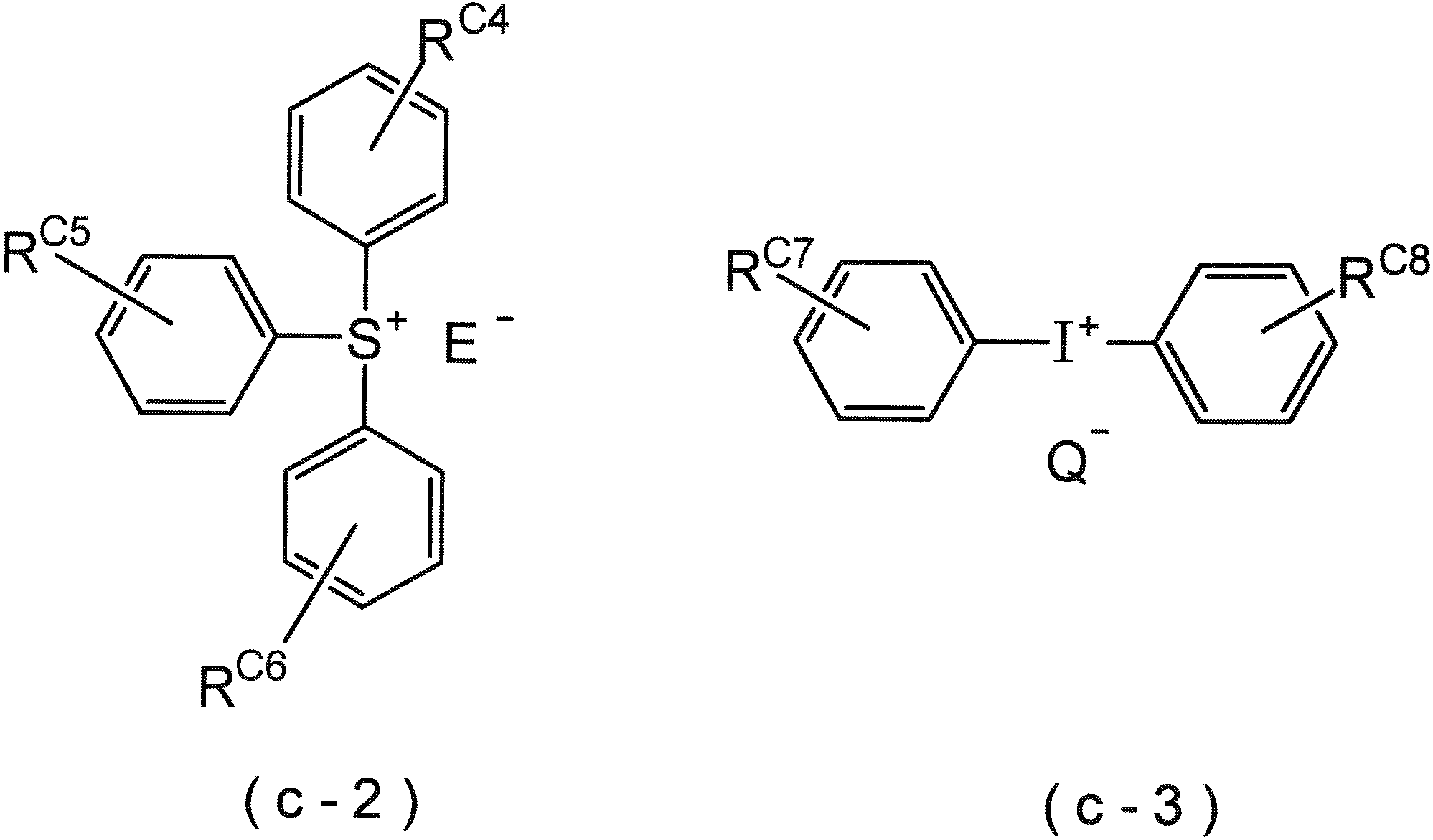
- Examples of the [C] acid scavenger include a sulfonium salt compound represented by the following formula (c-2) and an iodonium salt compound represented by the following formula (c-3).
- R C4 to R C8 each independently represent a hydrogen atom, an alkyl group having 1 to 12 carbon atoms, an alkoxyl group having 1 to 12 carbon atoms, SO 2 —R CC1 , a hydroxy group or a halogen atom.
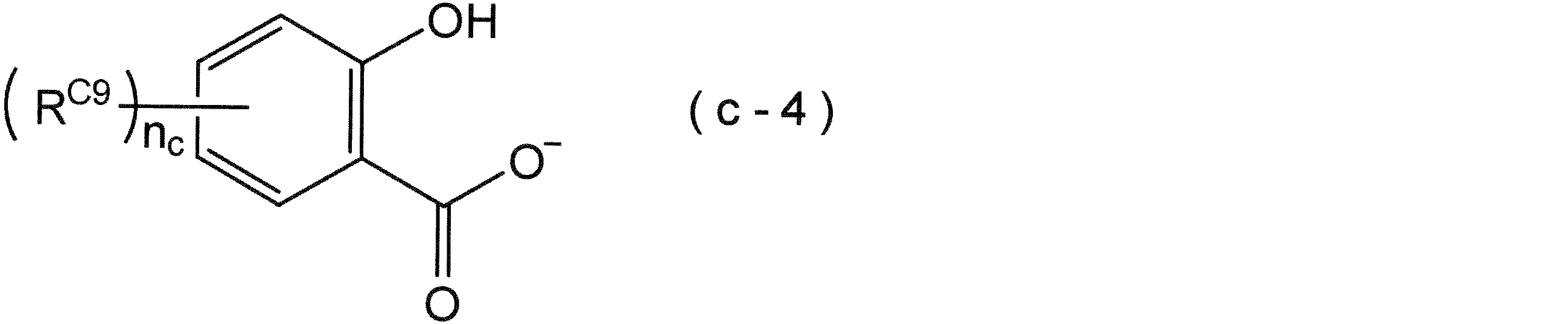
- E ⁇ and Q ⁇ are each independently represented by OH ⁇ , R CC1 —COO ⁇ , R CC1 —SO 3 ⁇ , R ⁇ —N ⁇ —SO 2 —R ⁇ or the following formula (c-4): Anion.
- R CC1 is an alkyl group having 1 to 20 carbon atoms, an aryl group having 6 to 12 carbon atoms, or an aralkyl group having 7 to 13 carbon atoms, or —O— between the carbon-carbons of these groups, A monovalent group containing —CO— or —COO—.
- the hydrogen atom of the alkyl group, aryl group or aralkyl group represented by R CC1 is a hydroxy group, an alkyl group having 1 to 12 carbon atoms, an alkoxy group having 1 to 12 carbon atoms or a cycloalkyl group having 5 to 10 carbon atoms. May be substituted.
- R ⁇ is an alkyl group having 1 to 20 carbon atoms, an aryl group having 6 to 12 carbon atoms, or an aralkyl group having 7 to 13 carbon atoms.
- R ⁇ is a fluorinated alkyl group having 1 to 20 carbon atoms.
- R C9 is an alkyl group having 1 to 12 carbon atoms or an alkoxyl group having 1 to 12 carbon atoms in which part or all of the hydrogen atoms may be substituted with fluorine atoms. .
- n c is an integer of 0-2. If n c is 2, two R C9 may be the same or different.
- Examples of the alkyl group represented by R C4 to R C8 include the same groups as those exemplified as the alkyl groups represented by R C1 , R C2 and R C3 described above.
- Examples of the alkoxyl group represented by R C4 to R C8 include a linear alkoxy group having 1 to 12 carbon atoms and a branched alkoxy group having 3 to 12 carbon atoms. Specifically, a methoxy group Ethoxy group, n-propoxy group, isopropoxy group, tert-butoxy group and the like.
- Examples of the halogen atom represented by R C4 to R C8 include a fluorine atom, a bromine atom, and a chlorine atom.
- R CC1 and R ⁇ examples include the same groups as those exemplified as the alkyl group, aryl group and aralkyl group represented by the above-mentioned R C1 , R C2 and R C3. Can be mentioned.
- R CC1 is preferably an alkyl group having 1 to 12 carbon atoms, an aryl group having 6 to 12 carbon atoms, and an aralkyl group having 7 to 13 carbon atoms.
- R ⁇ examples include groups in which part or all of the hydrogen atoms in the alkyl groups represented by R C1 , R C2, and R C3 are substituted with fluorine atoms, specifically, trifluoromethyl. Groups and the like.
- Examples of the alkyl group represented by R C9 include the same groups as those exemplified as the alkyl groups represented by R C1 , R C2 and R C3 described above.
- Examples of the alkoxyl group having 1 to 12 carbon atoms represented by R C9 include groups similar to those exemplified as the alkoxy group represented by R C4 to R C8 described above.
- R C4 to R C8 are preferably hydrogen atoms.
- E ⁇ and Q ⁇ are preferably compounds represented by the above formula (c-4).
- n c 0 is preferable.
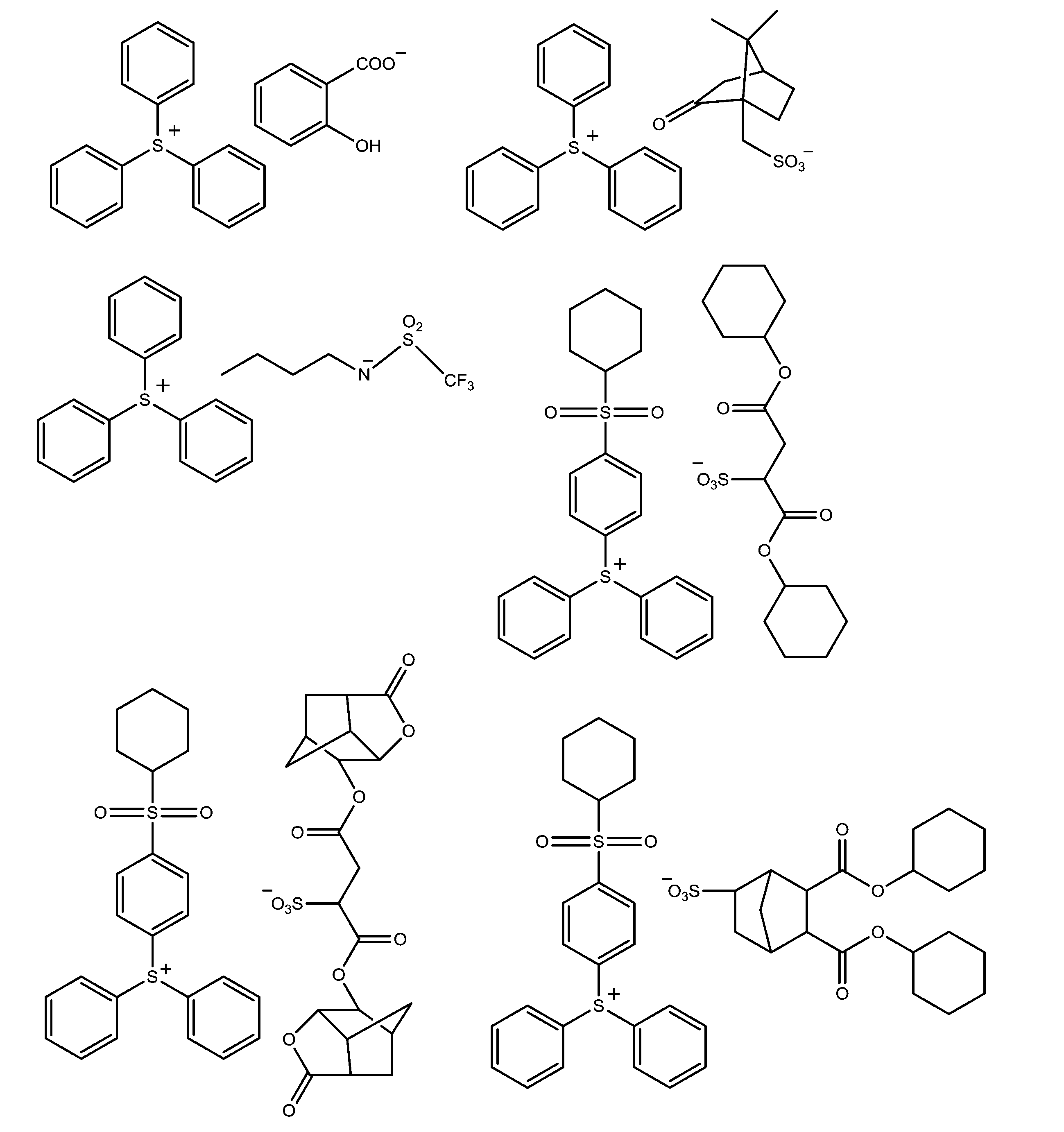
- Examples of the sulfonium salt compound represented by the above formula (c-2) and the iodonium salt compound represented by the above formula (c-3) include compounds exemplified by the following formula.
- a nitrogen-containing compound having an acid-dissociable group, a sulfonium salt compound represented by the above formula (c-2), And an iodonium salt compound represented by the above formula (c-3) is preferred, a piperidine compound having an acid dissociable group, and a compound represented by the above formula (c-2) are more preferred, and N- (t-pen Toxicarbonyl) piperidine and triphenylsulfonium salicylate are more preferred.
- the lower limit of the content of [C] acid scavenger in the total solid content in the composition is 1% by mass. Is preferable, and 2 mass% is more preferable.
- the upper limit of the content is preferably 40% by mass, more preferably 15% by mass, and still more preferably 10% by mass.
- the [D] solvent used in the radiation-sensitive composition can dissolve or disperse at least [A] particles, [B] acid generators and [C] acid scavengers, and optional components contained as necessary. There is no particular limitation as long as it is a suitable solvent. Moreover, the solvent used at the time of synthesize
- the said radiation sensitive composition may contain only 1 type of [D] solvent, and may contain it 2 or more types.
- the radiation-sensitive composition may further contain an inorganic solvent such as water, but it is possible to apply to the substrate, [A] the solubility of the particles, storage stability, and the like. Therefore, it is preferable not to use the inorganic solvent as a main solvent. As an upper limit of content of the said inorganic solvent in the said radiation sensitive composition, 20 mass% is preferable and 10 mass% is more preferable.
- Examples of the solvent include alcohol solvents, ether solvents, ketone solvents, amide solvents, ester solvents, hydrocarbon solvents, and the like.
- the alcohol solvent examples include aliphatic monoalcohol solvents having 1 to 18 carbon atoms such as ethanol, 2-propanol, 4-methyl-2-pentanol and n-hexanol, and 3 to 18 carbon atoms such as cyclohexanol.
- ether solvent examples include dialkyl ether solvents such as diethyl ether, dipropyl ether, dibutyl ether, dipentyl ether, diisoamyl ether, dihexyl ether and diheptyl ether, cyclic ether solvents such as tetrahydrofuran and tetrahydropyran, and diphenyl ether. And aromatic ring-containing ether solvents such as anisole.
- dialkyl ether solvents such as diethyl ether, dipropyl ether, dibutyl ether, dipentyl ether, diisoamyl ether, dihexyl ether and diheptyl ether, cyclic ether solvents such as tetrahydrofuran and tetrahydropyran, and diphenyl ether.
- aromatic ring-containing ether solvents such as anisole.
- ketone solvent examples include acetone, methyl ethyl ketone, methyl-n-propyl ketone, methyl-n-butyl ketone, diethyl ketone, methyl-iso-butyl ketone, 2-heptanone, ethyl-n-butyl ketone, and methyl-n-hexyl ketone.
- Chain ketone solvents such as di-iso-butyl ketone and trimethylnonanone
- cyclic ketone solvents such as cyclopentanone, cyclohexanone, cycloheptanone, cyclooctanone and methylcyclohexanone, 2,4-pentanedione, and acetonyl Examples include acetone and acetophenone.
- amide solvent examples include cyclic amide solvents such as N, N′-dimethylimidazolidinone and N-methylpyrrolidone, N-methylformamide, N, N-dimethylformamide, N, N-diethylformamide, acetamide, Examples thereof include chain amide solvents such as N-methylacetamide, N, N-dimethylacetamide, and N-methylpropionamide.
- ester solvent examples include monocarboxylic acid ester solvents such as ethyl acetate, n-butyl acetate, and ethyl lactate, polyhydric alcohol carboxylate solvents such as propylene glycol acetate, propylene glycol monomethyl ether acetate, and propylene glycol monoacetate.
- polyhydric alcohol partial ether carboxylate solvents such as ethyl ether, polycarboxylic acid diester solvents such as diethyl oxalate, lactone solvents such as ⁇ -butyrolactone, ⁇ -valerolactone, dimethyl carbonate, diethyl carbonate, ethylene carbonate, Examples thereof include carbonate solvents such as propylene carbonate.
- hydrocarbon solvent examples include aliphatic hydrocarbon solvents having 5 to 12 carbon atoms such as n-pentane and n-hexane, alicyclic hydrocarbon solvents having 5 to 12 ring members such as decahydronaphthalene, Examples thereof include aromatic hydrocarbon solvents having 6 to 16 carbon atoms such as toluene and xylene.
- an alcohol solvent and an ester solvent are preferable, a polyhydric alcohol partial ether solvent and a polyhydric alcohol partial ether carboxylate solvent are preferable, and propylene glycol monoethyl ether and propylene glycol monomethyl ether are further included. preferable.
- the radiation-sensitive composition may contain other optional ingredients such as a compound that can be a ligand and a surfactant.
- Compound that can be a ligand examples include a compound that can be a multidentate ligand or a bridging ligand (hereinafter also referred to as “compound (II)”). Examples of the compound (II) include the same compounds as those exemplified in the method for synthesizing [A] particles.
- the said radiation sensitive composition contains compound (II), as an upper limit of content of compound (II) with respect to the total solid in the said radiation sensitive composition, 10 mass% is preferable, and 3 mass% is More preferred is 1% by mass.
- the surfactant used in the radiation-sensitive composition is a component that exhibits an effect of improving applicability, striation, and the like.
- the surfactant include polyoxyethylene lauryl ether, polyoxyethylene stearyl ether, polyoxyethylene oleyl ether, polyoxyethylene n-octylphenyl ether, polyoxyethylene n-nonylphenyl ether, polyethylene glycol dilaurate, polyethylene glycol Nonionic surfactants such as distearate are listed.
- Examples of commercially available surfactants include KP341 (manufactured by Shin-Etsu Chemical Co., Ltd.), Polyflow No. 75, no.
- the radiation sensitive composition includes, for example, [A] particles, [B] acid generators, [C] acid scavengers and [D] solvents and other optional components added as necessary at a predetermined ratio.
- it can be prepared by filtering the obtained mixture with a membrane filter having a pore size of about 0.2 ⁇ m.
- a membrane filter having a pore size of about 0.2 ⁇ m.
- the upper limit of the solid content concentration is preferably 50% by mass, more preferably 30% by mass, further preferably 15% by mass, and particularly preferably 7% by mass.
- the pattern forming method includes a step of forming a film by coating the radiation-sensitive composition on a substrate (hereinafter also referred to as “coating step”) and a step of exposing the film (hereinafter referred to as “exposure step”). And a step of developing the exposed film (hereinafter also referred to as “developing step”).
- coating step a step of forming a film by coating the radiation-sensitive composition on a substrate
- exposure step a step of exposing the film
- developing step a step of developing the exposed film
- a film is formed by applying the radiation-sensitive composition to the substrate. Specifically, the radiation-sensitive composition is applied to one side of the substrate so that the resulting film has a desired thickness, and then pre-baked (PB) as necessary.
- the film is formed by volatilizing the solvent or the like.
- the method for applying the radiation-sensitive composition to the substrate is not particularly limited, and appropriate application means such as spin coating, cast coating, roll coating, etc. can be employed. Examples of the substrate include a silicon wafer and a wafer coated with aluminum.
- an organic or inorganic antireflection film may be formed on the substrate in advance.
- the lower limit of the average thickness of the film formed in this step is preferably 1 nm, more preferably 5 nm, still more preferably 10 nm, and particularly preferably 20 nm.
- the upper limit of the average thickness is preferably 1,000 nm, more preferably 200 nm, still more preferably 100 nm, and particularly preferably 70 nm.
- the lower limit of the PB temperature is usually 60 ° C, and preferably 80 ° C.
- the upper limit of the PB temperature is usually 140 ° C. and preferably 120 ° C.
- the lower limit of the PB time is usually 5 seconds, and preferably 10 seconds.
- the upper limit of the PB time is usually 600 seconds, and preferably 300 seconds.
- a protective film can be provided on the formed film, for example, in order to prevent the influence of basic impurities contained in the environmental atmosphere. Further, as described later, when immersion exposure is performed in the exposure step, an immersion protective film may be provided on the formed film in order to avoid direct contact between the immersion medium and the film.
- the film obtained in the coating step is exposed.
- the film is irradiated with radiation through a mask having a predetermined pattern.
- radiation irradiation through an immersion medium such as water, that is, immersion exposure may be employed as necessary.
- radiation to be exposed include visible light, ultraviolet light, far ultraviolet light, EUV (wavelength 13.5 nm), electromagnetic waves such as X-rays and ⁇ -rays, charged particle beams such as electron beams and ⁇ -rays, and the like.
- EUV and an electron beam are preferable from the viewpoint of increasing secondary electrons generated from [A] particles that have absorbed radiation.
- PEB post-exposure baking
- This PEB can increase the difference in solubility in the developer between the exposed and unexposed portions of the film.
- PEB temperature 50 ° C is preferred and 70 ° C is more preferred.
- an upper limit of PEB temperature 180 degreeC is preferable and 130 degreeC is more preferable.
- PEB time 5 second is preferable and 10 second is more preferable.
- the upper limit of the PEB time is preferably 600 seconds, and more preferably 300 seconds.
- the exposed film is developed using a developer.
- a developer examples include an alkaline aqueous solution and an organic solvent-containing solution.
- an alkaline aqueous solution is used as the developer, a positive pattern can usually be obtained.
- an organic solvent-containing liquid is used as the developer, a negative pattern can usually be obtained.
- an organic solvent-containing solution is preferable from the viewpoint of developability and the like.
- alkaline aqueous solution examples include sodium hydroxide, potassium hydroxide, sodium carbonate, sodium silicate, sodium metasilicate, ammonia, ethylamine, n-propylamine, diethylamine, di-n-propylamine, triethylamine, methyldiethylamine, ethyl Dimethylamine, triethanolamine, tetramethylammonium hydroxide (TMAH), pyrrole, piperidine, choline, 1,8-diazabicyclo- [5.4.0] -7-undecene, 1,5-diazabicyclo- [4.3 0.0] -5-nonene, and an alkaline aqueous solution in which at least one kind is dissolved.
- TMAH tetramethylammonium hydroxide
- the lower limit of the content of the alkaline compound in the alkaline aqueous solution is preferably 0.1% by mass, more preferably 0.5% by mass, and even more preferably 1% by mass.
- 20 mass% is preferable, 10 mass% is more preferable, and 5 mass% is further more preferable.
- TMAH aqueous solution As the alkaline aqueous solution, a TMAH aqueous solution is preferable, and a 2.38% by mass TMAH aqueous solution is more preferable.
- organic solvent in the organic solvent-containing liquid examples include the same organic solvents exemplified as the [D] solvent of the radiation-sensitive composition.
- hydrocarbon solvents and alcohol solvents are preferable, aliphatic hydrocarbon solvents, alicyclic hydrocarbon solvents, aromatic hydrocarbon solvents and aliphatic monoalcohol solvents are more preferable, hexane, Decahydronaphthalene, toluene and 2-propanol are more preferable, and a mixed solvent of hexane and toluene and 2-propanol are particularly preferable.
- the lower limit of the content of the organic solvent in the organic solvent-containing liquid is preferably 80% by mass, more preferably 90% by mass, further preferably 95% by mass, and particularly preferably 99% by mass.
- a surfactant may be added to the developer as necessary.
- a surfactant for example, an ionic or nonionic fluorine-based surfactant, a silicone-based surfactant, or the like can be used.
- a developing method for example, a method in which a substrate is immersed in a tank filled with a developer for a certain period of time (dip method), a method in which the developer is raised on the surface of the substrate by surface tension and is left stationary for a certain time (paddle method) ), A method of spraying the developer on the substrate surface (spray method), a method of continuously discharging the developer while scanning the developer discharge nozzle at a constant speed on the substrate rotating at a constant speed (dynamic dispensing method), etc. Is mentioned.
- the substrate after the development is preferably rinsed with a rinse liquid such as water or alcohol and then dried.
- a rinse liquid such as water or alcohol
- the rinsing method for example, a method of continuously discharging a rinsing liquid onto a substrate rotating at a constant speed (rotary coating method), a method of immersing the substrate in a tank filled with the rinsing liquid for a predetermined time (dip method) ), A method (spray method) of spraying a rinse liquid on the substrate surface, and the like.
- Average particle size of the particles was measured by a DLS method using a light scattering measuring device (“Zetasizer Nano ZS” from Malvern).
- Van der Waals volume The van der Waals volume was calculated by obtaining a stable structure by the PM3 method using WinMOPAC (Fujitsu, Ver. 3.9.0).
- B-1 N- (trifluoromethanesulfonyloxy) -1,8-naphthalimide (Van der Waals volume of generated acid: 0.84 ⁇ 10 ⁇ 28 m 3 )
- B-2 Triphenylsulfonium triflate (Van der Waals volume of acid generated: 0.84 ⁇ 10 ⁇ 28 m 3 )
- B-3 4-cyclohexylsulfonylphenyldiphenylsulfonium 5,6-di (cyclohexyloxycarbonyl) norbornane-2-sulfonate (van der Waals volume of acid generated: 3.80 ⁇ 10 ⁇ 28 m 3 )
- B-4 Triphenylsulfonium 6- (adamantan-1-ylcarbonyloxy) -1,1,2,2-tetrafluorohexane-1-sulfonate (Van der Waals volume of acid generated: 3.34 ⁇ 10 ⁇ 28 m 3 )
- C-1 N- (t-pentoxycarbonyl) piperidine (compound represented by the following formula (C-1))
- C-2 Triphenylsulfonium salicylate (compound represented by the following formula (C-2))
- D-1 Propylene glycol monomethyl ether acetate
- D-2 Propylene glycol monoethyl ether
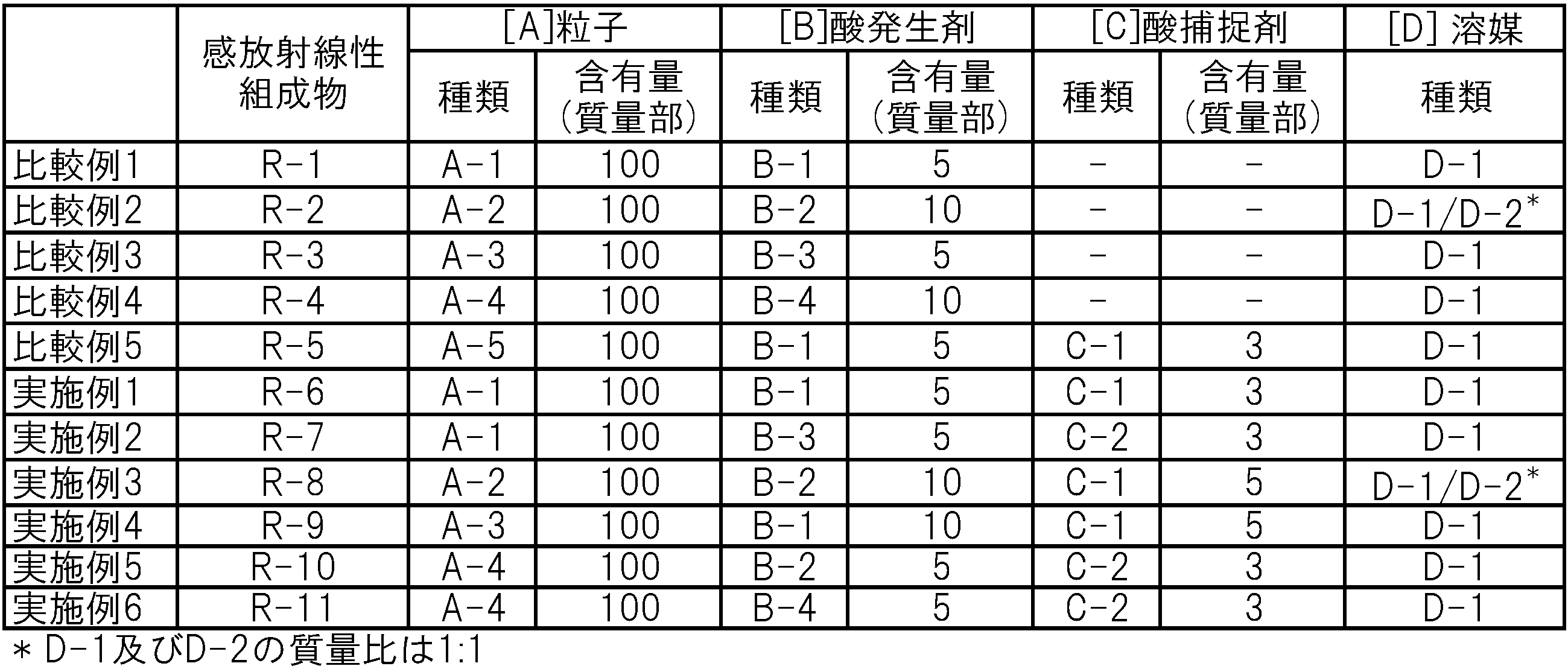
- each radiation-sensitive composition was prepared in the same manner as in Comparative Example 1 except that the types and amounts of each component shown in Table 1 were used. “-” In Table 1 below indicates that the corresponding component was not used.
- the content of silicon atoms with respect to all metal atoms in the compositions of the radiation sensitive compositions (R-1) to (R-4) and (R-6) to (R-11) is 0 atomic%.
- the content of silicon atoms with respect to all metal atoms in the composition of the radiation sensitive composition (R-5) is 88 atomic%.
- the content rate of the said silicon atom, all the metal atoms contained in each radiation sensitive composition originate in [A] particle
- [A] used in the synthesis of the particles [b] the number of atoms of total metal atoms contained in the metal-containing compound R A, [b] the number of atoms of silicon atoms contained in the metal-containing compound R B Is a value obtained by 100 ⁇ R B / R A.
- sensitivity An exposure amount for forming a line-and-space pattern (1L1S) having a one-to-one line width composed of a line portion having a line width of 100 nm and a space portion having a spacing of 100 nm formed between adjacent line portions.
- the optimum exposure dose was taken as the sensitivity ( ⁇ C / cm 2 ).
- Sensitivity means that the smaller the value, the higher the sensitivity, and it can be evaluated that less than 70 ⁇ C / cm 2 is good and 70 ⁇ C / cm 2 or more is not good.
- a pattern having excellent resolution can be formed with high sensitivity. Accordingly, these can be suitably used for semiconductor device processing processes and the like that are expected to be further miniaturized in the future.
Landscapes
- Physics & Mathematics (AREA)
- General Physics & Mathematics (AREA)
- Chemical & Material Sciences (AREA)
- Spectroscopy & Molecular Physics (AREA)
- Engineering & Computer Science (AREA)
- Organic Chemistry (AREA)
- Ceramic Engineering (AREA)
- Metallurgy (AREA)
- Materials For Photolithography (AREA)
- Exposure And Positioning Against Photoresist Photosensitive Materials (AREA)
Abstract
Description
当該感放射線性組成物は、[A]粒子と[B]酸発生体と[C]酸捕捉体とを含有する。当該感放射線性組成物は、有機溶媒(以下、「[D]溶媒」ともいう)を含有することが好ましく、本発明の効果を損なわない範囲において、その他の任意成分を含有してもよい。当該感放射線性組成物中の全金属原子に対するケイ素原子の含有率は、50原子%未満である。
[A]粒子は、金属酸化物を主成分とする粒子である。なお、[A]粒子は、金属酸化物を主成分とするので、当該感放射線性組成物から形成されるパターンのエッチング耐性の向上にも寄与している。
[A]粒子の主成分である金属酸化物を構成する金属原子としては、特に限定されず、例えば第3族~第16族の金属原子(但し、ケイ素原子を除く)等が挙げられる。上記金属原子の具体例としては、例えばチタン、ジルコニウム、ハフニウム等の第4族の金属原子、タンタル等の第5族の金属原子、クロム、タングステン等の第6族の金属原子、鉄、ルテニウム等の第8族の金属原子、コバルト等の第9族の金属原子、ニッケル等の第10族の金属原子、銅等の第11族の金属原子、亜鉛等の第12族の金属原子、ホウ素、アルミニウム、ガリウム、インジウム、タリウム等の第13族の金属原子、ゲルマニウム、スズ等の第14族の金属原子、アンチモン、ビスマス等の第15族の金属原子、テルル等の第16族の金属原子などが挙げられる。上記金属原子としては、第4族の金属原子、第12族の金属原子、及び第13族の金属原子が好ましく、ハフニウム、ジルコニウム、亜鉛及びインジウムがより好ましい。金属酸化物を構成する金属原子として上述の金属原子を用いることで、当該感放射線性組成物により形成される膜の露光部における二次電子の放出や、[B]酸発生体から発生した酸による[A]粒子の現像液に対する溶解性の変化をより促進することができる。その結果、当該感放射線性組成物の感度及び解像性をより向上できる。なお、上記金属酸化物を構成する金属原子は、1種単独で又は2種以上組み合わせて使用できる。
ギ酸、酢酸、プロピオン酸、ブタン酸、ペンタン酸、ヘキサン酸、ヘプタン酸、オクタン酸、ノナン酸、デカン酸、2-エチルヘキサン酸、チグリン酸、オレイン酸、アクリル酸、メタクリル酸、trans-2,3-ジメチルアクリル酸、ステアリン酸、リノール酸、リノレン酸、アラキドン酸、サリチル酸、安息香酸、p-アミノ安息香酸、ヨード安息香酸(例えば2-ヨード安息香酸、3-ヨード安息香酸、4-ヨード安息香酸等)、モノクロロ酢酸、ジクロロ酢酸、トリクロロ酢酸、o-トルイル酸、m-トルイル酸、p-トルイル酸、トリフルオロ酢酸、ペンタフルオロプロピオン酸、没食子酸、シキミ酸等のモノカルボン酸、シュウ酸、マロン酸、マレイン酸、メチルマロン酸、フマル酸、アジピン酸、セバシン酸、フタル酸、酒石酸等のジカルボン酸、クエン酸等の3以上のカルボキシ基を有するカルボン酸などが挙げられる。
マレイミド、コハク酸イミド等のカルボン酸イミド、ジ(トリフルオロメタンスルホン酸)イミド、ジ(ペンタフルオロエタンスルホン酸)イミド等のスルホン酸イミドなどが挙げられる。
ベンズアルドキシム、サリチルアルドキシム等のアルドキシム、ジエチルケトキシム、メチルエチルケトキシム、シクロヘキサノンオキシム等のケトキシムなどが挙げられる。
[A]粒子は、例えば後述する[b]金属含有化合物に対して加水分解縮合反応を行う方法、[b]金属含有化合物に対して配位子交換反応を行う方法等により得ることができる。ここで「加水分解縮合反応」とは、[b]金属含有化合物が有する加水分解性基が加水分解して-OHに変換され、得られた2個の-OHが脱水縮合して-O-が形成される反応をいう。
[b]金属含有化合物は、金属原子及び加水分解性基を有する金属化合物(I)、金属原子及び加水分解性基を有する金属化合物(I)の加水分解物、金属原子及び加水分解性基を有する金属化合物(I)の加水分解縮合物又はこれらの組み合わせである。金属化合物(I)は、1種単独で又は2種以上組み合わせて使用できる。

エチレン、プロピレン等の鎖状オレフィン、シクロペンテン、シクロヘキセン、ノルボルネン等の環状オレフィン、ブタジエン、イソプレン等の鎖状ジエン、シクロペンタジエン、メチルシクロペンタジエン、ペンタメチルシクロペンタジエン、シクロヘキサジエン、ノルボルナジエン等の環状ジエン、ベンゼン、トルエン、キシレン、ヘキサメチルベンゼン、ナフタレン、インデン等の芳香族炭化水素などが挙げられる。
当該感放射線性組成物に用いる[B]酸発生体は、放射線の露光により酸を発生する成分である。当該感放射線性組成物における[B]酸発生体の含有形態としては、低分子化合物の形態(以下、適宜「[B]酸発生剤」ともいう)でも、重合体の一部として組み込まれた形態でも、これらの両方の形態でもよいが、エッチング耐性の観点から、[B]酸発生剤のみを含有することが好ましい。
当該感放射線性組成物に用いる[C]酸捕捉体は、[B]酸発生体等から発生した酸を捕捉し、当該感放射線性組成物により形成される膜の露光部におけるpHを一定範囲に維持することで[A]粒子の現像液に対する溶解性変化を促進する。当該感放射線性組成物における[C]酸捕捉体の含有形態としては、遊離の化合物(以下、「[C]酸捕捉剤」ともいう)の形態でも、重合体の一部として組み込まれた形態でも、これらの両方の形態でもよい。当該感放射線性組成物は[C]酸捕捉体を1種又は2種以上含有してもよい。

当該感放射線性組成物に用いる[D]溶媒は、少なくとも[A]粒子、[B]酸発生体及び[C]酸捕捉体と、必要に応じて含有される任意成分とを溶解又は分散可能な溶媒であれば特に限定されない。また、[A]粒子を合成する際に用いた溶媒をそのまま[D]溶媒とすることもできる。当該感放射線性組成物は、[D]溶媒を1種のみ含有してもよく、2種以上含有してもよい。なお、当該感放射線性組成物は、[D]溶媒以外に水等の無機溶媒をさらに含有してもよいが、基板への塗布性、[A]粒子の溶解性、貯蔵安定性などの観点から、上記無機溶媒を主溶媒としないことが好ましい。当該感放射線性組成物における上記無機溶媒の含有量の上限としては、20質量%が好ましく、10質量%がより好ましい。
エタノール、2-プロパノール、4-メチル-2-ペンタノール、n-ヘキサノール等の炭素数1~18の脂肪族モノアルコール系溶媒、シクロヘキサノール等の炭素数3~18の脂環式モノアルコール系溶媒、1,2-プロピレングリコール等の炭素数2~18の多価アルコール系溶媒、プロピレングリコールモノメチルエーテル、プロピレングリコールモノエチルエーテル等の炭素数3~19の多価アルコール部分エーテル系溶媒などが挙げられる。
ジエチルエーテル、ジプロピルエーテル、ジブチルエーテル、ジペンチルエーテル、ジイソアミルエーテル、ジヘキシルエーテル、ジヘプチルエーテル等のジアルキルエーテル系溶媒、テトラヒドロフラン、テトラヒドロピラン等の環状エーテル系溶媒、ジフェニルエーテル、アニソール等の芳香環含有エーテル系溶媒などが挙げられる。
アセトン、メチルエチルケトン、メチル-n-プロピルケトン、メチル-n-ブチルケトン、ジエチルケトン、メチル-iso-ブチルケトン、2-ヘプタノン、エチル-n-ブチルケトン、メチル-n-ヘキシルケトン、ジ-iso-ブチルケトン、トリメチルノナノン等の鎖状ケトン系溶媒、シクロペンタノン、シクロヘキサノン、シクロヘプタノン、シクロオクタノン、メチルシクロヘキサノン等の環状ケトン系溶媒、2,4-ペンタンジオン、アセトニルアセトン、アセトフェノンなどが挙げられる。
N,N’-ジメチルイミダゾリジノン、N-メチルピロリドン等の環状アミド系溶媒、N-メチルホルムアミド、N,N-ジメチルホルムアミド、N,N-ジエチルホルムアミド、アセトアミド、N-メチルアセトアミド、N,N-ジメチルアセトアミド、N-メチルプロピオンアミド等の鎖状アミド系溶媒などが挙げられる。
酢酸エチル、酢酸n-ブチル、乳酸エチル等のモノカルボン酸エステル系溶媒、酢酸プロピレングリコール等の多価アルコールカルボキシレート系溶媒、酢酸プロピレングリコールモノメチルエーテル、酢酸プロピレングリコールモノエチルエーテル等の多価アルコール部分エーテルカルボキシレート系溶媒、シュウ酸ジエチル等の多価カルボン酸ジエステル系溶媒、γ-ブチロラクトン、δ-バレロラクトン等のラクトン系溶媒、ジメチルカーボネート、ジエチルカーボネート、エチレンカーボネート、プロピレンカーボネート等のカーボネート系溶媒などが挙げられる。
n-ペンタン、n-ヘキサン等の炭素数5~12の脂肪族炭化水素系溶媒、デカヒドロナフタレン等の環員数5~12の脂環式炭化水素系溶媒、トルエン、キシレン等の炭素数6~16の芳香族炭化水素系溶媒などが挙げられる。
当該感放射線性組成物は、[A]~[D]成分以外にも、配位子となり得る化合物、界面活性剤等のその他の任意成分を含有してもよい。
当該感放射線性組成物に用いる上記配位子となり得る化合物としては、例えば多座配位子又は架橋配位子となり得る化合物(以下、「化合物(II)」ともいう)等が挙げられる。化合物(II)としては、例えば[A]粒子の合成方法において例示した化合物と同様のもの等が挙げられる。
当該感放射線性組成物に用いる界面活性剤は、塗布性、ストリエーション等を改良する作用を示す成分である。上記界面活性剤としては、例えばポリオキシエチレンラウリルエーテル、ポリオキシエチレンステアリルエーテル、ポリオキシエチレンオレイルエーテル、ポリオキシエチレンn-オクチルフェニルエーテル、ポリオキシエチレンn-ノニルフェニルエーテル、ポリエチレングリコールジラウレート、ポリエチレングリコールジステアレート等のノニオン系界面活性剤などが挙げられる。また、上記界面活性剤の市販品としては、例えばKP341(信越化学工業社製)、ポリフローNo.75、同No.95(以上、共栄社化学社製)、エフトップEF301、同EF303、同EF352(以上、トーケムプロダクツ社製)、メガファックF171、同F173(以上、DIC社製)、フロラードFC430、同FC431(以上、住友スリーエム社製)、アサヒガードAG710、サーフロンS-382、同SC-101、同SC-102、同SC-103、同SC-104、同SC-105、同SC-106(以上、旭硝子社製)などが挙げられる。
当該感放射線性組成物は、例えば[A]粒子、[B]酸発生体、[C]酸捕捉体及び[D]溶媒と必要に応じて添加されるその他の任意成分とを所定の割合で混合し、好ましくは、得られた混合物を孔径0.2μm程度のメンブランフィルターでろ過することにより調製できる。当該感放射線性組成物の固形分濃度の下限としては、0.1質量%が好ましく、0.5質量%がより好ましく、1質量%がさらに好ましく、3質量%が特に好ましい。一方、上記固形分濃度の上限としては、50質量%が好ましく、30質量%がより好ましく、15質量%がさらに好ましく、7質量%が特に好ましい。
当該パターン形成方法は、基板に当該感放射線性組成物を塗工することにより膜を形成する工程(以下、「塗工工程」ともいう)と、上記膜を露光する工程(以下、「露光工程」ともいう)と、上記露光された膜を現像する工程(以下、「現像工程」ともいう)とを備える。当該パターン形成方法によれば、上述の当該感放射線性組成物を用いているので、解像度に優れるパターンを高感度で形成できる。以下、各工程について説明する。
本工程では、基板に当該感放射線性組成物を塗工することにより膜を形成する。具体的には、得られる膜が所望の厚さとなるように当該感放射線性組成物を基板の一方の面側に塗工した後、必要に応じてプレベーク(PB)によって当該感放射線性組成物の[D]溶媒等を揮発させることで膜を形成する。当該感放射線性組成物を基板に塗工する方法としては、特に限定されないが、例えば回転塗布、流延塗布、ロール塗布等の適宜の塗布手段を採用できる。上記基板としては、例えばシリコンウエハ、アルミニウムで被覆されたウエハ等が挙げられる。なお、感放射線性組成物の潜在能力を最大限に引き出すため、有機系又は無機系の反射防止膜を基板上に予め形成しておいてもよい。
本工程では、塗工工程により得られた上記膜を露光する。具体的には、例えば所定のパターンを有するマスクを介して上記膜に放射線をする。本工程では、必要に応じ、水等の液浸媒体を介した放射線の照射、つまり液浸露光を採用してもよい。露光する放射線としては、例えば可視光線、紫外線、遠紫外線、EUV(波長13.5nm)、X線、γ線等の電磁波、電子線、α線等の荷電粒子線などが挙げられる。これらの中で、放射線を吸収した[A]粒子から発生する二次電子を増加させる観点から、EUV及び電子線が好ましい。
本工程では、現像液を用い、露光された膜を現像する。これにより、所定のパターンが形成される。上記現像液としては、例えばアルカリ水溶液、有機溶媒含有液等が挙げられる。現像液としてアルカリ水溶液を用いた場合、通常ポジ型のパターンを得ることができる。また、現像液として有機溶媒含有液を用いた場合、通常ネガ型のパターンを得ることができる。上記現像液としては、現像性等の観点から、有機溶媒含有液が好ましい。
[A]粒子の平均粒子径は、光散乱測定装置(Malvern社の「Zetasizer Nano ZS」)を用いたDLS法によって測定した。
ファンデルワールス体積は、WinMOPAC(富士通社製、Ver.3.9.0)を用い、PM3法で安定構造を求めることによって計算した。
[A]粒子の合成に用いた[a]有機酸及び[b]金属含有化合物を以下に示す。
a-1:メタクリル酸(pKa:4.66)
a-2:チグリン酸(pKa:4.96)
a-3:安息香酸(pKa:4.21)
b-1:酢酸亜鉛二水和物
b-2:インジウム(III)イソプロポキシド
b-3:ハフニウム(IV)イソプロポキシド
b-4:ジルコニウム(IV)イソプロポキシド
b-5:テトラエトキシシラン
上記化合物(a-1)1.9g及び(b-1)1.7gを酢酸エチル40.0gに溶解させた。この溶液に2.2mlのトリエチルアミンを滴下して65℃で2時間加熱した。反応溶液をヘキサン洗浄した後に乾燥させることで金属原子と有機酸に由来する配位子とを含む粒子(A-1)を得た。この粒子(A-1)のDLS法により測定した平均粒子径は1.6nmであった。
上記化合物(a-2)8.0g及び(b-2)1.5gを混合して、65℃で6時間加熱した。この反応溶液を超純水及びアセトンにて洗浄した後に乾燥させることで金属原子と有機酸に由来する配位子とを含む粒子(A-2)を得た。この粒子(A-2)のDLS法により測定した平均粒子径は1.7nmであった。
上記化合物(a-1)8.0g及び(b-3)1.5gを混合して、65℃で21時間加熱した。この反応溶液を超純水及びアセトンにて洗浄した後に乾燥させることで金属原子と有機酸に由来する配位子とを含む粒子(A-3)を得た。この粒子(A-3)のDLS法により測定した平均粒子径は2.1nmであった。
上記化合物(a-3)5.0g及び(b-4)1.5gをテトラヒドロフラン(THF)に溶解させた後に65℃で21時間加熱した。この反応溶液を超純水及びアセトンにて洗浄した後に乾燥させることで金属原子と有機酸に由来する配位子とを含む粒子(A-4)を得た。この粒子(A-4)のDLS法により測定した平均粒子径は、2.4nmであった。
上記化合物(b-4)0.3g及び(b-5)1.3gを(a-1)9.0gに溶解させ、この溶液を65℃で12時間加熱した。反応溶液を超純水及びアセトンで洗浄した後に乾燥させ、金属原子と有機酸に由来する配位子とを主に含む金属酸化物の粒子(A-5)を得た。この粒子(A-5)の平均粒子径は4.1nmであった。
感放射線性組成物の調製に用いた[B]酸発生剤、[C]酸捕捉剤及び[D]溶媒を以下に示す。
B-1:N-(トリフルオロメタンスルホニルオキシ)-1,8-ナフタルイミド(発生する酸のファンデルワールス体積:0.84×10⁻²⁸m3)
B-2:トリフェニルスルホニウムトリフレート(発生する酸のファンデルワールス体積:0.84×10⁻²⁸m3)
B-3:4-シクロヘキシルスルホニルフェニルジフェニルスルホニウム5,6-ジ(シクロヘキシルオキシカルボニル)ノルボルナン-2-スルホネート(発生する酸のファンデルワールス体積:3.80×10⁻²⁸m3)
B-4:トリフェニルスルホニウム6-(アダマンタン-1-イルカルボニルオキシ)-1,1,2,2-テトラフルオロヘキサン-1-スルホネート(発生する酸のファンデルワールス体積:3.34×10⁻²⁸m3)
C-1:N―(t-ペントキシカルボニル)ピペリジン(下記式(C-1)で表される化合物)
C-2:トリフェニルスルホニウムサリチレート(下記式(C-2)で表される化合物)

D-1:酢酸プロピレングリコールモノメチルエーテル
D-2:プロピレングリコールモノエチルエーテル
粒子(A-1)100質量部、[B]酸発生剤としての(B-1)5質量部、及び[D]溶媒としての(D-1)を混合し、固形分濃度5質量%の混合液とした。得られた混合液を孔径0.20μmのメンブランフィルターでろ過することで感放射線性組成物(R-1)を調製した。
下記表1に示す種類及び量の各成分を用いた以外は比較例1と同様に操作して各感放射線性組成物を調製した。下記表1の「-」は、該当する成分を用いなかったことを示す。また、感放射線性組成物(R-1)~(R-4)及び(R-6)~(R-11)の組成物中の全金属原子に対するケイ素原子の含有率は0原子%である。一方、感放射線性組成物(R-5)の組成物中の全金属原子に対するケイ素原子の含有率は88原子%である。なお、上記ケイ素原子の含有率は、各感放射線性組成物に含まれる金属原子が全て[A]粒子に由来し、かつ[A]粒子の合成において[b]金属含有化合物に含まれる各金属原子が同じ割合で[A]粒子の形成に用いられたとする仮定に基づく推測値である。具体的には、[A]粒子の合成に用いた[b]金属含有化合物に含まれる全金属原子の原子数をRA、[b]金属含有化合物に含まれるケイ素原子の原子数をRBとしたときに、100×RB/RAで求められる値である。
[比較例1]
簡易スピンコーターで、シリコンウエハ上に上記比較例1で調製した感放射線性組成物(R-1)をスピンコートした後、100℃、60秒間の条件でPBを行い、平均厚さ50nmの膜を形成した。次に、電子線描画装置(JEOL社の「JBX-9500FS」)を用いて上記膜に電子線を露光し、パターニングを行った。電子線の露光後、上記膜に100℃、60秒間の条件でPEBを行い、有機溶媒(2-プロパノール)により現像した後、乾燥させることでネガ型パターンを形成した。
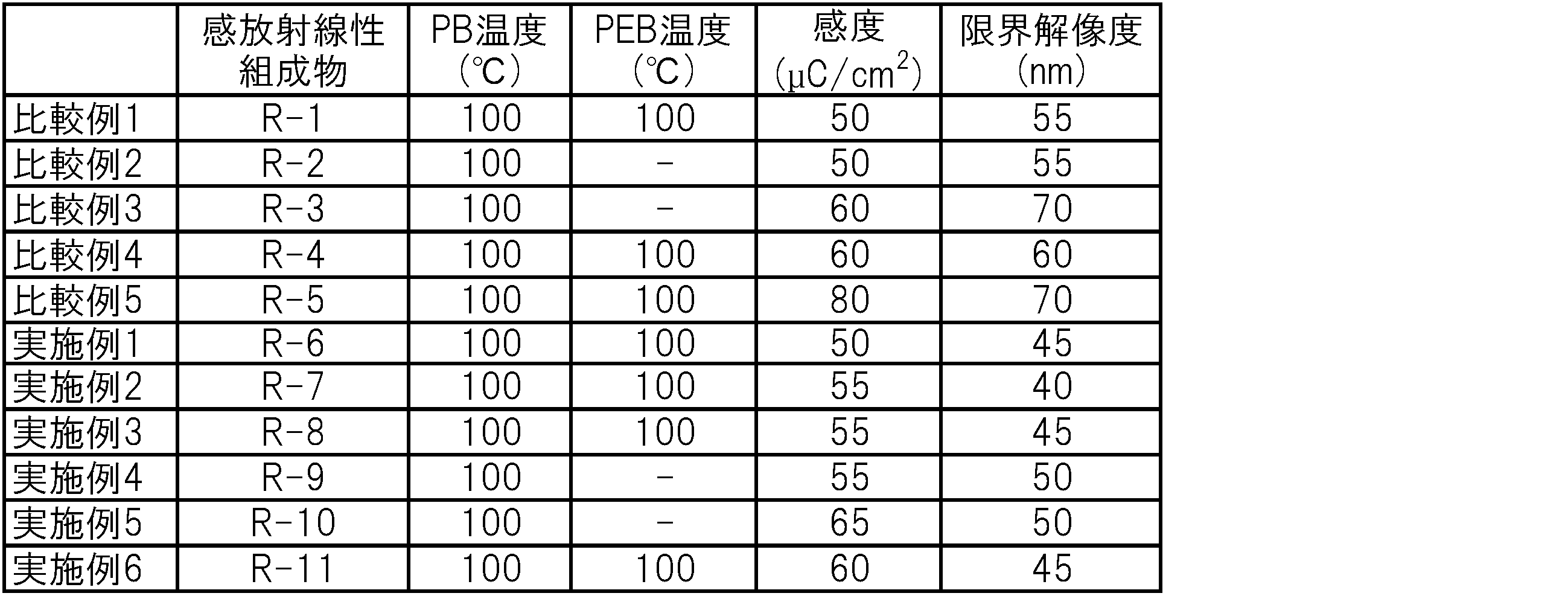
下記表2に示すプロセスとした以外は比較例1と同様に操作して各感放射線性組成物を用いたパターン形成を行った。下記表2の「-」は、該当するプロセスを用いなかったことを示す。
上記形成した各パターンについて、下記に示す方法により感度及び限界解像度についての評価を行った。評価結果を表2に示す。
線幅100nmのライン部と、隣り合うライン部の間に形成される間隔100nmのスペース部とで構成される1対1の線幅のライン・アンド・スペースパターン(1L1S)を形成する露光量を最適露光量とし、この最適露光量を感度(μC/cm2)とした。感度は、数値が小さいほど高感度であることを意味し、70μC/cm2未満を良好、70μC/cm2以上を良好でないと評価できる。
各種線幅のライン・アンド・スペースパターン(1L1S)を作成し、1対1の線幅が保持されていたライン・アンド・スペースパターンの中でライン幅及びスペース幅の合計が最小であったパターンのハーフピッチを限界解像度(nm)とした。限界解像度は、数値が小さいほど解像度に優れることを意味し、50nm以下を良好、50nm超を良好でないと評価できる。
Claims (8)
- 金属酸化物を主成分とする粒子と、
感放射線性酸発生体と、
酸捕捉体と
を含有し、
組成物中の全金属原子に対するケイ素原子の含有率が50原子%未満である感放射線性組成物。 - 上記感放射線性酸発生体の組成物中の全固形分に対する含有量が1質量%以上40質量%以下である請求項1に記載の感放射線性組成物。
- 上記酸捕捉体の組成物中の全固形分に対する含有量が1質量%以上40質量%以下である請求項1又は請求項2に記載の感放射線性組成物。
- 上記粒子の平均粒子径が20nm以下である請求項1、請求項2又は請求項3に記載の感放射線性組成物。
- 基板に請求項1から請求項4のいずれか1項に記載の感放射線性組成物を塗工することにより膜を形成する工程と、
上記膜を露光する工程と、
上記露光された膜を現像する工程と
を備えるパターン形成方法。 - 上記現像工程で用いる現像液がアルカリ水溶液である請求項5に記載のパターン形成方法。
- 上記現像工程で用いる現像液が有機溶媒含有液である請求項5に記載のパターン形成方法。
- 上記露光工程で用いる放射線が、極端紫外線又は電子線である請求項5、請求項6又は請求項7に記載のパターン形成方法。
Priority Applications (3)
| Application Number | Priority Date | Filing Date | Title |
|---|---|---|---|
| KR1020187026981A KR20180123045A (ko) | 2016-03-28 | 2017-02-20 | 감방사선성 조성물 및 패턴 형성 방법 |
| JP2018508576A JPWO2017169288A1 (ja) | 2016-03-28 | 2017-02-20 | 感放射線性組成物及びパターン形成方法 |
| US16/140,933 US20190094691A1 (en) | 2016-03-28 | 2018-09-25 | Radiation-sensitive composition and pattern-forming method |
Applications Claiming Priority (2)
| Application Number | Priority Date | Filing Date | Title |
|---|---|---|---|
| US201662314029P | 2016-03-28 | 2016-03-28 | |
| US62/314,029 | 2016-03-28 |
Related Child Applications (1)
| Application Number | Title | Priority Date | Filing Date |
|---|---|---|---|
| US16/140,933 Continuation US20190094691A1 (en) | 2016-03-28 | 2018-09-25 | Radiation-sensitive composition and pattern-forming method |
Publications (1)
| Publication Number | Publication Date |
|---|---|
| WO2017169288A1 true WO2017169288A1 (ja) | 2017-10-05 |
Family
ID=59963120
Family Applications (1)
| Application Number | Title | Priority Date | Filing Date |
|---|---|---|---|
| PCT/JP2017/006242 Ceased WO2017169288A1 (ja) | 2016-03-28 | 2017-02-20 | 感放射線性組成物及びパターン形成方法 |
Country Status (4)
| Country | Link |
|---|---|
| US (1) | US20190094691A1 (ja) |
| JP (1) | JPWO2017169288A1 (ja) |
| KR (1) | KR20180123045A (ja) |
| WO (1) | WO2017169288A1 (ja) |
Cited By (2)
| Publication number | Priority date | Publication date | Assignee | Title |
|---|---|---|---|---|
| WO2021131299A1 (ja) * | 2019-12-24 | 2021-07-01 | 国立研究開発法人産業技術総合研究所 | 有機修飾金属酸化物ナノ粒子、その製造方法、euvフォトレジスト材料およびエッチングマスクの製造方法 |
| KR20220021473A (ko) * | 2019-06-14 | 2022-02-22 | 제이에스알 가부시끼가이샤 | 감방사선성 수지 조성물 및 레지스트 패턴 형성 방법 |
Families Citing this family (2)
| Publication number | Priority date | Publication date | Assignee | Title |
|---|---|---|---|---|
| US12306536B2 (en) | 2020-11-20 | 2025-05-20 | Taiwan Semiconductor Manufacturing Co., Ltd. | Metallic photoresist patterning and defect improvement |
| KR20240101079A (ko) | 2022-12-23 | 2024-07-02 | 삼성전자주식회사 | 반도체 포토레지스트용 조성물 및 이를 이용한 패턴 형성 방법 |
Citations (7)
| Publication number | Priority date | Publication date | Assignee | Title |
|---|---|---|---|---|
| JP2006098568A (ja) * | 2004-09-29 | 2006-04-13 | Sumitomo Bakelite Co Ltd | 感光性樹脂組成物及びそれを用いた半導体装置 |
| WO2009110166A1 (ja) * | 2008-03-06 | 2009-09-11 | パナソニック株式会社 | レジスト材料及びそれを用いたパターン形成方法 |
| JP2013025211A (ja) * | 2011-07-25 | 2013-02-04 | Shin Etsu Chem Co Ltd | レジスト材料及びこれを用いたパターン形成方法 |
| JP2013083844A (ja) * | 2011-10-12 | 2013-05-09 | Fujifilm Corp | ポジ型感光性樹脂組成物、硬化物の製造方法、樹脂パターン製造方法、硬化物及び光学部材 |
| JP2013205521A (ja) * | 2012-03-27 | 2013-10-07 | Fujifilm Corp | パターン形成方法、それに用いられる感活性光線性又は感放射線性組成物、及び、レジスト膜、並びに、これらを用いる電子デバイスの製造方法、及び、電子デバイス |
| JP2014102391A (ja) * | 2012-11-20 | 2014-06-05 | Fujifilm Corp | 感光性樹脂組成物、硬化物及びその製造方法、樹脂パターン製造方法、硬化膜、有機el表示装置、液晶表示装置、並びに、タッチパネル表示装置 |
| JP2015157807A (ja) * | 2014-02-14 | 2015-09-03 | コーネル ユニバーシティCornell University | 金属酸化物ナノ粒子およびフォトレジスト組成物 |
Family Cites Families (1)
| Publication number | Priority date | Publication date | Assignee | Title |
|---|---|---|---|---|
| JP4217886B2 (ja) * | 2003-06-25 | 2009-02-04 | Jsr株式会社 | 感放射線性屈折率変化性組成物、パターン形成法および光学材料 |
-
2017
- 2017-02-20 KR KR1020187026981A patent/KR20180123045A/ko not_active Withdrawn
- 2017-02-20 WO PCT/JP2017/006242 patent/WO2017169288A1/ja not_active Ceased
- 2017-02-20 JP JP2018508576A patent/JPWO2017169288A1/ja active Pending
-
2018
- 2018-09-25 US US16/140,933 patent/US20190094691A1/en not_active Abandoned
Patent Citations (7)
| Publication number | Priority date | Publication date | Assignee | Title |
|---|---|---|---|---|
| JP2006098568A (ja) * | 2004-09-29 | 2006-04-13 | Sumitomo Bakelite Co Ltd | 感光性樹脂組成物及びそれを用いた半導体装置 |
| WO2009110166A1 (ja) * | 2008-03-06 | 2009-09-11 | パナソニック株式会社 | レジスト材料及びそれを用いたパターン形成方法 |
| JP2013025211A (ja) * | 2011-07-25 | 2013-02-04 | Shin Etsu Chem Co Ltd | レジスト材料及びこれを用いたパターン形成方法 |
| JP2013083844A (ja) * | 2011-10-12 | 2013-05-09 | Fujifilm Corp | ポジ型感光性樹脂組成物、硬化物の製造方法、樹脂パターン製造方法、硬化物及び光学部材 |
| JP2013205521A (ja) * | 2012-03-27 | 2013-10-07 | Fujifilm Corp | パターン形成方法、それに用いられる感活性光線性又は感放射線性組成物、及び、レジスト膜、並びに、これらを用いる電子デバイスの製造方法、及び、電子デバイス |
| JP2014102391A (ja) * | 2012-11-20 | 2014-06-05 | Fujifilm Corp | 感光性樹脂組成物、硬化物及びその製造方法、樹脂パターン製造方法、硬化膜、有機el表示装置、液晶表示装置、並びに、タッチパネル表示装置 |
| JP2015157807A (ja) * | 2014-02-14 | 2015-09-03 | コーネル ユニバーシティCornell University | 金属酸化物ナノ粒子およびフォトレジスト組成物 |
Cited By (3)
| Publication number | Priority date | Publication date | Assignee | Title |
|---|---|---|---|---|
| KR20220021473A (ko) * | 2019-06-14 | 2022-02-22 | 제이에스알 가부시끼가이샤 | 감방사선성 수지 조성물 및 레지스트 패턴 형성 방법 |
| KR102776230B1 (ko) | 2019-06-14 | 2025-03-07 | 제이에스알 가부시키가이샤 | 감방사선성 수지 조성물 및 레지스트 패턴 형성 방법 |
| WO2021131299A1 (ja) * | 2019-12-24 | 2021-07-01 | 国立研究開発法人産業技術総合研究所 | 有機修飾金属酸化物ナノ粒子、その製造方法、euvフォトレジスト材料およびエッチングマスクの製造方法 |
Also Published As
| Publication number | Publication date |
|---|---|
| KR20180123045A (ko) | 2018-11-14 |
| JPWO2017169288A1 (ja) | 2019-02-14 |
| US20190094691A1 (en) | 2019-03-28 |
Similar Documents
| Publication | Publication Date | Title |
|---|---|---|
| JP7071660B2 (ja) | 感放射線性組成物及びレジストパターン形成方法 | |
| JP6666564B2 (ja) | 感放射線性組成物及びパターン形成方法 | |
| JP2018017780A (ja) | 感放射線性組成物及びパターン形成方法 | |
| WO2018043506A1 (ja) | 感放射線性組成物及びパターン形成方法 | |
| WO2017169440A1 (ja) | 感放射線性組成物及びパターン形成方法 | |
| JP6871520B2 (ja) | 感放射線性組成物及びパターン形成方法 | |
| WO2016043200A1 (ja) | パターン形成方法 | |
| WO2018168221A1 (ja) | 感放射線性組成物及びパターン形成方法 | |
| US10120277B2 (en) | Radiation-sensitive composition and pattern-forming method | |
| US10108088B2 (en) | Radiation-sensitive composition and pattern-forming method | |
| JP6572898B2 (ja) | パターン形成方法 | |
| JP7327392B2 (ja) | パターン形成方法及び感放射線性組成物 | |
| US20190258161A1 (en) | Radiation-sensitive composition and pattern-forming method | |
| JP2018116160A (ja) | 感放射線性組成物及びパターン形成方法 | |
| JP2020201480A (ja) | 感放射線性組成物、パターン形成方法及び化合物 | |
| JPWO2017169288A1 (ja) | 感放射線性組成物及びパターン形成方法 | |
| WO2019220878A1 (ja) | 感放射線性組成物及びパターン形成方法 | |
| JP2019144553A (ja) | 感放射線性組成物及びパターン形成方法 | |
| JPWO2017141756A1 (ja) | 感放射線性組成物及びパターン形成方法 | |
| WO2020040092A1 (ja) | パターン形成方法及び感放射線性組成物 |
Legal Events
| Date | Code | Title | Description |
|---|---|---|---|
| WWE | Wipo information: entry into national phase |
Ref document number: 2018508576 Country of ref document: JP |
|
| ENP | Entry into the national phase |
Ref document number: 20187026981 Country of ref document: KR Kind code of ref document: A |
|
| NENP | Non-entry into the national phase |
Ref country code: DE |
|
| 121 | Ep: the epo has been informed by wipo that ep was designated in this application |
Ref document number: 17773836 Country of ref document: EP Kind code of ref document: A1 |
|
| 122 | Ep: pct application non-entry in european phase |
Ref document number: 17773836 Country of ref document: EP Kind code of ref document: A1 |