WO2017164124A1 - 2位に分岐構造を有するエーテル系基油の製造方法、冷凍機油組成物の製造方法及び潤滑油組成物の製造方法 - Google Patents
2位に分岐構造を有するエーテル系基油の製造方法、冷凍機油組成物の製造方法及び潤滑油組成物の製造方法 Download PDFInfo
- Publication number
- WO2017164124A1 WO2017164124A1 PCT/JP2017/010939 JP2017010939W WO2017164124A1 WO 2017164124 A1 WO2017164124 A1 WO 2017164124A1 JP 2017010939 W JP2017010939 W JP 2017010939W WO 2017164124 A1 WO2017164124 A1 WO 2017164124A1
- Authority
- WO
- WIPO (PCT)
- Prior art keywords
- producing
- base oil
- branched structure
- ether base
- acetal
- Prior art date
- Legal status (The legal status is an assumption and is not a legal conclusion. Google has not performed a legal analysis and makes no representation as to the accuracy of the status listed.)
- Ceased
Links
Classifications
-
- C—CHEMISTRY; METALLURGY
- C10—PETROLEUM, GAS OR COKE INDUSTRIES; TECHNICAL GASES CONTAINING CARBON MONOXIDE; FUELS; LUBRICANTS; PEAT
- C10M—LUBRICATING COMPOSITIONS; USE OF CHEMICAL SUBSTANCES EITHER ALONE OR AS LUBRICATING INGREDIENTS IN A LUBRICATING COMPOSITION
- C10M105/00—Lubricating compositions characterised by the base-material being a non-macromolecular organic compound
- C10M105/08—Lubricating compositions characterised by the base-material being a non-macromolecular organic compound containing oxygen
- C10M105/18—Ethers, e.g. epoxides
-
- C—CHEMISTRY; METALLURGY
- C07—ORGANIC CHEMISTRY
- C07B—GENERAL METHODS OF ORGANIC CHEMISTRY; APPARATUS THEREFOR
- C07B61/00—Other general methods
-
- C—CHEMISTRY; METALLURGY
- C07—ORGANIC CHEMISTRY
- C07C—ACYCLIC OR CARBOCYCLIC COMPOUNDS
- C07C41/00—Preparation of ethers; Preparation of compounds having groups, groups or groups
- C07C41/01—Preparation of ethers
- C07C41/18—Preparation of ethers by reactions not forming ether-oxygen bonds
- C07C41/28—Preparation of ethers by reactions not forming ether-oxygen bonds from acetals, e.g. by dealcoholysis
-
- C—CHEMISTRY; METALLURGY
- C07—ORGANIC CHEMISTRY
- C07C—ACYCLIC OR CARBOCYCLIC COMPOUNDS
- C07C43/00—Ethers; Compounds having groups, groups or groups
- C07C43/02—Ethers
- C07C43/03—Ethers having all ether-oxygen atoms bound to acyclic carbon atoms
- C07C43/04—Saturated ethers
Definitions
- the present invention relates to a method for producing an ether base oil having a branched structure at the 2-position, a method for producing a refrigerator oil composition, and a method for producing a lubricating oil composition.
- Refrigerator oil is used in compression refrigerators such as air conditioners, refrigerators, and car air conditioners, and is required to have lubricity and compatibility with refrigerants. Furthermore, since the compressor has a built-in motor, a high volume resistivity is required from the viewpoint of leakage prevention. As such refrigerating machine oil, an ether base oil having an ether bond may be used.
- dehydration condensation reaction for example, Patent Document 1
- Williamson reaction is used for the synthesis of ether.
- refrigeration oil is required to have a high volume resistivity.
- it is considered effective to have a branched structure at the 2-position.
- the alcohol having a branched structure at the 2-position has a large steric hindrance at the 1-position carbon, which makes it difficult for etherification by intermolecular reaction to proceed and the generated cation is more stable. Since the rearrangement to the 2nd position and intramolecular dehydration proceeds, olefins are easily formed. For this reason, in the dehydration condensation reaction, an ether compound having a branched structure at the 2-position cannot be obtained in a high yield.
- the target ether can be obtained by causing a nucleophilic substitution reaction of an alkoxide having a branched structure at the 2-position with respect to a halogen compound having a branched structure at the 2-position, but the steric hindrance is large. For this reason, the nucleophilic substitution reaction does not easily proceed, and the elimination reaction occurs as a side reaction, giving priority to olefin production. For this reason, in the Williamson reaction, an ether compound having a branched structure at the 2-position cannot be obtained in high yield.
- the present invention has been made in view of the above problems, and can produce an ether base oil having a branched structure at the 2-position in a high yield. Production of an ether base oil having a branched structure at the 2-position It is an object to provide a method, a method for producing a refrigerator oil composition, and a method for producing a lubricating oil composition.
- a process for producing an ether base oil having a branched structure at the 2-position comprising the following steps 1 and 2.
- Step 1 A step of obtaining an acetal-containing composition by performing an acetalization reaction in which an aldehyde (A) having a branched structure at the 2-position is condensed with an alcohol (B) having a branched structure at the 2-position.
- Step 2 A step of reducing the acetal-containing composition to obtain an ether compound having a branched structure at the 2-position.
- a method for producing a refrigerating machine oil composition comprising a step of adding a refrigerant to the ether base oil obtained by the method for producing an ether base oil according to [1].
- a method for producing a lubricating oil composition comprising a step of adding a lubricant additive to the ether base oil obtained by the method for producing an ether base oil according to [1].
- the method for producing an ether base oil having a branched structure at the 2-position of the present invention can obtain an ether base oil having a branched structure at the 2-position in a high yield.
- Step 1 A step of obtaining an acetal-containing composition by performing an acetalization reaction in which an aldehyde (A) having a branched structure at the 2-position is condensed with an alcohol (B) having a branched structure at the 2-position.
- Step 2 A step of reducing the acetal-containing composition to obtain an ether compound having a branched structure at the 2-position.
- Step 1 is a step of obtaining an acetal-containing composition by performing an acetalization reaction in which an aldehyde (A) having a branched structure at the 2-position is condensed with an alcohol (B) having a branched structure at the 2-position.
- an ether base oil having a high volume resistivity cannot be obtained in a high yield.
- the volume resistivity is low because the steric hindrance around the oxygen atom is reduced unless the branched structure is a multi-branched structure.
- the reaction is difficult to proceed due to steric hindrance, and the yield tends to decrease.
- the volume resistivity cannot be made sufficiently high.
- the aldehyde (A) having a branched structure at the 2-position is not particularly limited, and examples thereof include compounds represented by the following general formula (I).
- R 1 and R 2 each independently represents an alkyl group having 1 to 12 carbon atoms. ]
- the reactivity is improved, and therefore the number of carbon atoms of the alkyl group of R 1 and R 2 is preferably 1 or more and 8 or less, and more preferably 2 or more and 6 or less. More preferably, it is 2 or more and 4 or less.
- the total number of carbon atoms of the alkyl groups of R 1 and R 2 is preferably 2 or more and 16 or less, and is 3 or more and 12 or less. More preferably, it is 4 or more and 8 or less.
- aldehyde having a branched structure at the 2-position represented by the general formula (I) include 2-methylpropanal, 2-ethylpropanal, 2-methylbutanal, 2-ethylbutanal, 2- Propylbutanal, 2-methylpentanal, 2-ethylpentanal, 2-propylpentanal, 2-butylpentanal, 2-methylhexanal, 2-ethylhexanal, 2-propylhexanal, 2-butylhexanal, 2- Methylheptanal, 2-ethylheptanal, 2-propylheptanal, 2-butylheptanal, 2-methyloctanal, 2-ethyloctanal, 2-propyloctanal, 2-butyloctanal, 2-pentylnona Nar, 2-hexyl decanal, 2-heptyl undecanal, 2- Click chilled Deca monoclonal, and the like.
- the alcohol (B) having a branched structure at the 2-position is not particularly limited, and examples thereof include compounds represented by the following general formula (II).
- R 3 and R 4 each independently represents an alkyl group having 1 to 12 carbon atoms. ]
- the reactivity is improved, and therefore the number of carbon atoms of the alkyl group of R 3 and R 4 is preferably 1 or more and 8 or less, more preferably 2 or more and 6 or less. More preferably, it is 2 or more and 4 or less.
- the total number of carbon atoms of the alkyl groups of R 3 and R 4 is preferably 2 or more and 16 or less, and is 3 or more and 12 or less. More preferably, it is 4 or more and 8 or less.
- Specific examples of the alcohol having a branched structure at the 2-position represented by the general formula (II) include 2-methyl-1-propanol, 2-ethyl-1-propanol, 2-methyl-1-butanol, 2- Ethyl-1-butanol, 2-propyl-1-butanol, 2-methyl-1-pentanol, 2-ethyl-1-pentanol, 2-propyl-1-pentanol, 2-butyl-1-pentanol, 2-methyl-1-hexanol, 2-ethyl-1-hexanol, 2-propyl-1-hexanol, 2-butyl-1-hexanol, 2-methyl-1-heptanol, 2-ethyl-1-heptanol, 2- Propyl-1-heptanol, 2-butyl-1-heptanol, 2-methyl-1-octanol, 2-ethyl-1-octanol, 2-propyl-1 Octanol
- aldehyde (A) and alcohol (B) described above may be used alone or in combination of two or more.
- the ether compound of the general formula (III) to be described later can have a left-right symmetric structure or a left-right asymmetric structure.
- the ether compound of the general formula (III) mentioned later is symmetrical
- R 1 and R 2 in formula (I) may be the same as R 3 and R 4 in formula (II).
- the blending ratio of the aldehyde (A) and the alcohol (B) in the step 1 is such that the blending amount in terms of hydroxyl group of the alcohol (B) with respect to 1 equivalent of formyl group of the aldehyde (A) is 1.5 to 5. It is preferably 0 equivalent, more preferably 1.7 to 4.0 equivalent, and even more preferably 2.0 to 3.0 equivalent.
- the reaction temperature of the acetalization reaction in step 1 is appropriately set to such an extent that the acetalization reaction proceeds, but is preferably 50 to 200 ° C., more preferably 70 to 180 ° C., and still more preferably 100 to 150 ° C. .
- transduce inert gas such as nitrogen
- the acetalization reaction in step 1 is preferably performed in the presence of an acid catalyst.
- the acid catalyst include mineral acids such as hydrochloric acid, sulfuric acid, phosphoric acid and nitric acid, heteropolyacids such as phosphotungstic acid, and sulfonic acid compounds. Of these, sulfonic acid compounds are preferred.
- any compound having a sulfo group (—SO 3 H) may be used.
- Non-aromatic sulfonic acid compounds such as methanesulfonic acid, trifluoromethanesulfonic acid, 10-camphor-sulfonic acid, benzenesulfone, etc.
- acids aromatic sulfonic acid compounds such as p-toluenesulfonic acid, and hydrates of the aromatic sulfonic acid compounds, and one or more of these can be used.
- aromatic sulfonic acid compounds and hydrates thereof are preferable, and p-toluenesulfonic acid is more preferable from the viewpoint of suppressing side reactions.
- the amount of the sulfonic acid compound in the acid catalyst is preferably 70 to 100 mol%, more preferably 80 to 100 mol%, based on the total amount of the acid catalyst (100 mol%). More preferably, it is 90 to 100 mol%.
- the compounding amount of the acid catalyst with respect to 100 mol% of the aldehyde (A) is preferably 4.0 mol% or less, more preferably 2.0 mol% or less, still more preferably 0.5 mol% or less, and still more preferably 0.00 mol%. 1 mol% or less.
- the lower limit of the amount of the acid catalyst based on 100 mol% of the aldehyde (A) is not particularly limited, but is preferably from the viewpoint of productivity and maintaining the properties of the resulting ether base oil satisfactorily. It is 0001 mol% or more, more preferably 0.001 mol% or more, and still more preferably 0.005 mol% or more.
- the acetalization reaction in step 1 is preferably performed in the presence of an organic solvent.
- the organic solvent is not particularly limited, but preferably has a boiling point of 100 ° C. or higher, and more preferably has a boiling point of 105 ° C. or higher and 150 ° C. or lower.
- the boiling point of the organic solvent means a boiling point (standard boiling point) at 1 atmosphere.
- Examples of the organic solvent include hydrocarbon solvents such as aromatic hydrocarbon solvents and saturated hydrocarbon solvents.
- Examples of the organic solvent having a boiling point of 100 ° C. or higher include aromatic hydrocarbons such as toluene (110.6 ° C.), o-xylene (144.4 ° C.), m-xylene (139 ° C.), p-xylene (128 ° C.), etc.
- saturated hydrocarbon solvents such as n-octane (125.6 ° C.). Of these, toluene is preferred.
- the temperature in () in the said illustration shows the boiling point of each organic solvent.
- the organic solvent may be a mixed solvent composed of two or more organic solvents.
- a mixed solvent it is preferable that the boiling point of each solvent is 100 degreeC or more.
- the boiling point of the azeotrope is preferably 100 ° C. or higher.
- step 1 after the acetalization reaction is completed, it is preferable to perform a treatment for deactivating the acid catalyst used in the reaction.
- the reaction solution is separated into oil and water, the organic phase containing acetal is washed, and the water in the organic phase is removed with anhydrous magnesium sulfate or the like to obtain an acetal-containing composition. It is preferable to obtain.
- Step 2 is a step of obtaining an ether compound having a branched structure at the 2-position by reducing acetal contained in the acetal-containing composition.
- the acetal-containing composition used in step 2 the acetal-containing composition obtained in step 1 can be used as it is.
- the acetal-containing composition used in step 2 is preferably the acetal-containing composition x obtained in the following step 1 ′.
- the acetal composition used at the process 2 is the solvent contained in the acetal composition obtained at the process 1, the solvent contained in the acetal composition x obtained at the following process 1 ', a rotary evaporator, etc. It is preferable to use what was distilled off using.
- the acetal reduction method is not particularly limited, and examples thereof include a method using a reducing agent and a catalytic hydrogen reduction method using a catalyst.
- Examples of the reducing agent used in the method using a reducing agent include aluminum hydrides such as lithium aluminum hydride (LiAlH 4 ) and diisobutylaluminum hydride (DIBAL-H); sodium borohydride (NaBH 4 ), diborane (B 2 H 6 ), borane / ammonia complex (BH 3 ⁇ NH 3 ), borane ⁇ t-butylamine complex (BH 3 ⁇ (CH 3 ) 3 CNH 2 ), borane ⁇ tetrahydrofuran complex (BH 3 ⁇ THF), etc. Boron hydride; and the like.
- aluminum hydrides such as lithium aluminum hydride (LiAlH 4 ) and diisobutylaluminum hydride (DIBAL-H)
- sodium borohydride NaBH 4
- diborane B 2 H 6
- borane / ammonia complex BH 3 ⁇ NH 3
- a catalyst in which a metal component is usually supported on a carrier can be used.
- a hydrogenation catalyst in which a group 8-10 metal of the periodic table such as nickel, ruthenium, palladium, platinum, rhodium and iridium is supported on an inorganic support such as diatomaceous earth, alumina, silica alumina, activated carbon and the like. It is done.
- nickel-based catalysts such as nickel / diatomaceous earth and nickel / silica alumina are preferable from the viewpoint of product selectivity.
- solid acids such as zeolite, silica alumina and activated clay may be used as a co-catalyst for the hydrogenation reaction.
- the hydrogen pressure in the system in the catalytic hydrogen reduction method is preferably 1.2 to 5.0 MPa, more preferably 2.0 to 4.5 MPa, and still more preferably 3.0 to 4.0 MPa.
- a catalyst preactivation process or a dehydration process for removing water in the system may be performed before the acetal reduction reaction.
- the reaction temperature in the reduction step of this step is preferably ⁇ 50 to 200 ° C., more preferably 0 to 180 ° C., and further preferably 20 ° C. to 150 ° C.
- the time for the reduction step is preferably 0.5 to 10 hours, more preferably 1 to 8 hours, and further preferably 2 to 6 hours.
- Step 2 is preferably performed in the presence of an organic solvent.
- the organic solvent in Step 2 is not particularly limited as long as it is inert to the reaction, and alcohols such as methanol and ethanol; n-hexane, n-heptane, n-octane, isooctane, cyclopentane, cyclohexane and the like Aliphatic hydrocarbons; aromatic hydrocarbons such as benzene, toluene, ethylbenzene and xylene; ethers such as diethyl ether, dibutyl ether, tetrahydrofuran and dioxane;
- the organic solvent may be a single solvent or a mixed solvent obtained by mixing two or more kinds.
- step 2 After completion of the reduction reaction in step 2, the reaction solution is filtered, the filtrate is concentrated, and an ether compound having a branched structure at the 2-position is obtained by ordinary purification methods such as column chromatography, distillation and recrystallization. be able to.
- the ether compound having a branched structure at the 2-position obtained through Step 1 and Step 2 has a high volume resistivity and is useful as a base oil of a refrigerating machine oil composition and a base oil of a lubricating oil composition. It is useful as a base oil for a refrigerating machine oil composition used in a refrigerator having a motor built in a compressor, and as a base oil for an automotive lubricating oil composition equipped with an electric mechanism such as an electric power steering or a vehicle driving motor.
- the number of carbon atoms of the alkyl group represented by R 1 to R 4 is preferably 1 or more and 8 or less, more preferably 2 or more and 6 or less, and more preferably 2 or more and 4 or less. Further preferred.
- the total number of carbon atoms of the alkyl groups of R 1 and R 2 and the total number of carbon atoms of the alkyl groups of R 3 and R 4 are 2 or more and 16 or less, respectively. Is preferably 3 or more and 12 or less, more preferably 4 or more and 8 or less.
- the ratio of the ether compound represented by the general formula (III) is preferably 90% by mass or more and 94% by mass or more. More preferably, it is 96 mass% or more.
- Step 1 ′ a step of subjecting the acetal-containing composition obtained in Step 1 to an alkali treatment, then separating the organic phase containing the acetal and the aqueous phase, and obtaining the acetal-containing composition x from the organic phase.
- the acetal-containing composition obtained in step 1 may contain an ester that is a by-product. If an ester is contained, the volume resistivity of the ether base oil obtained in Step 2 will be low. On the other hand, by performing Step 1 ′, the ester contained in the acetal-containing composition x obtained in Step 1 ′ can be reduced, and consequently, the ester contained in the ether base oil can be reduced. The volume resistivity can be increased.
- step 1 ′ the acetal-containing composition obtained in step 1 is alkali-treated.
- the ester contained in the acetal-containing composition is hydrolyzed by the alkali.
- the ester becomes a carboxylate ion and an alcohol by hydrolysis.
- Carboxylic acid ions combine with an alkali metal such as sodium to form sodium carboxylate and the like, and move to the aqueous phase together with the alcohol.
- acetal remains in the organic phase. For this reason, the acetal-containing composition x obtained in step 1 ′ can reduce the ester content.
- alkali examples include alkali metal hydroxides and alkaline earth metal hydroxides, and alkali metal hydroxides are preferred.
- alkali metal hydroxide examples include sodium hydroxide, potassium hydroxide and lithium hydroxide.
- alkaline earth metal hydroxide examples include calcium hydroxide, strontium hydroxide and barium hydroxide.
- the amount of alkali used may be such that the system becomes alkaline, but it is preferably 1 to 250 parts by weight with respect to 100 parts by weight of water present in the system of Step 1 ′. More preferably, it is 20 to 150 parts by mass.
- the acetal-containing composition obtained in step 1 can be alkali-treated by mixing with an alkali. At this time, it is preferable to mix the acetal-containing composition obtained in step 1 with alkali in the form of an alkaline aqueous solution. Moreover, after mixing the acetal-containing composition obtained in step 1 and the alkali, it is preferable to stir to promote hydrolysis.
- the amount of water in the system of Step 1 ′ is not particularly limited, but is preferably 1 to 200 parts by weight with respect to 100 parts by weight of the acetal-containing composition obtained in Step 1, and 10 to 150 parts by weight. More preferred is 20 to 120 parts by mass.
- the hydrolysis temperature in step 1 ' is preferably 20 to 100 ° C, more preferably 40 to 90 ° C, and further preferably 60 to 85 ° C.
- the hydrolysis time is preferably 0.5 to 12 hours, more preferably 1 to 8 hours.
- a solvent having an intermediate property between the organic solvent used in Step 1 and water By adding the solvent, the organic phase and the aqueous phase are easily mixed during stirring, and the hydrolysis can be promoted.
- the solvent include methanol, ethanol, triethylene glycol and dipropylene glycol.
- the amount of the solvent is preferably 1 to 500 parts by weight, more preferably 10 to 300 parts by weight, and more preferably 20 to 250 parts by weight with respect to 100 parts by weight of water in the system of Step 1 ′. More preferably it is.
- the ether base oil having a branched structure at the 2-position obtained in the above step preferably has a volume resistivity of 1.0 ⁇ 10 10 ⁇ ⁇ m or more, and 1.0 ⁇ 10 11 ⁇ ⁇ m or more. More preferably, it is 1.0 ⁇ 10 12 ⁇ ⁇ m or more, and further preferably 1.0 ⁇ 10 13 ⁇ ⁇ m or more.
- the volume resistivity is measured by, for example, enclosing sample oil at room temperature (25 ° C.) in a liquid cell for measuring volume resistivity, and using a digital ultrahigh resistance / microammeter (model number: 5451) manufactured by ADMTT, It can be measured at an applied voltage of 250V.
- the ether base oil having a branched structure at the 2-position obtained in the above step has a 40 ° C. kinematic viscosity, a 100 ° C. kinematic viscosity, a viscosity index, and a pour point in the following ranges.
- the 40 ° C. kinematic viscosity is preferably 250 mm 2 / s or less, and more preferably 100 mm 2 / s or less.
- the 100 ° C. kinematic viscosity is preferably 50 mm 2 / s or less, and more preferably 25 mm 2 / s or less.
- the viscosity index is preferably 20 or more, and more preferably 100 or more.
- the pour point is preferably 0 ° C. or lower, more preferably ⁇ 30 ° C. or lower.
- the kinematic viscosity and the viscosity index are values measured according to the method described in JIS K2283: 1983, and the pour point is a value measured according to the method described in JIS K2269: 1987. .
- the content of the ester compound is preferably 2.0% by mass or less, more preferably 1.5% by mass or less, more preferably, based on the total amount of the ether base oil having a branched structure at the 2-position. 1.0% by mass or less.
- refrigerant examples include a fluorinated hydrocarbon refrigerant, a fluorinated ether compound refrigerant, a fluorinated alcohol compound refrigerant, a fluorinated ketone compound refrigerant, and a natural refrigerant.
- a fluorinated hydrocarbon refrigerant examples include a fluorinated hydrocarbon refrigerant, a fluorinated ether compound refrigerant, a fluorinated alcohol compound refrigerant, a fluorinated ketone compound refrigerant, and a natural refrigerant.
- One type of refrigerant may be used, or two or more types may be mixed and used. These refrigerants can be general purpose.
- the content ratio of ether base oil to refrigerant is preferably 1/99 to 99/1, more preferably 5/95 to 60/40 in terms of mass ratio.
- an additive in embodiment of the manufacturing method of the refrigerating machine oil composition of this invention, you may have the process of adding an additive further.
- the additive include an antioxidant, an extreme pressure agent, an acid scavenger, an oxygen scavenger and a copper deactivator, and one or more selected from these additives can be used.
- the content of each additive is usually 0.01 to 5% by mass, preferably 0.05 to 3% by mass, based on the total amount of the ether base oil.
- the refrigerating machine oil composition obtained by the above embodiment can be used for various types of refrigerating machines.
- a refrigerating machine for a refrigerating machine having a built-in motor in a compressor that requires high volume resistivity from the viewpoint of preventing leakage can be suitably used as a machine oil composition.
- An embodiment of a method for producing a lubricating oil composition of the present invention includes a lubricating oil obtained by replacing the ether base oil obtained in the above-described embodiment of the method for producing an ether base oil having a branched structure at the 2-position of the present invention with a lubricating oil. It has the process of adding an additive.
- Lubricating oil additives include viscosity index improvers, antioxidants, extreme pressure agents, antiwear agents, dispersants, metal detergents, rust inhibitors, friction modifiers, friction modifiers, pour point depressants, Examples include foaming agents and thickeners.
- One or more selected from these lubricating oil additives can be added to the ether base oil.
- each lubricating oil additive is usually 0.01 to 5% by mass, preferably 0.05 to 3% by mass, based on the total amount of the ether base oil.
- the lubricating oil composition obtained by the above embodiment can be used, for example, as a lubricating oil composition for automobiles such as internal combustion engine oil and drive system oil, and in particular, high volume resistivity is required from the viewpoint of preventing leakage. It can be suitably used as a lubricating oil composition for automobiles equipped with an electric mechanism such as an electric power steering or a vehicle driving motor.
- Step 1 alkali treatment
- a Dimroth and a mechanical stirrer were attached to a 2 L 4-neck flask, and the system was replaced with nitrogen.
- 480 g of the acetal-containing composition obtained in Step 1 480 g of 50% by mass NaOH aqueous solution, and 480 g of methanol were charged and stirred at 80 ° C. for 5 hours.
- the reaction solution was transferred to a separatory funnel and separated into oil and water.
- the organic phase was washed 5 times with 0.5 L of water and then anhydrous magnesium sulfate was added to remove water in the organic phase.
- the liquid of the organic phase was filtered, the filtrate was concentrated with a rotary evaporator, and the solvent was distilled off to obtain an acetal-containing composition x.
- Step 1 ′ The temperature was lowered to room temperature (25 ° C.), the inside of the system was replaced with nitrogen, the supernatant in the system was removed, the acetal-containing composition x obtained in Step 1 ′ was charged and replaced with hydrogen, an internal temperature of 120 ° C., The hydrogenation reaction was allowed to proceed for 5 hours at a hydrogen pressure of 3.5 MPa. After completion of the hydrogenation reaction, the temperature was lowered to room temperature (25 ° C.), and the reaction solution in the system was taken out.
- the catalyst was separated with a glass filter, and the filtrate was concentrated with a rotary evaporator to obtain a concentrate.
- the concentrate was distilled under reduced pressure at 128 ° C. and 0.34 torr using a distillation apparatus equipped with a Vigreux fractionation tube and a Liebig condenser, to obtain an ether compound having a branched structure at the 2-position.
- Example 2 After carrying out the acetalization reaction of step 1 in the same manner as in Example 1, the acetal reaction solution was concentrated on a rotary evaporator without performing the alkali treatment of step 1 ′, and the solvent was distilled off. An acetal-containing composition was obtained. Thereafter, reduction in step 2 was performed in the same manner as in Example 1.
- the mixture was cooled to room temperature (25 ° C.) and 0.2 L of a saturated aqueous solution of sodium bicarbonate was added to deactivate the acid catalyst. Then, the reaction solution was transferred to a separatory funnel and separated into oil and water. The organic phase was washed with 0.5 L of water three times, and then anhydrous magnesium sulfate was added to dry the organic phase liquid.
- the organic phase is washed 3 times with 0.5 L of water and once with 0.5 L of saturated brine, and then anhydrous magnesium sulfate is added to the organic phase.
- the liquid was dried. Then, the liquid of the organic phase was filtered, the filtrate was concentrated with a rotary evaporator, and the solvent was distilled off.
- volume resistivity Room temperature (25 ° C) sample oil is enclosed in a liquid cell for measuring volume resistivity, and volume resistance is applied at an applied voltage of 250 V using a digital ultrahigh resistance / microammeter (model number: 5451) manufactured by ADMT. The rate was measured.
- the yield of the acetal of the above formula (1) can be calculated from the following formula (2) based on the conversion rate of the aldehyde obtained by gas chromatography in step 1 and the selectivity of the acetal.
- the selectivity of the ether base oil of the above formula (1) can be obtained by gas chromatography in Step 2.
- Acetal yield (%) aldehyde conversion (%) ⁇ acetal selectivity (%) / 100 (2)
- the ether base oils obtained in Examples 1 and 2 have a significantly higher yield than Comparative Examples 1 and 2 and can be confirmed to be an excellent production method.
- the volume resistivity is extremely high, and as a base oil of a refrigerator oil composition of a refrigerator having a motor built in a compressor, and a base oil of a lubricating oil composition for automobiles equipped with an electric mechanism It can be confirmed that it is useful.
- R 1 and R 4 in the general formula (III) are butyl groups
- R 2 And R 4 was an ethyl group
- the proportion of di (2-ethylhexyl) ether in the total ethers obtained in Examples 1 and 2 was 95% by mass or more, respectively.
Landscapes
- Chemical & Material Sciences (AREA)
- Health & Medical Sciences (AREA)
- Emergency Medicine (AREA)
- Chemical Kinetics & Catalysis (AREA)
- General Chemical & Material Sciences (AREA)
- Oil, Petroleum & Natural Gas (AREA)
- Organic Chemistry (AREA)
- Lubricants (AREA)
- Low-Molecular Organic Synthesis Reactions Using Catalysts (AREA)
- Organic Low-Molecular-Weight Compounds And Preparation Thereof (AREA)
Abstract
2位に分岐構造を有するエーテル系基油を高い収率で得ることができる製造方法を提供する。 下記工程1及び工程2を有する、2位に分岐構造を有するエーテル系基油の製造方法。 工程1:2位に分岐構造を有するアルデヒド(A)に、2位に分岐構造を有するアルコール(B)を縮合させるアセタール化反応を行い、含アセタール組成物を得る工程。 工程2:含アセタール組成物に含まれるアセタールを還元して2位に分岐構造を有するエーテル系化合物を得る工程。
Description
本発明は、2位に分岐構造を有するエーテル系基油の製造方法、冷凍機油組成物の製造方法及び潤滑油組成物の製造方法に関する。
冷凍機油は、空調、冷蔵庫、カーエアコン等の圧縮型冷凍機に使用され、潤滑性と冷媒との相溶性が要求されている。さらに圧縮機にはモーターを内蔵しているため、漏電防止の観点から高い体積抵抗率が求められている。
このような冷凍機油として、エーテル結合を有するエーテル系基油を用いる場合がある。
このような冷凍機油として、エーテル結合を有するエーテル系基油を用いる場合がある。
通常、エーテルの合成には、脱水縮合反応(例えば特許文献1)、又はウィリアムソン反応が用いられる。
上述したように、冷凍機油は高い体積抵抗率が求められている。エーテル系基油の体積抵抗率を高めるためには、2位に分岐構造を持たせることが有効であると考えられる。
しかし、脱水縮合反応の場合、2位に分岐構造を有するアルコールは反応点である1位の炭素の立体障害が大きいため、分子間反応によるエーテル化が進行しにくい上、生成するカチオンがより安定な2位へ転位し、分子内脱水が進行するため、オレフィンができやすい。このため、脱水縮合反応では、2位に分岐構造を有するエーテル系化合物を高い収率で得ることができない。
また、ウィリアムソン反応の場合、2位に分岐構造を有するハロゲン化合物に対し、同じく2位に分岐構造を有するアルコキシドが求核置換反応を起こすことで目的のエーテルが得られるが、立体障害が大きいため、求核置換反応が進行しにくく、副反応として脱離反応が起きてオレフィン生成が優先してしまう。このため、ウィリアムソン反応では、2位に分岐構造を有するエーテル系化合物を高い収率で得ることができない。
本発明は、上記問題を鑑みてなされたものであって、2位に分岐構造を有するエーテル系基油を高い収率で得ることができる、2位に分岐構造を有するエーテル系基油の製造方法、冷凍機油組成物の製造方法及び潤滑油組成物の製造方法を提供することを課題とする。
本発明は、以下の[1]~[3]を提供する。
[1]下記工程1及び工程2を有する、2位に分岐構造を有するエーテル系基油の製造方法。
工程1:2位に分岐構造を有するアルデヒド(A)に、2位に分岐構造を有するアルコール(B)を縮合させるアセタール化反応を行い、含アセタール組成物を得る工程。
工程2:含アセタール組成物を還元して2位に分岐構造を有するエーテル系化合物を得る工程。
[2]上記[1]に記載のエーテル系基油の製造方法で得られたエーテル系基油に、冷媒を添加する工程を有する、冷凍機油組成物の製造方法。
[3]上記[1]に記載のエーテル系基油の製造方法で得られたエーテル系基油に、潤滑油添加剤を添加する工程を有する、潤滑油組成物の製造方法。
[1]下記工程1及び工程2を有する、2位に分岐構造を有するエーテル系基油の製造方法。
工程1:2位に分岐構造を有するアルデヒド(A)に、2位に分岐構造を有するアルコール(B)を縮合させるアセタール化反応を行い、含アセタール組成物を得る工程。
工程2:含アセタール組成物を還元して2位に分岐構造を有するエーテル系化合物を得る工程。
[2]上記[1]に記載のエーテル系基油の製造方法で得られたエーテル系基油に、冷媒を添加する工程を有する、冷凍機油組成物の製造方法。
[3]上記[1]に記載のエーテル系基油の製造方法で得られたエーテル系基油に、潤滑油添加剤を添加する工程を有する、潤滑油組成物の製造方法。
本発明の2位に分岐構造を有するエーテル系基油の製造方法は、2位に分岐構造を有するエーテル系基油を高い収率で得ることができる。
[2位に分岐構造を有するエーテル系基油の製造方法]
本発明の2位に分岐構造を有するエーテル系基油の製造方法の実施形態は、下記工程1及び工程2を有するものである。
工程1:2位に分岐構造を有するアルデヒド(A)に、2位に分岐構造を有するアルコール(B)を縮合させるアセタール化反応を行い、含アセタール組成物を得る工程。
工程2:含アセタール組成物を還元して2位に分岐構造を有するエーテル系化合物を得る工程。
本発明の2位に分岐構造を有するエーテル系基油の製造方法の実施形態は、下記工程1及び工程2を有するものである。
工程1:2位に分岐構造を有するアルデヒド(A)に、2位に分岐構造を有するアルコール(B)を縮合させるアセタール化反応を行い、含アセタール組成物を得る工程。
工程2:含アセタール組成物を還元して2位に分岐構造を有するエーテル系化合物を得る工程。
<工程1>
工程1は、2位に分岐構造を有するアルデヒド(A)に、2位に分岐構造を有するアルコール(B)を縮合させるアセタール化反応を行い、含アセタール組成物を得る工程である。
アルデヒド(A)及びアルコール(B)の何れか一方が2位に分岐構造を有さない場合、体積抵抗率が高いエーテル系基油を高い収率で得ることができない。例えば、分岐構造が3位以降の場合、多分岐構造でなければ、酸素原子周りの立体障害が小さくなるため、体積抵抗率が低くなる。分岐構造が1位の場合、立体障害により反応が進みにくく収率が低下しやすい。また、分岐構造を全く有さない場合、体積抵抗率を十分に高くできない。
工程1は、2位に分岐構造を有するアルデヒド(A)に、2位に分岐構造を有するアルコール(B)を縮合させるアセタール化反応を行い、含アセタール組成物を得る工程である。
アルデヒド(A)及びアルコール(B)の何れか一方が2位に分岐構造を有さない場合、体積抵抗率が高いエーテル系基油を高い収率で得ることができない。例えば、分岐構造が3位以降の場合、多分岐構造でなければ、酸素原子周りの立体障害が小さくなるため、体積抵抗率が低くなる。分岐構造が1位の場合、立体障害により反応が進みにくく収率が低下しやすい。また、分岐構造を全く有さない場合、体積抵抗率を十分に高くできない。
2位に分岐構造を有するアルデヒド(A)は特に限定されないが、下記一般式(I)で表される化合物が挙げられる。

[式(I)中、R1及びR2は、それぞれ独立して、炭素数1以上12以下のアルキル基を示す。]
[式(I)中、R1及びR2は、それぞれ独立して、炭素数1以上12以下のアルキル基を示す。]
上記一般式(I)において、反応性が良好になることから、R1及びR2のアルキル基の炭素数は、1以上8以下であることが好ましく、2以上6以下であることがより好ましく、2以上4以下であることがさらに好ましい。
また、上記一般式(I)において、反応性が良好になることから、R1及びR2のアルキル基の炭素数の合計は、2以上16以下であることが好ましく、3以上12以下であることがより好ましく、4以上8以下であることがさらに好ましい。
また、上記一般式(I)において、反応性が良好になることから、R1及びR2のアルキル基の炭素数の合計は、2以上16以下であることが好ましく、3以上12以下であることがより好ましく、4以上8以下であることがさらに好ましい。
上記一般式(I)で表される2位に分岐構造を有するアルデヒドの具体例としては、2-メチルプロパナール、2-エチルプロパナール、2-メチルブタナール、2-エチルブタナール、2-プロピルブタナール、2-メチルペンタナール、2-エチルペンタナール、2-プロピルペンタナール、2-ブチルペンタナール、2-メチルヘキサナール、2-エチルヘキサナール、2-プロピルヘキサナール、2-ブチルヘキサナール、2-メチルヘプタナール、2-エチルヘプタナール、2-プロピルヘプタナール、2-ブチルヘプタナール、2-メチルオクタナール、2-エチルオクタナール、2-プロピルオクタナール、2-ブチルオクタナール、2-ペンチルノナナール、2-へキシルデカナール、2-ヘプチルウンデカナール、2-オクチルドデカナール等が挙げられる。
2位に分岐構造を有するアルコール(B)は特に限定されないが、下記一般式(II)で表される化合物が挙げられる。
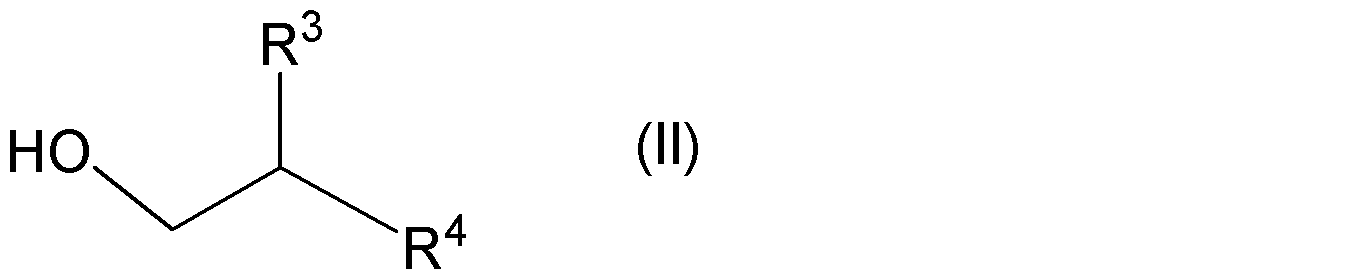
[式(II)中、R3及びR4は、それぞれ独立して、炭素数1以上12以下のアルキル基を示す。]
[式(II)中、R3及びR4は、それぞれ独立して、炭素数1以上12以下のアルキル基を示す。]
上記一般式(II)において、反応性が良好になることから、R3及びR4のアルキル基の炭素数は、1以上8以下であることが好ましく、2以上6以下であることがより好ましく、2以上4以下であることがさらに好ましい。
また、上記一般式(II)において、反応性が良好になることから、R3及びR4のアルキル基の炭素数の合計は、2以上16以下であることが好ましく、3以上12以下であることがより好ましく、4以上8以下であることがさらに好ましい。
また、上記一般式(II)において、反応性が良好になることから、R3及びR4のアルキル基の炭素数の合計は、2以上16以下であることが好ましく、3以上12以下であることがより好ましく、4以上8以下であることがさらに好ましい。
上記一般式(II)で表される2位に分岐構造を有するアルコールの具体例としては、2-メチル-1-プロパノール、2-エチル-1-プロパノール、2-メチル-1-ブタノール、2-エチル-1-ブタノール、2-プロピル-1-ブタノール、2-メチル-1-ペンタノール、2-エチル-1-ペンタノール、2-プロピル-1-ペンタノール、2-ブチル-1-ペンタノール、2-メチル-1-ヘキサノール、2-エチル-1-ヘキサノール、2-プロピル-1-ヘキサノール、2-ブチル-1-ヘキサノール、2-メチル-1-ヘプタノール、2-エチル-1-ヘプタノール、2-プロピル-1-ヘプタノール、2-ブチル-1-ヘプタノール、2-メチル-1-オクタノール、2-エチル-1-オクタノール、2-プロピル-1-オクタノール、2-ブチル-1-オクタノール、2-ペンチル-1-ノナノール、2-へキシル-1-デカノール、2-ヘプチル-1-ウンデカノール、2-オクチル-1-ドデカノール等が挙げられる。
上述したアルデヒド(A)及びアルコール(B)は、1種のものを単独で用いてもよいし、2種以上を併用してもよい。
上述したアルデヒド(A)及びアルコール(B)の組み合わせにより、後述する一般式(III)のエーテル化合物を左右対称構造、又は左右非対称構造とすることができる。
なお、アルデヒド(A)として上記一般式(I)のものを用い、アルコール(B)として上記一般式(II)のものを用いた場合において、後述する一般式(III)のエーテル化合物を左右対称構造とするためには、式(I)のR1及びR2と、式(II)のR3及びR4とを同一のものにすればよい。
なお、アルデヒド(A)として上記一般式(I)のものを用い、アルコール(B)として上記一般式(II)のものを用いた場合において、後述する一般式(III)のエーテル化合物を左右対称構造とするためには、式(I)のR1及びR2と、式(II)のR3及びR4とを同一のものにすればよい。
工程1におけるアルデヒド(A)と、アルコール(B)との配合比は、アルデヒド(A)が有するホルミル基1当量に対する、アルコール(B)の水酸基換算での配合量が、1.5~5.0当量であることが好ましく、1.7~4.0当量であることがより好ましく、2.0~3.0当量であることがさらに好ましい。
工程1のアセタール化反応の反応温度としては、アセタール化反応が進行する程度に適宜設定されるが、好ましくは50~200℃、より好ましくは70~180℃、さらに好ましくは100~150℃である。また、低い反応温度で反応させるために、系内に窒素等の不活性ガスを導入して反応を進行させてもよい。なお、工程1のアセタール化反応は常圧下で行うことが好ましい。
工程1のアセタール化反応は、酸触媒の存在下で行うことが好ましい。
酸触媒としては、塩酸、硫酸、リン酸、硝酸などの鉱酸、リンタングステン酸などのヘテロポリ酸、スルホン酸系化合物等が挙げられる。これらの中でもスルホン酸系化合物が好ましい。
酸触媒としては、塩酸、硫酸、リン酸、硝酸などの鉱酸、リンタングステン酸などのヘテロポリ酸、スルホン酸系化合物等が挙げられる。これらの中でもスルホン酸系化合物が好ましい。
スルホン酸系化合物としては、スルホ基(-SO3H)を有する化合物であればよく、メタンスルホン酸、トリフルオロメタンスルホン酸、10-カンファ-スルホン酸等の非芳香族スルホン酸系化合物、ベンゼンスルホン酸、p-トルエンスルホン酸等の芳香族スルホン酸系化合物、該芳香族スルホン酸系化合物の水和物等が挙げられ、これらの1種以上を用いることができる。これらの中でも、芳香族スルホン酸系化合物及びその水和物から選ばれる1種以上が好ましく、副反応抑制の観点から、p-トルエンスルホン酸がより好ましい。
本発明の一態様において、酸触媒中のスルホン酸系化合物の配合量は、酸触媒の全量(100モル%)に対して、好ましくは70~100モル%、より好ましくは80~100モル%、さらに好ましくは90~100モル%である。
アルデヒド(A)100モル%に対する酸触媒の配合量は、好ましくは4.0モル%以下、より好ましくは2.0モル%以下、さらに好ましくは0.5モル%以下、よりさらに好ましくは0.1モル%以下である。
アルデヒド(A)100モル%に対する酸触媒の配合量の下限値は、特に制限は無いが、生産性の観点、並びに得られるエーテル系基油の性状を良好に維持する観点から、好ましくは0.0001モル%以上、より好ましくは0.001モル%以上、さらに好ましくは0.005モル%以上である。
アルデヒド(A)100モル%に対する酸触媒の配合量の下限値は、特に制限は無いが、生産性の観点、並びに得られるエーテル系基油の性状を良好に維持する観点から、好ましくは0.0001モル%以上、より好ましくは0.001モル%以上、さらに好ましくは0.005モル%以上である。
工程1のアセタール化反応は、さらに、有機溶媒の存在下で行うことが好ましい。
有機溶媒は特に限定されないが、沸点100℃以上のものが好ましく、沸点105℃以上150℃以下のものがより好ましい。なお、本明細書において、有機溶媒の沸点とは、1気圧における沸点(標準沸点)を意味する。
有機溶媒は特に限定されないが、沸点100℃以上のものが好ましく、沸点105℃以上150℃以下のものがより好ましい。なお、本明細書において、有機溶媒の沸点とは、1気圧における沸点(標準沸点)を意味する。
アルデヒド(A)とアルコール(B)とのアセタール化反応では、水が生成されるが、反応系内に水が残存すると、逆反応との平衡により、反応の進行が妨げられ、生産性が低下する場合がある。また、反応系内に水が残存すると、副生成物の増加を引き起こし、得られるエーテル系基油の性状に悪影響を及ぼす可能性がある。有機溶媒の沸点が100℃以上の場合、工程1の温度を100℃以上にして、アセタール化反応で生成した水を除去することができる。
有機溶媒としては、芳香族炭化水素系溶媒、飽和炭化水素系溶媒等の炭化水素系溶媒が挙げられる。
沸点が100℃以上の有機溶媒としては、トルエン(110.6℃)、o-キシレン(144.4℃)、m-キシレン(139℃)、p-キシレン(128℃)等の芳香族炭化水素系溶媒、n-オクタン(125.6℃)等の飽和炭化水素系溶媒等が挙げられる。これらの中でもトルエンが好ましい。なお、上記例示中の( )内の温度は、各有機溶媒の沸点を示す。
沸点が100℃以上の有機溶媒としては、トルエン(110.6℃)、o-キシレン(144.4℃)、m-キシレン(139℃)、p-キシレン(128℃)等の芳香族炭化水素系溶媒、n-オクタン(125.6℃)等の飽和炭化水素系溶媒等が挙げられる。これらの中でもトルエンが好ましい。なお、上記例示中の( )内の温度は、各有機溶媒の沸点を示す。
有機溶媒は、2種以上の有機溶媒からなる混合溶媒を用いてもよい。混合溶媒を用いる場合、それぞれの溶媒の沸点が100℃以上であることが好ましい。また、混合溶媒が共沸混合物を形成する場合には、共沸混合物の沸点が100℃以上であることが好ましい。
工程1では、アセタール化反応が終了した後に、反応に用いた酸触媒を失活させる処理を行うことが好ましい。また、酸触媒を失活させた後は、反応液を油水分離して、アセタールを含む有機相を洗浄し、さらに無水硫酸マグネシウム等で有機相中の水分を除去して、含アセタール組成物を得ることが好ましい。
<工程2>
工程2は、含アセタール組成物に含まれるアセタールを還元して2位に分岐構造を有するエーテル系化合物を得る工程である。
工程2で用いる含アセタール組成物は、工程1で得られた含アセタール組成物をそのまま用いることができる。なお、後述するように、体積抵抗率をより高める観点からは、工程2で用いる含アセタール組成物は、下記の工程1’で得られた含アセタール組成物xとすることが好ましい。
また、工程2で用いる含アセタール組成物は、工程1で得られた含アセタール組成物に含まれる溶媒、下記の工程1’で得られた含アセタール組成物xに含まれる溶媒を、ロータリーエバポレーター等を用いて留去したものとすることが好ましい。
工程2は、含アセタール組成物に含まれるアセタールを還元して2位に分岐構造を有するエーテル系化合物を得る工程である。
工程2で用いる含アセタール組成物は、工程1で得られた含アセタール組成物をそのまま用いることができる。なお、後述するように、体積抵抗率をより高める観点からは、工程2で用いる含アセタール組成物は、下記の工程1’で得られた含アセタール組成物xとすることが好ましい。
また、工程2で用いる含アセタール組成物は、工程1で得られた含アセタール組成物に含まれる溶媒、下記の工程1’で得られた含アセタール組成物xに含まれる溶媒を、ロータリーエバポレーター等を用いて留去したものとすることが好ましい。
アセタールの還元方法としては、特に制限は無く、例えば、還元剤を用いる方法や、触媒を用いる接触水素還元方法等が挙げられる。
還元剤を用いる方法で使用する還元剤としては、例えば、水素化リチウムアルミニウム(LiAlH4)及び水素化ジイソブチルアルミニウム(DIBAL-H)等のアルミニウムの水素化物;水素化ホウ素ナトリウム(NaBH4)、ジボラン(B2H6)、ボラン・アンモニア錯体(BH3・NH3)、ボラン・t-ブチルアミン錯体(BH3・(CH3)3CNH2)、及びボラン・テトラヒドロフラン錯体(BH3・THF)等のホウ素の水素化物;等が挙げられる。
接触水素還元方法で用いる触媒としては、通常担体に金属成分を担持したもの用いることができる。具体的にはケイソウ土、アルミナ、シリカアルミナ、活性炭等の無機物担体に、ニッケル、ルテニウム、パラジウム、白金、ロジウム及びイリジウム等の周期表の第8~10族の金属を担持した水素化触媒が挙げられる。これらの中でも、生成物の選択性の点から、ニッケル/ケイソウ土,ニッケル/シリカアルミナ等のニッケル系触媒が好ましい。また、必要により水素化反応の助触媒としてゼオライト、シリカアルミナ及び活性白土等の固体酸を使用してもよい。
接触水素還元方法における系内の水素圧としては、好ましくは1.2~5.0MPa、より好ましくは2.0~4.5MPa、さらに好ましくは3.0~4.0MPaである。
なお、接触水素還元方法においては、アセタールの還元反応前に、触媒の予備活性化の処理や、系内の水分を取り除く脱水処理を行ってもよい。
なお、接触水素還元方法においては、アセタールの還元反応前に、触媒の予備活性化の処理や、系内の水分を取り除く脱水処理を行ってもよい。
本工程の還元工程での反応温度は、好ましくは-50~200℃、より好ましくは0~180℃、さらに好ましくは20℃~150℃である。還元工程の時間は、好ましくは0.5~10時間、より好ましくは1~8時間、さらに好ましくは2~6時間である。
工程2は有機溶媒の存在下で行うことが好ましい。工程2の有機溶媒としては、反応に不活性な溶媒であれば特に限定されず、メタノールやエタノール等のアルコール類;n-ヘキサン、n-ヘプタン、n-オクタン、イソオクタン、シクロペンタン及びシクロヘキサン等の脂肪族炭化水素類;ベンゼン、トルエン、エチルベンゼン及びキシレン等芳香族炭化水素類;ジエチルエーテル、ジブチルエーテル、テトラヒドロフラン及びジオキサン等のエーテル類;等が挙げられる。
当該有機溶媒は、単独溶媒であってもよく、2種以上を混合してなる混合溶媒であってもよい。
当該有機溶媒は、単独溶媒であってもよく、2種以上を混合してなる混合溶媒であってもよい。
工程2の還元反応終了後は、反応液をろ過して、ろ液を濃縮し、カラムクロマトグラフィー、蒸留及び再結晶等の通常の精製方法により、2位に分岐構造を有するエーテル系化合物を得ることができる。
工程1及び工程2を経て得られた2位に分岐構造を有するエーテル系化合物は、体積抵抗率が高く、冷凍機油組成物の基油、潤滑油組成物の基油として有用であり、特に、圧縮機にモーターを内蔵した冷凍機に用いられる冷凍機油組成物の基油、電動パワーステアリングや車両駆動用モーター等の電動機構を搭載した自動車用潤滑油組成物の基油として有用である。
なお、アルデヒド(A)として上記一般式(I)のものを用い、アルコール(B)として上記一般式(II)のものを用いた場合、2位に分岐構造を有するエーテル系化合物としては、下記一般式(III)のものが含まれる。
下記一般式(III)のR1及びR2は、上記一般式(I)のR1及びR2に相当し、下記一般式(III)のR3及びR4は、上記一般式(II)のR3及びR4に相当する。
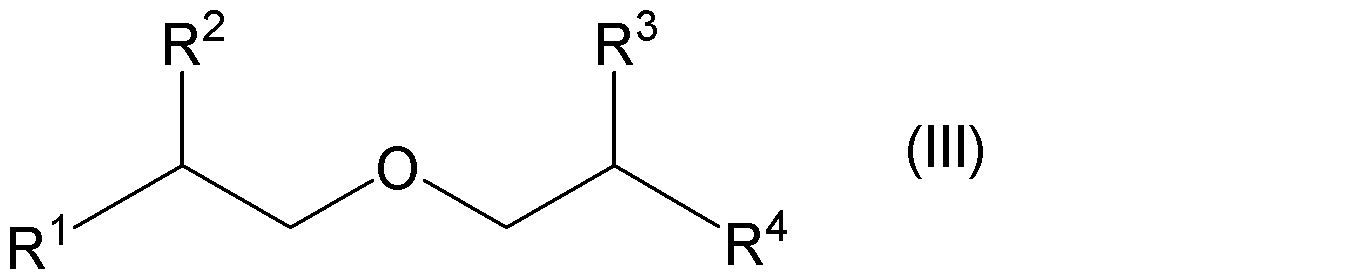
[式(III)中、R1~R4は、それぞれ独立して、炭素数1以上12以下のアルキル基を示す。]
下記一般式(III)のR1及びR2は、上記一般式(I)のR1及びR2に相当し、下記一般式(III)のR3及びR4は、上記一般式(II)のR3及びR4に相当する。
[式(III)中、R1~R4は、それぞれ独立して、炭素数1以上12以下のアルキル基を示す。]
上記一般式(III)において、R1~R4のアルキル基の炭素数は、1以上8以下であることが好ましく、2以上6以下であることがより好ましく、2以上4以下であることがさらに好ましい。
また、上記一般式(III)において、R1及びR2のアルキル基の炭素数の合計、並びに、R3及びR4のアルキル基の炭素数の合計は、それぞれ、2以上16以下であることが好ましく、3以上12以下であることがより好ましく、4以上8以下であることがさらに好ましい。
また、上記一般式(III)において、R1及びR2のアルキル基の炭素数の合計、並びに、R3及びR4のアルキル基の炭素数の合計は、それぞれ、2以上16以下であることが好ましく、3以上12以下であることがより好ましく、4以上8以下であることがさらに好ましい。
工程1及び工程2を経て得られたエーテル系化合物の中で、上記一般式(III)に示すエーテル系化合物の割合は、90質量%以上であることが好ましく、94質量%以上であることがより好ましく、96質量%以上であることがさらに好ましい。
<工程1’>
本発明の一態様では、工程1と工程2との間に下記の工程1’を行い、工程2の含アセタール組成物として、工程1’で得られた含アセタール組成物xを用いることが好ましい。
工程1’:前記工程1で得られた含アセタール組成物をアルカリ処理した後、アセタールを含む有機相と、水相とを分離し、有機相から含アセタール組成物xを得る工程。
本発明の一態様では、工程1と工程2との間に下記の工程1’を行い、工程2の含アセタール組成物として、工程1’で得られた含アセタール組成物xを用いることが好ましい。
工程1’:前記工程1で得られた含アセタール組成物をアルカリ処理した後、アセタールを含む有機相と、水相とを分離し、有機相から含アセタール組成物xを得る工程。
工程1で得られた含アセタール組成物の中には、副生成物であるエステルを含む場合がある。エステルが含まれると工程2で得られたエーテル系基油の体積抵抗率は低くなってしまう。
一方、工程1’を行うことにより、工程1’で得られた含アセタール組成物xに含まれるエステルを低減することができ、ひいてはエーテル系基油に含まれるエステルを低減し、エーテル系基油の体積抵抗率を高くすることができる。
一方、工程1’を行うことにより、工程1’で得られた含アセタール組成物xに含まれるエステルを低減することができ、ひいてはエーテル系基油に含まれるエステルを低減し、エーテル系基油の体積抵抗率を高くすることができる。
工程1’では、工程1で得られた含アセタール組成物をアルカリ処理している。これにより、含アセタール組成物に含まれるエステルがアルカリにより加水分解される。
エステルは加水分解によって、カルボン酸イオン及びアルコールとなる。カルボン酸イオンはナトリウム等のアルカリ金属と結合し、カルボン酸ナトリウム等を形成し、アルコールとともに水相に移動する。一方、アセタールは有機相に残存する。
このため、工程1’で得られた含アセタール組成物xは、エステルの含有量を低減することができる。
エステルは加水分解によって、カルボン酸イオン及びアルコールとなる。カルボン酸イオンはナトリウム等のアルカリ金属と結合し、カルボン酸ナトリウム等を形成し、アルコールとともに水相に移動する。一方、アセタールは有機相に残存する。
このため、工程1’で得られた含アセタール組成物xは、エステルの含有量を低減することができる。
アルカリは、アルカリ金属の水酸化物、アルカリ土類金属の水酸化物が挙げられ、アルカリ金属の水酸化物が好適である。
アルカリ金属の水酸化物としては、水酸化ナトリウム、水酸化カリウム及び水酸化リチウム等が挙げられる。アルカリ土類金属の水酸化物としては、水酸化カルシウム、水酸化ストロンチウム及び水酸化バリウム等が挙げられる。
アルカリの使用量は系内がアルカリ性となる程度であればよいが、工程1’の系内に存在する水100質量部に対して、1~250質量部であることが好ましく、10~200質量部であることがより好ましく、20~150質量部であることがさらに好ましい。
アルカリ金属の水酸化物としては、水酸化ナトリウム、水酸化カリウム及び水酸化リチウム等が挙げられる。アルカリ土類金属の水酸化物としては、水酸化カルシウム、水酸化ストロンチウム及び水酸化バリウム等が挙げられる。
アルカリの使用量は系内がアルカリ性となる程度であればよいが、工程1’の系内に存在する水100質量部に対して、1~250質量部であることが好ましく、10~200質量部であることがより好ましく、20~150質量部であることがさらに好ましい。
工程1で得られた含アセタール組成物は、アルカリと混合することにより、アルカリ処理できる。この際、アルカリをアルカリ水溶液の形態として、工程1で得られた含アセタール組成物とを混合することが好ましい。
また、工程1で得られた含アセタール組成物と、アルカリとを混合した後は、加水分解を促進させるため、撹拌することが好ましい。
また、工程1で得られた含アセタール組成物と、アルカリとを混合した後は、加水分解を促進させるため、撹拌することが好ましい。
工程1’の系内の水の量は特に限定されないが、工程1で得られた含アセタール組成物100質量部に対して、1~200質量部であることが好ましく、10~150質量部であることがより好ましく、20~120質量部であることがさらに好ましい。
工程1’の加水分解の温度は、20~100℃が好ましく、40~90℃がより好ましく、60~85℃がさらに好ましい。加水分解の時間は、0.5~12時間とすることが好ましく、1~8時間とすることがより好ましい。
工程1’の系内には、工程1で用いる有機溶媒と、水との中間的性質を有する溶媒を添加することが好ましい。該溶媒を添加することにより、攪拌時に有機相と水相とが混ざりやすくなり、加水分解を促進することができる。
該溶媒としては、メタノール、エタノール、トリエチレングリコール及びジプロピレングリコール等が挙げられる。
該溶媒の量は、工程1’の系内の水100質量部に対して、1~500質量部であることが好ましく、10~300質量部であることがより好ましく、20~250質量部であることがさらに好ましい。
該溶媒としては、メタノール、エタノール、トリエチレングリコール及びジプロピレングリコール等が挙げられる。
該溶媒の量は、工程1’の系内の水100質量部に対して、1~500質量部であることが好ましく、10~300質量部であることがより好ましく、20~250質量部であることがさらに好ましい。
<エーテル系基油の性状>
上記工程で得られた2位に分岐構造を有するエーテル系基油は、体積抵抗率が1.0×10¹⁰Ω・m以上であることが好ましく、1.0×10¹¹Ω・m以上であることがより好ましく、1.0×10¹²Ω・m以上であることがさらに好ましく、1.0×10¹³Ω・m以上であることがよりさらに好ましい。
なお、体積抵抗率は、例えば、室温(25℃)の試料油を体積固有抵抗測定用の液体セルに封入し、ADCMT社製のデジタル超高抵抗/微少電流計(型番:5451)を用い、印加電圧250Vで測定することができる。
上記工程で得られた2位に分岐構造を有するエーテル系基油は、体積抵抗率が1.0×10¹⁰Ω・m以上であることが好ましく、1.0×10¹¹Ω・m以上であることがより好ましく、1.0×10¹²Ω・m以上であることがさらに好ましく、1.0×10¹³Ω・m以上であることがよりさらに好ましい。
なお、体積抵抗率は、例えば、室温(25℃)の試料油を体積固有抵抗測定用の液体セルに封入し、ADCMT社製のデジタル超高抵抗/微少電流計(型番:5451)を用い、印加電圧250Vで測定することができる。
また、上記工程で得られた2位に分岐構造を有するエーテル系基油は、40℃動粘度、100℃動粘度、粘度指数、及び流動点が以下の範囲であることがより好ましい。
40℃動粘度は、250mm2/s以下であることが好ましく、100mm2/s以下であることがより好ましい。
100℃動粘度は、50mm2/s以下であることが好ましく、25mm2/s以下であることがより好ましい。
粘度指数は、20以上であることが好ましく、100以上であることがより好ましい。
流動点は、0℃以下であることが好ましく、-30℃以下であることがより好ましい。
なお、上記の動粘度及び粘度指数は、JIS K2283:1983に記載の方法に準拠して測定した値であり、流動点は、JIS K2269:1987に記載の方法に準拠して測定した値である。
40℃動粘度は、250mm2/s以下であることが好ましく、100mm2/s以下であることがより好ましい。
100℃動粘度は、50mm2/s以下であることが好ましく、25mm2/s以下であることがより好ましい。
粘度指数は、20以上であることが好ましく、100以上であることがより好ましい。
流動点は、0℃以下であることが好ましく、-30℃以下であることがより好ましい。
なお、上記の動粘度及び粘度指数は、JIS K2283:1983に記載の方法に準拠して測定した値であり、流動点は、JIS K2269:1987に記載の方法に準拠して測定した値である。
エーテル系基油中に副生成物であるエステル系化合物が存在すると、エーテル系基油の体積抵抗率が低下する。このため、エステル系化合物の含有量は、2位に分岐構造を有するエーテル系基油の全量基準で2.0質量%以下が好ましく、より好ましくは1.5質量%以下であり、さらに好ましくは1.0質量%以下である。
[冷凍機油組成物の製造方法]
本発明の冷凍機油組成物の製造方法の実施形態は、上述した本発明の2位に分岐構造を有するエーテル系基油の製造方法の実施の形態で得られたエーテル系基油に、冷媒を添加する工程を有するものである。
本発明の冷凍機油組成物の製造方法の実施形態は、上述した本発明の2位に分岐構造を有するエーテル系基油の製造方法の実施の形態で得られたエーテル系基油に、冷媒を添加する工程を有するものである。
冷媒としては、フッ化炭化水素冷媒、フッ化エーテル化合物冷媒、フッ化アルコール化合物冷媒、フッ化ケトン化合物冷媒、自然冷媒等が挙げられる。冷媒は一種でもよいが、二種以上を混合して用いてもよい。これら冷媒は汎用のものを用いることができる。
エーテル系基油と冷媒との含有量比(エーテル系基油/冷媒)は、質量比で好ましくは1/99~99/1、より好ましくは5/95~60/40である。
本発明の冷凍機油組成物の製造方法の実施形態では、さらに、添加剤を添加する工程を有していてもよい。
添加剤としては、酸化防止剤、極圧剤、酸捕捉剤、酸素捕捉剤及び銅不活性化剤等が挙げられ、これらの添加剤から選ばれる1種以上を用いることができる。各添加剤の含有量は、エーテル系基油の全量基準で、通常0.01~5質量%、好ましくは0.05~3質量%である。
添加剤としては、酸化防止剤、極圧剤、酸捕捉剤、酸素捕捉剤及び銅不活性化剤等が挙げられ、これらの添加剤から選ばれる1種以上を用いることができる。各添加剤の含有量は、エーテル系基油の全量基準で、通常0.01~5質量%、好ましくは0.05~3質量%である。
上記実施形態により得られた冷凍機油組成物は、各種冷凍機に用いることができるが、特に、漏電防止の観点から高い体積抵抗率が求められる、圧縮機にモーターを内蔵した冷凍機用の冷凍機油組成物として好適に用いることができる。
[潤滑油組成物の製造方法]
本発明の潤滑油組成物の製造方法の実施形態は、上述した本発明の2位に分岐構造を有するエーテル系基油の製造方法の実施の形態で得られたエーテル系基油に、潤滑油添加剤を添加する工程を有するものである。
本発明の潤滑油組成物の製造方法の実施形態は、上述した本発明の2位に分岐構造を有するエーテル系基油の製造方法の実施の形態で得られたエーテル系基油に、潤滑油添加剤を添加する工程を有するものである。
潤滑油添加剤としては、粘度指数向上剤、酸化防止剤、極圧剤、摩耗防止剤、分散剤、金属系清浄剤、防錆剤、摩擦調整剤、摩擦緩和剤、流動点降下剤、消泡剤及び増粘剤等が挙げられる。これら潤滑油添加剤から選ばれる1種以上をエーテル系基油に添加することができる。
各潤滑油添加剤の含有量は、エーテル系基油の全量基準で、通常0.01~5質量%、好ましくは0.05~3質量%である。
上記実施形態により得られた潤滑油組成物は、例えば、内燃機油、駆動系油等の自動車用潤滑油組成物等として用いることができ、特に、漏電防止の観点から高い体積抵抗率が求められる、電動パワーステアリングや車両駆動用モーター等の電動機構を搭載した自動車用潤滑油組成物として好適に用いることができる。
次に、本発明を実施例により更に詳細に説明するが、本発明はこれらの例によって何ら限定されるものではない。
1.エーテルの合成
[実施例1]
(工程1:アセタール化反応)
2Lの四口フラスコに、滴下ロート、ディーンスターク、ジムロート、及びメカニカルスターラーを取り付け、系内を窒素で置換した。次に、窒素で置換した系内に、2位に分岐構造を有するアルコール(B)として、2-エチル-1-ヘキサノール415g(1.4mol,500ml,2.2当量/対アルデヒド1当量)を、酸触媒として、p-トルエンスルホン酸一水和物5.2g(30mmol、0.02当量/対アルデヒド1当量)を、並びに、有機溶媒として、トルエン173g(200mL、6.0質量部/対アルデヒド1質量部)を仕込み、原料混合物を調整した。次いで、原料混合物を撹拌しながら、系内の温度が110℃に達するまで加熱した。
系内の温度が110℃に到達後、2位に分岐構造を有するアルデヒド(A)として、2-エチルヘキサナール186g(1.4mol、227mL)を滴下ロートを用いて1時間かけて、系内の原料混合物に滴下した。滴下終了後、常圧下で120℃まで昇温した後、同温度で5時間撹拌し、アセタール反応を進行させた。
その後、ガスクロマトグラフィーにてアセタール化の反応転化率、選択率を確認した後、室温(25℃)まで冷却し、炭酸水素ナトリウム飽和水溶液0.2Lを加えて、酸触媒を失活させた。そして、反応液を分液ロートに移送して、油水分離し、有機相を水0.5Lで3回洗浄後、無水硫酸マグネシウムを加えて、有機相の水分を除去した。その上で、有機相の液体をろ過し、含アセタール組成物を得た 。
[実施例1]
(工程1:アセタール化反応)
2Lの四口フラスコに、滴下ロート、ディーンスターク、ジムロート、及びメカニカルスターラーを取り付け、系内を窒素で置換した。次に、窒素で置換した系内に、2位に分岐構造を有するアルコール(B)として、2-エチル-1-ヘキサノール415g(1.4mol,500ml,2.2当量/対アルデヒド1当量)を、酸触媒として、p-トルエンスルホン酸一水和物5.2g(30mmol、0.02当量/対アルデヒド1当量)を、並びに、有機溶媒として、トルエン173g(200mL、6.0質量部/対アルデヒド1質量部)を仕込み、原料混合物を調整した。次いで、原料混合物を撹拌しながら、系内の温度が110℃に達するまで加熱した。
系内の温度が110℃に到達後、2位に分岐構造を有するアルデヒド(A)として、2-エチルヘキサナール186g(1.4mol、227mL)を滴下ロートを用いて1時間かけて、系内の原料混合物に滴下した。滴下終了後、常圧下で120℃まで昇温した後、同温度で5時間撹拌し、アセタール反応を進行させた。
その後、ガスクロマトグラフィーにてアセタール化の反応転化率、選択率を確認した後、室温(25℃)まで冷却し、炭酸水素ナトリウム飽和水溶液0.2Lを加えて、酸触媒を失活させた。そして、反応液を分液ロートに移送して、油水分離し、有機相を水0.5Lで3回洗浄後、無水硫酸マグネシウムを加えて、有機相の水分を除去した。その上で、有機相の液体をろ過し、含アセタール組成物を得た 。
(工程1’:アルカリ処理)
2Lの4口フラスコに、ジムロート及びメカニカルスターラーを取り付け、系内を窒素で置換した。次に、工程1で得られた含アセタール組成物を480g、50質量%NaOH水溶液を480g、メタノール480gを仕込み、80℃で5時間撹拌した。
その後、反応液を分液ロートに移送して油水分離し、有機相を水0.5Lで5回洗浄後、無水硫酸マグネシウムを加えて、有機相の水分を除去した。その上で、有機相の液体をろ過し、ろ液をロータリーエバポレータにて濃縮して溶媒を留去して、含アセタール組成物xを得た。
2Lの4口フラスコに、ジムロート及びメカニカルスターラーを取り付け、系内を窒素で置換した。次に、工程1で得られた含アセタール組成物を480g、50質量%NaOH水溶液を480g、メタノール480gを仕込み、80℃で5時間撹拌した。
その後、反応液を分液ロートに移送して油水分離し、有機相を水0.5Lで5回洗浄後、無水硫酸マグネシウムを加えて、有機相の水分を除去した。その上で、有機相の液体をろ過し、ろ液をロータリーエバポレータにて濃縮して溶媒を留去して、含アセタール組成物xを得た。
(工程2:還元)
1Lのオートクレーブに、触媒として、ニッケル珪藻土(日揮触媒化成社製、商品名:N-113)を10.0g、及び、溶媒として、イソオクタン300gを加え、系内を水素で置換した後、内部温度200℃、水素圧3.5MPaで0.5時間予備活性化を行った。
室温(25℃)に降温し、系内を窒素で置換した後、アセトアルデヒドジエチルアセタール10.0gを加えて、水素で置換した後、内部温度140℃、水素圧3.5MPaで0.5時間脱水した 。
室温(25℃)に降温し、系内を窒素で置換した後、系内の上澄みを取り除き、工程1’で得られた含アセタール組成物xを仕込んで水素で置換し、内部温度120℃、水素圧3.5MPaで、5時間水素化反応を進行させた。
水素化反応終了後、室温(25℃)に降温し、系内の反応液を取り出した。ガスクロマトグラフィーによりエーテル系基油の反応転化率及び選択率を確認した後、ガラスフィルターにて触媒を分離し、ろ液をロータリーエバポレータにて濃縮し、濃縮物を得た。そして、濃縮物を、ビグリュー分留管及びリービッヒ冷却器を取り付けた蒸留装置を用いて、128℃、0.34torrで減圧蒸留し、2位に分岐構造を有するエーテル系化合物を得た。
1Lのオートクレーブに、触媒として、ニッケル珪藻土(日揮触媒化成社製、商品名:N-113)を10.0g、及び、溶媒として、イソオクタン300gを加え、系内を水素で置換した後、内部温度200℃、水素圧3.5MPaで0.5時間予備活性化を行った。
室温(25℃)に降温し、系内を窒素で置換した後、アセトアルデヒドジエチルアセタール10.0gを加えて、水素で置換した後、内部温度140℃、水素圧3.5MPaで0.5時間脱水した 。
室温(25℃)に降温し、系内を窒素で置換した後、系内の上澄みを取り除き、工程1’で得られた含アセタール組成物xを仕込んで水素で置換し、内部温度120℃、水素圧3.5MPaで、5時間水素化反応を進行させた。
水素化反応終了後、室温(25℃)に降温し、系内の反応液を取り出した。ガスクロマトグラフィーによりエーテル系基油の反応転化率及び選択率を確認した後、ガラスフィルターにて触媒を分離し、ろ液をロータリーエバポレータにて濃縮し、濃縮物を得た。そして、濃縮物を、ビグリュー分留管及びリービッヒ冷却器を取り付けた蒸留装置を用いて、128℃、0.34torrで減圧蒸留し、2位に分岐構造を有するエーテル系化合物を得た。
[実施例2]
実施例1と同様の方法で工程1のアセタール化反応を行った後、工程1’のアルカリ処理を行わずにアセタール反応溶液をロータリーエバポレータにて濃縮して溶媒を留去し、溶媒を留去した含アセタール組成物を得た。その後、実施例1と同様の方法で工程2の還元を行った。
実施例1と同様の方法で工程1のアセタール化反応を行った後、工程1’のアルカリ処理を行わずにアセタール反応溶液をロータリーエバポレータにて濃縮して溶媒を留去し、溶媒を留去した含アセタール組成物を得た。その後、実施例1と同様の方法で工程2の還元を行った。
[比較例1]
(脱水縮合反応)
1Lの四口フラスコに、ディーンスターク、ジムロート、及びメカニカルスターラーを取り付け、系内を窒素で置換した。次に系内にアルコールとして、2-エチル-1-ヘキサノールを311g(2.38mol)、酸触媒として、硫酸を24g(0.24mol、0.1当量/対アルコール1当量)、有機溶媒として、トルエンを26g仕込み、原料混合物を調整した。次いで、原料混合物を撹拌しながら、常圧下で系内の温度が140℃に達するまで加熱した。その後、ガスクロマトグラフィーにてエーテル化の反応転化率、選択率を確認した後、室温(25℃)まで冷却し、炭酸水素ナトリウム飽和水溶液0.2Lを加えて、酸触媒を失活させた。そして、反応液を分液ロートに移送して、油水分離し、有機相を水0.5Lで3回洗浄後、無水硫酸マグネシウムを加えて、有機相の液体を乾燥させた。
(脱水縮合反応)
1Lの四口フラスコに、ディーンスターク、ジムロート、及びメカニカルスターラーを取り付け、系内を窒素で置換した。次に系内にアルコールとして、2-エチル-1-ヘキサノールを311g(2.38mol)、酸触媒として、硫酸を24g(0.24mol、0.1当量/対アルコール1当量)、有機溶媒として、トルエンを26g仕込み、原料混合物を調整した。次いで、原料混合物を撹拌しながら、常圧下で系内の温度が140℃に達するまで加熱した。その後、ガスクロマトグラフィーにてエーテル化の反応転化率、選択率を確認した後、室温(25℃)まで冷却し、炭酸水素ナトリウム飽和水溶液0.2Lを加えて、酸触媒を失活させた。そして、反応液を分液ロートに移送して、油水分離し、有機相を水0.5Lで3回洗浄後、無水硫酸マグネシウムを加えて、有機相の液体を乾燥させた。
[比較例2]
(ウィリアムソン反応)
2Lのセパラブルフラスコに、滴下ロート、ジムロート、及びメカニカルスターラーを取り付け、系内を窒素で置換した。次に系内にアルコールとして、2-エチル-1-ヘキサノールを195g(1.5mol)、ハロゲン化アルキルとして、1-ブロモ-2-エチルヘキサンを290g(1.5mol)、相間移動触媒として、テトラブチルアンモニウムブロミドを48g(0.15mol、0.1当量/対アルコール1当量)、反応溶媒として、50%水酸化ナトリウム水溶液を300g(3.75mol、2.5当量/対アルコール1当量)を仕込み、原料混合物を調整した。次いで、原料混合物を撹拌しながら、常圧下で系内の温度が70℃に達するまで加熱した。その後、ガスクロマトグラフィーにてエーテル化の反応転化率、選択率を確認した後、室温(25℃)まで冷却した。そして、反応液を分液ロートに移送して、油水分離し、有機相を水0.5Lで3回洗浄、飽和食塩水0.5Lで1回洗浄後、無水硫酸マグネシウムを加えて、有機相の液体を乾燥させた。その上で、有機相の液体をろ過し、ろ液をロータリーエバポレータにて濃縮して溶媒を留去した 。
(ウィリアムソン反応)
2Lのセパラブルフラスコに、滴下ロート、ジムロート、及びメカニカルスターラーを取り付け、系内を窒素で置換した。次に系内にアルコールとして、2-エチル-1-ヘキサノールを195g(1.5mol)、ハロゲン化アルキルとして、1-ブロモ-2-エチルヘキサンを290g(1.5mol)、相間移動触媒として、テトラブチルアンモニウムブロミドを48g(0.15mol、0.1当量/対アルコール1当量)、反応溶媒として、50%水酸化ナトリウム水溶液を300g(3.75mol、2.5当量/対アルコール1当量)を仕込み、原料混合物を調整した。次いで、原料混合物を撹拌しながら、常圧下で系内の温度が70℃に達するまで加熱した。その後、ガスクロマトグラフィーにてエーテル化の反応転化率、選択率を確認した後、室温(25℃)まで冷却した。そして、反応液を分液ロートに移送して、油水分離し、有機相を水0.5Lで3回洗浄、飽和食塩水0.5Lで1回洗浄後、無水硫酸マグネシウムを加えて、有機相の液体を乾燥させた。その上で、有機相の液体をろ過し、ろ液をロータリーエバポレータにて濃縮して溶媒を留去した 。
2.物性の測定及び収率の計算
2-1.体積抵抗率
室温(25℃)の試料油を体積固有抵抗測定用の液体セルに封入し、ADCMT社製のデジタル超高抵抗/微少電流計(型番:5451)を用い、印加電圧250Vで体積抵抗率を測定した。
2-1.体積抵抗率
室温(25℃)の試料油を体積固有抵抗測定用の液体セルに封入し、ADCMT社製のデジタル超高抵抗/微少電流計(型番:5451)を用い、印加電圧250Vで体積抵抗率を測定した。
2-2.エーテル系基油の収率
実施例1及び2のエーテル系基油の収率は、下記式(1)から算出できる。
エーテル系基油の収率(%)=アセタールの収率(%)×アセタールの転化率(%)×エーテル系基油の選択率(%)/100 (1)
なお、上記式(1)のアセタールの収率は、工程1のガスクロマトグラフィーで得られたアルデヒドの転化率及びアセタールの選択率により、下記式(2)から算出できる。また、上記式(1)のエーテル系基油の選択率は、工程2のガスクロマトグラフィーで得られる。
アセタールの収率(%)=アルデヒドの転化率(%)×アセタールの選択率(%)/100 (2)
実施例1及び2のエーテル系基油の収率は、下記式(1)から算出できる。
エーテル系基油の収率(%)=アセタールの収率(%)×アセタールの転化率(%)×エーテル系基油の選択率(%)/100 (1)
なお、上記式(1)のアセタールの収率は、工程1のガスクロマトグラフィーで得られたアルデヒドの転化率及びアセタールの選択率により、下記式(2)から算出できる。また、上記式(1)のエーテル系基油の選択率は、工程2のガスクロマトグラフィーで得られる。
アセタールの収率(%)=アルデヒドの転化率(%)×アセタールの選択率(%)/100 (2)
比較例1及び2のエーテル系基油の収率は、下記式(3)から算出できる。
エーテル系基油の収率(%)=アルコールの転化率(%)×エーテル系基油の選択率(%)/100 (3)
エーテル系基油の収率(%)=アルコールの転化率(%)×エーテル系基油の選択率(%)/100 (3)
2-3.エーテル系基油中のエステル系化合物の含有量の測定
ガスクロマトグラフィーにより、実施例1及び2のエーテル系基油中のエステル系化合物の含有量(質量%)を測定した。
ガスクロマトグラフィーにより、実施例1及び2のエーテル系基油中のエステル系化合物の含有量(質量%)を測定した。
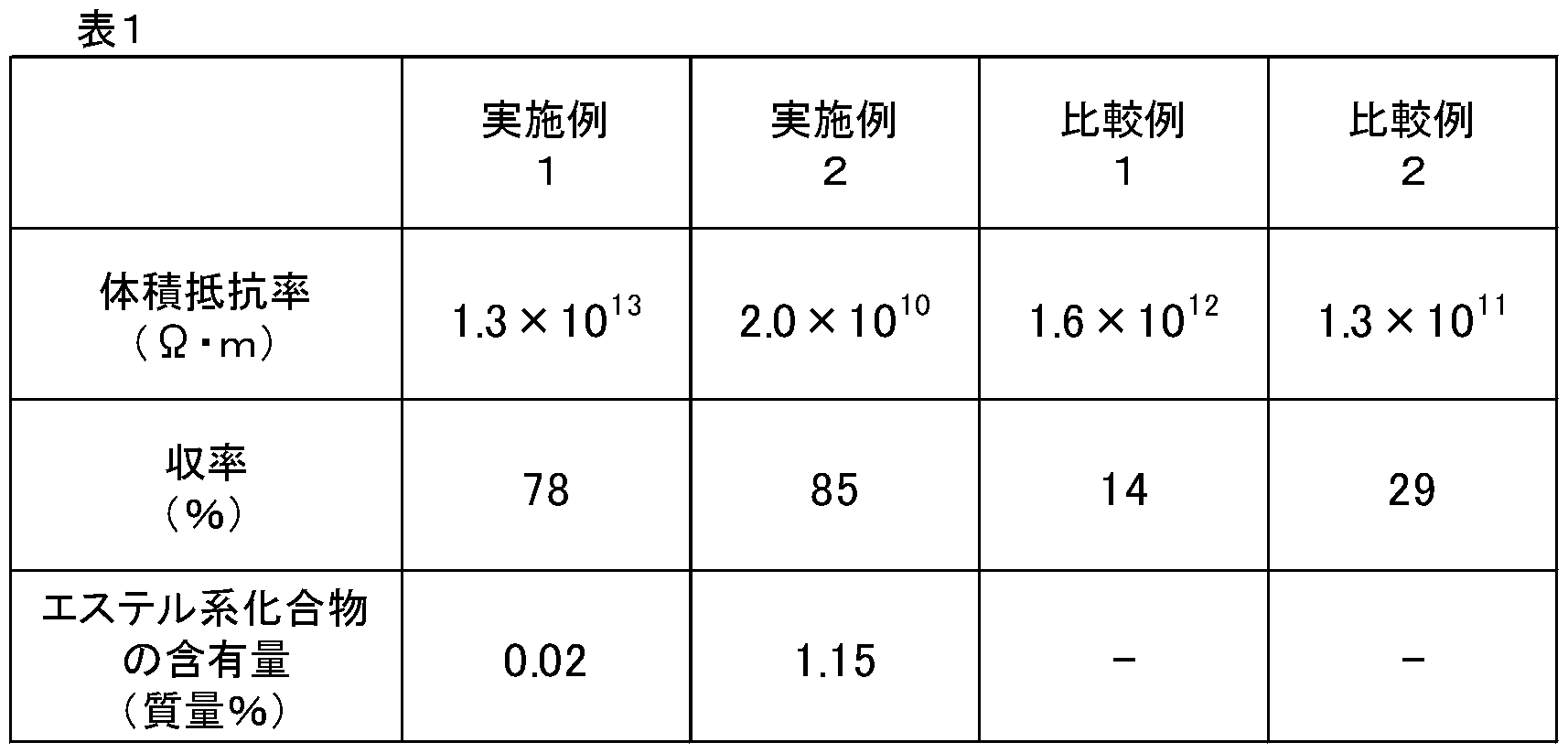
表1に示す評価結果から明らかなように、実施例1、2で得られたエーテル系基油は、比較例1、2に比べ、収率が極めて高く、優れた製法であることが確認できる。また、実施例1に関しては、体積抵抗率が極めて高く、圧縮機にモーターを内蔵した冷凍機の冷凍機油組成物の基油、および電動機構を搭載した自動車用の潤滑油組成物の基油として有用であることが確認できる。
なお、実施例1、2で得られた2位に分岐構造を有するエーテル系基油の分子構造をNMRで確認したところ、上記一般式(III)のR1及びR4がブチル基、R2及びR4がエチル基である、ジ(2-エチルヘキシル)エーテルであることが確認された。また、実施例1、2で得られた全エーテルに占めるジ(2-エチルヘキシル)エーテルの割合は、それぞれ95質量%以上であった。
なお、実施例1、2で得られた2位に分岐構造を有するエーテル系基油の分子構造をNMRで確認したところ、上記一般式(III)のR1及びR4がブチル基、R2及びR4がエチル基である、ジ(2-エチルヘキシル)エーテルであることが確認された。また、実施例1、2で得られた全エーテルに占めるジ(2-エチルヘキシル)エーテルの割合は、それぞれ95質量%以上であった。
Claims (11)
- 下記工程1及び工程2を有する、2位に分岐構造を有するエーテル系基油の製造方法。
工程1:2位に分岐構造を有するアルデヒド(A)に、2位に分岐構造を有するアルコール(B)を縮合させるアセタール化反応を行い、含アセタール組成物を得る工程。
工程2:含アセタール組成物に含まれるアセタールを還元して2位に分岐構造を有するエーテル系化合物を得る工程。 - 前記アルデヒド(A)が下記一般式(I)で表される化合物であり、前記アルコール(B)が下記一般式(II)で表される化合物である、請求項1に記載の2位に分岐構造を有するエーテル系基油の製造方法。

[式(I)中、R1及びR2は、それぞれ独立して、炭素数1以上12以下のアルキル基を示す。]
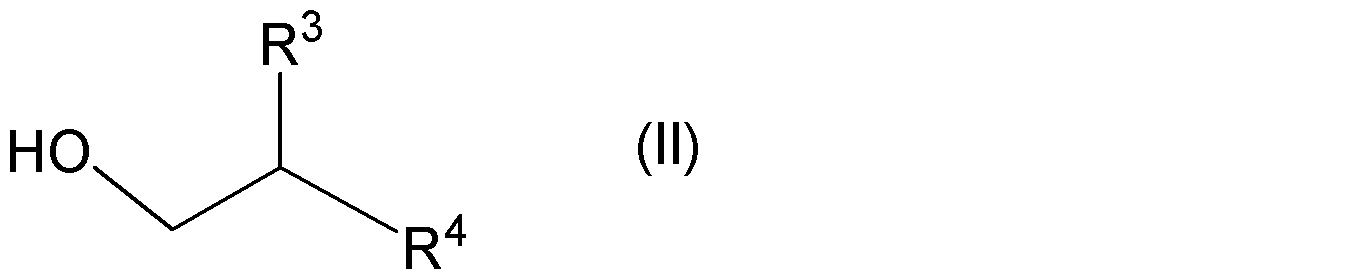
[式(II)中、R3及びR4は、それぞれ独立して、炭素数1以上12以下のアルキル基を示す。] - 前記エーテル系化合物が下記一般式(III)で表される化合物を含む請求項2に記載の2位に分岐構造を有するエーテル系基油の製造方法。

[式(III)中、R1~R4は、それぞれ独立して、炭素数1以上12以下のアルキル基を示す。] - 前記工程1を酸触媒の存在下で行い、前記酸触媒としてスルホン酸系化合物を含む、請求項1~3の何れか1項に記載の2位に分岐構造を有するエーテル系基油の製造方法。
- 前記スルホン酸系化合物が、芳香族スルホン酸系化合物及びその水和物から選ばれる1種以上である請求項4に記載の2位に分岐構造を有するエーテル系基油の製造方法。
- 前記工程2の還元が、触媒を用いる接触水素還元方法である、請求項1~5の何れか1項に記載の2位に分岐構造を有するエーテル系基油の製造方法。
- 前記工程1と前記工程2との間に下記の工程1’を行い、前記工程2の含アセタール組成物として、下記工程1’で得られた含アセタール組成物xを用いる請求項1~5の何れか1項に記載の2位に分岐構造を有するエーテル系基油の製造方法。
工程1’:前記工程1で得られた含アセタール組成物をアルカリ処理した後、アセタールを含む有機相と、水相とを分離し、有機相から含アセタール組成物xを得る工程。 - 前記アルカリがアルカリ金属の水酸化物である、請求項7に記載の2位に分岐構造を有するエーテル系基油の製造方法。
- エステル系化合物の含有量が、前記2位に分岐構造を有するエーテル系基油の全量基準で2.0質量%以下である、請求項1~8の何れか1項に記載の2位に分岐構造を有するエーテル系基油の製造方法。
- 請求項1~9の何れか1項に記載のエーテル系基油の製造方法で得られたエーテル系基油に、冷媒を添加する工程を有する、冷凍機油組成物の製造方法。
- 請求項1~9の何れか1項に記載のエーテル系基油の製造方法で得られたエーテル系基油に、潤滑油添加剤を添加する工程を有する、潤滑油組成物の製造方法。
Priority Applications (1)
| Application Number | Priority Date | Filing Date | Title |
|---|---|---|---|
| JP2018507310A JPWO2017164124A1 (ja) | 2016-03-24 | 2017-03-17 | 2位に分岐構造を有するエーテル系基油の製造方法、冷凍機油組成物の製造方法及び潤滑油組成物の製造方法 |
Applications Claiming Priority (2)
| Application Number | Priority Date | Filing Date | Title |
|---|---|---|---|
| JP2016-060569 | 2016-03-24 | ||
| JP2016060569 | 2016-03-24 |
Publications (1)
| Publication Number | Publication Date |
|---|---|
| WO2017164124A1 true WO2017164124A1 (ja) | 2017-09-28 |
Family
ID=59900464
Family Applications (1)
| Application Number | Title | Priority Date | Filing Date |
|---|---|---|---|
| PCT/JP2017/010939 Ceased WO2017164124A1 (ja) | 2016-03-24 | 2017-03-17 | 2位に分岐構造を有するエーテル系基油の製造方法、冷凍機油組成物の製造方法及び潤滑油組成物の製造方法 |
Country Status (2)
| Country | Link |
|---|---|
| JP (1) | JPWO2017164124A1 (ja) |
| WO (1) | WO2017164124A1 (ja) |
Citations (3)
| Publication number | Priority date | Publication date | Assignee | Title |
|---|---|---|---|---|
| WO1994011469A1 (de) * | 1992-11-06 | 1994-05-26 | Henkel Kommanditgesellschaft Auf Aktien | Dialkylether in metalloberflächen-behandlungsmitteln |
| JPH11166186A (ja) * | 1997-09-08 | 1999-06-22 | Clariant Gmbh | 鉱油及び鉱油蒸留物の流動特性を改善するための添加剤 |
| WO2005080305A1 (ja) * | 2004-02-25 | 2005-09-01 | Idemitsu Kosan Co., Ltd. | アルキルアセタール化合物とその製造方法及び潤滑油組成物 |
-
2017
- 2017-03-17 JP JP2018507310A patent/JPWO2017164124A1/ja active Pending
- 2017-03-17 WO PCT/JP2017/010939 patent/WO2017164124A1/ja not_active Ceased
Patent Citations (3)
| Publication number | Priority date | Publication date | Assignee | Title |
|---|---|---|---|---|
| WO1994011469A1 (de) * | 1992-11-06 | 1994-05-26 | Henkel Kommanditgesellschaft Auf Aktien | Dialkylether in metalloberflächen-behandlungsmitteln |
| JPH11166186A (ja) * | 1997-09-08 | 1999-06-22 | Clariant Gmbh | 鉱油及び鉱油蒸留物の流動特性を改善するための添加剤 |
| WO2005080305A1 (ja) * | 2004-02-25 | 2005-09-01 | Idemitsu Kosan Co., Ltd. | アルキルアセタール化合物とその製造方法及び潤滑油組成物 |
Also Published As
| Publication number | Publication date |
|---|---|
| JPWO2017164124A1 (ja) | 2019-02-14 |
Similar Documents
| Publication | Publication Date | Title |
|---|---|---|
| JP4959894B2 (ja) | 高純度含酸素化合物の製造方法及び潤滑油 | |
| EP2123624B1 (en) | Method for producing 4-methyl-2,3,5,6-tetrafluorobenzyl alcohol | |
| EP3883913B1 (en) | Process for making ethers via enol ethers | |
| JP2018150250A (ja) | ジアルキルアミノシランの製造方法 | |
| JP2017025014A (ja) | ベンゾオキサゾール化合物の製造方法 | |
| WO2017164124A1 (ja) | 2位に分岐構造を有するエーテル系基油の製造方法、冷凍機油組成物の製造方法及び潤滑油組成物の製造方法 | |
| CN112279766A (zh) | 包含非对称链状碳酸酯的组合物 | |
| US9315435B2 (en) | Method for producing hydroxyphenylcyclohexanol compound | |
| WO2017188151A1 (ja) | 冷凍機油、及び冷凍機用組成物 | |
| JP2016089067A (ja) | エーテル系基油、潤滑油組成物、及びエーテル系基油の製造方法 | |
| WO2007083839A1 (ja) | 第3級アミンの製造方法 | |
| JP6420673B2 (ja) | シクロヘキサン−1,4−ジカルボン酸ビス[4−(6−アクリロイルオキシヘキシル)フェニル]の製造方法 | |
| TW201422579A (zh) | 雙季戊四醇單縮甲醛之己酯 | |
| EP3697749B1 (en) | Etherification process | |
| EP3697750B1 (en) | Selective acetalization / etherification process | |
| CN113801714A (zh) | 一种齿轮油组合物及其制备方法 | |
| JP5507147B2 (ja) | ピリミジニルアルコール誘導体の製造方法及びその合成中間体 | |
| JP2013100265A (ja) | エポキシ付加物の製造方法 | |
| US7566806B2 (en) | Alkylamino group-terminated fluoroether and process for producing the same | |
| JP2004131439A (ja) | 2,5−ジ置換シクロペンタノン化合物及び2,5−ジ置換シクロペンタノール化合物の製造方法。 | |
| WO2024107999A1 (en) | Heterodimers of terpenes and linear or branched alkenes | |
| JP2004250348A (ja) | アルキルルテノセンの製造方法 | |
| JP2017190323A (ja) | テトラヒドロ−2h−ピラン誘導体の製造方法 | |
| JP2008247889A (ja) | ε−カプロラクトン化合物の製造方法 | |
| CN110997612A (zh) | 甲醇与仲醇或叔醇的铁催化的交叉偶联以生产甲酸酯 |
Legal Events
| Date | Code | Title | Description |
|---|---|---|---|
| ENP | Entry into the national phase |
Ref document number: 2018507310 Country of ref document: JP Kind code of ref document: A |
|
| NENP | Non-entry into the national phase |
Ref country code: DE |
|
| 121 | Ep: the epo has been informed by wipo that ep was designated in this application |
Ref document number: 17770166 Country of ref document: EP Kind code of ref document: A1 |
|
| 122 | Ep: pct application non-entry in european phase |
Ref document number: 17770166 Country of ref document: EP Kind code of ref document: A1 |