WO2017159689A1 - 熱伝導性樹脂組成物 - Google Patents
熱伝導性樹脂組成物 Download PDFInfo
- Publication number
- WO2017159689A1 WO2017159689A1 PCT/JP2017/010240 JP2017010240W WO2017159689A1 WO 2017159689 A1 WO2017159689 A1 WO 2017159689A1 JP 2017010240 W JP2017010240 W JP 2017010240W WO 2017159689 A1 WO2017159689 A1 WO 2017159689A1
- Authority
- WO
- WIPO (PCT)
- Prior art keywords
- heat conductive
- resin composition
- conductive filler
- resin
- composition
- Prior art date
- Legal status (The legal status is an assumption and is not a legal conclusion. Google has not performed a legal analysis and makes no representation as to the accuracy of the status listed.)
- Ceased
Links
Images

Classifications
-
- C—CHEMISTRY; METALLURGY
- C08—ORGANIC MACROMOLECULAR COMPOUNDS; THEIR PREPARATION OR CHEMICAL WORKING-UP; COMPOSITIONS BASED THEREON
- C08L—COMPOSITIONS OF MACROMOLECULAR COMPOUNDS
- C08L101/00—Compositions of unspecified macromolecular compounds
- C08L101/12—Compositions of unspecified macromolecular compounds characterised by physical features, e.g. anisotropy, viscosity or electrical conductivity
-
- C—CHEMISTRY; METALLURGY
- C08—ORGANIC MACROMOLECULAR COMPOUNDS; THEIR PREPARATION OR CHEMICAL WORKING-UP; COMPOSITIONS BASED THEREON
- C08L—COMPOSITIONS OF MACROMOLECULAR COMPOUNDS
- C08L33/00—Compositions of homopolymers or copolymers of compounds having one or more unsaturated aliphatic radicals, each having only one carbon-to-carbon double bond, and only one being terminated by only one carboxyl radical, or of salts, anhydrides, esters, amides, imides or nitriles thereof; Compositions of derivatives of such polymers
-
- H—ELECTRICITY
- H05—ELECTRIC TECHNIQUES NOT OTHERWISE PROVIDED FOR
- H05K—PRINTED CIRCUITS; CASINGS OR CONSTRUCTIONAL DETAILS OF ELECTRIC APPARATUS; MANUFACTURE OF ASSEMBLAGES OF ELECTRICAL COMPONENTS
- H05K7/00—Constructional details common to different types of electric apparatus
- H05K7/20—Modifications to facilitate cooling, ventilating, or heating
-
- H—ELECTRICITY
- H10—SEMICONDUCTOR DEVICES; ELECTRIC SOLID-STATE DEVICES NOT OTHERWISE PROVIDED FOR
- H10W—GENERIC PACKAGES, INTERCONNECTIONS, CONNECTORS OR OTHER CONSTRUCTIONAL DETAILS OF DEVICES COVERED BY CLASS H10
- H10W40/00—Arrangements for thermal protection or thermal control
- H10W40/10—Arrangements for heating
-
- H—ELECTRICITY
- H10—SEMICONDUCTOR DEVICES; ELECTRIC SOLID-STATE DEVICES NOT OTHERWISE PROVIDED FOR
- H10W—GENERIC PACKAGES, INTERCONNECTIONS, CONNECTORS OR OTHER CONSTRUCTIONAL DETAILS OF DEVICES COVERED BY CLASS H10
- H10W40/00—Arrangements for thermal protection or thermal control
- H10W40/20—Arrangements for cooling
- H10W40/25—Arrangements for cooling characterised by their materials
Definitions
- the present invention relates to a thermally conductive resin composition suitable for a thermal bonding material (TIM).
- a large amount of heat generated from the semiconductor module is transferred to the cool-down part via the heat conductive resin composition.
- power semiconductors used in computers, electric cars, power transmission system inverters, converters, etc. use Si as the semiconductor element, but in recent years, these semiconductor elements have been replaced with low power, high withstand voltage and high temperature drive. Therefore, there is a growing trend to use SiC and GaN that can be used, and a heat dissipation material that can be applied to these semiconductor modules is demanded.
- the thermal bonding material plays an important role in heat countermeasures for the entire semiconductor module, and the way in which heat is transferred varies greatly depending on how low the thermal resistance of the composition exhibiting high thermal conductivity is.
- a phase change TIM that undergoes phase change at a certain temperature can impart high thermal conductivity by increasing the content of thermally conductive fillers such as metal particles, but the composition itself is hard, and between the heat source and the heat radiating part.
- Patent Document 1 a problem that the TIM located in the position cannot be pressed and thinned.
- a TIM using a thermoplastic resin such as an ethylene-vinyl acetate copolymer is known.
- Patent Document 2 since the resin viscosity during heating is high, there is a problem that it does not lead to sufficient thinning (Patent Document 2). ). In any case, in order to increase the thermal conductivity to 3.5 W / (m ⁇ K) or higher, the filler must be highly filled, and the composition becomes hard.
- PCTIM PSX-Pm (Med Dry) EN / CH which is composed of paraffins marketed by Henkel and thermally conductive fillers, is crimped and thin with a thermal conductivity of 2.8 W / (m ⁇ K).
- paraffins are the main component, volatilization of organic components due to thermal decomposition becomes a problem at high temperature driving.
- a thermal conductive filler is additionally filled in order to improve thermal conductivity, a hard and brittle composition is obtained.
- JP 2004-75760 A Japanese Patent Laid-Open No. 11-45965
- the present invention has been made in view of the above-described problems, and is capable of being pressure-bonded / thinned in a region from room temperature to 100 ° C. while being highly filled with a heat conductive filler, and in an air atmosphere at 150 ° C.
- the purpose of the present invention is to provide a thermally conductive resin composition in which deterioration is hardly observed.
- the present inventors have found that a resin having a melting point of 40 to 100 ° C., a resin that is liquid at room temperature, and a thermally conductive filler in such an amount that the volume fraction in the composition is 70% by volume or more.
- the present invention is as follows. 1) A resin (A) having a melting point of 40 to 100 ° C., a resin (C) that is liquid at room temperature, and a thermally conductive filler (B) in such an amount that the volume fraction in the composition is 70% by volume or more.
- Thermally conductive resin composition is as follows.
- the thermally conductive resin composition according to 1) wherein at least one of the resins (A) and (C) has a weight loss of less than 10% when stored at 150 ° C. in the atmosphere for 100 hours. .
- At least 1 part of resin (C) is an acrylic resin, The heat conductive resin composition as described in 1) or 2) characterized by the above-mentioned.
- the heat conductive filler (B) contains a heat conductive filler (B1) having an average particle diameter of 1 to 3 ⁇ m, and the content of the heat conductive filler (B1) is 30% by volume or more of the composition.
- the heat conductive resin composition according to any one of 1) to 4 which is characterized in that 6)
- the heat conductive filler (B) contains a heat conductive filler (B2) having an average particle size of 4 to 40 ⁇ m, and the content of the heat conductive filler (B2) is 30% by volume or more of the composition.
- the heat conductive resin composition according to any one of 1) to 5 characterized in that 7) A thermal bonding material (TIM) containing the thermally conductive resin composition according to any one of 1) to 6). 8) The thermal bonding material (TIM) according to 7), which is for semiconductor modules.
- the heat conductive resin composition of the present invention is a conventional heat conductive resin that cannot be highly filled with a heat conductive filler and has to sacrifice heat conductivity because it is pressure-bonded and thinned at room temperature to 100 ° C. or less. Unlike a composition, it can be crimped and thinned while exhibiting high filling and high thermal conductivity, and has a high long-term heat resistance. Therefore, as a heat dissipation resin composition for a semiconductor package suitable for TIM. Used. In particular, there is an effect that an effective heat countermeasure can be realized for the next-generation semiconductor module using SiC or the like.
- the present invention is not limited to this.
- the value having “volume%” as a unit is a value at 23 ° C. *
- the heat conductive resin composition of the present invention comprises a resin (A) having a melting point of 40 to 100 ° C., a heat conductive filler (B), a liquid resin (C) at room temperature, and other components (D),
- A resin having a melting point of 40 to 100 ° C.
- B heat conductive filler
- C liquid resin
- D other components
- Resin (A) having a melting point of 40 to 100 ° C. The component (A) exhibits fluidity by melting or softening during heating and contributes to pressure bonding and thinning.
- the melting point of component (A) is 40 to 100 ° C., preferably 45 to 65 ° C. When the melting point is below 40 ° C., it may be difficult to handle the composition, and when the melting point exceeds 100 ° C., it may be difficult to use the composition as a TIM.
- Examples of the component (A) include fatty acid esters, fatty acid amides, paraffins, and the like, and preferably contains at least one kind. Moreover, it is preferable that content of a component (A) is less than 10 weight% of the amount of compositions.
- the composition tends to maintain a solid form.
- the component (A) preferably has a weight loss of less than 10% when stored at 150 ° C. for 100 hours in the atmosphere. When the weight reduction is less than 10%, the composition is likely to exhibit sufficient heat resistance.
- thermally conductive filler (B) As the thermally conductive filler (B), a commercially available general heat conductive filler can be used. Among them, from various viewpoints such as thermal conductivity, availability, insulation, filling properties, toxicity, etc., carbon allotropes such as graphite and diamond, aluminum oxide, magnesium oxide, beryllium oxide, titanium oxide, zirconium oxide and zinc oxide, etc.
- Metal oxides such as metal oxides, boron nitride, aluminum nitride and silicon nitride, metal carbides such as boron carbide, aluminum carbide and silicon carbide, acrylonitrile-based polymer fired products, furan resin fired products, cresol resin fired products, polyvinyl chloride Burned products, burned organic polymers such as burned products of sugar and charcoal, composite ferrites of Zn ferrite and other metals such as Mn, Ni, Cu, Fe-Al-Si ternary alloys, carbonyl iron Iron nickel alloy, metal powder, crystalline silica, and the like are preferable. *
- graphite, aluminum oxide, magnesium oxide, boron nitride, aluminum nitride, silicon carbide, the above composite ferrite, Fe-Al-Si ternary alloy, carbonyl iron, iron nickel alloy, and Crystalline silica is more preferable, graphite, ⁇ -alumina, hexagonal boron nitride, aluminum nitride, Mn—Zn soft ferrite, Ni—Zn soft ferrite, Fe—Al—Si ternary alloy, carbonyl iron, iron nickel Alloy is more preferable, spheroidized graphite, round or spherical ⁇ -alumina, spherical hexagonal boron nitride, aluminum nitride, Mn—Zn soft ferrite, Ni—Zn soft ferrite, spherical Fe—Al—Si ternary Alloys and carbonyl iron are particularly preferred. *
- the thermally conductive filler (B) is a silane coupling agent (vinyl silane, epoxy silane, (meth) acryl silane, isocyanate silane, chlorosilane, aminosilane, etc.), titanate coupling from the viewpoint of improving the dispersibility to the resin Agents (alkoxy titanate, amino titanate, etc.), fatty acids (caproic acid, caprylic acid, capric acid, lauric acid, myristic acid, palmitic acid, stearic acid, behenic acid and other saturated fatty acids, sorbic acid, elaidic acid, oleic acid, linol Acids, unsaturated fatty acids such as linolenic acid, erucic acid, etc.), resin acids (abietic acid, pimaric acid, levopimaric acid, neoapitic acid, parastrinic acid, dehydroabietic acid, isopimaric acid, sandaracopimaric acid, columic acid
- the use amount of the heat conductive filler (B) is such that the volume fraction (volume%) of the heat conductive filler (B) is from the viewpoint of increasing the heat conductivity of the heat conductive resin composition of the present invention.
- the amount is 70% by volume or more in the entire composition.
- the volume fraction is less than 70% by volume, the thermal conductivity tends to be insufficient.
- the volume fraction (volume%) of the thermally conductive filler (B) is calculated from the weight ratio and specific gravity of the resin component and the thermally conductive filler (B), and is obtained from the following equation. .
- the thermally conductive filler (B) is described as “filler”.
- Filler volume fraction (volume%) (filler weight ratio / filler specific gravity) / [(resin weight ratio / resin specific gravity) + (filler weight ratio / filler specific gravity)] ⁇ 100. . . (1)
- the resin described here refers to all components excluding the thermally conductive filler (B) from the above composition. *
- the particle diameter ratio between the heat conductive filler having a large particle diameter and the heat conductive filler having a small particle diameter is about 10/1.
- these heat conductive fillers can use not only the same kind of heat conductive filler but 2 or more types from which a kind differs together. Moreover, you may use various fillers other than a heat conductive filler as needed to such an extent that the effect of this invention is not prevented.
- fillers other than the heat conductive filler are not particularly limited, but wood powder, pulp, cotton chips, asbestos, glass fiber, carbon fiber, mica, walnut shell powder, rice husk powder, diatomaceous earth, white clay, silica ( Fumed silica, precipitated silica, fused silica, dolomite, silicic anhydride, amorphous spherical silica, etc.), reinforcing filler such as carbon black, diatomaceous earth, calcined clay, clay, talc, titanium oxide, bentonite, organic bentonite , Ferric oxide, aluminum fine powder, flint powder, activated zinc white, zinc powder, zinc carbonate, shirasu balloon, and filler such as resin powder such as PVC powder, PMMA powder, asbestos, glass fiber and glass filament, carbon fiber And fibrous fillers such as Kevlar fiber and polyethylene fiber.
- silica Fumed silica, precipitated silica, fused silica, dolomite,
- fillers include precipitated silica, fumed silica, fused silica, dolomite, carbon black, titanium oxide, talc and the like are preferable. Some of these fillers have a slight function as a heat conductive filler, and are composed of carbon fiber, various metal powders, various metal oxides, and various organic fibers. Depending on the synthesis method, crystallinity, and crystal structure, there are some that can be used as an excellent heat conductive filler. *
- the average particle size of the heat conductive filler (B) is not particularly limited, and is 40 ⁇ m or less, for example, 0.5 to 40 ⁇ m, from the viewpoint of easily improving the heat conductivity of the heat conductive resin composition of the present invention. It is preferably 1 to 20 ⁇ m, more preferably 2 to 15 ⁇ m.
- the average particle diameter means a volume-based cumulative average particle diameter (D 50 ) measured by a laser diffraction method.
- the thermal conductive filler (B) has an average particle size of 1 in that it is easy to improve the thermal conductivity of the thermal conductive resin composition of the present invention and to easily improve the filling rate of the thermal conductive filler (B) to the resin. It is preferable that a heat conductive filler (B1) of ⁇ 3 ⁇ m is contained, and the content of the heat conductive filler (B1) is 30% by volume or more of the composition. The content of the heat conductive filler (B1) is more preferably 35 to 40% by volume of the above composition. *
- the heat conductive filler (B) contains a heat conductive filler (B2) having an average particle size of 4 to 40 ⁇ m, and is further improved in that the heat conductivity of the heat conductive resin composition of the present invention can be further improved. It is preferable that content of a filler (B2) is 30 volume% or more of the said composition. The content of the heat conductive filler (B2) is more preferably 35 to 40% by volume of the above composition. *
- the viscosity of the component (C) at room temperature is not particularly limited, but it is easy to uniformly knead the components of the composition unless the viscosity is high.
- the resin (C) include acrylic resin, polyisoprene, polybutadiene, hydrogenated poly (ene), fatty acid ester, polybasic acid ester, etc.
- the resin (C) is at least It is preferable to contain one or more of these, and it is more preferable that at least one part of the component (C) is an acrylic resin.
- the amount of component (C) is preferably less than 10% by weight of the composition amount. When the amount is less than 10% by weight, the thermal conductivity of the composition is hardly impaired. Furthermore, the component (C) preferably has a weight loss of less than 10% when stored at 150 ° C. in the atmosphere for 100 hours. When the weight reduction is less than 10%, the composition is likely to exhibit sufficient heat resistance. *
- room temperature refers to any temperature between ⁇ 30 ° C. and 50 ° C., preferably any temperature between 0 ° C. and 40 ° C., more preferably 10 ° C. Any temperature between 30 ° C refers to more preferably 23 ° C.
- room temperature refers to any temperature between ⁇ 30 ° C. and 50 ° C.
- a resin that is liquid at least at a temperature between ⁇ 30 ° C. and 50 ° C. corresponds to a resin that is liquid at room temperature.
- composition according to the present invention may contain other components (D) such as a heat aging inhibitor and a metal deactivator.
- other component (D) is preferably a liquid component.
- the method for uniformly kneading the components of the heat conductive resin composition of the present invention is not particularly limited.
- the components can be stirred and kneaded at room temperature after being charged into a container such as stainless steel or polypropylene, or can be melt-kneaded by a heating roll, a kneader, an extruder, or the like.
- the kneading temperature is not particularly limited as long as it does not cause thermal degradation of the resin, and is preferably 100 ° C. or lower. *
- the heat conductive resin composition of the present invention may be formed into a sheet or may be patterned by liquid printing.
- the composition may contain a dilution solvent.
- the diluting solvent is not particularly limited, but in view of handling during printing and drying after printing, it is preferably a solvent having a boiling point of 300 ° C. or less, and among them, those that do not chemically react with the composition components are more preferable. preferable.
- the dilution solvent is not particularly limited as long as it does not cause liquid bleeding during printing, and is preferably 10% by weight or less with respect to 100% by weight of the composition. *
- the thermally conductive resin composition needs to effectively transmit heat to the outside.
- the thermal conductivity of the composition may be, for example, 0.9 W / (m ⁇ K) or more, preferably 1.5 W / (m ⁇ K) or more, more preferably 3.0 W / (m ⁇ K) or more. It is.
- heat conductivity means the heat conductivity in 23 degreeC.
- thermoly conductive resin composition largely depends on the heat resistance of the resin contained in the composition.
- the heat resistance performance of the resin used in the present invention is evaluated by the weight loss when stored at 150 ° C. for 100 hours in the atmosphere. *
- the thermal conductivity of the thermally conductive resin composition is measured at 23 ° C. by using a hot disk AB thermal conductivity measuring device (TPS2500S) and sandwiching the sensor from above and below with two sheet samples (15 mm ⁇ 15 mm ⁇ 3 mm). Do. *
- a sample having a main plane shape of 30 ⁇ was pierced from a plate-like body obtained by molding a heat conductive resin composition to a thickness of 200 ⁇ m with a hot press machine or the like ( Hereinafter, it is referred to as a “30 ⁇ sample”.
- a sample and a smooth glass plate are cured for 1 hour in a constant temperature and humidity chamber (23 ° C., 50% RH), the sample is sandwiched between two glass plates, the four corners are screwed, and the expanded size is a 30 ⁇ sample.
- a constant temperature and humidity chamber 23 ° C., 50% RH
- the wet spreadability degree (%) is determined by comparing the wet spread size with a 30 ⁇ sample after heating in an oven (60 ° C.) for 1 hour immediately after the push spreadability test. .
- 30 ⁇ described in the specification of the present invention represents a circle having a diameter of 30 mm.
- Thickness should just be a thing which is not damaged by screw fastening, and if it is 10 mm or more, it is preferable.
- FIG. 1 shows how the sample is sandwiched between glass plates. *
- the thermal bonding material (TIM) according to the present invention contains the heat conductive resin composition according to the present invention, the heat bonding material (TIM) can be pressure-bonded while being highly filled with the heat conductive filler, can be made thin, and Degradation is hardly observed in an air atmosphere at 150 ° C. Therefore, the thermal bonding material (TIM) according to the present invention can be suitably used for a semiconductor module, particularly for a semiconductor module including a power semiconductor element.
- the material for the power semiconductor element include power semiconductor materials such as SiC and GaN.
- component (A) fatty acid ester (NOF Corporation: Unistar H476D), as component (B), aluminum powder (Toyo Aluminum Co., Ltd .: 13-0086, 13-0087, 13-0090), as component (C) , Polyacrylic acid ester (Toagosei Co., Ltd .: ARUFOON UP-1080, UP-1500, UP-1172), polybasic acid ester (DIC Corporation: Monosizer W-7010), and other components (D), thioether type Antioxidant (ADEKA Corporation: Adeka Stab AO-412S), heavy metal deactivator (ADEKA Corporation: CDA-6, CDA-10), hindered amine light stabilizer (ADEKA Corporation: Adeka Stab LA-81), aging Preventing agent (Ouchi Shinsei Chemical Co., Ltd .: NOCRACK CD) They were charged into propylene in the vessel (in no particular order), and kneaded while heating and melting at 100 ° C., to obtain a thermal
- thermal conductivity of the thermally conductive resin composition obtained by kneading as described above is shown in Table 2 (The thermal conductivity of PCTIM PSX-Pm (Med Dry) EN / CH manufactured by Henkel is shown in Comparative Example 2).
- An example in which aluminum powder is used for the thermally conductive filler shows a high thermal conductivity (4.1 W / (m ⁇ K)).
- Table 4 shows the expansibility of the thermally conductive resin composition obtained by kneading as described above.
- the thermal conductivity is improved as the content (volume ratio) of the heat conductive filler in the resin composition is increased, but the softness of the resin composition itself is lost. Thus, it is extremely difficult to press and thin (Comparative Example 1 / Example 1).
- the heat conductive resin composition obtained by kneading at the component ratio shown in Example 3 has high spreadability while maintaining high heat conductivity.
- high heat resistance can be imparted to the resin composition itself by using a component (C) having high heat resistance.
- the heat conductive resin composition of the present invention is suitable for TIM of a semiconductor package including a next generation semiconductor module using SiC or the like.
Landscapes
- Chemical & Material Sciences (AREA)
- Health & Medical Sciences (AREA)
- Chemical Kinetics & Catalysis (AREA)
- Medicinal Chemistry (AREA)
- Polymers & Plastics (AREA)
- Organic Chemistry (AREA)
- Physics & Mathematics (AREA)
- Thermal Sciences (AREA)
- Engineering & Computer Science (AREA)
- Microelectronics & Electronic Packaging (AREA)
- Compositions Of Macromolecular Compounds (AREA)
Abstract
本発明は、熱伝導性フィラーを高充填しながらも圧着・薄化可能な、かつ、150℃の大気雰囲気下において劣化がほとんど観測されない熱伝導性樹脂組成物を提供することを課題とする。本発明は、融点が40~100℃の樹脂(A)、室温で液状の樹脂(C)、および組成物中の体積分率が70体積%以上となる量の熱伝導性フィラー(B)を含有する熱伝導性樹脂組成物である。上記組成物において、樹脂(A)及び(C)の少なくとも一方は、大気下150℃にて100時間保存した際の重量減少が10%未満であることが好ましい。
Description
本発明は熱接合材料(TIM)に適した熱伝導性樹脂組成物に関する。
半導体モジュールから大量に発生される熱は、熱伝導性樹脂組成物を介して放冷部位へ伝熱される。例えば、コンピューターや電気自動車、送電システムのインバータ、コンバータ等に使用されるパワー半導体は、半導体素子にSiが使用されているが、近年これらの半導体素子に代わって低電力、高耐電圧かつ高温駆動が可能なSiCやGaNを使用する動きが大きくなっており、これらの半導体モジュールに適応可能な放熱材料が求められている。
その中でも熱接合材料(TIM)は、半導体モジュール全体の熱対策において重要な役割を担っており、その熱の伝わり方は高熱伝導性を示す組成物の熱抵抗をいかに低く抑えるかによって大きく変わる。例えば、ある温度で相変化するフェーズチェンジ系のTIMは、金属粒子といった熱伝導性フィラー含有量を大きくすることで高熱伝導性を付与できるが、組成物自体が硬く、熱源と放熱部との間に位置するTIMを圧着・薄化することができなくなるという問題が生じる(特許文献1)。またエチレン-酢酸ビニル共重合体等の熱可塑性樹脂が用いられたTIMが公知であるが、加温時の樹脂粘度が高いため、十分な薄化までには至らない問題がある(特許文献2)。また、いずれのケースも熱伝導率を3.5W/(m・K)以上にするにはフィラーを高充填せざるを得ず、組成物が硬いものとなる。一方、Henkel社が上市しているパラフィン類と熱伝導性フィラーとから構成されるPCTIM PSX-Pm(Med Dry)EN/CHは、熱伝導率2.8W/(m・K)で圧着・薄化ができるものであるが、パラフィン類を主成分としているため、高温駆動時において熱分解による有機成分の揮発が問題となる。また、熱伝導率を向上するために熱伝導性フィラーを追加充填すると硬く脆い組成物となってしまう。
本発明は、上記の課題に鑑みてなされたものであって、熱伝導性フィラーを高充填しながらも、室温以上100℃以下の領域において圧着・薄化可能、かつ、150℃の大気雰囲気下において劣化がほとんど観測されない熱伝導性樹脂組成物を提供することを目的とする。
本発明者らは、鋭意検討を重ねた結果、融点が40~100℃の樹脂、室温で液状の樹脂、および組成物中の体積分率が70体積%以上となる量の熱伝導性フィラーを含有する熱伝導性樹脂組成物により、上記の課題を解決することに成功した。 すなわち、本発明は以下の通りである。1)融点が40~100℃の樹脂(A)、室温で液状の樹脂(C)、および組成物中の体積分率が70体積%以上となる量の熱伝導性フィラー(B)を含有する熱伝導性樹脂組成物。2)樹脂(A)及び(C)の少なくとも一方は、大気下150℃にて100時間保存した際の重量減少が10%未満であることを特徴とする1)記載の熱伝導性樹脂組成物。3)樹脂(C)の少なくとも1部がアクリル樹脂であることを特徴とする1)または2)に記載の熱伝導性樹脂組成物。4)熱伝導性フィラー(B)の平均粒径が40μm以下であることを特徴とする1)~3)のいずれか1つに記載の熱伝導性樹脂組成物。5)熱伝導性フィラー(B)が平均粒径1~3μmの熱伝導性フィラー(B1)を含有し、熱伝導性フィラー(B1)の含有量が組成物の30体積%以上であることを特徴とする1)~4)のいずれか1つに記載の熱伝導性樹脂組成物。6)熱伝導性フィラー(B)が平均粒径4~40μmの熱伝導性フィラー(B2)を含有し、熱伝導性フィラー(B2)の含有量が組成物の30体積%以上であることを特徴とする1)~5)のいずれかに1つに記載の熱伝導性樹脂組成物。7)1)~6)のいずれか1つに記載の熱伝導性樹脂組成物を含有する熱接合材料(TIM)。8)半導体モジュール用である7)に記載の熱接合材料(TIM)。
本発明の熱伝導性樹脂組成物は、室温~100℃以下において圧着・薄化するために熱伝導性フィラーを高充填できず熱伝導率を犠牲にせざるを得なかった従来の熱伝導性樹脂組成物とは異なり、高充填・高熱伝導率を示しながらも圧着・薄化することが可能で、かつ、高い長期耐熱性を有するため、TIMに好適な、半導体パッケージの放熱用樹脂組成物として用いられる。特に、SiCなどを使用した次世代半導体モジュールの有効な熱対策が実現できるという効果を奏する。
以下、本発明の一実施形態について説明するが、本発明はこれに限定されるものではない。なお、本明細書において、「体積%」を単位とする値は、23℃における値である。
本発明の熱伝導性樹脂組成物は、融点が40~100℃である樹脂(A)、熱伝導性フィラー(B)、室温において液状の樹脂(C)、その他成分(D)から構成され、各成分比により圧着・薄化の度合いが自在に変化しうることを特徴とする。以下、各成分について説明する。
[融点が40~100℃である樹脂(A)] 成分(A)は加温時に溶融あるいは軟化により流動性を発現して圧着・薄化に寄与する。成分(A)の融点は、40~100℃であり、45~65℃が好ましい。上記融点が40℃を下回ると組成物の取扱いが困難になる場合があり、上記融点が100℃を超えるとTIMとしての上記組成物の使用が困難になる場合がある。成分(A)としては、脂肪酸エステル、脂肪酸アミド、パラフィン等が挙げられ、少なくとも1種類以上を含有することが好ましい。また、成分(A)の含有量は組成物量の10重量%未満であることが好ましい。上記含有量が10重量%未満であると組成物が固体形状を保ちやすい。さらに、成分(A)は、大気下150℃にて100時間保存した際の重量減少が10%未満であることが好ましい。上記重量減少が10%未満であると組成物に十分な耐熱性を発現させやすい。
[熱伝導性フィラー(B)] 熱伝導性フィラー(B)としては、市販されている一般的な良熱伝導性充填材を用いることができる。なかでも、熱伝導率、入手性、絶縁性、充填性、毒性等種々の観点から、グラファイト、ダイヤモンド等の炭素同素体、酸化アルミニウム、酸化マグネシウム、酸化ベリリウム、酸化チタン、酸化ジルコニウムおよび酸化亜鉛等の金属酸化物、窒化ホウ素、窒化アルミニウムおよび窒化ケイ素等の金属窒化物、炭化ホウ素、炭化アルミニウムおよび炭化ケイ素等の金属炭化物、アクリロニトリル系ポリマー焼成物、フラン樹脂焼成物、クレゾール樹脂焼成物、ポリ塩化ビニル焼成物、砂糖の焼成物および木炭の焼成物等の有機性ポリマー焼成物、ZnフェライトとMn、Ni、Cu等の他の金属との複合フェライト、Fe-Al-Si系三元合金、カルボニル鉄、鉄ニッケル合金、金属粉末、結晶性シリカ等が好ましく挙げられる。
さらに入手性や熱伝導性の観点から、グラファイト、酸化アルミニウム、酸化マグネシウム、窒化ホウ素、窒化アルミニウム、炭化ケイ素、上記複合フェライト、Fe-Al-Si系三元合金、カルボニル鉄、鉄ニッケル合金、および結晶性シリカがより好ましく、グラファイト、α-アルミナ、六方晶窒化ホウ素、窒化アルミニウム、Mn-Zn系ソフトフェライト、Ni-Zn系ソフトフェライト、Fe-Al-Si系三元合金、カルボニル鉄、鉄ニッケル合金がより好ましく、球状化グラファイト、丸み状あるいは球状のα-アルミナ、球状六方晶窒化ホウ素、窒化アルミニウム、Mn-Zn系ソフトフェライト、Ni-Zn系ソフトフェライト、球状Fe-Al-Si系三元合金、カルボニル鉄が特に好ましい。
また、熱伝導性フィラー(B)は、樹脂に対する分散性を向上させる観点から、シランカップリング剤(ビニルシラン、エポキシシラン、(メタ)アクリルシラン、イソシアナートシラン、クロロシラン、アミノシラン等)、チタネートカップリング剤(アルコキシチタネート、アミノチタネート等)、脂肪酸(カプロン酸、カプリル酸、カプリン酸、ラウリン酸、ミリスチン酸、パルミチン酸、ステアリン酸、ベヘニン酸等の飽和脂肪酸、ソルビン酸、エライジン酸、オレイン酸、リノール酸、リノレン酸、エルカ酸等の不飽和脂肪酸等)、樹脂酸(アビエチン酸、ピマル酸、レボピマール酸、ネオアピチン酸、パラストリン酸、デヒドロアビエチン酸、イソピマール酸、サンダラコピマール酸、コルム酸、セコデヒドロアビエチン酸、ジヒドロアビエチン酸等)等により、表面が処理されたものであってもよい。
熱伝導性フィラー(B)の使用量は、本発明の熱伝導性樹脂組成物の熱伝導率を高くすることができる観点から、熱伝導性フィラー(B)の体積分率(体積%)が全組成物中の70体積%以上となる量である。上記体積分率が70体積%よりも少なくなる量である場合には、熱伝導性が十分でなくなる傾向がある。さらに高い熱伝導率を望む場合は、熱伝導性フィラー(B)の使用量を、上記体積分率が全組成物中の71体積%以上となる量にすることがより好ましい。
ここで熱伝導性フィラー(B)の体積分率(体積%)とは、樹脂分および熱伝導性フィラー(B)のそれぞれの重量比率と比重から算出されるものであり、下式より求められる。なお、下式(1)においては、熱伝導性フィラー(B)を「充填材」と記載した。充填材体積分率(体積%)=(充填材重量比率/充填材比重)/[(樹脂重量比率/樹脂比重)+(充填材重量比率/充填材比重)]×100 ...(1)ここで記載した樹脂とは、上記組成物から熱伝導性フィラー(B)を除いた全成分を指す。
また、樹脂に対する熱伝導性フィラー(B)の充填率を高めるひとつの手法として、粒子径の異なる熱伝導性フィラーを2種類以上併用することが好適である。この場合、粒子径の大きい熱伝導性フィラーと、粒子径の小さい熱伝導性フィラーとの粒子径比を10/1程度とすることが好ましい。
また、これら熱伝導性フィラーは、同一種類の熱伝導性フィラーだけでなく、種類の異なる2種以上を併用することもできる。また、本発明の効果を妨げない程度に、熱伝導性フィラー以外の各種充填材を必要に応じて用いてもよい。熱伝導性フィラー以外の各種充填材としては、特に限定されないが、木粉、パルプ、木綿チップ、アスベスト、ガラス繊維、炭素繊維、マイカ、クルミ殻粉、もみ殻粉、ケイソウ土、白土、シリカ(ヒュームドシリカ、沈降性シリカ、溶融シリカ、ドロマイト、無水ケイ酸、非晶質球形シリカ等)、カーボンブラックといった補強性充填材、ケイソウ土、焼成クレー、クレー、タルク、酸化チタン、ベントナイト、有機ベントナイト、酸化第二鉄、アルミニウム微粉末、フリント粉末、活性亜鉛華、亜鉛粉末、炭酸亜鉛、シラスバルーン、およびPVC粉末、PMMA粉末といった樹脂粉末等の充填材、石綿、ガラス繊維およびガラスフィラメント、炭素繊維、ケブラー繊維、ポリエチレンファイバー等の繊維状充填材等が挙げられる。これら充填材のうちでは沈降性シリカ、ヒュームドシリカ、溶融シリカ、ドロマイト、カーボンブラック、酸化チタン、タルク等が好ましい。なお、これら充填材の中には、わずかに熱伝導性フィラーとしての機能を有しているものもあり、また、炭素繊維、各種金属粉、各種金属酸化物、各種有機繊維のように、組成、合成方法、結晶化度、結晶構造によっては優れた熱伝導性フィラーとして使用可能となるものもある。
熱伝導性フィラー(B)の平均粒径は、特に限定されず、本発明の熱伝導性樹脂組成物の熱伝導率を向上させやすい点で、40μm以下、例えば、0.5~40μmであることが好ましく、1~20μmであることがより好
ましく、2~15μmであることが更により好ましい。なお、本明細書において、平均粒径とは、レーザー回折法により測定した体積基準の累積平均粒子径(D50)をいう。
ましく、2~15μmであることが更により好ましい。なお、本明細書において、平均粒径とは、レーザー回折法により測定した体積基準の累積平均粒子径(D50)をいう。
本発明の熱伝導性樹脂組成物の熱伝導率を向上させやすいとともに、樹脂に対する熱伝導性フィラー(B)の充填率を向上させやすい点で、熱伝導性フィラー(B)が平均粒径1~3μmの熱伝導性フィラー(B1)を含有し、熱伝導性フィラー(B1)の含有量が上記組成物の30体積%以上であることが好ましい。熱伝導性フィラー(B1)の含有量は、より好ましくは上記組成物の35~40体積%である。
本発明の熱伝導性樹脂組成物の熱伝導率を更に向上させやすい点で、熱伝導性フィラー(B)が平均粒径4~40μmの熱伝導性フィラー(B2)を含有し、熱伝導性フィラー(B2)の含有量が上記組成物の30体積%以上であることが好ましい。熱伝導性フィラー(B2)の含有量は、より好ましくは上記組成物の35~40体積%である。
[室温で液状の樹脂(C)] 液状樹脂である成分(C)を併用することは、熱伝導性フィラーを組成物中に多量に含有させることを可能とし、さらには室温での軟質性に寄与する。成分(C)の室温での粘度は特に限定されないが、高粘度でなければ組成物の各成分を均一に混練することが容易となりやすい。樹脂(C)としては、アクリル樹脂、ポリイソプレン、ポリブタジエン、水添ポリ(エン)、脂肪酸エステル、多塩基酸エステル等が挙げられ、上記軟質性向上等の観点から、樹脂(C)は、少なくともこれらの1種以上を含有することが好ましく、成分(C)の少なくとも1部がアクリル樹脂であることがより好ましい。また、成分(C)の量は組成物量の10重量%未満であることが好ましい。上記量が10重量%未満であると組成物の熱伝導性が大きく損なわれにくい。さらに、成分(C)は、大気下150℃にて100時間保存した際の重量減少が10%未満であることが好ましい。上記重量減少が10%未満であると組成物に十分な耐熱性を発現させやすい。
なお、本発明における「室温」とは、-30℃から50℃の間のいずれかの温度をいうが、好ましくは0℃から40℃の間のいずれかの温度を、より好ましくは10℃から30℃の間のいずれかの温度を、さらに好ましくは23℃をいう。例えば、室温が-30℃から50℃の間のいずれかの温度をいう場合、-30℃から50℃の間の少なくともある温度において液状の樹脂は、室温で液状の樹脂に該当する。
[その他成分(D)] 本発明に係る組成物は、熱老化防止剤および金属不活性化剤、等のその他成分(D)が添加されていてもよい。上記組成物の拡がり性を大きくする場合にはその他成分(D)は液状の成分であることが好ましい。
本発明の熱伝導性樹脂組成物の各成分を均一に混練する方法は特に限定されない。ステンレスやポリプロピレン等の容器に各成分を投入した後に室温で攪拌混練することも、加熱ロール、ニーダー、押出機等により溶融混練することもできる。混練温度としては樹脂の熱劣化が起こらない温度であれば特に限定されず、100℃以下であることが好ましい。
本発明の熱伝導性樹脂組成物は、シート状に成型しても、液印刷でパターン形成してもよい。液印刷する場合、上記組成物は希釈溶剤を含有していてもよい。希釈溶剤は特に限定されないが、印刷時の取扱いや印刷後の乾燥に鑑みれば、沸点が300℃以下の溶剤であることが好ましく、さらにはそれらのなかでも組成物成分と化学反応しないものがより好ましい。また希釈溶剤は、印刷時に液滲みが起こらない量であれば特に限定されず、組成物100重量%に対して10重量%以下であることが好ましい。
熱伝導性樹脂組成物は熱を効果的に外部に伝える必要がある。上記組成物の熱伝導率は、例えば、0.9W/(m・K)以上でよく、好ましくは1.5W/(m・K)以上、さらに好ましくは3.0W/(m・K)以上である。このような熱伝導性樹脂組成物を用いることにより、発熱体が空気と接触している場合と比較して、発熱体の熱を効率よく逃がすことが可能となる。なお、本明細書において、熱伝導率とは、23℃における熱伝導率をいう。
熱伝導性樹脂組成物の耐熱性能評価は、組成物に含まれる樹脂の耐熱性に大きく依存する。本発明において使用される樹脂の耐熱性能は、大気下150℃にて100時間保存した際の重量減少で評価する。
熱伝導性樹脂組成物の熱伝導率測定は、HotDiskAB製熱伝導率測定装置(TPS2500S)を用い、シート状サンプル(15mm×15mm×3mm)2つでセンサーを上下から挟む方法にて23℃で行う。
押し・濡れ拡がり性試験には、熱伝導性樹脂組成物を熱プレス機等で200μmの厚みに成型して得た板状体から、30φの主平面形状を有する円板を刳り貫いて試料(以下、「30φの試料」という。)として用いる。恒温恒湿室(23℃、50%RH)で試料および平滑なガラス板を1時間養生した後に、ガラス板2枚で試料を挟み込み、4隅をビス締めし、拡がった大きさを30φの試料と比すことで押し拡がり性度合い(%)を決定する。また、濡れ拡がり性試験は、押し拡がり性試験直後にオーブン(60℃)にて1時間加熱後、濡れ拡がった大きさを30φの試料と比すことで濡れ拡がり性度合い(%)を決定する。なお、本発明の明細書に記載される「30φ」とは、直径30mmの円を表現する。さらに、ガラス板の面積に規定はなく、厚みはビス締めにより破損しないものであればよく、10mm以上あれば好ましい。試料のガラス板への挟み込みの様子を図1に示す。
本発明に係る熱接合材料(TIM)は、本発明に係る熱伝導性樹脂組成物を含有するため、熱伝導性フィラーを高充填しながらも圧着可能であり、薄く作製することができ、かつ、150℃の大気雰囲気下において劣化がほとんど観測されない。よって、本発明に係る熱接合材料(TIM)は、半導体モジュール用、特に、パワー半導体素子を備える半導体モジュール用に好適に用いることができる。パワー半導体素子の材料としては、例えば、SiC、GaN等のパワー半導体材料が挙げられる。
以下に、実施例を挙げて本発明をさらに詳細に説明するが、本発明はこの実施例によって何ら制限を受けるものではない。以下の実施例および比較例において、樹脂の耐熱性能評価、熱伝導性樹脂組成物の熱伝導率測定、および押し・濡れ拡がり性試験は、上述の通りに行った。
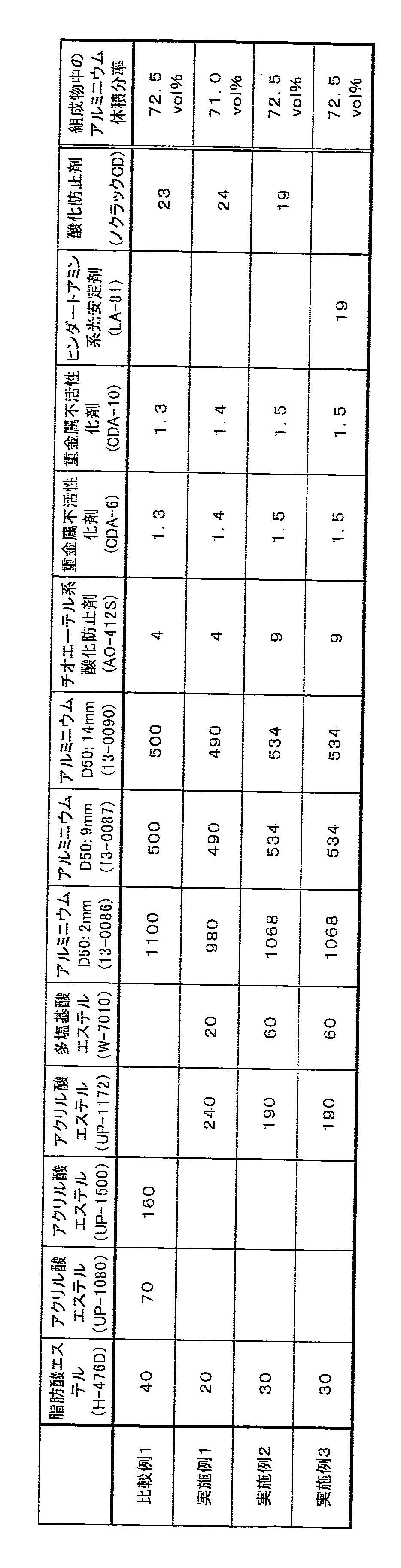
成分(A)として、脂肪酸エステル(日油株式会社:ユニスターH476D)、成分(B)として、アルミニウム粉(東洋アルミニウム株式会社:13-0086、13-0087、13-0090)、成分(C)として、ポリアクリル酸エステル(東亞合成株式会社:ARUFON UP-1080、UP-1500、UP-1172)、多塩基酸エステル(DIC株式会社:モノサイザーW-7010)、その他成分(D)として、チオエーテル系酸化防止剤(株式会社ADEKA:アデカスタブAO-412S)、重金属不活性化剤(ADEKA株式会社:CDA-6、CDA-10)、ヒンダードアミン系光安定剤(ADEKA株式会社:アデカスタブLA-81)、老化防止剤(大内新興化学工業株式会社:ノクラックCD)をポリプロピレン容器内に投入し(順不同)、100℃で加熱溶融させながら混練して、熱伝導性樹脂組成物を得た。熱伝導性樹脂組成物の成分比については表1に示す。なお、表1中の各成分の仕込み量は全て重量(具体的にはg)である。
上述の通りに混練して得た熱伝導性樹脂組成物の熱伝導率を表2に示す(Henkel社製PCTIM PSX-Pm(Med Dry)EN/CHの熱伝導率を比較例2に示す)。熱伝導性フィラーにアルミニウム粉を使用した例では高い熱伝導率(4.1W/(m・K))が示される。

比較例2に使用されているような一般的なパラフィンワックスについて、並びに、上述の通りに混練して得た熱伝導性樹脂組成物に含まれる成分(A)および(C)について、重量減少値(大気下150℃にて100時間保存)を表3に示す。

上述の通りに混練して得た熱伝導性樹脂組成物の拡がり性を表4に示す。
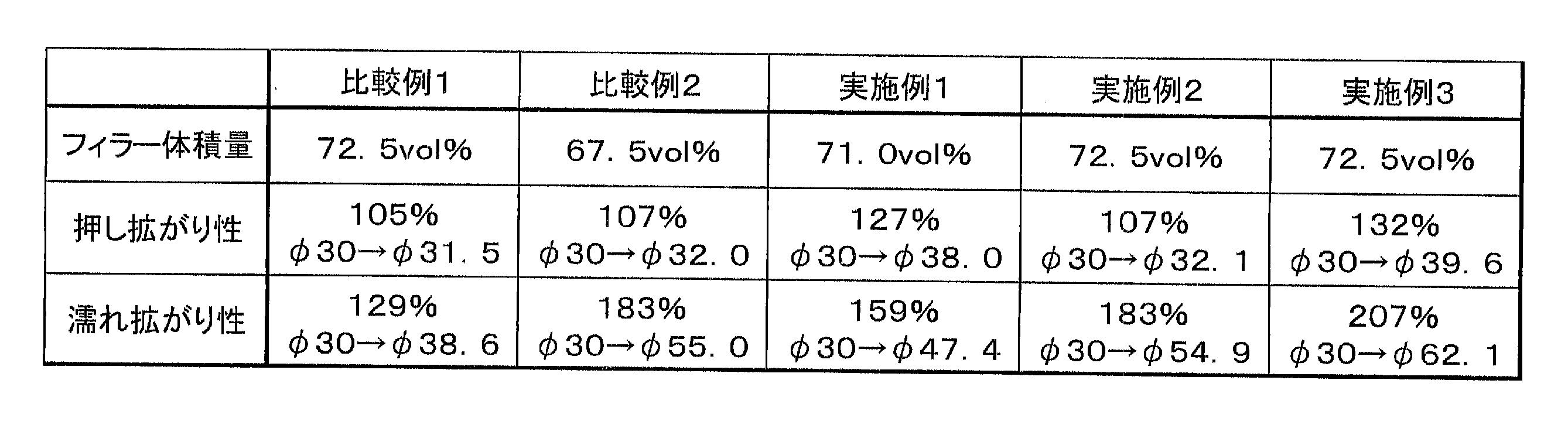
一般的に樹脂組成物中の熱伝導性フィラーの含有率(体積比)を大きくするほど熱伝導率は向上すると考えられるが、その一方で樹脂組成物自体の軟質性は失われることとなるため、圧着・薄化が著しく困難となる(比較例1/実施例1)。しかしながら、実施例3に示される成分比で混練することで得られる熱伝導性樹脂組成物は、高い熱伝導率を維持しつつ、かつ、高い拡がり性を有するものとなる。さらには表3に示されるように、成分(C)に耐熱性の高いものを使用することで樹脂組成物自体に高耐熱性能を付与できる。
したがって本発明の熱伝導性樹脂組成物は、SiCなどを使用した次世代半導体モジュールを含む半導体パッケージのTIMに好適なものである。
1...ボルト
2...ガラス板
3...熱伝導性樹脂組成物
4...ナット
5...ワッシャー
2...ガラス板
3...熱伝導性樹脂組成物
4...ナット
5...ワッシャー
Claims (8)
- 融点が40~100℃の樹脂(A)、室温で液状の樹脂(C)、および組成物中の体積分率が70体積%以上となる量の熱伝導性フィラー(B)を含有する熱伝導性樹脂組成物。
- 樹脂(A)及び(C)の少なくとも一方は、大気下150℃にて100時間保存した際の重量減少が10%未満であることを特徴とする請求項1記載の熱伝導性樹脂組成物。
- 樹脂(C)の少なくとも1部がアクリル樹脂であることを特徴とする請求項1または2に記載の熱伝導性樹脂組成物。
- 熱伝導性フィラー(B)の平均粒径が40μm以下であることを特徴とする請求項1~3のいずれか1つに記載の熱伝導性樹脂組成物。
- 熱伝導性フィラー(B)が平均粒径1~3μmの熱伝導性フィラー(B1)を含有し、熱伝導性フィラー(B1)の含有量が組成物の30体積%以上であることを特徴とする請求項1~4のいずれか1つに記載の熱伝導性樹脂組成物。
- 熱伝導性フィラー(B)が平均粒径4~40μmの熱伝導性フィラー(B2)を含有し、熱伝導性フィラー(B2)の含有量が組成物の30体積%以上であることを特徴とする請求項1~5のいずれかに1つに記載の熱伝導性樹脂組成物。
- 請求項1~6のいずれか1つに記載の熱伝導性樹脂組成物を含有する熱接合材料(TIM)。
- 半導体モジュール用である請求項7に記載の熱接合材料(TIM)。
Applications Claiming Priority (2)
| Application Number | Priority Date | Filing Date | Title |
|---|---|---|---|
| JP2016-051288 | 2016-03-15 | ||
| JP2016051288 | 2016-03-15 |
Publications (1)
| Publication Number | Publication Date |
|---|---|
| WO2017159689A1 true WO2017159689A1 (ja) | 2017-09-21 |
Family
ID=59850906
Family Applications (1)
| Application Number | Title | Priority Date | Filing Date |
|---|---|---|---|
| PCT/JP2017/010240 Ceased WO2017159689A1 (ja) | 2016-03-15 | 2017-03-14 | 熱伝導性樹脂組成物 |
Country Status (1)
| Country | Link |
|---|---|
| WO (1) | WO2017159689A1 (ja) |
Citations (4)
| Publication number | Priority date | Publication date | Assignee | Title |
|---|---|---|---|---|
| JP2000151160A (ja) * | 1998-11-04 | 2000-05-30 | Nitto Denko Corp | 放熱シート |
| JP2010232535A (ja) * | 2009-03-27 | 2010-10-14 | Polymatech Co Ltd | 耐熱性放熱シート |
| JP2010260225A (ja) * | 2009-05-01 | 2010-11-18 | Denki Kagaku Kogyo Kk | 熱伝導性成形体とその用途 |
| JP2013179277A (ja) * | 2012-02-08 | 2013-09-09 | Nitto Denko Corp | 熱伝導性シート |
-
2017
- 2017-03-14 WO PCT/JP2017/010240 patent/WO2017159689A1/ja not_active Ceased
Patent Citations (4)
| Publication number | Priority date | Publication date | Assignee | Title |
|---|---|---|---|---|
| JP2000151160A (ja) * | 1998-11-04 | 2000-05-30 | Nitto Denko Corp | 放熱シート |
| JP2010232535A (ja) * | 2009-03-27 | 2010-10-14 | Polymatech Co Ltd | 耐熱性放熱シート |
| JP2010260225A (ja) * | 2009-05-01 | 2010-11-18 | Denki Kagaku Kogyo Kk | 熱伝導性成形体とその用途 |
| JP2013179277A (ja) * | 2012-02-08 | 2013-09-09 | Nitto Denko Corp | 熱伝導性シート |
Similar Documents
| Publication | Publication Date | Title |
|---|---|---|
| TWI718560B (zh) | 六方晶氮化硼粉末及其製造方法以及使用其之組成物及散熱材料 | |
| US7527753B2 (en) | Acrylic-based thermally conductive composition and thermally conductive sheet | |
| JP7069485B2 (ja) | 六方晶窒化ホウ素粉末及びその製造方法、並びにそれを用いた組成物及び放熱材 | |
| JP5345340B2 (ja) | アルミナ配合粒子および樹脂成形体 | |
| TWI470010B (zh) | A heat-conductive sheet, a method for manufacturing the same, and a heat radiating device using a heat-conducting sheet | |
| JP5305656B2 (ja) | 熱伝導性組成物およびその作製方法 | |
| JP6092806B2 (ja) | 酸化亜鉛粉体、放熱性フィラー、樹脂組成物、放熱性グリース及び放熱性塗料組成物 | |
| JP6063589B2 (ja) | 熱伝導性セラミック−ポリマー複合体及びその製造方法 | |
| JP2016135729A5 (ja) | ||
| JP2016135731A5 (ja) | ||
| WO2011007638A1 (ja) | 酸化マグネシウム粒子、その製造方法、放熱性フィラー、樹脂組成物、放熱性グリース及び放熱性塗料組成物 | |
| JP5405890B2 (ja) | 熱伝導性成形体とその用途 | |
| JP5152108B2 (ja) | 熱伝導性樹脂組成物および熱伝導性フィルム | |
| JP2016124908A (ja) | 樹脂成形体 | |
| JP6732145B1 (ja) | 熱伝導性樹脂組成物、熱伝導性シートおよび製造方法 | |
| WO2016068240A1 (ja) | 熱伝導材 | |
| KR20230164657A (ko) | 열 전도성 충전제 | |
| JPWO2017002890A1 (ja) | 熱伝導性樹脂組成物 | |
| JP2011084657A (ja) | 熱硬化性樹脂組成物 | |
| JP7076980B2 (ja) | 蓄熱性熱伝導性粒子および樹脂組成物 | |
| JP7189879B2 (ja) | 熱伝導性シート | |
| JP2015209546A (ja) | ナノカーボン複合材料 | |
| JP2015167181A (ja) | 放熱シートの製造方法 | |
| JP5917993B2 (ja) | 熱伝導性樹脂を含む接合体 | |
| JP2005272648A (ja) | 熱伝導材料の製造方法 |
Legal Events
| Date | Code | Title | Description |
|---|---|---|---|
| NENP | Non-entry into the national phase |
Ref country code: DE |
|
| 121 | Ep: the epo has been informed by wipo that ep was designated in this application |
Ref document number: 17766687 Country of ref document: EP Kind code of ref document: A1 |
|
| 122 | Ep: pct application non-entry in european phase |
Ref document number: 17766687 Country of ref document: EP Kind code of ref document: A1 |
|
| NENP | Non-entry into the national phase |
Ref country code: JP |